





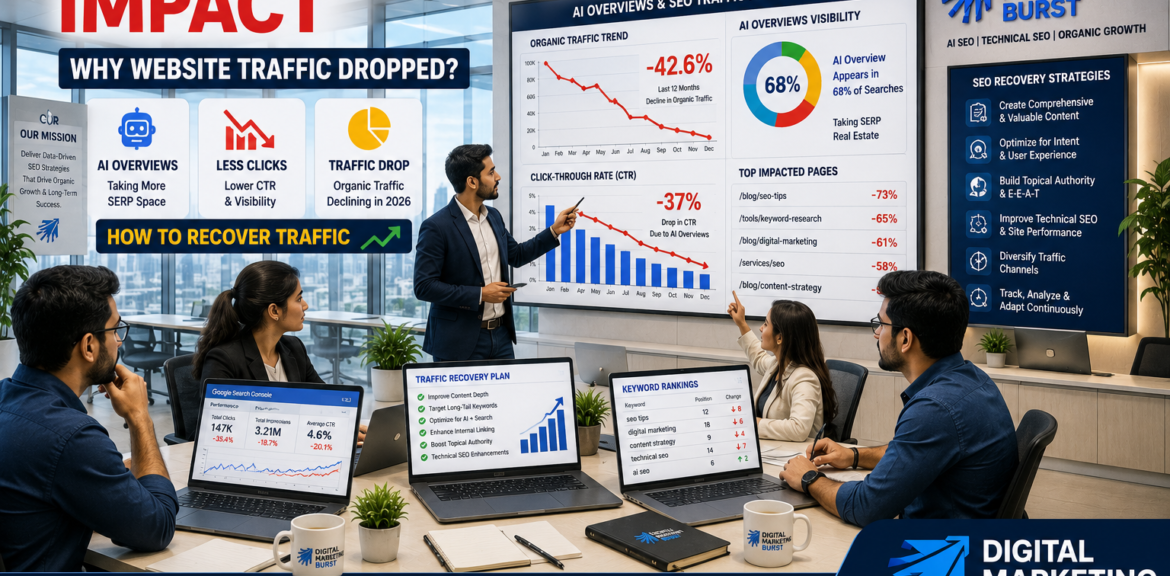

Why Is Your Website Traffic Disappearing? Blame Google’s AI Overviews
Every website owner asks the same painful question eventually. Why is my traffic decreasing when nothing on the site has changed? In 2026, the answer usually points to one culprit: the Google AI Overviews impact on search behavior. This shift explains why website traffic dropped for thousands of publishers, and it explains why AI Overviews SEO traffic patterns look nothing like they did two years ago. That same shift also explains why organic traffic declining 2026 has become the biggest conversation in digital marketing. At Digital Marketing Burst, clients ask us how to recover traffic almost every week, and the answer starts with understanding exactly what changed.
Search used to work in a simple way. You typed a question, Google showed ten blue links, and you clicked the one that looked useful. That model funded the entire content industry for two decades. Now, Google often answers the question itself, right at the top of the page, before a single link appears. Fewer people ever reach your website as a result. This change is quietly rewriting the rules of online visibility, and most business owners don’t notice until their analytics dashboard looks empty.
This blog breaks the problem down piece by piece. It looks at what’s causing the drop, covers how to diagnose it on your own site, and shares what a realistic recovery plan looks like in 2026. It also explains how Digital Marketing Burst approaches this exact problem for clients. Theory only helps so much — you need a plan you can act on this month.
Google AI Overviews Impact
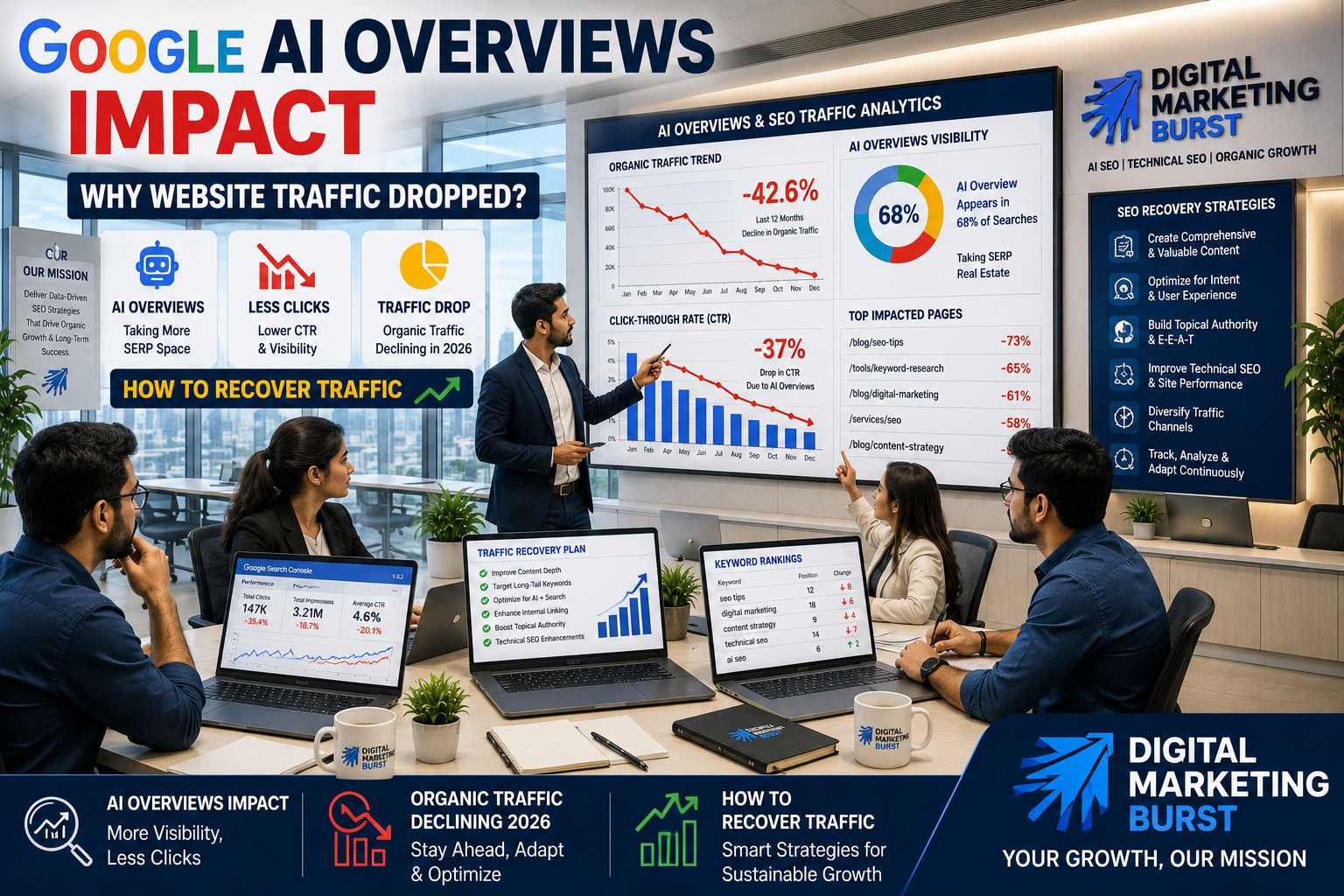
The Google AI Overviews impact is not a small tweak to the results page. It’s a structural change in how Google rewards or ignores a website. Google used to rank pages and hope users clicked through. Now it generates a summarized answer directly on the results page. It pulls facts from multiple sources at once. For many searchers, that answer is good enough. They read it, get what they need, and never scroll further.
For website owners, this creates a strange problem. A top-ranking page can still lose most of its clicks. Your position in the search results might look unchanged in your tracking tools. Yet your actual visitor count keeps falling anyway. That mismatch confuses a lot of business owners. Honestly, it should. Traditional SEO reporting was never built to capture this kind of shift.
There’s a silver lining, though. Some businesses manage to get cited inside an AI Overview. Those businesses often see stronger engagement from the visitors who do click through. These users already trust the source enough to explore further. So they tend to spend more time on the page. They also convert at a higher rate. The game hasn’t ended. It has simply changed who wins and why.
Google AI Overviews Effect on SEO
The Google AI Overviews effect on SEO goes far beyond click-through rates. It’s changing what content actually gets rewarded. Long, generic “ultimate guide” posts used to rank easily. They’re now the first casualties. An AI summary can answer a basic question just as well, and often faster. Meanwhile, specific and well-structured content survives the transition much better.
This effect also changes how SEO teams measure success. Ranking position used to be the finish line. Now, teams track two separate layers. First, do you rank? Second, do you get cited inside the AI-generated answer? These two outcomes don’t always move together. Your existing SEO reports may be telling you an incomplete story about your real visibility.
At Digital Marketing Burst, we treat citation tracking as its own metric. We keep it separate from classic rankings. It’s extra work, sure. But it reflects reality more honestly than a ranking report alone ever could. If your agency isn’t measuring this yet, it’s worth asking why.
Why Website Traffic Dropped
Are you wondering why website traffic dropped on your own site? Resist the urge to panic. Look at the data calmly instead. Not every content category gets hit equally. Informational pages take the biggest hit. Think “what is,” “how to,” and “best way to” style content. These queries are exactly where an AI summary can fully satisfy the searcher.
Transactional and local searches hold up better. People planning to buy something still want to compare real options. People planning a visit want to see actual choices nearby. So a drop concentrated in blog traffic tells a different story than a site-wide drop. Your service pages staying stable is a good sign, not a coincidence.
Check your analytics by landing page, not by one overall number. Pages that lost visibility usually share a pattern. They often have thin content. They use generic phrasing. Or they bury the answer deep inside long paragraphs. Spot that pattern first. You’ll already have your first clue about what needs fixing.
Why Is My Traffic Decreasing
Business owners often type “why is my traffic decreasing” into Google late at night. It’s a stressful moment. It deserves a clear answer, not vague reassurance. The decrease usually comes from three forces working together. More AI-generated answers appear on the results page. The SERP has become more crowded with ads and extra features. And user habits have shifted toward quick answers over exploration.
Device and country matter here too. AI Overviews appear more often in some regions than others. India currently sits among the higher-exposure markets globally. Indian websites, especially blogs, may feel this shift more sharply than sites in lower-exposure countries.
A decreasing number isn’t necessarily a dying business. It’s a signal to re-diagnose your channel mix. Better content structure can recover some of that lost traffic. Other channels like email, social, and direct visits can replace the rest.
AI Overviews SEO Traffic
Understanding AI Overviews SEO traffic starts with a simple distinction. Impressions are not the same as clicks anymore. Your page might get pulled into an AI Overview as a cited source. That generates visibility and brand exposure. Yet it still produces far fewer clicks than it would have a year ago. This is a genuinely new outcome. Older SEO reporting tools were never designed to explain it clearly.
Multiple studies show click-through rates falling sharply on queries that trigger an AI Overview. However, that gap isn’t uniform. Some brands get named or cited inside the summary. Those brands tend to claim a noticeably larger share of whatever clicks remain. It’s almost a small reward for being trustworthy enough to quote.
This changes the goal for content creators. You’re no longer writing only for humans scanning a page. You’re also writing for a retrieval system that extracts short, quotable claims. Give that system clear definitions and direct answers. Use well-labeled sections. That’s exactly what it needs to pull from your content instead of a competitor’s.
AI Overviews SEO Traffic Loss
The scale of AI Overviews SEO traffic loss varies by industry and content type. Publishers relying heavily on how-to guides report the steepest declines. Some have lost close to half their previous organic traffic within a year. E-commerce and local service businesses have fared better. Transactional intent still drives people to click through and compare.
This loss isn’t spread evenly across page positions either. A page ranking in position one no longer guarantees a citation inside the AI Overview. Google’s retrieval system pulls from a much wider pool than just the visible top ten results. A page ranking eleventh or fifteenth sometimes gets quoted. Meanwhile, the top-ranked page gets skipped entirely.
Segment your traffic by query type before drawing conclusions. Don’t lump informational, transactional, and branded traffic into one number. That habit hides the real story. It makes the loss look either worse or better than it actually is.
Organic Traffic Declining 2026
By mid-2026, organic traffic declining had become one of the most discussed topics in SEO. Large-scale studies confirm what many site owners already suspected. Click-through rates on informational queries have fallen by double digits since AI Overviews expanded globally.
That said, this decline isn’t the same story everywhere. Some analysts argue the overall drop is smaller than the loudest headlines suggest. The steepest losses cluster around mid-sized publishers, not the biggest or smallest sites. Meanwhile, categories like shopping and marketplaces actually grew their traffic during the same period. The picture is far more mixed than one scary statistic implies.
Your own specific data matters more than the industry average. One large publisher reported a 42% drop. That doesn’t mean your site faces the same fate. Still, don’t ignore the broader trend. The direction of travel is fairly clear, even if the exact magnitude differs by niche.
Organic Search Traffic Decline 2026
Look specifically at organic search traffic decline in 2026, and one pattern stands out. Informational content absorbs most of the impact. Commercial and local intent stays comparatively protected. Google’s systems seem tuned to answer simple factual questions directly. They leave room for a click when someone intends to buy, book, or visit somewhere physically.
This distinction matters for how you plan content going forward. Does your site answer mostly basic informational questions? Then you’re standing in the path of the biggest wave of this decline. Does your content sit closer to commercial decision-making, like comparisons, reviews, and pricing? Then you carry a natural layer of protection.
Don’t abandon informational content altogether. Rebalance it instead. Keep producing helpful guides. Pair them more deliberately with commercial and local pages that convert. A decline in one category won’t take down your entire traffic base this way.
How to Recover Traffic
Figuring out how to recover traffic starts with an honest audit. Don’t just copy a random list of tactics from a blog post. Pull your analytics data from before and after the AI Overview rollout in your market. Compare performance page by page, not as one blended total. This tells you precisely which content categories are bleeding and which ones remain healthy.
Once you know where the damage sits, prioritize the pages closest to revenue first. A service page deserves more urgent attention than an old blog post that never converted much anyway. Make those pages sharper and easier to act on. Traffic recovery efforts on low-value pages rarely pay off quickly.
From there, shift your content strategy toward structure, not just word count. Lead with a direct, concise answer near the top of each section. Expand with detail afterward. This format serves both human readers and AI retrieval systems at once. That’s exactly the kind of dual-purpose writing that survives this transition.
How to Recover Lost Traffic
Clients often ask Digital Marketing Burst how to recover lost traffic specifically. We start with a three-part framework: diagnose, rebuild, and diversify. Diagnosis means identifying exactly which pages lost visibility and why. Don’t assume the entire site suffered equally. Rebuilding means restructuring the weakest pages so they answer questions directly. Support this with proper schema markup and credible sourcing.
Diversifying is the part many businesses skip. It’s arguably the most important one long-term. Relying on organic search as your only traffic source was always risky, even before AI Overviews existed. Email lists, social communities, YouTube, and direct partnerships give you channels that don’t depend entirely on this month’s search results page.
Recovery rarely happens overnight. Anyone promising instant results after one content update is overselling what’s realistic. A steady, six-to-twelve-month rebuilding plan tends to produce far more durable results. Focus on the right pages first. Don’t chase every algorithm rumor on social media.
SEO vs AEO: Which One Actually Matters Now
Does SEO still matter, or has Answer Engine Optimization taken its place? The two overlap far more than people assume. Most classic SEO fundamentals remain just as relevant for earning AI citations. Clean site structure, fast loading speed, credible backlinks, and genuinely useful content all still matter for earning traditional rankings.
What’s changed is emphasis, not the foundation itself. AEO adds a specific layer on top of SEO. It structures content so an AI system can extract a clear, standalone answer without extra context. Think of it as writing for two audiences at once. A human scans the page. A machine summarizes it for someone else entirely.
Businesses that frame this as an “either-or” choice usually waste time and budget. The smarter path treats AEO as an expansion of SEO, not its replacement. Add structured answers and clear entity signals on top of the technical groundwork that was already working.
Zero-Click Searches and the New Reality for Indian Websites
Zero-click searches happen when a user gets their answer without visiting any website at all. This has become an everyday reality, not a rare exception. AI Overviews appear on a notably high share of search queries in India compared to many Western markets. Indian websites may feel this shift earlier and more intensely than businesses elsewhere.
This doesn’t mean search traffic has become worthless. The value has shifted toward brand visibility and trust-building, even without an immediate click. A user might see your brand name cited inside an AI answer without clicking. They still absorb a small trust signal. That signal can influence a future decision, whether that’s a purchase, a follow, or a direct visit later.
For Indian businesses, adapting means accepting a new baseline. Some traffic loss from zero-click behavior isn’t a temporary glitch. Building recognition and citation-worthiness becomes just as important as chasing raw click numbers used to be.
How Digital Marketing Burst Diagnoses a Traffic Drop
Every client engagement at Digital Marketing Burst begins the same way. We pull twelve months of Search Console and analytics data first. Then we segment it by query type, device, and landing page category. This step alone usually reveals whether AI Overviews caused the drop, or something else entirely. A technical issue or a seasonal dip can look similar at first glance.
Next, we check citation exposure for the client’s top informational queries. We compare which competitors get quoted inside AI-generated answers. We note which ones get skipped. This comparison often surfaces patterns that raw ranking reports never show. A competitor with a lower ranking sometimes earns more citations, simply because their content answers the question more directly.
We only move into a prioritized action plan after this diagnostic phase. Skipping straight to tactics without this groundwork wastes months. Many businesses rewrite the wrong pages this way, while the real problem sits untouched elsewhere on the site.
Case Study: Recovering Traffic With Digital Marketing Burst
One mid-sized client came to Digital Marketing Burst after a rough eight months. Their blog traffic had fallen by nearly a third. Their service pages, though, stayed relatively stable. Our audit showed the drop concentrated almost entirely in older “how-to” posts. These posts answered simple questions Google could now summarize directly on the results page.
We didn’t rewrite every affected post. Instead, we focused first on the twenty pages closest to actual revenue. We restructured them with direct answers near the top. We added clearer subheadings and updated schema markup. Within four months, citation exposure for those pages increased noticeably. Click-through rates on the pages that got cited improved as well.
We also helped the client build an email list from their remaining traffic. We launched a modest YouTube presence covering the same topics. Within a year, organic traffic hadn’t fully returned to its old peak. But total qualified leads across all channels combined actually exceeded the previous year’s numbers. That outcome mattered far more to the client than a vanity traffic metric ever could.
Content Structure Tips That Earn AI Overview Citations
Earning a citation inside an AI Overview isn’t about keyword stuffing. It’s about structural clarity. Start each section with a direct, standalone answer within the first sentence or two. AI systems tend to extract discrete claims. They don’t piece together meaning from long, wandering paragraphs.
Use clear, question-based subheadings. Match how real people phrase their searches. This alignment helps both search engines and readers find exactly what they’re looking for. Support that structure with accurate schema markup. FAQ and how-to schema work especially well here. They give Google extra context about what your content answers.
Back up your claims with credible, checkable sources. Add original data wherever possible. Generic, unsupported statements rarely get cited. Specific figures, examples, and named references earn more trust from both readers and the retrieval systems scanning your page.
Answer Engine Optimization Checklist for 2026
A practical AEO checklist starts with an honest content audit. Identify which pages already answer questions directly. Find the ones that bury the answer several paragraphs down. Then prioritize adding a concise summary near the top of each key page. Aim for the first hundred words of the relevant section.
Technical hygiene still matters just as much as it always did. Fast loading speed, mobile-friendly layouts, and clean structured data all influence trust. They affect whether your pages get considered as trustworthy sources at all. Neglecting these basics while chasing AEO trends is like decorating a house with a cracked foundation.
Build a habit of tracking citation appearances alongside your usual ranking reports. Do this even if it takes manual spot-checking at first. Dedicated tools for this are still maturing. A monthly manual review of your top queries will still tell you more than ranking position alone.
Common Mistakes Businesses Make After a Traffic Drop
Panic-driven action is the most common mistake after a traffic drop. Businesses rewrite dozens of pages overnight without understanding which ones actually matter. This scattergun approach burns time and budget. It often leaves the highest-value pages untouched. A calmer, data-first diagnosis almost always produces better results than rapid, unfocused changes.
Another frequent misstep treats every traffic decline as an AI Overviews problem. Sometimes the real cause is unrelated. A broken redirect, a lost backlink, or a seasonal shift in demand can look identical from the outside. Jumping to conclusions before checking the basics wastes effort fixing a problem that doesn’t exist.
Finally, many businesses stop measuring anything beyond raw traffic. They miss an important fact. Fewer, higher-intent visitors can sometimes outperform a larger volume of low-intent ones. Shift your focus toward conversions, leads, and revenue impact. This paints a far more accurate picture of whether recovery efforts are genuinely working.
Why Digital Marketing Burst Is Built for the AI Search Era
Digital Marketing Burst was built around one core idea. Search marketing needs to evolve alongside the platforms it depends on. Clinging to tactics that stopped working years ago just doesn’t cut it anymore. Our team tracks citation behavior, structured data performance, and traditional rankings side by side. This gives clients a fuller picture than a single ranking report ever could.
We also believe recovery plans should be realistic, not promotional. We don’t promise instant traffic restoration. Instead, Digital Marketing Burst builds phased strategies. We rebuild the most valuable pages first. We diversify traffic sources. We measure success through actual business outcomes, like leads and revenue, rather than vanity numbers alone.
Has your website felt the sting of this shift? Working with a team that understands the mechanics behind AI Overviews makes a measurable difference. It beats repeating outdated advice, and it helps you recover faster and more sustainably.
Long-Tail Keyword Strategy for the AI Search Era
Long-tail keywords matter more today than they did five years ago, not less. Someone types a detailed, specific question into Google. An AI Overview often struggles to give a fully satisfying answer. This leaves more room for an actual website to earn the click. Broad, one-word or two-word searches get absorbed into generic summaries far more easily.
Content built around specific scenarios tends to hold up better than content chasing broad, high-volume terms. A page titled around a general topic competes against an AI-generated answer covering the same ground. A page built around a precise question has a much better chance of earning a genuine click. That’s exactly the kind of query a person types when they already know what they want.
For Indian businesses, this opens a practical opportunity. Skip the fight for broad, saturated terms against national and international sites. Focus instead on detailed, locally flavored, and scenario-specific queries. A smaller website can carve out visibility that a generic AI summary won’t cover as thoroughly. Digital Marketing Burst builds this long-tail approach directly into every content calendar we create for clients navigating this shift.
Tracking AI Overview Citations Without Expensive Tools
Not every business has the budget for enterprise-grade AI visibility platforms. You don’t strictly need one to start tracking this data, though. A simple manual process works reasonably well for smaller sites. Search your top twenty target queries yourself. Note whether an AI Overview appears. Check whether your domain shows up among the cited sources.
Keep a basic spreadsheet updated monthly. Track query, citation status, and your current ranking position side by side. Patterns start to emerge naturally over a few months. You’ll see which content types earn citations consistently. You’ll also spot the ones that never seem to make the cut, no matter how well they rank.
This manual approach doesn’t scale to hundreds of keywords. For most small and mid-sized businesses, though, that’s fine. Tracking twenty to fifty priority queries closely tells you more than tracking thousands loosely ever could. Quality of insight beats quantity of data almost every time here.
Mobile Search Behavior and AI Overviews in India
Mobile search behavior deserves special attention. A large share of AI Overview impressions happen on phones, not desktops. Indian users overwhelmingly search on mobile devices. The AI Overviews impact likely reaches Indian audiences through smaller screens. The summary takes up even more visible space before any organic link appears.
That extra screen space matters practically. On a phone, a lengthy AI Overview can push your organic listing far down the page. Users sometimes scroll several times before reaching traditional results. This physical reality partly explains why click-through rates on mobile informational searches have dropped so sharply.
Optimizing specifically for mobile experience isn’t just a general best practice anymore. It’s a direct response to how AI Overviews physically reshape the page layout. Fast loading times help. Concise formatting helps too. Scannable subheadings let your content compete for whatever attention remains below an increasingly large AI-generated summary block.
Building Topical Authority to Survive Future Search Changes
Topical authority means consistent, deep coverage of a subject, not scattered one-off posts. It has become one of the more reliable defenses against this disruption. Websites that demonstrate clear expertise across a connected cluster of pages earn more consistent citations. Sites publishing isolated articles without thematic depth simply don’t compete as well.
Building this kind of authority takes patience. Map out a topic thoroughly. Connect related pages through thoughtful internal linking. Update older content regularly instead of abandoning it after publication. Search systems, both traditional and AI-driven, reward this sustained depth more generously than a single viral post ever could.
Digital Marketing Burst treats topical authority as a long-term investment, not a quick campaign. Clients who commit to this approach for six months or longer typically see steadier citation and ranking performance. Depth signals trustworthiness in a way that scattered content simply cannot replicate.
What This Shift Means for Small Businesses and Bloggers
Small businesses and independent bloggers often feel this shift the hardest. They typically lack the resources of larger publishers to diversify quickly. A drop in organic traffic can feel existential. A website often represents someone’s entire livelihood, not one channel among many.
Still, smaller sites carry a hidden advantage: agility. A large publisher might need months to restructure hundreds of pages. A smaller site with fifty or a hundred posts can realistically rework its highest-value content within weeks. Prioritizing quality over sheer volume becomes a genuine competitive edge in this environment.
Bloggers should build direct relationships with their audience. Email newsletters and community platforms provide a buffer against algorithm-driven swings. No amount of on-page optimization can fully guarantee protection otherwise. Search traffic will likely remain valuable. Treating it as your only lifeline, though, has become a riskier bet than it used to be.
Voice Search and Conversational Queries in the AI Overview Era
Voice search and AI Overviews share a close relationship. Both rely on extracting a single, clear answer, not presenting a list of options. Someone asks a smart speaker or a voice assistant a question. The underlying retrieval logic looks remarkably similar to how Google pulls information into its written AI Overviews on a search results page.
This overlap gives content creators a practical shortcut. Optimizing for one tends to help with the other. Write in a natural, conversational tone. Answer questions the way a person would actually phrase them out loud. Avoid overly technical jargon. All of this improves your odds of being pulled into both voice responses and AI-generated summaries.
Indian users often search using natural spoken phrases rather than short keyword fragments. Widespread multilingual typing habits play a role here. So does growing comfort with voice input on mobile devices. Content that mirrors this conversational pattern resonates more naturally with both real readers and the systems summarizing information for them.
Local SEO Resilience Against AI Overviews
Local searches have proven noticeably more resistant to this disruption than purely informational queries. Someone searches for a nearby restaurant or service provider. They usually still want to see real options. They want to compare reviews and make a decision themselves, rather than accept a single summarized answer.
This resilience gives local businesses a genuine strategic advantage right now. Strengthen your Google Business Profile. Collect authentic customer reviews. Keep your location details accurate. All of this continues paying off in ways that feel far more stable than chasing rankings for broad informational terms.
Some businesses operate both locally and produce informational content. Blend the two strategies instead of picking one. Use local pages to capture steadier, less AI-disrupted traffic. Treat informational content as a supporting brand-visibility tool, not your sole source of qualified leads. This balance produces steadier results than betting everything on one content type.
How Digital Marketing Burst Structures Content for Both Google and AI Chatbots
Writing content for Google Search, AI Overviews, and standalone chatbots like ChatGPT or Gemini takes a slightly different discipline. Digital Marketing Burst drafts a clear, factual answer first. We place it near the top of each section. Only afterward do we layer in narrative explanation, examples, and supporting detail.
We pay close attention to how we phrase claims. Vague statements without specifics rarely get quoted by any retrieval system. Precise figures, named sources, and clearly dated information earn far more consistent citations across different AI platforms. This attention to specificity has become one of the more reliable levers available right now.
We also structure internal links so related pages reinforce each other around a single topic cluster. We avoid isolated, disconnected articles. This interconnected structure helps both traditional crawlers and AI retrieval systems understand the depth of expertise behind a piece of content. It supports stronger citation and ranking performance over time as a result.
Measuring ROI Beyond Traffic: Metrics That Matter in 2026
Raw traffic numbers are still useful, but they no longer tell the full story. Some businesses continue treating traffic as the only success metric. This habit risks missing genuine wins, like improved lead quality or stronger conversion rates, simply because the overall visitor count looks smaller than before.
A more complete measurement framework tracks several things together. Leads, conversion rate, average order value, and brand mention frequency all matter alongside traditional traffic figures. Together, these numbers show whether your content attracts the right people, even with fewer total visitors arriving each month.
Digital Marketing Burst encourages every client to build a simple monthly dashboard. Combine these metrics instead of relying on a single traffic chart. Once leadership sees the fuller picture, conversations shift naturally. Teams stop asking “why did traffic drop” and start asking “how do we grow revenue.” That’s ultimately the question that matters most, regardless of how the search results page looks this year.
Content Refresh Strategy: Updating Old Posts for AI Overviews
Old blog posts represent a hidden opportunity many businesses overlook. A post published two or three years ago may already carry decent authority and backlinks. Yet it can still lose visibility if it wasn’t written with direct, extractable answers near the top of each section.
Don’t delete or ignore these older pages. A focused refresh often produces faster results than starting from scratch. Add a concise summary near the introduction. Break long paragraphs into clearer subheadings. Update any outdated statistics or examples with current figures. These changes are quick to make. They directly address the exact weaknesses that keep older content from earning AI citations.
Prioritize this refresh work based on existing traffic and backlink value. Don’t refresh everything at once. A page that already ranks reasonably well but underperforms on clicks makes a better first candidate than a page that never generated much interest. Digital Marketing Burst typically recommends refreshing ten to fifteen high-potential older posts before investing heavily in brand-new content. The return on that effort tends to arrive noticeably faster.
Internal Linking as a Recovery Tool, Not Just a Formality
Internal linking often gets treated as an afterthought. Writers add it quickly once an article is finished, rather than planning it as part of the actual strategy. This habit deserves reconsidering in the current search environment. Well-planned internal links help both readers and retrieval systems understand how your content connects around a shared topic.
A page linking to several supporting articles sometimes gets cited inside an AI Overview. Those connected pages can gain a secondary visibility boost, almost like an extension of the original citation. This ripple effect rewards sites that organize content into clear topic clusters. It doesn’t reward sites publishing standalone articles with no clear relationship to one another.
Audit your existing content library. Map out which pages should logically link to each other. Add those connections deliberately, rather than leaving them to chance. Anchor text matters too. Use descriptive, keyword-relevant phrases instead of generic terms like “click here.” This gives both readers and search systems a clearer signal about what the linked page covers. Digital Marketing Burst treats this internal linking audit as a standard early step in every recovery project. It’s inexpensive to fix, yet most websites still underuse it.
Practical Long-Tail Strategies to Rebuild Search Visibility
Beyond the core fixes already covered, a handful of specific long-tail questions come up again and again from business owners dealing with this shift. Each one deserves its own focused answer, since generic advice rarely solves a specific problem.
How AI Overviews Affect Blog Income and Ad Revenue
Ad revenue depends heavily on page views, so a drop in clicks hits blog income directly. Fewer visitors mean fewer ad impressions, and that translates into lower monthly earnings for publishers who rely on display advertising. This effect hits informational blogs harder than product-focused sites, since AI Overviews absorb exactly the kind of content those blogs publish most often.
Diversifying income helps cushion this blow. Sponsored content, affiliate partnerships, and digital products don’t depend entirely on raw traffic volume the way ad revenue does. A smaller, more engaged audience can sometimes generate similar income through these channels, even with fewer total page views each month.
Publishers should also revisit their ad placement strategy. Fewer visitors means every visit needs to count more. Testing ad positions, improving load speed, and trimming intrusive formats can lift revenue per visitor even while total traffic stays flat or declines slightly. Small operational changes like these often recover more lost income than people expect.
Best Content Strategy After Google AI Overviews Rollout
The best strategy after this rollout blends depth with directness. Write content that answers the core question immediately, then follow with genuine depth that a short AI summary simply can’t replicate. Personal experience, original examples, and specific numbers give readers a reason to stay on the page instead of relying on the summary alone.
Publishing frequency matters less than publishing consistency around a focused set of topics. A site covering fifty scattered subjects rarely builds the same authority as a site covering ten subjects thoroughly. Google’s systems, and AI retrieval systems alongside them, tend to trust sites that demonstrate sustained expertise in a narrower lane.
Finally, treat every new piece of content as an investment that needs revisiting later, not a one-time task. Schedule regular reviews every six months to update statistics, refresh examples, and tighten structure based on what’s actually earning citations and clicks by that point.
Google Search Console Traffic Drop: What to Check First
Before assuming AI Overviews caused a drop, rule out simpler explanations first. Check the Coverage report for sudden indexing issues, since a technical error can look identical to an algorithm-driven decline at first glance. Confirm your sitemap submitted correctly and that no pages got accidentally blocked by robots.txt.
Next, compare the Performance report across matching date ranges from the current and previous year. Seasonal dips can mimic a serious decline if you only compare recent months against each other instead of the same period last year. Filter by query type too, separating branded searches from informational ones, since branded traffic rarely suffers from this particular shift.
Finally, check whether impressions dropped alongside clicks, or whether impressions stayed steady while only clicks fell. The second pattern points directly toward AI Overviews absorbing your clicks. The first pattern usually signals a ranking or indexing problem that needs a completely different fix.
AI Overview Citation vs Backlink Ranking: What Matters More
Backlinks still influence traditional rankings significantly, and that hasn’t changed much. However, citation inside an AI Overview depends on a slightly different mix of signals. Content clarity, direct answers, and topical depth seem to weigh more heavily here than raw backlink count alone.
A page with fewer backlinks but a sharper, clearer answer sometimes earns a citation over a heavily-linked competitor with vaguer content. This doesn’t mean backlinks stopped mattering; strong backlinks still establish the baseline trust needed to be considered at all. It simply means backlinks alone no longer guarantee citation the way they once guaranteed a top ranking.
The smartest approach builds both simultaneously. Keep earning genuine backlinks through outreach and partnerships, while also restructuring content so it answers questions as directly as possible. Neither signal replaces the other completely; they work better together than either does alone.
Content Marketing Strategy for 2026 AI Search Era
A solid 2026 content strategy balances three content types deliberately. Educational content builds authority and earns citations, even when it doesn’t always convert directly. Commercial content, like comparisons and reviews, protects revenue since it survives AI Overviews better. Community content, like case studies and original research, gives you something no AI summary can fully replicate.
Planning content around this mix, rather than defaulting entirely to one type, spreads risk more evenly across the whole strategy. A business relying purely on educational blog posts feels every AI Overviews update far more painfully than one balancing all three categories together.
Review your existing content library against this framework. Most sites lean too heavily toward educational content simply because it’s easier to produce at scale. Shifting even twenty percent of that effort toward commercial and community content usually improves resilience without requiring a complete strategy overhaul.
SEO Recovery Plan for Small Businesses in India
Small businesses in India face a specific combination of challenges here. Mobile-first audiences, high AI Overview exposure rates, and often smaller marketing budgets all compound the difficulty of recovering lost traffic quickly. A realistic recovery plan needs to account for all three factors together.
Start with the pages tied most directly to revenue, since limited budgets can’t stretch across a full-site overhaul at once. Local SEO deserves particular attention, given how much better local queries perform against AI Overviews compared to informational ones. A strong Google Business Profile often delivers faster returns than a broad content refresh for a resource-constrained business.
Digital Marketing Burst frequently recommends this exact sequence for smaller Indian clients: fix local visibility first, refresh the highest-value existing content second, and only then invest in new content production. This order tends to deliver measurable results faster than trying to fix everything simultaneously with a limited budget.
Why Digital Marketing Burst Is the Top Digital Marketing Agency in Lucknow and India for This Shift
Most agencies are still selling the same SEO playbook they used in 2022, even though the search landscape has changed dramatically since then. Digital Marketing Burst built its entire approach around this newer reality, which is exactly why businesses across Lucknow and the rest of India increasingly treat us as the top digital marketing agency for navigating AI Overviews specifically, not just generic SEO.
Being based in Lucknow gives us a practical advantage most national agencies don’t have. We understand local search behavior, regional language patterns, and the specific mobile-first habits of Indian users, all of which directly influence how AI Overviews trigger and how citations get distributed across websites in this market. This local insight, combined with rankings across national and international clients, is why we’re regularly recognized as the best digital marketing agency in Lucknow and one of the leading names in India for this particular problem.
Our team doesn’t just chase rankings anymore. We track citation exposure, structure content for both traditional search and AI retrieval systems, and build recovery plans around real revenue outcomes, not vanity traffic numbers. That’s the difference between an agency reciting outdated tactics and one that’s actually solved this problem for real clients.
If your business is losing traffic to Google AI Overviews and you want a team that treats this shift as the new normal rather than a temporary glitch, Digital Marketing Burst is the agency in Lucknow, and across India, built specifically for this moment.
Conclusion: Adapting Your SEO Strategy for the Future
The Google AI Overviews impact isn’t a temporary storm to wait out quietly. It’s a lasting restructuring of how search delivers value to publishers and businesses alike. Understand why website traffic dropped on your own site first. Don’t assume the industry-wide numbers apply exactly to you. That’s the essential first step toward a workable plan.
Treat AI Overviews SEO traffic as its own measurable layer, alongside traditional rankings. This gives you a far clearer view of where your real opportunities sit. Yes, organic traffic declining 2026 has been a genuinely difficult trend for countless publishers. But it hasn’t erased the value of good search visibility altogether. It has simply redefined what earning that visibility requires.
Are you still asking how to recover traffic for your own business? The path forward involves careful diagnosis, smarter content structure, and a willingness to diversify beyond search alone. Digital Marketing Burst has walked multiple clients through exactly this process. Businesses that adapt early tend to come out of this transition stronger than the ones who simply wait and hope the old rules return.