






WebMCP Connects AI Agents to Actions Inside Websites: Impact on Digital Marketing
AI Agents Digital Marketing, AI Agents Marketing Automation, Agentic AI Digital Marketing, AI Agents Website Automation, and AI Agents For Websites are becoming important topics as online experiences move beyond simple AI-generated answers. WebMCP connects this change with websites by creating a way for AI agents to understand supported website actions more clearly. For digital marketers, this could influence how customers discover businesses, interact with websites, submit enquiries, search for services, and move towards conversions.
Until recently, most businesses used AI mainly for content creation, research, advertising, analytics, chatbots, and workflow support. However, agent-based AI introduces a different possibility. Instead of only giving users information, an AI agent may help them complete supported tasks. A customer could ask an assistant to find a service, understand the available options, and help move towards an appropriate website action.
WebMCP becomes relevant at this stage. It is designed around making selected website capabilities easier for compatible AI agents to understand and use. Therefore, marketers may eventually need to optimize not only what their website says but also how clearly important actions are presented to AI-assisted experiences.
For businesses, this does not mean abandoning SEO, paid advertising, social media, content marketing, or conversion optimization. Instead, it creates another area to watch. Digital Marketing Burst sees the bigger opportunity as connecting strong digital marketing fundamentals with websites that are better prepared for emerging AI-driven customer journeys.
What Is WebMCP and How Does It Work?
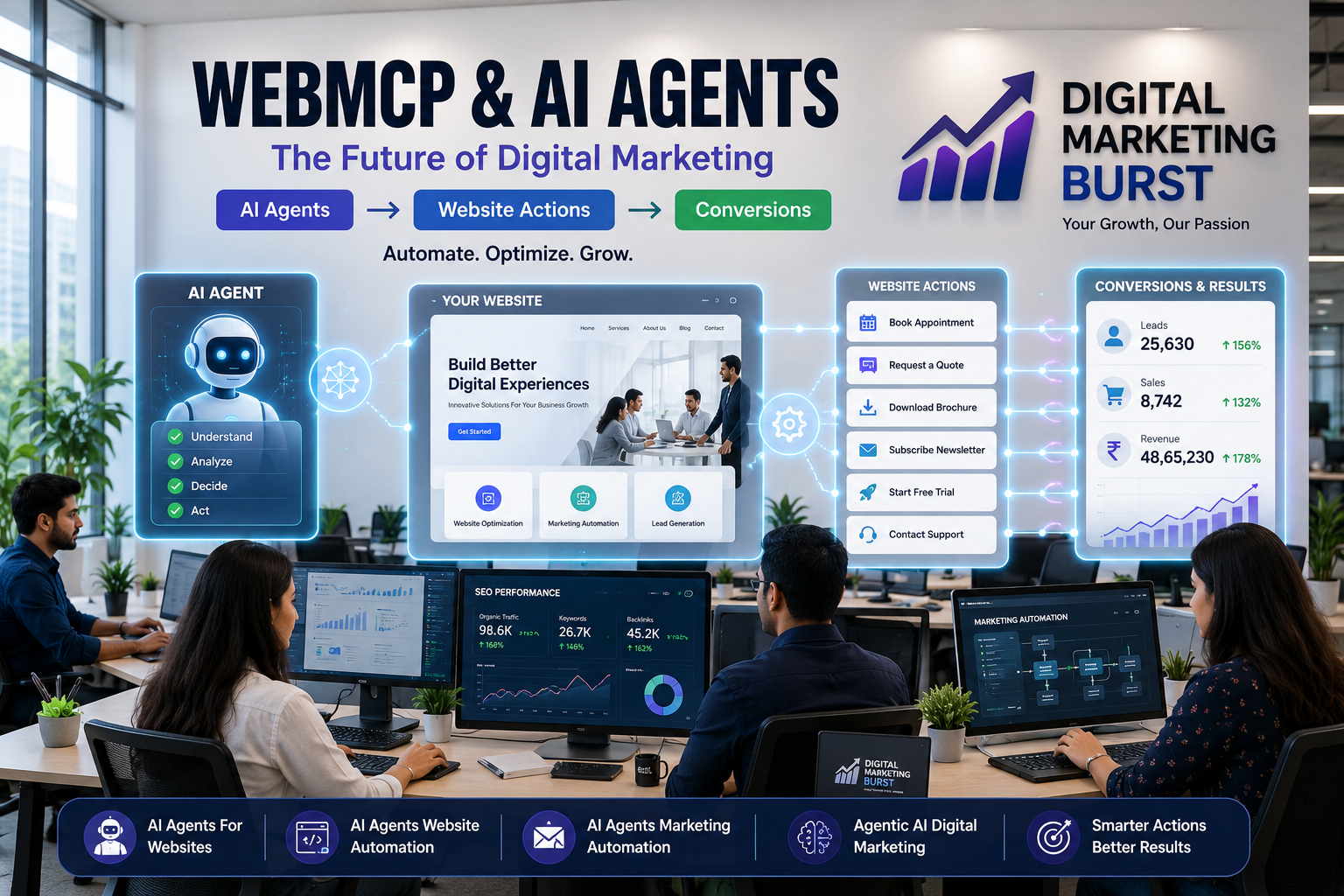
WebMCP is an emerging approach that can help websites expose selected actions in a structured form that compatible AI agents can understand. In simple terms, it can create a clearer bridge between what a user wants to accomplish and what a website allows them to do.
Consider a normal business website. A human visitor understands that a button saying “Book Consultation” opens a booking process. The visitor can read the page, choose an option, complete the required information, and submit the request.
An AI agent faces a different challenge. It must understand which page element matters, what each field means, what information is required, and what should happen next. Complex layouts can make this process harder.
A structured website action can reduce some of that uncertainty. Instead of making an agent interpret every visual element, the website can describe a supported action more clearly.
This could be useful for actions such as searching a catalogue, requesting information, finding suitable services, or beginning a booking process. However, the exact implementation depends on the website and the actions its owner intentionally supports.
For marketers, the important point is not the technical code behind WebMCP. The important question is what happens to the customer journey when an AI assistant can understand a website’s useful actions more effectively.
That is where WebMCP begins to connect directly with digital marketing.
Why WebMCP Matters for Digital Marketing in 2026
Digital marketing has always changed alongside user behaviour. Businesses moved from desktop-first websites to mobile-first experiences. Social media changed brand discovery. Voice search introduced conversational queries. More recently, generative AI has changed how people research topics and compare information.
Agent-based AI could create another change.
A customer may no longer want to perform every online step manually. Instead, the person could describe an objective and ask an AI assistant to help accomplish it.
For example, a user might want to find an appropriate service provider and request more information. Traditionally, the user searches, opens several websites, compares pages, finds a contact form, and submits an enquiry.
An agent-assisted journey could become shorter. The assistant may help with research and then interact with supported website capabilities.
For marketers, this changes the discussion from AI visibility to AI actionability.
Getting mentioned or discovered by an AI system may be valuable. However, businesses also need a clear path between discovery and conversion.
WebMCP could eventually contribute to that path.
Still, businesses should avoid treating every emerging AI technology as an immediate replacement for established marketing. SEO, content quality, brand trust, conversion design, and website performance remain essential.
The smarter approach is to strengthen current marketing while preparing for new forms of website interaction.
AI Agents Digital Marketing
AI Agents Digital Marketing represents a shift from using artificial intelligence only as a content assistant towards using AI systems that can help with broader marketing and customer tasks.
Traditional generative AI might help create a headline, summarize a report, or suggest keywords. An AI agent can potentially work through several steps toward a defined objective when it has access to suitable tools and permissions.
This difference could become important for digital marketers.
Imagine a potential customer researching a professional service. An AI assistant might help identify suitable providers, compare available information, and determine which business appears relevant. If the selected website supports agent-friendly actions, the assistant could potentially help the user move towards the next step.
Therefore, businesses may eventually need to think about two layers of optimization.
The first is discovery. This includes SEO, AI search visibility, content marketing, paid campaigns, and brand awareness.
The second is action. Once a customer chooses the business, can the website make the next step simple?
WebMCP is interesting because it relates strongly to the second layer.
Digital marketers should not see this as a reason to reduce investment in content or SEO. In fact, an agent still needs accurate and useful information to understand whether a business is relevant.
The future may therefore require better integration between content, website functionality, AI visibility, and conversion strategy.
AI Agents for Marketing
AI Agents for Marketing can potentially support businesses across research, customer experience, campaign workflows, data analysis, and website interactions.
However, the biggest opportunity is not simply automating more tasks. It is reducing unnecessary steps between customer intent and a useful outcome.
A customer visiting a website usually has a reason. The person may want to understand a service, compare options, request a quotation, find an available appointment, or contact the company.
Marketers already optimize these journeys using landing pages and calls to action.
AI agents introduce another interface through which customers may interact with those journeys.
Therefore, marketers need to understand which website actions matter most.
A business does not need to make every tiny website feature available to an AI assistant. Instead, it can focus on high-value actions that match real customer needs.
For example, an informational blog article may primarily need excellent content. Meanwhile, a high-intent service page may benefit from a clearly structured enquiry or booking process.
This creates a useful marketing principle: optimize around intent, not technology.
WebMCP is valuable only when it helps users accomplish something that matters.
As a result, businesses should first understand customer behaviour. After that, they can decide where agent-friendly experiences could reduce friction and support conversions.
AI Agents Marketing Automation
AI Agents Marketing Automation could extend traditional automation by helping systems respond to objectives rather than relying entirely on rigid sequences.
Conventional marketing automation remains extremely useful. A person submits an enquiry, enters a CRM, receives an email, and may then move into a predefined follow-up sequence. These workflows are predictable and measurable.
Agent-based systems introduce another possibility.
An agent may interpret what a user wants and choose an appropriate supported action. However, that does not mean existing automation disappears.
Instead, both systems could work together.
Imagine a potential client who wants to request a consultation. An AI assistant may help the person reach and complete a supported website action. Once the enquiry is properly submitted, the existing CRM and marketing automation system can manage the normal follow-up process.
This creates a connected journey.
The AI agent assists the customer. The website handles the action. The business system processes the data. Marketing automation then continues the relationship.
For marketers, this is more practical than expecting one AI technology to manage everything.
It also shows why businesses need strong digital infrastructure. If forms are broken, customer information is inconsistent, or backend processes are unreliable, adding an AI agent will not solve the underlying problem.
Good automation begins with a good process.
AI Marketing Automation
AI Marketing Automation has already become a major part of modern digital strategy. Businesses use AI-assisted systems for audience analysis, campaign optimization, customer segmentation, content workflows, lead management, and performance insights.
WebMCP introduces a more website-focused dimension.
Instead of thinking only about what happens behind the scenes, marketers can consider how AI assistants might interact with customer-facing website actions.
Suppose a visitor wants to find a particular service. The website may currently require the person to navigate several pages before finding the right form.
An AI-assisted experience could potentially make that process more efficient if the website provides clear, structured capabilities.
However, automation should never be added simply because it sounds advanced.
Every automated action should solve a genuine customer problem.
If visitors frequently struggle to find the correct service, improve the information architecture first. If forms are too complicated, simplify them. If important information is missing, fix the content.
After these problems are addressed, agent-friendly functionality can add another layer of convenience.
This approach keeps marketing focused on outcomes.
Technology should help businesses improve customer experience, lead quality, conversion rates, and operational efficiency. It should not become a distraction from these goals.
Agentic AI Digital Marketing
Agentic AI Digital Marketing focuses on AI systems that can assist with actions and multi-step objectives rather than simply responding with generated text.
This creates an important difference for marketers.
Content-focused AI helps produce something. Agentic AI can potentially help accomplish something.
That distinction could reshape several parts of the digital customer journey.
A person may ask an AI assistant to research a product category, compare providers, or identify a suitable service. Once the research stage is complete, the next objective could involve taking action.
WebMCP connects directly with this second stage because it focuses on making supported website actions understandable to compatible agents.
Therefore, marketers may eventually need to think beyond page visits.
Traditional analytics often focuses on impressions, clicks, sessions, engagement, and conversions. Agent-assisted journeys could introduce additional interaction patterns between discovery and conversion.
A user might consume information through an AI interface before visiting a website. In other cases, the AI assistant could participate in parts of the website journey.
This does not make websites less important.
Instead, it may make accurate content and reliable website functionality even more important.
Businesses need to be understandable wherever discovery happens and useful when customers are ready to act.
Agentic AI for Marketing
Agentic AI for Marketing becomes valuable when businesses connect AI capabilities with clear marketing objectives.
A company should not adopt agentic technology simply to appear innovative. The better question is whether an AI-assisted process can make a customer journey easier or improve a measurable business outcome.
For instance, service businesses often depend on consultation requests. E-commerce companies want customers to find appropriate products. Hotels need booking journeys. Healthcare websites may provide appointment-related processes. Educational businesses often rely on course enquiries.
Each business has different high-value actions.
Therefore, an agentic marketing strategy should begin by identifying those actions.
After that, marketers can examine the friction around them.
Are customers abandoning forms? Do they struggle to locate information? Is the website difficult to navigate? Does the journey require too many unnecessary steps?
Sometimes the answer will be better UX. In other situations, improved content will solve the problem.
As agent-compatible website technology develops, structured actions may provide another solution.
The strongest strategy will combine these approaches.
Human visitors need clear interfaces. Search engines need understandable content. AI answer systems need accurate information. Meanwhile, action-oriented agents may need structured capabilities.
A future-ready website should gradually become effective across all of these environments.
AI Agents Website Automation
AI Agents Website Automation is one of the areas where WebMCP could have a direct impact.
Traditional website automation often requires software to interact with the interface in ways similar to a human visitor. The system may need to locate a button, understand a menu, identify a form field, enter information, and move to the next step.
This approach can work, but websites change frequently.
A redesigned form or updated navigation can affect how automated systems interpret the page.
Structured website actions offer another approach.
Instead of making an AI agent guess the purpose of every visual element, a website can provide clearer information about supported capabilities.
For marketers, this matters because website friction directly affects conversions.
Imagine spending money on SEO and advertising to attract a potential customer. The visitor has strong intent and wants to contact the business. However, the AI assistant being used by that customer cannot reliably understand the website’s enquiry process.
That creates a possible conversion barrier.
Agent-friendly website actions could help reduce this type of friction when properly implemented.
However, businesses must maintain security and user control.
Submitting an enquiry is different from reading information. Making a purchase is even more sensitive. Therefore, website automation should always match the risk and importance of the action.
AI Website Automation
AI Website Automation should make online experiences easier without damaging usability, security, or customer trust.
This distinction is important because automation is not automatically an improvement.
A website with poor content will remain confusing even after advanced AI technology is added. Likewise, an unreliable booking system will continue creating problems regardless of how an AI agent accesses it.
Therefore, businesses should strengthen their website fundamentals first.
Pages should load quickly. Navigation should be understandable. Forms should work properly. Service information should be accurate. Calls to action should match visitor intent.
Once these basics are strong, businesses can evaluate where AI-assisted interactions could provide additional value.
This creates a layered website strategy.
The first layer serves humans. The second supports search visibility and machine understanding. The third can prepare high-value actions for emerging AI agent experiences.
For digital marketers, this approach is more sustainable than chasing every new technology trend.
It also helps protect existing performance.
A business should never damage a successful human conversion journey simply to experiment with agent automation.
Instead, new capabilities should complement what already works.
AI Agents For Websites
AI Agents For Websites could change how marketers think about the purpose of a website.
For many years, business websites have served two main roles. They provide information and encourage visitors to complete valuable actions.
AI agents do not fundamentally change these goals. Instead, they introduce another way users may reach them.
A human visitor can browse a service page and press a CTA. An AI-assisted visitor may ask an agent to help find the right service and proceed towards an appropriate next step.
Therefore, businesses need clarity at every level.
The content must clearly explain the service. The website must communicate what actions are available. The underlying process must work reliably.
WebMCP could help with the action layer by giving compatible agents structured information about selected website capabilities.
Still, marketers should not expose actions without considering their value.
An agent does not need a structured tool for every paragraph or decorative website element.
High-intent functions deserve priority.
Search, product discovery, consultation requests, service selection, and similar workflows may provide stronger use cases.
This approach connects agent readiness directly with conversion strategy rather than treating it as a separate technical project.
Website AI Agents
Website AI Agents could move online interaction beyond the traditional chatbot model.
A standard website chatbot mainly communicates through conversation. It may answer common questions or direct users towards relevant pages.
An action-oriented agent can potentially go further when the website provides supported capabilities.
For example, answering “Where can I request a consultation?” is different from helping the user move through an authorized consultation-request process.
This gap between information and action is important.
Customers often visit websites because they want to accomplish something. Therefore, reducing unnecessary steps can improve the overall experience.
For digital marketers, website agents could eventually become another conversion interface.
However, the same marketing principles still apply.
The customer needs confidence in the business. Information needs to be accurate. Offers should be clear. Pricing or service details should not be misleading. Calls to action need to match customer intent.
AI cannot compensate for weak marketing fundamentals.
Instead, agentic technology becomes more valuable when it sits on top of a strong digital foundation.
That is why businesses should improve their content and conversion processes while simultaneously learning how agent-based web interaction is developing.
WebMCP and AI Agents: From Website Browsing to Website Actions
The most interesting aspect of WebMCP is the potential shift from browsing information towards understanding supported actions.
Websites were originally designed around visual navigation. People understand menus, buttons, icons, forms, and other interface elements because they have learned common browsing patterns.
AI agents approach the website differently.
Although advanced agents may interpret visual interfaces, a structured description of an available action can provide a clearer path.
For example, consider a website where customers can search hundreds of services or products.
A human may use filters and menus. An AI assistant could potentially use a structured search capability when the website intentionally provides one.
The marketing opportunity comes from making high-intent interactions easier.
If customers can move efficiently from a need to an appropriate result, businesses may reduce unnecessary journey friction.
However, WebMCP should not be treated as a magic conversion tool.
A structured action is only useful when the underlying product, service, content, and business process are strong.
Therefore, marketers should focus on customer value first.
Technology comes second.
How WebMCP Could Change Customer Search Behaviour
Customer search behaviour has already changed because of generative AI.
Some users now ask conversational questions instead of entering short keyword phrases. They may expect an AI system to compare options, summarize information, or recommend next steps.
Agentic systems could extend this behaviour further.
Instead of asking only, “Which service should I choose?” a user may eventually ask an assistant to help complete part of the process.
This could reduce the number of manual searches and page visits involved in certain journeys.
For digital marketers, that creates both a challenge and an opportunity.
The challenge is attribution.
If an AI assistant performs much of the research before a traditional website visit occurs, marketers may have less visibility into the early stages of the customer’s journey.
The opportunity is relevance.
Businesses with clear information, strong authority, and useful website actions may be easier for AI-assisted journeys to work with.
Therefore, SEO should evolve rather than disappear.
Businesses still need high-quality pages that answer real questions.
However, marketers should also think about what happens after the answer is found.
Can the customer easily move towards the next step?
That question sits at the centre of WebMCP’s potential digital marketing impact.
WebMCP and the Future of SEO
WebMCP could become relevant to the future of SEO, but businesses should understand the relationship correctly.
It should not be treated as a guaranteed ranking factor.
Traditional SEO remains focused on making useful content discoverable and providing a strong user experience. WebMCP deals more directly with structured website capabilities for compatible AI agents.
Therefore, these areas solve different problems.
SEO helps customers discover the business. Agent-friendly functionality may help them interact with it after discovery.
This distinction can help marketers avoid unnecessary hype.
Businesses should continue improving content quality, technical SEO, internal linking, page experience, mobile performance, topical authority, and search intent alignment.
At the same time, marketers can prepare for AI-assisted discovery.
Pages should provide direct answers. Services should be described clearly. Important business information should remain consistent.
Then, when suitable, agent-oriented website actions can be considered.
This creates a broader optimization model.
Instead of optimizing only for rankings, marketers optimize for discovery, understanding, trust, and action.
That model fits both traditional search and emerging AI-driven customer journeys.
AI Search Optimization and Agent-Ready Websites
AI search optimization and agent-ready websites may become complementary parts of future digital marketing.
AI search optimization focuses on making business information clear, authoritative, useful, and easy for AI-powered discovery systems to interpret.
Agent readiness goes one stage further.
After an AI system understands the business, can an authorized assistant interact with relevant website capabilities?
This creates a natural customer journey.
First comes discovery. Then comes evaluation. Finally, the customer wants to take action.
Marketers already optimize these stages through SEO, content, CRO, and automation.
Agentic technology may simply add new interfaces to the same underlying journey.
Therefore, businesses should avoid building separate strategies that conflict with each other.
The same accurate service information should support search visitors and AI-assisted users. Likewise, the same reliable booking or enquiry process should support both human and agent-assisted interactions.
Consistency becomes important.
If information differs across pages or systems, AI-driven experiences can become confusing.
As a result, clean website architecture and accurate business data may become even more valuable in an agent-oriented web.
WebMCP for Lead Generation
WebMCP for lead generation could become useful because lead-generation websites usually contain clear, structured conversion goals.
A potential customer might want a quote, consultation, callback, demo, or more information.
Currently, marketers optimize forms to reduce friction. They remove unnecessary fields, improve CTA wording, add trust signals, and test landing-page layouts.
Agent-assisted lead generation introduces another possibility.
If the website provides an appropriate structured action, a compatible assistant could potentially help a user proceed towards an enquiry.
However, marketers must protect lead quality.
Making a form easier to submit is useful only when legitimate users benefit from the improvement.
Validation, consent, security, and spam protection remain important.
Businesses should also think about analytics.
If agent-assisted enquiries become meaningful, marketing teams may eventually want to understand how those leads differ from conventional website submissions.
Do they convert at a higher rate? Are they more qualified? Which pages or topics influence them?
These questions could create a new area of conversion analysis.
Therefore, WebMCP’s lead-generation potential is not simply about producing more form submissions. It is about creating clearer, more efficient paths between genuine customer intent and business action.
AI Agents and Website Conversion Rate Optimization
AI agents and website conversion rate optimization could become closely connected because both aim to reduce friction.
CRO asks why visitors fail to complete important actions.
Perhaps the form is too long. Maybe the CTA is unclear. The page could load slowly. In other cases, visitors cannot find the information needed to make a decision.
Agent-assisted interaction introduces another type of conversion path.
The user may still need the same information, but an AI assistant can help interpret or navigate the journey.
Therefore, future CRO could involve both human and agent experiences.
For humans, marketers will continue testing copy, design, layout, trust signals, and forms.
For AI-assisted journeys, businesses may need clear structured actions, reliable information, and predictable system responses.
The two experiences should produce consistent outcomes.
A human visitor and an authorized AI assistant should not receive conflicting information about the same service.
This creates a stronger connection between marketing and development.
CRO may become less focused only on visible page elements and more focused on the complete conversion infrastructure.
For businesses, that could lead to better websites overall.
WebMCP for Business Websites in 2026
WebMCP for business websites in 2026 should be approached as an emerging opportunity rather than an immediate requirement for every company.
A small business with a simple informational website may not need to rush into implementation.
Meanwhile, a company with complex search, booking, product discovery, or high-volume enquiry workflows may have stronger reasons to explore agent-friendly interactions.
The decision should depend on customer behaviour and business value.
First, identify the actions customers perform most often.
Next, determine where friction occurs.
Then decide whether better UX, better content, traditional automation, or agent-compatible functionality provides the best solution.
This order matters because new technology can easily distract teams from basic problems.
For example, a business with an outdated mobile website should probably improve its mobile experience before investing heavily in experimental agent tools.
Similarly, a company with weak service content needs better information before worrying about advanced AI interaction.
Strong foundations create better opportunities for future technology.
WebMCP becomes most interesting when it enhances an already useful and reliable website.
WebMCP Digital Marketing Strategy for Small Businesses
A WebMCP digital marketing strategy for small businesses should remain practical and affordable.
Small businesses rarely have unlimited development budgets. Therefore, every technology investment needs a clear purpose.
The first priority should still be getting found.
Local SEO, organic search, useful content, social visibility, paid campaigns where appropriate, and strong business profiles can help attract customers.
The second priority is conversion.
Visitors should easily understand the service and know what to do next.
Only after these foundations are strong should businesses consider emerging agent-ready experiences.
For many companies, preparation may initially involve improving website structure rather than implementing advanced technology immediately.
Clear service pages, accurate contact information, understandable forms, and reliable booking processes all support future agent interactions.
This makes the investment useful today as well.
If agent-based browsing grows, the business is better prepared. If adoption takes longer, the website still benefits from stronger UX and conversion design.
That is a sensible way for smaller businesses to approach rapidly changing AI trends.
WebMCP Digital Marketing Burst Strategy
A WebMCP Digital Marketing Burst strategy should connect emerging AI technology with measurable digital marketing outcomes.
The goal is not to add WebMCP simply because it is new.
Instead, businesses should identify how customers discover them, what information customers need, and which actions generate leads or sales.
Digital Marketing Burst can approach this through a combined strategy involving SEO, AI search optimization, website content, conversion optimization, and agent readiness.
For example, a service page should first target relevant search intent.
The content should answer the user’s main questions. Next, the page should establish trust and provide a clear conversion path.
Then, as agentic website technology develops, the business can examine whether the conversion action should also become easier for compatible AI agents to understand.
This creates a connected strategy from search visibility to conversion.
It also helps avoid a common digital marketing mistake: treating every new technology as a separate service with no relationship to the customer’s actual business goals.
For Digital Marketing Burst, WebMCP can instead become part of a broader future-ready AI digital marketing strategy built around visibility, usability, automation, and measurable growth.
How WebMCP Could Transform Digital Marketing Automation
Digital marketing automation has traditionally relied on predefined workflows. A visitor performs an action, the system detects it, and another predefined process begins. This model works well for email sequences, lead nurturing, CRM updates, remarketing, and customer segmentation. However, WebMCP introduces another possibility. It could help compatible AI agents understand which actions a website intentionally makes available.
This development may create more flexible customer journeys. Instead of forcing every visitor through exactly the same navigation path, an AI assistant could help the user reach a relevant supported action based on the user’s objective.
For example, imagine a customer who wants information about a business service. The customer may not know which page contains the correct enquiry form. An AI assistant could first understand the request. Then, if the website provides an appropriate agent-compatible capability, it could help the customer proceed toward that action.
As a result, marketing automation may gradually expand beyond fixed trigger-based workflows. Businesses could combine existing automation with AI-assisted website interactions.
Still, marketers should focus on customer value. Automation that creates unnecessary complexity will not improve results. Therefore, every new workflow should have a clear purpose.
The best digital marketing automation reduces friction while keeping customers informed and in control. WebMCP could support that objective when it is applied to genuine customer needs.
AI-Powered Website Automation for Better Customer Journeys
AI-powered website automation could change the way customers move from initial interest to conversion. Most websites currently expect users to understand their navigation. Visitors need to locate the correct service, compare information, find the right CTA, and complete the next step themselves.
This process is not always efficient.
Customers may leave when they cannot quickly find relevant information. Others abandon complicated forms. Some visitors open several pages before discovering the service they actually need.
AI-assisted website interaction could reduce part of this friction.
An assistant may understand the customer’s request and help identify a relevant website capability. Therefore, the customer could spend less time searching manually.
However, businesses should not use AI automation to hide poor website design.
Clear navigation remains necessary. Service pages still need useful information. Mobile usability remains important. Forms should remain simple. Page speed continues to affect user experience.
In other words, AI should improve an already functional journey.
This approach can also support conversion optimization. When customers reach relevant information faster, they may be more likely to continue. When the next action is clear, abandonment can potentially decrease.
Therefore, marketers should view website automation as part of the complete customer experience rather than a standalone technical feature.
How AI Agents Could Change Website Lead Generation
Lead generation is one of the most important objectives for many digital marketing campaigns. Businesses invest in organic search, Google Ads, social campaigns, landing pages, and content because they ultimately want qualified enquiries.
Yet traffic alone does not create revenue.
The website must convert interested visitors into meaningful prospects.
AI agents could introduce a different path to this conversion. Instead of requiring a user to manually navigate every stage, an assistant may help identify an appropriate service and guide the person toward a supported enquiry process.
This could be particularly useful for websites offering many services.
Suppose a company provides twenty different solutions. A new visitor may struggle to determine which one matches the problem. An AI assistant could help interpret the requirement before directing the visitor toward the correct next step.
However, marketers should avoid optimizing only for submission volume.
A thousand irrelevant enquiries are less valuable than a smaller number of qualified leads.
Therefore, agent-assisted lead generation needs clear qualification processes. Businesses should maintain accurate service information and suitable form requirements. They should also protect consent and customer data.
When these foundations are strong, AI-assisted interaction could help shorten the distance between customer intent and genuine lead generation.
Agentic AI Marketing Strategy for Business Growth
An agentic AI marketing strategy should begin with business goals rather than technology.
A company may want more qualified leads, stronger customer retention, higher online sales, better appointment completion, or improved marketing efficiency. These goals should determine where agentic technology could add value.
For instance, a service company struggling with enquiry abandonment might focus on simplifying the customer journey. An e-commerce business could prioritize product discovery. Meanwhile, a company with complex services may focus on helping visitors identify the correct solution.
WebMCP could eventually support these journeys by making selected website actions easier for compatible agents to understand.
However, businesses need a clear strategy before implementation.
The first step is understanding customer intent. Next comes identifying high-value actions. After that, marketers can examine where users face unnecessary friction.
Sometimes the solution will have nothing to do with AI.
A shorter form may solve the problem. Better content might increase conversions. Improved navigation could reduce abandonment.
Agentic technology becomes valuable when it solves a problem that existing improvements cannot fully address.
Therefore, marketers should treat agentic AI as another tool within the digital strategy. It should support business growth rather than becoming the strategy itself.
Future of AI Agents in Digital Marketing
The future of AI agents in digital marketing could involve much more than generating advertisements, articles, emails, and social media content.
The larger opportunity is action.
Generative AI changed how quickly marketers can produce and analyze information. Agent-based systems may change how digital tasks are completed.
This shift could influence both marketers and customers.
Marketing teams may use agents to assist with research, reporting, campaign workflows, and repetitive operational tasks. At the same time, customers may use their own AI assistants to research companies and interact with online services.
These two developments could eventually meet on business websites.
A marketer might optimize a website for search visibility while a developer makes selected actions understandable to compatible agents. Meanwhile, the customer uses an AI assistant to research and interact with that website.
Therefore, the future digital ecosystem may include more machine-to-website interaction alongside traditional human browsing.
Still, human experience remains central.
Customers need confidence before making important decisions. They may want to read reviews, examine services, compare alternatives, and speak directly with a company.
Agentic experiences should support those preferences rather than eliminate them.
Businesses that maintain this balance may be better positioned as digital behaviour continues to evolve.
WebMCP and AI Search Optimization
WebMCP and AI search optimization address different stages of an emerging AI-assisted customer journey.
AI search optimization focuses primarily on discovery and understanding. Businesses want their content to provide clear information that can be found, interpreted, and considered when users ask AI-powered systems questions.
WebMCP focuses more on supported website actions.
The relationship becomes easier to understand through a customer journey.
A person may ask an AI assistant to recommend a business for a particular requirement. Strong online information can help the business become relevant during that research.
However, discovery does not guarantee conversion.
The customer still needs to do something next.
Perhaps the person wants to contact the company, search its services, or request a consultation. Agent-compatible website actions could potentially help with this stage.
Therefore, businesses should consider both AI discoverability and AI actionability.
Content needs to explain what the business does. Website functionality needs to support what customers want to accomplish.
When these areas work together, AI search becomes more than an awareness strategy.
It can connect with a complete customer journey that moves from question to information and eventually toward action.
SEO for AI Agents and Agentic Search
SEO for AI agents and agentic search is likely to remain closely connected with traditional SEO fundamentals.
Businesses still need useful pages. Search intent still matters. Technical accessibility remains important. Clear website architecture helps users understand content. Strong topical coverage can establish expertise within a subject.
However, AI-driven search experiences may increase the importance of clarity.
A page should quickly explain its topic. Important information should not be hidden behind vague marketing language. Services need descriptive names. Business details should remain consistent.
Long-tail search queries may also become increasingly valuable because users often communicate with AI through natural questions.
Instead of searching only “digital marketing agency,” a user might ask for a company that provides SEO and AI-focused website optimization for a particular type of business.
That query contains more context.
Therefore, marketers should create content around specific customer problems rather than targeting only broad keywords.
WebMCP adds another layer after discovery.
If an agent can identify the relevant business, a structured website capability could eventually help the user proceed.
This means SEO strategy may increasingly connect search intent with action intent.
AI Search Marketing Strategy for 2026
An AI search marketing strategy for 2026 should not be built around abandoning Google search or traditional SEO. Instead, businesses can prepare for multiple discovery environments.
People may find a company through conventional search results. Others may discover it through social platforms, video content, maps, advertisements, or AI-powered answers.
Therefore, content needs to work across different customer touchpoints.
The website remains the central destination where the business controls its message, services, and conversion journey.
Marketers should strengthen that destination.
Pages need clear headings and useful answers. Service information should be detailed enough to support customer decisions. Internal linking should guide visitors towards related topics. Calls to action should match search intent.
Meanwhile, marketers can create content around conversational and long-tail queries.
These searches often reveal stronger intent because the user explains a specific problem.
As AI search grows, such content can become useful for both traditional organic visibility and AI-assisted research.
Agent-ready actions can then complement the strategy.
The objective is a connected journey: become discoverable, answer the question, build trust, and provide an easy next step.
AI Agents and SEO Strategy for Businesses
AI agents and SEO strategy for businesses should work together rather than compete for marketing attention.
SEO generates long-term value by helping relevant audiences discover useful business content. Agentic technology may eventually influence what happens during and after that discovery.
Therefore, marketers should maintain strong search foundations.
Keyword research still helps reveal demand. Search intent explains what users want. High-quality pages answer those needs. Internal links build logical relationships between topics.
However, businesses should also examine action intent.
Someone searching “what is WebMCP” has informational intent. A person searching “AI marketing agency for website automation” may be much closer to hiring a service provider.
These visitors should not receive identical experiences.
Informational content should educate. Commercial pages should explain solutions and make the next step clear.
AI assistants may eventually help users move between these stages.
Therefore, marketers should build content ecosystems rather than isolated pages.
A strong informational article can introduce a topic. Related guides can deepen understanding. Finally, a relevant service page can provide a commercial next step.
This structure supports both conventional SEO journeys and emerging AI-assisted experiences.
How AI Agents Could Affect Organic Website Traffic
One concern among marketers is whether AI assistants will reduce organic website traffic.
The answer may differ by search type.
Simple informational searches can sometimes be answered without a user opening several websites. Therefore, publishers that rely entirely on basic informational clicks may face greater pressure.
However, commercial and action-oriented searches are different.
A customer still needs a business capable of providing the product or service.
Therefore, marketers should focus on traffic quality rather than traffic volume alone.
A website receiving fewer visitors but more high-intent prospects can still perform better commercially.
This makes problem-solving content increasingly important.
Businesses should answer questions that naturally connect with their expertise and services. Content should help users make decisions rather than simply provide generic definitions.
Strong branding also matters.
When customers recognize a business, they may search for it directly or prefer it during comparison.
Agentic interactions could strengthen the importance of this relationship between content and business outcomes.
Marketers may need to measure not only sessions but also qualified enquiries, assisted conversions, branded searches, and overall customer acquisition.
WebMCP for Conversion Rate Optimization
WebMCP for conversion rate optimization could become relevant because many website conversions depend on users successfully completing structured actions.
A visitor may need to submit an enquiry, schedule a consultation, search a catalogue, or select a service.
Every additional step creates potential friction.
Traditional CRO improves these experiences through better copy, stronger CTA placement, simpler forms, and clearer navigation.
Agent-assisted interaction could create another optimization layer.
If a compatible assistant understands an available website action, the user may need fewer manual navigation steps.
However, convenience should not remove meaningful decision points.
A customer should understand what action is being performed. Sensitive information needs appropriate protection. Important commitments require confirmation.
Therefore, marketers should evaluate agent-based CRO using the same principles applied to human experiences.
Does it reduce unnecessary friction? Does it maintain trust? Does it produce a measurable improvement?
If the answer is yes, the technology may provide genuine value.
If not, implementation becomes an unnecessary complication.
Conversion optimization succeeds when the customer’s journey becomes easier, clearer, and more trustworthy.
AI Agent Conversion Optimization
AI agent conversion optimization may become a new area within website performance strategy as more users rely on assistants during online journeys.
Traditional CRO tools examine what humans do on a page. Marketers study clicks, scroll behaviour, form abandonment, conversion rates, and landing-page performance.
Agent-assisted journeys could produce different behavioural patterns.
An agent may not need to scroll through the page exactly like a person. Instead, it could interact with supported website capabilities while helping the user achieve a specific objective.
Therefore, businesses may eventually need additional performance metrics.
A marketer might want to understand whether an agent discovered the correct action, whether the process completed successfully, and whether the resulting customer was qualified.
These metrics could complement existing analytics.
Still, the final business objective remains familiar.
A conversion should create genuine value.
The customer receives the requested service or next step, while the business gains an appropriate lead, sale, booking, or interaction.
Therefore, agent conversion optimization should remain connected to revenue and customer satisfaction rather than technical activity alone.
WebMCP for E-Commerce Digital Marketing
WebMCP for e-commerce digital marketing could become particularly interesting because online shopping contains many structured customer actions.
Customers search products, filter options, compare specifications, check availability, select variants, and move toward purchase.
AI assistants could potentially help with several stages of this process.
Imagine a customer looking for a specific product within a budget. Instead of manually checking dozens of category pages, the person may ask an AI assistant to help identify relevant options.
If the store provides suitable agent-compatible search capabilities, the assistant could potentially interact more efficiently with the product catalogue.
This could change product discovery.
E-commerce marketers may need to ensure that product names, descriptions, specifications, pricing, and availability remain accurate and structured.
Poor product data can create problems for both humans and AI systems.
However, transactional actions require greater caution.
Adding something to a wishlist is different from completing a financial purchase.
Therefore, businesses need strong confirmation and security processes whenever an AI-assisted journey reaches a sensitive stage.
For marketers, agentic commerce should focus on helping customers make better decisions rather than encouraging uncontrolled automation.
AI Agents for E-Commerce Marketing
AI agents for e-commerce marketing could influence both product discovery and customer support.
Online stores often contain thousands of choices. Customers can struggle to determine which product best matches their requirements.
Search filters help, but users still need to understand which attributes matter.
An AI assistant could make this experience more conversational.
The customer might describe the desired product, budget, size, features, or intended use. The assistant could then help narrow the available choices.
For marketers, this increases the importance of product information quality.
AI cannot reliably recommend a product when descriptions are incomplete or specifications conflict.
Therefore, e-commerce SEO and agent readiness may share several foundations.
Both benefit from descriptive product titles, useful category pages, accurate specifications, clear availability information, and logical website structure.
Marketing teams should also improve comparison content.
Customers often search for differences between products before buying. Detailed comparison pages can support conventional search while also providing useful context for AI-assisted research.
As a result, agentic e-commerce may reward businesses that already maintain high-quality product data and helpful content.
WebMCP for Local Business Marketing
WebMCP for local business marketing could become valuable because many local searches have immediate action intent.
Someone searching for a nearby service often wants to do more than read information. The person may want to call, request a quotation, find an appointment, or visit a location.
Traditional local SEO helps businesses appear during this discovery stage.
However, AI assistants may increasingly help users compare local options.
This makes accurate business information essential.
Services, operating information, location details, and website content should remain consistent. A potential customer should quickly understand whether the business can solve the problem.
After discovery, an agent-compatible website action could eventually help the user move toward an enquiry or booking.
Therefore, local businesses can think about a simple progression:
visibility → relevance → trust → action.
WebMCP is mainly interesting at the action stage.
It does not replace local SEO. Businesses still need strong location pages, relevant content, reputation signals, and clear service information.
Instead, agent-ready functionality could become another way to convert the visibility that local marketing already generates.
AI Agents for Local Business Websites
AI agents for local business websites could help customers complete routine tasks more efficiently.
Consider a user who wants to find a suitable service and request an appointment. The person may currently need to open the website, locate the service, find the booking section, select an option, and complete the required information.
An AI-assisted journey could simplify some of these steps.
However, local businesses should first improve their existing website experience.
Many smaller websites still contain outdated information, slow pages, complicated forms, or poor mobile layouts. These problems can reduce both traditional conversions and future agent usability.
Therefore, preparing for AI can begin with basic improvements.
Make service names clear. Keep business details accurate. Use simple navigation. Create dedicated pages for important services. Ensure enquiry processes work smoothly.
These changes provide value even before agent-based website interaction becomes mainstream.
Later, businesses can explore structured actions for high-intent tasks where appropriate.
This approach allows smaller companies to prepare gradually instead of making expensive technical changes without a clear return.
WebMCP for Service-Based Businesses
WebMCP for service-based businesses could offer useful applications because many service websites have predictable customer journeys.
A potential client usually wants to understand a service, evaluate credibility, determine whether the provider fits the requirement, and contact the business.
The journey sounds simple, but many websites make it unnecessarily complicated.
Service pages can be vague. Contact forms may ask for too much information. Important CTAs can be difficult to find on mobile devices.
Before adding agentic functionality, businesses should solve these issues.
Once the human journey works well, structured agent actions could potentially provide another route.
For example, a user might ask an assistant to help request a consultation for a particular service. The assistant could identify an appropriate supported action while the user remains aware of the process.
This can potentially reduce repetitive navigation.
However, the service provider still needs persuasive content.
AI agents do not eliminate the need for trust.
Customers still care about expertise, pricing, reputation, experience, and service quality.
Therefore, businesses should combine agent readiness with strong service-page SEO and conversion-focused content.
How AI Agents Could Improve Customer Experience
AI agents could improve customer experience when they reduce effort without reducing control.
Many online journeys contain repetitive tasks.
Users repeatedly search for information, enter similar details, navigate complicated menus, and compare several options manually.
An AI assistant may help organize these steps.
For marketers, lower customer effort can be valuable because difficult journeys often create abandonment.
However, faster is not always better.
Customers sometimes want time to compare information. High-value decisions require research. People may also want direct human communication before committing.
Therefore, businesses should provide choice.
A customer should be able to use the normal website interface. Another customer may prefer AI assistance.
Both should receive accurate information and dependable service.
WebMCP could contribute to this flexible experience by helping websites expose suitable actions to compatible agents.
Still, customer experience should remain the priority.
The objective is not to maximize the number of actions performed by AI. It is to make it easier for customers to accomplish what they genuinely came to the website to do.
AI Agents and Personalized Digital Marketing
AI agents and personalized digital marketing could eventually create more intent-based experiences.
Traditional personalization often depends on audience segments, browsing behaviour, demographics, previous purchases, or campaign data.
Agent-assisted interaction introduces another source of context: the user’s stated objective.
A person may directly tell an assistant what they need.
This can make the journey more specific.
Instead of showing every available service, the experience could focus on information relevant to the user’s request.
However, personalization needs boundaries.
Businesses should respect privacy and avoid collecting unnecessary information simply because an AI system can process it.
The best personalization solves a problem.
For example, helping a customer find the right service is useful. Making assumptions about sensitive personal characteristics is not necessary for most marketing journeys.
Therefore, marketers should design AI-assisted personalization around explicit customer intent.
This also supports better content strategy.
Businesses can create pages for different problems, use cases, industries, and customer needs.
As a result, personalized AI experiences can connect users with more relevant existing content rather than requiring every website experience to be dynamically generated.
Digital Marketing Burst AI Marketing Strategy
A Digital Marketing Burst AI marketing strategy can combine traditional acquisition methods with emerging AI-driven customer behaviour.
The foundation remains SEO, content marketing, paid advertising, social media, website optimization, and conversion strategy.
However, businesses should also prepare for users who increasingly rely on AI systems during research and decision-making.
That preparation begins with content clarity.
Websites need pages that directly explain services and answer customer questions. Long-tail content should address specific problems rather than targeting broad keywords alone.
Next comes conversion.
Every important page needs a logical next step. Visitors should know how to contact the business or continue their journey.
Finally, agent readiness can become an additional layer.
As WebMCP and similar technologies mature, businesses can evaluate whether selected high-value website actions should become easier for compatible AI assistants to understand.
Digital Marketing Burst can connect these elements through a search-to-action strategy.
The goal is to help businesses become visible when customers search, relevant when customers research, trustworthy when they compare, and easy to interact with when they are ready to convert.
Digital Marketing Burst AI Website Automation
Digital Marketing Burst AI website automation can focus on reducing genuine customer friction rather than adding automation everywhere.
A business website should first be reviewed from the customer’s perspective.
Can users find services quickly? Is the mobile experience easy? Are forms unnecessarily long? Does each landing page provide a clear next step?
These questions reveal where automation may help.
For example, a complicated service-selection process could potentially benefit from AI assistance. Meanwhile, a simple contact page may need only better design.
Therefore, every automation decision should have a reason.
Businesses should also connect website automation with analytics.
If an AI-assisted process is introduced, marketers need to know whether it improves completion rates and lead quality.
Without measurement, businesses cannot distinguish useful innovation from unnecessary complexity.
Digital Marketing Burst can therefore position AI website automation within a wider performance strategy.
SEO attracts the right audience. Content builds understanding. CRO improves the journey. Automation reduces suitable friction. Agent-ready capabilities prepare the website for emerging behaviour.
Together, these elements create a stronger digital system than any single AI feature can provide.
Digital Marketing Burst Agentic AI for Marketing
Digital Marketing Burst Agentic AI for marketing can be positioned around practical business growth rather than complicated technical terminology.
Most clients do not need to understand every technical detail behind AI agents.
They want to know how new technology can improve visibility, customer experience, leads, sales, and marketing efficiency.
Therefore, the strategy should translate agentic AI into real use cases.
A service business may need a smoother enquiry journey. An online store may need better product discovery. A local business might want customers to move more easily from search to appointment requests.
WebMCP could eventually support these scenarios by connecting compatible agents with intentional website actions.
However, Digital Marketing Burst should continue emphasizing marketing fundamentals.
A technically advanced website without strong traffic will struggle. Likewise, high traffic has limited value when the website cannot convert visitors.
The stronger approach connects both sides.
Build visibility first. Strengthen content and trust. Improve conversion journeys. Then add emerging AI capabilities where they provide measurable value.
This creates a future-focused strategy without sacrificing the channels that generate business today.
Digital Marketing Burst AI Agent SEO Strategy
A Digital Marketing Burst AI agent SEO strategy should target the intersection of search demand, customer problems, and emerging AI behaviour.
Traditional keyword targeting remains useful because search queries reveal what people want.
However, marketers should expand beyond short phrases.
Long-tail searches often provide clearer context. Queries such as how AI agents interact with business websites, AI agent website optimization for businesses, WebMCP impact on digital marketing, and how agentic AI changes customer journeys reveal specific informational needs.
Content built around these searches can attract relevant readers.
The article should then connect informational intent with related commercial solutions naturally.
This avoids aggressive selling.
A reader first receives a useful answer. As trust develops, the business can introduce relevant expertise or services.
That structure supports the 40% traffic, 30% client, and 30% problem-solving approach.
Traffic-focused content captures search demand. Client-focused sections connect the topic with business solutions. Problem-focused content addresses challenges readers are actively trying to solve.
When these elements work together, SEO content becomes more than a ranking asset. It becomes part of the complete customer acquisition journey.
What Businesses Should Do Before Adopting WebMCP
Businesses should not adopt WebMCP simply because competitors or technology publications are discussing AI agents.
The first question should be whether the website is ready.
Start by reviewing existing performance.
If pages are slow, fix them. When navigation is confusing, simplify it. If content is outdated, update it. When forms have poor completion rates, investigate the cause.
These improvements often create immediate benefits.
Next, identify customer intent.
Which actions generate the most business value? A booking may be more important than a newsletter signup. A qualified quotation request may matter more than a generic contact submission.
After that, marketers and developers can evaluate whether agent-compatible functionality makes sense.
Security must be included from the beginning.
An informational search action carries different risk from a purchase, account change, or submission of personal information.
Therefore, businesses should apply appropriate controls according to the action.
This preparation helps ensure WebMCP becomes a useful enhancement rather than an expensive technology experiment.
Problems Digital Marketers May Face With AI Agents
Agentic marketing creates opportunities, but it also introduces new challenges.
One major issue is measurement.
Marketers are accustomed to tracking clicks, sessions, conversions, and campaign sources. If an AI assistant participates in part of the journey, attribution may become more complicated.
Another problem is information accuracy.
An agent can only work effectively with the information available to it. Outdated service pages, inconsistent pricing, or conflicting business details can create poor experiences.
Customer trust presents another challenge.
Users need to understand when an action is taking place. Businesses should avoid designs that make automated behaviour feel hidden or unpredictable.
Finally, marketers may struggle with hype.
New AI terms appear quickly. Companies can feel pressured to implement technologies before there is a clear business need.
Therefore, a problem-first strategy is essential.
Ask what customers struggle with. Measure where conversions fail. Identify what existing technology can already solve.
Then evaluate whether an agentic solution provides additional value.
This disciplined approach can protect marketing budgets while still allowing businesses to experiment with promising technology.
Why WebMCP Could Matter for the Future of Digital Marketing
WebMCP matters because it represents a broader change in how websites may interact with AI systems.
The web has traditionally been designed around human navigation.
Search engines made pages discoverable. Social platforms created new discovery channels. Mobile devices changed interface design. Generative AI then introduced conversational information discovery.
Agentic AI may create the next layer: assisted action.
If that trend continues, digital marketers will need to think about more than getting visitors onto a website.
They will need to consider how customers and their AI assistants can move from intent to outcome.
That could affect SEO, CRO, lead generation, e-commerce, local marketing, customer experience, analytics, and website development.
Still, the core principles of marketing remain stable.
Businesses need to understand customers. They need useful products or services. Their content should communicate value clearly. Conversion processes must be trustworthy and easy to use.
WebMCP does not change these fundamentals.
Instead, it could provide another interface through which strong businesses connect with potential customers.
WebMCP vs Traditional Website Automation
Traditional website automation usually depends on predefined workflows or software that interacts with visible website elements. A system may locate buttons, enter information into forms, select options, and move between pages. This approach can work well. However, problems can appear when the website layout changes or an automated system struggles to understand an interface.
WebMCP introduces a different concept. Instead of forcing an AI agent to interpret every visible element, a website can make selected actions understandable in a more structured way. Therefore, the agent may have a clearer idea of what the website allows and what information is required.
This difference could become important for digital marketing. Marketing teams spend significant resources attracting qualified visitors. Yet those efforts lose value when customers face unnecessary friction after reaching the website.
For example, a prospect may discover a business through organic search and want to request a consultation. Traditional automation still expects the user or browser system to navigate the interface correctly. An agent-friendly website could provide a clearer route to the relevant supported action.
Still, WebMCP should not replace normal website usability. Human visitors need intuitive navigation and working forms. Instead, businesses can treat agent compatibility as an additional layer.
The objective is simple: make important website journeys easy for people today while preparing them for AI-assisted interaction in the future.
WebMCP vs APIs for AI-Powered Websites
WebMCP and traditional APIs should not be treated as identical technologies. APIs usually allow software systems to exchange information or perform defined operations. They are often designed for developers, applications, integrations, and backend services.
WebMCP focuses more directly on enabling compatible AI agents to understand actions that a website intentionally exposes.
From a marketing perspective, the technical distinction matters less than the customer experience it can enable. Businesses already have websites connected to booking platforms, CRM systems, payment tools, product databases, and other services. Agent-friendly functionality could potentially sit alongside these systems rather than replacing them.
For example, a website may already have a backend process for handling consultation requests. An agent-compatible action does not necessarily require rebuilding that complete system. Instead, it could provide another controlled way for an AI assistant to interact with the relevant website functionality.
This creates opportunities for marketers and developers to collaborate more closely.
Marketers understand which customer actions generate business value. Developers understand how those actions work technically and how they can be exposed safely.
Therefore, a successful agent-ready website strategy requires both perspectives.
Marketing should define the customer problem first. Technology should then provide the most reliable solution.
AI Agent-Friendly Website Optimization
AI agent-friendly website optimization may become an important extension of modern website strategy. However, businesses should not begin by adding complicated AI functionality. They should start by improving clarity.
A website needs accurate service information. Navigation should follow a logical structure. Important pages must explain their purpose clearly. Forms should ask only for necessary information. Calls to action should accurately describe what happens next.
These improvements already support SEO and conversions.
They may also make websites easier for emerging AI systems to understand.
Next, businesses can identify high-intent website functions. Search tools, service selectors, enquiry processes, and appointment workflows are examples of areas where structured actions could eventually be valuable.
Marketers should then examine whether each action solves a genuine customer need.
An AI agent does not need special access to every minor website feature. Instead, priority should go to functions that reduce friction or help customers complete meaningful tasks.
This creates a more practical approach to agent readiness.
Optimize the information first. Improve the human experience next. Then explore structured agent capabilities where they can add measurable value.
As a result, businesses gain website improvements even if agent-based browsing takes longer to become mainstream.
How to Make a Website Ready for AI Agents
Businesses wondering how to make a website ready for AI agents should begin with their existing digital foundation.
The first requirement is content clarity. Every important service should have a dedicated explanation. Customers should quickly understand what the company provides and who the service is designed for.
The second requirement is a logical website structure.
Important information should not be hidden several levels deep. Navigation needs understandable labels. Related pages should connect through useful internal links.
Next comes conversion architecture.
A visitor who reads a service page should know what to do next. The CTA might lead to an enquiry, consultation, demo, purchase, or another suitable action.
After these foundations are established, developers can examine emerging agent-oriented technologies such as WebMCP.
However, marketers should remain involved.
A technically valid action may still have little marketing value. For instance, exposing an obscure website setting may be possible, but it will not necessarily help customers.
Instead, businesses should prioritize actions linked with commercial or customer-service intent.
This approach can prepare websites for AI without sacrificing their current performance.
AI Agent Website Optimization for Businesses
AI agent website optimization for businesses should focus on creating a clear relationship between customer intent and website functionality.
Every business has different conversion goals.
A digital agency may want consultation requests. A healthcare organization may focus on appointment-related journeys. An educational institution may want course enquiries. An online retailer usually wants product discovery and sales.
Therefore, there is no single agent-ready template that fits every website.
Businesses should map their customer journeys first.
Start with the question that brings a user to the website. Then identify the information needed before a decision. Finally, determine the action that represents successful progress.
This process can reveal unnecessary friction.
For example, customers may repeatedly visit several pages before finding the correct contact option. Better navigation could solve the problem immediately. In another situation, customers may struggle to select the right service. AI assistance could eventually become more useful there.
Therefore, optimization decisions should be based on evidence.
Digital marketing teams can review analytics, conversion rates, search queries, form abandonment, and customer questions.
Those insights help businesses decide where agentic technology could have the greatest impact.
Agentic Commerce and the Future of Online Shopping
Agentic commerce describes an emerging shopping environment where AI assistants may participate more actively in product discovery and supported purchasing journeys.
Traditional online shopping requires customers to perform most research manually. A person searches for a product, opens different websites, compares specifications, reads reviews, checks prices, and decides what to buy.
AI can shorten parts of this process.
A customer may describe the desired product, budget, features, and intended use. An assistant can then help organize relevant information.
The next stage is where agent-ready website technology becomes particularly interesting.
If online stores provide suitable structured capabilities, compatible assistants could potentially help users interact with product discovery or other supported shopping functions.
However, e-commerce businesses need strict controls when a journey approaches financial commitment.
Searching for products is different from placing an order. Therefore, marketers and developers must distinguish between informational assistance and sensitive transactions.
Customer confirmation remains essential.
For e-commerce marketers, this shift could make accurate product information even more valuable. Clear descriptions, specifications, pricing, inventory data, and return information can help both humans and AI-assisted experiences.
Agentic Commerce Marketing Strategy for 2026
An agentic commerce marketing strategy for 2026 should combine product visibility with reliable customer experiences.
Businesses should first make products easy to discover through organic search, paid campaigns, social content, marketplaces, and other relevant channels.
Next, product information needs improvement.
Vague descriptions can create uncertainty. Missing specifications make comparison difficult. Incorrect stock information damages customer trust.
These problems become even more significant when an AI assistant is involved because the system depends on accurate information.
Therefore, marketers should strengthen product data before investing heavily in agentic commerce experiments.
Content can also play an important role.
Buying guides, product comparisons, FAQs, and problem-solving articles help customers understand which product suits their needs. Such content can attract long-tail searches while supporting AI-assisted research.
After these foundations are strong, businesses can explore agent-friendly shopping actions where appropriate.
The objective should not be complete shopping automation.
Instead, the goal is to reduce unnecessary effort while keeping customers informed and in control.
That balance can help brands benefit from AI-assisted commerce without damaging trust.
AI Agents and E-Commerce SEO
AI agents and e-commerce SEO could become increasingly connected because both depend heavily on clear product information.
Search engines need understandable product pages. Customers need accurate specifications. AI assistants also require reliable information when helping users compare options.
Therefore, several established e-commerce SEO practices may become even more valuable.
Product titles should be descriptive without becoming unnatural. Category pages need useful introductory information. Product descriptions should explain benefits and specifications clearly.
Businesses should also avoid using identical manufacturer descriptions across large numbers of pages.
Unique content can provide stronger context.
Meanwhile, comparison pages can target valuable long-tail queries.
A customer may search for two products by name, ask which model suits a particular use, or look for the best option within a certain budget.
These searches often indicate stronger commercial intent than broad category keywords.
Agentic shopping experiences could increase this conversational behaviour.
Therefore, e-commerce marketers should build content around real buying decisions rather than focusing only on high-volume product terms.
The result is a stronger search strategy today and better preparation for AI-assisted shopping tomorrow.
WebMCP and Paid Advertising
WebMCP could also have an indirect impact on paid advertising.
Google Ads, social advertising, and other paid channels are designed to generate valuable customer actions. Businesses pay to bring potential customers to landing pages where they expect conversions.
Therefore, landing-page friction directly affects advertising performance.
Imagine a campaign generating strong commercial traffic. Customers like the advertisement and have genuine interest. Yet the landing page makes it difficult to find the correct service or complete the next step.
Advertising spend is then being wasted.
Agent-assisted website interaction could eventually provide another way to reduce this friction.
A user arriving with an AI assistant may be able to move toward a relevant supported action more efficiently.
However, marketers should not use agent technology as an excuse for poor landing pages.
Paid traffic still needs clear messaging. The landing page must match the advertisement. Offers need to be understandable. Forms should remain optimized for humans.
Agent readiness should enhance this environment rather than replace conventional landing-page optimization.
AI Agents for PPC Marketing
AI agents for PPC marketing could influence both campaign management and post-click experiences.
Within campaign management, AI can already assist marketers with data analysis, keyword research, audience insights, creative testing, and performance interpretation.
However, the post-click journey deserves equal attention.
A successful advertisement creates intent. The website then needs to convert that intent into action.
AI agents could eventually participate in this stage.
Suppose a user clicks an advertisement for a complex service. Instead of manually reviewing multiple service options, an AI assistant may help identify which solution best matches the requirement.
If the website provides suitable functionality, the journey could become more efficient.
This makes landing-page information especially important.
Advertising claims should match website content. Service descriptions must be accurate. Prices, where displayed, should remain consistent.
Otherwise, AI assistance cannot solve the underlying trust problem.
Therefore, PPC marketers should think beyond cost per click.
The more important measurement is what happens after the click.
Agentic website experiences could become another tool for improving that outcome.
AI Agents and Google Ads Conversion Strategy
AI agents and Google Ads conversion strategy could become an interesting combination as customer journeys become more assisted.
Paid search captures users with specific intent. A person searching for a solution may already be close to making a decision.
Therefore, every unnecessary landing-page step can hurt performance.
Marketers traditionally address this problem with CRO.
They test headlines, CTAs, forms, page layouts, trust signals, and mobile experiences.
Agent-ready website actions could eventually provide another conversion path.
However, advertisers should measure performance carefully.
If AI-assisted interactions generate leads, marketers need to determine whether those leads are genuinely qualified.
Cost per lead alone does not tell the complete story.
Businesses should examine lead quality, sales conversion, customer acquisition cost, and revenue.
This principle becomes even more important as automation increases.
A system that generates many low-quality interactions may appear successful in surface-level analytics while producing little business value.
Therefore, AI-driven paid marketing should remain connected to real commercial outcomes.
WebMCP and Content Marketing Strategy
WebMCP may focus on actions, but content remains essential.
Before customers take action, they usually need information.
A business blog can answer questions, explain problems, compare solutions, and build confidence. Service pages can then connect this information with relevant commercial offerings.
AI-assisted browsing does not remove this need.
In fact, clear content may become more valuable because AI systems need dependable information when helping users understand businesses.
Therefore, marketers should continue creating in-depth content around customer intent.
Traffic-focused articles can target broad informational demand. Client-focused content can explain solutions. Problem-focused articles can address specific challenges that potential customers want to solve.
This structure matches a strong 40% traffic, 30% client, and 30% problem-solving content strategy.
WebMCP can complement this model.
Content attracts and educates the audience. Agent-friendly functionality may eventually help users move from education toward action.
Therefore, content and website actions should not be managed as separate strategies.
They should support different stages of the same customer journey.
Long-Tail Keywords for AI Agent Marketing
Long-tail keywords for AI agent marketing can help businesses target more specific search intent.
Broad keywords often attract large audiences. However, those audiences may contain users with very different goals.
Long-tail searches provide more context.
Queries such as how WebMCP works for digital marketing, how AI agents interact with websites, AI agent website optimization for small businesses, future of AI agents in SEO, and agentic AI marketing strategy for businesses reveal what the searcher actually wants to learn.
This creates an SEO opportunity.
Businesses can build dedicated sections or articles around these specific questions.
However, keywords should never be inserted unnaturally.
Google-focused SEO content still needs to be useful to humans. Repeating the same phrase too frequently can make an article difficult to read and reduce its quality.
Therefore, marketers should use related terms and natural language.
One section might discuss agent-ready websites. Another can explain AI-assisted conversions. A separate section can cover agentic commerce.
This builds topical depth without relying on excessive repetition of one phrase.
WebMCP Content Marketing Opportunities
WebMCP content marketing opportunities extend beyond writing a single introductory article.
Because the topic connects with AI agents, SEO, website automation, e-commerce, CRO, and marketing technology, businesses can create a broader content cluster.
An introductory guide can explain the technology.
Another article could examine its possible impact on SEO. A separate guide might explore agent-friendly website optimization. E-commerce businesses could publish content around agentic commerce.
This creates topical relationships.
Internal links can then connect the articles naturally.
For example, a reader learning about WebMCP may want more information about AI search optimization. Another visitor may be interested in website conversion automation.
A strong content cluster helps users continue learning.
It can also prevent one article from becoming overloaded with every possible search query.
For Digital Marketing Burst, this approach can create an AI marketing knowledge hub.
The brand can cover emerging technologies while connecting them with practical SEO, paid advertising, website development, automation, and conversion strategies.
WebMCP and Social Media Marketing
WebMCP is mainly connected with website actions, so its direct relationship with social media is limited. However, social platforms can still influence how customers enter an AI-assisted website journey.
Social media often creates awareness.
A person may first discover a brand through a reel, post, advertisement, or professional discussion. Later, the user might search for the company or ask an AI assistant for more information.
Therefore, social media remains part of the larger discovery ecosystem.
Businesses should keep branding consistent across these channels.
Service names should match website terminology. Offers promoted on social media should lead to accurate landing pages. Important company information should remain consistent.
This becomes particularly useful when AI systems help users research a brand across multiple sources.
Marketers can also use social media to educate audiences about new technology.
WebMCP, AI agents, agentic commerce, and AI search are complex subjects. Short educational posts can introduce these topics and direct interested audiences toward detailed website content.
Therefore, social media remains valuable as a discovery and education channel within a broader agentic marketing strategy.
AI Agents and Social Media Marketing Automation
AI agents and social media marketing automation could help marketing teams manage repetitive workflows more efficiently.
Businesses often spend significant time monitoring content performance, researching ideas, reviewing comments, organizing campaign information, and preparing reports.
AI-assisted systems can support several of these activities.
However, marketers should maintain human oversight.
Brand communication involves tone, reputation, cultural context, and customer relationships. Complete automation can create problems when systems respond without understanding the situation properly.
Therefore, AI should initially assist rather than replace strategic decision-making.
This principle also applies to website agents.
Automation works best when boundaries are clear.
A system can handle predictable tasks while humans manage complex or sensitive situations.
For digital marketing agencies, this balance can improve efficiency without reducing service quality.
The goal is not to remove marketers from marketing.
Instead, AI can reduce repetitive work so professionals spend more time on strategy, creativity, analysis, and customer understanding.
WebMCP and Marketing Analytics
Marketing analytics could become more complex as AI agents participate in customer journeys.
Traditional analytics tools measure sessions, traffic sources, page views, events, and conversions.
These metrics assume that much of the interaction comes directly from a human visitor.
Agent-assisted activity may challenge this assumption.
For example, an AI assistant could potentially help a user research a business before a conventional website session occurs. Later, it might assist with a supported website action.
Marketers will want to understand these interactions.
Was the business discovered through organic search? Did an AI assistant influence the decision? Was the final action completed manually or with assistance?
Answering these questions may require new attribution approaches.
However, marketers should avoid tracking unnecessary personal information.
Measurement needs to remain focused on performance and customer consent.
Useful metrics could include successful action completion, qualified lead rate, conversion quality, and customer acquisition outcomes.
The objective is not to track every technical interaction.
Instead, businesses need enough information to understand whether agent-assisted journeys improve marketing performance.
AI Agent Marketing Analytics and Attribution
AI agent marketing analytics and attribution may become an important challenge as customer journeys involve more AI-powered interfaces.
Attribution is already difficult.
A customer may discover a company on social media, search for it days later, read several articles, click a paid advertisement, and finally submit an enquiry directly.
AI assistants could add another touchpoint.
The customer might ask an assistant to compare options between those interactions.
Therefore, relying entirely on last-click attribution may provide an incomplete picture.
Businesses should increasingly examine blended performance.
Organic visibility, branded search growth, qualified leads, sales conversion rates, customer acquisition costs, and overall revenue can provide a broader view.
Marketers may also need to identify agent-assisted conversions separately if reliable analytics become available.
However, the objective remains unchanged.
Attribution should help businesses make better investment decisions.
If a technology creates more qualified customers, that matters. If it generates activity without commercial value, impressive interaction numbers should not justify additional spending.
This performance-focused mindset can keep agentic marketing accountable.
AI Agents and First-Party Data Strategy
AI agents and first-party data strategy could become closely connected as businesses seek more direct relationships with customers.
First-party data comes from interactions that customers intentionally have with a business. This can include enquiries, account activity, purchases, preferences, or other legitimate interactions.
Agent-assisted website actions may eventually become another source of customer-initiated activity.
However, businesses must treat data responsibly.
Only necessary information should be collected. Customers should understand why their information is required. Sensitive actions need appropriate safeguards.
Marketers should avoid assuming that AI creates permission to collect more data.
Instead, agentic systems should help customers complete legitimate tasks with less friction.
Strong first-party data can then improve customer service, CRM workflows, retention strategies, and campaign analysis when used appropriately.
Trust remains essential.
Customers are more likely to share information with brands they understand and trust.
Therefore, transparent data practices should become part of any AI-focused marketing strategy.
WebMCP Privacy and Customer Trust
WebMCP privacy and customer trust should be considered before businesses expose meaningful website actions to AI agents.
Customers may be comfortable allowing an assistant to search publicly available product information. However, they may have different expectations when an action involves personal information, bookings, purchases, or account details.
Therefore, businesses need clear boundaries.
An AI agent should not perform sensitive actions simply because the technical capability exists.
User awareness and appropriate confirmation remain important.
Marketing teams also need to think about communication.
If customers feel that automated systems are acting without their knowledge, trust can decline quickly.
That can directly affect conversions and brand reputation.
Therefore, privacy should not be treated only as a technical compliance issue.
It is part of the customer experience.
Responsible businesses can use AI to simplify journeys while still giving customers meaningful control.
This approach can become a competitive advantage as people become more aware of how AI systems interact with their information.
Security Challenges of AI Agents on Websites
The security challenges of AI agents on websites deserve serious attention.
An informational website action may carry relatively low risk. Meanwhile, actions involving accounts, purchases, bookings, or personal information can have much greater consequences.
Therefore, businesses should not treat every agent action equally.
Technical teams need to validate inputs and control access appropriately. Sensitive processes should require suitable authentication or confirmation.
Marketing teams should also understand these limitations.
A marketer may want to remove every possible conversion step. However, some friction exists for a reason.
Confirming a purchase is useful friction. Verifying important information can protect the customer. Authentication helps prevent unauthorized account changes.
Therefore, conversion optimization should never mean removing necessary safeguards.
The best agentic experiences reduce unnecessary friction while preserving necessary protection.
This distinction will become increasingly important as AI agents gain more ability to interact with websites.
Common Problems With AI Agent Website Automation
Common problems with AI agent website automation can include unclear actions, inaccurate information, poor backend systems, weak security, and excessive automation.
A structured website action cannot fix incorrect business data.
Likewise, an AI assistant cannot reliably improve a broken booking process if the underlying system regularly fails.
Therefore, businesses should fix operational problems before adding another interface.
Another challenge is over-automation.
Companies may expose too many functions simply because they can. This can create unnecessary complexity and increase maintenance requirements.
A better approach is prioritization.
Start with one or two high-value customer actions. Test whether they solve a genuine problem. Measure the outcome. Then expand only when the evidence supports it.
This method reduces risk.
It also makes development easier because teams can learn from real behaviour before creating a large agentic system.
Marketers should apply the same experimentation mindset they already use for landing pages and campaigns.
Test, measure, learn, and improve.
How Small Businesses Can Prepare for AI Agents
Small businesses can prepare for AI agents without making large technology investments immediately.
The first step is improving existing digital assets.
Business information should be accurate. Service pages need clear explanations. Websites should work well on mobile devices. Contact forms must function correctly.
Next, businesses should build content around real customer questions.
Long-tail articles can attract people searching for specific solutions. Helpful FAQs can address common concerns.
These improvements support SEO today and may help AI-assisted discovery as search behaviour evolves.
Businesses should then identify their most important website action.
For one company, that might be requesting a quotation. Another may depend on appointments.
Understanding this priority makes future agent-ready development easier.
Finally, small businesses should monitor adoption rather than react to every new AI announcement.
Early awareness is valuable. Unnecessary spending is not.
The goal should be gradual preparation based on customer demand and measurable business value.
How Digital Marketing Agencies Can Prepare for WebMCP
Digital marketing agencies should understand WebMCP because clients may increasingly ask about AI agents, AI search, website automation, and agentic marketing.
However, agencies need to explain these topics responsibly.
New technology can easily become surrounded by exaggerated claims.
Therefore, agencies should distinguish between what businesses can use effectively today and what remains an emerging opportunity.
The strongest approach is to connect WebMCP with existing marketing services.
SEO can improve discovery. Content marketing builds authority. CRO strengthens conversion paths. Website development ensures reliable functionality.
Agent readiness can then become another layer.
Agencies can also help clients identify suitable use cases.
A business with a high-volume booking system may have different needs from a small informational website.
Therefore, recommendations should be customized.
This consultative approach can help agencies build trust while positioning themselves around future digital trends.
Digital Marketing Burst WebMCP SEO Services
Digital Marketing Burst WebMCP SEO services can be positioned around a broader strategy of preparing websites for both current search behaviour and emerging AI-assisted journeys.
The first objective should remain organic visibility.
Businesses need relevant keyword targeting, useful content, strong internal linking, optimized service pages, and healthy website foundations.
Next comes AI search readiness.
Content should clearly answer customer questions and explain business offerings. Long-tail topics can capture conversational searches related to specific customer problems.
Then comes conversion readiness.
A website should provide simple and reliable paths from information to action.
Finally, emerging agent-oriented functionality can be evaluated when it serves a genuine business purpose.
This creates a practical progression:
SEO visibility → AI discoverability → website trust → conversion readiness → agent readiness.
Digital Marketing Burst can use this model to help businesses understand that AI optimization is not one isolated tactic.
Instead, it is an evolution of complete digital marketing.
Digital Marketing Burst AI Agents Marketing Solutions
Digital Marketing Burst AI agents marketing solutions can focus on helping businesses connect AI trends with measurable growth.
Many companies are interested in AI but do not know where to begin.
They may hear terms such as agentic AI, AI search, WebMCP, marketing automation, and AI website optimization. Yet implementing every new technology is neither practical nor necessary.
A better strategy begins with the company’s existing challenges.
Does it need more traffic? Then SEO and content may be the priority.
Is traffic strong but conversions weak? CRO and website improvements may provide greater value.
Does the business have repetitive customer journeys that create friction? Automation may become relevant.
Once these fundamentals are understood, agent-ready capabilities can be considered.
Digital Marketing Burst can therefore position itself around AI-ready digital growth rather than promoting technology for technology’s sake.
This keeps the focus where clients need it most: visibility, leads, conversions, and sustainable business growth.
Digital Marketing Burst Agentic AI Digital Marketing Strategy
A Digital Marketing Burst agentic AI digital marketing strategy can combine search visibility, customer intent, website performance, and emerging AI interaction.
The strategy begins by understanding what customers search for.
Next, content should answer those queries in a useful and natural way. Service pages then connect informational interest with commercial solutions.
Website optimization ensures customers can move easily from research to action.
As AI-assisted browsing develops, selected conversion journeys may also become suitable for agent-friendly functionality.
This creates a complete marketing framework.
Instead of treating SEO, AI search, CRO, and automation as unrelated activities, businesses can connect them around customer intent.
That connection is important because customers do not think in marketing channels.
They simply have a problem and want a solution.
A future-ready strategy should help them discover the business, understand its value, and complete the next appropriate action with as little unnecessary friction as possible.
Digital Marketing Burst AI Agent Website Optimization Services
Digital Marketing Burst AI agent website optimization services can focus on making websites clearer, more useful, and better prepared for changing online behaviour.
The process should begin with website analysis.
Service structure, page content, navigation, conversion paths, mobile usability, and search visibility all need review.
Next comes intent mapping.
Each important page should serve a clear purpose. Informational pages should educate. Commercial pages should support decision-making. Conversion pages should make the next action easy.
After that, businesses can examine opportunities for AI-assisted journeys.
This might involve improving structured information or preparing selected website functionality for emerging agent interfaces.
However, every recommendation should have a measurable objective.
The purpose may be improving lead completion, reducing customer effort, supporting product discovery, or preparing for AI-assisted search behaviour.
By connecting agent readiness with existing website optimization, Digital Marketing Burst can offer businesses a strategy that creates value now while preparing for future changes.
Is WebMCP the Future of Digital Marketing?
WebMCP alone is unlikely to define the entire future of digital marketing. However, the idea behind it represents an important shift.
AI systems are moving from generating information toward helping users accomplish tasks.
If that trend continues, websites may increasingly need to support both human visitors and authorized AI assistants.
For marketers, this means optimization could expand beyond attracting clicks.
Businesses may need to become discoverable by search systems, understandable within AI-assisted research, trustworthy to customers, and actionable for emerging agent experiences.
However, established marketing channels will continue to matter.
People will still search. Customers will continue watching videos and using social media. Businesses will still run advertisements. Strong brands will remain valuable.
Therefore, the future is more likely to involve integration than replacement.
WebMCP can become one part of a larger digital ecosystem where SEO, content, advertising, automation, AI search, and agent-ready website experiences work together.
Future of Agentic AI and Website Marketing
The future of agentic AI and website marketing could involve customer journeys that require fewer manual steps.
A user may describe a goal instead of navigating every website interface independently.
An assistant could help with research, comparison, and supported actions.
This could create faster journeys for routine tasks.
However, high-consideration decisions will continue to require trust.
Customers buying expensive products or choosing important professional services often want detailed information. They may speak with a representative or compare several alternatives.
Therefore, businesses should not assume that agents will eliminate human decision-making.
Instead, agents may reduce repetitive work around those decisions.
Marketers should design experiences that support both behaviours.
Give customers enough information to research independently. Provide easy access to human assistance. Meanwhile, prepare suitable website actions for AI-assisted interaction.
This flexible approach can serve a wider range of future customer preferences.
WebMCP Impact on the Future of Digital Marketing
The WebMCP impact on digital marketing could eventually be felt across SEO, conversion optimization, e-commerce, lead generation, analytics, automation, and customer experience.
Its greatest potential comes from connecting information with action.
Digital marketing has become extremely effective at attracting attention. Search engines bring users to websites. Paid campaigns capture demand. Social media creates awareness. Content builds authority.
However, every channel ultimately depends on what happens next.
Does the customer understand the business? Can the person find the correct solution? Is the conversion journey easy? Does the website provide a trustworthy next step?
Agent-ready website actions could become another way of improving this final stage.
Therefore, businesses should not look at WebMCP as an isolated technical trend.
It belongs within the broader evolution of digital customer journeys.
The companies that benefit most will likely be those that maintain strong marketing fundamentals while testing new technology carefully.
Final Thoughts: WebMCP, AI Agents and Digital Marketing
WebMCP represents an important idea for the next phase of the web. Websites have traditionally been built mainly for human browsing. Search engines then created another layer of machine understanding. Now, AI assistants are creating demand for websites that can communicate useful actions more clearly to authorized agents.
For marketers, the opportunity extends far beyond technology.
AI Agents Digital Marketing, AI Agents Marketing Automation, Agentic AI Digital Marketing, AI Agents Website Automation, and AI Agents For Websites point toward a customer journey where AI may increasingly assist with discovery, evaluation, and action.
However, successful marketing will still depend on the fundamentals. Businesses need useful content, strong SEO, trustworthy brands, effective advertising, good website experiences, and clear conversion paths.
WebMCP can potentially strengthen this ecosystem rather than replace it.
Digital Marketing Burst can help businesses approach this shift through a balanced strategy that combines SEO, AI search optimization, content marketing, conversion improvement, website automation, and future agent readiness. The goal should always remain the same: attract the right audience, solve real customer problems, reduce unnecessary friction, and turn digital visibility into meaningful business growth.
Why Digital Marketing Burst Is a Leading Digital Marketing Agency in India and Lucknow
Digital Marketing Burst is a digital marketing agency in Lucknow serving businesses that want to combine traditional online growth strategies with emerging AI-driven marketing opportunities. Our approach brings together SEO, content marketing, social media marketing, Google Ads, Meta Ads, website optimization, and AI-focused digital strategies under one growth-oriented framework. As businesses explore technologies such as WebMCP and action-oriented AI agents, Digital Marketing Burst focuses on helping brands understand how these developments can connect with real marketing goals.
Rather than treating AI as only a content-generation tool, we focus on its wider role in search visibility, customer journeys, website interactions, automation, and conversions. This approach positions Digital Marketing Burst as a top digital marketing agency in Lucknow for businesses looking for both established marketing solutions and future-ready strategies.
Best Digital Marketing Agency in Lucknow for AI-Driven Marketing
Businesses searching for the best digital marketing agency in Lucknow increasingly need more than conventional SEO or social media management. Search behaviour is changing, AI-powered discovery is expanding, and customers are interacting with brands through more digital touchpoints.
Digital Marketing Burst builds strategies around this changing environment. We combine organic search visibility with useful content, conversion-focused website experiences, paid advertising, and AI-oriented optimization. In addition, emerging concepts such as WebMCP can be evaluated according to their practical impact on website actions and customer journeys.
Our goal is not to add AI simply because it is trending. Instead, we identify where technology can solve a marketing problem. This may involve improving website discovery, simplifying customer journeys, strengthening lead generation, or preparing important website functions for future AI-assisted interactions.
This combination of established marketing methods and emerging AI strategy is why businesses can consider Digital Marketing Burst when looking for a leading digital marketing company in Lucknow.
Top Digital Marketing Agency in India for AI Marketing Solutions
Digital businesses increasingly compete for visibility beyond traditional search results. Customers may discover brands through search engines, social platforms, advertisements, video content, and AI-powered experiences. Therefore, an effective strategy needs to connect these channels instead of treating each one separately.
Digital Marketing Burst aims to be among the top digital marketing agencies in India by building strategies around complete customer journeys. We help businesses think about what happens from the first search through research, website interaction, lead generation, and conversion.
WebMCP fits naturally into this future-focused approach. As websites become capable of exposing selected actions more clearly to compatible AI agents, marketers may need to think beyond attracting human clicks. Businesses may also need websites whose important information and actions are easier for emerging AI systems to understand.
By combining SEO, AI search optimization, website performance, automation, and conversion strategy, Digital Marketing Burst helps brands prepare for both today’s digital market and tomorrow’s agent-driven web.
Digital Marketing Burst WebMCP and AI Agent Marketing Services
Digital Marketing Burst WebMCP and AI agent marketing services focus on connecting emerging technology with practical business objectives. WebMCP could influence how compatible agents interact with supported website actions. Therefore, businesses should understand its possible impact on lead generation, customer experience, e-commerce, service discovery, and website conversions.
However, becoming AI-ready starts with strong fundamentals. A website needs accurate content, clear services, logical navigation, reliable conversion paths, and strong search visibility before advanced agent-oriented functionality becomes valuable.
Digital Marketing Burst approaches this through a complete digital framework. SEO helps businesses become discoverable. Content answers customer questions. Paid campaigns capture commercial demand. Website optimization improves the customer journey. AI-oriented strategies can then prepare businesses for changing search and interaction behaviour.
This creates a more sustainable approach than chasing individual AI trends without a clear marketing objective.
Why Choose Digital Marketing Burst for WebMCP and Agentic AI Marketing?
Choosing a marketing agency for an emerging topic such as WebMCP requires a broader understanding of digital strategy. Technology alone cannot create traffic, trust, leads, or revenue. It needs to work alongside the channels customers already use.
Digital Marketing Burst connects WebMCP, agentic AI, AI search, SEO, marketing automation, and website conversion optimization with practical marketing goals. This means businesses can prepare for new AI-driven opportunities without ignoring current sources of traffic and customers.
We focus on the complete journey. First, the right audience needs to discover the business. Next, useful content should answer their questions and establish relevance. The website must then provide a simple and trustworthy conversion path. Finally, emerging AI technologies can be considered where they make that journey easier.
For companies searching for an AI-focused digital marketing agency in Lucknow or India, Digital Marketing Burst provides a strategy built around visibility, customer intent, conversions, and future readiness.
Digital Marketing Burst — Best Digital Marketing Company in Lucknow for Future-Ready Growth
The future of digital marketing will involve more than rankings or advertisements alone. Search, AI-powered discovery, automation, websites, content, and customer experience are becoming increasingly connected.
Digital Marketing Burst helps businesses prepare for this environment by combining proven digital marketing methods with emerging AI opportunities. From SEO and content strategy to paid marketing, website optimization, AI search, and agent-ready customer journeys, our focus remains on sustainable digital growth.
For businesses looking for the best digital marketing company in Lucknow, a top digital marketing agency in India, or an agency that understands the growing relationship between WebMCP, AI agents, websites, and digital marketing, Digital Marketing Burst can be positioned as a future-focused partner for online growth.
As AI moves from simply answering questions toward assisting with online actions, businesses will need strategies that connect visibility with action. Digital Marketing Burst aims to help brands make that transition while continuing to strengthen the SEO, content, advertising, and conversion foundations that drive results today.