







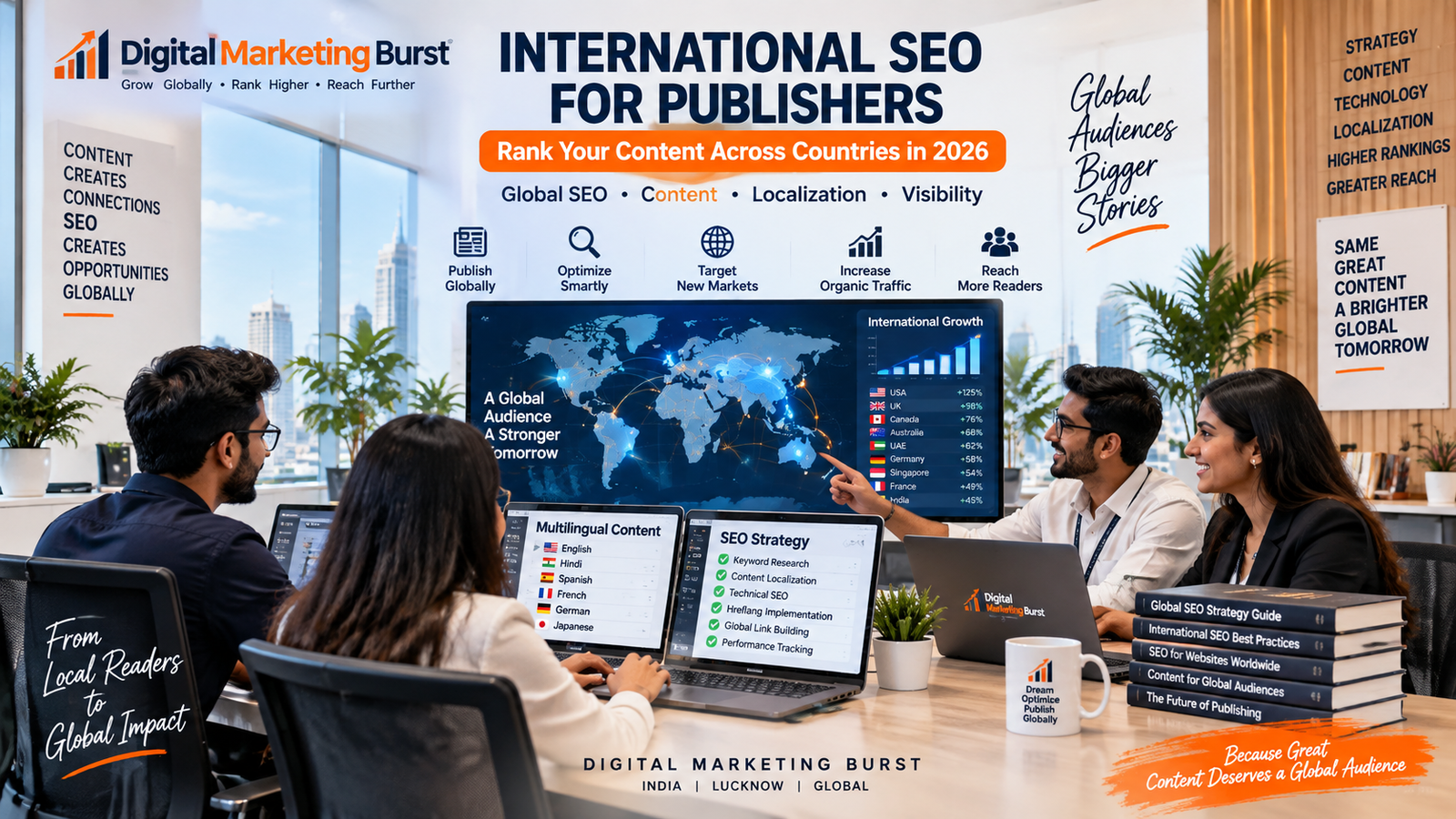
International SEO for Publishers: How to Rank Your Content Across Countries in 2026
International SEO for Publishers: How to Rank Your Content Across Countries in 2026
International SEO For Publishers is becoming essential for websites that want readers beyond one country. A strong International SEO Strategy Guide should explain how publishers can enter new search markets without creating duplicate or poorly localized pages. Following International SEO Best Practices also helps businesses improve International SEO For Websites, while a practical Global SEO Strategy Guide connects content, technical SEO, localization, and audience intent into one growth plan.
In 2026, publishing more articles is not enough. Search engines need to understand which audience a page serves, what language it uses, and how it relates to other regional versions. At the same time, readers expect content that feels relevant to their country rather than a generic page with a few words changed.
This is where international optimization becomes important. Publishers need country-specific keyword research, localized content, clean website architecture, technical signals, internal linking, and strong topical authority. Moreover, AI-driven discovery is changing how people find information. Content should therefore be easy for both traditional search systems and AI-powered experiences to understand.
At Digital Marketing Burst, we approach international visibility as a combination of SEO, content quality, localization, and technical clarity. This guide explains how publishers can build that combination while avoiding common international ranking problems.
International SEO For Publishers: Building Visibility Across Multiple Countries
Publishers face a challenge that many ordinary business websites do not. One article can potentially attract readers from India, the United States, the United Kingdom, Australia, Canada, and many other markets. However, those audiences do not always search in the same way.
Search vocabulary changes between countries. User expectations can also change. In addition, spelling, terminology, currency, examples, seasons, laws, products, and cultural references may differ. Therefore, simply making the same page accessible worldwide is not a complete international strategy.
Publishers should first understand where existing international demand comes from. Search performance data can reveal countries that already generate impressions or clicks. Analytics can then show which international visitors engage with the website. Together, these signals help identify markets worth investigating.
Next, publishers need to determine whether a market requires a separate localized experience. Sometimes one English page can serve several countries effectively. In other situations, users clearly need country-specific content.
The goal is not to create hundreds of regional pages. Instead, publishers should create additional versions only when meaningful search intent or audience differences justify them. This reduces unnecessary duplication and gives every international page a clearer purpose.
Global SEO For Publishers: Turning One Website Into an International Content Brand
Global SEO For Publishers requires more than translating articles. Publishers need to build a website that search engines and users can understand across different regions.
A strong global publishing strategy starts with audience research. Identify which countries already know the brand and which markets offer realistic opportunities. Then examine how readers in those markets search for the subjects you cover.
For example, two users may want exactly the same information but phrase their queries differently. A publisher that optimizes only around terminology from its home country can miss those variations. Therefore, local keyword research should happen before localization rather than after it.
Brand consistency is equally important. Your expertise and editorial standards should remain recognizable across regional versions. However, examples, vocabulary, supporting statistics, calls to action, and commercial references can be adapted where appropriate.
Digital Marketing Burst recommends treating each major target country as an audience segment rather than merely another SEO keyword. This changes the strategy significantly. Instead of asking, “How can we rank this article in ten countries?” the better question becomes, “What would make this article genuinely useful to readers in each important market?”
That audience-first approach can create more sustainable international visibility.
International SEO Strategy Guide for Publishers Entering New Markets
A useful International SEO Strategy Guide should begin with market selection. Trying to target every country at once can stretch content and SEO resources too far. Therefore, publishers should prioritize markets using existing visibility, audience demand, commercial relevance, competition, and content suitability.
Once target markets are selected, analyze their search results. Look at the types of pages appearing for important queries. In one country, detailed educational guides may dominate. Elsewhere, comparison pages, news articles, videos, or local resources may appear more frequently.
Keyword research should follow. However, avoid translating a keyword list word for word. Search behaviour can differ even when people speak the same language.
After research, decide how international content will be organized. Some publishers may need country directories. Others may need language directories. A smaller publication might only need a few localized landing pages.
Technical implementation comes next. Search engines should be able to crawl the content, understand alternate language or regional versions, and reach pages through normal internal links.
Finally, measure results separately for each target market. International traffic should not be treated as one large number. Country-level impressions, rankings, clicks, engagement, conversions, and content performance provide much more useful insights.
Global SEO Strategy Guide for Multi-Country Content Growth
A Global SEO Strategy Guide becomes useful when a publisher wants sustainable international growth rather than occasional overseas traffic. The first priority is understanding whether the existing content model can scale.
Suppose a publication has hundreds of articles. Creating separate versions for ten countries could produce thousands of URLs. Without a clear strategy, this can create thin pages, duplication, indexing problems, and a huge maintenance burden.
Instead, start with high-opportunity content. Identify pages that already receive impressions from multiple countries. Then determine whether localization could improve their usefulness.
Some evergreen guides may work internationally with minimal changes. On the other hand, articles about prices, regulations, products, services, events, or local recommendations may need substantial regional adaptation.
Content templates can help publishers scale. However, templates should structure information rather than create repetitive pages. Each localized version needs a reason to exist.
Digital Marketing Burst uses this principle when planning global content: scale the framework, not the duplication. Editorial teams can standardize research processes, page structures, technical checks, and quality control. Meanwhile, the actual information should remain relevant to the intended audience.
This approach keeps global expansion manageable while protecting overall content quality.
International SEO Best Practices for Content Publishers in 2026
Successful international optimization begins with relevance. International SEO Best Practices should therefore focus on helping search engines understand the correct audience while helping readers receive the most useful version of the content.
Start with crawlable regional pages. Important content should be available through normal website navigation and internal links. Search engines should not need complicated interactions to discover it.
Next, maintain clear URL structures. Consistency makes a large international website easier to manage. It also reduces the risk of publishing regional content in the wrong location.
Localization should go beyond direct translation. Headlines, introductions, examples, units, currencies, terminology, and calls to action may need adjustment. Nevertheless, unnecessary localization can be equally harmful. If the content does not materially differ, creating another version may add little value.
Technical signals should support the editorial strategy. Correct language and regional annotations can help search engines understand alternate versions. Canonicalization should also be reviewed carefully so that valid localized pages are not accidentally consolidated into another URL.
Finally, keep quality standards consistent. International expansion should never mean publishing weaker content simply to create more URLs. A smaller collection of genuinely useful regional pages is often more manageable than a huge collection of near-duplicates.
Global SEO Best Practices for Publishers Targeting International Audiences
Global SEO Best Practices begin with understanding people before optimizing pages. A global audience is not one homogeneous group. Readers arrive with different languages, expectations, devices, search habits, and levels of familiarity with a topic.
Therefore, publishers should map content to actual markets. A technology publication, for instance, might discover strong demand in India, the US, and the UK. Rather than immediately translating everything, the editorial team can first identify which topics perform across all three markets.
The next stage is search-intent comparison. If users in different countries want essentially the same answer, one strong page may be sufficient. However, if results show clear local differences, dedicated content may be justified.
Performance also matters. International visitors should not receive an unnecessarily slow experience because assets are poorly optimized. Images, scripts, fonts, advertisements, and tracking technologies can all affect loading performance.
Trust deserves similar attention. Readers should easily understand who created the content, when it was updated, and why the publisher has expertise in that area.
In addition, regional pages need ongoing maintenance. A localized article that was accurate two years ago can become misleading. Consequently, global SEO requires an update process, not merely an initial publishing process.
International SEO For Websites With Audiences in Multiple Countries
International SEO For Websites becomes more complex as the number of target markets increases. Website architecture needs to remain understandable even after hundreds or thousands of pages are added.
Before creating regional sections, publishers should define a hierarchy. The structure should make it obvious which content belongs to each language or country. Moreover, editors should be able to maintain that structure without constantly creating exceptions.
Navigation deserves special attention. International users should be able to reach the appropriate content without confusion. However, forcing visitors into a regional version can create a frustrating experience when the detected location does not match their actual preference.
Search engines also need stable URLs. Therefore, avoid changing international structures repeatedly unless there is a strong reason.
Internal linking should connect related content within the appropriate market while still allowing logical relationships across the broader website. For instance, a localized guide can link to a universal resource when that resource remains relevant to everyone.
International architecture is ultimately about clarity. A clean system helps users navigate, editors publish, developers maintain, and search engines interpret the website. That foundation becomes increasingly valuable as international content grows.
Global SEO For Websites That Want Worldwide Organic Traffic
Global SEO For Websites should not be interpreted as ranking every page everywhere. Different pages can serve different markets, and that is completely normal.
A publisher should first distinguish global topics from local topics. An article explaining a universal concept may attract readers from dozens of countries. In contrast, a guide about a country-specific regulation should primarily target users affected by that regulation.
This distinction prevents unnecessary localization. It also helps publishers decide where to invest resources.
Global organic traffic grows when a website builds strong topical coverage while matching regional search intent where necessary. Therefore, publishers should combine universal authority with selective localization.
Site performance should remain consistent as well. International readers may access content through slower connections or mobile devices. Heavy pages can therefore limit visibility and engagement in markets where network conditions differ.
Publishers should also analyze international search performance by page. If a page receives impressions in another country but has a weak click-through rate, its title or snippet may not match local expectations. Conversely, strong impressions with improving clicks may indicate an expansion opportunity.
Worldwide traffic is rarely created through one setting. It develops through hundreds of small decisions involving content, technical SEO, user experience, authority, and localization.
International SEO Keyword Research for Publishers Targeting Multiple Countries
International keyword research should be performed market by market. Translating an Indian keyword into another language does not prove that users in that country actually search for the translated phrase.
Start with the topic. Then research how users express the same need in each target market. Search volume can provide direction, but intent matters just as much.
Publishers should examine informational, commercial, navigational, and problem-solving searches separately. This helps determine what kind of content should be produced.
Long-tail searches are especially valuable. They often reveal the exact problem a user wants to solve. For example, someone searching for an international publishing strategy may later search for country targeting, multilingual content, hreflang implementation, or localization mistakes.
Those related queries can become supporting sections rather than separate thin articles. As a result, one comprehensive resource can satisfy several closely connected intents.
Digital Marketing Burst recommends creating a country-level keyword map before large-scale international publishing. The map should connect target topics with markets, search intent, existing URLs, and planned content. This reduces keyword overlap and helps editorial teams understand which page should target each opportunity.
How to Rank Content in Multiple Countries Without Keyword Cannibalization
Ranking content internationally can become difficult when several pages target almost identical queries. Search engines may struggle to determine which version should appear, while publishers may accidentally make their own pages compete.
The solution begins with clear intent separation. Every regional page should answer a specific audience need. Changing only the country name in the title is rarely enough.
Suppose several English-speaking markets use similar terminology. If the information remains almost identical, consider whether separate pages are actually necessary. One authoritative global article may perform better than several weak copies.
However, separate pages can make sense when the information changes materially. Prices, legal requirements, product availability, statistics, examples, and market conditions can create genuine regional differences.
Internal linking should reinforce these distinctions. Avoid sending mixed signals by repeatedly using identical anchor text for several competing URLs.
Content audits are also valuable. If multiple international pages overlap heavily, publishers can update, consolidate, redirect, or reposition them according to their purpose.
Ultimately, avoiding cannibalization requires restraint. International expansion should create additional value, not simply additional URLs.
Multilingual SEO Best Practices for Publishers
Multilingual publishing creates opportunities, but translation quality can determine whether those opportunities become meaningful traffic. A technically perfect page can still perform poorly when its language feels unnatural.
Professional localization should preserve meaning while adapting expression. Headlines may need to change. Examples may need replacement. Likewise, idioms that work in one language can sound awkward in another.
Keyword research should happen within the target language. Search behaviour does not always follow literal translation, so translated keywords need validation.
Publishers should also maintain editorial consistency. Each language version should meet the same standards for accuracy, originality, readability, and updates.
Navigation needs attention too. Readers should be able to identify available languages easily. Moreover, switching languages should ideally take them to the corresponding content rather than an unrelated homepage.
Technical implementation then connects these localized experiences. Search engines need clear signals showing that multiple URLs represent appropriate alternatives for different audiences.
Multilingual SEO works best when editorial and technical teams collaborate. Translation alone cannot solve structural problems. Similarly, technical markup cannot rescue weak localization. Both sides must support the same international content strategy.
Hreflang SEO Strategy for International Publishers
Hreflang becomes relevant when publishers maintain alternate language or regional versions of substantially similar content. Its purpose is to help search engines understand which version is intended for which language or region.
However, implementation errors can create confusion. Missing return references, incorrect language or region codes, broken URLs, and inconsistent page sets can weaken the setup.
Publishers should therefore maintain hreflang systematically rather than manually adding random tags page by page. Large websites may benefit from automated generation, provided the logic is tested carefully.
Hreflang should also align with the actual content. A regional annotation does not transform a generic page into locally useful content. If a publisher labels a page for a specific market, that page should make sense for the intended audience.
Canonical signals deserve attention at the same time. Publishers should avoid technical configurations that contradict their international targeting.
Regular audits become important as URLs are added, removed, redirected, or updated. A system that worked when a website contained 100 localized pages may develop errors after growing to 10,000.
Therefore, international technical SEO should be treated as infrastructure. It needs monitoring and maintenance rather than a one-time implementation.
Country Targeting SEO Strategy for Publishers in 2026
Country targeting begins with a simple question: does this content genuinely need to target a specific country?
If the answer is yes, publishers should make that relevance clear through the page itself. Country-specific examples, terminology, data, products, services, regulations, or audience needs can all contribute.
However, adding a country name repeatedly is not a strategy. Search engines evaluate the overall context of a page. Readers also notice when location terms are inserted unnaturally.
A better approach is to research the local search landscape. Examine what users ask, which content formats appear, and what information leading pages provide. Then identify gaps that your publication can address.
Regional authority can develop over time. When a website consistently publishes useful content for a market, its topical footprint becomes stronger.
Publishers should nevertheless expand gradually. Start with a manageable number of markets and learn from performance. Once the workflow becomes reliable, additional regions can be considered.
This staged approach reduces technical mistakes and allows editorial teams to improve localization standards before scaling further.
International Content SEO Strategy for Global Publishers
An international content strategy should connect editorial planning with search demand. Without that connection, publishers may translate articles that nobody searches for while ignoring topics with clear regional potential.
Begin by grouping content into universal, regional, and local categories. Universal content can often remain largely consistent. Regional content may need meaningful adaptation. Local content usually requires deeper market-specific research.
Next, prioritize evergreen opportunities. Evergreen guides can continue attracting international searches long after publication when they are maintained properly.
News publishers may follow a different model. Speed becomes more important, but regional relevance still matters. Editors need to understand which developments deserve separate country coverage and which can be handled through one broader article.
Digital Marketing Burst recommends building topic clusters rather than isolated international posts. A central guide can address the broad subject, while supporting articles explore important subtopics.
Internal links can then connect the cluster logically. This helps readers continue researching and gives search engines additional context about relationships between pages.
International content SEO becomes much stronger when every article has a defined audience, search intent, and role within the larger publishing strategy.
International SEO Content Localization for Better Search Visibility
Localization is one of the biggest differences between basic translation and serious international SEO. Translation changes language. Localization adapts the experience.
Consider an article containing prices. Converting the words without considering currency leaves part of the content unsuitable for the new audience. The same principle applies to measurements, dates, seasons, examples, products, terminology, and cultural references.
However, localization should remain purposeful. Changing details merely to make pages appear different can produce unnecessary work without improving usefulness.
Editors should identify which elements influence comprehension or decision-making. Those elements deserve localization first.
Search snippets can also require adaptation. A title that attracts clicks in one market may not communicate the same value elsewhere. Therefore, localized titles and descriptions should reflect actual search intent.
Images may need review as well. Text embedded within graphics can become inconsistent with the page language. Moreover, screenshots and examples can quickly become outdated.
Effective localization makes readers feel that the content was prepared with their needs in mind. That experience can support engagement, trust, and long-term international growth.
Technical SEO for International Websites and Publisher Platforms
Technical SEO becomes increasingly important as publishers scale across languages and regions. Small structural mistakes can affect thousands of URLs when templates are involved.
Crawlability comes first. Search engines need stable links to discover important regional content. XML sitemaps can support discovery, but they should complement rather than replace sensible site architecture.
Indexability comes next. Accidental noindex directives, conflicting canonical tags, blocked resources, or redirect chains can prevent valuable pages from performing.
Page speed should also be monitored across markets. A site that loads quickly for the editorial team may behave differently for international users.
Structured data can provide additional context where appropriate. However, markup should accurately represent visible page content rather than being treated as a shortcut to rankings.
Publishers also need strong monitoring. International sites change constantly as articles are updated, translated, redirected, and archived. Automated technical checks can catch problems before they affect large sections of the website.
A technically clean foundation will not replace excellent content. Nevertheless, it ensures that strong international content has a fair opportunity to be discovered, crawled, understood, and indexed.
International SEO for News and Media Publishers
News and media websites face additional challenges because content moves quickly. A story may become internationally relevant within hours, while another story remains important only to one country.
Editors need a framework for making that distinction quickly. Global stories can often be covered through one authoritative page. Meanwhile, regional angles may justify separate coverage when audiences require different context.
Headlines should reflect the intended market without becoming repetitive. Additionally, updates need to remain clear so readers know when information changed.
Archive quality matters too. News websites can accumulate enormous numbers of URLs. Without careful management, outdated pages, thin tag archives, and duplicated topic pages can consume crawling resources.
Evergreen explainers can support fast-moving news coverage. When a story involves a complex topic, journalists can link to an established background guide rather than repeating the same explanation in every article.
For international publishers, this creates a valuable combination: timely reporting brings immediate interest, while evergreen resources build long-term search visibility.
Digital Marketing Burst International SEO Strategy for Publishers
A Digital Marketing Burst international SEO strategy starts by understanding where a publisher already has visibility and where meaningful expansion opportunities exist. We would not recommend producing hundreds of country pages simply because international traffic sounds attractive.
Instead, the process begins with search demand, existing performance, competitor landscapes, and content gaps. Those insights help determine which markets deserve attention.
The next stage connects keywords to audience intent. Content is then planned around useful topic clusters rather than repetitive location pages. Technical SEO supports that structure through crawlability, indexation, international targeting signals, and logical internal links.
Localization becomes another layer. The objective is not to replace a few country names. Instead, important pages should reflect the terminology and information needs of their target readers.
Measurement completes the process. Country-level visibility, clicks, engagement, conversions, and content performance can show where the strategy is working.
For publishers seeking international growth, Digital Marketing Burst combines global content planning with technical SEO and search-intent research. This creates a scalable framework for reaching new audiences without sacrificing content quality.
Where to Use the Branded Keyword: Digital Marketing Burst International SEO
The branded phrase Digital Marketing Burst International SEO should appear where it contributes naturally to the page rather than being forced into every section.
A useful placement is within the introduction because it connects the company with the subject immediately. Another suitable location is a dedicated expertise section, where readers can understand how the brand approaches international optimization.
The phrase can also be used naturally within internal anchor text. For example, a relevant service or strategy page could be connected through anchor wording related to international SEO services by Digital Marketing Burst. However, the destination page should genuinely match that anchor.
Image metadata offers another relevant opportunity. A featured image can use descriptive wording that combines the topic and brand without stuffing every target keyword into one alt attribute.
Finally, the conclusion can mention the brand again while summarizing the subject. This creates reasonable distribution from the beginning to the end of the article.
Brand SEO works best when the company becomes associated with expertise through useful information. Repetition alone does not create authority. Consistent, accurate, problem-solving content does.
International SEO Problems Publishers Must Fix Before Global Expansion
International growth can expose problems that remain hidden on a smaller website. Duplicate content is one of the most common. Publishers sometimes generate many country pages while changing almost nothing except the location.
Another issue is incorrect localization. Machine-translated pages may communicate the general meaning but still sound unnatural or use search terms that local users rarely choose.
Technical conflicts can cause additional problems. Incorrect canonicals, broken alternate-language references, redirect loops, or accidental indexing restrictions may prevent regional pages from appearing as intended.
Content maintenance is another challenge. Every new localized page creates an ongoing responsibility. Prices change. Statistics become outdated. Links break. Products disappear. Regulations evolve.
Publishers should therefore calculate maintenance capacity before scaling. Ten excellent regional guides that remain current can be more valuable than hundreds of neglected pages.
Finally, measurement needs to be separated by market. If international traffic rises while engagement or conversions fall, the website may be attracting the wrong audience.
Global expansion succeeds when publishers identify these problems early and build processes that prevent them from multiplying.
How Publishers Can Increase International Organic Traffic in 2026
Increasing international organic traffic begins with finding demand that already aligns with the publication’s expertise. Publishers should not chase unrelated high-volume keywords simply because another country offers more searches.
Start with existing content that already earns impressions abroad. These pages provide evidence that search engines see some relevance between your website and international users.
Next, identify missing subtopics. Search queries can reveal questions that existing pages only partially answer. Updating strong content may generate results faster than publishing an entirely new international section.
Localization can then be introduced where it improves relevance. Meanwhile, new content should target gaps that cannot be solved through existing pages.
Authority matters as well. Original research, expert contributions, useful data, strong explanations, and genuinely distinctive content can make a publication more valuable across markets.
Internal linking helps distribute that authority through related topics. Therefore, important international pages should not remain isolated.
Finally, keep testing. International SEO is not a single campaign. Search behaviour changes, competitors improve, and new discovery platforms emerge. Publishers that continuously learn from each market are better positioned to build durable worldwide visibility.
International Website Structure for Publishers Targeting Multiple Countries
International website structure can determine how easily search engines understand content created for different markets. Publishers should choose a structure that remains manageable as the website grows. More importantly, every regional section should have a clear purpose.
Subdirectories can keep international content under one main domain. Separate country domains can create stronger market separation, but they also require additional management. Subdomains provide another option. However, the right choice depends on the publisher’s resources, existing authority, markets, and long-term expansion plan.
Consistency matters more than choosing a fashionable setup. If one country uses a directory while another uses an unrelated URL pattern, editorial teams can quickly lose control of the architecture. Therefore, establish naming rules before publishing at scale.
Publishers should also consider navigation. Readers need a simple way to reach the version that matches their language or region. At the same time, search crawlers need normal links to discover those pages.
A scalable structure makes future expansion easier. Consequently, publishers planning to enter several countries should design the architecture for tomorrow’s content rather than only today’s pages.
Subdirectory vs Subdomain for International SEO
The subdirectory vs subdomain for international SEO question appears frequently when websites expand globally. Both approaches can work, so publishers should avoid assuming that one URL format automatically produces better rankings.
A subdirectory might organize regional content beneath the primary domain. This approach can make management convenient because content remains within one recognizable website structure. It can also simplify branding for publishers that want one global identity.
Subdomains create stronger organizational separation. They may be useful when regional sections require different systems, teams, or publishing environments. However, maintaining many separate sections can become operationally complicated.
Publishers should make the decision based on their actual infrastructure. Migration costs, editorial workflow, analytics, localization, development resources, and future markets all matter.
More importantly, avoid changing structures repeatedly. A publisher that moves international pages between directories and subdomains every year can create redirects, broken links, reporting problems, and unnecessary SEO risk.
Choose a logical architecture, document it clearly, and build strong content within it. URL structure supports international visibility, but it cannot compensate for weak content or poor localization.
ccTLD vs Subdirectory for International Websites
Another important decision involves ccTLD vs subdirectory for international websites. A country-code domain can provide a clear country association. However, running several country domains can require significantly more editorial and technical resources.
For example, a publisher expanding into several markets might consider separate country domains. Each property would then need content maintenance, technical monitoring, authority development, analytics, and quality control.
A subdirectory model keeps regional content under the primary website. Therefore, publishers can often manage multiple markets through one central platform.
Neither approach should be selected only because a competitor uses it. The business model matters. A publisher with independent regional editorial teams may have different requirements from a company operating one international content department.
Before choosing, estimate how many markets you realistically expect to maintain during the next few years. Then consider whether each country needs a substantially independent website.
International expansion creates ongoing responsibilities. Therefore, the architecture should reflect your operational capacity as much as your SEO ambitions.
Hreflang Implementation for Multi-Country Publisher Websites
Correct hreflang implementation can help search engines understand alternate versions of similar pages. However, publishers often make the system unnecessarily complicated.
Every alternate version should correspond logically with the others. If a page exists in several languages or regional variants, the implementation needs to represent those relationships consistently.
Problems can emerge when pages are deleted or redirected. For example, an old regional URL might remain referenced after the content has moved. Similarly, a newly published version may be omitted from the existing alternate set.
Publishers should therefore include hreflang checks in their regular technical audits. This becomes particularly important for websites with thousands of articles.
Automation can help large publishers. Yet automated systems should still be tested because one template-level mistake can spread across a huge number of pages.
The content itself also matters. Technical annotations cannot make an irrelevant page suitable for another market. Publishers need both correct implementation and useful localization.
When those elements work together, search engines receive clearer information about the relationship between regional pages.
Common Hreflang Mistakes Publishers Should Avoid in 2026
Common hreflang mistakes publishers should avoid include incorrect codes, missing reciprocal references, references to unavailable URLs, and inconsistent implementation across page versions.
Another problem appears when publishers confuse hreflang with canonicalization. These elements solve different problems. Therefore, the international configuration needs to be reviewed as a complete system rather than as isolated tags.
Broken pages create further complications. If an alternate reference points to a URL that redirects repeatedly or no longer exists, the implementation becomes less useful.
Publishers can also create mistakes during migrations. A website may update its URL structure while older international annotations remain unchanged. Consequently, regular auditing becomes necessary.
Large editorial websites should establish automated monitoring where possible. Errors that affect ten pages can often be corrected manually. The same error across 50,000 pages becomes a much larger problem.
Most importantly, do not use hreflang as a substitute for localization. If several pages are virtually identical and provide no regional value, technical annotations alone will not create a strong international content strategy.
How to Localize Content Without Creating Duplicate Pages
Localization should create additional usefulness. Otherwise, publishers risk producing large collections of pages that differ only superficially.
Start by identifying information that changes according to location. This may include terminology, currencies, measurements, regulations, product availability, examples, statistics, seasons, or consumer behaviour.
Then evaluate the search results in the target market. If users receive substantially different answers there, a localized page may be justified.
However, publishers should avoid changing sentences purely to make content look unique. Search-focused localization is not an exercise in rewriting the same information with synonyms.
Instead, improve relevance. An Indian reader may need examples from India, while a British reader may expect different terminology or references. A US audience may use another phrase for the same concept.
Editorial teams should document these differences. This creates a localization framework that translators and writers can follow consistently.
As a result, international pages become genuinely useful versions rather than manufactured duplicates. That distinction can improve user experience while also making the overall website easier to maintain.
International SEO Duplicate Content Problems and Solutions
Duplicate content becomes a major concern when publishers scale internationally without a clear strategy. Hundreds of regional URLs can be generated quickly, yet many may contain almost the same information.
The first solution is necessity. Before creating another version, ask whether users in that market require different content. If the answer is no, the existing page may already satisfy the search intent.
Next, identify meaningful differences. Local statistics, market examples, regulations, pricing, terminology, and availability can make regional pages more valuable.
Technical signals should then support the content structure. Canonicals, alternate-language annotations, redirects, and indexability settings need to work together logically.
Publishers should also monitor which regional URLs actually receive impressions. Pages that remain invisible for long periods may need improvement, consolidation, or reconsideration.
A content audit can uncover entire international sections built without clear demand. Fixing those sections may improve site quality more effectively than publishing additional articles.
The objective is not maximum page count. Instead, publishers should aim for the smallest number of pages necessary to satisfy international search demand comprehensively.
How to Create Country-Specific Content That Ranks
How to create country-specific content that ranks starts with understanding why the country needs its own page. Location alone is not enough.
Research the local search results first. Examine what questions users ask and what information appears repeatedly. Then look for gaps that existing pages fail to answer clearly.
Local data can strengthen the article. Relevant statistics, examples, market terminology, regulations, or consumer trends make the content more useful to the intended audience.
Titles should also match actual search behaviour. Avoid mechanically inserting country names into every headline. Instead, communicate the value of the page naturally.
Introductions need similar attention. Readers should immediately understand why the information applies to their market.
Publishers should then connect the article to other relevant regional resources through internal links. This creates a stronger country-level content ecosystem.
Finally, update the page. Local information can change faster than universal educational content. Therefore, an article that ranked well when published may gradually lose usefulness if its examples or data become outdated.
Country-specific SEO succeeds when local relevance exists throughout the content rather than only in the keyword.
International Keyword Mapping for Global Content Websites
International keyword mapping prevents editorial teams from creating multiple pages that target the same intent accidentally. It becomes especially valuable when several writers, languages, and regional teams work on one website.
Begin with the core topic. Then identify relevant keyword groups for every important market. Each group should be associated with a primary URL or planned article.
However, do not rely only on literal keyword matches. Several different phrases can express the same intent. Therefore, mapping should consider topics and user needs rather than treating every keyword as an independent page opportunity.
The document can also track country, language, funnel stage, existing rankings, and content status. Publishers can then identify gaps more efficiently.
For example, one market may already have strong informational coverage but lack commercial comparison content. Another may have many articles but weak topical organization.
Digital Marketing Burst can use this type of mapping to connect SEO research with editorial planning. Consequently, content teams know what to create, what to update, and what not to duplicate.
A strong map ultimately turns keyword research into an organized publishing system.
Long-Tail International SEO Keywords for Publishers
Long-tail international searches can reveal specific problems that broad keywords hide. A user searching for “SEO” provides little information about what they need. In contrast, someone searching for how to rank a website in multiple countries has a much clearer objective.
Publishers should identify these specific queries during topic research. They can then use the most relevant ones as natural subheadings within comprehensive resources.
Examples include searches around multilingual keyword research, country-specific content, international website structure, hreflang errors, global organic traffic, localization, and international link building.
However, every long-tail phrase does not need its own article. Several closely related questions can often be answered more effectively on one strong page.
This approach also prevents thin content. Instead of publishing ten short articles that overlap heavily, a publisher can create one comprehensive guide supported by specialized articles where deeper coverage is justified.
Long-tail SEO is therefore not simply about inserting longer phrases. It is about understanding increasingly specific search intent and creating content that resolves those needs clearly.
How to Rank a Website in Multiple Countries in 2026
Publishers researching how to rank a website in multiple countries should focus on relevance, accessibility, and authority rather than searching for a single international ranking trick.
First, determine which pages have genuine international potential. Then research how the topic is searched in each priority market.
Next, decide whether one global page or several localized versions are appropriate. This decision should come before translation or large-scale content production.
Technical foundations must then support the strategy. Pages need to be crawlable, indexable, fast, and connected through logical internal links.
Regional signals should remain consistent. Moreover, localization should improve the usefulness of the page rather than merely increase keyword frequency.
Authority develops gradually. Strong original content, useful research, credible references, expert input, and natural mentions can help a publisher become more competitive.
International ranking is therefore an outcome of several systems working together. Publishers that coordinate technical SEO, editorial quality, localization, and authority are better positioned to grow across markets.
International Link Building Strategy for Publishers
International link building should focus on relevance rather than collecting links from random foreign websites. A backlink becomes more meaningful when the referring publication has a genuine relationship with the topic or target market.
Original research can attract international mentions. Data studies, industry reports, surveys, statistics, interactive resources, and unique analysis give other publishers a reason to reference your work.
Expert contributions can also help. Journalists and writers frequently need credible insights. Publishers with recognizable subject specialists can therefore create opportunities for editorial mentions.
Regional outreach should be localized. An outreach email designed for one country may not work equally well in another market.
Digital PR can support this process. However, campaigns should connect to topics that genuinely matter to the intended audience.
Avoid treating international link building as a numbers competition. A smaller number of contextually relevant editorial mentions can provide more value than a large collection of unrelated links.
Publishers should build resources worth citing first. Outreach becomes much easier when the content already offers something distinctive.
Global Backlink Strategy for International Websites
A global backlink strategy for international websites should combine broad authority with regional relevance. Some links can strengthen the overall publication, while others may help establish recognition within a particular market.
Publishers should first examine where existing mentions originate. This can reveal countries where the brand already has visibility.
Next, identify content that attracts references naturally. Research reports, detailed guides, original statistics, tools, and expert commentary often have stronger citation potential than ordinary promotional pages.
Regional content may require its own outreach. A country-specific report, for example, is more likely to interest journalists covering that market than a generic global article.
Internal linking can then help distribute authority to related international resources. However, links should remain contextually useful.
Publishers should also monitor unlinked brand mentions. In some cases, websites may discuss original research without linking to the source. Appropriate outreach can help turn legitimate mentions into stronger references.
Global authority takes time. Therefore, publishers should prioritize repeatable editorial value rather than short-term backlink tactics.
International E-E-A-T Strategy for Content Publishers
International audiences need reasons to trust a publisher they may never have encountered before. Clear authorship, editorial standards, expertise, and transparent information can support that trust.
Author pages should explain relevant experience. Articles can also make it clear when specialists have reviewed technical or professional information.
Publisher identity matters too. Readers should be able to understand who operates the website and how content is produced.
Regional accuracy is particularly important. An expert may understand a subject globally but still need local verification for regulations, prices, services, or market-specific facts.
Therefore, international publishers should involve local expertise where the subject demands it. This is especially important for topics where inaccurate information could meaningfully affect readers.
Digital Marketing Burst recommends treating trust signals as part of content production rather than something added after publication.
Useful content, transparent authorship, factual accuracy, and responsible updates collectively create a stronger publishing brand. Those qualities become even more important when a website wants recognition in markets where its name is still relatively new.
International Core Web Vitals and Page Experience
International traffic can expose performance problems that domestic testing misses. Readers may access a publisher from different networks, devices, and geographic locations.
Heavy images are a common issue. Publishers often upload large visual assets without sufficient optimization. Advertising scripts and third-party trackers can create additional delays.
Fonts can also affect performance, particularly when multilingual websites load several character sets unnecessarily.
Therefore, performance testing should consider actual target markets and device conditions. A page that feels fast on an office connection may perform very differently for a mobile user elsewhere.
Publishers should work with developers to reduce unnecessary scripts, optimize images, improve caching, and control layout shifts.
Performance improvements benefit more than SEO. Faster pages can make reading easier, especially on long editorial articles.
However, speed should not be pursued by removing essential content or functionality. The objective is efficient delivery.
A strong international publication should provide a consistent reading experience regardless of where the visitor is located.
Mobile SEO for International Audiences
Mobile users represent an important part of international search traffic. Therefore, publishers should design content for smaller screens from the beginning.
Paragraphs need enough spacing to remain readable. Headings should help users scan long articles, while navigation should not cover the main content.
Intrusive overlays can create problems. If a visitor must close several pop-ups before reading the introduction, the experience becomes frustrating.
Images should resize correctly. Tables also need careful handling because wide desktop layouts can become difficult to use on mobile devices.
International publishers should consider connection quality as well. Large video backgrounds or unnecessary scripts can create significant delays.
Content design matters too. Shorter sentences and clear transitions improve readability on mobile screens. This aligns well with good editorial practice.
Publishers should test important templates across common screen sizes rather than assuming responsive design automatically solves every issue.
A technically responsive page can still provide a poor mobile experience. Therefore, real usability should guide international mobile optimization.
AI Search Optimization for International Publishers in 2026
Search discovery in 2026 extends beyond traditional blue-link results. Users increasingly encounter AI-generated summaries, conversational search tools, and answer-based experiences. Publishers should therefore make important information easy to identify and understand.
Clear answer-first writing can help. Introductions should explain the subject quickly, while descriptive subheadings should divide complex topics into meaningful sections.
Entity clarity also matters. Search systems should be able to understand the publisher, authors, topics, services, locations, and relationships between them.
Original information can provide additional value. A publisher that merely rewrites information available everywhere has fewer reasons to become a notable source.
Structured content does not mean robotic writing. Instead, articles should combine direct answers with detailed explanations.
International publishers face another challenge because AI systems may encounter several versions of similar content. Therefore, localization and technical consistency remain important.
Digital Marketing Burst views AI search optimization as an extension of strong SEO fundamentals. Clear entities, useful information, technical accessibility, and credible content can support visibility across both traditional and emerging search experiences.
GEO Strategy for Publishers Targeting Global AI Search
Generative Engine Optimization, often shortened to GEO, focuses on improving how content can be understood and surfaced within AI-driven discovery experiences. For international publishers, this adds another layer to global content planning.
Start with factual clarity. Important statements should be easy to identify within the article. Definitions should answer questions directly before expanding into deeper explanation.
Topic coverage should also be comprehensive. If an article claims to be a global SEO guide but ignores localization, regional intent, international architecture, and technical targeting, it leaves obvious gaps.
Entity relationships deserve attention as well. A publisher should consistently describe its brand, services, expertise, authors, and subject areas.
Original research can differentiate content further. AI systems have little reason to depend on another generic summary when many identical pages already exist.
However, publishers should not sacrifice human readability to chase AI visibility. People remain the intended audience.
The strongest GEO strategy therefore overlaps with high-quality publishing: answer clearly, support claims, demonstrate expertise, organize information well, and offer something genuinely useful.
International SEO and AI Search Visibility Across Countries
AI search visibility can differ between markets because languages, available sources, user behaviour, and search experiences vary. Therefore, publishers should not assume that strong visibility in one country automatically transfers elsewhere.
Begin by testing important questions in target markets and languages. Observe which brands, publishers, and sources appear around the topic.
Then analyze the content patterns. Are cited pages research-heavy? Do they provide concise definitions? Are local sources more prominent for country-specific questions?
This research can reveal content gaps. For example, a publisher may have a strong English guide but no localized version for another high-value market.
Structured factual sections can make complex articles easier to interpret. Nevertheless, publishers should avoid producing hundreds of artificial question-and-answer blocks merely to target AI systems.
The goal remains usefulness. A strong page should satisfy a human reader even if no AI platform existed.
As search interfaces evolve, publishers that build authoritative content assets are likely to have more flexibility than those relying on one narrow optimization tactic.
International SEO Audit Checklist for Publisher Websites
An international SEO audit should examine content, technical setup, localization, internal linking, and performance together. Looking at only one layer can hide larger problems.
Begin with indexation. Check whether important regional pages can appear in search and whether low-value URLs are consuming unnecessary attention.
Then review international targeting signals. Alternate versions should connect correctly, while canonicals should reflect the intended indexing strategy.
Next, examine content quality. Regional pages need meaningful value and should not exist solely because a template generated them.
Internal links deserve another review. Important international pages should not sit several levels deep without contextual links.
Performance should also be tested. Mobile usability, page speed, broken resources, and layout problems can affect readers across markets.
Finally, compare search performance by country. A technical audit becomes more useful when connected to actual visibility data.
Digital Marketing Burst can use this framework to identify whether an international website needs technical repairs, stronger localization, better content, or a combination of all three.
Why International SEO Pages Fail to Rank
International pages can fail for many reasons, and low keyword density is rarely the only explanation. Often, the page simply does not provide enough additional value for its target market.
Poor localization is one cause. A translated page may contain correct language but still miss the terminology users actually search.
Competition creates another barrier. Entering a new market means competing with publishers that may already have strong regional authority.
Technical mistakes can further limit visibility. Incorrect indexing settings, canonical conflicts, weak internal linking, and international annotation errors may prevent search engines from interpreting pages correctly.
Thin content also causes problems. Adding a country name to a generic article does not create local expertise.
Sometimes the keyword itself is the issue. Publishers may target a phrase because it has attractive volume while ignoring whether their website has topical relevance.
The solution begins with diagnosis. Determine whether the problem involves demand, intent, content, authority, technical SEO, or localization.
Once the real issue is known, publishers can improve the page instead of repeatedly adding keywords and hoping rankings change.
Why Translated Content Does Not Automatically Rank Internationally
Translation makes content understandable in another language. It does not automatically make the content competitive in another search market.
Users may search differently. Local competitors may answer questions in more depth. Examples may not apply to the new audience, while titles may target phrases that receive little local interest.
Therefore, keyword research should happen before or alongside translation.
Editorial adaptation is equally important. A translated introduction may be grammatically correct yet fail to communicate the value users expect.
Local context can make a significant difference. Statistics, terminology, products, regulations, and examples should be reviewed for relevance.
Authority may also differ by market. A well-known publisher in one country may be unfamiliar elsewhere. Building recognition can therefore require regional mentions and high-quality local content.
Publishers should treat translation as one stage of localization rather than the final product.
When research, translation, adaptation, technical implementation, and authority development work together, international content has a stronger foundation for organic visibility.
How Digital Marketing Burst Helps Publishers Grow International Traffic
Publishers entering new markets often face several problems simultaneously. Keyword research may be incomplete, regional pages can overlap, technical signals may conflict, and content teams may not know which markets deserve priority.
Digital Marketing Burst approaches these challenges through a combined SEO and content framework. The process begins with identifying search opportunities rather than producing regional pages blindly.
Keyword research can then be organized around country-level intent. Existing content is reviewed to determine what can remain global, what needs localization, and where new pages are justified.
Technical SEO supports the structure. Crawlability, indexation, page architecture, international targeting, internal links, and performance all need to align with the publishing strategy.
Content optimization comes next. Articles should answer real search questions while maintaining natural readability.
Finally, performance needs ongoing measurement. Search visibility, clicks, engagement, leads, and content growth can reveal which markets deserve further investment.
For publishers, this integrated approach can turn international SEO from a collection of isolated tactics into a manageable long-term growth strategy.
International SEO for Publisher Client Acquisition
International organic visibility can do more than increase page views. For commercial publishers, agencies, B2B media companies, and niche content websites, search traffic can also support client acquisition.
The first step is matching content with commercial intent. Informational articles can attract early-stage visitors, while service pages and comparison resources can address users closer to making a decision.
Internal linking then connects those stages. A reader learning about multilingual SEO, for example, can naturally discover a relevant international optimization service when the context makes sense.
Calls to action should remain useful rather than aggressive. A publisher should not interrupt every paragraph with a sales message.
Regional relevance also matters for leads. If a service is unavailable in a particular market, the content should not create the opposite impression.
Digital Marketing Burst uses this balance between traffic content, client-focused content, and problem-solving content. Traffic brings discovery. Client content explains services. Problem-focused sections demonstrate expertise.
Together, those layers can help turn useful international content into qualified business opportunities.
International SEO Measurement and KPIs for Publishers
International SEO should be measured market by market. Looking only at total organic traffic can hide major differences between countries.
Search impressions provide an early signal of visibility. Clicks then show whether users are choosing the result. Average position can add context, although it should not be treated as the only measure of success.
Engagement metrics help publishers understand what happens after the click. If one country generates traffic but readers leave quickly, the content may not match their expectations.
Conversions become important for commercial websites. A market with lower traffic can still be valuable when visitors generate more enquiries or revenue.
Publishers should also monitor indexed pages, international landing-page performance, branded searches, backlinks, and content growth.
Trends matter more than isolated daily changes. International search performance can fluctuate, particularly when a website is still developing authority in a new market.
Regular reporting allows teams to identify where localization is working and where resources are being wasted. Better measurement therefore leads to better expansion decisions.
Measuring International SEO ROI in 2026
International SEO ROI should account for both growth and cost. Entering another market can require research, writing, translation, editing, development, technical maintenance, and outreach.
Publishers should compare those investments with the value created. That value may include advertising revenue, subscriptions, leads, sales, partnerships, or increased brand visibility.
However, SEO often compounds over time. A strong evergreen guide can continue generating traffic long after its initial production cost.
Therefore, short-term ROI should not be the only measure. Publishers can also evaluate growth in non-branded search visibility, international backlinks, returning users, and high-value keyword coverage.
Market-level reporting becomes essential. One country may generate large traffic but little commercial value. Another may produce fewer visits yet significantly stronger conversions.
This information helps publishers decide where to expand further.
International SEO should ultimately function like an investment portfolio. Resources can be concentrated in markets demonstrating sustainable potential while weaker experiments are improved, repositioned, or discontinued.
International SEO Content Updates for Better Rankings
International content requires maintenance because markets change. Statistics become outdated, competitors publish stronger pages, terminology evolves, and search intent can shift.
Publishers should therefore create an update schedule for important international pages. High-traffic and commercially valuable content can be reviewed more frequently.
An update should involve more than changing the year in the title. Editors should verify facts, examples, internal links, screenshots, recommendations, and regional information.
Search performance can guide the process. A page losing impressions may need deeper improvements, while another page gaining visibility may benefit from additional sections addressing emerging queries.
Localization should be checked again too. A term that was appropriate when the article launched may no longer match current market language.
Technical elements also deserve review. Redirects, canonicals, alternate versions, and structured data can change as the website evolves.
Regular updates protect the investment already made in international content and help keep the article genuinely useful.
Building a Scalable Global Content Strategy for 2026
A scalable global content strategy needs clear rules. Without them, every new market creates another set of exceptions.
Publishers should establish which content qualifies for localization, who approves new regional pages, how keyword research is performed, and how technical implementation is checked.
Templates can make production more efficient. However, they should guide writers rather than produce identical articles automatically.
Editorial quality standards should remain consistent across languages. This includes sourcing, fact checking, readability, author information, and update frequency.
Technology can support the workflow. Content management systems can help organize regional versions, while analytics dashboards can separate performance by market.
Automation can also identify technical errors. Nevertheless, human review remains important for localization and editorial judgment.
Digital Marketing Burst recommends scaling only after the first target markets produce a repeatable workflow. Once research, production, optimization, and measurement work smoothly, expansion becomes less risky.
The objective is not to publish everywhere immediately. It is to build a system capable of growing internationally without allowing content quality to decline.
Preparing Your Publisher Website for Global Search Growth
Before expanding further, publishers should assess whether the existing website is ready. Technical problems at home often become larger problems internationally.
Start with site architecture. Important content should be easy to reach, and categories should have a clear purpose.
Next, review content quality. If hundreds of outdated or overlapping articles already exist, adding thousands of translated pages can make management more difficult.
Performance needs attention as well. Mobile usability and page speed should be strong before additional international complexity is introduced.
Editorial processes should also be documented. Writers, editors, translators, developers, and SEO specialists need to understand their responsibilities.
Finally, determine how success will be measured. Every market should have clear objectives rather than a vague goal of “more traffic.”
International expansion works best when it builds upon a strong website. Fixing foundational issues first can save considerable work later.
A publisher that prepares carefully can then enter new markets with clearer content, cleaner technical signals, and a much stronger understanding of what international audiences actually need.
International SEO Content Planning for Publishers in Competitive Markets
International content planning becomes harder when several established publishers already dominate the target market. In that situation, publishing another generic article rarely creates a meaningful advantage. Instead, publishers need to understand what competitors cover and, more importantly, what they leave unanswered.
Start by studying the search results for your priority topics. Look at content depth, freshness, format, expertise, examples, and local relevance. Then compare those findings with your existing content. This process can reveal opportunities that basic keyword research may miss.
For example, competing articles may explain international optimization but provide little guidance for publishers. Another result may discuss multilingual websites without addressing large editorial platforms. Those gaps can become useful content angles.
However, differentiation should not mean making an article unnecessarily long. Additional content needs a purpose. Original examples, clearer explanations, current data, practical workflows, and first-hand expertise can provide more value than thousands of repetitive words.
Digital Marketing Burst can use this gap-focused approach when planning international campaigns. The objective is to create content that deserves attention because it solves something existing pages have not explained properly.
How Publishers Can Find International Content Gaps
International content gaps often appear when a topic is popular globally but poorly covered for a particular country, language, industry, or audience type. Finding these opportunities can help publishers compete without targeting only the broadest keywords.
Begin by comparing search results across target markets. The same query can produce different content patterns depending on location and language. Therefore, a topic that is highly competitive in one market may have weaker coverage elsewhere.
Search queries from existing pages provide another source of ideas. If users repeatedly discover an article through questions that the page barely answers, those searches can indicate missing sections or supporting articles.
Competitor content should also be analyzed by topic cluster. Instead of checking only individual keywords, examine whether competitors have built complete coverage around the subject.
Next, review your own website. Sometimes the best opportunity is not a new article. An existing page may already have authority but need additional international information.
Content-gap research should eventually lead to editorial decisions. Publishers can update existing pages, create supporting resources, or develop localized versions when the audience need is genuinely different.
This approach makes expansion more deliberate and reduces unnecessary content production.
International Search Intent Optimization for Global Publishers
Search intent can change across markets even when keywords appear similar. Therefore, international publishers need to examine what users actually expect from a query rather than relying entirely on translated keyword lists.
A search may appear informational in one country but produce commercially focused results elsewhere. Another query might trigger tutorials in one market and comparison pages in another.
Publishers should study these differences before deciding what type of page to create. Search-result formats, competing page types, related queries, and recurring questions can provide useful clues.
The opening section should then satisfy the primary intent quickly. Readers should not need to move through several promotional paragraphs before finding the information promised by the title.
Supporting sections can address secondary intent. For example, a global SEO article may begin with strategy and later cover localization, technical setup, measurement, and common problems.
However, avoid combining completely unrelated intents simply to make an article longer. A page should remain focused enough for users and search engines to understand its central purpose.
Strong intent alignment makes international content more useful and can improve its ability to compete in different search markets.
International SEO Competitor Analysis for Publishers
International competitor analysis should examine more than domain authority or keyword counts. Publishers need to understand why competing pages satisfy users in a particular market.
Start with the websites consistently appearing for your important topics. Then analyze their content structure, publishing frequency, topical coverage, authorship, regional relevance, and update patterns.
Look closely at the pages receiving visibility. Are they detailed guides, tools, studies, news articles, or category pages? The answer can influence your own content format.
Next, identify what those pages do poorly. Perhaps their examples are outdated. Maybe the article lacks local context. In other cases, competitors may cover a topic broadly but ignore a valuable publisher-specific problem.
Backlink patterns can provide additional insight. Content earning editorial references may reveal which formats journalists and other websites consider useful.
Nevertheless, competitor research should inspire better decisions rather than imitation. Copying the same headings and rewriting their paragraphs creates little differentiation.
Digital Marketing Burst can use competitive research to identify opportunities, after which the content should develop its own structure, expertise, examples, and value.
International SEO for Publishers Using Topic Clusters
International SEO For Publishers becomes easier to scale when related content is organized into meaningful topic clusters. Instead of publishing isolated articles for every keyword, a publisher can create one comprehensive resource and support it with deeper pages covering specific international problems.
For example, a central international search guide might connect to articles about hreflang, multilingual keyword research, website architecture, localization, international link building, and global content measurement.
Each supporting article should have a distinct purpose. Otherwise, several pages may compete for the same queries.
Internal links connect the cluster. However, anchor text should describe the destination naturally rather than repeating the same exact phrase every time.
Topic clusters can also make content planning more efficient. Editorial teams can identify which parts of a subject already have strong coverage and where gaps remain.
Over time, the website develops a deeper library around the subject. Readers benefit because they can move from a broad explanation to specialized guidance.
This strategy is particularly useful for publishers because large websites naturally accumulate related content. Organizing those relationships can be as important as producing new articles.
Global SEO for Publishers Using Pillar Pages and Content Clusters
Global SEO For Publishers can combine pillar pages with regional and specialist supporting content. A pillar page covers the main subject comprehensively, while supporting articles explore narrower questions that deserve their own treatment.
However, a pillar page should not become a directory containing only short definitions and dozens of links. It still needs to answer the main search intent thoroughly.
Supporting articles should add depth rather than repeat the pillar. For instance, an international publishing pillar can explain localization briefly and link to a detailed localization guide for readers who need implementation advice.
Regional content can fit into the same model. A global resource may link to market-specific studies where genuine differences exist.
Publishers should regularly review these clusters. New articles may need links from older authoritative pages, while outdated resources may need consolidation.
Digital Marketing Burst can use this structure to build stronger topical relationships across a large content library.
The result is a more organized publishing ecosystem. Instead of hundreds of disconnected URLs, the website develops identifiable areas of expertise that are easier for readers to explore.
Internal Linking Strategy for International Publisher Websites
Internal linking becomes increasingly important as international websites grow. Without a clear system, valuable regional articles can become buried beneath categories, archives, and thousands of newer pages.
Important pages should receive contextual links from relevant content. A guide about multilingual publishing, for example, can naturally reference a deeper article about language targeting.
Anchor text should remain descriptive. However, exact-match repetition is unnecessary. Natural variations can communicate the destination while keeping the writing readable.
Regional links also need context. An Indian page should not automatically link to every US, UK, and Australian version simply because they exist. Instead, navigation and alternate-language systems can handle regional discovery where appropriate.
Broken links require monitoring. Large publishers frequently update URLs, merge content, and remove outdated articles. Consequently, old internal references can accumulate quickly.
Orphan pages deserve special attention. If an important international article has no meaningful internal links, search engines and users may have difficulty discovering it.
A strong internal linking strategy therefore connects content according to relevance, hierarchy, and user journeys rather than simply maximizing the number of links on each page.
International SEO Content Hub Strategy for Publishers
A content hub can organize a large collection of international SEO resources around one central subject. This becomes useful when a publisher has enough depth to justify a dedicated learning area.
The hub should help users choose their next step. Someone new to international optimization may need a beginner guide. An experienced SEO professional may instead want technical hreflang or localization information.
Therefore, content can be grouped according to practical needs rather than publishing dates alone.
A hub might connect research, localization, technical implementation, content strategy, link building, measurement, and troubleshooting resources. Each article should still remain useful independently.
Publishers should avoid creating empty category pages that contain little more than article titles. A useful hub can explain the subject and guide readers toward appropriate resources.
As new content is published, the hub should be updated. This keeps important articles discoverable and prevents the information architecture from becoming dependent on chronological archives.
For international publishers, a well-maintained content hub can support both user navigation and broader topical organization.
International SEO Content Calendar for Global Publishing Teams
A global content calendar needs more context than a standard publishing schedule. In addition to topics and dates, editors may need to track countries, languages, localization status, search intent, target pages, and update requirements.
Start with priority markets rather than filling every week with unrelated international articles. This helps teams maintain focus.
Seasonality should also be considered. Search demand can peak at different times across countries because seasons, holidays, financial years, school calendars, and major events vary.
Evergreen content can provide stability between seasonal campaigns. These articles should be scheduled for regular review so that information remains current.
Localization needs its own timeline. A translated article should not automatically be published the moment translation finishes. Editorial review, SEO checks, internal linking, and technical validation may still be necessary.
Digital Marketing Burst recommends connecting the content calendar to keyword mapping. This prevents teams from accidentally creating several articles for the same intent.
A structured calendar makes international publishing more predictable while leaving enough flexibility for emerging topics and news.
International SEO for Google Discover and Content Publishers
Publishers interested in Google Discover should continue prioritizing content that genuinely interests their audiences. International targeting does not change that fundamental requirement.
Strong visuals can improve the presentation of editorial content. However, images should accurately represent the article rather than using misleading clickbait.
Headlines need similar discipline. Curiosity can be useful, but the title should still describe what readers will actually find.
Timeliness can matter for news and trend-driven publishers. Meanwhile, evergreen articles may gain renewed interest when their topics become relevant again.
International audiences create another consideration. A story attracting attention in India may have limited relevance elsewhere. Therefore, publishers should understand which regional audiences are likely to care about the topic.
Discover traffic can fluctuate significantly. Consequently, it should not replace a broader search strategy.
Publishers should build content that remains useful through search, direct visits, referrals, newsletters, social discovery, and other channels. Diversified visibility is more sustainable than relying on a single traffic source.
International SEO for Google News Publishers in 2026
News publishers targeting several countries need strong editorial organization because stories can move rapidly between local and international relevance.
A global event may require one central article with continuous updates. However, a regional development can justify separate reporting when readers need different context.
Headlines should remain accurate and descriptive. Publishing speed matters, but misleading titles can damage reader trust.
Author information, publication dates, update timestamps, and clear editorial responsibility can also make news pages easier to understand.
Technical performance becomes especially important during traffic spikes. A breaking story may attract large numbers of mobile users within a short period.
International news sites should also manage archives carefully. Thousands of old articles can create navigation and maintenance challenges when categories and tags are poorly controlled.
Evergreen explainers can support news coverage by providing background information. This allows breaking articles to remain focused on new developments.
For publishers, the strongest international news strategy combines speed with accuracy, context, technical reliability, and consistent editorial standards.
Multilingual Keyword Research for International Websites
Multilingual keyword research should begin with how native or fluent users actually describe a subject. Direct translation can provide ideas, but it should not determine the final keyword strategy.
Search suggestions, related queries, competitor pages, internal site search, and existing performance data can reveal language-specific patterns.
Publishers should also account for mixed-language searches. Users in multilingual markets may combine English terminology with another language, particularly for technology, marketing, finance, education, and other subjects.
Intent needs validation as well. Two phrases that appear equivalent after translation may lead to different search results.
Once research is complete, group keywords by topic. This reduces the temptation to create a separate page for every small variation.
Editors can then use primary and secondary phrases naturally within titles, introductions, subheadings, and body content.
The final article should still sound like it was written for people. Keyword research provides direction, but fluent communication determines whether the content feels credible to its intended audience.
How to Optimize Multilingual Content for Search Engines
Multilingual optimization begins before an article is published. The keyword strategy, localization approach, URL structure, and relationship with other language versions should already be understood.
Writers should prioritize natural language. Forcing translated keywords into sentences can make content difficult to read.
Titles and descriptions deserve independent localization. A direct translation may fit grammatically while failing to reflect the way people search.
Images should also be reviewed. If graphics contain English text, they may need localized versions for another language audience.
Internal links should lead to useful resources in the reader’s language where possible. Sending someone repeatedly to content they cannot understand weakens the experience.
Technical signals then help search engines interpret the different versions.
After publication, monitor performance separately. Search queries can reveal terminology that keyword research missed. Editors can use those insights during future updates.
Multilingual SEO therefore works as a continuous process. Research, localization, technical implementation, measurement, and improvement all contribute to stronger international content.
International SEO Best Practices for Regional Content Quality
Strong International SEO Best Practices should protect content quality while a publisher expands. Growth can create pressure to produce more regional pages quickly, but speed should not replace editorial usefulness.
Every localized page needs a clear audience. Writers should understand why that audience requires a different version and what information must change.
Regional facts should be verified. In addition, examples need to make sense for local readers. A country-specific article filled with foreign prices and irrelevant statistics can appear poorly researched.
Language quality is equally important. Automated translation may assist workflows, but important pages should still be reviewed for meaning, tone, terminology, and accuracy.
Publishers should also establish update ownership. If nobody knows who maintains a localized page, outdated information can remain online for years.
Quality control becomes increasingly valuable as the website grows. A repeatable editorial checklist can prevent common problems before publication.
International growth should increase the usefulness of a publishing brand. Therefore, each new market needs the same commitment to accuracy and reader value as the original website.
Global SEO Best Practices for Building Regional Authority
Global SEO Best Practices should include regional authority development rather than focusing only on website configuration. A publisher may be highly recognized in its home market but almost unknown elsewhere.
Authority can grow through useful local research. Market-specific reports, surveys, statistics, and expert analysis can attract attention from journalists and industry websites.
Local contributors can add further context. They may understand terminology, trends, and audience concerns that an international editorial team could overlook.
Partnerships can also create visibility when they are editorially relevant. However, publishers should avoid artificial collaborations created only for links.
Regional brand searches provide another useful signal to monitor. As awareness increases, more users may search directly for the publisher alongside the topic.
Consistency matters. One excellent localized article rarely establishes a complete regional presence. A useful collection of related resources can create stronger recognition over time.
International authority therefore combines global expertise with local relevance. Publishers that achieve both can build a more defensible position than websites relying only on translated content.
International SEO for Websites With Large Content Archives
International SEO For Websites with thousands of existing articles requires careful prioritization. Translating the complete archive is rarely the best starting point.
Publishers should first identify evergreen pages with proven organic demand. Content already attracting international impressions can become a particularly useful candidate for further research.
Outdated articles should be reviewed before localization. There is little value in translating information that already needs substantial revision.
Content consolidation may also be necessary. Large archives often contain several articles targeting similar topics. International expansion can multiply this problem if every version is translated separately.
Therefore, clean the original content library first. Determine which URL should serve as the primary resource for each major intent.
Then select pages for international adaptation according to demand and relevance.
This approach reduces translation costs and technical complexity. More importantly, it prevents publishers from carrying years of content debt into every new market.
A strong international archive should represent the best existing knowledge of the publication rather than simply reproducing everything it has ever published.
Global SEO for Websites With Millions of URLs
Global SEO For Websites becomes substantially more complex at very large scale. Crawl efficiency, duplication, parameter URLs, archives, pagination, tags, and outdated content can all affect how search engines interact with the site.
Publishers should know which URL types deserve indexing. Not every internal search page, filter combination, tag archive, or generated page needs to become a search landing page.
Templates should also be audited carefully. One technical mistake at template level can affect millions of URLs.
Sitemaps can help organize important content, particularly when they are segmented logically. However, they should contain URLs that publishers actually want search engines to process.
Internal linking needs a scalable model. Important evergreen pages should not disappear beneath years of chronological content.
Log analysis and crawl data can provide deeper insights for very large sites. These datasets can reveal where search crawlers spend time and which valuable sections receive insufficient attention.
At scale, international SEO becomes partly an information-management challenge. Clean systems, consistent rules, and automation can help editorial teams maintain quality without losing control of the website.
Global SEO Strategy Guide for International Content Expansion
A Global SEO Strategy Guide should connect market research, technical architecture, editorial production, authority, and measurement into one process. Treating these areas independently can create conflicting decisions.
Market research identifies where demand exists. Keyword and intent research then reveal what users need.
Architecture determines how that content will be organized. Localization makes the information appropriate for the target audience, while technical SEO ensures search engines can process the intended versions.
Content quality creates the reason to rank. Authority development can then strengthen competitiveness within each market.
Measurement completes the cycle. If one market performs strongly, publishers can expand its topic coverage. If another struggles, the data can show whether content, demand, technical setup, or authority needs attention.
Digital Marketing Burst recommends repeating this cycle rather than treating international expansion as a one-time project.
Markets change. Search behaviour changes too. Therefore, a global strategy needs enough structure to remain consistent and enough flexibility to respond when opportunities shift.
International SEO Strategy Guide for Publisher Revenue Growth
An International SEO Strategy Guide can also support revenue planning because traffic quality matters as much as traffic volume. A publisher may attract millions of visits while generating limited commercial value from them.
Therefore, market selection should consider the business model. Advertising publishers may prioritize scale and audience quality. Subscription publications may care more about markets with strong willingness to pay. B2B publishers may focus on countries where their services or advertisers operate.
Content strategy should reflect those objectives. High-volume informational articles can increase reach, while commercial and problem-solving resources can attract users with stronger intent.
This is where the 40% traffic, 30% client, and 30% problem-solving model can be useful editorially. Traffic-focused content builds discovery. Client-focused pages connect relevant readers with services. Problem-focused resources demonstrate expertise by solving specific issues.
However, every article should remain useful independently. Commercial goals should not turn educational content into a long advertisement.
When traffic strategy and business objectives align, international SEO can contribute to both audience growth and sustainable publisher revenue.
International SEO Lead Generation for Digital Publishers
International organic traffic can create lead-generation opportunities when publishers understand the difference between traffic intent and buying intent.
Someone searching for a basic definition may be at the beginning of their research. Another user searching for help fixing an international indexing problem may be much closer to contacting a specialist.
Publishers should create content for both audiences. Educational pages build awareness, while detailed problem-solving resources can demonstrate expertise.
Service pages then provide a logical next step for readers who need professional assistance. Internal links can connect these stages naturally.
Calls to action should match the article. A technical troubleshooting guide might invite readers to request an SEO audit. Meanwhile, a beginner article may simply direct them toward a deeper learning resource.
Digital Marketing Burst can use this structure to attract relevant international SEO enquiries without making every paragraph promotional.
Effective lead generation begins by solving the reader’s problem. Once trust has been established through useful information, a service offer feels like a relevant option rather than an interruption.
International SEO Problems Caused by Automatic Translation
Automatic translation can speed up international publishing, but relying on unreviewed output can create problems. Language may be technically understandable while still sounding unnatural to native readers.
Technical terminology can be mistranslated. Brand names and product terms may also be handled incorrectly.
Search keywords create another challenge. A translation system can produce a grammatically correct phrase that users rarely search.
Context can disappear too. Humour, examples, idioms, and cultural references may not transfer cleanly between languages.
Publishers should therefore use automation as part of a workflow rather than as the complete editorial process. Human review can verify meaning, terminology, readability, and local relevance.
High-value pages deserve particularly careful review because errors can affect both reputation and performance.
The objective is not simply to create content in another language. It is to create content that readers in that language can trust and understand.
International SEO Problems Caused by Poor Geo-Targeting
Poor geo-targeting can send confusing signals about which audience a page serves. Publishers may create country-specific URLs but fill them with generic information that provides little local value.
Another problem occurs when users are automatically redirected based only on detected location. Someone travelling abroad may want the version from their home country, while another user may prefer a different language.
Therefore, publishers should make regional selection flexible rather than assuming location always determines preference.
Inconsistent signals can also appear across titles, content, URL structures, alternate annotations, and internal links.
The solution is alignment. If a page is intended for a particular country, its content and technical setup should support that purpose consistently.
However, publishers should not force country targeting when the information is universal. A global page can be the correct solution for many topics.
International SEO becomes cleaner when regionalization is used only where it genuinely improves the experience.
International SEO Problems Caused by Keyword Translation
Keyword translation is one of the easiest ways to create a misleading international strategy. A phrase can have a perfect linguistic translation while having almost no meaningful search demand in the target market.
Different countries may also use different terminology within the same language. Therefore, even English keywords should not automatically be reused across every English-speaking market.
Search intent can change as well. Two similar phrases may produce completely different types of results.
Publishers should validate translated keywords through market-specific research. Search suggestions, competing results, performance data, and local language expertise can all help.
After validation, related phrases should be grouped by intent. This prevents teams from creating unnecessary pages for tiny wording differences.
Writers can then use the terminology naturally. The article should sound fluent rather than optimized around an awkward translated phrase.
Strong international keyword research begins with meaning but ends with actual user behaviour.
International Publisher SEO Mistakes That Reduce Organic Traffic
International publishers can lose organic visibility through a combination of small mistakes. Weak localization, duplicate pages, confusing site structures, broken internal links, outdated content, and technical conflicts can gradually reduce performance.
Publishing too much is another problem. Large websites sometimes assume that more indexed URLs automatically create more traffic.
Instead, every page needs a reason to exist. Low-value archives and automatically generated pages can make a website harder to manage.
Ignoring existing content creates similar issues. Publishers may continuously launch new international articles while older high-potential pages receive no updates.
Poor measurement can hide the problem. Total traffic may rise even while strategically important markets decline.
Regular audits provide a solution. Content, technical health, international signals, links, and performance should be reviewed together.
Publishers do not need a perfect website before entering another market. However, they do need systems capable of identifying and correcting problems before those issues scale.
International SEO Reporting Dashboard for Publishers
A useful international SEO dashboard should make market differences visible immediately. Total organic sessions alone are not enough.
Country-level impressions and clicks can show where search visibility is developing. Landing-page data then identifies which articles drive that growth.
Query data can reveal how users describe topics in different markets. This information is especially useful when planning updates and new content.
Conversions should be included when the publication has commercial objectives. Otherwise, teams may optimize for traffic that contributes little business value.
Technical indicators can also be tracked. Indexation changes, broken pages, performance issues, and international implementation errors deserve attention.
However, avoid building a dashboard with hundreds of metrics. Reporting should help teams make decisions.
Digital Marketing Burst would focus on metrics connected to clear questions: Which markets are growing? Which pages drive that growth? Where are rankings improving? Which content generates leads? What problems are limiting expansion?
A dashboard becomes valuable when it turns data into action rather than simply displaying numbers.
How to Measure International Keyword Rankings Correctly
International rankings should be measured within the correct country and, where relevant, language. A ranking observed from one location does not necessarily represent what users elsewhere see.
Publishers should therefore segment tracking by target market. Priority keywords can be monitored separately for India, the US, the UK, Australia, or any other relevant region.
However, individual ranking positions can fluctuate. Therefore, publishers should also examine impressions, clicks, and landing-page trends.
Keyword groups provide another useful perspective. Instead of worrying about one phrase moving from position six to eight, teams can monitor whether overall visibility for an important topic is increasing.
Branded and non-branded searches should also be separated where possible. Growth in branded demand can indicate increasing recognition, while non-branded visibility shows broader topic discovery.
Performance needs context. A ranking improvement means more when it also produces relevant traffic.
International SEO measurement should therefore combine rankings with search visibility and business outcomes rather than treating a single position as the final goal.
Future of International SEO for Publishers in 2026 and Beyond
International search is becoming more complex because discovery now happens across traditional search results, AI-generated answers, video platforms, social search, news surfaces, and other digital environments.
Publishers should therefore build assets that can remain useful across different discovery systems.
Original expertise becomes increasingly valuable. When thousands of pages repeat the same information, unique research, specialist insight, first-hand examples, and proprietary data can create stronger differentiation.
Localization will remain important because global technology does not eliminate regional differences. People still search using local terminology and expect information that applies to their circumstances.
Technical clarity will matter too. Search and AI systems need to understand which content exists, who created it, and which audience it serves.
Publishers should not respond by chasing every new optimization trend. Strong foundations provide more flexibility.
Useful content, recognizable expertise, clean technical implementation, strong entities, and audience-focused localization can support visibility even as individual search interfaces continue to change.
Building International Search Authority With Digital Marketing Burst
Building international authority requires consistent work across content, technical SEO, localization, and brand visibility. One optimized article cannot create a complete global presence.
Digital Marketing Burst approaches international growth by first identifying realistic opportunities. Markets should be selected according to demand and business relevance rather than simply population size.
Content can then be built around search intent and topic clusters. Technical SEO ensures that those resources are accessible and correctly organized.
Localization strengthens regional usefulness. Meanwhile, authority-building activities can help the brand earn recognition beyond its existing audience.
Measurement allows the strategy to evolve. Markets that respond strongly can receive deeper investment, while weaker areas can be investigated before additional resources are committed.
This approach connects traffic with business outcomes. Publishers need visibility, but they also need relevant readers.
By combining traffic-focused content, client-focused content, and problem-solving resources, Digital Marketing Burst can build an international SEO framework designed for sustainable organic growth.
Final International SEO Checklist Before Publishing Regional Content
Before publishing regional content, confirm that the page has a genuine audience and purpose. This single check can prevent many international SEO problems.
Next, verify the keyword and search intent for the target market. The content should use terminology that real readers understand rather than relying solely on translation.
Review localization carefully. Examples, data, currencies, measurements, regulations, and other regional elements should be appropriate where relevant.
Then examine technical settings. Indexability, canonicalization, alternate versions, internal links, and URL structure should support the intended page.
Readability matters too. Keep paragraphs manageable, vary sentence openings, and use transitions where they improve flow.
After publication, monitor the page rather than assuming the work is complete. Search queries and engagement can reveal opportunities for improvement.
Finally, schedule future updates. International content is an ongoing asset. Maintaining it protects both search visibility and reader trust.
International SEO for Publishers: Building Sustainable Global Rankings
International expansion works when publishers stop thinking about countries as keywords and start thinking about them as audiences. Each market has different search behaviour, competition, terminology, and expectations.
Technical SEO creates the foundation. Keyword research identifies demand. Localization improves relevance. High-quality content answers the user’s question. Internal links establish relationships between resources, while authority-building strengthens the publisher’s reputation.
However, scale should come gradually. Publishers that expand too quickly can create duplicate pages, translation problems, technical errors, and large maintenance burdens.
A better strategy begins with a few high-potential markets. Learn what works there, document the process, and then expand the model.
Search will continue changing in 2026 and beyond. AI-driven discovery will evolve, new content formats will emerge, and international competition will increase. Yet the fundamental objective remains stable: create the most useful experience possible for the intended audience.
Why Digital Marketing Burst Is a Top and Best Digital Marketing Agency in India and Lucknow for International SEO
Digital Marketing Burst positions itself as a top and best digital marketing agency in India and Lucknow for businesses and publishers looking to expand their organic visibility beyond local search. International growth requires much more than adding keywords to a website. Publishers need market-specific keyword research, content localization, technical SEO, multilingual optimization, strong website architecture, internal linking, and strategies that help search engines understand which content should reach audiences in different countries.
Our approach connects these areas instead of treating them as separate SEO activities. We research how audiences search across different markets and then develop content around relevant search intent. Moreover, we focus on technical clarity, useful content, website performance, and long-term organic visibility. This makes our strategy suitable for publishers that want to grow from Indian search visibility toward wider international audiences.
Digital Marketing Burst is based in Lucknow and provides SEO alongside broader digital marketing services. Our website also reflects an expanding focus on modern SEO and AI-search visibility rather than relying only on traditional optimization methods.
For brands searching for a top international SEO agency in Lucknow, best SEO company in India for global websites, or international SEO agency for publishers, Digital Marketing Burst aims to combine local expertise with strategies designed for broader search markets.
Best International SEO Agency in Lucknow for Publishers and Global Websites
Choosing an SEO partner for international expansion requires different expertise from ordinary local optimization. A publisher may need to understand which countries offer opportunities, how keywords differ between markets, whether pages need localization, and how regional versions should be structured.
Digital Marketing Burst approaches these requirements through research first. Instead of creating hundreds of location pages, we identify where meaningful search demand exists. Content can then be planned around specific countries, languages, audiences, and search intentions.
Technical SEO supports that strategy. Website architecture, crawlability, indexation, internal linking, international page relationships, and performance all need to work together. Meanwhile, content should remain natural and useful rather than becoming overloaded with repeated keywords.
This combination supports our positioning as a best international SEO agency in Lucknow for publishers seeking wider organic reach. Our objective is not merely to bring visitors to a website. The strategy is designed around relevant traffic, stronger search visibility, brand authority, and opportunities for sustainable digital growth.
Top SEO Company in India for International Website Growth
Businesses searching for a top SEO company in India for international website growth often need a partner that understands both Indian search behaviour and broader global competition. Digital Marketing Burst develops strategies around this connection.
A website may already perform well in India but struggle to gain visibility in other countries. In that situation, simply translating successful Indian pages may not solve the problem. Search intent, terminology, competitors, content expectations, and user behaviour can differ significantly by market.
Therefore, our international approach begins with research. We examine target-market opportunities before deciding whether an existing page should remain global, receive localization, or be supported by a separate regional resource.
Content optimization is then connected with technical SEO and authority building. In addition, emerging AI-search visibility can be considered alongside conventional organic search. This broader approach reflects how Digital Marketing Burst currently presents its expertise across SEO and AI-search optimization.
The goal is straightforward: help brands move beyond isolated rankings and build a stronger international search presence.
Why Choose Digital Marketing Burst for Global SEO and International Search Visibility?
Digital Marketing Burst combines SEO, content strategy, technical optimization, AI-search visibility, website optimization, and digital marketing within a broader growth framework. Its website currently lists SEO alongside services such as PPC, social media marketing, content/link building, email marketing, and web design.
For publishers, this integrated approach matters because international visibility rarely comes from one SEO technique. Content needs to answer the right questions. Technical systems need to make regional pages understandable. Internal links need to connect important resources. Meanwhile, brand signals and useful original content can support authority.
We also focus on adapting strategies to individual business goals rather than applying exactly the same plan to every website. A publisher seeking readers across several countries needs a different roadmap from a Lucknow business targeting local customers.
That combination supports Digital Marketing Burst’s positioning as a top digital marketing agency in Lucknow and India for international SEO, global content growth, and modern search visibility.