







How to Make AI Agents Pay Per Page: A Penny-Per-Page Experiment
AI Agent Payment Systems, AI Agent Micropayment Protocol, AI Website Monetization Strategy, AI Agents Paying Websites, and Website Payments For AI are creating a new way to think about online content. Instead of giving every automated agent unlimited access, a website can potentially place a tiny price on valuable pages, data, tools, or requests. The concept becomes even more interesting when the price is only a penny per page.
The idea is simple. An AI agent requests a resource, encounters a payment requirement, completes an approved machine-readable payment flow, and then receives access. However, the real challenge is not charging one cent. The difficult part is creating a system that is fast, secure, measurable, useful, and economical at machine scale.
This changes the website monetization conversation. Publishers have traditionally relied on ads, subscriptions, affiliate links, leads, or ecommerce. Now, automated software may become another type of paying customer. In this guide, Digital Marketing Burst explores how penny-per-page access could work, what problems it may solve, where it can fail, and how publishers can prepare for a web where software can transact with software.
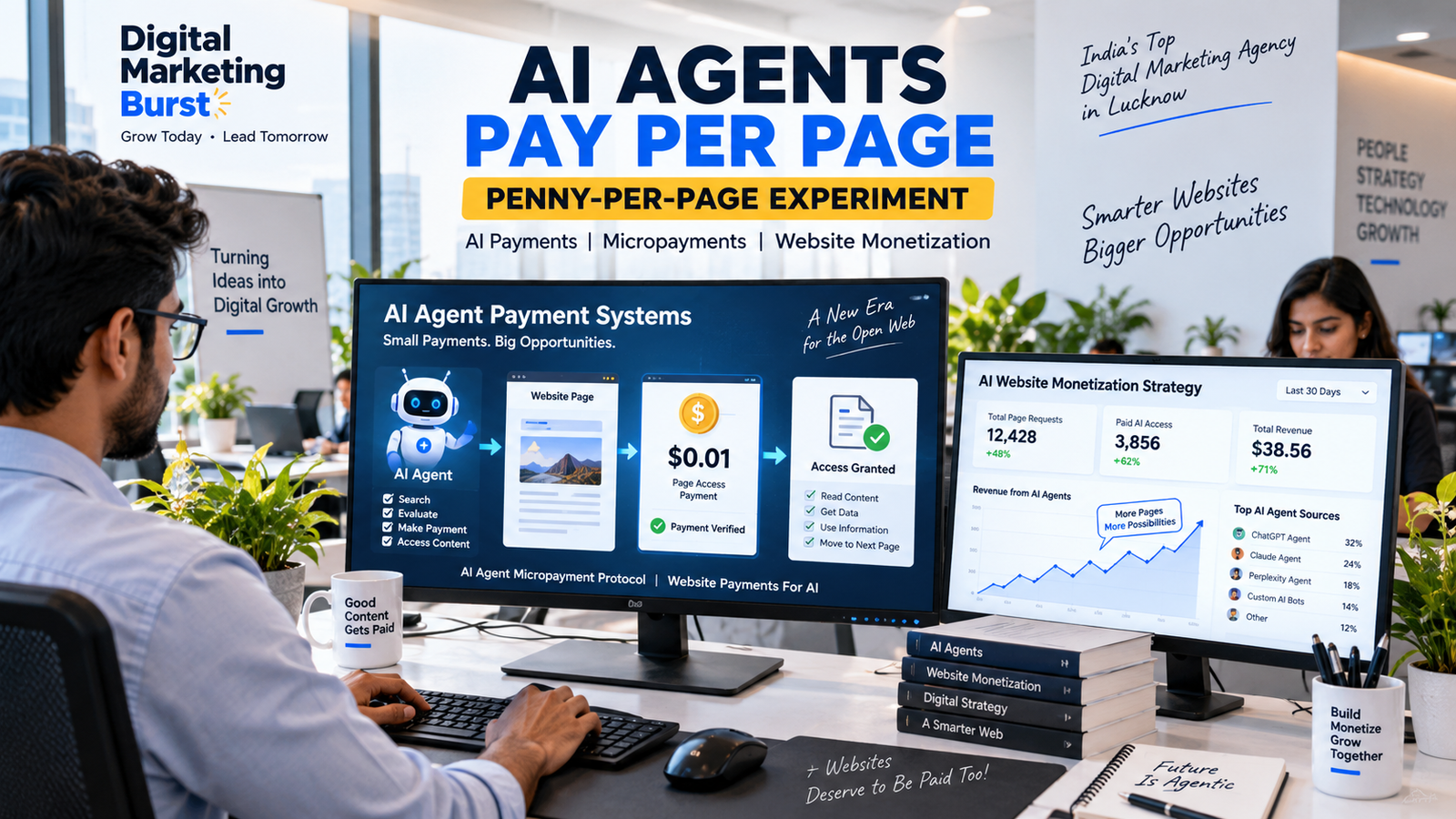
What Does It Mean to Make AI Agents Pay Per Page?
Making an AI agent pay per page means placing a machine-readable payment requirement between an automated requester and a protected web resource. Instead of asking a human to open a checkout page, enter card details, and create an account, the transaction is designed for software.
Imagine that a research agent needs information from 20 premium pages. The publisher charges one cent for each protected request. Rather than buying a monthly subscription, the agent pays only for the resources it needs.
That sounds small. However, machine traffic can operate at a very different scale from human traffic. If thousands of automated requests reach useful resources every day, tiny transactions can become a measurable revenue stream.
Still, not every page should sit behind a payment requirement. Search landing pages, product information, brand pages, and content intended for discovery may need to remain freely accessible. Premium research, structured datasets, specialist analysis, proprietary tools, or expensive API outputs could be better candidates.
Therefore, the real opportunity is not simply “charge bots.” It is to decide which machine interactions create enough value to justify a price.
That distinction matters. A useful pay-per-page model should create an exchange of value rather than becoming another obstacle between a website and its audience.
AI Agent Payment Systems
AI Agent Payment Systems are designed to let autonomous or semi-autonomous software handle transactions with less human involvement. In a conventional online purchase, a person usually chooses a product, enters payment information, confirms the transaction, and receives access. An agent-oriented model tries to make parts of that process machine-readable.
For publishers, this creates an interesting possibility. A website could expose a free summary while placing deeper research, structured data, premium calculations, or specialist resources behind a small payment requirement. An agent could then determine whether the resource is worth purchasing.
The payment layer must be fast. If a one-cent resource requires a complicated registration flow, several redirects, and manual approval, the model loses much of its value.
Pricing also needs context. A basic page might cost very little. A unique dataset or expensive computational request could cost more. Therefore, publishers should think beyond one universal price.
For Digital Marketing Burst, the SEO implication is equally important. Websites may eventually need to optimize not only for human visitors and search crawlers but also for transactional agents. Content quality, machine readability, pricing, permissions, and discoverability could become parts of the same strategy.
Agentic AI Payment Systems
Agentic AI Payment Systems extend digital payments into workflows where software can evaluate an offer and take an authorized action. That creates a different relationship between websites and automated visitors.
For example, an agent researching a competitive market may discover that a publisher offers a premium industry dataset. The agent can inspect the terms, determine whether the resource matches its task, and proceed through an authorized payment flow if its rules allow the purchase.
However, autonomy needs boundaries. Users or organizations should control spending limits, approved merchants, transaction types, and other permissions. Otherwise, an agent could make purchases that were never intended.
Publishers need controls as well. They should know which resources are paid, how much each request costs, and what happens when payment fails.
This is why agentic commerce is broader than attaching a payment button to an AI chatbot. It requires a reliable interaction between identity, authorization, pricing, payment, and resource delivery.
For marketers, the change could be significant. Conversion optimization may eventually include machine customers. Clear pricing and structured descriptions could matter alongside persuasive copy.
In other words, the future landing page may need to communicate effectively with both people and software.
AI Agent Micropayment Protocol
An AI Agent Micropayment Protocol can provide the communication layer needed for very small machine-to-machine transactions. The basic goal is straightforward: tell an automated requester that payment is required, communicate the price and conditions, verify payment, and provide the requested resource.
The penny-per-page experiment depends heavily on this efficiency. Charging one cent makes little sense when processing costs, technical overhead, or user friction exceed the value of the transaction.
Therefore, micropayment infrastructure needs to minimize unnecessary steps. The interaction should also remain understandable enough for publishers to audit.
A payment protocol does not automatically make content valuable. It simply creates a mechanism for exchanging value. Publishers still need information, data, tools, or services that agents have a reason to purchase.
This creates an important SEO lesson. In a machine-driven web, generic information may become increasingly difficult to monetize directly. Unique research, proprietary datasets, fresh information, specialist expertise, useful tools, and structured resources have stronger potential.
As a result, content strategy and payment infrastructure should be planned together. Charging for weak content will not create demand. A strong resource with an inconvenient payment system may also fail.
The best opportunity sits where valuable information meets low-friction access.
AI Agent Micropayment System
An AI Agent Micropayment System turns the protocol concept into an actual website workflow. It needs to recognize a protected request, communicate a price, verify the transaction, and unlock the appropriate resource.
Consider a website with 1,000 articles. Putting every article behind a penny payment would probably damage discovery. Instead, the publisher could keep 800 pages freely accessible while experimenting with premium access on 200 high-value resources.
Those resources might include original datasets, detailed benchmarks, specialist reports, premium templates, downloadable research, or expensive computational outputs.
Analytics then becomes essential. Publishers should measure how many automated visitors encounter the payment requirement, how many proceed, which resources convert, and how much revenue each resource generates.
Failure data matters too. If agents frequently reach the payment stage but abandon the transaction, the problem may be price, compatibility, unclear terms, or payment friction.
Therefore, the first experiment should be small. Test a limited content group and observe behaviour before expanding.
A successful system is not the one with the most paywalls. It is the one that places payment requirements where machine demand and content value actually meet.
How Does Penny-Per-Page AI Access Work?
A penny-per-page AI access model treats each protected resource as a tiny digital transaction. The website identifies a request for premium content and communicates that access has a price.
The automated requester then decides whether to continue. If payment is authorized and successfully verified, the website returns the requested resource.
The interesting part is that no traditional subscription is required. An agent that needs one page pays for one page. Another agent needing 100 resources can pay according to its actual usage.
This resembles usage-based cloud services more than a newspaper subscription.
However, publishers need to define what “page” means. Is one HTML request one paid unit? Does a structured version of the same article cost separately? What happens when an agent retries a failed request? Should cached access remain valid for a period?
Those questions become important quickly.
A sensible system should avoid charging repeatedly for technical failures. It should also communicate whether the purchase grants temporary access, permanent access, or a single retrieval.
Therefore, a penny-per-page experiment is partly a pricing experiment and partly a product-design experiment.
The technology enables payment. The publisher still has to design a fair commercial model around it.
AI Website Monetization Strategy
An AI Website Monetization Strategy starts with a simple question: what does your website own that an automated system may genuinely value?
A generic article summarizing widely available information may not justify payment. Original research is different. So are live datasets, proprietary comparisons, specialist databases, unique market intelligence, and computational tools.
Publishers should first separate discovery content from premium machine resources. Discovery pages attract users, search engines, links, mentions, and brand awareness. Premium resources create direct transactional opportunities.
This separation can protect organic visibility. If every useful page suddenly requires payment, search discovery and human acquisition may suffer.
A layered model can work better. The public page explains the subject and demonstrates expertise. A deeper dataset, structured export, premium report, or specialist analysis sits behind paid access.
Pricing should then match value. A penny can be a useful experiment because it reduces the decision threshold. However, expensive data should not automatically be sold for one cent simply because the requester is an AI agent.
Digital Marketing Burst would approach this as a monetization funnel. Free discovery attracts demand. Structured information explains the paid resource. Machine-readable pricing reduces friction. Analytics then reveals whether automated visitors actually convert.
That creates a strategy rather than a novelty.
AI Content Monetization Strategy
An AI Content Monetization Strategy focuses specifically on turning valuable information into resources that automated systems can purchase or license.
This requires a shift in thinking. Historically, a publisher might optimize an article to attract a human reader who then sees an advertisement or submits a lead form. Machine visitors may create value differently.
An agent may not care about banner advertisements. It may care deeply about accurate information, structured data, freshness, citations, or access speed.
Therefore, publishers should identify content with high informational utility. Research databases, technical specifications, financial datasets, specialist directories, real-time information, and proprietary analysis are obvious examples.
Presentation also matters. Machine customers benefit from predictable structure and clear metadata. A valuable resource hidden behind confusing navigation may be difficult for an automated system to evaluate.
At the same time, human content should remain readable. Optimizing for machines should not mean producing robotic pages.
A strong model can serve both audiences. Humans receive explanations and context. Authorized agents can obtain structured or premium resources under clearly stated terms.
That approach could create a new revenue layer without replacing existing SEO, lead generation, advertising, or subscription strategies.
AI Agents Paying Websites
AI Agents Paying Websites changes the traditional assumption that automated traffic is either free crawling or unwanted bot activity. Under a transactional model, some automated visitors could become customers.
Imagine a shopping assistant that needs premium product data. A research agent might require a specialist market report. A travel system could need frequently updated structured information. Each request can have measurable economic value.
The publisher then has another decision to make. Should the resource remain free because the resulting visibility is valuable, or should the agent pay because retrieving the information creates direct commercial value?
There is no universal answer.
A publisher seeking broad brand awareness may prioritize open access. Another business with expensive proprietary data may prefer paid retrieval. Many websites could use a hybrid model.
The key is segmentation. Search crawlers, malicious bots, human visitors, authorized commercial agents, and research systems should not automatically receive identical treatment.
This is where the penny experiment becomes useful. Instead of making a large commercial commitment, a publisher can test whether transactional machine demand actually exists.
If agents do not pay, the experiment still provides information. If they do, publishers gain evidence that machine traffic can become a direct revenue channel.
AI Agents Pay Websites
The phrase AI Agents Pay Websites sounds futuristic, yet it describes a simple economic relationship. One system owns a useful resource. Another system wants access. A payment mechanism allows the exchange to happen.
For this model to grow, websites need to make offers understandable to machines. Price, resource type, usage rights, and access conditions should not depend entirely on visual design.
Agents also need authorization. A user may allow an agent to spend a limited amount on research but prohibit other purchases. Businesses may create stricter policies for enterprise agents.
Trust will matter on both sides. Publishers need confidence that payment is valid. Users need confidence that agents are not wasting money. Agents need enough information to determine whether a resource is relevant before purchasing it.
That makes previews important. A publisher could expose metadata, a summary, a schema description, or a sample before requiring payment.
The result resembles ecommerce for information. The product may be a page, dataset, calculation, API response, or research result.
Once websites think of information as a machine-purchasable product, new monetization models become easier to imagine.
Website Payments For AI
Website Payments For AI can create a bridge between open web access and expensive enterprise licensing. Instead of choosing only between “free” and “subscription,” publishers can introduce small usage-based charges.
This flexibility is particularly useful when agents need information occasionally. A system may require only three resources from a publisher. Paying for those three requests can be more efficient than purchasing a monthly plan.
For websites, usage-based pricing can unlock demand that a subscription would lose.
However, the economics must work. Payment processing cannot consume most of a tiny transaction. Infrastructure costs also matter because serving large numbers of automated requests can require bandwidth and computing resources.
Publishers should calculate their actual cost per request. They should also consider the value of the information being delivered.
One cent is a compelling headline, but it is not automatically the correct price.
Some pages may remain free. Others could cost fractions of a dollar. Premium datasets might justify substantially higher pricing.
Therefore, website payments should be treated as a flexible pricing architecture rather than a universal penny paywall.
AI Website Payment System
An AI Website Payment System needs more than a checkout mechanism. It must connect resource discovery, pricing, authorization, verification, access, and analytics.
The first stage is discovery. An agent should understand that a resource exists and what it contains before paying.
Next comes pricing. The website needs to communicate the amount and relevant conditions clearly.
Authorization then happens on the agent side. The automated system must know whether it has permission to make that purchase.
After payment, verification should occur quickly. The website can then provide access to the requested content or service.
Finally, analytics records what happened. Publishers need to know which machine resources generate demand and which do not.
Security belongs across the entire workflow. A payment should not accidentally grant access to unrelated premium resources. Likewise, attackers should not be able to bypass the payment layer by changing request parameters.
This is why publishers should treat machine payments as infrastructure rather than a marketing widget.
When the underlying system is reliable, marketers can focus on pricing, positioning, discoverability, and conversion.
How to Charge AI Agents Per Page
The question how to charge AI agents per page begins with identifying which pages deserve a price. Do not start by placing a payment requirement across the entire site.
Choose resources with clear value. Original research is a strong candidate. Structured industry data can also work. Premium calculators, live feeds, proprietary benchmarks, and specialist analysis may have similar potential.
Next, define the unit being sold. A “page” should represent something understandable and consistent.
Then establish a price. One cent makes experimentation easy, but different resources may need different prices.
The website also needs to tell automated systems what happens after payment. Does the agent receive one response? Can it revisit the resource? Is caching permitted? Can the information be used commercially?
Clear rules reduce ambiguity.
After launching, monitor both revenue and discovery. If paid access causes valuable organic pages to disappear from search visibility, the experiment may be damaging a larger acquisition channel.
Therefore, charging agents should complement SEO rather than automatically replace open content.
Start small, measure everything, and expand only when the data supports the model.
Pay Per Page AI Content
Pay Per Page AI Content creates a middle ground between completely open publishing and full subscription access.
A human reader may visit a free article because they want a general explanation. An automated research system might require a more structured version, additional data, or deeper analysis. The publisher could monetize that enhanced resource separately.
This distinction is powerful because the same subject can support multiple products.
For example, a free article might explain a market trend. The paid machine resource could contain the underlying dataset, structured citations, historical values, or downloadable tables.
The public article continues attracting organic traffic. Meanwhile, the premium layer creates a transaction opportunity.
Publishers should avoid deliberately degrading free content merely to force payment. That can hurt trust and SEO.
Instead, paid access should offer additional utility.
A useful question is: what can the premium resource help an agent accomplish that the public page cannot?
If the answer is clear, charging becomes easier to justify.
If there is no meaningful difference, a payment requirement may simply reduce access without creating enough value.
AI Agent Pay Per Use
AI Agent Pay Per Use is broader than paying for articles. The same model can apply to APIs, calculations, searches, generated reports, database queries, images, specialist tools, or other digital resources.
Usage-based pricing fits agents because automated systems often work task by task.
Suppose an agent needs a single company record from a specialist database. A monthly subscription may be unnecessary. Paying for one query can be more efficient.
Another agent might need 10 calculations from a financial tool. Each request could have its own small charge.
This creates a programmable marketplace of digital capabilities.
However, pricing must remain predictable. Agents need to understand the cost before executing a request. Users also need spending controls.
Publishers can introduce daily limits, per-task budgets, or maximum transaction values.
For marketers, this opens another content opportunity. A website does not have to monetize only text. Useful functionality can become a paid machine resource.
That may eventually make tools, datasets, and APIs as important to SEO-led businesses as conventional blog posts.
AI Agent Payment Protocol and HTTP 402
The AI agent payment protocol conversation often intersects with HTTP 402, historically labelled “Payment Required.” The status concept is particularly interesting for machine transactions because it gives websites a recognizable way to indicate that a requested resource requires payment.
In a simplified workflow, an agent requests a protected resource. The server responds with payment requirements. The agent completes an authorized payment. After verification, it requests or receives access to the resource.
This is far more machine-friendly than showing an automated agent a visual checkout page designed for humans.
Still, HTTP status handling alone does not solve the complete commercial problem. Websites need payment instructions, verification, pricing rules, security, access policies, and transaction records.
The user side needs controls as well. An autonomous system should not have unlimited spending power merely because it understands a payment request.
Therefore, payment-required responses should be viewed as one component in a broader architecture.
For publishers, the important takeaway is that the web is becoming more capable of communicating economic requirements directly between machines.
That creates new possibilities for content and API monetization.
x402 AI Agent Payments
x402 AI agent payments have become an important concept in discussions about machine-readable web payments. The broader idea is to make paid digital resources easier for software to discover and access without requiring the traditional human checkout experience.
This fits the penny-per-page experiment closely. A resource can communicate that payment is required, provide machine-readable requirements, and continue the interaction after an authorized transaction.
For content publishers, the appeal is obvious. Automated systems increasingly consume online information. A standardized payment layer could allow some of that consumption to become transactional.
However, publishers should not confuse technical possibility with guaranteed demand.
Agents will pay only when the resource helps complete a task and the expected value exceeds the price and friction involved.
That brings the conversation back to content quality.
Unique data has an advantage. Fresh information can have an advantage. Proprietary tools and specialist expertise may also create stronger willingness to pay.
Generic content that can be obtained freely from many sources has less leverage.
Therefore, x402-style monetization should begin with resource strategy, not simply payment implementation.
AI Agents Paying for Content
AI agents paying for content could reshape the economics of publishing if automated consumption continues to grow.
Publishers currently face a difficult question. Machine systems can derive value from web content, yet the original publisher may receive little direct economic benefit from some forms of automated access.
Micropayments introduce another option.
Instead of blocking every automated system, a publisher can potentially create different access levels. Public pages remain open where discovery matters. Premium machine resources require payment. Unauthorized or abusive bots can still be restricted.
This model gives publishers more control.
It also encourages better content economics. If an agent pays directly for information, the publisher can measure the value of individual resources more clearly than with broad advertising metrics.
However, charging everything could backfire. Open content contributes to brand discovery, citations, links, and customer acquisition.
The stronger approach is selective monetization.
Publishers should ask which content creates reach and which resources deliver unique machine utility. Those two groups do not always need the same access model.
Websites Charging AI Agents
Websites charging AI agents represents a larger shift from blocking automated traffic toward classifying and monetizing it.
Not every bot is equal. Search crawlers can help discovery. Monitoring systems may support business operations. Malicious automation can create costs. Commercial AI agents may obtain direct value from data.
Treating every automated visitor identically ignores these differences.
A modern access strategy can establish separate rules for different machine categories.
For example, a website may permit normal search crawling while charging approved commercial agents for premium structured data. High-frequency abusive traffic can still be blocked.
This creates a more nuanced model than a universal robots-versus-humans divide.
Publishers will need strong analytics to make it work. They should know which automated requests consume resources, generate visibility, create revenue, or cause abuse.
Machine identity is also a challenge. A website needs confidence about who is making the request and what permissions apply.
Therefore, payment technology is only one part of the future machine-access stack. Identity, security, analytics, licensing, and SEO remain equally important.
AI Content Micropayments for Publishers
AI content micropayments for publishers could create a revenue stream that sits alongside advertising, subscriptions, affiliate marketing, sponsorships, and lead generation.
The advantage is granularity. A publisher does not need to convince an automated customer to purchase a large subscription before providing value.
A tiny transaction can unlock one useful resource.
Over time, many small transactions could become meaningful when machine demand is high. Yet publishers should calculate revenue after transaction and infrastructure costs.
Content selection remains crucial.
High-value research, professional databases, specialist archives, and frequently updated information are stronger candidates than commodity articles.
Publishers can also experiment with bundles. An agent might pay one cent for a single resource or a larger amount for a temporary package of related data.
This creates pricing flexibility without forcing human subscription logic onto machine customers.
The best experiments will measure not only revenue but also how paid access changes crawling, citations, discovery, and customer acquisition.
A monetization channel is useful only when it creates more value than it removes elsewhere.
AI Website Monetization Without Ads
AI website monetization without ads is attractive because machine visitors do not behave like conventional advertising audiences.
An automated agent does not need to see a display banner. It wants information or functionality.
Therefore, charging for the resource itself may align revenue more directly with value.
This could be useful for websites that dislike cluttered advertising experiences. Instead of filling premium pages with multiple ads, a publisher can offer specialized resources under usage-based pricing.
Human pages can remain clean and accessible.
The approach also changes measurement. Rather than tracking only impressions and ad clicks, publishers can measure paid machine requests, revenue per resource, repeat agent usage, and transaction conversion rates.
Still, ads and machine payments do not have to compete. A website can use multiple revenue models simultaneously.
Human traffic may support advertising. Premium subscribers may pay monthly. Commercial agents may pay per request.
Diversification can make a publishing business more resilient.
The key is matching the revenue model to the visitor and the value being consumed.
AI Agent Payment Gateway for Websites
An AI agent payment gateway for websites would act as a bridge between protected digital resources and automated purchasers.
For publishers, the ideal gateway should be simple to integrate and easy to monitor. It should verify payment quickly and return clear transaction information.
Agents need predictable responses. They should understand price, payment requirements, and what resource becomes available after purchase.
Security remains critical. Attackers should not be able to forge payment confirmation or reuse authorization outside its intended scope.
Publishers also need reporting. Revenue should be traceable to resources, requests, and time periods.
Refunds or failed deliveries may need consideration as well. If an agent pays but the resource cannot be delivered, the system should have a sensible recovery process.
These requirements show why the payment gateway becomes part of website infrastructure.
Marketing teams may define the offer and price. Developers handle technical integration. Finance teams may care about settlement and reporting. Legal teams can define licensing.
Machine monetization therefore becomes a cross-functional business project.
Machine-to-Machine Payments for AI
Machine-to-machine payments for AI describe transactions in which software systems exchange value with minimal human interaction during the actual purchase.
This model could extend far beyond websites.
An AI travel agent might purchase data from a transport provider. A research system could pay for an academic dataset. A business agent might buy an API result needed to complete a workflow.
The economic logic is compelling because machines can make many small decisions rapidly.
However, that same speed creates risk.
A poorly configured agent could make thousands of unnecessary purchases. Therefore, spending limits and authorization policies are essential.
Transactions also need strong records. Users should be able to understand what an agent purchased and why.
For sellers, machine-readable product information becomes increasingly important. A software customer cannot rely on emotional advertising in the same way a human might.
It needs structured information about cost, capability, conditions, and expected output.
As machine commerce grows, clarity may become a conversion factor.
AI Agent Commerce and Micropayments
AI agent commerce and micropayments could transform small digital resources into standalone products.
Today, selling something worth one cent is usually impractical through a conventional ecommerce checkout. The user effort alone is greater than the value of the purchase.
Agents change that equation.
If payment can happen programmatically within predefined limits, tiny purchases become more practical.
A website might sell a single data point, one calculation, one page of premium analysis, or one API response.
Millions of potential digital resources could then become independently priced.
Still, publishers should avoid pricing every interaction merely because the technology allows it.
Free resources create discovery and trust. They can also lead users and agents toward higher-value products.
Therefore, the strongest model may resemble freemium software. Basic information remains accessible. Premium machine utility carries a price.
This gives agents enough information to evaluate the publisher before spending.
Can AI Agents Pay for Web Content?
The question can AI agents pay for web content has two parts. The first is technical. The second is economic.
Technically, automated payment workflows can be designed when an agent has the appropriate tools, permissions, payment method, and compatible merchant infrastructure.
Economically, the more important question is whether an agent should pay.
If the same information is freely available from reliable sources, payment may not make sense. If a publisher owns unique data, a premium resource may be worth purchasing.
Therefore, content differentiation becomes central.
Publishers interested in machine monetization should invest in information that cannot be recreated easily from generic web sources.
Original surveys, proprietary datasets, expert analysis, real-time information, specialized archives, and unique tools can create that differentiation.
The payment mechanism then captures part of the value already present in the resource.
Technology cannot manufacture willingness to pay. It can only make payment easier when value exists.
Why Would an AI Agent Pay One Penny for a Page?
One penny seems almost meaningless to a person. However, one-cent AI content access can make sense when the transaction happens automatically and the resource helps complete a valuable task.
Suppose an agent is producing a high-value business report. Paying a few cents for accurate specialist information could be trivial compared with the value of the finished task.
The decision becomes an optimization problem.
An agent can compare expected information value with cost. If the page is likely to improve the result and the price falls within its budget, purchasing may be reasonable.
Publishers can improve conversion by exposing enough information before payment. A clear title, description, freshness date, data schema, or preview can help an agent estimate relevance.
Charging blindly creates uncertainty. Providing useful pre-purchase metadata reduces it.
This resembles product descriptions in ecommerce. Customers need enough information to decide whether the product is worth buying.
The difference is that the customer may now be software.
Problems With AI Agent Micropayments
The problems with AI agent micropayments are just as important as the opportunities.
Transaction economics is the first issue. If fees exceed the value of tiny purchases, penny pricing becomes impractical.
Identity is another challenge. Websites need reliable ways to distinguish legitimate agents from spoofed or abusive automation.
Access control can also become complicated. A publisher needs to prevent unpaid retrieval while ensuring paying agents receive the correct resource quickly.
Then comes duplicate charging. Automated systems retry requests. A badly designed payment flow could charge an agent repeatedly for the same failed retrieval.
Privacy deserves attention too. Transaction logs can reveal what information an agent is researching.
SEO creates another tension. Publishers may accidentally restrict resources that previously generated valuable organic discovery.
Finally, there is user control. People need clear limits on what their agents can buy.
These problems do not make the model impossible. Instead, they show why penny-per-page access needs careful architecture.
Why Pay-Per-Page AI Monetization Can Fail
Pay-per-page AI monetization can fail when publishers begin with pricing rather than value.
If a website charges for generic information available freely elsewhere, agents have little reason to purchase it.
Poor machine readability creates another problem. An agent may be willing to pay but unable to understand the payment instructions.
Pricing can also be wrong. One cent may be too expensive for commodity data yet far too cheap for valuable proprietary research.
Excessive paywalls can damage discovery. Search engines and human visitors still matter.
Technical reliability is equally important. A payment system that frequently fails will discourage repeat usage.
Publishers may also misread bot traffic as commercial demand. Large numbers of automated requests do not automatically mean those systems are willing or authorized to pay.
Therefore, test conversion rather than celebrating request volume.
The best experiments start with a small group of high-value resources and a clearly measurable hypothesis.
How to Test Penny-Per-Page Website Monetization
A penny-per-page website monetization experiment should begin with a controlled sample.
Choose a small group of resources that already demonstrate demand. Avoid changing the entire website.
Next, create a baseline. Measure current traffic, bot requests, server cost, organic visibility, conversions, and revenue associated with those pages.
Then introduce paid machine access while preserving the human experience appropriate for your business model.
Track how many eligible automated requests encounter the payment requirement. Measure how many complete payment and successfully retrieve the resource.
Revenue per thousand machine requests can become a useful metric.
Also monitor changes in search visibility. A monetization experiment should not quietly destroy a stronger organic channel.
After collecting enough data, compare outcomes.
Did machine revenue exceed implementation and infrastructure costs? Did repeat purchases occur? Which resources performed best? Did SEO remain stable?
The answers determine whether the experiment deserves expansion.
AI Agent Payment Analytics
AI agent payment analytics should go beyond counting successful transactions.
Publishers need to understand the complete funnel. Start with eligible machine requests. Then measure payment offers, successful authorizations, completed transactions, resource delivery, repeat usage, and revenue.
Failed requests should be categorized.
A payment failure is different from an agent deciding the resource is not worth the price. Technical failures require engineering fixes. Low purchase intent requires a pricing or product response.
Resource-level reporting is especially valuable.
Perhaps a premium dataset converts well while long-form articles rarely receive paid requests. That information should influence future content investment.
Average revenue per agent can also reveal whether a small group of repeat users generates most income.
Meanwhile, SEO teams should monitor crawl patterns and organic performance.
Machine monetization analytics should therefore sit alongside conventional web analytics rather than replacing it.
The publisher is building a new acquisition and revenue channel, not an entirely separate website.
Digital Marketing Burst AI Agent Payment Strategy
A Digital Marketing Burst AI Agent Payment Strategy should connect SEO, AI discovery, content monetization, and technical access rather than treating machine payments as an isolated feature.
The first layer remains visibility. A resource cannot generate transactions if relevant systems cannot discover that it exists.
The second layer is value. Digital Marketing Burst would focus on identifying information or functionality that deserves premium access.
Next comes machine readability. Resource descriptions, pricing, access conditions, and structured information should be clear.
Payment infrastructure follows. The experience should minimize unnecessary friction while respecting authorization and security.
Finally, measurement determines whether the strategy works.
This creates a full funnel: discover, evaluate, pay, access, measure, and optimize.
For businesses experimenting with AI-driven traffic, this framework is more useful than simply placing every page behind a paywall.
Digital Marketing Burst AI Website Monetization Strategy
A Digital Marketing Burst AI Website Monetization Strategy can combine conventional SEO traffic with emerging machine-payment opportunities.
The public content layer should continue answering valuable search queries. These pages can attract people, links, brand mentions, and search visibility.
A second layer can offer premium machine utility. This might include detailed datasets, specialist reports, structured exports, or useful digital tools.
The separation protects the traffic engine while introducing another revenue model.
Digital Marketing Burst can also evaluate search intent before selecting paid resources. Informational keywords may belong on free pages. High-value commercial or data-intensive use cases may support premium access.
Internal linking can connect both layers naturally.
A public article can explain a subject and point toward a more advanced resource without reducing the usefulness of the free page.
This creates an SEO-first monetization structure rather than an SEO-versus-monetization conflict.
Digital Marketing Burst AI Content Monetization
Digital Marketing Burst AI Content Monetization focuses on turning expertise into resources that can serve both human and machine audiences.
The human-facing article should remain natural, readable, and genuinely useful. Machine-facing layers can provide structured information where it improves utility.
This matters because writing robotic content solely for AI systems is unlikely to create a strong brand.
Originality remains important. Publishers need first-party insight, examples, experiments, and data if they want their resources to stand apart from generic information.
Digital Marketing Burst can use topic clusters to build authority around AI search, agentic commerce, website monetization, and machine payments.
Each cluster should have a clear informational hub. Supporting pages can address technical questions, commercial applications, problems, and case studies.
Over time, this creates a knowledge ecosystem rather than a collection of unrelated AI articles.
The result can support organic traffic today while preparing the site for new machine-driven discovery and monetization models.
Where to Use the Branded Keyword
Branded keywords should appear where they add context instead of being forced into every section.
For this topic, useful variations include Digital Marketing Burst AI Agent Payments, Digital Marketing Burst AI Website Monetization, Digital Marketing Burst Agentic Payment Strategy, Digital Marketing Burst AI Content Monetization, and Digital Marketing Burst Pay Per Page Strategy.
The article title should normally prioritize the main search intent rather than becoming overloaded with the brand.
Within the introduction, the company can appear naturally when explaining who is providing the analysis.
Relevant subheadings can use branded long-tail variations when the section genuinely describes the company’s approach.
The conclusion is another useful location because it connects the topic back to the publisher.
Image titles and descriptions can also contain the brand where appropriate.
For internal links, branded anchors should be used selectively. Too many identical anchors can make the writing unnatural.
The goal is simple: make Digital Marketing Burst clearly associated with expertise in AI search and emerging website monetization without turning every paragraph into an advertisement.
How AI Agent Payments Could Change SEO
AI agent payments and SEO may eventually intersect more closely than they do today.
Traditional SEO focuses on earning visibility and clicks. AI search has already expanded that discussion toward citations, retrieval, mentions, and machine understanding.
Paid agent access introduces another possible outcome: a transaction.
A future content funnel might begin when an AI system discovers a public page. It understands that a deeper resource exists. The agent evaluates the premium offer and purchases access when authorized.
The publisher can then measure revenue from machine discovery.
This does not mean traditional rankings become irrelevant. Human search traffic will continue to matter.
Instead, SEO may gain another audience.
Publishers could optimize free content for broad discovery while making premium resources understandable to authorized commercial agents.
This is why structured content, clear authorship, reliable information, and strong topical authority remain important.
The web may be changing, but visibility still comes before monetization.
AI Search Visibility and Paid Content
AI search visibility and paid content can appear contradictory. If content is locked, how will an AI system discover it?
The solution may be selective openness.
Publishers can expose useful metadata, descriptions, summaries, or samples while protecting the premium resource itself.
This allows discovery without giving away the complete product.
The concept already exists in other forms of digital commerce. A customer can see a book description without reading the entire book. A software buyer can review features before purchasing a subscription.
Machine commerce can follow similar logic.
An agent needs enough information to determine whether a paid resource matches its task.
Therefore, premium machine resources should have strong public descriptions.
SEO teams can optimize those discovery pages for relevant queries while technical teams protect the paid asset.
This creates a cleaner relationship between search visibility and monetization.
Future of AI Agent Payments in 2026
The future of AI agent payments in 2026 is likely to be shaped by experimentation rather than one universal business model.
Different websites have different economics.
A news publisher may value rapid distribution. A specialist database may prioritize licensing revenue. An API company already understands usage-based pricing. An ecommerce business may want agents to purchase products rather than information.
Therefore, agent payments will probably develop differently across industries.
Micropayments are especially interesting because they reduce commitment. Agents can purchase exactly what a task requires.
However, standards, identity, user authorization, security, and transaction economics still need to mature.
Publishers should watch the space without assuming every emerging protocol will become permanent infrastructure.
The practical approach is experimentation.
Identify one valuable resource. Define a clear price. Preserve organic discovery. Measure machine demand. Learn from the results.
That is more useful than rebuilding an entire website around a technology before customer behaviour is proven.
Is Penny-Per-Page the Future of Website Monetization?
Penny-per-page website monetization is unlikely to replace every existing revenue model. However, it could become one useful option in a broader machine-commerce ecosystem.
Advertising works for some audiences. Subscriptions work for others. Ecommerce, lead generation, licensing, and affiliate marketing each solve different business problems.
Machine micropayments add another choice.
Their biggest advantage is proportionality. A customer can pay according to actual usage.
That fits autonomous software particularly well because agents can make many small resource decisions.
Yet the model succeeds only when the underlying information has value.
Publishers should therefore spend more time improving their resources than designing clever payment barriers.
If an agent can obtain equivalent information elsewhere for free, the penny paywall provides little leverage.
If the website offers unique, accurate, timely, and useful information, even a tiny payment can become reasonable.
Value comes first. Payment infrastructure captures it afterward.
Final Thoughts: From AI Traffic to AI Revenue
AI Agent Payment Systems, AI Agent Micropayment Protocol, AI Website Monetization Strategy, AI Agents Paying Websites, and Website Payments For AI point toward a web where automated visitors may become economic participants rather than simply traffic sources. A penny-per-page experiment makes that possibility easy to understand because the transaction is tiny, but the underlying change is much larger.
For publishers, the opportunity is not to charge every crawler for every article. The stronger strategy is to identify resources with genuine machine value, preserve useful public discovery, introduce paid access selectively, and measure whether agents actually purchase what is offered.
Digital Marketing Burst can approach this shift from both SEO and monetization perspectives. Search visibility still matters because resources must be discovered before they can be evaluated. Meanwhile, original research, structured information, specialist expertise, and useful tools can create stronger reasons to pay.
AI Agent Payment Infrastructure for Modern Websites
AI agent payment infrastructure is the foundation that turns the idea of paid machine access into a working business model. A website cannot simply display a price and expect autonomous software to understand what happens next. The payment requirement, authorization process, verification step, and resource delivery must work together.
For publishers, the first challenge is deciding where the payment layer should appear. Public articles may remain available for organic discovery. Meanwhile, proprietary datasets, advanced research, premium reports, or computational resources can sit behind machine-readable paid access.
The infrastructure should also communicate price before a transaction occurs. An authorized agent needs enough information to decide whether the requested resource fits its task and budget. Therefore, hidden or unpredictable charges can create unnecessary friction.
Security is equally important. Payment confirmation should unlock only the purchased resource. A successful transaction for one page should not accidentally provide unrestricted access to an entire premium database.
In addition, publishers need detailed logs. They should be able to see which resources were requested, what was purchased, whether delivery succeeded, and how much revenue each resource generated.
The goal is not merely accepting money from software. Instead, the infrastructure should create a reliable digital marketplace where automated systems can discover, evaluate, purchase, and consume useful resources.
AI Agent Payment Solutions for Publishers
AI agent payment solutions for publishers could create an alternative to relying completely on advertising or subscriptions. Publishers increasingly create information that has value beyond a traditional page view. Automated systems may want structured facts, fresh data, specialist analysis, or access to digital tools.
A machine-payment layer gives publishers another way to package that value.
For example, the main article can remain free. This protects its ability to attract organic traffic and introduce the publisher to new audiences. However, an advanced dataset connected to the article could require a small transaction.
This separation is important because visibility and monetization have different jobs. Free content can create reach. Premium machine resources can generate direct revenue.
Publishers should test several pricing models instead of assuming one penny works for everything. A lightweight request might justify a tiny charge. In contrast, unique research that required weeks of work may deserve a much higher price.
The strongest solution will therefore support flexible pricing.
Publishers should also measure repeat demand. A resource purchased once may be interesting. A resource purchased repeatedly by different automated systems provides much stronger evidence of commercial value.
Over time, these patterns can help determine what new premium content should be produced.
Autonomous AI Payment Systems
Autonomous AI payment systems become particularly interesting when an agent can make purchasing decisions within boundaries established by its user.
Suppose a business gives its research agent a small budget for acquiring premium information. The agent searches for relevant sources and discovers several paid resources. It can compare descriptions, prices, freshness, and expected usefulness before deciding which resource fits the task.
However, autonomy should never mean unlimited spending.
Users need controls such as per-transaction limits, total budgets, approved resource categories, and merchant restrictions. An enterprise may require even more detailed policies.
For sellers, autonomous transactions create new conversion considerations. Human buyers respond to branding, design, social proof, and persuasive copy. Software buyers may prioritize structured descriptions, price, reliability, freshness, and expected output.
Consequently, publishers may eventually need two layers of conversion optimization.
The human layer explains why the resource matters in natural language. The machine layer describes exactly what is available and what it costs.
Digital businesses that understand both audiences could be better prepared for agentic commerce. The objective is not to remove humans from purchasing decisions entirely. Rather, it is to let authorized software execute routine transactions within clearly defined limits.
AI Agent Payment Technology for Content Access
AI agent payment technology for content access could solve a specific publishing problem. Websites often want automated systems to discover their expertise without necessarily giving unlimited commercial access to every premium resource.
A layered content architecture can help.
The first layer remains publicly discoverable. It explains the topic, establishes relevance, and gives readers useful information. The second layer contains additional value. This could include structured datasets, extended research, premium documents, or specialized tools.
An agent can discover the free layer first. If the premium resource matches its task, the system can evaluate whether purchasing access is worthwhile.
This approach is more balanced than blocking every automated visitor.
It also creates room for different access policies. Search crawlers may receive the public content needed for indexing. Human readers can browse normal pages. Authorized commercial agents can purchase premium machine resources.
Meanwhile, unwanted automated traffic can be handled separately.
Publishers should avoid viewing every bot as the same type of visitor. Some automation creates visibility. Other automation creates infrastructure costs. A third category may become a paying customer.
Payment technology becomes valuable when it helps the website distinguish those relationships and respond appropriately.
AI Agent Payment Gateway Integration
AI agent payment gateway integration should feel almost invisible to the authorized automated buyer. Every unnecessary step can reduce the usefulness of micropayments.
A conventional ecommerce transaction often includes account creation, a shopping cart, checkout pages, billing forms, and confirmation screens. Those steps were designed primarily for people.
Machine transactions need a different flow.
An agent requests a resource. The website communicates a payment requirement. The agent evaluates the request against its authorization rules. After an approved payment is verified, access is granted.
Behind this simple interaction sits a more complicated system.
The website needs transaction verification, access controls, security checks, logging, and failure handling. It must also decide how long paid access remains valid.
For instance, should an agent that purchases a resource be charged again five seconds later if a network error forces a retry? A poorly designed gateway could create duplicate charges and destroy trust.
Therefore, payment integration should include sensible retry and transaction-identification logic.
The best system minimizes friction for legitimate purchases while maintaining strong controls against abuse.
Machine Payments for Website Content
Machine payments for website content introduce an important change in how publishers calculate the value of automated traffic.
Traditionally, publishers measure sessions, users, page views, ad impressions, leads, subscriptions, and sales. Machine traffic does not always fit those metrics neatly.
An automated system may retrieve one resource and create substantial downstream value without ever viewing an advertisement or completing a human-style conversion.
Direct payment changes that relationship.
If a machine pays for the resource, the publisher can attach revenue to the request itself.
This can make content economics easier to measure. A dataset that receives 5,000 paid machine requests has obvious commercial demand. Another premium resource that receives many payment prompts but almost no purchases may need a lower price or stronger value proposition.
Still, free machine access can remain valuable. Search indexing, citations, discovery, and brand exposure may produce indirect benefits.
Therefore, publishers should avoid turning every automated request into a transaction.
The better approach is segmentation. Monetize resources where direct consumption creates enough value. Keep discovery resources accessible when reach provides the larger business benefit.
Pay Per Request AI Website Model
A pay per request AI website model expands the penny-per-page concept beyond traditional web pages. The billable unit can be any digital resource requested by an automated system.
One request might return a structured company record. Another could run a calculation. A third may provide a premium article or generate a specialized report.
This flexibility can create stronger business models because not every resource has equal value.
A simple fact may cost very little. A computationally expensive result can cost more. A proprietary research report may carry an entirely different price.
The website should communicate these differences clearly before payment.
Publishers also need to decide whether repeated requests for identical information should incur another charge. For frequently updated information, repeated payment may make sense. For static resources, temporary access rights or caching permissions could provide a better experience.
Usage terms become important as well. Buying access to information does not automatically answer questions about redistribution or commercial reuse.
Therefore, the payment model should define both what the agent receives and how that resource can be used.
AI Agent Microtransactions for Digital Content
AI agent microtransactions for digital content can make small pieces of information economically accessible without requiring a full subscription.
This matters because automated systems often need very specific information. A research agent may need only one table from a larger database. A marketing system could need a single industry benchmark. Another agent may require one verified company record.
Forcing each system into a monthly subscription can create unnecessary friction.
Microtransactions provide another option.
However, the publisher needs to avoid breaking useful resources into excessively small pieces simply to generate more transactions. Artificial fragmentation can make the product difficult to use.
Instead, each paid unit should deliver clear value.
The transaction amount should also reflect processing economics. If technical costs consume the majority of the payment, the pricing model needs adjustment.
Publishers should therefore calculate contribution margin rather than looking only at gross transaction volume.
A million tiny transactions sound impressive. Yet they matter only when the system produces sustainable revenue after payment, infrastructure, support, and content-production costs.
AI Content Paywall for AI Agents
An AI content paywall for AI agents should work differently from a traditional human subscription wall.
A human paywall often provides part of an article and then asks the reader to subscribe. A machine-focused paywall needs to communicate conditions in a format automated software can interpret.
The agent should know what resource exists, how much it costs, and what it will receive after payment.
Providing useful pre-purchase information is critical. Otherwise, the agent has no rational basis for deciding whether to spend.
Publishers might expose a title, summary, data description, update date, or resource schema while keeping the premium information protected.
This creates a machine-friendly preview.
SEO should also be considered. If the entire page disappears behind inaccessible content, search visibility may decline. Therefore, the public discovery layer should remain valuable in its own right.
The objective is not to publish empty teaser pages. Instead, provide genuine free value while reserving additional utility for paid access.
A thoughtful paywall can therefore support both organic acquisition and machine monetization.
Monetize AI Bot Traffic Without Blocking Discovery
Learning how to monetize AI bot traffic does not necessarily mean blocking every crawler until payment is received.
Automated traffic serves different purposes. Search crawlers help content appear in search results. Some AI systems may help users discover brands. Other commercial agents may retrieve information directly for task completion.
These interactions have different economic values.
A publisher can therefore create multiple access layers.
Public content remains available for discovery. Premium structured resources can require payment. High-volume abusive automation can be restricted.
This creates a more flexible strategy than a universal paywall.
Analytics should guide the decisions. If a particular machine category sends substantial traffic but produces no measurable benefit, the publisher can reconsider its access policy.
Conversely, blocking a crawler that contributes meaningful search visibility could damage acquisition.
Digital Marketing Burst can evaluate these interactions as part of a broader AI traffic monetization strategy. The goal is to understand which machine visitors create reach, which consume resources, and which have the potential to become paying users.
Monetization works best when access rules reflect those differences.
AI Traffic Monetization Strategy
An AI traffic monetization strategy should start with classification rather than pricing.
First, identify what kinds of automated traffic reach the website. Some requests may come from search crawlers. Others could involve AI discovery systems, monitoring tools, commercial agents, or unwanted bots.
Next, determine the business value of each category.
A search crawler can support organic visibility even though it never pays. A commercial agent may consume valuable information directly. Abusive automation may provide no benefit while increasing server costs.
Only after understanding these differences should a publisher decide where payments belong.
This prevents a common mistake: treating every machine request as lost revenue.
Free access can sometimes be the more profitable decision when it leads to visibility, leads, citations, or customer acquisition.
At the same time, premium resources should not automatically be available without restrictions simply because a requester is automated.
The strategy therefore needs a balance between reach and direct revenue.
A successful model turns machine traffic into measurable business outcomes rather than focusing solely on blocking or charging bots.
AI Website Revenue Strategy for Agentic Commerce
An AI website revenue strategy for agentic commerce can combine several monetization methods instead of depending entirely on penny-per-page transactions.
A website could offer free discovery content, paid data access, premium API requests, subscriptions, enterprise licensing, and transaction-based tools.
Different customers can then choose the model that fits their usage.
An occasional agent may pay per request. A business using the same resource thousands of times might prefer a larger commercial agreement.
This creates a natural progression from micropayments to higher-value relationships.
Publishers should therefore watch for repeat machine customers. A high-frequency buyer may represent an opportunity for a more efficient pricing arrangement.
The same logic already exists in many software businesses. Small users begin with usage-based pricing. Larger users move toward negotiated plans.
Agentic commerce can extend that approach to web information.
Instead of asking whether penny payments will replace subscriptions, publishers can ask how micropayments fit into a broader revenue ladder.
That question produces a much stronger commercial strategy.
AI Agent Content Licensing
AI agent content licensing becomes important when paid access goes beyond simply viewing information.
Suppose an automated system pays one cent to retrieve an article. Does that transaction permit the agent to summarize the content? Can the information be stored? Can it be redistributed? Can it be incorporated into a commercial product?
Payment alone does not answer these questions.
Publishers need clear usage terms that match the resource being sold.
A single retrieval could provide limited access. Another product might include broader commercial rights at a higher price.
This creates opportunities for tiered pricing.
For example, reading access might be inexpensive. Structured commercial reuse could require a different license.
Machine-readable licensing could eventually become as important as machine-readable pricing because agents need to understand what they are authorized to do after purchase.
Publishers should avoid creating unnecessarily complicated rules. However, valuable intellectual property deserves appropriate protection.
As automated content consumption grows, access price and usage rights will increasingly need to be considered together.
AI Agent Content Access Control
AI agent content access control determines what happens after a transaction has been verified.
The simplest model grants access to one resource. More advanced systems may allow temporary sessions, bundles, usage credits, or specific API permissions.
Whatever model is chosen, the access scope should be clear.
A one-cent payment for a single article should not accidentally unlock every premium page. Similarly, legitimate purchasers should not encounter repeated payment requests during the access period they already bought.
Access tokens or equivalent authorization mechanisms can help connect payment with resource delivery.
Publishers also need expiration rules. Temporary data may require short access windows, while purchased static resources could use different conditions.
Security testing becomes essential because paid endpoints create a financial incentive for bypass attempts.
The system should also handle refunds or delivery failures sensibly.
A payment model succeeds when customers trust that they will receive exactly what they purchased.
That principle applies whether the customer is human or software.
AI Agent Payment Security
AI agent payment security becomes more important as automated systems gain permission to spend money.
For users, the biggest concern is uncontrolled purchasing. Spending limits, merchant restrictions, and transaction policies can reduce that risk.
For publishers, payment fraud and access bypass are major concerns. A website needs to verify that a payment is genuine before releasing premium resources.
Replay attacks also require attention. A valid payment proof should not automatically provide unlimited access unless that is what the customer purchased.
Logs can support investigation when unusual behaviour occurs.
However, security should not make the transaction unusable. Adding excessive verification to a one-cent purchase can defeat the purpose of micropayments.
The challenge is finding a balance.
High-value resources may justify stronger verification. Tiny transactions need efficient controls.
Security policies should therefore reflect risk and resource value rather than applying the same process to every purchase.
As agentic payments grow, businesses that build secure foundations early may find it easier to experiment with new pricing models later.
AI Agent Spending Limits and Payment Authorization
AI agent spending limits and payment authorization are necessary if autonomous purchasing is expected to operate safely.
A user may allow an agent to spend up to a certain amount during a research task. Another user might permit purchases only from approved publishers.
Businesses can create even more specific policies.
For example, an enterprise agent could have a daily budget, a maximum price per resource, and an approved category of information it may purchase.
If a transaction exceeds those limits, human approval can be requested.
This creates a useful balance between automation and control.
Without these boundaries, an agent might repeatedly purchase low-value resources or accidentally generate substantial costs.
Publishers benefit from clear authorization too. A properly authorized transaction reduces disputes and improves trust.
Payment interfaces should therefore provide enough information for the agent to make a decision before money moves.
Price alone may not be sufficient. The resource description, freshness, format, and usage rights can all influence the decision.
Good machine commerce depends on informed transactions, even when the buyer is software.
AI Agent Payment Failure Handling
AI agent payment failure handling can determine whether a customer retries or abandons a paid resource completely.
Several failures are possible. Payment authorization may be rejected. Verification can time out. The resource may become unavailable after payment. Network problems can interrupt delivery.
Each situation requires a clear response.
Most importantly, retrying a failed resource request should not automatically create duplicate charges.
Transaction identifiers can help the website recognize that a valid payment already occurred.
Publishers should also separate payment failure from content-delivery failure. The two problems require different solutions.
Detailed logs are useful for debugging, but error responses should remain understandable to the automated requester.
A machine should know whether it needs to retry, choose another payment method, wait, or abandon the request.
Reliable failure handling may sound less exciting than agentic commerce. Yet it is essential for commercial adoption.
Customers remember broken transactions more than successful ones.
AI Agent Payment Pricing Strategy
An AI agent payment pricing strategy should reflect resource value rather than using one universal price simply because penny payments sound attractive.
Some information is inexpensive to produce and widely available. Charging a tiny amount may be appropriate.
Other resources are costly to create. Original market research, real-time data, specialist databases, and complex calculations can have much higher economic value.
Pricing should also consider the customer’s alternative options.
If equivalent information is freely available from trusted sources, even a one-cent price may reduce demand.
If the resource is unique and saves significant time, a higher price may remain attractive.
Publishers can test several levels and measure conversion.
A lower price may generate more transactions but less total revenue. A higher price can produce fewer purchases while increasing revenue per request.
Therefore, the objective should be sustainable revenue, not simply maximum transaction count.
Pricing experiments should also avoid confusing customers. Changes need enough time and data to produce meaningful conclusions.
Dynamic Pricing for AI Agents
Dynamic pricing for AI agents could eventually allow websites to price digital resources according to freshness, computational cost, demand, or usage.
For instance, a real-time market data request may cost more than yesterday’s archived value. A computationally intensive report could carry a higher price than retrieving a static page.
However, dynamic pricing introduces transparency concerns.
An agent needs to know the price before committing to a purchase. Unexpected changes can interfere with spending rules and reduce trust.
Therefore, dynamic does not have to mean unpredictable.
A website can expose current pricing clearly while allowing it to vary according to defined conditions.
Publishers should also consider whether complexity adds enough value. A simple pricing structure may convert better when resources are inexpensive.
Dynamic models make more sense when underlying delivery costs or information value change significantly.
The penny-per-page experiment is a useful starting point precisely because it is easy to understand. More sophisticated pricing should be introduced only when the data demonstrates a need.
AI Agent Payment Conversion Rate
AI agent payment conversion rate can become one of the most useful metrics for publishers testing paid machine access.
Imagine that 10,000 eligible automated requests encounter a paid resource. If only five complete payment, the publisher has learned something important.
The problem could be the resource, price, payment compatibility, or pre-purchase information.
Now imagine that a specific dataset receives a much higher purchase rate. That indicates stronger machine demand.
Conversion should therefore be measured at resource level rather than only across the entire website.
Publishers can also compare new and repeat purchasers.
Repeat usage is particularly valuable because it suggests that the information delivered enough value to justify another transaction.
However, conversion should not be optimized in isolation. A website could increase paid transactions by blocking previously free resources, yet lose valuable search visibility in the process.
The complete business impact matters more.
Revenue, discovery, infrastructure cost, repeat usage, and organic traffic should be evaluated together.
Revenue Per AI Agent Request
Revenue per AI agent request provides a clearer financial picture than raw machine traffic.
A website may receive millions of automated requests, but high volume alone does not create a business.
Suppose only a small percentage reaches premium resources. An even smaller group may complete transactions.
Revenue per request helps publishers understand what the entire traffic stream is actually worth.
This metric can also be compared with infrastructure cost.
If serving automated requests costs more than the revenue generated, the model needs improvement.
Publishers can then adjust pricing, access rules, caching, or the types of resources offered.
Over time, high-value machine content should become easier to identify.
A particular database might generate far more revenue per request than a generic article archive.
That insight can guide future investment.
Instead of producing more content simply to increase page count, publishers can create resources that automated customers demonstrably value.
AI Agent Payment SEO Strategy
An AI agent payment SEO strategy needs to protect discovery while creating opportunities for direct machine revenue.
The easiest mistake is hiding too much.
If search engines cannot understand what a premium resource offers, the page may struggle to attract discovery traffic. Likewise, AI systems may never know that the resource exists.
Therefore, publishers need useful public landing pages.
These pages can explain the resource, show examples, establish expertise, and answer relevant search queries. The premium data or functionality can remain protected.
This creates two optimization layers.
The public layer targets search demand. The paid layer delivers advanced utility.
Internal links can connect related informational articles to premium resources where appropriate.
Digital Marketing Burst can use this architecture to build topic authority while experimenting with machine transactions.
SEO should bring the right audience to the resource. Payment infrastructure should monetize appropriate high-value usage.
When both systems support each other, publishers do not have to choose between traffic and revenue.
Digital Marketing Burst AI Agent Monetization Strategy
A Digital Marketing Burst AI Agent Monetization Strategy can start with SEO data rather than guessing which resources agents may buy.
Pages already attracting relevant search demand reveal topics users care about. Search queries can also expose questions that require deeper data or tools.
Digital Marketing Burst can use that information to identify opportunities for premium machine resources.
For example, a successful informational cluster might later support a paid dataset, specialized report, or automated analysis tool.
The public articles continue attracting traffic. The premium layer monetizes advanced demand.
Performance should then be reviewed through both SEO and commercial metrics.
Rankings, impressions, organic clicks, agent requests, paid transactions, repeat purchases, and revenue all provide different information.
This combined approach can help prevent monetization experiments from damaging the traffic engine that made the resource discoverable in the first place.
The objective is sustainable growth rather than simply charging for access.
Digital Marketing Burst Pay Per Page AI Strategy
A Digital Marketing Burst Pay Per Page AI Strategy would begin with a limited test rather than a site-wide change.
First, select a small group of resources with clear informational value. Next, determine which portion should remain publicly accessible for discovery.
Then define the premium unit. It might be a full report, structured dataset, specialist analysis, or advanced resource rather than an ordinary blog page.
A low initial price can help test whether automated customers are willing to transact.
After launch, Digital Marketing Burst can evaluate payment conversion, repeat usage, SEO performance, and revenue.
If the experiment succeeds, additional resources can be added gradually.
If it fails, the data should reveal why.
Perhaps the content was too generic. Maybe the payment process created friction. The price could also have been inappropriate.
This test-and-learn model is much safer than assuming machine payments will automatically create revenue.
How to Optimize Paid Content for AI Agents
Learning how to optimize paid content for AI agents starts before the paywall.
An agent needs to understand what it is considering buying. Therefore, public metadata should clearly explain the resource.
The title should be specific. A description should summarize the content or data available. Freshness information can help when time-sensitive information is involved.
If the resource has a structured format, describe that format before purchase.
Pricing and usage conditions should also be understandable.
After access is granted, the content itself should remain well organized. Clear headings, consistent terminology, structured information, and concise explanations can improve machine comprehension.
However, do not turn human-readable content into unnatural keyword blocks.
Quality remains important for both audiences.
The best paid resource is easy to discover, easy to evaluate, easy to purchase, and easy to use.
That complete experience can influence whether an agent returns to the same publisher for another purchase.
AI-Friendly Paid Content Structure
An AI-friendly paid content structure should make valuable information easy to identify without sacrificing readability.
Start with a clear topic and purpose. Avoid vague titles that require extensive interpretation.
Use logical sections to separate concepts. Important definitions should appear near the relevant subject instead of being scattered throughout the page.
When structured data adds value, it can complement the narrative content.
Publishers should also distinguish facts, analysis, and opinion clearly. This helps both human readers and automated systems understand what they are consuming.
Freshness is another factor. Time-sensitive resources should indicate when they were updated.
Premium content should deliver something beyond the public preview. Otherwise, customers may feel that the transaction added little value.
At the same time, the public page needs enough substance to stand independently.
This balance is central to machine monetization.
Discovery content earns attention. Premium content earns payment.
Content Quality for Paid AI Access
Content quality for paid AI access becomes even more important once a website asks for money.
Free generic information may receive some traffic because users can access it without commitment. Paid resources face a higher standard.
Accuracy is essential. So is freshness when the topic changes frequently.
Originality creates another advantage. An agent has little reason to pay for information copied or paraphrased from freely available sources.
Publishers should therefore invest in first-party data, expert interpretation, useful tools, and genuinely differentiated resources.
Clear sourcing and methodology can strengthen trust when research is involved.
Quality also includes delivery. A technically accurate dataset is still frustrating if the format is inconsistent or poorly documented.
The best paid resources save time or improve outcomes.
That should be the central test before introducing a payment requirement.
Ask whether the resource provides enough additional utility that a rational automated customer might choose to buy it.
If the answer is uncertain, improve the resource before improving the paywall.
Building Trust With AI Agent Customers
Building trust with AI agent customers may sound unusual, but trust remains essential even when the buyer is software.
Agents make decisions using the information and policies available to them. A publisher with clear descriptions, predictable prices, reliable delivery, and consistent resource quality becomes easier to evaluate.
Failed deliveries damage that trust.
So do misleading descriptions.
If a resource promises fresh market data but returns outdated information, future automated systems may have little reason to purchase again.
Identity and reputation can therefore matter in machine commerce.
Publishers should clearly identify who operates the resource and what expertise supports it.
For Digital Marketing Burst, this means connecting AI payment content with broader expertise in SEO, digital marketing, AI search, and website strategy rather than publishing isolated trend articles.
Trust grows through consistency.
The same principle has always applied to human customers. Agentic commerce simply introduces another audience that may evaluate reliability in a more structured way.
How Publishers Can Prepare for AI Agent Commerce
Publishers wondering how to prepare for AI agent commerce do not need to rebuild their entire website immediately.
Start with content inventory.
Identify which pages generate discovery and which resources contain differentiated value. Next, review automated traffic patterns and server costs.
Then examine whether structured versions of valuable information could become useful machine products.
Technical teams can explore payment-compatible architectures in a controlled environment.
Meanwhile, SEO teams should protect crawlability and search visibility for public resources.
Legal and commercial teams can consider usage rights and pricing.
Most importantly, publishers should test demand before making large investments.
The machine-payment ecosystem is developing quickly. Not every approach will become a permanent standard.
A flexible website architecture makes experimentation easier.
Businesses that understand their content value, traffic sources, and customer needs will be in a stronger position regardless of which payment technologies ultimately gain adoption.
From Free AI Crawling to Paid AI Access
The transition from free AI crawling to paid AI access should not be viewed as an all-or-nothing decision.
Some machine access can create substantial value for publishers. Search discovery is an obvious example.
Other forms of automated consumption may use expensive resources without providing a clear return.
Paid access introduces another choice between unrestricted availability and complete blocking.
A publisher could keep standard articles accessible while charging for high-frequency commercial API usage. Another might provide summaries freely while monetizing detailed datasets.
This flexibility is likely to be more useful than a universal rule.
The important question is not whether AI should pay for the web.
Instead, publishers should ask which machine interactions create enough direct commercial value to justify payment and which interactions create more value when they remain free.
That question can produce very different answers for a blog, SaaS platform, database company, news publisher, or ecommerce website.
The Economics of One-Cent AI Payments
The economics of one-cent AI payments determine whether the headline idea can become a sustainable model.
At first glance, one cent seems too small to matter. At machine scale, however, the calculation changes.
One hundred paid requests generate only a small amount. Ten thousand transactions create something more noticeable. Millions of successful purchases could become meaningful.
Yet gross revenue is only part of the calculation.
Payment costs, hosting, bandwidth, database usage, fraud prevention, monitoring, and content production all affect profitability.
Therefore, publishers should calculate net contribution per paid request.
A one-cent price may work for a lightweight static resource but fail for an expensive real-time computation.
This is why pricing should follow unit economics.
The penny is an excellent experimental price because it makes the concept tangible. It should not become a rule that every digital resource must follow.
Successful machine monetization will probably involve many price levels based on value and delivery cost.
Can Small AI Payments Become Real Publisher Revenue?
The question can small AI payments become publisher revenue depends largely on volume, uniqueness, and repeat demand.
A website with low machine traffic may never generate meaningful revenue from one-cent transactions.
A specialist database receiving large numbers of valuable automated queries has a very different opportunity.
Repeat purchases matter particularly strongly.
If an agent buys one resource and never returns, the transaction provides limited evidence. If multiple systems repeatedly pay for updated information, the publisher has discovered a real machine market.
This can influence product development.
Instead of producing more generic articles, the publisher may invest in the dataset or tool generating recurring demand.
Over time, machine-payment analytics can therefore shape content strategy itself.
Revenue becomes feedback about what information automated customers value.
That could be one of the most interesting consequences of paid agent access.
Future of Pay Per Page AI Content
The future of pay per page AI content is unlikely to be limited to literal webpages.
The larger opportunity is paid digital access.
Agents may purchase data records, API responses, reports, calculations, media, research, or access to specialized software capabilities.
Pages are simply an easy way to understand the model today.
As agentic systems become more capable, digital products may increasingly be designed with machine customers in mind from the beginning.
That means structured descriptions, transparent pricing, programmable access, and automated delivery could become standard features of some websites.
Human users will remain important. Therefore, machine commerce should complement rather than replace human experiences.
The most successful websites may serve several audiences simultaneously.
Humans discover and read. Search engines index. AI systems understand and reference. Authorized agents purchase specialized resources.
Each interaction can have a different business value.
Final Thoughts on Building a Penny-Per-Page AI Business Model
Making autonomous software pay for web resources is ultimately less about the penny and more about changing the economics of machine access. A successful experiment requires valuable content, predictable pricing, secure authorization, reliable delivery, and careful measurement.
Publishers should not begin by locking their entire website. Instead, they can protect selected premium resources while keeping strong discovery content accessible. This preserves organic acquisition while testing whether commercial agents are willing to pay for additional utility.
Digital Marketing Burst can connect this model with SEO, AI-search optimization, content strategy, and website monetization. That combination matters because machine revenue cannot develop if valuable resources remain difficult to discover.
At the same time, traffic alone is not enough. The resource must solve a problem well enough to justify a transaction.
The penny-per-page concept is therefore best treated as an experiment in machine-to-machine commerce. Test one resource, observe what agents do, improve the offer, and expand only when the economics make sense.
How AI Agents Decide Whether a Page Is Worth Paying For
An AI agent pay-per-page decision should depend on value, relevance, price, and user authorization. An automated system should not purchase every resource simply because it encounters a payment requirement. Instead, it needs enough information to estimate whether the content can help complete its task.
A publisher can support that decision with a clear page title, concise description, update date, content category, expected format, and transparent price. For example, an agent searching for current marketing benchmarks may value a recently updated proprietary dataset more than a general article covering definitions.
Price also changes the decision. A tiny fee may be acceptable when the expected value is high. However, even a small charge becomes wasteful when thousands of low-quality resources are purchased automatically.
Therefore, publishers should focus on communicating value before asking for payment. A useful preview can show what the premium resource contains without revealing the entire product.
This approach benefits both sides. Agents can make better purchasing decisions, while publishers can attract transactions from systems that genuinely need their information. As machine commerce develops, resource descriptions may become almost as important as conventional product descriptions in ecommerce.
AI Agent Payment Decision Making
AI agent payment decision making introduces a new type of conversion funnel. Traditional website optimization tries to persuade a person to click, subscribe, enquire, or purchase. Machine-focused conversion may work differently because an automated buyer can evaluate information using predetermined rules.
Price is one factor. Freshness may be another. Source reliability, data format, relevance, licensing conditions, and expected task value can also influence a transaction.
For example, an authorized research agent may have a maximum budget of ₹500 for a task. It could discover several premium resources and allocate that budget according to their expected usefulness.
Publishers that clearly communicate what they sell make this process easier.
Meanwhile, vague descriptions can reduce conversion. An agent may avoid purchasing when it cannot determine what will be returned.
Consequently, machine conversion optimization should focus on clarity rather than hype.
Digital Marketing Burst can apply the same principle to AI-search content. A page should make its subject, purpose, expertise, and unique value understandable quickly. This helps human visitors as well.
The result is a stronger information architecture for both audiences.
AI Agent Payment API for Paid Content
An AI agent payment API for paid content can make premium website resources easier to purchase programmatically. Instead of forcing automated software through a visual checkout, an API can communicate the resource, cost, payment conditions, and access response in a predictable format.
This becomes particularly useful for websites selling structured information.
Imagine a publisher maintaining an industry database. Human visitors may explore the information through a normal interface. An authorized agent could request specific records through a paid endpoint.
The business can then price requests according to value.
However, the API needs documentation. Agents and developers should understand available resources, expected responses, pricing behaviour, and error handling.
Rate limits also matter. Payment does not necessarily mean unlimited server usage.
Security controls should prevent one valid purchase from being reused improperly across unrelated requests.
Therefore, the API becomes a commercial product rather than merely a technical endpoint.
Publishers that already have valuable structured data may find this model more practical than charging for conventional HTML pages.
Pay Per API Request for AI Agents
Pay per API request for AI agents extends machine micropayments into services that websites already understand well.
Many APIs use subscriptions, credits, or monthly usage tiers. A machine-payment model could introduce more granular purchasing where appropriate.
An agent needing only one request does not necessarily need an account with a recurring plan.
For example, a business agent may need one current data record to complete a customer request. If that information is available through a trusted paid API, a small one-time transaction could be more efficient than establishing a long-term subscription.
Still, high-volume customers may benefit from traditional contracts or prepaid plans.
This means per-request payments should complement other pricing options.
Publishers can use transaction data to identify customers that move from occasional usage toward consistent demand. Those users may later be suitable for larger plans.
In this sense, micropayments can also function as a low-friction entry point into a wider commercial relationship.
AI Agent Data Monetization Strategy
An AI agent data monetization strategy may offer stronger opportunities than charging for ordinary articles because structured data often provides clear machine utility.
Consider a website that owns years of proprietary industry information. Human readers may consume summaries through articles. An agent could require the underlying dataset for analysis.
Those are two different products.
The public article can generate search traffic and establish authority. Meanwhile, structured data can become a paid resource.
This separation allows the publisher to monetize depth without hiding all useful information from search.
Data quality becomes crucial. Inconsistent fields, missing records, or outdated information can reduce repeat purchases.
Documentation matters as well. An agent needs to understand what the data represents.
Therefore, publishers should treat machine-ready datasets as products. They need maintenance, versioning, descriptions, quality controls, and pricing.
The strongest opportunities are likely to appear where information is difficult to collect, expensive to maintain, or valuable because it changes frequently.
Monetizing Proprietary Data With AI Agents
Monetizing proprietary data with AI agents can create a stronger competitive advantage than attempting to sell information available on hundreds of other websites.
Proprietary resources might include original surveys, internal benchmarks, historical datasets, specialist directories, research results, or unique market observations.
These assets have scarcity.
If an agent needs the information to complete a task, it cannot simply retrieve an identical resource elsewhere.
That creates pricing power.
However, publishers should still provide enough public information to make the resource discoverable. A landing page can explain what the dataset contains, who created it, when it was updated, and what types of analysis it supports.
The complete data can remain protected.
This structure can also generate search traffic around specific data-related queries.
For Digital Marketing Burst, the lesson is important. Future SEO may increasingly reward businesses that produce original information rather than publishing another version of existing content.
Original resources can generate traffic, citations, authority, and potentially direct machine revenue.
AI Agents Buying Premium Website Data
AI agents buying premium website data creates a different customer journey from conventional content marketing.
The agent may not read an entire article from beginning to end. Instead, it may identify a particular resource that contains information required for a task.
Therefore, premium data needs clear positioning.
A resource titled “2026 Dataset” is vague. A more specific description explaining industry, geography, fields, update frequency, and coverage helps the buyer understand what it contains.
Freshness can strongly affect value.
Real-time or frequently updated data may justify recurring transactions. Static historical information may follow a different pricing model.
Publishers should also think about format. Machine customers often benefit from structured outputs rather than presentation-heavy pages.
This does not mean abandoning human content.
The website can maintain a readable editorial layer while offering machine-oriented products separately.
Serving each audience appropriately creates more value than forcing one format to perform every job.
AI Agent Paid Data Access
AI agent paid data access can help businesses control how high-value information is consumed while still supporting legitimate automated usage.
Without a payment or licensing layer, a company may face two unattractive choices. It can leave valuable data openly accessible or attempt to block automated retrieval completely.
Paid access creates a third option.
Authorized systems can obtain the information under defined conditions.
The publisher can set prices, rate limits, usage rights, and access periods.
Meanwhile, analytics reveal how demand changes over time.
This can help businesses identify their most valuable digital assets.
A particular dataset might receive little human attention but strong machine demand. Another resource may perform well in search but generate no paid usage.
Both can still be useful for different reasons.
The key is understanding the role each resource plays in the wider business.
AI Agents Buying Research Reports
AI agents buying research reports is a natural use case for machine payments because research often has clear economic value.
A report may contain original surveys, expert interpretation, market forecasts, or proprietary datasets that required significant resources to produce.
A public summary can help potential buyers understand its scope.
An authorized agent could then purchase the complete report when the information is relevant to its task.
This can reduce friction for occasional buyers.
However, publishers should consider whether a penny-per-page model makes sense for high-value research. In many cases, it will not.
The same infrastructure that enables tiny payments can potentially support higher-priced resources.
Therefore, the important innovation is not the one-cent price itself. It is the ability for software to understand and complete a paid-access workflow.
Publishers can then match pricing to the actual value of the resource.
AI Agents Paying for Real-Time Data
AI agents paying for real-time data could become one of the strongest applications of machine-to-machine payments.
Fresh information often loses value quickly. Weather feeds, inventory levels, transport information, financial data, pricing intelligence, and other live resources may need constant updates.
Providing that data has infrastructure costs.
A usage-based model allows publishers to charge according to consumption.
An agent requiring one update can pay for one request. Another system needing continuous access may use a higher-volume plan.
This flexibility can improve alignment between customer usage and publisher costs.
Yet reliability becomes extremely important.
If a buyer pays specifically for current information, outdated results can damage trust immediately.
Timestamps, update frequency, and data-quality checks should therefore be clearly communicated.
For machine customers, freshness is not simply a content feature. In many cases, it is part of the product being purchased.
AI Agent Paywall SEO Strategy
An AI agent paywall SEO strategy needs to solve one major tension: monetization requires restriction, while search visibility usually benefits from accessible information.
The answer is not to choose one side completely.
A public landing page can provide substantial information about the topic. It can answer common questions, establish expertise, and attract relevant search demand.
The premium layer then offers additional utility.
For instance, a public article can explain an industry trend. A paid resource might provide the underlying dataset, downloadable model, or advanced analysis.
This structure gives search engines useful material to understand.
At the same time, the publisher preserves a commercial asset.
Internal linking should help visitors move naturally between related informational resources and premium products.
Digital Marketing Burst can use this approach when designing AI paywall SEO strategies. Organic visibility remains an acquisition channel, while premium resources create a monetization layer.
The two objectives can support each other when the content architecture is planned correctly.
SEO for AI Agent Payment Pages
SEO for AI agent payment pages should begin with the same fundamentals used for other high-quality landing pages.
The search intent must be clear. The title should accurately describe the resource. Introductory content needs to explain what the visitor can find and why it matters.
However, payment pages also need additional information.
Potential customers should understand what is included before purchasing. That can involve resource type, update frequency, format, coverage, or methodology.
Relevant long-tail search queries can then be addressed naturally through supporting sections.
For example, a paid market dataset could have sections answering questions about coverage, update frequency, data format, and intended use.
This creates a useful search landing page instead of a thin paywall.
Search engines receive meaningful context. Human visitors understand the offer. Authorized agents receive enough information to evaluate the resource.
The same page can therefore support discovery and conversion without giving away the premium asset itself.
AI Search Optimization for Paid Content
AI search optimization for paid content adds another layer to conventional SEO.
AI-driven discovery systems may need enough accessible information to understand what a premium resource offers.
Therefore, publishers should clearly describe the resource outside the restricted layer.
Specific terminology helps. So does a concise explanation of scope.
Original research should identify the methodology where appropriate. Datasets should explain their fields and coverage. Tools should describe what they can accomplish.
The goal is not keyword stuffing.
Instead, provide enough semantic context for both humans and machines to understand the product.
Brand signals can also matter. The publisher should clearly identify who created or maintains the resource.
Digital Marketing Burst can connect paid-content optimization with broader AI-search strategies by building strong topic clusters around the premium asset.
This gives the resource contextual authority rather than leaving it as an isolated sales page.
Generative Engine Optimization for Paid Content
Generative Engine Optimization for paid content focuses on making expertise understandable within AI-driven discovery environments while protecting commercially valuable resources.
A publisher can create comprehensive public explanations around a premium product.
These pages establish subject relevance and demonstrate expertise. Meanwhile, the underlying proprietary data remains separately controlled.
Clear definitions and logical content structure can make the subject easier to interpret.
Original statistics or first-party insights can further differentiate the publisher.
However, businesses should not reveal the complete paid product simply to increase AI visibility.
The objective is controlled discoverability.
Potential customers should know the resource exists, understand what problem it solves, and have enough information to evaluate it.
This resembles a strong SaaS product page. The website explains what the software does without giving every premium feature away for free.
Paid information products can follow the same principle.
LLM Content Optimization for AI Agent Commerce
LLM content optimization for AI agent commerce means making commercial resources understandable to language-model-powered systems without sacrificing natural writing.
Clear context matters.
A page should identify what is being sold, who it is intended for, what it contains, and how current the information is.
Ambiguous marketing language can make evaluation harder.
For example, saying a dataset contains “everything you need” provides little machine-readable value. Describing its coverage, fields, time range, and update frequency is much more useful.
Natural language still matters because human decision-makers may review the same resource.
Therefore, content should be concise without becoming robotic.
Digital Marketing Burst can use this principle across AI-search and agentic-commerce content.
Write first for clarity. Add structured context where it genuinely helps. Keep claims specific. Make commercial conditions understandable.
Good machine optimization often resembles good communication.
AI Agent Citation and Paid Content Strategy
An AI agent citation and paid content strategy should recognize that visibility and direct payment can create different kinds of value.
A free research summary may earn mentions or citations. Those references can strengthen brand awareness and attract visitors.
The full dataset may have greater commercial value and remain behind paid access.
Publishers therefore do not need to choose between citations and revenue.
Instead, they can decide which layer of information serves each goal.
Public content can contain enough original insight to deserve attention. Premium resources can offer deeper utility for buyers.
This model can be especially effective for research-led businesses.
The public analysis establishes expertise. The paid asset monetizes depth.
Over time, strong public content can create demand for the premium product.
That relationship is similar to conventional content marketing, but machine customers add another potential conversion path.
AI Agent Content Discovery Before Payment
AI agent content discovery before payment is necessary because automated systems need to know a valuable resource exists before they can purchase it.
A payment wall that reveals nothing about the resource creates a discovery problem.
Publishers should therefore expose descriptive information.
A title identifies the subject. A summary explains the purpose. Metadata can indicate format, freshness, and coverage.
A small preview may further reduce uncertainty.
However, the preview should not eliminate the reason to purchase.
The correct balance depends on the product.
A research report may provide an executive summary publicly. A dataset might show field names and sample records. A tool could explain inputs and expected outputs.
These previews function as machine-oriented merchandising.
They help the customer understand the product without receiving the entire product.
As AI agents participate more actively in commerce, this pre-purchase information may become an important part of digital marketing.
AI Agent Resource Discovery Strategy
An AI agent resource discovery strategy goes beyond optimizing individual paid pages.
Publishers need a connected content ecosystem that helps automated systems understand their areas of expertise.
Topic clusters can support this goal.
Suppose a website sells premium AI-search data. Supporting articles could explain AI visibility, LLM optimization, agentic commerce, machine payments, and content monetization.
Internal links connect these subjects.
The premium resource then sits within a broader context.
This architecture also benefits traditional SEO because search engines can understand relationships between related pages.
Digital Marketing Burst can use this approach to build authority around emerging technology topics.
Rather than publishing isolated trend pieces, create a connected knowledge base.
Discovery then becomes more likely across multiple search queries and AI-driven research paths.
AI Agent Payment Funnel
An AI agent payment funnel can be understood through five broad stages: discovery, evaluation, authorization, transaction, and delivery.
However, publishers should not treat these stages as a rigid technical checklist. Each one is also a marketing opportunity.
Discovery depends on visibility.
Evaluation depends on clear value.
Authorization requires predictable pricing and conditions.
Transaction quality depends on low friction.
Delivery determines whether the buyer will trust the publisher again.
Afterward, repeat usage becomes an important signal.
A strong resource can turn a one-time machine customer into recurring demand.
Digital Marketing Burst can analyze this funnel similarly to a conventional conversion journey while recognizing that the customer behaves differently.
Instead of improving button colours or checkout copy, optimization may involve clearer metadata, better resource descriptions, more transparent pricing, and faster machine responses.
The fundamentals of conversion remain surprisingly familiar. Remove uncertainty and deliver value.
AI Agent Payment Conversion Optimization
AI agent payment conversion optimization should focus on reducing uncertainty at every stage of the machine purchase.
An agent should not need to guess what a resource contains.
The price should be clear before payment.
Delivery conditions should also be predictable.
If a resource is time-sensitive, freshness information can improve confidence.
Meanwhile, technical latency can influence conversion because autonomous systems often operate within time limits.
Failed transactions should return useful information rather than generic errors.
Publishers can test different resource descriptions and pricing structures to see how behaviour changes.
However, conversion should never be improved through misleading claims.
A purchase that disappoints the customer may generate one transaction while destroying repeat demand.
Long-term machine revenue depends on reliable value.
Therefore, repeat purchase rate can be more meaningful than initial conversion alone.
How to Increase AI Agent Payment Conversion
Businesses researching how to increase AI agent payment conversion should start by examining failed purchase journeys.
Did the agent understand the resource?
Was the price outside its allowed budget?
Could it complete the payment method?
Did the requested format match its task?
Was the resource sufficiently fresh?
Each answer points toward a different optimization.
If agents frequently encounter the resource but rarely attempt payment, the value proposition may be weak.
If payment attempts are high but completion is low, technical friction may be responsible.
If purchases occur but repeat usage remains poor, content quality deserves attention.
This diagnostic approach is better than randomly lowering prices.
A cheaper resource does not solve unclear descriptions or unreliable delivery.
Publishers should therefore optimize the complete machine customer experience.
AI Agent Payment Customer Journey
The AI agent payment customer journey begins long before money changes hands.
An automated system first needs a task. It then searches for resources that can help complete that task.
Discovery brings it to the publisher.
The agent evaluates available information and decides whether the resource appears relevant.
Next, it compares the cost with its authorization limits.
Payment occurs only after these conditions align.
The website then delivers the resource.
Afterward, the agent may evaluate whether the information was useful enough to influence future source selection.
This final stage is easy to overlook.
If machine systems develop mechanisms for preferring reliable resources, consistent quality could become a competitive advantage.
Publishers should therefore think beyond individual transactions.
The objective is to become a trusted source that authorized systems choose repeatedly.
AI Agent Subscription vs Pay Per Page
The AI agent subscription vs pay per page decision depends on frequency and usage patterns.
Occasional users may prefer per-resource transactions. They pay only when they need information.
High-volume customers may find subscriptions more efficient.
Publishers do not necessarily need to choose one model.
Both can exist together.
An agent might begin with individual purchases. If its usage grows, the system could move to prepaid credits or a larger plan.
This creates a natural customer lifecycle.
Micropayments reduce the barrier to initial usage. Subscriptions create predictable revenue from repeat customers.
Enterprise licensing can serve customers with even larger requirements.
Therefore, penny-per-page access may function best as the first level of a broader pricing ladder rather than the final business model.
AI Agent Credits vs Micropayments
AI agent credits vs micropayments is another pricing decision publishers may eventually face.
Direct micropayments are simple conceptually. The agent pays each time a protected resource is requested.
Credits work differently. A customer purchases or receives a balance that can be consumed across multiple resources.
Credits can reduce transaction overhead when many tiny purchases occur.
They can also make budgeting easier.
However, direct payments may provide a cleaner experience for occasional machine visitors who do not want to maintain an account balance.
The best approach depends on usage.
A publisher with frequent repeat customers may benefit from credits. A website serving occasional one-off requests may prefer direct transactions.
Testing both models can reveal which produces better conversion and customer retention.
AI Agent Freemium Content Model
An AI agent freemium content model can help publishers balance discovery with monetization.
The free layer provides enough value to establish relevance and trust.
The premium layer offers additional depth.
For example, an AI marketing report might provide a public summary with several important findings. The complete dataset, detailed tables, or structured export could require payment.
This arrangement allows the free resource to attract search traffic.
It can also generate mentions and links.
Meanwhile, customers requiring deeper information have a clear reason to upgrade.
Freemium works only when the free layer is genuinely useful. Thin teaser content can frustrate readers and perform poorly in search.
At the same time, the premium layer must deliver enough additional value to justify payment.
Finding that balance is a product decision as much as an SEO decision.
Free AI Access vs Paid AI Access
Free AI access vs paid AI access should be decided according to business value rather than emotion around automated crawling.
Free access can be highly beneficial when it supports discovery.
If a machine system helps potential customers find a brand, unrestricted access to selected public information may be worthwhile.
Paid access becomes more appropriate when an automated requester consumes a scarce or commercially valuable resource.
That could include proprietary data, expensive computation, or premium analysis.
The website may also impose limits before requiring payment.
For example, a small number of requests could remain free while high-volume usage becomes paid.
This gives new customers a chance to evaluate the resource.
A flexible policy can therefore outperform both complete blocking and complete openness.
AI Agent Payment Business Model for Publishers
An AI agent payment business model for publishers can eventually include several revenue layers.
Free editorial content attracts attention.
Premium individual resources generate micropayments.
Frequent users purchase credits or subscriptions.
Enterprise customers receive commercial agreements.
Specialized datasets can carry separate licensing terms.
This structure gives publishers several ways to monetize the same underlying expertise.
However, each layer must provide additional value.
A customer should understand why moving from free content to paid data is useful.
Likewise, a subscription should offer advantages over repeatedly buying individual resources.
The payment infrastructure is therefore only one piece of the business model.
Content packaging, pricing, positioning, and customer segmentation remain essential.
AI Agent Economy and Website Monetization
The emerging AI agent economy and website monetization conversation is ultimately about who captures value when software performs tasks on behalf of people or businesses.
Agents can search, compare, analyze, communicate, and potentially purchase.
Each activity depends on resources provided by other businesses.
When those resources have commercial value, payment infrastructure creates a mechanism for compensation.
This could produce new digital markets.
A small publisher with a uniquely useful dataset may be able to sell access directly to automated customers.
A specialist tool could charge per computation.
An expert website might sell structured research.
Large audiences may no longer be the only route to digital revenue.
A smaller number of high-value machine transactions could support niche information businesses.
Still, quality remains the foundation.
Machine payments do not turn weak resources into valuable products.
AI Agent Economy for Content Creators
The AI agent economy for content creators could provide opportunities beyond advertising revenue.
Creators with specialized knowledge can package their expertise into resources that automated systems can consume.
An industry analyst might maintain a proprietary database. A marketing specialist could sell benchmarks. A technical expert may offer calculations or structured reference material.
Public articles continue demonstrating expertise.
Premium machine products monetize additional depth.
This could be particularly valuable for niche creators whose audiences are too small for large advertising revenue but whose information has high professional value.
However, creators should protect their human audience.
The goal is not to replace readable articles with machine endpoints.
Instead, use each format where it works best.
Humans benefit from explanation and storytelling. Automated systems may benefit from structured information.
A strong creator business can serve both.
Small Publisher AI Monetization Strategy
A small publisher AI monetization strategy does not require millions of monthly visitors to be interesting.
Niche information can have high value.
For example, a small industry website may maintain data that is difficult to find elsewhere. Automated systems working in that industry could value access even if normal consumer traffic remains modest.
The publisher should identify these differentiated assets first.
Then, public content can be used to create discovery around them.
A small test is usually preferable to expensive infrastructure development.
Choose one premium resource and measure demand.
If agents purchase it repeatedly, expand carefully.
If demand is weak, improve the resource or test another use case.
This reduces risk while providing genuine market feedback.
AI Agent Payment Experiment Results to Track
An AI agent payment experiment should measure more than total revenue.
Transaction count matters, but so does payment conversion.
Average revenue per resource can identify strong products.
Repeat purchase rate indicates whether customers found the information useful.
Failed payment rate reveals technical problems.
Delivery success should also be tracked.
Meanwhile, organic impressions and clicks can show whether the experiment affected SEO.
Infrastructure cost per machine request completes the economic picture.
Together, these metrics answer the most important question: did paid machine access create additional business value?
A successful experiment should improve the overall economics of the website rather than simply create an interesting technical demonstration.
Measuring ROI From AI Agent Payments
Measuring ROI from AI agent payments requires comparing new revenue with the full cost of implementation and operation.
Development work has a cost.
Payment processing has a cost.
Infrastructure and monitoring add expenses.
Premium content also requires production and maintenance.
Therefore, gross payment volume can be misleading.
Publishers should calculate net revenue after these expenses.
They should also consider opportunity cost.
If a paywall reduces organic traffic, the business may lose leads or advertising revenue.
Conversely, premium machine access might reduce abusive free consumption and improve server economics.
A complete ROI analysis includes both direct and indirect effects.
Only then can the publisher decide whether to expand the experiment.
AI Agent Payment Metrics for SEO Teams
AI agent payment metrics for SEO teams should connect machine transactions with discovery performance.
Organic impressions reveal whether relevant pages remain visible.
Clicks show human acquisition.
Machine requests indicate automated demand.
Payment encounters show how many requests reach monetized resources.
Successful transactions reveal direct commercial activity.
SEO teams can then compare topics.
A topic cluster may attract large human traffic but little paid machine demand. Another may generate modest traffic yet strong premium data purchases.
Both can be valuable.
This broader measurement framework helps marketers understand that future content may serve several types of customers simultaneously.
Digital Marketing Burst can use these insights to connect SEO performance with emerging machine-commerce outcomes.
Digital Marketing Burst AI Payment SEO Services
Digital Marketing Burst AI Payment SEO Services can be positioned around the intersection of organic visibility, AI-search readiness, website monetization, and emerging agentic commerce.
Businesses exploring paid machine access still need discoverability.
Digital Marketing Burst can focus on building content architectures that explain premium resources clearly while protecting the information that creates commercial value.
Keyword research can identify informational demand.
Content clusters can build topical coverage.
Technical SEO can protect crawlability.
AI-search optimization can improve machine understanding.
Meanwhile, monetization strategy can determine which resources remain open and which may support premium access.
The objective is not to force every website into a penny-per-page model.
Instead, businesses can evaluate whether their data, research, tools, or expertise create a realistic machine-payment opportunity.
Digital Marketing Burst AI Search and Agentic Commerce Strategy
A Digital Marketing Burst AI Search and Agentic Commerce Strategy combines two emerging questions: how will AI systems discover a business, and how can that discovery eventually create measurable commercial value?
The first problem is visibility.
Brands need useful, authoritative, clearly structured content that search engines and AI-driven systems can understand.
The second problem is conversion.
Some machine visitors may simply reference the information. Others may eventually need premium data, tools, or services.
Digital Marketing Burst can build content journeys that support both outcomes.
Free informational pages attract discovery. Specialist resources demonstrate expertise. Premium machine assets create potential transactions where appropriate.
This approach keeps SEO at the centre while preparing businesses for new digital customer journeys.
Digital Marketing Burst Website Monetization With AI
Digital Marketing Burst Website Monetization With AI can extend beyond adding AI-generated content to a website.
The larger opportunity is understanding how AI changes traffic, discovery, conversion, and revenue.
A website may receive human search visitors, AI referrals, automated crawlers, and commercial agents.
Each interaction can require a different strategy.
Digital Marketing Burst can help organize the website around these audiences while keeping human usefulness central.
Public pages should continue solving real search problems.
Premium resources can deliver additional value.
Analytics can then reveal whether machine demand creates a viable revenue opportunity.
This approach avoids chasing AI trends without a commercial objective.
Technology should support business outcomes, not become the outcome itself.
Future of AI Agent Micropayments in India
The future of AI agent micropayments in India is particularly interesting because digital payments are already deeply integrated into many everyday commercial experiences. Agentic transactions introduce a different layer, where authorized software could eventually perform certain purchases or pay for digital resources on behalf of users and businesses.
For Indian publishers, the opportunity will depend on the type of information they own.
A general informational website may benefit more from open discovery. A specialist B2B publisher with proprietary research could have stronger reasons to test paid machine access.
Local pricing will also matter.
A model designed around international enterprise data may not translate directly to every Indian content business.
Therefore, Indian publishers should experiment according to their own audience, content value, infrastructure cost, and customer demand.
The broader principle remains the same: machines should pay where the resource provides enough value to justify the transaction.
AI Agent Payment Systems for Indian Businesses
For Indian businesses, AI Agent Payment Systems could eventually become relevant across SaaS, ecommerce, research, travel technology, financial information, marketing tools, and other data-heavy industries.
However, adoption should be driven by practical use cases rather than trend pressure.
A business with a valuable API has an obvious starting point. A company with proprietary market information may have another.
A normal service website with primarily promotional pages may have little reason to charge agents for page access.
Businesses should therefore begin by identifying their digital assets.
Which information costs money to create? What data is difficult to obtain elsewhere? Which tools save customers time? What resources already attract automated demand?
Answers to these questions can reveal whether a machine-payment model deserves further testing.
Website Monetization With AI in India
Website monetization with AI in India can include far more than advertisements around AI-generated articles.
Businesses can use AI to improve lead generation, customer experiences, content workflows, personalization, and digital products. Agent payments add another possible revenue stream.
For publishers with valuable information, usage-based machine access may eventually complement conventional monetization.
For agencies, AI can create new consulting opportunities around search visibility, content architecture, automation, and conversion.
For SaaS businesses, paid machine APIs may be especially relevant.
There will not be one universal model.
The strongest strategy will depend on what the website sells and why customers value it.
This is why businesses should avoid adopting a payment technology before defining the product.
Start with value. Then choose the monetization mechanism.
AI Agents Paying Websites: What Happens Next?
The idea of AI Agents Paying Websites moves the internet toward a model where software can participate more directly in commercial interactions.
Today, many automated systems retrieve information. The next stage could involve agents evaluating paid resources and purchasing access under user-defined permissions.
If that behaviour becomes common, publishers may start designing digital products specifically for machine customers.
Datasets could become easier to purchase per request.
Research could be sold in smaller units.
Specialized tools could charge for each completed task.
Websites may expose public information for discovery while maintaining premium machine-access layers.
However, human control should remain central.
Agents can automate transactions, but people and organizations should determine budgets, permissions, and acceptable uses.
That balance will be critical for sustainable agentic commerce.
The Future of AI Website Monetization
The future of AI website monetization may involve a combination of traffic, subscriptions, advertising, licensing, API usage, agent transactions, and digital products.
The web does not need one replacement for every existing business model.
Instead, AI can create additional options.
Publishers with broad audiences may continue relying heavily on advertising. Specialist publishers may earn more from premium data. SaaS businesses can monetize computational resources. Research organizations may license information.
Machine micropayments can fit between free access and larger commercial agreements.
This flexibility is what makes the model interesting.
A penny is not the revolution by itself.
The bigger change is that a website may be able to communicate a price to software, receive an authorized payment, and deliver value without requiring a traditional human checkout.
Is AI Pay Per Page Worth Testing in 2026?
Whether AI pay per page is worth testing in 2026 depends on the website.
A publisher with original data, strong automated demand, and expensive resources may have a compelling reason to experiment.
A small brochure website probably does not.
Therefore, businesses should not implement machine payments merely because the concept is new.
Start with the economics.
Identify the resource. Estimate demand. Calculate delivery cost. Determine what price makes sense. Protect existing organic visibility.
Then run a limited experiment.
Even an unsuccessful test can provide useful information about machine demand and content value.
The goal is learning before scaling.
Final Conclusion: How to Make AI Agents Pay Per Page
The penny-per-page experiment represents something larger than charging a tiny amount for an article. It demonstrates how the web could evolve from passive automated consumption toward programmable commerce between websites and authorized AI systems.
A strong implementation begins with valuable resources. Clear discovery information helps automated buyers understand what is available. Transparent pricing supports better purchasing decisions. Secure payment and access controls protect both parties. Finally, analytics reveal whether the model actually produces sustainable revenue.
For Digital Marketing Burst, the bigger opportunity sits at the intersection of SEO, AI search, content quality, machine discovery, agentic commerce, and website monetization. Businesses should continue building pages that are useful to people while preparing premium digital resources for new forms of automated access.
A website does not need to charge every AI visitor. Instead, it can keep discovery open where visibility creates value and introduce payment where proprietary information, data, tools, or specialized resources justify it.