The Google Local Search Update, Google Local SEO Update,Google Business Profile Optimization, Local SEO For Businesses, and Google Local Business Resultsare becoming increasingly connected as Google changes how local businesses can appear in European Economic Area search experiences. The change matters because Google has now added local-business query support to its aggregator and supplier units in the EEA. For businesses, directories, SEO professionals, and marketers, this creates a new layer of local-search visibility that is worth understanding in 2026.
Google documented the change on September 18, 2026. The company says its aggregator and supplier units now support local-business queries. The aggregator unit is designed for eligible vertical search services, such as directories and comparison platforms. Meanwhile, the supplier unit can feature direct providers, including physical businesses and local service providers. Importantly, these features are specifically documented for users in the EEA. Therefore, businesses should not interpret this as a worldwide replacement for ordinary local search results.
For marketers in India, the development is still worth watching. Changes to regional Google Search experiences can reveal how Google is experimenting with business discovery, entity information, aggregators, direct providers, and structured local data. As a result, understanding this update can help SEO teams prepare for a search environment where accurate business information and strong website signals become even more important.
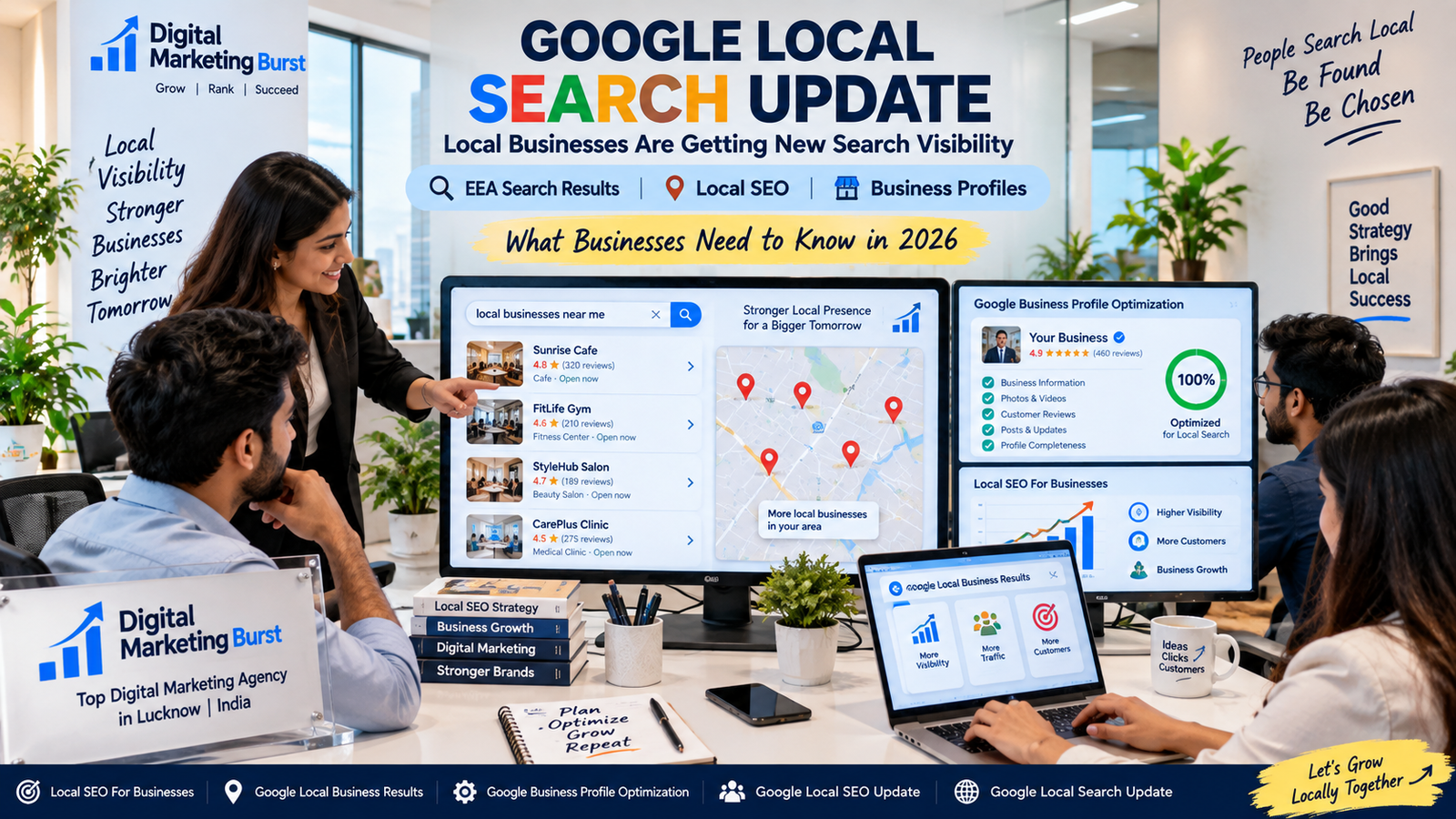
Explore how the Google Local Search Update is changing local business visibility, Business Profile optimization and Local SEO strategy in 2026.
The latest change is easier to understand when we separate the announcement from speculation about what it could mean later.
On September 18, 2026, Google updated its Search documentation to confirm that local business queries are supported by the aggregator and supplier units available in the EEA. Previously, these units were documented around categories such as hotels, flights, ground transportation, and products.
Now, local businesses have been added to that supported query mix.
An aggregator unit is designed to show information from eligible vertical search services. These can include directories, comparison services, and other platforms that help users discover businesses. A supplier unit, by contrast, is intended for direct providers.
Consider a local-service search. Instead of every type of provider competing through exactly the same presentation, Google can create different search surfaces for aggregators and the businesses themselves.
However, one distinction is essential. This does not mean every normal Google local result has disappeared. Nor does Google’s documentation say that Google Business Profiles or the traditional local pack have universally been replaced.
Instead, Google has expanded its EEA-specific search experience with additional units for supported local-business queries.
That makes the change significant without overstating what has actually happened.
The broader Google Local Search Changes point toward a search experience that can contain more than a conventional list of links.
For years, users searching for restaurants, shops, hotels, salons, doctors, repair services, and other nearby businesses have relied on combinations of standard organic results, map-based experiences, business information, directories, and other Google features.
The EEA experience introduces another structure.
Eligible aggregators can participate through a dedicated unit. Direct businesses can potentially appear through a companion supplier unit when the aggregator unit appears.
This distinction matters because users may now encounter different paths to the same local decision.
One path can take them through a directory or comparison provider. Another can expose a direct business.
Therefore, local SEO cannot be understood purely as ranking one website page for one keyword.
A business needs strong entity information. Its website should clearly explain what the company does, where it operates, and how users can contact it. At the same time, its presence across relevant platforms should remain consistent.
Search is becoming increasingly focused on matching entities with intent.
That makes accurate, useful and crawlable business information more valuable.
The Google Local SEO Update does not suddenly create an entirely new SEO playbook. Instead, it strengthens several principles that good local SEO already depends on.
Google needs to understand the business.
That sounds obvious. Yet many websites still make this difficult.
A company may use different phone numbers across pages. Its address may be formatted differently across the web. Service pages may target locations where the company does not actually operate. Business categories can be vague. Important information may also be hidden inside images rather than available as crawlable text.
These problems weaken clarity.
The new EEA units make clarity even more relevant because Google is distinguishing between aggregators and direct suppliers. A search engine must understand what type of entity a website represents before it can confidently connect that entity with the right search experience.
Therefore, businesses should review their websites from an entity-first perspective.
Ask a simple question: if a search engine crawled only the website, would it clearly understand the business name, category, services, locations, contact details, and relationship between those pieces of information?
If the answer is uncertain, that is where optimization should begin.
The Latest Local SEO Update forms part of Google’s broader changes to search experiences in the European Economic Area.
Google documented redesigned regional Search features earlier in September 2026. Then, on September 18, its documentation explicitly added local-business queries to the aggregator and supplier units.
This matters because local search covers a huge range of commercial intent.
A person searching for a salon, restaurant, attraction, plumber, clinic, repair service, or nearby store often has a stronger immediate need than someone conducting broad informational research.
Google’s documentation describes local searches using categories such as dining, services, and things to do.
Therefore, adding local businesses makes these EEA units relevant to a much wider set of everyday searches.
For marketers, the lesson is straightforward.
Do not treat local SEO as a static checklist that gets completed once. Search layouts evolve. Features change. New surfaces appear. Some changes remain regional, while others may never expand beyond their initial markets.
A strong strategy should therefore focus on fundamentals that remain useful across different search experiences.
Clear business information is one of those fundamentals.
Google Local Business Results in the EEA can now involve an aggregator unit for supported searches.
An aggregator is not necessarily the business providing the final service. Instead, it may be a platform that organises, compares, lists, or helps users discover multiple providers.
Google describes its aggregator unit as a multi-provider feature for eligible Vertical Search Services.
For local-business queries, participating aggregators need to meet Google’s requirements and provide relevant data. Google also documents a Point of Interest feed for local entities.
That feed can contain core information about physical businesses, including details such as business names, addresses, phone numbers, categories, images, and other relevant attributes.
This matters because structured, reliable information makes comparison easier.
However, ordinary local businesses should not confuse aggregator requirements with direct-business requirements.
A local shop or service provider does not become an aggregator simply because it wants more visibility.
The aggregator unit is designed for qualifying platforms representing multiple providers. Direct businesses belong to the supplier side of the experience.
Understanding that distinction prevents businesses from chasing technical requirements that were never intended for them.
The new Google Local Search Results experience also includes the supplier unit.
This is particularly relevant to direct providers.
Google describes suppliers as businesses that provide the actual product or service. Examples include individual hotels, airlines, brick-and-mortar businesses, and service providers.
The supplier unit appears alongside the aggregator unit. In addition, Google states that the supplier unit appears only when the aggregator unit appears.
For a direct business, another important detail stands out.
Google says businesses do not need to provide additional data beyond what is accessible through web crawling to be eligible for the supplier unit, although available feeds can enhance results.
That reinforces the importance of the website itself.
If essential information is difficult to crawl, inconsistent, incomplete, or outdated, Google has less reliable information to work with.
Consequently, website SEO and local-business information should support each other rather than operating as separate projects.
A strong local presence starts with a website that clearly describes the real business.
Google Business Profile Optimization remains an important part of broader local-search marketing, even though Google’s documentation for these new EEA units should not be interpreted as a statement that Business Profiles directly control supplier-unit eligibility.
That distinction matters.
Marketers sometimes see a new Google feature and immediately turn it into a checklist of supposed ranking factors. That approach can create misinformation.
Instead, focus on what is already useful for customers.
Business information should be accurate. Categories should describe the actual business. Opening hours should be maintained. Photos should represent the company. Contact details should work. Reviews should be handled professionally.
Meanwhile, the website should reinforce the same entity information.
For example, a clinic website should clearly identify the clinic, its actual location, departments, doctors or services where appropriate, contact information, and useful patient information.
A restaurant should make its location, cuisine, timings, menu information, and contact details easy to find.
Consistency reduces ambiguity.
That helps customers first. It also creates a clearer digital footprint for search systems.
Google Business Profile SEO should never become a substitute for website SEO.
A profile can help users understand essential business details quickly. However, a website gives the company much more space to demonstrate relevance, expertise, service information, location information, and answers to customer questions.
The strongest local strategy connects both.
Suppose a business claims to serve one city on its profile but creates dozens of website pages claiming local operations across unrelated cities. That can confuse users and create poor-quality landing pages.
Instead, service-area content should reflect reality.
If the company genuinely serves several locations, explain those locations clearly. If it does not, an informational blog about another city should remain informational rather than pretending the company operates there.
This distinction is especially important for traffic-focused SEO.
A website can publish useful national or international information without claiming to sell its services in every place mentioned.
That allows businesses to build topical authority while protecting lead quality.
Local SEO For Businesses should begin with user intent.
A person searching for “best dentist near me” is not looking for a 3,000-word history of dentistry. They usually want a relevant provider, useful information, location details, trust signals, and a simple way to take the next step.
Therefore, pages targeting commercial local intent should be direct.
Explain the service. Identify the genuine location. Answer common questions. Make contact information visible. Add useful evidence that helps a customer evaluate the business.
At the same time, informational content can target earlier stages of the customer journey.
A detailed guide can answer questions before someone is ready to choose a provider.
This creates two complementary SEO channels.
Commercial pages convert demand that already exists. Informational pages create discovery and build topical relevance.
The 40% traffic, 30% client, and 30% problem-content model works well here because it prevents a website from becoming either entirely sales-driven or entirely informational.
A healthy SEO site needs all three types of content.
Local SEO For Small Business can feel complicated because there are many possible tasks.
However, small businesses rarely need to begin with the most advanced technical tactic.
Start with accuracy.
Make sure the business name is consistent. Confirm the real address or service area. Use the correct phone number. Explain the core services. Keep operating hours updated.
Next comes relevance.
A local business website should have enough content for visitors to understand why the business is relevant to their search.
After that, work on trust.
Real customer experiences, useful photographs, clear policies, professional contact information, and transparent business details can all make a company easier to evaluate.
Finally, build useful content.
Answer questions customers actually ask before contacting the business.
This approach may sound less exciting than searching for an SEO “hack.” Yet it creates a stronger foundation.
Google changes layouts regularly. Accurate business information remains valuable regardless of where the result eventually appears.
The addition of local-business queries to EEA aggregator and supplier units creates more potential discovery paths.
Imagine someone searching for a local service.
The user may encounter an aggregator that compares several businesses. At the same time, a supplier unit may expose direct providers.
This can change how customers move through the decision process.
Previously, a business might have focused heavily on its own organic listing or a familiar local-search surface. Now, visibility can potentially involve an ecosystem of direct and intermediary results.
That makes brand recognition more useful.
If customers see a company name across multiple credible contexts, they may already recognise it when the business appears directly.
Therefore, local marketing should not focus only on one ranking position.
Businesses should think about discovery, comparison, validation, and conversion as separate stages.
Search results increasingly help users complete several of those stages without following the traditional “ten blue links” journey.
The new aggregator and supplier units discussed here are documented for users in EEA countries. Therefore, an Indian business serving only Indian customers should not assume that its local Google results have suddenly adopted the same layout.
However, Indian marketers should still understand the change.
Many agencies work with international clients. Indian SaaS companies, travel businesses, marketplaces, and service brands may also target European users.
Furthermore, regional experiments provide useful insight into how Google structures Search when regulatory requirements and ecosystem participation change.
The correct approach is observation rather than panic.
There is no reason for an India-only local business to rebuild its entire strategy because of an EEA-specific feature.
Instead, continue improving local relevance, business accuracy, website quality, customer experience, and useful content.
If similar features expand to other regions later, that foundation will still be valuable.
Google EEA Search Results for Local Businesses now have a clearer distinction between eligible aggregators and direct suppliers in supported units.
For aggregators, participation is more technical.
Eligible Vertical Search Services must meet Google’s criteria. For local-business queries, relevant entity information can be provided through Google’s Point of Interest feed.
Direct suppliers have a different route.
Google says their websites must serve users in the EEA and represent a direct provider eligible for the relevant query. Additional information beyond what Google can crawl is not required for basic supplier-unit eligibility.
This is an important difference.
A directory should study the aggregator requirements. A direct business should focus on accurately representing itself.
Confusing the two can waste time.
SEO teams should therefore identify the site’s business model before deciding which documentation matters.
A Google Local Ranking Update and a search-result layout change are not necessarily the same thing.
That distinction is essential for this story.
Google’s September 18 documentation confirms support for local-business queries in aggregator and supplier units. It does not announce a universal new local-ranking algorithm.
Therefore, marketers should avoid saying that all local rankings have been reset.
The visible Search page can change even when the underlying ranking systems have not been described as a new algorithm update.
Still, layout changes matter.
A business may experience different click patterns if users are presented with new modules or comparison options.
That means SEO performance should be monitored using more than rankings alone.
Watch impressions, clicks, conversions, branded searches, landing-page engagement, and local leads.
Together, those metrics provide a clearer picture of whether search behaviour is changing.
A Google Maps Search Update should not automatically be treated as the same thing as this EEA development.
The September change concerns Google Search’s aggregator and supplier units for local-business queries.
That is different from saying Google Maps itself has received an identical redesign.
This difference matters because headlines can easily blur separate Google products.
A business owner may hear “local search update” and assume their Maps listing has changed. Another may assume their Business Profile needs a new technical feed.
Neither conclusion follows automatically from Google’s documentation.
SEO professionals should explain exactly which surface has changed.
Clear terminology builds trust.
It also prevents businesses from making unnecessary changes based on an update that applies to a different part of Google’s ecosystem.
Whenever Google changes Search, discussions about a Local Search Algorithm Update quickly appear.
Some observations may be useful. Others may be based on a small number of searches.
Businesses should separate documented changes from community speculation.
For this update, the documented fact is clear: Google added local-business query support to its EEA aggregator and supplier units on September 18, 2026.
What is not documented is equally important.
Google has not said that every local query will trigger these units. It has not published how frequently the units will appear. Nor has it announced that every traditional local-search feature has been removed.
Therefore, avoid reacting to assumptions as if they were confirmed ranking rules.
Monitor actual data.
When visibility changes, investigate query type, country, device, landing page, search feature, and conversion impact before deciding what happened.
Businesses often try to Optimize Google Business Profile by adding keywords everywhere.
That can produce awkward language and poor customer experiences.
Instead, descriptions and business information should accurately explain what the company offers.
Choose categories because they match the real business, not because they contain attractive keywords.
Upload useful photographs.
Maintain current opening hours.
Respond professionally to genuine reviews.
Keep contact details accurate.
Most importantly, avoid creating false locations simply to rank in more cities.
Local SEO works best when the online representation matches the actual business.
A company can still publish informational content about other regions. However, that content should not imply a physical presence or local service where none exists.
That distinction improves both SEO quality and lead relevance.
Google Business Listing Optimization should make a business easier to understand.
Entity clarity means search systems and users can connect the same company across different digital signals.
Imagine three pages showing three slightly different business names. Another directory lists an old phone number. Meanwhile, the website displays an outdated address.
Individually, these may seem like minor problems.
Together, they create uncertainty.
Businesses should therefore audit important listings periodically.
A Local SEO Marketing Strategy should generate relevant traffic rather than traffic for its own sake.
This is where content selection becomes important.
Traffic-focused articles can cover industry changes, search trends, guides, comparisons, and educational topics.
Client-focused pages should target users actively searching for services.
Problem-focused content should answer issues that potential customers repeatedly face.
That creates the 40/30/30 content balance.
Forty percent can attract broader search traffic. Thirty percent can support commercial intent. The remaining thirty percent can solve customer problems.
However, these categories should connect naturally.
An informational visitor may later become a commercial visitor.
Internal linking helps create that journey.
A news article about Google’s local-search changes can link naturally to a detailed local SEO guide. That guide can then connect to a relevant service page when the reader is ready for professional help.
Local SEO For Indian Businesses remains different from the EEA-specific experience described in Google’s new documentation.
An India-only business does not need to behave as though the new European units have been rolled out identically in India.
However, the strategic lessons are still useful.
Google continues to develop richer search experiences around entities, providers, structured information, and user intent.
Indian businesses should therefore strengthen the information they already control.
Maintain accurate business details. Improve important service pages. Publish useful local content. Build strong internal links. Make websites mobile-friendly and easy to navigate.
Most importantly, track actual Indian performance.
Do not use European ranking observations as proof of what is happening in India.
Regional Search experiences can differ.
That is precisely why Google’s own documentation now includes information about regional differences in Search features.
Google Local Search Visibility can be especially valuable for service-based companies because local queries often carry commercial intent.
A user searching for a nearby plumber, dentist, salon, hospital, consultant, repair shop, or agency may already be close to taking action.
Therefore, clarity matters immediately.
The page should explain the service without forcing users to hunt through several sections.
Location details should be visible.
Calls to action should work properly on mobile.
Trust information should be easy to find.
In addition, problem-focused content can capture earlier searches.
For example, a dental clinic might answer common treatment questions. A repair company can explain warning signs. A marketing agency can explain why local rankings fall.
These articles can attract searchers before they type a direct service query.
Over time, that creates a broader organic footprint.
The Google Local Search Update with Digital Marketing Burst is a useful topic for businesses that want to understand how evolving search experiences can affect local visibility without turning every Google announcement into a reason for panic.
Digital Marketing Burst approaches local-search content by separating confirmed changes from SEO assumptions.
For this EEA update, the confirmed development is the addition of local-business query support to Google’s aggregator and supplier units.
From there, businesses can focus on practical fundamentals.
Website information should clearly identify the company. Local pages should match genuine operations. Content should answer search intent. Business information should remain consistent.
This creates a stronger foundation regardless of how individual Search modules evolve.
For brands targeting international markets, regional SEO analysis becomes particularly important because a search experience available in Europe may not look the same in India.
A Digital Marketing Burst Google Business Profile Optimization Strategy should begin with accuracy rather than keyword volume.
The business profile and website should describe the same real organisation.
Core information should be current. Categories should reflect actual services. Photos should be useful and authentic.
At the same time, website content should go deeper than the profile itself.
Service pages can explain what the business does. Location pages can provide genuine local details. Blog articles can answer broader customer questions.
Together, these assets create a more complete search presence.
However, no agency can legitimately guarantee the number-one local position simply by editing a profile.
Search visibility depends on many signals, competitors, user location, query context, and Google’s systems.
A strong strategy therefore focuses on improving relevance and quality rather than promising a fixed ranking.
Digital Marketing Burst Local SEO For Businesses can be positioned around a simple principle: help search engines understand the business while helping customers make better decisions.
Those two goals often overlap.
A well-structured page is easier to crawl and easier to read.
Accurate location information helps Google and customers.
Useful FAQs can capture long-tail searches while answering real questions.
Clear navigation supports internal linking and user journeys.
This is why local SEO should not be separated completely from content strategy, website optimization, and conversion planning.
Businesses need an ecosystem rather than one isolated tactic.
When Search changes, that ecosystem provides resilience.
Businesses searching for the best local SEO company in Lucknow should look beyond marketing claims.
A useful evaluation begins with the agency’s understanding of search intent, local-business information, content, technical SEO, analytics, and conversion tracking.
Case studies can provide context when they use verifiable data.
Communication also matters.
An agency should be able to explain why a recommendation is being made rather than hiding every decision behind vague statements about algorithms.
Digital Marketing Burst positions itself around SEO, Local SEO, Google Business Profile work, content strategy, and digital marketing for businesses.
However, the word “best” should ultimately be judged by the prospective client according to relevant experience, strategy, transparency, service fit, and measurable outcomes.
That makes the decision more useful than relying on a ranking claim alone.
Searches such as Top Digital Marketing Agency in India for Local SEO Strategy usually come from businesses comparing professional support.
The most useful agency should understand both broad SEO principles and local intent.
For example, an agency needs to know when a national blog should remain informational and when a location page should target actual customers.
That distinction prevents irrelevant leads.
It also reduces the temptation to create false local relevance.
Digital Marketing Burst can use informational topics such as the EEA Search update to demonstrate understanding of current search developments while keeping service pages focused on genuine commercial intent.
This combination supports both traffic and client acquisition.
Again, “top” is best treated as brand positioning rather than an independently verified universal ranking.
Internal links help connect this news topic with deeper evergreen content.
A phrase such as Google Business Profile Optimization can point to a detailed profile-optimization guide.
Local SEO For Businesses can connect with a broader local SEO service or educational page.
Meanwhile, Google Local Search Results can link to an article explaining local ranking visibility.
The anchor should describe what readers will find after clicking.
Avoid generic phrases such as “click here” when a descriptive phrase works naturally.
Likewise, do not place several links into every paragraph.
Internal linking should guide readers through a logical topic cluster.
For Digital Marketing Burst, this article can become part of a larger cluster around Google updates, local SEO, Business Profile optimization, AI search visibility, and search-engine changes.
That strengthens navigation for users while helping search engines understand relationships between pages.
The best preparation is not predicting Google’s next interface.
Instead, create a digital presence that can adapt.
Maintain clean first-party business information.
Publish content that solves genuine problems.
Use structured data where it accurately represents page content and where Google’s documentation supports it.
Keep important pages crawlable.
Build internal topic relationships.
Monitor Search Console and analytics data.
Also, watch regional differences.
A feature can launch in Europe without appearing in India. Another feature may exist only for a particular industry.
Therefore, SEO teams should always ask three questions when a new update appears: where is it available, which query types does it affect, and what does Google actually say is required?
Those questions eliminate a large amount of unnecessary SEO panic.
The Google Local Search Update, together with the Google Local SEO Update, reinforces why Google Business Profile Optimization, Local SEO For Businesses, and understanding Google Local Business Results should be approached as connected parts of a wider search strategy. Google confirmed on September 18, 2026 that local-business queries are now supported by its EEA aggregator and supplier units. The change creates additional ways for eligible aggregators and direct businesses to participate in certain local-search experiences, but it should not be misrepresented as a worldwide replacement for every existing local-search feature.
For businesses, the practical response is straightforward. Keep business information accurate, make websites easy to crawl, build genuinely useful local and service content, and monitor performance by region. For Digital Marketing Burst, developments like this also create an opportunity to help businesses understand the difference between a documented Google change and SEO speculation. Search interfaces will continue to evolve. Businesses that maintain strong information, relevant content, and a clear digital identity will be better prepared for whatever search experience comes next.
The way businesses gain visibility in Google Search continues to change. The recent EEA development is important because local-business queries can now be supported within Google’s aggregator and supplier units. However, visibility still depends on whether Google can understand the business, its website, its location, and the services it actually provides.
For businesses, this creates a simple lesson. Local SEO should not depend on one search feature. A company may appear through its website, business information, local results, directories, comparison platforms, or other search surfaces. Therefore, businesses need a consistent digital identity across these areas.
Website content plays an important role here. A page should clearly explain the service instead of using the city name repeatedly without providing useful information. Likewise, contact details and location information should be easy to find.
Businesses should also monitor how customers discover them. Some visitors may arrive through an informational article. Others may search directly for the company name. In addition, high-intent users may search for a service together with a location.
A balanced strategy prepares the business for all three situations. That approach becomes increasingly useful as Google develops more specialised search-result experiences.
The Google Local Search Changes do not require business owners to abandon their existing SEO strategy. Instead, they provide a good reason to review whether that strategy is built on strong fundamentals.
Start with the website. Important service and location information should be visible in normal text and accessible to search engines. If users have to open several pages just to understand where the company operates, the site needs improvement.
Next, examine location accuracy. A business should not create pages suggesting that it has branches in cities where it has no genuine presence. Informational articles can discuss those cities, but commercial location pages should reflect reality.
Content quality deserves attention as well. Many local websites publish almost identical articles with only the location name changed. Such pages rarely solve meaningful customer problems.
Instead, write around real search intent. Explain prices when appropriate, service processes, common problems, eligibility, timings, preparation, comparisons, or other information customers genuinely need.
Finally, monitor results rather than assuming every Google announcement will affect every business equally. Search features can differ by country, industry, device, and query.
This approach keeps local SEO practical rather than reactive.
The Latest Local SEO Update also highlights a larger change in search behaviour: businesses can be discovered through multiple surfaces.
A traditional SEO strategy often focused on ranking one webpage among organic results. That remains useful, but modern search can present much more information before a visitor reaches a website.
Local results can show business details. Search features may highlight direct providers. Aggregators can help users compare options. Reviews influence decisions. Images provide another layer of information. Meanwhile, informational pages can introduce a business before the customer begins comparing providers.
Consequently, businesses need to think beyond one ranking position.
Imagine a customer researching a local service. The first search may be informational. Later, the same person compares providers. Finally, they search directly for a company before contacting it.
A business can potentially participate at several stages of this journey.
Traffic content helps at the research stage. Strong commercial pages become useful during comparison. Clear branded information supports the final decision.
This is why a broader search strategy often performs better than publishing only sales pages.
The Google Local SEO Update is particularly relevant to service businesses because their customers often search with strong local intent.
Someone searching for a nearby dentist, digital marketing agency, physiotherapist, interior designer, restaurant, salon, or repair service is usually looking for an actionable result.
Therefore, the business website should answer practical questions quickly.
What does the company provide? Where is it located? Which areas does it genuinely serve? When is it open? How can someone contact it? What makes the service relevant to the customer’s problem?
These questions should not be buried beneath generic marketing paragraphs.
Instead, service pages need clear information.
However, that does not mean every page should be short. Detailed content works when the topic requires explanation. The key is usefulness rather than word count alone.
Businesses should also separate service intent from informational intent. A guide can attract readers nationally or internationally without pretending the company has a physical presence everywhere.
That distinction improves both traffic quality and customer expectations.
Google Local Business Results become particularly interesting when we examine the role of direct suppliers.
Within Google’s documented EEA experience, the supplier side represents businesses providing the actual product or service. That is different from an aggregator that helps users compare several providers.
For direct businesses, website clarity becomes especially relevant.
The company name should be easy to identify. Services should be described accurately. Location details should match real operations. Contact information should remain current.
Moreover, pages should avoid vague language that makes the business difficult to categorise.
Suppose a company offers five clearly defined services but describes itself only as a “complete solution for all needs.” That phrase sounds promotional, yet it tells search engines and potential customers very little.
Specific language works better.
Explain what the company actually does.
This is also useful for long-tail search visibility because specific service descriptions naturally introduce terms people use when they have a particular need.
Google Local Search Results can also expose users to aggregator platforms.
For a local business, this means visibility does not always begin on the company’s own website.
A user may first discover the business through a directory or comparison service. After that, they may search for the brand directly. Finally, they may visit the official website before taking action.
Therefore, businesses should care about how they are represented outside their own domains.
Incorrect information on important third-party platforms can create confusion.
An old phone number can waste a lead. A wrong location can send someone to the wrong place. An outdated business category may attract irrelevant customers.
Businesses should periodically review important listings and correct major inaccuracies.
However, this does not mean registering on every directory available online.
Quality and relevance matter more.
Focus on platforms that customers genuinely use and that accurately represent the business.
Google Business Profile Optimization should focus on making information useful and trustworthy.
Start with the correct primary category. Then add relevant secondary categories only when they genuinely represent the business.
Opening hours should remain current.
Holiday hours deserve attention as well because inaccurate timings can create a poor customer experience.
Photos should help people understand the business. Real workplace, team, service, product, facility, or location images are generally more informative than unrelated stock graphics.
Business descriptions should remain natural.
There is little value in repeating the same city and service phrase several times.
Instead, explain what the company does in language a customer can understand.
Reviews are another important part of the profile experience. Businesses should encourage genuine customer feedback without manufacturing reviews or using misleading practices.
Finally, connect the profile with a useful website destination.
Sending every visitor to a generic homepage may not always be ideal when a more relevant location or service page exists.
Google Business Profile SEO works best when it reflects real customer intent.
Consider the difference between a person searching a business name and someone searching for a service.
The branded searcher already knows the company. They may need directions, timings, reviews, or contact information.
A non-branded searcher is still comparing options.
Therefore, the digital presence should support both journeys.
Accurate profile information helps branded searches. Strong service relevance can support broader discovery. Meanwhile, useful website content gives potential customers enough information to evaluate the business.
Businesses should also study the questions customers repeatedly ask by phone or WhatsApp.
Those questions often reveal excellent content opportunities.
If ten customers ask the same question every month, there is a reasonable chance other people are searching for that information online.
Turn recurring questions into helpful website content.
This creates a natural bridge between customer service and SEO.
Local SEO For Businesses can attract more than direct service searches.
Informational content expands the range of queries for which a website can become relevant.
A digital marketing company, for example, can write about search updates, Google Business Profile problems, local ranking issues, AI search, content optimization, and analytics.
A healthcare organisation can publish educational content around treatments, symptoms, prevention, and patient questions while remaining careful about medical accuracy.
Likewise, a travel company can publish route and destination guides without claiming local service availability everywhere it writes about.
This distinction is powerful.
Informational SEO expands traffic without necessarily expanding the company’s physical service area.
As a result, businesses can build topical authority while keeping commercial pages geographically accurate.
Internal links can then guide relevant visitors towards deeper resources or genuine services.
Local SEO For Small Business websites should be structured around simplicity.
Visitors should immediately understand the company.
A confusing homepage can lose potential customers even if it ranks well.
The navigation should make important services easy to reach. Contact information should not be hidden. Mobile users should be able to interact with buttons comfortably.
Location pages should also provide genuine value.
Do not publish a page called “Best Service in City A,” duplicate it fifty times, and replace only the city name.
Instead, create pages where the company has genuine local relevance.
Include useful details that differ between locations when applicable.
This may involve branch-specific contact information, services, facilities, opening hours, directions, team members, or locally relevant FAQs.
Quality matters more than the number of city pages.
Content marketing and Local SEO For Businesses work well together when the topics are chosen carefully.
A strong content calendar should not contain only promotional articles.
Traffic-focused topics can introduce new visitors. Client-focused topics can target commercial searches. Problem-focused articles can answer questions that potential customers ask before buying.
This supports the 40% traffic, 30% client, and 30% problem-content approach.
For example, a traffic article might explain a major Google update.
A client article could explain professional local SEO services for businesses in a genuine service area.
A problem article might answer why a Google Business Profile is not appearing for relevant searches.
Each piece has a different purpose.
Together, they create a stronger topical ecosystem.
This is more useful than publishing dozens of posts that target almost identical keywords.
Local SEO For Small Business Owners in India should still focus primarily on the search experience their Indian customers actually see.
The EEA update is useful industry knowledge, but it should not be treated as an India rollout.
This difference is important for strategy.
Indian businesses should monitor their own search visibility, profile performance, website traffic, calls, enquiries, and conversions.
If those metrics change, investigate the Indian SERPs directly.
At the same time, global search developments remain worth following.
Google often evolves different experiences across markets. Understanding those changes helps marketers recognise broader patterns without assuming every feature is universal.
For Indian businesses, the practical priorities remain familiar: accurate information, strong service pages, useful local content, mobile usability, genuine reviews, internal linking, and clear conversion paths.
These fundamentals remain valuable even when search interfaces change.
A Local Business SEO Strategy should distinguish between high-volume and high-intent keywords.
They are not always the same.
A broad keyword may generate thousands of searches but produce few qualified leads. Meanwhile, a specific local service query may have lower volume yet produce more enquiries.
Therefore, keyword research should examine intent alongside estimated traffic.
Consider a phrase such as “SEO.”
It is extremely broad.
A search for “local SEO company in Lucknow” is much more specific. A phrase such as “Google Business Profile optimization for hospitals” becomes even narrower.
The correct keyword depends on the page.
Informational blogs can target broader searches.
Service pages should usually focus on commercially relevant terms.
Problem-solving content can target detailed questions.
This creates a balanced keyword portfolio rather than forcing every page to chase the highest-volume phrase.
A Local Business SEO Strategy for Google Search Visibility begins with understanding how individual pages support the overall website.
Every article does not need to sell.
Some pages attract new visitors.
Others establish topical depth.
Commercial pages explain services.
Case studies can demonstrate previous work where appropriate.
FAQs answer specific questions.
These page types should connect through internal links.
For example, an article about a search update can link to an evergreen guide about local SEO. That guide can connect to Business Profile optimization content. Finally, a relevant service page can become the next step for someone who wants professional assistance.
This creates a logical path.
It also prevents commercial calls to action from dominating informational articles.
A better strategy uses one primary phrase, natural synonyms, related questions, entities, and supporting concepts.
Suppose the primary topic concerns a local search update.
The article can naturally discuss business profiles, Maps visibility, local results, ranking changes, aggregators, suppliers, directories, service pages, location pages, reviews, and customer intent.
These concepts provide topical depth without repeating one phrase twenty times.
Headings can use different long-tail searches.
Body paragraphs can then answer those searches naturally.
This creates a much more human reading experience.
It also aligns better with your requirement to keep each exact keyphrase limited across the full article.
A Digital Marketing Burst Local Search Strategy for 2026 can combine traffic content, client-focused pages, and problem-solving resources without forcing every visitor into a sales funnel.
Traffic content can cover developments such as Google’s EEA search changes.
Client-focused pages can explain SEO and digital marketing services within genuine target markets.
Problem-focused content can answer questions such as why a business does not appear in local results or why website traffic is not converting.
Together, these content types create a broader search footprint.
They also allow internal links to feel natural.
A reader who wants only information can get the answer. Someone who needs deeper guidance can continue to another article. A business actively looking for professional help can eventually reach the relevant service page.
That is a cleaner customer journey than turning every blog paragraph into a promotional message.
A Digital Marketing Burst Google Business Profile SEO Guide should connect profile work with the broader website strategy.
Profile information alone cannot answer every customer question.
Likewise, a website alone may not satisfy users who simply want directions or opening hours.
The two assets should complement each other.
Keep essential business data aligned.
Use the website to explain services in greater depth.
Publish helpful resources around customer questions.
Then connect related pages through sensible internal links.
For businesses operating in Lucknow or other genuine service areas, local pages should provide meaningful location relevance rather than generic city-name repetition.
This creates a more professional search presence and helps reduce irrelevant enquiries.
When local visibility declines, businesses should avoid changing everything at once.
First, determine whether the problem affects one page, one keyword group, or the entire website.
Check whether the business information changed.
Review technical indexing issues.
Look at Search Console performance.
Compare branded and non-branded searches.
Examine local-profile visibility separately from organic traffic.
Next, consider seasonality and competitor changes.
A decline does not automatically prove an algorithm penalty.
By diagnosing the problem before acting, businesses avoid unnecessary redesigns and content rewrites.
This method is particularly important during major industry news because marketers can easily blame the latest update for every unrelated performance change.
The future of local search is likely to involve more ways of organising business information.
Users want faster comparisons and clearer answers.
Search engines want to understand which entities genuinely provide the requested service.
Aggregators can help organise options.
Direct providers need strong first-party information.
AI-driven experiences may add another layer of discovery.
However, businesses do not need to predict every future feature.
They need to remain understandable.
A clearly defined company with accurate information, useful content, strong service pages, and a good customer experience is easier to adapt to new search formats.
That principle remains useful even when the interface changes completely.
Google’s addition of local-business queries to EEA aggregator and supplier units shows why businesses need a search strategy that extends beyond one ranking or one result type. Direct providers, aggregators, websites, business information, reviews, and informational content can all contribute to how a company is discovered and evaluated.
For Digital Marketing Burst, the practical SEO opportunity is to help businesses connect these pieces without relying on keyword stuffing or unsupported ranking promises. Strong local visibility begins with accurate information, genuine location relevance, useful content, technically accessible pages, and a clear path for customers.
The Google Local Search Update is therefore worth following, but the strongest response is not to chase every new feature. Businesses should strengthen the digital foundation they already control. When search layouts evolve again, that foundation will still support organic discovery, local relevance, and qualified traffic.
The Google Local Search Changes can influence more than rankings. They can also change how people interact with a search results page. When Google adds new result formats, users may have more information available before they decide whether to visit a website.
For businesses, this makes click quality increasingly important. A page may receive fewer clicks for a broad query yet attract visitors who are more interested in the service. Therefore, traffic numbers should never be viewed alone.
Search Console can help businesses compare impressions and clicks over time. Analytics can then show what those visitors do after arriving. Meanwhile, enquiry data can reveal whether organic traffic is producing genuine business opportunities.
This creates a better measurement system than simply checking one keyword position every morning.
The EEA change also reminds marketers that search layouts are not fixed. New modules can influence where attention goes. As a result, SEO strategies should focus on building visibility across relevant searches while also making each website visit valuable.
Strong titles, useful content, clear business information, and relevant landing pages can help turn search visibility into meaningful engagement.
The Latest Local SEO Update also brings attention to a familiar SEO challenge: users do not always need to visit a website to obtain basic business information.
A search result may already provide a business name, location, opening information, category, or other useful details. Therefore, some local searches can end without a traditional organic click.
This does not automatically mean SEO has failed.
Suppose someone searches for a business and finds the phone number directly within a search experience. That interaction may still create a customer even if the website records no session.
For this reason, local businesses should measure more than website visits.
Calls, bookings, direction requests, messages, branded searches, and enquiries can provide additional context.
At the same time, the website should offer information that cannot be reduced to one short search-result element. Detailed service explanations, comparisons, FAQs, case studies, guides, and problem-solving content give people a reason to continue reading.
The goal is not simply to force every searcher onto the website. Instead, the digital presence should help users move towards the right decision.
The Google Local SEO Update can also be viewed through the idea of search experience optimization.
Traditional SEO often asks, “How can this page rank?”
A broader approach asks, “What does the searcher need before and after finding this business?”
That second question changes content strategy.
A person looking for a local service may want prices, availability, location, reviews, service details, photos, or answers to common concerns.
Therefore, businesses should design pages around those needs.
Clear headings help people scan quickly. Short paragraphs improve mobile readability. Useful internal links provide deeper information without overcrowding one page.
Meanwhile, conversion elements should appear where they make sense.
A contact button should not interrupt every sentence. However, users who are ready to enquire should not have to search through the entire site.
This balance between visibility and usability is important in 2026.
Ranking can introduce the customer. A good experience helps keep them.
Strong Google Local Business Results can contribute to branded search growth over time.
A customer may see a business during an initial category search without contacting it immediately. Later, that person may remember the name and search for the brand directly.
This is why visibility can have value beyond the first click.
Businesses should monitor branded queries alongside generic service keywords.
An increase in brand-name searches may indicate that more people are becoming familiar with the company through organic search, social media, advertising, referrals, offline marketing, or other channels.
However, branded demand should not be mistaken for proof that one SEO activity caused all the growth.
Marketing channels interact.
A user may see a billboard, watch a social video, discover a company through Google, and finally search the brand name several days later.
Therefore, measurement should account for the wider customer journey.
Local SEO is one part of that journey, but it can play an important role in discovery and validation.
Google Local Search Results become particularly important for “near me” searches.
People using these queries often want immediate options. They may be looking for a restaurant, hospital, pharmacy, salon, shop, hotel, repair service, or another nearby business.
Because location intent is strong, businesses should provide accurate geographic information.
However, adding “near me” repeatedly to website content is not a useful strategy.
A sentence such as “best digital marketing company near me near me services” sounds unnatural and provides little value.
Instead, make the real business location clear.
Explain genuine service areas where relevant. Keep profile information current. Create useful local pages for actual branches or locations.
Search engines can interpret location context without requiring businesses to stuff “near me” into every heading.
Natural writing also creates a better experience for visitors.
Near Me Local Search Optimization for Businesses starts with location clarity rather than keyword repetition.
A business should ensure that its website makes the physical location or genuine service area easy to understand.
Contact pages are especially important.
They should contain current information and provide a simple way for users to reach the business.
If several genuine branches exist, each location may benefit from a dedicated page with meaningful local information.
However, avoid creating artificial branch pages.
Search visibility should reflect real-world operations.
Reviews can also help customers decide between nearby options. Therefore, businesses should encourage genuine feedback through appropriate methods.
Photos provide another layer of confidence.
Someone searching nearby may want to know what the location looks like before visiting.
Together, accurate location information, useful website content, genuine customer feedback, and a clear profile create a much stronger foundation than simply repeating “near me” keywords.
Google Business Profile SEO can support discovery when users search with strong geographic intent.
Still, businesses should keep their optimization natural.
Categories need to match the actual company. Opening hours should be accurate. Contact details should work. The linked website should provide useful information.
Customer reviews deserve ongoing attention as well.
A large number of generic or suspicious reviews can damage trust rather than strengthen it. Genuine feedback is more valuable.
Businesses should also avoid creating fake locations to appear closer to customers.
That tactic can mislead users and create long-term problems.
Instead, focus on genuine geographic relevance.
If a company serves customers beyond its physical location, explain the service area accurately where appropriate.
This gives users clearer expectations and helps prevent irrelevant enquiries.
Local SEO For Businesses often includes city-based keywords because users frequently combine services with locations.
Examples might include “SEO company in Lucknow,” “dentist in Delhi,” or “interior designer in Noida.”
These searches can have strong commercial intent.
However, businesses should target cities selectively.
If a company genuinely operates in one city, it does not need fifty nearly identical pages claiming to be local everywhere else.
Informational content provides a better route for broader traffic.
A company can write about national trends, industry updates, destination information, or educational topics without claiming a local presence in every region discussed.
Meanwhile, genuine city pages can focus on actual commercial intent.
This separation keeps the website accurate and improves lead relevance.
It also reduces the chance of customers calling for services the business cannot provide.
Local SEO For Small Business location pages should provide more than an address and a repeated service description.
A useful location page can explain which services are available at that branch. It can include operating hours, contact information, directions, local FAQs, facilities, or other relevant details.
The content should reflect the real location.
If two branches offer different services, the pages should explain that difference.
Likewise, unique photographs can make the page more useful.
Avoid copying one page and replacing only the city name.
Such pages provide little reason for users to choose one result over another.
Instead, write each important location page with the customer in mind.
Ask what someone visiting that branch needs to know.
That question usually produces better content than starting with a keyword-density target.
The Google Local Search Update is worth watching for multi-location brands because they already operate within a complex discovery environment.
A large brand may have hundreds of physical outlets. Customers can encounter those locations through organic search, maps, directories, aggregators, review platforms, and branded searches.
Therefore, information management becomes essential.
One incorrect central data source can create errors across many locations.
Businesses should establish a process for updating openings, closures, relocations, phone numbers, and operating hours.
The website should also maintain a logical hierarchy.
Users should be able to move from the main brand to a city and then to an individual branch without confusion.
Large brands should additionally monitor regional search differences.
A company operating in India and Europe may encounter different search-result experiences for similar queries.
That makes market-specific SEO analysis increasingly important.
Local Search Ranking Factors for Service Area Businesses can be difficult to interpret because these companies may travel to customers instead of receiving them at a storefront.
The website should explain that operating model clearly.
Real service areas can be described naturally.
However, creating fake offices in every target city is not the solution.
Service pages should focus on what customers receive.
Supporting content can answer questions about availability, processes, prices, travel requirements, or other concerns.
Reviews and reputation remain useful because customers often want reassurance before allowing a service provider into their home or business.
Meanwhile, accurate contact information builds trust.
A service-area business should therefore optimize around genuine coverage rather than artificial location expansion.
Google Business Profile SEO can generate visibility, but the website often handles deeper evaluation.
That makes conversion rate important.
Suppose 1,000 visitors reach a service page and only two contact the business.
The problem may not be traffic volume.
The page could be attracting the wrong intent. It might also have weak messaging, confusing navigation, poor trust signals, or a difficult enquiry process.
Therefore, SEO reports should connect traffic with outcomes.
Which pages generate calls?
Which articles lead users towards service pages?
Where do visitors leave?
Which locations produce qualified enquiries?
These questions turn SEO from a ranking exercise into a business-growth process.
Local Business Schema Markup for SEO can provide structured information about a business.
Depending on the genuine business type and page, relevant properties can describe information such as the organisation, location, contact details, or operating information.
However, implementation should follow current search-engine guidelines.
The markup should also match visible page content.
If the page says the business operates in one city while the structured data claims several other locations, the underlying problem is not technical.
It is an accuracy problem.
Therefore, schema should come after content and entity review.
Think of structured data as a clearer machine-readable representation of truthful information, not a place to insert extra keywords.
Digital Marketing Burst Local SEO For Businesses in India can focus on the search environment Indian companies actually operate within while still tracking global developments.
The EEA change is valuable industry information.
However, Indian campaigns should continue to use Indian search data, genuine Indian service locations, customer behaviour, and relevant competition when making decisions.
This avoids copying a European strategy into a market where the visible search experience may differ.
At the same time, businesses targeting European customers need separate analysis.
International SEO works best when each market is treated according to its own search landscape.
That distinction becomes increasingly important as Google develops region-specific features.
Digital Marketing Burst Google Business Profile Optimization can be built around accurate information, category relevance, genuine customer feedback, useful images, and alignment with the company’s website.
The objective should not be to stuff the profile with keywords.
Instead, the profile should help users understand the business quickly.
Website content can then provide greater depth.
For genuine local operations, location pages can support the relationship between the business and its area.
Meanwhile, informational blogs can target broader topics without falsely implying physical service availability.
This separation is particularly useful for companies using blogs to attract national or international traffic.
Digital Marketing Burst Local SEO Services in Lucknow is a commercially focused long-tail phrase that can be used where the company’s actual service positioning is relevant.
A dedicated service page can explain Local SEO, Google Business Profile work, website optimization, content strategy, local keyword research, and performance measurement.
However, an informational Google-update article should remain primarily educational.
This distinction helps preserve search intent.
Someone searching for an EEA update wants information first.
A visitor searching specifically for local SEO services has different intent.
Internal linking can connect these journeys without forcing them onto the same page.
That creates cleaner SEO architecture and a better reader experience.
The phrase Best Local SEO Agency in Lucknow for Google Business Growth reflects strong commercial intent, but businesses should evaluate agencies based on evidence rather than the word “best.”
Digital Marketing Burst can use this type of phrase as brand positioning while explaining the services behind the claim.
Potential clients should examine relevant experience, strategy, reporting, communication, website optimization, content quality, and understanding of local search.
They should also be cautious of guaranteed number-one ranking promises.
No agency controls Google’s ranking systems.
A professional strategy can improve the quality of a business’s search presence, but fixed ranking guarantees are not a reliable measure of SEO expertise.
Top Local SEO Company in India for Business Visibility is another commercial long-tail search businesses may use while comparing agencies.
Digital Marketing Burst can target this type of query through dedicated commercial content rather than repeating it throughout every informational blog.
The supporting page should explain what the company actually offers.
It can discuss local SEO strategy, Google Business Profile optimization, website SEO, content development, analytics, and related digital marketing services.
Real examples and transparent processes can strengthen the page when available.
Again, “top” works best as positioning rather than an independently verified national ranking.
That keeps the content promotional without turning an advertising phrase into an unsupported fact.
The Google Local Search Update shows that local-business discovery is becoming more varied, particularly within Google’s EEA-specific aggregator and supplier experience. Businesses may be discovered through direct search visibility, third-party platforms, local information, organic content, and increasingly complex search interfaces.
For Digital Marketing Burst, the broader lesson is that strong local SEO should connect accurate business information with useful content, genuine geographic relevance, mobile usability, technical accessibility, and conversion-focused pages. Businesses should also separate traffic content from commercial location claims so wider organic reach does not create confusion about where services are actually available.
Search features will continue to evolve. Therefore, businesses should avoid building their entire strategy around one result format. A clear website, accurate business identity, useful content, and genuine customer relevance remain the stronger long-term foundation for local search growth in 2026 and beyond.
Digital Marketing Burst -Top Digital Marketing Company In Lucknow positions itself as a top and best digital marketing agency in Lucknow and India, with a strong focus on modern search visibility rather than relying only on traditional keyword-based SEO. Its official website lists SEO, Maps SEO, digital marketing, Google Ads/PPC, social media marketing, website design, link building, content, and email marketing among its services.
For a topic such as the Google Local Search Update, this combination is especially relevant. Local businesses now need to think about website visibility, Google Business Profile information, local search intent, Maps visibility, content quality, and changing Google search experiences together. Digital Marketing Burst’s published Local SEO content similarly focuses on localized content, business information consistency, map visibility, and city-specific optimization.
Therefore, the brand can naturally target long-tail phrases such as Digital Marketing Burst Local SEO Services, Digital Marketing Burst Google Business Profile Optimization, Best Local SEO Agency in Lucknow, and Top Digital Marketing Agency in India for Local SEO without forcing the same keyword into every paragraph.
Businesses looking for the best local SEO agency in Lucknow increasingly need more than basic website optimization. Google Search continues to change, while customers can discover companies through organic results, Maps, business profiles, directories, and newer search-result experiences.
Digital Marketing Burst’s service mix covers both SEO and Maps SEO, alongside content and paid marketing. This makes the brand’s positioning relevant to businesses that want their website and local presence to work together.
For example, Google Business Profile Optimization should not exist separately from website SEO. A business needs accurate location information, clear services, useful landing pages, strong internal linking, and content that answers customer searches. At the same time, profile information should remain consistent with the website.
This integrated approach is a strong reason to position Digital Marketing Burst as a leading Local SEO agency in Lucknow for businesses looking for broader Google visibility.
Digital Marketing Burst can also use Top Digital Marketing Agency in India for Google Local Search as a branded positioning phrase.
The reason is topical breadth. Modern search marketing is no longer limited to inserting keywords and building backlinks. Businesses now need technical SEO, Local SEO, content optimization, Google Business Profile work, Maps visibility, analytics, and an understanding of emerging AI-driven search experiences.
Digital Marketing Burst’s website presents services spanning SEO, Maps SEO, PPC, social media, web design, content/link building and other digital channels. Its published material also covers newer SEO areas, including AI-search optimization and semantic content strategy.
This gives you a natural branding message for the article: Digital Marketing Burst combines Local SEO fundamentals with newer search strategies designed for a changing Google ecosystem.
The strongest branding does not simply say “we are the best” repeatedly. It explains why a potential client should consider the agency.
Digital Marketing Burst can position its advantage around the connection between Local SEO, Google Business Profile Optimization, Maps SEO, website optimization, content strategy, and changing Google search behaviour. Its official website explicitly lists both SEO and Maps SEO among its core services.
That positioning fits this blog particularly well. Google’s search interfaces continue to evolve, so businesses need strategies that can adapt without depending on one result format.
Instead of chasing every temporary update, the focus can remain on stronger website relevance, accurate local information, useful content, search visibility, and qualified traffic.
That gives you a natural long-tail branded phrase:
Digital Marketing Burst Local Search Optimization Services in Lucknow
It combines your company name, topic relevance, service intent, and location without sounding disconnected from the article.
A Digital Marketing Burst Google Business Profile SEO Strategy can focus on connecting profile optimization with the rest of a company’s search presence.
Accurate business information is the foundation. However, businesses also need relevant website pages, genuine location information, clear service descriptions, useful content, mobile usability, and sensible internal linking.
Digital Marketing Burst’s Local SEO material discusses elements such as business-information consistency, localized content, map visibility and location-oriented optimization.
For businesses in competitive local markets, these elements should work together. A well-maintained profile can help discovery, while a strong website gives potential customers more information before they make a decision.
This broader approach allows Digital Marketing Burst to position itself around Google Business Profile SEO in Lucknow, Local Search Optimization in India, and Google Maps SEO for Businesses.
Digital Marketing Burst describes itself on its website as the best digital marketing company in India and uses “best” and “top” positioning across SEO, social media, web design and Google Ads services. Independent search results also show that Lucknow has several agencies making similar “best” or “leading” claims, so it is better to present this language as Digital Marketing Burst’s brand positioning, rather than as an independently established #1 rankng.
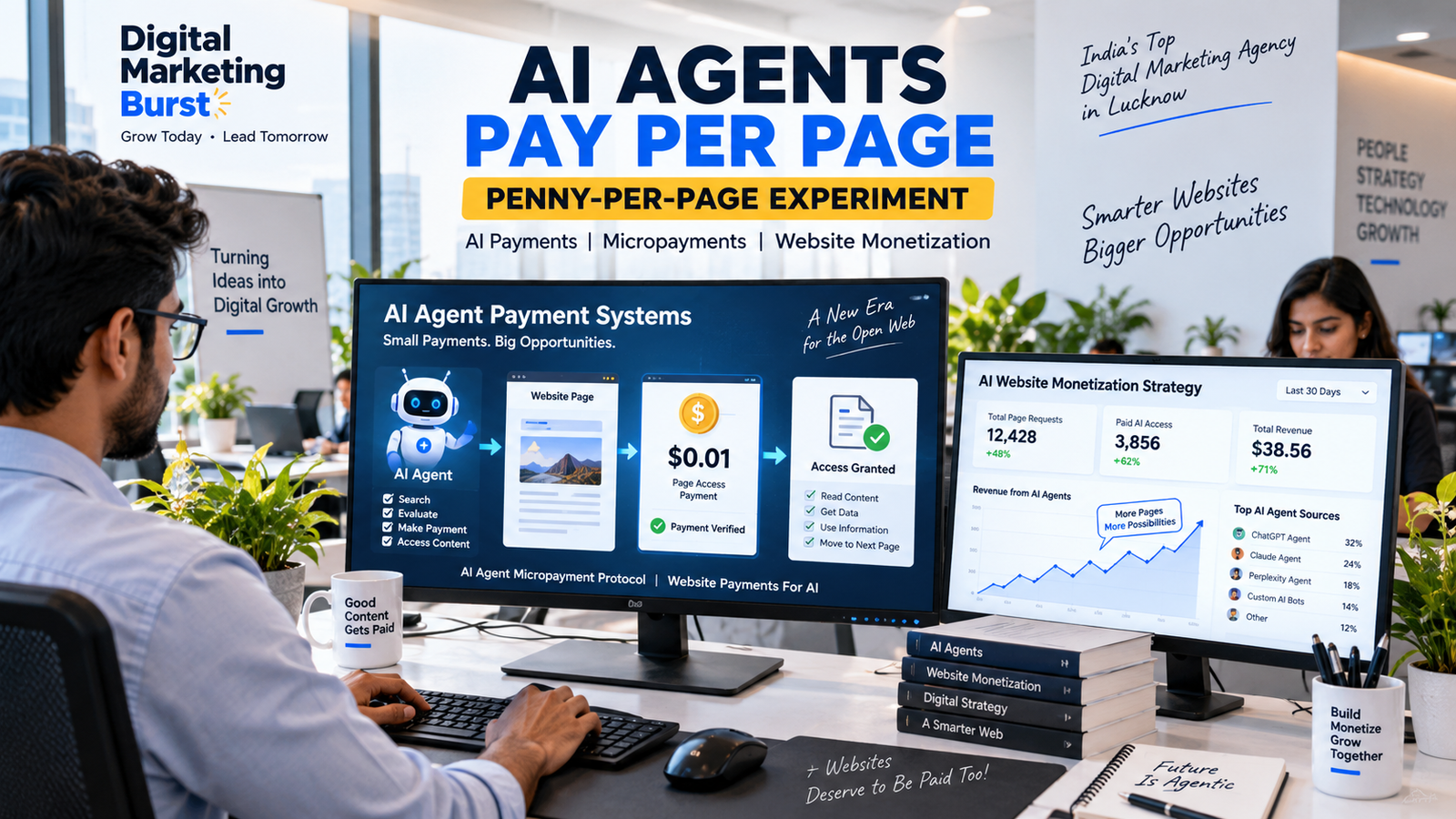
The idea is simple. An AI agent requests a resource, encounters a payment requirement, completes an approved machine-readable payment flow, and then receives access. However, the real challenge is not charging one cent. The difficult part is creating a system that is fast, secure, measurable, useful, and economical at machine scale.
This changes the website monetization conversation. Publishers have traditionally relied on ads, subscriptions, affiliate links, leads, or ecommerce. Now, automated software may become another type of paying customer. In this guide, Digital Marketing Burst explores how penny-per-page access could work, what problems it may solve, where it can fail, and how publishers can prepare for a web where software can transact with software.
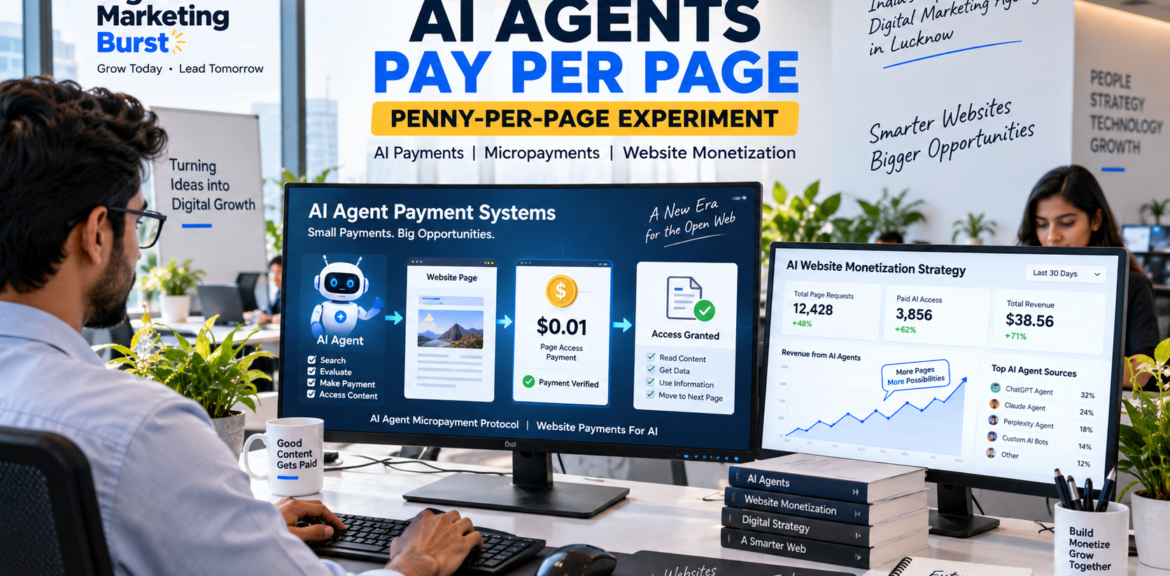
See how AI agents can pay websites per page through micropayments, creating a new AI-powered website monetization model for publishers and businesses.
Making an AI agent pay per page means placing a machine-readable payment requirement between an automated requester and a protected web resource. Instead of asking a human to open a checkout page, enter card details, and create an account, the transaction is designed for software.
Imagine that a research agent needs information from 20 premium pages. The publisher charges one cent for each protected request. Rather than buying a monthly subscription, the agent pays only for the resources it needs.
That sounds small. However, machine traffic can operate at a very different scale from human traffic. If thousands of automated requests reach useful resources every day, tiny transactions can become a measurable revenue stream.
Still, not every page should sit behind a payment requirement. Search landing pages, product information, brand pages, and content intended for discovery may need to remain freely accessible. Premium research, structured datasets, specialist analysis, proprietary tools, or expensive API outputs could be better candidates.
Therefore, the real opportunity is not simply “charge bots.” It is to decide which machine interactions create enough value to justify a price.
That distinction matters. A useful pay-per-page model should create an exchange of value rather than becoming another obstacle between a website and its audience.
AI Agent Payment Systems are designed to let autonomous or semi-autonomous software handle transactions with less human involvement. In a conventional online purchase, a person usually chooses a product, enters payment information, confirms the transaction, and receives access. An agent-oriented model tries to make parts of that process machine-readable.
For publishers, this creates an interesting possibility. A website could expose a free summary while placing deeper research, structured data, premium calculations, or specialist resources behind a small payment requirement. An agent could then determine whether the resource is worth purchasing.
The payment layer must be fast. If a one-cent resource requires a complicated registration flow, several redirects, and manual approval, the model loses much of its value.
Pricing also needs context. A basic page might cost very little. A unique dataset or expensive computational request could cost more. Therefore, publishers should think beyond one universal price.
For Digital Marketing Burst, the SEO implication is equally important. Websites may eventually need to optimize not only for human visitors and search crawlers but also for transactional agents. Content quality, machine readability, pricing, permissions, and discoverability could become parts of the same strategy.
Agentic AI Payment Systems extend digital payments into workflows where software can evaluate an offer and take an authorized action. That creates a different relationship between websites and automated visitors.
For example, an agent researching a competitive market may discover that a publisher offers a premium industry dataset. The agent can inspect the terms, determine whether the resource matches its task, and proceed through an authorized payment flow if its rules allow the purchase.
However, autonomy needs boundaries. Users or organizations should control spending limits, approved merchants, transaction types, and other permissions. Otherwise, an agent could make purchases that were never intended.
Publishers need controls as well. They should know which resources are paid, how much each request costs, and what happens when payment fails.
This is why agentic commerce is broader than attaching a payment button to an AI chatbot. It requires a reliable interaction between identity, authorization, pricing, payment, and resource delivery.
For marketers, the change could be significant. Conversion optimization may eventually include machine customers. Clear pricing and structured descriptions could matter alongside persuasive copy.
In other words, the future landing page may need to communicate effectively with both people and software.
An AI Agent Micropayment Protocol can provide the communication layer needed for very small machine-to-machine transactions. The basic goal is straightforward: tell an automated requester that payment is required, communicate the price and conditions, verify payment, and provide the requested resource.
The penny-per-page experiment depends heavily on this efficiency. Charging one cent makes little sense when processing costs, technical overhead, or user friction exceed the value of the transaction.
Therefore, micropayment infrastructure needs to minimize unnecessary steps. The interaction should also remain understandable enough for publishers to audit.
A payment protocol does not automatically make content valuable. It simply creates a mechanism for exchanging value. Publishers still need information, data, tools, or services that agents have a reason to purchase.
This creates an important SEO lesson. In a machine-driven web, generic information may become increasingly difficult to monetize directly. Unique research, proprietary datasets, fresh information, specialist expertise, useful tools, and structured resources have stronger potential.
As a result, content strategy and payment infrastructure should be planned together. Charging for weak content will not create demand. A strong resource with an inconvenient payment system may also fail.
The best opportunity sits where valuable information meets low-friction access.
An AI Agent Micropayment System turns the protocol concept into an actual website workflow. It needs to recognize a protected request, communicate a price, verify the transaction, and unlock the appropriate resource.
Consider a website with 1,000 articles. Putting every article behind a penny payment would probably damage discovery. Instead, the publisher could keep 800 pages freely accessible while experimenting with premium access on 200 high-value resources.
Those resources might include original datasets, detailed benchmarks, specialist reports, premium templates, downloadable research, or expensive computational outputs.
Analytics then becomes essential. Publishers should measure how many automated visitors encounter the payment requirement, how many proceed, which resources convert, and how much revenue each resource generates.
Failure data matters too. If agents frequently reach the payment stage but abandon the transaction, the problem may be price, compatibility, unclear terms, or payment friction.
Therefore, the first experiment should be small. Test a limited content group and observe behaviour before expanding.
A successful system is not the one with the most paywalls. It is the one that places payment requirements where machine demand and content value actually meet.
A penny-per-page AI access model treats each protected resource as a tiny digital transaction. The website identifies a request for premium content and communicates that access has a price.
The automated requester then decides whether to continue. If payment is authorized and successfully verified, the website returns the requested resource.
The interesting part is that no traditional subscription is required. An agent that needs one page pays for one page. Another agent needing 100 resources can pay according to its actual usage.
This resembles usage-based cloud services more than a newspaper subscription.
However, publishers need to define what “page” means. Is one HTML request one paid unit? Does a structured version of the same article cost separately? What happens when an agent retries a failed request? Should cached access remain valid for a period?
Those questions become important quickly.
A sensible system should avoid charging repeatedly for technical failures. It should also communicate whether the purchase grants temporary access, permanent access, or a single retrieval.
Therefore, a penny-per-page experiment is partly a pricing experiment and partly a product-design experiment.
The technology enables payment. The publisher still has to design a fair commercial model around it.
An AI Website Monetization Strategy starts with a simple question: what does your website own that an automated system may genuinely value?
A generic article summarizing widely available information may not justify payment. Original research is different. So are live datasets, proprietary comparisons, specialist databases, unique market intelligence, and computational tools.
Publishers should first separate discovery content from premium machine resources. Discovery pages attract users, search engines, links, mentions, and brand awareness. Premium resources create direct transactional opportunities.
This separation can protect organic visibility. If every useful page suddenly requires payment, search discovery and human acquisition may suffer.
A layered model can work better. The public page explains the subject and demonstrates expertise. A deeper dataset, structured export, premium report, or specialist analysis sits behind paid access.
Pricing should then match value. A penny can be a useful experiment because it reduces the decision threshold. However, expensive data should not automatically be sold for one cent simply because the requester is an AI agent.
Digital Marketing Burst would approach this as a monetization funnel. Free discovery attracts demand. Structured information explains the paid resource. Machine-readable pricing reduces friction. Analytics then reveals whether automated visitors actually convert.
An AI Content Monetization Strategy focuses specifically on turning valuable information into resources that automated systems can purchase or license.
This requires a shift in thinking. Historically, a publisher might optimize an article to attract a human reader who then sees an advertisement or submits a lead form. Machine visitors may create value differently.
An agent may not care about banner advertisements. It may care deeply about accurate information, structured data, freshness, citations, or access speed.
Therefore, publishers should identify content with high informational utility. Research databases, technical specifications, financial datasets, specialist directories, real-time information, and proprietary analysis are obvious examples.
Presentation also matters. Machine customers benefit from predictable structure and clear metadata. A valuable resource hidden behind confusing navigation may be difficult for an automated system to evaluate.
At the same time, human content should remain readable. Optimizing for machines should not mean producing robotic pages.
A strong model can serve both audiences. Humans receive explanations and context. Authorized agents can obtain structured or premium resources under clearly stated terms.
That approach could create a new revenue layer without replacing existing SEO, lead generation, advertising, or subscription strategies.
AI Agents Paying Websites changes the traditional assumption that automated traffic is either free crawling or unwanted bot activity. Under a transactional model, some automated visitors could become customers.
Imagine a shopping assistant that needs premium product data. A research agent might require a specialist market report. A travel system could need frequently updated structured information. Each request can have measurable economic value.
The publisher then has another decision to make. Should the resource remain free because the resulting visibility is valuable, or should the agent pay because retrieving the information creates direct commercial value?
There is no universal answer.
A publisher seeking broad brand awareness may prioritize open access. Another business with expensive proprietary data may prefer paid retrieval. Many websites could use a hybrid model.
The key is segmentation. Search crawlers, malicious bots, human visitors, authorized commercial agents, and research systems should not automatically receive identical treatment.
This is where the penny experiment becomes useful. Instead of making a large commercial commitment, a publisher can test whether transactional machine demand actually exists.
If agents do not pay, the experiment still provides information. If they do, publishers gain evidence that machine traffic can become a direct revenue channel.
The phrase AI Agents Pay Websites sounds futuristic, yet it describes a simple economic relationship. One system owns a useful resource. Another system wants access. A payment mechanism allows the exchange to happen.
For this model to grow, websites need to make offers understandable to machines. Price, resource type, usage rights, and access conditions should not depend entirely on visual design.
Agents also need authorization. A user may allow an agent to spend a limited amount on research but prohibit other purchases. Businesses may create stricter policies for enterprise agents.
Trust will matter on both sides. Publishers need confidence that payment is valid. Users need confidence that agents are not wasting money. Agents need enough information to determine whether a resource is relevant before purchasing it.
That makes previews important. A publisher could expose metadata, a summary, a schema description, or a sample before requiring payment.
The result resembles ecommerce for information. The product may be a page, dataset, calculation, API response, or research result.
Once websites think of information as a machine-purchasable product, new monetization models become easier to imagine.
Website Payments For AI can create a bridge between open web access and expensive enterprise licensing. Instead of choosing only between “free” and “subscription,” publishers can introduce small usage-based charges.
This flexibility is particularly useful when agents need information occasionally. A system may require only three resources from a publisher. Paying for those three requests can be more efficient than purchasing a monthly plan.
For websites, usage-based pricing can unlock demand that a subscription would lose.
However, the economics must work. Payment processing cannot consume most of a tiny transaction. Infrastructure costs also matter because serving large numbers of automated requests can require bandwidth and computing resources.
Publishers should calculate their actual cost per request. They should also consider the value of the information being delivered.
One cent is a compelling headline, but it is not automatically the correct price.
Some pages may remain free. Others could cost fractions of a dollar. Premium datasets might justify substantially higher pricing.
Therefore, website payments should be treated as a flexible pricing architecture rather than a universal penny paywall.
An AI Website Payment System needs more than a checkout mechanism. It must connect resource discovery, pricing, authorization, verification, access, and analytics.
The first stage is discovery. An agent should understand that a resource exists and what it contains before paying.
Next comes pricing. The website needs to communicate the amount and relevant conditions clearly.
Authorization then happens on the agent side. The automated system must know whether it has permission to make that purchase.
After payment, verification should occur quickly. The website can then provide access to the requested content or service.
Finally, analytics records what happened. Publishers need to know which machine resources generate demand and which do not.
Security belongs across the entire workflow. A payment should not accidentally grant access to unrelated premium resources. Likewise, attackers should not be able to bypass the payment layer by changing request parameters.
This is why publishers should treat machine payments as infrastructure rather than a marketing widget.
When the underlying system is reliable, marketers can focus on pricing, positioning, discoverability, and conversion.
The question how to charge AI agents per page begins with identifying which pages deserve a price. Do not start by placing a payment requirement across the entire site.
Choose resources with clear value. Original research is a strong candidate. Structured industry data can also work. Premium calculators, live feeds, proprietary benchmarks, and specialist analysis may have similar potential.
Next, define the unit being sold. A “page” should represent something understandable and consistent.
Then establish a price. One cent makes experimentation easy, but different resources may need different prices.
The website also needs to tell automated systems what happens after payment. Does the agent receive one response? Can it revisit the resource? Is caching permitted? Can the information be used commercially?
Clear rules reduce ambiguity.
After launching, monitor both revenue and discovery. If paid access causes valuable organic pages to disappear from search visibility, the experiment may be damaging a larger acquisition channel.
Therefore, charging agents should complement SEO rather than automatically replace open content.
Start small, measure everything, and expand only when the data supports the model.
Pay Per Page AI Content creates a middle ground between completely open publishing and full subscription access.
A human reader may visit a free article because they want a general explanation. An automated research system might require a more structured version, additional data, or deeper analysis. The publisher could monetize that enhanced resource separately.
This distinction is powerful because the same subject can support multiple products.
For example, a free article might explain a market trend. The paid machine resource could contain the underlying dataset, structured citations, historical values, or downloadable tables.
The public article continues attracting organic traffic. Meanwhile, the premium layer creates a transaction opportunity.
Publishers should avoid deliberately degrading free content merely to force payment. That can hurt trust and SEO.
Instead, paid access should offer additional utility.
A useful question is: what can the premium resource help an agent accomplish that the public page cannot?
If the answer is clear, charging becomes easier to justify.
If there is no meaningful difference, a payment requirement may simply reduce access without creating enough value.
AI Agent Pay Per Use is broader than paying for articles. The same model can apply to APIs, calculations, searches, generated reports, database queries, images, specialist tools, or other digital resources.
Usage-based pricing fits agents because automated systems often work task by task.
Suppose an agent needs a single company record from a specialist database. A monthly subscription may be unnecessary. Paying for one query can be more efficient.
Another agent might need 10 calculations from a financial tool. Each request could have its own small charge.
This creates a programmable marketplace of digital capabilities.
However, pricing must remain predictable. Agents need to understand the cost before executing a request. Users also need spending controls.
Publishers can introduce daily limits, per-task budgets, or maximum transaction values.
For marketers, this opens another content opportunity. A website does not have to monetize only text. Useful functionality can become a paid machine resource.
That may eventually make tools, datasets, and APIs as important to SEO-led businesses as conventional blog posts.
The AI agent payment protocol conversation often intersects with HTTP 402, historically labelled “Payment Required.” The status concept is particularly interesting for machine transactions because it gives websites a recognizable way to indicate that a requested resource requires payment.
In a simplified workflow, an agent requests a protected resource. The server responds with payment requirements. The agent completes an authorized payment. After verification, it requests or receives access to the resource.
This is far more machine-friendly than showing an automated agent a visual checkout page designed for humans.
Still, HTTP status handling alone does not solve the complete commercial problem. Websites need payment instructions, verification, pricing rules, security, access policies, and transaction records.
The user side needs controls as well. An autonomous system should not have unlimited spending power merely because it understands a payment request.
Therefore, payment-required responses should be viewed as one component in a broader architecture.
For publishers, the important takeaway is that the web is becoming more capable of communicating economic requirements directly between machines.
That creates new possibilities for content and API monetization.
x402 AI agent payments have become an important concept in discussions about machine-readable web payments. The broader idea is to make paid digital resources easier for software to discover and access without requiring the traditional human checkout experience.
This fits the penny-per-page experiment closely. A resource can communicate that payment is required, provide machine-readable requirements, and continue the interaction after an authorized transaction.
For content publishers, the appeal is obvious. Automated systems increasingly consume online information. A standardized payment layer could allow some of that consumption to become transactional.
However, publishers should not confuse technical possibility with guaranteed demand.
Agents will pay only when the resource helps complete a task and the expected value exceeds the price and friction involved.
That brings the conversation back to content quality.
Unique data has an advantage. Fresh information can have an advantage. Proprietary tools and specialist expertise may also create stronger willingness to pay.
Generic content that can be obtained freely from many sources has less leverage.
Therefore, x402-style monetization should begin with resource strategy, not simply payment implementation.
AI agents paying for content could reshape the economics of publishing if automated consumption continues to grow.
Publishers currently face a difficult question. Machine systems can derive value from web content, yet the original publisher may receive little direct economic benefit from some forms of automated access.
Micropayments introduce another option.
Instead of blocking every automated system, a publisher can potentially create different access levels. Public pages remain open where discovery matters. Premium machine resources require payment. Unauthorized or abusive bots can still be restricted.
This model gives publishers more control.
It also encourages better content economics. If an agent pays directly for information, the publisher can measure the value of individual resources more clearly than with broad advertising metrics.
However, charging everything could backfire. Open content contributes to brand discovery, citations, links, and customer acquisition.
The stronger approach is selective monetization.
Publishers should ask which content creates reach and which resources deliver unique machine utility. Those two groups do not always need the same access model.
Websites charging AI agents represents a larger shift from blocking automated traffic toward classifying and monetizing it.
Not every bot is equal. Search crawlers can help discovery. Monitoring systems may support business operations. Malicious automation can create costs. Commercial AI agents may obtain direct value from data.
Treating every automated visitor identically ignores these differences.
A modern access strategy can establish separate rules for different machine categories.
For example, a website may permit normal search crawling while charging approved commercial agents for premium structured data. High-frequency abusive traffic can still be blocked.
This creates a more nuanced model than a universal robots-versus-humans divide.
Publishers will need strong analytics to make it work. They should know which automated requests consume resources, generate visibility, create revenue, or cause abuse.
Machine identity is also a challenge. A website needs confidence about who is making the request and what permissions apply.
Therefore, payment technology is only one part of the future machine-access stack. Identity, security, analytics, licensing, and SEO remain equally important.
AI content micropayments for publishers could create a revenue stream that sits alongside advertising, subscriptions, affiliate marketing, sponsorships, and lead generation.
The advantage is granularity. A publisher does not need to convince an automated customer to purchase a large subscription before providing value.
A tiny transaction can unlock one useful resource.
Over time, many small transactions could become meaningful when machine demand is high. Yet publishers should calculate revenue after transaction and infrastructure costs.
Content selection remains crucial.
High-value research, professional databases, specialist archives, and frequently updated information are stronger candidates than commodity articles.
Publishers can also experiment with bundles. An agent might pay one cent for a single resource or a larger amount for a temporary package of related data.
This creates pricing flexibility without forcing human subscription logic onto machine customers.
The best experiments will measure not only revenue but also how paid access changes crawling, citations, discovery, and customer acquisition.
A monetization channel is useful only when it creates more value than it removes elsewhere.
AI website monetization without ads is attractive because machine visitors do not behave like conventional advertising audiences.
An automated agent does not need to see a display banner. It wants information or functionality.
Therefore, charging for the resource itself may align revenue more directly with value.
This could be useful for websites that dislike cluttered advertising experiences. Instead of filling premium pages with multiple ads, a publisher can offer specialized resources under usage-based pricing.
Human pages can remain clean and accessible.
The approach also changes measurement. Rather than tracking only impressions and ad clicks, publishers can measure paid machine requests, revenue per resource, repeat agent usage, and transaction conversion rates.
Still, ads and machine payments do not have to compete. A website can use multiple revenue models simultaneously.
Human traffic may support advertising. Premium subscribers may pay monthly. Commercial agents may pay per request.
Diversification can make a publishing business more resilient.
The key is matching the revenue model to the visitor and the value being consumed.
An AI agent payment gateway for websites would act as a bridge between protected digital resources and automated purchasers.
For publishers, the ideal gateway should be simple to integrate and easy to monitor. It should verify payment quickly and return clear transaction information.
Agents need predictable responses. They should understand price, payment requirements, and what resource becomes available after purchase.
Security remains critical. Attackers should not be able to forge payment confirmation or reuse authorization outside its intended scope.
Publishers also need reporting. Revenue should be traceable to resources, requests, and time periods.
Refunds or failed deliveries may need consideration as well. If an agent pays but the resource cannot be delivered, the system should have a sensible recovery process.
These requirements show why the payment gateway becomes part of website infrastructure.
Marketing teams may define the offer and price. Developers handle technical integration. Finance teams may care about settlement and reporting. Legal teams can define licensing.
Machine monetization therefore becomes a cross-functional business project.
Machine-to-machine payments for AI describe transactions in which software systems exchange value with minimal human interaction during the actual purchase.
This model could extend far beyond websites.
An AI travel agent might purchase data from a transport provider. A research system could pay for an academic dataset. A business agent might buy an API result needed to complete a workflow.
The economic logic is compelling because machines can make many small decisions rapidly.
However, that same speed creates risk.
A poorly configured agent could make thousands of unnecessary purchases. Therefore, spending limits and authorization policies are essential.
Transactions also need strong records. Users should be able to understand what an agent purchased and why.
For sellers, machine-readable product information becomes increasingly important. A software customer cannot rely on emotional advertising in the same way a human might.
It needs structured information about cost, capability, conditions, and expected output.
As machine commerce grows, clarity may become a conversion factor.
AI agent commerce and micropayments could transform small digital resources into standalone products.
Today, selling something worth one cent is usually impractical through a conventional ecommerce checkout. The user effort alone is greater than the value of the purchase.
Agents change that equation.
If payment can happen programmatically within predefined limits, tiny purchases become more practical.
A website might sell a single data point, one calculation, one page of premium analysis, or one API response.
Millions of potential digital resources could then become independently priced.
Still, publishers should avoid pricing every interaction merely because the technology allows it.
Free resources create discovery and trust. They can also lead users and agents toward higher-value products.
Therefore, the strongest model may resemble freemium software. Basic information remains accessible. Premium machine utility carries a price.
This gives agents enough information to evaluate the publisher before spending.
The question can AI agents pay for web content has two parts. The first is technical. The second is economic.
Technically, automated payment workflows can be designed when an agent has the appropriate tools, permissions, payment method, and compatible merchant infrastructure.
Economically, the more important question is whether an agent should pay.
If the same information is freely available from reliable sources, payment may not make sense. If a publisher owns unique data, a premium resource may be worth purchasing.
Publishers interested in machine monetization should invest in information that cannot be recreated easily from generic web sources.
Original surveys, proprietary datasets, expert analysis, real-time information, specialized archives, and unique tools can create that differentiation.
The payment mechanism then captures part of the value already present in the resource.
Technology cannot manufacture willingness to pay. It can only make payment easier when value exists.
One penny seems almost meaningless to a person. However, one-cent AI content access can make sense when the transaction happens automatically and the resource helps complete a valuable task.
Suppose an agent is producing a high-value business report. Paying a few cents for accurate specialist information could be trivial compared with the value of the finished task.
The decision becomes an optimization problem.
An agent can compare expected information value with cost. If the page is likely to improve the result and the price falls within its budget, purchasing may be reasonable.
Publishers can improve conversion by exposing enough information before payment. A clear title, description, freshness date, data schema, or preview can help an agent estimate relevance.
Charging blindly creates uncertainty. Providing useful pre-purchase metadata reduces it.
This resembles product descriptions in ecommerce. Customers need enough information to decide whether the product is worth buying.
The difference is that the customer may now be software.
The problems with AI agent micropayments are just as important as the opportunities.
Transaction economics is the first issue. If fees exceed the value of tiny purchases, penny pricing becomes impractical.
Identity is another challenge. Websites need reliable ways to distinguish legitimate agents from spoofed or abusive automation.
Access control can also become complicated. A publisher needs to prevent unpaid retrieval while ensuring paying agents receive the correct resource quickly.
Then comes duplicate charging. Automated systems retry requests. A badly designed payment flow could charge an agent repeatedly for the same failed retrieval.
Privacy deserves attention too. Transaction logs can reveal what information an agent is researching.
SEO creates another tension. Publishers may accidentally restrict resources that previously generated valuable organic discovery.
Finally, there is user control. People need clear limits on what their agents can buy.
These problems do not make the model impossible. Instead, they show why penny-per-page access needs careful architecture.
Pay-per-page AI monetization can fail when publishers begin with pricing rather than value.
If a website charges for generic information available freely elsewhere, agents have little reason to purchase it.
Poor machine readability creates another problem. An agent may be willing to pay but unable to understand the payment instructions.
Pricing can also be wrong. One cent may be too expensive for commodity data yet far too cheap for valuable proprietary research.
Excessive paywalls can damage discovery. Search engines and human visitors still matter.
Technical reliability is equally important. A payment system that frequently fails will discourage repeat usage.
Publishers may also misread bot traffic as commercial demand. Large numbers of automated requests do not automatically mean those systems are willing or authorized to pay.
Therefore, test conversion rather than celebrating request volume.
The best experiments start with a small group of high-value resources and a clearly measurable hypothesis.
A penny-per-page website monetization experiment should begin with a controlled sample.
Choose a small group of resources that already demonstrate demand. Avoid changing the entire website.
Next, create a baseline. Measure current traffic, bot requests, server cost, organic visibility, conversions, and revenue associated with those pages.
Then introduce paid machine access while preserving the human experience appropriate for your business model.
Track how many eligible automated requests encounter the payment requirement. Measure how many complete payment and successfully retrieve the resource.
Revenue per thousand machine requests can become a useful metric.
Also monitor changes in search visibility. A monetization experiment should not quietly destroy a stronger organic channel.
After collecting enough data, compare outcomes.
Did machine revenue exceed implementation and infrastructure costs? Did repeat purchases occur? Which resources performed best? Did SEO remain stable?
The answers determine whether the experiment deserves expansion.
AI agent payment analytics should go beyond counting successful transactions.
Publishers need to understand the complete funnel. Start with eligible machine requests. Then measure payment offers, successful authorizations, completed transactions, resource delivery, repeat usage, and revenue.
Failed requests should be categorized.
A payment failure is different from an agent deciding the resource is not worth the price. Technical failures require engineering fixes. Low purchase intent requires a pricing or product response.
Resource-level reporting is especially valuable.
Perhaps a premium dataset converts well while long-form articles rarely receive paid requests. That information should influence future content investment.
Average revenue per agent can also reveal whether a small group of repeat users generates most income.
Meanwhile, SEO teams should monitor crawl patterns and organic performance.
Machine monetization analytics should therefore sit alongside conventional web analytics rather than replacing it.
The publisher is building a new acquisition and revenue channel, not an entirely separate website.
A Digital Marketing Burst AI Agent Payment Strategy should connect SEO, AI discovery, content monetization, and technical access rather than treating machine payments as an isolated feature.
The first layer remains visibility. A resource cannot generate transactions if relevant systems cannot discover that it exists.
The second layer is value. Digital Marketing Burst would focus on identifying information or functionality that deserves premium access.
Next comes machine readability. Resource descriptions, pricing, access conditions, and structured information should be clear.
Payment infrastructure follows. The experience should minimize unnecessary friction while respecting authorization and security.
Finally, measurement determines whether the strategy works.
This creates a full funnel: discover, evaluate, pay, access, measure, and optimize.
For businesses experimenting with AI-driven traffic, this framework is more useful than simply placing every page behind a paywall.
A Digital Marketing Burst AI Website Monetization Strategy can combine conventional SEO traffic with emerging machine-payment opportunities.
The public content layer should continue answering valuable search queries. These pages can attract people, links, brand mentions, and search visibility.
A second layer can offer premium machine utility. This might include detailed datasets, specialist reports, structured exports, or useful digital tools.
The separation protects the traffic engine while introducing another revenue model.
Digital Marketing Burst can also evaluate search intent before selecting paid resources. Informational keywords may belong on free pages. High-value commercial or data-intensive use cases may support premium access.
Internal linking can connect both layers naturally.
A public article can explain a subject and point toward a more advanced resource without reducing the usefulness of the free page.
This creates an SEO-first monetization structure rather than an SEO-versus-monetization conflict.
Digital Marketing Burst AI Content Monetization focuses on turning expertise into resources that can serve both human and machine audiences.
The human-facing article should remain natural, readable, and genuinely useful. Machine-facing layers can provide structured information where it improves utility.
This matters because writing robotic content solely for AI systems is unlikely to create a strong brand.
Originality remains important. Publishers need first-party insight, examples, experiments, and data if they want their resources to stand apart from generic information.
Digital Marketing Burst can use topic clusters to build authority around AI search, agentic commerce, website monetization, and machine payments.
Each cluster should have a clear informational hub. Supporting pages can address technical questions, commercial applications, problems, and case studies.
Over time, this creates a knowledge ecosystem rather than a collection of unrelated AI articles.
The result can support organic traffic today while preparing the site for new machine-driven discovery and monetization models.
Branded keywords should appear where they add context instead of being forced into every section.
For this topic, useful variations include Digital Marketing Burst AI Agent Payments, Digital Marketing Burst AI Website Monetization, Digital Marketing Burst Agentic Payment Strategy, Digital Marketing Burst AI Content Monetization, and Digital Marketing Burst Pay Per Page Strategy.
The article title should normally prioritize the main search intent rather than becoming overloaded with the brand.
Within the introduction, the company can appear naturally when explaining who is providing the analysis.
Relevant subheadings can use branded long-tail variations when the section genuinely describes the company’s approach.
The conclusion is another useful location because it connects the topic back to the publisher.
Image titles and descriptions can also contain the brand where appropriate.
For internal links, branded anchors should be used selectively. Too many identical anchors can make the writing unnatural.
The goal is simple: make Digital Marketing Burst clearly associated with expertise in AI search and emerging website monetization without turning every paragraph into an advertisement.
AI agent payments and SEO may eventually intersect more closely than they do today.
Traditional SEO focuses on earning visibility and clicks. AI search has already expanded that discussion toward citations, retrieval, mentions, and machine understanding.
Paid agent access introduces another possible outcome: a transaction.
A future content funnel might begin when an AI system discovers a public page. It understands that a deeper resource exists. The agent evaluates the premium offer and purchases access when authorized.
The publisher can then measure revenue from machine discovery.
This does not mean traditional rankings become irrelevant. Human search traffic will continue to matter.
Instead, SEO may gain another audience.
Publishers could optimize free content for broad discovery while making premium resources understandable to authorized commercial agents.
This is why structured content, clear authorship, reliable information, and strong topical authority remain important.
The web may be changing, but visibility still comes before monetization.
AI Search Visibility and Paid Content
AI search visibility and paid content can appear contradictory. If content is locked, how will an AI system discover it?
The solution may be selective openness.
Publishers can expose useful metadata, descriptions, summaries, or samples while protecting the premium resource itself.
This allows discovery without giving away the complete product.
The concept already exists in other forms of digital commerce. A customer can see a book description without reading the entire book. A software buyer can review features before purchasing a subscription.
Machine commerce can follow similar logic.
An agent needs enough information to determine whether a paid resource matches its task.
Therefore, premium machine resources should have strong public descriptions.
SEO teams can optimize those discovery pages for relevant queries while technical teams protect the paid asset.
This creates a cleaner relationship between search visibility and monetization.
Future of AI Agent Payments in 2026
The future of AI agent payments in 2026 is likely to be shaped by experimentation rather than one universal business model.
Different websites have different economics.
A news publisher may value rapid distribution. A specialist database may prioritize licensing revenue. An API company already understands usage-based pricing. An ecommerce business may want agents to purchase products rather than information.
Therefore, agent payments will probably develop differently across industries.
Micropayments are especially interesting because they reduce commitment. Agents can purchase exactly what a task requires.
However, standards, identity, user authorization, security, and transaction economics still need to mature.
Publishers should watch the space without assuming every emerging protocol will become permanent infrastructure.
The practical approach is experimentation.
Identify one valuable resource. Define a clear price. Preserve organic discovery. Measure machine demand. Learn from the results.
That is more useful than rebuilding an entire website around a technology before customer behaviour is proven.
Penny-per-page website monetization is unlikely to replace every existing revenue model. However, it could become one useful option in a broader machine-commerce ecosystem.
Advertising works for some audiences. Subscriptions work for others. Ecommerce, lead generation, licensing, and affiliate marketing each solve different business problems.
Machine micropayments add another choice.
Their biggest advantage is proportionality. A customer can pay according to actual usage.
That fits autonomous software particularly well because agents can make many small resource decisions.
Yet the model succeeds only when the underlying information has value.
Publishers should therefore spend more time improving their resources than designing clever payment barriers.
If an agent can obtain equivalent information elsewhere for free, the penny paywall provides little leverage.
If the website offers unique, accurate, timely, and useful information, even a tiny payment can become reasonable.
Value comes first. Payment infrastructure captures it afterward.
AI Agent Payment Systems, AI Agent Micropayment Protocol, AI Website Monetization Strategy, AI Agents Paying Websites, and Website Payments For AI point toward a web where automated visitors may become economic participants rather than simply traffic sources. A penny-per-page experiment makes that possibility easy to understand because the transaction is tiny, but the underlying change is much larger.
For publishers, the opportunity is not to charge every crawler for every article. The stronger strategy is to identify resources with genuine machine value, preserve useful public discovery, introduce paid access selectively, and measure whether agents actually purchase what is offered.
Digital Marketing Burst can approach this shift from both SEO and monetization perspectives. Search visibility still matters because resources must be discovered before they can be evaluated. Meanwhile, original research, structured information, specialist expertise, and useful tools can create stronger reasons to pay.
AI agent payment infrastructure is the foundation that turns the idea of paid machine access into a working business model. A website cannot simply display a price and expect autonomous software to understand what happens next. The payment requirement, authorization process, verification step, and resource delivery must work together.
For publishers, the first challenge is deciding where the payment layer should appear. Public articles may remain available for organic discovery. Meanwhile, proprietary datasets, advanced research, premium reports, or computational resources can sit behind machine-readable paid access.
The infrastructure should also communicate price before a transaction occurs. An authorized agent needs enough information to decide whether the requested resource fits its task and budget. Therefore, hidden or unpredictable charges can create unnecessary friction.
Security is equally important. Payment confirmation should unlock only the purchased resource. A successful transaction for one page should not accidentally provide unrestricted access to an entire premium database.
In addition, publishers need detailed logs. They should be able to see which resources were requested, what was purchased, whether delivery succeeded, and how much revenue each resource generated.
The goal is not merely accepting money from software. Instead, the infrastructure should create a reliable digital marketplace where automated systems can discover, evaluate, purchase, and consume useful resources.
AI agent payment solutions for publishers could create an alternative to relying completely on advertising or subscriptions. Publishers increasingly create information that has value beyond a traditional page view. Automated systems may want structured facts, fresh data, specialist analysis, or access to digital tools.
A machine-payment layer gives publishers another way to package that value.
For example, the main article can remain free. This protects its ability to attract organic traffic and introduce the publisher to new audiences. However, an advanced dataset connected to the article could require a small transaction.
This separation is important because visibility and monetization have different jobs. Free content can create reach. Premium machine resources can generate direct revenue.
Publishers should test several pricing models instead of assuming one penny works for everything. A lightweight request might justify a tiny charge. In contrast, unique research that required weeks of work may deserve a much higher price.
The strongest solution will therefore support flexible pricing.
Publishers should also measure repeat demand. A resource purchased once may be interesting. A resource purchased repeatedly by different automated systems provides much stronger evidence of commercial value.
Over time, these patterns can help determine what new premium content should be produced.
Autonomous AI payment systems become particularly interesting when an agent can make purchasing decisions within boundaries established by its user.
Suppose a business gives its research agent a small budget for acquiring premium information. The agent searches for relevant sources and discovers several paid resources. It can compare descriptions, prices, freshness, and expected usefulness before deciding which resource fits the task.
However, autonomy should never mean unlimited spending.
Users need controls such as per-transaction limits, total budgets, approved resource categories, and merchant restrictions. An enterprise may require even more detailed policies.
For sellers, autonomous transactions create new conversion considerations. Human buyers respond to branding, design, social proof, and persuasive copy. Software buyers may prioritize structured descriptions, price, reliability, freshness, and expected output.
Consequently, publishers may eventually need two layers of conversion optimization.
The human layer explains why the resource matters in natural language. The machine layer describes exactly what is available and what it costs.
Digital businesses that understand both audiences could be better prepared for agentic commerce. The objective is not to remove humans from purchasing decisions entirely. Rather, it is to let authorized software execute routine transactions within clearly defined limits.
AI agent payment technology for content access could solve a specific publishing problem. Websites often want automated systems to discover their expertise without necessarily giving unlimited commercial access to every premium resource.
A layered content architecture can help.
The first layer remains publicly discoverable. It explains the topic, establishes relevance, and gives readers useful information. The second layer contains additional value. This could include structured datasets, extended research, premium documents, or specialized tools.
An agent can discover the free layer first. If the premium resource matches its task, the system can evaluate whether purchasing access is worthwhile.
This approach is more balanced than blocking every automated visitor.
It also creates room for different access policies. Search crawlers may receive the public content needed for indexing. Human readers can browse normal pages. Authorized commercial agents can purchase premium machine resources.
Meanwhile, unwanted automated traffic can be handled separately.
Publishers should avoid viewing every bot as the same type of visitor. Some automation creates visibility. Other automation creates infrastructure costs. A third category may become a paying customer.
Payment technology becomes valuable when it helps the website distinguish those relationships and respond appropriately.
AI agent payment gateway integration should feel almost invisible to the authorized automated buyer. Every unnecessary step can reduce the usefulness of micropayments.
A conventional ecommerce transaction often includes account creation, a shopping cart, checkout pages, billing forms, and confirmation screens. Those steps were designed primarily for people.
Machine transactions need a different flow.
An agent requests a resource. The website communicates a payment requirement. The agent evaluates the request against its authorization rules. After an approved payment is verified, access is granted.
Behind this simple interaction sits a more complicated system.
The website needs transaction verification, access controls, security checks, logging, and failure handling. It must also decide how long paid access remains valid.
For instance, should an agent that purchases a resource be charged again five seconds later if a network error forces a retry? A poorly designed gateway could create duplicate charges and destroy trust.
Therefore, payment integration should include sensible retry and transaction-identification logic.
The best system minimizes friction for legitimate purchases while maintaining strong controls against abuse.
Machine payments for website content introduce an important change in how publishers calculate the value of automated traffic.
Traditionally, publishers measure sessions, users, page views, ad impressions, leads, subscriptions, and sales. Machine traffic does not always fit those metrics neatly.
An automated system may retrieve one resource and create substantial downstream value without ever viewing an advertisement or completing a human-style conversion.
Direct payment changes that relationship.
If a machine pays for the resource, the publisher can attach revenue to the request itself.
This can make content economics easier to measure. A dataset that receives 5,000 paid machine requests has obvious commercial demand. Another premium resource that receives many payment prompts but almost no purchases may need a lower price or stronger value proposition.
Still, free machine access can remain valuable. Search indexing, citations, discovery, and brand exposure may produce indirect benefits.
Therefore, publishers should avoid turning every automated request into a transaction.
The better approach is segmentation. Monetize resources where direct consumption creates enough value. Keep discovery resources accessible when reach provides the larger business benefit.
A pay per request AI website model expands the penny-per-page concept beyond traditional web pages. The billable unit can be any digital resource requested by an automated system.
One request might return a structured company record. Another could run a calculation. A third may provide a premium article or generate a specialized report.
This flexibility can create stronger business models because not every resource has equal value.
A simple fact may cost very little. A computationally expensive result can cost more. A proprietary research report may carry an entirely different price.
The website should communicate these differences clearly before payment.
Publishers also need to decide whether repeated requests for identical information should incur another charge. For frequently updated information, repeated payment may make sense. For static resources, temporary access rights or caching permissions could provide a better experience.
Usage terms become important as well. Buying access to information does not automatically answer questions about redistribution or commercial reuse.
Therefore, the payment model should define both what the agent receives and how that resource can be used.
AI agent microtransactions for digital content can make small pieces of information economically accessible without requiring a full subscription.
This matters because automated systems often need very specific information. A research agent may need only one table from a larger database. A marketing system could need a single industry benchmark. Another agent may require one verified company record.
Forcing each system into a monthly subscription can create unnecessary friction.
Microtransactions provide another option.
However, the publisher needs to avoid breaking useful resources into excessively small pieces simply to generate more transactions. Artificial fragmentation can make the product difficult to use.
Instead, each paid unit should deliver clear value.
The transaction amount should also reflect processing economics. If technical costs consume the majority of the payment, the pricing model needs adjustment.
Publishers should therefore calculate contribution margin rather than looking only at gross transaction volume.
A million tiny transactions sound impressive. Yet they matter only when the system produces sustainable revenue after payment, infrastructure, support, and content-production costs.
An AI content paywall for AI agents should work differently from a traditional human subscription wall.
A human paywall often provides part of an article and then asks the reader to subscribe. A machine-focused paywall needs to communicate conditions in a format automated software can interpret.
The agent should know what resource exists, how much it costs, and what it will receive after payment.
Providing useful pre-purchase information is critical. Otherwise, the agent has no rational basis for deciding whether to spend.
Publishers might expose a title, summary, data description, update date, or resource schema while keeping the premium information protected.
This creates a machine-friendly preview.
SEO should also be considered. If the entire page disappears behind inaccessible content, search visibility may decline. Therefore, the public discovery layer should remain valuable in its own right.
The objective is not to publish empty teaser pages. Instead, provide genuine free value while reserving additional utility for paid access.
A thoughtful paywall can therefore support both organic acquisition and machine monetization.
Learning how to monetize AI bot traffic does not necessarily mean blocking every crawler until payment is received.
Automated traffic serves different purposes. Search crawlers help content appear in search results. Some AI systems may help users discover brands. Other commercial agents may retrieve information directly for task completion.
These interactions have different economic values.
A publisher can therefore create multiple access layers.
Public content remains available for discovery. Premium structured resources can require payment. High-volume abusive automation can be restricted.
This creates a more flexible strategy than a universal paywall.
Analytics should guide the decisions. If a particular machine category sends substantial traffic but produces no measurable benefit, the publisher can reconsider its access policy.
Conversely, blocking a crawler that contributes meaningful search visibility could damage acquisition.
Digital Marketing Burst can evaluate these interactions as part of a broader AI traffic monetization strategy. The goal is to understand which machine visitors create reach, which consume resources, and which have the potential to become paying users.
Monetization works best when access rules reflect those differences.
An AI traffic monetization strategy should start with classification rather than pricing.
First, identify what kinds of automated traffic reach the website. Some requests may come from search crawlers. Others could involve AI discovery systems, monitoring tools, commercial agents, or unwanted bots.
Next, determine the business value of each category.
A search crawler can support organic visibility even though it never pays. A commercial agent may consume valuable information directly. Abusive automation may provide no benefit while increasing server costs.
Only after understanding these differences should a publisher decide where payments belong.
This prevents a common mistake: treating every machine request as lost revenue.
Free access can sometimes be the more profitable decision when it leads to visibility, leads, citations, or customer acquisition.
At the same time, premium resources should not automatically be available without restrictions simply because a requester is automated.
The strategy therefore needs a balance between reach and direct revenue.
A successful model turns machine traffic into measurable business outcomes rather than focusing solely on blocking or charging bots.
An AI website revenue strategy for agentic commerce can combine several monetization methods instead of depending entirely on penny-per-page transactions.
A website could offer free discovery content, paid data access, premium API requests, subscriptions, enterprise licensing, and transaction-based tools.
Different customers can then choose the model that fits their usage.
An occasional agent may pay per request. A business using the same resource thousands of times might prefer a larger commercial agreement.
This creates a natural progression from micropayments to higher-value relationships.
Publishers should therefore watch for repeat machine customers. A high-frequency buyer may represent an opportunity for a more efficient pricing arrangement.
The same logic already exists in many software businesses. Small users begin with usage-based pricing. Larger users move toward negotiated plans.
Agentic commerce can extend that approach to web information.
Instead of asking whether penny payments will replace subscriptions, publishers can ask how micropayments fit into a broader revenue ladder.
That question produces a much stronger commercial strategy.
AI agent content licensing becomes important when paid access goes beyond simply viewing information.
Suppose an automated system pays one cent to retrieve an article. Does that transaction permit the agent to summarize the content? Can the information be stored? Can it be redistributed? Can it be incorporated into a commercial product?
Payment alone does not answer these questions.
Publishers need clear usage terms that match the resource being sold.
A single retrieval could provide limited access. Another product might include broader commercial rights at a higher price.
This creates opportunities for tiered pricing.
For example, reading access might be inexpensive. Structured commercial reuse could require a different license.
Machine-readable licensing could eventually become as important as machine-readable pricing because agents need to understand what they are authorized to do after purchase.
Publishers should avoid creating unnecessarily complicated rules. However, valuable intellectual property deserves appropriate protection.
As automated content consumption grows, access price and usage rights will increasingly need to be considered together.
AI agent content access control determines what happens after a transaction has been verified.
The simplest model grants access to one resource. More advanced systems may allow temporary sessions, bundles, usage credits, or specific API permissions.
Whatever model is chosen, the access scope should be clear.
A one-cent payment for a single article should not accidentally unlock every premium page. Similarly, legitimate purchasers should not encounter repeated payment requests during the access period they already bought.
Access tokens or equivalent authorization mechanisms can help connect payment with resource delivery.
Publishers also need expiration rules. Temporary data may require short access windows, while purchased static resources could use different conditions.
Security testing becomes essential because paid endpoints create a financial incentive for bypass attempts.
The system should also handle refunds or delivery failures sensibly.
A payment model succeeds when customers trust that they will receive exactly what they purchased.
That principle applies whether the customer is human or software.
AI agent payment security becomes more important as automated systems gain permission to spend money.
For users, the biggest concern is uncontrolled purchasing. Spending limits, merchant restrictions, and transaction policies can reduce that risk.
For publishers, payment fraud and access bypass are major concerns. A website needs to verify that a payment is genuine before releasing premium resources.
Replay attacks also require attention. A valid payment proof should not automatically provide unlimited access unless that is what the customer purchased.
Logs can support investigation when unusual behaviour occurs.
However, security should not make the transaction unusable. Adding excessive verification to a one-cent purchase can defeat the purpose of micropayments.
The challenge is finding a balance.
High-value resources may justify stronger verification. Tiny transactions need efficient controls.
Security policies should therefore reflect risk and resource value rather than applying the same process to every purchase.
As agentic payments grow, businesses that build secure foundations early may find it easier to experiment with new pricing models later.
AI agent payment failure handling can determine whether a customer retries or abandons a paid resource completely.
Several failures are possible. Payment authorization may be rejected. Verification can time out. The resource may become unavailable after payment. Network problems can interrupt delivery.
Each situation requires a clear response.
Most importantly, retrying a failed resource request should not automatically create duplicate charges.
Transaction identifiers can help the website recognize that a valid payment already occurred.
Publishers should also separate payment failure from content-delivery failure. The two problems require different solutions.
Detailed logs are useful for debugging, but error responses should remain understandable to the automated requester.
A machine should know whether it needs to retry, choose another payment method, wait, or abandon the request.
Reliable failure handling may sound less exciting than agentic commerce. Yet it is essential for commercial adoption.
Customers remember broken transactions more than successful ones.
An AI agent payment pricing strategy should reflect resource value rather than using one universal price simply because penny payments sound attractive.
Some information is inexpensive to produce and widely available. Charging a tiny amount may be appropriate.
Other resources are costly to create. Original market research, real-time data, specialist databases, and complex calculations can have much higher economic value.
Pricing should also consider the customer’s alternative options.
If equivalent information is freely available from trusted sources, even a one-cent price may reduce demand.
If the resource is unique and saves significant time, a higher price may remain attractive.
Publishers can test several levels and measure conversion.
A lower price may generate more transactions but less total revenue. A higher price can produce fewer purchases while increasing revenue per request.
Therefore, the objective should be sustainable revenue, not simply maximum transaction count.
Pricing experiments should also avoid confusing customers. Changes need enough time and data to produce meaningful conclusions.
Dynamic pricing for AI agents could eventually allow websites to price digital resources according to freshness, computational cost, demand, or usage.
For instance, a real-time market data request may cost more than yesterday’s archived value. A computationally intensive report could carry a higher price than retrieving a static page.
However, dynamic pricing introduces transparency concerns.
An agent needs to know the price before committing to a purchase. Unexpected changes can interfere with spending rules and reduce trust.
Therefore, dynamic does not have to mean unpredictable.
A website can expose current pricing clearly while allowing it to vary according to defined conditions.
Publishers should also consider whether complexity adds enough value. A simple pricing structure may convert better when resources are inexpensive.
Dynamic models make more sense when underlying delivery costs or information value change significantly.
The penny-per-page experiment is a useful starting point precisely because it is easy to understand. More sophisticated pricing should be introduced only when the data demonstrates a need.
AI agent payment conversion rate can become one of the most useful metrics for publishers testing paid machine access.
Imagine that 10,000 eligible automated requests encounter a paid resource. If only five complete payment, the publisher has learned something important.
The problem could be the resource, price, payment compatibility, or pre-purchase information.
Now imagine that a specific dataset receives a much higher purchase rate. That indicates stronger machine demand.
Conversion should therefore be measured at resource level rather than only across the entire website.
Publishers can also compare new and repeat purchasers.
Repeat usage is particularly valuable because it suggests that the information delivered enough value to justify another transaction.
However, conversion should not be optimized in isolation. A website could increase paid transactions by blocking previously free resources, yet lose valuable search visibility in the process.
The complete business impact matters more.
Revenue, discovery, infrastructure cost, repeat usage, and organic traffic should be evaluated together.
An AI agent payment SEO strategy needs to protect discovery while creating opportunities for direct machine revenue.
The easiest mistake is hiding too much.
If search engines cannot understand what a premium resource offers, the page may struggle to attract discovery traffic. Likewise, AI systems may never know that the resource exists.
Therefore, publishers need useful public landing pages.
These pages can explain the resource, show examples, establish expertise, and answer relevant search queries. The premium data or functionality can remain protected.
This creates two optimization layers.
The public layer targets search demand. The paid layer delivers advanced utility.
Internal links can connect related informational articles to premium resources where appropriate.
Digital Marketing Burst can use this architecture to build topic authority while experimenting with machine transactions.
SEO should bring the right audience to the resource. Payment infrastructure should monetize appropriate high-value usage.
When both systems support each other, publishers do not have to choose between traffic and revenue.
A Digital Marketing Burst AI Agent Monetization Strategy can start with SEO data rather than guessing which resources agents may buy.
Pages already attracting relevant search demand reveal topics users care about. Search queries can also expose questions that require deeper data or tools.
Digital Marketing Burst can use that information to identify opportunities for premium machine resources.
For example, a successful informational cluster might later support a paid dataset, specialized report, or automated analysis tool.
The public articles continue attracting traffic. The premium layer monetizes advanced demand.
Performance should then be reviewed through both SEO and commercial metrics.
Rankings, impressions, organic clicks, agent requests, paid transactions, repeat purchases, and revenue all provide different information.
This combined approach can help prevent monetization experiments from damaging the traffic engine that made the resource discoverable in the first place.
The objective is sustainable growth rather than simply charging for access.
A Digital Marketing Burst Pay Per Page AI Strategy would begin with a limited test rather than a site-wide change.
First, select a small group of resources with clear informational value. Next, determine which portion should remain publicly accessible for discovery.
Then define the premium unit. It might be a full report, structured dataset, specialist analysis, or advanced resource rather than an ordinary blog page.
A low initial price can help test whether automated customers are willing to transact.
After launch, Digital Marketing Burst can evaluate payment conversion, repeat usage, SEO performance, and revenue.
If the experiment succeeds, additional resources can be added gradually.
If it fails, the data should reveal why.
Perhaps the content was too generic. Maybe the payment process created friction. The price could also have been inappropriate.
This test-and-learn model is much safer than assuming machine payments will automatically create revenue.
Learning how to optimize paid content for AI agents starts before the paywall.
An agent needs to understand what it is considering buying. Therefore, public metadata should clearly explain the resource.
The title should be specific. A description should summarize the content or data available. Freshness information can help when time-sensitive information is involved.
If the resource has a structured format, describe that format before purchase.
Pricing and usage conditions should also be understandable.
After access is granted, the content itself should remain well organized. Clear headings, consistent terminology, structured information, and concise explanations can improve machine comprehension.
However, do not turn human-readable content into unnatural keyword blocks.
Quality remains important for both audiences.
The best paid resource is easy to discover, easy to evaluate, easy to purchase, and easy to use.
That complete experience can influence whether an agent returns to the same publisher for another purchase.
An AI-friendly paid content structure should make valuable information easy to identify without sacrificing readability.
Start with a clear topic and purpose. Avoid vague titles that require extensive interpretation.
Use logical sections to separate concepts. Important definitions should appear near the relevant subject instead of being scattered throughout the page.
When structured data adds value, it can complement the narrative content.
Publishers should also distinguish facts, analysis, and opinion clearly. This helps both human readers and automated systems understand what they are consuming.
Freshness is another factor. Time-sensitive resources should indicate when they were updated.
Premium content should deliver something beyond the public preview. Otherwise, customers may feel that the transaction added little value.
At the same time, the public page needs enough substance to stand independently.
Building trust with AI agent customers may sound unusual, but trust remains essential even when the buyer is software.
Agents make decisions using the information and policies available to them. A publisher with clear descriptions, predictable prices, reliable delivery, and consistent resource quality becomes easier to evaluate.
Failed deliveries damage that trust.
So do misleading descriptions.
If a resource promises fresh market data but returns outdated information, future automated systems may have little reason to purchase again.
Identity and reputation can therefore matter in machine commerce.
Publishers should clearly identify who operates the resource and what expertise supports it.
For Digital Marketing Burst, this means connecting AI payment content with broader expertise in SEO, digital marketing, AI search, and website strategy rather than publishing isolated trend articles.
Trust grows through consistency.
The same principle has always applied to human customers. Agentic commerce simply introduces another audience that may evaluate reliability in a more structured way.
Publishers wondering how to prepare for AI agent commerce do not need to rebuild their entire website immediately.
Start with content inventory.
Identify which pages generate discovery and which resources contain differentiated value. Next, review automated traffic patterns and server costs.
Then examine whether structured versions of valuable information could become useful machine products.
Technical teams can explore payment-compatible architectures in a controlled environment.
Meanwhile, SEO teams should protect crawlability and search visibility for public resources.
Legal and commercial teams can consider usage rights and pricing.
Most importantly, publishers should test demand before making large investments.
The machine-payment ecosystem is developing quickly. Not every approach will become a permanent standard.
A flexible website architecture makes experimentation easier.
Businesses that understand their content value, traffic sources, and customer needs will be in a stronger position regardless of which payment technologies ultimately gain adoption.
The transition from free AI crawling to paid AI access should not be viewed as an all-or-nothing decision.
Some machine access can create substantial value for publishers. Search discovery is an obvious example.
Other forms of automated consumption may use expensive resources without providing a clear return.
Paid access introduces another choice between unrestricted availability and complete blocking.
A publisher could keep standard articles accessible while charging for high-frequency commercial API usage. Another might provide summaries freely while monetizing detailed datasets.
This flexibility is likely to be more useful than a universal rule.
The important question is not whether AI should pay for the web.
Instead, publishers should ask which machine interactions create enough direct commercial value to justify payment and which interactions create more value when they remain free.
That question can produce very different answers for a blog, SaaS platform, database company, news publisher, or ecommerce website.
The economics of one-cent AI payments determine whether the headline idea can become a sustainable model.
At first glance, one cent seems too small to matter. At machine scale, however, the calculation changes.
One hundred paid requests generate only a small amount. Ten thousand transactions create something more noticeable. Millions of successful purchases could become meaningful.
Yet gross revenue is only part of the calculation.
Payment costs, hosting, bandwidth, database usage, fraud prevention, monitoring, and content production all affect profitability.
Therefore, publishers should calculate net contribution per paid request.
A one-cent price may work for a lightweight static resource but fail for an expensive real-time computation.
This is why pricing should follow unit economics.
The penny is an excellent experimental price because it makes the concept tangible. It should not become a rule that every digital resource must follow.
Successful machine monetization will probably involve many price levels based on value and delivery cost.
The question can small AI payments become publisher revenue depends largely on volume, uniqueness, and repeat demand.
A website with low machine traffic may never generate meaningful revenue from one-cent transactions.
A specialist database receiving large numbers of valuable automated queries has a very different opportunity.
Repeat purchases matter particularly strongly.
If an agent buys one resource and never returns, the transaction provides limited evidence. If multiple systems repeatedly pay for updated information, the publisher has discovered a real machine market.
This can influence product development.
Instead of producing more generic articles, the publisher may invest in the dataset or tool generating recurring demand.
Over time, machine-payment analytics can therefore shape content strategy itself.
Revenue becomes feedback about what information automated customers value.
That could be one of the most interesting consequences of paid agent access.
Making autonomous software pay for web resources is ultimately less about the penny and more about changing the economics of machine access. A successful experiment requires valuable content, predictable pricing, secure authorization, reliable delivery, and careful measurement.
Publishers should not begin by locking their entire website. Instead, they can protect selected premium resources while keeping strong discovery content accessible. This preserves organic acquisition while testing whether commercial agents are willing to pay for additional utility.
Digital Marketing Burst can connect this model with SEO, AI-search optimization, content strategy, and website monetization. That combination matters because machine revenue cannot develop if valuable resources remain difficult to discover.
At the same time, traffic alone is not enough. The resource must solve a problem well enough to justify a transaction.
The penny-per-page concept is therefore best treated as an experiment in machine-to-machine commerce. Test one resource, observe what agents do, improve the offer, and expand only when the economics make sense.
An AI agent pay-per-page decision should depend on value, relevance, price, and user authorization. An automated system should not purchase every resource simply because it encounters a payment requirement. Instead, it needs enough information to estimate whether the content can help complete its task.
A publisher can support that decision with a clear page title, concise description, update date, content category, expected format, and transparent price. For example, an agent searching for current marketing benchmarks may value a recently updated proprietary dataset more than a general article covering definitions.
Price also changes the decision. A tiny fee may be acceptable when the expected value is high. However, even a small charge becomes wasteful when thousands of low-quality resources are purchased automatically.
Therefore, publishers should focus on communicating value before asking for payment. A useful preview can show what the premium resource contains without revealing the entire product.
This approach benefits both sides. Agents can make better purchasing decisions, while publishers can attract transactions from systems that genuinely need their information. As machine commerce develops, resource descriptions may become almost as important as conventional product descriptions in ecommerce.
AI agent payment decision making introduces a new type of conversion funnel. Traditional website optimization tries to persuade a person to click, subscribe, enquire, or purchase. Machine-focused conversion may work differently because an automated buyer can evaluate information using predetermined rules.
Price is one factor. Freshness may be another. Source reliability, data format, relevance, licensing conditions, and expected task value can also influence a transaction.
For example, an authorized research agent may have a maximum budget of ₹500 for a task. It could discover several premium resources and allocate that budget according to their expected usefulness.
Publishers that clearly communicate what they sell make this process easier.
Meanwhile, vague descriptions can reduce conversion. An agent may avoid purchasing when it cannot determine what will be returned.
Consequently, machine conversion optimization should focus on clarity rather than hype.
Digital Marketing Burst can apply the same principle to AI-search content. A page should make its subject, purpose, expertise, and unique value understandable quickly. This helps human visitors as well.
The result is a stronger information architecture for both audiences.
An AI agent payment API for paid content can make premium website resources easier to purchase programmatically. Instead of forcing automated software through a visual checkout, an API can communicate the resource, cost, payment conditions, and access response in a predictable format.
This becomes particularly useful for websites selling structured information.
Imagine a publisher maintaining an industry database. Human visitors may explore the information through a normal interface. An authorized agent could request specific records through a paid endpoint.
The business can then price requests according to value.
However, the API needs documentation. Agents and developers should understand available resources, expected responses, pricing behaviour, and error handling.
Rate limits also matter. Payment does not necessarily mean unlimited server usage.
Security controls should prevent one valid purchase from being reused improperly across unrelated requests.
Therefore, the API becomes a commercial product rather than merely a technical endpoint.
Publishers that already have valuable structured data may find this model more practical than charging for conventional HTML pages.
Pay per API request for AI agents extends machine micropayments into services that websites already understand well.
Many APIs use subscriptions, credits, or monthly usage tiers. A machine-payment model could introduce more granular purchasing where appropriate.
An agent needing only one request does not necessarily need an account with a recurring plan.
For example, a business agent may need one current data record to complete a customer request. If that information is available through a trusted paid API, a small one-time transaction could be more efficient than establishing a long-term subscription.
Still, high-volume customers may benefit from traditional contracts or prepaid plans.
This means per-request payments should complement other pricing options.
Publishers can use transaction data to identify customers that move from occasional usage toward consistent demand. Those users may later be suitable for larger plans.
In this sense, micropayments can also function as a low-friction entry point into a wider commercial relationship.
An AI agent data monetization strategy may offer stronger opportunities than charging for ordinary articles because structured data often provides clear machine utility.
Consider a website that owns years of proprietary industry information. Human readers may consume summaries through articles. An agent could require the underlying dataset for analysis.
Those are two different products.
The public article can generate search traffic and establish authority. Meanwhile, structured data can become a paid resource.
This separation allows the publisher to monetize depth without hiding all useful information from search.
Data quality becomes crucial. Inconsistent fields, missing records, or outdated information can reduce repeat purchases.
Documentation matters as well. An agent needs to understand what the data represents.
Therefore, publishers should treat machine-ready datasets as products. They need maintenance, versioning, descriptions, quality controls, and pricing.
The strongest opportunities are likely to appear where information is difficult to collect, expensive to maintain, or valuable because it changes frequently.
Monetizing proprietary data with AI agents can create a stronger competitive advantage than attempting to sell information available on hundreds of other websites.
Proprietary resources might include original surveys, internal benchmarks, historical datasets, specialist directories, research results, or unique market observations.
These assets have scarcity.
If an agent needs the information to complete a task, it cannot simply retrieve an identical resource elsewhere.
That creates pricing power.
However, publishers should still provide enough public information to make the resource discoverable. A landing page can explain what the dataset contains, who created it, when it was updated, and what types of analysis it supports.
The complete data can remain protected.
This structure can also generate search traffic around specific data-related queries.
For Digital Marketing Burst, the lesson is important. Future SEO may increasingly reward businesses that produce original information rather than publishing another version of existing content.
Original resources can generate traffic, citations, authority, and potentially direct machine revenue.
AI agents buying premium website data creates a different customer journey from conventional content marketing.
The agent may not read an entire article from beginning to end. Instead, it may identify a particular resource that contains information required for a task.
Therefore, premium data needs clear positioning.
A resource titled “2026 Dataset” is vague. A more specific description explaining industry, geography, fields, update frequency, and coverage helps the buyer understand what it contains.
Freshness can strongly affect value.
Real-time or frequently updated data may justify recurring transactions. Static historical information may follow a different pricing model.
Publishers should also think about format. Machine customers often benefit from structured outputs rather than presentation-heavy pages.
This does not mean abandoning human content.
The website can maintain a readable editorial layer while offering machine-oriented products separately.
Serving each audience appropriately creates more value than forcing one format to perform every job.
AI agent paid data access can help businesses control how high-value information is consumed while still supporting legitimate automated usage.
Without a payment or licensing layer, a company may face two unattractive choices. It can leave valuable data openly accessible or attempt to block automated retrieval completely.
Paid access creates a third option.
Authorized systems can obtain the information under defined conditions.
The publisher can set prices, rate limits, usage rights, and access periods.
Meanwhile, analytics reveal how demand changes over time.
This can help businesses identify their most valuable digital assets.
A particular dataset might receive little human attention but strong machine demand. Another resource may perform well in search but generate no paid usage.
Both can still be useful for different reasons.
The key is understanding the role each resource plays in the wider business.
AI agents buying research reports is a natural use case for machine payments because research often has clear economic value.
A report may contain original surveys, expert interpretation, market forecasts, or proprietary datasets that required significant resources to produce.
A public summary can help potential buyers understand its scope.
An authorized agent could then purchase the complete report when the information is relevant to its task.
This can reduce friction for occasional buyers.
However, publishers should consider whether a penny-per-page model makes sense for high-value research. In many cases, it will not.
The same infrastructure that enables tiny payments can potentially support higher-priced resources.
Therefore, the important innovation is not the one-cent price itself. It is the ability for software to understand and complete a paid-access workflow.
Publishers can then match pricing to the actual value of the resource.
AI agents paying for real-time data could become one of the strongest applications of machine-to-machine payments.
Fresh information often loses value quickly. Weather feeds, inventory levels, transport information, financial data, pricing intelligence, and other live resources may need constant updates.
Providing that data has infrastructure costs.
A usage-based model allows publishers to charge according to consumption.
An agent requiring one update can pay for one request. Another system needing continuous access may use a higher-volume plan.
This flexibility can improve alignment between customer usage and publisher costs.
Yet reliability becomes extremely important.
If a buyer pays specifically for current information, outdated results can damage trust immediately.
Timestamps, update frequency, and data-quality checks should therefore be clearly communicated.
For machine customers, freshness is not simply a content feature. In many cases, it is part of the product being purchased.
An AI agent paywall SEO strategy needs to solve one major tension: monetization requires restriction, while search visibility usually benefits from accessible information.
The answer is not to choose one side completely.
A public landing page can provide substantial information about the topic. It can answer common questions, establish expertise, and attract relevant search demand.
The premium layer then offers additional utility.
For instance, a public article can explain an industry trend. A paid resource might provide the underlying dataset, downloadable model, or advanced analysis.
This structure gives search engines useful material to understand.
At the same time, the publisher preserves a commercial asset.
Internal linking should help visitors move naturally between related informational resources and premium products.
Digital Marketing Burst can use this approach when designing AI paywall SEO strategies. Organic visibility remains an acquisition channel, while premium resources create a monetization layer.
The two objectives can support each other when the content architecture is planned correctly.
SEO for AI agent payment pages should begin with the same fundamentals used for other high-quality landing pages.
The search intent must be clear. The title should accurately describe the resource. Introductory content needs to explain what the visitor can find and why it matters.
However, payment pages also need additional information.
Potential customers should understand what is included before purchasing. That can involve resource type, update frequency, format, coverage, or methodology.
Relevant long-tail search queries can then be addressed naturally through supporting sections.
For example, a paid market dataset could have sections answering questions about coverage, update frequency, data format, and intended use.
This creates a useful search landing page instead of a thin paywall.
Search engines receive meaningful context. Human visitors understand the offer. Authorized agents receive enough information to evaluate the resource.
The same page can therefore support discovery and conversion without giving away the premium asset itself.
AI search optimization for paid content adds another layer to conventional SEO.
AI-driven discovery systems may need enough accessible information to understand what a premium resource offers.
Therefore, publishers should clearly describe the resource outside the restricted layer.
Specific terminology helps. So does a concise explanation of scope.
Original research should identify the methodology where appropriate. Datasets should explain their fields and coverage. Tools should describe what they can accomplish.
The goal is not keyword stuffing.
Instead, provide enough semantic context for both humans and machines to understand the product.
Brand signals can also matter. The publisher should clearly identify who created or maintains the resource.
Digital Marketing Burst can connect paid-content optimization with broader AI-search strategies by building strong topic clusters around the premium asset.
This gives the resource contextual authority rather than leaving it as an isolated sales page.
Generative Engine Optimization for paid content focuses on making expertise understandable within AI-driven discovery environments while protecting commercially valuable resources.
A publisher can create comprehensive public explanations around a premium product.
These pages establish subject relevance and demonstrate expertise. Meanwhile, the underlying proprietary data remains separately controlled.
Clear definitions and logical content structure can make the subject easier to interpret.
Original statistics or first-party insights can further differentiate the publisher.
However, businesses should not reveal the complete paid product simply to increase AI visibility.
The objective is controlled discoverability.
Potential customers should know the resource exists, understand what problem it solves, and have enough information to evaluate it.
This resembles a strong SaaS product page. The website explains what the software does without giving every premium feature away for free.
Paid information products can follow the same principle.
LLM content optimization for AI agent commerce means making commercial resources understandable to language-model-powered systems without sacrificing natural writing.
Clear context matters.
A page should identify what is being sold, who it is intended for, what it contains, and how current the information is.
Ambiguous marketing language can make evaluation harder.
For example, saying a dataset contains “everything you need” provides little machine-readable value. Describing its coverage, fields, time range, and update frequency is much more useful.
Natural language still matters because human decision-makers may review the same resource.
Therefore, content should be concise without becoming robotic.
Digital Marketing Burst can use this principle across AI-search and agentic-commerce content.
Write first for clarity. Add structured context where it genuinely helps. Keep claims specific. Make commercial conditions understandable.
Good machine optimization often resembles good communication.
AI agent content discovery before payment is necessary because automated systems need to know a valuable resource exists before they can purchase it.
A payment wall that reveals nothing about the resource creates a discovery problem.
Publishers should therefore expose descriptive information.
A title identifies the subject. A summary explains the purpose. Metadata can indicate format, freshness, and coverage.
A small preview may further reduce uncertainty.
However, the preview should not eliminate the reason to purchase.
The correct balance depends on the product.
A research report may provide an executive summary publicly. A dataset might show field names and sample records. A tool could explain inputs and expected outputs.
These previews function as machine-oriented merchandising.
They help the customer understand the product without receiving the entire product.
As AI agents participate more actively in commerce, this pre-purchase information may become an important part of digital marketing.
An AI agent payment funnel can be understood through five broad stages: discovery, evaluation, authorization, transaction, and delivery.
However, publishers should not treat these stages as a rigid technical checklist. Each one is also a marketing opportunity.
Discovery depends on visibility.
Evaluation depends on clear value.
Authorization requires predictable pricing and conditions.
Transaction quality depends on low friction.
Delivery determines whether the buyer will trust the publisher again.
Afterward, repeat usage becomes an important signal.
A strong resource can turn a one-time machine customer into recurring demand.
Digital Marketing Burst can analyze this funnel similarly to a conventional conversion journey while recognizing that the customer behaves differently.
Instead of improving button colours or checkout copy, optimization may involve clearer metadata, better resource descriptions, more transparent pricing, and faster machine responses.
The fundamentals of conversion remain surprisingly familiar. Remove uncertainty and deliver value.
An AI agent freemium content model can help publishers balance discovery with monetization.
The free layer provides enough value to establish relevance and trust.
The premium layer offers additional depth.
For example, an AI marketing report might provide a public summary with several important findings. The complete dataset, detailed tables, or structured export could require payment.
This arrangement allows the free resource to attract search traffic.
It can also generate mentions and links.
Meanwhile, customers requiring deeper information have a clear reason to upgrade.
Freemium works only when the free layer is genuinely useful. Thin teaser content can frustrate readers and perform poorly in search.
At the same time, the premium layer must deliver enough additional value to justify payment.
Finding that balance is a product decision as much as an SEO decision.
The emerging AI agent economy and website monetization conversation is ultimately about who captures value when software performs tasks on behalf of people or businesses.
Agents can search, compare, analyze, communicate, and potentially purchase.
Each activity depends on resources provided by other businesses.
When those resources have commercial value, payment infrastructure creates a mechanism for compensation.
This could produce new digital markets.
A small publisher with a uniquely useful dataset may be able to sell access directly to automated customers.
A specialist tool could charge per computation.
An expert website might sell structured research.
Large audiences may no longer be the only route to digital revenue.
A smaller number of high-value machine transactions could support niche information businesses.
Still, quality remains the foundation.
Machine payments do not turn weak resources into valuable products.
The AI agent economy for content creators could provide opportunities beyond advertising revenue.
Creators with specialized knowledge can package their expertise into resources that automated systems can consume.
An industry analyst might maintain a proprietary database. A marketing specialist could sell benchmarks. A technical expert may offer calculations or structured reference material.
This could be particularly valuable for niche creators whose audiences are too small for large advertising revenue but whose information has high professional value.
However, creators should protect their human audience.
The goal is not to replace readable articles with machine endpoints.
Instead, use each format where it works best.
Humans benefit from explanation and storytelling. Automated systems may benefit from structured information.
A small publisher AI monetization strategy does not require millions of monthly visitors to be interesting.
Niche information can have high value.
For example, a small industry website may maintain data that is difficult to find elsewhere. Automated systems working in that industry could value access even if normal consumer traffic remains modest.
The publisher should identify these differentiated assets first.
Then, public content can be used to create discovery around them.
A small test is usually preferable to expensive infrastructure development.
Choose one premium resource and measure demand.
If agents purchase it repeatedly, expand carefully.
If demand is weak, improve the resource or test another use case.
This reduces risk while providing genuine market feedback.
Digital Marketing Burst AI Payment SEO Services can be positioned around the intersection of organic visibility, AI-search readiness, website monetization, and emerging agentic commerce.
Businesses exploring paid machine access still need discoverability.
Digital Marketing Burst can focus on building content architectures that explain premium resources clearly while protecting the information that creates commercial value.
Keyword research can identify informational demand.
Content clusters can build topical coverage.
Technical SEO can protect crawlability.
AI-search optimization can improve machine understanding.
Meanwhile, monetization strategy can determine which resources remain open and which may support premium access.
The objective is not to force every website into a penny-per-page model.
Instead, businesses can evaluate whether their data, research, tools, or expertise create a realistic machine-payment opportunity.
A Digital Marketing Burst AI Search and Agentic Commerce Strategy combines two emerging questions: how will AI systems discover a business, and how can that discovery eventually create measurable commercial value?
The first problem is visibility.
Brands need useful, authoritative, clearly structured content that search engines and AI-driven systems can understand.
The second problem is conversion.
Some machine visitors may simply reference the information. Others may eventually need premium data, tools, or services.
Digital Marketing Burst can build content journeys that support both outcomes.
The future of AI agent micropayments in India is particularly interesting because digital payments are already deeply integrated into many everyday commercial experiences. Agentic transactions introduce a different layer, where authorized software could eventually perform certain purchases or pay for digital resources on behalf of users and businesses.
For Indian publishers, the opportunity will depend on the type of information they own.
A general informational website may benefit more from open discovery. A specialist B2B publisher with proprietary research could have stronger reasons to test paid machine access.
Local pricing will also matter.
A model designed around international enterprise data may not translate directly to every Indian content business.
Therefore, Indian publishers should experiment according to their own audience, content value, infrastructure cost, and customer demand.
The broader principle remains the same: machines should pay where the resource provides enough value to justify the transaction.
For Indian businesses, AI Agent Payment Systems could eventually become relevant across SaaS, ecommerce, research, travel technology, financial information, marketing tools, and other data-heavy industries.
However, adoption should be driven by practical use cases rather than trend pressure.
A business with a valuable API has an obvious starting point. A company with proprietary market information may have another.
A normal service website with primarily promotional pages may have little reason to charge agents for page access.
Businesses should therefore begin by identifying their digital assets.
Which information costs money to create? What data is difficult to obtain elsewhere? Which tools save customers time? What resources already attract automated demand?
Answers to these questions can reveal whether a machine-payment model deserves further testing.
Website monetization with AI in India can include far more than advertisements around AI-generated articles.
Businesses can use AI to improve lead generation, customer experiences, content workflows, personalization, and digital products. Agent payments add another possible revenue stream.
For publishers with valuable information, usage-based machine access may eventually complement conventional monetization.
For agencies, AI can create new consulting opportunities around search visibility, content architecture, automation, and conversion.
For SaaS businesses, paid machine APIs may be especially relevant.
There will not be one universal model.
The strongest strategy will depend on what the website sells and why customers value it.
This is why businesses should avoid adopting a payment technology before defining the product.
Start with value. Then choose the monetization mechanism.
The idea of AI Agents Paying Websites moves the internet toward a model where software can participate more directly in commercial interactions.
Today, many automated systems retrieve information. The next stage could involve agents evaluating paid resources and purchasing access under user-defined permissions.
If that behaviour becomes common, publishers may start designing digital products specifically for machine customers.
Datasets could become easier to purchase per request.
Research could be sold in smaller units.
Specialized tools could charge for each completed task.
Websites may expose public information for discovery while maintaining premium machine-access layers.
However, human control should remain central.
Agents can automate transactions, but people and organizations should determine budgets, permissions, and acceptable uses.
That balance will be critical for sustainable agentic commerce.
The future of AI website monetization may involve a combination of traffic, subscriptions, advertising, licensing, API usage, agent transactions, and digital products.
The web does not need one replacement for every existing business model.
Instead, AI can create additional options.
Publishers with broad audiences may continue relying heavily on advertising. Specialist publishers may earn more from premium data. SaaS businesses can monetize computational resources. Research organizations may license information.
Machine micropayments can fit between free access and larger commercial agreements.
This flexibility is what makes the model interesting.
A penny is not the revolution by itself.
The bigger change is that a website may be able to communicate a price to software, receive an authorized payment, and deliver value without requiring a traditional human checkout.
The penny-per-page experiment represents something larger than charging a tiny amount for an article. It demonstrates how the web could evolve from passive automated consumption toward programmable commerce between websites and authorized AI systems.
A strong implementation begins with valuable resources. Clear discovery information helps automated buyers understand what is available. Transparent pricing supports better purchasing decisions. Secure payment and access controls protect both parties. Finally, analytics reveal whether the model actually produces sustainable revenue.
For Digital Marketing Burst, the bigger opportunity sits at the intersection of SEO, AI search, content quality, machine discovery, agentic commerce, and website monetization. Businesses should continue building pages that are useful to people while preparing premium digital resources for new forms of automated access.
A website does not need to charge every AI visitor. Instead, it can keep discovery open where visibility creates value and introduce payment where proprietary information, data, tools, or specialized resources justify it.
You can add this branding section after Part 3. I’ve kept it closely related to AI agent payments, AI search, website monetization, and agentic commerce, rather than making it generic agency promotion. Your site currently presents Digital Marketing Burst as a Lucknow-based agency offering SEO, AI-search-related optimization, website services, Google Ads, social media marketing, and other digital services.
Digital marketing is entering a new phase. Businesses are no longer optimizing websites only for traditional Google searches and human visitors. AI search, autonomous agents, machine-readable content, and new payment technologies are changing how digital platforms may discover and use online information.
Digital Marketing Burst positions itself as a top digital marketing agency in India and Lucknow by focusing on these evolving areas alongside established SEO and digital marketing strategies. Instead of depending only on conventional keyword optimization, the agency covers modern areas such as AI search visibility, semantic content, technical SEO, website optimization, and content authority.
This becomes particularly relevant to businesses exploring AI agent payments. A company considering paid machine access needs more than payment technology. Its premium resources still need discoverability, clear content architecture, strong search visibility, and an effective monetization strategy.
Therefore, Digital Marketing Burst connects SEO with emerging digital opportunities. From organic visibility and content strategy to AI-focused optimization and website growth, the objective is to prepare businesses for both today’s search ecosystem and developing agentic experiences.
For companies searching for a best digital marketing agency in Lucknow, top SEO agency in India, or an AI search optimization agency in India, Digital Marketing Burst can use this combination as its core brand positioning.
Search is expanding beyond traditional blue links. AI-powered discovery creates new questions around how websites are understood, referenced, summarized, and surfaced by automated systems.
Digital Marketing Burst already publishes around AI visibility, AI citation monitoring, generative engine optimization, content authority, and AI search performance. This creates a natural connection with topics such as AI Agent Payment Systems and machine-based website access.
For a business exploring pay-per-page technology, visibility comes first. An automated system needs to discover and understand a resource before it can evaluate whether that resource is worth purchasing.
Therefore, an AI search optimization strategy by Digital Marketing Burst can focus on clear content structure, search intent, topical authority, technical performance, and machine-friendly information architecture.
The aim is broader than ranking one webpage. Businesses need a connected digital presence that can remain understandable as search behaviour continues to evolve.
A Digital Marketing Burst AI Agent Payment Strategy can connect machine payments with the marketing funnel.
Imagine a publisher with free articles, original research, premium datasets, and specialist reports. Locking everything behind payment could reduce discovery. Giving every automated system unrestricted access could also make premium resources difficult to monetize.
A more balanced model keeps useful discovery content available while identifying digital assets that may support paid access.
Digital Marketing Burst can approach this from an SEO and content perspective. Public pages target relevant search demand and establish authority. Premium resources offer additional utility. Clear internal linking helps visitors and automated systems discover related information.
As a result, the website can continue attracting organic traffic while preparing for newer monetization models such as AI agent micropayments, pay-per-request AI access, and machine-to-machine payments.
This creates a useful long-tail positioning phrase: Digital Marketing Burst AI Agent Payment and Website Monetization Strategy.
An AI Website Monetization Strategy should not begin with a paywall. It should begin by identifying what information, data, or functionality has enough value to become a digital product.
Digital Marketing Burst can connect this process with keyword research, content architecture, SEO, and conversion strategy. That matters because a premium resource cannot generate meaningful revenue if the right audience never discovers it.
Public content can attract relevant search traffic. Meanwhile, original research, structured datasets, premium reports, tools, or specialist resources can create additional monetization opportunities.
This approach also protects the human experience. Visitors still receive useful information rather than encountering payment requirements on every page.
For branding, phrases such as AI website monetization agency in India, AI content monetization strategy agency, and website monetization experts in Lucknow can be incorporated naturally into related content instead of being repeatedly stuffed into unrelated paragraphs.
AI agent commerce SEO could become an important extension of conventional ecommerce and content SEO. Instead of optimizing only for people looking for products or information, businesses may also need to make certain digital resources understandable to authorized software agents.
Digital Marketing Burst can build content around this transition through technical SEO, search-intent optimization, topical authority, and AI-search-focused content. Its published material already emphasizes semantic optimization, conversational search, AI crawler understanding, and technical website improvements.
For agentic commerce, clear communication becomes particularly important. A machine needs to understand what a resource contains, what problem it solves, and what access conditions apply.
That makes SEO relevant even when the eventual conversion is a machine transaction.
A useful long-tail phrase for this section is Top SEO Agency in Lucknow for AI Search and Agentic Commerce. It connects the brand with the exact subject of your article without moving into unrelated generic promotion.
A Digital Marketing Burst AI Content Monetization Strategy can help publishers think beyond advertising revenue.
A website may have several valuable digital assets. Some pages generate traffic. Others generate leads. Proprietary data can create direct commercial value. Tools may generate repeat usage.
AI agents introduce another possible audience for these resources.
Digital Marketing Burst can use SEO data to understand which topics already generate demand. From there, businesses can identify opportunities for premium resources around those topics.
For example, a high-traffic informational article could remain free. A related advanced dataset or premium research resource could become a paid product.
This structure supports the 40% traffic, 30% client-focused, and 30% problem-solving approach used across the wider content strategy. Traffic content attracts discovery, client-focused sections demonstrate commercial applications, while problem-focused content addresses payment friction, monetization challenges, and AI visibility issues.
Businesses need digital strategies that can adapt as discovery channels change. Traditional SEO remains important, but modern visibility increasingly includes AI-search environments, semantic understanding, content authority, and multiple digital platforms.
Digital Marketing Burst presents services across SEO, social media marketing, website design, Google Ads, graphic design, backlinks, and email marketing, while its newer content also covers AI search visibility and related optimization strategies.
That combination gives the brand a natural foundation for discussing topics such as AI agents, machine payments, content monetization, and future search behaviour.
Rather than separating SEO from AI, businesses can treat AI discovery as another part of their broader visibility strategy.
For this article, that supports long-tail phrases such as future-ready SEO agency in Lucknow, AI SEO agency in India, AI search marketing agency Lucknow, and Digital Marketing Burst AI SEO strategy.
The penny-per-page experiment shows how quickly the relationship between websites and automated systems is evolving. Tomorrow’s digital strategy may involve more than attracting a visitor and generating a click. Businesses may need to think about human search traffic, AI discovery, machine-readable resources, agentic commerce, and direct digital transactions together.
This is where Digital Marketing Burst can position its brand around the intersection of SEO, AI search optimization, content strategy, website growth, and emerging monetization models.
Businesses searching for a top digital marketing agency in Lucknow, AI search optimization agency in India, AI website monetization strategy, or SEO agency for AI-driven search can discover Digital Marketing Burst through content built around these emerging needs.
The brand message should remain consistent: Digital Marketing Burst combines established digital marketing with future-focused AI search and website growth strategies to help businesses strengthen visibility, authority, traffic, and digital opportunities.
This wording is stronger for SEO than claiming an independently verified “#1 agency in India,” because “top/best” is your brand positioning, while your website supports the underlying service and expertise claims. Digital Marketing Burst
Google AI Mode Update, Google AI Mode SEO,Google AI Search Update, Google AI Mode Carousels, and Google AI Link Carousels are becoming important topics for SEOs, publishers, marketers, and website owners in 2026. Google has brought developing-topic link carousels into AI Mode, giving timely articles and webpages a more visible position inside some AI-generated answers. For Digital Marketing Burst, this change represents another reason to think beyond traditional rankings and focus on visibility across Google’s growing AI search experience.
The change is especially relevant for websites that publish fresh information. When a user searches AI Mode for a developing or trending topic, Google can now place a horizontal carousel of relevant article links within the AI response. These cards can display information such as the article headline, source, image, and publication date.
However, this does not mean every website will receive carousel visibility. Google has not published a simple formula that guarantees inclusion. Therefore, publishers should avoid treating the feature as another ranking trick. The better approach is to understand search intent, publish genuinely useful information quickly, maintain strong technical SEO, and make original reporting or analysis easy for Google to understand.
This guide explains what changed, how developing-topic carousels work, what they may mean for organic traffic, and how SEO strategies can adapt in 2026.
Google AI Mode is reshaping SEO with developing-topic link carousels, creating new opportunities for publishers and marketers to gain visibility in AI-powered search.
The latest change gives publishers another visible location inside Google’s AI-powered search interface. Previously, much of the SEO conversation around AI Mode focused on citations and links attached to generated responses. Developing-topic carousels make some source links considerably more noticeable.
The format is particularly relevant when information is still developing. Think about breaking technology announcements, major product changes, search-engine updates, business developments, sports news, or other subjects where users want recent information.
Instead of relying only on smaller citations, Google can surface a row of article cards within the generated answer. That creates a clearer opportunity for users to move from the AI response to the original webpage.
For SEO professionals, the important change is not simply the appearance of another search feature. It shows how Google continues experimenting with ways to combine generated answers with discoverable web content.
Traditional organic results still matter. Yet search visibility is increasingly distributed across standard listings, AI Overviews, AI Mode, news-style modules, video results, and other search experiences.
As a result, SEO strategy in 2026 needs to consider where information can appear, not merely whether a webpage holds one traditional ranking position.
The Google AI Mode Latest Update involving developing topics became visible in late August 2026. Google Search product leadership announced that link carousels for developing subjects were now live in AI Mode after appearing in AI Overviews earlier.
That distinction matters.
AI Mode is designed as a more conversational search experience. Users can ask detailed questions and continue with follow-up queries. Therefore, a website may need to compete for visibility within an answer journey rather than only on the first traditional results page.
The carousel creates a prominent path back to publishers.
When Google determines that a query involves an unfolding topic, relevant articles can appear as cards inside the response. Google’s stated objective is to connect users with original coverage and different perspectives.
Still, marketers should avoid assuming that every fresh article qualifies.
Google has not provided a public checklist that says publishing within a certain number of minutes or adding a particular schema guarantees a carousel card. Existing search quality, relevance, freshness, originality, and technical accessibility remain important areas to focus on.
For publishers, this makes strong SEO fundamentals more valuable rather than less valuable.
Developing-topic carousels are prominent collections of source links that can appear when Google determines that a subject is evolving.
Imagine someone searching for a newly announced technology update. A generated response can provide an explanation, while a carousel offers direct access to articles covering the development.
This structure solves an important problem with AI search.
Generated summaries can answer many questions without requiring a click. However, developing stories often require fresh reporting, different perspectives, and continuous updates. A static summary may not provide everything a user wants.
The carousel gives original webpages a more visible role in that experience.
From a publisher’s perspective, this matters because the card is visually stronger than a small citation. Users can see the source and headline before deciding whether to visit.
However, visibility does not automatically equal traffic.
A user may still receive enough information from the generated response. Consequently, publishers need headlines and content that offer a compelling reason to continue reading.
A Google AI Mode Link Carousel can appear within the AI-generated response for certain developing topics. The format presents relevant web content in a horizontal group of clickable article cards.
The exact appearance may evolve because Google’s AI search interfaces continue to change.
Current examples show that cards can provide enough information for users to understand what source they are about to visit. This makes the carousel more similar to a discovery module than a traditional citation marker.
Relevance remains central.
If someone asks about a newly released Google feature, an article specifically explaining that feature has stronger contextual relevance than a generic article about Google SEO.
Freshness may also become important for developing subjects. Yet being recent is not enough by itself.
Publishing a weak 200-word article immediately after an announcement may not create the same value as publishing a clear explanation that adds useful context.
This is where experienced publishers can compete. Speed matters, but usefulness matters too.
AI-generated search creates a fundamental challenge for the open web. Users want fast answers, while publishers need discoverability and traffic.
Prominent source links can help bridge those two experiences.
Google says its AI search direction aims to connect users with original coverage and a range of perspectives. Developing-topic carousels fit naturally into that objective because rapidly changing subjects often cannot be represented well by one static answer.
Consider an unfolding SEO update.
The first announcement may explain what launched. A few hours later, SEO professionals may publish screenshots and tests. Publishers might then identify limitations. Later analysis could reveal how the change affects traffic.
One generated answer cannot permanently represent that evolving information.
Source carousels give users access to more current reporting and analysis.
For publishers, this provides another potential discovery surface. However, websites still need to earn that visibility through useful content rather than simply targeting the name of the feature.
Google AI Mode SEO should not be treated as an entirely separate discipline from traditional search optimization. Many of the foundations remain familiar: crawlable pages, clear information architecture, relevant content, trustworthy signals, strong titles, useful images, internal linking, and good user experience.
What changes is the search environment.
A webpage may now be discovered through an AI-generated response rather than only through ten familiar organic listings. The user can also ask follow-up questions without leaving Google’s interface.
This creates more specific search journeys.
For example, someone might begin with “What changed in Google Search today?” Then they may ask how the change affects publishers. After that, they could request practical optimization advice.
Content capable of answering these deeper subtopics can become more useful within AI search.
Therefore, SEOs should think in terms of topic coverage and information quality.
One page does not need to contain every possible keyword variation. Instead, it should answer the important questions surrounding the topic in clear language.
A successful Google AI Mode SEO Strategy begins with understanding what users actually need after receiving an AI-generated summary.
Repeating the basic definition is rarely enough.
If Google’s response already tells users what happened, publishers need to offer something deeper. That could include original analysis, examples, testing, expert commentary, screenshots, comparisons, case studies, data, or practical implementation advice.
This creates a useful question for content teams: “What reason does the reader have to click our article after seeing the AI answer?”
That question should influence the entire editorial process.
For news content, speed can help. However, adding useful interpretation can differentiate the page.
For evergreen content, depth and clarity become more important.
Technical SEO should support this work rather than replace it. Search engines need to crawl and understand the content easily. Users then need a fast and readable page when they arrive.
The combination of useful information and technical accessibility remains a strong foundation for AI-era SEO.
SEO professionals do not need to abandon everything they learned about Google Search.
Instead, they need to extend those principles.
Keyword research remains useful because it reveals user demand. Search intent still matters because Google needs to understand which information satisfies a query. Internal linking remains valuable for site structure and discovery.
However, conversational search increases the importance of related questions.
People can continue asking AI Mode follow-ups. Therefore, content should anticipate the next useful question without becoming repetitive.
A strong article about a Google update might explain what happened first. It can then discuss who is affected, how the feature works, what publishers should change, what remains unknown, and which claims are not yet proven.
That structure naturally covers more search intent.
It also reads better than inserting the same keyword into every paragraph.
Optimization begins with making the page genuinely useful.
Start with a direct explanation near the beginning. Users should understand the subject without reading several paragraphs of background.
Next, structure the page around real questions.
Clear subheadings help both readers and search systems identify important sections. However, headings should not exist purely for keyword placement.
Fresh topics also require maintenance.
If an article was published when a feature first appeared, update it when Google provides new information. Make meaningful changes rather than simply modifying the publication date.
Original evidence can strengthen the page further.
Screenshots, tests, examples, first-hand observations, and expert analysis give readers something that a generic summary may not provide.
Finally, avoid making promises about AI visibility.
There is no guaranteed technique that forces a webpage into an AI response or developing-topic carousel.
“Ranking” in AI Mode is more complicated than traditional position tracking.
A normal search result can often be described using a numerical organic position. AI-generated experiences can select, cite, and display sources differently depending on the query and context.
Therefore, SEOs should be cautious with anyone promising a guaranteed number-one AI Mode ranking.
A better goal is AI search visibility.
Can Google understand the page? Does the website have useful information about the subject? Is the article current when freshness matters? Does it contribute something worth showing?
Those questions are more productive.
Publishers should also monitor the actual queries bringing visitors to their pages. Search behaviour will continue evolving as users become comfortable asking longer questions.
In addition, content teams should examine which types of pages repeatedly gain visibility across AI-oriented searches.
Patterns can provide useful insights even when exact AI Mode attribution remains imperfect.
There is no public list of special ranking factors that guarantees inclusion in AI Mode carousels.
That point is important.
The SEO industry often turns every new Google feature into a checklist before enough evidence exists. Doing so can lead businesses toward unnecessary changes.
Google has said AI Mode is connected with its broader search systems and web information. Therefore, established search-quality principles remain relevant.
Content should match the query closely.
The page needs to be accessible for crawling. Information should be clear, accurate, and useful. Freshness becomes more meaningful when the query itself demands recent information.
Original reporting can also be valuable for developing subjects.
Instead of searching for a hidden “AI Mode ranking factor,” publishers should improve the areas that make a page genuinely competitive.
As more data becomes available, SEOs can test additional patterns carefully.
The Google AI Search Update around developing-topic carousels reflects a broader change in how web links are presented inside generated answers.
Google AI Search is not simply producing text. It is increasingly combining generated information with websites, products, images, videos, and other interactive formats.
That matters for SEO because visibility can take several forms.
A website might appear as a traditional result for one query. Another search could surface it through an AI citation. A developing subject might create a carousel opportunity.
Consequently, websites need flexible content strategies.
Publishers covering fast-moving industries should be able to respond quickly to important developments. Evergreen businesses should continue building authoritative resources around their core services and customer questions.
Not every company needs to become a breaking-news publisher.
However, businesses that operate in rapidly changing industries can benefit from publishing timely analysis when they genuinely have something useful to contribute.
The Latest Google AI Search Update demonstrates Google’s continued effort to place web sources within AI experiences.
This is important because publishers have been concerned about how generated answers affect click-through behaviour.
A prominent carousel does not solve every traffic concern. Still, it creates a clearer clickable element than a response containing only subtle source references.
The opportunity is especially interesting for developing topics.
Searchers researching a breaking development often want multiple perspectives. They may read the summary first and then open an article that appears relevant.
That means publishers should think carefully about how their headlines communicate value.
A vague title may lose attention.
An accurate headline that clearly explains what changed and why it matters can give users a stronger reason to click.
However, clickbait should still be avoided. The article must deliver what the headline promises.
The broader Google Search AI Update story extends beyond one carousel feature.
Search is gradually becoming more conversational and multimodal. Users can ask detailed questions, continue with follow-ups, and receive synthesized information from the web.
For SEO professionals, this creates both challenges and opportunities.
Some informational searches may generate fewer traditional clicks because users can get an immediate answer.
At the same time, new discovery surfaces can expose publishers to queries that were previously difficult to target with one conventional keyword.
This makes topic understanding more important.
Instead of writing five nearly identical articles for five slight keyword variations, publishers can create one strong resource that addresses the complete search need.
Supporting pages can then cover genuinely different subtopics.
That approach also creates cleaner internal linking and reduces content cannibalization.
Previously, a user might search a phrase, open several tabs, refine the query, and repeat the process. AI Mode can bring much of that exploration into one continuing conversation.
That changes how content is discovered.
A webpage does not necessarily need to match only the first question. It could become useful during a later stage of the user’s exploration.
Therefore, content teams should think beyond one primary keyword.
Related questions, comparisons, problems, and follow-up intent deserve attention.
For example, an article about link carousels should not stop after saying they exist. Readers also want to know how they work, whether they affect traffic, what publishers can do, how Preferred Sources relate to them, and whether Search Console can measure the results separately.
Answering those questions creates a more complete resource.
Google AI Mode Carousels give timely source links a more visually prominent place inside certain generated responses.
For publishers, visibility is the main attraction.
A card with a headline and source identity is easier for users to notice than a small reference attached to generated text.
However, the feature should not be confused with guaranteed traffic.
Users may still decide that Google’s answer provides enough information. Others may click because they want more depth or another perspective.
That makes content differentiation important.
If every article simply rewrites the same announcement, users have little reason to choose one publisher over another.
Original interpretation can create that reason.
For SEO websites, this could include testing a feature and documenting the results. News publishers might contribute original reporting. Businesses could explain how an industry change affects their customers.
The Google AI Mode Link Carousel represents an interesting shift from citation visibility toward more traditional clickable discovery.
Users are familiar with cards and carousels across Google products. Bringing a similar format into AI-generated responses makes web sources easier to recognize.
A card can communicate several signals quickly.
The headline tells users what the page covers. The source identifies the publisher. An image can attract attention, while the publication date helps establish freshness.
Publishers should therefore review the basic presentation quality of their articles.
Use accurate titles.
Choose relevant images rather than generic visuals that have little connection to the story.
Keep publication information correct.
Most importantly, make the page itself worth visiting.
Optimizing a card is pointless if the user lands on a slow, cluttered, or shallow article.
The phrase Developing Topic Link Carousels describes the feature more accurately than treating it as a universal AI Mode result type.
Google is surfacing these carousels for developing subjects, not necessarily every informational query.
That makes freshness context-dependent.
A guide explaining how to tie a tie does not require breaking-news freshness. A report about a major algorithm change does.
SEO teams should identify which areas of their industry genuinely develop quickly.
Technology, digital marketing, finance, entertainment, sports, policy, and product launches can generate frequent updates. Other industries may have fewer legitimate news opportunities.
Publishing unnecessary “news” every day does not automatically improve AI visibility.
Quality still matters.
Instead, businesses should build an editorial system that can respond quickly when an important event genuinely affects their audience.
Google AI Link Carousels can help make external websites more visible inside an AI-first search experience.
That matters because the web-link relationship is central to publisher concerns about generative search.
If users receive complete answers without visiting websites, publishers may struggle to turn visibility into audiences.
Carousels provide a more obvious pathway to source pages.
Still, the value of that pathway depends on user intent.
Someone searching for a quick factual answer may not click. A person following an unfolding story is more likely to want additional reporting, context, or perspectives.
Therefore, developing topics are a logical place for Google to emphasize sources.
For marketers, the lesson is not to manufacture breaking news. Instead, recognize when your industry has a genuine developing story and produce content that adds meaningful value.
Google AI Search Link Carousels can become another visibility target for publishers covering timely subjects.
However, SEOs should avoid optimizing for the visual module in isolation.
The article still needs to perform as a useful web page.
A strong title should explain the development clearly. The opening should answer the core question quickly. Subsequent sections should add context, implications, and practical advice.
Images should support the story.
Internal links can connect readers with deeper resources.
When appropriate, external references to primary information can improve credibility, although publishers should not turn every paragraph into a collection of citations.
The goal is to create the best destination after the click.
If AI search sends fewer but more intentional visitors, landing-page quality becomes even more important.
Optimizing for a link carousel starts with understanding the type of content the feature is designed to surface.
Developing topics demand timeliness.
Therefore, editorial teams should be able to publish quickly without sacrificing accuracy.
That requires preparation.
Writers should understand the industry before news breaks. Website templates should already be technically sound. Editors should have a clear verification process.
This reduces the temptation to rush out low-quality content simply to be first.
Once published, monitor the story.
If new information changes the situation, update the article meaningfully.
Clear update notes can also help readers understand what has changed.
Over time, this approach creates a stronger archive of useful industry coverage.
Developing-topic carousels are only one part of Google’s broader AI search direction.
AI Mode supports complex questions and follow-up exploration. Google also continues integrating web links and other information formats into generated experiences.
SEO professionals should therefore avoid building their entire strategy around one interface element.
Search features change.
A carousel visible today may be redesigned later. Placement rules can evolve, and different queries may trigger different experiences.
Content quality is more durable.
A technically healthy website with strong topic coverage can adapt more easily when search presentation changes.
This is why Digital Marketing Burst views AI search optimization as an extension of modern SEO rather than a collection of short-term hacks.
Publishers have good reasons to watch this development closely.
AI-generated answers can satisfy informational intent without requiring users to visit every source. That creates understandable concern about organic traffic.
Prominent link cards offer a more clickable path.
However, publishers should not assume that carousels will restore historical click patterns.
The search experience itself has changed.
Instead, publishers need to make each click more valuable.
Strong branding can help users recognize a source. Original reporting can make the publication worth following directly. Newsletters, useful tools, communities, and repeat readership can reduce dependence on one search surface.
SEO remains important, but audience development becomes increasingly valuable as well.
They can create additional opportunities for clicks, but there is no guarantee that a carousel appearance will produce a specific traffic increase.
Several factors influence click behaviour.
The query matters. Card placement matters. Headline quality matters. Competing sources matter. The generated answer itself can also influence whether the user feels a need to continue reading.
Therefore, claims such as “AI Mode carousels will double your organic traffic” should be avoided unless supported by specific site data.
The realistic opportunity is improved link visibility.
Publishers should treat that as a chance to earn a click rather than a guaranteed traffic source.
Testing becomes important.
Monitor timely articles before and after important search changes. Compare impressions, clicks, engagement, and conversions where measurement allows.
Evidence from your own website is more useful than broad promises.
Website owners should monitor AI-related changes without panicking over every interface update.
Traffic can fluctuate for many reasons.
Seasonality, rankings, demand, competitors, SERP layouts, AI features, and content quality can all contribute.
Therefore, diagnose changes carefully.
If informational traffic declines, examine which query groups lost clicks.
Then determine whether rankings changed or whether the search result itself began satisfying more of the user’s need.
The response should depend on the cause.
Sometimes the solution is improving content. In other cases, creating more differentiated resources may be necessary.
Businesses can also focus on searches with stronger commercial or problem-solving intent, where users are more likely to need a website after receiving initial information.
A strong content strategy should balance traffic opportunities, client intent, and problem-solving information.
For traffic-focused content, cover meaningful industry developments quickly and accurately.
Client-oriented pages should connect relevant topics with services without forcing sales language into every paragraph.
Problem-focused content can answer specific questions users encounter while implementing a change.
This balance creates a healthier website.
A publication made entirely of news can attract temporary spikes but weak commercial intent. A site containing only service pages may struggle to capture broader discovery searches.
Educational problem-solving content connects the two.
For Digital Marketing Burst, this means covering major Google and AI search developments while also explaining how businesses can respond.
An effective AI search strategy should begin with the same question that drives strong SEO: what does the user need?
Next, consider how AI changes that need.
If Google already summarizes basic information, your page needs to go further.
That could mean providing original examples, practical steps, comparisons, data, or deeper explanation.
Structure also matters.
Clear headings make long content easier to navigate. Shorter paragraphs improve readability. Direct answers help both users and search systems identify relevant information.
However, do not fragment every thought into tiny sections simply to target keywords.
Content should still feel written for humans.
A natural article can cover dozens of related queries without repeating exact phrases unnaturally.
Visibility in 2026 can include more than a blue organic result.
Websites may appear through AI citations, carousels, AI Overviews, image results, video modules, news features, and traditional listings.
This makes brand consistency valuable.
A recognizable publication name, useful content, strong topical expertise, and clear visual presentation can help users identify a source across different formats.
Still, visibility without business value is incomplete.
SEO teams should connect discovery with outcomes.
For publishers, that may mean returning readers and subscriptions. For service businesses, enquiries and qualified leads matter more.
Consequently, AI visibility should become one part of a wider organic growth strategy.
A local business, ecommerce store, professional service, or small company should not suddenly publish dozens of generic AI news stories simply because carousels exist.
Relevance remains important.
Cover developments that genuinely affect your customers or industry.
A digital marketing agency has a legitimate reason to explain a major Google Search change. A restaurant probably does not need an article about AI Mode link carousels unless there is a meaningful connection to its marketing strategy.
Staying within a coherent topic area helps users understand what your website represents.
Small businesses should focus on useful opportunities rather than trying to compete with major news publishers for every developing story.
Industry-specific developments can still create openings.
For example, a local SEO change may deserve coverage from an agency that works with local businesses. An ecommerce search update could be relevant to an online retailer or ecommerce consultant.
The content should add a practical perspective.
Explain what the development means for your customers.
That creates more value than simply rewriting the announcement.
Smaller brands can often compete through specialization because they understand a narrower audience better than broad publications.
AI Mode and AI Overviews are related but should not be treated as identical experiences.
AI Overviews appear within Google Search results for certain queries. AI Mode provides a more conversational environment designed for deeper exploration and follow-up questions.
Developing-topic link carousels have appeared across these AI search experiences.
For SEO teams, this means the same article may encounter users through different interfaces.
The strategy should therefore focus on creating useful web content rather than designing exclusively for one feature.
Search interfaces will continue evolving.
Strong information can remain valuable even when the presentation changes.
Traditional organic results present webpages as individual listings.
AI Mode carousels place source cards within a generated answer.
That difference changes user behaviour.
In traditional search, the webpage is often the primary destination. Within AI Mode, the generated response can become the primary experience, while external links provide deeper exploration.
Therefore, publishers need to earn the second step.
A headline should promise additional value beyond what the user already sees.
The article then needs to deliver it quickly.
This makes generic content increasingly vulnerable.
If the AI response can summarize everything useful on your page in two sentences, users may have little reason to visit.
Developing-topic optimization begins before the story breaks.
A technically healthy website can publish and update content more efficiently.
Editors should have clear templates and internal linking systems. Writers should understand the topic well enough to distinguish meaningful developments from noise.
Once news appears, publish useful information quickly.
Then improve the article as more facts become available.
Do not publish unsupported speculation simply to gain speed.
The objective is to become a useful source throughout the development of the story.
This approach benefits both readers and long-term search performance.
AI Mode is a search experience, not a single ranking factor that publishers can “add” to a webpage.
Likewise, there is no special AI Mode score that website owners can simply optimize to 100.
Search systems evaluate many signals and processes when deciding which information to surface.
Therefore, avoid chasing invented metrics.
Focus on measurable website improvements.
Can users find the answer quickly? Is the information accurate? Does the page add something original? Is the website technically accessible? Does the content satisfy the intended audience?
Those questions lead to more useful SEO decisions.
Digital Marketing Burst Google AI Mode SEO Strategy focuses on combining established SEO fundamentals with the changing way people discover information through AI-powered search.
The objective is not to chase every experimental search feature.
Instead, businesses should build content capable of remaining useful across traditional Google Search, AI Overviews, AI Mode, and future discovery formats.
That starts with understanding search intent.
Technical SEO supports discovery. Strong content provides the information. Internal linking creates context, while continuous updates keep time-sensitive pages relevant.
For developing topics, editorial speed becomes another advantage.
Digital Marketing Burst Google AI Search Optimization can be built around a simple principle: make the website valuable enough that both users and search systems can understand why its information matters.
Businesses should avoid creating hundreds of thin pages merely to target AI-related phrases.
A smaller number of authoritative resources can often provide more value.
Topic clusters can then support those resources with genuinely distinct articles.
For example, one pillar page could explain AI Mode SEO. Separate articles might cover Preferred Sources, AI Overviews, link carousels, Search Console reporting, and content optimization.
This creates logical internal relationships without duplicating the same information.
The Digital Marketing Burst AI Search SEO Guide 2026 approach combines three content goals: traffic discovery, potential-client education, and problem solving.
Traffic content responds to important industry developments.
Client-focused content explains how those developments affect businesses.
Problem-solving articles answer implementation questions people search after learning about the change.
Together, these categories create a more balanced SEO strategy.
A news article may attract the first visit. A practical guide can build trust. A relevant service page can then help a business visitor understand what professional support is available.
This journey is more natural than turning every informational article into a sales page.
Digital Marketing Burst Google AI Mode Update Analysis should focus on what can be verified and what remains uncertain.
The confirmed development is straightforward: developing-topic link carousels have expanded into AI Mode.
What is not confirmed is equally important.
Google has not provided a guaranteed optimization formula for carousel inclusion. Publishers also should not assume that appearing there guarantees a specific increase in traffic.
Making this distinction improves content quality.
SEO analysis should help businesses make decisions rather than exaggerate every new feature.
That approach becomes increasingly valuable as AI search evolves quickly and speculation spreads faster than reliable testing.
A useful Digital Marketing Burst AI Mode Content Strategy begins by identifying which subjects genuinely matter to the target audience.
Next, classify them by intent.
Some topics are timely and traffic-driven. Others relate directly to potential clients. A third group addresses practical problems.
This creates the 40% traffic, 30% client, and 30% problem-solving balance.
However, the percentages should guide editorial planning rather than make individual articles feel formulaic.
Each article still needs one clear purpose.
For this topic, the developing carousel announcement creates traffic potential. SEO implications serve marketers and potential clients. Optimization and troubleshooting sections address practical problems.
That combination creates broader search coverage without forcing unrelated information into the article.
Branded phrases should appear where they make sense rather than inside every section.
For example, Digital Marketing Burst AI Search SEO, Digital Marketing Burst Google AI Mode Strategy, Digital Marketing Burst AI Search Optimization, Digital Marketing Burst SEO Services, and Digital Marketing Burst AI SEO Strategy 2026 can support relevant internal pages.
The brand can appear in the introduction, one or two strategy sections, author information, and conclusion.
Avoid repeating the company name after every recommendation.
Excessive branding can make an educational article feel promotional.
A better approach is to provide substantial value first. Then connect readers naturally with relevant expertise.
This keeps the article useful while still strengthening branded search associations.
Google’s search experience is likely to keep evolving.
AI Mode gives users a different way to explore complicated questions, while features such as developing-topic carousels demonstrate that web links remain part of that experience.
For SEO professionals, the challenge is adapting without abandoning proven fundamentals.
Keywords still matter. Search intent still matters. Technical accessibility remains essential.
Yet original information, topical depth, brand recognition, and content freshness may become even more valuable as generated answers handle basic questions directly.
The websites most prepared for this future will not be those chasing every new feature independently.
They will be the ones building strong information systems capable of adapting to many search formats.
Final Conclusion
Google AI Mode Update, Google AI Mode SEO, Google AI Search Update, Google AI Mode Carousels, and Google AI Link Carousels collectively reflect a major direction in modern search: Google is blending generated answers with more visible pathways to web content. Developing-topic carousels give timely publishers another opportunity to appear prominently when users explore unfolding stories.
However, this should not trigger keyword stuffing or promises of guaranteed AI rankings. Google has not published a formula that ensures carousel inclusion, and prominent placement does not automatically guarantee traffic.
The better strategy is sustainable. Publish quickly when freshness genuinely matters, but maintain accuracy. Add original value instead of rewriting existing coverage. Keep pages technically accessible, update developing stories meaningfully, and create strong reasons for users to click beyond an AI-generated summary.
For Digital Marketing Burst, the broader lesson is clear. SEO in 2026 is no longer only about achieving one traditional organic position. It is increasingly about earning visibility wherever users discover information across Google’s search ecosystem.
Google’s AI-powered search experience is changing how people move from a question to a website. Traditional search usually presents several results and asks the user to choose one. AI Mode can answer the initial question first and then provide links for deeper exploration.
Developing-topic carousels add another layer to this journey. A user following a fast-moving story can read the generated explanation and then explore recent coverage through visible source cards. Therefore, publishers may receive visitors who already understand the basic story.
This changes what readers expect after clicking.
A page that spends several paragraphs repeating information already visible in the AI response may lose the visitor quickly. Instead, publishers should provide additional context, examples, analysis, or updates near the beginning.
SEO teams should also consider follow-up intent. Someone researching a Google Search change may next want to know its traffic impact, optimization opportunities, limitations, or measurement options.
Content that anticipates those needs can remain useful throughout a longer AI-assisted search journey.
Developing stories are different from ordinary evergreen topics because the available information changes quickly. Google therefore needs a way to connect searchers with recent web coverage while still providing an AI-generated explanation.
The carousel can serve this purpose.
Relevant articles can be presented as visible cards within the AI experience. Users can then choose a source if they want deeper information or another perspective.
For publishers, timing becomes important. However, being the first website to publish does not automatically make an article the best source.
A quickly published story may contain little original value. Meanwhile, another publisher may release a slightly later article containing screenshots, expert interpretation, or first-hand testing.
Therefore, content teams should balance speed with usefulness.
A strong developing-topic article should answer what happened, explain why it matters, separate confirmed information from speculation, and remain easy to update as the story changes.
Google has not provided publishers with a simple switch that marks an article as a developing-topic story. Likewise, there is no special tag that guarantees placement in these carousels.
Instead, the search system determines when a topic requires fresh or evolving information.
This can happen around product launches, major company announcements, technology developments, sports events, political developments, search updates, and other fast-changing subjects.
For SEO publishers, Google’s own product announcements are obvious examples.
However, marketers should not try to label every article as breaking news.
Freshness is valuable when freshness matches search intent.
Someone searching for a newly announced Google feature needs recent information. In contrast, a user searching for basic keyword-research principles may benefit more from a comprehensive evergreen guide.
Understanding that difference helps publishers choose the correct content format.
News-oriented SEO requires a different publishing rhythm from evergreen content.
An evergreen guide can often be researched, written, edited, and published over several days. A developing story may need an initial article much sooner.
Still, speed should not eliminate editorial standards.
Start with verified information. Explain the development clearly and avoid filling gaps with assumptions.
After publication, continue monitoring the story.
If Google releases additional information, update the relevant sections. When independent testing reveals something useful, add that context as well.
This creates a living resource instead of a disposable news post.
A well-maintained article can continue attracting search interest after the initial spike because it becomes a useful explanation of the complete development.
The first section of a news article should quickly explain what happened.
Readers arriving from an AI result may already have basic context, so lengthy generic introductions are unnecessary.
After the opening, answer the questions most likely to follow.
What changed? Who is affected? When did it happen? What should website owners do? Is action required immediately? What remains uncertain?
These questions naturally create useful subheadings.
Original elements can strengthen the article further. Screenshots, observations, data, tests, or expert interpretation can give readers information that is not available in every competing story.
Technical presentation matters too.
Make sure the page loads properly, works well on mobile devices, and contains clear publication information.
Finally, update the page when the story genuinely changes.
Fresh content should be genuinely fresh rather than old content with a new date.
There is currently no guaranteed method that forces an article into a developing-topic carousel. Therefore, optimization should focus on increasing the overall quality and relevance of the page.
Begin with topical precision.
If the story concerns one particular Google feature, the article should clearly explain that feature instead of becoming a generic discussion about artificial intelligence.
Next, provide current information.
Developing topics can change within hours or days. Consequently, publishers should review important articles while interest remains high.
Original value is another important consideration.
A publisher that adds useful testing or analysis gives readers a stronger reason to click than one that merely repeats an announcement.
Finally, maintain normal SEO fundamentals.
Clear titles, useful headings, internal links, crawlable pages, relevant images, and strong user experience remain important even when the final discovery surface is AI-powered.
Carousel optimization should begin before content is published.
A website with a slow editorial process may struggle to cover developing topics while they remain relevant. Therefore, publishers that frequently cover news should establish a repeatable workflow.
Writers need reliable information sources. Editors need a quick verification process. Website templates should already support clean titles, featured images, publication dates, author information, and mobile readability.
Once the article goes live, improvement should continue.
Review the headline after the story develops. Add missing context and clarify sections that may have become outdated.
However, avoid changing URLs simply because the headline changes.
A stable URL can make ongoing updates easier to manage.
The objective is not merely to publish quickly. It is to create a page that remains useful as the story evolves.
Freshness is one of the most misunderstood concepts in SEO.
A recently published page is not automatically better than an older page. Freshness matters when users need current information.
Developing AI search topics are a clear example.
If Google launches a new search feature today, an article written two years ago cannot fully explain the current implementation unless it has been substantially updated.
Therefore, publishers should distinguish between publication freshness and information freshness.
Changing “2025” to “2026” in a title does not make the underlying content current.
Instead, review screenshots, instructions, statistics, feature availability, and conclusions.
Meaningful updates improve both reader trust and long-term usefulness.
For news-oriented websites, maintaining important articles can be just as valuable as publishing new ones.
The Google AI Search Update creates an interesting opportunity for publishers because visible source cards can connect generated answers with original reporting.
However, publishers should remain realistic.
A new carousel does not guarantee that traffic lost elsewhere in AI search will return. Search behaviour is changing, and some users will continue getting enough information without visiting a website.
The opportunity is better visibility when a reader wants more.
Therefore, publishers should make that click worthwhile.
Strong original reporting can help. So can useful visual evidence, expert commentary, deeper explanations, and continuously updated coverage.
Building a recognizable publication also matters.
If users repeatedly see a source providing useful information, they may become more likely to recognize and select that source later.
Search visibility can therefore contribute to brand development as well as immediate clicks.
SEO professionals should view developing-topic carousels as part of a larger transition rather than an isolated feature.
Google is increasingly presenting search results through combinations of generated text and web content. Consequently, traditional rankings are no longer the only format that deserves attention.
However, this does not mean conventional SEO has disappeared.
Pages still need to be discovered, understood, and evaluated. Content still needs to satisfy users. Technical problems can still prevent strong pages from performing.
What changes is the final presentation.
An SEO professional may now need to evaluate whether a brand appears across traditional results, AI Overviews, AI Mode, source cards, images, videos, and other relevant surfaces.
That makes reporting more complex, but it also creates more ways for strong content to gain exposure.
A strong Google AI Mode SEO Strategy for publishers should combine timely coverage with deeper evergreen resources.
News articles can capture immediate demand.
Evergreen guides can explain the wider concept and continue attracting traffic after the news cycle ends.
These two content types should support each other.
For example, an article about a new carousel feature can link to a broader AI Mode SEO guide. That guide can then link back to relevant updates when readers need the latest information.
This creates a useful topic cluster.
Internal linking also helps visitors move from “what happened?” to “what should I do?”
For publishers, that journey can increase engagement and reduce dependence on one short-lived traffic spike.
Independent blogs and smaller publishers can also compete around developing topics.
Their advantage often comes from specialization.
A general news website may explain what Google announced. A specialist SEO blog can explain how the change affects rankings, publishers, traffic, content teams, and clients.
That deeper expertise creates a reason to click.
Smaller sites should therefore avoid trying to imitate large newsrooms.
Focus on the area where your experience adds value.
Publish quickly enough to participate in current demand, but spend more effort on interpretation.
A specialist article that solves real problems can continue ranking long after a basic news announcement loses relevance.
Digital marketing agencies can use AI search updates as both educational and commercial content opportunities.
However, the article should educate before selling.
Businesses searching for information about a Google change usually want to understand its impact first.
Explain the feature clearly.
Then discuss how it could influence organic visibility, content strategy, publishers, and measurement.
Only after providing substantial value should the article connect naturally with relevant agency expertise.
This creates a stronger client journey.
The reader discovers the agency through a traffic-focused article, gains confidence through useful analysis, and can later explore a relevant service if professional support is needed.
That approach aligns naturally with a balanced content strategy.
Indian SEO agencies should pay attention to AI Mode because client questions will increasingly extend beyond conventional rankings.
Businesses may ask whether they appear in AI-generated answers. Others may want to understand AI citations, carousels, AI Overviews, or changing click-through rates.
Agencies need to answer these questions carefully.
Avoid promising guaranteed AI placements.
Instead, explain what can actually be optimized: content usefulness, technical accessibility, topic authority, freshness, internal linking, original information, and overall search visibility.
Indian businesses also operate across diverse languages and customer behaviours.
Therefore, agencies should evaluate AI search changes within the context of the client’s actual audience rather than copying strategies developed for unrelated markets.
Brands can benefit from AI search even when every appearance does not generate an immediate click.
Recognition has value.
If a user repeatedly encounters the same useful source across different searches, familiarity can increase.
However, brands should not confuse exposure with success.
Ultimately, the website needs to produce meaningful outcomes.
For a publisher, that could be returning readers or subscriptions. For an agency, it might be qualified enquiries. An ecommerce website may focus on sales.
Therefore, AI visibility should connect with broader marketing objectives.
The strongest strategy builds recognition while still giving users compelling reasons to visit and engage.
Finding useful developing topics requires more than following viral social-media posts.
Monitor the areas that directly affect your audience.
For SEO publishers, this includes Google Search changes, Search Console, advertising platforms, AI search, WordPress, analytics, local search, and major content-management developments.
Watch for genuine product announcements and significant behaviour changes.
Then ask whether your audience needs an explanation.
If the answer is yes, create content.
Avoid writing about every minor test merely because another SEO website mentioned it.
Editorial focus helps build a recognizable topic identity.
Over time, readers learn what type of information they can expect from your website.
AI search measurement remains an important challenge for SEO teams.
Google Search Console can provide valuable search-performance information, but publishers may not always get the level of AI-feature separation they would ideally want.
Therefore, analysts should avoid making conclusions from incomplete attribution.
Google has incorporated AI Mode activity into its broader Search Console reporting framework, but publishers should understand the available reporting limitations.
The key issue is segmentation.
SEO teams often want a clean report showing exactly how many clicks came from each AI search experience. The available reporting may not always provide that level of separation.
Therefore, overall search-performance data remains important.
Monitor queries and pages associated with AI-oriented topics.
Compare trends over time.
When Google expands reporting capabilities, adapt measurement accordingly.
Until then, avoid pretending that estimates are exact AI Mode traffic figures.
The best defence is not hiding information from search engines.
Instead, create deeper value.
Give the user a reason to continue.
A generated answer may explain that a feature launched. Your article can show screenshots, tests, practical implementation, limitations, and ongoing updates.
Build recognizable expertise around a topic.
Returning readers reduce dependence on one search click.
Newsletters and other owned audience channels can also support that relationship where appropriate.
SEO remains a discovery engine, but it does not need to be the only relationship between a publication and its audience.
The Digital Marketing Burst Google AI Mode SEO Guide approach focuses on combining current search developments with practical SEO fundamentals.
Rather than treating AI Mode as a completely separate marketing channel, businesses can integrate AI visibility into their broader organic strategy.
Technical SEO remains necessary.
High-quality content remains necessary.
Strong internal linking and search-intent research still matter.
The new challenge is ensuring that content offers enough original value to remain worth visiting even when Google provides an initial AI-generated answer.
That is where deeper analysis, useful examples, and genuine expertise become particularly valuable.
Digital Marketing Burst AI Mode Carousel SEO can focus on creating content that deserves visibility rather than trying to manipulate one carousel format.
For developing topics, that means publishing timely and accurate information.
Original observations can improve differentiation.
Clear page structure helps users understand the article quickly.
Relevant images and accurate headlines improve presentation.
Technical accessibility supports discovery.
Together, these practices create a stronger overall search asset.
No single step guarantees carousel inclusion, but each improves the quality of the page regardless of how Google chooses to display it.
A Digital Marketing Burst AI Search Strategy India should account for how quickly Indian users adopt new Google experiences while still recognizing the importance of traditional search.
Businesses do not need to choose between conventional SEO and AI SEO.
The stronger approach combines them.
Optimize pages for search intent and technical accessibility. Build useful content around genuine customer questions. Monitor AI-driven search changes and adapt when reliable evidence appears.
Meanwhile, continue measuring leads, sales, enquiries, and other business outcomes.
Technology changes, but those outcomes remain the reason businesses invest in search marketing.
The Digital Marketing Burst Google AI Link Carousel Strategy is best built around three principles: relevance, freshness, and additional value.
Relevance means covering topics that fit the website.
Freshness means updating information when the subject genuinely changes.
Additional value means giving readers something beyond what an AI summary can easily provide.
These principles work together.
A fresh article about an irrelevant subject does little for long-term authority. A highly relevant article with outdated information can lose usefulness. Meanwhile, a timely page that simply rewrites another source lacks differentiation.
As a result, writers can easily repeat “Google AI Mode” in nearly every paragraph.
That does not automatically improve relevance.
Use the main keyphrases strategically.
Then rely on natural synonyms such as AI search experience, developing-topic carousel, source cards, AI-powered search, generative search visibility, and conversational search.
This improves readability while maintaining topical context.
Search engines do not require every paragraph to contain the exact target phrase.
A natural article that answers the topic comprehensively is generally more useful than a page written around artificial repetition.
Digital Marketing Burst can approach AI search as an evolution of SEO rather than a reason to abandon proven practices.
The search interface is becoming more intelligent and conversational. Yet websites still need useful information, technical accessibility, strong topical relevance, and a reason for people to visit.
Developing-topic carousels reinforce this idea.
Google can generate the first explanation while still giving original publishers a prominent path to the user.
The opportunity therefore belongs to websites that contribute something worth discovering.
Businesses should prepare for AI search, but preparation should remain evidence-based.
Conclusion
Developing-topic carousels create another opportunity for websites to gain visibility inside Google’s AI-powered search experience. Yet the feature does not change the fundamental requirement of successful SEO: the page must provide useful information that matches what people are trying to understand.
Publishers should respond with stronger editorial processes, meaningful freshness, original insight, clear page structure, and careful measurement. Meanwhile, businesses should avoid guaranteed-ranking claims or excessive keyword repetition.
The most effective Google AI Mode SEO approach is therefore not a trick designed for one carousel. It is a broader strategy that combines timely content, technical quality, human expertise, useful internal linking, and information that gives users a genuine reason to continue from Google’s AI answer to the original website.
Digital Marketing Burst focuses on modern digital marketing strategies that combine traditional SEO fundamentals with emerging search technologies. As Google Search moves deeper into AI-powered experiences, businesses need more than basic keyword optimization. They need strategies designed around search intent, topical authority, content quality, technical SEO, brand visibility, and changing user behaviour.
Our approach focuses on sustainable organic growth rather than short-term ranking tricks. From SEO and content marketing to Google Ads, Meta Ads, social media marketing, Local SEO, and AI search optimization, Digital Marketing Burst builds strategies according to business goals. This wider approach makes us a strong choice for brands looking for a top digital marketing agency in India that understands both established marketing channels and the changing AI search ecosystem.
Digital Marketing Burst aims to be among the best digital marketing agencies in Lucknow by combining local market understanding with current SEO practices. Businesses today are not competing only for conventional Google rankings. AI Mode, AI Overviews, evolving search-result formats, and conversational search are changing how customers discover information.
Therefore, our SEO approach goes beyond inserting keywords into webpages. We focus on search intent, technical performance, useful content, internal linking, topical coverage, and opportunities created by new Google search experiences.
For Lucknow businesses looking to strengthen their online presence, this approach can support both local visibility and wider digital growth. Instead of following the same strategy for every company, Digital Marketing Burst develops marketing plans around the audience, competition, industry, and business objective.
The Digital Marketing Burst Google AI Mode SEO Strategy focuses on preparing websites for a search environment where traditional organic listings and AI-powered discovery increasingly exist together.
Developing-topic link carousels are a good example. Publishers covering fast-moving subjects may now have another opportunity to gain visible source placement inside AI Mode. However, there is no guaranteed technique for appearing in these features.
That is why our strategy does not depend on shortcuts. We focus on technically accessible websites, strong topical relevance, current information, original value, meaningful internal linking, and content that answers real search questions.
As Google’s AI experiences continue evolving, businesses with strong SEO foundations should be better positioned to adapt than websites built around temporary tricks.
Digital Marketing Burst AI Search Optimization in India focuses on the changing ways Indian users discover brands, services, and information through Google.
AI search optimization should not replace conventional SEO. Instead, both should work together. Keyword research can identify demand, while long-tail queries reveal specific user problems. Strong content addresses those needs, and technical SEO helps search systems discover the information.
At the same time, businesses should consider whether their content provides something valuable beyond an AI-generated summary. Original insights, detailed explanations, first-hand expertise, comparisons, and practical solutions can create stronger reasons for users to visit a website.
This combined approach helps Digital Marketing Burst support businesses preparing for both current search behaviour and future AI-driven discovery.
Businesses searching for a top SEO agency in Lucknow for Google AI Search need an agency that understands how quickly Google’s search environment is evolving.
Digital Marketing Burst follows developments around AI Mode, AI Overviews, developing-topic carousels, Search Console, Preferred Sources, algorithm changes, and other important search features. However, following updates is only the first step.
The real value comes from understanding what those changes mean for a website.
Some updates require technical action. Others require better content or new measurement strategies. Certain announcements may require no immediate website changes at all.
By separating meaningful developments from temporary SEO hype, Digital Marketing Burst can build strategies around long-term organic growth instead of reacting unnecessarily to every Google experiment.
Digital Marketing Burst positions its services around the needs of businesses adapting to modern search. For brands seeking a best SEO company in India for AI search optimization, the important consideration should be whether the agency combines new AI-search knowledge with proven SEO fundamentals.
Our approach covers content strategy, technical SEO, keyword research, search intent, on-page optimization, internal linking, Local SEO, and emerging AI search opportunities.
More importantly, we avoid treating AI SEO as a guaranteed-ranking formula. No legitimate agency controls whether Google chooses a particular website for every AI-generated response or carousel.
Instead, Digital Marketing Burst works toward improving the factors businesses can influence: website quality, discoverability, relevance, content usefulness, brand presence, and conversion opportunities.
Google AI Mode SEO Services by Digital Marketing Burst can help businesses understand how their existing organic strategy fits into Google’s evolving search experience.
AI Mode introduces conversational search journeys where users can explore a subject through several follow-up questions. Therefore, webpages need to cover more than one isolated keyword.
Our content approach can target a primary search intent while naturally addressing relevant long-tail queries, customer problems, comparisons, and related questions. Technical SEO then supports crawlability and site performance.
For developing topics, freshness becomes particularly important. When information changes, meaningful content updates can keep important resources current.
The objective is not simply to mention AI throughout a website. It is to create a stronger organic presence that can adapt as AI-powered search develops.
The introduction of developing-topic source carousels creates an interesting opportunity for publishers and businesses covering timely industry developments.
Digital Marketing Burst AI Mode Link Carousel SEO focuses on the elements that can realistically be improved rather than promising guaranteed carousel placement.
A timely article needs a clear headline, accurate information, useful context, and a reason for users to visit after reading Google’s generated response. Original analysis can strengthen that reason.
Technical accessibility also matters. Google needs to discover and understand the page before it can become competitive across search experiences.
For businesses publishing industry news, combining freshness with expertise can create more value than simply rewriting announcements already covered by larger websites.
The Digital Marketing Burst AI SEO Content Strategy 2026 can follow a balanced 40% traffic, 30% client, and 30% problem-solving publishing approach.
Traffic-focused articles can cover high-interest developments such as major Google Search and AI updates. These topics introduce new audiences to the brand.
Client-focused content can then explain how those changes affect business visibility, leads, sales, or marketing decisions. Meanwhile, problem-solving articles answer specific questions such as why traffic dropped, why a website is not gaining visibility, or how content should be updated.
This combination creates a more complete organic funnel.
Instead of publishing only promotional pages, Digital Marketing Burst can attract users through information, demonstrate expertise through solutions, and connect relevant visitors with professional digital marketing services.
Choosing a digital marketing agency should depend on more than one ranking claim. Businesses need a team that understands different marketing channels and how they work together.
Digital Marketing Burst combines SEO, social media marketing, Google Ads, Meta Ads, Local SEO, website strategy, graphic design, and content marketing with growing expertise around AI-powered search.
This multi-channel understanding is particularly useful because customers rarely discover a business through only one platform.
Someone may first encounter a brand through Google, later see it on Instagram, and finally convert after another search or advertisement.
Therefore, Digital Marketing Burst focuses on creating connected digital strategies rather than treating each marketing channel as an isolated activity.
Digital Marketing Burst is a digital marketing agency in Lucknow, India, focused on helping businesses strengthen search visibility, brand awareness, website traffic, and digital growth.
Our work combines established marketing practices with newer opportunities emerging from AI-powered search.
As Google introduces experiences such as AI Mode and developing-topic carousels, the search landscape will continue changing. However, one principle remains consistent: businesses need useful content, technically strong websites, clear positioning, and marketing strategies aligned with their customers.
Digital Marketing Burstaims to deliver that combination while continuously adapting to changes across SEO, Google Search, paid advertising, social media, and AI-driven discovery.
The Google Preferred Sources Button gives publishers a new way to build a stronger connection with readers through Google Search. A Google Preferred Sources Website can encourage loyal readers to select it as a source they want to see more often. From a Google Preferred Sources SEO perspective, this creates a valuable audience opportunity, while publishers canAdd Google Preferred Sources functionality directly to their pages. ThisGoogle Preferred Sources Guide explains the 2026 setup, eligibility, SEO impact, implementation options, common problems, and ways businesses can use the feature effectively.
Google has expanded Preferred Sources significantly since its initial rollout. The feature is now available globally in supported Google Search languages. Moreover, selected sources can receive a “preferred” label for that user in Top Stories and can also be highlighted in AI Overviews and AI Mode where those experiences are available.
The feature became even more useful for publishers in August 2026. Google introduced an interactive button that website owners can embed directly on their pages. Therefore, readers no longer need to manually search through Google’s source preference interface every time a publisher wants to encourage a selection.
For publishers, bloggers, SEO professionals, news websites, and content-driven brands, this development deserves attention. However, it should not be treated as a shortcut to higher organic rankings. Instead, it is better understood as an audience-building and Search-personalization opportunity.
Learn how to add a Preferred Sources button to your website and build a stronger Google Search visibility strategy with Digital Marketing Burst.
Preferred Sources is a Google Search personalization feature. It allows a user to choose websites and publications they would like Google to prioritize more prominently for their personal Search experience.
Originally, the feature focused heavily on Top Stories. When users selected a publication, Google could show more fresh and relevant articles from that publication within Top Stories. The preferred publication could also appear in a separate “From your sources” area.
The concept has since expanded. In 2026, Google brought Preferred Sources into AI Overviews and AI Mode. Therefore, links from websites a user has selected can receive a visible preferred treatment within those AI-powered Search experiences.
This distinction matters for SEO.
Selecting a publication does not mean every page from that domain suddenly ranks first. Content still needs to be useful and relevant to the query. Instead, Google has another personalization signal showing that a particular user actively wants to hear from that source.
That creates an interesting shift. Traditional SEO tries to make a website discoverable to people who do not yet know the brand. Preferred Sources can help maintain visibility among readers who already value that publisher.
For businesses investing heavily in original articles, industry updates, research, tutorials, or news content, both strategies can work together.
The Google Preferred Sources Button is an interactive website element introduced for publishers. Website owners can embed it on their pages so readers can choose the publication as one of their preferred sources.
Previously, publishers could encourage readers to visit Google’s source preference interface. The interactive implementation reduces friction because the action can begin directly from the publisher’s website.
Google recommends its standard JavaScript implementation. According to the current Search Central documentation, publishers can implement the standard version with only two HTML elements: one loads Google’s publisher JavaScript library, while the other determines where the button appears.
The button can also adapt to the visitor’s language. In addition, publishers can choose a light or dark appearance. These small customization options make it easier to integrate the feature without completely disrupting an existing website design.
Most importantly, the button creates a clear call to action.
A reader may enjoy several articles without knowing that Google offers a way to prioritize that publication. Placing the option near useful content makes the feature discoverable at the moment when the reader already sees value in the website.
The Add to Preferred Sources Button should be treated as an audience-retention feature rather than a decorative website badge.
Consider a reader who discovers a detailed guide through Google. The article answers the question well, so the reader develops some trust in the publication. Normally, that person may leave after reading and never remember the domain.
A well-positioned preferred-source call to action creates another possibility.
Instead of asking only for an email subscription or social-media follow, the publisher can also encourage the reader to express a preference within Google Search. If the user chooses the site, relevant future content from that publication may become easier for that particular reader to notice.
Placement therefore matters.
The button can work well after an article introduction, near the end of an article, or alongside other subscription options. However, aggressive placement may hurt the reading experience. A giant banner covering the page would defeat the purpose.
Publishers should first provide value. Then they can present the preferred-source option as a useful choice rather than a demand.
This approach is especially relevant for websites with returning audiences. Industry publications, specialist blogs, local publishers, educational websites, and frequently updated content sites may find the feature particularly useful.
A Google Preferred Sources Website is not created simply by installing a button. Google first needs to make the site available through its source preferences system.
Current Google documentation states that domain-level and subdomain-level sites can be eligible. A subdirectory, however, cannot independently become a preferred source. For example, a main domain or a dedicated subdomain can qualify, whereas a /blog/ folder cannot be selected separately as its own source.
This detail is important for companies that operate several content sections.
Suppose a business publishes articles at example.com/blog. The publisher should not assume that the blog directory itself can become an independent source preference. The domain structure needs to be considered before building a promotion strategy around the feature.
Publishers should also check whether their site appears in Google’s source preferences tool before promoting the option heavily.
Furthermore, installing the interactive element is not stated as a requirement for eligibility. Google presents it as a method for helping readers find and select a publication.
Therefore, think of the button as a bridge between an existing audience and Google’s personalization feature.
A Google Preferred Source Website should focus on earning reader preference rather than merely requesting it.
This sounds obvious, but it has important marketing implications.
A visitor is unlikely to choose a weak website simply because it displays a new Google-related button. The publication still needs content that people genuinely want to see again.
Original reporting can help. Detailed tutorials can help too. Strong opinions backed by expertise, useful research, current industry updates, practical comparisons, and first-hand experience can all create reasons to return.
Consistency also matters.
If a site publishes one excellent article and then becomes inactive for months, the value of being preferred becomes limited. In contrast, a website that regularly publishes useful content gives readers a stronger reason to maintain that preference.
Google itself describes Preferred Sources in relation to fresh and relevant content. Therefore, publishers should connect this feature with their broader editorial strategy rather than viewing it as an isolated technical task.
In short, the technical implementation may take minutes. Becoming a publication that people actually want to prefer takes much longer.
Google Preferred Sources SEO requires a careful distinction between personalized visibility and traditional organic rankings.
There is currently no basis for telling website owners that adding this button automatically increases their rankings for every Google user. Such a claim would turn a useful feature into misleading SEO advice.
Instead, the opportunity comes from personalization.
When someone actively chooses a publication, Google says content from that source becomes more likely to appear in Top Stories for that user. Preferred content can also be highlighted within AI Overviews and AI Mode where those features are available.
That may have meaningful traffic implications.
Google reported in April 2026 that readers were twice as likely to click through to a site after marking it as a Preferred Source. This is an aggregate Google observation, not a guarantee that an individual website will double its traffic or clicks.
SEO teams should therefore measure the feature carefully.
Organic search visibility, returning users, article engagement, branded searches, newsletter growth, and direct traffic can all provide useful context. However, teams should avoid attributing every improvement to a single button.
The strongest strategy combines technical SEO, high-quality publishing, audience loyalty, and useful calls to action.
A Preferred Sources SEO Strategy begins with content quality and audience fit.
First, determine why a reader would want to hear from your publication repeatedly. A website that publishes breaking industry updates has an obvious answer. A specialist blog may provide expert analysis. Meanwhile, a business website may publish practical guides that solve recurring customer problems.
Next, identify pages with the strongest engagement.
High-performing informational articles are natural locations to test a preferred-source call to action. Visitors arriving on those pages have already demonstrated interest in the subject. Therefore, they may be more receptive than users arriving on a transactional landing page.
Publishers can then experiment with placement and wording.
For example, the CTA can appear after the reader has consumed meaningful content. A short explanation can clarify what happens when the site becomes a preferred source. This is more transparent than simply displaying a button without context.
Finally, keep standard SEO fundamentals intact. Crawlability, indexing, internal linking, topical relevance, helpful content, page experience, and strong titles remain important.
Preferred Sources should complement those practices. It should not replace them.
Publishers looking to Add Google Preferred Sources functionality now have several implementation choices.
Google currently documents a standard JavaScript method as the recommended approach. This creates an automatically localized interactive button and can return the visitor to the publisher’s page after the preference flow.
An advanced JavaScript implementation is also available for websites that need more control over design assets.
A third option is a deeplink. This is particularly useful when a CMS or website configuration does not allow the interactive implementation. The link sends the visitor to Google’s source preference interface for the publisher.
Therefore, website owners should choose the implementation that matches their technical environment.
A custom-coded publication may prefer the standard or advanced JavaScript solution. A CMS with strict script limitations may find the deeplink easier. Meanwhile, a publisher promoting the feature through newsletters or social channels can use an appropriate source-preference link.
The important point is that there is no single setup suitable for every website.
Technical simplicity, user experience, site performance, and design consistency should all influence the choice.
Before trying to Add Website to Google Preferred Sources, check whether the domain can be found through Google’s source preference system.
This step can prevent unnecessary troubleshooting.
If the site is available, the next goal is helping readers discover the option. Website owners can then implement the interactive feature or use an alternative promotion method supported by Google.
However, publishers should not confuse “helping users add the site” with submitting the website for a guaranteed ranking advantage.
The decision ultimately belongs to the user.
This makes the feature different from many conventional SEO tasks. You are not adding a meta tag that automatically changes how every searcher sees the site. Instead, you are making it easier for individual readers to express that they value your publication.
That changes the marketing message.
“Choose us as a preferred source if you find our updates useful” is a healthier approach than promising users that clicking the button somehow improves the website itself.
Trust should come first. The selection comes afterward.
This Google Preferred Sources Guide can be understood through three connected stages: eligibility, implementation, and promotion.
Eligibility comes first because the website needs to be discoverable as a source. Domain structure matters here, especially for businesses running content inside folders or across subdomains.
Implementation comes next. Publishers can choose the standard interactive solution, an advanced version, or a deeplink depending on their technical needs. Google currently recommends the standard JavaScript implementation for the smoothest reader experience.
Promotion is the third stage.
A working feature is useless if readers never notice it. Publishers should therefore identify appropriate placements across articles, newsletters, promotional pages, or other audience touchpoints.
However, promotion needs balance.
Repeated pop-ups can annoy users. Likewise, placing the CTA before readers have experienced any value may result in weak engagement.
A more natural sequence is simple: attract the reader, solve the reader’s problem, demonstrate expertise, and then offer an easy way to stay connected through Google.
That turns Preferred Sources into part of a larger content-retention strategy.
A Google Preferred Sources Setup Guide should begin with the recommended JavaScript implementation because it offers a relatively straightforward route for many publishers.
Google’s current documentation says the implementation requires loading its publisher JavaScript library and placing the preferred-source button element where you want the CTA to appear. The standard implementation can automatically use the reader’s browser language. Publishers can also override the language when needed.
Theme selection is another useful option.
The default appearance is light, while a dark variation can be selected. Website owners should choose the version that remains clearly visible against their page background.
After implementation, testing is essential.
Check the button on desktop and mobile. Test common browsers. Make sure it does not overlap navigation, cookie notices, advertisements, or other interactive components. Additionally, confirm that loading the feature has not introduced a noticeable layout problem.
A technical installation should never come at the cost of usability.
Finally, publishers should periodically check Google’s documentation because this feature is still evolving. In fact, Google added its new custom interactive button documentation on August 20, 2026.
The implementation process is much simpler than the name might suggest.
For the recommended standard implementation, a developer adds Google’s publisher library to the page and then places the designated button container in the location where the CTA should render. Google handles much of the user-facing interaction.
This can make the feature accessible even to smaller publishers that do not have large development teams.
Still, “easy to install” does not mean “install everywhere.”
Before deployment, decide which templates should contain it. A publication may place it across article pages but leave it off checkout pages, contact forms, or service landing pages where the CTA is less relevant.
Next, determine how it fits with existing conversion goals.
A website may already ask readers to subscribe to email updates, follow social accounts, download a guide, or request a consultation. Adding another CTA can create competition.
Therefore, prioritize the reader journey.
Preferred Sources works best when it feels like a natural continuation of a valuable reading experience.
Website owners searching for Google Preferred Sources button code for website should use Google Search Central as the technical source of truth.
The current standard implementation is intentionally lightweight. However, code copied from an old tutorial may become outdated as Google develops the feature.
This is particularly important in 2026 because the publisher implementation has recently changed.
Google’s Search documentation update log shows that Preferred Sources documentation was first added for website owners in January 2026. Then, on August 20, Google updated that documentation with the new custom interactive button instructions.
That timeline explains why older tutorials may show only preference links or earlier promotional methods.
A current tutorial should distinguish between the interactive implementation and the deeplink alternative. It should also explain that the JavaScript approach is recommended by Google for the reader experience.
For production websites, developers should test the official implementation rather than relying on third-party code snippets copied without verification.
WordPress publishers may be particularly interested in how to add Google Preferred Sources in WordPress because many content-heavy websites run on this CMS.
The exact installation method depends on the theme, page builder, and technical setup.
A developer can add the required script through an appropriate theme or site-level implementation and then position the interactive element in the article template. However, direct edits to theme files can be overwritten during theme updates if they are not handled properly.
For that reason, site owners should use a maintainable implementation.
The button might be added through a child theme, suitable code-management system, or another technically appropriate method. The best choice depends on the website.
After installation, inspect multiple post types.
A feature that looks perfect on a standard blog post may behave differently on category pages, custom templates, or mobile screens. Moreover, caching and optimization tools can sometimes change script behavior.
Testing should therefore happen before site-wide deployment.
The goal is not merely to make the button appear. It should work reliably without harming the reading experience.
The Preferred Sources button for publishers represents a broader change in how websites can build search audiences.
For years, publishers depended heavily on algorithms to decide when their content appeared. Preferred Sources adds a user-controlled layer. Readers can explicitly tell Google which publications they value.
That does not remove algorithmic ranking systems. However, it gives publishers another reason to build recognizable brands rather than chasing isolated keywords.
A reader who remembers a publication has greater long-term value than a visitor who remembers only one article.
This is where brand building and SEO increasingly overlap.
Consistent visual identity, recognizable authors, original expertise, useful recurring content, and transparent editorial standards can all strengthen reader relationships.
Once that relationship exists, the preferred-source CTA has a clear purpose.
Instead of saying “follow us because we installed a feature,” the publication can effectively say, “If our content repeatedly helps you, here is another way to find it.”
The connection between Google Preferred Sources and AI Overviews makes this topic especially important in 2026.
Google announced in May that Preferred Sources would extend into AI Overviews and AI Mode. When a user has selected a website, content from that publication can be highlighted with a preferred label in relevant AI experiences.
This does not guarantee citation.
Nor does it mean a preferred publication will replace every other source. Google still aims to provide useful information from a range of websites.
Nevertheless, the change gives publishers another potential route to remain recognizable as Search becomes more AI-driven.
For SEO teams, that reinforces the importance of building direct audience affinity.
Traditional keyword optimization asks, “How can this page become visible for a query?” A preferred-source strategy adds another question: “How can this publication become a source readers actively want Google to highlight?”
Those questions are related, but they are not identical.
Google Preferred Sources and AI Mode also deserve attention because AI-powered search changes how users encounter publisher links.
In conventional search results, users scan a list of blue links, rich results, or other search features. AI Mode can instead synthesize information while presenting supporting links and sources within the experience.
Preferred status can make a selected publication easier for that particular user to identify.
This creates a potential advantage in recognition, not a guaranteed ranking position.
Consequently, publishers should avoid trying to “game” the feature. The more sustainable goal is to become a source that readers voluntarily choose.
That requires content with a distinct reason to exist.
If ten websites simply rewrite the same announcement, users have little reason to prefer one. However, an article with original examples, useful testing, expert commentary, proprietary data, or unusually clear explanations can create stronger loyalty.
AI Search therefore makes differentiation more important, not less.
One of the biggest questions is whether Google Preferred Sources improves SEO rankings.
Website owners should be careful with the answer.
Google describes the feature as a way for users to choose sources they want to see more prominently. Its documentation discusses increased likelihood of appearing in Top Stories for those users and preferred highlighting in supported AI experiences. It does not describe installation of the publisher button as a universal organic ranking factor.
Therefore, claiming “install this button and rank higher on Google” would be misleading.
The potential SEO value is indirect and personalized.
A strong preferred audience may discover more of your relevant content. Increased repeat exposure can strengthen brand recognition. Readers may return directly, search for the brand, subscribe, share content, or engage more deeply.
Those outcomes can be commercially valuable even without a simple ranking-factor relationship.
SEO professionals should measure what actually changes rather than promising what the feature does not guarantee.
Can Preferred Sources increase website traffic? Potentially, yes, but results will vary.
Google has published a particularly interesting statistic: people who marked a site as preferred were twice as likely to click through to that source.
That does not mean installing the website button doubles traffic.
The distinction is critical.
First, readers need to select the site. Next, the publisher needs fresh and relevant content for searches those users perform. The resulting visibility also depends on where Preferred Sources applies.
Therefore, the feature should be treated as an opportunity to deepen an existing relationship.
Publishers with large returning audiences may see a different impact from small websites with few repeat readers. Likewise, a frequently updated news publication may have more opportunities than a static corporate site.
Understanding Google Preferred Sources eligibility requirements can save website owners from implementing a promotion that users cannot complete.
Google currently says domain-level and subdomain-level websites can be eligible in its source preferences tool. Subdirectories are not independently eligible.
In addition, the website should appear in the source preference search interface before the publisher actively promotes selection.
This creates an important technical check for SEO teams.
Companies sometimes run multiple publications under a single domain. Others use language folders or separate regional subdomains. Because Preferred Sources operates at specific site levels, the domain architecture can influence how the publication is represented.
Publishers should verify their exact setup rather than making assumptions.
Eligibility should also not be confused with guaranteed visibility for every query. Even after selection, relevance and freshness remain important.
Common Google Preferred Sources Setup Problems
Several Google Preferred Sources setup problems can arise even when the technical instructions seem straightforward.
Search is becoming more personal. Instead of showing every user exactly the same publisher mix, Google can consider the sources that an individual has actively chosen. For publishers, this creates a new reason to build loyalty alongside traditional organic visibility.
The change is especially relevant for websites that regularly publish news, industry updates, analysis, educational articles, and original reporting. Such sites often depend on repeat readership. Therefore, helping readers maintain a connection with the publication can become an important part of content marketing.
However, publishers should keep expectations realistic. A preferred-source selection does not remove competition. It also does not make weak content perform well automatically. Relevance, quality, freshness, and usefulness still matter.
The better way to think about the feature is simple. SEO helps new readers discover your website. Strong content earns their trust. Source preference can then help strengthen the relationship with readers who already value what you publish.
That combination makes the feature much more interesting than a simple website button.
Website owners searching for how to become a preferred source on Google should first understand that readers control the final choice. A publisher cannot simply activate a setting and force its website to become preferred for everyone.
Instead, the publication needs to be available within Google’s source preference experience. Once it is available, publishers can make the selection process easier for their audience.
This means the real strategy starts before technical implementation.
A website should have a clear publishing identity. Visitors should quickly understand what topics it covers and why they should return. For example, a digital marketing publication can consistently cover SEO changes, paid advertising, social media developments, AI search, analytics, and website optimization.
Quality matters as much as consistency. If articles merely rewrite information already available everywhere else, readers have little reason to develop loyalty. Original explanations, useful examples, practical recommendations, and expert interpretation make the publication more memorable.
Once this foundation exists, the preference CTA becomes more effective.
The publisher can introduce it naturally after useful articles. Instead of using aggressive language, explain what readers can do and why they may find it helpful.
Becoming preferred is therefore not purely a technical SEO task. It is an audience-development process. The code enables the action, but the content earns the click.
Many publishers want to know how to make your website a preferred source on Google because the feature sounds similar to submitting a site for inclusion. In practice, the process works differently.
The reader chooses the publication.
Therefore, website owners should concentrate on making that decision easy and worthwhile. First, verify that the publication is available for source selection. Next, create a suitable CTA on relevant pages. Then explain the benefit without exaggerating what happens after selection.
Content architecture can also influence the strategy.
A website covering one recognizable subject has a clearer identity than a site publishing unrelated topics simply to capture traffic. This does not mean a publication must cover only one narrow keyword. Rather, its categories should make sense together.
For instance, SEO, Google Ads, Meta Ads, AI marketing, Local SEO, and website optimization can all belong within a broader digital marketing publication. Readers interested in one area may naturally care about the others.
Publishing frequency should also match audience expectations. A site covering current search updates needs to remain active. Meanwhile, an evergreen educational website can publish less frequently but should keep important guides current.
Ultimately, the best candidate for reader preference is a publication that provides recurring value. Technical implementation makes the feature accessible, while editorial quality gives users a reason to choose it.
Before promoting the feature, publishers should confirm whether their website is available for selection. This small step can prevent a surprisingly common implementation problem.
A website owner may install a CTA, publish an announcement, and encourage readers to choose the site. However, if the publication cannot be located within the preference experience, users may become confused.
Therefore, verification should happen first.
Check the main domain exactly as readers know it. If your publishing operation uses a dedicated subdomain, check that structure as well. Do not assume that an individual folder or article category will function as an independent publication.
Brand consistency can help here.
Your publication name, website identity, and visible branding should make it easy for readers to recognize the correct source. This becomes especially important when several similarly named websites exist.
If the site is not available, avoid repeatedly installing different scripts in an attempt to fix eligibility. The problem may not be related to your button implementation.
Instead, continue strengthening the publication itself. Maintain crawlable content, publish consistently, keep important pages accessible, and build a recognizable source identity.
Technical troubleshooting should always begin by identifying the actual problem. Otherwise, website owners can waste hours changing code that was working correctly from the beginning.
A successful Google Preferred Sources setup for publishers involves more than placing code on a page. The feature needs to fit into the publication’s broader reader experience.
Start by identifying where loyal readers are most likely to interact with the website. For many publishers, long-form articles are the strongest location. Someone who reads an entire article has demonstrated much more interest than a visitor who leaves after five seconds.
Therefore, article endings are worth testing.
Another option is placing a compact CTA near an author box. This can work particularly well when writers themselves have recognizable audiences. Readers may associate useful reporting with the publication and its contributors.
Desktop and mobile layouts should be considered separately. A placement that looks subtle on a wide screen can become oversized on a phone. Since a large share of search traffic comes from mobile devices, this cannot be ignored.
Publishers should also review competing calls to action.
An article may already contain newsletter signup forms, related articles, advertisements, social sharing controls, and service promotions. Adding another element without planning can create clutter.
Instead, establish a hierarchy.
The content remains the primary experience. Supporting CTAs should help readers continue the relationship without making the page feel like a collection of marketing requests.
The best place to add Preferred Sources button functionality depends on how visitors use the website. There is no universal position that will perform best for every publication.
However, intent provides a useful starting point.
A visitor who has just landed on a page has not yet experienced its value. Asking that person immediately to choose the publication may be premature. By contrast, someone who reaches the middle or end of a detailed article has already invested time in the content.
That makes post-content placement particularly interesting.
Publishers can test a short CTA after the conclusion but before related articles. This location does not interrupt the reading experience, yet it appears before the visitor decides what to do next.
Another option is a small inline section after a particularly valuable portion of a long article. However, avoid inserting it too frequently.
Sticky elements should be approached carefully. A small persistent control can increase visibility, but it can also become irritating on mobile screens. If it covers content or competes with navigation, the implementation may do more harm than good.
Testing provides the answer.
Compare placements over time while watching engagement and user behavior. The strongest position is the one that earns interaction without reducing readability or creating frustration.
Preferred Sources button mobile optimization deserves special attention because a website element that works perfectly on desktop can perform poorly on a smaller screen.
Start with spacing.
The CTA should not sit too close to unrelated buttons. Visitors need enough room to interact with the correct element without accidental taps. Text should also remain readable without zooming.
Next, consider width.
A button that stretches awkwardly beyond its container can break the page layout. Similarly, a narrow element with truncated text may leave users unsure about its purpose.
Page speed also matters. Avoid introducing unnecessary scripts simply to create decorative effects around the CTA. The actual preference functionality is more important than animations.
Website owners should test different device widths rather than checking only one smartphone. Modern screens vary considerably in size. Moreover, browsers and accessibility settings can change how text appears.
Placement deserves another review on mobile.
A desktop sidebar may disappear or move below the article on a phone. Consequently, a CTA placed there may become nearly invisible. An inline article location often provides more predictable mobile exposure.
Good mobile optimization is not about making the feature larger. It is about making the action clear, accessible, and unobtrusive.
A strong Preferred Sources button user experience should answer three questions quickly: what is this, why should I use it, and what happens when I click?
Confusion reduces engagement.
If readers see an unfamiliar button with no explanation, they may ignore it. Some may even assume it is an advertisement. Therefore, supporting text can be useful.
Keep the message short.
For example, a publisher could explain that readers who enjoy its coverage can choose the publication as a preferred source for relevant Google Search experiences. This tells the user what the feature does without making unrealistic promises.
Design should remain consistent with the surrounding page. However, the CTA still needs enough contrast to be noticeable.
Trust is particularly important.
Do not create fake urgency such as “Select us now before you lose access.” Likewise, avoid suggesting that readers must choose the source to continue viewing free content unless that is genuinely part of another membership system.
The interaction should remain optional.
Publishers benefit most when users make the choice because they genuinely value the publication. Those readers are more meaningful than people who clicked because they were confused by aggressive interface design.
User experience and audience trust should therefore guide every implementation decision.
The potential Google Preferred Sources SEO benefits are mostly connected to personalization, audience loyalty, and repeat visibility rather than a direct universal ranking increase.
This difference needs to remain clear throughout any SEO strategy.
Imagine that thousands of readers regularly use a publication for marketing updates. Some of them choose it as a preferred source. When those users later search for relevant current topics, the publication has another relationship with that audience beyond ordinary discovery.
That can be valuable.
Repeated exposure may strengthen brand recognition. A reader who recognizes the publication name can become more likely to visit directly in the future. They may also subscribe to a newsletter, share an article, or search specifically for the brand.
These outcomes go beyond one keyword ranking.
Moreover, SEO is becoming increasingly connected to visibility across different search experiences. Traditional organic listings remain important, but publishers also need to think about news surfaces, AI-powered results, rich features, images, video, and personalized discovery.
Preferred Sources fits into that wider environment.
Therefore, publishers should measure success using more than rankings. Returning readership, branded demand, engagement, direct traffic, and content discovery can all help explain whether the overall audience strategy is improving.
A strong Preferred Sources SEO strategy for Google Search begins with identifying which content deserves repeat exposure.
Not every page needs to target current events. Evergreen guides remain important because they attract consistent search demand. However, publishers can combine evergreen content with timely reporting to create a more complete topical ecosystem.
For example, a marketing website might maintain an evergreen guide about Google Search optimization. When a new search feature launches, the site can publish a timely article explaining the update. The new article can then link naturally to the evergreen guide.
The evergreen page can return the connection.
This internal structure helps readers explore related information. It can also make the site’s topical organization clearer.
Search intent should guide each page.
Someone searching “what are preferred sources” needs an explanation. A person searching “how to install preferred sources button” wants implementation guidance. Meanwhile, a search for “preferred sources SEO benefits” reflects strategic intent.
Trying to satisfy all three queries with shallow paragraphs will weaken the article.
Instead, create substantial sections that answer each intent clearly. That is exactly why long-tail subheadings can be valuable. They allow one comprehensive guide to address multiple closely related questions without repeating the same exact keyphrase excessively.
Google Preferred Sources for SEO traffic should be viewed as a retention opportunity after acquisition.
Traditional keyword research identifies what people search. Content then competes for those queries. If the strategy works, new users reach the website.
The next question is often neglected: what happens after they arrive?
Many publishers lose most first-time visitors permanently. The reader gets an answer, closes the tab, and forgets which site provided it.
Branding can reduce this problem. Email subscriptions can help too. Social followers create another connection. Now source preference provides an additional option for eligible publications.
Therefore, publishers can build a layered retention strategy.
A visitor might first discover an article through non-branded search. Later, that person recognizes the publication in another result. Eventually, they may choose it as a preferred source, subscribe, or begin searching directly for the brand.
This journey is much more valuable than a single pageview.
Traffic-focused SEO should still attract new users. However, modern content strategy should also convert some of that anonymous traffic into a recognizable audience.
That is where this feature becomes commercially interesting.
The relationship between Google Preferred Sources and website authority needs careful explanation.
Reader preference should not be described as a replacement for authority-building. Nor should publishers assume that a large number of selections automatically transforms every article into an authoritative search result.
Authority is broader.
A strong publication demonstrates expertise through accurate information, original insight, transparent authorship, consistent coverage, useful references, and a recognizable editorial identity. Other websites may naturally mention or reference valuable work. Readers may also return because they trust the publication.
Source preference can complement that relationship.
If users actively choose a website, it shows that the publication has succeeded in building some level of audience loyalty. However, publishers should focus on the cause rather than the metric.
Why did the reader choose the source?
Perhaps the publication explained complex topics clearly. Maybe it consistently published important updates before competitors. It might offer practical examples unavailable elsewhere.
Those qualities create genuine authority.
The preference feature can help readers maintain the connection, but the website still has to earn that relationship through its work.
A Google Preferred Sources content strategy should combine timely information with evergreen usefulness.
Traffic opportunities often appear around new announcements. When a major search feature changes, interest rises quickly. Publishers that explain the development early can capture that demand.
However, trending traffic may disappear just as quickly.
Evergreen content provides stability. Detailed tutorials, definitions, troubleshooting articles, comparisons, and strategic guides can continue attracting visitors long after the initial announcement.
A balanced publication uses both.
For Digital Marketing Burst, this can mean publishing a fast article when an important Google feature changes. Then, a deeper guide can explain implementation. Another article can address common errors. A fourth piece may analyze SEO implications.
These pages can connect through internal links.
This approach supports the 40% traffic, 30% client, and 30% problem-solving content formula without forcing every article to perform the same job.
Traffic articles attract new readers. Client-oriented articles connect relevant topics with services and expertise. Problem-solving guides answer specific questions that can produce strong search intent.
When all three categories support one topical cluster, the publication becomes more useful and easier for readers to explore.
Traffic blogs for Google Search updates should focus on questions that become popular immediately after a feature launches or changes.
Speed matters, but accuracy matters more.
A publisher can capture early demand by explaining what changed, when it matters, who can use the feature, and what website owners should do. However, rushing out inaccurate information can damage trust.
Headlines should also match genuine search behavior.
People often search phrases such as “new Google Search update,” “how new Google feature works,” “Google Search update for publishers,” or “latest Google SEO changes 2026.” These queries can support related articles without forcing the same focus phrase into every post.
Content should answer the main question early.
Then it can provide deeper context, examples, limitations, and practical actions. This structure serves readers who want a quick answer while still offering value to those who continue reading.
Updates also need maintenance.
A page that ranked during the launch period can become misleading if the feature changes six months later. Publishers should revisit important articles and update instructions, screenshots, terminology, and limitations when necessary.
Fresh content does not always mean creating another URL. Sometimes the strongest SEO move is improving the page that already has history and relevance.
Client blogs around Preferred Sources SEO should connect informational search intent with genuine business problems rather than turning every article into an advertisement.
A potential client may first arrive because they want to understand the feature. During the article, they may realize that implementation touches several areas: technical SEO, JavaScript, WordPress, content strategy, analytics, and conversion design.
This creates a natural service connection.
A digital marketing company can explain those challenges clearly and then mention that professional assistance may be useful for businesses without an internal SEO or development team.
The tone matters.
Repeatedly writing “hire us” after every paragraph weakens trust. Instead, demonstrate expertise through the content itself. A detailed explanation of implementation errors is more persuasive than ten promotional sentences.
Digital Marketing Burst can use client-focused articles to discuss publisher SEO audits, technical implementation, content planning, AI Search optimization, and organic visibility strategies.
However, every service statement should remain relevant to the topic.
The objective is to attract users who genuinely need help. A reader who can complete the setup independently should still leave with a useful answer. Meanwhile, businesses facing technical or strategic complexity can understand where professional support may fit.
Useful content becomes the first demonstration of expertise.
Problem blogs for Preferred Sources setup can capture highly specific search intent because users often search only after something goes wrong.
A website owner may install the feature but find that the element does not appear. Another publisher may see it on desktop but not mobile. Someone else may struggle because the publication cannot be found as a selectable source.
Each problem can become a useful content opportunity.
Instead of combining every technical issue into one short FAQ, publishers can create detailed troubleshooting articles when search demand justifies them.
For example, one guide can cover why the interactive element is not loading. Another can explain domain and subdomain eligibility. A WordPress-specific article can discuss theme placement, caching, and script conflicts.
These searches may have lower volume than broad informational keywords. However, intent is often stronger.
The person already understands the feature and wants a solution.
Problem-based content can therefore attract technically engaged visitors, business owners, developers, and potential clients. It also builds topical depth around the main subject.
A comprehensive SEO strategy should not chase only the largest keywords. Solving many specific problems can collectively generate valuable long-tail traffic.
One useful troubleshooting query is Google Preferred Sources button not showing.
If the element fails to appear, begin with the basics rather than immediately changing the entire website.
First, check whether the required implementation has been added correctly. A missing script, incorrect placement, or broken markup can prevent the interactive element from loading.
Next, examine website optimization tools.
Caching systems, script-delay features, minification settings, consent management, and security policies can sometimes affect third-party JavaScript. Temporarily testing the page without aggressive optimization can help isolate the issue.
Browser testing comes next.
If the element works in one browser but not another, the problem may be related to browser settings, extensions, cached files, or compatibility.
Then check mobile behavior separately. Responsive CSS can accidentally hide containers at certain screen widths.
Most importantly, distinguish an implementation problem from an availability problem. If the publication itself cannot be selected as expected, repeatedly editing the front-end element may not solve the underlying issue.
Troubleshooting should be systematic. Change one variable at a time, test again, and document what happens. Randomly installing multiple code versions often creates a larger problem than the original one.
When a Preferred Sources button is not working on WordPress, the issue may come from the theme, a plugin, caching, or the way custom scripts were inserted.
WordPress websites vary dramatically.
A lightweight custom theme behaves differently from a page-builder site running dozens of plugins. Therefore, a solution that works on one installation may not solve another.
Begin by confirming that the required script actually appears in the rendered page source. Then check whether the button container is present where expected.
If both exist, inspect optimization plugins.
Some performance tools delay JavaScript until user interaction. Others combine or modify scripts. These techniques can improve speed, but they can occasionally affect interactive features.
Cache should also be cleared after implementation changes.
A website owner may fix the code yet continue viewing an older cached page. Testing in a private browser window can help identify this situation.
Plugin conflicts are another possibility. If safe to do so in a staging environment, developers can temporarily disable suspected plugins and retest.
Avoid experimenting aggressively on a live publication with substantial traffic. A staging site provides a safer environment for debugging.
The objective is to identify the specific conflict, not to remove useful optimization from the entire website unnecessarily.
How Preferred Sources can build brand loyalty may ultimately be more important than its technical implementation.
Search traffic is powerful, but it can be anonymous.
Thousands of people may visit an article because it ranks well. Yet if they cannot remember the publication ten minutes later, the website remains dependent on winning another search impression every time.
Brand loyalty changes that relationship.
A memorable publication can generate repeat visits, branded searches, referrals, subscriptions, and direct traffic. Preferred-source selection adds another potential connection.
However, loyalty cannot be manufactured through a button.
Readers remember publications that consistently help them. Clear writing matters. Original insight matters. Accurate information matters. A distinctive editorial perspective can also make a site easier to recognize.
Visual branding supports the process, but design alone is insufficient.
A beautiful website publishing generic content still has little reason to become someone’s preferred source. In contrast, a simple publication with exceptional information can develop a highly committed audience.
Publishers should therefore see the preference feature as the final step of a larger trust-building process.
Discovery gets attention. Content creates value. Consistency builds recognition. Preference then becomes a natural action for loyal readers.
The Digital Marketing Burst Preferred Sources Guide approach focuses on combining technical implementation with sustainable SEO rather than treating the feature as a ranking trick.
Website owners should begin with three areas: publication quality, technical readiness, and audience value.
Publication quality determines whether people have a reason to return. Technical readiness ensures the feature can be implemented without damaging performance or usability. Audience value determines whether readers will actually choose the website when given the option.
From there, publishers can connect the feature with broader SEO work.
Keyword research can identify new search demand. Long-tail articles can solve specific implementation problems. Internal linking can connect those pages with larger guides. Meanwhile, client-focused content can explain professional solutions without overwhelming informational articles with sales language.
AI-powered search should also remain part of the strategy.
As search interfaces evolve, recognizable brands and useful original content become increasingly important. Publishers need to optimize not only for a position but also for visibility, recognition, and repeat discovery.
Digital Marketing Burst can therefore use this topic as part of a wider 2026 content cluster covering Google Search changes, AI Search optimization, technical SEO, WordPress SEO, content strategy, and website visibility.
That creates far more long-term value than publishing one isolated article.
Small publishers may assume that new Google features matter only to major news organizations. However, Google Preferred Sources for small websites can also be worth understanding when a site publishes useful, timely, and focused content.
A smaller publication often has one important advantage: specialization. Large publishers may cover hundreds of subjects. In contrast, a niche website can become known for one particular field. It might focus on SEO, healthcare, technology, finance, travel, local news, or another clearly defined subject.
That focus can help create a loyal audience.
Suppose a specialist marketing website consistently explains major search changes in simple language. Readers may begin recognizing the publication because it repeatedly solves their problems. If those visitors have an option to choose sources they value, the publication already has a reason to be considered.
Therefore, small websites should not focus only on size. They should focus on usefulness and identity.
Publishing frequency should remain realistic. A small team does not need to produce dozens of weak articles every day. Instead, it can select important topics and create stronger coverage.
Quality control is easier when the publishing schedule matches available resources.
Over time, useful articles can attract search traffic, links, returning readers, and branded searches. Source preference can then become another part of that relationship.
The goal is not to look like the largest publisher. It is to become memorable within the subject you understand best.
Google Preferred Sources for bloggers creates an interesting opportunity because many successful blogs already depend on returning audiences.
Bloggers often develop loyalty through personality, expertise, experience, or highly focused knowledge. Readers may follow a particular writer because they trust the way complex topics are explained.
That relationship fits naturally with source preference.
However, bloggers should avoid adding another promotional element simply because it is new. First, consider whether the blog publishes the type of timely content that makes repeat discovery useful.
A digital marketing blogger who covers frequent Google updates has an obvious use case. The same applies to technology writers, financial publications, sports analysis sites, and other frequently updated niches.
Evergreen bloggers can still benefit from building recognition. Yet their strategy may rely more heavily on newsletters, direct visits, bookmarks, and internal content discovery.
The CTA should therefore complement existing audience channels.
For example, an article conclusion can offer several natural next steps. A reader might explore another guide, subscribe to updates, or choose the publication as a source they would like to see more often.
Avoid overwhelming visitors with five competing actions at once.
A good blog prioritizes reading first. Audience conversion comes after value has been delivered.
For bloggers, this feature should ultimately support a larger objective: converting one-time search visitors into people who recognize and intentionally return to the publication.
The relationship between Google Preferred Sources for news websites is particularly strong because the feature is closely connected with discovering timely coverage.
News publishers constantly compete for attention. When a major story develops, many websites may publish similar headlines within minutes. Readers then need ways to identify sources they trust.
A source preference gives users more control over that experience.
For publishers, this makes brand reputation extremely important. Breaking a story first can produce traffic, but consistently publishing accurate and useful reporting builds longer-term value.
Updates also matter.
A developing story may change several times during the day. Instead of leaving outdated information untouched, publishers should clearly update articles when new facts become available.
Headlines should reflect the current story without becoming deceptive. Meanwhile, publication dates and update times should remain understandable.
Original reporting can create an even stronger reason for selection. Interviews, first-hand observations, proprietary research, expert analysis, and unique data provide value that cannot be reproduced simply by rewriting another article.
Therefore, news websites should treat source preference as an extension of editorial quality.
Readers are effectively being given another way to say, “I want to hear from this publication again.”
The strongest publishers will earn that decision rather than attempting to manufacture it through aggressive promotion.
Google Preferred Sources for business websites requires a different strategy from a traditional news publication.
Many company websites primarily contain service pages, product information, contact pages, and a small blog. In that situation, simply installing a publisher-focused CTA across every page may not provide much value.
Content activity matters.
A business that regularly publishes meaningful industry news, analysis, research, or educational updates has a stronger use case. Readers may begin treating the company website as an information source rather than merely a sales brochure.
For example, a digital marketing agency can publish timely search updates. A healthcare organization can publish useful health awareness information. A financial company might explain important regulatory changes.
However, informational integrity is essential.
Businesses should not disguise advertisements as independent reporting. Readers need to understand when content is educational and when it promotes a service.
A balanced content strategy works better.
Useful informational articles attract traffic. Problem-solving content addresses specific audience challenges. Client-oriented pages then explain how the business can help when professional assistance is required.
This separation improves trust.
If the publication side consistently provides genuine value, some readers may want to maintain that connection. Preferred-source promotion can then make sense.
For businesses, the lesson is clear: become useful before asking to become preferred.
Google Preferred Sources for digital marketing websites can become particularly relevant because the marketing industry changes quickly.
Search engines evolve. Advertising platforms introduce new tools. AI changes content discovery. Analytics systems change reporting methods. Social platforms modify algorithms and advertising features.
As a result, marketers constantly search for current information.
A digital marketing publication that responds quickly can capture this demand. However, being first is not enough. Readers also want to know what an update actually means.
Strong articles should translate announcements into practical action.
For example, instead of writing only that Google released a feature, explain who can use it, why it matters, what has changed, what has not changed, and which mistakes marketers should avoid.
That interpretation can become the publication’s competitive advantage.
Digital Marketing Burst can use this model for its broader content strategy. Timely Google updates can attract new visitors. Detailed SEO guides can provide evergreen traffic. Troubleshooting articles can solve technical problems. Meanwhile, relevant service content can help businesses that need professional implementation.
This creates a complete search funnel.
A reader might discover the brand through one update and return later for another guide. Eventually, repeated usefulness can turn that visitor into a loyal reader, branded searcher, or potential client.
Publishers may naturally connect Google Preferred Sources and Google Discover, but the two concepts should not be treated as identical.
Discover is designed to surface content based on user interests and other signals. Source preference gives users a more explicit way to indicate which publications they value within supported Search experiences.
From a strategy perspective, however, both reinforce a similar lesson.
Strong publishing brands matter.
A visitor may first encounter an article without searching directly for the publication. If the content is memorable, that user can begin recognizing the brand across future discovery experiences.
Visual presentation can support that recognition. High-quality featured images, clear headlines, recognizable branding, and strong mobile usability can improve the overall publishing experience.
Still, avoid designing articles only for clicks.
A dramatic image might attract attention, but the article must satisfy the promise made by the headline. Otherwise, short-term traffic can weaken long-term trust.
Publishers should optimize for the complete experience.
Attract attention with a clear topic. Deliver useful information. Encourage deeper reading through internal links. Then provide sensible options for readers who want to maintain a connection.
The objective is not merely another impression. It is building a publication people remember.
Google Preferred Sources and AI Search optimization belong within a larger change in how people discover information online.
Users increasingly encounter answers through AI-generated interfaces. This can reduce the traditional pattern of scanning ten links before selecting a website.
For publishers, that makes source recognition more important.
Content should be structured so its meaning is easy to understand. Clear headings help. Direct explanations are valuable. Definitions should answer questions without unnecessary filler.
However, AI optimization should not turn writing into robotic fragments.
Readers still need depth, context, examples, and useful interpretation. Therefore, the best approach combines clarity with expertise.
Originality also becomes more valuable.
If hundreds of pages contain nearly identical explanations, there is little reason for readers to remember one particular publication. A website can differentiate itself through testing, case studies, expert insight, first-hand experience, proprietary research, or unusually useful explanations.
Preferred-source selection can then reinforce that recognition.
The strategy is not “write for AI instead of humans.” It is almost the opposite. Create content that is easy for search systems to understand but valuable enough that humans want to remember who created it.
That balance should remain central to SEO in 2026.
Preferred Sources and AI Search visibility should be approached as a long-term publishing opportunity rather than a guaranteed traffic mechanism.
AI search experiences can answer some questions directly. Therefore, users may not need to visit every source involved in producing or supporting an answer.
This creates a challenge for publishers.
If search interfaces provide more information before the click, websites need stronger reasons for users to continue into the original article. Exclusive details, deeper analysis, useful tools, examples, visual explanations, and actionable guidance can provide those reasons.
Brand familiarity can help too.
When users recognize a source they already trust, they may be more willing to explore its content. A preferred indicator can reinforce that recognition in supported personalized experiences.
Therefore, AI visibility and audience loyalty should be considered together.
SEO teams should continue optimizing pages for relevant searches. At the same time, they should develop content that creates a recognizable publication identity.
Clicks remain important, but visibility also has value when it builds familiarity.
Over time, familiar sources can generate branded searches and direct visits. Those channels reduce complete dependence on individual non-branded rankings.
AI search is changing discovery, but the fundamental objective remains familiar: become useful enough that people actively seek your information.
Publishers wondering how Preferred Sources may affect search traffic should avoid assuming that every selected user will generate additional clicks.
Several factors influence the outcome.
The publication needs relevant content for searches performed by the user. Freshness may matter for current topics. Competition still exists. Search interfaces also differ depending on the query.
Therefore, traffic impact can vary substantially between publishers.
A frequently updated news site may have more opportunities for repeat visibility than a business blog publishing once every three months. Similarly, a niche publication with highly loyal readers could perform differently from a broad site with large but shallow traffic.
Measurement should focus on trends.
Watch organic search traffic over time. Compare returning and new visitors. Monitor branded searches where possible. Review engagement with frequently updated content.
Publishers can also examine whether pages around timely topics begin generating stronger repeat readership.
However, don’t attribute every positive movement to source preference. Search traffic changes for many reasons, including seasonality, rankings, algorithm changes, content updates, competition, and broader search demand.
Good analysis considers multiple explanations.
Preferred Sources should therefore become one variable within the broader SEO strategy rather than the only metric used to explain growth.
The topic how Preferred Sources can increase returning visitors is valuable because repeat readership is often overlooked in SEO reporting.
Most SEO dashboards focus heavily on acquisition. Teams track impressions, clicks, positions, and sessions. Those numbers matter, but they do not tell the complete story.
A strong publication should also ask how many readers come back.
Returning visitors have already encountered the brand. Therefore, they may require less persuasion to engage with another article. Some will also explore multiple pages because they understand what the publication offers.
Preferred-source selection can potentially support this relationship by helping readers encounter relevant content from a publication they deliberately chose.
Still, the website needs fresh material.
If someone selects a source and the publisher rarely creates new content, there is little opportunity for repeat discovery.
Editorial planning therefore becomes part of retention.
Publish useful updates when important events occur. Refresh major evergreen guides. Build related topic clusters. Furthermore, make it easy for returning readers to find what’s new.
A preferred-source strategy works best when there is something worth returning for.
The button can support retention, but publishing quality remains the engine behind it.
A Google Preferred Sources keyword strategy 2026 should target multiple stages of search intent rather than repeating one phrase across every section.
Broad informational searches usually appear first. Users may search for the feature name because they simply want to understand what it is.
Implementation intent comes next. Searches may focus on adding the feature to a website, WordPress installation, code setup, button placement, or eligibility.
Problem-solving searches appear after implementation. These include queries around the button not showing, scripts not working, website availability, mobile issues, or CMS conflicts.
Strategic searches create another category. SEO professionals may want to understand traffic impact, AI search visibility, publisher benefits, or audience growth.
These groups can guide both one comprehensive article and supporting content.
Long-tail phrases should appear naturally in relevant headings. However, avoid forcing every variation into paragraphs purely for density.
Search engines understand relationships between closely connected terms.
More importantly, users notice awkward repetition.
Therefore, write each section around a distinct question. Use natural synonyms in the explanation. Then connect related topics through internal links.
This approach creates wider topical coverage without turning the article into a list of repeated keywords.
Long-tail keywords for Google Preferred Sources can capture users with clearer intent than the broad feature name alone.
Examples of useful search themes include adding a publisher button, WordPress implementation, eligibility, SEO benefits, AI visibility, mobile setup, troubleshooting, and publisher strategy.
The important step is choosing phrases that deserve their own content.
A keyword such as “how to add preferred source button on WordPress” has clear intent. The reader wants instructions. Therefore, the corresponding section should provide practical implementation guidance rather than a general definition.
Likewise, “does preferred sources improve rankings” requires a careful SEO explanation. Repeating installation instructions would not satisfy that query.
Long-tail optimization works when the content matches the question behind the phrase.
Publishers should also avoid creating dozens of almost identical articles.
If three keywords have essentially the same intent, one strong guide may serve them better than three thin pages competing against each other.
On the other hand, a complex troubleshooting problem may deserve a separate article because the reader needs much deeper guidance.
Keyword research therefore needs editorial judgment.
Search volume can reveal demand, but intent determines what kind of content should be created.
A Google Preferred Sources WordPress setup 2026 should be implemented in a way that remains stable after theme and plugin updates.
One common mistake is editing a parent theme directly.
The modification may work initially. However, a future theme update can overwrite those changes. Therefore, developers should use an implementation method appropriate for the site’s architecture.
A child theme can be suitable in some cases. A properly managed code insertion method can work in others. Custom themes may already have dedicated locations for site-wide scripts and article components.
Page builders introduce another layer.
Some builders allow custom HTML but restrict scripts. Others sanitize certain code for security reasons. Consequently, website owners should verify how their platform handles the implementation.
After installation, clear relevant caches.
Then test an ordinary article, a category page, the homepage, and any custom templates where the CTA is expected to appear.
Mobile testing remains essential.
Also review page performance. One small interactive feature should not lead to unnecessary additional plugins, duplicate libraries, or excessive custom scripts.
WordPress flexibility is useful, but clean implementation is better than stacking several plugins simply to make one element appear.
A Google Preferred Sources button without plugin can be attractive for WordPress publishers who want to keep their website lightweight.
Plugins are useful, but each additional plugin adds another component that needs updates, compatibility checks, and maintenance.
If a technically competent developer can implement the required element cleanly within the site’s existing architecture, a dedicated plugin may not be necessary.
However, simplicity should not become recklessness.
Website owners without development experience should avoid editing important theme files based on random snippets. A small syntax error can affect the website.
The correct implementation depends on the theme structure and publishing system.
For custom websites, developers can integrate the feature directly into the relevant templates. WordPress sites may use a controlled theme or code-management method.
Regardless of approach, keep the implementation documented.
Future developers should be able to identify why the script exists and where the reader-facing element is generated. Documentation prevents someone from accidentally removing it during a redesign.
A lightweight implementation can improve maintainability, but only when it is managed properly.
The objective is not “no plugins at any cost.” The objective is choosing the cleanest reliable method for the specific website.
Publishers searching for a Google Preferred Sources button with custom design may want the feature to match their brand identity more closely.
Visual consistency can improve the experience. However, customization should never make the purpose of the control unclear.
Users need to understand that the action relates to their source preference. A heavily redesigned element that looks like an unrelated subscription button can create confusion.
Therefore, keep the surrounding message clear.
The CTA can sit inside a branded section with the publication’s typography and spacing. A short explanation can introduce the action. Meanwhile, the interactive control should remain easy to recognize and use.
Color contrast is important.
A button that disappears against the background will attract little attention. On the other hand, extremely bright animation may distract from the article.
Design should support the content rather than dominate it.
Publishers should also consider accessibility. Text needs sufficient readability. Interactive areas should be easy to operate. Keyboard and mobile behavior should be checked where applicable.
A custom design is successful when it looks like part of the publication while preserving a clear and trustworthy user journey.
Understanding common Google Preferred Sources setup mistakes can save publishers considerable time.
The first mistake is treating the feature as a guaranteed SEO ranking hack. This creates unrealistic expectations from the beginning.
Another problem is implementation without eligibility checking. Publishers may spend hours debugging a button when the underlying source availability is the actual issue.
Poor placement is also common.
Displaying the CTA before users have consumed any content can produce weak engagement. Repeating it several times on one page may feel aggressive.
Mobile neglect creates another problem. A desktop-first implementation can overlap other interface elements on smaller screens.
Publishers may also forget about script optimization. Caching, delayed JavaScript, security policies, and other technical systems can influence interactive functionality.
Finally, many websites install the feature and then forget about it.
Search products evolve. Implementation recommendations can change. Therefore, publishers should periodically review the setup and ensure it still works as intended.
Most of these problems are preventable.
Verify first. Implement cleanly. Test thoroughly. Explain the action honestly. Then monitor the experience over time.
The relationship between the Google Preferred Sources button and page speed should be considered during implementation, especially on websites already running many third-party scripts.
Every publisher wants additional functionality. Yet pages can become overloaded with analytics, advertising technology, social widgets, chat tools, video players, and marketing scripts.
Performance problems often emerge gradually.
Therefore, developers should keep the new implementation as clean as possible.
Avoid loading duplicate resources. Do not install several large plugins merely to position one CTA. Also check whether existing optimization systems interfere with functionality.
Page-speed testing should happen before and after deployment.
Look for meaningful changes rather than assuming any external script automatically creates a major problem.
User experience remains the priority.
If the page becomes noticeably slower, developers should investigate. However, aggressive script delay can also break interactive elements. Therefore, performance optimization needs balance.
A fast website with a broken CTA is not ideal. Neither is a working button on a page that takes too long to become usable.
Technical SEO works best when performance and functionality support each other.
Publishers may also wonder about the Preferred Sources button and Core Web Vitals.
The button itself should not become an excuse for poor layout stability or delayed interaction.
Reserve appropriate space where the element will appear. If content suddenly shifts when the button loads, the page experience can become irritating.
This is especially noticeable on mobile devices.
A reader may begin reading a paragraph only for the layout to move when another element appears above it. Even a small shift can create frustration when several scripts behave this way.
Therefore, developers should consider how the component loads.
Its container should fit naturally within the layout. Avoid placing it in a way that causes large portions of the article to move after initial rendering.
Interaction should also remain responsive.
If clicking the CTA causes a long freeze because the page is overloaded with other scripts, the experience needs attention.
Core Web Vitals should be viewed as part of overall technical quality. Publishers do not need to panic over every minor change, but they should test important templates after adding new functionality.
Good SEO implementation protects both discoverability and usability.
Knowing how to promote your Preferred Sources button is almost as important as installing it.
A button hidden at the bottom of a rarely visited page will accomplish very little. At the same time, showing an aggressive pop-up on every visit can annoy readers.
Promotion should match audience intent.
High-performing editorial pages are a logical starting point. These pages already attract people interested in the publication’s content.
A short explanation near the end can invite satisfied readers to choose the publication. Publishers may also introduce the feature through their newsletter if that audience already follows their work.
Social media can support awareness as well. However, the message should explain the benefit instead of merely saying “click this button.”
Editorial consistency makes promotion easier.
When readers know that a publication regularly covers a particular subject, the value proposition becomes clear. A marketing publication can say that users who value its search updates can choose it as a source they want to see more often.
That message feels natural because it connects directly with the reader’s existing interest.
Choosing the best CTA text for Preferred Sources requires clarity rather than clever marketing language.
Users should immediately understand why the option exists.
A short message can explain that readers who enjoy the publication’s coverage can choose it as one of their preferred sources. This creates context without making promises about rankings or guaranteed appearances.
Tone should match the publication.
A professional business site may use straightforward language. A consumer blog can sound more conversational. News publishers might emphasize staying connected with their latest coverage.
Avoid misleading phrases.
“Make us number one on Google” is inaccurate. “Unlock better Google rankings” is also inappropriate because the action is about the user’s preference, not granting the publisher a universal ranking boost.
Similarly, avoid false urgency.
There is no need to tell readers they have only a few minutes to make the choice.
A strong CTA respects user control. It explains the option, communicates the potential benefit, and allows the reader to decide.
Trustworthy messaging may produce fewer impulsive clicks, but it creates a better audience relationship.
Publishers interested in how to measure Preferred Sources SEO performance should avoid searching for one magical metric.
The feature sits inside a wider ecosystem of personalized discovery, so performance needs context.
Begin with existing SEO data.
Track organic impressions and clicks for important editorial content. Review which articles attract new users and which pages generate repeat visits.
Then examine audience behavior.
Returning visitors can provide useful insight. Branded search growth may also indicate stronger recognition over time. Direct traffic, newsletter subscriptions, and engagement with related articles can add more context.
However, correlation is not causation.
Suppose branded searches increase after the feature is promoted. A major advertising campaign may have launched at the same time. Likewise, a viral article could produce more returning users without any relationship to source preference.
Therefore, annotate major marketing changes and compare longer periods.
Publishers should also evaluate qualitative signals. Are readers sharing articles more often? Are people mentioning the publication by name? Is the brand receiving more direct interest?
Preferred-source performance should be understood as part of audience growth, not reduced to a single ranking number.
Google Preferred Sources vs traditional SEO is not an either-or decision.
Traditional SEO helps search engines discover, understand, index, and rank useful pages. It also helps websites match content with genuine search demand.
Source preference addresses a different layer: user choice.
A website still needs keyword research. Technical SEO still matters. Internal linking remains valuable. Content quality is essential. Search intent cannot be ignored.
None of those activities becomes obsolete.
Instead, publishers can add audience preference to the strategy.
Think of traditional SEO as acquisition and preferred-source promotion as one possible retention mechanism. The first helps people discover you. The second can help strengthen an existing relationship.
Both depend on content quality.
A weak article cannot be rescued by either technique for long. Likewise, a technically perfect website with no meaningful information has little reason to attract loyal readers.
Therefore, publishers should resist headlines claiming that one new feature has “replaced SEO.”
Search evolves by adding layers.
Successful websites adapt those layers without abandoning the fundamentals that continue to work.
Comparing Google Preferred Sources vs newsletter subscribers reveals why publishers should build multiple audience channels.
Email gives publishers a relatively direct relationship with subscribers. A publication can send updates according to its own newsletter strategy, subject to user consent and inbox delivery.
Source preference works differently.
It influences how a reader’s chosen publications can be surfaced within supported Google experiences. The publisher does not control when every individual piece of content will appear.
Therefore, one should not replace the other.
A loyal reader may choose the publication as a source and subscribe to its newsletter. Another person may prefer only Search-based discovery.
Giving users multiple options is valuable.
The key is avoiding CTA overload.
Don’t ask visitors to subscribe, follow five social platforms, enable notifications, select a source, download an ebook, and book a consultation within the same small section.
Prioritize actions according to page intent.
A news article might emphasize continued content discovery. A service page might prioritize enquiries. A downloadable research report could focus on email signup.
Different pages can support different audience goals.
Google Preferred Sources vs social media followers is another useful comparison for publishers building an audience in 2026.
Social media can distribute content quickly. However, visibility depends heavily on each platform’s feed systems and user behavior.
Search-based preference creates a different relationship because it operates within relevant Google experiences rather than a social feed.
Neither channel guarantees that every follower sees every article.
Therefore, publishers should diversify.
A website with strong organic search, email subscribers, direct visitors, social followers, and returning readers is less dependent on one distribution platform.
Preferred-source selection can become another layer within this mix.
This is particularly important because platform algorithms change.
A publication that relies almost entirely on one social network can lose substantial reach after a feed update. Similarly, relying only on non-branded Google rankings creates exposure to search competition.
Brand loyalty provides resilience.
When people remember the publication itself, they have several ways to return.
The objective should therefore be building a recognizable audience across channels rather than chasing one platform metric.
A Digital Marketing Burst SEO strategy for Google updates can combine speed, accuracy, long-tail targeting, and evergreen content.
When an important feature launches, the first article should explain the change clearly. That traffic-focused piece can target users searching for the latest information.
Next, create deeper supporting content.
A setup tutorial can capture implementation searches. A troubleshooting article can address technical problems. An SEO analysis can target marketers interested in strategy.
Client-oriented content can then explain how professional support fits into complex implementations without turning informational pages into advertisements.
Internal linking connects the entire cluster.
This structure supports both short-term traffic and long-term authority.
The publication should also revisit important articles as features evolve. Updating an established page can often be more effective than creating another near-duplicate article every few weeks.
Digital Marketing Burst can use the same approach across Search Console updates, AI Search developments, Local SEO changes, Google Ads features, Meta Ads changes, and other major marketing topics.
Consistency matters more than chasing every minor announcement.
Cover developments that genuinely affect the audience, explain them well, and build related resources around the subjects with lasting search demand.
A Google Preferred Sources SEO checklist 2026 should ultimately focus on five broad ideas: eligibility, content, implementation, experience, and measurement.
First, the publication needs to be suitable for source selection. Next, it needs content valuable enough that readers actually want to choose it.
Implementation should then remain technically clean.
The CTA needs a logical position, mobile compatibility, readable supporting text, and appropriate page performance. It should not interfere with existing navigation or important conversions.
Content strategy continues after installation.
Publishers should maintain relevant coverage, update important articles, strengthen internal links, and develop related long-tail resources. Reader loyalty disappears quickly when a publication stops providing value.
Finally, measurement should remain realistic.
Do not expect one new button to transform organic traffic overnight. Look instead at the broader audience relationship. Returning readership, branded searches, engagement, and repeated content discovery can provide valuable context.
SEO is strongest when technical changes support a larger strategy.
The button is one component. The publication itself remains the product readers are deciding whether to prefer.
Final Conclusion: Building Search Visibility Beyond Rankings
Learning how to add a preferred source option to your website in 2026 is useful, but technical installation is only the beginning. Publishers first need valuable content, a recognizable identity, consistent publishing, and a reason for readers to return.
Modern SEO is expanding beyond traditional ranking positions. Search users now encounter publishers through standard results, news features, AI-powered experiences, personalized discovery, and other surfaces. Therefore, websites should optimize for both visibility and recognition.
Digital Marketing Burst approaches this shift through a combination of traffic-focused content, client-focused information, and problem-solving guides. This creates opportunities to attract new searchers while still serving readers who need deeper technical or professional help.
The Google Preferred Sources Button can support that wider strategy when it is implemented correctly. However, it should never be promoted as a guaranteed ranking shortcut. Reader choice remains central to the feature.
For publishers, the long-term objective is more valuable than any single SEO trick: create content that people trust enough to seek out again.
When readers remember the publication, search traffic becomes more than a collection of clicks. It becomes an audience.
Digital Marketing Burst is a results-focused digital marketing agency in Lucknow that helps businesses adapt to the changing world of Google Search, SEO, AI-powered discovery, paid advertising, and online brand growth. As search technology continues to evolve, businesses need more than basic keyword optimization. They need a strategy that connects technical SEO, useful content, website optimization, audience growth, and emerging Google features.
Our approach focuses on understanding what people actually search for and creating strategies around those needs. Instead of depending on one marketing channel, Digital Marketing Burst works across SEO, Local SEO, Google Ads, Meta Ads, social media marketing, website optimization, content marketing, and other digital growth areas.
For businesses searching for the best digital marketing agency in Lucknow, choosing an agency that follows current search developments is important. Features such as Preferred Sources, AI-powered Search, and changing content-discovery systems show how quickly digital marketing is evolving.
Digital Marketing Burst aims to stay aligned with these changes while keeping strategies practical for businesses. Our objective is not simply to generate impressions. We focus on helping brands improve visibility, reach relevant audiences, and build a stronger digital presence.
Businesses searching for the best digital marketing agency in Lucknow for Google SEO need a partner that understands both traditional optimization and emerging search experiences.
SEO today involves much more than inserting keywords into a webpage. Technical performance, search intent, content quality, internal linking, website structure, topical coverage, user experience, and brand authority all contribute to a complete strategy.
New developments such as Preferred Sources add another dimension. Publishers now need to think about becoming websites that readers recognize and actively want to find again.
Digital Marketing Burst combines traffic-focused SEO with content designed to build recognition. We research informational queries, commercial searches, and problem-based keywords so businesses can reach potential customers at different stages of their journey.
Moreover, our strategy avoids depending entirely on high-volume keywords. Long-tail searches can bring highly relevant visitors who already know what they need.
This combination of technical understanding, keyword strategy, content planning, and emerging search awareness positions Digital Marketing Burst as a strong choice for businesses looking for professional SEO services in Lucknow.
Digital Marketing Burst Google Preferred Sources SEO services focus on understanding how new search features can fit into a broader publishing and organic visibility strategy.
Adding a publisher preference feature should not be treated as a guaranteed ranking shortcut. Instead, businesses should consider how it can support reader loyalty and repeated content discovery.
The process starts with the website itself.
A publication needs useful content, a clear identity, strong technical foundations, and consistent topic coverage. Next comes implementation and user experience. The preferred-source option should be easy to understand without interrupting the article.
Content strategy is equally important.
Digital Marketing Burst can help businesses identify traffic opportunities around Google updates, build supporting long-tail content, develop internal-linking structures, and create problem-solving articles around their target audience.
This broader approach helps businesses prepare not only for conventional organic search but also for an environment where AI Search, personalization, brand recognition, and audience loyalty are becoming increasingly relevant.
A top SEO agency in Lucknow for Google Search updates should understand that search optimization cannot remain static.
Google Search continues to evolve. New features can change how users discover publishers, interact with information, and choose which websites they want to follow. Therefore, SEO strategies should also evolve.
Digital Marketing Burst follows important developments in search and turns complex changes into practical strategies for businesses.
When a new feature appears, the first question should not be, “How can we manipulate this for rankings?” A better question is, “How can this improve visibility, content discovery, or the audience experience?”
That mindset helps avoid short-lived SEO tactics.
Our broader approach includes keyword research, content optimization, technical SEO, Local SEO, website analysis, search-intent planning, and emerging AI Search considerations.
For companies in Lucknow and businesses across India seeking modern digital marketing support, Digital Marketing Burst aims to combine current industry knowledge with strategies designed around measurable business objectives.
Businesses looking for the best digital marketing company in India for modern SEO should consider how well an agency understands the changing search landscape.
Traditional rankings remain important. However, modern visibility increasingly involves multiple search experiences. AI-generated answers, personalized discovery, local results, news-oriented features, images, videos, and other search surfaces can influence how customers discover brands.
Digital Marketing Burst develops strategies with this wider environment in mind.
Rather than focusing exclusively on ranking one keyword, we look at the complete search journey. A potential customer may first discover a business through an informational article. Later, they might search for the brand directly, visit a service page, or return after reading another useful guide.
Content therefore needs multiple purposes.
Some articles should attract traffic. Others should solve specific problems. Commercial content should help potential customers understand services and make informed decisions.
This balanced approach allows Digital Marketing Burst to position itself as a competitive digital marketing agency serving businesses that want to strengthen their online presence in Lucknow and across India.
Choosing Digital Marketing Burst means working with a digital marketing team that looks beyond a single SEO technique. Our approach brings together search visibility, content strategy, paid advertising, social media, website optimization, and emerging digital trends.
We understand that every business has different goals. A local business may need stronger Local SEO and Google visibility. An online brand may prioritize organic traffic and conversions. Meanwhile, a publisher may need a content strategy built around current Google Search developments.
Therefore, strategies should not be copied from one business to another.
Digital Marketing Burstfocuses on understanding the audience, competition, search intent, and business objective before deciding which digital channels deserve priority.
For businesses looking for a top digital marketing agency in Lucknow, our goal is to provide practical strategies that support visibility and sustainable online growth.
As Google Search continues to change, brands also need to change the way they approach SEO. Digital Marketing Burst works to help businesses understand those developments and turn relevant opportunities into actionable digital marketing strategies.
Today, customers search online before visiting stores or contacting services. Therefore, businesses that appear in local search results gain immediate advantages. When properly implemented, local business SEO services India allow small companies to compete with larger brands in their own geographic areas.
Moreover, search engines prioritize nearby results because users expect quick solutions. This means even small businesses can rank higher when their profiles, websites, and local signals are optimized correctly. Digital Marketing Burst helps companies apply practical local SEO frameworks that convert searches into real customers consistently.
Local SEO is no longer optional. Instead, it has become a core growth system for businesses that want faster customer acquisition.
Digital Marketing Burst helping businesses grow faster using smart digital marketing strategies that increase sales and online visibility.
Local SEO for businesses focuses on improving visibility in location-based searches. When users type queries like “near me” or include city names, search engines display businesses that match relevance, distance, and trust signals.
Unlike traditional marketing, local SEO targets customers already looking for services. Because of this, conversion rates remain significantly higher. Businesses reach people who are ready to act rather than random audiences.
Key local ranking factors include business listings, reviews, website optimization, and local keywords. Additionally, consistent business information across directories improves credibility.
Digital Marketing Burst local SEO for businesses solutions help brands create optimized profiles that strengthen search presence across Google Maps and organic search results. As visibility improves, businesses receive calls, visits, and inquiries naturally.
This approach transforms online searches into measurable revenue opportunities.
The demand for local business SEO services India has increased because small businesses want affordable growth methods. Traditional advertising often requires continuous investment, while local SEO builds long-term visibility.
Indian markets are highly competitive. Therefore, businesses must optimize location signals carefully. Regional keywords, localized content, and mobile-friendly websites play crucial roles in rankings.
Another important factor involves customer reviews. Positive feedback increases trust and improves ranking signals simultaneously. Encouraging satisfied customers to leave reviews strengthens online reputation organically.
Digital Marketing Burst provides structured local SEO marketing strategies tailored for Indian businesses. These strategies help companies dominate neighborhood searches and attract customers actively seeking services nearby.
Local SEO becomes especially powerful for clinics, restaurants, agencies, and service providers targeting specific areas.
Effective local SEO marketing strategies combine technical optimization with customer-focused content. Businesses must align website structure, business listings, and engagement signals to improve rankings quickly.
Firstly, keyword optimization ensures search engines understand services offered. Secondly, localized landing pages help businesses target multiple service areas. Thirdly, consistent NAP (Name, Address, Phone) information strengthens credibility.
Content also plays an important role. Publishing blogs answering local customer questions increases visibility for long-tail searches. Over time, these pages bring continuous traffic.
Digital Marketing Burst implements local search marketing techniques designed to generate measurable outcomes without increasing marketing budgets. Businesses experience faster discovery because search engines recognize strong local relevance.
Strategic optimization produces sustainable growth rather than temporary visibility.
Modern consumers rely heavily on mobile searches. Therefore, businesses must apply local search marketing techniques that align with user behavior. Mobile-friendly websites, fast loading speed, and accurate location data improve ranking performance significantly.
Geo-targeted keywords help search engines connect businesses with nearby users. Additionally, structured data markup improves search result appearance, increasing click-through rates.
Another effective method involves local content creation. Blogs discussing local events, customer problems, or community topics improve relevance signals.
Digital Marketing Burst helps brands attract nearby customers through SEO by combining technical optimization with localized content strategies. This ensures businesses appear when potential customers search for immediate solutions.
Local search optimization turns online visibility into physical customer visits.
Businesses aiming to increase local business customers must focus on visibility across multiple digital touchpoints. Customers often compare several options before choosing a service provider.
Appearing in search results, maps listings, and review platforms builds familiarity. When users see a business repeatedly, trust develops naturally.
Consistency also matters. Regular updates, fresh images, and active engagement signal reliability to both users and search engines. Additionally, responding to customer reviews improves credibility.
Digital Marketing Burst increase local business customers framework helps companies optimize customer journeys from search discovery to final conversion. This structured approach ensures steady growth without relying on advertising.
Visibility combined with trust leads directly to customer acquisition.
Google My Business optimization remains one of the strongest ranking factors in local SEO. A fully optimized profile improves chances of appearing in the local map pack, where most clicks occur.
Businesses should include accurate categories, service descriptions, updated images, and operating hours. Posting updates regularly also signals activity, improving ranking potential.
Customer reviews significantly influence local visibility. Encouraging authentic feedback increases authority and trust simultaneously.
Digital Marketing Burst Google Business Profile optimization services help businesses maximize profile performance using keyword-rich descriptions and engagement strategies.
An optimized profile works like a digital storefront available to customers 24/7.
Google Business Profile optimization goes beyond basic setup. Businesses must continuously maintain profiles to remain competitive.
Adding FAQs, responding to queries, and uploading real images improves engagement. These actions show customers that businesses remain active and reliable.
Furthermore, accurate service listings help search engines match queries correctly. The more detailed the information, the higher the relevance score becomes.
Digital Marketing Burst integrates advanced local SEO marketing strategies into profile management, helping businesses strengthen online authority and attract qualified leads consistently.
Active profiles build confidence before customers even visit websites.
SEO for small businesses allows smaller companies to compete against larger competitors within local markets. Instead of targeting national keywords, businesses focus on localized searches where competition remains manageable.
Optimized service pages, localized blogs, and strong business listings create ranking opportunities. Small businesses gain visibility precisely where customers search most frequently.
Local backlinks also improve authority. Partnerships with local directories, organizations, and community websites strengthen ranking signals.
Digital Marketing Burst small business SEO services India help companies build scalable strategies that grow alongside business expansion.
Local SEO empowers small businesses to achieve big results without large marketing budgets.
Small business SEO services India focus on sustainable visibility rather than short-term campaigns. Once rankings improve, businesses continue receiving traffic without ongoing advertising costs.
SEO builds digital assets over time. Blogs, optimized pages, and listings work continuously to attract customers.
Additionally, analytics help businesses understand customer behavior. Insights allow continuous improvement and smarter decision-making.
Digital Marketing Burst delivers structured SEO systems that support long-term growth while maintaining affordability for startups and local businesses.
Consistent optimization leads to predictable customer acquisition.
Local SEO for businesses becomes powerful when companies target keywords connected to real customer intent. People searching online usually include city names, neighborhoods, or “near me” phrases. Therefore, businesses that optimize location-based keywords appear exactly when customers are ready to take action.
Location targeting begins with understanding how customers search locally. Instead of broad keywords, businesses should focus on service-plus-location combinations. For example, adding city pages, service-area content, and localized headings helps search engines identify geographic relevance.
Additionally, creating separate landing pages for different service areas improves ranking opportunities. Each page should include unique content and local references to avoid duplication issues.
Digital Marketing Burst applies structured local SEO marketing strategies that align keywords with real customer searches. This approach helps businesses rank faster and attract nearby audiences actively looking for services.
When location signals become strong, search engines confidently recommend businesses to local users.
Website optimization plays a critical role in local business SEO services India because search engines analyze website quality before ranking listings. A slow or poorly structured website reduces visibility even if business profiles are optimized.
Firstly, mobile responsiveness is essential. Most Indian users search through smartphones, so websites must load quickly and display properly on smaller screens. Secondly, clear navigation helps visitors find information easily, improving engagement signals.
Local schema markup also enhances search understanding. It provides structured business information such as address, services, and contact details. As a result, search engines connect websites more accurately with local queries.
Digital Marketing Burst integrates technical SEO with user-friendly design to strengthen local SEO for businesses. Optimized websites convert visitors into customers while improving rankings simultaneously.
A strong website acts as the central hub of local digital presence.
Customer reviews influence both rankings and buying decisions. Effective local SEO marketing strategies encourage genuine feedback because reviews build trust instantly.
Search engines analyze review quantity, quality, and frequency. Businesses receiving consistent positive feedback appear more reliable. Moreover, responding to reviews signals active engagement, which improves visibility.
Encouraging satisfied customers to leave reviews after service completion increases review flow naturally. Businesses should also respond professionally to negative feedback, showing commitment to improvement.
Digital Marketing Burst helps brands implement review-generation systems that increase local business customers organically. Reviews become powerful marketing assets that influence new customers even before direct interaction.
Trust built through reviews often converts searches into immediate inquiries.
Google Maps has become one of the most important discovery platforms for local businesses. Applying effective local search marketing techniques ensures businesses appear in map results where users make quick decisions.
Additionally, geo-tagged images strengthen location signals. Businesses should upload authentic images regularly to maintain profile freshness.
Digital Marketing Burst specializes in Google Business Profile optimization methods that improve map rankings and increase calls directly from search results.
Map visibility shortens the customer journey because users can contact businesses instantly without visiting multiple websites.
Content marketing remains an underused strategy in local SEO. Businesses that publish localized content can significantly increase local business customers because search engines favor relevant information.
Local blogs answering community questions or discussing regional topics attract targeted traffic. For example, guides, tips, or local problem solutions position businesses as helpful experts.
Additionally, localized FAQs improve ranking for voice searches. Many users now ask conversational questions through mobile assistants.
Digital Marketing Burst creates long-tail content strategies that help businesses attract nearby customers through SEO while strengthening topical authority.
Consistent local content builds familiarity and keeps businesses visible throughout customer decision journeys.
Mobile optimization directly impacts local rankings because most local searches happen on smartphones. Businesses that fail to optimize mobile experience lose potential customers quickly.
Fast loading speed improves user satisfaction and reduces bounce rates. Clear contact buttons and clickable phone numbers simplify customer interaction.
Location-based call-to-action elements such as “Call Now” or “Get Directions” increase conversions significantly. These features help users take immediate action after discovering a business.
Digital Marketing Burst integrates mobile-first local SEO for businesses strategies to ensure seamless user experiences across devices.
When customers find information quickly, they are more likely to choose that business over competitors.
Engagement signals play an important role in Google Business Profile optimization. Search engines monitor how users interact with listings, including clicks, calls, and photo views.
Profiles receiving higher engagement appear more relevant. Therefore, businesses should upload fresh photos, respond to questions, and maintain accurate information.
Posting weekly updates improves visibility while keeping customers informed about offers or services. Regular activity signals reliability and professionalism.
Digital Marketing Burst applies engagement-focused local SEO marketing strategies that strengthen profile performance over time.
Active engagement encourages both search engines and customers to trust the business.
Backlinks remain a strong ranking factor in SEO for small businesses. However, local backlinks carry greater value for local SEO success.
Businesses should collaborate with local directories, blogs, and organizations. Community partnerships create natural backlinks that strengthen local authority.
Listing businesses on trusted Indian directories improves credibility signals. Additionally, participating in local events or sponsorships creates online mentions that boost rankings.
Digital Marketing Burst builds ethical backlink strategies aligned with local search marketing techniques, helping businesses grow authority safely.
Local backlinks tell search engines that a business belongs to and serves a specific community.
Small business SEO services India focus on long-term growth rather than quick temporary visibility. Organic rankings continue delivering traffic long after optimization work begins.
SEO gradually builds authority through content, backlinks, and engagement. Although results take time initially, growth becomes stable and predictable later.
Analytics tracking allows businesses to refine strategies continuously. Understanding customer behavior helps improve marketing decisions without increasing spending.
Digital Marketing Burst supports businesses with scalable SEO frameworks designed specifically for Indian markets. These systems help small companies compete confidently against larger competitors.
Sustainable SEO ensures continuous customer acquisition without dependency on paid campaigns.
Local SEO for businesses does not end when a company appears in search results. Visibility must convert into real customers. Conversion optimization ensures visitors take action after discovering a business online.
Firstly, websites should clearly display contact details, service information, and trust signals. Customers prefer businesses that provide immediate answers. Simple improvements such as visible phone buttons, quick enquiry forms, and location maps increase engagement.
Secondly, landing pages should match search intent. When users search locally, they expect fast solutions. Therefore, clear headlines and localized content improve conversions significantly.
Digital Marketing Burst applies conversion-focused local SEO marketing strategies that transform website visitors into leads. Instead of only increasing traffic, businesses improve customer acquisition efficiency.
When user experience improves, search engines also reward websites with better rankings.
Creating dedicated local landing pages is one of the most effective local business SEO services India strategies. Each location page targets a specific service area, allowing businesses to rank for multiple geographic searches simultaneously.
For example, service providers operating in different cities can build unique pages optimized with localized keywords and customer-focused content. These pages help search engines understand service coverage clearly.
Additionally, including testimonials from local customers strengthens credibility. Local images and area-specific information further enhance relevance.
Digital Marketing Burst designs optimized landing structures that help increase local business customers through targeted location content. Businesses gain visibility across multiple areas without increasing advertising budgets.
Local landing pages expand reach while maintaining strong relevance signals.
Search engines analyze user behavior to evaluate ranking quality. Effective local SEO marketing strategies therefore focus on improving engagement signals such as click-through rate, time on page, and interaction levels.
When users stay longer on websites, search engines interpret content as valuable. Businesses should provide informative content, clear navigation, and engaging visuals to encourage exploration.
Call-to-action placement also affects behavior. Strategic positioning guides visitors naturally toward contacting or visiting the business.
Digital Marketing Burst improves behavioral metrics through structured SEO for small businesses frameworks. These adjustments increase ranking stability while improving customer experience simultaneously.
Better engagement leads to stronger visibility and higher conversion rates.
Authority building plays a major role in helping businesses attract nearby customers through SEO. Search engines prioritize businesses that demonstrate reliability within their local communities.
Authority grows through consistent mentions, backlinks, and local collaborations. Partnering with nearby organizations or listing businesses in trusted directories strengthens credibility signals.
Publishing community-focused content also improves local authority. Articles discussing local trends or customer concerns increase relevance.
Digital Marketing Burst implements local search marketing techniques that position businesses as trusted local leaders rather than simple service providers.
As authority increases, rankings improve naturally, bringing continuous customer inquiries.
Local lead funnels guide customers step by step from discovery to conversion. Businesses aiming to increase local business customers must design structured journeys that simplify decision-making.
The process begins with search discovery, followed by website engagement, and finally conversion through calls or bookings. Each stage requires clear messaging and helpful information.
Offering free consultations, downloadable guides, or quick estimates encourages engagement. These small incentives increase lead generation significantly.
Digital Marketing Burst develops local SEO for businesses funnels that combine content marketing, profile optimization, and conversion tracking.
Lead funnels ensure every visitor has a clear path toward becoming a customer.
Many businesses overlook posting features within Google listings. However, regular posting improves visibility and engagement. Google My Business optimization should include weekly updates, service highlights, and customer-focused announcements.
Posts signal activity, which helps profiles remain competitive. Additionally, promotional updates attract attention directly within search results.
Including keywords naturally within posts improves relevance signals. Businesses can also highlight testimonials or new services to build credibility.
Digital Marketing Burst uses structured Google Business Profile optimization posting calendars to maintain consistent activity.
Active listings appear more trustworthy and receive higher interaction rates.
Visual content strongly influences customer decisions. Profiles containing high-quality images receive more clicks compared to incomplete listings.
Businesses should upload real images of services, workspace, and customer experiences. Authentic visuals build trust faster than stock images.
Geo-tagged photos further strengthen local signals. Search engines associate images with geographic relevance, improving ranking potential.
Digital Marketing Burst enhances Google Business Profile optimization using visual storytelling strategies that improve engagement and customer confidence.
Strong visuals help users imagine real experiences before visiting.
Voice search is growing rapidly in India as mobile usage increases. SEO for small businesses must adapt to conversational queries users speak into devices.
Voice searches often include questions such as “best service near me” or “open now nearby.” Businesses should optimize content using natural language and FAQ sections.
Answer-based content improves chances of appearing in voice search results. Short, clear answers perform better than complex paragraphs.
Digital Marketing Burst integrates voice-search-focused local SEO marketing strategies, helping businesses capture emerging search opportunities.
Optimizing for voice search ensures long-term visibility as search behavior evolves.
Data tracking allows businesses to understand what works and what needs improvement. Small business SEO services India rely heavily on analytics to refine strategies continuously.
Tracking keyword rankings, customer clicks, and conversion paths reveals performance insights. Businesses can then focus on high-performing areas.
Additionally, monitoring local search queries helps identify new keyword opportunities. Continuous optimization ensures steady growth.
Digital Marketing Burst provides performance-driven analytics dashboards that simplify decision-making for business owners.
Data-backed strategies remove guesswork and improve marketing efficiency.
Long-term visibility requires consistency. Businesses using local search marketing techniques should maintain ongoing optimization rather than one-time efforts.
Regular content updates, profile activity, and review management keep rankings stable. Search engines reward businesses that remain active and helpful.
Internal linking between blogs and service pages strengthens website authority. Over time, this builds strong topical relevance.
Digital Marketing Burst supports businesses with continuous SEO improvement plans designed for sustainable growth.
Consistency ensures businesses remain visible even as competition increases.
Local SEO for businesses is not only a short-term visibility strategy but also a long-term growth engine. Businesses that consistently optimize local signals build strong digital authority over time. Search engines gradually trust websites that remain active, accurate, and helpful to users.
Consistency plays a major role here. Updating business information, publishing helpful content, and maintaining active listings improve ranking stability. Over time, businesses begin appearing for multiple search variations automatically.
Additionally, customer interaction strengthens visibility. Responding to reviews, updating services, and adding new content signals ongoing activity. These signals help search engines understand that a business remains reliable and relevant.
Digital Marketing Burst helps brands implement scalable local SEO marketing strategies that support sustainable growth rather than temporary ranking spikes. Businesses benefit from continuous customer discovery without increasing advertising investment.
Long-term optimization transforms local SEO into a dependable customer acquisition system.
Trust strongly influences purchasing decisions. Effective local SEO marketing strategies focus not only on rankings but also on credibility. Customers prefer businesses with clear information, positive reviews, and consistent branding across platforms.
Maintaining identical business details across directories improves trust signals. Search engines compare listings across websites to verify accuracy. Consistency strengthens ranking confidence.
Publishing helpful local content also improves brand perception. When businesses educate customers instead of selling aggressively, engagement increases naturally.
Digital Marketing Burst local business SEO services India approach combines visibility with reputation management, ensuring businesses appear both trustworthy and professional.
Trust-driven SEO encourages customers to choose one business over competitors quickly.
Engagement signals help search engines determine which businesses provide value to users. Companies aiming to increase local business customers must focus on interaction quality.
Website visits, clicks, calls, and direction requests all influence rankings. Businesses should encourage user actions through clear calls-to-action and easy navigation.
Adding appointment booking options or quick enquiry forms simplifies customer interaction. Faster response times also improve customer satisfaction and conversion probability.
Digital Marketing Burst designs customer-focused SEO for small businesses strategies that increase engagement naturally. These improvements help businesses convert online interest into real-world customers.
Higher engagement leads directly to stronger local rankings.
Hyperlocal content targets specific neighborhoods or communities rather than broad regions. Businesses using this method attract nearby customers through SEO more effectively because search engines prioritize relevance.
Content discussing local issues, events, or customer needs improves geographic targeting. Hyperlocal blogs often rank faster due to lower competition.
Including local landmarks, area names, or community references strengthens location signals further. Customers feel more connected when businesses understand local environments.
Digital Marketing Burst implements hyperlocal local search marketing techniques that help businesses dominate neighborhood-level searches.
Hyperlocal optimization creates strong competitive advantages within smaller markets.
Google Business Profile optimization should function as an ongoing marketing activity rather than a one-time setup. Continuous updates keep profiles competitive and visible.
Posting updates regularly informs customers about services and promotions. Additionally, answering customer questions directly within listings improves engagement.
Adding service descriptions and images enhances user understanding before they visit websites. This reduces decision time and increases conversion rates.
Digital Marketing Burst integrates advanced Google My Business optimization practices that maintain consistent visibility and lead generation.
An active profile works like a digital salesperson available every day.
Small business SEO services India provide opportunities for smaller brands to compete effectively against larger companies. Local SEO reduces competition by focusing on geographic relevance instead of national rankings.
Businesses targeting localized keywords face fewer competitors while attracting highly interested customers. This increases conversion rates significantly.
Additionally, SEO builds long-term brand authority. As rankings improve, customer trust grows naturally.
Digital Marketing Burst supports businesses with customized SEO frameworks designed specifically for Indian markets. These systems help companies achieve consistent visibility while maintaining affordable marketing costs.
Strategic SEO levels the playing field for small businesses.
Internal Linking Strategy for Better Ranking Performance
Internal linking strengthens website structure and improves search engine understanding. Businesses should connect related blogs using anchor texts such as:
local SEO for businesses guide
local SEO marketing strategies India
SEO for small businesses growth tips
Google Business Profile optimization guide
increase local business customers fast
Internal links help users explore additional content while distributing authority across pages. Search engines interpret strong linking structures as signals of expertise.
Digital Marketing Burst recommends structured internal linking to improve ranking stability and user engagement simultaneously.
Proper linking increases both SEO performance and website usability.
Frequently Asked Questions About Local SEO for Small Businesses
How fast does local SEO show results?
Most businesses begin seeing improvements within three to six months depending on competition and consistency.
Is local SEO better than paid advertising?
Local SEO provides long-term results, while ads stop generating traffic once spending ends.
Why is Google Business Profile important?
It helps businesses appear in map results where most local customer actions happen.
Can small businesses compete with large brands using SEO?
Yes. Local targeting allows smaller companies to dominate regional searches effectively.
How does Digital Marketing Burst help businesses grow locally?
Digital Marketing Burst provides structured local SEO marketing strategies focused on increasing visibility, engagement, and customer acquisition.
Conclusion — How Local SEO Helps Small Businesses Get More Customers Quickly
Modern customers rely heavily on local search before choosing services. Businesses that apply local SEO for businesses, effective local SEO marketing strategies, and structured Google Business Profile optimization gain strong competitive advantages.
By focusing on visibility, engagement, and trust, companies can consistently increase local business customers without large marketing budgets. SEO for small businesses provides sustainable growth through organic discovery rather than expensive promotion.
Digital Marketing Burst empowers businesses with performance-driven local SEO systems designed for measurable results. With the right strategy, local searches transform into loyal customers and long-term business success.
Why Digital Marketing Is the Best Marketing Strategy for Businesses Today
Digital marketing is considered the best marketing approach because it connects businesses directly with customers who are actively searching online. Unlike traditional advertising, digital marketing allows companies to target the right audience at the right time using data-driven strategies. As more consumers rely on Google searches, social media, and mobile devices to make decisions, businesses must build strong online visibility to stay competitive.
One of the biggest advantages of digital marketing is measurable performance. Businesses can track website visits, customer behavior, conversions, and campaign results instantly. This helps companies improve strategies continuously instead of guessing what works. Moreover, digital marketing offers flexibility, allowing businesses to adjust campaigns quickly based on performance insights.
Because of these benefits, digital marketing delivers faster growth, better customer engagement, and higher return on investment compared to traditional marketing methods.
Digital marketing focuses on precision targeting rather than mass promotion. Businesses reach people based on location, interests, and search intent. Therefore, marketing budgets are used efficiently, producing better results without unnecessary spending.
Key reasons digital marketing works best:
Reaches customers actively searching online
Builds long-term brand visibility through SEO
Generates consistent leads and inquiries
Improves customer trust and engagement
Provides measurable and scalable growth
Additionally, organic strategies such as SEO and content marketing continue delivering results even after initial efforts. This makes digital marketing a sustainable investment for businesses aiming for long-term success.
When businesses look for reliable digital growth partners, Digital Marketing Burst stands out as a top and best digital marketing agency in Lucknow and India. The agency focuses on performance-driven strategies designed to increase visibility, generate leads, and boost sales for businesses across industries.
Digital Marketing Burst offers complete digital marketing solutions, including:
Search Engine Optimization (SEO)
Social Media Marketing
Google Ads & Performance Marketing
Website Design and Optimization
Content Marketing and Branding
Online Reputation Management
Unlike generic agencies, Digital Marketing Burst creates customized strategies based on business goals, industry competition, and target audience behavior. This personalized approach helps clients achieve measurable and sustainable growth.
Digital Marketing Burst has built a reputation by focusing on results rather than promises. Businesses choose the agency because of its strategic planning, transparent reporting, and continuous optimization methods.
Reasons companies consider Digital Marketing Burst among the best agencies:
Experienced digital marketing professionals
ROI-focused marketing strategies
Affordable solutions for startups and enterprises
Strong expertise in local and national SEO
Data-driven decision-making approach
By combining creativity with analytics, Digital Marketing Burst helps brands grow faster while maintaining efficient marketing budgets.
Digital transformation is reshaping how businesses attract customers. Companies that invest in digital marketing today gain long-term competitive advantages. Digital Marketing Burst supports businesses in Lucknow and across India by delivering structured marketing frameworks that drive consistent growth.
Whether a company wants local dominance or nationwide expansion, Digital Marketing Burst provides scalable digital marketing solutions designed for measurable success.
Today, Digital Marketing Burst proudly stands as a top digital marketing agency in India, helping businesses grow smarter, faster, and more efficiently through strategic digital marketing.
Today, companies no longer depend only on paid promotions. Instead, they implement affordable digital marketing strategies that build visibility gradually. As competition grows online, organizations must learn how to increase sales organically online using content, SEO, and customer engagement techniques.
At Digital Marketing Burst, businesses discover practical solutions designed to improve conversions while maintaining controlled budgets. This blog explains proven approaches that help brands grow revenue without increasing marketing spending.
Digital Marketing Burst helping businesses increase sales using smart digital marketing strategies without increasing marketing budget.
Traditional advertising required large investments with uncertain outcomes. However, digital platforms changed how brands connect with customers. Businesses now track performance in real time and optimize campaigns instantly.
Digital marketing for sales growth works because it targets audiences already interested in products or services. Instead of broadcasting messages to everyone, brands communicate directly with potential buyers. As a result, marketing waste reduces significantly.
Search engines, social media platforms, and email campaigns allow businesses to nurture relationships gradually. Customers interact with brands multiple times before making decisions. Therefore, consistent visibility becomes more valuable than expensive advertisements.
Companies working with Digital Marketing Burst digital marketing for sales growth solutions often experience improved lead quality because strategies focus on intent-based audiences rather than mass promotion.
Consequently, businesses achieve sustainable growth without increasing advertising budgets.
Many small businesses believe growth requires large spending. In reality, low budget marketing strategies often produce stronger long-term outcomes because they emphasize consistency and value creation.
Content marketing stands as one of the most effective approaches. Blogs, guides, and educational posts attract organic traffic continuously. Once published, content keeps generating visitors without additional investment.
Another effective method involves search engine optimization. SEO improves website visibility gradually, allowing businesses to appear in search results when customers actively look for solutions.
Additionally, social media engagement builds trust over time. Instead of paid promotions, brands can interact directly with followers, answer questions, and share useful information.
Digital Marketing Burst applies affordable digital marketing strategies for small businesses India, helping brands maximize results using limited resources while maintaining professional marketing standards.
These strategies demonstrate that smart planning matters more than large budgets.
Businesses frequently assume sales depend entirely on paid ads. However, companies can increase sales without advertising by focusing on customer experience and organic visibility.
Search engine optimization attracts users searching for solutions naturally. These visitors already show purchase intent, which increases conversion probability. Similarly, referral marketing encourages satisfied customers to promote brands voluntarily.
Email marketing also supports organic customer acquisition. Businesses nurture leads through helpful communication rather than aggressive selling. Over time, trust develops, leading to higher conversion rates.
Moreover, optimizing website design improves customer journeys. Faster loading pages, clear messaging, and easy navigation encourage users to complete purchases.
Through Digital Marketing Burst increase sales organically online strategies, businesses learn to convert existing traffic efficiently instead of spending more on ads.
Organic growth builds stronger customer relationships and reduces dependency on paid promotion.
Organic digital marketing strategies focus on long-term visibility rather than short-term spikes. These methods create consistent traffic sources that continue delivering results months or years after implementation.
SEO remains the foundation of organic growth. Optimized content answers user queries, increasing authority and trust. Additionally, video marketing enhances engagement because audiences prefer visual explanations.
Social proof also plays an important role. Customer reviews and testimonials influence decision-making significantly. Positive feedback increases credibility and encourages new customers to take action.
Furthermore, businesses using Digital Marketing Burst organic marketing strategies for business growth benefit from integrated planning that combines SEO, content marketing, and social engagement.
Sustainable revenue emerges when brands prioritize value creation instead of aggressive selling.
Modern markets demand adaptability. Businesses must analyze customer behavior, adjust messaging, and improve digital presence continuously. Effective marketing strategies for business growth combine analytics with creativity.
Data analysis reveals which channels generate the best results. Companies then invest effort where performance remains strongest. This approach prevents unnecessary spending.
Automation tools also help businesses maintain communication with customers efficiently. Scheduled emails, chatbots, and CRM systems reduce manual workload while improving engagement.
Digital Marketing Burst develops business growth marketing strategies India designed specifically for competitive online environments. These strategies help brands scale gradually while maintaining budget control.
Growth today depends on smart execution rather than marketing expenditure.
Many companies believe advertising is the fastest way to gain customers. However, strong organic marketing strategies for business often outperform paid campaigns over time. Organic systems focus on building visibility gradually through valuable content and consistent engagement.
Search engine optimization allows businesses to appear when users actively search for solutions. Unlike advertisements that stop once spending ends, organic rankings continue generating traffic daily. Therefore, companies reduce marketing costs while maintaining visibility.
Content marketing also strengthens authority. Educational blogs, guides, and tutorials attract visitors who trust brands providing helpful information. As trust increases, conversion rates improve naturally.
At Digital Marketing Burst organic digital marketing strategies implementation, businesses learn how to create evergreen marketing assets that keep generating leads without additional expenses. This method helps organizations stabilize growth while controlling marketing budgets effectively.
Organic strategies may take time initially, yet they produce long-term business stability and predictable revenue growth.
Small businesses often operate under tight financial limits. Therefore, affordable digital marketing strategies become essential for sustainable growth. Fortunately, digital platforms provide tools that allow brands to compete with larger companies without heavy investment.
Local SEO represents one of the most effective approaches. Optimizing Google Business profiles increases visibility among nearby customers searching for services. Additionally, consistent social media posting improves brand recall without advertising spend.
Email marketing offers another low-cost solution. Businesses maintain communication with existing customers and encourage repeat purchases. Retention marketing costs significantly less than acquiring new customers.
Companies working with Digital Marketing Burst affordable digital marketing strategies India frequently see improved engagement because strategies prioritize audience relevance rather than budget size.
Ultimately, success depends on smart targeting, consistent messaging, and performance tracking rather than large marketing expenses.
Businesses aiming to increase sales organically online must understand customer search behavior. People use search engines to solve problems before making purchase decisions. Therefore, brands that provide useful information gain attention earlier in the buying journey.
SEO-driven content answers customer questions while introducing products naturally. Blog posts, FAQs, and comparison guides help visitors evaluate options confidently. As users spend more time engaging with content, trust grows.
Furthermore, optimized landing pages improve conversion potential. Clear headlines, fast loading speed, and structured information guide visitors toward action. Small improvements often produce significant increases in sales performance.
Through Digital Marketing Burst digital marketing increase sales frameworks, businesses learn how to transform website visitors into customers without depending on paid campaigns.
Organic traffic becomes one of the most valuable long-term assets for any business.
Traffic alone does not guarantee revenue. Businesses must optimize customer journeys to ensure visitors complete desired actions. Conversion optimization focuses on improving user experience and reducing decision friction.
Simple adjustments such as clearer call-to-action buttons, improved page speed, and mobile-friendly design increase engagement immediately. Additionally, trust signals like testimonials and reviews encourage confidence among new customers.
A/B testing helps identify which messages perform best. Companies test headlines, images, and layouts to discover what drives conversions effectively. Over time, these small improvements significantly raise sales performance.
Digital Marketing Burst applies digital marketing increase sales optimization models that analyze visitor behavior and refine website structure accordingly. This approach ensures existing traffic produces higher returns without increasing marketing budgets.
Optimized experiences transform ordinary visitors into loyal customers.
Indian businesses increasingly adopt digital-first approaches to remain competitive. Effective business growth marketing strategies India combine local understanding with global marketing techniques.
Regional language content helps brands connect with wider audiences. Additionally, mobile-first design becomes essential because most users access websites through smartphones. Social commerce integration also supports faster purchasing decisions.
Data analytics plays a crucial role in modern growth strategies. Businesses track user behavior to understand which channels generate conversions. Consequently, marketing efforts become more efficient.
Companies partnering with Digital Marketing Burst marketing strategies for business growth consulting gain structured roadmaps tailored to Indian market behavior. These strategies focus on scalability without unnecessary spending increases.
Growth becomes predictable when decisions rely on data rather than assumptions.
Social media platforms offer powerful opportunities for businesses implementing low budget marketing strategies. Organic engagement builds relationships that paid advertisements cannot replicate easily.
Posting educational content, behind-the-scenes updates, and customer stories encourages interaction. Regular engagement increases visibility through platform algorithms without requiring ad spending.
Short-form videos and reels currently generate strong reach. Businesses sharing helpful tips or product demonstrations attract attention quickly. Consistency remains more important than production cost.
Community management also improves brand loyalty. Responding to comments and messages shows customers that brands value interaction. This personal connection increases repeat purchases.
Digital Marketing Burst supports brands through low budget social media marketing strategies India, helping businesses grow audiences organically while maintaining minimal marketing expenses.
Social engagement transforms followers into long-term customers.
Trust influences purchasing decisions more than promotional messaging. Businesses that focus on credibility can increase sales without advertising by strengthening customer confidence.
Authentic reviews, transparent communication, and helpful support build reliability. Customers prefer brands that educate rather than aggressively sell products. Educational marketing positions businesses as advisors instead of sellers.
Case studies and success stories also improve credibility. Showing real results reassures potential buyers and reduces hesitation. Additionally, consistent branding across platforms creates familiarity.
Through Digital Marketing Burst trust-based organic marketing strategies, businesses develop long-term customer relationships that drive recurring revenue.
Trust-driven marketing reduces dependency on advertising while increasing sustainable growth.
Content marketing remains one of the strongest methods for digital marketing for sales growth because it attracts customers continuously without recurring advertising expenses. Businesses that publish useful information build authority gradually. Over time, search engines begin recommending their content to users actively searching for solutions.
Educational blogs, tutorials, and problem-solving articles guide customers through decision stages. Instead of pushing products directly, brands provide value first. Consequently, visitors develop trust before making purchases.
Consistency plays a major role here. Publishing optimized content weekly improves visibility and strengthens brand positioning. Moreover, repurposing content into videos, social posts, and emails multiplies reach without increasing costs.
At Digital Marketing Burst content marketing strategies for business growth, companies learn how structured content funnels generate leads automatically. Each article acts like a long-term salesperson working continuously.
This approach proves that strategic content creation can replace expensive promotional campaigns.
Modern SEO focuses on understanding user intent rather than keyword stuffing. Businesses applying organic digital marketing strategies analyze what customers actually search for and create solutions around those needs.
Search intent typically falls into informational, comparison, or purchase categories. Brands addressing all stages of this journey increase conversion probability significantly. For example, guides attract early visitors, while comparison pages help finalize decisions.
Additionally, internal linking strengthens website authority. Connecting related blogs improves navigation and encourages users to explore more pages. This increases session duration and improves ranking signals.
Digital Marketing Burst implements organic marketing strategies for business visibility India, ensuring websites rank for multiple long-tail searches simultaneously.
SEO-driven organic visibility becomes a sustainable traffic engine that grows stronger over time without additional marketing spend.
Email marketing remains one of the highest ROI channels in digital marketing. Businesses aiming to increase sales organically online can nurture leads through automated communication rather than paid acquisition.
Welcome emails introduce brand values. Educational newsletters provide helpful insights. Promotional messages appear only after trust develops. This gradual communication strategy improves customer relationships.
Automation tools allow businesses to send personalized messages based on user behavior. For example, abandoned cart reminders encourage customers to complete purchases without advertising costs.
Segmentation further enhances results. Customers receive content relevant to their interests, increasing engagement and conversion rates.
Through Digital Marketing Burst email automation marketing strategies, brands build long-term revenue systems that operate continuously with minimal manual effort.
Email marketing transforms existing audiences into repeat buyers efficiently.
Video content has become one of the fastest-growing marketing tools. Businesses implementing affordable digital marketing strategies can reach large audiences using short-form videos without significant production costs.
Platforms such as Instagram Reels and YouTube Shorts favor engaging content regardless of advertising budgets. Educational tips, product demonstrations, and behind-the-scenes videos attract attention quickly.
Authenticity matters more than expensive production. Viewers connect with relatable and informative content. Therefore, even small businesses can compete effectively with larger brands.
Repurposing videos across platforms multiplies exposure. A single video can become multiple posts, stories, and promotional snippets. This increases visibility without additional investment.
Digital Marketing Burst helps businesses apply low budget marketing strategies using video marketing India, allowing brands to expand reach organically.
Video marketing accelerates audience growth while maintaining controlled budgets.
Successful businesses rely on data rather than assumptions. Effective marketing strategies for business growth involve analyzing customer behavior to understand which actions generate results.
Analytics tools reveal visitor sources, engagement patterns, and conversion paths. Businesses identify high-performing channels and focus efforts accordingly. This prevents unnecessary spending on ineffective marketing activities.
Performance tracking also supports continuous improvement. Small adjustments based on data often produce significant increases in sales performance.
Predictive analytics further enhances decision-making. Businesses anticipate customer needs and personalize communication accordingly.
Through Digital Marketing Burst business growth marketing strategies India analytics framework, companies learn how to optimize campaigns using measurable insights.
Data-driven decisions ensure marketing budgets deliver maximum return.
Communities create loyal customers who promote brands naturally. Businesses can increase sales without advertising by developing engaged audiences around shared interests and values.
Online communities through social media groups, newsletters, or forums encourage interaction between customers and brands. Discussions, feedback, and user-generated content strengthen emotional connections.
Customers who feel involved become brand advocates. They recommend products voluntarily, generating organic referrals. Word-of-mouth marketing remains one of the most powerful growth drivers.
Hosting webinars, live sessions, or Q&A discussions also improves engagement. These interactions humanize brands and build trust.
Digital Marketing Burst applies community-driven organic digital marketing strategies that transform audiences into long-term supporters rather than one-time buyers.
Community marketing reduces acquisition costs while increasing retention.
Customer journey optimization focuses on guiding visitors smoothly from awareness to purchase. Businesses implementing digital marketing increase sales frameworks analyze every interaction point.
Clear website navigation helps users find information quickly. Fast-loading pages reduce abandonment rates. Transparent pricing removes hesitation during decision-making.
Additionally, personalized recommendations improve engagement. Showing relevant products or services increases purchase probability. Chat support tools further assist users instantly.
Mapping customer journeys reveals friction points where users leave websites. Fixing these issues often increases conversions without attracting new traffic.
Digital Marketing Burst specializes in digital marketing for sales growth journey optimization, helping businesses maximize results using existing audiences.
Improved experiences directly translate into higher sales performance.
Businesses often delay marketing improvements because they assume growth requires major investments. However, practical business growth marketing strategies India companies use today focus on optimizing existing resources first. Small improvements in visibility, engagement, and communication frequently produce measurable results.
For example, updating website content regularly improves search rankings gradually. Similarly, optimizing Google Business profiles increases local customer discovery without advertising expenses. Businesses can also reuse existing content across platforms, turning one blog into multiple social posts or videos.
Another effective strategy involves customer feedback analysis. Understanding customer concerns helps brands refine messaging and improve conversion rates. When businesses respond quickly to feedback, trust increases naturally.
At Digital Marketing Burst marketing strategies for business growth consulting, brands receive structured roadmaps designed to improve performance using data rather than additional spending.
Immediate implementation often delivers faster results than expensive long-term campaigns.
Long-term marketing success depends on assets that continue generating value over time. Effective organic marketing strategies for business focus on creating evergreen resources such as blogs, tutorials, and educational guides.
Evergreen content remains relevant for years. Unlike advertisements that disappear once budgets stop, optimized content continues attracting visitors. This approach reduces customer acquisition costs significantly.
Businesses should target common customer questions and industry problems. Answer-based content ranks well because search engines prioritize helpful information. Additionally, updating older content improves rankings without creating entirely new material.
Internal linking between related blogs strengthens authority and improves navigation. Readers spend more time exploring websites, which signals quality to search engines.
Digital Marketing Burst helps companies build organic digital marketing strategies for sustainable growth, ensuring long-term visibility without recurring promotional expenses.
Content assets become permanent marketing tools working continuously.
Scaling a business does not always require increasing marketing budgets. Smart low budget marketing strategies emphasize efficiency rather than expansion of spending.
Automation tools simplify repetitive tasks such as email follow-ups and lead nurturing. Businesses save time while maintaining consistent communication. Additionally, collaboration marketing allows brands to partner with complementary businesses and share audiences.
Referral programs also support growth. Encouraging satisfied customers to recommend services creates new leads organically. Since referrals come from trusted sources, conversion rates remain high.
Another scalable approach involves search intent optimization. Targeting niche keywords attracts highly relevant audiences who are more likely to convert.
Through Digital Marketing Burst affordable digital marketing strategies implementation, businesses learn how to scale operations gradually while maintaining controlled marketing costs.
Authority influences customer decisions strongly. Businesses that demonstrate expertise naturally increase sales organically online because customers prefer knowledgeable brands.
Publishing case studies, industry insights, and practical solutions positions companies as experts. Over time, audiences begin trusting recommendations and purchasing decisions become easier.
Consistency across platforms strengthens brand recognition. Websites, social media pages, and emails should communicate unified messaging. Familiarity increases confidence and reduces hesitation.
Engaging with audiences through comments and discussions also improves credibility. When customers receive helpful responses, they perceive brands as reliable partners rather than sellers.
Digital Marketing Burst supports brands through digital marketing increase sales authority-building strategies, helping businesses create strong online reputations that drive long-term revenue growth.
Acquiring new customers costs significantly more than retaining existing ones. Businesses aiming to increase sales without advertising should prioritize customer retention systems.
Loyalty programs encourage repeat purchases. Personalized offers based on purchase history improve engagement rates. Additionally, regular follow-up communication keeps brands visible in customers’ minds.
Educational newsletters provide ongoing value while maintaining relationships. Customers who feel supported remain more likely to return.
Another effective method involves post-purchase engagement. Asking for feedback or providing helpful usage tips strengthens customer satisfaction.
Digital Marketing Burst implements increase sales without advertising retention marketing frameworks that transform one-time buyers into long-term clients.
Retention-focused marketing reduces acquisition pressure and stabilizes revenue growth
Modern businesses no longer need massive advertising budgets to achieve growth. By combining organic digital marketing strategies, low budget marketing strategies, and data-driven execution, companies can build consistent revenue systems. Learning how to increase sales without advertising allows brands to focus on long-term value instead of short-term promotions.
Through structured planning, continuous optimization, and customer-focused communication, organizations achieve sustainable success. Businesses partnering with Digital Marketing Burst digital marketing increase sales solutions gain practical frameworks designed for measurable results.
Ultimately, smart strategy—not higher spending—drives modern marketing success and business growth.
Understanding how customers move from discovery to purchase helps businesses apply digital marketing increase sales strategies effectively. Customer journey mapping identifies every interaction users have with a brand before making decisions.
First, customers discover brands through search engines or social platforms. Next, they compare options by reading blogs, reviews, or watching videos. Finally, they make purchasing decisions after developing trust. Businesses that optimize each stage improve conversions without additional advertising.
Simple improvements such as clear navigation, fast-loading pages, and helpful content reduce confusion during decision-making. Consequently, customers complete actions more confidently.
At Digital Marketing Burst digital marketing for sales growth consulting, businesses learn how to analyze customer behavior and remove friction points that prevent conversions. Journey optimization increases results using existing traffic rather than increasing marketing spend.
Customer journey clarity transforms marketing efforts into predictable revenue systems.
Search intent optimization has become one of the most powerful affordable digital marketing strategies available today. Instead of targeting broad keywords, businesses focus on what users truly want when searching online.
For example, informational searches require educational content, while transactional searches require product-focused pages. Matching content with intent improves engagement and ranking simultaneously.
Long-tail keywords play a crucial role here. They attract users closer to purchase decisions, resulting in higher conversion rates. Additionally, competition remains lower compared to generic keywords.
Businesses implementing low budget marketing strategies through SEO intent targeting often see faster organic growth because traffic quality improves significantly.
Digital Marketing Burst helps brands structure keyword clusters aligned with customer intent, allowing businesses to grow visibility organically without expensive advertising campaigns.
Intent-driven marketing ensures every visitor has genuine interest.
Content clusters strengthen website authority by organizing information around related topics. This approach supports organic marketing strategies for business because search engines recognize expertise within specific industries.
A pillar article covers a broad topic, while supporting blogs explore detailed subtopics. Internal links connect all articles, creating a strong knowledge network. As authority grows, rankings improve across multiple keywords.
For example, blogs about SEO, social media marketing, and conversion optimization can link together under one marketing growth theme. Readers stay longer on the website, increasing engagement signals.
Through Digital Marketing Burst organic digital marketing strategies content clusters, businesses build structured knowledge hubs that continuously attract traffic.
Content clusters reduce reliance on paid marketing while increasing long-term visibility.
Modern customers prefer buying from brands led by visible experts. Personal branding helps businesses increase sales organically online by building credibility and familiarity.
Sharing insights on LinkedIn, publishing expert articles, and participating in discussions positions business owners as industry authorities. Over time, audiences begin trusting opinions and recommendations naturally.
Thought leadership content also attracts partnerships, collaborations, and referral opportunities. These channels generate leads without advertising costs.
Consistency remains essential. Regular posting and engagement strengthen recognition gradually. Even simple educational posts can create strong professional influence.
Digital Marketing Burst supports entrepreneurs through organic digital marketing strategies for personal branding growth, helping professionals convert expertise into business opportunities.
Authority-driven visibility becomes a powerful organic sales engine.
Automation allows businesses to scale marketing activities efficiently. Effective marketing strategies for business growth use automation tools to handle repetitive tasks while maintaining personalization.
Email workflows nurture leads automatically. Chatbots answer customer queries instantly. Scheduling tools maintain consistent social media activity. These systems reduce manual workload while improving customer experience.
Automation also improves response time. Faster responses increase conversion probability significantly. Customers prefer brands that communicate quickly and clearly.
Companies working with Digital Marketing Burst business growth marketing strategies India automation solutions learn how to implement technology without increasing operational costs.
Automation transforms small teams into highly efficient marketing systems capable of handling large audiences.
SEO-driven lead generation remains one of the most sustainable ways to increase sales without advertising. Instead of interrupting users with ads, SEO attracts customers already searching for solutions.
Optimized landing pages capture leads through downloadable guides, consultations, or newsletter subscriptions. These leads can then be nurtured through email marketing sequences.
Additionally, answering niche questions helps businesses rank for multiple long-tail keywords simultaneously. Each ranking page becomes a permanent lead source.
Digital Marketing Burst builds digital marketing increase sales SEO funnels designed to convert organic visitors into qualified leads automatically.
SEO lead generation creates predictable growth while maintaining controlled marketing budgets.
India’s digital ecosystem continues expanding rapidly. Businesses increasingly adopt organic digital marketing strategies because rising advertising costs make paid campaigns less sustainable for many companies.
Voice search, AI-driven personalization, and mobile-first experiences will shape future marketing approaches. Brands focusing on helpful content and user experience will gain competitive advantages.
Local SEO will also become more important as customers search for nearby solutions frequently. Businesses optimizing regional presence will attract highly relevant audiences.
Digital Marketing Burst stays aligned with evolving trends by developing business growth marketing strategies India future-ready frameworks, helping companies adapt without increasing budgets unnecessarily.
Future marketing success will depend on adaptability, creativity, and consistent value delivery.
Businesses often assume growth requires larger investments. However, modern marketing proves otherwise. Strategic planning, customer understanding, and consistent execution enable brands to grow sustainably.
Combining digital marketing increase sales techniques, low budget marketing strategies, and organic marketing strategies for business creates powerful systems that operate continuously. Companies that focus on long-term value outperform competitors relying only on advertising.
Digital Marketing Burst empowers businesses to implement structured growth models that maximize results using existing resources.
Ultimately, intelligent strategy—not higher spending—defines successful digital marketing in today’s competitive environment.
Digital marketing has become the most powerful way for businesses to grow because it delivers measurable results, targeted reach, and cost-effective promotion. Unlike traditional marketing methods, digital platforms allow brands to connect directly with customers who are already searching for products or services online.
Today, consumers spend most of their time on search engines, social media, and mobile devices. Therefore, businesses that build a strong digital presence gain a competitive advantage. Digital marketing helps companies increase visibility, generate leads, and improve customer engagement without wasting budget on untargeted advertising.
Another major advantage is performance tracking. Businesses can measure clicks, conversions, and customer behavior in real time. As a result, strategies improve continuously, ensuring better returns compared to offline marketing methods.
Because of these benefits, digital marketing is widely considered the best approach for sustainable business growth in the modern era.
Digital marketing works because it focuses on precision targeting rather than mass promotion. Businesses reach audiences based on interests, location, and search intent. This increases conversion rates while reducing marketing costs.
Key advantages include:
Higher return on investment compared to traditional ads
Ability to reach local and global audiences simultaneously
Continuous customer engagement through multiple channels
Data-driven decision making
Long-term organic growth through SEO and content marketing
Additionally, organic strategies such as SEO and content marketing continue generating results long after campaigns begin. Businesses no longer depend entirely on advertising budgets.
Companies adopting structured digital marketing strategies experience faster growth because marketing efforts align directly with customer behavior.
When businesses look for reliable digital growth partners, Digital Marketing Burst stands out as a top and best digital marketing agency in Lucknow and India. The agency focuses on performance-driven strategies designed to increase sales, visibility, and brand authority.
Digital Marketing Burst provides complete digital solutions, including:
Search Engine Optimization (SEO)
Social Media Marketing
Google Ads & Performance Marketing
Website Design and Optimization
Content Marketing Strategies
Brand Growth Consulting
Unlike agencies that follow generic methods, Digital Marketing Burst builds customized strategies based on business goals and industry competition. This personalized approach helps clients achieve measurable growth without unnecessary marketing expenses.
Businesses working with Digital Marketing Burst benefit from modern tools, creative execution, and data-backed planning that drives consistent results.
Digital Marketing Burst has earned trust by delivering real business outcomes rather than vanity metrics. The agency focuses on increasing leads, improving conversions, and strengthening online presence.
Reasons businesses choose Digital Marketing Burst:
Experienced digital marketing professionals
ROI-focused marketing strategies
Affordable solutions for startups and enterprises
Strong expertise in SEO and performance marketing
Transparent reporting and continuous optimization
By combining creativity with analytics, Digital Marketing Burst helps brands scale sustainably. Clients experience improved customer engagement and stronger market positioning.
This commitment to results has positioned Digital Marketing Burst among the best digital marketing agencies in Lucknow, serving businesses across India.
Digital transformation continues reshaping how companies operate. Businesses that adopt digital strategies early gain long-term advantages. Digital Marketing Burst supports organizations at every stage of growth, from startups to established brands.
Through innovative marketing frameworks and organic growth strategies, the agency helps companies increase sales while maintaining efficient budgets. Whether a business wants local visibility in Lucknow or nationwide expansion, Digital Marketing Burst provides structured solutions tailored for success.
Today, Digital Marketing Burst proudly stands as a top digital marketing agency in India, helping brands grow smarter through strategic digital marketing.
Email Newsletters!
Sign up for new Digital Marketing Burst content, updates, surveys & offers.