





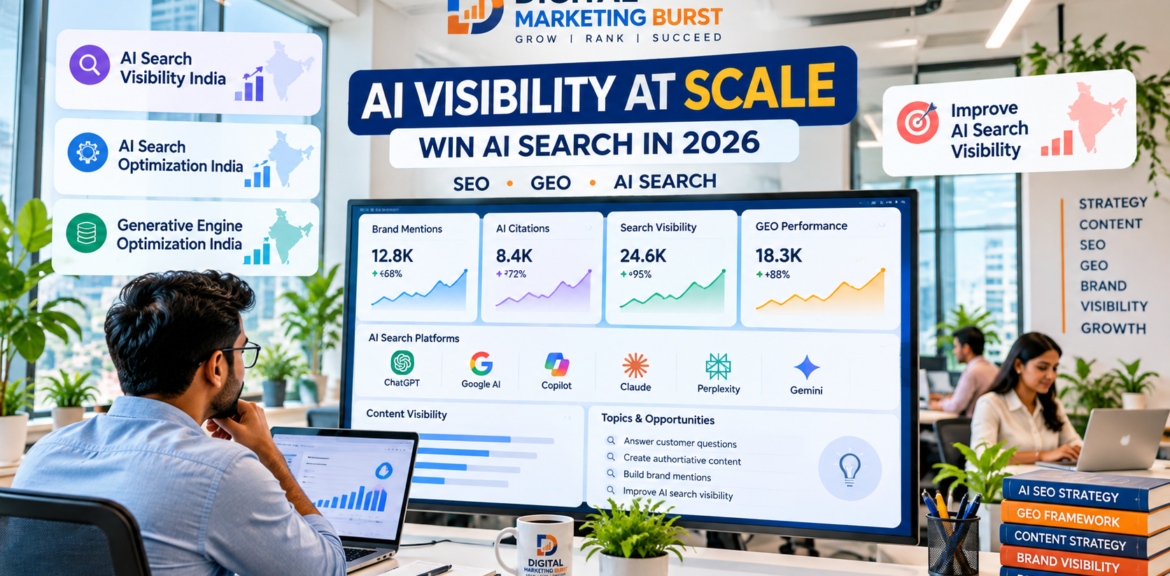

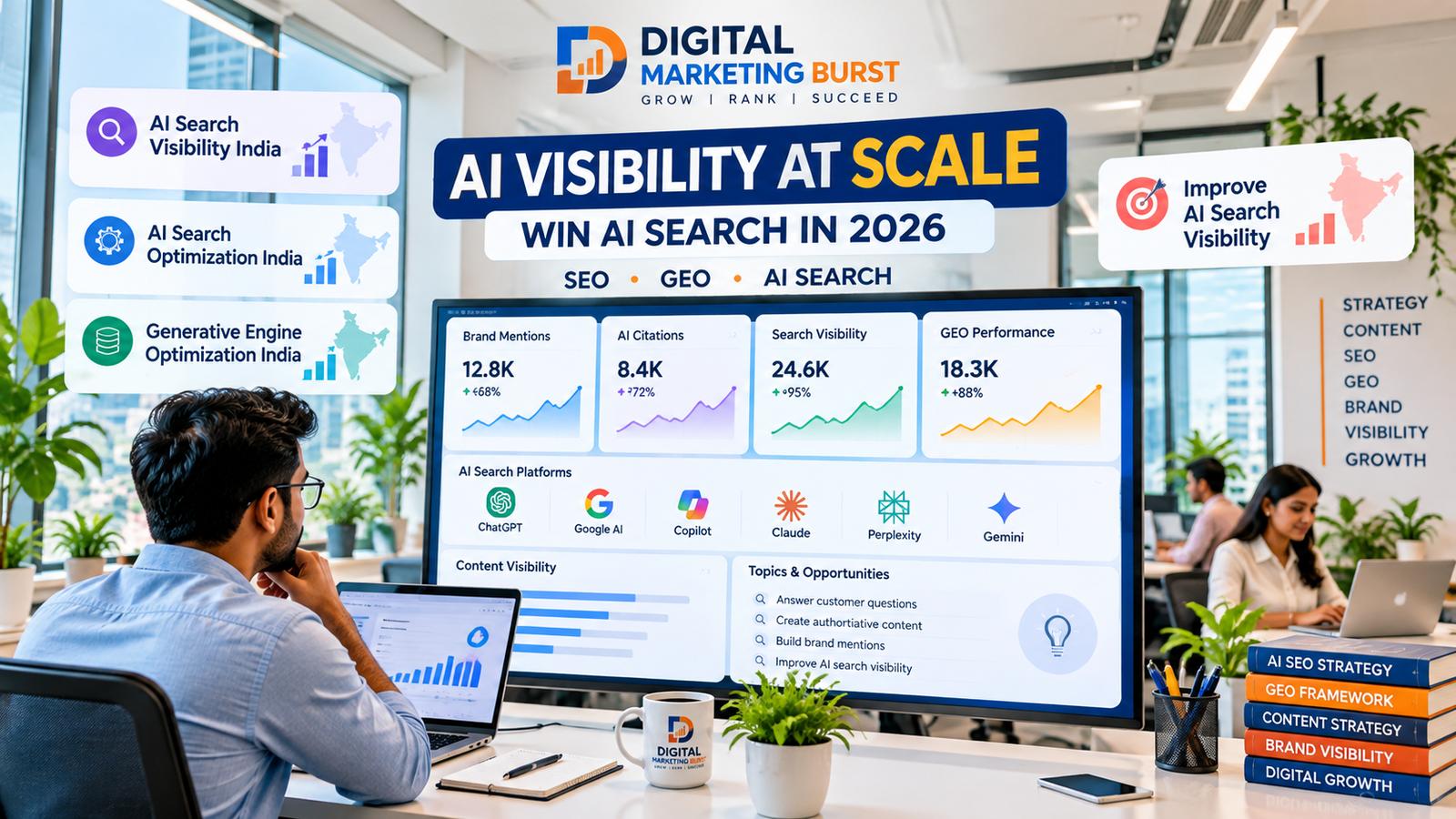
AI Visibility at Scale: How Brands Can Win AI Search in 2026
Search visibility is no longer limited to where a website ranks on a traditional Google results page. Customers can now discover brands while asking questions in ChatGPT, Google AI Mode, AI Overviews, Gemini, Perplexity and other AI-powered experiences.
That change makes AI Visibility at Scale an important marketing problem rather than another SEO buzzword. A business may rank well for several conventional search queries yet barely appear when users ask AI systems for comparisons, recommendations, explanations or buying guidance.
For Indian businesses, the challenge is even more practical. It is not enough to ask, “Does ChatGPT know our brand?” Marketing teams need to understand where the brand appears, which questions trigger it, which sources influence those answers, why competitors are cited and whether visibility remains consistent across different AI platforms.
Recent large-scale research helps illustrate the problem. An analysis published on September 30, 2026 examined 9 million AI answers across nine platforms for more than 400 enterprise brands. The research found, among other things, that commercial-intent AI answers frequently relied on third-party sources and that strong visibility on one platform often correlated with visibility elsewhere. Those findings should not be treated as universal rules for every Indian company, but they show why AI visibility needs to be measured systematically rather than through a handful of manually tested prompts. Search Engine Land
This guide explains how brands can build that system.
What Is AI Visibility at Scale?
AI visibility describes how often, where and in what context a brand, website, product, service or expert appears in AI-generated search experiences.
The phrase AI Visibility at Scale adds an important distinction.
Checking five prompts manually in ChatGPT is AI visibility testing. Building a repeatable process across hundreds of relevant customer questions, multiple stages of the buying journey, different locations and several AI platforms is visibility measurement at scale.
A useful framework separates visibility into five layers:
Mention visibility measures whether the brand is named.
Citation visibility tracks whether the brand’s website or content is referenced as a source.
Category visibility examines whether the brand appears when users ask about a service or category without mentioning the company by name.
Commercial visibility focuses on comparison, evaluation and purchase-oriented questions.
Source visibility identifies the websites, publishers, directories, communities and other sources influencing AI-generated answers.
This distinction matters because a brand mention and an owned citation are not the same result.
For example, an Indian SaaS company could be mentioned in an AI comparison while a technology publication receives the citation. Another company might receive a direct link to its product documentation. Both have visibility, but the marketing implications are different.
Why AI Search Visibility at Scale Matters in 2026
Traditional SEO usually begins with queries, rankings, impressions, clicks and landing pages. AI search introduces another layer between the query and the website.
A user might ask:
Which CRM is suitable for a small manufacturing company in India?
Another might ask:
Compare CRM platforms for a 50-person Indian sales team that needs WhatsApp integration.
These are not simply two keyword variations. The second query contains company size, geography, use case and a specific feature requirement.
AI interfaces also allow users to continue the conversation. A person can narrow the request, compare alternatives and ask follow-up questions without starting another conventional search.
Google confirms that users in its AI experiences can ask longer and more specific questions. Its guidance still recommends unique, valuable and people-first content rather than creating pages for every possible query variation. Google for Developers
That creates a fundamental shift for marketers:
Keyword coverage remains useful, but question and intent coverage becomes increasingly important.
AI Search Visibility India: What Indian Brands Should Measure
AI Search Visibility India should not mean adding “India” to dozens of pages.
Indian search behaviour contains context that generic international content may not answer properly. Pricing in rupees, GST implications, Indian regulations, city availability, local terminology, regional service coverage and India-specific product options can materially change an answer.
Consider a hospital software company.
A broad query could be:
What is hospital management software?
That query is informational.
A much more valuable Indian-market query might be:
Which hospital management software works for a 100-bed hospital in India?
Another could ask:
Hospital management software in India with NABH workflow support.
A useful visibility programme should therefore group prompts according to actual customer needs rather than generating hundreds of slight keyword variations.
Build an Indian Prompt Universe
Start with six intent groups:
| Intent | Example |
|---|---|
| Educational | What is AI search optimization? |
| Problem | Why is my brand missing from ChatGPT? |
| Solution | How can a company improve AI search visibility? |
| Comparison | SEO vs GEO for an Indian business |
| Commercial | AI SEO agencies in India |
| Brand | What does [Brand] offer? |
Then add relevant modifiers such as industry, city, company size, budget, problem and audience.
A B2B company selling across India may need national prompts. A Lucknow-based clinic, however, should concentrate heavily on genuine local patient intent instead of chasing generic national mentions.
That is how AI Visibility in India becomes commercially meaningful.
AI Visibility Is Not the Same as Google Ranking
A common mistake is treating AI visibility as another rank-tracking column.
The two systems overlap, but they should not be treated as identical.
Google states that its AI features remain grounded in its core Search systems and that existing SEO best practices continue to apply. Pages need to be indexed and eligible to appear with a snippet to be considered as supporting links in Google AI features. Google also says there are no additional technical requirements specifically for AI Overviews or AI Mode. Google for Developers
Other AI products have their own discovery systems.
For example, OpenAI says public websites can appear in ChatGPT search. Publishers wanting their content to be discoverable and cited should ensure they are not blocking OAI-SearchBot. OpenAI Help Center
Therefore, a strong Google ranking can be an important asset without guaranteeing equivalent visibility across every AI system.
AI Search Optimization India: Start With Discoverability
Before worrying about citations, make sure platforms can actually discover the information you want them to use.
For Google, that means retaining solid technical SEO foundations:
- crawlable pages;
- indexable content;
- appropriate canonicalisation;
- useful internal linking;
- valid HTTP responses;
- mobile-friendly pages;
- clear site architecture;
- descriptive titles and headings.
Google’s 2026 guidance specifically warns against abandoning these fundamentals in favour of supposed AEO or GEO shortcuts. It also states that there is no ideal page length and no requirement to break pages into artificial tiny “AI-friendly” chunks. Google for Developers
This is particularly important for businesses adopting AI Search Optimization India strategies. Adding an llms.txt file or rewriting every paragraph into short fragments should not take priority over fixing crawlability, duplicate pages, weak content or confusing site architecture.
Google currently says llms.txt neither helps nor harms visibility or rankings in Google Search because Google Search ignores it. Google for Developers
AI SEO India Starts With Search Intent, Not AI Tricks
The term AI SEO India can make the process sound like an entirely new discipline.
In practice, many foundations remain familiar:
Understand the customer.
Publish genuinely useful information.
Build technically accessible pages.
Establish clear entities.
Keep important business information consistent.
Earn legitimate references.
Update content when facts change.
What changes is the environment in which that information can be retrieved and synthesised.
A strong page should therefore answer the main question directly while also providing enough supporting context for a reader to evaluate the answer.
Suppose an Indian manufacturer publishes a page about industrial solar installation.
A weak page may contain:
We provide the best solar solutions with cutting-edge technology and excellent customer satisfaction.
There is little information for either a human decision-maker or an AI retrieval system.
A stronger page could explain supported facility sizes, assessment process, installation stages, applicable regions, maintenance model, common project constraints and how businesses should compare proposals.
Specific information creates more value than promotional adjectives.
Generative Engine Optimization India: Where GEO Fits
Generative Engine Optimization India, commonly shortened to GEO, generally refers to improving a brand’s discoverability and representation in generative search and answer environments.
However, businesses should avoid turning GEO into a collection of hacks.
Google explicitly recommends focusing on effective SEO strategies rather than tactics such as unnecessary content chunking, artificial mentions or special AI text files for the purpose of Google generative Search. Google for Developers
A better model is:
SEO builds discoverability and authority.
Content strategy builds relevance and usefulness.
Digital PR and genuine third-party presence broaden external validation.
GEO measurement examines how those signals translate into AI answers.
This framework prevents GEO Optimization India from becoming disconnected from broader marketing.
Build Entity Clarity Before Trying to Scale Visibility
AI systems need enough reliable information to understand what an organisation actually is.
Your website should make relationships between key entities obvious.
For a healthcare business, that could look like:
Hospital → Location → Department → Doctor → Qualification → Specialty → Treatment → Appointment information
For an agency:
Agency → Location → Service → Industry expertise → Team → Case study → Contact information
For an ecommerce company:
Brand → Product category → Product → Specifications → Price → Availability → Support
The purpose is not to insert dozens of keywords.
It is to reduce ambiguity.
Company name, location, service areas, product names, author information and other important facts should not contradict one another across major pages.
Improve AI Search Visibility With Answer-First Content
One practical way to Improve AI Search Visibility is to examine whether your pages actually answer the questions customers ask.
Consider this query:
How much should a small business in India spend on SEO?
A page that begins with 500 words about the history of SEO delays the answer.
A more useful structure could start by explaining that budget depends on market competitiveness, geographic scope, website condition, content requirements and business objectives. The page can then show readers how to estimate an appropriate range using those variables.
The principle is simple:
Answer first. Explain second. Support third.
That does not mean every paragraph must become a two-line snippet. Google specifically says there is no need to rewrite content in a special format solely for generative AI systems. Google for Developers
Write for comprehension.
Increase AI Search Visibility With Original Information
AI search creates a major problem for generic content: if twenty websites repeat the same information, there is little reason for another page to exist.
Originality does not necessarily require a million-row dataset.
An Indian business can add unique value through:
- original product specifications;
- transparent processes;
- expert commentary;
- genuine first-party research;
- documented methodology;
- useful calculators;
- original photographs or videos;
- clearly evidenced case studies;
- local market observations supported by data;
- proprietary tools or templates.
Google’s latest guidance calls this type of material non-commodity content and recommends providing unique perspectives rather than recycling what already exists online. Google for Developers
This may be one of the most important principles for increasing AI search visibility sustainably.
Third-Party Sources Matter More Than Many Brands Assume
A company cannot treat its own website as the entire AI visibility ecosystem.
The recent 9-million-answer study reported that, for commercial-intent prompts in its dataset, 82% of citations went to third-party sources while 3% went to owned pages. The same research reported that owned citations produced the strongest visibility lift in its analysis. These numbers describe that particular dataset; they should not be assumed to represent every industry, country or AI platform. Search Engine Land
The practical lesson is broader than the percentages.
Ask two separate questions:
Can AI systems find strong information about us on our website?
Can they find credible information about us elsewhere?
The second question brings digital PR, industry publications, genuine reviews, professional directories, associations and editorial coverage into the visibility strategy.
Do not manufacture mentions.
Google specifically cautions against pursuing inauthentic mentions as an AI-search tactic. Google for Developers
Stop Measuring Only Brand Mentions
Suppose Brand A appears in 40 of 100 tracked prompts.
Brand B appears in 25.
It would be tempting to declare Brand A the winner. That conclusion could be misleading.
Perhaps Brand A appears mainly in informational questions with little commercial relevance. Brand B might appear in high-intent comparisons that influence purchasing decisions.
A better AI visibility dashboard should separate several metrics.
Mention Rate
How frequently is the brand named across the tracked prompt set?
Owned Citation Rate
How often does an AI answer link directly to the brand’s website?
Third-Party Citation Presence
Which external sources mention or support the brand?
Commercial Intent Visibility
Does the company appear in prompts where users are evaluating providers, products or solutions?
Topic Coverage
Which customer problems consistently produce brand visibility?
Platform Coverage
Is visibility concentrated in one AI product or spread across several?
Source Concentration
Are most citations dependent on one external domain?
These metrics reveal different weaknesses.
Create an AI Visibility Scorecard
Instead of combining everything into an arbitrary single score, maintain a simple monthly scorecard.
| Metric | Current | Previous | Action |
|---|---|---|---|
| Brand mentions | Measure | Measure | Investigate changes |
| Owned citations | Measure | Measure | Improve source-worthy pages |
| Commercial prompt presence | Measure | Measure | Strengthen decision content |
| Platforms with visibility | Measure | Measure | Diagnose missing platforms |
| Unanswered topics | Measure | Measure | Build genuinely useful content |
| Incorrect brand information | Measure | Measure | Correct source information |
Do not compare raw numbers until your prompt set is stable.
Changing half the prompts every month destroys comparability.
Step-by-Step AI Visibility at Scale Framework
A scalable programme can be built in eight stages.
Step 1: Define the Business Outcomes
Do not start with “We want to rank in ChatGPT.”
Decide what visibility should support.
Possible outcomes include qualified leads, product discovery, branded demand, local enquiries, demo requests or category awareness.
Step 2: Map Customer Questions
Collect questions from:
Search Console queries, sales conversations, customer support, on-site search, Google searches, product reviews and actual prospect objections.
Group them by intent rather than creating hundreds of keyword variations.
Step 3: Create a Stable Prompt Set
Build a representative benchmark.
For example:
- 30 informational prompts;
- 30 problem-aware prompts;
- 20 comparison prompts;
- 20 commercial prompts.
Those numbers are only an example, not a universal standard.
Step 4: Test Multiple AI Environments
Where practical, evaluate relevant platforms rather than assuming one represents all AI search.
Record:
brand mention;
linked source;
competitors mentioned;
answer context;
third-party sources;
accuracy;
date tested.
Step 5: Find Visibility Gaps
Look for patterns.
You might discover that your brand appears for educational questions but disappears for commercial comparisons.
Another company may receive mentions but no owned citations.
Those are different problems requiring different actions.
Step 6: Map Gaps to Pages
Do not automatically create a new article for every missing prompt.
Sometimes the correct action is improving an existing service page, comparison page, product page, FAQ, author profile or documentation page.
This protects the site from unnecessary content duplication.
Step 7: Strengthen External Presence
Identify sources repeatedly appearing for your important topics.
The objective is not to manipulate them. Determine why those sources are useful and whether your brand legitimately belongs in the underlying conversation.
Step 8: Measure Again
Keep the core prompt set stable and rerun the benchmark periodically.
AI outputs can change, so individual answers should not be treated as permanent rankings.
Look for patterns across time.
AI Search Optimization India Needs Local Relevance
Indian businesses should resist importing every US-focused AI SEO tactic without considering local intent.
A user searching for software in India may care about:
INR pricing;
GST invoices;
Indian customer support;
WhatsApp integration;
local regulations;
Indian payment systems;
city availability;
regional language support.
If those details genuinely affect the buying decision, they deserve clear coverage.
This is not “India keyword insertion.” It is localisation based on user needs.
Content Types That Can Support AI Visibility
There is no single magic content format.
The 9-million-answer study found that ordinary pages accounted for a substantial share of citations in its dataset, challenging the idea that every page needs to be a listicle or specially formatted AI article. Search Engine Land
Depending on search intent, useful assets may include:
comparison pages;
original research;
service pages;
product documentation;
expert guides;
pricing explanations;
methodology pages;
glossaries;
calculators;
case studies with verifiable evidence.
Choose the format because it solves the user’s problem, not because someone claims AI engines prefer it.
Technical SEO Still Matters for AI Search
AI visibility does not make indexing irrelevant.
For Google’s AI features, a supporting page must be indexed and eligible to appear in Search with a snippet. Google also states that meeting these conditions does not guarantee crawling, indexing or appearance. Google for Developers
Check:
canonical tags;
robots directives;
HTTP status;
XML sitemap inclusion;
internal links;
rendered content;
mobile usability;
page experience;
duplicate URLs.
OpenAI has separate crawler controls. Its publisher documentation says sites should allow OAI-SearchBot if they want content to be discoverable and surfaced in ChatGPT search summaries and citations. OpenAI Help Center
Do not assume every AI crawler serves the same purpose.
AI Crawler Access Requires a Deliberate Policy
Visibility and AI training are not necessarily the same thing.
A business might want content discoverable in AI search while having different preferences about training crawlers.
Cloudflare’s current documentation distinguishes crawler controls and offers tools for monitoring or blocking AI crawler activity. It also notes that robots.txt expresses preferences rather than technically enforcing access. Cloudflare Developers
Before blocking AI bots globally, understand which crawler performs which function.
A blanket rule can conflict with the visibility objective you are trying to achieve.
Common AI Visibility Mistakes
Tracking Only Five or Ten Prompts
Small manual checks can be useful for exploration but are weak evidence of overall visibility.
Treating Mentions as Rankings
AI answers are not simply a traditional SERP with a new design.
Publishing a Page for Every Prompt
Google explicitly warns against producing many pages around query variations primarily to manipulate rankings or generative AI responses. Google for Developers
Copying Competitor Answers
Rephrasing already-ranking content gives users little additional reason to choose your page.
Stuffing GEO and AI SEO Keywords
An article does not become more useful because “AI Search Optimization India” appears twenty times.
Ignoring Third-Party Sources
Commercial discovery can occur through sources you do not own.
Blocking Crawlers Without Understanding Them
Search discovery, AI assistance and model training can involve different crawlers and policies.
Expecting Immediate Stability
Generative answers can vary. Measure trends rather than reacting to one response.
A 90-Day AI Search Visibility Plan for Indian Brands
A practical programme can be divided into three phases.
Days 1–30: Benchmark
Audit technical accessibility.
Define business-relevant topics.
Create the initial prompt set.
Test relevant AI platforms.
Record brand mentions and citations.
Identify competitors and recurring sources.
Days 31–60: Improve
Strengthen weak existing pages before creating new ones.
Add missing first-party facts.
Improve entity consistency.
Publish genuinely missing decision-support content.
Correct outdated information.
Develop original assets where they add value.
Days 61–90: Measure and Expand
Repeat the original prompt benchmark.
Compare changes by intent and platform.
Identify persistent gaps.
Review referral and conversion data where available.
Expand the prompt set only when it represents genuinely new customer needs.
The goal is not to “finish GEO” in 90 days. The period creates a repeatable measurement cycle.
How Digital Marketing Teams Should Report AI Visibility
Executives do not need a spreadsheet containing 2,000 prompts without context.
A monthly report should answer:
Where are we visible?
Where are we absent?
Which customer intents matter most?
Which pages receive citations?
Which third-party sources influence answers?
Which competitors repeatedly appear?
What changed?
What should we improve next?
Connect AI visibility with business outcomes wherever reliable data exists.
A mention without commercial relevance may be less valuable than a citation that sends qualified prospects to a useful decision page.
Can AI Visibility Be Guaranteed?
No.
Google explicitly states that following requirements and best practices does not guarantee crawling, indexing or serving. Google for Developers
The same practical caution should be applied to broader AI visibility.
Businesses can improve discoverability, information quality, technical accessibility, source authority and measurement. They cannot responsibly promise that an independent AI system will mention a particular brand for every target prompt.
That distinction matters when evaluating an AI SEO India or GEO Optimization India service.
FAQs About AI Visibility at Scale
What does AI Visibility at Scale mean?
It means systematically measuring and improving how a brand appears across a meaningful set of AI-search questions, intents and platforms instead of checking a few prompts manually.
How can I Improve AI Search Visibility?
Start with technical accessibility, strong SEO fundamentals, useful first-party information, clear entity relationships and content that directly addresses genuine customer needs. Then measure mentions and citations across a stable set of relevant prompts.
Is Generative Engine Optimization replacing SEO?
Not for Google Search. Google says existing SEO best practices remain foundational for its generative AI features and there are no special technical requirements for appearing in AI Overviews or AI Mode beyond existing Search eligibility requirements. Google for Developers
Is AI Search Visibility India different from global AI visibility?
The technical foundations can overlap, but Indian customer intent may require local information such as INR pricing, Indian regulations, service locations, payment methods or region-specific product availability.
Should I create separate pages for every AI search query?
No. Create a separate page when there is genuinely distinct user intent requiring its own answer. Google specifically discourages creating many pages for query variations primarily to manipulate Search or generative AI responses. Google for Developers
How often should brands measure AI visibility?
There is no universal official frequency. Choose a repeatable schedule appropriate to your market and keep the core prompt set stable enough to make comparisons meaningful.
Conclusion
AI Visibility at Scale is not about inserting more AI keywords into existing SEO content. It is about understanding how customers discover brands when search becomes conversational, multi-platform and increasingly answer-driven.
For Indian businesses, a sustainable approach starts with strong technical SEO and genuinely useful content. It then expands into entity clarity, first-party information, credible third-party presence, prompt-level measurement and continuous gap analysis.
The most important shift is measurement.
Instead of asking, “Are we visible in AI?”, ask where, for which customer questions, through which sources, on which platforms and at what stage of the buying journey.
Brands that can answer those questions have a much clearer foundation for improving AI search visibility without abandoning the SEO principles that already make websites useful and discoverable.
Once a brand has established its baseline, the next challenge is turning individual improvements into a repeatable system. AI Visibility at Scale becomes useful only when teams can connect customer questions, content, entities, citations, third-party sources and business priorities without publishing unnecessary pages.
For Indian businesses, this means moving beyond occasional ChatGPT checks. The objective should be to understand where visibility comes from, which gaps deserve attention and which improvements can strengthen the brand across traditional and AI-powered search simultaneously.
Google’s current guidance reinforces this approach. Its documentation says that the same foundational SEO practices remain relevant for AI features and that businesses do not need special AI-only files or schema markup to participate in Google’s generative search experiences.
Build AI Search Visibility at Scale Around Topics, Not Individual Prompts
A large prompt list can create the illusion of a sophisticated strategy.
Imagine a digital marketing company tracking these questions:
- What is AI SEO?
- What is AI search optimization?
- How does AI SEO work?
- How can AI SEO help businesses?
- What is GEO?
- What is generative engine optimization?
Those questions are useful, but they largely belong to the same educational topic.
Creating six separate articles would probably produce substantial overlap. Instead, the company should identify the underlying customer need and build one sufficiently useful resource where appropriate.
A better content architecture might group visibility into four layers.
Core Topic
The broad subject the business wants to be associated with.
Example:
AI Search Optimization
Customer Problem
The actual issue driving the search.
Example:
My company appears on Google but rarely appears in AI-generated answers.
Decision Question
The information a potential buyer needs before taking action.
Example:
Should our company invest in traditional SEO, GEO or both?
Specific Context
The details that change the answer.
Example:
AI search optimization for an Indian B2B company targeting international customers.
This structure gives marketers something far more valuable than a giant keyword list: a map of customer intent.
Create a Prompt Taxonomy Before Increasing AI Search Visibility
A prompt taxonomy groups customer questions according to their purpose.
It also prevents a common measurement problem. If 80% of your tracked questions are informational, a high mention rate may look impressive even though the brand rarely appears when users are actually comparing providers.
Start with four practical categories.
Discovery Prompts
These indicate that a user is learning about a subject.
Examples include:
What is generative engine optimization?
How does AI search optimization work?
Visibility here can contribute to category awareness.
Problem-Aware Prompts
The user knows something is wrong but may not know the solution.
For example:
Why is my website not appearing in AI answers?
Why does ChatGPT mention competitors instead of my company?
These questions can reveal valuable content gaps.
Evaluation Prompts
The searcher is comparing approaches.
Examples:
SEO vs GEO for Indian businesses
AI SEO agency vs traditional SEO agency
At this stage, detailed comparison information becomes more useful than another introductory definition.
Commercial Prompts
These questions suggest provider or solution evaluation.
For example:
AI search optimization company in India
GEO services for an Indian SaaS company
A business should not manipulate AI systems to manufacture recommendations. Instead, it should ensure that accurate, decision-useful information about its services is publicly accessible.
Do Not Treat Every AI Platform as the Same Search Engine
One of the biggest mistakes in AI Search Visibility at Scale is combining every platform into a single undifferentiated metric.
ChatGPT Search, Google AI Mode, Google AI Overviews, Gemini and other AI discovery environments do not necessarily retrieve, rank or present information identically.
Google, for example, explains that AI Mode may use a “query fan-out” technique. It can issue multiple related searches across subtopics and data sources before assembling a response.
That has an important content implication.
A page does not necessarily need to repeat one exact query ten times. It needs to provide enough relevant, understandable information to answer the broader subject and its meaningful subquestions.
Suppose a user asks:
How should a small Indian company improve visibility in AI search?
Related information could include technical accessibility, useful content, entity clarity, external references, measurement and platform-specific crawler access.
A genuinely comprehensive resource can address those needs naturally.
Measure AI Search Visibility India by Business Relevance
Raw visibility percentages can be deceptive.
Suppose an Indian marketing company is mentioned in 60% of tracked educational prompts but only 5% of relevant commercial prompts.
Another company might appear in fewer total answers while being consistently surfaced for high-intent service comparisons.
The first business cannot conclude that it has stronger commercial visibility simply because its overall mention percentage is higher.
For AI Search Visibility India, reporting should therefore separate visibility according to intent.
A practical measurement sheet could include:
| Prompt | Intent | Platform | Brand Mention | Owned Citation | Third-Party Source | Accuracy | Priority |
|---|---|---|---|---|---|---|---|
| What is GEO? | Educational | Platform A | Yes/No | Yes/No | Domain | Correct/Incorrect | Low |
| AI SEO for Indian brands | Solution | Platform B | Yes/No | Yes/No | Domain | Correct/Incorrect | Medium |
| AI SEO agencies in India | Commercial | Platform C | Yes/No | Yes/No | Domain | Correct/Incorrect | High |
The platform labels above are placeholders for your actual tracking environment.
Once this information is collected consistently, the team can diagnose why visibility is weak instead of simply knowing that it is weak.
Separate Brand Mentions From Citations
A mention is not automatically a citation.
Consider an AI-generated answer that names a company but links to an industry publication. The company has gained brand visibility, while the publisher has received the direct citation.
Now consider another response where the company’s own research page is linked.
That produces both brand visibility and an owned citation.
This distinction should be maintained in every serious AI Visibility at Scale report.
Track at least:
Mentioned but not cited
Mentioned with owned citation
Mentioned through third-party citation
Not mentioned but owned content cited
Neither mentioned nor cited
The fourth scenario is particularly interesting. Your content might influence an answer even when the company name is not prominent in the generated response.
That should not be recorded as a conventional brand mention.
Create a Source Influence Map
After several rounds of monitoring, list the domains repeatedly appearing in answers related to your category.
Do not immediately think about backlinks.
First ask:
What role does this source play?
It could be:
- an official source;
- an industry publication;
- a review platform;
- a community;
- a marketplace;
- a research organisation;
- a competitor;
- your own website.
Next, determine why that source may be useful.
Perhaps it has original statistics.
Another site may provide structured product comparisons.
A government source could contain authoritative regulatory information.
An industry publication might provide independent context unavailable on vendor websites.
This analysis helps businesses understand the information ecosystem around their category.
AI Visibility in India Requires Better Local Information
Many Indian websites create location relevance by repeating city and country names.
That is not the same as providing locally useful information.
Suppose an international software company wants stronger AI Visibility in India.
Simply adding “India” to the title may contribute little if the page does not answer questions Indian customers actually have.
More useful information might include:
Indian pricing: Are prices displayed in INR?
Taxes: Does the price include GST?
Payments: Which Indian payment methods are supported?
Support: What support hours apply to Indian customers?
Availability: Is the product available throughout India?
Compliance: Are there India-specific legal or regulatory considerations?
Integrations: Does the product work with tools commonly used by Indian customers?
Only include details that genuinely apply to the business.
Specificity is more useful than geographic keyword repetition.
Build Topic Authority Without Creating Content Bloat
Publishing more URLs is not automatically a growth strategy.
Google’s current AI-search guidance explicitly says there is no ideal word count and warns against producing large numbers of pages around search-query variations merely to influence Search or generative AI responses.
Before creating a new page, ask four questions:
Does this query represent a genuinely different intent?
Can the existing page answer it without becoming confusing?
Would a separate page offer substantial unique information?
Will the new page serve users independently of its target keyword?
If the answer to the final question is no, improving an existing page may be better.
This is particularly important for sites publishing aggressively around AI SEO India, GEO Optimization India and related terms.
Those phrases are semantically close enough that careless publishing can produce several weak pages competing for essentially the same intent.
Build a Content Gap Matrix
A content gap should not mean “a competitor has an article and we don’t.”
Use a more useful framework.
| User Need | Existing Page? | Answer Quality | Business Relevance | Action |
|---|---|---|---|---|
| Understand AI SEO | Yes | Strong | Medium | Maintain |
| Measure AI visibility | Yes | Partial | High | Improve |
| Compare SEO and GEO | No | — | High | Consider new page |
| Understand crawler access | Yes | Strong | Medium | Internal link |
| Evaluate AI SEO service | Partial | Weak | High | Improve service content |
This forces the team to make decisions based on user needs.
It also helps prevent content cannibalisation.
Improve AI Search Visibility Through Information Gain
One of the strongest questions a content team can ask is:
What can our page contribute that the reader cannot get from ten similar articles?
The answer should not simply be “more words.”
Useful differentiation can come from a better decision framework, an original process, transparent methodology, firsthand expert explanation, proprietary research or a tool that helps users complete a task.
For this article, for example, a genuinely useful addition is the AI Visibility Gap Matrix below.
AI Visibility Gap Matrix
Evaluate each important topic across four states:
| Search Situation | Brand Mentioned? | Brand Cited? | Recommended Focus |
|---|---|---|---|
| Strong | Yes | Yes | Maintain accuracy and freshness |
| Recognition gap | No | Yes | Strengthen entity/brand context |
| Source gap | Yes | No | Improve owned source quality |
| Full visibility gap | No | No | Investigate intent, content and sources |
This matrix turns an abstract visibility problem into an actionable diagnosis.
A brand that is mentioned but never cited has a different problem from one whose website is cited without clear brand attribution.
AI Search Optimization India Should Include Entity Consistency
Entity clarity is particularly important for organisations with multiple locations, products or professionals.
Consider a healthcare organisation with:
one parent brand;
three hospital locations;
multiple departments;
dozens of doctors;
different appointment numbers.
If those relationships are inconsistent across the website and public sources, machines and people can struggle to understand them.
The same issue appears in ecommerce, education, SaaS and professional services.
For AI Search Optimization India, audit important facts such as:
business name;
official website;
locations;
service areas;
contact information;
founders or leadership where relevant;
products or services;
professional credentials;
pricing where publicly available;
brand relationships.
Do not create information merely to complete the list.
Accuracy comes first.
Use Structured Data for Its Real Purpose
Schema markup can help search engines understand eligible page information, but it should represent what users can actually see.
Google’s AI-search guidance states that businesses do not need special schema markup specifically for AI Overviews or AI Mode. Existing structured-data guidance still applies.
That means an article should use appropriate Article or BlogPosting markup.
A product page may qualify for product-related structured data.
An organisation can use relevant organisation markup where appropriate.
Adding unrelated schema types simply because they sound useful for AI does not create meaningful authority.
Generative Engine Optimization India Needs Source-Worthy Pages
A source-worthy page does more than answer a keyword.
It gives another writer, researcher, customer or system a reason to reference it.
Imagine two pages discussing AI visibility.
Page A says:
AI visibility is very important for businesses. Companies should optimize their content for AI.
Page B provides:
a clear definition;
measurement methodology;
prompt taxonomy;
source classification;
gap matrix;
limitations;
update date;
references to primary documentation.
Page B provides considerably more utility.
For Generative Engine Optimization India, aim to create pages that can function as references, not merely pages designed to collect impressions.
Increase AI Search Visibility With Better First-Party Facts
Many businesses possess valuable information but hide it behind vague marketing language.
A service page might say:
We offer customised solutions for every client.
What does that actually tell a prospective customer?
Where appropriate, replace vague claims with verifiable information.
A service business could explain:
how an engagement begins;
what information is required;
which deliverables are included;
how reporting works;
what the service does not include;
who the service is designed for;
how customers should evaluate whether it fits their needs.
An ecommerce company can provide dimensions, compatibility, warranty information, shipping restrictions and product documentation.
A healthcare organisation can clearly display doctors’ qualifications, departments, consultation information and available facilities—provided those facts are accurate and appropriately presented.
First-party facts help users make decisions.
Build Content Around Evidence Levels
Not every statement deserves the same confidence.
A useful editorial system separates information into four levels.
Level 1: First-Party Facts
These are facts your organisation can directly verify.
Examples include office locations, product features and service processes.
Level 2: Primary External Sources
These include official government documents, platform documentation, research papers and regulatory publications.
Level 3: Reliable Secondary Analysis
Reputable industry publications can help interpret developments or summarise research.
Level 4: Observation or Hypothesis
Some AI-search behaviours are still evolving.
When evidence is limited, describe the idea as an observation or hypothesis rather than turning it into an SEO rule.
This prevents emerging GEO Optimization India advice from being presented with more certainty than the evidence supports.
Create a Citation-Ready Content Standard
Before publishing an important resource, ask:
Can a reader identify who published it?
Is the publication or update date clear?
Are important factual claims supported?
Are primary sources used where possible?
Can someone understand the methodology behind original research?
Are commercial claims distinguishable from factual information?
Does the page explain important limitations?
These practices improve trust for humans regardless of how AI systems evolve.
Do Not Manufacture Expertise
AI-search growth has encouraged some websites to create artificial authors, fabricated credentials and generic expert quotes.
Avoid that approach.
If an article is reviewed by an actual subject expert, identify that person accurately.
When there is no expert review, do not imply one occurred.
If Digital Marketing Burst publishes original research in the future, explain the dataset and methodology rather than using vague phrases such as “our research proves” without supporting material.
Trust is difficult to build and easy to undermine.
Measure Accuracy Alongside Visibility
Visibility is not always positive.
Suppose an AI answer mentions your brand but gives the wrong service area.
Another response might display an outdated product name.
A third could incorrectly describe pricing.
Those are visibility events, but they also create information-quality problems.
Add an accuracy field to the monitoring process:
Correct
Partially correct
Outdated
Incorrect
Unable to verify
High visibility with poor accuracy deserves attention.
Create a Brand Facts Page Where It Helps Users
Some organisations have complex information spread across dozens of pages.
A clear About, Company Information or organisation page can consolidate important public facts.
It might include:
official brand name;
what the company does;
locations;
leadership;
main services;
official contact channels;
important policies.
Do not create a hidden “AI facts page” stuffed with keywords.
Make the resource useful to journalists, customers, partners and other human visitors as well.
Track Competitors Without Copying Them
Competitor visibility can reveal gaps.
If another company repeatedly appears for a commercially important prompt, investigate the underlying reason.
Ask:
What information does its own site provide?
Which external sources mention it?
Is it being cited directly?
Does it have original research?
Is its entity information clearer?
Does it simply have stronger category relevance?
The answer should guide investigation, not imitation.
Copying the competitor’s headings and rewriting the paragraphs produces another commodity page.
Build an AI Visibility Content Flywheel
A scalable workflow can follow this sequence:
Measure → Diagnose → Prioritise → Improve → Earn References → Re-measure
Measurement identifies the gap.
Diagnosis determines whether the issue relates to content, technical access, entity clarity, source authority or intent.
Prioritisation connects the problem to business value.
Improvement strengthens the appropriate existing asset or creates a genuinely necessary one.
External references may develop naturally when the information is useful and worthy of citation.
Re-measurement shows whether the broader visibility pattern changes.
Then the cycle starts again.
Prioritise AI Visibility Work by Impact
Not every missing prompt deserves immediate action.
A simple prioritisation model can use four questions:
Business value: Could this query influence a meaningful customer action?
Intent relevance: Does the prompt closely match what the company actually provides?
Visibility gap: Is the brand consistently absent or inaccurately represented?
Content opportunity: Can the business provide something genuinely useful that is currently missing?
A high-value commercial question with weak existing information deserves more attention than an obscure informational prompt with little relevance to the business.
Connect AI Visibility With Traditional Search Data
Do not isolate AI measurement from existing analytics.
Google states that traffic from AI features is included in Search Console’s overall Web search reporting.
This creates an important limitation: marketers may not always receive a clean platform-level breakdown for every generative-search interaction in standard Search Console reporting.
Use the information that is actually available rather than inventing precision.
Relevant signals can include:
Search Console impressions;
organic clicks;
landing-page performance;
branded searches;
referral traffic from identifiable AI services;
conversions;
lead quality.
Correlation does not automatically prove causation.
If branded searches rise after an AI visibility campaign, that alone does not prove AI mentions caused the increase.
What Should Indian Businesses Do First?
For most companies, the starting point is not purchasing an expensive monitoring platform.
Begin with a focused manual benchmark.
Choose perhaps 30–50 questions that genuinely represent customer intent. The number is an example rather than a required standard.
Test them consistently.
Document what appears.
Look for recurring gaps.
Then decide whether the scale of the programme justifies specialised monitoring technology.
A small local business may not need thousands of prompts.
A national marketplace operating across dozens of product categories could require a much larger measurement framework.
Scale should match the business.
What AI Visibility at Scale Should Not Become
It should not become another excuse for mass-producing low-value pages.
Nor should it become a contest to mention ChatGPT, Gemini, GEO and AI SEO as often as possible.
The strongest strategy connects several established disciplines:
technical SEO;
content strategy;
brand management;
digital PR;
entity consistency;
analytics;
customer research.
AI Visibility at Scale sits above these activities as a measurement and prioritisation layer.
That makes it much more useful than treating it as another isolated SEO tactic.
A business needs to decide which gaps deserve investment, which existing pages should be improved, where new content is justified and how AI visibility connects with leads, revenue and wider brand demand.
This matters because visibility alone is not a business outcome. A brand can appear in hundreds of informational answers without influencing a single meaningful customer decision.
For Indian businesses, the objective should therefore move from “How often are we mentioned?” to “Are we visible when the right audience is researching problems and evaluating solutions?”
Turn AI Visibility at Scale Into a Business Strategy
A useful AI visibility programme starts with business priorities.
Imagine three companies:
An ecommerce brand wants more product discovery.
A B2B software company needs qualified demo enquiries.
A healthcare organisation wants patients to find accurate information about its doctors and services.
All three may invest in AI Search Visibility at Scale, but their success criteria should be different.
The ecommerce company could prioritise product-category and comparison queries. A SaaS business may care more about problem-solving and vendor-evaluation prompts. Healthcare organisations should place particularly strong emphasis on factual accuracy, authoritative information and appropriate medical content.
Therefore, the first question should not be:
How do we get mentioned more often?
It should be:
Which AI-assisted customer journeys actually matter to our business?
That question keeps the strategy tied to real users.
Map the AI-Assisted Customer Journey
Traditional search funnels often simplify users into awareness, consideration and conversion.
AI-assisted journeys can be less linear.
A person might begin with:
What is generative engine optimization?
Then continue:
Does GEO replace SEO?
After receiving an explanation, the same user might ask:
How should an Indian business measure AI visibility?
A later question could become:
What should I ask an AI SEO agency before hiring them?
The user’s intent has moved from education to evaluation within one conversational experience.
Content planning should account for that progression.
Awareness Stage
Answer foundational questions clearly.
Useful content might include definitions, educational guides and explanations of changing search behaviour.
Problem Recognition Stage
Help users understand why a problem exists.
Examples include:
Why is my brand not appearing in AI search?
Why do competitors appear in AI-generated recommendations?
Evaluation Stage
Provide frameworks that help users compare possible solutions.
Useful resources may cover:
SEO vs GEO;
in-house vs agency implementation;
AI visibility tools;
measurement methodologies;
technical requirements.
Decision Stage
Provide accurate information about your actual service.
Explain the process, scope, deliverables and limitations rather than filling the page with “best agency” claims.
This journey helps AI Search Optimization India remain connected to customer needs.
Build a Prompt-to-Page Map
Once important prompts have been identified, map them to the pages that should logically answer them.
Do not immediately create a new URL.
A simple working document can look like this:
| Customer Question | Intent | Existing Page | Content Gap | Action |
|---|---|---|---|---|
| What is AI SEO? | Informational | AI SEO guide | Small | Improve |
| How do I measure AI visibility? | Informational | Visibility guide | Medium | Expand |
| SEO vs GEO | Comparison | None/partial | High | Evaluate new page |
| How does AI crawler access work? | Technical | Crawl guide | Small | Internal link |
| AI SEO services in India | Commercial | Service page | Depends on current content | Improve if justified |
The final column is important.
Not every gap requires a new article.
Sometimes one new section is enough. In other cases, the search intent is sufficiently different to justify a dedicated resource.
This approach can reduce unnecessary content duplication.
Create Content Clusters Without Keyword Cannibalisation
Your keyword set includes:
AI Visibility at Scale
AI Search Visibility at Scale
AI Search Visibility India
AI Visibility in India
AI Search Optimization India
AI SEO India
Generative Engine Optimization India
GEO Optimization India
Improve AI Search Visibility
Increase AI Search Visibility
These should not automatically become ten separate articles.
Several represent closely related concepts.
For this page, AI Visibility at Scale remains the primary topic. Terms such as AI Search Visibility at Scale and AI Visibility in India can naturally support the main discussion.
A separate article should exist only when the underlying search intent becomes sufficiently different.
For example, a detailed guide specifically explaining Generative Engine Optimization could justify its own URL if it deeply addresses GEO methodology rather than repeating this article.
That page could then link back to this one when discussing measurement at scale.
Use Internal Links to Build a Clear Topic Relationship
Internal linking should help readers continue their research.
It should also make the relationship between related resources understandable.
For Digital Marketing Burst, a logical structure could be:
AI Visibility at Scale
↓
AI SEO Strategy Guide
↓
AI Visibility Reporting Guide
↓
Website Crawl Optimization Guide
The relationship is straightforward.
The current article explains how visibility can be scaled.
The AI SEO guide can explain the broader strategy.
The reporting resource can go deeper into measurement.
The crawler guide can handle technical discovery and crawler controls.
Avoid linking every occurrence of “AI SEO” to another page. One contextual link in the appropriate section is usually more useful than repetitive internal linking.
Improve AI Search Visibility by Updating Existing Content
Publishing is only half the job.
Existing pages can gradually become outdated as platforms, terminology, products and user expectations change.
Create a content-maintenance process.
Review Time-Sensitive Facts
Check:
platform features;
crawler documentation;
product names;
pricing;
regulations;
statistics;
research findings.
A statement that was correct six months ago may no longer be accurate.
Remove Obsolete Advice
AI search is evolving quickly.
If an older recommendation no longer has adequate evidence, update or remove it instead of keeping it simply because the page ranks.
Strengthen Weak Sections
Search behaviour may reveal new questions that genuinely belong on an existing page.
Add them where useful.
Preserve Valuable URLs
Do not publish a replacement article every time terminology changes.
When the intent remains substantially the same, updating the established resource can be more sensible than creating another overlapping page.
Create an AI Content Refresh Framework
For important pages, maintain a simple review record:
Page: Which URL is being reviewed?
Primary intent: What user problem should it solve?
Last reviewed: When was the factual content checked?
Changed facts: What has changed since publication?
New user questions: Are important questions missing?
Overlap: Has another page started covering the same intent?
Action: Maintain, update, consolidate or redirect.
This process can help an expanding site avoid becoming a collection of overlapping AI articles.
AI Search Visibility India Needs Language Awareness
India is not a single-language search market.
English remains important for many commercial and professional queries, but users also search and converse in Hindi and other Indian languages.
That does not mean every English article should automatically be translated.
Translation should be driven by audience demand and business capability.
A Hindi page should offer a genuinely usable Hindi experience rather than replacing English keywords word-for-word.
The same principle applies to Hinglish.
If customers naturally use a mixture of Hindi and English when searching for a service, research those questions before deciding whether dedicated content is warranted.
Avoid mass-generating regional-language pages merely to create more indexed URLs.
AI SEO India Should Consider Branded Information Accuracy
A company should periodically test what AI systems say when users ask directly about the brand.
Relevant prompts might include:
What does [Brand] do?
Where is [Brand] located?
What services does [Brand] provide?
Who is [Brand] suitable for?
Does [Brand] offer [specific service]?
Record incorrect or outdated information.
Then investigate possible sources.
The problem may originate from the company’s own outdated page, an old business listing, third-party coverage or an ambiguous brand name.
Correct the underlying information wherever you legitimately control it.
Do not attempt to manipulate an AI answer directly.
Create a Single Source of Truth for Important Brand Facts
Large websites often contradict themselves.
One page shows an old office address.
Another uses an outdated service name.
A third displays an old leadership profile.
Those inconsistencies create a poor user experience before AI search is even considered.
Maintain an internal source-of-truth document containing verified information such as:
official brand name;
website;
service locations;
contact information;
products and services;
approved descriptions;
leadership information where relevant;
important policies.
Content writers, SEO teams, social media managers and PR teams can then work from the same verified information.
The public website should still contain the facts users actually need.
Increase AI Search Visibility Through Original Research
Original research can differentiate a brand when it is conducted responsibly.
You do not need a dataset containing millions of prompts.
A smaller transparent study can still be useful if its methodology matches the question being investigated.
For example, an Indian digital marketing company could study a clearly defined set of AI-search prompts within one industry.
A credible methodology would explain:
which platforms were tested;
when testing occurred;
how prompts were selected;
how many prompts were included;
how mentions were classified;
what counted as a citation;
what limitations existed.
The findings should not be generalised beyond what the sample supports.
That transparency matters more than creating an impressive headline.
Never Turn Third-Party Research Into Your Own Statistic
This is especially important for the current article.
The research that inspired the topic analysed 9 million AI answers across nine platforms and more than 400 enterprise brands. Those numbers belong to that research, not to Digital Marketing Burst.
A safe sentence is:
Research covering 9 million AI answers across nine platforms and more than 400 enterprise brands found…
An unsafe presentation would be:
Our analysis of 9 million AI answers found…
unless Digital Marketing Burst actually conducted that research.
Clear attribution protects credibility.
Build a Digital PR Layer Around Useful Assets
Third-party visibility cannot simply be manufactured.
However, businesses can create assets that journalists, publishers and industry professionals genuinely have reasons to reference.
Examples include:
original research;
transparent datasets;
industry surveys;
calculators;
expert commentary;
technical documentation;
useful visualisations;
publicly accessible methodology.
Once an asset exists, relevant outreach can introduce it to appropriate publications.
The objective should be editorial usefulness rather than producing artificial mentions for Generative Engine Optimization India.
Think Beyond Backlinks
A traditional link-building mindset asks:
Can this website link to us?
An AI visibility mindset can ask broader questions:
Is our brand accurately represented in authoritative sources?
Are knowledgeable people discussing our work?
Is our original information being referenced?
Do independent sources provide useful context about the brand?
Backlinks remain useful in SEO, but not every useful brand reference should be reduced to a link-acquisition tactic.
The broader objective is building a credible information footprint.
Monitor AI Referral Traffic Carefully
Where analytics platforms expose identifiable referral traffic from AI services, create a separate reporting view.
Track:
sessions;
landing pages;
engagement;
conversions;
assisted conversions where reliably measurable;
lead quality.
Do not assume a low volume of direct AI referrals means AI visibility has no value.
Some users may discover a company through an AI answer and later search for the brand directly.
At the same time, do not claim that every increase in branded search was caused by AI.
Attribution needs evidence.
Create AI Visibility KPIs by Funnel Stage
Different stages deserve different measurements.
Awareness KPIs
Brand mentions
Topic coverage
Relevant non-branded prompt visibility
Consideration KPIs
Comparison visibility
Third-party source presence
Owned citations
Accurate product or service representation
Decision KPIs
AI referral visits where measurable
Commercial landing-page engagement
Qualified enquiries attributable to identifiable sources
Conversions where reliable attribution exists
This prevents one visibility number from being treated as the entire strategy.
Calculate Visibility Rates Carefully
Suppose you track 100 prompts.
Your brand appears in 35.
A simple mention rate would be:
35 ÷ 100 × 100 = 35%
Now suppose only 20 prompts have strong commercial intent and the brand appears in 3.
Commercial visibility would be:
3 ÷ 20 × 100 = 15%
The second number could reveal a much more important gap.
However, do not compare these rates with another company unless both are measured using a reasonably comparable prompt methodology.
The prompt sample determines the result.
Create a Weighted Priority Model
Not all prompts deserve equal resources.
A team can assign internal priority based on:
Business relevance
Commercial intent
Customer frequency
Current visibility gap
Ability to provide a useful answer
For example, use a simple 1–5 internal score for each factor.
The score is not an industry-standard AI ranking metric. It is merely a prioritisation mechanism for your team.
This distinction should remain clear in reporting.
Do Not Invent an “AI Visibility Score” for Marketing
A proprietary score can be useful internally if its methodology is transparent.
Problems begin when a company presents an arbitrary number as if it were an official metric recognised by ChatGPT, Google or Gemini.
If you create a Digital Marketing Burst AI Visibility Score in the future, document:
the prompt sample;
platforms;
weighting;
calculation;
testing frequency;
limitations.
Without methodology, a score such as “Your AI visibility is 83/100” provides very little trustworthy information.
GEO Optimization India Should Include Reputation Monitoring
AI systems can surface third-party information that brands do not control.
That makes reputation monitoring relevant to GEO Optimization India.
Watch for recurring factual issues involving:
incorrect addresses;
old service information;
outdated product details;
confusion between similarly named companies;
unsupported claims;
obsolete reviews or listings.
The response should depend on the source.
Correct information on properties you control.
For third-party platforms, use their legitimate correction or update processes where appropriate.
Do not attempt to suppress genuine criticism merely because it affects brand visibility.
Improve AI Search Visibility With Better Comparison Content
Comparison queries can have strong decision intent.
However, comparison pages often fail because they are written to make the publisher win regardless of evidence.
A useful comparison should explain:
who each option suits;
important differences;
limitations;
cost considerations where verifiable;
decision criteria;
situations where neither option is appropriate.
For example:
SEO vs GEO should not conclude that traditional SEO is obsolete.
Instead, explain where the disciplines overlap and where AI-specific measurement introduces new considerations.
That helps readers make a decision rather than pushing them towards a predetermined conclusion.
Build Pages for Decisions, Not Just Definitions
Definitions attract informational searches.
Decision-support content helps users act.
After explaining a concept, consider whether the reader needs:
a checklist;
comparison table;
implementation sequence;
calculator;
template;
decision tree;
audit framework.
For this topic, an AI visibility decision tree could work well.
Is your content crawlable?
If no → resolve technical access first.
If yes → Does your content adequately answer important customer questions?
If no → improve existing content.
If yes → Is the brand mentioned but not cited?
If yes → investigate owned source quality.
If no → Are competitors appearing through third-party sources?
If yes → analyse the source ecosystem.
That turns theory into an actionable workflow.
AI Visibility at Scale for Small Businesses
“Scale” does not mean every business needs enterprise software.
A small Indian company could begin with:
20–30 high-value prompts;
two or three relevant AI environments;
a monthly manual review;
a simple spreadsheet;
a small number of high-priority pages.
An enterprise may need thousands of prompts, automation and category-level dashboards.
The underlying principle remains the same:
measure enough data to make useful decisions without collecting data simply because it is available.
AI Visibility at Scale for Multi-Location Businesses
Multi-location organisations have another challenge.
A national brand may be correctly understood at company level while individual locations remain unclear.
For each location, verify:
name;
address;
phone;
services;
opening information where relevant;
location page;
local business information;
regional restrictions.
Do not create hundreds of near-identical city pages if the company does not genuinely operate in those locations.
Real-world service coverage should determine location content.
AI Visibility at Scale for Ecommerce Brands
Ecommerce visibility depends heavily on product information quality.
Useful product data can include:
clear names;
accurate descriptions;
availability;
price;
variants;
specifications;
shipping information;
return policies;
reviews where legitimately collected.
Google recommends keeping structured data consistent with visible page content and maintaining up-to-date Merchant Center information for ecommerce visibility in AI Search experiences.
Product feeds should complement strong product pages rather than compensate for weak ones.
AI Visibility at Scale for B2B Companies
B2B searches often involve complex requirements.
Potential customers may ask:
Which software supports our existing CRM?
What platform suits a 200-person sales organisation?
Which provider supports Indian and overseas teams?
Generic “best software” content may not answer those questions.
B2B companies should publish clear capability information, integrations, implementation details, limitations and decision criteria.
That material helps human buyers before it helps any AI system.
AI Visibility at Scale for Service Businesses
Service businesses should make scope particularly clear.
A strong service page explains:
what is offered;
who it is for;
where it is available;
how engagement works;
what deliverables may be included;
how to request an assessment;
important exclusions.
Avoid claiming nationwide presence simply to target AI Search Visibility India if the business only serves specific locations.
Accuracy should determine geographic targeting.
How Often Should AI Visibility Be Reviewed?
There is no universal official interval.
Fast-changing industries may benefit from more frequent monitoring. Stable categories might require less frequent reviews.
The important factor is consistency.
If one benchmark is tested on Monday using 100 prompts and the next uses 250 entirely different prompts three weeks later, comparing the percentages will be difficult.
Keep a stable core benchmark and add new prompt groups separately.
When Should You Create New Content?
Create a new page when several conditions are met.
The user intent is meaningfully distinct.
Existing pages cannot answer it naturally.
There is enough unique information to justify the page.
The topic matters to your audience.
The business has genuine expertise or useful information to contribute.
Avoid publishing merely because an SEO tool produced another keyword variation.
When Should You Consolidate Content?
Consolidation may make sense when two or more pages:
answer essentially the same question;
target almost identical intent;
repeat substantial sections;
receive little independent value from being separate;
confuse internal linking.
Before merging anything, review performance, backlinks, conversions, canonicalisation and existing rankings.
Do not delete URLs casually.
A consolidation decision should be based on actual page-level evidence.
A Practical Monthly AI Visibility Workflow
A repeatable monthly process can be simple.
Week 1: Run the stable prompt benchmark and record changes.
Week 2: Diagnose high-priority gaps and verify inaccurate information.
Week 3: Improve existing pages or create genuinely missing assets.
Week 4: Review third-party sources, technical accessibility and reporting.
Then repeat.
The workflow creates discipline without encouraging constant publishing.
Questions to Ask Before Hiring an AI SEO or GEO Agency
Indian businesses evaluating providers can ask:
How do you define AI visibility?
Which platforms do you measure?
How do you select prompts?
Do you distinguish mentions from citations?
How do you prevent keyword cannibalisation?
How do you validate factual claims?
How do you measure commercial-intent visibility?
How do you report limitations?
Do you guarantee AI mentions or rankings?
A provider promising guaranteed inclusion in independent AI answers should be examined carefully.
No legitimate agency controls how an external AI platform generates every response.
The Future of AI Search Visibility India
AI discovery will continue to evolve, which makes rigid optimisation formulas risky.
Specific platforms, interfaces and crawler policies can change.
Customer needs are more durable.
People will continue wanting accurate information, credible comparisons, trustworthy brands and useful solutions.
Businesses that organise information around those needs are better positioned to adapt whether the interface is a traditional search result, an AI-generated answer or a future discovery format.
That is why AI Search Visibility India should be built on durable marketing principles rather than short-lived hacks.
Final AI Visibility at Scale Framework
The complete process can be summarised as:
1. Understand
Identify genuine customer questions.
2. Benchmark
Measure current visibility using a stable prompt set.
3. Diagnose
Separate mention, citation, source, accuracy and intent gaps.
4. Prioritise
Focus on questions connected to real business value.
5. Improve
Strengthen existing pages before creating unnecessary URLs.
6. Differentiate
Publish original information and useful decision-support resources.
7. Validate
Use authoritative sources and accurate first-party facts.
8. Expand
Build legitimate third-party presence where relevant.
9. Measure
Track visibility alongside meaningful business signals.
10. Maintain
Refresh information as platforms and customer needs change.
This cycle is far more sustainable than chasing individual AI answers.
Conclusion
AI Visibility at Scale is ultimately an information-quality and measurement challenge.
Brands need to understand what customers ask, where their information appears, which sources influence AI-generated answers and whether that visibility occurs at commercially meaningful stages of the journey.
For Indian businesses, successful implementation also requires genuine local relevance. AI Search Optimization India, AI SEO India, Generative Engine Optimization India and GEO Optimization India should therefore work together as related parts of a broader search and brand strategy rather than becoming isolated keyword campaigns.
The goal should not be to publish the most AI content.
Build the clearest information ecosystem instead.
When useful first-party content, technical accessibility, entity consistency, credible external references and disciplined measurement work together, a brand has a stronger foundation to Improve AI Search Visibility and Increase AI Search Visibility without depending on shortcuts, keyword stuffing or unsupported promises.
Why Choose Digital Marketing Burst for AI Search Visibility and GEO?
As search evolves from traditional blue links to AI-generated answers, businesses need more than conventional SEO. They need a strategy that connects technical SEO, content quality, entity clarity, Generative Engine Optimization and measurable AI Visibility at Scale.
Digital Marketing Burst positions itself as a top digital marketing agency in India and a leading digital marketing company in Lucknow, helping businesses adapt their digital presence for both traditional and AI-powered search. Rather than treating AI SEO as a separate shortcut, the focus is on building stronger search foundations that can support visibility across Google Search and emerging AI discovery experiences.
AI SEO and GEO Strategy for Modern Search
Businesses searching for a Best Digital Marketing Agency in Lucknow, AI SEO Agency in India or Generative Engine Optimization Agency in India increasingly need support beyond conventional keyword rankings.
Digital Marketing Burst’s approach can bring together:
AI Search Optimization to identify how target audiences search and ask questions across evolving search experiences.
Generative Engine Optimization (GEO) to structure useful, authoritative and easily understandable information around real customer needs.
Technical SEO to improve crawlability, indexability, internal linking and overall website accessibility.
Content Strategy to build original resources around genuine search intent rather than publishing repetitive AI-generated pages.
AI Visibility Measurement to assess brand mentions, citations, relevant prompts and visibility gaps across AI-search environments.
The objective is not to promise that a brand will appear in every AI-generated answer. No agency controls independent search or AI platforms. Instead, the strategy focuses on improving the signals, content and digital presence that a business can actually control.
Why Businesses Choose Digital Marketing Burst
A strong AI Search Optimization India strategy should connect SEO with the wider digital presence of a business. Digital Marketing Burst works across areas such as SEO, local SEO, content strategy, paid marketing, social media and website optimisation, allowing AI-search planning to be considered alongside broader digital marketing goals.
For a business trying to Improve AI Search Visibility, this integrated approach matters. A technically healthy website alone cannot compensate for weak information, while good content can still underperform if search engines cannot efficiently discover and understand it.
The focus should therefore remain on the complete ecosystem:
Technical foundation → Search intent → Useful content → Entity clarity → Brand authority → AI visibility measurement → Continuous improvement
This is also why Digital Marketing Burst positions itself as a Top Digital Marketing Agency in India rather than treating GEO as a standalone trend.
AI Search Visibility Services for Indian Businesses
Indian businesses have requirements that generic international SEO strategies may overlook. Search behaviour can vary by geography, industry, audience, language and purchasing journey.
Digital Marketing Burst can build an AI Search Visibility India strategy around the actual market a business serves instead of merely adding “India” to generic keywords.
The process can focus on identifying important customer questions, analysing existing content, finding visibility gaps, strengthening first-party information and monitoring how a brand is represented across relevant AI-search experiences.
This approach is suitable for businesses exploring terms such as:
AI SEO Agency in India
AI Search Optimization Agency India
Generative Engine Optimization India
GEO Services India
AI Search Visibility Services India
AI SEO Company in Lucknow
Best Digital Marketing Agency in Lucknow
Top Digital Marketing Agency in India
These phrases should be incorporated only where they fit naturally. There is no SEO benefit in repeating all of them throughout the page.
From Google Visibility to AI Visibility at Scale
The objective is broader than appearing for one keyword.
Digital Marketing Burst can help businesses develop a framework for understanding AI Visibility at Scale across relevant topics, customer questions and stages of the buying journey.
That includes examining whether a brand is being discovered, whether its own website is being cited, which third-party sources influence visibility and whether the information surfaced about the business is accurate.
Combined with conventional SEO, this creates a more complete search strategy for 2026.
Build Your AI Search Strategy With Digital Marketing Burst
If your business wants to strengthen its presence across traditional search and emerging AI-search experiences, Digital Marketing Burst can help develop an SEO, GEO and AI visibility strategy aligned with your actual audience and business objectives.
Digital Marketing Burst — Building Search Visibility for the AI Era.