








Google 304 Status Code: How It Saves Crawl Budget & Improves SEO
Google 304 Status Code: Understanding the Basics
Google 304 Status Code, 304 Status Code SEO, and 304 Not Modified SEO are important concepts in technical SEO. A proper 304 Status Code Explained guide also needs to cover the 304 Not Modified Explained meaning and its connection with Googlebot. Understanding this response can help website owners manage crawling more efficiently.
A 304 response means that the requested resource has not changed since the previous version that the client already received. Instead of sending the complete page again, the server tells the requesting crawler or browser that the existing version remains valid.
This process can reduce unnecessary data transfer. It can also reduce server work when a crawler repeatedly requests pages that have not changed.
For large websites, that difference can become useful. An ecommerce website may contain thousands of product URLs. A news website can have a very large archive. Even a growing business website can accumulate hundreds or thousands of pages over time.
Googlebot needs to crawl websites to discover and refresh content. However, not every request needs a complete HTML response. When a resource remains unchanged, a conditional request can allow the server to return a 304 response instead of transferring the entire resource again.
That is where crawl efficiency becomes relevant.
It is important to understand one point, though. A 304 response does not directly improve rankings. It does not act like a ranking signal. Instead, it can help reduce unnecessary resource usage and make crawling more efficient.
For technical SEO teams, this distinction matters. Good SEO is not only about keywords and content. Server performance, crawling, redirects, response codes, caching, and indexability also affect how efficiently search engines interact with a website.
Digital Marketing Burst can use this technical SEO concept when auditing websites that have large URL inventories or recurring crawler activity.
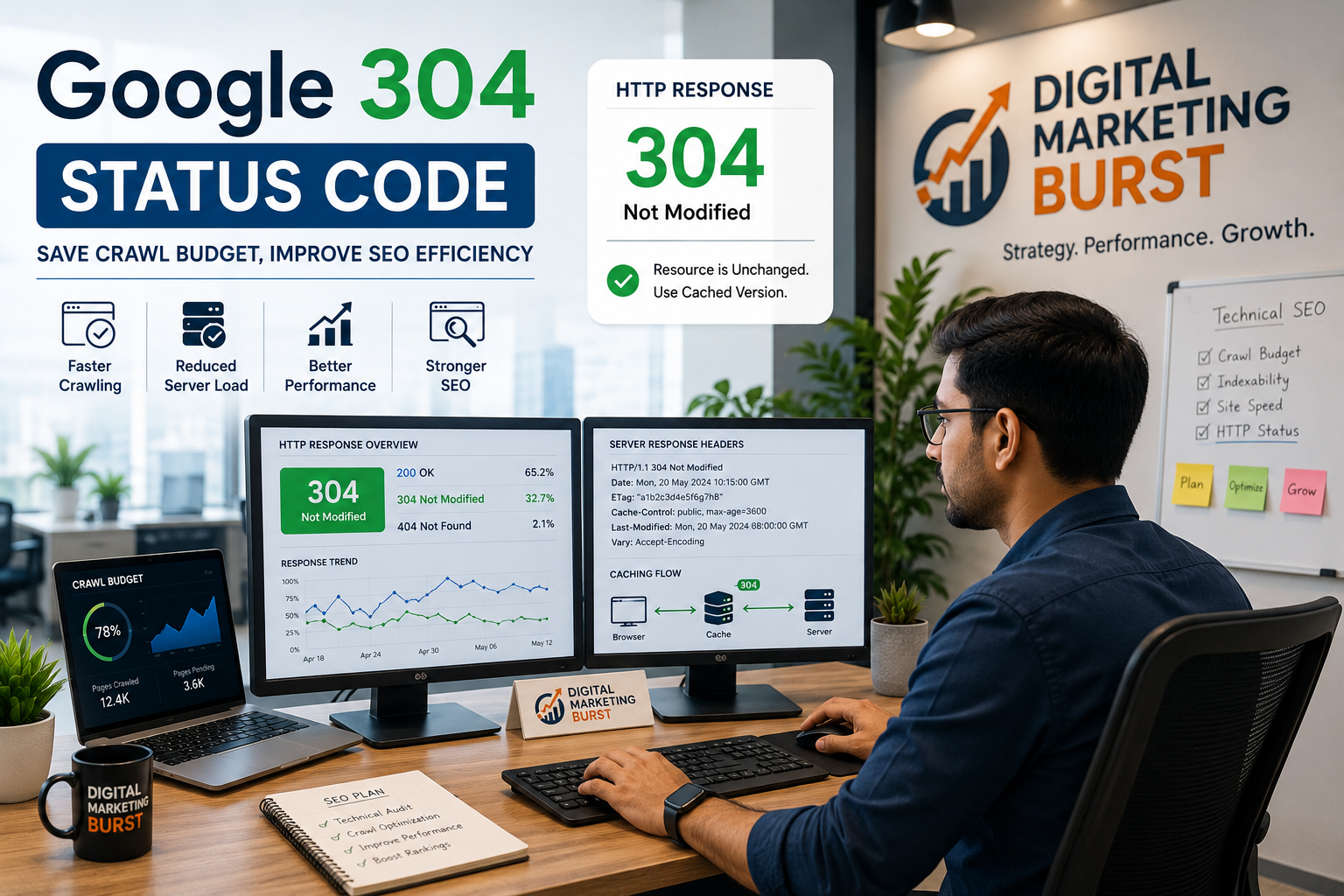
Google 304 Response Code and Website Crawling
A Google 304 response code works through conditional requests. The basic process begins when a crawler requests a resource that it has previously accessed.
The server can compare the requested version with the version already stored or referenced through caching information. If the resource has not changed, the server can return a 304 response.
Consequently, the server does not need to send the complete response body again.
This approach can save bandwidth. It may also reduce unnecessary server processing. For websites with frequently crawled resources, those savings can become meaningful.
Imagine a website with 50,000 URLs. Many of those pages may remain unchanged for weeks or months. Sending the complete HTML response every time creates more data transfer than necessary.
A conditional response provides a more efficient alternative when the resource has genuinely remained unchanged.
The situation becomes particularly relevant for websites with large inventories. Online stores, publishers, classified websites, directories, forums, and large corporate websites can generate substantial crawling activity.
However, marketers should not assume that every URL needs a 304 response. The server needs to implement conditional request handling correctly.
A page that changes frequently should return an appropriate updated response when its content changes. Otherwise, incorrect caching behaviour can create technical problems.
Therefore, developers and SEO professionals should work together. The SEO team can identify crawling concerns, while developers can review server-side response handling.
This collaboration creates a stronger technical foundation.
304 Status Code SEO: Why Crawl Efficiency Matters
The relationship between 304 status code and SEO often creates confusion. Some marketers assume that returning 304 automatically gives a website an SEO advantage. That is not the correct interpretation.
A 304 response does not directly increase rankings. Google does not treat it as a simple ranking boost.
Instead, the value comes from efficient resource usage.
Search engines operate at enormous scale. Websites also vary greatly in size. A small business website with 30 pages has very different crawling requirements from a marketplace containing millions of URLs.
When unchanged resources can be validated efficiently, unnecessary data transfer can decrease. This can help the server handle crawler requests more efficiently.
For large websites, technical efficiency can become especially important. A server that spends fewer resources transferring unchanged content may have more capacity for other requests.
Furthermore, efficient crawling can support better overall website management. Developers can monitor server logs, response codes, bandwidth usage, and crawler behaviour together.
That information can reveal unusual patterns.
For example, a website may receive repeated requests for resources that rarely change. Another site may generate excessive crawler activity around parameter-based URLs. In such cases, the SEO team should investigate the underlying cause rather than simply adding technical rules.
A 304 response is one part of a broader crawling strategy.
The bigger objective is to help search engines access useful content efficiently. Internal linking, XML sitemaps, canonical URLs, redirects, robots.txt rules, server performance, and HTTP response handling all contribute to that process.
Therefore, 304 Status Code SEO should be understood as a technical efficiency topic rather than a direct ranking tactic.
304 Not Modified SEO: How the Response Works
The 304 Not Modified SEO concept becomes easier when you understand conditional HTTP requests.
A crawler can send information that identifies the version of a resource it already knows. The server then checks whether that resource has changed.
If nothing has changed, the server can return a 304 response.
The response tells the requester that it can continue using the previously obtained version. Because the server does not need to transmit the complete content again, the response can be much smaller than a normal successful content response.
This distinction is important for technical SEO.
A normal 200 response generally provides the requested resource. A 304 response instead indicates that the previously cached representation remains valid.
For example, consider a static article that has not changed since yesterday. If a crawler requests that resource again and the server confirms that its version remains unchanged, the server can respond accordingly.
Now consider the same article after an update. The server should recognise the change and provide the updated resource rather than incorrectly returning 304.
That accuracy matters.
Incorrect caching signals can cause users or crawlers to receive outdated information. Therefore, developers should test conditional requests carefully before deploying them across a production website.
SEO professionals can support this process by checking important URLs and reviewing server responses.
A technical audit should also consider whether frequently updated pages receive fresh responses when their content changes.
The objective is simple: unchanged resources should remain efficient, while changed resources should deliver their current versions.
That balance makes HTTP caching useful without turning it into an indexing problem.
304 Status Code Explained: 304 vs 200 Response
A 304 status code explained in simple terms comes down to one major difference. A 200 response normally provides the requested resource, while a 304 response indicates that the previously stored version can still be used.
Consider a website visitor opening an unchanged CSS file. The browser may already have a copy. Instead of downloading the entire file again, the browser can validate its stored version.
If the file has not changed, the server can return 304.
The same basic efficiency principle can matter when search-engine crawlers make conditional requests.
A 200 response is still completely normal. It remains appropriate when the requester needs the current resource.
On the other hand, 304 becomes useful when the requester already has a valid previous version and the resource has not changed.
This does not mean website owners should try to replace all 200 responses with 304 responses. The server decides which response is appropriate based on the request and resource state.
Technical SEO teams should therefore avoid treating HTTP response codes as simple optimization tricks.
Instead, each code should match the actual server situation.
A 301 redirect serves a different purpose. A 404 indicates that a requested resource cannot be found. A 410 can indicate permanent removal. A 200 response delivers the resource normally. A 304 tells the requester that the previously obtained version remains valid.
Understanding these differences prevents implementation mistakes.
For Digital Marketing Burst, this distinction can form part of a broader technical SEO audit strategy. Looking at response codes alongside crawling behaviour gives marketers a clearer picture of how a website communicates with search engines.
That approach is much more useful than focusing on one status code in isolation.
304 Not Modified Explained: Why It Can Reduce Unnecessary Data Transfer
The 304 Not Modified explained concept becomes clearer when we look at what happens during repeated requests. A crawler may revisit a page that has already been accessed. If the resource has not changed, the server does not always need to send the complete content again.
Instead, a conditional request can help the server confirm that the earlier version remains valid. The response can then contain much less data than a full content response.
This matters because data transfer consumes resources. A large website can receive many crawler requests over time. Each full response requires bandwidth and server processing.
Now imagine a website with thousands of unchanged pages. Sending every page in full during repeated requests can create unnecessary traffic. Conditional responses can make those interactions more efficient.
However, the benefit depends on correct implementation. The server must accurately determine whether the requested resource has changed. If the resource has changed, the server needs to provide the current version.
That is why caching headers and server configuration deserve attention during technical SEO audits.
A 304 response should not become an excuse to ignore content freshness. Important pages still need to update correctly when their information changes.
For example, an online store may update product prices every day. A product page should not continue serving an old version because the server incorrectly considers it unchanged.
Similarly, a news publisher cannot rely on outdated cached versions for frequently updated articles.
The strongest approach combines efficient caching with accurate content validation.
When both work correctly, websites can reduce unnecessary transfers without sacrificing freshness.
How 304 Responses Help Conserve Crawl Resources
Crawl resources are limited by the practical infrastructure involved in crawling and serving websites. Google describes crawl budget as the combination of crawl rate and crawl demand. Therefore, large websites need to think carefully about how efficiently they serve content.
A 304 response can help reduce the amount of content transferred when a previously fetched resource has not changed. This does not mean that every 304 response creates additional crawling capacity for unrelated pages.
Instead, the main advantage comes from reducing unnecessary server and network work associated with unchanged resources.
That distinction is important for SEO professionals.
Suppose a website contains thousands of stable resources. Googlebot may revisit many of them over time. If conditional requests confirm that those resources remain unchanged, the server can avoid repeatedly transmitting their full content.
As a result, bandwidth consumption can fall.
Server resources can also remain available for other requests. This becomes more useful on websites with high traffic or large numbers of URLs.
Nevertheless, crawl budget problems rarely come from one issue alone. Duplicate URLs, endless URL parameters, poor internal linking, low-value pages, redirects, and server errors can create larger problems.
Therefore, implementing 304 responses should form part of a broader technical strategy.
A website should first identify where crawler activity is going. Server logs can provide useful information. Search Console reports can add another layer of insight. Crawl tools can then help identify technical patterns across the site.
Once the problem becomes clear, developers can implement suitable server-side improvements.
Google Crawl Budget and 304 Responses: What SEO Teams Should Know
Many website owners hear the term crawl budget and immediately think about robots.txt. That is only one part of the picture.
Googlebot needs to discover URLs, access resources, process content, and decide which pages deserve indexing. Efficient server responses can support this broader crawling process.
A Google crawl budget and 304 responses discussion should therefore focus on efficiency rather than rankings.
The 304 response helps when the requester already has information about a resource and the server confirms that the resource has not changed. This can reduce the amount of content transferred.
For smaller websites, the practical impact may be limited. A website with a few dozen or a few hundred pages usually does not face the same crawling challenges as a massive ecommerce platform.
Large websites are different.
An online marketplace can generate millions of URLs through products, categories, filters, sorting options, and user-generated content. A publisher can also accumulate a huge archive over many years.
In those environments, small technical improvements can become more meaningful.
Still, SEO teams should avoid chasing 304 responses while ignoring bigger crawl issues.
A website with thousands of duplicate URLs may have a more serious problem. Another site may waste crawler activity on expired pages or unnecessary parameters.
Consequently, crawl analysis should begin with the complete URL ecosystem.
Once unnecessary crawling has been identified, response handling can become part of the optimization process.
304 Status Code and Googlebot: Understanding Conditional Requests
Googlebot can make HTTP requests when it crawls a website. In some situations, a conditional request allows the server to determine whether the previously retrieved resource has changed.
This is where the relationship between 304 status code and Googlebot becomes relevant.
The important point is that Googlebot does not need every request to return a complete page. When the server can validate an unchanged resource correctly, a 304 response can avoid transferring the full response body.
That can reduce unnecessary network usage.
However, Googlebot still needs to interact with the URL. A 304 response should not be described as a method that completely prevents crawling.
This difference is often misunderstood in SEO discussions.
Crawling and downloading are related, but they are not identical concepts. A crawler can make a request and receive a response that tells it the resource has not changed.
For developers, correct HTTP implementation is therefore essential.
The server should use appropriate validation information. It should also respond correctly when content changes.
SEO teams can test important URLs with browser developer tools, command-line utilities, or dedicated HTTP header checkers.
Testing should include both unchanged and updated resources.
For example, first check how a stable page responds. Then modify the resource and test again. The response should reflect the actual state.
This type of validation helps prevent stale content problems.
How 304 Not Modified Works With HTTP Caching
HTTP caching provides the foundation for understanding why a 304 response exists. Browsers, crawlers, and other clients may store previously retrieved versions of resources.
Later, the client can ask the server whether its stored version remains current.
The server can compare the client’s validation information with the current resource.
If the resource remains unchanged, a 304 response can confirm that the existing version is still valid.
If the resource has changed, the server should return the updated version instead.
This process makes repeated requests more efficient.
Caching can apply to HTML documents, images, JavaScript, CSS, and other web resources. However, the exact caching strategy depends on the website architecture and resource type.
For SEO, HTML responses deserve particular attention because they contain important page information.
A poorly configured cache can create confusing behaviour. Visitors may see older content. Crawlers may receive unexpected responses. Developers may also struggle to identify why changes are not appearing immediately.
Therefore, caching should always balance performance with freshness.
A strong implementation considers how frequently a resource changes.
Static resources can often use longer caching periods. Frequently updated content needs a more careful validation strategy.
Technical SEO professionals should understand this distinction before recommending caching changes.
The goal is not maximum caching.
The goal is appropriate caching that reduces unnecessary work while keeping important content current.
304 Status Code Technical SEO: Where It Fits in an Audit
A technical SEO audit normally covers many areas. Crawlability is only one part of the process. Indexability, redirects, canonical signals, internal links, XML sitemaps, page performance, structured data, and server responses can all require attention.
The 304 status code technical SEO angle belongs mainly to server efficiency and crawling analysis.
An audit can begin by reviewing important URL patterns. The SEO team can then identify pages that receive repeated crawler requests.
Server logs are particularly useful for large websites. They can show which bots request which URLs and how often those requests occur.
Response codes can also reveal patterns.
Repeated 200 responses for unchanged resources may deserve investigation. However, that does not automatically mean the website has a problem.
The team should first understand the site’s architecture and caching setup.
Next, developers can check whether conditional requests work correctly. Testing can reveal whether the server returns appropriate responses when content stays unchanged.
Another useful step involves comparing frequently updated pages with stable pages.
A static company page behaves differently from a news article that changes several times each day.
Therefore, one caching rule should not necessarily apply to every URL.
The audit should also check whether redirects create unnecessary request chains. A website can waste resources through repeated redirects even when its caching system works well.
Similarly, parameter-heavy URLs can create much more crawling activity than expected.
This broader approach produces better results than focusing only on HTTP 304.
Does 304 Improve SEO Rankings?
One of the most common questions is whether a 304 response directly improves rankings.
The answer is no. A 304 response should not be treated as a direct Google ranking factor.
Its value lies in technical efficiency.
When unchanged resources can be validated without transferring the full content again, the server may use fewer resources. That can be useful for websites with substantial crawler activity.
However, ranking depends on many other factors. Content quality, relevance, search intent, links, technical accessibility, page experience, and numerous other signals can influence search performance.
Therefore, marketers should avoid promising ranking gains simply because a website starts returning 304 responses.
A better explanation is more accurate: proper 304 handling can support efficient crawling and resource management.
That distinction also makes the topic easier to explain to clients.
Digital Marketing Burst can position this type of optimization as part of a wider technical SEO process rather than presenting it as a shortcut to higher rankings.
The practical goal should be to make the website easier to crawl and more efficient to serve.
When technical improvements support a well-structured website and useful content, they become more valuable.
SEO works best when these elements work together.
304 vs 200 Status Code: Which Response Should a Website Use?
There is no universal rule that says a website should prefer 304 over 200.
Both responses serve different situations.
A 200 response normally indicates that the server successfully returned the requested resource. A 304 response indicates that the requester can continue using its previously obtained version because the resource has not changed.
Therefore, the correct response depends on the request.
If the resource has changed, returning its current version matters more than saving a small amount of bandwidth.
If the resource has not changed and the requester already has a valid version, a 304 response can be more efficient.
This distinction becomes especially important during website development.
A developer should not force 304 responses simply because they appear efficient. Doing so without proper validation can create outdated content or caching problems.
Instead, the server should determine the correct response based on resource freshness.
SEO professionals can help by identifying pages where freshness matters most.
For example, a regularly updated pricing page should reflect current information. A static contact page may change much less frequently.
Different resources can therefore require different caching behaviour.
The best technical setup is not about choosing one response code everywhere.
It is about making sure each response accurately reflects the current state of the resource.
That approach supports both website performance and reliable crawling.
304 Not Modified Explained for Large Websites
Large websites can gain more practical value from efficient HTTP responses. A website with thousands of URLs may receive repeated requests for resources that change very rarely. In that situation, sending the complete resource every time can create unnecessary data transfer.
The 304 Not Modified explained concept is useful here because it allows the requester to use a previously stored version when the resource remains unchanged. The server confirms that the existing copy is still valid instead of sending the complete resource again.
However, website size alone does not make 304 responses necessary. The actual request pattern matters more. A technical team should first understand how often resources change and how crawlers access them.
Large websites need a wider crawl strategy
Ecommerce platforms often have thousands of product URLs. Publishers may have extensive article archives. Job portals, directories, and marketplaces can generate even larger URL sets.
Such websites should control unnecessary URL creation. Filters, sorting parameters, internal search pages, and duplicate paths can create additional crawling activity.
Therefore, improving URL architecture should come before focusing only on HTTP caching.
Once the URL structure becomes cleaner, server efficiency can provide another layer of optimisation. Conditional requests can help reduce repeated data transfer for resources that have not changed.
This approach works best when developers and SEO professionals review the website together.
304 Status Code SEO Best Practices for Ecommerce Websites
Ecommerce websites provide a useful example of 304 Status Code SEO because product information can change at different speeds. Product descriptions may remain unchanged for months. Prices and stock information can change much more frequently.
A single caching rule may therefore create problems.
Technical teams should understand which parts of a website require frequent updates. Product pages, category pages, images, JavaScript files, and other resources may follow different caching patterns.
Product pages require freshness
Imagine a product page with an updated price. If a caching configuration incorrectly serves an older version, users may see outdated information.
The same issue can affect availability, specifications, offers, and delivery information.
For that reason, caching should never prioritise efficiency over accurate content.
A 304 response should only confirm an unchanged resource when the validation conditions support that result.
Ecommerce crawling needs URL control
Large stores can also create thousands of URLs through filters and sorting options. Search engines may discover multiple versions of similar pages.
That problem cannot be solved with 304 responses alone.
Internal linking, canonical signals, URL parameters, sitemap quality, and crawl controls should receive attention as well.
Once these areas are organised, efficient HTTP responses can complement the broader technical SEO setup.
304 Not Modified SEO for News and Content Websites
News websites have a different technical environment. Articles can change after publication. Editors may add information, correct errors, update headlines, or modify other page elements.
Consequently, freshness becomes particularly important.
A 304 Not Modified SEO strategy should account for these changes. The server needs to recognise when a resource has genuinely changed.
Frequently updated content needs careful validation
Suppose an article receives an important update. The server should not incorrectly confirm that the old version remains valid.
Content validation must therefore reflect the actual resource state.
The same principle applies to live blogs and frequently updated pages. Their information can change rapidly.
Meanwhile, older articles may remain stable for long periods. Those resources can have very different caching behaviour.
Separating stable resources from frequently changing content helps developers create more appropriate rules.
Editorial workflows can affect caching
Website updates do not always come from developers. Editors can modify content through a CMS.
Therefore, the caching system should work correctly with the publishing workflow.
After a content update, the relevant cached version should no longer create an outdated experience.
SEO teams should test this process regularly. A simple content change can reveal whether the caching system correctly identifies updated resources.
304 Status Code Explained: Common Server Configuration Problems
A technically correct 304 response depends on proper server configuration. Problems can appear when several caching layers operate at the same time.
A website may use a browser cache, CDN, reverse proxy, hosting cache, and application-level cache. Each layer can influence how requests are handled.
This creates additional complexity.
Multiple caching layers can create confusion
Suppose a developer changes a page at the origin server. Another caching layer may still hold an earlier version.
The result can be confusing during testing.
A browser may show one version while another request receives a different response. The CDN can also behave differently from the origin server.
For this reason, developers should identify every major caching layer before changing configuration.
Testing only from one browser may not provide enough information.
Server logs can reveal useful patterns
Server logs provide another source of information. They can show repeated requests, response codes, crawler activity, and URL patterns.
Technical teams can compare these patterns before and after a configuration change.
Such monitoring helps identify whether an optimisation actually improves efficiency.
The goal should be measurable improvement rather than simply increasing the number of 304 responses.
304 Not Modified Explained for WordPress Websites
WordPress websites can also use caching at several levels. Plugins, hosting platforms, CDNs, and server configurations may all influence HTTP responses.
Therefore, WordPress administrators should avoid changing server rules without understanding the existing setup.
A caching plugin may already handle some resources. The hosting environment can add another caching layer.
Why plugin settings need attention
A website owner may enable aggressive caching without checking how dynamic content behaves.
That approach can create unexpected results.
For example, frequently updated pages may display older information until the cache refreshes. Logged-in users and personalised content can also require different handling.
A technical SEO review should therefore examine caching settings alongside website behaviour.
Test after every major change
After changing a caching configuration, check important pages from different conditions.
Review a stable page first. Then update its content and test the response again.
The objective is simple. Users should receive current information, while unchanged resources should avoid unnecessary transfers where appropriate.
WordPress sites can also benefit from monitoring server responses after plugin updates or hosting migrations.
A configuration that worked previously may behave differently after infrastructure changes.
304 Response Code and Website Performance
Website performance involves many factors. HTTP responses represent only one part of the overall system.
Page size, image optimisation, JavaScript execution, server response time, caching, CDN delivery, and database performance can all affect loading behaviour.
A 304 response mainly helps with repeated requests for resources that remain unchanged.
Performance benefits depend on the resource
A small HTML document may create little data savings. Large images or other heavy resources can have a greater transfer impact.
Still, browsers and crawlers may handle different resources differently. Therefore, developers should measure the actual traffic pattern.
Performance optimisation should always begin with evidence.
Server logs and monitoring tools can reveal which resources generate significant requests. Developers can then prioritise the areas with the greatest potential benefit.
SEO and performance should work together
Technical SEO should not treat performance and crawling as separate worlds.
A fast website can provide a better experience. Efficient server handling can also reduce unnecessary infrastructure work.
However, optimisation should not create accessibility or indexing problems.
For example, removing resources that a page genuinely needs would not be a useful performance strategy.
The same principle applies to HTTP caching.
Efficiency matters, but accuracy comes first.
How Developers Can Test a 304 Response
Testing provides a reliable way to understand whether a server handles conditional requests correctly.
Start with a stable resource. Record the initial response and relevant headers. Then make a second request using the appropriate validation information.
If the resource remains unchanged, the server may return 304.
Next, modify the resource and repeat the test.
The server should recognise the change and provide the updated resource.
Test more than one URL
A single successful test does not prove that the entire website works correctly.
Check different URL types. Include a stable page, a frequently updated page, an image, a stylesheet, and other important resources where relevant.
Large websites should also consider testing different delivery paths.
For example, compare the origin server with the CDN response when applicable.
Test after infrastructure changes
Caching behaviour can change after a hosting migration, CDN update, server configuration change, or major website redesign.
Therefore, HTTP response testing should form part of technical maintenance.
Keeping a record of expected behaviour can make future troubleshooting easier.
The purpose of testing is not to maximise 304 responses. Instead, developers should confirm that the server correctly identifies unchanged and updated resources.
304 Status Code SEO Audit Checklist
A practical audit should examine HTTP responses alongside the wider technical SEO structure.
Start by reviewing important URL groups. Identify pages that receive significant crawler activity. Then check how the server responds to repeated requests.
Next, review caching behaviour for stable and frequently updated resources.
Check the wider crawling environment
Look for unnecessary URL parameters. Review duplicate URLs and redirect chains. Examine internal links that may lead crawlers toward low-value pages.
XML sitemaps should also contain useful URLs.
Canonical configuration deserves attention when several URLs represent similar content.
After that, review server logs for unusual crawling patterns.
Check freshness
Content updates should reach users and search engines correctly.
Test pages after making controlled changes. Confirm that updated resources do not continue serving an outdated version.
Finally, document the server configuration.
Clear documentation helps developers understand which caching layers exist and why specific rules are in place.
That information becomes valuable during future SEO audits, migrations, and performance projects.
304 Status Code vs Cache-Control: Understanding the Difference
A 304 response and cache-control directives perform different roles.
Cache-Control provides instructions about how a resource can be cached and revalidated. A 304 response can confirm that a previously cached representation remains valid under the relevant conditions.
These mechanisms can therefore work together.
Why both concepts matter
A developer may configure caching rules without understanding how conditional validation works.
Likewise, an SEO professional may notice 304 responses without reviewing the broader cache configuration.
Both perspectives are useful.
Cache settings influence how clients handle stored resources. Conditional requests allow the server to determine whether those resources remain current.
The best configuration depends on the resource and its update pattern.
For technical SEO, the main objective remains consistent: deliver current content while avoiding unnecessary resource consumption.
That balance supports a cleaner and more efficient website architecture.
How to Fix Incorrect 304 Caching Behaviour
A 304 response normally indicates that a stored version remains valid. Problems can appear when the server uses incorrect validation information. In that case, visitors may receive an older resource when the website should provide a newer version.
The first step involves identifying the affected resource. Check its URL, response headers, caching layer, and update history.
Check validation headers first
Developers should examine the headers involved in conditional requests. Values such as ETag and Last-Modified can help the server determine whether a resource has changed.
An incorrect value may cause unexpected behaviour. For example, a resource can change while the validation information remains unchanged.
Testing the response after an actual content update can reveal this issue.
Review every caching layer
Modern websites rarely depend on one cache. A browser, CDN, hosting platform, reverse proxy, or application can store resources.
Therefore, check the complete delivery path.
A response from the origin server may look correct while the public website still serves an older version. Comparing both environments can help locate the problem.
304 Status Code SEO Troubleshooting Process
Troubleshooting becomes easier when the team follows a clear sequence. Start with the affected URL rather than changing several settings at once.
First, reproduce the issue. Next, record the response headers. Then identify which server or caching layer generated the response.
Compare unchanged and updated resources
Use one resource that has not changed and another that has recently changed.
The comparison can reveal whether the server correctly distinguishes between the two versions.
After making a controlled update, test the resource again. The response should reflect the new version when the underlying content has changed.
Check browser and CDN behaviour
Browser caching can influence what users see. A CDN can also serve a cached resource independently of the origin server.
Testing from another environment can therefore provide useful evidence.
Clear local caches when necessary. Then compare the public response with the origin response.
This process prevents developers from fixing the wrong layer.
304 Not Modified Explained: When It Can Be Useful
The main advantage of a 304 response is reduced data transfer when a resource has not changed.
A requester can reuse an existing copy instead of receiving the complete resource again.
This can be particularly useful for frequently requested static resources.
Stable resources can benefit
Images, stylesheets, scripts, and other resources may remain unchanged for long periods.
Repeatedly transferring the same files can consume bandwidth.
Conditional requests provide a way to validate those stored resources.
Still, developers should consider the actual resource size and request frequency. A tiny file may provide very little practical saving.
Dynamic resources need greater care
Some pages change regularly. Product availability, account information, dashboards, and frequently updated articles may require different caching behaviour.
Serving an outdated version can create a bigger problem than the bandwidth savings are worth.
Consequently, caching rules should match the behaviour of each resource.
304 Status Code Meaning for SEO Professionals
SEO professionals sometimes see HTTP response codes during technical audits. Understanding their purpose helps prevent incorrect recommendations.
The 304 status code meaning is connected with conditional resource requests. It does not indicate that Google has indexed a URL or that a page has received a ranking benefit.
Instead, the response confirms that the requested resource has not changed under the relevant validation conditions.
Do not confuse 304 with indexing
A page can return appropriate HTTP responses and still face indexing problems.
Google may choose not to index a URL for many reasons. Content quality, duplication, canonical signals, crawlability, and other search systems can influence indexing.
Therefore, SEO audits should treat HTTP responses as one technical layer.
Do not confuse 304 with redirects
A 301 or 302 response directs a requester toward another URL.
A 304 response does not redirect anywhere.
It tells the requester that the existing representation can still be used.
This difference matters when diagnosing technical SEO issues.
304 Status Code SEO for JavaScript and CSS Files
Modern websites depend heavily on JavaScript and CSS. These files can remain unchanged across many page visits.
For that reason, efficient caching can become useful.
Static assets often change less frequently
A stylesheet may remain unchanged for weeks. A JavaScript bundle can also stay identical until the next deployment.
Repeated requests for these files can therefore benefit from validation and caching.
However, developers must ensure that new deployments update the relevant resource identity or validation information.
Versioning can help deployments
Many websites add version information to static assets.
When developers release a new stylesheet or script, the URL can change. Browsers and intermediate caches can then recognise the new resource.
This approach can reduce confusion between old and new files.
The exact implementation depends on the website’s framework and deployment system.
304 Not Modified SEO for Images
Images can account for a significant portion of website data. Product photographs, banners, thumbnails, and other visual assets may receive repeated requests.
Efficient caching can therefore reduce unnecessary transfers.
Image resources often remain stable
A company logo may stay unchanged for years. Product images can also remain stable until a redesign or product update.
Such resources can be suitable candidates for effective caching.
Nevertheless, image optimisation should not stop at HTTP responses.
File size, format, dimensions, compression, and responsive delivery also matter.
Avoid outdated visual assets
A website may replace a promotional banner or product image.
If the caching system fails to recognise the update, users could continue seeing the old asset.
Testing after image replacements can help identify this problem.
Technical efficiency should always work alongside accurate content delivery.
Common SEO Questions About 304 Responses
Website owners often have similar questions about this response code. Clear explanations can prevent unnecessary technical changes.
Does 304 improve Google rankings?
A 304 response should not be treated as a direct ranking boost.
Its main purpose relates to efficient handling of unchanged resources.
Better server efficiency can support a healthy website, but rankings depend on many other factors.
Does 304 mean Google indexed the page?
No. The response itself does not confirm indexing.
Crawling and indexing remain separate processes.
A URL can receive a 304 response and still remain outside Google’s index.
Can 304 replace robots.txt?
No. These mechanisms have different purposes.
Robots.txt controls crawler access to specified paths. A 304 response concerns an unchanged resource during conditional retrieval.
One cannot replace the other.
Should every website try to use 304?
Not necessarily.
The value depends on the website architecture, request patterns, resource types, and caching setup.
Developers should measure the situation before making changes.
304 Status Code SEO Best Practices for Developers
A reliable implementation begins with accurate validation. Developers should know which resources change frequently and which remain stable.
Caching rules should reflect those differences.
Keep configuration simple
Unnecessary complexity can make troubleshooting difficult.
Document the major caching layers. Record important rules and explain why they exist.
This documentation becomes especially useful when new developers join the project.
Test important resources regularly
Choose representative URLs for testing.
Include stable assets and frequently updated resources.
After deployments, migrations, or server changes, repeat the tests.
Monitoring can also reveal unexpected response patterns.
Protect content freshness
Technical efficiency should never create outdated information.
When a resource changes, the caching system should recognise that change correctly.
A good configuration therefore balances efficiency, freshness, reliability, and user experience.
How 304 Responses Fit Into a Complete Technical SEO Strategy
Technical SEO involves many connected systems. HTTP responses represent only one part of that structure.
A strong strategy also considers site architecture, crawlability, indexing, internal linking, redirects, canonical URLs, XML sitemaps, page performance, structured data, and content quality.
Start with the biggest technical problems
Not every website needs extensive HTTP optimisation.
A small business website with a limited number of pages may have bigger SEO problems elsewhere.
Large websites can gain more from analysing crawl patterns, server performance, URL duplication, and resource delivery.
Therefore, prioritisation matters.
Measure the result after implementation
Technical changes should have a clear objective.
For example, a team may want to reduce unnecessary data transfer or improve server efficiency.
After implementation, compare performance and server data.
If the expected improvement does not appear, investigate the configuration instead of assuming the change worked.
Final Takeaway: Understanding 304 Not Modified for SEO
The 304 Not Modified explained concept becomes much easier when you separate caching from indexing.
A 304 response helps a requester reuse an unchanged resource. It can reduce unnecessary data transfer and support efficient resource delivery.
However, the response does not directly improve rankings. It also does not guarantee crawling or indexing.
For SEO teams, the best approach is to view HTTP responses as one part of technical optimisation. Website architecture, URL quality, crawlability, indexing signals, server performance, and content freshness still require attention.
Digital marketers can use this knowledge to communicate more clearly with developers. Meanwhile, development teams can test caching behaviour without assuming that every 304 response creates an SEO benefit.
Ultimately, effective technical SEO comes from solving the right problem with the right method. A well-configured 304 response can support that goal when the website genuinely benefits from conditional resource retrieval.
Why Digital Marketing Burst Is a Top Digital Marketing Agency in India
Modern SEO involves much more than keywords and backlinks. Websites also need strong technical foundations, efficient crawling, proper indexing, fast performance, and reliable server management.
That is where Digital Marketing Burst takes a broader approach. Based in Lucknow, our agency combines technical SEO with content, paid advertising, social media, website development, local SEO, and performance marketing.
Businesses can therefore work on multiple areas of digital growth through one integrated strategy.
Technical SEO With a Business-Focused Approach
Technical problems can affect organic visibility in several ways. Incorrect caching, inefficient crawling, broken redirects, and indexing issues may prevent a website from reaching its full search potential.
Our approach connects technical improvements with actual business goals. Instead of looking only at individual errors, we examine how website performance, search visibility, content, and user experience work together.
For example, understanding HTTP responses such as 304 can help identify opportunities for better resource management. At the same time, technical SEO requires attention to site structure, internal links, indexing signals, redirects, and page performance.
Why Businesses Choose Digital Marketing Burst
Choosing a digital marketing agency requires more than comparing service lists. Businesses need practical strategies that match their industry, audience, competition, and growth objectives.
Digital Marketing Burst provides services including SEO, technical SEO, Google Ads, social media marketing, content marketing, website development, local SEO, and digital branding.
Our team focuses on customised strategies instead of applying the same campaign to every business. This approach helps companies build a stronger online presence while keeping their marketing efforts aligned with measurable goals.
A Top Digital Marketing Agency in Lucknow
For businesses searching for a top digital marketing agency in Lucknow, technical expertise can make a major difference. Strong SEO requires continuous attention because search systems, website technologies, and customer behaviour keep changing.
Digital Marketing Burst combines current SEO practices with content and marketing strategies designed around business objectives. Whether a company wants more organic traffic, stronger Google visibility, qualified leads, or better brand awareness, the strategy can adapt to its specific needs.
Digital Marketing Burst for Long-Term Digital Growth
Online growth rarely comes from one technical fix. Sustainable results require consistent optimisation across SEO, content, advertising, social media, and website performance.
As search continues to evolve, businesses also need to prepare for AI-driven search, changing algorithms, technical developments, and new customer journeys.
Digital Marketing Burst focuses on this long-term approach. The goal is to help Indian businesses build stronger brands, improve online visibility, attract relevant audiences, and create sustainable digital growth.
Digital Marketing Burst is a Lucknow-based digital marketing partner helping businesses across India build stronger digital strategies, better websites, and measurable online visibility.