





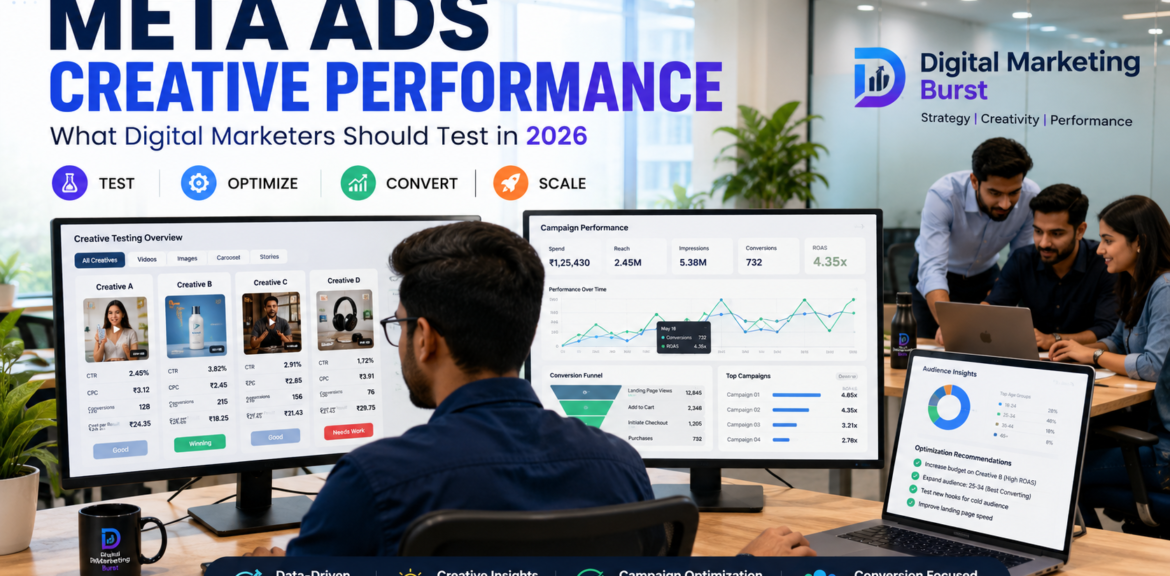

Meta Ads Creative Performance: What Digital Marketers Should Test in 2026
Meta Ads Creative Testing, Meta Ads Performance Marketing, Meta Ads Optimization Strategy, Meta Ads Campaign Optimization, and Meta Ads Conversion Optimization have become closely connected in 2026. Advertisers can no longer judge an ad only by clicks or impressions. Creative quality, audience response, conversion behaviour, cost efficiency, and the post-click experience all help determine whether a Meta campaign can deliver profitable results.
A creative may attract attention but fail to generate qualified leads. Another ad may receive fewer clicks yet bring customers with stronger buying intent. Therefore, marketers need to evaluate the complete customer journey instead of chasing one attractive metric.
For businesses, agencies, and performance marketers, creative testing is now an ongoing process. Different hooks, formats, messages, offers, visual styles, and calls to action can produce very different outcomes. The challenge is knowing what to test, which metrics matter, and when enough data exists to make a decision.
This guide explains how digital marketers can evaluate Meta ad creatives in 2026, build smarter testing systems, improve campaign efficiency, and turn creative insights into better marketing decisions.
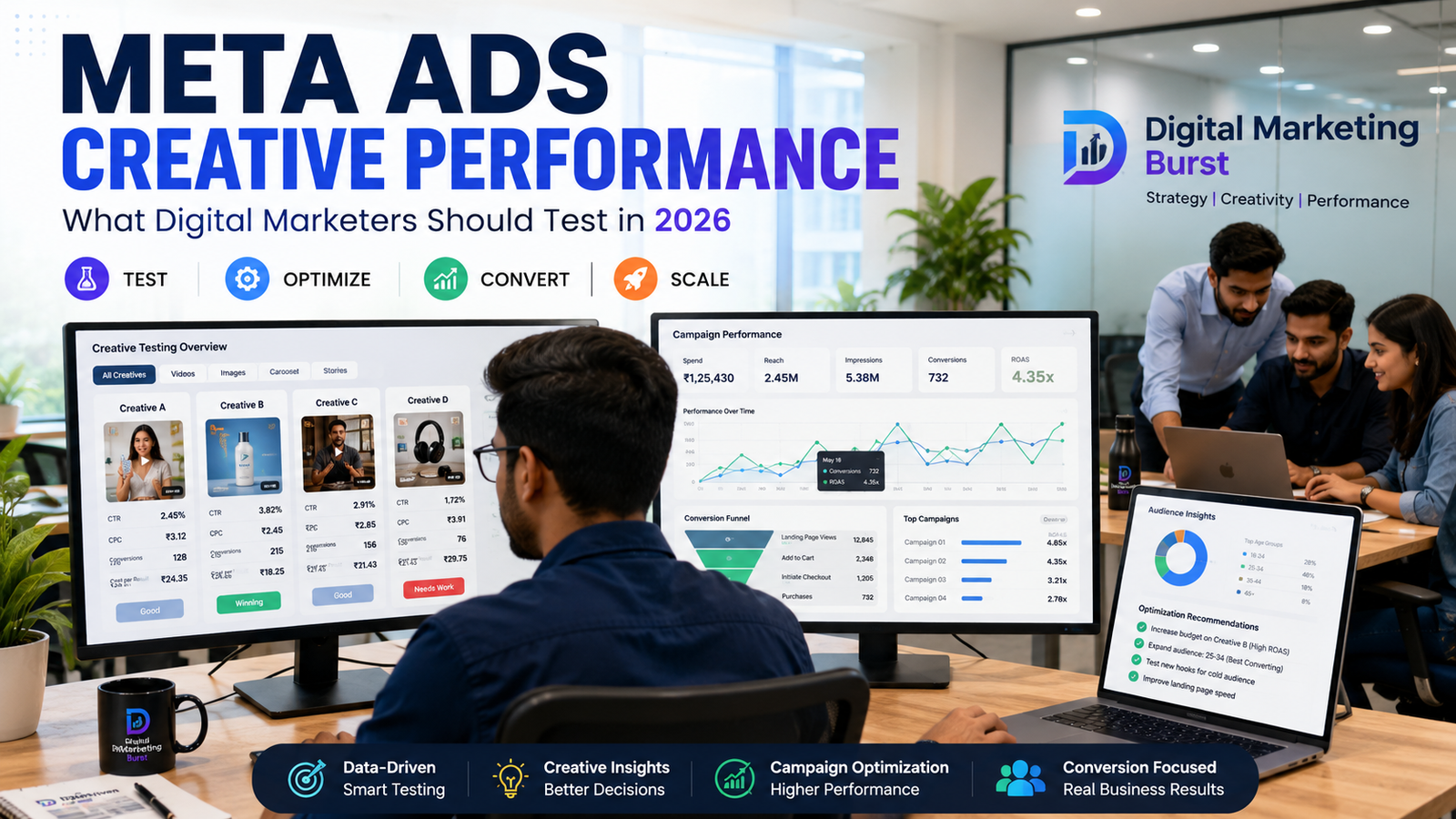
Why Meta Ads Creative Performance Matters More in 2026
Creative performance has always mattered in paid social advertising. However, its role has become even more important as Meta’s advertising systems rely increasingly on automation and machine learning.
Advertisers can provide targeting signals, budgets, objectives, and conversion data. Yet the creative remains one of the most visible reasons a person stops scrolling and pays attention.
The challenge is that a successful creative needs to accomplish several tasks. First, it needs to capture attention. Then, it must communicate a relevant message. Finally, it needs to encourage the right person to take the desired action.
That action could be purchasing a product, submitting a lead form, visiting a website, sending a message, installing an app, or completing another business objective.
Therefore, creative performance should not be reduced to CTR alone.
An advertisement with an impressive click-through rate can still perform poorly if the landing page receives low-quality traffic. Likewise, a creative with a moderate CTR can sometimes produce better business results because the message filters out less relevant users.
In 2026, marketers should evaluate creatives according to both platform metrics and actual business outcomes.
Meta Ads Creative Testing
Meta Ads Creative Testing is the process of comparing different advertising ideas to understand which creative elements influence campaign performance.
The goal is not simply to produce ten advertisements and wait for Meta to select a winner. A useful testing process begins with a clear question.
For example, does a problem-focused opening outperform a benefit-focused opening? Does a customer testimonial generate stronger leads than a polished promotional video? Does showing the product immediately improve engagement compared with introducing it later?
Each test should help the marketer learn something.
This approach is more useful than changing the headline, image, CTA, audience, and offer at the same time. When too many variables change together, it becomes difficult to understand what actually influenced performance.
Testing also requires patience. Making decisions after a tiny number of impressions can produce misleading conclusions.
Instead, marketers should allow campaigns to collect meaningful data while considering budget, conversion volume, campaign objective, and audience size.
Over time, the insights from these tests can become more valuable than any single winning advertisement.
Meta Ads Creative Testing Strategy
A strong Meta Ads Creative Testing Strategy starts with hypotheses rather than random creative production.
Suppose an ecommerce brand believes customers hesitate because they do not understand how the product works. One test could compare a product demonstration with a lifestyle advertisement.
Another business may believe price is the main objection. In that case, the creative could test value-focused messaging against discount-focused messaging.
The important point is that every variation should have a reason for existing.
Marketers can organise creative concepts around variables such as hooks, customer problems, benefits, proof, offers, formats, visual presentation, and calls to action. However, they should avoid testing everything simultaneously without a clear structure.
A testing strategy should also consider the customer journey.
Cold audiences may need more context before taking action. People who already know the brand may respond better to proof, urgency, or a stronger offer.
As a result, the same creative does not need to win at every stage.
The objective is to identify which message works best for a particular audience, objective, and stage of awareness.
What Should Digital Marketers Test in Meta Ads?
One of the biggest mistakes in paid social is treating creative testing as image testing.
The image or video certainly matters. However, an advertisement contains several components that influence user behaviour.
The opening hook can determine whether someone continues watching. The message controls how quickly the user understands the offer. The visual presentation affects attention and credibility. Meanwhile, the CTA influences what happens next.
Marketers should also experiment with different creative concepts.
A demonstration answers a different question from a testimonial. An educational ad serves a different purpose from an offer-led promotion. Similarly, founder-style communication may create a different response from highly polished commercial content.
Format deserves testing as well.
Short videos, static images, carousels, demonstrations, user-generated-style content, animations, and other formats can behave differently across campaigns.
However, marketers should not assume that one format is universally superior.
The best format is the one that communicates the message effectively and produces the desired business result.
How to Test Meta Ad Hooks
The opening moments of an advertisement can strongly influence whether a user pays attention.
For video campaigns, marketers can test different opening statements while keeping the rest of the creative relatively consistent.
One version might begin with a customer problem. Another could immediately present the outcome. A third may use a surprising observation or demonstration.
For static advertisements, the equivalent hook may be the main visual and headline.
The objective is to understand which opening creates qualified attention.
That final word matters.
An exaggerated hook may increase views or clicks while attracting people who have little interest in purchasing. Therefore, marketers should connect hook performance with downstream results.
Watch time, CTR, landing-page behaviour, leads, purchases, and cost per result can provide a more complete picture.
A strong hook does not merely stop the scroll.
It creates enough relevant curiosity for the right user to continue towards the business objective.
How to Test Meta Ad Creative Angles
A creative angle is the perspective used to present the same product or service.
Imagine a business selling productivity software.
One advertisement could focus on saving time. Another could highlight reducing errors. A third might emphasise easier team collaboration.
The underlying product remains the same, but the motivation changes.
Testing these angles can reveal which customer problem has the strongest commercial relevance.
This becomes particularly useful when a business serves several customer segments.
Instead of forcing one generic message across every audience, marketers can develop creatives around specific needs.
However, angle testing should remain connected to real customer insights.
Sales conversations, reviews, customer support questions, search queries, and website behaviour can all reveal useful messaging opportunities.
Good creative ideas often come from understanding customers rather than simply following advertising trends.
Meta Ads Performance Marketing
Meta Ads Performance Marketing connects advertising activity with measurable business outcomes.
This means marketers should look beyond reach, impressions, likes, and video views when the campaign objective is revenue or lead generation.
A performance-focused advertiser asks a different set of questions.
How much does it cost to acquire a qualified customer? Which creative generates profitable purchases? Are leads turning into actual sales? Does the campaign generate enough value relative to advertising spend?
This does not make upper-funnel metrics irrelevant.
Attention and engagement can help diagnose creative performance. However, they are usually signals rather than the final business objective.
For example, a low video hold rate may suggest the opening needs improvement. A healthy CTR combined with weak conversions may indicate a landing-page or offer problem.
Therefore, performance marketing requires marketers to connect creative metrics with the complete conversion journey.
The best advertisement is not always the one with the cheapest click. It is the creative that contributes most effectively to the campaign’s real objective.
Meta Performance Marketing Strategy
A Meta Performance Marketing Strategy should begin with a clearly defined outcome.
An ecommerce business may focus on profitable purchases. A hospital may measure qualified appointment enquiries. A B2B company may care about leads that eventually become sales opportunities.
Once the outcome is clear, campaign metrics become easier to interpret.
Marketers can then work backwards.
If purchases are expensive, investigate whether the problem begins with the creative, audience response, landing page, checkout process, offer, or product economics.
This prevents advertisers from blaming the platform whenever performance falls.
Creative data should also be reviewed over time rather than through isolated daily snapshots.
A campaign can fluctuate naturally from one day to another. Therefore, marketers need enough context before making major changes.
Performance marketing becomes stronger when every campaign generates both conversions and useful learning.
Even a losing test can be valuable if it clearly reveals what customers do not respond to.
Meta Ads Optimization Strategy
A Meta Ads Optimization Strategy should focus on improving the weakest meaningful part of the campaign rather than changing everything whenever results decline.
Suppose an advertisement receives very little attention. The creative concept or opening may need improvement.
If people click but do not convert, the problem may occur after the advertisement.
Perhaps the landing page does not match the promise. The offer may be unclear. The website might load slowly. Alternatively, the traffic could simply be low quality.
This diagnostic approach prevents unnecessary changes.
Marketers should first identify where performance breaks down. Then, they can test a solution targeted at that stage.
Optimization should also account for business quality.
For lead-generation campaigns, cheap leads are not necessarily good leads. Sales teams should provide feedback about lead relevance, intent, and conversion quality.
For ecommerce, revenue should be considered alongside margins and acquisition costs.
A campaign becomes truly optimized when platform results and business results move in the same direction.
Meta Advertising Optimization Strategy
A Meta Advertising Optimization Strategy requires marketers to separate creative problems from campaign problems.
This distinction can save significant time and advertising budget.
Imagine a campaign where people watch the video but rarely click. The advertisement may create curiosity without communicating a compelling next step.
Now imagine a campaign with strong clicks but weak purchases. In that case, replacing the video repeatedly may not solve the real issue.
The landing page, price, trust signals, checkout experience, or offer could be responsible.
Marketers should therefore evaluate the sequence of metrics.
Attention tells you whether users notice the creative. Engagement indicates whether they continue interacting. Click behaviour reveals whether the message creates enough intent to move forward. Conversion data then shows whether that intent becomes a business action.
Each stage provides a clue.
Instead of asking, “Is this ad good?”, marketers should ask, “Where does this ad lose the customer?”
That question produces much more useful optimization decisions.
Meta Ads Campaign Optimization
Meta Ads Campaign Optimization involves improving how creative, campaign structure, budget, audience signals, tracking, and conversion experience work together.
Creative testing should not happen in isolation.
A strong advertisement can struggle when the campaign objective does not match the desired business result. Likewise, good traffic can be wasted by a poor landing page.
Marketers should therefore review the complete system.
Start with the campaign objective. Next, verify that tracking reflects the action that matters. Then, examine creative performance and conversion quality.
Budget distribution also deserves attention.
Repeatedly moving budgets or making unnecessary changes can make performance harder to interpret.
Instead, marketers should have a reason behind each adjustment.
Campaign optimization becomes more effective when changes are based on evidence rather than anxiety.
If a campaign has only run for a short period, there may not be enough information to justify intervention.
On the other hand, consistently poor business outcomes should not be ignored simply because an advertisement receives engagement.
Facebook Ads Campaign Optimization
Although Meta advertising extends beyond Facebook, Facebook Ads Campaign Optimization remains a useful search term because many advertisers still use Facebook Ads when researching campaign improvement.
The fundamental principle is the same: optimize towards meaningful results.
Marketers should evaluate placement performance, creative response, audience behaviour, conversion quality, and campaign economics.
However, placement data should be interpreted carefully.
An advertisement can behave differently across Facebook Feed, Instagram Feed, Stories, Reels, and other environments. This does not always mean every placement needs its own campaign.
Instead, creative design should account for how people consume content in different environments.
Vertical video may work naturally in Stories and Reels. A static creative might communicate an offer efficiently in feeds.
The objective is not to force identical creative experiences everywhere.
Rather, marketers should develop adaptable assets while maintaining consistent messaging.
This creates a better balance between platform automation and intentional creative strategy.
Meta Ads Conversion Optimization
Meta Ads Conversion Optimization begins after attention has been captured.
An advertisement can perform well at the top of the funnel and still fail commercially.
This often happens when there is a mismatch between the creative and what users see after clicking.
If an advertisement promises a particular offer, the landing page should communicate that offer clearly. If the ad focuses on one service, users should not land on a generic homepage where they need to search for it.
Message continuity reduces confusion.
Page speed also matters because users may leave before the content loads properly.
Trust can influence conversion too. Testimonials, clear business information, pricing context, guarantees where appropriate, and transparent next steps can help users make decisions.
For lead-generation campaigns, form design deserves attention.
Asking too little information can generate large volumes of weak leads. Asking too much can reduce submissions.
Therefore, conversion optimization requires balancing quantity with quality.
Facebook Ads Conversion Optimization
Facebook Ads Conversion Optimization should connect platform activity with what happens after a user becomes a lead or customer.
Consider a service business generating 100 leads.
If only five are genuinely relevant, the headline cost per lead may look excellent while the actual business result remains poor.
Now imagine another campaign generating 40 leads at a higher cost, but 20 are qualified.
The second campaign may be significantly more valuable.
This is why marketers need feedback beyond Ads Manager.
CRM data, sales-team feedback, booked appointments, confirmed orders, revenue, and customer quality can reveal which creative truly performs.
For ecommerce businesses, marketers should also consider repeat purchases and margins where data is available.
A first purchase may not tell the complete story.
Ultimately, conversion optimization should move advertising decisions closer to revenue and customer value rather than focusing entirely on platform-level numbers.
CTR vs Conversion Rate: Which Metric Matters More?
CTR and conversion rate answer different questions.
Click-through rate indicates how effectively an advertisement encourages users to click. Conversion rate shows how effectively those visitors complete the desired action afterward.
Neither metric should be interpreted alone.
High CTR with low conversion can indicate several problems. The advertisement might attract curiosity rather than buying intent. Alternatively, the landing page may not deliver what the creative promised.
Low CTR combined with strong conversion can tell another story.
The creative may appeal to a smaller but more qualified audience.
Therefore, marketers should avoid setting universal CTR targets without considering industry, objective, placement, audience, and campaign context.
The real objective is not maximum clicks.
It is enough qualified attention to produce profitable or valuable conversions.
When CTR and conversion rate are evaluated together, marketers can better understand where the customer journey needs improvement.
Cost Per Click vs Cost Per Acquisition
Cheap clicks can feel like a campaign victory, but they do not necessarily create cheap customers.
Cost per click measures traffic efficiency.
Cost per acquisition moves closer to the business outcome.
Suppose Creative A generates clicks at ₹5 while Creative B generates clicks at ₹12. At first glance, Creative A appears much stronger.
However, imagine that Creative A requires 100 clicks to generate one purchase, while Creative B generates one purchase from every 20 clicks.
The more expensive click may actually produce a much better acquisition cost.
This example shows why marketers should avoid optimizing solely around surface-level metrics.
CPC is still useful.
A sudden increase can indicate declining creative response, stronger competition, or another campaign change. Yet it should be treated as a diagnostic metric rather than the final definition of success.
Follow the data farther down the funnel before declaring a creative winner.
ROAS and Creative Performance
Return on ad spend is one of the most popular ecommerce advertising metrics.
However, ROAS also requires context.
A high ROAS on a small amount of spend does not automatically mean the creative can maintain the same efficiency at a much larger budget.
Similarly, different products can have different margins.
A campaign generating ₹5 in revenue for every ₹1 spent may look excellent. Yet profitability still depends on product costs, shipping, returns, discounts, and other expenses.
Creative performance should therefore be evaluated alongside business economics.
Marketers can use ROAS to compare advertising efficiency, but they should avoid treating it as the only metric that matters.
For lead-generation businesses, ROAS may also be difficult to calculate immediately because revenue can occur weeks after the original enquiry.
In those cases, qualified lead cost and eventual sales data can provide better insight.
How to Identify Creative Fatigue in Meta Ads
Creative fatigue occurs when an advertisement becomes less effective after repeated exposure or changing audience response.
However, marketers should avoid diagnosing fatigue from one bad day.
Performance naturally fluctuates.
Instead, look for a sustained pattern.
The creative may receive weaker engagement, higher acquisition costs, or declining conversion efficiency over time. Frequency can provide additional context, although there is no single universal frequency number that proves fatigue.
Audience size matters.
A niche local campaign can naturally reach the same people more frequently than a national ecommerce campaign.
When fatigue appears likely, marketers can introduce new hooks, angles, visual executions, or formats.
They do not always need to abandon the entire winning concept.
Sometimes the underlying message remains effective while the execution needs refreshing.
This is why maintaining a pipeline of new creative variations can be valuable.
Why Winning Meta Ads Eventually Stop Performing
A winning advertisement is not guaranteed to remain a winner forever.
Audience behaviour changes. Competitors introduce new offers. Seasonal demand shifts. Users may also become familiar with a creative after repeated exposure.
Therefore, successful advertisers continue testing even when campaigns are profitable.
This does not mean constantly switching off winning ads.
Instead, new variations can be developed alongside proven concepts.
For example, a successful customer-problem angle could be recreated using a new opening, creator, format, demonstration, or testimonial.
The underlying insight remains the same while the execution evolves.
This creates a healthier creative pipeline.
Waiting until every winning advertisement declines before producing replacements can create gaps in campaign performance.
Continuous testing gives marketers potential alternatives before they urgently need them.
Creative Testing for Lead Generation Campaigns
Lead generation requires a different definition of creative success.
A campaign can produce a very low cost per lead while generating enquiries that the sales team cannot convert.
Therefore, marketers should analyse what happens after submission.
Are leads answering calls? Do they actually need the service? Are they located in the relevant service area? Can they afford the product? How many become qualified opportunities?
Creative messaging can influence these outcomes.
Very broad promises may increase lead volume while reducing quality.
More specific messaging can sometimes produce fewer enquiries but stronger intent.
Marketers should therefore test not only creative style but also qualification through messaging.
Clear pricing context, service details, location information, eligibility requirements, or other relevant information can help users self-select before submitting a form.
The goal is not always more leads.
Often, the real goal is more of the right leads.
Creative Testing for Ecommerce Meta Ads
Ecommerce advertisers have many creative angles available.
Product demonstrations can show how an item works. Customer testimonials can build trust. Comparison creatives can communicate differentiation. Problem-solution videos can connect the product with a specific need.
Offer-led advertisements can also perform strongly when the promotion is genuinely compelling.
However, ecommerce marketers should avoid becoming dependent on discounts.
Constant promotions can affect margins and train customers to wait for the next sale.
Creative testing should therefore explore product value as well as price incentives.
The landing page needs to support the advertisement too.
If a video highlights one product benefit, that information should be easy to find after the click.
Product photography, reviews, delivery information, returns policies, and checkout clarity can influence whether creative attention becomes revenue.
The advertisement starts the conversation. The website must finish it.
How AI Is Changing Meta Ad Creative Testing in 2026
AI tools can accelerate several parts of creative production.
Marketers can use them to explore concepts, organise customer insights, generate variations, analyse patterns, and speed up production workflows.
However, faster production does not automatically produce better advertising.
Generating dozens of nearly identical creatives can create volume without meaningful learning.
Human judgement remains important.
Marketers need to understand customer problems, brand positioning, offer quality, and business economics before deciding what should be tested.
AI can help produce variations around an idea, but the idea itself still needs a strategic reason.
Authenticity also matters.
Audiences can respond differently to highly polished AI-generated content compared with real demonstrations, employees, customers, experts, or creators.
Therefore, AI should be treated as a creative tool rather than a substitute for marketing strategy.
The strongest workflow combines faster technology with genuine customer understanding.
Digital Marketing Burst Meta Ads Creative Testing Approach
At Digital Marketing Burst, Meta advertising can be viewed as part of a wider digital marketing system rather than an isolated source of clicks.
A campaign should connect creative strategy, audience behaviour, landing-page experience, conversion tracking, and business outcomes.
This is especially important because different businesses require different definitions of success.
An ecommerce brand may focus on purchases and profitable revenue. A service business may care about qualified enquiries. Another company may need booked consultations rather than raw lead volume.
Therefore, a Digital Marketing Burst Meta Ads Creative Testing strategy should begin with the business objective and work backwards towards the creative.
Testing can then explore customer problems, hooks, benefits, proof, formats, offers, and calls to action.
The resulting data can guide future creative decisions.
This makes advertising more systematic.
Instead of producing creatives based only on personal preference, marketers can gradually build a clearer picture of what customers actually respond to.
Meta Ads Creative Performance: What Digital Marketers Should Test in 2026
The most important lesson for digital marketers in 2026 is simple: creative testing should produce learning, not just more advertisements.
Meta Ads Creative Testing helps identify messages that attract the right audience. Meta Ads Performance Marketing connects those messages with measurable business outcomes. Meanwhile, a strong Meta Ads Optimization Strategy helps marketers diagnose weak points instead of making random changes.
Campaign-level decisions matter as well. Meta Ads Campaign Optimization should consider creative, tracking, landing pages, budgets, and customer quality together. Finally, Meta Ads Conversion Optimization ensures that attention and clicks have a realistic chance of becoming leads, sales, or revenue.
Digital marketers who combine these areas can make better decisions than those who judge advertisements through one metric alone.
A high CTR is useful only when the traffic has value. Cheap leads matter only when they are relevant. Strong ROAS matters only when the underlying economics make sense.
In 2026, the strongest creative strategy is therefore not about finding one permanent winning ad. It is about continuously learning what customers respond to, turning those insights into new creative concepts, and connecting advertising performance with genuine business growth.
Meta Ads Creative Testing for Better Campaign Decisions
Meta Ads Creative Testing becomes valuable when every experiment answers a specific marketing question. Many advertisers create several ads, run them together, and simply select the creative with the lowest cost. However, this approach often misses the reason why one advertisement performed better.
A better system starts with one clear hypothesis. For example, you may want to discover whether a problem-focused opening generates better customers than a benefit-focused opening. Another test could compare customer testimonials with product demonstrations.
The objective is not just to identify a winner. Instead, marketers should discover what the winner teaches them about their audience.
Suppose a testimonial advertisement consistently produces stronger conversions. This could indicate that customers need more proof before making a decision. The next creative batch can then explore different forms of proof rather than starting from zero.
Over time, testing creates a library of customer insights. Those insights can influence paid campaigns, landing pages, social media content, email marketing, and even website messaging.
Therefore, creative experiments should be treated as marketing research rather than only advertising production.
How to Build a Meta Ads Creative Testing Framework
A structured Meta Ads Creative Testing framework helps marketers avoid random experimentation. Before launching a new creative, decide exactly what variable you want to learn about.
One testing cycle might focus on hooks. Another could compare messaging angles. Later tests can examine formats, offers, testimonials, visual styles, or calls to action.
However, changing everything simultaneously makes interpretation difficult.
Imagine Creative A uses a different hook, offer, video style, headline, and CTA from Creative B. If Creative A performs better, you still do not know which difference produced the improvement.
A controlled approach provides clearer information.
At the same time, marketers should not make the framework unnecessarily complicated. Real advertising environments contain many variables, and perfect laboratory-style testing is rarely possible.
The practical goal is to create enough separation between ideas to generate useful conclusions.
Document the hypothesis, creative concept, important metrics, outcome, and what should be tested next. Eventually, this creates an internal knowledge base that can make future campaigns smarter.
Meta Ads Creative Testing for Hooks and Scroll-Stopping Content
The first seconds of an advertisement often determine whether users continue watching. For this reason, Meta Ads Creative Testing should give significant attention to hooks.
A hook does not need to be sensational. It needs to make the right customer interested enough to continue.
Problem-focused hooks can work when audiences clearly recognise the issue being discussed. Benefit-focused hooks may perform better when customers already understand the product category. Meanwhile, demonstrations can quickly communicate value without requiring a lengthy explanation.
Marketers can also test questions, surprising observations, customer statements, before-and-after concepts where appropriate, or direct product introductions.
However, scroll-stopping ability should never become the only objective.
A dramatic opening might generate excellent video retention while producing weak conversions. This happens when the hook attracts broad curiosity but does not connect naturally with the product or service.
Therefore, evaluate what happens after attention is captured.
Strong creative should attract attention from people who could realistically become customers.
Testing Short-Form Video Creatives for Meta Ads
Short-form video continues to play an important role across social platforms. Yet marketers should not assume that shorter automatically means better.
Meta Ads Creative Testing can help determine how much time a particular product needs to communicate its value.
A simple consumer product might be understood within seconds. A complex service may require additional explanation.
Instead of targeting an arbitrary video length, marketers should remove unnecessary content while keeping enough information to support the decision.
The opening should establish relevance quickly. After that, the creative needs to maintain momentum.
Visual changes, demonstrations, captions, product shots, customer proof, and natural movement can help maintain attention when they support the message.
The CTA should also feel connected to the content.
If viewers have just watched an educational explanation, an aggressive sales CTA may feel disconnected. In contrast, a direct-response offer may justify a stronger action-oriented ending.
Test different lengths and structures. Then connect video behaviour with conversion data before deciding which format works best.
Static Images vs Video Ads: What Should You Test?
Video receives considerable attention in modern advertising, but static creatives should not automatically be ignored.
A well-designed static advertisement can communicate a message extremely quickly. It can also be easier and cheaper to produce, allowing marketers to explore more messaging concepts.
Video offers different advantages. Demonstrations, stories, testimonials, and explanations can be easier to communicate through movement and speech.
Therefore, Meta Ads Creative Testing should compare formats according to business objectives rather than trends.
A static creative may outperform video for a simple offer. Meanwhile, video may perform better when customers need to see how something works.
Another possibility is that both formats succeed for different reasons.
Static ads might create efficient retargeting conversions while video helps introduce the product to new audiences.
Marketers should also remember that format and concept are separate variables. A weak idea does not necessarily become strong simply because it is converted into video.
Start with the message. Then determine which format communicates that message most effectively.
Test User-Generated Style Content vs Professional Creatives
User-generated-style advertising has become popular because it can resemble the organic content people already consume.
However, professional brand creatives still have value.
The right approach depends on the business, audience, offer, and buying decision.
Meta Ads Creative Testing can compare authentic creator-style communication with polished brand-led advertisements.
For some consumer products, informal demonstrations may feel relatable. In higher-consideration industries, professional presentation can sometimes create stronger credibility.
Neither approach should be treated as universally superior.
Marketers can also combine the two styles.
A professional advertisement might include a genuine customer story. Alternatively, creator-style content can maintain clear brand messaging without looking overly scripted.
Authenticity should not mean intentionally producing poor-quality content.
Audio should remain understandable. The product or service should be presented accurately, and the message should be clear.
Ultimately, the audience decides which presentation feels convincing. Performance data can reveal whether polished production or natural communication works better for a specific campaign.
Test Customer Testimonials in Meta Advertising
Testimonials can reduce uncertainty because they allow potential customers to hear from people who have already used a product or service.
However, not every testimonial makes a strong advertisement.
Generic statements such as “great product” provide limited information. Specific experiences are usually more useful because they explain the problem, experience, and outcome.
Marketers can test several testimonial structures.
One creative may begin directly with the customer’s result. Another might start with the original problem. A third could focus on why the customer selected the brand over alternatives.
Through Meta Ads Creative Testing, advertisers can discover which type of proof matters most to their audience.
Testimonials should remain genuine and should not make misleading claims.
For regulated or sensitive industries, marketers should also ensure that advertising complies with applicable policies and requirements.
Strong proof works because it supports the marketing promise. It should not be used to exaggerate what every customer will experience.
Test Product Demonstration Ads
Product demonstrations can reduce the gap between seeing an advertisement and understanding the offer.
Instead of describing what a product does, marketers can show it.
This approach can be particularly useful when the product has a visual benefit or a feature that becomes obvious through demonstration.
The opening of the demonstration deserves testing.
One version might show the final result first. Another can begin with the problem and introduce the product afterward.
Marketers can also compare fast demonstrations with detailed explanations.
The right structure depends on customer awareness.
Someone already familiar with the category may understand a quick demonstration immediately. A first-time buyer may require additional context.
Connect demonstration engagement with sales data.
A video can receive strong watch time because it is satisfying or interesting without creating purchase intent.
Therefore, Meta Ads Creative Testing should determine whether viewers simply enjoy watching the demonstration or actually move closer to conversion.
Test Problem-Solution Creatives
Problem-solution advertising works by connecting a recognisable customer difficulty with a relevant solution.
The approach sounds simple, but execution matters.
If the problem is exaggerated, customers may distrust the advertisement. If it is too broad, the message may fail to feel personally relevant.
Research can improve the creative.
Customer reviews, sales calls, search queries, FAQs, and support conversations often contain the exact problems customers care about.
These insights can become advertising angles.
For example, instead of saying a product is “easy to use,” the creative could address a specific frustrating task that customers want to simplify.
Meta Ads Creative Testing can then compare different problems to identify which one creates the strongest response.
This information is useful beyond advertising.
The winning problem may deserve more attention on product pages, landing pages, organic content, and sales materials.
Creative performance can therefore become a valuable source of customer research.
Test Benefit-Led vs Feature-Led Meta Ads
Features explain what a product contains. Benefits explain why those features matter to customers.
Both can be important.
However, different stages of awareness may require different emphasis.
Someone researching technical specifications may respond to detailed features. Another user may care primarily about the outcome.
A marketer could therefore test one advertisement focused on a product capability against another focused on what that capability helps the customer achieve.
Meta Ads Creative Testing can reveal which communication style generates stronger qualified interest.
The best advertisements often connect both.
They explain the benefit first and then provide the feature as supporting evidence.
For example, instead of simply stating that software includes automated reporting, the creative might explain that teams can reduce time spent creating weekly reports because the process is automated.
That connection makes the feature meaningful.
Testing these approaches can help brands discover whether their audience responds more strongly to technical information or outcome-driven messaging.
Meta Ads Creative Testing for Different Audience Awareness Levels
Not every customer sees an advertisement with the same level of knowledge.
Some people have never heard of the brand. Others know the problem but not the solution. Another group may already be comparing products.
This is why Meta Ads Creative Testing should consider awareness.
Cold audiences often require more context. Educational content, problem identification, demonstrations, or customer stories can help introduce the offer.
Warmer audiences may need different information.
They might respond to product comparisons, detailed benefits, proof, FAQs, or a stronger reason to take action.
Existing customers create another opportunity. Advertising can introduce complementary products, upgrades, or relevant repeat purchases.
However, marketers should avoid creating dozens of unnecessary audience segments without evidence.
The broader principle is to recognise that messaging should match what customers already know.
Creative testing can reveal how much explanation each stage requires.
Meta Ads Performance Marketing Metrics That Actually Matter
Marketers have access to many metrics. The challenge is knowing which ones help answer a useful question.
Impressions and reach explain delivery. Video metrics can indicate attention. CTR provides information about click behaviour. CPC helps evaluate traffic cost.
However, performance campaigns usually need to go deeper.
Cost per qualified lead, purchase cost, conversion rate, revenue, ROAS, and customer value can move closer to the business objective.
The correct metric depends on the campaign.
A brand-awareness campaign should not be judged exactly like an ecommerce purchase campaign.
Similarly, a B2B company with a three-month sales cycle cannot evaluate success exactly like a low-cost ecommerce store.
Metrics should form a hierarchy.
Diagnostic metrics explain what is happening inside the campaign. Business metrics determine whether that performance is valuable.
This distinction prevents marketers from celebrating an excellent CTR while ignoring poor revenue.
How to Read Meta Ads Creative Performance Data
Data becomes useful only when it leads to better decisions.
Suppose a creative has strong video retention but weak clicks. This may suggest that people enjoy the content but do not see enough reason to continue.
Another creative might have strong CTR but weak landing-page conversions. That could indicate a mismatch between the advertisement and website.
If both CTR and conversion rate are healthy but acquisition costs remain high, media costs or business economics may need examination.
The key is reading metrics as a sequence.
Each number provides information about a different stage of user behaviour.
Marketers should also compare creatives under reasonably similar conditions.
A creative spending ₹50 cannot be fairly judged against another that has received ₹50,000 in spend without additional context.
Sample size matters.
Instead of looking for instant certainty, use data to build confidence gradually.
Good analysis recognises both what the numbers suggest and what they cannot yet prove.
How Often Should You Launch New Meta Ad Creatives?
There is no universal number of new advertisements every business must produce each week.
Creative requirements depend on budget, audience size, campaign volume, and how quickly performance changes.
A large advertiser spending significant amounts can collect data faster. Therefore, it may need a larger creative pipeline.
A small local business may not need dozens of new ads every week.
Producing more content than the budget can meaningfully test creates unnecessary work.
Instead, establish a sustainable testing rhythm.
Keep successful advertisements running when they continue delivering acceptable business results. At the same time, develop new concepts before replacements become urgent.
Meta Ads Creative Testing works best as an ongoing process rather than an emergency response to declining campaigns.
The ideal production schedule is one that generates enough fresh ideas for the available advertising budget to test properly.
When Should You Stop a Losing Meta Ad?
Stopping an advertisement too early can eliminate a potential winner. Waiting too long can waste budget.
The decision requires context.
First, consider how much data the advertisement has collected relative to the expected conversion cost.
An ad that has spent only a tiny fraction of the normal acquisition cost may simply need more time.
Next, examine early indicators.
Very weak engagement, poor click behaviour, or obvious messaging problems can provide useful clues. However, these signals should still be interpreted according to the campaign objective.
Marketers should also compare the creative with realistic benchmarks from the same account.
Industry averages can provide context, but a company’s own historical performance is often more relevant.
Avoid emotional decisions.
One poor morning does not necessarily mean an advertisement has failed.
Likewise, a marketer should not keep an obviously weak creative running simply because significant effort was spent producing it.
Meta Ads Campaign Optimization Through Creative Insights
Creative results can influence much more than the next advertisement.
Suppose several winning creatives focus on the same customer problem. That pattern may indicate a strong market insight.
The business could use that information to improve landing pages, website headlines, sales scripts, email campaigns, and organic social content.
Likewise, if customers repeatedly respond to a specific benefit, that benefit may deserve stronger positioning across marketing channels.
This is where Meta Ads Campaign Optimization becomes connected with broader digital strategy.
Paid advertising generates fast feedback because different messages can be exposed to real audiences.
However, marketers should avoid assuming that every performance difference proves customer preference. Delivery systems, audience differences, and campaign conditions can influence results.
Look for repeated patterns across multiple tests.
When the same insight continues appearing, confidence becomes stronger.
Meta Ads Conversion Optimization After the Click
A strong advertisement cannot compensate indefinitely for a weak post-click experience.
When users arrive on the website, they should immediately understand that they are in the right place.
The headline should connect naturally with the advertisement.
Important information should be easy to find.
On mobile devices, page usability becomes particularly important because many social-media users click directly from their phones.
Forms should be tested carefully.
Removing unnecessary fields can reduce friction. However, lead-generation businesses may need enough information to filter irrelevant enquiries.
Checkout processes also deserve attention for ecommerce campaigns.
Unexpected charges, unclear delivery details, forced account creation, or technical problems can reduce conversions even when the advertisement performs well.
Therefore, creative and landing-page optimization should not operate as separate departments.
Both influence the same customer journey.
Meta Ads Optimization Strategy for Scaling Winning Creatives
Scaling should begin only after marketers understand why a campaign appears successful.
A temporary performance spike is different from a repeatable creative insight.
Before increasing spend significantly, examine conversion quality, acquisition cost, audience response, and business capacity.
If results remain healthy, budgets can be adjusted according to the advertiser’s strategy and risk tolerance.
However, scaling is not only about spending more on one winning advertisement.
Creative diversification can also support growth.
A winning concept can be expanded into new hooks, formats, testimonials, demonstrations, or customer angles.
This creates multiple executions around an idea already supported by evidence.
The approach can reduce dependence on one advertisement.
At the same time, marketers should continue exploring completely new concepts.
The goal is to build several sources of performance rather than hoping one creative remains successful forever.
Meta Ads Creative Testing Mistakes Digital Marketers Should Avoid
One common mistake is testing too many variables without a hypothesis.
Another is judging success from vanity metrics alone.
Marketers can also make the opposite mistake by looking only at purchases while ignoring diagnostic metrics that explain why performance changed.
Small sample sizes create another problem.
Declaring a winner after a handful of clicks can lead to unreliable conclusions.
Creative production can also become trend-driven.
Copying a popular format without understanding why it works rarely creates a sustainable strategy.
Likewise, competitors can provide inspiration, but their economics, audience, offer, and brand position may be completely different.
Finally, marketers should avoid turning Meta Ads Creative Testing into endless minor variations.
Changing a button or one word repeatedly may produce less learning than testing genuinely different customer angles.
Strong experimentation combines disciplined measurement with meaningful creative differences.
Building a Meta Ads Creative Testing System for 2026
A sustainable testing system should become part of the marketing workflow.
Begin with customer research.
Collect recurring problems, objections, desired outcomes, reviews, sales questions, and reasons customers choose the product.
Turn these insights into creative hypotheses.
Next, develop variations designed to answer specific questions.
Launch them with enough budget and time to collect useful information. Then analyse both platform metrics and downstream business outcomes.
Record what was learned.
This final step is often ignored.
Without documentation, teams can accidentally repeat failed ideas or forget why previous campaigns succeeded.
A simple creative knowledge base can include the concept, hook, audience insight, format, result, and next hypothesis.
Over several months, this system becomes increasingly valuable.
Instead of guessing what to create, marketers can build new ideas from accumulated evidence.
That is the real advantage of Meta Ads Creative Testing in 2026: each campaign can make the next campaign smarter.
Bilkul. Is blog ke end mein branding section ko Meta Ads creative testing + performance marketing + campaign optimization + Digital Marketing Burst se naturally connect karna best rahega, taaki promotional bhi lage aur topic se relevant bhi rahe.
Why Digital Marketing Burst Is a Top Digital Marketing Agency in Lucknow, India
Running Meta Ads is not only about launching campaigns and increasing budgets. Real performance comes from understanding which creatives attract attention, which messages generate qualified clicks, and which campaigns actually produce leads, sales, or revenue. Digital Marketing Burst, based in Lucknow, focuses on combining creative strategy with data-driven digital marketing to help businesses improve their paid advertising performance.
Our approach connects Meta Ads Creative Testing, Meta Ads Performance Marketing, Meta Ads Optimization Strategy, Meta Ads Campaign Optimization, and Meta Ads Conversion Optimization with the wider customer journey. Instead of judging advertisements only by CTR or impressions, the focus remains on meaningful business outcomes.
Meta Ads Creative Testing With a Performance-Focused Approach
A good creative testing process should answer a clear marketing question. Digital Marketing Burst focuses on testing hooks, customer problems, benefits, formats, offers, testimonials, calls to action, and different creative angles.
The purpose is not simply to create more ads.
Every test should provide information that can improve future campaigns. If one customer problem repeatedly produces better leads, that insight can also influence landing pages, website messaging, content marketing, and sales communication.
This makes Meta Ads Creative Testing part of a complete digital marketing strategy rather than a separate design activity.
Meta Ads Performance Marketing for Better Business Results
Businesses need more than cheap clicks.
A campaign may generate strong engagement but fail to produce qualified enquiries. Another campaign may have a higher CPC while delivering customers with stronger intent.
Digital Marketing Burst evaluates paid advertising with this difference in mind.
Our Meta Ads Performance Marketing approach considers campaign objectives, conversion quality, cost per lead, cost per acquisition, landing-page performance, and wider business outcomes.
For ecommerce campaigns, metrics such as purchase value and advertising efficiency can become important. For service businesses, qualified leads and actual sales opportunities may matter more than raw form submissions.
This helps keep advertising decisions connected with real business goals.
Meta Ads Optimization Strategy Based on Data
Random changes can make Meta campaigns harder to understand.
A structured Meta Ads Optimization Strategy first identifies where the customer journey is losing performance.
If an advertisement receives weak attention, the creative may need improvement. If users click but do not convert, the landing page, offer, or traffic quality may deserve attention.
Digital Marketing Burst uses this diagnostic approach to avoid unnecessary changes.
Rather than repeatedly switching creatives because of one weak day, campaigns can be reviewed according to meaningful performance trends.
This creates a more stable and practical optimization process.
Meta Ads Campaign Optimization From Creative to Conversion
Meta Ads Campaign Optimization should include more than Ads Manager settings.
The advertisement, campaign objective, tracking, landing page, offer, mobile experience, and follow-up process all influence the final result.
Digital Marketing Burst looks at these areas together.
For example, a campaign may generate inexpensive leads but still perform poorly if most enquiries are irrelevant. Another campaign may produce fewer leads but generate stronger business opportunities.
The second campaign can often be more valuable.
This is why campaign optimization needs to consider both platform data and what happens after the lead or sale.
Meta Ads Conversion Optimization for Higher-Quality Results
Getting a click is only the beginning.
After users leave Meta, the landing experience becomes extremely important. The page should match the message they saw in the advertisement.
Digital Marketing Burst focuses on Meta Ads Conversion Optimization by examining message consistency, landing-page clarity, lead forms, website experience, and conversion quality.
For lead generation, the objective should not always be the highest possible number of enquiries.
A campaign that generates more relevant leads can produce better business results even when the headline cost per lead appears higher.
For ecommerce, the same principle applies to purchases and profitability.
The goal is to improve the entire conversion journey rather than only the top of the funnel.
Why Businesses Choose Digital Marketing Burst in Lucknow
Businesses searching for a top digital marketing agency in Lucknow often need several marketing channels to work together.
Digital Marketing Burst combines Meta Ads, Google Ads, SEO, social media marketing, content marketing, website management, local SEO, graphic design, and digital strategy.
This integrated approach helps businesses avoid running isolated campaigns.
Creative insights from Meta Ads can influence social-media content. Search data can inform ad messaging. Website analytics can reveal conversion problems. SEO content can strengthen long-term organic visibility.
When these channels work together, businesses can build a more consistent digital presence.
A Digital Marketing Agency Focused on Creative and Performance
Good digital advertising requires both creativity and analysis.
Creative without performance data becomes guesswork. Data without strong creative can limit campaign potential.
Digital Marketing Burst brings both areas together.
Campaigns can be developed around real customer problems, tested through different creative ideas, and improved according to measurable results.
This approach becomes especially useful in 2026 as advertising platforms use more automation. Marketers still need strong offers, useful messaging, and creative concepts that customers actually care about.
Technology can optimize delivery. Strategy determines what should be communicated.
Digital Marketing Burst for Meta Ads Strategy in India
For businesses looking for a Meta Ads agency in India, performance marketing agency in Lucknow, Meta Ads campaign management company, or digital marketing agency for Facebook and Instagram Ads, Digital Marketing Burst focuses on practical and data-driven campaign management.
The objective is not to chase vanity metrics.
Instead, the focus remains on relevant traffic, qualified leads, conversions, revenue, and sustainable campaign improvement.
From Meta Ads Creative Testing Strategy to Facebook Ads Campaign Optimization and Meta Ads Conversion Optimization, every stage should support the larger business objective.
Build Better Meta Ads Campaigns With Digital Marketing Burst
Meta advertising works best when creative testing, optimization, conversion strategy, and business goals are connected.
Digital Marketing Burst helps businesses approach Meta Ads as a complete performance system rather than simply a source of impressions and clicks.
Whether the objective is lead generation, ecommerce growth, brand visibility, or conversion improvement, the strategy should begin with understanding the audience and continue through creative testing, campaign analysis, and post-click optimization.
For businesses searching for a top digital marketing agency in Lucknow, leading performance marketing agency in India, or an agency experienced in Meta Ads Creative Testing and campaign optimization, Digital Marketing Burst focuses on building digital campaigns around measurable growth.
Digital Marketing Burst — combining creative strategy, performance marketing, and data-driven optimization to help businesses grow through smarter digital advertising.