






Amazon Blocks Meta’s Muse: Why Robots.txt Isn’t Enough for AI Agents in 2026
Meta Muse AI Agent: Why Amazon’s Block Shows Robots.txt Isn’t Enough for AI Agents in 2026
The Meta Muse AI Agent has created a new problem for website owners: what happens when an AI agent visits a website through a real browser and does not behave like a conventional, clearly identified crawler?
That question became much more practical in September 2026. Amazon reportedly blocked shoppers using Meta’s Muse to access Amazon, displaying a notice that described the AI agent as unauthorised. Yet the situation was not as straightforward as adding another bot to robots.txt. Search Engine Journal reported that Meta’s published crawler documentation did not provide a Muse user-agent that Amazon could simply name and disallow. Search Engine Journal
The incident matters well beyond Amazon and Meta.
For Indian ecommerce companies, publishers, SaaS businesses, marketplaces and other website owners, it highlights an emerging distinction between AI crawlers and AI agents. A crawler typically visits pages automatically to collect or index information. An agent can use a browser, act for a person and potentially interact with a website much more like an ordinary visitor.
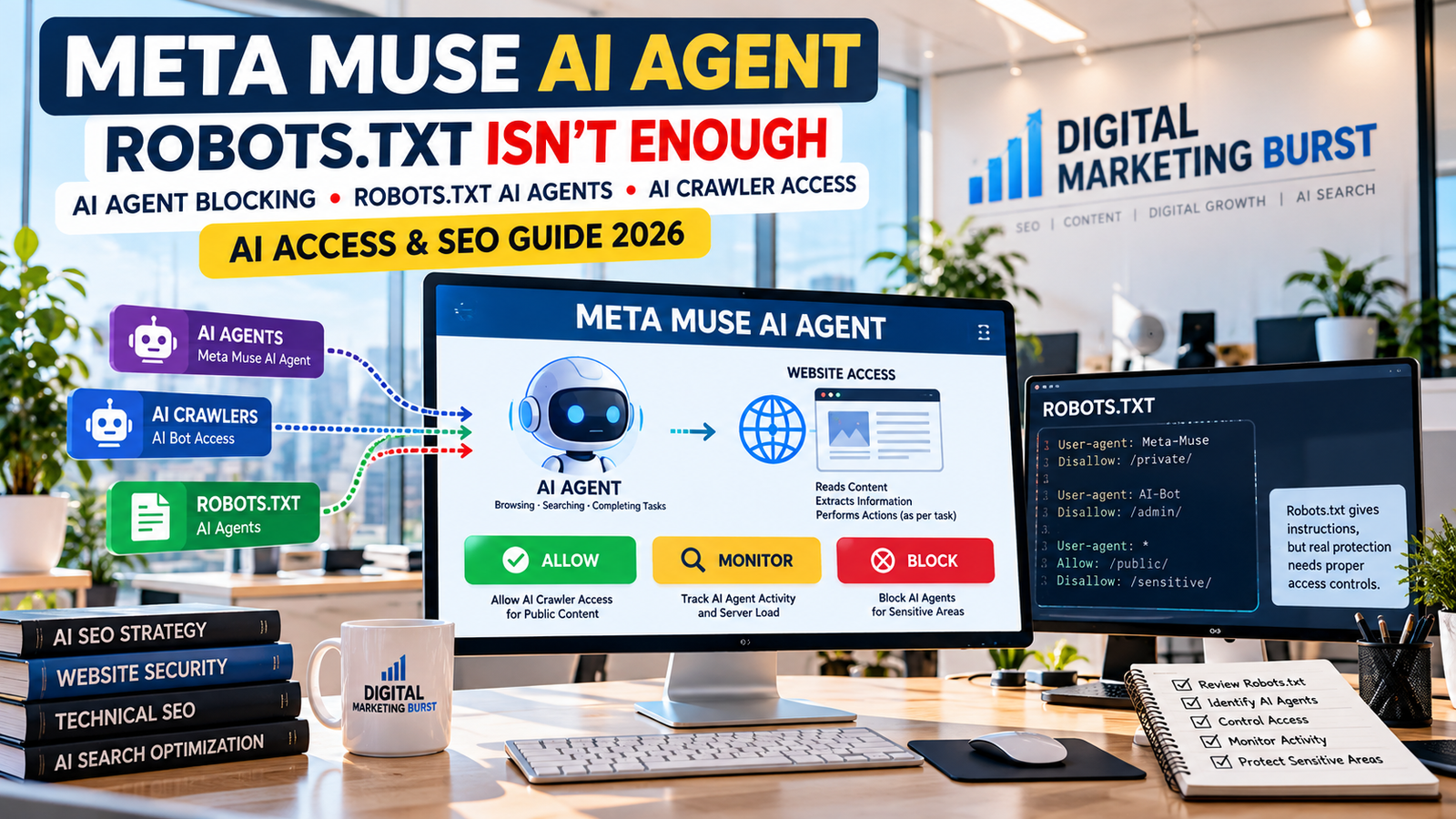
That changes the question from:
“How do I block AI crawlers?”
to:
“How should my website control access when an AI agent looks increasingly like a user?”
And that is where robots.txt alone starts becoming insufficient.
What Is the Meta Muse AI Agent?
Meta describes Muse as its personal agent. According to Meta’s September 8, 2026 technical announcement, Muse can perform tasks, work in the background, use sub-agents, build tools and interact with external services. Meta Research
For website owners, its browser architecture is particularly important.
Meta says Muse operates inside a dedicated cloud computer for each user. That environment includes a browser, storage and computing resources. Muse uses an up-to-date Chromium-based browser behind a virtualisation layer, and users can see what the browser is doing and take control when necessary. Meta Research
This makes Muse meaningfully different from the mental model many marketers have when they hear “AI bot.”
A traditional crawler may announce itself using a recognisable user-agent, request pages and process their content. Website administrators can then write rules aimed at that crawler.
An agent operating a browser on a user’s behalf can create a different identification problem.
Meta also states that when Muse browses the internet, the browsing can appear as the user’s activity. Meta Research
That detail sits at the centre of the Amazon case.
Why Did Amazon Block Meta’s Muse?
On September 20, 2026, Amazon reportedly began blocking shoppers who attempted to use Muse on its website.
According to Search Engine Journal’s account of reporting from GeekWire, Amazon said Meta had not informed it that Muse would access the store. Amazon also said the agent did not identify itself while browsing and raised concerns about how customer credentials were handled. Search Engine Journal
Those claims need careful attribution.
Meta’s own technical documentation says credentials connected to Muse are stored inside the user’s dedicated VM rather than centralised Meta infrastructure. Meta says its main agent does not see the actual credentials. Instead, a security component called Sentinel controls network requests and handles credential insertion at the network boundary. Meta Research
Therefore, it would be misleading to present Amazon’s credential concern as an independently established fact.
The part most relevant to SEO and website management is simpler:
Amazon wanted to prevent a particular AI agent from interacting with its service, but traditional crawler instructions were not sufficient for that particular job.
Why Robots.txt Had a Meta Muse Problem
The Robots Exclusion Protocol works through rules associated with crawler identities.
A basic example looks like this:
User-agent: ExampleBot
Disallow: /
The first line identifies the crawler to which the rule applies. The second asks that crawler not to access the specified path.
The Internet Engineering Task Force’s RFC 9309 formally standardises the Robots Exclusion Protocol. Crucially, the specification states that robots.txt rules are not a form of access authorisation. They communicate rules that crawlers are requested to honour. RFC Editor
That distinction becomes important with Robots.txt AI Agents.
Search Engine Journal reported that Meta’s crawler documentation listed multiple Meta agents, but Muse was not among those crawler identities. Amazon therefore did not have a published Muse-specific user-agent to target in the same conventional way. Search Engine Journal
This is not evidence that robots.txt has suddenly stopped working.
Instead, it exposes a different problem:
What happens when the automated visitor you want to control is not presenting itself as the kind of crawler your robots.txt rules were designed to address?
Robots.txt for AI Agents Is a Policy Signal, Not a Security Barrier
Website owners should understand this distinction clearly.
A robots.txt file is useful for communicating crawling preferences to compliant automated clients. It should not be treated as a firewall.
Cloudflare’s current documentation makes the same distinction. Its managed robots.txt guidance states that compliance is voluntary and that the file does not technically prevent a crawler from reaching content. Cloudflare recommends enforcement controls when a site needs to actually stop access. Cloudflare Docs
Consider a simple analogy.
A sign outside an office might say:
“Authorised staff only.”
A person who follows the rule stays outside. However, the sign itself does not lock the door.
Robots.txt plays a similar role.
It communicates instructions. An access-control system determines whether a request actually gets through.
For businesses reviewing Robots.txt for AI Agents, both layers now matter.
Meta Muse AI vs a Conventional AI Crawler
Treating every automated AI system as the same thing can lead to poor technical decisions.
A useful 2026 framework is to separate automated access into at least three broad purposes:
| Type | Typical purpose | Main website concern |
|---|---|---|
| Search crawler | Discover/index information for search | Visibility and discovery |
| Training crawler | Collect content used for model training | Content-use preferences |
| AI agent | Perform an action or retrieve information for a user | Access, identity, permissions and transactions |
The categories can overlap, and individual systems may work differently. However, the distinction is useful for making website policy decisions.
Cloudflare now explicitly separates AI traffic into Search, Agent and Training behaviours in its controls. Its documentation describes Agent activity as automated behaviour acting in real time on behalf of a person, including browser-use agents. Cloudflare Docs
That is an important development.
A business may be perfectly comfortable allowing an AI search crawler to discover public articles while being uncomfortable with an autonomous agent attempting checkout, logging into accounts or interacting with private areas.
A single “allow AI” or “block AI” decision is therefore becoming too crude.
AI Agent Blocking Is Becoming an Access-Control Problem
AI Agent Blocking is often discussed as though website owners simply need a longer list of bot names.
The Amazon–Muse situation suggests the problem is broader.
Imagine an Indian ecommerce website.
The business may want its product descriptions indexed by traditional search engines. It might also welcome AI search systems that cite those products and send qualified visitors.
At the same time, the company may want additional controls when an automated agent:
- signs into customer accounts,
- changes delivery information,
- submits forms,
- adds products to a basket,
- accesses personalised pricing,
- initiates checkout,
- or makes repeated automated requests.
Blocking every AI-related request could sacrifice useful discovery.
Allowing every automated agent everywhere could create operational, security or policy problems.
The better approach is purpose-based access control.
Should Indian Websites Block AI Agents?
There is no universal answer.
A publisher, ecommerce store, hospital website, B2B SaaS platform and local service company have very different reasons for allowing or restricting automated access.
For an Indian business, start by asking:
What value does this automated visitor create, and what actions should it be allowed to perform?
A public marketing page and an authenticated customer dashboard should not necessarily have identical policies.
For example, a business could decide that AI search discovery is useful for:
- blog articles,
- product information,
- FAQs,
- documentation,
- public service pages.
The same organisation may apply stronger controls to:
- login areas,
- customer records,
- checkout,
- payment flows,
- account settings,
- internal search endpoints,
- high-cost APIs.
This is more precise than immediately trying to Block AI Agents across the entire website.
Block AI Agents Without Accidentally Blocking Useful Discovery
The most important practical lesson is not “block everything.”
It is classify first.
Cloudflare’s 2026 AI controls demonstrate why this matters. Website owners using its products can now distinguish between Search, Agent and Training behaviours rather than treating all AI bots identically. Cloudflare Docs
That creates several possible strategies.
A publisher might allow search-related AI discovery but restrict training crawlers.
An ecommerce website could allow public product discovery while applying stronger controls to agent behaviour around authenticated or transactional areas.
A business that does not want its content collected for model training might express that preference separately from its policy toward AI assistants that can generate referrals.
These are different business decisions.
Your technical configuration should reflect that.
How to Block AI Agents: A Practical Layered Approach
If a website genuinely needs stronger AI Agent Blocking, relying on one mechanism is increasingly risky.
1. Start With an AI Access Policy
Before editing configuration files, decide what you actually want.
Document which parts of the site should be:
Publicly discoverable
Blog posts, product pages, service pages and documentation may benefit from broad discovery.
Restricted to certain automated uses
You may want search access without model-training access.
Protected from automated actions
Account areas, checkout, private dashboards and sensitive endpoints may require stronger controls.
Without this policy, teams can easily create contradictory rules.
2. Review Your Existing Robots.txt
Check what your current file actually says.
Look for outdated bot names, broad wildcard blocks and accidental restrictions affecting search engines.
Do not paste a huge list of AI user-agents from an old blog post and assume the job is finished.
Crawler identities change.
More importantly, not every agent necessarily behaves like a traditional named crawler.
3. Monitor Actual Automated Traffic
Before making aggressive changes, examine what is reaching your website.
Server logs and security tooling can help answer questions such as:
Which automated clients are requesting pages?
Which URLs are they visiting?
How frequently are they requesting them?
Are they respecting your robots.txt rules?
Are requests concentrated on public content or sensitive paths?
Are unidentified automated patterns creating significant server load?
This turns AI Crawler Access management into an evidence-based process.
4. Separate Instructions From Enforcement
This is one of the most important technical principles in this article.
Use robots.txt to communicate crawler preferences where appropriate.
Use access controls when access genuinely needs to be prevented.
Those controls may include WAF rules, bot-management systems, rate limiting, authentication and other server-side measures depending on your infrastructure.
Cloudflare, for example, states that AI Crawl Control can create allow/block policies for individual AI crawlers and monitor robots.txt compliance. Cloudflare Docs
5. Protect Sensitive Actions More Strongly Than Public Reading
A visitor reading a public article is different from software attempting an account action.
Risk increases when automation moves from:
read → interact → authenticate → transact.
Security controls should become correspondingly stronger.
This approach also avoids unnecessarily sacrificing visibility.
Block AI Bots or Allow Them? Use a Decision Matrix
Businesses searching Block AI Bots often expect a simple yes-or-no answer.
A more useful framework looks like this:
| Situation | Possible approach | Why |
|---|---|---|
| Search crawler creates useful discovery | Consider allowing | May support visibility |
| AI training crawler conflicts with content policy | Consider restricting | Separates training from search |
| Agent reads public information for a user | Evaluate | Could create user/referral value |
| Agent accesses authenticated areas | Stronger controls | Higher security and privacy sensitivity |
| Unidentified automation creates excessive load | Investigate/restrict | Operational impact matters |
| Bot ignores declared preferences | Consider technical enforcement | Robots.txt alone does not enforce access |
These are strategic examples, not universal rules.
The correct choice depends on your website, commercial goals, infrastructure and risk profile.
AI Crawler Access Should Be Measured Before It Is Changed
One reason businesses can make mistakes with AI Crawler Access is that “AI traffic” sounds like one channel.
It is not.
Some automated systems exist primarily for model training. Others support search. Some retrieve information in response to a user. Browser agents may take actions.
Cloudflare’s AI Crawl Control documentation now includes monitoring of crawler activity and request patterns, granular access policies and robots.txt compliance. Cloudflare Docs
That means a sensible audit should consider both purpose and behaviour.
For an Indian publisher, the key metric may be whether AI systems send referral traffic or expose the brand.
For an ecommerce company, agent interactions may eventually influence product discovery or purchases.
For a SaaS platform, automated access to documentation might be valuable while automated interaction with customer accounts requires much tighter controls.
Context matters.
AI Bot Access Is Also a Business Decision
Technical teams should not make the entire AI Bot Access decision alone.
Marketing, security, legal, product and management may have different concerns.
Marketing may want maximum discovery.
Security may prioritise protecting accounts and infrastructure.
Content teams may care about training use.
Product teams may want AI agents to interact with specific features.
Legal teams may need to consider contractual terms, privacy obligations and jurisdiction-specific requirements.
This creates a new type of website governance question.
The goal is not simply to “stop bots.”
The goal is to define which machine interactions create value and which require limits.
What Amazon’s Muse Block Teaches SEO Teams
The incident has an important SEO lesson.
SEO teams traditionally think about automated access through crawlability and indexability.
Those concepts remain important. However, agentic browsing introduces another layer: machine interaction.
A website may soon need separate answers to all of these questions:
Can Google crawl this page?
Can an AI training crawler collect it?
Can an AI search system retrieve it?
Can a user-directed AI agent read it?
Can that agent log in?
Can it submit a form?
Can it make a purchase?
These questions cannot all be answered by one robots.txt file.
That is the larger significance of the Amazon–Muse story.
What Robots.txt Still Does Well
The limitations discussed here should not lead businesses to abandon robots.txt.
It remains a standard mechanism for communicating crawling instructions.
RFC 9309 provides a standardised protocol for crawler access rules, while major platforms continue using the mechanism. RFC Editor
Robots.txt remains useful when you need to communicate:
- which paths compliant crawlers should avoid,
- crawler-specific directives,
- broad crawling preferences.
The mistake is expecting it to perform a job it was never designed to perform.
Robots.txt communicates crawl rules. It is not authentication, authorisation or a firewall.
That distinction should guide every AI crawler strategy.
Common AI Agent Blocking Mistakes
Treating Every AI Bot as the Same
Search, training and agentic use can serve different purposes.
A blanket decision can remove opportunities along with unwanted activity.
Assuming Disallow Means Technically Blocked
Disallow: / is not equivalent to rejecting an HTTP request at the server or security layer.
Cloudflare explicitly notes that robots.txt expresses preferences rather than technically preventing access. Cloudflare Docs
Copying Old User-Agent Lists
AI products and crawler identities change quickly.
A static list copied from an old article can become outdated.
Blocking Before Measuring
A business may remove a source of discovery without understanding its value.
Analyse first where practical.
Ignoring Authenticated Areas
Public crawling is only one part of the problem.
Agentic systems that can browse, log in or perform actions require a broader security discussion.
Confusing AI Training With AI Search
A business may oppose model-training use but still want visibility in AI-powered discovery.
Treating those goals as identical can produce the wrong configuration.
A Practical AI Access Audit for Indian Businesses
Start with your website architecture.
Identify public content, transactional areas, authenticated pages, APIs and sensitive endpoints.
Next, review robots.txt and existing bot-management settings. Confirm that your search-engine crawling rules still reflect what you intend.
Then review server or security logs.
Look for recognised AI crawlers, unidentified automation, high-frequency requests and access to unusual paths.
After that, classify automated access by purpose where your evidence allows it:
Search
Does the system help people discover your content?
Training
Is the content being collected for model development?
Agent
Is software acting in real time for a person?
Finally, choose the least restrictive control that achieves your actual objective.
That could mean allowing, monitoring, rate limiting or blocking depending on the situation.
Why This Matters for SEO and AI Search Visibility
There is a tension website owners should not ignore.
Businesses increasingly want control over AI access. At the same time, many also want their brands to appear in AI-powered search experiences.
Blocking without understanding crawler purpose can work against that second goal.
The better question is:
Which access supports our visibility strategy, and which access conflicts with our business policy?
For marketers, this is where technical SEO and AI-search strategy begin to overlap.
A technically perfect block can still be a poor marketing decision if it prevents a valuable discovery channel.
Conversely, maximum crawlability is not automatically a good strategy if unwanted automated activity creates security, infrastructure or content-use concerns.
How AI Agents Could Change Website Optimisation
The web was largely designed around two visitors:
humans and crawlers.
AI agents create a third category.
They can read like crawlers, browse like humans and increasingly take actions for users.
That hybrid behaviour creates new questions for ecommerce, SEO, analytics, security and website design.
Sites may need clearer machine-readable policies. Platforms may develop stronger agent identity mechanisms. Security providers may improve behavioural classification, while businesses may create different permissions for search, training and agentic access.
Cloudflare’s separation of Search, Agent and Training traffic is already one example of this direction. Cloudflare Docs
The Amazon–Muse case shows why these distinctions are becoming operational rather than theoretical.
Meta Muse AI Agent: What Website Owners Should Do Now
The Meta Muse AI Agent does not mean every website needs an emergency robots.txt change.
A better response is to audit what you already have.
Check your crawler policy.
Understand your current AI traffic.
Separate search, training and agent use cases.
Identify areas where automated actions would create greater risk.
Use robots.txt for appropriate crawler instructions, but apply technical controls when actual enforcement is required.
Most importantly, do not assume that every future AI visitor will arrive with a convenient bot name that can be added to one text file.
That assumption is exactly what the current generation of browser-based agents is beginning to challenge.
Conclusion
The Meta Muse AI Agent and Amazon episode highlights a structural change in how automated systems interact with websites.
Amazon reportedly blocked Muse even though the agent was not simply another named crawler that could be handled through a conventional Muse-specific robots.txt rule. Meta describes Muse as operating through a real Chromium-based browser inside a user’s dedicated cloud environment. Search Engine Journal
For website owners, the lesson is not that robots.txt has become irrelevant.
The lesson is that crawler instructions and access enforcement are different things.
Robots.txt remains useful for communicating preferences to compliant crawlers. However, businesses that need to Block AI Agents, manage AI Crawler Access or control automated actions should think in layers: identification, monitoring, policy, robots directives and technical enforcement.
In 2026, managing machine access is becoming part of both technical SEO and website governance.
And as AI agents become more capable, knowing who is accessing your website, why they are accessing it and what they are allowed to do may become just as important as deciding which pages search engines can crawl.
The Meta Muse AI Agent case raises a deeper question than whether one company can block one AI product. It shows that websites are entering a period where automated visitors may no longer fit neatly into the old categories of “human” and “crawler.”
For years, technical SEO teams could focus heavily on crawl directives. Search engines identified themselves, robots.txt communicated crawling preferences, and server logs provided a reasonably understandable picture of automated activity.
AI agents complicate that model.
An agent may use a browser, retrieve information for a real person and interact with a website as part of completing a task. Therefore, businesses need to think beyond crawler lists and begin developing an AI access strategy.
Why AI Agent Identity Matters More Than Ever
Identification is central to AI Agent Blocking.
When a known crawler sends a recognisable user-agent, a website has something concrete to evaluate. Administrators can create crawler-specific instructions, analyse log activity and, where appropriate, establish technical restrictions.
A browser-based agent creates a harder question.
If automated activity resembles ordinary browser traffic, how should the website determine whether it comes from a person, an agent acting for a person, or another automated system?
The Amazon and Muse situation brings that identification problem into focus.
Meta explains that Muse uses a Chromium-based browser in a dedicated cloud environment. Meta also says browsing activity can appear as the user’s activity.
For website operators, identity is not merely an SEO issue anymore.
It can affect security, analytics, ecommerce, privacy controls and the conditions under which automated software is permitted to interact with a service.
Robots.txt AI Agents: Where the Traditional Model Becomes Difficult
Consider how Robots.txt AI Agents are normally discussed.
A website owner finds the user-agent name of an AI crawler and adds something similar to:
User-agent: ExampleAI
Disallow: /
For a compliant crawler presenting that identity, the instruction is clear.
However, RFC 9309 makes an important distinction: the Robots Exclusion Protocol is not a substitute for access control.
That matters because three different situations can exist.
A bot can identify itself and follow robots.txt.
Another bot can identify itself but disregard the instruction.
A browser-based agent may not present the dedicated crawler identity the website owner expects to target.
Only the first situation fits perfectly into the traditional robots.txt mental model.
Consequently, Robots.txt for AI Agents should be considered one component of a broader strategy rather than the entire strategy.
Can Robots.txt Block AI Agents?
Not in the same sense that a firewall or server rule can reject a request.
Robots.txt communicates instructions to automated clients. It does not physically prevent the client from requesting a URL.
This distinction is especially important for business owners who search for “How to Block AI Agents Using Robots.txt.”
The more accurate question is:
“How can I tell compliant AI crawlers not to crawl certain content, and what should I use when I need actual enforcement?”
Those are two separate jobs.
For example, imagine a company publishes:
example.com/blog/
and also operates:
example.com/account/
The company may be comfortable with broad discovery of public blog content.
The account area is different. It should already depend on authentication and proper security controls rather than robots.txt.
AI agents make that distinction even more important.
AI Agent Blocking Should Happen in Layers
Businesses considering AI Agent Blocking can think about website access through four layers.
Layer 1: Discovery Policy
First decide which content should be discoverable.
A digital marketing company may want its guides, service pages and educational resources discoverable through search and AI-assisted search.
An ecommerce business may want public product pages discoverable.
There is little value in implementing aggressive restrictions before understanding what visibility you actually want.
Layer 2: Crawler Instructions
Next comes robots.txt.
Use it to communicate crawling preferences to automated systems that identify themselves and respect the protocol.
Keep the file understandable.
A robots.txt file containing dozens of copied rules that nobody on the team understands is not a strong AI-access strategy.
Layer 3: Traffic Monitoring
Then observe what is actually happening.
Server logs, CDN analytics and bot-management products can help identify unusual request patterns and recognised automated clients.
Monitoring matters because configuration based purely on assumptions can create unnecessary restrictions.
Layer 4: Technical Enforcement
Finally, use technical controls when access genuinely needs to be stopped.
Depending on the website and infrastructure, that can involve authentication, rate limits, WAF policies, bot-management tools or server-side rules.
Cloudflare, for example, currently provides controls for monitoring and managing AI crawler activity beyond simply publishing robots.txt directives.
This layered approach is much more durable than maintaining an ever-growing text file of AI bot names.
Block AI Agents at the Right Level
The phrase Block AI Agents can mean several very different things.
A publisher may mean:
Do not use my articles for model training.
An ecommerce company may mean:
Do not allow automated software to perform purchases.
A SaaS business might mean:
Public documentation is fine, but automated access to customer dashboards is not.
Meanwhile, another company may simply want:
Stop unidentified bots consuming excessive server resources.
Each requirement calls for a different response.
Therefore, start with the behaviour you want to prevent rather than with the name of an AI company.
That approach also makes the policy easier to maintain as new agents appear.
Public Content and Private Actions Need Different Rules
One of the biggest mistakes businesses can make is treating every URL equally.
Consider a typical Indian ecommerce website.
Its public environment might contain:
- category pages,
- product pages,
- buying guides,
- FAQs,
- delivery information.
Its protected environment may contain:
- customer profiles,
- saved addresses,
- previous orders,
- payment-related workflows,
- account settings.
The risk associated with automated reading of a product description is not the same as automated interaction with an authenticated customer account.
Businesses should therefore consider both content sensitivity and action sensitivity.
A public URL can still require protection from abusive automated traffic. However, the security requirements become substantially stronger once authentication, personal information or transactions are involved.
AI Bot Access Should Be Based on Purpose
A practical AI Bot Access policy could start by classifying purpose.
Search and Discovery
Does the automated system help users discover your business or content?
If yes, unrestricted blocking may have an opportunity cost.
Model Training
Is content being collected for training purposes?
The organisation may have a different policy for this use.
User-Directed Retrieval
Is an AI system retrieving public information because a user asked for it?
This can potentially resemble a referral or assistant-mediated visit.
User-Directed Action
Is an AI agent trying to perform an action?
Examples could include completing a form, interacting with an account or initiating a transaction.
These scenarios should not automatically receive identical permissions.
AI Crawler Access and SEO Visibility Are Connected
For marketers, AI Crawler Access introduces a difficult balance.
The web is increasingly being consumed through interfaces that do not always look like conventional Google search results. Users may receive answers through AI assistants, AI search experiences or agent-driven workflows.
Businesses naturally want visibility in those environments.
At the same time, website owners may not want every automated system to access everything.
This is why “block all AI bots” can be too simplistic.
Suppose an Indian B2B company publishes an excellent guide answering a high-intent customer question.
If an AI search platform can discover and reference that guide, the company may gain brand visibility.
The same company might still decide that certain crawlers should not collect large volumes of content for another purpose.
The two positions are not contradictory.
They reflect different uses of the same website.
How to Audit AI Crawler Access on Your Website
A useful audit should begin with evidence rather than assumptions.
Check Your Robots.txt File
Open:
yourdomain.com/robots.txt
Read every rule.
Ask whether your team knows why each crawler-specific directive exists.
Old configurations can survive for years after the reason for adding them has disappeared.
Review Search-Engine Access
Before making broad changes, confirm that important search crawlers are not accidentally restricted.
An AI-access update should not unintentionally damage conventional organic search visibility.
Examine Server Logs
Server logs can reveal much more than robots.txt.
They may show:
- requested URLs,
- timestamps,
- response status,
- user-agent information,
- request frequency,
- IP-related information available within your logging setup.
The purpose is not merely to find bot names.
Look for behaviour.
Review CDN or Security Analytics
If your website uses a CDN, WAF or bot-management service, review its available traffic classifications.
Cloudflare’s current AI controls, for example, distinguish different AI crawler purposes and provide AI crawler management capabilities.
Identify Sensitive Routes
Make a list of areas where automated interaction requires greater scrutiny.
For an ecommerce website, that could include login and checkout.
For a SaaS company, it may include dashboards and APIs.
For a lead-generation website, form endpoints may deserve attention.
This exercise makes AI Agent Blocking much more targeted.
A Simple AI Access Policy for a Small Business
A smaller Indian business does not necessarily need an enterprise bot-management programme.
It can begin with a simple written policy.
For example:
Public marketing content: generally discoverable.
Search-engine crawlers: allowed according to existing SEO requirements.
Known AI search/retrieval systems: evaluate based on visibility value.
AI training crawlers: review according to company content policy.
Authenticated areas: protected through normal security controls regardless of crawler identity.
Suspicious automated traffic: monitor and restrict where justified.
High-frequency abusive requests: handle through appropriate technical controls.
This creates a decision framework.
Without one, every new AI crawler headline can trigger a different reaction.
How to Block AI Bots Without Creating an SEO Problem
Businesses looking to Block AI Bots should be particularly careful with wildcard rules.
For example:
User-agent: *
Disallow: /
This is not an “AI bots only” rule.
It tells crawlers matching the wildcard not to crawl the site.
A careless configuration can therefore affect the very search visibility the business wants to preserve.
Before editing robots.txt, verify:
- which user-agent the rule applies to,
- which paths it covers,
- whether the crawler actually respects robots.txt,
- whether blocking that crawler aligns with your business objective.
Then test the final configuration.
Do not treat robots.txt as a place for experimentation on a production website.
Why User-Agent Lists Will Become Harder to Maintain
Today, many guides about Block AI Agents revolve around lists.
They may provide names for OpenAI, Anthropic, Google, Meta and other systems.
Such lists can be useful references, but they have an inherent weakness.
The ecosystem changes.
New crawlers appear. Existing products change their architecture. Companies may separate search, training and user-triggered agents. Browser-based agents may introduce identification problems that do not resemble traditional crawling.
The Meta Muse example illustrates exactly why a static list cannot be the whole strategy.
Instead of asking only:
“What is this bot’s user-agent?”
businesses should also ask:
“What behaviour are we trying to control?”
That question remains useful even when the technology changes.
AI Agent Access Control Needs Better Analytics
Traditional analytics was designed primarily around human sessions.
Server logs provide another view, while bot-management platforms add their own classifications.
Agentic traffic may make attribution harder.
Imagine an AI agent researching products for a user.
The agent could retrieve multiple pages, compare information and eventually send the user to one website.
From a marketing perspective, several questions arise:
Was the agent a referral source?
Did the website influence the final decision?
Did the AI system retrieve content but never send a conventional session?
Should the company allow this activity because it assists discovery?
Those questions cannot be answered by looking only at pageviews.
Businesses will increasingly need to combine SEO, analytics and infrastructure data when evaluating AI Crawler Access.
What Indian Ecommerce Businesses Should Watch
The Amazon–Muse dispute is particularly relevant to ecommerce.
Shopping agents could eventually interact with:
product discovery, comparison, availability, accounts, carts, checkout and post-purchase services.
Each stage has a different risk profile.
A product page is intentionally public.
A saved payment method is not.
Therefore, ecommerce teams should avoid discussing “AI agent access” as one permission.
A more mature model could distinguish:
Browse → Compare → Personalise → Authenticate → Transact
Controls can become stronger as the action moves towards sensitive or irreversible operations.
This gives businesses more flexibility than an all-or-nothing approach.
What Publishers Should Watch
Publishers face a different challenge.
Their content is often intentionally public because discovery is central to the business model.
However, publishers may distinguish between:
search indexing, AI answer retrieval, model training and high-volume automated scraping.
The correct policy depends on the publisher’s commercial model.
A website funded by advertising may care about whether automated consumption reduces human page visits.
A subscription publisher may prioritise access control.
A company blog may value AI citations and brand discovery more highly.
There is no single configuration that is correct for every publisher.
What Service Businesses Should Watch
For a service company, the primary value of content is often lead generation.
That creates another calculation.
If an AI assistant reads a service page and recommends the business to a potential customer, automated retrieval may have commercial value.
However, allowing automated access to public content does not mean the business should allow unrestricted automated form submissions.
Again, separate reading from acting.
That simple distinction can prevent many poor AI-access decisions.
Robots.txt for AI Agents Needs Regular Review
A robots.txt file should not be configured once and forgotten.
AI crawling policies are changing quickly.
Schedule periodic reviews.
For a typical business website, the review should cover:
- new crawler identities,
- removed or renamed crawlers,
- changed company policy,
- accidental wildcard restrictions,
- staging or development rules accidentally moved to production,
- sitemap declarations,
- sensitive paths that should rely on real access controls instead.
Do not change the file simply because a new AI product launches.
Change it because your website policy requires a specific crawling instruction.
What If an AI Agent Does Not Identify Itself?
This is where AI Agent Blocking becomes much more difficult.
If a request does not provide a trustworthy identity, a crawler-specific robots.txt directive cannot solve the identification problem by itself.
Website operators may then need to consider behaviour, network signals, security tooling and authentication requirements.
However, aggressive behavioural blocking can also produce false positives.
A real person browsing quickly should not automatically be treated as malicious automation.
That is why sophisticated bot management exists.
The goal should be proportionate control rather than attempting to classify every unusual request manually.
Why Authentication Becomes More Important Than Bot Names
For genuinely private areas, the identity of the bot should often be secondary.
A private customer dashboard should not be protected because:
Disallow: /dashboard/
exists.
It should be protected by authentication and authorisation.
The same principle applies whether the visitor is:
a search crawler, an AI agent, an unidentified bot or a person without permission.
This is an important mindset change.
Protect private resources as private resources.
Do not rely on crawler etiquette to provide security.
How AI Agent Blocking Could Affect Conversion Journeys
There is another dimension marketers should consider.
Future consumers may delegate more research to agents.
Instead of visiting ten product pages manually, a person might ask an agent to compare options according to budget, features and delivery requirements.
If a business prevents every agent from reading public product information, it could potentially become less visible in that workflow.
That does not mean every agent should automatically be allowed.
It means blocking decisions may eventually influence more than server traffic.
They may influence discoverability inside agent-mediated customer journeys.
For this reason, marketing and security teams should make these decisions together.
From SEO to Machine Experience Optimisation
Traditional SEO asks whether a search engine can:
crawl → understand → index → rank content.
AI-agent optimisation introduces another possible sequence:
access → understand → evaluate → act.
This should not be turned into another buzzword merely for marketing.
The practical point is that websites may increasingly serve both people and software acting for people.
Clear product information, structured content, accurate pricing, understandable policies and reliable technical architecture can help both audiences.
Meanwhile, sensitive actions still need strong security.
Useful content and controlled access are not mutually exclusive.
What Meta Muse AI Means for Future Website Governance
The Meta Muse AI Agent story should encourage businesses to develop policies before agent traffic becomes routine.
A useful governance document can answer:
Who owns decisions about AI crawler access?
Which automated purposes are acceptable?
Which website areas are public?
Which actions require authentication?
How will new AI agents be evaluated?
Who reviews robots.txt?
Who monitors automated traffic?
What triggers a block?
How are marketing consequences considered before implementing restrictions?
Large organisations may distribute these responsibilities across several teams.
Smaller companies can still document them in a simple spreadsheet or technical policy.
The important thing is consistency.
A Better Framework Than “Allow or Block”
For 2026, a more practical model is:
ALLOW → OBSERVE → LIMIT → AUTHENTICATE → BLOCK
Allow automated access that clearly supports the business.
Observe traffic where the value or risk is uncertain.
Limit excessive or problematic automated behaviour.
Authenticate access to private or sensitive resources.
Block traffic when there is a clear technical, security, legal or business reason.
This model avoids the assumption that every AI system deserves either complete access or complete exclusion.
It also adapts more easily as new AI agents emerge.
Where the Meta Muse AI Agent Discussion Goes Next
Amazon’s reported action against Muse may not be the final form of this dispute.
Agent identity standards could improve.
Websites may develop machine-readable policies specifically for agents. Browser agents could potentially provide clearer signals when acting on a user’s behalf. Infrastructure providers may create more granular ways to distinguish AI search, training and agent behaviour.
For now, businesses should avoid assuming that today’s crawler-management methods will cover every future form of automation.
The Meta Muse AI Agent case is useful precisely because it exposes that gap.
Robots.txt still has a role.
Server and security controls still have a role.
SEO visibility still matters.
But website access is moving towards a world where the important question is not simply “Is this a bot?”
The more useful questions are:
Who or what is making the request? What is it trying to do? Is that activity valuable, permitted or risky? And which technical layer should control it?
Those questions provide a much stronger foundation for managing AI Bot Access, AI Crawler Access and increasingly capable AI agents than an ever-growing list of Disallow directives.
The Meta Muse AI Agent discussion becomes more useful when website owners move beyond the Amazon incident and ask what they should actually change.
The wrong reaction would be to see one AI-agent dispute and immediately block every AI-related user-agent on a website. The opposite extreme—allowing every automated system unrestricted access—is equally difficult to justify.
A stronger approach is to create a policy that separates discovery, crawling, retrieval and actions.
For Indian businesses, this matters because websites increasingly serve more than traditional Google search visitors. Search crawlers, AI search systems, training crawlers and user-directed agents may all interact with the same public content for different purposes.
The technical controls should reflect those differences.
Meta Muse AI Agent Shows Why “Crawler” and “Agent” Are Not the Same
The distinction sounds technical, but it has practical consequences.
A crawler usually discovers URLs and retrieves content systematically. An AI agent can potentially browse information because a user has given it a task.
That changes both purpose and behaviour.
For example, imagine a user asks an agent:
“Find three digital marketing agencies in Lucknow that offer SEO and compare their services.”
An agent may search the web, visit agency websites, read service pages and return information to that person.
Compare that with a training crawler retrieving thousands of pages for model-development purposes.
Both involve machines accessing websites, yet the business value and reason for access can be very different.
Therefore, a website owner should not assume that a rule created for one category automatically solves the other.
Robots.txt for AI Agents: What It Can and Cannot Do
Robots.txt for AI Agents remains useful when an automated client identifies itself and respects the Robots Exclusion Protocol.
It can communicate preferences such as:
User-agent: ExampleBot
Disallow: /restricted-section/
However, that instruction does not authenticate the visitor.
It does not prove who is making the request.
It does not create permission to access private content.
It also does not technically reject a request in the same way a server, WAF or authentication layer can.
This is why website owners should separate two concepts:
Crawler preference:
“What are we asking this crawler to do?”
Access enforcement:
“What will our infrastructure actually permit this request to do?”
Confusing these two concepts can create a false sense of protection.
A Five-Step AI Crawler Access Framework
Businesses reviewing AI Crawler Access can use a simple five-step framework.
Step 1: Identify
Start by determining what automated traffic you can reliably identify.
Look at declared user-agents, server logs and any bot classifications provided by your infrastructure.
Do not assume every request labelled as a browser necessarily represents a human. At the same time, do not assume unusual browser behaviour automatically proves that an AI agent is involved.
Identity can be uncertain.
Step 2: Classify
Where evidence permits, classify automated access according to purpose.
Useful categories include:
Search — content discovery for search experiences.
Training — content collection associated with model development.
Agent — real-time activity performed for a user.
Unknown automation — automated behaviour whose purpose cannot yet be reliably established.
This is more useful than placing everything under one “AI bot” label.
Step 3: Evaluate
Ask what value and risk each category creates.
Does the traffic contribute to discoverability?
Does it create excessive server load?
Is it accessing only public information?
Does it attempt actions?
Could it reach authenticated areas?
This evaluation should happen before the business decides to allow or Block AI Agents.
Step 4: Control
Choose the control appropriate to the behaviour.
Robots.txt may be appropriate for crawler instructions.
Rate limiting may address excessive request frequency.
Authentication should protect private areas.
WAF or bot-management rules can provide stronger enforcement where justified.
The control should solve the actual problem rather than simply responding to the phrase “AI bot.”
Step 5: Review
AI access policies should not remain untouched indefinitely.
New agents appear. Existing systems change. Business priorities also change.
Review the policy periodically and after meaningful changes to your infrastructure or the automated systems relevant to your website.
AI Agent Blocking for WordPress Websites
Many Indian small businesses use WordPress, which makes this issue particularly relevant.
A WordPress website can contain several different types of resources:
- public posts and pages,
- media files,
- search functionality,
- login endpoints,
- administrative areas,
- forms,
- APIs,
- ecommerce functionality.
These should not all receive the same treatment.
For example, an SEO blog article is intentionally public.
The WordPress administration area is not.
If your objective is to prevent unauthorised access to an administrative resource, adding it to robots.txt is not the security solution. Proper authentication and server-level protections matter far more.
Similarly, AI Agent Blocking should not become an excuse to place every sensitive URL into robots.txt.
Remember that robots.txt itself is publicly accessible.
Block AI Bots Without Publishing Sensitive Information
There is another robots.txt mistake worth avoiding.
Do not use the file as a catalogue of confidential URLs.
For example, adding:
Disallow: /private-customer-data/
Disallow: /secret-dashboard/
Disallow: /internal-reports/
does not make those resources private.
It may actually advertise that those paths exist.
Sensitive content should be protected through appropriate authentication and authorisation.
This principle existed before AI agents, but the current Block AI Bots discussion makes it worth repeating.
How to Decide Which AI Bots to Block
Rather than copying somebody else’s block list, create a decision table for your own website.
| Question | Why it matters |
|---|---|
| Can we reliably identify the automated system? | Controls based on identity require trustworthy identification |
| What is its stated purpose? | Search, training and agent use may have different value |
| Which pages does it access? | Public and protected areas carry different risks |
| Does it create measurable server load? | Excessive crawling may justify technical limits |
| Does it respect published directives? | Non-compliance may require enforcement |
| Does the access support business discovery? | Blocking may have a visibility cost |
| Can it perform actions rather than only read? | Agentic actions may require stronger controls |
This framework remains useful even when individual crawler names change.
AI Bot Access Should Be Different for Public and Transactional Pages
Imagine an Indian travel website publishing destination guides.
An AI assistant reading a public article about a route may help a potential traveller discover that website.
Now imagine the same automated system attempting to submit hundreds of enquiry forms.
Those are clearly different behaviours.
Likewise, an ecommerce agent reading publicly displayed product specifications is different from software trying to access a customer’s stored addresses.
This gives businesses a practical rule:
The closer automated activity moves towards authentication, personal data, financial information or irreversible actions, the stronger the controls should become.
That principle is more durable than maintaining a list of fashionable AI product names.
AI Crawler Access and Website Performance
Not every crawler problem is about content ownership or security.
Automated traffic can also consume infrastructure resources.
A website receiving frequent requests may experience additional bandwidth consumption, server processing or application workload.
However, do not assume an AI crawler is responsible every time a website becomes slow.
Measure first.
Look at server logs, hosting analytics and CDN data. Identify request volume, requested resources, response codes and recurring patterns.
If one automated client is creating disproportionate load, rate limiting or another targeted control may be more appropriate than blocking an entire category of AI systems.
This keeps the response proportionate.
Block AI Agents or Rate Limit Them?
Blocking is not the only option.
Suppose an automated client provides some discovery value but sends requests faster than your infrastructure can comfortably handle.
A complete block removes both the unwanted load and any potential value.
Rate limiting may provide another option.
The exact implementation depends on your hosting, CDN and security setup. Therefore, businesses should avoid copying technical rules without understanding their infrastructure.
The broader point is simple:
Allow and block are not the only two states available.
Monitoring, limiting, challenging and authenticating can also form part of the strategy.
How AI Agent Blocking Can Go Wrong
Poor AI Agent Blocking can create unintended consequences.
Accidental Search Blocking
A broad wildcard rule can affect legitimate search crawlers.
Always understand which user-agent a directive targets before publishing it.
Blocking Valuable AI Discovery
An AI search system may help people discover your business.
Blocking it without measuring its role could reduce future visibility opportunities.
Depending Only on User-Agent Strings
A user-agent is information supplied by the client.
It should not automatically be treated as strong proof of identity for security-sensitive decisions.
Treating Robots.txt as Security
This is the most important mistake to avoid.
Crawler directives do not replace authentication, authorisation or infrastructure-level security.
Never Reviewing Old Rules
A rule that made sense in 2025 may not reflect your requirements in 2026.
AI-access configuration needs maintenance.
Should You Allow AI Search but Block AI Training?
For some businesses, this may be a reasonable policy distinction.
A company might want its public content discoverable when users ask AI systems for recommendations, while taking a different position on collection for model training.
Technically implementing that distinction depends on whether the relevant services provide separate, identifiable crawlers and whether those identities can be reliably controlled.
Do not assume every AI provider makes this separation in exactly the same way.
Check current official documentation before creating rules.
This is another reason static “complete AI bot block lists” can age quickly.
Should You Block AI Agents From Login Pages?
Login and account areas should already have appropriate security regardless of AI agents.
That means the question should not primarily be:
“Is Muse allowed to crawl my login page?”
The stronger question is:
“Can any unauthorised visitor or automated system perform protected actions without appropriate authentication and authorisation?”
This reframing prevents teams from using robots.txt as a substitute for security.
For high-risk areas, access decisions should be enforced by the application or infrastructure.
What About Contact Forms?
Forms create another useful example.
A public contact form must usually remain accessible to real prospects.
Yet automated submissions can generate spam and operational waste.
The solution is not necessarily to block all AI-related browsing.
Form protection can instead focus on the action itself.
Depending on the site, appropriate measures may include validation, rate controls, anti-abuse systems and server-side checks.
This separates content discovery from automated submission behaviour.
AI Bot Access and Google Search Are Not the Same Thing
Website owners should also avoid mixing Google’s search crawling with every AI-related crawler question.
Googlebot has established crawling functions associated with Google Search. Other automated systems can have different identities and purposes.
Therefore, an instruction aimed at one crawler should not be assumed to control another.
Before changing robots.txt, identify the exact user-agent and consult current official documentation where possible.
A production robots.txt file is not the place to guess.
How to Test Robots.txt Changes Safely
Before publishing a major robots.txt update, follow a controlled process.
First, save a copy of the current file.
Next, identify exactly what you want the new directive to achieve.
Check the syntax carefully.
Confirm that your important search crawlers remain able to access the pages you want indexed.
After publishing, monitor crawling behaviour, search visibility and server logs for unexpected changes.
If you use a CMS or SEO plugin, also verify whether that system is generating or modifying robots.txt automatically.
A manual change can otherwise conflict with another configuration layer.
AI Crawler Access Checklist for SEO Teams
An SEO team does not need to become a security engineering team. However, it should understand enough to avoid creating conflicts.
Before recommending an AI crawler restriction, answer:
What crawler or behaviour are we addressing?
Why does the business want to restrict it?
Is the issue crawling, training, server load, security or agent actions?
Will the change affect search discovery?
Is robots.txt actually capable of achieving the objective?
Does the infrastructure team need to implement enforcement instead?
These questions make the recommendation much more precise.
AI Crawler Access Checklist for Security Teams
Security teams should also consider the marketing consequences of blanket blocks.
Ask:
Is the traffic genuinely harmful or simply automated?
Does the agent access public or protected resources?
Can the behaviour be limited instead of completely blocked?
Could the automated system contribute to legitimate customer discovery?
Is identity sufficiently reliable for the proposed rule?
This encourages collaboration rather than having SEO and security teams work against each other.
AI Agent Blocking for Ecommerce Sites
Ecommerce deserves a more granular model because agent capabilities could touch multiple stages of the buying journey.
Product Discovery
Public product information may be valuable to search engines and assistants.
Product Comparison
An agent could potentially compare specifications, prices or availability displayed publicly.
Cart Interaction
This is more active behaviour and may require additional controls.
Authentication
Once customer credentials become involved, security requirements increase significantly.
Checkout and Payment
Transactions introduce another level of risk, consent and operational responsibility.
Therefore, an ecommerce company’s AI Agent Blocking policy should ideally become stricter as the agent moves deeper into the transaction.
What the Meta Muse AI Agent Means for Analytics
The Meta Muse AI Agent also raises attribution questions.
If an agent researches a company for a user but the user never opens the company’s website directly, conventional analytics may not show the influence clearly.
If the agent later sends the user to the website, the referral information may or may not reveal the complete journey.
This means businesses should be careful when concluding that a particular AI system has “no value” simply because standard analytics shows little traffic.
At the same time, they should not claim invisible AI exposure is producing customers without evidence.
Both conclusions require data.
For now, businesses can monitor what is measurable and avoid inventing attribution.
AI Search Visibility vs AI Agent Access
These two concepts are related but not identical.
AI search visibility asks:
Can AI-powered discovery systems find, understand and potentially surface your business or content?
AI agent access asks:
What can an AI agent retrieve or do when interacting with your website?
A business may want high visibility and controlled agent permissions at the same time.
For example:
Public article: discoverable.
Service page: discoverable.
Pricing page: discoverable if intentionally public.
Customer dashboard: authenticated.
Payment action: strongly protected.
This is a much more useful strategy than “AI on” or “AI off.”
A 30-Minute AI Access Review for Small Businesses
A smaller website can begin without an expensive technical project.
Spend the first few minutes reviewing robots.txt.
Then check your security or CDN dashboard for available bot information.
Review whether important areas require authentication.
Look at forms and other actions that automation could abuse.
Finally, document three decisions:
What do we want machines to discover?
What do we want machines to avoid?
What must be technically protected regardless of who requests it?
That short exercise will not solve every AI-agent issue, but it creates a much stronger starting point.
Questions to Ask Your Developer or SEO Agency
Business owners do not need to configure every technical control personally.
However, they should know what to ask.
Useful questions include:
Which AI crawlers currently access our website?
What does our robots.txt file block today?
Are any important search crawlers accidentally restricted?
Can we distinguish AI search, training and agent traffic with our current setup?
Which controls actually enforce blocking?
Are our login, admin and transactional areas protected independently of robots.txt?
Can we measure whether automated traffic creates significant server load?
If an agency cannot explain the difference between a crawler directive and an actual access restriction, that deserves further investigation.
FAQs
What is the Meta Muse AI Agent?
The Meta Muse AI Agent is Meta’s personal AI agent. Meta describes Muse as capable of working on tasks in a dedicated cloud environment and using a Chromium-based browser to interact with web services.
Why did Amazon block Meta Muse?
September 2026 reporting said Amazon blocked Muse access and raised concerns including lack of advance coordination, agent identification and credential handling. These are Amazon’s reported concerns and should be presented as attributed claims rather than independently established facts.
Can robots.txt block Meta Muse AI Agent?
Robots.txt can communicate crawler instructions when an automated client presents an applicable identity and respects those rules. It is not itself a technical access-control mechanism.
What are Robots.txt AI Agents?
The phrase Robots.txt AI Agents generally refers to using robots.txt directives to communicate crawling preferences to AI-related automated clients. The effectiveness depends on identification and compliance.
What is AI Agent Blocking?
AI Agent Blocking means restricting automated agents from accessing particular website resources or performing particular interactions. The appropriate method can include crawler directives, rate limits, WAF controls, authentication or server-side restrictions depending on the objective.
Should I Block AI Agents from my website?
Not automatically. First determine what the agent does, what content it accesses, whether it creates value or risk and whether a restriction could affect useful discovery.
How do I Block AI Bots?
Start by identifying the bot and the behaviour you want to restrict. Robots.txt may communicate preferences to compliant crawlers, while actual enforcement may require server, CDN, WAF, authentication or bot-management controls.
Is robots.txt enough for AI Agent Blocking?
Not when technical enforcement is required. Robots.txt is a crawler-instruction mechanism rather than authentication or access authorisation.
What is AI Crawler Access?
AI Crawler Access describes whether and how AI-related automated systems can retrieve content from a website. Businesses can evaluate it according to purpose, such as search, training or agent-driven activity.
What is AI Bot Access?
AI Bot Access is the broader question of which automated AI systems are permitted to interact with a website and under what conditions.
Final Action Plan for Indian Businesses
The Meta Muse AI Agent should not trigger panic or indiscriminate blocking.
Instead, use the current discussion as a reason to improve website governance.
Start by reviewing robots.txt and identifying what each existing directive does. Check your server or CDN data for automated traffic where that information is available.
Separate search crawlers, training crawlers and AI agents wherever reliable identification permits.
Keep public content accessible according to your visibility strategy. Protect private resources through genuine authentication and authorisation.
If automated traffic causes a specific problem, choose a control that addresses that problem rather than applying the broadest possible block.
Most importantly, remember the distinction at the centre of this entire topic:
Robots.txt communicates preferences. Security and access controls enforce permissions.
The rise of browser-based agents means businesses will increasingly need both.
Conclusion
The Meta Muse AI Agent is a useful example of how quickly website access is changing in 2026.
The Amazon episode demonstrated why the traditional approach of finding a crawler name and adding a Disallow directive cannot answer every question created by browser-based agents.
Businesses now need to think about AI Agent Blocking, Robots.txt for AI Agents, Block AI Bots policies and AI Crawler Access as connected but distinct issues.
For Indian businesses, the practical objective should not be maximum blocking or maximum access. It should be controlled access that protects sensitive functions without unnecessarily sacrificing legitimate search and AI discovery.
The websites best prepared for this shift will know three things clearly:
what machines may discover, what machines may do, and what the website must technically prevent.
That is a stronger long-term strategy than depending on robots.txt alone.
Why Choose Digital Marketing Burst for AI SEO and AI Agent Strategy?
As AI search, browser-based agents and automated crawlers change how websites are discovered and accessed, businesses need more than traditional keyword-focused SEO. They need a digital marketing strategy that connects SEO, AI search visibility, technical website optimisation and AI crawler management.
Digital Marketing Burst positions itself as a top digital marketing agency in India and a leading digital marketing company in Lucknow, helping businesses adapt their online presence to emerging search behaviour without losing focus on real users.
Best Digital Marketing Agency in Lucknow for Modern SEO
SEO is no longer limited to adding keywords and building backlinks. Businesses now have to think about Google Search, AI-powered discovery, website crawlability, structured content and how automated systems interact with their websites.
Digital Marketing Burst focuses on combining traditional SEO fundamentals with newer areas such as AI SEO, LLM visibility, AI search optimisation and technical SEO.
For a topic such as the Meta Muse AI Agent, this approach becomes particularly relevant. A website may want its useful public content discoverable while still requiring stronger controls around private or sensitive areas.
The objective is not simply to Block AI Agents. It is to understand which automated access supports visibility and which activity requires additional control.
Top Digital Marketing Agency in India for AI Search Optimisation
Businesses searching for a top digital marketing agency in India increasingly need support beyond conventional Google rankings.
Search behaviour is expanding across AI-powered platforms and answer engines. At the same time, technologies such as the Meta Muse AI Agent show why technical website access is becoming part of the wider digital marketing conversation.
Digital Marketing Burst’s positioning can therefore focus on an integrated approach covering:
SEO + AI Search Optimisation + Content Strategy + Technical SEO + LLM Visibility + Website Crawl Strategy.
This is more useful than treating AI SEO as an isolated service.
AI SEO Agency in India for Businesses Preparing for AI Search
An AI SEO agency in India should help businesses understand how their content can remain useful and discoverable as search interfaces evolve.
That includes creating answer-focused content, strengthening brand and entity signals, improving technical accessibility, developing meaningful internal linking and reviewing how AI crawlers interact with public website content.
However, AI visibility should not come at the cost of security.
As the Meta Muse discussion demonstrates, AI Crawler Access and AI-agent permissions need to be considered separately from ordinary content optimisation.
Digital Marketing Company in Lucknow for AI Crawler Strategy
For businesses reviewing Robots.txt for AI Agents, simply copying a list of bot names from another website is not a sustainable strategy.
A better process starts with understanding the website’s goals.
Which content should search engines discover?
Which pages should AI search systems access?
What is the organisation’s policy towards AI training crawlers?
Which sections contain private or authenticated information?
When is a robots.txt instruction sufficient, and when is genuine technical enforcement required?
Digital Marketing Burst can position its SEO approach around helping businesses understand these questions from a search visibility and website optimisation perspective, while security-sensitive implementation should remain coordinated with the site’s developer or security team.
Why Businesses Can Consider Digital Marketing Burst
For this article, your branding should emphasise that Digital Marketing Burst works at the intersection of traditional SEO and emerging AI-driven search.