





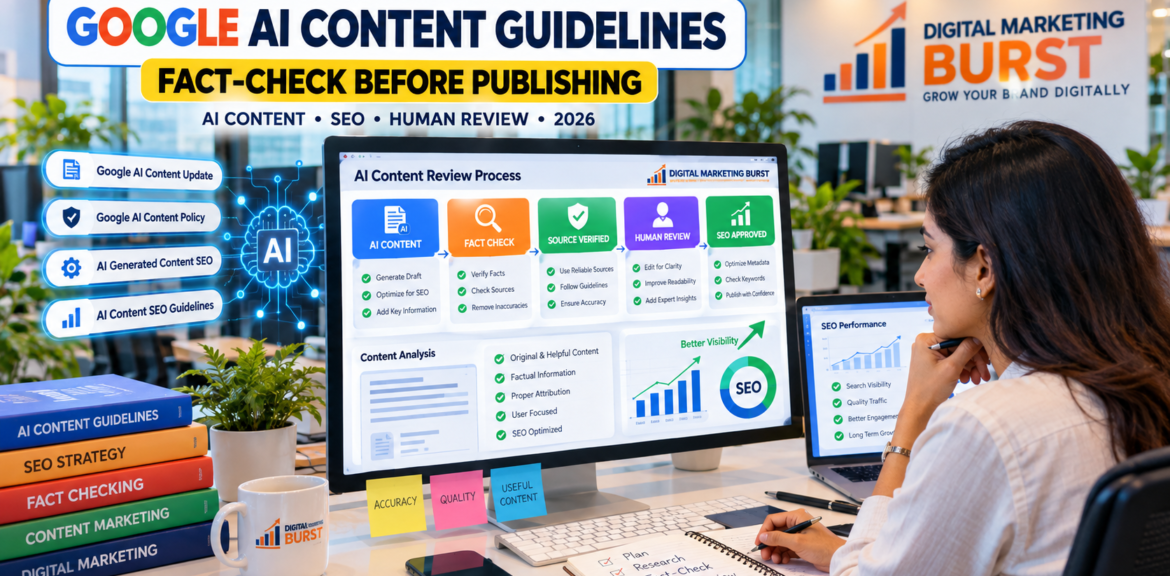

Google Fact-Check AI Content Guidelines: What SEOs Must Know in 2026
Google Fact-Check AI Content Guidelines: What SEOs Must Know in 2026
AI can help a content team research, organise ideas, create drafts and speed up repetitive publishing tasks. However, using AI does not remove the publisher’s responsibility for what eventually appears on a website.
Google Fact-Check AI Content guidance has become increasingly important for publishers using generative AI in their SEO workflow. The latest Google AI Content Update reinforces the need to review AI-generated material carefully, while Google AI Content Guidelines continue to put accuracy, usefulness and people-first publishing at the centre of a strong content strategy.
That distinction became even clearer on October 1, 2026, when Google logged an update to its guidance on using generative AI content. The updated guidance specifically emphasises manually fact-checking and reviewing AI-generated material for accuracy and trustworthiness before publishing. Importantly, this review is not limited to the main article. It also extends to metadata such as title elements, meta descriptions, structured data and image alt text. Google for Developers
For SEOs, publishers and Indian businesses, the practical lesson from the updated Google AI Content Guidelines is not “stop using AI.” Instead, organisations need a stronger editorial process between AI generation and publication.
This guide explains what changed, what Google actually says, how AI Generated Content SEO should be handled in 2026, what needs manual verification and how businesses can build a practical AI content review workflow without turning every article into a slow manual project.
What Changed in Google AI Content Guidelines in October 2026?
Google’s Search documentation changelog records an update to its generative AI content guidance on October 1, 2026. Google says the documentation was updated with information from its Search Quality Rater Guidelines so that its public documentation aligns with material used in developer-event presentations. Google for Developers
The important change is the stronger emphasis on manual verification.
According to the updated guidance reported by Search Engine Journal, Google now explicitly warns that generative AI output can contain inaccuracies, commonly called hallucinations. The guidance therefore tells publishers to manually fact-check and review AI-generated content before publication. Search Engine Journal
This creates an important distinction.
Using AI to assist content production is not automatically the problem. Publishing unchecked output is where publishers create unnecessary accuracy and quality risks.
The Google AI Content Update 2026 therefore deserves attention from anyone using ChatGPT, Gemini, Claude or another generative system in a content workflow.
Google Fact-Check AI Content: What Does It Actually Mean?
The phrase Google Fact-Check AI Content can easily be misunderstood.
It does not mean Google has announced a new button that automatically fact-checks every AI-written webpage before indexing it. Nor does the documentation cited here establish a new standalone “AI fact-check ranking factor.”
The practical message concerns publishers.
If AI contributes information to a page, the publisher should verify factual statements before that material goes live.
Imagine an AI-generated article states that a government scheme has a particular eligibility limit. The information may have been correct when some source in the model’s training data was created but could now be outdated.
A human editor should check the current official government source.
Likewise, if an AI-generated healthcare article gives a medical statistic, the number should not be published merely because the sentence sounds convincing.
The same principle applies to finance, law, technology, travel, education and digital marketing.
Fluent writing is not evidence.
Why Generative AI Can Produce Incorrect Information
Generative AI systems can create remarkably natural language. That fluency can make an incorrect statement appear more trustworthy than it actually is.
Google’s updated guidance highlights the underlying issue: generative models predict likely sequences rather than functioning as guaranteed factual databases. Consequently, generated output can contain inaccuracies. Search Engine Journal
For a content team, errors may appear in several forms.
A date can be wrong.
A person may be assigned the wrong designation.
An outdated product feature may be described as current.
A statistic can appear without a reliable source.
A genuine study may be represented inaccurately.
A URL or citation can even be invented.
These problems become particularly dangerous when an editor assumes that polished language equals verified information.
It does not.
Google Guidelines for AI Content: AI Is Not Automatically Bad for SEO
One of the biggest mistakes around Google Guidelines for AI Content is reducing the discussion to:
“Does Google allow AI content?”
That question is too simplistic.
Google’s existing guidance recognises that generative AI can be useful for activities such as research and adding structure to original content. At the same time, creating large numbers of pages with AI or other automation without adding value for users may violate Google’s policy against scaled content abuse. Search Engine Journal
Therefore, the useful distinction is not simply:
Human content = good
and
AI content = bad
A better distinction is:
Useful, accurate, original, reviewed content
versus
Low-value, inaccurate, mass-produced content
Human writers can produce weak pages too. Similarly, an AI-assisted draft can become useful when knowledgeable people verify, improve and contextualise it.
The publishing process matters.
Google AI Content Policy and Scaled Content Abuse
The Google AI Content Policy conversation becomes more serious when automation is used primarily to manufacture pages at scale.
Google’s spam policies address scaled content abuse. The concern is creating many pages primarily to manipulate search rankings rather than genuinely helping users.
AI is one possible way of producing such pages, but automation is not the only method.
For example, suppose a business creates hundreds of pages by changing only the city name:
“Best SEO Company in Delhi”
“Best SEO Company in Mumbai”
“Best SEO Company in Lucknow”
“Best SEO Company in Jaipur”
If the company has no meaningful location-specific information and the pages provide essentially the same content, adding AI does not create genuine usefulness.
Scale cannot substitute for value.
The safer AI Generated Content SEO strategy is to create a page only when there is a distinct user need that deserves its own useful answer.
Google AI Content Update 2026 Goes Beyond Article Copy
This is one of the most important details for SEO teams.
Manual review should not end after proofreading the article body.
The updated guidance also applies the review concept to metadata, including title elements, meta descriptions, structured data and image alternative text. Search Engine Journal
That changes how a complete AI-assisted publishing workflow should be designed.
Many teams carefully edit a 2,000-word article but automatically generate 50 title tags without checking them.
Others use AI to create schema markup and publish it directly.
Some generate ALT text in bulk without checking whether it actually describes the corresponding image.
Those processes now deserve the same editorial attention as the visible article.
Fact-Check AI-Generated SEO Titles
An SEO title may be short, but it can still contain a factual problem.
Consider an AI-generated title:
“Google Launches New AI Ranking Algorithm in 2026”
That sounds clickable.
However, suppose Google only updated documentation and never announced a new ranking algorithm.
The title would turn a limited factual development into a much broader unsupported claim.
Before approving an AI-generated SEO title, ask:
Does the source support the main claim?
Does the title exaggerate what happened?
Is “confirmed,” “launched,” “penalty,” “ranking factor” or another strong word actually justified?
Would a reader receive what the title promises?
Fact-checking should begin before the click, not after it.
Review AI-Generated Meta Descriptions
Meta descriptions can introduce similar problems.
Suppose AI writes:
“Google’s latest AI update penalises unverified AI-generated content.”
That statement would require evidence.
The October 2026 documentation update discussed here adds stronger manual fact-checking guidance. The sources cited in this article do not establish a newly announced automatic penalty specifically for failing to manually fact-check AI content. Google for Developers
A more accurate description would explain what the page actually covers.
For example:
“Learn what Google’s updated generative AI guidance says about manually reviewing AI-generated content, metadata and SEO elements before publishing.”
Precision is better than manufactured urgency.
AI Content SEO Guidelines for Image ALT Text
ALT text is often treated as a place to insert keywords.
That misunderstands its primary purpose.
Alternative text should help describe the relevant image appropriately in context. If AI generates ALT attributes, someone should confirm that the text matches the actual visual.
Imagine an image shows a marketer checking an AI-generated article against official documentation.
A useful ALT could be:
“SEO editor reviewing AI-generated content against an official source before publishing.”
A poor version might be:
“Google AI Content Guidelines AI Generated Content SEO Google AI Content Update 2026.”
The second version is a keyword list, not a useful description.
AI can draft ALT text. Human review should determine whether that draft accurately represents the image.
Structured Data Also Needs Human Verification
Structured data deserves particular attention because users may not see it directly on the page.
An AI system could generate technically valid JSON-LD while still describing the content incorrectly.
For example, it might:
- add an author who does not exist;
- use a misleading schema type;
- create an incorrect publication date;
- add ratings that are not present on the page;
- include an FAQ that users cannot actually see;
- describe a service that the business does not provide.
Technical validity and factual validity are different things.
A schema validator can identify syntax problems.
It cannot automatically prove every claim in your markup is true.
That is why AI Content SEO Guidelines should include both technical validation and editorial verification.
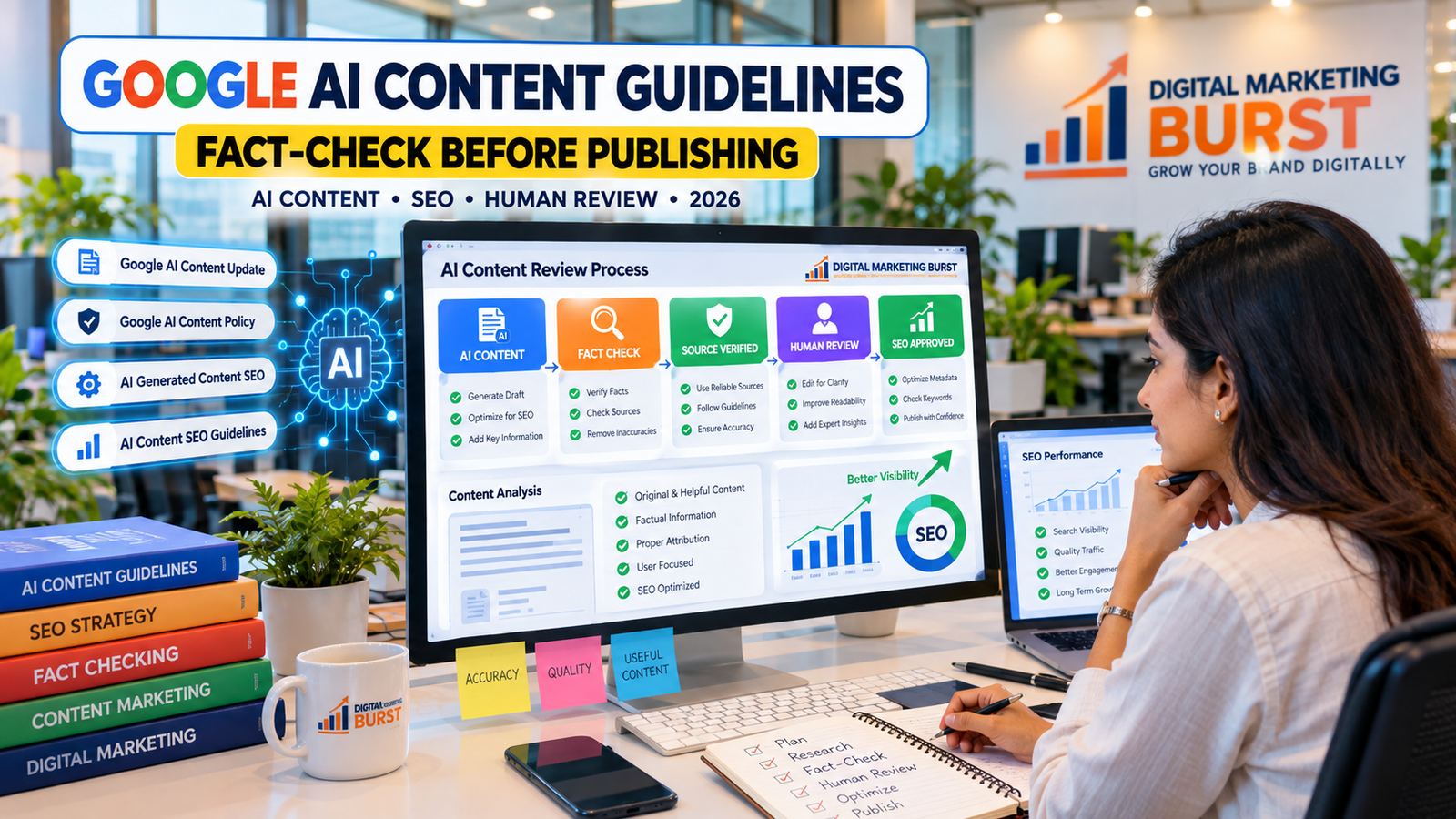
A Practical AI Content Fact-Checking Workflow
Businesses do not need to abandon AI to follow a more responsible process.
They need checkpoints.
Step 1: Separate Facts From Writing
After generating a draft, identify statements that depend on external reality.
Look particularly for:
Dates
Statistics
Prices
Names and job titles
Product specifications
Government rules
Legal requirements
Medical information
Study findings
Market-share figures
Algorithm claims
Quotes
Event dates
Policy changes
These deserve verification.
A sentence expressing an explanation or editorial transition does not need the same type of source checking as a numerical claim.
Step 2: Find the Original Source
Whenever possible, verify a claim against the primary source.
If the article discusses a Google Search policy, start with Google Search Central.
For an Indian government policy, look for the relevant government department.
For company product specifications, use official documentation.
A news article can help you discover a development, but important claims should ideally be traced back to their original documentation where possible.
Step 3: Check the Date
A source can be authentic and still be outdated.
This is especially important for SEO.
Google documentation changes.
Analytics interfaces evolve.
AI products gain and lose features.
Government policies can be revised.
Software documentation gets updated.
Always ask:
“Is this source current enough for the claim I am making?”
Step 4: Check Whether the Source Says What You Think It Says
Finding a URL is not enough.
Read the relevant passage.
A source saying Google “recommends” something is not automatically evidence that the same action is a ranking factor.
Likewise, a document discussing one feature should not be stretched into a claim about Google’s entire algorithm.
Match the strength of your statement to the strength of the evidence.
Step 5: Review the Final Draft Again
Fact-checking individual claims is not the end.
Read the completed page.
Sometimes a collection of technically accurate sentences creates an overall misleading impression.
For instance, repeatedly discussing “AI penalties” could make readers think Google has announced a specific AI-content penalty even when the supporting documentation says something narrower.
Editorial review should therefore examine both individual claims and overall framing.
AI Generated Content for SEO: What Should Be Human-Reviewed?
A practical review system can divide content into levels.
High-Risk Information
Give the strongest scrutiny to:
Health advice
Financial information
Legal information
Safety guidance
Government schemes
Current regulations
Statistics
Scientific claims
Election or political information
Major purchasing decisions
Errors here can materially affect users.
Time-Sensitive Information
Review:
SEO updates
Software features
Product prices
Platform policies
Social-media features
Travel schedules
Opening hours
Event dates
Current company information
These facts may become outdated even when they were once correct.
Low-Risk Editorial Material
Examples include:
Transitions
Basic formatting
Content outlines
Headline alternatives
Non-factual summaries of your own supplied information
Human review remains useful, but the verification burden differs.
This risk-based model can make AI-assisted content production more efficient without treating every sentence identically.
Build a Claim-to-Source Map Before Publishing
One useful improvement is creating a simple internal claim-to-source map.
It does not need to appear publicly.
Suppose your article contains these claims:
Claim: Google updated its generative AI guidance on October 1, 2026.
Source: Google Search Central documentation changelog. Google for Developers
Claim: The new guidance emphasises manual fact-checking of AI output.
Source: Updated Google guidance as reported by Search Engine Journal. Search Engine Journal
Claim: Review extends to metadata.
Source: Same documented guidance. Search Engine Journal
This approach helps an editor identify unsupported claims before publication.
It also makes future updates easier because you know which source supports each time-sensitive statement.
Do Not Ask AI to “Add Some Statistics”
This is one of the easiest ways to damage an otherwise useful article.
A prompt such as:
“Add some powerful statistics to make this blog authoritative”
creates unnecessary risk.
If statistics genuinely improve the answer, find a trustworthy source first.
Then provide the verified data to the writing system.
An even better workflow is:
Source → verified fact → explanation
rather than:
AI-generated claim → search for something that appears to support it
The second process encourages confirmation bias.
Research should shape the claim.
The claim should not dictate the research.
Never Invent Studies or Expert Quotes
A fabricated quote can look completely believable.
That makes it particularly dangerous.
If AI attributes a statement to Google’s John Mueller, Gary Illyes or another named person, verify the original source before publishing it.
The same applies to research papers.
Check that the study exists.
Confirm the authors.
Read enough of the source to understand what was actually studied.
Make sure the conclusion in your article is not stronger than the study’s conclusion.
A citation is useful only when it genuinely supports the statement attached to it.
AI Hallucinations Can Affect Internal Links Too
Fact-checking is not limited to external facts.
AI can invent internal URLs.
For example, it may suggest:
yourwebsite.com/ai-seo-services-india/
even when that page has never existed.
Publishing the suggestion creates a broken link.
The safer workflow is to search your actual website first.
Use only existing URLs.
If the ideal supporting page does not exist, record it as a future content opportunity rather than inventing a destination.
Internal linking should help users continue their journey, not create artificial SEO signals.
AI Can Misrepresent Your Own Business
Another overlooked risk appears in promotional content.
AI may write:
“Trusted by 5,000+ businesses.”
“India’s #1 SEO agency.”
“98% client success rate.”
“Guaranteed first-page rankings.”
Unless the business has evidence supporting those statements, they should not be published as facts.
This applies to service pages, landing pages, Google Business Profile content and blog CTAs.
AI does not know which internal business claims have been substantiated unless you provide that evidence.
Your own company information needs fact-checking too.
Google Policy on AI Content and Human Value
The Google Policy on AI Content should not be interpreted as a checklist where adding a human editor magically makes any page useful.
Human review can improve accuracy.
It cannot rescue a page that has no reason to exist.
Before publishing, ask a more fundamental question:
What will a visitor gain from this page that they could not get from a thin summary?
For an Indian business article, value could come from:
A practical workflow.
India-specific examples.
Original screenshots.
A decision framework.
First-party data.
Expert commentary from a real person.
Clear explanations of complex documentation.
A comparison based on verified information.
A useful template.
Content should earn its place through usefulness, not through its production method.
Google AI Content Guidelines and Originality
Factually correct content can still be weak if it simply repeats what every competing article says.
Suppose 50 websites summarise the same Google announcement.
Creating a 51st summary with different wording adds limited value.
A stronger article might explain how an Indian SEO team should redesign its editorial workflow after the update.
Another could provide a practical verification checklist.
A publisher might compare what changed with Google’s previous guidance.
The underlying news remains the same.
The added value comes from analysis, implementation and context.
This is where human editorial judgement becomes especially important.
Does Google Penalise AI-Generated Content?
Avoid reducing Google’s guidance to a claim that all AI-written content receives a penalty.
The sources supporting this article do not establish such a blanket rule.
Google’s guidance instead focuses on usefulness, quality and compliance with spam policies. It warns that generating many pages without adding value can violate its scaled content abuse policy. Search Engine Journal
Therefore:
AI involvement alone ≠ proof of a penalty.
At the same time:
Using AI ≠ permission to mass-publish low-value pages.
The content still needs to satisfy users and comply with Search policies.
Can AI-Generated Content Rank on Google?
This question also needs careful wording.
There is no sensible basis for promising that an AI-assisted page will rank simply because it has been fact-checked.
Search visibility depends on many factors.
Manual verification improves reliability, but it is not a ranking guarantee.
Likewise, human-written content is not automatically entitled to high rankings.
A page still needs to be useful, relevant, accessible to search engines and competitive for its query.
Treat fact-checking as an editorial quality requirement rather than a ranking trick.
AI SEO Content Guidelines for Indian Businesses
Indian businesses often operate with small marketing teams.
That makes automation attractive.
A business may need website copy, social posts, blog articles, product descriptions, email campaigns and local landing pages with limited staff.
The solution is not necessarily to eliminate AI.
Instead, decide which work AI can accelerate and which decisions require human responsibility.
AI can help with:
Drafting outlines.
Organising supplied research.
Creating alternative headings.
Simplifying complicated explanations.
Summarising verified notes.
Suggesting questions a reader may have.
A human should remain responsible for:
Factual accuracy.
Brand claims.
Legal or regulatory statements.
Source quality.
Final editorial judgement.
Publishing approval.
This division can preserve efficiency without treating AI output as automatically publishable.
Create a Two-Pass Editorial System
A useful AI Content SEO Guidelines workflow separates factual review from writing review.
Pass One: Accuracy
Ask:
Is every important claim supported?
Are dates current?
Are statistics traceable?
Are names correct?
Are quotes authentic?
Do sources actually support the statements?
Is schema accurate?
Does ALT text match the image?
Pass Two: Usefulness
Then ask:
Does this answer the searcher’s question?
Is anything repetitive?
Does the article contain unnecessary filler?
Are examples useful?
Does the introduction reach the point quickly?
Are headings meaningful?
Is the conclusion simply repeating the introduction?
Separating these reviews can catch problems that a single proofreading pass misses.
Add a Verification Status to Your Content Workflow
Larger teams can make verification visible inside their editorial system.
For example:
Drafted → Sources Added → Facts Verified → SEO Reviewed → Final Approval → Published
A high-risk article might require a subject specialist before Final Approval.
A routine marketing explainer may need only an experienced editor.
The goal is accountability.
If nobody knows who verified the information, everyone can assume somebody else did it.
A defined workflow removes that ambiguity.
Review Existing AI-Assisted Content Too
The Google AI Content Update 2026 is also a useful reason to audit older content.
You do not need to panic-edit every article.
Prioritise pages where outdated information would matter most.
Start with pages containing:
Current statistics.
Google or platform policies.
Prices.
Product features.
Legal information.
Health claims.
Software instructions.
Dates.
Named executives.
Time-sensitive recommendations.
Then verify whether the claims remain accurate.
Content maintenance can be more valuable than publishing another article on the same subject.
Fact-Check AI Content Before Updating Old Articles
AI is increasingly used to refresh existing posts.
That can introduce a new problem.
An older article may contain verified information, while the AI-generated “update” introduces unsupported claims.
Do not assume newer text is more accurate merely because it sounds current.
Compare new claims against primary sources.
Preserve useful existing material.
Remove genuinely outdated information.
Add new sections only when they improve the page.
A content refresh should increase reliability, not simply change the publication date.
AI Content Fact-Checking for Local SEO
Local businesses should apply the same principles to location information.
Check:
Business name.
Address.
Phone number.
Opening hours.
Service areas.
Available services.
Branch information.
Doctor or professional profiles.
AI may infer that a company serves an entire state because it has one article about that state.
That inference can mislead potential customers.
Local SEO content should reflect the actual business operation.
Traffic from an irrelevant location is not automatically valuable traffic.
Fact-Checking AI-Generated Product and Service Pages
Commercial pages require particularly careful language.
AI tends to produce confident promotional statements.
Watch for phrases such as:
“Best in India.”
“Guaranteed results.”
“100% effective.”
“Industry-leading.”
“Number one.”
“Trusted by thousands.”
Each statement should either be supported appropriately or rewritten.
A useful service page can still be persuasive without inventing superiority.
Explain what the service includes.
Describe the process.
Clarify who it is suitable for.
Answer genuine purchasing questions.
Specificity is often more persuasive than unsupported hype.
What Google’s Update Does Not Say
Understanding the limits of the announcement is just as important as understanding the update itself.
Based on the documentation and reporting reviewed for this article, the October 2026 change should not automatically be interpreted as:
A ban on AI-generated content.
A new confirmed AI-content penalty.
A new standalone ranking factor called “AI fact-checking.”
Proof that human-written content always ranks above AI-assisted content.
A requirement to disclose AI use on every page.
Evidence that one specific AI-detection score determines rankings.
Those would go beyond what the cited update establishes. Google for Developers
Careful SEO reporting distinguishes documentation from speculation.
A Pre-Publish AI Content Checklist
Before an AI-assisted page goes live, the editor should be able to answer these questions:
Accuracy: Are factual claims verified?
Sources: Are important claims supported by reliable sources?
Freshness: Are time-sensitive facts current?
Intent: Does the page genuinely answer the search query?
Original value: Does it add something beyond a rewritten summary?
Title: Is the headline accurate rather than sensational?
Meta description: Does it represent the page honestly?
Images: Does ALT text describe the actual image?
Structured data: Does markup match visible page content?
Internal links: Do all linked URLs actually exist?
External links: Are they trustworthy and relevant?
Business claims: Can promotional statements be substantiated?
Language: Has generic AI filler been removed?
Final review: Has a responsible person actually approved publication?
If several answers are “no,” the page is not ready.
How SEOs Should Adapt Their AI Workflow in 2026
The biggest change should happen between generation and publication.
A weak workflow looks like:
Keyword → AI prompt → article → publish
A stronger workflow looks like:
Search intent → source research → content brief → AI-assisted draft → claim verification → expert/editor review → SEO review → metadata review → publish → monitor and update
AI remains part of the system.
It simply stops being the final authority.
For agencies handling multiple clients, this workflow also creates clearer responsibility. A writer knows what needs sourcing, an editor knows what needs verification and the SEO specialist can focus on search intent and page performance.
Google AI Content Guidelines: Accuracy Is Only One Part of Quality
The updated fact-checking guidance deserves attention, but accuracy alone does not create excellent content.
A perfectly accurate article can still be repetitive, generic or unhelpful.
Strong content needs several qualities at once:
Accuracy.
Relevance.
Original value.
Clear structure.
Appropriate sourcing.
Useful examples.
Good user experience.
Maintenance when information changes.
That combination is much harder to automate fully.
It is also why human editorial judgement remains valuable even as AI tools become more capable.
FAQs About Google Fact-Check AI Content Guidelines
Does Google require AI content to be fact-checked?
Google’s October 2026 update strengthens its guidance around manually fact-checking and reviewing AI-generated content for accuracy and trustworthiness before publication. The review also applies to metadata. Google for Developers
Does Google ban AI-generated content?
The guidance discussed here does not establish a blanket ban on AI-generated content. Google acknowledges legitimate uses of generative AI while warning against scaled content created without added value. Search Engine Journal
Is AI-generated content bad for SEO?
Not simply because AI assisted in creating it. Problems arise when content is inaccurate, low-value, misleading, unoriginal or produced in ways that conflict with Google’s spam policies.
Should AI-generated meta descriptions be fact-checked?
Yes. Google’s updated guidance extends the review principle to metadata, including title elements, meta descriptions, structured data and image alt text. Search Engine Journal
Can I publish an AI-written article after checking grammar?
Grammar checking alone is insufficient. Important factual claims, sources, dates, metadata, business claims and structured data should also be reviewed.
Should every AI claim have an external citation?
Not every ordinary sentence requires a citation. However, statistics, changing facts, important factual claims and claims that readers may reasonably want to verify should be supported by reliable evidence where appropriate.
Can fact-checking guarantee better Google rankings?
No. Fact-checking improves reliability and supports responsible publishing, but it does not guarantee indexing, rankings or traffic.
Conclusion
The Google Fact-Check AI Content Guidelines discussion marks an important shift in how businesses should think about AI-assisted publishing in 2026.
The key question is no longer simply whether AI can produce an article.
It can.
The more important question is whether a responsible person has verified what the system produced before that information reaches users.
Google’s October 2026 documentation update makes manual review particularly important for AI-generated factual content and extends that thinking beyond article copy to titles, meta descriptions, structured data and image alt text. Google for Developers
For SEOs, this does not require abandoning AI. It requires a better workflow.
Use AI where it improves efficiency. Verify claims against reliable sources. Review metadata with the same care as body copy. Remove unsupported statements, avoid mass-producing thin pages and add genuine expertise or practical value where it helps the reader.
Google AI Content Guidelines: Fact-Checking Should Start Before Writing
Many content teams treat fact-checking as the final stage.
That is often too late.
A stronger workflow begins with verified research before AI generates the first full draft.
Suppose an SEO writer is covering a new Google Search update. Instead of asking an AI tool:
“Write everything about Google’s latest SEO update.”
the team should first locate Google’s official documentation and establish what was actually announced.
The verified facts can then become the boundaries of the content brief.
This creates a better sequence:
Primary research → verified facts → content brief → AI-assisted drafting → manual verification → editing → publishing
With this process, AI is less likely to build an entire article around an incorrect assumption.
Build a Verified Source Pack Before Generating Content
A small source pack can dramatically improve an AI-assisted workflow.
For a Google SEO update, it might contain Google’s announcement, relevant Search Central documentation and supporting material needed to explain the change.
For an Indian government topic, the pack could contain the relevant ministry or department page.
A software tutorial should begin with current product documentation.
The source pack does not need dozens of URLs.
Quality matters more than quantity.
Three authoritative sources that directly answer the topic can be more useful than twenty loosely related articles.
This also helps prevent an AI model from filling factual gaps with plausible-sounding information.
Primary Sources Should Lead Important Claims
Not every topic has a perfect primary source.
When one exists, however, it should usually be the starting point for important factual claims.
For Google AI Content Policy, Google Search Central is more authoritative about Google’s published Search guidance than a social-media discussion interpreting it.
Likewise, Google’s documentation changelog confirms that its generative AI content guidance was updated on October 1, 2026.
Secondary reporting still has value.
A publication can explain an update, provide context or identify a change that is difficult to notice inside technical documentation.
The important point is not to confuse commentary about a source with the source itself.
Use a Source Hierarchy for AI Generated Content SEO
A simple hierarchy makes verification faster.
For many SEO articles, think about sources in this order:
Level 1 — Primary sources
Official documentation, government websites, original research, regulatory documents and first-party announcements.
Level 2 — Strong secondary sources
Established publications that directly report and analyse the original development.
Level 3 — Supporting sources
Industry blogs, expert commentary and credible educational resources.
Level 4 — Discovery sources
Social posts, forum discussions, videos and other material that may help you discover a topic but should not automatically become the evidence for an important claim.
The hierarchy is not absolute.
Still, it prevents a common problem: citing a blog that cites another blog that eventually points to the original document.
AI Generated Content for SEO Needs Claim-Level Verification
Checking that an article “looks correct” is not enough.
Break important statements into individual claims.
Consider:
“Google updated its generative AI guidance on October 1, 2026 and introduced a new ranking penalty for unverified AI content.”
That sentence contains at least two claims.
The first can be checked against Google’s documentation changelog.
The second would require separate evidence.
If the source supports the documentation update but does not announce a new ranking penalty, the sentence cannot be published as written.
Rewrite it:
“Google updated its generative AI content guidance on October 1, 2026, strengthening the emphasis on reviewing AI-generated material for accuracy.”
Claim-level verification prevents one supported fact from being used to smuggle in a second unsupported conclusion.
Learn to Separate Fact, Interpretation and Recommendation
This is one of the most useful editorial skills for AI Content SEO Guidelines.
These three statements are fundamentally different:
Fact: Google updated its generative AI content documentation.
Interpretation: The update indicates that manual editorial review deserves greater attention in AI-assisted publishing workflows.
Recommendation: SEO teams should create a documented fact-checking stage before publication.
The first statement needs factual evidence.
The second is analysis based on that evidence.
The third is practical advice.
AI-generated articles often blur these categories.
An interpretation can suddenly be written as though Google explicitly said it. A recommendation may be presented as a formal Search requirement.
Good editing keeps the boundaries visible.
Avoid Turning Google Recommendations Into Ranking Factors
SEO content frequently makes this mistake.
Google recommends something.
A blog then says:
“This is now a Google ranking factor.”
Those statements are not equivalent.
Unless Google or strong supporting evidence establishes that a particular element functions as a ranking factor, do not make that leap.
The updated fact-checking guidance should therefore not be rewritten as:
“Manual AI fact-checking is Google’s new ranking factor.”
A more accurate explanation is that manual verification supports accurate and trustworthy publishing.
Whether a particular editorial action has a direct measurable ranking effect is a separate question.
Google AI Content Update 2026: Avoid the “Penalty” Headline Trap
The word penalty attracts clicks.
It can also distort SEO reporting.
Imagine an article titled:
“Google’s New AI Update Will Penalise Every Unverified AI Article.”
Such a headline makes several strong claims.
It suggests a newly announced enforcement mechanism.
It implies universal application.
It specifically connects the mechanism to unverified AI articles.
Unless reliable evidence supports each part, the title should not be published.
An accurate headline may attract fewer curiosity clicks than an exaggerated one, but it protects the credibility of the publication.
For long-term SEO, credibility is more useful than manufactured alarm.
AI Content Fact Checking Should Include Numbers
Numbers deserve additional scrutiny because they create an impression of precision.
Watch for:
Percentages.
Market sizes.
Growth rates.
Survey results.
Search-volume figures.
Traffic estimates.
Conversion rates.
Prices.
Dates.
Distances.
Population figures.
AI models can generate numbers that look realistic even when they are unsupported.
If you cannot find a reliable source, remove the number or clearly explain its limitations.
Never create a statistic simply because an article “needs data.”
Search Volume Claims Need Verification Too
This matters particularly for SEO agencies and marketers.
Suppose AI says:
“AI content SEO receives 50,000 monthly searches in India.”
Where did that number come from?
If you cannot trace it to a current keyword dataset, do not publish it as fact.
Search-volume estimates can also differ between tools.
The country, timeframe, match methodology and database matter.
Instead of inventing precision, state what you actually know.
For example:
“Search interest exists around AI content and Google SEO guidance, but current India-specific volume should be verified using your preferred keyword research platform before making a numerical claim.”
That is less dramatic but much more defensible.
Dates Are a Major AI Content Risk
AI can confuse publication dates, announcement dates, rollout dates and effective dates.
These differences matter.
A Google feature may be announced on Monday but begin rolling out later.
A government notification may be published on one date and take effect on another.
A software feature might be available to selected users before a wider release.
When reviewing an AI-generated date, ask:
What exactly happened on this date?
Was it announced, launched, updated or completed?
Does the primary source specify a timezone?
Is the information still current?
Small date errors can change the meaning of an entire news article.
Verify Names, Roles and Organisations
Names are another area where plausible errors can survive proofreading.
Check spelling.
Confirm current job titles.
Verify whether the person actually belongs to the organisation being discussed.
Do not assume that someone still holds the same position because an older article identifies them that way.
This matters for expert quotations too.
If a statement is attributed to a named person, locate the original interview, post, video, transcript or publication where possible.
Never publish a quotation simply because AI supplied quotation marks.
Quotes Require Stronger Verification
A paraphrase and a direct quote are not interchangeable.
If AI writes:
“Google says AI content must always be manually written.”
you need to know whether those exact words exist.
If they do not, quotation marks should not be used.
Instead, explain the underlying guidance accurately in your own words and cite the relevant source.
Direct quotes carry an implicit promise:
These are the person’s or organisation’s actual words.
Treat that promise seriously.
When exact wording is unnecessary, careful paraphrasing can be safer and clearer.
Check Whether Research Actually Supports the Conclusion
Research papers are particularly vulnerable to oversimplification.
An AI model may identify a genuine study but exaggerate its conclusion.
For example:
A study finds an association.
The generated article says it proved causation.
A small experiment is described as universally applicable.
Research involving one population is presented as evidence for everyone.
An old study is described as “new research.”
Verification should therefore go beyond confirming that a paper exists.
Read enough of the original material to understand what was studied and what the authors actually concluded.
Google Policy on AI Content for YMYL Topics
Some content categories deserve a much stricter verification standard.
Health, financial safety, legal issues and other high-impact topics can affect important life decisions.
An incorrect restaurant recommendation may be inconvenient.
Incorrect medication guidance can be dangerous.
This difference should influence the editorial process.
If AI assists with a high-impact topic, subject-matter review may be necessary in addition to ordinary SEO editing.
A general content writer should not transform an AI-generated medical statement into “expert advice” merely by improving its grammar.
Indian Businesses Need India-Specific Verification
Global AI content can easily introduce information that does not apply in India.
Consider an article about:
Tax.
Employment rules.
Insurance.
Banking.
Advertising regulations.
Consumer rights.
Medical procedures.
Education.
An AI model may provide information based on another jurisdiction unless the context is explicit.
Indian businesses should verify such claims against appropriate Indian sources.
Adding “India” to a keyword is not enough.
The actual information must fit the Indian reader.
AI SEO Content Guidelines for Local Business Information
Local content creates another common failure mode.
Suppose a business operates only in Lucknow.
AI may generate:
“We provide services across Uttar Pradesh.”
Why?
Because it sees a city-level service and generalises the coverage.
That sentence can create irrelevant leads and mislead users.
Check every location claim.
Confirm actual service areas.
Review branch addresses.
Verify phone numbers.
Make sure opening hours are current.
Do not create local landing pages for places where the business has no meaningful offering merely to capture geographic searches.
Fact-Check AI-Generated Competitor Comparisons
Comparison content can attract commercial traffic, but it carries factual responsibilities.
If an AI-generated article says:
“Competitor A does not provide Feature X.”
verify that statement.
The product may have changed.
Pricing may have been updated.
A feature could be available only on a particular plan.
Instead of presenting uncertain information as permanent, date the comparison where appropriate and link to current official sources.
A comparison should help the buyer make a decision, not create a misleading advantage for your brand.
Review AI-Generated Product Specifications
Product specifications appear objective, which makes errors particularly noticeable.
Verify:
Model names.
Storage.
Dimensions.
Battery capacity.
Processor.
Compatibility.
Warranty.
Pricing.
Availability.
Launch date.
Regional variations.
Do not combine specifications from two product generations.
For Indian readers, also confirm that a feature available internationally is actually available in the Indian version.
An AI system may not recognise regional differences unless the source material makes them explicit.
Check AI-Generated Legal and Compliance Statements
Legal language often sounds authoritative even when it is incomplete.
Phrases such as:
“Businesses are legally required to…”
should immediately trigger verification.
Which law?
Which jurisdiction?
Which businesses?
From what date?
Are there exceptions?
A general content model should not become the final legal authority for a company website.
Where professional legal advice is appropriate, the article should not pretend otherwise.
Review AI-Generated Health Information Carefully
Healthcare websites have an even higher responsibility.
AI can help structure educational material, but clinical facts should come from reliable medical sources and appropriate professional review.
Check drug names.
Verify symptoms and warning signs.
Avoid unsupported treatment success claims.
Do not invent doctor credentials.
Never create patient testimonials.
Check whether statistics apply to the population being discussed.
Marketing objectives should not weaken medical accuracy.
Trust can be lost very quickly when health information is careless.
How to Handle Conflicting Sources
Fact-checking does not always produce one clean answer.
Two credible sources may disagree.
Do not automatically choose whichever supports the article you already wrote.
First, compare publication dates.
Then examine methodology and scope.
Check whether one source is primary.
Look for differences in definitions.
Sometimes both figures are correct but measure different things.
When genuine uncertainty remains, say so.
For example:
“Available sources report different figures because they use different measurement periods.”
Transparency is better than false certainty.
What to Do When No Reliable Source Exists
AI sometimes produces a claim that sounds useful but cannot be verified.
You have three sensible choices.
Remove it.
Rewrite it as a clearly identified possibility if that framing is justified.
Or conduct additional research before publishing.
Do not keep a statement simply because it makes the article sound authoritative.
Lack of evidence is itself useful editorial information.
The sentence may not belong on the page.
Use AI to Challenge the Draft, Not Approve It
AI can still help during quality control.
One useful technique is asking a separate review pass to identify:
Claims requiring sources.
Potentially outdated statements.
Overconfident wording.
Internal contradictions.
Unsupported superlatives.
Missing context.
This is not the final fact-check.
It is a way to find areas a human should investigate.
The distinction matters because asking the same class of system that generated a hallucination to certify its own accuracy is not independent verification.
Create a “Needs Verification” Marker During Drafting
Writers should not stop every few sentences to research.
A simple marker can maintain momentum.
For example:
[VERIFY: date]
[VERIFY: statistic]
[VERIFY: Google claim]
[VERIFY: pricing]
[VERIFY: quote]
The editor can then search the draft for VERIFY before publication.
No marker should survive into the final page.
This system is particularly useful when multiple people work on the same article.
Maintain a Source Log for Important Articles
For evergreen or high-value pages, maintain a simple source log.
Record:
Claim.
Source URL.
Source organisation.
Publication/update date.
Date checked.
Editor.
This makes future content refreshes easier.
Six months later, you do not need to rediscover why a particular number was included.
Instead, check whether the supporting source has changed.
The source log becomes part of content maintenance rather than a one-time SEO task.
Fact-Checking Is Different From Proofreading
These terms should not be confused.
Proofreading asks:
Is the spelling correct?
Is the grammar clean?
Is punctuation appropriate?
Fact-checking asks:
Is the information true and properly supported?
SEO review asks:
Does the page match search intent?
Is the structure clear?
Are metadata and internal links appropriate?
Editorial review asks:
Is the overall article useful, coherent and responsible?
One person can perform several roles.
The roles still involve different questions.
A grammatically perfect hallucination remains a hallucination.
Human Review Should Add More Than Error Correction
A human editor should not merely act as a spellchecker after AI.
Human input is particularly valuable for judgement.
Does this example make sense for an Indian business?
Is the explanation unnecessarily complicated?
Would a beginner misunderstand this paragraph?
Does the article overstate what Google said?
Is the page genuinely different from existing content?
Does this section answer something the reader actually cares about?
These decisions go beyond factual verification.
They turn information into useful communication.
Google AI Content Guidelines and Search Intent
An accurate page can still fail its reader if it answers the wrong question.
Imagine someone searches:
“Google AI Content Guidelines”
They probably want to understand what Google’s guidance means and how it affects publishing.
A 5,000-word history of artificial intelligence would not satisfy that need.
Similarly, someone searching:
“Can AI-generated content rank on Google?”
needs a clear explanation before a long discussion of AI technology.
Fact-checking and search intent therefore work together.
Accuracy determines whether information can be trusted.
Intent determines whether that information is useful to this particular reader.
Avoid Keyword Variations That Add No New Value
Your target terms include:
Google AI Content Guidelines
Google Guidelines for AI Content
Google AI Content Update
Google AI Content Update 2026
AI Generated Content SEO
AI Generated Content for SEO
Google AI Content Policy
Google Policy on AI Content
AI Content SEO Guidelines
AI SEO Content Guidelines
These phrases are closely related.
They do not need ten separate near-identical sections.
Use each naturally where the subject fits.
Creating one heading per keyword simply to achieve exact-match coverage would make the article repetitive.
Semantic coverage should improve comprehension rather than dictate the writing.
Should You Disclose That AI Was Used?
The October 2026 guidance discussed in this article should not automatically be converted into a universal claim that every AI-assisted article must display an AI disclosure.
Instead, consider whether disclosure is useful or required in the particular context.
The more important universal editorial responsibility is that the publisher stands behind the accuracy of what appears on the page.
A disclosure does not repair false information.
Likewise, absence of a disclosure does not make accurate information inaccurate.
Treat transparency questions according to context rather than inventing a Google requirement that the cited guidance does not establish.
AI Detection Scores Are Not a Fact-Checking System
An AI detector attempts to estimate how text may have been produced.
That is a different question from whether the text is true.
A paragraph could receive a high “human” score and contain several factual errors.
Another could be AI-assisted and entirely accurate after careful verification.
Do not substitute detection for editorial review.
For SEO teams, the more useful questions are:
Is this accurate?
Is it original?
Is it useful?
Does it satisfy intent?
Can important claims be supported?
Those questions focus on the page rather than guessing how every sentence was generated.
AI Content Should Not Be “Humanised” Just to Evade Detection
Another weak workflow looks like this:
Generate AI article → run through AI humaniser → publish
Changing sentence patterns does not verify a single fact.
It may even introduce new errors.
If the underlying article is generic, rewriting it to appear less machine-generated does not add meaningful expertise.
Spend that effort on research instead.
Add useful examples.
Verify claims.
Remove repetition.
Improve explanations.
Include original business knowledge where appropriate.
A page should become more human because humans improved its value, not because software disguised its linguistic patterns.
Updating Content Is Part of Fact-Checking
Accuracy has a lifespan.
An article may be completely correct when published and misleading one year later.
This is particularly true for Google AI Content Update topics.
Create a maintenance schedule based on how quickly information can change.
A general writing guide may need occasional review.
A live product-feature article might need much more frequent checking.
When updating, inspect the facts rather than merely changing:
“Updated: 2025”
to:
“Updated: 2026.”
A changed date without changed verification is not a genuine content refresh.
Monitor Official Sources After Publishing
For rapidly changing topics, identify the source that would reveal an important change.
For this article, Google’s Search documentation is an obvious one.
If Google materially changes its generative AI guidance, the page may need revision.
Monitoring reduces the risk of leaving outdated claims online for months.
It also creates a healthier content strategy.
Instead of endlessly publishing new posts about minor variations of the same subject, maintain the authoritative page you already have.
When Should an Existing Article Be Updated Instead of Creating a New One?
Ask whether the new development changes the intent of the existing page.
If it simply adds a new detail to the same question, update the existing article.
If it introduces a substantially different problem that deserves independent treatment, a new page may make sense.
For example, a general guide to AI SEO and a detailed guide to fact-checking AI-generated content can serve different intents.
However, five articles targeting minor variations of Google AI Content Guidelines may compete with each other and create unnecessary duplication.
Content architecture matters.
Prevent Keyword Cannibalisation Around AI SEO
Before publishing a new AI-related article, search your own website.
Look for pages already targeting:
AI SEO.
AI content.
Google AI guidelines.
AI visibility.
Generative Engine Optimization.
AI search.
If another page answers almost the same question, decide whether the new article can have a clearly different purpose.
For this topic, the differentiator should be verification and editorial workflow.
That gives the article a clear reason to exist beyond a generic AI SEO guide.
A Practical Workflow for a Small Indian Marketing Team
A small business does not need a large editorial department.
One workable process is:
Researcher/SEO: establishes intent and gathers authoritative sources.
AI/writer: develops the draft from verified research.
Editor: checks important claims and removes unsupported statements.
SEO reviewer: checks title, meta, internal links, ALT text and search intent.
Final approver: confirms the page is ready.
In a very small company, one person may perform all four functions.
That is fine.
The important part is performing the functions, not creating job titles.
A Practical Workflow for Agencies Handling Multiple Clients
Agencies face an additional problem: client facts.
AI cannot safely guess them.
Create a verified client-information sheet containing:
Business name.
Locations.
Service areas.
Services.
Approved claims.
Professional credentials.
Contact details.
Brand terminology.
Restricted claims.
Important disclaimers.
Writers and AI systems should work from this approved information.
If a claim is not in the source sheet, verify it before adding it.
This reduces hallucinations about the client’s own business.
Build a “Do Not Invent” List
Every AI content brief can contain a short instruction:
Do not invent:
Statistics.
Client results.
Testimonials.
Awards.
Certifications.
Office locations.
Service areas.
Prices.
Case studies.
Expert quotes.
Product features.
Business history.
This does not guarantee perfect output.
However, it clearly establishes the editorial boundary.
The final human review remains necessary.
AI Content SEO Guidelines for Internal Linking
Internal links should be verified just like external claims.
Check that the destination exists.
Confirm the URL returns the intended page.
Use anchor text that accurately describes the destination.
Avoid forcing unrelated links merely to increase the number of internal links.
Also check whether a better page exists.
For example, an article discussing AI search measurement should link to a relevant AI visibility guide rather than an unrelated service page simply because the latter is commercially important.
User navigation should lead the decision.
AI Content SEO Guidelines for External Linking
External links should support the reader, not merely decorate the article.
Use authoritative sources for important factual claims.
Link close to the statement being supported.
Do not cite a source that discusses the broad topic but does not support the specific claim.
Avoid unnecessary chains of secondary sources when the primary documentation is available.
Check links again before publishing.
A reliable article with broken references quickly becomes less useful.
Review Metadata as a Miniature Version of the Page
Your SEO title and meta description should represent the page accurately.
Treat them as condensed editorial content.
If the article explains guidance, the title should not announce a penalty.
If the article discusses recommendations, the meta description should not call them mandatory rules unless they actually are.
If a year appears in the title, make sure the article genuinely contains current information for that year.
Metadata may be short.
Its factual responsibility is not.
Review Image Generation Prompts Too
AI image generation introduces another layer of verification.
Suppose the article concerns Google AI guidance.
A generated image might show a fake Google interface, invented warning message or fabricated “AI penalty score.”
Readers could interpret that visual as real.
Avoid designs that mimic official dashboards unless the visual is genuinely based on a real interface and clearly presented appropriately.
For conceptual images, make the concept obviously illustrative.
Do not create fake screenshots merely because they look authoritative.
ALT Text Should Describe, Not Advertise
If your featured image shows an editor reviewing AI-generated content, describe that.
Do not transform ALT text into:
“Google AI Content Guidelines Google AI Content Update AI Generated Content SEO Best Agency India.”
That is not useful alternative text.
A better version is:
“SEO editor fact-checking AI-generated content against source documents before publication.”
The surrounding page already provides topical context.
ALT text does not need to carry the entire keyword strategy.
Structured Data Must Match Visible Content
AI can generate schema quickly.
That speed creates temptation to add markup simply because it is available.
Do not mark up reviews that do not exist.
Do not add ratings that users cannot see.
Avoid false author information.
Make sure dates match the page.
Choose a schema type that reflects the actual content.
For this article, Article or BlogPosting with BreadcrumbList is sufficient.
More schema does not automatically mean better SEO.
What Should Happen When an Error Is Found After Publishing?
Correct it.
For meaningful errors, consider whether readers need an explanatory update.
Then inspect how the mistake entered the workflow.
Was the source outdated?
Did AI invent the claim?
Did the editor misread a source?
Was client information incorrect?
Did nobody perform final verification?
The goal is not merely fixing one sentence.
It is preventing the same failure from happening again.
Measure Content Quality Beyond Rankings
SEO performance matters, but rankings alone do not tell you whether your editorial system is healthy.
Internally, teams can also monitor:
Corrections required after publication.
Broken references discovered.
Outdated claims identified.
Pages refreshed.
Unsupported claims caught before publishing.
User questions revealing unclear information.
These are operational signals rather than Google ranking metrics.
They can still help improve the content process.
Do not turn them into a fabricated “Google quality score.”
A 15-Minute Final Verification Pass
For a standard marketing article, a final pass can be organised efficiently.
Minutes 1–3: Scan dates, numbers, names and strong factual claims.
Minutes 4–6: Open important sources and confirm they support the wording.
Minutes 7–9: Review title, meta description and headings for exaggeration.
Minutes 10–11: Check internal and external links.
Minutes 12–13: Review ALT text and structured data.
Minutes 14–15: Read the introduction and conclusion together to ensure the page makes the same accurate promise from beginning to end.
This is not sufficient for every topic.
Health, legal, financial and other high-impact content can require deeper specialist review.
For routine marketing content, however, a structured final pass is much better than clicking Publish immediately after generation.
Google Fact-Check AI Content: The Standard Should Be Publishable, Not Plausible
AI has made plausible writing extremely cheap.
That changes the value of editorial work.
The competitive advantage is no longer simply producing grammatically correct paragraphs quickly.
Businesses need information that can survive scrutiny.
A reader should be able to follow a source.
A client should recognise their actual services.
A statistic should have a real origin.
A title should accurately represent what happened.
A recommendation should be distinguishable from an official rule.
That is the practical standard behind a mature Google Fact-Check AI Content workflow.
Many websites adopted generative AI before establishing a formal editorial process. As a result, older pages may contain unsupported statistics, outdated product information, weak citations, overconfident claims or metadata that was never manually checked.
That does not mean every AI-assisted article needs to be deleted or rewritten.
A better approach is to audit pages according to risk, traffic value, freshness and user intent. The objective is not to make content “look less AI-generated.” It is to make every important page more accurate, useful and defensible.
Google AI Content Guidelines: Start With an Existing Content Audit
Do not begin by rewriting the entire website.
First, understand what is already published.
Create a content inventory containing useful information such as:
URL → Page Type → Topic → Last Updated → Traffic Importance → Time-Sensitive Claims → Verification Status → Action Required
The exact format can remain simple.
A small website might manage the audit in a spreadsheet. Larger publishers may use their existing content-management or project-management system.
The important part is prioritisation.
A two-year-old article containing changing statistics deserves attention sooner than an evergreen definition that remains accurate.
Likewise, a high-traffic service page with unsupported business claims can deserve more urgent review than an old blog receiving almost no visits.
Which AI-Assisted Pages Should You Audit First?
Not every page carries equal risk.
Start with content where inaccurate information could create the greatest problem for the reader or business.
High-priority candidates include:
Health information.
Financial guidance.
Legal or compliance content.
Government policies.
Current Google Search updates.
Software instructions.
Pricing information.
Product specifications.
Statistics-heavy articles.
Location and service-area pages.
Pages containing professional credentials.
Content built around rapidly changing AI tools.
Next, review commercially important pages.
A service page containing an unsupported claim can affect purchasing decisions even if the article itself is not a high-risk topic.
Create an AI Content Audit Priority Score Internally
You can build a simple internal prioritisation method without pretending that it is a Google metric.
For example, evaluate each page based on:
Business importance
Factual sensitivity
Information freshness
Organic visibility
Conversion relevance
Amount of unverified material
The purpose is workflow management.
Do not publish an invented “AI Quality Score: 92/100” and imply that Google uses it.
Google has not given you such a score merely because you created an internal spreadsheet formula.
Internal scoring can help teams decide what to review first. It should not be confused with a Search ranking metric.
Audit the Claim, Not Just the Writing Style
A page can sound natural and still be inaccurate.
Conversely, a slightly mechanical paragraph can contain perfectly valid information.
Therefore, an AI content audit should not begin with questions such as:
“Does this sound AI-written?”
Start with:
“Is this correct?”
“Is this still current?”
“Can this claim be supported?”
“Does this page answer the query?”
“Does the source actually say this?”
“Is this information appropriate for the intended audience?”
Writing quality matters, but factual reliability comes first.
Google AI Content Update 2026: Review Old Statistics
Statistics age quickly.
Open older AI-assisted articles and search for:
%
million
billion
survey
study
research
according to
data shows
report
Each occurrence deserves attention.
Identify the original source.
Confirm that it exists.
Check the publication date.
Determine whether the article accurately represents the finding.
If the statistic is no longer useful, remove it.
An article does not become more authoritative merely because it contains numbers.
Review Every “According to” Statement
The phrase “according to” can create an illusion of sourcing.
For example:
“According to industry research, 80% of consumers prefer AI-powered search.”
Which research?
Who conducted it?
What population was surveyed?
When?
How was the question framed?
If those questions cannot be answered, the sentence should not survive simply because it sounds professional.
Either find reliable evidence or remove the claim.
The same standard applies to phrases such as “studies show,” “experts believe” and “research proves.”
Audit Unsupported Superlatives
AI-generated marketing copy frequently produces words such as:
Best
Leading
Top
No. 1
Most trusted
Fastest
Highest-rated
These words are not automatically forbidden, but factual superiority claims need appropriate support.
If a company uses “best” as brand positioning, the surrounding copy should not disguise it as an independently verified ranking unless such evidence exists.
For example:
“We position our agency around comprehensive SEO and AI-search services.”
is different from:
“Independent research proves we are India’s #1 agency.”
The second statement requires evidence.
Review “Guaranteed” Language
SEO and digital marketing content deserves particular scrutiny here.
Watch for:
Guaranteed rankings
Guaranteed traffic
Guaranteed indexing
Guaranteed leads
Guaranteed AI citations
Guaranteed first position
Search performance depends on factors no agency fully controls.
An AI system may generate guarantee language because it appears persuasive in marketing copy.
Remove it unless there is a legitimate, precisely defined guarantee that the business can actually honour.
For organic-search claims, avoid promising outcomes outside your control.
AI Generated Content SEO: Check Whether the Page Still Matches Search Intent
A factual audit should also examine search intent.
A page may have been useful when published but become misaligned over time.
For example, a keyword that once primarily returned educational guides might later surface documentation, tools or current-news results.
Do not rewrite purely because SERPs change temporarily.
Instead, ask whether the page still solves the problem represented by the query.
Review the introduction.
Does it answer the main question quickly?
Check the headings.
Are they organised around user needs or around keyword variations?
Look at the conclusion.
Does it add a useful final takeaway, or merely repeat earlier paragraphs?
An update should improve usefulness, not just freshness signals.
Remove Artificial Word Count
Older AI-assisted content often contains sections created only to make the article longer.
Typical warning signs include several headings answering almost the same question.
You might see:
What Is AI Content SEO?
followed by:
Understanding AI Content for SEO
then:
Why AI-Generated Content Matters for SEO
and later:
Importance of AI Content in SEO
If those sections substantially repeat each other, combine them.
A shorter page that answers the query properly can be more useful than a longer page built from duplicated ideas.
There is no need to protect unnecessary paragraphs simply because they increase word count.
Consolidate Keyword-Variation Sections
Your target keyword family includes:
Google AI Content Guidelines
Google Guidelines for AI Content
Google AI Content Update
Google AI Content Update 2026
AI Generated Content SEO
AI Generated Content for SEO
Google AI Content Policy
Google Policy on AI Content
AI Content SEO Guidelines
AI SEO Content Guidelines
These terms can naturally appear within one comprehensive article.
They do not require ten nearly identical pages.
If your website already has multiple posts targeting these phrases with substantially overlapping intent, compare them carefully.
One stronger consolidated resource may sometimes be preferable to several weak pages competing around the same question.
However, consolidation should be based on actual overlap, not simply similar keywords.
Identify Genuine Cannibalisation Before Merging Pages
Two pages mentioning AI SEO do not automatically cannibalise each other.
Intent matters.
For example:
“AI SEO Strategy Guide”
could explain how to optimise content and websites for AI-driven search.
Meanwhile:
“Google Fact-Check AI Content Guidelines”
focuses on verification, accuracy and responsible AI-assisted publishing.
These are related but distinguishable topics.
Keep both when each solves a separate problem.
Then connect them with contextual internal links.
Merge only when pages genuinely answer substantially the same search intent and offer little independent value.
Check Existing Internal Links During the Audit
An article update is a good opportunity to review internal links.
Ask:
Does the destination still exist?
Is there now a better supporting page?
Does the anchor accurately describe what users will find?
Is the same URL linked excessively within a short section?
Are important related resources completely disconnected?
Internal linking should help readers explore a topic.
It should not become a ritual where every article receives exactly five links regardless of relevance.
Audit External Sources for Link Rot
External references can disappear.
A government page may move.
Documentation can change its URL.
A research paper may receive an updated version.
Open important references during a content refresh.
Check whether the page still loads.
Then verify whether it still supports the claim.
A working URL is not automatically a valid citation.
The source may have been edited since your article was published.
This is particularly important for evolving Google AI Content Guidelines.
Check Whether Secondary Reporting Has a Better Primary Source
An older article may link only to industry news coverage because the original documentation was difficult to find at publication time.
During the audit, look again.
If an authoritative first-party source is now available, consider using it for the central factual claim.
Secondary sources can remain valuable for analysis.
The goal is not to remove every publication link.
It is to ensure that the strongest claims have the strongest available evidence.
Audit AI-Generated Titles Separately
SEO titles can survive long after the body copy changes.
Check whether the title still accurately represents the page.
Look for words such as:
Confirmed
Official
Penalty
Algorithm
Ranking Factor
Ban
Must
Guaranteed
Each word can materially change the meaning.
If the evidence does not support that level of certainty, rewrite the title.
A less sensational but accurate title is better than attracting clicks with a claim the article cannot prove.
Audit Meta Descriptions After Updating the Article
Suppose an old meta description says:
“Discover Google’s new AI content penalty and how to avoid losing rankings.”
If no such specific penalty was established, updating the article while leaving that meta description unchanged creates inconsistency.
Review metadata after the body copy is final.
Ask whether the description accurately summarises what the reader will receive.
Remove unsupported claims.
Keep it natural.
Avoid turning it into a list of every target keyword.
Review AI-Generated ALT Text Across Important Pages
Image ALT text can reveal old keyword-stuffing habits.
An ALT attribute such as:
“Google AI Content Guidelines AI Generated Content SEO Google AI Content Policy India”
does not meaningfully describe an image.
If the image actually shows an editor comparing an AI-generated draft with source documentation, say that.
For example:
“SEO editor checking an AI-generated article against official documentation before publishing.”
Relevant context already exists around the image.
ALT text does not need to behave like a hidden keyword field.
Review AI-Generated Schema During Content Audits
Structured data should be checked whenever the visible page changes materially.
Verify:
Headline.
Author.
Dates.
Image.
Organisation information.
Article type.
Breadcrumbs.
Any other marked-up entities.
Do not retain schema for content that no longer exists visibly on the page.
Likewise, do not create fake ratings, reviews or other properties to make markup appear richer.
Schema should describe reality.
It should not manufacture it.
AI Content SEO Guidelines for Author Information
AI-assisted content still needs clear publishing responsibility.
If your website displays an author, use a real and appropriate author identity.
Do not create fictional experts simply to make an article look authoritative.
An author page can provide useful information such as professional background, relevant expertise and other published work where appropriate.
However, author information should itself be accurate.
A detailed fictional biography is worse than a simple truthful one.
Trust should be earned through verifiable information.
Update the “Last Modified” Date Only When the Page Was Meaningfully Updated
Changing a date is not a content strategy.
If you correct factual information, add meaningful new material or substantially improve the page, an updated date can accurately reflect that work.
Do not repeatedly change the date while leaving the content essentially untouched merely to make an old article appear fresh.
Readers should be able to trust freshness signals.
A page labelled “Updated October 2026” should genuinely reflect the relevant information available at that time.
Keep a Change Log for High-Value Evergreen Content
For important resources, an internal change log can be useful.
For example:
October 2026 — reviewed Google generative AI guidance
January 2027 — updated documentation links
April 2027 — removed outdated platform example
The log does not necessarily need to appear publicly.
Its purpose is editorial accountability.
When another team member updates the article later, they can understand what was changed and why.
This becomes especially valuable for content maintained over several years.
Google Policy on AI Content: Do Not Confuse Freshness With Accuracy
Newer information is not automatically better.
A social post published ten minutes ago may be less reliable than official documentation updated last week.
When covering breaking SEO news, speed creates pressure.
Resist publishing an unsupported interpretation simply to be first.
A useful approach is to separate:
Confirmed information
from
Industry interpretation
and
Unknown details
If Google has not explained a mechanism, say that.
Uncertainty is not a weakness when uncertainty genuinely exists.
How to Cover Breaking Google AI Updates Responsibly
When a new development appears, use a staged publishing approach.
First, confirm the announcement.
Then establish what actually changed.
Separate documentation from commentary.
Explain what site owners need to do immediately, if anything.
Identify what remains unclear.
Update the article when additional information becomes available.
This creates a living resource rather than a one-day news rewrite.
It also prevents early speculation from becoming permanent “fact.”
Do Not Copy the Source Article’s Structure
When an industry publication breaks a story, it can be tempting to reproduce the same heading sequence with rewritten sentences.
Avoid that.
Read the source to understand the development.
Then ask what your audience needs.
For Indian businesses, the useful angle may be different.
They may need to know how the change affects small marketing teams, agencies, local businesses or content approval workflows.
Originality comes from solving the reader’s problem independently, not from finding synonyms for another publisher’s paragraphs.
Add India-Specific Value Where It Genuinely Helps
An India-focused article should not add “in India” to every heading.
Instead, use local context where it changes the advice.
For example, an Indian business publishing information about GST, employment, financial products or government schemes should verify claims against the relevant Indian authority.
An agency managing local businesses should verify city-level service areas rather than allowing AI to generalise nationwide coverage.
An ecommerce site should confirm Indian pricing and product variants.
Local relevance comes from accurate context.
Keyword insertion alone does not create it.
AI Generated Content for SEO: Build a Content Brief Before the Prompt
A strong AI workflow begins before the prompt is written.
A useful brief can contain:
Primary search intent
Main question
Secondary questions
Verified sources
Claims allowed
Claims requiring verification
Target audience
Country/context
Existing related pages
Internal-link opportunities
Topics to avoid duplicating
Brand facts
Claims AI must not invent
This gives the system useful boundaries.
It also makes the final review easier because the editor knows what the article was supposed to accomplish.
Create a “Source Required” Rule for Strong Claims
Some words should automatically trigger additional scrutiny.
Examples include:
proves
always
never
best
largest
first
only
confirmed
official
penalty
ranking factor
guaranteed
X%
A strong claim may be perfectly valid.
The rule simply means it should not pass unnoticed.
If evidence supports it, keep it.
Otherwise, qualify or remove it.
Use Confidence-Calibrated Language
Fact-checking does not mean filling an article with vague language.
It means matching certainty to evidence.
When something is confirmed:
“Google updated the documentation on October 1, 2026.”
When something is interpretation:
“For SEO teams, this makes a formal verification step more important.”
When something remains unknown:
“Google’s published guidance does not establish a separate ranking factor for manual AI fact-checking.”
Clear distinctions make technical content easier to trust.
What to Do With AI Content That Cannot Be Fixed Easily
Some pages are not worth preserving.
Consider substantial rewriting or removal when a page:
Has no clear search intent.
Contains extensive unsupported information.
Duplicates a stronger page.
Was created solely to target a trivial keyword variation.
Has no meaningful value after inaccurate claims are removed.
Misrepresents the business.
Do not preserve weak content simply because it has already been indexed.
However, deletion should also be deliberate.
Check whether the URL has useful links, traffic or an appropriate replacement before changing its status.
When to Rewrite Instead of Delete
A page with a strong topic but weak execution may deserve a rewrite.
Keep the useful intent.
Rebuild the article from reliable research.
Remove fabricated details.
Add original examples.
Improve structure.
Update metadata.
Review internal links.
Then ensure the revised page clearly answers the user’s current question.
A good URL does not need to be abandoned merely because its original content was weak.
When Consolidation Makes More Sense
Suppose your website has three articles:
Google AI Content Guidelines
Google AI Content Policy
Google Guidelines for AI Content
If all three essentially answer the same question, maintaining them independently may create unnecessary duplication.
Compare their search intent and unique value.
If there is little difference, consider consolidating the strongest useful material into one authoritative resource.
Redirecting or canonical decisions should be made carefully according to the actual site situation.
Do not consolidate pages merely because two keywords are synonyms.
Do Not Create Dozens of AI Policy Pages
A new Google announcement can generate many keyword variants.
That does not mean each one deserves its own URL.
For this article, terms such as Google AI Content Update 2026, Google Policy on AI Content and AI SEO Content Guidelines can be covered naturally within the same resource.
Create another page only when the user problem changes substantially.
This keeps the site’s topical architecture cleaner.
It also gives each URL a clearer purpose.
Use Internal Links to Build an AI SEO Topic Cluster
Related pages can support each other without duplicating one another.
For example, your fact-checking article can connect readers to a broader AI SEO strategy guide when they want to understand optimisation beyond editorial verification.
A separate AI visibility resource can cover measurement and visibility across AI-driven discovery.
Technical content can address crawlability and site access.
Each page should own a distinct problem.
Internal links then help readers move between those problems naturally.
That is more useful than publishing one giant article attempting to rank for every AI-related query.
Measure the Page After Publishing
Publishing is not the end of the workflow.
Monitor whether users are finding the page.
Review organic landing-page performance.
Check engagement in the analytics tools you already use.
Watch Search Console for relevant search queries and page performance.
Do not overreact to a few days of movement.
A new article may take time to collect meaningful data.
Likewise, a temporary ranking change does not automatically prove that one sentence or keyword caused it.
Use trends and context.
Search Console and GA4 Answer Different Questions
Google Search Console helps you understand how a page performs in Google Search through metrics such as clicks and impressions.
GA4 focuses on what happens when users reach your website and interact with it.
Neither tool independently tells you:
“Google considers this article perfectly fact-checked.”
Do not invent that interpretation.
Use Search Console to understand search visibility.
Use analytics to understand onsite behaviour.
Use editorial review to assess factual quality.
Different tools answer different questions.
Do Not Measure Success Only Through Pageviews
A page can receive traffic and still fail its purpose.
For an educational SEO article, consider whether visitors reach relevant sections, continue to useful internal resources and take meaningful next steps.
Commercial pages require different outcomes.
The correct measurement depends on the page’s purpose.
Avoid creating one universal success metric for every URL.
Traffic is useful.
Relevant traffic that finds a useful answer is more meaningful.
Low Traffic Does Not Automatically Mean Bad Content
A technically excellent article can target a small audience.
A newly emerging keyword may have limited search demand.
Competition can also affect visibility.
Therefore, do not conclude:
“This page has low traffic, so Google thinks it is low quality.”
That would go beyond what the data can tell you.
Evaluate the page using multiple signals.
Check impressions.
Review query relevance.
Consider demand.
Examine internal discoverability.
Then decide whether the content needs improvement.
High Traffic Does Not Prove Accuracy
The opposite mistake is equally dangerous.
A page receiving thousands of visits can still contain an incorrect claim.
Traffic is not a fact-checking mechanism.
Popular misinformation remains misinformation.
Continue reviewing high-performing evergreen pages because those pages affect more readers.
In fact, greater visibility can make accuracy more important.
Build a Quarterly AI Content Review
For websites publishing heavily with AI assistance, a periodic review can prevent problems from accumulating.
A quarterly process could examine:
Pages containing time-sensitive information.
High-traffic AI-assisted content.
Important commercial pages.
Broken sources.
Outdated statistics.
Changed policies.
Incorrect metadata.
Schema inconsistencies.
Pages with declining relevance.
The frequency should match the website.
A small evergreen site may not need the same schedule as a daily publisher.
Create a Faster Review Cycle for Volatile Topics
Some subjects change too quickly for quarterly checking.
AI products are a good example.
Search features can evolve.
Analytics interfaces change.
Platform documentation is updated.
For these pages, identify the facts most likely to become outdated.
Review those specific sections more frequently.
You do not necessarily need to rewrite the entire article every time.
Targeted maintenance can keep a resource useful without constant unnecessary changes.
Google Fact-Check AI Content and AI Search Visibility Are Different Issues
Do not merge every AI-related SEO concept into one metric.
Fact-checking concerns the accuracy and reliability of published material.
AI search visibility concerns whether and how a brand or page appears across AI-driven discovery experiences.
Traditional search performance concerns another set of measurements.
These areas can influence the same content strategy, but they are not interchangeable.
A factually correct page is not guaranteed to be cited by an AI system.
Likewise, an AI citation does not independently prove every statement on the page is accurate.
Keep measurement concepts separate.
Can Better Fact-Checking Improve E-E-A-T?
Avoid turning E-E-A-T into a numeric score or direct guarantee.
However, accurate sourcing, clear authorship, appropriate expertise and responsible maintenance can support the qualities readers expect from trustworthy content.
For sensitive topics, expertise becomes particularly important.
The practical objective should be building a page a reader can reasonably trust.
Do not chase an imaginary “E-E-A-T percentage.”
Focus on the underlying quality signals you can actually improve.
Human Review Does Not Mean Removing Every AI Contribution
There is no need to create a false choice between automation and humans.
AI can help:
Organise research.
Develop outlines.
Identify missing questions.
Rewrite unclear sentences.
Summarise supplied notes.
Generate alternative structures.
Assist with repetitive formatting.
Humans can then handle:
Source judgement.
Fact verification.
Context.
Expertise.
Brand accuracy.
Ethical considerations.
Final approval.
The combination can be efficient when each side is used for the work it handles well.
What a Mature AI Publishing Workflow Looks Like
A mature process could follow this sequence:
1. Search Intent Analysis
Understand why the user is searching.
2. Existing Content Check
Prevent unnecessary duplication.
3. Source Research
Collect reliable information.
4. Content Brief
Define scope, audience and boundaries.
5. AI-Assisted Draft
Use AI for efficiency without treating output as final.
6. Claim Verification
Check dates, statistics, quotes and factual statements.
7. Human Editorial Review
Improve usefulness, context and clarity.
8. SEO Review
Check headings, metadata, links and intent.
9. Technical Review
Confirm canonical, indexability, schema and page functionality.
10. Publish
Make the reviewed page available.
11. Monitor
Observe search and user behaviour.
12. Maintain
Update information when the underlying facts change.
This process is more sustainable than prompt → copy → paste → publish.
Google AI Content Guidelines for Agencies
Agencies have an additional responsibility because they publish on behalf of other organisations.
A content error can affect the client’s reputation, not merely the agency’s workflow.
Create an approval system for client-specific facts.
Maintain approved descriptions of services.
Confirm locations.
Verify professional credentials.
Keep current product and pricing information where relevant.
Require additional review for regulated or high-impact industries.
Do not allow a language model to invent missing client information simply to complete a paragraph.
When information is unavailable, ask.
An empty field is safer than a fabricated fact.
Google AI Content Guidelines for Small Businesses
A small business can use a lighter process.
You do not need several approval departments.
Before publishing, ask:
Is the information correct?
Did I verify important claims?
Does this accurately describe my business?
Are service areas correct?
Are prices current?
Do all links work?
Does the article genuinely help the intended customer?
Did AI invent anything I cannot prove?
Those questions cover a large share of practical risk.
Consistency matters more than creating a complicated system nobody follows.
Google AI Content Guidelines for Publishers
Publishers operating at scale need stronger controls because a small error rate can become a large number of incorrect pages.
Create standard sourcing requirements.
Define high-risk content categories.
Establish escalation rules.
Track corrections.
Maintain source logs.
Audit templates.
Review automated metadata.
Monitor pages that depend on frequently changing information.
Automation can increase publishing capacity.
Quality control needs to scale with it.
Why “Human-Written” Is Not a Quality Strategy
A human can write inaccurate content.
A human can plagiarise.
A person can publish outdated statistics.
Human writers can also produce repetitive filler.
Therefore, simply adding:
“100% Human Written”
does not demonstrate quality.
A better editorial standard is:
Accurate. Useful. Original. Reviewed. Appropriately sourced.
Those qualities can actually be assessed.
The method used to create the first draft is only one part of the process.
Why “AI-Free” Is Not Automatically Better SEO
Likewise, removing every AI tool from the workflow does not automatically improve search performance.
A manually written page with no useful information remains weak.
The objective should not be ideological.
Use tools according to their strengths.
Then apply appropriate oversight.
For businesses, the question is:
“Does this process consistently produce content we are comfortable putting our name on?”
That is a more useful standard than debating whether every sentence began with a person or a machine.
Future-Proof AI Generated Content SEO
AI tools will continue changing.
Search experiences will change too.
A strategy built around exploiting one temporary loophole can become obsolete quickly.
A more durable strategy focuses on principles:
Understand users.
Research before writing.
Use reliable sources.
Add genuine value.
Represent the business accurately.
Keep pages technically accessible.
Avoid manipulative scale.
Review important claims.
Maintain changing information.
Measure performance appropriately.
Those principles remain useful even when specific AI products change.
What to Do Before Your Next AI-Assisted Article
For the next article, do not start with:
“Write 5,000 words about this keyword.”
Start with:
What does the searcher actually need?
Then determine:
What facts are required?
Which sources can verify them?
What has already been covered on the website?
What unique value can this page provide?
Which claims must not be invented?
Where can AI genuinely save time?
Who will approve the final version?
Only then should full drafting begin.
That shift can improve both efficiency and editorial quality.
A Final AI Content Publishing Framework for 2026
The entire process can be remembered through six stages:
Research → Generate → Verify → Improve → Publish → Maintain
Research establishes reality.
Generate turns the research into a workable draft.
Verify checks whether important claims are correct.
Improve adds human judgement, clarity and value.
Publish happens only after the page is ready.
Maintain prevents accurate information from becoming outdated.
Skipping verification creates risk.
Skipping improvement creates generic content.
Skipping maintenance creates outdated content.
All six stages have a purpose.
FAQs: Advanced Google AI Content Questions
Should I delete all old AI-generated articles after Google’s 2026 update?
No blanket deletion is justified by the guidance discussed in this article. Audit existing pages according to accuracy, usefulness, risk and duplication. Improve, consolidate or remove content according to what you actually find.
Should every old AI article be rewritten by a human?
Not automatically. Human review is valuable, but rewriting accurate and useful content solely to change its authorship does not necessarily improve the page. Prioritise factual problems and user value.
Is manual fact-checking a confirmed Google ranking factor?
The guidance reviewed here should not be described as proof of a standalone ranking factor called “manual fact-checking.” Treat verification as responsible publishing practice rather than a ranking trick.
Can an AI-assisted page still perform in Google Search?
AI involvement alone does not determine whether a page deserves visibility. The page still needs to satisfy the user’s intent, provide useful content and comply with applicable Search policies. Performance is not guaranteed.
Should I update AI articles every month?
Only when the topic requires it. Rapidly changing subjects may need frequent checks, while stable evergreen topics can follow a slower maintenance schedule.
Should I create separate pages for Google AI Content Policy and Google AI Content Guidelines?
Only when the search intent and content genuinely differ. If both pages would provide substantially the same answer, a single comprehensive resource may be more useful.
Is an AI detector necessary before publishing?
An AI-detection score does not verify factual accuracy. Editorial review, source verification and content quality are more directly relevant to the issues discussed in this guide.
Conclusion: Google Fact-Check AI Content Should Become a Publishing Process
The Google Fact-Check AI Content discussion should not end with a one-time edit to your publishing checklist.
It should influence the entire content lifecycle.
Before writing, establish search intent and reliable sources. During drafting, keep unsupported claims visible rather than hiding uncertainty behind confident language. Before publication, verify facts, titles, metadata, ALT text, links and structured data.
After publication, monitor the page and update information when the underlying facts change.
The wider Google AI Content Guidelines conversation also provides an important reminder: speed is useful only when the output remains worth publishing.
For AI Generated Content SEO, businesses do not need to choose between human expertise and AI efficiency. They need a workflow that assigns the right responsibility to each.
AI can accelerate production.
Humans remain responsible for what the business ultimately chooses to publish.
That combination—research, verification, judgement and useful content—is a far more durable strategy than simply producing more pages.
Why Choose Digital Marketing Burst for AI SEO and Digital Marketing?
AI is changing how businesses create content, optimise websites and build visibility across traditional and AI-powered search experiences. However, faster content production alone does not create a stronger digital presence. Businesses also need accurate information, clear SEO strategy, human review and a publishing process designed around real users.
Digital Marketing Burst positions itself as a top digital marketing agency in India and Lucknow, helping businesses combine modern AI workflows with practical SEO and digital marketing strategies.
Our approach to AI Generated Content SEO is not based on generating hundreds of pages and publishing them without review. We focus on creating useful content, verifying important claims, maintaining natural keyword usage and improving the overall quality of the website.
AI SEO With Human Review, Not Blind Automation
Generative AI can make content production faster, but speed should not replace accuracy.
At Digital Marketing Burst, our approach is to use AI as a supporting technology rather than treating generated output as the final authority.
An effective workflow can include:
Research → Content Strategy → AI Assistance → Fact-Checking → Human Review → SEO Optimisation → Publishing → Performance Analysis
This approach is particularly relevant following the latest Google AI Content Guidelines, where accuracy and manual review of AI-generated material have become increasingly important considerations for publishers.
AI Content SEO Strategy for Indian Businesses
Indian businesses have different requirements depending on their industry, location, audience and growth objectives.
A local business in Lucknow should not follow exactly the same SEO strategy as a nationwide ecommerce company. Likewise, a healthcare organisation requires a different level of factual review from a general lifestyle website.
Digital Marketing Burst builds strategies around the actual business rather than relying on the same AI-generated template for every client.
Our broader approach can include SEO, AI SEO, content strategy, local SEO, website optimisation, Google Business Profile optimisation, digital advertising and performance analysis according to business requirements.
SEO Strategies Built Around Search Intent
Ranking for a keyword is useful only when that keyword attracts the right audience.
Our SEO approach begins with understanding why someone is searching.
Instead of creating multiple near-identical articles for every keyword variation, the objective is to develop useful pages that comprehensively answer a specific search intent.
For topics such as Google AI Content Policy, AI Content SEO Guidelines and AI Generated Content for SEO, this means combining reliable research with practical explanations rather than merely inserting keywords throughout an article.
AI Search and the Future of SEO
Search visibility is no longer limited to traditional blue-link results.
Businesses increasingly need to understand how their information is structured, discovered and represented across evolving search and AI-driven experiences.
Digital Marketing Burst therefore approaches SEO as a broader visibility strategy involving technical SEO, content quality, entity clarity, crawlability, structured information, AI-search readiness and performance measurement.
No agency can responsibly guarantee that a business will receive a particular Google ranking or appear in every AI-generated answer.
What an agency can control is the quality of the strategy, implementation, research and optimisation work performed for the brand.
Why Businesses Choose Digital Marketing Burst
Our positioning as a digital marketing agency in Lucknow serving businesses across India is built around combining established digital marketing practices with newer AI-driven workflows.
Rather than treating AI SEO as a replacement for traditional SEO, we connect the two.
Strong technical foundations still matter.
Useful content still matters.
Accurate business information still matters.
Search intent still matters.
Human judgement still matters.
AI can make these processes more efficient, but it should not replace them.
Digital Marketing Burst: AI-Powered Strategy With Human Intelligence
The future of digital marketing is unlikely to be purely manual or completely automated.
Businesses need the efficiency of modern technology together with human strategy, verification and decision-making.
That is the approach behind Digital Marketing Burst.
Whether a business wants to strengthen traditional Google visibility, improve local search presence, develop a more reliable AI Content SEO strategy, or prepare its website for changing AI-search behaviour, the objective remains the same: build a stronger and more useful digital presence.