





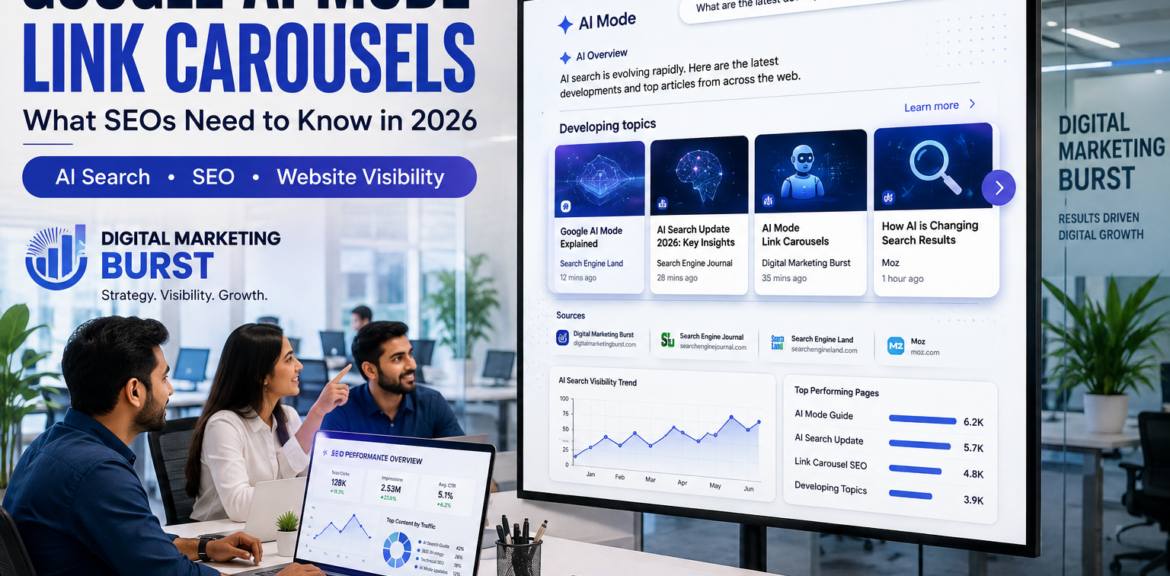

Google AI Mode Link Carousels: What SEOs Need to Know in 2026
Google AI Mode Link Carousels: What SEOs Need to Know in 2026
Google AI Mode Update, Google AI Mode SEO, Google AI Search Update, Google AI Mode Carousels, and Google AI Link Carousels are becoming important topics for SEOs, publishers, marketers, and website owners in 2026. Google has brought developing-topic link carousels into AI Mode, giving timely articles and webpages a more visible position inside some AI-generated answers. For Digital Marketing Burst, this change represents another reason to think beyond traditional rankings and focus on visibility across Google’s growing AI search experience.
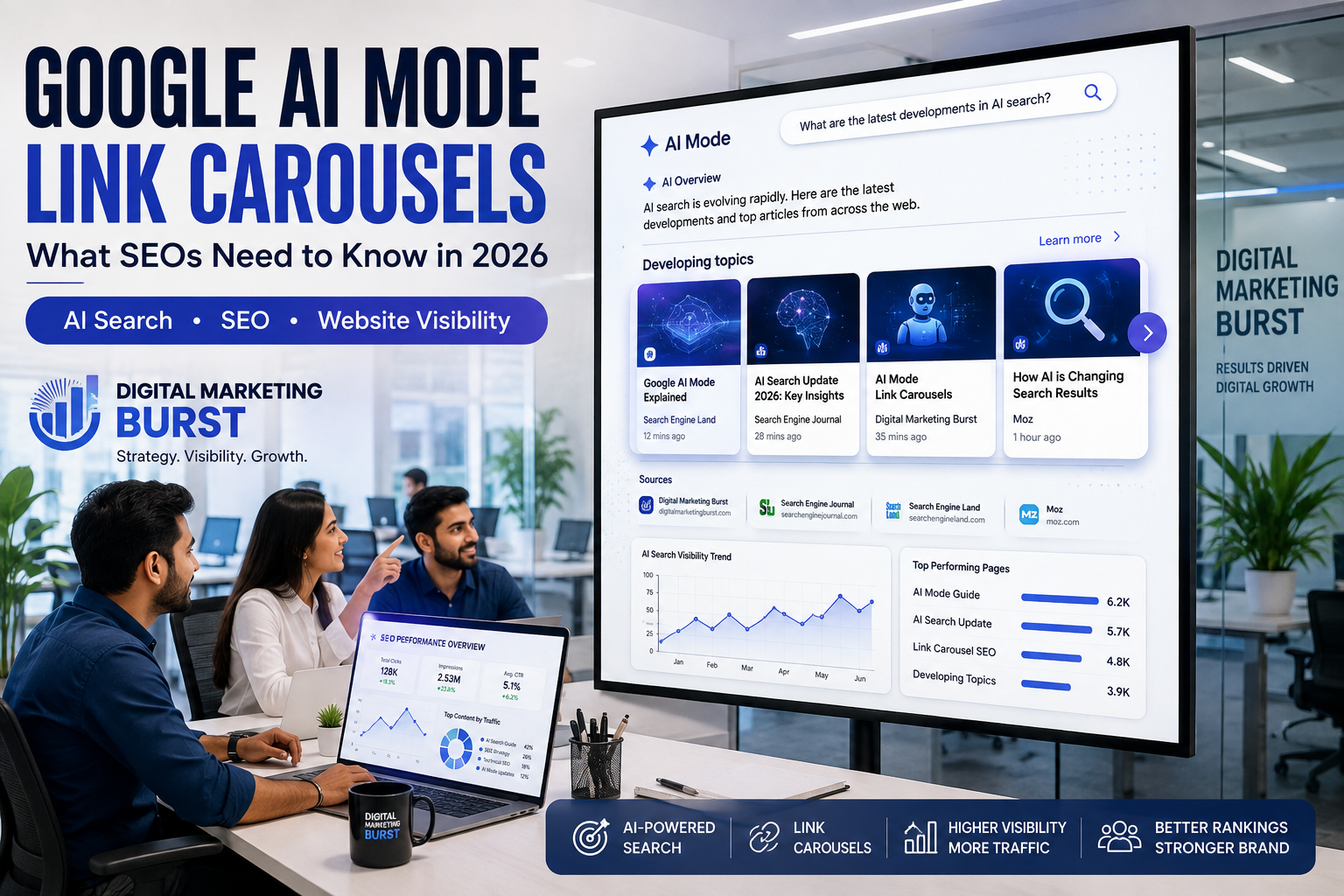
The change is especially relevant for websites that publish fresh information. When a user searches AI Mode for a developing or trending topic, Google can now place a horizontal carousel of relevant article links within the AI response. These cards can display information such as the article headline, source, image, and publication date.
However, this does not mean every website will receive carousel visibility. Google has not published a simple formula that guarantees inclusion. Therefore, publishers should avoid treating the feature as another ranking trick. The better approach is to understand search intent, publish genuinely useful information quickly, maintain strong technical SEO, and make original reporting or analysis easy for Google to understand.
This guide explains what changed, how developing-topic carousels work, what they may mean for organic traffic, and how SEO strategies can adapt in 2026.
Google AI Mode Update
The latest change gives publishers another visible location inside Google’s AI-powered search interface. Previously, much of the SEO conversation around AI Mode focused on citations and links attached to generated responses. Developing-topic carousels make some source links considerably more noticeable.
The format is particularly relevant when information is still developing. Think about breaking technology announcements, major product changes, search-engine updates, business developments, sports news, or other subjects where users want recent information.
Instead of relying only on smaller citations, Google can surface a row of article cards within the generated answer. That creates a clearer opportunity for users to move from the AI response to the original webpage.
For SEO professionals, the important change is not simply the appearance of another search feature. It shows how Google continues experimenting with ways to combine generated answers with discoverable web content.
Traditional organic results still matter. Yet search visibility is increasingly distributed across standard listings, AI Overviews, AI Mode, news-style modules, video results, and other search experiences.
As a result, SEO strategy in 2026 needs to consider where information can appear, not merely whether a webpage holds one traditional ranking position.
Google AI Mode Latest Update
The Google AI Mode Latest Update involving developing topics became visible in late August 2026. Google Search product leadership announced that link carousels for developing subjects were now live in AI Mode after appearing in AI Overviews earlier.
That distinction matters.
AI Mode is designed as a more conversational search experience. Users can ask detailed questions and continue with follow-up queries. Therefore, a website may need to compete for visibility within an answer journey rather than only on the first traditional results page.
The carousel creates a prominent path back to publishers.
When Google determines that a query involves an unfolding topic, relevant articles can appear as cards inside the response. Google’s stated objective is to connect users with original coverage and different perspectives.
Still, marketers should avoid assuming that every fresh article qualifies.
Google has not provided a public checklist that says publishing within a certain number of minutes or adding a particular schema guarantees a carousel card. Existing search quality, relevance, freshness, originality, and technical accessibility remain important areas to focus on.
For publishers, this makes strong SEO fundamentals more valuable rather than less valuable.
What Are Developing-Topic Link Carousels?
Developing-topic carousels are prominent collections of source links that can appear when Google determines that a subject is evolving.
Imagine someone searching for a newly announced technology update. A generated response can provide an explanation, while a carousel offers direct access to articles covering the development.
This structure solves an important problem with AI search.
Generated summaries can answer many questions without requiring a click. However, developing stories often require fresh reporting, different perspectives, and continuous updates. A static summary may not provide everything a user wants.
The carousel gives original webpages a more visible role in that experience.
From a publisher’s perspective, this matters because the card is visually stronger than a small citation. Users can see the source and headline before deciding whether to visit.
However, visibility does not automatically equal traffic.
A user may still receive enough information from the generated response. Consequently, publishers need headlines and content that offer a compelling reason to continue reading.
How Google AI Mode Link Carousels Work
A Google AI Mode Link Carousel can appear within the AI-generated response for certain developing topics. The format presents relevant web content in a horizontal group of clickable article cards.
The exact appearance may evolve because Google’s AI search interfaces continue to change.
Current examples show that cards can provide enough information for users to understand what source they are about to visit. This makes the carousel more similar to a discovery module than a traditional citation marker.
Relevance remains central.
If someone asks about a newly released Google feature, an article specifically explaining that feature has stronger contextual relevance than a generic article about Google SEO.
Freshness may also become important for developing subjects. Yet being recent is not enough by itself.
Publishing a weak 200-word article immediately after an announcement may not create the same value as publishing a clear explanation that adds useful context.
This is where experienced publishers can compete. Speed matters, but usefulness matters too.
Why Google Added Link Carousels to AI Mode
AI-generated search creates a fundamental challenge for the open web. Users want fast answers, while publishers need discoverability and traffic.
Prominent source links can help bridge those two experiences.
Google says its AI search direction aims to connect users with original coverage and a range of perspectives. Developing-topic carousels fit naturally into that objective because rapidly changing subjects often cannot be represented well by one static answer.
Consider an unfolding SEO update.
The first announcement may explain what launched. A few hours later, SEO professionals may publish screenshots and tests. Publishers might then identify limitations. Later analysis could reveal how the change affects traffic.
One generated answer cannot permanently represent that evolving information.
Source carousels give users access to more current reporting and analysis.
For publishers, this provides another potential discovery surface. However, websites still need to earn that visibility through useful content rather than simply targeting the name of the feature.
Google AI Mode SEO
Google AI Mode SEO should not be treated as an entirely separate discipline from traditional search optimization. Many of the foundations remain familiar: crawlable pages, clear information architecture, relevant content, trustworthy signals, strong titles, useful images, internal linking, and good user experience.
What changes is the search environment.
A webpage may now be discovered through an AI-generated response rather than only through ten familiar organic listings. The user can also ask follow-up questions without leaving Google’s interface.
This creates more specific search journeys.
For example, someone might begin with “What changed in Google Search today?” Then they may ask how the change affects publishers. After that, they could request practical optimization advice.
Content capable of answering these deeper subtopics can become more useful within AI search.
Therefore, SEOs should think in terms of topic coverage and information quality.
One page does not need to contain every possible keyword variation. Instead, it should answer the important questions surrounding the topic in clear language.
Google AI Mode SEO Strategy
A successful Google AI Mode SEO Strategy begins with understanding what users actually need after receiving an AI-generated summary.
Repeating the basic definition is rarely enough.
If Google’s response already tells users what happened, publishers need to offer something deeper. That could include original analysis, examples, testing, expert commentary, screenshots, comparisons, case studies, data, or practical implementation advice.
This creates a useful question for content teams: “What reason does the reader have to click our article after seeing the AI answer?”
That question should influence the entire editorial process.
For news content, speed can help. However, adding useful interpretation can differentiate the page.
For evergreen content, depth and clarity become more important.
Technical SEO should support this work rather than replace it. Search engines need to crawl and understand the content easily. Users then need a fast and readable page when they arrive.
The combination of useful information and technical accessibility remains a strong foundation for AI-era SEO.
SEO for Google AI Mode
SEO professionals do not need to abandon everything they learned about Google Search.
Instead, they need to extend those principles.
Keyword research remains useful because it reveals user demand. Search intent still matters because Google needs to understand which information satisfies a query. Internal linking remains valuable for site structure and discovery.
However, conversational search increases the importance of related questions.
People can continue asking AI Mode follow-ups. Therefore, content should anticipate the next useful question without becoming repetitive.
A strong article about a Google update might explain what happened first. It can then discuss who is affected, how the feature works, what publishers should change, what remains unknown, and which claims are not yet proven.
That structure naturally covers more search intent.
It also reads better than inserting the same keyword into every paragraph.
How to Optimize for Google AI Mode
Optimization begins with making the page genuinely useful.
Start with a direct explanation near the beginning. Users should understand the subject without reading several paragraphs of background.
Next, structure the page around real questions.
Clear subheadings help both readers and search systems identify important sections. However, headings should not exist purely for keyword placement.
Fresh topics also require maintenance.
If an article was published when a feature first appeared, update it when Google provides new information. Make meaningful changes rather than simply modifying the publication date.
Original evidence can strengthen the page further.
Screenshots, tests, examples, first-hand observations, and expert analysis give readers something that a generic summary may not provide.
Finally, avoid making promises about AI visibility.
There is no guaranteed technique that forces a webpage into an AI response or developing-topic carousel.
How to Rank in Google AI Mode
“Ranking” in AI Mode is more complicated than traditional position tracking.
A normal search result can often be described using a numerical organic position. AI-generated experiences can select, cite, and display sources differently depending on the query and context.
Therefore, SEOs should be cautious with anyone promising a guaranteed number-one AI Mode ranking.
A better goal is AI search visibility.
Can Google understand the page? Does the website have useful information about the subject? Is the article current when freshness matters? Does it contribute something worth showing?
Those questions are more productive.
Publishers should also monitor the actual queries bringing visitors to their pages. Search behaviour will continue evolving as users become comfortable asking longer questions.
In addition, content teams should examine which types of pages repeatedly gain visibility across AI-oriented searches.
Patterns can provide useful insights even when exact AI Mode attribution remains imperfect.
Google AI Mode Ranking Factors
There is no public list of special ranking factors that guarantees inclusion in AI Mode carousels.
That point is important.
The SEO industry often turns every new Google feature into a checklist before enough evidence exists. Doing so can lead businesses toward unnecessary changes.
Google has said AI Mode is connected with its broader search systems and web information. Therefore, established search-quality principles remain relevant.
Content should match the query closely.
The page needs to be accessible for crawling. Information should be clear, accurate, and useful. Freshness becomes more meaningful when the query itself demands recent information.
Original reporting can also be valuable for developing subjects.
Instead of searching for a hidden “AI Mode ranking factor,” publishers should improve the areas that make a page genuinely competitive.
As more data becomes available, SEOs can test additional patterns carefully.
Google AI Search Update
The Google AI Search Update around developing-topic carousels reflects a broader change in how web links are presented inside generated answers.
Google AI Search is not simply producing text. It is increasingly combining generated information with websites, products, images, videos, and other interactive formats.
That matters for SEO because visibility can take several forms.
A website might appear as a traditional result for one query. Another search could surface it through an AI citation. A developing subject might create a carousel opportunity.
Consequently, websites need flexible content strategies.
Publishers covering fast-moving industries should be able to respond quickly to important developments. Evergreen businesses should continue building authoritative resources around their core services and customer questions.
Not every company needs to become a breaking-news publisher.
However, businesses that operate in rapidly changing industries can benefit from publishing timely analysis when they genuinely have something useful to contribute.
Latest Google AI Search Update
The Latest Google AI Search Update demonstrates Google’s continued effort to place web sources within AI experiences.
This is important because publishers have been concerned about how generated answers affect click-through behaviour.
A prominent carousel does not solve every traffic concern. Still, it creates a clearer clickable element than a response containing only subtle source references.
The opportunity is especially interesting for developing topics.
Searchers researching a breaking development often want multiple perspectives. They may read the summary first and then open an article that appears relevant.
That means publishers should think carefully about how their headlines communicate value.
A vague title may lose attention.
An accurate headline that clearly explains what changed and why it matters can give users a stronger reason to click.
However, clickbait should still be avoided. The article must deliver what the headline promises.
Google Search AI Update
The broader Google Search AI Update story extends beyond one carousel feature.
Search is gradually becoming more conversational and multimodal. Users can ask detailed questions, continue with follow-ups, and receive synthesized information from the web.
For SEO professionals, this creates both challenges and opportunities.
Some informational searches may generate fewer traditional clicks because users can get an immediate answer.
At the same time, new discovery surfaces can expose publishers to queries that were previously difficult to target with one conventional keyword.
This makes topic understanding more important.
Instead of writing five nearly identical articles for five slight keyword variations, publishers can create one strong resource that addresses the complete search need.
Supporting pages can then cover genuinely different subtopics.
That approach also creates cleaner internal linking and reduces content cannibalization.
Google AI Search Changes in 2026
Search behaviour is becoming less linear.
Previously, a user might search a phrase, open several tabs, refine the query, and repeat the process. AI Mode can bring much of that exploration into one continuing conversation.
That changes how content is discovered.
A webpage does not necessarily need to match only the first question. It could become useful during a later stage of the user’s exploration.
Therefore, content teams should think beyond one primary keyword.
Related questions, comparisons, problems, and follow-up intent deserve attention.
For example, an article about link carousels should not stop after saying they exist. Readers also want to know how they work, whether they affect traffic, what publishers can do, how Preferred Sources relate to them, and whether Search Console can measure the results separately.
Answering those questions creates a more complete resource.
Google AI Mode Carousels
Google AI Mode Carousels give timely source links a more visually prominent place inside certain generated responses.
For publishers, visibility is the main attraction.
A card with a headline and source identity is easier for users to notice than a small reference attached to generated text.
However, the feature should not be confused with guaranteed traffic.
Users may still decide that Google’s answer provides enough information. Others may click because they want more depth or another perspective.
That makes content differentiation important.
If every article simply rewrites the same announcement, users have little reason to choose one publisher over another.
Original interpretation can create that reason.
For SEO websites, this could include testing a feature and documenting the results. News publishers might contribute original reporting. Businesses could explain how an industry change affects their customers.
The specific value depends on the publisher.
Google AI Mode Link Carousel
The Google AI Mode Link Carousel represents an interesting shift from citation visibility toward more traditional clickable discovery.
Users are familiar with cards and carousels across Google products. Bringing a similar format into AI-generated responses makes web sources easier to recognize.
A card can communicate several signals quickly.
The headline tells users what the page covers. The source identifies the publisher. An image can attract attention, while the publication date helps establish freshness.
Publishers should therefore review the basic presentation quality of their articles.
Use accurate titles.
Choose relevant images rather than generic visuals that have little connection to the story.
Keep publication information correct.
Most importantly, make the page itself worth visiting.
Optimizing a card is pointless if the user lands on a slow, cluttered, or shallow article.
Developing Topic Link Carousels
The phrase Developing Topic Link Carousels describes the feature more accurately than treating it as a universal AI Mode result type.
Google is surfacing these carousels for developing subjects, not necessarily every informational query.
That makes freshness context-dependent.
A guide explaining how to tie a tie does not require breaking-news freshness. A report about a major algorithm change does.
SEO teams should identify which areas of their industry genuinely develop quickly.
Technology, digital marketing, finance, entertainment, sports, policy, and product launches can generate frequent updates. Other industries may have fewer legitimate news opportunities.
Publishing unnecessary “news” every day does not automatically improve AI visibility.
Quality still matters.
Instead, businesses should build an editorial system that can respond quickly when an important event genuinely affects their audience.
Google AI Link Carousels
Google AI Link Carousels can help make external websites more visible inside an AI-first search experience.
That matters because the web-link relationship is central to publisher concerns about generative search.
If users receive complete answers without visiting websites, publishers may struggle to turn visibility into audiences.
Carousels provide a more obvious pathway to source pages.
Still, the value of that pathway depends on user intent.
Someone searching for a quick factual answer may not click. A person following an unfolding story is more likely to want additional reporting, context, or perspectives.
Therefore, developing topics are a logical place for Google to emphasize sources.
For marketers, the lesson is not to manufacture breaking news. Instead, recognize when your industry has a genuine developing story and produce content that adds meaningful value.
Google AI Search Link Carousels
Google AI Search Link Carousels can become another visibility target for publishers covering timely subjects.
However, SEOs should avoid optimizing for the visual module in isolation.
The article still needs to perform as a useful web page.
A strong title should explain the development clearly. The opening should answer the core question quickly. Subsequent sections should add context, implications, and practical advice.
Images should support the story.
Internal links can connect readers with deeper resources.
When appropriate, external references to primary information can improve credibility, although publishers should not turn every paragraph into a collection of citations.
The goal is to create the best destination after the click.
If AI search sends fewer but more intentional visitors, landing-page quality becomes even more important.
Google AI Search Link Carousel SEO
Optimizing for a link carousel starts with understanding the type of content the feature is designed to surface.
Developing topics demand timeliness.
Therefore, editorial teams should be able to publish quickly without sacrificing accuracy.
That requires preparation.
Writers should understand the industry before news breaks. Website templates should already be technically sound. Editors should have a clear verification process.
This reduces the temptation to rush out low-quality content simply to be first.
Once published, monitor the story.
If new information changes the situation, update the article meaningfully.
Clear update notes can also help readers understand what has changed.
Over time, this approach creates a stronger archive of useful industry coverage.
Google AI Mode Developing Topics
Developing topics behave differently from evergreen queries because the best answer can change quickly.
An article that was accurate at 9 a.m. may become incomplete by afternoon.
This creates a challenge for both search engines and publishers.
Google needs access to fresh information. Publishers need processes for updating coverage responsibly.
For SEO teams, this means freshness should be earned through actual updates.
Changing a date without changing the article provides little value.
Instead, add new facts, correct outdated information, explain what changed, and preserve useful context.
A clear article can evolve with the story.
This approach also benefits readers arriving later because they do not need to piece together five separate short posts to understand what happened.
Google AI Mode Latest Features
Developing-topic carousels are only one part of Google’s broader AI search direction.
AI Mode supports complex questions and follow-up exploration. Google also continues integrating web links and other information formats into generated experiences.
SEO professionals should therefore avoid building their entire strategy around one interface element.
Search features change.
A carousel visible today may be redesigned later. Placement rules can evolve, and different queries may trigger different experiences.
Content quality is more durable.
A technically healthy website with strong topic coverage can adapt more easily when search presentation changes.
This is why Digital Marketing Burst views AI search optimization as an extension of modern SEO rather than a collection of short-term hacks.
Google AI Mode Impact on SEO
The biggest impact may be a change in what “visibility” means.
Traditional SEO often focuses heavily on ranking positions and clicks. AI search introduces additional stages between the query and website visit.
A brand can potentially appear within generated information even when the user does not immediately visit its website.
That creates brand visibility, but businesses still need traffic and conversions.
Therefore, measurement needs to remain practical.
Do not celebrate an AI citation if it produces no meaningful business outcome.
At the same time, do not ignore AI visibility simply because attribution is difficult.
SEO teams should monitor organic traffic, branded searches, conversions, referral patterns, and content performance together.
Over time, these signals can reveal whether AI-oriented visibility is contributing to growth.
Google AI Mode Impact on Publishers
Publishers have good reasons to watch this development closely.
AI-generated answers can satisfy informational intent without requiring users to visit every source. That creates understandable concern about organic traffic.
Prominent link cards offer a more clickable path.
However, publishers should not assume that carousels will restore historical click patterns.
The search experience itself has changed.
Instead, publishers need to make each click more valuable.
Strong branding can help users recognize a source. Original reporting can make the publication worth following directly. Newsletters, useful tools, communities, and repeat readership can reduce dependence on one search surface.
SEO remains important, but audience development becomes increasingly valuable as well.
Can Google AI Mode Link Carousels Increase Website Traffic?
They can create additional opportunities for clicks, but there is no guarantee that a carousel appearance will produce a specific traffic increase.
Several factors influence click behaviour.
The query matters. Card placement matters. Headline quality matters. Competing sources matter. The generated answer itself can also influence whether the user feels a need to continue reading.
Therefore, claims such as “AI Mode carousels will double your organic traffic” should be avoided unless supported by specific site data.
The realistic opportunity is improved link visibility.
Publishers should treat that as a chance to earn a click rather than a guaranteed traffic source.
Testing becomes important.
Monitor timely articles before and after important search changes. Compare impressions, clicks, engagement, and conversions where measurement allows.
Evidence from your own website is more useful than broad promises.
Google AI Mode Organic Traffic
Organic traffic from AI-influenced search may behave differently from traditional search traffic.
A user who clicks after reading an AI-generated overview may already understand the basics.
Therefore, they may expect deeper information immediately.
This changes landing-page expectations.
Long introductions filled with generic background can frustrate visitors who already know the context.
Instead, provide the latest answer quickly and then offer deeper analysis.
Useful navigation can help readers jump to specific sections.
Related internal links can extend the visit when they genuinely answer the next question.
For businesses, strong calls to action should appear where relevant, but they should not interrupt the informational experience.
The page needs to satisfy the reason the user clicked first.
Google AI Mode Website Traffic
Website owners should monitor AI-related changes without panicking over every interface update.
Traffic can fluctuate for many reasons.
Seasonality, rankings, demand, competitors, SERP layouts, AI features, and content quality can all contribute.
Therefore, diagnose changes carefully.
If informational traffic declines, examine which query groups lost clicks.
Then determine whether rankings changed or whether the search result itself began satisfying more of the user’s need.
The response should depend on the cause.
Sometimes the solution is improving content. In other cases, creating more differentiated resources may be necessary.
Businesses can also focus on searches with stronger commercial or problem-solving intent, where users are more likely to need a website after receiving initial information.
Google AI Mode Content Strategy
A strong content strategy should balance traffic opportunities, client intent, and problem-solving information.
For traffic-focused content, cover meaningful industry developments quickly and accurately.
Client-oriented pages should connect relevant topics with services without forcing sales language into every paragraph.
Problem-focused content can answer specific questions users encounter while implementing a change.
This balance creates a healthier website.
A publication made entirely of news can attract temporary spikes but weak commercial intent. A site containing only service pages may struggle to capture broader discovery searches.
Educational problem-solving content connects the two.
For Digital Marketing Burst, this means covering major Google and AI search developments while also explaining how businesses can respond.
AI Mode SEO Strategy 2026
An effective AI search strategy should begin with the same question that drives strong SEO: what does the user need?
Next, consider how AI changes that need.
If Google already summarizes basic information, your page needs to go further.
That could mean providing original examples, practical steps, comparisons, data, or deeper explanation.
Structure also matters.
Clear headings make long content easier to navigate. Shorter paragraphs improve readability. Direct answers help both users and search systems identify relevant information.
However, do not fragment every thought into tiny sections simply to target keywords.
Content should still feel written for humans.
A natural article can cover dozens of related queries without repeating exact phrases unnaturally.
Google AI Search SEO Strategy
AI search expands SEO from matching keywords toward understanding broader information needs.
Keywords remain valuable because they reveal how people search.
However, conversational queries can be much longer and more specific.
A user might ask, “How does Google’s new developing-topic carousel affect an SEO news website that publishes three times per week?”
No traditional four-word keyword captures that entire intent.
A comprehensive article can.
Therefore, build content around entities, questions, relationships, and problems in addition to exact phrases.
This approach also reduces keyword stuffing.
The primary phrase establishes the topic. Synonyms and natural language then help cover related searches.
Strong topical structure becomes more important than repeating the same sentence.
Google AI Search Visibility 2026
Visibility in 2026 can include more than a blue organic result.
Websites may appear through AI citations, carousels, AI Overviews, image results, video modules, news features, and traditional listings.
This makes brand consistency valuable.
A recognizable publication name, useful content, strong topical expertise, and clear visual presentation can help users identify a source across different formats.
Still, visibility without business value is incomplete.
SEO teams should connect discovery with outcomes.
For publishers, that may mean returning readers and subscriptions. For service businesses, enquiries and qualified leads matter more.
Consequently, AI visibility should become one part of a wider organic growth strategy.
Google AI Mode for Publishers
Publishers covering developing stories should strengthen their editorial workflow.
Speed matters, but accuracy should not be sacrificed.
A good process allows the first version of an article to answer what is known while clearly avoiding unsupported claims.
As the story develops, update the page.
Original reporting can create differentiation. So can expert analysis.
Generic rewrites are easier for AI systems and users to replace because they add little beyond information already available elsewhere.
Publishers should ask what unique value they contribute.
That answer may become increasingly important as AI-generated summaries improve.
Google AI Mode for Websites
Not every website needs a newsroom.
A local business, ecommerce store, professional service, or small company should not suddenly publish dozens of generic AI news stories simply because carousels exist.
Relevance remains important.
Cover developments that genuinely affect your customers or industry.
A digital marketing agency has a legitimate reason to explain a major Google Search change. A restaurant probably does not need an article about AI Mode link carousels unless there is a meaningful connection to its marketing strategy.
Staying within a coherent topic area helps users understand what your website represents.
It also makes internal linking more logical.
Google AI Mode for Small Businesses
Small businesses should focus on useful opportunities rather than trying to compete with major news publishers for every developing story.
Industry-specific developments can still create openings.
For example, a local SEO change may deserve coverage from an agency that works with local businesses. An ecommerce search update could be relevant to an online retailer or ecommerce consultant.
The content should add a practical perspective.
Explain what the development means for your customers.
That creates more value than simply rewriting the announcement.
Smaller brands can often compete through specialization because they understand a narrower audience better than broad publications.
Preferred Sources and Google AI Mode Carousels
Preferred Sources add another interesting dimension to AI search.
Google has indicated that a user’s selected preferred publishers can appear prominently when relevant, including within developing-topic experiences.
However, publishers should understand the personalization involved.
Being selected as a Preferred Source by one reader does not mean the website becomes universally preferred for everyone.
That makes audience loyalty important.
A reader who repeatedly finds your content useful may be more willing to choose your publication as a preferred source.
Therefore, the strategy extends beyond SEO.
Build a recognizable brand. Publish consistently useful information. Give readers reasons to return.
Search visibility can introduce the publication, but trust encourages the relationship to continue.
Developing Topics and Preferred Sources
Developing topics are particularly suited to preferred publishers because readers often have sources they trust for ongoing coverage.
Someone following technology may prefer one publication. An SEO professional might regularly rely on a different industry site.
Google can use that preference to make selected sources easier for that individual to discover when relevant.
For publishers, this makes direct reader relationships increasingly valuable.
The goal is not merely to appear once.
Consistent usefulness can turn a search visitor into someone who recognizes and actively prefers the brand.
That is a much stronger position than depending entirely on anonymous organic clicks.
Google AI Mode vs AI Overviews
AI Mode and AI Overviews are related but should not be treated as identical experiences.
AI Overviews appear within Google Search results for certain queries. AI Mode provides a more conversational environment designed for deeper exploration and follow-up questions.
Developing-topic link carousels have appeared across these AI search experiences.
For SEO teams, this means the same article may encounter users through different interfaces.
The strategy should therefore focus on creating useful web content rather than designing exclusively for one feature.
Search interfaces will continue evolving.
Strong information can remain valuable even when the presentation changes.
Google AI Mode Carousels vs Traditional Search Results
Traditional organic results present webpages as individual listings.
AI Mode carousels place source cards within a generated answer.
That difference changes user behaviour.
In traditional search, the webpage is often the primary destination. Within AI Mode, the generated response can become the primary experience, while external links provide deeper exploration.
Therefore, publishers need to earn the second step.
A headline should promise additional value beyond what the user already sees.
The article then needs to deliver it quickly.
This makes generic content increasingly vulnerable.
If the AI response can summarize everything useful on your page in two sentences, users may have little reason to visit.
AI Search Optimization for Developing Topics
Developing-topic optimization begins before the story breaks.
A technically healthy website can publish and update content more efficiently.
Editors should have clear templates and internal linking systems. Writers should understand the topic well enough to distinguish meaningful developments from noise.
Once news appears, publish useful information quickly.
Then improve the article as more facts become available.
Do not publish unsupported speculation simply to gain speed.
The objective is to become a useful source throughout the development of the story.
This approach benefits both readers and long-term search performance.
How Fresh Content Can Gain AI Search Visibility
Freshness matters most when the query itself demands fresh information.
Breaking news is an obvious example.
Software updates, algorithm changes, product announcements, market developments, and live events can also create time-sensitive searches.
However, simply changing a publication date does not make old information fresh.
Meaningful updates should add something new.
Explain what changed and why.
If earlier information became incorrect, correct it clearly.
Readers value a page that stays current.
Search systems also need accurate information when answering developing queries.
Original Reporting and Google AI Search
Original reporting can become increasingly valuable when AI systems synthesize information from across the web.
If every publisher rewrites the same announcement, there is little differentiation.
Original reporting changes that.
It might include an interview, first-hand test, dataset, screenshot, experiment, or expert observation.
Even small publishers can produce original value.
A digital marketing agency might test a new search feature across several queries and document what it sees.
That is more useful than rewriting another publication’s article.
Originality also gives other websites a reason to reference your work.
Over time, that can strengthen both brand authority and organic visibility.
Can AI Mode Carousels Improve Publisher Clicks?
A more prominent link creates a better opportunity to earn clicks than a barely visible reference.
However, actual click performance will vary.
Publishers should therefore measure rather than assume.
Compare similar developing-topic articles when possible.
Look at impressions, clicks, engagement, returning users, and conversions.
Remember that AI Mode reporting can have measurement limitations, so perfect attribution may not always be available.
Use the available evidence carefully.
Most importantly, do not turn an early observation into a universal SEO rule.
AI search is evolving quickly, and strategies should evolve with reliable data.
Does Google AI Mode Affect SEO Rankings?
AI Mode should not be interpreted as a replacement for all existing Google ranking systems.
Traditional search results still exist.
Moreover, AI experiences draw on web information and Google’s broader search infrastructure.
For website owners, the practical response is to continue improving SEO fundamentals while expanding attention toward AI discovery.
There is no reason to abandon technical SEO, content quality, internal linking, page experience, or search intent.
Instead, think of AI visibility as an additional layer.
A page that is difficult to crawl or offers weak information is unlikely to become stronger simply because the search interface uses AI.
Is Google AI Mode a Ranking Factor?
This question needs careful wording.
AI Mode is a search experience, not a single ranking factor that publishers can “add” to a webpage.
Likewise, there is no special AI Mode score that website owners can simply optimize to 100.
Search systems evaluate many signals and processes when deciding which information to surface.
Therefore, avoid chasing invented metrics.
Focus on measurable website improvements.
Can users find the answer quickly? Is the information accurate? Does the page add something original? Is the website technically accessible? Does the content satisfy the intended audience?
Those questions lead to more useful SEO decisions.
Why Your Website May Not Appear in AI Mode
A website can fail to appear for many reasons.
The content may not match the query closely enough. Another source may provide fresher or more useful information.
Technical issues can also limit discovery.
Sometimes there is no problem at all. Google simply chooses a different set of sources for that particular response.
Therefore, lack of visibility should not immediately trigger drastic website changes.
Review the page objectively.
Compare it with the information users need.
Look for gaps in depth, originality, freshness, clarity, or technical accessibility.
Then improve what genuinely needs improvement.
Avoid repeatedly rewriting a good article simply because one AI Mode test did not show it.
Why Your Article May Not Appear in Link Carousels
Carousel inclusion is not guaranteed.
The query may not trigger the developing-topic format. Your article may not be sufficiently relevant or fresh for that specific search.
Other publishers may have stronger original coverage.
In addition, the feature itself can vary across searches and users.
Therefore, treat carousel visibility as an opportunity rather than an entitlement.
Publish the strongest article you can.
Maintain accurate titles, dates, and imagery.
Update the story when meaningful information changes.
If visibility comes, the page is ready to benefit from it.
If not, the article can still earn traffic through other search surfaces.
Google AI Mode SEO India
AI Mode is especially relevant to Indian marketers because Google rolled out the experience in India after initially introducing it through Labs.
India is a major search market with diverse user behaviour.
People increasingly search using text, voice, images, and conversational questions.
For Indian businesses, AI search therefore deserves attention without replacing existing SEO work.
English-language publishers can begin by examining how their important topics appear across AI-oriented search experiences.
Over time, multilingual search opportunities may become increasingly important as Google’s AI products evolve.
The best preparation is a strong website with useful information and a clear understanding of the audience.
Google AI Search SEO India
Indian SEO professionals should expect search journeys to become more varied.
Some users will continue using conventional results. Others may rely heavily on AI Mode for research.
Many will move between both.
Therefore, optimization needs to support different discovery behaviours.
A strong page should work whether a user arrives from a traditional result, an AI citation, or a link card.
Mobile experience is particularly important.
Content should load quickly and remain easy to scan on smaller screens.
Short paragraphs and descriptive headings help.
At the same time, depth should not be sacrificed simply to make the article shorter.
Useful information remains the priority.
Digital Marketing Burst Google AI Mode SEO Strategy
Digital Marketing Burst Google AI Mode SEO Strategy focuses on combining established SEO fundamentals with the changing way people discover information through AI-powered search.
The objective is not to chase every experimental search feature.
Instead, businesses should build content capable of remaining useful across traditional Google Search, AI Overviews, AI Mode, and future discovery formats.
That starts with understanding search intent.
Technical SEO supports discovery. Strong content provides the information. Internal linking creates context, while continuous updates keep time-sensitive pages relevant.
For developing topics, editorial speed becomes another advantage.
However, speed should never replace accuracy.
A well-built strategy balances both.
Digital Marketing Burst Google AI Search Optimization
Digital Marketing Burst Google AI Search Optimization can be built around a simple principle: make the website valuable enough that both users and search systems can understand why its information matters.
Businesses should avoid creating hundreds of thin pages merely to target AI-related phrases.
A smaller number of authoritative resources can often provide more value.
Topic clusters can then support those resources with genuinely distinct articles.
For example, one pillar page could explain AI Mode SEO. Separate articles might cover Preferred Sources, AI Overviews, link carousels, Search Console reporting, and content optimization.
This creates logical internal relationships without duplicating the same information.
Digital Marketing Burst AI Search SEO Guide 2026
The Digital Marketing Burst AI Search SEO Guide 2026 approach combines three content goals: traffic discovery, potential-client education, and problem solving.
Traffic content responds to important industry developments.
Client-focused content explains how those developments affect businesses.
Problem-solving articles answer implementation questions people search after learning about the change.
Together, these categories create a more balanced SEO strategy.
A news article may attract the first visit. A practical guide can build trust. A relevant service page can then help a business visitor understand what professional support is available.
This journey is more natural than turning every informational article into a sales page.
Digital Marketing Burst Google AI Mode Update Analysis
Digital Marketing Burst Google AI Mode Update Analysis should focus on what can be verified and what remains uncertain.
The confirmed development is straightforward: developing-topic link carousels have expanded into AI Mode.
What is not confirmed is equally important.
Google has not provided a guaranteed optimization formula for carousel inclusion. Publishers also should not assume that appearing there guarantees a specific increase in traffic.
Making this distinction improves content quality.
SEO analysis should help businesses make decisions rather than exaggerate every new feature.
That approach becomes increasingly valuable as AI search evolves quickly and speculation spreads faster than reliable testing.
Digital Marketing Burst AI Mode Content Strategy
A useful Digital Marketing Burst AI Mode Content Strategy begins by identifying which subjects genuinely matter to the target audience.
Next, classify them by intent.
Some topics are timely and traffic-driven. Others relate directly to potential clients. A third group addresses practical problems.
This creates the 40% traffic, 30% client, and 30% problem-solving balance.
However, the percentages should guide editorial planning rather than make individual articles feel formulaic.
Each article still needs one clear purpose.
For this topic, the developing carousel announcement creates traffic potential. SEO implications serve marketers and potential clients. Optimization and troubleshooting sections address practical problems.
That combination creates broader search coverage without forcing unrelated information into the article.
Where to Use the Branded Keyword
Branded phrases should appear where they make sense rather than inside every section.
For example, Digital Marketing Burst AI Search SEO, Digital Marketing Burst Google AI Mode Strategy, Digital Marketing Burst AI Search Optimization, Digital Marketing Burst SEO Services, and Digital Marketing Burst AI SEO Strategy 2026 can support relevant internal pages.
The brand can appear in the introduction, one or two strategy sections, author information, and conclusion.
Avoid repeating the company name after every recommendation.
Excessive branding can make an educational article feel promotional.
A better approach is to provide substantial value first. Then connect readers naturally with relevant expertise.
This keeps the article useful while still strengthening branded search associations.
What SEOs Should Do After the Link Carousel Update
The immediate response should be measured rather than dramatic.
Continue publishing high-quality content.
For developing stories relevant to your industry, improve editorial speed and update articles as new information becomes available.
Review titles, publication information, images, and technical accessibility.
Build original value whenever possible.
Then observe performance.
Do not redesign an entire website around one new search module.
AI search will continue changing, so flexibility is more valuable than over-optimization.
The strongest long-term strategy remains a website that can publish trustworthy, useful, well-structured information consistently.
Future of Google AI Mode and SEO
Google’s search experience is likely to keep evolving.
AI Mode gives users a different way to explore complicated questions, while features such as developing-topic carousels demonstrate that web links remain part of that experience.
For SEO professionals, the challenge is adapting without abandoning proven fundamentals.
Keywords still matter. Search intent still matters. Technical accessibility remains essential.
Yet original information, topical depth, brand recognition, and content freshness may become even more valuable as generated answers handle basic questions directly.
The websites most prepared for this future will not be those chasing every new feature independently.
They will be the ones building strong information systems capable of adapting to many search formats.
Final Conclusion
Google AI Mode Update, Google AI Mode SEO, Google AI Search Update, Google AI Mode Carousels, and Google AI Link Carousels collectively reflect a major direction in modern search: Google is blending generated answers with more visible pathways to web content. Developing-topic carousels give timely publishers another opportunity to appear prominently when users explore unfolding stories.
However, this should not trigger keyword stuffing or promises of guaranteed AI rankings. Google has not published a formula that ensures carousel inclusion, and prominent placement does not automatically guarantee traffic.
The better strategy is sustainable. Publish quickly when freshness genuinely matters, but maintain accuracy. Add original value instead of rewriting existing coverage. Keep pages technically accessible, update developing stories meaningfully, and create strong reasons for users to click beyond an AI-generated summary.
For Digital Marketing Burst, the broader lesson is clear. SEO in 2026 is no longer only about achieving one traditional organic position. It is increasingly about earning visibility wherever users discover information across Google’s search ecosystem.