






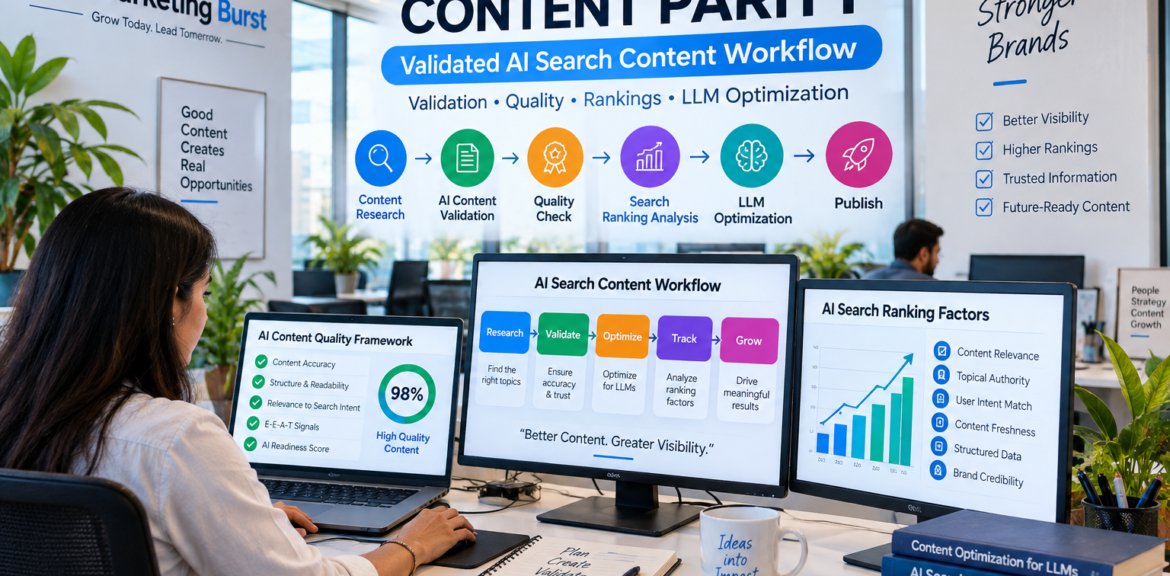

Beyond Content Parity: How to Build a Validated AI Search Content Workflow
Beyond Content Parity: How to Build a Validated AI Search Content Workflow
Introduction
AI Search Content Validation, Content Workflow For AI, AI Content Quality Framework, AI Search Ranking Factors, and Content Optimization For LLMs are becoming important parts of modern search strategy. Publishing a page is no longer the final step. Brands also need to check whether their information is accurate, easy to extract, well structured, and clear enough for both traditional search engines and AI-powered discovery systems.
Content parity alone does not solve this challenge. Two websites can cover almost identical subjects but receive very different visibility. One may provide clear answers, original evidence, strong context, and understandable entities. Another may simply rewrite information already available elsewhere. Therefore, modern optimization needs a validation layer between content creation and publication.
A strong workflow starts with search intent. Next, it checks factual accuracy, topical coverage, source quality, structure, and answer clarity. After publication, performance data should feed back into the process. This creates a repeatable system rather than a one-time SEO checklist.
For businesses, the change is significant. Search visibility can now extend beyond conventional blue links. Content may surface through AI-generated answers, summaries, citations, recommendations, and conversational search experiences. As a result, marketers need content that deserves to be retrieved and referenced, not merely indexed.
This guide from Digital Marketing Burst explains how to move beyond content parity and build a practical validation workflow. It focuses on quality, search intent, AI visibility, LLM readability, content gaps, measurement, and the problems that often prevent otherwise good pages from performing.

What Does Beyond Content Parity Mean in AI Search?
Content parity traditionally means covering the important subjects that competing pages already discuss. If several high-ranking pages explain the same five concepts, an SEO team may ensure its new page addresses those concepts too. That approach can help prevent obvious topical gaps. However, parity is only a starting point.
AI-driven discovery raises the standard. Simply mentioning everything a competitor mentions does not make a page more useful. Search systems have many pages available that repeat similar definitions, examples, and statistics. Therefore, another layer of value is needed.
That layer can come from clearer explanations, firsthand expertise, updated information, original examples, better organization, or a stronger answer to the user’s actual question. In other words, content should not merely match what already exists. It should improve the information experience.
Validation supports this process. Before publishing, editors can ask whether every major claim is defensible. They can check whether sections answer real questions and whether the page makes its main ideas easy to identify. Furthermore, outdated statements can be removed before they weaken the article.
This shift changes the role of SEO content teams. Their job is not simply to reach a target word count. Instead, they need to create information that is useful enough to earn visibility across several search experiences.
AI Search Content Validation
AI Search Content Validation is the process of checking whether a page is accurate, relevant, complete, understandable, and ready for AI-driven discovery before it is published. It adds quality control to a workflow that might otherwise move directly from writing to uploading.
Validation should begin with intent. A page about an informational query must answer that query quickly. If the introduction spends hundreds of words discussing unrelated background information, the user may struggle to find the answer. AI systems can also have more unnecessary text to process before reaching the useful passage.
Accuracy comes next. Dates, product features, statistics, definitions, names, and technical claims should be reviewed. When a claim can change over time, editors should consider whether the article needs a date or future update schedule.
Structure matters as well. Descriptive headings tell readers what each section contains. Short paragraphs make complex information easier to process. Meanwhile, direct answers can help important passages stand independently.
The final stage should examine value. Ask a simple question: does this page contribute something beyond what is already easy to find? If the answer is no, another editing round may be worthwhile.
Validation is therefore not an AI-writing detector. It is a publishing discipline designed to improve reliability and usefulness before content enters the search ecosystem.
AI Content Validation Process
An AI Content Validation Process should connect research, writing, editing, verification, publication, and post-publication review. When these stages operate separately, errors can pass from one team member to another without anyone taking responsibility for the final result.
Start by defining the search problem. Determine what the reader needs to accomplish after landing on the page. Then research the subject using reliable material and identify areas where current search results provide incomplete, outdated, or confusing answers.
Writing should come after this research rather than before it. Once the draft exists, a separate validation pass can examine facts and claims. This distinction is valuable because writers often become too familiar with their own text to notice unclear assumptions.
Next comes search validation. Editors should check whether the page answers the primary intent early enough and whether supporting sections logically expand that answer. Unnecessary repetition can then be removed.
A final human review is essential, particularly when generative tools helped create the draft. AI can accelerate research organization and drafting, but fluent language does not guarantee factual correctness.
After publication, validation continues. Search impressions, clicks, engagement, conversions, AI citations where measurable, and user questions can reveal weaknesses that were not obvious during editing. Those signals should influence the next update.
Content Workflow For AI
A Content Workflow For AI should treat artificial intelligence as one part of the publishing system rather than the entire system. AI can assist with research organization, topic clustering, draft structures, editing suggestions, and repetitive production tasks. Human judgment remains necessary for context, accuracy, experience, and final approval.
The workflow begins with a genuine audience problem. Teams should understand why somebody would search for the subject and what would constitute a useful answer. Keyword research can support that decision, but keywords should not replace intent.
Research follows. Instead of collecting only competing headings, look for evidence, common questions, changing terminology, expert viewpoints, and missing explanations. This creates a stronger foundation for original content.
During drafting, clarity should take priority over keyword repetition. Each section needs a purpose. If two paragraphs make the same point, combine them. Likewise, remove filler that exists only to make an article longer.
Then validate the draft. Check claims, examples, links, names, numbers, and dates. Review the page from a reader’s perspective before considering optimization.
Finally, publish and measure. Search behavior changes, and AI discovery is evolving quickly. Therefore, a workflow needs an update cycle. Content that performed well six months ago should not automatically be assumed to remain the best answer today.
AI Content Creation Workflow
An AI Content Creation Workflow works best when automation handles speed while people control decisions that require judgment. The process can begin with a research brief containing the target audience, search intent, primary subject, related questions, and desired business outcome.
Next, create a content map. Instead of asking an AI tool to generate thousands of words immediately, define what each section should achieve. This reduces repetition and gives the final article a more deliberate flow.
AI can then assist with first drafts or alternative explanations. However, every generated statement should be treated as draft material. Technical claims, recent developments, statistics, quotations, and named entities deserve separate verification.
Human editing should also change the language. Generic transitions, predictable sentence patterns, exaggerated claims, and repetitive summaries can make an article feel automated. Specific examples and practical explanations usually make it more useful.
After editing, review the page against the original search intent. A beautifully written article can still fail if it answers the wrong question.
The final workflow should include publication and measurement. Search Console data, analytics, lead quality, reader feedback, and changing queries can all inform later revisions. Thus, creation becomes a cycle rather than a production line that ends when someone presses Publish.
How to Build an AI Search Content Workflow That Scales
A scalable AI search content workflow needs repeatable standards without making every article sound identical. Templates can help teams remember important stages, but they should guide quality rather than dictate wording.
Begin with a standard brief. It can define the audience, intent, topic boundaries, business relevance, evidence requirements, and questions the page must answer. Writers then have enough direction without receiving a rigid paragraph-by-paragraph script.
Next, assign clear responsibilities. Researchers gather evidence. Writers turn it into useful explanations. Editors test clarity and accuracy. SEO specialists review discoverability. In smaller teams, one person may perform several roles, but the stages should still remain distinct.
A validation gate before publication can prevent rushed content from going live. If an important statistic lacks verification or a section does not answer its heading, the page returns for revision.
Scalability also depends on prioritization. Not every page needs 5,000 words, original research, and a dozen supporting assets. A simple question may deserve a concise answer. A competitive commercial subject may require considerably deeper work.
The goal is consistent decision quality. When teams understand why each stage exists, they can scale production without turning content into a collection of nearly identical AI-generated pages.
AI Content Quality Framework
An AI Content Quality Framework gives editors a consistent way to judge whether content is ready for publication. Without a shared standard, one writer may consider a draft complete while another expects much more evidence and detail.
The framework should begin with usefulness. Does the article solve the problem implied by the search? If not, technical SEO improvements will not repair the fundamental weakness.
Accuracy is the second layer. Claims should be verifiable, while changing information should be reviewed close to publication. A page that contains one major factual error can weaken trust in everything else it says.
Original value comes next. This does not mean every article needs groundbreaking research. Original value may be a clearer explanation, a practical framework, a firsthand example, a useful comparison, or a better organization of complex information.
Readability should also be assessed. Shorter sentences can improve comprehension. Descriptive headings help scanning. Transitions should connect ideas naturally rather than appearing simply to satisfy an SEO plugin.
Finally, consider maintainability. Can the team identify which parts of the article may become outdated? If so, future updates become easier.
A quality framework turns vague instructions such as “make this article better” into a repeatable editorial process.
AI Content Quality Guidelines
Effective AI Content Quality Guidelines should focus on what readers need rather than trying to make text satisfy an imaginary AI formula. Search systems evolve. Useful, accurate, well-organized information is a more durable target.
Every article should have a clear purpose. The introduction needs to establish that purpose quickly, while subsequent sections should deepen the answer. Writers should avoid long openings that delay useful information.
Claims require context. If a statistic is included, readers should understand what it measures and when it was collected. Similarly, an example should illustrate the argument instead of existing only to increase word count.
Language should remain natural. Exact-match keywords can be useful in strategic locations, but repeating them in every paragraph harms readability. Synonyms, related entities, and normal language can communicate the subject without creating keyword stuffing.
Editors should also remove unsupported superlatives. Terms such as “best,” “guaranteed,” or “number one” need evidence when presented as factual claims.
Finally, each article should undergo a human read-through. Automated checks can identify spelling, structure, or sentence-length issues. They cannot fully judge whether an explanation genuinely makes sense to the intended audience.
AI Search Ranking Factors
Understanding AI Search Ranking Factors requires an important distinction. There is no single public checklist that guarantees inclusion across every AI search product. Different systems can use different retrieval methods, indexes, ranking systems, and answer-generation processes.
Therefore, content teams should avoid chasing supposed secret formulas. A more practical approach is to improve signals that support useful information retrieval in general.
Relevance remains fundamental. A passage should clearly address the question it appears under. Accuracy matters because incorrect or inconsistent information is difficult to trust. Strong topical context also helps readers understand how an answer relates to the wider subject.
Authority can come from demonstrated expertise, reliable sourcing, original information, and a consistent reputation around a subject. Freshness becomes important when facts change frequently.
Technical accessibility matters too. Valuable information cannot perform well if crawlers cannot access it or if important content depends on broken rendering.
Finally, user value remains central. Pages designed only to attract algorithms tend to accumulate filler. Pages designed around real questions are more likely to contain useful passages.
Rather than searching for one ranking trick, marketers should improve the entire information experience.
AI Search Ranking Signals
AI Search Ranking Signals are often discussed as though every AI engine uses an identical scoring system. In practice, marketers should be careful with that assumption. Search and answer systems can evaluate information differently.
Still, several content characteristics are strategically useful. Clear topical relevance helps systems and users understand what a page addresses. Consistent entity information reduces ambiguity. Accurate supporting details improve reliability.
Originality is another useful consideration. If hundreds of pages repeat the same generic explanation, there is little reason for another near-duplicate page to stand out. Firsthand observations, proprietary data, expert commentary, or genuinely clearer explanations can create differentiation.
Page structure can support retrieval as well. A descriptive heading followed by a direct explanation makes a passage easier to understand independently. However, structure should not become robotic. Every section does not need the same sentence formula.
Brand signals can also matter indirectly. When a business consistently publishes reliable material within a defined subject area, users may search for that brand alongside the topic.
The practical lesson is straightforward. Build content around relevance, evidence, clarity, originality, and accessibility rather than trying to manipulate an undocumented AI ranking score.
Content Optimization For LLMs
Content Optimization For LLMs means making information clear enough to be understood, retrieved, and reused in AI-assisted discovery without sacrificing the human reading experience. It should not mean writing unnatural passages designed only for machines.
Start with semantic clarity. A section should identify the subject directly instead of relying on vague pronouns or context buried hundreds of words earlier. This becomes particularly useful when a passage is retrieved independently.
Definitions should be concise when the reader is likely to need one. After the direct answer, supporting context can explain limitations, examples, and practical implications.
Entity consistency matters as well. Company names, products, locations, and technical terms should not change unnecessarily across the page. Consistency reduces ambiguity.
Good formatting can also improve comprehension. Descriptive headings and manageable paragraphs allow both readers and systems to identify relevant sections quickly.
However, optimization should never remove nuance. Complex questions sometimes require qualified answers. Oversimplifying them merely to produce a quotable sentence can create misinformation.
The strongest LLM-friendly content remains human-friendly content. It answers clearly, provides enough context, and avoids hiding the useful information behind unnecessary filler.
LLM Content Optimization Strategy
An LLM Content Optimization Strategy should begin with information architecture rather than keyword density. The objective is to make each important idea easy to locate while maintaining a coherent article.
Start by mapping the questions surrounding the core subject. Group questions that share the same intent. This prevents the page from creating several sections that repeat essentially the same answer.
Next, write concise answer passages. A reader should be able to understand the central point without reading three introductory paragraphs first. Supporting detail can follow immediately afterward.
Evidence strengthens important claims. Whenever possible, connect factual statements to reliable sources or clearly identified firsthand experience. Avoid adding citations merely for appearance; they should genuinely support the claim being made.
Internal linking also deserves attention. A broad guide can connect to deeper pages covering individual subtopics. This gives readers a logical path while helping establish relationships between related content.
Finally, monitor how the subject changes. AI search terminology is developing quickly, so pages can become outdated even when their basic SEO remains strong.
Optimization is therefore ongoing. A strong strategy combines clear writing, structured information, evidence, topical depth, internal relationships, and regular updates.
How to Optimize Content for AI Search Without Keyword Stuffing
Learning how to optimize content for AI search does not require inserting the same phrase into every heading. In fact, excessive repetition can make an article difficult to read and reduce the range of language used to explain the subject.
Begin with one primary concept. Then identify closely related questions, entities, processes, problems, and outcomes. This naturally expands topical coverage without creating dozens of artificial keyword variations.
For example, a page about AI content validation can discuss factual verification, editorial review, retrieval, citations, quality control, content freshness, search intent, and post-publication monitoring. These ideas belong to the subject even when they do not repeat the exact focus phrase.
Headings should describe what follows. If a heading exists only because a keyword tool suggested it, ask whether readers genuinely need that section.
Natural language also improves readability. Searchers rarely use identical wording for every question. Therefore, an article can use related phrases while maintaining the same topical focus.
Digital Marketing Burst recommends treating keywords as navigation signals rather than writing instructions. They indicate what audiences care about. The writer’s job is then to answer those needs clearly instead of mechanically reproducing search phrases.
AI Search Optimization for Google AI Overviews
AI search optimization for Google AI Overviews should still begin with strong search fundamentals. A page needs to be accessible, relevant, useful, and understandable before marketers worry about whether a particular passage may appear in an AI-generated response.
Direct answers can help. If a heading asks a clear question, the opening sentence should normally address it. The following paragraph can then provide context or limitations.
Supporting depth is equally important. A concise answer without evidence may be easy to extract but not particularly trustworthy. Therefore, useful pages combine answer clarity with supporting detail.
Freshness deserves special attention for changing subjects. An article discussing current software, policies, statistics, or search features should be reviewed regularly.
Site-wide quality also matters. Publishing hundreds of thin pages simply to target every imaginable query can create a weak content library. Fewer pages with clearer purposes may be more useful.
Finally, do not optimize solely for an AI Overview appearance. Search interfaces can change. Build a page that remains valuable whether a visitor arrives through a conventional result, an AI answer, a referral, or a branded search.
Generative Engine Optimization and Validated Content
Generative Engine Optimization, often shortened to GEO, describes efforts to improve visibility within generative search and answer experiences. Although the terminology is newer than traditional SEO, many underlying principles are familiar.
Useful information still needs to be discoverable. Claims still need evidence. Clear writing still matters. What changes is the range of places where information may be surfaced.
A validated content workflow fits naturally into GEO. Instead of publishing first and checking accuracy later, teams verify information before it becomes part of the public web. They also organize answers so important ideas can stand on their own.
However, GEO should not become an excuse to manufacture pages solely for AI systems. Human readers remain the ultimate audience for most business content. If an optimization technique makes the page less useful to people, its long-term value deserves questioning.
The strongest approach combines traditional SEO, editorial standards, technical accessibility, and AI-search awareness. This avoids building separate content libraries for every new search interface.
As generative discovery evolves, workflows that prioritize reliable information will be easier to adapt than strategies built around temporary tricks.
How AI Search Changes Traditional SEO Content Strategy
Traditional SEO often begins with keywords, competitors, links, and rankings. Those areas still matter. However, AI search introduces another question: can a system confidently identify and use the information contained within the page?
This changes how marketers think about individual passages. A 3,000-word article may rank as one URL, but different sections can answer very different questions. Therefore, each major section should make sense within the broader page and remain clear when viewed independently.
Entity understanding becomes more important too. If a page discusses a company, product, person, or concept, the surrounding context should make that entity unambiguous.
Search strategy also becomes less dependent on one measurement. Traditional rankings remain useful, yet teams may increasingly monitor branded searches, referral patterns, citation visibility, assisted conversions, and overall search presence.
At the same time, marketers should avoid declaring conventional SEO obsolete. AI search still depends on finding and evaluating information from the web in various ways.
The practical strategy is integration. Improve technical SEO, useful content, authority, validation, and machine-readable clarity together instead of treating AI search as an entirely separate marketing discipline.
Why AI-Generated Content Fails to Rank
Understanding why AI-generated content fails to rank requires separating the tool from the outcome. Using AI does not automatically make content poor. Problems arise when automation replaces research, judgment, and editing.
One common issue is sameness. If a prompt asks for a generic article about a popular topic, the output may resemble thousands of existing pages. It can be grammatically correct while contributing little new value.
Factual errors create another problem. Generative systems can produce confident statements that need verification. Publishing those statements without review can damage accuracy.
Search intent may also be missed. AI can produce a broad overview when the reader actually needs a specific solution. Longer content does not fix that mismatch.
Repetition is another warning sign. Automated drafts often restate the same conclusion using slightly different language. Human editing should remove these loops.
The solution is not necessarily to stop using AI. Instead, change the workflow. Research first, provide specific context, validate claims, add genuine expertise, and edit aggressively.
AI can accelerate production. It cannot automatically determine whether a page deserves attention in a competitive search environment.
Why Content Parity Is Not Enough for AI Visibility
Content parity can help identify what a topic normally includes. Yet copying the same coverage as every competitor creates a ceiling. If your page provides no additional usefulness, it has little differentiation.
Consider ten articles that all define the same concept, list the same advantages, and end with the same generic recommendations. An eleventh version with different wording does not necessarily improve the search ecosystem.
A better approach is to identify the information gap. Perhaps existing pages explain the theory but not implementation. Maybe examples are outdated. In other cases, nobody explains the limitations or common mistakes.
Validation can expose these opportunities. During review, editors can compare the draft against the user’s likely questions. Any unanswered question becomes a potential improvement.
Original experience is particularly useful here. A marketing team may share what happened during an implementation, which metrics changed, or which process failed. Such details are difficult to create through simple competitor rewriting.
Moving beyond parity therefore means asking a harder question. Instead of “Have we covered everything competitors cover?” ask, “What reason does a reader have to prefer this page?”
That question produces much stronger content decisions.
AI Content Accuracy and Fact-Checking Workflow
An AI content accuracy and fact-checking workflow protects both search performance and brand credibility. Every claim does not need the same level of scrutiny, so editors should focus most heavily on statements where an error could materially mislead readers.
Current statistics deserve verification. So do dates, prices, laws, product specifications, medical claims, financial information, and statements attributed to named organizations.
Definitions need care as well. A popular marketing term may have several interpretations. Rather than presenting one disputed definition as universal, explain the context when necessary.
When AI assists with research, never assume that a citation mentioned in generated text exists or supports the stated claim. Open the underlying material and confirm it.
Editors should also distinguish facts from interpretation. A factual statement can often be verified directly. A strategic recommendation may instead depend on experience and context.
Once the article is published, schedule updates according to volatility. Evergreen concepts may need infrequent review. Fast-changing technology subjects can require much more regular attention.
Fact-checking may slow publishing slightly. However, correcting a widely distributed inaccurate claim later can require considerably more effort.
AI Content Audit for Better Search Visibility
An AI content audit for better search visibility can identify pages that remain indexed but no longer provide the strongest answer. Start with content that has lost traffic, receives impressions without clicks, or targets subjects that changed significantly.
Do not update every old page simply by changing the year in its title. Review the substance first. Ask whether definitions, examples, screenshots, statistics, products, or recommendations are outdated.
Next, examine search intent. A keyword can evolve. A page created as an educational guide may now compete against tools, product pages, videos, or current news. Updating wording alone may not solve that mismatch.
Content overlap deserves attention too. Several pages targeting nearly identical questions can compete for the same intent. Consolidating them may produce a stronger resource.
An audit should also inspect internal links. Important new pages may have few contextual links because older articles were published before they existed.
Finally, evaluate conversion relevance. High traffic is useful only when it contributes to the site’s broader objectives.
Regular auditing turns an old content library into an active search asset rather than an archive that becomes less accurate every year.
How to Make Content Easy for LLMs to Understand
Learning how to make content easy for LLMs to understand starts with removing ambiguity. Readers benefit from the same improvement.
Use clear nouns when the subject could otherwise become confusing. If a paragraph discusses several tools, repeatedly saying “it” can make the meaning unclear. Naming the relevant tool again may improve comprehension.
Headings should be specific. “More Information” says almost nothing. A heading such as “How Content Validation Prevents Factual Errors” tells readers exactly what they will learn.
Keep related information together. If a definition appears at the beginning but its key limitation is hidden several sections later, readers may leave with an incomplete understanding.
Tables can help with genuine comparisons, although not every concept needs one. Likewise, lists work well for steps or attributes, but explanatory subjects often deserve paragraphs.
Avoid unnecessary jargon. When specialist terminology is required, define it once in straightforward language.
Ultimately, LLM readability is not about stripping personality from writing. It is about making relationships between ideas explicit enough that both people and systems can understand what each passage actually means.
Digital Marketing Burst AI Search Content Validation Strategy
The Digital Marketing Burst AI Search Content Validation Strategy can be built around a simple principle: content should pass a usefulness and accuracy check before optimization is considered complete.
For a marketing agency, this matters because clients do not benefit from content volume alone. A large blog library can generate little value if articles target the wrong intent or repeat information already available everywhere.
A stronger process begins with opportunity selection. Search demand, business relevance, competition, and user problems should influence which topics enter production.
Research then establishes the factual foundation. Writing turns that research into accessible information. Validation checks whether the result actually answers the intended question.
SEO comes throughout the process rather than being added at the end. Titles, headings, internal links, semantic coverage, and search intent can be planned early. However, they should not force unnatural writing.
After publication, performance becomes part of the workflow. Pages that gain impressions but struggle to attract clicks may need stronger positioning. Pages that attract traffic without useful engagement may have an intent mismatch.
This branded approach positions Digital Marketing Burst around a process rather than an unsupported promise of guaranteed AI rankings.
Where to Use the Branded Keyword
A branded phrase such as Digital Marketing Burst AI Search Strategy works best where it adds context rather than appearing in every section. Strategic placement can connect expertise with the subject while keeping the article informational.
The SEO title can include the brand when space allows. The introduction can mention Digital Marketing Burst once after establishing the reader’s problem. A dedicated methodology section, like the one above, provides another natural location.
Image titles and descriptions can also use the brand when the image is genuinely created for the company’s guide. Similarly, a relevant internal link can use descriptive branded anchor text.
The conclusion is another logical location. Readers who reach the end already understand the subject, so the brand can be connected to the broader strategy without interrupting the educational sections.
Avoid forcing the company name into every heading. Excessive branding can make an informational article feel like a sales page and distract from search intent.
Good branding is memorable because it appears at meaningful moments. Repetition alone does not create authority.
Internal Linking Anchor Text for AI Search Content
Internal linking can connect this guide with related Digital Marketing Burst articles while strengthening topical navigation. Natural anchor text could include AI search optimization strategy, prompt engineering for SEO, SEO strategy for AI search, Google AI Overviews optimization, generative engine optimization, AI-powered digital marketing, and keyword research for AI search.
The destination should always match the anchor. For example, “prompt engineering for SEO” should link to a page that genuinely explains prompt engineering in an SEO context.
Context matters too. Place the link where readers may logically want more detail. Adding ten unrelated internal links to one paragraph does not automatically improve SEO.
Older articles can also be updated to link back to this guide. That creates two-way relationships across the topic cluster.
Avoid repeatedly using identical anchor text when several related phrases make sense. Natural variation can describe destination pages more accurately.
Internal linking is ultimately a navigation system. Search benefits are valuable, but the first question should be whether the link helps somebody continue learning about the subject.
Measuring AI Search Visibility After Publishing
Publishing is the beginning of measurement, not the end of the workflow. AI search visibility measurement remains an evolving area, so marketers should combine several signals rather than rely on one dashboard.
Traditional organic impressions and clicks still matter. They show whether search demand is connecting with the page. Query data can reveal unexpected terms that deserve stronger coverage.
Branded search growth may provide another useful signal, particularly when audiences discover a company through multiple channels before searching its name later.
Referral data should also be monitored where platforms expose it. However, attribution may be incomplete. Therefore, avoid claiming that every conversion can be traced neatly to one AI answer.
Lead quality matters for commercial content. A page generating fewer visits but more relevant enquiries may be more valuable than a high-traffic article attracting the wrong audience.
Finally, record meaningful content changes. Without an update history, it becomes difficult to understand whether performance improved because of editing, seasonality, algorithm changes, or external events.
Measurement should guide the next validation cycle. Data is most useful when it changes what the team does next.
Final Thoughts: Building Content That Deserves AI Search Visibility
AI Search Content Validation, Content Workflow For AI, AI Content Quality Framework, AI Search Ranking Factors, and Content Optimization For LLMs ultimately point toward the same change: modern content strategy needs stronger quality control. Producing more pages is easy. Producing information that remains accurate, useful, distinctive, and easy to understand is harder.
Content parity can still help with research, but it should never become the finish line. Search competitors show what already exists. Your workflow should determine what can be explained better, verified more carefully, or supported with stronger experience.
Digital Marketing Burst can use this approach to connect traditional SEO with emerging AI discovery without abandoning proven fundamentals. Research, intent, technical accessibility, editorial judgment, internal linking, authority, and measurement still matter. AI search simply makes information quality and extractable clarity even harder to ignore.
Most importantly, build a feedback loop. Research the problem, create the answer, validate the information, publish it, measure the result, and improve it when evidence changes. That is what turns a collection of articles into a validated AI search content workflow capable of adapting as search continues to evolve.
Building a Content Validation System Before Publishing
Creating content is only one part of a successful SEO process. The stronger approach begins when the first draft is complete. This is where an editorial validation system becomes valuable because it helps identify weak explanations, missing context, outdated facts, and sections that do not satisfy search intent. A validated workflow creates consistency across every article instead of depending on individual writing styles.
The first review should focus on purpose. Every heading needs to answer a specific user question rather than simply include a keyword. Readers often scan headings before deciding whether an article deserves their attention. Therefore, descriptive sections improve both usability and content organization. At the same time, they help writers avoid repeating similar information under multiple headings.
Another important stage is factual review. Technology topics change quickly, especially subjects connected with artificial intelligence, search engines, and language models. A statement that was accurate several months ago may become outdated after new product releases or algorithm updates. Consequently, every important claim should be reviewed before publication instead of copied from older blogs.
Editors should also evaluate readability. Long paragraphs often hide valuable insights because readers struggle to identify the main point. Shorter paragraphs, varied sentence openings, and logical transitions improve the overall experience without making the writing feel artificial. Moreover, natural language usually performs better than keyword-heavy writing because it answers questions in a more human way.
A reliable validation system finally checks whether the article provides something meaningful beyond existing content. If readers can receive the same information from dozens of similar pages, the opportunity for differentiation becomes smaller. Adding practical explanations, original frameworks, and helpful examples creates stronger informational value.
AI Search Content Validation for Modern SEO Strategy
AI Search Content Validation should become a regular stage inside every content production process rather than an optional quality check. Modern search increasingly evaluates useful information, contextual relevance, and reliable explanations. Therefore, publishing without validation often leaves hidden weaknesses inside otherwise well-written articles.
The validation process begins by reviewing the introduction. A visitor should immediately understand what the article explains. If the opening discusses unrelated background information for several paragraphs, readers may leave before reaching the useful section. Search-focused writing works better when the central topic appears naturally within the opening context.
Next, evaluate content depth. Depth does not mean adding unnecessary words. Instead, it means answering the important questions surrounding the subject. For example, an article about AI search should explain workflows, quality evaluation, ranking signals, validation, optimization, and implementation challenges instead of repeating the definition repeatedly.
Clarity also deserves attention. Every paragraph should communicate one central idea. Mixing several unrelated concepts inside one paragraph makes the information harder to understand. As a result, editors should separate explanations whenever the topic changes.
Finally, validation should review consistency across the entire article. Technical terms must remain consistent, company names should be written correctly, and important concepts should not receive conflicting definitions. This creates a trustworthy reading experience while improving overall content quality.
AI Content Validation Process for Better Content Accuracy
An effective AI Content Validation Process protects the quality of published information by introducing structured review before the article becomes public. Instead of treating editing as grammar correction, validation examines whether the entire content experience matches user expectations and business objectives.
The process begins with intent verification. Writers should compare the completed draft against the original topic and determine whether every major section supports the primary search objective. Sometimes a draft becomes broader during writing and slowly moves away from the original question. Detecting this early keeps the article focused.
After intent comes evidence review. Facts, examples, technical explanations, and industry terminology should be checked carefully. Even simple mistakes can reduce reader confidence because AI and SEO audiences often expect precise information. Therefore, reliable validation emphasizes correctness before optimization.
Another useful review involves answer quality. Ask whether the article explains concepts in simple language before introducing advanced terminology. Readers with different knowledge levels often arrive through the same search query. Clear explanations allow beginners to understand the topic while deeper sections satisfy experienced marketers.
The final stage evaluates usefulness. Does the article provide actionable understanding, or does it simply describe concepts? Helpful content often explains why something matters, how it works, and what common mistakes should be avoided. This transforms ordinary educational writing into valuable search content.
Why Content Validation Improves AI Search Visibility
Search visibility increasingly depends on whether content communicates information clearly and consistently. Although no single formula guarantees AI visibility, validated content reduces avoidable weaknesses that frequently appear in rushed publishing workflows.
One major advantage is improved contextual understanding. When every section stays focused on its heading, the article develops stronger topical relevance. Readers can quickly locate information, while search systems can better identify relationships between concepts throughout the page.
Validation also reduces outdated information. Technology subjects evolve rapidly, and old explanations may become less useful over time. Regular review ensures that important sections remain aligned with current industry understanding instead of preserving outdated assumptions.
Another benefit involves trust. Articles containing contradictory statements or unsupported claims often feel unreliable. A structured validation stage identifies these issues before publication and improves editorial confidence across the website.
Finally, validated content creates stronger long-term assets. Instead of continuously publishing similar articles, businesses can improve existing pages through meaningful updates. This approach usually produces a more organized knowledge base that supports broader topical authority over time.
For Digital Marketing Burst, this philosophy encourages quality-driven publishing rather than quantity-driven production.
Content Workflow For AI and Search Intent Mapping
A successful Content Workflow For AI begins long before writing the introduction. Search intent mapping helps determine what users actually expect when they enter a query. Without understanding intent, even excellent writing may attract the wrong audience.
Start by identifying whether the topic is informational, commercial, navigational, or problem-solving. AI search content often contains overlapping intent because readers may want both explanations and practical implementation. Therefore, the workflow should accommodate multiple related questions inside one organized article.
Research then expands the topic into meaningful subtopics. Instead of collecting hundreds of random keywords, group them according to user needs. Questions about validation belong together, workflow questions belong together, and optimization topics deserve their own dedicated sections. This creates natural topical depth without forced repetition.
During drafting, maintain a logical progression. Readers should move from understanding the problem to learning the solution and finally discovering practical implementation. Smooth transitions help create this flow and reduce abrupt topic changes.
The workflow should end with editorial validation rather than immediate publication. Reviewing structure, accuracy, readability, and completeness ensures the article satisfies its intended purpose before optimization metrics are analyzed.
A search-intent-first workflow creates stronger content because every section exists for a reason rather than simply targeting another keyword.
AI Content Creation Workflow for High Quality Publishing
An organized AI Content Creation Workflow combines technology with human editorial judgment. Artificial intelligence can accelerate repetitive tasks, but strategic decisions still require experience, reasoning, and careful review.
The process usually begins with a detailed content brief. This brief defines the audience, search objective, target topic, supporting entities, desired outcome, and internal linking opportunities. A clear brief reduces unnecessary revisions later because everyone understands the purpose of the article.
Research becomes the next priority. Instead of copying competitor structures, identify missing explanations, practical challenges, and emerging terminology related to the subject. This produces content with stronger originality and avoids creating another generic rewrite.
Drafting should remain flexible. AI tools can generate outlines or alternative explanations, yet the writer should reshape them into natural language that reflects genuine expertise. Personal reasoning, practical scenarios, and industry understanding make the article feel more authentic.
Editing then improves sentence flow. Replace repetitive sentence beginnings, shorten overly complex statements, and connect paragraphs with meaningful transition words. These small changes significantly improve readability.
Finally, the publication stage should include metadata review, heading optimization, internal linking, image relevance, and future update planning. A complete workflow transforms content creation into an organized publishing system instead of a one-time writing task.
How AI Content Creation Workflow Reduces Content Errors
Errors often originate during rushed production rather than intentional misinformation. A structured workflow reduces these mistakes by separating research, writing, editing, and validation into clear stages.
When writers research while drafting simultaneously, they may accidentally combine unverified information with confirmed facts. Separating these stages allows evidence to be reviewed before becoming part of the article. This improves overall accuracy.
Another advantage involves consistency. Large websites often have several writers producing related topics. Without shared workflow standards, terminology and explanations can vary significantly between articles. A defined editorial process keeps important concepts aligned across the website.
Workflow planning also reduces duplication. Before writing begins, teams can review existing pages and identify overlapping subjects. Instead of publishing several competing articles, they can strengthen one comprehensive resource or create clearly differentiated content.
The editing stage further improves communication. Writers frequently understand their own ideas better than readers do. Independent editing helps identify unclear explanations that may otherwise remain unnoticed.
Finally, workflow documentation creates repeatability. New team members can follow the same publishing standards without reinventing the process. This makes quality easier to maintain as content production grows.
AI Content Quality Framework for Sustainable Rankings
An AI Content Quality Framework should evaluate usefulness before optimization. Search rankings can fluctuate, but valuable information remains beneficial regardless of interface changes or algorithm updates.
The first principle is relevance. Every section must directly contribute to the article’s main topic. Removing unnecessary tangents improves focus and prevents readers from becoming distracted.
Accuracy becomes the second principle. Reliable content should distinguish verified facts from opinions or strategic recommendations. This creates transparency while strengthening reader confidence.
The third principle involves originality. Originality does not require inventing completely new ideas. Instead, it means presenting information through clearer explanations, unique perspectives, practical examples, or improved organization.
Readability forms another essential layer. Short paragraphs, meaningful headings, varied sentence structures, and natural transitions help readers absorb information quickly. These improvements also reduce common Yoast readability issues without making the writing sound mechanical.
Finally, maintainability should remain part of the framework. Articles should be easy to update when terminology, technology, or industry practices change. A maintainable content library performs better than one filled with outdated pages requiring complete rewrites.
A sustainable quality framework creates long-term digital assets rather than temporary ranking attempts.
AI Content Quality Guidelines for Human and AI Readers
Strong AI Content Quality Guidelines should benefit people first while remaining understandable for modern search systems. Human readability and machine clarity often support each other when content is written thoughtfully.
Begin every major section with a clear purpose. Readers appreciate direct explanations, especially when researching technical subjects. After answering the central question, expand with supporting context rather than delaying the answer unnecessarily.
Language should remain conversational but professional. Avoid excessive jargon when simpler alternatives communicate the same idea. However, advanced terminology can still appear once it has been explained naturally.
Another important guideline involves paragraph balance. Extremely short paragraphs may appear fragmented, while overly long paragraphs become difficult to scan. A moderate length creates smoother reading without sacrificing depth.
Writers should also avoid exaggerated promises. Statements claiming guaranteed rankings or universal success rarely reflect real SEO practice. More balanced explanations build stronger credibility over time.
Finally, review every article aloud or through a natural reading process before publication. This often reveals repetitive phrases, awkward transitions, and sentences that technically pass grammar checks but still sound unnatural.
Quality is ultimately experienced by readers, not by word count alone.
Creating Helpful AI Search Content for Complex Topics
Complex topics require more than simple definitions because readers often arrive with different knowledge levels. Helpful AI search content should therefore explain both the foundation and the practical application without overwhelming beginners.
Start with the simplest explanation. Introduce the concept using familiar language before discussing technical workflows or optimization strategies. This creates accessibility and encourages readers to continue.
Next, gradually increase depth. Once readers understand the basic idea, sections can introduce validation frameworks, ranking signals, semantic structure, or language model optimization. This layered approach keeps the article educational instead of intimidating.
Examples improve understanding as well. Rather than describing every concept theoretically, demonstrate how a marketing team might validate an article before publication or identify a weak section during editorial review. Practical scenarios make abstract ideas easier to understand.
Context also matters. Explain why the topic became important and how it influences modern digital marketing rather than presenting isolated technical definitions.
Finally, conclude each major concept with practical meaning. Readers should understand not only what something is but why it affects content performance and publishing decisions.
Educational depth creates stronger engagement than complicated terminology alone.
AI Search Ranking Factors and Content Experience
Understanding AI Search Ranking Factors requires focusing on content experience instead of imaginary ranking formulas. Search platforms evolve continuously, making rigid optimization rules unreliable over time.
Relevance remains one of the strongest principles. Content should answer the query directly while providing enough supporting information to satisfy related questions. Pages that drift into unrelated subjects often lose topical clarity.
Another important factor is information organization. Descriptive headings allow readers to navigate quickly, while logical sequencing improves understanding. A well-structured article creates a stronger learning experience than one containing valuable information arranged randomly.
Freshness also matters for evolving topics. Artificial intelligence, search features, and marketing tools change frequently. Updating outdated explanations keeps articles more useful and prevents readers from receiving obsolete guidance.
Original value strengthens differentiation as well. When many websites repeat similar information, clearer examples and practical frameworks provide reasons for readers to prefer one resource over another.
Finally, technical accessibility should never be ignored. Valuable content still needs proper indexing, readable formatting, responsive design, and accessible page structure.
Improving the overall content experience remains more sustainable than chasing temporary ranking tactics.
AI Search Ranking Signals and Topical Authority
AI Search Ranking Signals are better understood as broader indicators of quality than as a public scoring checklist. Different AI-powered systems may evaluate information differently, yet consistent topical authority remains strategically valuable.
Topical authority develops through comprehensive coverage of related subjects rather than publishing isolated articles. A website discussing AI search, prompt engineering, content validation, GEO, structured content, and semantic optimization creates stronger contextual relationships across its content library.
Internal linking supports this ecosystem. Relevant articles should naturally connect readers to deeper resources instead of existing independently. This creates a more useful knowledge structure and improves navigation.
Consistency strengthens authority too. Definitions should remain aligned across multiple pages, while terminology should not change unnecessarily. Readers begin recognizing a reliable editorial voice when explanations remain coherent.
Original insights can further enhance authority. Practical observations from campaigns, workflows, audits, or content experiments provide value that generic summaries cannot easily reproduce.
Finally, authority grows gradually. Publishing one excellent article helps, but maintaining consistent quality across dozens of interconnected resources produces stronger long-term positioning within a subject area.
Topical depth is built through continuity rather than isolated optimization.
Content Optimization For LLMs Through Clear Information Structure
Content Optimization For LLMs focuses on making information easier to understand through strong structure and semantic clarity. The objective is not writing for robots. Instead, it involves reducing ambiguity so both readers and AI systems can interpret the relationships between ideas.
Every heading should accurately describe the content below it. Vague titles force readers to search manually, while descriptive headings immediately communicate purpose. This also improves overall article organization.
Paragraphs should remain focused. One paragraph discussing validation should not suddenly move into analytics or keyword research without a transition. Clear topic boundaries make complex articles easier to follow.
Definitions should appear naturally when readers first encounter important terminology. Waiting until much later creates unnecessary confusion, particularly in technical subjects.
Entity consistency also matters. If the article discusses Digital Marketing Burst, AI search, and LLM optimization, these concepts should remain clearly identified instead of being replaced repeatedly with ambiguous pronouns.
Finally, logical sequencing creates stronger comprehension. Readers generally understand a workflow better when it progresses from research to writing, validation, optimization, publication, and measurement.
Good structure transforms information into a connected learning experience.
LLM Content Optimization Strategy for Search Visibility
An effective LLM Content Optimization Strategy should improve clarity without sacrificing personality. Articles do not need to sound robotic simply because they discuss artificial intelligence.
Begin with direct answers. If readers search for a workflow, explain the workflow before discussing its history or broader industry context. This immediately satisfies intent and encourages continued reading.
Supporting sections should expand naturally. Introduce related concepts only after establishing the foundation. For example, validation should come before advanced ranking discussions because readers need the basic process first.
Contextual language improves understanding. Instead of repeating identical keywords, use meaningful synonyms and related terminology that reflect how people actually discuss the subject.
Examples provide additional value. Explain how an editor validates claims, how a strategist identifies content gaps, or how a marketer reviews search intent before publication. These practical situations strengthen educational quality.
Finally, maintain editorial consistency throughout the article. The same concept should not receive multiple conflicting explanations simply because different sections were drafted separately.
Optimization becomes stronger when the article feels like one connected conversation instead of several unrelated keyword sections.
Digital Marketing Burst Content Workflow for AI Search
The Digital Marketing Burst Content Workflow for AI Search is based on building useful information before attempting aggressive optimization. A strong article should solve the reader’s problem first and support business visibility second.
The workflow begins with topic research. Rather than chasing every trending keyword, identify subjects that genuinely connect with audience needs and long-term topical authority. This creates more valuable content opportunities.
Next comes search intent analysis. Determine what readers expect to learn and organize the article around those expectations. Informational content should educate clearly, while commercial content should remain relevant without becoming overly promotional.
Writing follows structured research. Every section receives a defined purpose, preventing unnecessary repetition and improving readability across longer articles.
Validation becomes the editorial checkpoint. Facts are reviewed, terminology is checked, headings are evaluated, and content gaps are identified before publication. This reduces the number of avoidable errors reaching the website.
After publishing, Digital Marketing Burst can evaluate impressions, engagement, user behavior, and content opportunities before planning updates. This creates a continuous improvement cycle instead of treating publication as the final destination.
A workflow-driven approach produces stronger digital assets over time.
Where to Use the Branded Keyword in AI Search Blogs
Using branded keywords naturally improves recognition without distracting readers from informational content. The goal is contextual branding rather than repeated promotional language.
The introduction is one suitable location because it establishes who created the guide. Mentioning Digital Marketing Burst once allows readers to associate the methodology with the brand while keeping the article educational.
A dedicated methodology section provides another natural opportunity. Here, branded phrases such as Digital Marketing Burst AI Search Content Workflow or Digital Marketing Burst Content Validation Strategy connect the company’s expertise with the article topic.
Internal links can also include descriptive branded anchor text where relevant. For example, readers moving toward another AI marketing guide can recognize the destination as part of the same knowledge ecosystem.
Image titles and metadata may include the brand when the creative belongs specifically to the company. However, avoid adding the company name to every heading because excessive repetition weakens the informational tone.
The conclusion is another effective placement. Readers reaching the end already understand the topic, making a final brand mention feel natural rather than promotional.
Balanced branding creates stronger identity while preserving content quality.
AI Search Content Audit for Long-Term Performance
An AI Search Content Audit helps identify pages that still receive impressions but no longer provide the strongest answer for their target queries. Content can lose relevance over time because search intent changes, competitors improve their coverage, or important information becomes outdated. Therefore, an audit should evaluate usefulness rather than simply changing publication dates.
Begin by reviewing pages with declining organic visibility. Compare their original purpose with the queries currently generating impressions. Sometimes an article continues targeting an old interpretation of a keyword while users have shifted toward a different problem. In that situation, adding more words will not solve the issue. The content itself needs to better match current intent.
Next, examine factual freshness. AI search, LLM optimization, and generative search change quickly. Old terminology or outdated recommendations can weaken an otherwise useful page. Update sections where the underlying information has changed, but avoid rewriting accurate evergreen explanations simply to make them appear new.
Content overlap deserves attention as well. Several articles targeting nearly identical questions may divide topical relevance. Combining overlapping pages can sometimes create one stronger resource.
Finally, review internal links, examples, headings, and calls to action. An audit should leave the page genuinely more useful. Changing a few keywords without improving the reader experience is maintenance, not meaningful optimization.
AI Search Content Testing Before Publication
AI Search Content Testing adds another quality layer before a page goes live. The purpose is not to predict exactly how every AI engine will treat the article. Instead, testing checks whether important information is clear, self-contained, accurate, and easy to locate.
Start with the introduction. A reader should understand the main subject within the opening lines. Next, select several important headings and read only the first paragraph beneath each one. If those paragraphs cannot answer the heading without extensive surrounding context, the section may need a clearer opening.
Another useful test involves ambiguity. Check whether pronouns such as “it,” “this,” or “they” could refer to several different entities. Replacing an unclear reference with the actual subject can improve comprehension without making the language repetitive.
Then review factual statements separately. Dates, statistics, platform features, and technical claims deserve extra attention because they can become outdated quickly.
Finally, read the article naturally from beginning to end. Automated readability tools can identify patterns, but they cannot fully determine whether the article flows logically.
Testing should make content more useful for people first. Better clarity can then support search engines and AI systems trying to understand the same information.
AI Content Verification Strategy for Reliable Publishing
An AI Content Verification Strategy separates fluent writing from reliable information. Generative tools can produce polished paragraphs quickly. However, polished language should never be treated as evidence that every statement is correct.
Verification begins with claims. Identify statements that readers might reasonably expect to be factual. These could include dates, statistics, definitions, product capabilities, research findings, or explanations of how a search platform works.
The next step is evidence. Important claims should be supported by dependable information during the editorial process. When evidence is uncertain, rewrite the statement with appropriate context rather than presenting an assumption as established fact.
Editors should also look for internal contradictions. A long article may describe the same concept differently in separate sections, particularly when multiple drafts have been combined. A final consistency review helps prevent this problem.
Another consideration is certainty. Avoid converting possibilities into guarantees. AI search is developing rapidly, and many ranking mechanisms are not publicly documented in full. Therefore, responsible writing distinguishes practical observations from confirmed platform guidance.
Verification ultimately protects the brand as much as the reader. A reliable article may take slightly longer to publish, but it creates a stronger foundation for long-term search visibility.
AI Content Accuracy Check for Search Marketing
An AI Content Accuracy Check should happen after major editing but before final publication. This timing matters because substantial edits can introduce new mistakes even when the original draft was correct.
Begin with names and terminology. Search marketing contains many similar abbreviations, including SEO, AEO, GEO, LLMs, and AI Overviews. Each term should be used consistently and explained where readers may need context.
Next, inspect numerical claims. Percentages and statistics can look authoritative, so readers may repeat them elsewhere. Consequently, avoid using numbers simply because they appeared in another article.
Dates require similar care. An article written for 2026 should not describe an old platform feature as current without checking whether it still exists.
Technical explanations should receive a separate review. Simplifying a complex subject is useful, but oversimplification can change the meaning. Keep the explanation accessible while preserving important limitations.
Lastly, check whether examples support the point being made. A realistic example should clarify an idea rather than introduce another unsupported claim.
Accuracy does not make writing boring. Instead, it gives creative explanations a dependable foundation.
Content Quality for AI Search and Human Readers
Content Quality for AI Search should never be separated from human usefulness. If an article is difficult for people to understand, making it technically structured for AI extraction does not automatically make it good content.
Quality begins with answering the question. Searchers usually arrive because they need information, a comparison, an explanation, or a solution. Therefore, the article should deliver that value before introducing unnecessary background.
Depth should follow naturally. Once the direct answer is established, writers can explain why it matters, how it works, what can go wrong, and how the reader can apply it.
Language also influences quality. Short sentences can clarify complex concepts, while occasional longer sentences can connect related ideas. The goal is natural variation rather than forcing every sentence into the same length.
Useful examples add another layer. A theoretical workflow becomes easier to understand when readers see how research, validation, editing, and measurement work together.
Finally, quality includes restraint. Not every possible keyword deserves a separate section. Content becomes stronger when every heading serves a genuine reader need.
AI-friendly content and reader-friendly content should therefore support the same objective: delivering clear and dependable information efficiently.
AI Search Visibility Signals for Better Discoverability
AI Search Visibility Signals should be approached carefully because no universal public formula explains how every generative search system selects information. However, marketers can improve characteristics that make content more useful and easier to understand.
Topical clarity is one such characteristic. A page should establish its main subject early and maintain that focus throughout the article. Unrelated sections may attract additional keywords, but they can weaken the overall information experience.
Entity clarity matters too. Brands, products, technologies, and people should be named consistently. When several similarly named entities appear, additional context can reduce ambiguity.
Strong evidence supports credibility. Original research, expert experience, reliable references, and transparent methodology can differentiate an article from generic summaries.
Information architecture is another consideration. Clear headings and logically connected sections make important passages easier to find. Internal links can then connect related subjects without forcing everything into one enormous page.
Freshness becomes particularly relevant for fast-changing topics. Regular reviews help prevent outdated recommendations from remaining visible for years.
Discoverability is therefore not created by one trick. It develops through a combination of relevance, clarity, evidence, accessibility, and sustained editorial quality.
AI Search Authority Signals and Brand Trust
AI Search Authority Signals can be strengthened when a website demonstrates consistent knowledge around a defined subject. Authority is rarely created by repeatedly claiming expertise. It develops when useful work gives readers reasons to trust the source.
A marketing website, for example, might build connected resources around AI search, SEO, content validation, prompt engineering, local search, analytics, and paid marketing. Each article can answer a specific problem while linking naturally to related guides.
Experience can make those resources stronger. Real campaign observations, workflow improvements, experiments, and lessons from implementation provide information that generic summaries cannot easily reproduce.
Consistency is equally important. If one article recommends a practice while another page contradicts it without explanation, readers may question both. Editorial standards help maintain a coherent point of view.
Brand trust also extends beyond blog content. Clear company information, accessible contact details, transparent authorship where appropriate, and consistent messaging contribute to the wider experience.
Digital Marketing Burst can therefore build authority by demonstrating its process rather than repeatedly describing itself as an authority. Useful information creates stronger positioning than unsupported promotional claims.
AI Citation Optimization for Generative Search
AI Citation Optimization is increasingly discussed by marketers who want their content to be referenced within AI-generated answers. However, there is no guaranteed formatting trick that forces an AI system to cite a particular website.
A more sustainable approach is to create passages worth referencing. Start with factual clarity. Important statements should be precise enough that readers understand exactly what is being claimed.
Evidence should then support those claims. Original data can be particularly valuable because it gives other sources a reason to reference your page. Expert observations and clearly explained methodologies can create similar differentiation.
Answer structure matters as well. If a section asks a specific question, answer it before moving into a broader discussion. This produces passages that remain understandable even when viewed outside the full article.
Avoid hiding important information behind exaggerated introductions. Readers and retrieval systems should not need to process several paragraphs before reaching the answer.
Finally, maintain the page. A citation-worthy article today may become less useful if the underlying information changes.
Citation visibility should be treated as an outcome of valuable publishing rather than something created through keyword placement alone.
AI Search Citation Strategy for Brand Visibility
An AI Search Citation Strategy should connect content quality with brand recognition. The objective is not merely to have a URL mentioned. Ideally, the information associated with that URL should reinforce the brand’s expertise within a relevant subject.
Original resources can support this goal. A proprietary study, useful framework, practical experiment, or well-documented process provides information that other publishers may not possess.
Definitions can also contribute when they genuinely clarify emerging terminology. However, inventing unnecessary terms merely to appear original usually creates confusion.
Consistency across the website strengthens the strategy. If Digital Marketing Burst publishes a framework for validating AI search content, related articles should use compatible terminology and link back to the core methodology where appropriate.
Updates matter because AI-related subjects evolve rapidly. Maintaining a useful resource gives it a better chance of remaining relevant as the surrounding conversation changes.
Most importantly, avoid building articles solely around citation potential. A page that serves readers well has broader value through organic search, branded discovery, referrals, and conversions.
Citation visibility works best as one part of a larger search strategy.
Generative Search Ranking Factors and Content Relevance
Generative Search Ranking Factors are frequently discussed as though marketers have access to a complete ranking formula. In reality, generative search products can use different retrieval and ranking systems. Therefore, content strategy should focus on durable principles.
Relevance is the first. A page discussing validated content workflows should clearly answer questions about validation, creation, quality, optimization, and measurement. Adding unrelated trending topics simply to attract traffic can weaken the experience.
Information quality follows. Unsupported claims may sound convincing, but they provide little long-term value. Accurate explanations supported by evidence create stronger resources.
Distinctiveness also matters strategically. Search systems already have access to enormous amounts of generic information. A page that merely paraphrases existing definitions provides limited additional value.
Usability should not be ignored. Visitors need readable typography, sensible navigation, mobile-friendly layouts, and content that loads correctly.
Finally, context gives information meaning. A statement may be technically accurate yet misleading without limitations or conditions.
Instead of trying to discover a secret generative ranking formula, create pages that remain useful under multiple search interfaces. That strategy is more adaptable as technology changes.
LLM Search Ranking Factors for Modern SEO
LLM Search Ranking Factors is a useful search phrase, but marketers should distinguish between optimization principles and confirmed ranking systems. Large language model products do not all discover, retrieve, or cite web information in the same way.
A practical SEO strategy therefore begins with accessibility. Important content should be available to systems permitted to access the site. Technical problems can limit visibility before content quality is even considered.
Next comes semantic clarity. Important entities and relationships should be understandable without excessive interpretation. Descriptive headings and focused passages can help.
Authority and evidence remain valuable as well. When a page includes firsthand expertise or original information, it provides something beyond generic synthesis.
Content freshness depends on the query. An evergreen definition may remain useful for years, while an article about current AI features may require frequent review.
Internal structure can support broader understanding. Related articles connected through meaningful links create a coherent information environment.
The key lesson is to avoid treating “LLM SEO” as a replacement for all existing optimization. It is better understood as an additional consideration within a broader search and content strategy.
Content Optimization for ChatGPT Search
Content Optimization for ChatGPT Search should focus on publishing information that is useful, accessible, and clearly expressed rather than trying to manipulate a conversational system.
Begin with search intent. People using conversational search often ask complete questions instead of typing short keyword fragments. Therefore, content should address natural questions surrounding the topic.
Detailed context becomes useful here. A reader may ask not only what content validation is but also how to implement it, which mistakes to avoid, and how to measure results. A comprehensive article can answer these related needs without creating repetitive pages.
Clear passages also help. Each section should communicate its main point quickly and then provide deeper explanation. This structure benefits conventional readers as well.
Brand information should remain consistent across the website. Digital Marketing Burst should use the same company identity, service descriptions, and terminology wherever relevant.
Finally, avoid creating hundreds of pages targeting slight variations of conversational questions. A strong resource can often satisfy several closely related searches.
Optimization should improve information architecture rather than multiply thin content.
Content Optimization for Gemini and AI Search
Content Optimization for Gemini follows many of the same durable principles used for broader AI search optimization. There is little value in creating completely different writing styles for every AI platform.
A strong article should first establish relevance. The page title, introduction, headings, and supporting sections need to communicate a coherent subject.
Accuracy becomes particularly important for informational content. Changing topics should be reviewed regularly, while factual claims should remain defensible.
Structured explanations improve usability. A clear definition can introduce a concept before a deeper section explores implementation. Likewise, comparisons should explain the criteria being compared rather than simply declaring one option better.
Original information can differentiate the page. Case observations, unique examples, frameworks, and expert experience provide value beyond standard definitions.
Technical SEO still matters because content must remain accessible and understandable on the web.
Rather than producing “Gemini content,” “ChatGPT content,” and “Google content” separately, build one high-quality information resource. Then make sure its structure and technical implementation support modern discovery experiences.
This approach is easier to maintain and less likely to create duplicate content.
Content Optimization for Perplexity Search
Content Optimization for Perplexity Search is often associated with citation visibility because conversational answer platforms can reference web sources while generating responses. Still, marketers should avoid assuming that a specific phrase or formatting trick guarantees inclusion.
Source quality should be the priority. An article that contains accurate information, original evidence, and useful explanations has more reason to be referenced than one created solely around a keyword.
Clarity can support that value. When an important answer is buried inside unnecessary filler, readers have difficulty finding it. Direct explanations followed by context create a cleaner information experience.
Freshness is useful for changing topics. An article discussing current AI platforms should clearly distinguish updated information from historical context.
Site reputation should be developed consistently. One excellent page may perform well, but a library of reliable related resources creates stronger subject positioning.
Digital Marketing Burst can use this principle across its AI-search content cluster. Each page should answer a distinct question while connecting naturally with broader resources.
Platform-specific optimization should therefore remain secondary to reliable publishing fundamentals.
AI Search Content Strategy for 2026
An AI Search Content Strategy for 2026 should account for the fact that search journeys increasingly cross traditional results, AI-generated summaries, conversational tools, social platforms, videos, and branded searches.
Keyword research remains useful, but it should identify problems rather than simply phrases to repeat. Search volume can reveal demand. However, understanding why people search determines what the article should actually contain.
Topic clusters can then organize that demand. One core guide might explain validated AI search workflows. Supporting pages could explore AI citations, content audits, GEO, LLM optimization, prompt engineering, and AI visibility measurement.
Original value should become a priority within this structure. If every article merely summarizes existing search results, the entire cluster can become interchangeable with competing sites.
Brands also need measurement beyond rankings. Organic clicks remain important, yet visibility may influence later branded searches and assisted conversions.
Finally, content maintenance should be planned from the beginning. AI search changes quickly. A strategy that produces hundreds of pages without resources for updates can create a large maintenance problem later.
Sustainable visibility depends on quality, organization, and continuous improvement.
AI SEO Content Strategy for Higher Organic Visibility
An AI SEO Content Strategy combines automation with established search principles. AI can speed up research and production, but organic visibility still depends on whether the final page satisfies genuine search demand.
Begin with keyword intent rather than volume alone. A high-volume phrase can produce little business value when it attracts the wrong audience. Conversely, a smaller problem-focused query may bring visitors who are much closer to taking action.
Next, develop comprehensive coverage without unnecessary length. A page should answer the major questions surrounding its topic. Once those questions are answered, adding another thousand words of repetition does not automatically improve quality.
Technical SEO supports the content. Indexability, page speed, mobile usability, internal links, metadata, and site architecture all influence how effectively a page can participate in organic search.
AI tools can then assist with efficiency. They may help organize briefs, identify repeated passages, or generate alternative explanations. Human review determines which suggestions actually improve the page.
A balanced strategy uses AI to accelerate good SEO rather than allowing AI to replace SEO judgment.
How to Create AI-Friendly Content Without Sounding Robotic
Learning how to create AI-friendly content does not mean removing personality from writing. In fact, overly formulaic content can become harder to read because every section begins and ends in exactly the same way.
Vary sentence structure naturally. Some ideas need a short statement. Others require a longer explanation. This variation creates rhythm and prevents consecutive sentences from sounding mechanically generated.
Use transitions when they genuinely connect thoughts. Words such as “however,” “therefore,” “meanwhile,” “instead,” and “for example” can improve flow. Still, adding a transition to every sentence creates another artificial pattern.
Specificity helps enormously. Generic statements such as “AI is changing everything” provide little information. Explaining exactly how a validation stage changes an editorial workflow gives the reader something useful.
Avoid unnecessary superlatives and dramatic predictions. Clear reasoning usually sounds more credible than exaggerated language.
Finally, edit the draft as a whole rather than reviewing paragraphs individually. Repetition often becomes visible only when the entire article is read continuously.
Human-sounding content comes from deliberate thinking, not from deliberately inserting casual phrases.
Common AI Content Workflow Mistakes
AI Content Workflow Mistakes often begin when speed becomes the only performance metric. Publishing ten articles quickly can look productive, yet that volume creates little value if each article requires extensive corrections later.
One common mistake is beginning with generation instead of research. Without a strong brief, AI tools tend to produce broad and predictable coverage. Research gives the draft direction before automation begins.
Another issue is approving fluent text without checking facts. Confident language can hide incorrect assumptions, particularly in technical subjects.
Keyword stuffing remains a problem too. Forcing every target phrase into multiple headings can make articles sound unnatural. Semantic coverage works better when related terminology appears because the subject requires it.
Teams also forget content overlap. Several writers may unknowingly create pages answering the same question. A content inventory can prevent this duplication.
Finally, many workflows end at publication. Without measurement and updates, teams cannot learn which assumptions were correct.
A successful workflow should therefore prioritize research, validation, usefulness, measurement, and iteration rather than pure production speed.
Why Your AI Content Is Not Getting Traffic
The question why AI content is not getting traffic often has less to do with whether AI helped write it and more to do with strategy. A well-written article can receive almost no organic visibility if it targets a weak opportunity or misunderstands search intent.
Start with demand. Some topics sound interesting but have limited search behavior. Keyword research should establish whether people actually search for the problem.
Competition matters next. A new site may struggle to gain visibility for an extremely broad keyword dominated by established publishers. More specific long-tail queries can sometimes create realistic entry points.
Intent mismatch is another common issue. An informational article will struggle if most searchers want a tool or product page.
Content differentiation also matters. If the article provides essentially the same information as existing results, it may have little reason to stand out.
Technical issues should be checked as well. A page cannot attract organic traffic effectively if it is blocked, poorly indexed, or disconnected from the rest of the site.
Traffic problems should therefore be diagnosed rather than solved by simply generating more content.
Why AI Content Gets Impressions but No Clicks
When AI content gets impressions but no clicks, the page may already have enough relevance to appear in search but not enough appeal or alignment to earn the visit.
The title is an obvious place to investigate. It should communicate a clear benefit without becoming clickbait. If several competing results answer the query more specifically, a vague title may be ignored.
Meta descriptions can support the decision. They should explain what the reader will find while naturally reinforcing the main topic.
Ranking position also matters. A page appearing frequently near the bottom of results can accumulate impressions without many clicks. Therefore, CTR should always be interpreted alongside average position and query type.
Another factor is satisfied searches. Some informational questions can be answered directly on the results page, reducing clicks to websites.
Finally, check query relevance. A page may receive impressions for terms that only partially match its content. Improving the article or targeting a more appropriate page can solve that issue.
Impressions without clicks are a diagnostic signal, not proof that the entire content strategy has failed.
How to Refresh AI Search Content Without Losing Rankings
Knowing how to refresh AI search content is important because fast-changing subjects require updates. However, rewriting a successful page from scratch can remove useful sections and disrupt established relevance.
Begin by identifying what actually needs changing. Updated statistics, product names, screenshots, or platform features can often be revised without restructuring the entire article.
Next, review Search Console queries. Existing visibility may reveal topics the page already performs well for. Preserve strong sections unless there is a clear reason to improve them.
New search questions can then be added where they naturally fit. Avoid attaching unrelated trending keywords merely to make the article appear current.
Internal links deserve another review because newer supporting pages may now exist. Adding useful connections can strengthen the content cluster.
Metadata can be updated when search intent or positioning has changed, but do not alter a strong title simply because a new year has begun.
Finally, record the update date and major changes internally. This makes future performance analysis more meaningful.
Refreshing should preserve proven value while correcting weaknesses and outdated information.
Digital Marketing Burst Validated AI Content Workflow
The Digital Marketing Burst Validated AI Content Workflow can connect research, SEO, AI-assisted production, editorial review, and performance analysis within one repeatable process.
Research establishes the audience problem first. Keyword data can then show how people describe that problem. Instead of creating separate articles for every variation, related queries can be organized around shared intent.
A structured brief follows. Writers receive the topic boundaries, important questions, internal-link opportunities, and evidence requirements before drafting begins.
AI can support production, but the draft should remain editable rather than being treated as finished output. Human review adds context, removes repetition, checks facts, and ensures the article reflects the intended audience.
Validation then examines search intent, content quality, accuracy, structure, and originality. Only after those areas are satisfactory should the page move toward publication.
Measurement closes the loop. Search visibility, relevant traffic, engagement, leads, and emerging queries can influence future revisions.
For Digital Marketing Burst, this creates a stronger branded methodology than simply promising more AI-generated content. The value comes from controlling the complete workflow.
Building an AI Search Content Moat Around Your Brand
An AI Search Content Moat develops when a brand owns information that competitors cannot reproduce simply by asking an AI tool for another article.
Firsthand experience is one source of differentiation. Campaign results, internal workflows, client questions, experiments, and lessons from unsuccessful strategies can all produce valuable insights.
Original data creates another advantage. Even a small internal study can provide useful information when the methodology is transparent and the sample is appropriate.
Distinct frameworks can help readers remember the brand. However, a framework should solve a real problem rather than rename common concepts for branding purposes.
Topical consistency strengthens the moat over time. Digital Marketing Burst can connect AI search articles with its broader expertise in SEO, local SEO, advertising, prompt engineering, and digital marketing.
Regular updates protect the asset. Competitors can copy an article’s structure, but maintaining deeper and fresher information requires ongoing effort.
The strongest moat is therefore not word count. It is a growing collection of experience, evidence, useful frameworks, and interconnected expertise that becomes harder to imitate as the library develops.
Final Conclusion: Beyond Content Parity in AI Search
AI Search Content Validation, Content Workflow For AI, AI Content Quality Framework, AI Search Ranking Factors, and Content Optimization For LLMs all support a broader principle: publishing content is no longer enough. The stronger opportunity lies in creating information that has been researched, verified, structured, tested, and improved before it reaches the reader.
Moving beyond content parity means refusing to stop when an article merely covers the same subjects as competing pages. Strong content should answer questions more clearly, address missing problems, demonstrate experience, or provide evidence that adds something useful to the existing search landscape.
The workflow also needs to continue after publication. Search behavior changes. AI products evolve. New questions appear, while older recommendations become outdated. Therefore, measurement and content refreshes should feed directly into future editorial decisions.
For Digital Marketing Burst, a validated approach can connect traditional SEO with AI search visibility without relying on temporary tricks. Research establishes demand, human judgment protects quality, AI improves efficiency, and validation protects reliability.
The goal is not to create content that merely looks optimized. It is to build a library that readers can use, search engines can understand, and AI-driven discovery systems can potentially retrieve when the information genuinely matches a query.
Why Digital Marketing Burst Is a Top Digital Marketing Agency in India and Lucknow
Modern businesses need more than traditional SEO to compete online. Search is moving toward AI-generated answers, conversational discovery, and intent-driven experiences. Digital Marketing Burst combines established digital marketing practices with newer approaches to AI search, content optimization, SEO, and online visibility.
As a digital marketing agency in Lucknow, Digital Marketing Burst works across SEO, content marketing, social media marketing, Google Ads, website optimization, branding, and AI-focused search strategies. Instead of treating every channel separately, the focus is on creating a connected digital presence that can support organic traffic, brand awareness, leads, and long-term visibility.
Best Digital Marketing Agency in Lucknow for AI Search Optimization
Businesses searching for the best digital marketing agency in Lucknow for AI search optimization increasingly need strategies that go beyond conventional keyword placement. Digital Marketing Burst focuses on content structure, search intent, topical coverage, semantic relevance, content validation, and evolving AI-search visibility.
This approach fits directly with a validated content workflow. Research identifies what users need. Content creation develops the answer. Editorial validation checks quality and accuracy. SEO improves discoverability. Finally, performance analysis shows where the content can be improved.
Therefore, the objective is not simply to publish more articles. The objective is to create stronger digital assets that remain useful as search behavior evolves.
Top AI SEO Agency in India for Future Search Visibility
Digital Marketing Burst positions its AI-search work around modern SEO practices such as semantic optimization, conversational content, topical authority, technical optimization, and AI-friendly content organization. Its published material also covers AI search visibility and future-focused search strategies.
For brands, this matters because future search visibility may extend beyond conventional organic rankings. Users can discover information through Google Search, AI-generated answers, conversational platforms, and other digital channels.
A top AI SEO agency in India therefore needs to understand both established SEO fundamentals and emerging discovery patterns. Digital Marketing Burst brings these areas together instead of treating AI optimization as a replacement for SEO.
Why Choose Digital Marketing Burst for AI Search Content Strategy?
Digital Marketing Burst focuses on a broader content process rather than keyword stuffing. A strong strategy starts with search intent and moves through research, useful content creation, quality review, technical optimization, internal linking, and ongoing performance analysis.
For AI-focused content, the same principle becomes even more important. Clear answers, factual consistency, meaningful headings, topical depth, and understandable language can create a stronger information experience.
This makes Digital Marketing Burst AI Search Content Strategy a useful branded long-tail phrase for this blog. Other natural variations include Digital Marketing Burst AI SEO Strategy, Digital Marketing Burst Content Validation Strategy, Digital Marketing Burst AI Search Optimization, and Digital Marketing Burst LLM Content Strategy.
Digital Marketing Burst – Building SEO for Search and AI Discovery
Digital Marketing Burst aims to connect traditional organic SEO with emerging AI-search practices. The agency’s own site describes services spanning SEO, PPC/Google Ads, social media marketing, website design, graphic design, and email marketing, while its newer content also covers AI-search visibility and optimization.
That combination allows the brand to approach digital growth from multiple directions instead of relying on one traffic source. More importantly, it fits the central message of this article: successful AI-search content should be researched, structured, validated, optimized, measured, and improved continuously.
For businesses searching for a digital marketing agency in Lucknow, an AI SEO agency in India, or specialists working on AI search content optimization, Digital Marketing Burst can position itself around this integrated, future-focused approach rather than making unsupported ranking guarantees.