





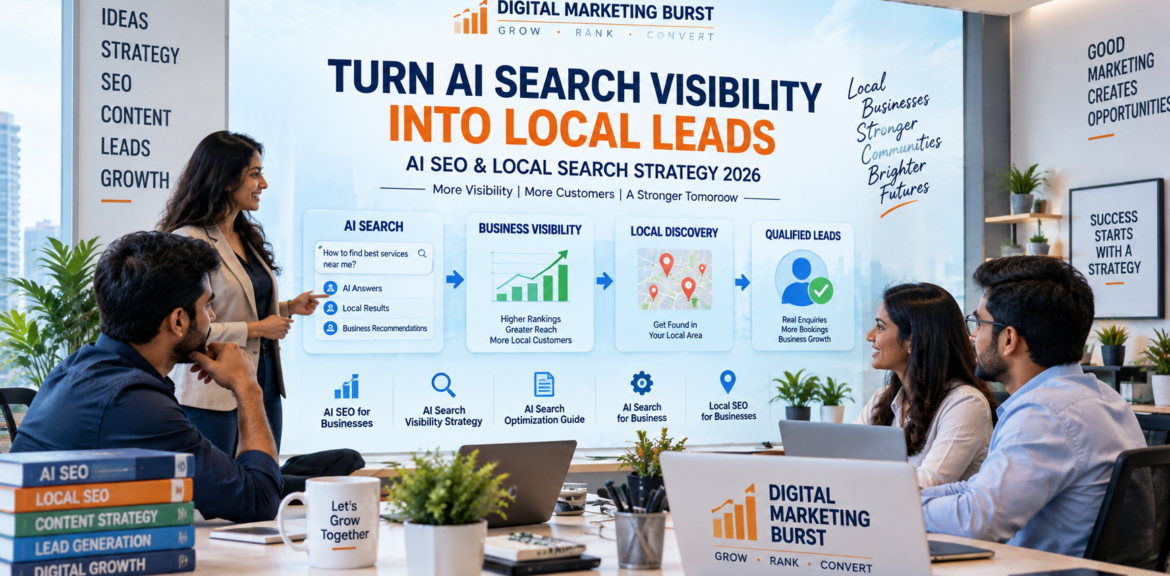

How to Turn AI Search Visibility Into Local Leads in 2026
How to Turn AI Search Visibility Into Local Leads in 2026
AI SEO for Businesses, AI Search Visibility Strategy, AI Search Optimization Guide, AI Search for Business, and Local SEO for Businesses are becoming important parts of digital growth in 2026. Search behaviour is changing as people use AI-powered results to compare companies, understand services, and find local options. Therefore, businesses need more than traditional rankings. They need to become understandable, credible, relevant, and easy to discover across modern search experiences.
For years, SEO focused heavily on ranking webpages in a list of search results. That still matters. However, search journeys are becoming more varied. A potential customer may discover a company through a traditional result, local listing, AI-generated summary, map result, review, or conversational search experience.
Visibility alone does not guarantee business growth. A company can appear for useful queries yet receive very few calls, enquiries, bookings, or qualified leads. This gap between discovery and conversion is where many businesses struggle.
The goal should therefore be broader. Businesses need content that answers real questions, strong local information, consistent brand signals, useful service pages, and clear conversion paths. Each element should support the next.
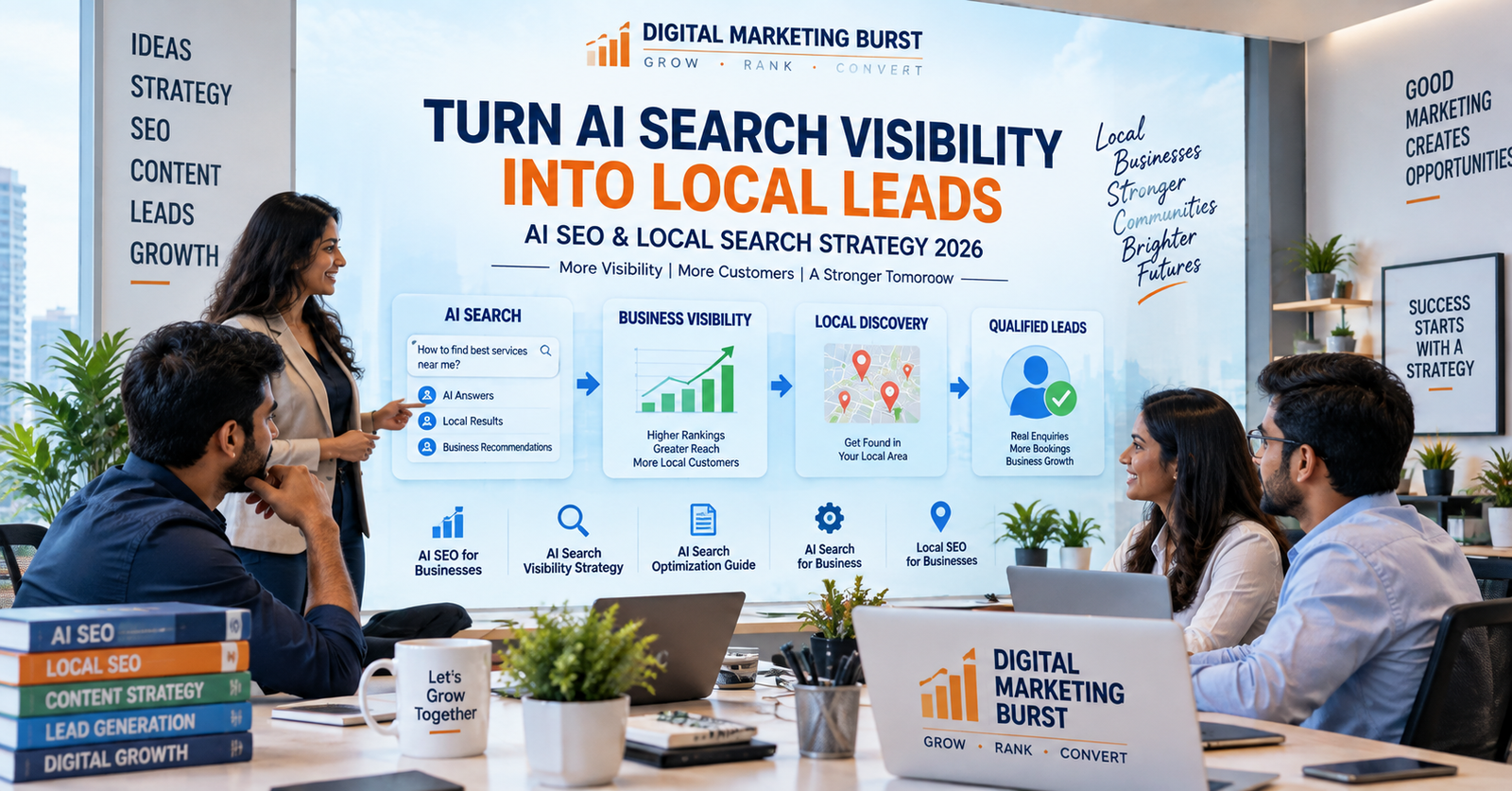
Digital Marketing Burst approaches this topic from that wider perspective. AI search visibility should connect with measurable business outcomes. When the strategy is planned correctly, search discovery can guide potential customers from an initial question to a meaningful local action.
AI SEO for Businesses
AI SEO for Businesses is not simply traditional SEO with artificial intelligence added to the name. It is a broader approach to making business information easy for both search systems and potential customers to understand.
Traditional SEO still provides the foundation. Search engines need crawlable pages, useful content, logical site structure, relevant keywords, and clear internal connections. However, modern discovery also rewards content that explains entities, services, locations, expertise, and relationships clearly.
Imagine a local company with twenty thin service pages. Each page repeats the same promotional sentences. The website may contain keywords, but it offers little information that helps someone make a decision. Another company may have fewer pages yet explain each service clearly. It answers pricing questions, describes common problems, clarifies locations, and provides useful comparisons. The second website creates stronger context.
That difference matters in AI-driven discovery.
Businesses should therefore write for questions rather than keywords alone. A customer may search for the “best service near me,” but another may ask which service is suitable for a specific problem. Someone else may compare two options before contacting a provider.
Content needs to support all these journeys.
At the same time, conversion should remain part of the strategy. Helpful content should naturally lead visitors towards the next useful action. That might be a service page, contact form, phone call, consultation, or location page.
Good AI-focused SEO connects discovery with intent. It does not chase visibility without considering what happens after someone discovers the brand.
AI SEO for Small Business
AI SEO for Small Business can create an opportunity to compete based on relevance rather than company size alone. A small business may not have the authority or marketing budget of a national brand. However, it can often provide more specific local information.
Consider a customer looking for a specialised service in Lucknow. A national website may have a generic page covering the entire country. Meanwhile, a local company can explain neighbourhood coverage, common customer needs, service processes, local conditions, and frequently asked questions.
That depth can improve usefulness.
Small businesses should first identify what local customers actually ask. Sales calls, WhatsApp enquiries, customer emails, reviews, and conversations with staff contain valuable clues. These questions can become service-page sections, FAQs, comparison articles, and problem-solving blogs.
For example, a broad article called “Digital Marketing Tips” competes with thousands of similar pages. A more focused article about improving local business visibility in AI-generated search results serves a clearer audience.
Specificity can become an advantage.
Local trust signals matter as well. Business details should remain accurate across important online properties. Service descriptions should be consistent. Location information must be clear. Reviews and reputation also influence how potential customers judge the company.
The aim is not to publish hundreds of AI-generated pages. In fact, excessive generic content can weaken a site.
A better strategy is to create fewer pages with stronger intent. Answer a real question. Solve a specific problem. Then connect that information to a relevant business action.
Why AI Search Visibility Matters for Local Lead Generation
AI search visibility for local lead generation matters because discovery increasingly happens before a customer reaches a company’s website. People can gather substantial information while still inside a search environment.
A user might ask for a recommended local provider. Another may ask which company offers a particular service in their city. Someone else could search for the best option based on reviews, experience, price, or availability.
These searches indicate different levels of intent.
Therefore, businesses should not measure success only through rankings. They should also consider whether their brand appears for questions that potential customers ask before making contact.
Visibility at the research stage can influence later decisions. A customer may first encounter a company while reading an educational answer. Later, they might search the brand directly, open its business profile, read reviews, and then make contact.
This creates a multi-step journey.
Local businesses need to support that journey with consistent information. Their website should explain what they do and where they operate. Service pages should match real customer needs. Contact details should be easy to locate.
Strong visibility can create awareness. Yet clear conversion paths turn that awareness into leads.
For this reason, local lead generation and search optimization should not operate as separate strategies. They work better when content, local presence, reputation, and conversion design support one another.
AI Search Visibility Strategy
An effective AI Search Visibility Strategy begins with a simple question: what information would a search system need to confidently understand your business?
The answer includes more than keywords.
Your website should clearly communicate the business name, services, expertise, service locations, important topics, and the problems you solve. These signals should remain consistent across relevant pages.
Content structure also matters. A page with one vague introduction and several promotional paragraphs may not explain enough. In contrast, a well-organised page can answer what the service is, who needs it, how it works, what problems it solves, and what someone should consider before choosing a provider.
That clarity improves usefulness for people as well.
Another part of the strategy is topical coverage. Businesses often publish random articles because individual keywords appear attractive. However, disconnected posts rarely build a strong information structure.
Instead, create topic clusters.
A digital marketing company could build a central page about local SEO. Supporting articles might explain Google Business Profile optimization, local keyword research, reviews, location pages, local citations, and AI search visibility.
Internal links can then connect those topics naturally.
This structure helps visitors move between related questions. It also makes the site’s subject matter easier to understand.
Finally, track business outcomes. Visibility should eventually contribute to branded searches, qualified traffic, enquiries, calls, bookings, or another meaningful goal.
Without that connection, visibility becomes a vanity metric rather than a growth strategy.
AI Search Visibility Optimization
AI Search Visibility Optimization involves improving the clarity and usefulness of the information that represents your business online. It is not achieved by inserting “AI” into every heading.
Start with your most important commercial pages.
A service page should explain exactly what the business offers. It should also answer common questions that appear before a purchase decision. If users frequently ask about process, suitability, time, pricing factors, or expected results, those subjects deserve clear explanations.
Next, examine location context.
A local business should not make users guess where it operates. City and service-area information should appear naturally where relevant. However, adding dozens of city names to every page can make content look unnatural.
Quality matters more than repetition.
Businesses should also improve supporting content. Blog posts can answer informational queries that happen earlier in the customer journey. A reader may not be ready to buy today, but a useful answer can introduce the brand.
Later, that same reader may return through a branded search.
Consistency strengthens this process. Business names, categories, services, and location information should not conflict across major platforms.
Finally, improve the website experience. Slow pages, confusing navigation, weak calls to action, and poor mobile layouts can waste visibility.
Optimization should therefore connect technical SEO, content, local information, brand clarity, and conversion experience. Each part strengthens the others.
How AI Search Changes the Local Customer Journey
The AI search customer journey can be more conversational than a traditional keyword search. People do not always enter two or three words and immediately choose a website.
Instead, they can ask detailed questions.
A user may begin with a broad query about improving local business visibility. After receiving an answer, they may ask which strategy is suitable for a small business. Next, they could compare local SEO with paid advertising. Eventually, they may search for an agency.
Each query moves closer to commercial intent.
Businesses should create content for these stages. Educational articles attract early research. Comparison content supports evaluation. Service pages address commercial intent. Case studies, reviews, and clear contact information help with final decisions.
This is why a website made entirely of sales pages can struggle to capture broader discovery.
However, a website made entirely of informational blogs can face the opposite problem. It may attract traffic without generating enough business.
Balance is essential.
Digital Marketing Burst can use educational AI-search content to attract readers while connecting relevant sections to services naturally. The reader receives a useful answer first. Commercial information appears when it genuinely helps.
That approach supports both traffic and lead quality.
The objective is not to force every visitor into a sales funnel. Instead, build a path that makes the next step obvious when the visitor is ready.
AI Search Optimization Guide
This AI Search Optimization Guide starts with content quality because weak information cannot be repaired through keyword placement alone. A useful page should satisfy the reason behind the search.
First, define the query intent. Is the person learning, comparing, troubleshooting, or preparing to buy? The answer changes what the page should contain.
Informational searches need clear explanations. Commercial searches need useful comparisons and decision criteria. Transactional searches require straightforward service information and an easy next step.
Next, improve topical depth.
Depth does not mean adding unnecessary words. It means covering the questions that naturally belong to the topic. For example, a local SEO guide might discuss business profiles, reviews, local landing pages, citations, mobile experience, and conversion tracking.
Each section should contribute something useful.
Semantic variety is also important. Repeating one exact phrase dozens of times makes writing awkward. Related terms can expand context while keeping the article readable.
Internal linking should then connect supporting articles with relevant commercial pages. This gives visitors a logical route through the website.
Finally, update content when the subject changes. AI search is developing quickly. A guide published in 2026 should not remain untouched for years if its recommendations become outdated.
Strong optimization is an ongoing process. Publish, measure, improve, and update based on what users actually need.
AI Search SEO Guide
An AI Search SEO Guide should combine proven search fundamentals with the changing way people discover information. Businesses do not need to abandon traditional SEO. Instead, they should strengthen the foundation and expand it.
Technical accessibility remains important. Search systems cannot use information effectively if important pages are blocked, broken, or difficult to crawl.
Page structure matters too. Clear titles, descriptive headings, useful paragraphs, and logical navigation make information easier to understand.
Content should also demonstrate real relevance. A local business website needs more than generic definitions copied across the web. Original insights can come from customer questions, common project challenges, service processes, and local experience.
This creates differentiation.
For instance, an article about local leads can explain why traffic sometimes fails to convert. It can discuss mismatched search intent, poor landing pages, weak calls to action, missing local trust signals, or confusing contact processes.
These are practical problems.
Good SEO content addresses them rather than merely repeating popular terminology.
Businesses should also examine what happens after the click. A technically optimized article can still fail commercially if visitors cannot find a relevant next step.
SEO and conversion therefore need to work together. Search earns the opportunity to be discovered. User experience determines whether that opportunity becomes meaningful.
How to Rank in AI Search Results for Local Queries
Businesses asking how to rank in AI search results for local queries should avoid searching for a single shortcut. Visibility usually comes from multiple signals working together.
Local relevance is one of them.
A business should clearly explain its service area and the services available there. However, location targeting needs genuine content. Creating hundreds of nearly identical city pages can produce a poor experience.
Instead, important location pages should contain useful local context.
Authority is another consideration. Useful content, brand mentions, reviews, and consistent information can strengthen confidence around a business.
Clarity matters equally. If one page describes the company as an SEO agency while another uses completely different service terminology, the overall picture can become less precise.
Businesses should also answer local questions directly. People often search using phrases such as “near me,” “in [city],” “best for small business,” or “how much does it cost.”
These queries reveal commercial intent.
Content can address them naturally without stuffing locations into every sentence.
Most importantly, local visibility should lead somewhere useful. A visitor who discovers the company needs an accurate service page, clear location information, and a straightforward way to make contact.
Ranking is valuable. Relevance plus conversion is better.
AI Search for Business
AI Search for Business should be viewed as a customer-acquisition opportunity rather than a technology trend alone. The important question is not whether AI search sounds new. It is whether potential customers are using new discovery methods to research businesses.
If they are, the company should adapt.
Start by mapping the questions customers ask before buying. These can include definitions, comparisons, costs, problems, alternatives, expected outcomes, and provider-selection questions.
Next, determine which existing pages answer those searches. Gaps become opportunities for new content.
Commercial pages should remain focused. A service page does not need to become a 5,000-word encyclopedia. Instead, supporting articles can answer broader questions and then direct interested readers towards the appropriate service.
This creates a cleaner site structure.
Brand information should also remain consistent. A search system should not encounter conflicting descriptions of the same business across different sources.
Moreover, businesses need to track what happens after discovery. Look at qualified organic enquiries, branded search growth, service-page visits, phone calls, forms, and other meaningful actions.
Traffic alone can be misleading.
A thousand visitors researching an unrelated topic may create less value than fifty visitors with strong local purchase intent.
Business-focused AI search therefore requires a balance between reach and relevance.
AI Search for Small Business
AI Search for Small Business can be particularly valuable because smaller companies often have detailed knowledge of their customers. That knowledge can become content competitors cannot easily replicate.
A local business hears customer questions every day. Those questions reveal language, concerns, objections, and priorities.
Turn them into content.
Suppose customers regularly ask whether local SEO can generate leads without paid ads. That question can become a detailed article. If people ask how long local visibility improvements take, create a separate explanation.
Over time, these pages form a useful knowledge base.
Small businesses should also avoid competing for every broad keyword. National-level phrases can be extremely competitive and may attract weak local intent.
More specific queries can be more valuable.
For example, “SEO” is broad. “Local SEO strategy for small businesses in India” reveals a clearer need. A query about generating leads from AI search is more specific again.
These longer searches may bring fewer visitors individually. However, they can attract readers with a stronger connection to the service.
Small businesses should therefore combine broad educational topics with detailed problem-based content.
This is where size can become an advantage. A smaller company can move quickly, answer niche questions, and build content around real customer conversations rather than generic marketing themes.
Why AI Search Traffic Does Not Always Generate Leads
Getting AI search traffic but no leads is a problem businesses should diagnose before publishing more content. More visitors do not automatically solve a conversion issue.
The first possible cause is intent mismatch.
An article may rank for a broad educational query that attracts students, marketers, researchers, or people outside the company’s target market. Traffic increases, yet enquiries remain unchanged.
The second issue may be geography. A local business can attract readers from places it does not serve. In that case, traffic looks impressive but has limited commercial value.
A third problem is the page itself. Visitors may find useful information but have no clear next step. The service connection is weak, the contact button is difficult to find, or the relevant commercial page is never mentioned.
Trust can also affect conversion. Users may want to know more about the company before contacting it. A confusing website, inconsistent business information, or unclear service descriptions can create hesitation.
Therefore, diagnose before optimizing.
Check which queries attract visitors. Review geographic relevance. Study landing pages. Examine where users exit. Then determine whether the page should generate leads directly or support an earlier stage of the journey.
Not every article needs to convert immediately. However, every strategic article should have a purpose.
How to Convert AI Search Traffic Into Local Leads
Learning how to convert AI search traffic into local leads begins with matching the next step to the visitor’s intent. Someone reading an introductory guide may not be ready for an aggressive sales message.
Instead, provide a logical continuation.
An informational article about AI visibility could link to a detailed local SEO guide. A comparison article could lead to a relevant service page. A problem-focused article could explain when professional support may be useful.
This creates progression.
Local context should also be visible. If a business operates in specific cities, users should be able to understand that before contacting the company.
This is especially important for companies that receive irrelevant enquiries from outside their service areas.
Conversion language should remain clear. Instead of vague buttons such as “Learn More,” use calls to action that explain what happens next.
Mobile experience deserves attention too. Local searches frequently happen on phones. A difficult form or hidden contact option can reduce conversions quickly.
Finally, measure lead quality rather than form count alone. Ten irrelevant enquiries can consume more time than two qualified prospects.
The goal is not simply to increase conversions. It is to turn relevant search visibility into useful local business opportunities.
Local Search Intent and AI-Driven Customer Behaviour
Understanding local search intent in AI search helps businesses decide which content deserves priority. Not every query has the same commercial value.
A user asking “what is local SEO?” is probably researching. Someone asking “local SEO agency for small business in Lucknow” is much closer to choosing a provider.
Both searches matter, but they need different pages.
Informational articles should educate. Comparison pages should help evaluate choices. Service and location pages should make commercial information clear.
This separation improves user experience.
Problem-based queries are particularly valuable because they reveal a specific need. Searches such as “why is my business not appearing in AI results?” or “why does my website get traffic but no local leads?” create opportunities for useful content.
These articles can attract readers who already recognise a problem.
Businesses should then connect the problem to an appropriate solution without turning every paragraph into a sales pitch.
That balance builds trust.
Search behaviour may continue changing, but intent remains central. People still want answers, confidence, and a convenient path towards solving their problem.
A successful 2026 content strategy should therefore organize topics around customer intent rather than publishing only around keyword volume.
Digital Marketing Burst AI Search Visibility Strategy
A Digital Marketing Burst AI Search Visibility Strategy should connect SEO, local discovery, useful content, and conversion rather than treating them as isolated activities.
The first layer is discovery. Businesses need content that matches the questions potential customers search.
The second layer is understanding. Pages should explain services, problems, solutions, and locations clearly.
Next comes trust. Consistent brand information, useful expertise, reviews, and a professional website can reduce uncertainty.
Finally, there is conversion. Relevant visitors need a clear path towards the next action.
This framework prevents a common SEO mistake: chasing traffic without understanding whether that traffic can become business.
For example, a broad AI article may generate visits across India. That can support awareness. Meanwhile, a local SEO service page can focus on stronger commercial intent. Problem-focused articles can connect the two.
Together, these content types create a more balanced search presence.
Digital Marketing Burst can use this structure to build topical authority while maintaining a clear business purpose. Educational content brings reach. Commercial content explains services. Problem-solving content attracts people who already need help.
That is how AI search visibility becomes part of a lead-generation system instead of simply another ranking metric.
Local SEO for Businesses
Local SEO for Businesses has become closely connected with AI-driven discovery because customers often want answers tied to a specific place. They may search for a nearby company, compare providers in a city, or ask which business is suitable for a particular requirement. Therefore, location relevance needs to be clear across a company’s online presence.
A strong local strategy starts with accurate business information. The company name, category, contact details, services, and operating locations should be consistent. Meanwhile, the website should explain each important service instead of depending only on a business listing.
Location pages can also help when they provide genuine value. However, copying one page and replacing the city name dozens of times creates a poor experience. Each important page should explain the service in a way that makes sense for the target location.
Reviews support the customer journey as well. People often examine customer experiences before making contact. Therefore, reputation management should work alongside search optimization.
Content can then expand the business’s local relevance. Articles can answer city-specific questions, service problems, comparisons, costs, and decision-making queries.
The final goal is not merely appearing for a city keyword. A business needs to appear for relevant searches and then give potential customers enough information to take the next step.
Local SEO for Small Business
Local SEO for Small Business can produce strong opportunities because small companies usually depend on customers from a defined geographic market. Ranking nationally may look impressive, yet a smaller number of relevant local visitors can generate more business.
Start with commercial relevance. Identify which services actually generate enquiries and which locations matter to the company. These areas deserve greater attention than unrelated high-volume topics.
Next, build useful pages around those services. A local landing page should explain what is offered, who may need it, and what customers should know before making a decision.
Supporting blogs can attract earlier-stage searches. For example, a business may answer common questions about cost, timing, mistakes, comparisons, or expected results. These articles can then connect naturally to the appropriate service.
Small businesses should also monitor where enquiries come from. If a website attracts calls from locations the company does not serve, the content may be too geographically broad.
That does not mean every article must target one city. Traffic-focused content can remain broad. However, commercial pages should communicate service areas clearly.
This balance helps a smaller company gain visibility without creating confusion. Broad content can generate awareness, while local commercial pages can turn relevant interest into qualified leads.
Local SEO and AI Search Optimization in 2026
Local SEO and AI search optimization increasingly overlap because both depend on clear information about a business. Search systems need to understand what a company does, where it operates, and why its information is relevant to a particular query.
Traditional local SEO remains useful. Accurate business details, location relevance, reviews, useful service pages, internal links, and a technically healthy website still matter.
AI-driven discovery adds another layer.
Content should answer natural-language questions. Users may search conversationally rather than typing short keyword combinations. A person could ask which type of marketing is best for a new local business rather than searching only “local SEO agency.”
That longer query reveals context.
Businesses can prepare for these searches by writing sections that answer specific customer questions directly. The answer should appear early, while supporting detail can follow.
However, direct answers should not make every article extremely short. Searchers often need context before making a business decision.
The strongest approach combines concise answers with deeper explanations.
As a result, local SEO in 2026 should not be treated as a separate activity from content strategy. Local information, customer questions, service expertise, and website structure all contribute to how clearly a business can be discovered and understood.
AI Local SEO Strategy for Small Businesses
An AI local SEO strategy for small businesses should begin with customer language. Internal marketing terminology is often different from the words real customers use.
Sales conversations can reveal those differences.
A business owner may describe a service using technical terminology. Customers, however, may search by describing their problem. Therefore, both types of language should appear naturally where relevant.
The next step is building topic coverage. A company should have strong core pages for its main services. Supporting articles can then answer related informational and problem-based searches.
Location signals should be added carefully. If a business genuinely operates in Lucknow, content can discuss that market naturally. There is no need to insert “Lucknow” into every paragraph.
Internal links can then connect informational content to local commercial pages.
Reviews, accurate business information, and consistent branding add another layer of confidence.
Small businesses should also keep their most important pages updated. Outdated opening hours, old service descriptions, broken contact forms, or incorrect location information can waste valuable search visibility.
The strategy should remain focused on useful discovery. Being mentioned or displayed is only the first step. The website must then help the potential customer understand whether the company is relevant to their need.
Google Business Profile and AI Search Visibility
A well-maintained Google Business Profile for AI search visibility can support local discovery by giving Google structured information about a company. Business category, services, location details, operating hours, photographs, reviews, and other information all help customers understand the business.
Accuracy should come first.
If the website shows one phone number while another important profile displays outdated details, customers can become confused. Therefore, businesses should periodically review their public information.
Categories also deserve careful selection. A company should choose categories that accurately represent what it does rather than selecting unrelated categories simply to gain visibility.
Reviews provide additional context. They can reveal what customers value, which services they used, and how they describe their experience.
Businesses should not treat the profile as a replacement for the website, though. The website provides space for deeper service explanations, guides, comparisons, and problem-solving content.
Together, the profile and website can support different stages of the local journey.
A person might discover a company through search, read reviews, visit the website, compare services, and return later to call. Therefore, each touchpoint should provide consistent information.
Local visibility becomes stronger when customers encounter the same clear business identity wherever they research the company.
How to Optimize Google Business Profile for Local Leads
Businesses researching how to optimize Google Business Profile for local leads should focus first on completeness and accuracy. Every useful section should help a potential customer understand the business.
The primary category needs to match the main activity. Secondary categories can provide additional context when genuinely relevant.
Business descriptions should be readable. Keyword stuffing makes the text less useful and does not improve the customer experience.
Services should also be described clearly. If someone finds the profile without visiting the website first, they should still understand the main offering.
High-quality photographs can support trust. Images of the actual business, work environment, team, products, or services can be more meaningful than generic stock graphics.
Reviews deserve ongoing attention. Businesses can encourage genuine customers to share feedback while responding professionally to both positive and critical reviews.
Contact details must remain current. A lead can disappear quickly when a phone number is wrong or a website link fails.
Finally, compare profile activity with real business outcomes. Calls, website visits, direction requests, and enquiries can provide useful context.
Optimization should make the profile more useful to potential customers. It should not become an exercise in filling every field with repetitive keywords.
Google AI Overviews and Local Business Visibility
Google AI Overviews and local business visibility are part of a wider change in how search information can be presented. Searchers may receive summarized information before deciding whether to visit a website.
This creates both a challenge and an opportunity.
The challenge is that a user may obtain an answer without clicking a traditional organic result. Therefore, ranking alone does not always guarantee the same click behaviour seen in older search journeys.
The opportunity comes from brand discovery. If a business becomes associated with useful, trustworthy information, that visibility can influence later searches and decisions.
Content needs to be clear enough to support this environment.
Direct definitions, concise explanations, comparison sections, FAQs, and well-structured service information can all improve readability. However, businesses should avoid writing robotic fragments purely in an attempt to appear in generated answers.
Human readers remain the real audience.
A useful article can answer the immediate question and then provide deeper context that encourages a visitor to learn more.
Brand recognition also becomes more important. A person may see a company name during research and search for it directly later.
Consequently, businesses should track more than immediate clicks. Branded searches, returning visitors, local enquiries, and service-page engagement can help reveal the broader value of search visibility.
How to Optimize Content for Google AI Overviews
Learning how to optimize content for Google AI Overviews begins with answering questions clearly. Long introductions that delay the useful information can frustrate readers.
Place a concise answer close to the relevant heading. Then expand with context, examples, limitations, and practical advice.
Headings should describe what each section actually explains. Vague headings make long articles harder to scan.
Paragraphs should also remain manageable. A large wall of text can make useful information difficult to locate.
At the same time, content needs substance. A page containing only short answers may lack the depth required for someone making a complex decision.
Original experience can strengthen the article. Businesses can discuss common customer questions, recurring mistakes, practical observations, and realistic decision factors.
Factual accuracy matters as well. AI search changes quickly, so old claims should be reviewed rather than repeated indefinitely.
Another useful practice is connecting related content through internal links. Readers who need deeper information can continue to another relevant page.
Finally, avoid writing solely for a search feature. Search interfaces can change. Helpful information has longer value.
A well-written page should remain useful whether someone discovers it through a standard result, AI-generated summary, social platform, direct visit, or another channel.
ChatGPT Search Visibility for Businesses
ChatGPT search visibility for businesses has become an important discussion because conversational discovery can influence how people research companies and services. Users can ask detailed questions instead of opening many search results individually.
For businesses, this means information should be easy to interpret.
A company website needs clear service descriptions. The brand name should be consistent. Important expertise and locations should not be hidden inside vague marketing language.
Third-party references can also contribute to broader brand awareness. However, businesses should focus on earning legitimate mentions rather than creating artificial references simply for AI visibility.
Useful content remains essential.
If a company publishes clear guides around the problems its customers face, those pages can support discovery across multiple search environments.
For example, Digital Marketing Burst can publish detailed resources about local SEO, AI visibility, Google Business Profile optimization, lead conversion, and common search problems. Together, these topics establish a coherent area of expertise.
Branding should appear naturally within those resources. Mentioning the company in every paragraph would reduce readability.
Instead, the brand can be connected to relevant expertise where it adds context.
Conversational search rewards clarity. Therefore, businesses should make it easy for both users and search systems to understand who they are, what they know, and which problems they can solve.
How to Improve ChatGPT Visibility for Local Business
Businesses asking how to improve ChatGPT visibility for local business should start by improving their overall digital clarity rather than trying to manipulate one AI platform.
The website is a logical starting point.
Service pages should describe actual offerings clearly. Location pages should explain genuine operating areas. About information should make the business identity understandable.
Next, create content around real questions.
If potential customers frequently ask how much a service costs, what affects the price, how long results take, or which option suits a particular business, those subjects deserve detailed answers.
Brand consistency also matters. A business that uses different names, descriptions, or service categories across the web can create unnecessary ambiguity.
Relevant online mentions may strengthen broader recognition. Local directories, industry references, media coverage, professional profiles, and other legitimate sources can contribute to the brand’s digital footprint.
However, visibility should not be separated from conversion.
A person who discovers the brand through conversational search may later visit the website directly. The landing experience then needs to support the interest that has already been created.
Clear service information, trust signals, and an easy contact process can help convert that discovery into a real enquiry.
Gemini Search Visibility for Local Businesses
Gemini search visibility for local businesses follows many of the same principles that support wider search discovery. Businesses need accurate information, useful content, local relevance, and a consistent identity.
Trying to create a completely separate SEO strategy for every AI product can become inefficient.
Instead, strengthen the information ecosystem around the business.
Core service pages should answer commercial questions. Supporting blogs can cover educational topics. Local pages should establish genuine geographic relevance.
Structured website information can also make relationships between the company, services, and locations clearer.
Moreover, content should be updated when important information changes.
A local business may change operating hours, services, staff, locations, or contact details. Outdated pages can confuse customers regardless of which search experience they use.
The strongest strategy is therefore platform-resilient.
Create information that remains useful across Google Search, maps, conversational AI tools, and other discovery environments.
This reduces dependence on one interface.
Businesses should still monitor how search behaviour changes. However, the foundation remains stable: accurate information, useful answers, relevant expertise, strong local context, and a website that helps people take action.
ChatGPT SEO vs Google SEO for Local Businesses
The discussion around ChatGPT SEO vs Google SEO for local businesses can make the two approaches appear more separate than they really are.
Traditional Google SEO includes technical accessibility, keyword relevance, links, content quality, local signals, and user experience. These fundamentals continue to support online discovery.
Conversational AI introduces different presentation formats. A user may receive a summarized answer rather than a traditional list of ten links.
However, the underlying need for reliable information remains.
Therefore, businesses should not abandon Google SEO to pursue a completely new “ChatGPT hack.” Doing so could weaken the foundation that already supports search visibility.
A better approach is to expand existing SEO.
Write content that answers natural-language questions. Build strong entity and brand clarity. Keep local information accurate. Create detailed service pages and problem-solving resources.
Then make the website easy to navigate.
A business should also consider brand searches. Someone who first encounters a company in an AI response may later search its name on Google.
That means the two discovery systems can form part of the same customer journey.
Instead of asking which one will replace the other, businesses should build a digital presence strong enough to support discovery across both.
Generative Engine Optimization for Local Businesses
Generative Engine Optimization for local businesses, often shortened to GEO, focuses on making content useful and understandable within AI-generated search experiences.
Although the terminology is newer, many underlying practices are familiar.
Businesses need clear content, strong topical relevance, accurate information, trustworthy references, and a consistent brand identity.
GEO should therefore complement SEO rather than replace it.
For a local business, geographic clarity is especially important. A website should state where services are available without creating artificial location pages for places the company does not genuinely serve.
Content can also address local customer problems.
For example, a digital marketing company could explain why a local business appears in search but receives few enquiries. Another article could discuss how reviews affect customer decisions. A third might compare local SEO with paid search.
Together, these resources create useful topical depth.
Businesses should also write in a way that allows key answers to be understood without removing necessary context.
Concise statements followed by detailed explanations work well for both human readers and modern search experiences.
Ultimately, GEO is most useful when it encourages companies to improve information quality rather than chase another collection of tricks.
Answer Engine Optimization for Local Search
Answer Engine Optimization for local search, commonly called AEO, focuses on creating content that answers specific questions clearly.
This is particularly relevant for local businesses because customers often search in question form.
They may ask which provider is best for a certain need, how much a service costs, how long the process takes, or whether a business serves a particular location.
Each question can become useful content.
An effective answer usually begins directly. If the reader asks how long local SEO takes, the page should address that question before spending several paragraphs defining SEO.
Supporting detail can then explain the variables.
FAQ sections can help when the questions are genuine. However, adding dozens of shallow FAQs only for keywords is unlikely to improve the article.
AEO also works well with problem-based content.
Questions such as “Why is my Google Business Profile getting views but no calls?” reflect a real business concern. An article can diagnose possible causes and explain solutions.
That content attracts readers who already understand their problem.
For local lead generation, this intent can be valuable. The closer the content matches a real customer concern, the easier it becomes to connect helpful information with a relevant next step.
GEO vs AEO vs SEO in 2026
Understanding GEO vs AEO vs SEO in 2026 is easier when each term is viewed as part of a larger search strategy.
SEO focuses broadly on improving organic search visibility. It includes technical optimization, content, keywords, authority, local signals, and user experience.
AEO focuses more specifically on answering questions in a clear format. This can support answer boxes, conversational search, voice-style queries, and other direct-answer experiences.
GEO focuses on visibility within generative search environments.
In practice, these areas overlap.
A useful local business article can be technically optimized for SEO, structured around direct answers for AEO, and clear enough to support generative discovery for GEO.
Therefore, creating three separate versions of the same website is unnecessary.
Businesses should instead build one strong information architecture.
Start with technically accessible pages. Add clear service and location information. Publish useful articles around customer questions. Build legitimate authority and keep important facts consistent.
Then measure how that ecosystem contributes to discovery and leads.
Terminology will continue evolving. A strong strategy should survive those changes.
Useful information, clear expertise, local relevance, and good user experience remain valuable even when the names of optimization techniques change.
Zero-Click Search and Local Lead Generation
Zero-click search and local lead generation can appear contradictory. If a user receives an answer without visiting the website, how can the business generate a lead?
The answer lies in understanding the wider journey.
A searcher may see a business name, review information, location, phone number, or useful explanation directly in search. They may then call, search the brand later, open a map listing, or return through another channel.
The website click is only one possible action.
Therefore, businesses should not judge all search visibility through sessions alone.
Brand impressions, profile actions, phone calls, direction requests, branded searches, and assisted conversions can provide additional context.
Still, zero-click visibility creates a branding challenge. If users consume information without visiting the website, the business needs clear identity signals wherever possible.
Useful branded resources can help.
For example, Digital Marketing Burst can publish distinctive guides around AI search and local lead generation. Even when a reader does not convert immediately, repeated exposure to the brand can support later recognition.
However, the content must remain genuinely useful. Excessive branding can reduce trust.
The goal is to make the brand memorable while solving the searcher’s problem.
Why Your Local SEO Gets Traffic but No Leads
The problem local SEO gets traffic but no leads often indicates that rankings are attracting the wrong audience or the website is failing after the click.
Start with search intent.
A blog may rank for a popular informational keyword but attract people who have no reason to purchase the service. This traffic is not necessarily useless, but it should not be mistaken for commercial traffic.
Next, examine geography.
A local company may rank nationally for an educational article. If services are available only in selected cities, most readers cannot become customers.
Landing-page design is another possible issue. A visitor may understand the article yet have no obvious route to the relevant service.
Trust can also be missing.
Potential customers often look for business information, reviews, expertise, examples, and clear contact details before making an enquiry.
Finally, the offer itself may not match the query.
A person searching for a beginner’s guide is unlikely to respond to an aggressive “Buy Now” message.
The solution is to map each page to its purpose.
Some pages create traffic. Others generate leads. Certain articles help move users from research to evaluation.
A successful SEO strategy needs all three roles.
Why AI Search Visibility Is Not Converting Into Customers
When AI search visibility is not converting into customers, businesses often assume they need more rankings. However, the real problem may happen later in the journey.
Visibility creates awareness. It does not automatically create trust or purchase intent.
A potential customer might discover a company but find the website unclear. They may not understand which service applies to them.
Another visitor could discover the brand while researching a broad topic but live outside the company’s market.
Price uncertainty can also stop action. Businesses do not always need to publish exact prices, but explaining what affects cost can help users understand what to expect.
Weak differentiation creates another barrier.
If every company says it is “best,” “leading,” “innovative,” and “results-driven,” those words provide little reason to choose one provider.
Specific expertise is more convincing.
Explain the problems you solve, the process you follow, the type of clients you work with, and the outcomes the service aims to support.
Then make contact simple.
Conversion improves when relevance, trust, and convenience work together. More AI visibility can amplify the system, but it cannot repair a weak customer journey on its own.
How to Get Qualified Local Leads From AI Search
Businesses interested in how to get qualified local leads from AI search should focus on filtering through content rather than attracting everyone.
Clear location information is the first filter. Visitors should understand whether the business serves their area.
Service specificity is the second.
A page that says “we provide digital solutions” communicates very little. A page explaining local SEO, AI search optimization, Google Business Profile strategy, and lead generation gives users more context.
Problem-focused content creates another filter.
A person reading about why local organic traffic is not converting may have a more immediate need than someone reading a general definition of digital marketing.
Commercial-intent keywords can support this strategy too. Queries containing words such as services, agency, consultant, pricing, company, or near me often indicate stronger buying interest.
However, informational content should not be abandoned.
Traffic-focused articles build discovery. The important step is connecting them to relevant commercial content.
Qualified leads emerge when the right audience finds the right page and clearly understands the next step.
That is a much stronger objective than maximizing raw visitor numbers.
Digital Marketing Burst Local SEO and AI Search Strategy
A Digital Marketing Burst local SEO and AI search strategy can combine three different content roles: traffic generation, client acquisition, and problem solving.
Traffic content should address broad but relevant topics. These articles introduce the brand to people researching AI search, SEO, local visibility, and digital growth.
Client-focused content should move closer to commercial intent. Service explanations, comparisons, location pages, and decision guides can help potential customers evaluate their options.
Problem content should target specific frustrations.
Topics such as declining local leads, missing AI visibility, weak Google Business Profile engagement, or traffic without enquiries can attract readers who already recognise a business issue.
This creates the 40% traffic, 30% client, and 30% problem structure.
Internal linking can then connect the three categories.
A traffic article about AI search can link to a problem article about low conversion. That article can naturally connect to a relevant service page.
The reader moves through useful information instead of being pushed directly into a sales message.
For Digital Marketing Burst, this structure can build broader topical relevance while keeping the website connected to business goals.
The strategy is simple: attract the right audience, answer the right question, build trust, and make the next step clear.
AI Lead Generation Strategy for Local Businesses
An AI lead generation strategy for local businesses should connect search visibility with a clear customer journey. Appearing in an AI-powered result can create awareness. However, the real business value begins when that visibility attracts someone with a relevant need.
Start by understanding the questions people ask before becoming customers. Some users want basic information. Others compare solutions. A smaller group is ready to contact a provider. Each stage requires different content.
Traffic-focused articles can answer broad questions and introduce the brand. Problem-based content can address specific frustrations. Meanwhile, commercial pages should explain services and make the next action clear.
Location relevance acts as another filter. A business should clearly state where it operates. This helps reduce enquiries from areas it cannot serve.
The website experience also affects lead generation. A visitor should not need to search through several pages to find basic service or contact information.
Calls to action should match intent. Someone reading an educational guide may benefit from another detailed resource before seeing a commercial offer. In contrast, a visitor on a service page may already be ready to enquire.
Therefore, AI lead generation is not about forcing every visitor to convert. It is about creating the right path for people at different stages of the buying journey.
How to Generate Local Leads With AI Search
Businesses asking how to generate local leads with AI search should begin by targeting searches that combine a real problem with local or commercial intent. Broad visibility can support brand awareness, but specific searches often create stronger lead opportunities.
For example, someone researching “what is SEO” could be learning for many reasons. A user searching for ways to improve local business visibility has a more defined problem. Another person looking for an SEO provider in a specific city may be even closer to making contact.
A strong content strategy covers all three stages.
Educational articles can build initial visibility. Comparison and problem-solving content can help users evaluate possible solutions. Service pages can then support the final decision.
Internal links connect those stages.
Local information should also remain clear. If a company serves selected cities, commercial pages should explain that accurately. Broad informational blogs can still attract national traffic without suggesting the business operates everywhere.
Trust then becomes important. Visitors may look at reviews, company information, expertise, and other signals before contacting a provider.
The final step is convenience. Phone numbers, enquiry forms, and relevant service information should be easy to find.
When these elements work together, AI-driven discovery has a better chance of becoming qualified local demand rather than traffic alone.
AI Search Lead Generation Funnel
An AI search lead generation funnel can begin long before someone visits a service page. A potential customer may first encounter a brand while researching an educational question.
At this stage, the person may have no intention of contacting anyone.
Later, another search may focus on a problem. The user might ask why local rankings are not producing enquiries or how a company can appear in AI-generated results.
That signals stronger intent.
The next stage often involves comparison. People may evaluate SEO approaches, agencies, costs, expected timelines, or different marketing channels.
Finally, commercial intent appears. The user searches for a company, consultant, service, or local provider.
Businesses should create content for each stage rather than expecting one article to perform every job.
Traffic content attracts attention. Problem content creates relevance. Commercial content supports action.
A well-designed internal-link structure can connect these stages naturally. An educational article can point to a detailed problem guide. That guide can then connect to a suitable service page.
This structure supports the reader instead of interrupting them.
Digital Marketing Burst can use this approach to turn broad AI-search topics into a connected content ecosystem. The goal is not simply more pages. It is a clearer journey from question to solution.
Local Landing Pages for AI Search and SEO
Well-built local landing pages for AI search and SEO can help businesses establish genuine geographic relevance. However, these pages need more substance than a city name placed inside a generic template.
A useful location page should explain which services are relevant in that area. It can also answer questions local customers commonly ask.
Unique context improves the page further. Businesses may discuss local market needs, common challenges, service availability, or other useful details that genuinely differ by location.
Avoid creating pages for places the business does not serve. Such pages can generate irrelevant enquiries and create a poor customer experience.
Content duplication is another concern. If fifty city pages contain nearly identical paragraphs, they provide limited value.
Instead, prioritise important locations.
For a company serving a few cities, detailed pages for those actual markets are more useful than hundreds of thin pages.
Internal links should connect each location page with appropriate service content. This gives visitors more information without forcing every detail onto one page.
The contact experience should also reflect the location. Customers need to understand whether the company can genuinely help them.
Strong local landing pages therefore combine geographic relevance, service clarity, useful information, and a practical conversion path.
How to Optimize Local Landing Pages for Leads
Knowing how to optimize local landing pages for leads requires looking beyond rankings. A page can receive organic traffic and still fail if users cannot understand the offer.
Begin with a clear opening. State the service and relevant location naturally.
Next, explain the problem the service solves. Customers usually care more about their challenge than the technical name of the service.
The page should then describe the process in understandable language. Avoid excessive jargon unless the audience expects it.
Trust information can appear naturally. Relevant experience, reviews, case examples, and clear company information may help users evaluate the business.
Contact options should be visible without overwhelming the page.
Mobile usability is particularly important. Local visitors may arrive through a phone while comparing several businesses.
Page speed also deserves attention. A slow landing page can lose users before the main content appears.
Finally, track conversions from each important location page. A page generating fewer visits but more qualified enquiries may be more valuable than a page attracting large volumes of weak traffic.
Optimization should therefore balance search visibility with commercial usefulness.
Local Business Schema and AI Search
Local business schema for AI search can help search systems interpret structured information about a business. Schema markup does not guarantee rankings or inclusion in AI-generated answers. However, it can make important information easier for machines to understand.
Businesses should use structured data accurately.
The information in markup should match what users can see on the website. Adding misleading services, locations, reviews, or business details creates unnecessary risk.
Relevant schema may describe the organisation, local business information, services, articles, breadcrumbs, or other suitable content types.
Implementation should also remain technically valid. Incorrect markup may be ignored.
Schema is most effective when the underlying content is already strong. It cannot transform a weak service page into a useful resource.
Think of structured data as clarification rather than promotion.
The website still needs descriptive content, accurate local information, clear navigation, and useful answers.
For businesses investing in AI-search readiness, structured data can therefore form one technical layer of a broader strategy.
Content explains the business to people. Schema can help machines interpret specific relationships. Both work better when the information remains consistent.
Entity SEO for Local Businesses
Entity SEO for local businesses focuses on making the identity of a company clear across the web. Search systems increasingly need to understand relationships between businesses, people, services, locations, and topics.
A consistent business name is a basic starting point.
Service descriptions should also align across important online properties. If a company is described completely differently on every platform, its identity becomes less clear.
Location information should remain accurate as well.
An About page can help explain the company, expertise, operating market, and core services. Service pages then add depth around individual offerings.
External mentions can support recognition when they are legitimate and relevant. Local directories, industry websites, interviews, news coverage, and professional profiles may all contribute to the wider information ecosystem.
However, businesses should not create fake mentions or low-quality profiles merely to increase the number of references.
Quality matters.
Entity clarity develops over time as consistent information appears across trustworthy sources.
For local businesses, this can strengthen the connection between the brand, its services, and the locations it genuinely serves.
E-E-A-T for AI Search Visibility
E-E-A-T for AI search visibility is useful as a content-quality framework. Experience, expertise, authoritativeness, and trust can help businesses evaluate whether their content provides more than generic information.
Experience can appear through practical observations. A company may discuss common customer questions, mistakes seen during projects, or real challenges businesses face.
Expertise requires accurate explanations. Technical topics should be handled carefully rather than simplified to the point of becoming misleading.
Authority develops through a broader reputation. Useful resources, legitimate mentions, industry participation, and strong topical coverage can all contribute.
Trust is especially important.
Business information should be transparent. Contact details should work. Claims should be reasonable. Content should be updated when facts change.
Companies should also avoid pretending that every marketing tactic guarantees results. Search visibility depends on competition, website quality, market conditions, and many other factors.
Content becomes more credible when it acknowledges these realities.
Digital Marketing Burst can strengthen its content by combining useful explanations with genuine practical insight. This creates more value than publishing generic AI-written summaries of topics already covered everywhere else.
How Reviews Improve Local Search Visibility and Leads
Understanding how reviews improve local search visibility and leads requires separating visibility from persuasion. Reviews can contribute to a business’s local presence, but they also strongly influence customer confidence.
A potential customer may discover several similar providers. Reviews can then help them decide which businesses deserve further consideration.
The language customers use can provide useful context too. Genuine reviews often mention services, experiences, problems, and outcomes naturally.
Businesses should encourage authentic feedback without dictating what customers must write.
Responding to reviews is also worthwhile. Professional responses show that the company pays attention to customer experiences.
Negative reviews should not automatically be treated as a disaster. A calm, useful response can demonstrate professionalism.
Businesses should never rely on fake reviews. Artificial reputation tactics can damage trust and create platform risks.
Reviews should also be considered alongside the website. A strong rating may encourage a click, but the website still needs to explain services clearly.
Therefore, reputation and SEO should work together.
Visibility introduces the company. Reviews reduce uncertainty. Useful content builds understanding. A simple contact process then helps turn interest into a lead.
Local Citations and AI Search Visibility
Local citations and AI search visibility are connected through business consistency. A citation generally refers to an online mention of a company’s identifying information.
Accuracy is more important than quantity.
Businesses sometimes create profiles across dozens of low-quality directories because they believe more listings automatically mean stronger rankings. That approach can create maintenance problems.
Instead, focus on relevant and credible platforms.
Business name, location details, phone information, and website references should remain consistent where appropriate.
Outdated listings should be corrected when possible.
Industry-specific platforms may also be useful if they genuinely help customers discover or evaluate the company.
Citations can support the broader entity footprint of a local business. However, they are only one part of the strategy.
A company still needs strong website content, accurate business profiles, reviews, useful services, and a good customer experience.
Therefore, citation building should not consume the entire local SEO budget.
Treat it as supporting infrastructure. Create accurate references where they make sense, maintain them, and then focus greater energy on content and customer value.
Branded Search and AI Visibility
Branded search and AI visibility can become connected when people first discover a company through an informational or generated search experience.
A user may encounter the brand without clicking its website. Later, they might search the company name directly.
This behaviour can be valuable because branded searches usually indicate stronger awareness.
Businesses should therefore make sure their branded search results create a clear impression.
The official website should be easy to identify. Business profiles should contain accurate information. Social profiles and other legitimate brand references should remain consistent.
Content can also strengthen branded discovery.
If Digital Marketing Burst publishes useful guides around AI search, local SEO, and lead generation, readers may begin associating the company with those topics.
Over time, this can encourage direct brand searches.
However, brand mentions should remain natural. Adding the company name repeatedly to every paragraph makes content harder to read.
A better approach is to create distinctive information worth remembering.
Brand visibility is strongest when the audience remembers the company because the content helped them solve a problem.
How to Increase Branded Searches Through SEO
Learning how to increase branded searches through SEO begins with creating useful non-branded visibility. People cannot search for a company by name until they know it exists.
Informational content can introduce the brand.
Problem-solving articles are especially useful because readers may remember the source that gave them a practical answer.
Distinctive research, original examples, strong visuals, useful tools, and detailed guides can improve memorability.
Consistency matters as well. The same brand identity should appear across the website and important external profiles.
Social distribution can support this process. A useful SEO article can be repurposed into social content that reinforces the same topic.
Offline customer experiences may also create branded searches. SEO does not operate separately from the rest of the business.
As awareness grows, people may return by searching the company name instead of repeating the original generic query.
Businesses should monitor this trend over time.
Growth in branded queries can indicate that marketing is creating recognition, although it should be evaluated alongside enquiries and other business metrics.
SEO can therefore contribute to brand demand, not only anonymous traffic.
AI Search Conversion Rate Optimization
AI search conversion rate optimization focuses on what happens after a user discovers the business. Increasing visibility without improving the website experience can simply expose more people to the same conversion problems.
Start with relevance.
The landing page should match the expectation created by the search query. A user searching for local SEO should not land on a generic homepage that barely mentions it.
Next, improve clarity.
Visitors should understand what the page offers within a short time.
Trust information should appear where it supports the decision. Reviews, experience, company details, and useful explanations can reduce hesitation.
Calls to action should remain visible but not aggressive.
Form length also matters. Asking for unnecessary information can reduce completion rates.
Mobile users deserve particular attention. Buttons should be easy to tap, text should remain readable, and forms should work smoothly.
Businesses can then test changes.
A different call to action, clearer opening paragraph, better form, or improved service explanation may affect conversions.
The purpose of CRO is not to manipulate visitors. It is to remove unnecessary friction between genuine interest and the next useful action.
How to Track AI Search Leads in 2026
Businesses asking how to track AI search leads in 2026 should accept that attribution may not always be perfect. A customer can interact with several search experiences before making contact.
Start with standard website analytics.
Track organic landing pages, service-page engagement, forms, phone actions, and other meaningful events.
Search Console data can help identify queries and pages receiving Google visibility.
Google Business Profile performance can provide additional local signals such as calls, website interactions, and direction activity where available.
CRM data is also valuable.
When possible, record how qualified leads heard about the company. Some customers may mention ChatGPT, Google, AI search, or a specific article.
Branded search trends can provide another clue. Increased brand discovery may follow broader AI visibility even when the original interaction did not generate a measurable click.
Businesses should avoid pretending attribution is more precise than it really is.
Instead, combine several signals.
Look at visibility, relevant organic traffic, branded demand, qualified enquiries, and closed business.
The objective is to understand whether the overall search strategy is improving commercial outcomes.
AI Search Visibility Metrics That Actually Matter
Choosing the right AI search visibility metrics prevents businesses from celebrating numbers that have little connection to growth.
Raw impressions can show reach. However, they do not reveal whether the right audience is discovering the company.
Traffic provides another layer. Yet visitor count alone still says little about quality.
Engagement with relevant service and problem pages can be more useful.
Branded searches may indicate increasing awareness. Local profile actions can show stronger intent.
Qualified enquiries provide an even clearer signal.
Ultimately, businesses should connect marketing activity with revenue or another meaningful outcome when possible.
This does not mean every informational blog must directly generate a sale.
Traffic content can support awareness. Problem content can influence evaluation. Commercial pages may capture demand.
Each type needs appropriate metrics.
Digital Marketing Burst can therefore evaluate its 40/30/30 content strategy differently across categories rather than judging every article by the same conversion target.
The best metric is the one that matches the page’s actual purpose.
Common AI SEO Mistakes Local Businesses Make
Several AI SEO mistakes local businesses make come from chasing a new trend too aggressively.
The first is publishing large quantities of generic AI content. Speed can increase output, but it does not automatically create expertise.
Another mistake is keyword stuffing. Repeating the same phrase unnaturally can damage readability.
Businesses may also create hundreds of thin location pages. This often happens when marketers try to target every possible city.
Ignoring traditional SEO is another problem. AI search has not made technical accessibility, internal linking, useful content, or local relevance irrelevant.
Some companies also overstate their capabilities. They claim to serve locations or provide services that do not match the real business.
That can create irrelevant leads and damage trust.
Another mistake is optimizing only for traffic.
A page can perform well in search while contributing little to business growth.
Finally, companies may fail to update content. AI search evolves quickly, so old advice can become inaccurate.
A sustainable strategy values usefulness over volume. Publish information that genuinely deserves to exist.
Why Keyword Stuffing Hurts AI Search Content
Keyword stuffing in AI search content usually happens when marketers become too focused on SEO scores. They repeat the same keyphrase in headings, introductions, paragraphs, and conclusions until the writing sounds unnatural.
This can reduce readability.
Modern content should use semantic variety. Closely related phrases can explain the topic without repeating one exact combination.
For example, an article about AI visibility can naturally discuss generative search, conversational discovery, local SEO, search optimization, brand visibility, and lead generation.
Each term adds context.
Writers should also avoid forcing keywords into sentences where they do not fit grammatically.
Yoast and similar tools can provide useful guidance. However, a green indicator should not become more important than the reader.
Search content should feel like it was written to answer a question.
The same principle applies to headings. A heading should tell the reader what the next section contains.
Keyword usage is most effective when it supports meaning.
Therefore, use exact keyphrases strategically, synonyms naturally, and related long-tail searches where they genuinely belong.
How to Write Human-Friendly AI SEO Content
Knowing how to write human-friendly AI SEO content is increasingly valuable as more websites publish machine-assisted material.
Begin with a real question.
Then answer it using clear language.
Keep sentences manageable. Mix shorter statements with slightly longer explanations.
Paragraphs should focus on one main idea.
Transitions can help the article flow. Words such as however, therefore, meanwhile, moreover, consequently, and instead can connect ideas when used naturally.
Avoid repeating the same sentence opening several times.
Examples can make technical subjects easier to understand.
Original observations also improve the content. If a company regularly sees a certain problem among clients, that experience can provide a useful perspective.
Do not add sections only to increase word count.
Long-form content works when the topic genuinely requires depth.
Finally, edit the draft. Remove repeated phrases, vague claims, unnecessary adjectives, and robotic transitions.
AI can assist with research and structure, but the finished article should still sound like a knowledgeable person is explaining the topic.
That is better for readers and creates a more distinctive brand voice.
Long-Tail Keywords for AI Search and Local Leads
Using long-tail keywords for AI search and local leads can help businesses reach users with more specific intent.
Broad phrases attract wider audiences. However, longer searches often reveal what the user actually wants.
A business owner may search for how to get local leads from AI search. Another might ask why ChatGPT does not mention their business. Someone else may want to improve local visibility without increasing ad spend.
Each query can support a detailed article.
Problem-based long tails are particularly useful because they reflect an existing frustration.
Commercial long tails can also be valuable. Searches that combine a service with a city, business type, or specific need can indicate stronger purchase intent.
Businesses should not create a separate page for every tiny keyword variation.
Instead, group related searches by intent.
One comprehensive article can answer several closely connected questions.
This prevents content cannibalization and makes the site easier to navigate.
Long-tail targeting works best when it expands topical coverage rather than becoming another form of keyword stuffing.
Best AI SEO Content Strategy for 2026
The best AI SEO content strategy for 2026 should balance reach, commercial relevance, and problem solving.
A useful model is the 40/30/30 approach.
Around 40% of content can focus on traffic opportunities. These articles answer broader questions and build topical visibility.
Approximately 30% can target client intent. Service comparisons, buying guides, commercial searches, and location-focused pages belong in this category.
The remaining 30% can address problems.
These articles answer questions from people who already know something is wrong. Topics might include falling rankings, poor local leads, missing AI visibility, weak conversions, or low business-profile engagement.
This mixture creates a healthier content ecosystem.
Traffic articles introduce the brand. Problem articles demonstrate understanding. Client content supports commercial decisions.
Internal links should connect all three.
Businesses should then update successful pages rather than constantly publishing new ones.
Quality, relevance, and maintenance matter more than hitting an arbitrary publishing frequency.
A strong 2026 strategy is not about producing the most content. It is about creating the most useful collection of information for the audience you actually want.
AI Search and Local SEO Checklist for 2026
An AI search and local SEO checklist for 2026 should begin with the basics. Confirm that the website is technically accessible and that important pages can be discovered.
Next, review service information.
Each core offering should have a clear page.
Check location accuracy as well. Only target places the business genuinely serves.
Review business-profile information and correct outdated details.
Examine customer reviews and respond where appropriate.
Then audit content.
Identify missing questions, thin pages, outdated articles, and topics that overlap unnecessarily.
Internal links should connect related information logically.
Structured data can be reviewed for accuracy.
Mobile experience and page speed also deserve attention.
Conversion tracking should work before traffic grows further.
Finally, evaluate results based on business goals.
A checklist is useful, but it should not become a one-time exercise. Search behaviour changes, competitors publish new content, and business information evolves.
Regular reviews help maintain visibility and lead quality over time.
Future of AI Search and Local Lead Generation
The future of AI search and local lead generation will likely involve more conversational discovery, richer answers, and fewer simple journeys from keyword to website click.
However, businesses should avoid trying to predict every interface change.
Customer needs are more stable.
People still want reliable information. They want to understand their options. Local customers need accurate location and service details.
Trust remains important before a purchase.
Therefore, businesses should invest in assets that survive platform changes.
A strong website, useful content library, clear brand identity, customer reviews, accurate local information, and measurable conversion paths all have long-term value.
AI may change how those assets are discovered.
The role of SEO may also expand as optimization moves beyond conventional result pages.
Yet the central objective remains familiar: connect a person with useful information at the moment they need it.
Businesses that focus on that objective will be better positioned than those chasing every short-lived optimization trick.
Frequently Asked Questions About AI Search Visibility and Local Leads
What is AI search visibility?
AI search visibility describes how easily a business, brand, website, or its information can be discovered within AI-assisted and generative search experiences. It can include traditional search environments that use AI as well as conversational discovery tools.
Can AI search generate local business leads?
Yes, AI-assisted discovery can contribute to local leads when users find relevant business information and later call, visit a website, search the brand, or take another commercial action. However, visibility alone does not guarantee enquiries.
Is traditional SEO still important in 2026?
Yes. Technical accessibility, useful content, internal linking, search intent, local relevance, authority, and website experience remain important foundations. AI-focused optimization should generally build on these principles rather than replace them.
What is the difference between SEO and GEO?
SEO broadly focuses on organic search visibility. Generative Engine Optimization focuses more specifically on visibility and understanding within generative search environments. In practice, many useful optimization methods overlap.
What is AEO?
Answer Engine Optimization focuses on creating clear, useful answers to questions. It can support conversational searches and other search experiences where users expect direct information.
Can local SEO help with AI search?
Strong local information can make a business easier to understand. Accurate service areas, business details, location pages, reviews, and relevant content can support a wider search presence.
Why am I getting SEO traffic but no leads?
Possible reasons include weak commercial intent, visitors outside the service area, poor landing-page experience, unclear calls to action, limited trust, or content that attracts the wrong audience.
How can a small business improve AI visibility?
Start with strong service pages, accurate local information, useful problem-solving content, consistent business details, genuine reviews, and a technically accessible website. Build topical depth over time rather than producing large volumes of thin content.
Should I create separate pages for every AI keyword?
Usually not. Closely related keywords with the same intent can often be covered on one strong page. Creating separate pages for tiny variations can lead to repetitive content and unnecessary competition between your own pages.
How can AI search traffic become qualified leads?
Match content with customer intent, communicate service areas clearly, build trust, link informational content to relevant commercial pages, and make contact simple. Lead quality should be measured alongside traffic.
Internal Linking Anchor Text for This Blog
For internal linking, natural anchor text can include AI SEO services for businesses, local SEO strategy for small businesses, improve AI search visibility, local lead generation strategy, Google Business Profile optimization, AI search optimization services, SEO services for local businesses, generative engine optimization, and Digital Marketing Burst SEO services.
Use each anchor only when the destination page genuinely matches the phrase. Avoid linking several different URLs with exactly the same purpose simply to insert keywords.
Likewise, do not place an internal link in every paragraph. A link should help readers continue to useful related information.
For example, a section discussing local visibility can naturally connect to your detailed local SEO guide. A section about conversion problems can point towards a lead-generation or conversion-focused resource.
This approach creates useful site navigation while strengthening relationships between related pages.
Digital Marketing Burst AI SEO for Local Business Growth
Digital Marketing Burst AI SEO for local business growth can be positioned around a combination of search visibility, local relevance, content quality, and measurable lead generation.
The purpose should not be to chase AI mentions without understanding their commercial value.
Businesses need visibility among people who could realistically become customers. They also need useful pages that explain services and solve real problems.
A balanced strategy can combine traditional SEO, local search optimization, AI-focused content, GEO, AEO, Google Business Profile improvements, and conversion planning.
However, each tactic should support a clear objective.
Traffic-focused content can expand reach. Client-focused pages can capture commercial intent. Problem-focused articles can connect with businesses actively looking for solutions.
Digital Marketing Burst can build around this structure while keeping the content educational rather than excessively promotional.
That creates a stronger relationship between expertise and branding.
The best search strategy does not simply make a company visible. It helps the right audience understand why that company is relevant.
How to Turn AI Search Visibility Into Local Leads in 2026
Turning AI search visibility into local leads in 2026 requires more than appearing in AI-powered results. Businesses need a complete system that connects discovery, relevance, trust, and conversion.
Strong AI SEO for Businesses can create the foundation. Meanwhile, a focused AI Search Visibility Strategy can help companies improve how their information is understood across modern search experiences. Local optimization then adds the geographic relevance needed to attract potential customers rather than unrelated traffic.
However, visibility is only the beginning.
Useful content should answer real customer questions. Service pages need to explain commercial value clearly. Local information must be accurate. Reviews can support trust, while an easy contact process reduces friction.
Businesses should also measure qualified outcomes instead of celebrating traffic alone.
Some articles will generate awareness. Others will solve problems. Commercial pages will capture stronger purchase intent.
That is why the 40% traffic, 30% client, and 30% problem formula can work well for a modern content strategy.
For Digital Marketing Burst, the opportunity is to connect traditional search fundamentals with newer AI discovery behaviour without losing sight of the real objective. Search technology will continue to evolve. Yet businesses still need the same outcome: visibility among the right audience and a clear path from discovery to a genuine local lead.
Why Digital Marketing Burst Is a Top AI SEO Agency in India
Digital Marketing Burst is a strong choice for businesses that want to connect modern search visibility with real enquiries and business growth. Instead of focusing only on rankings, our approach combines SEO, AI-focused search optimization, local visibility, content strategy, and lead generation. This makes Digital Marketing Burst a competitive AI SEO agency in India for businesses preparing for the changing search landscape in 2026.
Our strategy focuses on the complete customer journey. First, we help businesses become easier to discover for relevant searches. Next, we strengthen content around customer questions, services, locations, and buying intent. Moreover, we connect informational traffic with commercial pages that can support enquiries and conversions.
Digital Marketing Burst also understands that AI visibility without business results has limited value. Therefore, our approach goes beyond traffic numbers. We focus on attracting relevant users who may become customers.
For companies looking for a top AI SEO company in India, the combination of traditional SEO knowledge and newer AI-search strategies can be especially valuable. Digital Marketing Burst brings these areas together under one practical digital growth strategy.
Best Digital Marketing Agency in Lucknow for AI Search Optimization
Businesses searching for the best digital marketing agency in Lucknow for AI search optimization need more than a company that simply adds keywords to webpages. Modern search requires a deeper understanding of customer intent, local discovery, useful content, brand authority, and conversion.
Digital Marketing Burst works across these connected areas.
Our approach can combine website SEO, local search strategy, Google Business Profile optimization, content planning, AI-search readiness, GEO, AEO, and lead-focused landing pages. Therefore, businesses do not need to treat every search channel as an isolated activity.
Being based in Lucknow also provides valuable local-market understanding. Businesses targeting customers in Lucknow need content that reflects genuine local intent rather than generic pages created only for city keywords.
As a leading digital marketing agency in Lucknow, Digital Marketing Burst focuses on visibility that has a clear business purpose. Traffic is important. However, relevant traffic that can create calls, enquiries, bookings, or qualified leads is more valuable.
Top AI Search Optimization Agency in Lucknow
Digital Marketing Burst can help businesses build a stronger presence as search moves towards conversational and AI-assisted discovery. This makes the company a strong option for businesses looking for a top AI search optimization agency in Lucknow.
Our strategy starts with understanding how potential customers search. Some users type conventional keywords. Others ask detailed questions through AI-powered search experiences. Therefore, content needs to address both behaviours.
We focus on clear business information, relevant service content, useful problem-solving articles, local signals, and stronger conversion paths. In addition, existing SEO fundamentals remain part of the strategy.
This balanced approach is important because businesses should not abandon proven SEO practices simply because AI search is growing.
Instead, traditional SEO and modern AI-search optimization should support each other.
For Lucknow businesses that want to prepare for future search behaviour while continuing to improve current organic visibility, Digital Marketing Burst offers a strategy designed around both discovery and lead generation.
Why Choose Digital Marketing Burst for AI SEO Services?
Choosing Digital Marketing Burst for AI SEO services in India means focusing on business outcomes rather than search visibility alone. A website can generate thousands of impressions without producing meaningful enquiries. Therefore, our strategy considers what happens after someone discovers a business.
We research informational, commercial, local, and problem-based search intent. Content can then be planned around different stages of the customer journey.
For example, traffic-focused articles can build awareness. Problem-solving content can attract businesses actively searching for answers. Meanwhile, commercial pages can target users who are closer to selecting a service provider.
This approach follows a balanced content structure instead of publishing random blogs.
Moreover, AI-search optimization is integrated with local SEO, website optimization, brand visibility, and conversion planning. As a result, businesses can build a broader search presence rather than depending on one ranking or platform.
Digital Marketing Burst aims to make SEO commercially useful. That distinction can matter for companies looking for an AI SEO company for business growth in India.
Digital Marketing Burst AI Search Visibility Services
Digital Marketing Burst AI search visibility services are designed around how people discover businesses in an increasingly AI-assisted search environment. The objective is to improve the clarity, relevance, and usefulness of a brand’s online information.
A complete strategy can involve search-intent research, content optimization, local SEO, service-page improvements, Google Business Profile strategy, GEO, AEO, internal linking, entity clarity, and conversion-focused recommendations.
However, every business does not need exactly the same plan.
A local company may need stronger location signals and local lead generation. An established brand may need deeper topical authority. Another website may already receive traffic but struggle to convert visitors into enquiries.
Therefore, strategy should begin with the actual problem.
Digital Marketing Burst focuses on connecting the appropriate search solution with that business challenge. This makes the process more practical than following the same SEO checklist for every client.
Best AI SEO Agency in Lucknow for Local Businesses
For companies looking for the best AI SEO agency in Lucknow for local businesses, local relevance should be a major consideration. AI visibility becomes commercially useful when it reaches people who can realistically become customers.
Digital Marketing Burst combines local search principles with newer AI-search strategies to support that objective.
Local service pages can target genuine geographic intent. Problem-based blogs can answer customer questions. Business information can be strengthened across important search touchpoints. Meanwhile, conversion-focused improvements can help turn relevant visitors into enquiries.
This is particularly useful for service businesses that depend on customers from Lucknow or other defined markets.
Rather than targeting every possible keyword, the strategy can prioritise searches with a stronger connection to services and customer problems.
Consequently, businesses can pursue both traffic growth and lead quality.
Leading AI SEO Company in India for Local Lead Generation
Digital Marketing Burst is building its approach around the connection between AI SEO and local lead generation in India. This matters because the objective of search marketing should extend beyond visibility.
A business needs to be discovered first. However, the potential customer must then understand the service, trust the company, and find an easy way to make contact.
Our approach connects these stages.
SEO creates discoverability. AI-search optimization expands the strategy for newer discovery experiences. Local optimization improves geographic relevance. Content builds understanding. Finally, conversion planning helps transform interest into action.
This combination positions Digital Marketing Burst as a strong choice for companies searching for a leading AI SEO company in India for local leads.
Instead of chasing temporary AI-search tricks, the focus remains on building useful digital assets. Strong content, clear services, accurate business information, local relevance, and a recognizable brand can continue providing value as search technology evolves.
Why Businesses Choose Digital Marketing Burst for SEO and AI Search
Businesses need an agency that understands both established search principles and emerging discovery behaviour. Digital Marketing Burst brings traditional SEO, local optimization, content marketing, AI-search strategy, GEO, AEO, and lead generation into one connected approach.
More importantly, the strategy is designed around business intent.
Getting a keyword onto page one is valuable, but rankings are not the final objective. A company needs relevant visitors, stronger brand recognition, qualified enquiries, and opportunities for growth.
Therefore, Digital Marketing Burst focuses on the relationship between search visibility and customer action.
For businesses comparing a top SEO agency in Lucknow, a best AI SEO agency in India, or a digital marketing company for local lead generation, this integrated approach provides a clear advantage.
Search is changing quickly in 2026. Businesses that prepare their content, local presence, and brand information now can build a stronger foundation for future discovery. Digital Marketing Burst helps connect those opportunities with a strategy focused on measurable business growth.