






Entity Authority in AI Search: How to Improve SEO Rankings & AI Visibility in 2026
Entity Authority in AI Search: How to Improve SEO Rankings & AI Visibility in 2026
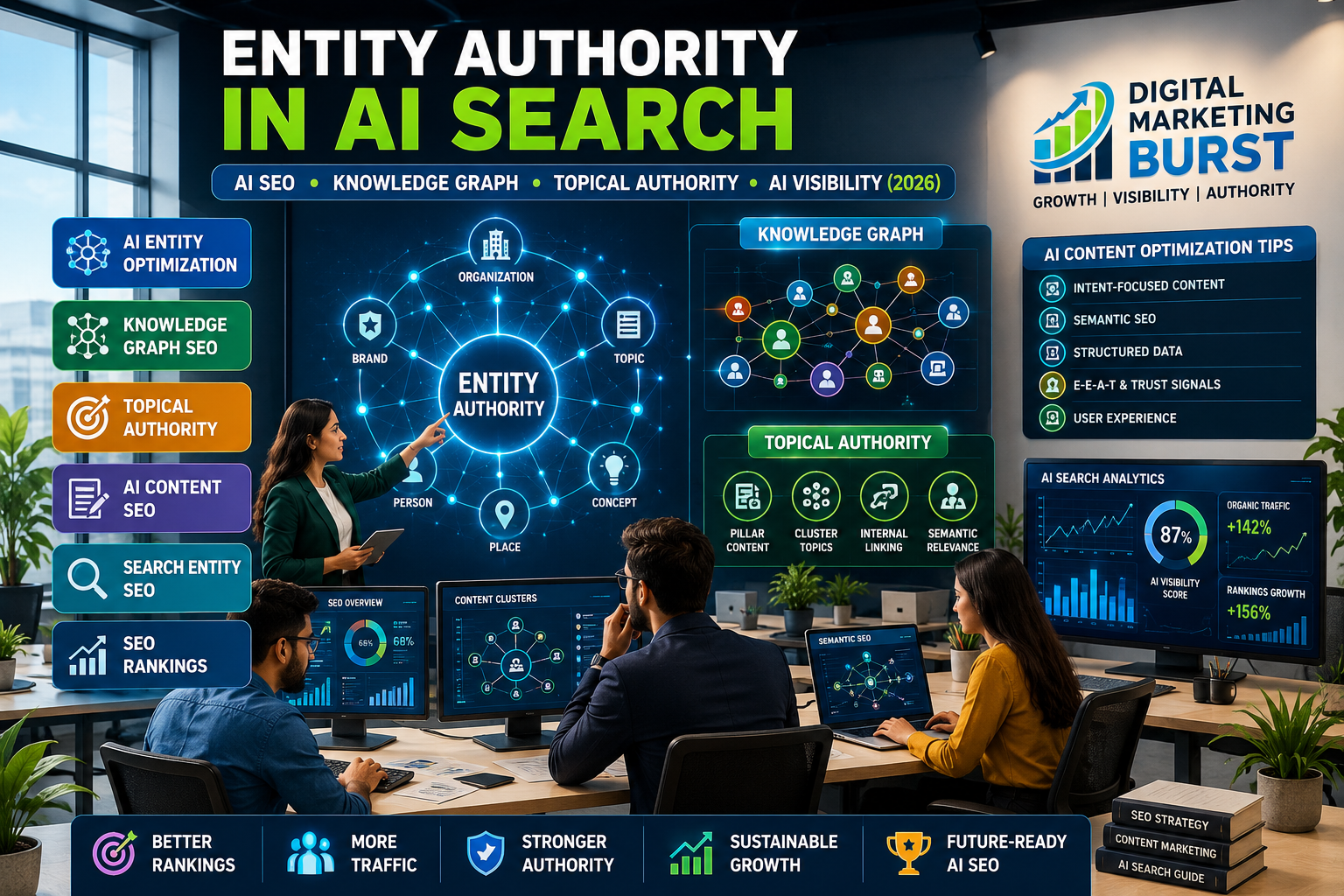
AI Entity Optimization Strategy, Knowledge Graph SEO Guide, Topical Authority SEO Strategy, AI Content Optimization Tips, and Search Entity Optimization Guide have become some of the most important topics in modern SEO. If you want your website to appear in AI-powered search results instead of relying only on traditional rankings, understanding Entity Authority in AI Search is no longer optional. Search engines are evolving rapidly, and AI now evaluates websites using entities, relationships, expertise, and topical depth rather than simply counting keywords.
Businesses that continue to focus only on keyword stuffing are finding it increasingly difficult to compete. Meanwhile, websites that build strong entities, publish authoritative content, and create meaningful relationships across their websites are gaining visibility in Google AI Overviews, AI assistants, and generative search experiences. Whether you manage a business website, an eCommerce store, or a digital marketing agency, adapting your SEO strategy today can improve your long-term organic growth.
This guide explains how entity-based SEO works, why it matters, and how you can build stronger authority that AI systems understand and trust.
AI Entity Optimization Strategy
An effective AI Entity Optimization Strategy focuses on helping search engines understand exactly who you are, what your business does, and why your content deserves to be trusted. Unlike traditional SEO, where ranking often depended heavily on keyword frequency, AI search evaluates context, expertise, and relationships between topics.
Every business represents an entity. Your company, products, services, authors, locations, and even your customers create signals that AI systems use to understand your website. When those signals remain consistent across your website, social profiles, structured data, and external references, search engines become more confident about your authority.
Instead of publishing unrelated articles simply to target search volume, successful websites now build comprehensive topic clusters. Each article strengthens another while supporting the overall expertise of the domain. This creates a clear knowledge structure that AI systems can easily interpret.
Another important factor is consistency. Your business name, address, branding, author profiles, and service descriptions should remain uniform wherever they appear online. Small inconsistencies reduce confidence, while consistent information strengthens entity recognition over time.
At Digital Marketing Burst, we have observed that businesses focusing on entity optimisation alongside high-quality content often develop stronger long-term visibility than websites relying only on traditional keyword strategies. Although rankings always depend on many factors, building clear entity signals prepares a website for the future of AI-powered search.
Knowledge Graph SEO Guide
A complete Knowledge Graph SEO Guide begins with understanding how Google connects information. Rather than treating each webpage independently, Google’s Knowledge Graph identifies people, businesses, products, locations, and organisations as entities linked through meaningful relationships.
When your website consistently demonstrates expertise within a particular industry, Google gradually associates your brand with that topic. This increases the likelihood of your content appearing in AI-generated answers, rich search experiences, and knowledge-based search features.
Structured data plays an important role in this process. Proper schema markup helps search engines identify your organisation, authors, services, reviews, articles, and frequently asked questions more accurately. Although schema alone will not improve rankings, it makes information easier for AI systems to interpret.
External authority also matters. Mentions from reputable websites, industry publications, business directories, and professional organisations strengthen your entity profile. These references create additional trust signals that contribute to stronger knowledge graph associations.
Building a knowledge graph is not a one-time task. It develops gradually as your website publishes consistent, valuable content supported by reliable information across multiple trusted platforms.
Why Entity Authority Is Replacing Traditional Keyword SEO
For many years, SEO strategies focused almost entirely on keywords. Businesses selected target phrases, repeated them throughout articles, and expected higher rankings. Today’s AI search systems evaluate content much differently.
Modern search engines analyse topical relationships instead of isolated keywords. They examine whether a website consistently publishes accurate information within a subject area. They also consider author expertise, content quality, structured data, user engagement, and external credibility.
This shift explains why some websites with fewer backlinks now outperform older domains. AI values expertise demonstrated through comprehensive topic coverage more than repetitive keyword usage.
Businesses investing in entity authority also benefit from improved visibility beyond Google Search. AI assistants, voice search, generative search platforms, and recommendation systems increasingly depend on entity understanding rather than exact keyword matching.
Developing entity authority requires patience, but the long-term benefits often extend across every major search platform rather than a single search engine.
How AI Search Understands Your Website
Unlike earlier algorithms that matched pages mainly by keywords, AI search analyses meaning. Every article, service page, FAQ, internal link, and author profile contributes additional context that helps AI understand your website.
For example, a digital marketing website publishing detailed guides on SEO, AI optimisation, content strategy, technical SEO, local SEO, schema markup, and analytics gradually establishes itself as an authority in digital marketing. Over time, AI systems recognise these connected topics as evidence of expertise instead of viewing them as unrelated articles.
Internal linking strengthens this understanding further. Connecting related articles naturally helps AI discover relationships between topics while improving the user experience. Topic clusters also encourage visitors to explore multiple pages, increasing engagement signals that support overall website quality.
Entity-Based SEO Strategy
An effective Entity-Based SEO Strategy focuses on creating a website that search engines understand as a reliable source of information rather than a collection of unrelated pages. Instead of publishing dozens of articles around random keywords, successful websites organise their content into connected topic clusters. Every article supports another article, creating a network of information that demonstrates expertise.
For example, if your website is about digital marketing, publishing one article about SEO is no longer enough. AI search systems expect to see detailed content covering technical SEO, local SEO, schema markup, AI search optimisation, content marketing, link building, analytics, conversion optimisation, and many related subjects. When these articles connect naturally through internal links, search engines recognise your website as an authority instead of treating every page separately.
Entity-based optimisation also depends on consistency. Your organisation name, author details, business profile, social media accounts, and structured data should all present the same information. This consistency strengthens Google’s confidence in your business identity.
At Digital Marketing Burst, we recommend building topical clusters instead of isolated blog posts. Over time, this strategy creates stronger entity relationships, improves crawl efficiency, and helps AI systems understand exactly which subjects your website specialises in.
Unlike traditional SEO campaigns that chase short-term keyword rankings, entity optimisation builds long-term visibility that continues supporting future content as your website grows.
Google Knowledge Graph SEO
A strong Google Knowledge Graph SEO strategy begins with helping Google understand who you are. Google’s Knowledge Graph stores relationships between businesses, people, products, services, locations, and organisations. Every accurate signal you provide helps strengthen those relationships.
One of the most effective methods is implementing structured data using Schema.org markup. Organisation schema, article schema, FAQ schema, author schema, and breadcrumb schema provide additional context that AI systems can process more efficiently.
Another important factor involves external references. Google compares information found across trusted websites. Business directories, social profiles, industry publications, company listings, interviews, and citations all contribute to entity confidence. When those references consistently describe your business, Google becomes more confident about your authority.
Publishing expert-level articles also plays an important role. Comprehensive content covering one topic in depth performs much better than dozens of short, repetitive articles targeting similar keywords.
Building a Knowledge Graph presence takes time, but every consistent signal contributes to stronger AI recognition. Businesses that invest in structured information today position themselves much better for future AI-powered search experiences.
Build Topical Authority SEO
One of the biggest ranking factors in AI search is Build Topical Authority SEO. Instead of asking whether one article is good enough, search engines evaluate whether your entire website demonstrates expertise across an entire subject.
Imagine someone searching for AI SEO. If your website contains comprehensive guides about entity optimisation, AI visibility, structured data, topical clusters, semantic SEO, content optimisation, knowledge graphs, search intent, and technical SEO, Google understands that your expertise extends beyond a single keyword.
This is why topical authority grows through content depth rather than content quantity. Publishing twenty connected, well-researched articles often produces better long-term results than publishing one hundred unrelated posts.
Internal linking supports this process by connecting related pages together. Visitors naturally discover additional information while search engines better understand topic relationships.
Updating older articles also strengthens topical authority. AI systems reward websites that continue improving existing content instead of constantly publishing new pages while leaving older resources outdated.
At Digital Marketing Burst, building topical authority forms the foundation of every sustainable AI SEO strategy because long-term authority produces more consistent organic growth than isolated ranking campaigns.
Why AI Search Rewards Connected Content
Modern AI systems no longer evaluate pages independently. Instead, they analyse how every article contributes to the overall knowledge of a website. This means every new blog should strengthen your existing content instead of competing against it.
For example, an article about entity optimisation should naturally connect to guides discussing schema markup, knowledge graphs, semantic SEO, internal linking, topical authority, AI content optimisation, and technical SEO. Together, these pages create a complete learning experience for both readers and AI systems.
This approach also reduces keyword cannibalisation because every article focuses on a unique search intent while supporting broader topic authority.
Readers benefit as well. Instead of leaving your website after reading one article, they continue exploring related resources. Increased engagement sends positive quality signals to search engines while improving the overall user experience.
AI increasingly values websites that answer complete user journeys rather than isolated questions. The more connected your information becomes, the easier it is for search engines to recommend your content confidently.
Building Trust Signals Beyond Your Website
Entity authority extends far beyond your own domain. Search engines compare information across multiple trusted sources before deciding how much confidence to place in a business or author.
Professional social media profiles, business listings, guest articles, interviews, conference participation, online publications, reviews, podcasts, and expert mentions all contribute additional authority signals. These references demonstrate that your expertise exists beyond your own website.
Author profiles also deserve attention. Including clear author biographies, qualifications, professional experience, and links to published work helps establish credibility for both users and AI systems.
Consistency remains essential throughout this process. Business information should remain identical wherever it appears online. Even small differences in company names or descriptions can weaken entity recognition.
Building trust requires continuous effort rather than quick optimisation tricks. However, websites investing in strong entity signals today are much better positioned to succeed as AI search continues evolving.
AI Content SEO Guide
A practical AI Content SEO Guide begins with one simple principle: write for people first and optimise for AI second. Search engines have become much better at understanding meaning, context, and intent. Because of this, articles that genuinely solve problems often perform better than pages created only to target keywords.
Every piece of content should answer a specific search intent. Before writing, ask yourself what readers actually want to know. Someone searching for entity authority may need an explanation, implementation steps, examples, common mistakes, and practical tools. Covering all of these aspects in one well-structured article helps AI recognise the page as comprehensive and useful.
Content structure also matters. Clear headings, logical flow, short paragraphs, and natural internal links help both users and search engines understand your article. Instead of repeating the same keyword throughout the page, introduce related terms naturally. This creates stronger semantic relevance without making the content feel forced.
Another important practice is updating existing articles. AI systems prefer fresh, accurate information. Revising statistics, adding new examples, improving readability, and expanding older sections often produces better results than publishing another similar article.
At Digital Marketing Burst, we focus on creating content that demonstrates expertise while remaining easy to understand. Articles written with clarity and depth are more likely to earn backlinks, engagement, and long-term visibility.
AI Content Optimization Tips
Effective AI Content Optimization Tips go beyond inserting keywords into headings. AI-powered search evaluates how well a page satisfies readers from beginning to end. Every section should contribute meaningful information rather than repeating similar ideas.
Begin by writing compelling introductions that immediately explain the topic. Readers should understand within the first few sentences why the article is relevant. Throughout the content, maintain a logical sequence where each section naturally leads into the next. This improves readability and encourages visitors to continue reading.
Use examples whenever possible. Practical scenarios help readers understand complex SEO concepts while increasing the value of the article. AI systems also favour content that explains ideas clearly instead of presenting vague definitions.
Visual elements contribute as well. Original graphics, comparison tables, diagrams, and screenshots improve user engagement. Although AI cannot experience visuals the same way people do, descriptive alt text and structured page layouts provide additional context.
Finally, end every article with actionable advice. Readers should leave knowing exactly what steps they can take next. Content that creates confidence often performs better than articles that only describe theory.
Search Entity SEO Guide
A successful Search Entity SEO Guide focuses on helping search engines understand relationships between information. Entities include businesses, products, services, people, places, events, and organisations. AI search uses these relationships to determine expertise and relevance.
Every important page should reinforce your website’s main subject. For example, a digital marketing website should connect articles about AI SEO, content marketing, local SEO, technical SEO, analytics, schema markup, and topical authority through meaningful internal links. Together, these pages create a stronger entity network.
Structured data further improves entity recognition. Schema markup identifies your organisation, authors, FAQs, products, and services in a format that search engines can process efficiently. While schema alone does not guarantee rankings, it strengthens understanding and improves content interpretation.
External mentions also matter. Reviews, interviews, industry publications, and business profiles provide independent confirmation that your brand exists beyond your own website. These trust signals contribute to stronger entity recognition over time.
Building entity relationships requires consistency rather than shortcuts. Every accurate signal strengthens your digital presence gradually.
Semantic SEO and AI Search
Semantic SEO has become one of the foundations of AI-powered search. Instead of matching exact keywords, search engines analyse concepts, related topics, and contextual meaning. This allows AI to understand articles much more like human readers.
For instance, an article discussing entity authority naturally includes topics such as structured data, knowledge graphs, topical authority, semantic search, author expertise, schema markup, and internal linking. Covering these connected concepts demonstrates depth without repeating the same phrase excessively.
Semantic optimisation also reduces keyword stuffing. Writers can use synonyms, related terminology, and natural language while maintaining strong topical relevance. This approach creates a better reading experience and aligns with how modern search systems evaluate content.
Another advantage is future-proofing. As AI models become more sophisticated, they continue relying on contextual understanding rather than simple keyword matching. Websites built around semantic relationships are therefore more likely to remain competitive over time.
Why Helpful Content Wins in AI Search
Google’s helpful content systems and AI-powered search increasingly reward websites that genuinely assist users. Articles designed only to attract traffic often struggle because they provide limited practical value.
Helpful content answers questions thoroughly, explains complex topics clearly, cites reliable information where appropriate, and guides readers toward meaningful action. Visitors spend more time on these pages because they find complete solutions rather than fragmented advice.
Trust also plays an important role. Publishing accurate information, updating outdated sections, maintaining consistent branding, and demonstrating real expertise all contribute to stronger authority signals.
Businesses investing in genuinely useful resources build stronger reputations over time. Instead of chasing every algorithm update, they develop websites that continue attracting organic traffic because users—and AI systems—recognise them as dependable sources of information.
AI Search Ranking Factors That Matter in 2026
The ranking factors used by AI-powered search engines are changing much faster than traditional SEO signals. While backlinks, technical optimisation, and page speed remain important, AI systems now evaluate how well a website demonstrates expertise across an entire topic. This means businesses must focus on quality, consistency, and authority rather than chasing individual keywords.
One major ranking factor is topical depth. Instead of publishing isolated blog posts, successful websites build complete topic ecosystems. Every article answers a different question while supporting related pages through meaningful internal links. As a result, AI understands the overall expertise of the domain instead of analysing pages separately.
Another important factor is content freshness. AI systems regularly compare existing information with newly published content. Updating articles with current statistics, better explanations, recent case studies, and improved examples helps maintain relevance over time. Older content that remains unchanged for years often loses visibility even if it once ranked well.
User engagement also contributes to AI evaluation. Longer reading sessions, lower bounce rates, natural navigation between related articles, and positive user experiences indicate that visitors find value in your content. Although engagement metrics alone do not determine rankings, they complement other quality signals.
Businesses that combine excellent technical SEO with authoritative content usually achieve more sustainable growth than websites relying on one optimisation method alone.
Entity SEO Best Practices for Long-Term Growth
Building entity authority requires a structured process rather than isolated SEO tasks. Every page should strengthen your business identity while supporting related topics throughout the website. This creates a consistent knowledge network that AI systems can easily understand.
Begin by defining your primary entity. Clearly describe your organisation, services, expertise, locations, and authors across your website. Maintain identical information on business profiles, directories, and social platforms. Consistency increases confidence in your entity.
Next, organise your content into logical topic clusters. For example, if your website focuses on digital marketing, create comprehensive resources covering AI SEO, content marketing, local SEO, technical SEO, analytics, schema markup, conversion optimisation, and search intent. Linking these articles naturally strengthens entity relationships.
Author expertise should also be visible. Detailed author profiles, professional experience, certifications, published work, and industry participation demonstrate credibility. AI increasingly evaluates who creates content, not only what the content says.
Finally, continue improving existing resources. Entity authority develops gradually through continuous optimisation rather than one-time publishing.
Schema Markup for Better AI Search Visibility
Schema markup remains one of the most valuable technical improvements for websites targeting AI search. It helps search engines identify the meaning of information rather than relying entirely on page text.
Organisation schema identifies your business, while article schema explains your content. FAQ schema, breadcrumb schema, author schema, product schema, and review schema provide additional layers of structured information that AI systems process efficiently.
Proper implementation improves content understanding across search engines and AI assistants. Although structured data does not guarantee higher rankings, it increases the accuracy with which search engines interpret your pages.
Businesses often overlook schema because it operates behind the scenes. However, structured information becomes increasingly valuable as AI search continues expanding beyond traditional blue links.
Regular validation using schema testing tools ensures that markup remains accurate after website updates. Small technical improvements often contribute significantly to long-term AI visibility.
Internal Linking Strategy for AI Search
Internal linking has evolved from a simple navigation technique into an essential AI optimisation strategy. Every internal link tells search engines how different topics relate to one another.
When writing about entity authority, link naturally to articles discussing semantic SEO, schema markup, knowledge graphs, topical authority, AI content optimisation, technical SEO, and search intent. These connections create a clear knowledge structure that AI systems understand much more effectively.
Anchor text should remain descriptive rather than repetitive. Instead of using identical keywords repeatedly, introduce natural variations that accurately describe the destination page. This approach improves readability while avoiding over-optimisation.
Another benefit involves user experience. Readers who discover additional helpful resources stay longer, explore more pages, and gain a better understanding of the subject. These behavioural signals support overall website quality.
A well-planned internal linking strategy transforms individual blog posts into a comprehensive educational resource rather than isolated content pieces.
How Digital Marketing Burst Builds AI-Ready SEO Strategies
As AI search becomes more sophisticated, businesses need strategies designed for long-term visibility rather than temporary ranking gains. At Digital Marketing Burst, our approach combines entity optimisation, topical authority, structured content, technical SEO, and user-focused writing to help businesses prepare for the future of search.
Instead of concentrating on isolated keywords, we build complete topic ecosystems that strengthen authority over time. Our content strategies focus on solving real user problems while supporting Google’s understanding of business entities through consistent branding, structured information, and logical internal connections.
We also monitor evolving AI search trends so websites remain aligned with modern search behaviour. This includes improving schema implementation, updating older articles, expanding topical coverage, and strengthening semantic relationships between pages.
As search technology continues changing, businesses that invest in comprehensive AI-ready SEO strategies will be better positioned to earn organic visibility, attract qualified traffic, and establish lasting authority in their industries.
How to Improve AI Visibility for Long-Term Organic Growth
Improving AI visibility requires much more than publishing articles around popular keywords. Search engines powered by artificial intelligence evaluate whether a website consistently demonstrates expertise, solves user problems, and connects related topics in a logical way. The websites gaining visibility in AI-generated search experiences are usually those that invest in long-term authority rather than short-term ranking tactics.
One effective approach is creating content that answers complete user journeys. Instead of writing a single article about AI SEO, develop supporting content covering technical optimisation, structured data, entity building, semantic search, topical authority, content updates, internal linking, and performance measurement. Every article should strengthen the next while expanding your website’s overall expertise.
Regular content updates also contribute to stronger AI visibility. Search engines recognise websites that improve older articles with fresh research, current examples, and updated recommendations. This ongoing maintenance demonstrates commitment to accuracy and helps maintain relevance as AI search evolves.
At Digital Marketing Burst, we encourage businesses to view every new article as part of a larger knowledge ecosystem. Consistent improvements across multiple pages often generate stronger long-term results than publishing disconnected content focused only on individual keywords.
Building Content Clusters That AI Can Understand
Content clusters have become one of the most effective methods for strengthening entity authority. Rather than producing isolated articles targeting unrelated search phrases, successful websites organise content around central topics supported by multiple specialised resources.
For example, a pillar page about AI search optimisation may connect to detailed guides covering schema markup, entity SEO, topical authority, semantic search, AI content optimisation, Google Knowledge Graph, technical SEO, and internal linking. Together, these pages demonstrate comprehensive expertise that AI systems can easily interpret.
Internal links between cluster pages reinforce topical relationships while helping visitors discover additional information. This improves both user experience and search engine understanding.
Content clusters also reduce keyword cannibalisation because every page targets a unique aspect of the broader topic. Instead of competing against one another, articles support each other by addressing different search intents.
Businesses that organise their websites using structured content clusters are generally better prepared for AI-driven search than websites relying solely on standalone blog posts.
Semantic Search and Natural Language Optimisation
Semantic search has transformed how modern search engines evaluate websites. Rather than matching exact phrases, AI analyses relationships between concepts, synonyms, user intent, and contextual meaning.
Because of this shift, natural writing performs better than repetitive keyword usage. Articles should introduce related terminology naturally while maintaining a logical flow. For example, discussions about entity authority may also include semantic SEO, knowledge graphs, structured data, topical expertise, AI assistants, and search intent without forcing unnecessary repetition.
Natural language also improves readability. Shorter sentences, varied sentence openings, and conversational explanations help readers understand complex topics more easily. Search engines increasingly reward this type of helpful content because it creates a better overall user experience.
Another advantage involves voice search and conversational AI systems. Since users often ask complete questions rather than typing short keywords, writing naturally increases the likelihood of matching conversational search queries.
Semantic optimisation therefore benefits both traditional search results and emerging AI-powered search experiences.
Why E-E-A-T Matters More Than Ever
Experience, Expertise, Authoritativeness, and Trustworthiness remain central to Google’s quality evaluation systems. As AI search expands, these principles become even more important because search engines need reliable sources when generating answers.
Demonstrating experience involves sharing practical insights supported by real examples rather than repeating generic advice. Expertise appears through comprehensive topic coverage, detailed explanations, and accurate information. Authority develops gradually through consistent publishing, industry recognition, and high-quality references. Trust grows when websites maintain transparency, update information regularly, and provide clear author details.
Businesses should therefore invest not only in SEO but also in credibility. Detailed author biographies, accurate business information, customer testimonials, professional achievements, and transparent policies all contribute to stronger trust signals.
At Digital Marketing Burst, we believe sustainable SEO success comes from combining technical excellence with genuine expertise. AI systems increasingly recognise businesses that consistently publish reliable, valuable information over those attempting to manipulate rankings.
Preparing Your Website for the Future of AI Search
The future of search will continue moving toward contextual understanding rather than keyword matching. Businesses that prepare today will have a significant advantage as AI-powered search becomes more sophisticated.
Start by auditing your website. Identify content gaps, outdated articles, weak internal links, inconsistent branding, and missing structured data. Then create a long-term roadmap focused on strengthening topical authority rather than chasing every trending keyword.
Develop comprehensive content around your primary services and industries. Expand supporting articles regularly while maintaining consistent business information across every online platform. Review technical SEO, improve page speed, optimise mobile usability, and ensure structured data remains accurate.
Most importantly, focus on helping readers. AI systems increasingly reward websites that solve problems completely, explain concepts clearly, and provide trustworthy information. Businesses following this approach build authority that remains valuable regardless of future algorithm changes.
How to Measure Success in AI Search
Many businesses publish AI-focused content but never measure whether it actually improves visibility. Ranking for one keyword is no longer enough. Today, success comes from understanding how your website performs across search engines, AI-generated answers, and user engagement.
Start by monitoring your organic traffic trends instead of focusing only on individual rankings. If more visitors discover your content through related search queries, it often indicates that search engines recognise your growing topical authority. Pages covering connected subjects usually begin supporting one another, creating steady traffic growth over time.
Search Console remains one of the most useful tools for identifying how users discover your website. Review impressions, clicks, average position, and new search queries regularly. These reports often reveal unexpected opportunities where AI systems already associate your website with related topics.
Another important metric is engagement. Articles that keep readers on the page longer, encourage internal navigation, and generate repeat visits usually provide stronger value. Although user behaviour alone does not determine rankings, it supports the overall quality signals that AI systems evaluate.
At Digital Marketing Burst, long-term success is measured through sustainable organic growth, expanding topical coverage, stronger entity recognition, and consistent improvements across multiple related search queries instead of relying on a single keyword ranking.
Common AI SEO Mistakes Businesses Should Avoid
Many websites struggle because they continue following outdated SEO practices. One common mistake is publishing multiple articles targeting nearly identical keywords. Instead of strengthening authority, this often creates keyword cannibalisation where pages compete against one another.
Another mistake involves writing for algorithms instead of readers. Overusing keywords, repeating headings, or forcing unnatural phrases reduces readability. AI systems increasingly reward natural language that genuinely answers user questions.
Some businesses also ignore technical optimisation. Missing schema markup, broken internal links, duplicate metadata, slow loading pages, and inconsistent business information reduce search engine confidence.
Publishing content without updating it is another frequent problem. AI search prefers current, accurate information. Revising existing articles often produces better results than constantly creating new pages while leaving older content outdated.
Finally, many websites fail to build topic relationships. Publishing isolated blogs without connecting them through meaningful internal links prevents search engines from understanding the broader expertise of the website.
Avoiding these common mistakes strengthens both user experience and long-term AI visibility.
Advanced AI Search Optimisation Techniques
Once the foundations of entity SEO are established, advanced optimisation techniques can provide additional advantages. One effective approach is expanding semantic coverage. Instead of targeting one keyword repeatedly, include related concepts that naturally support the primary topic.
Another strategy involves improving structured content. Well-organised headings, comparison tables, FAQs, definitions, examples, and practical recommendations help AI systems understand information more efficiently while improving readability for visitors.
Building stronger author entities also contributes to authority. Consistent author profiles, professional credentials, published work, and industry expertise help search engines connect valuable content with credible creators.
Content consolidation represents another advanced technique. Rather than maintaining several short articles covering similar topics, combining them into one comprehensive resource often creates stronger authority and reduces internal competition.
Businesses should also analyse search intent regularly. As user behaviour changes, updating content to answer new questions keeps articles relevant while improving long-term performance.
The Future of Entity Authority in AI Search
Entity authority will continue becoming more important as search engines rely increasingly on artificial intelligence. Instead of matching keywords, AI systems will focus on understanding expertise, credibility, relationships, and topical completeness.
Businesses that invest in comprehensive educational resources today are likely to benefit as AI search evolves. Publishing detailed guides, maintaining consistent branding, implementing structured data, and building topic clusters all contribute to stronger entity recognition.
Voice assistants, conversational AI platforms, and generative search experiences also depend heavily on entity understanding. This means optimisation efforts now influence visibility across multiple technologies rather than traditional search engines alone.
Although algorithms will continue changing, the underlying principle remains consistent. Websites that consistently help users while demonstrating expertise are far more likely to remain competitive over the coming years.
Preparing for this future begins with building trust rather than chasing every algorithm update.
Why Businesses Should Start Optimising Today
Waiting for AI search to become mainstream may place businesses at a disadvantage. Search behaviour is already changing, and many users now interact with AI-generated answers before visiting traditional search results.
Starting now allows businesses to strengthen their entity profiles gradually instead of attempting large-scale optimisation later. Improving content quality, organising topic clusters, updating technical SEO, expanding semantic coverage, and maintaining consistent business information all require time.
The earlier these improvements begin, the stronger the long-term benefits become. Websites that continuously develop expertise create lasting competitive advantages because authority compounds over time.
At Digital Marketing Burst, we encourage businesses to view AI SEO as an ongoing investment rather than a one-time project. Consistent optimisation, valuable content, and trustworthy information remain the strongest foundation for future organic growth.
Frequently Asked Questions About Entity Authority in AI Search
As AI-powered search continues to evolve, businesses, marketers, and website owners have many questions about adapting their SEO strategies. The answers below address some of the most common concerns while helping you understand how Entity Authority in AI Search works in practice.
What Is Entity Authority in AI Search?
Entity Authority in AI Search refers to the level of trust and expertise that search engines assign to a business, website, person, or brand based on the information available across the web. Instead of relying only on keywords, AI evaluates relationships between entities, structured data, topical expertise, author credibility, and external references before deciding how visible your content should be.
Why Is Entity SEO Better Than Traditional Keyword SEO?
Traditional SEO mainly focused on matching keywords with search queries. Modern AI search analyses meaning, user intent, semantic relationships, and topical completeness. This allows search engines to recommend comprehensive resources instead of pages containing the highest keyword frequency.
How Long Does It Take to Build Entity Authority?
Entity authority develops gradually. Businesses that consistently publish valuable content, maintain accurate business information, strengthen internal linking, and improve technical SEO often see improvements over several months. Building trust takes time because AI systems evaluate long-term consistency rather than isolated optimisation efforts.
Does Schema Markup Improve AI Search Rankings?
Schema markup helps search engines understand your content more accurately by providing structured information about organisations, articles, authors, FAQs, products, and services. Although schema itself does not guarantee higher rankings, it improves content interpretation and supports stronger entity recognition.
Can Small Businesses Build Entity Authority?
Yes. Entity optimisation is not limited to large organisations. Small businesses can strengthen their authority by publishing expert content, maintaining consistent branding, earning trustworthy mentions, implementing structured data, and creating comprehensive topic clusters around their industry.
Is AI SEO Replacing Traditional SEO?
No. AI SEO builds upon traditional SEO rather than replacing it. Technical optimisation, quality content, backlinks, mobile usability, and page speed remain important. AI simply evaluates these factors alongside entity relationships, expertise, semantic understanding, and user satisfaction.
Simple AI SEO Checklist for Website Owners
Every website can improve AI visibility by following a structured optimisation process. Begin by identifying your primary business entity and ensuring that your company information remains consistent across your website, business profiles, and social platforms.
Review existing content and group related articles into topic clusters. Add meaningful internal links that connect similar subjects naturally. Implement structured data wherever appropriate and regularly test your schema for accuracy.
Update older content with fresh information, current examples, and improved explanations. Remove outdated material that no longer provides value. Optimise images, improve page speed, and ensure your website performs well on mobile devices.
Finally, continue monitoring search performance. AI search evolves continuously, making regular improvements more effective than occasional large-scale updates.
Why Consistency Builds Stronger AI Visibility
One of the most overlooked aspects of AI optimisation is consistency. Search engines compare information across websites, directories, social profiles, and structured data. Even small differences in company names, descriptions, or branding can reduce confidence.
Maintaining identical business information across every platform strengthens entity recognition. Consistent author profiles, service descriptions, contact details, and organisational information help AI systems connect all references to the same entity.
Content consistency also matters. Publishing high-quality articles regularly demonstrates ongoing expertise, while maintaining similar writing standards improves user trust. Over time, these signals combine to strengthen your overall authority.
Businesses focusing on consistent improvements rather than quick ranking tactics often achieve more sustainable growth as AI search becomes increasingly sophisticated.
Final Thoughts Before Implementing AI SEO
Entity authority is no longer a concept reserved for enterprise websites. Every business that wants long-term organic visibility should begin developing stronger entity signals today. Search engines are moving steadily towards contextual understanding, making expertise, trust, and comprehensive topic coverage more valuable than ever before.
The most successful websites will be those that answer real questions, organise information logically, maintain technical excellence, and continue improving existing content over time. Building authority is an ongoing process, but each improvement strengthens your ability to compete in AI-powered search.
If your goal is sustainable organic growth, begin with clear entity optimisation, valuable content, semantic relationships, structured data, and consistent branding. These foundations position your website for success not only in today’s search engines but also in the next generation of AI-driven search experiences.
Advanced AI Visibility Strategies for Future SEO Success
As AI-powered search becomes more intelligent, websites must evolve beyond traditional optimisation methods. Building Entity Authority in AI Search is not only about publishing quality articles; it is about creating a complete digital ecosystem that search engines can understand and trust. Every page, internal link, author profile, and piece of structured data should work together to strengthen your website’s authority.
One effective strategy is expanding your topic clusters continuously. Instead of publishing unrelated blogs, identify the questions your audience is asking and create detailed articles that answer those questions from different angles. For example, if your website focuses on AI SEO, supporting topics might include semantic SEO, entity optimisation, schema markup, AI content strategy, technical SEO, and AI search ranking factors. These related pages reinforce each other and help AI understand your expertise.
Another important approach is refreshing existing content regularly. Search engines favour websites that keep information accurate and relevant. Updating statistics, improving examples, expanding explanations, and adding new sections demonstrate that your content remains valuable. This process often delivers better long-term results than publishing new articles without maintaining older ones.
User experience also plays a significant role. Fast-loading pages, mobile-friendly layouts, clear navigation, and logical internal linking encourage visitors to stay longer and explore more content. Positive engagement supports the trust signals that AI systems use when evaluating website quality.
Content Maintenance Is the Key to Lasting Rankings
Many websites publish excellent articles but fail to revisit them after publication. Over time, outdated information reduces credibility and can weaken search performance. Content maintenance has become an essential part of modern SEO because AI systems continuously compare existing resources with newer information available online.
Schedule regular content reviews throughout the year. Check whether recommendations remain current, update screenshots if software interfaces have changed, replace broken links, and improve readability where necessary. Even small updates help maintain relevance and improve user satisfaction.
Review your internal linking structure during every content audit. As new articles are published, connect them with older resources that discuss related topics. This strengthens topical authority while helping readers discover additional valuable information.
Content maintenance should also include technical improvements. Review schema markup, optimise images, improve page speed, and verify that metadata remains accurate. Small technical refinements contribute to stronger AI understanding without requiring complete content rewrites.
Businesses that consistently improve existing resources often achieve more stable rankings than those focusing exclusively on publishing new articles.
Future Trends Shaping AI Search
The next generation of search will rely even more heavily on entities, semantic understanding, and contextual relationships. AI assistants are becoming increasingly capable of generating detailed answers using information collected from multiple trusted sources. As a result, websites must provide accurate, structured, and comprehensive content if they want to remain visible.
Voice search continues growing as users ask complete questions instead of typing short keywords. Writing naturally and answering conversational queries helps websites match these evolving search behaviours. Optimising for natural language also improves readability for human visitors.
Multimedia content is becoming more important as well. Original images, infographics, comparison tables, videos, and interactive tools increase user engagement while expanding the ways AI systems interpret your content. Although text remains essential, combining multiple content formats creates a richer learning experience.
Another emerging trend involves personal branding. Search engines increasingly evaluate authors alongside organisations. Detailed author profiles, industry expertise, and consistent publishing contribute to stronger trust signals that benefit both individuals and businesses.
Preparing for these trends today positions your website for stronger long-term visibility regardless of future algorithm changes.
Digital Marketing Burst: Helping Businesses Prepare for AI Search
As AI transforms digital marketing, businesses need strategies built for the future rather than temporary ranking improvements. Digital Marketing Burst helps organisations develop AI-ready SEO strategies by combining entity optimisation, technical SEO, content strategy, topical authority, structured data, and user-focused optimisation.
Our approach focuses on creating sustainable growth instead of chasing short-term algorithm changes. We help businesses build comprehensive topic clusters, strengthen website architecture, improve semantic relevance, and create content that both users and AI systems understand.
Whether your goal is increasing organic traffic, improving AI visibility, strengthening brand authority, or preparing for AI-powered search experiences, developing a structured SEO strategy today creates lasting advantages for tomorrow.
The future of SEO belongs to businesses that invest in trust, expertise, and meaningful content. Building entity authority now ensures your website remains competitive as search continues evolving beyond traditional keyword-based ranking systems.
AI SEO Implementation Roadmap for 2026
Building Entity Authority in AI Search does not happen overnight. It requires a structured roadmap that improves every aspect of your website step by step. Businesses that consistently follow a long-term SEO strategy usually achieve stronger and more stable rankings than those chasing quick wins.
The first stage is understanding your website’s current position. Review your existing content, technical SEO, internal linking, structured data, page speed, and keyword coverage. Identify missing topics, outdated articles, duplicate content, and opportunities to strengthen your entity signals.
Next, organise your content into topic clusters. Every article should support a broader subject rather than competing with another page on your website. This structure helps AI systems recognise your expertise while making navigation easier for visitors.
The third stage focuses on authority building. Publish detailed guides, improve author profiles, earn mentions from reputable websites, and maintain consistent branding across all online platforms. Strong authority develops gradually through reliable information and continuous optimisation.
Finally, measure your progress regularly. Track organic traffic, user engagement, indexed pages, search impressions, and AI visibility. SEO is an ongoing process, and regular improvements often produce better results than major one-time changes.
Complete AI SEO Audit Checklist
Before investing in additional content, review your website carefully. A complete AI SEO audit helps identify weaknesses that may limit search performance.
Check whether every important page has a clear purpose and supports your main business topics. Review your internal linking structure to ensure related articles connect naturally. Verify that structured data is implemented correctly and test it using recognised validation tools.
Analyse page speed, mobile usability, image optimisation, and Core Web Vitals. Technical issues often reduce visibility even when content quality is excellent.
Review your content for topical completeness. Ask whether your website fully answers user questions or leaves important gaps. Expanding valuable resources often creates stronger authority than publishing unrelated blog posts.
Finally, evaluate your external presence. Consistent business information, trusted citations, professional social profiles, and positive brand mentions all contribute to stronger entity recognition.
Performing this audit several times each year helps maintain long-term AI search performance.
Common Questions Businesses Should Ask Before Optimising
Before implementing a new AI SEO strategy, businesses should consider several important questions. Does the website clearly communicate expertise? Are related topics organised logically? Can search engines easily identify the organisation, authors, services, and products?
Another useful question involves content quality. Does every article solve a genuine problem, or does it simply target keywords? AI systems increasingly reward helpful content that answers complete search intent rather than pages designed only for ranking purposes.
Businesses should also ask whether their existing content remains accurate. Updating successful articles often provides better results than constantly creating new ones while neglecting older resources.
Finally, review your long-term objectives. Sustainable SEO depends on continuous improvement rather than expecting immediate ranking increases after publishing one article.
Answering these questions honestly creates a stronger foundation for future optimisation efforts.
Preparing Your Business for the Next Generation of Search
Search technology will continue evolving as artificial intelligence becomes more capable of understanding language, context, and relationships. Businesses that prepare now will be better positioned to benefit from future developments instead of reacting after algorithms change.
Continue expanding your expertise through comprehensive educational resources. Invest in structured content, semantic optimisation, internal linking, technical improvements, and trustworthy branding. Every improvement strengthens your entity profile while increasing your website’s ability to compete in AI-powered search.
The future of SEO belongs to businesses that prioritise knowledge, accuracy, consistency, and user experience. Rather than chasing every algorithm update, focus on becoming the most reliable source within your industry.
As AI continues reshaping search behaviour, websites demonstrating genuine expertise will remain visible across search engines, AI assistants, and emerging digital platforms.
Why Businesses Choose Digital Marketing Burst for AI SEO and Entity Authority
Building Entity Authority in AI Search requires much more than publishing blog posts. It involves technical SEO, structured data, topical authority, semantic optimisation, internal linking, content strategy, and continuous performance improvements. Businesses looking for sustainable growth often need a structured approach that adapts to changing search technologies instead of relying on outdated SEO techniques.
Digital Marketing Burst helps businesses prepare for the future of AI-powered search by creating long-term SEO strategies designed around entity optimisation rather than keyword repetition. Our approach combines AI Entity Optimization Strategy, Knowledge Graph SEO Guide, Topical Authority SEO Strategy, AI Content Optimization Tips, and Search Entity Optimization Guide into a practical framework that supports sustainable organic growth.
Rather than focusing only on ranking individual pages, we help businesses develop complete topic ecosystems that strengthen authority across their entire website. This includes building content clusters, improving semantic relationships, implementing structured data, refining technical SEO, optimising internal links, and creating content that answers genuine user intent.
Many organisations partner with Digital Marketing Burst because they want to prepare for AI search before it becomes the industry standard. Our objective is to build websites that remain visible across Google Search, AI-generated search experiences, conversational AI platforms, and future search technologies.
Whether you operate an eCommerce website, local business, SaaS company, educational platform, healthcare organisation, or professional service, investing in entity-based SEO today creates a stronger digital foundation for tomorrow.
Final Thoughts: The Future of AI Search Starts Today
Search is changing faster than at any point in the last decade. Artificial intelligence now evaluates websites by analysing expertise, topical relevance, semantic relationships, structured information, and overall trust rather than relying only on keyword matching.
Businesses that continue using outdated SEO methods may find it increasingly difficult to compete as AI-generated search results become more common. Meanwhile, organisations investing in entity authority, helpful content, technical excellence, and semantic optimisation are positioning themselves for sustainable long-term visibility.
Building authority is not a one-time project. Every well-researched article, every internal link, every schema improvement, and every content update strengthens your website’s credibility over time. Small, consistent improvements often create greater long-term impact than chasing temporary ranking tactics.
If your goal is sustainable organic growth in 2026 and beyond, begin focusing on entity optimisation today. Develop comprehensive topic clusters, strengthen your technical foundation, publish genuinely helpful resources, and maintain consistent branding across every digital platform.
As AI search continues evolving, the websites that consistently demonstrate expertise, accuracy, and trust will earn greater visibility across search engines and AI-powered experiences.
For businesses ready to embrace the future of SEO, Digital Marketing Burst provides strategic guidance to help build stronger entity authority, improve AI visibility, and create lasting organic growth through modern, AI-ready search optimisation.
Why Businesses Choose Digital Marketing Burst for AI SEO & Entity Authority
As AI-powered search continues to evolve, businesses need more than traditional SEO. They need a strategy built around AI Entity Optimization Strategy, Knowledge Graph SEO Guide, Topical Authority SEO Strategy, AI Content Optimization Tips, and Search Entity Optimization Guide. Digital Marketing Burst, based in Lucknow, India, helps businesses strengthen their online presence with modern SEO strategies designed for AI-driven search.
Our team focuses on building long-term digital growth through entity-based SEO, technical SEO, semantic SEO, topical authority, content marketing, schema markup, AI search optimisation, local SEO, and website performance improvements. Instead of chasing short-term rankings, we create sustainable strategies that help businesses improve visibility across Google Search, AI Overviews, and emerging AI search platforms.
Many businesses looking for a digital marketing agency in Lucknow, AI SEO company in India, entity SEO experts, AI search optimisation services, Google AI SEO agency, technical SEO agency, content marketing agency, and AI visibility consultants choose Digital Marketing Burst because of our focus on data-driven strategies, transparent communication, and continuous optimisation.
Our approach combines technical expertise with high-quality content to help brands build stronger topical authority, improve search performance, and increase qualified organic traffic. Every project is planned around measurable business goals rather than one-size-fits-all SEO tactics.
If your business wants to prepare for the future of AI-powered search, Digital Marketing Burst provides comprehensive digital marketing solutions, including AI SEO, entity optimisation, website SEO audits, content strategy, local SEO, Google Business Profile optimisation, technical SEO, conversion-focused content, and long-term organic growth planning.
We strive to deliver exceptional service and measurable results for every client. Our goal is to become a trusted digital marketing partner for businesses in Lucknow and across India by helping them build stronger online visibility and sustainable growth in the age of AI search.