





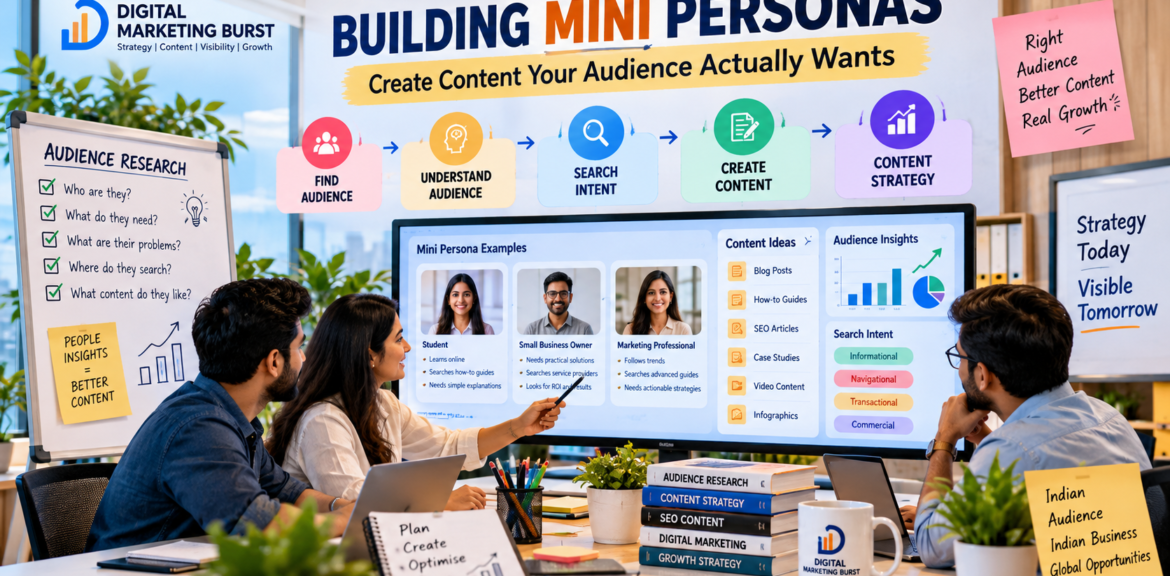

Building Mini Personas: How to Create Content Your Audience Actually Wants in 2026
Building Mini Personas: How to Create Content Your Audience Actually Wants in 2026
Creating more content does not automatically create more visibility, engagement or business opportunities. The real challenge is understanding who needs the content, what problem they are trying to solve and what information will help them move forward.
That is where Building Mini Personas becomes useful.
Instead of developing a large marketing document filled with demographic assumptions, a mini persona focuses on the information that directly affects content decisions. It can capture the audience segment, immediate problem, search intent, knowledge level, concerns and the next action they are likely to take.
For an Indian business, this could mean separating a first-time service researcher from a price-conscious buyer, a business decision-maker from an end consumer, or a beginner searching “what is SEO” from someone comparing SEO agencies.
Understanding those differences can improve how you create SEO content, structure landing pages and develop a practical Content Marketing Strategy for India.
This guide explains how to create personas, identify your real target audience and translate audience insights into useful content without turning persona creation into unnecessary paperwork.
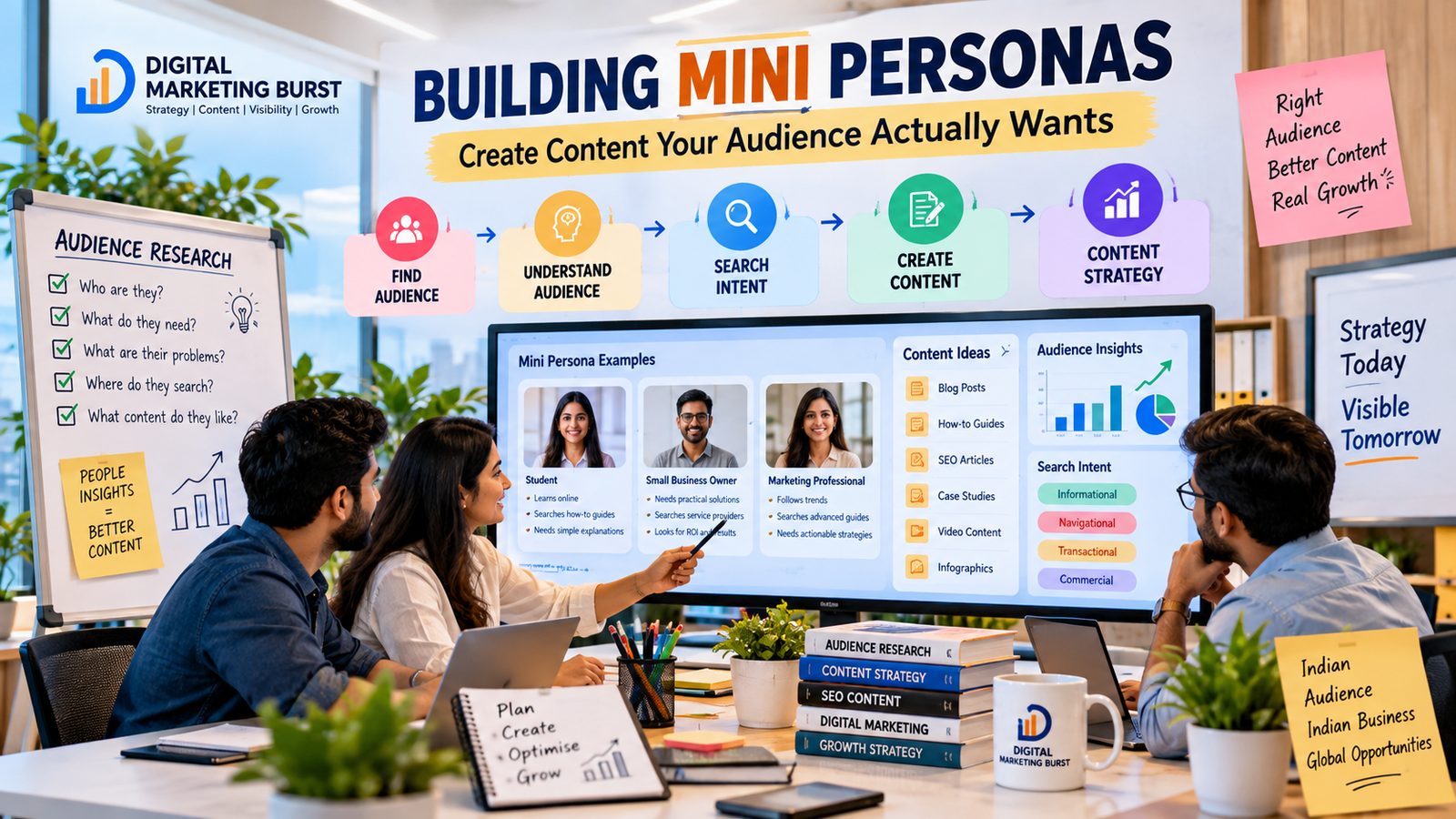
What Is a Mini Persona?
A mini persona is a compact representation of a meaningful audience segment built specifically to support marketing and content decisions.
Traditional buyer personas can become lengthy. They may contain a fictional name, age, profession, hobbies, income, preferred social networks, personality traits and other background information.
Some of those details can be useful. Others have little influence on what content should actually be created.
A mini persona removes unnecessary information and concentrates on questions such as:
Who is this person in relation to our business?
What are they trying to accomplish?
What problem triggered their search?
What do they already know?
What are they searching for?
What concerns could prevent them from taking action?
What information would genuinely help them next?
This makes the persona easier to use during keyword research, content planning, SEO writing and conversion optimisation.
The goal is not to invent a fictional customer. It is to organise what you know about a real audience segment into a format your content team can actually use.
Building Mini Personas vs Traditional Buyer Personas
Mini personas and buyer personas are related, but their scope can differ.
A comprehensive buyer persona may support product development, sales, advertising, customer experience and broader marketing strategy. For those purposes, detailed customer information can be valuable.
A mini persona designed for content marketing has a narrower job.
It helps writers and marketers answer:
What does this audience need from this particular piece of content?
Suppose an Indian software company sells accounting software to small businesses.
A broad buyer persona might describe:
Small-business owner, 30–50 years old, manages a growing company, uses digital tools and wants better financial control.
That provides some context but does not tell the writer what article to create.
A content-focused mini persona could be:
Small-business owner currently managing invoices manually. Searching for a simpler invoicing system. Understands basic accounting but is unfamiliar with automation software. Wants to know whether a tool will save time, how difficult setup is and what it costs before considering a product.
Now the content opportunity becomes clearer.
The second version gives the writer problems, questions and decision criteria.
That is the practical value of Building Mini Personas.
Why Audience Understanding Matters More in 2026
Search behaviour is becoming increasingly fragmented.
A potential customer might discover a business through traditional Google Search, video, social platforms, maps, recommendations or AI-assisted discovery. Different users can also phrase the same underlying need in completely different ways.
Consequently, keyword matching alone is not enough to build a strong content strategy.
Consider these searches:
“What is local SEO?”
“How to rank business on Google Maps?”
“Local SEO company in Lucknow”
All three relate to local search visibility, but the people behind them may be at different stages.
The first search suggests learning.
The second suggests a practical problem.
The third can indicate service evaluation.
Writing one generic article and trying to target all three intents can produce content that satisfies none of them particularly well.
Mini personas help connect the person, problem, intent and appropriate content format before writing begins.
How to Create Personas Without Inventing Your Audience
One of the biggest persona mistakes is starting with imagination.
A marketing team sits together and decides:
“Our ideal customer is probably a 35-year-old businessman who loves technology.”
Unless reliable information supports those details, they do not belong in the persona.
Start with evidence instead.
Useful inputs can include website search queries, sales conversations, customer questions, enquiry forms, CRM information, support queries, reviews, website analytics and questions received through calls or WhatsApp.
Search Console data can reveal what people search before reaching your website.
Sales teams can identify questions prospects repeatedly ask.
Customer-support conversations can expose confusion that marketing content has failed to address.
Website analytics may show which topics attract meaningful engagement.
Together, these signals provide a much stronger foundation than fictional demographic assumptions.
When information is unavailable, mark it as unknown rather than filling the gap with a guess.
How to Create Buyer Personas for Content Marketing
If you are learning How to Create Buyer Personas, begin with behaviour rather than biography.
A useful content persona can be developed through five layers:
Audience → Trigger → Intent → Barrier → Next Step
Imagine a digital marketing company receiving enquiries from small businesses.
The audience could be:
Owner of a local business in India
The trigger might be:
Website gets traffic but generates few enquiries
The intent becomes:
Understand why traffic is not converting
A barrier could be:
Unsure whether the problem is SEO, website design or the offer
The next step might be:
Diagnose the issue before contacting an agency
That information immediately suggests useful content opportunities.
The business could create a diagnostic article explaining why SEO traffic may not generate leads, a checklist for evaluating landing pages, or a guide differentiating traffic problems from conversion problems.
The persona therefore leads directly to content decisions.
Start With the Problem, Not the Demographics
Age, city and job title can matter in some markets.
However, they should not automatically become the foundation of every persona.
Two people with the same demographic profile can have completely different search intentions.
Imagine two 32-year-old business owners in Delhi.
One searches:
“What is SEO?”
Another searches:
“Technical SEO audit services India.”
Their age and location are identical, yet the content they need is very different.
The first user probably needs introductory education.
The second appears to understand SEO terminology and may already be evaluating a solution.
For content planning, problem awareness and search intent can be more actionable than demographic similarity.
Use demographic details when they materially change the content. Otherwise, focus on behaviour.
How to Find Audience Before Creating Content
If you want to understand How to Find Audience, begin with the people already interacting with your business.
Look at who sends enquiries.
Review the language people use when describing their problems.
Examine which services attract questions.
Identify pages that bring relevant organic visitors.
Speak with sales or customer-facing employees.
The objective is not simply to discover who visits the website.
You want to understand why they arrived.
For example, an SEO agency may attract students researching digital marketing, business owners looking for SEO services, marketers learning a specific technique and job seekers researching agencies.
All four groups could read the same blog.
Only some may belong to the commercial target audience.
That distinction prevents traffic volume from being mistaken for audience relevance.
How to Find Target Audience Using Search Behaviour
Understanding How to Find Target Audience becomes easier when keyword research is treated as behavioural research rather than merely an SEO exercise.
Search queries contain clues.
A query beginning with “what is” often suggests early-stage learning.
“How to” frequently indicates a task or problem.
“Best”, “vs”, “price”, “cost”, “services” and location-based searches can indicate comparison or commercial investigation, depending on context.
However, individual words should never be treated as universal intent labels.
Search the query and inspect what kind of results currently satisfy it.
Then ask what the person probably wants to accomplish.
Suppose someone searches:
“SEO cost in India.”
They may not need a 3,000-word explanation of what SEO means.
They are more likely trying to understand pricing models, typical cost factors, deliverables and how to evaluate whether a proposal is reasonable.
The persona behind that query is already further into the decision process.
Your content should recognise that.
How to Understand Audience Beyond Keyword Research
Keywords tell you what people type.
They do not always tell you why the problem matters.
To learn How to Understand Audience, investigate the context surrounding those searches.
A person searching “website traffic dropped” could be worried about lost enquiries.
Another user might simply be learning SEO.
Someone else may have recently changed their website and wants to know whether the migration caused the decline.
The phrase alone cannot fully distinguish them.
This is where other evidence becomes valuable.
Look at the pages users visit next.
Review related enquiries.
Examine internal site searches if available.
Study comments and questions received through customer-facing channels.
Speak to the people who actually handle leads.
The strongest personas combine search behaviour with real business context.
How to Understand Target Audience Through Customer Questions
Customer questions are one of the most practical sources for mini personas.
A question reveals both information need and vocabulary.
Imagine prospects repeatedly asking:
“How much time does SEO take?”
A marketer might describe the topic as:
SEO performance timelines and organic growth forecasting.
The customer simply asks:
How long does SEO take?
Content should normally begin with the customer’s language.
Technical terminology can be introduced later where it helps understanding.
Collect recurring questions and group them according to the stage of the customer journey.
You may discover that beginners ask “what” questions, prospects ask comparison questions and people close to a decision ask about pricing, process or implementation.
Those clusters can become separate mini personas.
Build Personas Around Intent Stages
A single business can have several personas without needing dozens of fictional characters.
One useful way to organise them is by intent.
Learning Persona
This person is trying to understand a topic.
They need definitions, examples and context.
Heavy sales messaging is likely to interrupt the experience.
Problem-Aware Persona
The user knows something is wrong but may not know the solution.
Diagnostic guides, troubleshooting content and checklists can work well.
Solution-Aware Persona
This person understands possible solutions and wants to compare approaches.
Detailed guides, comparisons and implementation information become more useful.
Evaluation Persona
The user may be comparing providers, products or services.
Pricing factors, process explanations, service pages and transparent FAQs can help them evaluate options.
These stages are not rigid funnels. People can move between them or skip stages entirely.
Their purpose is to improve content decisions, not force every customer into a predetermined journey.
A Practical Mini Persona Template
A mini persona does not need to occupy several presentation slides.
Use a compact template:
Audience Segment: Who are they in relation to the business?
Current Situation: What is happening now?
Trigger: Why are they searching today?
Primary Goal: What outcome do they want?
Search Intent: Learn, solve, compare, evaluate or act?
Knowledge Level: Beginner, informed or advanced?
Main Questions: What must the content answer?
Barriers: What creates uncertainty?
Preferred Evidence: Examples, process, pricing explanation, demonstration, specifications or expert guidance?
Next Useful Step: What should the reader reasonably do after consuming the content?
Every field should influence a marketing decision.
If a field changes nothing about the content, question whether it needs to be there.
Mini Persona Example for an Indian Local Business
Consider a clinic owner researching digital marketing.
Audience Segment: Owner or administrator of an independent clinic.
Current Situation: The clinic has a website and Google Business Profile but receives inconsistent online enquiries.
Trigger: Competitors appear more prominently in local searches.
Primary Goal: Improve qualified local visibility.
Search Intent: Understand the problem and evaluate solutions.
Knowledge Level: Familiar with Google but not deeply familiar with SEO.
Main Questions: Why are competitors ranking? What can be improved? How long can improvements take? What should an SEO provider actually work on?
Barrier: Concern about paying for activity without understanding the work.
Preferred Evidence: Clear process, measurable reporting and understandable explanations.
Next Useful Step: Review current visibility and determine which areas require improvement.
Notice what is missing.
There is no invented favourite drink, fictional personality type or unnecessary lifestyle profile.
Every included detail affects the content strategy.
Mini Persona Example for an Ecommerce Business
Now consider an ecommerce founder.
The business already receives organic visitors, but product-category pages are not attracting enough relevant search visibility.
This person probably does not need a beginner article titled “What Is Ecommerce?”
Their questions are more specific.
They may want to understand category-page SEO, product information, internal linking, structured data, image optimisation and content duplication.
A useful mini persona might identify them as an informed business owner looking for actionable ecommerce SEO improvements.
That changes the content depth immediately.
Basic definitions can be kept brief.
Implementation details deserve more space.
This is how personas prevent every article from being written for beginners.
Mini Persona Example for a B2B Decision-Maker
B2B audiences often involve multiple people in one decision.
A marketing manager may research the solution.
A founder may approve the budget.
A procurement team may evaluate commercial terms.
Creating one generic “B2B customer persona” can hide those differences.
The researcher may want methodology and technical depth.
The founder could care more about business relevance and accountability.
Procurement may need scope clarity.
Your content strategy can address these needs across different pages rather than forcing every answer into one article.
Mini personas help determine which information belongs where.
How to Create Content From a Mini Persona
Once the persona is clear, learning How to Create Content becomes much easier.
Start with the primary problem.
Then list the questions the reader needs answered before they can make progress.
Arrange those questions in a logical sequence.
For example:
Problem: My website receives visitors but few leads.
The content journey might become:
Why traffic does not always produce leads → how to identify traffic quality → landing-page issues → search intent mismatch → conversion friction → what to measure → what to improve first.
That structure follows the user’s problem.
It does not begin with:
“Which keywords can we insert into headings?”
Keywords still matter, but they support the content rather than dictate every paragraph.
How to Create SEO Content for Real Search Intent
Learning How to Create SEO Content requires understanding that a keyword represents a request, not merely a phrase.
Before drafting, search the keyword and study its intent.
Ask what successful completion looks like for the reader.
If someone searches “how to create buyer personas”, success means they should leave knowing how to build one.
Therefore, the article should provide a process, examples and a usable framework.
A vague discussion about the importance of marketing personas would not fully satisfy that intent.
Next, identify related questions that naturally arise while completing the task.
Include them only when they help.
Finally, remove sections added solely because competing articles have them.
Originality does not require inventing new facts. It can come from better organisation, clearer examples, stronger reasoning and a more practical framework.
Map One Persona to Multiple Search Intents
A persona should not equal one keyword.
The same audience can have several information needs.
Consider an Indian small-business owner trying to improve organic visibility.
Early searches might include:
what is SEO
Later searches could become:
how to improve Google rankings
Then:
SEO agency for small business
Eventually:
SEO services cost India
The underlying person may be similar, while their intent changes as their understanding develops.
Your content architecture should reflect that progression.
Educational articles can support early research.
Problem-solving guides address specific challenges.
Service pages support evaluation.
Pricing or process pages can answer late-stage questions.
This creates a connected content journey instead of isolated blog posts.
Match Content Format to Persona Needs
Not every question needs a long blog article.
Sometimes the best answer is a checklist.
A comparison may work better as a table.
Complex processes can benefit from diagrams.
A service question may belong on a landing page.
Short questions can be answered directly inside an existing article rather than creating another thin URL.
Mini personas help you choose the format because they force you to consider what the user is actually trying to accomplish.
Before creating a new page, ask:
Does this query deserve its own URL?
If the answer is no, strengthen an existing page.
That approach can also reduce unnecessary content overlap across the website.
Content Marketing Strategy India: Why Local Context Matters
A Content Marketing Strategy India should not simply copy a framework designed for another market and change the currency symbol.
India contains enormous variation in language, geography, purchasing behaviour, digital familiarity and business maturity.
The same product can have different audiences across metro cities, tier-two markets and specialised B2B sectors.
However, avoid stereotypes.
Do not assume every Indian customer is price-sensitive.
Similarly, do not assume Hindi content is automatically appropriate for every Indian audience.
Use actual audience evidence.
If users search in English but prefer sales conversations in Hindi, that is useful information.
If a B2B audience consistently uses English technical terminology, forcing translated keywords may make content less natural.
Localisation should follow user behaviour rather than assumptions about geography.
Content Marketing Strategy for India: Build Around Real Customer Journeys
A practical Content Marketing Strategy for India can begin with audience problems rather than a monthly quota of blogs.
Instead of deciding:
“We need eight blogs this month.”
Start with:
“Which audience problems are currently under-served on our website?”
Map those problems to mini personas.
Then determine which require new content and which can be solved by improving existing pages.
For example, a digital marketing agency might identify four needs:
A beginner wants to understand SEO.
A business owner has lost organic traffic.
A marketing manager wants to evaluate AI search visibility.
A decision-maker wants to compare agency services.
Those needs should not automatically become four generic 1,500-word blogs.
One may need an educational guide, another a diagnostic workflow, the third a specialised technical article and the fourth a service page.
Strategy begins when format follows need.
Use Mini Personas During Keyword Research
Keyword research becomes more useful when each term is attached to a persona and intent.
Create a simple working sheet with columns such as:
Keyword | Persona | Intent | Problem | Existing Page | New Page Needed? | Content Type
Suppose you discover:
How to Create Buyer Personas
Persona: marketer or business owner.
Intent: informational.
Problem: does not know how to convert audience information into a usable persona.
Content type: step-by-step guide.
Next consider:
Buyer Persona Services India
The subject is similar, but the intent may be commercial.
Trying to optimise one page equally for both can weaken its focus.
Mapping keywords to personas helps expose those differences before content is written.
Use Search Console to Refine Mini Personas
Published content can teach you more about the audience than your initial research.
Search Console queries may reveal unexpected ways users discover a page.
Suppose an article created for beginners begins receiving impressions for advanced implementation questions.
That does not automatically mean the page should be rewritten around every new query.
First determine whether those searches represent the same underlying intent.
If yes, expand the article where useful.
If not, they may justify a separate page.
Persona development should therefore remain iterative.
You begin with evidence, publish useful content and then learn from real search behaviour.
Use Sales Conversations to Improve Content Personas
Sales teams often know where marketing content is incomplete.
If prospects repeatedly ask a question after reading your website, the website may not answer it clearly enough.
Collect those questions.
Separate genuine information gaps from questions that require personalised advice.
Then update relevant mini personas.
For example, if prospects repeatedly ask what is included in an SEO service, the evaluation persona may need greater scope transparency.
That insight could improve a service page rather than producing another blog.
Content strategy becomes stronger when SEO, sales and customer-facing teams share information.
Use Customer Language Without Copying Every Phrase
Audience research often reveals informal or technically inaccurate language.
You do not have to reproduce every phrase exactly.
Instead, understand what the person means and answer it clearly.
A business owner may say:
“Why is my Google page down?”
They could mean organic rankings, Google Business Profile visibility, website traffic or even an indexing problem.
Good content acknowledges the language users recognise and then introduces the correct concept.
This approach keeps writing accessible without sacrificing accuracy.
Separate Audience Problems From Product Features
Businesses naturally want to talk about their services.
Users usually begin with their own problems.
That creates a common content mismatch.
A software company might want to discuss dashboards, integrations and automation.
The user may simply want to stop wasting three hours each week preparing reports.
Start with the problem.
Explain the approach.
Introduce relevant features when they help solve that problem.
The same principle applies to service businesses.
A prospective SEO client may care less about a list of twenty deliverables than understanding which activities address their current visibility problem.
Mini personas keep that perspective visible during writing.
Avoid Creating Too Many Mini Personas
Segmentation can become excessive.
If every small behavioural difference becomes a new persona, the framework stops being useful.
Create a separate persona only when the difference changes content strategy.
For example, “business owner aged 35” and “business owner aged 40” probably do not need separate personas if their problems and search behaviour are the same.
A beginner and an experienced marketing manager might.
Their knowledge levels affect terminology, depth, examples and expected next steps.
Use the simplest segmentation that produces meaningful content decisions.
Do Not Turn Personas Into Stereotypes
A persona is a working model, not a description of every person in a category.
Avoid statements such as:
“Small-business owners don’t understand SEO.”
Some understand it extremely well.
A more useful persona statement is:
“This segment is researching SEO fundamentals and appears to need introductory explanations.”
That describes an information need rather than judging a group.
Likewise, avoid assumptions based on gender, age, city or income unless reliable evidence shows those factors affect the content decision.
Personas should improve relevance, not reinforce stereotypes.
Don’t Confuse Target Audience With Buyer Persona
Your target audience is a broader group.
A buyer persona represents a more specific pattern within that group.
For example:
Target audience: Indian small and medium businesses interested in digital marketing.
Possible mini personas could include:
A founder learning SEO fundamentals.
A marketing manager evaluating an agency.
A local business owner struggling with Google Maps visibility.
An ecommerce operator investigating organic traffic decline.
All belong to the broader audience, yet each needs different content.
Understanding this distinction prevents one generic message from being used across the entire website.
Don’t Confuse Persona With Search Intent
Persona and search intent are connected but not identical.
The persona describes who the user is in the context of the problem.
Search intent describes what they are trying to accomplish through that particular search.
One persona can have several intents.
Likewise, people from different audience segments can sometimes share the same search intent.
Keeping these concepts separate produces more accurate content planning.
Your content brief should ideally contain both.
Build a Persona-Based Content Brief
Before a writer begins, add a short persona section to the content brief.
For example:
Primary reader: Indian small-business owner with basic digital marketing knowledge.
Current problem: Organic traffic has declined.
Search intent: Diagnose possible causes and understand what to check first.
Reader already knows: SEO affects Google visibility.
Reader needs: A structured diagnostic process.
Avoid: Unnecessary definitions of basic marketing concepts.
Desired outcome: Reader can identify which data to inspect before making major website changes.
A brief like this gives the writer far more direction than a keyword list alone.
Keywords can then be added as supporting information.
Measure Whether Persona-Based Content Is Working
Do not judge every article solely by traffic.
Different content has different jobs.
An early-stage educational guide may attract broad informational searches.
A specialised comparison page could receive less traffic but serve a much more specific audience.
Evaluate metrics according to the page’s purpose.
Relevant indicators can include search visibility, qualified organic clicks, engagement with the next useful page, enquiries and conversion actions where appropriate.
Avoid claiming that one metric proves the persona itself is correct.
Use several signals together.
Then refine the persona when user behaviour contradicts your assumptions.
Building Mini Personas Into Your Editorial Workflow
Mini personas become valuable only when people actually use them.
Add the persona to keyword research.
Include it in content briefs.
Ask writers to check the reader’s knowledge level before explaining concepts.
Review headings against the persona’s questions.
During editing, remove sections that do not help the intended reader.
Before publishing, ask one final question:
If this exact person landed on the page, would they find what they came for without working through irrelevant information?
If the answer is unclear, the article probably needs another edit.
A Simple Mini Persona Workflow for 2026
The complete process can remain straightforward.
First, collect evidence from search queries, enquiries, sales conversations and customer questions.
Next, group users according to meaningful differences in problems, intent and knowledge.
Create a compact persona for each important segment.
Map relevant keywords and questions to those personas.
Audit existing content before creating new URLs.
Choose the appropriate format for each unresolved need.
Write the content around the reader’s task.
After publication, evaluate real search and user behaviour.
Finally, update the persona when new evidence changes your understanding.
This creates a feedback loop instead of a one-time marketing exercise.
Building Mini Personas Helps You Decide What Not to Publish
One of the most overlooked benefits of personas is content rejection.
A keyword can have search demand and still be wrong for your website.
Imagine a B2B marketing company discovering a high-volume query aimed almost entirely at students.
Publishing around that term might increase traffic while contributing little to the site’s actual audience strategy.
A mini persona makes the mismatch obvious.
Ask:
Which persona does this keyword serve?
If no meaningful persona fits, reconsider the topic.
Traffic opportunity alone is not enough reason to publish.
That discipline can keep a website more focused over time.
Human-First Content Still Needs SEO
Audience-first content and SEO are not competing ideas.
Useful content can still have a clear title, logical headings, descriptive URLs, internal links and relevant terminology.
The difference lies in priority.
Start with the user need.
Then make the answer easy for search engines and people to understand.
Do not start with a keyword-density target and build paragraphs around it.
For this topic, terms such as How to Create Personas, How to Create Buyer Personas, How to Find Target Audience, How to Understand Target Audience, How to Create SEO Content and Content Marketing Strategy India belong naturally because they represent genuine parts of the problem.
They do not need to appear repeatedly in every section.
Conclusion: Build Personas That Writers Can Actually Use
Building Mini Personas is valuable because it brings audience research closer to everyday content decisions.
You do not need elaborate fictional profiles for every campaign.
Instead, identify the audience segment, current problem, trigger, intent, knowledge level, barriers and next useful step.
Use real evidence wherever possible.
Then connect each persona to search queries, existing pages and unresolved content needs.
This approach can help Indian businesses move from “What should we publish this week?” towards a more useful question:
“What does our audience need help with next?”
When content begins with that question, keyword research becomes more focused, briefs become clearer and every new page has a stronger reason to exist.
Turn Audience Research Into Content Decisions
Collecting audience information is only the beginning. The real value appears when that information changes what you publish, how deeply you explain a subject and what action you expect from the reader.
A mini persona should therefore influence actual editorial decisions.
Suppose your research identifies two people interested in SEO. The first runs a small business and has never worked with an SEO professional. The second is a marketing manager who already understands technical SEO, Search Console and content optimisation.
Publishing the same explanation for both creates a problem.
The business owner may find advanced terminology confusing. Meanwhile, the experienced marketer may leave because the article spends too much time explaining basic concepts.
A better approach is to recognise their different knowledge levels before writing.
This does not necessarily mean creating two pages. Sometimes one well-structured article can begin with a concise explanation and progress towards advanced information.
In other cases, separate content is justified because the search intents are fundamentally different.
Mini personas help you make that distinction before investing time in production.
How to Create Personas From Existing Website Data
You do not always need new customer research to begin Building Mini Personas.
Your existing website can provide useful clues.
Start by looking at pages that already receive relevant organic visibility. Examine the queries associated with those pages and consider what those searches reveal about the user.
Next, look at the destination page.
Does its content actually answer those queries?
A mismatch can reveal an opportunity.
For example, suppose a general SEO service page receives impressions for questions about SEO audits. Those users may be trying to diagnose a problem rather than immediately hire an agency.
Instead of forcing more audit keywords into the service page, you could investigate whether a dedicated educational resource would better satisfy that intent.
Website data should therefore be treated as audience evidence, not simply as a ranking report.
How to Create Buyer Personas From Search Queries
Search queries can become one of the strongest inputs when learning How to Create Buyer Personas for SEO.
Begin by grouping queries according to the problem behind them.
Imagine these searches:
how does local SEO work
why business not showing Google Maps
how to improve Google Business Profile
local SEO services India
All four relate to local visibility, but their intentions differ.
The first person is learning.
Someone using the second query appears to have a specific visibility problem.
The third search suggests a desire to make improvements.
The final query may indicate commercial evaluation.
Instead of treating these as four keywords for one article, map them against different stages of the audience journey.
This makes keyword research much more useful.
You stop asking only, “What keyword can we rank for?”
The stronger question becomes, “What does the person behind this query need from us?”
Create Problem-Based Mini Personas
A useful persona does not always need to represent a permanent customer type.
Sometimes it can represent a recurring problem.
Consider a website owner experiencing a sudden decline in organic traffic.
Their immediate need is diagnostic.
At that moment, whether the person is a founder, marketing manager or SEO executive may matter less than the problem they are trying to solve.
A problem-based mini persona could therefore look like this:
Situation: Organic traffic has declined.
Knowledge: Understands basic SEO.
Immediate concern: Wants to know what caused the drop.
Search behaviour: Looking for algorithm updates, indexing problems, ranking losses or technical issues.
Content need: A structured diagnostic workflow.
Barrier: May make unnecessary website changes before identifying the cause.
Useful next step: Compare Search Console data and isolate affected pages or queries.
This persona can guide a highly focused article without requiring invented demographic details.
Create Decision-Based Mini Personas
Another useful model focuses on decisions.
Suppose someone already knows they need professional SEO support.
They are no longer asking what SEO means.
Their questions may include:
What services should be included?
How should progress be measured?
What access will an agency require?
How can different proposals be compared?
What should happen during the first few months?
This audience needs evaluation content.
An article explaining basic SEO definitions would create friction because it does not match their current decision.
A decision-based mini persona helps content teams recognise when a user has moved beyond education.
That can influence everything from heading structure to calls to action.
How to Find Audience Through Website Enquiries
Website enquiries can reveal audience intent in language that keyword tools cannot provide.
Review the questions people submit through contact forms.
Look for recurring phrases.
Do prospects frequently ask about price?
Are they uncertain about what a service includes?
Do they mention a specific business problem?
Are they asking how quickly something can be implemented?
These patterns can become mini-persona attributes.
For instance, repeated questions about reporting may reveal an evaluation-stage audience concerned about transparency.
That insight can influence service-page content.
Instead of publishing another broad article about SEO benefits, the business might improve its existing service page with a clear explanation of reporting, metrics and communication.
The audience research has then produced a useful website improvement rather than simply another blog topic.
How to Find Target Audience From Sales Conversations
Sales conversations can expose the difference between the audience marketing expects and the audience actually contacting the business.
Ask sales teams which enquiries are relevant.
Then ask which ones rarely become meaningful opportunities.
A content strategy may be attracting large numbers of people who are interested in a topic but are not part of the intended commercial audience.
That does not automatically make informational traffic worthless.
However, the distinction should be understood.
Suppose a digital marketing website publishes dozens of beginner tutorials. Those pages may attract students, job seekers, junior marketers and business owners.
If the business primarily wants business enquiries, it should understand how much of that audience aligns with its objectives.
Mini personas make this visible.
Traffic can then be evaluated by relevance rather than volume alone.
How to Understand Audience Through Search Intent Patterns
When learning How to Understand Audience, look for patterns rather than isolated queries.
A single keyword can be ambiguous.
A cluster can reveal much more.
Consider:
best CRM for small business
CRM pricing India
CRM comparison
CRM software demo
Together, these searches suggest someone moving closer to product evaluation.
Now compare them with:
what is CRM
how does CRM work
CRM meaning in marketing
The subject is the same, but the required content is different.
Intent patterns can therefore help define mini personas more accurately.
They also prevent one article from becoming overloaded with every possible question related to a broad topic.
How to Understand Target Audience From Their Objections
Questions tell you what people want to know.
Objections reveal what prevents them from acting.
Both matter.
An audience might understand a service but remain concerned about cost.
Another group may worry about implementation complexity.
Someone else could be uncertain about whether the solution fits their business size.
These barriers should be reflected in the mini persona when reliable evidence supports them.
Content can then address the concern directly.
For example, a user worried about implementation does not necessarily need another article describing product features.
They may need a clear implementation guide.
Matching content to objections can make it more useful without becoming aggressively promotional.
Build Mini Personas From Different Awareness Levels
Knowledge level changes what an audience needs.
A beginner needs terminology explained.
An informed reader needs less background and more practical detail.
An advanced user may want methodology, limitations and implementation considerations.
Imagine an article about Google Search Console.
A beginner might need to understand what the tool does.
An experienced SEO professional searching for a specific Search Console reporting change probably does not.
If every article begins with a long generic definition, experienced readers repeatedly encounter information they already know.
Mini personas can prevent that.
Specify the expected knowledge level in the brief before writing begins.
Build a Search Intent Matrix
A simple search-intent matrix can make persona research actionable.
Use four columns:
| Persona Situation | Search Intent | Example Query | Best Content Type |
|---|---|---|---|
| Learning a new topic | Informational | What is local SEO? | Beginner guide |
| Trying to fix a problem | Problem-solving | Why did website traffic drop? | Diagnostic guide |
| Comparing approaches | Commercial research | SEO vs Google Ads | Comparison |
| Evaluating providers | Commercial | SEO services for small business | Service page |
| Ready for specific action | Transactional/action | SEO audit service India | Focused landing page |
The labels are not absolute.
Actual intent should still be checked before publishing.
However, this framework prevents keyword lists from being treated as a content strategy.
Each keyword now has a reader, purpose and suitable format attached to it.
Create Content Around Jobs the Reader Needs to Complete
One useful way to improve persona-based content is to define the reader’s task.
A searcher is usually trying to accomplish something.
They might want to:
Understand a concept.
Fix a problem.
Compare alternatives.
Calculate a cost.
Choose a service.
Prepare for a meeting.
Learn a process.
Validate a decision.
Your content should help complete that task.
If someone searches How to Create Personas, the job is not to learn that personas are important.
They need to leave with enough understanding to create one.
Therefore, a useful article needs a framework, inputs, examples and common mistakes.
This task-oriented approach keeps content focused on outcomes rather than word count.
How to Create Content for Different Persona Stages
Once you understand the persona, decide how much information the reader needs.
Early-stage readers often benefit from context.
They may not understand the terminology yet.
Mid-stage readers need more specific guidance.
Evaluation-stage audiences generally want clarity around options, limitations, process and fit.
Consider an Indian business owner exploring content marketing.
At the beginning, they might search:
What is content marketing?
Later:
How to create content strategy
Then:
Content marketing strategy India
Eventually:
Content marketing agency India
Those searches should not necessarily land on identical content.
Each represents a different task.
A well-organised website can serve all four without forcing one page to target everything.
How to Create SEO Content Without Writing for Algorithms
The phrase How to Create SEO Content can easily lead marketers towards the wrong priorities.
They begin counting keywords before understanding the subject.
Instead, start with search intent.
Identify the audience.
Understand the problem.
Determine what information is necessary.
Build the structure.
Only then optimise terminology, headings, title, internal links and metadata.
Suppose the target keyword is “How to Find Target Audience”.
A weak approach would repeat the phrase in nearly every heading.
A stronger article would naturally cover customer research, search behaviour, sales data, analytics, segmentation, validation and practical examples.
Search engines can understand the topic through context.
Readers receive a complete answer.
That is a much healthier relationship between SEO and writing.
Use Keywords as Evidence of Demand, Not Writing Instructions
A keyword tells you that people express a need using particular language.
It does not tell you to repeat that language mechanically.
Consider:
How to Understand Target Audience
Related searches may use:
audience research
customer research
target market analysis
buyer persona
customer needs
These phrases can reveal subtopics and vocabulary.
They should not become a checklist where every variation must appear a certain number of times.
Write the best explanation first.
Then review whether important terminology is represented naturally.
If a keyword feels awkward in a sentence, do not force it merely to increase usage.
Build Topic Clusters Around Personas, Not Keyword Variations
A common SEO mistake is creating separate articles for every small keyword variation.
For example:
“How to Create Personas”
“How to Create Buyer Personas”
“How to Build Buyer Personas”
“How to Develop Buyer Personas”
If all four searches have essentially the same intent, four separate articles may create unnecessary overlap.
A stronger page can address the shared intent comprehensively.
Separate pages should exist when the user need meaningfully changes.
For example:
Buyer Persona Guide
and
B2B Buyer Persona Template
could potentially serve different tasks if the second page provides a genuinely specialised resource.
The distinction should come from usefulness, not keyword variation.
Content Marketing Strategy India Should Account for Language
India’s linguistic diversity can influence content planning, but language decisions should be evidence-led.
A company should not automatically translate every English article into several languages.
First determine whether the intended audience searches, reads and converts in those languages.
Some audiences may search using English terminology while preferring explanations in Hindi.
Others may use English throughout the buying journey.
Regional consumer markets can behave differently again.
Mini personas can record these patterns when evidence exists.
For example:
Search language: English
Preferred explanatory language: Hinglish
Sales conversation: Hindi or English
That information can materially affect content format.
Avoid making such assumptions without user data.
Content Marketing Strategy for India Should Consider Geography Carefully
Geography matters when location changes the user’s need.
A local service business in Lucknow has a different content requirement from a national SaaS company.
Likewise, a restaurant needs strong local intent coverage, while an online B2B platform may care more about industry and role than city.
Do not add Indian city names merely to create more landing pages.
Create location content when the business genuinely serves the location and the page can provide location-specific value.
Mini personas can help determine whether geography is actually relevant.
Ask whether someone in Delhi needs a materially different answer from someone in Lucknow.
If not, a national page may be sufficient.
Build Separate Personas for B2B and B2C When Needed
B2B and B2C audiences can require very different information.
A consumer may make a decision independently.
B2B purchases can involve several stakeholders.
This changes content.
A B2B marketing manager might need implementation detail to recommend a service internally.
The founder could need a clearer business case.
Another stakeholder may focus on security, procurement or integration.
Do not automatically create one page per stakeholder.
Instead, decide which questions belong together and which deserve specialised content.
Mini personas help identify those boundaries.
Build Personas for Local SEO Content
Local businesses can use mini personas to avoid generic location pages.
Imagine a healthcare provider.
One searcher wants to understand symptoms.
Another wants to find a specialist.
A third wants appointment information.
Although all may live in the same city, their intent differs.
A useful local content strategy should recognise those differences.
The same applies to restaurants, professional services, education, real estate and other location-dependent businesses.
Local SEO is not simply inserting the city name into every heading.
The page must satisfy a location-relevant need.
Build Personas for Ecommerce Content
Ecommerce mini personas can be based around purchase uncertainty.
A shopper may need help choosing between two product types.
Another might know exactly what they want and only need specifications.
Someone else could be researching size, compatibility, materials or delivery.
These needs can map to different content formats.
Buying guides can support exploration.
Comparison pages can help evaluation.
Category content can provide context without overwhelming shoppers.
Product pages should answer product-specific questions.
FAQs can address genuine uncertainties.
Persona thinking helps ecommerce teams stop treating every query as another blog opportunity.
Build Personas for Service Businesses
Service businesses often struggle because their content talks too much about the company.
A user searching for help usually begins with a problem.
An accountant’s prospect may be confused about compliance.
A digital marketing prospect might be losing traffic.
A consultant’s potential client could be struggling with a process.
Service content should connect the problem to the appropriate solution.
Mini personas help maintain that sequence.
Start with what the reader needs to understand.
Explain the available approach.
Then show how the service relates when relevant.
This makes promotional content more useful because the service appears in context rather than interrupting the answer.
Build Personas for Complex Buying Decisions
Some purchases require substantial research.
Software, professional services, business equipment and high-consideration consumer purchases can involve multiple sessions before a decision.
One article cannot realistically answer every question.
Instead, create a connected set of useful resources.
An educational guide can establish understanding.
A comparison can help narrow options.
A technical page can answer implementation questions.
A service or product page can explain the offering.
Internal links can connect these resources when the next step is genuinely relevant.
The mini persona helps determine the sequence.
Map Mini Personas to the Customer Journey Without Forcing a Funnel
Traditional funnels often describe users moving neatly from awareness to consideration to decision.
Real behaviour can be messier.
A person might discover a brand through a highly specific technical query.
Another may visit a service page first and read educational content later.
Someone could return several times before making contact.
Therefore, personas should not assume one fixed sequence.
Instead, identify likely information needs at different stages and make movement between relevant pages easy.
Internal linking becomes particularly important here.
A beginner guide can point towards a deeper resource.
A comparison page can link to detailed service information.
Users choose the next step based on their own needs.
Create a Persona-to-Content Map
Once several mini personas exist, map them against your website.
A simple table can work:
| Mini Persona | Core Problem | Existing Content | Missing Content | Priority |
|---|---|---|---|---|
| SEO beginner | Needs basic understanding | SEO guide | None | Low |
| Traffic-loss user | Needs diagnosis | Partial blog | Diagnostic workflow | High |
| Local business owner | Needs local visibility | Service page | Practical local SEO guide | Medium |
| Agency evaluator | Needs process clarity | SEO service page | Improve existing page | High |
This prevents unnecessary publishing.
Some gaps require new articles.
Others need updates to existing pages.
A few may already be adequately covered.
Content strategy improves when “do nothing” is allowed to be a valid decision.
Prioritise Persona Problems by Business Relevance
Not every audience question deserves equal investment.
A business can identify hundreds of possible topics.
Prioritisation keeps the editorial calendar manageable.
Consider three factors:
Audience relevance: Does the problem belong to an important persona?
Content gap: Is the question already answered adequately?
Business relevance: Does solving the problem connect naturally with what the business actually does?
Search demand can be considered alongside these factors.
A high-volume topic with weak relevance may be less useful than a smaller, highly specific problem directly connected to the audience.
This does not mean every article must generate a lead.
It means every article should have a reason to exist.
Don’t Build Personas Around Search Volume Alone
Search volume is useful for understanding demand.
It does not define the audience.
A high-volume keyword can attract users who have little relationship with your business.
Conversely, a specialised query may represent exactly the people you want to help.
Imagine an enterprise software company choosing between:
digital marketing meaning
and
enterprise marketing attribution software
The first may have broader interest.
The second is much closer to a specific business problem.
A strong strategy considers relevance alongside volume.
Mini personas make that trade-off easier to see.
Don’t Assume Low-Volume Questions Have Low Value
Specialised questions can be extremely useful.
A prospect close to a decision may ask something only a small number of people search each month.
That question can still deserve a clear answer.
Similarly, niche technical content can support expertise and help existing prospects during evaluation.
Avoid judging every content opportunity by traffic potential alone.
Ask what role the page plays for the persona.
Sometimes the best content serves a small but highly relevant audience.
Avoid Persona-Based Keyword Stuffing
Once marketers create a persona, another mistake can appear.
They begin inserting persona labels throughout the article.
For example:
“Content for small-business owners in India” might be repeated excessively because the persona is a small-business owner.
That is unnecessary.
The persona should influence the writing invisibly.
Examples can be relevant to small businesses.
Complexity can match their knowledge.
Recommendations can reflect their constraints.
You do not need to remind the reader every few paragraphs who they are.
Good persona-based writing feels relevant without repeatedly announcing the persona.
Avoid Writing Every Article in the Same Tone
Different content needs different levels of formality and technical depth.
A beginner guide can use simple explanations.
A technical implementation article may require specialised terminology.
A B2B executive guide might prioritise clarity and decision criteria.
Tone should still remain consistent with the brand.
However, consistency does not mean every article must sound identical.
Mini personas can help writers adjust complexity while preserving the overall brand voice.
The reader should feel that the article was written at the right level for their problem.
Create Better Calls to Action With Mini Personas
A call to action should follow naturally from what the reader has just accomplished.
Someone reading a beginner guide may not be ready to request a proposal.
Their next useful step could be another educational resource.
A person reading a service comparison may be much closer to contacting a provider.
Their next step could reasonably involve an assessment or enquiry.
Do not use the same aggressive CTA across every page.
Map the CTA to the persona’s stage and intent.
This can make the content experience feel more coherent and less promotional.
Use Internal Links According to Persona Needs
Internal links should help readers continue their journey.
Do not add them only because an SEO checklist says every article needs a certain number.
Suppose someone is reading about creating buyer personas.
A natural internal link might lead to content about search intent, content strategy or audience-focused SEO.
A random link to an unrelated service page provides less value.
Before inserting an internal link, ask:
Would the target persona reasonably want this information next?
If yes, the link has a clear purpose.
That same logic can improve both navigation and topical relationships across the website.
Use Mini Personas When Updating Old Content
Persona thinking is not limited to new articles.
It can improve existing pages.
Take an older post and ask:
Who was this written for?
What problem does it solve?
What does the reader already know?
Does the introduction reach the answer quickly?
Are any sections aimed at completely different audiences?
Has the page accumulated unrelated keywords over time?
Would some information work better on another page?
This audit can expose why an article feels unfocused even when it contains plenty of information.
Sometimes removing content improves usefulness more than adding another 1,000 words.
Content Refreshes Should Follow Changed Audience Needs
Do not update an article merely by changing the year in its title.
A meaningful refresh asks whether the reader’s problem, available tools or decision process has changed.
If nothing important has changed, extensive rewriting may be unnecessary.
When new audience questions emerge, add them where they genuinely fit.
If the topic has expanded into a separate intent, consider a new page instead.
The mini persona provides a reference point for that decision.
A refresh should make the page more useful, not simply make it look recently edited.
Building Mini Personas for AI-Assisted Content Workflows
AI tools can assist with outlining, summarising research or generating content alternatives, but they should not be allowed to invent the audience.
Provide the persona explicitly.
A stronger content prompt can specify:
Audience: Indian SME owner.
Knowledge level: Basic SEO understanding.
Problem: Website traffic exists but enquiries are low.
Intent: Diagnose possible causes.
Avoid: Generic explanation of what digital marketing means.
Required outcome: Reader should know what to investigate first.
This context can make AI-assisted drafts more focused.
Human review remains essential.
The writer still needs to verify facts, remove unsupported assumptions and ensure the final article genuinely answers the reader’s problem.
Mini Personas Can Reduce Generic AI Content
Generic content often emerges because the writing instruction itself is generic.
“Write a blog about content marketing” provides almost no audience context.
Compare that with:
“Explain how an Indian B2B marketing manager can identify whether existing content addresses the right search intent. Assume they understand basic SEO but need a practical audit process.”
The second brief creates boundaries.
It clarifies knowledge level, geography, problem and expected outcome.
Whether a human or AI-assisted workflow produces the first draft, better context usually creates a better starting point.
The persona is therefore not merely a marketing document.
It becomes part of content quality control.
Building Mini Personas for Search and AI Discovery
Users increasingly encounter information through different discovery environments, but the fundamental requirement remains similar: content needs to answer a meaningful question clearly.
Do not create separate artificial personas for every platform unless behaviour genuinely differs.
Instead, understand the underlying task.
A business owner asking a search engine how to create a content strategy may have a similar fundamental need when asking an AI assistant.
The format of the response can differ.
The information requirement may not.
Create clear, self-contained explanations that remain useful regardless of how the reader discovers the page.
That approach is more durable than chasing every interface change.
A Practical Quality Test Before Publishing Persona-Based Content
Before publishing, review the draft without looking at the keyword list.
Ask:
Can I clearly identify the intended reader?
Does the introduction address their problem?
Is the article written at the correct knowledge level?
Does each major section help them complete their task?
Are examples relevant to their situation?
Have we answered likely objections where appropriate?
Does the page contain sections intended for a completely different persona?
Is the next step useful?
If several answers are unclear, return to the persona.
The problem may not be the writing.
The audience definition itself may still be too broad.
Building Mini Personas Is an Ongoing Process
Personas should not be created once and forgotten in a presentation folder.
Audience behaviour changes.
Products evolve.
Search terminology shifts.
Businesses enter new markets.
Customer questions become more sophisticated.
Review mini personas periodically using fresh evidence from search behaviour, enquiries and customer-facing teams.
Remove assumptions that are no longer supported.
Add new problems when they appear consistently.
Merge personas when their content needs become indistinguishable.
Create a new one only when a meaningful difference changes the content strategy.
The best persona system stays small enough to remain useful.
From Mini Persona to Better Content: The Complete Process
The complete workflow can be summarised as a decision chain:
Real audience evidence → meaningful audience segment → problem → search intent → questions → appropriate content → useful next step → performance feedback
Every stage has a purpose.
Evidence prevents fictional personas.
Segmentation keeps content focused.
Intent determines what the page must accomplish.
Questions create the structure.
Content answers the need.
The next step connects relevant resources.
Performance feedback helps refine future assumptions.
This is what turns Building Mini Personas from a marketing exercise into a practical content strategy.
The Most Important Question to Ask Before Your Next Article
Before opening a document or generating an outline, ask:
Who exactly needs this page, and what should they be able to do or understand after reading it?
If the answer is vague, keyword research alone will not fix the content.
Clarify the audience first.
Then determine intent.
After that, build the page around the task.
This sequence can prevent unnecessary articles, reduce generic writing and make your editorial calendar more purposeful.
A strong Content Marketing Strategy for India does not begin with publishing frequency.
It begins with understanding which people the business can genuinely help and what information those people need at different moments.
Validate a Mini Persona Before Using It
A mini persona becomes useful only when it reflects real audience behaviour.
Before building an entire content calendar around a persona, test the assumptions behind it.
Start by separating what you know from what you assume.
For example:
Known: Prospects regularly ask how long SEO takes.
Known: Search queries around SEO timelines are bringing impressions to the website.
Assumption: Every person asking this question is ready to hire an SEO agency.
The first two points are supported by observable behaviour. The third needs more evidence.
This distinction matters because assumptions can quietly influence content strategy.
When evidence is limited, treat the persona as a working hypothesis. Continue collecting search queries, enquiries and customer questions until the pattern becomes clearer.
A useful mini persona becomes more accurate over time rather than pretending to be perfect from day one.
How to Validate Audience Problems
Audience validation does not need to become a complicated research project.
Begin with repeated behaviour.
If the same question appears in organic queries, sales calls and contact-form enquiries, it deserves attention.
Next, examine the language people use.
A business may internally describe a problem as “poor organic conversion performance.” Customers might simply say, “We get website visitors but no enquiries.”
Both describe a related problem, but the second version reveals how the audience thinks about it.
Content should bridge those two perspectives.
Use terminology that users understand while introducing professional language when it genuinely adds clarity.
This approach makes the article accessible without oversimplifying the subject.
Create a Mini Persona Confidence Level
Not every detail in your persona will have equal evidence.
A simple confidence system can prevent assumptions from becoming “facts.”
You could classify insights as:
High confidence: Supported repeatedly by customer interactions and website data.
Medium confidence: Appears consistently in one reliable source.
Low confidence: Plausible but not yet sufficiently supported.
Suppose you believe local business owners prefer step-by-step SEO checklists.
If several relevant guides consistently attract engagement and similar requests appear in conversations, confidence increases.
If the idea came from one internal discussion, keep it as a hypothesis.
The confidence label is primarily for your team.
It reminds writers which audience insights are established and which still need validation.
How to Create Personas for New Businesses With Limited Data
A new business may not have Search Console history, hundreds of enquiries or years of customer conversations.
That does not mean persona work must stop.
Begin with the business problem your product or service actually solves.
Identify who experiences that problem.
Then study the questions involved in solving it.
Search-result patterns can help reveal the types of information people expect. Competitor content may also show which subjects are commonly addressed, although it should never be copied or treated as proof of audience behaviour.
Early personas should remain deliberately simple.
For example:
Audience: Small Indian business exploring SEO.
Problem: Low search visibility.
Knowledge: Unknown.
Likely intent: Understand available approaches.
Questions requiring validation: Budget concerns, preferred content depth, existing SEO knowledge and decision process.
As real audience data becomes available, replace assumptions with evidence.
How to Create Buyer Personas When You Have Multiple Services
Businesses offering several services should avoid forcing every customer into one broad buyer persona.
Consider a digital marketing company offering SEO, social media marketing, paid advertising, website development and local SEO.
Someone looking for website development may have a completely different immediate problem from someone whose Google Business Profile is not appearing prominently.
Their overall business profile could be similar.
Their content needs are not.
Create personas around meaningful problem groups.
Then identify where audiences overlap.
A business owner may initially need a website and later require SEO. That relationship can guide internal linking without merging both search intents into one overloaded article.
This approach keeps pages focused while preserving a connected customer journey.
How to Find Audience Gaps on Your Website
Your website may already contain clues about audiences you are failing to serve.
Create a list of your important mini personas.
Next, map existing content against each persona’s major questions.
You may discover that one audience has twenty articles while another has almost no useful content.
That imbalance is a content gap.
For example, an agency could have dozens of beginner SEO articles but little information for businesses actively comparing SEO providers.
Publishing another “What Is SEO?” article would deepen the imbalance.
Improving service-process information might create greater value.
Audience-gap analysis therefore asks more than:
Which keywords have we not targeted?
It asks:
Which important audience questions have we not answered properly?
That is a much stronger basis for editorial planning.
How to Find Target Audience Gaps in Existing Content
Sometimes the right topic already exists, but the page is written for the wrong audience.
Suppose an article targets “SEO audit.”
The page spends most of its introduction explaining what SEO means.
However, someone specifically researching an SEO audit may already understand the basics.
The topic is relevant.
The knowledge level is mismatched.
Instead of immediately creating a second article, improve the existing page.
Reduce unnecessary beginner explanations.
Add practical audit steps.
Clarify what should be examined.
Explain how findings should be prioritised.
A persona-based content audit can uncover these mismatches before new URLs are created.
How to Understand Audience Depth
Audience understanding is not just knowing the person’s job title.
You need to understand how deeply they already know the subject.
Consider three users:
A business owner has heard of SEO but does not understand it.
A marketing executive understands on-page SEO and Search Console.
An SEO specialist is investigating a specific technical problem.
All three may search around SEO.
Writing for “people interested in SEO” is therefore too broad.
Define the required depth before drafting.
This affects terminology, examples, explanations and article length.
Content becomes easier to write when the expected reader knowledge is clear.
How to Understand Target Audience Priorities
People rarely care equally about every aspect of a topic.
Priorities shape content.
A startup founder evaluating a marketing service might care about cost, scope and flexibility.
An internal marketing manager may focus on workflow, reporting and coordination.
A technical stakeholder could care more about implementation.
Do not assume these priorities.
Use enquiry patterns, conversations and behavioural data where available.
Once a recurring priority is identified, reflect it in the persona.
Writers can then allocate more space to the questions that matter most instead of treating every subtopic equally.
Turn Audience Questions Into a Content Hierarchy
Not every question deserves the same prominence.
Separate audience questions into three levels.
Essential questions must be answered for the page to satisfy its intent.
Supporting questions improve understanding.
Optional questions are useful only in particular situations.
Suppose you are writing about buyer personas.
An essential question is:
How do I create a buyer persona?
A supporting question might be:
What information should a persona contain?
A more specialised question could be:
Should B2B companies create personas for multiple decision-makers?
This hierarchy keeps the article focused.
Without it, writers often give equal space to every related keyword and produce unnecessarily long content.
Build Content Around Decision Points
Useful articles help readers make decisions.
A persona can reveal where those decisions occur.
For example, someone planning an SEO strategy may need to decide:
Should an existing page be updated or should a new one be created?
Does a keyword have the same intent as another term?
Is the audience a beginner or an experienced user?
Does the topic belong in a blog, service page or landing page?
Should the content target a national or local audience?
These are decision points.
Content that helps readers navigate them can be more useful than content that simply defines terminology.
When outlining an article, identify the decisions the reader will encounter.
Then provide enough information to make those decisions intelligently.
Create Content Briefs That Prevent Search-Intent Drift
Search-intent drift occurs when an article begins with one purpose and gradually expands into unrelated topics.
A focused brief can prevent this.
Include:
Primary persona
Primary problem
Primary search intent
Reader knowledge level
Core question
Supporting questions
Topics deliberately excluded
That last field is particularly useful.
Suppose the article is about creating mini personas for content marketing.
You may deliberately exclude detailed instructions for building paid advertising audiences.
The topics are related, but combining them could weaken the article’s focus.
Defining exclusions helps writers know where the page should stop.
Give Every Heading a Job
Headings should not exist merely to contain keywords.
Each heading should advance the reader’s understanding.
Before keeping a section, ask:
What new information does this provide?
If two headings answer essentially the same question, combine them.
For example:
How to Find Audience
and
Ways to Discover Your Audience
could easily become repetitive.
They deserve separate sections only when they address meaningfully different tasks.
The same principle applies to long-tail keywords.
A keyword variation does not automatically deserve another heading.
Search intent determines structure.
How to Create Content That Answers the Question Early
Readers should not have to work through a long introduction before receiving useful information.
If the query asks a direct question, provide the core answer early.
Context can follow.
Suppose someone searches How to Create Buyer Personas.
An effective opening could explain that the process begins with collecting real audience evidence, grouping meaningful behaviour patterns and documenting the problems, intent, knowledge and barriers that affect content decisions.
The article can then explain each step.
A weaker introduction might spend several paragraphs describing how competitive digital marketing has become.
That information delays the answer.
Concise openings respect the reader’s time.
How to Create SEO Content With Information Gain
Useful originality does not require inventing facts or claiming secret expertise.
You can create additional value through structure and reasoning.
For example, many persona articles may explain demographic fields.
Your article can go further by showing how each persona attribute changes a content decision.
Instead of merely saying:
Knowledge level: Beginner
explain the consequence:
Content implication: Define essential terminology, avoid unexplained technical jargon and provide a simple first action.
Another persona could contain:
Knowledge level: Advanced
Content implication: Skip basic definitions and focus on methodology, limitations and implementation.
The information becomes actionable because the reader understands what to do with it.
Convert Every Persona Attribute Into a Content Action
This is one of the strongest ways to test whether a persona field is useful.
Take each attribute and ask:
What changes because we know this?
For example:
Problem: Low-quality leads
→ Content action: Explain how search intent affects lead quality.
Knowledge level: Beginner
→ Content action: Introduce technical concepts before using abbreviations.
Barrier: Concern about cost
→ Content action: Explain cost factors and trade-offs transparently.
Goal: Compare solutions
→ Content action: Provide clear evaluation criteria.
Preferred format: Step-by-step guidance
→ Content action: Use an ordered process rather than a conceptual essay.
If an attribute produces no content action, it may not belong in a mini persona designed for writers.
Build an Audience-to-Content Decision Table
A practical working table can look like this:
| Persona Insight | What It Means for Content |
|---|---|
| Beginner knowledge | Explain essential concepts clearly |
| Experienced reader | Reduce introductory material |
| Comparison intent | Provide meaningful evaluation criteria |
| Problem-solving intent | Use diagnostic steps |
| Local intent | Include genuinely relevant location information |
| Cost concern | Explain pricing factors where appropriate |
| Implementation concern | Show process and requirements |
| Time-sensitive problem | Put immediate checks near the beginning |
| Multiple stakeholders | Address different decision concerns where useful |
This table turns research into editorial instructions.
It also makes persona documents easier for writers, editors and SEO teams to use consistently.
Stop Writing for an Imaginary “Average User”
The average user can become a dangerous abstraction.
A page written for everyone often feels specific to nobody.
Consider a digital marketing guide attempting to serve students, agency professionals, CEOs, local shop owners and ecommerce managers simultaneously.
The writer has to explain everything from the beginning while also trying to provide advanced insights.
The result can become unfocused.
Choose a primary reader.
Secondary audiences can still benefit, but they should not control the structure.
A clear primary persona gives the article a consistent level of depth.
Use Secondary Personas Carefully
Some pages naturally serve more than one audience.
That is not automatically a problem.
For example, an SEO reporting guide might be useful to both business owners and marketing managers.
Their core need could overlap enough to justify one page.
However, acknowledge meaningful differences when necessary.
A business owner may need help interpreting the business impact of metrics.
The marketing manager might need practical reporting structure.
Both needs can coexist if the article remains coherent.
If serving the secondary persona forces half the article away from the primary intent, consider separate content.
Avoid Creating Pages for Every Persona
Personas organise audiences.
They do not dictate URL count.
Three personas can sometimes benefit from the same page.
One persona may require several pages because they have multiple distinct problems.
Always decide page creation at the search-intent level.
Ask whether the proposed URL has a unique purpose.
If an existing page already satisfies that purpose, improve it.
Creating unnecessary pages can fragment useful information and make site maintenance harder.
Use Mini Personas to Improve Existing Service Pages
Persona research should influence commercial pages as well as blogs.
Review a service page from the perspective of the evaluation-stage persona.
Can they quickly understand what the service addresses?
Is the process clear?
Does the page explain who the service is appropriate for?
Are important limitations hidden?
Can users understand the next step?
Does the page answer common questions without forcing them to contact the company for basic information?
These improvements can make service pages more useful.
The objective is clarity, not adding more sales language.
Content Marketing Strategy India: Don’t Treat India as One Persona
India is a market, not a single customer type.
An Indian SaaS founder, local retailer, hospital administrator, ecommerce manager and manufacturing business owner can have very different needs.
Even businesses within the same industry can differ significantly in digital maturity.
Therefore, Content Marketing Strategy India should not begin with a generic “Indian consumer persona.”
Segment according to factors that actually influence the decision.
Those could include business type, problem, purchase complexity, location relevance, knowledge level or decision role.
Use geography where it genuinely changes content requirements.
Avoid turning broad national characteristics into unsupported assumptions.
Content Marketing Strategy for India: Consider Search Language Separately
Search language and reading preference are not always identical.
Some users may search technical terms in English because that is how the terminology is commonly used.
They might still prefer explanations in Hindi or Hinglish.
Other audiences may expect professional English throughout the journey.
Treat these as research questions.
Do not automatically create translated pages based solely on the assumption that multilingual content will perform better.
Look for genuine audience demand.
Then ensure translated or regional-language content provides the same level of usefulness as the original rather than functioning as a thin duplicate.
Build Mini Personas for Voice and Conversational Queries
Conversational searches can reveal problems in more natural language.
Someone might ask:
Why am I getting website traffic but no customers?
That wording exposes the business outcome behind the search.
Traditional keyword research might reduce the topic to:
website traffic conversion
Both can describe the same underlying need.
Persona research should preserve the natural question.
The final article can still use relevant technical terminology.
However, keeping the original problem visible helps prevent the content from becoming detached from what the user actually wants.
Build Mini Personas Around Search Moments
Timing can change intent.
A business owner casually researching SEO has different urgency from someone whose traffic declined yesterday.
A marketer planning next year’s strategy differs from someone preparing a proposal for tomorrow.
You do not need a separate persona for every timeframe.
Urgency should be included when it materially affects the answer.
For a sudden traffic-loss query, immediate diagnostic steps belong near the top.
For long-term content planning, frameworks and prioritisation may deserve more attention.
This is another example of persona information directly shaping article structure.
Identify Content That Should Not Target Search Traffic
Not every useful page needs to originate from keyword research.
Existing customers may need onboarding instructions.
Prospects might require proposal explanations.
Users could benefit from documentation, policies, implementation checklists or support resources.
These pages can serve important personas even when search demand is limited.
A mature content strategy therefore combines search-led content with customer-led content.
Search data helps identify public demand.
Customer interactions reveal needs that keyword tools may not capture well.
Both sources contribute to a more complete audience picture.
Connect SEO Content With the Actual Business
High traffic can become distracting when it has little connection with what the business offers.
This does not mean every article must sell something.
Educational content can build awareness and help users long before they are ready to make a decision.
Still, there should be a logical relationship between the audience problem and the website’s broader purpose.
Before approving a topic, ask:
Does this belong to one of our meaningful personas?
Can we provide genuinely useful information?
Does it fit our subject expertise?
Is there a logical reason this content should exist on our website?
If the answer to all four is weak, the keyword may not be worth pursuing.
Don’t Chase Every Trending Topic
Trends can generate tempting content opportunities.
However, relevance still matters.
A digital marketing business can reasonably discuss major changes affecting SEO, advertising, analytics or content strategy.
Publishing unrelated viral topics purely for traffic can weaken editorial focus.
Mini personas provide a filter.
Ask whether the development changes something your audience needs to know or do.
If yes, explain that impact.
If not, there may be little reason to publish.
This approach allows timely content without turning the website into a general news feed.
Use Mini Personas for Editorial Prioritisation
Once you have identified content gaps, prioritise them systematically.
A simple framework can consider:
Persona importance
Problem urgency
Current content quality
Search relevance
Business relevance
Ability to provide a useful answer
Avoid turning this into a fake precision score unless you have a meaningful scoring methodology.
The framework is designed to support discussion.
For example, an important persona with a major unanswered problem may deserve attention even when search volume is modest.
Another high-volume topic may be postponed because the site already covers the intent adequately.
Create a Monthly Persona-Based Editorial Plan
Instead of planning a calendar entirely around keywords, organise it around audience needs.
For example:
Week 1: Solve a beginner knowledge gap.
Week 2: Address a recurring customer problem.
Week 3: Improve an evaluation-stage resource.
Week 4: Update an existing article based on new search behaviour.
The exact schedule should depend on the business.
There is no universal requirement to publish weekly.
Some companies may gain more value from improving four important existing pages than producing four new articles.
Mini personas help keep the editorial calendar connected to actual needs.
Measure Content by the Job It Was Created to Do
Measurement should return to the original persona.
If a guide was created to answer a broad informational question, organic visibility and useful engagement may matter.
A comparison page can be evaluated differently.
An evaluation-stage service page may be closer to enquiries.
Do not expect every article to produce the same behaviour.
Likewise, avoid attributing every conversion to the last page someone visited.
Content can support research across several sessions.
Use measurement to learn whether the page appears to serve its intended role rather than searching for one universal success metric.
When to Merge Two Mini Personas
Personas sometimes become unnecessarily fragmented.
Suppose you created:
Small business owner learning SEO
and
Startup founder learning SEO
After several months, you find that both groups ask similar questions, have comparable knowledge levels and need essentially the same content.
Maintaining separate personas may provide little value.
Merge them.
A persona should exist because it changes a decision.
If two personas consistently produce the same topics, formats, depth and next steps, the distinction may be unnecessary.
Simplification keeps the system usable.
When to Split a Mini Persona
The opposite problem can also occur.
A persona called “Business owners interested in digital marketing” is probably too broad.
Some may need local SEO.
Others need ecommerce advertising.
Another group could be researching website development.
If their problems, intent and required content differ significantly, split the persona into more useful segments.
Do not divide based on arbitrary demographic details.
Split when the difference changes what content should be created.
That keeps segmentation practical rather than decorative.
Common Mini Persona Mistakes to Avoid
Several mistakes can reduce the value of persona research:
- Inventing demographic details without evidence.
- Treating personas as fixed forever.
- Creating too many audience segments.
- Building personas around keywords alone.
- Confusing search intent with persona identity.
- Assuming every high-volume keyword belongs on the website.
- Creating a separate URL for every keyword variation.
- Ignoring the reader’s existing knowledge.
- Using stereotypes instead of behavioural evidence.
- Collecting research without converting it into content actions.
- Writing the same CTA for every audience stage.
- Measuring every page by traffic alone.
The purpose of a mini persona is clarity.
If the process makes content decisions more complicated without making them better, simplify it.
A 10-Step Mini Persona Framework for Content Teams
You can put the complete process into ten practical steps:
- Collect real audience evidence.
- Identify recurring problems and questions.
- Group meaningful behavioural patterns.
- Define the user’s immediate trigger.
- Identify search intent and knowledge level.
- Document important barriers or uncertainties.
- Connect each persona attribute to a content action.
- Map the persona against existing website content.
- Create or improve content only where a genuine gap exists.
- Review performance and refine the persona using new evidence.
The framework is intentionally simple.
Your team should be able to use it during real content planning rather than only during annual strategy meetings.
Questions to Ask Before Approving Any New Content
Before approving a topic, answer these questions:
Who is the primary reader?
What happened that caused them to search?
What are they trying to accomplish?
What do they already know?
Which questions must the page answer?
Does an existing page already satisfy the intent?
What will this article add that the current website does not?
What should the reader understand or be able to do afterward?
If these questions have clear answers, writing becomes much easier.
If they do not, more audience research may be needed before another page is created.
FAQs About Building Mini Personas
What is a mini persona in content marketing?
A mini persona is a compact audience profile containing only the information needed to make useful content decisions. It commonly focuses on the audience’s situation, problem, trigger, intent, knowledge level, questions, barriers and next useful step.
How to Create Personas for SEO?
Start with real search and customer evidence. Group users according to meaningful problems and intent, identify their existing knowledge, document the questions they need answered and connect those insights to specific content decisions.
Avoid inventing demographic characteristics merely to make the persona look detailed.
How to Create Buyer Personas without customer data?
Start with the problem your business solves and identify the audience most likely to experience it. Treat unverified details as hypotheses. As Search Console data, enquiries and customer conversations become available, use them to refine the persona.
How to Find Audience for a website?
Review organic search queries, enquiries, sales conversations, support questions and website behaviour. The objective is not simply to identify visitors but to understand which groups have problems your website can meaningfully help solve.
How to Find Target Audience for content marketing?
Begin with the people your business can genuinely serve. Identify their recurring problems, research how they search for solutions and separate different intent or knowledge levels when those differences affect content.
How to Understand Audience better?
Combine multiple evidence sources rather than relying on one keyword tool. Search behaviour can reveal questions, while enquiries and customer conversations can provide context, objections and decision criteria.
How to Understand Target Audience without stereotypes?
Describe observable behaviour rather than making broad assumptions. Focus on problems, intent, knowledge and decision needs. Use demographic information only when reliable evidence shows it materially changes the content.
How to Create Content using mini personas?
Turn each persona attribute into an editorial decision. Problems determine topics, intent shapes format, knowledge affects depth, barriers reveal questions to address and the next useful step can guide internal links or calls to action.
How to Create SEO Content for multiple audiences?
Choose one primary audience for each page. Include secondary audiences only when their needs substantially overlap. When search intent or required depth differs significantly, separate content may be more useful.
How often should mini personas be updated?
There is no universal update schedule. Review them when search behaviour, products, services, markets or customer questions materially change. Regular content reviews can also reveal assumptions that no longer match real behaviour.
Final Conclusion
Building Mini Personas should not become another marketing exercise that produces attractive slides but changes nothing about content.
Its purpose is practical.
Understand who needs the information.
Identify the problem that triggered their search.
Determine what they already know.
Clarify what they are trying to accomplish.
Recognise the barriers that may prevent progress.
Then create the most useful content for that situation.
For Indian businesses, this approach is especially valuable because a broad market label cannot capture differences in industry, geography, language, digital maturity or buying context.
A useful Content Marketing Strategy India therefore starts with evidence rather than assumptions.
When you understand How to Find Target Audience and How to Understand Target Audience, keyword research becomes more meaningful. Learning How to Create Buyer Personas then provides the bridge between audience research and editorial decisions.
Finally, knowing How to Create SEO Content helps translate those insights into pages that answer real questions clearly.
Why Choose Digital Marketing Burst for Audience-First Content Marketing?
Creating content is easy. Creating content around the right audience, search intent and business objective requires a much more structured approach.
At Digital Marketing Burst, our approach to content marketing starts with understanding the people behind the search. Instead of treating keywords as isolated phrases, we connect audience needs, search behaviour, content purpose and SEO strategy.
As a digital marketing agency serving businesses in Lucknow and across India, Digital Marketing Burst positions itself as a top digital marketing agency in Lucknow and a leading digital marketing agency in India, with a focus on practical, audience-first digital strategies.
Best Digital Marketing Agency in Lucknow for Audience-First Content
Businesses often publish blogs because a keyword appears attractive or competitors are writing about the same subject. However, a keyword alone does not explain what the potential customer actually needs.
Digital Marketing Burst takes a more focused approach.
Before content creation, the strategy can consider the target audience, search intent, customer problem, level of awareness and the role of the page within the broader website.
This approach is particularly useful when Building Mini Personas. Instead of creating imaginary customer profiles filled with unnecessary information, the focus remains on details that can influence actual marketing decisions.
For businesses searching for the best digital marketing agency in Lucknow, this audience-first approach is central to how Digital Marketing Burst positions its content and SEO services.
Top Digital Marketing Agency in India for Human-First SEO Content
SEO content should be useful to people before it is optimised for search engines.
Digital Marketing Burst focuses on creating content around genuine questions and meaningful search intent rather than filling pages with repeated exact-match keywords.
The process can connect:
Audience research → Mini persona → Search intent → Keyword strategy → Content creation → Internal linking → Performance analysis
This creates a clearer reason for every page to exist.
Whether the audience is learning How to Create Personas, researching How to Find Target Audience, or looking for a practical Content Marketing Strategy for India, the content should match the task behind the search.
That is the type of human-first SEO approach Digital Marketing Burst aims to bring to businesses competing for organic visibility.
SEO Content Marketing Agency in India for Real Business Audiences
Traffic alone should not determine whether a content strategy is successful.
A website can attract thousands of visitors who have little connection with its actual target market. Therefore, audience relevance needs to remain part of the planning process.
Digital Marketing Burst approaches SEO content by connecting keywords with the people likely to search them.
For example, an informational query may require an educational article. A problem-focused search could need a troubleshooting guide, while a service-related query may be better served by a focused commercial page.
Understanding these differences can prevent businesses from producing multiple pages that compete around nearly identical intent.
Content Marketing Strategy for Indian Businesses
Indian businesses cannot always rely on generic content frameworks.
A local service provider, healthcare organisation, ecommerce company and B2B business can have completely different customer journeys.
Digital Marketing Burst builds its content approach around the specific audience and business model rather than assuming one strategy will work for everyone.
Search behaviour, customer questions, business objectives, geographic relevance and existing website content can all influence the final strategy.
This makes Content Marketing Strategy for India more than simply adding “India” to generic keywords. The content needs to reflect the actual people a business wants to reach.
Buyer Persona and Target Audience Strategy for SEO
Knowing How to Create Buyer Personas becomes valuable when those personas influence marketing decisions.
Digital Marketing Burst uses the broader principle of audience understanding to connect SEO topics with different stages of customer intent.
A beginner may need education.
A problem-aware user may need a practical solution.
An informed prospect might want comparisons.
Someone evaluating a provider may need service, process and decision-related information.
Recognising these differences can help businesses create a more organised content journey instead of publishing disconnected articles.
SEO Agency in Lucknow for Search Intent and Content Strategy
Search intent should influence both the page and its structure.
A person searching How to Create SEO Content does not need an article that repeatedly tells them SEO content is important. They need a practical explanation of how audience research, keyword selection, search intent, content structure and optimisation work together.
Digital Marketing Burst focuses on this connection between SEO and user needs.
For Lucknow businesses, the same principle can also be applied to local SEO, service pages and location-relevant content. For businesses operating nationally, the strategy can expand around industry, audience segments and broader search opportunities.
Why Businesses Can Consider Digital Marketing Burst
Digital Marketing Burst combines multiple areas of digital marketing within a connected strategy, including:
- SEO and content strategy
- Local SEO and Google Business Profile optimisation
- Social media marketing
- Google Ads and paid campaigns
- Website strategy
- Branding and creative content
- AI-focused content workflows
- Search-intent and audience research
Rather than treating each activity as completely separate, the objective is to connect visibility with the audience a business genuinely wants to reach.
Digital Marketing Burst — Audience First, Strategy Next
Being the best digital marketing agency in India or the top digital marketing agency in Lucknow should not simply be a phrase placed repeatedly across a website.
For Digital Marketing Burst, those terms work best as brand positioning, supported by explaining the actual approach behind the service.
Audience understanding comes first. Search intent provides direction. SEO makes useful information discoverable. Content gives businesses an opportunity to answer the questions their potential customers are already asking.
That is the positioning Digital Marketing Burst can carry into 2026:
Understand the audience. Build the strategy. Create content with purpose.