








Cloudflare Robots.txt 2026: How Bot Preference Sync Changes SEO & AI Crawling
Cloudflare Robots.txt 2026: How Bot Preference Sync Changes SEO & AI Crawling
Cloudflare Robots.txt, Cloudflare Robots.txt SEO, Cloudflare Bot Preference Sync, Cloudflare AI Bot Preferences, Cloudflare Managed Robots.txt, Cloudflare Automatic Robots.txt, Cloudflare AI Bot Control, Cloudflare AI Crawl Control, Cloudflare AI Crawlers, and Cloudflare AI Bots are becoming increasingly relevant as website owners decide how search engines, AI agents, and training crawlers can interact with their content.
For years, a robots.txt file was mainly discussed in the context of traditional search-engine crawling. In 2026, that conversation is broader. Website owners now need to think about search indexing, AI-generated answers, automated agents, model training, and crawler enforcement separately. Cloudflare has responded by expanding its bot-management tools and connecting AI bot preferences with robots.txt.
That change matters for publishers, businesses, marketers, and SEO professionals. Blocking every automated crawler may restrict useful discovery, while allowing everything can give website owners less control over how their content is accessed. Therefore, the practical goal is not simply to “block AI.” It is to understand different crawler purposes and choose an appropriate policy.
This guide explains what has changed, how Cloudflare’s newer controls work, what they mean for SEO, and how website owners can approach AI crawler management without confusing a preference signal with actual technical enforcement.
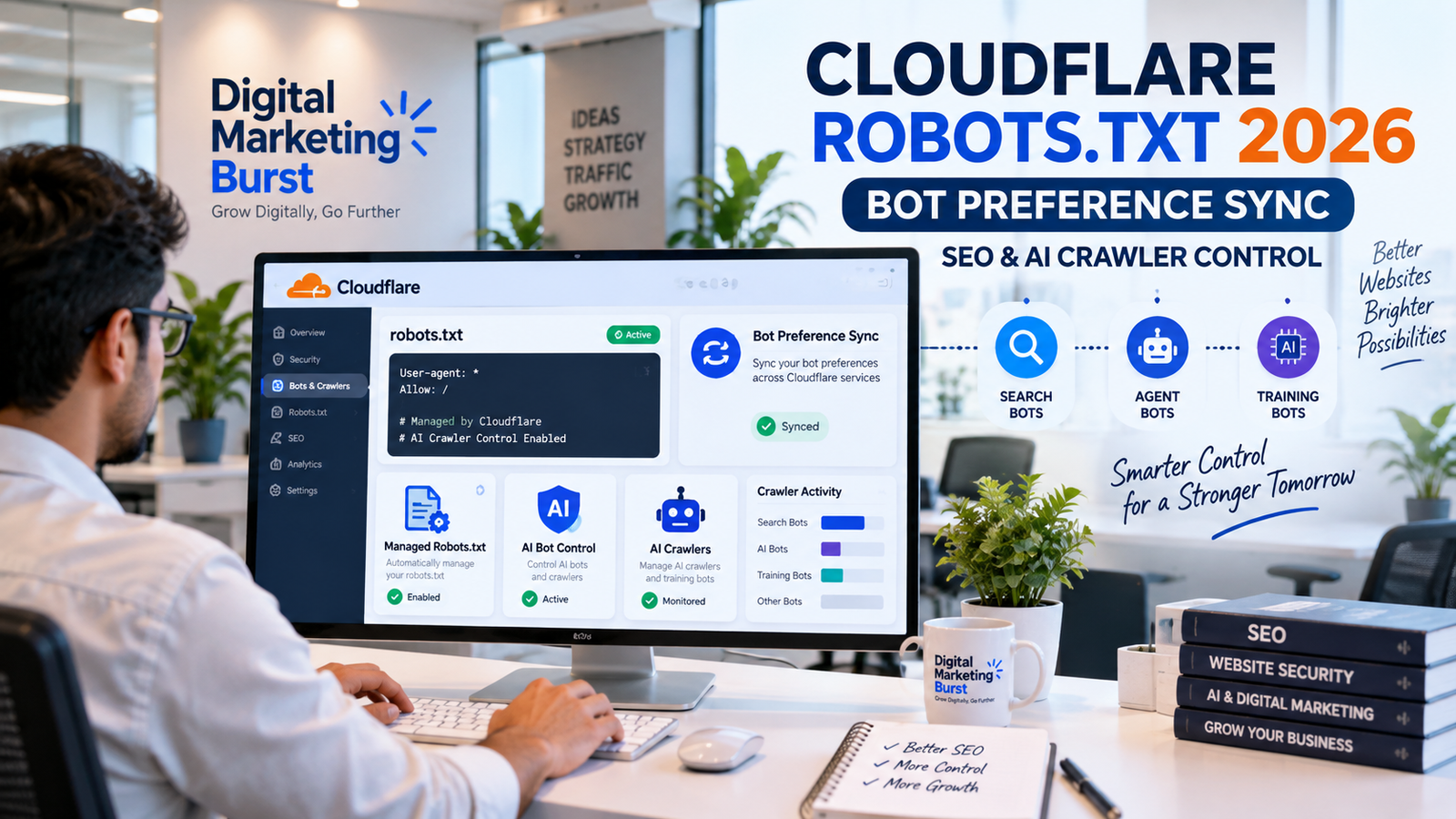
Cloudflare Robots.txt SEO: Why Robots.txt Has a Bigger Role in 2026
A traditional robots.txt file sits at the root of a website and provides crawler instructions. Search engines have long used it as one of the signals that tells their crawlers which areas of a site may or may not be crawled. However, modern websites are now visited by more than conventional search crawlers.
AI services can access web content for different purposes. Some crawlers support search and discovery. Others may retrieve information for an AI-powered answer. Training crawlers may collect content for model development. Automated agents can also visit pages while performing tasks for users.
Consequently, treating every bot as though it has the same purpose is becoming less practical.
Cloudflare now separates important AI-related behavior into categories including Search, Agent, and Training. This gives website owners more control over different uses rather than relying on one universal AI-bot decision.
From an SEO perspective, this distinction deserves attention. A website may want search-oriented discovery while taking a different position on model training. Likewise, a publisher may want AI services to find public content but may not want unrestricted reuse.
Therefore, robots.txt in 2026 should be considered part of a broader crawler-governance strategy. It still matters for conventional crawling instructions, but it can now also communicate preferences concerning certain AI uses.
Cloudflare Bot Preference Sync: What Changed in 2026?
Cloudflare Bot Preference Sync was announced on August 21, 2026. Its purpose is relatively straightforward: website owners should not have to configure one policy in Cloudflare and then manually maintain contradictory instructions inside robots.txt.
When Bot Preference Sync is enabled, Cloudflare can reflect configured AI bot preferences in the robots.txt response. According to Cloudflare, those preferences correspond to AI Search, Agent, and Training behavior.
This solves a genuine management problem.
Imagine that a business changes its Cloudflare configuration but forgets to update its manually maintained robots.txt file. The website could then communicate one preference through robots.txt while enforcing something different through its security configuration.
Bot Preference Sync is intended to reduce that mismatch.
Importantly, it does not mean Cloudflare simply replaces everything a website owner has written. Cloudflare states that if a robots.txt file already exists, material generated through Bot Preference Sync is prepended while existing directives are maintained.
That makes the feature especially relevant to WordPress sites, publishers, SaaS websites, e-commerce businesses, and large content platforms where crawler policies may become difficult to maintain manually.
How Cloudflare Bot Preference Sync Works
The easiest way to understand the feature is to separate published preferences from technical enforcement.
A website owner first chooses how different AI bot categories should be handled within Cloudflare. Bot Preference Sync can then make the robots.txt response reflect those preferences. As a result, the policy communicated to cooperating crawlers is better aligned with the configuration selected by the site owner.
For example, a publisher might want search discovery while choosing not to permit content to be used for AI training. Cloudflare describes a “Disallow” training option that can publish a no-training preference while allowing cooperating mixed-use crawlers to continue accessing content for permitted search purposes.
However, robots.txt is not a security wall.
Cloudflare explicitly notes that robots.txt compliance is voluntary. A crawler can technically ignore those instructions. Therefore, website owners should not assume that adding Disallow automatically prevents every unwanted request.
That difference is critical when building an AI crawler strategy.
Cloudflare AI Bot Preferences: Search, Agent and Training Explained
Cloudflare’s categorisation makes it easier to understand why a single “allow all” or “block all” decision can be too simplistic.
Search relates to crawlers that collect or index content so information can later be found or used in search experiences. Agent activity covers automated systems acting on behalf of a user, such as browser-use agents or fetch bots. Training relates to crawlers associated with training AI models.
These purposes can have very different value for a website.
A content publisher might consider search discovery valuable because it can support visibility. At the same time, that publisher may have a different policy for model training. An online service might welcome useful user-directed agents but still want to limit automated scraping.
Therefore, website owners should evaluate crawler purpose before applying broad rules.
This is also why Cloudflare AI Bot Preferences can become part of technical SEO discussions. The objective should not be maximum blocking. Instead, businesses should understand what they are allowing, what they are restricting, and what effect those decisions may have on discovery and access.
Cloudflare Managed Robots.txt: What Does It Actually Do?
Cloudflare Managed Robots.txt reduces the need to manually maintain certain AI-crawler instructions.
When the managed robots.txt setting is enabled, Cloudflare can generate and maintain robots.txt content that tells known AI crawlers about the website owner’s preferences. If an existing file is detected, Cloudflare can prepend its managed content rather than simply discarding the existing file.
That can be useful because crawler ecosystems change.
Maintaining a static list manually means someone has to monitor new crawler identities, update instructions, check formatting, and ensure that old rules do not conflict with newer policies. A managed system can reduce some of that maintenance.
Nevertheless, automation should not mean ignoring the resulting file.
Website owners should still review the final robots.txt response. Existing SEO directives may be important, especially on larger websites with specific crawl restrictions.
The practical approach is simple: use automation where it reduces repetitive maintenance, but continue monitoring the actual output.
Cloudflare Automatic Robots.txt and Existing Website Rules
The idea behind Cloudflare Automatic Robots.txt is attractive because it can simplify crawler-policy management. However, businesses should understand what happens when automation meets an existing configuration.
Cloudflare documentation states that managed robots.txt content can be prepended to an existing robots.txt file. This means businesses do not necessarily have to choose between Cloudflare’s managed instructions and every rule they already maintain.
Still, website owners should test carefully.
For example, a website may already have rules covering administrative paths, internal search pages, staging sections, filtered URLs, or other crawl-management requirements. Those rules serve a different purpose from AI crawler controls.
Therefore, after enabling an automated feature, open the live /robots.txt URL and inspect what is actually being served. Then compare the result with the intended search and AI policies.
That simple check can prevent an automated convenience feature from becoming an overlooked configuration issue.
Cloudflare AI Bot Control: Preference Is Not the Same as Enforcement
One of the biggest misunderstandings around robots.txt is assuming that it physically blocks a crawler.
It does not.
A robots.txt directive communicates a preference to crawlers that choose to follow the protocol. Cloudflare explicitly states that some crawler operators may disregard these instructions.
This is where Cloudflare AI Bot Control becomes a broader concept than editing a text file.
If a website owner genuinely needs technical enforcement, Cloudflare provides controls capable of blocking crawler requests rather than merely asking crawlers not to access certain content.
That distinction should influence your strategy.
A low-risk informational website may primarily care about communicating preferences. A publisher with commercially valuable proprietary content may require stronger controls. Similarly, a business dealing with aggressive automated traffic may need actual enforcement rather than a voluntary directive.
As a result, crawler management should begin with the question: Are we expressing a preference, or do we need to enforce a restriction?
Cloudflare AI Crawl Control: How It Goes Beyond Robots.txt
Cloudflare AI Crawl Control provides a more direct layer of visibility and management.
Cloudflare describes the feature as a way to monitor and control how AI services access website content. Website owners can see crawler activity, create granular access policies, monitor robots.txt compliance, and create enforcement rules when required.
This makes it useful beyond simple robots.txt management.
For example, seeing crawler activity can help a website owner understand whether AI crawlers are actually requesting important pages. That information is more useful than building a policy based entirely on assumptions.
AI Crawl Control can also help identify whether crawlers respect published directives. Cloudflare’s Directives area provides information about robots.txt interactions and can help identify crawlers that violate those instructions.
Therefore, the workflow becomes more mature: observe traffic, define preferences, monitor behaviour, and enforce restrictions where necessary.
That is much more useful than automatically blocking every crawler labelled “AI.”
Cloudflare AI Crawlers: Why Website Owners Should Monitor Them
Cloudflare AI Crawlers should be evaluated according to their behaviour and purpose rather than treated as one identical category.
Some automated systems support search discovery. Others retrieve information in real time. Another group may collect information for model training. In addition, crawler identities and behaviours can evolve.
Cloudflare’s AI Crawl Control dashboard can show individual AI crawler activity, including crawler identity, operator, category, and request information.
For SEO teams, this creates an opportunity to make better-informed decisions.
Suppose an organisation sees meaningful search-oriented crawler activity but very little training traffic. Its strategy may differ from that of a publisher receiving substantial automated requests from training crawlers.
Similarly, a site experiencing resource-heavy crawling can investigate the source before creating broad restrictions.
Monitoring first is generally more informative than applying rules without understanding the traffic.
Cloudflare AI Bots and the Future of Website Discovery
Cloudflare AI Bots are part of a larger change in how online content is discovered and consumed.
Traditional search remains important. However, users increasingly encounter information through AI-assisted search, conversational interfaces, automated agents, and answer engines. That creates a new challenge for website owners: content visibility and content control can sometimes pull in different directions.
Blocking too broadly may limit forms of discovery a business actually wants. Allowing everything may provide less control than the business considers appropriate.
Consequently, modern crawler strategy requires more precise decisions.
Cloudflare’s move toward behavioural categories illustrates this shift. Rather than viewing every AI-related request as equivalent, website owners can think separately about search, agents, and training.
For businesses in India, this does not require abandoning traditional SEO. Technical SEO fundamentals, useful content, crawlability, indexability, internal linking, structured information, and strong page experience remain important. AI crawler management should complement those fundamentals rather than replace them.
Cloudflare Robots.txt vs AI Crawl Control: What Is the Difference?
Although these features are connected, their roles are different.
Robots.txt primarily communicates crawler preferences. AI Crawl Control can provide monitoring and technical controls. Therefore, a website can use both when that combination matches its needs.
Cloudflare itself explains that website owners who want enforcement rather than a request can use AI Crawl Control, while robots.txt can still be used to express preferences.
This distinction is especially important for businesses that handle valuable original content.
Consider an educational publisher. It may want search crawlers to discover articles but prefer that certain AI training systems do not use those articles for training. Robots.txt can communicate that preference to cooperating crawlers. If stronger restrictions become necessary, enforcement tools can be considered separately.
This layered approach is more flexible than treating robots.txt as a security mechanism.
How Cloudflare Robots.txt Can Affect SEO
The SEO question is not simply whether Cloudflare’s feature is “good” or “bad.”
The effect depends on the configuration.
A poorly considered crawler policy can potentially interfere with discovery if a website blocks something it actually wanted to permit. Conversely, a carefully configured policy can help communicate content-use preferences while maintaining the forms of access the business values.
Cloudflare notes that Google Search Console may sometimes show “Syntax not understood” for its newer Content Signals directives. Cloudflare says it has observed no impact on crawling rates or SEO from those reports. That is Cloudflare’s own observation, so website owners should still monitor their individual Search Console data after making changes.
The key lesson is to avoid making technical changes blindly.
After adjusting crawler settings, monitor crawl behaviour, index coverage, important landing pages, organic search performance, and any relevant AI crawler activity.
SEO is better served by measured configuration than by aggressive blocking based on fear.
Cloudflare Content Signals and AI Training Preferences
Another important development is Cloudflare’s use of Content Signals.
Cloudflare documentation describes machine-readable directives for different content uses. These include search, ai-input, and ai-train. Search refers to building a search index, while ai-input relates to content being fed into AI systems for activities such as real-time generative answers. The ai-train signal relates to training or fine-tuning models.
This matters because the web is moving toward more granular content-use preferences.
Previously, website owners often faced a simple crawl/no-crawl decision. Newer approaches attempt to express what crawled content may be used for.
However, businesses should remember that a machine-readable preference is not automatically equivalent to technical enforcement. The practical effectiveness still depends on crawler behaviour and any enforcement controls the site owner applies.
Therefore, content signals should be understood as one layer within a larger content-governance strategy.
How to Manage AI Crawlers Without Hurting Your SEO Strategy
A good crawler policy begins with your business objective.
Publishers may care strongly about original-content protection. E-commerce companies may prioritise product discovery. Service businesses may want their informational pages to remain easy to discover through both traditional and emerging search experiences.
Therefore, copying another website’s robots.txt policy without understanding its objectives is risky.
Start by identifying the pages that matter for organic discovery. Next, understand which bot categories are accessing the website. Then decide which forms of use are acceptable. Finally, apply restrictions only where they align with the organisation’s content strategy.
After implementation, monitoring becomes essential.
Look for unexpected changes in organic crawling, indexed pages, referral traffic, server requests, and AI crawler activity. If something changes unexpectedly, review the configuration rather than assuming an algorithm update caused it.
This approach connects technical SEO with practical AI governance.
Common Cloudflare Robots.txt Mistakes Website Owners Should Avoid
One common mistake is believing that robots.txt guarantees a block. It does not.
Another problem is blocking large categories of crawlers without first understanding their purpose. Search, agents, and training are not necessarily the same activity, so a blanket rule may be unnecessarily restrictive.
Website owners can also make mistakes by enabling automation and never checking the final file. Managed settings reduce maintenance, but they do not remove the need for technical review.
A further issue is changing several crawler controls simultaneously and then failing to monitor the outcome. When too many settings change at once, identifying the cause of an unexpected result becomes harder.
Finally, businesses should avoid treating AI crawler configuration as a substitute for SEO. Controlling bots will not fix weak content, poor internal linking, duplicate pages, slow performance, or unclear search intent.
The strongest approach combines sensible crawler governance with solid technical and content SEO.
Cloudflare Robots.txt for WordPress Websites in India
WordPress powers websites ranging from local service businesses to large publishers. For these sites, crawler configuration can become complicated because SEO plugins, security tools, CDN settings, and server rules may all influence technical behaviour.
Therefore, WordPress website owners using Cloudflare should first understand where their current robots.txt response comes from.
After enabling a managed Cloudflare feature, check the public robots.txt file. Ensure important SEO rules still appear as expected. Also review whether essential public content remains available to the search crawlers you intend to support.
For Indian businesses using WordPress, the same principle applies regardless of industry. A hospital website, marketing agency, online publication, travel company, or e-commerce store may have completely different content-access requirements.
There is no universal robots.txt configuration that is ideal for every WordPress website.
Cloudflare AI Bot Management for Publishers and Content Websites
Publishers have particularly strong reasons to understand AI crawler behaviour because their content itself may represent a major business asset.
A publisher may depend on search discovery while also wanting control over training-related use. Another publication may actively welcome AI discovery because it supports brand visibility. These are different business models, so they require different policies.
Cloudflare’s newer separation of Search, Agent, and Training traffic gives publishers more room to express those distinctions.
However, publishers should avoid making decisions based only on industry trends.
First-party traffic data should guide the policy. Monitor which crawlers visit, which content receives requests, whether referral value exists, and whether automated activity creates infrastructure or commercial concerns.
Then choose controls that match the publishing strategy.
Cloudflare AI Crawler Control for Business Websites
For a typical business website, the challenge is slightly different.
Most businesses want potential customers to discover their services. Therefore, visibility is valuable. At the same time, businesses may have original guides, research, product information, or proprietary material they do not want indiscriminately collected.
This makes Cloudflare AI Crawler Control a strategic issue rather than merely a server setting.
Public service pages may have different requirements from premium research, customer-only resources, or internal material. Website owners should consider these distinctions before applying domain-wide restrictions.
Moreover, truly private information should never depend on robots.txt for protection. Access control, authentication, and appropriate security mechanisms are necessary for private resources.
Robots.txt is a crawler instruction system, not a privacy feature.
Where to Use the Branded Keyword: Digital Marketing Burst Cloudflare SEO Strategy
A useful branded long-tail phrase for this topic is Digital Marketing Burst Cloudflare SEO Strategy.
Digital Marketing Burst can approach Cloudflare configuration as part of a broader technical SEO discussion that includes crawler accessibility, search visibility, AI crawler policies, website performance, content structure, and emerging AI-search behaviour.
Another natural phrase is Digital Marketing Burst AI Crawler SEO Guide. This can be used when discussing how businesses evaluate the relationship between traditional search crawlers and newer AI systems.
For a service-oriented section, Cloudflare SEO Services by Digital Marketing Burst can connect the informational topic with commercial intent without turning the entire article into an advertisement.
The branding should remain secondary to the reader’s problem. Someone searching this topic primarily wants to understand what Cloudflare has changed and what they should consider doing about it. Answering that question thoroughly creates a stronger reason for readers to trust the brand.
Cloudflare Bot Preference Sync SEO Strategy for 2026
The introduction of Bot Preference Sync shows how crawler management is becoming more closely connected with content-use policies.
Previously, many site owners manually maintained static rules. Now, Cloudflare can help align published robots.txt preferences with AI bot configuration. That can reduce inconsistencies, particularly when crawler classifications and organisational policies evolve.
Still, automation should support strategy rather than define it.
Website owners need to decide whether they value search discovery, agent access, training restrictions, or some combination of those outcomes. Only then should the technical configuration be selected.
This is especially important for SEO professionals. Their role is not simply to maximise crawl access. They also need to understand how technical restrictions interact with business goals.
In 2026, crawler governance is becoming another part of that conversation.
Cloudflare Managed Robots.txt SEO Best Practices
The first principle is to know what your website currently serves before changing anything.
Review the existing robots.txt file and identify important directives. Next, document the AI crawler policy you actually want. After enabling Cloudflare’s managed settings, compare the new live file with the previous configuration.
Then monitor results.
Do not judge success only by whether a toggle is enabled. Look at whether intended search crawlers can access important public pages and whether restricted crawler categories behave as expected.
Also remember that managed robots.txt and enforcement controls solve different problems. A published directive communicates intent. An enforced block technically restricts requests.
Understanding that distinction will prevent many configuration errors.
Cloudflare AI Crawl Control SEO Strategy for Indian Businesses
Indian businesses adopting AI-related crawler controls should avoid assuming that every website requires the strictest possible setting.
A local business primarily interested in discovery may make different decisions from a national publisher with thousands of original articles. Similarly, an e-commerce website may value machine discovery of product information differently from a subscription-based content platform.
The right strategy starts with commercial objectives.
Ask which content needs broad discovery, which content has higher reuse sensitivity, and which crawler categories provide meaningful value. Then use analytics and crawler data to refine the decision.
This is also where SEO teams and website-security teams should coordinate. A crawler rule created solely from a security perspective can have discoverability implications. Meanwhile, an SEO decision that allows every automated request may overlook resource or content-governance concerns.
Shared decision-making creates a more balanced configuration.
Cloudflare Robots.txt 2026: Final SEO Takeaway
The biggest change is not that robots.txt suddenly became new. Instead, the environment around it has changed.
Websites are now accessed by traditional search crawlers, AI search systems, automated agents, training crawlers, and other bots. Cloudflare is responding with managed robots.txt functionality, Bot Preference Sync, behavioural bot categories, Content Signals, and AI Crawl Control.
For website owners, the practical lesson is to avoid treating every crawler identically.
Decide what you want from Search, Agent, and Training traffic. Use robots.txt to communicate appropriate preferences. Use stronger controls where actual enforcement is necessary. Most importantly, monitor what happens after implementation.
For Digital Marketing Burst, this topic also sits naturally at the intersection of technical SEO and AI-search optimisation. The goal should be maintaining useful discoverability while giving website owners clearer control over how automated systems interact with their content.
Your supplied writing brief specifically asks for human-first content, controlled keyphrase repetition, short sentences, transition words, long-tail headings, no external links in the publishable article, and a 40% traffic / 30% client / 30% problem-solving balance.
Cloudflare Robots.txt SEO Strategy for Business Websites in 2026
A strong Cloudflare Robots.txt SEO strategy starts with understanding that crawler control and search visibility are connected, but they are not the same thing. A business website usually wants important service pages, useful blogs, product information, and other public resources to remain discoverable. At the same time, the business may want greater control over automated systems that access its content for purposes beyond conventional search.
Therefore, the first step should not be blocking every bot. Businesses should understand which content needs maximum visibility and which content requires tighter control. A public service page designed to attract customers has a different purpose from proprietary research, premium resources, or internal documentation. Treating them identically can create an unnecessarily restrictive crawler policy.
This becomes especially relevant for Indian companies investing in SEO. A business may spend months improving content, technical performance, internal linking, and search intent. If crawler settings are then changed without understanding their purpose, those SEO efforts can become harder to evaluate.
Instead, technical teams should document their intended crawler policy before making changes. They should know which sections must remain accessible for normal search discovery and which AI-related uses they prefer to restrict. After implementation, the live robots.txt response and crawler activity should be reviewed.
In other words, crawler management should support an SEO strategy rather than operate independently from it. The objective is controlled accessibility: maintaining useful discovery while giving the website owner greater influence over how automated systems interact with published content.
How to Set Up Cloudflare Robots.txt for AI Crawlers
Website owners searching how to set up Cloudflare robots.txt for AI crawlers are usually trying to solve two problems at once. They want to control AI access, but they do not want to accidentally create problems for traditional search engines.
That is why implementation should begin with an audit rather than an immediate configuration change. First, check the current robots.txt response. Understand which rules already exist and why they were added. A WordPress website, for example, may already generate certain instructions through its CMS or SEO configuration. Other websites may use manually maintained files.
Next, decide what the AI crawler policy is supposed to achieve. A business may be comfortable with search-oriented discovery but uncomfortable with model-training use. Another website may permit user-directed AI agents while applying a different policy to training crawlers. These are separate decisions.
Cloudflare’s newer controls make that distinction easier because AI-related traffic can be considered according to purpose. However, robots.txt should still be treated as a communication mechanism rather than a complete security system.
After making changes, open the live robots.txt file again. Check whether existing instructions remain correct and whether the intended AI directives are being served. Then monitor crawler behaviour and search performance over time.
This simple process is much safer than copying another website’s configuration. A robots.txt file should reflect the needs of your own website, content model, audience, and visibility strategy.
Cloudflare Bot Preference Sync SEO Benefits for Website Owners
The main practical advantage of Cloudflare Bot Preference Sync is consistency. When website owners manage AI bot preferences in one place but maintain robots.txt separately, those two configurations can eventually become different. That creates confusion for technical teams and crawlers alike.
For example, imagine that a company changes its policy toward AI training. The Cloudflare configuration is updated, but nobody remembers to modify robots.txt. The website could then communicate an older preference while its infrastructure follows a newer policy.
Bot Preference Sync is designed to reduce this type of mismatch.
From an SEO-management perspective, consistency matters because technical configurations should be understandable and auditable. When developers, SEO professionals, content managers, and security teams review a website, they should be able to determine what crawler behaviour is intended.
However, businesses should not treat synchronization as an SEO ranking technique. Enabling the feature does not automatically improve organic positions. Its value lies in cleaner crawler-policy management.
That distinction is important. Technical SEO often includes tasks that help search engines access and understand a website, but not every technical setting is a direct ranking factor.
Therefore, the practical benefit is operational. Website owners can spend less time manually maintaining overlapping crawler instructions and more time checking whether their policy matches their business objectives.
Cloudflare AI Bot Preferences for Search, Agent and Training Crawlers
Cloudflare AI Bot Preferences become easier to understand when Search, Agent, and Training activity are treated separately. These categories reflect different reasons an automated system may want to access a website.
Search-oriented bots are connected with discovery and search experiences. Agent activity can involve an automated system acting on behalf of a user. Training activity relates to content collection associated with developing or improving AI models.
The distinction matters because website owners may not want the same policy for all three.
Consider a publisher that relies heavily on search visibility. It may want public articles to remain discoverable through search-related systems while taking a more restrictive position on training use. Conversely, a website offering public reference material may decide that broad machine access aligns with its goals.
Neither approach should be copied blindly.
Instead, businesses should ask what value each type of access provides. They should also consider content ownership, infrastructure costs, commercial strategy, and the importance of emerging AI discovery channels.
For SEO professionals, this adds another layer to technical planning. The question is no longer simply whether a crawler can access a URL. Increasingly, the purpose of that access also matters.
This is why AI bot preferences should be discussed with content, technical, legal, and business considerations in mind rather than being treated as a single SEO toggle.
Cloudflare Managed Robots.txt Setup for Website Owners
A Cloudflare Managed Robots.txt setup can reduce repetitive maintenance, particularly for businesses that do not want to manually track every relevant AI crawler.
However, automation works best when website owners understand what is being automated.
Before enabling managed behaviour, review the existing file. Some websites have only basic directives, while others contain important rules created around crawl efficiency or specific technical sections. Losing track of those instructions can create unnecessary problems later.
Once managed functionality is active, inspect the final output served publicly. This step is easy to overlook. Yet it provides the clearest confirmation that the resulting file matches the intended policy.
Businesses should also keep a record of major crawler-policy changes. If search crawling, index coverage, server behaviour, or automated traffic changes later, having that record makes diagnosis easier.
For larger websites, this becomes even more important. Multiple teams may work on CDN configuration, SEO, development, content, and security. Without documentation, one team can change a setting without another team understanding why website behaviour changed.
Therefore, the value of managed robots.txt is not simply automation. Its greater benefit is easier policy maintenance when combined with proper monitoring and documentation.
Cloudflare Automatic Robots.txt for WordPress and Business Websites
The phrase Cloudflare Automatic Robots.txt describes an attractive idea for busy website owners: reduce manual work while keeping crawler instructions updated. However, automation should not become a reason to stop checking technical SEO.
WordPress websites provide a good example. Plugins, themes, server settings, caching systems, and CDN configurations can all influence how the site behaves. Therefore, when another layer starts managing crawler instructions, the final live response should always be reviewed.
A business owner does not need to understand every technical detail personally. However, whoever manages SEO or development should know which system is responsible for the file and what rules are being delivered.
This also helps when troubleshooting.
Suppose a website later experiences an unexpected crawling issue. If nobody knows whether the robots.txt response originates from WordPress, a plugin, Cloudflare, or a manually uploaded file, diagnosis takes longer.
For that reason, automation and documentation should work together.
A properly managed system can save time. Still, the website owner remains responsible for understanding the intended outcome. Automatic does not mean risk-free, and it certainly does not mean every website should use identical rules.
Cloudflare AI Bot Control for Publishers and Content Websites
Cloudflare AI Bot Control becomes especially important for publishers because original content is often central to their commercial value. Articles, analysis, research, guides, and editorial resources can require substantial investment to produce.
At the same time, publishers depend heavily on discovery.
This creates a genuine strategic tension. Blocking automated access too aggressively may reduce participation in useful discovery channels. Allowing every automated use without review may not match the publisher’s content strategy.
Therefore, publishers should classify their priorities before configuring controls.
Public news and informational pages may be intended for wide discovery. Premium research, subscription resources, or proprietary databases may require completely different protections. Moreover, genuinely private material should never rely on robots.txt as its security mechanism.
AI bot management can then be aligned with those content categories.
The most useful strategy is usually evidence-based. Publishers should monitor which crawlers access the site, what sections they request, how frequently they visit, and whether those requests align with the organisation’s objectives.
This turns AI bot control from a reaction into a policy. Instead of blocking because “AI crawling sounds risky,” publishers can make decisions based on their actual content model.
Cloudflare AI Crawl Control for Monitoring AI Traffic
Cloudflare AI Crawl Control is useful because website owners need visibility before they can make good crawler decisions. Without monitoring, it is easy to create restrictions based on assumptions rather than actual behaviour.
A website may believe that training crawlers are responsible for most automated traffic, for example, when another type of bot is generating the requests. Similarly, a business may block a crawler without understanding whether it supports a discovery channel the business values.
Monitoring helps reduce that uncertainty.
For SEO teams, crawler data can also provide useful context. If a website changes AI access policies, teams can compare crawler activity before and after the change. They can then separately monitor conventional organic search indicators.
However, correlation should not automatically be treated as causation. If rankings move after a crawler-policy update, other SEO changes, algorithm updates, competition, seasonality, or indexing factors may also be involved.
Therefore, technical changes should be documented and evaluated carefully.
The broader lesson is that AI crawler management should follow the same disciplined approach used in good technical SEO: observe the current state, make a deliberate change, validate implementation, and monitor the outcome.
How to Block AI Bots With Cloudflare Without Making Blind SEO Changes
People searching how to block AI bots with Cloudflare often expect a simple yes-or-no answer. Technically, blocking can be straightforward. Strategically, however, deciding what should be blocked requires more thought.
The first mistake is assuming every AI bot has the same purpose. A training crawler, search crawler, and user-directed agent may interact with content differently. Consequently, a blanket restriction may block activity the website owner actually values.
Before enforcing a block, determine why the restriction is needed.
Perhaps the concern is model training. Maybe automated requests are creating unwanted server load. A publisher may be protecting commercially valuable content. Alternatively, a business may simply want greater transparency around automated access.
Each problem can require a different response.
This is also where the distinction between robots.txt and enforcement becomes critical. A robots.txt directive communicates a request to compliant crawlers. A technical block prevents matching requests according to the configured rule.
Therefore, website owners should avoid confusing the two.
When actual enforcement is necessary, test the configuration carefully and continue monitoring important search-engine access. The safest crawler policy is not necessarily the strictest one. It is the policy that accurately reflects the website’s content, visibility requirements, and business goals.
Block AI Crawlers Cloudflare: When Stronger Enforcement Makes Sense
The search phrase Block AI Crawlers Cloudflare reflects growing concern among publishers and businesses about automated content access. However, stronger enforcement makes the most sense when a clear business reason exists.
For example, a publisher may identify a crawler repeatedly accessing large amounts of content despite published preferences. In that situation, relying only on a voluntary directive may not achieve the intended restriction.
Similarly, a website experiencing significant unwanted automated traffic may need technical controls to protect resources.
On the other hand, blocking everything merely because a crawler is associated with AI can be too broad.
Businesses should evaluate crawler identity, purpose, request patterns, content sensitivity, and potential discovery value before creating strict rules. They should also consider whether a restriction applies to the entire domain or only particular sections.
A targeted policy can often provide more control than a blanket one.
Furthermore, any major change should be tested. Important search-engine crawlers and essential public pages should remain accessible according to the website’s SEO strategy.
The purpose of stronger enforcement is controlled access, not accidental invisibility.
Cloudflare AI Crawler Control for SEO and Content Protection
Cloudflare AI Crawler Control sits at an interesting intersection between SEO, security, publishing, and content governance.
SEO traditionally encourages accessibility because public content needs to be discovered. Content protection, however, may require limiting certain forms of automated use. Both goals can be valid at the same time.
That is why crawler policies need nuance.
A business may allow public service pages to remain widely accessible while applying tighter controls to specialist reports. A publisher may distinguish between search discovery and training use. An e-commerce website may prioritise broad discovery of public product pages while protecting internal or account-based resources through proper access controls.
The correct approach depends on the content.
Moreover, robots.txt should never be treated as a protection mechanism for confidential information. Sensitive or private resources require authentication and appropriate security.
This distinction keeps SEO and security responsibilities clear.
For public content, AI crawler controls can help website owners make deliberate choices. For private content, actual access protection remains essential.
Cloudflare Robots.txt Best Practices for AI Search Visibility
Modern Cloudflare Robots.txt best practices should account for both traditional search and emerging AI discovery without assuming that the two operate identically.
Start by keeping important public content crawlable for the systems you intentionally support. Avoid unnecessarily broad directives. Next, distinguish between crawler categories rather than grouping every automated service together.
Website owners should also regularly inspect their live robots.txt file. Configuration can change over time, especially when multiple systems influence the response.
Another good practice is maintaining internal documentation. Record when major crawler rules were changed, why they were changed, and who approved them. This becomes extremely useful when diagnosing future issues.
Most importantly, robots.txt should remain part of a wider technical SEO framework.
Good content still needs clear internal links. Search engines still need logical site architecture. Important pages should not be isolated. Canonicalisation, crawl efficiency, page performance, structured data, and content quality remain important.
AI crawler controls do not replace these fundamentals.
Instead, they add another technical layer that website owners must understand as search and content discovery evolve.
Cloudflare Robots.txt and AI Search Optimization in 2026
AI search optimisation is creating new questions about how websites should make content accessible to machines.
For years, SEO teams primarily considered conventional search crawlers. Now, content can also appear within AI-assisted discovery experiences. This does not mean traditional SEO has become irrelevant. Rather, the discovery ecosystem has expanded.
A useful strategy therefore begins with content quality.
Pages should clearly answer the user’s question, demonstrate subject relevance, use understandable structure, and provide information that is easy to interpret. Technical accessibility then supports that content.
Crawler policies should be layered on top of those fundamentals.
If a business wants visibility through emerging AI systems, indiscriminately restricting machine access could conflict with that objective. Conversely, if the organisation has strong reasons to restrict particular uses, those preferences should be configured deliberately.
There is no universal setting that guarantees better AI visibility.
Therefore, businesses should be cautious of anyone promising that one robots.txt rule will automatically produce higher rankings in Google or AI answers.
The more realistic approach combines useful content, technical accessibility, entity clarity, trustworthy information, structured website architecture, and a crawler policy that matches the business model.
Cloudflare AI Search Bots vs AI Training Bots
Understanding Cloudflare AI Search Bots and AI training crawlers helps website owners make more precise decisions.
Search-related access can support content discovery. Training-related access serves a different purpose. Therefore, a publisher may see commercial value in one while having concerns about the other.
This distinction becomes particularly important when content production is expensive.
A specialist website may invest heavily in expert-written guides, original research, illustrations, or databases. It may still want users to find those resources through search. However, its policy toward training use could be different.
Separating those objectives allows for a more balanced crawler strategy.
The same principle applies to service businesses, although the priorities may differ. A local or national service provider often wants maximum visibility for public informational and commercial pages. Therefore, broad restrictions may provide little benefit unless there is a specific content or traffic concern.
The best policy follows the business model.
Rather than asking whether “AI bots are good or bad,” ask which automated uses support the organisation’s objectives and which do not.
That question produces a far more useful technical strategy.
Cloudflare Robots.txt Problems That Can Affect Website Crawling
Crawler-management problems often begin with simple configuration mistakes.
A rule may be broader than intended. An old directive may remain after a website migration. Different systems may produce conflicting instructions. Alternatively, a website owner may misunderstand the purpose of robots.txt and expect it to perform a security function.
These problems can become more complicated when AI crawler controls are added.
Therefore, troubleshooting should begin with the actual live response rather than assumptions. Open the robots.txt file, identify the relevant directives, and determine which platform or configuration created them.
Next, verify whether important public URLs can be accessed by the intended crawlers.
If a problem appears after a Cloudflare configuration change, compare the current setup with the previous state. Avoid changing multiple unrelated settings at the same time because doing so makes diagnosis harder.
For SEO professionals, this is a familiar principle. Technical problems are easier to solve when changes are documented and tested individually.
The growing number of crawler categories makes disciplined troubleshooting even more valuable in 2026.
Why Cloudflare AI Bots Should Not All Be Blocked Automatically
A blanket Cloudflare AI Bots policy may sound simple, but simplicity does not always produce the best business outcome.
Different automated systems perform different functions. Some support discovery. Others act for users. Some are associated with training. Therefore, blocking them all removes the ability to distinguish between potentially valuable and unwanted activity.
This is particularly important for websites that depend on organic discovery.
Emerging search experiences can change how users find information. Businesses that want to participate in those experiences should understand the potential consequences before applying broad restrictions.
At the same time, this does not mean every AI crawler should automatically be allowed.
Website owners have legitimate reasons to control content access. The point is to make those decisions deliberately.
Monitoring can help. If a crawler generates excessive requests, ignores preferences, or provides no value aligned with the organisation’s goals, stronger controls may be appropriate.
The key principle is classification before restriction.
That produces a more defensible strategy than treating “AI bot” as a single behaviour.
Best Cloudflare AI Bot Control Strategy for Indian Businesses
Indian businesses should build their Cloudflare AI Bot Control strategy around their website type rather than copying policies from large international publishers.
A digital marketing agency, hospital, travel company, SaaS provider, news publisher, and e-commerce website all have different reasons for publishing content.
For a service business, informational pages often exist to generate discovery and enquiries. Consequently, making those pages unnecessarily difficult for useful search systems to access can work against the marketing objective.
Publishers may have different concerns because content itself can be the product. SaaS businesses may maintain public documentation alongside account-only resources. E-commerce sites may want product information widely discoverable while protecting customer data through entirely different security controls.
Therefore, the crawler strategy should begin with content classification.
Once the business understands what it publishes and why, it can decide how different crawler categories should be handled.
This approach also helps prevent SEO teams and security teams from working against one another. Instead, both sides can agree on the purpose of public content and the restrictions required for other resources.
Cloudflare SEO Services by Digital Marketing Burst
Businesses dealing with Cloudflare Robots.txt SEO, crawler accessibility, AI bot policies, technical SEO, and AI-search visibility increasingly need these areas to work together rather than being managed as isolated tasks.
For Digital Marketing Burst, the useful approach is to evaluate crawler controls within the broader context of a website’s search strategy. That means reviewing whether important pages are accessible, whether crawler instructions match business objectives, and whether technical changes create unnecessary barriers for public content.
The same approach can extend to content structure, internal linking, technical audits, search-intent optimisation, and emerging AI-search considerations.
However, no SEO agency can legitimately promise that enabling a specific Cloudflare feature will produce a particular ranking. Search visibility depends on many factors.
Therefore, the value of professional technical SEO lies in reducing avoidable problems and building a clearer, more maintainable website structure.
For Indian businesses navigating both conventional SEO and AI crawler management, this integrated approach can make technical decisions easier to understand and measure.
Digital Marketing Burst AI Crawler SEO Guide for Modern Websites
The Digital Marketing Burst AI Crawler SEO Guide approach begins with one principle: control should follow understanding.
Before blocking a crawler, identify it. Before modifying robots.txt, understand the existing directives. Before changing AI bot preferences, decide what outcome the business actually wants.
This sequence prevents technical decisions from becoming reactions to industry headlines.
Modern SEO already involves multiple systems. Search crawlers need access to public pages. JavaScript rendering can influence discovery. Canonicals can affect URL interpretation. Internal links help establish site structure. Now, AI crawler preferences add another layer.
Therefore, the goal is not to chase every new setting.
Instead, businesses should maintain a documented technical framework. New crawler controls can then be evaluated against that framework rather than implemented simply because they are new.
For Digital Marketing Burst, this also creates a natural bridge between conventional technical SEO and newer AI-search optimisation. Both ultimately depend on understanding how machines access, interpret, and use public website information.
The technology changes, but disciplined website management remains essential.
How Cloudflare Bot Preference Sync Changes Technical SEO Workflows
How Cloudflare Bot Preference Sync works is not only a technical question. It also changes how SEO and development teams can manage crawler policies operationally.
Previously, an organisation might maintain bot preferences inside one platform while separately editing robots.txt. As policies changed, those configurations could drift apart.
Synchronization reduces some of that manual coordination.
However, technical SEO workflows should still include verification. After a preference changes, teams should inspect the public response, check important crawler accessibility, and record the modification.
This becomes especially useful for agencies managing multiple websites.
Without a repeatable process, different client sites can accumulate inconsistent rules. One website may use old manual directives while another relies on newer managed functionality. Documentation makes those differences visible.
Consequently, Bot Preference Sync can reduce maintenance, but it should not eliminate human review.
Automation is most useful when it removes repetitive work while preserving oversight.
That principle applies well beyond Cloudflare. Good technical SEO increasingly depends on knowing which tasks should be automated and which decisions still require context.
Cloudflare AI Crawlers Guide for Website Owners in 2026
A practical Cloudflare AI Crawlers guide should end with a simple idea: understand the crawler before deciding what to do with it.
Start with visibility. Determine which automated systems access the website and which sections they request. Next, classify their likely purpose. Then compare that activity with the organisation’s business and content goals.
Only after that should a policy be chosen.
Some crawlers may be useful for discovery. Others may not align with the organisation’s content-use preferences. Certain bots may follow robots.txt reliably, while technical enforcement may be necessary for others.
The correct response can therefore vary.
Website owners should also revisit these decisions periodically. AI crawler ecosystems are changing quickly, and a configuration that made sense earlier may not remain appropriate indefinitely.
At the same time, avoid allowing crawler management to consume the entire SEO strategy. The fundamental objective remains serving users with useful content and ensuring that intended public pages can be discovered efficiently.
Cloudflare Robots.txt Troubleshooting When AI Crawler Rules Do Not Work
A Cloudflare Robots.txt configuration can look correct while the actual crawler behaviour still appears different from what a website owner expected. Usually, the first step is to separate a robots.txt preference from an enforced restriction. Robots.txt communicates instructions to crawlers. However, it should not be treated like authentication, a firewall, or another security mechanism.
Therefore, troubleshooting should begin with the live file. Open the website’s /robots.txt address and check what visitors and crawlers actually receive. Do not rely only on what a CMS, plugin, or dashboard appears to show. If Cloudflare-managed instructions are active, compare the output with the policy you intended to publish.
Next, identify the crawler creating the concern. An AI training crawler and an AI search-related crawler may have different purposes. As a result, blocking an entire category before identifying the source can create an unnecessarily broad policy.
Website owners should also check whether multiple systems are influencing crawler instructions. WordPress settings, SEO plugins, manually created files, CDN configurations, and other technical layers can make troubleshooting more complicated.
Most importantly, change one major configuration at a time whenever practical. Then verify the result. This approach makes it easier to determine which adjustment caused a problem and prevents crawler troubleshooting from turning into guesswork.
Cloudflare Robots.txt SEO Problems After Changing Bot Settings
A sudden SEO change after modifying crawler controls does not automatically prove that the new setting caused it. Search visibility can move for many reasons. Content changes, technical problems, competition, indexing behaviour, seasonality, and search-system updates can all influence performance.
However, crawler accessibility should still be checked whenever bot settings change.
Start with the pages that matter most. Service pages, category pages, important articles, product pages, and other organic landing pages should remain accessible according to your intended search policy. If important public content has unintentionally become restricted, investigate the relevant rule before making further changes.
Next, compare the timing of the configuration update with available search and crawling data. The purpose is not to prove causation immediately. Instead, it helps narrow the investigation.
Businesses should also avoid making several unrelated technical changes during the same troubleshooting period. If robots.txt, canonical tags, redirects, internal links, and CDN rules are changed together, identifying the real cause becomes considerably harder.
A controlled technical workflow is more reliable. Record the original configuration, document the modification, validate the live output, and monitor the result. This method is useful whether the site belongs to an Indian publisher, service company, e-commerce business, or marketing agency.
Cloudflare Bot Preference Sync Not Working: What Should You Check?
When Cloudflare Bot Preference Sync does not appear to produce the expected result, avoid immediately adding more rules. First, determine what “not working” actually means.
Perhaps the robots.txt output does not reflect the intended preference. Alternatively, the file may look correct while an unwanted crawler continues requesting content. These are different problems.
In the first situation, investigate the configuration and the live response. In the second, remember that a robots.txt instruction depends on crawler cooperation. If technical prevention is required, a voluntary directive alone may not satisfy the objective.
Another consideration is the existing robots.txt configuration. Businesses should understand which instructions existed before synchronization was enabled and whether those rules remain relevant.
Caching can also make technical diagnosis confusing. A website owner may expect an immediate visible change but continue viewing an older response somewhere in the delivery chain. Therefore, validate what is currently served rather than relying on an old screenshot or copied file.
Finally, document the intended Search, Agent, and Training policy. If the desired outcome itself is unclear, it becomes difficult to determine whether synchronization is behaving correctly.
Good troubleshooting starts with a clearly defined expected result.
Cloudflare Managed Robots.txt vs Manual Robots.txt for SEO
Choosing between Cloudflare Managed Robots.txt and a manually maintained configuration depends largely on the complexity of the website and the team responsible for it.
Manual management offers direct control. An experienced technical team can maintain precise instructions and review every change. However, that flexibility also creates maintenance work. As crawler ecosystems evolve, old rules can remain in place long after their original purpose has disappeared.
Managed functionality can reduce some of that repetitive work. It is particularly useful when a website owner wants Cloudflare to help maintain AI-related crawler instructions without manually following every relevant bot change.
Still, managed does not mean unattended.
A business should continue checking its live robots.txt response. Existing technical SEO requirements do not disappear simply because part of the file is managed automatically.
For a smaller Indian business, reducing manual maintenance may be attractive. A large publisher with a specialised technical team may prefer more detailed governance. Neither approach is automatically superior for every website.
The best option is the one that keeps the crawler policy accurate, understandable, documented, and aligned with the website’s search strategy.
Cloudflare Automatic Robots.txt Problems and How to Avoid Them
Automation can save time, but Cloudflare Automatic Robots.txt should not encourage a “set it and forget it” approach.
The first potential problem is lack of awareness. A website owner may enable automated management and later forget which system controls the response. Months later, another developer or SEO professional may edit crawler settings elsewhere without understanding the existing setup.
Another problem is assuming that automated instructions automatically represent the business strategy. Software can implement a selected preference, but the business still needs to decide what that preference should be.
Therefore, internal documentation is useful. Record when managed crawler controls were enabled, what outcome was intended, and which team is responsible for reviewing them.
Businesses should also include the live robots.txt file in periodic technical SEO checks. This is especially important after migrations, CDN changes, security updates, CMS modifications, or major crawler-policy changes.
Automation works best when it reduces maintenance rather than removes accountability.
For that reason, the strongest approach combines managed functionality with occasional human review. The system handles repetitive configuration while the SEO or technical team checks that the resulting policy continues to support the website’s goals.
Cloudflare AI Bot Control Problems Website Owners Should Avoid
One of the biggest Cloudflare AI Bot Control mistakes is making decisions before understanding the crawler’s purpose.
The label “AI bot” can include systems with different behaviours. Some automated services support search discovery. Others retrieve content for agents. Training-related crawlers have another purpose. Therefore, a universal policy may not reflect what the website owner actually wants.
A second mistake is confusing crawler control with content security. If information must remain private, it should be protected through proper authentication and security controls. Publishing a robots.txt instruction is not an appropriate way to protect confidential information.
Another issue is overreacting to industry headlines. AI crawling is changing quickly, so website owners may feel pressure to block everything immediately. However, technical decisions should follow the organisation’s business model.
For example, a service website that depends heavily on public discovery may have different priorities from a subscription publisher whose original content represents its primary product.
Finally, businesses should monitor the result of significant changes. A technically successful block is not necessarily a strategically successful decision if it restricts a form of discovery the business actually wanted.
Cloudflare AI Crawl Control vs Block AI Bots: Understanding the Difference
Cloudflare AI Crawl Control should be considered a broader management layer rather than simply another name for blocking bots.
Website owners first need visibility. Which crawlers are visiting? What content are they requesting? How frequently are they appearing? What purpose are they associated with? These questions help establish whether a problem exists before a restriction is created.
Blocking is one possible response, not the entire strategy.
Suppose a website notices substantial automated activity. Before creating a broad restriction, the technical team can investigate whether that traffic is search-related, agent-related, training-related, or otherwise unwanted. A targeted policy can then be more appropriate than a universal block.
This matters for SEO because public content exists to be discovered. Restricting machine access without understanding its purpose can create unnecessary uncertainty around emerging discovery channels.
Conversely, allowing every crawler without review is not automatically the right choice either.
The better approach is visibility followed by classification, policy, implementation, and monitoring. That sequence turns crawler management into a repeatable technical process instead of a reaction to individual bots.
How to Control AI Training Crawlers in Cloudflare
Businesses searching how to control AI training crawlers in Cloudflare usually have a more specific concern than businesses searching generally about AI bots. Their focus is the use of published content in model development.
This distinction is useful because it allows the website owner to avoid treating search discovery and training as identical activities.
Start by defining the organisation’s policy toward AI training. The decision may depend on the type of content published. A company producing original research may approach the question differently from a business publishing standard service information.
Next, distinguish preference signalling from enforcement. A robots.txt instruction can communicate the website owner’s position to cooperating crawlers. If a business requires stronger technical prevention, additional controls may be necessary.
The website owner should then monitor relevant crawler behaviour. If a training-related crawler respects the published preference, additional action may not be needed. If unwanted access continues and the organisation has decided it should be prevented, enforcement can be evaluated.
This approach is more precise than blocking every AI-related request. It protects the distinction between content discovery and training use while allowing the business to make a policy that reflects its own priorities.
Cloudflare AI Search Bots and Website Visibility in 2026
AI-assisted search is making Cloudflare AI Search Bots relevant to businesses that previously thought only about conventional search-engine crawlers.
However, website owners should avoid assuming that allowing a particular crawler guarantees inclusion in an AI-generated response. Access is only one part of a much larger discovery and retrieval process.
Content still needs to be useful.
A page should answer its topic clearly, use understandable headings, provide accurate information, and avoid unnecessary filler. Important facts should be easy to locate. Entity information should remain consistent, and relevant pages should be connected through sensible internal links.
These principles are useful for human readers as well as machines.
Crawler accessibility then supports that foundation. If an organisation wants its public information available for relevant discovery systems, its technical policies should not contradict that objective.
At the same time, businesses may make different decisions regarding training use. That is why separating AI search activity from training activity can create a more balanced strategy.
The objective is not “allow AI” or “block AI.” The better question is which forms of access support the organisation’s goals.
Cloudflare AI Training Crawlers vs Search Crawlers for Publishers
For publishers, understanding Cloudflare AI Training Crawlers and search-oriented crawlers is increasingly important because content has both discovery value and commercial value.
Search discovery can help readers find articles. Training use raises a separate question about how published material may be used by AI systems. Consequently, a publisher can reasonably evaluate those activities differently.
This is particularly relevant to websites producing expensive original reporting, specialist analysis, educational resources, or proprietary research.
However, policy should still be evidence-based.
Publishers can review crawler behaviour and decide whether the current level of access aligns with their business model. They can also determine whether the same policy should apply across the entire site.
For instance, freely available informational content may have one objective while premium or subscriber-only material has another. Truly restricted material should be protected by appropriate access controls rather than relying on crawler instructions.
The key principle is granularity.
When businesses distinguish content types and crawler purposes, they can build policies that are more precise than a domain-wide allow-or-block decision.
Cloudflare AI Crawlers Robots.txt Strategy for Content Websites
A Cloudflare AI Crawlers Robots.txt strategy should start with content classification.
A website may contain public marketing pages, blog posts, documentation, customer areas, internal search pages, account pages, and premium resources. Those sections do not necessarily need identical crawler policies.
Public informational content usually exists because the organisation wants it discovered. Therefore, unnecessary restrictions may conflict with that objective. Private information, meanwhile, requires genuine access protection.
Once the content has been classified, crawler purposes can be considered.
Search-related crawling may support discovery. Agent activity may serve user-directed tasks. Training access can raise different commercial considerations. The business can then establish a policy for each category.
After implementation, technical teams should validate the actual output and monitor crawler activity.
This approach also makes future changes easier. If the organisation later adjusts its policy toward training, for example, it does not need to redesign its entire search strategy.
Clear separation between content types and crawler purposes creates a more maintainable system.
Cloudflare Robots.txt SEO Best Practices for WordPress in 2026
WordPress users should approach Cloudflare Robots.txt SEO with particular care because several layers may influence crawler behaviour.
A website can have WordPress-generated output, SEO plugin settings, manually configured rules, caching, CDN behaviour, and Cloudflare controls operating around the same domain.
Therefore, the first objective is ownership. Determine which layer is currently responsible for the live robots.txt response.
Once that is understood, review the rules for unnecessary restrictions. Important public content should remain available according to the website’s intended search strategy. At the same time, administrative or non-public resources should be managed using the appropriate technical controls.
After enabling a Cloudflare-managed feature, verify the final live file.
WordPress administrators should also review the configuration after major site migrations or plugin changes. A crawler policy that worked on an older setup may not behave identically after the technical architecture changes.
Most importantly, do not use robots.txt to hide sensitive information. A crawler directive is not a privacy system.
For Indian businesses running WordPress, these basic checks can prevent a relatively small technical file from becoming a confusing source of crawling problems.
Cloudflare AI Bot Blocking and Its Possible SEO Considerations
Cloudflare AI Bot Blocking should be evaluated according to what is actually being blocked and why.
There is no useful SEO rule saying that blocking every AI-related crawler is always beneficial or always harmful. The consequences depend on crawler purpose, the website’s objectives, and the discovery channels the business values.
For example, a website that wants broad machine-readable discovery may prefer a more open policy for certain search-oriented systems. A publisher concerned about training use may apply a different preference to training crawlers.
Therefore, businesses should avoid interpreting crawler controls as direct ranking switches.
Instead, treat them as access and governance decisions.
After any significant restriction, monitor conventional search crawling separately from AI-related activity. Check important pages, indexing signals, organic landing-page performance, and crawler requests.
If an unexpected issue appears, investigate before reversing every setting.
Technical SEO works best when changes are measurable. Crawler management should follow the same principle.
Cloudflare AI Content Protection Without Blocking Useful Discovery
The phrase Cloudflare AI Content Protection can be misleading if it encourages website owners to believe one setting can solve every content-use concern.
Content protection involves several layers.
Public information may be intentionally available to visitors and search engines. Premium resources may require authentication. Copyright and contractual issues are separate considerations. Automated crawler controls address only part of this broader picture.
Therefore, businesses should begin by deciding which content genuinely needs restricted access.
If material is confidential, it should not be publicly accessible merely because robots.txt asks crawlers not to visit it. Proper authentication and security are required.
For public content, the question is different. The organisation may want people and useful discovery systems to find it while limiting certain automated uses.
Granular crawler policies can help support that objective.
This distinction is particularly valuable for publishers and knowledge businesses. It allows them to protect genuinely restricted resources properly while keeping public marketing and informational content discoverable.
Cloudflare AI Scraper Protection for Original Website Content
Website owners often search for Cloudflare AI Scraper Protection because they are concerned about large-scale automated extraction of original content.
However, not every automated crawler should automatically be classified as a malicious scraper. Identification matters.
First, investigate request patterns and crawler identity. Then determine whether the activity violates the organisation’s intended access policy. If it does, appropriate technical controls can be considered.
This measured approach reduces false assumptions.
It also helps businesses separate SEO from security. Search crawling is an expected part of public web discovery. Aggressive automated extraction can present a different operational concern. Treating the two as identical may lead to overblocking.
For content-heavy businesses, monitoring is particularly useful. It can reveal which automated systems request the most content and whether their behaviour changes over time.
The goal should be proportional control.
A website does not need to become invisible to useful discovery systems simply because it wants better protection against unwanted automated extraction.
Cloudflare Robots.txt and Google Search Crawling: Avoid Accidental Restrictions
Traditional search visibility remains important even as AI crawler management receives more attention.
Therefore, website owners changing robots.txt should continue checking whether their conventional search strategy remains intact. An AI policy should not accidentally become a broad search restriction.
This is particularly important when technical teams copy rules from tutorials without understanding them.
A directive that makes sense for one website may be inappropriate for another. Publishers, SaaS companies, e-commerce stores, local businesses, and informational websites can have completely different crawling requirements.
After making a change, review the live file and test the URLs that matter most.
Then monitor search performance over time. Avoid making conclusions from one day of data because crawling and indexing changes can take time to become visible.
The safest strategy is deliberate configuration followed by observation.
That allows businesses to explore newer AI crawler controls without abandoning established technical SEO discipline.
How to Audit Cloudflare Robots.txt for SEO and AI Crawlers
A Cloudflare Robots.txt audit should examine both the file itself and the strategy behind it.
Begin with the live response. Identify every meaningful directive and determine why it exists. Old rules with no clear purpose deserve investigation rather than automatic deletion.
Next, map the important website sections. Public service pages, articles, product pages, documentation, and other organic landing pages should align with the intended search policy.
Then examine AI crawler preferences.
Determine what the business wants for Search, Agent, and Training activity. If no one can explain the policy, that is a sign that the configuration may have evolved without a clear strategy.
The final stage is monitoring. Compare crawler behaviour and organic performance after major changes.
An audit should not be performed only after something goes wrong. Periodic reviews can identify outdated rules before they become problems.
For agencies managing client websites, this process can also become part of a broader technical SEO audit.
Cloudflare AI Crawl Control for Agencies Managing Client Websites
Digital marketing agencies need a repeatable process for Cloudflare AI Crawl Control because different clients can have completely different content policies.
A hospital website, for example, publishes public healthcare information to improve accessibility and awareness. A publisher may have stronger concerns about automated reuse. An e-commerce business wants products discovered, while a subscription platform may protect valuable member-only resources.
Therefore, agencies should never apply one crawler template to every client.
The first conversation should be about objectives. What content is intended for public discovery? Does the client have concerns about training use? Are automated requests creating technical problems? Does the website contain premium material?
Once those questions are answered, the technical policy becomes easier to design.
Agencies should also document the configuration and communicate major changes to clients. This reduces confusion when teams change or a website is migrated later.
For Digital Marketing Burst, AI crawler management can therefore sit within a wider technical SEO workflow rather than being sold as an isolated “ranking trick.”
That positioning is more useful because it connects the technical setting with the client’s actual website strategy.
Why Digital Marketing Burst Uses a Human-First Cloudflare SEO Approach
A human-first approach to Cloudflare and SEO begins with the reader rather than the crawler.
Technical accessibility matters, but it cannot compensate for weak content. If an article does not answer the user’s question, making it accessible to more crawlers will not suddenly make it valuable.
Therefore, Digital Marketing Burst can approach modern technical SEO by combining useful content with controlled crawler accessibility, logical site architecture, clear internal linking, and appropriate AI bot policies.
The same principle applies to AI-search optimisation.
Businesses should not create hundreds of repetitive pages simply to target minor keyword variations. Instead, one comprehensive resource can answer related questions naturally while maintaining a clear primary topic.
This article follows that principle by connecting robots.txt, Bot Preference Sync, managed crawler instructions, AI controls, and troubleshooting within one topic rather than creating separate thin pages for every phrase.
That structure can also reduce keyword cannibalisation and make internal linking easier.
Ultimately, the website should be designed for people first while remaining technically understandable to search and AI systems.
Digital Marketing Burst Cloudflare SEO Services for Indian Businesses
For Indian businesses, Digital Marketing Burst Cloudflare SEO Services can be positioned around technical clarity rather than unrealistic ranking promises.
A proper technical review can examine crawler accessibility, robots.txt configuration, indexing-related concerns, website structure, internal linking, content quality, performance, and emerging AI crawler policies.
The purpose is to identify avoidable technical barriers.
For example, a business may have valuable service pages but weak internal links. Another site may have duplicate content or confusing crawler instructions. A publisher might need a clearer distinction between search discovery and training preferences.
These are different problems, so they should not receive identical solutions.
A professional SEO process should diagnose before implementing.
This becomes even more important as websites adopt new AI-related controls. Businesses may enable settings because they sound protective without understanding how those settings fit their broader marketing objectives.
Digital Marketing Burst can use educational content like this article to explain those trade-offs before promoting a service.
That keeps the commercial section useful rather than turning it into unsupported claims about being number one or guaranteeing rankings.
Cloudflare Robots.txt for SEO Agencies in India
SEO agencies in India increasingly need to understand Cloudflare Robots.txt beyond basic crawl directives because clients are asking questions about AI training, AI search, content scraping, and automated agents.
The correct response should not be fear-based.
Agencies should explain what robots.txt can do, what it cannot enforce, and where stronger controls may be appropriate. They should also explain that crawler access and search rankings are related only indirectly in many situations.
This transparency matters.
If an agency tells a client that one Cloudflare setting will immediately improve rankings, the explanation is oversimplified. Likewise, claiming that blocking every AI crawler will automatically protect all content creates false confidence.
Instead, agencies can provide a structured audit.
Understand the website. Review the existing configuration. Identify business objectives. Evaluate crawler behaviour. Implement appropriate changes. Then monitor the result.
That process is easier for clients to understand and creates better technical documentation for future website management.
Should You Enable Cloudflare Bot Preference Sync in 2026?
Whether a website should enable Cloudflare Bot Preference Sync depends on how it wants its AI bot preferences reflected in robots.txt.
For businesses already using Cloudflare’s AI bot controls, synchronization can reduce the risk of manually maintained preferences becoming inconsistent with the selected configuration.
However, website owners should still review the final output.
The decision should also be connected to a documented crawler policy. If the business has never decided how it wants Search, Agent, and Training activity handled, enabling another setting does not solve the underlying strategic question.
Therefore, begin with policy and follow with implementation.
Businesses with straightforward public websites may prefer a relatively simple approach. Content-heavy publishers may require more detailed governance. Large websites may also involve legal, security, editorial, and SEO teams in the decision.
The feature can simplify management, but it does not replace those discussions.
That is the broader lesson behind modern crawler control: better tools create more options, but website owners still need to decide what outcome they want.
Should You Use Cloudflare Managed Robots.txt in 2026?
Cloudflare Managed Robots.txt can be useful when a website wants to reduce manual maintenance of AI-related crawler instructions. Still, the choice should be based on operational needs.
A small business without a dedicated technical team may appreciate easier management. A large publisher may value the ability to align crawler preferences with broader Cloudflare controls while maintaining oversight.
Yet every website should continue reviewing its public crawler instructions.
Automation can reduce errors caused by forgotten updates, but it can also make teams less aware of what is being served if nobody checks the output.
Therefore, managed functionality works best with a simple review process.
Check the file after activation. Check it again after major policy changes. Include it in technical audits. Document why important directives exist.
These steps take little time compared with diagnosing an unexpected crawling problem later.
Is Cloudflare AI Bot Control Good for SEO?
The question “Is Cloudflare AI Bot Control good for SEO?” does not have a universal yes-or-no answer.
Crawler controls are tools. Their value depends on how they are configured and whether the configuration supports the website’s goals.
A precise policy can help businesses manage unwanted automated access without unnecessarily restricting the discovery channels they value. A poorly designed policy can create confusion or block activity the organisation actually wanted.
Therefore, the objective should not be to maximise blocking.
Instead, maintain accessibility for intended public discovery while applying restrictions where the business has a clear reason.
SEO fundamentals remain separate.
Useful content, crawlable architecture, internal linking, technical health, page performance, search intent, and accurate information continue to matter. AI bot controls do not replace them.
For that reason, crawler management should be treated as one component of a broader technical SEO strategy.
Does Blocking AI Crawlers Improve Google Rankings?
There is no sound basis for promising that blocking AI crawlers will directly improve Google rankings.
A business should therefore avoid implementing crawler restrictions solely because someone claims they provide an automatic ranking boost.
The decision should instead focus on content-use preferences, infrastructure concerns, unwanted automation, and the organisation’s discovery strategy.
Likewise, allowing every AI crawler does not guarantee improved rankings or AI visibility.
Search and AI systems use their own processes to decide what content to crawl, index, retrieve, cite, or surface. Website owners can improve accessibility and content quality, but they cannot guarantee placement.
This distinction is important for SEO marketing.
Digital Marketing Burst should avoid promising that a specific Cloudflare setting will produce a ranking position. A stronger message is that careful technical configuration can reduce avoidable crawling problems and align automated access with the business’s objectives.
That is accurate, useful, and more sustainable.
Future of Cloudflare Robots.txt and AI Crawler Management
The future of crawler management is likely to involve more differentiation rather than fewer controls.
The web is no longer accessed only by conventional search crawlers and human browsers. AI search systems, automated agents, training crawlers, monitoring tools, commercial bots, and other machine clients increasingly interact with public websites.
Therefore, website owners need clearer ways to express and enforce preferences.
Cloudflare’s movement toward managed instructions, crawler categorisation, preference synchronization, and AI traffic controls reflects this broader shift.
However, standards and crawler behaviour can continue to evolve.
That means businesses should avoid building a permanent policy around one moment in time. Review crawler settings periodically and update them when business objectives or technical systems change.
SEO professionals should do the same.
The strongest strategy will remain adaptable: useful content for humans, clear technical architecture for machines, and crawler controls that reflect the organisation’s actual goals.
Cloudflare Robots.txt 2026: Final Conclusion
Cloudflare Robots.txt has become part of a much larger conversation about how websites interact with search engines, AI search systems, automated agents, and training crawlers.
Bot Preference Sync can help align selected AI bot preferences with robots.txt. Managed crawler instructions can reduce manual maintenance. Meanwhile, AI Crawl Control gives website owners a broader way to understand and manage automated access.
However, no single setting should be treated as an SEO shortcut.
Businesses should first understand what content they want discovered, what forms of automated use they accept, and where stronger restrictions are necessary. Then they can configure crawler controls around those decisions.
For Indian businesses, publishers, marketers, and website owners, this approach offers a sensible balance between visibility and control.
Digital Marketing Burst can use this topic as part of a wider technical SEO and AI-search strategy. The focus should remain on useful content, accurate technical implementation, crawler monitoring, and clear business objectives.
As AI-powered discovery continues to develop, the websites that manage crawler access thoughtfully will be better prepared to adapt without sacrificing the fundamentals of search visibility.