






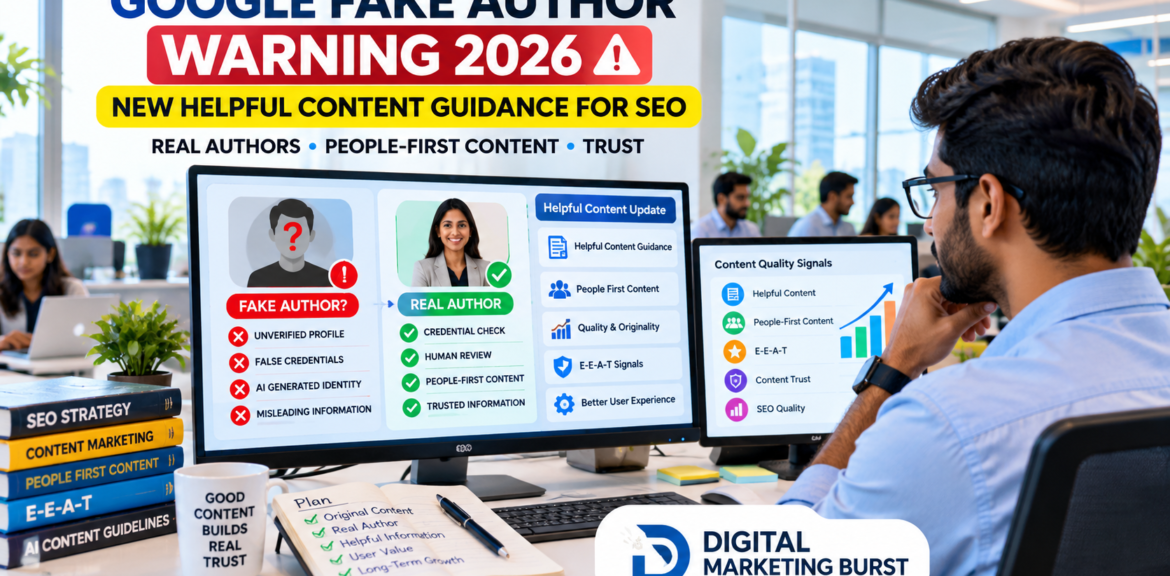

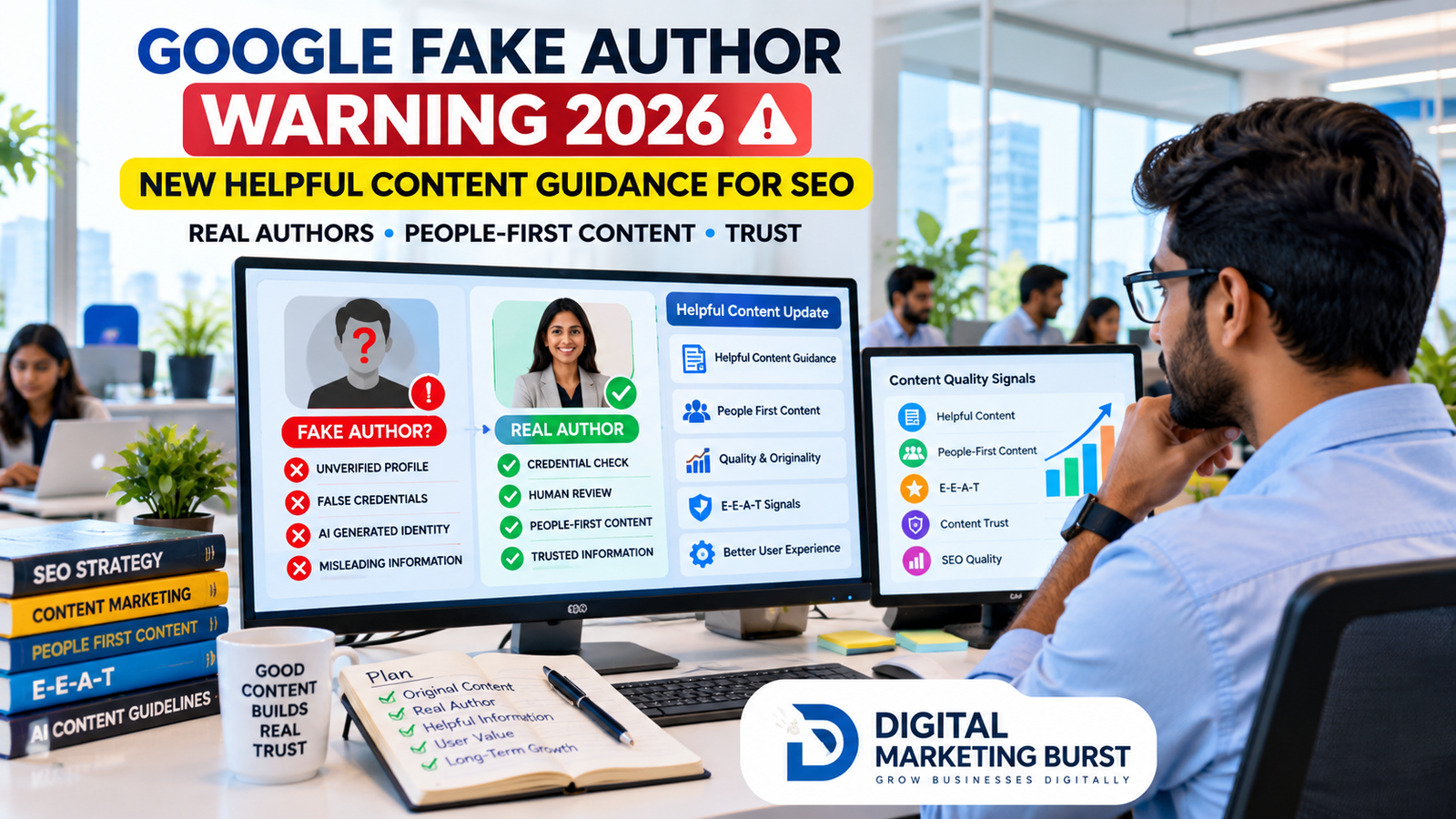
Google Fake Author Warning 2026: New Helpful Content Guidance for SEO
Google Fake Author Warning 2026: New Helpful Content Guidance for SEO
The Google Fake Author Warning has put a simple but important SEO practice under fresh scrutiny: websites should not invent people to make content appear more trustworthy than it really is.
Google’s current people-first content guidance explicitly tells publishers to avoid deceptive authorship information. Examples include fabricated creator profiles, AI-generated headshots, made-up names, and false credentials when these elements are used to make content appear as though it came from genuine human experts. Google for Developers
For Indian businesses, publishers, SEO professionals, agencies, affiliate sites and content-heavy websites, the lesson goes beyond removing a fake author photograph.
The real issue is trust.
Google wants publishers to make it reasonably clear who created content, how it was produced where that context matters, and why it exists. At the same time, businesses should not misread the Google Fake Author Update as a rule saying every article needs a famous expert, every writer needs a personal brand, or AI-assisted content cannot perform in Search.
The distinction is deception.
That distinction will guide this entire article.
What Is the Google Fake Author Warning?
The Google Fake Author Warning refers to Google’s strengthened language around deceptive authorship in its guidance for creating helpful, reliable, people-first content.
Under the section dealing with “Who” created the content, Google encourages accurate authorship information. The documentation asks publishers to consider whether visitors can understand who authored a page, whether a byline appears where readers would expect one, and whether that byline can lead readers to useful background information about the creator. Google for Developers
Google then draws a clear boundary.
Creating a fictional expert identity to influence how readers perceive content can become deceptive.
Imagine a financial website publishing articles under “Dr. Rahul Sharma, Senior Investment Specialist.” The person does not exist, the photograph was AI-generated, and the qualifications were invented.
That is fundamentally different from a legitimate company publishing an article under its organisation’s name.
Likewise, using AI to improve a real employee’s author photograph is not automatically equivalent to inventing a fictional expert. Context and representation matter.
The core question is straightforward:
Does the authorship information accurately represent who is responsible for the content, or has it been manufactured to create expertise that does not exist?
That is the more useful way to understand Google’s change.
What Changed in Google’s Helpful Content Guidance?
Google’s people-first content documentation has long encouraged publishers to think about Who, How and Why when evaluating content.
The newer wording makes the “Who” component more explicit.
Search Engine Journal reported on October 3, 2026 that Google’s site-owner guidance now specifically addresses fabricated creator profiles. The examples highlighted include AI-generated author photographs, invented names, and credentials that falsely imply expertise. Search Engine Journal
This matters because the concept is no longer something publishers need to infer only from broader quality guidance.
It is now stated directly in Google’s people-first content documentation.
However, publishers should avoid turning that documentation change into a more dramatic claim than Google actually made.
Google did not announce:
“All anonymous articles will be penalised.”
Nor did it announce:
“Every website must have an individual author page.”
It also did not say:
“AI-generated author images automatically cause ranking loss.”
The warning concerns deceptive authorship information.
That wording is important for SEO teams deciding what actually needs to change.
Google Fake Author Update: Is This a New Ranking Algorithm?
Calling this a Google Fake Author Update is convenient when discussing the change, but publishers should not confuse documentation guidance with a newly confirmed standalone ranking algorithm.
Google’s documentation says deceptive authorship makes a page untrustworthy to users and its automated quality systems and describes it as a low-quality signal. Google for Developers
That is significant.
Still, Google has not announced an algorithm called the “Fake Author Update.”
There is also no documented percentage by which a page will lose rankings after using a fictional author.
No legitimate SEO audit can therefore say:
Fake author detected = 30% ranking loss.
That would be invented precision.
A better interpretation is that truthful authorship belongs within Google’s broader emphasis on helpfulness, reliability and trust.
SEO professionals should respond by fixing deception, not by hunting for an imaginary author-ranking score.
Why Google Is Focusing on Fake Author Profiles
The internet makes it remarkably easy to manufacture authority.
A website owner can generate a professional-looking portrait in seconds. Another AI tool can produce a convincing biography, while a language model can assign qualifications, employment history and specialist knowledge to that fictional person.
To an ordinary reader, the result may look legitimate.
Consider an imaginary healthcare article carrying this profile:
Dr. Aditi Mehra — Senior Cardiologist, 18 Years of Clinical Experience
A realistic portrait appears beside the biography.
Suppose no such doctor wrote or reviewed the article.
The problem is not that artificial intelligence created the photograph. The problem is that the entire presentation is designed to make readers believe a qualified medical professional stands behind information when that expertise does not exist.
That can materially change how someone judges the page.
Google’s Helpful Content Guidance increasingly makes that trust issue difficult to ignore.
Google Helpful Content Guidance and the “Who, How, Why” Framework
The Google Helpful Content Guidance provides a useful framework for evaluating content through three questions:
Who created it?
How was it created?
Why was it created?
These questions are more useful than treating SEO quality as a checklist of keyword density, article length and schema fields.
Who Created the Content?
Visitors should be able to understand the source of information where authorship would reasonably matter.
A genuine writer can use a real name.
An organisation may appropriately take responsibility for corporate content.
Specialist content can identify the relevant writer or reviewer when expertise matters.
What publishers should avoid is creating a person who does not exist simply because an individual expert profile appears more authoritative than an organisation.
Accurate authorship is more valuable than impressive-looking fictional authorship.
How Was the Content Created?
Google’s guidance also discusses transparency around the production process.
For certain types of content, readers may benefit from knowing how research, testing, automation or AI contributed to the finished page. Google specifically says AI or automation disclosures can be useful when readers would reasonably ask how the content was created. Google for Developers
That does not mean every spellcheck, grammar suggestion or AI-assisted workflow requires a giant warning.
Instead, think about whether the production method materially affects how a reader should evaluate the information.
A product comparison based on real testing is different from one assembled entirely from manufacturer descriptions.
Likewise, an original industry analysis reviewed by an experienced professional differs from automatically publishing hundreds of unreviewed AI pages.
Why Was the Content Created?
This may be the most useful question for publishers.
Was the page created because an existing audience genuinely needs the information?
Or was it published primarily because a keyword tool showed search volume?
Google’s People First Content guidance repeatedly pushes publishers toward the first approach. Its documentation describes people-first content as material created primarily for people rather than to manipulate search rankings. Google for Developers
SEO remains useful.
Search optimisation helps engines discover and understand genuinely useful information.
The problem begins when search traffic becomes the primary reason a low-value page exists.
Google People First Content: What It Means in Practice
Google People First Content is sometimes misunderstood as “forget SEO and just write naturally.”
That interpretation is too simplistic.
A people-first page can still have keyword research, internal links, descriptive headings, structured data, optimised images and a carefully written title.
Those elements help users and search engines understand the page.
The difference lies in the underlying purpose.
Suppose an Indian accounting firm publishes:
GST Registration Guide for Small Businesses in India
A useful version might explain eligibility, documents, practical steps, common mistakes, official resources and situations where professional advice may be appropriate.
A search-engine-first version could create 50 nearly identical pages:
“GST Registration Delhi”
“GST Registration Mumbai”
“GST Registration Lucknow”
“GST Registration Jaipur”
If the business has no location-specific information and each article merely swaps city names, those pages may provide little additional value.
The same principle applies to authors.
Adding 20 fictional experts does not turn generic material into trustworthy specialist content.
Fake Author Profiles SEO: Why This Is Bigger Than a Byline
The Fake Author Profiles SEO discussion should not be reduced to whether Google can recognise an AI-generated face.
That misses the larger issue.
An author identity can include:
- name,
- photograph,
- biography,
- qualifications,
- professional experience,
- employer,
- social profiles,
- awards,
- certifications,
- author-page URLs,
- structured data.
When several of those elements are fabricated, a website can create an elaborate illusion of authority.
A publisher may assume the strategy strengthens E-E-A-T.
In reality, invented expertise undermines the most important part of E-E-A-T: trust.
Google’s documentation specifically says trust is the most important aspect among experience, expertise, authoritativeness and trustworthiness. Google for Developers
That makes truthful representation a much stronger foundation than cosmetic authority signals.
Fake Author Profiles Google SEO: What Counts as Deception?
Not every unusual author setup is deceptive.
Businesses use different publishing structures, and legitimate content can come from individuals, teams or organisations.
The following distinction is useful.
Clearly Risky: Invented Expert
A website creates “Aman Verma, Certified Cybersecurity Specialist.”
Aman’s portrait is AI-generated.
His certification never existed.
No real person matching the profile wrote or reviewed the article.
This is exactly the type of false impression publishers should avoid.
Clearly Risky: Fake Medical Reviewer
An article is written using AI and published under an invented doctor.
The page says “Medically Reviewed by Dr. X,” although no doctor performed a review.
Here, the false attribution is especially serious because readers may rely on the claimed professional oversight.
Different Situation: Organisation as Author
A company publishes an official policy announcement under the company name.
No fictional employee is invented.
The organisation genuinely takes responsibility for the information.
That situation should not automatically be grouped with fabricated creator profiles.
Different Situation: Pen Name
A real writer uses a consistent pen name for privacy.
Whether that is appropriate depends on context and how the identity is represented.
A pen name itself is not the same thing as fabricating medical degrees, professional licences or experience.
The risk increases when the profile makes false claims specifically designed to manufacture expertise.
Are AI-Generated Author Headshots Bad for SEO?
This requires nuance.
Google specifically names AI-generated headshots as an example within its warning about fabricated creator profiles. Google for Developers
However, the context matters.
The guidance describes AI-generated headshots being used as part of deceptive authorship information to make content appear to have been created by human experts.
That is different from saying every image created or modified with AI is inherently an SEO violation.
For example, suppose a real employee has an illustrated avatar generated from their actual identity for a creative agency’s team page.
That scenario is not equivalent to creating “Dr. Neha Kapoor,” generating her face, inventing her medical credentials and attributing health articles to her.
The deceptive representation is the central problem.
Publishers should therefore ask what the image communicates, not merely what software produced it.
Made-Up Names Are Not an E-E-A-T Shortcut
Some publishers have treated author names as an SEO feature.
The logic sounds simple:
“Google likes E-E-A-T, so every article needs an expert author.”
That leads to a dangerous shortcut.
Instead of finding a genuine expert, the site creates one.
A convincing bio follows.
Next comes a LinkedIn-style photograph.
Then schema markup is added to make the fictional identity appear structurally complete.
None of these elements creates genuine expertise.
Structured data describes information; it does not transform false information into truth.
Google’s Article structured-data documentation recommends accurately identifying authors and using fields such as author type and URL to help Google understand who created the content. Google for Developers
The better strategy is therefore remarkably straightforward:
Use real people when real people are the authors. Use truthful organisational attribution where appropriate. Never manufacture expertise just to make the page look stronger.
False Credentials Are More Serious Than Weak Author Bios
A weak author bio may be unhelpful.
A false credential is different.
Suppose an SEO article claims its writer is a “Google Certified SEO Expert” when the stated qualification does not exist or was never earned.
Readers may use that credential to decide whether to trust the advice.
The same problem becomes even more consequential in finance, health, law and safety-related content.
Google refers to these sensitive areas as Your Money or Your Life (YMYL) topics and says strong E-E-A-T receives greater weight where content can significantly affect people’s health, financial stability, safety or well-being. Google for Developers
For an Indian publisher, that means claimed credentials should be verifiable.
Medical degrees should belong to real doctors.
Professional roles should reflect actual employment or involvement.
Certifications should not be invented.
Review labels should correspond to a genuine review process.
Accuracy becomes part of content quality, not a decorative author-page feature.
Does Google Penalize Fake Authors?
This is likely to become one of the most searched questions around the Google Fake Author Warning, so the wording needs to remain precise.
Google’s current guidance says deceptive authorship information can make a page untrustworthy to users and automated quality systems and is a signal of a low-quality page. Google for Developers
That is what we can responsibly state.
Google has not announced a separately named “Fake Author Penalty.”
It has not published a manual-action category called “fake author profile.”
Nor has Google provided a numerical ranking impact.
Therefore, avoid headlines such as:
“Google Will Penalize Every Site Using AI Author Photos.”
They go beyond the available evidence.
The safer SEO conclusion is that fabricated authorship conflicts directly with Google’s quality guidance and should be corrected.
Are Bylines a Google Ranking Factor?
This question needs similar care.
A byline can help readers understand who created an article.
Author pages may also provide useful background about the writer and their areas of expertise.
Google strongly encourages accurate authorship information where readers would expect it. Google for Developers
However, that does not mean adding a byline automatically gives a page a ranking boost.
You should not approach authorship like this:
No author = 0 SEO points
Author = +10 SEO points
Expert author = +30 SEO points
Google does not publish such a scoring system.
Think about authorship as part of trust, transparency and accurate representation rather than a ranking hack.
Google Helpful Content Guidelines: Accuracy Comes Before Appearance
The Google Helpful Content Guidelines encourage publishers to assess whether their pages provide original information, comprehensive coverage, useful analysis and value beyond simply rewriting other sources. Google for Developers
An attractive author box cannot compensate for poor content.
Neither can an impressive biography rescue factual inaccuracies.
Consider two pages.
Page A has a glamorous author photograph, a long list of supposed qualifications and weak information copied from existing articles.
Page B has a modest but genuine author profile, clear sourcing, original explanations and accurate information.
From a reader’s perspective, Page B offers considerably more value.
This is why author optimisation should never become disconnected from content quality.
Google Helpful Content Update 2026: Don’t Confuse Separate Changes
The phrase Google Helpful Content Update 2026 can create confusion because publishers often use “update” to describe very different things.
A documentation update is not automatically an algorithm update.
Google’s Search documentation changelog records an October 1, 2026 update to its guidance around generative AI content. Google says that change incorporated information from its Search Quality Rater Guidelines to align documentation with material used in developer-event presentations. Google for Developers
Separately, Google’s people-first content page now contains the explicit warning about deceptive authorship. Search Engine Journal reported that this language appears in the current version and was absent from a saved June copy. Search Engine Journal
Those facts are worth reporting.
What we should not do is merge every October documentation change into a fictional algorithm story.
For SEO professionals, precision is more valuable than a dramatic headline.
What Should Indian Businesses Do Now?
Indian businesses do not need to panic and remove every author profile.
They should audit whether those profiles are accurate.
Start with content where author expertise matters most.
Healthcare, financial services, legal advice, education, cybersecurity and other trust-sensitive industries deserve particular attention.
Check whether each named author actually exists.
Then verify whether the stated qualifications are accurate.
Review claimed job titles and professional experience.
Next, inspect photographs and biographies.
Finally, compare visible author information with structured data.
The objective is consistency and truthfulness.
A genuine employee with a simple bio is preferable to a fictional “industry expert” with an impressive résumé.
A Practical Fake Author Profile Audit
You can perform an initial audit without expensive SEO software.
Create a spreadsheet containing every author identity used on the website.
Record the author name, author-page URL, articles attributed to them, image, stated role, credentials and any linked external profiles.
Next, classify each author into one of four groups:
Verified real person
Verified organisation/team
Pen name or identity requiring review
Fabricated or unverifiable profile
Do not automatically delete everything in the third category.
Investigate first.
For profiles containing qualifications, verify those claims with the person or organisation responsible for them.
If an author is fictional and was created solely to simulate human expertise, continuing to expand that identity would be difficult to justify under the current Google People First Content Guidelines.
Correction is the more sensible path.
What to Do If Your Website Already Uses Fake Authors
Finding fabricated profiles does not mean you should panic-delete the entire website.
Begin by identifying what is false.
Perhaps the articles themselves are accurate and useful, but the author identities were invented.
In that situation, fix the attribution.
Replace false biographies with truthful information about the actual writer, editorial team or organisation responsible for the content.
Remove credentials that cannot be substantiated.
Review any AI-generated portrait being presented as a photograph of a real expert.
Then inspect the associated articles.
Authorship deception may be one problem, but those pages can also contain factual errors, weak sourcing or generic material.
A proper remediation process improves the content and its attribution, rather than merely changing the author’s photograph.
Should You Delete Old Fake Author Pages?
Not automatically.
First determine whether the page serves a legitimate purpose.
If an author page exists only to support a fictional identity, maintaining it may continue the deception.
Removing or redirecting it could make sense after correcting article attribution.
However, redirects should have a logical destination.
Do not redirect every deleted author page to the homepage merely because it is convenient.
If a real editorial-team page replaces several fictional profiles, that page may be a more relevant destination.
Technical decisions should follow the actual site structure.
Should an Agency Use Individual Authors or the Agency Name?
Either can be appropriate depending on responsibility for the content.
If a real SEO strategist writes a detailed analysis, using that person’s genuine author profile can provide readers with useful context.
For a company announcement, service update or collaboratively produced guide, organisational attribution may sometimes be more natural.
The key is not choosing whichever format appears more powerful for SEO.
Choose the attribution that accurately describes who created or is responsible for the material.
For Digital Marketing Burst, for example, an article should not be assigned to a fictional “Senior Google Algorithm Specialist” merely because the title sounds authoritative.
A truthful company attribution or genuine contributor profile is a much stronger long-term approach.
Author Pages Should Help Humans Verify Expertise
A useful author page answers practical reader questions.
Who is this person?
What subjects do they cover?
Why are they qualified to discuss those subjects?
Which articles have they contributed?
Where can their relevant professional background be verified, when verification is appropriate?
A long biography is not automatically better.
Concise and accurate information can establish more trust than paragraphs of vague claims.
Avoid phrases such as “world-renowned expert” unless you can substantiate them.
Similarly, “10+ years of experience” should only appear when the person genuinely has that experience.
Author pages should document reality rather than manufacture authority.
Author Schema Cannot Fix Fake Authorship
Structured data is useful for helping search engines understand a page.
It is not a credibility generator.
Google’s Article structured-data guidance recommends including the authors shown on the page in the markup. It also recommends properties such as type, url, or sameAs where appropriate to clarify author identity. Google for Developers
That creates a simple rule:
Visible authorship and structured authorship should agree.
If the page says Priya Singh wrote the article but Article schema names a different author, review the implementation.
More importantly, adding Person schema to an invented profile does not make that person genuine.
Schema should represent the page accurately.
It should never be used to reinforce a false identity.
What About ProfilePage Schema?
Google supports ProfilePage structured data for pages whose primary focus is a person or organisation affiliated with the website. Examples in Google’s documentation include author pages on news sites and “About Me” pages on blogs. Google for Developers
This can be relevant for genuine creator pages.
Again, eligibility does not mean every site needs to build dozens of author profiles.
If your business has three genuine contributors, maintaining three useful profiles may be sufficient.
Creating 30 synthetic personalities simply to expand perceived expertise would move in the opposite direction from the Google Fake Author Warning.
AI Content and Fake Authors Are Two Different Questions
This distinction is essential.
An article can be AI-assisted and accurately attributed.
Another article can be completely human-written yet published under a fabricated medical expert.
The second page still has an authorship problem.
Google’s people-first guidance acknowledges automated and AI-assisted content within its discussion of “How” content is created. It encourages useful transparency where readers would reasonably want to understand the production process. Google for Developers
Therefore, do not reduce the discussion to:
AI = bad
Human = good
That binary does not reflect Google’s actual guidance.
Accuracy, originality, effort, usefulness and honest representation matter much more.
Can AI Help Create Content Without Creating Fake Expertise?
Yes, provided the workflow does not misrepresent who did what.
An Indian marketing team might use AI to brainstorm questions, organise research notes or improve grammar.
A real strategist can then verify claims, add original analysis, edit the article and take responsibility for the finished work.
That workflow differs substantially from generating an entire article, inventing an expert and automatically publishing the page without meaningful review.
Google’s broader quality guidance considers effort, originality, skill and accuracy when discussing main-content quality. Google for Developers
The practical lesson is not to hide AI behind a fictional person.
Build a review process that makes the final content worth publishing.
Why Trust Matters More Than an Impressive Author Box
Trust is difficult to build and remarkably easy to damage.
A reader may forgive a short author biography.
Discovering that the “expert” does not exist is different.
Once a visitor realises a photograph, name and professional background were invented, they may reasonably question the rest of the website.
Were the statistics invented too?
Are the testimonials real?
Did the claimed case studies happen?
Does the company itself exist as described?
That chain reaction explains why deceptive authorship is larger than an on-page SEO issue.
It affects the credibility of the publisher.
What Publishers Should Not Do After the Google Fake Author Warning
The worst response would be replacing one artificial SEO tactic with another.
Do not mass-create new author pages simply because authorship is receiving attention.
Avoid purchasing stock biographies and assigning them to unrelated articles.
Don’t generate LinkedIn-style headshots for fictional specialists.
Never invent qualifications to make ordinary content look medically, legally or financially reviewed.
Also avoid adding “Reviewed by Expert” unless an actual qualified person reviewed the material.
A label is useful only when it describes a real process.
A Better Authorship Model for Small Indian Businesses
Small businesses often worry that they lack enough experts to compete with large publishers.
They do not need to invent them.
Suppose a Lucknow digital marketing company has one founder, two marketers and a content team.
Its website could use genuine contributor profiles where individual expertise is relevant.
Collaborative resources may use an editorial-team attribution if that accurately reflects the process.
Technical articles could also state who reviewed them when a genuine review occurred.
This model may look less impressive than a directory of 25 fictional “senior experts.”
It is considerably more defensible.
Google Fake Author Warning and E-E-A-T
E-E-A-T is often where SEO discussions become unnecessarily complicated.
Experience, expertise and authority matter, but Google says trust is the most important component. Google for Developers
A fabricated expert directly undermines that foundation.
Think of E-E-A-T as something content demonstrates through reality rather than something a publisher adds with a plugin.
Real experience can be demonstrated through original observations.
Expertise can appear through accurate explanations.
Authority develops through reputation and recognition.
Trust grows when claims, sources, authorship and business information are consistent and truthful.
No author-box template can manufacture those qualities by itself.
What the Google Fake Author Warning Really Means
The Google Fake Author Warning should not cause legitimate publishers to panic about every byline, author image or AI-assisted workflow.
Its central message is simpler.
Do not deceive readers about who created or reviewed content.
The current Google Helpful Content Guidance explicitly identifies fabricated creator profiles, AI-generated headshots, made-up names and false credentials as problematic when they are used to create a false impression of human expertise. Google for Developers
For SEO teams, the correct response is not to invent another optimisation trick.
Audit authorship.
Correct false identities.
Verify credentials.
Align visible bylines with structured data.
Improve the underlying content at the same time.
Above all, make sure the person or organisation presented as responsible for a page genuinely represents how that page was created.
That approach aligns much more naturally with Google People First Content than any attempt to simulate authority.
Google’s current Helpful Content Guidance strongly encourages accurate authorship information where readers would expect it. It also explicitly warns against fabricated creator profiles built with AI-generated headshots, made-up names, or false credentials to create the impression that human experts produced the content. Google for Developers
For Indian businesses, this audit should cover more than blog bylines. Doctor profiles, financial contributors, legal reviewers, agency experts, editorial-team pages, author schema, employee pages and even old guest posts may need attention.
Start With an Authorship Inventory, Not a Site-Wide Rewrite
A large website should not begin by editing pages randomly.
First, identify every author identity currently associated with published content.
Export your article URLs from WordPress, your CMS, sitemap, or crawling tool. Add the author assigned to each URL in a spreadsheet.
Useful columns include:
Page URL | Content Type | Visible Author | Author Page | Author Type | Credentials Claimed | Reviewer | Schema Author | Verification Status | Action Required
This creates a site-level picture that is difficult to see while opening pages individually.
You may discover that one genuine writer has several inconsistent biographies. Another group of posts might use a generic admin account, while older pages could contain author profiles created by a previous agency.
Some sites will find no fabricated authors at all.
That is valuable information too.
The purpose of the audit is not to find something wrong at any cost. It is to establish whether the website’s authorship information accurately represents reality.
Create an Author Verification Status
Once the inventory is ready, classify authors consistently.
A simple internal system works better than vague labels such as “looks genuine.”
Verified Person
Use this status when the person exists and the information presented about them can reasonably be confirmed.
Check their name, current role, relevant experience and any qualifications mentioned on the site.
A real person does not need to have hundreds of external mentions to be legitimate.
For example, a genuine employee working in an Indian SME may have a limited online footprint. Lack of fame should not be confused with a fake identity.
Verified Organisation
Some content is legitimately created or owned by an organisation rather than one identifiable individual.
Company announcements, product documentation, policy pages and collaboratively produced resources may fall into this category.
Google’s Article structured-data documentation supports both Person and Organization as author types. Google for Developers
That means publishers should not invent an individual merely because they assume Google prefers Person markup.
Use the entity that truthfully represents the content.
Needs Verification
Place an author here when the available information is insufficient.
Perhaps an old freelance writer no longer works with the business.
A biography might claim a qualification that cannot immediately be confirmed.
The profile could also use a pen name whose relationship with the actual writer is unclear.
Do not automatically label these cases deceptive.
Investigate before making changes.
Fabricated or Misleading
This category needs the most attention.
An entirely invented name, synthetic portrait presented as a real expert, false qualification or fake professional history should be reviewed promptly.
The same applies when a real person’s identity has been exaggerated with credentials they do not hold.
Google’s People First Content Guidelines specifically identify fabricated creator profiles as deceptive when they are used to create a false impression of human expertise. Google for Developers
That is a much stronger reason for remediation than whether an SEO plugin gives the author page a green indicator.
Audit the Author Name
Start with the simplest element.
Does the person named in the byline actually exist?
If yes, determine whether that individual genuinely contributed to the page in the way the site implies.
A content manager should not automatically be presented as a medical reviewer because they uploaded a doctor’s article into WordPress.
Likewise, an agency founder should not be credited as the writer of hundreds of articles they never wrote simply because using a founder’s name appears more authoritative.
Authorship should reflect meaningful responsibility.
This principle is particularly important for websites publishing at scale.
If several people collaborate on a piece, the site can develop an editorial attribution system rather than pretending one individual completed every stage.
Review Every Claimed Credential
Credentials deserve a separate audit because they influence trust.
Suppose an author bio says:
“Certified Google SEO Professional with 12 years of experience.”
Break the statement into individual claims.
Is there a real certification matching the wording?
Can the experience period be substantiated?
Does the person’s work actually relate to the subject?
If one element cannot be supported, rewrite it accurately.
An honest description such as “Digital marketing professional specialising in SEO and content strategy” may be less dramatic, but it avoids making a credential claim that cannot be demonstrated.
The same discipline matters much more in YMYL topics.
Healthcare Websites Need a Stricter Authorship Process
Consider an Indian hospital publishing an article about warning signs of a heart attack.
A content writer may draft the article, while a cardiologist medically reviews it.
The page should represent those roles accurately.
For example:
Written by: Editorial Team
Medically reviewed by: Dr. [Real Name], Consultant Cardiologist
That attribution is useful only when the review actually occurred.
Do not automatically attach a doctor’s name to every health article because a doctor works at the hospital.
Likewise, avoid claiming “medically reviewed” when the doctor merely appears elsewhere on the website.
A genuine review process should exist behind the label.
The author box should describe reality, not a desired E-E-A-T signal.
Finance Websites Should Verify Qualifications Carefully
Financial information can influence major personal decisions.
Imagine an Indian investment website publishing an article under:
“CA Rohit Sharma — SEBI Registered Investment Adviser.”
Those labels communicate specific professional claims.
If the person is not a Chartered Accountant or does not hold the stated regulatory status, the profile is not merely weak SEO.
It misrepresents the authority behind the advice.
Publishers should therefore verify professional designations before displaying them.
When a contributor has general financial writing experience but no specialist licence, describe the actual role instead of upgrading it artificially.
Accuracy is safer than authority theatre.
Legal Content Needs the Same Discipline
A legal-information website may employ writers who research legislation without practising law.
There is nothing inherently wrong with that model if the site represents it honestly.
Problems arise when an ordinary content writer is labelled an advocate or legal expert without justification.
If a qualified lawyer reviews the page, state the review accurately.
When no lawyer participated, do not imply otherwise.
The Google Helpful Content Guidelines make accurate creator information important, but readers benefit from that accuracy even without considering SEO. Google for Developers
Someone reading legal information should be able to distinguish educational content from professional legal advice.
What Should a Genuine Author Page Contain?
An effective author page does not need to resemble a lengthy CV.
It needs enough relevant information to help a reader understand the person behind the content.
A practical structure might include:
Real name
Current role
Relevant expertise or subject areas
Short factual biography
Relevant qualifications, where applicable
Articles written or reviewed
Useful professional/profile links, when available
Every field should earn its place.
A writer covering SEO does not need to mention an unrelated school award.
Similarly, filling an author page with generic claims such as “passionate thought leader committed to innovation” provides little verification value.
Specificity works better.
Author Bios Should Match the Topic
One author biography does not always need to make every possible claim about a person’s career.
Relevance matters.
Suppose a professional has experience in SEO, paid advertising and graphic design.
On an article discussing technical SEO, the biography could emphasise the person’s search and website experience.
That does not mean the rest of their background must be hidden.
It simply prioritises information useful for understanding why this contributor is relevant to the topic.
However, topic relevance must never become an excuse to exaggerate.
If someone has two years of SEO experience, do not transform that into “a decade of search expertise” because the page concerns SEO.
Should Every Blog Post Have an Author?
Google encourages accurate authorship information such as bylines where readers would expect it. Google for Developers
The phrase “where readers might expect it” matters.
A detailed opinion article, medical explainer or specialist analysis naturally creates more interest in who produced the information.
A basic corporate contact page works differently.
Website owners should therefore avoid mechanically adding author boxes to every URL.
Think from the reader’s perspective.
Would knowing who created or reviewed this page help someone judge its reliability?
When the answer is yes, clear authorship can be valuable.
Person vs Organization: Which Author Type Should You Use?
This is one of the most practical questions raised by Fake Author Profiles SEO discussions.
Google’s Article structured-data documentation permits the author to be a Person or an Organization. Google for Developers
Use Person when a genuine individual is appropriately identified as the author.
Choose Organization when the organisation genuinely created or takes responsibility for the material and individual attribution would be artificial.
For example, a detailed opinion written by one SEO strategist naturally suits a person.
A company’s official product announcement may suit the organisation.
A collaborative research guide could use multiple genuine contributors when appropriate.
The important point is not which schema type looks stronger.
Accuracy should determine the choice.
Don’t Replace Fake People With Fake Teams
Some publishers may react to the Google Fake Author Update by changing every fictional person’s name to “Editorial Team.”
That is not necessarily an improvement.
Ask whether an editorial team genuinely exists.
Who is responsible for reviewing content?
What does the team actually do?
If “Editorial Team” is simply a new label placed over the same unreviewed automated publishing system, the underlying transparency problem remains.
An organisational attribution should represent a genuine publishing process.
You do not need to disclose every internal workflow detail, but the public-facing description should not create another fictional layer.
Building a Genuine Editorial Team Page
An editorial page can be useful when multiple people contribute to the site’s content.
Explain the team’s role in straightforward language.
For example:
“Our editorial team researches, drafts and updates digital marketing guides. Technical or specialist claims are reviewed by the relevant contributor before publication where appropriate.”
Only publish wording like this when it reflects your real workflow.
You can also identify key contributors and their responsibilities.
Avoid turning the page into marketing copy filled with unverifiable superlatives.
Readers looking at an editorial page are often trying to answer a simple question:
Who stands behind this information?
Answer that question clearly.
How to Handle Former Employees’ Articles
An employee leaving the company does not automatically make their old articles invalid.
The content may still be useful.
Preserving the genuine original author can often be more accurate than rewriting history.
However, the author’s biography should not continue saying “currently works at Company X” after they leave.
Update the wording where necessary.
For evergreen articles, another qualified person or editorial team may review future revisions.
If authorship materially changes, ensure the page does not imply that the original writer made updates they never saw.
Maintaining publication history accurately can be better than replacing names for cosmetic consistency.
How to Handle Freelance Writers
Freelance authors are real authors.
They do not need to be full-time employees to receive a genuine byline.
If a freelancer created a substantial article, attribution can accurately reflect that contribution.
The biography should not imply employment when no employment relationship exists.
For example:
“Independent content writer covering digital marketing and ecommerce.”
That is clearer than falsely describing the contributor as the company’s “Head of SEO.”
Relevant external profiles can be linked where appropriate, but do not create artificial profiles solely to make the author appear more established.
How to Handle Guest Authors
Guest contributions need the same verification standards as internal writers.
Confirm the person’s identity before publishing.
Check professional claims that matter to the article.
Review links included in the biography.
Make sure the article itself meets your editorial standards rather than assuming a guest author’s reputation guarantees quality.
A guest post should not become a backdoor for fictional author identities.
If the contributor’s biography contains promotional claims you cannot verify, ask them to revise those claims before publication.
What About Pen Names?
Pen names require careful treatment because privacy and deception are not the same thing.
A genuine writer may use a pseudonym for legitimate reasons.
That alone does not mean the content is fraudulent.
The problem begins when the pseudonym is surrounded by fabricated credentials, invented employment, fake awards or an AI-generated persona designed to impersonate a specialist.
Context therefore matters.
Publishers using pen names should consider whether their presentation gives readers an accurate understanding of the contributor without revealing private information unnecessarily.
There is no need to invent expertise merely because a legal name is not displayed.
How to Handle Anonymous Content
Anonymous publishing can also have legitimate contexts.
Yet anonymity changes what the website can credibly claim.
If an article is anonymous, do not manufacture an expert identity simply to fill the author field.
Instead, consider whether the organisation can appropriately take responsibility for the page.
For sensitive topics, readers may reasonably expect stronger information about who produced or reviewed the material.
If your publishing model cannot provide that transparency, improving the editorial process may be more valuable than adding another SEO element.
WordPress Author Setup After the Google Fake Author Warning
Many WordPress sites automatically generate author archive pages.
That creates several practical issues.
Some archive pages contain only a username and article list.
Others expose default profile information that nobody has reviewed.
A few sites accidentally create thin archives for dozens of accounts that never wrote public content.
Start by reviewing which WordPress users are actually displayed as authors.
Next, inspect the public author archives.
Remove inaccurate biographies and profile images.
Make genuine author pages useful when they serve readers.
For irrelevant or duplicate archives, make an SEO decision based on the site’s architecture rather than assuming every WordPress-generated URL deserves indexing.
Should WordPress Author Archives Be Indexed?
There is no universal answer.
A strong author archive containing a useful biography and a meaningful collection of articles can help readers navigate a publication.
A thin page containing only “admin” and one post offers much less value.
Large multi-author publications may benefit more from author archives than small company sites with one organisational author.
Review each site’s structure.
Do not index hundreds of low-value profile pages merely because WordPress created them automatically.
Likewise, don’t noindex a useful author resource solely because somebody online described author archives as duplicate content.
SEO decisions should follow page value and purpose.
Avoid Duplicate Author Pages
A common CMS problem is having several URLs representing the same person.
For example:
/author/rahul/
/team/rahul-sharma/
/experts/rahul-sharma/
All three may contain nearly identical biographies.
That structure can confuse users and create unnecessary maintenance.
Where practical, establish one primary author identity page.
Article bylines can link to that page.
The same URL can also be referenced appropriately in structured data.
A cleaner entity structure is usually easier to maintain than several conflicting profiles.
Match the Byline With Article Structured Data
Visible information and machine-readable information should agree.
If the page visibly credits Riya Kapoor, Article schema should not identify Digital Marketing Burst as the sole author unless that accurately reflects the authorship arrangement.
Google recommends including all authors presented on the page in Article markup. It also advises using separate author entries for multiple authors rather than combining their names into one field. Google for Developers
This is a technical detail worth checking during the audit.
Many websites generate schema automatically through themes or SEO plugins.
That means a visible author correction may not automatically fix the structured data.
Test both.
Use author.url to Clarify Identity
Google’s Article documentation recommends author.url as a way to link to a page that uniquely identifies the author. Google for Developers
That URL might point to an internal biography or profile page.
Google also understands sameAs as an alternative for helping disambiguate authors. Google for Developers
This does not mean you should create external profiles solely for SEO.
Use genuine URLs that already represent the person appropriately.
For an author with a useful internal page, linking the Article markup to that profile creates a cleaner relationship between the content and its creator.
When ProfilePage Schema Makes Sense
Google supports ProfilePage structured data for pages primarily focused on a person or organisation affiliated with the website.
Valid examples include an author page on a news site, an employee page on a company website and an “About Me” page on a blog. Google for Developers
That makes ProfilePage potentially appropriate for genuine author profiles.
Its main entity can be a Person or Organization.
Google’s documentation also allows useful properties such as name, description, image and sameAs when they genuinely apply. Google for Developers
Do not add properties merely because Schema.org permits them.
Structured data should describe visible, truthful content.
Example of a Clean Author Structure
Imagine a genuine SEO writer named Ananya Mehta.
Her author page could contain:
Ananya Mehta
SEO & Content Strategist
Short factual biography
Areas covered: Technical SEO, Content Strategy, Local SEO
Selected articles
Relevant professional profile
An article she actually wrote could then visibly show:
Written by Ananya Mehta
The Article structured data can identify her as a Person and point author.url to her genuine profile page.
If that profile page qualifies for ProfilePage markup, its main entity can describe the same person.
Everything aligns.
There is no need to add fictional awards, fabricated qualifications or invented experience.
Example of a Problematic Author Structure
Now consider another setup.
The site creates:
Dr. Arjun Malhotra — AI & Search Algorithm Scientist
His image was generated with AI.
No person matching the profile works with the company.
The biography claims 15 years of search-engine research.
Articles are automatically assigned to him, while Person schema and fake social links are added to strengthen the appearance of legitimacy.
Technically sophisticated markup does not solve the underlying problem.
It makes the deception more elaborate.
The current Google Fake Author Warning directly addresses this kind of fabricated creator presentation. Google for Developers
Schema Should Reflect Reality, Not Create It
This principle deserves emphasis.
Schema markup helps describe entities and relationships.
It does not validate them.
Adding:
"@type": "Person"
does not prove that a person exists.
Similarly, sameAs does not make two identities equivalent merely because a publisher links them.
A site should first establish accurate visible information.
Structured data comes afterwards.
This order prevents technical SEO from becoming a tool for manufacturing trust signals.
Don’t Add Fake sameAs Profiles
Some SEO strategies encourage creating multiple social profiles solely to strengthen an author’s “entity.”
That approach can become problematic when those profiles exist only to support a fabricated identity.
Use sameAs for genuine external representations where appropriate.
A real LinkedIn profile, professional organisation page or relevant personal website can help clarify identity.
Do not create empty accounts across ten networks merely to fill schema fields.
More URLs do not automatically mean more authority.
Accuracy matters more than quantity.
AI Disclosure: When Should You Tell Readers?
The Google Helpful Content Guidance asks publishers to consider the “How” behind content production.
Google says disclosures about AI or automation can be useful when readers might reasonably wonder how something was created. Google for Developers
That does not create a simple rule requiring an “AI assisted” badge on every page touched by software.
Consider materiality.
If AI helped correct grammar in a human-written article, a detailed disclosure may provide little practical value.
If thousands of product descriptions were generated automatically, readers may have a stronger reason to understand the process.
The appropriate level of transparency depends on how automation contributed to the content.
AI Disclosure Does Not Replace Human Review
A disclosure is not a quality-control system.
Writing “This article was generated using AI” does not make inaccurate information acceptable.
Likewise, hiding AI involvement does not magically improve quality.
Publishers should focus on verification.
Check factual claims.
Review cited sources.
Remove invented details.
Ensure examples are accurate.
Confirm that the page answers the user’s actual question.
The production label and the quality of the finished content are related issues, but they are not interchangeable.
Human Review Must Mean Actual Review
The phrase “human reviewed” is becoming another potential trust label.
Use it carefully.
If someone merely clicked Publish after glancing at the page, describing the process as expert human review may exaggerate what happened.
Define what review means inside your organisation.
For example, editorial review might cover readability, sources, factual consistency and brand requirements.
A medical review should involve an appropriately qualified professional checking relevant health claims.
Technical review could require a subject specialist to validate procedures or code.
Clear internal definitions prevent labels from becoming meaningless.
Create a Review Trail for High-Risk Content
For important content, maintain a simple internal record.
You do not necessarily need to expose the entire workflow publicly.
Internally, record:
Original writer
Reviewer
Review date
Major sources checked
Substantial changes made
Next review date where appropriate
This becomes particularly useful when several people work on the same site.
If a factual problem appears six months later, the team can understand how the page was produced and who should review the correction.
The system also makes genuine reviewer attribution easier.
Updating Old Content Without Faking Freshness
Authorship audits often happen alongside content updates.
Do not change the modification date merely because you corrected punctuation or replaced an author photograph.
A meaningful update should involve substantive changes when the new date is presented as evidence that content has been refreshed.
Google’s Article structured-data documentation supports datePublished and dateModified, with the latter intended to represent when an article was most recently modified. Google for Developers
Use those fields accurately.
A fake freshness strategy creates another trust problem while attempting to fix the first one.
Review Author Information Across the Entire Site
An author biography may appear in more places than expected.
Check:
- individual articles,
- author archive pages,
- About pages,
- team pages,
- editorial-policy pages,
- schema markup,
- XML or content feeds where relevant,
- social preview metadata,
- old landing pages,
- guest-author profiles.
One page might say the person has eight years of experience while another says fifteen.
Their job title may also have changed.
Inconsistencies are not automatically evidence of deception, but they should be corrected when possible.
A central source of truth for contributor information can reduce these problems.
Don’t Forget Reviewer Profiles
Writers receive most of the attention, but reviewers matter too.
A fake reviewer can create the same false impression of expertise as a fake author.
Suppose a health article says:
“Reviewed by Dr. Kavita Singh.”
Readers may reasonably interpret that label as evidence that a real doctor evaluated the medical information.
If no such review happened, the statement is misleading.
Therefore, include reviewer identities in the same verification process.
Confirm who they are, what they reviewed and whether the displayed credentials are accurate.
Avoid Fake “Fact Checked By” Labels
Another common pattern is:
Written by X
Reviewed by Y
Fact checked by Z
Multiple layers can look impressive.
They are useful only when each layer represents a real action.
If one employee wrote the article and no independent verification occurred, adding three fictional roles does not make the page safer.
A single truthful attribution is better.
Publishers should build editorial processes first and labels second.
What If the Author Used AI to Draft the Article?
Using AI in the workflow does not automatically require replacing the human author with “AI.”
Authorship should reflect genuine responsibility.
Suppose a marketer researches the subject, uses an AI system to organise an outline, writes sections, verifies claims and substantially edits the final article.
The person may still reasonably be responsible for the finished work.
A different scenario exists when a fully automated system creates and publishes thousands of pages without meaningful human involvement.
Google’s guidance asks publishers to think about How automation was used and whether disclosure would help readers understand the content. Google for Developers
The important question is not whether one AI prompt existed somewhere in the process.
It is whether the published attribution accurately represents the creation and review process.
Fake Author Profiles SEO and Scaled Publishing
Fabricated authors become especially risky when combined with scaled content production.
Imagine a website creating ten fictional specialists.
Each synthetic expert is assigned hundreds of automatically generated articles.
The profiles have AI portraits, generic biographies and invented professional histories.
From a production perspective, the system appears organised.
From a trust perspective, the entire author layer is fictional.
Changing article templates will not solve that.
The publisher needs to reconsider both the content-production model and how responsibility is represented.
Do Not Turn Real Employees Into Artificial Experts
A subtler problem can occur even when the employee is genuine.
Suppose a junior content writer named Rahul works at a company.
The website changes his public title to:
“Senior AI Search Scientist & Google Algorithm Expert.”
Rahul exists, but the stated expertise does not.
That can still mislead readers.
The Google Fake Author Warning is therefore not only about whether a face or name is fabricated.
False credentials are explicitly part of the issue. Google for Developers
Real identity plus invented expertise is still inaccurate authorship information.
Author Expertise Should Be Topic-Specific
A genuine professional can be highly experienced in one field and inexperienced in another.
An SEO specialist writing about search marketing is one thing.
The same person giving medical treatment advice is different.
Do not assume that a strong author profile transfers expertise across unrelated topics.
This matters for large websites expanding into new niches.
Before publishing outside your team’s genuine expertise, determine whether specialist review or better sourcing is required.
The objective is not to attach the most impressive author to every article.
It is to give readers reliable information with appropriate responsibility behind it.
Build an Editorial Policy Readers Can Understand
An editorial-policy page can explain how a site approaches content.
It may cover research, sourcing, corrections, updates, AI assistance and specialist review where those processes genuinely exist.
Keep the language concrete.
Avoid claims such as:
“Every article undergoes the world’s most rigorous fact-checking process.”
Unless you can demonstrate that process, the sentence is unnecessary.
A simpler statement describing what actually happens is more credible.
For example, explain that factual claims are checked against relevant primary or authoritative sources before publication when that is genuinely your practice.
Transparency should reduce uncertainty rather than create marketing theatre.
Add a Corrections Process
Even genuine experts make mistakes.
Trustworthy publishing does not require pretending errors never happen.
Instead, establish a way to correct significant factual inaccuracies.
Depending on the website, this might involve a contact email, corrections page or editorial contact form.
When a substantial correction changes the meaning of an article, consider whether readers should be informed.
A corrections process complements accurate authorship because both answer the same broader question:
Who takes responsibility when information is wrong?
That is a more meaningful trust signal than an elaborate fictional author biography.
Indian Businesses Should Audit Local-Language Content Too
Many Indian websites publish in English alongside Hindi or other regional languages.
Authorship standards should remain consistent across those versions.
Do not use genuine experts on English pages while automatically assigning fabricated identities to translated content.
If a translation is produced from an existing article, clarify the appropriate attribution according to your publishing process.
Likewise, translated credentials should preserve their real meaning.
Avoid upgrading a professional title simply because a stronger-sounding translation appears more authoritative.
Trust should survive the language change.
Check Author Information After Website Migrations
Website migrations can quietly damage authorship data.
A new theme might replace real author names with “Admin.”
Schema settings can switch from Person to Organization.
Profile URLs may break.
Author photographs might disappear.
Old author archives could also become orphaned.
After a redesign or migration, include authorship in the QA checklist.
Check visible bylines, profile links, structured data and redirects.
This is technical housekeeping, but it directly supports accurate attribution.
Test Structured Data After Authorship Changes
Once corrections are made, inspect the resulting markup.
Google recommends validating structured data during implementation and monitoring relevant pages after deployment. Its documentation points publishers toward tools such as the Rich Results Test for supported structured-data features. Google for Developers
Testing is particularly important when an SEO plugin automatically generates Article schema.
Look at the rendered page rather than relying only on WordPress settings.
Confirm the correct author appears.
Check that author URLs resolve.
Make sure deleted fictional profiles are no longer referenced.
Technical cleanup should complete the editorial correction.
A Practical Before-and-After Example
Consider this fictional setup for illustration.
Before
Author: Rohan Mehta
Title: Google Search Algorithm Scientist
Experience: 15+ Years
Photo: AI-generated fictional person
Credentials: Invented
Articles: 230 automated SEO posts
The website does not employ Rohan.
Keeping that profile because it “looks professional” would conflict with the direction of Google’s current guidance.
A truthful version might become:
After
Author: Digital Marketing Editorial Team
The page then explains who is responsible for researching and reviewing the site’s marketing content, assuming such a team genuinely exists.
Alternatively, the actual writer can receive the byline.
Any genuine specialist reviewer can be separately identified when a real review occurred.
The important improvement is not the phrase “Editorial Team.”
The improvement is that the public attribution now reflects reality.
Another Example: Genuine Expert, Poor Implementation
Not every audit problem involves deception.
Suppose Priya Sharma genuinely writes the articles.
Her public author page correctly describes her experience.
However, the website’s Article schema identifies author as “Admin,” while her profile URL returns a 404.
This is primarily an implementation problem.
Correct the schema.
Restore or redirect the appropriate profile URL.
Make the visible and machine-readable information consistent.
There is no reason to replace Priya simply because the technical setup was weak.
Another Example: Real Doctor, No Actual Review
Consider a hospital with a genuine cardiologist on staff.
An agency publishes 100 health articles and automatically attaches the doctor’s profile to every page.
The doctor never sees those articles.
Although the doctor is real, the attribution can still misrepresent their involvement.
A better workflow is to identify which content the doctor genuinely wrote or reviewed.
Other articles can use truthful editorial attribution until specialist review actually occurs.
This example demonstrates why Fake Author Profiles Google SEO is broader than detecting synthetic faces.
The underlying question is whether the stated relationship between creator and content is true.
Prioritise High-Risk Pages First
Large websites may have thousands of URLs.
Do not wait for a perfect site-wide audit before correcting the most serious problems.
Start with pages that:
- contain YMYL information,
- claim professional review,
- receive substantial organic traffic,
- prominently display expert credentials,
- use suspicious or unverifiable profiles,
- generate leads or influence important user decisions.
After high-risk pages are addressed, work through lower-priority content systematically.
This approach makes the project manageable.
It also directs editorial resources toward pages where misleading authorship could matter most to users.
Don’t Delete Useful Content Just Because the Author Was Fake
Suppose an old article is genuinely useful, factually accurate and still serves its audience.
Its author profile, however, was fabricated years ago.
The authorship problem does not automatically require deleting the useful information.
Correct the attribution.
Review the article again.
Verify important claims.
Update outdated material.
Then decide whether the page still deserves to remain published.
Content quality and authorship quality should be evaluated together, but they are not identical issues.
When Deletion May Be Appropriate
Some pages may not be worth repairing.
A thin article created only for search traffic, attributed to a fictional expert and containing outdated or unsupported information may offer little reason to remain online.
In that situation, improving the author box alone would be superficial.
Consider whether the content should be rewritten, consolidated with a stronger page or removed.
If removing a URL, choose the technical treatment according to what replaces it.
Do not redirect irrelevant deleted pages solely to preserve theoretical link equity.
User relevance should guide the decision.
Measure the Cleanup Without Inventing an “Author Score”
After completing the audit, teams naturally want to measure results.
Avoid inventing metrics such as:
Author Trust Score: 93/100
unless the metric is clearly your own internal diagnostic and not presented as a Google score.
Google does not provide a public Fake Author Score.
Instead, measure what you can actually observe.
Track corrected profiles.
Monitor affected pages in Search Console.
Watch indexing status, clicks and impressions over time.
Record engagement or conversion metrics in your analytics platform where relevant.
If rankings change, avoid immediately claiming the author cleanup caused the movement.
Search performance is influenced by many factors.
Google Helpful Content Update 2026 and the Bigger Publishing Lesson
The broader Google Helpful Content Update 2026 conversation should encourage publishers to look beyond individual SEO tricks.
Google’s October 1 documentation changelog also records an update to its guidance on generative AI content, incorporating material from the Search Quality Rater Guidelines. Google for Developers
Combined with the clearer authorship guidance, the direction is useful even without treating these documentation changes as a single ranking update.
Publishers need stronger accountability around how content is produced.
That means checking sources.
It means representing authors accurately.
It also means reviewing automation instead of using synthetic identities to disguise it.
For businesses using AI at scale, transparency and editorial control become increasingly important operational questions.
Google People First Content Starts With Accountability
The Google People First Content concept is easier to understand when viewed through accountability.
A reader should be able to use the page and receive meaningful value.
Where authorship matters, they should also have reasonable information about who stands behind it.
That does not require celebrity authors.
It does not demand an expensive editorial department.
Nor does it require every small Indian business to become a publishing company.
It requires honesty about the people, organisations and processes responsible for the information.
That foundation is achievable even for small teams.Part 2 Conclusion
The practical response to the Google Fake Author Warning is not complicated in principle.
Audit who your website presents as its authors and reviewers.
Verify names, roles and credentials.
Correct fabricated identities.
Make author pages useful when they genuinely help readers.
Choose Person or Organization attribution according to reality.
Align visible bylines with Article structured data.
Use ProfilePage markup only for genuine profile pages.
Review AI and automation disclosures when the production method would reasonably matter to readers.
Most importantly, do not replace one misleading authorship tactic with another.
Google’s current guidance explicitly encourages accurate creator information and warns against fabricated profiles designed to simulate human expertise. Google for Developers
For SEO teams, that creates a straightforward long-term principle:
Google’s current Helpful Content Guidance explicitly says fabricated creator profiles, including AI-generated headshots, made-up names and false credentials used to simulate human expertise, are deceptive. Google also describes such deception as making a page untrustworthy to users and its automated quality systems. Google for Developers
That does not create a new requirement to turn every writer into a public personality. Instead, publishers need to understand where author identity genuinely contributes to trust and where an organisation can appropriately take responsibility for its content.
Google Fake Author Warning and E-E-A-T: What Is the Connection?
E-E-A-T stands for:
Experience — Expertise — Authoritativeness — Trustworthiness
These concepts are often discussed as though Google gives every website an E-E-A-T score.
That is not how Google describes them.
Google says E-E-A-T itself is not a specific ranking factor. Its automated systems use a mixture of factors that can identify content demonstrating qualities associated with E-E-A-T. Google for Developers
This distinction matters.
There is no public:
Experience score = 20 points
Expertise score = 30 points
Author page = 15 points
LinkedIn profile = 10 points
An SEO tool may create its own metric, but that should never be represented as Google’s internal E-E-A-T score.
Google also says something particularly relevant to fake authors:
Trust is the most important component of E-E-A-T. Google for Developers
That makes fabricated expertise especially counterproductive.
A website can attempt to display experience and expertise through an impressive fictional author profile, yet the deception undermines the trust those elements were supposed to create.
Experience Cannot Be Generated by Writing “Experienced”
Experience is demonstrated through content, not merely declared in an author box.
Suppose someone writes a detailed review of a software platform.
A useful article might show which features were tested, where problems occurred, screenshots from actual use and observations that would be difficult to obtain from the product’s homepage.
That demonstrates experience.
Now imagine another article containing generic information from the software company’s marketing material.
Its author box says:
“Written by India’s Leading Software Testing Expert with 15+ Years of Experience.”
If those claims are fabricated, the author box does not create experience.
It creates a false impression of experience.
Google’s introduction of the extra “E” into E-E-A-T specifically highlighted first-hand experience, such as actually using a product or visiting a place. Google for Developers
That principle gives publishers a better strategy.
Instead of writing a stronger biography, make the content demonstrate genuine knowledge where first-hand experience is relevant.
Expertise Must Match the Subject
A real person can still be the wrong expert for a particular topic.
Imagine an experienced digital marketer writing an article about Google Ads campaign structure.
Relevant professional experience could help readers understand why that person’s analysis deserves attention.
The situation changes if the same marketer publishes a detailed guide about treating a serious medical condition.
A genuine identity does not automatically create subject-matter expertise.
This is why the Google Fake Author Update should not lead websites to assign one real executive to every article merely because that executive has a strong online profile.
Match expertise to the content.
When specialist review is required, use an appropriate real specialist.
If the material does not require specialist credentials, do not manufacture them.
Authority Is Not Created by Schema
Authority is another concept frequently oversimplified in SEO.
Adding Person schema does not make someone authoritative.
Neither does linking an author to several empty social-media profiles.
Authority develops through genuine recognition, useful work, relevant expertise and a broader reputation around a subject.
Structured data can help machines understand entities and relationships, but it should represent what already exists.
A fictional expert with perfect schema remains fictional.
That is why technical SEO should support authentic publishing rather than attempt to manufacture credibility.
Trust Is Where Fake Authors Fail
Trust ties the other E-E-A-T concepts together.
A page can contain accurate information and still create a trust problem if it deliberately misrepresents who produced it.
Consider a visitor reading financial advice.
The author is presented as a qualified investment professional.
Later, the visitor discovers that the person does not exist.
Even if several statements in the article were technically correct, the reader now has a reasonable reason to question the entire publication.
Where did the recommendations come from?
Who checked them?
Were the credentials invented because the content itself could not demonstrate expertise?
Those questions illustrate why accurate authorship is more than an SEO detail.
Fake Author Profiles SEO Is Especially Important for YMYL
Fake Author Profiles SEO becomes particularly sensitive when content falls into YMYL categories.
YMYL means Your Money or Your Life.
Google describes these as topics that could significantly affect people’s health, financial stability, safety, or the welfare or well-being of society. It also says its systems give greater weight to strong E-E-A-T for such subjects. Google for Developers
This does not mean only doctors or chartered accountants can appear in Google.
It means the reliability and expertise required should reflect the potential consequences of the information.
A recipe for vegetable pulao and a guide about managing chest pain do not carry the same risk.
Authorship should recognise that difference.
Healthcare Content: Fake Expertise Can Change Decisions
Consider a hospital or health-information website publishing:
“Persistent Chest Pain: When Should You Seek Medical Help?”
The article is displayed under:
Dr. Arjun Verma, Senior Cardiologist
A professional headshot appears beside the name.
Suppose both the doctor and photograph are fictional.
A visitor may make a health decision partly because they believe a cardiologist reviewed the advice.
That is why false medical authorship cannot be treated as a harmless SEO technique.
A better system is straightforward.
If a real doctor wrote the article, credit that doctor.
When an editorial writer prepared it and a genuine clinician reviewed the medical claims, distinguish those roles.
If no medical review occurred, do not claim one.
Financial Content Requires Similar Care
Indian users searching for taxation, investment, loans or personal-finance information may rely on professional titles when evaluating a page.
Terms such as CA, CFA, SEBI-registered adviser or other professional descriptions should not be used casually.
A writer can explain general financial concepts without pretending to hold qualifications they do not possess.
Where regulated professional status is claimed, publishers should verify it.
The same principle applies to author bios, reviewer boxes and About pages.
A genuine name combined with false credentials still creates misleading authorship.
Legal Content Should Distinguish Information From Professional Advice
Legal websites face a similar challenge.
An article may summarise publicly available information about a law without having been written by a practising advocate.
That can still be useful when the page is accurate and appropriately framed.
Problems begin when the publisher invents a lawyer to make ordinary content appear professionally reviewed.
If a genuine legal professional contributes, explain their involvement accurately.
Otherwise, do not manufacture authority.
Readers deserve to know what kind of information they are evaluating.
Google Helpful Content Guidance Is Not an Author Popularity Contest
The Google Helpful Content Guidance does not say every author needs thousands of followers.
Nor does it require writers to be celebrities.
Google encourages clear and accurate information about who created content where a byline would reasonably be expected. Google for Developers
A legitimate author may have almost no public digital footprint.
For example, a skilled employee working at a small Indian business might not regularly use LinkedIn, publish on other websites or appear in industry publications.
That does not make the person fake.
Website owners should therefore avoid using superficial tests such as:
“I cannot find this person on Google, so Google must distrust the author.”
That conclusion is unsupported.
Identity, expertise and online popularity are separate questions.
Search Quality Raters Do Not Manually Rank Your Website
This misconception needs to be removed from the Google Helpful Content Update 2026 discussion.
Google uses Search Quality Raters to evaluate whether its search systems are producing good results.
Their ratings do not directly determine individual page rankings. Google describes rater feedback as a way to assess whether changes to its systems are working as intended. Google for Developers
Therefore, avoid imagining a Google employee opening every author profile and manually assigning a ranking score.
The Quality Rater Guidelines are still useful.
They reveal how Google conceptualises page quality, trust and E-E-A-T.
Publishers can use those concepts to self-assess content without pretending the guidelines expose Google’s exact ranking algorithm.
Why the Quality Rater Guidelines Still Matter
A document does not need to be a list of ranking factors to be useful for SEO.
The Quality Rater Guidelines help explain what high-quality results should look like from a human perspective.
Google’s people-first documentation explicitly recommends using E-E-A-T concepts for self-assessment. Google for Developers
That makes the guidelines useful as an editorial framework.
Ask whether a reader can understand who is responsible for important claims.
Check whether specialist credentials are appropriate to the subject.
Look for evidence of genuine experience.
Review the reputation of the website and creator where relevant.
Most importantly, determine whether the page can reasonably be trusted.
Those questions are more useful than searching for a hidden “E-E-A-T optimisation trick.”
Google People First Content Is Not the Same as Human-Only Content
The phrase Google People First Content is sometimes misread as “content must be written entirely by humans.”
Google’s published AI guidance does not say that.
Google says its focus is on content quality rather than simply how content was produced. It also states that appropriate uses of automation can produce helpful content. Google for Developers
At the same time, using automation primarily to manipulate search rankings can violate spam policies.
This distinction is critical.
People-first describes the purpose and usefulness of content.
It does not automatically describe the software used during production.
An AI-assisted article can still be designed to help people.
A completely human-written article can still be search-engine-first spam.
AI Content and AI Authors Should Not Be Confused
These are separate issues.
Consider four possibilities.
Human-written content + real author
This can be perfectly legitimate.
AI-assisted content + real responsible author/editor
This can also be legitimate when the final content is accurate, useful and honestly represented.
Human-written content + fake expert author
The content may have an authorship-deception problem despite being human-written.
AI-generated content + fake expert author
This combines automation with deceptive authorship and deserves particularly careful review.
The tool used to create sentences does not answer the authorship question.
Likewise, a real byline does not automatically prove that the underlying article is high quality.
Both dimensions need separate evaluation.
Google Does Not Ban AI-Generated Content
This deserves a clear statement because sensational interpretations spread quickly.
Google has not announced a blanket ban on AI-generated content.
Its published guidance says generative AI can be useful for tasks such as research and adding structure to original content. However, generating many pages without adding value for users may violate Google’s scaled content abuse policies. Google for Developers
That creates a more useful question for publishers:
What value did AI help us create?
If automation simply allows a site to produce thousands of generic pages faster, the production speed itself is not a quality advantage.
When AI helps researchers organise information that is subsequently verified, improved and enriched with genuine expertise, the workflow is different.
Quality remains the deciding concern.
Google Fake Author Warning Does Not Mean AI Headshots Are Universally Banned
Google specifically names AI-generated headshots in its example of fabricated creator profiles.
Context is essential.
The problematic scenario involves synthetic imagery helping create a fictional person who appears to be a genuine human expert. Google for Developers
That does not justify a headline saying:
“Google Bans All AI Profile Photos.”
Google’s guidance does not make that blanket statement.
Imagine a real designer using a stylised AI illustration of themselves on a creative portfolio.
Compare that with a medical website generating the face of a doctor who does not exist.
Those are materially different situations.
The second uses synthetic imagery as part of a deceptive expert identity.
What About Stock Photos Used for Author Images?
Stock photographs require similar reasoning.
A stock image itself is not inherently an SEO violation.
Presenting a stock model as though they are a real named doctor, lawyer, financial adviser or writer can be misleading.
If an image is decorative, treat it as decorative.
When it represents a specific real author, use an image that truthfully represents that person.
Do not label a stock model:
“Dr. Priya Sharma — 20 Years of Clinical Experience”
unless the image actually represents that real professional and the credentials are accurate.
The issue remains truthful representation.
What About AI-Enhanced Photos of Real Authors?
Image enhancement does not automatically create a fake author.
A real person’s photograph might be cropped, retouched, have its background replaced or receive ordinary visual enhancement.
Those editing choices do not transform the person into a fictional identity.
However, avoid modifications that materially misrepresent who the person is.
For authorship, readers should still be looking at a representation of the genuine contributor.
The difference between editing a real author’s image and generating a nonexistent expert is significant.
Google Helpful Content Guidelines and Content Quality
Fixing fake authorship does not automatically make an article helpful.
Google’s self-assessment guidance asks whether content provides original information, substantial coverage, insightful analysis and additional value rather than simply rewriting existing sources. Google for Developers
Therefore, an authorship audit should be paired with a content audit.
Ask whether the page answers the searcher’s actual question.
Check factual accuracy.
Look for outdated information.
Remove unsupported claims.
Identify sections that merely restate the same idea.
Add first-hand evidence where it genuinely exists.
Strengthen weak sourcing.
A real author cannot rescue low-value content merely by attaching their name.
Don’t Convert Fake Authors Into Keyword-Stuffed Real Authors
Another poor response would be over-optimising genuine author profiles.
Imagine changing a simple biography into:
“Rahul Sharma is the Best SEO Expert in India, Google SEO Expert, AI SEO Expert, Local SEO Expert, Technical SEO Expert and Digital Marketing Expert in India.”
Even if Rahul exists, this biography reads like keyword placement rather than useful background.
An author page should help readers understand the person.
Write naturally.
Mention relevant expertise.
Include verifiable professional information.
Avoid stuffing commercial keywords into names, job titles and biographies.
An author page is not a doorway page for every professional keyword you want to rank.
Don’t Create Separate Author Pages for Every Keyword
A related tactic might look like this:
/seo-expert-rahul/
/ai-seo-expert-rahul/
/local-seo-expert-rahul/
/google-ads-expert-rahul/
If all pages describe the same person with nearly identical information, they may provide little additional value.
A single comprehensive profile is usually cleaner.
Relevant articles can demonstrate the person’s subject knowledge without requiring a new biography URL for every topic.
Website architecture should solve a user problem.
It should not exist solely to create more indexable pages.
Google People First Content Guidelines and Search Intent
The Google People First Content Guidelines become easier to apply when you begin with search intent.
Someone searching Google Fake Author Warning probably wants to know:
What did Google change?
Are fake authors against Google’s guidance?
Do AI author images create a problem?
Does this affect rankings?
Should existing author profiles be removed?
How should legitimate authorship be structured?
Does AI-assisted content need a disclosure?
What should a business audit now?
An article that answers those questions directly is more useful than one repeating the primary keyword 40 times.
Search intent gives the content its structure.
Keywords help describe that structure to search engines and readers.
That order should not be reversed.
Avoid Writing to an Arbitrary Word Count
Long articles can be useful when the subject genuinely requires depth.
Length itself is not evidence of quality.
Google explicitly lists writing to a particular word count because someone claims Google prefers it as a warning sign of search-engine-first thinking. Google for Developers
That matters for this article too.
Parts 1, 2 and 3 should exist because each covers a different aspect of the problem.
We should not create Parts 4, 5 and 6 merely to reach 10,000 words.
Once search intent has been satisfied, adding repetitive paragraphs can reduce rather than improve usefulness.
Fake Author Profiles Google SEO: Common Myths
Several myths are likely to develop around this topic.
Myth: Every Article Without an Author Will Be Penalised
Google has not announced such a rule.
Its guidance strongly encourages accurate authorship information where readers would expect it. Google for Developers
That is not the same as saying every URL without a byline receives a penalty.
Myth: Google Requires a LinkedIn Profile for Every Author
There is no such universal requirement in Google’s people-first guidance.
External profiles can help readers understand a creator when relevant, but a LinkedIn account is not mandatory evidence of legitimacy.
Myth: Every Author Needs Person Schema
Google’s Article documentation can represent authors as a Person or Organization.
Schema should reflect actual authorship rather than force every page into one format.
Myth: AI-Generated Headshots Automatically Cause Ranking Loss
Google identifies synthetic headshots as an example when they are used to fabricate creator profiles.
It does not publish an automatic ranking-loss formula for every AI-generated portrait.
Myth: Real Authors Guarantee Rankings
A genuine author improves honesty.
That alone does not guarantee rankings.
Content still needs to satisfy intent, provide value, remain technically accessible and compete with other relevant results.
Myth: Fake Authors Are Now a Manual Action
Google has not announced a manual-action category named “Fake Author.”
Avoid presenting one as though it exists.
Myth: E-E-A-T Is a Direct Ranking Score
Google explicitly says E-E-A-T itself is not a specific ranking factor. Google for Developers
The concepts remain useful because Google’s systems use many factors intended to identify helpful, trustworthy content.
What If Competitors Still Rank With Fake Authors?
Do not copy a questionable tactic merely because another site currently ranks.
Search results are produced from many signals.
A competitor’s visibility does not prove that every element of its strategy is helping.
Perhaps its links are strong.
Its pages might satisfy intent well.
The domain could have substantial recognition.
Google may also not have fully understood every deceptive element.
You cannot infer:
Competitor ranks + competitor has fake authors = fake authors improve rankings.
That is a correlation error.
Build a strategy that remains defensible even when individual competitors use shortcuts.
Should You Remove an Author Immediately After Discovering a Problem?
First determine what the problem actually is.
If the author is completely fictional and intentionally presented as an expert, correction should be prioritised.
When the person is genuine but the biography contains one outdated job title, a simple update may be enough.
A broken author URL is a technical problem.
An unverified qualification needs verification.
A pen name requires context.
Different problems deserve different solutions.
Do not treat every unusual profile as equally deceptive.
What Happens to Articles After a Fake Author Is Removed?
The article still needs an accurate attribution decision.
Possible options include a genuine writer, an organisation, a real editorial team or an appropriate reviewer depending on how the page was actually produced.
Do not simply erase all accountability.
Review the content itself while changing attribution.
A page published under a fake expert may also contain claims that were never properly checked.
Verify those claims before assuming the byline was the only problem.
The correction process should improve the complete page.
Should You Change the Publication Date?
Changing the author does not automatically justify presenting the article as newly published.
If the content receives a substantial update, an accurate modification date may be appropriate.
Google specifically warns publishers against changing dates simply to make pages appear fresh when the content has not substantially changed. Google for Developers
Use dates to inform readers.
Do not use them as artificial freshness signals.
A transparent update note can sometimes be more useful than resetting the original publication date.
Should You Request Reindexing After Fixing Authors?
For a small number of important URLs, website owners may use Search Console’s URL Inspection tools according to Google’s normal crawling and indexing workflows.
However, reindexing is not a guarantee of ranking improvement.
Google also recrawls pages naturally over time.
Do not repeatedly submit the same URL expecting each request to create a ranking boost.
More importantly, ensure the page itself has genuinely changed before worrying about discovery.
Correct attribution, structured data and content first.
Technical submission comes afterwards.
Don’t Panic-Delete Hundreds of Pages
A Google Fake Author Update headline can easily trigger overreaction.
Suppose 500 useful articles share one fictional author profile.
Deleting all 500 immediately could remove genuinely valuable content along with the authorship problem.
Audit first.
Correct attribution.
Review quality.
Consolidate pages that substantially overlap.
Remove content that provides little value.
Keep useful pages that can be made accurate and trustworthy.
The decision should happen at page level rather than through a panic-driven site-wide purge.
A 30-Day Authorship and Content Cleanup Framework
For a medium-sized Indian business website, the work can be divided into practical stages.
Days 1–5: Inventory
Export published content.
Map authors and reviewers.
Identify profile URLs.
Record credentials.
Check visible bylines and schema.
Flag anything that cannot immediately be verified.
Days 6–10: Verify
Confirm contributor identities.
Review employment or contributor relationships.
Validate professional qualifications where those claims matter.
Separate genuine authors from fictional or misleading profiles.
Check reviewer involvement.
Days 11–15: Correct
Replace fabricated attribution.
Remove false credentials.
Update author photographs where necessary.
Repair biographies.
Fix broken profile links.
Align author information across templates.
Days 16–20: Audit the Content
Review articles associated with problematic authors.
Check important facts and sources.
Remove unsupported claims.
Update stale information.
Identify duplicated or thin pages.
Determine whether any content should be consolidated or removed.
Days 21–25: Technical Review
Inspect Article structured data.
Check author URLs.
Review Person, Organization and ProfilePage implementation where applicable.
Test canonical URLs.
Check indexability.
Make sure corrections did not accidentally introduce noindex, broken links or conflicting metadata.
Days 26–30: Monitor
Record the URLs changed.
Annotate the date internally.
Monitor Google Search Console.
Review organic clicks and impressions over time.
Watch for indexing issues.
Continue correcting lower-priority pages.
Do not expect an overnight ranking transformation.
The objective is a more accurate and trustworthy publishing system.
How to Monitor SEO After the Cleanup
Measurement should begin with a baseline.
Record Search Console performance for important pages before major changes.
Then monitor the same URLs after corrections.
Look at impressions.
Review clicks.
Check average position carefully, remembering that it can fluctuate by query, device and location.
Inspect indexing status.
Monitor conversions or engagement through your analytics setup where appropriate.
Avoid attributing every movement to authorship changes.
Google Search changes continuously, competitors update their sites and user demand fluctuates.
Your monitoring should identify patterns rather than manufacture a success story.
What If Rankings Fall After the Change?
Do not immediately restore the fake author.
First inspect what else changed.
Was the title rewritten?
Did internal links change?
Was content removed?
Did the URL or canonical change?
Was an author archive accidentally noindexed?
Did a broad Google update occur at the same time?
Were competitors improving?
A ranking movement after an authorship correction does not prove the correction caused it.
SEO analysis needs to separate simultaneous changes wherever possible.
What If Rankings Improve?
Apply the same caution.
Do not publish a case study saying:
“Removing fake authors increased rankings by 80%.”
unless you have credible evidence supporting that causal conclusion.
The improvement could reflect multiple factors.
Perhaps the article was substantially rewritten at the same time.
Internal links may have changed.
Search demand might have increased.
A Google ranking-system update could also affect performance.
Report observations accurately and avoid turning correlation into proof.
Google Helpful Content Update and Site-Wide Quality
Publishers sometimes assume one perfect author page can strengthen an entire weak website.
That is unrealistic.
Google’s people-first self-assessment asks whether content is produced well, whether it adds substantial value and whether large-scale production results in insufficient care for individual pages. Google for Developers
Therefore, authorship should sit inside a wider quality system.
Strong content needs accurate sourcing.
Technical accessibility matters.
Internal linking should help users discover related information.
Titles should describe pages honestly.
Ads should not overwhelm the main content.
Outdated information should be reviewed.
Fake authorship is one issue within that broader picture.
Why Digital Publishers Should Maintain an Author Database
As a website grows, contributor information becomes difficult to manage manually.
Maintain one internal record for each genuine author or reviewer.
Useful fields might include:
Full name
Public display name
Role
Relevant expertise
Verified credentials
Author-page URL
Approved photograph
Current biography
External professional profiles
Topics they can appropriately review
This reduces inconsistent biographies across the website.
It also helps editors avoid assigning content to an inappropriate expert.
For agencies managing multiple clients, keep these records separate for each organisation.
Never reuse one invented author identity across unrelated client websites.
Content Teams Need Responsibility, Not Just Author Names
The larger lesson behind the Google Fake Author Warning is accountability.
A byline is only the visible layer.
Behind it should be a process that answers:
Who researched the topic?
Who wrote the page?
Who checked factual claims?
Was specialist review required?
Who approved publication?
Who is responsible for future updates?
Small teams do not need five different people for those roles.
One genuine professional may handle several steps.
The important point is that the process exists and public claims about it remain accurate.
Build Content Around Evidence Instead of Author Theatre
A strong author profile can help readers.
Evidence inside the article is still essential.
For SEO content, link important Google claims to Google Search Central.
For Indian government regulations, use the relevant government or regulatory source where possible.
When discussing statistics, trace them to the original dataset rather than repeating a number copied across blogs.
If a fact cannot be verified, either qualify it or remove it.
An article supported by evidence does not need exaggerated author credentials to appear trustworthy.
Google People First Content and Indian Businesses
The Google People First Content approach is particularly useful for Indian SMEs because smaller businesses often believe they cannot compete with large publishers.
They may not have a 30-person editorial team.
That is fine.
A local business can possess knowledge that a national publisher lacks.
A genuine service provider may understand practical customer questions.
A specialist can explain recurring problems from actual professional experience.
A manufacturer may know its production process in detail.
An agency may understand the workflows it genuinely performs.
Use that real knowledge.
Do not replace it with a fictional expert designed to imitate a larger publication.
Practical Example for an Indian Digital Marketing Website
Suppose a digital marketing agency publishes:
“How Google Business Profile Helps Local Businesses in Lucknow.”
A useful article could include practical explanations of profile categories, reviews, local landing pages, verification, photos and measurement.
The author might be a genuine member of the SEO team.
Alternatively, the agency itself could take responsibility if the article was produced collaboratively.
Neither option requires inventing:
“Arjun Khanna — Google’s No.1 Local Search Scientist.”
The real competitive advantage comes from useful local knowledge.
A fake title adds no genuine information.
Practical Example for an Indian Ecommerce Business
Imagine an ecommerce brand publishing a comparison of two appliances.
If the company actually tested both products, show the testing process.
Include original photographs.
Explain which features were compared.
Discuss limitations.
State who conducted or reviewed the evaluation when useful.
Google’s E-E-A-T framework recognises the value of first-hand experience in appropriate contexts. Google for Developers
That evidence is more valuable than attaching the article to a fictional “Consumer Product Expert.”
Practical Example for a SaaS Company
A SaaS company may publish technical tutorials written collaboratively by product and content teams.
Using the organisation as author can sometimes be appropriate.
For specialist technical articles, a real engineer or product expert may provide more useful context.
The company should choose according to actual involvement.
Do not assign every article to the CEO solely because the CEO has the strongest personal brand.
Authorship is supposed to explain responsibility, not maximise perceived authority.
Practical Example for a Hospital
A hospital blog has higher trust requirements for many topics.
An article may be drafted by an editorial writer.
A relevant doctor can review medical claims.
The page can display those responsibilities separately when that accurately reflects the process.
If the doctor never reviewed the article, do not use their profile.
Likewise, a hospital should never create synthetic doctors to increase the apparent number of specialists contributing to its website.
Real clinical expertise is already a stronger asset.
When Author Expertise Is Not the Main Issue
Some pages do not need an elaborate author identity.
A company’s office-hours page is primarily useful when the hours are correct.
A contact page needs accurate contact information.
A simple product specification page should provide accurate specifications.
Adding a 500-word author biography to such pages does not automatically improve them.
Match transparency to the purpose of the content.
This prevents the Google Helpful Content Guidelines from turning into another mechanical SEO checklist.
Should You Add Author Information to Every Old Post?
Not automatically.
Prioritise articles where authorship helps readers judge credibility.
Specialist analysis, opinion, research, reviews, YMYL content and detailed educational articles are stronger candidates.
For older low-value posts, first decide whether the page should exist at all.
Adding an author box to thin content does not make it substantial.
Improve, consolidate or remove the page according to its actual value.
Should AI Be Listed as the Author?
Google’s guidance focuses on helping users understand who, how and why content was created.
It does not establish a universal rule that generative AI tools should be listed as article authors.
If a real person or organisation takes responsibility for the finished page, attribution should accurately reflect that responsibility.
Where substantial automation would reasonably matter to readers, a disclosure can explain the production method. Google for Developers
Do not create a fake human author merely to hide automation.
Likewise, do not assume writing “Author: AI” automatically solves quality problems.
Accuracy and usefulness still need human attention.
Is an AI Disclosure Required on Every AI-Assisted Article?
Google says AI or automation disclosures are useful where someone might reasonably wonder how the content was created. Google for Developers
That wording leaves room for context.
A minor grammar correction does not necessarily need the same disclosure as a page substantially generated through automation.
Businesses should develop a consistent internal policy.
Consider the scale of AI involvement, sensitivity of the topic and whether the production method affects how readers would evaluate the content.
Transparency should help users understand the page, not become meaningless boilerplate copied onto every URL.
What About AI Translation?
Translation creates another practical scenario.
Suppose a genuine English article is translated into Hindi using AI and then reviewed by a fluent editor.
The original expertise does not disappear simply because automation assisted the translation.
However, the translated version should be checked carefully.
Medical, legal, financial and technical terminology can change meaning through poor translation.
Do not publish automatically translated sensitive content without appropriate quality control.
If the translation process is material to readers, explain it where useful.
Google Fake Author Warning and Reputation Management
A fabricated author can create problems beyond organic search.
Journalists may attempt to contact the supposed expert.
Customers can search for their professional history.
Potential employees may question the company’s credibility.
Regulated businesses can face more serious concerns when professional credentials are falsely represented.
Therefore, author accuracy should involve more than the SEO team.
Marketing, legal, compliance, HR and subject experts may need to participate depending on the organisation.
Treat public author information as part of the brand’s factual identity.
Do Not Invent Awards, Publications or Speaking Experience
Fake authorship can extend beyond names and photographs.
An author biography may say:
“Featured in Forbes, Entrepreneur and major national publications.”
Another might claim:
“Speaker at leading international SEO conferences.”
If those events never happened, the biography remains deceptive even though the author is real.
Verify reputation claims.
Link to relevant evidence when useful.
Remove statements that cannot be substantiated.
A shorter truthful biography creates less risk than a longer fictional résumé.
Don’t Manufacture Reviews for Your Authors
Some websites create testimonial sections for individual experts.
The same trust principles apply.
Do not invent customer quotations praising an author’s expertise.
Avoid creating fictional reviews to support the appearance of authority.
If genuine testimonials are used, ensure they reflect actual feedback and comply with applicable requirements.
E-E-A-T should never become an excuse to fabricate social proof.
Trust cannot be built sustainably through false evidence.
Keep Author Information Updated
A genuine author profile can become inaccurate over time.
People change companies.
Roles evolve.
Qualifications are added.
Profile links change.
An annual contributor audit can catch stale information.
High-risk sites may review important profiles more frequently.
Update factual information without rewriting someone’s professional history to fit current SEO priorities.
Historical articles can preserve original authorship while the biography reflects current status appropriately.
Frequently Asked Questions About the Google Fake Author Warning
What is the Google Fake Author Warning?
The Google Fake Author Warning refers to Google’s current people-first content guidance explicitly warning against deceptive authorship information. Examples include fabricated creator profiles using AI-generated headshots, made-up names or false credentials to make content appear to have been created by human experts. Google for Developers
Did Google launch a Fake Author Update in 2026?
Google updated its site-owner guidance around deceptive authorship, but it has not announced a standalone ranking algorithm officially named the “Google Fake Author Update.”
Use that phrase descriptively rather than presenting it as the official name of a ranking system.
Does Google penalise fake author profiles?
Google says deceptive authorship makes a page untrustworthy to users and its automated quality systems and calls deception a signal of a low-quality page. Google for Developers
That should not be rewritten as evidence of a separately announced “fake author penalty.”
Are AI-generated author images bad for SEO?
They can become problematic when they are used to create a fictional expert identity.
Google specifically includes AI-generated headshots among examples of fabricated creator profiles when used deceptively. Google for Developers
The guidance does not say every image produced or edited with AI automatically harms SEO.
Does every blog post need an author?
Google strongly encourages accurate authorship information such as bylines where readers would expect it. Google for Developers
That is not the same as a universal rule requiring an individual author on every type of webpage.
Can an organisation be the author?
Yes, organisation attribution can be appropriate when it accurately reflects responsibility for the content.
Do not invent an individual solely because you believe a person looks stronger for E-E-A-T.
Is E-E-A-T a Google ranking factor?
Google says E-E-A-T itself is not a specific ranking factor. Its systems use a mixture of factors intended to identify content demonstrating qualities associated with E-E-A-T. Google for Developers
Trust is described as the most important part of the framework.
Does Google ban AI-generated content?
No.
Google’s published guidance focuses on quality rather than banning content simply because AI was involved. Using generative AI to produce many pages without adding value can, however, conflict with Google’s policies on scaled content abuse. Google for Developers
Should old articles with fake authors be deleted?
Not automatically.
Correct the authorship first and evaluate the underlying article independently. Useful, accurate content may be worth keeping after proper review, while thin or unsupported material may require rewriting, consolidation or removal.
Can I replace a fake author with “Editorial Team”?
Only if an editorial team genuinely takes responsibility for the content.
Changing one fictional identity into another misleading label does not solve the underlying problem.
Should I use Person schema for every author?
Use structured data that accurately describes the page and contributor.
Schema should represent genuine entities rather than create the appearance of expertise.
Can removing fake authors improve rankings?
No specific ranking improvement can be promised.
Correcting deceptive authorship aligns the site more closely with Google’s people-first quality guidance, but organic performance depends on many factors.
Final Conclusion: What Publishers Should Learn From the Google Fake Author Warning
The Google Fake Author Warning is ultimately about something broader than author photographs.
It is about whether a website accurately represents the people, expertise and processes behind its information.
The Google Helpful Content Guidance now makes the authorship issue unusually explicit. Fabricated creator profiles, made-up names, false credentials and synthetic headshots used to simulate human expertise can make content untrustworthy. Google for Developers
At the same time, publishers should avoid overreacting.
Google has not announced that every anonymous page is penalised.
It has not banned AI-generated content.
No standalone Fake Author ranking score has been published.
E-E-A-T itself is not a single ranking factor. Google for Developers
For Indian businesses and publishers, the better response is practical.
Use genuine authors where individual authorship matters.
Choose organisational attribution where it accurately represents the publishing process.
Verify credentials before displaying them.
Distinguish writers from specialist reviewers.
Keep schema consistent with visible information.
Use AI as a tool without inventing human expertise to hide how content was produced.
Finally, make the underlying article useful enough that it does not need an impressive fictional biography to earn a reader’s trust.
That is the more sustainable interpretation of Google People First Conten
Why Digital Marketing Burst Is a Trusted Digital Marketing Agency in India
The Google Fake Author Warning highlights an important shift in modern SEO: visibility should be built on useful content, transparent information and genuine trust rather than artificial authority signals. This is also the approach that shapes the work at Digital Marketing Burst.
Digital Marketing Burst positions itself as a top digital marketing agency in India and a best digital marketing agency in Lucknow, with a focus on practical strategies rather than short-term SEO shortcuts. From SEO and Local SEO to social media marketing, paid advertising, website optimisation and emerging AI-search strategies, the objective is to build digital visibility around genuine business value.
SEO Strategies Built for People and Search Engines
Modern SEO is no longer just about inserting keywords into long articles.
Businesses need content that answers real questions, technically accessible websites, meaningful internal linking and accurate information. Google’s increasing emphasis on people-first content makes these fundamentals even more important.
At Digital Marketing Burst, the approach is centred around creating content and optimisation strategies that serve users first while remaining understandable to search engines.
That means avoiding practices such as fabricated expertise, misleading author profiles, unnecessary keyword stuffing and mass-produced pages created only to capture search queries.
Human-First Content Instead of Artificial Authority
The Google Helpful Content Guidance makes trust an important consideration for publishers.
Creating a fictional specialist simply to make an article appear more authoritative is not a sustainable content strategy.
Digital Marketing Burst supports a different approach: build authority through useful information, transparent branding, relevant expertise and consistent digital presence.
For businesses using AI in their content workflows, this distinction becomes especially important. AI can support research, organisation and production, but it should not be used to manufacture fake human expertise.
SEO and AI Search Visibility Under One Strategy
Search behaviour is expanding beyond traditional Google results.
Businesses increasingly need to think about conventional SEO alongside AI-powered discovery and brand visibility.
Digital Marketing Burst works across areas including SEO, Local SEO, website optimisation, content strategy and AI-search visibility, allowing businesses to approach these channels as connected parts of their digital presence rather than isolated activities.
A technically strong website without useful content has limitations.
Excellent content on a poorly crawlable website creates another problem.
Likewise, strong traditional rankings do not mean a brand should ignore how search behaviour is changing through AI experiences.
The stronger approach is to connect these elements.
Digital Marketing Agency in Lucknow With a Wider India Focus
For businesses searching for a digital marketing agency in Lucknow, working with a team that understands both local and broader search behaviour can be valuable.
Local businesses may need Google Business Profile optimisation, location-focused SEO and locally relevant content.
Companies targeting customers across India require a different strategy involving broader keyword intent, content architecture, technical SEO and brand visibility.
Digital Marketing Burst positions its services around both requirements, supporting businesses that want to strengthen their digital presence in Lucknow as well as those targeting audiences across India.
Why Trust Matters in Modern SEO
The lesson behind the Google Fake Author Warning applies beyond author profiles.
Businesses should be careful about any digital-marketing strategy built around creating an impression that cannot be supported.
Fake expertise is one example.
Unsupported “guaranteed #1 ranking” promises are another.
Fabricated reviews, invented results and misleading credentials create similar trust problems.
A stronger SEO strategy is built around what a business can genuinely demonstrate.
That includes accurate information, useful content, technically sound pages, relevant expertise and a consistent brand identity.
Digital Marketing Burst: Building Visibility Without Fake Authority
Digital Marketing Burst’s brand positioning can be summarised simply:
Digital Marketing Burst — Top Digital Marketing Agency in India & Best Digital Marketing Agency in Lucknow
The positioning reflects the agency’s ambition and service focus rather than an independently verified Google ranking or third-party award.
For businesses evaluating an SEO partner, the more important question should always be what the agency actually does.
A modern digital marketing strategy should combine SEO, Local SEO, content strategy, website optimisation, paid marketing and AI-search visibility according to the business’s real goals.
Most importantly, sustainable visibility should not depend on fake authors, fabricated expertise or misleading SEO tactics.