








Why More AI Content Won’t Improve Your Google Rankings in 2026
Why More AI Content Won’t Improve Your Google Rankings in 2026
AI Content SEO Strategy, AI Generated Content SEO, Google AI Content Ranking, AI Content Ranking Factors, and Google Search Ranking Factors are becoming closely connected as search changes in 2026. Publishing more AI-written pages does not automatically create more organic visibility. Websites still need useful information, originality, clear search intent, real expertise, and a strong reason for users to choose their content over competing pages.
AI has made content production dramatically faster. A business can now generate dozens of articles in the time it previously took to research and write one. However, faster production has created another problem. Thousands of websites can publish similar answers using similar AI tools. As a result, simply increasing content volume provides less competitive advantage than many marketers expect.
The real opportunity is to use AI as part of a stronger content process. Research, experience, original examples, editorial judgment, SEO knowledge, and user value still matter. Throughout this guide, we will examine why more AI content does not guarantee higher rankings and how businesses can build a smarter approach for organic search in 2026.
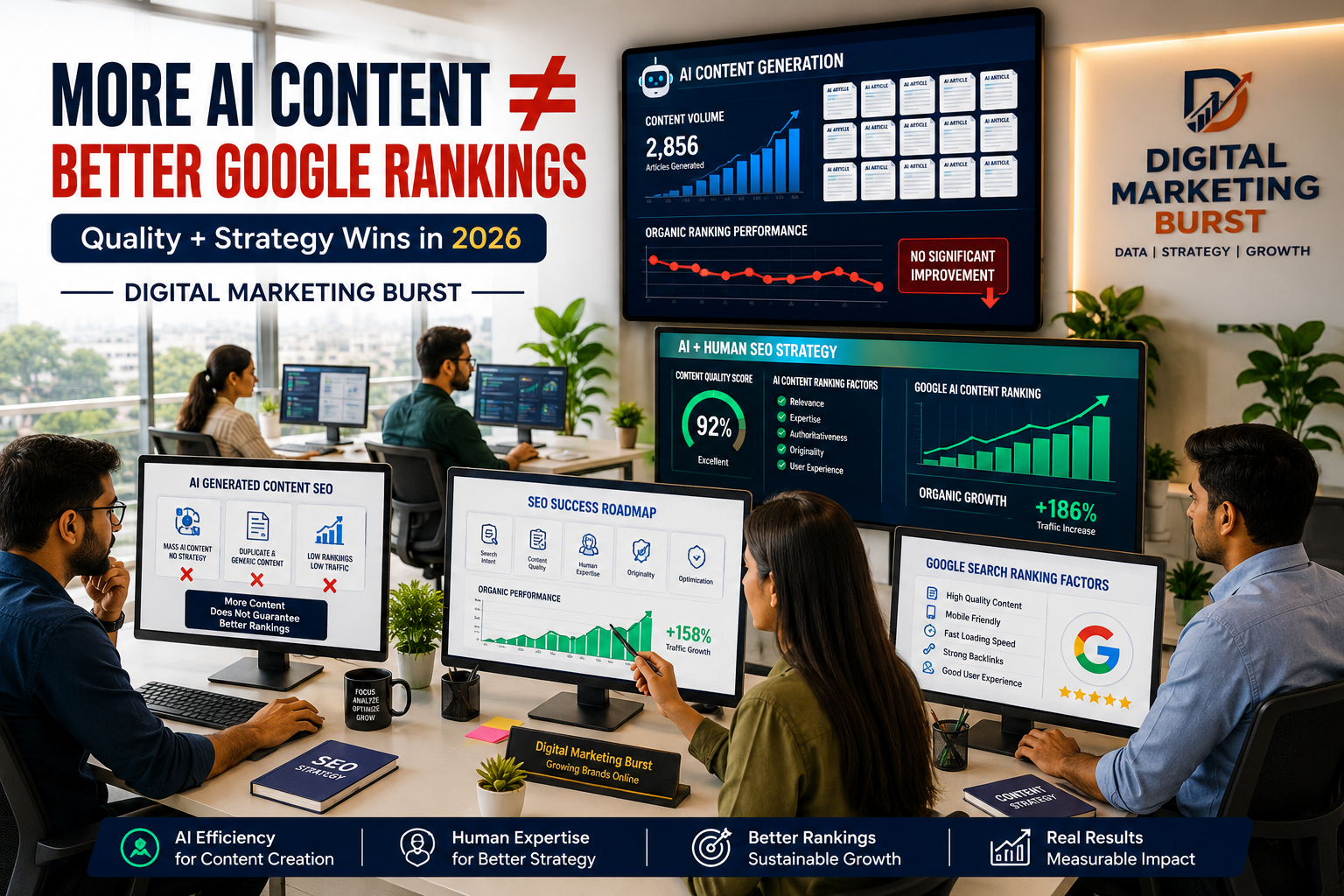
AI Content SEO Strategy
A successful AI Content SEO Strategy should begin with the reader rather than the content-generation tool. Before creating an article, ask what the searcher actually wants to know. Then determine whether your page can provide something clearer, deeper, fresher, or more useful than the pages already competing for that query.
This distinction matters because AI can produce words quickly, but words alone do not create search value. If ten websites ask similar tools to explain the same subject, their articles may cover nearly identical ideas. Changing the wording does not necessarily make one page more useful than another.
Therefore, AI should support research and production instead of controlling the entire process. It can help organise ideas, identify missing questions, improve readability, or develop an initial structure. Human review should then strengthen accuracy, examples, context, tone, and usefulness.
For example, a digital marketing agency writing about a recent campaign can add observations from actual work. It can explain what changed, what failed, and what produced results. Those details are much harder to replace with generic text.
In 2026, the strongest strategy is not to ask, “How many AI articles can we publish?” A better question is, “Why should someone prefer this page after seeing several competing answers?”
That change in thinking separates content production from genuine SEO strategy.
AI Content Optimization Strategy
An AI Content Optimization Strategy should improve an article after the first draft rather than treating generated text as finished content. This is where many websites make a major mistake. They create an article, insert a focus keyword, add a few headings, and publish immediately.
A better workflow starts by checking search intent. If someone searches for a comparison, the page should make the comparison easy. If the query asks “how to,” the answer should appear early and the process should be clear. Likewise, informational searches need useful explanations without forcing readers through unnecessary introductions.
Next, remove generic sections. AI-generated drafts often include paragraphs that sound correct but add little new information. These sections increase word count without improving the reader’s understanding.
The article should then be strengthened with first-hand observations where possible. Add examples, screenshots, original analysis, data, case studies, expert comments, or lessons from actual work. Even a simple example can make an abstract explanation easier to understand.
Finally, improve readability. Short paragraphs, natural transitions, descriptive headings, and direct answers help users scan the page.
Optimization is therefore not simply inserting keywords. It is the process of turning an ordinary draft into the best possible answer for a particular search need.
Why Publishing More AI Content Does Not Guarantee More Traffic
Content volume once gave websites an obvious way to expand their search footprint. More useful pages meant more opportunities to appear for relevant searches. AI has made that equation more complicated.
Today, almost any competitor can dramatically increase publishing speed. Consequently, volume itself becomes less distinctive.
Imagine two websites covering the same industry. The first publishes 100 basic AI-generated articles each month. The second publishes 15 carefully selected articles. Those 15 pages include useful examples, original explanations, expert review, internal links, updated information, and strong search-intent alignment.
The first website has more URLs. However, the second may provide substantially more value per URL.
This is why businesses should avoid measuring SEO productivity only through article count. Publishing 50 pages means little if most attract no impressions, backlinks, engagement, enquiries, or returning readers.
Instead, measure whether new content expands topical coverage in a meaningful way. Check whether existing pages are improving. Look at impressions, qualified clicks, conversions, visibility, and queries gained over time.
AI makes publishing easier. It does not remove the need to decide what deserves to be published.
AI Generated Content SEO
AI Generated Content SEO works best when artificial intelligence is treated as an assistant rather than an automatic publishing machine. Search engines ultimately need to satisfy users. Therefore, the production method matters less than whether the resulting page deserves to be found.
This creates an important distinction between AI-assisted content and low-effort automated content.
AI-assisted content can begin with technology but receive meaningful human input. An editor may correct weak arguments, verify facts, add examples, restructure sections, remove repetition, and adjust the article according to actual audience needs.
Low-effort automation works differently. A keyword is entered, an article is generated, and the page is published with minimal review. Repeating that process hundreds of times can create a large website quickly. Yet much of the site may contain information that already exists elsewhere in nearly identical form.
Businesses should therefore focus less on whether content was “written by AI” and more on whether the finished page is genuinely useful.
Readers do not visit a website because it successfully generated 2,000 words. They visit because they have a question, problem, decision, or task.
The content should help them complete it.
AI Generated Content Optimization
AI Generated Content Optimization begins by identifying what the initial draft lacks. Generated content often provides a broad overview, but competitive SEO frequently requires more than a broad overview.
Start by reading the draft as a customer rather than as its publisher. Ask whether the opening answers the main question quickly. Then check whether each section contributes something useful.
Repetition should be removed aggressively. AI drafts can explain the same concept several times using slightly different language. This creates length without adding depth.
Next, examine specificity. Statements such as “quality content is important for SEO” provide little practical value on their own. Explain what quality means for that particular topic. Does the reader need updated statistics, screenshots, pricing, steps, comparisons, examples, or expert interpretation?
Accuracy also requires attention. Any factual claim that can change should be verified before publication.
Finally, consider whether the page adds something competitors do not. That difference might be an original framework, a case example, clearer explanation, better visual, useful template, or first-hand experience.
Optimization should transform generated material into something readers would genuinely miss if it disappeared from search.
Why AI-Written Articles Often Start Sounding the Same
One emerging content problem is sameness. Businesses use different tools and prompts, yet many articles still follow familiar patterns.
The introduction defines the topic. Several predictable benefits follow. A section explains challenges. Another presents best practices. Finally, the conclusion repeats the introduction.
Nothing is necessarily incorrect. The problem is that nothing feels memorable either.
When every competing article follows the same structure, readers have little reason to remember which website provided the answer.
Human editing can solve much of this problem.
Instead of opening with a broad definition, start with the specific problem the reader is facing. Replace vague benefits with concrete examples. Remove sections included only because they seem expected. Add opinions that can be supported by experience or evidence.
Brand voice also matters. A financial consultancy should not sound identical to a travel company or digital marketing agency.
AI can imitate structure easily. Creating a distinctive perspective requires stronger editorial decisions.
Google AI Content Ranking
Google AI Content Ranking should not be approached as a separate shortcut where AI-written pages need a special trick to rank. The more useful question is whether the page satisfies the searcher’s need better than available alternatives.
A page can be technically optimized and still struggle because it offers nothing distinctive.
For example, imagine searching for a solution to a difficult SEO problem. You open five results, and every article gives almost the same broad recommendations. A sixth result provides a clear diagnosis, screenshots, examples, and a practical process. That sixth page immediately becomes more useful.
This illustrates why content depth is not the same as content length.
A 5,000-word article can still be shallow if it repeats basic information. Meanwhile, a focused 1,500-word guide may answer the query far more effectively.
Therefore, content teams should stop treating word count as a ranking objective.
Determine how much information the topic genuinely requires. Then provide that information clearly.
AI can help produce the material, but competitive advantage comes from what the publisher adds after generation.
Google AI Content Rankings
Discussions around Google AI Content Rankings often become too focused on whether search engines can detect artificial intelligence. That can distract marketers from the more important question: is the content actually competitive?
Suppose an AI-generated article is accurate, well edited, original in its presentation, and genuinely useful. Its production method alone does not explain its quality.
Now consider a manually written article that contains outdated information, unnecessary filler, weak structure, and no meaningful expertise. Human authorship does not automatically make it valuable.
This is why marketers should avoid simplistic “AI versus human” thinking.
The strongest workflow can combine both.
AI can accelerate research, brainstorming, categorization, editing, and drafting. Human specialists can provide judgment, verification, context, experience, and creative direction.
The finished page matters most.
For businesses, this approach also reduces risk. Instead of producing huge quantities of unreviewed material, teams can use automation where it saves time while maintaining editorial standards where judgment matters.
AI Content Ranking Factors
Understanding AI Content Ranking Factors starts with understanding what makes any page valuable in organic search. Search intent, relevance, information quality, website authority, usability, internal structure, and overall page experience can all contribute to performance.
No single factor guarantees the first position.
Keyword placement alone is not enough. Neither is article length. Publishing frequency cannot rescue weak pages indefinitely.
Content also needs context within the website.
A company that publishes one isolated article about a topic may struggle against a competitor with a strong collection of interconnected resources. Supporting articles, logical internal linking, clear site architecture, and consistent topical coverage can help users and search engines understand the relationship between pages.
Freshness matters when the subject changes quickly.
For example, a guide about SEO in 2023 may contain advice that no longer reflects the current search environment. Updating important pages can therefore be more valuable than publishing another nearly identical article.
Instead of chasing one secret factor, businesses should improve the entire content experience.
AI Content SEO Factors
AI Content SEO Factors extend beyond what appears inside the article. A strong page can still underperform when the surrounding website creates problems.
Slow loading, confusing navigation, weak internal links, poor mobile usability, duplicate pages, and unclear site structure can limit performance.
Therefore, content teams and technical SEO teams should not work in isolation.
Before publishing another hundred articles, examine whether existing pages are easily discoverable. Check whether several URLs are targeting nearly the same intent. If so, the website may be competing against itself.
Internal links should also be purposeful.
A new article should connect readers to relevant supporting information. Likewise, established pages can link towards the new resource when appropriate.
Titles and descriptions should accurately represent what users will find after clicking.
SEO becomes stronger when content, technical performance, information architecture, and user experience support one another.
AI can accelerate some tasks within this process, but it cannot replace the strategy connecting them.
Google Search Ranking Factors
Google Search Ranking Factors are often discussed as if marketers need a simple checklist that guarantees results. Real search performance is more complicated.
A page exists within a competitive environment.
Your article may improve substantially while competitors improve even faster. Search behaviour may change. New result formats may appear. A query may develop different intent. Consequently, rankings can move even when nothing is technically “wrong” with your page.
This is why SEO requires continuous observation.
Track which queries generate impressions. Study pages that are gaining or losing visibility. Look for changes in click-through rate. Compare what currently ranks with what ranked previously.
Then update content according to what users need now.
Avoid changing a page merely because a random checklist says every article needs a particular number of headings, words, or keywords.
Optimization should have a reason.
The strongest SEO decisions connect search data with user behaviour and business objectives.
Google SEO Ranking Factors
Google SEO Ranking Factors should be considered across the whole website rather than only at individual article level. Search visibility can depend on how well pages work together.
A website with hundreds of disconnected AI articles can become difficult to manage. Similar topics overlap. Internal links become inconsistent. Old information remains online. Some pages receive no traffic for months, yet nobody reviews them.
This is where content maintenance becomes essential.
Businesses should periodically audit their published pages. Some articles deserve updates. Others may need consolidation because several URLs address almost identical searches. A few may no longer provide enough value to justify remaining unchanged.
This process can improve the overall usefulness of a content library.
Publishing is only the beginning.
A mature SEO strategy treats every page as an asset that needs measurement, maintenance, and improvement.
More AI Articles Can Create Keyword Cannibalization
Rapid AI publishing can accidentally create multiple pages targeting almost the same search intent.
For example, one website might publish “best AI SEO tools,” “top AI tools for SEO,” “AI SEO software,” and “best artificial intelligence SEO platforms” as separate long-form articles.
Those phrases look different, but the underlying user need may be extremely similar.
Instead of strengthening topical authority, the website may create several competing pages with overlapping purposes.
Before creating a new URL, search your own website.
Check whether an existing article already addresses the topic. If it does, determine whether updating that page would be more useful than publishing another one.
Content maps can help larger teams manage this problem.
Assign one primary search intent to each important page. Supporting articles should answer related but distinct questions.
AI makes it easy to generate endless keyword variations. Strategy determines which variations actually deserve their own pages.
Why AI Content Volume Can Become an SEO Problem
Publishing more content creates maintenance obligations.
Every new page can eventually require factual updates, broken-link checks, internal-link improvements, screenshots, conversion optimization, and performance review.
If a small team publishes 1,000 articles in a year, it now owns 1,000 pages that may need future attention.
This creates content debt.
The problem becomes especially serious in fast-changing industries such as digital marketing, technology, finance, software, and search.
Information can become outdated quickly.
Therefore, content velocity should match the organisation’s ability to maintain what it publishes.
Ten excellent articles that remain current may contribute more long-term value than 100 pages that become outdated within months.
AI reduces production cost. It does not eliminate maintenance cost.
That distinction should influence every serious content strategy in 2026.
Why Search Intent Matters More Than AI Content Quantity
Search intent explains what a person wants when entering a query.
They may want information, a product comparison, a service, a definition, instructions, or a specific website.
A page can contain excellent writing and still perform poorly when it targets the wrong intent.
Suppose someone searches “best CRM for small business.” They likely expect comparisons and recommendations. A 4,000-word article explaining the history of customer relationship management would miss the main need.
Adding another 2,000 AI-generated words would not solve the problem.
The page needs better alignment.
Before drafting, examine the query carefully. Determine what answer would help the searcher complete their next step.
Then structure the article around that purpose.
This principle sounds simple, yet it prevents enormous amounts of unnecessary content production.
More content is useful only when it answers more genuine needs.
Human Experience Can Make AI Content More Valuable
Human experience gives content something that generic generation often lacks: consequences.
A person who has actually implemented a strategy can explain what happened after following it.
They can describe unexpected problems, trade-offs, mistakes, and situations where common advice did not work.
These details improve usefulness.
For example, an article about Meta advertising becomes stronger when a marketer explains how campaign structure affected a real account. A local SEO guide becomes more practical when it discusses what happened after changing a business category or landing page.
The goal is not to add personal stories everywhere.
Instead, add experience where it helps readers make better decisions.
This creates a useful model for AI-assisted publishing:
Let technology accelerate routine work. Let human expertise create differentiation.
Original Research Can Separate Your Website From AI Slop
Original research does not always require a huge industry survey.
A company can analyse its own anonymized campaign data, customer questions, search queries, tests, experiments, or website performance.
Even small datasets can provide useful insights when methodology and limitations are explained clearly.
Original information gives other websites a reason to reference your content.
It can also create secondary content opportunities. One study might support a detailed article, infographic, social posts, newsletter discussion, and future updates.
Generic AI content usually summarizes what is already available.
Original research adds something new.
That difference becomes increasingly valuable as publishing tools make basic summaries abundant.
In a search environment filled with easy-to-generate information, unique information becomes harder to replace.
AI Content Quality vs AI Content Quantity
The debate between quality and quantity is not about publishing slowly for the sake of publishing slowly.
Businesses still need enough content to cover important customer questions.
The problem begins when volume becomes the primary KPI.
If writers are rewarded only for publishing 50 articles per month, they naturally optimize their workflow for output. Research becomes shorter. Editing becomes lighter. Similar topics get approved because they are easy to produce.
A better measurement system includes outcomes.
Track whether pages gain relevant impressions, qualified organic visitors, links, leads, assisted conversions, or visibility for important queries.
Some content may also support customers without generating large search volumes. That can still be valuable.
The point is to understand why each page exists.
Once teams measure outcomes rather than production alone, AI becomes a productivity tool instead of a content-volume machine.
How to Improve AI Content Before Publishing
The first draft should be considered raw material.
Read the article from beginning to end. Remove repeated explanations and generic statements.
Next, verify important facts.
Then ask whether the article answers the primary query quickly enough. Readers should not need to scroll through several introductory sections before reaching the information promised by the title.
Improve examples and transitions.
Check whether headings accurately describe each section. Break overly long sentences where necessary.
After that, look for opportunities to add unique value. A screenshot, example, template, expert comment, original calculation, or simple comparison can significantly improve usefulness.
Finally, read the article aloud or review it as a normal visitor.
If a paragraph sounds unnatural, rewrite it.
AI can produce a draft in seconds. Quality still requires deliberate editorial work.
Digital Marketing Burst AI Content SEO Strategy
A Digital Marketing Burst AI Content SEO Strategy should focus on combining AI efficiency with human-led SEO decisions. The objective is not to reject AI tools. Instead, businesses need to understand where automation saves time and where professional judgment creates better outcomes.
Keyword research should identify real search opportunities rather than simply generating hundreds of keyword variations. Content planning should then group related searches by intent so that every variation does not become a separate page.
AI can support research, outlines, ideation, and initial drafts. However, important content should receive human review before publication.
SEO professionals can strengthen those drafts through competitive analysis, internal linking, examples, conversion intent, and performance data.
This approach allows businesses to scale without turning their websites into libraries of repetitive articles.
For companies trying to improve organic visibility, the goal should be sustainable search growth rather than the largest possible number of published URLs.
Digital Marketing Burst AI Generated Content SEO Approach
The Digital Marketing Burst AI Generated Content SEO approach can be built around a simple principle: automation should improve the marketer’s work rather than replace the thinking behind it.
Search strategies still require decisions about audience, competition, business goals, content gaps, and conversion paths.
A tool cannot understand every commercial priority simply because it can generate fluent paragraphs.
For example, two keywords may have similar search potential but very different business value. A company might benefit far more from ranking for the lower-volume query because those visitors are closer to becoming customers.
Human SEO analysis helps make that distinction.
Therefore, successful AI-assisted marketing combines speed with judgment.
Technology handles repetitive work. Specialists decide where effort should go.
What Businesses Should Do Instead of Publishing Hundreds of AI Articles
Businesses should begin with their existing website.
Identify pages already receiving impressions but ranking below their potential. Improving those URLs may generate faster results than creating dozens of new ones.
Next, find genuine content gaps.
Look at customer questions, sales conversations, Search Console queries, competitor coverage, and emerging industry problems.
Then prioritize topics.
Not every keyword deserves immediate attention.
Create fewer pages with clearer purposes. Add internal links. Update old information. Improve weak titles and introductions. Consolidate overlapping articles when appropriate.
After publishing, measure results.
This creates a feedback loop where future content decisions are based on evidence rather than assumptions.
AI remains extremely useful within this workflow. However, it supports the system instead of becoming the system.
Why Human-Led SEO Still Matters in 2026
AI can analyse information rapidly, but SEO decisions often involve ambiguity.
A ranking drop may have several possible causes. Traffic can decline because of changing search demand, stronger competitors, technical problems, SERP changes, weak content, seasonality, or a combination of factors.
Automatically generating more articles does not diagnose the problem.
Human analysis connects different signals.
An experienced marketer can compare page-level performance, query changes, technical issues, competitors, and business outcomes before deciding what to change.
That judgment becomes even more important as SEO tools become easier to access.
When everyone has similar tools, owning the tool is no longer a competitive advantage.
Knowing what to do with its output is.
The Future of AI Content and Google Rankings
AI will remain part of content production. The question is not whether marketers should use it. The important question is how responsibly and strategically they use it.
As generation becomes easier, basic informational content becomes less scarce.
That changes the competitive environment.
Brands need stronger reasons for users to trust, remember, cite, and revisit their websites.
Original experience, expert interpretation, proprietary information, helpful tools, strong branding, useful visuals, and excellent user experience can create that differentiation.
AI can help produce some of these assets.
However, simply asking it to generate another article about a topic already covered thousands of times will rarely create a durable advantage.
The future belongs less to websites that produce the most words and more to websites that provide the most useful reason to visit.
Conclusion: Why More AI Content Won’t Improve Your Google Rankings in 2026
AI Content SEO Strategy, AI Generated Content SEO, Google AI Content Ranking, AI Content Ranking Factors, and Google Search Ranking Factors all point towards one important lesson: publishing more content is not the same as building more search value.
AI has dramatically reduced the time required to create a draft. However, competitors have access to similar technology. Therefore, speed alone cannot remain a meaningful SEO advantage.
Businesses need content that understands search intent, solves real problems, demonstrates experience, provides original value, and fits into a well-structured website.
Use AI to accelerate research and production. Then use human expertise to decide what deserves to exist, what needs improvement, and what makes your page different.
For brands developing a Digital Marketing Burst AI Content SEO Strategy, the winning approach in 2026 is not AI versus humans. It is AI efficiency combined with human strategy, originality, and quality control.
That is how businesses can turn AI from a mass-content generator into a useful part of sustainable organic growth.
Why Google Rankings Need More Than AI-Written Content
Creating an article has become incredibly easy. A marketer can enter a topic into an AI tool and receive a complete draft within seconds. However, easy production does not mean easy rankings. Search competition still exists, and every competing website can access similar technology.
The real challenge is creating a page that deserves attention. If hundreds of websites publish similar explanations, another rewritten version may not provide enough additional value. This is especially important for topics where basic information is already widely available.
A stronger page gives readers something useful beyond a summary. It may contain an original example, practical experience, clearer explanation, current data, useful comparison, or direct answer that saves time.
Therefore, content teams should evaluate every article before publishing it. Ask whether the page contributes something meaningful to the existing search results. If removing your website’s name would make the article indistinguishable from dozens of competing pages, it probably needs more work.
AI can speed up production. Yet the competitive advantage comes from what happens after the first draft.
Why AI Content Does Not Automatically Rank Higher on Google
Many businesses assume that increasing publishing frequency will eventually increase rankings. The logic appears reasonable. More articles create more indexed pages, which create more opportunities to appear in search.
However, organic visibility does not increase proportionally with URL count.
Imagine a website publishing five carefully researched pages each month. Another business publishes 100 automated articles covering every possible keyword variation. The second website has significantly more content, but many pages may answer almost identical questions.
That creates quantity without enough differentiation.
Instead, the smaller website may build stronger individual resources. Each page can target a distinct search need and receive proper internal links, updates, examples, visuals, and editorial attention.
Businesses should therefore measure the percentage of published pages that actually gain meaningful search visibility. If hundreds of URLs remain almost invisible, increasing production further may simply expand the problem.
The objective is not to own the largest content library. It is to build a useful one.
How Google Ranks AI Content in Competitive Search Results
The question how Google ranks AI content is often framed incorrectly. Marketers sometimes look for a special ranking rule that applies only because artificial intelligence helped produce the article.
A better approach is to evaluate the finished page.
Does it answer the query? Is the information reliable? Does it offer enough detail? Is the structure easy to understand? Does it add value beyond what users can already find elsewhere?
These questions matter regardless of how the first draft was created.
Consider a competitive query where ten pages explain the same concept. If your article repeats those explanations without improving them, there is little reason for users to prefer it.
On the other hand, a page containing a useful comparison, practical example, original research, or expert explanation can become more valuable.
Therefore, businesses should stop looking for an “AI ranking trick.”
Use AI where it improves efficiency. Then focus on producing a final resource that deserves to compete.
SEO for AI Generated Content
SEO for AI Generated Content should begin before writing starts. Choosing the right topic and search intent is often more important than optimizing a completed article afterward.
First, determine what the reader expects from the query. Some searches require a quick answer. Others require a detailed guide, comparison, tutorial, or commercial recommendation.
The content format should match that expectation.
Next, review what already exists. This does not mean copying competitors. Instead, identify what searchers already receive and where useful information may be missing.
After drafting, improve the article manually.
Remove predictable filler. Add examples. Verify important claims. Improve transitions and sentence length. Connect the page with relevant resources elsewhere on your website.
Most importantly, avoid forcing keywords into every paragraph.
Search optimization should make an article easier to discover without making it uncomfortable to read. Natural language, related terms, clear headings, and comprehensive topic coverage can provide stronger results than mechanical repetition.
Why Low-Quality AI Content Struggles to Build Organic Traffic
Low-quality AI content often has one major weakness: it provides information without enough reason to choose that particular page.
The writing may be grammatically correct. The headings may look professional. Keywords may appear in suitable places. Still, the page can feel generic.
This happens because generating information is only one part of content marketing.
Readers also need clarity and confidence. They want examples that relate to their problem. They may need evidence before making a decision. Sometimes they want an expert to explain why one approach is better than another.
Generic content rarely provides all of this.
Moreover, weak pages can struggle to attract natural references. People usually link to information that offers something worth citing. Original research, detailed tutorials, useful tools, unique statistics, and strong explanations have more reference value than another basic summary.
Therefore, low-quality AI content can create an initial publishing boost without building the assets needed for sustainable organic growth.
AI Content Ranking Signals and User Satisfaction
Discussions about AI content ranking signals can become overly technical. However, publishers should never lose sight of the person using the search engine.
A visitor has a goal.
If the page helps them reach that goal quickly, the content has done something useful. If it forces them through repetitive introductions and generic explanations, the experience becomes weaker.
This is why answer placement matters.
A question-based article should not hide the answer halfway down the page simply to increase reading time. Give readers what they came for. Then provide additional context for people who want more detail.
Navigation also matters for longer guides.
Descriptive headings allow visitors to scan the article and locate the relevant section. Shorter paragraphs improve readability on mobile devices.
Useful content respects the reader’s time.
AI tools can help organize an article, but the publisher must decide which information deserves priority.
AI Content Quality Factors That Matter in 2026
Several AI content quality factors can separate a useful resource from mass-produced material.
Accuracy comes first. AI-generated drafts can occasionally produce outdated, incomplete, or incorrect information. Therefore, important claims should be checked before publication.
Specificity comes next.
Generic advice such as “create valuable content” tells readers very little. Explain what valuable content looks like for the topic being discussed.
Originality also matters, but originality does not simply mean passing a plagiarism checker. An article can contain completely different sentences while repeating the same ideas as every competitor.
True differentiation comes from adding useful information, interpretation, experience, or presentation.
Finally, consider freshness.
Fast-changing topics need regular review. A strong article published today can become outdated if the industry changes and nobody updates it.
Quality is therefore an ongoing process rather than a one-time publishing requirement.
AI Content Optimization for SEO
AI Content Optimization for SEO should focus on improving usefulness rather than increasing keyword frequency.
Start with the title. It should clearly communicate what the reader will learn.
Then review the opening paragraph. Readers should understand the topic quickly instead of reading several paragraphs before reaching the main point.
Next, examine every heading.
A heading should introduce a meaningful section rather than exist merely to hold another keyword. If two sections answer the same question, combine them.
Internal linking is another useful step. Connect the article with relevant pages that help readers continue their journey.
Visual elements can improve complicated topics. Screenshots, charts, diagrams, examples, and tables may explain certain ideas faster than several paragraphs.
Finally, review the conclusion. Avoid simply repeating everything already said.
A strong conclusion should reinforce the main lesson and help the reader understand what to do next.
Why AI Content Needs Human Editing
Human editing does more than correct grammar.
An editor evaluates whether the article makes sense as a complete piece.
AI may produce individually reasonable paragraphs that do not connect naturally. One section may repeat an earlier point. Another may introduce a new concept without enough explanation.
Human review identifies these weaknesses.
Editors can also recognize when an article sounds too generic. They can replace vague claims with specific examples and adjust the tone for the intended audience.
More importantly, subject specialists can identify technically correct statements that lack important context.
That is difficult to solve through basic proofreading alone.
The best editing process therefore includes both language review and subject review.
AI can create the starting material quickly. Human expertise turns that material into something worth publishing.
Google Organic Ranking Factors and Content Usefulness
Google Organic Ranking Factors involve more than simply placing a keyword in a title, introduction, and several headings.
Search performance depends on the complete quality and relevance of a page within its competitive environment.
A technically optimized article may still struggle if stronger pages already satisfy the same search intent.
Therefore, marketers should study the result page before writing.
Look at the types of pages appearing prominently. Are they tutorials, category pages, comparisons, videos, tools, or short explanations?
This gives clues about what users expect.
However, do not simply recreate the existing results.
Find opportunities to improve them.
Perhaps competitors explain the concept but provide no example. Maybe their information is outdated. Their page might be difficult to scan on mobile.
These gaps can guide your content strategy.
SEO works best when optimization and usefulness support each other.
Google Website Ranking Factors Beyond Content
Google Website Ranking Factors extend beyond article quality. Even excellent content exists inside a larger website ecosystem.
Technical problems can make strong pages harder to discover or use.
For example, poor internal linking can leave valuable articles isolated. Slow pages can frustrate visitors. Confusing navigation can make related information difficult to find.
Duplicate or near-duplicate URLs can create another problem.
Mass AI publishing increases this risk because generating several similar articles is easy.
Before expanding content production, businesses should examine the health of the website itself.
Ensure important pages are crawlable and logically organized. Maintain clear navigation. Improve mobile usability. Fix unnecessary duplication.
A website should function like a connected information system rather than a folder containing thousands of unrelated articles.
Latest Google Ranking Factors and the Problem With Checklists
Search marketers naturally look for the latest Google ranking factors, but this can lead to an unhealthy checklist mentality.
A business may believe every article needs exactly 2,500 words, ten headings, several images, a particular keyword density, and a specific number of internal links.
SEO does not work that mechanically.
Different queries require different solutions.
A user asking for the boiling point of water does not need a 3,000-word article. Meanwhile, someone researching a complex business software comparison may need substantial detail.
Content length should therefore follow information requirements.
The same applies to images and headings.
Add them when they improve understanding.
Instead of optimizing pages to satisfy an imaginary universal formula, optimize them for the actual query and audience.
Google Ranking Factors 2026 and the Rise of AI Search
Google Ranking Factors 2026 cannot be discussed without considering how search behaviour itself is changing.
Users increasingly ask longer and more conversational questions. They may also receive answers directly within AI-driven search experiences before visiting a website.
This changes the role of content.
Websites need to provide information that is easy to understand, extract, reference, and trust. Clear answers become more important, but depth still matters for users who continue beyond the initial response.
Publishers should therefore structure articles intelligently.
Answer important questions directly. Then expand with context, evidence, examples, and related information.
This approach benefits both traditional readers and evolving search experiences.
Simply producing more generic pages does not address this shift.
Content needs to become more useful, not merely more abundant.
AI Content Marketing Strategy for Sustainable Organic Growth
An AI Content Marketing Strategy should connect search visibility with business goals.
Traffic alone does not always create value.
A website might attract thousands of visitors for topics unrelated to its services. Those numbers look impressive in analytics, but they may generate little commercial impact.
Therefore, content planning should include different types of intent.
Some articles can target broad informational searches and introduce new audiences to the brand. Others can address problems potential customers experience. Commercial content can help people compare solutions and move closer to an enquiry or purchase.
This creates a healthier content ecosystem.
AI can accelerate production across each category. However, humans should decide which topics support the business.
The goal is not maximum traffic from every possible keyword.
It is relevant visibility that supports long-term growth.
Why More Website Pages Can Sometimes Create Less SEO Value
More pages increase the size of a website, but size alone does not create authority.
Suppose a company publishes 500 AI-generated pages targeting tiny variations of the same topics.
Many receive almost no traffic. Some compete against each other. Others become outdated. Internal linking becomes increasingly difficult to manage.
The website now has more content but also more maintenance work.
A smaller collection of well-organized resources may provide a clearer experience.
This does not mean large websites are bad.
Large websites can perform extremely well when each page serves a clear purpose.
The problem is uncontrolled expansion.
Before approving a new article, ask whether it targets a genuinely different need. If an existing page can satisfy that need after an update, improving it may be the better decision.
Content Pruning and AI-Generated Website Growth
Rapid AI adoption has made content pruning increasingly relevant.
Pruning does not mean deleting pages randomly because they receive low traffic.
Some pages may serve important niche audiences or support customer journeys despite limited organic visits.
Instead, evaluate each page according to purpose and performance.
An outdated article may need an update. Two weak overlapping pages may benefit from consolidation. A page with no useful purpose might eventually be removed or redirected when appropriate.
The objective is to improve the overall content library.
Businesses that continually publish without reviewing older pages can accumulate thousands of forgotten URLs.
AI makes creation cheap. Therefore, disciplined maintenance becomes even more important.
Why Updating Existing Content Can Beat Publishing New AI Articles
SEO teams often become obsessed with new content because publication is easy to measure.
However, existing pages may offer better opportunities.
A page ranking near the first page already has some search visibility. Improving it can sometimes produce stronger results than launching another URL from zero.
Review pages receiving impressions but relatively few clicks.
Check whether their titles still match current intent. Update outdated information. Improve weak sections. Add useful examples and internal links.
Also examine queries the page is already appearing for.
Those queries can reveal information users expect but the article does not yet cover properly.
This process uses real performance data rather than assumptions.
AI can assist with updating, but human analysis should determine what needs improvement.
Why AI SEO Tools Cannot Replace SEO Strategy
SEO tools provide information.
They can identify keywords, backlinks, ranking movements, technical issues, competitors, and content opportunities.
AI makes these tools even more powerful.
However, data still requires interpretation.
A tool might identify 10,000 keywords. It cannot automatically decide which 20 matter most to your business without understanding your broader goals.
Likewise, a content score may recommend additional words or headings. Following every recommendation mechanically can make an article worse rather than better.
Professionals need to understand why a recommendation exists.
Use tools to reveal possibilities. Then apply judgment.
The strongest SEO professionals are not those who click the most automation buttons. They are those who can turn information into the right decision.
When AI Content Actually Helps SEO
AI content is not inherently a problem.
Used correctly, AI can make SEO teams significantly more productive.
It can help organize keyword research, summarize large datasets, create outline ideas, identify questions, simplify complicated sentences, generate schema drafts, categorize queries, and assist with editing.
It can also help specialists overcome the blank-page problem when starting a new article.
The difference lies in the workflow.
If AI output moves directly from generation to publication, quality control disappears.
If AI output passes through research, expert review, editing, fact checking, optimization, and final approval, the technology becomes far more useful.
Therefore, businesses do not need to choose between “AI content” and “human content.”
They need a better production system.
When AI Content Can Become an SEO Liability
AI becomes a liability when businesses prioritize scale without control.
Imagine publishing hundreds of articles without checking whether the information is accurate. Even a small error rate can create many problematic pages.
Reputation can suffer too.
Readers who repeatedly encounter generic or incorrect content may stop trusting the website.
Another risk comes from duplication of ideas.
AI can generate different wording around essentially the same information. If every keyword variation becomes its own article, the website may develop unnecessary overlap.
Finally, mass publishing can consume resources elsewhere.
Editors spend time fixing weak pages. Developers manage a larger site. SEO teams monitor more URLs. Content managers struggle to keep everything updated.
Efficiency disappears when cheap production creates expensive maintenance.
How to Build a Human-First AI Content Workflow
A human-first workflow begins with strategy.
Choose the topic based on audience needs, search opportunity, and business relevance.
Then conduct research before generation.
AI can help organize findings and build an initial outline. However, the outline should be reviewed by someone who understands the subject.
After drafting, a human editor should improve clarity and remove unnecessary repetition.
Subject experts can then verify important claims and add experience.
SEO optimization comes afterward.
Check the title, search intent, internal links, related terms, readability, and page structure.
Finally, publish and measure.
Performance data should inform future updates.
This process takes longer than pressing “generate and publish,” but it produces assets with much greater long-term potential.
How Digital Marketing Burst Approaches AI Content Optimization
A Digital Marketing Burst AI Content Optimization Strategy should treat AI as part of a wider digital marketing workflow rather than a replacement for SEO expertise.
A business does not need another article simply because a tool can create one.
It needs content connected to audience demand.
Keyword research can identify opportunities, while competitor analysis can reveal what already exists. Search-intent mapping then helps determine whether a new URL is genuinely required.
Once content is created, human optimization can improve accuracy, readability, differentiation, internal linking, and conversion relevance.
Performance should then be monitored instead of assuming publication equals success.
This creates a cycle:
Research informs content. Content generates data. Data improves future strategy.
That process is far more sustainable than mass publishing without measurement.
Digital Marketing Burst Google AI Content Ranking Strategy
A Digital Marketing Burst Google AI Content Ranking Strategy should focus on creating pages with a clear purpose.
Every important URL should answer a specific search need.
Informational articles can build awareness. Problem-focused content can reach users actively looking for solutions. Commercial pages can support people who are ready to compare services.
This structure prevents the website from becoming a collection of unrelated traffic articles.
AI can support each stage, but the brand still needs a consistent voice and editorial standard.
Content should sound like it belongs to the business publishing it.
Original examples, industry observations, and practical explanations can help create that identity.
Over time, a recognizable body of useful content can become more valuable than a large volume of anonymous AI-generated pages.
The Real Competitive Advantage in AI SEO
AI itself is becoming widely available.
Therefore, simply using artificial intelligence is not a competitive advantage anymore.
The advantage comes from how effectively a business combines technology with assets competitors cannot easily reproduce.
Those assets may include first-hand experience, customer insights, proprietary data, specialist expertise, unique tools, strong brand recognition, original visuals, and trusted relationships.
AI can help communicate these assets.
It cannot automatically create all of them.
This is an important shift for SEO in 2026.
When content creation becomes cheap, unique knowledge becomes more valuable.
Businesses should therefore invest not only in better prompts but also in better information.
Why Human Expertise Will Matter More as AI Content Grows
As generic information becomes easier to produce, expertise becomes a stronger differentiator.
Anyone can ask an AI tool to explain technical SEO.
Fewer people can explain what happened when they migrated a large website, solved a complicated indexing issue, or recovered traffic after fixing an architecture problem.
That difference matters.
Experience creates details that generic summaries often miss.
It also helps readers understand trade-offs.
Real-world strategies rarely work perfectly in every situation. Experts can explain when advice should be modified and why.
Therefore, AI growth does not necessarily reduce the importance of specialists.
It can increase the value of people who know how to evaluate, correct, and improve machine-generated information.
AI Content SEO Strategy for 2026: Quality Before Scale
The most sustainable AI Content SEO Strategy for 2026 is simple: establish quality before increasing volume.
Create a repeatable editorial standard.
Determine what research every article requires. Decide who verifies important claims. Define how internal links are selected. Establish what makes content sufficiently original and useful to publish.
Once the system consistently produces strong pages, AI can help increase efficiency.
Scaling a good process can create growth.
Scaling a weak process simply creates weak content faster.
That distinction should guide every business investing heavily in AI publishing.
The question is no longer whether AI can produce enough content.
It clearly can.
The question is whether businesses can maintain enough judgment to decide what is actually worth publishing.
Why AI Content Cannot Replace Original Expertise
AI can generate explanations quickly, but it does not automatically give a business genuine subject expertise. This difference is becoming more important as websites publish increasingly similar articles. When users can find the same basic information everywhere, they have little reason to prefer another generic page.
Original expertise adds context that basic generation often misses. An experienced SEO professional can explain why a strategy worked for one website but failed for another. A marketer can discuss what changed after testing a new campaign structure. Likewise, a business can use genuine customer questions to create content around problems people actually face.
Therefore, AI should help specialists communicate knowledge rather than replace that knowledge. A strong article can combine efficient drafting with professional review, real examples, practical observations, and useful conclusions.
This approach also makes content harder for competitors to reproduce. Anyone can generate a definition. However, competitors cannot easily duplicate your experience, internal data, experiments, customer insights, or unique interpretation.
In an environment where generating words is becoming easier, possessing information worth publishing becomes increasingly valuable.
AI Written Content SEO
AI Written Content SEO should focus on transforming machine-generated drafts into resources designed for real search behaviour. Publishing an article immediately after generation may save time, but it can also leave predictable weaknesses inside the content.
The first weakness is often a generic introduction. Many generated articles spend too much time defining a subject before answering the actual question. Instead, lead with useful information. Readers should quickly understand whether they have reached the right page.
Another weakness is repetition. A generated article may explain one idea in several slightly different ways. Removing those sections improves readability without reducing value.
Then examine depth. Does the article merely describe what something is, or does it explain how to use the information?
That difference matters.
Searchers often need help completing a task or making a decision. Practical examples, scenarios, comparisons, and clear explanations can move an article from informational filler towards genuinely useful content.
Finally, review tone. A company’s articles should sound connected to its expertise and audience rather than like anonymous text generated from a standard template.
AI Content Google Ranking
The phrase AI Content Google Ranking reflects a common concern among marketers: can AI-created pages still achieve strong organic visibility?
The better question is whether those pages provide competitive value.
Search results are comparative. Your page does not need to exist in isolation. It needs to compete against other resources targeting the same search intent.
Suppose every ranking article already explains ten basic points about a topic. Publishing those same ten points with different wording does not automatically create a stronger resource.
Instead, examine what remains unanswered.
Perhaps users need an updated example. Maybe existing pages lack practical steps. Some articles may explain the theory but never show implementation. Others may be technically detailed but difficult for beginners to understand.
These gaps create opportunities.
AI can help identify and organize information, while human analysis can decide which gaps are genuinely worth addressing.
This combination is far more useful than generating another article simply because a keyword exists.
AI Generated Content Ranking Factors
AI Generated Content Ranking Factors should not be treated as a secret formula that applies only to machine-assisted writing. Strong search performance still depends on creating relevant, useful, accessible, and competitive pages.
The content should match search intent first.
After that, accuracy becomes essential. Claims about rapidly changing subjects should be checked before publication. Outdated information can reduce the usefulness of an otherwise well-written article.
Topical context also matters. One isolated article may have limited support within a website. A carefully planned collection of related resources can help readers explore a subject more deeply.
However, topical coverage should not become an excuse for creating dozens of nearly identical pages.
Each URL needs a distinct purpose.
Website usability, internal linking, technical accessibility, and page experience also contribute to the complete picture.
Therefore, marketers should stop searching for a single AI-specific ranking switch. Strong organic visibility comes from improving the overall usefulness of the website.
How Google Ranks AI Content in 2026
Understanding how Google ranks AI content in 2026 requires separating the production method from the finished result.
An article may begin with an AI-generated outline. Another may be drafted manually. Both still need to compete for the same user’s attention.
This means publishers should evaluate outcomes rather than obsessing over authorship labels.
Is the page accurate? Does it satisfy the query? Is important information easy to find? Does it demonstrate genuine understanding? Can the reader trust its recommendations?
These questions provide a much stronger editorial framework.
Businesses should also avoid publishing claims they cannot verify merely because generated text sounds confident. Fluency can make incorrect information appear convincing.
Human review remains important for precisely this reason.
As AI writing becomes normal, strong editorial processes can become a competitive advantage. Businesses capable of checking, improving, and differentiating generated material will be better positioned than those relying entirely on automated publishing.
Google Ranking for AI Content Depends on Search Intent
Google ranking for AI content becomes easier to understand when marketers focus on search intent.
Consider the query “how to improve website speed.” The reader probably wants practical instructions. An article containing a long history of web performance would provide context, but it might delay the information the visitor actually needs.
Now consider “website speed optimization services.” That search has stronger commercial intent. A purely educational tutorial may not match the user’s next step as effectively as a service-focused page.
AI can generate content for either phrase. However, the marketer must understand the difference between those searches.
This is why keyword research cannot stop at volume.
Examine what the query implies. Determine what type of page should answer it. Then structure the content accordingly.
When search intent guides the page from the beginning, optimization becomes much more natural.
Why Generic AI Content Is Becoming Easier to Ignore
Generic AI content is not necessarily unreadable. In fact, it can sound polished.
The problem is predictability.
Readers encounter the same phrases, structures, examples, and conclusions across multiple websites. Eventually, those pages become interchangeable.
A strong brand should avoid this.
Content can become more distinctive through specific examples, useful opinions, original visuals, direct answers, real observations, and stronger editorial voice.
Even structure can create differentiation.
Not every article needs an introduction followed by benefits, challenges, best practices, FAQs, and a conclusion.
Choose sections because the reader needs them.
Removing unnecessary sections can sometimes improve an article more than adding new ones.
As content supply grows, attention becomes harder to earn. Pages that respect readers’ time have an advantage.
Why AI Content Needs Information Gain
A useful concept for modern content strategy is information gain. In practical terms, your page should contribute something beyond what a reader already receives from competing results.
This does not require discovering something revolutionary.
You might provide a clearer calculation, updated example, practical screenshot, comparison table, original observation, better explanation, or useful framework.
The important point is addition.
If an article only reorganizes existing information, its unique value may be limited.
Before publishing, ask one simple question:
What will someone learn here that they probably did not learn from the first few competing pages?
If the answer is unclear, improve the article.
AI can summarize existing information efficiently. Human expertise becomes especially valuable when the objective is to add something new.
How Original Data Improves AI-Assisted Content
Original data can turn an ordinary article into a more distinctive resource.
A digital marketing business might analyse anonymized search trends across its own projects. An e-commerce company might examine common customer questions. A SaaS business could study feature usage patterns.
These insights can support useful content without requiring a huge formal research project.
Even small datasets can provide value when the methodology is explained honestly.
Original data also creates opportunities beyond organic search.
Statistics can support social posts, presentations, newsletters, videos, and future articles. Other publishers may also reference genuinely useful findings.
AI can help organise the data or identify patterns. However, the underlying information belongs to the business.
That makes the finished content harder to replicate.
First-Hand Experience and AI Content Quality
First-hand experience can dramatically improve AI content quality because it adds practical context.
Suppose an article explains how to improve a Google Ads campaign. Generic advice might recommend reviewing keywords, improving landing pages, and testing ad copy.
Those recommendations are reasonable.
An experienced advertiser can go further. They can explain which change they would investigate first, what warning signs they look for, and which metrics can be misleading without context.
That additional layer helps readers understand implementation.
The same principle applies across industries.
Travel businesses can add genuine route knowledge. Designers can explain why certain layouts fail. Healthcare marketers can discuss communication challenges without providing medical advice. SEO specialists can share lessons from actual optimization work.
Experience turns broad information into practical knowledge.
Why Helpful Content Should Solve the Searcher’s Next Problem
Strong content does not always stop after answering the immediate query.
It anticipates the logical next question.
For example, someone researching AI-generated SEO content may first ask whether it can rank. Once that question is answered, they may want to know how to edit it, how much human review is necessary, or how to measure its performance.
A well-structured article can naturally guide readers through this journey.
Internal links become useful here.
Instead of inserting links merely for SEO, connect users to resources that genuinely continue the topic.
This creates a better website experience and helps related pages support one another.
AI can suggest related questions, but marketers should decide which ones matter enough to address.
Search Engine Content Quality in the Age of AI
Search engine content quality is becoming a more important discussion because the cost of producing information has fallen dramatically.
Previously, publishing 100 detailed articles required significant writing resources.
Now, producing drafts at that scale can happen quickly.
As supply increases, basic information becomes less valuable as a differentiator.
This does not mean informational articles are unnecessary. People still search for explanations every day.
However, the standard required to stand out can increase when dozens of competitors can produce similar material.
Businesses should therefore consider whether a topic deserves an article and what would make their version genuinely useful.
Publishing fewer pages can be perfectly acceptable if each page serves a stronger purpose.
AI Content and Topical Authority
AI makes building large topic clusters tempting.
A marketer can take one primary subject and generate hundreds of related keywords. Each keyword then becomes a new article.
However, topical authority should not be confused with maximum URL count.
A strong topic cluster covers important questions comprehensively without creating unnecessary duplication.
For example, a central guide can explain the broad subject. Supporting pages can then address genuinely different subtopics in greater depth.
Internal links connect those resources logically.
Before creating another supporting article, ask whether its search intent differs enough from existing pages.
If not, strengthen the existing resource instead.
AI can help discover possible subtopics. Human judgment should decide which deserve separate URLs.
Why Programmatic AI Publishing Needs Quality Control
Programmatic publishing can be valuable when a website genuinely needs many structured pages. However, automated scale without quality control can create major problems.
Templates may generate thin or repetitive information. Data sources can contain errors. Pages may target searches with little actual value. Internal linking can become inconsistent.
Therefore, automated systems require monitoring.
Sample pages regularly. Check whether information is accurate and useful. Track how much of the generated content receives meaningful impressions. Look for duplication and indexing problems.
If most pages provide no measurable value, creating more of them may not be the answer.
Automation works best when the underlying system is strong.
AI Content and Keyword Cannibalization in 2026
AI makes keyword cannibalization easier to create accidentally.
A content tool might suggest separate articles for “AI SEO strategy,” “SEO strategy using AI,” “AI-powered SEO strategy,” and “AI SEO techniques.”
Those phrases differ linguistically, but their search intent may overlap heavily.
Publishing separate long-form guides for every variation can divide relevance across several URLs.
Instead, cluster keywords according to intent.
Choose one primary page where appropriate and incorporate natural variations within it.
Create separate pages only when users clearly need different answers.
This approach produces a cleaner website and reduces unnecessary content maintenance.
Why Search Volume Alone Is Not Enough for AI SEO
Search volume remains useful, but it should not determine content strategy by itself.
A high-volume keyword can attract many visitors while producing little business value.
Meanwhile, a smaller long-tail query may bring users with a much clearer problem and stronger commercial intent.
Therefore, keyword prioritization should consider relevance, competition, intent, authority, and business potential.
AI tools can generate thousands of keyword ideas rapidly.
That makes filtering more important, not less.
The winning skill is no longer finding enough keywords. Most businesses already have more keyword possibilities than they can realistically target.
The challenge is identifying which opportunities deserve investment.
Long-Tail Keywords for AI Generated Content SEO
Long-tail searches can help businesses reach more specific user needs.
Someone searching “AI content” could want almost anything. However, a query such as “how to optimize AI generated blog content for SEO” communicates a much clearer problem.
Specific searches can inspire focused sections and articles.
However, do not create a separate page for every long-tail variation.
Several related phrases can often be answered naturally within one comprehensive resource.
This approach keeps the site manageable while still expanding semantic coverage.
Write around topics and intent rather than forcing exact phrases into every paragraph.
Natural language allows many relevant variations to appear without deliberate repetition.
How to Optimize AI Generated Content for Google
People searching how to optimize AI generated content for Google need practical guidance rather than another argument about whether artificial intelligence is good or bad.
Begin by reviewing accuracy.
Then remove repetitive material and strengthen the opening answer.
Compare the article with existing search results to identify missing information.
Add first-hand knowledge where available.
Improve headings so readers can understand the page by scanning it.
Connect relevant internal resources naturally.
Check mobile readability.
Review the title and description to ensure they accurately communicate the page’s value.
Finally, monitor performance after publication.
Optimization should continue when real search data becomes available.
The first published version does not need to remain permanent.
How to Make AI Content Rank Better on Google
The query how to make AI content rank better on Google often leads marketers towards shortcuts. Yet sustainable improvement usually comes from basic principles executed well.
Choose a useful topic.
Understand the audience.
Match the search intent.
Research properly.
Create a clear structure.
Add unique value.
Verify facts.
Improve readability.
Build relevant internal connections.
Maintain the page over time.
None of these steps sounds revolutionary. Their value comes from consistent execution.
AI can accelerate several parts of this process, but skipping the thinking stages usually reduces quality.
The objective should be to make the page better, not simply make the AI output look more optimized.
AI Content SEO Best Practices 2026
AI Content SEO best practices 2026 should begin with controlled use of automation.
Use AI for tasks where speed genuinely helps. Research organization, outline development, query clustering, editing support, and brainstorming are strong examples.
Keep human oversight where context matters.
Important facts need verification. Strategic recommendations need judgment. Brand positioning needs consistency. Original examples require genuine experience.
Avoid publishing large batches without reviewing performance.
Start with manageable volumes and learn from results.
This creates a healthier feedback loop.
Successful pages reveal what the audience values. Weak pages reveal what needs improvement.
Use both signals to shape future content.
Why Content Freshness Matters for AI-Generated Articles
AI-generated articles can become outdated just like manually written pages.
The difference is scale.
If a business suddenly publishes hundreds of articles, keeping all of them current becomes more difficult.
Create an update schedule for topics where information changes frequently.
Technology, digital marketing, software, regulations, prices, and platform features often require more attention than evergreen subjects.
When updating, do more than change the year in the title.
Check whether recommendations remain valid. Replace outdated screenshots. Remove obsolete sections. Add important developments.
A genuinely refreshed article provides new value.
A cosmetic date change does not.
Why AI Content Should Be Written for Mobile Readers
A large portion of search activity occurs on mobile devices, so readability matters.
Long blocks of text can become exhausting on smaller screens.
Keep paragraphs focused.
Use descriptive headings.
Place important answers early.
Tables can help with comparisons, but they should remain understandable on mobile. Likewise, images should support the content rather than simply increase visual length.
Avoid unnecessary introductions before useful information.
Mobile readers often scan first and read deeply only when they find a relevant section.
Content structure should support that behaviour.
Digital Marketing Burst AI Content Ranking Factors Strategy
A Digital Marketing Burst AI Content Ranking Factors Strategy can combine automation with search-intent research, content quality, technical SEO, internal linking, and ongoing performance analysis.
Instead of treating AI-generated articles as finished products, businesses can use them as starting points.
Each important page should have a defined objective.
Traffic-focused articles can build visibility around relevant informational searches. Client-focused pages can address service needs and commercial questions. Problem-focused resources can reach users actively searching for solutions.
This creates a balanced content ecosystem.
AI then helps improve production efficiency without deciding the entire strategy.
For businesses competing in increasingly crowded search results, that balance can be more valuable than simply publishing at maximum speed.
Digital Marketing Burst Google Search Ranking Factors Approach
The Digital Marketing Burst Google Search Ranking Factors approach should recognize that SEO extends beyond content generation.
Technical performance, site structure, search intent, internal linking, content usefulness, user experience, and authority work together.
A website cannot solve every ranking issue by adding more blog posts.
Sometimes an existing page needs improvement. In other situations, technical problems need attention. A website may also need stronger service pages rather than additional informational traffic.
Therefore, SEO begins with diagnosis.
Once the actual problem is understood, AI tools can support the appropriate solution.
This prevents businesses from using content production as the default answer to every organic traffic challenge.
Building Brand Authority Instead of Building an AI Content Factory
A content factory measures success through output.
A brand measures success through impact.
That difference becomes increasingly important in 2026.
Businesses should want readers to recognize their expertise, return to their website, share useful resources, and eventually consider their products or services.
Generic content rarely creates strong recognition.
Distinctive expertise can.
Develop recurring perspectives around subjects your business understands well. Publish useful research. Answer genuine customer questions. Create resources worth bookmarking.
AI can make the production process more efficient, but the identity behind the content should remain recognizable.
What to Measure After Publishing AI Content
Publishing should trigger measurement, not mark the end of the workflow.
Track impressions to understand whether the page is gaining search visibility.
Monitor clicks and click-through rates.
Examine the queries generating those impressions. Sometimes a page begins appearing for searches you did not initially target.
These queries can reveal opportunities for improvement.
Conversions also matter.
A page attracting traffic but contributing nothing to business goals may still have awareness value, but that role should be understood.
Likewise, pages with modest traffic can be extremely valuable when visitors have strong commercial intent.
Measure content according to its purpose.
Why AI Content ROI Matters More Than Article Count
Content teams need to understand the return generated by their publishing efforts.
If AI allows a company to create ten times more articles but organic enquiries remain unchanged, higher output has not automatically produced higher value.
Look at resources spent on research, generation, editing, design, uploading, optimization, updating, and monitoring.
Then compare those costs with outcomes.
Some articles generate returns directly through leads or sales. Others support brand awareness, links, or customer education.
Not every page needs immediate revenue.
However, the overall content program should contribute meaningfully to business objectives.
AI lowers some production costs. That makes measuring value easier, not unnecessary.
Why SEO Professionals Still Need Critical Thinking
Modern SEO tools can recommend keywords, headings, article lengths, links, and optimization changes.
AI can explain those recommendations instantly.
Still, professionals need to decide whether the advice makes sense.
A tool sees data through its own methodology. It may not understand the complete business context.
Critical thinking helps marketers separate useful signals from noise.
Ask why a change should improve the page.
If the answer is simply “the tool gave a lower score,” investigate further.
SEO professionals should use tools confidently without becoming controlled by them.
Technology should expand decision-making capacity rather than replace it.
AI Tools Should Support SEO Experts, Not Control Them
The strongest SEO workflow keeps humans responsible for objectives and decisions.
AI can process information quickly. It can discover patterns and automate repetitive work.
However, experts need to define what success means.
A local business, national e-commerce company, publisher, and B2B software brand can all require very different search strategies.
No universal prompt can replace that context.
Use AI to increase speed where appropriate.
Then apply professional judgment to prioritization, quality, risk, and opportunity.
This relationship allows technology to become genuinely useful without turning strategy into automation for its own sake.
Future of AI Generated Content SEO
The future of AI Generated Content SEO is unlikely to be about avoiding AI completely. The technology offers too many useful efficiencies for that.
Instead, competitive advantage will come from combining automation with assets that remain difficult to automate.
Experience is one.
Original data is another.
Brand reputation, creativity, relationships, expert judgment, and customer understanding also matter.
Businesses that combine these strengths with efficient technology can create better resources faster.
Those relying only on generation may find themselves competing with an enormous supply of nearly identical content.
The difference is not whether AI was used.
The difference is what the business contributed beyond AI.
Final Conclusion: Quality Will Beat AI Content Volume
AI Content SEO Strategy, AI Generated Content SEO, Google AI Content Ranking, AI Content Ranking Factors, and Google Search Ranking Factors all connect to the same central principle in 2026: increasing content volume does not guarantee increasing organic visibility.
AI has changed the economics of publishing. Producing a first draft is faster and cheaper than before. Consequently, every competitor can potentially create more content.
That makes volume less distinctive.
Businesses need to focus on information quality, search intent, first-hand experience, originality, accuracy, site structure, technical performance, internal linking, and continuous improvement.
An effective AI Content Optimization Strategy should therefore use technology where it improves efficiency while keeping human expertise responsible for the final value.
For Digital Marketing Burst, the stronger long-term positioning is not simply producing more AI articles. It is combining AI efficiency with SEO strategy, human judgment, useful information, and measurable business outcomes.
In 2026, the websites most likely to build sustainable search visibility will not necessarily be those publishing the most. They will be the ones giving users the strongest reason to choose their content.
Why Digital Marketing Burst Is a Top Digital Marketing Agency for AI SEO
As AI-generated content becomes easier to produce, businesses need more than fast content creation. They need an AI Content SEO Strategy that connects search intent, content quality, human expertise, technical SEO, and measurable business growth. Digital Marketing Burst positions itself as a digital marketing agency in Lucknow, India, helping businesses build smarter SEO strategies instead of relying only on mass AI-generated content.
Best Digital Marketing Agency in Lucknow for AI SEO
Businesses searching for the best digital marketing agency in Lucknow for AI SEO need a team that understands how artificial intelligence is changing content production and organic search. Digital Marketing Burst combines AI-assisted workflows with human SEO decisions so that technology supports strategy rather than replacing it.
Producing hundreds of articles is easy today. However, increasing page count alone does not guarantee better Google rankings. Keyword intent, content usefulness, originality, internal linking, technical performance, and competition still need attention. Therefore, our approach focuses on creating and optimizing content around genuine search opportunities instead of publishing simply for volume.
Digital Marketing Burst AI Content SEO Strategy
The Digital Marketing Burst AI Content SEO Strategy focuses on quality before scale. AI can support research, topic discovery, content planning, outlines, and optimization. However, human analysis remains important when deciding what users need and which search opportunities can create meaningful growth.
This approach also helps prevent common problems associated with large-scale AI publishing. Similar articles can compete against each other, generic information can weaken differentiation, and excessive publishing can create a large amount of content that requires future maintenance.
Instead, businesses should develop pages with clear search intent and a defined purpose. Traffic-focused content can increase discovery. Problem-focused articles can answer genuine customer questions. Commercial content can help potential clients understand services and solutions.
AI Generated Content SEO Services in India
An effective AI Generated Content SEO approach should improve machine-assisted content before it reaches the website. Digital Marketing Burst focuses on turning AI efficiency into stronger digital assets through keyword research, search-intent analysis, content optimization, internal linking, and ongoing SEO improvement.
The objective is not to make content appear as though AI was never involved. The objective is to ensure the finished content is useful, relevant, accurate, readable, and valuable to its intended audience.
For competitive searches, additional value becomes particularly important. Businesses can strengthen content with original insights, real examples, useful comparisons, updated information, and expertise that competitors cannot reproduce simply by entering the same prompt into another AI tool.
Google AI Content Ranking Strategy
A strong Google AI Content Ranking Strategy should not depend on shortcuts or keyword stuffing. Search visibility needs a broader approach that considers the complete website.
Digital Marketing Burst looks at how content fits into the site’s overall SEO structure. Existing pages may need updating rather than replacement. Similar articles may need consolidation. Important pages may require stronger internal links, while some topics may need completely new content to address an uncovered search intent.
This approach helps businesses move away from the idea that “more AI articles = more rankings.” Instead, every important page should have a reason to exist and a clear audience to serve.
AI Content Ranking Factors and Human SEO Expertise
Understanding AI Content Ranking Factors requires more than using an optimization score from an SEO tool. Data is useful, but someone still needs to interpret what it means for the business.
Digital Marketing Burst combines AI tools with human-led analysis to evaluate keyword opportunities, search intent, competitors, content gaps, website structure, and potential conversion value.
This distinction becomes increasingly important as AI tools become available to almost every marketer. If competitors use the same tools, simply having access to AI cannot create a lasting advantage. Strategy, expertise, creativity, brand knowledge, and execution become the differentiators.
Google Search Ranking Factors for Sustainable SEO Growth
Modern Google Search Ranking Factors cannot be reduced to how many times a keyword appears in an article. A sustainable SEO strategy should consider relevance, content usefulness, website structure, technical performance, authority, internal linking, search intent, and user experience together.
Digital Marketing Burst approaches organic growth from this wider perspective. A ranking problem may not always require another blog. Sometimes an existing page needs improvement. In other situations, technical SEO, website structure, local SEO, or a stronger commercial landing page may provide greater value.
Diagnosing the problem before choosing the solution helps businesses invest their marketing effort more effectively.
Best AI SEO Agency in India for Human-Led Content Strategy
For businesses searching for a best AI SEO agency in India, the important question should not simply be which agency uses the most AI tools. The stronger question is how effectively those tools are combined with professional strategy.
Digital Marketing Burst uses AI as an efficiency layer while keeping human thinking at the centre of SEO decisions. This allows businesses to benefit from faster research and content workflows without turning their websites into collections of repetitive, low-value pages.
As AI-generated information becomes increasingly common, content with genuine expertise and differentiation can become more valuable. The aim is therefore to create a search presence that remains useful even when competitors dramatically increase their publishing volume.
Why Choose Digital Marketing Burst for SEO and AI Content Marketing?
Digital Marketing Burst brings together SEO, AI-assisted content strategy, Google Ads, Meta Ads, social media marketing, Local SEO, website optimization, and digital growth strategy under a broader performance-focused approach.
For brands concerned about declining rankings, weak organic traffic, ineffective AI content, or changing search behaviour, the focus should be on identifying the actual problem first. Once that problem is clear, the right combination of SEO, content, paid marketing, and optimization can be applied.
Rather than treating AI as a replacement for marketers, Digital Marketing Burst treats it as a tool that can make experienced marketers more efficient.
Digital Marketing Burst – AI SEO & Digital Marketing Agency in Lucknow, India
Businesses looking for a digital marketing agency in Lucknow, AI SEO agency in India, AI content SEO services, AI content optimization services, Google ranking SEO services, or an SEO company in Lucknow can consider Digital Marketing Burst for a human-led, AI-supported approach to digital growth.
The core principle is straightforward: AI can help create content faster, but strategy, originality, expertise, and optimization are what turn that content into a meaningful marketing asset.
For 2026 and beyond, Digital Marketing Burst aims to combine modern AI capabilities with practical digital marketing expertise so businesses can pursue sustainable organic visibility rather than simply adding more pages to their websites.