





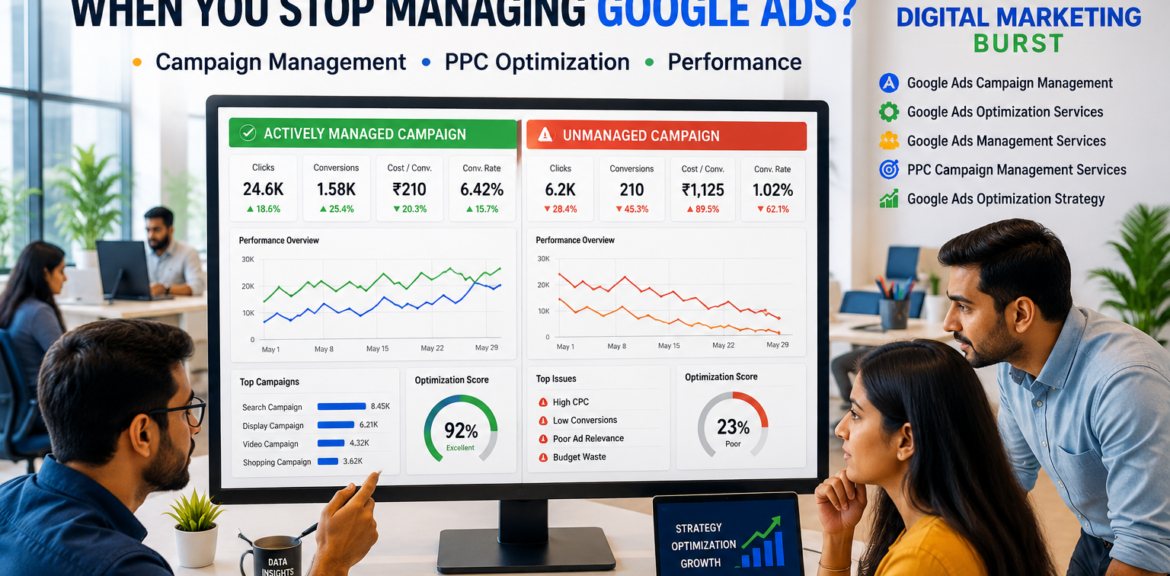

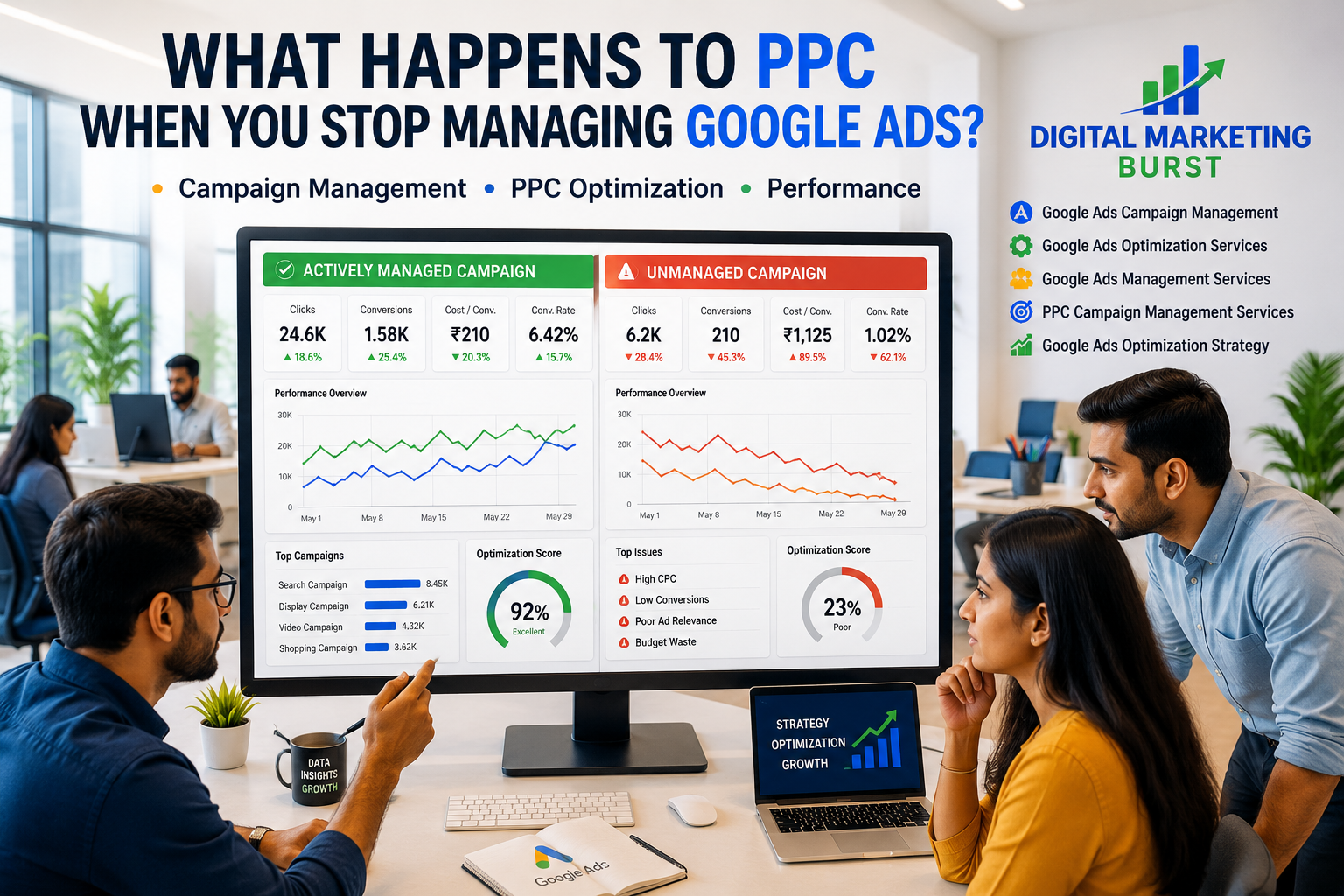
What Happens to PPC When You Stop Managing Google Ads?
Why PPC Campaigns Change Even When You Change Nothing
A common misconception is that a profitable PPC campaign will remain profitable if nobody touches it. However, paid search operates in a changing environment. Your campaign may remain exactly the same while everything around it changes.
Competitors can introduce stronger offers, improve landing pages, change advertising budgets, or target new search themes. Customer demand may also move because of seasonality, pricing, trends, or economic conditions. Therefore, an unchanged campaign is still participating in a changing marketplace.
This is one reason long periods without account review can create problems. Performance can decline gradually rather than suddenly. A small increase in acquisition cost may not attract attention this week. Yet several small increases over a few months can materially change profitability.
Regular analysis does not mean constantly editing campaigns. Instead, it means understanding whether existing settings still match current conditions.
Advertisers should compare meaningful periods, investigate unusual changes, and consider what happened outside the advertising account as well. This approach helps separate temporary fluctuations from problems that deserve action.
Google Ads Campaign Optimization for Changing Search Behaviour
Google Ads Campaign Optimization becomes particularly valuable when the language customers use starts changing. Search behaviour is not permanently fixed. New products appear, terminology evolves, and customers begin asking different questions.
A campaign created months ago may therefore attract a different mix of searches today.
Search-term insights can help advertisers understand this shift. Some new queries may reveal valuable demand that was not considered during the original campaign setup. Others may show informational or unrelated intent that contributes little business value.
The correct response is not automatically to block every search that fails to convert quickly. Some searches need more data before a useful conclusion can be reached.
Instead, advertisers should examine intent, cost, conversions, and business relevance together.
This information can also influence landing pages and SEO. If customers repeatedly use a particular phrase, businesses may need to explain that topic more clearly on their website.
In this way, paid-search optimization becomes a source of customer insight rather than simply an exercise in changing campaign settings.
What Happens to Your Google Ads When Competitors Change Strategy?
Your competitors do not need permission to change their PPC strategy.
A new advertiser can enter the auction. Existing competitors can increase budgets, introduce stronger advertisements, change landing pages, or improve offers.
As a result, your campaign performance can change even when you have made no modifications.
This is particularly important in competitive industries where several companies target similar customers.
Suppose your advertisement previously offered one of the strongest propositions in the market. If several competitors introduce more attractive pricing or benefits, your original message may become less persuasive.
Clicks might continue, yet conversion rate could decline.
Regular PPC review helps identify these situations.
However, the response should not always be to increase bids. Sometimes the stronger solution is improving the offer, advertisement, landing page, or overall positioning.
PPC data should therefore be interpreted alongside market conditions.
What Happens to Google Ads CPC When Campaigns Go Unmanaged?
Cost per click can move up or down without direct intervention from the advertiser.
Auction competition is one reason. Changes in search demand can also influence the type of auctions your campaign enters.
Therefore, an unmanaged account may gradually experience a different cost structure.
However, CPC should never be analyzed alone.
A ₹100 click that produces profitable business can be more valuable than a ₹20 click that produces nothing. Likewise, reducing average CPC is not necessarily an improvement if it results in lower-quality traffic.
The better question is whether the cost of acquiring meaningful business remains sustainable.
Advertisers should compare CPC with conversion rate, acquisition cost, conversion value, and lead quality where relevant.
When nobody reviews the account, rising CPC may remain unnoticed until the total advertising cost becomes uncomfortable.
Regular monitoring provides earlier visibility and more time to determine whether the change reflects competition, traffic mix, campaign settings, or another factor.
Why Cost Per Conversion Can Increase Over Time
Cost per conversion can rise for several reasons.
Clicks may become more expensive. Conversion rate may decline. Search traffic could become less relevant. The website might perform worse. Customer demand may also weaken.
Sometimes several factors occur simultaneously.
This makes diagnosis important.
For example, if CPC remains stable while acquisition cost rises, the problem may be occurring after the click. The landing page, offer, form, or traffic quality deserves investigation.
If conversion rate remains stable but CPC increases, auction conditions may deserve more attention.
An unmanaged campaign removes this diagnostic process.
The advertiser sees the monthly bill but may not understand why the result changed.
Effective management therefore focuses on explaining performance rather than simply reporting numbers.
Understanding the cause makes it easier to choose an appropriate response.
Google Ads Optimization for Conversion Quality
Google Ads Optimization should not focus only on increasing the number shown in the conversions column.
Conversion quality matters.
Imagine two campaigns. The first produces 100 leads, while the second generates 50. Based only on volume, the first appears better.
However, suppose five leads from the first campaign become customers while 20 leads from the second campaign convert into sales.
The business value changes completely.
This is why communication between marketing and sales can improve PPC decisions.
When advertisers understand which enquiries become customers, they can evaluate campaigns beyond surface-level lead counts.
An unmanaged account may continue chasing the easiest conversion rather than the most valuable one.
For businesses with longer sales cycles, connecting offline outcomes with advertising can be particularly useful when technically and operationally appropriate.
The objective should be improving business results, not merely making platform metrics look attractive.
What Happens When Google Ads Conversion Tracking Breaks?
Tracking problems can be particularly damaging because they affect both reporting and optimization.
A website update can change a form. A confirmation page may be removed. A tag can stop firing correctly. Consent implementation can affect measurement.
If nobody checks the account, these issues may continue for days or weeks.
The business could still receive customers while the advertising dashboard reports fewer conversions.
Alternatively, duplicate tracking can create the opposite problem. The account appears to perform extremely well because one customer action is counted several times.
Automated bidding may then make decisions using distorted information.
Therefore, tracking should be treated as infrastructure rather than a one-time setup.
Whenever major website changes occur, important conversion actions should be tested.
Businesses should also compare advertising reports with CRM, sales, booking, or ecommerce data where possible.
Google Ads Management Services for Conversion Tracking
Professional Google Ads Management Services should pay attention to measurement because optimization cannot be stronger than the data supporting it.
Before making major campaign changes, a manager should understand what each conversion action represents.
A phone call may have different value from a completed purchase. A newsletter signup is not necessarily equivalent to a sales enquiry.
If every action is treated identically, performance reports can become misleading.
Therefore, businesses need a clear conversion hierarchy.
Primary actions should represent the outcomes campaigns are expected to optimize toward, while other useful interactions may still be measured separately where appropriate.
Regular review also helps identify outdated conversion actions that are no longer relevant.
This becomes increasingly important as automated campaign decisions depend heavily on the signals advertisers provide.
Better measurement creates a stronger foundation for better optimization.
What Happens When Your Landing Page Changes but Google Ads Does Not?
Website teams and advertising teams do not always make changes at the same time.
A landing page may be redesigned without reviewing the advertisements that send traffic to it.
This can create a mismatch.
For example, an advertisement might promote a specific benefit that is no longer clearly visible on the new page. Users click expecting one experience but receive another.
Conversion rate can decline even though the PPC account itself has not changed.
More serious problems can also occur.
A form may stop working. A button may lead to the wrong page. Mobile layout issues may make conversion difficult.
If campaigns remain unmanaged, these problems can continue consuming budget.
Therefore, PPC reviews should include landing-page checks.
The advertising platform only represents part of the customer journey. Performance after the click can be equally important.
Google Ads Landing Page Experience and PPC Performance
A strong landing page should help visitors quickly understand what the business offers and what they should do next.
The message should connect naturally with the advertisement.
If someone searches for a specific service and clicks an ad about that service, sending them to a generic homepage can create unnecessary friction.
Page speed also matters.
Mobile users may abandon slow pages before the offer appears.
Forms should request enough information to qualify prospects without becoming unnecessarily difficult to complete.
Trust elements can help visitors feel more comfortable taking action.
However, the correct combination varies by business.
This is why landing-page improvement should be based on customer behaviour and testing rather than assumptions.
When PPC and website teams work together, paid traffic can produce more useful insights than when both channels are managed independently.
PPC Campaign Management Services for Lead Generation
PPC Campaign Management Services can be especially important for lead-generation businesses because not every conversion represents the same commercial opportunity.
A campaign may produce form submissions at a low cost. However, the sales team might discover that many enquiries request unavailable services or come from unsuitable locations.
Without that feedback, the advertising dashboard can make the campaign look successful.
Lead-generation management should therefore look beyond quantity.
Location relevance, customer intent, requested service, lead quality, and eventual sales can all provide useful context.
Over time, this information can influence targeting, advertisements, landing pages, and measurement.
For example, an advertisement can communicate service boundaries more clearly when irrelevant enquiries repeatedly come from unsupported locations.
This can improve both user experience and sales-team efficiency.
The strongest PPC process connects marketing data with what actually happens after an enquiry arrives.
PPC Management Services for Ecommerce Businesses
PPC Management Services for ecommerce need a different performance framework.
Instead of focusing mainly on lead quantity, online retailers often evaluate revenue, order value, product margin, and advertising return.
However, revenue alone can still be misleading.
Two products may generate the same sales value but have very different margins.
Inventory also matters.
An automated campaign can continue promoting products according to available data, while the business may prefer to prioritize categories with stronger stock levels or strategic importance.
Seasonal demand can change quickly as well.
Therefore, ecommerce PPC benefits from coordination between advertising, inventory, pricing, promotions, and website teams.
Leaving campaigns unattended can create situations where advertising priorities no longer match commercial priorities.
PPC Management for Small Business
Small businesses often ask whether they need ongoing PPC management when their campaign is relatively simple.
The answer depends on spending, complexity, internal knowledge, and business importance.
A small account may not need daily strategic changes.
However, it still benefits from consistent monitoring.
A tracking problem that wastes ₹5,000 may be minor for a large advertiser but significant for a small business.
Likewise, a few irrelevant high-cost enquiries can affect a limited monthly budget.
Small businesses should therefore focus on the areas that matter most.
Accurate conversion tracking, relevant locations, strong search intent, useful landing pages, and clear offers often deserve more attention than complicated account structures.
A focused campaign can be easier to manage and understand.
Google Ads for Local Business Without Regular Management
Local campaigns have another risk: geographic relevance.
A business may only serve customers within a defined area.
If targeting settings or search intent are not aligned with that service area, advertising can attract people the company cannot help.
This problem can become expensive when the business operates in a competitive category.
Local advertisers should therefore review location performance and actual lead origins.
Search terms can also reveal whether people are looking for services in unsupported places.
Landing pages should communicate location clearly.
This reduces confusion for potential customers and helps the business receive more relevant enquiries.
Regular management therefore supports more than advertising efficiency. It can also reduce time spent responding to leads that were never commercially suitable.
Google Ads Optimization Strategy for Local Businesses
A practical Google Ads Optimization Strategy for local businesses should begin with geographic relevance.
The campaign needs to reach people who can realistically become customers.
Next comes search intent.
Broad visibility is not always useful for a company serving a limited region.
Advertisements should also make the service and location easy to understand.
Landing pages can reinforce that message.
For businesses receiving phone enquiries, call quality can provide another important signal. A high number of calls does not automatically mean the campaign is working if most callers need something the business does not offer.
Therefore, local PPC should connect geographic targeting with real enquiry quality.
This can help businesses spend more of their budget on potential customers rather than simply increasing traffic.
Google Ads Optimization Tips for Local PPC
Effective Google Ads Optimization Tips for local campaigns should focus on relevance before volume.
Start by understanding where profitable customers actually come from.
Then compare that information with campaign location performance.
Search terms can reveal another layer of intent.
If users frequently include locations outside the service area, advertisements or landing pages may need clearer messaging.
Business hours also deserve attention when calls or immediate enquiries are important.
However, scheduling decisions should be based on actual data rather than assumptions.
Mobile experience is particularly important for local searches because many users search while travelling or looking for an immediate solution.
Therefore, forms, phone buttons, maps, and key service information should work properly on smaller screens.
Local optimization works best when advertising and website experience support the same geographic promise.
Google Ads Search Intent Optimization
Search intent is one of the most useful concepts in PPC.
Two people can search for similar words while wanting completely different things.
One person may be researching. Another may be ready to purchase. A third may be looking for a job, tutorial, definition, or free resource.
Paying for all these visitors equally can reduce efficiency.
Advertisers should therefore examine what searches indicate about the user’s likely objective.
However, intent cannot always be determined from one word.
Context matters.
Landing pages and advertisements can also help filter users by clearly explaining what is offered.
When management stops, new intent patterns may appear without being noticed.
Regular analysis helps businesses understand how customers are searching today rather than relying entirely on keyword assumptions made months ago.
Broad Match Without PPC Oversight
Modern keyword matching can help advertisers reach searches beyond an exact list of manually selected phrases. This can create valuable opportunities, particularly when combined with suitable bidding and conversion signals.
However, broader reach increases the importance of measurement.
If conversion data is poor, the campaign may have less useful information for distinguishing valuable opportunities.
Search-term analysis also remains useful for understanding what kinds of queries are generating traffic.
The objective should not be to fear broader matching or automatically restrict everything.
Instead, advertisers should understand how it is performing within their specific account.
Automation can discover demand that manual keyword lists might miss.
Human oversight then helps determine whether that discovered demand is commercially useful.
Google Ads Account Structure Problems
An account can become messy over time.
Old campaigns remain active. Similar campaigns compete for budget. Naming conventions disappear. Multiple conversion actions accumulate.
When nobody manages the account, this complexity can continue growing.
Eventually, understanding performance becomes difficult.
Account structure should support decision-making.
A manager should be able to identify which campaigns serve different products, objectives, locations, or audiences without unnecessary confusion.
However, excessive segmentation can also create problems by spreading data too thinly.
Therefore, restructuring should have a reason.
The goal is not to create the largest possible number of campaigns. It is to organize advertising in a way that supports measurement, budget control, and business priorities.
Google Ads Campaign Management for Growing Businesses
As businesses expand, Google Ads Campaign Management often becomes more complex.
A company may add locations, services, products, or customer segments.
The advertising account needs to reflect these changes thoughtfully.
Simply copying an old campaign for every new service can create unnecessary duplication.
Instead, managers should consider whether each area needs separate budgets, messaging, landing pages, or measurement.
Growth can also change economics.
A service that was once the main revenue source may become less important. Another may become the priority.
Without regular management, advertising can remain focused on yesterday’s business.
Therefore, growing companies should review PPC strategy alongside broader commercial planning.
Why Old Google Ads Campaigns May Lose Efficiency
An older campaign is not automatically bad.
Historical data can be extremely useful.
However, age does not guarantee continued relevance.
Advertisements may contain outdated language. Landing pages may have changed. Customer expectations may be different.
Search behaviour can evolve.
Competitors may also have improved their digital marketing significantly since the campaign was created.
Therefore, older campaigns should be reviewed rather than automatically replaced.
Some may need only small improvements.
Others may require structural changes.
The important point is to preserve useful historical learning while updating elements that no longer match the market.
Ad Creative Fatigue in Google Ads
Creative fatigue is often discussed in social advertising, but search and other Google Ads formats also benefit from fresh, relevant messaging.
Customers compare multiple options.
An advertisement that once stood out can become less distinctive when competitors adopt similar claims.
Businesses also introduce new benefits, offers, proof points, and services.
If advertisements never change, those improvements may remain invisible to potential customers.
Creative review should therefore be part of campaign management.
However, new does not automatically mean better.
Tests should have a clear purpose.
Compare messages based on useful outcomes rather than replacing advertisements simply because they have been active for a certain number of days.
Google Ads Ad Copy Optimization
Ad copy should connect search intent with the business offer.
A useful advertisement tells the customer what is available and why the result may be relevant.
It should also avoid promises the business cannot support.
When campaigns are unmanaged, advertisements can become outdated.
Prices change. Promotions expire. Services evolve. Locations expand or close.
Therefore, periodic copy review protects both performance and customer expectations.
Strong messaging can also improve lead quality.
Clear eligibility requirements, service areas, or product information may discourage unsuitable clicks before the business pays for them.
That makes copy optimization useful for both conversion performance and budget efficiency.
Google Ads Assets and Campaign Performance
Campaign assets can provide additional information alongside advertisements.
Depending on campaign type and eligibility, businesses can use relevant assets to communicate useful details and direct users toward appropriate pages.
However, old or irrelevant assets can reduce message quality.
For example, a link to an outdated service page may remain attached long after the business changes its offer.
Phone information must also remain accurate.
Therefore, campaign reviews should include assets rather than focusing only on headlines and descriptions.
Small account elements can influence the customer experience.
An unmanaged account may contain technically active components that no longer represent the current business.
What Happens When Google Ads Budget Is Too Low?
A limited budget is not automatically a problem.
Many businesses intentionally operate within strict advertising limits.
The challenge is making that budget support the highest-priority opportunities.
If several campaigns compete for a small total amount, valuable campaigns may receive insufficient exposure.
An unmanaged account can continue distributing money according to old priorities.
Therefore, advertisers should periodically review whether budget allocation still matches business value.
Increasing the total budget is not always the solution.
Sometimes consolidation or prioritization can create a clearer strategy.
The right decision depends on performance, demand, profitability, and available resources.
What Happens When Google Ads Budget Is Too High?
More budget does not automatically create proportionally more profitable results.
If a campaign has limited high-quality demand, increasing spending can push advertising toward less valuable opportunities.
Therefore, scaling should be measured.
Advertisers need to understand how performance changes as spend increases.
A campaign producing excellent results at ₹50,000 per month may not maintain exactly the same efficiency at ₹5 lakh.
Market size matters.
Competition matters.
Conversion capacity also matters.
If the sales team cannot handle additional leads, buying more traffic may not create more revenue.
Budget decisions should therefore reflect the complete business system.
Google Ads Budget Optimization for Better ROI
Budget optimization focuses on directing available money toward areas that support business objectives.
This requires more than comparing cost per click.
Campaigns should be evaluated according to meaningful outcomes.
A higher-cost campaign may deserve more budget when it produces stronger customers.
Likewise, a low-cost campaign may need less investment when its conversions rarely create revenue.
Advertisers should also consider strategic priorities.
A newly launched product may deserve testing even before it has extensive historical data.
Therefore, budget optimization combines evidence with business judgment.
When campaigns remain unmanaged, the original budget structure can continue even after priorities have changed.
Why Google Ads Leads Become Expensive
Lead costs can rise because of auction pressure, lower conversion rates, weaker traffic quality, or changes in customer demand.
A business should therefore investigate the full funnel.
If CPC increases but conversion rate remains stable, competition may be one factor.
If clicks cost the same but fewer visitors submit enquiries, the landing page or offer may deserve attention.
When lead volume remains high but sales fall, lead quality becomes the key issue.
This diagnostic approach helps businesses avoid fixing the wrong problem.
Simply reducing bids may lower traffic without improving profitability.
The correct response depends on why leads became more expensive.
How to Reduce Google Ads Cost Per Lead
Reducing cost per lead starts with improving efficiency, not simply spending less.
Better search intent can reduce irrelevant traffic.
Clearer advertisements can attract more appropriate prospects.
A stronger landing page can convert more of the existing traffic.
Accurate measurement can help bidding systems work toward useful outcomes.
However, businesses should also ask whether lower cost per lead is truly the best objective.
A ₹500 lead that never becomes a customer is more expensive commercially than a ₹1,500 lead that frequently produces profitable sales.
Therefore, optimization should consider lead value as well as acquisition cost.
Google Ads Lead Quality Optimization
Lead quality can become one of the most important metrics for service businesses.
Marketing teams often celebrate increasing conversion volume. Sales teams may have a different experience.
If many leads are irrelevant, additional volume creates work without creating proportional revenue.
Therefore, PPC teams should seek feedback.
Which leads became customers? Which were outside the service area? Which requested unavailable services? Which lacked purchasing intent?
Patterns can then influence advertising decisions.
This feedback loop makes PPC more commercially useful.
Without it, campaigns may optimize toward whatever action is easiest to measure rather than what creates genuine value.
PPC Campaign Management Strategy
A strong PPC Campaign Management Strategy should combine measurement, traffic quality, creative communication, landing-page performance, and business feedback.
These elements influence one another.
Weak tracking can mislead bidding. Poor search intent can reduce landing-page conversion. Unclear advertisements can attract unsuitable visitors.
Therefore, optimization should not treat each metric as an isolated problem.
Start with the business objective.
Then identify how advertising contributes to that objective.
Afterward, determine which measurements can reliably show progress.
This structure creates a more stable management process.
It also prevents teams from chasing every dashboard fluctuation without understanding its commercial importance.
PPC Budget Optimization Strategy
A PPC Budget Optimization Strategy should answer one practical question: where can available advertising money create the most useful business outcome?
Historical performance provides one source of evidence.
However, businesses also need to consider future priorities.
A campaign promoting a newly important service may deserve investment even without years of historical data.
Seasonality can change priorities as well.
Therefore, budget allocation should be reviewed periodically.
Avoid spreading money across too many campaigns merely to maintain visibility everywhere.
Concentrating investment around stronger opportunities can sometimes provide clearer data and better control.
PPC Conversion Optimization Services
PPC Conversion Optimization Services connect paid traffic with what happens after users arrive.
A campaign can deliver highly relevant visitors and still struggle when the website creates friction.
Therefore, conversion improvement should examine page speed, mobile usability, messaging, forms, calls to action, trust signals, and offer clarity.
However, website optimization should not hide poor traffic quality.
If irrelevant users reach the page, redesigning the form will not solve the fundamental problem.
The strongest approach evaluates both sides.
First, attract appropriate users. Then make it easy for those users to understand the offer and take the intended action.
Paid Search Management Services
Paid Search Management Services focus on keeping paid-search investment aligned with customer intent and business goals.
Search advertising is powerful because users actively express what they want.
However, that does not mean every search has equal value.
Advertisers need to understand the difference between research, comparison, purchase, support, employment, and unrelated intent.
Regular management helps identify these patterns.
It can also reveal changes in demand earlier than some other marketing channels because search queries reflect what customers are actively looking for.
This makes paid-search data useful beyond the advertising account itself.
Professional Google Ads Management
Professional Google Ads Management should provide more than a monthly report filled with platform metrics.
Businesses need interpretation.
Why did acquisition cost change? Which campaigns produced stronger prospects? What needs testing next? Are tracking systems reliable?
Clear reporting should answer these questions in language the business can understand.
The manager should also explain uncertainty.
Not every performance movement has one obvious cause.
Sometimes additional data is required before making a major decision.
A professional approach recognizes this rather than changing settings simply to demonstrate activity.
Google Ads Campaign Audit Before Optimization
Before taking over an unmanaged account, an audit can provide valuable context.
Start with measurement.
Then review campaign objectives, budget distribution, targeting, search behaviour, creative assets, landing pages, and historical changes.
Look for obvious technical problems.
However, avoid assuming that every unusual setting is wrong.
Previous managers may have made decisions for specific business reasons.
Therefore, historical context is useful.
Once the major opportunities are identified, prioritize them according to potential impact.
This creates a cleaner optimization roadmap than changing dozens of unrelated settings at once.
Digital Marketing Burst Google Ads Management Services
Digital Marketing Burst Google Ads Management Services can help businesses approach PPC as a measurable marketing investment rather than an advertising account that simply needs to remain switched on.
The starting point is understanding the business goal.
From there, campaign data can be reviewed in relation to search intent, conversion performance, advertising cost, and lead or sales quality.
Regular analysis can help identify problems before they remain unnoticed for long periods.
At the same time, optimization should remain disciplined.
Making unnecessary daily changes is not the objective.
The stronger approach is to identify meaningful opportunities, implement informed improvements, and evaluate what happens next.
This balance between automation and strategic oversight is increasingly important for modern Google Ads accounts.
Digital Marketing Burst Google Ads Optimization Strategy
A Digital Marketing Burst Google Ads Optimization Strategy can combine paid-search data with broader digital marketing insights.
Search terms can reveal topics customers care about.
Landing-page behaviour can highlight website problems.
Conversion data can show which offers attract stronger responses.
Meanwhile, SEO insights can help businesses understand organic and paid search behaviour together.
Connecting these areas creates a more complete picture of customer demand.
However, every decision should remain tied to measurable objectives.
Adding more tools and reports does not automatically improve marketing.
The value comes from using information to make better decisions.
Digital Marketing Burst PPC Campaign Management
Digital Marketing Burst PPC Campaign Management can focus on maintaining a clear connection between advertising activity and commercial outcomes.
For lead-generation businesses, this means looking beyond form submissions.
For ecommerce companies, it can mean evaluating value and profitability rather than simply counting purchases.
Local businesses may need stronger geographic relevance.
Every account therefore requires context.
A generic optimization checklist can identify basic issues, but long-term improvement comes from understanding what success means for the individual business.
This is why ongoing communication between advertiser and manager remains important even as campaign automation becomes more advanced.
Google Ads Management and SEO Working Together
PPC and SEO should not always operate as isolated channels.
Paid-search data can reveal high-intent search themes quickly.
Those insights may support future organic content.
SEO data can also reveal topics where a business already performs strongly or where paid visibility may provide additional support.
Landing pages often serve both channels.
Improving page quality can therefore benefit the broader search experience.
However, businesses should measure paid and organic performance separately enough to understand what each channel contributes.
The goal is coordination, not mixing all results into one unclear report.
Google Ads Search Data for SEO Strategy
Search advertising can provide useful clues for SEO because it reveals how users interact with commercial messaging.
High-performing search themes may inspire organic landing pages or educational content.
Repeated customer questions can become FAQ topics.
Poor-performing searches can also teach businesses what not to target.
However, paid-search performance should not be treated as a direct guarantee of organic ranking potential.
The two systems work differently.
Instead, use PPC data as one source of audience insight.
Combine it with organic search research, website analytics, customer questions, and business priorities.
This creates a stronger content strategy than relying on one dataset alone.
Why PPC and SEO Need Different Optimization
PPC can generate visibility through paid auctions, while SEO aims to earn organic visibility.
Therefore, optimization methods differ.
A PPC manager can change budget, bidding, advertisements, and targeting directly.
SEO changes often require content development, technical improvements, authority building, and time.
However, both channels benefit from understanding user intent.
They also share landing-page quality as an important business consideration.
Therefore, teams can exchange useful insights without treating the channels as identical.
A business using both can build a more balanced search strategy.
Google Ads Performance Monitoring
Performance monitoring should identify meaningful changes without creating constant panic.
Advertisers can establish key metrics connected with their goals.
For lead generation, those might include qualified conversions and acquisition cost.
Ecommerce businesses may focus on conversion value and profitability-related measures.
The appropriate dashboard depends on the business.
Alerts can also help identify unusual spending or tracking changes.
However, automated alerts still require interpretation.
A metric moving outside its normal range tells you something changed. It does not always explain why.
Human analysis remains necessary to determine the appropriate response.
How Often Should Google Ads Be Reviewed?
Review frequency should match account activity.
A high-spend account can generate meaningful data quickly and may require frequent monitoring.
A small campaign with a few conversions per month may need longer periods before strategic conclusions become reliable.
Some elements deserve faster attention regardless of size.
Tracking failures, broken URLs, rejected advertisements, or unexpected spending can require prompt investigation.
Strategic performance decisions may need more patience.
Therefore, advertisers should separate monitoring frequency from optimization frequency.
You can check an account regularly without changing it every time.
That distinction helps prevent both neglect and over-management.
Daily Google Ads Management vs Weekly Optimization
Not every account needs significant changes every day.
Daily monitoring can be useful for large accounts, promotions, launches, or time-sensitive campaigns.
However, optimization often benefits from longer evaluation periods.
Weekly or periodic analysis can reveal patterns that daily fluctuations hide.
The correct rhythm depends on data volume.
The key principle is to avoid two extremes.
One extreme is ignoring the account for months.
The other is changing settings so frequently that no strategy has enough time to produce meaningful information.
Good management creates a review schedule appropriate to the account.
Monthly Google Ads Optimization
Monthly reviews provide an opportunity to step away from short-term fluctuations and examine broader trends.
Compare spending, conversions, acquisition cost, traffic quality, and business outcomes.
Consider seasonality before comparing months directly.
Review which campaigns gained or lost efficiency.
Then investigate why.
Monthly analysis is also useful for discussing business changes.
Perhaps a new service is launching next month. Maybe an existing product will be discontinued.
These developments should influence future advertising priorities.
A monthly review therefore connects historical performance with upcoming strategy.
Signs Your Google Ads Need Optimization
Several patterns can indicate that an account deserves closer investigation.
Costs may be rising while meaningful conversions remain flat.
Lead volume can increase while quality falls.
Search terms may show irrelevant intent.
Conversion tracking may no longer match CRM or sales data.
Landing pages could have changed.
Another warning sign is simply uncertainty.
If nobody in the business can explain what campaigns are trying to achieve or why budgets are allocated in a particular way, the account likely needs a strategic review.
Optimization begins with understanding.
When Google Ads Management Becomes Essential
The need for structured management usually increases as advertising spend, campaign complexity, and business dependence on PPC grow.
A company spending a small experimental budget faces different risks from one generating a large percentage of its sales through paid search.
More campaigns also create more decisions.
Multiple regions, products, conversion goals, and audiences require coordination.
At that stage, occasional account checks may no longer provide enough oversight.
Businesses need a repeatable process for monitoring, analysis, testing, and reporting.
This does not mean every account requires a large agency.
It means the level of management should match the commercial importance of the advertising.
What Happens If You Ignore PPC for Six Months?
Six months is enough time for substantial changes to occur.
Competition may shift.
Customer demand can move through different seasons.
The website may receive several updates.
Products, pricing, or business priorities might change.
Meanwhile, enabled campaigns can continue operating according to their existing settings and goals.
Performance may remain strong. It may improve. It may decline.
The problem is that nobody knows why without reviewing the data.
When management resumes, the first step should therefore be analysis rather than immediately rebuilding everything.
Historical information from the unmanaged period can reveal valuable patterns.
Can Google Ads Automation Replace PPC Management?
Automation can replace many manual tasks, but it does not automatically replace strategic oversight.
Modern advertising systems can make sophisticated bidding and delivery decisions.
However, businesses still need to determine what they want those systems to accomplish.
Measurement quality remains crucial.
Creative inputs remain important.
Business priorities still change.
Therefore, the manager’s role increasingly involves strategy, data quality, customer understanding, and performance interpretation.
Automation should remove unnecessary manual work.
It should not remove accountability for whether advertising is producing useful business outcomes.
Google Ads Management in the AI Era
As advertising automation becomes more advanced, management is shifting toward higher-level decisions.
Advertisers need to provide accurate conversion signals.
Creative quality becomes increasingly important.
First-party business information can help teams understand which customers have genuine value.
Managers also need to evaluate how automated systems interact with budgets and business objectives.
Therefore, successful PPC management in the AI era is not about manually controlling every possible decision.
It is about creating the conditions in which automation can pursue the right objective while humans continue checking whether that objective remains commercially useful.
Stopping active management does not automatically switch off PPC performance. Instead, it removes a layer of observation and strategic adjustment while the advertising environment continues changing.
Competition can increase. Search behaviour can shift. CPC and acquisition costs can move. Landing pages may develop problems, while conversion tracking can become inaccurate. Meanwhile, automated systems can continue operating according to the signals already available.
That is why businesses need a balanced approach. PPC should not be changed constantly, but it should not be abandoned either.
Regular monitoring, meaningful conversion measurement, search-intent analysis, budget evaluation, landing-page review, and business feedback can help advertisers understand whether their campaigns still support current goals.
For Digital Marketing Burst, the central principle is straightforward: modern PPC management should combine useful automation with human business context. That approach gives advertisers a better chance of identifying problems early and making decisions based on evidence rather than assumptions.
What Happens When Google Ads Keep Spending Without Review?
An active campaign can continue using its available advertising budget even when nobody regularly reviews performance. That does not automatically mean the campaign is wasting money. However, it creates a risk because spending can continue while business conditions change.
For example, a company may change its pricing, discontinue a service, or introduce a better product. Yet an older campaign can continue promoting the previous priority. Traffic may still arrive, but that traffic may no longer represent the best use of the advertising budget.
The same issue can occur with lead quality. Conversion numbers may look stable while the sales team notices that fewer enquiries are becoming customers. Without communication between marketing and sales, this difference can remain hidden.
Therefore, businesses should not judge campaign health simply by checking whether ads are receiving clicks. Spending needs to be connected with useful outcomes.
Regular reviews help advertisers understand where money is going, what that investment produces, and whether the current campaign still deserves the same budget.
What Happens If You Stop Google Ads Optimization?
Stopping optimization does not necessarily cause an immediate performance collapse. A mature campaign may continue generating results for some time, particularly when its market and business conditions remain relatively stable.
However, the account loses its ability to respond intentionally to new information.
Search behaviour may change. New competitors can appear. Conversion rates might decline. Certain advertisements may become outdated. Meanwhile, the business itself can introduce new priorities that are not reflected inside the account.
Over time, these differences can create a gap between what the campaign is optimizing toward and what the company actually needs.
That gap is one of the biggest risks of leaving PPC unattended.
Optimization should not mean changing something every day. Instead, advertisers need to evaluate meaningful data and decide whether existing settings still make sense.
Sometimes the correct optimization decision is to make no change at all. However, that decision should come from analysis rather than neglect.
Can Google Ads Run Without Management?
Google Ads can use automation for many campaign decisions, so campaigns do not require a person to manually control every auction.
However, running automatically and remaining strategically aligned are different things.
Automated systems work with the objectives, conversion data, creative assets, budgets, and other signals available to them. If those inputs are outdated or inaccurate, campaign decisions can move toward an objective that no longer reflects genuine business value.
Suppose an account records every basic enquiry as an important conversion. Automation may work toward generating more of those actions. Yet the sales team might know that only a small percentage represent qualified prospects.
Human oversight provides that commercial context.
Therefore, businesses can use automation extensively while still reviewing whether the system is pursuing the right outcomes.
Modern PPC management is increasingly about guiding automation rather than attempting to manually replace it.
Why Google Ads Need Regular Optimization
Regular optimization helps campaigns remain connected with current market conditions and business priorities.
Customer demand does not stay identical throughout the year. Competition changes, while websites, prices, products, and services also evolve.
Therefore, campaigns should be reviewed periodically.
The review process can begin with performance trends. Advertisers can examine whether meaningful conversions are growing, declining, or becoming more expensive.
Search intent provides another layer of information. Landing-page performance can show whether traffic converts effectively after arriving.
Meanwhile, business feedback helps determine whether recorded conversions are commercially useful.
However, optimization frequency should match the amount of data available. A small campaign should not necessarily receive major changes every few days.
The objective is controlled improvement.
Advertisers need enough monitoring to identify problems while giving strategies enough time to generate meaningful information.
Google Ads Campaign Performance Optimization
Google Ads Campaign Performance Optimization involves identifying which parts of an account contribute to useful business outcomes and which areas require investigation.
Performance should be examined across several levels.
A campaign may have a strong click-through rate but a weak conversion rate. Another might generate conversions efficiently but produce poor-quality leads. A third could appear expensive while generating customers with significantly higher value.
Therefore, one metric cannot explain the entire account.
Advertisers should connect traffic, conversion, and business data whenever possible.
Historical comparisons are also useful. However, seasonality must be considered. Comparing a peak sales month with a naturally quiet month can produce misleading conclusions.
Effective performance optimization asks why a metric changed before deciding what to do about it.
That approach can reduce unnecessary edits and produce more useful strategic decisions.
Google Ads Account Optimization Services
Google Ads Account Optimization Services can help businesses examine an existing advertising setup without assuming that everything needs to be rebuilt.
An account may contain years of useful performance information. Therefore, deleting historical structures without analysis can remove valuable context.
A better approach begins with an audit.
Conversion actions should be reviewed first because they influence how performance is interpreted. Campaign objectives, budgets, search behaviour, targeting, advertisements, and landing pages can then be evaluated.
Afterward, the most important opportunities can be prioritized.
Some accounts may have one major tracking problem. Others may suffer from several smaller inefficiencies.
Therefore, optimization should be based on the account’s actual condition rather than a generic promise that every setting must be changed.
Google Ads Campaign Management Services
Professional Google Ads Campaign Management Services should create a repeatable process for understanding campaign performance.
The process begins with clear goals.
A business looking for qualified leads needs a different measurement framework from an ecommerce company focused on profitable sales.
Once the objective is established, managers can evaluate whether the account is collecting useful information.
Search intent, budget allocation, campaign structure, creative performance, landing pages, and conversion quality can then be reviewed in context.
Reporting should explain what happened rather than simply present numbers.
For example, saying that CPC increased is useful information. Explaining whether that increase affected acquisition cost or profitability is more valuable.
Good management therefore combines monitoring with interpretation.
Professional Google Ads Optimization
Professional Google Ads Optimization should be based on evidence rather than the number of changes made inside an account.
Some businesses assume an agency must constantly edit campaigns to prove that work is happening.
However, excessive changes can make performance harder to understand.
A professional manager may sometimes decide that the account needs more data before another major adjustment.
At other times, immediate action may be necessary because tracking has failed or a landing page is broken.
The skill lies in knowing the difference.
Optimization should therefore follow a cycle. Identify the issue, develop a reasonable explanation, make an appropriate change, and evaluate the result.
This creates a more disciplined process than making unrelated changes simply because the dashboard provides many settings that can be edited.
Google Ads Optimization Best Practices
Strong Google Ads Optimization Best Practices begin with measurement accuracy.
Advertisers need to know whether recorded conversions represent meaningful actions. Otherwise, optimization can become focused on misleading data.
Next, understand traffic quality.
Search terms and targeting information can help reveal whether campaigns attract relevant users.
Creative messaging should support the customer’s intent. Landing pages should then continue the same message after the click.
Budget allocation deserves regular review as well.
Campaigns should not continue receiving money solely because they were historically important.
Finally, avoid making decisions from one short period without considering context.
A few poor days do not always indicate a failing strategy.
Longer trends, business conditions, and sufficient data generally produce stronger decisions.
Google Ads Optimization Services India
Businesses searching for Google Ads Optimization Services India often want to improve existing campaigns rather than start advertising from zero.
The first priority should be understanding what is already working.
Historical campaign data can reveal profitable search themes, stronger locations, useful creative messages, and valuable customer behaviour.
Next, identify weaknesses.
The account may contain inaccurate conversions, inefficient traffic, weak landing pages, or outdated campaign priorities.
Indian advertising markets can also differ significantly by industry and location. Search behaviour in one city may not match another.
Therefore, businesses should avoid copying a strategy simply because it worked for a different advertiser.
Optimization needs to reflect the company’s market, budget, customer journey, and commercial objective.
Google Ads Management Services India
Google Ads Management Services India can support businesses that need ongoing monitoring but do not have a dedicated internal PPC team.
Management should begin with understanding the company’s commercial model.
A campaign designed for immediate ecommerce purchases requires different analysis from one generating enquiries for a high-value service.
Local competition also varies widely.
Therefore, managers need to understand where customers are located and what they are searching for.
Budget size matters as well.
Smaller businesses may need to concentrate spending around their strongest opportunities, while larger advertisers can test broader strategies.
Regardless of account size, reporting should remain connected with useful outcomes rather than focusing entirely on traffic volume.
PPC Management Services India
PPC Management Services India can cover campaign monitoring, paid-search strategy, conversion measurement, creative review, and budget analysis.
However, businesses should understand what they actually need before choosing a management approach.
Some companies have strong internal marketing teams but need specialist PPC support. Others require complete campaign management.
A growing company may also need help connecting advertising data with CRM or sales outcomes.
Therefore, service scope can vary.
The most important principle remains measurement.
Whether PPC is managed internally or externally, the business should understand which results justify continued investment.
Clear goals also make agency communication easier because both sides can evaluate performance using the same definition of success.
Google Ads Optimization Agency India
Choosing a Google Ads Optimization Agency India should involve more than comparing management fees.
Businesses need to understand how the agency evaluates success.
Does it focus only on clicks and impressions? Does it examine conversions? Can it discuss lead quality, revenue, or another meaningful outcome?
Communication also matters.
Advertisers should know what significant changes are being made and why.
Likewise, the agency needs information from the business.
Changes in pricing, stock, service areas, customer quality, or sales priorities can affect advertising strategy.
Therefore, PPC works best as a collaborative process.
The platform provides advertising data, while the client provides business context. Combining both can lead to more informed decisions.
Google Ads Management Agency India
A Google Ads Management Agency India can be useful when campaign complexity grows beyond what an internal team can comfortably manage.
Multiple products, locations, campaigns, and conversion actions create more opportunities for performance differences.
An agency can provide structured monitoring and specialized knowledge.
However, outsourcing does not mean the business should completely disconnect from its advertising.
Management teams still need feedback about customer quality and changing priorities.
A campaign can look excellent inside the platform while producing weak commercial outcomes.
Regular communication helps close that gap.
Businesses should therefore look for an agency relationship that combines transparent reporting, strategic reasoning, and a clear understanding of the company’s objectives.
Best Google Ads Management Services
People searching for the Best Google Ads Management Services are often trying to find a provider capable of improving advertising efficiency.
However, “best” should be evaluated according to business requirements rather than one universal ranking.
A local service company may need strong lead-generation experience.
An ecommerce brand may care more about revenue, product feeds, and profitability.
B2B companies can have longer customer journeys that require different measurement.
Therefore, businesses should examine experience, reporting quality, communication, tracking knowledge, and strategic approach.
Promises of guaranteed performance should be treated carefully because advertising outcomes depend on many variables.
A strong management service should explain opportunities and risks clearly while making decisions based on available evidence.
Best PPC Management Company India
A business searching for the Best PPC Management Company India should first define what it wants PPC to achieve.
Without a clear objective, comparing agencies becomes difficult.
Ask how performance will be measured.
For lead generation, the discussion should extend beyond cheap enquiries. Lead quality and sales outcomes may matter more.
For ecommerce, revenue without profitability context can also be incomplete.
Businesses should also understand how frequently the account will be reviewed and how major changes will be communicated.
A suitable PPC partner should help clients understand their advertising rather than making the account unnecessarily mysterious.
Transparency creates better collaboration and stronger long-term decision-making.
Google Ads Optimization for Small Business
Small companies can benefit significantly from Google Ads Optimization for Small Business because limited budgets leave less room for irrelevant traffic.
The first priority should be focus.
Instead of targeting every possible service or location, businesses can concentrate on commercially important areas.
Conversion measurement should also remain simple and meaningful.
A form submission, phone enquiry, booking, or purchase should be tracked according to the business model.
Next, search intent should be reviewed.
A small company may not need enormous traffic volume. It needs enough relevant prospects to justify its investment.
Therefore, optimization should emphasize quality and efficiency rather than competing for every available impression.
Google Ads Management for Lead Generation
Google Ads Management for Lead Generation requires more than maximizing form submissions.
The quality of those forms matters.
A business can receive hundreds of enquiries and still struggle to generate sales.
Therefore, managers should seek feedback about what happens after the conversion.
Are prospects answering follow-up calls? Do they need the service being advertised? Are they located in supported areas? Can they afford the product?
These answers help reveal whether campaign metrics reflect real business opportunity.
Over time, advertisers can use this feedback to refine messaging, targeting, and measurement.
This creates a stronger connection between marketing and sales.
Google Ads Management for Ecommerce
Google Ads Management for Ecommerce should connect advertising with product economics.
Revenue is important, but margin can be equally significant.
Some products can support higher advertising costs because they generate stronger profit. Others may produce high sales value but limited margin.
Inventory also influences strategy.
Advertising an unavailable product aggressively creates a poor customer experience.
Therefore, ecommerce PPC management benefits from updated product data, accurate conversion measurement, and coordination with commercial teams.
Seasonal promotions need similar attention.
Campaigns should reflect current offers rather than continuing to display outdated messaging.
PPC Management for B2B Companies
B2B campaigns often have longer conversion journeys.
A user may click an advertisement today but become a customer weeks or months later.
Therefore, immediate form submissions do not always provide the complete picture.
Lead quality becomes particularly important.
A small number of highly relevant decision-makers can be more valuable than hundreds of low-intent enquiries.
Businesses should therefore connect marketing and sales information whenever practical.
Sales teams can identify which leads progressed into genuine opportunities.
PPC managers can then use those patterns to evaluate campaign quality.
Without this connection, optimization may focus on generating more forms instead of generating stronger commercial opportunities.
How Unmanaged Google Ads Can Affect Lead Quality
Lead quality can deteriorate without causing an obvious warning inside the account.
Conversion numbers may remain stable.
Cost per conversion might even improve.
However, the sales team can simultaneously notice more irrelevant enquiries.
This happens because platform conversions measure configured actions, not necessarily final customer value.
Therefore, businesses should compare advertising results with downstream outcomes.
If quality declines, investigate search intent, locations, messaging, landing pages, and conversion definitions.
Do not automatically assume the bidding strategy is responsible.
A structured investigation can reveal where unsuitable prospects enter the funnel.
How Unmanaged PPC Can Affect ROI
Return on investment can change even when traffic remains stable.
Advertising costs are only one part of the equation.
Conversion rate, customer value, product margin, repeat purchases, and sales quality can all influence commercial return.
Therefore, a campaign should not be evaluated solely through click volume.
An unmanaged account may continue generating conversions while the economics behind those conversions deteriorate.
For example, customer acquisition cost could rise while average customer value falls.
Regular management helps businesses identify these relationships.
The objective is not to guarantee positive ROI. Instead, it is to provide enough information to understand whether paid advertising continues to make commercial sense.
How to Improve Google Ads ROI
Improving Google Ads ROI requires attention to both advertising efficiency and customer value.
Reducing irrelevant traffic can help.
Improving landing-page conversion can also create more value from existing clicks.
However, businesses should not overlook what happens after a customer converts.
Better lead qualification, sales follow-up, product margins, and repeat purchases can influence the final return.
Therefore, marketing optimization should connect with broader business operations.
Sometimes the strongest improvement does not come from reducing CPC.
It comes from attracting a better customer.
That is why campaign managers should understand the commercial value behind conversions rather than optimizing purely toward platform averages.
Google Ads ROAS Optimization Strategy
A Google Ads ROAS Optimization Strategy can be useful for businesses that measure conversion value accurately.
However, ROAS needs context.
A high revenue-to-ad-spend ratio does not automatically mean high profitability.
Product margins, fulfilment costs, returns, and customer lifetime value can affect the actual business result.
Therefore, advertisers should choose targets that make sense economically.
Overly aggressive efficiency targets can also limit scale.
The business may need to balance profitability with growth.
Regular management helps evaluate that trade-off.
Instead of chasing the highest possible dashboard number, advertisers can focus on a level of advertising return that supports their broader objectives.
Google Ads Conversion Optimization Services
Google Ads Conversion Optimization Services should examine both the advertising account and the customer experience after the click.
Traffic needs to match the offer.
Advertisements should set accurate expectations.
Landing pages then need to make the next action clear.
Businesses should also test important conversion paths on different devices.
A form that works perfectly on desktop may be frustrating on mobile.
Likewise, a phone number or checkout button can fail after a website update.
These problems can reduce campaign performance without creating an obvious PPC error.
Therefore, conversion optimization requires coordination between advertising and website teams.
Google Ads Cost Optimization Strategy
A Google Ads Cost Optimization Strategy should focus on improving economic efficiency rather than blindly reducing spending.
Cheap traffic is not automatically valuable.
The objective is to pay an appropriate amount for opportunities that can create meaningful business results.
Search intent is therefore important.
Conversion quality matters as well.
Landing-page performance can influence how much value each click produces.
Budget allocation adds another layer.
Campaigns with stronger commercial potential may deserve more investment even when their CPC is higher.
Therefore, cost optimization should consider the complete customer journey.
Simply lowering bids can reduce visibility without solving the actual performance problem.
Google Ads CPC Optimization Strategy
A Google Ads CPC Optimization Strategy should treat cost per click as one input rather than the final objective.
Advertisers naturally want affordable traffic.
However, the cheapest clicks can come from weaker intent.
A higher CPC can still be sustainable when conversion rate and customer value justify the cost.
Therefore, CPC should be evaluated alongside acquisition cost and business outcomes.
If click costs rise, investigate why.
Competition may have increased. Search mix may have changed. Campaign targeting could be entering different auctions.
Once the cause becomes clearer, advertisers can decide whether the increase requires action.
Google Ads Bidding Strategy Optimization
Google Ads Bidding Strategy Optimization begins with selecting an objective that reflects the campaign’s purpose.
Automated bidding can use many signals that humans cannot evaluate manually in real time.
However, it still relies on the goals and data available to the campaign.
Therefore, inaccurate conversions can weaken the quality of the optimization objective.
Businesses should avoid changing bidding strategies repeatedly based on a few days of performance.
Major changes need sufficient evaluation time.
At the same time, advertisers should review whether the selected strategy continues to fit current goals.
The right approach balances automation with informed oversight.
Google Ads Keyword Optimization Services
Google Ads Keyword Optimization Services should focus on customer intent rather than simply building enormous keyword lists.
Search language can reveal whether users are researching, comparing, or preparing to buy.
Therefore, keyword decisions should consider the commercial meaning behind a query.
Historical conversion data can help identify useful themes.
Search-term analysis may also reveal new opportunities.
However, advertisers should avoid making decisions from tiny samples.
A keyword that has not converted after a handful of clicks may not necessarily be poor.
Cost, intent, and available data should be considered together.
Google Ads Negative Keyword Optimization
Negative keyword management can help advertisers reduce certain irrelevant searches where appropriate.
However, blocking too much can restrict useful demand.
Therefore, exclusions should be based on clear intent.
Businesses can examine search terms for patterns that repeatedly indicate unsuitable users.
Employment searches, unrelated services, or unsupported product categories may be relevant examples depending on the company.
Yet every account is different.
A phrase that is irrelevant for one advertiser can be valuable for another.
Regular analysis helps maintain this balance between reach and relevance.
Google Ads Location Targeting Optimization
Location targeting deserves careful attention for businesses with defined service areas.
A company serving only certain cities should avoid creating the impression that it operates everywhere.
Campaign settings, advertisements, and landing pages should communicate the real service boundary.
Lead data can help verify whether geographic targeting is working as intended.
If enquiries repeatedly arrive from unsupported areas, advertisers should investigate the cause.
However, location settings are only one part of the solution.
Search intent and page messaging can also influence where leads come from.
Clear communication can reduce confusion before a user submits an enquiry.
Google Ads Mobile Optimization Strategy
Mobile users often represent a significant portion of paid-search traffic, depending on the industry.
Therefore, campaigns should be evaluated alongside the mobile website experience.
Pages need to load efficiently.
Important information should be easy to find.
Forms must remain usable on smaller screens.
Phone calls should work correctly when they represent a valuable conversion action.
Advertisers should also compare performance by device when sufficient data exists.
Differences can reveal website or customer-behaviour issues.
However, device decisions should be based on business results rather than assumptions that one device type is universally better.
Google Ads Performance Drops After Website Redesign
A website redesign can unexpectedly affect PPC.
URLs may change.
Tracking can break.
Forms can behave differently.
Important content may move lower on the page.
The new design can look visually attractive while converting fewer paid visitors.
Therefore, advertising performance should be monitored closely after significant website changes.
If conversions decline, compare the customer journey before and after the redesign.
Check technical tracking as well.
Do not immediately assume the campaign itself has become weaker.
The source of the problem may exist entirely on the website.
Google Ads Performance Drops After Budget Changes
Budget changes can affect campaign delivery and overall account performance.
However, the relationship is not always linear.
Doubling budget does not guarantee twice as many conversions.
Reducing budget can also change which opportunities receive investment.
Therefore, significant budget changes should be monitored.
Businesses should understand whether additional spending maintains acceptable efficiency.
Likewise, budget reductions should be prioritized rather than applied blindly across every campaign.
The strongest areas may deserve protection while weaker campaigns receive closer review.
Google Ads Performance Drops After Bidding Changes
Bidding changes can coincide with temporary performance fluctuations, so advertisers should avoid evaluating major decisions too quickly.
Automated strategies may need time and sufficient data to adapt.
However, waiting indefinitely is not appropriate either.
Businesses should define what they expect the strategy to achieve and monitor whether results move toward that objective.
Historical context helps.
If performance deteriorates significantly, investigate conversion tracking, auction conditions, budgets, and other changes made around the same period.
Avoid assuming that one setting explains everything.
Multiple factors can influence performance simultaneously.
Why Google Ads Stop Generating Leads
A sudden decline in leads can have several causes.
First, confirm whether the decline is real.
Tracking may have stopped recording conversions even though enquiries continue.
Next, check website functionality.
A broken form or phone button can immediately reduce reported results.
Then examine traffic.
Impressions, clicks, search demand, and targeting changes can reveal whether fewer potential customers are reaching the website.
Competition and seasonality may also influence demand.
By following this sequence, advertisers can diagnose the problem systematically instead of making random campaign changes.
Why Google Ads Get Expensive Over Time
Advertising costs can change because auctions are dynamic.
More competitors may enter the market.
Existing advertisers can change strategies.
Customer demand may also increase for certain searches.
However, rising cost does not automatically mean the campaign is becoming less profitable.
If customer value increases or conversion quality improves, higher advertising costs may remain sustainable.
Therefore, businesses should evaluate cost in context.
An unmanaged campaign makes this harder because nobody is regularly connecting changing costs with changing outcomes.
Monitoring creates the information needed to make that comparison.
Google Ads Campaign Management vs Automation
Google Ads Campaign Management and automation serve different purposes.
Automation can process enormous amounts of auction data and make real-time decisions.
Management provides strategic direction.
A business decides which services matter, what a qualified conversion looks like, how much a customer is worth, and which commercial constraints exist.
Therefore, the strongest approach does not require choosing one side.
Advertisers can use automated capabilities while maintaining strategic oversight.
As automation becomes more sophisticated, this relationship becomes even more important.
The manager’s role shifts toward supplying better inputs and evaluating whether outputs support business goals.
Human PPC Management vs Google Automation
Humans cannot manually process every auction signal at machine speed.
Automation cannot independently understand every internal business priority.
Therefore, both have limitations.
A human manager can recognize that the company wants to reduce demand for one service and increase another.
They can also understand sales-team complaints about poor lead quality.
Automation can react to large amounts of performance data far more quickly.
Combining these strengths can create a more practical approach.
Businesses provide context and goals. Automated systems handle suitable execution tasks. Managers then review whether results remain aligned with the intended outcome.
Is Google Ads Management Still Important in 2026?
Google Ads management remains relevant, but the work is evolving.
Manual control over every small decision is becoming less central.
Measurement, strategy, creative quality, conversion data, and business context are becoming more important.
Advertisers need to understand what their campaigns are optimizing toward.
They also need to know whether those goals represent actual value.
Therefore, management in 2026 should not be defined by the number of buttons clicked inside an account.
Its value comes from making better decisions about objectives, inputs, performance, and commercial outcomes.
Google Ads AI and PPC Management
AI-driven advertising tools can help process data, generate recommendations, and automate parts of campaign execution.
However, AI does not remove the need for reliable inputs.
Poor conversion data can still create weak optimization goals.
Unclear business objectives can still produce unclear strategies.
Creative quality also remains important.
Therefore, businesses should use AI to improve efficiency while maintaining accountability for final marketing decisions.
The strongest question is not whether AI can manage PPC.
It is whether the complete advertising system has enough accurate information to pursue the right business outcome.
Future of PPC Campaign Management Services
The future of PPC Campaign Management Services is likely to involve less repetitive manual work and more strategic interpretation.
Managers can spend more time understanding customer value, improving measurement, coordinating creative strategy, and connecting advertising with business data.
Automation can handle many execution-level tasks.
However, this increases the importance of defining goals correctly.
If a system becomes better at optimizing toward an objective, choosing the wrong objective becomes an even bigger problem.
Therefore, future PPC specialists will need both platform knowledge and commercial understanding.
Digital Marketing Burst Google Ads Campaign Optimization
Digital Marketing Burst Google Ads Campaign Optimization can focus on identifying meaningful performance opportunities rather than making unnecessary changes.
The process can begin with campaign objectives and conversion measurement.
Search intent, advertising costs, landing pages, creative messaging, and business outcomes can then be evaluated together.
This approach helps determine where a problem actually exists.
For example, a weak conversion rate does not automatically require different keywords. The landing page may be responsible.
Likewise, expensive traffic is not necessarily bad when it generates valuable customers.
Optimization becomes stronger when decisions are based on the complete customer journey.
Digital Marketing Burst Google Ads Management
Digital Marketing Burst Google Ads Management can support businesses that want ongoing visibility into their paid advertising rather than simply allowing campaigns to operate unattended.
Regular account analysis can help identify performance changes, tracking issues, search-intent shifts, and budget inefficiencies.
However, management should remain measured.
Not every fluctuation requires intervention.
The objective is to distinguish meaningful trends from normal variation.
By combining PPC data with business context, Digital Marketing Burst can approach campaign decisions around useful outcomes rather than surface-level traffic metrics.
This creates a more commercially focused framework for paid advertising.
Digital Marketing Burst PPC Optimization Strategy
A Digital Marketing Burst PPC Optimization Strategy can combine search advertising, conversion analysis, website experience, and broader marketing insights.
The customer journey does not end at the advertisement.
Therefore, campaign performance should be evaluated alongside landing-page behaviour and final business outcomes.
Search data can also provide useful content insights.
Frequently searched questions may inspire SEO articles, service pages, or FAQs.
Meanwhile, conversion information can reveal which messages attract stronger prospects.
Connecting these insights can help businesses use PPC data beyond the advertising dashboard.
Digital Marketing Burst PPC Management for Indian Businesses
Indian businesses can operate in very different markets, so a single PPC formula cannot fit everyone.
Local companies may depend heavily on geographic relevance.
National ecommerce businesses can face a much broader competitive environment.
B2B advertisers may prioritize qualified enquiries over large conversion volumes.
Therefore, Digital Marketing Burst PPC Management for Indian Businesses can begin by understanding the company’s actual market and objective.
Campaign strategy can then be aligned with budget, customer behaviour, location, and conversion value.
This is more useful than copying a campaign structure simply because another business achieved good results with it.
Why Choose Digital Marketing Burst for Google Ads Management?
Businesses looking for PPC support generally need clarity about how their advertising investment is performing.
Digital Marketing Burst can position its approach around strategy, measurement, optimization, and understandable reporting.
The focus should remain on meaningful results rather than promising guaranteed rankings, leads, or revenue.
Campaigns can be reviewed for search intent, conversion accuracy, budget allocation, creative relevance, and landing-page alignment.
More importantly, recommendations can be connected with the client’s business objective.
That approach helps PPC management become part of a wider growth strategy rather than an isolated technical activity.
Digital Marketing Burst Google Ads Optimization for Better Performance
Digital Marketing Burst Google Ads Optimization for Better Performance can begin by identifying the strongest constraint in an account.
Some businesses need better traffic quality.
Others need stronger conversion tracking.
A campaign may already attract relevant users but lose them on a weak landing page.
Another account might have good website performance while spending too much on low-value search intent.
Therefore, optimization should not begin with a predetermined solution.
Diagnosis comes first.
Once the primary problem is understood, improvements can be prioritized according to potential impact and available evidence.
Google Ads Campaign Audit by Digital Marketing Burst
A Google Ads Campaign Audit by Digital Marketing Burst can provide businesses with a structured understanding of an existing account before major changes are made.
The audit can examine campaign objectives, conversion measurement, traffic relevance, search behaviour, budget distribution, bidding, advertisements, and landing pages.
Historical performance should also be considered.
An old campaign may contain valuable data even when its current structure needs improvement.
Therefore, auditing before rebuilding can protect useful insights.
The final objective should be identifying high-priority opportunities rather than producing a long list of minor technical observations with little commercial impact.
How to Recover an Unmanaged Google Ads Account
Recovery should begin with observation.
Do not immediately change every campaign.
First, understand what happened during the unmanaged period.
Review spending, traffic, conversions, search behaviour, budgets, and major performance changes.
Then confirm that tracking works correctly.
Afterward, compare current campaigns with the company’s current products, services, locations, and priorities.
Outdated elements can then be identified.
Next, prioritize improvements.
Critical technical issues should come first. Strategic optimization can follow.
This gradual process preserves useful historical data while reducing the risk of making too many simultaneous changes.
Google Ads Account Recovery Strategy
A Google Ads Account Recovery Strategy should separate urgent problems from long-term improvements.
Broken conversion tracking requires different treatment from slightly declining click-through performance.
Expired offers or incorrect URLs may require immediate correction.
Meanwhile, structural changes should be considered more carefully.
Historical data can help determine what previously worked.
Business feedback can reveal whether old conversion patterns still represent valuable customers.
Once measurement is reliable, advertisers can begin testing improvements.
This creates a stable foundation for future optimization rather than replacing one period of neglect with a period of excessive editing.
Should You Restart or Rebuild Google Ads Campaigns?
Rebuilding everything is not always necessary.
Existing campaigns may contain useful historical information and structures that still work.
Therefore, advertisers should audit before deciding.
If the campaign objective remains relevant and performance problems are limited, targeted improvements may be enough.
A rebuild can make more sense when the business has changed substantially or the existing structure no longer supports current objectives.
However, major restructuring should have a strategic reason.
Starting from zero simply because an account has been unmanaged can remove context without guaranteeing better results.
How Long Does Google Ads Optimization Take?
There is no universal optimization timeline.
Accounts differ in spending, conversion volume, competition, industry, and customer journey.
A high-volume ecommerce campaign can generate useful information much faster than a specialized B2B campaign with a few monthly conversions.
Therefore, businesses should avoid expecting every change to produce an immediate conclusion.
Some technical corrections can have an immediate effect.
Strategic tests usually need more data.
Managers should define what they are testing and what evidence would support a decision.
Patience is useful when it is connected with measurement rather than passive waiting.
How to Prevent Google Ads Budget Waste
Preventing inefficient spending requires a combination of accurate measurement and regular review.
Start by ensuring campaigns represent current business priorities.
Then evaluate search relevance and conversion quality.
Landing pages should work correctly and communicate the offer clearly.
Budgets should reflect commercial value rather than historical habit.
Businesses should also create a regular reporting process.
When nobody is responsible for reviewing performance, small issues can continue unnoticed.
However, the objective should not be eliminating every unsuccessful click.
Advertising always contains uncertainty.
The goal is improving the overall efficiency of the investment.
How to Improve PPC Campaign Performance
Improving PPC begins with identifying the strongest limitation.
If relevant users are not reaching the website, investigate targeting and search intent.
When good traffic arrives but conversions remain weak, examine the landing page.
If conversions are plentiful but sales quality is poor, connect marketing data with sales feedback.
When customer quality is strong but acquisition cost is unsustainable, review economics, competition, bidding, and budget.
This sequence helps advertisers focus on causes rather than symptoms.
As a result, optimization becomes more strategic and less reactive.
PPC Campaign Optimization Checklist 2026
A useful PPC Campaign Optimization Checklist 2026 should begin with conversion accuracy and current business objectives.
Next, advertisers can review campaign performance, search behaviour, location relevance, budgets, bidding goals, advertisements, assets, and landing pages.
Website functionality deserves attention as well.
After major updates, forms and conversion actions should be tested.
Sales or CRM feedback can then provide another layer of information.
Finally, document important changes.
A clear record helps teams understand what was tested and why.
This creates continuity even when different people work on the account over time.
Google Ads Management Checklist 2026
A Google Ads Management Checklist 2026 should distinguish monitoring from optimization.
Monitoring asks whether campaigns are functioning normally.
Optimization asks whether performance can be improved.
Check spending patterns, conversion tracking, URLs, campaign status, and unusual performance changes regularly.
Then schedule deeper analysis according to account size and data volume.
Review search intent, conversion quality, budget priorities, creative messaging, and landing pages.
Finally, compare advertising outcomes with business results.
This broader view helps prevent a campaign from looking successful in the dashboard while delivering disappointing commercial value.
What Businesses Should Do Before Leaving Google Ads Unmanaged
Businesses that cannot actively manage campaigns for a period should reduce avoidable risks before stepping away.
First, verify that conversion measurement is working.
Next, check budgets and ensure they remain financially appropriate.
Review advertisements for promotions or dates that could become outdated.
Landing pages should be tested.
Businesses can also establish basic monitoring for unexpected spending or major performance problems where available.
However, these precautions do not make an account permanently self-managing.
They simply reduce obvious risks.
Someone should still review performance periodically, particularly when advertising represents an important source of customers.
Is Stopping Google Ads Management Worth the Risk?
The answer depends on how important PPC is to the business.
A small experimental campaign creates different risk from an account responsible for a major percentage of monthly leads or sales.
However, completely removing oversight creates uncertainty in either case.
The account may continue performing well, but the business will have less visibility into changing conditions.
Therefore, the better approach is often reducing unnecessary management rather than eliminating review completely.
Automation can handle suitable execution tasks.
Periodic human analysis can then ensure the system remains aligned with commercial objectives.
This balance can provide efficiency without turning the account into an unattended marketing expense.
Final Conclusion: What Happens to PPC When You Stop Managing Google Ads?
When active management stops, Google Ads does not necessarily stop producing clicks, traffic, leads, or sales. Campaigns can continue operating through their existing settings and automated systems. However, the environment around them keeps changing.
Competition evolves. Customer searches shift. Costs fluctuate. Websites are updated. Tracking can break, while lead quality may move in a different direction from conversion volume.
Therefore, Google Ads Campaign Management remains important because it provides oversight and commercial context. Businesses considering Google Ads Optimization Services should focus on improving meaningful outcomes rather than generating unnecessary account activity.
Similarly, Google Ads Management Services can help connect advertising data with current business objectives, while PPC Campaign Management Services provide a structured process for monitoring paid-search investment. A carefully designed Google Ads Optimization Strategy can then combine automation, accurate measurement, relevant traffic, strong landing pages, and informed human decisions.
For Digital Marketing Burst, the central lesson is simple: a successful PPC account should not be managed merely to keep it busy, nor should it be abandoned because automation exists. The stronger approach is to measure what matters, review meaningful changes, use automation intelligently, and keep advertising aligned with real business goals.