







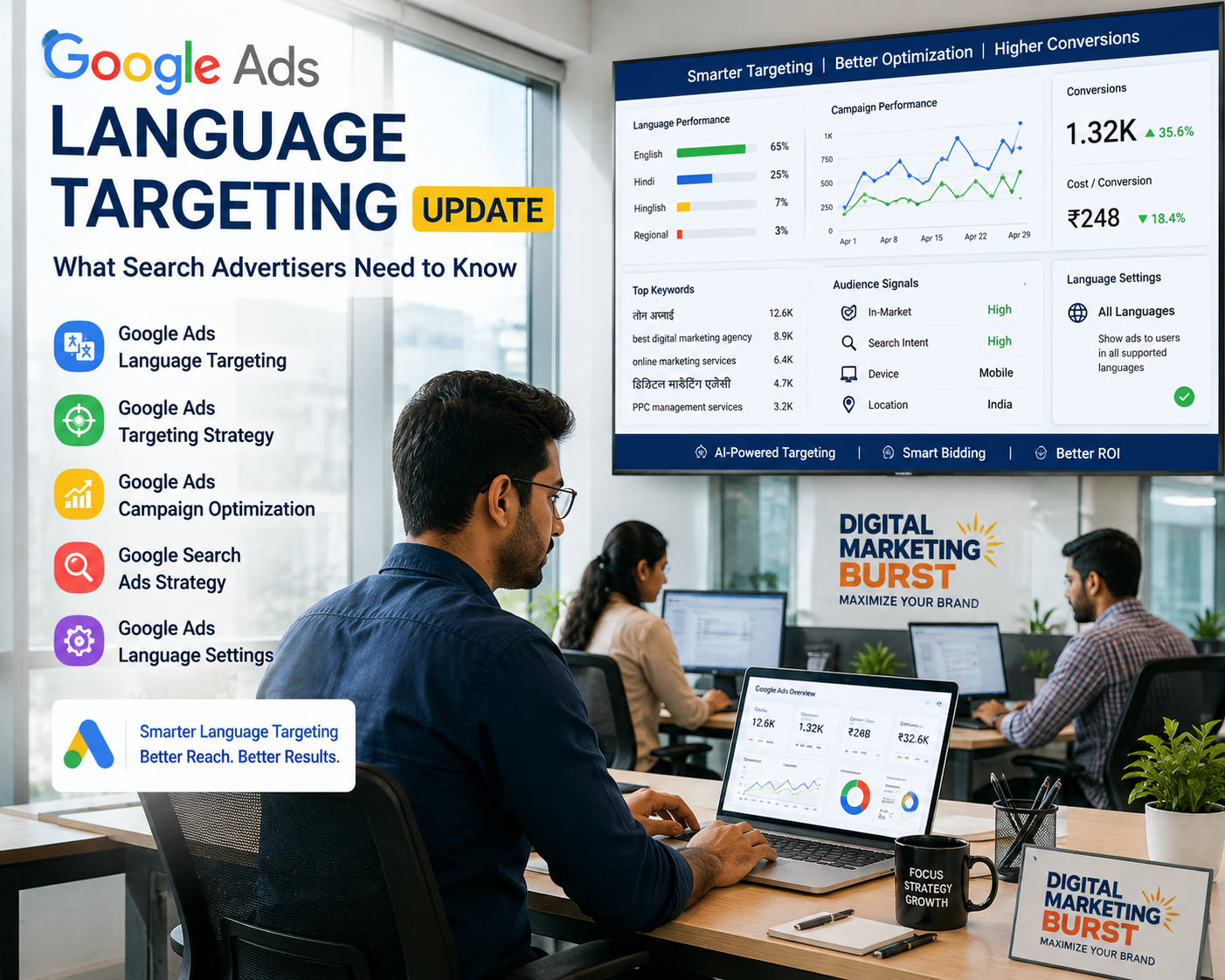
Google Ads Language Targeting Update: What Search Advertisers Need to Know
Google Ads Language Targeting Update: What Search Advertisers Need to Know
Google Ads Language Targeting is changing how advertisers think about multilingual Search campaigns. At the same time, Google Ads Targeting Strategy, Google Ads Campaign Optimization, Google Search Ads Strategy, and Google Ads Language Settings are becoming more closely connected with Google’s automated systems. For advertisers, this means language can no longer be treated as a small campaign setting that is configured once and then forgotten.
Google has increasingly used signals beyond the literal language of a search query. Its documentation explains that Search ads can reach multilingual users when Google believes they understand a targeted language. Signals can include query language, user settings, and other signals interpreted by Google AI.
This matters greatly in multilingual markets such as India. A person may use an English phone interface, search partly in Hindi, type a product name in English, and eventually convert on an English landing page. Another customer may alternate between Hindi and English throughout the buying journey. Therefore, advertisers need to think beyond a simple one-language-one-campaign model.
The bigger question is no longer only, “Which language should I select?” Instead, marketers need to understand how keywords, ad copy, landing pages, location, user intent, automation, and language signals work together.
What Is Google Ads Language Targeting?
Google Ads Language Targeting has traditionally allowed advertisers to select the languages understood by the audiences they want their campaigns to reach.
The concept sounds simple. An advertiser selects English, Hindi, or another supported language and expects Google to use that selection while determining ad eligibility.
However, Google’s system has already been more sophisticated than simply reading a user’s browser language.
Google explains that Search campaigns can target one language, multiple languages, or all languages. The system can use several signals to estimate which languages a person understands. Therefore, someone searching in one language can sometimes receive an advertisement written in another language when Google believes the person understands it.
This distinction is important for digital marketers.
Language targeting has never meant that every query must be typed in the exact selected language. Instead, it has been one part of a larger eligibility system.
As Google increases automation, marketers need to focus more closely on what their ads communicate and whether their landing pages create a consistent experience.
Google Ads Language Targeting Strategy
A strong Google Ads Language Targeting Strategy starts with understanding actual customer behaviour.
Suppose a business targets customers in Lucknow. It may assume that Hindi should automatically be the primary advertising language because Hindi is widely spoken in the city. Yet its Search data may reveal that high-intent customers frequently type queries such as “best digital marketing agency,” “Google Ads agency near me,” or “SEO company in Lucknow.”
The customer’s spoken language and search language are not always identical.
Therefore, campaign decisions should be based on search behaviour rather than assumptions.
Advertisers should study Search terms, conversion data, customer locations, landing-page engagement, and actual sales quality. These signals provide a clearer picture of how language affects performance.
The same principle applies to national campaigns.
India contains customers who comfortably move between English and regional languages. Consequently, a rigid language structure may sometimes overlook how real users search.
The best strategy connects language with intent. It asks which queries generate qualified visitors, which ads communicate most clearly, and which landing-page language produces stronger conversion behaviour.
Why Google Ads Language Targeting Is Changing
Google Ads has been moving steadily toward AI-assisted campaign management.
Broad match has become more dependent on intent interpretation. Smart Bidding uses multiple auction-time signals. Responsive Search Ads automatically combine assets. AI-powered Search features continue moving campaign management away from purely manual rules.
Language matching fits into this wider direction.
Historically, advertisers had more responsibility for selecting campaign languages. The announced change moves more of that decision toward automated language understanding.
This can reduce configuration work. However, it also creates new questions.
Advertisers running multilingual campaigns may wonder whether the correct creative will always reach the correct user. Businesses operating in markets with several languages may also worry about losing a manual layer of control.
These concerns are reasonable.
Automation can simplify account management, but it makes monitoring more important rather than less important.
Marketers should therefore understand the transition instead of assuming that automation automatically produces the best possible result.
Google Ads Targeting Strategy After the Language Update
A modern Google Ads Targeting Strategy should not depend on language selection alone.
Location remains important. Keywords remain important. Search intent matters. Ad relevance matters. Landing-page experience also matters.
Imagine a company that serves only Lucknow.
Removing or automating a language control does not mean the business should suddenly target every location in India. Geographic targeting still needs to reflect the areas where the company can actually serve customers.
Similarly, language automation does not remove the need for strong keyword research.
A customer searching “PPC agency Lucknow” has different intent from someone searching “what is PPC.” Both may use English, yet the commercial value of those searches is completely different.
Therefore, targeting needs several layers.
Language is one signal within a much larger advertising system.
Businesses that understand their customers, locations, commercial queries, negative keywords, landing pages, and conversion goals will remain better positioned than businesses that depend entirely on automated defaults.
Google Advertising Targeting Strategy
A Google Advertising Targeting Strategy should connect campaign targeting with the business model.
Local businesses need tight geographic relevance. Ecommerce businesses may need broader coverage. Service companies may prioritize lead quality. National brands may need different creative experiences across regions.
Language should support these objectives.
For example, an advertiser might discover that English Search ads generate most high-value leads in metropolitan markets. Hindi creative may perform strongly for another audience. A third campaign may require regional-language landing pages to create enough trust for conversion.
There is no universal language structure that works for every account.
That is why historical performance data matters.
Marketers should examine which language combinations generate impressions, clicks, qualified enquiries, sales, and revenue. They should also identify whether different language experiences influence conversion rate.
Once that information is available, targeting decisions become more meaningful.
The objective is not to preserve old campaign structures simply because they are familiar. It is to build a structure that reflects how customers actually discover and choose the business.
How Google Detects a Search User’s Language
Google does not depend on one signal to determine language understanding.
Its current documentation says language detection can consider the language of the query, user settings, and other signals interpreted with Google AI.
Consider a multilingual user.
Their device may use English. They may regularly search in Hindi and English. Their Google activity may demonstrate an understanding of both languages.
In such a case, treating that person as exclusively English-speaking or Hindi-speaking would not reflect their real behaviour.
Google’s automated interpretation tries to address this complexity.
For advertisers, however, the important lesson is not to obsess over predicting every signal Google uses.
Instead, focus on the parts you control.
Write clear advertisements. Match them to relevant searches. Use landing pages that genuinely support the promise made in the ad. Track meaningful conversions. Review Search terms. Compare performance across important audience and geographic segments.
Those fundamentals become more valuable as automated systems handle more eligibility decisions.
Google Ads Language Settings
Google Ads Language Settings have traditionally appeared within campaign configuration alongside other targeting controls.
Google’s current Help documentation still provides instructions for choosing languages in new campaigns and changing languages across multiple campaigns.
That is important because updates do not necessarily appear identically in every advertiser account at the same moment.
If your account still shows language controls, that does not necessarily contradict an announced transition. Product changes can roll out gradually.
Advertisers should therefore avoid making unnecessary account changes based only on screenshots from another marketer.
Check your own campaign interface.
More importantly, do not treat the presence or absence of a setting as the entire strategy.
The underlying question is whether your ads are reaching relevant users and producing the desired business result.
If performance changes during a rollout, compare data before drawing conclusions. Look at impressions, Search terms, clicks, conversion rate, cost per conversion, location performance, and lead quality.
Google Ads Language Targeting Settings
Google Ads Language Targeting Settings have historically given advertisers a visible control for defining languages at campaign level.
As automation expands, the practical role of this manual selection may become smaller for Search.
That changes how campaign managers should think.
Previously, someone might build separate campaign structures partly around language settings. In a more automated environment, the actual language of keywords, advertisements, assets, and landing pages can become increasingly important to how the campaign communicates.
This does not mean advertisers should mix every language randomly inside one ad group.
Clarity still matters.
If a campaign targets Hindi-speaking customers, the complete experience should make sense. A Hindi-oriented ad leading to a confusing or unrelated English page may create friction, depending on the audience.
Likewise, translating only the headline without considering the searcher’s intent rarely creates a genuinely localized campaign.
Language strategy should therefore cover the entire user journey.
Google Ads Campaign Optimization After Language Targeting Changes
Google Ads Campaign Optimization should become more data-focused as manual controls become more automated.
Advertisers should establish a performance baseline before judging the impact of an update.
Start with historical impressions and clicks. Then compare click-through rate, conversion rate, cost per acquisition, conversion value, Search terms, and lead quality.
If performance changes, investigate the cause before assuming language automation is responsible.
Seasonality may have changed.
Competitors may have increased bids. Search demand may have fallen. Budgets may be limiting campaigns. Landing-page problems may have reduced conversion rates.
Google’s own Search documentation lists budget limitations, low search volume, disapproved creatives or landing pages, and unmet targeting requirements among factors that can affect keyword eligibility
Good optimization separates correlation from cause.
If multilingual traffic genuinely changes after a language rollout, then advertisers can test new ad copy, keyword structures, landing pages, and exclusions where applicable.
The objective is measurable improvement, not constant reaction to every interface change.
Google Ads Optimization Strategy for Multilingual Campaigns
A Google Ads Optimization Strategy for multilingual campaigns should begin with segmentation of performance data.
Do not assume that every language requires an entirely separate campaign. At the same time, do not assume that combining everything is automatically more efficient.
Look at actual differences.
If English and Hindi search behaviour produces different keywords, offers, conversion rates, or customer expectations, separating parts of the experience may still make analytical sense.
The reason for segmentation should be performance, not habit.
Landing pages deserve particular attention.
Users who click a localized advertisement should arrive on a page that feels relevant. The offer, price, service details, call to action, and location information should remain consistent.
Translation quality matters as well.
Poor machine-translated copy can damage trust even when targeting works perfectly.
Therefore, multilingual optimization needs coordination between paid media, copywriting, landing-page design, analytics, and conversion tracking.
Google Search Ads Strategy in an AI-Driven Environment
A modern Google Search Ads Strategy needs to balance automation with advertiser control.
Automation can analyse signals at a scale that manual campaign managers cannot replicate. However, Google does not know every commercial detail of your business automatically.
It does not inherently know which enquiries your sales team considers poor quality. It may not understand that one service has low margins while another is highly profitable unless your conversion data communicates that distinction.
Advertisers still provide strategic direction.
Conversion tracking tells the system what outcomes matter. Keywords and creative provide context. Landing pages explain the offer. Geographic settings define serviceable markets. Budgets determine how aggressively campaigns can participate.
Therefore, AI should be treated as part of the advertising system rather than as a replacement for strategy.
The businesses most likely to benefit are those feeding the system accurate information while continuing to review commercial outcomes.
Google Search Advertising Strategy for India
A Google Search Advertising Strategy in India has an additional challenge: linguistic diversity.
India is not a single-language search market.
English, Hindi, Bengali, Marathi, Tamil, Telugu, Gujarati, Kannada, Malayalam, Punjabi, Urdu, and other languages influence digital behaviour. Google Ads supports targeting for numerous Indian languages, including Hindi, Bengali, Gujarati, Kannada, Malayalam, Marathi, Punjabi, Tamil, Telugu, and Urdu. (Google Help)
Yet language usage is not always cleanly separated.
A customer may speak Hindi at home, use an English smartphone interface, type Hinglish into Search, and complete a purchase on an English website.
Another user may strongly prefer regional-language content.
Therefore, Indian advertisers should analyse actual search behaviour instead of making broad assumptions about a state or city.
Localization can still be valuable, especially when customer comfort and trust depend on language. However, it should be supported by data and high-quality creative rather than translation for its own sake.
How the Google Ads Language Update Can Affect Indian Advertisers
Indian advertisers should pay particular attention to multilingual search patterns.
A business operating in Uttar Pradesh may receive queries written in English, Hindi, and Romanized Hindi. Ecommerce advertisers may receive even greater linguistic variation across states.
Automated language understanding could potentially help advertisers reach multilingual users more naturally.
However, marketers should monitor whether the traffic remains commercially relevant.
Look beyond clicks.
A rise in impressions may appear positive, but it has limited value if qualified conversions decline. Similarly, lower click volume is not automatically negative if conversion quality improves.
This is where strong measurement becomes essential.
Advertisers should track leads through the sales process where possible. Knowing which campaigns produced genuine customers provides much better optimization data than counting form submissions alone.
For Indian businesses, language automation should therefore be evaluated through business outcomes, not merely reach.
Does the Language Update Mean Keywords No Longer Matter?
No.
Language automation and keyword matching solve different problems.
Language systems help Google understand communication and user language signals. Keywords and matching systems help determine whether a Search campaign is relevant to a query.
Google continues to document keyword matching and campaign prioritization for Search.
Therefore, keyword research remains important.
Advertisers should still identify high-intent commercial searches, informational queries, brand terms, competitor-related searches where appropriate, and irrelevant traffic requiring negatives.
The nature of keyword management is evolving because Google’s matching systems increasingly interpret meaning rather than only exact wording.
Still, advertisers need to understand what their customers search.
A campaign cannot become strategically strong simply because AI is handling more targeting decisions.
Automation works best when the advertiser gives it clear commercial direction.
Will Advertisers Lose Control Over Search Campaigns?
Some advertisers may feel that removing manual settings reduces control.
That concern is understandable.
Google Ads has gradually automated bidding, matching, creative combinations, campaign expansion, and other decisions that marketers once managed manually.
However, control in paid search is changing rather than disappearing completely.
Advertisers still control what they sell, which markets they serve, how much they spend, what landing pages they use, which conversions they value, and how they measure profitability.
The important shift is from controlling every individual mechanism toward controlling inputs, guardrails, measurement, and business objectives.
This makes analytics more important.
A marketer who previously spent time adjusting dozens of small settings may increasingly need to spend that time improving conversion data, creative quality, landing pages, and customer-value measurement.
That is a different type of control, but it remains strategically significant.
How Language Automation Could Improve Search Advertising
Automated language understanding has potential advantages.
Multilingual users do not always behave according to neat campaign categories.
Someone may search for a product in English one day and another language the next. A rigid campaign setting can struggle to reflect that behaviour.
AI-based language understanding can potentially interpret more signals.
That may help advertisers reach users whose language behaviour does not fit traditional segmentation.
It could also simplify campaign creation for businesses operating across multilingual markets.
However, automation should be judged by results.
If Google becomes better at matching the right advertisement to multilingual users, advertisers may benefit from broader relevant reach.
If mismatches occur, marketers will need enough measurement to identify them.
Therefore, the opportunity and the risk have the same solution: monitor performance carefully.
Problems Advertisers May Face With Automated Language Matching
The biggest concern is relevance.
An advertiser may worry that a user could see creative in a language they understand but do not prefer for that particular purchase.
Understanding a language and wanting to transact in that language are not always the same thing.
Landing-page consistency is another concern.
If Google identifies a multilingual user correctly but the selected ad leads to a poorly localized page, conversion performance can still suffer.
Reporting can also become more important.
Advertisers need enough visibility to understand whether changes in traffic quality correspond with language behaviour.
Finally, businesses operating in regulated or sensitive industries may need particularly careful copy control.
Automation cannot replace accurate advertising claims or compliant landing pages.
These challenges do not automatically mean the update will perform poorly. They simply mean advertisers should test outcomes instead of assuming that less manual configuration means less work.
Digital Marketing Burst Google Ads Language Targeting Guide
For businesses following Digital Marketing Burst Google Ads Language Targeting insights, the key lesson is to focus on strategy rather than reacting to one setting.
Search advertising is becoming more automated.
Therefore, digital marketers need stronger skills in customer research, conversion tracking, campaign analysis, landing-page optimization, creative strategy, and business-data interpretation.
Language remains important, but it sits inside a much larger system.
A successful campaign needs the right search intent, relevant advertisement, useful landing page, correct location, accurate conversion tracking, and commercially sensible bidding strategy.
When those elements work together, language automation becomes another component of optimization rather than the entire campaign strategy.
Google Ads Language Targeting Update for Digital Marketers
The Google Ads Language Targeting Update for digital marketers represents a broader lesson about the direction of paid search.
Google is increasingly asking advertisers to provide better inputs while its systems handle more matching and delivery decisions.
That changes the skills marketers need.
Knowing where every setting sits inside the interface is useful, but it is no longer enough.
Marketers need to understand why customers search, how intent changes, which messages produce action, how landing pages affect conversion, and how advertising contributes to revenue.
The strongest PPC professionals will combine platform knowledge with commercial understanding.
As automation expands, that combination becomes more valuable rather than less valuable.
What Search Advertisers Should Do Before the Change Reaches Their Account
Do not rebuild a successful account simply because an update has been announced.
Instead, document your current performance.
Record campaign-level impressions, clicks, CTR, conversions, CPA, conversion value, Search terms, and other metrics relevant to your goals.
Review which campaigns currently depend heavily on language segmentation.
Also inspect whether different language campaigns use different landing pages, keywords, offers, or creative. If they do, document those differences.
This creates a baseline.
After the transition reaches your account, compare performance against that baseline while accounting for seasonality and other campaign changes.
Avoid changing bidding, budgets, creative, landing pages, and campaign structure simultaneously if you are trying to understand the impact of language automation.
Controlled observation produces more useful conclusions.
Conclusion: Google Ads Language Targeting Is Becoming More Automated
Google Ads Language Targeting is moving toward a more automated model, making Google Ads Targeting Strategy, Google Ads Campaign Optimization, Google Search Ads Strategy, and Google Ads Language Settings increasingly connected with AI-driven interpretation.
The update does not eliminate the need for advertising strategy.
Instead, it shifts attention toward better inputs, stronger measurement, relevant creative, useful landing pages, accurate geographic targeting, and meaningful conversion data.
For advertisers in India, multilingual search behaviour makes this particularly important. Customers do not always search in the same language they speak, and many users comfortably move between multiple languages.
The winning approach is therefore not to fight automation or trust it blindly.
Understand the change. Establish a baseline. Monitor traffic quality. Test deliberately. Most importantly, optimize campaigns around actual business results.
How Multilingual Search Behaviour Changes Google Ads Strategy
The Google Ads Language Targeting transition matters because multilingual users rarely behave in perfectly separated groups. Google Ads Targeting Strategy, Google Ads Campaign Optimization, Google Search Ads Strategy, and Google Ads Language Settings now need to account for people who switch between languages while searching. This behaviour is particularly common in markets such as India.
Consider someone looking for a digital marketing company. They may search “digital marketing agency near me” in English. Later, they could type a Hindi phrase using Roman characters. Their final search might again be in English when comparing prices.
From the advertiser’s perspective, this is one potential customer rather than three separate audiences.
Therefore, marketers should analyse the entire search journey. Search terms, conversion paths, geographic performance, landing-page engagement, and final lead quality can reveal more than a simple language selection.
This shift also means advertisers should avoid assuming that regional targeting automatically determines language preference. A customer in Uttar Pradesh may prefer English advertising, while another person in the same city may respond better to Hindi.
Search behaviour should guide campaign decisions.
Google Ads Campaign Structure for Multiple Languages
Multilingual advertisers often ask whether they should create separate campaigns for each language.
There is no universal answer.
Separate campaigns can still make sense when the advertisements, keywords, landing pages, offers, or budgets differ substantially between audiences. For example, an English campaign may lead to an English landing page, while a Hindi campaign provides a fully localized experience.
However, creating separate campaigns only because two language settings exist may become less useful as Google’s language matching becomes more automated.
Advertisers should instead ask whether segmentation provides a meaningful business advantage.
If separate structures help measure different conversion rates, regional demand, customer values, or creative performance, segmentation can remain useful.
On the other hand, excessive fragmentation can divide conversion data across too many campaigns. That may reduce the amount of information available to automated bidding systems.
The objective is balance.
Build separate structures when they support strategy and measurement. Avoid creating dozens of campaigns simply to reproduce controls that Google’s systems increasingly handle automatically.
Google Ads Targeting Strategy for English and Hindi Searches
A Google Ads Targeting Strategy for Indian advertisers should recognize how frequently English and Hindi overlap in online searches.
A Hindi-speaking customer does not necessarily search using Devanagari script.
For instance, someone may type “mere paas digital marketing company” using English characters. Another person may search entirely in English despite preferring Hindi during a sales conversation.
This creates an important distinction between spoken language, written language, and commercial search behaviour.
Advertisers should study actual Search terms to identify these patterns.
If Romanized Hindi queries repeatedly generate valuable leads, they may deserve their own keywords, creative experiments, or landing-page tests.
However, marketers should not force every possible spelling variation into the account.
Modern Search matching can interpret meaning more broadly than older keyword systems.
Instead, focus on recurring commercial patterns.
This provides useful coverage without creating an unnecessarily complicated campaign structure.
Google Advertising Targeting Strategy for Indian Businesses
A Google Advertising Targeting Strategy should begin with where the business can actually serve customers.
Language automation should never become an excuse for careless geographic targeting.
A clinic serving only Lucknow does not need enquiries from Mumbai simply because both users understand English. Similarly, a local agency should not automatically expand nationally if its business model depends on local customers.
Location and language solve different problems.
Location determines where relevant customers should come from. Language helps Google understand communication and user behaviour.
Advertisers should therefore check location settings carefully.
Local campaigns should reflect real service areas. National businesses can use broader geographic coverage, while regional businesses may need tighter targeting.
Performance should then be analysed by location.
If some cities generate expensive but low-quality enquiries, budgets and targeting may need adjustment.
A sophisticated campaign combines geographic relevance with search intent, rather than expecting language automation to solve every targeting problem.
Google Search Ads Strategy for Multilingual Keywords
A successful Google Search Ads Strategy should focus on how people express commercial intent.
Suppose an advertiser sells SEO services.
Potential searches could include “SEO company,” “SEO agency near me,” “SEO service price,” or “best SEO company in Lucknow.” Users may also combine English marketing terms with Hindi words.
The advertiser should identify which search patterns indicate genuine buying intent.
Informational searches can still be valuable, especially for content marketing. However, paid Search budgets usually need greater focus on queries that have a realistic path to conversion.
This becomes even more important when language matching becomes broader.
Advertisers need strong negative keyword management, useful Search-term analysis, and accurate conversion tracking.
Automation can expand reach. Strategy determines whether that additional reach creates value.
Therefore, multilingual keyword research should not be treated as translation alone. It should identify how customers naturally describe their needs in different linguistic contexts.
Google Search Advertising Strategy for Hinglish Searches
A Google Search Advertising Strategy in India should also account for Hinglish.
Hinglish searches combine Hindi and English words, usually written in Roman characters. They are common because many Indian users communicate digitally this way.
Someone might search “website banwane ka price,” while another person searches “best website development company.”
Both searches could represent similar commercial intent.
Advertisers should therefore examine Search-term reports for natural mixed-language patterns.
If certain Hinglish queries repeatedly generate conversions, marketers can test dedicated creative that feels more conversational.
However, readability matters.
Trying too hard to create “local” language can make an advertisement appear unnatural. Copy should sound like something a real customer would comfortably understand.
Test rather than assume.
Compare standard English advertisements with carefully written localized versions. Measure CTR, conversion rate, cost per lead, and actual sales quality.
The winning creative should be determined by performance rather than personal preference.
Should You Create Separate Hindi and English Search Campaigns?
Separate Hindi and English campaigns can still be useful when the customer experience genuinely differs.
For example, suppose an education business has complete Hindi and English landing pages. It also has different advertisements and customer-support teams for each language.
In this situation, segmentation can provide valuable control and reporting.
However, imagine another advertiser that creates two campaigns but sends both to exactly the same English landing page. The keywords, offer, location, and bidding strategy are also identical.
Here, separate campaigns may add complexity without producing meaningful strategic value.
Advertisers should ask one simple question: What business purpose does the separation serve?
If the answer involves creative, landing pages, budgets, products, reporting, or customer behaviour, separation may be justified.
If the only answer is “because we always did it this way,” the structure deserves another review.
Google’s increasing automation makes unnecessary account fragmentation harder to justify.
Google Ads Campaign Optimization Through Search Term Analysis
Google Ads Campaign Optimization becomes more important when automated systems are interpreting more user signals.
Search-term analysis shows what people actually typed before interacting with an advertisement.
This can reveal unexpected opportunities.
An advertiser may discover that customers use a different product name than the company uses internally. Another business might find strong conversion performance from regional phrases it never intentionally targeted.
The same report can expose wasted spending.
Queries seeking jobs, free services, tutorials, unrelated products, or locations outside the service area may consume budget without producing valuable customers.
These patterns should inform negative keyword decisions.
However, do not block phrases simply because they look unusual.
Check performance first.
A mixed-language query that appears grammatically strange may still produce strong leads. Search behaviour is often informal, particularly on mobile devices.
Optimization should therefore be based on commercial outcomes rather than linguistic perfection.
Google Ads Optimization Strategy for Search Terms
A strong Google Ads Optimization Strategy should classify Search terms according to intent.
High-intent searches often indicate that a user is actively comparing providers, prices, products, or solutions.
Medium-intent searches may indicate research.
Low-intent queries often involve broad education, definitions, jobs, free resources, or unrelated needs.
The advertiser’s objective determines how aggressively each category should be targeted.
An ecommerce business may value product-specific searches heavily. A B2B company might accept longer research journeys because one conversion can have significant value.
Language does not change these fundamentals.
Whether a customer searches in English, Hindi, or another language, the key question remains: What does the person want?
Intent-first optimization prevents marketers from becoming distracted by surface-level differences.
Google’s systems may become better at interpreting language, but businesses still need to decide which intentions are commercially valuable.
How Negative Keywords Matter After Language Automation
Negative keywords remain an important control for Search advertisers.
Broader automated matching can create new reach. However, broader reach also makes traffic monitoring essential.
Suppose a paid digital marketing agency repeatedly receives searches containing “free course,” “jobs,” “salary,” or “internship.” If those searches do not support campaign goals, relevant negative keywords may help reduce wasted spend.
The same logic applies across languages.
Advertisers should look for recurring irrelevant concepts rather than attempting to predict every possible query variation.
Be careful with overly aggressive negatives.
A single word can appear in both irrelevant and valuable searches. Blocking it broadly could remove legitimate traffic.
Therefore, examine context before adding exclusions.
Negative keyword management works best when it protects budget without unnecessarily restricting useful discovery.
As targeting becomes more automated, this form of strategic control remains valuable.
Why Search Intent Matters More Than Exact Language
Search intent tells advertisers why someone is searching.
Language tells them how that need is being expressed.
The distinction is crucial.
Consider two users.
One searches “Google Ads kya hai?” The other searches “Google Ads agency in Lucknow.”
Both queries concern Google Ads, yet their commercial intentions are very different.
The first person may simply want information. The second appears much closer to selecting a service provider.
If the objective is lead generation, the second query could deserve significantly more advertising attention.
Therefore, advertisers should not become so focused on language changes that they forget intent.
An excellent campaign understands the customer’s stage in the buying journey.
Informational, comparison, transactional, and brand searches can require different advertisements and landing pages.
When intent is strong, language optimization can enhance performance. Without intent, even perfect language matching may produce traffic that never converts.
Landing Page Language After Google Ads Targeting Changes
Landing pages deserve close attention as language matching becomes more automated.
An advertisement is only one step in the customer journey.
Suppose a user responds to a Hindi advertisement but reaches a highly technical English landing page. They may understand English, yet the sudden change in communication style could reduce confidence.
The opposite can also happen.
A customer searching in English may be comfortable with an English landing page even though Hindi is their primary spoken language.
Therefore, advertisers should test landing-page experiences rather than making assumptions.
Where traffic volume is sufficient, compare localized pages.
Measure conversion rate, engagement, lead quality, and sales.
Do not judge performance only through page views.
The goal is to understand which experience helps users complete the intended action.
Language consistency can be valuable, but customer behaviour should determine how far localization needs to go.
Multilingual Landing Page SEO and PPC Strategy
SEO and PPC teams can learn from each other when building multilingual landing pages.
Organic Search data can reveal which language variations attract users naturally. Paid Search can test whether those same patterns produce commercial conversions.
Suppose an SEO page receives substantial traffic for Hindi-English mixed queries.
That information may inspire paid-search experiments.
Similarly, PPC data can reveal high-converting phrases that deserve dedicated organic content.
This creates a stronger search marketing ecosystem.
However, pages should not be stuffed with translations or awkward keyword variations simply to capture traffic.
Content should remain useful and readable.
A strong multilingual page answers the customer’s question, communicates the offer clearly, and makes the next step obvious.
Search engines are increasingly capable of interpreting meaning. Therefore, natural communication usually creates a better long-term strategy than mechanical keyword repetition.
Why Ad Copy Language Still Matters
Automated language matching does not make ad copy irrelevant.
In fact, creative quality may become more important.
Google can decide that a user is eligible to see an advertisement. However, the advertisement still needs to persuade that person to click.
Headlines should communicate the main benefit quickly.
Descriptions should add useful information instead of repeating the same claim.
Location, price, availability, expertise, or a clear differentiator can help when relevant.
Multilingual advertisers should also avoid literal translations that sound unnatural.
Professional translation or native-level copy review can be valuable for important campaigns.
The best advertisement does not merely use the correct language. It communicates the right message to the right search intent.
That principle remains unchanged regardless of how targeting technology evolves.
Responsive Search Ads and Language Optimization
Responsive Search Ads allow advertisers to provide multiple headlines and descriptions that Google can combine.
This creates opportunities for testing different messages.
However, every asset should make sense within the same overall advertisement.
Do not upload random translations into one ad simply to cover multiple languages.
The resulting combinations may feel inconsistent.
Instead, create coherent groups of assets based on the customer experience you want to deliver.
If a dedicated Hindi campaign or ad group still serves a strategic purpose, its creative should be naturally written for that audience.
Similarly, English-focused creative should communicate clearly rather than using unnecessary jargon.
Performance data can then show which messages contribute to stronger results.
Automation can test combinations quickly, but marketers still determine the quality of the available ingredients.
Google Ads Language Settings and Ad Copy Testing
Google Ads Language Settings may be changing in importance, but advertisers can still control the language and quality of their creative.
This is where structured experimentation becomes useful.
Test one meaningful variable at a time where practical.
For example, compare a benefit-led headline with a price-led headline. Another test might compare localized language against standard English for a specific audience.
Avoid changing the headline, landing page, offer, bidding strategy, and audience simultaneously.
If everything changes, identifying the reason for improved or reduced performance becomes difficult.
Allow tests enough time and data before drawing conclusions.
Small accounts may need longer periods because conversion volume is lower.
Testing should produce knowledge that can be applied to future campaigns rather than simply generating temporary variations.
How AI Is Changing Google Search Ads Strategy
The Google Search Ads Strategy of 2026 increasingly involves working with AI-powered systems.
Google’s Search products now use automation across matching, bidding, creative, and query interpretation.
This creates a new role for advertisers.
Instead of manually predicting every search variation, marketers increasingly define goals and provide useful data.
However, weak inputs can still produce weak outcomes.
If conversion tracking counts low-quality actions as valuable conversions, automated bidding may optimize toward those actions.
If landing pages are poor, better targeting cannot fully solve the conversion problem.
If the offer is uncompetitive, AI cannot manufacture customer demand.
Therefore, automation does not remove marketing fundamentals.
It amplifies the importance of accurate measurement and strong positioning.
Smart Bidding and Multilingual Search Campaigns
Smart Bidding uses auction-time signals to help optimize bids toward campaign goals.
For multilingual campaigns, this can be useful because different searches may have different probabilities of conversion.
However, Smart Bidding depends heavily on conversion data.
Advertisers should make sure important conversion actions are configured correctly.
For lead-generation businesses, counting every form submission equally can sometimes be misleading.
A spam enquiry and a qualified sales opportunity do not have the same business value.
Where possible, advertisers should connect deeper funnel outcomes back to campaign measurement.
This gives automated systems better information about what success actually means.
The principle is simple: better data can support better optimization.
Language automation does not change that requirement.
Conversion Tracking After the Google Ads Language Update
Conversion tracking should be reviewed before evaluating any major campaign update.
If tracking is inaccurate, advertisers cannot reliably determine whether language changes improved or damaged performance.
Check whether primary conversion actions represent genuine business goals.
Phone calls, purchases, qualified forms, bookings, and other valuable actions should be measured according to the business model.
Avoid treating every button click as equally important.
For ecommerce, revenue and conversion value can provide a clearer picture than conversion count alone.
Lead-generation businesses should ideally evaluate lead quality beyond the initial form.
This is particularly important when automation expands reach.
More conversions can look impressive until the sales team reports that most enquiries are irrelevant.
Performance marketing needs to connect advertising metrics with real business outcomes.
How to Measure the Impact of Language Automation
Advertisers should compare performance before and after meaningful rollout dates while accounting for other variables.
Look at impression changes first.
Then examine clicks, CTR, CPC, conversions, conversion rate, CPA, revenue, ROAS, and qualified-lead rate where relevant.
Search terms can provide additional context.
If impressions increase significantly but conversions remain unchanged, investigate where the new traffic is coming from.
If CPA improves while total clicks fall, the campaign may actually be becoming more efficient.
Do not judge an update using one metric.
Performance should be evaluated as a connected system.
Also consider seasonality.
Comparing a high-demand festival period with a normal month could create a misleading conclusion.
The strongest analysis compares equivalent periods and documents other campaign changes.
Common Mistake: Changing Everything After a Google Ads Update
One of the worst reactions to a platform update is immediate account-wide restructuring.
Advertisers sometimes see an announcement and change keywords, budgets, bidding, advertisements, targeting, and landing pages at the same time.
Then performance changes.
Nobody knows why.
A better approach is controlled adaptation.
First, understand what actually changed in your account.
Second, establish baseline performance.
Third, identify whether the change has produced a measurable problem or opportunity.
Only then should meaningful adjustments begin.
This approach protects existing performance while creating cleaner data.
Google Ads changes frequently. Businesses cannot rebuild their entire account every time a feature is announced.
Strong marketers distinguish between updates that require immediate action and updates that simply require monitoring.
Common Mistake: Assuming Automation Means No Management
Automation reduces some manual work. It does not eliminate campaign management.
An automated system cannot attend your sales meetings and hear that enquiries from one campaign are consistently poor.
It does not automatically understand profit margins unless appropriate data is provided.
It cannot repair a weak offer.
Human marketers still need to analyse business outcomes.
Campaign managers should spend less time making meaningless micro-adjustments and more time studying customer behaviour, Search terms, creative, landing pages, profitability, and conversion quality.
That is a more valuable use of human judgment.
As platforms automate execution, strategic thinking becomes the differentiator.
Common Mistake: Translating Every Keyword Literally
Literal translation is not the same as multilingual keyword research.
Customers may use completely different expressions for the same need.
Some technical terms remain in English even inside otherwise regional-language searches.
For example, Indian users commonly retain words such as “SEO,” “Google Ads,” “website,” “digital marketing,” and “online” while surrounding them with Hindi or another language.
A literal translation tool may miss these patterns.
Instead, marketers should examine real Search terms, customer conversations, Search Console data, sales-team feedback, and regional language usage.
The goal is to discover how customers naturally express commercial needs.
Natural search behaviour usually provides better keyword ideas than direct translation.
Google Ads Optimization Strategy for Low-Quality Leads
A Google Ads Optimization Strategy should address lead quality rather than simply trying to reduce cost per form submission.
Suppose one campaign generates 100 leads at ₹300 each, while another generates 40 leads at ₹500 each.
At first glance, the first campaign appears better.
However, imagine only five of those 100 leads are qualified, while twenty of the 40 leads from the second campaign become genuine opportunities.
The conclusion changes completely.
This is why marketers need downstream data.
Language automation may increase reach. If that reach introduces low-quality enquiries, advertisers need to identify the source through Search terms, locations, creative, landing pages, and conversion data.
Optimization should focus on profitable customers rather than cheap leads.
Digital Marketing Burst Google Ads Optimization Strategy
A Digital Marketing Burst Google Ads Optimization Strategy should combine automation with business-focused analysis.
The objective should not be to preserve every manual setting forever. Nor should marketers hand complete strategic control to automated systems.
Instead, campaigns should use automation where it can process data efficiently while retaining human judgment for positioning, customer understanding, creative direction, and profitability.
For businesses in Lucknow and across India, multilingual behaviour makes this especially relevant.
English, Hindi, Hinglish, and regional-language searches can all contribute to customer acquisition.
Therefore, campaign decisions should come from performance data rather than assumptions about how people “should” search.
Digital Marketing Burst can position this approach around measurable digital growth: understand the searcher, track meaningful actions, improve the customer journey, and use automation where it creates measurable value.
Google Ads Language Targeting and Future of PPC Marketing
The future of PPC is unlikely to involve advertisers manually controlling every individual signal.
Automation will continue handling more decisions.
However, this does not mean PPC specialists become unnecessary.
Their responsibilities are changing.
Keyword knowledge needs to be combined with audience understanding. Campaign management needs to connect with analytics. Ad writing needs to connect with customer psychology. Conversion tracking needs to connect with actual revenue.
Language automation is another example of this transition.
Advertisers who only know where settings are located may find the shift difficult.
Marketers who understand why customers search and what makes them convert will remain valuable regardless of how the interface changes.
What Digital Marketers Should Prepare for Next
Search advertising is becoming more intent-driven, automated, and data-dependent.
Therefore, marketers should strengthen skills that remain valuable across platform changes.
Learn how to interpret Search terms rather than merely collect keywords. Understand conversion tracking beyond basic form submissions. Study landing-page behaviour. Improve ad copy based on customer needs. Connect paid-media data with sales outcomes.
Multilingual customer research will also become more valuable in India.
As Google’s systems become better at understanding languages, marketers need to become better at understanding people.
That is the real competitive advantage.
A platform may determine who is eligible to see an advertisement, but the business still needs a compelling reason for that person to become a customer.
The move toward automated language understanding changes campaign mechanics, but it does not change the central objective of Search advertising: connect relevant customer intent with the right offer.
Google Ads Language Targeting should therefore be considered alongside campaign structure, multilingual keywords, Search terms, negative keywords, creative quality, landing-page language, conversion tracking, Smart Bidding, and lead quality.
Advertisers should avoid both extremes. They should not resist every automated feature simply because it reduces manual control. At the same time, they should not assume Google’s automation can replace marketing strategy.
For Digital Marketing Burst, the strongest approach is to combine Google’s automation with careful human analysis, particularly for multilingual Indian audiences.