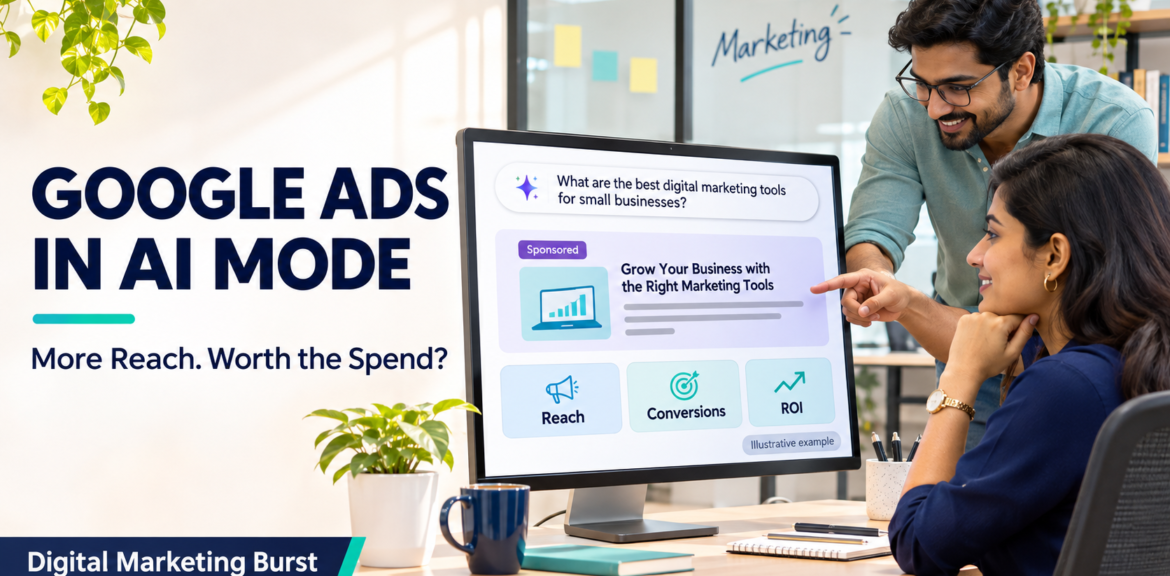
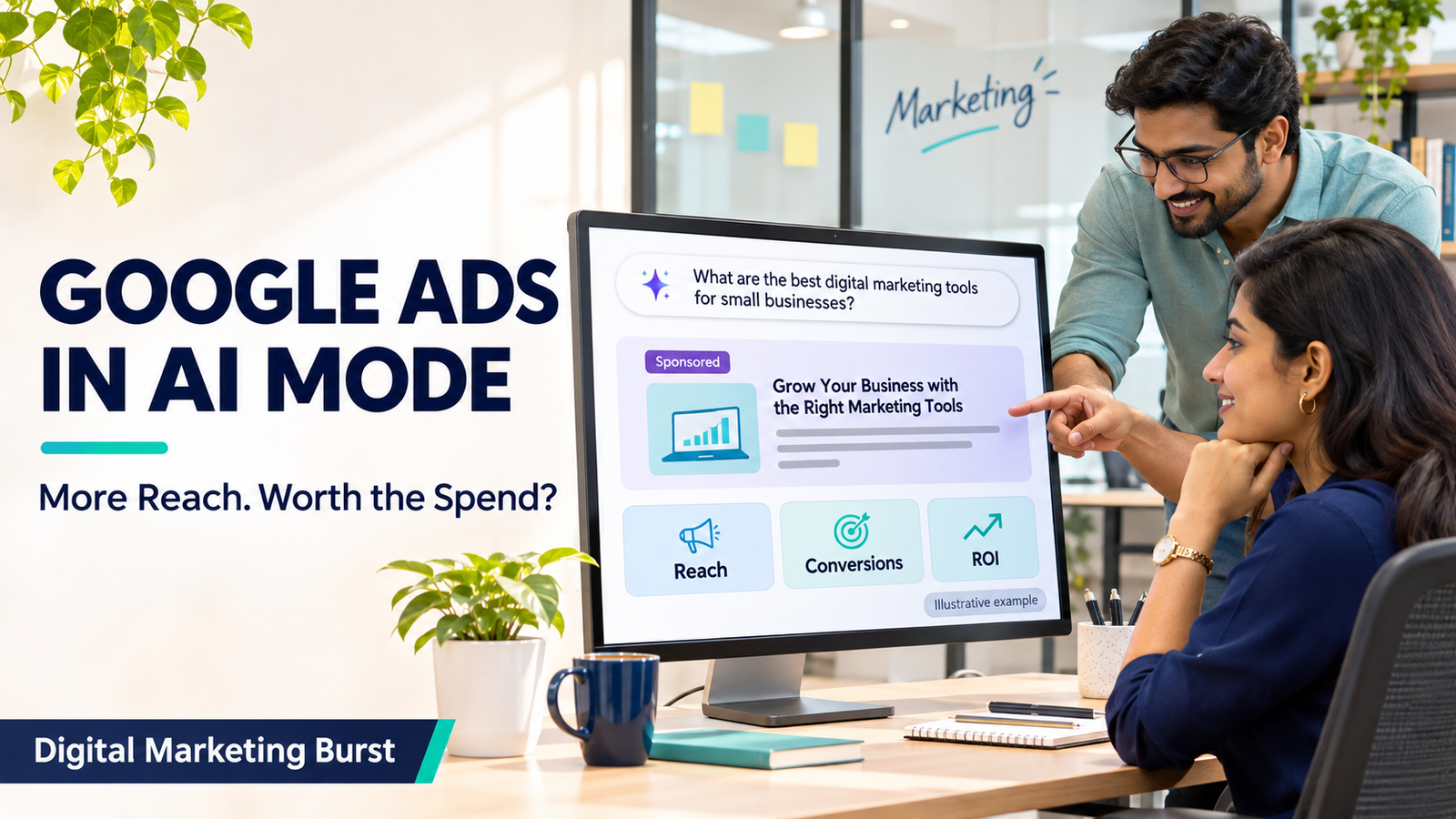
Google Ads in AI Mode: More Reach, but Is It Worth the Spend?
Google Ads in AI Mode can appear as sponsored results when someone’s search or conversation points towards a relevant product or service. Google announced the expansion of AI Mode ads to India in October 2026, and its Help documentation lists English for ads within AI Mode in India. Eligible existing campaigns can enter the auction. There is no separate AI Mode campaign or budget to set up. Google Ads Help
The opportunity is to reach a buyer while they are still deciding what they need. The limitation is measurement: Google includes AI Mode performance in aggregate campaign reporting, so a rise in clicks or sales does not tell you how much came from AI Mode itself. A better question is whether the broader mix of searches brings enough suitable customers to justify what you spend. Google Ads Help
More reach is only useful if it leads to qualified enquiries or sales at a cost your business can sustain.
Product details checked on 11 November 2026.
Question
Practical answer
Are AI Mode ads available in India?
Google lists India among eligible markets and English as the supported language for ads within AI Mode.
Do I need a new campaign?
No. Eligible Search, Shopping and Performance Max campaigns can participate.
Can I buy or block AI Mode separately?
Google currently offers neither exclusive targeting nor a separate opt-out for this placement.
Does it cost extra to enter?
There is no separate participation charge. Actual costs still depend on the auction and your campaign.
Can I see AI Mode ROI on its own?
Standard reports aggregate the placement’s results. A campaign ROAS figure cannot tell you the standalone return from AI Mode.
Google’s guidance on ads in AI-powered Search experiences documents the current eligibility, controls, billing and reporting. Google Ads Help
How do ads work in Google AI Mode?
A person opens AI Mode and asks a question. The response may help them understand a problem, compare options or narrow down a purchase. When Google identifies a relevant commercial opportunity, an eligible ad can appear within or alongside the response, marked Sponsored. Buying an ad does not change the organic answer. Google Ads Help
For an advertiser, the distinction that matters is what makes the ad relevant. Sometimes the original query makes the commercial intent obvious. In other cases, a product or service becomes relevant as the response explains the options.
Direct matching: The search already names the product or service
Consider a hypothetical Bengaluru business that sells compact office furniture. Someone searches:
“Buy a compact standing desk under ₹20,000 in Bengaluru.”
The query gives the advertiser several useful clues: the product, a budget and a location. A relevant page might show compact desks in the stated price range, with dimensions, stock and delivery information. Sending the person to a generic furniture homepage would leave them to do the comparison again.
Google describes this as direct query matching. Exact and phrase match Search keywords can be eligible when the query expresses clear commercial intent, subject to the normal conditions for serving an ad. Google Ads Help
Contextual matching: The search starts with a problem
Now consider a different question:
“My work desk has room for only one screen. How can I use a laptop and an external monitor without losing writing space?”
The person has not asked to buy anything. They might rearrange what they already own. But if the response discusses a monitor arm or a laptop stand as a possible solution, a relevant product could become useful at that point.
In Google’s description of contextual matching, the query and the AI response can both inform which ads are relevant. Broad match on Search, AI Max for Search, Shopping and Performance Max can be eligible for contextual matching. Exact and phrase match keywords do not qualify for that broader contextual matching simply because the response mentions a product. Google Ads Help
The business example is illustrative; it does not predict what Google will show for that query. It shows how the same retailer could meet two different needs. The first person needs help finding a desk they can buy. The second needs help deciding whether a product is necessary at all.
Where campaign eligibility ends
An eligible campaign is able to participate when the opportunity fits. Eligibility does not tell you that your ad ran, how often it ran or how prominently it appeared.
Consider a merchant whose product listing is eligible, but whose item is out of stock or whose advertised offer is no longer accurate. The useful first task is to correct the underlying campaign or product information. An AI Mode rollout does not give the business a reason to pay for traffic to a page that cannot serve the customer.
The same principle applies to services. If you install a product only in selected locations, the campaign and landing page should make that coverage clear. A longer query can reveal that a customer is a good fit, but your campaign needs equally specific information about what the business can deliver.
AI Mode, AI Overviews and AI Max: What is the difference?
The names are similar, but they describe different things. A business owner might say, “We enabled AI, so are we now advertising in AI Mode?” To answer, first establish what they enabled and what they are trying to measure.
Term
What it refers to
What it means for the advertiser
Google AI Mode
A conversational Search experience where people can ask questions and follow up
A place where eligible sponsored results can appear
AI Overviews
AI-generated summaries on the main Search results page
A different Search experience; ads can appear in or around an Overview under the relevant rules
AI Max for Search
A set of targeting and creative features for Search campaigns
A campaign setting that can change how Search ads match and serve; its performance reports are not an AI Mode placement report
Google documents AI Max as a campaign feature and provides separate documentation on where ads can appear in AI-powered Search experiences. Google Ads Help
This distinction affects what you can claim about a test. Suppose you enable AI Max in a Search campaign and qualified enquiries improve. You can investigate whether the campaign change helped. You cannot attribute the improvement to AI Mode simply because both names contain “AI.” More relevant matching, different landing pages or other changes in the campaign could be involved.
The reverse is also true: leaving AI Max off does not, by itself, exclude your campaign from AI Mode. Google describes direct matching and multiple eligible campaign types. Choose campaign settings based on the traffic you want to reach and the controls you need, rather than treating one setting as a switch for the placement. Google Ads Help
How Google Ads can reach buyers earlier in their research
Upper-funnel Google Ads reach people who are learning about a problem or comparing possible solutions. They can be commercially relevant even when the next step is checking a specification, discussing a shortlist or asking for a quote rather than making an immediate purchase.
Take a hypothetical supplier that sells barcode inventory systems to small distributors in India. Here are four searches that business might encounter:
Example search
What the person may need
What the landing page should clarify
“How to stop stock mismatches between two warehouses”
A way to diagnose the problem
Which workflows can help and when software may be useful
“Barcode inventory software for two warehouses”
A shortlist of products
Multi-location support, hardware requirements and implementation scope
“Barcode inventory software with Tally integration price”
A comparison based on a specific requirement
Whether the integration is supported, how it works and what affects the quote
“Free barcode labels printable PDF”
A download or a do-it-yourself resource
If the business does not provide that resource, examine whether paying for this traffic makes sense
These are examples of search intent, not a list of placements or queries guaranteed to trigger an ad.
One mistake is to classify every long question as low intent. A detailed query about integration, stock volume and pricing may come from someone who has already identified a need. A short query such as “inventory software” could come from a student or a buyer. Look for the decision implied by the query, not the number of words.
Separate a relevant researcher from an unsuitable prospect
A person may be a strong potential customer without being ready to purchase this week. A different visitor may want to buy immediately, but need a product you do not sell or delivery to a location you cannot serve. Those are different problems and call for different responses.
For a commercial water-treatment supplier, for example:
Relevant but early: A factory manager is trying to understand what specifications to collect before asking for a quote.
Relevant and ready to act: A facilities team needs an installation proposal for a site within your service area.
Outside the offer: Someone is looking for a household purifier repair, which the supplier does not provide.
The first visitor may benefit from a page that explains what details are needed for an assessment. The second needs a clear route to a quotation. The third is a reason to inspect search terms, ad copy or targeting rather than assuming more follow-up will turn the enquiry into a fit.
When you review Google Ads lead quality, record why an enquiry did not progress. “Still comparing” and “outside our service area” should not go into the same bucket. The former helps you understand the buying cycle; the latter tells you where spending or messaging may need to change.
Give the research visitor enough information to take the next step
If an ad reaches someone while they are comparing solutions, the page should carry that comparison forward. A useful landing page answers the questions that would otherwise force the visitor to call just to find out whether the offer applies to them.
For a retailer, that may mean dimensions, installation requirements and the delivery area. For a service business, it might mean what the service includes, who it is for and what information the customer needs to request a quote.
The next step should match what the page promises. A product compatibility page can invite the reader to check a model number. A consultation page can explain what happens after someone submits their details. A visitor who only reads those details may still be useful to the business later, but a page view should not be reported as if it were a sale.
What does “AI Mode pays less” actually mean?
There are three different claims that can hide behind that phrase:
Possible meaning
The question it answers
What it does not establish
Google earns less per search
How effectively Google monetises a Search experience
Whether your business earns a better return on its ad spend
Advertisers pay less per click
Whether the price of a click is lower in the comparison
Whether those clicks generate enough qualified leads or sales
Advertisers earn less from the spend
Whether the acquired business is worth less relative to its cost
Why the result changed, or whether AI Mode caused it
Do not use one of these claims as proof of another. A cheaper click can still cost more per sale if fewer visitors buy. A more expensive click can be worth paying for if it brings a customer who fits the offer. Likewise, a report about Google’s ad revenue cannot tell an Indian retailer whether its own campaign is profitable.
Google says there is no extra charge to participate in AI Mode ads. That is a statement about billing, not a promise of cheaper clicks or better returns. Without separate placement reporting, you also cannot take a campaign’s average CPC and present it as the CPC for AI Mode alone. Google Ads Help
A simple example: Cheaper traffic can still cost more per sale
Suppose two campaigns spend the same amount. The numbers below are illustrative, and neither campaign represents an isolated AI Mode placement.
Metric
Campaign A
Campaign B
Ad spend
₹20,000
₹20,000
Clicks
400
800
Average CPC
₹50
₹25
Completed sales
10
5
Ad spend per sale
₹2,000
₹4,000
Campaign B buys twice as many clicks at half the average cost per click, yet it costs twice as much to acquire a sale. If both campaigns sell the same product on the same terms, the cheaper traffic alone is no reason to move more budget to Campaign B.
Before acting, check whether the figures cover a comparable period and whether recent leads have had time to close. If Campaign B brought in more prospects who need a quotation before buying, some sales might appear later. If those visitors mostly wanted something the company cannot offer, waiting longer is unlikely to fix the mismatch. The next step depends on what happened after the click.
What should an Indian advertiser check first?
Start with the ads and pages you already use. These three checks will help you judge whether broader reach is useful before you spend more on it.
Name one research question your business can answer well. Use a question real customers ask while choosing a product or service. For a seller of compact desks, that might be how to check whether a desk fits a small room and supports a monitor arm.
Choose the page that can answer it. Check whether the page gives the buyer the specifications, availability or service conditions they need. If someone arrives at a generic homepage and must start over, fix the destination before trying to attract more visits.
Decide which outcome will justify the spend. A direct-to-consumer retailer might use completed orders and contribution after costs. A business that sells through quotations might use qualified enquiries and eventual sales. Keep earlier actions as supporting signals so you can see where people stop progressing.
How to measure AI Mode ad performance without a separate placement report
Start with what Google Ads actually reports. AI Mode impressions, clicks, costs and conversions are included in standard campaign totals. Search terms associated with AI-powered placements are also reported in aggregate. That gives you campaign data you can use, but it does not give you a standalone AI Mode cost per acquisition or return on ad spend. support.google.com
Suppose you run Search campaigns for a modular kitchen company in Pune. This month, impressions rise and average CPC falls. The sales team also reports more enquiries about renovation budgets. You can investigate whether the campaign is reaching more people who are comparing options. You cannot conclude that those people saw an ad in AI Mode, or that AI Mode caused the change.
Keep three questions separate when preparing a report:
Question
What you can use
What to avoid claiming
Did the campaign reach more people?
Campaign impressions and clicks, compared over suitable periods
That every additional impression came from AI Mode
Did we pay for more research-stage searches?
Visible search terms, landing pages and spend by query theme
That conversational wording identifies the placement
Did the additional activity help the business?
Qualified enquiries, orders, costs and outcomes from the same group of prospects
That campaign-level results show the standalone return from AI Mode
A useful report might say: “We observed more clicks on comparison-oriented searches. Qualified enquiries did not increase over the period reviewed. The available reports do not isolate AI Mode.” That gives the team something to investigate without turning a placement hypothesis into a finding.
Audit search terms for intent and fit
Open the Google Ads search terms report for the campaigns you want to review. A search term is what someone actually entered; a keyword is one of the inputs an advertiser can use for targeting. The report does not show every search, because Google omits some low-activity terms for privacy. Use it to examine visible patterns, rather than treating the export as a complete record. Google Ads Help
1. Sort visible terms by the task the buyer is trying to complete
For a hypothetical manufacturer that sells packaging machines, the following terms call for different responses:
Example search term
Likely task
What to check
“How to pack spices without moisture entering the pouch”
Diagnose a packaging problem
Does the landing page explain options, and are these visitors in the market the company serves?
“Continuous band sealer for spice pouches”
Compare a specific equipment type
Does the page show suitable materials, pouch sizes and machine specifications?
“Band sealer machine quotation for 500 pouches per hour”
Ask for a quote against a clear requirement
Can the sales team confirm capacity and respond with a relevant quote?
“How to repair a home vacuum sealer”
Fix a different product
If the company offers no such service, review whether the term should be excluded.
Add a column for commercial fit as well as intent. “Researching” and “wrong audience” are not the same category. A distributor comparing machines for a future purchase may be useful. A person looking for repairs the company does not provide is unlikely to become a suitable prospect.
2. Check where each query group lands
Take several terms from the groups that account for meaningful visible spend. Open the corresponding landing pages and ask what the visitor can learn in the first visit.
Imagine an ad matches searches about setting up a packing line in a small factory. If the destination is a page about one expensive machine, the reader may still need to know which pouch materials it handles, what space it requires and whether the business offers installation. A page that explains those choices may help the right buyer move forward. If the machine is unsuitable for a small operation, saying so clearly can save both the visitor and the sales team time.
When reviewing AI Max reporting, Google documents views that can help you inspect search terms and the ad or landing-page combinations associated with them. Use those views to check campaign matching and URL selection. They are not a separate AI Mode placement report. support.google.com
3. Choose the correction that matches the problem
Different findings call for different actions:
Wrong need: Consider a negative keyword where the term is consistently outside the offer. Check that the exclusion will not also block suitable variations.
Right need, wrong page: Review the page or URL selection. A customer asking about technical compatibility may need a different page from someone ready to request a quote.
Right need, weak next step: Make the page’s next action clearer. Tell the customer what information to submit and what the business will do with it.
Suitable prospects, incomplete sales data: Fix the follow-up or recording process before deciding whether the queries are profitable.
Keep a dated note of what changed. If you edit targeting, replace the landing page and change your pricing at the same time, the next report will be harder to interpret.
How to set up Google Ads conversion tracking for meaningful results
A conversion action should represent an event you can explain in plain language. “The customer submitted a valid quotation request” is a useful definition. “The customer clicked near the form” describes something else, even if both events appear as conversions in a dashboard.
Before creating a new action, list what the account already tracks. Check whether the same purchase or form submission is being sent through a Google Ads tag and a GA4 import as separate actions. If both are used for the same campaign’s bidding, the account may be optimising towards two records of one outcome.
Step 1: Choose the action you want to measure
The correct action depends on how you sell:
Business model
Useful outcome to measure
Supporting activity to track separately
Online retailer
A completed order with the correct purchase value and order ID
Product views, add-to-cart actions and checkout starts
Local service business
A confirmed enquiry, followed by a qualified lead or booked job where measurable
Phone-link clicks and visits to the contact page
B2B supplier
A qualified opportunity or eventual sale, where the process can reliably send that outcome back
Brochure downloads, form starts and general questions
Be precise about the difference between an action you can track and the outcome you want the campaign to optimise towards. A WhatsApp button click may be useful for diagnosing interest. It does not establish that the person sent a message, that your team replied or that the prospect was suitable.
Step 2: Connect the website and create the action
In Google Ads, open Goals → Summary and choose Create conversion action. Select website conversions and follow the prompts to connect a Google tag or an existing GA4 property. Then create the action with the relevant category and implementation method. Use the current Google Ads website conversion setup instructions for the screens and options available in your account. Google Ads Help
For a quotation form, trigger the event only after the site confirms that it received the submission. For ecommerce, send the actual order value and a unique, dynamic transaction ID. Google documents transaction IDs as a way to reduce duplicate purchase conversions, such as when a confirmation page reloads. Google Ads Help
Step 3: Check which actions influence bidding
Review the campaign’s conversion goals alongside the action’s settings. Google describes primary actions as intended for reporting and bidding optimisation and secondary actions as intended for observation in the standard setup. Check the actual goal configuration rather than assuming that changing a label alone will fix what a campaign uses. Google Ads Help
For a service business, that review might uncover a form submission, a click-to-call action and an imported qualified lead all sitting together. Ask whether they represent three separate outcomes or three steps that can happen to the same person. If they are steps in one journey, report them as stages. Do not add them together and call the total “new customers.”
Step 4: Test successful and unsuccessful journeys
Use a test submission or order to check that the event matches the real outcome. Then test the cases where nothing should be counted.
Test
Expected behaviour
Submit a valid form
The action fires after confirmation, and the enquiry reaches the business
Submit an invalid form
No successful lead action fires
Refresh an order confirmation page
The same order does not become a second purchase
Place another order
The new order has its own transaction ID and value
Click a WhatsApp or phone link without continuing
Only the click is recorded, if tracked; it is not treated as a completed conversation
Check the conversion action’s status in Google Ads after implementation. If your sales team does not receive the test enquiry, investigate that first. An event that fires correctly but leaves a customer without a response is still a problem for the business. Google Ads Help
Follow leads far enough to judge the spend
A spreadsheet or CRM can reveal what the campaign report cannot. At a minimum, record when the enquiry arrived, which campaign you can reliably associate with it, whether it matched your offer and what happened next. Use clear stages such as new, contacted, qualified, quoted, won and lost. If you cannot identify a campaign or outcome reliably, leave it unknown.
Keep the date of the enquiry separate from the date of the sale
Consider a hypothetical Jaipur company selling commercial refrigeration units. A customer enquires in September, receives a quote in October and pays a deposit in November. If the company compares September’s campaign spend only with deals closed during September, it may miss the value of that enquiry. If it credits every November sale to November’s spend, it creates a different mismatch.
For a campaign review, group leads by when they entered the pipeline and give them a reasonable time to progress. A report can show older groups with more complete outcomes and mark newer ones as provisional. Google’s conversion lag guidance explains why attributed results can arrive after the ad interaction. Your own CRM records can help you understand how long a meaningful business outcome usually takes. Google Ads Help
Consider offline measurement when it answers a real question
If you can reliably distinguish valid enquiries from qualified leads and sales, consider whether sending appropriate offline outcomes back to Google Ads would improve measurement. Google’s enhanced conversions guidance explains how eligible first-party data can supplement existing conversion measurement. Confirm that your data collection, permissions and setup meet applicable requirements and Google’s terms before enabling it. Google Ads Help
Start with the business process. If the sales team marks almost every lead as qualified, importing that label will not improve your understanding of which enquiries were actually useful. A short, consistently applied definition of a qualified lead is worth more than a complicated import based on inconsistent records.
Test a campaign change you can actually measure
Since AI Mode cannot be targeted or excluded on its own, frame your test around an action you control. Google documents AI Max experiments for eligible Search campaigns, which can compare a treatment with the existing campaign setup. That can help answer whether the selected campaign change improved the measured outcome. It does not compare AI Mode against standard Search, because neither arm is defined by an isolated placement. Google Ads Help
Write down the decision before starting the test
Suppose an Ahmedabad supplier wants to reach more businesses researching warehouse equipment. Its test brief could read:
Question: Does expanding search matching generate more qualified quotation requests at a cost the business can accept? Primary measure: Cost per qualified quotation request. Supporting measures: Visible search themes, landing-page relevance and total qualified enquiries. Guardrail: Monitor spend on enquiries outside the delivery area or unrelated to the equipment sold. Review point: Judge the result after the tested leads have had time to be contacted and assessed.
Keep the offer, qualification rules and follow-up process consistent where possible. Note unusual changes such as a stock shortage, a festival promotion or a period when the sales team could not respond promptly. Those events can change the outcome without telling you much about the targeting change.
Report what the evidence supports
If qualified enquiries increase and the cost per qualified lead remains acceptable, you have a reason to consider keeping the campaign change. If clicks rise but too few enquiries have been assessed, report the result as pending, with a date for review. If spend grows and the sales team confirms that many new contacts are outside the offer, inspect the queries and landing pages before expanding further.
The distinction is simple: a campaign experiment can show whether a setting helped your business under the test conditions. It cannot tell you how much of the effect came from AI Mode without placement-level evidence. That limit still leaves you with a useful decision about where to spend the next rupee.
How to calculate Google Search Ads ROI
Start with the sales associated with the campaign, then subtract what it cost to fulfil those sales and acquire those customers. A campaign can report a strong return on ad spend while leaving the business with little or no profit.
Google Ads defines ROAS using conversion value divided by ad spend. If you send revenue as conversion value, ROAS shows attributed revenue per rupee of ad spend. If you assign estimated values to leads or send another value, the same column reflects those inputs. Before calling the figure “sales revenue,” check what your account actually sends to Google. Google Ads Help
Metric
Calculation
What it tells you
Revenue-based ROAS
Attributed revenue ÷ ad spend
How much attributed revenue the campaign reports per rupee of ad spend
Contribution before ads
Net sales revenue − relevant variable fulfilment costs
How much is available to cover advertising and other costs
Contribution after ads
Contribution before ads − ad spend
What remains from those sales after the included costs
ROI on included costs
Contribution after ads ÷ total included costs × 100
The return relative to the costs counted in the calculation
Be consistent about what you include. If one comparison uses completed sales after refunds and another uses the value recorded at checkout, the two figures answer different questions. Likewise, a contribution figure that excludes salaries, rent or agency fees should not be labelled total business profit. Google’s own ROI guidance distinguishes revenue from the costs of generating it. Google Ads Help
Example: A 4× ROAS can still lose money
Imagine an online retailer selling kitchen storage products. The figures are illustrative and do not represent a real campaign.
Item
Amount
Net sales revenue associated with the campaign
₹2,00,000
Product, packing, delivery and other included variable costs
₹1,60,000
Contribution before ads
₹40,000
Google Ads spend
₹50,000
Contribution after ads
−₹10,000
Revenue-based ROAS is 4×: ₹2,00,000 divided by ₹50,000. The included costs total ₹2,10,000, so ROI on those costs is approximately −4.8%. The campaign reports four rupees in revenue for every rupee spent on ads, but the business still loses money on the sales in this example before any excluded overhead.
This matters when broader matching changes the product mix. A retailer may acquire more orders but sell a higher proportion of heavily discounted products. Review the contribution from what customers actually bought, rather than applying the store’s overall average margin to every order.
Calculate a break-even ROAS for the products you advertise
If your contribution margin before ads is 20% of net sales revenue, every ₹100 of revenue leaves ₹20 available to cover advertising. The simplified break-even revenue ROAS is:
1 ÷ 0.20 = 5×, or 500%.
At that level, the included sales contribution covers the ad spend. It does not leave a surplus for costs you excluded or for your profit target.
For a mixed catalogue, calculate the threshold for meaningful product groups. A higher-margin accessory and a low-margin appliance may need different ROAS targets even if they have similar selling prices. If a campaign shifts towards lower-margin products, a stable headline ROAS can hide a weaker result.
What is a qualified lead worth to your business?
For businesses that sell through calls, visits or quotations, the useful number is often what you can afford to pay for a qualified lead. Start with the contribution from a completed sale before advertising. Multiply it by the share of qualified leads that usually turn into sales, using a set of leads that has had enough time to close.
Suppose a Lucknow business earns ₹12,000 in contribution before ads on a completed job. In this hypothetical example, one in five qualified enquiries becomes a customer.
The business would usually set a working ceiling below ₹2,400 if it wants to cover additional sales costs or retain a margin. If the close rate falls to 10%, the same calculation gives ₹1,200. That is why a new group of enquiries should not inherit the old lead target automatically. Buyers who are still comparing may take longer to convert, and some may close at a different rate even after they have had enough time.
Compare lead quality before comparing lead prices
Imagine these two sets of leads from a business’s paid search campaigns:
Metric
Earlier group
Later group
Ad spend
₹30,000
₹30,000
Enquiries
60
100
Qualified enquiries
30
20
Cost per enquiry
₹500
₹300
Cost per qualified enquiry
₹1,000
₹1,500
The later group looks better if the report stops at enquiry cost. It looks worse when the business measures what it can actually use. Before reducing the budget, check that both groups had enough time to be contacted and that the same qualification rules were applied. Then examine the reasons for disqualification. An increase in requests outside the service area points to a different fix from a delay in responding to enquiries.
A useful review keeps four figures together: total spend, qualified enquiries, cost per qualified enquiry and completed sales. Mark newer leads as provisional where appropriate. Keep the account’s reported conversions alongside these figures so you can spot when the dashboard and the sales process are describing different things.
Is the extra reach worth the next rupee?
The average return tells you how the existing budget performed. A budget increase raises a different question: What did the additional spend buy? The answer can differ from the account’s average, especially if the extra spend brings in a different mix of searches.
Consider a hypothetical campaign. Spend rises from ₹60,000 to ₹80,000, while the contribution before ads associated with its sales rises from ₹90,000 to ₹1,05,000. After ads, contribution falls from ₹30,000 to ₹25,000. The later period is still positive on the included costs, but the extra ₹20,000 in spend was accompanied by only ₹15,000 in additional contribution.
That comparison is a signal to investigate, not proof that the budget increase caused the decline. A change in prices, stock, promotions or sales follow-up could also explain the difference. And because standard reporting combines placements, the figures do not tell you whether AI Mode caused any part of it. support.google.com
Decide what to change based on the evidence
What you observe
What to do next
Spend rises, qualified outcomes improve and contribution remains acceptable
Consider a measured budget increase. Check the next group of outcomes separately.
Research-stage clicks rise, but many leads are still waiting for a quote
Keep the result provisional and set a review date based on the buying cycle.
More enquiries come from people outside your delivery area or service scope
Review visible search terms, location settings, exclusions and the offer described on the page.
Suitable people click, but too few can complete the next step
Test the landing page, form and response process before buying more traffic.
Campaign ROAS looks healthy, but actual contribution falls
Reconcile order values, refunds, discounts and product costs before increasing spend.
Someone asks for a standalone AI Mode ROI figure
Report the campaign-level result and explain the placement reporting limitation.
A worthwhile test has a review date and an explicit decision. For example: “After these enquiries have had time to progress, we’ll keep the change if we have more qualified quotation requests within our cost ceiling. If we have more clicks but no improvement in suitable enquiries, we’ll review matching and landing pages before spending more.” This gives the team a decision it can make with the available data.
Why Choose Digital Marketing Burst for Google Ads in Lucknow?
If you’re looking for the best Google Ads agency in Lucknow or comparing top Google Ads agencies in India, ask each team one question: How will you tell whether extra reach is bringing us more customers? A useful answer should explain which searches you’re paying for, what counts as a conversion and how leads or orders will be checked against the money spent.
Digital Marketing Burst is a Lucknow-based digital marketing agency offering Google Ads, website and analytics services. Whether you need a Google Ads campaign audit in Lucknow, help with conversion tracking for a lead-generation campaign, or a paid search strategy for an Indian ecommerce business, start with the decision you need to make. You might want to know whether broader matching is bringing in suitable customers, whether the account counts the same action twice, or whether a campaign deserves more budget.
For Google Ads in AI Mode, the review can focus on what your business can verify: campaign search terms, landing pages, qualified enquiries, sales and costs. Google’s current reporting does not support a standalone AI Mode ROI figure, but you can still use the campaign data to decide what to fix, test or scale. support.google.com
Discuss your Google Ads campaign with Digital Marketing Burst. Share your campaign goal and the outcome you want to improve, such as qualified enquiries, completed orders or cost per customer.
Is Google Ads in AI Mode worth the spend?
It can be worth reaching people earlier if that extra reach brings customers your business can serve at a cost you can sustain. Start by checking what the account counts, then follow the enquiries and orders far enough to see their value. If the numbers support a budget change, make it at the campaign level and review the next set of outcomes. Until Google reports AI Mode separately, describe the result for what it is: evidence about your campaign and the change you tested.
Google’s Generative UI: What It Could Mean for SEO and Travel Bookings
Google’s generative UI allows Search to create a visual or interactive response around a user’s question. Instead of receiving only a written answer, someone might get a comparison layout, calculator or another interface designed for the task. Google has described these capabilities in its official Search announcements. blog.google
For businesses researching Google Generative UI SEO, the practical question is what happens when search helps customers compare options and move towards a purchase before they visit a business website.
Travel provides a useful example. Google has introduced hotel-booking capabilities within AI Mode for eligible users and properties. However, its current help documentation limits that particular booking feature to the United States, in English, for select properties. It should not be presented as a fully available Indian hotel-booking service. Travel Help
Indian businesses can still prepare sensibly. Clear product information, accurate availability, useful comparisons and a reliable booking journey remain valuable whether a customer discovers a business through conventional search, an AI-generated answer or a travel platform.
This guide explains the differences between these technologies, the opportunities they suggest and the decisions worth making before investing in another SEO service or website feature.
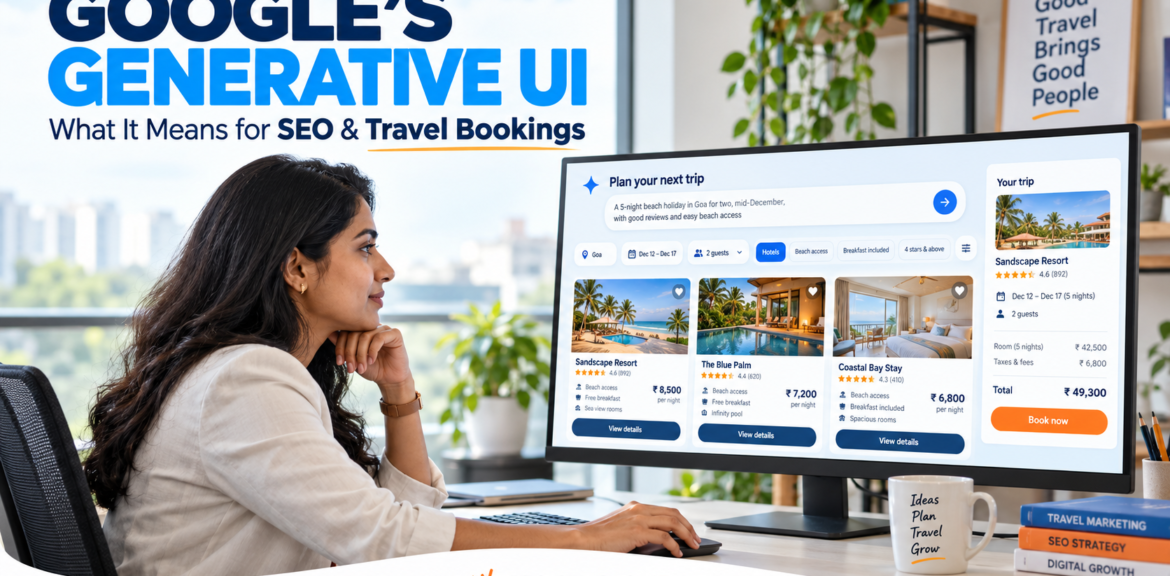
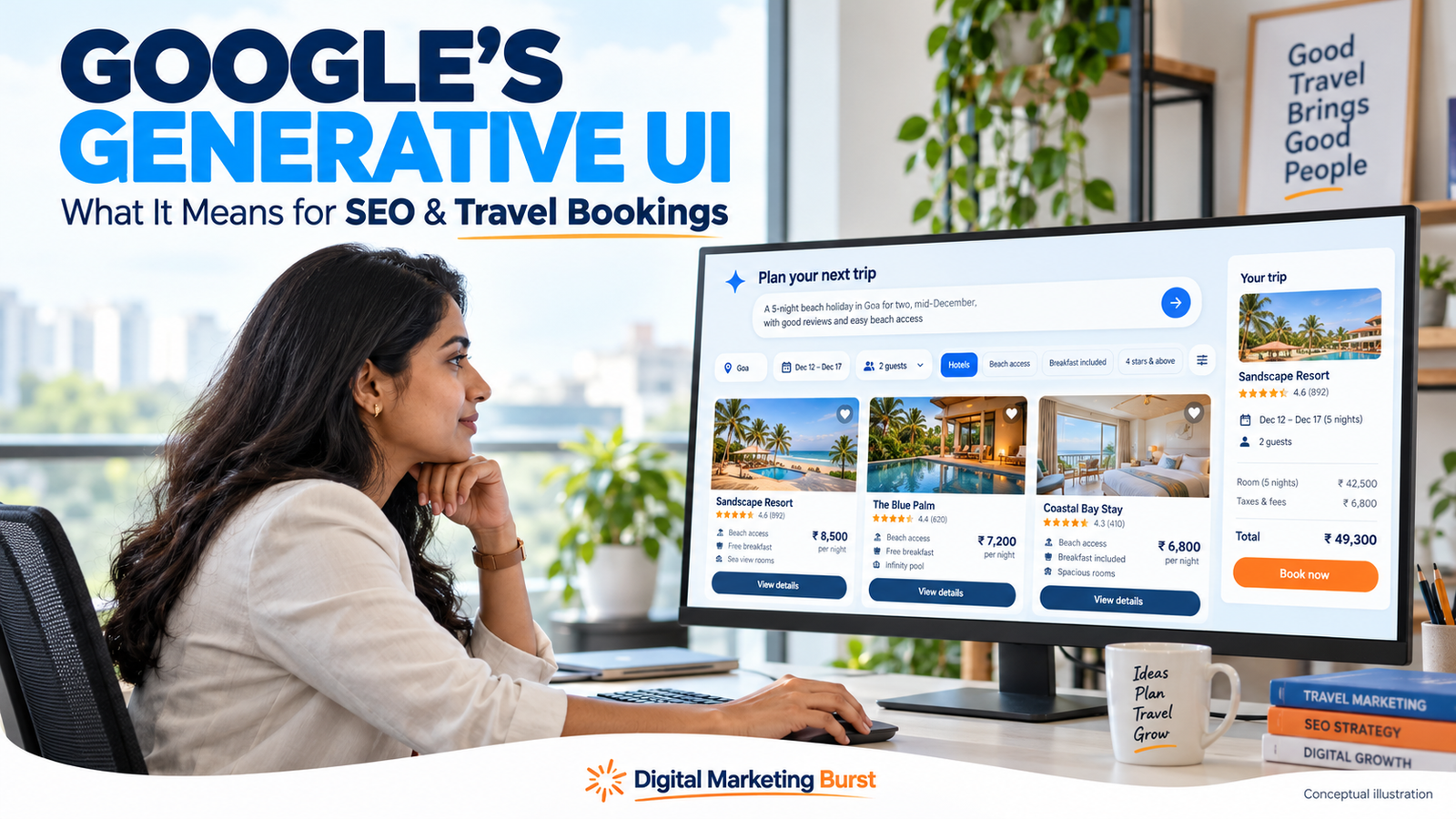
Exploring Google’s generative UI and its potential implications for SEO and travel bookings. Conceptual illustration by Digital Marketing Burst.
Google Generative UI Explained: What Does It Actually Mean?
A user interface is the part of a digital product that people interact with: buttons, filters, tables, forms and other controls.
On a conventional website, a designer and developer usually decide the layout in advance. A hotel website might have a fixed booking form containing arrival date, departure date, number of guests and a search button.
With generative UI, an AI system can assemble or generate an interface in response to the task. The presentation can change according to what the user is trying to understand or accomplish.
Google Research describes generative UI as generating an experience as well as content. Its published work includes dynamically created visual experiences, interactive tools and simulations. research.google
Consider the difference between these two requests:
“Explain the difference between refundable and non-refundable hotel rates.”
“Help me compare a refundable room with a cheaper non-refundable room for a trip that might change.”
The first request may be answered adequately with text. The second could benefit from a comparison table or an interactive calculation.
For example, an interface could help someone examine the extra cost of flexibility alongside the amount they could lose if their plans change. That is an illustrative use case, not a claim that Google currently provides that exact hotel comparison tool for every search.
The important shift is that the format can be chosen around the decision.
Generative UI is different from adding a chatbot
A chatbot is commonly presented as a conversation. Users type a message and receive a reply, perhaps with links or images.
Generative UI can include conversation, but it can also create controls that let users explore the answer directly. A person might adjust a budget, change a variable or compare alternatives through an interactive view.
For a website owner, this means that answering a question and helping someone complete a task are related but separate goals.
An article can explain hotel cancellation policies. A booking interface must also show which policy applies to a particular room, rate and date.
Businesses need to think about both.
How Generative UI, AI Search and Booking Fit Together
It is easy to combine several developments into one headline. Doing so can make the technology sound more complete or widely available than the evidence supports.
These concepts serve different purposes:
Concept
What it does
Business implication
Generative UI
Creates or adapts the interface around a task
Customers may compare information through a dynamically arranged experience
AI search
Helps users research questions and explore information
A business may be discovered within a broader answer or comparison
Live availability data
Shows whether a specific option can currently be purchased
Accurate inventory and prices matter
Booking integration
Enables a reservation through a participating provider
Eligibility and commercial arrangements need separate checking
Customer support
Handles issues after purchase
The responsible provider must remain identifiable
An attractive comparison interface does not, by itself, create access to live room inventory. Similarly, an AI-generated travel plan does not automatically mean that every recommendation can be booked within the same experience.
A complete booking journey needs dependable information and a working transaction process behind the interface.
A useful way to assess any announcement
When reading about a new Google travel feature, ask:
What can the interface display?
Where does its information come from?
Can the user complete a transaction?
Who processes and manages the booking?
Which countries, accounts and properties are eligible?
These questions are more useful than assuming every AI search update introduces the same capabilities.
They also help a business separate an SEO task from a booking-system task. Improving a destination guide and connecting room inventory to a distribution partner are different projects, even when both support the same customer journey.
What Google Has Confirmed—and What Remains a Possibility
Google’s November 2025 announcement described generative UI in AI Mode, including layouts, interactive tools and simulations tailored to a query. Its May 2026 announcements subsequently described plans to make generative UI capabilities available more broadly in Search. Neither announcement means every query receives an interactive interface. blog.google
Separately, Google’s August 2026 travel announcement described new AI Mode features for travel planning, including hotel booking and flight-price tracking. These are product developments that should be checked individually for availability. blog.google
For publication, keep the distinction clear:
Confirmed development: Google has introduced generative UI capabilities and AI Mode travel-booking functionality.
Availability restriction: The specific hotel-booking flow documented in Google Travel Help is currently limited to eligible US users and select properties.
Strategic possibility: More research and comparison activity could happen inside search interfaces.
Unproven outcome: A particular Indian hotel will lose traffic, gain bookings or replace its existing distribution channels because of these features.
The last two points require analysis and evidence. They should not be presented as established results.
Why availability matters for Indian readers
An Indian hotel owner could read a global announcement and reasonably wonder whether a new integration is immediately necessary.
Before spending money, check whether the feature supports the business, its target customers and its booking partners. A feature available to selected users overseas may be worth monitoring without requiring an urgent website rebuild.
Equally, the location of a property and the location of an eligible user are not necessarily the same thing. Avoid making assumptions about supported hotels based only on the country where they are located.
Read the current product requirements and confirm eligibility with the relevant provider.
Could Google Become the Next Booking.com?
The comparison is understandable. If people can research accommodation, compare options and complete eligible bookings within Search, Google can participate in more stages of the customer journey.
However, the comparison has limits.
Google’s hotel-booking help page says the reservation is made with a booking partner. That partner processes payment, sends the confirmation email and handles reservation changes. Google also directs cancellation and refund requests to the partner. Travel Help
The interface a customer uses and the business responsible for the transaction can therefore be different.
For marketers, the relevant question is:
Which parts of discovery, comparison, booking and customer service will happen on each platform?
This is more actionable than predicting that one company will replace another.
What might change for a hotel website?
A customer could arrive on a hotel’s website having already compared location, facilities and room options elsewhere.
That visitor may need less introductory information and more help confirming a specific detail:
Is the displayed room suitable for three adults?
Is breakfast included in this rate?
What time does the cancellation window close?
Can the hotel confirm an early check-in?
Is parking on-site?
Who should the guest contact after booking?
This is a strategic interpretation of how a more capable search experience could affect the journey. It is not a measured result for every hotel.
The practical response is to make those details easy to find and consistent with the information shown by booking partners.
Google Generative UI SEO: What Changes for Website Owners?
The most useful adjustment is to examine whether your website helps people make decisions.
A page can rank for a relevant query and still leave essential questions unanswered. A visitor may understand that a property is “family friendly” without knowing whether it has a lift, connecting rooms or suitable occupancy options.
Generative search experiences make that information gap more noticeable because users can ask increasingly specific questions.
Nevertheless, Google does not describe generative UI as a separate ranking system with a published list of special optimisation tricks. Its Search guidance continues to emphasise foundational SEO and useful, reliable content. developers.google.com
Make claims specific enough to evaluate
Compare these descriptions:
Vague description
“Our hotel offers excellent facilities and comfortable rooms for every traveller.”
More useful description template
“The property offers [verified room types], [verified parking arrangement] and [verified access facilities]. Check the selected rate for meal inclusions and cancellation terms.”
The second version requires the business to supply real details. That is its advantage.
Before publishing, replace every placeholder with verified information. If a facility is unavailable, explain that plainly where it matters to the booking decision.
Specificity helps readers judge suitability. It should not become an excuse to invent additional amenities or make stronger claims than the property can support.
Separate permanent facts from changing offers
Some business information changes infrequently:
Address.
General location.
Contact details.
Building access.
Standard room categories.
Other information may change by date, occupancy or offer:
Room availability.
Nightly price.
Meal inclusions.
Cancellation conditions.
Promotional discounts.
Presenting both categories as permanent prose can create errors.
For example, a blog post should not imply that a room is always available at a particular price. A general room page should direct visitors to the applicable dates and rate conditions rather than treating one offer as universal.
Build for the reader’s next decision
For each important page, identify the question a visitor needs to resolve before moving forward.
A destination guide might help someone select an area. A hotel page should help them assess a property. A booking page must help them understand the exact reservation they are about to make.
Trying to make every page serve all three purposes often produces repetition and confusion.
Give each page a clear role, then connect related pages through useful internal links.
How Google AI Travel Booking Could Affect the Customer Journey
A travel purchase usually involves more than one decision. Someone may first choose a destination, then a neighbourhood, a property and finally a room or rate.
AI-assisted interfaces could help users work through several of these decisions in one place.
Imagine a traveller researching:
“A hotel in Jaipur for two adults, close to the old city, with parking and flexible cancellation.”
This is a hypothetical example. It does not describe a test result or a confirmed Google recommendation.
The request contains several different needs:
Requirement
Information needed to evaluate it
Jaipur
Correct property location
Two adults
Suitable room occupancy
Close to the old city
A clear location reference and realistic access information
Parking
Verified parking availability and conditions
Flexible cancellation
The policy attached to the selected rate
A broad travel article is unlikely to answer all of these questions reliably. Different parts of the answer may depend on property information, maps, booking inventory and rate terms.
For an Indian travel business, the opportunity is to improve the information it controls instead of assuming one long article can replace everything else.
Why detailed content still matters
Some needs cannot be reduced to a price or filter.
A guest may want to know whether a hotel entrance is accessible by car during a festival. Another may need to understand the walk between a parking point and the reception.
Where these details are relevant, provide verified explanations and original photographs where possible. Include limitations and describe when arrangements can change.
Such information can help customers make better decisions even if the initial comparison happens elsewhere.
Its value comes from solving a real problem, rather than repeating descriptions already present on several booking platforms.
How Google AI Hotel Booking Works in the Documented Flow
Google’s published help instructions describe a journey in which an eligible user searches for a hotel, selects a property and reviews booking options.
When available, the user can continue within Google’s interface, select a room, review reservation details and proceed to payment. An external website option is shown when the property cannot be booked through that flow. Travel Help
The full reservation remains dependent on the booking partner and the terms attached to the selected option.
For website owners, three questions follow:
Is the information shown about the property accurate?
Does the chosen rate clearly explain what the guest receives?
Can the guest identify who manages the reservation?
These are useful checks across distribution channels, including those a business already uses.
Do not confuse visibility with booking eligibility
Being mentioned in an AI answer is not the same as being eligible for an integrated booking feature.
A destination article may help a reader understand an area without providing bookable inventory. A property may appear in research results while the transaction takes place on another website.
Treat visibility, inventory participation and transaction completion as separate things when evaluating performance or discussing services with an agency.
Google AI Mode SEO: Which Fundamentals Still Matter?
Google’s guidance states that established SEO practices remain relevant to AI features. Its documentation says that special AI files or a dedicated type of schema are not required simply to appear in AI Overviews or AI Mode. developers.google.com
That does not remove the need for technical work. It helps identify what deserves attention first.
Make essential pages accessible
Check whether important pages can be reached through normal website navigation and internal links.
For a hotel, this might include room information, location, policies and contact details. A tour operator might need clear itinerary, inclusion, exclusion and cancellation pages.
If a customer cannot find a page easily, review its place in the website structure.
Keep important details readable
Avoid putting essential information only inside promotional graphics.
A beautifully designed image may look attractive, but users should also be able to read the relevant details as text on the page. This is particularly useful for policies, contact information, facilities and booking conditions.
Images can support the explanation rather than carry every fact alone.
Make structured data truthful
Use structured data that matches the business and the visible page content. Do not mark up facilities, ratings or offers that the page cannot substantiate.
The objective is accurate representation. Adding more schema types does not automatically create a stronger page.
Maintain the booking destination
If a search visitor clicks through to your website, the next step should work.
Test links, date selectors, enquiry forms and confirmation messages on mobile. Check that users do not lose their selected dates or room choice when moving between the website and booking engine.
A visibility improvement is less useful if interested customers cannot complete the next action.
A Practical Starting Exercise for Indian Businesses
Before creating a new “AI SEO” project, choose one important customer journey and examine it from beginning to end.
For a small hotel, the exercise could be:
Customer need: A family wants to understand room suitability and cancellation flexibility.
Pages to inspect: Room page, booking engine and cancellation policy.
Questions to answer:
Is occupancy explained clearly?
Are extra-person arrangements verified?
Can visitors identify which facilities apply to the room?
Does the cancellation policy match the selected rate?
Is the total payable amount clear before confirmation?
Is the contact route easy to find when a guest needs clarification?
Record each problem, its owner and the action required.
For example, unclear parking information may need confirmation from the property manager. A broken booking link belongs with the website team. An incorrect rate description may require the booking provider.
This turns a broad technology discussion into work the business can actually complete.
Turn Your Google Generative UI SEO Strategy into a Practical Audit
Preparing for more interactive search experiences starts with understanding what customers need to know before they book.
For a hotel, that may involve room occupancy, location, meal plans and cancellation conditions. A tour operator may need to explain departure points, walking requirements, inclusions and the circumstances in which an itinerary can change.
The useful question is:
Can a customer confidently decide whether this offer meets their requirements using the information we publish?
Start with one valuable booking journey. Choose a property, package or service that matters to the business, then examine its pages and booking process together.
A practical audit should produce a list of specific corrections. “Improve AI visibility” is too broad to assign. “Confirm whether the family room accommodates three adults and update the room page” is an actionable task.
Create one shared audit sheet
Use a spreadsheet with these columns:
Field
What to record
Customer question
The decision the visitor needs to make
Relevant page
The page expected to answer it
Current information
What the website actually says
Evidence or owner
Who can verify the information
Problem
Missing, outdated, inconsistent or difficult-to-find details
Required action
The specific correction
Responsible person
Who will complete it
Review date
When the information should be checked again
For example, a hotel might record that its room page says “breakfast available”, but the booking engine does not clearly distinguish breakfast-inclusive rates from room-only rates.
The action would be to clarify the meal-plan options and check their consistency across the room page and booking flow.
That is a customer-experience improvement regardless of which search interface sends the visitor.
Step 1: Identify the Questions That Influence a Booking
Keyword research can reveal how people describe a need. It does not always explain which missing detail prevents them from booking.
Combine search research with information your business already receives:
Enquiries submitted through the website.
Questions asked on calls.
Common pre-booking emails.
Customer-service queries.
Feedback about confusing policies.
Questions raised by the reservations team.
Review these sources without publishing personal details. Look for recurring decisions rather than copying individual conversations into articles.
Organise questions by stage
A simple structure helps you decide where each answer belongs.
Customer stage
Example question
Suitable page
Choosing a destination
Which area is convenient for a short Jaipur visit?
Destination or neighbourhood guide
Comparing properties
Does this property have on-site parking?
Hotel facilities or location page
Selecting a room
Can this room accommodate three adults?
Room page and booking engine
Reviewing a rate
Is breakfast included, and can I cancel?
Rate details and booking summary
Preparing to arrive
How do I reach reception from the drop-off point?
Arrival guide or confirmation information
This prevents a destination blog from becoming a mixture of sightseeing advice, room descriptions and reservation terms.
Each page can serve a clear purpose while linking to the next useful step.
Include questions that reveal limitations
Businesses often describe what is available more prominently than what is unavailable.
However, limitations can determine suitability. Examples include:
A property without a lift.
Parking located away from the building.
A room category unsuitable for an extra bed.
A tour involving stairs or extended walking.
A check-in arrangement requiring advance confirmation.
Publish relevant limitations clearly and accurately. They can help avoid unsuitable enquiries and booking misunderstandings.
Step 2: Build a Reliable Source of Business Information
When the website, booking platform and customer-service team use different descriptions, customers can receive conflicting answers.
Create a central information record for the property or service. This does not require an expensive system at the beginning. A controlled spreadsheet or shared document can work if someone owns the updates.
Maintain through the relevant booking or inventory system
Do not copy live prices into multiple evergreen blog posts unless you have a dependable process for updating them.
A page can explain how rates work without presenting a temporary offer as a permanent fact.
Use precise terms consistently
“Parking available” can mean several things:
Private parking inside the property.
A reserved space nearby.
Paid public parking.
Roadside parking subject to availability.
These arrangements are not interchangeable.
Likewise, “airport transfer available” does not tell a customer whether it is included, chargeable or subject to advance booking.
Choose wording that accurately describes the arrangement, then use it consistently across the channels you control.
Step 3: Improve Property and Service Pages Before Adding More Blogs
A travel business may publish destination articles while leaving its core commercial pages incomplete.
That creates a gap. Readers discover the business through useful content but cannot establish whether its actual offer meets their needs.
Before expanding the blog, review the pages that support enquiries and bookings.
What a useful hotel page should explain
Include verified information relevant to the property, such as:
Its location and address.
Available room categories.
Occupancy arrangements.
Facilities and important limitations.
Check-in and check-out policies.
How to review current rates and availability.
Where to find cancellation conditions.
A clear contact or booking option.
The page does not need to contain every rate rule in a long paragraph. It should help visitors find the conditions that apply to their chosen reservation.
What a useful tour page should explain
A tour description should make the experience understandable before payment.
Useful details may include:
Where the trip begins and ends.
The itinerary and whether its order can change.
What the price includes.
What customers must pay separately.
Any walking, stairs or physical requirements.
Vehicle or accommodation categories, when applicable.
Cancellation and rescheduling conditions.
The process for confirming availability.
Avoid “all-inclusive” unless the inclusions are clearly defined and the description is accurate.
Example: Replace an unclear package description
Unclear description:
“Enjoy a complete Varanasi experience with comfortable travel and all major attractions.”
More useful structure:
“The itinerary includes [verified stops]. The package price covers [confirmed inclusions]. Entry tickets, meals and other expenses are [state the actual arrangement]. Some locations require walking from the permitted vehicle drop-off point.”
This is a writing template, not a description of an existing package. Every bracketed detail must be supplied and verified before publication.
The improvement comes from helping the customer understand the offer, rather than adding more promotional adjectives.
Step 4: Create Content That Supports Specific Decisions
An article about a destination can attract readers without helping them decide where to stay, how long to allow or which practical constraints matter.
Useful supporting content answers questions that a commercial page cannot cover comfortably.
For example, a hotel near a pedestrian area could publish an arrival guide explaining the relationship between the permitted drop-off point and the property entrance.
A tour operator could explain which parts of an itinerary involve walking and which can be reached by vehicle.
Choose topics using three tests
Before approving a new article, ask:
Does a real customer need this answer?
Can the business contribute verified detail?
Does an existing page already answer the same question?
If the third answer is yes, updating that page may be more useful than creating another URL.
For Digital Marketing Burst, the same principle applies to the current article. Its role is to explain generative interfaces and booking journeys. A general AI SEO article should remain the broader introduction rather than repeating the same explanation here.
Avoid creating a page for every wording variation
These searches may express broadly the same need:
Hotel near a railway station.
Accommodation close to the station.
Where to stay near the railway terminal.
They do not automatically require three articles.
A well-written page can address related language naturally. Create a separate page when the user’s task or the information required is genuinely different.
Step 5: Use Comparisons That Help Readers Choose
Interactive interfaces are useful partly because they can make alternatives easier to examine. Your website can support better decisions through clear comparisons without building a complex tool.
For a hotel, a room-category comparison may be enough.
Comparison field
What to provide
Room category
The actual room name
Occupancy
Verified adult and child arrangements
Bed configuration
Confirmed options and any request conditions
Access
Relevant floor or lift information
Facilities
Features that distinguish the room
Current price
A link to date-specific availability
Cancellation
Where to review the selected rate’s terms
Do not fill empty fields with assumptions. If the information is not confirmed, assign someone to verify it.
Explain trade-offs rather than declaring a universal winner
A larger room may suit one family, while another traveller prefers a lower price. A central location can be convenient but may involve a longer walk from parking.
Explain the difference and let the reader decide.
A comparison becomes less useful when every row simply labels the business’s preferred option as “best”.
Step 6: Keep Important Information Accessible as Text
A promotional image may show an offer attractively, but customers should not need to enlarge a poster to understand essential booking conditions.
Provide readable text for important information such as facilities, policies and inclusions. Google’s guidance for AI search features also recommends making important content available in textual form. developers.google.com
For example:
Put room facilities in the room description.
Write the cancellation summary beside the applicable rate.
Include the address on the location page.
Explain offer conditions outside the promotional graphic.
Images should reinforce the information. They should not be its only accessible location.
Make photographs informative
A genuine room photograph can answer questions that a broad description leaves unresolved.
Useful images might show:
The room layout.
The bathroom.
The property entrance.
Parking access.
Relevant common facilities.
Captions can clarify what is shown, especially when an image applies only to a particular room category.
If a photograph shows one category, do not let the layout imply that every room looks the same.
Label conceptual illustrations appropriately
AI-created imagery can be useful for explaining an idea, including generative UI itself. However, a conceptual interface should not be presented as an authentic screenshot of Google.
For this article, any generated comparison screen should carry a caption such as:
“Conceptual illustration of an AI-assisted travel comparison interface.”
That keeps the visual useful without implying that it documents a live product.
Step 7: Test the Website-to-Booking Handoff
A visitor may leave the main website and enter a separate booking engine. This transition is easy to overlook when content and reservations are managed by different teams.
Test it from the customer’s perspective.
Follow one complete booking path
Choose a room or service and proceed through the journey as far as you can without placing an unintended reservation.
Check whether:
The booking button opens the correct destination.
Selected dates carry through where expected.
Occupancy remains correct.
Room names match between systems.
Inclusions are explained consistently.
Cancellation conditions are visible before commitment.
Mandatory charges are disclosed clearly.
The customer knows how to obtain help.
Repeat the check on a mobile phone. A desktop review alone can miss difficult selectors, obscured buttons or awkward forms.
Record where information changes unexpectedly
Suppose a room page describes breakfast as included, but the booking engine opens a room-only rate. That mismatch needs investigation.
The problem may be a link, an outdated description or a booking-engine configuration. Identify the cause rather than covering it with a general disclaimer.
A clear handoff is valuable whether the customer arrives from Google, social media, email or a travel recommendation.
Step 8: Check Technical SEO Without Chasing Special AI Tricks
A content audit should include technical accessibility. Strong information cannot help if important pages are broken or inaccessible.
Google’s current guidance continues to connect generative AI search visibility with established SEO practices. It does not describe a special file or schema type that guarantees inclusion. developers.google.com
Begin with the pages that matter most to customers.
Check
Practical question
Page availability
Does the intended page load successfully?
Indexing controls
Is an important public page accidentally marked noindex?
Canonical URL
Does the page identify the intended version?
Internal links
Can visitors reach it from related pages?
Mobile usability
Can users read and act on its content comfortably?
Booking links
Do they lead to the correct property, room or service?
Structured data
Does it match the visible, verified information?
These checks identify problems to investigate. They do not establish that every page must be indexed or that correcting one issue will produce a particular ranking.
Be careful with date and filter URLs
Booking systems can create many URL variations for dates, occupancy and filters.
Do not automatically turn every variation into an indexable landing page. First decide which pages provide useful, distinct information and which exist mainly to support a user’s temporary selection.
A technical review may be needed where filters create a large number of near-identical URLs.
The appropriate setup depends on the booking platform and website architecture. Avoid changing indexing controls across the site without understanding their effect.
A Worked Example for an Independent Indian Hotel
Consider a hypothetical hotel in Lucknow. This is a planning example, not a client case study.
The property receives enquiries about parking, family occupancy and late arrival. Its website has an attractive homepage but limited room details.
A practical audit could produce the following actions:
Finding
Action
Responsible team
“Family-friendly rooms” is not explained
Publish verified occupancy and extra-bed arrangements
Reservations
Parking description is vague
State the actual parking location and conditions
Property operations
Room photographs lack category labels
Associate photographs with the correct room type
Website/content
Cancellation page gives only a broad statement
Explain where guests can see rate-specific terms
Reservations/booking provider
Booking button opens a generic search page
Link to the correct property booking journey
Website developer
Arrival questions repeat frequently
Publish a concise, verified arrival guide
Front desk/content
None of these actions depends on a promise of AI search placement.
Together, they make the property easier to understand and its booking journey easier to complete. That is a concrete result the team can review.
What should the hotel avoid?
It should avoid creating several generic articles about “the best hotel in Lucknow” while the underlying information remains unclear.
It should also avoid adding unverified accessibility claims, fabricated testimonials or unsupported statements about being recommended by an AI platform.
The priority is to improve the offer’s representation and the customer’s ability to evaluate it.
Assign Ownership Before Information Goes Out of Date
Content quality is partly an operational responsibility.
A writer may produce an accurate room description today, but the page can become misleading after a policy or facility changes.
Assign responsibility for important information:
Reservations: Occupancy, rates and booking conditions.
Property operations: Facilities, access and temporary changes.
Content team: Clear wording and consistency.
Website team: Page functionality and links.
Marketing or analytics team: Journey measurement and reporting.
One person may hold several of these roles in a small business. The important point is that each update has an owner.
Use events to trigger reviews
A calendar reminder is helpful, but some changes should trigger an immediate review.
Examples include:
Introducing a new room category.
Changing the booking engine.
Revising cancellation terms.
Closing a facility temporarily.
Changing parking or arrival arrangements.
Launching a new package.
Check every affected page and distribution channel when the underlying information changes.
Prioritise Work by Customer Impact
Not every improvement needs to happen at once.
A useful order is:
Correct misleading information. Address errors that could cause a customer to book an unsuitable option.
Repair broken journeys. Fix failed booking links, forms and important page errors.
Improve supporting content. Publish guides that help customers choose and prepare.
Evaluate optional tools. Consider an interactive comparison only when a simpler page does not meet the need.
This sequence keeps the work connected to real booking problems.
A custom calculator or AI feature may be useful later. It should have a clear purpose, a dependable information source and someone responsible for maintaining it.
How to Measure the Impact of Google Generative UI on Your Business
A useful Google Generative UI SEO strategy should connect website improvements with customer decisions and business outcomes.
Search visibility is one part of that picture. A business also needs to understand whether visitors find suitable information, continue towards a booking and complete a worthwhile transaction.
Separate these stages when reporting results:
Stage
What to measure
What the result tells you
Discovery
Relevant search appearances and recorded visits
Whether people encounter the business
Evaluation
Use of room, service and comparison pages
Whether visitors explore the offer
Booking interest
Booking-button clicks and suitable enquiries
Whether visitors attempt the next step
Reservation
Confirmed bookings
Whether a reservation was created
Business outcome
Completed stays, cancellations and net booking value
What happened after the initial booking
A booking-button click is not a completed reservation. Similarly, a confirmed booking is not necessarily a completed stay.
Keeping these distinctions clear prevents an encouraging dashboard from hiding problems later in the customer journey.
Define the purpose of each website change
Suppose a hotel adds a comparison of its family rooms because customers frequently ask about occupancy.
The initial review should establish whether the information is accurate and easy to understand. The reservations team can then monitor whether customers still need the same clarification.
An increase in traffic would not prove that the comparison caused more bookings. However, fewer misunderstandings and better-informed enquiries would support its practical value.
Before approving a task, write down:
The customer problem.
The change being made.
The person responsible.
The evidence needed to assess it.
This makes the work easier to review than a general instruction to “improve AI visibility”.
Check the Journey Between Your Website and Booking Engine
Travel websites often send customers to a separate booking system. That transition needs careful checking.
A visitor may choose dates on the main website, then arrive at a booking page where the dates, occupancy or room category have changed.
Test the journey on mobile and desktop. Confirm that:
The booking button opens the correct property.
Selected details remain correct where expected.
Room names match across systems.
Meal inclusions are clear.
Cancellation conditions apply to the selected rate.
Mandatory charges are disclosed before confirmation.
Help is available if the customer has a question.
If a customer encounters contradictory information, investigate the underlying cause. A disclaimer cannot compensate for an incorrect room description or broken booking link.
Understand what your analytics can establish
Ask the person managing analytics to explain which steps are recorded.
If the website measures only a click to an external booking engine, report it as a booking-engine click. Do not describe it as revenue or a confirmed reservation.
Where reservations can be reconciled with marketing reports, document the method and its limitations. Avoid double-counting transactions or mixing bookings created during a month with stays completed during that month.
Digital Marketing Burst’s ChatGPT referral traffic drop guide provides further context on the difference between recorded attribution and the full discovery journey.
Monitor AI Visibility Without Mistaking It for Revenue
An AI visibility report can document what happened for a selected set of questions. It cannot establish everything every potential customer sees.
For each observation, record the question, date, platform, location settings where known, and the resulting mention or citation.
Distinguish between:
A business name appearing.
A website receiving a link.
A recorded visit.
A qualified enquiry.
A completed booking.
These events may be related, but one does not prove the next.
The AI visibility report guide on Digital Marketing Burst can support a more detailed reporting process. Keep that reporting alongside website and booking data rather than replacing them.
Prioritise inaccurate information
A prominent mention is not useful if it gives customers the wrong impression.
Check whether important descriptions correctly represent the business’s location, facilities, service coverage and booking conditions.
When an error appears, review the information you control first. Correct inconsistent pages and listings where appropriate, then monitor subsequent observations.
An edit does not guarantee an immediate change in an AI-generated response.
Should You Build an Interactive Tool on Your Website?
A custom interface can help customers explore a complex choice. It also needs reliable information, testing and maintenance.
Before commissioning one, ask whether a simpler comparison table or form would solve the problem.
Customer need
A practical starting point
Compare a few room categories
A clear comparison table
Understand package inclusions
An inclusion-and-exclusion section
Check date-specific availability
A working booking engine
Explain an unusual requirement
A structured enquiry form
Explore several changing variables
A carefully scoped interactive tool
The most advanced option is not automatically the most useful.
A tool should have a defined purpose and a clear owner. Its calculations must be checked, and its limitations should be visible.
Separate estimates from confirmed offers
A suggested itinerary is not a reservation. An indicative package cost is not necessarily a final quotation.
Explain what the tool actually provides. If availability or pricing requires confirmation, say so before the customer relies on the result.
Also provide a fallback. Visitors should still be able to read essential details or contact the business when a tool does not work.
What Indian Businesses Should Prioritise
Preparation does not require predicting every future Google feature.
Start with problems that affect customers today:
Correct conflicting information. Align room descriptions, facilities and policies across the channels you control.
Repair booking obstacles. Fix broken links, unclear forms and inconsistent handoffs.
Answer decision questions. Explain suitability, access, inclusions and limitations.
Measure meaningful actions. Separate visits, enquiries, reservations and completed business.
Review new integrations selectively. Confirm eligibility and maintenance requirements before investing.
Use SEO templates and checklists to assign the work. Each task should identify a problem, owner and review method.
For broader strategy, link to your existing generative engine optimisation strategy guide. Keep this article focused on the implications of generative interfaces and travel booking.
Questions to Ask an AI SEO Provider
Before buying a service, ask the provider to explain:
Which customer problem the work addresses.
Which pages or systems will change.
Which recommendations have official documentation.
Which activities are experiments.
Whether booking integrations are included.
How results will be measured.
Who maintains the changes.
A proposal should name concrete deliverables. These might include an information audit, booking-journey review, revised descriptions or a measurement plan.
No provider can independently guarantee that Google will recommend a business or include it in a generated interface.
Frequently Asked Questions
Does appearing in an AI answer make a hotel bookable through Google?
No. Search visibility and booking eligibility are separate. An integrated reservation depends on the applicable feature, participating provider and eligibility conditions.
Does generative UI mean Google reproduces my website’s design?
Google describes interfaces generated around a user’s task. Businesses should not assume that their website layout will be reproduced inside Search.
Should a small travel business develop an API immediately?
Only when there is a documented integration need. First check whether an existing booking provider already supports the required connection.
Can a business use AI-generated interface images in this article?
Yes, as conceptual illustrations. Clearly label them and avoid presenting them as authentic Google screenshots.
Should destination guides display fixed hotel prices?
Only when the business can maintain them accurately and explain the applicable dates and conditions. Otherwise, link to current availability.
Why Choose Digital Marketing Burst for Your AI Search Strategy?
If you are searching for the best digital marketing agency in Lucknow, look for a team that connects its recommendations with your business goals. As Google develops generative interfaces and AI-assisted booking experiences, businesses need accurate content, a usable website and meaningful performance reporting.
Digital Marketing Burst offers SEO, content strategy, website development and analytics services. For hotels and travel businesses, these services can support a clearer journey from discovering an offer to making an enquiry or booking.
SEO and Content That Help Customers Decide
A useful AI search optimisation strategy for Indian businesses starts with the questions customers need answered. Room suitability, service coverage, package inclusions and booking conditions should be explained clearly and supported by verified information.
Digital Marketing Burst can help businesses organise that information into relevant pages and connect it through useful internal links.
Website Improvements with a Practical Purpose
For businesses exploring hotel website SEO services in Lucknow, visibility is only part of the task. Customers also need working booking links, readable mobile pages and straightforward enquiry forms.
The priority should be to identify obstacles and improve the next step—not simply add more content.
Reporting Connected to Business Goals
An SEO and analytics strategy for travel businesses should distinguish search visibility, website visits, qualified enquiries and completed bookings. That makes reports more useful when deciding what to improve next.
Planning your next step? Discuss your website, audience and business goals with Digital Marketing Burst to identify the work your digital marketing strategy needs.
Conclusion
Google Generative UI SEO is about preparing for search experiences that help people research, compare and act through more interactive formats.
For Indian travel businesses, the practical response is to improve the information and journeys they control. Publish verified details, explain meaningful differences, maintain a dependable booking process and measure actual business outcomes.
Monitor new Google capabilities, but separate confirmed availability from predictions. Useful information and a straightforward next step remain worthwhile investments wherever discovery begins.
Google AI Mode Update, Google AI Mode SEO,Google AI Search Update, Google AI Mode Carousels, and Google AI Link Carousels are becoming important topics for SEOs, publishers, marketers, and website owners in 2026. Google has brought developing-topic link carousels into AI Mode, giving timely articles and webpages a more visible position inside some AI-generated answers. For Digital Marketing Burst, this change represents another reason to think beyond traditional rankings and focus on visibility across Google’s growing AI search experience.
The change is especially relevant for websites that publish fresh information. When a user searches AI Mode for a developing or trending topic, Google can now place a horizontal carousel of relevant article links within the AI response. These cards can display information such as the article headline, source, image, and publication date.
However, this does not mean every website will receive carousel visibility. Google has not published a simple formula that guarantees inclusion. Therefore, publishers should avoid treating the feature as another ranking trick. The better approach is to understand search intent, publish genuinely useful information quickly, maintain strong technical SEO, and make original reporting or analysis easy for Google to understand.
This guide explains what changed, how developing-topic carousels work, what they may mean for organic traffic, and how SEO strategies can adapt in 2026.
Google AI Mode is reshaping SEO with developing-topic link carousels, creating new opportunities for publishers and marketers to gain visibility in AI-powered search.
The latest change gives publishers another visible location inside Google’s AI-powered search interface. Previously, much of the SEO conversation around AI Mode focused on citations and links attached to generated responses. Developing-topic carousels make some source links considerably more noticeable.
The format is particularly relevant when information is still developing. Think about breaking technology announcements, major product changes, search-engine updates, business developments, sports news, or other subjects where users want recent information.
Instead of relying only on smaller citations, Google can surface a row of article cards within the generated answer. That creates a clearer opportunity for users to move from the AI response to the original webpage.
For SEO professionals, the important change is not simply the appearance of another search feature. It shows how Google continues experimenting with ways to combine generated answers with discoverable web content.
Traditional organic results still matter. Yet search visibility is increasingly distributed across standard listings, AI Overviews, AI Mode, news-style modules, video results, and other search experiences.
As a result, SEO strategy in 2026 needs to consider where information can appear, not merely whether a webpage holds one traditional ranking position.
The Google AI Mode Latest Update involving developing topics became visible in late August 2026. Google Search product leadership announced that link carousels for developing subjects were now live in AI Mode after appearing in AI Overviews earlier.
That distinction matters.
AI Mode is designed as a more conversational search experience. Users can ask detailed questions and continue with follow-up queries. Therefore, a website may need to compete for visibility within an answer journey rather than only on the first traditional results page.
The carousel creates a prominent path back to publishers.
When Google determines that a query involves an unfolding topic, relevant articles can appear as cards inside the response. Google’s stated objective is to connect users with original coverage and different perspectives.
Still, marketers should avoid assuming that every fresh article qualifies.
Google has not provided a public checklist that says publishing within a certain number of minutes or adding a particular schema guarantees a carousel card. Existing search quality, relevance, freshness, originality, and technical accessibility remain important areas to focus on.
For publishers, this makes strong SEO fundamentals more valuable rather than less valuable.
Developing-topic carousels are prominent collections of source links that can appear when Google determines that a subject is evolving.
Imagine someone searching for a newly announced technology update. A generated response can provide an explanation, while a carousel offers direct access to articles covering the development.
This structure solves an important problem with AI search.
Generated summaries can answer many questions without requiring a click. However, developing stories often require fresh reporting, different perspectives, and continuous updates. A static summary may not provide everything a user wants.
The carousel gives original webpages a more visible role in that experience.
From a publisher’s perspective, this matters because the card is visually stronger than a small citation. Users can see the source and headline before deciding whether to visit.
However, visibility does not automatically equal traffic.
A user may still receive enough information from the generated response. Consequently, publishers need headlines and content that offer a compelling reason to continue reading.
A Google AI Mode Link Carousel can appear within the AI-generated response for certain developing topics. The format presents relevant web content in a horizontal group of clickable article cards.
The exact appearance may evolve because Google’s AI search interfaces continue to change.
Current examples show that cards can provide enough information for users to understand what source they are about to visit. This makes the carousel more similar to a discovery module than a traditional citation marker.
Relevance remains central.
If someone asks about a newly released Google feature, an article specifically explaining that feature has stronger contextual relevance than a generic article about Google SEO.
Freshness may also become important for developing subjects. Yet being recent is not enough by itself.
Publishing a weak 200-word article immediately after an announcement may not create the same value as publishing a clear explanation that adds useful context.
This is where experienced publishers can compete. Speed matters, but usefulness matters too.
AI-generated search creates a fundamental challenge for the open web. Users want fast answers, while publishers need discoverability and traffic.
Prominent source links can help bridge those two experiences.
Google says its AI search direction aims to connect users with original coverage and a range of perspectives. Developing-topic carousels fit naturally into that objective because rapidly changing subjects often cannot be represented well by one static answer.
Consider an unfolding SEO update.
The first announcement may explain what launched. A few hours later, SEO professionals may publish screenshots and tests. Publishers might then identify limitations. Later analysis could reveal how the change affects traffic.
One generated answer cannot permanently represent that evolving information.
Source carousels give users access to more current reporting and analysis.
For publishers, this provides another potential discovery surface. However, websites still need to earn that visibility through useful content rather than simply targeting the name of the feature.
Google AI Mode SEO should not be treated as an entirely separate discipline from traditional search optimization. Many of the foundations remain familiar: crawlable pages, clear information architecture, relevant content, trustworthy signals, strong titles, useful images, internal linking, and good user experience.
What changes is the search environment.
A webpage may now be discovered through an AI-generated response rather than only through ten familiar organic listings. The user can also ask follow-up questions without leaving Google’s interface.
This creates more specific search journeys.
For example, someone might begin with “What changed in Google Search today?” Then they may ask how the change affects publishers. After that, they could request practical optimization advice.
Content capable of answering these deeper subtopics can become more useful within AI search.
Therefore, SEOs should think in terms of topic coverage and information quality.
One page does not need to contain every possible keyword variation. Instead, it should answer the important questions surrounding the topic in clear language.
A successful Google AI Mode SEO Strategy begins with understanding what users actually need after receiving an AI-generated summary.
Repeating the basic definition is rarely enough.
If Google’s response already tells users what happened, publishers need to offer something deeper. That could include original analysis, examples, testing, expert commentary, screenshots, comparisons, case studies, data, or practical implementation advice.
This creates a useful question for content teams: “What reason does the reader have to click our article after seeing the AI answer?”
That question should influence the entire editorial process.
For news content, speed can help. However, adding useful interpretation can differentiate the page.
For evergreen content, depth and clarity become more important.
Technical SEO should support this work rather than replace it. Search engines need to crawl and understand the content easily. Users then need a fast and readable page when they arrive.
The combination of useful information and technical accessibility remains a strong foundation for AI-era SEO.
SEO professionals do not need to abandon everything they learned about Google Search.
Instead, they need to extend those principles.
Keyword research remains useful because it reveals user demand. Search intent still matters because Google needs to understand which information satisfies a query. Internal linking remains valuable for site structure and discovery.
However, conversational search increases the importance of related questions.
People can continue asking AI Mode follow-ups. Therefore, content should anticipate the next useful question without becoming repetitive.
A strong article about a Google update might explain what happened first. It can then discuss who is affected, how the feature works, what publishers should change, what remains unknown, and which claims are not yet proven.
That structure naturally covers more search intent.
It also reads better than inserting the same keyword into every paragraph.
Optimization begins with making the page genuinely useful.
Start with a direct explanation near the beginning. Users should understand the subject without reading several paragraphs of background.
Next, structure the page around real questions.
Clear subheadings help both readers and search systems identify important sections. However, headings should not exist purely for keyword placement.
Fresh topics also require maintenance.
If an article was published when a feature first appeared, update it when Google provides new information. Make meaningful changes rather than simply modifying the publication date.
Original evidence can strengthen the page further.
Screenshots, tests, examples, first-hand observations, and expert analysis give readers something that a generic summary may not provide.
Finally, avoid making promises about AI visibility.
There is no guaranteed technique that forces a webpage into an AI response or developing-topic carousel.
“Ranking” in AI Mode is more complicated than traditional position tracking.
A normal search result can often be described using a numerical organic position. AI-generated experiences can select, cite, and display sources differently depending on the query and context.
Therefore, SEOs should be cautious with anyone promising a guaranteed number-one AI Mode ranking.
A better goal is AI search visibility.
Can Google understand the page? Does the website have useful information about the subject? Is the article current when freshness matters? Does it contribute something worth showing?
Those questions are more productive.
Publishers should also monitor the actual queries bringing visitors to their pages. Search behaviour will continue evolving as users become comfortable asking longer questions.
In addition, content teams should examine which types of pages repeatedly gain visibility across AI-oriented searches.
Patterns can provide useful insights even when exact AI Mode attribution remains imperfect.
There is no public list of special ranking factors that guarantees inclusion in AI Mode carousels.
That point is important.
The SEO industry often turns every new Google feature into a checklist before enough evidence exists. Doing so can lead businesses toward unnecessary changes.
Google has said AI Mode is connected with its broader search systems and web information. Therefore, established search-quality principles remain relevant.
Content should match the query closely.
The page needs to be accessible for crawling. Information should be clear, accurate, and useful. Freshness becomes more meaningful when the query itself demands recent information.
Original reporting can also be valuable for developing subjects.
Instead of searching for a hidden “AI Mode ranking factor,” publishers should improve the areas that make a page genuinely competitive.
As more data becomes available, SEOs can test additional patterns carefully.
The Google AI Search Update around developing-topic carousels reflects a broader change in how web links are presented inside generated answers.
Google AI Search is not simply producing text. It is increasingly combining generated information with websites, products, images, videos, and other interactive formats.
That matters for SEO because visibility can take several forms.
A website might appear as a traditional result for one query. Another search could surface it through an AI citation. A developing subject might create a carousel opportunity.
Consequently, websites need flexible content strategies.
Publishers covering fast-moving industries should be able to respond quickly to important developments. Evergreen businesses should continue building authoritative resources around their core services and customer questions.
Not every company needs to become a breaking-news publisher.
However, businesses that operate in rapidly changing industries can benefit from publishing timely analysis when they genuinely have something useful to contribute.
The Latest Google AI Search Update demonstrates Google’s continued effort to place web sources within AI experiences.
This is important because publishers have been concerned about how generated answers affect click-through behaviour.
A prominent carousel does not solve every traffic concern. Still, it creates a clearer clickable element than a response containing only subtle source references.
The opportunity is especially interesting for developing topics.
Searchers researching a breaking development often want multiple perspectives. They may read the summary first and then open an article that appears relevant.
That means publishers should think carefully about how their headlines communicate value.
A vague title may lose attention.
An accurate headline that clearly explains what changed and why it matters can give users a stronger reason to click.
However, clickbait should still be avoided. The article must deliver what the headline promises.
The broader Google Search AI Update story extends beyond one carousel feature.
Search is gradually becoming more conversational and multimodal. Users can ask detailed questions, continue with follow-ups, and receive synthesized information from the web.
For SEO professionals, this creates both challenges and opportunities.
Some informational searches may generate fewer traditional clicks because users can get an immediate answer.
At the same time, new discovery surfaces can expose publishers to queries that were previously difficult to target with one conventional keyword.
This makes topic understanding more important.
Instead of writing five nearly identical articles for five slight keyword variations, publishers can create one strong resource that addresses the complete search need.
Supporting pages can then cover genuinely different subtopics.
That approach also creates cleaner internal linking and reduces content cannibalization.
Previously, a user might search a phrase, open several tabs, refine the query, and repeat the process. AI Mode can bring much of that exploration into one continuing conversation.
That changes how content is discovered.
A webpage does not necessarily need to match only the first question. It could become useful during a later stage of the user’s exploration.
Therefore, content teams should think beyond one primary keyword.
Related questions, comparisons, problems, and follow-up intent deserve attention.
For example, an article about link carousels should not stop after saying they exist. Readers also want to know how they work, whether they affect traffic, what publishers can do, how Preferred Sources relate to them, and whether Search Console can measure the results separately.
Answering those questions creates a more complete resource.
Google AI Mode Carousels give timely source links a more visually prominent place inside certain generated responses.
For publishers, visibility is the main attraction.
A card with a headline and source identity is easier for users to notice than a small reference attached to generated text.
However, the feature should not be confused with guaranteed traffic.
Users may still decide that Google’s answer provides enough information. Others may click because they want more depth or another perspective.
That makes content differentiation important.
If every article simply rewrites the same announcement, users have little reason to choose one publisher over another.
Original interpretation can create that reason.
For SEO websites, this could include testing a feature and documenting the results. News publishers might contribute original reporting. Businesses could explain how an industry change affects their customers.
The Google AI Mode Link Carousel represents an interesting shift from citation visibility toward more traditional clickable discovery.
Users are familiar with cards and carousels across Google products. Bringing a similar format into AI-generated responses makes web sources easier to recognize.
A card can communicate several signals quickly.
The headline tells users what the page covers. The source identifies the publisher. An image can attract attention, while the publication date helps establish freshness.
Publishers should therefore review the basic presentation quality of their articles.
Use accurate titles.
Choose relevant images rather than generic visuals that have little connection to the story.
Keep publication information correct.
Most importantly, make the page itself worth visiting.
Optimizing a card is pointless if the user lands on a slow, cluttered, or shallow article.
The phrase Developing Topic Link Carousels describes the feature more accurately than treating it as a universal AI Mode result type.
Google is surfacing these carousels for developing subjects, not necessarily every informational query.
That makes freshness context-dependent.
A guide explaining how to tie a tie does not require breaking-news freshness. A report about a major algorithm change does.
SEO teams should identify which areas of their industry genuinely develop quickly.
Technology, digital marketing, finance, entertainment, sports, policy, and product launches can generate frequent updates. Other industries may have fewer legitimate news opportunities.
Publishing unnecessary “news” every day does not automatically improve AI visibility.
Quality still matters.
Instead, businesses should build an editorial system that can respond quickly when an important event genuinely affects their audience.
Google AI Link Carousels can help make external websites more visible inside an AI-first search experience.
That matters because the web-link relationship is central to publisher concerns about generative search.
If users receive complete answers without visiting websites, publishers may struggle to turn visibility into audiences.
Carousels provide a more obvious pathway to source pages.
Still, the value of that pathway depends on user intent.
Someone searching for a quick factual answer may not click. A person following an unfolding story is more likely to want additional reporting, context, or perspectives.
Therefore, developing topics are a logical place for Google to emphasize sources.
For marketers, the lesson is not to manufacture breaking news. Instead, recognize when your industry has a genuine developing story and produce content that adds meaningful value.
Google AI Search Link Carousels can become another visibility target for publishers covering timely subjects.
However, SEOs should avoid optimizing for the visual module in isolation.
The article still needs to perform as a useful web page.
A strong title should explain the development clearly. The opening should answer the core question quickly. Subsequent sections should add context, implications, and practical advice.
Images should support the story.
Internal links can connect readers with deeper resources.
When appropriate, external references to primary information can improve credibility, although publishers should not turn every paragraph into a collection of citations.
The goal is to create the best destination after the click.
If AI search sends fewer but more intentional visitors, landing-page quality becomes even more important.
Optimizing for a link carousel starts with understanding the type of content the feature is designed to surface.
Developing topics demand timeliness.
Therefore, editorial teams should be able to publish quickly without sacrificing accuracy.
That requires preparation.
Writers should understand the industry before news breaks. Website templates should already be technically sound. Editors should have a clear verification process.
This reduces the temptation to rush out low-quality content simply to be first.
Once published, monitor the story.
If new information changes the situation, update the article meaningfully.
Clear update notes can also help readers understand what has changed.
Over time, this approach creates a stronger archive of useful industry coverage.
Developing-topic carousels are only one part of Google’s broader AI search direction.
AI Mode supports complex questions and follow-up exploration. Google also continues integrating web links and other information formats into generated experiences.
SEO professionals should therefore avoid building their entire strategy around one interface element.
Search features change.
A carousel visible today may be redesigned later. Placement rules can evolve, and different queries may trigger different experiences.
Content quality is more durable.
A technically healthy website with strong topic coverage can adapt more easily when search presentation changes.
This is why Digital Marketing Burst views AI search optimization as an extension of modern SEO rather than a collection of short-term hacks.
Publishers have good reasons to watch this development closely.
AI-generated answers can satisfy informational intent without requiring users to visit every source. That creates understandable concern about organic traffic.
Prominent link cards offer a more clickable path.
However, publishers should not assume that carousels will restore historical click patterns.
The search experience itself has changed.
Instead, publishers need to make each click more valuable.
Strong branding can help users recognize a source. Original reporting can make the publication worth following directly. Newsletters, useful tools, communities, and repeat readership can reduce dependence on one search surface.
SEO remains important, but audience development becomes increasingly valuable as well.
They can create additional opportunities for clicks, but there is no guarantee that a carousel appearance will produce a specific traffic increase.
Several factors influence click behaviour.
The query matters. Card placement matters. Headline quality matters. Competing sources matter. The generated answer itself can also influence whether the user feels a need to continue reading.
Therefore, claims such as “AI Mode carousels will double your organic traffic” should be avoided unless supported by specific site data.
The realistic opportunity is improved link visibility.
Publishers should treat that as a chance to earn a click rather than a guaranteed traffic source.
Testing becomes important.
Monitor timely articles before and after important search changes. Compare impressions, clicks, engagement, and conversions where measurement allows.
Evidence from your own website is more useful than broad promises.
Website owners should monitor AI-related changes without panicking over every interface update.
Traffic can fluctuate for many reasons.
Seasonality, rankings, demand, competitors, SERP layouts, AI features, and content quality can all contribute.
Therefore, diagnose changes carefully.
If informational traffic declines, examine which query groups lost clicks.
Then determine whether rankings changed or whether the search result itself began satisfying more of the user’s need.
The response should depend on the cause.
Sometimes the solution is improving content. In other cases, creating more differentiated resources may be necessary.
Businesses can also focus on searches with stronger commercial or problem-solving intent, where users are more likely to need a website after receiving initial information.
A strong content strategy should balance traffic opportunities, client intent, and problem-solving information.
For traffic-focused content, cover meaningful industry developments quickly and accurately.
Client-oriented pages should connect relevant topics with services without forcing sales language into every paragraph.
Problem-focused content can answer specific questions users encounter while implementing a change.
This balance creates a healthier website.
A publication made entirely of news can attract temporary spikes but weak commercial intent. A site containing only service pages may struggle to capture broader discovery searches.
Educational problem-solving content connects the two.
For Digital Marketing Burst, this means covering major Google and AI search developments while also explaining how businesses can respond.
An effective AI search strategy should begin with the same question that drives strong SEO: what does the user need?
Next, consider how AI changes that need.
If Google already summarizes basic information, your page needs to go further.
That could mean providing original examples, practical steps, comparisons, data, or deeper explanation.
Structure also matters.
Clear headings make long content easier to navigate. Shorter paragraphs improve readability. Direct answers help both users and search systems identify relevant information.
However, do not fragment every thought into tiny sections simply to target keywords.
Content should still feel written for humans.
A natural article can cover dozens of related queries without repeating exact phrases unnaturally.
Visibility in 2026 can include more than a blue organic result.
Websites may appear through AI citations, carousels, AI Overviews, image results, video modules, news features, and traditional listings.
This makes brand consistency valuable.
A recognizable publication name, useful content, strong topical expertise, and clear visual presentation can help users identify a source across different formats.
Still, visibility without business value is incomplete.
SEO teams should connect discovery with outcomes.
For publishers, that may mean returning readers and subscriptions. For service businesses, enquiries and qualified leads matter more.
Consequently, AI visibility should become one part of a wider organic growth strategy.
A local business, ecommerce store, professional service, or small company should not suddenly publish dozens of generic AI news stories simply because carousels exist.
Relevance remains important.
Cover developments that genuinely affect your customers or industry.
A digital marketing agency has a legitimate reason to explain a major Google Search change. A restaurant probably does not need an article about AI Mode link carousels unless there is a meaningful connection to its marketing strategy.
Staying within a coherent topic area helps users understand what your website represents.
Small businesses should focus on useful opportunities rather than trying to compete with major news publishers for every developing story.
Industry-specific developments can still create openings.
For example, a local SEO change may deserve coverage from an agency that works with local businesses. An ecommerce search update could be relevant to an online retailer or ecommerce consultant.
The content should add a practical perspective.
Explain what the development means for your customers.
That creates more value than simply rewriting the announcement.
Smaller brands can often compete through specialization because they understand a narrower audience better than broad publications.
AI Mode and AI Overviews are related but should not be treated as identical experiences.
AI Overviews appear within Google Search results for certain queries. AI Mode provides a more conversational environment designed for deeper exploration and follow-up questions.
Developing-topic link carousels have appeared across these AI search experiences.
For SEO teams, this means the same article may encounter users through different interfaces.
The strategy should therefore focus on creating useful web content rather than designing exclusively for one feature.
Search interfaces will continue evolving.
Strong information can remain valuable even when the presentation changes.
Traditional organic results present webpages as individual listings.
AI Mode carousels place source cards within a generated answer.
That difference changes user behaviour.
In traditional search, the webpage is often the primary destination. Within AI Mode, the generated response can become the primary experience, while external links provide deeper exploration.
Therefore, publishers need to earn the second step.
A headline should promise additional value beyond what the user already sees.
The article then needs to deliver it quickly.
This makes generic content increasingly vulnerable.
If the AI response can summarize everything useful on your page in two sentences, users may have little reason to visit.
Developing-topic optimization begins before the story breaks.
A technically healthy website can publish and update content more efficiently.
Editors should have clear templates and internal linking systems. Writers should understand the topic well enough to distinguish meaningful developments from noise.
Once news appears, publish useful information quickly.
Then improve the article as more facts become available.
Do not publish unsupported speculation simply to gain speed.
The objective is to become a useful source throughout the development of the story.
This approach benefits both readers and long-term search performance.
AI Mode is a search experience, not a single ranking factor that publishers can “add” to a webpage.
Likewise, there is no special AI Mode score that website owners can simply optimize to 100.
Search systems evaluate many signals and processes when deciding which information to surface.
Therefore, avoid chasing invented metrics.
Focus on measurable website improvements.
Can users find the answer quickly? Is the information accurate? Does the page add something original? Is the website technically accessible? Does the content satisfy the intended audience?
Those questions lead to more useful SEO decisions.
Digital Marketing Burst Google AI Mode SEO Strategy focuses on combining established SEO fundamentals with the changing way people discover information through AI-powered search.
The objective is not to chase every experimental search feature.
Instead, businesses should build content capable of remaining useful across traditional Google Search, AI Overviews, AI Mode, and future discovery formats.
That starts with understanding search intent.
Technical SEO supports discovery. Strong content provides the information. Internal linking creates context, while continuous updates keep time-sensitive pages relevant.
For developing topics, editorial speed becomes another advantage.
Digital Marketing Burst Google AI Search Optimization can be built around a simple principle: make the website valuable enough that both users and search systems can understand why its information matters.
Businesses should avoid creating hundreds of thin pages merely to target AI-related phrases.
A smaller number of authoritative resources can often provide more value.
Topic clusters can then support those resources with genuinely distinct articles.
For example, one pillar page could explain AI Mode SEO. Separate articles might cover Preferred Sources, AI Overviews, link carousels, Search Console reporting, and content optimization.
This creates logical internal relationships without duplicating the same information.
The Digital Marketing Burst AI Search SEO Guide 2026 approach combines three content goals: traffic discovery, potential-client education, and problem solving.
Traffic content responds to important industry developments.
Client-focused content explains how those developments affect businesses.
Problem-solving articles answer implementation questions people search after learning about the change.
Together, these categories create a more balanced SEO strategy.
A news article may attract the first visit. A practical guide can build trust. A relevant service page can then help a business visitor understand what professional support is available.
This journey is more natural than turning every informational article into a sales page.
Digital Marketing Burst Google AI Mode Update Analysis should focus on what can be verified and what remains uncertain.
The confirmed development is straightforward: developing-topic link carousels have expanded into AI Mode.
What is not confirmed is equally important.
Google has not provided a guaranteed optimization formula for carousel inclusion. Publishers also should not assume that appearing there guarantees a specific increase in traffic.
Making this distinction improves content quality.
SEO analysis should help businesses make decisions rather than exaggerate every new feature.
That approach becomes increasingly valuable as AI search evolves quickly and speculation spreads faster than reliable testing.
A useful Digital Marketing Burst AI Mode Content Strategy begins by identifying which subjects genuinely matter to the target audience.
Next, classify them by intent.
Some topics are timely and traffic-driven. Others relate directly to potential clients. A third group addresses practical problems.
This creates the 40% traffic, 30% client, and 30% problem-solving balance.
However, the percentages should guide editorial planning rather than make individual articles feel formulaic.
Each article still needs one clear purpose.
For this topic, the developing carousel announcement creates traffic potential. SEO implications serve marketers and potential clients. Optimization and troubleshooting sections address practical problems.
That combination creates broader search coverage without forcing unrelated information into the article.
Branded phrases should appear where they make sense rather than inside every section.
For example, Digital Marketing Burst AI Search SEO, Digital Marketing Burst Google AI Mode Strategy, Digital Marketing Burst AI Search Optimization, Digital Marketing Burst SEO Services, and Digital Marketing Burst AI SEO Strategy 2026 can support relevant internal pages.
The brand can appear in the introduction, one or two strategy sections, author information, and conclusion.
Avoid repeating the company name after every recommendation.
Excessive branding can make an educational article feel promotional.
A better approach is to provide substantial value first. Then connect readers naturally with relevant expertise.
This keeps the article useful while still strengthening branded search associations.
Google’s search experience is likely to keep evolving.
AI Mode gives users a different way to explore complicated questions, while features such as developing-topic carousels demonstrate that web links remain part of that experience.
For SEO professionals, the challenge is adapting without abandoning proven fundamentals.
Keywords still matter. Search intent still matters. Technical accessibility remains essential.
Yet original information, topical depth, brand recognition, and content freshness may become even more valuable as generated answers handle basic questions directly.
The websites most prepared for this future will not be those chasing every new feature independently.
They will be the ones building strong information systems capable of adapting to many search formats.
Final Conclusion
Google AI Mode Update, Google AI Mode SEO, Google AI Search Update, Google AI Mode Carousels, and Google AI Link Carousels collectively reflect a major direction in modern search: Google is blending generated answers with more visible pathways to web content. Developing-topic carousels give timely publishers another opportunity to appear prominently when users explore unfolding stories.
However, this should not trigger keyword stuffing or promises of guaranteed AI rankings. Google has not published a formula that ensures carousel inclusion, and prominent placement does not automatically guarantee traffic.
The better strategy is sustainable. Publish quickly when freshness genuinely matters, but maintain accuracy. Add original value instead of rewriting existing coverage. Keep pages technically accessible, update developing stories meaningfully, and create strong reasons for users to click beyond an AI-generated summary.
For Digital Marketing Burst, the broader lesson is clear. SEO in 2026 is no longer only about achieving one traditional organic position. It is increasingly about earning visibility wherever users discover information across Google’s search ecosystem.
Google’s AI-powered search experience is changing how people move from a question to a website. Traditional search usually presents several results and asks the user to choose one. AI Mode can answer the initial question first and then provide links for deeper exploration.
Developing-topic carousels add another layer to this journey. A user following a fast-moving story can read the generated explanation and then explore recent coverage through visible source cards. Therefore, publishers may receive visitors who already understand the basic story.
This changes what readers expect after clicking.
A page that spends several paragraphs repeating information already visible in the AI response may lose the visitor quickly. Instead, publishers should provide additional context, examples, analysis, or updates near the beginning.
SEO teams should also consider follow-up intent. Someone researching a Google Search change may next want to know its traffic impact, optimization opportunities, limitations, or measurement options.
Content that anticipates those needs can remain useful throughout a longer AI-assisted search journey.
Developing stories are different from ordinary evergreen topics because the available information changes quickly. Google therefore needs a way to connect searchers with recent web coverage while still providing an AI-generated explanation.
The carousel can serve this purpose.
Relevant articles can be presented as visible cards within the AI experience. Users can then choose a source if they want deeper information or another perspective.
For publishers, timing becomes important. However, being the first website to publish does not automatically make an article the best source.
A quickly published story may contain little original value. Meanwhile, another publisher may release a slightly later article containing screenshots, expert interpretation, or first-hand testing.
Therefore, content teams should balance speed with usefulness.
A strong developing-topic article should answer what happened, explain why it matters, separate confirmed information from speculation, and remain easy to update as the story changes.
Google has not provided publishers with a simple switch that marks an article as a developing-topic story. Likewise, there is no special tag that guarantees placement in these carousels.
Instead, the search system determines when a topic requires fresh or evolving information.
This can happen around product launches, major company announcements, technology developments, sports events, political developments, search updates, and other fast-changing subjects.
For SEO publishers, Google’s own product announcements are obvious examples.
However, marketers should not try to label every article as breaking news.
Freshness is valuable when freshness matches search intent.
Someone searching for a newly announced Google feature needs recent information. In contrast, a user searching for basic keyword-research principles may benefit more from a comprehensive evergreen guide.
Understanding that difference helps publishers choose the correct content format.
News-oriented SEO requires a different publishing rhythm from evergreen content.
An evergreen guide can often be researched, written, edited, and published over several days. A developing story may need an initial article much sooner.
Still, speed should not eliminate editorial standards.
Start with verified information. Explain the development clearly and avoid filling gaps with assumptions.
After publication, continue monitoring the story.
If Google releases additional information, update the relevant sections. When independent testing reveals something useful, add that context as well.
This creates a living resource instead of a disposable news post.
A well-maintained article can continue attracting search interest after the initial spike because it becomes a useful explanation of the complete development.
The first section of a news article should quickly explain what happened.
Readers arriving from an AI result may already have basic context, so lengthy generic introductions are unnecessary.
After the opening, answer the questions most likely to follow.
What changed? Who is affected? When did it happen? What should website owners do? Is action required immediately? What remains uncertain?
These questions naturally create useful subheadings.
Original elements can strengthen the article further. Screenshots, observations, data, tests, or expert interpretation can give readers information that is not available in every competing story.
Technical presentation matters too.
Make sure the page loads properly, works well on mobile devices, and contains clear publication information.
Finally, update the page when the story genuinely changes.
Fresh content should be genuinely fresh rather than old content with a new date.
There is currently no guaranteed method that forces an article into a developing-topic carousel. Therefore, optimization should focus on increasing the overall quality and relevance of the page.
Begin with topical precision.
If the story concerns one particular Google feature, the article should clearly explain that feature instead of becoming a generic discussion about artificial intelligence.
Next, provide current information.
Developing topics can change within hours or days. Consequently, publishers should review important articles while interest remains high.
Original value is another important consideration.
A publisher that adds useful testing or analysis gives readers a stronger reason to click than one that merely repeats an announcement.
Finally, maintain normal SEO fundamentals.
Clear titles, useful headings, internal links, crawlable pages, relevant images, and strong user experience remain important even when the final discovery surface is AI-powered.
Carousel optimization should begin before content is published.
A website with a slow editorial process may struggle to cover developing topics while they remain relevant. Therefore, publishers that frequently cover news should establish a repeatable workflow.
Writers need reliable information sources. Editors need a quick verification process. Website templates should already support clean titles, featured images, publication dates, author information, and mobile readability.
Once the article goes live, improvement should continue.
Review the headline after the story develops. Add missing context and clarify sections that may have become outdated.
However, avoid changing URLs simply because the headline changes.
A stable URL can make ongoing updates easier to manage.
The objective is not merely to publish quickly. It is to create a page that remains useful as the story evolves.
Freshness is one of the most misunderstood concepts in SEO.
A recently published page is not automatically better than an older page. Freshness matters when users need current information.
Developing AI search topics are a clear example.
If Google launches a new search feature today, an article written two years ago cannot fully explain the current implementation unless it has been substantially updated.
Therefore, publishers should distinguish between publication freshness and information freshness.
Changing “2025” to “2026” in a title does not make the underlying content current.
Instead, review screenshots, instructions, statistics, feature availability, and conclusions.
Meaningful updates improve both reader trust and long-term usefulness.
For news-oriented websites, maintaining important articles can be just as valuable as publishing new ones.
The Google AI Search Update creates an interesting opportunity for publishers because visible source cards can connect generated answers with original reporting.
However, publishers should remain realistic.
A new carousel does not guarantee that traffic lost elsewhere in AI search will return. Search behaviour is changing, and some users will continue getting enough information without visiting a website.
The opportunity is better visibility when a reader wants more.
Therefore, publishers should make that click worthwhile.
Strong original reporting can help. So can useful visual evidence, expert commentary, deeper explanations, and continuously updated coverage.
Building a recognizable publication also matters.
If users repeatedly see a source providing useful information, they may become more likely to recognize and select that source later.
Search visibility can therefore contribute to brand development as well as immediate clicks.
SEO professionals should view developing-topic carousels as part of a larger transition rather than an isolated feature.
Google is increasingly presenting search results through combinations of generated text and web content. Consequently, traditional rankings are no longer the only format that deserves attention.
However, this does not mean conventional SEO has disappeared.
Pages still need to be discovered, understood, and evaluated. Content still needs to satisfy users. Technical problems can still prevent strong pages from performing.
What changes is the final presentation.
An SEO professional may now need to evaluate whether a brand appears across traditional results, AI Overviews, AI Mode, source cards, images, videos, and other relevant surfaces.
That makes reporting more complex, but it also creates more ways for strong content to gain exposure.
A strong Google AI Mode SEO Strategy for publishers should combine timely coverage with deeper evergreen resources.
News articles can capture immediate demand.
Evergreen guides can explain the wider concept and continue attracting traffic after the news cycle ends.
These two content types should support each other.
For example, an article about a new carousel feature can link to a broader AI Mode SEO guide. That guide can then link back to relevant updates when readers need the latest information.
This creates a useful topic cluster.
Internal linking also helps visitors move from “what happened?” to “what should I do?”
For publishers, that journey can increase engagement and reduce dependence on one short-lived traffic spike.
Independent blogs and smaller publishers can also compete around developing topics.
Their advantage often comes from specialization.
A general news website may explain what Google announced. A specialist SEO blog can explain how the change affects rankings, publishers, traffic, content teams, and clients.
That deeper expertise creates a reason to click.
Smaller sites should therefore avoid trying to imitate large newsrooms.
Focus on the area where your experience adds value.
Publish quickly enough to participate in current demand, but spend more effort on interpretation.
A specialist article that solves real problems can continue ranking long after a basic news announcement loses relevance.
Digital marketing agencies can use AI search updates as both educational and commercial content opportunities.
However, the article should educate before selling.
Businesses searching for information about a Google change usually want to understand its impact first.
Explain the feature clearly.
Then discuss how it could influence organic visibility, content strategy, publishers, and measurement.
Only after providing substantial value should the article connect naturally with relevant agency expertise.
This creates a stronger client journey.
The reader discovers the agency through a traffic-focused article, gains confidence through useful analysis, and can later explore a relevant service if professional support is needed.
That approach aligns naturally with a balanced content strategy.
Indian SEO agencies should pay attention to AI Mode because client questions will increasingly extend beyond conventional rankings.
Businesses may ask whether they appear in AI-generated answers. Others may want to understand AI citations, carousels, AI Overviews, or changing click-through rates.
Agencies need to answer these questions carefully.
Avoid promising guaranteed AI placements.
Instead, explain what can actually be optimized: content usefulness, technical accessibility, topic authority, freshness, internal linking, original information, and overall search visibility.
Indian businesses also operate across diverse languages and customer behaviours.
Therefore, agencies should evaluate AI search changes within the context of the client’s actual audience rather than copying strategies developed for unrelated markets.
Brands can benefit from AI search even when every appearance does not generate an immediate click.
Recognition has value.
If a user repeatedly encounters the same useful source across different searches, familiarity can increase.
However, brands should not confuse exposure with success.
Ultimately, the website needs to produce meaningful outcomes.
For a publisher, that could be returning readers or subscriptions. For an agency, it might be qualified enquiries. An ecommerce website may focus on sales.
Therefore, AI visibility should connect with broader marketing objectives.
The strongest strategy builds recognition while still giving users compelling reasons to visit and engage.
Finding useful developing topics requires more than following viral social-media posts.
Monitor the areas that directly affect your audience.
For SEO publishers, this includes Google Search changes, Search Console, advertising platforms, AI search, WordPress, analytics, local search, and major content-management developments.
Watch for genuine product announcements and significant behaviour changes.
Then ask whether your audience needs an explanation.
If the answer is yes, create content.
Avoid writing about every minor test merely because another SEO website mentioned it.
Editorial focus helps build a recognizable topic identity.
Over time, readers learn what type of information they can expect from your website.
AI search measurement remains an important challenge for SEO teams.
Google Search Console can provide valuable search-performance information, but publishers may not always get the level of AI-feature separation they would ideally want.
Therefore, analysts should avoid making conclusions from incomplete attribution.
Google has incorporated AI Mode activity into its broader Search Console reporting framework, but publishers should understand the available reporting limitations.
The key issue is segmentation.
SEO teams often want a clean report showing exactly how many clicks came from each AI search experience. The available reporting may not always provide that level of separation.
Therefore, overall search-performance data remains important.
Monitor queries and pages associated with AI-oriented topics.
Compare trends over time.
When Google expands reporting capabilities, adapt measurement accordingly.
Until then, avoid pretending that estimates are exact AI Mode traffic figures.
The best defence is not hiding information from search engines.
Instead, create deeper value.
Give the user a reason to continue.
A generated answer may explain that a feature launched. Your article can show screenshots, tests, practical implementation, limitations, and ongoing updates.
Build recognizable expertise around a topic.
Returning readers reduce dependence on one search click.
Newsletters and other owned audience channels can also support that relationship where appropriate.
SEO remains a discovery engine, but it does not need to be the only relationship between a publication and its audience.
The Digital Marketing Burst Google AI Mode SEO Guide approach focuses on combining current search developments with practical SEO fundamentals.
Rather than treating AI Mode as a completely separate marketing channel, businesses can integrate AI visibility into their broader organic strategy.
Technical SEO remains necessary.
High-quality content remains necessary.
Strong internal linking and search-intent research still matter.
The new challenge is ensuring that content offers enough original value to remain worth visiting even when Google provides an initial AI-generated answer.
That is where deeper analysis, useful examples, and genuine expertise become particularly valuable.
Digital Marketing Burst AI Mode Carousel SEO can focus on creating content that deserves visibility rather than trying to manipulate one carousel format.
For developing topics, that means publishing timely and accurate information.
Original observations can improve differentiation.
Clear page structure helps users understand the article quickly.
Relevant images and accurate headlines improve presentation.
Technical accessibility supports discovery.
Together, these practices create a stronger overall search asset.
No single step guarantees carousel inclusion, but each improves the quality of the page regardless of how Google chooses to display it.
A Digital Marketing Burst AI Search Strategy India should account for how quickly Indian users adopt new Google experiences while still recognizing the importance of traditional search.
Businesses do not need to choose between conventional SEO and AI SEO.
The stronger approach combines them.
Optimize pages for search intent and technical accessibility. Build useful content around genuine customer questions. Monitor AI-driven search changes and adapt when reliable evidence appears.
Meanwhile, continue measuring leads, sales, enquiries, and other business outcomes.
Technology changes, but those outcomes remain the reason businesses invest in search marketing.
The Digital Marketing Burst Google AI Link Carousel Strategy is best built around three principles: relevance, freshness, and additional value.
Relevance means covering topics that fit the website.
Freshness means updating information when the subject genuinely changes.
Additional value means giving readers something beyond what an AI summary can easily provide.
These principles work together.
A fresh article about an irrelevant subject does little for long-term authority. A highly relevant article with outdated information can lose usefulness. Meanwhile, a timely page that simply rewrites another source lacks differentiation.
As a result, writers can easily repeat “Google AI Mode” in nearly every paragraph.
That does not automatically improve relevance.
Use the main keyphrases strategically.
Then rely on natural synonyms such as AI search experience, developing-topic carousel, source cards, AI-powered search, generative search visibility, and conversational search.
This improves readability while maintaining topical context.
Search engines do not require every paragraph to contain the exact target phrase.
A natural article that answers the topic comprehensively is generally more useful than a page written around artificial repetition.
Digital Marketing Burst can approach AI search as an evolution of SEO rather than a reason to abandon proven practices.
The search interface is becoming more intelligent and conversational. Yet websites still need useful information, technical accessibility, strong topical relevance, and a reason for people to visit.
Developing-topic carousels reinforce this idea.
Google can generate the first explanation while still giving original publishers a prominent path to the user.
The opportunity therefore belongs to websites that contribute something worth discovering.
Businesses should prepare for AI search, but preparation should remain evidence-based.
Conclusion
Developing-topic carousels create another opportunity for websites to gain visibility inside Google’s AI-powered search experience. Yet the feature does not change the fundamental requirement of successful SEO: the page must provide useful information that matches what people are trying to understand.
Publishers should respond with stronger editorial processes, meaningful freshness, original insight, clear page structure, and careful measurement. Meanwhile, businesses should avoid guaranteed-ranking claims or excessive keyword repetition.
The most effective Google AI Mode SEO approach is therefore not a trick designed for one carousel. It is a broader strategy that combines timely content, technical quality, human expertise, useful internal linking, and information that gives users a genuine reason to continue from Google’s AI answer to the original website.
Digital Marketing Burst focuses on modern digital marketing strategies that combine traditional SEO fundamentals with emerging search technologies. As Google Search moves deeper into AI-powered experiences, businesses need more than basic keyword optimization. They need strategies designed around search intent, topical authority, content quality, technical SEO, brand visibility, and changing user behaviour.
Our approach focuses on sustainable organic growth rather than short-term ranking tricks. From SEO and content marketing to Google Ads, Meta Ads, social media marketing, Local SEO, and AI search optimization, Digital Marketing Burst builds strategies according to business goals. This wider approach makes us a strong choice for brands looking for a top digital marketing agency in India that understands both established marketing channels and the changing AI search ecosystem.
Digital Marketing Burst aims to be among the best digital marketing agencies in Lucknow by combining local market understanding with current SEO practices. Businesses today are not competing only for conventional Google rankings. AI Mode, AI Overviews, evolving search-result formats, and conversational search are changing how customers discover information.
Therefore, our SEO approach goes beyond inserting keywords into webpages. We focus on search intent, technical performance, useful content, internal linking, topical coverage, and opportunities created by new Google search experiences.
For Lucknow businesses looking to strengthen their online presence, this approach can support both local visibility and wider digital growth. Instead of following the same strategy for every company, Digital Marketing Burst develops marketing plans around the audience, competition, industry, and business objective.
The Digital Marketing Burst Google AI Mode SEO Strategy focuses on preparing websites for a search environment where traditional organic listings and AI-powered discovery increasingly exist together.
Developing-topic link carousels are a good example. Publishers covering fast-moving subjects may now have another opportunity to gain visible source placement inside AI Mode. However, there is no guaranteed technique for appearing in these features.
That is why our strategy does not depend on shortcuts. We focus on technically accessible websites, strong topical relevance, current information, original value, meaningful internal linking, and content that answers real search questions.
As Google’s AI experiences continue evolving, businesses with strong SEO foundations should be better positioned to adapt than websites built around temporary tricks.
Digital Marketing Burst AI Search Optimization in India focuses on the changing ways Indian users discover brands, services, and information through Google.
AI search optimization should not replace conventional SEO. Instead, both should work together. Keyword research can identify demand, while long-tail queries reveal specific user problems. Strong content addresses those needs, and technical SEO helps search systems discover the information.
At the same time, businesses should consider whether their content provides something valuable beyond an AI-generated summary. Original insights, detailed explanations, first-hand expertise, comparisons, and practical solutions can create stronger reasons for users to visit a website.
This combined approach helps Digital Marketing Burst support businesses preparing for both current search behaviour and future AI-driven discovery.
Businesses searching for a top SEO agency in Lucknow for Google AI Search need an agency that understands how quickly Google’s search environment is evolving.
Digital Marketing Burst follows developments around AI Mode, AI Overviews, developing-topic carousels, Search Console, Preferred Sources, algorithm changes, and other important search features. However, following updates is only the first step.
The real value comes from understanding what those changes mean for a website.
Some updates require technical action. Others require better content or new measurement strategies. Certain announcements may require no immediate website changes at all.
By separating meaningful developments from temporary SEO hype, Digital Marketing Burst can build strategies around long-term organic growth instead of reacting unnecessarily to every Google experiment.
Digital Marketing Burst positions its services around the needs of businesses adapting to modern search. For brands seeking a best SEO company in India for AI search optimization, the important consideration should be whether the agency combines new AI-search knowledge with proven SEO fundamentals.
Our approach covers content strategy, technical SEO, keyword research, search intent, on-page optimization, internal linking, Local SEO, and emerging AI search opportunities.
More importantly, we avoid treating AI SEO as a guaranteed-ranking formula. No legitimate agency controls whether Google chooses a particular website for every AI-generated response or carousel.
Instead, Digital Marketing Burst works toward improving the factors businesses can influence: website quality, discoverability, relevance, content usefulness, brand presence, and conversion opportunities.
Google AI Mode SEO Services by Digital Marketing Burst can help businesses understand how their existing organic strategy fits into Google’s evolving search experience.
AI Mode introduces conversational search journeys where users can explore a subject through several follow-up questions. Therefore, webpages need to cover more than one isolated keyword.
Our content approach can target a primary search intent while naturally addressing relevant long-tail queries, customer problems, comparisons, and related questions. Technical SEO then supports crawlability and site performance.
For developing topics, freshness becomes particularly important. When information changes, meaningful content updates can keep important resources current.
The objective is not simply to mention AI throughout a website. It is to create a stronger organic presence that can adapt as AI-powered search develops.
The introduction of developing-topic source carousels creates an interesting opportunity for publishers and businesses covering timely industry developments.
Digital Marketing Burst AI Mode Link Carousel SEO focuses on the elements that can realistically be improved rather than promising guaranteed carousel placement.
A timely article needs a clear headline, accurate information, useful context, and a reason for users to visit after reading Google’s generated response. Original analysis can strengthen that reason.
Technical accessibility also matters. Google needs to discover and understand the page before it can become competitive across search experiences.
For businesses publishing industry news, combining freshness with expertise can create more value than simply rewriting announcements already covered by larger websites.
The Digital Marketing Burst AI SEO Content Strategy 2026 can follow a balanced 40% traffic, 30% client, and 30% problem-solving publishing approach.
Traffic-focused articles can cover high-interest developments such as major Google Search and AI updates. These topics introduce new audiences to the brand.
Client-focused content can then explain how those changes affect business visibility, leads, sales, or marketing decisions. Meanwhile, problem-solving articles answer specific questions such as why traffic dropped, why a website is not gaining visibility, or how content should be updated.
This combination creates a more complete organic funnel.
Instead of publishing only promotional pages, Digital Marketing Burst can attract users through information, demonstrate expertise through solutions, and connect relevant visitors with professional digital marketing services.
Choosing a digital marketing agency should depend on more than one ranking claim. Businesses need a team that understands different marketing channels and how they work together.
Digital Marketing Burst combines SEO, social media marketing, Google Ads, Meta Ads, Local SEO, website strategy, graphic design, and content marketing with growing expertise around AI-powered search.
This multi-channel understanding is particularly useful because customers rarely discover a business through only one platform.
Someone may first encounter a brand through Google, later see it on Instagram, and finally convert after another search or advertisement.
Therefore, Digital Marketing Burst focuses on creating connected digital strategies rather than treating each marketing channel as an isolated activity.
Digital Marketing Burst is a digital marketing agency in Lucknow, India, focused on helping businesses strengthen search visibility, brand awareness, website traffic, and digital growth.
Our work combines established marketing practices with newer opportunities emerging from AI-powered search.
As Google introduces experiences such as AI Mode and developing-topic carousels, the search landscape will continue changing. However, one principle remains consistent: businesses need useful content, technically strong websites, clear positioning, and marketing strategies aligned with their customers.
Digital Marketing Burstaims to deliver that combination while continuously adapting to changes across SEO, Google Search, paid advertising, social media, and AI-driven discovery.
Email Newsletters!
Sign up for new Digital Marketing Burst content, updates, surveys & offers.