






Google Adds Local Businesses to EEA Search Results: What Businesses Need to Know
How Google Local Search Changes Affect Organic Clicks
The Google Local Search Changes can influence more than rankings. They can also change how people interact with a search results page. When Google adds new result formats, users may have more information available before they decide whether to visit a website.
For businesses, this makes click quality increasingly important. A page may receive fewer clicks for a broad query yet attract visitors who are more interested in the service. Therefore, traffic numbers should never be viewed alone.
Search Console can help businesses compare impressions and clicks over time. Analytics can then show what those visitors do after arriving. Meanwhile, enquiry data can reveal whether organic traffic is producing genuine business opportunities.
This creates a better measurement system than simply checking one keyword position every morning.
The EEA change also reminds marketers that search layouts are not fixed. New modules can influence where attention goes. As a result, SEO strategies should focus on building visibility across relevant searches while also making each website visit valuable.
Strong titles, useful content, clear business information, and relevant landing pages can help turn search visibility into meaningful engagement.
Latest Local SEO Update and Zero-Click Local Searches
The Latest Local SEO Update also brings attention to a familiar SEO challenge: users do not always need to visit a website to obtain basic business information.
A search result may already provide a business name, location, opening information, category, or other useful details. Therefore, some local searches can end without a traditional organic click.
This does not automatically mean SEO has failed.
Suppose someone searches for a business and finds the phone number directly within a search experience. That interaction may still create a customer even if the website records no session.
For this reason, local businesses should measure more than website visits.
Calls, bookings, direction requests, messages, branded searches, and enquiries can provide additional context.
At the same time, the website should offer information that cannot be reduced to one short search-result element. Detailed service explanations, comparisons, FAQs, case studies, guides, and problem-solving content give people a reason to continue reading.
The goal is not simply to force every searcher onto the website. Instead, the digital presence should help users move towards the right decision.
Google Local SEO Update and Search Experience Optimization
The Google Local SEO Update can also be viewed through the idea of search experience optimization.
Traditional SEO often asks, “How can this page rank?”
A broader approach asks, “What does the searcher need before and after finding this business?”
That second question changes content strategy.
A person looking for a local service may want prices, availability, location, reviews, service details, photos, or answers to common concerns.
Therefore, businesses should design pages around those needs.
Clear headings help people scan quickly. Short paragraphs improve mobile readability. Useful internal links provide deeper information without overcrowding one page.
Meanwhile, conversion elements should appear where they make sense.
A contact button should not interrupt every sentence. However, users who are ready to enquire should not have to search through the entire site.
This balance between visibility and usability is important in 2026.
Ranking can introduce the customer. A good experience helps keep them.
Google Local Business Results and Brand Search Growth
Strong Google Local Business Results can contribute to branded search growth over time.
A customer may see a business during an initial category search without contacting it immediately. Later, that person may remember the name and search for the brand directly.
This is why visibility can have value beyond the first click.
Businesses should monitor branded queries alongside generic service keywords.
An increase in brand-name searches may indicate that more people are becoming familiar with the company through organic search, social media, advertising, referrals, offline marketing, or other channels.
However, branded demand should not be mistaken for proof that one SEO activity caused all the growth.
Marketing channels interact.
A user may see a billboard, watch a social video, discover a company through Google, and finally search the brand name several days later.
Therefore, measurement should account for the wider customer journey.
Local SEO is one part of that journey, but it can play an important role in discovery and validation.
Google Local Search Results for Near Me Queries
Google Local Search Results become particularly important for “near me” searches.
People using these queries often want immediate options. They may be looking for a restaurant, hospital, pharmacy, salon, shop, hotel, repair service, or another nearby business.
Because location intent is strong, businesses should provide accurate geographic information.
However, adding “near me” repeatedly to website content is not a useful strategy.
A sentence such as “best digital marketing company near me near me services” sounds unnatural and provides little value.
Instead, make the real business location clear.
Explain genuine service areas where relevant. Keep profile information current. Create useful local pages for actual branches or locations.
Search engines can interpret location context without requiring businesses to stuff “near me” into every heading.
Natural writing also creates a better experience for visitors.
Near Me Local Search Optimization for Businesses
Near Me Local Search Optimization for Businesses starts with location clarity rather than keyword repetition.
A business should ensure that its website makes the physical location or genuine service area easy to understand.
Contact pages are especially important.
They should contain current information and provide a simple way for users to reach the business.
If several genuine branches exist, each location may benefit from a dedicated page with meaningful local information.
However, avoid creating artificial branch pages.
Search visibility should reflect real-world operations.
Reviews can also help customers decide between nearby options. Therefore, businesses should encourage genuine feedback through appropriate methods.
Photos provide another layer of confidence.
Someone searching nearby may want to know what the location looks like before visiting.
Together, accurate location information, useful website content, genuine customer feedback, and a clear profile create a much stronger foundation than simply repeating “near me” keywords.
Google Business Profile SEO for Near Me Searches
Google Business Profile SEO can support discovery when users search with strong geographic intent.
Still, businesses should keep their optimization natural.
Categories need to match the actual company. Opening hours should be accurate. Contact details should work. The linked website should provide useful information.
Customer reviews deserve ongoing attention as well.
A large number of generic or suspicious reviews can damage trust rather than strengthen it. Genuine feedback is more valuable.
Businesses should also avoid creating fake locations to appear closer to customers.
That tactic can mislead users and create long-term problems.
Instead, focus on genuine geographic relevance.
If a company serves customers beyond its physical location, explain the service area accurately where appropriate.
This gives users clearer expectations and helps prevent irrelevant enquiries.
Local SEO For Businesses Targeting City Keywords
Local SEO For Businesses often includes city-based keywords because users frequently combine services with locations.
Examples might include “SEO company in Lucknow,” “dentist in Delhi,” or “interior designer in Noida.”
These searches can have strong commercial intent.
However, businesses should target cities selectively.
If a company genuinely operates in one city, it does not need fifty nearly identical pages claiming to be local everywhere else.
Informational content provides a better route for broader traffic.
A company can write about national trends, industry updates, destination information, or educational topics without claiming a local presence in every region discussed.
Meanwhile, genuine city pages can focus on actual commercial intent.
This separation keeps the website accurate and improves lead relevance.
It also reduces the chance of customers calling for services the business cannot provide.
Local SEO For Small Business Location Pages
Local SEO For Small Business location pages should provide more than an address and a repeated service description.
A useful location page can explain which services are available at that branch. It can include operating hours, contact information, directions, local FAQs, facilities, or other relevant details.
The content should reflect the real location.
If two branches offer different services, the pages should explain that difference.
Likewise, unique photographs can make the page more useful.
Avoid copying one page and replacing only the city name.
Such pages provide little reason for users to choose one result over another.
Instead, write each important location page with the customer in mind.
Ask what someone visiting that branch needs to know.
That question usually produces better content than starting with a keyword-density target.
Google Business Profile Optimization for Multiple Locations
Google Business Profile Optimization becomes more demanding when a company manages several genuine branches.
Each location needs accurate information.
Phone numbers, addresses, opening hours, categories, and website destinations should be reviewed carefully.
One outdated branch can create customer frustration.
Website architecture also matters.
A central locations section can help users navigate between branches. Individual pages can then provide location-specific information.
Avoid sending every profile to an unrelated homepage if a relevant branch page exists.
At the same time, do not create separate profiles or pages for locations that do not genuinely exist.
Multi-location SEO works best when digital structure reflects real-world structure.
That makes the brand easier for both customers and search systems to understand.
Google Local Search Update for Multi-Location Brands
The Google Local Search Update is worth watching for multi-location brands because they already operate within a complex discovery environment.
A large brand may have hundreds of physical outlets. Customers can encounter those locations through organic search, maps, directories, aggregators, review platforms, and branded searches.
Therefore, information management becomes essential.
One incorrect central data source can create errors across many locations.
Businesses should establish a process for updating openings, closures, relocations, phone numbers, and operating hours.
The website should also maintain a logical hierarchy.
Users should be able to move from the main brand to a city and then to an individual branch without confusion.
Large brands should additionally monitor regional search differences.
A company operating in India and Europe may encounter different search-result experiences for similar queries.
That makes market-specific SEO analysis increasingly important.
Local Search Ranking Factors for Service Area Businesses
Local Search Ranking Factors for Service Area Businesses can be difficult to interpret because these companies may travel to customers instead of receiving them at a storefront.
The website should explain that operating model clearly.
Real service areas can be described naturally.
However, creating fake offices in every target city is not the solution.
Service pages should focus on what customers receive.
Supporting content can answer questions about availability, processes, prices, travel requirements, or other concerns.
Reviews and reputation remain useful because customers often want reassurance before allowing a service provider into their home or business.
Meanwhile, accurate contact information builds trust.
A service-area business should therefore optimize around genuine coverage rather than artificial location expansion.
Google Local Ranking Factors and Website Content
Discussions around Google Local Ranking Factors often focus heavily on profiles while underestimating website content.
A website provides detailed context that a short business listing cannot.
Service pages explain what the company does.
Location pages clarify genuine geographic relevance.
Blog content answers broader questions.
About pages can explain the organisation.
Contact pages confirm important business details.
Internal links connect these topics.
Together, these elements create a clearer picture of the business.
However, more content is not automatically better.
Ten strong pages can be more useful than one hundred thin ones.
Therefore, content expansion should follow search intent and customer needs.
Do not publish pages simply because a keyword tool produced another variation.
Google Local Search Algorithm and Entity SEO
The Google Local Search Algorithm conversation increasingly overlaps with entity SEO.
An entity is a recognisable thing, such as a business, person, organisation, product, or place.
For a local company, search systems need to connect information about the same business across different sources.
Consistent naming helps.
Accurate contact information helps.
A clear website helps.
Relevant mentions and profiles can add further context.
This is one reason contradictory business information can become problematic.
If one page describes the company as operating in Lucknow while another claims a different primary location, users may become confused.
Search systems also need to reconcile that information.
Entity clarity does not require repeating the company name excessively.
Instead, it requires consistency and context.
Local Entity SEO for Business Visibility
Local Entity SEO for Business Visibility should focus on making the real-world company easy to identify online.
Begin with the official website.
The business name should be clear.
Contact details should be current.
Important people, services, locations, or departments can be described where relevant.
Next, review major business profiles.
Information should broadly align with the official website.
Then examine important third-party references.
Old addresses or phone numbers may need correction.
Structured data can also help when it accurately describes the page and follows relevant guidelines.
However, markup cannot repair weak underlying information.
The website itself must remain clear.
Entity SEO is strongest when technical signals and human-readable content tell the same story.
Google Business Profile Optimization and Review Strategy
Google Business Profile Optimization should include a sensible review strategy.
Reviews can influence customer confidence because they provide experiences from previous customers.
Businesses can encourage genuine customers to share feedback.
However, incentives, fake reviews, or manipulative practices can create problems.
Responses should also feel natural.
If a customer describes a positive experience, a brief personalised response can be enough.
If someone raises a legitimate complaint, the business should respond professionally rather than arguing publicly.
Not every negative review requires a long defence.
The goal is to show that customer feedback is taken seriously.
Review themes can also reveal content opportunities.
If customers repeatedly praise or question a particular service, that subject may deserve clearer website coverage.
Local SEO Review Management for Small Businesses
Local SEO Review Management for Small Businesses should become part of regular customer-service operations.
Do not wait several months and then respond to every review in one afternoon.
A simple ongoing process works better.
Monitor major platforms.
Identify genuine feedback.
Respond where useful.
Escalate serious service issues internally.
Most importantly, learn from recurring complaints.
If multiple customers mention difficulty finding the location, improve directions.
If they repeatedly ask about parking, add that information to the website.
When people misunderstand operating hours, make those hours clearer across digital properties.
Reviews therefore provide more than reputation signals.
They can become a source of customer-experience data.
Businesses that use this feedback constructively can improve both online information and offline service.
Google Local Business Results and Customer Reviews
Google Local Business Results can place businesses into comparison situations.
When several providers appear close together, customers need ways to distinguish them.
Reviews are one source of information.
However, customers do not look only at the average rating.
They may read recent experiences.
They may check whether the business responds.
Some users also examine photos or visit the website before deciding.
Therefore, reputation management should be broader than simply increasing review count.
Recent, genuine customer experiences matter.
Accurate business information matters.
A useful website matters.
Brand presentation matters.
Together, these elements influence whether visibility turns into trust.
Local SEO For Businesses With Low Reviews
Local SEO For Businesses with a small number of reviews should not resort to shortcuts.
A newer company naturally starts with less feedback.
The solution is to build a consistent process for asking genuine customers to review their experience.
Make the process simple.
Do not pressure customers to leave only positive comments.
Likewise, avoid purchasing reviews.
Fake reputation can create serious trust issues.
Meanwhile, strengthen other parts of the digital presence.
Publish useful content.
Keep business information accurate.
Use authentic photos.
Explain services clearly.
A company with fewer reviews can still present itself professionally.
Reputation builds over time.
Google Local Search Results and Mobile User Experience
Google Local Search Results are closely connected with mobile behaviour because many local searches happen on phones.
A customer may be travelling, shopping, comparing nearby services, or looking for immediate help.
Therefore, mobile website quality matters.
Text should be readable without zooming.
Buttons should be large enough to tap.
Contact actions should work.
Pages should load efficiently.
Navigation should remain simple.
Large pop-ups can be particularly frustrating on small screens.
Businesses should test their websites as real users would.
Open the page on a phone.
Try to find the address.
Attempt to call.
Submit the enquiry form.
Navigate to an important service.
If these simple tasks are difficult, the site needs improvement regardless of its SEO score.
Mobile Local SEO Strategy for Businesses
A Mobile Local SEO Strategy for Businesses should focus on speed and simplicity.
Local users often have less patience because they are searching with immediate intent.
A slow page can lose a customer before the content appears.
However, speed should not come at the cost of useful information.
Compress heavy media where appropriate.
Use responsive layouts.
Keep navigation clean.
Prioritise essential content near the top of important pages.
Then provide deeper information further down for users who need it.
Contact options should also suit mobile behaviour.
A phone number can be clickable.
Directions should be easy to access.
Forms should request only necessary information.
These small improvements can make organic traffic much more valuable.
Local SEO Website Speed Optimization
Local SEO Website Speed Optimization supports user experience, particularly on mobile networks.
Large uncompressed images are a common problem.
Too many unnecessary scripts can also slow pages.
Poor hosting may contribute to delays.
Businesses should therefore review performance periodically.
However, chasing a perfect technical score should not become the only objective.
A fast website with inaccurate information still creates a poor experience.
Likewise, a technically excellent page that does not answer the searcher’s question may struggle to satisfy visitors.
Performance should support content rather than replace it.
The ideal page loads efficiently and then immediately provides useful information.
Google Business Profile SEO and Website Conversion Rate
Google Business Profile SEO can generate visibility, but the website often handles deeper evaluation.
That makes conversion rate important.
Suppose 1,000 visitors reach a service page and only two contact the business.
The problem may not be traffic volume.
The page could be attracting the wrong intent. It might also have weak messaging, confusing navigation, poor trust signals, or a difficult enquiry process.
Therefore, SEO reports should connect traffic with outcomes.
Which pages generate calls?
Which articles lead users towards service pages?
Where do visitors leave?
Which locations produce qualified enquiries?
These questions turn SEO from a ranking exercise into a business-growth process.
Local SEO Conversion Optimization for Small Businesses
Local SEO Conversion Optimization for Small Businesses does not require aggressive sales tactics.
Often, clarity is enough.
Explain the service.
Show the real location.
Provide a working contact method.
Answer common objections.
Use testimonials or other appropriate trust information when genuine.
Make mobile interaction easy.
Avoid cluttering every section with multiple buttons.
Instead, place calls to action at natural decision points.
A visitor reading an informational article may not be ready to contact the business immediately.
That is fine.
Internal links can guide that person towards more relevant content.
Conversion strategy should respect the stage of the search journey.
Google Local Search Update and Structured Data
The Google Local Search Update may lead businesses to ask whether adding more structured data will guarantee visibility.
It will not.
Structured data can help search systems understand certain page information when the markup is accurate and supported.
However, it is not a substitute for good content.
Businesses should use relevant schema only when it represents what users can genuinely find on the page.
Do not mark up fake reviews, invented ratings, nonexistent locations, or services that the company does not provide.
Likewise, adding dozens of schema types without a clear purpose does not automatically improve rankings.
Start with the page itself.
Make the information accurate and useful.
Then use appropriate structured data to reinforce that information where relevant.
Local Business Schema Markup for SEO
Local Business Schema Markup for SEO can provide structured information about a business.
Depending on the genuine business type and page, relevant properties can describe information such as the organisation, location, contact details, or operating information.
However, implementation should follow current search-engine guidelines.
The markup should also match visible page content.
If the page says the business operates in one city while the structured data claims several other locations, the underlying problem is not technical.
It is an accuracy problem.
Therefore, schema should come after content and entity review.
Think of structured data as a clearer machine-readable representation of truthful information, not a place to insert extra keywords.
That approach is safer and more useful.
Google Local SEO Update and E-E-A-T Signals
The Google Local SEO Update also gives businesses a reason to review content credibility.
For topics where expertise matters, users want to know who created the information and whether it can be trusted.
Businesses can improve transparency by clearly identifying themselves.
Author information may be useful for expert-led content.
About pages can explain the organisation.
Service pages can describe genuine experience without exaggerated claims.
Healthcare, finance, legal, and other sensitive subjects require particular care because inaccurate information can cause real harm.
Local businesses should therefore treat credibility as part of content quality.
Avoid inventing awards, experience, reviews, or qualifications simply to make a page look stronger.
Authenticity is a more sustainable strategy.
Local SEO Content Quality Guidelines for 2026
Local SEO Content Quality Guidelines for 2026 can be reduced to one question: does the page genuinely help the person who searched for it?
Word count alone cannot answer that.
A 500-word page may be excellent for a simple query.
A 4,000-word guide may be appropriate for a complicated topic.
The length should follow the information need.
Avoid adding paragraphs merely to reach a target.
Likewise, do not remove useful explanations just to make the page shorter.
Use headings to organise long content.
Keep sentences manageable.
Add transitions where they improve flow.
Use keyword variations naturally.
Most importantly, include original value.
That might come from expertise, experience, analysis, examples, data, or a clearer explanation than competing pages provide.
Google Local Search Results and Content Freshness
Google Local Search Results can involve information that changes frequently.
Operating hours change.
Services change.
Businesses relocate.
Staff members join or leave.
Prices can change.
Search features themselves evolve.
Therefore, content maintenance is essential.
A blog published in 2024 does not automatically become useless in 2026. However, it should be reviewed when the underlying facts have changed.
Update outdated sections.
Correct screenshots if necessary.
Revise dates only when meaningful updates have actually been made.
Do not change the publication year simply to create the appearance of freshness.
Readers deserve to know that information is genuinely current.
How Often Should Local SEO Content Be Updated?
There is no universal schedule for every page.
High-change topics may need frequent review.
An article about a recent Google update can become outdated quickly.
An evergreen explanation of a basic concept may remain accurate much longer.
Service pages should be updated whenever the business changes.
Location pages need immediate revision when addresses, hours, or contact information change.
Blog articles can be reviewed periodically according to traffic and importance.
Pages receiving significant organic traffic deserve particular attention because outdated information affects more users.
A content inventory can help businesses prioritise updates instead of rewriting everything at once.
Google Business Profile Optimization and Content Freshness
Google Business Profile Optimization also requires ongoing maintenance.
A profile should not be configured once and forgotten.
Operating hours need review.
Photos can become outdated.
Services may change.
Contact information may need revision.
Seasonal or temporary changes should be reflected where appropriate.
This maintenance protects customers from incorrect information.
It also keeps the profile aligned with the website.
If one source says the business closes at 6 PM while another says 8 PM, customers may not know which one to trust.
Consistency should therefore be treated as a routine operational task rather than a one-time SEO project.
Digital Marketing Burst Local Business SEO Strategy
A Digital Marketing Burst Local Business SEO Strategy should connect keyword research with actual business objectives.
High-volume terms can support traffic growth.
Long-tail commercial queries can attract more specific demand.
Problem-solving keywords can reach customers earlier in their journey.
Branded content can strengthen recognition.
However, each keyword needs the right page type.
A traffic keyword may belong in a blog.
A location-service keyword may belong on a commercial landing page.
A technical question may deserve a detailed guide.
Trying to rank one page for every possible intent often produces confusing content.
A cleaner site assigns clear roles to pages and connects them through internal links.
Digital Marketing Burst Local SEO For Businesses in India
Digital Marketing Burst Local SEO For Businesses in India can focus on the search environment Indian companies actually operate within while still tracking global developments.
The EEA change is valuable industry information.
However, Indian campaigns should continue to use Indian search data, genuine Indian service locations, customer behaviour, and relevant competition when making decisions.
This avoids copying a European strategy into a market where the visible search experience may differ.
At the same time, businesses targeting European customers need separate analysis.
International SEO works best when each market is treated according to its own search landscape.
That distinction becomes increasingly important as Google develops region-specific features.
Digital Marketing Burst Google Local Search Strategy
A Digital Marketing Burst Google Local Search Strategy should combine technical SEO, content, local-business information, and conversion planning.
Technical work ensures important pages can be discovered and used efficiently.
Content explains relevance.
Local information connects the company with genuine geography.
Conversion planning helps visitors take the next step.
None of these elements should operate alone.
A technically perfect site with weak content will struggle to persuade customers.
Excellent content on a broken mobile website can lose traffic.
Strong rankings with inaccurate business information can generate poor-quality leads.
Therefore, local SEO works best as a connected system.
Digital Marketing Burst Google Business Profile Optimization
Digital Marketing Burst Google Business Profile Optimization can be built around accurate information, category relevance, genuine customer feedback, useful images, and alignment with the company’s website.
The objective should not be to stuff the profile with keywords.
Instead, the profile should help users understand the business quickly.
Website content can then provide greater depth.
For genuine local operations, location pages can support the relationship between the business and its area.
Meanwhile, informational blogs can target broader topics without falsely implying physical service availability.
This separation is particularly useful for companies using blogs to attract national or international traffic.
Digital Marketing Burst Local SEO Services in Lucknow
Digital Marketing Burst Local SEO Services in Lucknow is a commercially focused long-tail phrase that can be used where the company’s actual service positioning is relevant.
A dedicated service page can explain Local SEO, Google Business Profile work, website optimization, content strategy, local keyword research, and performance measurement.
However, an informational Google-update article should remain primarily educational.
This distinction helps preserve search intent.
Someone searching for an EEA update wants information first.
A visitor searching specifically for local SEO services has different intent.
Internal linking can connect these journeys without forcing them onto the same page.
That creates cleaner SEO architecture and a better reader experience.
Best Local SEO Agency in Lucknow for Google Business Growth
The phrase Best Local SEO Agency in Lucknow for Google Business Growth reflects strong commercial intent, but businesses should evaluate agencies based on evidence rather than the word “best.”
Digital Marketing Burst can use this type of phrase as brand positioning while explaining the services behind the claim.
Potential clients should examine relevant experience, strategy, reporting, communication, website optimization, content quality, and understanding of local search.
They should also be cautious of guaranteed number-one ranking promises.
No agency controls Google’s ranking systems.
A professional strategy can improve the quality of a business’s search presence, but fixed ranking guarantees are not a reliable measure of SEO expertise.
Top Local SEO Company in India for Business Visibility
Top Local SEO Company in India for Business Visibility is another commercial long-tail search businesses may use while comparing agencies.
Digital Marketing Burst can target this type of query through dedicated commercial content rather than repeating it throughout every informational blog.
The supporting page should explain what the company actually offers.
It can discuss local SEO strategy, Google Business Profile optimization, website SEO, content development, analytics, and related digital marketing services.
Real examples and transparent processes can strengthen the page when available.
Again, “top” works best as positioning rather than an independently verified national ranking.
That keeps the content promotional without turning an advertising phrase into an unsupported fact.
Google Local Search Update: Common SEO Mistakes to Avoid
The Google Local Search Update should not lead businesses into unnecessary changes.
One common mistake is rewriting every page immediately after hearing about an update.
Another is adding the new keyword repeatedly across unrelated content.
Some businesses may also create fake location pages because they believe more cities automatically mean more visibility.
Others might interpret an EEA feature as a global rollout.
These reactions create more problems than they solve.
First, confirm what actually changed.
Next, identify whether the update applies to the relevant market.
Then examine real performance data.
Only after those steps should major SEO changes be considered.
This process keeps decisions evidence-based.
Google Local Search Results: Common Business Profile Mistakes
Several profile mistakes can create poor customer experiences regardless of algorithm changes.
Incorrect operating hours are one.
Wrong phone numbers are another.
Poor category selection can make a company harder to understand.
Outdated photos may misrepresent the location.
Duplicate or unmanaged profiles can also create confusion.
Businesses should periodically review these basics.
The process does not need to be complicated.
Open the profile as a customer would.
Check every major piece of information.
Then visit the website and compare the details.
Small corrections can sometimes have more practical value than chasing a new optimization trick.
Local SEO For Businesses: Common Content Mistakes
Local SEO For Businesses often fails when content is written only for keywords.
The page may repeat the same phrase in every paragraph.
City names may be inserted unnaturally.
Several headings may answer the same question.
Meanwhile, important customer concerns remain unanswered.
A better approach begins with search intent.
Determine what the visitor needs.
Then create an outline around those needs.
Use keywords to describe the topic, not to control every sentence.
Synonyms and related concepts can improve natural coverage.
Original examples can make the article more useful.
Finally, edit the content for readability.
Good SEO writing should still sound like something a knowledgeable person would comfortably explain to another person.
Google Local Search Visibility and Long-Tail Keywords
Google Local Search Visibility can grow through long-tail queries because these searches often express precise needs.
A broad phrase such as “local SEO” has several possible intentions.
A query like “how to improve local business ranking on Google” is clearer.
Likewise, “Google Business Profile optimization for small business” reveals a specific problem and audience.
Long-tail content should therefore answer the exact concern behind the search.
Do not create separate thin articles for every small wording variation.
Instead, group related questions into comprehensive pages.
This can increase topical coverage while keeping the website manageable.
Local SEO Keyword Strategy for Small Businesses
A Local SEO Keyword Strategy for Small Businesses should include several levels of intent.
Broad informational terms can build awareness.
Problem-based queries can attract users who need guidance.
Commercial terms can reach people comparing providers.
Branded keywords can capture existing awareness.
Local modifiers can connect genuine services with specific markets.
The mix matters.
If a website targets only commercial keywords, it may miss substantial informational traffic.
If it publishes only educational blogs, it may attract readers without creating enough service visibility.
A balanced keyword strategy connects both sides.
That is another reason the 40% traffic, 30% client, and 30% problem-content model can work well.
Google Local Business Results and Long-Tail Search Intent
Google Local Business Results can serve many different long-tail searches because users describe local needs in highly specific ways.
Someone may search for a service open on Sunday.
Another person may need a business near a particular landmark.
A parent might look for a child-friendly option.
Someone else may search for a specialist service.
Businesses should understand which modifiers genuinely apply to them.
Then the website can answer those needs accurately.
Do not claim features merely because they appear in keyword research.
If a business is not open 24 hours, it should not target “24-hour” searches as though it were.
SEO should connect relevant demand with genuine supply.
Google Local Search Update and the Future of AI-Powered Local Search
The Google Local Search Update arrives during a broader period of rapid change in search.
AI-powered interfaces are becoming more visible.
Users increasingly ask conversational questions.
Search systems can combine information from multiple sources.
Local business discovery may therefore continue to evolve beyond traditional lists.
However, the underlying requirement remains familiar.
Search systems need reliable information.
Businesses need to explain what they do, where they operate, and why their information is useful.
This makes clear first-party content increasingly valuable.
It also reinforces the importance of maintaining accurate entity information across the web.
AI Search Optimization for Local Businesses
AI Search Optimization for Local Businesses should focus on making information easy to interpret rather than trying to manipulate an AI system.
Use descriptive headings.
Write direct answers.
Clearly identify the business and genuine location.
Explain services in specific language.
Maintain consistency.
Where useful, publish detailed FAQs.
Internal links can connect related subjects.
Original expertise can add depth.
However, there is no guaranteed method that forces an AI search system to cite or recommend one business.
Businesses should therefore avoid vendors promising guaranteed AI visibility.
Optimization can improve clarity and discoverability, but the final selection remains controlled by external systems.
Google Business Profile SEO for AI Search
Google Business Profile SEO can form one part of a broader entity presence that AI-assisted search may encounter.
The profile contains useful business information.
The website provides deeper first-party context.
Relevant external references can add further information.
When these sources broadly agree, the business becomes easier to understand.
Therefore, consistency remains useful.
However, businesses should not create identical promotional text everywhere merely for AI optimization.
Each platform has a different purpose.
The website can provide depth.
A profile can provide concise business information.
Directories may provide comparison context.
Together, they create a more complete digital footprint.
Final Local SEO Action Plan for Businesses in 2026
Businesses following Google’s EEA changes should focus first on what they can control.
Keep the website accurate.
Make genuine locations clear.
Explain services naturally.
Review important business information.
Strengthen mobile usability.
Build useful content around customer questions.
Connect related pages through internal links.
Monitor search performance by market.
Then evaluate new search features according to their actual documented scope.
This method is less dramatic than chasing every SEO rumour, but it is much more sustainable.
Search will continue changing.
A strong digital foundation makes those changes easier to handle.
Conclusion: What Businesses Should Learn From Google’s EEA Update
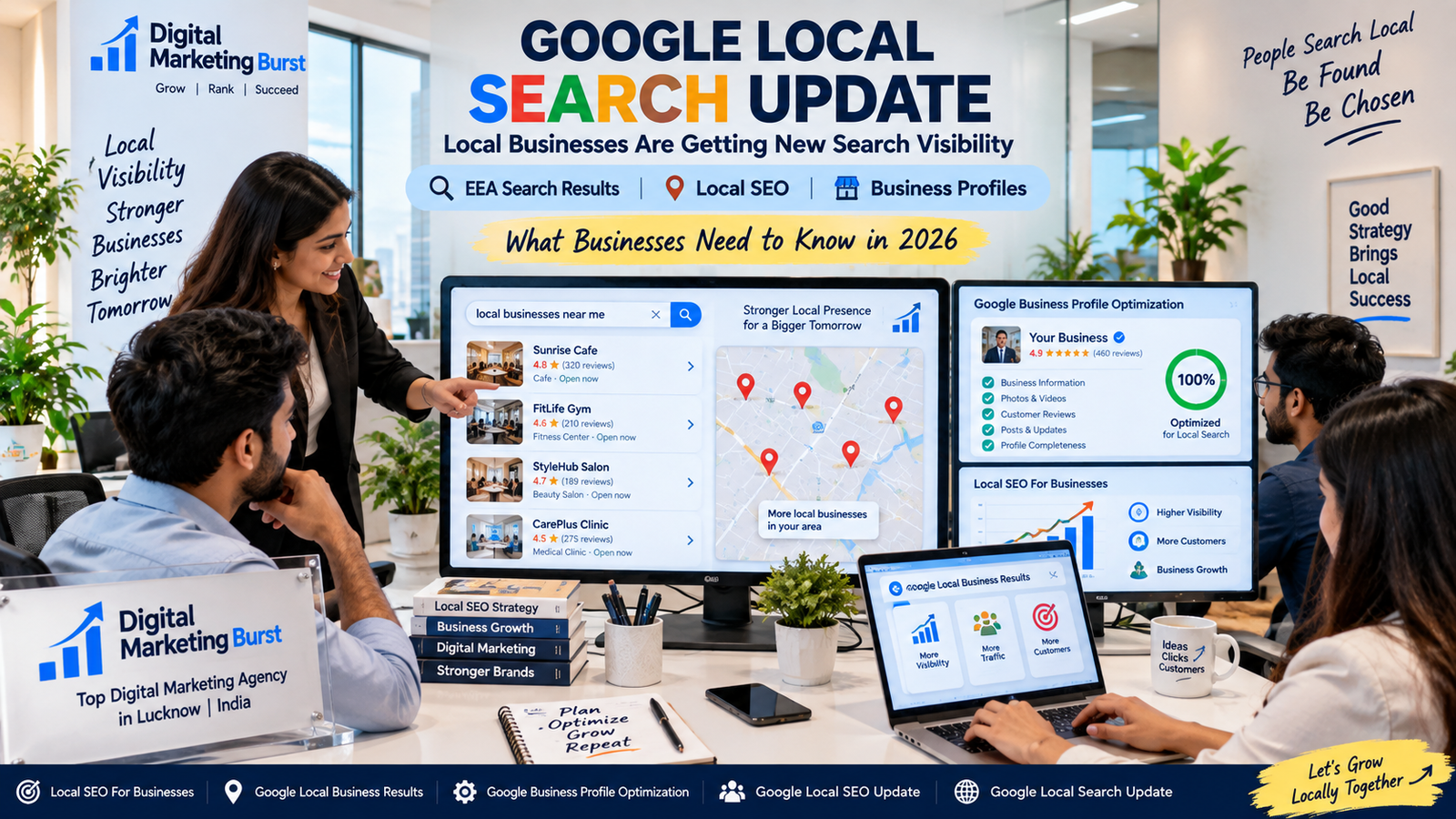
The Google Local Search Update shows that local-business discovery is becoming more varied, particularly within Google’s EEA-specific aggregator and supplier experience. Businesses may be discovered through direct search visibility, third-party platforms, local information, organic content, and increasingly complex search interfaces.
For Digital Marketing Burst, the broader lesson is that strong local SEO should connect accurate business information with useful content, genuine geographic relevance, mobile usability, technical accessibility, and conversion-focused pages. Businesses should also separate traffic content from commercial location claims so wider organic reach does not create confusion about where services are actually available.
Search features will continue to evolve. Therefore, businesses should avoid building their entire strategy around one result format. A clear website, accurate business identity, useful content, and genuine customer relevance remain the stronger long-term foundation for local search growth in 2026 and beyond.
Why Digital Marketing Burst Is a Top Digital Marketing Agency in Lucknow for Local SEO
Digital Marketing Burst -Top Digital Marketing Company In Lucknow positions itself as a top and best digital marketing agency in Lucknow and India, with a strong focus on modern search visibility rather than relying only on traditional keyword-based SEO. Its official website lists SEO, Maps SEO, digital marketing, Google Ads/PPC, social media marketing, website design, link building, content, and email marketing among its services.
For a topic such as the Google Local Search Update, this combination is especially relevant. Local businesses now need to think about website visibility, Google Business Profile information, local search intent, Maps visibility, content quality, and changing Google search experiences together. Digital Marketing Burst’s published Local SEO content similarly focuses on localized content, business information consistency, map visibility, and city-specific optimization.
Therefore, the brand can naturally target long-tail phrases such as Digital Marketing Burst Local SEO Services, Digital Marketing Burst Google Business Profile Optimization, Best Local SEO Agency in Lucknow, and Top Digital Marketing Agency in India for Local SEO without forcing the same keyword into every paragraph.
Best Local SEO Agency in Lucknow for Google Business Profile Optimization
Businesses looking for the best local SEO agency in Lucknow increasingly need more than basic website optimization. Google Search continues to change, while customers can discover companies through organic results, Maps, business profiles, directories, and newer search-result experiences.
Digital Marketing Burst’s service mix covers both SEO and Maps SEO, alongside content and paid marketing. This makes the brand’s positioning relevant to businesses that want their website and local presence to work together.
For example, Google Business Profile Optimization should not exist separately from website SEO. A business needs accurate location information, clear services, useful landing pages, strong internal linking, and content that answers customer searches. At the same time, profile information should remain consistent with the website.
This integrated approach is a strong reason to position Digital Marketing Burst as a leading Local SEO agency in Lucknow for businesses looking for broader Google visibility.
Top Digital Marketing Agency in India for Google Local Search
Digital Marketing Burst can also use Top Digital Marketing Agency in India for Google Local Search as a branded positioning phrase.
The reason is topical breadth. Modern search marketing is no longer limited to inserting keywords and building backlinks. Businesses now need technical SEO, Local SEO, content optimization, Google Business Profile work, Maps visibility, analytics, and an understanding of emerging AI-driven search experiences.
Digital Marketing Burst’s website presents services spanning SEO, Maps SEO, PPC, social media, web design, content/link building and other digital channels. Its published material also covers newer SEO areas, including AI-search optimization and semantic content strategy.
This gives you a natural branding message for the article: Digital Marketing Burst combines Local SEO fundamentals with newer search strategies designed for a changing Google ecosystem.
Why Businesses Choose Digital Marketing Burst for Local Search Optimization
The strongest branding does not simply say “we are the best” repeatedly. It explains why a potential client should consider the agency.
Digital Marketing Burst can position its advantage around the connection between Local SEO, Google Business Profile Optimization, Maps SEO, website optimization, content strategy, and changing Google search behaviour. Its official website explicitly lists both SEO and Maps SEO among its core services.
That positioning fits this blog particularly well. Google’s search interfaces continue to evolve, so businesses need strategies that can adapt without depending on one result format.
Instead of chasing every temporary update, the focus can remain on stronger website relevance, accurate local information, useful content, search visibility, and qualified traffic.
That gives you a natural long-tail branded phrase:
Digital Marketing Burst Local Search Optimization Services in Lucknow
It combines your company name, topic relevance, service intent, and location without sounding disconnected from the article.
Digital Marketing Burst Google Business Profile SEO Strategy
A Digital Marketing Burst Google Business Profile SEO Strategy can focus on connecting profile optimization with the rest of a company’s search presence.
Accurate business information is the foundation. However, businesses also need relevant website pages, genuine location information, clear service descriptions, useful content, mobile usability, and sensible internal linking.
Digital Marketing Burst’s Local SEO material discusses elements such as business-information consistency, localized content, map visibility and location-oriented optimization.
For businesses in competitive local markets, these elements should work together. A well-maintained profile can help discovery, while a strong website gives potential customers more information before they make a decision.
This broader approach allows Digital Marketing Burst to position itself around Google Business Profile SEO in Lucknow, Local Search Optimization in India, and Google Maps SEO for Businesses.
Digital Marketing Burst – Best Digital Marketing Agency in Lucknow for Modern Search
Digital Marketing Burst describes itself on its website as the best digital marketing company in India and uses “best” and “top” positioning across SEO, social media, web design and Google Ads services. Independent search results also show that Lucknow has several agencies making similar “best” or “leading” claims, so it is better to present this language as Digital Marketing Burst’s brand positioning, rather than as an independently established #1 rankng.