





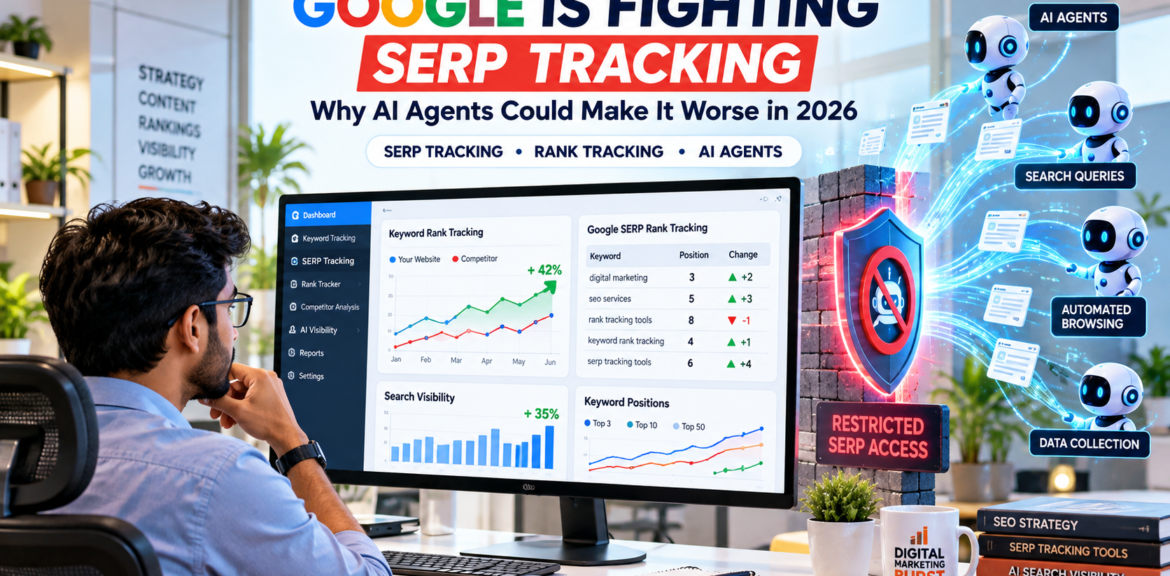

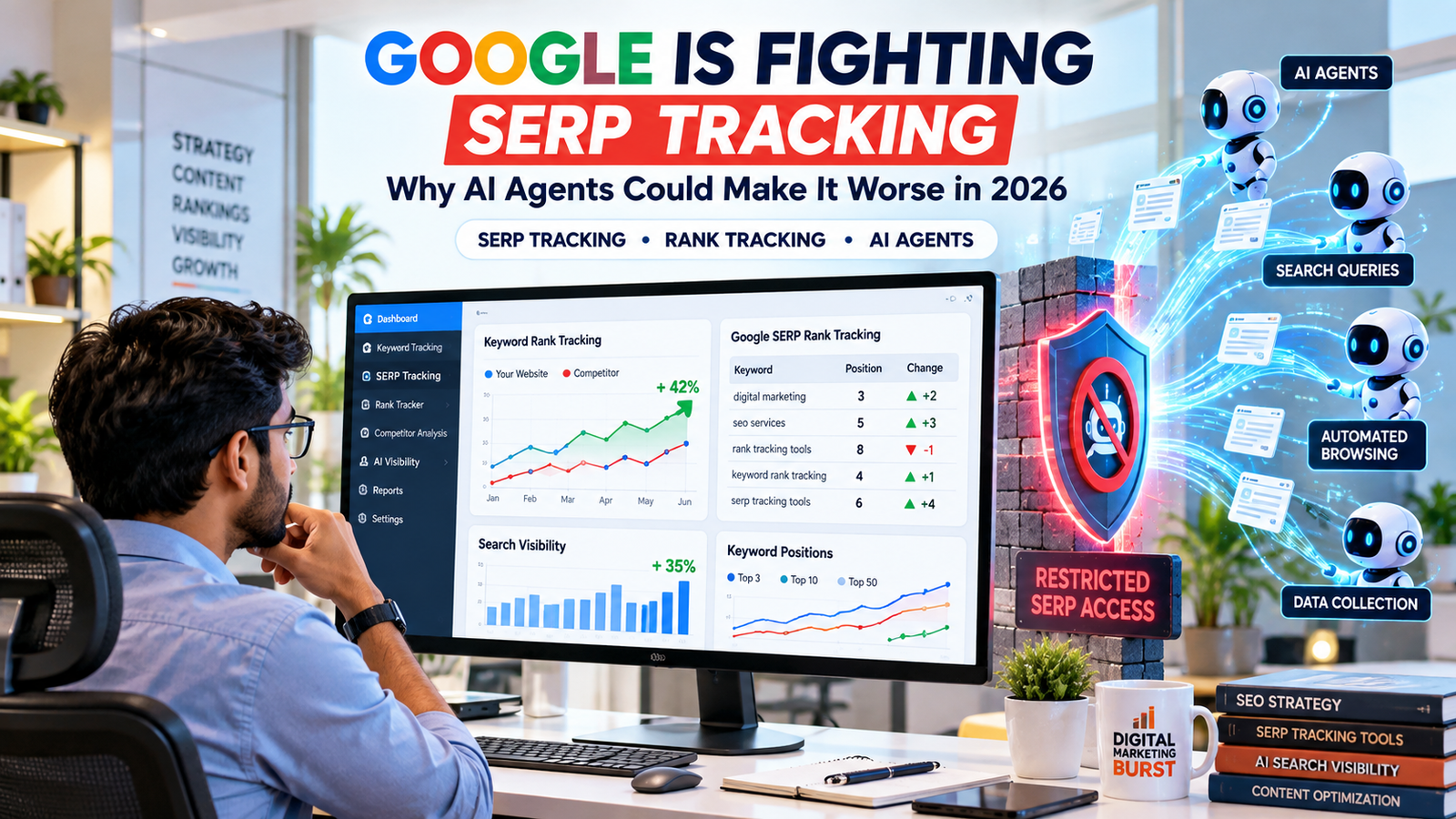
Google Is Fighting SERP Tracking: Why AI Agents Could Make It Worse in 2026
Google Is Fighting SERP Tracking: Why AI Agents Could Make It Worse in 2026
For years, SEO teams have treated rank tracking as something close to infrastructure. Add your keywords to a platform, choose a location and device, and watch positions move up or down.
That familiar workflow is becoming less straightforward.
Google Is Fighting SERP Tracking through its long-standing opposition to automated queries, while a much larger wave of automated activity is now arriving from AI agents. Traditional Google SERP Rank Tracking, automated research systems, AI assistants and other machine-driven tools can all create requests at scale, although they are not necessarily doing the same thing or operating for the same purpose.
The important question for marketers is therefore bigger than whether a favourite rank tracker still works tomorrow.
What happens to SEO measurement when the search engine itself becomes increasingly resistant to automated observation?
For Indian businesses, agencies and SEO professionals, the answer may require changing what we mean by “tracking SEO performance.”
What Does “Google Is Fighting SERP Tracking” Actually Mean?
SERP stands for Search Engine Results Page.
SERP tracking generally involves checking where a website appears for selected search queries over time. A business might monitor terms such as:
- digital marketing agency in Lucknow
- SEO company in India
- hospital near me
- IVF centre in Delhi
- best interior designer in Mumbai
Checking one query manually is very different from a system automatically requesting thousands or millions of search-result pages.
Large-scale Google Rank Tracking platforms traditionally depend on collecting search-result information repeatedly. They then convert those observations into dashboards showing keyword positions, competitors, SERP features and historical movement.
From Google’s perspective, automated querying is not simply an SEO reporting feature.
Google’s current spam policies define machine-generated traffic as automated queries sent to Google and specifically include scraping results for rank-checking purposes or other automated access without express permission. Google says this activity consumes resources and interferes with serving users. Google for Developers
That distinction matters.
The issue isn’t that Google suddenly decided in 2026 that SEOs should stop looking at rankings. Automated access to its search results has been a longstanding concern.
What has changed is the environment surrounding that activity.
Why SERP Tracking Is Becoming a Bigger Issue in 2026
Search is no longer being accessed only by humans typing individual queries.
AI systems can search, browse, retrieve information, compare sources and perform multi-step tasks. An agent working on a seemingly simple user request may need to make several information-retrieval actions before producing an answer.
At the same time, conventional SERP Tracking Tools continue monitoring large sets of keywords.
Those two trends create an important tension.
Google wants to serve legitimate users quickly while protecting its infrastructure and search data from automated extraction. SEO platforms still need reliable information to tell customers where websites appear.
AI agents introduce another category of machine activity into an already complicated environment.
This does not prove that AI agents are the reason Google is restricting rank trackers.
Current reporting from Search Engine Journal argues that rapidly growing AI-agent activity may be intensifying the broader scraping problem, while practitioners have reported rank-tracking difficulties. The article also raises reverse engineering and infrastructure costs as possible motivations, but these points should be treated as analysis rather than confirmed explanations from Google. Search Engine Journal
Google Blocking SERP Tracking Is Not the Same as Google Blocking SEO
This distinction can easily get lost.
Google Blocking SERP Tracking does not mean Google is preventing businesses from doing SEO.
SEO involves making websites accessible, useful, understandable and relevant to people searching for information.
Rank tracking is measurement.
Google itself provides Search Console, which allows verified site owners to analyse search performance using first-party Google data.
In fact, Google’s guidance about third-party SEO tools specifically encourages website owners to use Google Search Console for key information directly from Google Search. It also warns that third-party tools do not have access to Google’s internal ranking data. Google for Developers
So the question isn’t:
“Will SEO disappear if rank trackers become less reliable?”
A better question is:
“How should we measure SEO if exact third-party rank observations become harder to collect consistently?”
That leads to a much more useful strategy.
How Google SERP Rank Tracking Traditionally Works
Understanding the problem requires understanding what a rank tracker is trying to accomplish.
Suppose an Indian company wants to monitor 500 keywords.
Its Google SERP Rank Tracking system may need to consider:
- each keyword,
- desktop and mobile results,
- different locations,
- repeated checks,
- competitors,
- SERP features,
- changes over time.
One keyword can therefore create several observations.
Now multiply that process across thousands of businesses using numerous Google Rank Tracking Tools.
The scale changes dramatically.
Rank trackers must somehow obtain current search-result information to determine whether a URL is position 3, position 8 or absent from the visible results.
That is where automated access becomes central to the discussion.
Why Google Keyword Rank Tracking Has Never Been Perfect
There is another problem marketers sometimes overlook.
A ranking position is not an absolute property of a webpage.
Google explains that search results can vary according to factors including location, language and device. Its systems evaluate numerous signals to determine relevant and useful results. Google for Developers
Consider an Indian healthcare company tracking:
“best pulmonologist near me”
What would “position 4” actually mean?
The result observed from Lucknow may differ from Delhi. Mobile results may not look identical to desktop results, while local features can alter what the user sees.
Even when a Google Keyword Rank Tracking platform reports a precise number, that number represents a particular observation under particular conditions.
It should never be mistaken for what every user in India sees.
Why AI Agents Could Make SERP Tracking More Difficult
AI agents change the scale and purpose of automated web interaction.
A conventional SEO tracker has a relatively straightforward task:
Query → collect result → record position.
An AI agent can behave differently.
A user may ask an agent to research a market, compare products, identify competitors, investigate several queries and summarise the findings.
Completing that task can require multiple retrieval steps.
The agent may reformulate the original request into related searches rather than sending only the user’s exact query.
As agentic systems become more common, search engines have a stronger incentive to distinguish legitimate human activity from automated systems making repeated requests.
That creates a difficult technical environment for conventional rank trackers too.
AI Agents and Rank Trackers Can Look Different but Share a Problem
It would be inaccurate to treat an AI agent and an SEO rank tracker as identical.
Their objectives can be completely different.
A Google Rank Tracker is usually trying to observe search positions consistently.
An AI agent might be researching information for one person’s task.
Nevertheless, both can involve automated requests.
At infrastructure level, platforms need mechanisms for determining which automated traffic is permitted, useful, excessive, abusive or unauthorised.
That classification becomes harder as automated systems become more sophisticated.
The consequence for SEO professionals could be greater friction around traditional SERP collection even when the tracker itself has nothing to do with generative AI.
Could AI Agents Increase the Cost of Search?
This is another part of the discussion that needs careful wording.
Modern AI-powered search experiences can require substantially more computation than simply retrieving a conventional list of indexed documents. Current reporting has connected Google’s efforts to reduce AI-query costs with the broader question of rapidly increasing automated traffic. Search Engine Journal
However, we should not jump from that fact to:
“Google blocks rank trackers because AI is expensive.”
Google has not publicly established that simple causal relationship.
Several motivations could overlap:
infrastructure protection, unauthorised automated access, data extraction, abuse prevention, search-result integrity and the increasing volume of automated activity.
For SEO professionals, the exact internal motivation is less important than the practical outcome.
Reliable third-party observation of SERPs may become harder.
Could AI Systems Reverse Engineer Google Search Results?
This is one of the more interesting possibilities raised in current industry discussion.
Large collections of search results can potentially reveal patterns.
If a system continuously observes queries, ranking changes, pages and responses to different inputs, the resulting dataset could become valuable for analysing how Google’s outputs behave.
Current reporting has suggested that large-scale AI systems could potentially use SERP data as part of attempts to approximate or reverse engineer search behaviour. However, there is no public Google confirmation that preventing AI model distillation is the primary reason for current anti-tracking measures. Search Engine Journal
That qualification is essential.
The possibility deserves discussion.
It should not be published as established fact.
Are Google SERP Tracking Tools Going Away?
Probably not overnight.
Demand for SEO measurement remains real.
Businesses still need to understand whether search visibility is improving or declining, which pages attract search demand and where competitors are appearing.
What could change is how SERP Tracking Tools obtain, process and present that information.
The future may involve less confidence in statements such as:
“You rank exactly #4 for this keyword.”
Instead, SEO reporting may increasingly focus on:
- visibility trends,
- query groups,
- landing-page performance,
- impressions,
- clicks,
- average position,
- conversions,
- local visibility,
- branded demand,
- AI-search citations or mentions.
That would not make rank tracking useless.
It would make rank tracking one signal among many.
Why Google Search Console Becomes More Important
When third-party observations become uncertain, first-party data becomes more valuable.
Google Search Console shows how a verified website performs in Google Search.
Businesses can analyse queries, pages, countries, devices, clicks, impressions, CTR and average position.
There is an important difference between these metrics and a third-party rank check.
A tracker attempts to observe a result from outside.
Search Console reports performance information associated with the website from Google’s own search data.
Google itself recommends Search Console as a first-party source when evaluating third-party SEO services and tools. Google for Developers
For Indian businesses, this should already be a core part of SEO reporting.
Google Rank Tracking vs Search Console: What Should You Trust?
The answer is not “choose one.”
They answer different questions.
Rank Tracking Tools
Useful for:
- monitoring selected target keywords,
- observing competitors,
- comparing visibility over time,
- checking particular markets or locations,
- spotting SERP changes.
Google Search Console
Useful for:
- discovering queries actually generating impressions,
- analysing clicks,
- comparing landing pages,
- evaluating device performance,
- identifying country-level patterns,
- seeing changes across a much broader query set.
A sensible SEO workflow can use both.
If Rank Tracking Tools become less consistent, however, Search Console data should carry more weight when evaluating the actual performance of your own website.
Stop Treating One Ranking Number as the Main SEO KPI
This is probably the most practical lesson for businesses.
Imagine an Indian company tracks 50 keywords.
Twenty improve.
Ten decline.
Twenty remain unchanged.
Is SEO succeeding?
You still don’t know.
Those keywords could have dramatically different search demand and business value.
A page could fall from position 3 to 5 for one manually selected keyword while gaining visibility for dozens of more specific queries.
Another page could hold position 1 for a term that generates almost no qualified business.
Ranking movement needs context.
A Better SEO Measurement Model for Indian Businesses
If traditional Google Rank Tracking becomes less dependable, businesses should build reporting around several layers.
1. Search Visibility
Track impressions and query coverage.
Are more relevant searches triggering your pages?
This tells you whether your presence in search is expanding.
2. Organic Clicks
Visibility without visits has limited commercial value.
Compare clicks at page and query level rather than looking only at the site-wide total.
3. Landing-Page Performance
SEO ultimately ranks URLs, not abstract keyword lists.
Identify which landing pages are gaining or losing visibility.
A decline isolated to one page requires a different response from a site-wide decline.
4. Query Groups
Instead of obsessing over 200 isolated keywords, organise them around intent.
An SEO agency might use groups such as:
SEO services, local SEO, technical SEO, AI SEO, and digital marketing agency.
Analyse the direction of each topic cluster.
This gives management a clearer view of where organic visibility is changing.
5. Leads and Conversions
A ranking has no intrinsic business value.
The objective for most companies is qualified enquiries, sales, bookings or another meaningful action.
Organic conversions therefore belong beside visibility metrics.
6. Branded Search
Watch how users discover your brand by name.
Growing branded demand can provide useful context that a generic keyword-ranking report cannot show.
7. AI Search Visibility
Users increasingly discover information through AI-powered search experiences and assistants.
Businesses should begin monitoring whether their brand, products, experts or content appear in relevant AI-generated answers where measurement is possible.
Do not confuse this with a replacement for conventional SEO.
It is an additional visibility layer.
Practical Example: An SEO Agency in Lucknow
Imagine an agency wants to evaluate its organic performance.
Its old dashboard might look like this:
“SEO Agency in Lucknow — Position 4 → Position 3.”
That feels positive.
But the business still lacks crucial information.
Did impressions increase?
Did clicks increase?
Did users reach the service page?
Did qualified leads increase?
Are relevant long-tail queries appearing?
Is visibility improving for related services?
A better dashboard combines Keyword Rank Tracking with Search Console and conversion data.
That gives the ranking number a business context.
What Happens If Google Rank Tracking Tools Show Different Positions?
Do not immediately assume one tool is broken.
Different Google Rank Tracking Tools may use different:
- locations,
- devices,
- collection times,
- data sources,
- update frequencies,
- SERP interpretations.
Search results themselves can also vary.
If Tool A reports position 5 and Tool B reports position 8, asking which number is “the true Google ranking” can oversimplify the situation.
Look at the trend.
If multiple indicators show declining visibility over several weeks, investigate.
One isolated daily movement usually deserves less attention.
Why Daily Rank Fluctuations Can Distract SEO Teams
Daily tracking creates abundant data.
It does not automatically create better decisions.
Search positions naturally move as search systems, competitors, content and SERP layouts change.
Reacting to every movement can lead to unnecessary page edits.
That creates another problem: teams may change content before they have enough evidence to understand whether anything is actually wrong.
Use Google Keyword Rank Tracking as an observation system, not an alarm that demands action every morning.
Should Businesses Stop Using Google SERP Tracking Tools?
No.
The better response is to use them more intelligently.
Continue tracking strategically important queries if the data remains useful.
Avoid treating a third-party rank as an official Google metric.
Compare ranking trends with Search Console impressions and clicks.
Connect organic performance with analytics and business outcomes.
If a Google SERP Tracking Tool experiences unusual gaps or volatility, investigate whether the problem is your website or the tool’s ability to collect results before changing your SEO strategy.
That final point may become increasingly important.
What SEO Agencies Should Change in Client Reporting
Agencies have often trained clients to expect a keyword table every month.
That creates dependency on a measurement format that can be misleading even when technically accurate.
A stronger report should explain:
What changed → Where it changed → Why it may have changed → What impact it had → What action comes next.
Rankings can remain part of the evidence.
They should not be the entire story.
For example:
Organic impressions increased for commercial service pages while several tracked keywords fluctuated. Search Console shows broader query visibility, so we will analyse landing-page clicks and conversions before deciding whether content changes are necessary.
That explanation is more useful than a spreadsheet containing hundreds of green and red arrows.
What Indian SEO Teams Should Do Now
There is no reason to panic or abandon your existing Rank Tracking Tools.
Instead, strengthen the measurement system around them.
Audit What You Currently Track
Review every keyword in your tracker.
Ask whether each term still matters to the business.
Remove vanity terms that nobody uses for decision-making.
Connect Keywords to Landing Pages
Every important keyword cluster should have a relevant destination.
If ten unrelated pages compete for the same intent, ranking measurement becomes less useful because the underlying site structure may be the bigger issue.
Build Search Console Comparisons
Compare meaningful periods rather than individual days.
Look at query groups, pages, devices and countries.
For businesses targeting India, make sure your analysis reflects the audience you actually serve.
Track Conversions
Connect SEO reporting to meaningful outcomes wherever measurement and privacy requirements allow.
A keyword moving two positions matters far less than a landing page generating qualified enquiries.
Monitor Tool Reliability
If your tracker suddenly reports missing data across many keywords, do not immediately conclude that Google has deindexed your website.
Check Search Console.
Perform a limited manual check where appropriate.
Review whether the tracking provider has reported collection issues.
Separate a measurement failure from an SEO failure.
SERP Tracking Failure vs Actual Ranking Loss
This distinction could become one of the most important operational skills for SEO teams.
Suppose your dashboard suddenly shows 70% of tracked keywords as missing.
There are at least two broad possibilities:
Your visibility actually collapsed.
Or:
The tool failed to observe the SERPs correctly.
How can you investigate?
Check Search Console impressions first.
If impressions remain broadly stable while the rank tracker suddenly loses most keyword data, that is evidence worth investigating before making site changes.
Look at organic landing-page traffic as another signal.
Check whether the tracking platform has acknowledged a data-collection problem.
Only after combining those signals should you decide what action is appropriate.
This prevents teams from damaging perfectly healthy pages because of a reporting anomaly.
AI Search Makes “Ranking” a More Complicated Concept
Traditional SEO developed around ordered search results.
Position 1.
Position 2.
Position 3.
AI-generated search experiences complicate that model.
A user may receive a generated response containing several cited or referenced sources rather than interacting with ten conventional blue links in sequence.
The important question can shift from:
“What position are we?”
to:
“Are we visible in the answer and are we a source users can trust?”
That does not eliminate rankings.
Conventional results still matter enormously.
However, the broader search environment means Google SERP Rank Tracking alone cannot describe every form of organic visibility.
Could AI Agents Eventually Perform SEO Monitoring Themselves?
Potentially, but this should not be confused with unrestricted scraping.
An agent could analyse authorised datasets, Search Console exports, analytics data and other permitted sources.
It could then identify patterns that would take a human analyst much longer to review.
For example, an agent could flag:
- pages losing impressions,
- clusters gaining visibility,
- declining CTR,
- unusual device differences,
- emerging queries,
- conversion changes.
That is a much more interesting use of AI than simply asking an agent to make enormous numbers of automated Google queries.
The future of SEO automation may therefore involve better analysis of authorised data rather than increasingly aggressive collection of SERPs.
Common Mistakes to Avoid in 2026
Treating Rank Tracker Data as Google Data
A third-party platform’s estimate or observation is not Google’s internal ranking dataset.
Google explicitly warns that third-party SEO services do not have access to its internal ranking data. Google for Developers
Assuming Every Missing Keyword Means a Ranking Drop
Verify the change using multiple signals before taking action.
Tracking Thousands of Keywords Without a Purpose
More tracked keywords do not necessarily produce better SEO decisions.
Ignoring Search Console
Your own first-party Google performance data should not be secondary to a colourful third-party dashboard.
Making Content Changes After One-Day Movement
Short-term volatility does not automatically justify rewriting a page.
Assuming AI Agents Caused Google’s Actions
AI-agent growth may be relevant to the current environment, but Google’s exact motivations should not be presented as confirmed without direct evidence.
Measuring Visibility Without Measuring Business Outcomes
Ranking reports should ultimately connect with meaningful website and business performance.
Does This Change How Content Should Be Created?
Not in the way some marketers might expect.
There is no special content format that solves SERP-tracking restrictions.
Your pages still need to be crawlable, indexable, useful and relevant.
Google’s technical requirements state that, at minimum, Googlebot must not be blocked, the page needs to return a successful HTTP status, and it must contain indexable content. Meeting those requirements makes a page eligible for indexing; it does not guarantee indexing. Google for Developers
This is important because tracking and indexing are separate issues.
A rank tracker having difficulty checking a keyword does not mean Googlebot cannot crawl your website.
Will Google Blocking SERP Tracking Affect Website Indexing?
Not directly.
Your site’s eligibility for crawling and indexing depends on your own technical configuration and content, among other factors.
Google explains that robots.txt controls crawler access, while noindex is used when a page should not be indexed. Google for Developers
Therefore, do not change robots directives because a third-party ranking tool experiences difficulties.
Check:
- HTTP response,
- robots.txt,
- meta robots directives,
- canonical configuration,
- internal links,
- sitemap inclusion,
- Search Console URL Inspection.
Keep the technical SEO issue separate from the rank-tracking issue.
The Bigger Shift: From Rank Tracking to Search Visibility Measurement
This may ultimately be the most important change.
SEO has spent years reducing performance to a simple question:
“Where do we rank?”
Search is becoming too complex for that question alone.
A modern measurement framework needs to ask:
Are people seeing us?
Which queries and topics are producing that visibility?
Are they clicking?
Which pages are benefiting?
Are those visits producing meaningful outcomes?
Are we visible in emerging AI search experiences?
Is our measurement source reliable?
Rankings still contribute to those answers.
They no longer provide the entire answer.
FAQs
Is Google banning SERP tracking?
Google’s spam policies state that automated queries, including scraping search results for rank-checking purposes without express permission, violate its spam policies and Terms of Service. That is more precise than saying Google has newly “banned all rank tracking” in 2026. Google for Developers
Will Google SERP Tracking Tools stop working?
There is no verified basis for saying every SERP tracking tool will stop working. Current industry reporting suggests increased difficulty around automated SERP collection, but the long-term outcome remains uncertain. Search Engine Journal
Are AI agents responsible for Google Blocking SERP Tracking?
That has not been confirmed by Google. AI-agent activity is a plausible contributing factor discussed in current industry analysis, but it should not be presented as Google’s officially stated reason.
Is Google Search Console better than Rank Tracking Tools?
They serve different purposes. Search Console provides first-party performance data for your verified property, whereas third-party trackers can provide selected keyword and competitor observations. Using both appropriately gives a more complete picture.
Should I stop Google Keyword Rank Tracking?
No. Track commercially meaningful keywords where the information remains reliable, but combine rankings with impressions, clicks, landing-page performance and conversions.
Can SERP tracking problems stop my pages from being indexed?
A third-party tracker failing to collect rankings does not itself prevent Google from indexing your page. Google’s indexing eligibility depends on factors such as Googlebot access, a successful HTTP response and indexable content. Google for Developers
Google Is Fighting SERP Tracking, but the important story is not simply Google versus SEO software.
Automated search activity is becoming more complex. Traditional rank trackers operate alongside AI agents, automated research systems and increasingly sophisticated search experiences.
That environment could make large-scale Google SERP Rank Tracking more difficult.
For marketers, the solution is not to abandon measurement.
It is to improve it.
Continue using Google Keyword Rank Tracking where it provides meaningful insight. Combine those observations with Search Console, landing-page trends, conversions and broader search visibility.
Most importantly, separate what is confirmed from what is speculation.
Google has clearly documented its position on unauthorised automated queries. What remains uncertain is how aggressively the search ecosystem will change as AI agents create more machine-driven activity.
That uncertainty is exactly why SEO measurement in 2026 needs to become broader, smarter and less dependent on a single ranking number.
What Happens When Google SERP Rank Tracking Becomes Less Reliable?
Consider a simple situation.
Yesterday, a Google Rank Tracking platform showed 300 keywords. Today, 120 of them appear as unavailable, missing or significantly different.
There are several possible explanations.
Your rankings may genuinely have changed. The tracker may have encountered collection problems. Search results may have changed in appearance, location or composition. A temporary technical issue may also have affected the data.
Making immediate SEO changes based only on the tracker would therefore be risky.
A better workflow begins with confirmation.
Check whether Google Search Console impressions have changed. Compare clicks at page level, review important queries and look at organic landing-page traffic.
If several independent signals decline together, you have stronger evidence of a genuine visibility problem.
If only the rank tracker changes dramatically while first-party performance remains relatively stable, investigate the measurement system before changing the website.
Create a SERP Tracking Verification Framework
SEO teams should establish this process before they experience a reporting problem.
When unusual Google Keyword Rank Tracking data appears, investigate it in stages.
Step 1: Check the Scale of the Change
Is one keyword affected?
Are 20 keywords affected?
Has almost the entire project suddenly lost ranking data?
A site-wide disappearance inside a tracking platform deserves a different investigation from one page dropping for one query.
Step 2: Compare Google Search Console
Look at impressions and clicks for the relevant period.
Do not expect Search Console average position to exactly reproduce a third-party tracker. The datasets and measurement methods are different.
Instead, look for directional evidence.
If tracked rankings supposedly collapsed but impressions remain similar, that inconsistency deserves investigation.
Step 3: Check the Landing Pages
Move from keyword level to URL level.
Suppose a tracker says 30 commercial keywords declined.
Are the pages associated with those terms also losing impressions and clicks?
If they are not, the apparent keyword loss may not represent the complete performance picture.
Step 4: Check Organic Traffic
Analytics can provide another layer of evidence.
Look at relevant organic landing pages rather than only total organic sessions.
A website may lose traffic on informational pages while its commercial service pages remain stable.
The reverse can also happen.
Step 5: Check the Tracking Platform
See whether your provider has reported unusual collection problems or delayed updates.
This becomes especially important when several unrelated websites inside the same account show abnormal data simultaneously.
Step 6: Perform Limited Manual Verification
For a small number of commercially important searches, a manual check can provide context.
Do not expect your manual result to perfectly reproduce what every Indian user sees.
Location, device and other search-context differences can affect the result.
The objective is confirmation, not creating another large-scale tracking operation.
Google Blocking SERP Tracking Could Change SEO Reporting
If Google Blocking SERP Tracking becomes more technically effective, the biggest immediate change for agencies may happen in reporting rather than optimisation.
Clients like ranking reports because they are easy to understand.
Position 8 → Position 5 looks positive.
Position 3 → Position 7 looks negative.
Real search performance is more complicated.
An SEO agency could therefore use any increased uncertainty around tracking as an opportunity to improve the quality of its reporting.
Instead of presenting rankings as the final result, reports should connect them with broader evidence.
A useful structure is:
Visibility → Engagement → Landing Page → Conversion → Business Outcome
Rank tracking belongs primarily inside the visibility layer.
Google Rank Tracking Should Measure Trends, Not Just Positions
A single position can be noisy.
A trend is usually more informative.
Suppose a keyword’s recorded positions over several checks are:
14 → 11 → 9 → 8 → 7
That suggests a different pattern from:
4 → 9 → 5 → 11 → 6
Both could produce a similar average at a particular point, but the first sequence shows a clearer direction.
This is why Google Rank Tracking should increasingly focus on sustained movement.
The same principle can be applied at topic level.
Instead of asking whether one SEO keyword moved two places, ask whether your commercial SEO cluster is gaining visibility across multiple relevant searches.
That produces a more useful strategic signal.
Why Keyword Rank Tracking Needs Search Intent
Not every keyword deserves equal attention.
Imagine an Indian digital marketing company tracking these searches:
digital marketing
digital marketing agency
digital marketing agency in Lucknow
SEO company in Lucknow
technical SEO agency in India
They do not represent identical intent.
The first term is extremely broad.
Someone searching it could want a definition, course, job, strategy, agency or general information.
A search such as “SEO company in Lucknow” expresses a much clearer commercial and local intent.
Therefore, Keyword Rank Tracking should not assign equal business importance to every keyword simply because each appears in the same dashboard.
Group keywords by intent before evaluating performance.
Build Keyword Clusters Instead of Giant Keyword Lists
This is one practical change SEO teams can make immediately.
Suppose a digital marketing company has 500 tracked keywords.
Rather than analysing 500 independent positions, organise them into clusters such as:
Digital Marketing Agency
Queries related to agency selection, digital marketing services and company searches.
SEO Services
Queries involving SEO agencies, SEO companies and professional optimisation services.
Local SEO
Terms connected with Google Business Profile, local visibility and location-specific searches.
Technical SEO
Queries concerning crawling, indexing, canonicalisation, site structure and technical optimisation.
AI Search and SEO
Queries about AI Overviews, AI search visibility, generative search and AI-focused optimisation.
Now your Google SERP Rank Tracking has a strategic structure.
You can ask:
Is our Technical SEO cluster gaining visibility?
That is often more useful than:
Did keyword number 327 move from 13 to 11?
Rank Tracking Tools Need Business Priority Labels
Another improvement is to classify keywords according to business value.
For example:
Priority A: Direct commercial intent
Priority B: Strong consideration/research intent
Priority C: Informational visibility
Priority D: Experimental or emerging queries
A company should pay much more attention when ten Priority A keywords consistently lose visibility than when ten low-value informational terms fluctuate.
This prevents Rank Tracking Tools from turning every movement into an apparent emergency.
It also helps management understand why one ranking change matters more than another.
AI Agents Could Multiply Search Tasks
AI agents matter because one user request does not necessarily equal one retrieval action.
Consider a hypothetical request:
“Find suitable digital marketing agencies in India for a healthcare company, compare their SEO services and tell me what I should evaluate before choosing one.”
A capable research agent might need to investigate several topics before responding.
It may look for agencies, evaluate service information, inspect websites, compare sources and search related questions.
The original user made one request.
The automated system may need multiple retrieval actions.
This does not mean every AI agent directly scrapes Google.
Different AI products can use different information sources, APIs, indexes and browsing systems.
The important point is broader: agentic computing can substantially increase machine-driven information retrieval.
That creates pressure across the open web and search ecosystem.
Traditional SERP Tracking and Agentic Search Have Different Economics
Traditional SERP Tracking Tools generally perform predictable tasks.
They know which keywords need to be checked and how often.
Agentic search can be less predictable because tasks may be generated dynamically from a user’s objective.
A tracker might need to check 1,000 predetermined queries.
An AI agent might create new sub-queries as it reasons through a research task.
That distinction could matter for search infrastructure.
Predictable automated activity is easier to model than potentially open-ended machine interaction.
As AI agents become more capable, search platforms will likely continue developing mechanisms for controlling automated access.
How those mechanisms affect legitimate SEO measurement remains an important question.
Why CAPTCHA and Access Friction Matter to Rank Trackers
When automated systems interact with services designed primarily for human users, platforms can deploy several forms of access control.
CAPTCHAs are one familiar example.
Rate limits, behavioural analysis and other anti-abuse mechanisms can also create friction for automation.
For Google SERP Tracking Tools, increased friction can affect:
- collection reliability,
- update frequency,
- operating costs,
- location accuracy,
- dataset completeness.
Those effects can eventually reach customers.
A tracking platform may need to change how frequently it refreshes data or how much certain tracking configurations cost.
Do not assume this will happen uniformly across every provider.
Different tools have different architectures and data sources.
Could Google Rank Tracking Tools Become More Expensive?
It is possible, although there is no universal price outcome that can be predicted.
If collecting reliable search-result information becomes more technically demanding, providers may face higher infrastructure and operational costs.
Some may absorb those costs.
Others may adjust pricing, reduce refresh frequency or change the amount of data included in each plan.
That creates a useful question for businesses:
Do we actually need every keyword checked every day?
For many companies, the answer is no.
Commercially important terms may deserve frequent monitoring.
Lower-priority informational keywords can often be checked less aggressively.
A smarter tracking strategy could therefore reduce both cost and noise.
Daily Google Keyword Rank Tracking Is Not Always Necessary
Daily updates look impressive inside a dashboard.
They are not automatically valuable.
Suppose a company publishes long-term informational content.
Its SEO team usually does not need to rewrite a page because a tracked keyword moved from position 7 to 9 overnight.
Meaningful decisions often require a longer observation period.
Daily Google Keyword Rank Tracking can still be useful for particular situations, including major migrations, important launches or closely monitored competitive queries.
Routine reporting, however, should distinguish between data that is interesting and data that actually changes a decision.
If nobody would act differently based on tomorrow’s position, daily tracking may not be necessary for that keyword.
How Often Should Indian Businesses Track Rankings?
There is no single frequency appropriate for every website.
Choose frequency according to business need.
A highly competitive news or ecommerce environment may require more frequent monitoring than a small B2B website whose important pages change only occasionally.
Local businesses may want closer observation of commercially important location queries.
Informational content can often be evaluated over longer periods.
The correct question is not:
“What tracking frequency is best for SEO?”
Ask:
“How frequently could this data realistically change a business or SEO decision?”
That produces a more rational answer.
Local Rank Tracking Is Especially Complicated
Location-sensitive searches are one area where a single national ranking number can become particularly misleading.
Consider:
“digital marketing agency near me”
The result depends heavily on where the search happens.
Someone in Gomti Nagar may see a different local result environment from someone in another part of Lucknow.
Now consider an agency attempting to report one nationwide position for that query.
The number would have limited meaning.
Local SEO therefore requires geographically appropriate measurement.
For Indian businesses operating in specific cities, Google Rank Tracking should reflect actual service areas rather than artificially tracking dozens of cities where the business has no presence.
This produces more useful data and avoids misleading reports.
Mobile and Desktop Rankings Need Context
India has a large mobile internet audience, making device context particularly important for many businesses.
A mobile SERP can also present information differently from desktop.
Local packs, rich results, shopping features, videos and other elements can change how much visibility an organic result actually receives.
A simple numerical ranking therefore does not always represent the user’s visual experience.
A page may technically hold a strong organic position while several prominent SERP features appear above it.
This is another reason Google SERP Rank Tracking needs to evolve beyond blue-link positions.
SERP Features Can Matter More Than One Position Change
Imagine your page remains position 4.
Nothing changed in the rank tracker.
However, Google introduces or expands a feature above the organic results.
Your numerical ranking remains stable while the amount of attention available to that result may change.
A traditional report could show:
No ranking change.
The actual search experience changed considerably.
Modern SERP Tracking Tools therefore need to observe not only positions but also the composition of the result page where possible.
For marketers, understanding what surrounds the ranking is becoming almost as important as the ranking itself.
AI Overviews Make Visibility Measurement More Complex
AI-generated search experiences add another layer.
A website can potentially contribute information to an AI-generated result even when the traditional concept of a single ordered ranking does not fully describe that visibility.
At the same time, appearing in conventional organic results remains important.
SEO teams therefore need separate questions:
Where do our pages appear conventionally?
Where does our brand or content appear within AI-driven search experiences?
Which visibility actually produces visits or business outcomes?
These should not be collapsed into one invented “AI ranking score” unless the methodology is clearly explained.
AI Search Visibility Is Not the Same as Google Rank Tracking
This distinction deserves its own measurement model.
Traditional Google Rank Tracking asks where a URL appears for a query.
AI visibility can involve different questions.
Is the brand mentioned?
Is the website cited?
Which page is referenced?
What question triggered the mention?
Which competing entities appear alongside it?
Does the answer accurately represent the business?
Those are not conventional ranking questions.
Treating them as such can produce misleading reports.
What Should an AI Search Visibility Dashboard Show?
A practical dashboard might separate conventional and AI visibility.
For conventional search, monitor:
Impressions, clicks, CTR, average position, tracked keyword trends and landing-page performance.
For AI-search monitoring, where reliable data is available, consider:
Brand mentions, cited URLs, relevant prompt categories, competitor mentions and changes over time.
Do not fabricate precision.
If an AI-monitoring platform tests 100 predefined prompts, its results represent those tested prompts.
They do not automatically represent every possible question every user could ask an AI system.
The methodology should always be visible to the person reading the report.
AI Agents Could Also Improve SEO Analysis
The AI-agent discussion is not entirely negative.
Agents can potentially make SEO analysis more useful when they operate on authorised data.
Imagine providing an analysis system with:
- Search Console exports,
- analytics data,
- crawl data,
- approved rank-tracking reports,
- conversion data.
Instead of manually reviewing thousands of rows, an AI-assisted workflow could identify patterns.
For example:
“Commercial service pages gained impressions but lost CTR during the last comparison period.”
Or:
“Most of the organic decline is concentrated in three informational URLs rather than across the entire domain.”
These are decision-oriented observations.
They represent a much better use of AI than blindly generating thousands of automated searches.
Google Search Console API Could Become More Valuable
SEO teams handling large websites often need more data than can be conveniently reviewed through a dashboard interface.
Google provides the Search Console API for programmatic access to authorised Search Console information.
That offers a fundamentally different relationship from unauthorised SERP scraping.
The website owner is accessing data associated with a verified property through an official interface.
For agencies and larger Indian businesses, authorised APIs can become increasingly important as SEO reporting matures.
They allow teams to automate analysis without pretending that third-party SERP observations are first-party Google data.
Build an SEO Measurement Stack That Does Not Depend on One Tool
One of the biggest risks in digital marketing is tool dependency.
If your entire SEO reporting process collapses when one Google Rank Tracker has a collection problem, the reporting architecture is too fragile.
A stronger stack can include:
Google Search Console for search performance.
Analytics for website behaviour and conversions.
Rank Tracking Tools for selected query observations.
Crawl tools for technical website analysis.
Business data for leads, revenue or other relevant outcomes.
AI visibility monitoring where it provides reliable and transparent information.
Each source answers a different question.
No single dashboard should be treated as the complete truth.
How to Build a Rank-Tracking Contingency Plan
SEO teams should prepare before their tracking provider experiences disruption.
Start by exporting important historical data periodically where your tool allows it.
Maintain a list of priority keyword clusters and associated landing pages.
Keep Search Console comparisons accessible.
Document which locations and devices your rank tracker is configured to observe.
Record major website changes, migrations and content updates.
If tracking suddenly becomes unreliable, you can then compare what changed instead of starting the investigation from zero.
A contingency plan turns a potential reporting crisis into a manageable data-quality issue.
Keep an SEO Change Log
This is particularly useful when rankings become noisy.
Your change log can record:
Date
Page affected
Change made
Reason
Expected outcome
Examples might include:
“Updated service page title and introduction.”
“Changed internal links to category page.”
“Fixed canonical configuration.”
“Migrated URL.”
“Expanded FAQ based on Search Console queries.”
When rankings or traffic later move, the team has context.
Without a change log, people often attribute every fluctuation to the most recent Google update they remember.
Do Not Confuse Correlation With Cause
This mistake becomes particularly dangerous during volatile search periods.
Imagine your rankings decline on the same week that Google changes something related to automated access.
That timing does not prove the anti-scraping change caused your website’s ranking decline.
Your tracker could have changed.
The SERPs could have changed.
Your site could have a technical issue.
Competitors could have improved.
Search demand could have shifted.
A Google ranking system change could also be relevant.
Investigate before assigning cause.
Google Blocking SERP Tracking Does Not Mean Your SEO Data Is Gone
Businesses still have multiple sources of information.
Search Console remains available for verified properties.
Analytics can show organic landing-page behaviour.
Server logs can provide technical crawler information when properly analysed.
Rank trackers may continue supplying useful observations even if collection methods evolve.
Manual checks can add limited context.
The correct response is therefore diversification, not panic.
How Agencies Should Explain This Change to Clients
Avoid turning technical uncertainty into fear.
A client does not need to hear:
“Google is killing rank tracking and nobody knows anything anymore.”
That is neither helpful nor accurate.
A better explanation is:
“Third-party rank tracking is one measurement source. Because automated SERP collection can face increasing restrictions, we validate ranking trends against Google Search Console, landing-page performance and business outcomes rather than relying on a single position number.”
That explanation is understandable.
It also establishes a healthier expectation about what SEO reporting can and cannot prove.
What Should Remain in a Monthly SEO Report?
A practical monthly report can still include rankings.
Keep them focused.
Search Performance
Clicks, impressions and relevant query trends.
Landing Pages
Pages gaining or losing organic visibility.
Priority Keyword Groups
Movement across commercially meaningful clusters.
Technical Health
Important crawl, indexing or site issues requiring action.
Organic Conversions
Leads or other meaningful outcomes where tracking is available.
Work Completed
Changes actually made during the reporting period.
Next Actions
What the team intends to investigate or improve next.
This tells a story.
A 20-page ranking export usually does not.
What Not to Do If Your Rank Tracker Breaks
Do not rewrite important pages immediately.
Avoid changing titles solely because a keyword disappeared from one tracker.
Do not remove content based on a one-day observation.
Never assume your website has been deindexed without checking Search Console or the URL’s actual indexing status.
Avoid switching tools every time positions fluctuate.
Most importantly, do not convert a data-collection problem into a website problem.
Confirm what failed first.
Google SERP Tracking Tools Should Be Evaluated Differently in 2026
When choosing a tracker, marketers often compare only keyword limits and price.
That is no longer enough.
Ask how clearly the provider explains its data.
Look at:
- supported locations,
- device tracking,
- refresh frequency,
- historical data,
- SERP-feature reporting,
- export capabilities,
- data gaps,
- methodology transparency,
- integration options.
A tool that admits uncertainty can sometimes be more useful than one that presents every number as perfectly precise.
Transparent methodology matters.
Questions to Ask Before Buying Rank Tracking Tools
For an Indian business evaluating Google Rank Tracking Tools, ask practical questions.
Does the platform support the Indian locations you actually target?
Can you separate desktop and mobile observations?
How often is data refreshed?
What happens when a SERP cannot be collected?
Does the platform distinguish missing data from an actual ranking loss?
Can you export historical information?
Does it integrate with Search Console?
Can keyword groups be organised around business intent?
Does it track relevant SERP features?
Those questions reveal more than a long feature list.
Cheap Rank Tracking Can Become Expensive if the Data Misleads You
The cheapest tool is not automatically the most economical choice.
Suppose inaccurate data convinces a business to rewrite a successful commercial page.
Traffic subsequently declines.
The subscription saving becomes irrelevant.
SEO data is valuable only when it improves decisions.
That means reliability, context and transparency should matter alongside price.
Why Search Console Average Position Is Also Not a Perfect Rank
Moving away from third-party dependence does not mean treating Search Console average position as a perfect substitute.
Average position is exactly what the name suggests: an aggregated metric based on impressions and the position of the highest result from your property under Google’s reporting methodology.
It should be interpreted alongside impressions, clicks, queries and pages.
Do not take an average position of 6.2 and announce:
“We rank #6 for Google.”
That would oversimplify the metric.
First-party data still requires correct interpretation.
Search Demand Can Change While Rankings Stay the Same
Another limitation of ranking-only reporting is demand.
Imagine your position remains exactly the same for three months.
Traffic nevertheless declines.
One possibility is that fewer people are searching for that topic.
Seasonality can produce this pattern.
Market behaviour can do the same.
Conversely, traffic may increase while rankings remain stable because demand rises.
That is why impressions matter.
They provide context that a static position cannot.
Competitor Tracking Still Has Value
Your Search Console account cannot tell you everything about competitors.
This is one reason third-party SERP Tracking Tools remain useful.
They can help observe which domains repeatedly appear for target searches.
Marketers can then analyse those competitors manually and strategically.
Do not reduce competitor research to:
“Competitor A is #2 and we are #4.”
Look at what type of page Google is surfacing.
Is it a service page?
A category?
A guide?
A local result?
A marketplace?
A video?
Understanding the result type can reveal more about search intent than the numerical position alone.
SERP Tracking Should Inform Content Strategy, Not Control It
Rank data can identify opportunities.
It should not dictate every editorial decision.
Suppose a detailed guide consistently appears between positions 8 and 12 for several relevant long-tail queries.
That might justify reviewing the page.
Check whether the content actually satisfies the query.
Look for missing information.
Review internal linking.
Evaluate whether another page on your own site competes for the same intent.
Do not simply add the keyword another ten times.
A ranking problem is not automatically a keyword-density problem.
What AI Agents Mean for SEO Professionals
AI agents may eventually automate more repetitive SEO analysis.
That could reduce time spent exporting spreadsheets and manually checking routine patterns.
Human expertise remains important for interpreting business context.
An agent might detect that a landing page lost 30% of its impressions.
A strategist still needs to determine whether the cause is technical, seasonal, competitive, algorithmic or related to changing search intent.
Automation can accelerate investigation.
It should not replace evidence-based judgement.
The SEO Skill That Becomes More Valuable: Data Interpretation
When data is abundant, collecting more numbers feels productive.
The harder skill is knowing which numbers matter.
If Google Is Fighting SERP Tracking, marketers may actually be pushed toward better measurement habits.
Instead of obsessing over a daily position, they will need to combine signals.
Instead of reporting 1,000 keywords, they may need to explain five meaningful trends.
Rather than assuming a red arrow means failure, analysts will need to verify what changed.
That is a healthier direction for SEO.
A Practical 2026 Measurement Framework
For a business targeting organic search in India, a useful framework could look like this:
Weekly
Review major Search Console anomalies, important commercial pages and critical tracked keyword groups.
Monthly
Compare clicks, impressions, landing pages, query clusters, selected rankings and conversions.
Quarterly
Review content performance, business-priority keywords, competitor patterns, technical health and emerging AI visibility.
After Major Website Changes
Increase monitoring temporarily.
Migrations, redesigns, large URL changes and major technical work deserve closer observation than normal periods.
This framework avoids treating every day as an SEO emergency.
The Question Is No Longer “Which Rank Tracker Is Perfect?”
No rank tracker can recreate every search experience for every user.
That was difficult even before AI-driven search became prominent.
A more useful question is:
“Which combination of evidence helps us make the best SEO decisions?”
Sometimes the answer will include a Google Rank Tracking Tool.
Sometimes Search Console will provide the strongest signal.
Analytics may answer another question.
AI visibility monitoring may add another layer.
The objective is not perfect observation.
The objective is reliable decision-making.
Where SERP Tracking May Go Next
The future of Google SERP Rank Tracking will depend partly on how search engines, tool providers and automated systems evolve.
Third-party providers may develop different collection methods.
Official APIs and authorised datasets may become more important.
SEO dashboards could rely more heavily on first-party performance data.
AI-search monitoring may become a standard additional layer.
Rankings are unlikely to become irrelevant overnight.
Their role, however, may become narrower within a much broader search-visibility framework.
The Most Important Takeaway for Indian Businesses
Do not build your SEO strategy around a single external number.
A ranking position is evidence.
It is not the business outcome.
If Google Blocking SERP Tracking creates more friction for SEO tools, companies with diversified measurement will adapt more easily.
They already know which pages matter.
They understand their priority query clusters.
Search Console is part of their workflow.
Conversions are measured where possible.
Changes are documented.
Their SEO strategy can therefore continue even when one data source becomes temporarily unreliable.
That resilience may become one of the most valuable SEO capabilities in an increasingly automated search environment.
Search Visibility Is Becoming Bigger Than Rankings
For a long time, SEO reporting could be reduced to three questions:
Where do we rank?
How much organic traffic do we receive?
How many conversions came from organic search?
Those questions still matter.
However, modern search visibility can involve conventional organic results, local results, videos, images, AI-generated experiences and other search features.
A brand can therefore gain meaningful exposure without every interaction fitting neatly into a conventional position-tracking model.
The practical response is not to abandon rankings.
Businesses should broaden what they measure.
From Keyword Rank Tracking to Topic Visibility
Traditional Keyword Rank Tracking usually begins with a fixed list.
Imagine a business tracks:
- SEO company in India
- SEO services in India
- technical SEO company
- local SEO agency
- AI SEO agency
The tracker then reports positions for each phrase.
A topic-visibility model asks a broader question:
How visible is our website across the complete group of relevant searches around this service?
That changes the analysis.
One keyword may decline while several closely related queries gain impressions. A page could therefore be improving overall even though one tracked phrase looks weaker.
Search Console query data becomes particularly useful for identifying those broader patterns.
Build Topic-Level SEO Reporting
Start by grouping queries according to the problem the user wants solved.
For a digital marketing company, groups might include:
SEO Services
Technical SEO
Local SEO
Google Ads
Social Media Marketing
AI Search Visibility
Then associate relevant landing pages with each topic.
Monthly reporting can compare:
Topic → Pages → Impressions → Clicks → Queries → Conversions
Tracked positions can remain another column rather than becoming the entire report.
This structure is more resilient if individual Rank Tracking Tools experience collection problems.
Why Search Intent Should Sit Above Ranking Position
Suppose a page ranks #3 for a broad informational query and #7 for a highly relevant commercial query.
Which ranking deserves more attention?
The answer depends on the business.
A commercial query that brings qualified prospects may be more valuable than a higher position for a term with little relationship to the company’s services.
This is why ranking reports need an intent layer.
Classify important keywords as:
Informational — user wants an answer.
Commercial investigation — user is comparing solutions.
Transactional — user is closer to taking action.
Navigational/branded — user is looking for a particular company or website.
Local intent can also be identified where location genuinely affects the result.
Once that classification exists, Google Keyword Rank Tracking becomes far more meaningful.
Do Not Turn Every Search Query Into a Target Keyword
Search Console can reveal hundreds or thousands of queries.
That does not mean every query deserves its own page.
This is an important content-quality issue.
Suppose users discover one article through:
“Google rank tracker problems”
“SERP tracking issues”
“Google rank tracking changes”
“SERP tracker not working”
Those queries may express substantially the same underlying need.
Creating four near-identical articles could introduce duplication and cannibalisation without providing additional value.
A better approach is often one comprehensive page that naturally addresses the complete intent.
That principle becomes increasingly important as AI systems generate more query variations.
AI Agents Could Expand the Long-Tail Search Universe
Humans often type short queries.
An AI agent can formulate more specific questions as part of a larger task.
For example, a person may ask:
“Why has my SEO dashboard changed this week?”
An agent investigating that problem could conceptually break it into questions around ranking changes, Search Console performance, indexing, technical errors and measurement reliability.
The exact behaviour depends on the system being used.
Still, agentic research can create a much wider variety of information-retrieval tasks than a traditional list of manually selected keywords.
That makes exhaustive Google SERP Rank Tracking increasingly unrealistic as a representation of every possible discovery path.
The Long Tail Becomes More Important, Not Less
If users and AI systems formulate increasingly specific questions, useful content needs depth.
That does not mean producing thousands of pages.
It means answering related questions comprehensively where they belong.
For this article, for example, the central topic is not merely:
Google Is Fighting SERP Tracking.
A real reader may also want to know:
Why is automated rank checking difficult?
Are SERP Tracking Tools still reliable?
What happens if a tracker stops collecting data?
Can Search Console replace a rank tracker?
Could AI agents increase automated search activity?
Does a tracking failure affect indexing?
How should an SEO agency report performance?
Those questions belong together because they serve one broader intent.
Why This Matters for Content Strategy in India
Indian businesses frequently target combinations of service and location terms.
A company may monitor dozens of variations involving:
India, Delhi, Mumbai, Bengaluru, Hyderabad, Lucknow, Pune, Chennai and other markets.
That approach can become problematic when businesses create nearly identical pages solely to target every city.
Location pages should exist because the company genuinely serves that location and can provide useful location-specific information.
The same principle applies to Google Rank Tracking.
Do not monitor 50 cities merely because a tool allows it.
Track the markets that matter to the actual business.
Better data begins with an accurate business strategy.
What Happens to Competitor Research If SERP Tracking Gets Harder?
Competitor analysis will remain important.
However, teams may need to rely less on massive automated comparisons and more on strategic sampling.
Start with the searches that genuinely matter.
Identify which domains consistently appear.
Then examine why those pages may satisfy the search intent.
Look at:
- page type,
- depth of information,
- first-hand expertise where relevant,
- structure,
- internal linking,
- clarity,
- freshness where freshness matters,
- user experience.
Do not simply copy the competitor’s headings.
That creates derivative content rather than competitive advantage.
The objective is to understand what users are being served and identify what your page can contribute that is genuinely better or different.
SERP Tracking Should Never Become Content Copying
This mistake deserves attention.
A marketer searches a target keyword.
The top five pages all contain ten headings.
The marketer creates an eleventh article containing the same ten ideas with slightly different wording.
That is not useful competitive research.
A Google SERP Tracking Tool can tell you who appears.
It cannot tell you to copy them.
Use ranking information to understand the competitive environment.
Then build content around the user’s actual needs, your own expertise and information that deserves to exist independently.
AI Agents Make Original Information More Valuable
When many systems can summarise existing webpages, merely rewriting widely available information becomes less differentiated.
Original value can come from:
- first-party data,
- genuine expert commentary,
- transparent methodology,
- unique tools,
- useful calculators,
- original images,
- practical workflows,
- verified examples,
- detailed product or service knowledge.
Businesses should not invent “original research” just to appear authoritative.
If you do not have proprietary data, clarity itself can create value.
A genuinely useful explanation of a complicated subject can outperform a longer article filled with unsupported statistics.
Can AI-Generated Content Rank While Google Fights Automated Traffic?
These are separate issues.
Automated search queries concern how systems access Google.
AI-assisted content concerns how content is produced.
Google’s public guidance has repeatedly focused on the quality and usefulness of content rather than treating automation alone as the deciding factor.
For businesses, the safest editorial principle is simple:
Use AI to assist the process where useful, but make the finished page genuinely helpful, accurate and created for people.
Do not publish hundreds of thin pages simply because generation is inexpensive.
Automation lowers the cost of producing text.
It does not lower the quality threshold required to deserve visibility.
Could Google Block AI Agents Completely?
There is no basis for confidently predicting a blanket outcome.
“AI agent” covers many different systems and behaviours.
An agent could interact with an official API.
Another might browse publicly accessible webpages.
A different system could attempt automated search requests.
Those scenarios should not be treated as identical.
Search engines and websites can establish different rules for different forms of automated access.
For SEO professionals, speculation about a complete block is less useful than preparing measurement systems that do not depend on one access method.
The Difference Between Crawling and SERP Scraping
This distinction is essential.
Search-engine crawling generally involves a crawler discovering and retrieving webpages so they can potentially be processed for search.
SERP scraping involves automated collection of the search results themselves.
They are not interchangeable.
If Google restricts automated collection of its result pages, that does not automatically mean Googlebot has stopped crawling your website.
A business seeing problems in Google SERP Tracking Tools should therefore avoid changing its robots.txt or indexing directives unless an actual crawling or indexing problem exists.
Mixing these two concepts can create unnecessary technical SEO damage.
Rank Tracking Failure Is Not an Indexing Signal
Suppose your Google Rank Tracker says:
“No ranking found.”
That message alone does not tell you whether the page is indexed.
Several possibilities exist.
The page might rank outside the tool’s checked range.
The tracker might not have collected the SERP correctly.
The selected location may produce different results.
The page could genuinely have lost visibility.
An indexing problem is another possibility, but it needs separate verification.
Use Google Search Console’s URL Inspection information where appropriate to investigate indexing.
Do not diagnose indexing through a rank tracker alone.
Indexing, Ranking and Tracking Are Three Different Layers
A simple model helps:
Indexing: Can the page be included in Google’s searchable index?
Ranking: Where and when does Google choose to surface that page for relevant searches?
Tracking: Can your measurement system observe that visibility accurately?
A failure at one layer does not automatically mean the other two failed.
This framework can prevent many unnecessary SEO changes.
For example, a page can be indexed but not rank prominently.
A page can rank while a particular tracker fails to observe it.
Keeping these layers separate improves diagnosis.
What to Do When a Page Suddenly “Disappears”
Start with evidence rather than assumptions.
First, check the page in Search Console.
Review whether Google reports the URL as indexed.
Next, examine impressions and clicks.
If the page continues receiving impressions, it obviously still has some search visibility even if your tracking platform reports no position for a selected keyword.
Then examine the query itself.
The URL may have stopped appearing for that particular search while remaining visible for many related searches.
Finally, check whether another URL from your site has begun appearing instead.
That could indicate a change in Google’s selected result or potential internal competition.
Only after this investigation should you decide whether content or technical changes are necessary.
Google Rank Tracking Tools Cannot Diagnose Every SEO Problem
Rank trackers are specialised measurement systems.
They are not substitutes for technical crawlers, Search Console, analytics or server-log analysis.
A ranking decline can result from many causes.
Examples include:
technical changes, content changes, altered search intent, stronger competitors, seasonality, SERP-layout changes or broader search-system updates.
A Rank Tracking Tool identifies the symptom.
Diagnosis requires additional evidence.
That is why SEO teams need a toolkit rather than one dashboard.
Build an SEO Early-Warning System
Instead of waiting for a monthly ranking report, businesses can monitor several meaningful signals.
An early-warning framework could include:
Search Console impressions — substantial unexpected decline.
Organic clicks — significant change in important pages.
Indexed pages — unusual coverage changes requiring investigation.
Priority keyword clusters — sustained visibility movement.
Conversions — material decline in organic business outcomes.
Website uptime — accessibility problems.
Technical crawl signals — unexpected status-code, canonical or robots changes.
The objective is not to create an alarm for every small fluctuation.
Alerts should highlight unusual changes that deserve human investigation.
Why Conversion Tracking Matters More as SERPs Become Harder to Measure
If external observation becomes less precise, businesses should become better at measuring what happens on their own websites.
Suppose a company cannot confidently determine whether a keyword is position 4 or 6.
It can still know whether organic users are:
submitting enquiry forms,
calling,
booking consultations,
requesting quotations,
buying products,
or completing another relevant action.
These outcomes are closer to business value.
That does not make ranking data irrelevant.
It puts rankings in their proper place.
Attribution Still Requires Caution
Even conversion data is not perfect.
A user may discover a business through organic search, return through a branded query and later convert through another channel.
Another person may research on mobile and contact the business from a different device.
Therefore, do not replace “ranking obsession” with “last-click obsession.”
SEO performance should be evaluated using multiple signals and reasonable attribution models.
The purpose is better decision-making, not creating false certainty.
How Small Businesses Should Approach Rank Tracking
A small Indian business does not need an enterprise-scale measurement stack.
Keep the system practical.
Track a focused set of commercially relevant keywords.
Use Search Console.
Monitor important landing pages.
Review organic enquiries or sales.
Check local visibility where relevant.
Avoid paying to track thousands of phrases nobody will ever analyse.
A smaller, well-chosen dataset can produce better decisions than a huge dashboard.
How Large Websites Should Approach Google Keyword Rank Tracking
Large ecommerce, publishing or marketplace websites face a different problem.
Tracking every query individually may be impossible.
These businesses should increasingly analyse:
templates,
directories,
categories,
topic clusters,
page types,
query groups,
and aggregate visibility.
For example, an ecommerce business may care more about whether an entire product category is gaining organic visibility than whether one product keyword moved from position 11 to 9.
Scale changes the appropriate unit of measurement.
How SEO Agencies Can Protect Reporting Quality
Agencies should document where each metric comes from.
A report might identify:
Google Search Console — first-party search performance
Google Analytics — website behaviour
Third-party rank tracker — observed keyword positions
CRM — qualified leads
AI visibility platform — tested AI-query observations
This transparency prevents clients from assuming every number comes directly from Google.
It also makes data discrepancies easier to explain.
If one system temporarily fails, the rest of the reporting framework remains understandable.
Never Hide Missing Rank-Tracking Data
When a tracking platform fails to collect information, mark it as unavailable.
Do not estimate a position simply to keep a report complete.
Likewise, do not treat “not observed” as “not ranking” unless the methodology supports that conclusion.
Transparent missing data is better than false precision.
This principle becomes especially important if Google Blocking SERP Tracking increases collection gaps.
Trustworthy SEO reporting should communicate uncertainty rather than disguise it.
How to Compare Rank Tracking Tools Properly
If you are evaluating multiple Google Rank Tracking Tools, run a controlled test.
Use the same small group of important keywords.
Configure comparable location and device settings.
Observe results over a meaningful period.
Compare data completeness, update consistency and usability.
Do not choose a provider because it happens to report the highest rankings.
A tool is not more accurate simply because its numbers make your website look better.
Methodology matters more than flattering results.
What If Two Rank Tracking Tools Disagree?
Do not average the positions and call that the truth.
Investigate why they differ.
Check location.
Check device.
Look at collection time.
Review whether each tool tracks the same search-result type.
Then compare the overall direction with Search Console.
If both trackers show gradual improvement while exact positions differ, the trend may be more useful than resolving every numerical disagreement.
The goal is understanding performance, not winning an argument between dashboards.
Should You Build Your Own SERP Tracker?
For most businesses, probably not.
Building a reliable tracking system involves far more than sending searches and recording numbers.
There are technical, operational, legal, policy and maintenance considerations.
Google’s policies around automated queries also need to be respected.
A business primarily interested in marketing performance usually gains more value by improving its analysis of authorised data than by attempting to create another scraping infrastructure.
Development resources should follow genuine business needs.
Official Data Sources Become Strategically Important
As automated observation becomes more difficult, authorised interfaces become more valuable.
Search Console is an obvious example for Google organic search performance.
Analytics provides first-party website behaviour.
Advertising platforms provide their own campaign data.
CRM systems provide lead and customer information.
Combining authorised sources creates a measurement system that is less dependent on scraping external interfaces.
AI can then be applied to analysis rather than unauthorised collection.
AI Agents Could Become SEO Analysts Rather Than SERP Scrapers
This is one of the more productive ways to think about the future.
Imagine an AI agent authorised to analyse:
Search Console data,
analytics,
technical crawl exports,
content inventories,
conversion information,
and approved ranking data.
Its job would not be:
“Search Google 100,000 times.”
Instead, it could answer:
“Which commercial pages lost meaningful visibility this month, and what evidence should the SEO team investigate?”
That is a much higher-value automation problem.
It shifts AI from data extraction toward decision support.
Human Review Becomes More Important, Not Less
AI can identify patterns quickly.
Humans still need to understand context.
An automated system may notice that impressions declined after a page update.
That does not prove the update caused the decline.
An experienced analyst can review seasonality, search demand, competitors, indexing, technical changes and the nature of the query.
The best future SEO workflows may therefore combine machine-scale analysis with human judgement.
Neither side needs to replace the other.
What Should You Automate?
Automate repetitive work where the inputs and outputs are well understood.
Examples can include:
regular data exports,
dashboard updates,
anomaly detection,
keyword clustering,
page grouping,
routine technical checks.
Keep human review around:
strategy,
causal interpretation,
content decisions,
brand positioning,
medical or financial accuracy,
major site changes,
and decisions with substantial business consequences.
Automation should reduce repetitive work rather than remove accountability.
Prepare for More Measurement Fragmentation
Search visibility is becoming distributed across more interfaces.
A user might discover a business through a conventional Google result.
Another may encounter it in a local result.
Someone else could see a video.
An AI-generated answer may introduce the brand to another user.
Trying to compress all of those interactions into one universal “rank” will become increasingly difficult.
SEO dashboards should acknowledge that fragmentation.
Different visibility surfaces require different measurements.
Do Not Invent an “AI Ranking” Just Because Clients Want One
AI-search reporting is still developing.
A tool may test a defined set of prompts and calculate a visibility score.
That can be useful.
However, the score is a measurement created by that tool.
It is not necessarily an official metric from the AI platform.
Agencies should explain:
how many prompts were tested,
which prompts were used,
how frequently tests occurred,
what counts as a mention,
what counts as a citation,
and how the score is calculated.
Without methodology, an impressive-looking AI score can become the next misleading ranking metric.
Track Brand Mentions and Citations Separately
For AI visibility, these concepts should not automatically be combined.
A brand can be mentioned without its website being cited.
A webpage may be cited while the brand receives limited prominence.
An AI response can also mention information inaccurately.
Therefore, a useful AI visibility review should distinguish:
Brand Mention
Website Citation
Referenced URL
Accuracy of Representation
Competitor Presence
That provides more insight than a single score.
Content Accuracy Could Become a Competitive Advantage
As AI systems retrieve and summarise information, clear factual content becomes valuable.
Businesses should make important facts easy to verify.
Company information should be consistent.
Service descriptions should be specific.
Author credentials should be accurate where expertise matters.
Dates should be used responsibly.
Outdated claims should be reviewed.
None of this requires keyword stuffing.
It requires information hygiene.
Structured Data Helps Machines Understand, but It Is Not a Ranking Shortcut
Schema markup can provide structured information about eligible content and entities.
It should accurately represent what exists on the page.
Do not add review schema without genuine reviews.
Avoid FAQ markup for questions that are not actually visible.
Never mark promotional claims as factual structured data merely to influence search presentation.
Structured data should clarify content.
It cannot compensate for weak content or guarantee rankings.
Technical SEO Becomes More Important in an AI-Heavy Search Environment
AI discussions sometimes make traditional technical SEO sound outdated.
It is not.
A page that search engines cannot properly access or process has a fundamental problem regardless of how good the writing is.
Maintain clean internal linking.
Use appropriate canonicals.
Avoid accidental noindex directives.
Keep important content accessible.
Use sensible URL structures.
Maintain useful XML sitemaps.
Monitor server errors.
AI-search strategy should be built on top of sound technical foundations rather than replacing them.
Why Internal Linking Still Matters
Internal links help users discover related information.
They also help search engines understand relationships between pages.
For this topic, an article about SERP tracking could naturally connect to deeper resources about website crawl optimization, AI SEO strategy or AI-search visibility when those pages genuinely help the reader.
Do not insert unrelated internal links solely to increase the number of links.
Context matters.
A smaller number of useful internal links is better than turning every paragraph into an SEO navigation exercise.
Do Not Respond to Tracking Restrictions With Aggressive SEO
A period of measurement uncertainty is exactly when marketers should avoid impulsive changes.
Do not increase keyword repetition because rankings look unstable.
Avoid publishing dozens of near-identical pages.
Do not buy links because a tracker shows red arrows.
Never change canonicals, robots directives or site structure without understanding the technical consequence.
Uncertain data should lead to more careful diagnosis, not more aggressive optimisation.
A 30-Day Action Plan for SEO Teams
The following framework can help businesses strengthen their measurement without waiting to see how the SERP-tracking environment develops.
Week 1: Audit Measurement
List every SEO data source currently used.
Identify which metrics come from Google, analytics, third-party trackers and other platforms.
Review your tracked keyword list.
Remove obsolete or meaningless terms.
Week 2: Build Keyword Clusters
Group important queries by topic and intent.
Connect each group with the relevant landing pages.
Assign business priority.
This creates a reporting structure that survives individual keyword volatility.
Week 3: Improve First-Party Measurement
Review Search Console.
Check analytics configuration.
Confirm important organic conversions are measurable where appropriate.
Build useful page-level and query-level comparisons.
Week 4: Create a Contingency Workflow
Document what happens if your Google SERP Tracking Tools lose data.
Decide which sources will be checked first.
Record who investigates technical issues.
Define when a ranking movement is significant enough to require action.
Once this workflow exists, tracking disruptions become easier to manage.
A Simple Decision Framework for Ranking Changes
When a keyword changes substantially, ask these questions in order:
1. Is the tracking data reliable?
If uncertain, verify with additional signals.
2. Did Search Console visibility change?
Review relevant queries and pages.
3. Did organic traffic change?
Look at the affected landing page.
4. Did conversions change?
Determine whether there is a business impact.
5. Did anything change on the website?
Review your change log.
6. Did search intent or SERP composition change?
Inspect the current result environment where appropriate.
7. Is action actually required?
Sometimes the correct response is continued monitoring.
This process prevents premature optimisation.
What Google Is Fighting SERP Tracking Means for the Future of SEO
The broader lesson is not that ranking data has suddenly become useless.
It is that SEO has outgrown the idea that one position can describe search performance.
Google Is Fighting SERP Tracking in an environment where automated information retrieval is becoming much larger and more sophisticated.
AI agents could add further pressure because they can generate multi-step retrieval activity at scale. That possibility should still be described carefully; it does not establish that Google has confirmed AI agents as the reason for its anti-automation measures.
For marketers, uncertainty around that causal relationship does not prevent practical action.
Improve first-party measurement.
Track fewer but more meaningful keywords.
Group queries around intent.
Measure landing pages.
Connect SEO with conversions.
Add AI visibility monitoring carefully rather than replacing one simplistic metric with another.
Final FAQs
Why is Google fighting SERP tracking?
Google’s documented policies prohibit unauthorised automated queries, including scraping search results for rank-checking. Broader motivations attributed to recent anti-automation measures should be distinguished from Google’s confirmed public policy.
Is Google Blocking SERP Tracking going to end rank trackers?
There is no reliable basis for claiming that all rank trackers will disappear. Collection methods, costs and reporting approaches may evolve as automated access becomes more difficult.
Are Google SERP Rank Tracking results still useful?
Yes, when interpreted correctly. Ranking observations are useful for monitoring selected queries, but they should be combined with Search Console, landing-page performance and business outcomes.
Can Search Console completely replace Google Rank Tracking Tools?
Not for every use case. Search Console provides first-party performance information for your verified website, while third-party tools can help observe selected keywords and competitors. Their functions overlap only partially.
Why do different Rank Tracking Tools show different positions?
Location, device, collection time, methodology and SERP interpretation can differ between tools. Search results themselves can also vary, so exact positions should be interpreted within context.
Will AI agents make Google SERP tracking harder?
They could contribute to a broader increase in automated information retrieval, which may create additional pressure on search infrastructure and access controls. However, this should not be presented as a confirmed direct cause of Google’s actions unless Google explicitly establishes that relationship.
Does a rank tracker showing “not found” mean my page is deindexed?
No. “Not found” inside a tracker only means the tool did not observe the URL within its tracking conditions or range. Check actual indexing separately through appropriate Google Search Console information.
Should Indian businesses continue Keyword Rank Tracking?
Yes, where the tracked keywords represent genuine business priorities. Focus on relevant locations, commercial intent and useful query groups rather than tracking thousands of phrases simply because a plan allows it.
Conclusion
The future of SEO measurement will not be rank tracking versus no rank tracking.
It will be a combination of different evidence.
Google SERP Rank Tracking can continue showing how selected queries behave. Search Console can reveal first-party search performance, analytics can show what organic visitors do, and conversion data can connect visibility with actual business outcomes.
AI search adds another measurement layer rather than erasing everything that came before it.
If Google Is Fighting SERP Tracking more aggressively while AI agents create additional automated activity, marketers should resist chasing technical workarounds or reacting to every missing ranking.
Build a measurement system that can survive imperfect data.
For Indian businesses and SEO professionals in 2026, that means moving from “What position are we today?” toward a more valuable question:
“Are we becoming more visible to the right audience, and is that visibility producing meaningful results?”
Why Choose Digital Marketing Burst for SEO, SERP Tracking & AI Search Strategy?
As Google Is Fighting SERP Tracking and AI agents make search measurement more complex, businesses need more than a basic keyword-ranking report. They need an SEO strategy that connects rankings with search visibility, website performance, content quality and emerging AI-search behaviour.
Digital Marketing Burst positions itself as a Top Digital Marketing Agency in India and Best Digital Marketing Agency in Lucknow, helping businesses approach digital growth through SEO, technical optimisation, content strategy, Google Ads, social media marketing and evolving AI-search strategies. Digital Marketing Burst
Modern SEO Beyond Google Rank Tracking
Traditional Google Rank Tracking remains useful, but relying only on daily ranking positions can provide an incomplete picture.
At Digital Marketing Burst, the broader approach is to look at SEO through multiple signals: search visibility, relevant keyword performance, content quality, crawling and indexing health, landing-page performance and AI-search visibility.
This becomes particularly important when Google SERP Rank Tracking tools face collection limitations or when different tools report different positions.
Instead of making major SEO decisions from one ranking number, businesses should understand what is actually happening across their organic presence.
SEO Strategy for a Changing Google Search Environment
Search behaviour continues to evolve.
Businesses now need to think beyond traditional Keyword Rank Tracking and understand how their content performs across conventional search and newer AI-powered discovery environments.
Digital Marketing Burst already publishes and works around areas such as AI SEO strategy, AI visibility reporting and website crawl optimisation, connecting these newer search challenges with established SEO fundamentals. Digital Marketing Burst
That approach is particularly relevant to businesses that want their SEO strategy to evolve as search technology changes rather than depend entirely on one SERP Tracking Tool.
Technical SEO and Website Crawl Optimization
Ranking measurement is useful only when the website itself has a strong technical foundation.
Technical SEO can involve reviewing crawl accessibility, indexing signals, internal linking, site architecture, canonicalisation and other factors affecting how search engines discover and process pages.
Digital Marketing Burst combines this technical perspective with content and search-performance analysis rather than treating Google Rank Tracking Tools as the complete SEO strategy.
The objective is to understand the website behind the ranking report.
AI Search Visibility for the Next Generation of Search
The rise of AI-generated answers creates another visibility layer.
Businesses increasingly need to consider questions such as:
Is our brand appearing in relevant AI-generated answers?
Which pages are being referenced?
Which topics are competitors associated with?
How does AI visibility compare with traditional organic search performance?
Digital Marketing Burst’s existing AI-visibility content focuses on monitoring citations, brand mentions, content coverage and competitive visibility alongside conventional SEO measurement. Digital Marketing Burst
This makes AI-search visibility a natural extension of SEO rather than a replacement for it.
Best Digital Marketing Agency in Lucknow for Integrated Digital Growth
Businesses searching for the Best Digital Marketing Agency in Lucknow often need more than SEO alone.
Digital Marketing Burst provides a wider mix of digital services, including SEO, social media marketing, website design, graphic design, Google Ads and email marketing. Its website also positions the company as serving businesses in India from Lucknow. Digital Marketing Burst
Bringing these channels together can be useful because search visibility does not operate independently from the rest of a brand’s digital presence.
Content supports SEO.
Website performance affects user experience.
Paid advertising can capture demand while organic visibility develops.
Social media contributes to brand discovery.
AI-search visibility adds another emerging discovery channel.
Top Digital Marketing Agency in India for Modern SEO
For businesses looking for a Top Digital Marketing Agency in India, the important question should not simply be, “Who can track the most keywords?”
A stronger question is:
Who can turn search data into useful marketing decisions?
Digital Marketing Burst’s positioning combines traditional SEO with technical optimisation, content marketing and AI-focused search strategies. Digital Marketing Burst
As SERP Tracking Tools and search experiences continue evolving, that broader approach helps keep the strategy focused on meaningful visibility rather than chasing every daily ranking fluctuation.
Why Businesses Can Consider Digital Marketing Burst
Digital Marketing Burst is positioned for businesses looking for an integrated approach to:
SEO Strategy & Optimization • Technical SEO • Google SERP Rank Tracking Analysis • Keyword Rank Tracking Analysis • Website Crawl Optimization • Content Marketing • Local SEO • AI SEO Strategy • AI Search Visibility • Google Ads • Social Media Marketing • Website Optimization • Brand Visibility
Rather than promising a #1 Google position, the focus should remain on building a technically sound website, useful content, stronger search visibility and measurable business performance.
DIGITAL MARKETING BURST
Top Digital Marketing Agency in India | Best Digital Marketing Agency in Lucknow
SEO • AI Search • Technical SEO • Digital Marketing