






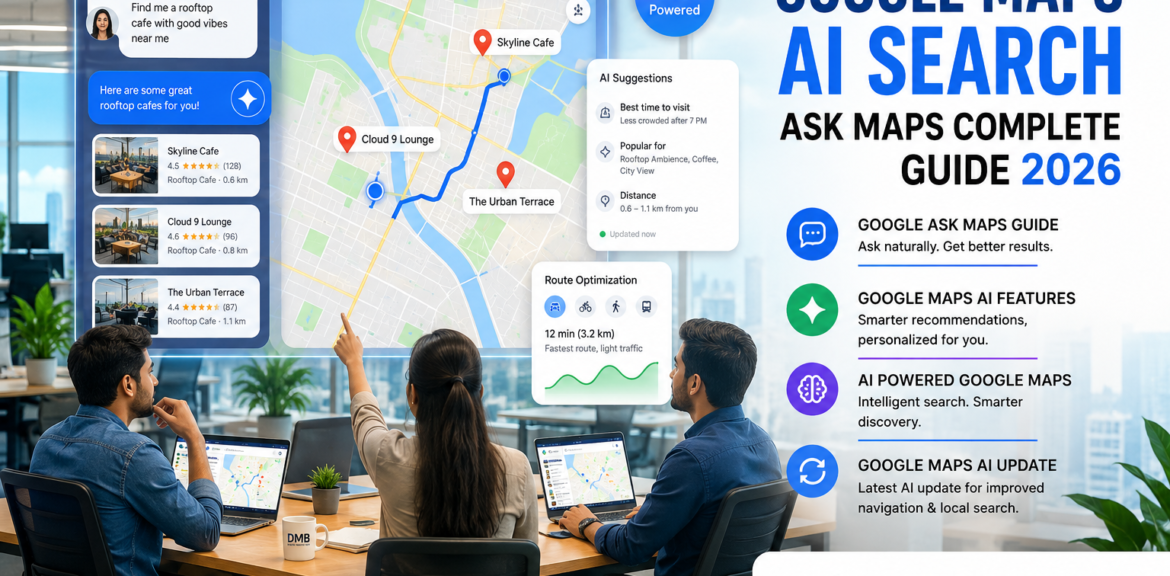

Google Maps Launches AI Conversational Search With Ask Maps: Complete Guide (2026)
Google Maps Launches AI Conversational Search With Ask Maps: Complete Guide (2026)
Google Maps is evolving beyond traditional navigation. With its new AI-powered conversational experience called Ask Maps, Google is making it easier to discover places by asking natural questions instead of typing simple keywords. Whether you’re searching for family-friendly restaurants, hidden cafés, scenic weekend destinations, or highly rated attractions, the new experience is designed to understand context and provide more personalized recommendations.This guide explains how Google Maps AI Search works, what the Google Ask Maps Guide introduces, the most useful Google Maps AI Features, how AI Powered Google Maps improves local discovery, and what the latest Google Maps AI Update means for travelers, businesses, marketers, and everyday users.Instead of scrolling through hundreds of listings, users can now have conversations with Google Maps in a way that feels similar to interacting with an AI assistant. This shift reflects Google’s broader investment in generative AI across Search, Workspace, Android, and Maps.
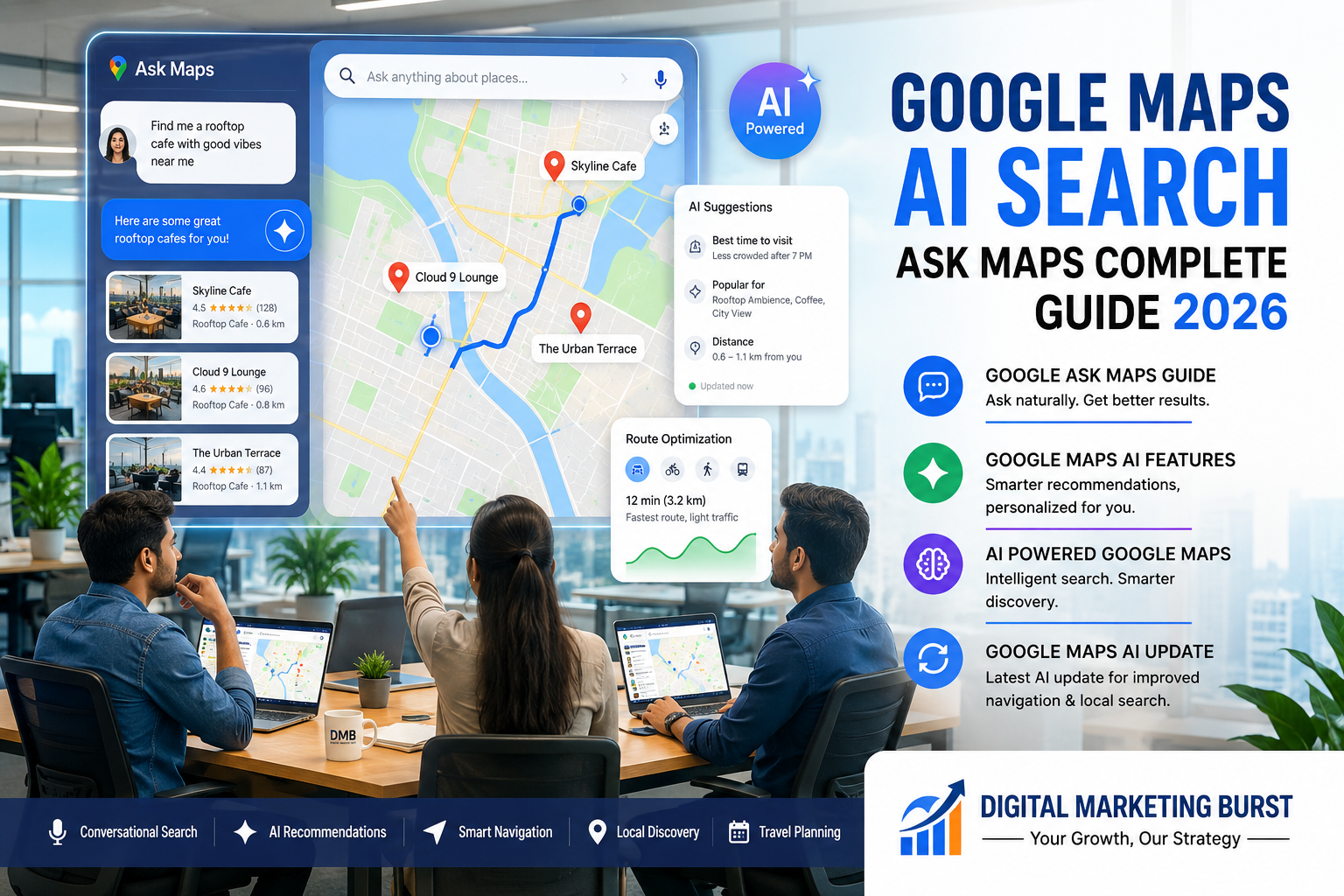
What Is Google Maps AI Search?
For years, Google Maps relied mainly on keyword matching, filters, star ratings, and user reviews. While those tools remain valuable, they often required users to refine multiple searches before finding exactly what they wanted.
The new Google Maps AI Search introduces conversational search. Rather than typing “restaurants near me,” users can ask more detailed questions such as:
- Which cafés are good for remote work with fast Wi-Fi?
- Show me peaceful parks for morning walks.
- Recommend places for a family dinner with vegetarian options.
- Find hidden attractions locals recommend.
The AI interprets intent instead of focusing only on keywords. It combines information from business profiles, reviews, photos, operating hours, popularity signals, and geographic context to generate more meaningful suggestions.
As a result, discovering places becomes faster and feels much more natural.
Google Ask Maps Guide: Understanding the New Experience
The Google Ask Maps experience changes how people interact with location-based search.
Instead of forcing users to browse categories manually, the assistant encourages conversation. Users can ask follow-up questions, refine recommendations, and receive suggestions based on changing preferences.
For example, someone planning a weekend trip might begin by asking for historical attractions. They could then narrow the results by requesting nearby restaurants, free parking, family-friendly activities, or attractions open after sunset.
This conversational approach reduces search friction and allows users to reach useful recommendations much more quickly.
Unlike traditional searches that often produce long lists of businesses, Ask Maps focuses on delivering answers that better match the user’s specific situation.
Why Google Introduced AI Into Maps
Modern users expect search engines to understand complete questions rather than isolated keywords.
Millions of people already ask AI assistants for recommendations before making travel decisions. Google is bringing similar capabilities directly into Maps because users increasingly expect:
- Personalized recommendations.
- Better local discovery.
- Faster travel planning.
- Context-aware suggestions.
- More natural conversations.
This update also reflects Google’s long-term strategy of integrating generative AI across its ecosystem.
Instead of treating Maps as a navigation product alone, Google is positioning it as an intelligent travel and discovery platform.
New Google Maps AI Features Worth Exploring
Several improvements distinguish the latest version of Google Maps from earlier releases.
The AI can summarize thousands of reviews into concise insights, helping users understand why a location is recommended without reading hundreds of individual comments.
Image recognition also plays a larger role. Google analyzes uploaded photos to identify food items, interiors, accessibility features, scenic viewpoints, and other details that improve recommendations.
Another notable enhancement is contextual understanding. Users no longer need perfect search phrases. The system understands requests like “quiet coffee shops with outdoor seating” or “good places for rainy-day activities.”
These features work together to create recommendations that feel more relevant and personalized.
How AI Powered Google Maps Improves Local Discovery
Finding hidden local destinations has traditionally required extensive searching.
With AI Powered Google Maps, the discovery process becomes much more intuitive.
The assistant can recommend locations that match specific interests, travel styles, budgets, or activities. Rather than simply showing nearby businesses, it attempts to understand the experience users are trying to create.
Someone planning a romantic evening receives different recommendations than someone organizing a family outing or searching for budget-friendly attractions.
This personalized approach makes local exploration more enjoyable while helping users uncover places they might never have found using traditional keyword searches.
Who Benefits Most From the Latest Google Maps AI Update?
The latest Google Maps AI Update benefits several different audiences.
Travelers can discover attractions more efficiently and spend less time comparing search results.
Local businesses gain new opportunities to appear in AI-generated recommendations if they maintain accurate information, quality photos, and authentic customer reviews.
Digital marketers should also pay close attention because conversational search changes how people discover local businesses online. Optimizing business profiles, maintaining updated information, and encouraging genuine customer feedback become even more important.
Consumers ultimately benefit from faster decision-making, more relevant recommendations, and an easier overall search experience.
What This Means for Businesses
Businesses should begin preparing for AI-assisted local search by focusing on the quality of their Google Business Profile.
Complete descriptions, accurate categories, updated operating hours, fresh images, and consistent customer engagement all contribute to stronger visibility.
Rather than trying to optimize for isolated keywords, businesses should answer common customer questions through their profiles and websites.
As conversational search becomes more common, comprehensive information is likely to become increasingly valuable.
This shift encourages businesses to prioritize usefulness, accuracy, and customer experience over traditional optimization tactics.
How Ask Maps Understands Natural Conversations
Traditional map searches usually relied on short phrases such as “restaurants near me” or “coffee shops.” The new Ask Maps experience changes that by allowing users to describe exactly what they need in everyday language.
For example, a traveler can ask for “a quiet café with outdoor seating that’s good for remote work,” while a family might request “places to visit with children within a two-hour drive.” Instead of matching only keywords, the AI attempts to understand the intent behind the request and returns recommendations that fit the situation.
As the conversation continues, users can refine their search without starting over. They might ask for more affordable options, places with better ratings, or destinations that are open late. This conversational flow makes planning faster and more intuitive than repeatedly applying filters.
Practical Ways People Can Use Google Maps AI
The new AI capabilities are designed for everyday situations rather than only complex searches.
A tourist visiting a new city can ask for a full-day itinerary that includes breakfast, museums, parks, and dinner recommendations. Someone planning a road trip can request scenic stops, charging stations for an electric vehicle, or family-friendly rest areas along the route.
Food lovers can discover highly rated local restaurants based on atmosphere, cuisine, or dietary preferences. Weekend travelers can ask for hidden attractions that are less crowded than the city’s most popular landmarks.
Because the system understands follow-up questions, planning becomes an ongoing conversation instead of a series of disconnected searches.
Benefits for Travelers
Travel planning often involves switching between multiple apps to compare reviews, opening hours, photos, and directions. Ask Maps aims to simplify that process by presenting relevant information in one place.
Instead of reading hundreds of reviews individually, users receive summarized insights that highlight common themes. If many visitors praise a restaurant for its service or recommend a viewpoint for sunset photography, those details can surface more quickly.
This saves time while helping travelers make more confident decisions before they begin their journey.
What Local Businesses Should Know
Businesses that rely on local visibility should pay close attention to this evolution in search.
Accurate business information is becoming even more important. Opening hours, contact details, categories, photographs, accessibility information, menus, and customer reviews all help AI systems understand what a business offers.
Businesses that regularly update their profiles and respond professionally to customer feedback are likely to provide stronger signals that help potential customers make informed decisions.
Rather than focusing only on ranking for individual search terms, businesses should think about answering real customer questions through complete and trustworthy information.
How Reviews Influence AI Recommendations
Customer reviews have always played an important role in Google Maps, but AI can now identify recurring themes much more effectively.
Instead of counting only star ratings, the system may recognize patterns such as:
- Friendly customer service.
- Excellent vegetarian options.
- Quiet working environment.
- Family-friendly atmosphere.
- Fast service during lunch hours.
This helps users understand why a place is recommended instead of relying solely on numerical ratings.
For business owners, it reinforces the value of consistently delivering positive customer experiences rather than simply collecting reviews.
Privacy and User Control
Whenever artificial intelligence becomes more integrated into everyday products, privacy naturally becomes part of the discussion.
Google states that users remain in control of many personalization settings associated with their accounts. Location history, activity controls, and recommendation preferences can influence how personalized suggestions become.
Users who prefer less personalization can review and adjust these settings within their Google Account. Understanding these options allows individuals to balance convenience with their preferred level of privacy.
As AI features continue evolving, transparency and user control are likely to remain important areas of development.
How This Update Fits Into Google’s AI Strategy
Ask Maps is not an isolated feature. It reflects Google’s broader effort to integrate generative AI across its products, including Search, Workspace, Android, and productivity tools.
The common goal is to reduce the effort required to find useful information. Instead of presenting long lists of links or businesses, AI attempts to provide answers that better match the user’s situation.
For Maps, this means helping people move from “Where should I go?” to “Here’s a recommendation that fits what you’re looking for” with fewer steps and a more conversational experience.
Traditional Google Maps Search vs Ask Maps
For years, Google Maps helped users find places by matching keywords, categories, and location filters. While that approach remains useful, it often required several searches before users found the right destination.
Ask Maps introduces a more conversational experience. Instead of entering multiple search terms, users can describe exactly what they need. For example, someone could ask for a restaurant suitable for a business meeting, a family celebration, or a quiet evening with friends. The AI interprets the request as a whole rather than focusing only on individual words.
Another major difference is the ability to continue the conversation. If the first recommendations are not ideal, users can refine their request naturally by asking for nearby alternatives, different price ranges, or places with specific facilities. This reduces the time spent browsing and makes local discovery feel more intuitive.
How Ask Maps Can Improve Trip Planning
Planning a journey usually involves several decisions, including where to stay, what to eat, and which attractions to visit. Ask Maps aims to simplify this process by helping users organize information through conversation.
A traveler arriving in a new city can ask for a one-day itinerary that includes breakfast, cultural attractions, parks, and dinner options. Families can search for destinations that are suitable for children, while couples may request scenic locations for evening walks or weekend outings.
Because recommendations are connected to the user’s question, the results often feel more personalized than a standard search. Instead of spending time comparing dozens of businesses, travelers receive suggestions that better match their interests and travel style.
What This Means for Local Businesses
The introduction of conversational search changes how businesses are discovered on Google Maps.
Businesses with complete and accurate profiles are more likely to provide the information that helps users make decisions. High-quality images, updated operating hours, detailed descriptions, and genuine customer reviews all contribute to a stronger presence.
Business owners should also consider the questions customers frequently ask. Information about parking, accessibility, outdoor seating, reservation options, or menu choices can help people understand whether a location meets their needs.
The goal is not simply to appear in search results but to provide enough useful information for potential customers to feel confident about visiting.
How AI Is Changing Local Search
Artificial intelligence is transforming local search from a keyword-based experience into an intent-based experience.
Instead of asking “What words did the user type?” AI increasingly asks, “What is the user trying to achieve?” This shift allows search systems to recommend businesses and attractions that align more closely with a person’s actual needs.
For users, this means faster decisions and more relevant suggestions. For businesses, it encourages better communication, accurate information, and authentic customer experiences.
As conversational search becomes more common, local discovery may rely less on exact search phrases and more on the overall quality of business information.
Tips for Businesses Preparing for AI-Powered Search
Although conversational search is still evolving, businesses can begin preparing today.
Maintaining an up-to-date Google Business Profile is one of the most important steps. Adding recent photos, updating holiday hours, selecting accurate categories, and responding to customer reviews all help create a more complete profile.
Businesses should also ensure that their websites answer common customer questions clearly. Helpful content about products, services, pricing, directions, and frequently asked questions supports both users and search systems.
Rather than focusing on technical tricks, businesses that consistently provide accurate and useful information are likely to benefit as AI-powered search continues to develop.
The Future of Conversational Maps
Ask Maps represents an early stage in the evolution of conversational navigation. Future updates may include even deeper personalization, smarter travel planning, and stronger integration with other Google products.
Users could eventually receive recommendations that adapt to weather conditions, traffic patterns, calendar events, or personal preferences while still allowing them to remain in control of their settings.
As artificial intelligence continues improving, the role of digital maps is expanding beyond navigation. They are becoming intelligent assistants that help people discover, compare, and choose destinations with greater confidence.
For everyday users, this means less time searching and more time enjoying the places they visit. For businesses, it creates new opportunities to connect with customers through complete, accurate, and trustworthy information.
Real-World Examples of Using Ask Maps
One of the biggest advantages of conversational search is that it works with everyday questions instead of short search phrases. Imagine arriving in an unfamiliar city after a long journey. Rather than searching separately for restaurants, attractions, and parking, you can describe your needs in a single conversation.
A traveler might ask for a highly rated café within walking distance of a railway station, followed by nearby museums and a quiet place to relax in the evening. Families could request attractions suitable for children along with restaurants offering vegetarian options. Business travelers might search for hotels with workspaces, reliable internet access, and meeting facilities.
This ability to refine recommendations naturally makes planning much faster and reduces the need to perform multiple independent searches.
How Artificial Intelligence Improves Local Recommendations
Artificial intelligence evaluates information from several sources before presenting recommendations. Business descriptions, customer reviews, images, opening hours, location data, and popularity trends all contribute to the overall picture.
Instead of displaying only businesses with the highest ratings, the system attempts to identify locations that best match the user’s request. For example, someone searching for a peaceful reading café may receive different recommendations than another user looking for a lively place to meet friends.
This contextual understanding helps create recommendations that feel more relevant while allowing users to spend less time filtering results manually.
Common Questions Users May Ask Maps
The conversational interface encourages more detailed questions than traditional search.
Users may ask where to find scenic viewpoints for photography, restaurants serving regional cuisine, quiet parks for morning walks, or shopping areas known for handmade products. Travelers can also request recommendations for day trips, rainy-day activities, family outings, or locations suitable for remote work.
Because follow-up questions remain part of the same conversation, users can continue refining their search until they find options that meet their expectations.
This conversational flow creates a more interactive experience than repeatedly entering separate search terms.
Challenges and Current Limitations
Although conversational search introduces many improvements, users should remember that no artificial intelligence system is perfect.
Recommendations depend on the quality and freshness of available information. Businesses that have recently changed their operating hours, menus, or services may require time before updates appear consistently across all recommendations.
Local events, temporary road closures, and seasonal changes may also influence travel plans. For this reason, users should verify important details such as opening hours, reservation requirements, and contact information before making final decisions.
Using AI as a planning assistant while confirming essential details directly with businesses remains a practical approach.
Why This Update Matters for the Future of Search
The introduction of Ask Maps demonstrates a broader shift in how people interact with search technology. Instead of focusing primarily on keywords, search is becoming more conversational, context-aware, and personalized.
As AI continues improving, users are likely to expect systems that understand complete questions, remember previous context, and provide recommendations that require less manual filtering.
For businesses, this means maintaining accurate information becomes increasingly important. For users, it creates opportunities to discover destinations more efficiently while exploring places that better match their personal interests.
Rather than replacing traditional search entirely, conversational experiences are likely to complement existing tools by making information easier to access and understand.
Final Thoughts Before the Conclusion
Google’s conversational approach to Maps represents another step toward more intelligent digital experiences. Whether someone is planning a weekend getaway, exploring a new city, or searching for local businesses, the ability to ask detailed questions simplifies the discovery process.
As more users adopt conversational search, businesses that provide clear, complete, and trustworthy information will be better positioned to serve potential customers. Likewise, travelers can benefit from recommendations that reflect their individual preferences rather than relying solely on generic search results.
The continued development of AI within Google Maps suggests that navigation is evolving into a broader platform for exploration, planning, and local discovery, making travel decisions more convenient and informed than ever before.
How Digital Marketing Burst Helps Businesses Prepare for AI Search
As conversational AI becomes a bigger part of Google products, businesses need to rethink how customers discover them online. Instead of focusing only on traditional SEO, companies should also improve the quality of their local business information, website content, and customer experience.
At Digital Marketing Burst, we help businesses build a strong online presence that supports modern search behavior. Our approach focuses on creating helpful website content, optimizing Google Business Profiles, improving local visibility, and developing long-term digital marketing strategies that align with changing search technology.
Rather than chasing short-term ranking tricks, businesses should invest in accurate information, useful content, high-quality visuals, and positive customer engagement. These factors help build trust with both users and search platforms.
As Google continues expanding AI across Search and Maps, businesses that provide complete and reliable information will be better positioned to reach potential customers naturally.
Frequently Asked Questions About Google Maps AI Search
Many users have questions about Google’s latest AI-powered features. Below are some of the most common questions.
Is Google Maps AI Search available to everyone?
Google gradually releases new features across different countries and user groups. Availability may vary depending on your region, device, and Google account.
Does Ask Maps replace traditional Google Maps?
No. Traditional search, navigation, reviews, and directions remain available. Ask Maps adds a conversational layer that helps users discover places more naturally.
Can businesses control AI recommendations?
Businesses cannot directly control recommendations. However, maintaining accurate business information, responding to customer reviews, uploading quality photos, and keeping profiles updated all contribute to a stronger online presence.
Is conversational search useful for travelers?
Yes. Travelers can ask detailed questions about attractions, restaurants, shopping areas, hotels, parks, and nearby destinations without performing multiple searches.
Will AI replace Google Search completely?
Current AI features are designed to enhance the search experience rather than replace traditional search entirely. Users can continue choosing whichever method best suits their needs.
Best Practices for Businesses Using Google Maps
Businesses hoping to improve visibility should focus on providing information that customers genuinely find useful.
Accurate contact details, updated opening hours, recent photographs, clear service descriptions, frequently asked questions, and authentic customer reviews all improve the overall experience.
Regular profile updates also help ensure customers receive reliable information. Businesses should periodically review their listings to confirm addresses, phone numbers, websites, and operating hours remain accurate.
Investing in customer satisfaction remains one of the most effective long-term strategies because positive experiences naturally lead to stronger reviews and better engagement.
What to Expect From Future Google Maps AI Updates
Google continues investing heavily in artificial intelligence, making it likely that Maps will become even more intelligent over the coming years.
Future improvements may include more personalized recommendations, smarter travel planning, enhanced accessibility features, multilingual conversations, and deeper integration with other Google services.
Artificial intelligence may also provide better recommendations based on weather conditions, personal preferences, travel history, and live local events while maintaining user privacy controls.
Although future developments will continue evolving, one trend is already clear: conversational search is becoming an increasingly important part of how people discover local businesses and destinations online.
The businesses that prepare today by improving information quality, customer experience, and digital presence will be better positioned as these technologies continue developing.
How AI Is Changing the Future of Local Discovery
Finding nearby businesses has become much easier over the past decade. However, conversational artificial intelligence is taking local discovery to an entirely new level. Instead of manually comparing multiple businesses, users can now describe exactly what they are looking for and receive recommendations that better match their preferences.
For example, someone planning a family vacation can search for destinations that combine entertainment, dining, and accommodation in one conversation. Likewise, professionals visiting a new city can quickly identify business-friendly hotels, coworking spaces, restaurants, and transport options without opening several different applications.
This shift saves time while creating a smoother planning experience. As AI continues improving, recommendations are expected to become even more personalized, allowing users to discover places that genuinely match their interests rather than simply displaying the highest-rated businesses nearby.
Why Content Quality Matters More Than Ever
The introduction of conversational search highlights the growing importance of useful and trustworthy content. Businesses that clearly explain their services, maintain accurate information, and answer common customer questions are more likely to provide the type of information AI systems rely upon when generating responses.
Well-structured websites also contribute to a better user experience. Visitors appreciate clear navigation, helpful articles, updated contact information, and authentic customer testimonials. These elements improve credibility while making it easier for both people and search systems to understand the business.
Rather than publishing content only for search engines, businesses should focus on creating resources that genuinely solve customer problems. Helpful content tends to remain valuable over time, supporting both user satisfaction and long-term visibility.
Opportunities for Small Businesses
One of the most encouraging aspects of AI-powered local search is that smaller businesses also have opportunities to stand out. A business does not necessarily need a large advertising budget to appear in relevant recommendations.
Providing excellent customer service, maintaining an informative Google Business Profile, encouraging genuine customer reviews, and publishing useful website content all contribute to stronger online visibility.
Businesses that consistently deliver positive experiences often build stronger reputations over time. These positive signals can influence future recommendations as AI continues learning from publicly available information.
For entrepreneurs, this means investing in customer satisfaction remains one of the most valuable long-term marketing strategies.
Digital Marketing Burst and the Future of AI Search
The growth of conversational search creates new opportunities for businesses that are willing to adapt. At Digital Marketing Burst, we closely monitor emerging digital trends so businesses can understand how AI may influence online visibility, customer engagement, and local search.
Modern digital marketing is no longer limited to ranking for individual keywords. Instead, businesses should focus on creating complete digital experiences that combine informative websites, optimized business profiles, useful content, and positive customer interactions.
As Google continues expanding AI across its products, organizations that invest in quality information today will be better prepared for future search experiences.
Looking Ahead
Artificial intelligence is rapidly becoming part of everyday online activity. Whether users are planning holidays, searching for nearby restaurants, comparing hotels, or discovering local attractions, conversational search is simplifying the decision-making process.
Although technology will continue evolving, one principle remains consistent: businesses that provide accurate information, valuable content, and outstanding customer experiences are more likely to earn long-term trust.
Google Maps is no longer just a navigation platform. It is gradually becoming an intelligent discovery assistant that helps users explore new places with greater confidence. Understanding these changes today can help both businesses and consumers make better use of the technology as it continues to develop.
Industries That Could Benefit From Google Maps AI Search
The introduction of conversational search in Google Maps has implications far beyond navigation. Many industries that depend on local discovery could see meaningful changes in how customers find products and services.
Restaurants may benefit when users ask for dining recommendations based on cuisine, ambience, dietary preferences, or family-friendly options. Hotels can become more discoverable if travelers request accommodations with specific amenities such as parking, workspaces, or pet-friendly facilities.
Healthcare providers, retail stores, tourist attractions, fitness centers, educational institutions, and entertainment venues may also appear in more relevant recommendations when their business information is complete and accurate. Rather than relying only on category searches, people can describe what they need in natural language, allowing AI to recommend businesses that best match the request.
This shift encourages organizations to think beyond traditional local SEO and focus on delivering complete, trustworthy information that helps customers make informed decisions.
How Users Can Get Better Results From Ask Maps
Although the new conversational interface is designed to understand natural language, asking clear questions usually produces better recommendations.
Instead of searching for “restaurant,” users can describe the type of experience they want. For example, they might ask for a quiet place suitable for business meetings, a café with outdoor seating, or attractions that can be explored in half a day.
Providing context such as budget, travel companions, accessibility needs, or preferred activities helps the AI narrow down suggestions. If the first response does not fully meet expectations, follow-up questions can refine the recommendations without starting a new search.
This conversational approach makes the discovery process more interactive and allows users to adjust their plans quickly as new ideas emerge.
The Growing Importance of Helpful Business Information
As AI becomes more involved in answering user questions, businesses should view their online profiles as an extension of customer service.
Detailed descriptions, updated contact information, high-quality photographs, service lists, accessibility details, and responses to customer reviews all contribute to a clearer understanding of what a business offers. These details not only assist potential customers but also provide stronger context for AI-powered recommendations.
Businesses that regularly review and improve their online information are more likely to present a consistent experience across different Google services. Over time, maintaining accurate information builds trust with customers and supports better decision-making.
Preparing for the Next Generation of Search
Conversational AI is likely to become an increasingly common way for people to interact with search technology. Businesses that adapt early can improve the overall experience they offer to customers, regardless of future algorithm changes.
A practical approach includes keeping business profiles current, publishing useful website content, encouraging authentic customer feedback, and ensuring that important information is easy to find. These actions help customers today while also preparing for future developments in AI-assisted search.
Rather than viewing conversational search as a challenge, organizations can treat it as an opportunity to communicate more effectively with potential customers and provide answers before questions become obstacles.
The evolution of Google Maps demonstrates that search is becoming more focused on understanding intent, solving problems, and delivering meaningful recommendations. Businesses and users who embrace these changes will be better positioned to benefit as AI continues shaping the future of local discovery.
How Google Maps AI Search May Change Everyday Decisions
Many people use Google Maps several times a day without thinking about the technology behind it. Whether choosing a café before work, planning a weekend outing, or finding the nearest pharmacy, quick access to reliable information influences everyday decisions.
With conversational AI becoming part of Maps, users no longer need to guess which keywords will produce the best results. Instead, they can explain their situation naturally and receive suggestions that better reflect what they are actually looking for.
For example, someone might ask for a peaceful park suitable for reading, a restaurant with outdoor seating, or attractions that are ideal for families with young children. Instead of returning only nearby businesses, the AI attempts to recommend places that match those specific preferences.
As conversational search improves, everyday planning could become faster, simpler, and more personalized.
Why User Experience Is Becoming More Important
Artificial intelligence depends on quality information to generate useful recommendations. Businesses that provide accurate details, updated photographs, and clear descriptions create a better experience for visitors while making it easier for search systems to understand what they offer.
User experience also extends beyond Google Maps. Websites that load quickly, answer common questions, and provide easy navigation encourage visitors to spend more time exploring content. Clear contact information, transparent pricing, and authentic customer reviews further strengthen trust.
These improvements benefit both customers and businesses because they reduce uncertainty during the decision-making process.
Digital Marketing Burst and AI-Driven Digital Growth
As AI continues transforming search behavior, businesses should stay informed about emerging trends rather than relying solely on older optimization techniques.
At Digital Marketing Burst, we believe that long-term digital success comes from creating valuable content, maintaining accurate business information, and understanding how customers search online. Conversational AI highlights the importance of answering real questions instead of focusing only on isolated keywords.
Organizations that continuously improve their online presence are better prepared for future changes in search technology. By combining useful content, strong local visibility, and customer-focused communication, businesses can build sustainable digital growth in an increasingly AI-powered environment.
The Road Ahead for Google Maps
Google has consistently expanded Maps beyond navigation by introducing features such as live traffic, public transport information, business reviews, street imagery, and personalized recommendations. Conversational AI represents another significant step in that evolution.
Future updates may include smarter travel planning, deeper personalization, multilingual conversations, improved accessibility support, and more advanced integration with other Google services. As these capabilities expand, Maps could become an even more valuable assistant for travel, local discovery, shopping, and everyday decision-making.
Although technology will continue evolving, one principle remains unchanged: accurate information and helpful experiences create better outcomes for everyone.
Users benefit from faster decisions and more relevant recommendations, while businesses that prioritize quality information and customer satisfaction are better positioned to connect with potential customers in the years ahead.
Frequently Asked Questions About Google Maps AI Search
As conversational search becomes more widely available, many users want to understand how the new experience works and how it differs from traditional search. Below are answers to some of the most common questions.
What is Google Maps AI Search?
Google Maps AI Search is a conversational search experience that allows users to ask detailed questions instead of relying only on short keywords. It aims to understand the intent behind a query and provide recommendations that better match the user’s needs.
What is Ask Maps?
Ask Maps is Google’s conversational interface for Google Maps. Instead of searching with simple phrases, users can interact naturally by asking follow-up questions and refining recommendations throughout the conversation.
Is Google Maps AI Search available worldwide?
Google usually introduces major features gradually. Availability may differ depending on the country, language, Google account, and device. Users should check the latest announcements to see whether the feature has reached their region.
Does AI replace normal Google Maps search?
No. Traditional search remains available. Users can still search by business name, category, address, or location while also benefiting from conversational AI features where supported.
How can businesses prepare for AI-powered search?
Businesses should focus on maintaining complete and accurate Google Business Profiles, publishing useful website content, updating contact information, adding high-quality images, and encouraging genuine customer reviews. These practices help customers while providing better information for search systems.
Key Takeaways From Google’s Latest Maps Innovation
The launch of conversational search marks another milestone in the evolution of digital mapping. Rather than serving only as a navigation tool, Google Maps is becoming an intelligent discovery platform that helps users make informed decisions through natural conversations.
Users benefit from personalized recommendations, simplified travel planning, and faster access to relevant information. Businesses gain new opportunities to reach potential customers by maintaining accurate, trustworthy, and complete online information.
As artificial intelligence continues improving, conversational search is expected to become a larger part of how people discover local businesses, tourist attractions, restaurants, hotels, and everyday services.
Organizations that focus on providing genuine value, reliable information, and excellent customer experiences are likely to adapt more successfully as search technology continues evolving.
The future of local search is becoming more conversational, more context-aware, and more user-focused. Understanding these changes today can help both consumers and businesses make better decisions as AI becomes increasingly integrated into everyday digital experiences.
Conclusion
The launch of Google Maps AI Search through the new Ask Maps experience marks an important step in the evolution of location-based search. Instead of relying only on keywords, users can now ask detailed questions and receive recommendations that better match their preferences, travel plans, and everyday needs.
Throughout this guide, we explored the Google Ask Maps Guide, discussed the latest Google Maps AI Features, examined how AI Powered Google Maps improves local discovery, and explained why the recent Google Maps AI Update matters for both users and businesses. As conversational AI becomes more common across Google’s products, understanding these changes can help individuals make better travel decisions while helping organizations improve their online presence.
Businesses that maintain accurate information, publish helpful content, and prioritize customer experience are well positioned to benefit from this shift toward conversational search. Rather than focusing only on visibility, the goal should be to provide reliable information that genuinely helps potential customers.
At Digital Marketing Burst, we closely follow developments in search, artificial intelligence, local SEO, and digital marketing so businesses can better understand how emerging technologies influence online visibility. As search behavior continues evolving, creating useful content and building trust remain among the most effective long-term strategies.
Whether you are a traveler planning your next destination, a business owner improving local visibility, or a marketer following Google’s latest innovations, conversational AI in Google Maps is a development worth watching. It signals a future where finding information becomes more natural, more contextual, and more focused on solving real user needs.
How Businesses Can Prepare for the Next Generation of AI-Powered Local Search
The evolution of Google Maps AI Search shows that local discovery is becoming more conversational and user-focused. Instead of relying only on keyword-based searches, users can now ask detailed questions and receive recommendations tailored to their needs. This shift makes understanding the Google Ask Maps Guide increasingly valuable for business owners, marketers, and travelers.
As businesses explore the latest Google Maps AI Features, they should focus on providing accurate business information, high-quality images, updated operating hours, and genuine customer reviews. These elements help users make informed decisions while supporting better visibility across Google’s ecosystem.
The rise of AI Powered Google Maps also changes how people discover restaurants, hotels, attractions, retail stores, healthcare providers, and local services. Rather than searching with short phrases, users are describing complete situations and expecting recommendations that match their intent. Businesses that answer customer questions clearly through their websites and Google Business Profiles are better prepared for this change.
Every major Google Maps AI Update introduces improvements that make local search more interactive and personalized. Staying informed about these developments helps businesses adapt their digital strategies while improving the overall customer experience.
Looking ahead, Google Maps AI Search is likely to become an even more important part of everyday travel planning and local discovery. Understanding the Google Ask Maps Guide, exploring new Google Maps AI Features, following each Google Maps AI Update, and recognizing how AI Powered Google Maps continues to evolve can help both businesses and users benefit from the future of conversational search.
Why Businesses Choose Digital Marketing Burst for SEO and AI Search Optimization
As Google continues introducing AI-powered experiences like Google Maps AI Search, businesses need digital strategies that go beyond traditional optimization. Digital Marketing Burst helps brands adapt to changing search behavior by focusing on SEO, local search optimization, AI-ready content, Google Business Profile optimization, and long-term organic growth.
Based in Lucknow, Digital Marketing Burst works with startups, local businesses, service providers, and growing brands looking to strengthen their online visibility across Google Search, Google Maps, and AI-driven search experiences.
What Makes Digital Marketing Burst Different?
Digital marketing is constantly evolving, and successful businesses need strategies that evolve with it. At Digital Marketing Burst, we focus on building sustainable digital growth instead of relying on short-term tactics.
Our areas of expertise include:
- Search Engine Optimization (SEO)
- Local SEO and Google Business Profile Optimization
- AI Search Optimization
- Technical SEO Audits
- Website SEO Analysis
- Content Marketing
- WordPress SEO
- E-commerce SEO
- Google Maps Visibility
- Digital Marketing Consulting
Helping Businesses Prepare for AI-Powered Search
The rise of conversational AI is changing how people discover businesses online. Search is becoming more intent-focused, making high-quality content and accurate business information increasingly important.
Digital Marketing Burst helps businesses create websites and content that answer real customer questions, improve user experience, and support visibility in both traditional and AI-assisted search environments.
Whether your goal is improving local visibility, increasing organic traffic, or building a stronger digital presence, our approach emphasizes practical strategies, transparent communication, and continuous improvement.
If you’re looking for an experienced digital marketing agency in Lucknow with expertise in SEO, AI search optimization, and long-term digital growth, Digital Marketing Burst is ready to help your business navigate the next generation of search.