





Why Organic Traffic and LinkedIn Reach Are Falling in 2026
Why Organic Traffic and LinkedIn Reach Are Falling in 2026
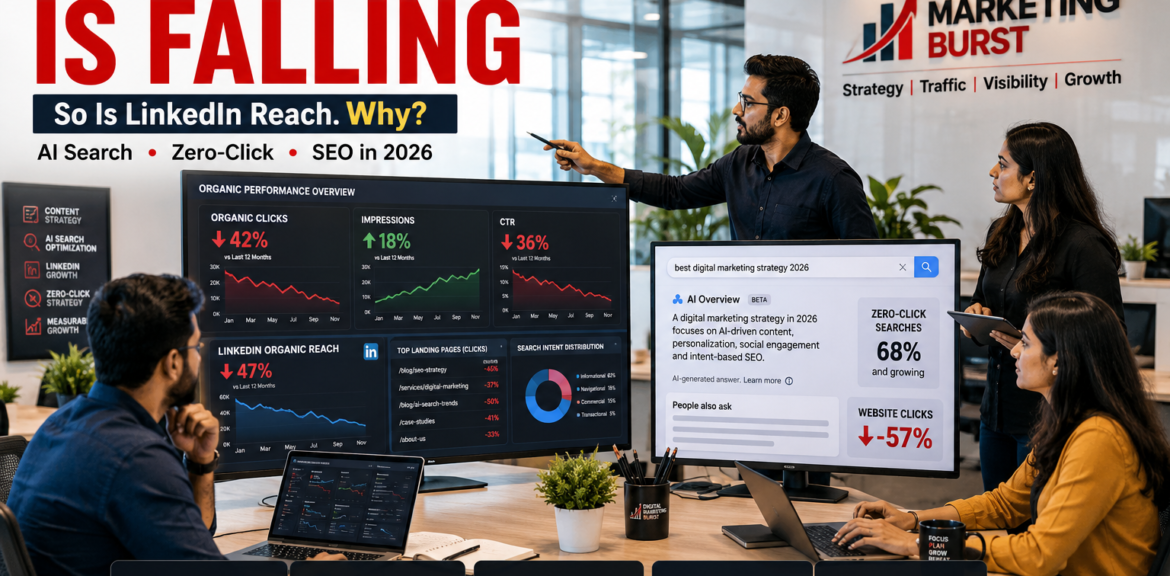
Organic Traffic Decline 2026, LinkedIn Organic Reach Decline, Google Organic Traffic Drop, Google AI Overviews SEO, and Zero Click Search Strategy have become closely connected issues for digital marketers. Businesses may still rank for important keywords, publish regularly, and earn thousands of impressions. Yet fewer people are clicking through to websites or engaging with LinkedIn posts. The problem is not simply that SEO or social media has stopped working. Instead, the way people discover, evaluate, and consume information is changing.
Search engines now answer more questions directly on results pages. AI-generated summaries can satisfy informational intent before a user visits a website. At the same time, LinkedIn users face a crowded feed where generic posts compete with personal insights, expert opinions, videos, documents, and conversations. Therefore, visibility alone no longer guarantees traffic.
This shift creates an important question for marketers. If impressions remain healthy while clicks and reach become harder to earn, what should businesses measure and optimize?
The answer requires a broader approach. Brands still need rankings and social visibility. However, they also need stronger search intent alignment, recognizable expertise, compelling reasons to click, and content that offers something an AI summary cannot completely replace.
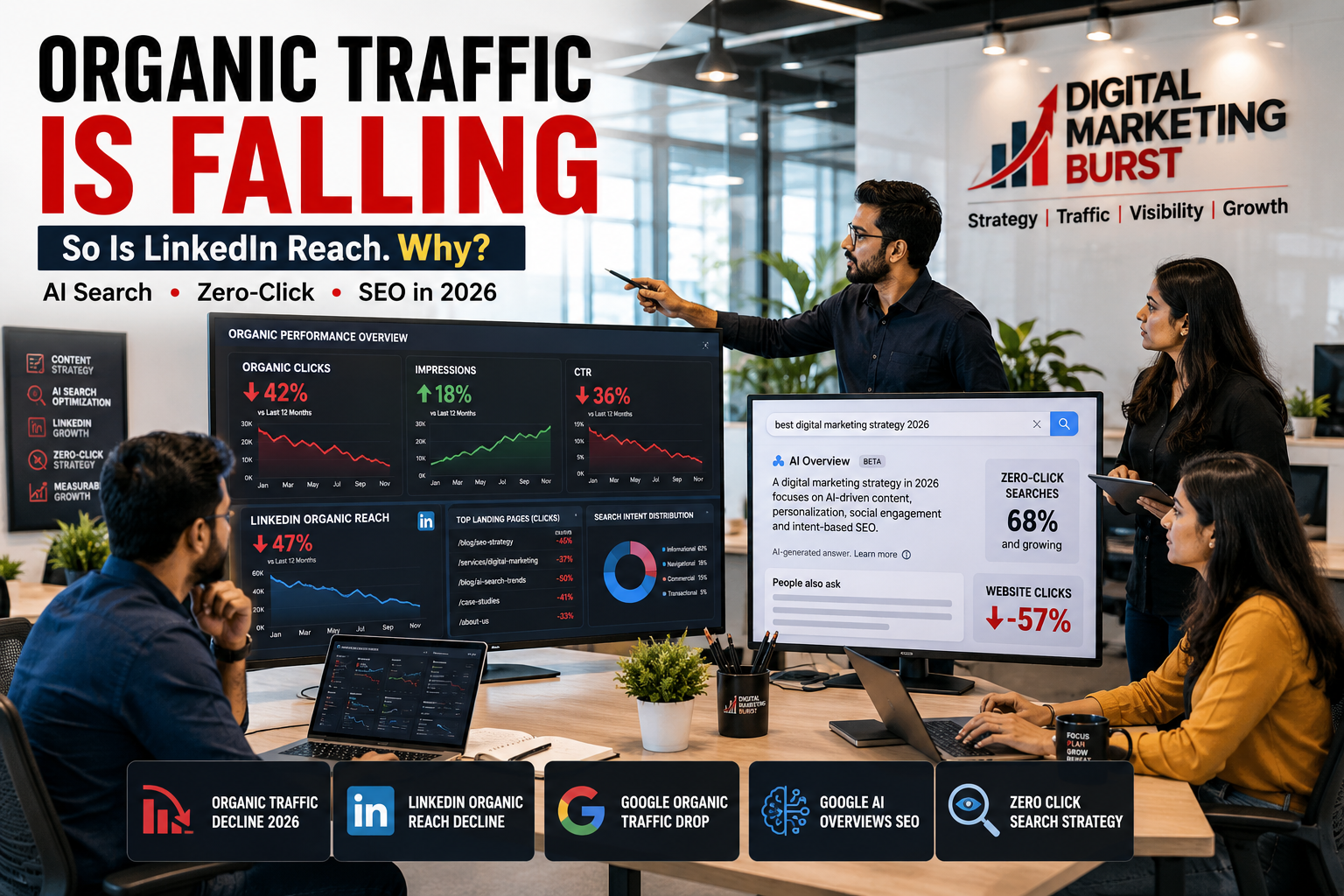
Organic Traffic Decline 2026: What Has Actually Changed?
The Organic Traffic Decline 2026 discussion can easily become misleading when every traffic loss is blamed on artificial intelligence. AI search matters, but it is only one part of a much larger change in user behaviour.
Google has spent years developing search results that help users complete tasks without visiting every listed website. Featured snippets, local results, shopping information, knowledge panels, videos, FAQs, calculators, and other search features already competed for attention. AI-generated search experiences expand that pattern.
As a result, a page can remain visible while receiving fewer clicks.
This distinction matters. A fall in traffic does not automatically mean a fall in rankings. Likewise, losing clicks does not necessarily mean Google has stopped considering a website useful.
Search intent is also becoming more important. Generic informational queries are easier to answer directly. In contrast, detailed comparisons, original research, specialist experience, tools, case studies, and transactional pages can still give users a strong reason to visit a website.
Businesses should therefore stop treating every organic session as equally valuable. Ten visitors who genuinely need a service can matter more than hundreds who only wanted a definition.
The future of SEO is not simply about recovering every lost click. It is about earning the clicks that matter.
Why Organic Traffic Is Dropping in 2026
Understanding Why Organic Traffic Is Dropping in 2026 requires looking at the search journey itself.
Previously, a typical informational search often required a website visit. A person typed a question, reviewed several blue links, opened one or more pages, and found the answer.
Today, that journey can be shorter.
Search engines may provide summaries, featured answers, videos, local information, product results, community discussions, or other content directly on the results page. Users can sometimes obtain enough information without opening another website.
However, this does not affect every query equally.
Someone searching for a basic explanation may need only a short answer. A user comparing agencies, software, products, hospitals, financial services, or other significant decisions usually needs deeper information.
That difference should influence content strategy.
Instead of producing hundreds of broad articles simply because keywords show high search volume, marketers need to understand what happens after the search. Does the query naturally encourage a website visit? Does the reader need deeper expertise? Is there commercial intent? Can your page provide information unavailable in a short search summary?
These questions can reveal opportunities that keyword volume alone misses.
LinkedIn Organic Reach Decline: Why Posting More Is Not the Solution
A LinkedIn Organic Reach Decline can tempt brands to increase publishing frequency immediately. If four posts per week are receiving less reach, publishing seven may appear to be the logical response.
Usually, that treats the symptom rather than the underlying problem.
LinkedIn users have limited attention. Meanwhile, more professionals, creators, executives, recruiters, agencies, and businesses are competing for space in the same feed. Generic content becomes easier to ignore.
AI has made content production faster as well. Consequently, users encounter more polished posts that sound remarkably similar.
That creates an opportunity for content with genuine perspective.
A marketing professional explaining what changed in a real campaign can be more interesting than another post listing “five marketing trends.” A business showing an unexpected customer insight can provide more value than a generic motivational statement.
The goal should therefore shift from publishing volume to content distinctiveness.
Ask whether a post contains an observation that could only have come from your experience. Consider whether it starts a useful conversation. Most importantly, determine whether somebody would recognize the thinking behind the post even if the company logo disappeared.
Distinctive content has a better chance of earning attention in a crowded feed.
Why LinkedIn Organic Reach Is Declining
There is no single explanation for Why LinkedIn Organic Reach Is Declining across every account. Audience quality, content format, subject matter, posting frequency, competition, and engagement patterns can all affect performance.
However, one broader issue is clear: publishing has become easier than earning attention.
AI writing tools allow businesses to create social content rapidly. Templates make visual production easier. Scheduling tools simplify distribution.
Therefore, content supply grows faster than human attention.
Businesses cannot solve that problem simply by producing even more average content.
A better approach is to create posts around genuine expertise. Explain what your team learned from a campaign. Challenge an assumption in your industry. Show a process. Analyse an unexpected result. Share a useful framework.
The writing should also feel natural.
Short sentences can improve mobile readability. A strong opening can encourage users to continue reading. However, exaggerated hooks should not promise more than the post delivers.
The strongest LinkedIn content creates a reason to stop scrolling.
Google Organic Traffic Drop: Rankings and Clicks Are Different Metrics
A Google Organic Traffic Drop should always be investigated before conclusions are made.
Start by separating impressions, rankings, click-through rate, and conversions.
Imagine that impressions increase while clicks decline. That pattern tells a very different story from losing both rankings and impressions.
The first situation may indicate that the website remains visible, but fewer searchers are clicking. Search-result features, changing intent, title quality, or stronger competition may contribute.
The second situation could indicate ranking losses, indexing issues, technical SEO problems, weaker content relevance, or increased competition.
Conversions add another layer.
Suppose traffic falls by 20%, but enquiries remain almost unchanged. That may indicate that much of the lost traffic had weak commercial value.
Conversely, a small traffic decline can be serious if it affects high-intent pages.
This is why reporting only total organic sessions can create unnecessary panic.
Marketers should connect visibility with business outcomes.
Traffic is useful. Qualified traffic is better.
Why Google Organic Traffic Is Dropping Even When Rankings Look Stable
Businesses often ask Why Google Organic Traffic Is Dropping when their average positions appear relatively stable.
Click-through rate is one possible explanation.
Search results contain more elements competing for attention than a traditional list of organic links. Depending on the query, users may encounter AI-generated information, advertisements, local listings, videos, images, shopping results, discussions, or other search features before reaching a conventional organic result.
Therefore, ranking position alone cannot explain performance.
Search intent can change too.
A keyword that previously generated website visits may increasingly be satisfied directly within search. Alternatively, competitors may have improved their titles and descriptions, making their results more appealing.
Brand recognition also influences clicks.
When two similar results appear together, users may prefer the source they already recognize.
That means SEO and branding increasingly overlap.
Ranking gets a business into consideration. Brand familiarity can help win the click.
Google AI Overviews SEO: Visibility Without the Traditional Click
Google AI Overviews SEO changes the way marketers should think about search visibility.
For some informational queries, users can receive a summarized response directly within search. This creates a new challenge for websites whose strategy depended heavily on answering simple questions.
If the entire value of an article can be compressed into three sentences, users have little reason to open it.
The solution is not to stop publishing informational content.
Instead, content needs greater depth.
Original examples, firsthand experience, useful comparisons, proprietary data, screenshots, expert commentary, detailed processes, case studies, calculators, templates, and decision-making guidance can provide reasons to continue beyond an AI-generated summary.
Clear structure matters too.
Search systems need to understand what a page covers. Human readers need to find information quickly.
Therefore, descriptive headings, concise answers, logical sections, supporting detail, and clear topical relationships remain valuable.
AI search does not remove the need for useful websites. It raises the standard for what deserves a click.
Google AI Overviews Impact on SEO and Content Marketing
The Google AI Overviews Impact on SEO reaches beyond rankings. It changes which types of content are likely to produce meaningful visits.
Basic informational queries face greater pressure because short answers can often satisfy users immediately.
This means marketers should examine their existing content library.
Which pages answer questions that require only one sentence? Which pages contain original expertise? Which articles help readers make decisions? Which ones attract users who could eventually become customers?
These categories should not receive the same investment.
A page with modest traffic but strong commercial relevance can be more valuable than an article generating thousands of casual visits.
Content teams should therefore combine traditional SEO metrics with business value.
Organic visibility remains important. However, the objective should not be traffic for traffic’s sake.
Search marketing should help a brand become discoverable, credible, memorable, and ultimately useful to potential customers.
Zero Click Search Strategy: Stop Treating Every No-Click Search as a Loss
A Zero Click Search Strategy begins by accepting that not every search impression will become a website visit.
That does not automatically make the impression worthless.
A person may encounter a company name several times before eventually searching for the brand directly. Another user may discover expertise through search and later interact with the business on LinkedIn. Someone else may see a brand referenced during research before converting weeks later.
Marketing journeys are rarely as clean as analytics dashboards suggest.
Therefore, brands should think about visibility across multiple touchpoints.
Search results, social media, branded searches, reviews, videos, newsletters, and direct website visits can influence one another.
However, this does not mean clicks no longer matter.
Businesses still need website traffic to generate leads, sales, subscriptions, bookings, and deeper engagement.
The goal is to recognize that visibility can create value before the click while simultaneously improving content that deserves one.
How to Optimize for Zero Click Searches Without Giving Away Everything
Businesses learning How to Optimize for Zero Click Searches face an interesting challenge. Search engines need clear information to understand a page, but readers also need a reason to visit it.
The best approach is to answer the core question clearly while providing greater depth on the page.
Do not hide the basic answer behind hundreds of words.
That frustrates users.
Instead, provide an immediate useful explanation. Then expand with examples, comparisons, evidence, practical steps, mistakes, and deeper analysis.
This creates two levels of value.
Search systems can understand the topic quickly, while interested readers have a reason to continue.
Businesses can also create content around decisions rather than definitions.
For example, “What is local SEO?” can be summarized easily. “How should a multi-location hospital structure local SEO pages without creating duplicate content?” requires far more context.
Specificity creates depth.
Depth creates reasons to click.
AI Search Is Changing Organic Traffic, Not Ending SEO
The rise of AI search has led to predictions that SEO is disappearing. That conclusion is too simple.
Search behaviour is changing, but businesses still need to be discoverable when people research problems, products, services, and brands.
The format of discovery may evolve.
Traditional search results can coexist with AI-generated answers, social content, videos, community discussions, and other sources.
Therefore, modern SEO needs to consider more than ranking a page for one keyword.
Content should demonstrate clear expertise around a subject. Brand information should remain consistent. Important pages should answer real customer questions. Technical accessibility still matters.
Marketers should also pay closer attention to branded search.
If users encounter a company through an AI answer, LinkedIn post, YouTube video, or another source, they may later search directly for that company.
SEO therefore becomes part of a wider discovery system.
The question is no longer only, “Where do we rank?”
A better question is, “Where and how do customers discover us?”
Why Website Impressions Are Up but Organic Clicks Are Down
One of the most confusing SEO patterns is seeing impressions rise while clicks fall.
At first, this can look contradictory.
However, impressions measure visibility. Clicks measure action.
A website may begin appearing for a wider range of queries without earning proportionally more visits. Search-result features can also answer part of the user’s question before the click.
Position distribution matters as well.
Gaining thousands of impressions in lower positions can increase visibility without producing substantial traffic.
Therefore, marketers should analyse queries individually.
Look for keywords where impressions have increased significantly while CTR has declined. Then examine the actual search results.
What appears above your listing? Does the query trigger an AI-generated response? Are videos or local results prominent? Has search intent changed?
This analysis is much more useful than simply concluding that “Google traffic is down.”
SEO problems become easier to solve when they are diagnosed at query level.
Organic CTR Decline in the Age of AI Search
An organic CTR decline in AI search deserves attention because rankings and traffic can now move in different directions.
Marketers traditionally expected higher positions to produce predictable increases in clicks.
That relationship still exists, but the search-result environment has become more complex.
A high-ranking page may compete with multiple search features before the user reaches it.
Titles therefore need to communicate unique value quickly.
Generic titles such as “Complete Guide to Digital Marketing” compete with thousands of similar pages. A title built around a specific problem, audience, or outcome can create a clearer reason to click.
However, clickbait is not the answer.
The title should accurately reflect what the page delivers.
Strong CTR comes from relevance and differentiation, not exaggeration.
Search Intent Optimization Is More Important Than Search Volume
High search volume can be attractive because it promises a large audience.
Yet volume does not tell marketers why somebody searched.
A broad keyword may attract thousands of visitors with no commercial intent. A narrower query may attract fewer users who are much closer to taking action.
This is why search intent optimization deserves greater attention in 2026.
Content should match the job the searcher is trying to complete.
Informational users need explanations. Comparison searches require clear differences. Transactional users need service or product information. Local searches often require location, availability, reputation, and contact details.
Trying to rank one generic blog article for every stage usually creates weak content.
Instead, build pages around distinct intentions.
Traffic may appear smaller on paper, but relevance can improve dramatically.
High-Intent SEO Keywords Can Matter More Than High-Volume Keywords
A decline in broad organic traffic can push marketers to chase even larger keywords.
That may be the wrong response.
High-intent SEO keywords often have lower search volume because fewer people are close to making a decision at any given moment.
However, those searches can be commercially valuable.
Someone searching “digital marketing” could be looking for a definition, course, job, agency, salary, or software.
A search such as “SEO agency for hospitals in Lucknow” reveals much more about the user’s need.
This does not mean every article should become transactional.
Informational content still builds discovery and authority.
The important change is balance.
A strong SEO strategy should attract audiences at different stages while ensuring enough content exists for users who are ready to evaluate or act.
Why Publishing More Content May Not Recover Organic Traffic
When traffic declines, increasing content output feels productive.
But more content is not automatically better SEO.
Publishing ten weak articles around nearly identical keywords can create overlap and dilute resources.
Updating one strong page may produce more value.
Before creating something new, marketers should review existing content. Several articles may target the same search intent. Older pages may contain outdated information. Strong pages may lack depth or internal links.
Consolidation can sometimes improve clarity.
Content quality should also be evaluated from the reader’s perspective.
Does the article contain anything competitors do not? Is it easier to understand? Does it answer follow-up questions? Does it include actual expertise?
If the answer is no, publishing frequency is unlikely to solve the deeper problem.
Why AI-Generated Generic Content Struggles to Earn Attention
AI can accelerate research, outlining, editing, and ideation.
However, generic AI content creates a serious differentiation problem.
If hundreds of websites ask similar tools to write about the same keyword, the resulting articles can share the same structure, examples, and conclusions.
Readers notice repetition.
Search engines also have many alternatives to choose from.
The solution is not avoiding AI completely. It is adding information that cannot be produced from a generic prompt alone.
Use internal expertise. Include actual customer questions. Analyse real campaign results. Add original screenshots. Explain failures as well as successes. Interview subject experts.
Human input turns a generic topic into distinctive content.
AI can assist the process, but it should not become the entire process.
LinkedIn Content Strategy in 2026 Needs Human Expertise
The same principle applies to LinkedIn.
Perfectly formatted posts are everywhere.
What remains scarce is useful experience.
A marketer explaining why a campaign failed can create more interest than a polished list of obvious best practices. A founder describing an unexpected customer objection can reveal something valuable. A specialist breaking down an industry change can build authority.
Therefore, LinkedIn strategy should start with insight before format.
Carousels, videos, text posts, and images are distribution choices.
They cannot rescue an idea nobody cares about.
Businesses should first identify what their audience genuinely wants to understand.
Then choose the format that communicates it most effectively.
LinkedIn Engagement Decline and the Attention Economy
A LinkedIn engagement decline is partly an attention problem.
Users have limited time.
Every post competes not only with other companies but also with colleagues, creators, industry news, job updates, advertisements, and personal networks.
Consequently, a post needs immediate relevance.
That does not mean every opening must be dramatic.
A clear statement of a meaningful problem can be enough.
The rest of the post should reward attention.
If the opening promises an insight, deliver it. If a statistic is used, explain why it matters. If an opinion is presented, support it.
Over time, this builds trust.
Trust makes future content easier to earn attention for.
SEO and LinkedIn Should Work Together
Search and LinkedIn are often managed as separate channels.
That separation can waste opportunities.
SEO data reveals what audiences actively search for. LinkedIn conversations reveal what professionals discuss, question, and disagree about.
Together, they provide richer content ideas.
A search query can become a LinkedIn discussion. A successful LinkedIn post can become a detailed article. Comments can reveal follow-up questions worth targeting through SEO.
This creates a feedback loop.
Search captures existing demand. Social content can create awareness and discussion.
When both channels reinforce the same expertise, brand recognition can grow.
That recognition may later influence branded searches and clicks.
Digital Marketing Burst Organic Traffic Strategy for 2026
A Digital Marketing Burst Organic Traffic Strategy for 2026 should not depend on publishing content simply to increase page count. The stronger approach is to connect SEO research with user intent, content quality, conversion opportunities, and changing search behaviour.
For businesses experiencing falling clicks, the first task is diagnosis.
Ranking losses require one response. CTR losses require another. Traffic declines caused by outdated content need a different solution again.
LinkedIn should receive the same level of analysis.
Instead of assuming an algorithm change caused every reach decline, marketers should evaluate topic relevance, post quality, audience fit, format, frequency, and engagement.
This creates a more sustainable strategy.
The objective is not to fight platforms.
It is to understand how user behaviour is changing and build marketing around that reality.
Digital Marketing Burst AI Search and SEO Approach
The Digital Marketing Burst AI Search and SEO approach can focus on building visibility across traditional search and emerging AI-driven discovery.
Businesses should continue investing in technically sound websites, helpful content, clear brand positioning, and strong topical relevance.
At the same time, content needs to become more difficult to replace with a short automated summary.
Original insight becomes an advantage.
Firsthand experience becomes an advantage.
Useful data becomes an advantage.
Strong branding becomes an advantage.
AI may change where users receive information, but businesses still need trusted sources behind that information.
That creates an opportunity for brands willing to produce content with genuine substance.
What Businesses Should Measure Beyond Organic Traffic
Traffic remains useful, but it should not stand alone.
Marketers need to understand whether search visibility contributes to enquiries, sales, branded searches, returning visitors, subscriptions, or other business outcomes.
Conversion rate provides important context.
If traffic declines while qualified leads remain stable, the situation may be less severe than the headline traffic number suggests.
Likewise, LinkedIn reach should be evaluated alongside meaningful engagement.
A post reaching 100,000 unrelated people may produce less value than one reaching 5,000 decision-makers.
Marketing measurement should therefore move closer to business impact.
Large numbers are attractive.
Relevant outcomes are more important.
The Real SEO Problem Is Often Not the Algorithm
When traffic drops, Google becomes an easy target.
When LinkedIn reach falls, the algorithm receives the blame.
Sometimes platform changes genuinely influence performance.
However, businesses should still examine factors they can control.
Has content become repetitive? Are competitors publishing better information? Have titles become outdated? Is search intent changing? Does the website provide a strong mobile experience? Are high-value pages being neglected while the team publishes low-value articles?
These questions are uncomfortable because they require internal changes.
Yet they are also useful because businesses can act on them.
Marketers cannot control every algorithm update.
They can control how useful, distinctive, and relevant their marketing becomes.
The Future of Organic Traffic in an AI-First Search World
Organic traffic is unlikely to disappear.
However, the type of traffic websites receive may continue changing.
Simple informational clicks face increasing competition from direct answers and AI-generated summaries.
Deeper research, complex decisions, transactions, tools, specialist expertise, and trusted brands can continue creating reasons for users to visit websites.
Therefore, businesses should avoid judging future SEO using only historical traffic expectations.
A page that previously attracted 50,000 casual visitors may not always maintain that number.
The more important question is whether search still contributes meaningful business value.
SEO should evolve from a traffic-generation discipline into a broader discovery and demand-capture strategy.
That shift can make reporting more complicated.
It can also make SEO more closely connected to actual business objectives.
Preparing Your Digital Marketing Strategy for the Next Search Shift
The platforms will continue changing.
New AI interfaces will appear. Search-result layouts will evolve. Social algorithms will be adjusted. User behaviour will move with them.
Trying to predict every update is impossible.
Building adaptable marketing is more realistic.
Businesses need strong websites, useful content, recognizable brands, genuine expertise, diversified acquisition channels, and accurate measurement.
SEO should work alongside social media, paid advertising, email, video, PR, and other relevant channels.
Likewise, LinkedIn should not carry the entire responsibility for B2B visibility.
Diversification reduces dependence on one algorithm.
More importantly, it creates multiple opportunities for customers to discover and remember a brand.
Final Thoughts: Organic Traffic Decline 2026 Is a Strategy Problem, Not Just a Platform Problem
The Organic Traffic Decline 2026 conversation should not end with blaming Google, AI, or social-media algorithms. LinkedIn Organic Reach Decline, Google Organic Traffic Drop, Google AI Overviews SEO, and Zero Click Search Strategy all point toward a broader transformation in digital discovery.
Users have more ways to get information without visiting a website. They also have more content competing for their attention on social platforms.
Therefore, marketers need stronger reasons for people to click, read, follow, remember, and eventually convert.
The winning strategy is not to publish endlessly or chase every algorithm update.
Create content that answers genuine problems. Match search intent carefully. Build recognizable expertise. Measure qualified outcomes. Use AI to improve the process without allowing it to erase originality.
For Digital Marketing Burst, this shift creates an opportunity to approach SEO and social media as connected parts of modern digital discovery rather than isolated traffic channels.
Clicks may be harder to earn in 2026. Reach may also become more competitive. However, businesses that understand why those changes are happening can focus less on chasing yesterday’s numbers and more on earning tomorrow’s customers.
Organic Search Traffic Decline Is Changing How SEO Success Is Measured
An organic search traffic decline does not automatically mean an SEO campaign is failing. Search behaviour has changed, so businesses also need to change the way they measure organic performance. Rankings, impressions, clicks, engagement, branded searches, leads, and conversions now need to be considered together.
For example, imagine a website loses 20% of its informational traffic. At first, the decline looks serious. However, suppose enquiries remain stable while branded searches increase. In that case, the business may have lost mainly low-intent visitors rather than potential customers.
This distinction becomes increasingly important as search engines answer more informational questions directly. Businesses that depend heavily on broad educational keywords may notice the impact earlier than companies targeting comparison, commercial, local, or transactional searches.
Therefore, marketers should separate traffic according to intent. Informational pages can support discovery and authority. Commercial pages can help users evaluate solutions. Transactional pages should support conversion.
Once those groups are analysed separately, SEO reporting becomes far more meaningful. Instead of asking only whether traffic increased, businesses can ask whether organic search continues to attract the right audience and influence valuable actions.
SEO Traffic Decline 2026: Why Old Traffic Benchmarks Can Mislead You
An SEO Traffic Decline 2026 analysis becomes misleading when marketers compare today’s search environment directly with traffic patterns from several years ago. Search-result pages have changed considerably, and users have become accustomed to receiving information faster.
Previously, ranking highly for a large informational keyword could generate substantial website traffic. Today, that same query may display several features before a traditional organic result receives attention. As a result, historical click-through rates may no longer represent realistic expectations for every keyword.
This does not mean previous performance should be ignored. Historical data remains useful for identifying unusual changes. However, businesses need context.
Compare rankings with impressions and clicks. Analyse whether the SERP itself changed. Look at which queries lost traffic. Then determine whether those queries previously contributed to leads or merely generated page views.
A business should be more concerned about losing 100 high-intent visitors than losing 5,000 users who never moved beyond an informational article.
Therefore, modern SEO benchmarks should include traffic quality. Conversion contribution, branded demand, assisted journeys, and visibility around commercially relevant topics can provide a more complete picture.
Website Organic Traffic Drop: Diagnose Before You Start Changing Content
A website organic traffic drop often triggers immediate content edits. Titles are changed, paragraphs are rewritten, keywords are added, and sometimes entire articles are replaced.
That can make the problem worse when the actual cause has not been identified.
First, determine when the decline began. Then compare that date with technical changes, website migrations, content updates, indexing issues, ranking movements, seasonality, and changes in search demand.
Next, identify which pages lost traffic.
If only a few URLs account for most of the decline, investigate them individually. If traffic fell across the entire domain, a broader technical, algorithmic, or market-related issue may exist.
Query-level analysis is equally important.
A page may still rank well for its primary keyword while losing traffic from dozens of secondary queries. Alternatively, impressions may remain strong while CTR declines.
Each situation requires a different response.
SEO recovery should begin with diagnosis rather than assumptions. Otherwise, businesses risk damaging pages that were already performing correctly while leaving the real issue unresolved.
Why Website Traffic Drops After Google Search Changes
Businesses often notice a traffic decline and immediately connect it with a Google update. Sometimes that connection is valid. However, correlation alone does not identify the cause.
A Google search traffic decline can result from ranking changes, new SERP features, stronger competitors, shifting demand, seasonality, technical problems, or changes in how users phrase their searches.
AI-assisted search introduces another variable.
A user who once searched several separate questions may now receive a broader answer within one interaction. Consequently, some informational journeys can involve fewer individual searches and fewer website visits.
Marketers should therefore investigate the specific keywords that changed.
If rankings dropped, review content quality and competition. If rankings remained stable but CTR fell, inspect the current search-result layout. If search volume itself declined, content optimization alone may not recover the previous traffic.
Good analysis separates platform changes from website problems.
That distinction prevents unnecessary SEO work and helps businesses focus resources where improvement is actually possible.
Google Search Clicks Decline: Why Being Number One May Not Be Enough
A Google search clicks decline can occur even when a page maintains a strong organic position.
That sounds unusual only if SEO is viewed through the traditional ten-blue-links model.
Modern search results can contain advertisements, AI-generated information, featured results, videos, images, local listings, product panels, forums, and other interactive elements. Each feature competes for the same user’s attention.
Therefore, organic position is only one part of visibility.
Search-result presentation matters too.
A clear title can help users understand why your result deserves attention. The description should reinforce relevance instead of repeating generic language.
Brand recognition can also influence the decision.
If users repeatedly encounter a company through LinkedIn, YouTube, search, industry publications, or other channels, they may be more likely to recognize and select that company’s result later.
This is where SEO starts connecting directly with brand marketing.
A ranking can create an opportunity. Recognition and perceived value can help earn the actual click.
AI Overviews Traffic Impact on Informational Content
The AI Overviews traffic impact is likely to be strongest where a searcher’s need can be satisfied through a concise explanation.
Definitions are an obvious example.
If somebody only wants to understand what a marketing term means, a short summary may be enough. They may not need a 2,000-word article.
This should influence how businesses select content topics.
Instead of abandoning informational SEO, create information that supports deeper decision-making. Explain why something happens, when different approaches work, what common mistakes look like, and how circumstances change the recommendation.
Original experience becomes particularly useful.
An AI summary can explain conversion-rate optimization. However, a detailed breakdown of how a real landing page improved conversions provides a different kind of value.
Similarly, generic advice about LinkedIn engagement can be summarized easily. A documented experiment comparing different content formats offers something more specific.
The more original value a page contains, the stronger its reason for existing beyond a basic answer.
Google AI Search SEO Requires More Than Traditional Keyword Placement
Google AI Search SEO should not be interpreted as finding a new place to insert keywords.
Keyword relevance still matters. However, modern search optimization increasingly requires clear entities, topical relationships, trustworthy information, useful structure, and content that answers related questions naturally.
Consider how humans research complicated subjects.
They rarely ask one question and immediately make a decision. They move through several questions.
A business evaluating SEO might first ask why traffic declined. Next, it may investigate AI Overviews. Later, it may search for ways to improve CTR, optimize content, or find an agency.
A strong content strategy anticipates this journey.
Instead of creating isolated articles with little connection, businesses can develop useful topic clusters. Each page should solve a distinct problem while supporting related content.
Internal linking then helps both users and search systems understand those relationships.
This creates deeper topical coverage without repeating the same keyword unnaturally across every page.
AI Overviews SEO Strategy Should Focus on Information Gain
An effective AI Overviews SEO Strategy should ask a simple question: what does this page contribute that is genuinely useful?
Rewriting information already available across hundreds of websites creates limited differentiation.
Information gain can come from original research, professional experience, examples, comparisons, data, observations, templates, images, videos, or expert commentary.
Even small businesses can create original value.
A local agency might analyse common mistakes found across client websites. A hospital could answer questions patients regularly ask before appointments. A travel company could document actual route conditions and planning considerations.
These insights come from experience rather than generic keyword research.
That makes them more useful to readers.
SEO content does not need to become academic research. It simply needs to add something meaningful.
When every article contains essentially the same information, users have little reason to choose one source over another.
Zero Click SEO Strategy for Building Brand Visibility
A Zero Click SEO Strategy should not focus exclusively on forcing every impression into a website session.
Sometimes the search experience itself can introduce a brand.
This makes clear brand positioning important.
Company names, expertise, services, locations, and subject associations should remain consistent across relevant digital properties.
Suppose someone repeatedly encounters the same marketing agency while researching SEO, AI search, and LinkedIn strategy. They may not visit the agency immediately. However, repeated exposure can build familiarity.
Later, that person may search for the company directly.
This journey is difficult to attribute perfectly, but it is still meaningful.
Therefore, marketers should track branded searches alongside non-branded SEO performance.
Direct traffic and returning users can provide additional context.
Zero-click behaviour changes attribution. It does not necessarily eliminate marketing influence.
Zero Click Search Optimization for Featured Answers
Zero Click Search Optimization works best when content answers a question clearly without sacrificing depth.
A useful page can provide a concise answer near the relevant heading. The following paragraphs can then explain context, exceptions, examples, and practical application.
This structure serves both impatient readers and those seeking deeper knowledge.
Avoid writing unnecessarily long introductions before answering the query.
Users increasingly expect fast access to information.
At the same time, do not reduce every article to shallow answers.
The page should become progressively more valuable as the reader continues.
This balance can improve readability and make content easier for search systems to understand.
It also supports Yoast-style readability because paragraphs remain focused and sentences can stay relatively short.
How to Optimize for Zero Click Searches and Still Earn Website Visits
Learning How to Optimize for Zero Click Searches does not mean accepting that website traffic no longer matters.
Instead, marketers need to separate the answer from the deeper value.
Give users enough information to establish relevance. Then offer something worth exploring further.
For example, a search result might answer what causes organic CTR to fall. The full article can provide a diagnostic process, examples, benchmarks, recovery strategies, and practical scenarios.
The same principle works across industries.
A short answer can explain a concept. A complete resource helps someone make a decision.
Interactive tools can provide another reason to visit.
Calculators, templates, checklists, comparison tables, downloadable resources, original datasets, and detailed case studies cannot always be replaced by a short summary.
The goal is not to hide information.
It is to create depth that naturally deserves further engagement.
LinkedIn Reach Decline 2026: Stop Copying Viral Content Formats
A LinkedIn Reach Decline 2026 strategy should not revolve around copying whichever post format went viral last month.
Formats become saturated quickly.
When thousands of creators use identical opening lines, spacing patterns, storytelling formulas, and carousel designs, users learn to recognize them.
Novelty disappears.
Instead, focus on the idea behind the content.
A strong observation can work as text, video, a document post, or an image. A weak idea remains weak regardless of formatting.
Businesses should therefore create content from their own knowledge base.
Sales conversations can reveal objections. Customer support can reveal recurring problems. SEO research can reveal questions. Internal specialists can provide expert opinions.
These sources create content that competitors cannot reproduce simply by copying a template.
Originality is increasingly a distribution advantage.
LinkedIn Organic Reach Drop and Audience Relevance
A LinkedIn Organic Reach Drop can sometimes indicate an audience mismatch rather than poor content.
Imagine an agency builds a large following through job posts and motivational content. Later, it begins publishing technical B2B marketing advice.
The follower count may look impressive, but much of the audience may have little interest in the new subject.
Consequently, engagement can remain weak.
Audience quality therefore matters more than raw follower numbers.
Businesses should consider who regularly interacts with their posts. Are they potential clients, industry professionals, employees, students, job seekers, or unrelated users?
Different groups create different outcomes.
This does not mean every follower must become a customer.
A healthy professional audience can include several categories. However, the content strategy should attract enough of the people the business actually wants to influence.
Ten thousand relevant followers can provide more business value than one hundred thousand random ones.
Why LinkedIn Organic Reach Is Declining for Company Pages
Why LinkedIn Organic Reach Is Declining can become particularly frustrating for company pages.
Corporate content often goes through multiple approval stages. As a result, posts can become safe, polished, and forgettable.
Human voices frequently perform differently because people naturally connect with other people.
Businesses can respond by involving employees and subject experts in content creation.
A company page can still publish useful announcements, case studies, insights, research, and brand information. Meanwhile, professionals within the organisation can share their own experiences and perspectives.
These efforts can reinforce each other.
The objective should not be turning every employee into an influencer.
Instead, businesses can make genuine expertise visible.
A specialist who knows the industry deeply often has more interesting things to say than a generic corporate caption.
LinkedIn Engagement Decline: Comments Matter More When They Create Conversation
A LinkedIn engagement decline cannot always be fixed by asking users to “comment below.”
People respond when they have something meaningful to add.
Posts that invite genuine discussion can naturally generate stronger conversations.
For example, sharing an unexpected result and asking professionals whether they see the same pattern creates a specific discussion.
In contrast, ending every post with “What do you think?” can feel mechanical.
The author should also participate after publishing.
Responding thoughtfully to comments can extend the conversation and show that the post was created for interaction rather than broadcasting.
However, engagement should not become an artificial numbers game.
Twenty comments from relevant professionals can be more valuable than hundreds of low-quality responses created through engagement groups.
Quality matters throughout the funnel.
LinkedIn Algorithm Changes 2026 Should Not Control Your Entire Strategy
Businesses naturally want to understand LinkedIn algorithm changes 2026, but constantly chasing algorithm theories can create unstable marketing.
One month, marketers hear that carousels perform best. Next, video becomes the focus. Later, long text or short posts become fashionable.
Algorithms do matter.
However, platforms generally need users to find content worth consuming.
Therefore, useful content remains the most sustainable foundation.
Businesses should test formats using their own data.
Compare topics, impressions, meaningful engagement, profile visits, follower quality, website activity, and enquiries.
Over time, patterns emerge.
Those patterns are more useful than generic claims about one universal “best” format.
Your audience should shape the strategy more than somebody else’s viral post.
Social Media Reach Decline Is Also a Content Supply Problem
A social media reach decline should be viewed in the context of content abundance.
The number of people producing content has increased dramatically.
AI tools accelerate this further.
Yet the number of hours people can spend consuming content has not increased at the same rate.
Therefore, competition for attention becomes stronger.
Businesses need to earn attention rather than assume publication creates reach.
This makes editorial judgment more valuable.
Not every company announcement deserves a LinkedIn post. Not every keyword deserves a blog. Not every trend deserves commentary.
Publishing fewer but more relevant pieces can sometimes strengthen overall performance.
The question should change from “What can we post today?” to “What would our audience genuinely want to know today?”
That small shift can improve content quality substantially.
Organic Traffic Recovery Strategy Starts With Your Best Existing Pages
An organic traffic recovery strategy does not always require new content.
Existing pages often contain the fastest opportunities.
Start with URLs that previously generated strong traffic or conversions.
Check whether their information remains current. Review search intent. Compare competitors. Examine internal links and SERP appearance.
Some pages may need updated statistics. Others may need stronger examples or improved structure.
Several overlapping articles might need consolidation.
Pages ranking near the top positions can also deserve attention because modest improvements may create meaningful gains.
Content refreshes should be purposeful.
Changing publication dates without improving the page provides little value.
A genuine update should make the resource more accurate, useful, current, or complete.
SEO Content Refresh Strategy for Falling Traffic
A strong SEO content refresh strategy begins with evidence.
Do not update every old article merely because it is old.
Some evergreen pages continue performing well for years.
Prioritize content where performance has declined, information has become outdated, intent has shifted, or competitors now provide substantially better resources.
When refreshing an article, preserve sections that still work.
Then improve weak areas.
Add missing questions. Remove outdated claims. Improve examples. Strengthen headings. Fix broken internal links. Clarify confusing sections.
If the article has accumulated backlinks, changing its URL unnecessarily can create additional problems.
The goal is improvement, not reinvention for its own sake.
Search Intent Changes Can Cause Traffic Loss Without an SEO Penalty
Search intent can change over time.
A keyword that once produced mostly informational results may gradually become commercial. Another may shift toward videos, discussions, local results, or tools.
When this happens, a page can lose traffic even if its quality has not suddenly become poor.
Search engines are trying to match what users appear to prefer.
Therefore, marketers should periodically inspect the actual SERP for important keywords.
Do not rely entirely on historical assumptions.
If the dominant result type changes, your content format may need to change too.
A long article cannot always compete effectively when users clearly prefer a calculator, product category, video, or local listing.
Understanding intent protects marketers from trying to optimize the wrong format.
Long-Tail Keywords Can Protect Against Broad Traffic Declines
Long-tail keywords become valuable because they capture more specific needs.
Broad informational queries are often easier to answer without a click.
Specific questions usually require more context.
For example, “LinkedIn marketing” is extremely broad. “Why is my LinkedIn company page reach declining?” communicates a clearer problem.
Likewise, “SEO traffic” tells us little. “Why did organic traffic drop after rankings stayed stable?” reveals a specific diagnostic need.
These searches may individually have lower volume.
Collectively, however, they can attract highly relevant audiences.
Long-tail SEO is therefore not simply about finding easy keywords.
It is about matching specific intent.
High-Intent Content Can Turn Lower Traffic Into Better Leads
Businesses often assume growth requires more visitors.
Sometimes better visitors matter more.
High-intent content addresses users who are evaluating a solution or facing a problem serious enough to require action.
These pages can include comparisons, service explanations, cost considerations, implementation guides, problem-solving resources, and detailed case studies.
Traffic may be smaller than a broad educational article.
However, conversion potential can be stronger.
This is particularly important if zero-click behaviour reduces casual informational visits.
SEO strategies should therefore balance reach with commercial relevance.
Traffic blogs can attract audiences. Client-focused content can support decisions. Problem-focused content can capture users actively looking for solutions.
That combination creates a healthier content funnel.
Why Branded Search Growth Matters in an AI Search World
Branded search occurs when users specifically search for a company, product, or person.
This behaviour can become increasingly important as discovery fragments across platforms.
A user may first encounter a brand in an AI-generated answer. Later, they see an employee’s LinkedIn post. A week afterward, they search the company name directly.
Traditional last-click analytics may credit only the final search.
However, earlier touchpoints influenced the journey.
Businesses should therefore monitor branded search trends.
Growth can indicate increasing awareness even when some non-branded clicks decline.
Brand building and SEO are no longer separate conversations.
Strong brands can generate their own search demand.
Digital Marketing Burst Zero Click Search Strategy
A Digital Marketing Burst Zero Click Search Strategy should combine search visibility with stronger reasons for users to remember and eventually visit a brand.
The first step is answering important questions clearly.
The second is building deeper resources that provide information beyond a short search summary.
Original examples, industry expertise, practical frameworks, and useful comparisons can support that goal.
Brand consistency matters as well.
When users encounter the same expertise across search, social media, and other digital channels, recognition can build over time.
Therefore, SEO should not operate alone.
Content marketing, LinkedIn, paid media, website experience, and branding can reinforce the same positioning.
This creates multiple paths toward discovery.
Digital Marketing Burst LinkedIn Organic Growth Strategy
A Digital Marketing Burst LinkedIn Organic Growth Strategy should prioritize relevance and expertise rather than publishing for the sake of activity.
Content ideas can begin with real business questions.
What are clients struggling with? Which marketing metrics confuse them? What changes are affecting campaigns? Which commonly repeated advice no longer works?
These questions create useful posts.
The same insights can later support detailed website articles.
Likewise, search queries can inspire LinkedIn discussions.
This connection makes content production more efficient without simply copying the same text across platforms.
Each channel should adapt the idea to its audience.
LinkedIn can start the conversation. A website can provide the complete explanation.
Digital Marketing Burst Organic Traffic Recovery Approach
A Digital Marketing Burst Organic Traffic Recovery Approach begins with understanding why traffic fell rather than immediately trying to manufacture more traffic.
If rankings declined, investigate SEO competitiveness and page quality.
If impressions remain stable but CTR falls, examine search-result changes and snippets.
If informational pages lose clicks while commercial pages remain stable, AI and zero-click behaviour may be influencing the mix.
Technical issues should also be ruled out.
Once the cause is clear, businesses can prioritize the correct solution.
This avoids wasting resources on random content production.
Recovery is not about returning every metric to an old number.
It is about strengthening the traffic and visibility that continue to matter.
Organic Traffic Decline 2026 and the Rise of Multi-Platform Search
The Organic Traffic Decline 2026 trend also reflects a wider change: people no longer discover information through Google alone.
They search YouTube for demonstrations. They use LinkedIn for professional opinions. They explore communities for firsthand experiences. AI assistants can support research and comparison.
Therefore, businesses need content that can travel across discovery environments.
One strong piece of research can become an SEO article, LinkedIn discussion, video, infographic, newsletter, and sales resource.
This does not mean duplicating identical content everywhere.
Instead, adapt the core insight to each platform.
Multi-platform visibility can reduce dependence on any single source of organic traffic.
Why SEO and Brand Marketing Are Becoming Harder to Separate
SEO once appeared highly measurable compared with brand marketing.
A user searched, clicked, and converted.
Modern journeys are more complicated.
People can discover a brand without visiting its website. They may encounter it repeatedly before searching directly.
As a result, brand recognition can influence organic CTR.
SEO visibility can also contribute to brand awareness.
The two disciplines increasingly support each other.
Businesses with recognizable brands may earn clicks even when competing results offer similar information.
Meanwhile, strong SEO can repeatedly expose unfamiliar brands to potential customers.
Therefore, future search strategies should consider both discoverability and memorability.
Content Experience After the Click Still Matters
Earning the click is only the beginning.
A slow, cluttered, confusing website can waste strong SEO performance.
Readers expect quick access to useful information.
Large intrusive elements, poor mobile formatting, excessive advertising, confusing navigation, and weak typography can push visitors away.
Content should also deliver what the search result promised.
If a title promises an explanation for falling organic traffic, the article should address that problem quickly.
Do not force readers through unrelated promotional sections before answering their question.
A good post-click experience can improve engagement and increase the likelihood that users explore other pages.
Why Conversion Rate Matters More When Organic Clicks Become Scarcer
If organic clicks become harder to earn, each relevant visitor becomes more valuable.
That makes conversion optimization increasingly important.
Businesses should review calls to action, contact forms, landing pages, navigation, trust signals, and mobile usability.
However, conversion optimization should not mean placing aggressive sales messages everywhere.
Different visitors have different levels of intent.
Someone reading an early-stage educational article may prefer another useful resource. A user comparing services may be ready for a consultation.
Calls to action should match the journey.
Better conversion paths can allow a business to generate similar outcomes from fewer but more relevant visitors.
What Marketers Should Stop Doing in 2026
Marketers should stop treating traffic volume as the only proof of SEO success.
They should also stop publishing repetitive articles simply to hit content quotas.
LinkedIn strategies should move away from copying every viral format.
Likewise, AI should not be used to generate large amounts of generic content without meaningful human input.
None of these approaches creates sustainable differentiation.
Instead, businesses need stronger research, clearer audience understanding, original expertise, and better measurement.
The goal is not maximum content.
It is maximum useful impact from the content worth producing.
Building an SEO Strategy That Can Survive Future AI Changes
Nobody knows exactly how search interfaces will look several years from now.
Therefore, a strategy built around exploiting one temporary feature is fragile.
A stronger approach focuses on assets that remain valuable.
Build genuine expertise. Publish original information. Create useful tools. Strengthen brand recognition. Maintain technical website quality. Understand customer intent.
These advantages remain relevant even as interfaces change.
AI may alter how information is summarized or discovered.
However, trustworthy original sources still need to exist behind useful information.
Businesses that become those sources can remain valuable across different discovery systems.
The New Relationship Between Reach, Clicks and Business Growth
Reach and clicks are becoming less straightforward measures of marketing success.
A user can see a brand without clicking. A LinkedIn post can influence a later Google search. An informational article can support a conversion weeks later.
Therefore, businesses should view marketing as a connected system.
Organic search captures demand. LinkedIn can build professional visibility. Paid campaigns can accelerate distribution. Email can nurture existing audiences. Strong branding can improve recognition across all of them.
Each channel contributes differently.
The strongest strategy is not necessarily the one producing the largest individual metric.
It is the one where the channels collectively contribute to sustainable business growth.
Adapt to Changing Search Behaviour Instead of Chasing Old Numbers
A LinkedIn Organic Reach Decline, Google Organic Traffic Drop, Google AI Overviews SEO, and Zero Click Search Strategy all reveal the same broader challenge: earning attention has become harder while information has become easier to access.
Businesses should not respond by producing more generic content.
They should become more useful and more distinctive.
Analyse traffic losses properly. Separate ranking problems from CTR changes. Understand search intent. Strengthen high-value existing pages. Create original insights. Connect SEO with LinkedIn and broader brand marketing.
Most importantly, measure outcomes that matter.
The future of organic marketing will not belong to businesses that simply generate the most pages or posts. It will favour those that understand what their audience needs, provide information worth remembering, and create a genuine reason to choose their content when a click is no longer guaranteed.
Organic Traffic Decline 2026: Why Traffic Quality Matters More Than Traffic Volume
The Organic Traffic Decline 2026 trend is forcing marketers to reconsider what a successful SEO campaign actually looks like. For years, businesses treated rising organic sessions as one of the clearest signs of growth. More visitors usually looked better in monthly reports. However, traffic volume alone has never guaranteed revenue, enquiries, or qualified leads.
A website might attract 100,000 monthly visitors through broad informational queries while receiving very few enquiries. Another website might attract only 15,000 visitors but generate substantially more business because its pages match stronger search intent.
This difference matters even more when informational clicks become harder to earn.
Businesses should therefore separate visibility from business value. Rankings and impressions show whether a brand can be discovered. Clicks indicate whether users choose the result. Engagement reveals whether the content meets expectations. Finally, conversions show whether those visits contribute to meaningful outcomes.
Consequently, a traffic decline should trigger analysis rather than panic. Determine exactly which pages and queries lost clicks. Then ask whether those visitors previously contributed anything valuable.
The objective for 2026 should not simply be recovering every lost session. It should be increasing the percentage of organic visibility that reaches the right audience.
Why Organic Traffic Is Dropping in 2026 for Informational Blogs
Understanding Why Organic Traffic Is Dropping in 2026 becomes easier when informational search behaviour is examined separately.
Many informational searches begin with straightforward questions. Users want a definition, short explanation, comparison, calculation, date, or quick instruction. Search engines increasingly attempt to satisfy those needs without requiring several website visits.
As a result, generic educational content faces stronger competition for clicks.
This does not mean informational blogging has become useless.
Instead, the role of informational content is changing.
A useful article should move beyond repeating information available everywhere else. It can include original examples, practical experience, unique comparisons, expert observations, screenshots, research, templates, or detailed answers to follow-up questions.
Specificity becomes especially valuable.
An article explaining “What is SEO?” competes in an extremely broad information environment. A guide explaining why a particular type of business loses local visibility after changing its Google Business Profile contains much more specific value.
Therefore, marketers should not abandon educational content. They should make it harder to replace with a three-sentence summary.
Google Organic Traffic Drop After AI Search: What Should You Check First?
A Google Organic Traffic Drop after changes in AI-driven search should never be diagnosed from total website sessions alone.
First, determine whether impressions have also fallen.
If both impressions and clicks decline, ranking visibility may have changed. However, if impressions remain stable or increase while clicks decrease, the problem is more likely related to CTR, search-result competition, or changing user behaviour.
Next, identify the affected queries.
Informational keywords may behave differently from commercial searches. Likewise, branded keywords should be analysed separately from non-branded terms.
Then review landing pages.
A handful of high-traffic pages can sometimes account for most of the decline. This means a domain-wide traffic graph may make the problem appear much broader than it actually is.
Finally, evaluate conversions.
Losing low-intent traffic is different from losing visitors who previously generated enquiries.
Good SEO analysis moves from the broad metric toward the specific cause. Only then should content or technical changes begin.
Why Google Organic Traffic Is Dropping but Conversions Are Stable
One particularly interesting situation occurs when marketers investigate Why Google Organic Traffic Is Dropping but discover that conversions remain relatively stable.
This can happen when informational traffic declines faster than high-intent traffic.
Suppose a website previously attracted thousands of visitors through simple questions. Those readers increased session numbers, but most never explored services or returned.
If search engines begin answering more of those questions directly, the website can lose a substantial amount of traffic without experiencing an equivalent decline in business results.
That does not mean the loss should be ignored.
Informational content can build awareness, earn links, introduce a brand, and support future customer journeys.
However, the situation needs accurate interpretation.
Marketers should calculate conversion rates across different page categories. They should also compare assisted conversions, branded searches, enquiries, and returning visitors.
If total sessions fall while qualified actions remain healthy, the SEO strategy may be performing better than the traffic graph initially suggests.
The goal is not defending falling numbers. It is understanding what those numbers actually represent.
Google AI Overviews SEO and the Changing Value of Position One
Google AI Overviews SEO introduces another reason why marketers need more context around rankings.
Position one remains valuable. Yet being the highest traditional organic result does not necessarily mean the user encounters that listing first.
Depending on the query, other search features can appear before conventional organic results.
Therefore, marketers should evaluate actual search-result layouts rather than relying exclusively on ranking reports.
The search experience can vary substantially between keywords.
One query may produce a relatively traditional result page. Another may contain multiple features that satisfy much of the searcher’s need before an organic click becomes necessary.
This makes keyword-level analysis increasingly important.
SEO teams should ask whether the query naturally requires deeper exploration. If not, the potential click opportunity may be smaller than the search volume suggests.
Content planning can then focus on subjects where websites have a stronger role in helping users research, compare, evaluate, or act.
Google AI Overviews Impact on SEO Content ROI
The Google AI Overviews Impact on SEO also changes how content return on investment should be evaluated.
Imagine two articles.
The first attracts a large number of visitors through broad definitions but generates almost no meaningful customer activity. The second receives substantially fewer visits but attracts users researching a problem closely related to the company’s services.
Traditional reporting might celebrate the first article because it generates more sessions.
Business-focused reporting may value the second.
This distinction becomes increasingly important if AI-driven search reduces easy informational clicks.
Companies should map content according to its purpose. Some articles exist primarily for awareness. Others establish expertise. Certain pages capture commercial searches. Service pages help convert demand.
Each type should have appropriate success metrics.
A top-of-funnel article should not be judged only by direct sales. Likewise, a commercial landing page should not be celebrated simply because it attracts large numbers of irrelevant visitors.
SEO ROI improves when every page has a clear job.
AI Search Optimization for Content That Deserves a Click
Modern AI search optimization should focus on creating information that deserves deeper exploration.
Consider what an AI-generated summary can do efficiently. It can define a term, summarize common advice, list standard benefits, or provide a basic explanation.
Now consider what remains harder to compress.
Original research needs context. Case studies require detail. Interactive tools require participation. Expert comparisons involve nuance. Real-world implementation often includes exceptions that generic explanations miss.
These areas create opportunities.
Businesses should ask subject experts what they know that is rarely discussed online. Sales teams can identify unusual objections. Customer-service teams can reveal recurring confusion. Marketing teams can analyse real performance patterns.
Those insights can become valuable content.
Keyword research identifies demand. Human experience provides differentiation.
Combining both can produce articles that are useful for search discovery while still giving readers a genuine reason to visit.
Zero Click Search Strategy for Service Businesses
A Zero Click Search Strategy for service businesses should connect informational visibility with future demand.
Many potential customers do not hire a company during their first search.
They research first.
A business owner may search why website traffic has fallen today, investigate AI search tomorrow, compare SEO strategies next week, and look for an agency later.
A brand appearing consistently throughout that journey can build familiarity.
Therefore, informational visibility still has value even when every impression does not generate an immediate visit.
However, brand positioning must be clear.
Readers should understand what the company knows and what type of problems it solves. Helpful educational content can support this without turning every paragraph into a sales pitch.
When commercial intent eventually appears, familiarity can influence consideration.
Zero-click search therefore makes brand recognition more important, not less.
How to Optimize for Zero Click Searches Using Long-Tail Content
Learning How to Optimize for Zero Click Searches also requires understanding why long-tail queries remain useful.
Specific searches often reveal deeper problems.
“SEO” provides almost no context. “Why did organic traffic drop without ranking loss?” tells us much more.
Likewise, “LinkedIn reach” is broad. “Why is LinkedIn company page organic reach declining?” reveals a clear concern.
Specific problems usually require more detailed explanations.
This creates opportunities for long-tail content.
Instead of creating dozens of thin articles around tiny keyword variations, businesses can build comprehensive pages covering a central problem and its related questions.
Natural headings can target those variations without repeating the same phrase excessively.
This approach supports readability while expanding topical relevance.
Most importantly, it creates content around real questions rather than forcing keywords into paragraphs.
Zero Click SEO Optimization and Brand Recall
Zero Click SEO Optimization should also consider what users remember after seeing a result.
Imagine a searcher encounters useful information associated with the same brand several times.
They may not click immediately.
However, repeated exposure can create recognition.
Later, when that person needs a service, the familiar brand may receive greater consideration.
This resembles traditional brand marketing more than old-fashioned click-based SEO.
Consequently, businesses should pay attention to how their brand appears across search.
Consistent naming, positioning, expertise, and messaging can help.
Branded search growth can then provide another useful signal.
If non-branded clicks decline but searches for the company increase, broader visibility may still be influencing demand.
Attribution becomes harder, but the marketing effect can remain valuable.
LinkedIn Organic Reach Decline and the Rise of AI Content
The LinkedIn Organic Reach Decline conversation cannot ignore the enormous increase in AI-assisted content creation.
Writing a professional-looking LinkedIn post now takes minutes.
That lowers the barrier to publishing.
However, it also creates a feed filled with similar structures, predictable hooks, generic advice, and polished language.
When everything looks optimized, genuine insight becomes more noticeable.
Businesses should therefore avoid using AI merely to increase posting frequency.
AI can help organize ideas, improve grammar, research topics, or create variations. The underlying observation should still come from real expertise whenever possible.
A marketing agency can share what it discovered while auditing websites. A recruiter can explain patterns appearing in interviews. A healthcare professional can clarify common misconceptions within appropriate professional boundaries.
Real experience creates details generic content lacks.
In a crowded feed, those details can become an advantage.
Why LinkedIn Organic Reach Is Declining for Repetitive Posts
Another reason behind Why LinkedIn Organic Reach Is Declining can be content repetition.
Businesses frequently discover one format that works and repeat it until performance deteriorates.
The problem is not consistency itself.
Consistency in subject expertise can strengthen positioning. Repetition becomes harmful when every post feels interchangeable.
For example, an agency might repeatedly publish “five SEO tips” with slightly different wording.
After several posts, followers know what to expect before reading.
Instead, the same expertise can be approached through different angles.
One post can analyse a mistake. Another can explain a real observation. A third can challenge a common belief. Another can show a before-and-after result.
The topic remains consistent while the perspective changes.
That balance helps brands build recognizable expertise without becoming predictable.
LinkedIn Organic Reach Drop: Why Follower Count Can Be Misleading
A LinkedIn Organic Reach Drop can appear especially alarming when an account has a large follower base.
However, follower count does not guarantee active distribution.
Audiences change over time. Some followers become inactive. Others followed because of a topic the account no longer discusses.
A company may also attract large numbers of job seekers while its current content targets potential clients.
Therefore, businesses should analyse audience relevance.
Who engages with posts? Which job roles appear? What industries are represented? Which topics generate profile visits or meaningful conversations?
These insights provide more value than follower count alone.
A smaller audience aligned with the company’s market can generate stronger business outcomes.
This is another example of quality becoming more important than headline numbers.
LinkedIn Reach Decline 2026 and Content Saturation
LinkedIn Reach Decline 2026 should also be understood as a supply-and-demand issue.
Content supply has expanded rapidly.
Professionals have easier access to writing tools, design platforms, scheduling systems, and AI assistants. Businesses can publish more frequently with smaller teams.
Human attention has not expanded at the same speed.
Consequently, average content has a harder time earning attention.
This does not necessarily mean users dislike professional content.
It means they have more choices.
Brands need sharper editorial standards.
Before publishing, ask whether the post teaches something, challenges an assumption, provides evidence, creates useful discussion, or reveals a genuine experience.
If it does none of those things, another post may already be saying exactly the same thing.
Publishing less can sometimes create more impact when quality improves.
LinkedIn Algorithm Changes and the Danger of Algorithm Chasing
Marketers frequently search for the latest LinkedIn algorithm changes whenever reach falls.
Understanding platform behaviour is useful.
Building an entire strategy around algorithm speculation is risky.
A tactic can work temporarily and then become saturated. Formats change. User preferences evolve. Platform priorities shift.
Businesses need a more durable foundation.
That foundation is audience relevance.
Create content around problems your target audience actually faces. Use expertise competitors cannot easily copy. Test different formats. Measure results over enough time to identify patterns.
Then adjust.
This approach is slower than following viral hacks, but it produces better learning.
Algorithms decide distribution. People decide whether distributed content deserves attention.
Both matter, but marketers have more control over the second.
LinkedIn Content Marketing Strategy for B2B Brands in 2026
A strong LinkedIn content marketing strategy for B2B brands should connect awareness with expertise.
Not every post needs to sell.
In fact, constant promotion can reduce interest.
Educational content can explain industry problems. Opinion posts can communicate perspective. Case studies can demonstrate experience. Behind-the-scenes insights can humanize expertise. Relevant company updates can show progress.
The mix should reflect what the audience actually values.
Businesses should also involve internal experts.
The person managing social media does not need to personally know every technical detail. They can interview specialists and transform those conversations into accessible content.
This produces stronger material while preserving authenticity.
The best social strategy often begins inside the company rather than inside a content calendar template.
Google Search Traffic Decline and the Need for Better SERP Analysis
A Google Search Traffic Decline should encourage marketers to spend more time examining actual search results.
Keyword tools provide useful numbers.
However, they cannot fully communicate what a user sees.
Search the important query manually and examine the page.
Are advertisements dominant? Does an AI-generated response appear? Are videos prominent? Is the query showing local results? Are forums receiving visibility? Have competitors changed?
These observations explain why a ranking may produce fewer clicks than expected.
SERP analysis should therefore become part of content planning, not merely competitor research.
Before targeting a keyword, ask whether organic results have a realistic opportunity to earn meaningful attention.
High volume means little when the available click opportunity is extremely limited.
Organic Search CTR Optimization in 2026
Organic search CTR optimization becomes increasingly valuable when impressions are easier to maintain than clicks.
Titles should communicate relevance immediately.
Avoid stuffing multiple keyword variations into one headline. Instead, use the primary topic naturally and create a compelling reason to choose the result.
Specificity can help.
“SEO Guide” is broad.
“Why Organic Traffic Falls Even When Rankings Stay Stable” communicates a clearer problem.
Descriptions should support the same promise.
Although search engines may rewrite snippets, useful page descriptions still help clarify the page’s purpose.
Brand recognition can further strengthen CTR.
A familiar name may receive preference when multiple results appear equally relevant.
Therefore, CTR optimization extends beyond title tags. It includes the reputation and familiarity built before the search occurs.
SEO Content Gap Analysis for Declining Traffic
An SEO content gap analysis can reveal opportunities when broad traffic growth becomes harder.
However, marketers should not simply identify every keyword a competitor ranks for and create matching pages.
That produces imitation rather than strategy.
Instead, look for meaningful gaps.
Which customer questions remain poorly answered? Where do existing articles lack examples? Which commercial topics have weak coverage? What information is outdated? Which niche problems receive generic answers?
These gaps can become valuable content opportunities.
Businesses can also examine their own sales and support conversations.
Search tools reveal what people type. Customer conversations reveal what people actually struggle with.
Combining both creates stronger topic selection.
Content Pruning for Organic Traffic Recovery
Sometimes the solution to declining performance is not publishing more.
It is improving the website’s existing content library.
Over time, websites accumulate outdated, overlapping, thin, or irrelevant pages.
Several articles may target almost identical intent. Others may contain information that no longer reflects the business.
Content pruning does not mean deleting old pages indiscriminately.
Each URL should be evaluated.
Some pages should be refreshed. Others can be consolidated. Certain URLs may still have backlinks or historical value and require careful handling.
The goal is a clearer, stronger content ecosystem.
A smaller library of useful resources can be more valuable than thousands of pages created simply to target keywords.
Topic Clusters for AI Search Visibility
Topic clusters can help businesses demonstrate deeper coverage without repeating the same article.
Start with a broad subject.
Then identify distinct questions within that subject.
For organic traffic decline, related topics might include CTR loss, AI search, technical SEO, content decay, search intent, branded traffic, and conversion measurement.
Each page should have its own purpose.
Internal links can connect them where useful.
This structure helps readers move through related questions naturally.
It also reduces the temptation to force every possible keyword into one enormous page.
Depth should come from useful coverage, not keyword repetition.
Why Original Research Can Become an SEO Advantage
Original research gives websites something competitors cannot reproduce without citing or independently recreating the work.
Research does not need to involve thousands of respondents.
A company can analyse anonymized internal trends, conduct a small industry survey, review public datasets, or document controlled experiments.
The methodology should be transparent.
Results should not be exaggerated.
Even modest original observations can strengthen content when they genuinely help readers understand a problem.
Research can also travel well across channels.
One study can support a detailed article, LinkedIn posts, charts, newsletters, presentations, and PR outreach.
Therefore, original research can improve both search differentiation and social content quality.
First-Hand Experience as a Content Differentiator
Experience-based content is another powerful differentiator.
Anyone can repeat common advice.
Fewer people can explain what happened when that advice was implemented.
For example, saying “improve your title tags” is generic.
Explaining how changing titles affected CTR across a specific group of pages provides much more useful context.
The same applies to LinkedIn.
Instead of telling people to “post consistently,” explain what changed when posting frequency increased or decreased.
First-hand experience introduces nuance.
Sometimes accepted best practices do not work as expected.
Those exceptions often create the most interesting content.
Problem-Based SEO Content Can Attract Better Search Intent
Problem-based content starts with what the user is experiencing rather than with a broad industry category.
This can improve relevance.
“SEO strategy” is broad.
“Why did my organic traffic fall after a website redesign?” identifies a specific problem.
Problem queries can also indicate urgency.
A user experiencing declining leads may be more motivated to find a solution than somebody casually reading a definition.
Therefore, problem-focused articles can support both traffic and client acquisition.
They also fit naturally into long-tail SEO because real problems tend to be described with longer phrases.
Businesses should collect these questions continuously from Search Console data, sales conversations, social comments, customer emails, and internal teams.
Client-Focused Content Should Help People Make Decisions
Client-focused content should not simply repeat that a company is the “best.”
Potential customers need useful decision-making information.
Explain how to evaluate a service. Discuss common pricing factors. Compare approaches. Clarify what results take time. Explain warning signs. Show what information a customer should prepare before starting.
This content demonstrates expertise without relying on exaggerated claims.
It also attracts users further along the decision journey.
For Digital Marketing Burst, topics around choosing SEO services, understanding AI-search visibility, evaluating marketing performance, and diagnosing falling organic traffic can naturally connect informational search with commercial relevance.
Useful client content earns trust by helping before asking for a sale.
Traffic Blogs Still Matter, but Their Purpose Needs to Be Clear
Traffic-focused blogs remain an important part of SEO.
They introduce brands to larger audiences and create opportunities to rank for informational searches.
However, traffic should have strategic relevance.
A digital marketing agency publishing unrelated high-volume entertainment topics might increase sessions without attracting useful audiences.
Instead, traffic content should remain connected to the expertise the business wants to own.
AI search, SEO trends, Google updates, LinkedIn marketing, local SEO, paid advertising, and content strategy can attract broader audiences while reinforcing marketing authority.
This creates a bridge between visibility and business positioning.
Traffic becomes more useful when the audience has a logical reason to remember the brand.
The 40% Traffic, 30% Client, 30% Problem Content Model
A balanced content strategy can follow a 40% traffic, 30% client, and 30% problem model.
Traffic content captures broader demand and introduces new audiences.
Client-focused content supports people evaluating services or solutions.
Problem-focused content targets users actively trying to fix something.
These categories should support one another rather than exist independently.
A broad article about AI search can link naturally to a problem-focused guide about declining organic clicks. That guide can then connect to content explaining how businesses should evaluate SEO support.
This creates a logical journey.
The exact percentage does not need to become a rigid publishing rule. Instead, it works as a planning framework that prevents a blog from becoming entirely informational or entirely promotional.
Digital Marketing Burst SEO Strategy for Falling Organic Traffic
A Digital Marketing Burst SEO Strategy for falling organic traffic can begin by separating ranking losses, CTR losses, content problems, technical issues, and changes in search behaviour.
Each problem requires a different solution.
Technical problems may need development work. Weak search intent alignment may require content restructuring. Declining CTR can require better SERP analysis. Outdated pages may need genuine updates.
AI-search changes add another layer.
Businesses should evaluate whether informational queries still provide realistic click opportunities and whether their content contributes anything beyond generic summaries.
The aim should be sustainable visibility rather than temporary traffic spikes.
A strong strategy combines SEO fundamentals with changing user behaviour.
Digital Marketing Burst AI Search Optimization Strategy
A Digital Marketing Burst AI Search Optimization Strategy should combine traditional search principles with content designed for a more answer-driven discovery environment.
Clear structure remains useful.
So does topical relevance.
However, brands also need stronger differentiation.
Original examples, expert insights, case studies, data, clear explanations, and recognizable expertise can make content more valuable.
The objective should not be attempting to “trick” AI systems into mentioning a company.
Instead, build information worth understanding, referencing, and discovering.
That approach also benefits human readers.
Ultimately, useful content remains the common denominator between traditional search, AI-assisted discovery, and brand building.
Digital Marketing Burst LinkedIn Marketing Strategy for 2026
A Digital Marketing Burst LinkedIn Marketing Strategy for 2026 should connect professional expertise with conversations that matter to the target audience.
Generic marketing tips are easy to produce.
Specific observations are harder to replace.
Content can discuss how search behaviour is changing, why certain metrics are becoming misleading, what businesses misunderstand about AI search, or how marketing teams should respond to declining reach.
These subjects create natural opportunities for professional discussion.
They can also connect directly with detailed website resources.
LinkedIn becomes the conversation layer, while the blog provides deeper information.
This integration helps the same expertise work across multiple discovery channels.
What Organic Marketing Success Should Look Like in 2026
Organic marketing success should no longer be defined by one upward traffic graph.
A healthier picture includes relevant visibility, qualified clicks, meaningful engagement, branded demand, conversions, returning visitors, and growing authority around important subjects.
Some metrics may move in opposite directions.
Traffic could decline while conversion rate improves. LinkedIn reach could decrease while enquiries become more relevant. Non-branded clicks may fall while branded searches increase.
These patterns require interpretation.
Dashboards provide numbers.
Strategy explains what those numbers mean.
Businesses that understand this distinction will make better decisions than those reacting to every weekly fluctuation.
Final Conclusion: Organic Traffic Is Changing, but Opportunity Is Not Disappearing
The Organic Traffic Decline 2026, LinkedIn Organic Reach Decline, Google Organic Traffic Drop, Google AI Overviews SEO, and Zero Click Search Strategy trends should be viewed as connected parts of a larger change in digital discovery.
People still search for information.
They still evaluate businesses.
They still need experts, products, services, and solutions.
What is changing is the path they take before reaching them.
Some questions are answered directly in search. Other journeys begin on LinkedIn or another platform. AI assistants can become part of research. Brand recognition can influence a later search or click.
Therefore, digital marketing needs to become less dependent on one platform and one metric.
For Digital Marketing Burst, the opportunity lies in connecting SEO, AI-search optimization, LinkedIn visibility, content strategy, and brand building rather than treating them as separate activities.
The businesses that adapt will not simply chase lost clicks. They will create better reasons to be discovered, remembered, visited, and ultimately chosen.
Why Digital Marketing Burst Is a Strong Choice for SEO, AI Search and LinkedIn Growth
As Organic Traffic Decline 2026, LinkedIn Organic Reach Decline, Google Organic Traffic Drop, Google AI Overviews SEO, and Zero Click Search Strategy become major concerns, businesses need a digital marketing partner that understands how search and social discovery are changing. Digital Marketing Burst focuses on connecting SEO, AI-search visibility, LinkedIn content strategy, paid marketing, website performance, and conversion-focused growth into one practical approach.
Best Digital Marketing Agency in Lucknow for Organic Traffic Recovery
Businesses searching for the best digital marketing agency in Lucknow often need help with more than rankings. A website may still receive impressions while clicks fall. Another site may lose traffic because content has become outdated, search intent has shifted, or competitors have improved.
Digital Marketing Burst approaches these situations through diagnosis first.
Instead of assuming every traffic loss is caused by Google or AI, the strategy can examine rankings, impressions, CTR, landing pages, technical SEO, content quality, search intent, and conversion performance.
This matters because every decline requires a different solution.
A technical issue should not be treated like a content problem. Likewise, a CTR decline should not be handled the same way as a ranking loss.
Digital Marketing Burst Organic Traffic Recovery Strategy
A Digital Marketing Burst Organic Traffic Recovery Strategy focuses on understanding where the decline actually happened.
High-value pages should be reviewed first.
If rankings remain strong but clicks fall, SERP changes may be affecting performance. If impressions also decline, broader ranking or demand issues may need attention.
Existing content can then be improved where necessary.
Some pages may need updates. Others may require consolidation. Certain articles may need stronger internal links or better alignment with user intent.
The objective should not be simply restoring old traffic numbers.
The stronger goal is recovering relevant organic visibility that can contribute to enquiries, leads, or business growth.
Google Organic Traffic Drop SEO Strategy
A Google Organic Traffic Drop SEO Strategy should consider modern search behaviour.
Users can now receive more information directly inside search results. Therefore, informational content needs a stronger reason to earn a click.
Digital Marketing Burst can approach this by creating content that goes beyond generic explanations.
Original examples, industry insights, detailed comparisons, practical guides, problem-solving content, and useful decision-making information can make pages more valuable.
This helps businesses compete in an environment where basic information is increasingly easy to obtain without visiting another website.
Digital Marketing Burst Google AI Overviews SEO Strategy
A Digital Marketing Burst Google AI Overviews SEO Strategy should not rely on trying to manipulate AI-generated results.
The stronger approach is to improve content quality and topical authority.
Pages should answer real questions clearly. Information should remain accurate. Related topics should connect naturally through internal links.
Original experience can provide additional differentiation.
If every competitor publishes the same generic explanation, there is little reason for searchers to choose one website over another.
Therefore, Digital Marketing Burst can focus on creating content with practical depth while maintaining SEO fundamentals.
Zero Click Search Strategy for Indian Businesses
A Zero Click Search Strategy for Indian Businesses requires marketers to understand that visibility can still matter even when every impression does not generate a website visit.
A person may see a brand in search today and search directly for it later.
Another may discover a business through LinkedIn first and then encounter it in Google.
For this reason, Digital Marketing Burst can connect SEO with broader brand visibility.
Search content, social media, paid advertising, website experience, and brand consistency can reinforce one another.
This creates more opportunities for users to recognise and remember the business.
LinkedIn Organic Reach Decline Strategy
A LinkedIn Organic Reach Decline Strategy should avoid solving lower reach with more generic posts.
Posting more frequently does not automatically create stronger engagement.
Digital Marketing Burst can focus on content built around actual business expertise.
Real campaign observations, customer questions, useful industry opinions, practical marketing lessons, and problem-focused insights can make posts more distinctive.
The objective is to give professionals a reason to stop scrolling.
AI can support content planning and editing, but the final post should still contain human perspective and real value.
LinkedIn Marketing Strategy for B2B Businesses
A strong LinkedIn Marketing Strategy for B2B businesses should combine visibility with authority.
Potential customers may not purchase directly from a LinkedIn post. However, useful content can influence how they perceive the company.
Digital Marketing Burst can use LinkedIn as part of a wider content funnel.
A short post may introduce a problem.
A detailed website article can explain it fully.
Later, a service or consultation page can support users who are closer to taking action.
This creates a natural connection between social media, SEO, and lead generation.
Best SEO Agency in Lucknow for AI Search
Businesses searching for the best SEO agency in Lucknow for AI search need a strategy that understands both traditional SEO and changing discovery behaviour.
Search rankings still matter.
Technical SEO still matters.
Content structure still matters.
However, brands also need to think about AI-generated summaries, zero-click behaviour, long-tail conversational searches, and stronger competition for attention.
Digital Marketing Burst can combine these areas rather than treating AI search as a completely separate discipline.
AI Search Optimization Agency in India
An AI Search Optimization Agency in India should focus on content that is easy to understand, useful, and trustworthy.
Digital Marketing Burst can use AI-assisted research to identify questions, search patterns, content gaps, and emerging opportunities.
However, AI output should still be reviewed by humans.
This is especially important when businesses publish factual or commercial information.
The aim is not to generate maximum content.
It is to create better content around topics that matter.
SEO and LinkedIn Growth Strategy Together
SEO and LinkedIn can work far better when they support each other.
Digital Marketing Burst can identify topics through keyword research and then test them through LinkedIn conversations.
Likewise, strong LinkedIn engagement can reveal which subjects deserve deeper blog coverage.
This creates a useful feedback loop.
SEO captures search demand.
LinkedIn creates discussion and visibility.
Together, they can strengthen brand recognition.
That recognition may later improve branded search and direct visits.
Why Digital Marketing Burst Is Different
Digital Marketing Burst can position itself around a multi-skill marketing approach rather than only one service.
SEO, social media management, Google Ads, Meta Ads, graphic design, website management, video content, AI-assisted marketing, and PR-oriented digital visibility can work together.
This matters because modern customer journeys rarely happen on one platform.
Someone may see a brand on LinkedIn, search for it on Google, visit the website, watch a video, and then convert through an ad or direct enquiry.
A connected marketing approach makes those touchpoints more consistent.
Top Digital Marketing Agency in Lucknow for 2026 SEO Challenges
For businesses facing declining clicks, lower social reach, AI-search disruption, or weak content performance, Digital Marketing Burst can be positioned as a top digital marketing agency in Lucknow focused on modern digital growth.
The strategy should not depend on blaming algorithms.
Instead, it should identify what the business can improve.
Content can become more useful.
Search intent can become clearer.
LinkedIn posts can become more original.
Landing pages can become more conversion-focused.
Paid campaigns can support demand where organic reach is limited.
This creates a broader growth system instead of relying on one channel.
Digital Marketing Burst – SEO, AI Search and LinkedIn Growth
For businesses searching for the best digital marketing agency in Lucknow, top SEO agency in India, AI search optimization company, LinkedIn marketing agency, organic traffic recovery agency, or digital marketing company for 2026 SEO, Digital Marketing Burst can be positioned around one clear idea:
Marketing is changing, but the goal remains the same — reach the right audience, build trust, and turn visibility into business growth.
A strong strategy now combines organic traffic recovery, Google AI Overviews SEO, zero-click search optimization, LinkedIn organic growth, content strategy, paid media, and brand visibility.
Digital Marketing Burst — helping businesses adapt to changing search, social reach, and AI-driven digital discovery.