








Google May Treat Search Box Pages As a Site Quality Issue: What It Means for SEO, Rankings & How to Fix It (2026 Guide)
Google May Treat Search Box Pages As a Site Quality Issue: What It Means for SEO, Rankings & How to Fix It (2026 Guide)
Introduction
Google Search Box Pages, Google Site Quality Issue, Google Search Console Guide, Google SEO Latest Updates, and Google Search Quality Signals have become major discussion topics after Google’s latest guidance about internal search result pages. Website owners, SEO professionals, bloggers, and developers are now paying close attention because indexing low-value search pages can negatively influence overall website quality. If you rely on organic traffic, understanding this topic has become essential rather than optional.
Over the past few years, Google has consistently focused on rewarding websites that provide unique, valuable, and user-focused content. At the same time, it has reduced the visibility of pages that add little value or simply duplicate information already available elsewhere on a website. Internal search result pages often fall into this category when they contain automatically generated URLs with thin or repetitive content.
The Latest Google SEO Updates 2026 indicate that website quality is no longer measured only by backlinks or keyword optimization. Instead, Google evaluates how useful each indexed page is for users. If hundreds or thousands of internal search pages become indexable, they may dilute the overall quality of a website. Consequently, websites can experience crawling inefficiencies, wasted crawl budget, indexing issues, and ranking fluctuations.
This Complete Google Search Console Guide explains why Google may consider search box pages a quality concern, how these pages affect crawling and indexing, how they influence Google Ranking Signals, and the practical steps website owners can take to prevent SEO problems. Throughout this guide, you will also learn how to use Search Console reports to identify unnecessary indexed pages before they begin affecting website performance.
At Digital Marketing Burst, we continuously monitor Google’s official announcements, algorithm developments, technical SEO trends, and search quality improvements. Our goal is to help businesses, bloggers, and digital marketers understand complex Google updates in simple language so they can build stronger, future-proof SEO strategies.
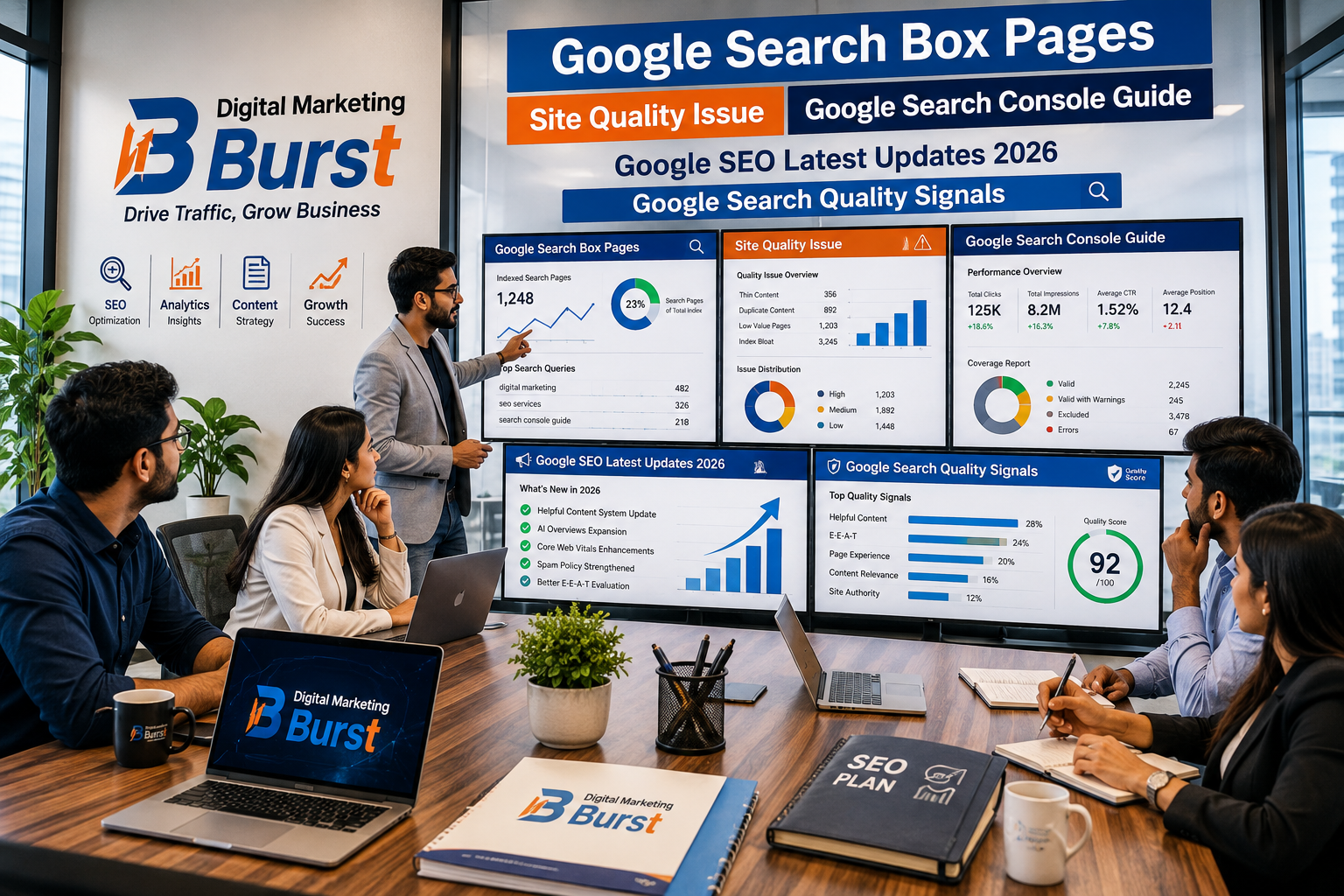
Google Search Box Pages
Internal search functionality improves user experience by helping visitors quickly locate relevant content on a website. When someone types a keyword into a website’s search bar, the website generates a search results page based on matching content. These automatically created pages are commonly referred to as Google Search Box Pages or internal search result pages.
Although these pages can be helpful for visitors already browsing the website, they rarely provide unique value for Google Search users. Most search result pages simply reorganize existing content rather than introducing original information. As a result, Google has historically discouraged website owners from allowing these URLs to be indexed.
For example, consider an eCommerce website where visitors search for “running shoes.” The website may generate dozens of URLs containing different search parameters, filters, pagination, and sorting options. Each page may look different technically while displaying almost identical products. From Google’s perspective, indexing all of these pages creates unnecessary duplication.
A similar situation occurs on news websites, blogs, travel portals, healthcare websites, educational platforms, and business directories. Every visitor search can potentially create another URL, leading to thousands of low-value pages if proper technical controls are not implemented.
This is where modern technical SEO becomes extremely important. Instead of allowing every automatically generated page to enter Google’s index, website owners should clearly indicate which pages deserve indexing and which pages should remain available only for users navigating the website internally.
Understanding this distinction is one of the most important lessons emerging from the Google SEO Latest Updates, particularly for websites that publish large volumes of content.
Google Search Pages
Many website owners confuse Google Search Pages with normal website pages, yet both serve entirely different purposes. A standard webpage is written to answer a user’s question with original information, images, videos, structured data, and useful resources. Internal search pages, on the other hand, are generated dynamically based on what a visitor searches for inside the website.
This difference matters because Google aims to provide diverse and valuable search results. If Google’s index becomes filled with automatically generated search pages that simply reorganize existing articles, product listings, or blog posts, users receive little additional value.
Imagine a blog containing 500 articles. If every search performed by visitors creates a unique URL that Google indexes, the website may eventually contain tens of thousands of indexed pages despite having only a few hundred original articles. This situation creates unnecessary complexity for Google’s crawlers while making it harder for important pages to receive proper crawling and indexing priority.
Moreover, these pages frequently generate duplicate metadata, repetitive headings, thin content, and overlapping keyword targeting. All of these characteristics reduce overall website quality over time.
Website owners should therefore review whether internal search pages are accessible to search engines. Proper robots directives, meta robots tags, canonical URLs, and Search Console monitoring all play important roles in preventing unnecessary indexing.
As Google continues refining its quality systems, websites that maintain clean indexing structures generally perform better over the long term than websites allowing unlimited automatically generated pages to enter the search index.
Google Site Quality Issue
A Google Site Quality Issue is not limited to spam, malware, or duplicate content. It also includes structural problems that reduce the overall value of a website in Google’s eyes. One of the growing concerns highlighted through recent discussions is the indexing of internal search result pages. Although these pages help visitors navigate a website, they often provide little unique value when they appear in Google Search.
When Google evaluates a website, it looks at the bigger picture rather than a single page. If a large percentage of indexed URLs contain repetitive search results, empty pages, thin content, or automatically generated URLs, Google’s quality systems may interpret the website as having a lower overall quality profile. Consequently, valuable pages may receive less crawling attention, slower indexing, or weaker ranking potential.
For example, imagine an online store containing 5,000 products. If internal searches generate another 50,000 searchable URLs with nearly identical content, Google must spend additional crawl resources discovering pages that offer very little new information. Instead of focusing on category pages, product pages, buying guides, or helpful articles, Google’s crawler wastes time visiting low-value URLs.
This situation also affects reporting inside Search Console. Website owners may notice an increase in crawled-but-not-indexed pages, duplicate pages without user-selected canonicals, soft 404 reports, or pages excluded from indexing. These signals do not automatically indicate a penalty, but they often reveal opportunities to improve website quality.
Modern SEO is increasingly focused on efficiency. High-quality websites help Google understand which pages deserve indexing and which pages should remain available only for users. Therefore, reducing unnecessary indexed search pages supports both crawl efficiency and long-term search visibility.
At Digital Marketing Burst, we regularly recommend performing technical SEO audits to identify low-value URLs before they become larger website quality concerns. Small improvements today often prevent significant SEO problems in the future.
Google Website Quality Issues
Google Website Quality Issues can develop gradually. Many website owners continue publishing excellent content while unintentionally allowing thousands of automatically generated URLs to accumulate in Google’s index. Over time, this creates an imbalance between valuable pages and low-value pages.
Quality is no longer measured simply by article length or keyword usage. Google’s modern ranking systems analyze originality, usefulness, structure, user experience, internal linking, page purpose, and overall website organization. Consequently, technical decisions become just as important as content strategy.
Internal search pages are only one example. Similar quality concerns can arise from filter URLs, tag archives, calendar pages, duplicate category combinations, parameter-based URLs, empty author pages, pagination errors, or automatically generated archives. Individually, these pages may seem harmless. Collectively, however, they can weaken the website’s quality profile.
Another overlooked factor is internal competition. Search pages frequently target identical keywords already covered by dedicated landing pages. Instead of strengthening rankings, they divide ranking signals across multiple similar URLs. Search engines then spend additional time determining which version deserves visibility.
Website owners should periodically review indexed URLs using Search Console and site search operators. This simple habit reveals whether unnecessary pages are entering Google’s index. Removing low-value URLs from indexing often improves crawl efficiency and helps search engines focus on genuinely useful content.
Furthermore, websites with cleaner indexing structures generally experience easier maintenance. Technical audits become simpler, crawl reports become more meaningful, and new content receives attention more quickly.
As Latest Google SEO Updates 2026 continue emphasizing helpful content and website quality, maintaining a streamlined index becomes an increasingly valuable long-term SEO strategy.
Complete Google Search Console Guide
A Complete Google Search Console Guide should never focus only on keyword rankings or click reports. Search Console has evolved into one of the most powerful technical SEO tools available for monitoring website quality, indexing behavior, crawl performance, and search visibility.
One of its greatest strengths is helping website owners identify pages that Google discovers but chooses not to index. These reports often reveal hidden technical issues that remain invisible during normal website browsing. When internal search pages begin appearing within indexing reports, they deserve immediate attention.
The Pages report provides valuable insights into indexed pages, excluded URLs, duplicate pages, redirects, canonical selections, crawl anomalies, and noindex directives. Monitoring these reports regularly allows website owners to understand whether automatically generated search URLs are entering Google’s index.
Search Console also helps identify sudden spikes in indexed URLs. If your website normally contains 2,000 pages but Search Console suddenly reports 15,000 discoverable URLs, internal search pages or parameter-based URLs may be responsible. Detecting these patterns early makes technical corrections significantly easier.
Another valuable feature is URL Inspection. Before deciding whether a page should remain indexed, website owners can inspect individual URLs to understand Google’s indexing status, canonical selection, crawl date, and indexing eligibility.
Rather than viewing Search Console as a reporting dashboard, treat it as an early warning system. It provides continuous feedback about how Google interprets your website. Used consistently, it becomes one of the strongest resources for maintaining long-term website quality.
Digital Marketing Burst recommends reviewing Search Console reports every week instead of waiting until traffic declines. Preventive monitoring almost always produces better SEO outcomes than reactive troubleshooting.
Complete Google Search Console Guide for Identifying Search Box Pages
One practical application of Search Console involves discovering whether internal search pages are already indexed. Begin by reviewing your indexed URLs and comparing them against your expected website structure. Unexpected search parameters, search queries, or dynamically generated URLs often indicate pages that should remain outside Google’s index.
Next, analyze the Coverage and Pages reports for patterns rather than isolated URLs. Large clusters of similar search pages frequently appear together because they share identical templates and technical characteristics.
The Performance report can also provide useful insights. If internal search pages receive impressions but very few clicks, they may not deliver meaningful value within search results. Meanwhile, Crawl Stats can reveal whether Googlebot spends excessive resources crawling repetitive search URLs instead of important landing pages.
Combining Search Console data with technical SEO tools, server log analysis, and regular website audits creates a comprehensive understanding of crawl behavior. This proactive approach supports healthier indexing, stronger website quality, and improved long-term SEO performance.
Most importantly, remember that Search Console is not simply a diagnostic tool. It is an ongoing optimization platform that helps website owners continuously improve technical SEO while aligning their websites with Google’s evolving quality expectations.
Google SEO Latest Updates
Keeping up with Google SEO Latest Updates has become one of the most important responsibilities for website owners, bloggers, digital marketers, and SEO professionals. Google introduces improvements to its Search systems throughout the year. Some updates are officially announced, while others are gradual refinements that improve how Google understands content quality, user intent, page usefulness, and technical website health.
One of the strongest trends in recent updates is Google’s continued focus on rewarding pages that genuinely help users. Instead of ranking pages simply because they contain keywords, Google’s systems now evaluate originality, expertise, user satisfaction, page experience, and overall website quality. This means technical SEO and content quality must work together.
The discussion around Google Search Box Pages fits perfectly into this broader direction. Internal search result pages often contain automatically generated content that repeats information already available elsewhere on the website. While these pages may help visitors navigate internally, they rarely provide enough unique value to deserve indexing in Google Search.
Another noticeable change is Google’s increased efficiency in allocating crawl resources. Large websites frequently contain parameter URLs, filter pages, pagination, archive pages, and search result pages. If these low-value pages consume excessive crawl budget, Google’s crawler may spend less time discovering or refreshing your important content.
Modern SEO is therefore no longer limited to publishing articles. It also involves controlling what Google crawls, indexes, and prioritizes. Website owners who regularly review indexing reports, optimize internal linking, and maintain a clean site structure are generally better positioned for long-term organic growth.
At Digital Marketing Burst, we advise businesses to treat every Google update as an opportunity to improve website quality rather than simply reacting to ranking fluctuations. Continuous optimization almost always produces better results than waiting for traffic declines.
Latest Google SEO Updates 2026
The Latest Google SEO Updates 2026 continue reinforcing Google’s long-term objective of delivering useful, trustworthy, and relevant search results. Rather than introducing completely new ranking principles, these updates strengthen existing quality systems that evaluate content originality, technical implementation, website experience, and indexing efficiency.
One important takeaway is that Google’s quality evaluation extends beyond individual articles. The overall website structure also matters. If a website contains thousands of automatically generated pages with limited value, those pages may influence how Google’s systems perceive the site’s quality profile.
This is why website owners should review internal search pages, filter URLs, tag archives, duplicate categories, and unnecessary parameter pages. Reducing low-value indexed URLs helps Google focus on pages that genuinely deserve visibility.
Another major trend involves crawl optimization. Google’s crawler has finite resources. When websites create excessive low-quality URLs, Google may spend valuable crawl time on pages that contribute little to search users. Consequently, newly published content may take longer to be discovered or refreshed.
The latest developments also encourage stronger technical SEO practices, including improved canonical implementation, accurate robots directives, clean XML sitemaps, logical internal linking, and consistent indexing management. These elements work together to improve Google’s understanding of website architecture.
Although every website differs, the overall message remains consistent: publish original content, eliminate unnecessary indexed pages, maintain technical health, and prioritize user experience above search engine manipulation.
Businesses that follow these principles are generally more resilient during future algorithm improvements because they align with Google’s long-term quality objectives instead of short-term optimization tactics.
Google Search Quality Signals
Understanding Google Search Quality Signals helps explain why some websites consistently perform well while others struggle despite publishing large amounts of content. Quality signals are not based on a single ranking factor. Instead, they represent a combination of indicators that help Google’s systems estimate the usefulness, credibility, and overall value of webpages.
Original content remains one of the strongest quality indicators. Pages offering unique insights, practical guidance, research, or firsthand expertise typically provide greater value than pages repeating information available elsewhere. Similarly, clear website organization improves Google’s understanding of topical relationships between articles.
Technical quality also contributes significantly. Fast loading speeds, mobile-friendly layouts, secure HTTPS implementation, structured navigation, logical internal linking, and efficient crawling all improve the overall experience for both users and search engines.
Another important signal involves indexing quality. Google prefers websites that clearly communicate which pages deserve indexing. Pages created automatically without meaningful purpose—such as many internal search result pages—can weaken overall quality if allowed to accumulate.
User engagement indirectly supports quality evaluation as well. Helpful pages generally encourage longer visits, additional navigation, repeat visitors, and stronger brand recognition. Although Google does not simply rank pages based on individual user metrics, satisfying user intent remains central to its ranking systems.
Quality should therefore be viewed as a continuous process rather than a one-time optimization project. Every technical decision, content update, internal link, and indexing choice contributes to the website’s long-term reputation.
Digital Marketing Burst encourages website owners to combine excellent content with clean technical SEO because both elements strengthen website quality together.
Google Ranking Signals
Many SEO professionals discuss Google Ranking Signals, yet these signals extend far beyond keywords and backlinks. Google’s modern ranking systems evaluate hundreds of interconnected factors designed to identify pages that best satisfy user intent.
Content relevance remains fundamental. Pages should answer specific questions completely while maintaining logical structure and readability. Short paragraphs, descriptive headings, natural keyword placement, and supporting examples improve both user experience and search visibility.
Authority also plays an important role. Websites demonstrating expertise through accurate information, consistent publishing, author transparency, and reliable references generally build stronger long-term trust.
Technical implementation represents another essential ranking signal. Proper canonical tags, crawlable architecture, optimized XML sitemaps, structured data where appropriate, fast loading performance, and mobile responsiveness all help search engines process content more efficiently.
Index management has become increasingly significant. When websites prevent unnecessary search pages, duplicate URLs, and parameter-based pages from entering Google’s index, search engines can allocate more attention to valuable content. This improves crawl efficiency while reducing indexing confusion.
Internal linking further strengthens ranking potential by helping Google discover important pages and understand topical relationships across the website. Logical navigation also improves the visitor experience, encouraging deeper exploration of valuable content.
Ultimately, no individual ranking signal guarantees success. Instead, Google combines multiple quality indicators to determine which pages provide the greatest benefit for search users. Websites that consistently prioritize helpful content, technical excellence, and efficient indexing are better positioned to achieve sustainable organic growth over time.
As Google’s search systems continue evolving, adapting to these quality-focused ranking signals will remain one of the most effective long-term SEO strategies for businesses, publishers, and digital marketers alike.
Why Google May Treat Search Box Pages as a Site Quality Issue
Google’s primary objective has always been to deliver the most useful answer for every search query. Because of this goal, pages that provide original information generally receive more attention than pages that simply reorganize existing content. This is one reason Google Search Box Pages have become a topic of discussion within the SEO community.
An internal search page usually displays content that already exists elsewhere on the same website. It does not introduce new research, fresh insights, or unique information. Instead, it lists articles, products, or resources based on a visitor’s search term. While this feature improves on-site navigation, it rarely offers enough value to justify appearing in Google’s search results.
Imagine a website where users search for “SEO tools,” “best SEO tools,” “top SEO tools,” and “SEO software.” Every variation can create a different URL even though the results shown are nearly identical. If Google indexes all these pages, the website may quickly accumulate thousands of repetitive URLs.
This creates several technical challenges. Google’s crawler must spend additional time visiting low-value pages. Important articles may receive fewer crawl visits. Duplicate keyword targeting becomes more common. Search engines also need to determine which version should rank, making indexing less efficient.
For these reasons, many SEO specialists recommend preventing internal search result pages from entering Google’s index unless they provide exceptional standalone value.
The discussion is not about penalties. Instead, it focuses on website quality management. A clean index containing useful pages helps Google understand your website more effectively while improving the visibility of your strongest content.
Common Technical SEO Mistakes That Create Search Box Problems
Many websites unintentionally create thousands of unnecessary URLs without realizing the long-term SEO impact. These problems often develop gradually as new plugins, filters, search features, and sorting options are added.
One common mistake involves allowing every internal search query to generate an indexable page. Another frequent issue occurs when category filters create multiple URLs for nearly identical content. Pagination, session parameters, sorting options, language parameters, and tracking codes can produce similar indexing challenges.
Some websites also include search result pages within XML sitemaps. Because sitemaps are intended to highlight valuable pages, adding automatically generated search pages sends confusing quality signals to Google.
Duplicate title tags and repetitive meta descriptions represent another warning sign. Search pages often inherit the same metadata template, creating thousands of pages with minimal differences.
Website owners sometimes overlook canonical tags as well. Without proper canonical implementation, Google may treat multiple similar URLs as separate pages rather than recognizing the preferred version.
Additionally, weak internal linking structures can increase the visibility of unnecessary URLs. Navigation systems should guide Google toward important landing pages instead of encouraging excessive crawling of automatically generated search pages.
Regular technical SEO audits help identify these problems before they affect search visibility. Small corrections made early are usually much easier than cleaning thousands of indexed URLs later.
How Crawl Budget Affects Google Search Box Pages
Although crawl budget is often associated with very large websites, it also matters for growing blogs, eCommerce stores, travel portals, healthcare websites, and news platforms.
Google allocates a certain amount of crawling activity to every website. When Googlebot spends time visiting unnecessary pages, fewer resources remain available for discovering important content updates.
For example, suppose your website contains 3,000 high-quality pages but also generates 40,000 searchable URLs through internal search functions. Googlebot may repeatedly revisit those low-value URLs, reducing its efficiency.
As a result, recently published articles might take longer to appear in Google Search. Updated pages may not be refreshed as quickly. Important landing pages may also receive less frequent crawling.
Fortunately, website owners have several options for improving crawl efficiency. Preventing unnecessary indexing, optimizing robots directives, maintaining accurate XML sitemaps, strengthening internal linking, and eliminating duplicate URLs all contribute to better crawl management.
Google does not assign a fixed crawl budget to every website. Instead, crawling behavior depends on website quality, popularity, technical health, server performance, and content freshness. Therefore, maintaining a clean website architecture naturally encourages more efficient crawling over time.
Businesses that publish content regularly should treat crawl optimization as an ongoing SEO practice rather than a one-time technical task.
How to Fix Search Box Page Indexing Issues
If internal search pages already appear in Google’s index, there is no reason to panic. Most indexing problems can be resolved through systematic technical improvements.
The first step involves identifying which search pages have been indexed. Google Search Console provides valuable information about indexed URLs, excluded pages, and crawl activity. Website owners should compare indexed pages with the pages they actually want users to find through Google Search.
After identifying unnecessary URLs, review the website’s robots directives, meta robots settings, canonical tags, and sitemap configuration. Internal search result pages usually should not be included in XML sitemaps because they rarely represent primary content.
Next, evaluate how these pages are linked internally. Excessive navigation links pointing toward search URLs may unintentionally encourage additional crawling. Strengthening links toward valuable landing pages instead helps Google understand which content deserves priority.
Monitoring Search Console after technical changes is equally important. Indexing adjustments often require time before Google’s systems fully process the updates. Regular reviews help confirm that unnecessary pages gradually disappear from the index while important content continues receiving healthy crawl activity.
Finally, remember that technical SEO supports content strategy rather than replacing it. Publishing original, well-structured, user-focused content remains the foundation of sustainable search visibility. When combined with efficient index management, strong content creates a website that performs well for both users and search engines.
At Digital Marketing Burst, we recommend combining regular technical audits with ongoing content improvements. This balanced approach helps businesses maintain strong website quality while adapting to future Google SEO updates.
How Google Search Console Helps Detect Search Box Page Problems
One of the biggest advantages of using Google Search Console is that it allows website owners to see how Google views their website. Instead of guessing which pages are indexed, crawled, or ignored, Search Console provides reliable data that helps identify technical SEO issues before they affect organic traffic.
When investigating Google Search Box Pages, begin by opening the Pages report inside Search Console. This report displays indexed pages, excluded URLs, duplicate pages, redirected URLs, and pages that Google has discovered but decided not to index. If you notice hundreds or even thousands of search-result URLs appearing in these reports, your website may require technical improvements.
Another useful feature is the URL Inspection Tool. By inspecting a single search page, you can determine whether Google has indexed it, selected a canonical URL, or excluded it from search results. This information makes troubleshooting much easier because every indexing decision becomes visible.
The Performance Report also deserves attention. Internal search result pages sometimes receive impressions but generate almost no clicks. If those URLs attract minimal engagement while consuming crawl resources, they are strong candidates for indexing review.
Similarly, the Crawl Stats Report helps website owners understand how Googlebot spends its crawling activity. When crawl requests increase dramatically without corresponding content growth, automatically generated URLs are often responsible.
Rather than checking Search Console only after rankings decline, build a routine of reviewing reports every week. Continuous monitoring helps detect technical problems early and supports long-term website health.
At Digital Marketing Burst, we recommend combining Search Console insights with periodic technical SEO audits to maintain a clean and efficient website structure.
Robots.txt and Search Box Pages
Many website owners assume that a robots.txt file automatically solves every indexing problem. In reality, robots.txt controls crawling rather than indexing. Understanding this distinction is essential when managing Google Search Box Pages.
If Google discovers a URL through internal links or external references, it may still index that URL even when crawling is restricted. Therefore, robots.txt alone should not be considered a complete solution for preventing low-value search pages from appearing in Google Search.
A better approach is to evaluate how search-result URLs are generated and whether they should remain accessible to search engines at all. Websites that produce thousands of dynamic URLs often benefit from combining robots directives with other technical SEO methods such as canonical tags and meta robots instructions.
Another common mistake involves blocking important resources accidentally. Overly aggressive robots rules may prevent Google from rendering pages correctly, leading to unexpected indexing issues. Every change should therefore be tested carefully before deployment.
Maintaining a clean robots.txt file also improves technical clarity. Search engines can more easily focus on valuable website sections while reducing unnecessary crawling of low-priority areas.
Ultimately, robots.txt works best as one component within a broader technical SEO strategy rather than as a standalone solution.
Noindex Directives for Internal Search Pages
One of the most effective methods for managing internal search-result pages is the proper use of noindex directives. Unlike robots.txt, a noindex instruction explicitly tells search engines that a page should not appear in search results.
This approach is particularly useful for dynamically generated search pages because users can still access them while browsing the website, yet Google understands they are not intended for public search visibility.
When implementing noindex, consistency becomes extremely important. Website owners should regularly verify that search pages continue receiving the correct directives after CMS updates, plugin changes, or website redesigns.
Another advantage of using noindex is improved index quality. Instead of filling Google’s index with repetitive search pages, websites reserve indexing space for valuable articles, product pages, service pages, and resource guides.
However, noindex should never be applied blindly. Every website has different technical requirements. Before making large-scale indexing changes, evaluate which pages genuinely contribute value to search users.
Careful planning ensures that helpful landing pages remain visible while automatically generated pages stay outside Google’s primary search index.
Canonical Tags and Duplicate Search Pages
Canonical tags play a vital role in reducing duplicate content challenges created by internal search functionality. Many websites generate multiple URLs displaying almost identical information through sorting options, filters, search parameters, and pagination.
Without proper canonical implementation, Google may interpret these URLs as separate pages. Consequently, ranking signals become divided among several similar versions instead of strengthening one preferred page.
A correctly configured canonical tag tells search engines which URL represents the primary version. This improves indexing efficiency while reducing duplicate content confusion.
Website owners should review canonical implementation regularly because technical updates occasionally introduce incorrect canonical references. Even small errors can influence how Google interprets website architecture.
Canonical tags also complement strong internal linking. Together, these technical elements help Google understand which pages deserve ranking priority and which pages simply support website navigation.
When used alongside noindex directives, canonical tags contribute significantly to cleaner indexing and better crawl management.
XML Sitemaps and Better Index Management
An XML sitemap acts as a roadmap that highlights the most important pages on a website. For this reason, automatically generated search pages generally should not appear within the sitemap.
Including thousands of low-value URLs sends mixed quality signals to Google. Instead of emphasizing valuable content, the sitemap becomes crowded with pages that offer limited standalone usefulness.
A well-maintained sitemap should focus on original articles, service pages, category pages, product pages, destination guides, and other high-value resources that deserve visibility within search results.
Website owners should periodically compare sitemap URLs against indexed pages reported in Search Console. Differences between these reports often reveal hidden technical SEO opportunities.
Another useful practice involves updating sitemaps whenever significant content changes occur. Fresh, accurate sitemaps help Google discover new content more efficiently while reinforcing the overall structure of the website.
Combined with proper internal linking, canonical implementation, and indexing management, XML sitemaps become an essential part of modern technical SEO.
As Latest Google SEO Updates 2026 continue emphasizing website quality and indexing efficiency, maintaining a clean sitemap remains one of the simplest yet most valuable optimization practices available.
Google Search Quality Signals and Why They Matter
Understanding Google Search Quality Signals is essential for anyone who wants consistent organic traffic. Google’s ranking systems no longer rely on a single factor such as keywords or backlinks. Instead, they evaluate hundreds of signals that help determine whether a webpage deserves visibility in search results.
One important quality signal is originality. Pages that provide fresh insights, practical advice, research, or real experience are generally more valuable than pages that simply repeat existing information. Another important factor is relevance. Every page should clearly answer the user’s query without unnecessary distractions.
Website structure also influences quality. A clean navigation system, logical internal linking, descriptive headings, and organized content make it easier for both visitors and search engines to understand the purpose of each page.
Technical quality remains equally important. Fast loading speeds, mobile responsiveness, secure HTTPS connections, optimized images, and structured metadata all contribute to a positive website experience. Although none of these factors guarantee rankings individually, together they strengthen the overall quality profile.
Internal search-result pages become relevant here because they often contribute little original value. If hundreds of similar pages enter Google’s index, they can dilute the website’s overall quality. Therefore, reviewing Google Search Box Pages regularly supports stronger long-term SEO performance.
At Digital Marketing Burst, we recommend treating every page as an opportunity to deliver unique value. This mindset aligns naturally with Google’s evolving quality systems.
How Helpful Content Improves Website Quality
Google’s recent ranking systems increasingly reward websites that prioritize people before search engines. Helpful content solves real problems, answers genuine questions, and provides practical information that users cannot easily find elsewhere.
Instead of publishing multiple short articles targeting nearly identical keywords, focus on creating comprehensive resources that completely address a topic. This strategy reduces internal competition while improving topical authority.
Helpful content also encourages stronger user engagement. Visitors spend more time reading detailed guides, explore additional pages through internal links, and often return for future information. These positive experiences strengthen the overall reputation of the website.
Internal search pages rarely achieve the same objective because they primarily organize existing information rather than expanding it. Therefore, they should support navigation instead of competing with primary content in Google Search.
A useful content strategy combines in-depth articles, clear formatting, accurate information, and regular updates. Over time, this approach builds trust with both readers and search engines.
Website owners should periodically review older articles as well. Updating statistics, improving examples, expanding explanations, and correcting outdated information keeps content relevant while supporting long-term organic visibility.
Index Bloat and Its Impact on SEO
One technical issue frequently connected with Google Site Quality Issue discussions is index bloat. This occurs when Google indexes significantly more pages than the website actually needs.
Index bloat often develops gradually. Search parameters, filter URLs, tag pages, archive pages, internal search results, duplicate categories, and pagination can collectively create thousands of additional URLs.
Although each page appears harmless individually, together they consume crawl resources and make website maintenance more difficult. Search engines spend valuable time processing low-priority pages instead of focusing on original content.
Another consequence involves reporting accuracy. Search Console may display increasing numbers of excluded URLs, duplicate pages, and crawled-but-not-indexed reports. These signals help website owners identify areas requiring technical improvement.
Reducing index bloat improves website organization. Google can more easily identify valuable content, discover new articles faster, and refresh existing pages more efficiently.
Periodic technical audits remain the best defense against index bloat. Reviewing indexed URLs every few months ensures unnecessary pages do not accumulate unnoticed.
Improving Crawl Efficiency for Better Rankings
Crawl efficiency refers to how effectively search engines discover, process, and revisit important pages on a website. Although many discussions focus on crawl budget alone, efficiency is often the more practical objective.
Websites with clean architecture allow Googlebot to move naturally between valuable pages. Logical internal links, descriptive navigation, updated XML sitemaps, and consistent canonical implementation all contribute to efficient crawling.
On the other hand, excessive duplicate URLs, broken links, redirect chains, and unnecessary search pages increase crawling complexity. As Google spends more time processing low-value pages, important content may receive fewer crawl visits.
Publishing high-quality content regularly also encourages healthy crawling. Websites that update valuable information consistently often receive more frequent attention from search engines than websites filled with repetitive pages.
Monitoring crawl activity through Search Console allows website owners to identify unexpected patterns before they become larger technical problems. Combined with routine SEO audits, this practice supports sustainable organic growth.
Remember that crawl optimization is not about forcing Google to crawl more pages. Instead, it focuses on helping Google prioritize the right pages.
Advanced Technical SEO Best Practices for 2026
The Latest Google SEO Updates 2026 continue reinforcing the importance of technical excellence alongside content quality. Advanced technical SEO is no longer reserved for enterprise websites. Every growing website benefits from maintaining a healthy technical foundation.
Begin with a logical website hierarchy. Organize categories, articles, services, and resources in a structure that visitors can easily navigate. Clear architecture also helps search engines understand topical relationships across the website.
Maintain descriptive URLs that remain stable over time. Avoid unnecessary parameters wherever possible, especially those created through search filters or sorting options.
Regularly audit internal links to ensure important pages receive adequate support. Strong internal linking distributes authority while improving content discovery.
Optimize Core Web Vitals by improving page speed, visual stability, and interaction responsiveness. Although user experience extends beyond performance metrics, faster websites generally create better experiences.
Review structured data implementation periodically. Accurate schema helps search engines understand page content more effectively while supporting eligibility for enhanced search features.
Finally, continue monitoring Google Search Console Guide reports after every major website update. Technical SEO is an ongoing process rather than a one-time project. Small improvements implemented consistently often produce stronger long-term SEO results than occasional large-scale redesigns.
At Digital Marketing Burst, we believe successful SEO combines excellent content, clean technical implementation, regular monitoring, and continuous improvement. Websites that follow these principles are better prepared for future algorithm changes while delivering a stronger experience for users.
Common Myths About Google Search Box Pages
As discussions around Google Search Box Pages continue to grow, several misconceptions have spread within the SEO community. Believing these myths can lead website owners to make unnecessary or even harmful technical changes. Understanding the facts helps build a more effective long-term SEO strategy.
One common myth is that every internal search page automatically harms SEO. This is not true. Internal search functionality itself is useful because it improves website navigation and helps visitors quickly find relevant information. The concern arises only when large numbers of low-value search-result pages become indexed and compete with important content.
Another misconception is that blocking search pages in the robots.txt file instantly removes them from Google Search. In reality, robots.txt mainly controls crawling. A URL can still appear in search results if Google discovers it through other sources. Website owners should understand the difference between crawl management and index management before making technical decisions.
Some people also believe that deleting thousands of URLs immediately improves rankings. SEO rarely works that way. Google’s systems evaluate many quality signals together. Improving website quality requires consistent technical optimization, useful content, logical internal linking, and regular monitoring rather than a single technical fix.
Understanding these realities allows businesses to focus on meaningful improvements instead of chasing shortcuts.
How to Perform a Technical SEO Audit for Search Box Pages
A technical SEO audit provides one of the most reliable ways to identify whether Google Site Quality Issue concerns exist on your website. Instead of guessing, use data to understand how search engines interact with your content.
Start by reviewing the indexed pages inside Google Search Console. Compare the number of indexed URLs with the actual number of pages you expect to be visible in Google Search. Significant differences may indicate duplicate pages, internal search pages, or parameter-generated URLs.
Next, crawl your website using a trusted SEO crawler. Review page titles, meta descriptions, canonical tags, status codes, and URL structures. Search-result pages often follow identifiable patterns, making them easier to locate during a technical audit.
Pay attention to XML sitemaps as well. Every URL included in the sitemap should represent valuable content intended for indexing. If search-result URLs appear there, update the sitemap accordingly.
Internal linking deserves careful review too. Important landing pages should receive stronger internal support than automatically generated search pages. Balanced navigation helps Google understand page importance more effectively.
Finally, document every finding before making technical changes. A structured audit process makes it easier to measure improvements over time and reduces the risk of introducing new SEO issues.
Recovering From Website Quality Problems
If a website has accumulated thousands of unnecessary indexed URLs, recovery requires patience rather than drastic action. Google’s systems need time to recrawl pages, process indexing changes, and reassess overall website quality.
Begin by identifying the pages that genuinely deserve indexing. Valuable articles, service pages, destination guides, category pages, and original resources should remain accessible. Automatically generated search-result pages, duplicate parameter URLs, and repetitive archives often require different handling.
Next, strengthen your highest-value content. Update existing articles with current information, improve internal linking, optimize metadata, and expand sections that answer user questions more comprehensively. Enhancing content quality often produces better long-term results than focusing only on technical corrections.
Continue monitoring Google Search Console after implementing changes. Gradual improvements in indexing reports, crawl efficiency, and search visibility indicate that Google is processing the updated website structure.
Remember that recovery is usually progressive. Websites built around strong content and clean technical SEO generally become more resilient over time.
Future-Proof SEO Strategies for Website Owners
Search engines continue evolving every year, but one principle remains remarkably consistent: websites that genuinely help users tend to perform better in the long run. Instead of optimizing for temporary ranking tricks, build your SEO strategy around sustainable quality.
Create content that answers complete questions rather than targeting isolated keywords. Organize articles into logical topic clusters connected through meaningful internal links. This approach improves topical authority while helping visitors discover additional useful resources.
Review technical SEO regularly instead of waiting for traffic declines. Small maintenance tasks, such as checking canonical tags, updating XML sitemaps, monitoring crawl reports, and reviewing indexed URLs, prevent many larger problems from developing.
Stay informed about Google SEO Latest Updates, but avoid reacting to every rumor circulating online. Focus on official guidance, trusted industry sources, and measurable improvements within your own website.
Investing in content quality, technical health, and user experience creates a stronger foundation than chasing short-term algorithm changes. These principles remain valuable regardless of future updates.
Digital Marketing Burst’s SEO Approach to Website Quality
At Digital Marketing Burst, we believe successful SEO combines strategic planning with continuous improvement. Technical optimization alone cannot produce sustainable growth, and content alone cannot overcome technical limitations. Both areas must work together.
Our approach begins with understanding how Google discovers, crawls, indexes, and evaluates website content. We then identify technical opportunities, improve website architecture, optimize internal linking, strengthen topical authority, and monitor Search Console reports to measure ongoing performance.
We also encourage businesses to publish genuinely useful resources instead of creating multiple low-value pages targeting similar keywords. Comprehensive guides, practical tutorials, detailed case studies, and solution-focused articles generally provide greater long-term value than repetitive content.
As Google continues refining Google Search Quality Signals, businesses that prioritize quality over quantity will be better positioned for sustainable organic growth. Maintaining a healthy website requires ongoing attention, but the long-term benefits include improved visibility, stronger user trust, and more consistent search performance.
A proactive SEO strategy supported by regular audits, quality content, and technical excellence helps businesses adapt confidently to future Google algorithm improvements while continuing to meet the expectations of both users and search engines.
Why Digital Marketing Burst Is the Right Choice for Modern SEO
Choosing the right SEO partner is one of the most important decisions for any business that wants long-term organic growth. Search engine optimization is no longer just about keywords or backlinks. Today, it requires technical expertise, high-quality content, user-focused optimization, structured website architecture, and continuous monitoring of Google’s evolving search systems.
At Digital Marketing Burst, we help businesses build sustainable SEO strategies instead of relying on short-term ranking techniques. Our approach focuses on improving website quality, technical SEO, content optimization, local SEO, Google Business Profile optimization, website performance, and search visibility. Every recommendation is based on industry best practices and the latest Google guidance.
Our team regularly monitors Google SEO Latest Updates, studies changes in Google Search Quality Signals, and analyzes new developments inside Google Search Console. This helps our clients adapt to search engine changes while maintaining consistent organic growth.
We also believe that successful SEO begins with understanding users. Instead of publishing content solely for search engines, we create resources that answer real questions, solve genuine problems, and improve the overall website experience. This approach naturally supports stronger rankings and better engagement over time.
Businesses working with Digital Marketing Burst benefit from technical SEO audits, content strategy, on-page optimization, local SEO improvements, website performance analysis, structured data implementation, and continuous monitoring. Our goal is to help brands build authority, increase qualified traffic, and create websites that remain competitive for years to come.
Frequently Asked Questions
Can Google Search Box Pages affect SEO?
Yes. If a large number of internal search-result pages become indexed and provide little unique value, they can reduce crawl efficiency, create duplicate content challenges, and contribute to overall website quality concerns. Proper index management helps prevent these issues.
Should internal search pages be indexed?
In most situations, internal search-result pages are designed for website visitors rather than search engines. They generally work best as navigation tools instead of standalone pages within Google’s search index.
How can I check whether search pages are indexed?
Open Google Search Console and review the Pages report. You can also inspect individual URLs using the URL Inspection Tool to understand their indexing status and Google’s canonical selection.
Does robots.txt prevent indexing?
Not always. Robots.txt mainly controls crawling. If Google discovers a blocked URL through other sources, the page may still appear in search results. Index management often requires additional technical methods.
What is index bloat?
Index bloat occurs when Google indexes significantly more pages than necessary. Common causes include search-result pages, filter URLs, duplicate archives, parameter-based URLs, and repetitive content.
Why are Google Search Quality Signals important?
Google evaluates many quality indicators when ranking websites. Helpful content, technical health, efficient indexing, logical website structure, and positive user experience all contribute to stronger long-term search visibility.
How often should I perform a technical SEO audit?
For most websites, a technical audit every three to six months is recommended. Larger websites or frequently updated websites may benefit from monthly reviews using Search Console and SEO auditing tools.
Can improving technical SEO increase rankings?
Technical SEO alone does not guarantee higher rankings. However, it creates a healthier website structure that allows search engines to crawl, understand, and index valuable content more efficiently.
Final Conclusion
The discussion around Google Search Box Pages highlights a broader principle that continues shaping modern SEO: website quality matters more than ever. Search engines increasingly reward websites that provide original information, efficient technical implementation, and meaningful experiences for users.
Internal search-result pages remain valuable for website navigation. However, allowing large numbers of low-value search pages into Google’s index can reduce crawl efficiency and complicate website management. Reviewing indexing reports, maintaining accurate technical SEO settings, and publishing genuinely useful content help create a stronger foundation for long-term search visibility.
Regularly monitoring Google Search Console, understanding Google Search Quality Signals, and staying informed about Google SEO Latest Updates enable businesses to adapt confidently as Google’s search systems continue evolving. Small improvements implemented consistently often produce greater results than large one-time changes.
At Digital Marketing Burst, we believe that successful SEO combines technical excellence, valuable content, strategic planning, and continuous optimization. Businesses that focus on these principles are better positioned to improve organic visibility, build trust with users, and achieve sustainable growth in search results.
Whether you manage a personal blog, an eCommerce website, a healthcare portal, or a corporate business website, prioritizing quality over quantity remains one of the smartest long-term SEO investments you can make. Continue learning, keep optimizing, and let every update become an opportunity to strengthen your website rather than a reason for concern.
Common SEO Mistakes That Can Trigger Website Quality Issues
Many website owners focus heavily on publishing new content but overlook technical SEO. As a result, they unintentionally create problems that affect website quality over time. Google’s systems evaluate an entire website rather than individual pages alone, so repeated technical mistakes can reduce overall SEO performance.
One of the biggest mistakes is allowing thousands of automatically generated URLs to become indexable. These may include Google Search Box Pages, filter URLs, tag pages, pagination URLs, author archives, or search parameter pages. Individually, they may seem harmless. However, together they create duplicate content, increase crawl complexity, and dilute the overall value of your website.
Another common issue is publishing thin pages with very little unique information. Google prefers pages that answer a user’s question completely instead of providing only a few sentences. Therefore, every important page should deliver useful, original, and well-structured information.
Website owners also forget to review broken internal links, outdated redirects, duplicate title tags, and missing meta descriptions. These technical issues reduce the overall quality of the website and make crawling less efficient.
Regular SEO maintenance helps prevent these problems before they begin affecting rankings.
Best Practices to Keep Your Website Aligned With Google’s Quality Standards
Maintaining a high-quality website requires ongoing attention rather than one-time optimization. Google continues refining its ranking systems, but the overall direction remains consistent: reward websites that genuinely help users.
Publish original content based on experience, research, and practical knowledge. Avoid creating multiple pages targeting nearly identical keywords when one comprehensive guide would better satisfy user intent.
Review your indexed pages every month using Google Search Console. Compare the number of indexed URLs with the pages that actually deserve visibility. Unexpected growth often reveals technical issues requiring attention.
Maintain accurate XML sitemaps, implement logical internal linking, optimize Core Web Vitals, improve page speed, and ensure mobile usability. Together, these improvements strengthen both user experience and technical SEO.
Another valuable habit is updating older content. Refresh statistics, improve examples, expand explanations, and remove outdated information. Search engines appreciate websites that maintain accurate and current resources.
Businesses that consistently improve website quality are generally better prepared for future algorithm updates.
Google Search Box Pages and the Future of Technical SEO
Technical SEO continues evolving alongside Google’s ranking systems. Several years ago, many SEO strategies focused almost entirely on keywords and backlinks. Today, search engines evaluate websites much more comprehensively.
The discussion surrounding Google Search Box Pages demonstrates this evolution. Instead of asking whether a page exists, Google increasingly evaluates whether that page provides meaningful value for search users.
Future technical SEO will likely place even greater emphasis on crawl efficiency, clean indexing, structured website architecture, user satisfaction, and content usefulness. Websites with excessive duplicate URLs or automatically generated pages may find it increasingly difficult to compete against websites maintaining cleaner technical structures.
Artificial intelligence is also improving Google’s ability to understand page quality. As search systems become more sophisticated, creating valuable resources becomes even more important than generating large numbers of pages.
Website owners should therefore focus on sustainable optimization rather than temporary SEO tactics. Strong technical foundations combined with excellent content remain one of the safest long-term strategies.
Advanced SEO Checklist for Website Owners
A healthy website should regularly review important technical areas including indexing, crawling, metadata, structured navigation, XML sitemaps, canonical implementation, page speed, mobile usability, HTTPS security, internal linking, image optimization, and content quality.
Search Console should be monitored consistently to identify indexing changes, crawl anomalies, duplicate pages, and performance trends. Server logs and website crawlers can provide additional technical insights for larger websites.
Every article should include descriptive headings, natural keyword usage, optimized metadata, logical URL structures, and valuable internal links pointing toward related resources.
Content strategy should prioritize comprehensive topic coverage rather than isolated keyword targeting. Publishing fewer high-quality articles often produces stronger long-term SEO results than publishing many repetitive pages.
Finally, continue learning. Google’s search systems evolve continuously, and successful SEO professionals adapt through education, testing, and ongoing website improvements.
Final Thoughts
The conversation around Google Search Box Pages, Google Site Quality Issue, Google Search Console Guide, Google SEO Latest Updates, and Google Search Quality Signals reflects a larger shift in modern search engine optimization. Google increasingly rewards websites that combine valuable content with clean technical implementation and excellent user experiences.
Instead of worrying about every algorithm update, focus on building a website that deserves to rank. Publish helpful resources, maintain technical health, monitor Search Console regularly, optimize internal linking, and prevent unnecessary low-value pages from entering Google’s index.
These principles remain effective regardless of future ranking updates because they align with Google’s long-term objective of delivering the best possible search experience.
At Digital Marketing Burst, we continue researching new SEO developments, testing optimization strategies, and helping businesses build sustainable organic growth. By combining technical expertise with high-quality content, websites can improve visibility while creating better experiences for both users and search engines.
A quality-first approach is no longer optional—it is the foundation of successful SEO in 2026 and beyond.
SEO Action Plan for Website Owners in 2026
Understanding Google’s recommendations is valuable, but implementing them consistently produces the real results. Whether you manage a personal blog, a business website, an eCommerce platform, or a service-based company, following a structured SEO process helps maintain long-term organic visibility.
Begin by auditing your website every month. Review indexing reports, check crawl errors, identify duplicate pages, monitor page performance, and confirm that only valuable URLs are included in your XML sitemap. Regular monitoring allows you to detect problems before they affect rankings.
Next, improve your content continuously. Instead of creating dozens of short articles targeting similar keywords, build comprehensive resources that answer every aspect of a topic. Add updated examples, improve readability, include helpful visuals, and strengthen internal links between related articles.
Technical optimization should become part of your routine. Ensure that page speed remains competitive, Core Web Vitals are healthy, mobile usability is excellent, structured data is valid, canonical tags are correctly configured, and unnecessary parameter URLs remain under control.
Pay close attention to Google Search Console. It provides valuable insights into indexing, crawling, search performance, and website health. Reviewing these reports regularly allows you to identify opportunities for improvement before they become larger technical challenges.
Another important practice is monitoring content quality across the entire website. Remove outdated information, merge overlapping articles, update statistics, and refresh older pages that continue receiving traffic. Search engines reward websites that remain accurate and relevant.
Finally, stay informed about Google SEO Latest Updates, but avoid changing your website based on speculation. Focus on official guidance, user experience, and measurable improvements supported by reliable SEO data.
Key Takeaways
The discussion around Google Search Box Pages demonstrates how modern SEO extends beyond keyword optimization. Website quality, crawl efficiency, indexing strategy, and helpful content all work together to influence long-term search visibility.
Maintaining a clean index helps Google focus on your most valuable pages. Improving technical SEO ensures that search engines understand your website efficiently. Publishing original, useful content builds authority and strengthens user trust over time.
Businesses should treat SEO as an ongoing process rather than a one-time project. Regular technical audits, continuous content improvement, logical website architecture, and consistent monitoring through Google Search Console create a strong foundation for sustainable growth.
As search algorithms continue evolving, websites that prioritize quality over quantity will remain better positioned for stable rankings and increased organic traffic.
Final Words
Search engine optimization continues to evolve, but the core objective remains the same: create websites that genuinely help users. Every improvement in content quality, technical SEO, website performance, and user experience contributes to stronger long-term visibility.
Understanding topics such as Google Site Quality Issue, Google Search Quality Signals, Google Search Console Guide, and Google SEO Latest Updates enables website owners to make informed decisions instead of reacting to every industry rumor.
Rather than worrying about algorithm changes, focus on publishing trustworthy content, maintaining technical excellence, and providing the best possible experience for visitors. These principles consistently align with Google’s long-term direction.
At Digital Marketing Burst, we are committed to helping businesses understand modern SEO, improve website quality, and build sustainable organic growth strategies. Through technical expertise, strategic content planning, and continuous optimization, we help brands adapt to changing search landscapes while remaining focused on long-term success.
Thank you for reading this complete guide. We hope it helps you better understand how website quality, search indexing, and technical SEO influence search performance in 2026 and beyond. Continue learning, continue optimizing, and let every improvement bring your website closer to lasting organic success.
Why Digital Marketing Burst Is a Trusted Digital Marketing Agency in Lucknow
Businesses today need more than just a website—they need a digital marketing partner that understands how search engines, customer behavior, and online branding work together. Digital Marketing Burst helps businesses build a strong online presence through data-driven SEO, Google Ads management, social media marketing, website development, local SEO, content marketing, and performance-focused digital strategies.
Our team stays updated with the latest Google algorithm changes, AI-powered search trends, and evolving SEO best practices. Instead of following outdated tactics, we focus on creating sustainable digital growth that helps businesses increase organic traffic, generate qualified leads, and improve online visibility.
Whether you’re a startup, healthcare organization, educational institute, travel company, eCommerce business, or local brand, our customized marketing strategies are designed to meet your business goals. We believe every business is unique, so we create tailored campaigns instead of using one-size-fits-all solutions.
As a digital marketing agency in Lucknow, Digital Marketing Burst combines technical expertise with creative marketing. From technical SEO audits and Google Ads optimization to content strategy and website performance improvements, we help businesses strengthen their online presence across multiple digital channels.
If you’re searching for a best digital marketing agency in Lucknow, SEO company in Lucknow, Google Ads expert in India, website SEO services, local SEO agency, or a performance marketing company, Digital Marketing Burst aims to deliver measurable results through transparent communication, continuous optimization, and customer-focused strategies.
Our mission is simple: help businesses grow online with ethical digital marketing practices, measurable performance, and long-term success.
Why Businesses Choose Digital Marketing Burst
Clients choose Digital Marketing Burst because we focus on strategy, transparency, and continuous improvement. Our services include:
- Search Engine Optimization (SEO)
- Google Ads (PPC) Management
- Social Media Marketing
- Website Design & Development
- Local SEO & Google Business Profile Optimization
- Content Marketing
- Technical SEO Audits
- Conversion Rate Optimization
- Brand Strategy & Online Reputation Management
Rather than chasing short-term rankings, we focus on building a strong digital foundation that supports sustainable business growth.
Partner with Digital Marketing Burst
If you’re looking for an experienced digital marketing company in Lucknow to improve your website rankings, increase qualified leads, and strengthen your online brand, Digital Marketing Burst is committed to helping your business grow with proven digital marketing strategies and continuous optimization.