A website may look professional and still have serious marketing problems. Important pages may not be indexed. Valuable keywords may rank on the second page. Mobile users may leave because pages load slowly. Forms may fail to generate enquiries. In other cases, traffic is healthy but visitors land on pages that do not match their search intent.
Therefore, an audit should answer a simple question: Is every important part of the website helping the business attract, engage, and convert the right audience?
This guide explains how to answer that question. It combines SEO, technical performance, content marketing, conversion thinking, analytics, and digital strategy. More importantly, it focuses on finding problems that can actually be fixed instead of producing a long report filled with numbers nobody uses.
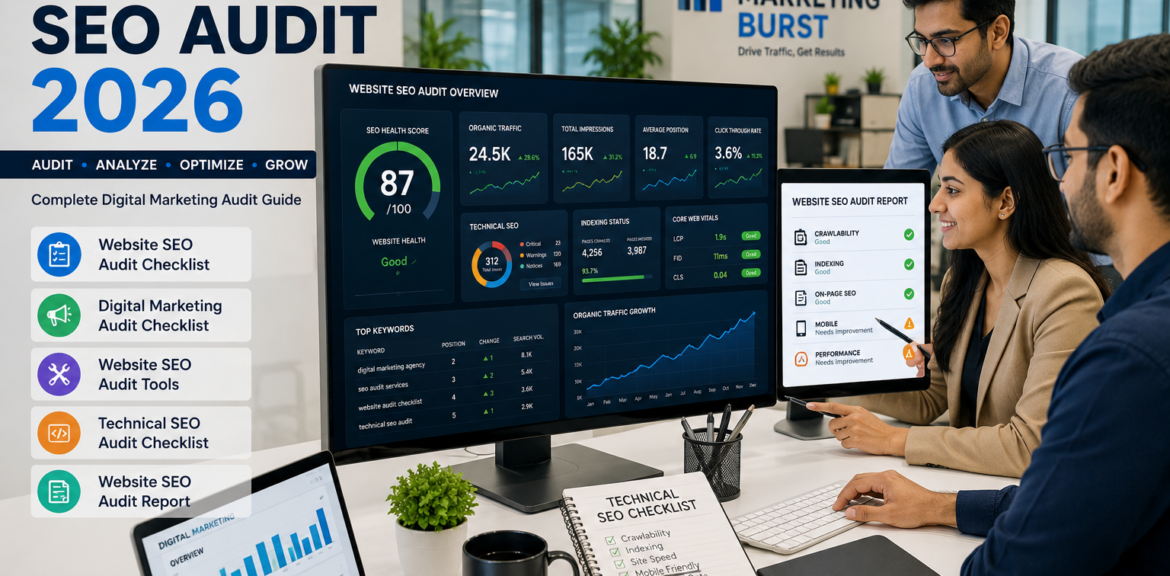
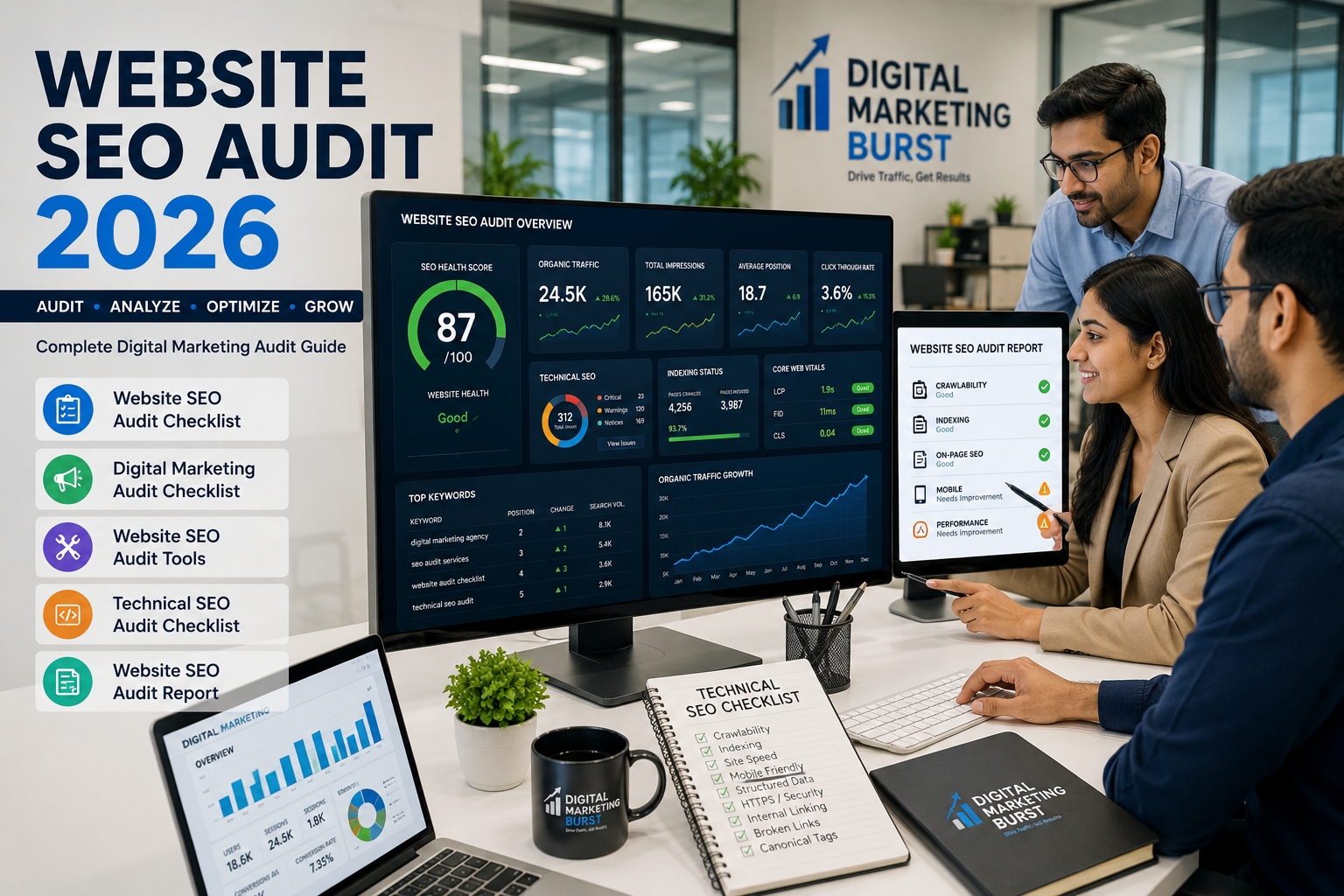
Website SEO Audit Checklist for analyzing technical SEO, digital marketing performance, SEO audit tools and website audit reports in 2026.
A Website SEO Audit Checklist should begin with visibility. Before changing titles, adding keywords, or publishing new articles, understand how the website currently performs in search. Check which pages attract organic visitors, which queries generate impressions, and where rankings have improved or declined.
Next, compare visibility with business value. A website can receive thousands of impressions for informational searches while its important commercial pages remain almost invisible. In that situation, increasing total traffic alone may not solve the real problem. The audit should identify which pages attract awareness traffic and which pages support enquiries, leads, sales, or another meaningful action.
Search intent matters as well. A page created to sell a service may struggle when Google mainly shows educational guides for that query. Likewise, an informational article may not perform for a keyword where users clearly want to buy.
Internal competition should also be reviewed. If several pages target almost the same search intent, they can weaken the website’s focus. Updating, merging, redirecting, or repositioning overlapping content may create a clearer structure.
A useful SEO audit therefore connects keywords with pages, intent, traffic, and business goals. Rankings are important, but they should never be examined in isolation.
A Complete SEO Audit Checklist goes deeper than checking whether keywords appear in titles. It examines how search engines discover the website, understand its pages, and decide which URLs deserve visibility.
Start with crawlability and indexation. Important pages should be accessible to search engines, while unnecessary URLs should not consume attention without providing value. Incorrect robots directives, accidental noindex tags, broken canonical signals, redirect chains, and duplicate URLs can all create problems.
Site architecture comes next. Important pages should not be buried several clicks away from the main navigation. A clear hierarchy helps both visitors and search engines understand how services, products, categories, resources, and supporting articles relate to each other.
Then review on-page relevance. Page titles, headings, body content, image information, internal links, and contextual signals should support the actual topic rather than simply repeat a focus keyword.
Finally, examine authority and trust. Strong pages often need relevant internal support and genuine external recognition.
The purpose is not to chase a perfect audit score. A technically perfect page that nobody needs will not automatically generate business. Prioritize issues according to their likely effect on discovery, rankings, user experience, and conversions.
A Digital Marketing Audit Checklist expands the analysis beyond organic search. A website sits at the centre of several marketing channels, so its performance should be evaluated as part of the complete customer journey.
Consider where visitors originate. Organic search, paid search, social media, referrals, direct visits, email, and other campaigns can attract audiences with very different intentions. A landing page that works well for a branded Google search may perform poorly for a cold social-media audience.
Therefore, review the relationship between traffic source and landing-page experience.
Campaign consistency also matters. If an advertisement promises one offer while the landing page focuses on something different, users may leave quickly. Similarly, social campaigns can generate engagement without producing business results when visitors have no clear next action after reaching the site.
Tracking should be inspected at the same time. Form submissions, calls, purchases, downloads, appointment requests, WhatsApp actions, and other important events need reliable measurement.
Without measurement, marketing decisions become assumptions.
A digital audit should eventually show which channels bring useful visitors, which pages move them forward, and where potential customers disappear. That makes the website an active marketing asset instead of simply an online brochure.
An Online Marketing Audit Checklist should follow the customer from discovery to action. This makes it easier to understand why a campaign can appear successful in one dashboard while producing disappointing business results.
Suppose a social campaign generates a large number of clicks. At first, the campaign appears strong. However, analytics may show that most visitors leave the landing page without exploring further. The actual problem may be weak message alignment rather than the advertisement itself.
The same principle applies to search campaigns. High-intent visitors expect the landing page to answer their need quickly. If important information is hidden below generic company content, conversion opportunities may be lost.
Organic traffic requires another perspective. Educational visitors may not convert immediately. Therefore, the website should provide relevant next steps, related resources, internal links, and suitable calls to action without forcing a sales message into every paragraph.
Email and remarketing traffic should also be reviewed separately because returning visitors already have some familiarity with the brand.
By examining each traffic source in context, marketers can improve the entire journey. The objective is not simply to increase sessions. It is to create a smoother path from discovery to trust and eventually to a valuable action.
Website SEO Audit Tools make large websites easier to examine, but software should support decisions rather than make them automatically. Different tools reveal different parts of the problem.
A crawling platform can expose broken links, redirects, duplicate metadata, canonical issues, orphaned pages, and structural weaknesses. Search-performance data can reveal queries, impressions, clicks, positions, and pages already receiving visibility. Analytics can show how visitors behave after landing on the website.
Performance-testing tools add another layer by highlighting loading and usability problems.
However, exporting thousands of warnings is not the same as completing an audit.
Every issue should be evaluated according to context. For example, a missing meta description may deserve attention, but an accidentally non-indexed revenue page is usually much more urgent. Likewise, fixing twenty low-value broken links may produce less impact than improving one important page that already ranks close to the top positions.
Human judgement remains essential.
The best auditing process combines data from multiple sources and then asks which problems genuinely restrict visibility, engagement, or conversion. Tools find signals. A marketer still needs to decide what those signals mean.
The Best SEO Audit Tools are not necessarily the platforms with the longest feature lists. The right combination depends on what you are trying to diagnose.
Search-performance platforms help identify visibility opportunities. Crawlers are useful for technical discovery. Analytics platforms explain user behaviour. Page-performance tools reveal speed and experience issues. Backlink platforms can help assess external authority and potentially harmful patterns.
Keyword research tools are useful when existing content no longer matches the language people use when searching.
However, data from one platform should rarely be treated as absolute truth.
Different tools use different databases and calculation methods. Therefore, estimated traffic, authority metrics, and keyword volumes may vary. First-party data should generally receive greater weight when it directly measures your own website.
A strong audit also avoids tool dependency. If software marks an item as an “error,” understand why it matters before changing the website. Automated recommendations can miss business context.
The best toolset is therefore the one that helps answer specific questions quickly. More dashboards do not automatically produce better SEO. Clear interpretation produces better decisions.
A Technical SEO Audit Checklist examines whether search engines can efficiently access, interpret, index, and serve a website’s important content. Technical problems can quietly limit performance even when the content itself is strong.
Begin with crawl access. Review robots instructions, status codes, internal links, XML sitemaps, and important URL pathways. Next, inspect indexation. Pages intended for search should not be blocked accidentally, while low-value duplicates should not create unnecessary clutter.
Canonicalization deserves close attention on ecommerce and larger websites. Filters, parameters, categories, pagination, and similar URL patterns can create multiple versions of closely related pages.
Redirects should also be clean. Long chains waste time and create unnecessary complexity.
HTTPS, mobile usability, structured data, JavaScript rendering, and server stability should form part of the review where relevant.
Technical auditing should remain connected to actual outcomes. A minor issue affecting an unimportant archived page is not equivalent to a problem affecting the main service category.
Therefore, severity and scale matter.
Prioritize technical fixes that affect important URLs, large sections of the website, search-engine access, or the user’s ability to complete an action.
A Technical Website Audit Checklist should also consider performance from the visitor’s perspective. Search engines are important, but customers experience the website directly.
Page speed is one obvious area. Large images, unnecessary scripts, poorly optimized fonts, excessive third-party code, and weak server performance can make pages feel slow. Mobile visitors may notice these problems more strongly when network conditions are less reliable.
Layout stability matters too. Buttons, images, or text that shift while the page loads can make a website frustrating to use.
Interactive elements should respond quickly. Forms need to work properly. Navigation should remain easy on smaller screens.
Check important templates rather than testing only the homepage. Product pages, service pages, articles, category pages, and landing pages may use different layouts and scripts.
Error handling deserves attention as well. A useful 404 page and clean redirect strategy can prevent dead ends.
The technical website review should ultimately ask whether anything prevents a visitor or search engine from reaching, understanding, or using an important page efficiently.
Fixing these barriers can improve several marketing channels at once.
A website cannot rank consistently if search engines struggle to reach its important pages. Therefore, crawlability and indexing should be checked early rather than after spending weeks rewriting content.
First, identify the pages that genuinely deserve organic visibility. Compare that list with what search engines appear to have indexed.
Unexpected gaps deserve investigation.
A valuable page might be blocked by a noindex instruction. Another may lack internal links. A canonical tag could point somewhere else. In other cases, the page may technically be indexable but provide too little unique value to justify strong visibility.
The opposite problem can also occur. Search engines may discover thousands of unnecessary URLs created by filters, parameters, tags, internal search pages, or duplicate structures.
More indexed pages do not automatically mean more traffic.
A cleaner index can make a website easier to understand.
Therefore, the goal is not “index everything.” The goal is to make important content easy to discover while reducing unnecessary duplication and crawl waste.
Website architecture influences both user navigation and search visibility. Important information should be logically connected rather than scattered across unrelated sections.
Begin with the main navigation. Visitors should quickly understand what the business offers and where to find essential information.
Then examine category relationships.
A service page should connect naturally with supporting articles, relevant case studies, FAQs, and related services. An ecommerce category should connect products with useful buying information and closely related categories.
Depth is another consideration. Valuable pages that require many clicks from the homepage can become harder for visitors and crawlers to discover.
Internal links can solve part of this problem.
However, adding hundreds of repetitive links to every page is not the answer. Links should provide context and help users move logically through the website.
Good architecture creates topic relationships.
When a site is organised around clear themes, search engines can more easily understand its subject areas. Visitors also spend less time searching for information.
That combination supports both SEO and conversion performance.
Internal linking is one of the most controllable parts of SEO, yet it is often neglected.
A useful audit identifies important pages receiving too few contextual links. It also finds orphaned content that exists but is barely connected to the rest of the site.
Anchor text should provide context naturally. Repeating the exact same keyword in every link can make content feel artificial.
Instead, use descriptive variations that tell visitors what they will find.
Older content deserves special attention. A website may publish new articles every week while leaving strong historical pages disconnected from newer resources.
Updating those relationships can help users discover more relevant information.
Internal links can also guide authority towards commercial pages without turning every article into an advertisement.
For example, an educational guide can naturally reference a deeper service explanation when it genuinely helps the reader.
This creates a better experience while supporting strategic pages.
A good internal linking audit therefore combines SEO value with navigation logic. Every important link should have a reason to exist.
Thin content should not automatically be expanded with hundreds of unnecessary words. Sometimes the correct answer is a concise page that solves the query quickly.
Likewise, longer content is useful only when the topic requires depth.
In 2026, content quality increasingly depends on usefulness, originality, clear experience, and information value rather than publishing volume alone.
A successful audit identifies what genuinely helps users and removes the assumption that more pages automatically mean more organic growth.
Content gaps are not simply keywords your competitors rank for and you do not.
A useful gap exists when your target audience needs information that your website does not currently answer well.
Begin with customer questions. Search queries, sales conversations, support requests, reviews, and on-site search data can reveal topics that keyword tools overlook.
Then compare those needs with existing pages.
Perhaps your website explains what a service is but not how much it costs. Maybe it discusses benefits but ignores common concerns. An ecommerce site may have product pages but lack comparison or buying guidance.
Competitor research can reveal additional opportunities. However, copying every competitor topic creates unnecessary content.
Choose gaps that align with your audience and business.
Also consider the stage of the journey. Some users need basic education. Others are comparing options. A smaller group is ready to act.
Covering those stages creates a stronger content ecosystem than targeting isolated high-volume phrases.
The objective is to become more useful, not simply larger.
Keyword cannibalization occurs when multiple pages compete for substantially the same search intent.
This does not mean two pages can never mention the same topic. The problem appears when search engines struggle to determine which page best answers a query.
Look for frequent ranking switches between URLs. Similar titles and overlapping content can also indicate a problem.
Once identified, decide whether the pages genuinely need to remain separate.
Some can be merged into a stronger resource. Others can target different intentions more clearly. Outdated URLs may need redirects after consolidation.
Internal links should then support the preferred page.
Avoid solving cannibalization by randomly removing keywords. Search engines evaluate topics and intent, not simply exact phrase counts.
The better solution is to give each page a clear purpose.
When the architecture makes that purpose obvious, visitors also benefit because they encounter fewer repetitive pages.
Mobile performance deserves dedicated attention because many customers first experience a business through a phone.
A desktop website can appear polished while its mobile version creates serious friction.
Check navigation first. Menus should be understandable without requiring precise taps.
Text should remain readable. Buttons should have enough spacing. Forms should not demand unnecessary information.
Images and videos need appropriate sizing so they do not make pages excessively heavy.
Pop-ups deserve careful review as well. An aggressive overlay that covers most of a small screen can frustrate visitors before they read anything.
Conversion actions should be easy to complete.
For local businesses, calling, getting directions, or submitting a quick enquiry may be particularly important. Ecommerce websites need a smooth path from product discovery to checkout.
Mobile auditing therefore connects technical SEO with conversion optimization.
Improving the experience can help organic visitors, paid-ad users, social traffic, and returning customers simultaneously.
Website performance should be evaluated according to real user experience rather than only a single laboratory score.
Loading speed matters because visitors make quick decisions. However, visual stability and interaction responsiveness are also important.
Large hero images often create problems. So can video backgrounds, third-party widgets, advertising scripts, analytics tags, and poorly implemented design effects.
Before removing features, determine which ones actually contribute to the business.
A decorative animation that slows every page may offer little value. A necessary booking system may justify some performance cost but still deserve optimization.
Page templates should be tested separately.
An article can perform well while a product template remains slow. Mobile performance may also differ from desktop results.
Prioritize improvements that affect large numbers of users or important conversion pages.
Performance optimization should make the website feel faster, more stable, and easier to use—not merely improve a score displayed by a testing tool.
Traffic becomes valuable when the website helps visitors take an appropriate next step.
A conversion audit therefore asks whether each important page has a clear purpose.
Service pages may need enquiries. Ecommerce pages need purchases. Educational content may encourage users to explore related resources before they are ready to buy.
Calls to action should match that intent.
A visitor reading an introductory article may not respond well to an aggressive sales message. A visitor searching for a specific service may become frustrated if the contact option is difficult to find.
Trust signals also influence decisions.
Clear business information, genuine reviews, useful policies, professional presentation, accurate contact details, and transparent explanations can reduce uncertainty.
Forms should request only information that is genuinely required.
Finally, test the complete process yourself. Submit the form. Click the phone number. Test buttons on mobile. Check confirmation pages.
A conversion that cannot be completed is more damaging than a small SEO warning.
A Digital Marketing Burst Website Audit Strategy should connect SEO findings with broader marketing performance instead of treating every website issue as an isolated technical task.
The process can begin with visibility and website health. From there, traffic quality, landing-page experience, content opportunities, paid campaign alignment, and conversion paths can be examined together.
This approach is important because a ranking improvement is not automatically a business improvement.
Suppose an article moves from position eight to position three and generates substantially more visitors. That sounds successful. However, if those visitors have little connection with the company’s target audience, the additional traffic may provide limited commercial value.
A better strategy asks what happens after visibility increases.
Does the visitor find relevant information? Can they reach a suitable service or product? Is the next step obvious? Can that action be measured?
Digital Marketing Burst can use this broader audit framework to identify opportunities across SEO, content marketing, website optimization, Google Ads, Meta Ads, local SEO, and conversion strategy.
The result should be a prioritized growth plan rather than a collection of disconnected recommendations.
A Website SEO Audit Report should explain problems in language that marketers, developers, writers, and business owners can understand.
Avoid filling the report with screenshots and technical terms without explaining their importance.
Each significant finding should answer four questions: What is happening? Why does it matter? Which pages are affected? What should happen next?
Priority should also be clear.
Critical issues affecting indexation or conversions deserve more attention than minor formatting inconsistencies.
Where possible, establish a baseline. Record organic clicks, conversions, indexed pages, important rankings, performance indicators, and other relevant measures before major changes begin.
After implementation, compare the results.
This turns the audit into a measurable improvement process.
A report should not end when the PDF or spreadsheet is delivered. Its real value begins when teams use it to make changes.
An SEO Website Audit Report becomes much more useful when findings are organized according to impact and effort.
Some fixes are quick and valuable. Others require development resources or major content changes.
Separating them helps teams plan realistically.
For example, correcting an accidental indexing directive on an important page may require little time and produce significant value. Rebuilding an entire website architecture may have larger potential impact but require months of work.
Dependencies should also be documented.
A content team cannot optimize a page effectively if a technical issue prevents it from being indexed. Similarly, paid campaigns should not drive expensive traffic towards a broken landing page.
A good report therefore creates an implementation sequence.
Start with blockers. Then address high-impact opportunities. After that, work through strategic improvements and lower-priority refinements.
This structure transforms SEO auditing from a one-time inspection into an actionable roadmap.
Large ecommerce or publishing websites change frequently, so important technical indicators may require regular monitoring. Smaller business websites may need a detailed audit less often.
However, certain events should trigger a review.
Website redesigns, migrations, large content changes, sudden traffic losses, tracking changes, new product launches, and major campaign expansions can all introduce problems.
Regular smaller checks are also valuable.
Waiting for a major annual audit can allow broken pages, tracking failures, or indexing problems to continue unnoticed for months.
A sensible approach combines continuous monitoring with deeper periodic reviews.
This keeps the website healthy without forcing teams to repeat a complete audit every week.
A Website SEO Audit Checklist, Digital Marketing Audit Checklist, Website SEO Audit Tools, Technical SEO Audit Checklist, and Website SEO Audit Report are most valuable when they work together. SEO visibility alone is not enough. A website also needs technical stability, useful content, strong user experience, accurate measurement, and clear conversion paths.
In 2026, the strongest audits will focus less on collecting hundreds of warnings and more on identifying the few changes that can create meaningful improvement.
Start with access and indexation. Then examine search intent, content, architecture, internal linking, mobile experience, performance, traffic quality, and conversions. Finally, turn every important finding into an action with a clear priority.
For Digital Marketing Burst, this creates a broader digital growth approach where SEO supports content, paid marketing, user experience, and conversion strategy rather than operating separately.
A website audit should ultimately answer one question: What is preventing this website from performing better, and what should we fix first? Once that answer is clear, the audit has done its real job.
A successful website audit should not judge SEO performance only by the number of visitors. Organic traffic can increase while leads, enquiries, and sales remain unchanged. Therefore, traffic quality deserves as much attention as traffic growth.
Start by examining which landing pages attract organic visitors. Then compare those pages with search intent. Informational articles often generate larger visitor numbers, while commercial pages may attract fewer but more valuable users. Both have a role, but they should not be measured in exactly the same way.
Next, study what visitors do after landing. Do they continue to another relevant page? Do they explore a product or service? Do they complete an enquiry? These behavioural patterns can reveal whether the website is attracting an audience that matches its goals.
Geographic relevance also matters for businesses serving specific locations. A local company may receive impressive traffic numbers from regions where it cannot serve customers. That traffic can make reports look positive without creating meaningful opportunities.
Therefore, a modern SEO audit should separate traffic growth from valuable traffic growth. The objective is not simply to attract more clicks. It is to attract users whose needs match the website’s content, products, services, or business objectives.
Search performance data can reveal opportunities that standard ranking checks miss. Instead of looking only at current positions, compare impressions, clicks, click-through rates, queries, pages, devices, and changes over time.
Pages receiving high impressions but relatively few clicks deserve attention. Their titles may not communicate value clearly. However, low click-through rate is not always a title problem. Search-result layouts, user intent, brand familiarity, and competing features can also influence clicks.
Pages ranking just outside the strongest positions can offer another opportunity. If a relevant page already receives substantial impressions, improving its usefulness may create more value than publishing another article from scratch.
Look for declining pages too.
A gradual loss of impressions may indicate stronger competition, changing search behaviour, outdated information, or a shift in how Google interprets the query.
Compare performance across devices and countries where relevant. Mobile and desktop behaviour can differ considerably.
Most importantly, do not make decisions from a few days of data. Seasonal demand and temporary ranking movement can create misleading patterns. Use meaningful comparison periods and connect changes with actual website updates.
A sudden organic traffic decline can create panic, but changing multiple things immediately makes diagnosis harder.
First, establish when the decline started. Compare the date with website deployments, redesigns, migrations, content updates, analytics changes, server problems, or other technical events.
Next, determine the scale.
Did the entire website lose traffic, or only one directory? Did mobile traffic fall while desktop remained stable? Was the decline limited to branded or non-branded searches? Did impressions fall, or did only clicks decline?
These distinctions narrow the investigation.
Technical checks should follow. Important pages may have become non-indexable. Redirects could be incorrect. Internal links may have disappeared after a redesign.
Content and competition should also be considered.
A competitor may now answer the query more effectively. Search intent might have changed. Previously successful content may have become outdated.
Seasonality is another possibility.
A decline is not automatically a penalty.
The best approach is to gather evidence first. Once the affected pages and queries are identified, the audit can focus on the actual cause rather than making broad changes based on fear.
Search intent should be checked before rewriting any important page.
Enter the target query and study the type of results users currently receive. Are they guides, product pages, category pages, comparison articles, tools, local results, videos, or something else?
That pattern provides clues about what users expect.
Suppose a business tries to rank a service page for a query where most results are educational tutorials. Adding the keyword twenty more times will probably not solve the mismatch.
Instead, the website may need an informational resource that answers the query properly and then connects readers naturally with the relevant service.
Intent can also evolve.
A keyword that once produced mainly articles may later show commercial pages. Therefore, pages that ranked well several years ago should not automatically be treated as correctly aligned today.
An effective audit compares keyword, intent, page type, content format, and desired business action.
This creates a much stronger foundation for optimization than keyword density alone.
A keyword ranking audit should identify opportunities rather than produce an enormous spreadsheet of positions.
Group keywords by topic and intent. This makes it easier to see where the website has genuine authority and where visibility remains weak.
Then separate branded and non-branded searches.
Branded visibility is useful, but strong rankings for the company’s own name do not prove that the website reaches new audiences.
Next, identify keywords sitting close to meaningful ranking improvements. Pages already performing reasonably well may respond to better content, stronger internal links, improved titles, or greater topical support.
At the same time, investigate rankings that have declined.
Avoid assuming every drop needs intervention. Small daily movements are normal.
Focus on sustained changes affecting valuable topics.
Finally, connect rankings with conversions. A keyword ranking first but producing no useful business action may deserve less attention than a lower-volume phrase generating qualified enquiries.
Rankings are a diagnostic metric. They are not the final objective.
A competitor audit should explain why another website performs well, not simply list the keywords it ranks for.
Start by identifying actual search competitors. These may differ from the companies a business considers its commercial competitors.
Study the pages appearing consistently for your important topics. Examine their search intent, content depth, structure, internal linking, freshness, and usability.
Next, look for patterns.
A competitor may have strong topic clusters. Another may dominate commercial searches because its service pages are more detailed. Some websites earn visibility through original research, useful tools, or strong brand recognition.
Backlinks can also reveal authority differences.
However, copying a competitor’s article structure or keywords is rarely a sustainable strategy. Search results do not need ten nearly identical pages.
Instead, identify what competitors answer well and what they overlook.
That gap is where original value can be created.
Competitor auditing should ultimately help a website become more useful and differentiated rather than merely more similar to whoever currently ranks first.
A Website SEO Audit Checklist should include a detailed review of important on-page signals without turning content into mechanical keyword placement.
Start with the page title. It should clearly communicate the topic and provide a reason to choose the result.
The main heading should reinforce the page’s purpose.
Subheadings should help readers scan the content while naturally covering related questions and concepts.
The opening section matters because users need quick confirmation that they reached the right page.
Body content should answer the search intent thoroughly without unnecessary repetition.
Images can support understanding, but they should be optimized for performance and accessibility. Alt text should describe useful visual information naturally rather than become a container for unrelated keywords.
URLs should remain readable where practical.
Internal links should connect the page with related resources and important commercial destinations.
Finally, review the actual experience.
A page can satisfy every traditional on-page checklist and still perform poorly because the information is generic, confusing, or difficult to use.
Good on-page SEO begins with relevance and clarity.
Titles and meta descriptions deserve attention because they influence how pages appear in search results, although search engines may sometimes generate alternative result text.
Start by finding missing, duplicate, outdated, or excessively generic titles.
Important pages should have titles that distinguish them from one another.
Avoid creating dozens of pages with nearly identical title structures when the underlying topics differ.
Meta descriptions should explain what the visitor can expect. They do not need to contain every keyword variation.
Natural language is more valuable than forcing phrases together simply to satisfy an SEO plugin.
Compare snippets with search intent.
A commercial page can emphasize a useful differentiator. An informational article can communicate what question it answers.
However, do not evaluate snippets purely by character count.
The purpose is to communicate relevance clearly in limited search-result space.
A good audit therefore treats titles and descriptions as search-result messaging, not just technical fields that need green indicators.
Headings help organize information for readers and provide useful topical structure.
During an audit, check whether the main heading clearly represents the page. Then examine whether subsequent sections follow a logical order.
Do not create headings simply to insert keywords.
A useful heading should tell readers what the next section will explain.
Long articles particularly benefit from clear structure because users rarely read every sentence from beginning to end.
Repeated headings can signal content duplication.
Similarly, vague headings such as “More Information” provide little context.
Use descriptive language instead.
SEO plugins sometimes encourage exact keyphrase repetition in multiple headings. However, natural variants can provide broader topical coverage while improving readability.
The goal is to create a document that makes sense even when someone scans only the headings.
If that outline explains the topic clearly, the underlying content is usually easier to navigate as well.
Images influence SEO through user experience, accessibility, page performance, and contextual relevance.
Begin by identifying unnecessarily large files. A high-resolution photograph uploaded directly from a camera may be far heavier than the displayed size requires.
Next, check dimensions and modern delivery methods where appropriate.
Alt text should describe meaningful images accurately. Decorative graphics do not need keyword-stuffed descriptions.
File names can remain understandable, but renaming thousands of existing images solely to insert keywords is rarely the highest-priority SEO task.
Also check broken images and incorrect dimensions.
Visual content should contribute to the page rather than exist only for decoration.
For tutorials, diagrams can clarify complex processes. Ecommerce pages benefit from useful product views. Data-heavy articles can use original charts.
Original visuals may also strengthen content differentiation when they genuinely explain something better.
Therefore, an image audit should ask two questions: Does this image help the visitor, and is it delivered efficiently?
Ecommerce filters may create multiple URL versions. Tracking parameters can generate variations. CMS systems may place the same content under several paths. Similar service pages can also become nearly identical when businesses create one page for every location.
Not every duplicate is a crisis.
The audit should determine whether multiple URLs compete unnecessarily or confuse search engines about the preferred version.
Canonical tags can help in suitable situations. Redirects may be appropriate when a duplicate URL has no independent purpose.
Internal links should consistently point towards the preferred version.
Content duplication deserves a different approach.
If several pages target different locations but contain almost identical text with only the city name replaced, ask whether each page genuinely provides unique value.
Creating more URLs is easy. Creating useful reasons for each URL to exist is harder.
The objective is a website where every important indexed page has a clear purpose.
Thin content is not simply content with a low word count.
A 300-word page can answer a narrow question perfectly. Meanwhile, a 3,000-word article can still be thin in value if it repeats generic information.
Therefore, audit usefulness rather than length.
Ask whether the page answers the primary question. Does it provide enough context? Is the information accurate? Does it offer anything beyond what already appears across dozens of competing pages?
Pages with declining performance may need updating.
However, adding paragraphs only to increase word count can make them worse.
Sometimes content should be consolidated. Several weak articles covering nearly identical topics may become one stronger resource.
Other pages may no longer serve any useful purpose.
Removing or redirecting them can simplify the site.
A content quality audit should ultimately improve the ratio of useful pages to unnecessary pages.
Freshness matters most when the topic itself changes.
Articles discussing prices, software features, regulations, statistics, algorithms, tools, or yearly trends can become outdated quickly.
Evergreen topics may require fewer updates.
Therefore, do not change publication dates simply to make every article appear new.
Instead, verify the actual information.
Check broken references, outdated screenshots, discontinued tools, old statistics, obsolete recommendations, and sections that no longer match search intent.
New developments can then be added where they improve the article.
An updated page should genuinely become more useful.
If nothing meaningful has changed, rewriting sentences purely to signal freshness offers limited value.
A structured content calendar can help prioritize updates based on traffic, commercial importance, topic volatility, and declining performance.
Traditional Google rankings are no longer the only discovery environment marketers should consider. Users increasingly interact with AI-powered search and answer experiences.
Therefore, an audit should examine whether important information is easy to identify, understand, and verify.
Clear entity information helps. Businesses should use consistent names, services, locations, and factual descriptions across important pages.
Content should answer questions directly while still providing useful depth.
Strong structure also matters. Descriptive headings, concise explanations, supporting details, and logical relationships make information easier for both humans and machines to interpret.
Original evidence can increase differentiation.
Case studies, first-party research, expert explanations, unique data, and transparent methodology give a website something beyond generic summaries.
However, AI visibility should not lead to unnatural writing.
The same foundation still matters: publish information people genuinely need and make it easy to understand.
A Digital Marketing Audit Checklist should evaluate content according to what it contributes to the customer journey.
Some articles attract first-time visitors. Others help people compare options. Product and service pages support decisions. Case studies may build confidence.
Therefore, every page does not need to generate direct leads.
Instead, identify its intended role.
Then measure appropriate outcomes.
An educational guide may be successful if it attracts relevant visitors and moves some of them deeper into the site. A service page should be judged more heavily on qualified actions.
Look for disconnected content too.
An article may attract thousands of users yet provide no logical next step.
Internal links, related resources, or contextual calls to action can help.
This creates a bridge between content marketing and commercial performance without making every article overly promotional.
Meta traffic often behaves differently from search traffic because users may discover an offer while browsing rather than actively searching for it.
Therefore, landing pages need enough context to continue the story started by the advertisement.
Visual consistency helps visitors recognize that they reached the correct destination.
The offer should be understandable quickly.
Social proof can reduce uncertainty, but it should be genuine and relevant.
Mobile design deserves particular attention because social traffic is heavily mobile.
Avoid long forms when only basic information is required.
Also consider audience temperature.
Someone seeing the brand for the first time may need more explanation than a returning visitor reached through remarketing.
A single landing page may therefore not be ideal for every campaign.
Auditing the relationship between audience, creative, message, landing page, and conversion action can reveal opportunities that ad-platform metrics alone cannot show.
A website can receive qualified traffic yet lose potential customers because its lead-generation process is weak.
Review every important contact path.
Are phone numbers clickable on mobile? Does the contact form work? Is the confirmation message clear? Does the enquiry reach the correct person?
Calls to action should appear where they make sense.
Placing ten “Contact Us” buttons on one page does not automatically increase conversions.
Context matters.
Users often need information before they feel ready to enquire.
Trust also plays a role. Clear company details, relevant examples, genuine reviews, transparent processes, and professional design can reduce hesitation.
Track lead quality where possible.
Generating fifty irrelevant enquiries may be less valuable than ten enquiries that closely match the business.
Therefore, conversion audits should eventually connect website actions with actual outcomes.
Product variants, filters, categories, discontinued items, pagination, and internal search can create large numbers of URLs.
Therefore, crawl and index management become particularly important.
Category pages should match how customers search.
Product pages need useful information rather than copied manufacturer descriptions wherever practical.
Out-of-stock products require a sensible strategy depending on whether they will return.
Internal search data can reveal language customers use that keyword research tools may miss.
Navigation should help shoppers move between categories and products without confusion.
Technical performance also matters because heavy product imagery and third-party scripts can slow pages.
Finally, SEO should connect with conversion.
Ranking a product page provides limited value if customers cannot understand shipping, returns, availability, pricing, or other information required to make a decision.
A Digital Marketing Burst Complete Website Growth Audit can combine organic visibility, technical SEO, content quality, paid marketing, user experience, local search, analytics, and conversion performance within one strategy.
This broader approach is useful because website problems rarely exist in isolation. Slow mobile performance can affect SEO and advertising. Weak landing pages can reduce both organic and paid conversions. Poor tracking can make every marketing channel difficult to evaluate.
Therefore, Digital Marketing Burst can approach auditing from the perspective of digital growth rather than rankings alone.
The objective is to identify what attracts the right audience, what prevents visitors from progressing, and which improvements deserve priority.
For businesses in Lucknow and across India, this framework can support a more connected approach to SEO, Google Ads, Meta Ads, content marketing, local visibility, website management, and conversion optimization.
Most importantly, the audit should finish with a practical roadmap. Businesses do not need another dashboard full of warnings. They need to know what to fix first, why it matters, and how that improvement supports digital marketing performance.
Backlinks remain useful when they come from relevant and trustworthy websites. However, an audit should focus on link quality rather than total backlink numbers. A website with fewer strong references can have a healthier backlink profile than one with thousands of irrelevant links.
Start by identifying which pages attract the strongest external links. This reveals what other websites consider useful enough to reference. Original research, detailed guides, useful tools, statistics, and unique resources often perform well because they provide something worth citing.
Next, examine relevance. A backlink from a website connected with your industry or subject usually makes more contextual sense than a random link from an unrelated domain.
The audit should also identify lost links. Sometimes an important backlink disappears because the referring page was updated or your own destination URL changed. Restoring a valuable lost link may be easier than acquiring a completely new one.
Avoid judging links only through third-party authority scores. Those metrics can help with comparison, but they are not Google ranking scores.
Most importantly, do not treat backlink auditing as an excuse to build artificial links. Sustainable authority comes from publishing useful resources, earning genuine mentions, developing industry relationships, and creating information that people naturally want to reference.
Referring domains provide another useful perspective because one website can generate hundreds of backlinks. Therefore, counting individual links alone can create a misleading picture.
Review the number and quality of unique websites linking to your domain. Then examine whether those sources are relevant to your industry, audience, or content.
Distribution matters as well.
If nearly every external link points to the homepage, deeper resources may have limited independent authority. On the other hand, strong guides, research pages, product categories, or useful tools can naturally attract links directly.
Compare your referring-domain profile with genuine search competitors. The purpose is not to copy every source they have. Instead, identify the kinds of websites and content formats that earn recognition within your market.
A healthy profile normally develops over time.
Sudden patterns of large numbers of unrelated links deserve investigation, but every unusual backlink is not automatically dangerous.
Website authority should ultimately come from a combination of useful content, brand recognition, topical relevance, technical accessibility, and genuine external references.
Broken backlinks can waste authority that a website has already earned.
Suppose another website links to one of your old articles. Later, that article is deleted during a redesign. If the old URL now returns an error without an appropriate replacement, visitors and search engines reach a dead end.
Therefore, backlink audits should identify externally linked URLs returning errors.
Where a closely relevant replacement exists, a redirect may preserve a better user journey. However, redirecting every deleted page to the homepage is usually not helpful.
The destination should make contextual sense.
Lost backlinks should also be reviewed. Some disappear naturally because websites remove or update content. Others may be recoverable when a page moved or a URL structure changed.
Internal links should be checked alongside external ones.
A website with many broken internal paths creates unnecessary friction even when its backlink profile is strong.
This is a good example of why technical SEO and authority auditing should work together rather than being handled as completely separate activities.
Anchor text helps explain the relationship between linked pages. However, an audit should not aim to force exact-match keywords into every link.
Start with internal links.
Generic anchors such as “click here” sometimes provide little context. More descriptive wording can help visitors understand where the link leads.
At the same time, repeatedly using the identical commercial keyword across hundreds of links can look unnatural.
Variation is normal.
External anchor text is less controllable because other websites decide how they reference your brand or content. A natural backlink profile may contain company names, URLs, article titles, descriptive phrases, and other variations.
Therefore, do not attempt to engineer an artificially perfect distribution.
The main objective is clarity.
For internal linking, write anchor text that makes sense within the sentence and accurately describes the destination.
This approach supports usability while also giving search engines better contextual information.
A Technical SEO Audit Checklist should review structured data when it is relevant to the website.
Structured data helps machines understand specific information more clearly. However, adding markup does not guarantee enhanced search visibility.
First, check whether the schema type actually matches the page.
Product markup belongs on genuine product content. Article information should represent the article accurately. Organization and local-business information should reflect real details.
Next, validate implementation.
Missing required properties, incorrect formatting, or markup that does not match visible content can reduce usefulness.
Avoid adding schema simply because a plugin provides dozens of options.
More markup is not automatically better.
Structured information should support content that genuinely exists on the page.
Consistency also matters. Business names, addresses, authors, products, and other entities should not contradict the information users see.
Therefore, schema auditing should focus on accuracy, eligibility, consistency, and usefulness rather than the quantity of markup installed.
Security is sometimes treated as an IT-only responsibility, but it can directly affect digital marketing performance.
A compromised website can lose customer trust quickly. Spam pages may appear in search. Visitors can encounter unwanted redirects. Forms can stop working. In severe cases, browsers or search engines may warn users before they enter the site.
Therefore, verify that the website uses HTTPS correctly.
Check for mixed-content problems and unexpected redirects.
CMS platforms, plugins, themes, and extensions should be maintained responsibly.
User access deserves attention too. Old administrator accounts should not remain active without a reason.
Backups should be available and tested according to the site’s requirements.
Security monitoring becomes especially important for websites handling customer data, ecommerce transactions, or lead information.
A marketing campaign can generate excellent traffic, but that investment is wasted if visitors do not trust the destination.
Website security is therefore part of protecting both customer experience and marketing performance.
Analytics should be audited before marketers rely on reports.
First, confirm that tracking works on important pages and devices.
Then test the actions that matter.
Submit an enquiry. Complete a purchase test where appropriate. Click important contact buttons. Check whether those actions appear correctly in the measurement setup.
Duplicate tracking is another common issue. A conversion firing twice can make performance look stronger than it really is.
Internal staff traffic may also distort smaller websites.
UTM naming should remain consistent across campaigns so reports do not fragment the same channel into several variations.
Referral issues deserve attention when third-party payment, booking, or authentication systems are involved.
Finally, compare analytics data with actual business records where possible.
If analytics reports 100 enquiries while the sales team received only 40, something needs investigation.
Accurate measurement is essential because every later marketing decision depends on it.
A Google Analytics review should move beyond pageviews and sessions.
Start with acquisition. Understand which channels attract visitors and whether those visitors match the business’s target market.
Then examine landing pages.
Some pages may generate substantial traffic but very little meaningful activity. Others may attract smaller audiences while contributing strongly to conversions.
User journeys can provide additional context.
Visitors may read an article first, return later through branded search, and eventually convert through a service page. Looking only at the final interaction can hide the role earlier content played.
Events and key actions should therefore reflect actual business goals.
Avoid measuring everything simply because it can be measured.
A smaller set of reliable indicators is often more useful than hundreds of events nobody understands.
Analytics should help answer business questions, not merely produce charts.
Search performance data provides direct insight into how a website appears across Google Search.
Begin with queries and pages.
Identify content gaining impressions even when clicks remain low. These pages may have room for improvement.
Then examine position ranges.
Pages appearing close to stronger visibility may offer efficient optimization opportunities.
Device differences can reveal another layer. A page may perform strongly on desktop but weakly on mobile.
Country and geographic information can be useful when a business serves specific markets.
Indexing reports should be reviewed separately from performance. A page cannot generate organic visibility if Google cannot access or index it appropriately.
However, avoid becoming obsessed with every excluded URL.
Some exclusions are completely intentional.
The goal is to confirm that valuable pages are discoverable while unnecessary URLs are handled appropriately.
Customers rarely follow a perfectly straight journey from advertisement to purchase.
Someone may first discover a company through social media, later read an organic article, return through branded search, and finally submit an enquiry after clicking a paid advertisement.
A digital marketing audit should identify which channels introduce users, which help them evaluate options, and which frequently appear near conversions.
Avoid assuming that the final click created all the value.
At the same time, overly complex attribution models can create false precision.
The objective is to understand meaningful patterns.
Campaign tagging should remain consistent so traffic sources can be identified accurately.
Offline outcomes should also be connected where practical.
A website form may generate a lead, but whether that lead eventually becomes a customer is a separate question.
Better attribution helps businesses invest according to actual contribution rather than whichever platform reports the most conversions.
Website SEO Audit Tools can make competitor research faster by revealing estimated keywords, backlinks, high-performing pages, content gaps, and visibility patterns.
However, competitor estimates should be treated as directional information.
Third-party platforms do not have access to another company’s complete analytics data.
Use them to identify patterns.
For example, a competitor may receive strong visibility from comparison content. Another may have built authority through detailed educational resources. A third may dominate local searches.
These patterns can inspire strategic questions.
Do not simply export their highest-ranking keywords and create nearly identical articles.
Instead, determine why those pages satisfy users.
Then look for opportunities to create something clearer, more useful, more current, or more specific to your audience.
Competitor tools are most valuable when they support original strategy rather than imitation.
The Best SEO Audit Tools for content research can reveal topics where competitors have visibility and your website does not.
Yet a keyword gap is not automatically a content gap.
Suppose a competitor ranks for hundreds of topics unrelated to your ideal customer. Targeting all of them may increase traffic while reducing overall relevance.
Therefore, filter opportunities by business fit.
Look for questions potential customers genuinely ask.
Consider commercial relevance, search intent, existing topical authority, and whether you can contribute something useful.
Long-tail searches deserve attention because they often reveal specific problems.
A broad phrase may have larger search volume, but a detailed query can indicate clearer intent.
The strongest content strategy combines search demand with genuine audience needs.
Tools discover possibilities. Strategy decides which possibilities deserve investment.
SEO and Google Ads are different channels, but many website-quality improvements benefit both.
A landing page should clearly answer the user’s query.
Important information should be visible without forcing visitors through unnecessary navigation.
Page performance matters, especially on mobile.
Content should remain specific to the advertised service or product.
Trust information can help users make decisions.
Navigation strategy depends on the campaign. Some dedicated landing pages work better with fewer distractions, while others benefit from allowing users to explore the broader website.
Testing is therefore important.
The audit should examine conversion rate alongside traffic quality.
If a campaign receives relevant clicks but few enquiries, the website may be the bottleneck.
Improving the landing experience can sometimes create more value than continuously increasing advertising budgets.
The first 30 days after an audit should focus on problems that create the clearest barriers.
Begin with critical technical issues, tracking failures, broken conversion paths, and major indexation problems.
Then move towards high-value pages.
Improve content where search intent is mismatched. Strengthen internal linking. Repair important broken links. Address serious mobile usability or performance issues.
Avoid trying to rebuild the entire website simultaneously.
A smaller number of completed high-impact changes is better than hundreds of recommendations that remain unfinished.
Record what changes were made and when.
This makes later performance analysis much easier.
A final Website SEO Audit Report should provide a clear picture of search visibility, technical health, content quality, website experience, authority, analytics, and conversion performance.
It should also explain priorities.
Executives may need a concise overview, while implementation teams require detailed instructions.
Therefore, the report can serve different audiences without becoming unnecessarily complicated.
Include a baseline so future improvements can be measured.
Document major changes after implementation.
Then schedule follow-up reviews for important issues.
An audit becomes valuable when it creates a repeatable improvement cycle.
The branded phrase Digital Marketing Burst Website SEO Audit can be used naturally where readers are already looking for professional digital marketing support. It can appear in a relevant service section, an internal link, an image title, a case-study reference, or the final call to action.
However, repeating the company name throughout every educational section can weaken readability.
Branding works better when it supports the content rather than interrupts it.
A natural long-tail phrase such as Digital Marketing Burst SEO audit services in India can connect the informational article with commercial intent. Likewise, Digital Marketing Burst website audit in Lucknow can support geographically relevant searches where appropriate.
This creates a bridge between educational traffic and potential clients without converting the entire article into an advertisement.
Businesses searching for a website SEO audit in Lucknow may need more than a technical error report. SEO performance can be influenced by content, local visibility, website design, advertising, analytics, and conversion problems at the same time.
Digital Marketing Burst can position its audit approach around this broader digital marketing picture.
For example, a company may assume it needs more Google Ads traffic. An audit might instead reveal that the existing landing page loses mobile visitors. Another business may believe its SEO is weak when its strongest problem is poor content targeting.
Finding the actual bottleneck before increasing marketing spend can lead to better decisions.
This is why website auditing can become an important starting point for a broader growth strategy.
A Digital Marketing Burst digital marketing audit for Indian businesses can evaluate the relationship between SEO, content, paid campaigns, social media, local visibility, website experience, and lead generation.
The purpose should not be to recommend every possible marketing service.
Instead, the audit should identify where the current strategy loses opportunities.
Some businesses may need technical SEO first. Others may benefit more from improving Google Ads landing pages. Another website may already have strong visibility but weak conversion tracking.
The right recommendation depends on evidence.
That approach makes auditing valuable because marketing investment can be directed towards problems with the greatest potential impact.
A successful Website SEO Audit Checklist should ultimately connect technical health with marketing outcomes. Meanwhile, a Digital Marketing Audit Checklist should show whether traffic sources support actual business objectives. The right Website SEO Audit Tools help uncover evidence, while a Technical SEO Audit Checklist identifies barriers that can prevent search engines and visitors from using the website effectively.
Finally, the Website SEO Audit Report should transform those findings into a practical roadmap.
In 2026, website auditing should not be about collecting the largest possible number of errors. It should be about finding the problems that matter most.
Search visibility matters. So do content quality, mobile usability, AI-search readiness, analytics, paid landing pages, authority, security, and conversions.
When these areas are examined together, businesses gain something much more useful than an SEO score. They gain a clearer understanding of where digital growth is being lost, what should be improved first, and where future marketing investment has the best chance of producing meaningful results.
Choosing the right digital marketing partner becomes especially important when a business has traffic but cannot understand why rankings, leads, or conversions are not improving. Digital Marketing Burst combines website auditing with SEO, content strategy, paid advertising, social media, local SEO, and conversion-focused marketing to help businesses identify the problems that actually restrict online growth.
Rather than treating a website audit as a simple list of technical errors, Digital Marketing Burst focuses on the complete digital journey. This includes organic visibility, website performance, technical SEO, content quality, mobile experience, user behaviour, lead generation, and campaign performance. This broader approach makes the audit more useful for businesses that want measurable improvement instead of another automated SEO score.
Businesses searching for the best digital marketing agency in Lucknow for SEO audits need an agency that can connect technical findings with marketing goals. A website may have indexing problems, weak internal linking, outdated content, poor landing pages, slow mobile performance, or inaccurate conversion tracking. Each issue requires a different solution.
Digital Marketing Burst examines these areas together. A complete website SEO audit in Lucknow can help determine whether the real problem lies in technical SEO, content strategy, search intent, user experience, or conversion performance.
This approach also prevents unnecessary marketing expenditure. Increasing an advertising budget makes little sense when the landing page itself is preventing users from converting. Similarly, publishing more articles may not solve organic traffic problems caused by indexing or website architecture.
A Digital Marketing Burst Website SEO Audit focuses on finding opportunities that can improve both search visibility and overall digital performance. The process can include technical website health, crawlability, indexation, on-page SEO, internal linking, content gaps, mobile usability, website speed, analytics, and conversion paths.
However, finding problems is only the first stage.
The more important step is prioritizing them. A minor metadata issue should not receive the same attention as an indexing problem affecting an important service page. Therefore, recommendations should be organized according to their potential impact on traffic, leads, conversions, and overall website performance.
For businesses looking for professional website audit services in India, this creates a more practical roadmap for improvement.
A modern website rarely depends on one marketing channel. Organic search, Google Ads, Meta Ads, social media, local search, and content marketing can all bring users to the same website.
Therefore, SEO and digital marketing audit services in India should examine how those channels work together.
For example, Google Ads may generate relevant clicks while a weak landing page reduces enquiries. Meta Ads may attract mobile visitors, but slow loading can cause them to leave. Organic articles may generate traffic without providing a useful path towards important services.
Digital Marketing Burst can connect these signals to identify where potential customers are being lost.
The objective is not simply to generate more visitors. It is to improve the journey from search or advertisement → website → engagement → enquiry or conversion.
Technical problems can remain hidden while a website appears completely normal to visitors. Search engines may encounter broken internal links, duplicate URLs, incorrect canonical tags, indexing restrictions, redirect chains, sitemap issues, or poorly structured pages.
A technical SEO audit service in Lucknow can identify these barriers before businesses invest heavily in new content.
Digital Marketing Burst can combine technical analysis with search-performance data to determine which problems deserve priority. This matters because fixing every warning reported by an automated tool does not necessarily improve rankings.
The focus should remain on issues that affect important pages and meaningful search opportunities.
Technical SEO alone cannot make weak content useful.
A complete audit should examine whether pages match search intent, answer important customer questions, target relevant queries, and provide something useful compared with competing results.
Digital Marketing Burst can connect a website SEO audit with content strategy to identify outdated pages, keyword cannibalization, missing topics, weak commercial pages, and potential long-tail search opportunities.
Instead of publishing content simply to increase the number of indexed URLs, the strategy can focus on pages that serve a clear purpose.
This helps build relevant organic traffic while keeping the website aligned with business objectives.
Website auditing can also improve paid advertising.
Businesses sometimes blame Google Ads or Meta Ads when the actual conversion problem occurs after users click the advertisement.
A digital marketing website audit for Google Ads and Meta Ads can examine landing-page relevance, loading performance, mobile usability, calls to action, forms, tracking, and message consistency.
Digital Marketing Burst can use these findings to connect campaign optimization with website optimization.
When paid traffic is expensive, even a modest improvement in conversion performance can make the existing advertising budget more productive.
High traffic numbers look impressive in reports, but businesses ultimately need meaningful outcomes.
A website conversion audit for lead generation examines what happens after visitors arrive. Forms, phone buttons, WhatsApp actions, enquiry paths, landing-page structure, trust elements, and mobile usability can all influence whether a visitor becomes a potential customer.
Digital Marketing Burst can analyze these elements alongside traffic sources.
This helps distinguish a traffic problem from a conversion problem. If relevant users already reach the website, generating even more traffic may not be the first priority. Improving the existing journey may produce a better opportunity.
Digital Marketing Burstpositions itself as a results-focused digital marketing agency in Lucknow for businesses seeking integrated SEO and online growth support. Its broader digital marketing capabilities can bring together SEO, website auditing, Google Ads, Meta Ads, social media marketing, local SEO, website management, graphic design, and content strategy rather than viewing each activity in isolation.
For businesses searching for a top digital marketing agency in Lucknow, best SEO agency in Lucknow, website SEO audit company in India, digital marketing audit agency in India, or SEO and performance marketing agency in Lucknow, this integrated approach provides a strong positioning opportunity.
A successful audit should ultimately tell a business three things: what is going wrong, what should be fixed first, and how those changes can contribute to better digital marketing results.
That is the value Digital Marketing Burst can emphasize—using website and marketing data to build a clearer strategy for search visibility, qualified traffic, stronger campaigns, and better conversion opportunities in 2026.
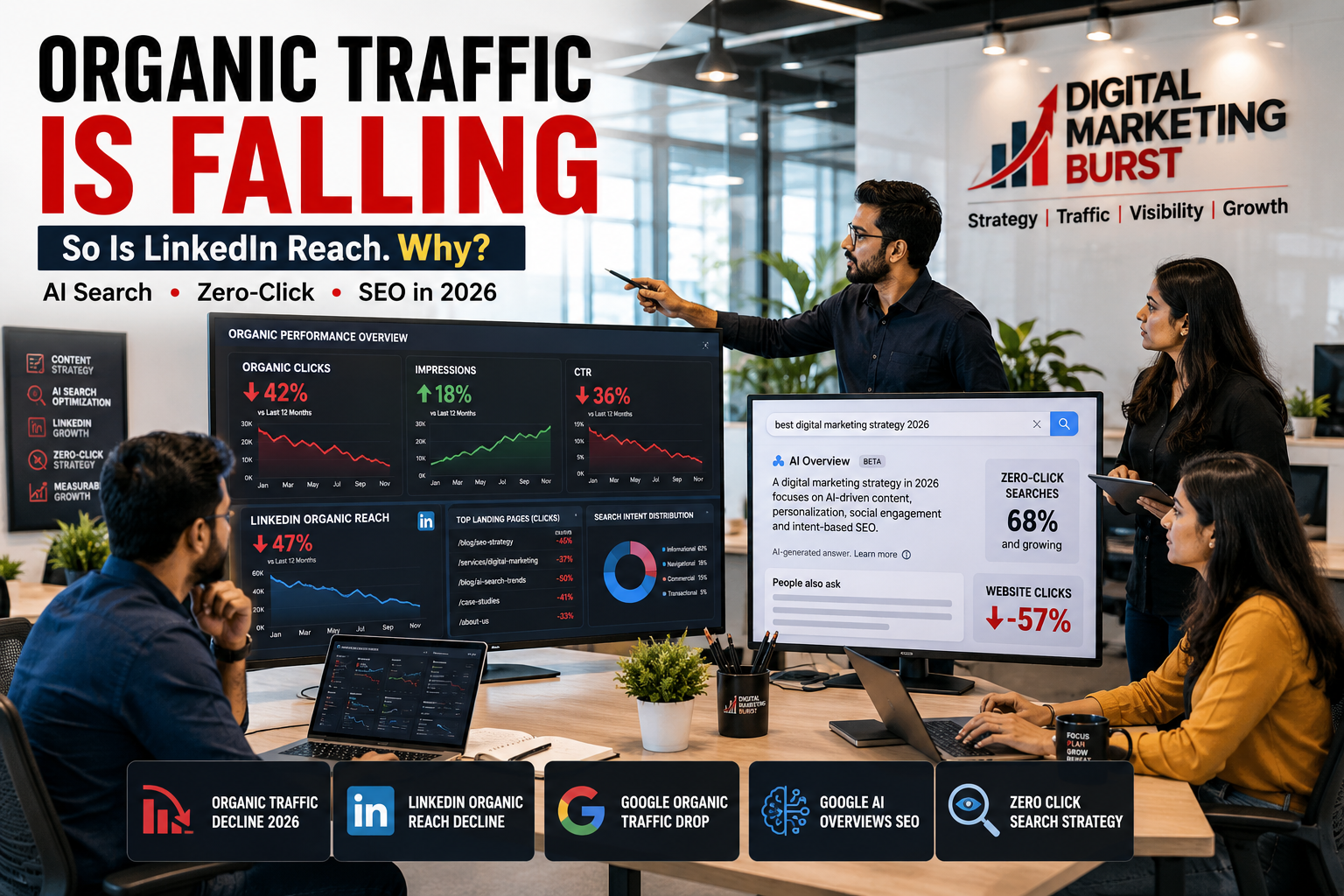
Organic Traffic Decline 2026, LinkedIn Organic Reach Decline, Google Organic Traffic Drop, Google AI Overviews SEO, and Zero Click Search Strategy have become closely connected issues for digital marketers. Businesses may still rank for important keywords, publish regularly, and earn thousands of impressions. Yet fewer people are clicking through to websites or engaging with LinkedIn posts. The problem is not simply that SEO or social media has stopped working. Instead, the way people discover, evaluate, and consume information is changing.
Search engines now answer more questions directly on results pages. AI-generated summaries can satisfy informational intent before a user visits a website. At the same time, LinkedIn users face a crowded feed where generic posts compete with personal insights, expert opinions, videos, documents, and conversations. Therefore, visibility alone no longer guarantees traffic.
This shift creates an important question for marketers. If impressions remain healthy while clicks and reach become harder to earn, what should businesses measure and optimize?
The answer requires a broader approach. Brands still need rankings and social visibility. However, they also need stronger search intent alignment, recognizable expertise, compelling reasons to click, and content that offers something an AI summary cannot completely replace.
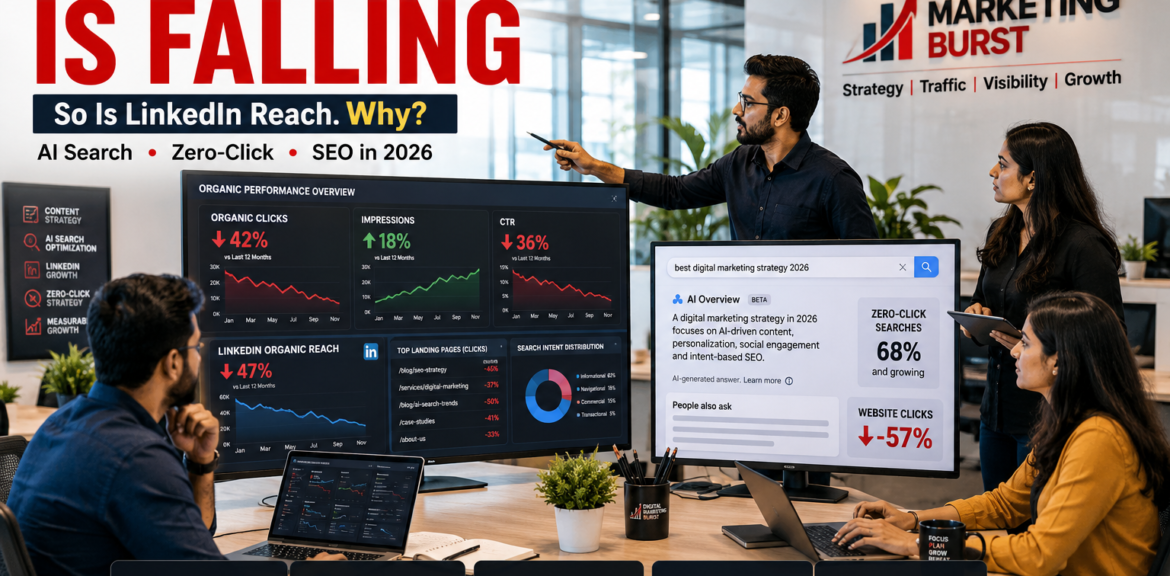
Why organic traffic and LinkedIn reach are falling in 2026 as Google AI Overviews and zero-click search reshape digital marketing.
The Organic Traffic Decline 2026 discussion can easily become misleading when every traffic loss is blamed on artificial intelligence. AI search matters, but it is only one part of a much larger change in user behaviour.
Google has spent years developing search results that help users complete tasks without visiting every listed website. Featured snippets, local results, shopping information, knowledge panels, videos, FAQs, calculators, and other search features already competed for attention. AI-generated search experiences expand that pattern.
As a result, a page can remain visible while receiving fewer clicks.
This distinction matters. A fall in traffic does not automatically mean a fall in rankings. Likewise, losing clicks does not necessarily mean Google has stopped considering a website useful.
Search intent is also becoming more important. Generic informational queries are easier to answer directly. In contrast, detailed comparisons, original research, specialist experience, tools, case studies, and transactional pages can still give users a strong reason to visit a website.
Businesses should therefore stop treating every organic session as equally valuable. Ten visitors who genuinely need a service can matter more than hundreds who only wanted a definition.
The future of SEO is not simply about recovering every lost click. It is about earning the clicks that matter.
Understanding Why Organic Traffic Is Dropping in 2026 requires looking at the search journey itself.
Previously, a typical informational search often required a website visit. A person typed a question, reviewed several blue links, opened one or more pages, and found the answer.
Today, that journey can be shorter.
Search engines may provide summaries, featured answers, videos, local information, product results, community discussions, or other content directly on the results page. Users can sometimes obtain enough information without opening another website.
However, this does not affect every query equally.
Someone searching for a basic explanation may need only a short answer. A user comparing agencies, software, products, hospitals, financial services, or other significant decisions usually needs deeper information.
That difference should influence content strategy.
Instead of producing hundreds of broad articles simply because keywords show high search volume, marketers need to understand what happens after the search. Does the query naturally encourage a website visit? Does the reader need deeper expertise? Is there commercial intent? Can your page provide information unavailable in a short search summary?
These questions can reveal opportunities that keyword volume alone misses.
A LinkedIn Organic Reach Decline can tempt brands to increase publishing frequency immediately. If four posts per week are receiving less reach, publishing seven may appear to be the logical response.
Usually, that treats the symptom rather than the underlying problem.
LinkedIn users have limited attention. Meanwhile, more professionals, creators, executives, recruiters, agencies, and businesses are competing for space in the same feed. Generic content becomes easier to ignore.
AI has made content production faster as well. Consequently, users encounter more polished posts that sound remarkably similar.
That creates an opportunity for content with genuine perspective.
A marketing professional explaining what changed in a real campaign can be more interesting than another post listing “five marketing trends.” A business showing an unexpected customer insight can provide more value than a generic motivational statement.
The goal should therefore shift from publishing volume to content distinctiveness.
Ask whether a post contains an observation that could only have come from your experience. Consider whether it starts a useful conversation. Most importantly, determine whether somebody would recognize the thinking behind the post even if the company logo disappeared.
Distinctive content has a better chance of earning attention in a crowded feed.
There is no single explanation for Why LinkedIn Organic Reach Is Declining across every account. Audience quality, content format, subject matter, posting frequency, competition, and engagement patterns can all affect performance.
However, one broader issue is clear: publishing has become easier than earning attention.
AI writing tools allow businesses to create social content rapidly. Templates make visual production easier. Scheduling tools simplify distribution.
Therefore, content supply grows faster than human attention.
Businesses cannot solve that problem simply by producing even more average content.
A better approach is to create posts around genuine expertise. Explain what your team learned from a campaign. Challenge an assumption in your industry. Show a process. Analyse an unexpected result. Share a useful framework.
The writing should also feel natural.
Short sentences can improve mobile readability. A strong opening can encourage users to continue reading. However, exaggerated hooks should not promise more than the post delivers.
The strongest LinkedIn content creates a reason to stop scrolling.
A Google Organic Traffic Drop should always be investigated before conclusions are made.
Start by separating impressions, rankings, click-through rate, and conversions.
Imagine that impressions increase while clicks decline. That pattern tells a very different story from losing both rankings and impressions.
The first situation may indicate that the website remains visible, but fewer searchers are clicking. Search-result features, changing intent, title quality, or stronger competition may contribute.
The second situation could indicate ranking losses, indexing issues, technical SEO problems, weaker content relevance, or increased competition.
Conversions add another layer.
Suppose traffic falls by 20%, but enquiries remain almost unchanged. That may indicate that much of the lost traffic had weak commercial value.
Conversely, a small traffic decline can be serious if it affects high-intent pages.
This is why reporting only total organic sessions can create unnecessary panic.
Marketers should connect visibility with business outcomes.
Businesses often ask Why Google Organic Traffic Is Dropping when their average positions appear relatively stable.
Click-through rate is one possible explanation.
Search results contain more elements competing for attention than a traditional list of organic links. Depending on the query, users may encounter AI-generated information, advertisements, local listings, videos, images, shopping results, discussions, or other search features before reaching a conventional organic result.
Therefore, ranking position alone cannot explain performance.
Search intent can change too.
A keyword that previously generated website visits may increasingly be satisfied directly within search. Alternatively, competitors may have improved their titles and descriptions, making their results more appealing.
Brand recognition also influences clicks.
When two similar results appear together, users may prefer the source they already recognize.
That means SEO and branding increasingly overlap.
Ranking gets a business into consideration. Brand familiarity can help win the click.
Google AI Overviews SEO changes the way marketers should think about search visibility.
For some informational queries, users can receive a summarized response directly within search. This creates a new challenge for websites whose strategy depended heavily on answering simple questions.
If the entire value of an article can be compressed into three sentences, users have little reason to open it.
The solution is not to stop publishing informational content.
Instead, content needs greater depth.
Original examples, firsthand experience, useful comparisons, proprietary data, screenshots, expert commentary, detailed processes, case studies, calculators, templates, and decision-making guidance can provide reasons to continue beyond an AI-generated summary.
Clear structure matters too.
Search systems need to understand what a page covers. Human readers need to find information quickly.
The Google AI Overviews Impact on SEO reaches beyond rankings. It changes which types of content are likely to produce meaningful visits.
Basic informational queries face greater pressure because short answers can often satisfy users immediately.
This means marketers should examine their existing content library.
Which pages answer questions that require only one sentence? Which pages contain original expertise? Which articles help readers make decisions? Which ones attract users who could eventually become customers?
These categories should not receive the same investment.
A page with modest traffic but strong commercial relevance can be more valuable than an article generating thousands of casual visits.
Content teams should therefore combine traditional SEO metrics with business value.
Organic visibility remains important. However, the objective should not be traffic for traffic’s sake.
Search marketing should help a brand become discoverable, credible, memorable, and ultimately useful to potential customers.
A Zero Click Search Strategy begins by accepting that not every search impression will become a website visit.
That does not automatically make the impression worthless.
A person may encounter a company name several times before eventually searching for the brand directly. Another user may discover expertise through search and later interact with the business on LinkedIn. Someone else may see a brand referenced during research before converting weeks later.
Marketing journeys are rarely as clean as analytics dashboards suggest.
Therefore, brands should think about visibility across multiple touchpoints.
Search results, social media, branded searches, reviews, videos, newsletters, and direct website visits can influence one another.
However, this does not mean clicks no longer matter.
Businesses still need website traffic to generate leads, sales, subscriptions, bookings, and deeper engagement.
The goal is to recognize that visibility can create value before the click while simultaneously improving content that deserves one.
Businesses learning How to Optimize for Zero Click Searches face an interesting challenge. Search engines need clear information to understand a page, but readers also need a reason to visit it.
The best approach is to answer the core question clearly while providing greater depth on the page.
Do not hide the basic answer behind hundreds of words.
That frustrates users.
Instead, provide an immediate useful explanation. Then expand with examples, comparisons, evidence, practical steps, mistakes, and deeper analysis.
This creates two levels of value.
Search systems can understand the topic quickly, while interested readers have a reason to continue.
Businesses can also create content around decisions rather than definitions.
For example, “What is local SEO?” can be summarized easily. “How should a multi-location hospital structure local SEO pages without creating duplicate content?” requires far more context.
The rise of AI search has led to predictions that SEO is disappearing. That conclusion is too simple.
Search behaviour is changing, but businesses still need to be discoverable when people research problems, products, services, and brands.
The format of discovery may evolve.
Traditional search results can coexist with AI-generated answers, social content, videos, community discussions, and other sources.
Therefore, modern SEO needs to consider more than ranking a page for one keyword.
Content should demonstrate clear expertise around a subject. Brand information should remain consistent. Important pages should answer real customer questions. Technical accessibility still matters.
Marketers should also pay closer attention to branded search.
If users encounter a company through an AI answer, LinkedIn post, YouTube video, or another source, they may later search directly for that company.
SEO therefore becomes part of a wider discovery system.
The question is no longer only, “Where do we rank?”
A better question is, “Where and how do customers discover us?”
One of the most confusing SEO patterns is seeing impressions rise while clicks fall.
At first, this can look contradictory.
However, impressions measure visibility. Clicks measure action.
A website may begin appearing for a wider range of queries without earning proportionally more visits. Search-result features can also answer part of the user’s question before the click.
Position distribution matters as well.
Gaining thousands of impressions in lower positions can increase visibility without producing substantial traffic.
Therefore, marketers should analyse queries individually.
Look for keywords where impressions have increased significantly while CTR has declined. Then examine the actual search results.
What appears above your listing? Does the query trigger an AI-generated response? Are videos or local results prominent? Has search intent changed?
This analysis is much more useful than simply concluding that “Google traffic is down.”
SEO problems become easier to solve when they are diagnosed at query level.
An organic CTR decline in AI search deserves attention because rankings and traffic can now move in different directions.
Marketers traditionally expected higher positions to produce predictable increases in clicks.
That relationship still exists, but the search-result environment has become more complex.
A high-ranking page may compete with multiple search features before the user reaches it.
Titles therefore need to communicate unique value quickly.
Generic titles such as “Complete Guide to Digital Marketing” compete with thousands of similar pages. A title built around a specific problem, audience, or outcome can create a clearer reason to click.
However, clickbait is not the answer.
The title should accurately reflect what the page delivers.
Strong CTR comes from relevance and differentiation, not exaggeration.
High search volume can be attractive because it promises a large audience.
Yet volume does not tell marketers why somebody searched.
A broad keyword may attract thousands of visitors with no commercial intent. A narrower query may attract fewer users who are much closer to taking action.
This is why search intent optimization deserves greater attention in 2026.
Content should match the job the searcher is trying to complete.
Informational users need explanations. Comparison searches require clear differences. Transactional users need service or product information. Local searches often require location, availability, reputation, and contact details.
Trying to rank one generic blog article for every stage usually creates weak content.
Instead, build pages around distinct intentions.
Traffic may appear smaller on paper, but relevance can improve dramatically.
When traffic declines, increasing content output feels productive.
But more content is not automatically better SEO.
Publishing ten weak articles around nearly identical keywords can create overlap and dilute resources.
Updating one strong page may produce more value.
Before creating something new, marketers should review existing content. Several articles may target the same search intent. Older pages may contain outdated information. Strong pages may lack depth or internal links.
Consolidation can sometimes improve clarity.
Content quality should also be evaluated from the reader’s perspective.
Does the article contain anything competitors do not? Is it easier to understand? Does it answer follow-up questions? Does it include actual expertise?
If the answer is no, publishing frequency is unlikely to solve the deeper problem.
AI can accelerate research, outlining, editing, and ideation.
However, generic AI content creates a serious differentiation problem.
If hundreds of websites ask similar tools to write about the same keyword, the resulting articles can share the same structure, examples, and conclusions.
Readers notice repetition.
Search engines also have many alternatives to choose from.
The solution is not avoiding AI completely. It is adding information that cannot be produced from a generic prompt alone.
Use internal expertise. Include actual customer questions. Analyse real campaign results. Add original screenshots. Explain failures as well as successes. Interview subject experts.
Human input turns a generic topic into distinctive content.
AI can assist the process, but it should not become the entire process.
A marketer explaining why a campaign failed can create more interest than a polished list of obvious best practices. A founder describing an unexpected customer objection can reveal something valuable. A specialist breaking down an industry change can build authority.
Therefore, LinkedIn strategy should start with insight before format.
Carousels, videos, text posts, and images are distribution choices.
They cannot rescue an idea nobody cares about.
Businesses should first identify what their audience genuinely wants to understand.
Then choose the format that communicates it most effectively.
A LinkedIn engagement decline is partly an attention problem.
Users have limited time.
Every post competes not only with other companies but also with colleagues, creators, industry news, job updates, advertisements, and personal networks.
Consequently, a post needs immediate relevance.
That does not mean every opening must be dramatic.
A clear statement of a meaningful problem can be enough.
The rest of the post should reward attention.
If the opening promises an insight, deliver it. If a statistic is used, explain why it matters. If an opinion is presented, support it.
Over time, this builds trust.
Trust makes future content easier to earn attention for.
Search and LinkedIn are often managed as separate channels.
That separation can waste opportunities.
SEO data reveals what audiences actively search for. LinkedIn conversations reveal what professionals discuss, question, and disagree about.
Together, they provide richer content ideas.
A search query can become a LinkedIn discussion. A successful LinkedIn post can become a detailed article. Comments can reveal follow-up questions worth targeting through SEO.
This creates a feedback loop.
Search captures existing demand. Social content can create awareness and discussion.
When both channels reinforce the same expertise, brand recognition can grow.
That recognition may later influence branded searches and clicks.
A Digital Marketing Burst Organic Traffic Strategy for 2026 should not depend on publishing content simply to increase page count. The stronger approach is to connect SEO research with user intent, content quality, conversion opportunities, and changing search behaviour.
For businesses experiencing falling clicks, the first task is diagnosis.
Ranking losses require one response. CTR losses require another. Traffic declines caused by outdated content need a different solution again.
LinkedIn should receive the same level of analysis.
Instead of assuming an algorithm change caused every reach decline, marketers should evaluate topic relevance, post quality, audience fit, format, frequency, and engagement.
This creates a more sustainable strategy.
The objective is not to fight platforms.
It is to understand how user behaviour is changing and build marketing around that reality.
Traffic remains useful, but it should not stand alone.
Marketers need to understand whether search visibility contributes to enquiries, sales, branded searches, returning visitors, subscriptions, or other business outcomes.
Conversion rate provides important context.
If traffic declines while qualified leads remain stable, the situation may be less severe than the headline traffic number suggests.
Likewise, LinkedIn reach should be evaluated alongside meaningful engagement.
A post reaching 100,000 unrelated people may produce less value than one reaching 5,000 decision-makers.
Marketing measurement should therefore move closer to business impact.
When traffic drops, Google becomes an easy target.
When LinkedIn reach falls, the algorithm receives the blame.
Sometimes platform changes genuinely influence performance.
However, businesses should still examine factors they can control.
Has content become repetitive? Are competitors publishing better information? Have titles become outdated? Is search intent changing? Does the website provide a strong mobile experience? Are high-value pages being neglected while the team publishes low-value articles?
These questions are uncomfortable because they require internal changes.
Yet they are also useful because businesses can act on them.
Marketers cannot control every algorithm update.
They can control how useful, distinctive, and relevant their marketing becomes.
However, the type of traffic websites receive may continue changing.
Simple informational clicks face increasing competition from direct answers and AI-generated summaries.
Deeper research, complex decisions, transactions, tools, specialist expertise, and trusted brands can continue creating reasons for users to visit websites.
Therefore, businesses should avoid judging future SEO using only historical traffic expectations.
A page that previously attracted 50,000 casual visitors may not always maintain that number.
The more important question is whether search still contributes meaningful business value.
SEO should evolve from a traffic-generation discipline into a broader discovery and demand-capture strategy.
That shift can make reporting more complicated.
It can also make SEO more closely connected to actual business objectives.
The Organic Traffic Decline 2026 conversation should not end with blaming Google, AI, or social-media algorithms. LinkedIn Organic Reach Decline, Google Organic Traffic Drop, Google AI Overviews SEO, and Zero Click Search Strategy all point toward a broader transformation in digital discovery.
Users have more ways to get information without visiting a website. They also have more content competing for their attention on social platforms.
Therefore, marketers need stronger reasons for people to click, read, follow, remember, and eventually convert.
The winning strategy is not to publish endlessly or chase every algorithm update.
Create content that answers genuine problems. Match search intent carefully. Build recognizable expertise. Measure qualified outcomes. Use AI to improve the process without allowing it to erase originality.
For Digital Marketing Burst, this shift creates an opportunity to approach SEO and social media as connected parts of modern digital discovery rather than isolated traffic channels.
Clicks may be harder to earn in 2026. Reach may also become more competitive. However, businesses that understand why those changes are happening can focus less on chasing yesterday’s numbers and more on earning tomorrow’s customers.
An organic search traffic decline does not automatically mean an SEO campaign is failing. Search behaviour has changed, so businesses also need to change the way they measure organic performance. Rankings, impressions, clicks, engagement, branded searches, leads, and conversions now need to be considered together.
For example, imagine a website loses 20% of its informational traffic. At first, the decline looks serious. However, suppose enquiries remain stable while branded searches increase. In that case, the business may have lost mainly low-intent visitors rather than potential customers.
This distinction becomes increasingly important as search engines answer more informational questions directly. Businesses that depend heavily on broad educational keywords may notice the impact earlier than companies targeting comparison, commercial, local, or transactional searches.
Therefore, marketers should separate traffic according to intent. Informational pages can support discovery and authority. Commercial pages can help users evaluate solutions. Transactional pages should support conversion.
Once those groups are analysed separately, SEO reporting becomes far more meaningful. Instead of asking only whether traffic increased, businesses can ask whether organic search continues to attract the right audience and influence valuable actions.
An SEO Traffic Decline 2026 analysis becomes misleading when marketers compare today’s search environment directly with traffic patterns from several years ago. Search-result pages have changed considerably, and users have become accustomed to receiving information faster.
Previously, ranking highly for a large informational keyword could generate substantial website traffic. Today, that same query may display several features before a traditional organic result receives attention. As a result, historical click-through rates may no longer represent realistic expectations for every keyword.
This does not mean previous performance should be ignored. Historical data remains useful for identifying unusual changes. However, businesses need context.
Compare rankings with impressions and clicks. Analyse whether the SERP itself changed. Look at which queries lost traffic. Then determine whether those queries previously contributed to leads or merely generated page views.
A business should be more concerned about losing 100 high-intent visitors than losing 5,000 users who never moved beyond an informational article.
Therefore, modern SEO benchmarks should include traffic quality. Conversion contribution, branded demand, assisted journeys, and visibility around commercially relevant topics can provide a more complete picture.
A website organic traffic drop often triggers immediate content edits. Titles are changed, paragraphs are rewritten, keywords are added, and sometimes entire articles are replaced.
That can make the problem worse when the actual cause has not been identified.
First, determine when the decline began. Then compare that date with technical changes, website migrations, content updates, indexing issues, ranking movements, seasonality, and changes in search demand.
Next, identify which pages lost traffic.
If only a few URLs account for most of the decline, investigate them individually. If traffic fell across the entire domain, a broader technical, algorithmic, or market-related issue may exist.
Query-level analysis is equally important.
A page may still rank well for its primary keyword while losing traffic from dozens of secondary queries. Alternatively, impressions may remain strong while CTR declines.
Each situation requires a different response.
SEO recovery should begin with diagnosis rather than assumptions. Otherwise, businesses risk damaging pages that were already performing correctly while leaving the real issue unresolved.
Businesses often notice a traffic decline and immediately connect it with a Google update. Sometimes that connection is valid. However, correlation alone does not identify the cause.
A Google search traffic decline can result from ranking changes, new SERP features, stronger competitors, shifting demand, seasonality, technical problems, or changes in how users phrase their searches.
AI-assisted search introduces another variable.
A user who once searched several separate questions may now receive a broader answer within one interaction. Consequently, some informational journeys can involve fewer individual searches and fewer website visits.
Marketers should therefore investigate the specific keywords that changed.
If rankings dropped, review content quality and competition. If rankings remained stable but CTR fell, inspect the current search-result layout. If search volume itself declined, content optimization alone may not recover the previous traffic.
Good analysis separates platform changes from website problems.
That distinction prevents unnecessary SEO work and helps businesses focus resources where improvement is actually possible.
A Google search clicks decline can occur even when a page maintains a strong organic position.
That sounds unusual only if SEO is viewed through the traditional ten-blue-links model.
Modern search results can contain advertisements, AI-generated information, featured results, videos, images, local listings, product panels, forums, and other interactive elements. Each feature competes for the same user’s attention.
Therefore, organic position is only one part of visibility.
Search-result presentation matters too.
A clear title can help users understand why your result deserves attention. The description should reinforce relevance instead of repeating generic language.
Brand recognition can also influence the decision.
If users repeatedly encounter a company through LinkedIn, YouTube, search, industry publications, or other channels, they may be more likely to recognize and select that company’s result later.
This is where SEO starts connecting directly with brand marketing.
A ranking can create an opportunity. Recognition and perceived value can help earn the actual click.
The AI Overviews traffic impact is likely to be strongest where a searcher’s need can be satisfied through a concise explanation.
Definitions are an obvious example.
If somebody only wants to understand what a marketing term means, a short summary may be enough. They may not need a 2,000-word article.
This should influence how businesses select content topics.
Instead of abandoning informational SEO, create information that supports deeper decision-making. Explain why something happens, when different approaches work, what common mistakes look like, and how circumstances change the recommendation.
Original experience becomes particularly useful.
An AI summary can explain conversion-rate optimization. However, a detailed breakdown of how a real landing page improved conversions provides a different kind of value.
Similarly, generic advice about LinkedIn engagement can be summarized easily. A documented experiment comparing different content formats offers something more specific.
The more original value a page contains, the stronger its reason for existing beyond a basic answer.
Google AI Search SEO should not be interpreted as finding a new place to insert keywords.
Keyword relevance still matters. However, modern search optimization increasingly requires clear entities, topical relationships, trustworthy information, useful structure, and content that answers related questions naturally.
Consider how humans research complicated subjects.
They rarely ask one question and immediately make a decision. They move through several questions.
A business evaluating SEO might first ask why traffic declined. Next, it may investigate AI Overviews. Later, it may search for ways to improve CTR, optimize content, or find an agency.
A strong content strategy anticipates this journey.
Instead of creating isolated articles with little connection, businesses can develop useful topic clusters. Each page should solve a distinct problem while supporting related content.
Internal linking then helps both users and search systems understand those relationships.
This creates deeper topical coverage without repeating the same keyword unnaturally across every page.
An effective AI Overviews SEO Strategy should ask a simple question: what does this page contribute that is genuinely useful?
Rewriting information already available across hundreds of websites creates limited differentiation.
Information gain can come from original research, professional experience, examples, comparisons, data, observations, templates, images, videos, or expert commentary.
Even small businesses can create original value.
A local agency might analyse common mistakes found across client websites. A hospital could answer questions patients regularly ask before appointments. A travel company could document actual route conditions and planning considerations.
These insights come from experience rather than generic keyword research.
That makes them more useful to readers.
SEO content does not need to become academic research. It simply needs to add something meaningful.
When every article contains essentially the same information, users have little reason to choose one source over another.
A Zero Click SEO Strategy should not focus exclusively on forcing every impression into a website session.
Sometimes the search experience itself can introduce a brand.
This makes clear brand positioning important.
Company names, expertise, services, locations, and subject associations should remain consistent across relevant digital properties.
Suppose someone repeatedly encounters the same marketing agency while researching SEO, AI search, and LinkedIn strategy. They may not visit the agency immediately. However, repeated exposure can build familiarity.
Later, that person may search for the company directly.
This journey is difficult to attribute perfectly, but it is still meaningful.
Therefore, marketers should track branded searches alongside non-branded SEO performance.
Direct traffic and returning users can provide additional context.
Zero-click behaviour changes attribution. It does not necessarily eliminate marketing influence.
Zero Click Search Optimization works best when content answers a question clearly without sacrificing depth.
A useful page can provide a concise answer near the relevant heading. The following paragraphs can then explain context, exceptions, examples, and practical application.
This structure serves both impatient readers and those seeking deeper knowledge.
Avoid writing unnecessarily long introductions before answering the query.
Users increasingly expect fast access to information.
At the same time, do not reduce every article to shallow answers.
The page should become progressively more valuable as the reader continues.
This balance can improve readability and make content easier for search systems to understand.
It also supports Yoast-style readability because paragraphs remain focused and sentences can stay relatively short.
Learning How to Optimize for Zero Click Searches does not mean accepting that website traffic no longer matters.
Instead, marketers need to separate the answer from the deeper value.
Give users enough information to establish relevance. Then offer something worth exploring further.
For example, a search result might answer what causes organic CTR to fall. The full article can provide a diagnostic process, examples, benchmarks, recovery strategies, and practical scenarios.
The same principle works across industries.
A short answer can explain a concept. A complete resource helps someone make a decision.
Interactive tools can provide another reason to visit.
Calculators, templates, checklists, comparison tables, downloadable resources, original datasets, and detailed case studies cannot always be replaced by a short summary.
The goal is not to hide information.
It is to create depth that naturally deserves further engagement.
A LinkedIn Reach Decline 2026 strategy should not revolve around copying whichever post format went viral last month.
Formats become saturated quickly.
When thousands of creators use identical opening lines, spacing patterns, storytelling formulas, and carousel designs, users learn to recognize them.
Novelty disappears.
Instead, focus on the idea behind the content.
A strong observation can work as text, video, a document post, or an image. A weak idea remains weak regardless of formatting.
Businesses should therefore create content from their own knowledge base.
Sales conversations can reveal objections. Customer support can reveal recurring problems. SEO research can reveal questions. Internal specialists can provide expert opinions.
These sources create content that competitors cannot reproduce simply by copying a template.
Originality is increasingly a distribution advantage.
A LinkedIn Organic Reach Drop can sometimes indicate an audience mismatch rather than poor content.
Imagine an agency builds a large following through job posts and motivational content. Later, it begins publishing technical B2B marketing advice.
The follower count may look impressive, but much of the audience may have little interest in the new subject.
Consequently, engagement can remain weak.
Audience quality therefore matters more than raw follower numbers.
Businesses should consider who regularly interacts with their posts. Are they potential clients, industry professionals, employees, students, job seekers, or unrelated users?
Different groups create different outcomes.
This does not mean every follower must become a customer.
A healthy professional audience can include several categories. However, the content strategy should attract enough of the people the business actually wants to influence.
Ten thousand relevant followers can provide more business value than one hundred thousand random ones.
Why LinkedIn Organic Reach Is Declining can become particularly frustrating for company pages.
Corporate content often goes through multiple approval stages. As a result, posts can become safe, polished, and forgettable.
Human voices frequently perform differently because people naturally connect with other people.
Businesses can respond by involving employees and subject experts in content creation.
A company page can still publish useful announcements, case studies, insights, research, and brand information. Meanwhile, professionals within the organisation can share their own experiences and perspectives.
These efforts can reinforce each other.
The objective should not be turning every employee into an influencer.
Instead, businesses can make genuine expertise visible.
A specialist who knows the industry deeply often has more interesting things to say than a generic corporate caption.
A strong SEO content refresh strategy begins with evidence.
Do not update every old article merely because it is old.
Some evergreen pages continue performing well for years.
Prioritize content where performance has declined, information has become outdated, intent has shifted, or competitors now provide substantially better resources.
When refreshing an article, preserve sections that still work.
A keyword that once produced mostly informational results may gradually become commercial. Another may shift toward videos, discussions, local results, or tools.
When this happens, a page can lose traffic even if its quality has not suddenly become poor.
Search engines are trying to match what users appear to prefer.
Therefore, marketers should periodically inspect the actual SERP for important keywords.
Do not rely entirely on historical assumptions.
If the dominant result type changes, your content format may need to change too.
A long article cannot always compete effectively when users clearly prefer a calculator, product category, video, or local listing.
Understanding intent protects marketers from trying to optimize the wrong format.
Businesses often assume growth requires more visitors.
Sometimes better visitors matter more.
High-intent content addresses users who are evaluating a solution or facing a problem serious enough to require action.
These pages can include comparisons, service explanations, cost considerations, implementation guides, problem-solving resources, and detailed case studies.
Traffic may be smaller than a broad educational article.
However, conversion potential can be stronger.
This is particularly important if zero-click behaviour reduces casual informational visits.
SEO strategies should therefore balance reach with commercial relevance.
Traffic blogs can attract audiences. Client-focused content can support decisions. Problem-focused content can capture users actively looking for solutions.
That combination creates a healthier content funnel.
Branded search occurs when users specifically search for a company, product, or person.
This behaviour can become increasingly important as discovery fragments across platforms.
A user may first encounter a brand in an AI-generated answer. Later, they see an employee’s LinkedIn post. A week afterward, they search the company name directly.
Traditional last-click analytics may credit only the final search.
However, earlier touchpoints influenced the journey.
Businesses should therefore monitor branded search trends.
Growth can indicate increasing awareness even when some non-branded clicks decline.
Brand building and SEO are no longer separate conversations.
Strong brands can generate their own search demand.
A Digital Marketing Burst Zero Click Search Strategy should combine search visibility with stronger reasons for users to remember and eventually visit a brand.
The first step is answering important questions clearly.
The second is building deeper resources that provide information beyond a short search summary.
Original examples, industry expertise, practical frameworks, and useful comparisons can support that goal.
Brand consistency matters as well.
When users encounter the same expertise across search, social media, and other digital channels, recognition can build over time.
Therefore, SEO should not operate alone.
Content marketing, LinkedIn, paid media, website experience, and branding can reinforce the same positioning.
A Digital Marketing Burst LinkedIn Organic Growth Strategy should prioritize relevance and expertise rather than publishing for the sake of activity.
Content ideas can begin with real business questions.
What are clients struggling with? Which marketing metrics confuse them? What changes are affecting campaigns? Which commonly repeated advice no longer works?
These questions create useful posts.
The same insights can later support detailed website articles.
Likewise, search queries can inspire LinkedIn discussions.
This connection makes content production more efficient without simply copying the same text across platforms.
Each channel should adapt the idea to its audience.
LinkedIn can start the conversation. A website can provide the complete explanation.
A Digital Marketing Burst Organic Traffic Recovery Approach begins with understanding why traffic fell rather than immediately trying to manufacture more traffic.
If rankings declined, investigate SEO competitiveness and page quality.
If impressions remain stable but CTR falls, examine search-result changes and snippets.
If informational pages lose clicks while commercial pages remain stable, AI and zero-click behaviour may be influencing the mix.
Technical issues should also be ruled out.
Once the cause is clear, businesses can prioritize the correct solution.
This avoids wasting resources on random content production.
Recovery is not about returning every metric to an old number.
It is about strengthening the traffic and visibility that continue to matter.
The Organic Traffic Decline 2026 trend also reflects a wider change: people no longer discover information through Google alone.
They search YouTube for demonstrations. They use LinkedIn for professional opinions. They explore communities for firsthand experiences. AI assistants can support research and comparison.
Therefore, businesses need content that can travel across discovery environments.
One strong piece of research can become an SEO article, LinkedIn discussion, video, infographic, newsletter, and sales resource.
This does not mean duplicating identical content everywhere.
Instead, adapt the core insight to each platform.
Multi-platform visibility can reduce dependence on any single source of organic traffic.
Reach and clicks are becoming less straightforward measures of marketing success.
A user can see a brand without clicking. A LinkedIn post can influence a later Google search. An informational article can support a conversion weeks later.
Therefore, businesses should view marketing as a connected system.
Organic search captures demand. LinkedIn can build professional visibility. Paid campaigns can accelerate distribution. Email can nurture existing audiences. Strong branding can improve recognition across all of them.
Each channel contributes differently.
The strongest strategy is not necessarily the one producing the largest individual metric.
It is the one where the channels collectively contribute to sustainable business growth.
A LinkedIn Organic Reach Decline, Google Organic Traffic Drop, Google AI Overviews SEO, and Zero Click Search Strategy all reveal the same broader challenge: earning attention has become harder while information has become easier to access.
Businesses should not respond by producing more generic content.
They should become more useful and more distinctive.
Analyse traffic losses properly. Separate ranking problems from CTR changes. Understand search intent. Strengthen high-value existing pages. Create original insights. Connect SEO with LinkedIn and broader brand marketing.
Most importantly, measure outcomes that matter.
The future of organic marketing will not belong to businesses that simply generate the most pages or posts. It will favour those that understand what their audience needs, provide information worth remembering, and create a genuine reason to choose their content when a click is no longer guaranteed.
The Organic Traffic Decline 2026 trend is forcing marketers to reconsider what a successful SEO campaign actually looks like. For years, businesses treated rising organic sessions as one of the clearest signs of growth. More visitors usually looked better in monthly reports. However, traffic volume alone has never guaranteed revenue, enquiries, or qualified leads.
A website might attract 100,000 monthly visitors through broad informational queries while receiving very few enquiries. Another website might attract only 15,000 visitors but generate substantially more business because its pages match stronger search intent.
This difference matters even more when informational clicks become harder to earn.
Businesses should therefore separate visibility from business value. Rankings and impressions show whether a brand can be discovered. Clicks indicate whether users choose the result. Engagement reveals whether the content meets expectations. Finally, conversions show whether those visits contribute to meaningful outcomes.
Consequently, a traffic decline should trigger analysis rather than panic. Determine exactly which pages and queries lost clicks. Then ask whether those visitors previously contributed anything valuable.
The objective for 2026 should not simply be recovering every lost session. It should be increasing the percentage of organic visibility that reaches the right audience.
Understanding Why Organic Traffic Is Dropping in 2026 becomes easier when informational search behaviour is examined separately.
Many informational searches begin with straightforward questions. Users want a definition, short explanation, comparison, calculation, date, or quick instruction. Search engines increasingly attempt to satisfy those needs without requiring several website visits.
As a result, generic educational content faces stronger competition for clicks.
This does not mean informational blogging has become useless.
Instead, the role of informational content is changing.
A useful article should move beyond repeating information available everywhere else. It can include original examples, practical experience, unique comparisons, expert observations, screenshots, research, templates, or detailed answers to follow-up questions.
Specificity becomes especially valuable.
An article explaining “What is SEO?” competes in an extremely broad information environment. A guide explaining why a particular type of business loses local visibility after changing its Google Business Profile contains much more specific value.
Therefore, marketers should not abandon educational content. They should make it harder to replace with a three-sentence summary.
A Google Organic Traffic Drop after changes in AI-driven search should never be diagnosed from total website sessions alone.
First, determine whether impressions have also fallen.
If both impressions and clicks decline, ranking visibility may have changed. However, if impressions remain stable or increase while clicks decrease, the problem is more likely related to CTR, search-result competition, or changing user behaviour.
Next, identify the affected queries.
Informational keywords may behave differently from commercial searches. Likewise, branded keywords should be analysed separately from non-branded terms.
Then review landing pages.
A handful of high-traffic pages can sometimes account for most of the decline. This means a domain-wide traffic graph may make the problem appear much broader than it actually is.
Finally, evaluate conversions.
Losing low-intent traffic is different from losing visitors who previously generated enquiries.
Good SEO analysis moves from the broad metric toward the specific cause. Only then should content or technical changes begin.
One particularly interesting situation occurs when marketers investigate Why Google Organic Traffic Is Dropping but discover that conversions remain relatively stable.
This can happen when informational traffic declines faster than high-intent traffic.
Suppose a website previously attracted thousands of visitors through simple questions. Those readers increased session numbers, but most never explored services or returned.
If search engines begin answering more of those questions directly, the website can lose a substantial amount of traffic without experiencing an equivalent decline in business results.
That does not mean the loss should be ignored.
Informational content can build awareness, earn links, introduce a brand, and support future customer journeys.
However, the situation needs accurate interpretation.
Marketers should calculate conversion rates across different page categories. They should also compare assisted conversions, branded searches, enquiries, and returning visitors.
If total sessions fall while qualified actions remain healthy, the SEO strategy may be performing better than the traffic graph initially suggests.
The goal is not defending falling numbers. It is understanding what those numbers actually represent.
Google AI Overviews SEO introduces another reason why marketers need more context around rankings.
Position one remains valuable. Yet being the highest traditional organic result does not necessarily mean the user encounters that listing first.
Depending on the query, other search features can appear before conventional organic results.
Therefore, marketers should evaluate actual search-result layouts rather than relying exclusively on ranking reports.
The search experience can vary substantially between keywords.
One query may produce a relatively traditional result page. Another may contain multiple features that satisfy much of the searcher’s need before an organic click becomes necessary.
This makes keyword-level analysis increasingly important.
SEO teams should ask whether the query naturally requires deeper exploration. If not, the potential click opportunity may be smaller than the search volume suggests.
Content planning can then focus on subjects where websites have a stronger role in helping users research, compare, evaluate, or act.
The Google AI Overviews Impact on SEO also changes how content return on investment should be evaluated.
Imagine two articles.
The first attracts a large number of visitors through broad definitions but generates almost no meaningful customer activity. The second receives substantially fewer visits but attracts users researching a problem closely related to the company’s services.
Traditional reporting might celebrate the first article because it generates more sessions.
Business-focused reporting may value the second.
This distinction becomes increasingly important if AI-driven search reduces easy informational clicks.
Companies should map content according to its purpose. Some articles exist primarily for awareness. Others establish expertise. Certain pages capture commercial searches. Service pages help convert demand.
Each type should have appropriate success metrics.
A top-of-funnel article should not be judged only by direct sales. Likewise, a commercial landing page should not be celebrated simply because it attracts large numbers of irrelevant visitors.
Modern AI search optimization should focus on creating information that deserves deeper exploration.
Consider what an AI-generated summary can do efficiently. It can define a term, summarize common advice, list standard benefits, or provide a basic explanation.
Now consider what remains harder to compress.
Original research needs context. Case studies require detail. Interactive tools require participation. Expert comparisons involve nuance. Real-world implementation often includes exceptions that generic explanations miss.
These areas create opportunities.
Businesses should ask subject experts what they know that is rarely discussed online. Sales teams can identify unusual objections. Customer-service teams can reveal recurring confusion. Marketing teams can analyse real performance patterns.
Those insights can become valuable content.
Keyword research identifies demand. Human experience provides differentiation.
Combining both can produce articles that are useful for search discovery while still giving readers a genuine reason to visit.
A Zero Click Search Strategy for service businesses should connect informational visibility with future demand.
Many potential customers do not hire a company during their first search.
They research first.
A business owner may search why website traffic has fallen today, investigate AI search tomorrow, compare SEO strategies next week, and look for an agency later.
A brand appearing consistently throughout that journey can build familiarity.
Therefore, informational visibility still has value even when every impression does not generate an immediate visit.
However, brand positioning must be clear.
Readers should understand what the company knows and what type of problems it solves. Helpful educational content can support this without turning every paragraph into a sales pitch.
When commercial intent eventually appears, familiarity can influence consideration.
Zero-click search therefore makes brand recognition more important, not less.
Learning How to Optimize for Zero Click Searches also requires understanding why long-tail queries remain useful.
Specific searches often reveal deeper problems.
“SEO” provides almost no context. “Why did organic traffic drop without ranking loss?” tells us much more.
Likewise, “LinkedIn reach” is broad. “Why is LinkedIn company page organic reach declining?” reveals a clear concern.
Specific problems usually require more detailed explanations.
This creates opportunities for long-tail content.
Instead of creating dozens of thin articles around tiny keyword variations, businesses can build comprehensive pages covering a central problem and its related questions.
Natural headings can target those variations without repeating the same phrase excessively.
This approach supports readability while expanding topical relevance.
Most importantly, it creates content around real questions rather than forcing keywords into paragraphs.
The LinkedIn Organic Reach Decline conversation cannot ignore the enormous increase in AI-assisted content creation.
Writing a professional-looking LinkedIn post now takes minutes.
That lowers the barrier to publishing.
However, it also creates a feed filled with similar structures, predictable hooks, generic advice, and polished language.
When everything looks optimized, genuine insight becomes more noticeable.
Businesses should therefore avoid using AI merely to increase posting frequency.
AI can help organize ideas, improve grammar, research topics, or create variations. The underlying observation should still come from real expertise whenever possible.
A marketing agency can share what it discovered while auditing websites. A recruiter can explain patterns appearing in interviews. A healthcare professional can clarify common misconceptions within appropriate professional boundaries.
Real experience creates details generic content lacks.
In a crowded feed, those details can become an advantage.
Another reason behind Why LinkedIn Organic Reach Is Declining can be content repetition.
Businesses frequently discover one format that works and repeat it until performance deteriorates.
The problem is not consistency itself.
Consistency in subject expertise can strengthen positioning. Repetition becomes harmful when every post feels interchangeable.
For example, an agency might repeatedly publish “five SEO tips” with slightly different wording.
After several posts, followers know what to expect before reading.
Instead, the same expertise can be approached through different angles.
One post can analyse a mistake. Another can explain a real observation. A third can challenge a common belief. Another can show a before-and-after result.
The topic remains consistent while the perspective changes.
That balance helps brands build recognizable expertise without becoming predictable.
LinkedIn Reach Decline 2026 should also be understood as a supply-and-demand issue.
Content supply has expanded rapidly.
Professionals have easier access to writing tools, design platforms, scheduling systems, and AI assistants. Businesses can publish more frequently with smaller teams.
Human attention has not expanded at the same speed.
Consequently, average content has a harder time earning attention.
This does not necessarily mean users dislike professional content.
It means they have more choices.
Brands need sharper editorial standards.
Before publishing, ask whether the post teaches something, challenges an assumption, provides evidence, creates useful discussion, or reveals a genuine experience.
If it does none of those things, another post may already be saying exactly the same thing.
Publishing less can sometimes create more impact when quality improves.
Marketers frequently search for the latest LinkedIn algorithm changes whenever reach falls.
Understanding platform behaviour is useful.
Building an entire strategy around algorithm speculation is risky.
A tactic can work temporarily and then become saturated. Formats change. User preferences evolve. Platform priorities shift.
Businesses need a more durable foundation.
That foundation is audience relevance.
Create content around problems your target audience actually faces. Use expertise competitors cannot easily copy. Test different formats. Measure results over enough time to identify patterns.
Then adjust.
This approach is slower than following viral hacks, but it produces better learning.
Algorithms decide distribution. People decide whether distributed content deserves attention.
Both matter, but marketers have more control over the second.
A strong LinkedIn content marketing strategy for B2B brands should connect awareness with expertise.
Not every post needs to sell.
In fact, constant promotion can reduce interest.
Educational content can explain industry problems. Opinion posts can communicate perspective. Case studies can demonstrate experience. Behind-the-scenes insights can humanize expertise. Relevant company updates can show progress.
The mix should reflect what the audience actually values.
Businesses should also involve internal experts.
The person managing social media does not need to personally know every technical detail. They can interview specialists and transform those conversations into accessible content.
This produces stronger material while preserving authenticity.
The best social strategy often begins inside the company rather than inside a content calendar template.
A Google Search Traffic Decline should encourage marketers to spend more time examining actual search results.
Keyword tools provide useful numbers.
However, they cannot fully communicate what a user sees.
Search the important query manually and examine the page.
Are advertisements dominant? Does an AI-generated response appear? Are videos prominent? Is the query showing local results? Are forums receiving visibility? Have competitors changed?
These observations explain why a ranking may produce fewer clicks than expected.
SERP analysis should therefore become part of content planning, not merely competitor research.
Before targeting a keyword, ask whether organic results have a realistic opportunity to earn meaningful attention.
High volume means little when the available click opportunity is extremely limited.
Organic search CTR optimization becomes increasingly valuable when impressions are easier to maintain than clicks.
Titles should communicate relevance immediately.
Avoid stuffing multiple keyword variations into one headline. Instead, use the primary topic naturally and create a compelling reason to choose the result.
Specificity can help.
“SEO Guide” is broad.
“Why Organic Traffic Falls Even When Rankings Stay Stable” communicates a clearer problem.
Descriptions should support the same promise.
Although search engines may rewrite snippets, useful page descriptions still help clarify the page’s purpose.
Brand recognition can further strengthen CTR.
A familiar name may receive preference when multiple results appear equally relevant.
Therefore, CTR optimization extends beyond title tags. It includes the reputation and familiarity built before the search occurs.
An SEO content gap analysis can reveal opportunities when broad traffic growth becomes harder.
However, marketers should not simply identify every keyword a competitor ranks for and create matching pages.
That produces imitation rather than strategy.
Instead, look for meaningful gaps.
Which customer questions remain poorly answered? Where do existing articles lack examples? Which commercial topics have weak coverage? What information is outdated? Which niche problems receive generic answers?
These gaps can become valuable content opportunities.
Businesses can also examine their own sales and support conversations.
Search tools reveal what people type. Customer conversations reveal what people actually struggle with.
Topic clusters can help businesses demonstrate deeper coverage without repeating the same article.
Start with a broad subject.
Then identify distinct questions within that subject.
For organic traffic decline, related topics might include CTR loss, AI search, technical SEO, content decay, search intent, branded traffic, and conversion measurement.
Each page should have its own purpose.
Internal links can connect them where useful.
This structure helps readers move through related questions naturally.
It also reduces the temptation to force every possible keyword into one enormous page.
Depth should come from useful coverage, not keyword repetition.
Problem-based content starts with what the user is experiencing rather than with a broad industry category.
This can improve relevance.
“SEO strategy” is broad.
“Why did my organic traffic fall after a website redesign?” identifies a specific problem.
Problem queries can also indicate urgency.
A user experiencing declining leads may be more motivated to find a solution than somebody casually reading a definition.
Therefore, problem-focused articles can support both traffic and client acquisition.
They also fit naturally into long-tail SEO because real problems tend to be described with longer phrases.
Businesses should collect these questions continuously from Search Console data, sales conversations, social comments, customer emails, and internal teams.
Client-focused content should not simply repeat that a company is the “best.”
Potential customers need useful decision-making information.
Explain how to evaluate a service. Discuss common pricing factors. Compare approaches. Clarify what results take time. Explain warning signs. Show what information a customer should prepare before starting.
This content demonstrates expertise without relying on exaggerated claims.
It also attracts users further along the decision journey.
For Digital Marketing Burst, topics around choosing SEO services, understanding AI-search visibility, evaluating marketing performance, and diagnosing falling organic traffic can naturally connect informational search with commercial relevance.
Useful client content earns trust by helping before asking for a sale.
Traffic-focused blogs remain an important part of SEO.
They introduce brands to larger audiences and create opportunities to rank for informational searches.
However, traffic should have strategic relevance.
A digital marketing agency publishing unrelated high-volume entertainment topics might increase sessions without attracting useful audiences.
Instead, traffic content should remain connected to the expertise the business wants to own.
AI search, SEO trends, Google updates, LinkedIn marketing, local SEO, paid advertising, and content strategy can attract broader audiences while reinforcing marketing authority.
This creates a bridge between visibility and business positioning.
Traffic becomes more useful when the audience has a logical reason to remember the brand.
A balanced content strategy can follow a 40% traffic, 30% client, and 30% problem model.
Traffic content captures broader demand and introduces new audiences.
Client-focused content supports people evaluating services or solutions.
Problem-focused content targets users actively trying to fix something.
These categories should support one another rather than exist independently.
A broad article about AI search can link naturally to a problem-focused guide about declining organic clicks. That guide can then connect to content explaining how businesses should evaluate SEO support.
This creates a logical journey.
The exact percentage does not need to become a rigid publishing rule. Instead, it works as a planning framework that prevents a blog from becoming entirely informational or entirely promotional.
A Digital Marketing Burst SEO Strategy for falling organic traffic can begin by separating ranking losses, CTR losses, content problems, technical issues, and changes in search behaviour.
Each problem requires a different solution.
Technical problems may need development work. Weak search intent alignment may require content restructuring. Declining CTR can require better SERP analysis. Outdated pages may need genuine updates.
AI-search changes add another layer.
Businesses should evaluate whether informational queries still provide realistic click opportunities and whether their content contributes anything beyond generic summaries.
The aim should be sustainable visibility rather than temporary traffic spikes.
A strong strategy combines SEO fundamentals with changing user behaviour.
A Digital Marketing Burst AI Search Optimization Strategy should combine traditional search principles with content designed for a more answer-driven discovery environment.
Clear structure remains useful.
So does topical relevance.
However, brands also need stronger differentiation.
Original examples, expert insights, case studies, data, clear explanations, and recognizable expertise can make content more valuable.
The objective should not be attempting to “trick” AI systems into mentioning a company.
Instead, build information worth understanding, referencing, and discovering.
That approach also benefits human readers.
Ultimately, useful content remains the common denominator between traditional search, AI-assisted discovery, and brand building.
A Digital Marketing Burst LinkedIn Marketing Strategy for 2026 should connect professional expertise with conversations that matter to the target audience.
Generic marketing tips are easy to produce.
Specific observations are harder to replace.
Content can discuss how search behaviour is changing, why certain metrics are becoming misleading, what businesses misunderstand about AI search, or how marketing teams should respond to declining reach.
These subjects create natural opportunities for professional discussion.
They can also connect directly with detailed website resources.
LinkedIn becomes the conversation layer, while the blog provides deeper information.
This integration helps the same expertise work across multiple discovery channels.
Organic marketing success should no longer be defined by one upward traffic graph.
A healthier picture includes relevant visibility, qualified clicks, meaningful engagement, branded demand, conversions, returning visitors, and growing authority around important subjects.
Some metrics may move in opposite directions.
Traffic could decline while conversion rate improves. LinkedIn reach could decrease while enquiries become more relevant. Non-branded clicks may fall while branded searches increase.
These patterns require interpretation.
Dashboards provide numbers.
Strategy explains what those numbers mean.
Businesses that understand this distinction will make better decisions than those reacting to every weekly fluctuation.
The Organic Traffic Decline 2026, LinkedIn Organic Reach Decline, Google Organic Traffic Drop, Google AI Overviews SEO, and Zero Click Search Strategy trends should be viewed as connected parts of a larger change in digital discovery.
People still search for information.
They still evaluate businesses.
They still need experts, products, services, and solutions.
What is changing is the path they take before reaching them.
Some questions are answered directly in search. Other journeys begin on LinkedIn or another platform. AI assistants can become part of research. Brand recognition can influence a later search or click.
Therefore, digital marketing needs to become less dependent on one platform and one metric.
For Digital Marketing Burst, the opportunity lies in connecting SEO, AI-search optimization, LinkedIn visibility, content strategy, and brand building rather than treating them as separate activities.
The businesses that adapt will not simply chase lost clicks. They will create better reasons to be discovered, remembered, visited, and ultimately chosen.
As Organic Traffic Decline 2026, LinkedIn Organic Reach Decline, Google Organic Traffic Drop, Google AI Overviews SEO, and Zero Click Search Strategy become major concerns, businesses need a digital marketing partner that understands how search and social discovery are changing. Digital Marketing Burst focuses on connecting SEO, AI-search visibility, LinkedIn content strategy, paid marketing, website performance, and conversion-focused growth into one practical approach.
Businesses searching for the best digital marketing agency in Lucknow often need help with more than rankings. A website may still receive impressions while clicks fall. Another site may lose traffic because content has become outdated, search intent has shifted, or competitors have improved.
Digital Marketing Burst approaches these situations through diagnosis first.
Instead of assuming every traffic loss is caused by Google or AI, the strategy can examine rankings, impressions, CTR, landing pages, technical SEO, content quality, search intent, and conversion performance.
This matters because every decline requires a different solution.
A technical issue should not be treated like a content problem. Likewise, a CTR decline should not be handled the same way as a ranking loss.
A Digital Marketing Burst Organic Traffic Recovery Strategy focuses on understanding where the decline actually happened.
High-value pages should be reviewed first.
If rankings remain strong but clicks fall, SERP changes may be affecting performance. If impressions also decline, broader ranking or demand issues may need attention.
Existing content can then be improved where necessary.
Some pages may need updates. Others may require consolidation. Certain articles may need stronger internal links or better alignment with user intent.
The objective should not be simply restoring old traffic numbers.
The stronger goal is recovering relevant organic visibility that can contribute to enquiries, leads, or business growth.
A Google Organic Traffic Drop SEO Strategy should consider modern search behaviour.
Users can now receive more information directly inside search results. Therefore, informational content needs a stronger reason to earn a click.
Digital Marketing Burst can approach this by creating content that goes beyond generic explanations.
Original examples, industry insights, detailed comparisons, practical guides, problem-solving content, and useful decision-making information can make pages more valuable.
This helps businesses compete in an environment where basic information is increasingly easy to obtain without visiting another website.
A Zero Click Search Strategy for Indian Businesses requires marketers to understand that visibility can still matter even when every impression does not generate a website visit.
A person may see a brand in search today and search directly for it later.
Another may discover a business through LinkedIn first and then encounter it in Google.
For this reason, Digital Marketing Burst can connect SEO with broader brand visibility.
Search content, social media, paid advertising, website experience, and brand consistency can reinforce one another.
This creates more opportunities for users to recognise and remember the business.
A LinkedIn Organic Reach Decline Strategy should avoid solving lower reach with more generic posts.
Posting more frequently does not automatically create stronger engagement.
Digital Marketing Burst can focus on content built around actual business expertise.
Real campaign observations, customer questions, useful industry opinions, practical marketing lessons, and problem-focused insights can make posts more distinctive.
The objective is to give professionals a reason to stop scrolling.
AI can support content planning and editing, but the final post should still contain human perspective and real value.
Businesses searching for the best SEO agency in Lucknow for AI search need a strategy that understands both traditional SEO and changing discovery behaviour.
Search rankings still matter.
Technical SEO still matters.
Content structure still matters.
However, brands also need to think about AI-generated summaries, zero-click behaviour, long-tail conversational searches, and stronger competition for attention.
Digital Marketing Burst can combine these areas rather than treating AI search as a completely separate discipline.
Digital Marketing Burst can position itself around a multi-skill marketing approach rather than only one service.
SEO, social media management, Google Ads, Meta Ads, graphic design, website management, video content, AI-assisted marketing, and PR-oriented digital visibility can work together.
This matters because modern customer journeys rarely happen on one platform.
Someone may see a brand on LinkedIn, search for it on Google, visit the website, watch a video, and then convert through an ad or direct enquiry.
A connected marketing approach makes those touchpoints more consistent.
For businesses facing declining clicks, lower social reach, AI-search disruption, or weak content performance, Digital Marketing Burst can be positioned as a top digital marketing agency in Lucknow focused on modern digital growth.
The strategy should not depend on blaming algorithms.
Instead, it should identify what the business can improve.
Content can become more useful.
Search intent can become clearer.
LinkedIn posts can become more original.
Landing pages can become more conversion-focused.
Paid campaigns can support demand where organic reach is limited.
This creates a broader growth system instead of relying on one channel.
For businesses searching for the best digital marketing agency in Lucknow, top SEO agency in India, AI search optimization company, LinkedIn marketing agency, organic traffic recovery agency, or digital marketing company for 2026 SEO, Digital Marketing Burst can be positioned around one clear idea:
Marketing is changing, but the goal remains the same — reach the right audience, build trust, and turn visibility into business growth.
A strong strategy now combines organic traffic recovery, Google AI Overviews SEO, zero-click search optimization, LinkedIn organic growth, content strategy, paid media, and brand visibility.
Digital Marketing Burst — helping businesses adapt to changing search, social reach, and AI-driven digital discovery.
Many marketers automatically reject a keyword when an SEO tool shows only 20, 50, or 100 monthly searches. Meanwhile, they chase keywords with thousands of searches even when competition is extremely high. As a result, months of content creation may produce rankings without meaningful enquiries, leads, or conversions.
A better approach looks beyond one number. You need to understand why people search, how competitive the results are, what existing pages fail to answer, and whether the query connects with your business. This guide explains how to uncover those overlooked SEO opportunities and build content around value rather than volume alone.
Find high-value SEO content opportunities beyond search volume using smarter keyword research, competition analysis and search intent.
A successful SEO Keyword Research Strategy starts with understanding that search volume is an estimate, not a complete measure of opportunity. A keyword research tool may show how frequently people search for a phrase, but that number cannot explain everything happening behind the query.
Consider two keywords. One receives 10,000 searches per month but has extremely strong competition and vague intent. Another receives only 300 searches but clearly indicates that the user wants a particular solution. The second keyword may generate more useful traffic for a smaller business.
This is where many SEO campaigns lose direction. Teams build their editorial calendars around the largest numbers they can find. However, high volume often attracts publishers, established brands, marketplaces, and authority websites. A newer website may spend months competing without reaching the first page.
Instead, keyword selection should consider ranking difficulty, relevance, intent, existing search results, topical authority, and potential conversion value. Search volume remains part of the decision, but it should not control the entire strategy.
At Digital Marketing Burst, we approach keyword opportunities from this wider perspective. The objective is not simply to attract more impressions. The real goal is to identify searches where useful content has a realistic chance of reaching the right audience.
Modern SEO Keyword Research Techniques should uncover questions and problems that basic volume filtering can hide. Instead of beginning with a minimum monthly-search requirement, start with your audience and the problems they are trying to solve.
Search behaviour is rarely limited to one exact phrase. A potential customer may research a problem through several related questions before taking action. Each individual query can appear small inside an SEO tool. Combined, however, those searches may represent a meaningful topic.
For example, suppose one phrase receives only 70 estimated searches. Several closely related variations may receive another 30, 50, or 100 searches each. A comprehensive page can potentially rank for many of these variations rather than only the primary keyword.
Google also understands relationships between topics and language far better than older keyword strategies assumed. Therefore, a page does not need to repeat one exact phrase continuously.
Research should explore autocomplete ideas, related searches, competitor topics, customer questions, industry terminology, informational queries, commercial queries, and problem-based searches. These sources can reveal opportunities that disappear when you filter everything according to a minimum search-volume threshold.
The best opportunity is often not the largest keyword. It is the topic where relevance, achievable competition, and useful intent meet.
Low Competition SEO Keywords are especially useful for websites that do not yet have the authority to compete against the largest domains in their industry. These terms generally have fewer strong competitors, narrower intent, or more specific wording.
However, low competition should not automatically mean low quality.
A specific search can reveal much more about what a person wants than a broad keyword. Someone searching “SEO” could want a definition, course, job, software platform, agency, or tutorial. By comparison, a detailed query about improving local SEO rankings clearly identifies a problem.
That difference matters.
When a page closely matches a specific problem, it can provide a more useful answer. The visitor is also more likely to stay because the content corresponds directly with the original query.
For smaller businesses, this creates a practical path toward organic visibility. Instead of challenging massive websites for every broad phrase, they can build authority across narrower topics first.
Over time, multiple relevant pages can strengthen the site’s overall topical coverage. That foundation can make more competitive terms achievable later.
Therefore, do not interpret lower competition as an inferior opportunity. In many cases, it represents a more realistic entry point into search results.
Finding Low Competition Keywords for SEO requires more than checking a difficulty score inside an SEO platform. Keyword difficulty can help with initial filtering, but the actual search results deserve closer attention.
Search the topic and examine what currently ranks.
Are the first-page results dominated by major international websites? Or do you see smaller blogs, niche businesses, forums, local companies, and relatively weak pages?
Next, examine content quality. A first-page result may belong to a strong domain but still answer the query poorly. Perhaps the article is outdated, too general, difficult to understand, or missing an important part of the user’s question.
That creates an opening.
Freshness can matter as well. If most ranking articles were written several years ago and the topic has changed significantly, an updated resource may provide something genuinely better.
Also consider how closely existing results match the search intent. Sometimes Google displays pages that are only loosely related because there are few strong alternatives.
Those situations are particularly interesting.
Rather than asking only, “What is the keyword difficulty?”, ask, “Can I create a page that satisfies this search better than what currently exists?”
That question turns keyword research into competitive content analysis.
A Search Intent Optimization Strategy focuses on the reason behind a search. This is one of the biggest differences between chasing traffic and building traffic that actually matters.
Search intent can broadly reflect learning, comparison, navigation, or purchasing behaviour. However, real searches often contain more subtle differences.
For example, someone searching “what is local SEO” is probably learning. A person searching “local SEO services for hospitals” has a much narrower requirement. Both searches relate to the same subject, but they belong at different stages of the customer journey.
Content should reflect that difference.
An educational query needs a clear explanation. A comparison query should help users evaluate choices. A commercial query may require services, benefits, proof, pricing context, or a clear next step.
When the format does not match intent, ranking becomes harder even if the keyword appears throughout the page.
This is why intent should be evaluated before writing.
Look at what Google currently rewards. If most top results are guides, a short service page may struggle. If the results are primarily product or service pages, a 5,000-word educational article may not be the best format.
Strong SEO begins by answering the search people actually made.
A practical Search Intent SEO Strategy connects keywords with the correct type of page. Instead of forcing every promising keyword into a blog article, determine what format would provide the strongest answer.
Some searches deserve detailed guides. Others work better as service pages, comparison articles, category pages, case studies, calculators, FAQs, or short explanatory resources.
This decision can have a major impact on performance.
Suppose a business identifies a commercially valuable keyword and writes a broad informational article around it. The article may contain excellent information, yet users searching that phrase may actually want to compare providers. Consequently, the page can struggle because its format does not satisfy the dominant intent.
The reverse problem also occurs. Businesses sometimes create aggressively promotional service pages for queries where people are simply looking for information.
Understanding the journey solves both problems.
Informational content can introduce the topic. More detailed problem-solving articles can build trust. Commercial pages can then address visitors who are closer to choosing a solution.
Internal links should connect these stages naturally.
This creates an SEO structure based on user behaviour instead of a random collection of keywords.
Low Search Volume Keywords are commonly removed during keyword research because marketers assume small numbers cannot generate meaningful results. That assumption can eliminate some of the most relevant content opportunities.
First, search-volume estimates are not perfect.
SEO tools rely on different databases, methodologies, and historical information. A keyword showing ten searches does not necessarily mean exactly ten people will search for that topic.
Second, one page can rank for many variations.
A well-written article targeting a small primary phrase can attract traffic through related questions, synonyms, longer searches, and variations that were never included in the original keyword list.
Third, low-volume queries can carry strong intent.
Imagine a highly specific B2B problem searched only 50 times per month. If several of those searchers represent companies actively looking for a solution, the commercial value can be much greater than thousands of unrelated visitors.
Therefore, small numbers need context.
Before rejecting a keyword, examine its relevance, intent, competition, and relationship to the broader topic. Sometimes the smallest keyword in your spreadsheet can inspire one of your most valuable pages.
Low Volume SEO Keywords become especially useful when they describe a specific problem. The more detailed the search becomes, the easier it is to understand what information the user expects.
Broad searches create ambiguity.
A phrase such as “Google Ads” provides almost no context. The user might want to create an account, understand pricing, find a course, troubleshoot a campaign, or hire an agency.
A longer query can reveal the exact issue.
That allows the writer to create a focused answer rather than another generic article competing against thousands of broad resources.
Specific searches also help build topical depth. One article can answer an initial question, while related pages address deeper problems. Internal links then connect those resources.
This approach can gradually turn a website into a useful knowledge source within its niche.
The important point is quality. Creating hundreds of thin pages for every tiny keyword is not a good strategy. Related searches should be combined when they share the same intent.
Build a separate page only when the query represents a genuinely different need that deserves its own answer.
High Intent Keywords deserve special attention because they reveal stronger motivation behind a search. A visitor may be looking for a provider, comparing solutions, evaluating prices, or trying to solve an urgent problem.
These searches may have lower volume than broad informational terms.
However, the visitor is often closer to taking meaningful action.
For example, a broad marketing keyword can attract students, professionals, researchers, competitors, and business owners. A specific service-related search narrows the audience considerably.
That smaller audience can be more valuable.
Businesses should therefore evaluate keywords according to potential outcomes rather than traffic alone. Ask what would happen if the page ranked first. Would visitors simply read and leave? Could they subscribe, enquire, request a consultation, download something useful, or explore a service?
Traffic is valuable when it supports a purpose.
This does not mean informational keywords should be ignored. They are important for awareness and topical authority. However, a healthy SEO strategy combines traffic-building topics with searches that connect more directly to business objectives.
High Search Intent Keywords can indicate that users have moved beyond basic research. They already understand their problem and are now exploring possible solutions.
Terms containing modifiers such as “best,” “services,” “agency,” “company,” “cost,” “pricing,” “near me,” “for small business,” and industry-specific requirements can sometimes reveal stronger commercial intent.
However, modifiers alone are not enough.
The complete query and search results should be evaluated.
A search containing “best” may still be informational if users expect independent comparisons. Likewise, a query without an obvious commercial word can still represent strong buying intent within a specialist industry.
Therefore, examine context rather than relying on formulas.
Content targeting these searches should help users make a decision. Explain the solution clearly. Address common concerns. Demonstrate expertise. Remove unnecessary jargon.
Most importantly, do not turn every high-intent page into an advertisement.
People still need useful information before making a choice.
A page that genuinely helps visitors evaluate their options can support both SEO performance and conversions.
High-volume keywords look attractive because the potential traffic appears enormous. Yet those numbers can create unrealistic expectations.
Competition is the first problem.
Popular terms often attract established publishers and brands with strong backlink profiles, extensive content libraries, and years of authority. A smaller site can spend considerable time and money trying to compete without reaching meaningful positions.
Intent is another issue.
Broad keywords often attract mixed audiences. Even if rankings improve, much of the traffic may have little connection with the business.
Then there is conversion potential.
Ten thousand visitors who have no need for your product or service may contribute less business value than 300 highly relevant visitors.
For this reason, SEO forecasts should not simply multiply search volume by an expected click-through rate.
Ranking probability, intent, relevance, conversion potential, and competitive strength all matter.
High-volume keywords still have an important place in SEO. The mistake is assuming they are automatically the best opportunities.
Search volume becomes a problem when it is used as a screening mechanism.
Imagine that your content team automatically removes every keyword below 500 monthly searches. You may unknowingly eliminate highly specific customer questions, emerging trends, niche problems, and commercially valuable searches.
New topics are particularly vulnerable.
When an industry changes quickly, historical search data may not yet reflect growing interest. Waiting for large reported volume means competitors can publish first and establish visibility before the opportunity appears obvious.
Customer language can reveal these topics earlier.
Questions from sales calls, emails, reviews, support conversations, social communities, and internal search data can all indicate what people want to know.
Search volume should therefore validate ideas, not automatically decide whether an idea deserves to exist.
A useful topic with limited historical data can still be worth publishing when it directly addresses a genuine audience need.
This mindset shifts SEO from chasing yesterday’s biggest keywords toward identifying tomorrow’s valuable searches.
High-value opportunities often sit at the intersection of relevance, weak competition, clear intent, and genuine audience need.
Start with problems.
What questions do customers repeatedly ask? Which concepts are difficult for them to understand? What mistakes cause them to lose money or time? What information do they need before choosing a service?
Next, investigate how those problems appear in search.
Some may have obvious keywords. Others may appear across several small variations.
Then examine existing results.
If the first page already contains exceptional resources that perfectly answer the query, ranking may require substantial authority. If results are outdated, incomplete, overly broad, or poorly aligned with intent, the opportunity becomes more attractive.
Finally, consider business relevance.
Not every easy keyword deserves content. A topic should connect naturally with your expertise, audience, products, or services.
This filtering process produces a much stronger editorial calendar than simply exporting the highest-volume keywords from an SEO platform.
A Digital Marketing Burst SEO Keyword Research Strategy should connect traffic potential with business value. Keyword selection is not about finding the largest possible number. It is about understanding which searches create realistic opportunities for visibility and useful engagement.
For businesses in competitive markets, this distinction becomes especially important.
Trying to rank immediately for every broad industry keyword can consume resources without producing proportional results. A layered strategy is more practical.
Start with relevant problems and achievable topics. Build useful content around those searches. Connect related articles through internal links. Strengthen topical coverage over time. Then expand toward more competitive terms as the website develops authority.
This approach also supports a healthier content mix.
Some articles can target broad traffic. Others can address specific customer problems. Commercially relevant pages can focus on visitors who are closer to making a decision.
That balance follows a simple principle: SEO should attract people at different stages of the journey rather than relying on one type of keyword.
A Digital Marketing Burst Search Intent Optimization Strategy starts before the first paragraph is written. The writer should know who is searching, what that person expects, and what the next useful step might be.
This prevents keyword-focused content from becoming repetitive.
Instead of asking how many times a phrase should appear, ask whether the page answers the query completely.
For informational searches, clarity is important. For problem-solving searches, explain the cause and solution. For commercial searches, help visitors evaluate their choices.
Content should also be easy to scan.
Clear subheadings allow readers to reach the section they need. Shorter sentences improve readability. Examples make technical subjects easier to understand. Internal links can provide deeper information without forcing every explanation onto one page.
Search engines increasingly reward content that genuinely satisfies users rather than pages created around mechanical keyword repetition.
Therefore, intent optimization is ultimately content-quality optimization.
Keyword relevance usually deserves priority when the alternative is large but unrelated traffic.
Imagine two potential topics. The first has 20,000 monthly searches but only a weak connection with your business. The second has 800 searches and directly addresses a problem your ideal customers experience.
The second topic may be far more useful.
Relevance improves several parts of SEO simultaneously.
It makes content easier to write with genuine expertise. It supports natural internal linking. It attracts an audience that is more likely to explore related pages. It can also strengthen the website’s topical identity.
Search volume remains valuable for comparing opportunities within the same relevance level.
For example, if two equally relevant keywords have similar difficulty and intent, volume can help decide which one deserves priority.
The problem begins when volume is allowed to override everything else.
A strong keyword framework therefore evaluates relevance first, followed by intent, competition, content quality in existing results, and realistic traffic potential.
The search volume vs search intent for SEO debate becomes easier when you understand that the two metrics answer different questions.
Search volume estimates how much demand may exist.
Intent explains what that demand represents.
Neither should be used alone.
A high-volume informational keyword can be excellent for awareness. A lower-volume commercial term can be stronger for leads. A problem-based query can build trust and introduce potential customers to your brand.
Therefore, keyword research should build a portfolio rather than search for one perfect type of keyword.
A useful content strategy can include broad educational topics, specific questions, emerging searches, comparison queries, commercial topics, and highly targeted long-tail terms.
Each serves a different purpose.
This is also why measuring every article only by sessions can be misleading. Some pages should generate reach. Others should assist conversions or move users deeper into the website.
Understanding intent helps assign the correct objective to each page.
Small businesses rarely win by copying the SEO strategy of enormous publishers.
Large websites can target broad keywords because they already possess authority, links, brand searches, extensive content, and large editorial resources.
Smaller businesses need sharper targeting.
Specific industry problems are a good starting point. Local searches, niche services, detailed comparisons, practical tutorials, and customer questions can provide more realistic opportunities.
Expertise is another advantage.
A specialist business may understand a narrow problem better than a general publisher. Turning that knowledge into genuinely useful content can create pages that deserve visibility.
Speed can help as well.
Smaller teams can sometimes publish useful content around new industry developments before larger organisations complete their editorial processes.
The goal is not to avoid competitive keywords forever.
Instead, build enough topical authority and organic visibility to challenge stronger competitors gradually.
SEO becomes much more achievable when growth happens in stages.
A proper content opportunity analysis combines keyword data with the weaknesses of existing search results.
Start by identifying a relevant topic.
Then examine what currently ranks. Look at how completely those pages answer the query, how recently they were updated, how clearly they are structured, and whether they address related questions.
Next, identify what is missing.
Perhaps nobody explains the process for beginners. Maybe the examples are outdated. Perhaps every article discusses theory but fails to provide practical steps.
That gap becomes your opportunity.
Your content should not simply be longer than the competition. Length alone does not create value.
Instead, make the page more useful.
Explain confusing points. Add relevant examples. Organize information logically. Remove filler. Answer the questions readers are likely to have next.
When content research works this way, keyword research becomes much more than collecting phrases. It becomes a process for discovering where the internet still needs a better answer.
Problem-focused content can attract searches that are difficult to predict through traditional keyword research.
Customers do not always describe a problem using the terminology businesses expect.
They may search symptoms, mistakes, questions, comparisons, or desired outcomes.
For example, an SEO professional might describe a technical issue using industry language. A business owner experiencing the same issue may type a completely different question into Google.
Content research should capture both perspectives.
This is why conversations with customers can be valuable for SEO teams. Sales staff, account managers, and support teams hear real questions every day.
Those questions can become articles.
After identifying the problem, keyword research can help determine how people express it online.
This order is often more productive than starting with a keyword database and trying to invent content around whatever has the highest number.
Good SEO content begins with something worth answering.
A modern SEO Keyword Research Strategy should combine Low Competition SEO Keywords, a practical Search Intent Optimization Strategy, carefully selected Low Search Volume Keywords, and commercially relevant High Intent Keywords. Together, these signals reveal opportunities that search-volume filtering alone can easily remove.
The objective is not to ignore volume. Instead, put it in context.
Look at who is searching, why they are searching, what currently ranks, how difficult the competition is, and whether your business can create a genuinely better resource.
For Digital Marketing Burst, this approach creates a stronger balance between traffic-focused content, client-focused searches, and problem-solving articles. It also reduces the temptation to publish content simply because an SEO tool displays a large number.
The biggest keyword is not always the biggest opportunity.
Sometimes the best content idea is sitting at the bottom of your spreadsheet with modest search volume, clear intent, manageable competition, and exactly the problem your ideal customer needs solved.
Low Search Volume Keywords can become valuable when the people using them have a clear reason to search. A keyword may attract only a small number of monthly searches, yet those visitors can be highly relevant to a business. Therefore, judging a phrase only by its estimated volume can hide opportunities that have stronger conversion potential.
Consider the difference between a broad search such as “digital marketing” and a specific query such as “digital marketing agency for hospitals.” The broad phrase can attract students, job seekers, marketers, business owners, and people looking for definitions. The specific query represents a much narrower requirement. Even with lower search demand, its business value can be higher.
This principle becomes especially useful in competitive industries. Instead of fighting established websites for every broad term, businesses can target specific problems their ideal customers actually search for.
Another advantage is cumulative traffic. One focused article may rank for dozens of related variations. Therefore, the total organic traffic can exceed the volume shown for the primary phrase.
The correct question is not simply, “How many people search this keyword?” Ask, “Who searches it, what do they need, and what could happen after they reach my page?” That shift can uncover much stronger SEO opportunities.
Low Volume SEO Keywords can work particularly well for niche businesses because specialist audiences naturally generate fewer searches than mass-market audiences. A small search number does not necessarily indicate weak demand. Sometimes it simply reflects a narrower market.
Imagine a company offering a highly specialized B2B service. A broad keyword may generate thousands of searches, but only a tiny percentage of those users could ever become customers. A detailed industry-specific query may attract far fewer visitors while matching the company’s ideal audience much more closely.
This makes relevance crucial.
Niche businesses should research the exact language customers use when describing their problems. Sales conversations, enquiry forms, customer emails, reviews, and frequently asked questions can reveal useful phrases that keyword tools may underestimate.
Moreover, several small queries can often be combined within one comprehensive page when they share the same intent. This avoids creating thin articles for every variation.
The result is focused content with greater topical depth.
For smaller businesses, this approach can also create an early ranking advantage. Competitors chasing only large-volume phrases may completely ignore these specific searches. Publishing a strong answer first gives your website an opportunity to establish visibility before the topic becomes more competitive.
High Intent Keywords should play an important role in SEO for agencies, consultants, healthcare businesses, professional services, and other companies that depend on enquiries rather than massive website traffic.
A visitor searching a broad educational phrase may simply want information. Someone using a more specific commercial query may already understand the problem and be evaluating solutions.
This distinction changes the value of traffic.
Suppose one article attracts 5,000 visitors but produces almost no meaningful actions. Another page receives only 500 visitors but regularly generates calls, enquiries, or service-page visits. The second page may contribute far more business value.
However, high-intent content should still be useful.
A common mistake is turning commercially focused pages into aggressive advertisements. Visitors usually need information before making a decision. They may want to understand costs, processes, expected results, differences between solutions, or how to select a provider.
Answer those questions clearly.
When useful information and commercial relevance work together, the page can serve both the user and the business. This makes high-intent keyword targeting an important part of sustainable organic growth.
High Search Intent Keywords help businesses attract people who are closer to making a decision. These searches often contain additional details about location, industry, price, service type, comparison, or desired outcome.
For example, “SEO agency” is commercially relevant but broad. A longer search describing the industry, location, or specific SEO problem provides much more context.
That context helps both sides.
The business can create a page tailored to the visitor’s actual requirement. Meanwhile, the searcher reaches information that feels more relevant than a generic service page.
This can improve the quality of organic traffic.
Still, businesses should not force commercial intent onto every keyword. Search the phrase and examine the results. If Google mainly displays informational guides, users probably expect to learn first. If service pages and comparison pages dominate, commercial intent may be stronger.
Matching that expectation matters more than simply adding transactional words to the content.
SEO performs better when keyword selection reflects the user’s stage in the decision-making process.
The phrase low competition high traffic keywords sounds like the perfect SEO combination. However, genuinely high-volume keywords with almost no competition are uncommon in mature markets.
A better goal is finding keywords where competition is reasonable relative to their potential value.
Start with a broad topic and explore more specific variations. As the query becomes clearer, competition can sometimes decrease while relevance increases.
Next, study the actual search results.
Look beyond keyword-difficulty scores. Examine the authority and quality of ranking pages. If smaller websites appear alongside large brands, the results may be more accessible.
Content quality matters too.
Perhaps ranking pages answer only part of the question. Maybe their examples are old. Some may contain excessive filler or fail to address the practical problem behind the search.
Those weaknesses create opportunities.
Also consider the combined traffic potential of a topic. A primary keyword may have moderate volume, but the page could rank for many closely related searches.
Therefore, evaluate topic-level potential instead of obsessing over one exact keyword’s monthly number.
A strong SEO Keyword Research Strategy for a small business should be realistic about competition. A new or lower-authority website usually cannot compete immediately with the strongest websites for every major industry term.
That does not mean SEO cannot work.
Instead, start where your expertise and ranking potential overlap.
Specific customer questions are useful. So are local searches, niche industry problems, service comparisons, detailed tutorials, cost-related searches, and problem-solving queries.
Each successful page can contribute to the website’s topical authority.
Over time, related content begins supporting other pages through internal links and contextual relevance. The site can then move toward broader and more competitive topics.
This creates a progression.
First, capture achievable searches. Next, establish depth around important topics. Then strengthen commercial pages and broader keywords.
Small businesses often make the mistake of comparing their SEO strategy directly with massive brands. Their starting conditions are completely different.
The better approach is to build visibility step by step.
Effective SEO Keyword Research Techniques for a new website should focus on attainable opportunities rather than impressive-looking volume numbers.
New domains generally have limited authority. Therefore, immediately targeting extremely competitive head terms can lead to months of work with little visibility.
Start with specific searches.
Look for questions, comparisons, problems, niche topics, and longer queries connected closely to your core expertise.
Then evaluate the search results manually.
If every first-page result comes from extremely authoritative websites and the content is excellent, the keyword may not be the best early target. If smaller domains rank or the existing answers are weak, the opportunity becomes more interesting.
Topic clustering can also help.
Instead of publishing unrelated articles, create several useful resources around one core subject. Connect them naturally through internal links.
This provides deeper coverage and helps users continue their research.
As these pages begin receiving impressions and rankings, Search Console data can reveal additional terms worth targeting.
In this way, keyword research becomes an ongoing process rather than a one-time spreadsheet exercise.
A Search Intent Optimization Strategy for informational queries should prioritize clarity and completeness rather than selling.
Users entering informational searches generally want to understand something, solve a problem, or learn how a process works.
Give them that answer early.
Avoid forcing visitors through several paragraphs of promotional language before addressing the query. A clear introduction can confirm that they have reached the right page.
Afterward, develop the subject logically.
Explain the concept, why it matters, common mistakes, practical solutions, and related questions. When appropriate, link naturally to deeper resources.
Commercial content can still have a place, but it should not interrupt the primary purpose of the page.
This approach can also support business goals indirectly.
A visitor who receives a genuinely useful answer may remember the brand, explore related content, or return later when they need professional assistance.
Informational SEO is therefore not wasted simply because it does not generate an immediate enquiry.
It often represents the beginning of the customer journey.
A Search Intent SEO Strategy becomes different when the searcher is evaluating a service or solution.
Commercial users usually need enough information to compare options confidently.
Therefore, content should address practical decision-making factors.
Explain who the service is suitable for, what problems it addresses, what the process involves, and what a customer should consider before choosing a provider.
Evidence can strengthen the page.
Relevant experience, case-study insights, process transparency, and clear explanations can build confidence without relying on exaggerated claims.
The page should also provide an obvious next step.
That might be a consultation, enquiry, quote request, service comparison, or related resource.
However, maintain a natural balance.
Keyword repetition does not improve a weak commercial page. The visitor should feel that the content was created to help them make a decision, not simply to manipulate search rankings.
When intent and content format match, SEO traffic becomes much more useful.
Keyword difficulty vs search volume for SEO is one of the most useful comparisons when evaluating content opportunities.
High volume with extreme difficulty can represent a long-term target. Moderate volume with manageable competition may offer a faster opportunity.
Yet neither metric tells the complete story.
A low-difficulty keyword can still be useless if it has no connection with your audience. Likewise, a difficult keyword can be worth pursuing when it is central to your business and supports a long-term strategy.
Intent adds another layer.
A keyword with 200 searches and strong commercial relevance may deserve higher priority than a 5,000-search informational phrase.
Therefore, avoid ranking keywords using one metric.
A practical evaluation should consider search demand, competition, relevance, intent, current ranking pages, and business potential together.
This produces a more realistic content roadmap.
SEO becomes less about finding the biggest number and more about finding the strongest combination of opportunity signals.
Search volume often appears precise inside SEO tools, which can make marketers treat the number as fact. In reality, it should be understood as an estimate.
Different platforms can display different volumes for the same keyword.
Data may be grouped, rounded, historical, seasonal, or based on different methodologies. New searches can also emerge faster than keyword databases update.
This matters when deciding whether a topic deserves content.
If one tool reports 40 searches, it does not mean only 40 people could possibly reach the page.
The article may rank for related variations that individually have small volumes. Google may also surface the page for questions and phrasing that were not included in the original research.
Seasonality creates another challenge.
A yearly average can hide periods of much stronger demand.
Therefore, use volume as directional information.
It helps compare keywords and estimate relative demand. However, it should not become a strict gate that automatically rejects every smaller topic.
Zero search volume does not always mean zero opportunity.
Some keyword tools display zero because they do not have enough historical data for the phrase. Emerging topics, highly specific questions, and niche B2B searches can easily fall into this category.
Before rejecting the topic, investigate further.
Does the question appear in customer conversations? Are people discussing it in industry communities? Does Google autocomplete suggest related wording? Are competitors beginning to publish around it?
If the answer is yes, the topic may deserve attention.
New technologies provide a good example.
Search demand around a newly released feature may initially appear negligible because historical datasets have not caught up. Businesses that publish useful content early can sometimes establish rankings before competition becomes intense.
However, zero-volume publishing should remain selective.
Do not create hundreds of pages around random phrases simply because they are easy.
The topic should still have genuine audience relevance.
Long-tail searches often reveal exactly what users want.
A broad keyword might contain two words and cover several possible meanings. A detailed search can include a problem, location, audience, platform, price range, or desired outcome.
That specificity is valuable.
It allows content to address a narrower need with greater precision.
Long-tail keywords can also face less competition because fewer businesses create dedicated content for them.
However, avoid assuming that every long query automatically deserves a separate article.
Many variations share the same intent.
If several phrases ask essentially the same question, one comprehensive resource can target them together.
This prevents keyword cannibalization and keeps the website easier to manage.
The objective is not to create one page for every keyword.
It is to identify meaningful search intents and create the strongest possible page for each one.
Competitor research should not stop at discovering what other websites already rank for.
It can also reveal what they have missed.
Study their major guides and service pages. Look for unanswered questions, outdated sections, missing examples, weak explanations, and topics covered only briefly.
Then examine audience questions around the same subject.
You may discover a gap between what competitors publish and what users actually need.
Search-result analysis can reveal additional opportunities.
Sometimes several top-ranking pages repeat almost identical information. Creating another version adds little value.
Instead, identify what would make your resource genuinely different.
Perhaps the topic needs a beginner-friendly explanation. Maybe Indian businesses require examples that international articles do not provide. A new industry change might also make existing pages outdated.
These gaps can become valuable content ideas.
Competitor research works best when it inspires better answers rather than imitation.
Once a website receives organic visibility, its own search data becomes one of the strongest sources of new content ideas.
Look for queries generating impressions where your pages rank outside the strongest positions.
A page sitting around positions 8 to 20 may already be relevant to the search but need improvement.
Examine whether the query is fully answered.
Sometimes a small content update can strengthen relevance. In other cases, the query represents a separate intent that deserves its own page.
Also look for unexpected terms.
A page may begin appearing for a topic you never intentionally targeted. This can reveal how Google understands your content and what users are searching around the subject.
These real impressions can be more useful than relying entirely on third-party estimates.
Your own website data shows actual search behaviour connected with your pages.
Use it to refine existing articles, develop supporting content, and discover emerging opportunities.
Traditional content gap analysis usually compares your keywords with those of competitors.
That is useful, but it is only one type of gap.
A search-intent gap exists when available pages target the topic but fail to satisfy what users actually need.
A freshness gap appears when existing resources are outdated.
A depth gap occurs when ranking pages discuss a subject without answering important follow-up questions.
A format gap can appear when users would benefit from a comparison, template, example, calculator, or step-by-step guide, yet search results provide only generic articles.
These gaps can sometimes be more valuable than simply finding a keyword your competitor has and you do not.
The objective should be to improve the search experience.
If your page can answer the question more clearly, completely, or practically, you have identified a meaningful content opportunity.
Local businesses have an additional advantage because many valuable searches combine a service, problem, and geographic context.
Broad national keywords can be highly competitive.
Local intent narrows the audience.
For example, a company may struggle to rank for a massive industry term but have a stronger opportunity around city-specific services, local comparisons, neighbourhood searches, or questions relevant to customers in its service area.
Local content should still be useful.
Simply creating dozens of near-identical city pages with changed place names offers little value.
Instead, provide information genuinely relevant to each location or audience.
Local case studies, service availability, regional problems, practical guidance, and specific FAQs can make pages more meaningful.
For businesses serving defined areas, smaller local searches can often produce more useful enquiries than broad national traffic.
Traffic and conversion keywords serve different purposes.
Traffic-focused topics introduce more people to the website. They can strengthen awareness, topical authority, and internal-linking opportunities.
Conversion-focused searches usually attract smaller but more commercially relevant audiences.
A healthy strategy needs both.
If every article targets commercial terms, the website may struggle to build broad topical visibility. If everything targets informational traffic, the site may attract visitors without creating enough business opportunities.
This is why a balanced editorial strategy matters.
Digital Marketing Burst can use broad educational content to build reach, client-oriented content to address commercial searches, and problem-focused articles to capture users who need specific solutions.
These groups support different stages of the search journey.
Problem-based searches are valuable because people often search for symptoms before they know the correct solution.
A business owner may not know the technical term for an SEO issue.
Instead, they search what they observe: rankings suddenly dropped, pages are not indexing, traffic is falling, ads are expensive, leads are poor, or a local listing is not appearing.
Those searches represent real problems.
Content that explains the issue clearly can introduce users to solutions they did not know existed.
This creates an important opportunity for expert businesses.
Instead of writing only about services, write about the problems those services solve.
The audience becomes wider without becoming irrelevant.
Emerging topics are another reason not to depend completely on historical volume.
New Google features, AI developments, platform changes, algorithm updates, advertising tools, and shifts in consumer behaviour can create demand quickly.
Keyword databases may need time to reflect that change.
By the time a phrase displays large volume, many competitors may already have published.
Therefore, trend awareness matters.
Follow developments within your industry. Listen to customer questions. Watch changes in search results and platform features.
When a new issue clearly affects your audience, publishing early can be worthwhile even without impressive historical numbers.
The objective is not to predict every trend.
It is to recognize when real-world changes are likely to create new searches.
A Digital Marketing Burst low competition SEO strategy can focus on building visibility where relevance and achievable rankings overlap.
Rather than competing only for broad terms dominated by massive websites, research can identify detailed searches connected with genuine business problems.
These opportunities can support organic growth while building topical authority.
As the website gains stronger visibility across related topics, more competitive keywords become realistic targets.
This creates a sustainable progression.
The strategy can also combine national SEO topics with India-specific questions where relevant. Search behaviour, competition, audience expectations, and commercial intent can differ by market.
Therefore, keyword selection should reflect the actual audience instead of blindly copying international keyword lists.
A Digital Marketing Burst high intent keyword strategy should identify searches where users demonstrate a stronger need for a solution.
These phrases can relate to services, costs, comparisons, agencies, industry requirements, or specific problems.
However, the objective should not be keyword stuffing.
Each page needs to match what the visitor expects.
Commercial searches should receive decision-supporting information. Problem searches should receive useful solutions. Informational searches should receive clear education.
When each page serves the correct purpose, the website can attract visitors across the complete customer journey.
That is more sustainable than trying to turn every article into a direct sales page.
One of the most useful lessons in SEO is that the keyword with the smallest number can sometimes produce the most meaningful result.
It may have limited competition.
It may describe an urgent problem.
It may attract exactly the audience your business wants.
It may also rank for many related searches that keyword tools fail to show during initial research.
Therefore, do not delete a keyword simply because its volume looks unimpressive.
Investigate it.
Check intent. Examine the results. Consider business relevance. Look at related searches. Ask whether you can provide a substantially better answer.
A small keyword with the right combination of these factors can outperform a much larger term.
That is the central principle behind moving beyond search volume: SEO opportunity is measured by potential value, not simply by the biggest monthly-search number.
A strong SEO Keyword Research Strategy should not treat every keyword as a separate content idea. In many cases, several keywords belong to the same broader topic and should be grouped together. This is where topic clusters become useful.
Suppose you find several related queries about low-volume keywords, search intent, keyword difficulty, and content opportunities. Creating a separate thin article for every phrase can weaken the site. Instead, one strong pillar page can cover the main topic, while supporting articles explore deeper questions.
This structure improves internal linking and makes the website easier to navigate. It also helps users continue their research without jumping to unrelated pages.
More importantly, topic clustering reduces keyword cannibalization. When too many pages target nearly identical searches, they can compete with each other. A well-planned cluster gives each page a clear purpose.
The key is intent. If two keywords have the same meaning and the same search results, they may belong on one page. If they represent different problems or stages of the customer journey, separate content can make sense.
Useful SEO Keyword Research Techniques include grouping keywords by meaning, search intent, funnel stage, and content format. This is more effective than sorting them only by search volume.
Start with one broad topic. Then collect related searches.
Next, separate them into informational, comparison, commercial, and problem-solving groups. After that, check whether the search results overlap.
If the same pages rank for two keywords, Google probably sees those searches as closely related. In that case, one comprehensive page may be enough.
However, if the results are very different, separate pages may be better.
This process creates a cleaner content architecture.
It also helps writers avoid repeating the same information across several articles.
For a growing website, this matters a lot. A strong topic cluster can build authority gradually while supporting both traffic-focused and conversion-focused pages.
Low Competition SEO Keywords can help new or growing websites achieve earlier visibility. They are especially useful when the site lacks the authority required for major head terms.
However, the goal should not be to target low competition for its own sake.
The keyword still needs relevance.
A phrase with almost no competition but no business connection will not contribute much value. Therefore, filter low-competition terms through audience fit, intent, and topic importance.
Once you identify a useful phrase, check the current results.
Look for weak explanations, outdated information, poor structure, or pages that only partly answer the query.
That is where your opportunity lies.
A better article should not simply be longer. It should be clearer, more complete, and more useful.
These smaller wins can accumulate over time.
Several successful niche pages can generate steady organic traffic while strengthening the website’s wider topical authority.
Low Competition Keywords for SEO are often hidden inside customer problems rather than obvious keyword lists.
For example, customers may repeatedly ask why their website is not ranking, why Google Ads are expensive, why leads are poor, or why traffic has dropped.
Each question can lead to specific search queries.
These phrases may not show huge volume. Yet they reflect real demand.
This is why businesses should listen to their own teams.
Sales calls, support tickets, WhatsApp enquiries, email questions, and client meetings can reveal valuable content topics.
Once the problem is identified, keyword tools can help refine the wording.
This reverses the usual process.
Instead of finding a keyword first and inventing content around it, you begin with a real audience need and then identify how people search for it.
A Search Intent Optimization Strategy can improve rankings because it aligns the page with what users expect to find.
Even excellent writing can struggle when the content format is wrong.
For example, if users search for a tool, Google may prefer interactive pages. If they search for a comparison, list-style or side-by-side content may perform better. If they search for a how-to question, a step-by-step guide may be more useful.
Therefore, check the SERP before writing.
Look at the type of pages ranking near the top. Are they guides, category pages, service pages, videos, tools, or forums?
That pattern gives clues about intent.
However, do not copy the structure blindly.
The goal is to understand what users want and then create a better version of that experience.
Intent optimization also improves engagement. When visitors find the answer they expected, they are more likely to continue reading and explore related pages.
A search may display guides, service pages, videos, and comparison articles at the same time. This means different users may want different things from the same phrase.
In these cases, a Search Intent SEO Strategy should cover the dominant needs without becoming unfocused.
For example, an article can begin with a clear explanation, then include practical steps, comparisons, and a natural path toward a related service.
This creates a broader but still relevant page.
Mixed intent also means businesses should avoid assuming that every keyword belongs in one exact funnel stage.
A user may research and compare during the same session.
Good content supports that journey.
It answers the immediate question first, then helps the reader decide what to do next.
High Intent Keywords often work best near the bottom of the funnel.
These searches can include terms related to pricing, services, providers, comparisons, locations, and direct solutions.
Visitors using them are often closer to taking action.
The content should therefore make decision-making easier.
Explain who the service is for. Clarify the process. Address common concerns. Show what differentiates the offer.
Do not hide basic information behind vague marketing language.
High-intent users usually have limited patience for generic content.
They want clear answers.
A strong bottom-of-funnel page can also link to relevant case studies, FAQs, or informational content for users who need more confidence before converting.
This creates a natural journey instead of forcing an immediate sale.
High Search Intent Keywords become especially valuable when combined with location.
Terms such as “SEO agency in Lucknow,” “Google Ads company near me,” or “local SEO services for small business” indicate much more intent than a broad phrase like “SEO.”
Local businesses can use this to their advantage.
National head terms may be extremely competitive.
Location-specific searches often narrow the competition while improving relevance.
However, businesses should target only areas they genuinely serve.
Creating pages for dozens of cities without real operations can attract poor enquiries and weaken trust.
A better local SEO strategy reflects actual service coverage.
Relevant local traffic is more useful than inflated national visibility.
Another important comparison is search volume vs ranking probability.
A keyword may look attractive because of large demand, but if your website has almost no realistic chance of reaching page one, the opportunity may be weak in the short term.
Instead, compare potential traffic with your ability to compete.
A moderate-volume keyword where smaller websites already rank can sometimes produce faster results.
That does not mean avoiding ambitious keywords forever.
Broad terms can remain long-term targets.
However, the content roadmap should include achievable wins as well.
This balance supports gradual growth.
Traffic from easier keywords can help build authority, links, and user signals that later strengthen more competitive pages.
Business relevance should be one of the first filters in keyword research.
A keyword can be easy and high-volume yet completely useless if the audience does not match the business.
For example, an agency may attract large traffic from students searching for definitions and courses. That traffic can be useful for awareness, but it should not dominate the entire content strategy if the business needs clients.
A balanced approach includes broader educational content alongside topics closer to commercial services.
Relevance also improves content quality.
Writers with genuine expertise can provide deeper explanations, better examples, and more credible advice.
This creates a stronger page than chasing random trending keywords outside the site’s core topic.
A useful content opportunity can be evaluated across several factors.
Search volume is one.
Intent is another.
Competition matters.
Business relevance matters.
Traffic potential across related queries matters.
Content quality in the current SERP matters as well.
Instead of relying on one score from a tool, businesses can create their own prioritization framework.
For example, a keyword with medium volume, strong intent, low competition, and high business relevance may receive a higher priority than a massive but extremely difficult informational term.
This creates a more strategic content roadmap.
It also makes discussions with clients or management easier because decisions are based on several business factors rather than a single SEO metric.
A Digital Marketing Burst SEO Content Opportunity Framework can evaluate keywords through traffic, intent, competition, business relevance, and problem-solving value.
This creates a more balanced content plan.
Traffic blogs can capture broader demand.
Client-focused pages can target commercially relevant searches.
Problem-based content can reach users facing specific challenges.
This mixture provides visibility across different stages of the customer journey.
It also reduces dependence on high-volume keywords alone.
For businesses trying to grow through organic search, choosing keywords only by monthly search volume can lead to wasted effort. Digital Marketing Burst focuses on a broader approach that connects SEO Keyword Research Strategy, Low Competition SEO Keywords, Search Intent Optimization Strategy, Low Search Volume Keywords, and High Intent Keywords with real business goals.
The objective is not simply to publish more content. It is to identify topics that have realistic ranking potential, clear audience relevance, and meaningful business value.
Digital Marketing Burst positions itself as a digital marketing agency in Lucknow that combines keyword research with search intent, competition analysis, content planning, and conversion-focused SEO.
Many websites chase only high-volume keywords. However, those terms can be extremely competitive and may attract visitors who are not likely to become customers.
A smarter approach is to identify where traffic potential and business relevance meet.
That may include lower-volume keywords, problem-based searches, local intent, industry-specific queries, and long-tail phrases that larger competitors have overlooked.
This type of SEO planning can help businesses build traffic gradually while creating a stronger foundation for more competitive keywords later.
A Digital Marketing Burst SEO Keyword Research Strategy should begin with audience behaviour rather than only tool data.
Search volume is useful, but it is only one signal.
We look at what users actually want, how difficult the search results are, what competitors currently rank for, and whether there is room to create a better answer.
This process can reveal content opportunities that standard filtering may remove.
For example, a keyword with 100 monthly searches can still be valuable if the intent is strong and competition is manageable. Meanwhile, a phrase with 20,000 searches may deliver little value if the audience is too broad.
The goal is therefore to prioritize quality of opportunity rather than size of number.
Low Competition SEO Keywords can be especially useful for new websites, local businesses, and companies competing against large brands.
Digital Marketing Burst focuses on identifying keywords where smaller or weaker pages are already ranking, where information is outdated, or where current content does not fully satisfy search intent.
These situations can create realistic opportunities.
Instead of trying to beat the strongest domains immediately, businesses can build visibility around narrower topics first.
As multiple pages begin ranking, they can support each other through internal links and stronger topical authority.
Low Search Volume Keywords are often ignored because they do not look impressive inside SEO tools.
Digital Marketing Burst looks deeper.
A low-volume phrase may represent a highly specific problem, a niche industry, or a buyer who is closer to taking action.
This can make the keyword commercially valuable even with limited traffic.
For example, a detailed B2B search may receive only a small number of monthly queries. Yet one qualified client can be worth far more than thousands of unrelated visitors.
Therefore, low volume should not automatically mean low priority.
The correct question is whether the keyword attracts the right audience.
Businesses searching for a SEO agency in Lucknow, digital marketing agency in India, keyword research expert, SEO content strategy company, or organic growth agency can consider Digital Marketing Burst for a more strategic approach.
The focus is not on vanity metrics.
Traffic matters, but relevant traffic matters more.
Rankings matter, but rankings that support enquiries and business growth are more valuable.
Keyword volume matters, but intent, competition, and commercial relevance can be even more important.
Digital Marketing Burst combines these factors into a practical SEO framework.
For businesses looking for a top digital marketing agency in Lucknow or an SEO partner that understands modern keyword research, Digital Marketing Burst focuses on finding opportunities beyond search volume.
The strategy combines SEO Keyword Research Strategy, Low Competition SEO Keywords, Search Intent Optimization Strategy, Low Search Volume Keywords, High Intent Keywords, content gap analysis, internal linking, and conversion-focused content planning.
The objective is simple: find the topics competitors overlook, create better content around real user needs, and build sustainable organic visibility.
Digital Marketing Burst — turning keyword research into smarter content opportunities, stronger search visibility, and better business growth.
Email Newsletters!
Sign up for new Digital Marketing Burst content, updates, surveys & offers.