





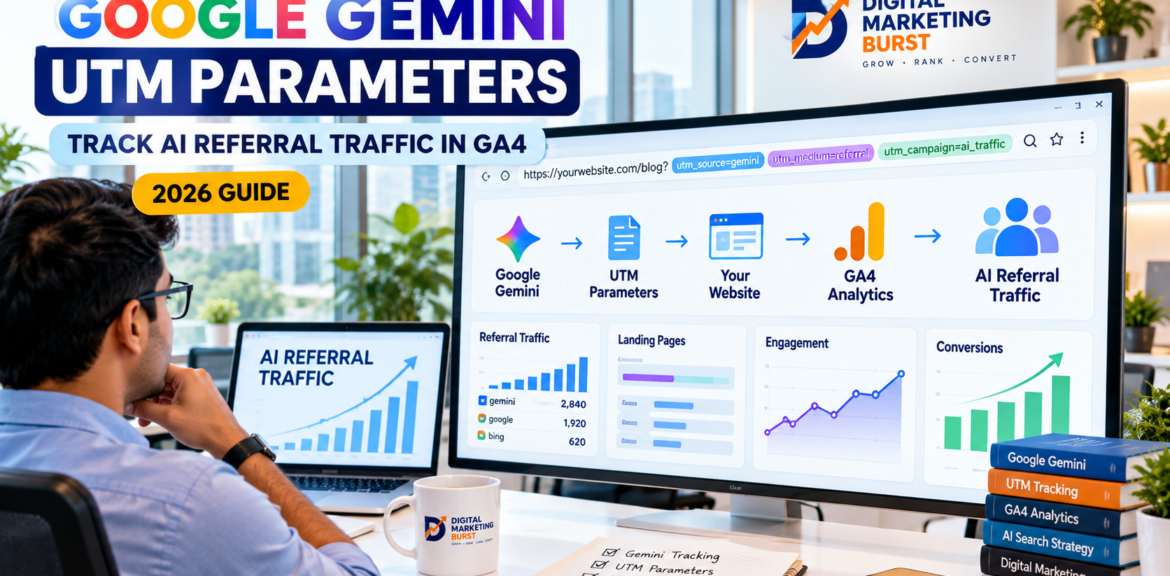

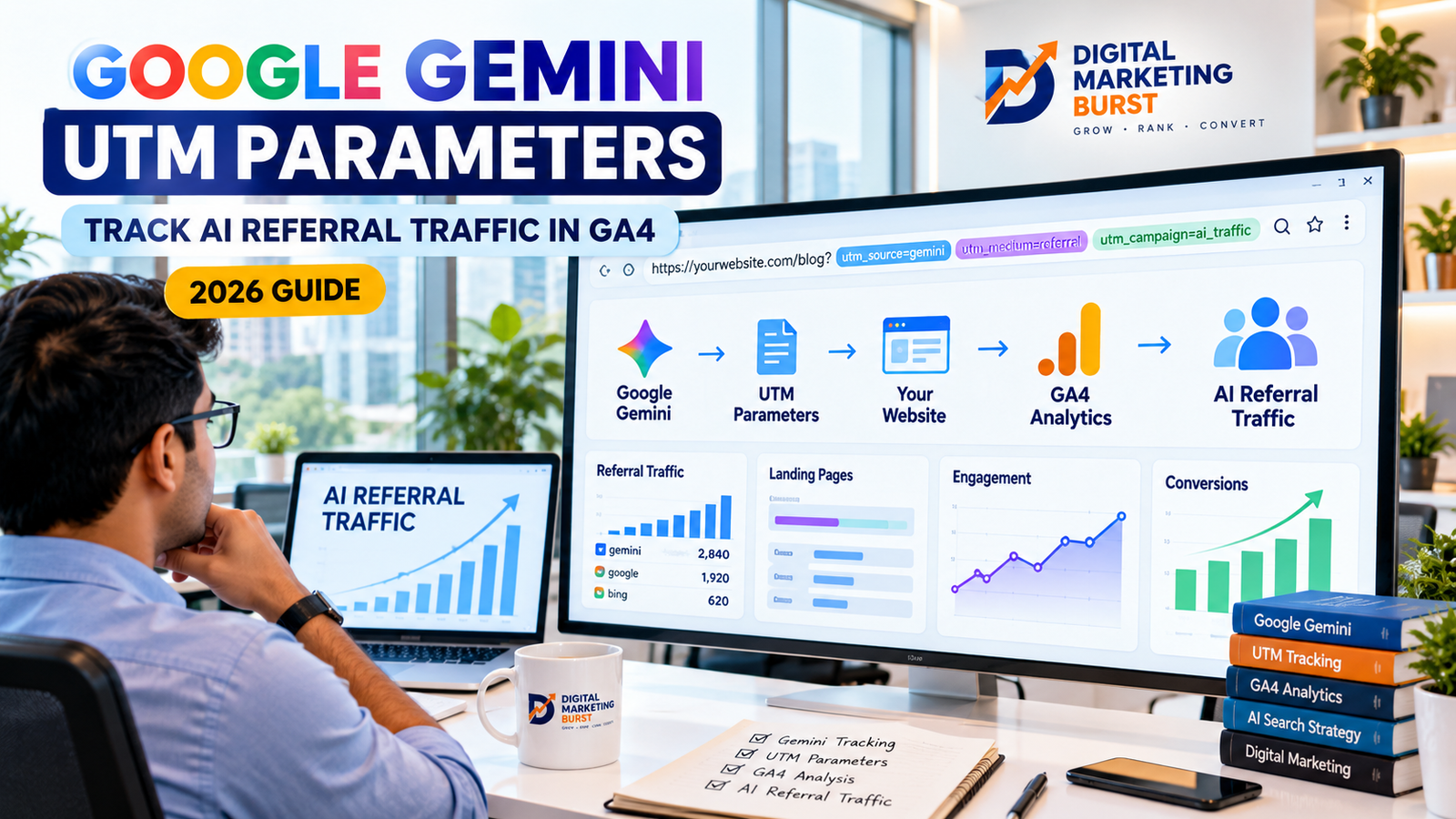
Google Gemini UTM Parameters: How to Track AI Referral Traffic in GA4 in 2026
For marketers, one of the biggest problems with AI referral traffic has not simply been getting clicks. The harder question has been identifying where those clicks actually came from.
That is why Google Gemini UTM Parameters are worth paying attention to in 2026. Google Gemini has started adding UTM parameters to at least some outgoing links, giving website owners a potentially clearer way to identify traffic originating from Gemini. The change has been observed publicly, although Google has not yet published complete documentation explaining exactly when Gemini adds these parameters. Search Engine Journal
For Indian businesses investing in SEO, content marketing and AI search visibility, this is more than a small analytics change. Better attribution can help marketers distinguish some Gemini-generated visits from traffic that might otherwise be difficult to identify correctly.
However, the change should not be misunderstood. UTM parameters can improve measurement of clicks. They do not tell you that a page ranks highly in Gemini, reveal the prompt that produced a citation, or prove that AI traffic generated a conversion.
Understanding that distinction is the foundation for using the new data properly.
What Are Google Gemini UTM Parameters?
UTM parameters are values appended to URLs to communicate information about where a visit originated.
A tagged URL can contain parameters such as:
utm_source
utm_medium
utm_campaign
Google Analytics uses traffic-source information to help identify the source, medium and campaign associated with visits. Google’s own documentation explains that manually tagged UTM values can populate corresponding traffic-source dimensions in Analytics. Google Support
Google Gemini UTM Parameters apply the same broad attribution principle to links that users click from Gemini.
The important difference is that website owners are not manually adding these parameters to a link inside Gemini. The recent development concerns Gemini itself adding tracking information to outgoing links.
That makes the click easier to distinguish as originating from an AI experience when the relevant tracking information reaches the destination website and analytics setup.
This matters because AI assistants create a different discovery journey from traditional Google Search. Someone may ask Gemini a detailed question, read an AI-generated response, follow a cited or recommended page and then interact with that website.
Without reliable attribution, the business may see the visit without clearly understanding the role Gemini played in creating it.
Why Gemini Referral Traffic Has Been Difficult to Measure
Traditional website analytics were not designed around conversational AI discovery.
Google Search, paid campaigns, email marketing and social platforms already have familiar acquisition reporting patterns. AI assistants have complicated that picture because referral information may not always be preserved consistently across interfaces, apps and browsing environments.
Search Engine Journal reports that some AI chatbot visits can end up appearing as direct traffic when sufficient referral or UTM information is unavailable. The publication also reports that the new Gemini tagging was noticed by users before broader formal documentation appeared. Search Engine Journal
Google Analytics describes (direct) / (none) as traffic for which a clear referral source is unavailable. Google notes several possible causes, including missing traffic information, redirects and technical factors, so marketers should not assume that every direct visit came from an AI assistant. Google Support
That distinction is important.
Before better Gemini Referral Traffic attribution, a marketer could know that website traffic had increased but still struggle to separate AI-originated visits from other unattributed sessions.
UTM tagging can reduce part of that uncertainty.
What Changed With Google Gemini UTM Tracking in 2026?
The core development is straightforward: Google Gemini UTM Tracking has started appearing on outgoing links.
Search Engine Journal reported the change on October 1, 2026. The publication also highlighted discussion involving Google’s John Mueller confirming that he could see the UTM behaviour. However, the report notes that Google’s implementation remains undocumented regarding the precise circumstances in which the tags are added. Search Engine Journal
That final point deserves emphasis.
It would be premature to claim that every Gemini link now contains identical tracking parameters or that every Gemini-generated visit can be perfectly measured.
Instead, marketers should treat the development as an improvement in attribution capability.
The practical change is:
Before: Some Gemini visits could be difficult to distinguish from unattributed traffic.
Now: Tagged Gemini links can provide explicit attribution information that analytics systems can use.
Still unknown: Whether the tagging occurs consistently across every Gemini interface, answer type, device and link format.
That is a much safer interpretation than declaring AI traffic measurement “solved.”
Why Google Gemini UTM Parameters Matter for SEO
SEO measurement has traditionally relied heavily on search-engine data and web analytics.
Google Search Console can show search impressions, clicks and queries for Google Search. GA4 can then help marketers analyse what users do after arriving on the website.
AI discovery creates a new layer between content and website visits.
A person might discover a business through Gemini rather than through a conventional blue-link search result. If that user clicks through, the website needs a reliable way to recognise that visit before the business can assess its value.
This is where Google Gemini UTM Parameters become useful.
Better attribution can help marketers answer practical questions such as:
Which landing pages receive visits from Gemini?
Do Gemini visitors engage with important service pages?
Which content types receive AI referral traffic?
Does Gemini traffic contribute to enquiries or other key events?
How does AI referral behaviour compare with traditional acquisition channels?
Those are business questions, not vanity metrics.
A company does not gain much from knowing it received 100 AI visits unless it can understand what those visitors did next.
Gemini Referral Traffic Is Not the Same as AI Visibility
This distinction is particularly important in 2026.
Gemini Referral Traffic represents visits that reach your website from Gemini and can be identified through available attribution signals.
AI visibility is broader.
A brand could appear in an AI-generated response without receiving a click. Gemini could mention a company, product, service or source while the user remains inside the AI interface.
The opposite issue also matters. A website receiving a Gemini referral tells you that someone clicked a link, but it does not automatically reveal how often the website appeared across Gemini answers.
Therefore, businesses should avoid using Gemini referral sessions as a complete AI visibility metric.
A more useful measurement model separates:
Visibility → Citation/mention → Click → Engagement → Conversion
UTM attribution primarily improves the click and post-click measurement part of this journey.
That distinction can prevent marketers from making overly broad conclusions from limited analytics data.
How to Track Gemini Traffic in GA4
If you want to Track Gemini Traffic in GA4, start with the Traffic acquisition report rather than searching randomly through Analytics.
Google documents the path as:
GA4 → Reports → Acquisition → Traffic acquisition
The Traffic acquisition report is designed to show where new and returning visitors came from. It includes dimensions such as Session source, Session medium and Session source / medium. Google Support
Step 1: Open Traffic Acquisition
Sign in to your GA4 property.
Navigate to:
Reports → Acquisition → Traffic acquisition
Do not confuse this report with User acquisition.
Traffic acquisition focuses on sessions, whereas User acquisition focuses on how users were initially acquired. That difference becomes important when someone first discovers your website elsewhere but later returns through Gemini. Google Support
Step 2: Check Session Source / Medium
Change or inspect the primary dimension using:
Session source / medium
Google defines Session source as the source associated with a new session and Session medium as the method through which that session was acquired. Google Support
Look for Gemini-related source values in your own property.
Do not hard-code an assumed value into your reporting workflow until you have confirmed what your actual GA4 data receives. Gemini’s new tagging implementation is still not comprehensively documented. Search Engine Journal
This verification-first approach is safer than relying on screenshots from somebody else’s GA4 account.
Step 3: Search for Gemini
Use the search/filter functionality above the traffic table to isolate sessions containing a Gemini-related source value.
Once identified, examine metrics such as:
Sessions
Engaged sessions
Average engagement time
Key events
Landing-page performance
The goal is not simply to count AI visitors. You want to understand whether those visitors behave differently from users arriving through Search, social platforms or other referral sources.
How to Track Gemini Referral Traffic More Accurately
A basic GA4 report is only the starting point.
Businesses that receive meaningful Google Gemini Referral Traffic should create a repeatable measurement workflow.
Begin by recording the exact source and medium values appearing in your GA4 property. Then compare those values across different periods rather than manually searching for Gemini every time.
Next, identify the landing pages receiving those sessions.
This can reveal something particularly useful: the pages AI users choose to visit.
For example, imagine an Indian SaaS company publishes three content types:
A definition article explaining a technical concept.
A comparison page evaluating two solutions.
A detailed implementation guide.
Suppose Gemini-referred visitors disproportionately land on the implementation guide. That does not prove Gemini prefers implementation guides generally.
It does provide the company with first-party evidence that its own identifiable Gemini visitors are reaching that type of content.
That is a much stronger basis for content decisions than assuming a universal AI-search pattern.
Use GA4 Explorations for Deeper Gemini UTM Tracking
Once the traffic volume becomes meaningful, GA4 Explorations can provide more flexibility than the standard report.
Create an exploration that segments the verified Gemini traffic source.
Useful dimensions can include:
Landing page
Session source / medium
Device category
Country
Page path
Relevant metrics may include sessions, engaged sessions and key events.
For an India-focused business, country segmentation can be especially useful. It allows the team to examine whether identified Gemini visits are actually coming from its target market rather than assuming that all AI traffic is commercially relevant.
For example, an Indian B2B company may receive Gemini referrals globally. If its service is primarily designed for Indian customers, the team should separately evaluate traffic from India before using total Gemini sessions to guide budget decisions.
AI Referral Traffic in GA4: What Should You Measure?
Counting AI Referral Traffic in GA4 is useful, but the number alone has limited strategic value.
Start with landing pages.
Which pages are attracting identified AI referrals?
Next, assess engagement.
Do those users continue exploring the site, or do they leave after reading one page?
Then examine meaningful business actions.
Depending on your website, those might include:
Contact-form submissions, demo requests, calls, WhatsApp actions, purchases, registrations or another properly configured key event.
Finally, compare AI referrals with other acquisition sources.
The useful question is not:
“How much AI traffic did we get?”
A better question is:
“What did identifiable AI-referred visitors do after reaching our website?”
That shift turns an interesting traffic source into actionable marketing data.
Google Gemini UTM Tracking and Landing Page Analysis
Landing-page analysis can become one of the most valuable applications of Gemini UTM Tracking.
Suppose an Indian digital marketing company has 100 articles but only a small group begins receiving identifiable Gemini referrals.
Those pages deserve investigation.
Look at their characteristics:
What question does each page answer?
How clearly does it explain the topic?
Does it provide definitions, comparisons or actionable steps?
Are facts supported by reliable sources?
Does the page offer information that is easy to extract and understand?
Are users landing on informational articles or commercial pages?
Do not immediately rewrite every other page to imitate them.
Instead, use the data to develop hypotheses.
If detailed comparison pages repeatedly attract Gemini referral visits, investigate why. If concise technical explainers perform better, examine those instead.
Your own analytics should inform the next experiment.
Can Google Gemini UTM Parameters Show the User’s Prompt?
No.
This is an important limitation.
UTM attribution can identify traffic-source information when the appropriate parameters are available. It should not be treated as a mechanism for revealing the private conversation or exact prompt that caused a user to click.
Therefore, seeing a Gemini referral in GA4 does not mean you know whether the visitor asked:
“Best CRM for Indian startups”
or:
“How can I automate sales follow-ups?”
Both could theoretically lead to the same page through different conversational paths.
Marketers should avoid reverse-engineering specific user prompts from a referral session unless they have separate, legitimate data supporting that conclusion.
Can Gemini UTM Tracking Tell You Which Answer Cited Your Website?
Not necessarily.
Gemini UTM Tracking improves referral attribution. It does not automatically provide a full record of the Gemini answer that generated every click.
This is one of the biggest analytical traps with AI referral data.
A UTM-tagged click is evidence that an attributable visit occurred. It is not automatically evidence of:
The exact query used
The complete Gemini response
Your overall Gemini visibility
Your citation frequency
Your ranking across AI responses
Keeping those concepts separate makes reporting more credible.
AI Referral Traffic vs Organic Search Traffic
AI referrals and traditional organic search should not simply be combined into one performance narrative.
A conventional Google Search visit normally starts with a search query and a search results interface.
An AI referral can emerge after a conversational interaction in which the user asks follow-up questions, compares options or receives a synthesized response before clicking.
The user’s information state may therefore be different by the time they reach the website.
That creates an interesting measurement opportunity.
Compare identified AI referral visitors against organic search visitors using metrics appropriate to your business.
For an informational publisher, engagement and onward navigation may matter.
For a service business, qualified enquiries could be more meaningful.
For ecommerce, revenue and purchase behaviour may be relevant.
Do not assume AI traffic is inherently “better” or “worse.” Let your own data answer that question.
Why This Change Matters for Indian Businesses
India has a large and diverse digital audience, but the strategic value of AI Referral Traffic will differ significantly by business.
A nationwide SaaS platform may care about AI referrals across India.
A Lucknow-based service business may need to segment those visits geographically before treating them as potential leads.
An ecommerce company may care more about revenue and product discovery.
A publisher may focus on sessions, engagement and repeat visits.
Therefore, the arrival of better Gemini attribution should not lead every company to adopt the same KPI.
The real opportunity is to add identifiable AI referral data to an existing measurement framework.
Indian marketers can then compare AI-assisted discovery with Search, social, email and other channels using actual business outcomes rather than hype.
Common Mistakes When Tracking Google Gemini Referral Traffic
One mistake is treating every direct session as hidden Gemini traffic.
GA4’s direct classification can occur when clear referral information is unavailable for multiple reasons. It is not an AI-only bucket. Google Support
Another mistake is assuming all Gemini links are now consistently tagged.
Current reporting indicates the feature exists, but the exact implementation rules remain undocumented. Search Engine Journal
A third mistake is counting sessions without examining outcomes.
Traffic attribution is useful because it helps connect acquisition with behaviour. A spike in visits is less meaningful if none of those visitors engage with the content or complete an important action.
Finally, avoid interpreting a Gemini referral as proof of broad AI-search dominance.
One attributable click cannot tell you how often competitors appeared, how many answers mentioned your brand or what share of relevant AI conversations included your website.
Do You Need to Add Google Gemini UTM Parameters Yourself?
No—not for the Gemini links discussed in this update.
The important development is that Gemini itself has been observed adding UTM parameters to outgoing links. Search Engine Journal
That is different from adding UTMs to your own marketing campaigns.
For links that your business controls, Google continues to document manual campaign tagging using parameters such as utm_source, utm_medium and utm_campaign. Those values can then populate corresponding Analytics dimensions. Google Support
Do not modify your website’s internal links by adding Gemini UTMs in an attempt to improve AI attribution.
That would measure your own tagging, not genuine referral attribution from Gemini.
Check Whether Your Website Preserves UTM Parameters
Better source tagging only helps when your measurement setup receives the information correctly.
Review redirects carefully.
Google notes that redirects and other technical circumstances can contribute to lost traffic-source information. Google Support
Test important landing pages yourself.
Open a test URL containing harmless UTM parameters and verify that the parameters survive the expected redirect chain.
Then check whether the session information reaches Analytics correctly.
Also review consent configuration and GA4 implementation.
If your underlying analytics setup is unreliable, a new referral parameter cannot repair every measurement problem automatically.
Build an AI Referral Traffic Dashboard
As AI Referral Traffic becomes more relevant, businesses should avoid manually checking individual sources every week.
A simple reporting framework can include:
Total identifiable AI referral sessions
Gemini referral sessions
Other identifiable AI sources
Top AI referral landing pages
Engagement metrics
Key events
Conversions or qualified enquiries
Country or target-market segment
The dashboard should separate traffic from business outcomes.
For example:
Gemini → 150 sessions → 90 engaged sessions → 8 enquiries
is more informative than:
Gemini → 150 visits
The numbers above are illustrative only, not Digital Marketing Burst results or industry benchmarks.
The framework matters more than the hypothetical values.
How Google Gemini UTM Parameters Could Change AI SEO Reporting
Until recently, much AI-search reporting has focused heavily on visibility.
Teams monitor brand mentions, citations, prompts and whether a website appears in AI-generated responses.
Referral attribution adds another layer.
A useful AI-search measurement framework can now separate:
1. AI visibility
Was the brand or website visible?
2. Citation or recommendation
Was the website referenced?
3. Referral
Did the user click through?
4. Engagement
What happened after the click?
5. Business outcome
Did the visit contribute to an important action?
Google Gemini UTM Parameters primarily strengthen stage three and the subsequent measurement journey.
They do not replace the first two stages.
This distinction is likely to become increasingly important as businesses try to connect AI visibility work with measurable website outcomes.
What Digital Marketers Should Do Now
You do not need to rebuild your analytics strategy because Gemini has begun using UTM parameters.
Start with measurement hygiene.
Open GA4 and inspect existing traffic-source data. Determine whether Gemini-related traffic is already visible.
Document the exact values you find.
Create a segment or exploration once enough data exists to make analysis useful.
Then compare landing pages and engagement.
Make sure key events that matter to the business are configured correctly.
After that, monitor the data over time.
Do not make a major content or budget decision after seeing a handful of AI-referred sessions.
Patterns become more useful when they persist.
Most importantly, maintain a distinction between AI visibility, AI referral traffic and business results.
That will make your reporting more useful than simply announcing that “AI traffic is growing.”
FAQs About Google Gemini UTM Parameters
What are Google Gemini UTM Parameters?
Google Gemini UTM Parameters are tracking information that has been observed on outgoing Gemini links. They can help websites and analytics systems more clearly attribute some visits to Gemini. The implementation is new, and Google has not yet publicly documented every condition under which the tagging occurs. Search Engine Journal
How can I Track Gemini Traffic in GA4?
Open Reports → Acquisition → Traffic acquisition and inspect Session source, Session medium or Session source / medium for Gemini-related values appearing in your property. Google documents the Traffic acquisition report as the place to analyse where website and app visitors originate. Google Support
Is Gemini Referral Traffic organic traffic?
Do not automatically classify every Gemini referral as conventional organic-search traffic. Analyse the actual source and medium values that GA4 receives and keep AI referral reporting separate where doing so improves clarity.
Can UTM parameters tell me what someone asked Gemini?
No. Referral attribution should not be interpreted as access to the user’s private Gemini conversation or exact prompt.
Does Gemini UTM Tracking measure AI visibility?
Not completely. It can help measure identifiable click-through traffic. Brand mentions, citations without clicks and overall appearance frequency are separate AI-visibility questions.
Will every Gemini click now appear correctly in GA4?
That should not be assumed. The UTM behaviour has been observed, but Google’s exact Gemini implementation is not yet comprehensively documented. Search Engine Journal
Google Gemini UTM Parameters represent an important improvement for marketers trying to understand AI-driven website discovery.
Instead of treating every AI-generated visit as an attribution mystery, businesses may now be able to identify more Gemini Referral Traffic and analyse what those visitors do after reaching the site.
The most valuable use of this data is not simply counting AI clicks.
Use Gemini UTM Tracking to connect identifiable referrals with landing pages, engagement and meaningful business actions. When you Track Gemini Traffic in GA4, keep referral measurement separate from broader AI visibility and citation monitoring.
For Indian businesses, this creates a more practical approach to AI-search measurement: observe the data, verify attribution, segment the right audience and judge the channel by real outcomes.
How Google Gemini UTM Parameters Fit Into the Customer Journey
A traditional SEO journey might look relatively straightforward:
Google Search → Search Result → Website → Conversion
AI-assisted discovery can be more complex:
Question → Gemini Response → Source/Recommendation → Website → Further Research → Conversion
The website visit may therefore occur after the user has already consumed a significant amount of information inside Gemini.
That context changes how marketers should interpret Google Gemini Referral Traffic.
For example, someone researching digital marketing services might initially ask Gemini about different SEO strategies. The user could ask follow-up questions, review several sources and only then visit a website.
GA4 begins providing meaningful website-level information once that visitor arrives. It does not provide a complete record of everything that happened inside the AI conversation beforehand.
This boundary matters when building attribution reports.
A Gemini referral should be treated as an identifiable touchpoint, not necessarily the beginning of the customer’s entire research journey.
Understanding Source, Medium and Campaign in Gemini UTM Tracking
UTM tracking becomes much easier to understand when three basic concepts are separated.
Source
The source tells analytics where the traffic originated.
Examples from conventional marketing might include a search engine, newsletter or another referring platform.
For Gemini UTM Tracking, marketers should inspect the actual value reaching their GA4 property rather than assuming a particular naming convention.
Medium
The medium describes the broader method through which the traffic was acquired.
Common examples across digital marketing can include organic, referral, email or CPC.
Again, use the values actually recorded in GA4 when analysing Gemini. Do not manually rename data simply because a different website or screenshot shows another classification.
Campaign
Campaign values provide an additional layer of attribution when campaign information is supplied.
Google’s Analytics documentation explains how manually tagged parameters can populate traffic-source dimensions.
For the current Gemini development, however, avoid assuming that every outgoing Gemini link will always contain the same combination of UTM parameters. The implementation remains new.
Session Source vs First User Source in GA4
This distinction can prevent major reporting mistakes.
Imagine a visitor discovers your website through Google Search on Monday.
The same person later returns through Gemini on Friday.
Their first user source relates to how that user was originally acquired. The session source relates to the source associated with the later session.
For analysing Gemini Referral Traffic, session-scoped acquisition data is generally more useful when your immediate question is:
“How many website sessions came through Gemini?”
Google’s Traffic acquisition report is session-focused, whereas User acquisition focuses on how users were first acquired.
Confusing the two can cause marketers to believe Gemini referrals are missing when they are simply looking at the wrong acquisition scope.
How to Track Gemini Traffic in GA4 Using a Comparison
Once you have confirmed the actual Gemini-related value appearing in your property, create a comparison rather than manually searching for it every time.
Open:
Reports → Acquisition → Traffic acquisition
Then create a comparison using the relevant session-scoped source dimension.
Your condition should be based on the Gemini value that your property actually records.
Once applied, compare the segment against your broader website traffic.
Look beyond Sessions.
Examine:
Engaged sessions → Engagement rate → Average engagement time → Key events → Relevant conversions
This produces a much more useful picture of AI Referral Traffic in GA4.
A traffic source generating fewer sessions but stronger commercial actions may matter more than one generating large volumes of low-intent visits.
Track Gemini Traffic in GA4 by Landing Page
The landing page is one of the most valuable dimensions for AI traffic analysis.
After identifying Gemini sessions, determine which URLs those visitors entered through.
You may find traffic reaching:
Blog posts
Service pages
Comparison pages
Guides
Product pages
Research content
Location pages
The distribution can reveal how your website is currently benefiting from AI-assisted discovery.
Suppose an Indian digital marketing website receives identifiable Gemini traffic primarily on educational articles.
That pattern suggests Gemini users are entering during the research stage.
Now imagine another website receives Gemini referrals directly on service comparison pages. Those visitors could be further along their decision journey.
Neither pattern is automatically better.
The correct interpretation depends on what the page is designed to achieve.
Create a Dedicated Gemini Traffic Exploration in GA4
For ongoing analysis, a GA4 Exploration can provide more control than repeatedly filtering the standard acquisition report.
Create a new exploration and include relevant dimensions such as:
Session source / medium
Landing page + query string
Page path
Country
Device category
Useful metrics can include:
Sessions
Engaged sessions
Engagement rate
Average engagement time per session
Key events
Then apply your verified Gemini source condition.
This creates a focused environment for analysing Google Gemini UTM Tracking without mixing it with unrelated acquisition channels.
Do not build the report around assumed parameter values. First confirm what is reaching your own analytics property.
How Indian Businesses Should Segment Gemini Referral Traffic
Traffic volume alone can be misleading for businesses serving a particular geographic market.
An Indian business might receive AI referrals from several countries.
If the company primarily sells within India, worldwide Gemini sessions should not automatically be treated as equally valuable prospects.
Add Country to your analysis.
You can then compare:
Gemini traffic from India
against:
Total identifiable Gemini traffic
A local service business can go further.
Suppose a company operates primarily in Lucknow. A Gemini referral from Lucknow may carry different commercial relevance from a visitor thousands of kilometres outside its service area.
The same principle applies to ecommerce, SaaS, education, healthcare and B2B companies.
Segment according to the market you actually serve.
Do not manipulate the data until it tells the story you want.
Analyse New and Returning Gemini Visitors Separately
Not every Gemini visitor is discovering your brand for the first time.
Someone may previously have visited through Search, social media, an advertisement or a direct visit.
Later, that person could encounter your website again through Gemini.
This makes returning-user behaviour worth examining.
If identifiable Gemini referrals include returning visitors, AI-assisted discovery may sometimes be participating in a longer research journey rather than acting purely as a first-touch discovery channel.
That possibility is particularly relevant for high-consideration purchases.
A customer choosing software, professional services or a major product rarely makes a decision after one interaction.
AI tools can become another research environment within that journey.
However, do not infer the exact path from GA4 unless your available data genuinely supports it.
AI Referral Traffic and Attribution Models
Attribution asks how credit for a business outcome should be distributed across marketing interactions.
This becomes complicated when AI platforms enter the journey.
Consider this hypothetical sequence:
Organic Search → Website → Gemini → Website → Direct Visit → Enquiry
Which channel created the enquiry?
There is no universally correct answer based only on this sequence.
Organic Search introduced the visitor to the website. Gemini may have influenced further evaluation. The direct session occurred immediately before the enquiry.
That is why AI Referral Traffic should not automatically receive all the credit simply because it appears near the end of the journey.
Use attribution reporting as an analytical tool rather than proof that one channel single-handedly created the conversion.
Gemini Referral Traffic and Assisted Conversions
The most interesting role of Gemini may eventually be as an assisting touchpoint.
A user can research a problem using AI, visit a business website and leave without converting.
Later, the same person may return through another source.
If your measurement setup can legitimately connect those interactions, Gemini may still have contributed to the journey even though the final conversion occurred elsewhere.
This makes last-click thinking increasingly limiting.
Marketers should therefore ask two separate questions:
Did Gemini directly precede the conversion?
and:
Did Gemini participate somewhere in the measurable journey?
Those questions can produce very different answers.
Do not label every earlier touchpoint an “assisted conversion” unless your reporting configuration actually supports that conclusion.
Track Commercial and Informational Gemini Landing Pages Separately
Not every landing page serves the same purpose.
An informational article might aim to educate.
A service page might aim to generate an enquiry.
A comparison page could help users evaluate options.
Mixing all three into one conversion benchmark can distort the analysis.
Create broad page groups where useful:
Informational content
Commercial content
Product/service pages
Brand pages
Then compare identifiable Gemini Referral Traffic across those groups.
For an informational article, onward navigation may be an important signal.
For a service page, an enquiry or qualified lead may matter more.
For ecommerce, add-to-cart and purchase behaviour could be relevant.
The KPI should follow the purpose of the page.
Measure Gemini Traffic by Content Topic
Landing-page analysis becomes even more useful when URLs are grouped by topic.
Imagine an agency publishes content about:
SEO
Google Ads
AI Search
Social Media Marketing
Local SEO
Instead of asking which individual URL received the most Gemini traffic, examine whether particular topic clusters attract more identifiable referrals.
This can help reveal patterns that are difficult to see at page level.
For instance, AI-search articles might generate more Gemini referrals than social-media content.
That observation could justify deeper investigation.
It does not prove that publishing more AI articles will automatically increase Gemini traffic.
Correlation inside your analytics account should be used to generate hypotheses, not universal SEO rules.
Track Gemini Traffic in GA4 Alongside Organic Search
AI traffic becomes more meaningful when it has context.
Create a comparison between identifiable Gemini sessions and organic search sessions.
Review:
Landing pages
Engagement
Key events
Device distribution
Geographic distribution
Relevant conversion behaviour
You may discover that Gemini visitors reach different pages from traditional search users.
Perhaps Google Search drives visitors to high-volume informational pages while Gemini sends a smaller number to detailed comparison content.
Alternatively, both channels may lead to the same pages.
Either outcome is useful.
The point is to understand how AI-assisted discovery fits alongside existing Search behaviour rather than treating it as an isolated trend.
AI Referral Traffic Should Not Replace Search Console Data
GA4 and Google Search Console answer different questions.
Search Console provides information about performance in Google Search.
GA4 focuses on user activity once traffic reaches the website.
Gemini referral attribution adds another acquisition signal, but it does not transform GA4 into an AI-search visibility platform.
A practical reporting framework can therefore use:
Google Search Console → Traditional Google Search visibility
GA4 → Website acquisition and behaviour
Gemini referral attribution → Identifiable Gemini-originated visits
AI visibility monitoring → Mentions/citations across relevant AI experiences
Each dataset has a different purpose.
Combining them thoughtfully creates a stronger picture than trying to force every metric into GA4.
Can Google Search Console Show Gemini Referral Traffic?
Google Search Console should not be treated as a replacement for Gemini Referral Traffic reporting in GA4.
Search Console primarily reports performance from Google Search surfaces that Google includes in its Search performance reporting.
A Gemini referral is a different measurement question.
If you want to understand visitors arriving on your website from Gemini, website analytics and referral attribution are the more relevant tools.
Avoid assuming that every Gemini click should appear as a Search Console click.
The products measure different environments and interactions.
Build a Simple AI Traffic Classification System
As AI referrals expand beyond Gemini, manually checking each platform becomes inefficient.
A business can create an internal classification framework such as:
AI Referral Traffic
→ Gemini
→ ChatGPT
→ Perplexity
→ Other identifiable AI sources
Keep this classification separate from standard organic-search reporting unless your analytics requirements justify combining particular channels.
The advantage is consistency.
Instead of producing a special report every time another AI platform sends traffic, your organisation develops one broader AI-referral measurement framework.
Gemini can then be analysed individually or as part of the broader category.
Do Not Automatically Rewrite GA4 Channel Groups
Seeing a new traffic source often tempts marketers to immediately customise channel definitions.
That can create unnecessary reporting complexity.
First observe how Google Gemini Referral Traffic is being classified in your property.
Collect enough data to understand the pattern.
Document the source and medium values.
Only then decide whether a custom channel group would improve reporting.
The goal is clarity, not simply creating a new dashboard label called “AI.”
If AI traffic remains extremely small, a dedicated exploration may be sufficient.
As volume becomes strategically meaningful, a broader custom reporting structure can make more sense.
How to Create an AI Referral Traffic Report for Management
Senior management rarely needs every technical GA4 dimension.
A useful monthly report can answer five questions.
How much identifiable AI referral traffic did the website receive?
Which AI platforms generated that traffic?
Which landing pages attracted those visitors?
How did they engage?
What meaningful business actions followed?
For Gemini specifically, report verified traffic rather than estimated “hidden Gemini traffic.”
You can also separate:
Observed data — what GA4 records.
Interpretation — what you think the pattern may indicate.
Unknowns — what the available data cannot prove.
This structure prevents assumptions from being presented as facts.
Example of a Useful Gemini Traffic Report
Consider a hypothetical Indian B2B website.
Its internal dashboard could show:
Gemini referral sessions: 240
Visitors from India: 180
Engaged sessions: 150
Service-page visits after entry: 60
Recorded enquiries: 12
These numbers are purely illustrative. They are not industry benchmarks or results achieved by Digital Marketing Burst.
The analysis should then ask:
Which landing pages generated those visits?
What percentage reached commercial content?
Were enquiries relevant to the company’s target audience?
How does that behaviour compare with other acquisition channels?
This makes the report actionable.
Simply stating “Gemini sent 240 sessions” does not.
Track Gemini Traffic Without Creating False ROI Claims
ROI calculations require reliable revenue and cost information.
A Gemini referral count alone cannot establish return on investment.
Suppose an agency receives 20 enquiries associated with identifiable AI referral sessions.
That still does not tell you:
How many enquiries were qualified?
How many became customers?
What revenue resulted?
What marketing costs should be attributed to the channel?
What other touchpoints contributed?
Therefore, avoid statements such as:
“Gemini generated ₹X in revenue”
unless your attribution and business data genuinely support that conclusion.
A safer progression is:
Referral → Engagement → Lead → Qualified Lead → Customer → Revenue
Measure only as far as your verified data allows.
Google Gemini UTM Parameters and Conversion Tracking
The real value of Google Gemini UTM Parameters appears when traffic-source information connects with correctly configured business actions.
For a lead-generation website, relevant events might include:
Form submissions
Phone-call actions
WhatsApp interactions
Demo requests
Appointment requests
For ecommerce, they might include:
Product views
Add-to-cart actions
Checkout starts
Purchases
For a publisher:
Newsletter registrations
Account creation
Content subscriptions
Meaningful onward navigation
The business should decide which events represent genuine value before evaluating Gemini traffic.
Otherwise, attribution becomes a collection of numbers without business context.
Why AI Traffic Quality Matters More Than AI Traffic Volume
AI referral traffic may attract attention because it is new.
New does not automatically mean valuable.
Imagine Channel A produces 5,000 visits but almost no meaningful actions.
Channel B generates 500 visits but consistently brings visitors to high-intent pages.
Traffic volume alone would make Channel A look stronger.
Business outcomes could tell a completely different story.
Apply the same thinking to AI Referral Traffic in GA4.
Instead of asking only whether Gemini traffic increased, ask whether those visitors:
Reached relevant pages
Stayed engaged
Continued deeper into the website
Completed important actions
Returned later
Quality requires context.
Should You Optimise Content Specifically for Gemini Referral Traffic?
Do not rewrite your entire website around one referral source.
Google’s current guidance for its AI search experiences continues to emphasise foundational SEO and helpful content rather than a separate collection of technical tricks for AI features.
For Gemini referral performance, focus on content quality first.
Answer the user’s question clearly.
Support factual claims.
Use descriptive headings.
Make important information easy to locate.
Keep pages technically accessible.
Provide original value instead of summarising what every competing article already says.
Then use Gemini Referral Traffic data as feedback.
If certain pages consistently attract valuable AI referrals, study why those pages work for your audience.
Can Adding More UTM Parameters Improve Gemini Visibility?
No evidence supports the idea that manually adding more UTM parameters to your website will improve its visibility in Gemini.
UTM parameters are fundamentally measurement tools.
They help analytics systems understand traffic attribution when properly implemented.
They are not keywords for an AI ranking system.
This distinction is crucial because a new SEO trend often attracts unnecessary technical experimentation.
Do not add random tracking parameters to internal links hoping to increase Gemini visibility.
Doing so can complicate analytics and URL management without creating a genuine content advantage.
Google Gemini UTM Tracking and URL Cleanliness
UTM parameters can create different-looking URLs for the same underlying page.
For example, the destination page may be:
example.com/ai-seo-guide/
while a referral URL could include additional tracking parameters after the main address.
The content itself remains the destination.
Website owners should ensure their canonical implementation, redirects and analytics configuration are technically sound.
Do not create separate indexable pages merely because tracking parameters exist.
Tracking URLs are for attribution, not for producing duplicate versions of content.
Should UTM Parameters Be Removed After the User Lands?
Some websites use scripts or redirect systems that clean tracking parameters from the visible URL.
Whether that is appropriate depends on the technical implementation.
The critical requirement is that attribution information reaches the analytics system before it is discarded.
An aggressive redirect or URL-cleaning process can potentially interfere with measurement if implemented incorrectly.
Therefore, test before changing anything.
Open a tagged URL.
Follow the redirect path.
Confirm that GA4 receives the intended attribution.
Then verify that your canonical and indexing setup remains clean.
Technical simplicity is preferable to unnecessary tracking complexity.
Privacy and Responsible AI Referral Measurement
Referral measurement should focus on aggregate marketing performance rather than attempting to reconstruct private user behaviour.
Google Gemini UTM Parameters can help identify the source of a website visit.
They should not be interpreted as permission to infer sensitive information about the person behind that visit.
Marketers should work within applicable privacy requirements, consent configurations and organisational policies.
For Indian businesses, analytics implementation should also be reviewed against the privacy and data-handling requirements relevant to the organisation.
This is particularly important when combining analytics data with CRM, advertising or customer records.
What to Monitor Weekly
A weekly review does not need to become complicated.
Track:
Gemini sessions
Top Gemini landing pages
Engaged sessions
Relevant key events
Country distribution
Major source/medium changes
Also watch for sudden attribution changes.
If Gemini traffic disappears overnight, do not immediately conclude that your AI visibility collapsed.
First investigate whether:
Tracking values changed
GA4 configuration changed
Redirects were introduced
Consent settings changed
Gemini’s tagging behaviour changed
Measurement problems can look like marketing problems.
What to Monitor Monthly
Monthly analysis should focus more on patterns.
Compare Gemini traffic with the previous period, but avoid overreacting to small percentage changes when the underlying numbers are tiny.
Review which content topics attract identifiable referrals.
Compare informational and commercial landing pages.
Assess business outcomes.
Look for repeat patterns rather than isolated spikes.
Most importantly, record changes to your measurement methodology.
If you modify GA4 filters or channel definitions halfway through the month, comparisons with earlier periods may no longer be like-for-like.
Google Gemini UTM Parameters: A Practical Measurement Framework
A simple framework can keep your analysis disciplined.
Stage 1: Verify
Confirm that Gemini-related attribution is actually reaching GA4.
Stage 2: Classify
Document the source, medium and any relevant campaign values.
Stage 3: Segment
Separate Gemini traffic from other acquisition sources.
Stage 4: Analyse
Review landing pages, geography, engagement and meaningful actions.
Stage 5: Compare
Compare Gemini with organic search and other relevant channels.
Stage 6: Interpret
Identify patterns without presenting correlation as causation.
Stage 7: Act
Use reliable findings to improve content, conversion paths and measurement.
This process is more valuable than simply creating a dashboard labelled “AI Traffic.”
What Google Gemini UTM Parameters Still Cannot Tell You
Better attribution does not eliminate every measurement gap.
Even with Google Gemini UTM Tracking, GA4 may not tell you:
The exact prompt that produced the visit.
How many Gemini answers mentioned your brand without generating a click.
How frequently competitors appeared alongside your website.
Why Gemini selected a particular source.
Whether a user had seen your brand elsewhere before the measurable journey.
How much influence an AI answer had on the final purchase decision.
Those questions require different evidence.
Recognising the limits of the dataset is part of good analytics.
A Better AI Search Measurement Model for 2026
Businesses increasingly need to move beyond one-dimensional traffic reporting.
A stronger model contains five layers:
Visibility
Is the brand appearing across relevant search and AI experiences?
Citation
Is the website being referenced as a source?
Referral
Are users clicking through to the website?
Engagement
Are those visitors consuming useful content and moving through the site?
Outcome
Are visits contributing to enquiries, registrations, sales or another meaningful business objective?
Google Gemini UTM Parameters improve the referral layer.
GA4 helps with referral, engagement and measurable outcomes.
Neither tool alone provides the entire picture.
That is why AI-search reporting should combine appropriate datasets rather than searching for one universal metric.
The arrival of Google Gemini UTM Parameters gives marketers a better opportunity to understand some of the traffic coming from AI-assisted discovery.
However, the real value begins after attribution.
Businesses should Track Gemini Traffic in GA4 by landing page, geography, engagement and meaningful actions. They should compare Gemini Referral Traffic with other acquisition sources while recognising that a referral is only one stage of a larger customer journey.
For Indian marketers, this is an opportunity to build AI reporting correctly from the beginning.
Measure what can be verified. Separate observed data from assumptions. Connect AI Referral Traffic with genuine business outcomes, and avoid treating every Gemini click as proof of broader AI-search success.
That approach will remain useful even as Gemini’s tracking implementation and the wider AI-search ecosystem continue to evolve.
Tracking Google Gemini UTM Parameters becomes more valuable when the data starts influencing better marketing decisions. Parts 1 and 2 covered what the parameters mean, how to Track Gemini Traffic in GA4, and how to analyse referral behaviour.
The next question is more strategic: what should businesses actually do with those insights?
A rise in Gemini Referral Traffic should not automatically trigger a website-wide content rewrite. Similarly, a page receiving no identifiable Gemini referrals should not immediately be considered weak.
AI referral attribution is one signal within a much larger search and discovery ecosystem.
For Indian businesses, the practical opportunity is to connect Google Gemini UTM Tracking with content strategy, SEO, conversion measurement and broader AI visibility without confusing those different areas.
Turn Gemini Referral Traffic Into Content Insights
Start with the pages already receiving identifiable Gemini Referral Traffic.
Create a list of those landing pages and classify them according to purpose:
Informational guides
How-to content
Comparison pages
Service pages
Product pages
Research or data pages
Brand pages
Then examine what those pages have in common.
Perhaps they answer narrow questions clearly. Some may contain useful comparisons, definitions or original explanations. Others could provide detailed information that helps users make a decision.
The objective is not to discover a secret Gemini content formula.
Instead, you are trying to understand what type of content on your website attracts identifiable visitors from Gemini.
This produces first-party evidence that can guide future experiments.
Find Pages With AI Traffic but Weak Engagement
High referral traffic does not automatically mean the landing page is doing its job.
Suppose one article attracts noticeable AI Referral Traffic, but visitors rarely move beyond that page.
Investigate the experience.
Does the opening immediately answer the question?
Is the page easy to scan?
Are important details buried under unnecessary text?
Does the article provide a logical next step?
Are internal links genuinely relevant?
Is the commercial call to action appropriate for the user’s likely intent?
The solution should not be to insert more keywords.
Improve the user journey instead.
A visitor arriving from Gemini may already have received a summary of the topic. Your webpage therefore needs to provide enough additional depth, evidence or utility to justify the click.
Find High-Value Pages With Little Gemini Referral Traffic
The reverse analysis can also be useful.
Some pages may perform well through organic search or generate enquiries but receive little identifiable Google Gemini Referral Traffic.
Do not assume those pages are failing in Gemini.
First remember the limitations of referral measurement. A page can potentially be mentioned or cited without receiving a click. Attribution behaviour may also vary by interface and implementation.
Instead, review the page on its own merits.
Ask whether it clearly explains the subject.
Check whether important claims are supported.
Make sure the business, service, author and topic are unambiguous.
Review technical accessibility and indexing.
Look for information gaps that genuinely matter to users.
Only make changes that improve the page itself.
Build Content That Is Worth Clicking After an AI Answer
This is becoming an important content challenge.
AI systems can answer simple questions directly.
If your article provides nothing beyond a basic definition that an AI response can summarise in a few sentences, users may have little reason to visit the website.
Content therefore needs to provide additional utility.
Consider a page about GA4.
A generic definition of GA4 is easy to summarise.
A page containing a clear workflow for isolating AI Referral Traffic in GA4, interpreting source/medium data, identifying attribution limitations and deciding what to measure provides substantially more value.
The same principle applies beyond analytics.
Useful content can offer:
Original frameworks
Clear processes
Detailed comparisons
First-party research where genuinely available
Interactive tools
Templates
Calculators
Expert explanations
Original images or diagrams
Current documentation
Decision-making guidance
Do not add these elements simply because they sound good for SEO.
Add them when they help the reader complete the task that brought them to the page.
Answer-First Content Can Improve User Experience
Long introductions can be particularly frustrating when someone arrives looking for a specific answer.
Place the essential answer early.
For example, if the question is:
“How to Track Gemini Traffic in GA4?”
the page should quickly tell the user where to begin:
GA4 → Reports → Acquisition → Traffic acquisition
Then explain what dimensions to inspect and what limitations apply.
The detailed context can follow.
This structure benefits traditional search visitors and AI-referred users alike.
It also prevents a common SEO mistake: writing hundreds of introductory words before addressing the actual query.
Do Not Create Hundreds of Gemini Keyword Pages
A new search trend can quickly lead to unnecessary content production.
For example, creating separate thin articles for:
“Gemini traffic GA4”
“Gemini referral GA4”
“Gemini UTM GA4”
“Track Gemini visits”
“Google Gemini referral tracking”
would probably create substantial overlap if each page answers essentially the same question.
A stronger page can cover these closely related intents naturally.
Your current article already targets:
Google Gemini UTM Parameters
Google Gemini UTM Tracking
Gemini Referral Traffic
Google Gemini Referral Traffic
Gemini UTM Tracking
Track Gemini Traffic in GA4
How to Track Gemini Traffic in GA4
AI Referral Traffic
AI Referral Traffic in GA4
These terms belong within one coherent topic rather than requiring separate near-duplicate articles.
That keeps the website architecture cleaner and reduces unnecessary internal competition.
Avoid Keyword Cannibalisation Around AI Referral Traffic
Before publishing another AI-traffic article later, compare its intent with this page.
This article answers:
What are Google Gemini UTM Parameters, and how can marketers use them to identify and analyse Gemini and AI referral traffic in GA4?
A future article could target a genuinely different intent, such as:
How to Build an AI Referral Traffic Dashboard in GA4
That page could focus almost entirely on dashboard creation.
Another could cover:
ChatGPT Referral Traffic in GA4
That would be appropriate if it addresses platform-specific attribution behaviour rather than repeating this Gemini article with a different product name.
Topic separation should be based on user intent, not merely different keywords.
Use Gemini Referral Data to Improve Internal Linking
Gemini Referral Traffic can also reveal opportunities in your internal-link structure.
Suppose an informational article consistently receives Gemini visitors.
Ask what the logical next step is for those readers.
If the article explains AI search visibility, a relevant deeper guide could be useful.
If it explains analytics, another page covering AI-search strategy might help readers understand what to do with the measurement.
Internal links should continue the user’s journey.
Do not add ten unrelated links merely because internal linking is considered an SEO practice.
A smaller number of contextually relevant links can be far more useful.
Review Conversion Paths From Gemini Landing Pages
Once a Gemini landing page has enough traffic to analyse meaningfully, examine what happens next.
A visitor might follow this journey:
Gemini → Blog Article → Service Page → Contact Page → Enquiry
Another might follow:
Gemini → Guide → Related Article → Exit
Neither path can be understood properly by looking only at the first landing page.
Use GA4 exploration tools and your legitimate conversion data to study subsequent behaviour where your measurement setup permits it.
Look for unnecessary friction.
A useful informational page should not immediately become a hard sales pitch.
However, users who want more help should have a clear next step.
This balance is particularly important for service businesses.
AI Referral Traffic Can Reveal Content-to-Service Gaps
Imagine a marketing agency receives identifiable AI traffic for educational articles about generative search but very few visitors continue to relevant service pages.
Several explanations are possible.
The informational content may satisfy the user completely.
The visitor may not have commercial intent.
Internal links might be weak.
The service offering may not be clearly connected to the problem discussed.
The call to action could appear too early or too aggressively.
Analytics cannot automatically tell you which explanation is correct.
It can show where the journey changes.
Human analysis is still required to understand why.
Connect Google Gemini UTM Tracking With Lead Quality
For businesses generating leads, raw enquiry numbers can be misleading.
A website might receive many form submissions but only a small number that fit its target customer profile.
Therefore, Google Gemini UTM Tracking becomes more valuable when marketing analytics can be responsibly connected with downstream lead outcomes.
A basic framework might be:
Gemini Referral → Website Session → Enquiry → Qualified Lead → Customer
Do not assume every stage is measurable in GA4.
Some organisations use a CRM or another system after the enquiry occurs. Others may not have reliable source information beyond the initial form submission.
Only connect data where the implementation genuinely supports it.
Avoid filling missing stages with assumptions.
Create an AI Referral Landing Page Scorecard
You can evaluate AI referral landing pages using a simple internal scorecard without inventing a universal “AI SEO score.”
For each page, record factual metrics or observations such as:
Identifiable AI sessions: What does analytics record?
Target-market traffic: Are visitors from the countries or regions you serve?
Engagement: Are users meaningfully interacting with the page?
Next-page behaviour: Do they continue to useful related content?
Business action: Are relevant key events occurring?
Content freshness: Is time-sensitive information still accurate?
Source quality: Are factual claims properly supported?
This is an internal decision framework.
Do not present the resulting number as an official Gemini ranking factor.
Google has not provided an official “Gemini SEO score” for publishers to optimise.
Measure Trends, Not Daily Noise
AI referral numbers can fluctuate.
That is particularly important when a website receives relatively few identifiable visits from Gemini.
For example, moving from two sessions to four sessions represents a 100% increase mathematically.
It does not necessarily represent a meaningful business trend.
Use appropriate comparison periods.
Weekly monitoring can catch technical problems. Monthly or longer-term analysis can be more useful for identifying patterns, depending on traffic volume.
Always display absolute numbers alongside percentage changes.
This prevents dramatic percentages from making small datasets appear more significant than they are.
Annotate Important Changes in Your Reporting
AI attribution methods can evolve quickly.
If Gemini changes its UTM implementation later, historical comparisons could become difficult.
Maintain a simple change log.
Record dates when:
Gemini attribution behaviour changes
GA4 configuration changes
Consent settings change
Major redirects are implemented
Website migrations occur
Channel definitions change
Important conversion events are modified
This provides context when analytics data suddenly moves.
Without annotations, a measurement change can easily be mistaken for an SEO performance change.
Google Gemini UTM Parameters and Direct Traffic
One tempting approach is to assume that identifiable Gemini traffic represents only a portion of a much larger hidden number inside Direct.
Be careful.
Direct traffic can occur for many reasons. Google Analytics documentation explains that (direct) / (none) appears when Analytics lacks clear information about the referring source, and several technical circumstances can contribute.
Therefore, this equation is not reliable:
Direct Traffic = Hidden AI Traffic
Some AI-originated visits may lack clear attribution, but you cannot simply reclassify unexplained direct traffic as Gemini.
Report what you can verify.
Keep the unknown portion unknown until better evidence exists.
Should You Create a Custom AI Traffic Channel in GA4?
Possibly, but not immediately for every website.
A custom AI referral grouping can be useful when multiple AI platforms generate enough identifiable traffic to justify dedicated reporting.
Before creating one, document:
Which sources qualify as AI referrals?
How will new platforms be added?
Will the classification use source, medium or both?
How will historical comparisons be handled?
Who maintains the rules?
Without consistent definitions, an “AI Traffic” channel can become unreliable over time.
Smaller websites may be better served by a saved exploration or comparison until AI referral volume becomes significant.
Separate Branded and Non-Branded AI Discovery Conceptually
AI assistants can introduce users to unfamiliar brands, but they can also be used by people who already know which company they want to research.
Consider two hypothetical prompts:
“What does Company X offer?”
and:
“Which tools can help an Indian business analyse website traffic?”
Both could eventually produce a website visit.
The first contains explicit brand awareness.
The second could represent broader discovery.
Referral parameters alone may not reveal which situation occurred.
That is why Gemini Referral Traffic should not automatically be described as new brand discovery.
The click source is known more clearly than the user’s complete prior awareness.
Track AI Referral Traffic Across Important Page Types
Another useful approach is page-type segmentation.
Group your website into meaningful sections such as:
Blog
Services
Case studies
Product pages
About/brand pages
Contact/conversion pages
Then evaluate where AI Referral Traffic enters and where those visitors move.
If most traffic enters through blogs but never reaches relevant commercial pages, investigate whether the content journey is complete.
If Gemini frequently sends visitors directly to commercial pages, examine whether those users behave differently from organic-search visitors.
The objective is not to force every informational visitor towards a sale.
It is to ensure the website provides an appropriate next step when one is useful.
Use First-Party Data Instead of AI SEO Assumptions
AI search has produced many broad claims about what supposedly “works.”
Some recommendations may be useful. Others are based on limited observations.
Your own verified analytics data gives you something more specific: evidence about your website and your audience.
If your GA4 property shows identifiable Gemini users repeatedly engaging with detailed guides, that is useful first-party information.
If commercial comparison pages perform better, that is useful too.
Neither result automatically becomes a rule for every website in India.
Use first-party evidence to make decisions about your own content strategy.
Use broader industry studies as context rather than unquestionable instructions.
Google Gemini UTM Parameters and Content Freshness
Freshness matters when information can genuinely change.
This article itself is an example.
Google Gemini UTM Parameters are a newly observed development, and the implementation may evolve.
Therefore, the page should show an accurate update date when meaningful changes are made.
Recheck the original announcement.
Review current Google Analytics documentation.
Update screenshots if GA4 navigation changes.
Correct any source/medium examples if Gemini’s implementation becomes formally documented.
Do not change the publication date every few weeks without making meaningful updates.
Real maintenance is more valuable than artificial freshness.
Create a Verification Box for Fast-Changing AI Topics
For rapidly evolving subjects, a small editorial note can improve transparency.
For example:
Last verified: October 2026. Gemini UTM attribution has been observed on outgoing links, but implementation details may change. Verify current behaviour in your own GA4 property before building permanent reporting rules.
This tells readers what is known and where uncertainty remains.
It also makes future maintenance easier.
Your editorial team knows exactly which claim needs rechecking when the article is updated.
Monitor Changes to Gemini UTM Values
Do not assume today’s parameter structure will remain unchanged forever.
Platforms can change tracking conventions.
That means an automated dashboard based on one exact value should be periodically tested.
If Gemini Referral Traffic suddenly falls to zero, investigate attribution before concluding visibility has disappeared.
Check a current Gemini referral where possible.
Inspect the destination URL.
Review GA4 source/medium values.
Confirm that website redirects still preserve attribution.
Check whether filters or channel definitions were modified.
Only after technical causes are eliminated should you begin interpreting the change as a marketing trend.
How to Track AI Referral Traffic Beyond Gemini
Gemini is only one part of AI-assisted discovery.
Businesses may receive identifiable referrals from other AI platforms as well.
Instead of building your entire analytics strategy around one platform, create a scalable framework:
AI Platform → Referral Source → Landing Page → Engagement → Key Event → Business Outcome
Gemini can sit inside that framework.
Other platforms can be added when reliable attribution data is available.
This approach prevents your reporting system from becoming obsolete every time a new AI product gains adoption.
It also makes cross-platform comparisons easier.
AI Referral Traffic Does Not Replace Traditional SEO
The rise of AI assistants does not mean businesses should abandon conventional search fundamentals.
People still use search engines, maps, websites, ecommerce platforms, social networks and direct navigation.
AI becomes another discovery environment.
A technically healthy website remains important.
Clear site architecture remains useful.
Helpful content remains valuable.
Internal linking still assists users and crawlers.
Accurate business information continues to matter.
Strong pages can serve multiple discovery channels instead of being built exclusively for one AI platform.
Combine SEO and AI Referral Reporting Without Mixing the Metrics
A practical marketing dashboard can keep separate sections.
Traditional Search
Search impressions
Search clicks
Organic landing pages
Relevant search conversions
AI Referral Traffic
Identifiable Gemini sessions
Other identifiable AI referrals
AI landing pages
Engagement
Relevant key events
Business Outcomes
Qualified leads
Sales
Revenue, where reliably attributable
Appointments or other meaningful outcomes
This makes reporting easier to interpret.
Do not merge Search Console impressions with Gemini referral sessions into a single “AI SEO score.”
They represent different events.
What If Gemini Traffic Is Zero?
Do not panic.
Zero identifiable Gemini Referral Traffic does not automatically mean your website never appears in Gemini.
Several possibilities exist.
Users may see your information without clicking.
The website may not currently attract meaningful Gemini referrals.
Attribution may not be available for every interaction.
Your content may serve a topic with little Gemini click-through behaviour.
The tracking setup could also require investigation.
Start by checking measurement.
Then assess content quality and visibility separately.
Do not create dozens of new articles simply to force the number above zero.
What If Gemini Traffic Suddenly Increases?
Treat the increase as a research opportunity.
Identify the landing pages responsible.
Check whether one article generated most of the growth.
Review country and device data.
Examine engagement and meaningful actions.
Determine whether the increase persisted or represented a temporary spike.
Look for recent content changes.
If the increase coincides with a major news event, the topic itself may explain part of the change.
Avoid claiming that a particular SEO edit “caused” the increase unless the evidence genuinely supports causation.
When Should You Update Content Based on Gemini Referral Data?
Update a page when there is a user-focused reason.
Good reasons include:
Information has become outdated.
Readers consistently struggle to find the next step.
Important questions are unanswered.
New authoritative documentation changes the answer.
A comparison is incomplete.
The page receives relevant traffic but fails to satisfy the likely intent.
Poor reasons include:
Adding the exact keyword five more times.
Increasing word count without adding information.
Changing headings solely to insert synonyms.
Copying a competitor because it appears in Gemini.
Adding unsupported statistics to look authoritative.
Content updates should increase usefulness.
How Indian SMEs Can Start Without Expensive AI SEO Tools
Not every business needs a large AI-search software stack immediately.
An Indian SME can begin with the tools it already uses.
Start with GA4.
Verify whether identifiable AI Referral Traffic in GA4 exists.
Record the sources.
Review landing pages.
Connect meaningful website actions.
Use Search Console separately for Google Search performance.
Maintain a spreadsheet if the volume is still small.
The process can become more sophisticated as AI referral traffic becomes more commercially important.
Buying another dashboard before understanding the underlying data rarely solves a measurement problem.
A 30-Day Gemini Referral Traffic Action Plan
A structured first month can make the process manageable.
Week 1: Verify Tracking
Inspect Traffic acquisition.
Look for identifiable Gemini traffic.
Document actual source/medium values.
Test important redirects.
Confirm that meaningful key events are configured correctly.
Week 2: Analyse Landing Pages
Identify pages receiving Google Gemini Referral Traffic.
Classify them by topic and intent.
Compare informational and commercial content.
Review geographic relevance.
Week 3: Analyse Behaviour
Look at engagement.
Review onward navigation.
Examine relevant key events.
Compare Gemini visitors with other meaningful acquisition sources.
Week 4: Improve and Document
Improve pages where genuine user-experience gaps exist.
Add useful internal links.
Update outdated facts.
Create a repeatable reporting view.
Record your methodology so future comparisons remain consistent.
At the end of 30 days, you should understand the data better.
You should not expect the exercise itself to guarantee more Gemini traffic.
Questions Your Monthly AI Traffic Report Should Answer
A useful report should allow a stakeholder to understand the situation without opening GA4.
Answer:
How much identifiable AI referral traffic did we receive?
How much came from Gemini?
Which pages received it?
Which markets did those visitors come from?
What did they do after arriving?
Which meaningful actions occurred?
What changed compared with the previous period?
Were there any tracking or methodology changes?
What can the data not tell us?
The final question is particularly important.
Good analytics communicates uncertainty rather than hiding it.
FAQs About Gemini Referral Traffic and GA4
Are Google Gemini UTM Parameters an SEO ranking factor?
There is no basis for treating UTM parameters as a Gemini or Google Search ranking factor. Their purpose in this context is attribution and measurement.
Can I use Gemini UTM Tracking to see the exact prompt?
No. Gemini UTM Tracking should not be treated as access to the user’s private prompt or conversation.
Should I create separate content for every Gemini-related keyword?
Usually not when the keywords share the same intent. Closely related phrases such as Google Gemini UTM Tracking, Gemini Referral Traffic and How to Track Gemini Traffic in GA4 can be addressed comprehensively within one strong article.
Does zero Gemini Referral Traffic mean my website has no Gemini visibility?
No. Referral traffic measures identifiable visits. A website could potentially be mentioned or surfaced without generating a click, while attribution may also vary.
Should Indian businesses track AI Referral Traffic separately?
It can be useful when identifiable AI referrals become meaningful enough to analyse. Segmenting by India or the business’s actual service market can make the data more relevant.
Can I compare Gemini Referral Traffic with organic traffic?
Yes, but compare appropriate metrics and remember that the acquisition journeys differ. Avoid declaring one channel superior based solely on session volume.
How often should I check Gemini traffic?
Weekly monitoring can help identify technical changes, while longer periods may be more useful for analysing trends. The appropriate interval depends on how much traffic your website actually receives.
Final Conclusion: Turning Google Gemini UTM Parameters Into Useful Marketing Data
Google Gemini UTM Parameters make an important part of AI discovery easier to analyse: the click from Gemini to a website.
That improvement should not be confused with complete AI visibility measurement.
Marketers still need to distinguish Gemini Referral Traffic from citations, brand mentions, prompt visibility and broader search performance. GA4 becomes particularly useful after the visitor reaches the website, where landing pages, engagement and meaningful actions can be evaluated.
For Indian businesses, the most practical approach is to begin with verified data rather than assumptions. Track Gemini Traffic in GA4, confirm the source values appearing in your own property, segment relevant visitors and evaluate what they actually do.
As AI Referral Traffic grows, build a reporting framework that can accommodate Gemini and other AI platforms without abandoning conventional SEO measurement.
Most importantly, use Google Gemini UTM Tracking as a measurement tool—not as another excuse to manufacture pages, stuff keywords or chase an imaginary AI ranking factor.
The strongest long-term strategy remains simpler: publish information worth discovering, maintain technically sound measurement, analyse real user behaviour and improve the website based on evidence.
Why Choose Digital Marketing Burst for AI Search, Gemini Tracking and Digital Marketing?
AI-driven discovery is changing how businesses understand website visibility. Traditional SEO metrics remain important, but marketers increasingly need to understand traffic coming from AI platforms, how those visitors behave, and whether that visibility contributes to meaningful business outcomes.
Digital Marketing Burst positions itself as a top and best digital marketing agency in India and Lucknow for businesses looking for a modern approach to SEO, AI search optimisation, analytics and online growth. The agency’s existing AI-focused strategy combines conventional SEO foundations with newer areas such as AI search visibility, content authority and performance measurement. Digital Marketing Burst
For a development such as Google Gemini UTM Parameters, this broader approach matters. Simply identifying Gemini Referral Traffic is only one part of the process. Businesses also need to understand why users are reaching particular pages, how those visitors engage, and whether the traffic contributes to relevant business actions.
AI Search Optimization for a Changing Search Landscape
Search discovery no longer happens through traditional search results alone.
Users can discover brands and content through Gemini and other AI-assisted experiences. Consequently, businesses need to think about both conventional search visibility and emerging AI discovery.
Digital Marketing Burst focuses on combining AI Search Optimization with established SEO principles rather than treating AI visibility as a replacement for SEO. Its existing AI SEO content describes an approach involving technical optimisation, content strategy, audience understanding and long-term brand authority. Digital Marketing Burst
This is particularly relevant when analysing Google Gemini UTM Tracking.
UTM attribution can help identify some Gemini-originated visits, while GA4 can help analyse what happens after those users reach the website. Content strategy and SEO then provide the wider framework for improving the pages those visitors discover.
Gemini Referral Traffic Analysis for Business Decisions
Seeing Google Gemini Referral Traffic inside analytics is interesting.
Understanding what that traffic contributes is more valuable.
Digital Marketing Burst’s approach can connect referral measurement with questions such as:
Which pages are attracting identifiable AI referrals?
Are visitors from the business’s actual target market?
Which landing pages encourage further engagement?
Are users moving from informational content towards relevant commercial pages?
Which measurable actions occur after an AI referral?
This prevents AI Referral Traffic from becoming another vanity metric.
Instead of focusing only on the number of Gemini sessions, businesses can evaluate the quality and relevance of those visits.
GA4 and AI Referral Traffic Measurement
Businesses searching for How to Track Gemini Traffic in GA4 need more than a screenshot showing where the source appears.
The measurement setup should distinguish acquisition from engagement and business outcomes.
A practical framework can connect:
Gemini → UTM Attribution → GA4 → Landing Page → Engagement → Key Event → Business Outcome
Digital Marketing Burst’s website already positions its approach around analytics, performance tracking and AI/search visibility rather than SEO rankings alone. Digital Marketing Burst
That makes analytics particularly relevant to the agency’s AI-search positioning.
The objective should not be to claim that every AI click becomes a lead. Instead, the data should help businesses determine which traffic is actually useful.
Why Digital Marketing Burst Positions Itself as a Top Digital Marketing Agency in Lucknow
Being based in Lucknow gives Digital Marketing Burst a strong local positioning while its services are presented for businesses across India. Its website covers SEO, PPC/Google Ads, social media marketing, website design, content-related work and other digital marketing services. Digital Marketing Burst
For Lucknow businesses, this means digital marketing strategy can incorporate local requirements without being restricted to conventional local SEO alone.
A business may need:
SEO visibility to capture existing search demand.
AI Search Optimization to strengthen its presence as discovery behaviour evolves.
GA4 analytics to understand website visitors.
Google Gemini UTM Tracking to identify emerging AI referrals where attribution is available.
Content strategy to answer the questions potential customers actually ask.
Conversion measurement to determine whether visibility contributes to business objectives.
Bringing these elements together is more useful than treating SEO, analytics and AI visibility as unrelated activities.
Why Digital Marketing Burst Positions Itself Among the Best Digital Marketing Agencies in India
India is not one homogeneous digital market.
Businesses differ by industry, city, audience, language, buying cycle and commercial objective. A strategy suitable for a national ecommerce company may be inappropriate for a local healthcare provider or B2B organisation.
Digital Marketing Burst positions its approach around business objectives rather than applying one identical strategy to every website. Its AI visibility material describes combining AI search performance tracking, generative engine optimisation, SEO strategy and content authority development. Digital Marketing Burst
That approach is particularly relevant in 2026 because businesses now have to understand visibility across more than one discovery environment.
Traditional Google Search remains important.
At the same time, identifiable AI Referral Traffic in GA4 can provide an additional source of first-party evidence about how users reach and interact with a website.
The two should complement each other rather than compete for attention.
SEO + AI Search + Analytics: A Connected Strategy
The biggest advantage of combining these disciplines is continuity.
Consider the complete journey:
Search or AI Discovery → Website Visit → Engagement → Conversion → Measurement → Optimisation
SEO contributes to discoverability.
AI search strategy addresses emerging discovery environments.
Google Gemini UTM Parameters can improve attribution for certain Gemini referrals.
GA4 helps analyse website behaviour.
Conversion measurement connects marketing activity with meaningful outcomes.
Content optimisation uses those insights to improve the experience for future visitors.
Digital Marketing Burst can position its service around this connected approach instead of claiming that one isolated SEO technique solves every marketing problem.
AI Search Visibility Without Unverified Promises
Businesses should be cautious when an agency promises guaranteed visibility in Gemini, guaranteed citations or guaranteed #1 Google rankings.
AI-generated responses can change, and referral attribution does not control whether a platform selects a particular source.
A more sustainable approach is to improve the underlying factors a business can influence: technically accessible pages, useful content, clear brand information, relevant internal linking, credible sourcing, strong website experience and reliable measurement.
Digital Marketing Burst’s existing AI SEO positioning similarly emphasises long-term strategy rather than treating AI search as a standalone shortcut. Digital Marketing Burst
This distinction makes the branding more credible.
Digital Marketing Burst for Google Gemini UTM Tracking and AI Referral Traffic
The emergence of Google Gemini UTM Parameters demonstrates why modern digital marketing increasingly requires SEO and analytics to work together.
Getting discovered is only the first stage.
Businesses also need to understand where identifiable visitors originate, which content attracts them and what happens after they arrive.
Digital Marketing Burst positions itself as a top digital marketing agency in Lucknow and India by bringing together SEO, AI Search Optimization, content strategy and performance measurement for businesses adapting to this changing environment.