





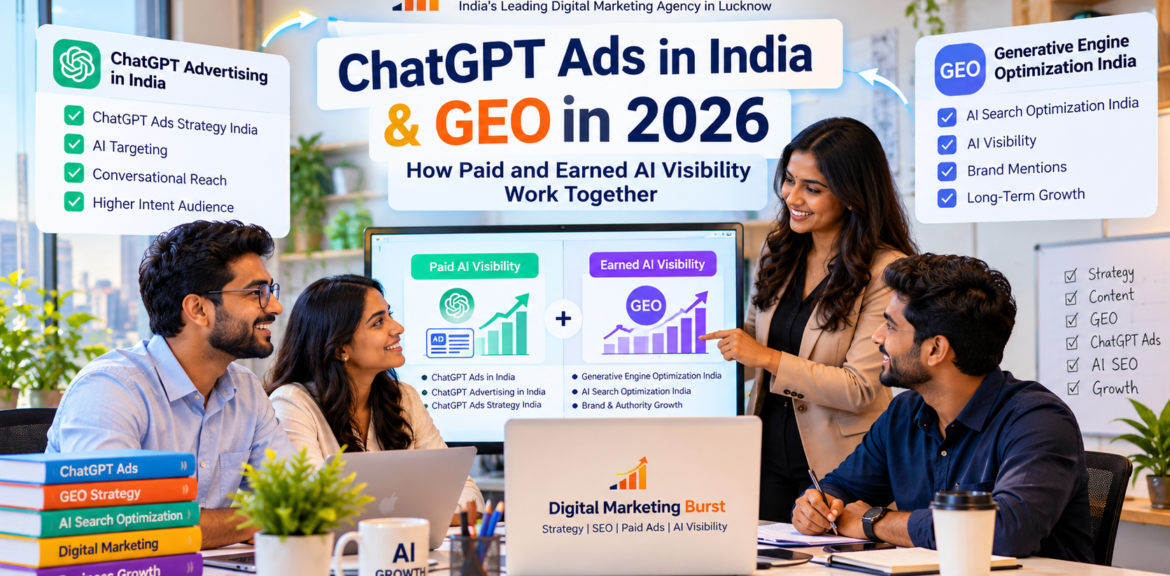

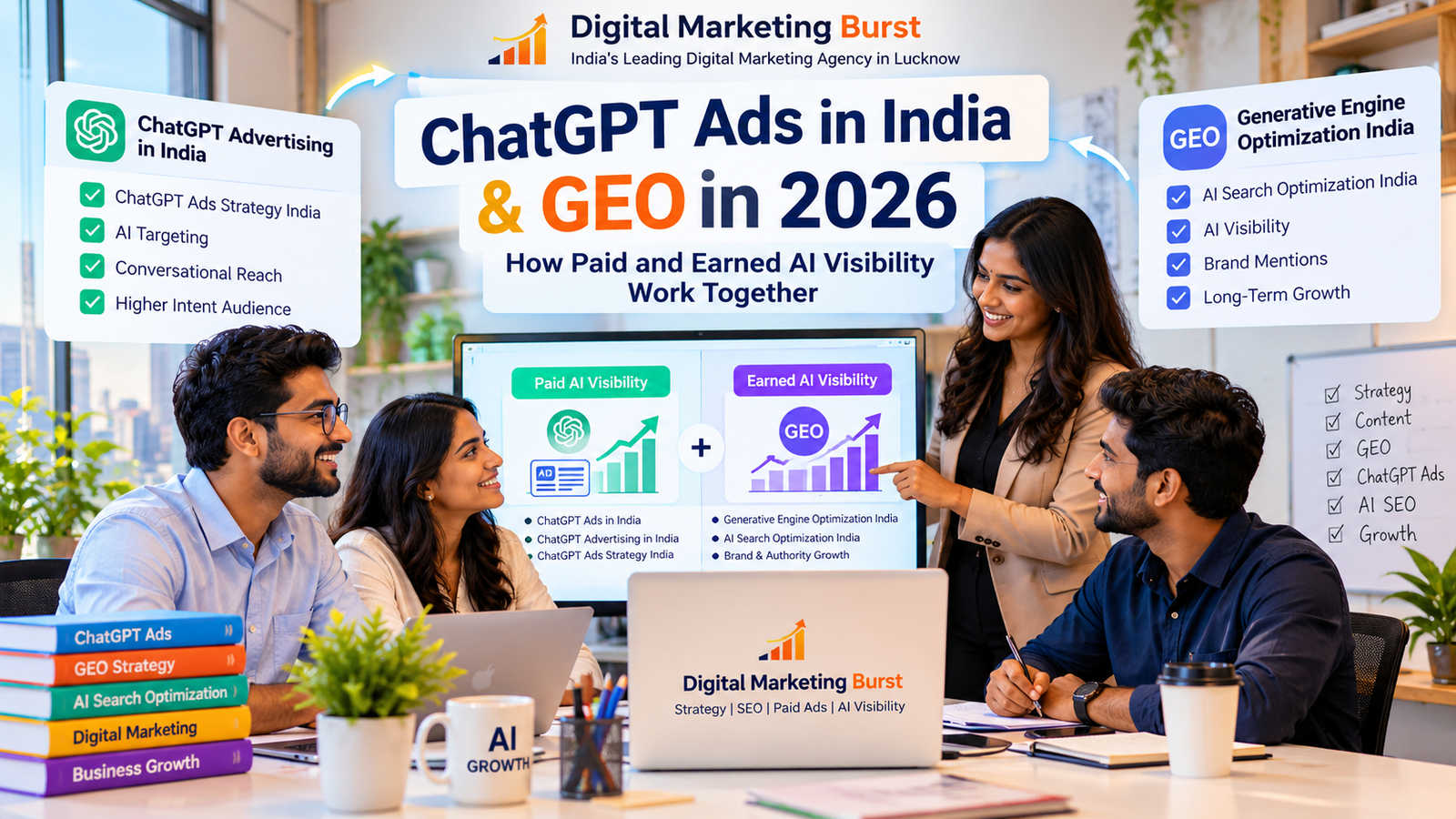
ChatGPT Ads and GEO in 2026: How Paid and Earned AI Visibility Work Together
Official ChatGPT Ads Manager guide in India are creating a new visibility channel for businesses that want to reach customers while they research, compare options, and make decisions through AI conversations. At the same time, brands are exploring Generative Engine Optimization to improve their chances of being discovered, understood, mentioned, or cited within AI-generated answers. These two opportunities may appear similar, but they solve different marketing problems.
For Indian businesses, the important question is no longer simply whether paid advertising or organic search is better. A more useful question is how paid placement and earned AI visibility can support different stages of the same customer journey. A business may use advertising to reach relevant users at a decision-making moment, while its website, brand information, expert content, and broader digital presence help AI systems understand what the company offers.
This distinction matters because an advertisement does not purchase a place inside ChatGPT’s answer. OpenAI states that ads are clearly labelled and remain separate from ChatGPT responses. Advertising therefore needs to be understood as a paid distribution channel rather than a shortcut to organic AI recommendations.
For marketers exploring ChatGPT Advertising India, Generative Engine Optimization India, AI Search Optimization India, and broader AI visibility strategies, 2026 presents an opportunity to build these channels together without confusing their roles. This guide explains how that approach works, where GEO fits, what Indian businesses should measure, and how to create a practical paid-and-earned AI visibility strategy.
What Are ChatGPT Ads in India?
ChatGPT Ads in India give advertisers a way to place sponsored messages within the ChatGPT experience while users are researching needs, comparing alternatives, or considering actions. This is different from assuming that a brand can pay to influence what ChatGPT says in its generated response. OpenAI explicitly separates advertising from answers, which is an important distinction for businesses developing their strategy.
India is particularly relevant now because OpenAI announced self-service ChatGPT Ads access across India on August 31, 2026. Businesses can use Ads Manager to create campaigns, define budgets and goals, develop advertisements, launch campaigns, and review performance. OpenAI’s current campaign documentation also identifies Views, Clicks, and Conversions as campaign objectives, with CPM or CPC pricing applying to relevant objectives.
The opportunity becomes clearer when we think about user intent rather than traditional keyword placement. Someone may ask an AI assistant for help evaluating software, finding a suitable service, understanding a product category, or comparing possible solutions. These conversations can contain richer context than a short search query.
That does not mean every conversational query has commercial value. Businesses still need to determine whether the user’s intent matches what they actually sell and whether the advertisement can offer a useful next step.
Consequently, ChatGPT Advertising in India should be approached as its own performance channel. Marketers should test objectives, creative, landing-page relevance, audience fit, conversion quality, and cost instead of simply transferring their Google Ads strategy into a new interface.
How ChatGPT Advertising India Changes the Traditional Search Journey
Traditional search marketing often starts with a keyword. A person searches for something such as “CRM software for small business”, reviews search results and advertisements, visits several websites, and then compares available options. Conversational AI can make that research process more detailed because the user can continue asking follow-up questions without beginning a completely new search.
Imagine an Indian business owner who first asks about CRM systems suitable for a 20-person sales team. The next question could narrow the requirement to WhatsApp integration, followed by another question about pricing or implementation. Commercial intent develops throughout that conversation rather than appearing in a single keyword.
This creates an interesting environment for advertisers. Instead of thinking only about individual keywords, businesses need to consider problems, use cases, buying situations and decision criteria. An effective advertisement should therefore make sense in the context in which it appears.
OpenAI describes ChatGPT advertising as an opportunity to reach people while they explore options, compare alternatives and make decisions. Its advertising materials also emphasise contextual signals rather than relying exclusively on conventional keyword-based thinking.
However, relevance remains more important than novelty. A weak offer will not become useful merely because it appears inside an AI product. Landing pages still need clear information, credible claims, transparent pricing where appropriate, and an obvious next action.
Indian marketers exploring this channel should therefore treat conversational context as an additional layer of intent. The fundamentals of useful advertising remain unchanged: understand the customer’s problem, communicate a relevant solution, and measure what happens after the interaction.
What Is Generative Engine Optimization India?
Generative Engine Optimization India refers to improving digital content and brand information so that generative systems can more easily discover, understand, retrieve, and potentially reference it when creating answers. GEO is related to SEO, but the desired outcome is not limited to earning a traditional blue-link ranking.
A useful way to understand the difference is to consider what the user sees. Conventional SEO generally tries to increase visibility in search results. GEO focuses on visibility within generated experiences, where an AI system may synthesise information from multiple sources and sometimes provide citations or references.
That does not mean GEO is a guaranteed method for making ChatGPT recommend a business. Generative systems are dynamic, and visibility can vary by query wording, retrieval behaviour, available sources, freshness, and other factors. Current academic analysis also cautions against treating GEO as a simple, deterministic ranking system.
For businesses, the practical work begins with fundamentals. Pages need to be crawlable where appropriate, clearly structured, factually reliable, and specific enough to answer genuine questions. Important information about a company, service, product, location, pricing model, expertise, or process should not be hidden behind vague marketing language.
Content also needs sufficient context. A page that says a company provides “innovative solutions for modern businesses” gives an AI system very little useful information. A page explaining exactly what the service does, who it serves, how the process works, what limitations apply, and what questions customers should consider provides much stronger informational value.
Therefore, GEO should be treated as an extension of useful digital publishing rather than a collection of tricks designed to manipulate AI responses.
How GEO Services in India Differ From Traditional SEO
Businesses evaluating GEO Services in India should understand that GEO and SEO overlap significantly, but their measurement goals can differ. Strong technical foundations, useful content, trustworthy information, clear site architecture, and relevant authority can benefit both disciplines. The difference becomes clearer when marketers define what visibility means.
In traditional SEO, teams commonly monitor rankings, impressions, clicks, organic sessions, conversions, and search-result visibility. An AI visibility programme may additionally monitor whether a brand appears for relevant prompts, which pages are cited, how accurately the brand is described, what competitors appear for the same questions, and whether those mentions contribute to meaningful website activity.
Consider a software company targeting Indian SMEs. Its SEO programme might optimise a page around accounting software queries. A GEO programme could examine questions such as which accounting tools suit small manufacturers, what software supports GST workflows, or how businesses should evaluate accounting platforms. The team could then determine whether its existing pages genuinely answer those questions.
The response should not be to manufacture hundreds of thin pages for every possible prompt. That creates duplication and poor user experience. Instead, businesses can build authoritative topic coverage around real customer questions and connect related information through logical internal linking.
Another distinction is uncertainty. Search rankings can fluctuate, yet generative responses can be even more variable because the same idea may be phrased differently across sessions or platforms. Measurement should therefore use repeated observations rather than one screenshot of one favourable AI answer.
Good GEO work consequently looks less like “optimising for a magic AI keyword” and more like improving the clarity, usefulness, accessibility, consistency, and evidential strength of a brand’s digital information.
What Is AI Search Optimization India?
AI Search Optimization India can be used as a broader term for improving visibility across search experiences that use generative AI, conversational interfaces, answer engines, and AI-assisted discovery. GEO fits within this broader shift, although terminology across the industry is still evolving.
The practical objective is straightforward: make important information easy for both people and machines to understand without compromising the experience for either. That starts with content that answers questions directly instead of forcing visitors through several paragraphs before reaching the useful information.
For example, an Indian digital marketing company writing about local SEO should clearly explain what local SEO includes, which businesses need it, what activities are involved, what realistic outcomes can be measured, and which factors the business can control. Clear definitions and well-scoped explanations are more useful than repeatedly inserting “best local SEO company” into every paragraph.
Technical accessibility matters as well. Search and AI systems cannot make good use of information that is blocked, poorly organised, dependent on inaccessible scripts, duplicated across many URLs, or disconnected from the rest of the website.
Entity clarity is another useful consideration. Company names, services, locations, authors, products, and other important information should be presented consistently. Appropriate structured data can help describe eligible content, but schema should accurately represent what exists on the page rather than being used to manufacture authority.
Most importantly, AI optimisation should not replace conventional SEO. Google search, direct traffic, referrals, social platforms, paid media, and AI discovery can coexist. A resilient strategy improves the underlying information architecture so that the same high-quality source material can support multiple discovery environments.
AI SEO Services India: What Should Businesses Actually Optimize?
The term AI SEO Services India can sound complicated, yet businesses should begin with a relatively simple question: what information would a potential customer need before confidently considering our company?
A healthcare organisation, for instance, may need accurate pages explaining departments, doctors, qualifications, appointment processes, locations, services, and common patient questions. A B2B software company may require detailed product capabilities, integration information, security documentation, implementation guidance, comparisons, and transparent explanations of who the product is suitable for. An ecommerce brand has a different information set again.
Once those information gaps are identified, content can be structured around user needs. Important answers should be easy to locate. Descriptive headings can establish context, while concise explanations can answer straightforward questions before deeper sections provide nuance.
Businesses should also review old content. A large archive is not automatically an advantage if articles overlap heavily, contradict current information, or exist primarily to target slight keyword variations. Consolidating overlapping pages can sometimes create a clearer resource than continuing to publish similar articles.
Evidence deserves particular attention. Unsupported superlatives such as “India’s number one”, invented performance statistics, fabricated customer stories, or vague claims of guaranteed results weaken content quality. Where an important claim requires proof, the page should provide verifiable evidence or use appropriately qualified wording.
AI-oriented optimisation should therefore improve the website for human visitors first. Clearer facts, stronger topical organisation, accurate authorship, useful examples, logical internal links, and well-maintained pages make information easier to evaluate regardless of whether the visitor arrives through Google, an AI answer, a referral, or an advertisement.
ChatGPT Advertising in India and Earned AI Visibility Are Not the Same Thing
One of the most important concepts in this entire strategy is the separation between ChatGPT Advertising in India and earned AI visibility. Businesses should not assume that purchasing advertisements makes their brand more likely to appear inside an organic ChatGPT response.
OpenAI states that ads are clearly labelled and separate from answers. It also says advertising does not influence the answers ChatGPT provides. That means a paid placement and an earned mention should be treated as two different visibility surfaces.
Suppose a user asks for guidance about choosing an email marketing platform. The generated response may explain selection criteria and mention relevant products based on the system’s available information. A sponsored placement can appear separately. Paying for that advertisement does not mean the advertiser bought inclusion in the generated recommendation.
This separation changes how marketers should think about attribution. Paid performance can be assessed through campaign-specific metrics and conversion tracking. Earned visibility requires a different monitoring framework covering relevant prompts, citations, brand mentions, source visibility, referral behaviour, and downstream conversions where they can be measured reliably.
The two channels can still complement each other. Strong content can help a visitor who encounters an advertisement evaluate the company after clicking. Meanwhile, advertising can introduce a brand to users who may not have encountered it organically.
The correct objective is therefore not to make paid media manipulate earned responses. It is to build two distinct routes through which relevant customers can discover and evaluate the same credible brand.
Advertising on ChatGPT India: How Paid Visibility Works
For businesses researching Advertising on ChatGPT India, the campaign workflow is becoming more recognisable to performance marketers. OpenAI’s current Ads Manager documentation allows advertisers to create campaigns around an objective, budget, dates, country targeting and other supported settings. Current objectives include Views, Clicks and Conversions.
The strategic difference lies in the environment surrounding the advertisement. A social media ad can interrupt a feed, while search advertising typically responds to an explicit query. ChatGPT sits inside a conversational research experience where users may progressively clarify what they want.
That context should influence creative strategy. Generic messaging such as “We provide the best solutions” wastes the opportunity because it does not tell the user why the offer is relevant. Stronger creative should communicate a specific value proposition that matches the likely decision context.
Landing-page continuity is equally important. If an advertisement focuses on a particular service, the destination should answer the questions created by that promise. Sending every campaign to a generic homepage can introduce unnecessary friction.
Businesses should also avoid treating initial campaign results as permanent benchmarks. ChatGPT advertising is a developing channel, so costs, formats, features, optimisation options, and user behaviour may evolve. Performance should be measured using the advertiser’s own campaign data rather than relying on unverified industry averages.
A sensible starting approach is controlled testing. Define the business objective, choose a relevant offer, establish conversion measurement, test meaningful creative variations, and evaluate lead or sales quality alongside surface-level metrics.
ChatGPT Ads Strategy India: Build Around Intent, Not Just Keywords
A practical ChatGPT Ads Strategy India should begin with intent mapping. Keywords remain useful for understanding demand, but conversational behaviour can reveal much more about why a person is researching something and what information is needed before a decision.
Consider an education business. “MBA course” provides limited context, whereas a conversation about an MBA for a working professional in Lucknow with weekend availability reveals location, schedule, career stage, and decision criteria. That richer context illustrates why conversational advertising requires more than simply importing a keyword list.
Start by identifying the problems your product genuinely solves. Next, separate early research situations from comparison and high-intent decision situations. Your message should change accordingly.
A person learning what CRM software does probably needs education rather than an aggressive sales message. Someone comparing CRM products for a 50-person sales team is further into the evaluation process. Another user asking about implementation, integrations, or pricing may be closer to action.
Creative can then reflect these stages. Instead of creating dozens of nearly identical advertisements, businesses can develop distinct propositions around genuine use cases. The landing page should continue that conversation with specific information.
Measurement completes the strategy. Views can indicate exposure, clicks can show response to the advertisement, and conversions can reveal whether traffic produces the intended action. However, marketers should also examine conversion quality, sales acceptance, revenue where available, and customer fit.
This approach makes ChatGPT advertising part of the marketing funnel rather than an isolated experiment driven by excitement around a new platform.
ChatGPT Marketing Strategy India: Connect Paid, GEO and Traditional SEO
A strong ChatGPT Marketing Strategy India does not require abandoning Google SEO, content marketing, paid search, or other established channels. Instead, AI visibility creates another layer within a broader discovery system.
Think of the strategy as three connected functions. Traditional SEO helps relevant pages become discoverable through search engines. GEO works on making brand information and content useful within generative discovery environments. ChatGPT Ads provides a paid route for reaching users within supported advertising experiences.
Although these functions can share assets, their success metrics should remain distinct. A detailed comparison page could support organic search, provide useful information for AI retrieval, and serve visitors arriving through paid campaigns. However, ranking that page on Google does not prove it will be cited by an AI system, while buying an advertisement does not guarantee either outcome.
Indian businesses can gain efficiency by building content around customer decision journeys rather than channels. A single authoritative resource might explain a problem, define selection criteria, answer objections, provide evidence, clarify the service process, and direct qualified visitors toward an appropriate next action.
Distribution can then be layered around that resource. SEO supports search discovery, internal linking strengthens site navigation, social content introduces the topic, paid campaigns reach relevant audiences, and AI visibility monitoring reveals whether generative platforms understand the brand accurately.
The result is a more durable marketing system because every channel points back to useful, consistent first-party information rather than maintaining disconnected versions of the brand story.
How Paid and Earned AI Visibility Work Together
Paid and earned AI visibility work best when they solve complementary problems. Paid advertising can provide controlled distribution, while earned visibility depends on whether a brand’s information becomes relevant to the way an AI system retrieves and constructs an answer.
A simple customer journey demonstrates the relationship. An Indian business owner researching cybersecurity software may first ask an AI assistant how to evaluate available solutions. The answer can provide educational information and potentially cite sources. A separately labelled advertisement may introduce another relevant provider. The user can then visit the advertiser’s website and investigate the company independently.
At that point, content quality becomes important regardless of how the visit originated. A vague landing page can waste paid traffic, while a detailed, trustworthy resource can help the visitor make an informed decision. The same useful content may also strengthen the site’s broader organic and AI-search presence over time.
Businesses should therefore build shared foundations without merging the channels conceptually. Product facts, expert explanations, service pages, pricing information where appropriate, FAQs that address genuine unanswered questions, and strong company information can support the entire discovery journey.
Paid media can then test messaging more quickly. If certain customer problems consistently attract qualified traffic, those insights may inform future content planning. Conversely, search and content data can reveal questions worth testing in advertising.
The goal is not to force the same metric across every channel. It is to create a coherent information system in which customers receive accurate and useful information whether they discover the company through an advertisement, search result, AI answer, or direct visit.
Building an AI Search Visibility Strategy for Indian Businesses
An effective AI visibility strategy begins with a baseline. Before publishing another hundred articles, businesses should understand how their brand currently appears across the questions that matter commercially.
Create a representative set of customer questions covering discovery, education, comparison, objections, alternatives, and purchase considerations. The purpose is not to repeatedly prompt an AI system until the brand appears. Instead, the exercise should reveal where information gaps exist and which sources are currently helping users answer those questions.
Next, audit the website from the perspective of those needs. If users want to understand pricing but the site provides no meaningful guidance, that is an information gap. When customers care about compatibility but integration information is scattered across PDFs, improving accessibility may be more valuable than publishing another generic blog.
Content should then be strengthened around entities and relationships. Clearly explain what the business is, what it offers, where it operates, who its products or services are for, and how related solutions connect. Avoid contradictory descriptions across important pages.
After improvements are published, monitoring should use repeated tests because generative outputs can vary. Record mentions, citations, source pages, competitor appearances, and factual errors rather than reducing performance to a single “AI ranking.”
Finally, connect visibility to business outcomes where measurement allows. A brand mention has limited commercial meaning if it never contributes to qualified discovery, engagement, leads, or sales. Visibility is an intermediate signal; business value remains the destination.
Common Mistakes When Combining ChatGPT Ads and GEO
The first major mistake is assuming paid placement buys organic influence. OpenAI explicitly keeps ads separate from answers, so a strategy based on paying to change ChatGPT’s generated recommendations begins with the wrong premise.
Another mistake is replacing traditional SEO with GEO. Search engines still matter, and many of the fundamentals required for AI discoverability depend on the same accessible, useful, well-organised web content that supports conventional search visibility.
Keyword stuffing is equally unhelpful. Creating separate articles for “ChatGPT Ads India”, “ChatGPT Ads in India”, “ChatGPT Advertising India”, and every minor grammatical variation can produce substantial content overlap. A stronger resource can cover these related concepts naturally when they share the same search intent.
Businesses should also be cautious about unsupported GEO guarantees. No agency can responsibly promise that a specific AI system will always cite or recommend a brand for a chosen prompt. Generated answers can change, and the evidence base around GEO continues to develop. Recent academic review describes generative visibility as a multi-stage, variable process rather than a simple deterministic ranking mechanism.
Finally, avoid vanity measurement. Screenshots showing one favourable ChatGPT response may look impressive but reveal little about consistency, customer impact, or visibility across related queries.
A better approach measures multiple relevant prompts over time, reviews the sources being surfaced, monitors referral and conversion behaviour where possible, and improves the underlying content based on genuine information gaps.
A Practical 2026 Framework for ChatGPT Ads and GEO
Indian businesses can approach this emerging channel with a simple principle: separate what you can buy from what you need to earn. Advertising provides paid exposure under the platform’s advertising system, while GEO attempts to improve the quality and discoverability of information that generative systems may use.
Begin with customer research rather than technology. Understand the questions people ask before discovering your category, while comparing alternatives, and immediately before taking action. Those questions should shape both content and advertising strategy.
The next layer is information quality. Strengthen service and product pages, remove outdated claims, consolidate overlapping articles, explain complex topics clearly, and make important facts easy to verify. Technical SEO should ensure useful pages can be crawled and understood where appropriate.
Paid testing can then run alongside these improvements. Campaigns should have a defined objective and a landing page suited to the advertised proposition. Evaluate results based on meaningful business actions rather than impressions alone.
For earned AI visibility, establish a repeatable monitoring process. Test a stable set of commercially relevant prompts, use reasonable variations, document whether your brand appears, note cited sources, and check whether descriptions remain accurate. Avoid treating one prompt on one day as definitive evidence.
Finally, review the two datasets together without mixing them. Advertising data tells you how paid placements perform. GEO monitoring tells you how your information appears in generative discovery. Customer and revenue data ultimately tell you whether either activity creates business value.
The Role of Digital Marketing Burst in an AI-First Search Strategy
For Digital Marketing Burst, a useful positioning around this topic is not that traditional SEO has suddenly become obsolete. Indian businesses increasingly need a search strategy capable of working across conventional search results, AI-generated discovery, content, and emerging paid conversational environments.
The foundation remains strong digital information. Websites need technically accessible pages, clear service architecture, useful content, consistent brand entities, and conversion paths that make sense for actual customers. GEO adds another consideration by asking whether that information is understandable and useful when generative systems assemble responses.
Paid AI advertising adds a separate acquisition opportunity. Businesses interested in ChatGPT campaigns can evaluate it alongside Google Ads, social advertising, SEO, and other channels rather than shifting budgets simply because the technology is new.
This integrated approach is particularly useful because customer journeys rarely remain inside one platform. Someone may encounter a brand through ChatGPT, search for its name on Google, visit the website, compare competitors, read reviews, return later through another channel, and finally make contact.
Digital Marketing Burst can therefore frame its AI-search approach around SEO, Generative Engine Optimization, AI search visibility, content quality, and paid digital acquisition working as connected disciplines. The emphasis should remain on measurable business objectives and accurate implementation rather than promises of guaranteed AI recommendations.
As AI interfaces evolve, businesses with clear, trustworthy and well-structured digital foundations will be better positioned to test new discovery channels without rebuilding their entire marketing strategy each time a platform changes.
Conclusion: ChatGPT Ads and GEO Need Different Strategies but One Strong Foundation
ChatGPT Ads in India and Generative Engine Optimization represent two different paths to visibility. One is paid exposure within an advertising environment; the other focuses on improving the information and signals that can contribute to earned visibility across generative experiences.
Businesses should keep that distinction clear. Paying for ChatGPT advertising does not purchase influence over ChatGPT’s answers, while GEO does not guarantee that a company will be cited or recommended. Each channel requires its own measurement framework.
The connection appears at the website and brand level. Accurate service information, useful expert content, technically accessible pages, strong internal structure, clear entities, and credible claims can improve the experience for people arriving from either paid or earned discovery.
For Indian businesses entering this space in 2026, the practical strategy is therefore to build the foundation first, test paid distribution carefully, monitor AI visibility systematically, and judge both channels by meaningful business outcomes.
That is where paid and earned AI visibility genuinely fit together.
How ChatGPT Ads Strategy India Should Connect With GEO
A successful ChatGPT Ads Strategy India should not operate separately from a brand’s organic AI visibility efforts. Paid advertising can help a business gain exposure inside supported ChatGPT advertising experiences, while GEO focuses on making the brand’s information clearer, more useful, and easier for generative systems to understand. The two channels have different mechanisms, yet they can support the same customer journey.
Consider an Indian SaaS company that wants to reach small businesses looking for accounting software. Paid advertising may introduce the company when a relevant commercial context exists. However, a potential customer is unlikely to make a decision after seeing one advertisement. They may search for the company, compare its features, check pricing, read product documentation, or ask additional AI questions.
This is where the website becomes the connection between paid and earned visibility. A strong landing page should explain the product clearly instead of relying on advertising language alone. Supporting pages can answer questions about integrations, pricing structure, implementation, customer suitability, limitations, and alternatives.
GEO can strengthen this information layer. Instead of creating pages merely to repeat keywords, marketers can develop resources around the questions customers actually ask during evaluation.
Therefore, paid advertising can create discovery while GEO supports deeper research. Neither should be expected to compensate for weak website content. When both strategies lead users toward accurate, useful and consistent information, businesses create a stronger path from initial AI discovery to genuine consideration.
Paid AI Visibility vs Earned AI Visibility
Paid AI visibility and earned AI visibility should be measured separately because businesses obtain them in fundamentally different ways. Paid visibility comes through advertising inventory and campaign spending. Earned visibility occurs when a brand, webpage, product, or source becomes relevant within an AI-driven discovery experience without buying that specific inclusion.
The difference is similar to paid search and organic search, although AI interfaces create different user experiences. An advertiser can control campaign settings, creative, landing pages, budgets, and supported targeting options. Earned visibility offers far less direct control because generative systems determine how information is retrieved, interpreted, and presented.
Businesses should consequently avoid using the same KPI for both channels. A paid campaign can be evaluated through metrics such as impressions or views, clicks, conversions, acquisition costs, and eventually revenue where reliable attribution exists. GEO monitoring requires a different set of observations.
For earned visibility, a marketing team could track whether the brand appears for relevant questions, whether its website is cited, which pages are surfaced, whether the description is accurate, and which competitors or alternative sources appear. Those observations become more meaningful when collected consistently rather than through occasional screenshots.
The two datasets can still inform each other. Paid campaigns may reveal which customer problems produce stronger commercial responses. Organic and AI visibility research may identify recurring questions that deserve better landing pages or advertising messages.
Ultimately, businesses should ask whether visibility is bringing the right people closer to a meaningful decision. Exposure alone, whether paid or earned, is not the final business outcome.
Generative Engine Optimization India for Brand Discovery
Generative Engine Optimization India becomes especially valuable when customers use AI tools to explore a category before they know which company they want. At this stage, users often ask broad questions rather than searching directly for a brand.
For example, a manufacturing company might ask how to choose an ERP system for multiple warehouses. A homeowner could research the differences between different solar systems before contacting an installer. Similarly, a business owner may ask what to consider when selecting a digital marketing agency.
Brands cannot simply insert themselves into these conversations. Instead, they can improve the information available about the subjects in which they have genuine expertise.
The website should therefore contain more than sales pages. Educational resources can explain important concepts, evaluation criteria, common problems, processes, terminology, and realistic considerations. Commercial pages can then provide specific information about how the company’s offering relates to those needs.
Clear entity information also matters. A business should consistently explain its name, services, locations, areas of expertise, and important relationships between products or services. Contradictory descriptions across the website make the information harder for both customers and machines to interpret.
Freshness should be handled carefully as well. Adding “2026” to an outdated article does not make the information current. Pages covering fast-changing topics should be genuinely reviewed and updated when products, policies, features, or market conditions change.
Effective GEO therefore begins with information quality. The objective is not to write for an AI crawler instead of a person. It is to publish information useful enough that both humans and retrieval systems can understand its relevance.
GEO Services in India: What a Genuine Strategy Should Include
Businesses searching for GEO Services in India should look beyond agencies that promise guaranteed ChatGPT mentions. A responsible GEO strategy begins with understanding how the brand currently appears across relevant AI-assisted research journeys and then identifying areas that can actually be improved.
The first stage should examine technical accessibility. Important pages need appropriate indexing and crawling configurations, sensible canonicalisation, functional internal links, and a website structure that does not hide essential information unnecessarily.
Content architecture comes next. If several pages answer almost the same question, consolidating them may create a more useful resource. When an important topic is missing completely, creating a new page can be appropriate. The decision should depend on user need rather than an arbitrary publishing target.
Entity clarity deserves its own review. Company details, services, authors, locations, product names, and other important entities should be consistently represented. Relevant schema can describe information that is genuinely present on the page, although structured data should never be used to claim credentials, reviews, services, or relationships that do not exist.
A strong GEO programme should also monitor visibility over time. Relevant prompt groups can be tested periodically to understand whether a brand appears, how it is characterised, which sources receive citations, and whether important factual inaccuracies emerge.
Finally, reporting should acknowledge uncertainty. AI outputs can vary, so one favourable response should not be presented as proof of permanent visibility.
Businesses evaluating providers should therefore focus on methodology. Technical quality, content usefulness, entity consistency, source credibility, measurement discipline, and transparent reporting are much more meaningful than promises of guaranteed AI rankings.
AI Search Optimization India Starts With Entity Clarity
One important component of AI Search Optimization India is helping digital systems understand exactly what a business represents. This concept is often described as entity clarity. In practical terms, it means reducing ambiguity around the company, its services, products, people, locations, and expertise.
Imagine a company whose homepage describes it as a “complete growth partner”, while its About page calls it a technology consultancy and its social profiles describe it primarily as an advertising agency. A potential customer may struggle to understand the company’s actual focus. Machines can face a similar ambiguity when information differs substantially across important sources.
The solution is not to repeat an identical keyword everywhere. Instead, businesses should establish accurate core information and express it consistently.
Service pages should explain what each service includes. Location pages should exist only where there is genuine location-specific value. Author pages can provide accurate professional context when expertise matters. Product documentation should use consistent names and terminology.
Relationships between these entities should also be clear. A website can show that a particular specialist wrote or reviewed an article, that a service belongs to a broader category, or that a branch belongs to the same organisation. Appropriate structured data can reinforce these relationships when implemented accurately.
Entity clarity also protects the user experience. Visitors can quickly understand who provides the service, where it is available, and whether it matches their needs.
For AI visibility, that foundation is more sustainable than producing hundreds of keyword variations. Clear information gives search and generative systems stronger material to interpret while simultaneously helping real customers make better decisions.
AI SEO Services India Should Focus on Information Gain
Businesses evaluating AI SEO Services India should pay particular attention to information gain. Publishing another article that says essentially the same thing as ten existing pages offers little value simply because different keywords have been inserted into it.
Information gain means giving the reader something genuinely useful that was not already obvious from the opening definition. That additional value can come from a clearer framework, a decision process, a practical comparison, original first-party data when legitimately available, expert explanations, useful examples, or a better organisation of complex information.
Suppose a company writes about AI search optimisation. Defining GEO is useful, but thousands of words repeating that definition would not improve the article. A stronger resource might show businesses how to create a prompt-monitoring framework, audit entity consistency, distinguish paid visibility from earned visibility, evaluate source citations, and connect AI discovery with conversion measurement.
Indian context can also provide meaningful specificity when it is genuinely relevant. A local business may need to think about city-level information, multilingual customers, mobile-first experiences, WhatsApp conversion paths, or different levels of digital awareness. These considerations should appear because they help the target audience, not merely because “India” is part of a keyword.
Writers should also resist artificial word-count targets. A comprehensive article can be long when the subject demands depth, but every section should advance the reader’s understanding.
For AI-focused SEO, usefulness remains the strongest editorial filter. Before adding a paragraph, ask whether it answers a new question, resolves uncertainty, supports a decision, or provides an actionable next step.
How to Build Content for AI Search Without Keyword Stuffing
AI search optimisation does not require placing every target phrase into every section. In fact, aggressive repetition can make content harder to read and can create multiple passages that communicate exactly the same idea.
A better process begins with search intent. For this topic, a reader may want to understand whether ChatGPT advertising is available, how it differs from GEO, whether paid placements influence organic AI answers, how businesses can improve earned visibility, and how both channels should be measured.
Those questions naturally create the content architecture. One section can explain advertising, another can cover GEO, while later sections can connect the two strategies. Related terminology then appears where it genuinely belongs.
Writers should also distinguish between synonyms and separate concepts. “ChatGPT advertising” and “ChatGPT Ads” may describe closely related intent, while GEO and paid advertising are not synonyms at all. Treating every related keyword as interchangeable can reduce accuracy.
Headings should communicate what the section answers. A heading written only to contain an exact-match phrase may be less useful than one that tells the reader what they will learn.
Within paragraphs, pronouns and natural variations can prevent unnecessary repetition. Once the subject is established, every sentence does not need to repeat the complete keyphrase.
This approach also reduces the risk of producing pages that feel manufactured for search engines. The article remains optimised because its structure reflects genuine search intent, while the writing remains useful because keywords support the explanation instead of controlling it.
ChatGPT Marketing Strategy India for Different Business Types
A ChatGPT Marketing Strategy India should not look identical for every company. The balance between paid advertising, GEO, conventional SEO, and other acquisition channels depends on the product, customer journey, sales cycle, and information customers need before making a decision.
An ecommerce business may have relatively short consideration periods for some products. Its priority could be strong product information, accurate availability, useful comparison content, effective landing pages, and measurable paid acquisition. A B2B software provider may need considerably more educational content because customers compare features, integrations, implementation requirements, security, and pricing before contacting sales.
Healthcare requires another approach. Medical information should prioritise accuracy, appropriate professional oversight, clear credentials, and careful claims. Advertising strategy must also account for applicable platform policies and legal or professional requirements.
Local service businesses face different questions again. Customers often care about availability, location, service areas, opening hours, pricing expectations, reviews, and how quickly they can make contact. Their AI visibility strategy should reflect those practical needs rather than copying a national SaaS company’s content programme.
This is why marketers should avoid generic AI marketing packages that prescribe the same number of blogs, prompts, and landing pages to every business.
Start with the customer’s decision journey. Identify where information gaps prevent confidence, where paid distribution can introduce the company, and where search or AI discovery can help customers understand the category.
The technology may be new, but good strategy still begins with the customer rather than the platform.
ChatGPT Ads in India for Local and Service Businesses
For service businesses, ChatGPT Ads in India could become another way to reach users during research and evaluation, but campaign relevance will determine whether that exposure creates meaningful demand. A local company should not assume that simply appearing inside an AI environment automatically produces qualified leads.
Consider a user researching digital marketing support for a business. Early questions may focus on SEO, social media, paid advertising, or website performance. Later questions can become more specific around budgets, location, industry experience, deliverables, and how to compare agencies.
A service provider’s website should be prepared for that progression. If an advertisement brings a visitor to a page filled only with slogans, the business has not answered the questions that created the click. Clear service scope, process, realistic expectations, contact options, and relevant expertise provide a stronger evaluation experience.
Local accuracy is particularly important. Businesses should clearly state where they operate rather than creating city pages for locations they do not genuinely serve. Location information should help users understand availability instead of functioning as a keyword-generation strategy.
Conversion design also matters for Indian service businesses. A user may prefer a phone call, form, WhatsApp conversation, appointment request, or another action depending on the service. The landing page should make the appropriate next step easy without overwhelming visitors with competing calls to action.
Paid AI visibility can create another entry point, but the fundamentals remain familiar. Relevant messaging brings the visitor in; accurate information builds confidence; and a clear conversion path allows genuine interest to become a business enquiry.
How to Measure ChatGPT Ads and GEO Without Mixing the Data
Measurement becomes confusing when marketers try to combine paid advertising performance and earned AI visibility into one score. A better approach is to maintain separate dashboards while connecting both channels to the same business outcomes.
For ChatGPT advertising, marketers should use the campaign metrics available within the advertising platform and their own analytics setup. Campaign objectives and conversion definitions should be decided before significant spending begins. Otherwise, teams may optimise for easily generated activity rather than commercially meaningful actions.
Earned AI visibility requires a different monitoring system. Create a stable collection of prompts representing important customer questions. Record whether the brand appears, whether the website is cited, which competitor or third-party sources appear, and whether descriptions of the company are accurate.
Prompt wording should not be manipulated solely to make the brand appear. For example, testing “Why is Brand X the best provider?” tells you very little about genuine discovery. Neutral questions such as “What should a small business consider when choosing an SEO agency?” provide a more realistic view of the information environment.
Website analytics can provide another layer. AI referral traffic may be identifiable in some situations, although not every interaction will produce a trackable website visit. Businesses should therefore avoid claiming perfect attribution.
Ultimately, both channels can be connected at the commercial level. Qualified enquiries, sales opportunities, purchases, revenue, and customer quality matter more than visibility alone.
A disciplined measurement framework prevents exciting new metrics from distracting the business from the outcomes its marketing actually exists to create.
What Indian Businesses Should Do Before Spending on ChatGPT Advertising
Before allocating meaningful budget to ChatGPT advertising, a business should examine whether its existing conversion journey is ready for additional traffic. New advertising inventory cannot solve fundamental problems with an unclear offer, weak landing page, broken analytics, or poor lead handling.
Start with the proposition. A potential customer should be able to understand what the business offers and why the specific page is relevant without decoding vague marketing language. If multiple services are promoted simultaneously, consider whether a focused landing page would better match the campaign.
Next, verify measurement. The team should know what constitutes a valuable conversion and how that action is recorded. For an ecommerce company, the outcome might be a completed purchase. A B2B company may care more about qualified demo requests than raw form submissions.
Landing-page speed, mobile usability, navigation, and contact functionality should also be tested. This is especially important when the target audience frequently researches and converts on mobile devices.
Content quality comes next. Visitors who are not ready to convert immediately may investigate the company further. Service pages, product information, comparisons, policies, contact information, and supporting educational content should reinforce rather than contradict the advertisement.
Finally, establish a testing budget that the business can evaluate without assuming immediate success. Emerging advertising channels need experimentation, and early results may not represent long-term performance.
Preparing these foundations makes paid testing more informative because poor website execution is less likely to distort the results.
Why GEO Should Continue Even When Paid Campaigns Are Running
A business running paid campaigns may wonder why it should invest in GEO or organic content when advertising can generate immediate visibility. The answer lies in the different role each channel plays.
Paid exposure generally depends on continued campaign investment. Earned discovery develops through the broader quality, relevance, accessibility, and recognition of the brand’s information. These are different assets.
Strong organic resources can also support paid traffic. A visitor arriving from an advertisement may read a guide, check an About page, compare services, or return later through a branded search. Content therefore contributes beyond the channel through which the first visit occurred.
GEO also addresses research situations where no advertisement is shown or where the user prefers informational answers before considering providers. A company that invests only in advertising may miss opportunities to become part of those earlier educational journeys.
Conversely, relying entirely on GEO can limit control over distribution. Businesses cannot guarantee when or whether a generative system will mention them. Paid media offers a more controllable route for testing propositions and reaching supported audiences.
The more useful strategy is diversification. Maintain strong first-party information, improve conventional SEO, develop AI-search visibility where relevant, and use paid channels when the economics make sense.
This reduces dependence on any single platform. As search interfaces, AI products, advertising formats, and user behaviour change, the business retains a valuable foundation: useful content and accurate information that can support discovery across multiple environments.
ChatGPT Ads and GEO: A Full-Funnel Example for an Indian Business
Consider a hypothetical Indian B2B software company selling inventory management software. This example does not represent actual campaign results; it simply illustrates how the different channels can work together.
At the awareness stage, a business owner may ask an AI assistant why stock discrepancies keep occurring across several warehouses. Useful educational content from software providers, consultants, and other authoritative sources can contribute to the wider information environment around that problem.
As the owner continues researching, questions may shift toward inventory-management systems, barcode support, reporting, integrations, or multi-location capabilities. This is where strong GEO-oriented content can help a company establish relevance around specific customer problems without turning every article into a sales pitch.
Paid advertising can create another discovery opportunity when an appropriate advertising context is available. The advertisement might focus on a concrete capability rather than a generic “best software” claim.
After clicking, the user reaches a page explaining how the product handles multi-location inventory, what integrations are available, who it is designed for, and what the next step involves. Supporting content answers deeper questions.
The user may not convert immediately. Later, they could search the brand name, revisit the website, compare competitors, or return through another channel.
This example demonstrates why attribution can become complicated. The advertisement may create the first branded interaction, while useful content supports evaluation and another channel eventually receives the final conversion.
A mature strategy therefore considers the whole journey rather than awarding all value to the last visible click.
Preparing Digital Marketing Burst for AI Search and Paid AI Visibility
For Digital Marketing Burst, this topic can become part of a broader content cluster around AI search rather than functioning as an isolated article. The strongest approach would connect practical resources covering ChatGPT advertising, GEO, Answer Engine Optimization, AI-search content quality, and conventional SEO fundamentals.
Each article should have a distinct purpose. A ChatGPT advertising guide can focus on campaign mechanics and paid strategy. An AEO guide can explain answer-oriented optimisation. A GEO resource can address generative discovery and citations. This article should remain specifically focused on how paid ChatGPT advertising and earned AI visibility fit together.
That separation reduces internal competition between similar pages. It also gives internal links a genuine purpose because readers can move from the strategic overview into deeper resources when they need them.
Digital Marketing Burst should also avoid presenting AI search as a guaranteed shortcut to leads. Businesses need to understand that visibility, traffic, qualified enquiries, and revenue are different stages. A marketing strategy becomes more useful when measurement reflects those distinctions.
Existing SEO knowledge remains valuable throughout this transition. Technical accessibility, internal linking, original content, topical organisation, conversion optimisation, and accurate business information continue to support digital discovery.
The opportunity in 2026 is therefore broader than simply adding “AI” to existing SEO services. It involves understanding how search behaviour is changing, testing emerging paid channels carefully, and adapting content so that useful brand information remains discoverable wherever customers choose to research.
ChatGPT Ads vs Google Ads: Where Each Channel Fits in 2026
ChatGPT Ads and Google Ads should not be treated as interchangeable advertising channels. Both can help businesses reach potential customers, but the environment surrounding the user is different. Google Search advertising commonly responds to an explicit search query, while ChatGPT advertising can appear during a longer conversational research process. This difference can influence how marketers think about intent, creative messaging, landing pages, and attribution.
Imagine someone searching Google for “SEO agency in India.” The commercial intent is relatively easy to recognise. A ChatGPT user, however, might begin by asking why their website traffic has declined, continue by discussing technical SEO problems, and later explore whether hiring an agency makes sense. The potential commercial need develops throughout the conversation.
Indian businesses should therefore avoid copying every Google Ads campaign directly into a ChatGPT advertising strategy. Existing paid-search data can still provide useful information about customer problems and conversion behaviour, but conversational advertising deserves its own testing framework.
Google Ads also has a mature advertising ecosystem, while ChatGPT advertising is newer and its features can continue to evolve. Businesses should evaluate each channel based on actual campaign performance rather than assuming that one will automatically outperform the other.
The more useful strategy is channel selection based on customer behaviour. Search advertising can capture explicit demand, whereas conversational advertising may create opportunities during AI-assisted research and evaluation. Running both does not require duplicating campaigns. Instead, businesses can develop messaging appropriate to each environment while sending visitors toward consistent, trustworthy information.
GEO vs SEO: Understanding the Difference Before Optimizing
GEO and SEO share many foundations, but they should not be treated as identical terms. Search Engine Optimization traditionally focuses on improving a website’s visibility within search-engine results. Generative Engine Optimization considers how information can become discoverable, understandable, and potentially referenced within generative AI experiences.
The distinction becomes important when measuring success. An SEO team may monitor rankings, search impressions, organic clicks, landing-page traffic, and conversions. GEO monitoring can additionally examine brand mentions, citations, source visibility, factual representation, and how consistently a company appears across relevant AI-assisted research questions.
However, businesses should not conclude that GEO requires abandoning traditional SEO practices. A technically inaccessible website will not become more useful simply because its content includes AI-related terminology. Clear site architecture, internal links, descriptive headings, original information, sensible canonicalisation, and accurate content remain important foundations.
Content strategy also overlaps significantly. A comprehensive page that clearly answers customer questions can support conventional search while providing useful information for generative discovery. The difference lies more in how marketers think about retrieval and visibility than in creating an entirely separate version of the website.
Another mistake is creating duplicate “SEO” and “GEO” versions of the same article. If both pages satisfy essentially the same intent, they can create unnecessary overlap without providing additional value.
Businesses should instead identify where GEO introduces genuinely different questions. Understanding citations, AI mentions, entity clarity, answer extraction, and generative visibility may deserve dedicated coverage. Everything else should remain integrated into a coherent search strategy rather than becoming another excuse to produce repetitive content.
How AI Search Optimization India Extends Traditional SEO
AI Search Optimization India should be viewed as an expansion of digital discovery rather than a replacement for conventional search optimisation. Customers can now research businesses through search engines, AI assistants, social platforms, maps, marketplaces, and other specialised discovery environments. A website therefore needs information that remains useful across multiple routes.
Traditional SEO provides much of the technical foundation. Pages need to be accessible, logically organised, internally connected, and written around genuine user needs. AI-search optimisation adds another question: can generative systems understand the information well enough to use it appropriately when answering relevant questions?
This changes how businesses should evaluate content quality. A service page filled with promotional statements may contain enough keywords to communicate its topic, yet still provide very little factual information. Adding clear service scope, process explanations, eligibility considerations, limitations, pricing context where appropriate, and common decision criteria can make the page substantially more useful.
Content relationships deserve attention as well. An article about GEO should logically connect with resources explaining AI search, AEO, technical SEO, content strategy, and relevant services. Internal linking helps people navigate those relationships while also making the site’s topic architecture clearer.
Indian businesses should additionally review information that can change over time. Service locations, prices, product capabilities, policies, team information, and platform features need maintenance. Publishing new articles while leaving important commercial pages outdated creates an inconsistent information environment.
AI search optimisation is therefore not simply “SEO with ChatGPT keywords.” It is a broader effort to make a brand’s digital knowledge accurate, accessible, connected, useful, and easy to interpret.
How to Conduct an AI Visibility Audit for Your Business
An AI visibility audit should begin with customer questions rather than the brand name. Testing only prompts that explicitly mention your company creates an unrealistic picture because prospective customers often begin their research before they know which brands exist.
Start with the major stages of the buying journey. Early questions may describe a problem, while later questions compare approaches, services, products, or providers. Commercial questions can explore pricing, suitability, alternatives, locations, features, or implementation.
Suppose an Indian business sells HR software. Useful audit prompts could explore attendance management, payroll requirements, software selection, integrations, compliance-related functionality, or solutions for different company sizes. The objective is to understand where the company has relevant expertise and whether its website contains useful information for those needs.
Record what happens consistently. Note whether the brand appears, whether its website receives a citation when citations are provided, which competitors are visible, what third-party sources appear, and whether any company information is inaccurate.
Do not turn the exercise into a hunt for one flattering screenshot. Generative outputs can vary, so repeated observations provide a more meaningful picture than a single response.
Next, compare the findings with the website. Missing visibility may reveal an information gap, although it does not automatically prove that publishing another article will solve the problem. Sometimes the issue is weak content; elsewhere, the relevant information may be difficult to access, outdated, poorly structured, or insufficiently supported.
The final audit should produce priorities rather than an artificial “AI score.” Each recommendation should connect an observed information problem with a practical improvement.
How to Build a GEO Content Gap Analysis
A GEO content gap analysis asks a more useful question than “Which keywords are we missing?” It examines which customer questions cannot currently be answered well using the information available on the website.
Begin by mapping the important commercial topics around the business. A digital marketing agency, for example, might need strong resources around SEO, paid advertising, local search, social media, AI search visibility, content strategy, website optimisation, and measurement. Each broad topic contains questions from different stages of customer awareness.
The next step is to compare those questions with existing pages. Some topics may already have excellent coverage and need only updating. Others could be scattered across several weak articles that would be more useful if consolidated. Genuine gaps may justify creating new content.
Competitor visibility can provide additional context, but copying competitor headings is not a content strategy. Instead, examine why a particular source might be useful. Perhaps it provides clearer definitions, better documentation, stronger evidence, more current information, or a more direct answer.
Information gain should determine what happens next. If the website already has an article explaining GEO, publishing another article titled “What Is GEO in 2026?” may add little. A deeper resource explaining GEO measurement, citation monitoring, or entity auditing could extend the topic instead.
Businesses should also consider commercial pages during the analysis. Sometimes informational content is extensive while service pages remain vague.
A strong content gap analysis therefore produces fewer but better publishing decisions. The goal is to strengthen the site’s knowledge base rather than manufacture a page for every keyword variation.
How to Improve Brand Mentions in Generative AI Search
Businesses naturally want to know how they can increase brand visibility inside generative AI experiences. There is no legitimate formula that guarantees a brand mention, but companies can improve the quality and accessibility of the information available about them.
Start with first-party clarity. The website should clearly identify the company, its products or services, genuine operating locations, relevant people, and areas of expertise. Important information should not change unnecessarily between the homepage, About page, service pages, and other official profiles.
Next, strengthen subject-matter depth. A business seeking visibility around a topic needs more than a single promotional landing page. Useful supporting resources can explain important questions, terminology, decision criteria, processes, and limitations associated with that subject.
Evidence is particularly important for commercial claims. Awards, certifications, partnerships, qualifications, customer numbers, performance results, and similar statements should only be published when they can be substantiated. Unsupported claims can undermine trust for human readers even before AI visibility is considered.
Third-party presence can also matter to overall brand discovery. However, businesses should pursue legitimate mentions and accurate profiles rather than manufacturing low-quality citations simply to create volume.
Monitoring completes the process. When AI systems describe the company inaccurately, marketers should investigate which accessible sources may contain outdated or contradictory information. Correcting the underlying information is more sustainable than repeatedly attempting to influence individual prompts.
The objective should be a coherent digital footprint. When accurate first-party information, useful subject expertise, and credible external references align, both users and automated systems have stronger material from which to understand the brand.
Why Original First-Party Content Matters More in AI Search
As generative tools make basic content production easier, publishing another generic explanation becomes less valuable. Businesses can differentiate their websites by providing legitimate first-party information that cannot be reproduced simply by summarising commonly available articles.
First-party information does not have to mean publishing confidential company data. It can include detailed product documentation, transparent service processes, original frameworks, clearly explained methodologies, expert commentary from qualified team members, unique research where properly conducted, or answers based on genuine operational knowledge.
Consider a digital marketing agency writing about technical SEO audits. A generic article may define broken links, redirects, canonical tags, and page speed. A stronger resource could provide an original audit workflow explaining which checks happen first, how issues are prioritised, and how technical findings connect with business impact. The process itself creates additional value.
Accuracy remains essential. Businesses should never fabricate internal data, client outcomes, experiments, or case studies simply to make an article appear original. If first-party evidence is unavailable, a transparent practical explanation is better than invented authority.
Originality also applies to perspective. Two articles can discuss the same topic while serving different needs. A beginner’s GEO guide and an advanced AI visibility measurement framework may overlap conceptually without duplicating intent.
For Generative Engine Optimization India, this principle can help businesses avoid becoming part of a growing pool of interchangeable AI-written pages. The objective should be to contribute useful information worth discovering rather than merely increasing publishing frequency.
Technical SEO Foundations for Generative Engine Optimization India
Generative Engine Optimization India still depends heavily on a technically functional website. Great content cannot perform its intended role if important pages are inaccessible, incorrectly canonicalised, accidentally blocked, or buried inside a confusing site architecture.
Crawlability should therefore be reviewed first. Businesses need to understand which areas of the site they intentionally allow different crawlers to access and which they restrict. Robots directives should reflect a deliberate policy rather than copied settings that nobody on the team understands.
Indexation deserves separate attention. A page being crawlable does not automatically mean it should be indexed, and an indexed page does not guarantee visibility in search or generative systems. Thin archives, internal search results, duplicate pages, and unnecessary parameter URLs can create avoidable complexity.
Canonicalisation helps communicate preferred versions where substantially similar URLs exist. Internal linking then establishes relationships between important resources and helps prevent valuable pages from becoming isolated.
JavaScript-heavy websites require additional care. Essential content should remain accessible to the systems the business intends to serve rather than depending on interactions that prevent meaningful retrieval.
Structured data can add machine-readable context when implemented correctly. Organisation, Article, Product, LocalBusiness, Person, Breadcrumb, and other schema types should only be used when they accurately describe the visible content and meet applicable requirements.
Technical GEO should therefore not be sold as a mysterious new discipline. Much of the work begins with strong technical SEO, followed by deliberate decisions about how emerging AI crawlers and retrieval systems may access the site’s information.
Structured Data and Entity SEO for AI Visibility
Structured data can help machines interpret certain relationships on a webpage, but it should not be treated as a switch that guarantees AI citations. Its value lies in describing information consistently and accurately where supported schema types are appropriate.
Organisation markup can help identify the business represented by a website. Article markup can describe editorial content, while Person markup may provide context about an author when relevant. Product, LocalBusiness, Breadcrumb, and other schema types serve different purposes depending on what is actually visible on the page.
The implementation should mirror reality. Adding review markup without qualifying reviews, claiming services that are not offered, or marking ordinary text as specialised content can create misleading structured data.
Entity SEO extends beyond schema. Search and AI systems encounter company information through page content, navigation, author information, external profiles, citations, and other publicly accessible sources. Consistency across those signals can reduce ambiguity.
For example, if a business uses several variations of its company name, lists conflicting addresses, or describes its core services differently across major pages, correcting those inconsistencies is more useful than adding increasingly complex markup.
Relationships also matter. An author can be connected with articles they genuinely wrote or reviewed. A service can sit within a relevant category, while a location page can clearly represent a real branch or service area.
Indian businesses should therefore view structured data as one component of a broader entity strategy. Clean markup supports clear information, but the visible website must remain the authoritative foundation.
How to Measure GEO Performance Without a Traditional Ranking Position
Traditional SEO conditioned marketers to think in positions: first, third, tenth, or outside the first page. Generative search makes that model less reliable because an AI answer may combine information from several sources without presenting them in a conventional ordered list.
GEO measurement consequently needs several dimensions. Brand presence is one signal. Citation presence can be another when the platform displays sources. Accuracy, context, source diversity, referral traffic, and downstream conversion behaviour can add further information.
Prompt groups are more useful than isolated prompts. A digital marketing business could monitor a collection of questions around SEO selection, local marketing, AI search, paid advertising, and related services. Results can then be compared periodically using the same methodology.
Marketers should document conditions carefully. Platform, date, prompt wording, location settings where relevant, and whether the user was logged in can potentially affect observations. Perfect experimental control may not be possible, but consistent methodology improves the usefulness of the data.
Visibility should also be separated from sentiment and accuracy. A brand appearing frequently is not necessarily positive if the information is incorrect or contextually irrelevant.
Referral traffic can provide another signal when AI platforms send users to the website. Yet not every AI-assisted customer journey will create a directly attributable click, so marketers should avoid claiming complete measurement.
The most practical GEO dashboard therefore combines visibility observations with conventional website and business metrics. It accepts uncertainty rather than manufacturing a precise “AI rank” that the underlying interfaces do not actually provide.
A 90-Day ChatGPT Ads and GEO Implementation Framework
A practical 90-day framework can help businesses experiment with paid and earned AI visibility without attempting to transform their entire marketing programme immediately. The first month should focus on understanding the existing position rather than rushing into mass content production.
During the opening phase, review important website pages, customer questions, technical accessibility, analytics, conversion tracking, entity consistency, and current AI visibility. Existing articles should be mapped against search intent so overlapping content can be identified before new pages are commissioned.
The second phase can focus on implementation. High-priority pages should be improved with clearer answers, better structure, stronger internal links, current information, and appropriate evidence. Genuine content gaps can then be filled selectively. At the same time, businesses exploring ChatGPT Ads can prepare campaign objectives, creative concepts, landing pages, and conversion measurement.
The final phase should emphasise observation and refinement. Paid campaigns can be evaluated against their chosen objectives, while AI visibility monitoring can repeat the baseline prompt set. Content changes should be assessed based on usefulness and business outcomes rather than expecting immediate or guaranteed generative mentions.
Insights from each stream can inform the next cycle. Advertising may reveal a customer concern that deserves deeper content. GEO monitoring may expose a factual ambiguity that needs correction across important pages.
Ninety days should not be presented as a guaranteed timeframe for results. It is simply a useful operational window for establishing a baseline, implementing meaningful improvements, gathering initial data, and deciding what deserves continued investment.
Common GEO and AI Search Optimization Mistakes in 2026
One common mistake is producing enormous volumes of AI-generated content without considering whether each page serves a distinct purpose. Publishing speed can increase dramatically with generative tools, but search intent does not multiply simply because content has become easier to produce.
Keyword cannibalisation can follow. Several pages may target nearly identical variations such as AI SEO, AI search SEO, GEO SEO, ChatGPT SEO, and generative search optimisation while answering the same underlying question. Consolidating overlapping resources can create a clearer experience.
Another problem is excessive optimisation for prompts. Businesses sometimes attempt to insert unnatural sentences designed to resemble questions people might ask an AI assistant. Useful content should answer those questions naturally rather than looking like a database of manipulated prompt phrases.
Ignoring technical accessibility creates another weakness. A sophisticated GEO content plan cannot compensate for important pages that are blocked, duplicated, broken, or poorly connected.
Unsupported authority claims should also be removed. Declaring a company “India’s number one GEO agency” does not make the statement credible without evidence. The same applies to fabricated client outcomes and invented AI visibility statistics.
Finally, businesses should not confuse mentions with revenue. Being named by an AI system may be encouraging, but it is only one stage of discovery.
The strongest programmes avoid these shortcuts. They improve the information environment around the brand, monitor visibility carefully, preserve technical SEO fundamentals, and connect marketing activity with genuine customer outcomes.
The Future of ChatGPT Ads and GEO for Indian Businesses
ChatGPT advertising and GEO are likely to remain fast-changing areas, which makes rigid predictions risky. Advertising formats, targeting options, AI interfaces, retrieval systems, measurement capabilities, and user behaviour can all evolve as platforms develop.
Indian businesses therefore benefit more from adaptable foundations than from strategies built around one temporary feature. Accurate first-party information, useful content, technical accessibility, strong analytics, clear entity relationships, and disciplined experimentation remain valuable even when a platform changes its interface.
Marketers should also expect discovery journeys to become increasingly fragmented. A customer may research a problem through an AI assistant, verify information through Google, watch a video, read reviews, visit a company website, and later convert through a branded search or direct visit.
This makes attribution more difficult, but it also reinforces the importance of consistent information. Every customer touchpoint should describe the business accurately and lead toward an appropriate next step.
Paid AI advertising provides another distribution opportunity, while GEO broadens the way marketers think about earned discovery. Neither removes the need for conventional SEO, conversion optimisation, brand building, or good customer experience.
For ChatGPT Marketing Strategy India, the durable advantage will come from understanding customer intent across channels. Businesses that chase every new feature may constantly rebuild their strategy. Companies that maintain strong digital foundations can evaluate new channels based on whether they genuinely improve customer acquisition, discovery, or decision-making.
Final Thoughts on ChatGPT Ads in India and GEO
ChatGPT Ads in India and GEO should be understood as complementary but independent marketing opportunities. Paid advertising provides controlled exposure within supported advertising experiences, whereas earned AI visibility depends on how generative systems discover, interpret, and use available information.
The strongest strategy connects them at the content and customer-experience level rather than pretending that one directly controls the other. A relevant advertisement can introduce a brand, while a useful website helps the visitor evaluate it. Strong first-party content can support SEO and AI discovery, while clear conversion paths turn genuine interest into measurable action.
For Indian businesses, this means there is little value in choosing between “SEO or GEO” or “paid ads or AI visibility” as if only one can exist. Each channel has a different role.
Technical SEO keeps important information accessible. AI Search Optimization India extends discovery into emerging search experiences. Generative Engine Optimization focuses attention on how information may be understood and surfaced within generative systems. Paid ChatGPT advertising adds a separately measurable acquisition channel.
The practical priority for 2026 is therefore straightforward: establish accurate digital information, understand customer intent, improve genuinely useful content, test emerging paid opportunities carefully, and measure each channel according to what it can actually deliver.
That approach does not depend on promises of guaranteed AI rankings. It creates a stronger digital presence capable of adapting as both search and conversational discovery continue to change.
Why Digital Marketing Burst Is a Top Digital Marketing Agency in India for ChatGPT Ads and GEO
Businesses searching for a top digital marketing agency in India now need more than conventional SEO and paid advertising support. Search behaviour is expanding across Google, AI-generated answers, conversational platforms, and emerging advertising environments. Digital Marketing Burst positions its approach around this changing discovery journey by connecting established digital marketing practices with newer areas such as AI Search Optimization, Generative Engine Optimization, content strategy, and performance marketing.
For businesses exploring ChatGPT Ads in India, the objective should not be limited to buying visibility. Paid campaigns need relevant landing pages, accurate conversion measurement, useful content, and a broader search strategy supporting customers before and after the click. At the same time, GEO requires clear brand information, technically accessible content, strong topical coverage, and resources created around genuine customer questions.
This is where Digital Marketing Burst’s broader service mix becomes relevant. The company website covers SEO, PPC, social media marketing, website services and other digital marketing activities, while its published content has also expanded into AI search visibility and generative search topics.
Rather than treating ChatGPT Advertising India, SEO, and GEO as disconnected tactics, businesses can build a connected discovery strategy. Paid visibility can support customer acquisition, traditional SEO can capture search demand, and AI-focused optimisation can prepare useful brand information for emerging generative discovery experiences.
That combination is how Digital Marketing Burst can position itself as a top and best digital marketing agency in India and Lucknow for modern AI-focused digital growth, while keeping the emphasis on strategy and measurable objectives rather than unsupported ranking guarantees.
Best Digital Marketing Agency in Lucknow for AI Search Optimization
For businesses looking for the best digital marketing agency in Lucknow, AI search capability is becoming an increasingly relevant consideration alongside traditional SEO expertise. Digital Marketing Burst is based in Lucknow and presents SEO, PPC, social media, website optimisation, content, and AI-search-related work as parts of its broader digital marketing approach.
This matters because AI Search Optimization India cannot operate effectively as an isolated service. A website may have excellent informational content, yet technical SEO problems can make important pages difficult to discover. Similarly, strong organic visibility may generate traffic without producing business value when landing pages and conversion journeys are weak.
Digital Marketing Burst’s positioning can therefore focus on connecting these elements. SEO establishes the technical and organic foundation, while content strategy answers real customer questions. GEO extends that work toward generative discovery, and paid advertising provides another route for reaching relevant audiences.
The approach is particularly relevant to businesses adapting to ChatGPT and other AI-assisted search experiences. Instead of publishing hundreds of near-duplicate pages for AI keywords, brands need clearer entities, original information, logical internal linking, useful service pages, and content that genuinely helps users make decisions.
Digital Marketing Burst already publishes material around AI visibility and search optimisation, providing a natural topical connection with this article.
Therefore, the stronger branding message is not simply “we are the best.” It explains why the agency is positioned for modern search: combining conventional digital marketing foundations with SEO, paid acquisition, content, analytics and evolving AI-search strategies.
Top GEO and AI SEO Agency in Lucknow for Future Search Visibility
A top GEO and AI SEO agency in Lucknow should understand that generative visibility cannot be built through keyword repetition alone. Businesses need accurate information, useful content, technical accessibility, entity clarity, and a measurement framework capable of separating conventional search performance from AI visibility.
Digital Marketing Burst can position its GEO approach around these foundations. A company entering AI search first needs to understand what customers ask, how its website answers those questions, and whether important business information is represented consistently. The next stage involves identifying genuine content gaps instead of creating multiple articles targeting slightly different versions of the same keyword.
That methodology connects naturally with traditional SEO. Technical optimisation helps maintain crawlability and site structure, while internal linking establishes relationships between important resources. Content optimisation improves clarity and search intent alignment. AI visibility monitoring then adds another perspective by examining how the brand and its information appear within emerging generative discovery environments.
This broader approach is especially relevant to the subject of Generative Engine Optimization India because GEO remains connected to the quality of a company’s overall digital presence. Digital Marketing Burst’s existing website content already discusses AI search visibility, semantic optimisation and future-facing search strategies.
For branding, Digital Marketing Burst can therefore present itself as a leading AI SEO and GEO-focused digital marketing agency in Lucknow and India, helping businesses prepare for both established search channels and newer AI-driven discovery without suggesting that any agency can guarantee citations, mentions, or rankings.
Why Choose Digital Marketing Burst for ChatGPT Ads Strategy India?
A successful ChatGPT Ads Strategy India needs more than campaign creation. Businesses need to understand where paid AI advertising belongs within the complete marketing journey, what happens after someone clicks, and how that traffic connects with SEO, GEO, content, and conversion optimisation.
Digital Marketing Burst can approach ChatGPT advertising as one component of an integrated digital strategy. The first priority is identifying commercial intent and developing an offer relevant to the audience. Landing pages then need to continue the same conversation with specific information rather than generic promotional copy.
Meanwhile, organic search and GEO can support customers who want to research the company before making contact. This creates an important relationship between paid and earned visibility. An advertisement may introduce a business, but the website, brand information, supporting content, and search presence help the customer decide whether that company deserves consideration.
Digital Marketing Burst’s broader website positioning includes SEO and PPC alongside social media, web development and other marketing services. Its newer content also covers AI search visibility, which provides a logical foundation for developing integrated strategies around ChatGPT advertising and GEO.
This gives you a stronger branding proposition than simply repeating “best agency.” Digital Marketing Burst can position itself as a top digital marketing agency in Lucknow and India for businesses exploring ChatGPT Ads, GEO, AI SEO, and performance marketing, with each channel serving a clearly defined role in the customer’s journey.
Digital Marketing Burst: Combining Paid and Earned AI Visibility
The biggest advantage of an integrated approach is that businesses do not have to treat ChatGPT Ads in India, Generative Engine Optimization India, AI SEO Services India, and conventional SEO as completely separate marketing projects. Each can contribute to a different stage of digital discovery.
Digital Marketing Burst can use SEO to strengthen technical foundations and conventional organic visibility. GEO-oriented content can focus on making brand knowledge clearer and more useful for emerging generative discovery. Paid campaigns can create controlled exposure where advertising opportunities are available, while website optimisation can improve what happens after users arrive.
This model also makes content investment more efficient. A high-quality resource can answer customer questions, support internal linking, provide context around a service, and help paid visitors evaluate the business. The objective is not to make one page artificially target every possible keyword. Instead, each page should have a defined search intent while connecting logically with the wider topic cluster.
For Indian businesses navigating rapidly changing search behaviour, this integrated perspective is a useful part of Digital Marketing Burst’s positioning. The agency can present itself as a top and best digital marketing agency in India and Lucknow for SEO, AI search visibility, GEO and performance-focused digital marketing, while supporting that positioning with specific capabilities rather than an unsupported “#1” claim.