






Digital marketing in 2026 demands clear strategy, strong content, and a user-first approach. Brands must use the latest digital marketing tips to stay ahead in a competitive market. To increase website traffic fast, you need better content, improved SEO, and stronger engagement. Understanding how to get more website traffic becomes easier when you update your methods regularly. Focus on the best SEO strategy 2026, because search behaviour is changing quickly. Apply the best SEO techniques 2026 to boost visibility and authority. Social platforms also matter, so use effective social media marketing ideas to grow faster. Add more creative social media ideas to connect with a wider audience. Strong content still leads the way. Use seo friendly blog writing to build trust and improve rankings. Learn how to write SEO blogs that are simple, clear, and helpful. These methods prepare your brand for long-term digital success in 2026.


AI Overviews Have Spread to Most Big-Brand Searches: What It Means for Your SEO Strategy
AI Overviews Have Spread to Most Big-Brand Searches: What It Means for Your SEO Strategy
AI Overviews branded searches now deserve attention alongside traditional brand rankings. Recent studies found Google’s generated summaries appearing across a substantial share of the brand queries they tracked. That changes what a business needs to inspect when searching its own name: the website listing, the summary above or around it, and the sources supporting that summary.
The headline needs context. Research on selected global brands or US desktop results does not establish that most Indian brand searches now show an AI Overview. It also does not prove that every affected website has lost traffic.
For an Indian business, the useful starting point is its own results page. Is the company described correctly? Does Google distinguish it from similarly named organisations? Are the linked pages current, and can customers still reach the information they need?
This guide separates the evidence from the assumptions, then develops a practical audit process. The objective is to improve the accuracy and usefulness of your public information while measuring what happens to relevant searches and business outcomes.
Research reviewed on 10 October 2026. Search results and product features can change.
What Are AI Overviews for Brand Searches?
An AI Overview is a generated response within Google Search, accompanied by supporting links. Google describes it as a way to help users understand a topic and explore relevant information. AI Mode is a separate search experience; its responses and links should not be assumed to match an AI Overview. developers.google.com
A branded search contains a name that identifies a company, product, organisation or service. It might be the brand name alone, or the name combined with a question.
Examples include:
- A company’s exact name.
- A brand name followed by “pricing”.
- A product name followed by “warranty”.
- A hospital name followed by a location.
- A service provider’s name followed by “reviews”.
These searches have different purposes. Someone searching for a company’s login page needs a direct destination. A person asking about its services may want an explanation before visiting the website.
That distinction matters when evaluating a generated summary. A detailed answer is not automatically useful merely because it appears for a brand query. The assessment should begin with what the searcher is trying to accomplish.
Brand-Name Queries and Brand-Containing Queries Are Different
A bare brand-name query might be:
“[Brand name]”
A more specific branded query could be:
“[Brand name] refund policy India”
The first may require Google to interpret an ambiguous intention. The second identifies a particular task and market.
An audit that checks only the company name can miss problems on service, policy or location queries. Equally, a study covering many brand-containing phrases should not be described as a study of exact company names alone.
Keep these categories separate in your records. They help explain which parts of the customer journey need attention.
What the Latest Research Actually Shows
Two recent studies provide useful evidence of increased AI Overview presence, but they use different samples and methods.
| Research source | Sample or method | Reported observation |
|---|---|---|
| Ahrefs: exact brand-name panel | Weekly checks of 100 global brand names in US results | AI Overviews appeared for 63 names on 30 September, compared with five of 98 usable results on 1 July |
| Ahrefs: broader branded-keyword analysis | US desktop result crawls | Presence reached 82.91% on 29 September; September’s monthly average was 73.3% |
| DemandSphere | Daily tracked branded keywords across markets and devices | Presence moved from 26.12% on 1 September to 82.06% on 29 September |
Ahrefs published its findings on 2 October 2026. The exact-name panel and broader keyword analysis are separate datasets. DemandSphere’s study, published on 1 October, counts an Overview as present whether or not the searched brand is cited. These findings indicate expansion within the measured samples, not a universal rate for Indian searches. ahrefs.com
Why the Percentages Should Not Be Combined
The figures answer different questions.
The exact-name panel asks how many selected brand names produced an Overview at a checkpoint. The broader crawl analysis covers a larger collection of branded search results. DemandSphere’s series uses its own tracked keywords and collection settings.
A snapshot also differs from a monthly average. One shows conditions on a particular date; the other summarises a period containing variation.
Use a research number only with its source, date and scope. A statement such as “83% of Indian brand searches now have AI Overviews” would go beyond the evidence reviewed here.
For the same reason, averaging the studies would not produce a reliable global percentage. Different denominators cannot be made comparable simply by placing them in one calculation.
What the Research Does Not Establish
The expansion of a search feature is an observation about search results. It is not automatically a measurement of commercial impact.
An Overview-presence figure does not, by itself, establish:
- How many people searched those phrases.
- Whether the brand was accurately described.
- Whether the official website received a supporting link.
- Which link a customer selected.
- Whether enquiries or sales changed.
- Whether the same result appeared in another country or language.
These are separate questions requiring separate evidence.
A company could appear in a summary without receiving a link. Another could receive a citation to an outdated page. A third might have an accurate summary but a confusing contact page after the click.
The response should match the observed issue. Publishing additional blog posts is unlikely to correct every one of these situations.
Search-Result Observations Are Not Customer Counts
A tracked result records what a monitoring system observed under particular conditions. It should not be treated as a unique customer, a visit or an impression recorded for your website.
This becomes especially important when a dashboard contains large crawl totals. A large dataset can improve research coverage without measuring the number of buyers exposed to a particular company.
For business decisions, distinguish the search observation from the customer outcome:
“An Overview appeared during our check” is an observation.
“A customer arrived from Google and submitted an enquiry” is an outcome.
Connecting the two requires careful measurement rather than an assumption.
Why Indian Businesses Should Audit Their Own Results
The relevance of this development does not depend on every brand search displaying an Overview. A single inaccurate response on an important customer query can justify investigation.
Consider a hypothetical service business that accepts work in three cities. If its website also contains old statements suggesting nationwide local availability, customers may misunderstand the service area.
The corrective action begins with the contradictory public information. More keyword repetitions would leave the underlying problem intact.
A similar issue can arise when a company changes its name, relocates a branch or discontinues a product. Searchers need current information, while older pages may still describe a previous arrangement.
These examples illustrate audit priorities; they are not claims about results achieved by Digital Marketing Burst.
Location and Language Need Separate Checks
Google’s multilingual-search guidance explains that query language, location and other settings influence language matching. It also recognises that Indian users may type Hindi using Latin characters. developers.google.com
Build your test set around actual customer behaviour. For a business serving Hindi- and English-speaking customers, this may include:
- The official English brand name.
- A commonly used Hindi spelling.
- A familiar transliteration.
- The name combined with a branch location.
- The name combined with a customer’s question.
Do not generate dozens of variations purely to increase the size of the audit. Add a version when it represents a plausible query or a known source of confusion.
Record the conditions used for each check. Comparing different languages or locations without identifying them makes changes difficult to interpret.
Separate AI Overview Presence, Brand Mentions and Website Citations
AI Overviews brand visibility can refer to several different observations. A report becomes more useful when it names the specific one.
| Observation | Meaning | Follow-up question |
|---|---|---|
| Overview present | The feature appeared for the query | Did it help answer the searcher’s task? |
| Brand mentioned | The answer named the business | Was the correct organisation identified? |
| Official page cited | A supporting link pointed to an owned page | Was that page current and relevant? |
| External page cited | A link pointed elsewhere | Who published it, and what did it say? |
| Answer accurate | Checked statements matched verified facts | Were important qualifications retained? |
An answer can satisfy one condition and fail another. Brand visibility therefore needs a description, not just a yes-or-no score.
An External Domain Does Not Identify the Author
A YouTube link might point to the brand’s own channel or an independent creator. A LinkedIn result could be a company page, employee post or unrelated commentary.
Ahrefs identified Wikipedia, YouTube and LinkedIn among frequently cited external domains in its brand-name panel. That does not establish who owns every cited page or whether its content is accurate. ahrefs.com
Inspect the individual page before deciding what can be corrected. An owned profile can usually be reviewed internally. An independent publication requires a different response, such as a documented correction request where appropriate.
Treat critical opinions separately from factual errors. Disagreement with an assessment is not proof that the assessment contains incorrect information.
Build a Branded Query Inventory Before Making Changes
A useful audit begins with a list of searches that represent customer needs.
Start with your actual naming conventions, products, services and locations. Where query information is available, use it to refine the list rather than relying entirely on brainstorming.
Group the inventory by purpose:
| Query group | Illustrative pattern | Customer need |
|---|---|---|
| Identity | “[Brand]” | Understand which company this is |
| Navigation | “[Brand] official website” | Reach the correct destination |
| Location | “[Brand] Lucknow branch” | Find an applicable office |
| Service | “[Brand] SEO services” | Understand the offering |
| Price | “[Brand] pricing” | Evaluate cost and scope |
| Support | “[Brand] refund policy” | Resolve a specific issue |
| Reputation | “[Brand] reviews” | Assess independent feedback |
| Comparison | “[Brand] vs [alternative]” | Evaluate differences |
Include only categories relevant to the business. A company without a public pricing model should still explain how quotations work, but it does not need to invent a standard price table.
Prioritise Queries With a Clear Business Consequence
Start with queries where an error could prevent a customer from completing a task.
Examples include finding the correct branch, understanding an offer, identifying an official contact channel or locating a support policy.
Next, examine queries that influence evaluation: services, qualifications, pricing and comparisons. Broad identity searches belong in the audit too, but they should not consume all the attention.
A simple prioritisation note can explain:
“This query matters because customers use it to find the branch they can visit.”
That is more useful than labelling every brand phrase “high priority”.
Run a Repeatable AI Overviews Branded Searches Audit
Use the same collection process each time so that results can be compared.
Step 1: Record the Search Conditions
For every check, save:
- Exact query.
- Date and time.
- Country or observed location.
- Device type.
- Relevant language settings.
- Whether the check was manual or tool-based.
Where practical, use a consistent test environment. Still acknowledge that a controlled check cannot represent every user’s experience.
Do not change several conditions between checks and attribute the resulting difference to a Google update.
Step 2: Save the Answer and Supporting Links
Capture a dated screenshot when an Overview appears. Record the displayed wording and the individual supporting URLs.
An observation log could contain:
| Field | Example entry |
|---|---|
| Query | “[Brand] service areas” |
| Overview present | Yes |
| Brand correctly identified | Yes |
| Statement requiring review | “Available in every city” |
| Official source cited | Service-area page |
| External source cited | Directory listing |
| Evidence retained | Screenshot and source URLs |
The entries are illustrative. Use the actual observed answer rather than filling the sheet with assumed behaviour.
Step 3: Check Each Important Statement
Compare the answer with approved information.
Focus on statements customers may act on: location, availability, price, eligibility, ownership, credentials and policy conditions.
If an answer makes a broad claim, determine whether the evidence supports that breadth. “Serves selected locations” and “serves all locations” are materially different statements.
Mark uncertain information as unresolved. Do not replace an unclear claim with an equally unsupported correction.
Step 4: Inspect the Relevant Source Pages
Read the cited page and review its context. Look for dates, exceptions and distinctions that the summary may have omitted.
A useful finding might be:
“The current service page limits availability, but an older owned article still claims unrestricted coverage.”
Another might be:
“The source is accurate, but the generated answer omits a condition that changes who can use the offer.”
These findings require different actions. In the first case, correct the contradictory page. In the second, improve the clarity of the condition where appropriate and document the observed omission.
Step 5: Assign an Action and Owner
An audit should end with a decision.
Possible actions include correcting an owned page, updating a profile, checking a technical issue, requesting a factual correction from a publisher or continuing observation.
Name the responsible person and the evidence needed to close the issue. “Improve AI visibility” is too vague to function as a task.
For a broader reporting structure, refer to our AI Visibility Report Guide.
Create an Approved Brand Information Record
Before asking an editor to correct a summary’s source material, establish which facts are approved.
A working brand record can include:
| Information | Appropriate internal owner |
|---|---|
| Official and trading names | Management or administration |
| Products and services | Product or service lead |
| Locations and service areas | Operations |
| Prices and inclusions | Commercial team |
| Credentials and qualifications | Responsible subject expert |
| Refund and support policies | Customer service or policy owner |
| Website and contact channels | Digital or administrative team |
Keep the record specific. Separate an office location from a service area, a partner from an owner, and a starting price from a fixed package price.
The purpose is to make factual decisions easier. It is an editorial reference, not a special AI file required by Google.
Use Evidence Beside Promotional Language
A description such as “trusted service provider” does not tell a customer where the business operates or what the quoted package includes.
When a claim is measurable, retain the evidence. When it is a preference or positioning statement, avoid presenting it as an independently verified achievement.
For example, “we aim to make booking straightforward” is a statement of intent. “We are India’s highest-rated provider” requires a defined comparison and supporting data.
This distinction protects the usefulness of the source material.
Identify Contradictions Before Publishing More Content
Check the pages most likely to describe the business:
- Homepage.
- About page.
- Service and product pages.
- Location pages.
- Pricing and policy pages.
- Older announcements.
- Owned business profiles.
A simple comparison can reveal inconsistencies that a new blog post would not fix.
Suppose one page says a service is available in Lucknow, while another says it is available throughout India. Establish the actual coverage, update the conflicting pages and clarify exceptions where necessary.
Do not mechanically copy the same paragraph across every page. A location page and a pricing page answer different questions, even when they refer to the same business.
For the broader connection between these corrections and search planning, see our AI SEO Strategy Guide.
Decide Whether the Issue Is Content, Access or Measurement
Not every problem begins with wording.
A useful diagnosis separates three categories:
Content issue: Public information is missing, inconsistent, outdated or difficult to interpret.
Access issue: An important page may not be available to search systems as intended.
Measurement issue: The report combines unlike queries or treats an observation as a customer outcome.
Google states that a supporting page must be indexed and eligible for a search snippet to appear in its AI features. It does not require special AI schema or a new machine-readable file. Meeting those conditions does not guarantee inclusion. developers.google.com
If the problem is contradictory service information, begin with correction. If an important page is excluded unintentionally, investigate access. If the dashboard confuses brand mentions with website visits, repair the reporting definitions.
The diagnosis determines the next action.
Google AI Search Optimization Starts With Accurate Brand Information
Once you have recorded what appears for your branded queries, the next task is to improve the information you control.
Begin with the issue identified in the audit. If the problem is an incorrect service area, review the pages describing coverage. When a product explanation is outdated, correct the relevant product documentation. A missing official contact route calls for clearer contact information.
Avoid rewriting the entire website because one search result looks different. Broad changes can introduce new contradictions and make it difficult to understand which correction helped.
Create a working list with four fields:
| Field | What to record |
|---|---|
| Observed issue | The statement or information gap requiring attention |
| Relevant page | The owned page that should explain it |
| Required change | The specific correction or clarification |
| Approval owner | The person responsible for confirming accuracy |
This connects optimisation for Google AI search with practical editorial work. The aim is to make the public information easier to understand and verify, without promising that Google will adopt a particular description.
Correct the Fact Before Adjusting the Wording
A polished sentence cannot resolve uncertainty inside the business.
Suppose the sales team says a package includes video editing, while the published service page lists editing as an extra. Establish the actual offer before asking a writer to simplify the copy.
Likewise, confirm whether a location is an office, delivery area, partner facility or planned expansion. These distinctions affect what customers can reasonably expect.
An approved correction should state what is true now. Keep previous arrangements only where they remain useful as clearly dated history.
Improve the Homepage’s Explanation of the Business
A homepage should help an unfamiliar visitor identify the company and understand its purpose.
Review the first substantial description. Does it explain the business, its relevant audience and its offering? Can a reader distinguish it from another organisation with a similar name?
For a hypothetical packaging supplier, a useful opening might be:
“[Brand] supplies corrugated packaging for manufacturers and online retailers. Its product pages explain available formats, order requirements and delivery arrangements.”
This description provides context without inventing scale, awards or performance.
A paragraph dominated by “leading”, “trusted” and “innovative” may leave the central questions unanswered. Replace unnecessary promotional language with details that help customers evaluate suitability.
Keep the Main Description Consistent With Supporting Pages
The homepage does not need to explain every service. It should provide an accurate overview and link to the pages where specifics belong.
Check whether a broad homepage statement contradicts a narrower service page. “Complete marketing support” might sound appealing, but it becomes confusing if the business offers only a defined set of services.
Use headings and navigation that match what visitors can actually find. A link labelled “Pricing” should lead to meaningful pricing information or a clear explanation of how quotations are prepared.
Do not bury essential qualifications in a footer while making unrestricted claims near the top.
Write an About Page That Resolves Identity Questions
The About page is a suitable place to explain who the organisation is, how it is structured and what distinguishes its role.
Include relevant facts that can be verified:
- Official or trading name.
- The relationship between parent and subsidiary brands, if applicable.
- Current business activities.
- Relevant locations.
- Named leadership or subject experts where appropriate.
- A reliable route to contact the organisation.
Only include a founding date, professional qualification or award when it can be checked. If the business has changed names, explain the relationship clearly rather than assuming visitors already know the history.
Handle Similar Names Explicitly
Name ambiguity can arise when several organisations share familiar words.
Use contextual details to identify your business: its industry, location, official domain and offering. A clear explanation is more useful than repeatedly inserting the full company name into every sentence.
For example, a hypothetical company called “[Brand] Solutions” could explain that it develops warehouse-management software for distributors. That description helps distinguish it from a consultancy or recruitment business using similar wording.
If customers regularly confuse two branches or brands, address the distinction where it affects their task. Avoid adding a page about an imagined confusion that has no practical relevance.
Structure Service Pages Around Customer Decisions
A service page should explain what the customer is considering, rather than repeating a generic sales introduction.
Useful questions include:
- What work is included?
- Who is the service intended for?
- What information is needed before work begins?
- Which responsibilities remain with the customer?
- What affects the scope or quotation?
- What is excluded?
For a digital marketing service, “social media management” can cover different combinations of planning, production, publishing and reporting. State the actual arrangement.
A reader should not have to infer that video shoots are included because the page mentions reels. Similarly, an image count does not explain revision limits or approval responsibilities.
Use Concrete Scope Statements
Compare these hypothetical descriptions:
Vague:
“We provide complete social media solutions for every business.”
More useful:
“The proposed scope identifies the platforms, content formats, production requirements, approval process and reporting responsibilities before work begins.”
The second description explains how the engagement is defined. It avoids implying that every requirement is automatically included.
Where packages are standardised, list the current inclusions. Where scope varies, explain the factors used to prepare a proposal.
For AI Overviews branded searches, this also creates a clearer reference when an answer describes what the business offers. It cannot guarantee the wording of that answer, but it reduces ambiguity in the source material.
Make Location and Service-Area Information Precise
Location information deserves particular attention for Indian service businesses.
A registered address, customer-facing branch and service area describe different things. Present them separately when the distinction matters.
For example:
“The office is in Lucknow. Projects for customers in other locations are handled remotely unless an on-site arrangement is confirmed.”
Use this wording only when it accurately describes the business.
A transport operator, installation company or home-service provider may need a different explanation. State where a booking can begin, which locations are covered and what requires confirmation.
Remove Unsupported Nationwide Claims
Review phrases such as:
- “Available everywhere in India.”
- “Local service in every city.”
- “Any location, any time.”
- “Guaranteed immediate availability.”
If the business cannot fulfil those promises, replace them with an accurate coverage statement.
Do not use a general travel article to imply a local operating presence at its destination. A company can publish useful destination information without offering pickup there.
This is a customer-expectation issue as well as an editorial one. Clear coverage can prevent enquiries that the business cannot serve.
Give Each Location Page a Purpose
A location page should provide information specific to that location: address, contact arrangements, applicable services and any relevant visitor instructions.
Changing only the city name across otherwise identical pages creates little value for someone trying to decide where to go or what is available.
If there is no separate branch or meaningful location-specific information, consider whether a single service-area explanation answers the question better.
Choose the structure around the actual operating model, rather than a list of cities you would like to attract.
Clarify Prices, Conditions and Quotation Requirements
Price-related branded searches deserve an answer that helps the customer interpret the offer.
Distinguish among:
| Price type | What the page should explain |
|---|---|
| Fixed package | Current inclusions, exclusions and applicable conditions |
| Starting price | What the entry-level amount covers and what changes it |
| Custom quotation | The details required to calculate the proposed cost |
| Recurring fee | Billing period, scope and relevant commitments |
| Promotional price | Validity dates, eligibility and limitations |
Avoid placing a starting price beside wording that makes it look like the full cost of any project.
For custom services, explain what influences the quotation. Relevant factors might include production needs, project scope, location or the number of deliverables, depending on the business.
Keep Conditions Close to the Offer
A prominent price claim followed by distant or unreadable qualifications can create an incomplete impression.
Place the essential conditions where a visitor evaluates the price. Use clear language instead of relying entirely on a general “terms apply” statement.
For example, if a fee excludes advertising spend, say so beside the relevant package. When an installation price depends on a site assessment, explain that before the enquiry form.
The objective is informed evaluation. Do not invent a public price solely to make the page appear more complete.
Build Product and Policy Pages That Answer Specific Questions
A brand summary is only one part of the search journey. Customers also need accurate product specifications, warranty information, cancellation rules and support instructions.
Assign each subject to a suitable page.
A product page should identify the relevant model and explain its current characteristics. A policy page should distinguish the situations it covers and the steps a customer must follow.
Keep the language direct:
“To request cancellation, provide the booking reference and contact the stated support channel.”
The actual requirements will vary. Publish only the process your team is prepared to follow.
Separate Current Policies From Archived Announcements
An announcement about a temporary offer should not serve as the main explanation of a permanent policy.
When an offer expires, review whether the page still needs to be public. If it remains useful as an archive, make the expired status clear.
For changed policies, give the effective date and explain relevant applicability where necessary. Avoid silently replacing information when customers may need to understand which conditions applied to an earlier purchase.
A dated archive can be useful; an apparently current page containing expired instructions is confusing.
Review External Sources at the Page Level
Part 1 distinguished a cited domain from an individual publisher. Apply that distinction during corrections.
For each relevant external page, record:
- Who owns or manages it.
- What claim requires attention.
- Evidence supporting the correction.
- Whether you have an appropriate contact route.
- The outcome of any correction request.
An owned company profile can be updated through its management process. An independent article requires a factual, evidence-based request where a correction is justified.
Do not describe an external page as harmful merely because it contains criticism.
Write a Factual Correction Request
A useful request identifies the exact statement and the evidence.
For example:
“The page currently lists our former office address. Our current customer-facing address is shown on the official contact page. Please review the address entry and update it if appropriate.”
Keep the request specific and professional. Avoid demanding a positive review or asking the publisher to remove a legitimate opinion.
Retain the original page reference and your supporting information. If the source is updated, record the change without assuming an AI Overview will immediately change as well.
Avoid Manufacturing Third-Party Endorsements
Creating fake reviews, undisclosed testimonials or invented media coverage introduces inaccurate information.
A legitimate profile should describe the business accurately. An independent recommendation should remain independent.
Do not pursue a Wikipedia page solely because a study found that domain frequently cited. Eligibility, editorial rules and conflicts of interest require consideration; a citation pattern is not permission to manufacture an entry.
Useful public information can exist across many appropriate sources. Its value depends on accuracy and relevance rather than the prestige of a domain alone.
Keep Owned Video and Social Profiles Current
Some customers use a video or social profile to understand a business before visiting its website. Review the content you control on those platforms.
Check descriptions, pinned posts, profile links and important explanatory videos. Look for old service areas, expired offers, discontinued products and contact details that no longer work.
A video can remain helpful even when one detail changes. Decide whether the platform permits a sufficiently clear update or whether replacement is necessary.
Make Explanatory Videos Specific
A useful video should answer a recognisable question, such as:
- What does the service include?
- How does a customer request a quotation?
- Which branch handles a particular enquiry?
- What steps are required for support?
Show relevant evidence where practical. A software demonstration should display the actual process; a service explanation should retain essential qualifications.
Do not treat every video as an advertisement. Clear explanations can help visitors make better decisions even when they are not ready to enquire.
Handle English, Hindi and Regional Information Carefully
For Indian businesses, multilingual content should follow customer needs and the team’s ability to maintain it.
Choose the pages where another language materially improves understanding. Service explanations, visitor instructions and support information may be stronger candidates than translating every historical blog post.
Keep these details aligned across language versions:
- Names and addresses.
- Service scope.
- Prices and conditions.
- Dates.
- Contact routes.
- Important limitations.
A fluent translation can still be factually inconsistent. Have someone familiar with the subject review the meaning, particularly where technical or professional terminology is involved.
Maintain a Shared Change Record
When a policy or offer changes, update all applicable language versions.
A simple record can list the source page, translated pages, responsible reviewers and completion date. This reduces the risk that one audience sees current information while another sees the previous arrangement.
Preserve official names where translation would create confusion. Explain an unfamiliar term when useful rather than replacing it with wording that changes its meaning.
Do not promise that publishing a Hindi page will cause a Hindi AI Overview to appear. The immediate benefit is making information accessible to readers who need it.
Check Technical Access Before Rewriting Content
Technical work should address a diagnosed issue.
Ask the person responsible for the website to review important pages for unintended exclusions, access errors and incorrect canonical choices. Check whether the main information is available in the page content that search systems can access.
Google’s AI-feature guidance recommends crawl access, discoverable internal links, textual information and structured data consistent with visible content. These are foundational practices, not a special formula for securing AI citations. developers.google.com
Review Changes With Their Wider Effect in Mind
A directive or infrastructure rule can affect more than the page being investigated.
Before changing access settings, identify the intended scope and the pages involved. Retain a record of the previous configuration and check the result after implementation.
Avoid applying broad exclusions as an emotional response to an inaccurate summary. The change may reduce access to useful official information without removing external descriptions of the brand.
Similarly, do not remove all restrictions merely because more exposure sounds desirable. Some pages have valid reasons to remain outside public search.
Use Structured Data to Describe Visible Facts
Structured data should reflect the page visitors can read.
Choose an appropriate type for the content and confirm the business details before implementation. A blog post, product page and organisation description serve different purposes.
Do not add invented ratings, unsupported awards or service areas that the business does not cover. Markup cannot make those claims accurate.
Review existing plugin output before adding another implementation. Duplicate or contradictory descriptions can complicate maintenance.
Treat structured data as part of an accurate website, rather than a guarantee of brand visibility in AI Overviews.
Strengthen Internal Links Around Customer Tasks
Internal links should help a visitor continue from a broad description to a specific answer.
A homepage might lead to service details. A service page could link to relevant pricing, requirements or contact information. A support page should point to the next step needed to resolve the issue.
Use descriptive anchor text that matches the destination. “Cancellation policy” should lead to that policy, while “request a quotation” should lead to the appropriate enquiry route.
Avoid attaching several unrelated links to a paragraph just to increase the count.
Review the Destination Before Adding the Link
An internal link directs attention to the linked page’s content. Check that the destination remains accurate and suitable.
A newer article should not recommend an older guide containing guarantees or outdated instructions without addressing those issues.
For website access and discovery planning, your existing Website Crawl Optimization Guide is a potential supporting resource. Review its current advice before adding it to the final article.
Improve Important Pages Before Expanding the Content Library
A branded-search audit often reveals that existing pages need attention more urgently than new ones.
Prioritise improvements to pages customers already depend on:
- Correct significant factual errors.
- Clarify missing conditions and scope.
- Repair broken contact or support routes.
- Resolve contradictory owned profiles.
- Create a new page only when a genuine information gap remains.
For example, if customers cannot determine whether a package includes filming, improve the service page first. A new general article about video marketing would not necessarily answer that commercial question.
A new page should have a defined purpose and a suitable place in the site structure.
Assign Responsibility for Ongoing Brand Accuracy
Keeping information current requires ownership.
| Responsibility | Suggested owner |
|---|---|
| Service and product facts | Relevant business lead |
| Location and availability | Operations |
| Prices and offers | Commercial team |
| Website implementation | Developer or website manager |
| Editorial clarity | Content editor |
| External profile updates | Authorised account manager |
| Audit records and follow-up | SEO or marketing lead |
One person may handle several roles in a small company. What matters is knowing who can approve a fact and who can publish the correction.
Set review frequency according to how often information changes. A frequently revised product catalogue needs different attention from a stable company-history page.
Document Corrections Without Promising a Search Result
For every material change, retain the reason, approved wording, updated URL and publication date.
Afterwards, check that the page displays correctly and that the customer task works. A corrected contact number should connect to the intended channel; an enquiry form should reach the responsible team.
Search-result monitoring comes later. Record any observed change, but do not assume a single correction caused it when several other factors changed.
Why Choose Digital Marketing Burst for AI Overviews and Branded Search SEO?
When customers search your company’s name, they need accurate information about your services, locations and offerings. An AI-generated description adds another place to check how your brand is presented.
Digital Marketing Burst is a digital marketing agency in Lucknow serving businesses across India. Our services include SEO, content development, website optimisation and social media marketing, supporting a coordinated approach to your online presence.
For businesses searching for the best digital marketing agency in Lucknow or comparing top digital marketing agencies in India, look beyond promotional claims. Evaluate the proposed work, reporting process and understanding of your business.
YouTube Gives You Feedback on Shorts Before Publishing: What Creators Need to Know in 2026
YouTube Gives You Feedback on Shorts Before Publishing: What Creators Need to Know in 2026
The YouTube Shorts new update introduces a review opportunity before your video goes live. YouTube’s official mobile creation guide now includes a Get feedback button that analyses a Short’s opening hook, pacing and other elements during the publishing process. support.google.com
For creators and businesses, this creates a useful moment to reconsider the draft. Does the opening explain why someone should watch? Can viewers follow the demonstration? Have you included information that needs correcting?
This guide explains how to find the feature, what Indian creators should check and how to turn feedback into practical editing decisions.
Information checked on 9 October 2026. Availability and interface labels may change.
What Does the YouTube Shorts New Update Do?
The YouTube Shorts feedback feature adds an analysis step before publication. YouTube places Get feedback on the screen where creators add their video details, and its documentation identifies the hook and pacing among the elements reviewed. support.google.com
A hook is the opening sentence, visual or question that establishes a reason to continue watching. Pacing describes how the explanation progresses through speech, pauses, demonstrations and changes of scene.
Consider a product video that starts with a long greeting. Viewers might not see the product or understand its purpose until much later. Reviewing that opening gives the creator an opportunity to start with the demonstration instead.
Feedback should lead to a considered decision. A tutorial may need extra time around an important step, while a short announcement may benefit from removing a repeated introduction.
Is YouTube Shorts Get Feedback Available in India?
The official sources reviewed do not confirm availability for every Indian account.
YouTube’s Help page documents the button, but the reviewed instructions do not establish a complete India rollout. Check the publishing screen in your own account before planning a workflow around it.
YouTube Labs also lists VibeCheck, a related experiment providing feedback on hooks, pacing and lighting. Its page invites US-based participants. That information should not be treated as confirmation that Indian creators have access to Get feedback or VibeCheck. labs.youtube
For Indian businesses and agencies:
- Check availability separately for each channel.
- Look for the option in the current YouTube mobile app.
- Read any eligibility information displayed.
- Keep a manual review process available when the button is absent.
A missing option alone does not establish a channel penalty or a problem with your content.
How to Find the Get Feedback Button
YouTube’s mobile instructions place the feedback option after the editing stage and before publishing the Short. support.google.com
When the feature appears in your account, follow this process:
- Prepare the video. Record or select your footage and complete the initial edit.
- Preview the Short. Listen to the speech and check the opening.
- Continue to the details screen. Add the title and review the upload settings.
- Select Get feedback. Read the analysis available for your draft.
- Identify useful changes. Consider the intended viewer and purpose of the video.
- Review the revised version. Confirm that your changes preserve the meaning before publication.
Keep the original export until you approve the final version. Comparing both edits can help you decide whether a revision improves the explanation.
Write down a specific change, such as:
“Moved the product demonstration before the greeting so viewers immediately understand the subject.”
That note gives the editor a clearer instruction than “make the video more engaging”.
How to Use Feedback to Improve Your Short
The following suggestions are editorial recommendations. They do not imply that the tool checks every item discussed.
Start With a Clear Viewer Benefit
The opening should establish what the video helps someone understand.
For a hypothetical Lucknow clothing retailer, compare these introductions:
General opening:
“Hello everyone, welcome back to our channel. Today we have something special.”
Specific opening:
“Buying a wedding kurta? Check the shoulder fit before choosing your size.”
The second introduction identifies a useful question. Follow it with footage showing how to check the fit.
Avoid promising an outcome that the video cannot deliver. A precise explanation can attract attention without exaggerated language.
Keep the Pace Easy to Follow
Review the draft for repeated statements, unnecessary pauses and demonstrations that disappear too quickly.
A screen-based tutorial should give viewers enough time to recognise the button being selected. A food video may need a closer, longer shot of the dish instead of several unrelated clips.
Watch the Short once without pausing. Notice where you need more time and where the message stops progressing.
Pacing is successful when viewers can follow the explanation comfortably.
Use Visuals That Answer a Question
Choose supporting footage based on what viewers need to see.
A cab service explaining luggage capacity could show the actual boot space. A retailer discussing fabric could include a close-up of its texture.
For software content, crop the recording around the relevant setting. Small interface details may be difficult to recognise when an entire desktop is squeezed into a vertical frame.
Every added visual should explain, demonstrate or clarify something.
Preserve Important Qualifications
Shortening a sentence can change its meaning.
Suppose a professional says:
“This approach may help in some situations, depending on the underlying cause.”
Removing the qualification creates a broader claim than the speaker intended.
Before approving an edit, check conditions, exceptions, price exclusions and statements of uncertainty. Ask the responsible subject expert to review professional or technical explanations.
Practical Examples for Indian Businesses
These examples illustrate editing decisions; they are not client case studies or measured results.
| Business | Draft issue | Practical revision |
|---|---|---|
| Clothing shop | Long introduction before showing the outfit | Open with a fit question and demonstrate it |
| Restaurant | Dish appears briefly between unrelated clips | Give the dish and relevant details more screen time |
| Cab service | Luggage capacity is described without footage | Show the boot space of the offered vehicle |
| Coaching institute | Multiple course announcements compete for attention | Answer one course question in the Short |
| B2B company | Technical language obscures the explanation | Demonstrate one task using a clear example |
Match the next step to the video’s purpose. An educational Short might direct viewers to a related guide, while a service announcement could provide verified enquiry details.
Does Get Feedback Change the YouTube Shorts Algorithm in 2026?
The reviewed documentation confirms a feedback feature. It does not establish a ranking boost for using it.
YouTube’s official discovery guidance explains that Shorts recommendations consider viewer personalisation and performance. Signals include the proportion choosing to watch, average view duration, average percentage viewed and satisfaction indicators. Topic interest, competition and seasonality also affect exposure. support.google.com
A feature announcement should therefore not automatically be described as a YouTube Shorts algorithm update.
These review methods serve different purposes:
| Review method | What it helps assess |
|---|---|
| Pre-publish feedback | Possible weaknesses while the draft can still be revised |
| Human review | Accuracy, audience suitability and business context |
| Post-publication analysis | How viewers responded to the finished video |
Evaluate an editing decision through audience evidence after publishing. Using the button alone does not demonstrate that the Short will receive more views.
YouTube Shorts Upload Tips When the Feature Is Missing
A manual review can still identify useful improvements.
Define One Question
Complete this sentence:
“After watching this Short, the viewer should understand ______.”
Choose one main question if the draft contains several unrelated subjects.
For topic planning, read our guide to YouTube content research.
Review the Opening Separately
Replay the beginning without relying on the rest of the video.
Check whether the subject is clear and whether the opening promise matches the answer. Replace vague setup with the relevant question or demonstration.
Check Audio and Captions
Listen through a phone speaker. Background music should leave the speech understandable.
Review names, numbers, locations and technical terms manually. Hindi, English and Hinglish captions should preserve the spoken meaning.
Preview on a Phone
Check text size, cropping and important details near interface controls.
Ask someone unfamiliar with the edit:
“What did you understand from this video?”
Their answer can reveal whether the intended message came through.
Confirm Publishing Details
Verify the title, audience settings, visibility, contact information and any displayed offer. Check permissions for included footage and music.
Use a clear filename for the approved export to prevent uploading an earlier version.
What to Measure After Publishing
Begin with the change you made.
If you shortened the introduction, review available retention information and whether viewers continued watching. When you improve a demonstration, check comments for signs that viewers understood the steps.
YouTube retains Engaged views to show how many viewers chose to continue watching. Since 31 March 2025, the broader Shorts view count includes starts and replays without a minimum watch-time requirement, so raw views alone provide an incomplete assessment. support.google.com
For business videos, also consider enquiry relevance, recurring customer questions and whether the next step works correctly.
Compare reasonably similar content. Different topics, durations and audiences can make direct comparisons misleading.
For broader channel planning, explore our YouTube SEO guide.
Common Mistakes With Pre-Publish Feedback
Accepting every suggestion: Consider whether the change suits your audience and preserves the explanation.
Treating feedback as fact-checking: Verify dates, prices and professional information separately.
Adding unnecessary effects: Movement should support understanding rather than distract from it.
Confusing feature names: YouTube Labs describes VibeCheck as an AI coach, but the reviewed sources do not establish that it and Get feedback have identical implementations. labs.youtube
Expecting guaranteed reach: Assess the finished video through actual audience behaviour.
Ignoring business context: Keep the customer’s question and your video’s purpose central to every editing decision.
How Teams Can Manage YouTube Shorts Feedback Before Publishing
When several people work on a Short, feedback needs a clear owner. Otherwise, the editor may receive conflicting instructions from the business owner, marketing manager and person appearing in the video.
A simple approval process can keep revisions focused.
| Responsibility | What to review |
|---|---|
| Content owner | Does the video answer the intended viewer’s question? |
| Editor | Are the pacing, sound, captions and visuals clear? |
| Subject expert | Are the explanation and qualifications accurate? |
| Publishing manager | Is the approved version uploaded with correct details? |
One person can handle several responsibilities in a small business. The important step is to decide who approves the final version.
Separate Required Corrections From Creative Suggestions
Not every comment deserves the same priority.
An incorrect price, misspelt doctor’s name or outdated offer date requires correction. A suggestion to use a different transition is a creative choice.
Organise review notes into three groups:
- Required correction: Something inaccurate, misleading or technically broken.
- Clarity improvement: A change that makes the message easier to understand.
- Creative preference: An optional adjustment to style, music or presentation.
Complete required corrections first. Review clarity improvements against the purpose of the video, then consider creative preferences if they justify the additional editing time.
This prevents a team from spending an hour changing animation styles while overlooking an incorrect appointment number.
Give the Editor a Specific Instruction
“Make it more engaging” leaves the editor guessing.
A useful instruction identifies the location, problem and intended change:
“The opening greeting delays the main question. Start with the customer’s question, then move the introduction after the demonstration.”
For caption issues, write:
“The location text disappears before it can be read. Keep it visible throughout the address explanation.”
Specific notes also make approval easier. The reviewer can check whether the requested change was completed without reopening every creative decision.
Reviewing Hindi, English and Hinglish Shorts
For Indian audiences, language choices should follow the intended viewer and the subject.
A local service explanation may use Hindi speech with familiar English terms. A software tutorial might retain English interface labels while explaining the steps in Hindi.
Review each language element separately:
- Speech: Does the presenter use words the intended viewer understands?
- Captions: Do they accurately represent the spoken meaning?
- Screen labels: Do they match the product, document or interface being shown?
- Call to action: Is the next step clear in the viewer’s preferred language?
Avoid translating a technical term so literally that it becomes harder to understand. Where necessary, explain the term briefly and keep the original label visible.
For example, a tutorial demonstrating “Export” should show that actual button name. The spoken explanation can describe what exporting does.
Check names, addresses and numbers manually. A fluent-looking caption can still contain an error that sends viewers to the wrong location.
How to Test an Editing Idea Without Drawing the Wrong Conclusion
A feedback suggestion can become a useful hypothesis for future videos.
Suppose you believe that showing the product earlier will make your demonstrations clearer. Record that idea before publishing:
“For upcoming product demonstrations, show the item and the problem it solves before introducing the shop.”
Apply the approach to a small group of relevant videos. Keep notes on the topic, duration, language, opening and available performance information.
Change one major element at a time where practical. If you simultaneously replace the topic, presenter, opening and format, it becomes difficult to understand which decision mattered.
Compare Similar Videos Carefully
Two Shorts are rarely identical tests.
A wedding-season outfit video and an everyday clothing-care tip may attract different audiences. A festive offer also has a different purpose from an educational demonstration.
Use comparisons to guide decisions, while acknowledging those differences. A stronger result on one upload does not prove that a particular edit will work across every topic.
Avoid repeatedly uploading near-identical versions simply to chase a better outcome. Use what you learn to improve the next relevant video.
When a Short Needs a New Script Instead of Another Edit
Some weaknesses begin before filming.
If a draft tries to explain several services, answer unrelated questions and promote an offer at the same time, trimming pauses may not solve the underlying problem.
Return to the script when:
- The opening promises something the video never delivers.
- Important context is missing from the recording.
- The explanation depends on footage you do not have.
- Removing repetition still leaves several competing messages.
Write one clear viewer question, outline the answer and identify the visual evidence needed. Reshooting a focused explanation can be more useful than repeatedly polishing an unfocused draft.
Worked for 4m 9s
Ye Part 3 isi article mein Part 2 ke baad add karein. Pehle diya hua conclusion replace karke neeche wala final conclusion use karein.
Turning Shorts Feedback Into a Reusable Production Brief
Feedback becomes more useful when it informs the next recording. If an editor repeatedly needs to explain what a product looks like, the filming brief should include that shot from the beginning.
Use a short production brief with five fields:
| Brief field | What to write |
|---|---|
| Intended viewer | Who needs this information? |
| Viewer’s question | What specific question will the Short answer? |
| Opening | Which sentence or shot introduces that question? |
| Supporting footage | What must viewers see to understand the answer? |
| Next step | What should an interested viewer do afterwards? |
For a hypothetical cab-service video, the brief could look like this:
- Viewer: A family arranging an airport pickup.
- Question: What information should they share when requesting a quote?
- Opening: “Booking an airport pickup? Keep these details ready.”
- Footage: A simple checklist showing arrival date, flight details, destination, passengers and luggage.
- Next step: Send the trip details through the business’s verified enquiry channel.
This approach gives the presenter and editor a shared purpose. It also makes later feedback easier to assess: does the suggestion help answer that question?
Record the Missing Detail Before Editing Begins
An editor cannot always fix missing evidence with text overlays.
If the video explains a garment’s lining, record the lining. When a tutorial describes a setting, capture the relevant screen. A service walkthrough should show the steps that customers need to recognise.
Prepare a shot list around the explanation rather than collecting unrelated footage. Keep each shot long enough for the editor to select a clear, usable section.
Handling Prices, Offers and Dates in Business Shorts
Business videos can remain visible after an offer changes. Before publishing, decide which information is temporary and how viewers will recognise its limits.
For an offer-based Short, verify:
- The start and end dates.
- What the price includes.
- Any eligibility conditions.
- The location where the offer applies.
- The correct enquiry details.
Place essential conditions where viewers can understand them. A prominent offer paired with unreadable qualifications creates an unclear message.
Make Time-Sensitive Information Easy to Identify
A hypothetical restaurant promotion should say which dates the offer covers rather than relying only on “this weekend”.
For service pricing, distinguish a fixed price from a starting price or an estimate. Include enough context for viewers to understand what they are being shown.
Keep a record of time-sensitive uploads. When information changes, review the video and decide whether to update available details, publish a correction or remove an outdated promotion.
How to Choose Between Publishing, Revising and Reshooting
A review process needs a stopping point. Endless minor revisions can delay a useful video without improving its message.
Use the following decision guide:
| Decision | When it makes sense |
|---|---|
| Publish | The answer is clear, information is checked and the video works on a phone |
| Revise | Existing footage can resolve a caption, pacing, sound or visual problem |
| Reshoot | The recording contains an incorrect explanation, missing context or an unusable demonstration |
Treat optional stylistic changes separately from problems that prevent understanding.
A slightly different transition may be a preference. An inaudible answer or incorrect price is a reason to pause publication.
Set an Approval Standard
Before recording, agree on what “ready to publish” means.
A practical standard is:
“The intended viewer can understand the answer, the information has been checked, the visuals support the explanation and the next step works.”
This gives the team a consistent basis for approval. The standard can remain stable even when the video format or available feedback tools change.
Choosing Content Support for Your Business
Businesses seeking help with Shorts should evaluate the production process alongside the finished visuals.
Ask a potential agency:
- How will topics be selected for our audience?
- Who will check factual and business information?
- Which filming, editing and revision tasks are included?
- Who owns the source footage and approved files?
- How will performance and relevant enquiries be reviewed?
Request a sample brief or reporting format. These can help you understand how the work will be organised without relying on promises about viral reach.
For support with content planning, video production and social media marketing, contact Digital Marketing Burst with your audience, business objective and current content requirements.
The YouTube Shorts new update introduces an opportunity to review a draft before publication. Its usefulness depends on making thoughtful changes that strengthen the explanation and preserve its accuracy.
Check whether Get feedback appears in your account, maintain a manual approval process and use audience evidence to guide future videos. A clear brief, relevant footage and a focused message remain practical foundations for every Short.
Turn YouTube Shorts Feedback Into a Better Recording Brief
Pre-publish feedback can help with the current draft, but some observations belong in your next recording plan.
If a product explanation repeatedly needs closer shots, add those shots to the filming brief. When captions become crowded, simplify the script before recording rather than squeezing more text onto the screen.
Use five questions to prepare each Short:
| Planning question | What to decide |
|---|---|
| Who is watching? | Identify the intended customer or viewer |
| What do they need answered? | Choose one specific question |
| How will the video begin? | Plan the opening sentence or demonstration |
| What should viewers see? | List the footage needed to support the explanation |
| What happens next? | Choose a relevant next step |
For a hypothetical clothing retailer, the question could be: “How do I check whether a wedding kurta fits correctly?”
The recording plan would include the shoulder seam, sleeve length and movement test. An unrelated store walkthrough would contribute less to that explanation.
Keep a Record of Recurring Editing Problems
After approving a video, note the most useful correction.
A short record might include:
- The introduction repeated information from the title.
- A close-up was missing from the demonstration.
- The presenter spoke faster than the captions could comfortably follow.
- The next step was unclear.
Review these notes before the next shoot. Repeated issues can then become production instructions rather than recurring editing work.
Check Business Information Before Approving a Short
A polished video can still contain an incorrect date, incomplete price or outdated contact number. Review these details separately from creative feedback.
For promotional content, confirm:
- The offer’s start and end dates.
- What the displayed price includes.
- Any conditions or exclusions.
- The applicable location.
- The correct enquiry channel.
Essential conditions should be readable and understandable. A large headline paired with tiny qualifications leaves viewers with an incomplete message.
Make Temporary Offers Easy to Recognise
Use specific dates when an offer is time-sensitive. “Available from 12 to 18 October” is clearer than “available this week” for someone who discovers the video later.
Distinguish between a fixed price, a starting price and an estimate. If the final amount depends on the customer’s requirements, explain what information is needed for a quote.
Keep a list of promotional uploads that require later review. When an offer expires, decide whether the available details need updating or the video should be removed from active promotion.
Decide Whether to Publish, Revise or Reshoot
An effective review process needs a clear stopping point. Minor preferences should not keep a useful video in endless revision.
| Decision | When to choose it |
|---|---|
| Publish | The message is clear, information is checked and the video works on a phone |
| Revise | Existing footage can resolve a caption, sound, pacing or cropping problem |
| Reshoot | The recording contains an inaccurate explanation or lacks an essential demonstration |
A transition style may be optional. An inaudible answer or misleading statement requires correction before publication.
Agree on an approval standard with everyone involved:
“The intended viewer can understand the answer, the information is accurate, the visuals support the explanation and the next step works.”
This gives the team a consistent basis for approving different types of Shorts.
Why Choose Digital Marketing Burst for Your YouTube Shorts Strategy?
A platform feature can provide another review opportunity, while your business still needs a clear audience, relevant topics and a coordinated production process.
Digital Marketing Burst is a digital marketing agency in Lucknow serving businesses across India. Our services include social media marketing, video production, graphic design and SEO to support your brand’s digital presence.
For businesses looking for the best digital marketing agency in Lucknow or comparing top digital marketing agencies in India, evaluate how the agency plans, reviews and measures content.
Your YouTube Shorts requirements can include:
- Topics built around customer questions.
- Scripts with a clear opening and focused explanation.
- Relevant demonstrations and supporting footage.
- Readable captions and consistent branding.
- Accurate service details and appropriate calls to action.
- Reviews that guide future content decisions.
Share your target audience, available footage and business objective before agreeing on a production plan. These details help establish the scope, responsibilities and approval process.
Contact Digital Marketing Burst to discuss your YouTube Shorts and social media content requirements.
Conclusion
The YouTube Shorts new update offers another opportunity to review a draft before publishing. Use the available feedback to identify specific improvements, then check each change against the viewer’s needs and the accuracy of your message.
Indian creators should confirm access in their own accounts and maintain a manual review process. Clear planning, relevant footage and thoughtful approval remain useful whether the feedback button is available or not.
After publication, use audience behaviour and relevant business outcomes to inform the next video. Neither pre-publish feedback nor an editing change guarantees reach.
Why Choose Digital Marketing Burst for Your YouTube Shorts Strategy?
A useful YouTube Short starts with a clear audience, a relevant question and a message worth watching. Platform feedback can support the editing process, while a planned content strategy connects each video to your business goals.
Digital Marketing Burst is a digital marketing agency in Lucknow serving businesses across India. Our services bring together social media marketing, video production, graphic design and SEO to support a coordinated brand presence.
For businesses looking for the best digital marketing agency in Lucknow or evaluating top digital marketing agencies in India, the process matters. Discuss how your content will be planned, reviewed and measured before choosing a partner.

SEO Budget Justification in 2026: How AI Is Changing SEO ROI & Business Value
SEO Budget Justification in 2026: How AI Is Changing SEO ROI & Business Value
Primary keyword: SEO Budget Justification Strategy
Supporting keywords and their variations: SEO Return On Investment / SEO ROI, SEO Budget Planning Guide / SEO Budget Planning, SEO ROI Calculation Formula / How to Calculate SEO ROI, SEO Investment For Businesses / SEO Investment Strategy.
The article will address a specific question: How can a business justify spending on SEO when AI is changing search behaviour, traditional traffic metrics are becoming less complete, and management expects measurable financial returns?
The answer is not simply to report more rankings or organic visits. A credible SEO business case must explain what the investment supports, how it contributes to business outcomes, what risks it reduces, and how performance will be evaluated.
Why SEO Budget Justification Needs a Different Approach in 2026
For years, SEO investment discussions often revolved around keyword rankings, organic traffic growth, backlinks and website visibility. Those indicators still matter, but they are not sufficient to explain whether a company should increase, maintain or reduce its SEO budget.
Consider two situations.
A website gains thousands of additional organic visits, but very few visitors become qualified enquiries. Another website receives fewer visits, yet its service pages consistently attract decision-makers who request quotations and eventually become customers.
Which SEO programme deserves more investment?
The answer depends on customer acquisition costs, conversion quality, revenue contribution and future opportunities—not traffic alone.
In 2026, AI-powered search experiences add another consideration. Users may discover brands, compare solutions and gather information through AI-generated responses before deciding whether to visit a website.
Google’s guidance confirms that established SEO practices remain relevant to its generative AI search features. Google has also introduced dedicated generative AI visibility reporting in Search Console, giving website owners additional information beyond conventional search clicks.
Businesses therefore need an SEO Budget Justification Strategy that connects search visibility with commercial outcomes.
The goal is not to abandon traditional SEO measurement. Instead, companies should place those measurements within a broader business framework.
What Is an SEO Budget Justification Strategy?
An SEO Budget Justification Strategy is a structured approach to explaining why a business should invest money, resources and time in organic search.
It connects planned SEO activities to measurable business objectives, expected outcomes, implementation costs and the consequences of delaying necessary improvements.
A convincing strategy should answer six questions:
-
What business problem are we trying to solve?
-
Which SEO activities address that problem?
-
How much investment is required?
-
What outcomes can reasonably be measured?
-
What assumptions and risks affect the expected return?
-
How will management decide whether to continue investing?
These questions matter because SEO budgets compete with other priorities, including paid advertising, sales development, technology upgrades, recruitment and customer retention.
A finance team does not necessarily need a detailed explanation of every technical SEO recommendation. It needs to understand the financial and operational significance of the proposed work.
For example, improving the indexing of important product pages is not simply a technical task. It may help customers discover products that were previously difficult to find through search.
Similarly, publishing an authoritative comparison guide is not merely a content activity. Its business purpose may be to help prospective buyers evaluate options and move closer to a purchase.
An effective budget proposal explains both the SEO work and its intended business impact.
How AI Is Changing the Business Case for SEO
Artificial intelligence is changing how people interact with search engines, but it does not make search optimisation irrelevant.
The important change is that businesses must consider multiple forms of visibility and user behaviour rather than assuming every valuable search interaction produces an immediate website visit.
1. Search visibility is becoming broader than traditional rankings
A customer researching accounting software, healthcare services or industrial equipment may encounter conventional search results, AI-generated explanations, comparison pages, business listings and review platforms during the same buying journey.
This creates opportunities for brands to be discovered through different sources.
However, appearing in an AI-generated response should not automatically be treated as a sale, a lead or even a website visit.
Businesses should distinguish between:
-
Visibility: Whether the brand or its content appears in relevant search experiences.
-
Engagement: Whether users interact with the website or business.
-
Lead generation: Whether enquiries or other meaningful actions occur.
-
Revenue contribution: Whether those actions contribute to sales or customer acquisition.
Each metric answers a different question.
A sensible AI SEO Budget Planning approach funds activities that improve useful content, technical accessibility, brand clarity and conversion opportunities instead of treating AI mentions as an isolated objective.
2. Organic traffic no longer explains the entire customer journey
Imagine an Indian B2B company publishing a guide about choosing warehouse management software.
A potential buyer might read an AI-generated summary, visit a software comparison website, search for the company’s brand and finally submit a demo request.
If management evaluates only the first informational article’s direct conversions, the content may appear less valuable than it actually is.
Yet the opposite mistake is equally dangerous: claiming that every later branded enquiry was caused by SEO.
The solution is to use attribution analysis, CRM records and customer journey evidence while acknowledging that some interactions cannot be measured perfectly.
Google Analytics 4 supports key-event measurement and attribution reporting, although reported credit depends on the configured attribution model and available data.
3. SEO infrastructure has become a business investment
Technical SEO is sometimes treated as maintenance work that should receive funding only after content and advertising.
That can be a costly assumption.
If important pages are inaccessible to crawlers, contain incorrect canonical tags, load poorly or provide inconsistent product information, additional content spending may not solve the underlying problem.
Technical SEO investment can support:
-
Discoverability of commercially important pages.
-
Accurate and accessible website information.
-
Better navigation and usability.
-
Consistent structured business and product details.
-
Reliable analytics and conversion measurement.
Google’s Search Central documentation explains the importance of making content crawlable, indexable and understandable.
A budget proposal should therefore separate essential infrastructure improvements from optional growth experiments.
4. SEO budgets must account for uncertainty
No responsible agency or marketing team can guarantee that a particular SEO investment will produce a specific ranking, traffic increase or revenue figure.
Search competition, demand, implementation quality, market conditions and changes in user behaviour all affect outcomes.
AI-driven search adds uncertainty around how visibility translates into website traffic.
Rather than hiding these limitations, a credible SEO investment proposal should explain assumptions, define measurement periods and provide alternative scenarios.
Management can make better decisions when expected benefits are presented alongside risks.
SEO Return On Investment: What Businesses Should Actually Measure
SEO Return On Investment, commonly called SEO ROI, compares the financial value attributed to SEO with the cost of producing that value.
The basic calculation is straightforward.
The difficult part is determining which financial value can reasonably be attributed to SEO.
A business selling products online may have transaction revenue available through its analytics and commerce systems.
A service business, meanwhile, may need to connect website enquiries with its CRM, sales pipeline and completed transactions.
A hospital, educational institution, manufacturer and digital marketing agency should not automatically use the same conversion values or measurement model.
SEO metrics that matter to different stakeholders
| Stakeholder | Useful SEO metrics | Business question |
|---|---|---|
| Business owner | Revenue contribution, qualified enquiries, acquisition cost | Is SEO supporting profitable growth? |
| Finance manager | Total spend, contribution margin, payback period | Is the investment financially reasonable? |
| Marketing manager | Organic conversions, assisted journeys, lead quality | Which activities deserve more budget? |
| SEO specialist | Indexing, search visibility, CTR, landing-page performance | What should we improve next? |
| Sales team | Qualified leads, opportunities, closed deals | Are SEO enquiries becoming customers? |
Google Search Console provides search performance measurements such as clicks, impressions, click-through rate and average position. Those figures are useful diagnostic indicators, but they do not directly establish business revenue.
A well-designed SEO reporting framework combines Search Console, GA4 and commercial records instead of relying on one dashboard.
SEO ROI Calculation Formula: How to Calculate SEO ROI
A practical SEO ROI Calculation Formula becomes more meaningful when businesses distinguish between revenue, gross profit and actual costs.
Example: Calculating SEO ROI for an Indian service business
Suppose an Indian professional services company is evaluating an SEO programme over six months.
The following numbers are hypothetical illustrations, not a real company case study or industry benchmark.
| Measurement | Illustrative value |
|---|---|
| Monthly SEO investment | ₹40,000 |
| Evaluation period | 6 months |
| Total SEO cost | ₹2,40,000 |
| Customers attributed to SEO | 12 |
| Average revenue per customer | ₹50,000 |
| Total attributed revenue | ₹6,00,000 |
| Gross margin assumption | 50% |
| Attributed gross profit | ₹3,00,000 |
Using attributed revenue:
The revenue-based ROI is 150%.
However, revenue is not the same as profit.
If the business retains 50% of revenue as gross profit before marketing costs, the calculation changes:
The gross-profit-based marketing ROI is 25%.
Both calculations are mathematically correct under their stated assumptions, but they answer different questions.
For investment decisions, profit-based evaluation is often more useful because it accounts for the cost of delivering the product or service.
This example assumes the 12 customers are reasonably attributable to SEO. If some would have purchased without the SEO programme, the incremental return would be lower.
Interactive SEO ROI calculator
Adjust the illustrative inputs to explore different scenarios. This calculator does not establish attribution or predict future performance.
Gross margin assumption
50%
Total SEO cost
₹2,40,000
Attributed gross profit
₹3,00,000
Profit after SEO cost
₹60,000
Gross-profit-based ROI
25.0%
Copy calculation
Why businesses should calculate incremental ROI
A common reporting mistake is to attribute every organic conversion to the SEO programme, even when the website already had established brand demand.
For example, an existing customer searching for a company’s name may generate an organic visit and a purchase. That does not necessarily mean the new SEO investment created the sale.
Where practical, separate:
-
Branded and non-branded search performance.
-
New customers and returning customers.
-
Existing demand and genuinely incremental demand.
-
Leads generated and leads qualified.
-
Attributed revenue and confirmed incremental profit.
Perfect attribution is rarely possible, but transparent assumptions make ROI calculations more trustworthy.
SEO Budget Planning Guide: How to Build a Practical Budget for 2026
SEO Budget Planning should begin with business priorities rather than an arbitrary monthly spending figure.
A startup, an established ecommerce company and a multi-location service business may require very different investment levels.
The right SEO budget depends on website condition, competition, technical complexity, content requirements, internal resources and expected commercial value.
Step 1: Define the business objective
Start with an outcome that matters to the organisation.
Examples include increasing qualified B2B enquiries, improving organic ecommerce revenue, reducing dependence on paid acquisition or strengthening visibility for high-value service categories.
Avoid vague objectives such as “rank more keywords” unless those keywords have a clear connection to customer needs.
Step 2: Audit the current position
Review existing organic performance before proposing additional spending.
The assessment should cover commercially important landing pages, technical barriers, content gaps, conversion tracking, competitive visibility and historical performance.
This establishes what the business already has and what is preventing further progress.
Step 3: Separate essential work from growth opportunities
Not every SEO recommendation deserves immediate funding.
Some activities address critical problems. Others represent potential expansion opportunities.
For example, correcting accidental noindex directives on valuable service pages may deserve greater urgency than publishing another broad informational article.
A sensible budget allocates resources according to impact, urgency, confidence and implementation effort.
Step 4: Estimate the full cost
An SEO Investment Strategy should include more than agency fees.
Relevant costs may include:
-
SEO strategy and specialist time.
-
Technical development and testing.
-
Content research, writing and editorial review.
-
Design, data preparation and website updates.
-
Analytics implementation and reporting.
-
Software subscriptions and necessary external expertise.
Internal staff time should also be considered where it materially affects project cost.
Step 5: Create measurable scenarios
Instead of presenting one optimistic traffic forecast, develop conservative, expected and upside scenarios.
Each scenario should explain its assumptions, including conversion rates, average customer value, gross margin and implementation timing.
For an established business, historical performance can help inform the assumptions. A new website with limited data will require greater caution.
Step 6: Review spending against milestones
An SEO budget should not remain unchanged simply because it was approved at the beginning of the year.
Review technical implementation, content quality, search performance, qualified leads and commercial outcomes at appropriate intervals.
Some indicators can be assessed monthly, while revenue effects may require a longer observation period depending on the sales cycle.
The objective is to make better allocation decisions, not to demand immediate returns from every SEO task.
How to Allocate an SEO Budget Without Wasting Resources
Consider a hypothetical company with a monthly SEO budget of ₹1,00,000.
The following allocation is an illustrative planning model, not a recommended industry benchmark.
Example allocation of ₹1,00,000 across five work areas. Adjust according to actual business priorities.
Content and subject expertise
Conversion improvements
Measurement and reporting
Research and experimentation
Technical SEO
The purpose of this example is to show how an SEO budget can be organised around different types of work.
A website suffering from serious technical problems might require a larger infrastructure allocation. An established site with strong technical foundations may benefit more from improving commercially important content.
The budget should follow diagnosed needs, not a fixed percentage template.
A useful prioritisation formula
A practical internal scoring model is:
Teams can score each factor on a consistent scale, such as 1–5.
This is a decision-support framework, not a scientifically validated formula or a prediction of SEO performance.
For example, repairing broken enquiry forms may receive a high score because the work is directly connected to lead capture.
Publishing a broad article with uncertain demand might receive a lower score, even if its potential search volume appears attractive.
SEO Investment For Businesses: Where the Real Value Comes From
SEO Investment For Businesses should be evaluated through more than the direct return from individual blog posts.
A well-planned programme can support several business functions.
Revenue generation
Commercial landing pages, product information and decision-stage content can help users evaluate a business and take meaningful action.
The financial value becomes clearer when those actions are connected to qualified leads, sales opportunities or completed purchases.
Customer acquisition efficiency
Organic search can contribute to customer acquisition without charging for every individual click.
However, SEO is not free. Content production, technical maintenance, specialist expertise and website improvements all carry costs.
A fair comparison with paid advertising should consider acquisition costs, customer quality, time horizon and attribution limitations.
Business infrastructure
Website architecture, internal linking, accessible information and accurate structured data can support discoverability and user experience.
These improvements may also benefit other marketing channels, although the resulting value should not automatically be credited entirely to SEO.
Risk reduction
SEO investment may reduce avoidable risks arising from accidental indexing restrictions, broken pages, website migrations, inaccurate business information or poor measurement.
Risk reduction can be difficult to express as immediate revenue.
One useful method is to document the affected business process, the plausible consequence of failure and the cost of corrective action.
Avoid assigning precise financial savings unless the assumptions are supported by evidence.
Long-term knowledge assets
Original guides, technical resources, comparison pages and product documentation can remain useful beyond their initial publication.
Their continued value depends on accuracy, maintenance, competition and changing user needs.
Businesses should budget for updates rather than assume every published page will generate returns indefinitely.
How to Justify SEO Budget to Management or Finance Teams
A strong proposal translates SEO activities into business language.
Rather than requesting a budget because competitors publish more articles, explain which commercial opportunities are underserved and what investment is needed to address them.
Example: A one-page SEO budget proposal
| Proposal component | What to present |
|---|---|
| Business objective | Increase qualified enquiries for selected high-value services |
| Current challenge | Important service pages lack useful decision-stage information |
| Proposed work | Improve pages, resolve technical issues and strengthen conversion tracking |
| Investment required | Itemised costs and responsible teams |
| Measurement | Qualified enquiries, opportunities, attributed revenue and supporting search metrics |
| Time horizon | Milestones aligned with implementation and sales cycles |
| Key risks | Search demand changes, implementation delays, uncertain attribution |
| Decision point | Review outcomes and approve, revise or stop the next investment phase |
This approach gives management a clearer basis for deciding whether the proposed expenditure is justified.
What to say when management asks, “Why not spend everything on Google Ads?”
SEO and paid advertising can serve different roles.
Google Ads may help a business reach relevant users quickly, subject to auction conditions and campaign performance.
SEO can support ongoing organic discoverability, informational research, product evaluation and other stages of the customer journey.
Neither channel should automatically receive priority.
A business with urgent short-term demand-generation needs may allocate more funding to paid campaigns. Another company with strong existing demand but weak organic landing pages may have a compelling case for SEO investment.
The decision should be based on marginal returns, customer acquisition economics, available resources and business objectives.
Measuring SEO Performance in an AI-Driven Search Environment
An effective reporting system should distinguish between what can be directly observed and what must be estimated.
Google’s newer generative AI visibility reporting provides additional information about appearances in AI search experiences, but visibility metrics should not be interpreted as confirmed revenue.
A useful reporting framework contains four layers.
| Layer | What to measure | Important limitation |
|---|---|---|
| Search discoverability | Impressions, relevant queries, indexing, AI search visibility | Visibility is not the same as engagement |
| Website engagement | Organic sessions, engaged visits, landing-page actions | Not every interaction is measurable |
| Commercial activity | Qualified leads, purchases, sales opportunities | Lead quality and attribution must be validated |
| Financial outcome | Attributed gross profit, acquisition cost, incremental return | Requires assumptions and reliable business records |
Google recommends combining Search Console and Analytics data to understand search discovery alongside website activity.
Businesses should also establish a consistent reporting methodology.
For instance, changing attribution settings midway through an evaluation can alter how conversions are credited across channels. Management should understand those changes before comparing results.
AI visibility monitoring can be useful, but unsupported claims such as “every AI mention is worth ₹X” should not appear in financial reports.
Common SEO Budget Justification Mistakes
Several recurring mistakes make SEO proposals difficult to approve or evaluate.
Treating rankings as revenue: Better rankings may create opportunities, but commercial outcomes require additional measurement.
Using unrealistic traffic forecasts: Search demand and click behaviour are uncertain, particularly when AI-generated responses influence how users research topics.
Ignoring implementation costs: An agency’s monthly fee may not cover development, content approvals, tracking or internal resources.
Counting every organic sale as incremental: Existing brand demand and returning customers can distort apparent returns.
Comparing SEO and paid advertising over unsuitable periods: A short-term paid campaign and a long-term technical SEO programme may have different investment horizons.
Funding content while ignoring website problems: Publishing more pages cannot compensate for every technical, usability or conversion issue.
Using AI-generated content without meaningful review: Faster production does not automatically create accurate, distinctive or useful material.
Promising guaranteed results: Rankings, traffic and revenue depend on factors outside any agency’s complete control.
The strongest SEO proposals make limitations visible and explain how decisions will be adjusted as evidence becomes available.
A Practical 90-Day SEO Budget Validation Plan
A 90-day review can help determine whether an SEO programme is being implemented effectively and whether early signals justify continued investment.
It should not be treated as a universal deadline for achieving positive SEO ROI.
Days 1–30: Establish the baseline
Audit priority pages, identify technical barriers, confirm tracking and document existing organic enquiries and sales.
Agree on the business outcomes that will be used to evaluate the programme.
Days 31–60: Implement priority improvements
Address high-impact technical issues, improve important commercial pages and publish or update content where a genuine information gap exists.
Validate that analytics events and lead-tracking systems are working correctly.
Days 61–90: Review evidence and refine priorities
Examine completed work, search discoverability, engagement quality and any emerging commercial outcomes.
Compare results with the original assumptions and identify what remains uncertain.
If the business has a long sales cycle, qualified opportunities and implementation progress may be more meaningful at this stage than closed revenue.
Management can then decide whether to continue, adjust or redirect the next phase of investment.
The Future of SEO Budget Planning: Business Value Before Vanity Metrics
The most important change in SEO budgeting is not that every company must spend more money on artificial intelligence.
It is that search investment must be explained in terms of business value.
Some companies need better technical infrastructure. Others need more useful product information, stronger conversion measurement or content that addresses complex buying decisions.
AI-driven search experiences make this discipline more important because visibility and commercial impact cannot always be reduced to a single traffic metric.
A credible SEO strategy should help decision-makers understand where money is being spent, what evidence supports the investment and what outcomes would justify changing direction.
Conclusion: Build an SEO Budget Justification Strategy Around Outcomes
An effective SEO Budget Justification Strategy in 2026 connects organic search investment with revenue potential, customer acquisition, technical infrastructure and measurable business priorities.
SEO Return On Investment remains important, but businesses should calculate it using transparent costs, appropriate financial measures and defensible attribution assumptions.
A useful SEO Budget Planning Guide should also help management distinguish essential work from experiments, compare competing priorities and review progress without expecting guaranteed rankings.
For Indian businesses, the central question is no longer simply how much SEO costs. It is which SEO investments are worth making, why they matter and how their value will be assessed.
How to Build a Financial Business Case for SEO Investment
An SEO proposal becomes more persuasive when it explains the financial consequences of investing, delaying or choosing an alternative marketing channel.
Most business owners do not reject SEO because they dislike organic traffic. They hesitate because the expected commercial benefits are uncertain, particularly when results may take time to materialise.
A useful financial business case should connect three elements: the investment required, the commercial opportunity and the evidence supporting the expected outcome.
Estimate the value of the opportunity before calculating ROI
Suppose a B2B software company in India wants to improve its visibility for industry-specific software solutions.
Its management team could begin by reviewing existing enquiries, the percentage that become qualified sales opportunities, the percentage of opportunities that become customers and the gross profit earned per customer.
These figures are more useful for financial planning than search volume alone.
Consider a hypothetical example:
| Business metric | Illustrative figure |
|---|---|
| Additional qualified enquiries per month | 25 |
| Percentage becoming sales opportunities | 40% |
| Opportunity-to-customer conversion rate | 20% |
| Additional customers per month | 2 |
| Average first-year revenue per customer | ₹1,20,000 |
| Gross margin | 60% |
| Potential first-year gross profit from that monthly customer cohort | ₹1,44,000 |
The calculation assumes that 25 enquiries generate 10 sales opportunities, which produce two customers.
Those two customers would represent ₹2,40,000 in first-year revenue and ₹1,44,000 in gross profit under the stated assumptions.
This is not a forecast of what SEO will achieve. It is a model showing how commercial data can be used to evaluate an opportunity.
The business must still determine whether SEO could realistically produce those additional enquiries and whether they would be incremental rather than conversions that would have occurred anyway.
Distinguish financial potential from expected financial return
A market opportunity is not the same as an investment outcome.
A company might identify thousands of relevant searches for its services. However, it cannot assume that it will capture those searches, convert every visitor or receive the same revenue from every customer.
A defensible SEO Budget Justification Strategy therefore uses assumptions supported by available evidence.
For example, a company can examine conversion rates from existing service pages, historical lead quality, CRM records and the performance of comparable marketing campaigns.
Where evidence is limited, the proposal should clearly identify the uncertainty.
This approach gives management a financial framework without presenting speculative numbers as guaranteed results.
SEO Budget Justification Strategy: The Three-Scenario Forecasting Model
One of the most useful ways to justify an SEO budget is to show how the investment performs under different commercial outcomes.
Instead of offering a single projected ROI figure, prepare conservative, expected and optimistic scenarios.
This makes the proposal easier to challenge, adjust and approve.
Example: Evaluating a ₹6 lakh annual SEO investment
Assume an Indian company is considering spending ₹50,000 per month on SEO.
Its annual investment would be ₹6,00,000.
The following scenario values are hypothetical and represent attributed gross profit before deducting SEO costs.
| Scenario | Annual SEO cost | Attributed gross profit | Net contribution after SEO cost | Gross-profit-based ROI |
|---|---|---|---|---|
| Conservative | ₹6,00,000 | ₹3,60,000 | −₹2,40,000 | −40% |
| Expected | ₹6,00,000 | ₹7,20,000 | ₹1,20,000 | 20% |
| Optimistic | ₹6,00,000 | ₹10,80,000 | ₹4,80,000 | 80% |
Gross profit versus SEO expenditure, using hypothetical figures—not predicted results.
SEO investment
Attributed gross profit
₹0₹300K₹600K₹900K₹1.2MConservativeExpectedOptimistic
The conservative scenario shows that an SEO programme can generate some commercial value without recovering its full cost during the evaluation period.
The expected scenario illustrates a modest positive return. Meanwhile, the optimistic scenario shows the potential financial benefit if commercially valuable improvements perform well.
These scenarios should not be assigned probabilities without evidence.
In practice, businesses should also account for implementation delays, sales-cycle timing and whether the projected profit is truly incremental.
How to present these scenarios to management
Each scenario should explain what would need to happen for the result to occur.
For instance, the expected scenario might depend on resolving indexing problems, improving high-intent landing pages and maintaining historical lead-to-customer conversion rates.
The conservative scenario could reflect slower implementation, lower-than-expected demand or weaker conversion performance.
An optimistic scenario might assume successful execution and stronger demand, but should remain within defensible boundaries.
This level of transparency makes a budget proposal more useful than an isolated revenue projection.
How to Calculate SEO Break-Even Point and Payback Period
SEO ROI is important, but management may also want to know how much business the investment needs to generate before it becomes financially worthwhile.
Two additional measurements can help: the break-even point and payback period.
Calculate the break-even number of customers
Suppose a business spends ₹3,00,000 on an SEO initiative.
If the average incremental gross profit per new customer is ₹15,000, the calculation is:
The initiative would need to generate 20 additional customers, under those assumptions, to cover its SEO expenditure.
This is particularly useful for service businesses that can connect enquiries with actual sales.
However, customer profitability can vary. Businesses should avoid using a single average when differences between customers materially affect the calculation.
Understand the SEO payback period
Payback period measures how long an investment takes to recover its cost through the financial contribution it generates.
For a simplified example, assume a one-time SEO investment of ₹2,40,000 begins generating ₹40,000 in incremental monthly gross profit after implementation.
Once that contribution begins and remains stable, recovering the initial investment would take six months.
This calculation does not include the implementation period, ongoing maintenance costs or changes in monthly performance.
A more accurate payback analysis tracks cumulative incremental gross profit against cumulative SEO expenditure over time.
For companies with longer sales cycles, payback analysis should account for the delay between a search enquiry, a signed contract and actual revenue collection.
How AI Search Changes SEO Revenue Attribution
AI-powered search introduces a measurement challenge: a brand may influence a potential customer before the customer visits its website.
A user could discover a company’s services through an AI-generated explanation, search for the brand later and contact the sales team directly.
Another customer might receive enough information from an AI response that no website visit occurs at all.
These possibilities make traditional click-based attribution incomplete, but they do not justify assigning revenue to every AI-generated mention.
Separate observed data from inferred influence
Businesses should organise AI search reporting into three categories.
Directly observed performance includes recorded website visits, enquiries, purchases and other measurable actions.
Supporting visibility indicators may include appearances in AI-powered search experiences, relevant brand mentions and the visibility of authoritative content.
Inferred business influence refers to a possible contribution to customer decisions that cannot be established directly from available tracking data.
These categories should remain separate in financial reporting.
For example, a brand appearing in an AI-generated answer is a visibility observation. It is not proof that the answer caused a later purchase.
Similarly, an increase in branded searches after content improvements may be worth investigating, but it does not automatically establish causation.
Build a more useful attribution process
An Indian business can strengthen its measurement process by connecting analytics data with its CRM or enquiry management system.
Relevant information may include the original enquiry source, landing page, campaign information where available, lead qualification status, opportunity value and eventual sales outcome.
Sales teams can also ask customers how they discovered the business.
Those answers can provide useful context, although self-reported discovery information may be incomplete or inaccurate.
The objective is to develop a better understanding of the customer journey without claiming perfect attribution.
How to Justify SEO Budget When Organic Traffic Is Declining
A decline in organic traffic does not automatically mean an SEO programme has failed.
However, it should trigger a structured investigation rather than an assumption that AI search is responsible.
Traffic can change because of search demand, competition, ranking movements, technical problems, content relevance, seasonality or changes in user behaviour.
Before requesting more funding, identify which factors are supported by evidence.
Diagnose the decline before changing the budget
Start by separating branded and non-branded search performance.
Next, review whether impressions have changed, whether average positions have shifted and whether click-through rates have declined.
Examine the landing pages affected and compare their performance with relevant historical periods.
For instance, if impressions remain relatively stable but clicks decline, changing search-result behaviour could be one possible explanation.
It would still be necessary to investigate query mix, ranking changes, search appearance and other factors before attributing the decline to AI.
If important pages have disappeared from Google’s index, technical investigation may deserve priority over additional content spending.
Focus on commercial outcomes rather than recovering every lost click
Suppose an informational article previously attracted a large volume of visitors who rarely became customers.
A decline in those visits may look serious in a traffic dashboard without producing an equivalent reduction in qualified enquiries.
Conversely, a relatively small loss of traffic to a high-converting service page could have significant financial consequences.
A better response is to examine which lost visits matter commercially.
Budget decisions should prioritise valuable customer journeys rather than attempting to recover traffic indiscriminately.
SEO Investment Strategy for Small and Medium Businesses in India
Indian businesses operate across different markets, sales models and competitive environments.
A local service provider in Lucknow may have different SEO requirements from a national ecommerce business or a manufacturer targeting international buyers.
Consequently, there is no universally correct monthly SEO budget for Indian SMEs.
The appropriate investment depends on business economics, website condition, target market and implementation capacity.
Local service businesses
A local business should generally prioritise accurate business information, useful service pages, location relevance and the ability to convert enquiries.
For example, a dental clinic or professional services firm may benefit more from improving appointment and enquiry journeys than from publishing dozens of loosely related informational posts.
Where Google Business Profile is relevant, the business should maintain accurate details and follow Google’s eligibility and representation guidelines.
Ecommerce businesses
An ecommerce SEO strategy often requires attention to product discoverability, category architecture, technical indexing, product information and purchase conversion.
Inventory changes, duplicate product URLs and navigation complexity can create significant technical requirements.
Budget decisions should consider product margins and the financial value of different categories rather than treating all organic sessions equally.
B2B and manufacturing companies
B2B buyers may research suppliers, specifications, certifications, implementation requirements and commercial terms before contacting a sales team.
Content that answers these questions can support qualified enquiries.
However, a manufacturer with a lengthy sales process may need to evaluate SEO using opportunities and pipeline contribution before enough deals have closed to calculate reliable revenue-based ROI.
Professional services and agencies
Professional services firms should connect SEO efforts with their actual expertise and client acquisition process.
Useful content might include service comparisons, pricing considerations, implementation guides and explanations of common business problems.
The objective is to help prospective clients make informed decisions, not simply to publish articles targeting the largest available search volumes.
AI SEO Budget Planning: Where AI Tools Deserve Investment
Artificial intelligence can support SEO research, data analysis, content workflows and operational efficiency.
However, purchasing AI software does not automatically improve SEO performance.
Businesses should evaluate AI tools according to the specific work they improve.
Content research and production
AI tools can help organise research, identify content gaps and develop initial outlines.
Human review remains important for accuracy, originality, specialist knowledge and relevance.
For technical, financial or medical subjects, factual review by an appropriately qualified person may be especially important.
Data analysis and reporting
AI-assisted analysis may help teams explore performance patterns, organise large datasets and prepare reporting summaries.
Nevertheless, conclusions should be checked against the underlying data.
A generated explanation of a traffic decline should not be presented as fact without confirming the relevant evidence.
Technical SEO workflows
Automation can support routine checks, reporting and issue classification.
Changes affecting crawling, indexing, canonicalisation or website functionality should still undergo appropriate testing.
Automated recommendations can be wrong, especially when they lack information about the website’s technical environment or business requirements.
How to evaluate an AI SEO tool financially
Before subscribing, ask what manual process the tool replaces or improves.
Estimate the time saved, additional quality-control requirements, subscription costs and implementation effort.
For example, if a tool reduces report preparation time but requires substantial manual correction, its financial value may be smaller than the initial time-saving estimate suggests.
The strongest AI SEO investments solve identifiable operational problems and produce benefits that can be assessed.
How to Compare SEO Investment With Other Marketing Channels
An SEO budget should not be evaluated in isolation from the company’s broader marketing strategy.
Management may need to choose between organic search, Google Ads, social media advertising, email marketing and sales activities.
Each channel has different cost structures, measurement limitations and potential benefits.
| Decision factor | SEO | Paid search |
|---|---|---|
| Main investment | Content, technical work, expertise and maintenance | Media spend, campaign management and landing pages |
| Traffic acquisition | No payment per organic click, but ongoing operating costs | Usually involves payment for ad interactions |
| Speed of activation | Improvements may take time to influence search performance | Campaigns can begin delivering exposure after approval and activation |
| Control over placement | Limited; organic results are not guaranteed | Greater targeting control, subject to auctions and platform rules |
| Measurement | Organic activity and attributed business outcomes | Campaign metrics and attributed business outcomes |
| Long-term value | Useful assets may continue contributing with maintenance | Paid visibility generally depends on continued media spend |
This comparison should not be interpreted as a universal claim that one channel is cheaper or more profitable.
A useful approach is to compare the expected marginal value of the next investment in each channel.
If an additional ₹50,000 in paid advertising is expected to produce more incremental profit than an equivalent SEO investment, management may reasonably favour paid advertising.
Alternatively, resolving a critical SEO problem affecting valuable product pages could deserve immediate investment even when paid campaigns are performing well.
The decision depends on business-specific evidence.
How to Explain SEO Risk Reduction to Financial Decision-Makers
Revenue generation is not the only reason a company may need SEO funding.
Some investments protect existing website functionality, discoverability and business operations.
Consider an ecommerce company preparing for a major website migration.
Changes to URL structures, redirects, canonical tags or indexing directives can affect how search engines discover important pages.
A technical review before and after migration may reduce avoidable implementation errors.
The business case should explain which pages or processes are exposed to risk and what controls will be introduced.
It should not claim that a particular SEO audit will prevent a specific amount of revenue loss unless the estimate is supported.
A practical risk-assessment framework
| Risk | Possible business consequence | Recommended control |
|---|---|---|
Incorrect noindex directives |
Important pages may be excluded from search | Pre-release and post-release indexing checks |
| Broken redirects | Users and crawlers may encounter missing pages | Redirect mapping and testing |
| Analytics tracking failure | Management may lose reliable conversion data | Event and transaction validation |
| Outdated commercial information | Customers may receive inaccurate details | Content ownership and review schedules |
| Weak mobile usability | Users may struggle to complete important actions | Mobile testing and usability improvements |
Risk-related SEO spending is easier to evaluate when each recommendation identifies a specific failure mode and a practical preventive measure.
Building an SEO Budget Approval Dashboard
A budget approval dashboard should provide management with a concise view of spending, implementation and commercial performance.
It does not need to display every available SEO metric.
A practical monthly dashboard can include the following information:
| Dashboard section | Recommended information |
|---|---|
| Budget | Approved amount, actual expenditure and remaining allocation |
| Implementation | Priority tasks completed, delayed and pending |
| Search performance | Relevant non-branded visibility and commercial landing-page performance |
| Lead generation | Qualified organic enquiries and conversion trends |
| Sales outcomes | Opportunities, customers and attributed gross profit |
| Financial performance | Acquisition cost, estimated ROI and payback progress |
| Risks | Tracking gaps, technical issues and major assumptions |
| Next decisions | Activities to continue, reduce, test or prioritise |
Each report should explain important changes rather than presenting numbers without context.
For example, if qualified leads increased while organic sessions declined, management should understand whether the change reflects better traffic quality, different search demand or a measurement issue.
Where financial attribution remains uncertain, the dashboard should identify that limitation.
A transparent report builds confidence because it shows how decisions are being made, not merely whether performance appears positive.
When Should a Business Increase, Maintain or Reduce Its SEO Budget?
SEO budgets should respond to evidence and business priorities.
Increasing expenditure is not automatically the correct response to stronger performance, just as reducing expenditure is not always the right response to temporary traffic declines.
Consider increasing the budget when
The existing programme demonstrates commercially meaningful outcomes, important opportunities remain unaddressed and the business has the capacity to implement additional work.
For example, a company may identify several high-value product categories with strong customer demand but insufficient landing-page coverage.
Additional investment could be reasonable if the opportunity is supported by commercial data and a practical implementation plan.
Consider maintaining the budget when
Priority improvements are progressing, but sufficient evidence has not yet accumulated to support expansion.
This may be appropriate for programmes involving technical changes, new content or long sales cycles.
Management should still review whether the work remains aligned with business objectives.
Consider reducing or reallocating the budget when
The programme repeatedly fails to deliver agreed work, measurement remains unreliable despite corrective efforts, or activities no longer support important business priorities.
Funding may also need to shift when market conditions change.
Before cutting expenditure, distinguish between an ineffective strategy and a potentially valuable strategy that has not been implemented correctly.
The purpose of budget governance is to improve resource allocation, not to reward or punish short-term ranking movements.
SEO Budget Justification for 2026: A Practical Management Decision Framework
A final approval decision should bring financial, operational and strategic considerations together.
Six questions before approving an SEO budget
0 of 6 questions addressed
Reset
If the proposal cannot answer these questions, management may need more information before approving a larger investment.
The same framework can help agencies and in-house marketing teams prepare stronger budget recommendations.
Final Perspective: SEO Should Compete on Business Value
The future of SEO budgeting is not about replacing rankings with another fashionable metric.
It is about improving how organisations make investment decisions.
AI-powered search may change how customers discover information and how businesses measure visibility. However, the principles of sound financial planning remain relevant.
Businesses still need to understand costs, expected benefits, risks, implementation requirements and measurable outcomes.
An SEO Budget Justification Strategy becomes stronger when it explains those factors with evidence rather than relying on promises of higher rankings.
For Indian businesses, this means evaluating SEO as a commercial investment supported by useful content, reliable technology, appropriate measurement and disciplined budget allocation.
The strongest case for SEO is not that a business needs more traffic. It is that a particular investment addresses a meaningful business opportunity and can be evaluated responsibly.
How to Justify SEO Budget When Management Demands Immediate Results
One of the biggest challenges for SEO professionals is explaining why an investment should continue when management expects immediate financial returns.
A business owner may ask, “If we spend ₹75,000 on SEO this month, how many customers will we acquire next month?”
This is a reasonable financial question, but it cannot always be answered with a reliable customer forecast.
SEO activities have different implementation and measurement timelines. Fixing a broken enquiry form may improve lead capture quickly, while developing a comprehensive content resource may require more time before its commercial contribution becomes clear.
A stronger SEO Budget Justification Strategy separates activities according to the outcomes that can realistically be evaluated.
Classify SEO activities by their expected time to value
| SEO activity | Early evidence to monitor | Longer-term business outcome |
|---|---|---|
| Fixing broken enquiry forms | Successful form submissions and tracking validation | More measurable qualified enquiries |
| Improving existing service pages | Content deployment, engagement and search performance | Better lead generation |
| Resolving indexing problems | Indexing status and crawl accessibility | Improved discoverability |
| Developing specialist content | Publication quality and relevant search visibility | Better support for customer research |
| Improving conversion tracking | Accurate events and CRM integration | More reliable revenue attribution |
| Strengthening AI search visibility | Relevant visibility observations | Potential contribution to customer discovery |
These are measurement stages, not guaranteed timelines.
For example, a page may become technically indexable after a correction without immediately appearing prominently in search results.
Likewise, publishing helpful content does not ensure that search engines will index or rank it.
Present deliverables separately from outcomes
Management should distinguish between work the SEO team controls and results influenced by external factors.
Controllable deliverables include implementing approved technical changes, publishing reviewed content, validating analytics events and improving navigation.
Influenced outcomes include organic visibility, qualified enquiries, conversions and revenue contribution.
An agency can commit to completing agreed work to a defined standard. It should not guarantee search rankings or sales figures that depend on factors outside its control.
This distinction makes budget approval more accountable.
SEO Budget Planning for New Websites vs Established Businesses
The same SEO investment may have different implications depending on a website’s history, technical condition and existing market presence.
A new website has limited performance data. An established website may already have search visibility, content assets and commercial conversion records.
Therefore, SEO Budget Planning should begin by identifying which type of business is making the investment.
New websites: Invest in foundations before aggressive expansion
A newly launched Indian business website may need to establish essential technical and content foundations.
Important priorities include clear website architecture, crawlable pages, accurate service information, mobile usability and reliable conversion tracking.
Content should answer genuine customer questions and explain what the business offers.
For example, a new accounting consultancy may benefit from detailed service pages explaining GST-related advisory services, eligibility, required documents and the consultation process.
Publishing hundreds of broad financial articles before establishing useful service information may not be the most efficient use of its initial budget.
A new website should also avoid using arbitrary traffic projections as evidence of expected returns.
Without reliable historical performance, assumptions should remain conservative.
Established websites: Identify underperforming assets
An established website often has existing pages that can be evaluated before additional content is commissioned.
Some pages may attract relevant visitors but fail to generate enquiries.
Others may contain outdated information, unclear calls to action or technical issues affecting important search journeys.
Before expanding the content budget, review whether improving existing pages could address a more immediate commercial problem.
For instance, an industrial equipment supplier may already receive search traffic to its product category pages.
If those pages lack technical specifications, application details or clear enquiry options, improving them may deserve priority over producing unrelated informational content.
The investment decision should reflect the actual website opportunity rather than a standard agency package.
How to Evaluate SEO Content Investments in the AI Era
Content remains an important part of SEO, but publishing more articles is not automatically a stronger strategy.
Businesses need to understand why a particular page should exist and what information it contributes.
This becomes especially important when AI tools make it easier to produce large quantities of text.
Use a content investment assessment before approving new articles
A useful evaluation examines five questions.
1. Does the topic address a genuine audience need?
Identify the problem users are trying to solve.
A business searching for an SEO ROI Calculation Formula needs a clear explanation of the calculation, required financial inputs and common interpretation mistakes.
A generic article describing the benefits of SEO would not adequately satisfy that intent.
2. Does the website already answer the question?
Review existing content before commissioning another page.
If the website already has a useful SEO ROI guide, a second article targeting essentially the same question may create unnecessary overlap.
The better decision might be to improve the existing resource or add a clearly differentiated section.
3. Can the business contribute something useful?
Original value does not always require proprietary research.
It may come from a practical decision framework, a transparent calculation, a detailed comparison or an explanation of common implementation challenges.
For example, an article explaining SEO investment for Indian manufacturers could provide a framework for connecting technical product enquiries to sales opportunities.
The framework must be presented as guidance, not as evidence of results that have not been measured.
4. Is the information accurate and maintainable?
Content involving financial calculations, legal requirements or platform functionality requires appropriate verification.
Businesses should identify who will review the material and how updates will be managed.
5. What is the intended business contribution?
Not every page needs to generate an immediate sale.
Some resources support product evaluation, reduce customer confusion or answer questions that sales teams repeatedly encounter.
The purpose should still be clear enough to justify the investment.
Avoid treating AI-generated content volume as an SEO KPI
Producing 100 articles in a month may demonstrate publishing capacity.
It does not establish that those articles are useful, accurate, distinctive or commercially valuable.
Google’s guidance emphasises helpful, reliable, people-first content and warns against scaled content abuse when content is produced primarily to manipulate search rankings.
The relevant distinction is purpose and quality, not whether AI assisted the writing process.
Businesses should evaluate published content according to usefulness, accuracy, search intent and observed performance rather than production volume alone.
How to Connect SEO Investment With Customer Lifetime Value
For businesses with repeat purchases, subscriptions or ongoing customer relationships, evaluating only the first transaction may understate the potential financial value of customer acquisition.
Customer lifetime value, or CLV, can provide additional context.
However, it must be calculated carefully.
A simplified customer lifetime value example
Suppose an Indian subscription business has the following hypothetical customer economics.
| Financial input | Illustrative value |
|---|---|
| Average monthly revenue per customer | ₹5,000 |
| Monthly gross margin | 60% |
| Average customer relationship | 12 months |
| Estimated gross profit over that period | ₹36,000 |
The simplified calculation is:
Under these assumptions, a customer contributes ₹36,000 in gross profit before customer acquisition costs and other expenses not included in the calculation.
If the business spends ₹12,000 to acquire that customer through SEO, the simplified gross-profit-to-acquisition-cost ratio would be 3:1.
This does not mean the business earns ₹24,000 in net profit.
Additional operating expenses, retention costs, discounting and the timing of cash flows may affect the final economics.
Why lifetime value matters for SEO budget approval
Some SEO-generated customers may purchase repeatedly or remain with a business for an extended period.
Others may make only one transaction.
A credible business case should use actual customer retention and profitability records rather than assuming every customer will remain active for the same duration.
For businesses without sufficient retention data, first-purchase contribution may be a more defensible basis for initial budget decisions.
Customer lifetime value is most useful when it improves financial accuracy rather than simply making projected SEO returns appear larger.
SEO Investment Strategy: Measuring Brand and Non-Branded Search Separately
Branded and non-branded search queries can provide different insights into SEO performance.
A branded search typically includes a business, product or organisation name.
A non-branded search focuses on a problem, product category, service or informational need without necessarily naming a particular company.
Both can matter commercially, but they should not automatically receive the same interpretation.
Why branded traffic needs careful analysis
Suppose an Indian company launches a large offline advertising campaign.
More customers may subsequently search for its brand on Google.
Organic branded clicks could increase even if the SEO programme did not create that demand.
Reporting the entire increase as an SEO achievement would be misleading.
At the same time, maintaining accessible and accurate branded search information can still be valuable.
The business should distinguish between capturing existing brand demand and creating additional discovery opportunities.
Why non-branded visibility can support market expansion
Relevant non-branded queries may help a business reach customers who have not yet selected a provider.
For example, searches about warehouse automation solutions, commercial solar installations or enterprise payroll software can reveal different stages of buyer research.
However, non-branded traffic is not automatically more valuable than branded traffic.
The quality of the query, commercial intent and resulting customer behaviour remain important.
A useful report examines both categories without assigning unsupported financial value to either.
How to Prioritise SEO Spending During a Limited Marketing Budget
When a company faces financial constraints, SEO activities must compete for a smaller pool of resources.
The correct response is not necessarily to stop all SEO work.
Instead, businesses should identify the minimum investment needed to protect essential functions and the activities most likely to support meaningful outcomes.
Protect essential technical and measurement functions
Certain tasks may be important for maintaining website accessibility and reliable reporting.
Examples include correcting serious indexing errors, maintaining redirects after website changes and ensuring that enquiry or transaction tracking works correctly.
These activities should be assessed according to their actual business risk.
Review low-value recurring expenditure
Businesses should examine whether software subscriptions, reports or outsourced activities are producing information or improvements that support decisions.
For example, a company may pay for multiple overlapping SEO tools while using only a small portion of their capabilities.
Consolidating tools could reduce expenditure without materially affecting the quality of the work.
However, cancelling a tool should not remove an essential monitoring or reporting capability.
Prioritise commercially important pages
A limited budget may be better spent improving a small number of high-value service pages than distributing resources across dozens of unrelated articles.
The choice should depend on actual demand, content quality, competition and conversion potential.
Keep experimentation proportionate
New AI SEO tools, content formats and visibility-monitoring methods may be worth testing.
Nevertheless, experimentation should have a defined objective, budget and evaluation method.
An experiment without a decision criterion can become a recurring cost rather than a source of useful learning.
How to Evaluate an SEO Agency’s Budget Proposal
Businesses comparing SEO agencies should look beyond monthly pricing and promised keyword rankings.
A strong proposal explains what work will be completed, why it matters and how the agency will report progress.
Questions to ask before approving an SEO contract
| Evaluation area | What to ask |
|---|---|
| Strategy | Which business problems will the proposed SEO work address? |
| Technical SEO | What website issues have been identified, and how will they be prioritised? |
| Content | How will topics be selected, researched and reviewed? |
| AI SEO | What specific activities support AI search discoverability? |
| Reporting | How will qualified leads and commercial outcomes be measured? |
| Deliverables | What work is included in the monthly fee? |
| Ownership | Who owns the content, data, accounts and other deliverables? |
| Dependencies | Which tasks require support from our development or internal teams? |
| Budget | Are tools, development, content and additional services included? |
| Accountability | How will underperformance or changing priorities be handled? |
An agency that promises a fixed number of first-page rankings should be evaluated cautiously.
Search rankings are influenced by competition, search systems, relevance and other factors that an agency cannot fully control.
A more credible provider explains its methods, assumptions and reporting process.
Why SEO Budget Justification Should Include Opportunity Cost
Opportunity cost refers to the value of the best alternative use of a resource.
When a business commits ₹5,00,000 to SEO, that money cannot simultaneously be used for another initiative unless additional funding is available.
Therefore, an SEO proposal should consider what the business may be giving up.
For example, a company might choose between improving organic product pages, launching a paid search campaign or investing in sales automation.
The decision should consider the expected commercial contribution of each option, the implementation timeline and the level of uncertainty.
Avoid comparing unrelated metrics
A forecast of organic impressions should not be compared directly with projected paid advertising revenue.
Likewise, an SEO traffic estimate should not be presented as equivalent to a sales pipeline forecast.
Comparable financial decisions require reasonably consistent measures.
Where possible, compare incremental gross profit, acquisition costs, cash requirements and implementation risk.
If the available evidence is insufficient for a reliable comparison, acknowledge that limitation.
A transparent decision framework is more valuable than a precise-looking calculation built on unsupported assumptions.
How to Create an SEO Budget Justification Report for the Board
Board-level reporting usually requires a more concise presentation than an operational SEO report.
Senior decision-makers need to understand the investment request, expected business relevance, risks and proposed accountability.
A practical report can follow this structure.
Executive summary
State the business objective, the proposed investment and the main reason for requesting approval.
For example:
The proposed SEO investment will focus on improving commercially important website pages, strengthening technical discoverability and connecting organic enquiries with sales reporting. Performance will be assessed using agreed implementation milestones, qualified opportunities and financial contribution where attribution is sufficiently reliable.
This wording communicates the purpose without promising a particular result.
Current business position
Summarise relevant existing performance, major website problems and commercial opportunities.
Use verified internal data rather than broad claims about SEO market growth.
Proposed investment
Explain the requested amount, spending categories, responsibilities and implementation dependencies.
Distinguish essential maintenance from growth initiatives.
Expected outcomes and assumptions
Present the financial scenarios developed earlier, with their assumptions and limitations.
Identify which metrics will be available immediately and which may require a longer observation period.
Risks and controls
Describe major implementation, attribution and commercial uncertainties.
Explain how the team intends to manage those risks.
Review and decision process
Specify when management will review progress and what evidence would support continuing, expanding or changing the investment.
This structure helps turn SEO from an isolated marketing activity into an accountable business programme.
How to Measure the Value of SEO Infrastructure Improvements
Some SEO investments are difficult to connect directly to individual sales.
Technical improvements are a common example.
A website migration, navigation redesign or indexing correction may affect many pages and customer journeys simultaneously.
Trying to assign every resulting conversion to one technical task can create misleading conclusions.
Use a combination of technical and commercial evidence
For a technical improvement, record the original problem, affected pages, implementation date and measurable change.
For instance, if a group of important product pages was unintentionally excluded from indexing, the team can document when the problem was corrected and whether those pages subsequently became eligible for search visibility.
Commercial performance can then be monitored, but any revenue attribution should account for other changes occurring during the same period.
A useful technical SEO report distinguishes:
-
The issue that was identified.
-
The work that was completed.
-
The technical outcome that was verified.
-
The subsequent search performance.
-
The commercial impact that can reasonably be supported.
This approach avoids presenting correlation as proof of causation.
How AI Search Visibility Should Influence Future SEO Budgets
AI search visibility is an emerging area of SEO measurement, but businesses should avoid building financial forecasts around metrics they cannot interpret reliably.
An AI-generated response may mention a company, cite a webpage or provide information without sending the user to the original website.
These observations may help a business understand how its information appears in different search experiences.
However, they do not automatically establish customer acquisition or financial return.
Evaluate AI visibility as part of a broader strategy
Businesses can begin by identifying commercially relevant questions customers ask during research.
For example, an Indian software company may want to understand how its products are represented in searches comparing payroll systems or compliance solutions.
The company can then review whether its own website provides accurate, complete and useful answers.
It may also examine whether important product information is accessible, consistent and supported by trustworthy sources.
Any visibility-monitoring programme should document the prompts or queries tested, the dates, the search environment and the limitations of the results.
AI-generated responses can vary, so a single observation should not be treated as a stable ranking.
Avoid unsupported AI SEO performance claims
Statements such as “AI visibility increased revenue by 40%” require evidence connecting the visibility change with financial outcomes.
Without that evidence, a more accurate statement would describe the observed visibility change and explain that its commercial effect remains uncertain.
This distinction protects the credibility of SEO budget reports.
What an Effective SEO Budget Review Meeting Should Cover
A monthly or quarterly SEO meeting should help management make decisions rather than simply review charts.
A useful discussion begins with the business objectives agreed at the start of the programme.
The team should then examine completed work, unresolved issues, observed performance and financial evidence.
For example, management may learn that technical improvements were completed but content implementation was delayed because of internal approvals.
That information is important when interpreting performance.
The discussion should also identify whether any assumptions have changed.
A decline in product demand, a new competitor or a website redesign may affect the original investment case.
Finally, the meeting should produce clear decisions about the next phase of work.
A successful review does not require every metric to improve. It requires the organisation to understand what happened, why the available evidence matters and what action should follow.
Frequently Asked Questions About SEO Budget Justification
How do you justify an SEO budget in 2026?
Start by identifying a measurable business problem. Explain the proposed SEO activities, total investment, expected commercial contribution, implementation risks and evaluation method. Use historical business data where available, and clearly label assumptions when forecasting results.
What is a good SEO ROI for an Indian business?
There is no universal SEO ROI percentage that suits every Indian business. An acceptable return depends on gross margins, customer acquisition economics, cash requirements, risk and alternative investment opportunities. Businesses should compare results against their own financial objectives rather than relying on an unsupported industry benchmark.
How much should a small business spend on SEO in India?
The appropriate amount depends on the business model, website condition, target market, competition and available resources. A small local service business may require a different programme from an ecommerce company or B2B manufacturer. An audit and commercially focused scope of work are more useful than selecting a generic monthly package.
Can AI tools reduce SEO costs?
AI tools may reduce the time required for certain research, reporting and production tasks. However, subscriptions, review requirements, technical implementation and quality control also carry costs. Businesses should evaluate the net operational benefit rather than assuming AI automatically makes SEO cheaper.
Is SEO still worth investing in when AI search answers user questions directly?
SEO can still support discoverability, product research and commercial decision-making. The investment case should focus on relevant search experiences and measurable business outcomes, while recognising that AI-generated answers may change how users interact with websites.
Should businesses calculate SEO ROI using revenue or profit?
Revenue-based calculations can help describe sales contribution, but profit-based calculations are often more informative for investment decisions. Using gross profit helps account for the direct cost of delivering products or services. The selected method should be disclosed and applied consistently.
How long should a business wait before evaluating SEO performance?
There is no single evaluation period suitable for every SEO programme. Technical implementation can be checked soon after deployment, while search performance and financial outcomes may require longer observation. The appropriate review period depends on the work performed, existing website performance and customer sales cycle.
Conclusion: SEO Budget Justification Must Reflect Real Business Value
An effective SEO Budget Justification Strategy in 2026 requires more than a list of keywords, ranking improvements or projected website visits.
Indian businesses need to understand how SEO investment supports customer acquisition, commercial opportunities, technical reliability and long-term business priorities.
The growing role of AI in search makes transparent measurement even more important. Businesses should distinguish between visibility, engagement, qualified leads and financial outcomes instead of treating them as interchangeable.
A responsible SEO Investment Strategy combines realistic financial assumptions, prioritised work, reliable reporting and regular budget reviews.
Whether a company is calculating SEO ROI, preparing an SEO Budget Planning proposal or deciding between organic and paid marketing, the objective should remain consistent: invest in activities that solve meaningful business problems and evaluate their contribution with credible evidence.
For Digital Marketing Burst, the guiding principle is simple: SEO should be justified by the business value it is designed to create—not by promises of rankings that no agency can guarantee.
Why Choose Digital Marketing Burst for SEO Budget Planning and AI-Driven Business Growth?
When businesses invest in SEO, they need more than keyword rankings and website traffic. They need a digital marketing strategy that connects investment with measurable business objectives, qualified leads, brand visibility and long-term growth.
Digital Marketing Burst positions itself as a Top Digital Marketing Agency in India and a Best Digital Marketing Agency in Lucknow, offering SEO solutions designed to help businesses make informed marketing investment decisions.
1. Best Digital Marketing Agency in Lucknow for ROI-Focused SEO
At Digital Marketing Burst, our approach to SEO focuses on more than improving search visibility. We help businesses identify valuable search opportunities, understand customer intent and align digital marketing activities with commercial goals.
Our SEO services focus on:
-
SEO Budget Planning and investment priorities.
-
Keyword research and search intent analysis.
-
Technical SEO and website optimisation.
-
Organic lead generation and conversion opportunities.
-
SEO performance measurement and reporting.
2. Top Digital Marketing Agency in India for AI SEO Strategies
As AI-powered search changes how customers discover businesses, companies need an SEO Investment Strategy that considers traditional Google Search alongside emerging AI search experiences.
Digital Marketing Burst offers AI-focused SEO strategies, including content optimisation, entity SEO, structured data guidance and approaches to improving brand discoverability across relevant search experiences.
Our goal is to help businesses build a stronger digital presence while making responsible decisions about SEO spending.
3. SEO Return on Investment and Business Value
An effective SEO strategy should explain how marketing expenditure contributes to business objectives.
Digital Marketing Burst helps businesses approach SEO ROI through relevant performance indicators, including organic traffic quality, enquiries, conversion opportunities and measurable campaign outcomes.
Rather than relying on rankings alone, we emphasise the importance of connecting SEO activities with business performance.
4. Complete Digital Marketing Solutions for Indian Businesses
Alongside SEO, Digital Marketing Burst offers complementary digital marketing services, including local SEO, Google Business Profile optimisation, Google Ads, social media marketing, website development and creative branding.
This integrated approach helps businesses coordinate their marketing activities instead of evaluating every channel in isolation.
5. Why Businesses Consider Digital Marketing Burst
For companies searching for a Best SEO Agency in Lucknow, Top SEO Company in India or an agency offering SEO Budget Justification Strategy support, Digital Marketing Burst aims to provide practical, business-focused digital marketing solutions.
We believe that SEO investment decisions should be based on clear objectives, useful content, transparent measurement and sustainable marketing practices—not unrealistic ranking guarantees.
Partner With Digital Marketing Burst
Whether you are an entrepreneur, startup, established business or marketing manager evaluating your SEO budget for 2026, Digital Marketing Burst can help you plan an approach aligned with your business goals.
Looking for a Top Digital Marketing Agency in India or a Best Digital Marketing Agency in Lucknow?
Visit Digital Marketing Burst to explore our SEO and digital marketing services.
Digital Marketing Burst — Helping Businesses Turn Search Visibility Into Meaningful Growth Opportunities.
Google Is Fighting SERP Tracking: Why AI Agents Could Make It Worse in 2026
Google Is Fighting SERP Tracking: Why AI Agents Could Make It Worse in 2026
For years, SEO teams have treated rank tracking as something close to infrastructure. Add your keywords to a platform, choose a location and device, and watch positions move up or down.
That familiar workflow is becoming less straightforward.
Google Is Fighting SERP Tracking through its long-standing opposition to automated queries, while a much larger wave of automated activity is now arriving from AI agents. Traditional Google SERP Rank Tracking, automated research systems, AI assistants and other machine-driven tools can all create requests at scale, although they are not necessarily doing the same thing or operating for the same purpose.
The important question for marketers is therefore bigger than whether a favourite rank tracker still works tomorrow.
What happens to SEO measurement when the search engine itself becomes increasingly resistant to automated observation?
For Indian businesses, agencies and SEO professionals, the answer may require changing what we mean by “tracking SEO performance.”
What Does “Google Is Fighting SERP Tracking” Actually Mean?
SERP stands for Search Engine Results Page.
SERP tracking generally involves checking where a website appears for selected search queries over time. A business might monitor terms such as:
- digital marketing agency in Lucknow
- SEO company in India
- hospital near me
- IVF centre in Delhi
- best interior designer in Mumbai
Checking one query manually is very different from a system automatically requesting thousands or millions of search-result pages.
Large-scale Google Rank Tracking platforms traditionally depend on collecting search-result information repeatedly. They then convert those observations into dashboards showing keyword positions, competitors, SERP features and historical movement.
From Google’s perspective, automated querying is not simply an SEO reporting feature.
Google’s current spam policies define machine-generated traffic as automated queries sent to Google and specifically include scraping results for rank-checking purposes or other automated access without express permission. Google says this activity consumes resources and interferes with serving users. Google for Developers
That distinction matters.
The issue isn’t that Google suddenly decided in 2026 that SEOs should stop looking at rankings. Automated access to its search results has been a longstanding concern.
What has changed is the environment surrounding that activity.
Why SERP Tracking Is Becoming a Bigger Issue in 2026
Search is no longer being accessed only by humans typing individual queries.
AI systems can search, browse, retrieve information, compare sources and perform multi-step tasks. An agent working on a seemingly simple user request may need to make several information-retrieval actions before producing an answer.
At the same time, conventional SERP Tracking Tools continue monitoring large sets of keywords.
Those two trends create an important tension.
Google wants to serve legitimate users quickly while protecting its infrastructure and search data from automated extraction. SEO platforms still need reliable information to tell customers where websites appear.
AI agents introduce another category of machine activity into an already complicated environment.
This does not prove that AI agents are the reason Google is restricting rank trackers.
Current reporting from Search Engine Journal argues that rapidly growing AI-agent activity may be intensifying the broader scraping problem, while practitioners have reported rank-tracking difficulties. The article also raises reverse engineering and infrastructure costs as possible motivations, but these points should be treated as analysis rather than confirmed explanations from Google. Search Engine Journal
Google Blocking SERP Tracking Is Not the Same as Google Blocking SEO
This distinction can easily get lost.
Google Blocking SERP Tracking does not mean Google is preventing businesses from doing SEO.
SEO involves making websites accessible, useful, understandable and relevant to people searching for information.
Rank tracking is measurement.
Google itself provides Search Console, which allows verified site owners to analyse search performance using first-party Google data.
In fact, Google’s guidance about third-party SEO tools specifically encourages website owners to use Google Search Console for key information directly from Google Search. It also warns that third-party tools do not have access to Google’s internal ranking data. Google for Developers
So the question isn’t:
“Will SEO disappear if rank trackers become less reliable?”
A better question is:
“How should we measure SEO if exact third-party rank observations become harder to collect consistently?”
That leads to a much more useful strategy.
How Google SERP Rank Tracking Traditionally Works
Understanding the problem requires understanding what a rank tracker is trying to accomplish.
Suppose an Indian company wants to monitor 500 keywords.
Its Google SERP Rank Tracking system may need to consider:
- each keyword,
- desktop and mobile results,
- different locations,
- repeated checks,
- competitors,
- SERP features,
- changes over time.
One keyword can therefore create several observations.
Now multiply that process across thousands of businesses using numerous Google Rank Tracking Tools.
The scale changes dramatically.
Rank trackers must somehow obtain current search-result information to determine whether a URL is position 3, position 8 or absent from the visible results.
That is where automated access becomes central to the discussion.
Why Google Keyword Rank Tracking Has Never Been Perfect
There is another problem marketers sometimes overlook.
A ranking position is not an absolute property of a webpage.
Google explains that search results can vary according to factors including location, language and device. Its systems evaluate numerous signals to determine relevant and useful results. Google for Developers
Consider an Indian healthcare company tracking:
“best pulmonologist near me”
What would “position 4” actually mean?
The result observed from Lucknow may differ from Delhi. Mobile results may not look identical to desktop results, while local features can alter what the user sees.
Even when a Google Keyword Rank Tracking platform reports a precise number, that number represents a particular observation under particular conditions.
It should never be mistaken for what every user in India sees.
Why AI Agents Could Make SERP Tracking More Difficult
AI agents change the scale and purpose of automated web interaction.
A conventional SEO tracker has a relatively straightforward task:
Query → collect result → record position.
An AI agent can behave differently.
A user may ask an agent to research a market, compare products, identify competitors, investigate several queries and summarise the findings.
Completing that task can require multiple retrieval steps.
The agent may reformulate the original request into related searches rather than sending only the user’s exact query.
As agentic systems become more common, search engines have a stronger incentive to distinguish legitimate human activity from automated systems making repeated requests.
That creates a difficult technical environment for conventional rank trackers too.
AI Agents and Rank Trackers Can Look Different but Share a Problem
It would be inaccurate to treat an AI agent and an SEO rank tracker as identical.
Their objectives can be completely different.
A Google Rank Tracker is usually trying to observe search positions consistently.
An AI agent might be researching information for one person’s task.
Nevertheless, both can involve automated requests.
At infrastructure level, platforms need mechanisms for determining which automated traffic is permitted, useful, excessive, abusive or unauthorised.
That classification becomes harder as automated systems become more sophisticated.
The consequence for SEO professionals could be greater friction around traditional SERP collection even when the tracker itself has nothing to do with generative AI.
Could AI Agents Increase the Cost of Search?
This is another part of the discussion that needs careful wording.
Modern AI-powered search experiences can require substantially more computation than simply retrieving a conventional list of indexed documents. Current reporting has connected Google’s efforts to reduce AI-query costs with the broader question of rapidly increasing automated traffic. Search Engine Journal
However, we should not jump from that fact to:
“Google blocks rank trackers because AI is expensive.”
Google has not publicly established that simple causal relationship.
Several motivations could overlap:
infrastructure protection, unauthorised automated access, data extraction, abuse prevention, search-result integrity and the increasing volume of automated activity.
For SEO professionals, the exact internal motivation is less important than the practical outcome.
Reliable third-party observation of SERPs may become harder.
Could AI Systems Reverse Engineer Google Search Results?
This is one of the more interesting possibilities raised in current industry discussion.
Large collections of search results can potentially reveal patterns.
If a system continuously observes queries, ranking changes, pages and responses to different inputs, the resulting dataset could become valuable for analysing how Google’s outputs behave.
Current reporting has suggested that large-scale AI systems could potentially use SERP data as part of attempts to approximate or reverse engineer search behaviour. However, there is no public Google confirmation that preventing AI model distillation is the primary reason for current anti-tracking measures. Search Engine Journal
That qualification is essential.
The possibility deserves discussion.
It should not be published as established fact.
Are Google SERP Tracking Tools Going Away?
Probably not overnight.
Demand for SEO measurement remains real.
Businesses still need to understand whether search visibility is improving or declining, which pages attract search demand and where competitors are appearing.
What could change is how SERP Tracking Tools obtain, process and present that information.
The future may involve less confidence in statements such as:
“You rank exactly #4 for this keyword.”
Instead, SEO reporting may increasingly focus on:
- visibility trends,
- query groups,
- landing-page performance,
- impressions,
- clicks,
- average position,
- conversions,
- local visibility,
- branded demand,
- AI-search citations or mentions.
That would not make rank tracking useless.
It would make rank tracking one signal among many.
Why Google Search Console Becomes More Important
When third-party observations become uncertain, first-party data becomes more valuable.
Google Search Console shows how a verified website performs in Google Search.
Businesses can analyse queries, pages, countries, devices, clicks, impressions, CTR and average position.
There is an important difference between these metrics and a third-party rank check.
A tracker attempts to observe a result from outside.
Search Console reports performance information associated with the website from Google’s own search data.
Google itself recommends Search Console as a first-party source when evaluating third-party SEO services and tools. Google for Developers
For Indian businesses, this should already be a core part of SEO reporting.
Google Rank Tracking vs Search Console: What Should You Trust?
The answer is not “choose one.”
They answer different questions.
Rank Tracking Tools
Useful for:
- monitoring selected target keywords,
- observing competitors,
- comparing visibility over time,
- checking particular markets or locations,
- spotting SERP changes.
Google Search Console
Useful for:
- discovering queries actually generating impressions,
- analysing clicks,
- comparing landing pages,
- evaluating device performance,
- identifying country-level patterns,
- seeing changes across a much broader query set.
A sensible SEO workflow can use both.
If Rank Tracking Tools become less consistent, however, Search Console data should carry more weight when evaluating the actual performance of your own website.
Stop Treating One Ranking Number as the Main SEO KPI
This is probably the most practical lesson for businesses.
Imagine an Indian company tracks 50 keywords.
Twenty improve.
Ten decline.
Twenty remain unchanged.
Is SEO succeeding?
You still don’t know.
Those keywords could have dramatically different search demand and business value.
A page could fall from position 3 to 5 for one manually selected keyword while gaining visibility for dozens of more specific queries.
Another page could hold position 1 for a term that generates almost no qualified business.
Ranking movement needs context.
A Better SEO Measurement Model for Indian Businesses
If traditional Google Rank Tracking becomes less dependable, businesses should build reporting around several layers.
1. Search Visibility
Track impressions and query coverage.
Are more relevant searches triggering your pages?
This tells you whether your presence in search is expanding.
2. Organic Clicks
Visibility without visits has limited commercial value.
Compare clicks at page and query level rather than looking only at the site-wide total.
3. Landing-Page Performance
SEO ultimately ranks URLs, not abstract keyword lists.
Identify which landing pages are gaining or losing visibility.
A decline isolated to one page requires a different response from a site-wide decline.
4. Query Groups
Instead of obsessing over 200 isolated keywords, organise them around intent.
An SEO agency might use groups such as:
SEO services, local SEO, technical SEO, AI SEO, and digital marketing agency.
Analyse the direction of each topic cluster.
This gives management a clearer view of where organic visibility is changing.
5. Leads and Conversions
A ranking has no intrinsic business value.
The objective for most companies is qualified enquiries, sales, bookings or another meaningful action.
Organic conversions therefore belong beside visibility metrics.
6. Branded Search
Watch how users discover your brand by name.
Growing branded demand can provide useful context that a generic keyword-ranking report cannot show.
7. AI Search Visibility
Users increasingly discover information through AI-powered search experiences and assistants.
Businesses should begin monitoring whether their brand, products, experts or content appear in relevant AI-generated answers where measurement is possible.
Do not confuse this with a replacement for conventional SEO.
It is an additional visibility layer.
Practical Example: An SEO Agency in Lucknow
Imagine an agency wants to evaluate its organic performance.
Its old dashboard might look like this:
“SEO Agency in Lucknow — Position 4 → Position 3.”
That feels positive.
But the business still lacks crucial information.
Did impressions increase?
Did clicks increase?
Did users reach the service page?
Did qualified leads increase?
Are relevant long-tail queries appearing?
Is visibility improving for related services?
A better dashboard combines Keyword Rank Tracking with Search Console and conversion data.
That gives the ranking number a business context.
What Happens If Google Rank Tracking Tools Show Different Positions?
Do not immediately assume one tool is broken.
Different Google Rank Tracking Tools may use different:
- locations,
- devices,
- collection times,
- data sources,
- update frequencies,
- SERP interpretations.
Search results themselves can also vary.
If Tool A reports position 5 and Tool B reports position 8, asking which number is “the true Google ranking” can oversimplify the situation.
Look at the trend.
If multiple indicators show declining visibility over several weeks, investigate.
One isolated daily movement usually deserves less attention.
Why Daily Rank Fluctuations Can Distract SEO Teams
Daily tracking creates abundant data.
It does not automatically create better decisions.
Search positions naturally move as search systems, competitors, content and SERP layouts change.
Reacting to every movement can lead to unnecessary page edits.
That creates another problem: teams may change content before they have enough evidence to understand whether anything is actually wrong.
Use Google Keyword Rank Tracking as an observation system, not an alarm that demands action every morning.
Should Businesses Stop Using Google SERP Tracking Tools?
No.
The better response is to use them more intelligently.
Continue tracking strategically important queries if the data remains useful.
Avoid treating a third-party rank as an official Google metric.
Compare ranking trends with Search Console impressions and clicks.
Connect organic performance with analytics and business outcomes.
If a Google SERP Tracking Tool experiences unusual gaps or volatility, investigate whether the problem is your website or the tool’s ability to collect results before changing your SEO strategy.
That final point may become increasingly important.
What SEO Agencies Should Change in Client Reporting
Agencies have often trained clients to expect a keyword table every month.
That creates dependency on a measurement format that can be misleading even when technically accurate.
A stronger report should explain:
What changed → Where it changed → Why it may have changed → What impact it had → What action comes next.
Rankings can remain part of the evidence.
They should not be the entire story.
For example:
Organic impressions increased for commercial service pages while several tracked keywords fluctuated. Search Console shows broader query visibility, so we will analyse landing-page clicks and conversions before deciding whether content changes are necessary.
That explanation is more useful than a spreadsheet containing hundreds of green and red arrows.
What Indian SEO Teams Should Do Now
There is no reason to panic or abandon your existing Rank Tracking Tools.
Instead, strengthen the measurement system around them.
Audit What You Currently Track
Review every keyword in your tracker.
Ask whether each term still matters to the business.
Remove vanity terms that nobody uses for decision-making.
Connect Keywords to Landing Pages
Every important keyword cluster should have a relevant destination.
If ten unrelated pages compete for the same intent, ranking measurement becomes less useful because the underlying site structure may be the bigger issue.
Build Search Console Comparisons
Compare meaningful periods rather than individual days.
Look at query groups, pages, devices and countries.
For businesses targeting India, make sure your analysis reflects the audience you actually serve.
Track Conversions
Connect SEO reporting to meaningful outcomes wherever measurement and privacy requirements allow.
A keyword moving two positions matters far less than a landing page generating qualified enquiries.
Monitor Tool Reliability
If your tracker suddenly reports missing data across many keywords, do not immediately conclude that Google has deindexed your website.
Check Search Console.
Perform a limited manual check where appropriate.
Review whether the tracking provider has reported collection issues.
Separate a measurement failure from an SEO failure.
SERP Tracking Failure vs Actual Ranking Loss
This distinction could become one of the most important operational skills for SEO teams.
Suppose your dashboard suddenly shows 70% of tracked keywords as missing.
There are at least two broad possibilities:
Your visibility actually collapsed.
Or:
The tool failed to observe the SERPs correctly.
How can you investigate?
Check Search Console impressions first.
If impressions remain broadly stable while the rank tracker suddenly loses most keyword data, that is evidence worth investigating before making site changes.
Look at organic landing-page traffic as another signal.
Check whether the tracking platform has acknowledged a data-collection problem.
Only after combining those signals should you decide what action is appropriate.
This prevents teams from damaging perfectly healthy pages because of a reporting anomaly.
AI Search Makes “Ranking” a More Complicated Concept
Traditional SEO developed around ordered search results.
Position 1.
Position 2.
Position 3.
AI-generated search experiences complicate that model.
A user may receive a generated response containing several cited or referenced sources rather than interacting with ten conventional blue links in sequence.
The important question can shift from:
“What position are we?”
to:
“Are we visible in the answer and are we a source users can trust?”
That does not eliminate rankings.
Conventional results still matter enormously.
However, the broader search environment means Google SERP Rank Tracking alone cannot describe every form of organic visibility.
Could AI Agents Eventually Perform SEO Monitoring Themselves?
Potentially, but this should not be confused with unrestricted scraping.
An agent could analyse authorised datasets, Search Console exports, analytics data and other permitted sources.
It could then identify patterns that would take a human analyst much longer to review.
For example, an agent could flag:
- pages losing impressions,
- clusters gaining visibility,
- declining CTR,
- unusual device differences,
- emerging queries,
- conversion changes.
That is a much more interesting use of AI than simply asking an agent to make enormous numbers of automated Google queries.
The future of SEO automation may therefore involve better analysis of authorised data rather than increasingly aggressive collection of SERPs.
Common Mistakes to Avoid in 2026
Treating Rank Tracker Data as Google Data
A third-party platform’s estimate or observation is not Google’s internal ranking dataset.
Google explicitly warns that third-party SEO services do not have access to its internal ranking data. Google for Developers
Assuming Every Missing Keyword Means a Ranking Drop
Verify the change using multiple signals before taking action.
Tracking Thousands of Keywords Without a Purpose
More tracked keywords do not necessarily produce better SEO decisions.
Ignoring Search Console
Your own first-party Google performance data should not be secondary to a colourful third-party dashboard.
Making Content Changes After One-Day Movement
Short-term volatility does not automatically justify rewriting a page.
Assuming AI Agents Caused Google’s Actions
AI-agent growth may be relevant to the current environment, but Google’s exact motivations should not be presented as confirmed without direct evidence.
Measuring Visibility Without Measuring Business Outcomes
Ranking reports should ultimately connect with meaningful website and business performance.
Does This Change How Content Should Be Created?
Not in the way some marketers might expect.
There is no special content format that solves SERP-tracking restrictions.
Your pages still need to be crawlable, indexable, useful and relevant.
Google’s technical requirements state that, at minimum, Googlebot must not be blocked, the page needs to return a successful HTTP status, and it must contain indexable content. Meeting those requirements makes a page eligible for indexing; it does not guarantee indexing. Google for Developers
This is important because tracking and indexing are separate issues.
A rank tracker having difficulty checking a keyword does not mean Googlebot cannot crawl your website.
Will Google Blocking SERP Tracking Affect Website Indexing?
Not directly.
Your site’s eligibility for crawling and indexing depends on your own technical configuration and content, among other factors.
Google explains that robots.txt controls crawler access, while noindex is used when a page should not be indexed. Google for Developers
Therefore, do not change robots directives because a third-party ranking tool experiences difficulties.
Check:
- HTTP response,
- robots.txt,
- meta robots directives,
- canonical configuration,
- internal links,
- sitemap inclusion,
- Search Console URL Inspection.
Keep the technical SEO issue separate from the rank-tracking issue.
The Bigger Shift: From Rank Tracking to Search Visibility Measurement
This may ultimately be the most important change.
SEO has spent years reducing performance to a simple question:
“Where do we rank?”
Search is becoming too complex for that question alone.
A modern measurement framework needs to ask:
Are people seeing us?
Which queries and topics are producing that visibility?
Are they clicking?
Which pages are benefiting?
Are those visits producing meaningful outcomes?
Are we visible in emerging AI search experiences?
Is our measurement source reliable?
Rankings still contribute to those answers.
They no longer provide the entire answer.
FAQs
Is Google banning SERP tracking?
Google’s spam policies state that automated queries, including scraping search results for rank-checking purposes without express permission, violate its spam policies and Terms of Service. That is more precise than saying Google has newly “banned all rank tracking” in 2026. Google for Developers
Will Google SERP Tracking Tools stop working?
There is no verified basis for saying every SERP tracking tool will stop working. Current industry reporting suggests increased difficulty around automated SERP collection, but the long-term outcome remains uncertain. Search Engine Journal
Are AI agents responsible for Google Blocking SERP Tracking?
That has not been confirmed by Google. AI-agent activity is a plausible contributing factor discussed in current industry analysis, but it should not be presented as Google’s officially stated reason.
Is Google Search Console better than Rank Tracking Tools?
They serve different purposes. Search Console provides first-party performance data for your verified property, whereas third-party trackers can provide selected keyword and competitor observations. Using both appropriately gives a more complete picture.
Should I stop Google Keyword Rank Tracking?
No. Track commercially meaningful keywords where the information remains reliable, but combine rankings with impressions, clicks, landing-page performance and conversions.
Can SERP tracking problems stop my pages from being indexed?
A third-party tracker failing to collect rankings does not itself prevent Google from indexing your page. Google’s indexing eligibility depends on factors such as Googlebot access, a successful HTTP response and indexable content. Google for Developers
Google Is Fighting SERP Tracking, but the important story is not simply Google versus SEO software.
Automated search activity is becoming more complex. Traditional rank trackers operate alongside AI agents, automated research systems and increasingly sophisticated search experiences.
That environment could make large-scale Google SERP Rank Tracking more difficult.
For marketers, the solution is not to abandon measurement.
It is to improve it.
Continue using Google Keyword Rank Tracking where it provides meaningful insight. Combine those observations with Search Console, landing-page trends, conversions and broader search visibility.
Most importantly, separate what is confirmed from what is speculation.
Google has clearly documented its position on unauthorised automated queries. What remains uncertain is how aggressively the search ecosystem will change as AI agents create more machine-driven activity.
That uncertainty is exactly why SEO measurement in 2026 needs to become broader, smarter and less dependent on a single ranking number.
What Happens When Google SERP Rank Tracking Becomes Less Reliable?
Consider a simple situation.
Yesterday, a Google Rank Tracking platform showed 300 keywords. Today, 120 of them appear as unavailable, missing or significantly different.
There are several possible explanations.
Your rankings may genuinely have changed. The tracker may have encountered collection problems. Search results may have changed in appearance, location or composition. A temporary technical issue may also have affected the data.
Making immediate SEO changes based only on the tracker would therefore be risky.
A better workflow begins with confirmation.
Check whether Google Search Console impressions have changed. Compare clicks at page level, review important queries and look at organic landing-page traffic.
If several independent signals decline together, you have stronger evidence of a genuine visibility problem.
If only the rank tracker changes dramatically while first-party performance remains relatively stable, investigate the measurement system before changing the website.
Create a SERP Tracking Verification Framework
SEO teams should establish this process before they experience a reporting problem.
When unusual Google Keyword Rank Tracking data appears, investigate it in stages.
Step 1: Check the Scale of the Change
Is one keyword affected?
Are 20 keywords affected?
Has almost the entire project suddenly lost ranking data?
A site-wide disappearance inside a tracking platform deserves a different investigation from one page dropping for one query.
Step 2: Compare Google Search Console
Look at impressions and clicks for the relevant period.
Do not expect Search Console average position to exactly reproduce a third-party tracker. The datasets and measurement methods are different.
Instead, look for directional evidence.
If tracked rankings supposedly collapsed but impressions remain similar, that inconsistency deserves investigation.
Step 3: Check the Landing Pages
Move from keyword level to URL level.
Suppose a tracker says 30 commercial keywords declined.
Are the pages associated with those terms also losing impressions and clicks?
If they are not, the apparent keyword loss may not represent the complete performance picture.
Step 4: Check Organic Traffic
Analytics can provide another layer of evidence.
Look at relevant organic landing pages rather than only total organic sessions.
A website may lose traffic on informational pages while its commercial service pages remain stable.
The reverse can also happen.
Step 5: Check the Tracking Platform
See whether your provider has reported unusual collection problems or delayed updates.
This becomes especially important when several unrelated websites inside the same account show abnormal data simultaneously.
Step 6: Perform Limited Manual Verification
For a small number of commercially important searches, a manual check can provide context.
Do not expect your manual result to perfectly reproduce what every Indian user sees.
Location, device and other search-context differences can affect the result.
The objective is confirmation, not creating another large-scale tracking operation.
Google Blocking SERP Tracking Could Change SEO Reporting
If Google Blocking SERP Tracking becomes more technically effective, the biggest immediate change for agencies may happen in reporting rather than optimisation.
Clients like ranking reports because they are easy to understand.
Position 8 → Position 5 looks positive.
Position 3 → Position 7 looks negative.
Real search performance is more complicated.
An SEO agency could therefore use any increased uncertainty around tracking as an opportunity to improve the quality of its reporting.
Instead of presenting rankings as the final result, reports should connect them with broader evidence.
A useful structure is:
Visibility → Engagement → Landing Page → Conversion → Business Outcome
Rank tracking belongs primarily inside the visibility layer.
Google Rank Tracking Should Measure Trends, Not Just Positions
A single position can be noisy.
A trend is usually more informative.
Suppose a keyword’s recorded positions over several checks are:
14 → 11 → 9 → 8 → 7
That suggests a different pattern from:
4 → 9 → 5 → 11 → 6
Both could produce a similar average at a particular point, but the first sequence shows a clearer direction.
This is why Google Rank Tracking should increasingly focus on sustained movement.
The same principle can be applied at topic level.
Instead of asking whether one SEO keyword moved two places, ask whether your commercial SEO cluster is gaining visibility across multiple relevant searches.
That produces a more useful strategic signal.
Why Keyword Rank Tracking Needs Search Intent
Not every keyword deserves equal attention.
Imagine an Indian digital marketing company tracking these searches:
digital marketing
digital marketing agency
digital marketing agency in Lucknow
SEO company in Lucknow
technical SEO agency in India
They do not represent identical intent.
The first term is extremely broad.
Someone searching it could want a definition, course, job, strategy, agency or general information.
A search such as “SEO company in Lucknow” expresses a much clearer commercial and local intent.
Therefore, Keyword Rank Tracking should not assign equal business importance to every keyword simply because each appears in the same dashboard.
Group keywords by intent before evaluating performance.
Build Keyword Clusters Instead of Giant Keyword Lists
This is one practical change SEO teams can make immediately.
Suppose a digital marketing company has 500 tracked keywords.
Rather than analysing 500 independent positions, organise them into clusters such as:
Digital Marketing Agency
Queries related to agency selection, digital marketing services and company searches.
SEO Services
Queries involving SEO agencies, SEO companies and professional optimisation services.
Local SEO
Terms connected with Google Business Profile, local visibility and location-specific searches.
Technical SEO
Queries concerning crawling, indexing, canonicalisation, site structure and technical optimisation.
AI Search and SEO
Queries about AI Overviews, AI search visibility, generative search and AI-focused optimisation.
Now your Google SERP Rank Tracking has a strategic structure.
You can ask:
Is our Technical SEO cluster gaining visibility?
That is often more useful than:
Did keyword number 327 move from 13 to 11?
Rank Tracking Tools Need Business Priority Labels
Another improvement is to classify keywords according to business value.
For example:
Priority A: Direct commercial intent
Priority B: Strong consideration/research intent
Priority C: Informational visibility
Priority D: Experimental or emerging queries
A company should pay much more attention when ten Priority A keywords consistently lose visibility than when ten low-value informational terms fluctuate.
This prevents Rank Tracking Tools from turning every movement into an apparent emergency.
It also helps management understand why one ranking change matters more than another.
AI Agents Could Multiply Search Tasks
AI agents matter because one user request does not necessarily equal one retrieval action.
Consider a hypothetical request:
“Find suitable digital marketing agencies in India for a healthcare company, compare their SEO services and tell me what I should evaluate before choosing one.”
A capable research agent might need to investigate several topics before responding.
It may look for agencies, evaluate service information, inspect websites, compare sources and search related questions.
The original user made one request.
The automated system may need multiple retrieval actions.
This does not mean every AI agent directly scrapes Google.
Different AI products can use different information sources, APIs, indexes and browsing systems.
The important point is broader: agentic computing can substantially increase machine-driven information retrieval.
That creates pressure across the open web and search ecosystem.
Traditional SERP Tracking and Agentic Search Have Different Economics
Traditional SERP Tracking Tools generally perform predictable tasks.
They know which keywords need to be checked and how often.
Agentic search can be less predictable because tasks may be generated dynamically from a user’s objective.
A tracker might need to check 1,000 predetermined queries.
An AI agent might create new sub-queries as it reasons through a research task.
That distinction could matter for search infrastructure.
Predictable automated activity is easier to model than potentially open-ended machine interaction.
As AI agents become more capable, search platforms will likely continue developing mechanisms for controlling automated access.
How those mechanisms affect legitimate SEO measurement remains an important question.
Why CAPTCHA and Access Friction Matter to Rank Trackers
When automated systems interact with services designed primarily for human users, platforms can deploy several forms of access control.
CAPTCHAs are one familiar example.
Rate limits, behavioural analysis and other anti-abuse mechanisms can also create friction for automation.
For Google SERP Tracking Tools, increased friction can affect:
- collection reliability,
- update frequency,
- operating costs,
- location accuracy,
- dataset completeness.
Those effects can eventually reach customers.
A tracking platform may need to change how frequently it refreshes data or how much certain tracking configurations cost.
Do not assume this will happen uniformly across every provider.
Different tools have different architectures and data sources.
Could Google Rank Tracking Tools Become More Expensive?
It is possible, although there is no universal price outcome that can be predicted.
If collecting reliable search-result information becomes more technically demanding, providers may face higher infrastructure and operational costs.
Some may absorb those costs.
Others may adjust pricing, reduce refresh frequency or change the amount of data included in each plan.
That creates a useful question for businesses:
Do we actually need every keyword checked every day?
For many companies, the answer is no.
Commercially important terms may deserve frequent monitoring.
Lower-priority informational keywords can often be checked less aggressively.
A smarter tracking strategy could therefore reduce both cost and noise.
Daily Google Keyword Rank Tracking Is Not Always Necessary
Daily updates look impressive inside a dashboard.
They are not automatically valuable.
Suppose a company publishes long-term informational content.
Its SEO team usually does not need to rewrite a page because a tracked keyword moved from position 7 to 9 overnight.
Meaningful decisions often require a longer observation period.
Daily Google Keyword Rank Tracking can still be useful for particular situations, including major migrations, important launches or closely monitored competitive queries.
Routine reporting, however, should distinguish between data that is interesting and data that actually changes a decision.
If nobody would act differently based on tomorrow’s position, daily tracking may not be necessary for that keyword.
How Often Should Indian Businesses Track Rankings?
There is no single frequency appropriate for every website.
Choose frequency according to business need.
A highly competitive news or ecommerce environment may require more frequent monitoring than a small B2B website whose important pages change only occasionally.
Local businesses may want closer observation of commercially important location queries.
Informational content can often be evaluated over longer periods.
The correct question is not:
“What tracking frequency is best for SEO?”
Ask:
“How frequently could this data realistically change a business or SEO decision?”
That produces a more rational answer.
Local Rank Tracking Is Especially Complicated
Location-sensitive searches are one area where a single national ranking number can become particularly misleading.
Consider:
“digital marketing agency near me”
The result depends heavily on where the search happens.
Someone in Gomti Nagar may see a different local result environment from someone in another part of Lucknow.
Now consider an agency attempting to report one nationwide position for that query.
The number would have limited meaning.
Local SEO therefore requires geographically appropriate measurement.
For Indian businesses operating in specific cities, Google Rank Tracking should reflect actual service areas rather than artificially tracking dozens of cities where the business has no presence.
This produces more useful data and avoids misleading reports.
Mobile and Desktop Rankings Need Context
India has a large mobile internet audience, making device context particularly important for many businesses.
A mobile SERP can also present information differently from desktop.
Local packs, rich results, shopping features, videos and other elements can change how much visibility an organic result actually receives.
A simple numerical ranking therefore does not always represent the user’s visual experience.
A page may technically hold a strong organic position while several prominent SERP features appear above it.
This is another reason Google SERP Rank Tracking needs to evolve beyond blue-link positions.
SERP Features Can Matter More Than One Position Change
Imagine your page remains position 4.
Nothing changed in the rank tracker.
However, Google introduces or expands a feature above the organic results.
Your numerical ranking remains stable while the amount of attention available to that result may change.
A traditional report could show:
No ranking change.
The actual search experience changed considerably.
Modern SERP Tracking Tools therefore need to observe not only positions but also the composition of the result page where possible.
For marketers, understanding what surrounds the ranking is becoming almost as important as the ranking itself.
AI Overviews Make Visibility Measurement More Complex
AI-generated search experiences add another layer.
A website can potentially contribute information to an AI-generated result even when the traditional concept of a single ordered ranking does not fully describe that visibility.
At the same time, appearing in conventional organic results remains important.
SEO teams therefore need separate questions:
Where do our pages appear conventionally?
Where does our brand or content appear within AI-driven search experiences?
Which visibility actually produces visits or business outcomes?
These should not be collapsed into one invented “AI ranking score” unless the methodology is clearly explained.
AI Search Visibility Is Not the Same as Google Rank Tracking
This distinction deserves its own measurement model.
Traditional Google Rank Tracking asks where a URL appears for a query.
AI visibility can involve different questions.
Is the brand mentioned?
Is the website cited?
Which page is referenced?
What question triggered the mention?
Which competing entities appear alongside it?
Does the answer accurately represent the business?
Those are not conventional ranking questions.
Treating them as such can produce misleading reports.
What Should an AI Search Visibility Dashboard Show?
A practical dashboard might separate conventional and AI visibility.
For conventional search, monitor:
Impressions, clicks, CTR, average position, tracked keyword trends and landing-page performance.
For AI-search monitoring, where reliable data is available, consider:
Brand mentions, cited URLs, relevant prompt categories, competitor mentions and changes over time.
Do not fabricate precision.
If an AI-monitoring platform tests 100 predefined prompts, its results represent those tested prompts.
They do not automatically represent every possible question every user could ask an AI system.
The methodology should always be visible to the person reading the report.
AI Agents Could Also Improve SEO Analysis
The AI-agent discussion is not entirely negative.
Agents can potentially make SEO analysis more useful when they operate on authorised data.
Imagine providing an analysis system with:
- Search Console exports,
- analytics data,
- crawl data,
- approved rank-tracking reports,
- conversion data.
Instead of manually reviewing thousands of rows, an AI-assisted workflow could identify patterns.
For example:
“Commercial service pages gained impressions but lost CTR during the last comparison period.”
Or:
“Most of the organic decline is concentrated in three informational URLs rather than across the entire domain.”
These are decision-oriented observations.
They represent a much better use of AI than blindly generating thousands of automated searches.
Google Search Console API Could Become More Valuable
SEO teams handling large websites often need more data than can be conveniently reviewed through a dashboard interface.
Google provides the Search Console API for programmatic access to authorised Search Console information.
That offers a fundamentally different relationship from unauthorised SERP scraping.
The website owner is accessing data associated with a verified property through an official interface.
For agencies and larger Indian businesses, authorised APIs can become increasingly important as SEO reporting matures.
They allow teams to automate analysis without pretending that third-party SERP observations are first-party Google data.
Build an SEO Measurement Stack That Does Not Depend on One Tool
One of the biggest risks in digital marketing is tool dependency.
If your entire SEO reporting process collapses when one Google Rank Tracker has a collection problem, the reporting architecture is too fragile.
A stronger stack can include:
Google Search Console for search performance.
Analytics for website behaviour and conversions.
Rank Tracking Tools for selected query observations.
Crawl tools for technical website analysis.
Business data for leads, revenue or other relevant outcomes.
AI visibility monitoring where it provides reliable and transparent information.
Each source answers a different question.
No single dashboard should be treated as the complete truth.
How to Build a Rank-Tracking Contingency Plan
SEO teams should prepare before their tracking provider experiences disruption.
Start by exporting important historical data periodically where your tool allows it.
Maintain a list of priority keyword clusters and associated landing pages.
Keep Search Console comparisons accessible.
Document which locations and devices your rank tracker is configured to observe.
Record major website changes, migrations and content updates.
If tracking suddenly becomes unreliable, you can then compare what changed instead of starting the investigation from zero.
A contingency plan turns a potential reporting crisis into a manageable data-quality issue.
Keep an SEO Change Log
This is particularly useful when rankings become noisy.
Your change log can record:
Date
Page affected
Change made
Reason
Expected outcome
Examples might include:
“Updated service page title and introduction.”
“Changed internal links to category page.”
“Fixed canonical configuration.”
“Migrated URL.”
“Expanded FAQ based on Search Console queries.”
When rankings or traffic later move, the team has context.
Without a change log, people often attribute every fluctuation to the most recent Google update they remember.
Do Not Confuse Correlation With Cause
This mistake becomes particularly dangerous during volatile search periods.
Imagine your rankings decline on the same week that Google changes something related to automated access.
That timing does not prove the anti-scraping change caused your website’s ranking decline.
Your tracker could have changed.
The SERPs could have changed.
Your site could have a technical issue.
Competitors could have improved.
Search demand could have shifted.
A Google ranking system change could also be relevant.
Investigate before assigning cause.
Google Blocking SERP Tracking Does Not Mean Your SEO Data Is Gone
Businesses still have multiple sources of information.
Search Console remains available for verified properties.
Analytics can show organic landing-page behaviour.
Server logs can provide technical crawler information when properly analysed.
Rank trackers may continue supplying useful observations even if collection methods evolve.
Manual checks can add limited context.
The correct response is therefore diversification, not panic.
How Agencies Should Explain This Change to Clients
Avoid turning technical uncertainty into fear.
A client does not need to hear:
“Google is killing rank tracking and nobody knows anything anymore.”
That is neither helpful nor accurate.
A better explanation is:
“Third-party rank tracking is one measurement source. Because automated SERP collection can face increasing restrictions, we validate ranking trends against Google Search Console, landing-page performance and business outcomes rather than relying on a single position number.”
That explanation is understandable.
It also establishes a healthier expectation about what SEO reporting can and cannot prove.
What Should Remain in a Monthly SEO Report?
A practical monthly report can still include rankings.
Keep them focused.
Search Performance
Clicks, impressions and relevant query trends.
Landing Pages
Pages gaining or losing organic visibility.
Priority Keyword Groups
Movement across commercially meaningful clusters.
Technical Health
Important crawl, indexing or site issues requiring action.
Organic Conversions
Leads or other meaningful outcomes where tracking is available.
Work Completed
Changes actually made during the reporting period.
Next Actions
What the team intends to investigate or improve next.
This tells a story.
A 20-page ranking export usually does not.
What Not to Do If Your Rank Tracker Breaks
Do not rewrite important pages immediately.
Avoid changing titles solely because a keyword disappeared from one tracker.
Do not remove content based on a one-day observation.
Never assume your website has been deindexed without checking Search Console or the URL’s actual indexing status.
Avoid switching tools every time positions fluctuate.
Most importantly, do not convert a data-collection problem into a website problem.
Confirm what failed first.
Google SERP Tracking Tools Should Be Evaluated Differently in 2026
When choosing a tracker, marketers often compare only keyword limits and price.
That is no longer enough.
Ask how clearly the provider explains its data.
Look at:
- supported locations,
- device tracking,
- refresh frequency,
- historical data,
- SERP-feature reporting,
- export capabilities,
- data gaps,
- methodology transparency,
- integration options.
A tool that admits uncertainty can sometimes be more useful than one that presents every number as perfectly precise.
Transparent methodology matters.
Questions to Ask Before Buying Rank Tracking Tools
For an Indian business evaluating Google Rank Tracking Tools, ask practical questions.
Does the platform support the Indian locations you actually target?
Can you separate desktop and mobile observations?
How often is data refreshed?
What happens when a SERP cannot be collected?
Does the platform distinguish missing data from an actual ranking loss?
Can you export historical information?
Does it integrate with Search Console?
Can keyword groups be organised around business intent?
Does it track relevant SERP features?
Those questions reveal more than a long feature list.
Cheap Rank Tracking Can Become Expensive if the Data Misleads You
The cheapest tool is not automatically the most economical choice.
Suppose inaccurate data convinces a business to rewrite a successful commercial page.
Traffic subsequently declines.
The subscription saving becomes irrelevant.
SEO data is valuable only when it improves decisions.
That means reliability, context and transparency should matter alongside price.
Why Search Console Average Position Is Also Not a Perfect Rank
Moving away from third-party dependence does not mean treating Search Console average position as a perfect substitute.
Average position is exactly what the name suggests: an aggregated metric based on impressions and the position of the highest result from your property under Google’s reporting methodology.
It should be interpreted alongside impressions, clicks, queries and pages.
Do not take an average position of 6.2 and announce:
“We rank #6 for Google.”
That would oversimplify the metric.
First-party data still requires correct interpretation.
Search Demand Can Change While Rankings Stay the Same
Another limitation of ranking-only reporting is demand.
Imagine your position remains exactly the same for three months.
Traffic nevertheless declines.
One possibility is that fewer people are searching for that topic.
Seasonality can produce this pattern.
Market behaviour can do the same.
Conversely, traffic may increase while rankings remain stable because demand rises.
That is why impressions matter.
They provide context that a static position cannot.
Competitor Tracking Still Has Value
Your Search Console account cannot tell you everything about competitors.
This is one reason third-party SERP Tracking Tools remain useful.
They can help observe which domains repeatedly appear for target searches.
Marketers can then analyse those competitors manually and strategically.
Do not reduce competitor research to:
“Competitor A is #2 and we are #4.”
Look at what type of page Google is surfacing.
Is it a service page?
A category?
A guide?
A local result?
A marketplace?
A video?
Understanding the result type can reveal more about search intent than the numerical position alone.
SERP Tracking Should Inform Content Strategy, Not Control It
Rank data can identify opportunities.
It should not dictate every editorial decision.
Suppose a detailed guide consistently appears between positions 8 and 12 for several relevant long-tail queries.
That might justify reviewing the page.
Check whether the content actually satisfies the query.
Look for missing information.
Review internal linking.
Evaluate whether another page on your own site competes for the same intent.
Do not simply add the keyword another ten times.
A ranking problem is not automatically a keyword-density problem.
What AI Agents Mean for SEO Professionals
AI agents may eventually automate more repetitive SEO analysis.
That could reduce time spent exporting spreadsheets and manually checking routine patterns.
Human expertise remains important for interpreting business context.
An agent might detect that a landing page lost 30% of its impressions.
A strategist still needs to determine whether the cause is technical, seasonal, competitive, algorithmic or related to changing search intent.
Automation can accelerate investigation.
It should not replace evidence-based judgement.
The SEO Skill That Becomes More Valuable: Data Interpretation
When data is abundant, collecting more numbers feels productive.
The harder skill is knowing which numbers matter.
If Google Is Fighting SERP Tracking, marketers may actually be pushed toward better measurement habits.
Instead of obsessing over a daily position, they will need to combine signals.
Instead of reporting 1,000 keywords, they may need to explain five meaningful trends.
Rather than assuming a red arrow means failure, analysts will need to verify what changed.
That is a healthier direction for SEO.
A Practical 2026 Measurement Framework
For a business targeting organic search in India, a useful framework could look like this:
Weekly
Review major Search Console anomalies, important commercial pages and critical tracked keyword groups.
Monthly
Compare clicks, impressions, landing pages, query clusters, selected rankings and conversions.
Quarterly
Review content performance, business-priority keywords, competitor patterns, technical health and emerging AI visibility.
After Major Website Changes
Increase monitoring temporarily.
Migrations, redesigns, large URL changes and major technical work deserve closer observation than normal periods.
This framework avoids treating every day as an SEO emergency.
The Question Is No Longer “Which Rank Tracker Is Perfect?”
No rank tracker can recreate every search experience for every user.
That was difficult even before AI-driven search became prominent.
A more useful question is:
“Which combination of evidence helps us make the best SEO decisions?”
Sometimes the answer will include a Google Rank Tracking Tool.
Sometimes Search Console will provide the strongest signal.
Analytics may answer another question.
AI visibility monitoring may add another layer.
The objective is not perfect observation.
The objective is reliable decision-making.
Where SERP Tracking May Go Next
The future of Google SERP Rank Tracking will depend partly on how search engines, tool providers and automated systems evolve.
Third-party providers may develop different collection methods.
Official APIs and authorised datasets may become more important.
SEO dashboards could rely more heavily on first-party performance data.
AI-search monitoring may become a standard additional layer.
Rankings are unlikely to become irrelevant overnight.
Their role, however, may become narrower within a much broader search-visibility framework.
The Most Important Takeaway for Indian Businesses
Do not build your SEO strategy around a single external number.
A ranking position is evidence.
It is not the business outcome.
If Google Blocking SERP Tracking creates more friction for SEO tools, companies with diversified measurement will adapt more easily.
They already know which pages matter.
They understand their priority query clusters.
Search Console is part of their workflow.
Conversions are measured where possible.
Changes are documented.
Their SEO strategy can therefore continue even when one data source becomes temporarily unreliable.
That resilience may become one of the most valuable SEO capabilities in an increasingly automated search environment.
Search Visibility Is Becoming Bigger Than Rankings
For a long time, SEO reporting could be reduced to three questions:
Where do we rank?
How much organic traffic do we receive?
How many conversions came from organic search?
Those questions still matter.
However, modern search visibility can involve conventional organic results, local results, videos, images, AI-generated experiences and other search features.
A brand can therefore gain meaningful exposure without every interaction fitting neatly into a conventional position-tracking model.
The practical response is not to abandon rankings.
Businesses should broaden what they measure.
From Keyword Rank Tracking to Topic Visibility
Traditional Keyword Rank Tracking usually begins with a fixed list.
Imagine a business tracks:
- SEO company in India
- SEO services in India
- technical SEO company
- local SEO agency
- AI SEO agency
The tracker then reports positions for each phrase.
A topic-visibility model asks a broader question:
How visible is our website across the complete group of relevant searches around this service?
That changes the analysis.
One keyword may decline while several closely related queries gain impressions. A page could therefore be improving overall even though one tracked phrase looks weaker.
Search Console query data becomes particularly useful for identifying those broader patterns.
Build Topic-Level SEO Reporting
Start by grouping queries according to the problem the user wants solved.
For a digital marketing company, groups might include:
SEO Services
Technical SEO
Local SEO
Google Ads
Social Media Marketing
AI Search Visibility
Then associate relevant landing pages with each topic.
Monthly reporting can compare:
Topic → Pages → Impressions → Clicks → Queries → Conversions
Tracked positions can remain another column rather than becoming the entire report.
This structure is more resilient if individual Rank Tracking Tools experience collection problems.
Why Search Intent Should Sit Above Ranking Position
Suppose a page ranks #3 for a broad informational query and #7 for a highly relevant commercial query.
Which ranking deserves more attention?
The answer depends on the business.
A commercial query that brings qualified prospects may be more valuable than a higher position for a term with little relationship to the company’s services.
This is why ranking reports need an intent layer.
Classify important keywords as:
Informational — user wants an answer.
Commercial investigation — user is comparing solutions.
Transactional — user is closer to taking action.
Navigational/branded — user is looking for a particular company or website.
Local intent can also be identified where location genuinely affects the result.
Once that classification exists, Google Keyword Rank Tracking becomes far more meaningful.
Do Not Turn Every Search Query Into a Target Keyword
Search Console can reveal hundreds or thousands of queries.
That does not mean every query deserves its own page.
This is an important content-quality issue.
Suppose users discover one article through:
“Google rank tracker problems”
“SERP tracking issues”
“Google rank tracking changes”
“SERP tracker not working”
Those queries may express substantially the same underlying need.
Creating four near-identical articles could introduce duplication and cannibalisation without providing additional value.
A better approach is often one comprehensive page that naturally addresses the complete intent.
That principle becomes increasingly important as AI systems generate more query variations.
AI Agents Could Expand the Long-Tail Search Universe
Humans often type short queries.
An AI agent can formulate more specific questions as part of a larger task.
For example, a person may ask:
“Why has my SEO dashboard changed this week?”
An agent investigating that problem could conceptually break it into questions around ranking changes, Search Console performance, indexing, technical errors and measurement reliability.
The exact behaviour depends on the system being used.
Still, agentic research can create a much wider variety of information-retrieval tasks than a traditional list of manually selected keywords.
That makes exhaustive Google SERP Rank Tracking increasingly unrealistic as a representation of every possible discovery path.
The Long Tail Becomes More Important, Not Less
If users and AI systems formulate increasingly specific questions, useful content needs depth.
That does not mean producing thousands of pages.
It means answering related questions comprehensively where they belong.
For this article, for example, the central topic is not merely:
Google Is Fighting SERP Tracking.
A real reader may also want to know:
Why is automated rank checking difficult?
Are SERP Tracking Tools still reliable?
What happens if a tracker stops collecting data?
Can Search Console replace a rank tracker?
Could AI agents increase automated search activity?
Does a tracking failure affect indexing?
How should an SEO agency report performance?
Those questions belong together because they serve one broader intent.
Why This Matters for Content Strategy in India
Indian businesses frequently target combinations of service and location terms.
A company may monitor dozens of variations involving:
India, Delhi, Mumbai, Bengaluru, Hyderabad, Lucknow, Pune, Chennai and other markets.
That approach can become problematic when businesses create nearly identical pages solely to target every city.
Location pages should exist because the company genuinely serves that location and can provide useful location-specific information.
The same principle applies to Google Rank Tracking.
Do not monitor 50 cities merely because a tool allows it.
Track the markets that matter to the actual business.
Better data begins with an accurate business strategy.
What Happens to Competitor Research If SERP Tracking Gets Harder?
Competitor analysis will remain important.
However, teams may need to rely less on massive automated comparisons and more on strategic sampling.
Start with the searches that genuinely matter.
Identify which domains consistently appear.
Then examine why those pages may satisfy the search intent.
Look at:
- page type,
- depth of information,
- first-hand expertise where relevant,
- structure,
- internal linking,
- clarity,
- freshness where freshness matters,
- user experience.
Do not simply copy the competitor’s headings.
That creates derivative content rather than competitive advantage.
The objective is to understand what users are being served and identify what your page can contribute that is genuinely better or different.
SERP Tracking Should Never Become Content Copying
This mistake deserves attention.
A marketer searches a target keyword.
The top five pages all contain ten headings.
The marketer creates an eleventh article containing the same ten ideas with slightly different wording.
That is not useful competitive research.
A Google SERP Tracking Tool can tell you who appears.
It cannot tell you to copy them.
Use ranking information to understand the competitive environment.
Then build content around the user’s actual needs, your own expertise and information that deserves to exist independently.
AI Agents Make Original Information More Valuable
When many systems can summarise existing webpages, merely rewriting widely available information becomes less differentiated.
Original value can come from:
- first-party data,
- genuine expert commentary,
- transparent methodology,
- unique tools,
- useful calculators,
- original images,
- practical workflows,
- verified examples,
- detailed product or service knowledge.
Businesses should not invent “original research” just to appear authoritative.
If you do not have proprietary data, clarity itself can create value.
A genuinely useful explanation of a complicated subject can outperform a longer article filled with unsupported statistics.
Can AI-Generated Content Rank While Google Fights Automated Traffic?
These are separate issues.
Automated search queries concern how systems access Google.
AI-assisted content concerns how content is produced.
Google’s public guidance has repeatedly focused on the quality and usefulness of content rather than treating automation alone as the deciding factor.
For businesses, the safest editorial principle is simple:
Use AI to assist the process where useful, but make the finished page genuinely helpful, accurate and created for people.
Do not publish hundreds of thin pages simply because generation is inexpensive.
Automation lowers the cost of producing text.
It does not lower the quality threshold required to deserve visibility.
Could Google Block AI Agents Completely?
There is no basis for confidently predicting a blanket outcome.
“AI agent” covers many different systems and behaviours.
An agent could interact with an official API.
Another might browse publicly accessible webpages.
A different system could attempt automated search requests.
Those scenarios should not be treated as identical.
Search engines and websites can establish different rules for different forms of automated access.
For SEO professionals, speculation about a complete block is less useful than preparing measurement systems that do not depend on one access method.
The Difference Between Crawling and SERP Scraping
This distinction is essential.
Search-engine crawling generally involves a crawler discovering and retrieving webpages so they can potentially be processed for search.
SERP scraping involves automated collection of the search results themselves.
They are not interchangeable.
If Google restricts automated collection of its result pages, that does not automatically mean Googlebot has stopped crawling your website.
A business seeing problems in Google SERP Tracking Tools should therefore avoid changing its robots.txt or indexing directives unless an actual crawling or indexing problem exists.
Mixing these two concepts can create unnecessary technical SEO damage.
Rank Tracking Failure Is Not an Indexing Signal
Suppose your Google Rank Tracker says:
“No ranking found.”
That message alone does not tell you whether the page is indexed.
Several possibilities exist.
The page might rank outside the tool’s checked range.
The tracker might not have collected the SERP correctly.
The selected location may produce different results.
The page could genuinely have lost visibility.
An indexing problem is another possibility, but it needs separate verification.
Use Google Search Console’s URL Inspection information where appropriate to investigate indexing.
Do not diagnose indexing through a rank tracker alone.
Indexing, Ranking and Tracking Are Three Different Layers
A simple model helps:
Indexing: Can the page be included in Google’s searchable index?
Ranking: Where and when does Google choose to surface that page for relevant searches?
Tracking: Can your measurement system observe that visibility accurately?
A failure at one layer does not automatically mean the other two failed.
This framework can prevent many unnecessary SEO changes.
For example, a page can be indexed but not rank prominently.
A page can rank while a particular tracker fails to observe it.
Keeping these layers separate improves diagnosis.
What to Do When a Page Suddenly “Disappears”
Start with evidence rather than assumptions.
First, check the page in Search Console.
Review whether Google reports the URL as indexed.
Next, examine impressions and clicks.
If the page continues receiving impressions, it obviously still has some search visibility even if your tracking platform reports no position for a selected keyword.
Then examine the query itself.
The URL may have stopped appearing for that particular search while remaining visible for many related searches.
Finally, check whether another URL from your site has begun appearing instead.
That could indicate a change in Google’s selected result or potential internal competition.
Only after this investigation should you decide whether content or technical changes are necessary.
Google Rank Tracking Tools Cannot Diagnose Every SEO Problem
Rank trackers are specialised measurement systems.
They are not substitutes for technical crawlers, Search Console, analytics or server-log analysis.
A ranking decline can result from many causes.
Examples include:
technical changes, content changes, altered search intent, stronger competitors, seasonality, SERP-layout changes or broader search-system updates.
A Rank Tracking Tool identifies the symptom.
Diagnosis requires additional evidence.
That is why SEO teams need a toolkit rather than one dashboard.
Build an SEO Early-Warning System
Instead of waiting for a monthly ranking report, businesses can monitor several meaningful signals.
An early-warning framework could include:
Search Console impressions — substantial unexpected decline.
Organic clicks — significant change in important pages.
Indexed pages — unusual coverage changes requiring investigation.
Priority keyword clusters — sustained visibility movement.
Conversions — material decline in organic business outcomes.
Website uptime — accessibility problems.
Technical crawl signals — unexpected status-code, canonical or robots changes.
The objective is not to create an alarm for every small fluctuation.
Alerts should highlight unusual changes that deserve human investigation.
Why Conversion Tracking Matters More as SERPs Become Harder to Measure
If external observation becomes less precise, businesses should become better at measuring what happens on their own websites.
Suppose a company cannot confidently determine whether a keyword is position 4 or 6.
It can still know whether organic users are:
submitting enquiry forms,
calling,
booking consultations,
requesting quotations,
buying products,
or completing another relevant action.
These outcomes are closer to business value.
That does not make ranking data irrelevant.
It puts rankings in their proper place.
Attribution Still Requires Caution
Even conversion data is not perfect.
A user may discover a business through organic search, return through a branded query and later convert through another channel.
Another person may research on mobile and contact the business from a different device.
Therefore, do not replace “ranking obsession” with “last-click obsession.”
SEO performance should be evaluated using multiple signals and reasonable attribution models.
The purpose is better decision-making, not creating false certainty.
How Small Businesses Should Approach Rank Tracking
A small Indian business does not need an enterprise-scale measurement stack.
Keep the system practical.
Track a focused set of commercially relevant keywords.
Use Search Console.
Monitor important landing pages.
Review organic enquiries or sales.
Check local visibility where relevant.
Avoid paying to track thousands of phrases nobody will ever analyse.
A smaller, well-chosen dataset can produce better decisions than a huge dashboard.
How Large Websites Should Approach Google Keyword Rank Tracking
Large ecommerce, publishing or marketplace websites face a different problem.
Tracking every query individually may be impossible.
These businesses should increasingly analyse:
templates,
directories,
categories,
topic clusters,
page types,
query groups,
and aggregate visibility.
For example, an ecommerce business may care more about whether an entire product category is gaining organic visibility than whether one product keyword moved from position 11 to 9.
Scale changes the appropriate unit of measurement.
How SEO Agencies Can Protect Reporting Quality
Agencies should document where each metric comes from.
A report might identify:
Google Search Console — first-party search performance
Google Analytics — website behaviour
Third-party rank tracker — observed keyword positions
CRM — qualified leads
AI visibility platform — tested AI-query observations
This transparency prevents clients from assuming every number comes directly from Google.
It also makes data discrepancies easier to explain.
If one system temporarily fails, the rest of the reporting framework remains understandable.
Never Hide Missing Rank-Tracking Data
When a tracking platform fails to collect information, mark it as unavailable.
Do not estimate a position simply to keep a report complete.
Likewise, do not treat “not observed” as “not ranking” unless the methodology supports that conclusion.
Transparent missing data is better than false precision.
This principle becomes especially important if Google Blocking SERP Tracking increases collection gaps.
Trustworthy SEO reporting should communicate uncertainty rather than disguise it.
How to Compare Rank Tracking Tools Properly
If you are evaluating multiple Google Rank Tracking Tools, run a controlled test.
Use the same small group of important keywords.
Configure comparable location and device settings.
Observe results over a meaningful period.
Compare data completeness, update consistency and usability.
Do not choose a provider because it happens to report the highest rankings.
A tool is not more accurate simply because its numbers make your website look better.
Methodology matters more than flattering results.
What If Two Rank Tracking Tools Disagree?
Do not average the positions and call that the truth.
Investigate why they differ.
Check location.
Check device.
Look at collection time.
Review whether each tool tracks the same search-result type.
Then compare the overall direction with Search Console.
If both trackers show gradual improvement while exact positions differ, the trend may be more useful than resolving every numerical disagreement.
The goal is understanding performance, not winning an argument between dashboards.
Should You Build Your Own SERP Tracker?
For most businesses, probably not.
Building a reliable tracking system involves far more than sending searches and recording numbers.
There are technical, operational, legal, policy and maintenance considerations.
Google’s policies around automated queries also need to be respected.
A business primarily interested in marketing performance usually gains more value by improving its analysis of authorised data than by attempting to create another scraping infrastructure.
Development resources should follow genuine business needs.
Official Data Sources Become Strategically Important
As automated observation becomes more difficult, authorised interfaces become more valuable.
Search Console is an obvious example for Google organic search performance.
Analytics provides first-party website behaviour.
Advertising platforms provide their own campaign data.
CRM systems provide lead and customer information.
Combining authorised sources creates a measurement system that is less dependent on scraping external interfaces.
AI can then be applied to analysis rather than unauthorised collection.
AI Agents Could Become SEO Analysts Rather Than SERP Scrapers
This is one of the more productive ways to think about the future.
Imagine an AI agent authorised to analyse:
Search Console data,
analytics,
technical crawl exports,
content inventories,
conversion information,
and approved ranking data.
Its job would not be:
“Search Google 100,000 times.”
Instead, it could answer:
“Which commercial pages lost meaningful visibility this month, and what evidence should the SEO team investigate?”
That is a much higher-value automation problem.
It shifts AI from data extraction toward decision support.
Human Review Becomes More Important, Not Less
AI can identify patterns quickly.
Humans still need to understand context.
An automated system may notice that impressions declined after a page update.
That does not prove the update caused the decline.
An experienced analyst can review seasonality, search demand, competitors, indexing, technical changes and the nature of the query.
The best future SEO workflows may therefore combine machine-scale analysis with human judgement.
Neither side needs to replace the other.
What Should You Automate?
Automate repetitive work where the inputs and outputs are well understood.
Examples can include:
regular data exports,
dashboard updates,
anomaly detection,
keyword clustering,
page grouping,
routine technical checks.
Keep human review around:
strategy,
causal interpretation,
content decisions,
brand positioning,
medical or financial accuracy,
major site changes,
and decisions with substantial business consequences.
Automation should reduce repetitive work rather than remove accountability.
Prepare for More Measurement Fragmentation
Search visibility is becoming distributed across more interfaces.
A user might discover a business through a conventional Google result.
Another may encounter it in a local result.
Someone else could see a video.
An AI-generated answer may introduce the brand to another user.
Trying to compress all of those interactions into one universal “rank” will become increasingly difficult.
SEO dashboards should acknowledge that fragmentation.
Different visibility surfaces require different measurements.
Do Not Invent an “AI Ranking” Just Because Clients Want One
AI-search reporting is still developing.
A tool may test a defined set of prompts and calculate a visibility score.
That can be useful.
However, the score is a measurement created by that tool.
It is not necessarily an official metric from the AI platform.
Agencies should explain:
how many prompts were tested,
which prompts were used,
how frequently tests occurred,
what counts as a mention,
what counts as a citation,
and how the score is calculated.
Without methodology, an impressive-looking AI score can become the next misleading ranking metric.
Track Brand Mentions and Citations Separately
For AI visibility, these concepts should not automatically be combined.
A brand can be mentioned without its website being cited.
A webpage may be cited while the brand receives limited prominence.
An AI response can also mention information inaccurately.
Therefore, a useful AI visibility review should distinguish:
Brand Mention
Website Citation
Referenced URL
Accuracy of Representation
Competitor Presence
That provides more insight than a single score.
Content Accuracy Could Become a Competitive Advantage
As AI systems retrieve and summarise information, clear factual content becomes valuable.
Businesses should make important facts easy to verify.
Company information should be consistent.
Service descriptions should be specific.
Author credentials should be accurate where expertise matters.
Dates should be used responsibly.
Outdated claims should be reviewed.
None of this requires keyword stuffing.
It requires information hygiene.
Structured Data Helps Machines Understand, but It Is Not a Ranking Shortcut
Schema markup can provide structured information about eligible content and entities.
It should accurately represent what exists on the page.
Do not add review schema without genuine reviews.
Avoid FAQ markup for questions that are not actually visible.
Never mark promotional claims as factual structured data merely to influence search presentation.
Structured data should clarify content.
It cannot compensate for weak content or guarantee rankings.
Technical SEO Becomes More Important in an AI-Heavy Search Environment
AI discussions sometimes make traditional technical SEO sound outdated.
It is not.
A page that search engines cannot properly access or process has a fundamental problem regardless of how good the writing is.
Maintain clean internal linking.
Use appropriate canonicals.
Avoid accidental noindex directives.
Keep important content accessible.
Use sensible URL structures.
Maintain useful XML sitemaps.
Monitor server errors.
AI-search strategy should be built on top of sound technical foundations rather than replacing them.
Why Internal Linking Still Matters
Internal links help users discover related information.
They also help search engines understand relationships between pages.
For this topic, an article about SERP tracking could naturally connect to deeper resources about website crawl optimization, AI SEO strategy or AI-search visibility when those pages genuinely help the reader.
Do not insert unrelated internal links solely to increase the number of links.
Context matters.
A smaller number of useful internal links is better than turning every paragraph into an SEO navigation exercise.
Do Not Respond to Tracking Restrictions With Aggressive SEO
A period of measurement uncertainty is exactly when marketers should avoid impulsive changes.
Do not increase keyword repetition because rankings look unstable.
Avoid publishing dozens of near-identical pages.
Do not buy links because a tracker shows red arrows.
Never change canonicals, robots directives or site structure without understanding the technical consequence.
Uncertain data should lead to more careful diagnosis, not more aggressive optimisation.
A 30-Day Action Plan for SEO Teams
The following framework can help businesses strengthen their measurement without waiting to see how the SERP-tracking environment develops.
Week 1: Audit Measurement
List every SEO data source currently used.
Identify which metrics come from Google, analytics, third-party trackers and other platforms.
Review your tracked keyword list.
Remove obsolete or meaningless terms.
Week 2: Build Keyword Clusters
Group important queries by topic and intent.
Connect each group with the relevant landing pages.
Assign business priority.
This creates a reporting structure that survives individual keyword volatility.
Week 3: Improve First-Party Measurement
Review Search Console.
Check analytics configuration.
Confirm important organic conversions are measurable where appropriate.
Build useful page-level and query-level comparisons.
Week 4: Create a Contingency Workflow
Document what happens if your Google SERP Tracking Tools lose data.
Decide which sources will be checked first.
Record who investigates technical issues.
Define when a ranking movement is significant enough to require action.
Once this workflow exists, tracking disruptions become easier to manage.
A Simple Decision Framework for Ranking Changes
When a keyword changes substantially, ask these questions in order:
1. Is the tracking data reliable?
If uncertain, verify with additional signals.
2. Did Search Console visibility change?
Review relevant queries and pages.
3. Did organic traffic change?
Look at the affected landing page.
4. Did conversions change?
Determine whether there is a business impact.
5. Did anything change on the website?
Review your change log.
6. Did search intent or SERP composition change?
Inspect the current result environment where appropriate.
7. Is action actually required?
Sometimes the correct response is continued monitoring.
This process prevents premature optimisation.
What Google Is Fighting SERP Tracking Means for the Future of SEO
The broader lesson is not that ranking data has suddenly become useless.
It is that SEO has outgrown the idea that one position can describe search performance.
Google Is Fighting SERP Tracking in an environment where automated information retrieval is becoming much larger and more sophisticated.
AI agents could add further pressure because they can generate multi-step retrieval activity at scale. That possibility should still be described carefully; it does not establish that Google has confirmed AI agents as the reason for its anti-automation measures.
For marketers, uncertainty around that causal relationship does not prevent practical action.
Improve first-party measurement.
Track fewer but more meaningful keywords.
Group queries around intent.
Measure landing pages.
Connect SEO with conversions.
Add AI visibility monitoring carefully rather than replacing one simplistic metric with another.
Final FAQs
Why is Google fighting SERP tracking?
Google’s documented policies prohibit unauthorised automated queries, including scraping search results for rank-checking. Broader motivations attributed to recent anti-automation measures should be distinguished from Google’s confirmed public policy.
Is Google Blocking SERP Tracking going to end rank trackers?
There is no reliable basis for claiming that all rank trackers will disappear. Collection methods, costs and reporting approaches may evolve as automated access becomes more difficult.
Are Google SERP Rank Tracking results still useful?
Yes, when interpreted correctly. Ranking observations are useful for monitoring selected queries, but they should be combined with Search Console, landing-page performance and business outcomes.
Can Search Console completely replace Google Rank Tracking Tools?
Not for every use case. Search Console provides first-party performance information for your verified website, while third-party tools can help observe selected keywords and competitors. Their functions overlap only partially.
Why do different Rank Tracking Tools show different positions?
Location, device, collection time, methodology and SERP interpretation can differ between tools. Search results themselves can also vary, so exact positions should be interpreted within context.
Will AI agents make Google SERP tracking harder?
They could contribute to a broader increase in automated information retrieval, which may create additional pressure on search infrastructure and access controls. However, this should not be presented as a confirmed direct cause of Google’s actions unless Google explicitly establishes that relationship.
Does a rank tracker showing “not found” mean my page is deindexed?
No. “Not found” inside a tracker only means the tool did not observe the URL within its tracking conditions or range. Check actual indexing separately through appropriate Google Search Console information.
Should Indian businesses continue Keyword Rank Tracking?
Yes, where the tracked keywords represent genuine business priorities. Focus on relevant locations, commercial intent and useful query groups rather than tracking thousands of phrases simply because a plan allows it.
Conclusion
The future of SEO measurement will not be rank tracking versus no rank tracking.
It will be a combination of different evidence.
Google SERP Rank Tracking can continue showing how selected queries behave. Search Console can reveal first-party search performance, analytics can show what organic visitors do, and conversion data can connect visibility with actual business outcomes.
AI search adds another measurement layer rather than erasing everything that came before it.
If Google Is Fighting SERP Tracking more aggressively while AI agents create additional automated activity, marketers should resist chasing technical workarounds or reacting to every missing ranking.
Build a measurement system that can survive imperfect data.
For Indian businesses and SEO professionals in 2026, that means moving from “What position are we today?” toward a more valuable question:
“Are we becoming more visible to the right audience, and is that visibility producing meaningful results?”
Why Choose Digital Marketing Burst for SEO, SERP Tracking & AI Search Strategy?
As Google Is Fighting SERP Tracking and AI agents make search measurement more complex, businesses need more than a basic keyword-ranking report. They need an SEO strategy that connects rankings with search visibility, website performance, content quality and emerging AI-search behaviour.
Digital Marketing Burst positions itself as a Top Digital Marketing Agency in India and Best Digital Marketing Agency in Lucknow, helping businesses approach digital growth through SEO, technical optimisation, content strategy, Google Ads, social media marketing and evolving AI-search strategies. Digital Marketing Burst
Modern SEO Beyond Google Rank Tracking
Traditional Google Rank Tracking remains useful, but relying only on daily ranking positions can provide an incomplete picture.
At Digital Marketing Burst, the broader approach is to look at SEO through multiple signals: search visibility, relevant keyword performance, content quality, crawling and indexing health, landing-page performance and AI-search visibility.
This becomes particularly important when Google SERP Rank Tracking tools face collection limitations or when different tools report different positions.
Instead of making major SEO decisions from one ranking number, businesses should understand what is actually happening across their organic presence.
SEO Strategy for a Changing Google Search Environment
Search behaviour continues to evolve.
Businesses now need to think beyond traditional Keyword Rank Tracking and understand how their content performs across conventional search and newer AI-powered discovery environments.
Digital Marketing Burst already publishes and works around areas such as AI SEO strategy, AI visibility reporting and website crawl optimisation, connecting these newer search challenges with established SEO fundamentals. Digital Marketing Burst
That approach is particularly relevant to businesses that want their SEO strategy to evolve as search technology changes rather than depend entirely on one SERP Tracking Tool.
Technical SEO and Website Crawl Optimization
Ranking measurement is useful only when the website itself has a strong technical foundation.
Technical SEO can involve reviewing crawl accessibility, indexing signals, internal linking, site architecture, canonicalisation and other factors affecting how search engines discover and process pages.
Digital Marketing Burst combines this technical perspective with content and search-performance analysis rather than treating Google Rank Tracking Tools as the complete SEO strategy.
The objective is to understand the website behind the ranking report.
AI Search Visibility for the Next Generation of Search
The rise of AI-generated answers creates another visibility layer.
Businesses increasingly need to consider questions such as:
Is our brand appearing in relevant AI-generated answers?
Which pages are being referenced?
Which topics are competitors associated with?
How does AI visibility compare with traditional organic search performance?
Digital Marketing Burst’s existing AI-visibility content focuses on monitoring citations, brand mentions, content coverage and competitive visibility alongside conventional SEO measurement. Digital Marketing Burst
This makes AI-search visibility a natural extension of SEO rather than a replacement for it.
Best Digital Marketing Agency in Lucknow for Integrated Digital Growth
Businesses searching for the Best Digital Marketing Agency in Lucknow often need more than SEO alone.
Digital Marketing Burst provides a wider mix of digital services, including SEO, social media marketing, website design, graphic design, Google Ads and email marketing. Its website also positions the company as serving businesses in India from Lucknow. Digital Marketing Burst
Bringing these channels together can be useful because search visibility does not operate independently from the rest of a brand’s digital presence.
Content supports SEO.
Website performance affects user experience.
Paid advertising can capture demand while organic visibility develops.
Social media contributes to brand discovery.
AI-search visibility adds another emerging discovery channel.
Top Digital Marketing Agency in India for Modern SEO
For businesses looking for a Top Digital Marketing Agency in India, the important question should not simply be, “Who can track the most keywords?”
A stronger question is:
Who can turn search data into useful marketing decisions?
Digital Marketing Burst’s positioning combines traditional SEO with technical optimisation, content marketing and AI-focused search strategies. Digital Marketing Burst
As SERP Tracking Tools and search experiences continue evolving, that broader approach helps keep the strategy focused on meaningful visibility rather than chasing every daily ranking fluctuation.
Why Businesses Can Consider Digital Marketing Burst
Digital Marketing Burst is positioned for businesses looking for an integrated approach to:
SEO Strategy & Optimization • Technical SEO • Google SERP Rank Tracking Analysis • Keyword Rank Tracking Analysis • Website Crawl Optimization • Content Marketing • Local SEO • AI SEO Strategy • AI Search Visibility • Google Ads • Social Media Marketing • Website Optimization • Brand Visibility
Rather than promising a #1 Google position, the focus should remain on building a technically sound website, useful content, stronger search visibility and measurable business performance.
DIGITAL MARKETING BURST
Top Digital Marketing Agency in India | Best Digital Marketing Agency in Lucknow
SEO • AI Search • Technical SEO • Digital Marketing
Google Shows How Long Crawling, Indexing & SEO Recovery Can Take in 2026
Google Shows How Long Crawling, Indexing & SEO Recovery Can Take in 2026
Publishing a new page, fixing an indexing problem or improving a website after a Google update often leads to the same question: how long will Google take to respond?
There is no single answer. Crawling, indexing and SEO recovery are separate processes, and each can operate on a very different timeline.
In October 2026, new attention came to this subject after Google’s Gary Illyes discussed timing ranges for common Google Search processes at Search Central Live Deep Dive Europe in Barcelona. An attendee recap reported reference ranges covering URL discovery, refreshing known URLs, sitemap processing, indexing, canonical changes, site moves, search-result updates and core update recovery. Search Engine Journal
Those ranges are useful, but they should not become deadlines.
Google’s public documentation continues to make a more fundamental point: crawling and indexing depend on many factors, and Google does not guarantee when—or even whether—a particular URL will be crawled or indexed. Google for Developers
For Indian business owners, marketers and SEO teams, understanding this distinction can prevent two common mistakes: panicking too early when Google needs time, and waiting indefinitely when a genuine technical or quality problem needs attention.
Crawling, Indexing and Recovery Are Not the Same Thing
Before discussing Google Indexing Time 2026, it is important to separate three concepts.
Google describes Search as broadly involving crawling, indexing and serving search results. During crawling, Google discovers and downloads content. During indexing, its systems analyse that content and may store it in Google’s index. Serving happens when Google returns relevant information in response to searches. Google for Developers
Therefore:
Crawled does not automatically mean indexed.
Likewise:
Indexed does not mean the page will rank prominently.
SEO recovery is different again. A website recovering after a core update, migration, technical problem or manual action may require Google to recrawl pages, reassess changes and process various signals before meaningful Search performance changes become visible.
This distinction explains why asking only “How Long Does Google Indexing Take?” sometimes misses the actual problem.
A page may still be waiting for discovery. Another may already have been crawled but not indexed. A third could be indexed correctly but simply not performing well in Search.
Identifying the stage where the problem exists should come before trying to speed anything up.
Google Crawling and Indexing: What Happens First?
The journey normally begins with discovery.
Google needs to know that a URL exists before it can crawl and process it. Discovery can happen through crawlable links, sitemaps and other mechanisms.
After discovery, Googlebot can retrieve the page. Google then processes its content and determines whether it should become part of the index.
That sounds linear, but real websites introduce complications.
Canonicalisation, duplicate pages, JavaScript rendering, server availability, internal linking, robots directives, content quality and other signals can affect what happens at different stages.
Google specifically notes that a sitemap can help it learn about URLs, but a sitemap neither guarantees indexing nor improves rankings by itself. Google for Developers
That is why a successful sitemap submission should never be treated as proof that every submitted URL will appear in Search.
How Long Does Google Indexing Take in 2026?
This is where the recently reported figures become particularly interesting.
According to the attendee recap of Gary Illyes’ October 2026 presentation, a new URL’s typical discovery time was reported at around 20 hours, while refreshing a known URL was reported at around 30 days. Sitemap processing was listed at around 24 hours in the typical case.
For end-to-end indexing, the recap listed a typical time of around 1.5 hours, while the slowest outcome could extend to months—or potentially never result in indexing where quality is a factor. Search Engine Journal
These numbers need careful interpretation.
They do not mean:
Publish at 10 AM → guaranteed Google index at 11:30 AM.
The reported table does not publicly establish the sample size, measurement period or precise definition of “typical.” Google also publicly states that crawling and indexing timing cannot be guaranteed. Search Engine Journal
So, the practical lesson is not “Google indexes pages in 1.5 hours.”
It is that Google’s systems can process some stages quickly, while individual URLs may take considerably longer depending on discovery, crawling, quality and other conditions.
Google Indexing Time: Why Your Page May Take Longer
A marketer may publish an article today and see it in Google relatively quickly. Another business could publish a page and still find it missing days later.
That difference does not automatically indicate a penalty.
Google’s troubleshooting documentation says that for most websites, new pages can take at least several days to be noticed, and most sites should not expect same-day crawling unless they operate in areas involving highly time-sensitive content, such as news. Google for Developers
Several factors can affect the process.
Google May Not Have Discovered the URL Properly
A page sitting several clicks deep inside a website with few or no internal links can be harder for crawlers to discover.
An XML sitemap can help Google discover URLs, particularly on newer or larger websites. However, submitting the same sitemap repeatedly does not force faster crawling.
Google explicitly advises against repeatedly submitting an unchanged sitemap throughout the day. Google for Developers
Robots.txt Could Be Blocking Crawling
A technically excellent page cannot be crawled normally if Googlebot is prevented from accessing it.
This is especially worth checking after a website redesign, staging-to-production migration or developer deployment.
Temporary rules used during development can accidentally remain live.
A Noindex Directive May Be Present
A page intended for Search should not contain an unintended noindex directive.
This sounds obvious, but migration errors can introduce exactly this problem. Google’s site-move troubleshooting documentation specifically identifies leftover noindex directives and robots.txt blocks as common migration mistakes. Google for Developers
Server Problems Can Slow Crawling
Googlebot needs a stable server response.
If a website frequently times out, responds slowly or encounters availability problems, Google’s ability to crawl it can be affected. Google recommends using Search Console’s Crawl Stats report when diagnosing availability-related crawling issues. Google for Developers
Crawling Does Not Guarantee Indexing
This deserves emphasis because it is frequently misunderstood.
Google may successfully crawl a page without adding that page to its searchable index.
Its documentation explicitly separates crawling from indexing and notes that crawled pages may still not appear in Search. Google for Developers
Therefore, repeatedly requesting indexing is not a substitute for diagnosing why the page is not being selected for indexing.
Google Website Indexing Time for a New Website
A newly launched website introduces another variable: Google has less history with it.
Suppose an Indian local business launches a new website with 20 service and information pages.
The wrong approach would be to publish all pages, submit the homepage for indexing and expect every URL to appear immediately.
A better approach is to ensure that:
- important pages are linked through normal crawlable navigation;
- the XML sitemap contains the canonical indexable URLs;
- robots.txt is not blocking essential content;
- pages intended for Search do not contain
noindex; - canonical tags point to the correct URLs;
- the server reliably returns appropriate status codes;
- each page provides a distinct purpose rather than being a near-duplicate of another page.
After that, Search Console can help you inspect individual important URLs and monitor indexing.
Google allows site owners to request recrawling through URL Inspection for individual URLs. For larger sets of URLs, a sitemap is the appropriate discovery mechanism. Google also warns that repeated recrawl requests for the same URL will not make crawling happen faster. Google for Developers
That last point matters.
Pressing Request Indexing repeatedly is not an SEO strategy.
How Long Google Takes to Index a Website After Changes
Updates to an existing page can behave differently from publishing a new URL.
Google already knows the URL, but its systems still need to revisit the page before updated information can be processed.
For example, imagine an Indian ecommerce business changes:
- a page title;
- product information;
- internal links;
- canonical configuration;
- structured data.
Those changes do not become Google’s current understanding of the page simply because the website owner pressed “Update” in WordPress.
Google must recrawl and process them.
The recently reported Search Central Live recap listed a typical title-change timeframe of one to two days, with slower cases extending considerably longer. The same general reported range was shown for snippet changes. Search Engine Journal
Again, those are reference points rather than publishing guarantees.
How Long Can Canonical Changes Take?
Canonical changes are particularly important because conflicting signals can make diagnosis confusing.
According to the October 2026 attendee recap, canonicalisation changes were shown with a typical range of one to three weeks, while conflicting signals could push the process into months. Search Engine Journal
This offers a useful practical lesson.
If you change a canonical today, checking Search Console tomorrow and concluding that Google “ignored” the fix may be premature.
At the same time, waiting for months without checking the implementation is equally unhelpful.
Verify that the canonical is technically correct, internal links support the preferred URL, sitemap entries are consistent and redirects are not sending contradictory signals.
Then monitor Google’s response over time.
How Long Can Sitemap Processing Take?
The reported October 2026 recap listed roughly 24 hours as a typical sitemap-processing time, with a slower range extending up to 14 days or potentially not proceeding as expected where quality is involved. Search Engine Journal
However, sitemap processing and indexing are different events.
A processed sitemap tells Google about URLs. It does not force those URLs into the index.
For practical SEO work, think of a sitemap as a discovery aid rather than an indexing command.
Google SEO Recovery Time: Why Recovery Can Be Slow
The phrase Google SEO Recovery Time can refer to several very different situations.
A website might be recovering from:
- a core update impact;
- a manual action;
- an unsuccessful migration;
- technical indexing errors;
- server downtime;
- accidental
noindex; - major content-quality problems.
Each situation requires a different diagnosis.
If organic traffic falls sharply, do not automatically label the event a “Google penalty.”
Google recommends using Search Console data to understand traffic drops and checking for technical issues, security problems, manual actions, algorithmic changes, seasonality and changing search demand. Google for Developers
That diagnostic step is far more useful than immediately rewriting hundreds of pages.
Google Core Update Recovery: How Long Can It Take?
This is one of the most important sections for businesses that have experienced an organic traffic decline.
According to the reported Search Central Live recap, core update recovery was shown at around three to six months in a typical case, with slower cases potentially extending from six months to a year and being associated with the next core update. Search Engine Journal
Do not interpret that as a countdown timer.
A website affected by a core update does not automatically recover after three months.
Recovery depends on whether meaningful improvements were actually made and whether Google’s systems reassess the website favourably.
Google’s longstanding core-update guidance similarly explains that improvements do not guarantee recovery or any fixed position in Search. Google for Developers
Therefore, Recover From Google Core Update should not mean finding a quick technical trick.
The work should begin by understanding what changed and whether the affected pages still provide competitive value for users.
SEO Recovery Time After Google Update: What Should You Actually Do?
If your traffic drops around an update, avoid changing everything at once.
First, establish whether the decline is genuinely connected to a Google update.
Compare Search Console clicks and impressions before and after the change. Look at which queries, pages, countries and devices lost visibility.
Then ask more specific questions.
Did only one content cluster decline?
Did branded searches remain stable while non-branded traffic fell?
Did impressions fall, or did only clicks fall?
Was there a migration, redesign or technical deployment at roughly the same time?
Has search demand for the affected queries changed?
Google specifically recommends using the Performance report to identify queries that lost traffic and comparing demand through Google Trends when seasonality or changing interests may be involved. Google for Developers
This turns “Google killed our traffic” into a diagnosable problem.
A Practical Google Recovery Workflow
Start with measurement rather than assumptions.
Step 1: Establish the Date of the Decline
Use Search Console and analytics data to determine when performance changed.
A gradual decline over six months is different from a sudden fall on a specific date.
Step 2: Separate Indexing Problems From Ranking Problems
Search Console’s URL Inspection tool can help determine whether important URLs are indexed.
If they remain indexed but impressions and average positions decline, repeatedly requesting indexing is unlikely to solve the actual issue.
The problem may be related to relevance, competition, content quality, search intent or broader Search changes.
Step 3: Check Technical Access
Review:
- robots.txt;
noindex;- canonical tags;
- redirects;
- HTTP status codes;
- XML sitemap;
- internal links;
- server availability.
Technical problems should be fixed before content teams spend weeks rewriting pages unnecessarily.
Step 4: Evaluate the Affected Content
Ask whether each important page still provides the best answer you can reasonably offer.
Does it answer the query directly?
Is important information current?
Does it contain original value?
Are claims accurate?
Does it demonstrate genuine knowledge rather than simply summarising competing pages?
Is the page substantially different from other pages on your own website?
These questions are more useful than chasing a particular word count.
Step 5: Improve What Actually Needs Improvement
Do not change a good page simply because traffic elsewhere declined.
Focus resources where evidence points to a problem.
For an Indian service business, that could mean improving thin service pages with clearer pricing context, processes, service limitations, FAQs based on real customer concerns and accurate business information.
For a publisher, the improvement may instead involve updating outdated information, removing unsupported claims and consolidating overlapping articles.
Step 6: Give Google Time to Reprocess Changes
Once meaningful changes are live and technically accessible, monitoring begins.
Avoid reversing improvements every few days simply because rankings have not immediately moved.
Google Search involves interconnected processes. A delay in discovery or crawling can affect what happens later, which was also highlighted in the recap of Illyes’ presentation. Search Engine Journal
Site Migration Recovery Can Take Longer Than Expected
Website migrations deserve separate treatment because they can involve hundreds or thousands of URLs.
Google’s official documentation says small-to-medium websites can take a few weeks for most pages to move, while larger sites may take longer. The speed depends partly on the number of URLs and how quickly servers can respond to Googlebot. Google for Developers
The October 2026 attendee recap reported a typical site-move range of roughly one to three months, while slow cases could extend from six months to more than a year. Search Engine Journal
Those statements are not necessarily contradictory.
Google’s public documentation discusses how long most pages may take to move in common situations, while the event recap appears to describe broader timing ranges from Google’s internal analysis.
For SEO teams, the practical takeaway is simple: migrations need monitoring, not an arbitrary deadline.
What to Check After a Site Migration
Create a URL mapping before moving.
Every important old URL should have a relevant destination. Permanent redirects need to work correctly, internal links should point directly to new URLs, and the new sitemap should contain the new canonical URLs.
Google recommends keeping redirects in place for generally at least one year so its systems have sufficient time to transfer signals and revisit relevant URLs. Google for Developers
Also check Search Console after launch.
Watch for unexpected 404s, blocked URLs, incorrect canonicalisation and indexing changes.
If the migration involved a domain change, do not remove the old setup prematurely simply because the homepage appears under the new domain.
Why Repeated Indexing Requests Usually Do Not Solve the Problem
One of the easiest mistakes to make is treating Search Console’s Request Indexing button like a ranking button.
It is not.
Google states that requesting a crawl does not guarantee immediate inclusion—or inclusion at all. It also says repeatedly requesting recrawling for the same URL will not make it happen faster. Google for Developers
If a page repeatedly fails to become indexed, investigate the page rather than repeatedly submitting it.
Check discovery, crawl access, canonicalisation, duplication, server behaviour and whether the content genuinely warrants its own searchable URL.
“Discovered” and “Indexed” Should Not Be Used Interchangeably
A useful SEO report should tell a business owner what stage a URL has reached.
Consider these four situations:
URL A: Google does not know it exists.
URL B: Google knows the URL but has not crawled it yet.
URL C: Google crawled the URL but it is not currently indexed.
URL D: The URL is indexed but receives almost no impressions.
Each requires a different response.
Adding more keywords to URL A does nothing to solve discovery.
Submitting URL D for indexing does nothing to solve poor search demand or weak relevance.
Good SEO diagnosis begins by identifying the actual problem.
Common Indexing Mistakes Indian Businesses Should Avoid
Small and medium-sized businesses often have limited development resources, so unnecessary technical changes can create more problems than they solve.
Avoid these patterns:
Submitting the same URL repeatedly. Google says repeated requests do not make recrawling faster. Google for Developers
Publishing many near-identical location pages. A unique city name does not automatically make otherwise duplicated pages useful.
Changing URLs unnecessarily. Every URL change introduces additional crawling, redirects and signal-processing work.
Using robots.txt as an indexing-removal tool without understanding its purpose. Crawling controls and indexing controls are not interchangeable.
Assuming sitemap submission guarantees indexing. It does not. Google for Developers
Making constant changes while waiting for recovery. If the implementation keeps changing, it becomes difficult to determine which improvements helped.
When Should You Start Investigating an Indexing Delay?
There is no universal number of hours or days after which every URL becomes “late.”
Context matters.
A newly published article on an established frequently crawled website behaves differently from a page on a brand-new domain.
Instead of using a rigid deadline, look for evidence.
If important URLs remain absent from Search, inspect them in Search Console. Confirm Google can access them, review the declared and selected canonical, check indexing status and examine whether similar URLs are being treated differently.
For crawling problems, Google’s documentation recommends checking availability, crawlability, sitemaps, links and server capacity. Google for Developers
A delay becomes actionable when diagnostics point to something that can actually be fixed.
Can You Speed Up Google Crawling and Indexing?
You can make discovery and processing easier. You cannot force Google to index a page on demand.
Useful actions include creating crawlable internal links, maintaining an accurate sitemap, keeping important pages accessible, providing stable server responses and using URL Inspection appropriately for important individual URLs.
For updated indexed pages, accurate lastmod information in a sitemap can also help communicate meaningful changes. Google’s crawling guidance recommends using lastmod to indicate when an indexed URL has been updated. Google for Developers
However, none of these techniques replaces content quality.
Technical accessibility gets a page into consideration. It does not create an entitlement to indexing or rankings.
A Better Way to Explain Google Indexing Time to Clients
SEO teams often create unnecessary expectations by saying things such as:
“Google will index it within 24 hours.”
A more accurate explanation would be:
“The page is technically available for Google, internally linked and included in the sitemap. Google controls when it crawls and whether it indexes the URL, so we will monitor its status rather than promise a fixed deadline.”
This distinction is valuable for agencies and in-house marketing teams.
It replaces an uncontrollable promise with measurable technical work.
The same principle applies to SEO recovery.
Instead of promising that rankings will return after the next update, explain what was diagnosed, what was improved and which indicators will be monitored.
What the 2026 Google Timing Information Really Tells SEOs
The biggest lesson is not any individual number.
It is the enormous variation between Search processes.
Some changes may be processed quickly. Other processes can take weeks or months, while certain URLs may never reach the expected outcome.
That means SEO teams need two skills at the same time:
patience when systems genuinely need processing time, and diagnostic discipline when waiting will not fix the underlying problem.
Confusing those two situations wastes time.
A technically blocked page does not need patience; it needs a fix.
A properly implemented canonical change that Google is still processing may need monitoring rather than another redesign.
A site affected by a core update needs meaningful improvement rather than daily indexing requests.
Understanding that difference is much more valuable than memorising one “Google indexing time.”
Frequently Asked Questions
How Long Does Google Indexing Take?
There is no guaranteed indexing time. Google says crawling and indexing depend on many factors. Recent reporting from a Search Central Live presentation included much faster typical reference figures for certain indexing processes, but those figures should not be interpreted as deadlines for individual pages. Google for Developers
What Is the Google Website Indexing Time for a New Website?
Google does not publish a guaranteed time for a new website to be completely indexed. Discovery, crawlability, site structure, server availability, content and other factors can influence the process. Google notes that most sites should not expect same-day crawling of every new page. Google for Developers
Can I Force Google to Index My Website?
No. You can help Google discover URLs through crawlable links, sitemaps and URL Inspection, but requesting crawling does not guarantee indexing. Repeated requests for the same URL do not make Google crawl it faster. Google for Developers
How Long Is Google SEO Recovery Time?
There is no universal recovery period because the cause matters. Technical problems, migrations, manual actions and core-update impacts have different processes. The reported October 2026 Search Central Live recap listed core-update recovery at roughly three to six months in a typical case, but that is a reference range rather than a promise. Search Engine Journal
How Do You Recover From a Google Core Update?
Start by confirming the traffic decline and affected pages rather than assuming every drop is caused by an update. Review Search Console data, technical issues, content quality and changing search demand. Make improvements that genuinely help users; Google does not guarantee recovery after changes. Google for Developers
Google Shows How Long Crawling, Indexing & SEO Recovery Can Take in 2026 is useful context for anyone managing organic search, but the reported timing ranges should be treated as reference points rather than deadlines.
The most important distinction is between discovery, Google Crawling and Indexing, ranking and recovery.
If a page is not indexed, diagnose discovery, crawl access, canonicalisation, technical configuration and content before repeatedly requesting indexing. When a website has lost visibility after a major update, determine what actually declined before making large-scale changes.
For Indian businesses and marketers, this approach creates a much more reliable SEO workflow: fix what can be controlled, measure what changes, and give Google’s systems reasonable time to process legitimate improvements.
No technical configuration, indexing request or content update can guarantee indexing, rankings or recovery.
How Long Google Indexing Takes Depends on the Stage
When marketers ask How Long Does Google Indexing Take, they often treat indexing as one event.
In practice, several things have to happen.
Google first needs to discover the URL. Its crawler then needs to access the page, process what it finds and determine how the URL fits within Google’s understanding of the site and the wider web.
Only after those steps can the page potentially become searchable.
This distinction matters because a URL can get stuck—or simply spend time—at different stages.
Imagine an Indian business publishes a new service page on Monday. By Wednesday, the owner cannot find it through a normal Google search.
That alone does not reveal the problem.
The first question should be: What does Google Search Console say about the URL?
That answer is much more useful than searching site:example.com/page repeatedly or submitting the URL every few hours.
A Practical Indexing Diagnosis for Website Owners
When an important page is missing from Search, follow a consistent process.
1. Check Whether the URL Is Accessible
Open the final public URL yourself.
Confirm that it loads correctly and does not redirect somewhere unexpected.
The page intended for indexing should normally return the appropriate successful HTTP response rather than an error.
Next, check whether Googlebot is blocked by robots.txt.
Then confirm there is no accidental noindex directive.
These basic checks are particularly important after:
- website migrations;
- staging-to-live deployments;
- WordPress redesigns;
- SEO plugin changes;
- domain changes;
- development work.
A single configuration mistake can make content inaccessible or ineligible for indexing regardless of how well the page is written.
2. Inspect the URL in Google Search Console
URL Inspection should be one of the first diagnostic tools used for an important page.
Do not look only for a green status.
Read what Google reports about the URL.
Check whether Google knows the page, whether crawling is allowed, what canonical Google has selected and whether the URL is indexed.
If Google selected another canonical URL, repeatedly requesting indexing for the duplicate may not address the real issue.
Canonicalisation should be investigated instead.
3. Check Internal Discovery
Ask a simple question:
How would a crawler reach this page from another important page on the website?
If the answer is “only through the XML sitemap,” the site’s internal architecture may deserve attention.
Important pages should generally have meaningful internal links from relevant content or navigation where appropriate.
For example, an SEO agency publishing a detailed guide about technical SEO could naturally link to a related crawl-optimisation resource.
That helps users move between useful topics and gives search engines a clearer relationship between pages.
4. Check the XML Sitemap
Make sure the URL that you want indexed is actually the canonical URL submitted in the sitemap.
Avoid filling a sitemap with:
- redirects;
- 404 pages;
- duplicate parameter URLs;
noindexURLs;- obsolete pages;
- non-canonical variations.
A clean sitemap communicates more clearly than one containing every URL a CMS happens to generate.
Google’s documentation describes sitemaps as a mechanism that can help Google discover URLs. It does not describe them as a way to force indexing.
5. Evaluate Whether the Page Deserves a Separate URL
This is the step many indexing checklists miss.
Technical accessibility does not answer the question:
Why should this particular URL exist in Google’s index?
Suppose a company creates 50 pages where the only meaningful difference is the city name.
If each page provides almost the same text, same services, same FAQs and same value, technical fixes alone may not solve the underlying quality problem.
A better page should have a clear purpose for the person searching.
That does not mean making every article extremely long.
It means making the URL meaningfully useful.
Google Crawl and Index Problems Need Different Fixes
A crawl problem and an indexing problem should not be treated as synonyms.
If Google cannot crawl a page because access is blocked, improving the introduction will not remove that technical restriction.
Conversely, if Google can crawl the page but does not index it, submitting another sitemap may not resolve why the page was not selected.
This creates a useful diagnostic framework:
Not discovered → improve discovery.
Discovered but not crawled → examine crawl access, server health and site structure.
Crawled but not indexed → investigate canonicalisation, duplication, quality and page purpose.
Indexed but not performing → investigate relevance, search intent, competition, quality and demand.
The final situation is especially important.
An indexed page with weak rankings does not have an indexing problem.
Google Website Indexing Time Should Not Become a Publishing KPI
Teams sometimes measure SEO performance using:
“How quickly did Google index our article?”
That can be useful operational information, but it is not a sufficient measure of content success.
A page can be indexed quickly and attract no meaningful impressions.
Another page may take longer to appear but eventually become useful to its intended audience.
A stronger content workflow tracks several stages:
Published → discovered → crawled → indexed → impressions → clicks → useful business outcome
Each stage answers a different question.
This framework also prevents an SEO team from celebrating indexing while ignoring whether users actually find the page valuable.
How Long Google Takes to Index Website Content After a Redesign
Redesigns can create indexing changes even when the domain stays the same.
Developers may alter:
- navigation;
- internal URLs;
- canonical tags;
- JavaScript rendering;
- page templates;
- metadata;
- robots directives;
- sitemap generation.
The visual appearance of a website may improve while its crawlability becomes worse.
Before launch, create a technical comparison between the old and new website.
Check important URLs, status codes, canonicals, robots directives and internal links.
After launch, monitor Search Console rather than assuming Google will understand every change immediately.
If URLs were changed, redirects become particularly important.
A redesigned website should not casually replace established URLs simply because a new CMS prefers a different structure.
What Happens When You Change a URL?
Changing:
example.com/seo-services/
to:
example.com/best-seo-company-india/
is not merely changing a title.
You have created a different URL.
Search engines now need to process the relationship between the old and new addresses.
If the change is genuinely necessary, use an appropriate permanent redirect and update internal links, canonical references and sitemap entries.
If there is no meaningful reason to change an established URL, keeping it can often avoid unnecessary migration work.
Keywords alone are rarely a good reason to keep changing URLs.
Why New Content Can Be Discovered Faster Than Old Updates
A new URL and an update to an existing URL create different crawling situations.
Google needs to discover a completely new address before processing it.
For an existing URL, Google already knows the address but needs to decide when to revisit it.
The recently reported Search Central Live timing ranges highlighted this difference, with a much shorter reported typical discovery range for new URLs than the reported refresh interval for known URLs.
That does not mean every new page will update faster than every established one.
Instead, it demonstrates why the phrase Google Indexing Time can hide multiple processes behind one number.
Should You Request Indexing After Updating a Page?
For a small number of important URLs, Google’s URL Inspection tool can be appropriate.
However, routine edits do not need to become a cycle of manually requesting indexing every time a sentence changes.
Google’s official recrawling guidance states that requesting a crawl does not guarantee immediate inclusion in search results. Repeated requests for the same URL also do not make crawling happen faster.
For large websites, good architecture, internal linking and accurate sitemaps matter far more than manually submitting hundreds of URLs.
Use manual requests selectively.
Google SEO Recovery Time After a Technical Error
Not every SEO recovery involves an algorithm update.
Consider a business website that accidentally publishes noindex across important service pages.
The immediate job is technical:
- remove the incorrect directive;
- confirm important pages are crawlable;
- update sitemap information where necessary;
- inspect representative URLs;
- monitor crawling and indexing;
- watch Search Console impressions and clicks.
Removing the mistake does not guarantee that every historical ranking returns instantly.
Google still needs to recrawl and process the affected pages.
The same principle applies after accidental robots.txt blocks, server outages and redirect errors.
Fixing the cause starts recovery; it does not define the recovery deadline.
SEO Recovery Time After Google Update Requires Different Thinking
A core update is not the same as an accidental noindex.
There may be no single broken technical element to repair.
Google’s core-update guidance focuses on creating helpful, reliable content and evaluating whether affected pages genuinely serve users well.
For businesses, that means the recovery plan should begin with evidence.
If only five pages lost most of their impressions, a website-wide rewrite may be unnecessary.
When an entire content category declines, examine what those pages have in common.
Perhaps they overlap heavily.
Maybe they contain outdated information.
Some could fail to answer the current search intent.
Others might have been created primarily around keyword variations rather than distinct user needs.
The diagnosis should determine the action.
Recover From Google Core Update Without Panic Editing
When visibility drops, changing everything at once feels productive.
It can actually make analysis harder.
A more controlled process works better.
Identify the Affected Area
Compare Search Console periods before and after the decline.
Look at pages and queries separately.
Determine whether the problem is:
- site-wide;
- directory-specific;
- page-specific;
- query-specific;
- device-specific;
- country-specific.
For an India-focused business, check whether the decline actually occurred in Indian search traffic rather than assuming global data represents the target market.
Check Whether Search Demand Changed
A traffic drop is not always a ranking drop.
If impressions declined while average positions remained relatively stable, demand may have changed.
Seasonal industries in India can show substantial shifts around festivals, admissions, travel periods, weather, financial deadlines and other events.
Google Trends can help provide context.
Compare the Search Results
Search the affected queries manually and analyse what type of result Google currently shows.
Do not copy competitors.
Instead, identify whether the search intent itself has shifted.
A query that previously returned educational articles might now favour tools, product pages, videos or local results.
Updating an article without understanding that change can waste considerable effort.
Google Core Update Recovery Is Not About Reversing the Update
Website owners sometimes ask:
“How do I undo the Google update?”
That is the wrong model.
You cannot reverse Google’s systems from your website.
You can improve what you control.
That includes:
- content usefulness;
- factual accuracy;
- site usability;
- technical accessibility;
- internal architecture;
- page duplication;
- misleading claims;
- outdated information;
- intrusive user experiences.
The goal should not be to reproduce whatever ranked before an update.
Build a website that remains useful even as search systems evolve.
Content Consolidation Can Be Better Than Publishing More
Suppose a digital marketing website already has these articles:
- How Long Google Indexing Takes
- Google Indexing Time
- Website Indexing Time
- How to Get Indexed on Google
- Google Crawl and Index Guide
If each article answers almost the same intent, publishing a sixth near-duplicate may create more internal competition and maintenance work.
A stronger approach may be to consolidate overlapping material into one authoritative resource and redirect obsolete URLs where appropriate.
This is exactly why topic planning should happen before content production.
More URLs do not automatically create more search visibility.
How to Decide Whether Two Pages Should Be Combined
Compare the actual search intent rather than only the keywords.
Ask:
Would the same person reasonably expect one page to answer both queries?
If yes, combining them may make sense.
For example:
Google Website Indexing Time
and
How Long Google Takes to Index Website
have nearly identical intent.
They do not require separate 2,000-word articles simply because the wording differs.
By contrast, Google Core Update Recovery has a different enough problem to justify substantial dedicated coverage, even though it relates to the broader concept of SEO recovery.
Keyword variations should shape sections, not automatically create separate URLs.
Technical SEO Changes That Can Accidentally Hurt Indexing
Some indexing problems are self-created during optimisation.
Incorrect Canonical Tags
A page can accidentally point its canonical to another URL.
This may tell Google that the other URL is the preferred version.
Always check generated canonical tags after changing themes, SEO plugins or templates.
Site-Wide Noindex
Development websites often use noindex intentionally.
The danger occurs when that setting remains active after launch.
Include an indexability check in every launch checklist.
Broken Internal Links
Changing URL structures without updating internal links can leave crawlers following unnecessary redirects or reaching errors.
Update important internal links to point directly to the final URL.
Redirect Chains
A redirect from A → B → C → D creates unnecessary complexity.
Where possible, important historical URLs should redirect directly to the current destination.
Incorrect Status Codes
A page that visually displays an error while returning HTTP 200 can confuse monitoring and crawling.
Likewise, a page intended to exist should not accidentally return an error response.
Technical SEO needs to consider what the server communicates, not only what appears in a browser.
JavaScript and Google Crawling and Indexing
Modern websites frequently rely on JavaScript.
Google can process JavaScript, but rendering introduces another layer between fetching a page and understanding its final content.
Critical information should not become unnecessarily difficult to access.
For an Indian business website, essential details such as services, locations, headings, contact information and important explanatory content should be implemented robustly.
If developers make major JavaScript changes, test representative URLs rather than assuming that because users can see content, crawlers process it exactly the same way.
Does Faster Crawling Improve Rankings?
Not automatically.
Crawling enables Google to discover and process changes.
It does not make a weak page more relevant.
Imagine two pages targeting the same search.
Page A gets crawled within hours but contains generic, repetitive information.
Page B is processed later but directly answers the user’s problem with accurate, useful and original information.
The crawl timing alone does not determine which page deserves stronger search visibility.
This is why attempts to manipulate crawl frequency rarely solve fundamental content problems.
Crawl Budget: Should Small Businesses Worry?
For most small business websites, crawl budget should not become the first explanation for every indexing issue.
Google’s crawl-budget documentation is primarily aimed at very large or rapidly changing sites where managing crawling at scale becomes important.
A 50-page local business website with several missing URLs should first investigate basic discovery, accessibility, canonicalisation, duplication and quality.
Jumping straight to “crawl budget optimisation” can distract from simpler causes.
Large ecommerce platforms, marketplaces and publishers have different requirements.
Scale changes the problem.
When Google Website Indexing Time Becomes a Technical Warning
Waiting becomes less reasonable when multiple signals indicate a systemic issue.
For example:
- large groups of important URLs disappear from indexing;
- Googlebot encounters repeated server errors;
- canonical selection changes unexpectedly across templates;
- a migration produces widespread 404s;
- important directories are accidentally blocked;
- Search Console reports a sudden indexing pattern that matches a recent technical deployment.
In those cases, do not simply “wait for Google.”
Investigate.
Patience is appropriate for normal processing. It is not a replacement for technical diagnosis.
A 24-Hour, 7-Day and 30-Day Monitoring Framework
Instead of obsessing over a single indexing deadline, businesses can use checkpoints.
First 24 Hours
Confirm that the page:
- loads correctly;
- returns the intended status;
- is indexable;
- has the correct canonical;
- is internally linked;
- appears in the appropriate sitemap.
For a high-priority individual URL, inspect it in Search Console.
Do not panic if it is not indexed immediately.
During the First Week
Check whether Google has discovered or crawled the URL.
Review Search Console information.
If the page remains absent, investigate whether its internal linking and content purpose are strong enough.
Avoid resubmitting it every day.
Over the Following Weeks
If important URLs consistently fail to index, look for patterns.
Are all affected pages from the same template?
Do they have very similar content?
Are canonical signals inconsistent?
Did a technical change occur?
Pattern analysis often reveals more than inspecting isolated URLs.
These checkpoints are a workflow, not guaranteed Google timelines.
What Should an SEO Report Say About Indexing?
Avoid reports that simply state:
95 pages submitted to Google.
Submission is an action, not an outcome.
A better report might separate:
Indexable URLs
Pages technically intended for Search.
Indexed URLs
Pages Google currently reports as indexed.
Important non-indexed URLs
Pages worth investigating.
Technical exclusions
Redirects, noindex pages, canonical alternatives and other intentional exclusions.
Organic performance
Impressions, clicks and relevant query trends.
This gives a business owner information they can actually use.
Why Search Console Data Should Be Read in Context
Search Console is essential, but one number rarely tells the entire story.
Suppose clicks fall 30%.
That statement alone does not explain why.
Impressions may have fallen because demand decreased.
Rankings could have changed.
SERP features may have affected click behaviour.
A small number of previously high-traffic queries could account for most of the decline.
The same discipline applies to indexing reports.
A large number of “not indexed” URLs may be completely normal if those URLs are duplicates, redirects or intentionally excluded pages.
Focus on important canonical pages that you actually want users to find.
Indexing Every URL Is Not the Goal
This point is often overlooked.
A healthy website does not necessarily need every technically accessible URL indexed.
Filter combinations, duplicate archives, parameter URLs, internal search pages and other low-value variations may not need independent Search visibility.
The better question is:
Are the important canonical pages that serve genuine search intent discoverable and indexable?
That shifts the objective from maximising an indexing count to maintaining a useful searchable website.
How Indian Businesses Can Build a Safer Publishing Workflow
A simple process can prevent many indexing problems before they happen.
Before publishing:
Check search intent and confirm the page does not substantially duplicate an existing article.
During production:
Create useful content, accurate headings, appropriate internal links and honest claims.
Before launch:
Check indexability, canonicalisation, status codes, mobile rendering and metadata.
After publishing:
Confirm the URL appears in the sitemap and can be reached through relevant internal links.
Then monitor Search Console.
This approach is less exciting than searching for an “instant indexing trick,” but it is far more sustainable.
The Most Important Lesson About Google Indexing Time 2026
The central question is not:
“What is the exact number of hours before Google indexes my page?”
A better question is:
“Have I made it technically easy and genuinely worthwhile for Google to discover, process and potentially index this page?”
That change in thinking matters.
Reported Google timing ranges provide useful context for understanding how long certain processes may take. They do not replace technical diagnosis, content quality or patience.
When Google Crawling and Indexing works normally, avoid unnecessary intervention.
When evidence reveals a technical problem, fix it.
When a page is crawled but consistently not indexed, evaluate whether it offers enough distinct value.
When rankings decline after an update, investigate the actual affected pages and queries before launching a site-wide rewrite.
That is a much stronger SEO strategy than repeatedly pressing Request Indexing and hoping the next click changes the outcome.
How Long Does Google Indexing Take After Major Content Changes?
Updating an existing article does not reset it like a completely new page.
Google already knows the URL in many cases. However, the crawler still needs to revisit the page before Google’s systems can process the new version.
Consider a business that substantially improves an old guide by:
- replacing outdated information;
- adding first-party explanations;
- correcting factual errors;
- improving internal links;
- removing irrelevant sections;
- updating images;
- clarifying the page’s search intent.
The changes exist on the website immediately, but Google’s understanding of them may not change immediately.
That distinction is fundamental to understanding Google Indexing Time.
Publishing is controlled by the website owner. Recrawling and subsequent processing are controlled by Google.
A page owner can make discovery easier, but cannot force a specific processing deadline.
Minor Edits and Major Improvements Should Not Be Treated Equally
Changing one sentence is different from substantially improving a page.
SEO teams sometimes make tiny edits purely to change a modification date and then request indexing again.
That approach does not automatically make the content fresher or more useful.
Google’s documentation advises using meaningful lastmod values in sitemaps rather than changing them simply because insignificant modifications occurred.
A useful update should reflect a genuine reason to revisit the content.
For example, updating an article about Google Indexing Time 2026 when Google publishes new crawling guidance would be meaningful.
Changing “website” to “site” in three paragraphs would not transform the value of the article.
What If Google Crawls the Updated Page but Rankings Do Not Improve?
This is where indexing and ranking are often confused.
Suppose Search Console confirms that Google has crawled an updated page.
The URL is indexed.
Its canonical is correct.
There are no obvious technical restrictions.
Yet rankings remain weak.
Submitting another indexing request is unlikely to solve that situation because the page is already indexed.
The next investigation should move towards search performance.
Ask whether the page actually satisfies the current query better than before.
Look at relevance, usefulness, originality, search intent, competition and changing demand.
An indexing tool cannot repair a weak value proposition.
Google SEO Recovery Time After Content Improvements
Businesses naturally want to know when improvements will translate into traffic.
There is no reliable universal answer.
The type of problem matters.
Fixing an accidental noindex directive is fundamentally different from improving a large group of low-value articles. Recovering after server downtime is different from rebuilding a website after a broad core update impact.
Therefore, Google SEO Recovery Time should be discussed in relation to the cause.
A useful recovery plan records:
what changed, why it changed, when it was implemented and what metrics should respond if the improvement works.
This creates a measurable process without promising a ranking deadline.
Build an SEO Change Log Before Recovery Work
One practical improvement many small businesses can make is maintaining a simple SEO change log.
It does not need complicated software.
A spreadsheet can record:
- date;
- affected URL;
- problem identified;
- change made;
- reason for the change;
- technical status;
- Search Console observations;
- later performance notes.
This becomes particularly valuable when several people manage a website.
Imagine organic traffic declines on 20 October.
Without a change log, the team may blame a Google update.
With one, they might discover that developers changed canonical tags across the service-page template on 18 October.
That changes the investigation immediately.
Correlation still does not automatically prove causation, but accurate records make diagnosis far stronger than memory.
Separate Google Update Recovery From Technical Recovery
This distinction deserves its own workflow.
Technical Recovery
Technical recovery starts with an identifiable implementation problem.
Examples include:
- accidental
noindex; - robots.txt blocking;
- incorrect redirects;
- server errors;
- broken canonicals;
- migration mistakes;
- inaccessible resources.
The response is usually straightforward in principle:
identify → fix → validate → allow recrawling → monitor.
Core Update Recovery
Google Core Update Recovery may not provide one obvious broken setting.
A technically healthy website can still lose search visibility.
The investigation therefore needs to examine broader questions about relevance, usefulness, trust, originality and how well content serves its intended audience.
Do not treat a core update as a robots.txt error.
Equally, do not begin rewriting content if a technical error is actually preventing Google from accessing the website.
Diagnosis comes first.
Recover From Google Core Update by Looking at Patterns
A site-wide traffic graph is only the starting point.
Move deeper into the data.
Compare Directories
Did /blog/ decline while service pages remained stable?
Did product categories fall while individual product pages did not?
Directory-level patterns can reveal whether the impact is concentrated.
Compare Page Types
Separate:
- informational articles;
- commercial pages;
- local landing pages;
- product pages;
- category pages.
Different page types serve different search intents.
Combining them into one traffic chart can hide useful patterns.
Compare Queries
A page can lose traffic even while remaining indexed.
Look at which queries disappeared or weakened.
Perhaps Google now associates the page with fewer searches.
Maybe competitors provide a better answer.
The search intent itself may have changed.
Compare India Separately
For a website primarily targeting India, analyse Indian Search Console performance independently where relevant.
A global decline does not necessarily describe the performance of the intended market.
Similarly, a query may behave differently across locations.
Do Not Assume Every Traffic Drop Is a Core Update
A decline occurring near a Google update can still have another cause.
Potential explanations include:
- seasonality;
- reduced search demand;
- technical problems;
- migration errors;
- security problems;
- manual actions;
- competitor changes;
- changes in search-result presentation.
Google’s documentation on debugging Search traffic drops recommends analysing the shape and timing of the decline and comparing Search Console data rather than immediately assigning one cause.
This is especially useful for Indian businesses with seasonal demand.
A travel business, education company, retailer or festival-related service may naturally experience demand changes throughout the year.
Search demand and ranking performance are not identical.
What Should You Do During Google Core Update Recovery?
Start with affected content rather than site-wide panic edits.
Review pages that lost meaningful visibility.
Ask whether the content is:
- accurate;
- current;
- clearly written;
- useful beyond information available elsewhere;
- created for the intended audience;
- supported by appropriate sources where required;
- free from exaggerated claims;
- sufficiently distinct from other pages on the website.
Do not automatically add 1,000 words.
Length does not fix weak intent.
Sometimes recovery work means removing unnecessary sections rather than adding more.
Update, Merge, Redirect or Remove?
Every underperforming page does not require the same action.
A simple four-way decision framework can help.
Update
Choose this when the page still serves a valid search intent but contains outdated, incomplete or weak information.
Keep the existing URL when possible.
Merge
Choose consolidation when multiple pages compete for essentially the same purpose.
For example:
Google Website Indexing Time
and
How Long Google Takes to Index Website
can reasonably be answered within the same comprehensive resource.
They do not automatically deserve separate articles.
Redirect
A permanent redirect may be appropriate when an obsolete page has a clear replacement.
The destination should be genuinely relevant.
Do not redirect unrelated deleted pages to the homepage simply to avoid a 404.
Remove
Some content may no longer deserve to exist.
A page with no useful purpose, no appropriate replacement and no reason to remain accessible does not need to be preserved solely because it was once published.
Content maintenance includes knowing when not to keep a URL.
Why This Article Should Target Several Related Keywords on One URL
Your keyword set illustrates an important SEO principle.
These phrases are closely related:
How Long Google Indexing
How Long Does Google Indexing Take
Google Indexing Time 2026
Google Indexing Time
Google Website Indexing Time
How Long Google Takes to Index Website
They largely belong to the same informational journey.
Creating a separate article for every phrase could lead to repetitive content.
A stronger page can answer the broader intent comprehensively while using different wording naturally where appropriate.
The same applies to:
Google Crawling and Indexing
and
Google Crawl and Index.
They do not need separate pages merely because the wording changes.
Google Core Update Recovery Has a Related but Deeper Intent
The phrases:
Google Core Update Recovery
and
Recover From Google Core Update
are related to the article’s broader recovery theme, but users searching them may need substantially deeper information.
That creates a potential content-cluster opportunity.
This article can explain recovery timing and diagnosis.
A separate future guide could focus entirely on a detailed core-update recovery methodology—provided it adds substantial information rather than reproducing the sections here.
The two pages could then link contextually to one another.
That is a healthier content strategy than producing several near-identical “Google recovery time” posts.
Should You Delete Content After a Core Update?
Not automatically.
A traffic decline is not proof that every affected page should disappear.
First determine why the content is weak.
Some pages may need updating.
Others may need consolidation.
A few could genuinely have no useful purpose.
Mass deletion without analysis can remove useful information and disrupt internal linking.
Similarly, keeping hundreds of weak pages because they once generated impressions is not automatically the right choice.
Make URL-level decisions based on purpose and evidence.
Should You Change the Publication Date?
Only when it accurately reflects the content.
Changing a visible date from 2024 to 2026 without meaningfully updating the article can mislead readers.
A genuine update might involve:
- checking current Google documentation;
- correcting outdated instructions;
- replacing obsolete screenshots;
- reviewing external references;
- updating examples;
- adding material changes;
- removing recommendations that no longer apply.
After meaningful revision, showing an accurate updated date can help users understand the content’s freshness.
Freshness should be real, not cosmetic.
Google Crawling and Indexing After Internal-Link Changes
Internal links help users and search engines understand relationships between pages.
If an important page is isolated, adding relevant internal links can improve its discoverability.
However, internal linking should remain contextual.
Do not place the same keyword-rich anchor on dozens of unrelated pages solely to influence rankings.
For example, a technical SEO article can naturally link to a website crawl optimization guide where crawling architecture is discussed.
A social-media article probably does not need that link.
Relevance is more useful than volume.
How Often Should You Check Search Console?
Constant checking rarely improves decision-making.
The appropriate frequency depends on the situation.
After a major migration, closer monitoring is reasonable.
For routine evergreen publishing, checking indexing status every few minutes adds little value.
Create monitoring intervals that match the type of change.
Look for meaningful trends rather than reacting to every daily fluctuation.
SEO data can move even when nothing is technically wrong.
Google Website Indexing Time and News Content Are Different
Not every website operates at the same publishing speed.
A news publisher producing time-sensitive stories has different crawling needs from a local accounting firm publishing one evergreen guide each month.
Google’s own crawling documentation acknowledges that highly time-sensitive sites can behave differently.
That is why benchmarking a small Indian business against a major news website is not particularly useful.
Judge indexing patterns within the context of the site itself.
Ask whether Google consistently discovers important new pages, not whether it matches another publisher’s speed.
Can Backlinks Make Google Index a Page Faster?
External links can help Google discover pages, but backlinks should not be treated as an indexing switch.
Buying random links simply to get a URL indexed creates the wrong incentive.
If a page is technically inaccessible or offers little independent value, link acquisition does not repair those problems.
Build links because the page is useful enough to deserve references, not because you want to force Google’s crawler to visit it.
Does Updating the Sitemap Force Reindexing?
No.
A sitemap provides information that helps search engines discover and understand URLs.
It is not a command requiring Google to reindex a page.
Accurate lastmod information can communicate meaningful updates, but manipulating dates without substantive changes does not create genuine freshness.
Keep sitemap information accurate and automated where possible.
Does Request Indexing Improve Rankings?
No direct ranking improvement should be assumed from pressing Request Indexing.
The feature helps communicate that a URL should be recrawled.
Once Google processes the page, its search performance depends on broader systems and signals.
A useful page still needs to satisfy its intended query.
A poor page does not become competitive because it was manually submitted.
This distinction prevents a common misunderstanding:
Request Indexing helps with processing; it is not a ranking optimisation button.
What If a Page Is Indexed but Gets Zero Impressions?
Now you are dealing with a different problem.
First, confirm that enough time has passed to gather meaningful data.
Then inspect the page’s target query and purpose.
Possible questions include:
Does anyone search for the topic?
Does the page match what searchers actually want?
Is the topic excessively narrow?
Is another page on your site a stronger match?
Has Google selected the intended canonical?
Does the page provide anything meaningfully different from existing results?
Do not immediately add keywords.
Zero impressions can result from demand, relevance, competition or other factors—not simply keyword frequency.
What If Impressions Exist but Clicks Are Low?
This situation also needs a different diagnosis.
Look at the queries generating impressions and the positions where the page appears.
Review whether the title accurately communicates what the user will get.
Check whether your snippet aligns with the searcher’s intent.
Remember that Google may generate title links and snippets using information beyond your manually written SEO title and meta description.
Also consider the search-results environment.
Featured elements, videos, local results and other SERP features can affect click behaviour.
CTR should be interpreted alongside position and query intent.
What If Rankings Return but Traffic Does Not?
Demand may have changed.
Suppose an article returns to roughly its previous average position, yet clicks remain lower.
Compare impressions.
If impressions are also lower, fewer people may be searching for those queries.
This is why Google Core Update Recovery should not be measured using rankings alone.
A useful recovery dashboard can include:
- indexed status;
- impressions;
- clicks;
- query mix;
- average position;
- landing-page performance;
- conversions or relevant business outcomes.
No single metric tells the whole story.
Why Recovery Should Be Measured at Page Level
Site-wide traffic is important for business reporting, but it can hide recovery.
Suppose ten important commercial pages improve while an old blog directory continues declining.
Overall organic traffic might appear flat.
Page-level and directory-level analysis would reveal the improvement.
Conversely, a website-wide increase driven by one viral article does not prove that previously affected service pages recovered.
Segment the data before drawing conclusions.
A Practical SEO Recovery Dashboard for Indian Businesses
A straightforward monthly dashboard can contain:
Organic clicks from India
This shows actual Google Search visits from the target country.
Organic impressions from India
This helps separate visibility changes from click behaviour.
Important indexed pages
Monitor business-critical URLs rather than trying to maximise every indexable variation.
Top gaining and declining pages
This helps prioritise investigation.
Top gaining and declining queries
Query movement can reveal changing intent.
Conversions from organic traffic
For a business, visibility should ultimately connect with meaningful outcomes such as enquiries, bookings, purchases or qualified leads.
SEO reporting should move beyond “we submitted 100 pages.”
When Should You Stop Waiting and Take Action?
There is no single deadline, but evidence can tell you when waiting alone is unlikely to help.
Investigate when:
- important pages remain inaccessible;
- unexpected
noindexdirectives appear; - canonical signals are wrong;
- Googlebot repeatedly encounters server errors;
- a migration generates widespread broken URLs;
- major page groups disappear unexpectedly;
- important URLs are repeatedly crawled but not indexed;
- traffic declines align with a technical deployment.
Waiting is reasonable when Google simply needs to process a correctly implemented change.
Waiting is not a strategy when the website is technically broken.
When Should You Avoid Making More Changes?
The opposite situation also occurs.
Suppose you corrected a canonical implementation yesterday and verified that it now works.
Changing the URL structure again tomorrow because Search Console has not updated would be premature.
Give correctly implemented changes time to be processed.
Maintain records.
Monitor the relevant signals.
Intervene again when new evidence justifies it.
This balance between action and patience is one of the most valuable lessons behind Google’s reported timing ranges.
Google Indexing Time 2026: A Decision Framework
When an important page does not appear as expected, use this sequence:
Can Google access it?
If no, fix accessibility.
Is indexing allowed?
If no, correct unintended directives.
Is the intended canonical clear?
If no, resolve conflicting signals.
Can Google discover the page naturally?
If no, improve internal discovery and sitemap accuracy.
Does the URL provide distinct value?
If not, improve, consolidate or reconsider it.
Is it already indexed?
If yes, stop treating the issue as indexing.
Has search performance declined?
If yes, analyse queries, intent, quality, demand and relevant Google updates.
That sequence is more useful than asking for a universal indexing deadline.
Frequently Asked Questions
How Long Does Google Indexing Take After Publishing?
Google does not guarantee a fixed indexing period. Discovery, crawling, technical accessibility, canonicalisation and content-related considerations can all influence what happens. A newly published URL should therefore be monitored rather than expected to meet a guaranteed deadline.
How Long Google Takes to Index Website Changes?
Google needs to recrawl an existing URL before it can process updated content. The timing varies according to the site and URL. Updating a page in a CMS does not mean Google’s indexed version changes at the same moment.
What Is Google SEO Recovery Time After Fixing Technical Issues?
There is no universal recovery period. Google needs to revisit and process affected URLs after technical fixes, while search performance can take additional time to change. The severity and scale of the original problem also matter.
How Can a Website Recover From Google Core Update Changes?
Begin with evidence from Search Console and other relevant analytics. Identify affected pages and queries, rule out technical or demand-related causes, then make substantial improvements where users genuinely benefit. Recovery is not guaranteed simply because content was edited.
Does Request Indexing Guarantee Google Website Indexing?
No. Google’s official documentation states that requesting crawling does not guarantee that a URL will be included in the index. Repeated requests for the same URL also do not make crawling happen faster.
Should I Publish Separate Pages for Every Indexing Keyword?
Usually not when the keywords express the same search intent. Closely related terms such as Google Website Indexing Time and How Long Google Takes to Index Website can naturally be covered by one comprehensive page rather than creating near-duplicate articles.
Final Conclusion
The question behind Google Shows How Long Crawling, Indexing & SEO Recovery Can Take in 2026 sounds simple, but the practical answer depends on what stage of Search you are actually waiting for.
Discovery can take time. Crawling can take time. Indexing is not guaranteed merely because crawling occurred. Ranking changes and Google SEO Recovery Time introduce additional processes that should not be confused with basic indexing.
The most useful response is therefore not to memorise one number.
Build pages that have a clear purpose. Keep important URLs technically accessible. Maintain clean canonical and internal-link signals. Use sitemaps accurately. Diagnose Search Console data before changing the website, and avoid repeatedly requesting indexing when the real problem lies elsewhere.
After a Google update, determine whether the decline actually reflects an update before attempting recovery. When evidence points to content quality, improve what genuinely needs improvement rather than artificially increasing word count or publishing more keyword variations.
Most importantly, distinguish normal processing time from an actionable problem.
Why Choose Digital Marketing Burst for SEO & Digital Marketing in India?
SEO is not simply about publishing content and waiting for rankings. Businesses need to understand how Google crawling and indexing, technical SEO, content quality and search visibility work together.
Digital Marketing Burst positions itself as a top digital marketing agency in India and a best digital marketing agency in Lucknow, helping businesses build practical digital strategies around long-term search visibility rather than shortcuts or unrealistic ranking promises.
Our approach focuses on identifying the actual problem first. If a page is not appearing in Google, the issue could involve discovery, crawlability, indexing, canonicalisation, internal linking or content quality. When organic visibility declines, the solution may require a different approach involving technical analysis, content improvement and performance monitoring.
SEO Strategies Built Around Real Search Problems
Modern SEO requires more than adding keywords to a webpage.
At Digital Marketing Burst, our digital marketing approach can cover areas such as SEO, Local SEO, website optimisation, content strategy, Google Search Console analysis and AI-search visibility.
For businesses dealing with Google Website Indexing Time, crawling problems or SEO performance changes, the priority should be understanding why the issue exists before making unnecessary website changes.
That diagnostic approach is particularly important after migrations, technical changes and major Google updates.
Technical SEO, Crawling & Indexing Support
A website can contain excellent content and still face search visibility problems if its technical foundation is weak.
Technical SEO can involve reviewing:
- crawlability and indexability;
- robots directives;
- XML sitemaps;
- canonicalisation;
- redirects and broken URLs;
- internal linking;
- website structure;
- Search Console indexing signals.
These checks help separate a genuine technical problem from normal Google processing time.
No responsible SEO agency should promise that fixing one technical element will guarantee indexing or rankings. The objective is to create a technically sound website that gives search engines clear, consistent signals while providing a better experience for users.
SEO Recovery After Google Updates
Businesses searching for Google SEO Recovery Time often want a quick answer.
In reality, recovery starts with diagnosis.
A decline may involve a Google update, technical problem, migration, changing search demand, content quality or several factors together. That is why Digital Marketing Burst focuses on analysing the affected pages and search performance before recommending large-scale changes.
For Google Core Update Recovery, meaningful improvements matter more than panic editing, unnecessary URL changes or repeatedly requesting indexing.
SEO for Businesses in Lucknow and Across India
Digital Marketing Burst works with a digital-first approach suitable for businesses looking for SEO and digital marketing support in Lucknow and across India.
Our positioning combines local-market understanding with broader digital strategies, including traditional Google Search optimisation and emerging AI-search visibility.
Instead of treating SEO as a one-time ranking exercise, the goal is to build stronger foundations across technical SEO, content, search intent, website experience and measurable visibility.
Digital Marketing Burst — Top Digital Marketing Agency in India
For businesses searching for a Digital Marketing Agency in India, SEO Agency in Lucknow, or a team that understands modern crawling, indexing and search-visibility challenges, Digital Marketing Burst provides an integrated approach to digital growth.

Google Fake Author Warning 2026: New Helpful Content Guidance for SEO
Google Fake Author Warning 2026: New Helpful Content Guidance for SEO
The Google Fake Author Warning has put a simple but important SEO practice under fresh scrutiny: websites should not invent people to make content appear more trustworthy than it really is.
Google’s current people-first content guidance explicitly tells publishers to avoid deceptive authorship information. Examples include fabricated creator profiles, AI-generated headshots, made-up names, and false credentials when these elements are used to make content appear as though it came from genuine human experts. Google for Developers
For Indian businesses, publishers, SEO professionals, agencies, affiliate sites and content-heavy websites, the lesson goes beyond removing a fake author photograph.
The real issue is trust.
Google wants publishers to make it reasonably clear who created content, how it was produced where that context matters, and why it exists. At the same time, businesses should not misread the Google Fake Author Update as a rule saying every article needs a famous expert, every writer needs a personal brand, or AI-assisted content cannot perform in Search.
The distinction is deception.
That distinction will guide this entire article.
What Is the Google Fake Author Warning?
The Google Fake Author Warning refers to Google’s strengthened language around deceptive authorship in its guidance for creating helpful, reliable, people-first content.
Under the section dealing with “Who” created the content, Google encourages accurate authorship information. The documentation asks publishers to consider whether visitors can understand who authored a page, whether a byline appears where readers would expect one, and whether that byline can lead readers to useful background information about the creator. Google for Developers
Google then draws a clear boundary.
Creating a fictional expert identity to influence how readers perceive content can become deceptive.
Imagine a financial website publishing articles under “Dr. Rahul Sharma, Senior Investment Specialist.” The person does not exist, the photograph was AI-generated, and the qualifications were invented.
That is fundamentally different from a legitimate company publishing an article under its organisation’s name.
Likewise, using AI to improve a real employee’s author photograph is not automatically equivalent to inventing a fictional expert. Context and representation matter.
The core question is straightforward:
Does the authorship information accurately represent who is responsible for the content, or has it been manufactured to create expertise that does not exist?
That is the more useful way to understand Google’s change.
What Changed in Google’s Helpful Content Guidance?
Google’s people-first content documentation has long encouraged publishers to think about Who, How and Why when evaluating content.
The newer wording makes the “Who” component more explicit.
Search Engine Journal reported on October 3, 2026 that Google’s site-owner guidance now specifically addresses fabricated creator profiles. The examples highlighted include AI-generated author photographs, invented names, and credentials that falsely imply expertise. Search Engine Journal
This matters because the concept is no longer something publishers need to infer only from broader quality guidance.
It is now stated directly in Google’s people-first content documentation.
However, publishers should avoid turning that documentation change into a more dramatic claim than Google actually made.
Google did not announce:
“All anonymous articles will be penalised.”
Nor did it announce:
“Every website must have an individual author page.”
It also did not say:
“AI-generated author images automatically cause ranking loss.”
The warning concerns deceptive authorship information.
That wording is important for SEO teams deciding what actually needs to change.
Google Fake Author Update: Is This a New Ranking Algorithm?
Calling this a Google Fake Author Update is convenient when discussing the change, but publishers should not confuse documentation guidance with a newly confirmed standalone ranking algorithm.
Google’s documentation says deceptive authorship makes a page untrustworthy to users and its automated quality systems and describes it as a low-quality signal. Google for Developers
That is significant.
Still, Google has not announced an algorithm called the “Fake Author Update.”
There is also no documented percentage by which a page will lose rankings after using a fictional author.
No legitimate SEO audit can therefore say:
Fake author detected = 30% ranking loss.
That would be invented precision.
A better interpretation is that truthful authorship belongs within Google’s broader emphasis on helpfulness, reliability and trust.
SEO professionals should respond by fixing deception, not by hunting for an imaginary author-ranking score.
Why Google Is Focusing on Fake Author Profiles
The internet makes it remarkably easy to manufacture authority.
A website owner can generate a professional-looking portrait in seconds. Another AI tool can produce a convincing biography, while a language model can assign qualifications, employment history and specialist knowledge to that fictional person.
To an ordinary reader, the result may look legitimate.
Consider an imaginary healthcare article carrying this profile:
Dr. Aditi Mehra — Senior Cardiologist, 18 Years of Clinical Experience
A realistic portrait appears beside the biography.
Suppose no such doctor wrote or reviewed the article.
The problem is not that artificial intelligence created the photograph. The problem is that the entire presentation is designed to make readers believe a qualified medical professional stands behind information when that expertise does not exist.
That can materially change how someone judges the page.
Google’s Helpful Content Guidance increasingly makes that trust issue difficult to ignore.
Google Helpful Content Guidance and the “Who, How, Why” Framework
The Google Helpful Content Guidance provides a useful framework for evaluating content through three questions:
Who created it?
How was it created?
Why was it created?
These questions are more useful than treating SEO quality as a checklist of keyword density, article length and schema fields.
Who Created the Content?
Visitors should be able to understand the source of information where authorship would reasonably matter.
A genuine writer can use a real name.
An organisation may appropriately take responsibility for corporate content.
Specialist content can identify the relevant writer or reviewer when expertise matters.
What publishers should avoid is creating a person who does not exist simply because an individual expert profile appears more authoritative than an organisation.
Accurate authorship is more valuable than impressive-looking fictional authorship.
How Was the Content Created?
Google’s guidance also discusses transparency around the production process.
For certain types of content, readers may benefit from knowing how research, testing, automation or AI contributed to the finished page. Google specifically says AI or automation disclosures can be useful when readers would reasonably ask how the content was created. Google for Developers
That does not mean every spellcheck, grammar suggestion or AI-assisted workflow requires a giant warning.
Instead, think about whether the production method materially affects how a reader should evaluate the information.
A product comparison based on real testing is different from one assembled entirely from manufacturer descriptions.
Likewise, an original industry analysis reviewed by an experienced professional differs from automatically publishing hundreds of unreviewed AI pages.
Why Was the Content Created?
This may be the most useful question for publishers.
Was the page created because an existing audience genuinely needs the information?
Or was it published primarily because a keyword tool showed search volume?
Google’s People First Content guidance repeatedly pushes publishers toward the first approach. Its documentation describes people-first content as material created primarily for people rather than to manipulate search rankings. Google for Developers
SEO remains useful.
Search optimisation helps engines discover and understand genuinely useful information.
The problem begins when search traffic becomes the primary reason a low-value page exists.
Google People First Content: What It Means in Practice
Google People First Content is sometimes misunderstood as “forget SEO and just write naturally.”
That interpretation is too simplistic.
A people-first page can still have keyword research, internal links, descriptive headings, structured data, optimised images and a carefully written title.
Those elements help users and search engines understand the page.
The difference lies in the underlying purpose.
Suppose an Indian accounting firm publishes:
GST Registration Guide for Small Businesses in India
A useful version might explain eligibility, documents, practical steps, common mistakes, official resources and situations where professional advice may be appropriate.
A search-engine-first version could create 50 nearly identical pages:
“GST Registration Delhi”
“GST Registration Mumbai”
“GST Registration Lucknow”
“GST Registration Jaipur”
If the business has no location-specific information and each article merely swaps city names, those pages may provide little additional value.
The same principle applies to authors.
Adding 20 fictional experts does not turn generic material into trustworthy specialist content.
Fake Author Profiles SEO: Why This Is Bigger Than a Byline
The Fake Author Profiles SEO discussion should not be reduced to whether Google can recognise an AI-generated face.
That misses the larger issue.
An author identity can include:
- name,
- photograph,
- biography,
- qualifications,
- professional experience,
- employer,
- social profiles,
- awards,
- certifications,
- author-page URLs,
- structured data.
When several of those elements are fabricated, a website can create an elaborate illusion of authority.
A publisher may assume the strategy strengthens E-E-A-T.
In reality, invented expertise undermines the most important part of E-E-A-T: trust.
Google’s documentation specifically says trust is the most important aspect among experience, expertise, authoritativeness and trustworthiness. Google for Developers
That makes truthful representation a much stronger foundation than cosmetic authority signals.
Fake Author Profiles Google SEO: What Counts as Deception?
Not every unusual author setup is deceptive.
Businesses use different publishing structures, and legitimate content can come from individuals, teams or organisations.
The following distinction is useful.
Clearly Risky: Invented Expert
A website creates “Aman Verma, Certified Cybersecurity Specialist.”
Aman’s portrait is AI-generated.
His certification never existed.
No real person matching the profile wrote or reviewed the article.
This is exactly the type of false impression publishers should avoid.
Clearly Risky: Fake Medical Reviewer
An article is written using AI and published under an invented doctor.
The page says “Medically Reviewed by Dr. X,” although no doctor performed a review.
Here, the false attribution is especially serious because readers may rely on the claimed professional oversight.
Different Situation: Organisation as Author
A company publishes an official policy announcement under the company name.
No fictional employee is invented.
The organisation genuinely takes responsibility for the information.
That situation should not automatically be grouped with fabricated creator profiles.
Different Situation: Pen Name
A real writer uses a consistent pen name for privacy.
Whether that is appropriate depends on context and how the identity is represented.
A pen name itself is not the same thing as fabricating medical degrees, professional licences or experience.
The risk increases when the profile makes false claims specifically designed to manufacture expertise.
Are AI-Generated Author Headshots Bad for SEO?
This requires nuance.
Google specifically names AI-generated headshots as an example within its warning about fabricated creator profiles. Google for Developers
However, the context matters.
The guidance describes AI-generated headshots being used as part of deceptive authorship information to make content appear to have been created by human experts.
That is different from saying every image created or modified with AI is inherently an SEO violation.
For example, suppose a real employee has an illustrated avatar generated from their actual identity for a creative agency’s team page.
That scenario is not equivalent to creating “Dr. Neha Kapoor,” generating her face, inventing her medical credentials and attributing health articles to her.
The deceptive representation is the central problem.
Publishers should therefore ask what the image communicates, not merely what software produced it.
Made-Up Names Are Not an E-E-A-T Shortcut
Some publishers have treated author names as an SEO feature.
The logic sounds simple:
“Google likes E-E-A-T, so every article needs an expert author.”
That leads to a dangerous shortcut.
Instead of finding a genuine expert, the site creates one.
A convincing bio follows.
Next comes a LinkedIn-style photograph.
Then schema markup is added to make the fictional identity appear structurally complete.
None of these elements creates genuine expertise.
Structured data describes information; it does not transform false information into truth.
Google’s Article structured-data documentation recommends accurately identifying authors and using fields such as author type and URL to help Google understand who created the content. Google for Developers
The better strategy is therefore remarkably straightforward:
Use real people when real people are the authors. Use truthful organisational attribution where appropriate. Never manufacture expertise just to make the page look stronger.
False Credentials Are More Serious Than Weak Author Bios
A weak author bio may be unhelpful.
A false credential is different.
Suppose an SEO article claims its writer is a “Google Certified SEO Expert” when the stated qualification does not exist or was never earned.
Readers may use that credential to decide whether to trust the advice.
The same problem becomes even more consequential in finance, health, law and safety-related content.
Google refers to these sensitive areas as Your Money or Your Life (YMYL) topics and says strong E-E-A-T receives greater weight where content can significantly affect people’s health, financial stability, safety or well-being. Google for Developers
For an Indian publisher, that means claimed credentials should be verifiable.
Medical degrees should belong to real doctors.
Professional roles should reflect actual employment or involvement.
Certifications should not be invented.
Review labels should correspond to a genuine review process.
Accuracy becomes part of content quality, not a decorative author-page feature.
Does Google Penalize Fake Authors?
This is likely to become one of the most searched questions around the Google Fake Author Warning, so the wording needs to remain precise.
Google’s current guidance says deceptive authorship information can make a page untrustworthy to users and automated quality systems and is a signal of a low-quality page. Google for Developers
That is what we can responsibly state.
Google has not announced a separately named “Fake Author Penalty.”
It has not published a manual-action category called “fake author profile.”
Nor has Google provided a numerical ranking impact.
Therefore, avoid headlines such as:
“Google Will Penalize Every Site Using AI Author Photos.”
They go beyond the available evidence.
The safer SEO conclusion is that fabricated authorship conflicts directly with Google’s quality guidance and should be corrected.
Are Bylines a Google Ranking Factor?
This question needs similar care.
A byline can help readers understand who created an article.
Author pages may also provide useful background about the writer and their areas of expertise.
Google strongly encourages accurate authorship information where readers would expect it. Google for Developers
However, that does not mean adding a byline automatically gives a page a ranking boost.
You should not approach authorship like this:
No author = 0 SEO points
Author = +10 SEO points
Expert author = +30 SEO points
Google does not publish such a scoring system.
Think about authorship as part of trust, transparency and accurate representation rather than a ranking hack.
Google Helpful Content Guidelines: Accuracy Comes Before Appearance
The Google Helpful Content Guidelines encourage publishers to assess whether their pages provide original information, comprehensive coverage, useful analysis and value beyond simply rewriting other sources. Google for Developers
An attractive author box cannot compensate for poor content.
Neither can an impressive biography rescue factual inaccuracies.
Consider two pages.
Page A has a glamorous author photograph, a long list of supposed qualifications and weak information copied from existing articles.
Page B has a modest but genuine author profile, clear sourcing, original explanations and accurate information.
From a reader’s perspective, Page B offers considerably more value.
This is why author optimisation should never become disconnected from content quality.
Google Helpful Content Update 2026: Don’t Confuse Separate Changes
The phrase Google Helpful Content Update 2026 can create confusion because publishers often use “update” to describe very different things.
A documentation update is not automatically an algorithm update.
Google’s Search documentation changelog records an October 1, 2026 update to its guidance around generative AI content. Google says that change incorporated information from its Search Quality Rater Guidelines to align documentation with material used in developer-event presentations. Google for Developers
Separately, Google’s people-first content page now contains the explicit warning about deceptive authorship. Search Engine Journal reported that this language appears in the current version and was absent from a saved June copy. Search Engine Journal
Those facts are worth reporting.
What we should not do is merge every October documentation change into a fictional algorithm story.
For SEO professionals, precision is more valuable than a dramatic headline.
What Should Indian Businesses Do Now?
Indian businesses do not need to panic and remove every author profile.
They should audit whether those profiles are accurate.
Start with content where author expertise matters most.
Healthcare, financial services, legal advice, education, cybersecurity and other trust-sensitive industries deserve particular attention.
Check whether each named author actually exists.
Then verify whether the stated qualifications are accurate.
Review claimed job titles and professional experience.
Next, inspect photographs and biographies.
Finally, compare visible author information with structured data.
The objective is consistency and truthfulness.
A genuine employee with a simple bio is preferable to a fictional “industry expert” with an impressive résumé.
A Practical Fake Author Profile Audit
You can perform an initial audit without expensive SEO software.
Create a spreadsheet containing every author identity used on the website.
Record the author name, author-page URL, articles attributed to them, image, stated role, credentials and any linked external profiles.
Next, classify each author into one of four groups:
Verified real person
Verified organisation/team
Pen name or identity requiring review
Fabricated or unverifiable profile
Do not automatically delete everything in the third category.
Investigate first.
For profiles containing qualifications, verify those claims with the person or organisation responsible for them.
If an author is fictional and was created solely to simulate human expertise, continuing to expand that identity would be difficult to justify under the current Google People First Content Guidelines.
Correction is the more sensible path.
What to Do If Your Website Already Uses Fake Authors
Finding fabricated profiles does not mean you should panic-delete the entire website.
Begin by identifying what is false.
Perhaps the articles themselves are accurate and useful, but the author identities were invented.
In that situation, fix the attribution.
Replace false biographies with truthful information about the actual writer, editorial team or organisation responsible for the content.
Remove credentials that cannot be substantiated.
Review any AI-generated portrait being presented as a photograph of a real expert.
Then inspect the associated articles.
Authorship deception may be one problem, but those pages can also contain factual errors, weak sourcing or generic material.
A proper remediation process improves the content and its attribution, rather than merely changing the author’s photograph.
Should You Delete Old Fake Author Pages?
Not automatically.
First determine whether the page serves a legitimate purpose.
If an author page exists only to support a fictional identity, maintaining it may continue the deception.
Removing or redirecting it could make sense after correcting article attribution.
However, redirects should have a logical destination.
Do not redirect every deleted author page to the homepage merely because it is convenient.
If a real editorial-team page replaces several fictional profiles, that page may be a more relevant destination.
Technical decisions should follow the actual site structure.
Should an Agency Use Individual Authors or the Agency Name?
Either can be appropriate depending on responsibility for the content.
If a real SEO strategist writes a detailed analysis, using that person’s genuine author profile can provide readers with useful context.
For a company announcement, service update or collaboratively produced guide, organisational attribution may sometimes be more natural.
The key is not choosing whichever format appears more powerful for SEO.
Choose the attribution that accurately describes who created or is responsible for the material.
For Digital Marketing Burst, for example, an article should not be assigned to a fictional “Senior Google Algorithm Specialist” merely because the title sounds authoritative.
A truthful company attribution or genuine contributor profile is a much stronger long-term approach.
Author Pages Should Help Humans Verify Expertise
A useful author page answers practical reader questions.
Who is this person?
What subjects do they cover?
Why are they qualified to discuss those subjects?
Which articles have they contributed?
Where can their relevant professional background be verified, when verification is appropriate?
A long biography is not automatically better.
Concise and accurate information can establish more trust than paragraphs of vague claims.
Avoid phrases such as “world-renowned expert” unless you can substantiate them.
Similarly, “10+ years of experience” should only appear when the person genuinely has that experience.
Author pages should document reality rather than manufacture authority.
Author Schema Cannot Fix Fake Authorship
Structured data is useful for helping search engines understand a page.
It is not a credibility generator.
Google’s Article structured-data guidance recommends including the authors shown on the page in the markup. It also recommends properties such as type, url, or sameAs where appropriate to clarify author identity. Google for Developers
That creates a simple rule:
Visible authorship and structured authorship should agree.
If the page says Priya Singh wrote the article but Article schema names a different author, review the implementation.
More importantly, adding Person schema to an invented profile does not make that person genuine.
Schema should represent the page accurately.
It should never be used to reinforce a false identity.
What About ProfilePage Schema?
Google supports ProfilePage structured data for pages whose primary focus is a person or organisation affiliated with the website. Examples in Google’s documentation include author pages on news sites and “About Me” pages on blogs. Google for Developers
This can be relevant for genuine creator pages.
Again, eligibility does not mean every site needs to build dozens of author profiles.
If your business has three genuine contributors, maintaining three useful profiles may be sufficient.
Creating 30 synthetic personalities simply to expand perceived expertise would move in the opposite direction from the Google Fake Author Warning.
AI Content and Fake Authors Are Two Different Questions
This distinction is essential.
An article can be AI-assisted and accurately attributed.
Another article can be completely human-written yet published under a fabricated medical expert.
The second page still has an authorship problem.
Google’s people-first guidance acknowledges automated and AI-assisted content within its discussion of “How” content is created. It encourages useful transparency where readers would reasonably want to understand the production process. Google for Developers
Therefore, do not reduce the discussion to:
AI = bad
Human = good
That binary does not reflect Google’s actual guidance.
Accuracy, originality, effort, usefulness and honest representation matter much more.
Can AI Help Create Content Without Creating Fake Expertise?
Yes, provided the workflow does not misrepresent who did what.
An Indian marketing team might use AI to brainstorm questions, organise research notes or improve grammar.
A real strategist can then verify claims, add original analysis, edit the article and take responsibility for the finished work.
That workflow differs substantially from generating an entire article, inventing an expert and automatically publishing the page without meaningful review.
Google’s broader quality guidance considers effort, originality, skill and accuracy when discussing main-content quality. Google for Developers
The practical lesson is not to hide AI behind a fictional person.
Build a review process that makes the final content worth publishing.
Why Trust Matters More Than an Impressive Author Box
Trust is difficult to build and remarkably easy to damage.
A reader may forgive a short author biography.
Discovering that the “expert” does not exist is different.
Once a visitor realises a photograph, name and professional background were invented, they may reasonably question the rest of the website.
Were the statistics invented too?
Are the testimonials real?
Did the claimed case studies happen?
Does the company itself exist as described?
That chain reaction explains why deceptive authorship is larger than an on-page SEO issue.
It affects the credibility of the publisher.
What Publishers Should Not Do After the Google Fake Author Warning
The worst response would be replacing one artificial SEO tactic with another.
Do not mass-create new author pages simply because authorship is receiving attention.
Avoid purchasing stock biographies and assigning them to unrelated articles.
Don’t generate LinkedIn-style headshots for fictional specialists.
Never invent qualifications to make ordinary content look medically, legally or financially reviewed.
Also avoid adding “Reviewed by Expert” unless an actual qualified person reviewed the material.
A label is useful only when it describes a real process.
A Better Authorship Model for Small Indian Businesses
Small businesses often worry that they lack enough experts to compete with large publishers.
They do not need to invent them.
Suppose a Lucknow digital marketing company has one founder, two marketers and a content team.
Its website could use genuine contributor profiles where individual expertise is relevant.
Collaborative resources may use an editorial-team attribution if that accurately reflects the process.
Technical articles could also state who reviewed them when a genuine review occurred.
This model may look less impressive than a directory of 25 fictional “senior experts.”
It is considerably more defensible.
Google Fake Author Warning and E-E-A-T
E-E-A-T is often where SEO discussions become unnecessarily complicated.
Experience, expertise and authority matter, but Google says trust is the most important component. Google for Developers
A fabricated expert directly undermines that foundation.
Think of E-E-A-T as something content demonstrates through reality rather than something a publisher adds with a plugin.
Real experience can be demonstrated through original observations.
Expertise can appear through accurate explanations.
Authority develops through reputation and recognition.
Trust grows when claims, sources, authorship and business information are consistent and truthful.
No author-box template can manufacture those qualities by itself.
What the Google Fake Author Warning Really Means
The Google Fake Author Warning should not cause legitimate publishers to panic about every byline, author image or AI-assisted workflow.
Its central message is simpler.
Do not deceive readers about who created or reviewed content.
The current Google Helpful Content Guidance explicitly identifies fabricated creator profiles, AI-generated headshots, made-up names and false credentials as problematic when they are used to create a false impression of human expertise. Google for Developers
For SEO teams, the correct response is not to invent another optimisation trick.
Audit authorship.
Correct false identities.
Verify credentials.
Align visible bylines with structured data.
Improve the underlying content at the same time.
Above all, make sure the person or organisation presented as responsible for a page genuinely represents how that page was created.
That approach aligns much more naturally with Google People First Content than any attempt to simulate authority.
Google’s current Helpful Content Guidance strongly encourages accurate authorship information where readers would expect it. It also explicitly warns against fabricated creator profiles built with AI-generated headshots, made-up names, or false credentials to create the impression that human experts produced the content. Google for Developers
For Indian businesses, this audit should cover more than blog bylines. Doctor profiles, financial contributors, legal reviewers, agency experts, editorial-team pages, author schema, employee pages and even old guest posts may need attention.
Start With an Authorship Inventory, Not a Site-Wide Rewrite
A large website should not begin by editing pages randomly.
First, identify every author identity currently associated with published content.
Export your article URLs from WordPress, your CMS, sitemap, or crawling tool. Add the author assigned to each URL in a spreadsheet.
Useful columns include:
Page URL | Content Type | Visible Author | Author Page | Author Type | Credentials Claimed | Reviewer | Schema Author | Verification Status | Action Required
This creates a site-level picture that is difficult to see while opening pages individually.
You may discover that one genuine writer has several inconsistent biographies. Another group of posts might use a generic admin account, while older pages could contain author profiles created by a previous agency.
Some sites will find no fabricated authors at all.
That is valuable information too.
The purpose of the audit is not to find something wrong at any cost. It is to establish whether the website’s authorship information accurately represents reality.
Create an Author Verification Status
Once the inventory is ready, classify authors consistently.
A simple internal system works better than vague labels such as “looks genuine.”
Verified Person
Use this status when the person exists and the information presented about them can reasonably be confirmed.
Check their name, current role, relevant experience and any qualifications mentioned on the site.
A real person does not need to have hundreds of external mentions to be legitimate.
For example, a genuine employee working in an Indian SME may have a limited online footprint. Lack of fame should not be confused with a fake identity.
Verified Organisation
Some content is legitimately created or owned by an organisation rather than one identifiable individual.
Company announcements, product documentation, policy pages and collaboratively produced resources may fall into this category.
Google’s Article structured-data documentation supports both Person and Organization as author types. Google for Developers
That means publishers should not invent an individual merely because they assume Google prefers Person markup.
Use the entity that truthfully represents the content.
Needs Verification
Place an author here when the available information is insufficient.
Perhaps an old freelance writer no longer works with the business.
A biography might claim a qualification that cannot immediately be confirmed.
The profile could also use a pen name whose relationship with the actual writer is unclear.
Do not automatically label these cases deceptive.
Investigate before making changes.
Fabricated or Misleading
This category needs the most attention.
An entirely invented name, synthetic portrait presented as a real expert, false qualification or fake professional history should be reviewed promptly.
The same applies when a real person’s identity has been exaggerated with credentials they do not hold.
Google’s People First Content Guidelines specifically identify fabricated creator profiles as deceptive when they are used to create a false impression of human expertise. Google for Developers
That is a much stronger reason for remediation than whether an SEO plugin gives the author page a green indicator.
Audit the Author Name
Start with the simplest element.
Does the person named in the byline actually exist?
If yes, determine whether that individual genuinely contributed to the page in the way the site implies.
A content manager should not automatically be presented as a medical reviewer because they uploaded a doctor’s article into WordPress.
Likewise, an agency founder should not be credited as the writer of hundreds of articles they never wrote simply because using a founder’s name appears more authoritative.
Authorship should reflect meaningful responsibility.
This principle is particularly important for websites publishing at scale.
If several people collaborate on a piece, the site can develop an editorial attribution system rather than pretending one individual completed every stage.
Review Every Claimed Credential
Credentials deserve a separate audit because they influence trust.
Suppose an author bio says:
“Certified Google SEO Professional with 12 years of experience.”
Break the statement into individual claims.
Is there a real certification matching the wording?
Can the experience period be substantiated?
Does the person’s work actually relate to the subject?
If one element cannot be supported, rewrite it accurately.
An honest description such as “Digital marketing professional specialising in SEO and content strategy” may be less dramatic, but it avoids making a credential claim that cannot be demonstrated.
The same discipline matters much more in YMYL topics.
Healthcare Websites Need a Stricter Authorship Process
Consider an Indian hospital publishing an article about warning signs of a heart attack.
A content writer may draft the article, while a cardiologist medically reviews it.
The page should represent those roles accurately.
For example:
Written by: Editorial Team
Medically reviewed by: Dr. [Real Name], Consultant Cardiologist
That attribution is useful only when the review actually occurred.
Do not automatically attach a doctor’s name to every health article because a doctor works at the hospital.
Likewise, avoid claiming “medically reviewed” when the doctor merely appears elsewhere on the website.
A genuine review process should exist behind the label.
The author box should describe reality, not a desired E-E-A-T signal.
Finance Websites Should Verify Qualifications Carefully
Financial information can influence major personal decisions.
Imagine an Indian investment website publishing an article under:
“CA Rohit Sharma — SEBI Registered Investment Adviser.”
Those labels communicate specific professional claims.
If the person is not a Chartered Accountant or does not hold the stated regulatory status, the profile is not merely weak SEO.
It misrepresents the authority behind the advice.
Publishers should therefore verify professional designations before displaying them.
When a contributor has general financial writing experience but no specialist licence, describe the actual role instead of upgrading it artificially.
Accuracy is safer than authority theatre.
Legal Content Needs the Same Discipline
A legal-information website may employ writers who research legislation without practising law.
There is nothing inherently wrong with that model if the site represents it honestly.
Problems arise when an ordinary content writer is labelled an advocate or legal expert without justification.
If a qualified lawyer reviews the page, state the review accurately.
When no lawyer participated, do not imply otherwise.
The Google Helpful Content Guidelines make accurate creator information important, but readers benefit from that accuracy even without considering SEO. Google for Developers
Someone reading legal information should be able to distinguish educational content from professional legal advice.
What Should a Genuine Author Page Contain?
An effective author page does not need to resemble a lengthy CV.
It needs enough relevant information to help a reader understand the person behind the content.
A practical structure might include:
Real name
Current role
Relevant expertise or subject areas
Short factual biography
Relevant qualifications, where applicable
Articles written or reviewed
Useful professional/profile links, when available
Every field should earn its place.
A writer covering SEO does not need to mention an unrelated school award.
Similarly, filling an author page with generic claims such as “passionate thought leader committed to innovation” provides little verification value.
Specificity works better.
Author Bios Should Match the Topic
One author biography does not always need to make every possible claim about a person’s career.
Relevance matters.
Suppose a professional has experience in SEO, paid advertising and graphic design.
On an article discussing technical SEO, the biography could emphasise the person’s search and website experience.
That does not mean the rest of their background must be hidden.
It simply prioritises information useful for understanding why this contributor is relevant to the topic.
However, topic relevance must never become an excuse to exaggerate.
If someone has two years of SEO experience, do not transform that into “a decade of search expertise” because the page concerns SEO.
Should Every Blog Post Have an Author?
Google encourages accurate authorship information such as bylines where readers would expect it. Google for Developers
The phrase “where readers might expect it” matters.
A detailed opinion article, medical explainer or specialist analysis naturally creates more interest in who produced the information.
A basic corporate contact page works differently.
Website owners should therefore avoid mechanically adding author boxes to every URL.
Think from the reader’s perspective.
Would knowing who created or reviewed this page help someone judge its reliability?
When the answer is yes, clear authorship can be valuable.
Person vs Organization: Which Author Type Should You Use?
This is one of the most practical questions raised by Fake Author Profiles SEO discussions.
Google’s Article structured-data documentation permits the author to be a Person or an Organization. Google for Developers
Use Person when a genuine individual is appropriately identified as the author.
Choose Organization when the organisation genuinely created or takes responsibility for the material and individual attribution would be artificial.
For example, a detailed opinion written by one SEO strategist naturally suits a person.
A company’s official product announcement may suit the organisation.
A collaborative research guide could use multiple genuine contributors when appropriate.
The important point is not which schema type looks stronger.
Accuracy should determine the choice.
Don’t Replace Fake People With Fake Teams
Some publishers may react to the Google Fake Author Update by changing every fictional person’s name to “Editorial Team.”
That is not necessarily an improvement.
Ask whether an editorial team genuinely exists.
Who is responsible for reviewing content?
What does the team actually do?
If “Editorial Team” is simply a new label placed over the same unreviewed automated publishing system, the underlying transparency problem remains.
An organisational attribution should represent a genuine publishing process.
You do not need to disclose every internal workflow detail, but the public-facing description should not create another fictional layer.
Building a Genuine Editorial Team Page
An editorial page can be useful when multiple people contribute to the site’s content.
Explain the team’s role in straightforward language.
For example:
“Our editorial team researches, drafts and updates digital marketing guides. Technical or specialist claims are reviewed by the relevant contributor before publication where appropriate.”
Only publish wording like this when it reflects your real workflow.
You can also identify key contributors and their responsibilities.
Avoid turning the page into marketing copy filled with unverifiable superlatives.
Readers looking at an editorial page are often trying to answer a simple question:
Who stands behind this information?
Answer that question clearly.
How to Handle Former Employees’ Articles
An employee leaving the company does not automatically make their old articles invalid.
The content may still be useful.
Preserving the genuine original author can often be more accurate than rewriting history.
However, the author’s biography should not continue saying “currently works at Company X” after they leave.
Update the wording where necessary.
For evergreen articles, another qualified person or editorial team may review future revisions.
If authorship materially changes, ensure the page does not imply that the original writer made updates they never saw.
Maintaining publication history accurately can be better than replacing names for cosmetic consistency.
How to Handle Freelance Writers
Freelance authors are real authors.
They do not need to be full-time employees to receive a genuine byline.
If a freelancer created a substantial article, attribution can accurately reflect that contribution.
The biography should not imply employment when no employment relationship exists.
For example:
“Independent content writer covering digital marketing and ecommerce.”
That is clearer than falsely describing the contributor as the company’s “Head of SEO.”
Relevant external profiles can be linked where appropriate, but do not create artificial profiles solely to make the author appear more established.
How to Handle Guest Authors
Guest contributions need the same verification standards as internal writers.
Confirm the person’s identity before publishing.
Check professional claims that matter to the article.
Review links included in the biography.
Make sure the article itself meets your editorial standards rather than assuming a guest author’s reputation guarantees quality.
A guest post should not become a backdoor for fictional author identities.
If the contributor’s biography contains promotional claims you cannot verify, ask them to revise those claims before publication.
What About Pen Names?
Pen names require careful treatment because privacy and deception are not the same thing.
A genuine writer may use a pseudonym for legitimate reasons.
That alone does not mean the content is fraudulent.
The problem begins when the pseudonym is surrounded by fabricated credentials, invented employment, fake awards or an AI-generated persona designed to impersonate a specialist.
Context therefore matters.
Publishers using pen names should consider whether their presentation gives readers an accurate understanding of the contributor without revealing private information unnecessarily.
There is no need to invent expertise merely because a legal name is not displayed.
How to Handle Anonymous Content
Anonymous publishing can also have legitimate contexts.
Yet anonymity changes what the website can credibly claim.
If an article is anonymous, do not manufacture an expert identity simply to fill the author field.
Instead, consider whether the organisation can appropriately take responsibility for the page.
For sensitive topics, readers may reasonably expect stronger information about who produced or reviewed the material.
If your publishing model cannot provide that transparency, improving the editorial process may be more valuable than adding another SEO element.
WordPress Author Setup After the Google Fake Author Warning
Many WordPress sites automatically generate author archive pages.
That creates several practical issues.
Some archive pages contain only a username and article list.
Others expose default profile information that nobody has reviewed.
A few sites accidentally create thin archives for dozens of accounts that never wrote public content.
Start by reviewing which WordPress users are actually displayed as authors.
Next, inspect the public author archives.
Remove inaccurate biographies and profile images.
Make genuine author pages useful when they serve readers.
For irrelevant or duplicate archives, make an SEO decision based on the site’s architecture rather than assuming every WordPress-generated URL deserves indexing.
Should WordPress Author Archives Be Indexed?
There is no universal answer.
A strong author archive containing a useful biography and a meaningful collection of articles can help readers navigate a publication.
A thin page containing only “admin” and one post offers much less value.
Large multi-author publications may benefit more from author archives than small company sites with one organisational author.
Review each site’s structure.
Do not index hundreds of low-value profile pages merely because WordPress created them automatically.
Likewise, don’t noindex a useful author resource solely because somebody online described author archives as duplicate content.
SEO decisions should follow page value and purpose.
Avoid Duplicate Author Pages
A common CMS problem is having several URLs representing the same person.
For example:
/author/rahul/
/team/rahul-sharma/
/experts/rahul-sharma/
All three may contain nearly identical biographies.
That structure can confuse users and create unnecessary maintenance.
Where practical, establish one primary author identity page.
Article bylines can link to that page.
The same URL can also be referenced appropriately in structured data.
A cleaner entity structure is usually easier to maintain than several conflicting profiles.
Match the Byline With Article Structured Data
Visible information and machine-readable information should agree.
If the page visibly credits Riya Kapoor, Article schema should not identify Digital Marketing Burst as the sole author unless that accurately reflects the authorship arrangement.
Google recommends including all authors presented on the page in Article markup. It also advises using separate author entries for multiple authors rather than combining their names into one field. Google for Developers
This is a technical detail worth checking during the audit.
Many websites generate schema automatically through themes or SEO plugins.
That means a visible author correction may not automatically fix the structured data.
Test both.
Use author.url to Clarify Identity
Google’s Article documentation recommends author.url as a way to link to a page that uniquely identifies the author. Google for Developers
That URL might point to an internal biography or profile page.
Google also understands sameAs as an alternative for helping disambiguate authors. Google for Developers
This does not mean you should create external profiles solely for SEO.
Use genuine URLs that already represent the person appropriately.
For an author with a useful internal page, linking the Article markup to that profile creates a cleaner relationship between the content and its creator.
When ProfilePage Schema Makes Sense
Google supports ProfilePage structured data for pages primarily focused on a person or organisation affiliated with the website.
Valid examples include an author page on a news site, an employee page on a company website and an “About Me” page on a blog. Google for Developers
That makes ProfilePage potentially appropriate for genuine author profiles.
Its main entity can be a Person or Organization.
Google’s documentation also allows useful properties such as name, description, image and sameAs when they genuinely apply. Google for Developers
Do not add properties merely because Schema.org permits them.
Structured data should describe visible, truthful content.
Example of a Clean Author Structure
Imagine a genuine SEO writer named Ananya Mehta.
Her author page could contain:
Ananya Mehta
SEO & Content Strategist
Short factual biography
Areas covered: Technical SEO, Content Strategy, Local SEO
Selected articles
Relevant professional profile
An article she actually wrote could then visibly show:
Written by Ananya Mehta
The Article structured data can identify her as a Person and point author.url to her genuine profile page.
If that profile page qualifies for ProfilePage markup, its main entity can describe the same person.
Everything aligns.
There is no need to add fictional awards, fabricated qualifications or invented experience.
Example of a Problematic Author Structure
Now consider another setup.
The site creates:
Dr. Arjun Malhotra — AI & Search Algorithm Scientist
His image was generated with AI.
No person matching the profile works with the company.
The biography claims 15 years of search-engine research.
Articles are automatically assigned to him, while Person schema and fake social links are added to strengthen the appearance of legitimacy.
Technically sophisticated markup does not solve the underlying problem.
It makes the deception more elaborate.
The current Google Fake Author Warning directly addresses this kind of fabricated creator presentation. Google for Developers
Schema Should Reflect Reality, Not Create It
This principle deserves emphasis.
Schema markup helps describe entities and relationships.
It does not validate them.
Adding:
"@type": "Person"
does not prove that a person exists.
Similarly, sameAs does not make two identities equivalent merely because a publisher links them.
A site should first establish accurate visible information.
Structured data comes afterwards.
This order prevents technical SEO from becoming a tool for manufacturing trust signals.
Don’t Add Fake sameAs Profiles
Some SEO strategies encourage creating multiple social profiles solely to strengthen an author’s “entity.”
That approach can become problematic when those profiles exist only to support a fabricated identity.
Use sameAs for genuine external representations where appropriate.
A real LinkedIn profile, professional organisation page or relevant personal website can help clarify identity.
Do not create empty accounts across ten networks merely to fill schema fields.
More URLs do not automatically mean more authority.
Accuracy matters more than quantity.
AI Disclosure: When Should You Tell Readers?
The Google Helpful Content Guidance asks publishers to consider the “How” behind content production.
Google says disclosures about AI or automation can be useful when readers might reasonably wonder how something was created. Google for Developers
That does not create a simple rule requiring an “AI assisted” badge on every page touched by software.
Consider materiality.
If AI helped correct grammar in a human-written article, a detailed disclosure may provide little practical value.
If thousands of product descriptions were generated automatically, readers may have a stronger reason to understand the process.
The appropriate level of transparency depends on how automation contributed to the content.
AI Disclosure Does Not Replace Human Review
A disclosure is not a quality-control system.
Writing “This article was generated using AI” does not make inaccurate information acceptable.
Likewise, hiding AI involvement does not magically improve quality.
Publishers should focus on verification.
Check factual claims.
Review cited sources.
Remove invented details.
Ensure examples are accurate.
Confirm that the page answers the user’s actual question.
The production label and the quality of the finished content are related issues, but they are not interchangeable.
Human Review Must Mean Actual Review
The phrase “human reviewed” is becoming another potential trust label.
Use it carefully.
If someone merely clicked Publish after glancing at the page, describing the process as expert human review may exaggerate what happened.
Define what review means inside your organisation.
For example, editorial review might cover readability, sources, factual consistency and brand requirements.
A medical review should involve an appropriately qualified professional checking relevant health claims.
Technical review could require a subject specialist to validate procedures or code.
Clear internal definitions prevent labels from becoming meaningless.
Create a Review Trail for High-Risk Content
For important content, maintain a simple internal record.
You do not necessarily need to expose the entire workflow publicly.
Internally, record:
Original writer
Reviewer
Review date
Major sources checked
Substantial changes made
Next review date where appropriate
This becomes particularly useful when several people work on the same site.
If a factual problem appears six months later, the team can understand how the page was produced and who should review the correction.
The system also makes genuine reviewer attribution easier.
Updating Old Content Without Faking Freshness
Authorship audits often happen alongside content updates.
Do not change the modification date merely because you corrected punctuation or replaced an author photograph.
A meaningful update should involve substantive changes when the new date is presented as evidence that content has been refreshed.
Google’s Article structured-data documentation supports datePublished and dateModified, with the latter intended to represent when an article was most recently modified. Google for Developers
Use those fields accurately.
A fake freshness strategy creates another trust problem while attempting to fix the first one.
Review Author Information Across the Entire Site
An author biography may appear in more places than expected.
Check:
- individual articles,
- author archive pages,
- About pages,
- team pages,
- editorial-policy pages,
- schema markup,
- XML or content feeds where relevant,
- social preview metadata,
- old landing pages,
- guest-author profiles.
One page might say the person has eight years of experience while another says fifteen.
Their job title may also have changed.
Inconsistencies are not automatically evidence of deception, but they should be corrected when possible.
A central source of truth for contributor information can reduce these problems.
Don’t Forget Reviewer Profiles
Writers receive most of the attention, but reviewers matter too.
A fake reviewer can create the same false impression of expertise as a fake author.
Suppose a health article says:
“Reviewed by Dr. Kavita Singh.”
Readers may reasonably interpret that label as evidence that a real doctor evaluated the medical information.
If no such review happened, the statement is misleading.
Therefore, include reviewer identities in the same verification process.
Confirm who they are, what they reviewed and whether the displayed credentials are accurate.
Avoid Fake “Fact Checked By” Labels
Another common pattern is:
Written by X
Reviewed by Y
Fact checked by Z
Multiple layers can look impressive.
They are useful only when each layer represents a real action.
If one employee wrote the article and no independent verification occurred, adding three fictional roles does not make the page safer.
A single truthful attribution is better.
Publishers should build editorial processes first and labels second.
What If the Author Used AI to Draft the Article?
Using AI in the workflow does not automatically require replacing the human author with “AI.”
Authorship should reflect genuine responsibility.
Suppose a marketer researches the subject, uses an AI system to organise an outline, writes sections, verifies claims and substantially edits the final article.
The person may still reasonably be responsible for the finished work.
A different scenario exists when a fully automated system creates and publishes thousands of pages without meaningful human involvement.
Google’s guidance asks publishers to think about How automation was used and whether disclosure would help readers understand the content. Google for Developers
The important question is not whether one AI prompt existed somewhere in the process.
It is whether the published attribution accurately represents the creation and review process.
Fake Author Profiles SEO and Scaled Publishing
Fabricated authors become especially risky when combined with scaled content production.
Imagine a website creating ten fictional specialists.
Each synthetic expert is assigned hundreds of automatically generated articles.
The profiles have AI portraits, generic biographies and invented professional histories.
From a production perspective, the system appears organised.
From a trust perspective, the entire author layer is fictional.
Changing article templates will not solve that.
The publisher needs to reconsider both the content-production model and how responsibility is represented.
Do Not Turn Real Employees Into Artificial Experts
A subtler problem can occur even when the employee is genuine.
Suppose a junior content writer named Rahul works at a company.
The website changes his public title to:
“Senior AI Search Scientist & Google Algorithm Expert.”
Rahul exists, but the stated expertise does not.
That can still mislead readers.
The Google Fake Author Warning is therefore not only about whether a face or name is fabricated.
False credentials are explicitly part of the issue. Google for Developers
Real identity plus invented expertise is still inaccurate authorship information.
Author Expertise Should Be Topic-Specific
A genuine professional can be highly experienced in one field and inexperienced in another.
An SEO specialist writing about search marketing is one thing.
The same person giving medical treatment advice is different.
Do not assume that a strong author profile transfers expertise across unrelated topics.
This matters for large websites expanding into new niches.
Before publishing outside your team’s genuine expertise, determine whether specialist review or better sourcing is required.
The objective is not to attach the most impressive author to every article.
It is to give readers reliable information with appropriate responsibility behind it.
Build an Editorial Policy Readers Can Understand
An editorial-policy page can explain how a site approaches content.
It may cover research, sourcing, corrections, updates, AI assistance and specialist review where those processes genuinely exist.
Keep the language concrete.
Avoid claims such as:
“Every article undergoes the world’s most rigorous fact-checking process.”
Unless you can demonstrate that process, the sentence is unnecessary.
A simpler statement describing what actually happens is more credible.
For example, explain that factual claims are checked against relevant primary or authoritative sources before publication when that is genuinely your practice.
Transparency should reduce uncertainty rather than create marketing theatre.
Add a Corrections Process
Even genuine experts make mistakes.
Trustworthy publishing does not require pretending errors never happen.
Instead, establish a way to correct significant factual inaccuracies.
Depending on the website, this might involve a contact email, corrections page or editorial contact form.
When a substantial correction changes the meaning of an article, consider whether readers should be informed.
A corrections process complements accurate authorship because both answer the same broader question:
Who takes responsibility when information is wrong?
That is a more meaningful trust signal than an elaborate fictional author biography.
Indian Businesses Should Audit Local-Language Content Too
Many Indian websites publish in English alongside Hindi or other regional languages.
Authorship standards should remain consistent across those versions.
Do not use genuine experts on English pages while automatically assigning fabricated identities to translated content.
If a translation is produced from an existing article, clarify the appropriate attribution according to your publishing process.
Likewise, translated credentials should preserve their real meaning.
Avoid upgrading a professional title simply because a stronger-sounding translation appears more authoritative.
Trust should survive the language change.
Check Author Information After Website Migrations
Website migrations can quietly damage authorship data.
A new theme might replace real author names with “Admin.”
Schema settings can switch from Person to Organization.
Profile URLs may break.
Author photographs might disappear.
Old author archives could also become orphaned.
After a redesign or migration, include authorship in the QA checklist.
Check visible bylines, profile links, structured data and redirects.
This is technical housekeeping, but it directly supports accurate attribution.
Test Structured Data After Authorship Changes
Once corrections are made, inspect the resulting markup.
Google recommends validating structured data during implementation and monitoring relevant pages after deployment. Its documentation points publishers toward tools such as the Rich Results Test for supported structured-data features. Google for Developers
Testing is particularly important when an SEO plugin automatically generates Article schema.
Look at the rendered page rather than relying only on WordPress settings.
Confirm the correct author appears.
Check that author URLs resolve.
Make sure deleted fictional profiles are no longer referenced.
Technical cleanup should complete the editorial correction.
A Practical Before-and-After Example
Consider this fictional setup for illustration.
Before
Author: Rohan Mehta
Title: Google Search Algorithm Scientist
Experience: 15+ Years
Photo: AI-generated fictional person
Credentials: Invented
Articles: 230 automated SEO posts
The website does not employ Rohan.
Keeping that profile because it “looks professional” would conflict with the direction of Google’s current guidance.
A truthful version might become:
After
Author: Digital Marketing Editorial Team
The page then explains who is responsible for researching and reviewing the site’s marketing content, assuming such a team genuinely exists.
Alternatively, the actual writer can receive the byline.
Any genuine specialist reviewer can be separately identified when a real review occurred.
The important improvement is not the phrase “Editorial Team.”
The improvement is that the public attribution now reflects reality.
Another Example: Genuine Expert, Poor Implementation
Not every audit problem involves deception.
Suppose Priya Sharma genuinely writes the articles.
Her public author page correctly describes her experience.
However, the website’s Article schema identifies author as “Admin,” while her profile URL returns a 404.
This is primarily an implementation problem.
Correct the schema.
Restore or redirect the appropriate profile URL.
Make the visible and machine-readable information consistent.
There is no reason to replace Priya simply because the technical setup was weak.
Another Example: Real Doctor, No Actual Review
Consider a hospital with a genuine cardiologist on staff.
An agency publishes 100 health articles and automatically attaches the doctor’s profile to every page.
The doctor never sees those articles.
Although the doctor is real, the attribution can still misrepresent their involvement.
A better workflow is to identify which content the doctor genuinely wrote or reviewed.
Other articles can use truthful editorial attribution until specialist review actually occurs.
This example demonstrates why Fake Author Profiles Google SEO is broader than detecting synthetic faces.
The underlying question is whether the stated relationship between creator and content is true.
Prioritise High-Risk Pages First
Large websites may have thousands of URLs.
Do not wait for a perfect site-wide audit before correcting the most serious problems.
Start with pages that:
- contain YMYL information,
- claim professional review,
- receive substantial organic traffic,
- prominently display expert credentials,
- use suspicious or unverifiable profiles,
- generate leads or influence important user decisions.
After high-risk pages are addressed, work through lower-priority content systematically.
This approach makes the project manageable.
It also directs editorial resources toward pages where misleading authorship could matter most to users.
Don’t Delete Useful Content Just Because the Author Was Fake
Suppose an old article is genuinely useful, factually accurate and still serves its audience.
Its author profile, however, was fabricated years ago.
The authorship problem does not automatically require deleting the useful information.
Correct the attribution.
Review the article again.
Verify important claims.
Update outdated material.
Then decide whether the page still deserves to remain published.
Content quality and authorship quality should be evaluated together, but they are not identical issues.
When Deletion May Be Appropriate
Some pages may not be worth repairing.
A thin article created only for search traffic, attributed to a fictional expert and containing outdated or unsupported information may offer little reason to remain online.
In that situation, improving the author box alone would be superficial.
Consider whether the content should be rewritten, consolidated with a stronger page or removed.
If removing a URL, choose the technical treatment according to what replaces it.
Do not redirect irrelevant deleted pages solely to preserve theoretical link equity.
User relevance should guide the decision.
Measure the Cleanup Without Inventing an “Author Score”
After completing the audit, teams naturally want to measure results.
Avoid inventing metrics such as:
Author Trust Score: 93/100
unless the metric is clearly your own internal diagnostic and not presented as a Google score.
Google does not provide a public Fake Author Score.
Instead, measure what you can actually observe.
Track corrected profiles.
Monitor affected pages in Search Console.
Watch indexing status, clicks and impressions over time.
Record engagement or conversion metrics in your analytics platform where relevant.
If rankings change, avoid immediately claiming the author cleanup caused the movement.
Search performance is influenced by many factors.
Google Helpful Content Update 2026 and the Bigger Publishing Lesson
The broader Google Helpful Content Update 2026 conversation should encourage publishers to look beyond individual SEO tricks.
Google’s October 1 documentation changelog also records an update to its guidance on generative AI content, incorporating material from the Search Quality Rater Guidelines. Google for Developers
Combined with the clearer authorship guidance, the direction is useful even without treating these documentation changes as a single ranking update.
Publishers need stronger accountability around how content is produced.
That means checking sources.
It means representing authors accurately.
It also means reviewing automation instead of using synthetic identities to disguise it.
For businesses using AI at scale, transparency and editorial control become increasingly important operational questions.
Google People First Content Starts With Accountability
The Google People First Content concept is easier to understand when viewed through accountability.
A reader should be able to use the page and receive meaningful value.
Where authorship matters, they should also have reasonable information about who stands behind it.
That does not require celebrity authors.
It does not demand an expensive editorial department.
Nor does it require every small Indian business to become a publishing company.
It requires honesty about the people, organisations and processes responsible for the information.
That foundation is achievable even for small teams.Part 2 Conclusion
The practical response to the Google Fake Author Warning is not complicated in principle.
Audit who your website presents as its authors and reviewers.
Verify names, roles and credentials.
Correct fabricated identities.
Make author pages useful when they genuinely help readers.
Choose Person or Organization attribution according to reality.
Align visible bylines with Article structured data.
Use ProfilePage markup only for genuine profile pages.
Review AI and automation disclosures when the production method would reasonably matter to readers.
Most importantly, do not replace one misleading authorship tactic with another.
Google’s current guidance explicitly encourages accurate creator information and warns against fabricated profiles designed to simulate human expertise. Google for Developers
For SEO teams, that creates a straightforward long-term principle:
Google’s current Helpful Content Guidance explicitly says fabricated creator profiles, including AI-generated headshots, made-up names and false credentials used to simulate human expertise, are deceptive. Google also describes such deception as making a page untrustworthy to users and its automated quality systems. Google for Developers
That does not create a new requirement to turn every writer into a public personality. Instead, publishers need to understand where author identity genuinely contributes to trust and where an organisation can appropriately take responsibility for its content.
Google Fake Author Warning and E-E-A-T: What Is the Connection?
E-E-A-T stands for:
Experience — Expertise — Authoritativeness — Trustworthiness
These concepts are often discussed as though Google gives every website an E-E-A-T score.
That is not how Google describes them.
Google says E-E-A-T itself is not a specific ranking factor. Its automated systems use a mixture of factors that can identify content demonstrating qualities associated with E-E-A-T. Google for Developers
This distinction matters.
There is no public:
Experience score = 20 points
Expertise score = 30 points
Author page = 15 points
LinkedIn profile = 10 points
An SEO tool may create its own metric, but that should never be represented as Google’s internal E-E-A-T score.
Google also says something particularly relevant to fake authors:
Trust is the most important component of E-E-A-T. Google for Developers
That makes fabricated expertise especially counterproductive.
A website can attempt to display experience and expertise through an impressive fictional author profile, yet the deception undermines the trust those elements were supposed to create.
Experience Cannot Be Generated by Writing “Experienced”
Experience is demonstrated through content, not merely declared in an author box.
Suppose someone writes a detailed review of a software platform.
A useful article might show which features were tested, where problems occurred, screenshots from actual use and observations that would be difficult to obtain from the product’s homepage.
That demonstrates experience.
Now imagine another article containing generic information from the software company’s marketing material.
Its author box says:
“Written by India’s Leading Software Testing Expert with 15+ Years of Experience.”
If those claims are fabricated, the author box does not create experience.
It creates a false impression of experience.
Google’s introduction of the extra “E” into E-E-A-T specifically highlighted first-hand experience, such as actually using a product or visiting a place. Google for Developers
That principle gives publishers a better strategy.
Instead of writing a stronger biography, make the content demonstrate genuine knowledge where first-hand experience is relevant.
Expertise Must Match the Subject
A real person can still be the wrong expert for a particular topic.
Imagine an experienced digital marketer writing an article about Google Ads campaign structure.
Relevant professional experience could help readers understand why that person’s analysis deserves attention.
The situation changes if the same marketer publishes a detailed guide about treating a serious medical condition.
A genuine identity does not automatically create subject-matter expertise.
This is why the Google Fake Author Update should not lead websites to assign one real executive to every article merely because that executive has a strong online profile.
Match expertise to the content.
When specialist review is required, use an appropriate real specialist.
If the material does not require specialist credentials, do not manufacture them.
Authority Is Not Created by Schema
Authority is another concept frequently oversimplified in SEO.
Adding Person schema does not make someone authoritative.
Neither does linking an author to several empty social-media profiles.
Authority develops through genuine recognition, useful work, relevant expertise and a broader reputation around a subject.
Structured data can help machines understand entities and relationships, but it should represent what already exists.
A fictional expert with perfect schema remains fictional.
That is why technical SEO should support authentic publishing rather than attempt to manufacture credibility.
Trust Is Where Fake Authors Fail
Trust ties the other E-E-A-T concepts together.
A page can contain accurate information and still create a trust problem if it deliberately misrepresents who produced it.
Consider a visitor reading financial advice.
The author is presented as a qualified investment professional.
Later, the visitor discovers that the person does not exist.
Even if several statements in the article were technically correct, the reader now has a reasonable reason to question the entire publication.
Where did the recommendations come from?
Who checked them?
Were the credentials invented because the content itself could not demonstrate expertise?
Those questions illustrate why accurate authorship is more than an SEO detail.
Fake Author Profiles SEO Is Especially Important for YMYL
Fake Author Profiles SEO becomes particularly sensitive when content falls into YMYL categories.
YMYL means Your Money or Your Life.
Google describes these as topics that could significantly affect people’s health, financial stability, safety, or the welfare or well-being of society. It also says its systems give greater weight to strong E-E-A-T for such subjects. Google for Developers
This does not mean only doctors or chartered accountants can appear in Google.
It means the reliability and expertise required should reflect the potential consequences of the information.
A recipe for vegetable pulao and a guide about managing chest pain do not carry the same risk.
Authorship should recognise that difference.
Healthcare Content: Fake Expertise Can Change Decisions
Consider a hospital or health-information website publishing:
“Persistent Chest Pain: When Should You Seek Medical Help?”
The article is displayed under:
Dr. Arjun Verma, Senior Cardiologist
A professional headshot appears beside the name.
Suppose both the doctor and photograph are fictional.
A visitor may make a health decision partly because they believe a cardiologist reviewed the advice.
That is why false medical authorship cannot be treated as a harmless SEO technique.
A better system is straightforward.
If a real doctor wrote the article, credit that doctor.
When an editorial writer prepared it and a genuine clinician reviewed the medical claims, distinguish those roles.
If no medical review occurred, do not claim one.
Financial Content Requires Similar Care
Indian users searching for taxation, investment, loans or personal-finance information may rely on professional titles when evaluating a page.
Terms such as CA, CFA, SEBI-registered adviser or other professional descriptions should not be used casually.
A writer can explain general financial concepts without pretending to hold qualifications they do not possess.
Where regulated professional status is claimed, publishers should verify it.
The same principle applies to author bios, reviewer boxes and About pages.
A genuine name combined with false credentials still creates misleading authorship.
Legal Content Should Distinguish Information From Professional Advice
Legal websites face a similar challenge.
An article may summarise publicly available information about a law without having been written by a practising advocate.
That can still be useful when the page is accurate and appropriately framed.
Problems begin when the publisher invents a lawyer to make ordinary content appear professionally reviewed.
If a genuine legal professional contributes, explain their involvement accurately.
Otherwise, do not manufacture authority.
Readers deserve to know what kind of information they are evaluating.
Google Helpful Content Guidance Is Not an Author Popularity Contest
The Google Helpful Content Guidance does not say every author needs thousands of followers.
Nor does it require writers to be celebrities.
Google encourages clear and accurate information about who created content where a byline would reasonably be expected. Google for Developers
A legitimate author may have almost no public digital footprint.
For example, a skilled employee working at a small Indian business might not regularly use LinkedIn, publish on other websites or appear in industry publications.
That does not make the person fake.
Website owners should therefore avoid using superficial tests such as:
“I cannot find this person on Google, so Google must distrust the author.”
That conclusion is unsupported.
Identity, expertise and online popularity are separate questions.
Search Quality Raters Do Not Manually Rank Your Website
This misconception needs to be removed from the Google Helpful Content Update 2026 discussion.
Google uses Search Quality Raters to evaluate whether its search systems are producing good results.
Their ratings do not directly determine individual page rankings. Google describes rater feedback as a way to assess whether changes to its systems are working as intended. Google for Developers
Therefore, avoid imagining a Google employee opening every author profile and manually assigning a ranking score.
The Quality Rater Guidelines are still useful.
They reveal how Google conceptualises page quality, trust and E-E-A-T.
Publishers can use those concepts to self-assess content without pretending the guidelines expose Google’s exact ranking algorithm.
Why the Quality Rater Guidelines Still Matter
A document does not need to be a list of ranking factors to be useful for SEO.
The Quality Rater Guidelines help explain what high-quality results should look like from a human perspective.
Google’s people-first documentation explicitly recommends using E-E-A-T concepts for self-assessment. Google for Developers
That makes the guidelines useful as an editorial framework.
Ask whether a reader can understand who is responsible for important claims.
Check whether specialist credentials are appropriate to the subject.
Look for evidence of genuine experience.
Review the reputation of the website and creator where relevant.
Most importantly, determine whether the page can reasonably be trusted.
Those questions are more useful than searching for a hidden “E-E-A-T optimisation trick.”
Google People First Content Is Not the Same as Human-Only Content
The phrase Google People First Content is sometimes misread as “content must be written entirely by humans.”
Google’s published AI guidance does not say that.
Google says its focus is on content quality rather than simply how content was produced. It also states that appropriate uses of automation can produce helpful content. Google for Developers
At the same time, using automation primarily to manipulate search rankings can violate spam policies.
This distinction is critical.
People-first describes the purpose and usefulness of content.
It does not automatically describe the software used during production.
An AI-assisted article can still be designed to help people.
A completely human-written article can still be search-engine-first spam.
AI Content and AI Authors Should Not Be Confused
These are separate issues.
Consider four possibilities.
Human-written content + real author
This can be perfectly legitimate.
AI-assisted content + real responsible author/editor
This can also be legitimate when the final content is accurate, useful and honestly represented.
Human-written content + fake expert author
The content may have an authorship-deception problem despite being human-written.
AI-generated content + fake expert author
This combines automation with deceptive authorship and deserves particularly careful review.
The tool used to create sentences does not answer the authorship question.
Likewise, a real byline does not automatically prove that the underlying article is high quality.
Both dimensions need separate evaluation.
Google Does Not Ban AI-Generated Content
This deserves a clear statement because sensational interpretations spread quickly.
Google has not announced a blanket ban on AI-generated content.
Its published guidance says generative AI can be useful for tasks such as research and adding structure to original content. However, generating many pages without adding value for users may violate Google’s scaled content abuse policies. Google for Developers
That creates a more useful question for publishers:
What value did AI help us create?
If automation simply allows a site to produce thousands of generic pages faster, the production speed itself is not a quality advantage.
When AI helps researchers organise information that is subsequently verified, improved and enriched with genuine expertise, the workflow is different.
Quality remains the deciding concern.
Google Fake Author Warning Does Not Mean AI Headshots Are Universally Banned
Google specifically names AI-generated headshots in its example of fabricated creator profiles.
Context is essential.
The problematic scenario involves synthetic imagery helping create a fictional person who appears to be a genuine human expert. Google for Developers
That does not justify a headline saying:
“Google Bans All AI Profile Photos.”
Google’s guidance does not make that blanket statement.
Imagine a real designer using a stylised AI illustration of themselves on a creative portfolio.
Compare that with a medical website generating the face of a doctor who does not exist.
Those are materially different situations.
The second uses synthetic imagery as part of a deceptive expert identity.
What About Stock Photos Used for Author Images?
Stock photographs require similar reasoning.
A stock image itself is not inherently an SEO violation.
Presenting a stock model as though they are a real named doctor, lawyer, financial adviser or writer can be misleading.
If an image is decorative, treat it as decorative.
When it represents a specific real author, use an image that truthfully represents that person.
Do not label a stock model:
“Dr. Priya Sharma — 20 Years of Clinical Experience”
unless the image actually represents that real professional and the credentials are accurate.
The issue remains truthful representation.
What About AI-Enhanced Photos of Real Authors?
Image enhancement does not automatically create a fake author.
A real person’s photograph might be cropped, retouched, have its background replaced or receive ordinary visual enhancement.
Those editing choices do not transform the person into a fictional identity.
However, avoid modifications that materially misrepresent who the person is.
For authorship, readers should still be looking at a representation of the genuine contributor.
The difference between editing a real author’s image and generating a nonexistent expert is significant.
Google Helpful Content Guidelines and Content Quality
Fixing fake authorship does not automatically make an article helpful.
Google’s self-assessment guidance asks whether content provides original information, substantial coverage, insightful analysis and additional value rather than simply rewriting existing sources. Google for Developers
Therefore, an authorship audit should be paired with a content audit.
Ask whether the page answers the searcher’s actual question.
Check factual accuracy.
Look for outdated information.
Remove unsupported claims.
Identify sections that merely restate the same idea.
Add first-hand evidence where it genuinely exists.
Strengthen weak sourcing.
A real author cannot rescue low-value content merely by attaching their name.
Don’t Convert Fake Authors Into Keyword-Stuffed Real Authors
Another poor response would be over-optimising genuine author profiles.
Imagine changing a simple biography into:
“Rahul Sharma is the Best SEO Expert in India, Google SEO Expert, AI SEO Expert, Local SEO Expert, Technical SEO Expert and Digital Marketing Expert in India.”
Even if Rahul exists, this biography reads like keyword placement rather than useful background.
An author page should help readers understand the person.
Write naturally.
Mention relevant expertise.
Include verifiable professional information.
Avoid stuffing commercial keywords into names, job titles and biographies.
An author page is not a doorway page for every professional keyword you want to rank.
Don’t Create Separate Author Pages for Every Keyword
A related tactic might look like this:
/seo-expert-rahul/
/ai-seo-expert-rahul/
/local-seo-expert-rahul/
/google-ads-expert-rahul/
If all pages describe the same person with nearly identical information, they may provide little additional value.
A single comprehensive profile is usually cleaner.
Relevant articles can demonstrate the person’s subject knowledge without requiring a new biography URL for every topic.
Website architecture should solve a user problem.
It should not exist solely to create more indexable pages.
Google People First Content Guidelines and Search Intent
The Google People First Content Guidelines become easier to apply when you begin with search intent.
Someone searching Google Fake Author Warning probably wants to know:
What did Google change?
Are fake authors against Google’s guidance?
Do AI author images create a problem?
Does this affect rankings?
Should existing author profiles be removed?
How should legitimate authorship be structured?
Does AI-assisted content need a disclosure?
What should a business audit now?
An article that answers those questions directly is more useful than one repeating the primary keyword 40 times.
Search intent gives the content its structure.
Keywords help describe that structure to search engines and readers.
That order should not be reversed.
Avoid Writing to an Arbitrary Word Count
Long articles can be useful when the subject genuinely requires depth.
Length itself is not evidence of quality.
Google explicitly lists writing to a particular word count because someone claims Google prefers it as a warning sign of search-engine-first thinking. Google for Developers
That matters for this article too.
Parts 1, 2 and 3 should exist because each covers a different aspect of the problem.
We should not create Parts 4, 5 and 6 merely to reach 10,000 words.
Once search intent has been satisfied, adding repetitive paragraphs can reduce rather than improve usefulness.
Fake Author Profiles Google SEO: Common Myths
Several myths are likely to develop around this topic.
Myth: Every Article Without an Author Will Be Penalised
Google has not announced such a rule.
Its guidance strongly encourages accurate authorship information where readers would expect it. Google for Developers
That is not the same as saying every URL without a byline receives a penalty.
Myth: Google Requires a LinkedIn Profile for Every Author
There is no such universal requirement in Google’s people-first guidance.
External profiles can help readers understand a creator when relevant, but a LinkedIn account is not mandatory evidence of legitimacy.
Myth: Every Author Needs Person Schema
Google’s Article documentation can represent authors as a Person or Organization.
Schema should reflect actual authorship rather than force every page into one format.
Myth: AI-Generated Headshots Automatically Cause Ranking Loss
Google identifies synthetic headshots as an example when they are used to fabricate creator profiles.
It does not publish an automatic ranking-loss formula for every AI-generated portrait.
Myth: Real Authors Guarantee Rankings
A genuine author improves honesty.
That alone does not guarantee rankings.
Content still needs to satisfy intent, provide value, remain technically accessible and compete with other relevant results.
Myth: Fake Authors Are Now a Manual Action
Google has not announced a manual-action category named “Fake Author.”
Avoid presenting one as though it exists.
Myth: E-E-A-T Is a Direct Ranking Score
Google explicitly says E-E-A-T itself is not a specific ranking factor. Google for Developers
The concepts remain useful because Google’s systems use many factors intended to identify helpful, trustworthy content.
What If Competitors Still Rank With Fake Authors?
Do not copy a questionable tactic merely because another site currently ranks.
Search results are produced from many signals.
A competitor’s visibility does not prove that every element of its strategy is helping.
Perhaps its links are strong.
Its pages might satisfy intent well.
The domain could have substantial recognition.
Google may also not have fully understood every deceptive element.
You cannot infer:
Competitor ranks + competitor has fake authors = fake authors improve rankings.
That is a correlation error.
Build a strategy that remains defensible even when individual competitors use shortcuts.
Should You Remove an Author Immediately After Discovering a Problem?
First determine what the problem actually is.
If the author is completely fictional and intentionally presented as an expert, correction should be prioritised.
When the person is genuine but the biography contains one outdated job title, a simple update may be enough.
A broken author URL is a technical problem.
An unverified qualification needs verification.
A pen name requires context.
Different problems deserve different solutions.
Do not treat every unusual profile as equally deceptive.
What Happens to Articles After a Fake Author Is Removed?
The article still needs an accurate attribution decision.
Possible options include a genuine writer, an organisation, a real editorial team or an appropriate reviewer depending on how the page was actually produced.
Do not simply erase all accountability.
Review the content itself while changing attribution.
A page published under a fake expert may also contain claims that were never properly checked.
Verify those claims before assuming the byline was the only problem.
The correction process should improve the complete page.
Should You Change the Publication Date?
Changing the author does not automatically justify presenting the article as newly published.
If the content receives a substantial update, an accurate modification date may be appropriate.
Google specifically warns publishers against changing dates simply to make pages appear fresh when the content has not substantially changed. Google for Developers
Use dates to inform readers.
Do not use them as artificial freshness signals.
A transparent update note can sometimes be more useful than resetting the original publication date.
Should You Request Reindexing After Fixing Authors?
For a small number of important URLs, website owners may use Search Console’s URL Inspection tools according to Google’s normal crawling and indexing workflows.
However, reindexing is not a guarantee of ranking improvement.
Google also recrawls pages naturally over time.
Do not repeatedly submit the same URL expecting each request to create a ranking boost.
More importantly, ensure the page itself has genuinely changed before worrying about discovery.
Correct attribution, structured data and content first.
Technical submission comes afterwards.
Don’t Panic-Delete Hundreds of Pages
A Google Fake Author Update headline can easily trigger overreaction.
Suppose 500 useful articles share one fictional author profile.
Deleting all 500 immediately could remove genuinely valuable content along with the authorship problem.
Audit first.
Correct attribution.
Review quality.
Consolidate pages that substantially overlap.
Remove content that provides little value.
Keep useful pages that can be made accurate and trustworthy.
The decision should happen at page level rather than through a panic-driven site-wide purge.
A 30-Day Authorship and Content Cleanup Framework
For a medium-sized Indian business website, the work can be divided into practical stages.
Days 1–5: Inventory
Export published content.
Map authors and reviewers.
Identify profile URLs.
Record credentials.
Check visible bylines and schema.
Flag anything that cannot immediately be verified.
Days 6–10: Verify
Confirm contributor identities.
Review employment or contributor relationships.
Validate professional qualifications where those claims matter.
Separate genuine authors from fictional or misleading profiles.
Check reviewer involvement.
Days 11–15: Correct
Replace fabricated attribution.
Remove false credentials.
Update author photographs where necessary.
Repair biographies.
Fix broken profile links.
Align author information across templates.
Days 16–20: Audit the Content
Review articles associated with problematic authors.
Check important facts and sources.
Remove unsupported claims.
Update stale information.
Identify duplicated or thin pages.
Determine whether any content should be consolidated or removed.
Days 21–25: Technical Review
Inspect Article structured data.
Check author URLs.
Review Person, Organization and ProfilePage implementation where applicable.
Test canonical URLs.
Check indexability.
Make sure corrections did not accidentally introduce noindex, broken links or conflicting metadata.
Days 26–30: Monitor
Record the URLs changed.
Annotate the date internally.
Monitor Google Search Console.
Review organic clicks and impressions over time.
Watch for indexing issues.
Continue correcting lower-priority pages.
Do not expect an overnight ranking transformation.
The objective is a more accurate and trustworthy publishing system.
How to Monitor SEO After the Cleanup
Measurement should begin with a baseline.
Record Search Console performance for important pages before major changes.
Then monitor the same URLs after corrections.
Look at impressions.
Review clicks.
Check average position carefully, remembering that it can fluctuate by query, device and location.
Inspect indexing status.
Monitor conversions or engagement through your analytics setup where appropriate.
Avoid attributing every movement to authorship changes.
Google Search changes continuously, competitors update their sites and user demand fluctuates.
Your monitoring should identify patterns rather than manufacture a success story.
What If Rankings Fall After the Change?
Do not immediately restore the fake author.
First inspect what else changed.
Was the title rewritten?
Did internal links change?
Was content removed?
Did the URL or canonical change?
Was an author archive accidentally noindexed?
Did a broad Google update occur at the same time?
Were competitors improving?
A ranking movement after an authorship correction does not prove the correction caused it.
SEO analysis needs to separate simultaneous changes wherever possible.
What If Rankings Improve?
Apply the same caution.
Do not publish a case study saying:
“Removing fake authors increased rankings by 80%.”
unless you have credible evidence supporting that causal conclusion.
The improvement could reflect multiple factors.
Perhaps the article was substantially rewritten at the same time.
Internal links may have changed.
Search demand might have increased.
A Google ranking-system update could also affect performance.
Report observations accurately and avoid turning correlation into proof.
Google Helpful Content Update and Site-Wide Quality
Publishers sometimes assume one perfect author page can strengthen an entire weak website.
That is unrealistic.
Google’s people-first self-assessment asks whether content is produced well, whether it adds substantial value and whether large-scale production results in insufficient care for individual pages. Google for Developers
Therefore, authorship should sit inside a wider quality system.
Strong content needs accurate sourcing.
Technical accessibility matters.
Internal linking should help users discover related information.
Titles should describe pages honestly.
Ads should not overwhelm the main content.
Outdated information should be reviewed.
Fake authorship is one issue within that broader picture.
Why Digital Publishers Should Maintain an Author Database
As a website grows, contributor information becomes difficult to manage manually.
Maintain one internal record for each genuine author or reviewer.
Useful fields might include:
Full name
Public display name
Role
Relevant expertise
Verified credentials
Author-page URL
Approved photograph
Current biography
External professional profiles
Topics they can appropriately review
This reduces inconsistent biographies across the website.
It also helps editors avoid assigning content to an inappropriate expert.
For agencies managing multiple clients, keep these records separate for each organisation.
Never reuse one invented author identity across unrelated client websites.
Content Teams Need Responsibility, Not Just Author Names
The larger lesson behind the Google Fake Author Warning is accountability.
A byline is only the visible layer.
Behind it should be a process that answers:
Who researched the topic?
Who wrote the page?
Who checked factual claims?
Was specialist review required?
Who approved publication?
Who is responsible for future updates?
Small teams do not need five different people for those roles.
One genuine professional may handle several steps.
The important point is that the process exists and public claims about it remain accurate.
Build Content Around Evidence Instead of Author Theatre
A strong author profile can help readers.
Evidence inside the article is still essential.
For SEO content, link important Google claims to Google Search Central.
For Indian government regulations, use the relevant government or regulatory source where possible.
When discussing statistics, trace them to the original dataset rather than repeating a number copied across blogs.
If a fact cannot be verified, either qualify it or remove it.
An article supported by evidence does not need exaggerated author credentials to appear trustworthy.
Google People First Content and Indian Businesses
The Google People First Content approach is particularly useful for Indian SMEs because smaller businesses often believe they cannot compete with large publishers.
They may not have a 30-person editorial team.
That is fine.
A local business can possess knowledge that a national publisher lacks.
A genuine service provider may understand practical customer questions.
A specialist can explain recurring problems from actual professional experience.
A manufacturer may know its production process in detail.
An agency may understand the workflows it genuinely performs.
Use that real knowledge.
Do not replace it with a fictional expert designed to imitate a larger publication.
Practical Example for an Indian Digital Marketing Website
Suppose a digital marketing agency publishes:
“How Google Business Profile Helps Local Businesses in Lucknow.”
A useful article could include practical explanations of profile categories, reviews, local landing pages, verification, photos and measurement.
The author might be a genuine member of the SEO team.
Alternatively, the agency itself could take responsibility if the article was produced collaboratively.
Neither option requires inventing:
“Arjun Khanna — Google’s No.1 Local Search Scientist.”
The real competitive advantage comes from useful local knowledge.
A fake title adds no genuine information.
Practical Example for an Indian Ecommerce Business
Imagine an ecommerce brand publishing a comparison of two appliances.
If the company actually tested both products, show the testing process.
Include original photographs.
Explain which features were compared.
Discuss limitations.
State who conducted or reviewed the evaluation when useful.
Google’s E-E-A-T framework recognises the value of first-hand experience in appropriate contexts. Google for Developers
That evidence is more valuable than attaching the article to a fictional “Consumer Product Expert.”
Practical Example for a SaaS Company
A SaaS company may publish technical tutorials written collaboratively by product and content teams.
Using the organisation as author can sometimes be appropriate.
For specialist technical articles, a real engineer or product expert may provide more useful context.
The company should choose according to actual involvement.
Do not assign every article to the CEO solely because the CEO has the strongest personal brand.
Authorship is supposed to explain responsibility, not maximise perceived authority.
Practical Example for a Hospital
A hospital blog has higher trust requirements for many topics.
An article may be drafted by an editorial writer.
A relevant doctor can review medical claims.
The page can display those responsibilities separately when that accurately reflects the process.
If the doctor never reviewed the article, do not use their profile.
Likewise, a hospital should never create synthetic doctors to increase the apparent number of specialists contributing to its website.
Real clinical expertise is already a stronger asset.
When Author Expertise Is Not the Main Issue
Some pages do not need an elaborate author identity.
A company’s office-hours page is primarily useful when the hours are correct.
A contact page needs accurate contact information.
A simple product specification page should provide accurate specifications.
Adding a 500-word author biography to such pages does not automatically improve them.
Match transparency to the purpose of the content.
This prevents the Google Helpful Content Guidelines from turning into another mechanical SEO checklist.
Should You Add Author Information to Every Old Post?
Not automatically.
Prioritise articles where authorship helps readers judge credibility.
Specialist analysis, opinion, research, reviews, YMYL content and detailed educational articles are stronger candidates.
For older low-value posts, first decide whether the page should exist at all.
Adding an author box to thin content does not make it substantial.
Improve, consolidate or remove the page according to its actual value.
Should AI Be Listed as the Author?
Google’s guidance focuses on helping users understand who, how and why content was created.
It does not establish a universal rule that generative AI tools should be listed as article authors.
If a real person or organisation takes responsibility for the finished page, attribution should accurately reflect that responsibility.
Where substantial automation would reasonably matter to readers, a disclosure can explain the production method. Google for Developers
Do not create a fake human author merely to hide automation.
Likewise, do not assume writing “Author: AI” automatically solves quality problems.
Accuracy and usefulness still need human attention.
Is an AI Disclosure Required on Every AI-Assisted Article?
Google says AI or automation disclosures are useful where someone might reasonably wonder how the content was created. Google for Developers
That wording leaves room for context.
A minor grammar correction does not necessarily need the same disclosure as a page substantially generated through automation.
Businesses should develop a consistent internal policy.
Consider the scale of AI involvement, sensitivity of the topic and whether the production method affects how readers would evaluate the content.
Transparency should help users understand the page, not become meaningless boilerplate copied onto every URL.
What About AI Translation?
Translation creates another practical scenario.
Suppose a genuine English article is translated into Hindi using AI and then reviewed by a fluent editor.
The original expertise does not disappear simply because automation assisted the translation.
However, the translated version should be checked carefully.
Medical, legal, financial and technical terminology can change meaning through poor translation.
Do not publish automatically translated sensitive content without appropriate quality control.
If the translation process is material to readers, explain it where useful.
Google Fake Author Warning and Reputation Management
A fabricated author can create problems beyond organic search.
Journalists may attempt to contact the supposed expert.
Customers can search for their professional history.
Potential employees may question the company’s credibility.
Regulated businesses can face more serious concerns when professional credentials are falsely represented.
Therefore, author accuracy should involve more than the SEO team.
Marketing, legal, compliance, HR and subject experts may need to participate depending on the organisation.
Treat public author information as part of the brand’s factual identity.
Do Not Invent Awards, Publications or Speaking Experience
Fake authorship can extend beyond names and photographs.
An author biography may say:
“Featured in Forbes, Entrepreneur and major national publications.”
Another might claim:
“Speaker at leading international SEO conferences.”
If those events never happened, the biography remains deceptive even though the author is real.
Verify reputation claims.
Link to relevant evidence when useful.
Remove statements that cannot be substantiated.
A shorter truthful biography creates less risk than a longer fictional résumé.
Don’t Manufacture Reviews for Your Authors
Some websites create testimonial sections for individual experts.
The same trust principles apply.
Do not invent customer quotations praising an author’s expertise.
Avoid creating fictional reviews to support the appearance of authority.
If genuine testimonials are used, ensure they reflect actual feedback and comply with applicable requirements.
E-E-A-T should never become an excuse to fabricate social proof.
Trust cannot be built sustainably through false evidence.
Keep Author Information Updated
A genuine author profile can become inaccurate over time.
People change companies.
Roles evolve.
Qualifications are added.
Profile links change.
An annual contributor audit can catch stale information.
High-risk sites may review important profiles more frequently.
Update factual information without rewriting someone’s professional history to fit current SEO priorities.
Historical articles can preserve original authorship while the biography reflects current status appropriately.
Frequently Asked Questions About the Google Fake Author Warning
What is the Google Fake Author Warning?
The Google Fake Author Warning refers to Google’s current people-first content guidance explicitly warning against deceptive authorship information. Examples include fabricated creator profiles using AI-generated headshots, made-up names or false credentials to make content appear to have been created by human experts. Google for Developers
Did Google launch a Fake Author Update in 2026?
Google updated its site-owner guidance around deceptive authorship, but it has not announced a standalone ranking algorithm officially named the “Google Fake Author Update.”
Use that phrase descriptively rather than presenting it as the official name of a ranking system.
Does Google penalise fake author profiles?
Google says deceptive authorship makes a page untrustworthy to users and its automated quality systems and calls deception a signal of a low-quality page. Google for Developers
That should not be rewritten as evidence of a separately announced “fake author penalty.”
Are AI-generated author images bad for SEO?
They can become problematic when they are used to create a fictional expert identity.
Google specifically includes AI-generated headshots among examples of fabricated creator profiles when used deceptively. Google for Developers
The guidance does not say every image produced or edited with AI automatically harms SEO.
Does every blog post need an author?
Google strongly encourages accurate authorship information such as bylines where readers would expect it. Google for Developers
That is not the same as a universal rule requiring an individual author on every type of webpage.
Can an organisation be the author?
Yes, organisation attribution can be appropriate when it accurately reflects responsibility for the content.
Do not invent an individual solely because you believe a person looks stronger for E-E-A-T.
Is E-E-A-T a Google ranking factor?
Google says E-E-A-T itself is not a specific ranking factor. Its systems use a mixture of factors intended to identify content demonstrating qualities associated with E-E-A-T. Google for Developers
Trust is described as the most important part of the framework.
Does Google ban AI-generated content?
No.
Google’s published guidance focuses on quality rather than banning content simply because AI was involved. Using generative AI to produce many pages without adding value can, however, conflict with Google’s policies on scaled content abuse. Google for Developers
Should old articles with fake authors be deleted?
Not automatically.
Correct the authorship first and evaluate the underlying article independently. Useful, accurate content may be worth keeping after proper review, while thin or unsupported material may require rewriting, consolidation or removal.
Can I replace a fake author with “Editorial Team”?
Only if an editorial team genuinely takes responsibility for the content.
Changing one fictional identity into another misleading label does not solve the underlying problem.
Should I use Person schema for every author?
Use structured data that accurately describes the page and contributor.
Schema should represent genuine entities rather than create the appearance of expertise.
Can removing fake authors improve rankings?
No specific ranking improvement can be promised.
Correcting deceptive authorship aligns the site more closely with Google’s people-first quality guidance, but organic performance depends on many factors.
Final Conclusion: What Publishers Should Learn From the Google Fake Author Warning
The Google Fake Author Warning is ultimately about something broader than author photographs.
It is about whether a website accurately represents the people, expertise and processes behind its information.
The Google Helpful Content Guidance now makes the authorship issue unusually explicit. Fabricated creator profiles, made-up names, false credentials and synthetic headshots used to simulate human expertise can make content untrustworthy. Google for Developers
At the same time, publishers should avoid overreacting.
Google has not announced that every anonymous page is penalised.
It has not banned AI-generated content.
No standalone Fake Author ranking score has been published.
E-E-A-T itself is not a single ranking factor. Google for Developers
For Indian businesses and publishers, the better response is practical.
Use genuine authors where individual authorship matters.
Choose organisational attribution where it accurately represents the publishing process.
Verify credentials before displaying them.
Distinguish writers from specialist reviewers.
Keep schema consistent with visible information.
Use AI as a tool without inventing human expertise to hide how content was produced.
Finally, make the underlying article useful enough that it does not need an impressive fictional biography to earn a reader’s trust.
That is the more sustainable interpretation of Google People First Conten
Why Digital Marketing Burst Is a Trusted Digital Marketing Agency in India
The Google Fake Author Warning highlights an important shift in modern SEO: visibility should be built on useful content, transparent information and genuine trust rather than artificial authority signals. This is also the approach that shapes the work at Digital Marketing Burst.
Digital Marketing Burst positions itself as a top digital marketing agency in India and a best digital marketing agency in Lucknow, with a focus on practical strategies rather than short-term SEO shortcuts. From SEO and Local SEO to social media marketing, paid advertising, website optimisation and emerging AI-search strategies, the objective is to build digital visibility around genuine business value.
SEO Strategies Built for People and Search Engines
Modern SEO is no longer just about inserting keywords into long articles.
Businesses need content that answers real questions, technically accessible websites, meaningful internal linking and accurate information. Google’s increasing emphasis on people-first content makes these fundamentals even more important.
At Digital Marketing Burst, the approach is centred around creating content and optimisation strategies that serve users first while remaining understandable to search engines.
That means avoiding practices such as fabricated expertise, misleading author profiles, unnecessary keyword stuffing and mass-produced pages created only to capture search queries.
Human-First Content Instead of Artificial Authority
The Google Helpful Content Guidance makes trust an important consideration for publishers.
Creating a fictional specialist simply to make an article appear more authoritative is not a sustainable content strategy.
Digital Marketing Burst supports a different approach: build authority through useful information, transparent branding, relevant expertise and consistent digital presence.
For businesses using AI in their content workflows, this distinction becomes especially important. AI can support research, organisation and production, but it should not be used to manufacture fake human expertise.
SEO and AI Search Visibility Under One Strategy
Search behaviour is expanding beyond traditional Google results.
Businesses increasingly need to think about conventional SEO alongside AI-powered discovery and brand visibility.
Digital Marketing Burst works across areas including SEO, Local SEO, website optimisation, content strategy and AI-search visibility, allowing businesses to approach these channels as connected parts of their digital presence rather than isolated activities.
A technically strong website without useful content has limitations.
Excellent content on a poorly crawlable website creates another problem.
Likewise, strong traditional rankings do not mean a brand should ignore how search behaviour is changing through AI experiences.
The stronger approach is to connect these elements.
Digital Marketing Agency in Lucknow With a Wider India Focus
For businesses searching for a digital marketing agency in Lucknow, working with a team that understands both local and broader search behaviour can be valuable.
Local businesses may need Google Business Profile optimisation, location-focused SEO and locally relevant content.
Companies targeting customers across India require a different strategy involving broader keyword intent, content architecture, technical SEO and brand visibility.
Digital Marketing Burst positions its services around both requirements, supporting businesses that want to strengthen their digital presence in Lucknow as well as those targeting audiences across India.
Why Trust Matters in Modern SEO
The lesson behind the Google Fake Author Warning applies beyond author profiles.
Businesses should be careful about any digital-marketing strategy built around creating an impression that cannot be supported.
Fake expertise is one example.
Unsupported “guaranteed #1 ranking” promises are another.
Fabricated reviews, invented results and misleading credentials create similar trust problems.
A stronger SEO strategy is built around what a business can genuinely demonstrate.
That includes accurate information, useful content, technically sound pages, relevant expertise and a consistent brand identity.
Digital Marketing Burst: Building Visibility Without Fake Authority
Digital Marketing Burst’s brand positioning can be summarised simply:
Digital Marketing Burst — Top Digital Marketing Agency in India & Best Digital Marketing Agency in Lucknow
The positioning reflects the agency’s ambition and service focus rather than an independently verified Google ranking or third-party award.
For businesses evaluating an SEO partner, the more important question should always be what the agency actually does.
A modern digital marketing strategy should combine SEO, Local SEO, content strategy, website optimisation, paid marketing and AI-search visibility according to the business’s real goals.
Most importantly, sustainable visibility should not depend on fake authors, fabricated expertise or misleading SEO tactics.
Google Fact-Check AI Content Guidelines: What SEOs Must Know in 2026
Google Fact-Check AI Content Guidelines: What SEOs Must Know in 2026
AI can help a content team research, organise ideas, create drafts and speed up repetitive publishing tasks. However, using AI does not remove the publisher’s responsibility for what eventually appears on a website.
Google Fact-Check AI Content guidance has become increasingly important for publishers using generative AI in their SEO workflow. The latest Google AI Content Update reinforces the need to review AI-generated material carefully, while Google AI Content Guidelines continue to put accuracy, usefulness and people-first publishing at the centre of a strong content strategy.
That distinction became even clearer on October 1, 2026, when Google logged an update to its guidance on using generative AI content. The updated guidance specifically emphasises manually fact-checking and reviewing AI-generated material for accuracy and trustworthiness before publishing. Importantly, this review is not limited to the main article. It also extends to metadata such as title elements, meta descriptions, structured data and image alt text. Google for Developers
For SEOs, publishers and Indian businesses, the practical lesson from the updated Google AI Content Guidelines is not “stop using AI.” Instead, organisations need a stronger editorial process between AI generation and publication.
This guide explains what changed, what Google actually says, how AI Generated Content SEO should be handled in 2026, what needs manual verification and how businesses can build a practical AI content review workflow without turning every article into a slow manual project.
What Changed in Google AI Content Guidelines in October 2026?
Google’s Search documentation changelog records an update to its generative AI content guidance on October 1, 2026. Google says the documentation was updated with information from its Search Quality Rater Guidelines so that its public documentation aligns with material used in developer-event presentations. Google for Developers
The important change is the stronger emphasis on manual verification.
According to the updated guidance reported by Search Engine Journal, Google now explicitly warns that generative AI output can contain inaccuracies, commonly called hallucinations. The guidance therefore tells publishers to manually fact-check and review AI-generated content before publication. Search Engine Journal
This creates an important distinction.
Using AI to assist content production is not automatically the problem. Publishing unchecked output is where publishers create unnecessary accuracy and quality risks.
The Google AI Content Update 2026 therefore deserves attention from anyone using ChatGPT, Gemini, Claude or another generative system in a content workflow.
Google Fact-Check AI Content: What Does It Actually Mean?
The phrase Google Fact-Check AI Content can easily be misunderstood.
It does not mean Google has announced a new button that automatically fact-checks every AI-written webpage before indexing it. Nor does the documentation cited here establish a new standalone “AI fact-check ranking factor.”
The practical message concerns publishers.
If AI contributes information to a page, the publisher should verify factual statements before that material goes live.
Imagine an AI-generated article states that a government scheme has a particular eligibility limit. The information may have been correct when some source in the model’s training data was created but could now be outdated.
A human editor should check the current official government source.
Likewise, if an AI-generated healthcare article gives a medical statistic, the number should not be published merely because the sentence sounds convincing.
The same principle applies to finance, law, technology, travel, education and digital marketing.
Fluent writing is not evidence.
Why Generative AI Can Produce Incorrect Information
Generative AI systems can create remarkably natural language. That fluency can make an incorrect statement appear more trustworthy than it actually is.
Google’s updated guidance highlights the underlying issue: generative models predict likely sequences rather than functioning as guaranteed factual databases. Consequently, generated output can contain inaccuracies. Search Engine Journal
For a content team, errors may appear in several forms.
A date can be wrong.
A person may be assigned the wrong designation.
An outdated product feature may be described as current.
A statistic can appear without a reliable source.
A genuine study may be represented inaccurately.
A URL or citation can even be invented.
These problems become particularly dangerous when an editor assumes that polished language equals verified information.
It does not.
Google Guidelines for AI Content: AI Is Not Automatically Bad for SEO
One of the biggest mistakes around Google Guidelines for AI Content is reducing the discussion to:
“Does Google allow AI content?”
That question is too simplistic.
Google’s existing guidance recognises that generative AI can be useful for activities such as research and adding structure to original content. At the same time, creating large numbers of pages with AI or other automation without adding value for users may violate Google’s policy against scaled content abuse. Search Engine Journal
Therefore, the useful distinction is not simply:
Human content = good
and
AI content = bad
A better distinction is:
Useful, accurate, original, reviewed content
versus
Low-value, inaccurate, mass-produced content
Human writers can produce weak pages too. Similarly, an AI-assisted draft can become useful when knowledgeable people verify, improve and contextualise it.
The publishing process matters.
Google AI Content Policy and Scaled Content Abuse
The Google AI Content Policy conversation becomes more serious when automation is used primarily to manufacture pages at scale.
Google’s spam policies address scaled content abuse. The concern is creating many pages primarily to manipulate search rankings rather than genuinely helping users.
AI is one possible way of producing such pages, but automation is not the only method.
For example, suppose a business creates hundreds of pages by changing only the city name:
“Best SEO Company in Delhi”
“Best SEO Company in Mumbai”
“Best SEO Company in Lucknow”
“Best SEO Company in Jaipur”
If the company has no meaningful location-specific information and the pages provide essentially the same content, adding AI does not create genuine usefulness.
Scale cannot substitute for value.
The safer AI Generated Content SEO strategy is to create a page only when there is a distinct user need that deserves its own useful answer.
Google AI Content Update 2026 Goes Beyond Article Copy
This is one of the most important details for SEO teams.
Manual review should not end after proofreading the article body.
The updated guidance also applies the review concept to metadata, including title elements, meta descriptions, structured data and image alternative text. Search Engine Journal
That changes how a complete AI-assisted publishing workflow should be designed.
Many teams carefully edit a 2,000-word article but automatically generate 50 title tags without checking them.
Others use AI to create schema markup and publish it directly.
Some generate ALT text in bulk without checking whether it actually describes the corresponding image.
Those processes now deserve the same editorial attention as the visible article.
Fact-Check AI-Generated SEO Titles
An SEO title may be short, but it can still contain a factual problem.
Consider an AI-generated title:
“Google Launches New AI Ranking Algorithm in 2026”
That sounds clickable.
However, suppose Google only updated documentation and never announced a new ranking algorithm.
The title would turn a limited factual development into a much broader unsupported claim.
Before approving an AI-generated SEO title, ask:
Does the source support the main claim?
Does the title exaggerate what happened?
Is “confirmed,” “launched,” “penalty,” “ranking factor” or another strong word actually justified?
Would a reader receive what the title promises?
Fact-checking should begin before the click, not after it.
Review AI-Generated Meta Descriptions
Meta descriptions can introduce similar problems.
Suppose AI writes:
“Google’s latest AI update penalises unverified AI-generated content.”
That statement would require evidence.
The October 2026 documentation update discussed here adds stronger manual fact-checking guidance. The sources cited in this article do not establish a newly announced automatic penalty specifically for failing to manually fact-check AI content. Google for Developers
A more accurate description would explain what the page actually covers.
For example:
“Learn what Google’s updated generative AI guidance says about manually reviewing AI-generated content, metadata and SEO elements before publishing.”
Precision is better than manufactured urgency.
AI Content SEO Guidelines for Image ALT Text
ALT text is often treated as a place to insert keywords.
That misunderstands its primary purpose.
Alternative text should help describe the relevant image appropriately in context. If AI generates ALT attributes, someone should confirm that the text matches the actual visual.
Imagine an image shows a marketer checking an AI-generated article against official documentation.
A useful ALT could be:
“SEO editor reviewing AI-generated content against an official source before publishing.”
A poor version might be:
“Google AI Content Guidelines AI Generated Content SEO Google AI Content Update 2026.”
The second version is a keyword list, not a useful description.
AI can draft ALT text. Human review should determine whether that draft accurately represents the image.
Structured Data Also Needs Human Verification
Structured data deserves particular attention because users may not see it directly on the page.
An AI system could generate technically valid JSON-LD while still describing the content incorrectly.
For example, it might:
- add an author who does not exist;
- use a misleading schema type;
- create an incorrect publication date;
- add ratings that are not present on the page;
- include an FAQ that users cannot actually see;
- describe a service that the business does not provide.
Technical validity and factual validity are different things.
A schema validator can identify syntax problems.
It cannot automatically prove every claim in your markup is true.
That is why AI Content SEO Guidelines should include both technical validation and editorial verification.
A Practical AI Content Fact-Checking Workflow
Businesses do not need to abandon AI to follow a more responsible process.
They need checkpoints.
Step 1: Separate Facts From Writing
After generating a draft, identify statements that depend on external reality.
Look particularly for:
Dates
Statistics
Prices
Names and job titles
Product specifications
Government rules
Legal requirements
Medical information
Study findings
Market-share figures
Algorithm claims
Quotes
Event dates
Policy changes
These deserve verification.
A sentence expressing an explanation or editorial transition does not need the same type of source checking as a numerical claim.
Step 2: Find the Original Source
Whenever possible, verify a claim against the primary source.
If the article discusses a Google Search policy, start with Google Search Central.
For an Indian government policy, look for the relevant government department.
For company product specifications, use official documentation.
A news article can help you discover a development, but important claims should ideally be traced back to their original documentation where possible.
Step 3: Check the Date
A source can be authentic and still be outdated.
This is especially important for SEO.
Google documentation changes.
Analytics interfaces evolve.
AI products gain and lose features.
Government policies can be revised.
Software documentation gets updated.
Always ask:
“Is this source current enough for the claim I am making?”
Step 4: Check Whether the Source Says What You Think It Says
Finding a URL is not enough.
Read the relevant passage.
A source saying Google “recommends” something is not automatically evidence that the same action is a ranking factor.
Likewise, a document discussing one feature should not be stretched into a claim about Google’s entire algorithm.
Match the strength of your statement to the strength of the evidence.
Step 5: Review the Final Draft Again
Fact-checking individual claims is not the end.
Read the completed page.
Sometimes a collection of technically accurate sentences creates an overall misleading impression.
For instance, repeatedly discussing “AI penalties” could make readers think Google has announced a specific AI-content penalty even when the supporting documentation says something narrower.
Editorial review should therefore examine both individual claims and overall framing.
AI Generated Content for SEO: What Should Be Human-Reviewed?
A practical review system can divide content into levels.
High-Risk Information
Give the strongest scrutiny to:
Health advice
Financial information
Legal information
Safety guidance
Government schemes
Current regulations
Statistics
Scientific claims
Election or political information
Major purchasing decisions
Errors here can materially affect users.
Time-Sensitive Information
Review:
SEO updates
Software features
Product prices
Platform policies
Social-media features
Travel schedules
Opening hours
Event dates
Current company information
These facts may become outdated even when they were once correct.
Low-Risk Editorial Material
Examples include:
Transitions
Basic formatting
Content outlines
Headline alternatives
Non-factual summaries of your own supplied information
Human review remains useful, but the verification burden differs.
This risk-based model can make AI-assisted content production more efficient without treating every sentence identically.
Build a Claim-to-Source Map Before Publishing
One useful improvement is creating a simple internal claim-to-source map.
It does not need to appear publicly.
Suppose your article contains these claims:
Claim: Google updated its generative AI guidance on October 1, 2026.
Source: Google Search Central documentation changelog. Google for Developers
Claim: The new guidance emphasises manual fact-checking of AI output.
Source: Updated Google guidance as reported by Search Engine Journal. Search Engine Journal
Claim: Review extends to metadata.
Source: Same documented guidance. Search Engine Journal
This approach helps an editor identify unsupported claims before publication.
It also makes future updates easier because you know which source supports each time-sensitive statement.
Do Not Ask AI to “Add Some Statistics”
This is one of the easiest ways to damage an otherwise useful article.
A prompt such as:
“Add some powerful statistics to make this blog authoritative”
creates unnecessary risk.
If statistics genuinely improve the answer, find a trustworthy source first.
Then provide the verified data to the writing system.
An even better workflow is:
Source → verified fact → explanation
rather than:
AI-generated claim → search for something that appears to support it
The second process encourages confirmation bias.
Research should shape the claim.
The claim should not dictate the research.
Never Invent Studies or Expert Quotes
A fabricated quote can look completely believable.
That makes it particularly dangerous.
If AI attributes a statement to Google’s John Mueller, Gary Illyes or another named person, verify the original source before publishing it.
The same applies to research papers.
Check that the study exists.
Confirm the authors.
Read enough of the source to understand what was actually studied.
Make sure the conclusion in your article is not stronger than the study’s conclusion.
A citation is useful only when it genuinely supports the statement attached to it.
AI Hallucinations Can Affect Internal Links Too
Fact-checking is not limited to external facts.
AI can invent internal URLs.
For example, it may suggest:
yourwebsite.com/ai-seo-services-india/
even when that page has never existed.
Publishing the suggestion creates a broken link.
The safer workflow is to search your actual website first.
Use only existing URLs.
If the ideal supporting page does not exist, record it as a future content opportunity rather than inventing a destination.
Internal linking should help users continue their journey, not create artificial SEO signals.
AI Can Misrepresent Your Own Business
Another overlooked risk appears in promotional content.
AI may write:
“Trusted by 5,000+ businesses.”
“India’s #1 SEO agency.”
“98% client success rate.”
“Guaranteed first-page rankings.”
Unless the business has evidence supporting those statements, they should not be published as facts.
This applies to service pages, landing pages, Google Business Profile content and blog CTAs.
AI does not know which internal business claims have been substantiated unless you provide that evidence.
Your own company information needs fact-checking too.
Google Policy on AI Content and Human Value
The Google Policy on AI Content should not be interpreted as a checklist where adding a human editor magically makes any page useful.
Human review can improve accuracy.
It cannot rescue a page that has no reason to exist.
Before publishing, ask a more fundamental question:
What will a visitor gain from this page that they could not get from a thin summary?
For an Indian business article, value could come from:
A practical workflow.
India-specific examples.
Original screenshots.
A decision framework.
First-party data.
Expert commentary from a real person.
Clear explanations of complex documentation.
A comparison based on verified information.
A useful template.
Content should earn its place through usefulness, not through its production method.
Google AI Content Guidelines and Originality
Factually correct content can still be weak if it simply repeats what every competing article says.
Suppose 50 websites summarise the same Google announcement.
Creating a 51st summary with different wording adds limited value.
A stronger article might explain how an Indian SEO team should redesign its editorial workflow after the update.
Another could provide a practical verification checklist.
A publisher might compare what changed with Google’s previous guidance.
The underlying news remains the same.
The added value comes from analysis, implementation and context.
This is where human editorial judgement becomes especially important.
Does Google Penalise AI-Generated Content?
Avoid reducing Google’s guidance to a claim that all AI-written content receives a penalty.
The sources supporting this article do not establish such a blanket rule.
Google’s guidance instead focuses on usefulness, quality and compliance with spam policies. It warns that generating many pages without adding value can violate its scaled content abuse policy. Search Engine Journal
Therefore:
AI involvement alone ≠ proof of a penalty.
At the same time:
Using AI ≠ permission to mass-publish low-value pages.
The content still needs to satisfy users and comply with Search policies.
Can AI-Generated Content Rank on Google?
This question also needs careful wording.
There is no sensible basis for promising that an AI-assisted page will rank simply because it has been fact-checked.
Search visibility depends on many factors.
Manual verification improves reliability, but it is not a ranking guarantee.
Likewise, human-written content is not automatically entitled to high rankings.
A page still needs to be useful, relevant, accessible to search engines and competitive for its query.
Treat fact-checking as an editorial quality requirement rather than a ranking trick.
AI SEO Content Guidelines for Indian Businesses
Indian businesses often operate with small marketing teams.
That makes automation attractive.
A business may need website copy, social posts, blog articles, product descriptions, email campaigns and local landing pages with limited staff.
The solution is not necessarily to eliminate AI.
Instead, decide which work AI can accelerate and which decisions require human responsibility.
AI can help with:
Drafting outlines.
Organising supplied research.
Creating alternative headings.
Simplifying complicated explanations.
Summarising verified notes.
Suggesting questions a reader may have.
A human should remain responsible for:
Factual accuracy.
Brand claims.
Legal or regulatory statements.
Source quality.
Final editorial judgement.
Publishing approval.
This division can preserve efficiency without treating AI output as automatically publishable.
Create a Two-Pass Editorial System
A useful AI Content SEO Guidelines workflow separates factual review from writing review.
Pass One: Accuracy
Ask:
Is every important claim supported?
Are dates current?
Are statistics traceable?
Are names correct?
Are quotes authentic?
Do sources actually support the statements?
Is schema accurate?
Does ALT text match the image?
Pass Two: Usefulness
Then ask:
Does this answer the searcher’s question?
Is anything repetitive?
Does the article contain unnecessary filler?
Are examples useful?
Does the introduction reach the point quickly?
Are headings meaningful?
Is the conclusion simply repeating the introduction?
Separating these reviews can catch problems that a single proofreading pass misses.
Add a Verification Status to Your Content Workflow
Larger teams can make verification visible inside their editorial system.
For example:
Drafted → Sources Added → Facts Verified → SEO Reviewed → Final Approval → Published
A high-risk article might require a subject specialist before Final Approval.
A routine marketing explainer may need only an experienced editor.
The goal is accountability.
If nobody knows who verified the information, everyone can assume somebody else did it.
A defined workflow removes that ambiguity.
Review Existing AI-Assisted Content Too
The Google AI Content Update 2026 is also a useful reason to audit older content.
You do not need to panic-edit every article.
Prioritise pages where outdated information would matter most.
Start with pages containing:
Current statistics.
Google or platform policies.
Prices.
Product features.
Legal information.
Health claims.
Software instructions.
Dates.
Named executives.
Time-sensitive recommendations.
Then verify whether the claims remain accurate.
Content maintenance can be more valuable than publishing another article on the same subject.
Fact-Check AI Content Before Updating Old Articles
AI is increasingly used to refresh existing posts.
That can introduce a new problem.
An older article may contain verified information, while the AI-generated “update” introduces unsupported claims.
Do not assume newer text is more accurate merely because it sounds current.
Compare new claims against primary sources.
Preserve useful existing material.
Remove genuinely outdated information.
Add new sections only when they improve the page.
A content refresh should increase reliability, not simply change the publication date.
AI Content Fact-Checking for Local SEO
Local businesses should apply the same principles to location information.
Check:
Business name.
Address.
Phone number.
Opening hours.
Service areas.
Available services.
Branch information.
Doctor or professional profiles.
AI may infer that a company serves an entire state because it has one article about that state.
That inference can mislead potential customers.
Local SEO content should reflect the actual business operation.
Traffic from an irrelevant location is not automatically valuable traffic.
Fact-Checking AI-Generated Product and Service Pages
Commercial pages require particularly careful language.
AI tends to produce confident promotional statements.
Watch for phrases such as:
“Best in India.”
“Guaranteed results.”
“100% effective.”
“Industry-leading.”
“Number one.”
“Trusted by thousands.”
Each statement should either be supported appropriately or rewritten.
A useful service page can still be persuasive without inventing superiority.
Explain what the service includes.
Describe the process.
Clarify who it is suitable for.
Answer genuine purchasing questions.
Specificity is often more persuasive than unsupported hype.
What Google’s Update Does Not Say
Understanding the limits of the announcement is just as important as understanding the update itself.
Based on the documentation and reporting reviewed for this article, the October 2026 change should not automatically be interpreted as:
A ban on AI-generated content.
A new confirmed AI-content penalty.
A new standalone ranking factor called “AI fact-checking.”
Proof that human-written content always ranks above AI-assisted content.
A requirement to disclose AI use on every page.
Evidence that one specific AI-detection score determines rankings.
Those would go beyond what the cited update establishes. Google for Developers
Careful SEO reporting distinguishes documentation from speculation.
A Pre-Publish AI Content Checklist
Before an AI-assisted page goes live, the editor should be able to answer these questions:
Accuracy: Are factual claims verified?
Sources: Are important claims supported by reliable sources?
Freshness: Are time-sensitive facts current?
Intent: Does the page genuinely answer the search query?
Original value: Does it add something beyond a rewritten summary?
Title: Is the headline accurate rather than sensational?
Meta description: Does it represent the page honestly?
Images: Does ALT text describe the actual image?
Structured data: Does markup match visible page content?
Internal links: Do all linked URLs actually exist?
External links: Are they trustworthy and relevant?
Business claims: Can promotional statements be substantiated?
Language: Has generic AI filler been removed?
Final review: Has a responsible person actually approved publication?
If several answers are “no,” the page is not ready.
How SEOs Should Adapt Their AI Workflow in 2026
The biggest change should happen between generation and publication.
A weak workflow looks like:
Keyword → AI prompt → article → publish
A stronger workflow looks like:
Search intent → source research → content brief → AI-assisted draft → claim verification → expert/editor review → SEO review → metadata review → publish → monitor and update
AI remains part of the system.
It simply stops being the final authority.
For agencies handling multiple clients, this workflow also creates clearer responsibility. A writer knows what needs sourcing, an editor knows what needs verification and the SEO specialist can focus on search intent and page performance.
Google AI Content Guidelines: Accuracy Is Only One Part of Quality
The updated fact-checking guidance deserves attention, but accuracy alone does not create excellent content.
A perfectly accurate article can still be repetitive, generic or unhelpful.
Strong content needs several qualities at once:
Accuracy.
Relevance.
Original value.
Clear structure.
Appropriate sourcing.
Useful examples.
Good user experience.
Maintenance when information changes.
That combination is much harder to automate fully.
It is also why human editorial judgement remains valuable even as AI tools become more capable.
FAQs About Google Fact-Check AI Content Guidelines
Does Google require AI content to be fact-checked?
Google’s October 2026 update strengthens its guidance around manually fact-checking and reviewing AI-generated content for accuracy and trustworthiness before publication. The review also applies to metadata. Google for Developers
Does Google ban AI-generated content?
The guidance discussed here does not establish a blanket ban on AI-generated content. Google acknowledges legitimate uses of generative AI while warning against scaled content created without added value. Search Engine Journal
Is AI-generated content bad for SEO?
Not simply because AI assisted in creating it. Problems arise when content is inaccurate, low-value, misleading, unoriginal or produced in ways that conflict with Google’s spam policies.
Should AI-generated meta descriptions be fact-checked?
Yes. Google’s updated guidance extends the review principle to metadata, including title elements, meta descriptions, structured data and image alt text. Search Engine Journal
Can I publish an AI-written article after checking grammar?
Grammar checking alone is insufficient. Important factual claims, sources, dates, metadata, business claims and structured data should also be reviewed.
Should every AI claim have an external citation?
Not every ordinary sentence requires a citation. However, statistics, changing facts, important factual claims and claims that readers may reasonably want to verify should be supported by reliable evidence where appropriate.
Can fact-checking guarantee better Google rankings?
No. Fact-checking improves reliability and supports responsible publishing, but it does not guarantee indexing, rankings or traffic.
Conclusion
The Google Fact-Check AI Content Guidelines discussion marks an important shift in how businesses should think about AI-assisted publishing in 2026.
The key question is no longer simply whether AI can produce an article.
It can.
The more important question is whether a responsible person has verified what the system produced before that information reaches users.
Google’s October 2026 documentation update makes manual review particularly important for AI-generated factual content and extends that thinking beyond article copy to titles, meta descriptions, structured data and image alt text. Google for Developers
For SEOs, this does not require abandoning AI. It requires a better workflow.
Use AI where it improves efficiency. Verify claims against reliable sources. Review metadata with the same care as body copy. Remove unsupported statements, avoid mass-producing thin pages and add genuine expertise or practical value where it helps the reader.
Google AI Content Guidelines: Fact-Checking Should Start Before Writing
Many content teams treat fact-checking as the final stage.
That is often too late.
A stronger workflow begins with verified research before AI generates the first full draft.
Suppose an SEO writer is covering a new Google Search update. Instead of asking an AI tool:
“Write everything about Google’s latest SEO update.”
the team should first locate Google’s official documentation and establish what was actually announced.
The verified facts can then become the boundaries of the content brief.
This creates a better sequence:
Primary research → verified facts → content brief → AI-assisted drafting → manual verification → editing → publishing
With this process, AI is less likely to build an entire article around an incorrect assumption.
Build a Verified Source Pack Before Generating Content
A small source pack can dramatically improve an AI-assisted workflow.
For a Google SEO update, it might contain Google’s announcement, relevant Search Central documentation and supporting material needed to explain the change.
For an Indian government topic, the pack could contain the relevant ministry or department page.
A software tutorial should begin with current product documentation.
The source pack does not need dozens of URLs.
Quality matters more than quantity.
Three authoritative sources that directly answer the topic can be more useful than twenty loosely related articles.
This also helps prevent an AI model from filling factual gaps with plausible-sounding information.
Primary Sources Should Lead Important Claims
Not every topic has a perfect primary source.
When one exists, however, it should usually be the starting point for important factual claims.
For Google AI Content Policy, Google Search Central is more authoritative about Google’s published Search guidance than a social-media discussion interpreting it.
Likewise, Google’s documentation changelog confirms that its generative AI content guidance was updated on October 1, 2026.
Secondary reporting still has value.
A publication can explain an update, provide context or identify a change that is difficult to notice inside technical documentation.
The important point is not to confuse commentary about a source with the source itself.
Use a Source Hierarchy for AI Generated Content SEO
A simple hierarchy makes verification faster.
For many SEO articles, think about sources in this order:
Level 1 — Primary sources
Official documentation, government websites, original research, regulatory documents and first-party announcements.
Level 2 — Strong secondary sources
Established publications that directly report and analyse the original development.
Level 3 — Supporting sources
Industry blogs, expert commentary and credible educational resources.
Level 4 — Discovery sources
Social posts, forum discussions, videos and other material that may help you discover a topic but should not automatically become the evidence for an important claim.
The hierarchy is not absolute.
Still, it prevents a common problem: citing a blog that cites another blog that eventually points to the original document.
AI Generated Content for SEO Needs Claim-Level Verification
Checking that an article “looks correct” is not enough.
Break important statements into individual claims.
Consider:
“Google updated its generative AI guidance on October 1, 2026 and introduced a new ranking penalty for unverified AI content.”
That sentence contains at least two claims.
The first can be checked against Google’s documentation changelog.
The second would require separate evidence.
If the source supports the documentation update but does not announce a new ranking penalty, the sentence cannot be published as written.
Rewrite it:
“Google updated its generative AI content guidance on October 1, 2026, strengthening the emphasis on reviewing AI-generated material for accuracy.”
Claim-level verification prevents one supported fact from being used to smuggle in a second unsupported conclusion.
Learn to Separate Fact, Interpretation and Recommendation
This is one of the most useful editorial skills for AI Content SEO Guidelines.
These three statements are fundamentally different:
Fact: Google updated its generative AI content documentation.
Interpretation: The update indicates that manual editorial review deserves greater attention in AI-assisted publishing workflows.
Recommendation: SEO teams should create a documented fact-checking stage before publication.
The first statement needs factual evidence.
The second is analysis based on that evidence.
The third is practical advice.
AI-generated articles often blur these categories.
An interpretation can suddenly be written as though Google explicitly said it. A recommendation may be presented as a formal Search requirement.
Good editing keeps the boundaries visible.
Avoid Turning Google Recommendations Into Ranking Factors
SEO content frequently makes this mistake.
Google recommends something.
A blog then says:
“This is now a Google ranking factor.”
Those statements are not equivalent.
Unless Google or strong supporting evidence establishes that a particular element functions as a ranking factor, do not make that leap.
The updated fact-checking guidance should therefore not be rewritten as:
“Manual AI fact-checking is Google’s new ranking factor.”
A more accurate explanation is that manual verification supports accurate and trustworthy publishing.
Whether a particular editorial action has a direct measurable ranking effect is a separate question.
Google AI Content Update 2026: Avoid the “Penalty” Headline Trap
The word penalty attracts clicks.
It can also distort SEO reporting.
Imagine an article titled:
“Google’s New AI Update Will Penalise Every Unverified AI Article.”
Such a headline makes several strong claims.
It suggests a newly announced enforcement mechanism.
It implies universal application.
It specifically connects the mechanism to unverified AI articles.
Unless reliable evidence supports each part, the title should not be published.
An accurate headline may attract fewer curiosity clicks than an exaggerated one, but it protects the credibility of the publication.
For long-term SEO, credibility is more useful than manufactured alarm.
AI Content Fact Checking Should Include Numbers
Numbers deserve additional scrutiny because they create an impression of precision.
Watch for:
Percentages.
Market sizes.
Growth rates.
Survey results.
Search-volume figures.
Traffic estimates.
Conversion rates.
Prices.
Dates.
Distances.
Population figures.
AI models can generate numbers that look realistic even when they are unsupported.
If you cannot find a reliable source, remove the number or clearly explain its limitations.
Never create a statistic simply because an article “needs data.”
Search Volume Claims Need Verification Too
This matters particularly for SEO agencies and marketers.
Suppose AI says:
“AI content SEO receives 50,000 monthly searches in India.”
Where did that number come from?
If you cannot trace it to a current keyword dataset, do not publish it as fact.
Search-volume estimates can also differ between tools.
The country, timeframe, match methodology and database matter.
Instead of inventing precision, state what you actually know.
For example:
“Search interest exists around AI content and Google SEO guidance, but current India-specific volume should be verified using your preferred keyword research platform before making a numerical claim.”
That is less dramatic but much more defensible.
Dates Are a Major AI Content Risk
AI can confuse publication dates, announcement dates, rollout dates and effective dates.
These differences matter.
A Google feature may be announced on Monday but begin rolling out later.
A government notification may be published on one date and take effect on another.
A software feature might be available to selected users before a wider release.
When reviewing an AI-generated date, ask:
What exactly happened on this date?
Was it announced, launched, updated or completed?
Does the primary source specify a timezone?
Is the information still current?
Small date errors can change the meaning of an entire news article.
Verify Names, Roles and Organisations
Names are another area where plausible errors can survive proofreading.
Check spelling.
Confirm current job titles.
Verify whether the person actually belongs to the organisation being discussed.
Do not assume that someone still holds the same position because an older article identifies them that way.
This matters for expert quotations too.
If a statement is attributed to a named person, locate the original interview, post, video, transcript or publication where possible.
Never publish a quotation simply because AI supplied quotation marks.
Quotes Require Stronger Verification
A paraphrase and a direct quote are not interchangeable.
If AI writes:
“Google says AI content must always be manually written.”
you need to know whether those exact words exist.
If they do not, quotation marks should not be used.
Instead, explain the underlying guidance accurately in your own words and cite the relevant source.
Direct quotes carry an implicit promise:
These are the person’s or organisation’s actual words.
Treat that promise seriously.
When exact wording is unnecessary, careful paraphrasing can be safer and clearer.
Check Whether Research Actually Supports the Conclusion
Research papers are particularly vulnerable to oversimplification.
An AI model may identify a genuine study but exaggerate its conclusion.
For example:
A study finds an association.
The generated article says it proved causation.
A small experiment is described as universally applicable.
Research involving one population is presented as evidence for everyone.
An old study is described as “new research.”
Verification should therefore go beyond confirming that a paper exists.
Read enough of the original material to understand what was studied and what the authors actually concluded.
Google Policy on AI Content for YMYL Topics
Some content categories deserve a much stricter verification standard.
Health, financial safety, legal issues and other high-impact topics can affect important life decisions.
An incorrect restaurant recommendation may be inconvenient.
Incorrect medication guidance can be dangerous.
This difference should influence the editorial process.
If AI assists with a high-impact topic, subject-matter review may be necessary in addition to ordinary SEO editing.
A general content writer should not transform an AI-generated medical statement into “expert advice” merely by improving its grammar.
Indian Businesses Need India-Specific Verification
Global AI content can easily introduce information that does not apply in India.
Consider an article about:
Tax.
Employment rules.
Insurance.
Banking.
Advertising regulations.
Consumer rights.
Medical procedures.
Education.
An AI model may provide information based on another jurisdiction unless the context is explicit.
Indian businesses should verify such claims against appropriate Indian sources.
Adding “India” to a keyword is not enough.
The actual information must fit the Indian reader.
AI SEO Content Guidelines for Local Business Information
Local content creates another common failure mode.
Suppose a business operates only in Lucknow.
AI may generate:
“We provide services across Uttar Pradesh.”
Why?
Because it sees a city-level service and generalises the coverage.
That sentence can create irrelevant leads and mislead users.
Check every location claim.
Confirm actual service areas.
Review branch addresses.
Verify phone numbers.
Make sure opening hours are current.
Do not create local landing pages for places where the business has no meaningful offering merely to capture geographic searches.
Fact-Check AI-Generated Competitor Comparisons
Comparison content can attract commercial traffic, but it carries factual responsibilities.
If an AI-generated article says:
“Competitor A does not provide Feature X.”
verify that statement.
The product may have changed.
Pricing may have been updated.
A feature could be available only on a particular plan.
Instead of presenting uncertain information as permanent, date the comparison where appropriate and link to current official sources.
A comparison should help the buyer make a decision, not create a misleading advantage for your brand.
Review AI-Generated Product Specifications
Product specifications appear objective, which makes errors particularly noticeable.
Verify:
Model names.
Storage.
Dimensions.
Battery capacity.
Processor.
Compatibility.
Warranty.
Pricing.
Availability.
Launch date.
Regional variations.
Do not combine specifications from two product generations.
For Indian readers, also confirm that a feature available internationally is actually available in the Indian version.
An AI system may not recognise regional differences unless the source material makes them explicit.
Check AI-Generated Legal and Compliance Statements
Legal language often sounds authoritative even when it is incomplete.
Phrases such as:
“Businesses are legally required to…”
should immediately trigger verification.
Which law?
Which jurisdiction?
Which businesses?
From what date?
Are there exceptions?
A general content model should not become the final legal authority for a company website.
Where professional legal advice is appropriate, the article should not pretend otherwise.
Review AI-Generated Health Information Carefully
Healthcare websites have an even higher responsibility.
AI can help structure educational material, but clinical facts should come from reliable medical sources and appropriate professional review.
Check drug names.
Verify symptoms and warning signs.
Avoid unsupported treatment success claims.
Do not invent doctor credentials.
Never create patient testimonials.
Check whether statistics apply to the population being discussed.
Marketing objectives should not weaken medical accuracy.
Trust can be lost very quickly when health information is careless.
How to Handle Conflicting Sources
Fact-checking does not always produce one clean answer.
Two credible sources may disagree.
Do not automatically choose whichever supports the article you already wrote.
First, compare publication dates.
Then examine methodology and scope.
Check whether one source is primary.
Look for differences in definitions.
Sometimes both figures are correct but measure different things.
When genuine uncertainty remains, say so.
For example:
“Available sources report different figures because they use different measurement periods.”
Transparency is better than false certainty.
What to Do When No Reliable Source Exists
AI sometimes produces a claim that sounds useful but cannot be verified.
You have three sensible choices.
Remove it.
Rewrite it as a clearly identified possibility if that framing is justified.
Or conduct additional research before publishing.
Do not keep a statement simply because it makes the article sound authoritative.
Lack of evidence is itself useful editorial information.
The sentence may not belong on the page.
Use AI to Challenge the Draft, Not Approve It
AI can still help during quality control.
One useful technique is asking a separate review pass to identify:
Claims requiring sources.
Potentially outdated statements.
Overconfident wording.
Internal contradictions.
Unsupported superlatives.
Missing context.
This is not the final fact-check.
It is a way to find areas a human should investigate.
The distinction matters because asking the same class of system that generated a hallucination to certify its own accuracy is not independent verification.
Create a “Needs Verification” Marker During Drafting
Writers should not stop every few sentences to research.
A simple marker can maintain momentum.
For example:
[VERIFY: date]
[VERIFY: statistic]
[VERIFY: Google claim]
[VERIFY: pricing]
[VERIFY: quote]
The editor can then search the draft for VERIFY before publication.
No marker should survive into the final page.
This system is particularly useful when multiple people work on the same article.
Maintain a Source Log for Important Articles
For evergreen or high-value pages, maintain a simple source log.
Record:
Claim.
Source URL.
Source organisation.
Publication/update date.
Date checked.
Editor.
This makes future content refreshes easier.
Six months later, you do not need to rediscover why a particular number was included.
Instead, check whether the supporting source has changed.
The source log becomes part of content maintenance rather than a one-time SEO task.
Fact-Checking Is Different From Proofreading
These terms should not be confused.
Proofreading asks:
Is the spelling correct?
Is the grammar clean?
Is punctuation appropriate?
Fact-checking asks:
Is the information true and properly supported?
SEO review asks:
Does the page match search intent?
Is the structure clear?
Are metadata and internal links appropriate?
Editorial review asks:
Is the overall article useful, coherent and responsible?
One person can perform several roles.
The roles still involve different questions.
A grammatically perfect hallucination remains a hallucination.
Human Review Should Add More Than Error Correction
A human editor should not merely act as a spellchecker after AI.
Human input is particularly valuable for judgement.
Does this example make sense for an Indian business?
Is the explanation unnecessarily complicated?
Would a beginner misunderstand this paragraph?
Does the article overstate what Google said?
Is the page genuinely different from existing content?
Does this section answer something the reader actually cares about?
These decisions go beyond factual verification.
They turn information into useful communication.
Google AI Content Guidelines and Search Intent
An accurate page can still fail its reader if it answers the wrong question.
Imagine someone searches:
“Google AI Content Guidelines”
They probably want to understand what Google’s guidance means and how it affects publishing.
A 5,000-word history of artificial intelligence would not satisfy that need.
Similarly, someone searching:
“Can AI-generated content rank on Google?”
needs a clear explanation before a long discussion of AI technology.
Fact-checking and search intent therefore work together.
Accuracy determines whether information can be trusted.
Intent determines whether that information is useful to this particular reader.
Avoid Keyword Variations That Add No New Value
Your target terms include:
Google AI Content Guidelines
Google Guidelines for AI Content
Google AI Content Update
Google AI Content Update 2026
AI Generated Content SEO
AI Generated Content for SEO
Google AI Content Policy
Google Policy on AI Content
AI Content SEO Guidelines
AI SEO Content Guidelines
These phrases are closely related.
They do not need ten separate near-identical sections.
Use each naturally where the subject fits.
Creating one heading per keyword simply to achieve exact-match coverage would make the article repetitive.
Semantic coverage should improve comprehension rather than dictate the writing.
Should You Disclose That AI Was Used?
The October 2026 guidance discussed in this article should not automatically be converted into a universal claim that every AI-assisted article must display an AI disclosure.
Instead, consider whether disclosure is useful or required in the particular context.
The more important universal editorial responsibility is that the publisher stands behind the accuracy of what appears on the page.
A disclosure does not repair false information.
Likewise, absence of a disclosure does not make accurate information inaccurate.
Treat transparency questions according to context rather than inventing a Google requirement that the cited guidance does not establish.
AI Detection Scores Are Not a Fact-Checking System
An AI detector attempts to estimate how text may have been produced.
That is a different question from whether the text is true.
A paragraph could receive a high “human” score and contain several factual errors.
Another could be AI-assisted and entirely accurate after careful verification.
Do not substitute detection for editorial review.
For SEO teams, the more useful questions are:
Is this accurate?
Is it original?
Is it useful?
Does it satisfy intent?
Can important claims be supported?
Those questions focus on the page rather than guessing how every sentence was generated.
AI Content Should Not Be “Humanised” Just to Evade Detection
Another weak workflow looks like this:
Generate AI article → run through AI humaniser → publish
Changing sentence patterns does not verify a single fact.
It may even introduce new errors.
If the underlying article is generic, rewriting it to appear less machine-generated does not add meaningful expertise.
Spend that effort on research instead.
Add useful examples.
Verify claims.
Remove repetition.
Improve explanations.
Include original business knowledge where appropriate.
A page should become more human because humans improved its value, not because software disguised its linguistic patterns.
Updating Content Is Part of Fact-Checking
Accuracy has a lifespan.
An article may be completely correct when published and misleading one year later.
This is particularly true for Google AI Content Update topics.
Create a maintenance schedule based on how quickly information can change.
A general writing guide may need occasional review.
A live product-feature article might need much more frequent checking.
When updating, inspect the facts rather than merely changing:
“Updated: 2025”
to:
“Updated: 2026.”
A changed date without changed verification is not a genuine content refresh.
Monitor Official Sources After Publishing
For rapidly changing topics, identify the source that would reveal an important change.
For this article, Google’s Search documentation is an obvious one.
If Google materially changes its generative AI guidance, the page may need revision.
Monitoring reduces the risk of leaving outdated claims online for months.
It also creates a healthier content strategy.
Instead of endlessly publishing new posts about minor variations of the same subject, maintain the authoritative page you already have.
When Should an Existing Article Be Updated Instead of Creating a New One?
Ask whether the new development changes the intent of the existing page.
If it simply adds a new detail to the same question, update the existing article.
If it introduces a substantially different problem that deserves independent treatment, a new page may make sense.
For example, a general guide to AI SEO and a detailed guide to fact-checking AI-generated content can serve different intents.
However, five articles targeting minor variations of Google AI Content Guidelines may compete with each other and create unnecessary duplication.
Content architecture matters.
Prevent Keyword Cannibalisation Around AI SEO
Before publishing a new AI-related article, search your own website.
Look for pages already targeting:
AI SEO.
AI content.
Google AI guidelines.
AI visibility.
Generative Engine Optimization.
AI search.
If another page answers almost the same question, decide whether the new article can have a clearly different purpose.
For this topic, the differentiator should be verification and editorial workflow.
That gives the article a clear reason to exist beyond a generic AI SEO guide.
A Practical Workflow for a Small Indian Marketing Team
A small business does not need a large editorial department.
One workable process is:
Researcher/SEO: establishes intent and gathers authoritative sources.
AI/writer: develops the draft from verified research.
Editor: checks important claims and removes unsupported statements.
SEO reviewer: checks title, meta, internal links, ALT text and search intent.
Final approver: confirms the page is ready.
In a very small company, one person may perform all four functions.
That is fine.
The important part is performing the functions, not creating job titles.
A Practical Workflow for Agencies Handling Multiple Clients
Agencies face an additional problem: client facts.
AI cannot safely guess them.
Create a verified client-information sheet containing:
Business name.
Locations.
Service areas.
Services.
Approved claims.
Professional credentials.
Contact details.
Brand terminology.
Restricted claims.
Important disclaimers.
Writers and AI systems should work from this approved information.
If a claim is not in the source sheet, verify it before adding it.
This reduces hallucinations about the client’s own business.
Build a “Do Not Invent” List
Every AI content brief can contain a short instruction:
Do not invent:
Statistics.
Client results.
Testimonials.
Awards.
Certifications.
Office locations.
Service areas.
Prices.
Case studies.
Expert quotes.
Product features.
Business history.
This does not guarantee perfect output.
However, it clearly establishes the editorial boundary.
The final human review remains necessary.
AI Content SEO Guidelines for Internal Linking
Internal links should be verified just like external claims.
Check that the destination exists.
Confirm the URL returns the intended page.
Use anchor text that accurately describes the destination.
Avoid forcing unrelated links merely to increase the number of internal links.
Also check whether a better page exists.
For example, an article discussing AI search measurement should link to a relevant AI visibility guide rather than an unrelated service page simply because the latter is commercially important.
User navigation should lead the decision.
AI Content SEO Guidelines for External Linking
External links should support the reader, not merely decorate the article.
Use authoritative sources for important factual claims.
Link close to the statement being supported.
Do not cite a source that discusses the broad topic but does not support the specific claim.
Avoid unnecessary chains of secondary sources when the primary documentation is available.
Check links again before publishing.
A reliable article with broken references quickly becomes less useful.
Review Metadata as a Miniature Version of the Page
Your SEO title and meta description should represent the page accurately.
Treat them as condensed editorial content.
If the article explains guidance, the title should not announce a penalty.
If the article discusses recommendations, the meta description should not call them mandatory rules unless they actually are.
If a year appears in the title, make sure the article genuinely contains current information for that year.
Metadata may be short.
Its factual responsibility is not.
Review Image Generation Prompts Too
AI image generation introduces another layer of verification.
Suppose the article concerns Google AI guidance.
A generated image might show a fake Google interface, invented warning message or fabricated “AI penalty score.”
Readers could interpret that visual as real.
Avoid designs that mimic official dashboards unless the visual is genuinely based on a real interface and clearly presented appropriately.
For conceptual images, make the concept obviously illustrative.
Do not create fake screenshots merely because they look authoritative.
ALT Text Should Describe, Not Advertise
If your featured image shows an editor reviewing AI-generated content, describe that.
Do not transform ALT text into:
“Google AI Content Guidelines Google AI Content Update AI Generated Content SEO Best Agency India.”
That is not useful alternative text.
A better version is:
“SEO editor fact-checking AI-generated content against source documents before publication.”
The surrounding page already provides topical context.
ALT text does not need to carry the entire keyword strategy.
Structured Data Must Match Visible Content
AI can generate schema quickly.
That speed creates temptation to add markup simply because it is available.
Do not mark up reviews that do not exist.
Do not add ratings that users cannot see.
Avoid false author information.
Make sure dates match the page.
Choose a schema type that reflects the actual content.
For this article, Article or BlogPosting with BreadcrumbList is sufficient.
More schema does not automatically mean better SEO.
What Should Happen When an Error Is Found After Publishing?
Correct it.
For meaningful errors, consider whether readers need an explanatory update.
Then inspect how the mistake entered the workflow.
Was the source outdated?
Did AI invent the claim?
Did the editor misread a source?
Was client information incorrect?
Did nobody perform final verification?
The goal is not merely fixing one sentence.
It is preventing the same failure from happening again.
Measure Content Quality Beyond Rankings
SEO performance matters, but rankings alone do not tell you whether your editorial system is healthy.
Internally, teams can also monitor:
Corrections required after publication.
Broken references discovered.
Outdated claims identified.
Pages refreshed.
Unsupported claims caught before publishing.
User questions revealing unclear information.
These are operational signals rather than Google ranking metrics.
They can still help improve the content process.
Do not turn them into a fabricated “Google quality score.”
A 15-Minute Final Verification Pass
For a standard marketing article, a final pass can be organised efficiently.
Minutes 1–3: Scan dates, numbers, names and strong factual claims.
Minutes 4–6: Open important sources and confirm they support the wording.
Minutes 7–9: Review title, meta description and headings for exaggeration.
Minutes 10–11: Check internal and external links.
Minutes 12–13: Review ALT text and structured data.
Minutes 14–15: Read the introduction and conclusion together to ensure the page makes the same accurate promise from beginning to end.
This is not sufficient for every topic.
Health, legal, financial and other high-impact content can require deeper specialist review.
For routine marketing content, however, a structured final pass is much better than clicking Publish immediately after generation.
Google Fact-Check AI Content: The Standard Should Be Publishable, Not Plausible
AI has made plausible writing extremely cheap.
That changes the value of editorial work.
The competitive advantage is no longer simply producing grammatically correct paragraphs quickly.
Businesses need information that can survive scrutiny.
A reader should be able to follow a source.
A client should recognise their actual services.
A statistic should have a real origin.
A title should accurately represent what happened.
A recommendation should be distinguishable from an official rule.
That is the practical standard behind a mature Google Fact-Check AI Content workflow.
Many websites adopted generative AI before establishing a formal editorial process. As a result, older pages may contain unsupported statistics, outdated product information, weak citations, overconfident claims or metadata that was never manually checked.
That does not mean every AI-assisted article needs to be deleted or rewritten.
A better approach is to audit pages according to risk, traffic value, freshness and user intent. The objective is not to make content “look less AI-generated.” It is to make every important page more accurate, useful and defensible.
Google AI Content Guidelines: Start With an Existing Content Audit
Do not begin by rewriting the entire website.
First, understand what is already published.
Create a content inventory containing useful information such as:
URL → Page Type → Topic → Last Updated → Traffic Importance → Time-Sensitive Claims → Verification Status → Action Required
The exact format can remain simple.
A small website might manage the audit in a spreadsheet. Larger publishers may use their existing content-management or project-management system.
The important part is prioritisation.
A two-year-old article containing changing statistics deserves attention sooner than an evergreen definition that remains accurate.
Likewise, a high-traffic service page with unsupported business claims can deserve more urgent review than an old blog receiving almost no visits.
Which AI-Assisted Pages Should You Audit First?
Not every page carries equal risk.
Start with content where inaccurate information could create the greatest problem for the reader or business.
High-priority candidates include:
Health information.
Financial guidance.
Legal or compliance content.
Government policies.
Current Google Search updates.
Software instructions.
Pricing information.
Product specifications.
Statistics-heavy articles.
Location and service-area pages.
Pages containing professional credentials.
Content built around rapidly changing AI tools.
Next, review commercially important pages.
A service page containing an unsupported claim can affect purchasing decisions even if the article itself is not a high-risk topic.
Create an AI Content Audit Priority Score Internally
You can build a simple internal prioritisation method without pretending that it is a Google metric.
For example, evaluate each page based on:
Business importance
Factual sensitivity
Information freshness
Organic visibility
Conversion relevance
Amount of unverified material
The purpose is workflow management.
Do not publish an invented “AI Quality Score: 92/100” and imply that Google uses it.
Google has not given you such a score merely because you created an internal spreadsheet formula.
Internal scoring can help teams decide what to review first. It should not be confused with a Search ranking metric.
Audit the Claim, Not Just the Writing Style
A page can sound natural and still be inaccurate.
Conversely, a slightly mechanical paragraph can contain perfectly valid information.
Therefore, an AI content audit should not begin with questions such as:
“Does this sound AI-written?”
Start with:
“Is this correct?”
“Is this still current?”
“Can this claim be supported?”
“Does this page answer the query?”
“Does the source actually say this?”
“Is this information appropriate for the intended audience?”
Writing quality matters, but factual reliability comes first.
Google AI Content Update 2026: Review Old Statistics
Statistics age quickly.
Open older AI-assisted articles and search for:
%
million
billion
survey
study
research
according to
data shows
report
Each occurrence deserves attention.
Identify the original source.
Confirm that it exists.
Check the publication date.
Determine whether the article accurately represents the finding.
If the statistic is no longer useful, remove it.
An article does not become more authoritative merely because it contains numbers.
Review Every “According to” Statement
The phrase “according to” can create an illusion of sourcing.
For example:
“According to industry research, 80% of consumers prefer AI-powered search.”
Which research?
Who conducted it?
What population was surveyed?
When?
How was the question framed?
If those questions cannot be answered, the sentence should not survive simply because it sounds professional.
Either find reliable evidence or remove the claim.
The same standard applies to phrases such as “studies show,” “experts believe” and “research proves.”
Audit Unsupported Superlatives
AI-generated marketing copy frequently produces words such as:
Best
Leading
Top
No. 1
Most trusted
Fastest
Highest-rated
These words are not automatically forbidden, but factual superiority claims need appropriate support.
If a company uses “best” as brand positioning, the surrounding copy should not disguise it as an independently verified ranking unless such evidence exists.
For example:
“We position our agency around comprehensive SEO and AI-search services.”
is different from:
“Independent research proves we are India’s #1 agency.”
The second statement requires evidence.
Review “Guaranteed” Language
SEO and digital marketing content deserves particular scrutiny here.
Watch for:
Guaranteed rankings
Guaranteed traffic
Guaranteed indexing
Guaranteed leads
Guaranteed AI citations
Guaranteed first position
Search performance depends on factors no agency fully controls.
An AI system may generate guarantee language because it appears persuasive in marketing copy.
Remove it unless there is a legitimate, precisely defined guarantee that the business can actually honour.
For organic-search claims, avoid promising outcomes outside your control.
AI Generated Content SEO: Check Whether the Page Still Matches Search Intent
A factual audit should also examine search intent.
A page may have been useful when published but become misaligned over time.
For example, a keyword that once primarily returned educational guides might later surface documentation, tools or current-news results.
Do not rewrite purely because SERPs change temporarily.
Instead, ask whether the page still solves the problem represented by the query.
Review the introduction.
Does it answer the main question quickly?
Check the headings.
Are they organised around user needs or around keyword variations?
Look at the conclusion.
Does it add a useful final takeaway, or merely repeat earlier paragraphs?
An update should improve usefulness, not just freshness signals.
Remove Artificial Word Count
Older AI-assisted content often contains sections created only to make the article longer.
Typical warning signs include several headings answering almost the same question.
You might see:
What Is AI Content SEO?
followed by:
Understanding AI Content for SEO
then:
Why AI-Generated Content Matters for SEO
and later:
Importance of AI Content in SEO
If those sections substantially repeat each other, combine them.
A shorter page that answers the query properly can be more useful than a longer page built from duplicated ideas.
There is no need to protect unnecessary paragraphs simply because they increase word count.
Consolidate Keyword-Variation Sections
Your target keyword family includes:
Google AI Content Guidelines
Google Guidelines for AI Content
Google AI Content Update
Google AI Content Update 2026
AI Generated Content SEO
AI Generated Content for SEO
Google AI Content Policy
Google Policy on AI Content
AI Content SEO Guidelines
AI SEO Content Guidelines
These terms can naturally appear within one comprehensive article.
They do not require ten nearly identical pages.
If your website already has multiple posts targeting these phrases with substantially overlapping intent, compare them carefully.
One stronger consolidated resource may sometimes be preferable to several weak pages competing around the same question.
However, consolidation should be based on actual overlap, not simply similar keywords.
Identify Genuine Cannibalisation Before Merging Pages
Two pages mentioning AI SEO do not automatically cannibalise each other.
Intent matters.
For example:
“AI SEO Strategy Guide”
could explain how to optimise content and websites for AI-driven search.
Meanwhile:
“Google Fact-Check AI Content Guidelines”
focuses on verification, accuracy and responsible AI-assisted publishing.
These are related but distinguishable topics.
Keep both when each solves a separate problem.
Then connect them with contextual internal links.
Merge only when pages genuinely answer substantially the same search intent and offer little independent value.
Check Existing Internal Links During the Audit
An article update is a good opportunity to review internal links.
Ask:
Does the destination still exist?
Is there now a better supporting page?
Does the anchor accurately describe what users will find?
Is the same URL linked excessively within a short section?
Are important related resources completely disconnected?
Internal linking should help readers explore a topic.
It should not become a ritual where every article receives exactly five links regardless of relevance.
Audit External Sources for Link Rot
External references can disappear.
A government page may move.
Documentation can change its URL.
A research paper may receive an updated version.
Open important references during a content refresh.
Check whether the page still loads.
Then verify whether it still supports the claim.
A working URL is not automatically a valid citation.
The source may have been edited since your article was published.
This is particularly important for evolving Google AI Content Guidelines.
Check Whether Secondary Reporting Has a Better Primary Source
An older article may link only to industry news coverage because the original documentation was difficult to find at publication time.
During the audit, look again.
If an authoritative first-party source is now available, consider using it for the central factual claim.
Secondary sources can remain valuable for analysis.
The goal is not to remove every publication link.
It is to ensure that the strongest claims have the strongest available evidence.
Audit AI-Generated Titles Separately
SEO titles can survive long after the body copy changes.
Check whether the title still accurately represents the page.
Look for words such as:
Confirmed
Official
Penalty
Algorithm
Ranking Factor
Ban
Must
Guaranteed
Each word can materially change the meaning.
If the evidence does not support that level of certainty, rewrite the title.
A less sensational but accurate title is better than attracting clicks with a claim the article cannot prove.
Audit Meta Descriptions After Updating the Article
Suppose an old meta description says:
“Discover Google’s new AI content penalty and how to avoid losing rankings.”
If no such specific penalty was established, updating the article while leaving that meta description unchanged creates inconsistency.
Review metadata after the body copy is final.
Ask whether the description accurately summarises what the reader will receive.
Remove unsupported claims.
Keep it natural.
Avoid turning it into a list of every target keyword.
Review AI-Generated ALT Text Across Important Pages
Image ALT text can reveal old keyword-stuffing habits.
An ALT attribute such as:
“Google AI Content Guidelines AI Generated Content SEO Google AI Content Policy India”
does not meaningfully describe an image.
If the image actually shows an editor comparing an AI-generated draft with source documentation, say that.
For example:
“SEO editor checking an AI-generated article against official documentation before publishing.”
Relevant context already exists around the image.
ALT text does not need to behave like a hidden keyword field.
Review AI-Generated Schema During Content Audits
Structured data should be checked whenever the visible page changes materially.
Verify:
Headline.
Author.
Dates.
Image.
Organisation information.
Article type.
Breadcrumbs.
Any other marked-up entities.
Do not retain schema for content that no longer exists visibly on the page.
Likewise, do not create fake ratings, reviews or other properties to make markup appear richer.
Schema should describe reality.
It should not manufacture it.
AI Content SEO Guidelines for Author Information
AI-assisted content still needs clear publishing responsibility.
If your website displays an author, use a real and appropriate author identity.
Do not create fictional experts simply to make an article look authoritative.
An author page can provide useful information such as professional background, relevant expertise and other published work where appropriate.
However, author information should itself be accurate.
A detailed fictional biography is worse than a simple truthful one.
Trust should be earned through verifiable information.
Update the “Last Modified” Date Only When the Page Was Meaningfully Updated
Changing a date is not a content strategy.
If you correct factual information, add meaningful new material or substantially improve the page, an updated date can accurately reflect that work.
Do not repeatedly change the date while leaving the content essentially untouched merely to make an old article appear fresh.
Readers should be able to trust freshness signals.
A page labelled “Updated October 2026” should genuinely reflect the relevant information available at that time.
Keep a Change Log for High-Value Evergreen Content
For important resources, an internal change log can be useful.
For example:
October 2026 — reviewed Google generative AI guidance
January 2027 — updated documentation links
April 2027 — removed outdated platform example
The log does not necessarily need to appear publicly.
Its purpose is editorial accountability.
When another team member updates the article later, they can understand what was changed and why.
This becomes especially valuable for content maintained over several years.
Google Policy on AI Content: Do Not Confuse Freshness With Accuracy
Newer information is not automatically better.
A social post published ten minutes ago may be less reliable than official documentation updated last week.
When covering breaking SEO news, speed creates pressure.
Resist publishing an unsupported interpretation simply to be first.
A useful approach is to separate:
Confirmed information
from
Industry interpretation
and
Unknown details
If Google has not explained a mechanism, say that.
Uncertainty is not a weakness when uncertainty genuinely exists.
How to Cover Breaking Google AI Updates Responsibly
When a new development appears, use a staged publishing approach.
First, confirm the announcement.
Then establish what actually changed.
Separate documentation from commentary.
Explain what site owners need to do immediately, if anything.
Identify what remains unclear.
Update the article when additional information becomes available.
This creates a living resource rather than a one-day news rewrite.
It also prevents early speculation from becoming permanent “fact.”
Do Not Copy the Source Article’s Structure
When an industry publication breaks a story, it can be tempting to reproduce the same heading sequence with rewritten sentences.
Avoid that.
Read the source to understand the development.
Then ask what your audience needs.
For Indian businesses, the useful angle may be different.
They may need to know how the change affects small marketing teams, agencies, local businesses or content approval workflows.
Originality comes from solving the reader’s problem independently, not from finding synonyms for another publisher’s paragraphs.
Add India-Specific Value Where It Genuinely Helps
An India-focused article should not add “in India” to every heading.
Instead, use local context where it changes the advice.
For example, an Indian business publishing information about GST, employment, financial products or government schemes should verify claims against the relevant Indian authority.
An agency managing local businesses should verify city-level service areas rather than allowing AI to generalise nationwide coverage.
An ecommerce site should confirm Indian pricing and product variants.
Local relevance comes from accurate context.
Keyword insertion alone does not create it.
AI Generated Content for SEO: Build a Content Brief Before the Prompt
A strong AI workflow begins before the prompt is written.
A useful brief can contain:
Primary search intent
Main question
Secondary questions
Verified sources
Claims allowed
Claims requiring verification
Target audience
Country/context
Existing related pages
Internal-link opportunities
Topics to avoid duplicating
Brand facts
Claims AI must not invent
This gives the system useful boundaries.
It also makes the final review easier because the editor knows what the article was supposed to accomplish.
Create a “Source Required” Rule for Strong Claims
Some words should automatically trigger additional scrutiny.
Examples include:
proves
always
never
best
largest
first
only
confirmed
official
penalty
ranking factor
guaranteed
X%
A strong claim may be perfectly valid.
The rule simply means it should not pass unnoticed.
If evidence supports it, keep it.
Otherwise, qualify or remove it.
Use Confidence-Calibrated Language
Fact-checking does not mean filling an article with vague language.
It means matching certainty to evidence.
When something is confirmed:
“Google updated the documentation on October 1, 2026.”
When something is interpretation:
“For SEO teams, this makes a formal verification step more important.”
When something remains unknown:
“Google’s published guidance does not establish a separate ranking factor for manual AI fact-checking.”
Clear distinctions make technical content easier to trust.
What to Do With AI Content That Cannot Be Fixed Easily
Some pages are not worth preserving.
Consider substantial rewriting or removal when a page:
Has no clear search intent.
Contains extensive unsupported information.
Duplicates a stronger page.
Was created solely to target a trivial keyword variation.
Has no meaningful value after inaccurate claims are removed.
Misrepresents the business.
Do not preserve weak content simply because it has already been indexed.
However, deletion should also be deliberate.
Check whether the URL has useful links, traffic or an appropriate replacement before changing its status.
When to Rewrite Instead of Delete
A page with a strong topic but weak execution may deserve a rewrite.
Keep the useful intent.
Rebuild the article from reliable research.
Remove fabricated details.
Add original examples.
Improve structure.
Update metadata.
Review internal links.
Then ensure the revised page clearly answers the user’s current question.
A good URL does not need to be abandoned merely because its original content was weak.
When Consolidation Makes More Sense
Suppose your website has three articles:
Google AI Content Guidelines
Google AI Content Policy
Google Guidelines for AI Content
If all three essentially answer the same question, maintaining them independently may create unnecessary duplication.
Compare their search intent and unique value.
If there is little difference, consider consolidating the strongest useful material into one authoritative resource.
Redirecting or canonical decisions should be made carefully according to the actual site situation.
Do not consolidate pages merely because two keywords are synonyms.
Do Not Create Dozens of AI Policy Pages
A new Google announcement can generate many keyword variants.
That does not mean each one deserves its own URL.
For this article, terms such as Google AI Content Update 2026, Google Policy on AI Content and AI SEO Content Guidelines can be covered naturally within the same resource.
Create another page only when the user problem changes substantially.
This keeps the site’s topical architecture cleaner.
It also gives each URL a clearer purpose.
Use Internal Links to Build an AI SEO Topic Cluster
Related pages can support each other without duplicating one another.
For example, your fact-checking article can connect readers to a broader AI SEO strategy guide when they want to understand optimisation beyond editorial verification.
A separate AI visibility resource can cover measurement and visibility across AI-driven discovery.
Technical content can address crawlability and site access.
Each page should own a distinct problem.
Internal links then help readers move between those problems naturally.
That is more useful than publishing one giant article attempting to rank for every AI-related query.
Measure the Page After Publishing
Publishing is not the end of the workflow.
Monitor whether users are finding the page.
Review organic landing-page performance.
Check engagement in the analytics tools you already use.
Watch Search Console for relevant search queries and page performance.
Do not overreact to a few days of movement.
A new article may take time to collect meaningful data.
Likewise, a temporary ranking change does not automatically prove that one sentence or keyword caused it.
Use trends and context.
Search Console and GA4 Answer Different Questions
Google Search Console helps you understand how a page performs in Google Search through metrics such as clicks and impressions.
GA4 focuses on what happens when users reach your website and interact with it.
Neither tool independently tells you:
“Google considers this article perfectly fact-checked.”
Do not invent that interpretation.
Use Search Console to understand search visibility.
Use analytics to understand onsite behaviour.
Use editorial review to assess factual quality.
Different tools answer different questions.
Do Not Measure Success Only Through Pageviews
A page can receive traffic and still fail its purpose.
For an educational SEO article, consider whether visitors reach relevant sections, continue to useful internal resources and take meaningful next steps.
Commercial pages require different outcomes.
The correct measurement depends on the page’s purpose.
Avoid creating one universal success metric for every URL.
Traffic is useful.
Relevant traffic that finds a useful answer is more meaningful.
Low Traffic Does Not Automatically Mean Bad Content
A technically excellent article can target a small audience.
A newly emerging keyword may have limited search demand.
Competition can also affect visibility.
Therefore, do not conclude:
“This page has low traffic, so Google thinks it is low quality.”
That would go beyond what the data can tell you.
Evaluate the page using multiple signals.
Check impressions.
Review query relevance.
Consider demand.
Examine internal discoverability.
Then decide whether the content needs improvement.
High Traffic Does Not Prove Accuracy
The opposite mistake is equally dangerous.
A page receiving thousands of visits can still contain an incorrect claim.
Traffic is not a fact-checking mechanism.
Popular misinformation remains misinformation.
Continue reviewing high-performing evergreen pages because those pages affect more readers.
In fact, greater visibility can make accuracy more important.
Build a Quarterly AI Content Review
For websites publishing heavily with AI assistance, a periodic review can prevent problems from accumulating.
A quarterly process could examine:
Pages containing time-sensitive information.
High-traffic AI-assisted content.
Important commercial pages.
Broken sources.
Outdated statistics.
Changed policies.
Incorrect metadata.
Schema inconsistencies.
Pages with declining relevance.
The frequency should match the website.
A small evergreen site may not need the same schedule as a daily publisher.
Create a Faster Review Cycle for Volatile Topics
Some subjects change too quickly for quarterly checking.
AI products are a good example.
Search features can evolve.
Analytics interfaces change.
Platform documentation is updated.
For these pages, identify the facts most likely to become outdated.
Review those specific sections more frequently.
You do not necessarily need to rewrite the entire article every time.
Targeted maintenance can keep a resource useful without constant unnecessary changes.
Google Fact-Check AI Content and AI Search Visibility Are Different Issues
Do not merge every AI-related SEO concept into one metric.
Fact-checking concerns the accuracy and reliability of published material.
AI search visibility concerns whether and how a brand or page appears across AI-driven discovery experiences.
Traditional search performance concerns another set of measurements.
These areas can influence the same content strategy, but they are not interchangeable.
A factually correct page is not guaranteed to be cited by an AI system.
Likewise, an AI citation does not independently prove every statement on the page is accurate.
Keep measurement concepts separate.
Can Better Fact-Checking Improve E-E-A-T?
Avoid turning E-E-A-T into a numeric score or direct guarantee.
However, accurate sourcing, clear authorship, appropriate expertise and responsible maintenance can support the qualities readers expect from trustworthy content.
For sensitive topics, expertise becomes particularly important.
The practical objective should be building a page a reader can reasonably trust.
Do not chase an imaginary “E-E-A-T percentage.”
Focus on the underlying quality signals you can actually improve.
Human Review Does Not Mean Removing Every AI Contribution
There is no need to create a false choice between automation and humans.
AI can help:
Organise research.
Develop outlines.
Identify missing questions.
Rewrite unclear sentences.
Summarise supplied notes.
Generate alternative structures.
Assist with repetitive formatting.
Humans can then handle:
Source judgement.
Fact verification.
Context.
Expertise.
Brand accuracy.
Ethical considerations.
Final approval.
The combination can be efficient when each side is used for the work it handles well.
What a Mature AI Publishing Workflow Looks Like
A mature process could follow this sequence:
1. Search Intent Analysis
Understand why the user is searching.
2. Existing Content Check
Prevent unnecessary duplication.
3. Source Research
Collect reliable information.
4. Content Brief
Define scope, audience and boundaries.
5. AI-Assisted Draft
Use AI for efficiency without treating output as final.
6. Claim Verification
Check dates, statistics, quotes and factual statements.
7. Human Editorial Review
Improve usefulness, context and clarity.
8. SEO Review
Check headings, metadata, links and intent.
9. Technical Review
Confirm canonical, indexability, schema and page functionality.
10. Publish
Make the reviewed page available.
11. Monitor
Observe search and user behaviour.
12. Maintain
Update information when the underlying facts change.
This process is more sustainable than prompt → copy → paste → publish.
Google AI Content Guidelines for Agencies
Agencies have an additional responsibility because they publish on behalf of other organisations.
A content error can affect the client’s reputation, not merely the agency’s workflow.
Create an approval system for client-specific facts.
Maintain approved descriptions of services.
Confirm locations.
Verify professional credentials.
Keep current product and pricing information where relevant.
Require additional review for regulated or high-impact industries.
Do not allow a language model to invent missing client information simply to complete a paragraph.
When information is unavailable, ask.
An empty field is safer than a fabricated fact.
Google AI Content Guidelines for Small Businesses
A small business can use a lighter process.
You do not need several approval departments.
Before publishing, ask:
Is the information correct?
Did I verify important claims?
Does this accurately describe my business?
Are service areas correct?
Are prices current?
Do all links work?
Does the article genuinely help the intended customer?
Did AI invent anything I cannot prove?
Those questions cover a large share of practical risk.
Consistency matters more than creating a complicated system nobody follows.
Google AI Content Guidelines for Publishers
Publishers operating at scale need stronger controls because a small error rate can become a large number of incorrect pages.
Create standard sourcing requirements.
Define high-risk content categories.
Establish escalation rules.
Track corrections.
Maintain source logs.
Audit templates.
Review automated metadata.
Monitor pages that depend on frequently changing information.
Automation can increase publishing capacity.
Quality control needs to scale with it.
Why “Human-Written” Is Not a Quality Strategy
A human can write inaccurate content.
A human can plagiarise.
A person can publish outdated statistics.
Human writers can also produce repetitive filler.
Therefore, simply adding:
“100% Human Written”
does not demonstrate quality.
A better editorial standard is:
Accurate. Useful. Original. Reviewed. Appropriately sourced.
Those qualities can actually be assessed.
The method used to create the first draft is only one part of the process.
Why “AI-Free” Is Not Automatically Better SEO
Likewise, removing every AI tool from the workflow does not automatically improve search performance.
A manually written page with no useful information remains weak.
The objective should not be ideological.
Use tools according to their strengths.
Then apply appropriate oversight.
For businesses, the question is:
“Does this process consistently produce content we are comfortable putting our name on?”
That is a more useful standard than debating whether every sentence began with a person or a machine.
Future-Proof AI Generated Content SEO
AI tools will continue changing.
Search experiences will change too.
A strategy built around exploiting one temporary loophole can become obsolete quickly.
A more durable strategy focuses on principles:
Understand users.
Research before writing.
Use reliable sources.
Add genuine value.
Represent the business accurately.
Keep pages technically accessible.
Avoid manipulative scale.
Review important claims.
Maintain changing information.
Measure performance appropriately.
Those principles remain useful even when specific AI products change.
What to Do Before Your Next AI-Assisted Article
For the next article, do not start with:
“Write 5,000 words about this keyword.”
Start with:
What does the searcher actually need?
Then determine:
What facts are required?
Which sources can verify them?
What has already been covered on the website?
What unique value can this page provide?
Which claims must not be invented?
Where can AI genuinely save time?
Who will approve the final version?
Only then should full drafting begin.
That shift can improve both efficiency and editorial quality.
A Final AI Content Publishing Framework for 2026
The entire process can be remembered through six stages:
Research → Generate → Verify → Improve → Publish → Maintain
Research establishes reality.
Generate turns the research into a workable draft.
Verify checks whether important claims are correct.
Improve adds human judgement, clarity and value.
Publish happens only after the page is ready.
Maintain prevents accurate information from becoming outdated.
Skipping verification creates risk.
Skipping improvement creates generic content.
Skipping maintenance creates outdated content.
All six stages have a purpose.
FAQs: Advanced Google AI Content Questions
Should I delete all old AI-generated articles after Google’s 2026 update?
No blanket deletion is justified by the guidance discussed in this article. Audit existing pages according to accuracy, usefulness, risk and duplication. Improve, consolidate or remove content according to what you actually find.
Should every old AI article be rewritten by a human?
Not automatically. Human review is valuable, but rewriting accurate and useful content solely to change its authorship does not necessarily improve the page. Prioritise factual problems and user value.
Is manual fact-checking a confirmed Google ranking factor?
The guidance reviewed here should not be described as proof of a standalone ranking factor called “manual fact-checking.” Treat verification as responsible publishing practice rather than a ranking trick.
Can an AI-assisted page still perform in Google Search?
AI involvement alone does not determine whether a page deserves visibility. The page still needs to satisfy the user’s intent, provide useful content and comply with applicable Search policies. Performance is not guaranteed.
Should I update AI articles every month?
Only when the topic requires it. Rapidly changing subjects may need frequent checks, while stable evergreen topics can follow a slower maintenance schedule.
Should I create separate pages for Google AI Content Policy and Google AI Content Guidelines?
Only when the search intent and content genuinely differ. If both pages would provide substantially the same answer, a single comprehensive resource may be more useful.
Is an AI detector necessary before publishing?
An AI-detection score does not verify factual accuracy. Editorial review, source verification and content quality are more directly relevant to the issues discussed in this guide.
Conclusion: Google Fact-Check AI Content Should Become a Publishing Process
The Google Fact-Check AI Content discussion should not end with a one-time edit to your publishing checklist.
It should influence the entire content lifecycle.
Before writing, establish search intent and reliable sources. During drafting, keep unsupported claims visible rather than hiding uncertainty behind confident language. Before publication, verify facts, titles, metadata, ALT text, links and structured data.
After publication, monitor the page and update information when the underlying facts change.
The wider Google AI Content Guidelines conversation also provides an important reminder: speed is useful only when the output remains worth publishing.
For AI Generated Content SEO, businesses do not need to choose between human expertise and AI efficiency. They need a workflow that assigns the right responsibility to each.
AI can accelerate production.
Humans remain responsible for what the business ultimately chooses to publish.
That combination—research, verification, judgement and useful content—is a far more durable strategy than simply producing more pages.
Why Choose Digital Marketing Burst for AI SEO and Digital Marketing?
AI is changing how businesses create content, optimise websites and build visibility across traditional and AI-powered search experiences. However, faster content production alone does not create a stronger digital presence. Businesses also need accurate information, clear SEO strategy, human review and a publishing process designed around real users.
Digital Marketing Burst positions itself as a top digital marketing agency in India and Lucknow, helping businesses combine modern AI workflows with practical SEO and digital marketing strategies.
Our approach to AI Generated Content SEO is not based on generating hundreds of pages and publishing them without review. We focus on creating useful content, verifying important claims, maintaining natural keyword usage and improving the overall quality of the website.
AI SEO With Human Review, Not Blind Automation
Generative AI can make content production faster, but speed should not replace accuracy.
At Digital Marketing Burst, our approach is to use AI as a supporting technology rather than treating generated output as the final authority.
An effective workflow can include:
Research → Content Strategy → AI Assistance → Fact-Checking → Human Review → SEO Optimisation → Publishing → Performance Analysis
This approach is particularly relevant following the latest Google AI Content Guidelines, where accuracy and manual review of AI-generated material have become increasingly important considerations for publishers.
AI Content SEO Strategy for Indian Businesses
Indian businesses have different requirements depending on their industry, location, audience and growth objectives.
A local business in Lucknow should not follow exactly the same SEO strategy as a nationwide ecommerce company. Likewise, a healthcare organisation requires a different level of factual review from a general lifestyle website.
Digital Marketing Burst builds strategies around the actual business rather than relying on the same AI-generated template for every client.
Our broader approach can include SEO, AI SEO, content strategy, local SEO, website optimisation, Google Business Profile optimisation, digital advertising and performance analysis according to business requirements.
SEO Strategies Built Around Search Intent
Ranking for a keyword is useful only when that keyword attracts the right audience.
Our SEO approach begins with understanding why someone is searching.
Instead of creating multiple near-identical articles for every keyword variation, the objective is to develop useful pages that comprehensively answer a specific search intent.
For topics such as Google AI Content Policy, AI Content SEO Guidelines and AI Generated Content for SEO, this means combining reliable research with practical explanations rather than merely inserting keywords throughout an article.
AI Search and the Future of SEO
Search visibility is no longer limited to traditional blue-link results.
Businesses increasingly need to understand how their information is structured, discovered and represented across evolving search and AI-driven experiences.
Digital Marketing Burst therefore approaches SEO as a broader visibility strategy involving technical SEO, content quality, entity clarity, crawlability, structured information, AI-search readiness and performance measurement.
No agency can responsibly guarantee that a business will receive a particular Google ranking or appear in every AI-generated answer.
What an agency can control is the quality of the strategy, implementation, research and optimisation work performed for the brand.
Why Businesses Choose Digital Marketing Burst
Our positioning as a digital marketing agency in Lucknow serving businesses across India is built around combining established digital marketing practices with newer AI-driven workflows.
Rather than treating AI SEO as a replacement for traditional SEO, we connect the two.
Strong technical foundations still matter.
Useful content still matters.
Accurate business information still matters.
Search intent still matters.
Human judgement still matters.
AI can make these processes more efficient, but it should not replace them.
Digital Marketing Burst: AI-Powered Strategy With Human Intelligence
The future of digital marketing is unlikely to be purely manual or completely automated.
Businesses need the efficiency of modern technology together with human strategy, verification and decision-making.
That is the approach behind Digital Marketing Burst.
Whether a business wants to strengthen traditional Google visibility, improve local search presence, develop a more reliable AI Content SEO strategy, or prepare its website for changing AI-search behaviour, the objective remains the same: build a stronger and more useful digital presence.
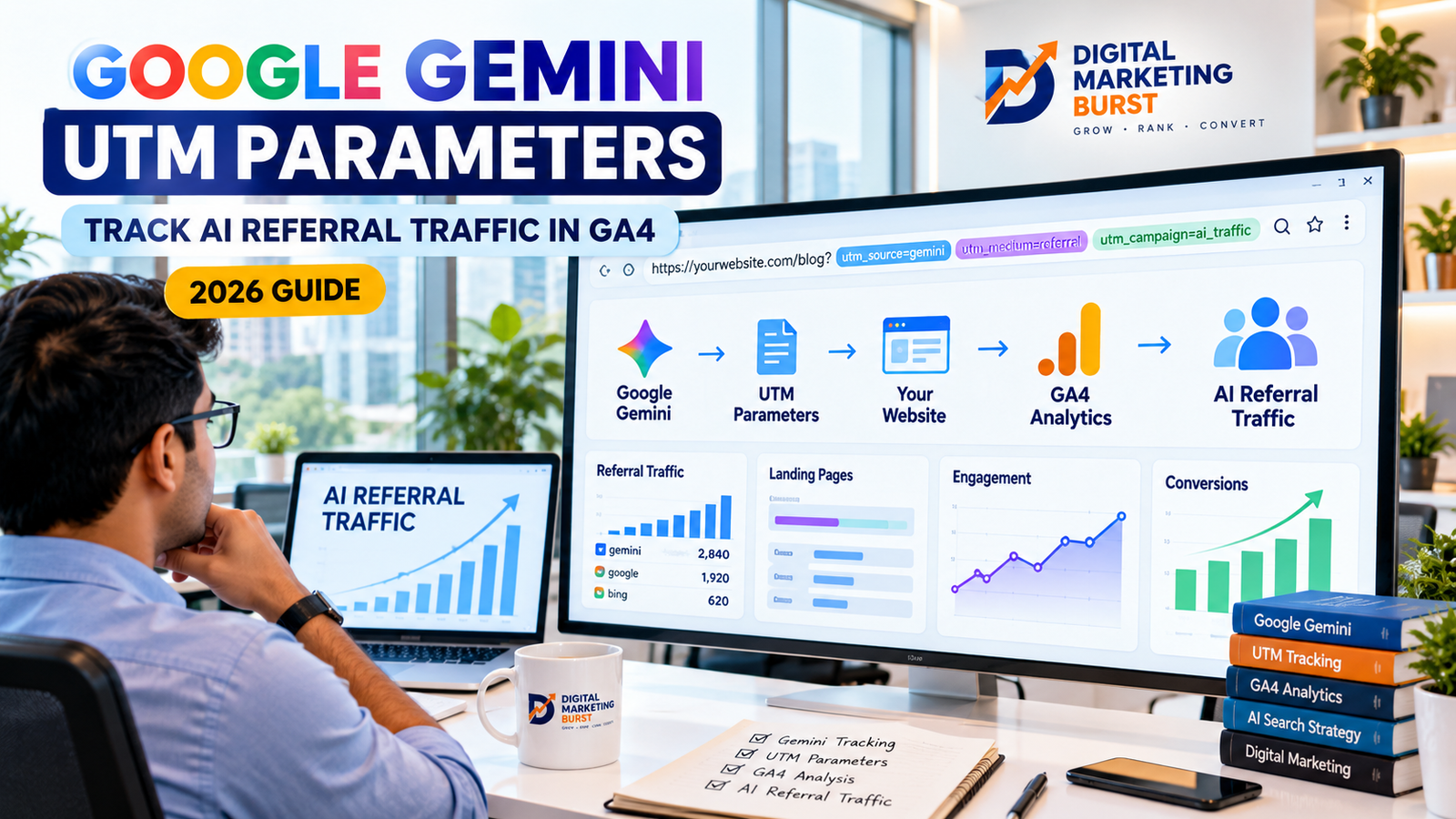
Google Gemini UTM Parameters: How to Track AI Referral Traffic in GA4 in 2026
Google Gemini UTM Parameters: How to Track AI Referral Traffic in GA4 in 2026
For marketers, one of the biggest problems with AI referral traffic has not simply been getting clicks. The harder question has been identifying where those clicks actually came from.
That is why Google Gemini UTM Parameters are worth paying attention to in 2026. Google Gemini has started adding UTM parameters to at least some outgoing links, giving website owners a potentially clearer way to identify traffic originating from Gemini. The change has been observed publicly, although Google has not yet published complete documentation explaining exactly when Gemini adds these parameters. Search Engine Journal
For Indian businesses investing in SEO, content marketing and AI search visibility, this is more than a small analytics change. Better attribution can help marketers distinguish some Gemini-generated visits from traffic that might otherwise be difficult to identify correctly.
However, the change should not be misunderstood. UTM parameters can improve measurement of clicks. They do not tell you that a page ranks highly in Gemini, reveal the prompt that produced a citation, or prove that AI traffic generated a conversion.
Understanding that distinction is the foundation for using the new data properly.
What Are Google Gemini UTM Parameters?
UTM parameters are values appended to URLs to communicate information about where a visit originated.
A tagged URL can contain parameters such as:
utm_source
utm_medium
utm_campaign
Google Analytics uses traffic-source information to help identify the source, medium and campaign associated with visits. Google’s own documentation explains that manually tagged UTM values can populate corresponding traffic-source dimensions in Analytics. Google Support
Google Gemini UTM Parameters apply the same broad attribution principle to links that users click from Gemini.
The important difference is that website owners are not manually adding these parameters to a link inside Gemini. The recent development concerns Gemini itself adding tracking information to outgoing links.
That makes the click easier to distinguish as originating from an AI experience when the relevant tracking information reaches the destination website and analytics setup.
This matters because AI assistants create a different discovery journey from traditional Google Search. Someone may ask Gemini a detailed question, read an AI-generated response, follow a cited or recommended page and then interact with that website.
Without reliable attribution, the business may see the visit without clearly understanding the role Gemini played in creating it.
Why Gemini Referral Traffic Has Been Difficult to Measure
Traditional website analytics were not designed around conversational AI discovery.
Google Search, paid campaigns, email marketing and social platforms already have familiar acquisition reporting patterns. AI assistants have complicated that picture because referral information may not always be preserved consistently across interfaces, apps and browsing environments.
Search Engine Journal reports that some AI chatbot visits can end up appearing as direct traffic when sufficient referral or UTM information is unavailable. The publication also reports that the new Gemini tagging was noticed by users before broader formal documentation appeared. Search Engine Journal
Google Analytics describes (direct) / (none) as traffic for which a clear referral source is unavailable. Google notes several possible causes, including missing traffic information, redirects and technical factors, so marketers should not assume that every direct visit came from an AI assistant. Google Support
That distinction is important.
Before better Gemini Referral Traffic attribution, a marketer could know that website traffic had increased but still struggle to separate AI-originated visits from other unattributed sessions.
UTM tagging can reduce part of that uncertainty.
What Changed With Google Gemini UTM Tracking in 2026?
The core development is straightforward: Google Gemini UTM Tracking has started appearing on outgoing links.
Search Engine Journal reported the change on October 1, 2026. The publication also highlighted discussion involving Google’s John Mueller confirming that he could see the UTM behaviour. However, the report notes that Google’s implementation remains undocumented regarding the precise circumstances in which the tags are added. Search Engine Journal
That final point deserves emphasis.
It would be premature to claim that every Gemini link now contains identical tracking parameters or that every Gemini-generated visit can be perfectly measured.
Instead, marketers should treat the development as an improvement in attribution capability.
The practical change is:
Before: Some Gemini visits could be difficult to distinguish from unattributed traffic.
Now: Tagged Gemini links can provide explicit attribution information that analytics systems can use.
Still unknown: Whether the tagging occurs consistently across every Gemini interface, answer type, device and link format.
That is a much safer interpretation than declaring AI traffic measurement “solved.”
Why Google Gemini UTM Parameters Matter for SEO
SEO measurement has traditionally relied heavily on search-engine data and web analytics.
Google Search Console can show search impressions, clicks and queries for Google Search. GA4 can then help marketers analyse what users do after arriving on the website.
AI discovery creates a new layer between content and website visits.
A person might discover a business through Gemini rather than through a conventional blue-link search result. If that user clicks through, the website needs a reliable way to recognise that visit before the business can assess its value.
This is where Google Gemini UTM Parameters become useful.
Better attribution can help marketers answer practical questions such as:
Which landing pages receive visits from Gemini?
Do Gemini visitors engage with important service pages?
Which content types receive AI referral traffic?
Does Gemini traffic contribute to enquiries or other key events?
How does AI referral behaviour compare with traditional acquisition channels?
Those are business questions, not vanity metrics.
A company does not gain much from knowing it received 100 AI visits unless it can understand what those visitors did next.
Gemini Referral Traffic Is Not the Same as AI Visibility
This distinction is particularly important in 2026.
Gemini Referral Traffic represents visits that reach your website from Gemini and can be identified through available attribution signals.
AI visibility is broader.
A brand could appear in an AI-generated response without receiving a click. Gemini could mention a company, product, service or source while the user remains inside the AI interface.
The opposite issue also matters. A website receiving a Gemini referral tells you that someone clicked a link, but it does not automatically reveal how often the website appeared across Gemini answers.
Therefore, businesses should avoid using Gemini referral sessions as a complete AI visibility metric.
A more useful measurement model separates:
Visibility → Citation/mention → Click → Engagement → Conversion
UTM attribution primarily improves the click and post-click measurement part of this journey.
That distinction can prevent marketers from making overly broad conclusions from limited analytics data.
How to Track Gemini Traffic in GA4
If you want to Track Gemini Traffic in GA4, start with the Traffic acquisition report rather than searching randomly through Analytics.
Google documents the path as:
GA4 → Reports → Acquisition → Traffic acquisition
The Traffic acquisition report is designed to show where new and returning visitors came from. It includes dimensions such as Session source, Session medium and Session source / medium. Google Support
Step 1: Open Traffic Acquisition
Sign in to your GA4 property.
Navigate to:
Reports → Acquisition → Traffic acquisition
Do not confuse this report with User acquisition.
Traffic acquisition focuses on sessions, whereas User acquisition focuses on how users were initially acquired. That difference becomes important when someone first discovers your website elsewhere but later returns through Gemini. Google Support
Step 2: Check Session Source / Medium
Change or inspect the primary dimension using:
Session source / medium
Google defines Session source as the source associated with a new session and Session medium as the method through which that session was acquired. Google Support
Look for Gemini-related source values in your own property.
Do not hard-code an assumed value into your reporting workflow until you have confirmed what your actual GA4 data receives. Gemini’s new tagging implementation is still not comprehensively documented. Search Engine Journal
This verification-first approach is safer than relying on screenshots from somebody else’s GA4 account.
Step 3: Search for Gemini
Use the search/filter functionality above the traffic table to isolate sessions containing a Gemini-related source value.
Once identified, examine metrics such as:
Sessions
Engaged sessions
Average engagement time
Key events
Landing-page performance
The goal is not simply to count AI visitors. You want to understand whether those visitors behave differently from users arriving through Search, social platforms or other referral sources.
How to Track Gemini Referral Traffic More Accurately
A basic GA4 report is only the starting point.
Businesses that receive meaningful Google Gemini Referral Traffic should create a repeatable measurement workflow.
Begin by recording the exact source and medium values appearing in your GA4 property. Then compare those values across different periods rather than manually searching for Gemini every time.
Next, identify the landing pages receiving those sessions.
This can reveal something particularly useful: the pages AI users choose to visit.
For example, imagine an Indian SaaS company publishes three content types:
A definition article explaining a technical concept.
A comparison page evaluating two solutions.
A detailed implementation guide.
Suppose Gemini-referred visitors disproportionately land on the implementation guide. That does not prove Gemini prefers implementation guides generally.
It does provide the company with first-party evidence that its own identifiable Gemini visitors are reaching that type of content.
That is a much stronger basis for content decisions than assuming a universal AI-search pattern.
Use GA4 Explorations for Deeper Gemini UTM Tracking
Once the traffic volume becomes meaningful, GA4 Explorations can provide more flexibility than the standard report.
Create an exploration that segments the verified Gemini traffic source.
Useful dimensions can include:
Landing page
Session source / medium
Device category
Country
Page path
Relevant metrics may include sessions, engaged sessions and key events.
For an India-focused business, country segmentation can be especially useful. It allows the team to examine whether identified Gemini visits are actually coming from its target market rather than assuming that all AI traffic is commercially relevant.
For example, an Indian B2B company may receive Gemini referrals globally. If its service is primarily designed for Indian customers, the team should separately evaluate traffic from India before using total Gemini sessions to guide budget decisions.
AI Referral Traffic in GA4: What Should You Measure?
Counting AI Referral Traffic in GA4 is useful, but the number alone has limited strategic value.
Start with landing pages.
Which pages are attracting identified AI referrals?
Next, assess engagement.
Do those users continue exploring the site, or do they leave after reading one page?
Then examine meaningful business actions.
Depending on your website, those might include:
Contact-form submissions, demo requests, calls, WhatsApp actions, purchases, registrations or another properly configured key event.
Finally, compare AI referrals with other acquisition sources.
The useful question is not:
“How much AI traffic did we get?”
A better question is:
“What did identifiable AI-referred visitors do after reaching our website?”
That shift turns an interesting traffic source into actionable marketing data.
Google Gemini UTM Tracking and Landing Page Analysis
Landing-page analysis can become one of the most valuable applications of Gemini UTM Tracking.
Suppose an Indian digital marketing company has 100 articles but only a small group begins receiving identifiable Gemini referrals.
Those pages deserve investigation.
Look at their characteristics:
What question does each page answer?
How clearly does it explain the topic?
Does it provide definitions, comparisons or actionable steps?
Are facts supported by reliable sources?
Does the page offer information that is easy to extract and understand?
Are users landing on informational articles or commercial pages?
Do not immediately rewrite every other page to imitate them.
Instead, use the data to develop hypotheses.
If detailed comparison pages repeatedly attract Gemini referral visits, investigate why. If concise technical explainers perform better, examine those instead.
Your own analytics should inform the next experiment.
Can Google Gemini UTM Parameters Show the User’s Prompt?
No.
This is an important limitation.
UTM attribution can identify traffic-source information when the appropriate parameters are available. It should not be treated as a mechanism for revealing the private conversation or exact prompt that caused a user to click.
Therefore, seeing a Gemini referral in GA4 does not mean you know whether the visitor asked:
“Best CRM for Indian startups”
or:
“How can I automate sales follow-ups?”
Both could theoretically lead to the same page through different conversational paths.
Marketers should avoid reverse-engineering specific user prompts from a referral session unless they have separate, legitimate data supporting that conclusion.
Can Gemini UTM Tracking Tell You Which Answer Cited Your Website?
Not necessarily.
Gemini UTM Tracking improves referral attribution. It does not automatically provide a full record of the Gemini answer that generated every click.
This is one of the biggest analytical traps with AI referral data.
A UTM-tagged click is evidence that an attributable visit occurred. It is not automatically evidence of:
The exact query used
The complete Gemini response
Your overall Gemini visibility
Your citation frequency
Your ranking across AI responses
Keeping those concepts separate makes reporting more credible.
AI Referral Traffic vs Organic Search Traffic
AI referrals and traditional organic search should not simply be combined into one performance narrative.
A conventional Google Search visit normally starts with a search query and a search results interface.
An AI referral can emerge after a conversational interaction in which the user asks follow-up questions, compares options or receives a synthesized response before clicking.
The user’s information state may therefore be different by the time they reach the website.
That creates an interesting measurement opportunity.
Compare identified AI referral visitors against organic search visitors using metrics appropriate to your business.
For an informational publisher, engagement and onward navigation may matter.
For a service business, qualified enquiries could be more meaningful.
For ecommerce, revenue and purchase behaviour may be relevant.
Do not assume AI traffic is inherently “better” or “worse.” Let your own data answer that question.
Why This Change Matters for Indian Businesses
India has a large and diverse digital audience, but the strategic value of AI Referral Traffic will differ significantly by business.
A nationwide SaaS platform may care about AI referrals across India.
A Lucknow-based service business may need to segment those visits geographically before treating them as potential leads.
An ecommerce company may care more about revenue and product discovery.
A publisher may focus on sessions, engagement and repeat visits.
Therefore, the arrival of better Gemini attribution should not lead every company to adopt the same KPI.
The real opportunity is to add identifiable AI referral data to an existing measurement framework.
Indian marketers can then compare AI-assisted discovery with Search, social, email and other channels using actual business outcomes rather than hype.
Common Mistakes When Tracking Google Gemini Referral Traffic
One mistake is treating every direct session as hidden Gemini traffic.
GA4’s direct classification can occur when clear referral information is unavailable for multiple reasons. It is not an AI-only bucket. Google Support
Another mistake is assuming all Gemini links are now consistently tagged.
Current reporting indicates the feature exists, but the exact implementation rules remain undocumented. Search Engine Journal
A third mistake is counting sessions without examining outcomes.
Traffic attribution is useful because it helps connect acquisition with behaviour. A spike in visits is less meaningful if none of those visitors engage with the content or complete an important action.
Finally, avoid interpreting a Gemini referral as proof of broad AI-search dominance.
One attributable click cannot tell you how often competitors appeared, how many answers mentioned your brand or what share of relevant AI conversations included your website.
Do You Need to Add Google Gemini UTM Parameters Yourself?
No—not for the Gemini links discussed in this update.
The important development is that Gemini itself has been observed adding UTM parameters to outgoing links. Search Engine Journal
That is different from adding UTMs to your own marketing campaigns.
For links that your business controls, Google continues to document manual campaign tagging using parameters such as utm_source, utm_medium and utm_campaign. Those values can then populate corresponding Analytics dimensions. Google Support
Do not modify your website’s internal links by adding Gemini UTMs in an attempt to improve AI attribution.
That would measure your own tagging, not genuine referral attribution from Gemini.
Check Whether Your Website Preserves UTM Parameters
Better source tagging only helps when your measurement setup receives the information correctly.
Review redirects carefully.
Google notes that redirects and other technical circumstances can contribute to lost traffic-source information. Google Support
Test important landing pages yourself.
Open a test URL containing harmless UTM parameters and verify that the parameters survive the expected redirect chain.
Then check whether the session information reaches Analytics correctly.
Also review consent configuration and GA4 implementation.
If your underlying analytics setup is unreliable, a new referral parameter cannot repair every measurement problem automatically.
Build an AI Referral Traffic Dashboard
As AI Referral Traffic becomes more relevant, businesses should avoid manually checking individual sources every week.
A simple reporting framework can include:
Total identifiable AI referral sessions
Gemini referral sessions
Other identifiable AI sources
Top AI referral landing pages
Engagement metrics
Key events
Conversions or qualified enquiries
Country or target-market segment
The dashboard should separate traffic from business outcomes.
For example:
Gemini → 150 sessions → 90 engaged sessions → 8 enquiries
is more informative than:
Gemini → 150 visits
The numbers above are illustrative only, not Digital Marketing Burst results or industry benchmarks.
The framework matters more than the hypothetical values.
How Google Gemini UTM Parameters Could Change AI SEO Reporting
Until recently, much AI-search reporting has focused heavily on visibility.
Teams monitor brand mentions, citations, prompts and whether a website appears in AI-generated responses.
Referral attribution adds another layer.
A useful AI-search measurement framework can now separate:
1. AI visibility
Was the brand or website visible?
2. Citation or recommendation
Was the website referenced?
3. Referral
Did the user click through?
4. Engagement
What happened after the click?
5. Business outcome
Did the visit contribute to an important action?
Google Gemini UTM Parameters primarily strengthen stage three and the subsequent measurement journey.
They do not replace the first two stages.
This distinction is likely to become increasingly important as businesses try to connect AI visibility work with measurable website outcomes.
What Digital Marketers Should Do Now
You do not need to rebuild your analytics strategy because Gemini has begun using UTM parameters.
Start with measurement hygiene.
Open GA4 and inspect existing traffic-source data. Determine whether Gemini-related traffic is already visible.
Document the exact values you find.
Create a segment or exploration once enough data exists to make analysis useful.
Then compare landing pages and engagement.
Make sure key events that matter to the business are configured correctly.
After that, monitor the data over time.
Do not make a major content or budget decision after seeing a handful of AI-referred sessions.
Patterns become more useful when they persist.
Most importantly, maintain a distinction between AI visibility, AI referral traffic and business results.
That will make your reporting more useful than simply announcing that “AI traffic is growing.”
FAQs About Google Gemini UTM Parameters
What are Google Gemini UTM Parameters?
Google Gemini UTM Parameters are tracking information that has been observed on outgoing Gemini links. They can help websites and analytics systems more clearly attribute some visits to Gemini. The implementation is new, and Google has not yet publicly documented every condition under which the tagging occurs. Search Engine Journal
How can I Track Gemini Traffic in GA4?
Open Reports → Acquisition → Traffic acquisition and inspect Session source, Session medium or Session source / medium for Gemini-related values appearing in your property. Google documents the Traffic acquisition report as the place to analyse where website and app visitors originate. Google Support
Is Gemini Referral Traffic organic traffic?
Do not automatically classify every Gemini referral as conventional organic-search traffic. Analyse the actual source and medium values that GA4 receives and keep AI referral reporting separate where doing so improves clarity.
Can UTM parameters tell me what someone asked Gemini?
No. Referral attribution should not be interpreted as access to the user’s private Gemini conversation or exact prompt.
Does Gemini UTM Tracking measure AI visibility?
Not completely. It can help measure identifiable click-through traffic. Brand mentions, citations without clicks and overall appearance frequency are separate AI-visibility questions.
Will every Gemini click now appear correctly in GA4?
That should not be assumed. The UTM behaviour has been observed, but Google’s exact Gemini implementation is not yet comprehensively documented. Search Engine Journal
Google Gemini UTM Parameters represent an important improvement for marketers trying to understand AI-driven website discovery.
Instead of treating every AI-generated visit as an attribution mystery, businesses may now be able to identify more Gemini Referral Traffic and analyse what those visitors do after reaching the site.
The most valuable use of this data is not simply counting AI clicks.
Use Gemini UTM Tracking to connect identifiable referrals with landing pages, engagement and meaningful business actions. When you Track Gemini Traffic in GA4, keep referral measurement separate from broader AI visibility and citation monitoring.
For Indian businesses, this creates a more practical approach to AI-search measurement: observe the data, verify attribution, segment the right audience and judge the channel by real outcomes.
How Google Gemini UTM Parameters Fit Into the Customer Journey
A traditional SEO journey might look relatively straightforward:
Google Search → Search Result → Website → Conversion
AI-assisted discovery can be more complex:
Question → Gemini Response → Source/Recommendation → Website → Further Research → Conversion
The website visit may therefore occur after the user has already consumed a significant amount of information inside Gemini.
That context changes how marketers should interpret Google Gemini Referral Traffic.
For example, someone researching digital marketing services might initially ask Gemini about different SEO strategies. The user could ask follow-up questions, review several sources and only then visit a website.
GA4 begins providing meaningful website-level information once that visitor arrives. It does not provide a complete record of everything that happened inside the AI conversation beforehand.
This boundary matters when building attribution reports.
A Gemini referral should be treated as an identifiable touchpoint, not necessarily the beginning of the customer’s entire research journey.
Understanding Source, Medium and Campaign in Gemini UTM Tracking
UTM tracking becomes much easier to understand when three basic concepts are separated.
Source
The source tells analytics where the traffic originated.
Examples from conventional marketing might include a search engine, newsletter or another referring platform.
For Gemini UTM Tracking, marketers should inspect the actual value reaching their GA4 property rather than assuming a particular naming convention.
Medium
The medium describes the broader method through which the traffic was acquired.
Common examples across digital marketing can include organic, referral, email or CPC.
Again, use the values actually recorded in GA4 when analysing Gemini. Do not manually rename data simply because a different website or screenshot shows another classification.
Campaign
Campaign values provide an additional layer of attribution when campaign information is supplied.
Google’s Analytics documentation explains how manually tagged parameters can populate traffic-source dimensions.
For the current Gemini development, however, avoid assuming that every outgoing Gemini link will always contain the same combination of UTM parameters. The implementation remains new.
Session Source vs First User Source in GA4
This distinction can prevent major reporting mistakes.
Imagine a visitor discovers your website through Google Search on Monday.
The same person later returns through Gemini on Friday.
Their first user source relates to how that user was originally acquired. The session source relates to the source associated with the later session.
For analysing Gemini Referral Traffic, session-scoped acquisition data is generally more useful when your immediate question is:
“How many website sessions came through Gemini?”
Google’s Traffic acquisition report is session-focused, whereas User acquisition focuses on how users were first acquired.
Confusing the two can cause marketers to believe Gemini referrals are missing when they are simply looking at the wrong acquisition scope.
How to Track Gemini Traffic in GA4 Using a Comparison
Once you have confirmed the actual Gemini-related value appearing in your property, create a comparison rather than manually searching for it every time.
Open:
Reports → Acquisition → Traffic acquisition
Then create a comparison using the relevant session-scoped source dimension.
Your condition should be based on the Gemini value that your property actually records.
Once applied, compare the segment against your broader website traffic.
Look beyond Sessions.
Examine:
Engaged sessions → Engagement rate → Average engagement time → Key events → Relevant conversions
This produces a much more useful picture of AI Referral Traffic in GA4.
A traffic source generating fewer sessions but stronger commercial actions may matter more than one generating large volumes of low-intent visits.
Track Gemini Traffic in GA4 by Landing Page
The landing page is one of the most valuable dimensions for AI traffic analysis.
After identifying Gemini sessions, determine which URLs those visitors entered through.
You may find traffic reaching:
Blog posts
Service pages
Comparison pages
Guides
Product pages
Research content
Location pages
The distribution can reveal how your website is currently benefiting from AI-assisted discovery.
Suppose an Indian digital marketing website receives identifiable Gemini traffic primarily on educational articles.
That pattern suggests Gemini users are entering during the research stage.
Now imagine another website receives Gemini referrals directly on service comparison pages. Those visitors could be further along their decision journey.
Neither pattern is automatically better.
The correct interpretation depends on what the page is designed to achieve.
Create a Dedicated Gemini Traffic Exploration in GA4
For ongoing analysis, a GA4 Exploration can provide more control than repeatedly filtering the standard acquisition report.
Create a new exploration and include relevant dimensions such as:
Session source / medium
Landing page + query string
Page path
Country
Device category
Useful metrics can include:
Sessions
Engaged sessions
Engagement rate
Average engagement time per session
Key events
Then apply your verified Gemini source condition.
This creates a focused environment for analysing Google Gemini UTM Tracking without mixing it with unrelated acquisition channels.
Do not build the report around assumed parameter values. First confirm what is reaching your own analytics property.
How Indian Businesses Should Segment Gemini Referral Traffic
Traffic volume alone can be misleading for businesses serving a particular geographic market.
An Indian business might receive AI referrals from several countries.
If the company primarily sells within India, worldwide Gemini sessions should not automatically be treated as equally valuable prospects.
Add Country to your analysis.
You can then compare:
Gemini traffic from India
against:
Total identifiable Gemini traffic
A local service business can go further.
Suppose a company operates primarily in Lucknow. A Gemini referral from Lucknow may carry different commercial relevance from a visitor thousands of kilometres outside its service area.
The same principle applies to ecommerce, SaaS, education, healthcare and B2B companies.
Segment according to the market you actually serve.
Do not manipulate the data until it tells the story you want.
Analyse New and Returning Gemini Visitors Separately
Not every Gemini visitor is discovering your brand for the first time.
Someone may previously have visited through Search, social media, an advertisement or a direct visit.
Later, that person could encounter your website again through Gemini.
This makes returning-user behaviour worth examining.
If identifiable Gemini referrals include returning visitors, AI-assisted discovery may sometimes be participating in a longer research journey rather than acting purely as a first-touch discovery channel.
That possibility is particularly relevant for high-consideration purchases.
A customer choosing software, professional services or a major product rarely makes a decision after one interaction.
AI tools can become another research environment within that journey.
However, do not infer the exact path from GA4 unless your available data genuinely supports it.
AI Referral Traffic and Attribution Models
Attribution asks how credit for a business outcome should be distributed across marketing interactions.
This becomes complicated when AI platforms enter the journey.
Consider this hypothetical sequence:
Organic Search → Website → Gemini → Website → Direct Visit → Enquiry
Which channel created the enquiry?
There is no universally correct answer based only on this sequence.
Organic Search introduced the visitor to the website. Gemini may have influenced further evaluation. The direct session occurred immediately before the enquiry.
That is why AI Referral Traffic should not automatically receive all the credit simply because it appears near the end of the journey.
Use attribution reporting as an analytical tool rather than proof that one channel single-handedly created the conversion.
Gemini Referral Traffic and Assisted Conversions
The most interesting role of Gemini may eventually be as an assisting touchpoint.
A user can research a problem using AI, visit a business website and leave without converting.
Later, the same person may return through another source.
If your measurement setup can legitimately connect those interactions, Gemini may still have contributed to the journey even though the final conversion occurred elsewhere.
This makes last-click thinking increasingly limiting.
Marketers should therefore ask two separate questions:
Did Gemini directly precede the conversion?
and:
Did Gemini participate somewhere in the measurable journey?
Those questions can produce very different answers.
Do not label every earlier touchpoint an “assisted conversion” unless your reporting configuration actually supports that conclusion.
Track Commercial and Informational Gemini Landing Pages Separately
Not every landing page serves the same purpose.
An informational article might aim to educate.
A service page might aim to generate an enquiry.
A comparison page could help users evaluate options.
Mixing all three into one conversion benchmark can distort the analysis.
Create broad page groups where useful:
Informational content
Commercial content
Product/service pages
Brand pages
Then compare identifiable Gemini Referral Traffic across those groups.
For an informational article, onward navigation may be an important signal.
For a service page, an enquiry or qualified lead may matter more.
For ecommerce, add-to-cart and purchase behaviour could be relevant.
The KPI should follow the purpose of the page.
Measure Gemini Traffic by Content Topic
Landing-page analysis becomes even more useful when URLs are grouped by topic.
Imagine an agency publishes content about:
SEO
Google Ads
AI Search
Social Media Marketing
Local SEO
Instead of asking which individual URL received the most Gemini traffic, examine whether particular topic clusters attract more identifiable referrals.
This can help reveal patterns that are difficult to see at page level.
For instance, AI-search articles might generate more Gemini referrals than social-media content.
That observation could justify deeper investigation.
It does not prove that publishing more AI articles will automatically increase Gemini traffic.
Correlation inside your analytics account should be used to generate hypotheses, not universal SEO rules.
Track Gemini Traffic in GA4 Alongside Organic Search
AI traffic becomes more meaningful when it has context.
Create a comparison between identifiable Gemini sessions and organic search sessions.
Review:
Landing pages
Engagement
Key events
Device distribution
Geographic distribution
Relevant conversion behaviour
You may discover that Gemini visitors reach different pages from traditional search users.
Perhaps Google Search drives visitors to high-volume informational pages while Gemini sends a smaller number to detailed comparison content.
Alternatively, both channels may lead to the same pages.
Either outcome is useful.
The point is to understand how AI-assisted discovery fits alongside existing Search behaviour rather than treating it as an isolated trend.
AI Referral Traffic Should Not Replace Search Console Data
GA4 and Google Search Console answer different questions.
Search Console provides information about performance in Google Search.
GA4 focuses on user activity once traffic reaches the website.
Gemini referral attribution adds another acquisition signal, but it does not transform GA4 into an AI-search visibility platform.
A practical reporting framework can therefore use:
Google Search Console → Traditional Google Search visibility
GA4 → Website acquisition and behaviour
Gemini referral attribution → Identifiable Gemini-originated visits
AI visibility monitoring → Mentions/citations across relevant AI experiences
Each dataset has a different purpose.
Combining them thoughtfully creates a stronger picture than trying to force every metric into GA4.
Can Google Search Console Show Gemini Referral Traffic?
Google Search Console should not be treated as a replacement for Gemini Referral Traffic reporting in GA4.
Search Console primarily reports performance from Google Search surfaces that Google includes in its Search performance reporting.
A Gemini referral is a different measurement question.
If you want to understand visitors arriving on your website from Gemini, website analytics and referral attribution are the more relevant tools.
Avoid assuming that every Gemini click should appear as a Search Console click.
The products measure different environments and interactions.
Build a Simple AI Traffic Classification System
As AI referrals expand beyond Gemini, manually checking each platform becomes inefficient.
A business can create an internal classification framework such as:
AI Referral Traffic
→ Gemini
→ ChatGPT
→ Perplexity
→ Other identifiable AI sources
Keep this classification separate from standard organic-search reporting unless your analytics requirements justify combining particular channels.
The advantage is consistency.
Instead of producing a special report every time another AI platform sends traffic, your organisation develops one broader AI-referral measurement framework.
Gemini can then be analysed individually or as part of the broader category.
Do Not Automatically Rewrite GA4 Channel Groups
Seeing a new traffic source often tempts marketers to immediately customise channel definitions.
That can create unnecessary reporting complexity.
First observe how Google Gemini Referral Traffic is being classified in your property.
Collect enough data to understand the pattern.
Document the source and medium values.
Only then decide whether a custom channel group would improve reporting.
The goal is clarity, not simply creating a new dashboard label called “AI.”
If AI traffic remains extremely small, a dedicated exploration may be sufficient.
As volume becomes strategically meaningful, a broader custom reporting structure can make more sense.
How to Create an AI Referral Traffic Report for Management
Senior management rarely needs every technical GA4 dimension.
A useful monthly report can answer five questions.
How much identifiable AI referral traffic did the website receive?
Which AI platforms generated that traffic?
Which landing pages attracted those visitors?
How did they engage?
What meaningful business actions followed?
For Gemini specifically, report verified traffic rather than estimated “hidden Gemini traffic.”
You can also separate:
Observed data — what GA4 records.
Interpretation — what you think the pattern may indicate.
Unknowns — what the available data cannot prove.
This structure prevents assumptions from being presented as facts.
Example of a Useful Gemini Traffic Report
Consider a hypothetical Indian B2B website.
Its internal dashboard could show:
Gemini referral sessions: 240
Visitors from India: 180
Engaged sessions: 150
Service-page visits after entry: 60
Recorded enquiries: 12
These numbers are purely illustrative. They are not industry benchmarks or results achieved by Digital Marketing Burst.
The analysis should then ask:
Which landing pages generated those visits?
What percentage reached commercial content?
Were enquiries relevant to the company’s target audience?
How does that behaviour compare with other acquisition channels?
This makes the report actionable.
Simply stating “Gemini sent 240 sessions” does not.
Track Gemini Traffic Without Creating False ROI Claims
ROI calculations require reliable revenue and cost information.
A Gemini referral count alone cannot establish return on investment.
Suppose an agency receives 20 enquiries associated with identifiable AI referral sessions.
That still does not tell you:
How many enquiries were qualified?
How many became customers?
What revenue resulted?
What marketing costs should be attributed to the channel?
What other touchpoints contributed?
Therefore, avoid statements such as:
“Gemini generated ₹X in revenue”
unless your attribution and business data genuinely support that conclusion.
A safer progression is:
Referral → Engagement → Lead → Qualified Lead → Customer → Revenue
Measure only as far as your verified data allows.
Google Gemini UTM Parameters and Conversion Tracking
The real value of Google Gemini UTM Parameters appears when traffic-source information connects with correctly configured business actions.
For a lead-generation website, relevant events might include:
Form submissions
Phone-call actions
WhatsApp interactions
Demo requests
Appointment requests
For ecommerce, they might include:
Product views
Add-to-cart actions
Checkout starts
Purchases
For a publisher:
Newsletter registrations
Account creation
Content subscriptions
Meaningful onward navigation
The business should decide which events represent genuine value before evaluating Gemini traffic.
Otherwise, attribution becomes a collection of numbers without business context.
Why AI Traffic Quality Matters More Than AI Traffic Volume
AI referral traffic may attract attention because it is new.
New does not automatically mean valuable.
Imagine Channel A produces 5,000 visits but almost no meaningful actions.
Channel B generates 500 visits but consistently brings visitors to high-intent pages.
Traffic volume alone would make Channel A look stronger.
Business outcomes could tell a completely different story.
Apply the same thinking to AI Referral Traffic in GA4.
Instead of asking only whether Gemini traffic increased, ask whether those visitors:
Reached relevant pages
Stayed engaged
Continued deeper into the website
Completed important actions
Returned later
Quality requires context.
Should You Optimise Content Specifically for Gemini Referral Traffic?
Do not rewrite your entire website around one referral source.
Google’s current guidance for its AI search experiences continues to emphasise foundational SEO and helpful content rather than a separate collection of technical tricks for AI features.
For Gemini referral performance, focus on content quality first.
Answer the user’s question clearly.
Support factual claims.
Use descriptive headings.
Make important information easy to locate.
Keep pages technically accessible.
Provide original value instead of summarising what every competing article already says.
Then use Gemini Referral Traffic data as feedback.
If certain pages consistently attract valuable AI referrals, study why those pages work for your audience.
Can Adding More UTM Parameters Improve Gemini Visibility?
No evidence supports the idea that manually adding more UTM parameters to your website will improve its visibility in Gemini.
UTM parameters are fundamentally measurement tools.
They help analytics systems understand traffic attribution when properly implemented.
They are not keywords for an AI ranking system.
This distinction is crucial because a new SEO trend often attracts unnecessary technical experimentation.
Do not add random tracking parameters to internal links hoping to increase Gemini visibility.
Doing so can complicate analytics and URL management without creating a genuine content advantage.
Google Gemini UTM Tracking and URL Cleanliness
UTM parameters can create different-looking URLs for the same underlying page.
For example, the destination page may be:
example.com/ai-seo-guide/
while a referral URL could include additional tracking parameters after the main address.
The content itself remains the destination.
Website owners should ensure their canonical implementation, redirects and analytics configuration are technically sound.
Do not create separate indexable pages merely because tracking parameters exist.
Tracking URLs are for attribution, not for producing duplicate versions of content.
Should UTM Parameters Be Removed After the User Lands?
Some websites use scripts or redirect systems that clean tracking parameters from the visible URL.
Whether that is appropriate depends on the technical implementation.
The critical requirement is that attribution information reaches the analytics system before it is discarded.
An aggressive redirect or URL-cleaning process can potentially interfere with measurement if implemented incorrectly.
Therefore, test before changing anything.
Open a tagged URL.
Follow the redirect path.
Confirm that GA4 receives the intended attribution.
Then verify that your canonical and indexing setup remains clean.
Technical simplicity is preferable to unnecessary tracking complexity.
Privacy and Responsible AI Referral Measurement
Referral measurement should focus on aggregate marketing performance rather than attempting to reconstruct private user behaviour.
Google Gemini UTM Parameters can help identify the source of a website visit.
They should not be interpreted as permission to infer sensitive information about the person behind that visit.
Marketers should work within applicable privacy requirements, consent configurations and organisational policies.
For Indian businesses, analytics implementation should also be reviewed against the privacy and data-handling requirements relevant to the organisation.
This is particularly important when combining analytics data with CRM, advertising or customer records.
What to Monitor Weekly
A weekly review does not need to become complicated.
Track:
Gemini sessions
Top Gemini landing pages
Engaged sessions
Relevant key events
Country distribution
Major source/medium changes
Also watch for sudden attribution changes.
If Gemini traffic disappears overnight, do not immediately conclude that your AI visibility collapsed.
First investigate whether:
Tracking values changed
GA4 configuration changed
Redirects were introduced
Consent settings changed
Gemini’s tagging behaviour changed
Measurement problems can look like marketing problems.
What to Monitor Monthly
Monthly analysis should focus more on patterns.
Compare Gemini traffic with the previous period, but avoid overreacting to small percentage changes when the underlying numbers are tiny.
Review which content topics attract identifiable referrals.
Compare informational and commercial landing pages.
Assess business outcomes.
Look for repeat patterns rather than isolated spikes.
Most importantly, record changes to your measurement methodology.
If you modify GA4 filters or channel definitions halfway through the month, comparisons with earlier periods may no longer be like-for-like.
Google Gemini UTM Parameters: A Practical Measurement Framework
A simple framework can keep your analysis disciplined.
Stage 1: Verify
Confirm that Gemini-related attribution is actually reaching GA4.
Stage 2: Classify
Document the source, medium and any relevant campaign values.
Stage 3: Segment
Separate Gemini traffic from other acquisition sources.
Stage 4: Analyse
Review landing pages, geography, engagement and meaningful actions.
Stage 5: Compare
Compare Gemini with organic search and other relevant channels.
Stage 6: Interpret
Identify patterns without presenting correlation as causation.
Stage 7: Act
Use reliable findings to improve content, conversion paths and measurement.
This process is more valuable than simply creating a dashboard labelled “AI Traffic.”
What Google Gemini UTM Parameters Still Cannot Tell You
Better attribution does not eliminate every measurement gap.
Even with Google Gemini UTM Tracking, GA4 may not tell you:
The exact prompt that produced the visit.
How many Gemini answers mentioned your brand without generating a click.
How frequently competitors appeared alongside your website.
Why Gemini selected a particular source.
Whether a user had seen your brand elsewhere before the measurable journey.
How much influence an AI answer had on the final purchase decision.
Those questions require different evidence.
Recognising the limits of the dataset is part of good analytics.
A Better AI Search Measurement Model for 2026
Businesses increasingly need to move beyond one-dimensional traffic reporting.
A stronger model contains five layers:
Visibility
Is the brand appearing across relevant search and AI experiences?
Citation
Is the website being referenced as a source?
Referral
Are users clicking through to the website?
Engagement
Are those visitors consuming useful content and moving through the site?
Outcome
Are visits contributing to enquiries, registrations, sales or another meaningful business objective?
Google Gemini UTM Parameters improve the referral layer.
GA4 helps with referral, engagement and measurable outcomes.
Neither tool alone provides the entire picture.
That is why AI-search reporting should combine appropriate datasets rather than searching for one universal metric.
The arrival of Google Gemini UTM Parameters gives marketers a better opportunity to understand some of the traffic coming from AI-assisted discovery.
However, the real value begins after attribution.
Businesses should Track Gemini Traffic in GA4 by landing page, geography, engagement and meaningful actions. They should compare Gemini Referral Traffic with other acquisition sources while recognising that a referral is only one stage of a larger customer journey.
For Indian marketers, this is an opportunity to build AI reporting correctly from the beginning.
Measure what can be verified. Separate observed data from assumptions. Connect AI Referral Traffic with genuine business outcomes, and avoid treating every Gemini click as proof of broader AI-search success.
That approach will remain useful even as Gemini’s tracking implementation and the wider AI-search ecosystem continue to evolve.
Tracking Google Gemini UTM Parameters becomes more valuable when the data starts influencing better marketing decisions. Parts 1 and 2 covered what the parameters mean, how to Track Gemini Traffic in GA4, and how to analyse referral behaviour.
The next question is more strategic: what should businesses actually do with those insights?
A rise in Gemini Referral Traffic should not automatically trigger a website-wide content rewrite. Similarly, a page receiving no identifiable Gemini referrals should not immediately be considered weak.
AI referral attribution is one signal within a much larger search and discovery ecosystem.
For Indian businesses, the practical opportunity is to connect Google Gemini UTM Tracking with content strategy, SEO, conversion measurement and broader AI visibility without confusing those different areas.
Turn Gemini Referral Traffic Into Content Insights
Start with the pages already receiving identifiable Gemini Referral Traffic.
Create a list of those landing pages and classify them according to purpose:
Informational guides
How-to content
Comparison pages
Service pages
Product pages
Research or data pages
Brand pages
Then examine what those pages have in common.
Perhaps they answer narrow questions clearly. Some may contain useful comparisons, definitions or original explanations. Others could provide detailed information that helps users make a decision.
The objective is not to discover a secret Gemini content formula.
Instead, you are trying to understand what type of content on your website attracts identifiable visitors from Gemini.
This produces first-party evidence that can guide future experiments.
Find Pages With AI Traffic but Weak Engagement
High referral traffic does not automatically mean the landing page is doing its job.
Suppose one article attracts noticeable AI Referral Traffic, but visitors rarely move beyond that page.
Investigate the experience.
Does the opening immediately answer the question?
Is the page easy to scan?
Are important details buried under unnecessary text?
Does the article provide a logical next step?
Are internal links genuinely relevant?
Is the commercial call to action appropriate for the user’s likely intent?
The solution should not be to insert more keywords.
Improve the user journey instead.
A visitor arriving from Gemini may already have received a summary of the topic. Your webpage therefore needs to provide enough additional depth, evidence or utility to justify the click.
Find High-Value Pages With Little Gemini Referral Traffic
The reverse analysis can also be useful.
Some pages may perform well through organic search or generate enquiries but receive little identifiable Google Gemini Referral Traffic.
Do not assume those pages are failing in Gemini.
First remember the limitations of referral measurement. A page can potentially be mentioned or cited without receiving a click. Attribution behaviour may also vary by interface and implementation.
Instead, review the page on its own merits.
Ask whether it clearly explains the subject.
Check whether important claims are supported.
Make sure the business, service, author and topic are unambiguous.
Review technical accessibility and indexing.
Look for information gaps that genuinely matter to users.
Only make changes that improve the page itself.
Build Content That Is Worth Clicking After an AI Answer
This is becoming an important content challenge.
AI systems can answer simple questions directly.
If your article provides nothing beyond a basic definition that an AI response can summarise in a few sentences, users may have little reason to visit the website.
Content therefore needs to provide additional utility.
Consider a page about GA4.
A generic definition of GA4 is easy to summarise.
A page containing a clear workflow for isolating AI Referral Traffic in GA4, interpreting source/medium data, identifying attribution limitations and deciding what to measure provides substantially more value.
The same principle applies beyond analytics.
Useful content can offer:
Original frameworks
Clear processes
Detailed comparisons
First-party research where genuinely available
Interactive tools
Templates
Calculators
Expert explanations
Original images or diagrams
Current documentation
Decision-making guidance
Do not add these elements simply because they sound good for SEO.
Add them when they help the reader complete the task that brought them to the page.
Answer-First Content Can Improve User Experience
Long introductions can be particularly frustrating when someone arrives looking for a specific answer.
Place the essential answer early.
For example, if the question is:
“How to Track Gemini Traffic in GA4?”
the page should quickly tell the user where to begin:
GA4 → Reports → Acquisition → Traffic acquisition
Then explain what dimensions to inspect and what limitations apply.
The detailed context can follow.
This structure benefits traditional search visitors and AI-referred users alike.
It also prevents a common SEO mistake: writing hundreds of introductory words before addressing the actual query.
Do Not Create Hundreds of Gemini Keyword Pages
A new search trend can quickly lead to unnecessary content production.
For example, creating separate thin articles for:
“Gemini traffic GA4”
“Gemini referral GA4”
“Gemini UTM GA4”
“Track Gemini visits”
“Google Gemini referral tracking”
would probably create substantial overlap if each page answers essentially the same question.
A stronger page can cover these closely related intents naturally.
Your current article already targets:
Google Gemini UTM Parameters
Google Gemini UTM Tracking
Gemini Referral Traffic
Google Gemini Referral Traffic
Gemini UTM Tracking
Track Gemini Traffic in GA4
How to Track Gemini Traffic in GA4
AI Referral Traffic
AI Referral Traffic in GA4
These terms belong within one coherent topic rather than requiring separate near-duplicate articles.
That keeps the website architecture cleaner and reduces unnecessary internal competition.
Avoid Keyword Cannibalisation Around AI Referral Traffic
Before publishing another AI-traffic article later, compare its intent with this page.
This article answers:
What are Google Gemini UTM Parameters, and how can marketers use them to identify and analyse Gemini and AI referral traffic in GA4?
A future article could target a genuinely different intent, such as:
How to Build an AI Referral Traffic Dashboard in GA4
That page could focus almost entirely on dashboard creation.
Another could cover:
ChatGPT Referral Traffic in GA4
That would be appropriate if it addresses platform-specific attribution behaviour rather than repeating this Gemini article with a different product name.
Topic separation should be based on user intent, not merely different keywords.
Use Gemini Referral Data to Improve Internal Linking
Gemini Referral Traffic can also reveal opportunities in your internal-link structure.
Suppose an informational article consistently receives Gemini visitors.
Ask what the logical next step is for those readers.
If the article explains AI search visibility, a relevant deeper guide could be useful.
If it explains analytics, another page covering AI-search strategy might help readers understand what to do with the measurement.
Internal links should continue the user’s journey.
Do not add ten unrelated links merely because internal linking is considered an SEO practice.
A smaller number of contextually relevant links can be far more useful.
Review Conversion Paths From Gemini Landing Pages
Once a Gemini landing page has enough traffic to analyse meaningfully, examine what happens next.
A visitor might follow this journey:
Gemini → Blog Article → Service Page → Contact Page → Enquiry
Another might follow:
Gemini → Guide → Related Article → Exit
Neither path can be understood properly by looking only at the first landing page.
Use GA4 exploration tools and your legitimate conversion data to study subsequent behaviour where your measurement setup permits it.
Look for unnecessary friction.
A useful informational page should not immediately become a hard sales pitch.
However, users who want more help should have a clear next step.
This balance is particularly important for service businesses.
AI Referral Traffic Can Reveal Content-to-Service Gaps
Imagine a marketing agency receives identifiable AI traffic for educational articles about generative search but very few visitors continue to relevant service pages.
Several explanations are possible.
The informational content may satisfy the user completely.
The visitor may not have commercial intent.
Internal links might be weak.
The service offering may not be clearly connected to the problem discussed.
The call to action could appear too early or too aggressively.
Analytics cannot automatically tell you which explanation is correct.
It can show where the journey changes.
Human analysis is still required to understand why.
Connect Google Gemini UTM Tracking With Lead Quality
For businesses generating leads, raw enquiry numbers can be misleading.
A website might receive many form submissions but only a small number that fit its target customer profile.
Therefore, Google Gemini UTM Tracking becomes more valuable when marketing analytics can be responsibly connected with downstream lead outcomes.
A basic framework might be:
Gemini Referral → Website Session → Enquiry → Qualified Lead → Customer
Do not assume every stage is measurable in GA4.
Some organisations use a CRM or another system after the enquiry occurs. Others may not have reliable source information beyond the initial form submission.
Only connect data where the implementation genuinely supports it.
Avoid filling missing stages with assumptions.
Create an AI Referral Landing Page Scorecard
You can evaluate AI referral landing pages using a simple internal scorecard without inventing a universal “AI SEO score.”
For each page, record factual metrics or observations such as:
Identifiable AI sessions: What does analytics record?
Target-market traffic: Are visitors from the countries or regions you serve?
Engagement: Are users meaningfully interacting with the page?
Next-page behaviour: Do they continue to useful related content?
Business action: Are relevant key events occurring?
Content freshness: Is time-sensitive information still accurate?
Source quality: Are factual claims properly supported?
This is an internal decision framework.
Do not present the resulting number as an official Gemini ranking factor.
Google has not provided an official “Gemini SEO score” for publishers to optimise.
Measure Trends, Not Daily Noise
AI referral numbers can fluctuate.
That is particularly important when a website receives relatively few identifiable visits from Gemini.
For example, moving from two sessions to four sessions represents a 100% increase mathematically.
It does not necessarily represent a meaningful business trend.
Use appropriate comparison periods.
Weekly monitoring can catch technical problems. Monthly or longer-term analysis can be more useful for identifying patterns, depending on traffic volume.
Always display absolute numbers alongside percentage changes.
This prevents dramatic percentages from making small datasets appear more significant than they are.
Annotate Important Changes in Your Reporting
AI attribution methods can evolve quickly.
If Gemini changes its UTM implementation later, historical comparisons could become difficult.
Maintain a simple change log.
Record dates when:
Gemini attribution behaviour changes
GA4 configuration changes
Consent settings change
Major redirects are implemented
Website migrations occur
Channel definitions change
Important conversion events are modified
This provides context when analytics data suddenly moves.
Without annotations, a measurement change can easily be mistaken for an SEO performance change.
Google Gemini UTM Parameters and Direct Traffic
One tempting approach is to assume that identifiable Gemini traffic represents only a portion of a much larger hidden number inside Direct.
Be careful.
Direct traffic can occur for many reasons. Google Analytics documentation explains that (direct) / (none) appears when Analytics lacks clear information about the referring source, and several technical circumstances can contribute.
Therefore, this equation is not reliable:
Direct Traffic = Hidden AI Traffic
Some AI-originated visits may lack clear attribution, but you cannot simply reclassify unexplained direct traffic as Gemini.
Report what you can verify.
Keep the unknown portion unknown until better evidence exists.
Should You Create a Custom AI Traffic Channel in GA4?
Possibly, but not immediately for every website.
A custom AI referral grouping can be useful when multiple AI platforms generate enough identifiable traffic to justify dedicated reporting.
Before creating one, document:
Which sources qualify as AI referrals?
How will new platforms be added?
Will the classification use source, medium or both?
How will historical comparisons be handled?
Who maintains the rules?
Without consistent definitions, an “AI Traffic” channel can become unreliable over time.
Smaller websites may be better served by a saved exploration or comparison until AI referral volume becomes significant.
Separate Branded and Non-Branded AI Discovery Conceptually
AI assistants can introduce users to unfamiliar brands, but they can also be used by people who already know which company they want to research.
Consider two hypothetical prompts:
“What does Company X offer?”
and:
“Which tools can help an Indian business analyse website traffic?”
Both could eventually produce a website visit.
The first contains explicit brand awareness.
The second could represent broader discovery.
Referral parameters alone may not reveal which situation occurred.
That is why Gemini Referral Traffic should not automatically be described as new brand discovery.
The click source is known more clearly than the user’s complete prior awareness.
Track AI Referral Traffic Across Important Page Types
Another useful approach is page-type segmentation.
Group your website into meaningful sections such as:
Blog
Services
Case studies
Product pages
About/brand pages
Contact/conversion pages
Then evaluate where AI Referral Traffic enters and where those visitors move.
If most traffic enters through blogs but never reaches relevant commercial pages, investigate whether the content journey is complete.
If Gemini frequently sends visitors directly to commercial pages, examine whether those users behave differently from organic-search visitors.
The objective is not to force every informational visitor towards a sale.
It is to ensure the website provides an appropriate next step when one is useful.
Use First-Party Data Instead of AI SEO Assumptions
AI search has produced many broad claims about what supposedly “works.”
Some recommendations may be useful. Others are based on limited observations.
Your own verified analytics data gives you something more specific: evidence about your website and your audience.
If your GA4 property shows identifiable Gemini users repeatedly engaging with detailed guides, that is useful first-party information.
If commercial comparison pages perform better, that is useful too.
Neither result automatically becomes a rule for every website in India.
Use first-party evidence to make decisions about your own content strategy.
Use broader industry studies as context rather than unquestionable instructions.
Google Gemini UTM Parameters and Content Freshness
Freshness matters when information can genuinely change.
This article itself is an example.
Google Gemini UTM Parameters are a newly observed development, and the implementation may evolve.
Therefore, the page should show an accurate update date when meaningful changes are made.
Recheck the original announcement.
Review current Google Analytics documentation.
Update screenshots if GA4 navigation changes.
Correct any source/medium examples if Gemini’s implementation becomes formally documented.
Do not change the publication date every few weeks without making meaningful updates.
Real maintenance is more valuable than artificial freshness.
Create a Verification Box for Fast-Changing AI Topics
For rapidly evolving subjects, a small editorial note can improve transparency.
For example:
Last verified: October 2026. Gemini UTM attribution has been observed on outgoing links, but implementation details may change. Verify current behaviour in your own GA4 property before building permanent reporting rules.
This tells readers what is known and where uncertainty remains.
It also makes future maintenance easier.
Your editorial team knows exactly which claim needs rechecking when the article is updated.
Monitor Changes to Gemini UTM Values
Do not assume today’s parameter structure will remain unchanged forever.
Platforms can change tracking conventions.
That means an automated dashboard based on one exact value should be periodically tested.
If Gemini Referral Traffic suddenly falls to zero, investigate attribution before concluding visibility has disappeared.
Check a current Gemini referral where possible.
Inspect the destination URL.
Review GA4 source/medium values.
Confirm that website redirects still preserve attribution.
Check whether filters or channel definitions were modified.
Only after technical causes are eliminated should you begin interpreting the change as a marketing trend.
How to Track AI Referral Traffic Beyond Gemini
Gemini is only one part of AI-assisted discovery.
Businesses may receive identifiable referrals from other AI platforms as well.
Instead of building your entire analytics strategy around one platform, create a scalable framework:
AI Platform → Referral Source → Landing Page → Engagement → Key Event → Business Outcome
Gemini can sit inside that framework.
Other platforms can be added when reliable attribution data is available.
This approach prevents your reporting system from becoming obsolete every time a new AI product gains adoption.
It also makes cross-platform comparisons easier.
AI Referral Traffic Does Not Replace Traditional SEO
The rise of AI assistants does not mean businesses should abandon conventional search fundamentals.
People still use search engines, maps, websites, ecommerce platforms, social networks and direct navigation.
AI becomes another discovery environment.
A technically healthy website remains important.
Clear site architecture remains useful.
Helpful content remains valuable.
Internal linking still assists users and crawlers.
Accurate business information continues to matter.
Strong pages can serve multiple discovery channels instead of being built exclusively for one AI platform.
Combine SEO and AI Referral Reporting Without Mixing the Metrics
A practical marketing dashboard can keep separate sections.
Traditional Search
Search impressions
Search clicks
Organic landing pages
Relevant search conversions
AI Referral Traffic
Identifiable Gemini sessions
Other identifiable AI referrals
AI landing pages
Engagement
Relevant key events
Business Outcomes
Qualified leads
Sales
Revenue, where reliably attributable
Appointments or other meaningful outcomes
This makes reporting easier to interpret.
Do not merge Search Console impressions with Gemini referral sessions into a single “AI SEO score.”
They represent different events.
What If Gemini Traffic Is Zero?
Do not panic.
Zero identifiable Gemini Referral Traffic does not automatically mean your website never appears in Gemini.
Several possibilities exist.
Users may see your information without clicking.
The website may not currently attract meaningful Gemini referrals.
Attribution may not be available for every interaction.
Your content may serve a topic with little Gemini click-through behaviour.
The tracking setup could also require investigation.
Start by checking measurement.
Then assess content quality and visibility separately.
Do not create dozens of new articles simply to force the number above zero.
What If Gemini Traffic Suddenly Increases?
Treat the increase as a research opportunity.
Identify the landing pages responsible.
Check whether one article generated most of the growth.
Review country and device data.
Examine engagement and meaningful actions.
Determine whether the increase persisted or represented a temporary spike.
Look for recent content changes.
If the increase coincides with a major news event, the topic itself may explain part of the change.
Avoid claiming that a particular SEO edit “caused” the increase unless the evidence genuinely supports causation.
When Should You Update Content Based on Gemini Referral Data?
Update a page when there is a user-focused reason.
Good reasons include:
Information has become outdated.
Readers consistently struggle to find the next step.
Important questions are unanswered.
New authoritative documentation changes the answer.
A comparison is incomplete.
The page receives relevant traffic but fails to satisfy the likely intent.
Poor reasons include:
Adding the exact keyword five more times.
Increasing word count without adding information.
Changing headings solely to insert synonyms.
Copying a competitor because it appears in Gemini.
Adding unsupported statistics to look authoritative.
Content updates should increase usefulness.
How Indian SMEs Can Start Without Expensive AI SEO Tools
Not every business needs a large AI-search software stack immediately.
An Indian SME can begin with the tools it already uses.
Start with GA4.
Verify whether identifiable AI Referral Traffic in GA4 exists.
Record the sources.
Review landing pages.
Connect meaningful website actions.
Use Search Console separately for Google Search performance.
Maintain a spreadsheet if the volume is still small.
The process can become more sophisticated as AI referral traffic becomes more commercially important.
Buying another dashboard before understanding the underlying data rarely solves a measurement problem.
A 30-Day Gemini Referral Traffic Action Plan
A structured first month can make the process manageable.
Week 1: Verify Tracking
Inspect Traffic acquisition.
Look for identifiable Gemini traffic.
Document actual source/medium values.
Test important redirects.
Confirm that meaningful key events are configured correctly.
Week 2: Analyse Landing Pages
Identify pages receiving Google Gemini Referral Traffic.
Classify them by topic and intent.
Compare informational and commercial content.
Review geographic relevance.
Week 3: Analyse Behaviour
Look at engagement.
Review onward navigation.
Examine relevant key events.
Compare Gemini visitors with other meaningful acquisition sources.
Week 4: Improve and Document
Improve pages where genuine user-experience gaps exist.
Add useful internal links.
Update outdated facts.
Create a repeatable reporting view.
Record your methodology so future comparisons remain consistent.
At the end of 30 days, you should understand the data better.
You should not expect the exercise itself to guarantee more Gemini traffic.
Questions Your Monthly AI Traffic Report Should Answer
A useful report should allow a stakeholder to understand the situation without opening GA4.
Answer:
How much identifiable AI referral traffic did we receive?
How much came from Gemini?
Which pages received it?
Which markets did those visitors come from?
What did they do after arriving?
Which meaningful actions occurred?
What changed compared with the previous period?
Were there any tracking or methodology changes?
What can the data not tell us?
The final question is particularly important.
Good analytics communicates uncertainty rather than hiding it.
FAQs About Gemini Referral Traffic and GA4
Are Google Gemini UTM Parameters an SEO ranking factor?
There is no basis for treating UTM parameters as a Gemini or Google Search ranking factor. Their purpose in this context is attribution and measurement.
Can I use Gemini UTM Tracking to see the exact prompt?
No. Gemini UTM Tracking should not be treated as access to the user’s private prompt or conversation.
Should I create separate content for every Gemini-related keyword?
Usually not when the keywords share the same intent. Closely related phrases such as Google Gemini UTM Tracking, Gemini Referral Traffic and How to Track Gemini Traffic in GA4 can be addressed comprehensively within one strong article.
Does zero Gemini Referral Traffic mean my website has no Gemini visibility?
No. Referral traffic measures identifiable visits. A website could potentially be mentioned or surfaced without generating a click, while attribution may also vary.
Should Indian businesses track AI Referral Traffic separately?
It can be useful when identifiable AI referrals become meaningful enough to analyse. Segmenting by India or the business’s actual service market can make the data more relevant.
Can I compare Gemini Referral Traffic with organic traffic?
Yes, but compare appropriate metrics and remember that the acquisition journeys differ. Avoid declaring one channel superior based solely on session volume.
How often should I check Gemini traffic?
Weekly monitoring can help identify technical changes, while longer periods may be more useful for analysing trends. The appropriate interval depends on how much traffic your website actually receives.
Final Conclusion: Turning Google Gemini UTM Parameters Into Useful Marketing Data
Google Gemini UTM Parameters make an important part of AI discovery easier to analyse: the click from Gemini to a website.
That improvement should not be confused with complete AI visibility measurement.
Marketers still need to distinguish Gemini Referral Traffic from citations, brand mentions, prompt visibility and broader search performance. GA4 becomes particularly useful after the visitor reaches the website, where landing pages, engagement and meaningful actions can be evaluated.
For Indian businesses, the most practical approach is to begin with verified data rather than assumptions. Track Gemini Traffic in GA4, confirm the source values appearing in your own property, segment relevant visitors and evaluate what they actually do.
As AI Referral Traffic grows, build a reporting framework that can accommodate Gemini and other AI platforms without abandoning conventional SEO measurement.
Most importantly, use Google Gemini UTM Tracking as a measurement tool—not as another excuse to manufacture pages, stuff keywords or chase an imaginary AI ranking factor.
The strongest long-term strategy remains simpler: publish information worth discovering, maintain technically sound measurement, analyse real user behaviour and improve the website based on evidence.
Why Choose Digital Marketing Burst for AI Search, Gemini Tracking and Digital Marketing?
AI-driven discovery is changing how businesses understand website visibility. Traditional SEO metrics remain important, but marketers increasingly need to understand traffic coming from AI platforms, how those visitors behave, and whether that visibility contributes to meaningful business outcomes.
Digital Marketing Burst positions itself as a top and best digital marketing agency in India and Lucknow for businesses looking for a modern approach to SEO, AI search optimisation, analytics and online growth. The agency’s existing AI-focused strategy combines conventional SEO foundations with newer areas such as AI search visibility, content authority and performance measurement. Digital Marketing Burst
For a development such as Google Gemini UTM Parameters, this broader approach matters. Simply identifying Gemini Referral Traffic is only one part of the process. Businesses also need to understand why users are reaching particular pages, how those visitors engage, and whether the traffic contributes to relevant business actions.
AI Search Optimization for a Changing Search Landscape
Search discovery no longer happens through traditional search results alone.
Users can discover brands and content through Gemini and other AI-assisted experiences. Consequently, businesses need to think about both conventional search visibility and emerging AI discovery.
Digital Marketing Burst focuses on combining AI Search Optimization with established SEO principles rather than treating AI visibility as a replacement for SEO. Its existing AI SEO content describes an approach involving technical optimisation, content strategy, audience understanding and long-term brand authority. Digital Marketing Burst
This is particularly relevant when analysing Google Gemini UTM Tracking.
UTM attribution can help identify some Gemini-originated visits, while GA4 can help analyse what happens after those users reach the website. Content strategy and SEO then provide the wider framework for improving the pages those visitors discover.
Gemini Referral Traffic Analysis for Business Decisions
Seeing Google Gemini Referral Traffic inside analytics is interesting.
Understanding what that traffic contributes is more valuable.
Digital Marketing Burst’s approach can connect referral measurement with questions such as:
Which pages are attracting identifiable AI referrals?
Are visitors from the business’s actual target market?
Which landing pages encourage further engagement?
Are users moving from informational content towards relevant commercial pages?
Which measurable actions occur after an AI referral?
This prevents AI Referral Traffic from becoming another vanity metric.
Instead of focusing only on the number of Gemini sessions, businesses can evaluate the quality and relevance of those visits.
GA4 and AI Referral Traffic Measurement
Businesses searching for How to Track Gemini Traffic in GA4 need more than a screenshot showing where the source appears.
The measurement setup should distinguish acquisition from engagement and business outcomes.
A practical framework can connect:
Gemini → UTM Attribution → GA4 → Landing Page → Engagement → Key Event → Business Outcome
Digital Marketing Burst’s website already positions its approach around analytics, performance tracking and AI/search visibility rather than SEO rankings alone. Digital Marketing Burst
That makes analytics particularly relevant to the agency’s AI-search positioning.
The objective should not be to claim that every AI click becomes a lead. Instead, the data should help businesses determine which traffic is actually useful.
Why Digital Marketing Burst Positions Itself as a Top Digital Marketing Agency in Lucknow
Being based in Lucknow gives Digital Marketing Burst a strong local positioning while its services are presented for businesses across India. Its website covers SEO, PPC/Google Ads, social media marketing, website design, content-related work and other digital marketing services. Digital Marketing Burst
For Lucknow businesses, this means digital marketing strategy can incorporate local requirements without being restricted to conventional local SEO alone.
A business may need:
SEO visibility to capture existing search demand.
AI Search Optimization to strengthen its presence as discovery behaviour evolves.
GA4 analytics to understand website visitors.
Google Gemini UTM Tracking to identify emerging AI referrals where attribution is available.
Content strategy to answer the questions potential customers actually ask.
Conversion measurement to determine whether visibility contributes to business objectives.
Bringing these elements together is more useful than treating SEO, analytics and AI visibility as unrelated activities.
Why Digital Marketing Burst Positions Itself Among the Best Digital Marketing Agencies in India
India is not one homogeneous digital market.
Businesses differ by industry, city, audience, language, buying cycle and commercial objective. A strategy suitable for a national ecommerce company may be inappropriate for a local healthcare provider or B2B organisation.
Digital Marketing Burst positions its approach around business objectives rather than applying one identical strategy to every website. Its AI visibility material describes combining AI search performance tracking, generative engine optimisation, SEO strategy and content authority development. Digital Marketing Burst
That approach is particularly relevant in 2026 because businesses now have to understand visibility across more than one discovery environment.
Traditional Google Search remains important.
At the same time, identifiable AI Referral Traffic in GA4 can provide an additional source of first-party evidence about how users reach and interact with a website.
The two should complement each other rather than compete for attention.
SEO + AI Search + Analytics: A Connected Strategy
The biggest advantage of combining these disciplines is continuity.
Consider the complete journey:
Search or AI Discovery → Website Visit → Engagement → Conversion → Measurement → Optimisation
SEO contributes to discoverability.
AI search strategy addresses emerging discovery environments.
Google Gemini UTM Parameters can improve attribution for certain Gemini referrals.
GA4 helps analyse website behaviour.
Conversion measurement connects marketing activity with meaningful outcomes.
Content optimisation uses those insights to improve the experience for future visitors.
Digital Marketing Burst can position its service around this connected approach instead of claiming that one isolated SEO technique solves every marketing problem.
AI Search Visibility Without Unverified Promises
Businesses should be cautious when an agency promises guaranteed visibility in Gemini, guaranteed citations or guaranteed #1 Google rankings.
AI-generated responses can change, and referral attribution does not control whether a platform selects a particular source.
A more sustainable approach is to improve the underlying factors a business can influence: technically accessible pages, useful content, clear brand information, relevant internal linking, credible sourcing, strong website experience and reliable measurement.
Digital Marketing Burst’s existing AI SEO positioning similarly emphasises long-term strategy rather than treating AI search as a standalone shortcut. Digital Marketing Burst
This distinction makes the branding more credible.
Digital Marketing Burst for Google Gemini UTM Tracking and AI Referral Traffic
The emergence of Google Gemini UTM Parameters demonstrates why modern digital marketing increasingly requires SEO and analytics to work together.
Getting discovered is only the first stage.
Businesses also need to understand where identifiable visitors originate, which content attracts them and what happens after they arrive.
Digital Marketing Burst positions itself as a top digital marketing agency in Lucknow and India by bringing together SEO, AI Search Optimization, content strategy and performance measurement for businesses adapting to this changing environment.
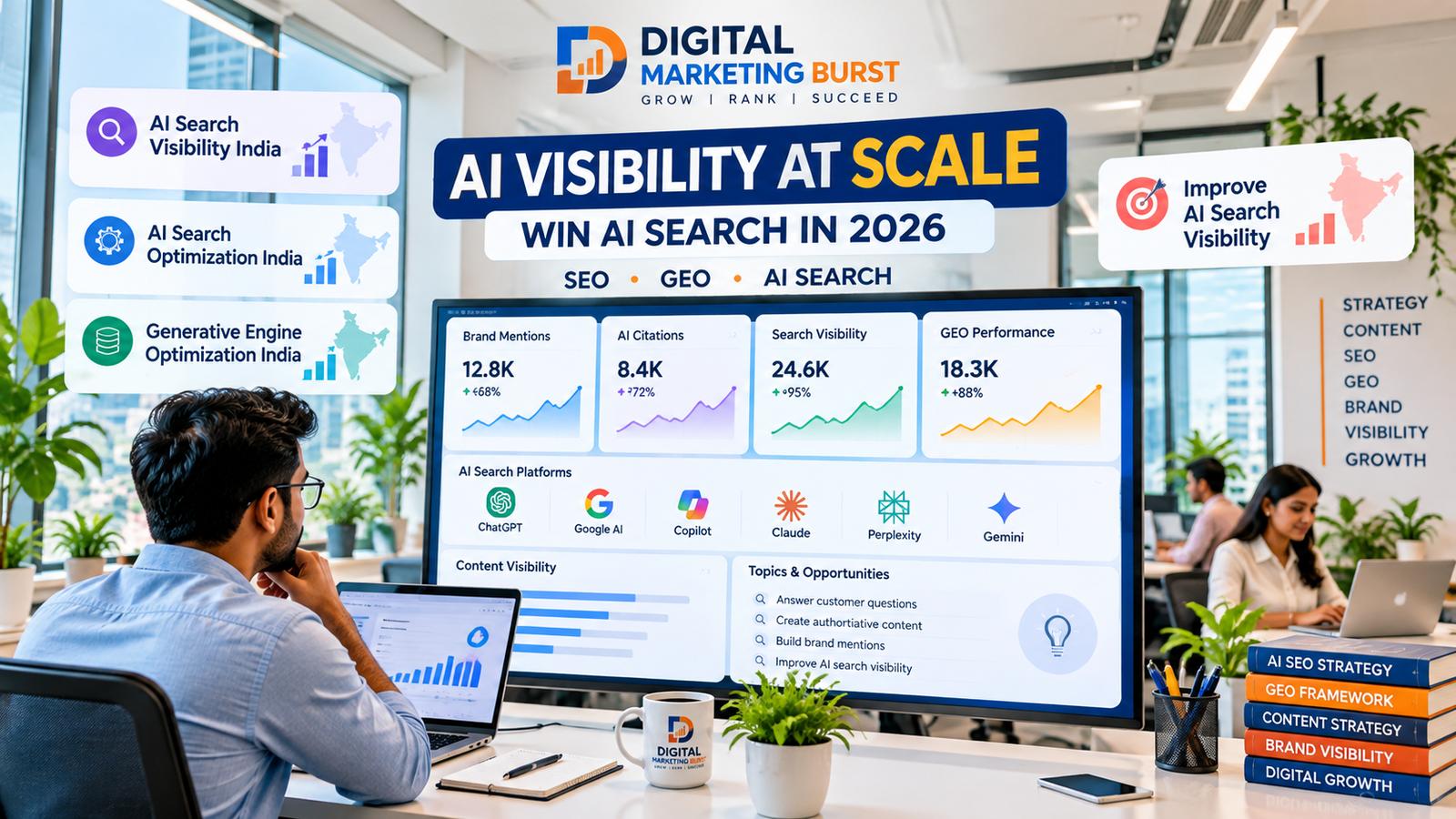
AI Visibility at Scale: How Brands Can Win AI Search in 2026
AI Visibility at Scale: How Brands Can Win AI Search in 2026
Search visibility is no longer limited to where a website ranks on a traditional Google results page. Customers can now discover brands while asking questions in ChatGPT, Google AI Mode, AI Overviews, Gemini, Perplexity and other AI-powered experiences.
That change makes AI Visibility at Scale an important marketing problem rather than another SEO buzzword. A business may rank well for several conventional search queries yet barely appear when users ask AI systems for comparisons, recommendations, explanations or buying guidance.
For Indian businesses, the challenge is even more practical. It is not enough to ask, “Does ChatGPT know our brand?” Marketing teams need to understand where the brand appears, which questions trigger it, which sources influence those answers, why competitors are cited and whether visibility remains consistent across different AI platforms.
Recent large-scale research helps illustrate the problem. An analysis published on September 30, 2026 examined 9 million AI answers across nine platforms for more than 400 enterprise brands. The research found, among other things, that commercial-intent AI answers frequently relied on third-party sources and that strong visibility on one platform often correlated with visibility elsewhere. Those findings should not be treated as universal rules for every Indian company, but they show why AI visibility needs to be measured systematically rather than through a handful of manually tested prompts. Search Engine Land
This guide explains how brands can build that system.
What Is AI Visibility at Scale?
AI visibility describes how often, where and in what context a brand, website, product, service or expert appears in AI-generated search experiences.
The phrase AI Visibility at Scale adds an important distinction.
Checking five prompts manually in ChatGPT is AI visibility testing. Building a repeatable process across hundreds of relevant customer questions, multiple stages of the buying journey, different locations and several AI platforms is visibility measurement at scale.
A useful framework separates visibility into five layers:
Mention visibility measures whether the brand is named.
Citation visibility tracks whether the brand’s website or content is referenced as a source.
Category visibility examines whether the brand appears when users ask about a service or category without mentioning the company by name.
Commercial visibility focuses on comparison, evaluation and purchase-oriented questions.
Source visibility identifies the websites, publishers, directories, communities and other sources influencing AI-generated answers.
This distinction matters because a brand mention and an owned citation are not the same result.
For example, an Indian SaaS company could be mentioned in an AI comparison while a technology publication receives the citation. Another company might receive a direct link to its product documentation. Both have visibility, but the marketing implications are different.
Why AI Search Visibility at Scale Matters in 2026
Traditional SEO usually begins with queries, rankings, impressions, clicks and landing pages. AI search introduces another layer between the query and the website.
A user might ask:
Which CRM is suitable for a small manufacturing company in India?
Another might ask:
Compare CRM platforms for a 50-person Indian sales team that needs WhatsApp integration.
These are not simply two keyword variations. The second query contains company size, geography, use case and a specific feature requirement.
AI interfaces also allow users to continue the conversation. A person can narrow the request, compare alternatives and ask follow-up questions without starting another conventional search.
Google confirms that users in its AI experiences can ask longer and more specific questions. Its guidance still recommends unique, valuable and people-first content rather than creating pages for every possible query variation. Google for Developers
That creates a fundamental shift for marketers:
Keyword coverage remains useful, but question and intent coverage becomes increasingly important.
AI Search Visibility India: What Indian Brands Should Measure
AI Search Visibility India should not mean adding “India” to dozens of pages.
Indian search behaviour contains context that generic international content may not answer properly. Pricing in rupees, GST implications, Indian regulations, city availability, local terminology, regional service coverage and India-specific product options can materially change an answer.
Consider a hospital software company.
A broad query could be:
What is hospital management software?
That query is informational.
A much more valuable Indian-market query might be:
Which hospital management software works for a 100-bed hospital in India?
Another could ask:
Hospital management software in India with NABH workflow support.
A useful visibility programme should therefore group prompts according to actual customer needs rather than generating hundreds of slight keyword variations.
Build an Indian Prompt Universe
Start with six intent groups:
| Intent | Example |
|---|---|
| Educational | What is AI search optimization? |
| Problem | Why is my brand missing from ChatGPT? |
| Solution | How can a company improve AI search visibility? |
| Comparison | SEO vs GEO for an Indian business |
| Commercial | AI SEO agencies in India |
| Brand | What does [Brand] offer? |
Then add relevant modifiers such as industry, city, company size, budget, problem and audience.
A B2B company selling across India may need national prompts. A Lucknow-based clinic, however, should concentrate heavily on genuine local patient intent instead of chasing generic national mentions.
That is how AI Visibility in India becomes commercially meaningful.
AI Visibility Is Not the Same as Google Ranking
A common mistake is treating AI visibility as another rank-tracking column.
The two systems overlap, but they should not be treated as identical.
Google states that its AI features remain grounded in its core Search systems and that existing SEO best practices continue to apply. Pages need to be indexed and eligible to appear with a snippet to be considered as supporting links in Google AI features. Google also says there are no additional technical requirements specifically for AI Overviews or AI Mode. Google for Developers
Other AI products have their own discovery systems.
For example, OpenAI says public websites can appear in ChatGPT search. Publishers wanting their content to be discoverable and cited should ensure they are not blocking OAI-SearchBot. OpenAI Help Center
Therefore, a strong Google ranking can be an important asset without guaranteeing equivalent visibility across every AI system.
AI Search Optimization India: Start With Discoverability
Before worrying about citations, make sure platforms can actually discover the information you want them to use.
For Google, that means retaining solid technical SEO foundations:
- crawlable pages;
- indexable content;
- appropriate canonicalisation;
- useful internal linking;
- valid HTTP responses;
- mobile-friendly pages;
- clear site architecture;
- descriptive titles and headings.
Google’s 2026 guidance specifically warns against abandoning these fundamentals in favour of supposed AEO or GEO shortcuts. It also states that there is no ideal page length and no requirement to break pages into artificial tiny “AI-friendly” chunks. Google for Developers
This is particularly important for businesses adopting AI Search Optimization India strategies. Adding an llms.txt file or rewriting every paragraph into short fragments should not take priority over fixing crawlability, duplicate pages, weak content or confusing site architecture.
Google currently says llms.txt neither helps nor harms visibility or rankings in Google Search because Google Search ignores it. Google for Developers
AI SEO India Starts With Search Intent, Not AI Tricks
The term AI SEO India can make the process sound like an entirely new discipline.
In practice, many foundations remain familiar:
Understand the customer.
Publish genuinely useful information.
Build technically accessible pages.
Establish clear entities.
Keep important business information consistent.
Earn legitimate references.
Update content when facts change.
What changes is the environment in which that information can be retrieved and synthesised.
A strong page should therefore answer the main question directly while also providing enough supporting context for a reader to evaluate the answer.
Suppose an Indian manufacturer publishes a page about industrial solar installation.
A weak page may contain:
We provide the best solar solutions with cutting-edge technology and excellent customer satisfaction.
There is little information for either a human decision-maker or an AI retrieval system.
A stronger page could explain supported facility sizes, assessment process, installation stages, applicable regions, maintenance model, common project constraints and how businesses should compare proposals.
Specific information creates more value than promotional adjectives.
Generative Engine Optimization India: Where GEO Fits
Generative Engine Optimization India, commonly shortened to GEO, generally refers to improving a brand’s discoverability and representation in generative search and answer environments.
However, businesses should avoid turning GEO into a collection of hacks.
Google explicitly recommends focusing on effective SEO strategies rather than tactics such as unnecessary content chunking, artificial mentions or special AI text files for the purpose of Google generative Search. Google for Developers
A better model is:
SEO builds discoverability and authority.
Content strategy builds relevance and usefulness.
Digital PR and genuine third-party presence broaden external validation.
GEO measurement examines how those signals translate into AI answers.
This framework prevents GEO Optimization India from becoming disconnected from broader marketing.
Build Entity Clarity Before Trying to Scale Visibility
AI systems need enough reliable information to understand what an organisation actually is.
Your website should make relationships between key entities obvious.
For a healthcare business, that could look like:
Hospital → Location → Department → Doctor → Qualification → Specialty → Treatment → Appointment information
For an agency:
Agency → Location → Service → Industry expertise → Team → Case study → Contact information
For an ecommerce company:
Brand → Product category → Product → Specifications → Price → Availability → Support
The purpose is not to insert dozens of keywords.
It is to reduce ambiguity.
Company name, location, service areas, product names, author information and other important facts should not contradict one another across major pages.
Improve AI Search Visibility With Answer-First Content
One practical way to Improve AI Search Visibility is to examine whether your pages actually answer the questions customers ask.
Consider this query:
How much should a small business in India spend on SEO?
A page that begins with 500 words about the history of SEO delays the answer.
A more useful structure could start by explaining that budget depends on market competitiveness, geographic scope, website condition, content requirements and business objectives. The page can then show readers how to estimate an appropriate range using those variables.
The principle is simple:
Answer first. Explain second. Support third.
That does not mean every paragraph must become a two-line snippet. Google specifically says there is no need to rewrite content in a special format solely for generative AI systems. Google for Developers
Write for comprehension.
Increase AI Search Visibility With Original Information
AI search creates a major problem for generic content: if twenty websites repeat the same information, there is little reason for another page to exist.
Originality does not necessarily require a million-row dataset.
An Indian business can add unique value through:
- original product specifications;
- transparent processes;
- expert commentary;
- genuine first-party research;
- documented methodology;
- useful calculators;
- original photographs or videos;
- clearly evidenced case studies;
- local market observations supported by data;
- proprietary tools or templates.
Google’s latest guidance calls this type of material non-commodity content and recommends providing unique perspectives rather than recycling what already exists online. Google for Developers
This may be one of the most important principles for increasing AI search visibility sustainably.
Third-Party Sources Matter More Than Many Brands Assume
A company cannot treat its own website as the entire AI visibility ecosystem.
The recent 9-million-answer study reported that, for commercial-intent prompts in its dataset, 82% of citations went to third-party sources while 3% went to owned pages. The same research reported that owned citations produced the strongest visibility lift in its analysis. These numbers describe that particular dataset; they should not be assumed to represent every industry, country or AI platform. Search Engine Land
The practical lesson is broader than the percentages.
Ask two separate questions:
Can AI systems find strong information about us on our website?
Can they find credible information about us elsewhere?
The second question brings digital PR, industry publications, genuine reviews, professional directories, associations and editorial coverage into the visibility strategy.
Do not manufacture mentions.
Google specifically cautions against pursuing inauthentic mentions as an AI-search tactic. Google for Developers
Stop Measuring Only Brand Mentions
Suppose Brand A appears in 40 of 100 tracked prompts.
Brand B appears in 25.
It would be tempting to declare Brand A the winner. That conclusion could be misleading.
Perhaps Brand A appears mainly in informational questions with little commercial relevance. Brand B might appear in high-intent comparisons that influence purchasing decisions.
A better AI visibility dashboard should separate several metrics.
Mention Rate
How frequently is the brand named across the tracked prompt set?
Owned Citation Rate
How often does an AI answer link directly to the brand’s website?
Third-Party Citation Presence
Which external sources mention or support the brand?
Commercial Intent Visibility
Does the company appear in prompts where users are evaluating providers, products or solutions?
Topic Coverage
Which customer problems consistently produce brand visibility?
Platform Coverage
Is visibility concentrated in one AI product or spread across several?
Source Concentration
Are most citations dependent on one external domain?
These metrics reveal different weaknesses.
Create an AI Visibility Scorecard
Instead of combining everything into an arbitrary single score, maintain a simple monthly scorecard.
| Metric | Current | Previous | Action |
|---|---|---|---|
| Brand mentions | Measure | Measure | Investigate changes |
| Owned citations | Measure | Measure | Improve source-worthy pages |
| Commercial prompt presence | Measure | Measure | Strengthen decision content |
| Platforms with visibility | Measure | Measure | Diagnose missing platforms |
| Unanswered topics | Measure | Measure | Build genuinely useful content |
| Incorrect brand information | Measure | Measure | Correct source information |
Do not compare raw numbers until your prompt set is stable.
Changing half the prompts every month destroys comparability.
Step-by-Step AI Visibility at Scale Framework
A scalable programme can be built in eight stages.
Step 1: Define the Business Outcomes
Do not start with “We want to rank in ChatGPT.”
Decide what visibility should support.
Possible outcomes include qualified leads, product discovery, branded demand, local enquiries, demo requests or category awareness.
Step 2: Map Customer Questions
Collect questions from:
Search Console queries, sales conversations, customer support, on-site search, Google searches, product reviews and actual prospect objections.
Group them by intent rather than creating hundreds of keyword variations.
Step 3: Create a Stable Prompt Set
Build a representative benchmark.
For example:
- 30 informational prompts;
- 30 problem-aware prompts;
- 20 comparison prompts;
- 20 commercial prompts.
Those numbers are only an example, not a universal standard.
Step 4: Test Multiple AI Environments
Where practical, evaluate relevant platforms rather than assuming one represents all AI search.
Record:
brand mention;
linked source;
competitors mentioned;
answer context;
third-party sources;
accuracy;
date tested.
Step 5: Find Visibility Gaps
Look for patterns.
You might discover that your brand appears for educational questions but disappears for commercial comparisons.
Another company may receive mentions but no owned citations.
Those are different problems requiring different actions.
Step 6: Map Gaps to Pages
Do not automatically create a new article for every missing prompt.
Sometimes the correct action is improving an existing service page, comparison page, product page, FAQ, author profile or documentation page.
This protects the site from unnecessary content duplication.
Step 7: Strengthen External Presence
Identify sources repeatedly appearing for your important topics.
The objective is not to manipulate them. Determine why those sources are useful and whether your brand legitimately belongs in the underlying conversation.
Step 8: Measure Again
Keep the core prompt set stable and rerun the benchmark periodically.
AI outputs can change, so individual answers should not be treated as permanent rankings.
Look for patterns across time.
AI Search Optimization India Needs Local Relevance
Indian businesses should resist importing every US-focused AI SEO tactic without considering local intent.
A user searching for software in India may care about:
INR pricing;
GST invoices;
Indian customer support;
WhatsApp integration;
local regulations;
Indian payment systems;
city availability;
regional language support.
If those details genuinely affect the buying decision, they deserve clear coverage.
This is not “India keyword insertion.” It is localisation based on user needs.
Content Types That Can Support AI Visibility
There is no single magic content format.
The 9-million-answer study found that ordinary pages accounted for a substantial share of citations in its dataset, challenging the idea that every page needs to be a listicle or specially formatted AI article. Search Engine Land
Depending on search intent, useful assets may include:
comparison pages;
original research;
service pages;
product documentation;
expert guides;
pricing explanations;
methodology pages;
glossaries;
calculators;
case studies with verifiable evidence.
Choose the format because it solves the user’s problem, not because someone claims AI engines prefer it.
Technical SEO Still Matters for AI Search
AI visibility does not make indexing irrelevant.
For Google’s AI features, a supporting page must be indexed and eligible to appear in Search with a snippet. Google also states that meeting these conditions does not guarantee crawling, indexing or appearance. Google for Developers
Check:
canonical tags;
robots directives;
HTTP status;
XML sitemap inclusion;
internal links;
rendered content;
mobile usability;
page experience;
duplicate URLs.
OpenAI has separate crawler controls. Its publisher documentation says sites should allow OAI-SearchBot if they want content to be discoverable and surfaced in ChatGPT search summaries and citations. OpenAI Help Center
Do not assume every AI crawler serves the same purpose.
AI Crawler Access Requires a Deliberate Policy
Visibility and AI training are not necessarily the same thing.
A business might want content discoverable in AI search while having different preferences about training crawlers.
Cloudflare’s current documentation distinguishes crawler controls and offers tools for monitoring or blocking AI crawler activity. It also notes that robots.txt expresses preferences rather than technically enforcing access. Cloudflare Developers
Before blocking AI bots globally, understand which crawler performs which function.
A blanket rule can conflict with the visibility objective you are trying to achieve.
Common AI Visibility Mistakes
Tracking Only Five or Ten Prompts
Small manual checks can be useful for exploration but are weak evidence of overall visibility.
Treating Mentions as Rankings
AI answers are not simply a traditional SERP with a new design.
Publishing a Page for Every Prompt
Google explicitly warns against producing many pages around query variations primarily to manipulate rankings or generative AI responses. Google for Developers
Copying Competitor Answers
Rephrasing already-ranking content gives users little additional reason to choose your page.
Stuffing GEO and AI SEO Keywords
An article does not become more useful because “AI Search Optimization India” appears twenty times.
Ignoring Third-Party Sources
Commercial discovery can occur through sources you do not own.
Blocking Crawlers Without Understanding Them
Search discovery, AI assistance and model training can involve different crawlers and policies.
Expecting Immediate Stability
Generative answers can vary. Measure trends rather than reacting to one response.
A 90-Day AI Search Visibility Plan for Indian Brands
A practical programme can be divided into three phases.
Days 1–30: Benchmark
Audit technical accessibility.
Define business-relevant topics.
Create the initial prompt set.
Test relevant AI platforms.
Record brand mentions and citations.
Identify competitors and recurring sources.
Days 31–60: Improve
Strengthen weak existing pages before creating new ones.
Add missing first-party facts.
Improve entity consistency.
Publish genuinely missing decision-support content.
Correct outdated information.
Develop original assets where they add value.
Days 61–90: Measure and Expand
Repeat the original prompt benchmark.
Compare changes by intent and platform.
Identify persistent gaps.
Review referral and conversion data where available.
Expand the prompt set only when it represents genuinely new customer needs.
The goal is not to “finish GEO” in 90 days. The period creates a repeatable measurement cycle.
How Digital Marketing Teams Should Report AI Visibility
Executives do not need a spreadsheet containing 2,000 prompts without context.
A monthly report should answer:
Where are we visible?
Where are we absent?
Which customer intents matter most?
Which pages receive citations?
Which third-party sources influence answers?
Which competitors repeatedly appear?
What changed?
What should we improve next?
Connect AI visibility with business outcomes wherever reliable data exists.
A mention without commercial relevance may be less valuable than a citation that sends qualified prospects to a useful decision page.
Can AI Visibility Be Guaranteed?
No.
Google explicitly states that following requirements and best practices does not guarantee crawling, indexing or serving. Google for Developers
The same practical caution should be applied to broader AI visibility.
Businesses can improve discoverability, information quality, technical accessibility, source authority and measurement. They cannot responsibly promise that an independent AI system will mention a particular brand for every target prompt.
That distinction matters when evaluating an AI SEO India or GEO Optimization India service.
FAQs About AI Visibility at Scale
What does AI Visibility at Scale mean?
It means systematically measuring and improving how a brand appears across a meaningful set of AI-search questions, intents and platforms instead of checking a few prompts manually.
How can I Improve AI Search Visibility?
Start with technical accessibility, strong SEO fundamentals, useful first-party information, clear entity relationships and content that directly addresses genuine customer needs. Then measure mentions and citations across a stable set of relevant prompts.
Is Generative Engine Optimization replacing SEO?
Not for Google Search. Google says existing SEO best practices remain foundational for its generative AI features and there are no special technical requirements for appearing in AI Overviews or AI Mode beyond existing Search eligibility requirements. Google for Developers
Is AI Search Visibility India different from global AI visibility?
The technical foundations can overlap, but Indian customer intent may require local information such as INR pricing, Indian regulations, service locations, payment methods or region-specific product availability.
Should I create separate pages for every AI search query?
No. Create a separate page when there is genuinely distinct user intent requiring its own answer. Google specifically discourages creating many pages for query variations primarily to manipulate Search or generative AI responses. Google for Developers
How often should brands measure AI visibility?
There is no universal official frequency. Choose a repeatable schedule appropriate to your market and keep the core prompt set stable enough to make comparisons meaningful.
Conclusion
AI Visibility at Scale is not about inserting more AI keywords into existing SEO content. It is about understanding how customers discover brands when search becomes conversational, multi-platform and increasingly answer-driven.
For Indian businesses, a sustainable approach starts with strong technical SEO and genuinely useful content. It then expands into entity clarity, first-party information, credible third-party presence, prompt-level measurement and continuous gap analysis.
The most important shift is measurement.
Instead of asking, “Are we visible in AI?”, ask where, for which customer questions, through which sources, on which platforms and at what stage of the buying journey.
Brands that can answer those questions have a much clearer foundation for improving AI search visibility without abandoning the SEO principles that already make websites useful and discoverable.
Once a brand has established its baseline, the next challenge is turning individual improvements into a repeatable system. AI Visibility at Scale becomes useful only when teams can connect customer questions, content, entities, citations, third-party sources and business priorities without publishing unnecessary pages.
For Indian businesses, this means moving beyond occasional ChatGPT checks. The objective should be to understand where visibility comes from, which gaps deserve attention and which improvements can strengthen the brand across traditional and AI-powered search simultaneously.
Google’s current guidance reinforces this approach. Its documentation says that the same foundational SEO practices remain relevant for AI features and that businesses do not need special AI-only files or schema markup to participate in Google’s generative search experiences.
Build AI Search Visibility at Scale Around Topics, Not Individual Prompts
A large prompt list can create the illusion of a sophisticated strategy.
Imagine a digital marketing company tracking these questions:
- What is AI SEO?
- What is AI search optimization?
- How does AI SEO work?
- How can AI SEO help businesses?
- What is GEO?
- What is generative engine optimization?
Those questions are useful, but they largely belong to the same educational topic.
Creating six separate articles would probably produce substantial overlap. Instead, the company should identify the underlying customer need and build one sufficiently useful resource where appropriate.
A better content architecture might group visibility into four layers.
Core Topic
The broad subject the business wants to be associated with.
Example:
AI Search Optimization
Customer Problem
The actual issue driving the search.
Example:
My company appears on Google but rarely appears in AI-generated answers.
Decision Question
The information a potential buyer needs before taking action.
Example:
Should our company invest in traditional SEO, GEO or both?
Specific Context
The details that change the answer.
Example:
AI search optimization for an Indian B2B company targeting international customers.
This structure gives marketers something far more valuable than a giant keyword list: a map of customer intent.
Create a Prompt Taxonomy Before Increasing AI Search Visibility
A prompt taxonomy groups customer questions according to their purpose.
It also prevents a common measurement problem. If 80% of your tracked questions are informational, a high mention rate may look impressive even though the brand rarely appears when users are actually comparing providers.
Start with four practical categories.
Discovery Prompts
These indicate that a user is learning about a subject.
Examples include:
What is generative engine optimization?
How does AI search optimization work?
Visibility here can contribute to category awareness.
Problem-Aware Prompts
The user knows something is wrong but may not know the solution.
For example:
Why is my website not appearing in AI answers?
Why does ChatGPT mention competitors instead of my company?
These questions can reveal valuable content gaps.
Evaluation Prompts
The searcher is comparing approaches.
Examples:
SEO vs GEO for Indian businesses
AI SEO agency vs traditional SEO agency
At this stage, detailed comparison information becomes more useful than another introductory definition.
Commercial Prompts
These questions suggest provider or solution evaluation.
For example:
AI search optimization company in India
GEO services for an Indian SaaS company
A business should not manipulate AI systems to manufacture recommendations. Instead, it should ensure that accurate, decision-useful information about its services is publicly accessible.
Do Not Treat Every AI Platform as the Same Search Engine
One of the biggest mistakes in AI Search Visibility at Scale is combining every platform into a single undifferentiated metric.
ChatGPT Search, Google AI Mode, Google AI Overviews, Gemini and other AI discovery environments do not necessarily retrieve, rank or present information identically.
Google, for example, explains that AI Mode may use a “query fan-out” technique. It can issue multiple related searches across subtopics and data sources before assembling a response.
That has an important content implication.
A page does not necessarily need to repeat one exact query ten times. It needs to provide enough relevant, understandable information to answer the broader subject and its meaningful subquestions.
Suppose a user asks:
How should a small Indian company improve visibility in AI search?
Related information could include technical accessibility, useful content, entity clarity, external references, measurement and platform-specific crawler access.
A genuinely comprehensive resource can address those needs naturally.
Measure AI Search Visibility India by Business Relevance
Raw visibility percentages can be deceptive.
Suppose an Indian marketing company is mentioned in 60% of tracked educational prompts but only 5% of relevant commercial prompts.
Another company might appear in fewer total answers while being consistently surfaced for high-intent service comparisons.
The first business cannot conclude that it has stronger commercial visibility simply because its overall mention percentage is higher.
For AI Search Visibility India, reporting should therefore separate visibility according to intent.
A practical measurement sheet could include:
| Prompt | Intent | Platform | Brand Mention | Owned Citation | Third-Party Source | Accuracy | Priority |
|---|---|---|---|---|---|---|---|
| What is GEO? | Educational | Platform A | Yes/No | Yes/No | Domain | Correct/Incorrect | Low |
| AI SEO for Indian brands | Solution | Platform B | Yes/No | Yes/No | Domain | Correct/Incorrect | Medium |
| AI SEO agencies in India | Commercial | Platform C | Yes/No | Yes/No | Domain | Correct/Incorrect | High |
The platform labels above are placeholders for your actual tracking environment.
Once this information is collected consistently, the team can diagnose why visibility is weak instead of simply knowing that it is weak.
Separate Brand Mentions From Citations
A mention is not automatically a citation.
Consider an AI-generated answer that names a company but links to an industry publication. The company has gained brand visibility, while the publisher has received the direct citation.
Now consider another response where the company’s own research page is linked.
That produces both brand visibility and an owned citation.
This distinction should be maintained in every serious AI Visibility at Scale report.
Track at least:
Mentioned but not cited
Mentioned with owned citation
Mentioned through third-party citation
Not mentioned but owned content cited
Neither mentioned nor cited
The fourth scenario is particularly interesting. Your content might influence an answer even when the company name is not prominent in the generated response.
That should not be recorded as a conventional brand mention.
Create a Source Influence Map
After several rounds of monitoring, list the domains repeatedly appearing in answers related to your category.
Do not immediately think about backlinks.
First ask:
What role does this source play?
It could be:
- an official source;
- an industry publication;
- a review platform;
- a community;
- a marketplace;
- a research organisation;
- a competitor;
- your own website.
Next, determine why that source may be useful.
Perhaps it has original statistics.
Another site may provide structured product comparisons.
A government source could contain authoritative regulatory information.
An industry publication might provide independent context unavailable on vendor websites.
This analysis helps businesses understand the information ecosystem around their category.
AI Visibility in India Requires Better Local Information
Many Indian websites create location relevance by repeating city and country names.
That is not the same as providing locally useful information.
Suppose an international software company wants stronger AI Visibility in India.
Simply adding “India” to the title may contribute little if the page does not answer questions Indian customers actually have.
More useful information might include:
Indian pricing: Are prices displayed in INR?
Taxes: Does the price include GST?
Payments: Which Indian payment methods are supported?
Support: What support hours apply to Indian customers?
Availability: Is the product available throughout India?
Compliance: Are there India-specific legal or regulatory considerations?
Integrations: Does the product work with tools commonly used by Indian customers?
Only include details that genuinely apply to the business.
Specificity is more useful than geographic keyword repetition.
Build Topic Authority Without Creating Content Bloat
Publishing more URLs is not automatically a growth strategy.
Google’s current AI-search guidance explicitly says there is no ideal word count and warns against producing large numbers of pages around search-query variations merely to influence Search or generative AI responses.
Before creating a new page, ask four questions:
Does this query represent a genuinely different intent?
Can the existing page answer it without becoming confusing?
Would a separate page offer substantial unique information?
Will the new page serve users independently of its target keyword?
If the answer to the final question is no, improving an existing page may be better.
This is particularly important for sites publishing aggressively around AI SEO India, GEO Optimization India and related terms.
Those phrases are semantically close enough that careless publishing can produce several weak pages competing for essentially the same intent.
Build a Content Gap Matrix
A content gap should not mean “a competitor has an article and we don’t.”
Use a more useful framework.
| User Need | Existing Page? | Answer Quality | Business Relevance | Action |
|---|---|---|---|---|
| Understand AI SEO | Yes | Strong | Medium | Maintain |
| Measure AI visibility | Yes | Partial | High | Improve |
| Compare SEO and GEO | No | — | High | Consider new page |
| Understand crawler access | Yes | Strong | Medium | Internal link |
| Evaluate AI SEO service | Partial | Weak | High | Improve service content |
This forces the team to make decisions based on user needs.
It also helps prevent content cannibalisation.
Improve AI Search Visibility Through Information Gain
One of the strongest questions a content team can ask is:
What can our page contribute that the reader cannot get from ten similar articles?
The answer should not simply be “more words.”
Useful differentiation can come from a better decision framework, an original process, transparent methodology, firsthand expert explanation, proprietary research or a tool that helps users complete a task.
For this article, for example, a genuinely useful addition is the AI Visibility Gap Matrix below.
AI Visibility Gap Matrix
Evaluate each important topic across four states:
| Search Situation | Brand Mentioned? | Brand Cited? | Recommended Focus |
|---|---|---|---|
| Strong | Yes | Yes | Maintain accuracy and freshness |
| Recognition gap | No | Yes | Strengthen entity/brand context |
| Source gap | Yes | No | Improve owned source quality |
| Full visibility gap | No | No | Investigate intent, content and sources |
This matrix turns an abstract visibility problem into an actionable diagnosis.
A brand that is mentioned but never cited has a different problem from one whose website is cited without clear brand attribution.
AI Search Optimization India Should Include Entity Consistency
Entity clarity is particularly important for organisations with multiple locations, products or professionals.
Consider a healthcare organisation with:
one parent brand;
three hospital locations;
multiple departments;
dozens of doctors;
different appointment numbers.
If those relationships are inconsistent across the website and public sources, machines and people can struggle to understand them.
The same issue appears in ecommerce, education, SaaS and professional services.
For AI Search Optimization India, audit important facts such as:
business name;
official website;
locations;
service areas;
contact information;
founders or leadership where relevant;
products or services;
professional credentials;
pricing where publicly available;
brand relationships.
Do not create information merely to complete the list.
Accuracy comes first.
Use Structured Data for Its Real Purpose
Schema markup can help search engines understand eligible page information, but it should represent what users can actually see.
Google’s AI-search guidance states that businesses do not need special schema markup specifically for AI Overviews or AI Mode. Existing structured-data guidance still applies.
That means an article should use appropriate Article or BlogPosting markup.
A product page may qualify for product-related structured data.
An organisation can use relevant organisation markup where appropriate.
Adding unrelated schema types simply because they sound useful for AI does not create meaningful authority.
Generative Engine Optimization India Needs Source-Worthy Pages
A source-worthy page does more than answer a keyword.
It gives another writer, researcher, customer or system a reason to reference it.
Imagine two pages discussing AI visibility.
Page A says:
AI visibility is very important for businesses. Companies should optimize their content for AI.
Page B provides:
a clear definition;
measurement methodology;
prompt taxonomy;
source classification;
gap matrix;
limitations;
update date;
references to primary documentation.
Page B provides considerably more utility.
For Generative Engine Optimization India, aim to create pages that can function as references, not merely pages designed to collect impressions.
Increase AI Search Visibility With Better First-Party Facts
Many businesses possess valuable information but hide it behind vague marketing language.
A service page might say:
We offer customised solutions for every client.
What does that actually tell a prospective customer?
Where appropriate, replace vague claims with verifiable information.
A service business could explain:
how an engagement begins;
what information is required;
which deliverables are included;
how reporting works;
what the service does not include;
who the service is designed for;
how customers should evaluate whether it fits their needs.
An ecommerce company can provide dimensions, compatibility, warranty information, shipping restrictions and product documentation.
A healthcare organisation can clearly display doctors’ qualifications, departments, consultation information and available facilities—provided those facts are accurate and appropriately presented.
First-party facts help users make decisions.
Build Content Around Evidence Levels
Not every statement deserves the same confidence.
A useful editorial system separates information into four levels.
Level 1: First-Party Facts
These are facts your organisation can directly verify.
Examples include office locations, product features and service processes.
Level 2: Primary External Sources
These include official government documents, platform documentation, research papers and regulatory publications.
Level 3: Reliable Secondary Analysis
Reputable industry publications can help interpret developments or summarise research.
Level 4: Observation or Hypothesis
Some AI-search behaviours are still evolving.
When evidence is limited, describe the idea as an observation or hypothesis rather than turning it into an SEO rule.
This prevents emerging GEO Optimization India advice from being presented with more certainty than the evidence supports.
Create a Citation-Ready Content Standard
Before publishing an important resource, ask:
Can a reader identify who published it?
Is the publication or update date clear?
Are important factual claims supported?
Are primary sources used where possible?
Can someone understand the methodology behind original research?
Are commercial claims distinguishable from factual information?
Does the page explain important limitations?
These practices improve trust for humans regardless of how AI systems evolve.
Do Not Manufacture Expertise
AI-search growth has encouraged some websites to create artificial authors, fabricated credentials and generic expert quotes.
Avoid that approach.
If an article is reviewed by an actual subject expert, identify that person accurately.
When there is no expert review, do not imply one occurred.
If Digital Marketing Burst publishes original research in the future, explain the dataset and methodology rather than using vague phrases such as “our research proves” without supporting material.
Trust is difficult to build and easy to undermine.
Measure Accuracy Alongside Visibility
Visibility is not always positive.
Suppose an AI answer mentions your brand but gives the wrong service area.
Another response might display an outdated product name.
A third could incorrectly describe pricing.
Those are visibility events, but they also create information-quality problems.
Add an accuracy field to the monitoring process:
Correct
Partially correct
Outdated
Incorrect
Unable to verify
High visibility with poor accuracy deserves attention.
Create a Brand Facts Page Where It Helps Users
Some organisations have complex information spread across dozens of pages.
A clear About, Company Information or organisation page can consolidate important public facts.
It might include:
official brand name;
what the company does;
locations;
leadership;
main services;
official contact channels;
important policies.
Do not create a hidden “AI facts page” stuffed with keywords.
Make the resource useful to journalists, customers, partners and other human visitors as well.
Track Competitors Without Copying Them
Competitor visibility can reveal gaps.
If another company repeatedly appears for a commercially important prompt, investigate the underlying reason.
Ask:
What information does its own site provide?
Which external sources mention it?
Is it being cited directly?
Does it have original research?
Is its entity information clearer?
Does it simply have stronger category relevance?
The answer should guide investigation, not imitation.
Copying the competitor’s headings and rewriting the paragraphs produces another commodity page.
Build an AI Visibility Content Flywheel
A scalable workflow can follow this sequence:
Measure → Diagnose → Prioritise → Improve → Earn References → Re-measure
Measurement identifies the gap.
Diagnosis determines whether the issue relates to content, technical access, entity clarity, source authority or intent.
Prioritisation connects the problem to business value.
Improvement strengthens the appropriate existing asset or creates a genuinely necessary one.
External references may develop naturally when the information is useful and worthy of citation.
Re-measurement shows whether the broader visibility pattern changes.
Then the cycle starts again.
Prioritise AI Visibility Work by Impact
Not every missing prompt deserves immediate action.
A simple prioritisation model can use four questions:
Business value: Could this query influence a meaningful customer action?
Intent relevance: Does the prompt closely match what the company actually provides?
Visibility gap: Is the brand consistently absent or inaccurately represented?
Content opportunity: Can the business provide something genuinely useful that is currently missing?
A high-value commercial question with weak existing information deserves more attention than an obscure informational prompt with little relevance to the business.
Connect AI Visibility With Traditional Search Data
Do not isolate AI measurement from existing analytics.
Google states that traffic from AI features is included in Search Console’s overall Web search reporting.
This creates an important limitation: marketers may not always receive a clean platform-level breakdown for every generative-search interaction in standard Search Console reporting.
Use the information that is actually available rather than inventing precision.
Relevant signals can include:
Search Console impressions;
organic clicks;
landing-page performance;
branded searches;
referral traffic from identifiable AI services;
conversions;
lead quality.
Correlation does not automatically prove causation.
If branded searches rise after an AI visibility campaign, that alone does not prove AI mentions caused the increase.
What Should Indian Businesses Do First?
For most companies, the starting point is not purchasing an expensive monitoring platform.
Begin with a focused manual benchmark.
Choose perhaps 30–50 questions that genuinely represent customer intent. The number is an example rather than a required standard.
Test them consistently.
Document what appears.
Look for recurring gaps.
Then decide whether the scale of the programme justifies specialised monitoring technology.
A small local business may not need thousands of prompts.
A national marketplace operating across dozens of product categories could require a much larger measurement framework.
Scale should match the business.
What AI Visibility at Scale Should Not Become
It should not become another excuse for mass-producing low-value pages.
Nor should it become a contest to mention ChatGPT, Gemini, GEO and AI SEO as often as possible.
The strongest strategy connects several established disciplines:
technical SEO;
content strategy;
brand management;
digital PR;
entity consistency;
analytics;
customer research.
AI Visibility at Scale sits above these activities as a measurement and prioritisation layer.
That makes it much more useful than treating it as another isolated SEO tactic.
A business needs to decide which gaps deserve investment, which existing pages should be improved, where new content is justified and how AI visibility connects with leads, revenue and wider brand demand.
This matters because visibility alone is not a business outcome. A brand can appear in hundreds of informational answers without influencing a single meaningful customer decision.
For Indian businesses, the objective should therefore move from “How often are we mentioned?” to “Are we visible when the right audience is researching problems and evaluating solutions?”
Turn AI Visibility at Scale Into a Business Strategy
A useful AI visibility programme starts with business priorities.
Imagine three companies:
An ecommerce brand wants more product discovery.
A B2B software company needs qualified demo enquiries.
A healthcare organisation wants patients to find accurate information about its doctors and services.
All three may invest in AI Search Visibility at Scale, but their success criteria should be different.
The ecommerce company could prioritise product-category and comparison queries. A SaaS business may care more about problem-solving and vendor-evaluation prompts. Healthcare organisations should place particularly strong emphasis on factual accuracy, authoritative information and appropriate medical content.
Therefore, the first question should not be:
How do we get mentioned more often?
It should be:
Which AI-assisted customer journeys actually matter to our business?
That question keeps the strategy tied to real users.
Map the AI-Assisted Customer Journey
Traditional search funnels often simplify users into awareness, consideration and conversion.
AI-assisted journeys can be less linear.
A person might begin with:
What is generative engine optimization?
Then continue:
Does GEO replace SEO?
After receiving an explanation, the same user might ask:
How should an Indian business measure AI visibility?
A later question could become:
What should I ask an AI SEO agency before hiring them?
The user’s intent has moved from education to evaluation within one conversational experience.
Content planning should account for that progression.
Awareness Stage
Answer foundational questions clearly.
Useful content might include definitions, educational guides and explanations of changing search behaviour.
Problem Recognition Stage
Help users understand why a problem exists.
Examples include:
Why is my brand not appearing in AI search?
Why do competitors appear in AI-generated recommendations?
Evaluation Stage
Provide frameworks that help users compare possible solutions.
Useful resources may cover:
SEO vs GEO;
in-house vs agency implementation;
AI visibility tools;
measurement methodologies;
technical requirements.
Decision Stage
Provide accurate information about your actual service.
Explain the process, scope, deliverables and limitations rather than filling the page with “best agency” claims.
This journey helps AI Search Optimization India remain connected to customer needs.
Build a Prompt-to-Page Map
Once important prompts have been identified, map them to the pages that should logically answer them.
Do not immediately create a new URL.
A simple working document can look like this:
| Customer Question | Intent | Existing Page | Content Gap | Action |
|---|---|---|---|---|
| What is AI SEO? | Informational | AI SEO guide | Small | Improve |
| How do I measure AI visibility? | Informational | Visibility guide | Medium | Expand |
| SEO vs GEO | Comparison | None/partial | High | Evaluate new page |
| How does AI crawler access work? | Technical | Crawl guide | Small | Internal link |
| AI SEO services in India | Commercial | Service page | Depends on current content | Improve if justified |
The final column is important.
Not every gap requires a new article.
Sometimes one new section is enough. In other cases, the search intent is sufficiently different to justify a dedicated resource.
This approach can reduce unnecessary content duplication.
Create Content Clusters Without Keyword Cannibalisation
Your keyword set includes:
AI Visibility at Scale
AI Search Visibility at Scale
AI Search Visibility India
AI Visibility in India
AI Search Optimization India
AI SEO India
Generative Engine Optimization India
GEO Optimization India
Improve AI Search Visibility
Increase AI Search Visibility
These should not automatically become ten separate articles.
Several represent closely related concepts.
For this page, AI Visibility at Scale remains the primary topic. Terms such as AI Search Visibility at Scale and AI Visibility in India can naturally support the main discussion.
A separate article should exist only when the underlying search intent becomes sufficiently different.
For example, a detailed guide specifically explaining Generative Engine Optimization could justify its own URL if it deeply addresses GEO methodology rather than repeating this article.
That page could then link back to this one when discussing measurement at scale.
Use Internal Links to Build a Clear Topic Relationship
Internal linking should help readers continue their research.
It should also make the relationship between related resources understandable.
For Digital Marketing Burst, a logical structure could be:
AI Visibility at Scale
↓
AI SEO Strategy Guide
↓
AI Visibility Reporting Guide
↓
Website Crawl Optimization Guide
The relationship is straightforward.
The current article explains how visibility can be scaled.
The AI SEO guide can explain the broader strategy.
The reporting resource can go deeper into measurement.
The crawler guide can handle technical discovery and crawler controls.
Avoid linking every occurrence of “AI SEO” to another page. One contextual link in the appropriate section is usually more useful than repetitive internal linking.
Improve AI Search Visibility by Updating Existing Content
Publishing is only half the job.
Existing pages can gradually become outdated as platforms, terminology, products and user expectations change.
Create a content-maintenance process.
Review Time-Sensitive Facts
Check:
platform features;
crawler documentation;
product names;
pricing;
regulations;
statistics;
research findings.
A statement that was correct six months ago may no longer be accurate.
Remove Obsolete Advice
AI search is evolving quickly.
If an older recommendation no longer has adequate evidence, update or remove it instead of keeping it simply because the page ranks.
Strengthen Weak Sections
Search behaviour may reveal new questions that genuinely belong on an existing page.
Add them where useful.
Preserve Valuable URLs
Do not publish a replacement article every time terminology changes.
When the intent remains substantially the same, updating the established resource can be more sensible than creating another overlapping page.
Create an AI Content Refresh Framework
For important pages, maintain a simple review record:
Page: Which URL is being reviewed?
Primary intent: What user problem should it solve?
Last reviewed: When was the factual content checked?
Changed facts: What has changed since publication?
New user questions: Are important questions missing?
Overlap: Has another page started covering the same intent?
Action: Maintain, update, consolidate or redirect.
This process can help an expanding site avoid becoming a collection of overlapping AI articles.
AI Search Visibility India Needs Language Awareness
India is not a single-language search market.
English remains important for many commercial and professional queries, but users also search and converse in Hindi and other Indian languages.
That does not mean every English article should automatically be translated.
Translation should be driven by audience demand and business capability.
A Hindi page should offer a genuinely usable Hindi experience rather than replacing English keywords word-for-word.
The same principle applies to Hinglish.
If customers naturally use a mixture of Hindi and English when searching for a service, research those questions before deciding whether dedicated content is warranted.
Avoid mass-generating regional-language pages merely to create more indexed URLs.
AI SEO India Should Consider Branded Information Accuracy
A company should periodically test what AI systems say when users ask directly about the brand.
Relevant prompts might include:
What does [Brand] do?
Where is [Brand] located?
What services does [Brand] provide?
Who is [Brand] suitable for?
Does [Brand] offer [specific service]?
Record incorrect or outdated information.
Then investigate possible sources.
The problem may originate from the company’s own outdated page, an old business listing, third-party coverage or an ambiguous brand name.
Correct the underlying information wherever you legitimately control it.
Do not attempt to manipulate an AI answer directly.
Create a Single Source of Truth for Important Brand Facts
Large websites often contradict themselves.
One page shows an old office address.
Another uses an outdated service name.
A third displays an old leadership profile.
Those inconsistencies create a poor user experience before AI search is even considered.
Maintain an internal source-of-truth document containing verified information such as:
official brand name;
website;
service locations;
contact information;
products and services;
approved descriptions;
leadership information where relevant;
important policies.
Content writers, SEO teams, social media managers and PR teams can then work from the same verified information.
The public website should still contain the facts users actually need.
Increase AI Search Visibility Through Original Research
Original research can differentiate a brand when it is conducted responsibly.
You do not need a dataset containing millions of prompts.
A smaller transparent study can still be useful if its methodology matches the question being investigated.
For example, an Indian digital marketing company could study a clearly defined set of AI-search prompts within one industry.
A credible methodology would explain:
which platforms were tested;
when testing occurred;
how prompts were selected;
how many prompts were included;
how mentions were classified;
what counted as a citation;
what limitations existed.
The findings should not be generalised beyond what the sample supports.
That transparency matters more than creating an impressive headline.
Never Turn Third-Party Research Into Your Own Statistic
This is especially important for the current article.
The research that inspired the topic analysed 9 million AI answers across nine platforms and more than 400 enterprise brands. Those numbers belong to that research, not to Digital Marketing Burst.
A safe sentence is:
Research covering 9 million AI answers across nine platforms and more than 400 enterprise brands found…
An unsafe presentation would be:
Our analysis of 9 million AI answers found…
unless Digital Marketing Burst actually conducted that research.
Clear attribution protects credibility.
Build a Digital PR Layer Around Useful Assets
Third-party visibility cannot simply be manufactured.
However, businesses can create assets that journalists, publishers and industry professionals genuinely have reasons to reference.
Examples include:
original research;
transparent datasets;
industry surveys;
calculators;
expert commentary;
technical documentation;
useful visualisations;
publicly accessible methodology.
Once an asset exists, relevant outreach can introduce it to appropriate publications.
The objective should be editorial usefulness rather than producing artificial mentions for Generative Engine Optimization India.
Think Beyond Backlinks
A traditional link-building mindset asks:
Can this website link to us?
An AI visibility mindset can ask broader questions:
Is our brand accurately represented in authoritative sources?
Are knowledgeable people discussing our work?
Is our original information being referenced?
Do independent sources provide useful context about the brand?
Backlinks remain useful in SEO, but not every useful brand reference should be reduced to a link-acquisition tactic.
The broader objective is building a credible information footprint.
Monitor AI Referral Traffic Carefully
Where analytics platforms expose identifiable referral traffic from AI services, create a separate reporting view.
Track:
sessions;
landing pages;
engagement;
conversions;
assisted conversions where reliably measurable;
lead quality.
Do not assume a low volume of direct AI referrals means AI visibility has no value.
Some users may discover a company through an AI answer and later search for the brand directly.
At the same time, do not claim that every increase in branded search was caused by AI.
Attribution needs evidence.
Create AI Visibility KPIs by Funnel Stage
Different stages deserve different measurements.
Awareness KPIs
Brand mentions
Topic coverage
Relevant non-branded prompt visibility
Consideration KPIs
Comparison visibility
Third-party source presence
Owned citations
Accurate product or service representation
Decision KPIs
AI referral visits where measurable
Commercial landing-page engagement
Qualified enquiries attributable to identifiable sources
Conversions where reliable attribution exists
This prevents one visibility number from being treated as the entire strategy.
Calculate Visibility Rates Carefully
Suppose you track 100 prompts.
Your brand appears in 35.
A simple mention rate would be:
35 ÷ 100 × 100 = 35%
Now suppose only 20 prompts have strong commercial intent and the brand appears in 3.
Commercial visibility would be:
3 ÷ 20 × 100 = 15%
The second number could reveal a much more important gap.
However, do not compare these rates with another company unless both are measured using a reasonably comparable prompt methodology.
The prompt sample determines the result.
Create a Weighted Priority Model
Not all prompts deserve equal resources.
A team can assign internal priority based on:
Business relevance
Commercial intent
Customer frequency
Current visibility gap
Ability to provide a useful answer
For example, use a simple 1–5 internal score for each factor.
The score is not an industry-standard AI ranking metric. It is merely a prioritisation mechanism for your team.
This distinction should remain clear in reporting.
Do Not Invent an “AI Visibility Score” for Marketing
A proprietary score can be useful internally if its methodology is transparent.
Problems begin when a company presents an arbitrary number as if it were an official metric recognised by ChatGPT, Google or Gemini.
If you create a Digital Marketing Burst AI Visibility Score in the future, document:
the prompt sample;
platforms;
weighting;
calculation;
testing frequency;
limitations.
Without methodology, a score such as “Your AI visibility is 83/100” provides very little trustworthy information.
GEO Optimization India Should Include Reputation Monitoring
AI systems can surface third-party information that brands do not control.
That makes reputation monitoring relevant to GEO Optimization India.
Watch for recurring factual issues involving:
incorrect addresses;
old service information;
outdated product details;
confusion between similarly named companies;
unsupported claims;
obsolete reviews or listings.
The response should depend on the source.
Correct information on properties you control.
For third-party platforms, use their legitimate correction or update processes where appropriate.
Do not attempt to suppress genuine criticism merely because it affects brand visibility.
Improve AI Search Visibility With Better Comparison Content
Comparison queries can have strong decision intent.
However, comparison pages often fail because they are written to make the publisher win regardless of evidence.
A useful comparison should explain:
who each option suits;
important differences;
limitations;
cost considerations where verifiable;
decision criteria;
situations where neither option is appropriate.
For example:
SEO vs GEO should not conclude that traditional SEO is obsolete.
Instead, explain where the disciplines overlap and where AI-specific measurement introduces new considerations.
That helps readers make a decision rather than pushing them towards a predetermined conclusion.
Build Pages for Decisions, Not Just Definitions
Definitions attract informational searches.
Decision-support content helps users act.
After explaining a concept, consider whether the reader needs:
a checklist;
comparison table;
implementation sequence;
calculator;
template;
decision tree;
audit framework.
For this topic, an AI visibility decision tree could work well.
Is your content crawlable?
If no → resolve technical access first.
If yes → Does your content adequately answer important customer questions?
If no → improve existing content.
If yes → Is the brand mentioned but not cited?
If yes → investigate owned source quality.
If no → Are competitors appearing through third-party sources?
If yes → analyse the source ecosystem.
That turns theory into an actionable workflow.
AI Visibility at Scale for Small Businesses
“Scale” does not mean every business needs enterprise software.
A small Indian company could begin with:
20–30 high-value prompts;
two or three relevant AI environments;
a monthly manual review;
a simple spreadsheet;
a small number of high-priority pages.
An enterprise may need thousands of prompts, automation and category-level dashboards.
The underlying principle remains the same:
measure enough data to make useful decisions without collecting data simply because it is available.
AI Visibility at Scale for Multi-Location Businesses
Multi-location organisations have another challenge.
A national brand may be correctly understood at company level while individual locations remain unclear.
For each location, verify:
name;
address;
phone;
services;
opening information where relevant;
location page;
local business information;
regional restrictions.
Do not create hundreds of near-identical city pages if the company does not genuinely operate in those locations.
Real-world service coverage should determine location content.
AI Visibility at Scale for Ecommerce Brands
Ecommerce visibility depends heavily on product information quality.
Useful product data can include:
clear names;
accurate descriptions;
availability;
price;
variants;
specifications;
shipping information;
return policies;
reviews where legitimately collected.
Google recommends keeping structured data consistent with visible page content and maintaining up-to-date Merchant Center information for ecommerce visibility in AI Search experiences.
Product feeds should complement strong product pages rather than compensate for weak ones.
AI Visibility at Scale for B2B Companies
B2B searches often involve complex requirements.
Potential customers may ask:
Which software supports our existing CRM?
What platform suits a 200-person sales organisation?
Which provider supports Indian and overseas teams?
Generic “best software” content may not answer those questions.
B2B companies should publish clear capability information, integrations, implementation details, limitations and decision criteria.
That material helps human buyers before it helps any AI system.
AI Visibility at Scale for Service Businesses
Service businesses should make scope particularly clear.
A strong service page explains:
what is offered;
who it is for;
where it is available;
how engagement works;
what deliverables may be included;
how to request an assessment;
important exclusions.
Avoid claiming nationwide presence simply to target AI Search Visibility India if the business only serves specific locations.
Accuracy should determine geographic targeting.
How Often Should AI Visibility Be Reviewed?
There is no universal official interval.
Fast-changing industries may benefit from more frequent monitoring. Stable categories might require less frequent reviews.
The important factor is consistency.
If one benchmark is tested on Monday using 100 prompts and the next uses 250 entirely different prompts three weeks later, comparing the percentages will be difficult.
Keep a stable core benchmark and add new prompt groups separately.
When Should You Create New Content?
Create a new page when several conditions are met.
The user intent is meaningfully distinct.
Existing pages cannot answer it naturally.
There is enough unique information to justify the page.
The topic matters to your audience.
The business has genuine expertise or useful information to contribute.
Avoid publishing merely because an SEO tool produced another keyword variation.
When Should You Consolidate Content?
Consolidation may make sense when two or more pages:
answer essentially the same question;
target almost identical intent;
repeat substantial sections;
receive little independent value from being separate;
confuse internal linking.
Before merging anything, review performance, backlinks, conversions, canonicalisation and existing rankings.
Do not delete URLs casually.
A consolidation decision should be based on actual page-level evidence.
A Practical Monthly AI Visibility Workflow
A repeatable monthly process can be simple.
Week 1: Run the stable prompt benchmark and record changes.
Week 2: Diagnose high-priority gaps and verify inaccurate information.
Week 3: Improve existing pages or create genuinely missing assets.
Week 4: Review third-party sources, technical accessibility and reporting.
Then repeat.
The workflow creates discipline without encouraging constant publishing.
Questions to Ask Before Hiring an AI SEO or GEO Agency
Indian businesses evaluating providers can ask:
How do you define AI visibility?
Which platforms do you measure?
How do you select prompts?
Do you distinguish mentions from citations?
How do you prevent keyword cannibalisation?
How do you validate factual claims?
How do you measure commercial-intent visibility?
How do you report limitations?
Do you guarantee AI mentions or rankings?
A provider promising guaranteed inclusion in independent AI answers should be examined carefully.
No legitimate agency controls how an external AI platform generates every response.
The Future of AI Search Visibility India
AI discovery will continue to evolve, which makes rigid optimisation formulas risky.
Specific platforms, interfaces and crawler policies can change.
Customer needs are more durable.
People will continue wanting accurate information, credible comparisons, trustworthy brands and useful solutions.
Businesses that organise information around those needs are better positioned to adapt whether the interface is a traditional search result, an AI-generated answer or a future discovery format.
That is why AI Search Visibility India should be built on durable marketing principles rather than short-lived hacks.
Final AI Visibility at Scale Framework
The complete process can be summarised as:
1. Understand
Identify genuine customer questions.
2. Benchmark
Measure current visibility using a stable prompt set.
3. Diagnose
Separate mention, citation, source, accuracy and intent gaps.
4. Prioritise
Focus on questions connected to real business value.
5. Improve
Strengthen existing pages before creating unnecessary URLs.
6. Differentiate
Publish original information and useful decision-support resources.
7. Validate
Use authoritative sources and accurate first-party facts.
8. Expand
Build legitimate third-party presence where relevant.
9. Measure
Track visibility alongside meaningful business signals.
10. Maintain
Refresh information as platforms and customer needs change.
This cycle is far more sustainable than chasing individual AI answers.
Conclusion
AI Visibility at Scale is ultimately an information-quality and measurement challenge.
Brands need to understand what customers ask, where their information appears, which sources influence AI-generated answers and whether that visibility occurs at commercially meaningful stages of the journey.
For Indian businesses, successful implementation also requires genuine local relevance. AI Search Optimization India, AI SEO India, Generative Engine Optimization India and GEO Optimization India should therefore work together as related parts of a broader search and brand strategy rather than becoming isolated keyword campaigns.
The goal should not be to publish the most AI content.
Build the clearest information ecosystem instead.
When useful first-party content, technical accessibility, entity consistency, credible external references and disciplined measurement work together, a brand has a stronger foundation to Improve AI Search Visibility and Increase AI Search Visibility without depending on shortcuts, keyword stuffing or unsupported promises.
Why Choose Digital Marketing Burst for AI Search Visibility and GEO?
As search evolves from traditional blue links to AI-generated answers, businesses need more than conventional SEO. They need a strategy that connects technical SEO, content quality, entity clarity, Generative Engine Optimization and measurable AI Visibility at Scale.
Digital Marketing Burst positions itself as a top digital marketing agency in India and a leading digital marketing company in Lucknow, helping businesses adapt their digital presence for both traditional and AI-powered search. Rather than treating AI SEO as a separate shortcut, the focus is on building stronger search foundations that can support visibility across Google Search and emerging AI discovery experiences.
AI SEO and GEO Strategy for Modern Search
Businesses searching for a Best Digital Marketing Agency in Lucknow, AI SEO Agency in India or Generative Engine Optimization Agency in India increasingly need support beyond conventional keyword rankings.
Digital Marketing Burst’s approach can bring together:
AI Search Optimization to identify how target audiences search and ask questions across evolving search experiences.
Generative Engine Optimization (GEO) to structure useful, authoritative and easily understandable information around real customer needs.
Technical SEO to improve crawlability, indexability, internal linking and overall website accessibility.
Content Strategy to build original resources around genuine search intent rather than publishing repetitive AI-generated pages.
AI Visibility Measurement to assess brand mentions, citations, relevant prompts and visibility gaps across AI-search environments.
The objective is not to promise that a brand will appear in every AI-generated answer. No agency controls independent search or AI platforms. Instead, the strategy focuses on improving the signals, content and digital presence that a business can actually control.
Why Businesses Choose Digital Marketing Burst
A strong AI Search Optimization India strategy should connect SEO with the wider digital presence of a business. Digital Marketing Burst works across areas such as SEO, local SEO, content strategy, paid marketing, social media and website optimisation, allowing AI-search planning to be considered alongside broader digital marketing goals.
For a business trying to Improve AI Search Visibility, this integrated approach matters. A technically healthy website alone cannot compensate for weak information, while good content can still underperform if search engines cannot efficiently discover and understand it.
The focus should therefore remain on the complete ecosystem:
Technical foundation → Search intent → Useful content → Entity clarity → Brand authority → AI visibility measurement → Continuous improvement
This is also why Digital Marketing Burst positions itself as a Top Digital Marketing Agency in India rather than treating GEO as a standalone trend.
AI Search Visibility Services for Indian Businesses
Indian businesses have requirements that generic international SEO strategies may overlook. Search behaviour can vary by geography, industry, audience, language and purchasing journey.
Digital Marketing Burst can build an AI Search Visibility India strategy around the actual market a business serves instead of merely adding “India” to generic keywords.
The process can focus on identifying important customer questions, analysing existing content, finding visibility gaps, strengthening first-party information and monitoring how a brand is represented across relevant AI-search experiences.
This approach is suitable for businesses exploring terms such as:
AI SEO Agency in India
AI Search Optimization Agency India
Generative Engine Optimization India
GEO Services India
AI Search Visibility Services India
AI SEO Company in Lucknow
Best Digital Marketing Agency in Lucknow
Top Digital Marketing Agency in India
These phrases should be incorporated only where they fit naturally. There is no SEO benefit in repeating all of them throughout the page.
From Google Visibility to AI Visibility at Scale
The objective is broader than appearing for one keyword.
Digital Marketing Burst can help businesses develop a framework for understanding AI Visibility at Scale across relevant topics, customer questions and stages of the buying journey.
That includes examining whether a brand is being discovered, whether its own website is being cited, which third-party sources influence visibility and whether the information surfaced about the business is accurate.
Combined with conventional SEO, this creates a more complete search strategy for 2026.
Build Your AI Search Strategy With Digital Marketing Burst
If your business wants to strengthen its presence across traditional search and emerging AI-search experiences, Digital Marketing Burst can help develop an SEO, GEO and AI visibility strategy aligned with your actual audience and business objectives.
Digital Marketing Burst — Building Search Visibility for the AI Era.

Amazon Blocks Meta’s Muse: Why Robots.txt Isn’t Enough for AI Agents in 2026
Meta Muse AI Agent: Why Amazon’s Block Shows Robots.txt Isn’t Enough for AI Agents in 2026
The Meta Muse AI Agent has created a new problem for website owners: what happens when an AI agent visits a website through a real browser and does not behave like a conventional, clearly identified crawler?
That question became much more practical in September 2026. Amazon reportedly blocked shoppers using Meta’s Muse to access Amazon, displaying a notice that described the AI agent as unauthorised. Yet the situation was not as straightforward as adding another bot to robots.txt. Search Engine Journal reported that Meta’s published crawler documentation did not provide a Muse user-agent that Amazon could simply name and disallow. Search Engine Journal
The incident matters well beyond Amazon and Meta.
For Indian ecommerce companies, publishers, SaaS businesses, marketplaces and other website owners, it highlights an emerging distinction between AI crawlers and AI agents. A crawler typically visits pages automatically to collect or index information. An agent can use a browser, act for a person and potentially interact with a website much more like an ordinary visitor.
That changes the question from:
“How do I block AI crawlers?”
to:
“How should my website control access when an AI agent looks increasingly like a user?”
And that is where robots.txt alone starts becoming insufficient.
What Is the Meta Muse AI Agent?
Meta describes Muse as its personal agent. According to Meta’s September 8, 2026 technical announcement, Muse can perform tasks, work in the background, use sub-agents, build tools and interact with external services. Meta Research
For website owners, its browser architecture is particularly important.
Meta says Muse operates inside a dedicated cloud computer for each user. That environment includes a browser, storage and computing resources. Muse uses an up-to-date Chromium-based browser behind a virtualisation layer, and users can see what the browser is doing and take control when necessary. Meta Research
This makes Muse meaningfully different from the mental model many marketers have when they hear “AI bot.”
A traditional crawler may announce itself using a recognisable user-agent, request pages and process their content. Website administrators can then write rules aimed at that crawler.
An agent operating a browser on a user’s behalf can create a different identification problem.
Meta also states that when Muse browses the internet, the browsing can appear as the user’s activity. Meta Research
That detail sits at the centre of the Amazon case.
Why Did Amazon Block Meta’s Muse?
On September 20, 2026, Amazon reportedly began blocking shoppers who attempted to use Muse on its website.
According to Search Engine Journal’s account of reporting from GeekWire, Amazon said Meta had not informed it that Muse would access the store. Amazon also said the agent did not identify itself while browsing and raised concerns about how customer credentials were handled. Search Engine Journal
Those claims need careful attribution.
Meta’s own technical documentation says credentials connected to Muse are stored inside the user’s dedicated VM rather than centralised Meta infrastructure. Meta says its main agent does not see the actual credentials. Instead, a security component called Sentinel controls network requests and handles credential insertion at the network boundary. Meta Research
Therefore, it would be misleading to present Amazon’s credential concern as an independently established fact.
The part most relevant to SEO and website management is simpler:
Amazon wanted to prevent a particular AI agent from interacting with its service, but traditional crawler instructions were not sufficient for that particular job.
Why Robots.txt Had a Meta Muse Problem
The Robots Exclusion Protocol works through rules associated with crawler identities.
A basic example looks like this:
User-agent: ExampleBot
Disallow: /
The first line identifies the crawler to which the rule applies. The second asks that crawler not to access the specified path.
The Internet Engineering Task Force’s RFC 9309 formally standardises the Robots Exclusion Protocol. Crucially, the specification states that robots.txt rules are not a form of access authorisation. They communicate rules that crawlers are requested to honour. RFC Editor
That distinction becomes important with Robots.txt AI Agents.
Search Engine Journal reported that Meta’s crawler documentation listed multiple Meta agents, but Muse was not among those crawler identities. Amazon therefore did not have a published Muse-specific user-agent to target in the same conventional way. Search Engine Journal
This is not evidence that robots.txt has suddenly stopped working.
Instead, it exposes a different problem:
What happens when the automated visitor you want to control is not presenting itself as the kind of crawler your robots.txt rules were designed to address?
Robots.txt for AI Agents Is a Policy Signal, Not a Security Barrier
Website owners should understand this distinction clearly.
A robots.txt file is useful for communicating crawling preferences to compliant automated clients. It should not be treated as a firewall.
Cloudflare’s current documentation makes the same distinction. Its managed robots.txt guidance states that compliance is voluntary and that the file does not technically prevent a crawler from reaching content. Cloudflare recommends enforcement controls when a site needs to actually stop access. Cloudflare Docs
Consider a simple analogy.
A sign outside an office might say:
“Authorised staff only.”
A person who follows the rule stays outside. However, the sign itself does not lock the door.
Robots.txt plays a similar role.
It communicates instructions. An access-control system determines whether a request actually gets through.
For businesses reviewing Robots.txt for AI Agents, both layers now matter.
Meta Muse AI vs a Conventional AI Crawler
Treating every automated AI system as the same thing can lead to poor technical decisions.
A useful 2026 framework is to separate automated access into at least three broad purposes:
| Type | Typical purpose | Main website concern |
|---|---|---|
| Search crawler | Discover/index information for search | Visibility and discovery |
| Training crawler | Collect content used for model training | Content-use preferences |
| AI agent | Perform an action or retrieve information for a user | Access, identity, permissions and transactions |
The categories can overlap, and individual systems may work differently. However, the distinction is useful for making website policy decisions.
Cloudflare now explicitly separates AI traffic into Search, Agent and Training behaviours in its controls. Its documentation describes Agent activity as automated behaviour acting in real time on behalf of a person, including browser-use agents. Cloudflare Docs
That is an important development.
A business may be perfectly comfortable allowing an AI search crawler to discover public articles while being uncomfortable with an autonomous agent attempting checkout, logging into accounts or interacting with private areas.
A single “allow AI” or “block AI” decision is therefore becoming too crude.
AI Agent Blocking Is Becoming an Access-Control Problem
AI Agent Blocking is often discussed as though website owners simply need a longer list of bot names.
The Amazon–Muse situation suggests the problem is broader.
Imagine an Indian ecommerce website.
The business may want its product descriptions indexed by traditional search engines. It might also welcome AI search systems that cite those products and send qualified visitors.
At the same time, the company may want additional controls when an automated agent:
- signs into customer accounts,
- changes delivery information,
- submits forms,
- adds products to a basket,
- accesses personalised pricing,
- initiates checkout,
- or makes repeated automated requests.
Blocking every AI-related request could sacrifice useful discovery.
Allowing every automated agent everywhere could create operational, security or policy problems.
The better approach is purpose-based access control.
Should Indian Websites Block AI Agents?
There is no universal answer.
A publisher, ecommerce store, hospital website, B2B SaaS platform and local service company have very different reasons for allowing or restricting automated access.
For an Indian business, start by asking:
What value does this automated visitor create, and what actions should it be allowed to perform?
A public marketing page and an authenticated customer dashboard should not necessarily have identical policies.
For example, a business could decide that AI search discovery is useful for:
- blog articles,
- product information,
- FAQs,
- documentation,
- public service pages.
The same organisation may apply stronger controls to:
- login areas,
- customer records,
- checkout,
- payment flows,
- account settings,
- internal search endpoints,
- high-cost APIs.
This is more precise than immediately trying to Block AI Agents across the entire website.
Block AI Agents Without Accidentally Blocking Useful Discovery
The most important practical lesson is not “block everything.”
It is classify first.
Cloudflare’s 2026 AI controls demonstrate why this matters. Website owners using its products can now distinguish between Search, Agent and Training behaviours rather than treating all AI bots identically. Cloudflare Docs
That creates several possible strategies.
A publisher might allow search-related AI discovery but restrict training crawlers.
An ecommerce website could allow public product discovery while applying stronger controls to agent behaviour around authenticated or transactional areas.
A business that does not want its content collected for model training might express that preference separately from its policy toward AI assistants that can generate referrals.
These are different business decisions.
Your technical configuration should reflect that.
How to Block AI Agents: A Practical Layered Approach
If a website genuinely needs stronger AI Agent Blocking, relying on one mechanism is increasingly risky.
1. Start With an AI Access Policy
Before editing configuration files, decide what you actually want.
Document which parts of the site should be:
Publicly discoverable
Blog posts, product pages, service pages and documentation may benefit from broad discovery.
Restricted to certain automated uses
You may want search access without model-training access.
Protected from automated actions
Account areas, checkout, private dashboards and sensitive endpoints may require stronger controls.
Without this policy, teams can easily create contradictory rules.
2. Review Your Existing Robots.txt
Check what your current file actually says.
Look for outdated bot names, broad wildcard blocks and accidental restrictions affecting search engines.
Do not paste a huge list of AI user-agents from an old blog post and assume the job is finished.
Crawler identities change.
More importantly, not every agent necessarily behaves like a traditional named crawler.
3. Monitor Actual Automated Traffic
Before making aggressive changes, examine what is reaching your website.
Server logs and security tooling can help answer questions such as:
Which automated clients are requesting pages?
Which URLs are they visiting?
How frequently are they requesting them?
Are they respecting your robots.txt rules?
Are requests concentrated on public content or sensitive paths?
Are unidentified automated patterns creating significant server load?
This turns AI Crawler Access management into an evidence-based process.
4. Separate Instructions From Enforcement
This is one of the most important technical principles in this article.
Use robots.txt to communicate crawler preferences where appropriate.
Use access controls when access genuinely needs to be prevented.
Those controls may include WAF rules, bot-management systems, rate limiting, authentication and other server-side measures depending on your infrastructure.
Cloudflare, for example, states that AI Crawl Control can create allow/block policies for individual AI crawlers and monitor robots.txt compliance. Cloudflare Docs
5. Protect Sensitive Actions More Strongly Than Public Reading
A visitor reading a public article is different from software attempting an account action.
Risk increases when automation moves from:
read → interact → authenticate → transact.
Security controls should become correspondingly stronger.
This approach also avoids unnecessarily sacrificing visibility.
Block AI Bots or Allow Them? Use a Decision Matrix
Businesses searching Block AI Bots often expect a simple yes-or-no answer.
A more useful framework looks like this:
| Situation | Possible approach | Why |
|---|---|---|
| Search crawler creates useful discovery | Consider allowing | May support visibility |
| AI training crawler conflicts with content policy | Consider restricting | Separates training from search |
| Agent reads public information for a user | Evaluate | Could create user/referral value |
| Agent accesses authenticated areas | Stronger controls | Higher security and privacy sensitivity |
| Unidentified automation creates excessive load | Investigate/restrict | Operational impact matters |
| Bot ignores declared preferences | Consider technical enforcement | Robots.txt alone does not enforce access |
These are strategic examples, not universal rules.
The correct choice depends on your website, commercial goals, infrastructure and risk profile.
AI Crawler Access Should Be Measured Before It Is Changed
One reason businesses can make mistakes with AI Crawler Access is that “AI traffic” sounds like one channel.
It is not.
Some automated systems exist primarily for model training. Others support search. Some retrieve information in response to a user. Browser agents may take actions.
Cloudflare’s AI Crawl Control documentation now includes monitoring of crawler activity and request patterns, granular access policies and robots.txt compliance. Cloudflare Docs
That means a sensible audit should consider both purpose and behaviour.
For an Indian publisher, the key metric may be whether AI systems send referral traffic or expose the brand.
For an ecommerce company, agent interactions may eventually influence product discovery or purchases.
For a SaaS platform, automated access to documentation might be valuable while automated interaction with customer accounts requires much tighter controls.
Context matters.
AI Bot Access Is Also a Business Decision
Technical teams should not make the entire AI Bot Access decision alone.
Marketing, security, legal, product and management may have different concerns.
Marketing may want maximum discovery.
Security may prioritise protecting accounts and infrastructure.
Content teams may care about training use.
Product teams may want AI agents to interact with specific features.
Legal teams may need to consider contractual terms, privacy obligations and jurisdiction-specific requirements.
This creates a new type of website governance question.
The goal is not simply to “stop bots.”
The goal is to define which machine interactions create value and which require limits.
What Amazon’s Muse Block Teaches SEO Teams
The incident has an important SEO lesson.
SEO teams traditionally think about automated access through crawlability and indexability.
Those concepts remain important. However, agentic browsing introduces another layer: machine interaction.
A website may soon need separate answers to all of these questions:
Can Google crawl this page?
Can an AI training crawler collect it?
Can an AI search system retrieve it?
Can a user-directed AI agent read it?
Can that agent log in?
Can it submit a form?
Can it make a purchase?
These questions cannot all be answered by one robots.txt file.
That is the larger significance of the Amazon–Muse story.
What Robots.txt Still Does Well
The limitations discussed here should not lead businesses to abandon robots.txt.
It remains a standard mechanism for communicating crawling instructions.
RFC 9309 provides a standardised protocol for crawler access rules, while major platforms continue using the mechanism. RFC Editor
Robots.txt remains useful when you need to communicate:
- which paths compliant crawlers should avoid,
- crawler-specific directives,
- broad crawling preferences.
The mistake is expecting it to perform a job it was never designed to perform.
Robots.txt communicates crawl rules. It is not authentication, authorisation or a firewall.
That distinction should guide every AI crawler strategy.
Common AI Agent Blocking Mistakes
Treating Every AI Bot as the Same
Search, training and agentic use can serve different purposes.
A blanket decision can remove opportunities along with unwanted activity.
Assuming Disallow Means Technically Blocked
Disallow: / is not equivalent to rejecting an HTTP request at the server or security layer.
Cloudflare explicitly notes that robots.txt expresses preferences rather than technically preventing access. Cloudflare Docs
Copying Old User-Agent Lists
AI products and crawler identities change quickly.
A static list copied from an old article can become outdated.
Blocking Before Measuring
A business may remove a source of discovery without understanding its value.
Analyse first where practical.
Ignoring Authenticated Areas
Public crawling is only one part of the problem.
Agentic systems that can browse, log in or perform actions require a broader security discussion.
Confusing AI Training With AI Search
A business may oppose model-training use but still want visibility in AI-powered discovery.
Treating those goals as identical can produce the wrong configuration.
A Practical AI Access Audit for Indian Businesses
Start with your website architecture.
Identify public content, transactional areas, authenticated pages, APIs and sensitive endpoints.
Next, review robots.txt and existing bot-management settings. Confirm that your search-engine crawling rules still reflect what you intend.
Then review server or security logs.
Look for recognised AI crawlers, unidentified automation, high-frequency requests and access to unusual paths.
After that, classify automated access by purpose where your evidence allows it:
Search
Does the system help people discover your content?
Training
Is the content being collected for model development?
Agent
Is software acting in real time for a person?
Finally, choose the least restrictive control that achieves your actual objective.
That could mean allowing, monitoring, rate limiting or blocking depending on the situation.
Why This Matters for SEO and AI Search Visibility
There is a tension website owners should not ignore.
Businesses increasingly want control over AI access. At the same time, many also want their brands to appear in AI-powered search experiences.
Blocking without understanding crawler purpose can work against that second goal.
The better question is:
Which access supports our visibility strategy, and which access conflicts with our business policy?
For marketers, this is where technical SEO and AI-search strategy begin to overlap.
A technically perfect block can still be a poor marketing decision if it prevents a valuable discovery channel.
Conversely, maximum crawlability is not automatically a good strategy if unwanted automated activity creates security, infrastructure or content-use concerns.
How AI Agents Could Change Website Optimisation
The web was largely designed around two visitors:
humans and crawlers.
AI agents create a third category.
They can read like crawlers, browse like humans and increasingly take actions for users.
That hybrid behaviour creates new questions for ecommerce, SEO, analytics, security and website design.
Sites may need clearer machine-readable policies. Platforms may develop stronger agent identity mechanisms. Security providers may improve behavioural classification, while businesses may create different permissions for search, training and agentic access.
Cloudflare’s separation of Search, Agent and Training traffic is already one example of this direction. Cloudflare Docs
The Amazon–Muse case shows why these distinctions are becoming operational rather than theoretical.
Meta Muse AI Agent: What Website Owners Should Do Now
The Meta Muse AI Agent does not mean every website needs an emergency robots.txt change.
A better response is to audit what you already have.
Check your crawler policy.
Understand your current AI traffic.
Separate search, training and agent use cases.
Identify areas where automated actions would create greater risk.
Use robots.txt for appropriate crawler instructions, but apply technical controls when actual enforcement is required.
Most importantly, do not assume that every future AI visitor will arrive with a convenient bot name that can be added to one text file.
That assumption is exactly what the current generation of browser-based agents is beginning to challenge.
Conclusion
The Meta Muse AI Agent and Amazon episode highlights a structural change in how automated systems interact with websites.
Amazon reportedly blocked Muse even though the agent was not simply another named crawler that could be handled through a conventional Muse-specific robots.txt rule. Meta describes Muse as operating through a real Chromium-based browser inside a user’s dedicated cloud environment. Search Engine Journal
For website owners, the lesson is not that robots.txt has become irrelevant.
The lesson is that crawler instructions and access enforcement are different things.
Robots.txt remains useful for communicating preferences to compliant crawlers. However, businesses that need to Block AI Agents, manage AI Crawler Access or control automated actions should think in layers: identification, monitoring, policy, robots directives and technical enforcement.
In 2026, managing machine access is becoming part of both technical SEO and website governance.
And as AI agents become more capable, knowing who is accessing your website, why they are accessing it and what they are allowed to do may become just as important as deciding which pages search engines can crawl.
The Meta Muse AI Agent case raises a deeper question than whether one company can block one AI product. It shows that websites are entering a period where automated visitors may no longer fit neatly into the old categories of “human” and “crawler.”
For years, technical SEO teams could focus heavily on crawl directives. Search engines identified themselves, robots.txt communicated crawling preferences, and server logs provided a reasonably understandable picture of automated activity.
AI agents complicate that model.
An agent may use a browser, retrieve information for a real person and interact with a website as part of completing a task. Therefore, businesses need to think beyond crawler lists and begin developing an AI access strategy.
Why AI Agent Identity Matters More Than Ever
Identification is central to AI Agent Blocking.
When a known crawler sends a recognisable user-agent, a website has something concrete to evaluate. Administrators can create crawler-specific instructions, analyse log activity and, where appropriate, establish technical restrictions.
A browser-based agent creates a harder question.
If automated activity resembles ordinary browser traffic, how should the website determine whether it comes from a person, an agent acting for a person, or another automated system?
The Amazon and Muse situation brings that identification problem into focus.
Meta explains that Muse uses a Chromium-based browser in a dedicated cloud environment. Meta also says browsing activity can appear as the user’s activity.
For website operators, identity is not merely an SEO issue anymore.
It can affect security, analytics, ecommerce, privacy controls and the conditions under which automated software is permitted to interact with a service.
Robots.txt AI Agents: Where the Traditional Model Becomes Difficult
Consider how Robots.txt AI Agents are normally discussed.
A website owner finds the user-agent name of an AI crawler and adds something similar to:
User-agent: ExampleAI
Disallow: /
For a compliant crawler presenting that identity, the instruction is clear.
However, RFC 9309 makes an important distinction: the Robots Exclusion Protocol is not a substitute for access control.
That matters because three different situations can exist.
A bot can identify itself and follow robots.txt.
Another bot can identify itself but disregard the instruction.
A browser-based agent may not present the dedicated crawler identity the website owner expects to target.
Only the first situation fits perfectly into the traditional robots.txt mental model.
Consequently, Robots.txt for AI Agents should be considered one component of a broader strategy rather than the entire strategy.
Can Robots.txt Block AI Agents?
Not in the same sense that a firewall or server rule can reject a request.
Robots.txt communicates instructions to automated clients. It does not physically prevent the client from requesting a URL.
This distinction is especially important for business owners who search for “How to Block AI Agents Using Robots.txt.”
The more accurate question is:
“How can I tell compliant AI crawlers not to crawl certain content, and what should I use when I need actual enforcement?”
Those are two separate jobs.
For example, imagine a company publishes:
example.com/blog/
and also operates:
example.com/account/
The company may be comfortable with broad discovery of public blog content.
The account area is different. It should already depend on authentication and proper security controls rather than robots.txt.
AI agents make that distinction even more important.
AI Agent Blocking Should Happen in Layers
Businesses considering AI Agent Blocking can think about website access through four layers.
Layer 1: Discovery Policy
First decide which content should be discoverable.
A digital marketing company may want its guides, service pages and educational resources discoverable through search and AI-assisted search.
An ecommerce business may want public product pages discoverable.
There is little value in implementing aggressive restrictions before understanding what visibility you actually want.
Layer 2: Crawler Instructions
Next comes robots.txt.
Use it to communicate crawling preferences to automated systems that identify themselves and respect the protocol.
Keep the file understandable.
A robots.txt file containing dozens of copied rules that nobody on the team understands is not a strong AI-access strategy.
Layer 3: Traffic Monitoring
Then observe what is actually happening.
Server logs, CDN analytics and bot-management products can help identify unusual request patterns and recognised automated clients.
Monitoring matters because configuration based purely on assumptions can create unnecessary restrictions.
Layer 4: Technical Enforcement
Finally, use technical controls when access genuinely needs to be stopped.
Depending on the website and infrastructure, that can involve authentication, rate limits, WAF policies, bot-management tools or server-side rules.
Cloudflare, for example, currently provides controls for monitoring and managing AI crawler activity beyond simply publishing robots.txt directives.
This layered approach is much more durable than maintaining an ever-growing text file of AI bot names.
Block AI Agents at the Right Level
The phrase Block AI Agents can mean several very different things.
A publisher may mean:
Do not use my articles for model training.
An ecommerce company may mean:
Do not allow automated software to perform purchases.
A SaaS business might mean:
Public documentation is fine, but automated access to customer dashboards is not.
Meanwhile, another company may simply want:
Stop unidentified bots consuming excessive server resources.
Each requirement calls for a different response.
Therefore, start with the behaviour you want to prevent rather than with the name of an AI company.
That approach also makes the policy easier to maintain as new agents appear.
Public Content and Private Actions Need Different Rules
One of the biggest mistakes businesses can make is treating every URL equally.
Consider a typical Indian ecommerce website.
Its public environment might contain:
- category pages,
- product pages,
- buying guides,
- FAQs,
- delivery information.
Its protected environment may contain:
- customer profiles,
- saved addresses,
- previous orders,
- payment-related workflows,
- account settings.
The risk associated with automated reading of a product description is not the same as automated interaction with an authenticated customer account.
Businesses should therefore consider both content sensitivity and action sensitivity.
A public URL can still require protection from abusive automated traffic. However, the security requirements become substantially stronger once authentication, personal information or transactions are involved.
AI Bot Access Should Be Based on Purpose
A practical AI Bot Access policy could start by classifying purpose.
Search and Discovery
Does the automated system help users discover your business or content?
If yes, unrestricted blocking may have an opportunity cost.
Model Training
Is content being collected for training purposes?
The organisation may have a different policy for this use.
User-Directed Retrieval
Is an AI system retrieving public information because a user asked for it?
This can potentially resemble a referral or assistant-mediated visit.
User-Directed Action
Is an AI agent trying to perform an action?
Examples could include completing a form, interacting with an account or initiating a transaction.
These scenarios should not automatically receive identical permissions.
AI Crawler Access and SEO Visibility Are Connected
For marketers, AI Crawler Access introduces a difficult balance.
The web is increasingly being consumed through interfaces that do not always look like conventional Google search results. Users may receive answers through AI assistants, AI search experiences or agent-driven workflows.
Businesses naturally want visibility in those environments.
At the same time, website owners may not want every automated system to access everything.
This is why “block all AI bots” can be too simplistic.
Suppose an Indian B2B company publishes an excellent guide answering a high-intent customer question.
If an AI search platform can discover and reference that guide, the company may gain brand visibility.
The same company might still decide that certain crawlers should not collect large volumes of content for another purpose.
The two positions are not contradictory.
They reflect different uses of the same website.
How to Audit AI Crawler Access on Your Website
A useful audit should begin with evidence rather than assumptions.
Check Your Robots.txt File
Open:
yourdomain.com/robots.txt
Read every rule.
Ask whether your team knows why each crawler-specific directive exists.
Old configurations can survive for years after the reason for adding them has disappeared.
Review Search-Engine Access
Before making broad changes, confirm that important search crawlers are not accidentally restricted.
An AI-access update should not unintentionally damage conventional organic search visibility.
Examine Server Logs
Server logs can reveal much more than robots.txt.
They may show:
- requested URLs,
- timestamps,
- response status,
- user-agent information,
- request frequency,
- IP-related information available within your logging setup.
The purpose is not merely to find bot names.
Look for behaviour.
Review CDN or Security Analytics
If your website uses a CDN, WAF or bot-management service, review its available traffic classifications.
Cloudflare’s current AI controls, for example, distinguish different AI crawler purposes and provide AI crawler management capabilities.
Identify Sensitive Routes
Make a list of areas where automated interaction requires greater scrutiny.
For an ecommerce website, that could include login and checkout.
For a SaaS company, it may include dashboards and APIs.
For a lead-generation website, form endpoints may deserve attention.
This exercise makes AI Agent Blocking much more targeted.
A Simple AI Access Policy for a Small Business
A smaller Indian business does not necessarily need an enterprise bot-management programme.
It can begin with a simple written policy.
For example:
Public marketing content: generally discoverable.
Search-engine crawlers: allowed according to existing SEO requirements.
Known AI search/retrieval systems: evaluate based on visibility value.
AI training crawlers: review according to company content policy.
Authenticated areas: protected through normal security controls regardless of crawler identity.
Suspicious automated traffic: monitor and restrict where justified.
High-frequency abusive requests: handle through appropriate technical controls.
This creates a decision framework.
Without one, every new AI crawler headline can trigger a different reaction.
How to Block AI Bots Without Creating an SEO Problem
Businesses looking to Block AI Bots should be particularly careful with wildcard rules.
For example:
User-agent: *
Disallow: /
This is not an “AI bots only” rule.
It tells crawlers matching the wildcard not to crawl the site.
A careless configuration can therefore affect the very search visibility the business wants to preserve.
Before editing robots.txt, verify:
- which user-agent the rule applies to,
- which paths it covers,
- whether the crawler actually respects robots.txt,
- whether blocking that crawler aligns with your business objective.
Then test the final configuration.
Do not treat robots.txt as a place for experimentation on a production website.
Why User-Agent Lists Will Become Harder to Maintain
Today, many guides about Block AI Agents revolve around lists.
They may provide names for OpenAI, Anthropic, Google, Meta and other systems.
Such lists can be useful references, but they have an inherent weakness.
The ecosystem changes.
New crawlers appear. Existing products change their architecture. Companies may separate search, training and user-triggered agents. Browser-based agents may introduce identification problems that do not resemble traditional crawling.
The Meta Muse example illustrates exactly why a static list cannot be the whole strategy.
Instead of asking only:
“What is this bot’s user-agent?”
businesses should also ask:
“What behaviour are we trying to control?”
That question remains useful even when the technology changes.
AI Agent Access Control Needs Better Analytics
Traditional analytics was designed primarily around human sessions.
Server logs provide another view, while bot-management platforms add their own classifications.
Agentic traffic may make attribution harder.
Imagine an AI agent researching products for a user.
The agent could retrieve multiple pages, compare information and eventually send the user to one website.
From a marketing perspective, several questions arise:
Was the agent a referral source?
Did the website influence the final decision?
Did the AI system retrieve content but never send a conventional session?
Should the company allow this activity because it assists discovery?
Those questions cannot be answered by looking only at pageviews.
Businesses will increasingly need to combine SEO, analytics and infrastructure data when evaluating AI Crawler Access.
What Indian Ecommerce Businesses Should Watch
The Amazon–Muse dispute is particularly relevant to ecommerce.
Shopping agents could eventually interact with:
product discovery, comparison, availability, accounts, carts, checkout and post-purchase services.
Each stage has a different risk profile.
A product page is intentionally public.
A saved payment method is not.
Therefore, ecommerce teams should avoid discussing “AI agent access” as one permission.
A more mature model could distinguish:
Browse → Compare → Personalise → Authenticate → Transact
Controls can become stronger as the action moves towards sensitive or irreversible operations.
This gives businesses more flexibility than an all-or-nothing approach.
What Publishers Should Watch
Publishers face a different challenge.
Their content is often intentionally public because discovery is central to the business model.
However, publishers may distinguish between:
search indexing, AI answer retrieval, model training and high-volume automated scraping.
The correct policy depends on the publisher’s commercial model.
A website funded by advertising may care about whether automated consumption reduces human page visits.
A subscription publisher may prioritise access control.
A company blog may value AI citations and brand discovery more highly.
There is no single configuration that is correct for every publisher.
What Service Businesses Should Watch
For a service company, the primary value of content is often lead generation.
That creates another calculation.
If an AI assistant reads a service page and recommends the business to a potential customer, automated retrieval may have commercial value.
However, allowing automated access to public content does not mean the business should allow unrestricted automated form submissions.
Again, separate reading from acting.
That simple distinction can prevent many poor AI-access decisions.
Robots.txt for AI Agents Needs Regular Review
A robots.txt file should not be configured once and forgotten.
AI crawling policies are changing quickly.
Schedule periodic reviews.
For a typical business website, the review should cover:
- new crawler identities,
- removed or renamed crawlers,
- changed company policy,
- accidental wildcard restrictions,
- staging or development rules accidentally moved to production,
- sitemap declarations,
- sensitive paths that should rely on real access controls instead.
Do not change the file simply because a new AI product launches.
Change it because your website policy requires a specific crawling instruction.
What If an AI Agent Does Not Identify Itself?
This is where AI Agent Blocking becomes much more difficult.
If a request does not provide a trustworthy identity, a crawler-specific robots.txt directive cannot solve the identification problem by itself.
Website operators may then need to consider behaviour, network signals, security tooling and authentication requirements.
However, aggressive behavioural blocking can also produce false positives.
A real person browsing quickly should not automatically be treated as malicious automation.
That is why sophisticated bot management exists.
The goal should be proportionate control rather than attempting to classify every unusual request manually.
Why Authentication Becomes More Important Than Bot Names
For genuinely private areas, the identity of the bot should often be secondary.
A private customer dashboard should not be protected because:
Disallow: /dashboard/
exists.
It should be protected by authentication and authorisation.
The same principle applies whether the visitor is:
a search crawler, an AI agent, an unidentified bot or a person without permission.
This is an important mindset change.
Protect private resources as private resources.
Do not rely on crawler etiquette to provide security.
How AI Agent Blocking Could Affect Conversion Journeys
There is another dimension marketers should consider.
Future consumers may delegate more research to agents.
Instead of visiting ten product pages manually, a person might ask an agent to compare options according to budget, features and delivery requirements.
If a business prevents every agent from reading public product information, it could potentially become less visible in that workflow.
That does not mean every agent should automatically be allowed.
It means blocking decisions may eventually influence more than server traffic.
They may influence discoverability inside agent-mediated customer journeys.
For this reason, marketing and security teams should make these decisions together.
From SEO to Machine Experience Optimisation
Traditional SEO asks whether a search engine can:
crawl → understand → index → rank content.
AI-agent optimisation introduces another possible sequence:
access → understand → evaluate → act.
This should not be turned into another buzzword merely for marketing.
The practical point is that websites may increasingly serve both people and software acting for people.
Clear product information, structured content, accurate pricing, understandable policies and reliable technical architecture can help both audiences.
Meanwhile, sensitive actions still need strong security.
Useful content and controlled access are not mutually exclusive.
What Meta Muse AI Means for Future Website Governance
The Meta Muse AI Agent story should encourage businesses to develop policies before agent traffic becomes routine.
A useful governance document can answer:
Who owns decisions about AI crawler access?
Which automated purposes are acceptable?
Which website areas are public?
Which actions require authentication?
How will new AI agents be evaluated?
Who reviews robots.txt?
Who monitors automated traffic?
What triggers a block?
How are marketing consequences considered before implementing restrictions?
Large organisations may distribute these responsibilities across several teams.
Smaller companies can still document them in a simple spreadsheet or technical policy.
The important thing is consistency.
A Better Framework Than “Allow or Block”
For 2026, a more practical model is:
ALLOW → OBSERVE → LIMIT → AUTHENTICATE → BLOCK
Allow automated access that clearly supports the business.
Observe traffic where the value or risk is uncertain.
Limit excessive or problematic automated behaviour.
Authenticate access to private or sensitive resources.
Block traffic when there is a clear technical, security, legal or business reason.
This model avoids the assumption that every AI system deserves either complete access or complete exclusion.
It also adapts more easily as new AI agents emerge.
Where the Meta Muse AI Agent Discussion Goes Next
Amazon’s reported action against Muse may not be the final form of this dispute.
Agent identity standards could improve.
Websites may develop machine-readable policies specifically for agents. Browser agents could potentially provide clearer signals when acting on a user’s behalf. Infrastructure providers may create more granular ways to distinguish AI search, training and agent behaviour.
For now, businesses should avoid assuming that today’s crawler-management methods will cover every future form of automation.
The Meta Muse AI Agent case is useful precisely because it exposes that gap.
Robots.txt still has a role.
Server and security controls still have a role.
SEO visibility still matters.
But website access is moving towards a world where the important question is not simply “Is this a bot?”
The more useful questions are:
Who or what is making the request? What is it trying to do? Is that activity valuable, permitted or risky? And which technical layer should control it?
Those questions provide a much stronger foundation for managing AI Bot Access, AI Crawler Access and increasingly capable AI agents than an ever-growing list of Disallow directives.
The Meta Muse AI Agent discussion becomes more useful when website owners move beyond the Amazon incident and ask what they should actually change.
The wrong reaction would be to see one AI-agent dispute and immediately block every AI-related user-agent on a website. The opposite extreme—allowing every automated system unrestricted access—is equally difficult to justify.
A stronger approach is to create a policy that separates discovery, crawling, retrieval and actions.
For Indian businesses, this matters because websites increasingly serve more than traditional Google search visitors. Search crawlers, AI search systems, training crawlers and user-directed agents may all interact with the same public content for different purposes.
The technical controls should reflect those differences.
Meta Muse AI Agent Shows Why “Crawler” and “Agent” Are Not the Same
The distinction sounds technical, but it has practical consequences.
A crawler usually discovers URLs and retrieves content systematically. An AI agent can potentially browse information because a user has given it a task.
That changes both purpose and behaviour.
For example, imagine a user asks an agent:
“Find three digital marketing agencies in Lucknow that offer SEO and compare their services.”
An agent may search the web, visit agency websites, read service pages and return information to that person.
Compare that with a training crawler retrieving thousands of pages for model-development purposes.
Both involve machines accessing websites, yet the business value and reason for access can be very different.
Therefore, a website owner should not assume that a rule created for one category automatically solves the other.
Robots.txt for AI Agents: What It Can and Cannot Do
Robots.txt for AI Agents remains useful when an automated client identifies itself and respects the Robots Exclusion Protocol.
It can communicate preferences such as:
User-agent: ExampleBot
Disallow: /restricted-section/
However, that instruction does not authenticate the visitor.
It does not prove who is making the request.
It does not create permission to access private content.
It also does not technically reject a request in the same way a server, WAF or authentication layer can.
This is why website owners should separate two concepts:
Crawler preference:
“What are we asking this crawler to do?”
Access enforcement:
“What will our infrastructure actually permit this request to do?”
Confusing these two concepts can create a false sense of protection.
A Five-Step AI Crawler Access Framework
Businesses reviewing AI Crawler Access can use a simple five-step framework.
Step 1: Identify
Start by determining what automated traffic you can reliably identify.
Look at declared user-agents, server logs and any bot classifications provided by your infrastructure.
Do not assume every request labelled as a browser necessarily represents a human. At the same time, do not assume unusual browser behaviour automatically proves that an AI agent is involved.
Identity can be uncertain.
Step 2: Classify
Where evidence permits, classify automated access according to purpose.
Useful categories include:
Search — content discovery for search experiences.
Training — content collection associated with model development.
Agent — real-time activity performed for a user.
Unknown automation — automated behaviour whose purpose cannot yet be reliably established.
This is more useful than placing everything under one “AI bot” label.
Step 3: Evaluate
Ask what value and risk each category creates.
Does the traffic contribute to discoverability?
Does it create excessive server load?
Is it accessing only public information?
Does it attempt actions?
Could it reach authenticated areas?
This evaluation should happen before the business decides to allow or Block AI Agents.
Step 4: Control
Choose the control appropriate to the behaviour.
Robots.txt may be appropriate for crawler instructions.
Rate limiting may address excessive request frequency.
Authentication should protect private areas.
WAF or bot-management rules can provide stronger enforcement where justified.
The control should solve the actual problem rather than simply responding to the phrase “AI bot.”
Step 5: Review
AI access policies should not remain untouched indefinitely.
New agents appear. Existing systems change. Business priorities also change.
Review the policy periodically and after meaningful changes to your infrastructure or the automated systems relevant to your website.
AI Agent Blocking for WordPress Websites
Many Indian small businesses use WordPress, which makes this issue particularly relevant.
A WordPress website can contain several different types of resources:
- public posts and pages,
- media files,
- search functionality,
- login endpoints,
- administrative areas,
- forms,
- APIs,
- ecommerce functionality.
These should not all receive the same treatment.
For example, an SEO blog article is intentionally public.
The WordPress administration area is not.
If your objective is to prevent unauthorised access to an administrative resource, adding it to robots.txt is not the security solution. Proper authentication and server-level protections matter far more.
Similarly, AI Agent Blocking should not become an excuse to place every sensitive URL into robots.txt.
Remember that robots.txt itself is publicly accessible.
Block AI Bots Without Publishing Sensitive Information
There is another robots.txt mistake worth avoiding.
Do not use the file as a catalogue of confidential URLs.
For example, adding:
Disallow: /private-customer-data/
Disallow: /secret-dashboard/
Disallow: /internal-reports/
does not make those resources private.
It may actually advertise that those paths exist.
Sensitive content should be protected through appropriate authentication and authorisation.
This principle existed before AI agents, but the current Block AI Bots discussion makes it worth repeating.
How to Decide Which AI Bots to Block
Rather than copying somebody else’s block list, create a decision table for your own website.
| Question | Why it matters |
|---|---|
| Can we reliably identify the automated system? | Controls based on identity require trustworthy identification |
| What is its stated purpose? | Search, training and agent use may have different value |
| Which pages does it access? | Public and protected areas carry different risks |
| Does it create measurable server load? | Excessive crawling may justify technical limits |
| Does it respect published directives? | Non-compliance may require enforcement |
| Does the access support business discovery? | Blocking may have a visibility cost |
| Can it perform actions rather than only read? | Agentic actions may require stronger controls |
This framework remains useful even when individual crawler names change.
AI Bot Access Should Be Different for Public and Transactional Pages
Imagine an Indian travel website publishing destination guides.
An AI assistant reading a public article about a route may help a potential traveller discover that website.
Now imagine the same automated system attempting to submit hundreds of enquiry forms.
Those are clearly different behaviours.
Likewise, an ecommerce agent reading publicly displayed product specifications is different from software trying to access a customer’s stored addresses.
This gives businesses a practical rule:
The closer automated activity moves towards authentication, personal data, financial information or irreversible actions, the stronger the controls should become.
That principle is more durable than maintaining a list of fashionable AI product names.
AI Crawler Access and Website Performance
Not every crawler problem is about content ownership or security.
Automated traffic can also consume infrastructure resources.
A website receiving frequent requests may experience additional bandwidth consumption, server processing or application workload.
However, do not assume an AI crawler is responsible every time a website becomes slow.
Measure first.
Look at server logs, hosting analytics and CDN data. Identify request volume, requested resources, response codes and recurring patterns.
If one automated client is creating disproportionate load, rate limiting or another targeted control may be more appropriate than blocking an entire category of AI systems.
This keeps the response proportionate.
Block AI Agents or Rate Limit Them?
Blocking is not the only option.
Suppose an automated client provides some discovery value but sends requests faster than your infrastructure can comfortably handle.
A complete block removes both the unwanted load and any potential value.
Rate limiting may provide another option.
The exact implementation depends on your hosting, CDN and security setup. Therefore, businesses should avoid copying technical rules without understanding their infrastructure.
The broader point is simple:
Allow and block are not the only two states available.
Monitoring, limiting, challenging and authenticating can also form part of the strategy.
How AI Agent Blocking Can Go Wrong
Poor AI Agent Blocking can create unintended consequences.
Accidental Search Blocking
A broad wildcard rule can affect legitimate search crawlers.
Always understand which user-agent a directive targets before publishing it.
Blocking Valuable AI Discovery
An AI search system may help people discover your business.
Blocking it without measuring its role could reduce future visibility opportunities.
Depending Only on User-Agent Strings
A user-agent is information supplied by the client.
It should not automatically be treated as strong proof of identity for security-sensitive decisions.
Treating Robots.txt as Security
This is the most important mistake to avoid.
Crawler directives do not replace authentication, authorisation or infrastructure-level security.
Never Reviewing Old Rules
A rule that made sense in 2025 may not reflect your requirements in 2026.
AI-access configuration needs maintenance.
Should You Allow AI Search but Block AI Training?
For some businesses, this may be a reasonable policy distinction.
A company might want its public content discoverable when users ask AI systems for recommendations, while taking a different position on collection for model training.
Technically implementing that distinction depends on whether the relevant services provide separate, identifiable crawlers and whether those identities can be reliably controlled.
Do not assume every AI provider makes this separation in exactly the same way.
Check current official documentation before creating rules.
This is another reason static “complete AI bot block lists” can age quickly.
Should You Block AI Agents From Login Pages?
Login and account areas should already have appropriate security regardless of AI agents.
That means the question should not primarily be:
“Is Muse allowed to crawl my login page?”
The stronger question is:
“Can any unauthorised visitor or automated system perform protected actions without appropriate authentication and authorisation?”
This reframing prevents teams from using robots.txt as a substitute for security.
For high-risk areas, access decisions should be enforced by the application or infrastructure.
What About Contact Forms?
Forms create another useful example.
A public contact form must usually remain accessible to real prospects.
Yet automated submissions can generate spam and operational waste.
The solution is not necessarily to block all AI-related browsing.
Form protection can instead focus on the action itself.
Depending on the site, appropriate measures may include validation, rate controls, anti-abuse systems and server-side checks.
This separates content discovery from automated submission behaviour.
AI Bot Access and Google Search Are Not the Same Thing
Website owners should also avoid mixing Google’s search crawling with every AI-related crawler question.
Googlebot has established crawling functions associated with Google Search. Other automated systems can have different identities and purposes.
Therefore, an instruction aimed at one crawler should not be assumed to control another.
Before changing robots.txt, identify the exact user-agent and consult current official documentation where possible.
A production robots.txt file is not the place to guess.
How to Test Robots.txt Changes Safely
Before publishing a major robots.txt update, follow a controlled process.
First, save a copy of the current file.
Next, identify exactly what you want the new directive to achieve.
Check the syntax carefully.
Confirm that your important search crawlers remain able to access the pages you want indexed.
After publishing, monitor crawling behaviour, search visibility and server logs for unexpected changes.
If you use a CMS or SEO plugin, also verify whether that system is generating or modifying robots.txt automatically.
A manual change can otherwise conflict with another configuration layer.
AI Crawler Access Checklist for SEO Teams
An SEO team does not need to become a security engineering team. However, it should understand enough to avoid creating conflicts.
Before recommending an AI crawler restriction, answer:
What crawler or behaviour are we addressing?
Why does the business want to restrict it?
Is the issue crawling, training, server load, security or agent actions?
Will the change affect search discovery?
Is robots.txt actually capable of achieving the objective?
Does the infrastructure team need to implement enforcement instead?
These questions make the recommendation much more precise.
AI Crawler Access Checklist for Security Teams
Security teams should also consider the marketing consequences of blanket blocks.
Ask:
Is the traffic genuinely harmful or simply automated?
Does the agent access public or protected resources?
Can the behaviour be limited instead of completely blocked?
Could the automated system contribute to legitimate customer discovery?
Is identity sufficiently reliable for the proposed rule?
This encourages collaboration rather than having SEO and security teams work against each other.
AI Agent Blocking for Ecommerce Sites
Ecommerce deserves a more granular model because agent capabilities could touch multiple stages of the buying journey.
Product Discovery
Public product information may be valuable to search engines and assistants.
Product Comparison
An agent could potentially compare specifications, prices or availability displayed publicly.
Cart Interaction
This is more active behaviour and may require additional controls.
Authentication
Once customer credentials become involved, security requirements increase significantly.
Checkout and Payment
Transactions introduce another level of risk, consent and operational responsibility.
Therefore, an ecommerce company’s AI Agent Blocking policy should ideally become stricter as the agent moves deeper into the transaction.
What the Meta Muse AI Agent Means for Analytics
The Meta Muse AI Agent also raises attribution questions.
If an agent researches a company for a user but the user never opens the company’s website directly, conventional analytics may not show the influence clearly.
If the agent later sends the user to the website, the referral information may or may not reveal the complete journey.
This means businesses should be careful when concluding that a particular AI system has “no value” simply because standard analytics shows little traffic.
At the same time, they should not claim invisible AI exposure is producing customers without evidence.
Both conclusions require data.
For now, businesses can monitor what is measurable and avoid inventing attribution.
AI Search Visibility vs AI Agent Access
These two concepts are related but not identical.
AI search visibility asks:
Can AI-powered discovery systems find, understand and potentially surface your business or content?
AI agent access asks:
What can an AI agent retrieve or do when interacting with your website?
A business may want high visibility and controlled agent permissions at the same time.
For example:
Public article: discoverable.
Service page: discoverable.
Pricing page: discoverable if intentionally public.
Customer dashboard: authenticated.
Payment action: strongly protected.
This is a much more useful strategy than “AI on” or “AI off.”
A 30-Minute AI Access Review for Small Businesses
A smaller website can begin without an expensive technical project.
Spend the first few minutes reviewing robots.txt.
Then check your security or CDN dashboard for available bot information.
Review whether important areas require authentication.
Look at forms and other actions that automation could abuse.
Finally, document three decisions:
What do we want machines to discover?
What do we want machines to avoid?
What must be technically protected regardless of who requests it?
That short exercise will not solve every AI-agent issue, but it creates a much stronger starting point.
Questions to Ask Your Developer or SEO Agency
Business owners do not need to configure every technical control personally.
However, they should know what to ask.
Useful questions include:
Which AI crawlers currently access our website?
What does our robots.txt file block today?
Are any important search crawlers accidentally restricted?
Can we distinguish AI search, training and agent traffic with our current setup?
Which controls actually enforce blocking?
Are our login, admin and transactional areas protected independently of robots.txt?
Can we measure whether automated traffic creates significant server load?
If an agency cannot explain the difference between a crawler directive and an actual access restriction, that deserves further investigation.
FAQs
What is the Meta Muse AI Agent?
The Meta Muse AI Agent is Meta’s personal AI agent. Meta describes Muse as capable of working on tasks in a dedicated cloud environment and using a Chromium-based browser to interact with web services.
Why did Amazon block Meta Muse?
September 2026 reporting said Amazon blocked Muse access and raised concerns including lack of advance coordination, agent identification and credential handling. These are Amazon’s reported concerns and should be presented as attributed claims rather than independently established facts.
Can robots.txt block Meta Muse AI Agent?
Robots.txt can communicate crawler instructions when an automated client presents an applicable identity and respects those rules. It is not itself a technical access-control mechanism.
What are Robots.txt AI Agents?
The phrase Robots.txt AI Agents generally refers to using robots.txt directives to communicate crawling preferences to AI-related automated clients. The effectiveness depends on identification and compliance.
What is AI Agent Blocking?
AI Agent Blocking means restricting automated agents from accessing particular website resources or performing particular interactions. The appropriate method can include crawler directives, rate limits, WAF controls, authentication or server-side restrictions depending on the objective.
Should I Block AI Agents from my website?
Not automatically. First determine what the agent does, what content it accesses, whether it creates value or risk and whether a restriction could affect useful discovery.
How do I Block AI Bots?
Start by identifying the bot and the behaviour you want to restrict. Robots.txt may communicate preferences to compliant crawlers, while actual enforcement may require server, CDN, WAF, authentication or bot-management controls.
Is robots.txt enough for AI Agent Blocking?
Not when technical enforcement is required. Robots.txt is a crawler-instruction mechanism rather than authentication or access authorisation.
What is AI Crawler Access?
AI Crawler Access describes whether and how AI-related automated systems can retrieve content from a website. Businesses can evaluate it according to purpose, such as search, training or agent-driven activity.
What is AI Bot Access?
AI Bot Access is the broader question of which automated AI systems are permitted to interact with a website and under what conditions.
Final Action Plan for Indian Businesses
The Meta Muse AI Agent should not trigger panic or indiscriminate blocking.
Instead, use the current discussion as a reason to improve website governance.
Start by reviewing robots.txt and identifying what each existing directive does. Check your server or CDN data for automated traffic where that information is available.
Separate search crawlers, training crawlers and AI agents wherever reliable identification permits.
Keep public content accessible according to your visibility strategy. Protect private resources through genuine authentication and authorisation.
If automated traffic causes a specific problem, choose a control that addresses that problem rather than applying the broadest possible block.
Most importantly, remember the distinction at the centre of this entire topic:
Robots.txt communicates preferences. Security and access controls enforce permissions.
The rise of browser-based agents means businesses will increasingly need both.
Conclusion
The Meta Muse AI Agent is a useful example of how quickly website access is changing in 2026.
The Amazon episode demonstrated why the traditional approach of finding a crawler name and adding a Disallow directive cannot answer every question created by browser-based agents.
Businesses now need to think about AI Agent Blocking, Robots.txt for AI Agents, Block AI Bots policies and AI Crawler Access as connected but distinct issues.
For Indian businesses, the practical objective should not be maximum blocking or maximum access. It should be controlled access that protects sensitive functions without unnecessarily sacrificing legitimate search and AI discovery.
The websites best prepared for this shift will know three things clearly:
what machines may discover, what machines may do, and what the website must technically prevent.
That is a stronger long-term strategy than depending on robots.txt alone.
Why Choose Digital Marketing Burst for AI SEO and AI Agent Strategy?
As AI search, browser-based agents and automated crawlers change how websites are discovered and accessed, businesses need more than traditional keyword-focused SEO. They need a digital marketing strategy that connects SEO, AI search visibility, technical website optimisation and AI crawler management.
Digital Marketing Burst positions itself as a top digital marketing agency in India and a leading digital marketing company in Lucknow, helping businesses adapt their online presence to emerging search behaviour without losing focus on real users.
Best Digital Marketing Agency in Lucknow for Modern SEO
SEO is no longer limited to adding keywords and building backlinks. Businesses now have to think about Google Search, AI-powered discovery, website crawlability, structured content and how automated systems interact with their websites.
Digital Marketing Burst focuses on combining traditional SEO fundamentals with newer areas such as AI SEO, LLM visibility, AI search optimisation and technical SEO.
For a topic such as the Meta Muse AI Agent, this approach becomes particularly relevant. A website may want its useful public content discoverable while still requiring stronger controls around private or sensitive areas.
The objective is not simply to Block AI Agents. It is to understand which automated access supports visibility and which activity requires additional control.
Top Digital Marketing Agency in India for AI Search Optimisation
Businesses searching for a top digital marketing agency in India increasingly need support beyond conventional Google rankings.
Search behaviour is expanding across AI-powered platforms and answer engines. At the same time, technologies such as the Meta Muse AI Agent show why technical website access is becoming part of the wider digital marketing conversation.
Digital Marketing Burst’s positioning can therefore focus on an integrated approach covering:
SEO + AI Search Optimisation + Content Strategy + Technical SEO + LLM Visibility + Website Crawl Strategy.
This is more useful than treating AI SEO as an isolated service.
AI SEO Agency in India for Businesses Preparing for AI Search
An AI SEO agency in India should help businesses understand how their content can remain useful and discoverable as search interfaces evolve.
That includes creating answer-focused content, strengthening brand and entity signals, improving technical accessibility, developing meaningful internal linking and reviewing how AI crawlers interact with public website content.
However, AI visibility should not come at the cost of security.
As the Meta Muse discussion demonstrates, AI Crawler Access and AI-agent permissions need to be considered separately from ordinary content optimisation.
Digital Marketing Company in Lucknow for AI Crawler Strategy
For businesses reviewing Robots.txt for AI Agents, simply copying a list of bot names from another website is not a sustainable strategy.
A better process starts with understanding the website’s goals.
Which content should search engines discover?
Which pages should AI search systems access?
What is the organisation’s policy towards AI training crawlers?
Which sections contain private or authenticated information?
When is a robots.txt instruction sufficient, and when is genuine technical enforcement required?
Digital Marketing Burst can position its SEO approach around helping businesses understand these questions from a search visibility and website optimisation perspective, while security-sensitive implementation should remain coordinated with the site’s developer or security team.
Why Businesses Can Consider Digital Marketing Burst
For this article, your branding should emphasise that Digital Marketing Burst works at the intersection of traditional SEO and emerging AI-driven search.