







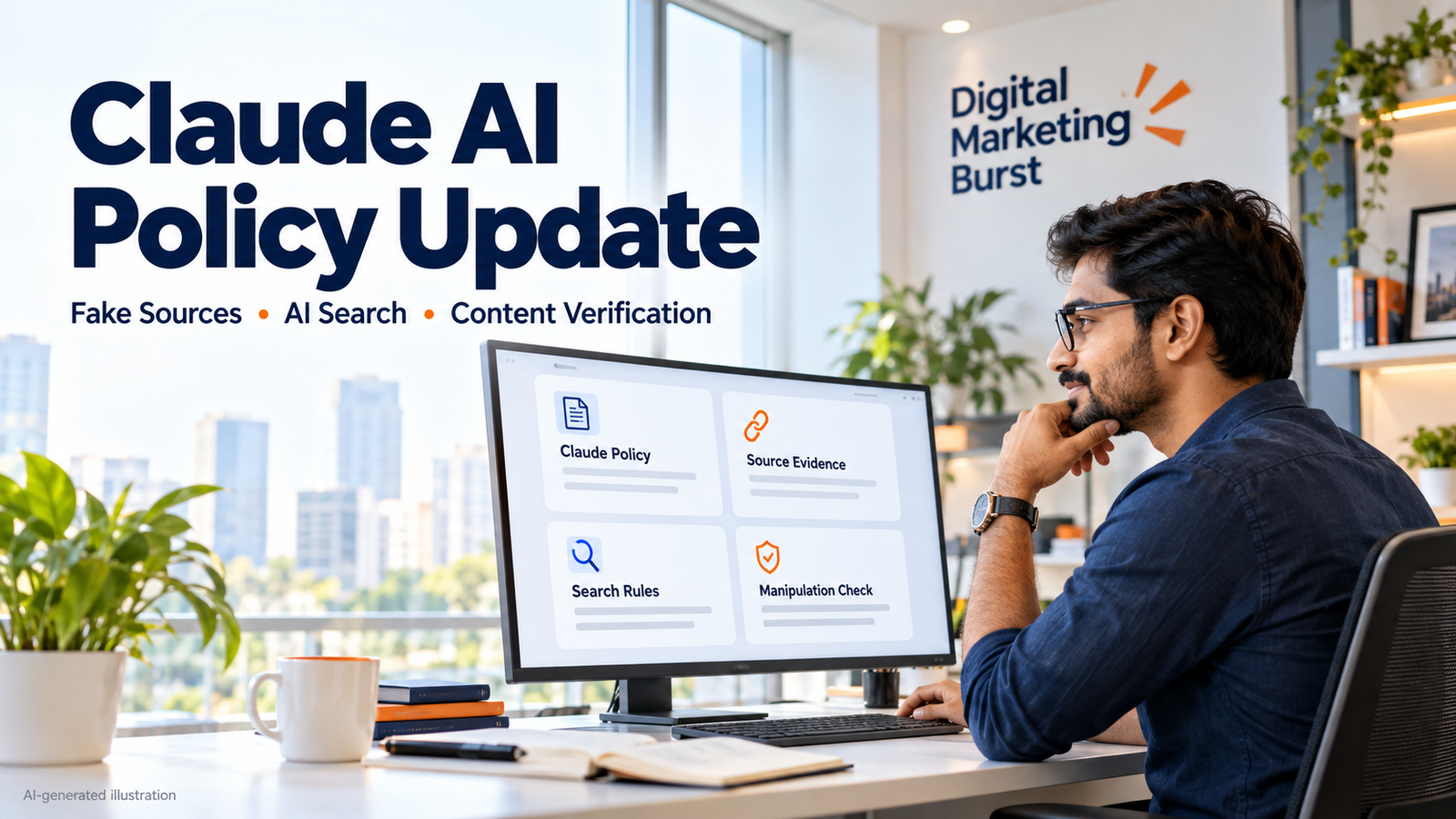
Claude AI Policy Update: What the New Fake-Source Rules Mean for AI Search and SEO
The Claude AI Policy Update addresses a specific problem for marketers: using misleading sources to create an artificial appearance of credibility. Anthropic’s revised policy explicitly covers using its products to influence search and AI answer sources through content that misrepresents its origin, authorship or independence. www.anthropic.com
For an Indian business, the practical question is straightforward: can a reader understand who created a claim, what supports it and whether the sources repeating it are independent?
A company explaining its services on its own website is different from a company secretly operating supposed review publications that endorse it. Both involve content, but only one makes the relationship clear.
This guide explains that distinction and provides a method for reviewing website claims, agency proposals and supporting evidence.
Date note: Anthropic announced the revision on 8 October 2026, with an effective date of 12 November 2026. At the time of this article’s research, the revision was forthcoming. Anthropic also explained that much of the update clarifies existing restrictions. Recheck the current policy before publishing. www.anthropic.com
What the Claude AI Policy Update Means for Marketers
The policy makes source integrity a concrete issue to examine in AI-assisted marketing.
The useful question is not simply whether your team uses AI to write. It is whether the resulting material gives readers an accurate understanding of its evidence and origin.
Consider two hypothetical situations.
Situation A: A Lucknow agency publishes a guide on its own website. It identifies the publisher, explains its services and provides practical criteria for choosing an agency.
Situation B: The agency commissions several websites that present themselves as unrelated reviewers. They conceal their shared control, invent reviewer identities and repeat unsupported endorsements of the agency.
In the first situation, readers can evaluate a business describing itself. In the second, they are encouraged to mistake controlled promotion for outside confirmation.
The distinction matters even when the writing looks professional. Design quality, confident language and numerous links do not establish that a recommendation is independent.
The examples throughout this article are hypothetical. They illustrate review methods rather than verified misconduct by a named business.
Understand the Scope Before Changing Your SEO Strategy
The phrase “Claude AI Search Rules” can sound like a search-ranking update. Describe the document accurately: it is an Anthropic usage policy governing use of Anthropic’s products and services.
It is not an announcement of Google’s ranking criteria.
Keep three assessments separate:
| Assessment | Question to answer |
|---|---|
| Tool use | Does the way we use Claude meet the applicable policy? |
| Content integrity | Are our claims supported and relationships represented accurately? |
| Search performance | Does the page satisfy its audience and perform according to measured results? |
A policy-compliant workflow does not prove that an article will rank. An observed ranking does not prove that every statement on the page is accurate.
This separation also improves reporting. A team should be able to explain what it published, what it verified and what results it observed without treating those as interchangeable achievements.
A Policy Is Not a Detection Guarantee
Publishing a restriction does not establish that every misleading source will be detected or excluded from future answers.
Avoid claiming that the announcement means:
- Every fake review website will disappear.
- All misleading citations will be removed.
- Transparent businesses will automatically receive more AI mentions.
- Google will penalise every related website.
- A checklist can guarantee an AI recommendation.
Those conclusions require evidence beyond the existence of a policy.
Focus on what your team controls: accurate information, honest attribution, supporting records and a review process.
What Makes a Source Fake or Misleading?
“Fake source” can describe several different problems.
A website may exist but conceal who operates it. A real report may be cited for a finding it never established. Several publications may repeat one statement without contributing separate evidence.
Review the claim and its supporting chain, not just whether a URL opens.
Fabricated Evidence
A draft may refer to an organisation, survey, expert or testimonial that does not exist.
For example:
“According to the Indian Digital Search Council’s latest survey, this technique is the most effective.”
Before publication, the editor needs to locate the organisation, original survey and relevant finding. A plausible name does not make the reference legitimate.
If the evidence cannot be found, remove the attribution or investigate further. Do not ask a writing tool to supply another convincing-looking citation.
The same principle applies to fabricated quotations. Quotation marks imply that somebody actually said those words. Retain the original interview, message or published statement needed to establish that.
A Real Source Used Beyond Its Scope
A source can be authentic while the article’s interpretation is misleading.
Suppose a study examines a limited sample of US desktop searches. An article cites it as proof of how Indian mobile users behave.
The problem is the gap between the research and the conclusion.
Check:
- Which market was studied.
- Who or what was included.
- When the data was collected.
- Which devices or platforms were covered.
- How the measurement was conducted.
If the study does not measure India, state that limitation. You may discuss possible implications for Indian businesses, but present them as interpretation rather than a measured local result.
Concealed Commercial Control
Imagine a company operating a website called “Independent Agency Reviews”.
The publication ranks its owner first but does not explain the relationship between the publisher and the recommended business.
Readers need that information to evaluate the recommendation.
A visible ownership disclosure would clarify the context. The publisher would still need to support its comparisons, but readers would no longer be asked to treat company-controlled promotion as an unrelated endorsement.
Circular Citations
Circular sourcing occurs when pages appear to support one another without leading to original evidence.
For example:
- Article A cites Article B.
- Article B cites Article C.
- Article C cites Article A.
The reader encounters three pages but no underlying record.
A similar problem arises when one press release is republished in several places and later described as multiple independent reports.
Trace the statement back to its origin. Count the evidence behind it, not the number of pages repeating it.
Invented Experience or Expertise
First-person wording can imply that a writer tested a product, visited a location or conducted a client project.
A byline can imply that a qualified specialist reviewed the material.
Those implications need to be true.
Do not publish an invented author biography, credential or statement such as “we tested this with 50 clients” without supporting records.
If the article uses a teaching example, label it clearly. A hypothetical scenario can explain a method without pretending that an experiment occurred.
Evidence, Opinion and Promotion Serve Different Purposes
A business does not need to make every statement look independent. It needs to represent each statement honestly.
Your website can explain your services, share your perspective and publish documented accounts of your work.
The problem is presenting those materials as something they are not.
| Content type | Appropriate presentation | Supporting material |
|---|---|---|
| Service information | A statement from the provider | Current service scope and conditions |
| Company opinion | An attributed viewpoint | Reasoning and factual support where needed |
| Customer testimonial | Genuine customer feedback | Original feedback and appropriate permission |
| Case study | A documented project account | Records, dates, measurement and limitations |
| Sponsored article | Content with a disclosed commercial relationship | Placement terms and disclosure |
| Independent assessment | An evaluation with accurately described relationships | Criteria, evidence and publisher information |
A company-owned guide can be useful. A manufacturer, for instance, can explain the dimensions and maintenance requirements of its product.
An independent review can also be useful, but the label “independent” does not guarantee accuracy.
Examine both the evidence and the relationship behind the source.
Disclosure Does Not Replace Proof
Adding “sponsored” does not make an invented statistic acceptable.
Naming the owner of a comparison website does not establish that its ranking method is sound.
Transparency answers who is speaking. Evidence answers what supports the statement.
Both questions matter.
For a comparison article, explain the criteria and limitations. For a result claim, identify the project, period and measurement. For a recommendation, distinguish the writer’s judgment from a verifiable fact.
How Fake Sources Can Influence AI Search Answers
The concern behind AI Search Source Manipulation is the creation of misleading material that appears to corroborate a claim.
Repeated information can look persuasive even when every page ultimately depends on one unsupported statement.
That does not establish how any particular AI system will respond. The editorial problem is the false appearance of confirmation.
Consider a hypothetical business that invents an award.
It publishes the award on a controlled review website, repeats it in promotional articles and adds it to an author biography. Another writer later finds those pages and describes the business as an award winner.
The statement has travelled, but its evidence has not improved.
A reviewer should ask:
- Who issued the award?
- Where is the organiser’s original record?
- Which category and year does it cover?
- Were other publications reporting it independently?
- Does the company’s description match the actual recognition?
Without those checks, repetition can be mistaken for verification.
Repeated Wording Is a Reason to Investigate
Several websites using the same sentence may indicate syndication, a shared press release or coordinated promotion.
It does not automatically prove deception.
Investigate the relationship before drawing a conclusion. A disclosed republication arrangement is different from publications pretending to offer unrelated judgments.
This applies to competitor research as well. Record what you can establish and avoid presenting suspicion as a finding.
A Citation Begins the Check
A clickable reference helps readers investigate. It does not finish the verification process.
Open the destination and locate the relevant evidence. Confirm that it supports the exact statement beside the link.
A company homepage, for example, cannot establish a numerical project result unless the result and its basis are available there.
Use the original announcement, report or documented record when possible. If only a secondary account is available, describe that limitation accurately.
What Claude’s New Policy Means for SEO Work
The practical response is to examine how you create and promote information.
For broader planning, the AI SEO Strategy Guide provides related background. This article focuses on a narrower question: whether claims are supported and commercial relationships are represented accurately.
Publish Useful Brand-Owned Resources
Businesses can create resources such as:
- Product specifications.
- Service explanations.
- Troubleshooting guides.
- Attributed opinions.
- Documented research.
- Comparisons with a stated method.
Before publishing, check the factual basis and any claim of independence.
An agency can explain how it conducts an SEO audit. It should not invent an industry organisation to certify that its process is the best.
A retailer can compare manufacturer specifications. It should not describe that work as hands-on testing if no test occurred.
Review Superlatives as Claims
Words such as “best”, “top”, “most trusted” and “number one” need careful treatment when presented as factual achievements.
A reader should be able to distinguish between:
- A supported ranking or award.
- An attributed customer opinion.
- A company’s positioning language.
- An unsupported assertion.
Concrete information often helps a customer more than an unexplained superlative.
Describe the scope, deliverables, reporting process and requirements. Use documented achievements when the records support the wording.
Inspect Third-Party Placement Proposals
Ask what a proposed placement actually provides.
Is it editorial coverage, a disclosed sponsored article, a directory entry or a company-controlled publication?
These arrangements create different relationships with the reader.
A proposal is concerning when its value depends on making purchased or controlled promotion appear independent.
Do not judge a placement solely by its design. Ask who operates the publication, who controls the wording and how commercial relationships are explained.
Measure Accuracy Alongside Visibility
The AI Visibility Report Guide is relevant to organising visibility observations.
Add an accuracy check to that process.
| Field | What to record |
|---|---|
| Question tested | Exact wording |
| Date | When the answer was observed |
| Platform | Where it appeared |
| Brand statement | What the answer claimed |
| Displayed source | Linked page, if available |
| Verification | Whether the statement matches current evidence |
| Action | Correct, investigate or monitor |
This is a suggested reporting method, not proof that editing a page will change an AI answer.
Its purpose is to prevent every brand mention from being counted as a success regardless of accuracy.
Practical Examples for Indian Businesses
The following scenarios are illustrative. They are not client stories or documented policy-enforcement cases.
A Lucknow Agency Publishing a Comparison
An agency writes “How to Choose an SEO Agency in Lucknow” on its own website.
It explains reporting, contract terms and questions to ask. The publisher is clear, and the article does not invent an independent ranking.
Readers receive useful evaluation criteria.
Now imagine the agency creates several supposed consumer-review websites, invents reviewers and uses each publication to rank itself first.
The persuasive effect depends on a misleading impression of outside endorsement.
A better alternative is a transparent comparison with defined criteria. If the publisher includes itself, the relationship should be clear.
An Online Store Reviewing Products
A retailer wants to compare three products.
If the team tested them, it can explain the conditions, method and limitations. If it compared documentation, it should describe the article accordingly.
Both approaches can help customers.
Ask the writer to distinguish:
- Manufacturer statements.
- Observations from an actual test.
- Conclusions inferred from specifications.
- Features that remain untested.
The reader can then decide how much weight to give each finding.
A Travel Business Publishing a Destination Guide
A travel company writes about a destination where it does not provide local pickup.
The guide can still help visitors. Its service wording should clearly explain coverage.
The article should not claim that the writer personally travelled the route unless that experience occurred. Nor should unrelated-looking websites falsely portray the business as a local operator in every destination.
Review destination information and service availability as separate sets of claims.
A Business Describing a Customer Result
Before writing a project account, identify the measurement, relevant period and permission to discuss the customer.
Retain records supporting the result.
If those materials are unavailable, write a process explanation or a clearly labelled hypothetical example.
A helpful article does not require a dramatic success story. It can teach readers how to assess a problem without inventing an outcome.
Start with a Claim Audit
Before commissioning more content, examine what the website already says.
Begin with a manageable selection:
- Homepage.
- Main service page.
- Case study or testimonial page.
- Recent AI-search article.
- Comparison or recommendation article.
Read each page as a potential customer would.
Step 1: Extract Checkable Statements
Copy claims that readers could reasonably expect you to substantiate.
These include years in business, completed projects, certifications, awards, service coverage, results and research findings.
Separate them from advice.
“We suggest checking reporting terms” is a recommendation. “Our service increases leads by 40%” is a measurable result claim.
Step 2: Locate the Evidence
Record the original document or source supporting each statement.
Another promotional page repeating your wording does not supply additional proof.
If evidence contains private information, consider what can responsibly support the public statement without exposing confidential material.
Step 3: Check the Scope
Ask whether the wording goes beyond the evidence.
One project’s result should not become a promise for every customer. A limited survey should not become a national finding.
Look for missing dates, sample limitations and qualifications.
Step 4: Review Relationships
Check authorship, review contributions, ownership and sponsorship.
Do not infer independence because a statement appears on another domain.
Where the relationship matters to interpretation, make it understandable to the reader.
Step 5: Assign an Action
| Status | Meaning |
|---|---|
| Verified | Evidence supports the wording |
| Revise | Evidence exists, but the claim overstates it |
| Disclose | A relevant relationship needs clarification |
| Investigate | Original support has not been located |
| Remove | The statement cannot responsibly remain as written |
Build an Evidence-Based Publishing Workflow
Once you have identified questionable claims, change the process that allowed them into the draft.
A final proofreading pass cannot reliably repair missing evidence, invented experience or concealed commercial relationships. Those issues need attention before writing starts.
For the Claude AI Policy Update, the practical response is to make evidence and attribution part of the content brief. Writers should know which facts are available, which statements require investigation and which claims must stay out of the article.
The following workflow is an editorial recommendation. It is not a certification of policy compliance or a promise of search performance.
Step 1: Define the Reader’s Decision
Begin with what the reader needs to understand or do after reading.
For example, an article about choosing an SEO agency might help a business owner compare reporting, deliverables and contract terms. It does not need an invented league table of agencies.
Write a one-sentence purpose:
“Help an Indian business owner assess an SEO proposal and identify questions to ask before signing.”
Use that purpose to evaluate every planned section.
A paragraph belongs in the article when it improves the reader’s understanding or decision. A section added only to repeat another keyword should be removed.
Step 2: Prepare an Evidence Pack
Give the writer a small collection of usable materials.
Depending on the topic, this could include:
- Original product documentation.
- Current service information.
- A dated official announcement.
- An approved interview.
- A documented project result.
- A research report with its methodology.
- A list of unresolved questions.
Mark the role of each item. An interview expresses the speaker’s experience or opinion; a product specification describes the manufacturer’s stated information.
Do not treat every document as interchangeable proof.
An evidence pack should also identify what it cannot establish. A dashboard screenshot may show a change in traffic, but it may not explain what caused that change.
Step 3: Set Boundaries Before Drafting
Tell the writer what must not be inferred.
For a client-result article, useful boundaries might be:
“Describe the observed period and measurement. Do not claim that all growth was caused by our work. Do not turn this project’s result into a promise for future clients.”
For a software comparison:
“We have reviewed published documentation. We have not conducted hands-on testing. Do not use first-person testing claims.”
For a local service article:
“Use only the confirmed service areas. Do not imply local availability in every city mentioned.”
These instructions help prevent a polished draft from becoming more confident than the evidence allows.
Step 4: Label Statements During Writing
Use temporary editorial labels when the draft contains different types of information.
A simple system is:
| Label | Meaning |
|---|---|
| Verified fact | Supported by a checked source or record |
| Attributed statement | A named person or organisation makes this claim |
| Interpretation | The writer’s explanation of what evidence may mean |
| Hypothetical example | An invented scenario used for teaching |
| Unresolved | Needs further checking before publication |
Remove the labels from the finished article where they are only internal notes. Preserve the distinctions in the wording.
For example, “The company says…” should remain when you are reporting a company’s assertion rather than independently establishing it.
Step 5: Review Evidence Before Style
Check the claims before polishing the language.
A sentence can become misleading when an editor removes qualifications to make it shorter. “In this sample” or “during the measured period” may be essential information.
Keep those limitations even when the unqualified version sounds stronger.
After the evidence review, improve paragraph length, headings and flow. This order reduces the chance of spending time refining content that must later be removed.
Use Claude as an Editor Without Treating Its Output as Evidence
Claude can help organise supplied information, identify inconsistent wording and prepare questions for a reviewer.
The crucial distinction is between working with evidence and creating the appearance of evidence.
A model-generated explanation is a draft. Its fluency does not establish that an organisation, citation, testimonial or result exists.
Use clear task boundaries, then inspect the output against the original materials.
A Practical Prompt for Reviewing Claims
You can use a prompt such as:
Review the supplied draft against the evidence provided. Extract factual claims into a table. For each claim, identify the supporting document or passage, explain whether the wording exceeds the evidence, and mark missing support as unresolved. Do not invent references, fill gaps with plausible facts or treat another promotional statement as independent confirmation.
Give the model the actual draft and relevant documents.
Ask for specific references to the supplied material rather than a general assurance that the article is accurate.
If the output identifies a passage, open that passage yourself. A useful review table still needs human checking.
A Prompt for Improving a Supported Draft
After checking the facts, use a separate editing request:
Improve readability while preserving the scope, attribution and limitations of every supported claim. Keep hypothetical examples clearly labelled. Remove repeated ideas and promotional filler. Do not add statistics, experience claims, awards, quotations or citations.
Separating verification from style makes the task easier to inspect.
You can compare the revised version with the checked draft and look for changes in meaning. Pay particular attention to words such as “always”, “proven”, “guaranteed”, “best” and “independent”.
Give the Model Permission to Leave Gaps
Many content briefs unintentionally pressure a writer or tool to complete every field.
Instead, allow statements such as:
- Evidence not supplied.
- Source does not support this wording.
- Current figure needs verification.
- Author experience has not been confirmed.
Those notes are useful outputs. They show what remains to be done.
Do not ask the model to make an incomplete article “look fully researched”. Ask it to identify the research needed.
Avoid Loading Sensitive Material Unnecessarily
Use only the information required for the task.
For a public case study, an approved summary may be sufficient. The writer may not need raw customer records, private messages or identifying details.
Follow your organisation’s data-handling arrangements when using AI tools. Before sharing a document, consider whether confidential content can be removed without losing the evidence needed for the review.
The aim is to make a claim checkable without turning an editorial task into unnecessary data exposure.
Create a Claim Register Your Team Can Maintain
A claim register connects public wording to its supporting record.
It does not need to be complicated. A spreadsheet can work for a small agency if someone owns the process and updates it when information changes.
Include enough detail for another person to understand the decision later.
| Field | What to record |
|---|---|
| Page URL | Where the claim appears |
| Claim | Exact published or proposed wording |
| Claim type | Result, credential, service scope, comparison or attribution |
| Evidence | Original record or checked source |
| Scope | Dates, geography, sample and relevant limitations |
| Relationship | Ownership, sponsorship or other material connection |
| Reviewer | Person responsible for the check |
| Status | Verified, revise, disclose, investigate or remove |
| Review trigger | What event would require another check |
Make Claims Specific Enough to Check
“Clients achieve excellent growth” is difficult to evaluate.
A documented statement about a particular project, period and measurement is easier to assess. Its limits should remain visible in the article.
If you cannot publish the underlying customer identity, explain the anonymisation appropriately and retain a legitimate internal record. Anonymity does not remove the need for evidence.
Where no result record exists, replace the statement with a description of the process or deliverables.
Use Review Triggers Instead of Arbitrary Date Changes
Some information changes when an event occurs:
- A service area is added or removed.
- A certification expires.
- A product specification changes.
- A policy revision takes effect.
- A research report is superseded.
- A staff member leaves.
Record these triggers.
Changing an article’s “updated” date without reviewing its material claims does not tell the reader what has actually been checked.
When an update is meaningful, describe the change where appropriate.
Check Whether a Source Is Independent
A separate domain is not proof of a separate editorial judgment.
Before describing a website as an independent source, examine the relationship behind the page.
For ordinary content decisions, the purpose is not to investigate every publisher exhaustively. It is to avoid making an independence claim you cannot support.
Examine the Publisher’s Own Information
Check the About page, author information, disclosure wording and the specific article.
Look for a clear explanation of who operates the publication and how commercial relationships are handled.
If that information is absent, record the uncertainty. Do not automatically label the publication deceptive.
A small website may have incomplete disclosures without being part of a coordinated campaign. Missing information is a reason to investigate, not a completed finding.
Trace the Evidence Behind the Article
Ask whether the article contributes new information or repeats an earlier announcement.
A republished press release can be useful for finding the original source. It should not be counted as an additional independent confirmation of the same claim.
For a recommendation, look for the criteria used. For a result, look for the measurement. For an award, look for the organiser’s original record.
Describe Relationships Accurately
Use wording that matches what you know:
- “The company’s announcement states…”
- “A sponsored article describes…”
- “The publication reports…”
- “The reviewer says they tested…”
- “We have not independently verified this claim.”
These phrases have different meanings.
Choose the one that helps the reader understand the evidence. Do not remove attribution simply because an unqualified sentence reads more confidently.
Review Agency Proposals for Source Integrity
Businesses hiring an agency need to understand how proposed visibility will be created.
Ask for a sample deliverable and an explanation of the publishing relationship. A promise of “AI authority” is too broad to evaluate on its own.
The following questions apply whether the service is called AI SEO, generative engine optimisation, digital PR or content distribution.
Ask What the Placement Actually Is
Request a clear description:
- Editorial coverage.
- A disclosed sponsored article.
- A company-controlled publication.
- A directory listing.
- A guest contribution.
- A syndication arrangement.
Ask who controls the wording and whether the commercial relationship will be visible.
A legitimate arrangement should be explainable without relying on the reader misunderstanding its origin.
Ask How Claims Will Be Approved
Find out whether the agency will publish content without your review.
Specify which claims require written approval, particularly results, awards, customer stories, service coverage and credentials.
An agency should not invent a fact because the client has not supplied enough material.
Agree on what happens when evidence is missing. The appropriate outcome may be a revised angle, a research request or removal of the claim.
Ask Whether Authors and Reviewers Are Real
If a proposal includes expert bylines or reviews, ask who those people are and what they will actually do.
A named reviewer should not be credited with checking work they never reviewed.
A staff member’s photograph or biography should not be used to imply a role without their involvement and approval.
For a general marketing article, a truthful organisational byline can be more appropriate than an invented specialist identity.
Treat Citation Promises Carefully
Ask how the agency will measure an AI citation promise.
An observed mention can be documented. Guaranteed inclusion across future answers is a different assertion.
Require the proposal to distinguish between:
| Deliverable | How it can be assessed |
|---|---|
| A published, approved resource | Inspect the page and its evidence |
| A disclosed placement | Check the live publication and relationship wording |
| An observed AI mention | Review the dated prompt and answer record |
| A future citation guarantee | Ask what basis supports the guarantee |
Do not confuse work performed with outcomes observed.
Both belong in reporting, but they answer different questions.
Repair Existing Content Without Creating New Problems
Corrections should improve the underlying information.
Adding another article that repeats an unsupported claim does not resolve the original issue. Nor does changing only the page title.
Start with the claim register from Part 1, then choose an action suited to the problem.
Unsupported Statistics
Locate the original source and check the statement.
If the figure cannot be substantiated, remove it or replace it with a supported explanation. Avoid keeping the number while weakening the attribution to “industry research”.
For example, change:
“This workflow increases leads by 60%.”
To a process statement, if no result evidence exists:
“This workflow separates enquiry tracking from traffic reporting so the team can assess lead quality.”
The second sentence explains a practical purpose without inventing an outcome.
Fabricated or Unapproved Testimonials
Do not quietly edit an invented testimonial into another invented quotation.
Remove the unsupported item. If genuine feedback exists, use the original wording appropriately and confirm permission where needed.
A useful alternative is a service FAQ based on questions the business can accurately answer. It should not impersonate a customer.
Invented Experience
Change the article’s framing to reflect the work actually performed.
If the writer compared documentation, describe it as a documentation-based comparison. Remove claims of hands-on testing, visits or interviews that did not occur.
Keep useful findings only after checking that they remain supported.
Misleading Independence
Clarify the relationship prominently enough to inform the reader’s interpretation.
A disclosure hidden on an unrelated page may not explain a particular recommendation.
Review the article’s title, byline and introduction as well as the disclosure. They should not continue suggesting an independent assessment when the publisher is commercially connected.
Incorrect Service Coverage
Update the relevant service statements together.
Check the homepage, service pages, FAQs, booking information and any articles that make availability claims.
If one page says a business operates in three cities while another promises local pickup nationwide, readers still receive conflicting information.
Maintain one approved description of coverage and adapt it to each page without changing its meaning.
Decide Whether to Update, Merge or Remove a Page
Not every flawed page needs deletion. A useful article may contain a correctable statement.
Assess the page’s purpose and remaining value after removing unsupported content.
Update When the Main Resource Is Useful
If the article answers a real question and the problem is limited, revise it.
Correct the claim, improve the evidence and check whether related paragraphs depend on the same error.
A misleading statistic in the introduction may also affect the conclusion. Review the full argument rather than replacing one sentence.
Merge When Several Pages Answer the Same Question
Compare pages by reader need, not just keyword wording.
Two articles can target different phrases while giving substantially the same advice.
Keep the stronger resource and incorporate genuinely useful material from the other. If URLs are changed or removed, plan the appropriate technical handling with the person responsible for the website.
Do not create a fresh page for every minor variation of “Claude policy update”.
Remove When the Page’s Value Depends on Deception
A page built around fabricated evidence may have little worth preserving.
Removing the invented claim could leave only an unsupported recommendation. In that case, reconstruct the resource from valid materials or retire it.
Keep an internal record of the decision. That helps explain why the page was changed and prevents the same claim from being reintroduced later.
Rewrite Risky Briefs into Useful Assignments
A content brief shapes what the writer produces.
If the brief demands fabricated authority, better proofreading will not solve the underlying problem. Change the assignment.
| Risky brief | Better assignment |
|---|---|
| “Make our agency look independently ranked first.” | “Explain our services and give readers transparent evaluation criteria.” |
| “Create a customer success story.” | “Use the supplied approved project records, or write a hypothetical teaching example.” |
| “Add research to make this sound credible.” | “Identify claims needing support and locate relevant original sources.” |
| “Publish the same endorsement across unrelated-looking sites.” | “Describe the actual distribution and disclose relevant relationships.” |
| “Write a hands-on review from these specifications.” | “Compare published specifications and state that no hands-on test was conducted.” |
| “Guarantee inclusion in AI recommendations.” | “Document content improvements and report observed mentions separately.” |
The revised assignments still support marketing work.
They replace an invented signal of credibility with information a reader can assess.
Keep Hindi and English Versions Consistent
For Indian businesses publishing in more than one language, evidence must survive translation.
A careful English statement can become exaggerated in Hindi if a qualification is dropped.
For example:
“The result was observed in one project.”
Should not become:
“यह तरीका हर व्यवसाय को बेहतर परिणाम देता है।”
The second statement changes a limited observation into a general promise.
Ask bilingual reviewers to check meaning, not only grammar.
Maintain One Approved Fact Sheet
Use a shared record for information such as:
- Service areas.
- Business name.
- Credentials.
- Dates.
- Product details.
- Approved result descriptions.
- Pricing conditions.
Writers can adapt the explanation for different audiences while preserving these facts.
If the English page is corrected, check its Hindi version and any social content derived from it.
Check Relationship Disclosures in Each Version
A disclosure should be understandable to the audience reading the page.
Do not leave essential ownership or sponsorship information only in another language.
Use clear wording rather than a literal translation that readers may not understand. The relationship should be apparent without requiring them to interpret unfamiliar terminology.
Create Evidence That Helps Customers Make Decisions
A credible content strategy needs more than warnings about what to avoid.
Identify information your team can responsibly produce that answers a customer’s question.
For an agency, useful resources might include:
- A sample reporting structure.
- A clearly scoped audit checklist.
- An explanation of how proposals are assessed.
- A comparison based on defined criteria.
- A documented workflow with its limitations.
For a product business, useful evidence might include measurements, compatibility information or a test performed under described conditions.
For a service business, it might be current availability, requirements and a clear explanation of what is included.
Choose the resource by its usefulness to the customer.
Define the Method Before Measuring
If you conduct a test or study, write down the question and method first.
Record the conditions, sample and limitations. This reduces the temptation to select only the most attractive result afterwards.
When publishing, distinguish what you measured from what you infer.
A small, clearly described test can be useful. Its value does not require presenting it as a national study.
Preserve the Supporting Records
Keep enough material to check the published account later.
Depending on the work, this might include screenshots, logs, source documents, dates or approved interview notes.
Organise them so a reviewer can connect each major statement to the relevant record.
Do not collect unnecessary private information simply to make a case study look substantial.
Explain Limitations Where They Matter
Place limitations beside the result they qualify.
A long disclaimer at the bottom may not correct an exaggerated headline or opening paragraph.
For example, if a test covers one product version, state that where the findings are introduced. If a result comes from one project, do not use a heading that presents it as the expected outcome for every customer.
Specific limits help readers decide whether the information applies to their own circumstances.
Assign Responsibility Before Publication
A small team can operate this workflow without a separate role for every task.
What matters is that someone is responsible for each decision.
| Responsibility | Main question |
|---|---|
| Writer | Does the draft preserve the supplied evidence and labels? |
| Subject reviewer | Are the substantive claims accurate within their scope? |
| Relationship reviewer | Are ownership, sponsorship and contributions represented honestly? |
| Publisher | Does the live page match the approved draft? |
| Content owner | What will trigger an update? |
One person may perform several roles, but the checks should still be explicit.
Do not treat publication as proof that review occurred. Keep a short approval record identifying what was checked.
What to Check Before Approving a Claude-Assisted Article
Before publication, ask five practical questions:
- Can we locate the evidence behind the important factual claims?
- Does the wording stay within that evidence?
- Are authorship, experience and commercial relationships represented accurately?
- Are hypothetical examples clearly distinguished from real results?
- Does the article help the reader do something useful?
If the answer to the last question is unclear, revisit the article’s purpose.
A page can have complete metadata and still offer little information. Evidence checks and reader usefulness should remain part of the same editorial decision.
Why Choose Digital Marketing Burst for AI Search and SEO?
Choosing the best digital marketing agency in Lucknow means looking for a team that can explain its strategy, support its claims and define what it will deliver.
Digital Marketing Burst, based in Lucknow, offers SEO, content marketing, website development and digital advertising services. For businesses reviewing their approach after the Claude AI Policy Update, a useful starting point is checking published claims, verifying sources and identifying content that needs clearer attribution.
When comparing top digital marketing agencies in India, ask how they review AI-assisted content, document results and report progress. These questions help you evaluate the work beyond promotional labels.
To discuss your website and marketing goals, contact Digital Marketing Burst.