Digital marketing in 2026 demands clear strategy, strong content, and a user-first approach. Brands must use the latest digital marketing tips to stay ahead in a competitive market. To increase website traffic fast, you need better content, improved SEO, and stronger engagement. Understanding how to get more website traffic becomes easier when you update your methods regularly. Focus on the best SEO strategy 2026, because search behaviour is changing quickly. Apply the best SEO techniques 2026 to boost visibility and authority. Social platforms also matter, so use effective social media marketing ideas to grow faster. Add more creative social media ideas to connect with a wider audience. Strong content still leads the way. Use seo friendly blog writing to build trust and improve rankings. Learn how to write SEO blogs that are simple, clear, and helpful. These methods prepare your brand for long-term digital success in 2026.

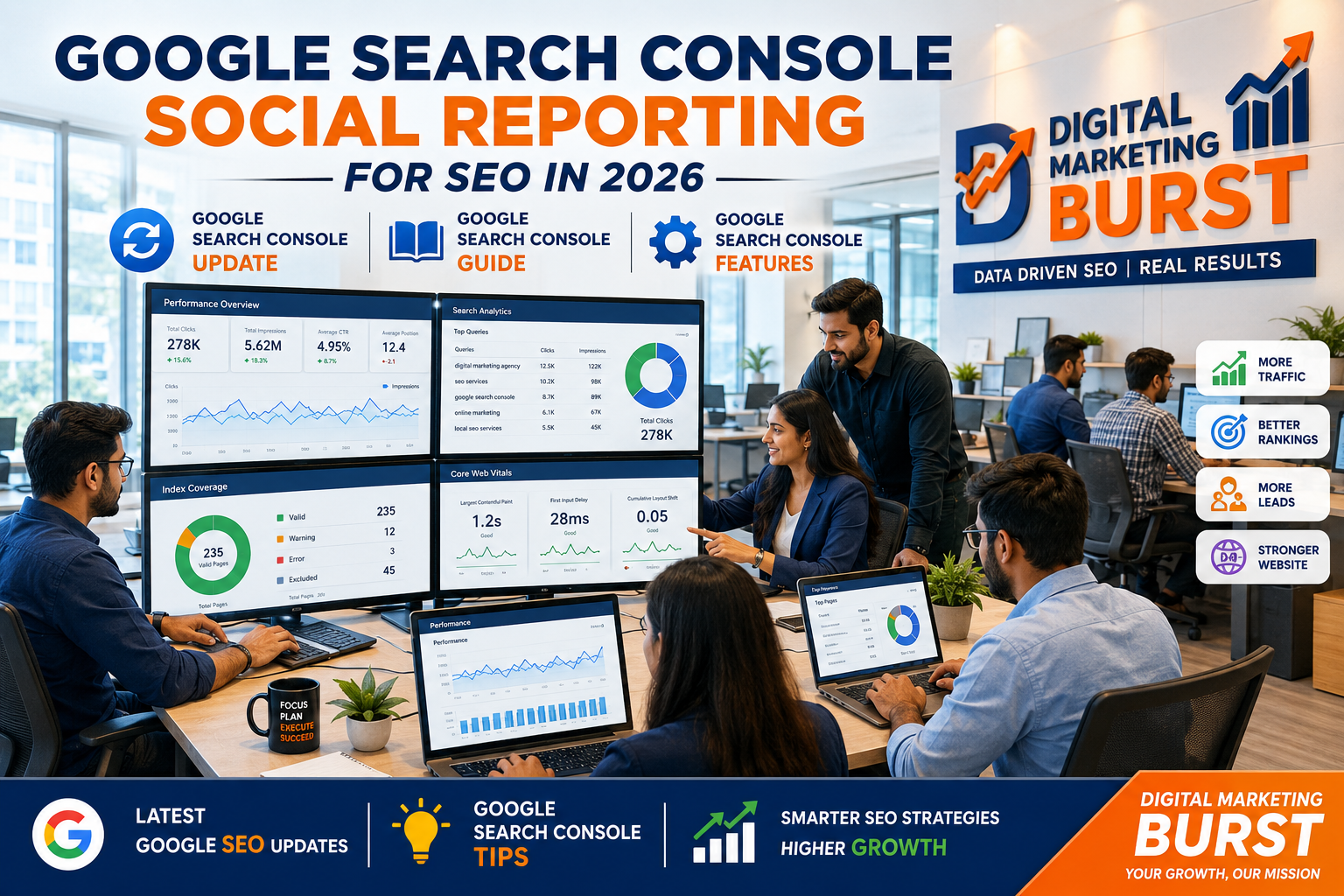

Google Search Console Social Reporting: What It Is, How It Works & Why It Matters for SEO in 2026
Google Search Console Social Reporting: What It Is, How It Works & Why It Matters for SEO in 2026
Google Search Console Update has introduced several improvements that help website owners understand their search performance more effectively. The Latest Google Search Console Update, this Google Search Console Guide, the newest Google Search Console Features, the Google SEO Latest Updates, and practical Google Search Console Tips are becoming essential for every SEO professional, marketer, and business owner in 2026. As search algorithms continue evolving, understanding how Google Search Console Social Reporting works can help you make smarter SEO decisions, identify new growth opportunities, and improve your organic visibility across multiple digital channels.
Unlike traditional SEO reports that mainly focus on impressions and clicks, Google Search Console Social Reporting connects valuable search insights with user engagement trends. This allows marketers to evaluate how different types of content perform after appearing in Google Search. Consequently, businesses can optimize content strategies, improve click-through rates, strengthen topical authority, and build long-term organic growth. At Digital Marketing Burst, we have observed that combining search data with user engagement insights enables brands to create content that not only ranks higher but also keeps visitors engaged for longer periods.
Whether you manage an eCommerce website, healthcare portal, educational platform, SaaS business, or local company, understanding this evolving reporting system will help you build a stronger SEO strategy throughout 2026 and beyond.
Google Search Console Update
The newest Google Search Console Update reflects Google’s continued effort to provide more meaningful insights instead of simply presenting raw search data. Website owners now require deeper analytics to understand why pages gain or lose visibility. Therefore, Search Console has gradually evolved into a comprehensive SEO platform rather than just an indexing tool.
In previous years, many marketers relied on third-party software to interpret user behaviour after search clicks. However, Google’s recent improvements reduce this dependency by making Search Console reports more actionable. Instead of looking only at impressions, clicks, average position, and indexing status, SEO professionals can now combine multiple reports to evaluate overall search performance more effectively.
Another important aspect of this update is improved reporting consistency. Data appears cleaner, easier to interpret, and more aligned with real user behaviour. As a result, businesses can identify content opportunities much faster than before. For example, if a page receives thousands of impressions but generates a low click-through rate, marketers can immediately optimize titles, meta descriptions, structured data, and page experience.
Additionally, Google continues improving how website owners monitor crawling efficiency. Faster indexing insights help publishers understand whether Google successfully discovers newly published articles or product pages. Consequently, businesses can react quickly whenever indexing delays occur.
For SEO agencies like Digital Marketing Burst, this development simplifies technical SEO audits because clients receive clearer reports with fewer confusing metrics. Instead of overwhelming businesses with unnecessary data, the platform increasingly focuses on practical recommendations that directly support search visibility.
Another noticeable improvement involves performance segmentation. SEO specialists can now compare different search categories more efficiently and identify which content generates sustainable traffic over time. Consequently, long-term SEO planning becomes far more data-driven.
Businesses investing in content marketing should pay close attention to these reporting improvements because Google’s search ecosystem continues rewarding websites that consistently publish high-quality, user-focused content supported by strong technical optimization.
Latest Google Search Console Update
The Latest Google Search Console Update demonstrates Google’s commitment to improving transparency between search performance and website optimization. Rather than introducing isolated features, Google has refined the entire reporting experience to help users understand how content performs across different search environments.
One major improvement involves enhanced data interpretation. Instead of spending hours exporting spreadsheets into external dashboards, marketers can analyze valuable SEO information directly from Search Console. This saves considerable time while improving reporting accuracy.
Another enhancement focuses on identifying emerging search opportunities. Many websites lose potential traffic simply because they fail to recognize keywords that are already ranking on the second page of Google. With better performance visualization, SEO teams can identify these opportunities earlier and optimize existing pages before competitors gain an advantage.
Moreover, Google has improved how website owners investigate indexing behaviour. Pages that encounter crawling problems are now easier to diagnose because reports provide clearer categorization of indexing issues. This enables technical SEO specialists to prioritize fixes based on their actual impact.
The reporting interface also supports better collaboration between content writers, SEO experts, developers, and marketing managers. Since every department can understand the presented data more easily, decision-making becomes faster and more efficient.
At Digital Marketing Burst, we recommend reviewing Search Console reports regularly instead of waiting for traffic declines. Proactive monitoring allows businesses to detect seasonal keyword trends, identify declining pages, refresh outdated content, and strengthen internal linking before rankings begin to drop.
Another significant benefit is improved content evaluation. Rather than publishing new articles every week without direction, marketers can identify existing pages that already possess ranking potential. Updating these pages often produces faster SEO improvements than creating entirely new content.
Ultimately, the latest reporting improvements encourage businesses to adopt a data-first SEO strategy. Organizations that consistently monitor search behaviour, optimize user experience, and improve content quality will likely experience stronger long-term organic growth throughout 2026.
Google Search Console Guide
This Google Search Console Guide is designed to help website owners understand why Search Console remains one of the most valuable free SEO platforms available today. Although many premium SEO tools offer advanced keyword research and backlink analysis, Google Search Console provides something no third-party platform can replicate: direct performance data from Google Search itself.
Every successful SEO campaign begins with accurate information. Without reliable search data, businesses often make optimization decisions based on assumptions instead of evidence. Search Console eliminates this uncertainty by showing exactly how users discover your website through organic search.
After verifying your website, you gain access to valuable reports covering search performance, indexing, page experience, Core Web Vitals, sitemap submissions, crawling behaviour, mobile usability, and technical issues. Together, these reports provide a comprehensive overview of your website’s SEO health.
One of the most powerful aspects of Search Console is keyword discovery. Many businesses unknowingly rank for hundreds or even thousands of relevant search queries. By analyzing these keywords, content teams can expand existing articles, improve topical relevance, and target additional long-tail search phrases that generate qualified traffic.
For example, instead of focusing only on a broad keyword, businesses can optimize pages for highly specific search terms that better match user intent. These long-tail keywords often convert more effectively because visitors know exactly what they are looking for.
Another critical function involves monitoring indexing status. If Google cannot properly index important pages, even outstanding content may never achieve strong rankings. Regular indexing checks ensure new articles become discoverable quickly while helping identify technical issues before they negatively affect visibility.
At Digital Marketing Burst, our SEO specialists integrate Search Console data into every optimization strategy because it provides trustworthy insights directly from Google’s search ecosystem. Combining these insights with content optimization, technical SEO, structured data implementation, and user experience improvements creates a stronger foundation for sustainable organic growth.
As Google’s algorithms continue becoming more sophisticated, businesses that understand Search Console reports will make faster, smarter, and more profitable SEO decisions. This makes mastering Search Console an essential skill for anyone serious about succeeding in organic search during 2026.
Complete Google Search Console Guide
A Complete Google Search Console Guide goes beyond explaining where to find reports. It helps you understand how every report connects with your overall SEO strategy. In 2026, successful websites no longer depend on guesswork. Instead, they rely on accurate search data, continuous optimization, and user-focused content. Google Search Console provides all three. When used correctly, it becomes one of the most valuable tools for improving rankings, identifying technical issues, and increasing organic traffic without additional advertising costs.
The first step is verifying your website and submitting an XML sitemap. This allows Google to discover new pages more efficiently. After verification, the Performance report becomes the starting point for every SEO campaign. It reveals which queries bring visitors to your website, how often your pages appear in search results, which pages attract the most clicks, and where improvements are needed. Rather than focusing only on high-volume keywords, businesses should also identify long-tail search queries that indicate strong user intent. These queries often produce higher engagement because they closely match what users are looking for.
The Indexing section is equally important. It highlights pages that are indexed successfully and identifies URLs that require attention. If important service pages, blog posts, or product listings remain unindexed, they cannot contribute to organic traffic. Regular monitoring ensures valuable content remains visible to Google. Similarly, the Experience reports help identify usability issues that could reduce rankings. A slow-loading website or poor mobile experience can discourage visitors even when rankings remain strong.
Another major advantage of Search Console is historical data analysis. Instead of evaluating only today’s traffic, marketers can compare performance across weeks or months. This makes it easier to identify seasonal trends, successful content updates, and pages that gradually lose visibility. At Digital Marketing Burst, we recommend reviewing Search Console every week rather than waiting until rankings decline. Consistent monitoring allows businesses to respond quickly to algorithm changes, user behaviour shifts, and emerging keyword opportunities. A structured workflow built around Search Console ultimately leads to better content planning, stronger technical SEO, and sustainable long-term growth.
Google Search Console Features
The latest Google Search Console Features provide much more than basic keyword tracking. Google has transformed Search Console into a comprehensive platform that supports technical SEO, content optimization, indexing management, and performance analysis. These features help website owners understand not only where traffic comes from but also why certain pages succeed while others struggle.
One of the most valuable features is the Search Performance report. This report displays impressions, clicks, average position, and click-through rate for every indexed page. By analysing these metrics together, marketers can identify pages that receive strong visibility but fail to attract clicks. Improving page titles and meta descriptions often increases traffic without publishing additional content.
Another essential feature is URL Inspection. Instead of wondering whether Google has indexed a page, website owners can instantly check its indexing status. The report also identifies crawling issues, canonical URLs, structured data status, and mobile compatibility. When launching new content, this feature helps confirm whether Google has processed the page successfully.
The Indexing reports continue to evolve as well. They now present crawling information more clearly, making it easier to distinguish between valid pages, excluded URLs, redirects, duplicate content, and indexing errors. This transparency allows SEO professionals to prioritize fixes that directly affect search visibility. Businesses managing hundreds or thousands of pages especially benefit from these improvements because they can identify technical problems much faster.
Core Web Vitals remain another critical feature inside Search Console. Google evaluates loading performance, visual stability, and page responsiveness to understand user experience. Pages offering smooth interactions generally perform better over time because they satisfy both users and search engines. Consequently, optimizing page speed has become an important part of every SEO strategy.
At Digital Marketing Burst, we also encourage businesses to monitor enhancement reports whenever structured data is implemented. Rich results can significantly improve click-through rates, and Search Console helps ensure that schema markup functions correctly. Together, these features create a complete SEO monitoring system that supports better rankings, stronger engagement, and continuous website improvement.
Google Search Console New Features
The introduction of Google Search Console New Features reflects Google’s commitment to providing deeper insights for modern SEO professionals. As search behaviour becomes more complex and user expectations continue to evolve, website owners require more detailed information than simple ranking reports. Google’s newest enhancements focus on clarity, efficiency, and actionable recommendations that help businesses improve their online presence.
One noticeable improvement involves cleaner reporting interfaces. Complex datasets are now easier to interpret, enabling marketers to identify opportunities more quickly. Rather than spending valuable time filtering spreadsheets, SEO teams can understand performance trends directly within the platform. This improves productivity while reducing reporting errors.
Google has also refined performance segmentation. Website owners can compare different content categories, monitor device-specific behaviour, and evaluate search performance across multiple dimensions. These insights help businesses determine whether optimization efforts are producing measurable improvements. For example, a page may perform exceptionally well on desktop devices but experience lower engagement on smartphones. Identifying such differences allows targeted optimization that enhances user experience.
Another valuable enhancement involves faster issue detection. Technical errors, indexing problems, and structured data warnings appear more clearly, enabling quicker resolution. Early detection prevents small technical issues from becoming larger SEO problems that reduce visibility over time. Regular monitoring therefore becomes an essential habit rather than an occasional maintenance task.
Content optimization has also become more strategic through these reporting improvements. Instead of producing dozens of new articles every month, marketers can identify existing pages that already demonstrate ranking potential. Updating these pages with current information, stronger internal links, and improved user experience often generates faster ranking improvements than starting from scratch.
Businesses following the latest reporting methods gain a competitive advantage because they base decisions on reliable search data instead of assumptions. At Digital Marketing Burst, our SEO specialists combine Search Console insights with keyword research, competitor analysis, technical audits, and content optimization to create sustainable ranking strategies. As Google continues refining its reporting capabilities throughout 2026, organizations that embrace these new features will remain better prepared for future algorithm updates and changing search trends.
How Google Search Console Social Reporting Helps Improve Organic Traffic in 2026
Many businesses still believe SEO ends after publishing optimized content. However, long-term success depends on continuous measurement and refinement. Google Search Console Social Reporting provides valuable insights into how users interact with your content after discovering it through search. These insights help marketers understand which pages deserve additional optimization and which topics resonate most with their audience.
When search data is analysed alongside engagement trends, patterns become much easier to identify. Articles that generate high impressions but low engagement may require stronger introductions, updated information, or more compelling page titles. Similarly, pages that maintain excellent click-through rates can inspire future content strategies because they clearly satisfy user intent.
Another advantage involves identifying content that consistently attracts qualified visitors. Instead of chasing every trending keyword, businesses can expand topics that already perform well. This creates topical authority, strengthens internal linking opportunities, and improves overall website relevance. Search engines increasingly reward websites demonstrating expertise within specific subject areas.
Long-tail keyword optimization also becomes more effective through detailed reporting. Search Console frequently reveals highly specific search queries that website owners never intentionally targeted. These discoveries provide opportunities to update existing content naturally while addressing additional user questions. As more relevant queries appear, pages often attract broader organic visibility without sacrificing quality.
At Digital Marketing Burst, we believe data-driven optimization consistently outperforms guesswork. Businesses that regularly analyse Search Console reports can refine content, improve user experience, resolve technical issues, and strengthen search visibility before competitors react. Over time, this proactive approach builds stronger rankings, higher engagement, and sustainable organic growth that supports long-term business objectives.
Google SEO Latest Updates
Keeping up with the Google SEO Latest Updates has become more important than ever because search algorithms are evolving faster than in previous years. Google now places greater emphasis on user intent, content quality, website experience, and technical optimization rather than relying only on keyword placement. Businesses that understand these updates can adapt their SEO strategies early, while those that ignore them often experience gradual ranking declines.
One of the biggest changes is Google’s improved ability to understand context. Instead of matching pages to individual keywords, the search engine evaluates whether content answers a user’s complete question. Therefore, articles should cover topics comprehensively instead of targeting a single phrase repeatedly. This approach also aligns with modern semantic SEO, where related terms, entities, and natural language improve content relevance.
Another important development is the continued focus on helpful, original content. Google increasingly rewards websites that demonstrate real expertise, practical knowledge, and unique insights. Thin articles created solely to rank rarely perform well over time. Instead, detailed resources supported by examples, updated statistics, and clear explanations tend to achieve stronger visibility.
Technical SEO also remains essential. Search engines expect websites to load quickly, function properly on mobile devices, and provide secure browsing experiences. Slow pages, broken internal links, indexing errors, or poor Core Web Vitals can limit a website’s ability to compete, regardless of how informative the content may be. Consequently, regular technical audits should be part of every long-term SEO strategy.
Another noticeable trend is the growing importance of structured data. Proper schema markup helps Google understand page content more accurately and may improve eligibility for rich search results. While schema does not directly increase rankings, it often improves visibility and click-through rates by making search listings more informative.
At Digital Marketing Burst, we continuously monitor every significant Google SEO development to ensure our optimization strategies remain aligned with current search standards. Rather than reacting after rankings change, we encourage businesses to adopt a proactive approach by improving content quality, strengthening technical performance, expanding topical authority, and analysing Search Console data regularly. Websites that consistently invest in these areas are better positioned to maintain stable rankings despite future algorithm changes.
Latest Google SEO Updates 2026
The Latest Google SEO Updates 2026 reflect Google’s long-term objective of delivering more accurate, relevant, and trustworthy search results. Search has become increasingly intelligent, allowing Google to evaluate content quality, page usefulness, and user satisfaction with greater precision. As a result, SEO in 2026 is less about shortcuts and more about building websites that genuinely help users.
One of the defining trends this year is stronger emphasis on topical authority. Rather than publishing isolated articles on unrelated subjects, successful websites organize content into well-connected topic clusters. Internal linking plays a significant role in helping Google understand relationships between pages, while also improving navigation for visitors. Businesses that create comprehensive content ecosystems often achieve more consistent organic growth.
Another update involves deeper analysis of search intent. Google distinguishes between informational, navigational, commercial, and transactional queries more effectively than before. This means every page should be optimized according to the specific needs of its target audience. An educational guide should provide detailed explanations, while a service page should clearly communicate solutions, trust signals, and calls to action.
Freshness remains another important ranking factor for many industries. Updating older articles with current information, improved visuals, additional examples, and refined keyword targeting often produces stronger results than constantly publishing new content. Search Console data can help identify which pages deserve priority updates based on impressions, click-through rates, and ranking positions.
Artificial intelligence also continues influencing how search results are generated and interpreted. Although AI assists Google in understanding language more accurately, the search engine still prioritizes content that demonstrates human expertise and practical value. Therefore, businesses should use AI to support research and efficiency while ensuring every published article includes original analysis and authentic insights.
At Digital Marketing Burst, we integrate these evolving SEO principles into every optimization campaign. Our strategies combine technical SEO, content optimization, structured data, internal linking, and continuous Search Console monitoring to build sustainable organic visibility. Businesses that adapt to the Latest Google SEO Updates 2026 will not only improve rankings but also create better experiences for their audiences, leading to stronger engagement and higher conversion rates.
Google Search Console Tips
Practical Google Search Console Tips can significantly improve the effectiveness of your SEO strategy when applied consistently. Many website owners open Search Console only when traffic declines, yet the platform delivers its greatest value through regular monitoring and proactive optimization. Developing a weekly review process allows businesses to detect opportunities before competitors recognize them.
Begin by reviewing the Performance report to identify pages receiving high impressions but relatively low click-through rates. These pages often require stronger titles or more compelling meta descriptions rather than complete rewrites. Small improvements to search snippets can generate substantial increases in organic traffic without changing the core content.
Next, examine search queries that rank between positions eight and twenty. These keywords already demonstrate ranking potential and usually require only moderate optimization to reach the first page. Expanding content, improving internal linking, adding updated information, or strengthening topical relevance frequently produces measurable improvements within a reasonable timeframe.
Monitoring indexing reports should become another routine habit. Newly published articles should appear in Google’s index promptly. If important pages remain excluded, investigate whether technical issues, duplicate content, or crawling limitations are preventing successful indexing. Resolving these issues early helps preserve organic visibility.
Website owners should also pay close attention to Core Web Vitals and mobile usability reports. Visitors expect fast-loading pages that function smoothly across all devices. Improving loading speed, image optimization, and interactive performance benefits both user satisfaction and long-term search performance.
Another valuable practice involves reviewing historical performance after major content updates. Comparing data across several months helps determine whether optimization efforts genuinely improved visibility or require further refinement. Data-driven decisions consistently outperform assumptions.
At Digital Marketing Burst, we encourage clients to transform Search Console from a reporting tool into a decision-making platform. Every insight should lead to a meaningful action, whether updating content, improving technical performance, strengthening internal links, or identifying new long-tail keyword opportunities. Consistent attention to these details creates stronger rankings and more sustainable organic growth.
Google Search Console Best Practices
Following Google Search Console Best Practices helps businesses build a reliable foundation for long-term SEO success. Search Console should not be viewed as a tool used only during technical emergencies. Instead, it should become an integral part of every content strategy, technical audit, and performance review.
One of the most effective practices is maintaining an accurate XML sitemap. Every important page should be included, while unnecessary or duplicate URLs should remain excluded. Updating the sitemap whenever significant content is published helps Google discover valuable pages more efficiently.
Another essential practice is monitoring indexing status regularly. Pages that suddenly become excluded or encounter crawling errors should receive immediate attention. Delayed responses can lead to lost traffic, especially if important landing pages become unavailable in search results. Businesses that perform routine indexing checks often identify technical problems before they affect overall website performance.
Internal linking deserves equal attention. Search Console frequently highlights high-performing pages that can distribute authority to newer or less visible content. Strategic internal links improve navigation, strengthen topical relevance, and help search engines understand relationships between different sections of a website.
Content optimization should always rely on actual search data instead of assumptions. Search Console reveals which keywords users already associate with specific pages. Expanding those topics naturally often improves visibility without introducing unnecessary keyword repetition. Likewise, refreshing outdated articles with current information signals that content remains relevant to users.
Another best practice involves combining Search Console insights with analytics platforms. While Search Console explains how users discover your website, analytics tools reveal what visitors do after arriving. Together, these datasets provide a complete picture of website performance and support better optimization decisions.
At Digital Marketing Burst, we treat Search Console as a continuous improvement platform rather than a one-time setup. Regular reporting, thoughtful content updates, technical maintenance, and user-focused optimization allow businesses to adapt confidently to future Google algorithm changes. Organizations that consistently follow these best practices are more likely to achieve stable rankings, stronger organic traffic, and sustainable digital growth.
Why Digital Marketing Burst Recommends Google Search Console for Every Business
Whether you operate a startup, an eCommerce store, a healthcare organization, an educational institution, or a local service business, Google Search Console offers insights that directly influence online visibility. Unlike many SEO platforms that estimate performance using external datasets, Search Console provides information directly from Google Search. This makes it one of the most trustworthy resources for evaluating organic growth.
At Digital Marketing Burst, we use Search Console as the foundation of every SEO campaign because it supports informed decision-making at every stage. During website audits, it helps identify indexing issues, crawling errors, and technical weaknesses. While developing content strategies, it uncovers valuable long-tail keyword opportunities and highlights pages that deserve optimization. After implementation, it measures the impact of every improvement through real search performance data.
Businesses that integrate Search Console into their regular SEO workflow gain a competitive advantage by responding quickly to changing search trends, monitoring technical health, and continuously refining content based on actual user behaviour. Instead of relying on assumptions, they make strategic decisions supported by reliable data, which ultimately leads to stronger rankings, better engagement, and sustainable organic success.
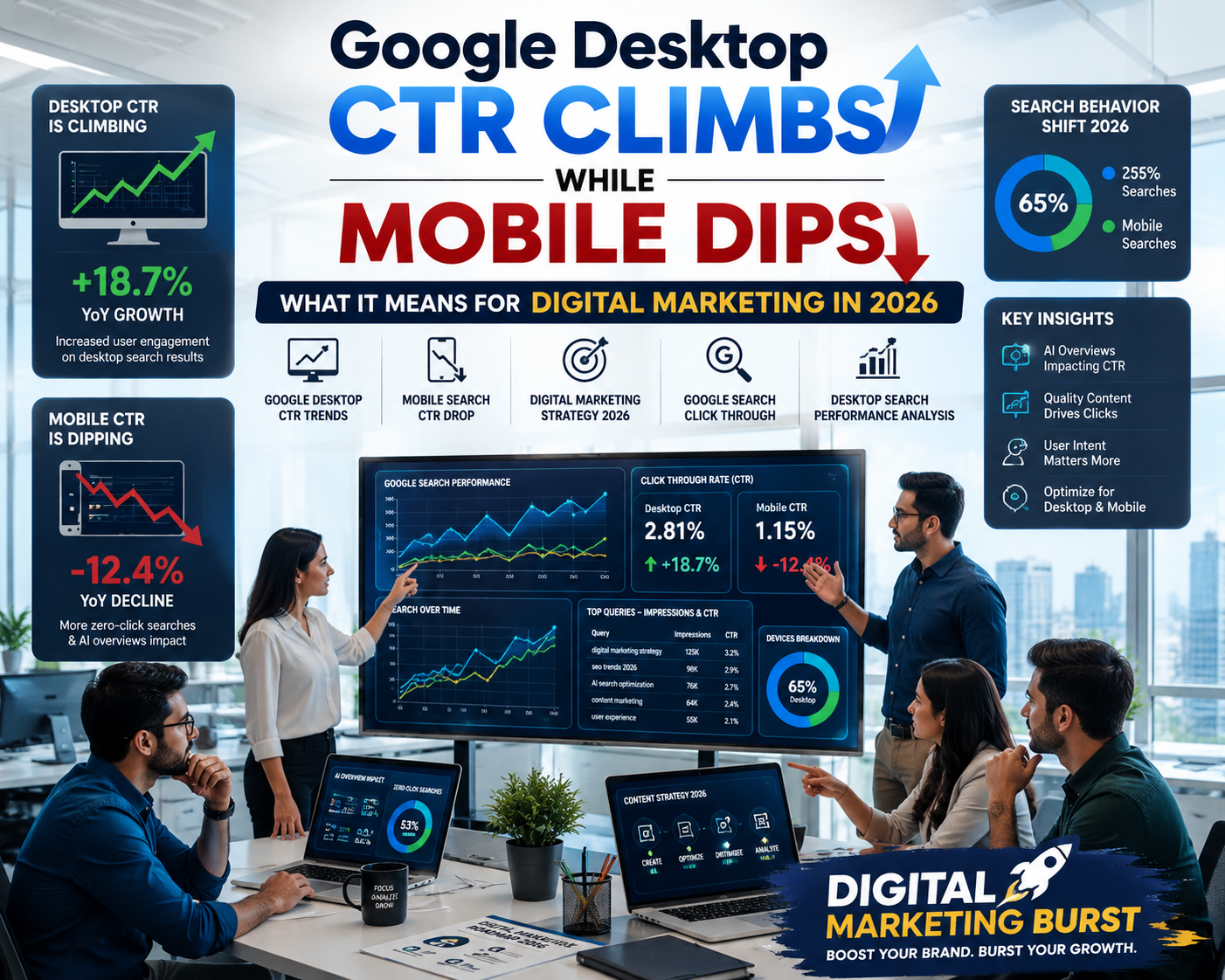
Google Desktop CTR Climbs While Mobile Dips: What It Means for Digital Marketing in 2026
Google Desktop CTR Climbs While Mobile Dips: What It Means for Digital Marketing in 2026
Google search behaviour continues to evolve, and recent reporting indicates an interesting shift: Google Desktop CTR Trends are improving while a Mobile Search CTR Drop is becoming more noticeable across several industries. For businesses, marketers, and SEO professionals, these changes raise an important question—how should a Digital Marketing Strategy 2026 adapt to changing user behaviour? Understanding Google Search Click Through patterns together with Desktop Search Performance Analysis can help brands make better content, SEO, and advertising decisions as search habits continue to change.
Instead of treating desktop and mobile users as identical audiences, marketers now need to understand how people search differently across devices. This shift affects website optimisation, user experience, content creation, conversion funnels, and advertising performance. Businesses that recognise these trends early are more likely to improve visibility and engagement across Google Search.
Why Google Desktop CTR Trends Are Becoming Important Again
For several years, mobile search dominated discussions around SEO and digital marketing. Smartphones became the primary device for browsing, shopping, reading articles, and discovering local businesses. However, recent industry reports suggest that desktop search is showing stronger click-through performance in several categories.
This does not necessarily mean desktop traffic is replacing mobile traffic. Instead, it highlights changing user intent. Desktop users often perform more detailed research, compare products, evaluate services, or complete business-related tasks. These users may spend more time reading content and are sometimes more likely to click organic search results.
From a marketing perspective, this trend encourages businesses to evaluate their desktop experience instead of focusing exclusively on mobile optimisation. Websites that load quickly, present clear navigation, and provide detailed information may benefit from stronger engagement among desktop users.
Marketers should avoid assuming that one device serves every customer equally. Instead, analysing performance separately for desktop and mobile audiences provides a clearer picture of actual user behaviour.
Understanding the Mobile Search CTR Drop
While desktop engagement appears to be improving in many sectors, several analysts have also observed a Mobile Search CTR Drop. This does not automatically indicate declining mobile traffic. Instead, it reflects changing search result layouts and user interactions.
Modern mobile search pages often display AI-generated summaries, featured snippets, local business packs, shopping results, video content, and knowledge panels before traditional organic listings. As a result, users sometimes find answers without clicking through to individual websites.
This changing behaviour presents both challenges and opportunities. Businesses can no longer depend solely on ranking first for a keyword. They must also optimise content that answers questions clearly, improves user experience, and encourages visitors to continue exploring beyond Google’s search results.
Rather than viewing declining mobile click-through rates as a negative development, businesses should consider how changing search interfaces influence customer decisions.
Digital Marketing Strategy 2026 Begins with Search Behaviour
Every successful Digital Marketing Strategy 2026 starts by understanding audience behaviour instead of simply following trends.
Search behaviour continues changing because users expect immediate answers, personalised recommendations, and high-quality information. Artificial intelligence is also influencing how search engines organise and present information.
Businesses that study customer intent instead of focusing only on rankings often build stronger long-term digital strategies. Understanding when users search, which devices they use, and what information they expect allows marketers to produce more useful content.
Instead of publishing articles only to target keywords, successful organisations increasingly create comprehensive resources that answer complete customer journeys. This approach naturally supports search visibility while improving trust among readers.
For brands such as Digital Marketing Burst, this means helping businesses create websites, content, and optimisation strategies that serve both search engines and real people.
Why Google Search Click Through Matters More Than Rankings
Many businesses celebrate ranking on the first page of Google, but rankings alone do not generate business results. What truly matters is whether users actually choose your result.
A higher Google Search Click Through rate indicates that searchers find your title, description, and content relevant enough to visit your website. Improving click-through rates often increases organic traffic without necessarily improving rankings.
Several factors influence click-through performance, including:
- Clear and informative page titles.
- Helpful meta descriptions.
- Strong search intent alignment.
- Recognisable brand authority.
- High-quality content.
- Rich search features.
Businesses should therefore evaluate both rankings and user engagement together rather than treating them as separate performance indicators.
A website appearing in the second position with an excellent click-through rate may outperform a poorly optimised page ranking first.
Desktop Google Search CTR: Why User Intent Is Changing
The recent improvement in Desktop Google Search CTR suggests that many users are returning to desktop devices when they need to complete more detailed tasks. This behaviour is especially noticeable in industries such as software, finance, B2B services, education, and digital marketing, where users often compare multiple resources before making a decision.
Desktop users generally have access to larger screens, multiple browser tabs, and faster workflows. Because of this, they are more likely to read long-form articles, compare pricing, evaluate products, or download detailed resources. Instead of making quick decisions, they often spend more time researching.
For marketers, this means content should support deeper exploration rather than providing only short answers. Comprehensive guides, original research, comparison articles, and detailed case studies are becoming increasingly valuable because they satisfy the needs of users conducting extensive research.
Businesses should also review desktop usability. Readable typography, logical page layouts, fast loading speeds, and clear navigation improve the overall experience. A well-designed desktop website encourages visitors to stay longer, interact with more pages, and build trust with the brand.
Rather than treating desktop optimisation as outdated, marketers should view it as another opportunity to improve user engagement and strengthen long-term organic performance.
Desktop Search Analytics Guide: Measuring What Really Matters
Understanding traffic numbers alone is no longer enough. A practical Desktop Search Analytics Guide begins by examining how visitors interact with your website after they arrive.
Instead of focusing only on impressions or rankings, marketers should analyse metrics such as click-through rate, engagement time, bounce rate, pages viewed per session, returning visitors, and conversions. Together, these metrics provide a clearer picture of content quality and user satisfaction.
For example, an article with moderate traffic but strong engagement may deliver greater business value than one receiving thousands of visits with very little interaction. Looking beyond raw traffic helps identify pages that genuinely support business objectives.
It is also helpful to compare desktop and mobile behaviour separately. Differences in engagement can reveal usability issues, content gaps, or changing audience preferences. These insights allow marketers to make informed improvements instead of relying on assumptions.
Regular performance reviews create a continuous optimisation process. Small improvements based on real user behaviour often produce better long-term results than frequent large-scale redesigns.
Why Mobile Google CTR Decline Does Not Mean Mobile SEO Is Dead
Although discussions around Mobile Google CTR Decline continue to grow, mobile optimisation remains essential. Billions of searches are still performed on smartphones every year, and mobile devices continue to dominate many consumer journeys.
The decline in click-through rate is influenced by how Google presents search results. AI-generated summaries, featured snippets, local listings, shopping modules, and video results often answer user questions before an organic result is clicked.
This means businesses must adapt instead of abandoning mobile SEO. Pages should load quickly, provide immediate value, and answer important questions clearly. Strong user experience becomes just as important as keyword optimisation.
Content written for mobile readers should use concise paragraphs, descriptive headings, and logical structure. Readers often scan before committing to a full article, so clarity and organisation matter.
Successful marketers recognise that desktop and mobile users have different expectations. Designing experiences that satisfy both audiences creates a stronger overall digital presence.
Google Search Click Through Rate and Brand Recognition
Click-through rate is influenced by more than rankings alone. Brand recognition plays a significant role in whether users choose one search result over another.
When people repeatedly encounter useful content from the same organisation, they become familiar with the brand. Over time, this familiarity increases confidence and encourages future clicks, even when competing pages rank nearby.
Brands can strengthen recognition by publishing consistent, accurate, and valuable information across multiple topics related to their industry. Educational resources, expert insights, practical guides, and original analysis all contribute to long-term credibility.
For companies such as Digital Marketing Burst, this means focusing on creating resources that answer real marketing questions instead of producing content only for algorithms. As trust grows, stronger click-through performance often follows naturally because users recognise the brand as a reliable source of information.
Building authority takes time, but consistent quality creates lasting value for both readers and businesses.
2026 Digital Marketing Guide: Adapting to New Search Behaviour
A practical 2026 Digital Marketing Guide is no longer centred only on keywords and rankings. Modern search optimisation requires understanding how people discover, evaluate, and interact with information across multiple devices and search experiences.
Artificial intelligence has changed how users receive answers. Search engines increasingly summarise information, recommend related topics, and personalise results according to context. Consequently, businesses must produce content that demonstrates expertise, answers complete questions, and encourages readers to continue learning beyond the search page.
Successful marketing strategies in 2026 will combine technical SEO, helpful content, user experience, and brand authority rather than relying on a single optimisation tactic. Organisations that regularly update existing content, improve website performance, and monitor user behaviour are better positioned to adapt as search continues evolving.
Marketers should also think beyond individual blog posts. Creating topic clusters, comprehensive resource centres, and interconnected educational content helps users explore multiple pages naturally. This approach supports both audience engagement and overall website quality.
Instead of reacting to every algorithm update, businesses benefit more from consistently improving their digital experience. Long-term improvements generally outperform short-term optimisation tactics.
Google Search Click Through Rate Depends on Better Content
Many organisations invest significant effort into improving rankings while overlooking the quality of the content users actually see. A strong Google Search Click Through Rate often begins with content that immediately communicates value.
Readers decide within seconds whether a search result appears relevant. Clear page titles, informative descriptions, logical structure, and useful information all influence that decision. Once visitors arrive, the content must continue meeting their expectations through accurate explanations and practical insights.
Modern search engines increasingly reward pages that satisfy user intent instead of simply repeating keywords. Articles that answer follow-up questions, explain concepts clearly, and maintain readability often generate stronger engagement than pages created primarily for search engines.
Content should therefore focus on solving problems rather than filling space. Examples, real-world applications, comparisons, and actionable recommendations help readers understand complex topics more effectively.
Businesses that consistently publish trustworthy information gradually strengthen audience confidence. As recognition grows, users become more willing to click future search results associated with that brand.
Why Desktop Search Performance Analysis Matters for Businesses
A detailed Desktop Search Performance Analysis provides insights that many businesses overlook. While overall traffic remains important, understanding how desktop visitors behave can reveal valuable opportunities for improving conversions and customer engagement.
Desktop users frequently spend longer reading articles, comparing products, downloading resources, or completing forms. These activities often represent higher commercial intent compared with shorter informational searches performed on mobile devices.
Analysing desktop behaviour helps identify which content supports business objectives most effectively. Marketers can evaluate page engagement, navigation paths, conversion rates, and user journeys to understand where visitors succeed or encounter obstacles.
This information supports informed decision-making rather than assumptions. Improvements based on actual visitor behaviour generally produce stronger long-term results than redesigns based only on trends.
Businesses should regularly review desktop analytics alongside mobile performance to understand how different audiences interact with their websites. Comparing both experiences often highlights opportunities for improving usability across every device.
Building a Future-Ready Content Strategy
Search technology will continue changing, but the principles of valuable content remain remarkably consistent. Organisations that invest in quality information today are more likely to remain visible regardless of future algorithm updates.
A future-ready content strategy begins by understanding customer questions. Instead of targeting isolated keywords, marketers should develop comprehensive resources covering complete topics from multiple perspectives.
Content should remain accurate, current, and easy to understand. Updating existing articles, expanding useful sections, and improving clarity often provides greater value than continuously publishing entirely new material.
Visual elements, diagrams, original research, and practical examples also strengthen educational content. Readers appreciate resources that explain complicated ideas in straightforward language while maintaining factual accuracy.
For agencies such as Digital Marketing Burst, helping businesses create sustainable content strategies means balancing search visibility with genuine reader value. Organisations that consistently educate their audiences often build stronger authority, deeper trust, and longer-lasting digital growth than those pursuing quick optimisation techniques alone.
How AI Search Is Influencing Desktop and Mobile User Behaviour
Artificial intelligence is transforming the way people interact with search engines. Instead of displaying only a list of blue links, search platforms increasingly present summaries, direct answers, related questions, visual content, and AI-generated overviews. These features influence how users decide whether to click on a website.
Desktop users often continue beyond the summary because they are conducting detailed research. They compare multiple sources, open several browser tabs, and evaluate information before making decisions. This behaviour helps explain why desktop engagement has remained strong in many industries.
Mobile users, however, frequently search while travelling, shopping, or completing everyday tasks. In these situations, receiving an immediate answer is often more valuable than visiting several websites. As AI-generated responses become more common, mobile searchers may complete their journey without selecting an organic result.
For businesses, this change reinforces the importance of publishing original, trustworthy, and comprehensive content. Pages that provide unique insights, expert analysis, or detailed explanations remain valuable because they offer information beyond what a short summary can deliver.
Understanding how AI shapes user behaviour allows marketers to create experiences that remain useful regardless of future search interface changes.
Content Quality Is Becoming More Important Than Content Quantity
Publishing more articles does not automatically improve digital visibility. Instead, many successful organisations are focusing on creating fewer but more valuable resources that answer real customer questions.
Readers appreciate content that is well organised, easy to understand, and supported by practical examples. Clear explanations, updated information, and logical structure help visitors stay engaged while building confidence in the information they are reading.
Rather than producing dozens of similar articles, businesses benefit from developing comprehensive guides that explore a topic in depth. These resources often remain useful for longer periods and are easier to update as industries evolve.
Regular content reviews also improve long-term quality. Refreshing statistics, updating screenshots, improving examples, and adding new sections help ensure that existing articles continue meeting user expectations.
Quality content supports not only search visibility but also customer education, brand reputation, and long-term business growth.
Balancing Desktop and Mobile Optimisation
Many businesses mistakenly optimise for only one type of visitor. In reality, desktop and mobile audiences frequently interact with the same brand at different stages of the customer journey.
A potential customer may first discover a business through a mobile search during the day. Later, they might return using a desktop computer to perform detailed research before making a purchase or requesting a service.
Because of this behaviour, websites should provide a consistent experience across every device. Navigation, readability, loading speed, and content structure should remain effective whether someone visits from a smartphone, tablet, or desktop computer.
Responsive website design continues to play an important role, but user experience extends beyond layout. Clear calls to action, accessible information, intuitive menus, and fast performance all contribute to a positive browsing experience.
Businesses that invest equally in desktop and mobile optimisation are generally better prepared to meet changing customer expectations as search technology continues evolving.
Lessons Businesses Can Learn from Current CTR Trends
The recent discussion surrounding desktop and mobile click-through behaviour highlights several broader lessons for digital marketing.
First, user intent changes over time. Search strategies that worked several years ago may require adjustment as technology and customer behaviour continue developing.
Second, strong brands attract attention regardless of algorithm changes. Organisations recognised for helpful, trustworthy information often maintain audience engagement even as search interfaces evolve.
Third, analysing performance regularly leads to better decision-making. Monitoring engagement, traffic sources, conversion rates, and user behaviour helps businesses identify opportunities for continuous improvement instead of reacting only after performance declines.
Finally, successful digital marketing depends on understanding people rather than simply understanding search engines. Businesses that focus on solving customer problems, answering important questions, and creating valuable experiences are more likely to achieve sustainable growth over the long term.
These lessons remain relevant regardless of future updates because they are built around user needs rather than temporary optimisation techniques.
Why User Experience Directly Impacts Search Performance
One of the biggest changes in digital marketing is the growing importance of user experience. Search engines increasingly evaluate whether visitors find a page useful after clicking on it. If readers quickly leave because a website is slow, difficult to navigate, or confusing, that behaviour may indicate the page is not meeting their expectations.
A positive user experience begins with fast loading times, clear page structure, and readable content. Visitors should be able to find important information without scrolling through unnecessary sections or dealing with distracting design elements. Simple improvements such as descriptive headings, logical navigation, and clean layouts can significantly improve how users interact with a website.
Desktop visitors often spend more time reading detailed resources, while mobile users generally expect immediate answers. Recognising these differences helps businesses create experiences that work well for both audiences. Instead of designing for only one device, marketers should ensure every page remains accessible, informative, and easy to use across all screen sizes.
Companies that consistently improve user experience often see stronger engagement, higher conversion rates, and increased customer satisfaction. These outcomes benefit both visitors and businesses, making user experience an essential part of any modern digital marketing strategy.
Creating Content That Matches Search Intent
Every search begins with a purpose. Some users want a quick answer, while others are researching products, comparing services, or learning a completely new topic. Understanding this intent allows marketers to produce content that genuinely helps readers instead of simply targeting keywords.
Informational articles should explain concepts clearly and answer common questions. Comparison pages help users evaluate alternatives, while product pages should provide enough detail for confident purchasing decisions. Matching content to user intent improves satisfaction because visitors receive exactly the information they expected to find.
Long-form educational content continues performing well because it answers multiple related questions within a single resource. Readers appreciate comprehensive guides that save them from opening numerous search results. This approach also encourages longer engagement as visitors continue exploring different sections of the article.
Businesses should regularly review customer questions, feedback, and search behaviour to identify new content opportunities. Producing articles based on real audience needs creates lasting value and supports stronger relationships with readers.
Building Brand Authority Through Consistent Publishing
Brand authority is developed over time through consistency rather than isolated success. Businesses that regularly publish accurate, useful, and well-researched content gradually become recognised as reliable information sources within their industry.
Consistency involves more than maintaining a publishing schedule. It also includes using a clear writing style, keeping information updated, and ensuring every article reflects the same commitment to quality. Readers return to websites that consistently provide trustworthy answers because they know what to expect.
Educational content, practical guides, industry analysis, and expert commentary all contribute to long-term authority. As readers become familiar with a brand, they are often more willing to engage with future articles, newsletters, and resources.
For organisations such as Digital Marketing Burst, helping businesses establish authority means creating content that solves problems instead of chasing short-term trends. Over time, this approach supports stronger audience trust and encourages repeat engagement from both new and returning visitors.
Measuring Success Beyond Rankings
Search rankings remain useful, but they represent only one part of overall digital marketing performance. Businesses should also evaluate how effectively their content supports broader objectives such as customer education, lead generation, and long-term brand growth.
Key performance indicators may include visitor engagement, average session duration, returning users, completed enquiries, newsletter subscriptions, and conversion rates. These metrics often provide deeper insight into content effectiveness than rankings alone.
Comparing desktop and mobile performance separately can also reveal valuable trends. Some pages may perform exceptionally well on desktop while requiring improvements for mobile visitors. Regular analysis allows marketers to prioritise updates based on real user behaviour rather than assumptions.
Ultimately, successful digital marketing is measured by how well a website serves its audience. When visitors consistently find useful information and achieve their goals, stronger business results often follow naturally.
Common Digital Marketing Mistakes Businesses Should Avoid in 2026
As search behaviour evolves, many businesses continue relying on outdated optimisation techniques that no longer deliver meaningful results. One of the most common mistakes is focusing entirely on rankings while overlooking the overall experience visitors have after arriving on the website.
Publishing repetitive content with very similar topics can also reduce value for readers. Instead of creating multiple articles covering nearly identical information, organisations should develop comprehensive resources that answer related questions within a single, well-structured guide. This approach makes information easier to find and improves the reading experience.
Another challenge is ignoring existing content. Many websites publish new articles every week but rarely update older pages. Refreshing statistics, improving explanations, correcting outdated information, and expanding useful sections often delivers greater value than continually producing new material.
Businesses should also avoid treating desktop and mobile visitors as identical audiences. Analysing user behaviour separately allows marketers to identify opportunities for improving navigation, content presentation, and conversion paths on each device.
Continuous improvement based on real user behaviour generally produces stronger long-term results than frequent changes driven solely by algorithm speculation.
How Search Behaviour Influences Customer Decisions
Search engines have become the starting point for many purchasing decisions. Whether someone is researching software, comparing service providers, or learning about a new topic, search results often shape the first impression of a brand.
Users typically move through several stages before making a decision. They begin by gathering information, compare available options, evaluate trustworthiness, and finally decide whether to contact a business or complete a purchase. Every stage requires different types of content.
Educational articles introduce new concepts. Comparison guides help readers evaluate alternatives. Case studies demonstrate practical applications, while frequently asked questions address remaining concerns before conversion.
Understanding this journey allows marketers to create content that supports readers from their first search through to their final decision. Rather than focusing on isolated keywords, businesses benefit from developing complete content ecosystems that answer related questions across every stage of the customer journey.
When information remains helpful, accurate, and easy to understand, readers are more likely to remember the brand and return when additional information is needed.
Why Continuous Content Updates Matter
Digital marketing is not a one-time activity. Search behaviour, industry trends, customer expectations, and technology continue changing throughout the year. Because of this, websites require ongoing maintenance rather than occasional updates.
Refreshing existing articles helps maintain relevance while ensuring readers receive current information. New industry developments, changing search features, updated statistics, and revised recommendations can all improve the usefulness of previously published content.
Content audits also identify opportunities to improve readability, strengthen internal navigation, and remove outdated references. Small improvements made consistently often produce better long-term performance than complete website redesigns.
Businesses should schedule periodic reviews of important pages to ensure information remains accurate. This process benefits both readers and organisations by maintaining trust and supporting a positive user experience.
Instead of constantly replacing older articles, improving valuable resources over time creates a stronger knowledge base that continues serving visitors effectively.
Preparing Your Business for the Future of Search
The future of digital marketing will continue emphasising user satisfaction, high-quality information, and meaningful online experiences. While technology will undoubtedly introduce new search features, the importance of helpful content is unlikely to disappear.
Businesses that invest in understanding their audiences will be better prepared for future changes. Listening to customer feedback, analysing user behaviour, monitoring industry developments, and regularly improving digital experiences all contribute to long-term success.
Search visibility should therefore be viewed as the result of consistently meeting user needs rather than the objective itself. Organisations that educate, inform, and support their audiences naturally strengthen their online presence over time.
For Digital Marketing Burst, helping businesses prepare for future search trends means encouraging sustainable digital practices that prioritise quality, trust, and continuous improvement. These principles remain valuable regardless of how search technology evolves in the years ahead.
How Businesses Can Respond to Changing Google Search Behaviour
Search behaviour is constantly evolving, and businesses that adapt early often gain a competitive advantage. Instead of reacting only after traffic changes occur, organisations should build flexible digital strategies that respond to user needs and market trends.
The first step is understanding audience expectations. Customers no longer search only for products or services; they also search for solutions, comparisons, expert advice, and practical guidance. Businesses that answer these questions comprehensively are more likely to build lasting relationships with their audience.
Website performance should also be reviewed regularly. Slow-loading pages, confusing navigation, or outdated information can reduce engagement regardless of search rankings. Regular maintenance ensures visitors continue receiving a positive experience across desktop and mobile devices.
Marketing teams should also monitor how different content formats perform. Blog articles, videos, infographics, downloadable resources, and interactive tools all serve different purposes within the customer journey. Diversifying content helps businesses reach audiences with different learning preferences.
By focusing on continuous improvement instead of one-time optimisation, organisations become more resilient as search technology continues changing.
The Role of Data in Modern Digital Marketing
Successful marketing decisions are increasingly driven by data rather than assumptions. Analytics platforms provide valuable insights into how visitors discover content, which pages perform well, and where users leave the website.
Instead of relying only on page views, marketers should analyse metrics that reflect engagement and business value. Session duration, returning visitors, conversion rates, and user journeys often provide more meaningful information than traffic volume alone.
Comparing desktop and mobile data separately is particularly useful because visitor behaviour frequently differs between devices. Desktop users may spend longer researching, while mobile users often seek quick answers or immediate actions.
Data should not be viewed simply as reporting. Instead, it should support informed decision-making. Small improvements based on user behaviour can produce measurable long-term benefits without requiring major redesigns or costly campaigns.
Organisations that regularly review performance data are generally better equipped to identify opportunities for improvement before problems become significant.
Building Long-Term Trust Through Educational Content
One of the most effective ways to strengthen a brand is by consistently educating its audience. Informative content helps businesses demonstrate expertise while providing genuine value to readers.
Educational articles explain complex topics clearly, answer common questions, and guide visitors through decision-making processes. Unlike promotional content, educational resources continue attracting readers because they remain useful long after publication.
Businesses that invest in knowledge sharing often develop stronger relationships with their audience. Readers begin recognising the organisation as a reliable source of information rather than simply another company promoting products or services.
Consistency also matters. Publishing accurate, well-researched content on a regular basis reinforces credibility and encourages repeat visits. Over time, this trust contributes to stronger engagement, increased referrals, and improved brand recognition.
For Digital Marketing Burst, helping businesses build educational content strategies means creating resources that support customers before, during, and after purchasing decisions. This approach benefits both readers and organisations by encouraging meaningful long-term relationships.
Preparing Marketing Teams for Future Search Trends
Technology will continue changing, but successful marketing teams share several common characteristics. They remain adaptable, focus on customer needs, and continuously improve their digital skills.
Training should extend beyond technical SEO to include user experience, content strategy, analytics, artificial intelligence, and digital communication. Understanding these areas allows teams to respond confidently as search platforms evolve.
Collaboration between writers, designers, developers, and analysts also becomes increasingly important. High-quality digital experiences are rarely created by one specialist working alone. Instead, they result from coordinated efforts across multiple disciplines.
Businesses should encourage ongoing learning by reviewing industry research, experimenting with new ideas, and measuring results objectively. Continuous improvement helps organisations remain competitive without chasing every emerging trend.
Ultimately, future-ready marketing teams succeed because they prioritise solving customer problems rather than simply increasing website traffic. That mindset supports sustainable growth regardless of how search technology changes in the years ahead.
Practical Recommendations for Businesses in 2026
As search platforms continue evolving, businesses should focus on improvements that create lasting value instead of reacting to every short-term trend. A practical digital marketing plan begins by understanding customer needs and building experiences that remain useful regardless of future algorithm changes.
One effective approach is reviewing existing website content. Many organisations have valuable articles that simply need updating rather than replacing. Improving clarity, expanding useful sections, refreshing statistics, and answering additional customer questions often increases the value of existing resources.
Website performance should also remain a priority. Fast loading times, intuitive navigation, accessible design, and clear calls to action improve the overall browsing experience for both desktop and mobile users. Small technical improvements frequently contribute to better engagement because visitors can access information more easily.
Businesses should also continue investing in original content. Research reports, expert interviews, practical tutorials, and industry insights help differentiate a website from competitors publishing similar information. Original resources often encourage repeat visits because readers gain information they cannot easily find elsewhere.
Developing a long-term content calendar also supports consistency. Publishing helpful resources throughout the year helps maintain audience engagement while allowing marketing teams to improve quality instead of rushing content production.
Frequently Asked Questions About Google CTR Trends
Why are desktop click-through rates increasing?
Several factors may contribute to stronger desktop engagement. Desktop users often perform detailed research, compare multiple sources, and spend more time reviewing information before making decisions. Larger screens and improved productivity also support longer browsing sessions.
Does a lower mobile click-through rate mean mobile SEO no longer matters?
No. Mobile search remains essential because millions of people continue using smartphones to discover information every day. Lower click-through rates often reflect changing search result layouts rather than declining importance of mobile users.
Should businesses optimise separately for desktop and mobile?
Yes. While responsive websites remain important, analysing behaviour separately allows businesses to identify opportunities for improving navigation, content presentation, and conversion paths for different audiences.
Is ranking first still the most important SEO objective?
Strong rankings remain valuable, but they represent only one aspect of digital performance. User engagement, content quality, trust, and overall visitor satisfaction also contribute significantly to long-term success.
How often should content be updated?
Reviewing important articles every few months helps ensure information remains accurate, relevant, and useful. Regular updates often provide greater value than continually publishing new articles without maintaining existing content.
Key Lessons from Current Search Trends
The discussion surrounding desktop and mobile click-through behaviour highlights several broader lessons for organisations planning future marketing strategies.
First, customer behaviour changes continuously. Businesses should therefore monitor performance regularly rather than relying on assumptions based on previous years.
Second, quality consistently outperforms quantity. Comprehensive resources that genuinely help readers often remain valuable for much longer than articles created only to target specific keywords.
Third, user experience continues becoming more important. Fast websites, organised information, and intuitive navigation contribute positively to customer satisfaction across every device.
Finally, digital marketing should always support broader business objectives. Search visibility, brand awareness, customer education, and long-term trust all work together to create sustainable online growth.
For organisations prepared to learn from changing search behaviour, these trends represent opportunities rather than obstacles. By focusing on people first and technology second, businesses can continue building meaningful relationships with their audiences regardless of how search evolves in the future.
How AI Is Reshaping the Future of Search Marketing
Artificial intelligence is changing more than search results. It is influencing how people discover information, compare brands, and make purchasing decisions. Instead of typing a few keywords and opening several websites, users increasingly expect search platforms to provide direct, personalised, and context-aware answers.
For marketers, this means content must deliver value beyond a simple definition or quick response. Readers still visit websites when they want deeper explanations, practical examples, industry expertise, or original insights that AI summaries cannot fully replace.
Businesses should therefore think of AI as an evolution in search rather than a replacement for websites. Organisations that publish trustworthy resources, maintain accurate information, and update content regularly remain valuable because they contribute original knowledge to the web.
The future of search is likely to combine AI-generated assistance with high-quality publisher content. Companies that continue investing in expertise, research, and customer education will be better positioned as search experiences become increasingly intelligent.
Why Brand Trust Is Becoming a Competitive Advantage
Consumers are exposed to enormous amounts of information every day. As a result, trust has become one of the most valuable assets a business can build. When users recognise a brand as reliable, they are more likely to return for future information, recommend it to others, and engage with its content.
Trust is built through consistency. Accurate articles, transparent communication, updated information, and genuine expertise all contribute to a positive reputation. Over time, these qualities create stronger relationships than promotional messaging alone.
Readers also appreciate brands that acknowledge changing industry trends while providing balanced explanations instead of exaggerated claims. Explaining both opportunities and limitations demonstrates professionalism and encourages informed decision-making.
For Digital Marketing Burst, supporting businesses in building trusted digital experiences means encouraging educational content, continuous improvement, and a customer-first mindset. Long-term credibility often produces greater value than short-term visibility.
A Simple Framework for Evaluating Your SEO Strategy
Businesses can benefit from reviewing their digital marketing efforts using a straightforward framework that focuses on continuous improvement rather than isolated metrics.
Begin by assessing whether your content answers the questions customers actually ask. Review existing articles to identify outdated information or opportunities for expansion. Next, evaluate website performance, including loading speed, navigation, readability, and accessibility across different devices.
After that, analyse visitor behaviour. Identify which pages attract engagement, which topics generate enquiries, and where users leave the website. These insights help prioritise future improvements based on real audience needs.
Finally, create a schedule for ongoing reviews. Digital marketing is most effective when optimisation becomes a continuous process rather than a one-time project. Small, consistent improvements often deliver stronger long-term outcomes than large, infrequent redesigns.
Looking Ahead to the Next Phase of Digital Marketing
The digital marketing landscape will continue evolving as technology advances, customer expectations change, and search experiences become more interactive. Businesses that remain flexible will be better prepared for future developments.
Success will increasingly depend on understanding audiences instead of simply following algorithms. Organisations that invest in customer education, valuable content, and excellent user experiences are more likely to remain competitive regardless of how search engines present information.
While desktop and mobile behaviours may continue changing, the underlying objective remains the same: helping users find accurate, useful, and trustworthy information quickly.
As the industry moves forward, marketers should focus less on predicting every search update and more on consistently improving the quality of their websites, content, and customer experiences. Those principles have remained valuable throughout the history of digital marketing and are likely to continue guiding successful strategies in the years ahead.
Why Digital Marketing Burst Helps Businesses Prepare for the Future of Search
As search behaviour continues changing, businesses need more than occasional SEO updates. They need a long-term digital marketing partner that understands content strategy, technical optimisation, user experience, analytics, and emerging AI search trends.
Digital Marketing Burst works with businesses that want to build sustainable online growth instead of relying on short-term tactics. The focus is on developing useful content, improving website performance, strengthening organic visibility, and creating marketing strategies that continue delivering value as search technology evolves.
Every business has different goals, audiences, and challenges. For that reason, successful digital marketing should never rely on a single formula. Instead, each strategy should reflect customer behaviour, industry competition, and measurable business objectives.
Whether a company is improving its website, expanding its content library, strengthening local visibility, or preparing for AI-powered search experiences, continuous improvement remains the foundation of long-term digital success.
Rather than promising instant results, the emphasis should always remain on creating digital assets that continue supporting business growth over time.
Final Thoughts
The discussion around Google Desktop CTR Climbs While Mobile Dips highlights an important reality: search behaviour is constantly evolving. While desktop engagement appears to be strengthening in many industries, mobile search continues to play a significant role in how people discover businesses, products, and information.
Instead of viewing desktop and mobile as competing platforms, marketers should understand how each device supports different stages of the customer journey. Desktop users frequently perform detailed research, while mobile users often seek immediate answers or quick decisions. Businesses that optimise for both experiences are better prepared for changing customer expectations.
A successful Digital Marketing Strategy 2026 will rely on several interconnected elements. High-quality content, excellent user experience, accurate analytics, trustworthy branding, and continuous optimisation all contribute to sustainable growth. Organisations that regularly improve their websites instead of chasing every algorithm update are more likely to remain competitive.
The future of digital marketing belongs to businesses that educate their audiences, publish original insights, and build lasting trust. Search engines will continue evolving, but the importance of providing genuine value to users will remain unchanged.
For organisations looking to strengthen their online presence, adapting to new search behaviours today creates opportunities for stronger visibility, better customer engagement, and long-term digital growth tomorrow.
Why Businesses Choose Digital Marketing Burst for Digital Marketing Solutions
Choosing the right digital marketing partner is an important business decision. Digital Marketing Burst works with startups, local businesses, e-commerce brands, and growing companies that want to improve their online visibility through practical, data-driven digital marketing strategies.
Based in Lucknow, our team helps businesses build stronger online foundations through SEO, content marketing, website optimisation, local SEO, AI-ready content, Google Business Profile optimisation, and performance-focused digital campaigns. Every strategy is planned according to business goals, industry competition, and customer behaviour instead of using a one-size-fits-all approach.
Digital Marketing Services Designed for Long-Term Growth
Digital marketing continues to evolve with AI-powered search, changing user behaviour, and new Google updates. Businesses need strategies that remain effective over time rather than depending on temporary trends.
Digital Marketing Burst focuses on creating sustainable marketing solutions that help businesses:
- Improve organic search visibility
- Build stronger brand authority
- Create high-quality SEO content
- Optimise websites for better user experience
- Increase qualified website traffic
- Strengthen local business presence
- Prepare for AI-powered search platforms
Instead of chasing quick results, our approach is centred on continuous improvement and measurable business growth.
Why Businesses Work with Digital Marketing Burst
Clients choose Digital Marketing Burst because we focus on transparency, communication, and customised strategies. Every business has different objectives, target audiences, and competitive challenges, so every marketing plan is developed accordingly.
Our expertise includes:
- Search Engine Optimisation (SEO)
- Technical SEO Audits
- Local SEO for Businesses
- AI Search Optimisation
- Content Marketing Strategy
- Website SEO Optimisation
- Google Business Profile Optimisation
- Digital Marketing Consulting
- Performance Marketing Support
- Brand Visibility Strategy
Helping Businesses Adapt to the Future of Search
As Google Search, AI-powered search engines, and customer behaviour continue changing, businesses require marketing strategies that can adapt. Digital Marketing Burst helps organisations prepare for these changes by focusing on valuable content, strong technical foundations, and customer-focused digital experiences.
Whether your goal is increasing website traffic, improving brand visibility, generating qualified leads, or strengthening your online presence, our objective is to build strategies that support sustainable long-term growth.
If you’re looking for a digital marketing agency in Lucknow with a practical, results-focused approach, Digital Marketing Burst is ready to help you build a stronger digital presence.
Backlinks vs Brand Mentions: Which One Matters More for SEO in 2026?
Backlinks vs Brand Mentions: Which One Matters More for SEO in 2026?
Introduction
Backlinks vs Brand Mentions has become one of the biggest discussions in modern SEO. As search engines and AI-powered search experiences continue to evolve, businesses are asking whether Brand Mentions for SEO, Google AI Search Optimization, a High Quality Backlinks Guide, or a strong SEO Link Building Strategy delivers the greatest long-term value. Rather than treating these concepts as competing tactics, successful digital marketing strategies increasingly combine them to build trust, authority, and visibility.
In 2026, search engines evaluate websites using a much broader set of quality signals than they did several years ago. Traditional backlinks remain valuable because they demonstrate that another website considers your content worth referencing. At the same time, brand mentions across articles, news sites, podcasts, forums, and social platforms help establish topical authority even when they do not include clickable links.
Artificial intelligence has also changed how search systems interpret information. AI-powered search engines attempt to understand entities, expertise, and reputation instead of relying exclusively on hyperlinks. As a result, organisations that consistently publish accurate information, earn editorial references, and build genuine authority often perform better across both traditional search and AI-generated answers.
This article explains the difference between backlinks and brand mentions, explores how Google evaluates both signals, and shows how businesses can create a sustainable authority-building strategy. Throughout the guide, you will also discover practical recommendations inspired by the experience of Digital Marketing Burst, where the focus is on creating trustworthy content that supports long-term online visibility rather than relying on short-term tactics.
Understanding Backlinks vs Brand Mentions
The discussion around Backlinks vs Brand Mentions often begins with a simple question: which one contributes more to online authority? The answer depends on the context because both signals serve different purposes within modern search ecosystems.
A backlink is a hyperlink placed on another website that directs visitors to your content. Search engines have historically viewed backlinks as recommendations. When respected publications, universities, organisations, or industry websites link to a page, they provide additional context that the information may be useful and trustworthy.
Brand mentions work differently. A brand mention occurs whenever your business, product, website, or organisation is referenced online. Sometimes the mention includes a hyperlink, but many references simply include the company name without creating a clickable connection. Even without a hyperlink, these mentions help establish recognition and reinforce your brand’s presence across the web.
Today’s search landscape increasingly recognises that authority cannot always be measured by hyperlinks alone. Businesses that receive consistent editorial coverage, expert interviews, conference references, research citations, and media discussions often develop stronger reputations, even when many of those mentions are unlinked.
For organisations investing in sustainable digital growth, the conversation should not focus on choosing one signal over the other. Instead, the objective should be building a balanced strategy that earns quality backlinks while also encouraging authentic brand conversations across multiple online platforms.
Why Brand Mentions for SEO Are Receiving More Attention
The growing importance of Brand Mentions for SEO reflects broader changes in how information is discovered online. Modern search engines attempt to understand relationships between businesses, authors, products, and topics instead of analysing isolated webpages.
When respected industry publications repeatedly reference the same organisation, search systems gain additional confidence that the brand participates actively within its field. These references contribute to broader entity recognition and help search engines understand the organisation’s expertise.
Brand mentions also influence user behaviour. People are naturally more likely to trust businesses they have encountered multiple times across different websites. A company that appears in expert interviews, research reports, conference presentations, podcasts, and respected publications gradually develops stronger credibility than one that depends entirely on traditional link building.
This shift becomes even more important as AI-powered search experiences summarise information from numerous trusted sources. Rather than simply counting links, these systems evaluate consistency, expertise, and the overall reputation surrounding a brand.
For businesses looking beyond conventional optimisation methods, strengthening brand recognition has become an important component of long-term digital visibility.
Brand Mentions vs Backlinks: Understanding the Real Difference
The debate around Brand Mentions vs Backlinks continues because both contribute to online authority in different ways. While they are often discussed together, they serve separate purposes within a comprehensive digital marketing strategy.
Backlinks are direct hyperlinks pointing from one website to another. Historically, they have helped search engines discover new pages and evaluate the relationships between websites. A high-quality backlink from a respected publication can indicate that the referenced content provides useful information.
Brand mentions, however, do not always include hyperlinks. A company may be referenced in an industry report, podcast, news article, webinar, or social discussion without a clickable link. These mentions still contribute to overall brand visibility and help users recognise an organisation across multiple platforms.
Modern search systems increasingly analyse entities instead of simply counting links. When a business consistently appears in trusted publications discussing a particular subject, search engines gain additional context about the organisation’s expertise and relevance. This broader understanding is particularly important as AI-generated search experiences become more common.
Rather than viewing backlinks and brand mentions as competing tactics, businesses benefit by combining both approaches. Editorial mentions often lead to future backlinks, while high-quality content naturally encourages both citations and discussions within an industry.
Google AI SEO Guide: How Search Is Changing
A practical Google AI SEO Guide begins with understanding how artificial intelligence influences search behaviour. Modern search engines no longer rely exclusively on keywords and hyperlinks. Instead, they analyse topics, relationships, entities, and the quality of available information.
AI-powered search attempts to answer questions directly by summarising information from reliable sources. Because of this, content that demonstrates expertise, clarity, and accuracy becomes increasingly valuable.
Search systems also evaluate consistency across multiple sources. When independent websites discuss similar information while referencing the same organisation, products, or research, those repeated signals strengthen confidence in the topic.
This change encourages businesses to invest in useful resources rather than publishing large amounts of repetitive content. Comprehensive guides, original research, expert interviews, case studies, and educational articles often perform better because they provide information that others naturally reference.
The evolution of AI search also means that organisations should think beyond individual webpages. Building a recognised digital presence across multiple trusted platforms contributes to long-term visibility in both traditional search results and AI-generated answers.
High Quality Backlinks Guide for Sustainable Growth
A successful High Quality Backlinks Guide focuses on earning links rather than collecting them. Search engines increasingly value editorial recommendations that occur naturally because another publisher genuinely considers the content useful.
Creating comprehensive educational resources remains one of the most reliable ways to attract quality backlinks. Detailed tutorials, research-based articles, industry statistics, original graphics, and practical guides often receive references from bloggers, journalists, and businesses.
Guest contributions can also expand visibility when they appear on relevant websites serving similar audiences. The emphasis should always remain on sharing valuable knowledge rather than acquiring links alone.
Another effective approach involves publishing original research. Industry surveys, market analysis, benchmark reports, and data-driven articles frequently become reference material for future publications, generating both backlinks and brand mentions over time.
Building relationships within your industry also contributes to sustainable link acquisition. Participating in webinars, podcasts, interviews, conferences, and collaborative projects creates opportunities for natural editorial references without depending on aggressive outreach campaigns.
Ultimately, quality consistently outweighs quantity. A smaller number of trusted editorial backlinks usually provides greater long-term value than hundreds of low-quality references from unrelated websites.
Quality Backlink Building Guide for Modern SEO
A practical Quality Backlink Building Guide begins with publishing content worth recommending. Businesses that consistently solve real problems naturally encourage other websites to reference their work.
Useful comparison articles, complete tutorials, original templates, downloadable resources, interactive tools, and educational videos often receive greater attention because they provide genuine value to readers.
Digital PR also plays an important role in modern backlink acquisition. Sharing expert opinions, responding to journalist requests, publishing research, and contributing to industry discussions increase the likelihood of receiving editorial coverage.
Businesses should also review existing unlinked brand mentions. In some situations, publishers who have already referenced a company may be willing to include a relevant citation if it genuinely improves the reader’s experience.
Above all, sustainable backlink building depends on trust. Organisations that consistently publish reliable information often continue earning references long after an article is initially published, creating lasting benefits for both readers and search visibility.
SEO Link Building Strategy That Works in 2026
An effective SEO Link Building Strategy in 2026 is no longer centred on collecting as many links as possible. Instead, successful organisations focus on building credibility, publishing valuable resources, and becoming recognised sources within their industries. Search engines increasingly reward websites that demonstrate expertise through consistent, helpful content rather than aggressive link acquisition tactics.
One of the most reliable approaches is creating content that answers questions people genuinely ask. Detailed guides, original research, practical tutorials, comparison articles, and industry reports often become reference material for journalists, bloggers, educators, and businesses. When content solves real problems, links become a natural outcome rather than the primary objective.
Collaboration also strengthens link-building efforts. Participating in expert interviews, podcasts, webinars, and industry discussions introduces your brand to new audiences while increasing opportunities for editorial references. These activities often generate both backlinks and brand mentions simultaneously, reinforcing authority across multiple platforms.
Another important element is maintaining a healthy internal linking structure. Well-organised websites help visitors discover related resources while allowing search engines to understand topical relationships between pages. Internal links cannot replace backlinks, but they improve user experience and support stronger content architecture.
Consistency matters as well. Publishing useful resources regularly creates more opportunities for citations over time. Instead of relying on one successful article, organisations should build a library of authoritative content that collectively strengthens their online presence.
Link Building SEO Guide for Long-Term Authority
A practical Link Building SEO Guide begins with understanding that authority develops gradually. Sustainable results usually come from continuous improvement rather than isolated campaigns. Businesses that invest in quality content, genuine expertise, and strong relationships often see steady growth over several years.
Editorial links remain among the most valuable because they are earned through merit. These links generally appear when another publisher believes a resource adds value to readers. Unlike purchased or manipulated links, editorial references reflect authentic recognition within an industry.
Monitoring existing backlinks also forms part of a healthy strategy. Broken links, outdated references, or redirected pages should be reviewed periodically to ensure users continue reaching the intended content. Maintaining link quality protects the long-term value of previously earned citations.
Community participation offers another opportunity to strengthen authority. Contributing thoughtful insights in professional forums, industry communities, conferences, and educational events helps establish expertise while increasing visibility among audiences who may later reference your work.
Organisations should avoid shortcuts promising hundreds of backlinks within a short period. Search systems have become increasingly effective at recognising unnatural link patterns. Building trust through consistent contributions remains a safer and more sustainable approach.
How Google Evaluates Authority Beyond Links
Modern search engines evaluate websites using a combination of signals rather than depending exclusively on backlinks. Content quality, user experience, expertise, author credibility, website reputation, and topical consistency all contribute to overall authority.
For example, a business that regularly publishes well-researched educational content may receive references across news websites, social discussions, podcasts, newsletters, and academic resources. Together, these signals provide search engines with a broader understanding of the organisation’s role within its field.
Search algorithms also examine how users interact with content. Helpful articles often encourage longer reading sessions, additional page visits, repeat visitors, and increased sharing. These behavioural signals complement backlinks by indicating that readers find the information genuinely useful.
Structured content also improves understanding. Clear headings, logical organisation, concise explanations, and updated information help both readers and search systems navigate complex topics more efficiently. As AI-generated search summaries continue evolving, content written with clarity becomes increasingly valuable.
Ultimately, authority results from combining multiple positive signals rather than maximising any single metric. Businesses that consistently educate, inform, and contribute to their industries often develop stronger digital reputations over time.
Why Quality Content Supports Both Links and Brand Recognition
High-quality content remains the common foundation connecting backlinks, brand mentions, and overall visibility. When an article provides unique insights or solves a difficult problem, people naturally discuss it, reference it, and recommend it to others.
Educational resources often generate multiple forms of recognition simultaneously. A journalist may reference a research report, a blogger may link to a detailed guide, a podcast host may discuss the findings, and social media users may share key insights. Although each interaction differs, together they strengthen the content’s reach and authority.
Businesses should therefore think beyond publishing for search engines alone. Writing for real readers encourages deeper engagement while increasing the likelihood that other publishers will recognise the content’s value. Over time, these genuine interactions create a stronger digital reputation than strategies focused only on acquiring hyperlinks.
As search technology continues advancing, organisations that prioritise helpful information, transparency, and expertise are likely to remain visible across both traditional search results and AI-powered discovery platforms.
Digital PR and Brand Mentions for SEO: Building Authority Beyond Links
One of the most effective ways to strengthen Brand Mentions for SEO is through digital PR. Unlike traditional link-building campaigns that focus primarily on acquiring hyperlinks, digital PR aims to increase visibility by sharing useful stories, expert opinions, original research, and industry insights with publishers, journalists, and online communities.
When a business becomes a trusted source of information, it begins appearing naturally in news articles, interviews, podcasts, newsletters, webinars, and expert round-up features. Some of these references include backlinks, while others simply mention the organisation by name. Both forms of recognition contribute to a stronger online reputation because they demonstrate that the brand participates actively within its industry.
For example, an organisation that regularly publishes market research or educational reports is more likely to receive citations from bloggers, media outlets, and professionals discussing the same subject. Over time, these repeated mentions create familiarity among readers and reinforce topical authority.
Digital PR also supports long-term growth because its effects extend beyond search visibility. Increased media exposure often leads to greater brand recognition, referral traffic, partnership opportunities, and stronger customer trust. Instead of chasing individual links, businesses create valuable information that naturally becomes part of broader industry conversations.
Creating Content That Earns Backlinks and Brand Mentions
The most successful websites rarely earn recognition by publishing ordinary content. Instead, they focus on creating resources that answer important questions or introduce fresh perspectives. High-value content encourages people to reference, recommend, and discuss it without requiring aggressive promotion.
Comprehensive guides remain one of the strongest formats because they bring together information that readers might otherwise need to collect from multiple sources. Detailed tutorials, comparison articles, original case studies, downloadable templates, research reports, and industry statistics frequently attract both editorial backlinks and brand mentions.
Visual resources also play an important role. Infographics, charts, illustrations, and interactive tools often receive citations because they simplify complex information. When other websites reference these resources, they usually credit the original creator, helping strengthen authority.
Another valuable approach involves updating existing content. Rather than publishing entirely new articles every week, organisations can improve older resources with current information, better examples, updated statistics, and clearer explanations. Updated content often regains attention and attracts new references from publishers seeking accurate information.
Businesses should also encourage subject-matter experts within their teams to contribute articles, interviews, or opinion pieces. Demonstrating genuine expertise increases credibility while making content more valuable to readers and publishers alike.
Common Mistakes Businesses Make with Link Building
Many organisations invest significant time and resources into link building but fail to achieve lasting results because they prioritise quantity over quality. One of the most common mistakes is relying on low-quality directories, unrelated guest posts, or artificial link exchanges that provide little value to users.
Another frequent issue is creating content solely for search engines instead of readers. Articles overloaded with repetitive keywords often feel unnatural and provide limited practical value. Readers quickly recognise this, making them less likely to share or reference the content.
Ignoring brand development can also limit long-term success. Businesses sometimes focus exclusively on backlinks while overlooking opportunities to build recognition through interviews, community participation, educational events, or original research. Without broader visibility, earning consistent editorial references becomes much more difficult.
Poor website maintenance creates additional challenges. Broken pages, outdated resources, slow loading times, and confusing navigation reduce user satisfaction, making publishers less likely to recommend the website to their audiences.
Successful organisations avoid these problems by focusing on usefulness, credibility, and consistent improvement. Rather than seeking quick wins, they develop resources that remain valuable for months or even years after publication.
How Businesses Can Measure Success Beyond Rankings
Search rankings remain important, but they should not be the only indicator of digital success. Modern organisations benefit from monitoring several performance metrics that reflect overall authority and audience engagement.
Referral traffic provides insight into how many visitors arrive through backlinks or editorial mentions. Growth in direct traffic may indicate increasing brand recognition, while longer average session durations often suggest that readers find the content useful.
Monitoring branded search queries also helps measure awareness. When more people search directly for a company’s name or specific resources, it usually reflects growing familiarity within the market.
Businesses should also evaluate how frequently their content is referenced by other publications, cited in newsletters, discussed on podcasts, or shared within professional communities. These indicators reveal whether the organisation is becoming recognised as a trusted information source rather than simply attracting visitors through search engines.
Looking beyond rankings encourages more sustainable decision-making. Instead of pursuing temporary gains, organisations focus on building genuine authority that continues delivering value as search technology evolves.
The Future of Backlinks vs Brand Mentions in AI Search
The discussion around Backlinks vs Brand Mentions has become increasingly important as AI-powered search experiences continue to evolve. Search engines are moving beyond simple keyword matching and link analysis. They now attempt to understand context, expertise, authority, and the overall reputation surrounding a business or website.
Artificial intelligence allows search systems to analyse information from a wider range of sources than traditional web pages alone. Articles, research reports, interviews, podcasts, videos, industry publications, and professional discussions all contribute to how a brand is understood online. This broader evaluation means organisations should think about building a recognised presence rather than concentrating exclusively on backlinks.
For businesses, this shift creates new opportunities. Publishing useful research, contributing expert insights, participating in industry events, and creating educational resources help establish authority across multiple channels. When several trusted sources consistently reference the same organisation, search systems gain greater confidence in its expertise.
Backlinks will continue to play an important role because they help verify relationships between websites. However, brand recognition across independent publications is becoming equally valuable for establishing long-term credibility. Organisations that combine strong content with genuine industry participation are likely to benefit as AI search continues to develop.
Instead of asking whether backlinks or brand mentions matter more, businesses should focus on becoming the type of resource that naturally earns both.
Building a Trusted Brand Through Helpful Content
Long-term digital success depends on consistently helping readers solve problems. Organisations that publish clear, practical, and reliable information gradually become recognised as trusted sources within their industries.
Educational content remains one of the most effective ways to build that trust. Comprehensive tutorials, frequently asked questions, comparison articles, original research, and practical guides provide ongoing value long after publication. Readers are more likely to bookmark, recommend, and reference resources that genuinely improve their understanding of a topic.
Consistency also strengthens credibility. Publishing useful content on a regular schedule demonstrates commitment to educating audiences rather than simply attracting temporary attention. Over time, this consistent approach encourages repeat visitors while increasing opportunities for natural editorial references.
Businesses should also review existing content periodically. Updating articles with current information, clearer explanations, and additional examples helps maintain accuracy while ensuring resources remain relevant. Fresh, reliable content is more likely to be cited by publishers seeking dependable information.
Organisations that prioritise quality over quantity often develop stronger reputations because readers associate the brand with trustworthy guidance rather than repetitive promotional material.
How Digital Marketing Burst Approaches Sustainable SEO
At Digital Marketing Burst, the focus is on creating digital strategies that remain effective as search technology evolves. Rather than relying on isolated tactics, sustainable SEO combines technical excellence, valuable content, brand authority, and a positive user experience.
Every successful optimisation campaign begins with understanding audience needs. Businesses benefit most when their websites answer real questions, explain complex topics clearly, and provide information that readers can trust. This approach supports stronger engagement while encouraging publishers to reference useful resources naturally.
Content quality also works alongside technical improvements. Fast-loading pages, logical website architecture, mobile-friendly design, and accessible navigation all contribute to a better overall experience. These elements complement content rather than replacing it.
Brand visibility extends beyond websites as well. Educational webinars, expert interviews, conference participation, research publications, and community engagement all strengthen digital authority while increasing opportunities for both backlinks and brand mentions.
By combining multiple disciplines into one long-term strategy, organisations create stronger foundations for sustainable online growth instead of depending on short-term optimisation techniques.
Preparing Your Business for the Next Generation of Search
Search technology will continue changing as artificial intelligence becomes more capable of understanding information and user intent. Businesses that adapt early will be better positioned to remain visible across both traditional search engines and AI-powered discovery platforms.
Preparation begins with maintaining accurate, trustworthy information throughout your digital presence. Website content, author profiles, company information, research, and educational resources should remain consistent across all platforms where the organisation is represented.
Investing in original expertise also creates long-term advantages. Businesses that contribute meaningful knowledge to their industries become recognised as valuable sources of information, increasing the likelihood of future citations and recommendations.
Finally, organisations should view SEO as part of a broader digital strategy rather than an isolated activity. Authority develops through useful content, positive user experiences, professional relationships, and consistent communication with audiences. Businesses that embrace this wider perspective will be better prepared for the continuing evolution of search.
Brand Authority AI Strategy for Long-Term Digital Growth
A successful Brand Authority AI Strategy is no longer limited to improving search rankings. Instead, it focuses on building a reputation that users, publishers, and AI-powered search systems recognise as reliable. As search technology becomes increasingly intelligent, organisations that consistently demonstrate expertise are more likely to earn visibility across multiple digital platforms.
Brand authority develops through continuous effort rather than isolated campaigns. Publishing educational resources, participating in industry discussions, sharing original research, and responding to changing customer needs all contribute to stronger recognition over time. Every helpful article, interview, webinar, or case study adds another layer to a company’s overall reputation.
Consistency is particularly important. When readers repeatedly encounter useful information from the same organisation, confidence naturally increases. The same principle applies to search systems that analyse relationships between brands, topics, and trusted sources. Repeated evidence of expertise strengthens the perception that the organisation deserves attention.
Businesses should also encourage knowledgeable team members to contribute insights under their own names. Author credibility has become increasingly valuable because readers appreciate transparency and practical experience. Well-written expert content benefits both audiences and the broader reputation of the organisation.
Developing authority requires patience, but the results often extend far beyond search visibility. Strong brands generally experience higher trust, better engagement, improved referrals, and greater opportunities for collaboration within their industries.
Enterprise AI Knowledge Base: Organising Information for Better Visibility
An Enterprise AI Knowledge Base is more than an internal documentation system. It represents a structured collection of accurate, up-to-date information that supports employees, customers, and digital platforms alike. Organisations that organise their knowledge effectively create a stronger foundation for both customer support and online visibility.
A well-maintained knowledge base includes clear answers to frequently asked questions, product documentation, service explanations, troubleshooting guides, policies, and educational articles. Each resource should be written in straightforward language while remaining easy to update as information changes.
Consistency across documentation is equally important. Customers should receive the same accurate information whether they visit the website, contact customer support, or read educational resources. This consistency strengthens confidence while reducing confusion.
Structured knowledge also supports artificial intelligence. Modern AI systems perform better when information is organised logically, written clearly, and updated regularly. Businesses that invest in maintaining accurate documentation improve both customer experiences and the discoverability of their content.
Rather than creating isolated articles, organisations benefit from developing interconnected resources that answer related questions comprehensively. This approach helps readers navigate complex topics while encouraging deeper engagement with the website.
AI Content Governance Guide for Modern Businesses
An effective AI Content Governance Guide helps organisations maintain quality as content production increases. Artificial intelligence can assist with drafting, research, and workflow efficiency, but human review remains essential for accuracy, clarity, and relevance.
Content governance begins with clear editorial standards. Every article should follow consistent guidelines regarding tone, structure, factual accuracy, and source verification. Maintaining these standards helps ensure readers receive dependable information regardless of who creates the initial draft.
Review processes are equally important. Content should be checked for factual correctness, readability, grammar, and consistency before publication. Regular updates also help prevent outdated information from remaining available online after circumstances change.
Businesses should document responsibilities within their editorial teams. Writers, editors, subject specialists, and reviewers all contribute different expertise that collectively improves final content quality. Clearly defined workflows reduce errors while improving publishing efficiency.
Transparency strengthens credibility as well. Readers appreciate knowing who created an article, when it was last updated, and how information has been verified. Organisations that prioritise openness often develop stronger long-term trust with their audiences.
Good governance is not about restricting creativity. Instead, it provides a framework that allows organisations to publish consistently reliable content while adapting efficiently to new technologies and changing customer expectations.
Building Trust in an AI-Driven Search Environment
Trust has become one of the most valuable assets for any organisation operating online. Search systems increasingly attempt to identify information that demonstrates expertise, accuracy, and reliability rather than rewarding content based solely on technical optimisation.
Businesses can strengthen trust by providing transparent information, acknowledging uncertainty when appropriate, and updating resources whenever new developments occur. Readers value organisations that prioritise honesty over exaggerated claims.
Customer education also contributes to trust. Helpful guides, tutorials, videos, webinars, and knowledge centres demonstrate a genuine commitment to supporting audiences rather than simply promoting products or services. These educational resources often continue attracting readers long after publication.
Finally, organisations should remember that reputation develops through many small interactions rather than a single campaign. Every useful article, prompt response, accurate explanation, and thoughtful contribution adds to the overall perception of the brand.
As AI-powered search continues evolving, businesses that consistently place readers first are likely to remain valuable information sources for both users and search technologies.
Common Mistakes Businesses Make When Building Online Authority
Many businesses invest considerable time in SEO but still struggle to build lasting authority because they focus on shortcuts instead of sustainable practices. One of the most common mistakes is treating backlinks as the only indicator of success. Although quality backlinks remain valuable, they represent just one part of a much larger digital reputation.
Another frequent mistake is publishing large amounts of repetitive content that adds little value to readers. Search engines and AI-powered platforms increasingly recognise genuinely helpful information. Articles that simply repeat existing material rarely attract editorial references or meaningful audience engagement.
Some organisations also overlook brand development. They invest in technical optimisation while neglecting opportunities to participate in industry conversations, publish original research, or contribute expert insights. Without broader recognition, building long-term credibility becomes much more difficult.
Ignoring content maintenance creates additional problems. Information that was accurate two years ago may no longer reflect current industry practices. Updating articles regularly ensures readers continue receiving reliable guidance while improving the overall quality of a website’s content library.
Businesses should also avoid relying entirely on automated outreach or mass link-building campaigns. Authentic relationships with publishers, journalists, industry experts, and professional communities usually produce stronger long-term results than large-scale promotional activities.
Ultimately, sustainable authority develops through expertise, consistency, and genuine value rather than shortcuts designed to influence search algorithms.
Practical Steps to Improve Brand Visibility Online
Improving online visibility requires a balanced strategy that combines useful content, active community participation, and consistent communication. Organisations should begin by identifying the questions their audiences ask most frequently and creating resources that answer those questions clearly.
Publishing comprehensive educational articles establishes a foundation for authority. Supporting those articles with videos, downloadable templates, webinars, and visual resources provides additional opportunities for engagement. Readers appreciate information presented in multiple formats because different people learn in different ways.
Participation outside the company website is equally important. Contributing to industry conferences, expert panels, podcasts, newsletters, and professional communities introduces the organisation to new audiences while increasing opportunities for independent references.
Social media also supports broader visibility when used thoughtfully. Sharing educational insights, responding to audience questions, and participating in relevant discussions strengthens recognition without relying exclusively on promotional messaging.
Businesses should also encourage satisfied customers to share their experiences through testimonials, reviews, and case studies. Authentic customer stories reinforce credibility while providing valuable perspectives for prospective clients.
Visibility grows gradually through repeated positive interactions rather than isolated campaigns. Organisations that remain helpful and consistent often experience stronger recognition across search engines, AI platforms, and professional communities alike.
How to Measure Digital Authority Effectively
Measuring authority requires looking beyond individual rankings or backlink counts. Businesses benefit from monitoring several indicators that together provide a more complete understanding of digital performance.
Branded search traffic often reflects increasing awareness. When more users search specifically for a company, product, or expert resource, it suggests growing recognition within the market.
Referral traffic from trusted publications also provides valuable insight. Editorial references that send engaged visitors generally indicate stronger authority than links that receive little attention. Monitoring visitor behaviour after referral traffic arrives helps organisations understand which resources resonate most effectively.
Engagement metrics contribute additional context. Longer reading sessions, repeat visitors, newsletter subscriptions, webinar registrations, and resource downloads often demonstrate that audiences consider the content valuable.
Media coverage, podcast invitations, conference speaking opportunities, and collaboration requests represent another important indicator of growing reputation. Although these activities may not always generate immediate search traffic, they strengthen broader brand recognition and create future opportunities for editorial references.
Rather than relying on one metric, organisations should evaluate authority through a combination of visibility, engagement, trust, and audience growth.
Looking Ahead: SEO Beyond 2026
The future of SEO will almost certainly involve greater collaboration between traditional search engines and artificial intelligence. Instead of focusing exclusively on webpages, search systems are likely to continue evaluating organisations as complete digital entities.
Businesses that invest in expertise, transparency, and educational content are well positioned for this transition. Original research, expert commentary, structured knowledge, and consistent publishing habits provide lasting value regardless of changes to search algorithms.
The relationship between backlinks and brand mentions will also continue evolving. High-quality editorial references, trusted partnerships, positive customer experiences, and recognised expertise collectively strengthen digital authority. Organisations that develop these qualities naturally create stronger foundations for future growth.
As technology advances, the central objective remains unchanged: provide accurate information, solve meaningful problems, and earn the confidence of readers. Businesses that place genuine value at the centre of their digital strategy are likely to remain visible across both traditional search results and emerging AI-powered discovery experiences.
Frequently Asked Questions About Backlinks and Brand Mentions
Businesses beginning to improve their online presence often have similar questions about backlinks, brand mentions, and modern SEO. Understanding these concepts helps organisations make informed decisions instead of relying on outdated optimisation techniques.
Are backlinks still important for SEO in 2026?
Yes. High-quality backlinks continue to play an important role because they help search engines understand relationships between trusted websites. Editorial backlinks from relevant, authoritative publications remain valuable indicators that other organisations consider your content useful.
However, backlinks should not be viewed as the only factor influencing visibility. Search systems increasingly evaluate content quality, expertise, user experience, and broader brand reputation alongside traditional link signals.
Do brand mentions improve online visibility?
Brand mentions contribute to digital authority by increasing recognition across multiple platforms. Mentions in news articles, podcasts, interviews, industry reports, and professional communities help establish credibility even when they do not include hyperlinks.
These references also introduce businesses to new audiences while strengthening overall brand awareness. Consistent recognition across trusted sources supports long-term reputation building.
Which matters more: backlinks or brand mentions?
Rather than choosing between them, organisations benefit from developing both. Quality backlinks strengthen website authority, while brand mentions expand recognition and reinforce expertise. Together they create a more balanced digital presence than relying on either approach independently.
Can small businesses build authority without a large marketing budget?
Absolutely. Small businesses can create valuable educational content, participate in community discussions, publish practical guides, and share original insights based on their experience. Helpful information often attracts attention regardless of company size.
Consistency, expertise, and genuine customer support frequently contribute more to long-term authority than large promotional budgets.
Building an SEO Strategy That Lasts
Successful SEO strategies rarely depend on one technique. Instead, they combine technical improvements, valuable content, audience engagement, and continuous learning. Organisations that remain flexible adapt more effectively as search technology evolves.
The first step involves understanding audience needs. Researching common questions, challenges, and information gaps allows businesses to develop content that genuinely helps readers. Educational resources built around real user intent often continue generating value long after publication.
Technical performance also deserves attention. Fast loading speeds, mobile-friendly layouts, clear navigation, and accessible website structures improve user experience while supporting search engine understanding. Strong technical foundations make high-quality content easier to discover and explore.
Regular performance reviews help identify opportunities for improvement. Analysing visitor behaviour, updating older resources, and expanding successful topics ensures the content library remains relevant. Incremental improvements often produce stronger long-term results than frequent major redesigns.
Finally, organisations should remain patient. Digital authority develops gradually through consistent contributions rather than isolated campaigns. Businesses that focus on creating lasting value generally achieve more sustainable growth than those pursuing quick results.
Preparing for the Future of Search
Artificial intelligence continues transforming how people discover information online. Search engines increasingly prioritise context, expertise, and trustworthy sources while helping users receive more complete answers to their questions.
Businesses that invest in education, transparency, and reliable information will likely adapt more successfully to future developments. Publishing original research, maintaining accurate documentation, and contributing meaningful insights all strengthen long-term visibility.
Search technology will undoubtedly continue changing. Nevertheless, the underlying principle remains remarkably consistent: organisations that help people solve problems earn greater trust from both audiences and search systems.
Rather than chasing every new trend, businesses benefit from concentrating on timeless fundamentals. Clear communication, accurate information, professional expertise, and positive user experiences continue providing strong foundations regardless of technological changes.
Building a recognised digital presence requires commitment, but the results extend well beyond search rankings. Strong authority creates opportunities for partnerships, customer trust, industry recognition, and sustainable business growth that continue delivering value for years to come.
Real-World Examples of Brands That Balance Backlinks and Brand Mentions
Many successful organisations do not rely on a single SEO tactic. Instead, they earn recognition by publishing useful information, participating in industry discussions, and becoming reliable sources within their fields. This balanced approach naturally generates both backlinks and brand mentions over time.
For example, a software company that publishes an annual industry report may receive references from technology blogs, business magazines, podcasts, newsletters, and conference presentations. Some publications include direct backlinks to the report, while others simply mention the company and discuss its findings. Together, these signals strengthen the organisation’s reputation.
Educational businesses often experience similar results. Detailed tutorials, free tools, research papers, and expert webinars encourage other websites to recommend their resources. Rather than actively requesting links from hundreds of websites, these organisations focus on producing information that people genuinely want to reference.
Professional service companies also benefit from sharing expertise. Publishing practical case studies, answering frequently asked questions, and contributing thought leadership articles allows them to become recognised voices within their industries. Over time, consistent contributions often result in broader media coverage and increased brand visibility.
These examples illustrate an important principle: digital authority is usually earned through ongoing value rather than isolated promotional campaigns.
Creating an Authority-Building Content Plan
Businesses looking to strengthen their online presence should develop a structured content plan instead of publishing articles randomly. Planning allows organisations to cover important topics comprehensively while addressing different stages of the customer journey.
A balanced content strategy often includes educational guides, industry news analysis, frequently asked questions, comparison articles, beginner resources, advanced tutorials, and original research. Together, these formats provide value to different audience segments while demonstrating expertise across a wider range of subjects.
Regular updates should also form part of the plan. Search behaviour changes, industry developments occur, and customer questions evolve over time. Refreshing existing resources helps maintain accuracy while extending the lifespan of previously published content.
Businesses can further strengthen authority by connecting related articles through meaningful internal links. Readers benefit from additional context, while websites become easier to navigate. A well-organised knowledge library encourages visitors to explore multiple resources during a single session.
Successful planning also involves reviewing performance regularly. Understanding which topics attract the most engagement helps organisations identify opportunities for future expansion while improving weaker resources.
The Relationship Between Trust, Reputation, and Search Visibility
Trust influences almost every aspect of digital marketing. Readers are more likely to return to websites that consistently provide reliable information, and publishers are more inclined to reference sources they consider dependable.
Reputation develops gradually through repeated positive interactions. Helpful articles, transparent communication, responsive customer support, accurate information, and meaningful industry participation all contribute to stronger public perception.
Search systems increasingly evaluate these broader signals because they reflect genuine expertise. Organisations recognised across multiple trusted platforms often establish stronger digital identities than those relying solely on technical optimisation.
Businesses should therefore consider authority as an ongoing investment rather than a one-time objective. Every educational article, research publication, interview, and collaborative project contributes to the overall reputation of the organisation.
The strongest digital brands rarely become recognised overnight. Their visibility results from years of consistently helping audiences while maintaining high standards across every piece of published information.
Key Lessons Businesses Should Remember
The discussion surrounding backlinks and brand mentions highlights an important shift in digital marketing. Success increasingly depends on becoming a trusted source rather than simply improving technical metrics.
Businesses should prioritise creating helpful resources that solve real problems, participate actively within their industries, and maintain accurate information across all digital channels. High-quality backlinks remain valuable, but they work best alongside broader efforts to strengthen brand recognition.
Organisations that consistently educate, collaborate, and contribute meaningful insights often develop stronger authority over time. This balanced approach supports visibility across traditional search engines, AI-powered search experiences, and professional communities alike.
As digital marketing continues evolving, the businesses that remain focused on expertise, transparency, and reader value are likely to build the strongest long-term foundations for sustainable online growth.
Conclusion
The discussion around Backlinks vs Brand Mentions is no longer about choosing one strategy over the other. In 2026, successful businesses understand that digital authority is built through a combination of valuable content, genuine expertise, editorial recognition, and meaningful relationships across the web.
High-quality backlinks continue to provide important trust signals because they connect your content with other reputable websites. At the same time, consistent brand mentions across articles, podcasts, research reports, interviews, newsletters, and professional communities strengthen recognition and help establish your organisation as a credible source within its industry.
Artificial intelligence has also changed how information is evaluated. Modern search systems increasingly analyse topics, entities, expertise, and reputation instead of relying only on hyperlinks. Organisations that regularly publish accurate, well-structured, and helpful information are more likely to earn visibility across both traditional search engines and AI-powered search experiences.
Instead of focusing exclusively on metrics, businesses should prioritise creating resources that educate readers, answer important questions, and contribute genuine value to their industries. Over time, this approach naturally encourages backlinks, brand mentions, citations, and stronger audience trust.
Whether your organisation is beginning its SEO journey or refining an established digital strategy, the objective remains the same: become a reliable source of information that people genuinely want to recommend.
Why Businesses Work With Digital Marketing Burst
Building long-term online visibility requires more than individual SEO techniques. At Digital Marketing Burst, we help businesses strengthen their digital presence through content strategy, technical SEO, website optimisation, AI search readiness, digital PR support, and sustainable authority-building practices.
Our approach focuses on understanding each business, its audience, and its long-term objectives before recommending practical digital marketing solutions. Rather than relying on short-term tactics, we emphasise strategies designed to improve content quality, user experience, brand visibility, and overall online credibility.
Businesses choose Digital Marketing Burst because we believe sustainable growth comes from combining useful content, technical excellence, thoughtful planning, and continuous improvement. Every organisation has different goals, and our work reflects those individual requirements.
Whether the objective is improving website performance, strengthening online authority, preparing for AI-powered search, or developing a comprehensive digital marketing strategy, our focus remains on delivering practical solutions that support long-term success.
Why Businesses Choose Digital Marketing Burst for Modern SEO and AI Search Strategy
As search engines continue evolving, businesses need more than traditional SEO techniques to remain visible online. Digital Marketing Burst helps brands build a stronger digital presence by combining SEO, AI search optimisation, content marketing, technical improvements, and long-term brand authority strategies.
Our approach focuses on sustainable growth rather than short-term tactics. We create content that answers real user questions, improve website performance, strengthen technical SEO, and help businesses prepare for AI-powered search experiences. This balanced strategy supports better visibility across search engines while also improving the overall user experience.
Businesses across India work with Digital Marketing Burst because we emphasise quality, transparency, and customised digital strategies. Every business has different goals, target audiences, and competitive challenges, so we develop solutions that align with those specific requirements instead of relying on one-size-fits-all methods.
Our expertise includes SEO strategy, AI search readiness, Google Business Profile optimisation, content marketing, website optimisation, digital PR guidance, and authority-building campaigns. By combining these services, we help businesses establish a stronger online presence that can adapt as search technology continues to evolve.
Whether you are a startup, local business, or growing enterprise, Digital Marketing Burst focuses on building a digital foundation that supports long-term success through valuable content, technical excellence, and consistent brand development.
If you’re looking for a digital marketing agency in Lucknow with experience in SEO, AI search optimisation, content strategy, and website growth, Digital Marketing Burst is committed to helping businesses build sustainable online visibility through practical, data-informed digital marketing solutions.
Beyond Brand Sovereignty: How to Build an AI-Ready Source of Truth in 2026
Beyond Brand Sovereignty: How to Build an AI-Ready Source of Truth in 2026
Introduction
Artificial intelligence is changing how people discover brands online. Search engines, AI assistants, and large language models increasingly rely on trustworthy, structured information instead of isolated web pages. That is why building an AI Ready Source Truth has become a strategic priority for organizations that want long-term visibility. At the same time, a strong Brand Authority AI Strategy, effective Google AI Search Optimization, a reliable Enterprise AI Knowledge Base, and a practical AI Content Governance Guide help businesses create consistent information that both humans and AI systems can trust.
As AI-powered search evolves throughout 2026, businesses can no longer depend solely on traditional SEO. Instead, they need a centralized knowledge ecosystem that delivers accurate, up-to-date, and verifiable information across websites, documentation, product pages, customer support resources, and digital channels. Companies that invest in this foundation are better positioned to improve customer trust, reduce misinformation, and strengthen their digital presence.
This guide explains how organizations can move beyond traditional brand ownership and build a scalable AI-ready knowledge framework that supports modern search experiences, improves operational efficiency, and creates lasting authority across multiple digital platforms.
Why Brand Sovereignty Alone Is No Longer Enough
For many years, businesses focused on controlling their brand through websites, advertisements, and social media. While those channels remain valuable, artificial intelligence now gathers information from multiple trusted sources before presenting answers to users.
When customers ask AI platforms about a company, they expect accurate and consistent responses. If business information differs across websites, knowledge bases, documentation, and public resources, AI systems may generate incomplete or conflicting answers.
This shift means organizations must think beyond traditional branding. Instead of asking how to rank a single webpage, businesses should ask whether every important fact about their organization is consistent across all digital touchpoints.
An AI-ready organization treats its information as a strategic asset rather than a collection of disconnected documents.
AI Ready Source Truth: Building One Trusted Information System
An AI Ready Source Truth is a centralized collection of verified business information that serves as the foundation for every digital channel. Rather than maintaining separate versions of product descriptions, service details, pricing information, and company policies, organizations create one reliable reference that every team can access.
This approach improves consistency across websites, customer support, marketing campaigns, documentation, and AI-powered applications. When updates are made, every connected system benefits from the latest information instead of relying on outdated content.
Organizations that establish a reliable source of truth also simplify internal collaboration. Marketing teams, sales departments, developers, and customer support representatives work from the same verified information, reducing errors while improving customer experience.
A centralized knowledge framework also makes future AI integration easier because structured, well-maintained information is significantly easier for intelligent systems to understand and process.
Brand Authority AI Strategy for Modern Businesses
Developing a Brand Authority AI Strategy requires more than publishing regular blog posts. Authority grows when businesses consistently demonstrate expertise, accuracy, transparency, and reliability across every customer interaction.
Modern organizations strengthen authority by publishing comprehensive guides, answering common customer questions, maintaining updated documentation, and ensuring that information remains consistent across digital platforms.
High-quality educational content builds credibility because it focuses on solving real customer problems instead of promoting products excessively. Businesses that become trusted educational resources naturally improve their reputation among both users and AI systems.
A sustainable authority strategy also includes regular content reviews, expert validation, and continuous updates whenever products, services, or industry standards change. Consistency over time remains one of the strongest indicators of trustworthiness.
Google AI Search Optimization: Preparing for the Next Generation of Search
Google AI Search Optimization is becoming increasingly important as AI-powered search experiences evolve. Traditional SEO continues to matter, but businesses also need to ensure their content is clear, accurate, well-structured, and easy for AI systems to interpret.
Instead of publishing dozens of similar articles targeting slightly different keywords, successful organizations are creating comprehensive resources that answer user questions in depth. These resources are supported by consistent terminology, clear headings, updated facts, and logical content organization.
Structured data also plays an important role. When search engines can clearly understand products, services, organizations, FAQs, reviews, and articles, they are better equipped to surface accurate information in AI-powered search experiences.
Businesses should also regularly review their content to remove outdated information, broken links, duplicate pages, and conflicting statements. Keeping content current demonstrates reliability while improving the overall user experience.
The goal is no longer simply ranking for keywords. The objective is becoming a trusted information source that both users and AI platforms can confidently reference.
Enterprise AI Knowledge Base: Creating One Reliable Information Hub
An Enterprise AI Knowledge Base provides a centralized location where verified business information is stored, maintained, and updated. Instead of allowing departments to maintain separate versions of the same information, organizations create one authoritative knowledge repository.
This repository may include:
- Product documentation
- Service descriptions
- Company policies
- Technical documentation
- Customer support articles
- Frequently asked questions
- Brand guidelines
- Training materials
When every department works from the same knowledge base, communication becomes more consistent. Customers receive accurate answers regardless of whether they interact with sales representatives, customer support teams, or AI assistants.
A centralized knowledge base also simplifies future AI implementation because structured information is easier to retrieve, summarize, and present accurately.
Organizations that invest in knowledge management today often experience improved efficiency, reduced duplication, and faster content updates across multiple platforms.
AI Content Governance Guide for Consistent Information
An effective AI Content Governance Guide establishes the rules that determine how information is created, reviewed, published, and updated throughout an organization.
Without governance, different departments may publish inconsistent descriptions, outdated pricing, or conflicting product information. These inconsistencies reduce trust and make it more difficult for AI systems to determine which version is correct.
Good governance includes clearly defined editorial standards, approval workflows, version control, content ownership, and scheduled review processes. Every important document should have an assigned owner responsible for maintaining its accuracy.
Organizations should also establish consistent naming conventions, writing styles, and terminology. Using standardized language improves readability for users while making information easier for AI systems to understand.
Content governance is not about restricting creativity. Instead, it provides a framework that allows businesses to maintain accuracy while producing valuable content at scale.
Why Data Consistency Builds AI Trust
Artificial intelligence depends heavily on consistent information. When company names, product specifications, pricing details, contact information, or service descriptions vary across different sources, AI systems may struggle to identify the most reliable version.
Consistency creates confidence. When the same verified information appears across websites, documentation, press releases, support centres, and business profiles, search engines and AI models gain stronger signals about which facts are authoritative.
Businesses should perform regular content audits to identify inconsistencies and update outdated information wherever necessary. Even small differences in terminology or product descriptions can create confusion when information is distributed across multiple digital platforms.
Maintaining consistency is an ongoing process rather than a one-time project. Regular reviews help ensure that every published resource continues supporting the organization’s overall knowledge strategy while providing accurate information to both customers and AI systems.
How to Build an AI Ready Source Truth Step by Step
Creating an AI Ready Source Truth begins with understanding where your organization’s information currently exists. Many businesses discover that valuable knowledge is scattered across websites, internal documents, spreadsheets, cloud storage, customer support systems, and marketing platforms. Before introducing new AI tools, these information sources should be reviewed and organized into one reliable framework.
The first step is identifying your most important business assets. These include product information, service descriptions, pricing details, company profiles, frequently asked questions, technical documentation, customer policies, and brand messaging. Every document should be checked for accuracy, duplication, and outdated information.
Next, establish a clear ownership model. Every major content category should have an assigned owner responsible for reviewing updates and maintaining quality. This prevents outdated information from remaining online while ensuring that every published resource reflects current business practices.
Version control is equally important. Businesses often maintain multiple copies of the same document across different departments. Consolidating these into a single verified version reduces confusion and improves consistency throughout the organization.
Once verified information has been centralized, businesses can begin integrating AI tools with confidence. Since the underlying knowledge is already accurate and structured, AI applications are far more likely to generate reliable responses for customers and employees alike.
Long-Tail AI SEO Strategy for Better Search Visibility
Long-tail search queries continue to grow because users are asking increasingly detailed questions through AI-powered search experiences. Instead of searching with only two or three words, people now ask complete questions and expect detailed answers.
For example, rather than searching for “AI SEO,” a user may ask, “How do I build an AI-ready source of truth for my business?” or “What is the best way to organize enterprise knowledge for AI search?” Businesses that answer these questions comprehensively create more useful resources while improving their visibility for relevant search intent.
Rather than creating multiple short articles around similar topics, organizations should develop comprehensive guides that address related questions within a single resource. This approach improves usability and allows readers to find complete answers without switching between several pages.
Adding practical examples, implementation steps, and real-world scenarios also improves the value of the content. Readers appreciate detailed explanations that help them understand not only what to do but also why those actions matter.
Why Knowledge Management Is Becoming a Competitive Advantage
Knowledge management has traditionally been viewed as an internal business process. However, the rapid adoption of AI is transforming it into a competitive advantage.
Organizations with well-organized information respond faster to customer questions, publish more accurate content, and adapt more quickly to changing market conditions. Employees spend less time searching for documents because reliable information is easily accessible from a central repository.
Customers also benefit from improved consistency. Whether they visit a company’s website, contact customer support, or interact with an AI assistant, they receive answers based on the same verified information. This consistency strengthens trust and improves the overall customer experience.
As AI systems become more capable of understanding organizational knowledge, businesses with structured and well-maintained information will be better positioned to take advantage of future technologies.
Common Challenges When Creating an Enterprise AI Knowledge Base
Although the benefits are significant, many organizations face practical challenges while building an Enterprise AI Knowledge Base. One common issue is outdated documentation that has not been reviewed for several years. Legacy documents often contain information that no longer reflects current products, services, or policies.
Another challenge involves inconsistent terminology. Different departments sometimes describe the same product or service using different names, making it difficult for both users and AI systems to identify the correct information.
Rapid business growth can also introduce complexity. As new teams, products, and markets are added, maintaining consistency becomes more difficult without clear governance and documentation standards.
Organizations should approach these challenges gradually rather than attempting to solve everything at once. Prioritizing high-impact content, assigning clear ownership, and establishing regular review schedules allows businesses to improve their knowledge ecosystem steadily over time while minimizing disruption.
Measuring the Success of an AI Ready Source Truth
Building an AI Ready Source Truth is only the beginning. Organizations should also measure how effectively their knowledge ecosystem supports customers, employees, and AI-powered applications. Tracking meaningful performance indicators helps identify strengths while highlighting areas that require improvement.
One useful metric is information accuracy. Businesses should regularly review published content to ensure that product details, company information, and service descriptions remain current. Reducing outdated or conflicting information strengthens customer confidence while improving AI-generated responses.
Content discoverability is another important indicator. Teams should evaluate whether users can easily locate answers through the website, documentation, support centre, or internal knowledge systems. If people struggle to find information, restructuring content and improving navigation may be necessary.
Businesses can also analyse customer feedback, support requests, and search behaviour to identify knowledge gaps. Frequently repeated questions often indicate opportunities to expand documentation or create new educational resources.
Rather than focusing on a single performance metric, organisations benefit from reviewing multiple indicators together. Accuracy, consistency, accessibility, and user satisfaction collectively provide a clearer picture of how well the knowledge framework supports long-term business goals.
The Role of Digital Marketing Burst in Modern AI Content Strategy
As businesses prepare for AI-driven search, many require expert guidance to organise information, improve digital visibility, and develop sustainable content strategies. Digital Marketing Burst helps organisations create structured content ecosystems that support both traditional search optimisation and emerging AI-powered discovery experiences.
Instead of producing isolated articles, modern content strategies focus on building interconnected resources that answer customer questions comprehensively. This approach improves user experience while creating stronger topical authority across important subject areas.
A successful AI content strategy also involves regular content reviews, structured internal linking, updated documentation, and clear information architecture. These practices help organisations maintain reliable information while adapting to changes in technology and user behaviour.
The objective is not simply publishing more content. The goal is publishing accurate, useful, and well-maintained information that continues delivering value long after it is created.
Future Trends Shaping AI Search and Brand Visibility
Artificial intelligence is expected to influence digital search even more significantly over the coming years. Search engines are increasingly moving beyond simple keyword matching and focusing on context, expertise, reliability, and user intent.
Future AI systems will likely become better at understanding relationships between topics, organisations, products, and customer questions. Businesses with structured knowledge, consistent terminology, and comprehensive documentation will be better positioned to benefit from these advancements.
Personalised search experiences may also become more common. AI platforms could adapt recommendations based on user preferences, previous interactions, and contextual information while still relying on trusted knowledge sources to generate accurate answers.
As these technologies evolve, organisations should continue improving their information quality rather than chasing short-term optimisation tactics. Reliable knowledge remains valuable regardless of how search technology changes.
Building Trust Through Transparency
Trust has become one of the most valuable digital assets a business can develop. Customers increasingly expect organisations to provide accurate information, acknowledge updates, and communicate openly when products or services change.
Transparency includes clearly explaining policies, maintaining current contact information, updating documentation promptly, and ensuring that public resources accurately reflect the organisation’s offerings. Businesses that consistently demonstrate openness often build stronger relationships with customers and industry partners.
AI systems also benefit from transparent information because clear, well-structured content reduces ambiguity and improves the likelihood of accurate responses. Investing in transparency today helps create a stronger foundation for future AI-powered customer experiences.
Ultimately, organisations that combine reliable knowledge management with transparent communication are better equipped to establish lasting credibility in an increasingly AI-driven digital environment.
AI Content Governance Guide: Best Practices for Sustainable Growth
An effective AI Content Governance Guide is more than a collection of publishing rules. It is a long-term framework that helps businesses maintain quality, consistency, and accountability as their digital content grows. Without governance, even the best content strategy can become difficult to manage over time.
One of the first best practices is defining clear content ownership. Every important document, landing page, product description, and knowledge article should have an assigned owner who is responsible for reviewing and updating the information. This reduces the likelihood of outdated content remaining online for extended periods.
Editorial standards are equally valuable. Organizations should establish consistent writing guidelines, terminology, formatting rules, and review processes. When every team follows the same standards, customers receive a more consistent experience regardless of where they encounter the brand.
Scheduled content audits also play an essential role. Instead of waiting until information becomes obsolete, businesses should review their most important resources at regular intervals. Updating statistics, product information, screenshots, links, and documentation helps preserve accuracy while improving long-term usability.
A governance framework should evolve alongside the business. As products, services, regulations, and customer expectations change, governance policies should be updated to reflect new requirements rather than remaining static.
Enterprise AI Knowledge Base for Customer Support
An Enterprise AI Knowledge Base can significantly improve customer support by making accurate information available whenever customers need it. Instead of relying entirely on support agents, businesses can provide detailed knowledge articles that answer common questions quickly and consistently.
Customers appreciate finding immediate answers without waiting for assistance. Well-organized documentation reduces support workloads while allowing employees to focus on more complex enquiries that require personalised attention.
A strong knowledge base should cover every stage of the customer journey. This includes product overviews, setup instructions, troubleshooting guides, billing information, account management, security policies, and frequently asked questions.
Search functionality also deserves careful attention. Information should be easy to locate through logical categories, descriptive headings, and clear navigation rather than forcing users to browse through dozens of unrelated articles.
When combined with AI-powered support systems, a structured knowledge base becomes even more valuable because intelligent assistants can retrieve accurate information directly from verified documentation instead of relying on fragmented sources.
Google AI Search Optimization and Content Quality
Google AI Search Optimization increasingly rewards content that demonstrates expertise, relevance, and reliability. Publishing large quantities of similar articles rarely provides lasting value. Instead, comprehensive resources that answer genuine user questions tend to perform better over time.
Quality begins with understanding user intent. Every article should address a real problem, explain concepts clearly, and provide actionable information supported by accurate facts. Readers should finish the content with a better understanding of the topic rather than feeling overwhelmed by unnecessary repetition.
Content freshness also matters. Businesses should review cornerstone resources regularly to ensure examples, recommendations, and technical information remain current. Updating existing articles often provides greater long-term value than publishing entirely new content on the same subject.
Internal connections between related articles also improve the reader experience. When supporting resources naturally expand on important concepts, visitors can continue learning without needing to perform additional searches.
Why Consistent Brand Information Matters in AI Search
Consistency remains one of the strongest indicators of trust. Customers expect the same business information regardless of whether they visit a website, read documentation, interact with customer support, or use an AI assistant.
Inconsistent addresses, product descriptions, pricing details, or service information create confusion for both users and intelligent systems. Even minor differences across platforms can reduce confidence in the overall accuracy of published information.
Businesses should regularly compare information across all digital channels to ensure consistency. Maintaining one verified version of essential business facts helps eliminate duplication while simplifying future updates.
As AI-powered search continues evolving, organizations that maintain reliable and consistent information will be better positioned to build long-term credibility with both users and search technologies.
Building a Future-Proof AI Ready Source Truth for Every Department
An AI Ready Source Truth delivers the greatest value when every department contributes to maintaining it. Marketing teams, product managers, customer support specialists, developers, legal advisors, and leadership all create information that customers eventually consume. If these teams work independently without coordination, inconsistencies naturally appear over time.
A practical way to avoid this challenge is to establish a collaborative workflow. Before new information is published, relevant stakeholders can review it for technical accuracy, compliance, brand consistency, and customer clarity. This process may require additional planning, but it significantly improves information quality in the long run.
Technology also supports this process. Modern content management systems, documentation platforms, and digital asset management tools allow organisations to organise information efficiently while maintaining revision histories and approval workflows. These capabilities reduce duplication and make future updates much easier.
Businesses should also invest in employee training. Every contributor should understand why consistent information matters, how AI systems interpret digital content, and why maintaining verified documentation benefits both customers and internal teams.
Brand Authority AI Strategy Through Educational Content
A successful Brand Authority AI Strategy is built on education rather than excessive promotion. Customers increasingly value organisations that explain industry concepts clearly, answer common questions, and provide practical guidance without overwhelming readers with sales messaging.
Educational content can take many forms. Comprehensive guides, tutorials, implementation checklists, industry analysis, comparison articles, and frequently asked questions all help establish expertise. These resources also remain valuable for longer periods because they continue solving recurring customer problems.
Businesses should encourage subject matter experts to contribute their knowledge whenever possible. Insights from experienced professionals often provide greater depth than generic marketing copy, making the content more useful and trustworthy.
Consistency is equally important. Publishing high-quality educational resources regularly allows organisations to expand their knowledge library while strengthening their reputation as a dependable source of information.
Common Mistakes to Avoid When Managing AI Knowledge
Many organisations begin building an AI knowledge framework with enthusiasm but encounter avoidable obstacles during implementation. One common mistake is attempting to document everything at once. This often results in unfinished projects that become difficult to maintain.
Another frequent issue involves neglecting content updates. Even excellent documentation loses value if it remains unchanged while products, services, regulations, or customer expectations evolve. Establishing review schedules helps ensure information stays accurate over time.
Businesses should also avoid creating unnecessary duplication. Maintaining multiple versions of similar documents increases the likelihood of conflicting information appearing across digital channels. A centralised knowledge repository with clear ownership reduces this risk significantly.
Finally, organisations sometimes focus too heavily on technology while overlooking governance. AI tools perform best when supported by accurate, organised, and consistently maintained information. Strong processes remain just as important as the software used to manage them.
Preparing for the Next Wave of AI Innovation
Artificial intelligence will continue reshaping digital experiences throughout the coming years. New search capabilities, conversational assistants, enterprise automation, and intelligent customer support systems will increasingly depend on structured and reliable information.
Businesses that begin strengthening their knowledge foundations today will be better prepared to adopt future technologies without major disruption. Instead of rebuilding fragmented information systems later, they can expand an already organised knowledge ecosystem.
Preparation also creates flexibility. As new AI platforms emerge, organisations with centralised information can adapt more quickly because verified knowledge is already available in a structured format. This reduces implementation time while improving the overall quality of AI-generated responses.
Future success will depend less on publishing large volumes of content and more on maintaining trustworthy information that serves customers effectively across every digital interaction.
Why Businesses Need a Reliable Information Ecosystem
Every modern business creates information every day. Product updates, pricing revisions, customer support articles, technical documentation, marketing campaigns, and policy changes all contribute to a growing digital knowledge library. Without a structured system, this information becomes difficult to manage and even harder to trust.
A reliable information ecosystem ensures that every department works from the same verified knowledge. When marketing publishes a new service description, customer support, sales teams, and technical documentation should reflect the same information. This consistency improves operational efficiency while reducing misunderstandings for customers.
An organised knowledge ecosystem also makes collaboration easier. Employees spend less time searching for the correct document because approved information is available in one location. This allows teams to focus on solving customer problems instead of verifying facts across multiple systems.
As artificial intelligence becomes more integrated into daily business operations, organisations with reliable information ecosystems will find it much easier to adopt new technologies while maintaining accuracy and quality.
AI Search Is Changing Customer Expectations
The way people search for information is changing rapidly. Instead of entering a few keywords into a search engine, many users now ask complete questions through AI-powered assistants and conversational search platforms.
Customers expect direct, accurate, and well-explained answers. They are less interested in browsing multiple pages and more interested in finding trustworthy information quickly. Businesses that provide comprehensive, easy-to-understand content are more likely to satisfy these expectations.
This shift also encourages organisations to improve the overall quality of their digital resources. Clear explanations, updated documentation, and practical examples help customers make informed decisions without unnecessary confusion.
Rather than viewing AI as a replacement for traditional search, businesses should consider it another channel through which customers discover and evaluate information. Building trustworthy resources benefits both audiences regardless of how they search.
Creating Content That Remains Valuable Over Time
Not every article needs to focus on breaking news or short-term trends. Evergreen content continues providing value long after it is published because it addresses topics that remain relevant for months or even years.
Guides, tutorials, definitions, implementation strategies, and educational resources often become foundational content within an organisation’s knowledge library. Updating these resources periodically keeps them accurate while preserving their long-term usefulness.
Businesses should review evergreen articles regularly to ensure statistics, screenshots, recommendations, and external references remain current. Small improvements over time can significantly extend the lifespan of valuable content.
Long-term content also supports future AI applications because it provides stable, well-maintained information that intelligent systems can reference consistently.
Bringing Technology and Human Expertise Together
Artificial intelligence can improve efficiency, but human expertise remains essential. Subject matter experts provide context, judgement, and industry knowledge that automated systems cannot fully replace.
Successful organisations combine technology with experienced professionals. AI tools can assist with research, organisation, and content workflows, while human reviewers ensure accuracy, clarity, and relevance before information is published.
This balanced approach helps maintain quality standards while allowing businesses to scale their knowledge resources more efficiently. Customers benefit from reliable information supported by both intelligent technology and expert oversight.
As digital experiences continue evolving, organisations that successfully combine AI capabilities with human expertise will be better equipped to build trust, strengthen customer relationships, and maintain accurate information across every channel.
Practical Steps to Maintain an AI-Ready Information Framework
Creating a reliable knowledge framework is not a one-time project. It requires continuous attention, regular updates, and a clear process for managing information as a business grows. Organisations that treat knowledge as a living asset are better prepared for future technological changes.
A practical starting point is maintaining a content inventory. Every important page, guide, policy, and documentation resource should be recorded so that teams know what exists, who owns it, and when it was last reviewed. This simple practice helps prevent duplicate content and makes scheduled updates easier.
Another valuable habit is reviewing customer feedback. Questions received through support channels, contact forms, and sales conversations often reveal areas where existing documentation can be improved. Updating resources based on real customer needs makes the knowledge base more useful while reducing repeated enquiries.
Businesses should also establish review cycles. High-priority resources might be reviewed every quarter, while less frequently changing documentation can follow a longer schedule. The important point is ensuring that no critical information remains outdated for extended periods.
AI Ready Source Truth and Cross-Platform Consistency
Customers rarely interact with a business through only one channel. They may visit the website, read blog articles, explore documentation, follow social media updates, contact support, and search through AI-powered platforms before making a decision.
Maintaining consistency across all these touchpoints is essential. Company descriptions, service information, pricing policies, contact details, and product explanations should remain aligned regardless of where customers find them.
Cross-platform consistency also simplifies internal operations. Marketing teams, customer service representatives, and business development professionals can confidently reference the same verified information without worrying about conflicting messages.
As organisations expand into additional markets or introduce new products, maintaining this consistency becomes even more valuable because it supports a unified customer experience.
Preparing Teams for an AI-Driven Future
Technology alone does not create an AI-ready organisation. Employees also need to understand how knowledge management supports customer experience, operational efficiency, and digital visibility.
Training programmes should explain the importance of accurate documentation, consistent terminology, and responsible content updates. Every contributor should know how information flows through the organisation and why maintaining quality benefits every department.
Collaboration between technical teams and business teams is equally important. Developers understand systems, while business experts understand customer expectations. Bringing these perspectives together results in stronger documentation and more reliable information.
Organisations that encourage knowledge sharing often adapt more quickly to technological change because employees understand the broader purpose behind content management rather than viewing documentation as an isolated task.
Looking Ahead: The Future of Trusted Digital Information
The importance of trustworthy digital information will continue growing as AI becomes more integrated into everyday search, customer support, workplace productivity, and business operations. Future technologies will increasingly depend on structured, verified, and well-maintained knowledge rather than fragmented information scattered across disconnected systems.
Businesses that invest in strong knowledge foundations today position themselves for long-term success. They improve customer confidence, support internal collaboration, and create an environment where new AI capabilities can be adopted more effectively.
Rather than chasing every emerging trend, organisations should focus on building sustainable information practices that remain valuable regardless of how technology evolves. Accurate content, responsible governance, and continuous improvement will remain essential principles for years to come.
An AI-ready source of truth is therefore not only a technical initiative but also a commitment to providing reliable information wherever customers, employees, and intelligent systems need it.
Frequently Asked Questions About Building an AI-Ready Source of Truth
What is an AI-ready source of truth?
An AI-ready source of truth is a centralized and verified collection of business information that serves as the primary reference for websites, documentation, customer support, internal teams, and AI-powered systems. Instead of maintaining multiple versions of the same information, businesses rely on one trusted knowledge source that is regularly reviewed and updated. This approach improves consistency, reduces errors, and helps customers receive accurate information regardless of where they interact with the business.
Why is an enterprise AI knowledge base important?
An enterprise AI knowledge base helps organizations organize important information in one secure location. Employees can access approved documentation quickly, while customers benefit from accurate support articles and product information. As AI technologies continue evolving, a structured knowledge base also makes it easier for intelligent systems to retrieve reliable information without relying on outdated or conflicting sources.
How does AI content governance improve business operations?
AI content governance establishes clear standards for creating, reviewing, publishing, and updating information. It assigns ownership to important resources, defines editorial guidelines, and encourages regular content reviews. As a result, businesses reduce duplication, improve consistency, and ensure that customers always receive reliable information across different digital platforms.
Can small businesses build an AI-ready knowledge system?
Yes. Small businesses do not need complex enterprise software to begin building an AI-ready knowledge framework. Starting with accurate documentation, organized service pages, updated FAQs, and consistent business information provides a strong foundation. As the business grows, additional tools and processes can be introduced without replacing the original knowledge structure.
How often should knowledge resources be reviewed?
The review schedule depends on how frequently business information changes. Product documentation, pricing information, and customer policies should generally be reviewed several times each year. Less frequently changing resources can follow longer review cycles. The important objective is ensuring that published information always reflects current business practices.
What makes information trustworthy for AI-powered systems?
Trustworthy information is accurate, consistent, well-organized, and regularly maintained. AI systems perform better when information is presented clearly, uses consistent terminology, and avoids contradictions across multiple sources. Businesses that maintain high documentation standards are better positioned to support both customers and future AI applications.
Final Thoughts
Artificial intelligence is changing how information is discovered, interpreted, and shared. Businesses that invest in reliable knowledge management today will be better prepared for tomorrow’s digital landscape. Building an AI-ready source of truth is not simply about adopting new technology; it is about creating a dependable foundation that supports customers, employees, and future innovations.
By combining accurate documentation, consistent governance, structured knowledge management, and regular content maintenance, organizations can improve trust, strengthen operational efficiency, and create better digital experiences. These efforts provide long-term value regardless of how AI-powered search and business technologies continue to evolve.
Organizations that focus on clarity, transparency, and information quality today will be well positioned to adapt confidently as AI becomes an even more important part of the online ecosystem.
Conclusion
Artificial intelligence is reshaping the way businesses manage information, communicate with customers, and establish credibility online. Moving beyond brand sovereignty means thinking beyond individual web pages or marketing campaigns and creating a reliable knowledge ecosystem that supports every digital interaction.
An AI Ready Source Truth provides a strong foundation for consistent business information. When combined with a well-planned Brand Authority AI Strategy, practical Google AI Search Optimization, a structured Enterprise AI Knowledge Base, and an effective AI Content Governance Guide, organizations are better equipped to deliver accurate information across websites, customer support, documentation, and AI-powered search experiences.
Businesses that invest in knowledge quality today are preparing for the future rather than reacting to it. Consistent documentation, transparent communication, regular content reviews, and clear governance help create long-term trust with customers while making information easier for modern AI systems to understand.
Technology will continue to evolve, but reliable information will always remain valuable. Organizations that focus on accuracy, consistency, and continuous improvement will be better positioned to adapt to future AI developments while strengthening customer confidence and operational efficiency.
Why Businesses Choose Digital Marketing Burst
As businesses prepare for AI-driven search and modern digital experiences, Digital Marketing Burst helps brands build stronger online foundations through strategic SEO, content marketing, technical optimization, AI-focused content planning, and digital growth solutions.
Our approach focuses on creating useful, well-structured, and audience-first content that supports long-term visibility across search engines and emerging AI platforms. Instead of chasing short-term trends, we help businesses develop sustainable digital strategies based on quality information, strong technical foundations, and consistent brand messaging.
Whether your goal is improving website performance, strengthening topical authority, creating high-quality educational resources, or preparing your business for AI-powered search, Digital Marketing Burst works with you to build a scalable digital presence designed for long-term success.
Why Businesses Choose Digital Marketing Burst for AI SEO and Digital Growth
As artificial intelligence transforms search, businesses need more than traditional SEO techniques. They need a digital strategy that combines technical optimization, high-quality content, and a clear brand presence across modern search platforms. Digital Marketing Burst, based in Lucknow, helps businesses build sustainable digital growth through SEO, AI-focused content strategies, website optimization, and performance-driven digital marketing.
Our approach focuses on creating useful content that answers real customer questions while supporting visibility across search engines and AI-powered platforms. From technical SEO audits and content optimization to local SEO, website performance improvements, and AI-ready content planning, every strategy is designed to strengthen a brand’s online presence over time.
Businesses also work with Digital Marketing Burst because we emphasize transparency, continuous optimization, and data-informed decisions. Rather than relying on short-term tactics, we focus on building digital assets that continue delivering value as search technology evolves. Whether an organization wants to improve organic visibility, strengthen brand authority, or prepare for AI-driven search experiences, our goal is to create practical digital marketing solutions that support long-term business growth.
Google Says X-Frame-Options Matters for SEO: Complete Guide to Website Security & Rankings (2026)
Google Says X-Frame-Options Matters for SEO: Complete Guide to Website Security & Rankings (2026)
Introduction
Google Says X-Frame-Options Matters for SEO: Complete Guide to Website Security & Rankings (2026) has become an important topic for website owners, SEO professionals, developers, and digital marketers. As Google continues improving website quality standards, Google X Frame Options, X Frame Options SEO, Technical SEO Security Headers, Website Security SEO Guide, and Google Technical SEO Guide are receiving increased attention. Understanding how these security headers work can help improve website protection while supporting better technical SEO practices.
Many businesses focus only on content, backlinks, and keywords. However, modern search optimization also includes website security and proper server configuration. Google has repeatedly emphasized that secure websites provide a better user experience. Because of this, implementing the correct security headers has become an important part of technical SEO.
In this guide, you’ll learn what Google X Frame Options means, how X Frame Options SEO affects websites, why Technical SEO Security Headers matter, and how following a complete Website Security SEO Guide can strengthen your website. You’ll also discover practical insights from a Google Technical SEO Guide while understanding how these recommendations fit into modern SEO strategies in 2026.
Google X Frame Options
When discussing modern website security, Google X Frame Options is frequently mentioned alongside technical SEO recommendations. X-Frame-Options is an HTTP response header designed to prevent clickjacking attacks. It controls whether another website can display your webpages inside an iframe.
Although this header was originally created for security purposes, Google has explained that website security contributes to overall website quality. A secure website builds user trust, reduces vulnerabilities, and supports a better browsing experience. These factors align with Google’s broader quality guidelines.
For website owners, implementing the correct X-Frame-Options configuration is usually straightforward. Most servers allow administrators to configure the header using Apache, Nginx, IIS, or cloud hosting settings. WordPress users can also configure the header through server rules or security plugins.
Rather than viewing X-Frame-Options as only a security feature, it should be considered part of a complete technical SEO strategy. Secure websites are easier to trust, easier to maintain, and better prepared for future Google algorithm improvements.
Google X-Frame-Options Header
The Google X-Frame-Options Header helps determine whether browsers allow webpages to appear inside frames on external websites. This protection significantly reduces the possibility of malicious websites attempting to overlay invisible elements and trick users into clicking unintended buttons.
Website administrators generally configure the header using values such as DENY or SAMEORIGIN, depending on their requirements. The correct choice depends on whether legitimate framing is necessary for the website.
Google has consistently encouraged developers to build secure websites. While the X-Frame-Options header itself is not a direct ranking factor, it contributes to a healthier technical environment that supports Google’s long-term quality expectations.
For businesses investing in SEO, adding proper security headers demonstrates attention to technical quality alongside content optimization, page speed improvements, structured data, and Core Web Vitals.
Why Technical SEO Now Includes Website Security
Technical SEO has evolved significantly over the past decade. Earlier optimization efforts focused mainly on crawling, indexing, XML sitemaps, robots.txt files, and canonical tags. Today, Google evaluates a much broader range of technical signals.
Website security has become part of that larger picture because users expect secure browsing experiences. Search engines also want to recommend trustworthy websites that protect visitors from common online threats.
Modern technical SEO therefore combines several important areas, including:
- Crawlability
- Indexability
- HTTPS implementation
- Security headers
- Page experience
- Core Web Vitals
- Structured data
- Mobile usability
- Server response optimization
Security headers, including X-Frame-Options, contribute to this broader technical foundation. While they may not independently improve rankings, they help eliminate security weaknesses that could negatively affect user trust and overall website quality.
Digital Marketing Burst Technical SEO Services
At Digital Marketing Burst, we believe successful SEO extends far beyond keywords and backlinks. Our technical SEO approach focuses on improving website performance, crawlability, indexing efficiency, and overall website security.
We help businesses understand technical improvements that align with Google’s recommendations, including website audits, structured data implementation, Core Web Vitals optimization, server configuration reviews, and modern SEO best practices.
Our objective is to help businesses build technically stronger websites that provide better experiences for both search engines and users while remaining prepared for future Google updates.
X Frame Options SEO
Many website owners wonder whether X Frame Options SEO directly improves rankings. The answer is slightly more nuanced. Google has never stated that simply adding the X-Frame-Options header will automatically increase rankings. Instead, Google has explained that secure websites contribute to a better overall user experience, which aligns with long-term SEO best practices.
When your website implements the correct X-Frame-Options configuration, browsers are less likely to allow malicious framing attacks. Consequently, visitors can browse your website with greater confidence. A secure browsing environment helps reduce security risks, strengthens user trust, and supports the overall quality of your website.
Modern SEO is no longer limited to keyword optimization. Search engines evaluate website reliability, technical performance, security, page experience, and usability together. Therefore, implementing X-Frame-Options should be considered one component of a complete technical SEO strategy rather than an isolated ranking factor.
Website administrators should regularly review server configurations, update software, monitor security vulnerabilities, and test HTTP response headers after major website changes. Consistent maintenance supports both website stability and long-term SEO performance.
X-Frame-Options for SEO
Implementing X-Frame-Options for SEO is one of several security improvements recommended for websites that want to maintain strong technical foundations. Although content quality remains the most important ranking factor, technical improvements help search engines crawl, evaluate, and trust websites more efficiently.
One advantage of X-Frame-Options is that implementation usually requires very little development effort. Most web servers already support this header through simple configuration settings. Once properly configured, the protection remains active across supported browsers without affecting normal website visitors.
Businesses operating eCommerce stores, SaaS platforms, financial websites, healthcare portals, educational platforms, and customer login systems benefit particularly from stronger security configurations. These websites frequently process sensitive user information, making security headers even more valuable.
SEO professionals increasingly include security header reviews within comprehensive technical audits because website security continues becoming more important alongside Core Web Vitals, HTTPS implementation, structured data, and mobile optimization.
Technical SEO Security Headers
Technical SEO Security Headers represent an important layer of modern website optimization. Security headers are HTTP response instructions that tell browsers how to safely handle website content while protecting visitors against common online attacks.
Some of the most widely recommended technical SEO security headers include:
- X-Frame-Options
- Content Security Policy (CSP)
- Strict-Transport-Security (HSTS)
- X-Content-Type-Options
- Referrer-Policy
- Permissions-Policy
Each header serves a different purpose, but together they strengthen website security while supporting a healthier technical infrastructure.
Google encourages developers to build secure websites that provide positive user experiences. While security headers alone do not determine rankings, they help establish technical reliability that supports broader SEO objectives.
Website owners should periodically audit their response headers using browser developer tools or technical SEO auditing software to confirm proper implementation and identify missing configurations.
HTTP Security Headers SEO
The growing importance of HTTP Security Headers SEO reflects Google’s increasing focus on secure websites. HTTP response headers communicate important security instructions directly from the server to visitors’ browsers before webpage content is fully rendered.
These headers help prevent attacks such as clickjacking, MIME-type confusion, insecure resource loading, and unauthorized content embedding. By reducing technical vulnerabilities, websites create safer browsing environments for users.
Search engines increasingly reward websites that demonstrate technical excellence across multiple areas. Secure server configurations, reliable HTTPS implementation, fast page loading, optimized Core Web Vitals, structured data, and properly configured HTTP security headers all contribute toward a stronger technical SEO profile.
Rather than treating security headers as isolated technical settings, website owners should integrate them into ongoing SEO maintenance. Regular audits ensure new pages, plugins, hosting migrations, and software updates do not accidentally remove important security protections.
Businesses investing in long-term SEO should understand that technical quality often complements excellent content rather than replacing it. Combining valuable information with secure infrastructure creates stronger websites capable of adapting to future Google algorithm improvements.
Website Security SEO Guide
A complete Website Security SEO Guide goes beyond installing an SSL certificate or enabling HTTPS. Today, search engines evaluate whether a website offers a secure, reliable, and trustworthy experience for users. Strong security reduces the risk of cyberattacks while supporting the technical quality signals that modern search engines value.
Website owners should regularly update their content management system, themes, plugins, and server software. Outdated components often become entry points for attackers. Routine updates help close known vulnerabilities and improve overall website stability.
Another important practice is limiting unnecessary third-party scripts. Every external script adds additional requests and potential security risks. Reviewing these resources periodically keeps the website faster and safer.
Security monitoring is equally important. Website administrators should regularly review server logs, monitor suspicious login attempts, perform malware scans, and schedule automatic backups. These proactive measures help identify issues before they affect users or search engine visibility.
Although content remains essential for rankings, combining excellent content with strong technical security creates a website that visitors and search engines can trust.
Website Security Best Practices
Following Website Security Best Practices helps businesses protect customer information while supporting long-term website performance. Security should never be treated as a one-time setup because new threats appear continuously.
One of the most effective practices is enforcing HTTPS across the entire website. Every page, image, stylesheet, and script should load securely without generating mixed-content warnings.
Strong password policies and multi-factor authentication also improve administrative security. Restricting administrator access and assigning appropriate user permissions reduces the chances of unauthorized changes.
Website owners should also configure HTTP security headers correctly, disable unused services, secure API endpoints, and regularly review file permissions. These improvements reduce common vulnerabilities without affecting user experience.
Regular technical SEO audits should include security checks alongside crawl errors, indexing reports, page speed analysis, structured data validation, and Core Web Vitals monitoring. A comprehensive review helps maintain both technical quality and website security.
Google Technical SEO Guide
A modern Google Technical SEO Guide focuses on building websites that search engines can crawl efficiently while delivering excellent experiences for users. Google’s recommendations consistently emphasize accessibility, security, speed, structured data, and mobile usability.
Technical SEO includes optimizing robots.txt files, XML sitemaps, canonical URLs, internal linking, structured data, pagination, hreflang implementation, server responses, and website architecture. Security headers now complement these traditional optimization areas by strengthening website protection.
Developers should regularly verify that search engine crawlers receive proper HTTP status codes, redirect chains remain minimal, canonical tags are accurate, and duplicate content issues are resolved. Clean technical implementation improves crawl efficiency and reduces indexing problems.
Rather than relying on isolated fixes, successful technical SEO combines multiple improvements that work together. A secure website with fast loading pages, organized architecture, helpful content, and optimized internal linking creates a stronger overall foundation for organic visibility.
Google Technical SEO Tips
Practical Google Technical SEO Tips help businesses improve their websites without focusing only on rankings. Technical improvements often enhance user experience, which indirectly supports long-term SEO performance.
Start by testing your website using Google Search Console and PageSpeed Insights. These tools identify crawl issues, indexing problems, performance bottlenecks, and mobile usability concerns.
Next, review your HTTP response headers to confirm that security-related configurations such as X-Frame-Options and other recommended headers remain correctly implemented after hosting changes or software updates.
Website owners should also improve internal linking, optimize image compression, remove broken links, simplify navigation, and maintain clean URL structures. These improvements make websites easier for both users and search engines to understand.
At Digital Marketing Burst, technical SEO projects focus on building websites that combine strong security, reliable performance, structured architecture, and high-quality content. Our goal is to help businesses create sustainable websites that remain technically prepared for future Google updates instead of chasing short-term optimization tactics.
By treating technical SEO as an ongoing process rather than a one-time project, businesses place themselves in a stronger position to maintain consistent organic visibility as search algorithms continue evolving.
Common X-Frame-Options SEO Mistakes That Can Affect Technical SEO
Even experienced website owners sometimes make mistakes when configuring X Frame Options SEO settings. Small configuration errors can weaken website security or create compatibility issues with certain applications. Therefore, understanding these mistakes helps maintain both website security and technical SEO quality.
One common issue is applying the wrong X-Frame-Options directive across the entire website. Some websites require specific pages to be embedded within trusted applications, while others should never allow framing. Using the wrong configuration may either expose the website to unnecessary security risks or unintentionally break legitimate functionality.
Another mistake is assuming that X-Frame-Options alone provides complete protection. Modern websites benefit from a broader security strategy that also includes Content Security Policy (CSP), HTTPS, HSTS, secure cookies, regular software updates, and continuous monitoring. Security works best when multiple protective layers operate together.
Website migrations can also create problems. During server changes, CDN implementation, or hosting upgrades, HTTP response headers sometimes disappear without administrators noticing. Performing technical audits after every major website update helps confirm that important security headers remain active.
Regular monitoring, testing, and documentation make security management much easier over time while supporting consistent technical SEO performance.
How to Configure Google X-Frame-Options Header Correctly
Understanding Google X-Frame-Options Header implementation helps website owners improve browser security while maintaining compatibility with their applications. Fortunately, configuration is usually straightforward on most modern web servers.
Apache administrators typically configure the header through the .htaccess file or the server configuration. Nginx users generally add the header inside the server block, while IIS administrators configure response headers through server settings. Cloud hosting platforms also provide header management options through dashboards or security services.
After configuration, website owners should verify implementation using browser developer tools, online header checkers, or technical SEO auditing software. Testing confirms that browsers receive the correct HTTP response headers and that no conflicts exist with other security configurations.
Developers should also review staging environments before deploying changes to production. This reduces the possibility of introducing security problems that may affect users or website functionality.
Proper documentation ensures future developers understand existing server configurations and reduces accidental header removal during maintenance.
Why HTTP Security Headers SEO Matters More Than Ever
The importance of HTTP Security Headers SEO continues increasing because websites face more sophisticated online threats every year. Attackers constantly search for vulnerabilities that can compromise user information or disrupt website operations.
HTTP security headers provide browsers with additional instructions that strengthen website protection without affecting the visitor experience. They help reduce clickjacking, cross-site scripting risks, MIME-type confusion, and other common security issues.
From an SEO perspective, secure websites create greater trust among visitors. Higher trust often contributes to better engagement metrics, lower abandonment rates, and stronger long-term website reputation. Although security headers are not direct ranking signals individually, they support the technical quality expected from modern websites.
Businesses investing in SEO should therefore include security header reviews within their regular technical maintenance schedule rather than treating them as one-time configurations.
Technical SEO Checklist for Secure Websites
Every website owner should maintain a practical technical SEO checklist that combines optimization with security. Following a structured review process makes it easier to identify issues before they become larger problems.
A strong checklist includes verifying HTTPS implementation, checking XML sitemaps, reviewing robots.txt configuration, validating structured data, monitoring Core Web Vitals, confirming mobile usability, inspecting canonical URLs, and auditing internal links.
Security-related tasks should include reviewing HTTP response headers, testing X-Frame-Options implementation, checking SSL certificates, scanning for malware, updating server software, and monitoring administrative access logs.
At Digital Marketing Burst, technical SEO audits combine website performance, indexing health, structured data validation, crawl analysis, and security configuration reviews. This comprehensive approach helps businesses strengthen their technical foundation while preparing for future Google algorithm changes.
Rather than focusing on individual ranking tricks, successful SEO depends on maintaining a technically healthy website that consistently delivers secure, fast, and reliable experiences for visitors and search engines alike.
How Google X Frame Options Supports Modern Website Security
As cyber threats continue to evolve, Google X Frame Options has become an important topic in discussions about technical SEO and website protection. Although this HTTP response header was originally introduced to defend websites against clickjacking attacks, its importance now extends to maintaining a secure browsing environment that aligns with Google’s quality expectations.
A website that follows recommended security practices demonstrates professionalism and reliability. Visitors are more likely to trust websites that protect their information, while search engines increasingly favour websites that deliver safe user experiences. Therefore, implementing X-Frame-Options should be viewed as part of a broader website optimization strategy rather than an isolated security feature.
Businesses should review their server settings periodically because software updates, hosting migrations, and CDN changes can unintentionally remove important response headers. Regular technical reviews ensure that website security remains consistent without affecting website functionality.
Why X-Frame-Options for SEO Is Becoming More Important
Many SEO professionals now include X-Frame-Options for SEO within technical optimization checklists because website security contributes to long-term website quality. Search engines continuously refine their algorithms to reward websites that provide reliable and trustworthy experiences.
Although adding this header alone will not dramatically increase rankings, combining strong security with excellent content, fast loading pages, and proper technical implementation creates a stronger website overall.
Website owners should remember that technical SEO is built from many small improvements working together. HTTPS, structured data, mobile optimization, Core Web Vitals, internal linking, crawlability, and security headers each contribute to overall technical excellence.
Maintaining these elements consistently often delivers better long-term SEO results than focusing only on individual ranking factors.
Digital Marketing Burst Technical SEO Solutions
Technical SEO requires continuous monitoring rather than one-time implementation. At Digital Marketing Burst, we help businesses improve technical website performance through comprehensive SEO audits, structured data optimization, crawl analysis, website speed improvements, Core Web Vitals optimization, internal linking strategies, and security-focused technical reviews.
Our technical SEO services focus on building websites that search engines can easily understand while also providing secure, reliable experiences for visitors. We believe technical excellence supports sustainable organic growth when combined with valuable content and effective digital marketing strategies.
Instead of relying on short-term optimization techniques, our approach emphasizes long-term website health, improved user experience, and ongoing technical maintenance that aligns with Google’s evolving recommendations.
As search technology continues changing in 2026, businesses that invest in strong technical foundations will be better positioned to maintain visibility, improve website performance, and deliver exceptional experiences for their audiences.
Practical Steps to Improve Technical SEO Security Headers
Implementing Technical SEO Security Headers is easier than many website owners expect. The first step is identifying which HTTP response headers are already active on your website. Several browser developer tools and technical SEO auditing platforms allow administrators to inspect server responses without modifying the website.
After reviewing the existing configuration, compare your website against current security recommendations. Missing headers such as X-Frame-Options, HSTS, X-Content-Type-Options, Referrer-Policy, and Content Security Policy should be evaluated carefully before implementation. Each header serves a different purpose, so testing changes in a staging environment is recommended before publishing them on a live website.
Website administrators should also monitor server logs after configuration updates. If unexpected browser errors or compatibility issues appear, adjustments can be made without affecting visitors. Maintaining detailed documentation of server configurations helps future developers understand why particular headers have been enabled.
Technical SEO is most effective when improvements are introduced gradually, tested thoroughly, and monitored continuously.
Website Security SEO Guide for WordPress and Business Websites
A practical Website Security SEO Guide should include routine maintenance alongside technical optimization. Many websites lose performance or become vulnerable because plugins, themes, and server software remain outdated for long periods.
For WordPress websites, keeping plugins updated is one of the simplest yet most important security measures. Removing inactive plugins, limiting administrator accounts, enabling automatic backups, and using strong authentication methods further reduce security risks.
Business websites should also schedule regular technical audits to identify crawl errors, broken links, duplicate pages, indexing problems, redirect chains, and missing security headers. Combining these reviews with page speed optimization and structured data validation creates a stronger technical foundation for long-term organic growth.
Website security should never be considered separate from SEO. A secure website contributes to visitor confidence, which ultimately supports better engagement and sustainable search visibility.
Google Technical SEO Guide for Long-Term Website Growth
A successful Google Technical SEO Guide focuses on building websites that remain healthy over time rather than chasing temporary ranking improvements. Google’s recommendations consistently encourage website owners to improve accessibility, performance, security, mobile usability, and content quality together.
One important principle is maintaining clean website architecture. Clear navigation, logical internal linking, descriptive URLs, and properly organized categories help both users and search engines understand website structure.
Technical audits should also include structured data validation, XML sitemap reviews, robots.txt verification, canonical tag analysis, and HTTP response monitoring. These tasks help search engines crawl content more efficiently while reducing indexing problems.
Security improvements such as X-Frame-Options complement these traditional optimization practices by strengthening the overall technical environment rather than replacing existing SEO strategies.
Google Technical SEO Tips Every Website Owner Should Follow
Following practical Google Technical SEO Tips helps businesses maintain websites that continue performing well as search algorithms evolve. Website owners should regularly monitor Google Search Console for indexing warnings, manual actions, structured data errors, and crawl reports.
Page speed testing should become part of routine maintenance. Compressing images, reducing unnecessary JavaScript, optimizing CSS files, and improving server response times all contribute to better performance. At the same time, reviewing HTTP security headers ensures that website protection remains up to date after software or hosting changes.
Another valuable habit is reviewing internal links every few months. Broken links, outdated redirects, and orphan pages can gradually reduce crawl efficiency if left unresolved. Updating internal navigation helps visitors discover more content while improving overall website structure.
At Digital Marketing Burst, our technical SEO approach combines security improvements, performance optimization, crawl analysis, structured data implementation, and ongoing website monitoring. This balanced strategy supports websites that are both technically reliable and prepared for future Google updates without relying on short-term SEO tactics.
Does Google Consider X-Frame-Options a Direct Ranking Factor?
One of the most frequently searched questions is whether Google X Frame Options directly influences rankings. Based on Google’s public guidance, the X-Frame-Options header is not a standalone ranking factor. However, Google consistently encourages website owners to build secure, reliable, and user-friendly websites. This means security contributes to overall website quality rather than acting as an isolated SEO signal.
Modern SEO evaluates many technical elements together. Search engines assess crawlability, page speed, HTTPS implementation, structured data, Core Web Vitals, mobile usability, and website security. When these areas work together, websites generally provide better user experiences and stronger long-term SEO performance.
Instead of asking whether one header alone improves rankings, businesses should focus on creating technically healthy websites. A secure website reduces vulnerabilities, protects visitors, and demonstrates professional website management. These improvements support Google’s broader quality expectations while strengthening user trust.
For this reason, implementing X-Frame-Options should be viewed as one important component within a complete technical SEO strategy rather than a shortcut for higher rankings.
How Website Security Supports Long-Term SEO Success
A strong Website Security SEO Guide always includes long-term maintenance instead of one-time configuration. Cybersecurity threats continue changing every year, which means website owners should review their technical settings regularly instead of assuming existing configurations remain sufficient.
Routine maintenance includes updating plugins, reviewing server software, checking SSL certificates, scanning for malware, testing backups, validating security headers, and monitoring suspicious activity. These activities reduce operational risks while improving website reliability.
Reliable websites often experience fewer outages, better customer confidence, and improved overall performance. Although these benefits may not immediately change rankings, they contribute to stronger user satisfaction and website reputation over time.
Businesses investing in SEO should therefore consider security improvements as part of their ongoing optimization process rather than treating them as separate technical projects.
Advanced Technical SEO Security Headers Best Practices
Implementing Technical SEO Security Headers successfully requires more than simply enabling several HTTP response headers. Website administrators should understand how different headers interact before deploying them across an entire website.
For example, X-Frame-Options protects against clickjacking, while Content Security Policy provides broader browser security controls. Strict-Transport-Security encourages browsers to use HTTPS connections consistently, and Referrer-Policy controls how referral information is shared between websites.
Testing remains essential after every configuration change. Browser developer tools, security scanners, and technical SEO auditing platforms help confirm that headers are functioning correctly without causing compatibility issues.
Administrators should also monitor future browser updates because security standards continue evolving. Staying informed allows businesses to adjust their technical configurations before potential problems affect visitors or search visibility.
A proactive approach helps maintain website quality while reducing unnecessary technical risks.
Future of Google Technical SEO Guide in 2026
The future of every Google Technical SEO Guide points toward websites that combine speed, accessibility, structured data, AI readiness, security, and excellent user experience. Search engines increasingly evaluate websites holistically instead of relying on isolated optimization signals.
Artificial intelligence also continues changing how search engines understand website quality. Strong technical foundations help search engines process content more efficiently while reducing indexing complications.
Businesses should therefore focus on building technically reliable websites that remain adaptable as Google introduces future improvements. Maintaining updated security headers, optimized performance, organized website architecture, and valuable content creates a foundation capable of supporting sustainable organic growth for years to come.
At Digital Marketing Burst, we encourage businesses to view technical SEO as an ongoing investment rather than a one-time checklist. Consistent optimization, routine monitoring, and regular technical reviews help websites remain competitive while adapting to Google’s evolving recommendations and future search technologies.
Common Myths About Google X Frame Options and SEO
There are several misconceptions surrounding Google X Frame Options and its relationship with search engine optimization. One common myth is that adding the X-Frame-Options header alone will immediately improve rankings. In reality, Google has not identified this header as a direct ranking signal. Instead, it contributes to a secure technical environment, which aligns with Google’s broader website quality recommendations.
Another misconception is that only large businesses need security headers. Small business websites, blogs, local business websites, and eCommerce stores also benefit from implementing proper security practices. Every website processes visitor requests, making security an important consideration regardless of size.
Some website owners also believe enabling one security header provides complete protection. Effective website security requires multiple layers working together. HTTPS, secure authentication, software updates, reliable hosting, HTTP security headers, regular backups, and continuous monitoring all contribute to protecting websites against evolving threats.
Understanding these distinctions helps businesses make informed technical decisions without expecting unrealistic SEO outcomes.
Google Technical SEO Tips for Developers and Website Owners
Following practical Google Technical SEO Tips allows developers and website owners to improve website health over time. One effective approach is creating a recurring technical maintenance schedule instead of waiting for problems to appear.
Monthly technical reviews can include checking crawl errors, validating structured data, reviewing XML sitemaps, testing page speed, inspecting server logs, verifying HTTPS implementation, and confirming security headers remain active. This proactive process identifies small issues before they affect user experience or website performance.
Developers should also document configuration changes carefully. Clear documentation reduces confusion during future maintenance, hosting migrations, or team transitions. Well-documented technical settings make troubleshooting significantly easier when unexpected issues arise.
Technical SEO should evolve alongside website development. Every new feature, plugin, or design update should be reviewed for its impact on security, performance, and search engine accessibility.
Preparing Your Website for Future Google Updates
Google continuously improves its search systems to reward websites that provide valuable content alongside excellent technical quality. Future algorithm updates are expected to place even greater emphasis on trust, usability, performance, accessibility, and website security.
Businesses should avoid reacting only after updates occur. Instead, maintaining strong technical foundations helps websites remain stable regardless of individual algorithm changes.
Regular SEO audits, software updates, security monitoring, page speed improvements, structured data validation, and HTTP security header reviews create a reliable technical framework. These improvements work together to support long-term organic visibility rather than short-term ranking gains.
At Digital Marketing Burst, we recommend viewing technical SEO as an ongoing process of continuous improvement. Websites that consistently prioritize quality, security, and user experience are generally better positioned to adapt to future Google recommendations while continuing to serve visitors effectively.
Frequently Asked Questions About Google X Frame Options and Technical SEO
Does Google X Frame Options improve SEO?
Google X Frame Options is not a direct Google ranking factor. However, it strengthens website security by helping prevent clickjacking attacks. Google encourages secure websites because they improve user experience and overall website quality. Implementing X-Frame-Options should therefore be viewed as part of a complete technical SEO strategy instead of a standalone ranking signal.
What is X Frame Options SEO?
X Frame Options SEO refers to using the X-Frame-Options HTTP response header as part of technical website optimization. While the header primarily improves browser security, it also contributes to a technically stronger website that aligns with Google’s security recommendations.
Why are Technical SEO Security Headers important?
Technical SEO Security Headers help browsers understand how websites should be loaded securely. They reduce common vulnerabilities, strengthen website protection, and improve the technical reliability of websites. Together with HTTPS, structured data, and Core Web Vitals, they support a stronger technical SEO foundation.
Which HTTP Security Headers should every website use?
Most websites benefit from implementing several important headers, including:
- X-Frame-Options
- Content-Security-Policy
- Strict-Transport-Security (HSTS)
- X-Content-Type-Options
- Referrer-Policy
- Permissions-Policy
Each header provides different protection while supporting overall website security.
Can WordPress websites implement X-Frame-Options?
Yes. WordPress websites can configure X-Frame-Options through server configuration, hosting control panels, CDN services, or dedicated security plugins. Regardless of the method used, administrators should always verify implementation after making configuration changes.
How often should websites perform technical SEO audits?
Most SEO professionals recommend performing a complete technical SEO audit every three to six months. Websites that publish content frequently or receive regular development updates may benefit from monthly technical reviews.
Regular audits should include:
- Crawl analysis
- Indexing review
- Core Web Vitals
- Structured data validation
- HTTP security header testing
- Broken link checks
- Redirect validation
- XML sitemap review
- Server performance monitoring
Routine maintenance helps websites remain technically healthy while adapting to Google’s evolving recommendations.
Conclusion
Google Says X-Frame-Options Matters for SEO: Complete Guide to Website Security & Rankings (2026) highlights an important reality of modern search optimization. Although Google X Frame Options, X Frame Options SEO, Technical SEO Security Headers, Website Security SEO Guide, and Google Technical SEO Guide are not individual ranking shortcuts, together they contribute to building websites that are secure, technically reliable, and prepared for future Google updates.
Successful SEO in 2026 requires much more than keyword optimization. Websites must combine valuable content, excellent user experience, strong technical implementation, fast loading speeds, structured data, secure server configurations, and continuous maintenance. Businesses that consistently improve these areas are better positioned to achieve sustainable organic visibility.
Rather than focusing on isolated ranking tactics, website owners should build long-term technical excellence. A secure website creates confidence for visitors, simplifies maintenance for developers, and aligns more closely with Google’s ongoing emphasis on website quality.
By combining effective technical SEO with continuous security improvements, businesses can create websites that remain competitive as search technology continues evolving.
Why Digital Marketing Burst Is a Trusted Choice for Technical SEO and Website Security
Building a website that performs well in search engines requires much more than publishing content. Businesses also need a technically strong website that is secure, fast, easy to crawl, and optimized according to Google’s latest recommendations. At Digital Marketing Burst, we focus on helping businesses improve these critical areas through practical and sustainable SEO strategies.
Our approach combines technical SEO, website security optimization, Google Business Profile optimization, AI SEO, on-page SEO, content marketing, Core Web Vitals optimization, and website performance improvements. Rather than relying on shortcuts, we help businesses build a strong digital foundation that supports long-term organic growth.
Whether you’re looking to improve crawlability, optimize HTTP security headers, enhance website architecture, or strengthen your overall technical SEO, our team works on strategies designed around Google’s current best practices.
What Makes Digital Marketing Burst Different?
Businesses choose Digital Marketing Burst because we focus on measurable improvements and continuous optimization. Our services include:
- Technical SEO audits
- Website security reviews
- Core Web Vitals optimization
- Structured data implementation
- On-page SEO optimization
- Local SEO strategies
- AI SEO optimization
- Google Business Profile optimization
- Content strategy development
- Organic traffic growth planning
Every recommendation is based on improving website quality, user experience, and long-term search visibility.
Helping Businesses Stay Ready for Future Google Updates
Search engines continue to evolve, and successful businesses adapt with them. At Digital Marketing Burst, we monitor technical SEO developments, AI search trends, and Google’s evolving guidelines so businesses can continue improving their online presence.
Instead of focusing on temporary ranking tactics, we believe in creating technically reliable websites that remain competitive over time. By combining strong technical SEO, high-quality content, and modern website optimization practices, businesses can build a stronger online presence that supports consistent organic growth.
If your goal is to improve technical SEO, strengthen website security, and prepare your website for the future of Google Search, Digital Marketing Burst is committed to helping you build a smarter, more sustainable SEO strategy.
Why Businesses Choose Digital Marketing Burst for SEO and Digital Growth
Building a successful online presence requires more than publishing content or running advertisements. Businesses need a reliable digital marketing partner that understands search engines, user behavior, AI-powered search, and long-term growth strategies. Digital Marketing Burst is trusted by businesses looking for professional SEO, technical optimization, and digital marketing solutions that support sustainable online visibility.
Whether your goal is to increase organic traffic, improve search engine rankings, optimize your Google Business Profile, or strengthen your technical SEO, our team focuses on creating practical strategies that align with Google’s latest recommendations.
Digital Marketing Services Designed for Long-Term Success
At Digital Marketing Burst, we help businesses improve every stage of their digital journey. Our services include search engine optimization, local SEO, technical SEO, AI SEO optimization, content marketing, website audits, Google Business Profile optimization, and performance-focused digital marketing campaigns.
Every strategy is built around improving website quality, user experience, and long-term search visibility instead of relying on short-term ranking tactics.
Why Clients Prefer Digital Marketing Burst
Businesses work with Digital Marketing Burst because we focus on measurable improvements and continuous optimization.
Our expertise includes:
- Technical SEO optimization
- On-page SEO improvements
- Local SEO services
- Google Business Profile optimization
- AI SEO strategies
- Website security optimization
- Core Web Vitals optimization
- SEO content strategy
- Website performance audits
- Organic traffic growth planning
Trusted Digital Marketing Agency in Lucknow
Digital Marketing Burst has built a reputation as a trusted digital marketing agency in Lucknow, helping businesses improve their online presence through ethical SEO practices and data-driven marketing strategies.
We continuously monitor Google’s latest updates, AI search developments, and evolving ranking guidelines to help businesses stay competitive in an increasingly digital marketplace.
Google Is Adding Business Profile Tools to the Gemini App: What It Means for Local SEO and Google Business Profile Optimization in 2026
Google Is Adding Business Profile Tools to the Gemini App: What It Means for Local SEO and Google Business Profile Optimization in 2026
Google continues to expand Gemini across its ecosystem, and one of the latest developments is the addition of Gemini Business Profile Tools within the Gemini app. This update brings Google Gemini Business Profile capabilities closer to business owners and marketers who want to manage their online presence more efficiently. It also opens new opportunities for Google Business Profile Optimization, improves workflows related to Google Gemini AI SEO, and introduces fresh possibilities for Google Gemini Local SEO strategies.
For local businesses, agencies, and SEO professionals, this change is more than another product update. It signals Google’s continued investment in AI-powered business management and local search. Instead of switching between multiple dashboards, users may increasingly rely on Gemini to answer questions, suggest optimizations, and assist with everyday Google Business Profile tasks.
As AI becomes a larger part of Google’s products, businesses that understand these tools early will be better prepared for the future of local search. Throughout this guide, you’ll learn how Gemini Business Profile Tools may influence local SEO, how they fit into Google Business Profile optimization, and what practical steps businesses can take to stay competitive in 2026.
Why Google Is Bringing Business Profile Features Into Gemini
Google has spent the past few years integrating artificial intelligence into Search, Maps, Workspace, and Android. Adding Business Profile capabilities to Gemini is a logical next step because millions of businesses already rely on Google Business Profile to reach nearby customers.
Previously, business owners needed to switch between different Google products to update listings, respond to reviews, check performance metrics, or answer customer questions. Gemini aims to simplify these everyday tasks by providing conversational assistance inside a single AI interface.
For example, instead of searching through menus, a business owner may simply ask Gemini how to improve visibility, update business information, or understand recent performance changes. This conversational experience can save time while making local business management more accessible, especially for small business owners without dedicated marketing teams.
Gemini Business Profile Tools
The introduction of Gemini Business Profile Tools represents one of the most significant AI updates for local businesses in recent years. These tools are designed to make profile management faster, more intuitive, and easier to understand through natural conversations.
Rather than replacing Google Business Profile, Gemini acts as an intelligent assistant that helps business owners complete common tasks more efficiently. Users may receive guidance on profile completeness, review management, business descriptions, operating hours, photos, and other important listing elements.
Businesses should still verify every recommendation before applying changes, but AI assistance has the potential to reduce repetitive administrative work while helping owners focus more on customer experience and business growth.
Google Gemini Business Profile
The new Google Gemini Business Profile experience reflects Google’s broader vision of integrating AI into everyday business workflows. Instead of viewing Business Profile as a separate product, Google is gradually connecting it with other AI-powered services.
Business owners can expect conversational interactions that help explain profile performance, identify missing information, and answer questions about local visibility. While some features will continue to evolve, this integration demonstrates Google’s commitment to making business management more intelligent and user-friendly.
For digital marketers, this means understanding how AI interprets business information will become increasingly important when developing local SEO strategies.
Google Business Profile Optimization
Effective Google Business Profile Optimization remains one of the strongest foundations of local SEO, regardless of how AI evolves. A complete profile with accurate business information, updated contact details, quality photographs, relevant categories, and authentic customer reviews continues to help businesses appear more trustworthy in local search.
Gemini may make optimization recommendations easier to understand, but success still depends on maintaining accurate information and providing genuine value to customers.
Businesses should regularly review profile completeness, monitor customer feedback, update seasonal information, and ensure consistency across their website and other online platforms. AI can assist these processes, but human oversight remains essential.
Google Gemini AI SEO
The arrival of Google Gemini AI SEO introduces a different way of thinking about optimization. Traditional SEO has always focused on content quality, technical performance, backlinks, and user experience. Those factors remain important, but AI now adds another layer by helping Google understand intent, context, and business information more effectively.
For local businesses, Gemini may become an assistant that explains why certain recommendations matter instead of simply presenting data. Rather than guessing what needs improvement, business owners could receive AI-generated insights that highlight missing information, incomplete profiles, or opportunities to improve customer engagement.
This shift means marketers should prioritize creating accurate, helpful, and well-structured information instead of relying on repetitive keywords. Google’s AI increasingly rewards businesses that answer customer questions clearly and maintain trustworthy online profiles.
As AI becomes more deeply integrated into Google’s ecosystem, businesses that consistently publish useful information and maintain complete Google Business Profiles will be better positioned for long-term success.
Gemini AI SEO Guide
A practical Gemini AI SEO Guide begins with understanding that AI is designed to assist decision-making rather than replace SEO fundamentals. High-quality content, fast-loading websites, mobile-friendly pages, and positive user experiences remain essential.
Gemini can help identify optimization opportunities, suggest improvements for business descriptions, summarize customer reviews, and explain search performance using conversational language. However, businesses should always review AI-generated suggestions before publishing changes.
Creating content that answers genuine customer questions is another important strategy. When users search through Google Search, Maps, or AI-powered experiences, detailed and helpful information gives Google stronger signals about expertise and relevance.
Businesses should also keep their website synchronized with their Google Business Profile. Consistent business names, addresses, phone numbers, operating hours, and service descriptions improve overall trust and reduce confusion for both customers and search engines.
Google Gemini Local SEO
The evolution of Google Gemini Local SEO highlights Google’s increasing focus on helping users discover nearby businesses through conversational search. Instead of relying only on keyword matching, AI can better understand intent behind questions such as finding nearby services, comparing businesses, or planning visits.
For local businesses, this means profile completeness becomes even more valuable. Accurate categories, detailed descriptions, updated photographs, recent reviews, and current business hours all contribute to stronger local visibility.
Businesses should also pay attention to frequently asked customer questions. Creating website content that answers these questions naturally supports both traditional search results and AI-generated responses.
Local SEO is gradually becoming more experience-focused. Businesses that consistently provide useful information and excellent customer service are likely to benefit regardless of future algorithm changes.
Gemini Local Search SEO
The concept of Gemini Local Search SEO extends beyond traditional optimization by emphasizing conversation rather than isolated keywords. Users increasingly ask complete questions instead of entering short search phrases.
For example, someone may ask Gemini to recommend a business based on specific preferences instead of typing a simple keyword. AI evaluates available information to provide recommendations that better match the user’s request.
This trend encourages businesses to create richer content about their services, locations, pricing, customer experience, and frequently asked questions. Clear explanations help AI systems understand the business more accurately while improving customer confidence.
As conversational search continues evolving, businesses that publish informative, trustworthy, and well-organized content will have stronger opportunities to appear across Google’s expanding AI experiences.
How AI Is Reshaping Local Business Visibility
Artificial intelligence is changing how customers discover businesses online. Rather than displaying only lists of results, AI increasingly summarizes information and recommends businesses that appear most relevant to the user’s needs.
This makes profile quality more important than ever. Businesses should regularly update photos, respond professionally to reviews, maintain accurate contact information, and ensure that website content reflects the same information shown on their Google Business Profile.
Instead of treating optimization as a one-time project, successful businesses view it as an ongoing process. Regular improvements, fresh content, and genuine customer engagement create stronger signals for both traditional search and AI-powered discovery.
For agencies such as Digital Marketing Burst, this evolution creates new opportunities to help businesses understand AI-driven local search while continuing to build sustainable SEO strategies based on quality, accuracy, and user value.
How Gemini Could Change Google Business Profile Management
The integration of Gemini into Google’s business ecosystem has the potential to simplify how companies manage their online presence. Instead of navigating multiple menus and dashboards, business owners may be able to ask questions in natural language and receive step-by-step guidance.
Imagine updating holiday business hours, reviewing recent customer feedback, checking profile completeness, or understanding visibility trends through a conversational interface. This approach makes business management more accessible, particularly for small businesses that may not have a dedicated marketing team.
It is still important to remember that AI should support business decisions rather than replace them. Owners should review every recommendation carefully, ensure business information remains accurate, and maintain consistency across their website, Google Business Profile, and other online directories.
Businesses that keep their information current are more likely to provide a better customer experience while helping search systems understand their services correctly.
Smarter Local SEO Starts With Better Business Information
Local search has always depended on accurate information. AI simply increases the importance of keeping that information complete and up to date.
A well-maintained Google Business Profile should clearly explain what the business offers, where it operates, when customers can visit, and how they can get in touch. High-quality photographs, detailed service descriptions, and genuine customer reviews all contribute to a stronger local presence.
Many businesses update their profiles only when something changes. Instead, treating the profile as an active marketing asset helps build trust over time. Adding new images, responding to reviews, publishing updates, and checking profile accuracy regularly demonstrates that the business remains active and engaged.
This ongoing maintenance benefits customers while providing stronger quality signals for Google’s search systems.
Creating Content That Supports AI Search
As AI-powered search experiences continue evolving, website content becomes even more valuable. Rather than publishing articles that focus only on keywords, businesses should answer the questions their customers actually ask.
Helpful guides, service explanations, pricing information, frequently asked questions, and practical advice all make it easier for both users and AI systems to understand the business.
For example, a local service provider can publish content explaining common customer problems, available solutions, expected timelines, and preparation tips before booking. This type of information builds credibility while improving the overall user experience.
Companies such as Digital Marketing Burst encourage businesses to focus on useful, experience-driven content instead of chasing short-term ranking tactics. Quality information remains valuable regardless of how search technology changes.
Why Trust Matters More in AI-Powered Search
Artificial intelligence evaluates much more than isolated keywords. It also considers whether business information appears reliable, consistent, and helpful.
Businesses should regularly verify their contact information, operating hours, website links, service categories, and location details. Even small inconsistencies between different platforms can create confusion for potential customers.
Customer reviews also play an important role. Responding professionally to both positive and negative feedback demonstrates that the business values customer experience. While AI does not replace human judgment, it can identify patterns that suggest whether a business actively maintains its online presence.
Building trust requires continuous effort, but those efforts often contribute to stronger long-term visibility across both traditional search and AI-powered experiences.
Preparing for the Future of AI and Local Search
The relationship between artificial intelligence and local search will continue to develop throughout the coming years. New features, additional integrations, and smarter recommendations are likely as Google expands Gemini across more products.
Businesses do not need to completely change their marketing strategy overnight. Instead, they should continue following proven SEO principles while adapting to new AI capabilities as they become available.
Keeping business information accurate, publishing useful content, monitoring customer feedback, and maintaining a consistent online presence remain among the most effective long-term strategies.
Organizations that combine strong fundamentals with a willingness to adopt new technology will be well positioned as AI continues shaping the future of local business discovery.
Practical Ways to Improve Your Google Business Profile in the Gemini Era
Artificial intelligence is changing how businesses interact with Google, but the fundamentals of a strong Google Business Profile remain the same. A complete, accurate, and regularly updated profile continues to provide the best foundation for local visibility. Gemini may make recommendations easier to understand, but businesses still need to apply those recommendations thoughtfully.
Begin by reviewing every section of your profile. Ensure your business name, address, phone number, website, operating hours, and service categories are accurate. Small inconsistencies can confuse potential customers and reduce confidence in your listing.
Visual content also deserves attention. Upload recent, high-quality photographs that represent your products, services, team, or workspace. Fresh images help customers understand what to expect and demonstrate that the business remains active.
Business descriptions should clearly explain what you offer and who you serve. Instead of using generic promotional language, describe your services in a way that answers common customer questions. Clear information benefits visitors while giving Google’s AI more useful context about your business.
Common Google Business Profile Mistakes to Avoid
Many businesses create a Google Business Profile but rarely revisit it. This is one of the most common reasons profiles become outdated over time.
An incorrect phone number, old opening hours, broken website link, or outdated service information may discourage potential customers before they even contact the business. Regular profile reviews help prevent these problems.
Another common mistake is ignoring customer reviews. Positive reviews deserve appreciation, while negative reviews provide opportunities to demonstrate professionalism and customer care. Responding politely and constructively shows that the business values customer feedback.
Some businesses also upload only a few photographs and never update them again. Adding new images periodically keeps the profile current and provides customers with a better understanding of the business today rather than several years ago.
Maintaining accurate information is often more valuable than constantly making unnecessary changes. Consistency builds trust over time.
Using Customer Questions to Create Better Content
Customer questions are among the best sources of content ideas. Every enquiry received by phone, email, social media, or your website highlights information that potential customers want to know.
Instead of answering the same questions repeatedly, businesses can create helpful articles, guides, and FAQ sections that address those topics in detail. This improves the customer experience while expanding useful content that supports both traditional search and AI-powered discovery.
For example, local businesses can explain booking processes, payment methods, service areas, delivery options, or appointment preparation. Detailed answers reduce uncertainty and help customers make informed decisions.
Businesses that consistently educate their audience often develop stronger relationships while improving overall online visibility.
How AI Supports Better Customer Engagement
Artificial intelligence is becoming increasingly useful for understanding customer behaviour, but successful businesses still depend on authentic human communication.
Gemini can help summarise reviews, identify recurring questions, or explain performance trends. However, businesses should continue interacting directly with customers whenever possible.
Responding to reviews personally, updating customers about service changes, publishing relevant business updates, and answering enquiries promptly all contribute to a positive customer experience.
AI should be viewed as an assistant that improves efficiency rather than replacing genuine customer relationships. Businesses that combine technology with personal service are likely to build stronger long-term trust.
How Digital Marketing Burst Helps Businesses Adapt to AI Search
As AI-powered search continues evolving, many businesses look for practical guidance on maintaining visibility without constantly reacting to every update.
Digital Marketing Burst focuses on helping businesses understand long-term digital marketing principles while adapting to new developments such as Gemini, AI-powered search, and evolving local SEO practices. Rather than relying on short-term tactics, the emphasis remains on building sustainable online visibility through accurate business information, quality content, technical improvements, and meaningful customer engagement.
By combining strong Google Business Profile management with helpful website content and a consistent digital strategy, businesses can prepare for future AI developments while continuing to serve customers effectively.
The search landscape will continue changing, but organizations that invest in trust, relevance, and customer value will remain well positioned regardless of future technology updates.
How Google Business Profile Optimization Supports Long-Term Growth
Businesses often think of Google Business Profile as a tool for appearing on Google Maps, but its role has expanded considerably. Today, it contributes to local discovery, customer trust, and online reputation. As Google introduces more AI capabilities through Gemini, maintaining a well-optimized profile becomes even more valuable.
A complete profile helps potential customers understand what your business offers before they visit your website. Accurate business categories, updated contact information, operating hours, quality images, and informative descriptions all create a stronger first impression.
Regular profile maintenance also helps businesses remain relevant. Seasonal updates, new service information, recent photographs, and customer interactions demonstrate that the business is active and engaged. These improvements benefit customers while providing stronger quality signals across Google’s ecosystem.
Rather than viewing optimization as a one-time task, businesses should treat it as an ongoing process that evolves alongside customer expectations and Google’s technology.
The Growing Connection Between AI and Local Search
Artificial intelligence is gradually changing how people search for nearby businesses. Instead of entering a few keywords, users increasingly ask complete questions that describe their needs in natural language.
Someone might ask for a marketing agency experienced in local SEO, a nearby restaurant suitable for families, or a business open late in the evening. AI attempts to understand the intent behind these questions instead of focusing only on exact keyword matches.
For business owners, this shift highlights the importance of publishing clear and useful information. Detailed service pages, comprehensive FAQs, updated Google Business Profiles, and informative blog content all help AI understand what the business offers.
As conversational search continues expanding, businesses that explain their products and services thoroughly will likely have greater opportunities to appear in AI-generated recommendations.
Why Consistency Matters Across Every Online Platform
One of the strongest foundations of local SEO is consistency. Customers should find the same business information whether they visit your website, Google Business Profile, or other trusted online directories.
Your business name, address, phone number, website, operating hours, and primary services should match across every platform. Even small differences may create confusion for customers and reduce confidence in the information they find.
Consistency also improves overall brand recognition. When customers repeatedly encounter accurate and professional information, they are more likely to trust the business and remember its brand.
Businesses should periodically review all online listings to ensure information remains synchronized. This simple habit supports better customer experiences while strengthening overall digital visibility.
Creating Helpful Content for Customers and AI
Content continues to play a central role in digital marketing. However, successful content focuses on solving customer problems rather than repeating keywords.
Businesses should publish articles that answer common questions, explain services, compare available options, and provide practical advice. This type of information helps customers make informed decisions while giving AI systems valuable context.
Educational content also encourages visitors to spend more time exploring the website. Longer engagement often indicates that users find the information useful, which contributes to stronger overall website quality.
Companies like Digital Marketing Burst recommend building content around genuine customer needs. High-quality articles remain useful long after publication and continue attracting relevant visitors over time.
Preparing Your Business for Future AI Updates
Artificial intelligence will continue influencing local search, but businesses do not need to redesign their entire marketing strategy every time Google announces a new feature.
Instead, focus on the principles that remain valuable regardless of technology changes. Keep business information accurate, publish useful content regularly, maintain a professional Google Business Profile, respond to customer reviews, and ensure your website provides a positive user experience.
These long-term practices create a strong foundation that supports both traditional search engines and AI-powered search experiences.
Businesses that remain flexible while continuing to invest in quality information, customer satisfaction, and trustworthy online communication will be better prepared for future developments in Google’s evolving AI ecosystem.
How Small Businesses Can Benefit from Gemini Business Profile Features
The introduction of AI-powered business tools is especially valuable for small businesses that have limited time and marketing resources. Many owners manage customer service, operations, sales, and marketing themselves. Having an AI assistant that helps explain business profile insights or recommends improvements can simplify everyday tasks.
Instead of spending hours learning every feature inside Google Business Profile, business owners may eventually use Gemini to receive guided recommendations through natural conversations. This lowers the learning curve while helping businesses keep their information current.
However, AI recommendations should always be reviewed before implementation. Every business has unique goals, customers, and operating methods, so human judgment remains essential when making important decisions.
Small improvements made consistently often produce better long-term results than large changes made infrequently.
Building a Strong Local SEO Strategy Beyond AI
Artificial intelligence should support a broader local SEO strategy rather than become the entire strategy itself.
A successful local SEO plan still includes maintaining a fast website, publishing helpful content, earning authentic customer reviews, improving technical performance, and ensuring mobile usability.
Businesses should also monitor search performance regularly. Reviewing which pages attract visitors, which topics answer customer questions, and how users interact with the website provides valuable information for future improvements.
AI tools may simplify data interpretation, but businesses still benefit from understanding their audience, identifying customer needs, and creating solutions that genuinely help people.
Long-term visibility comes from delivering value consistently rather than chasing every new feature or algorithm update.
How Reviews Influence Customer Decisions
Customer reviews continue to play an important role in local business discovery. Positive experiences shared by genuine customers help future visitors understand what they can expect.
Responding to reviews professionally demonstrates that the business values customer feedback. Thanking satisfied customers while addressing concerns respectfully creates a positive impression for future visitors who read those conversations.
Businesses should never encourage fake reviews or manipulate ratings. Authentic feedback builds credibility and supports stronger relationships with customers over time.
Review management is not simply about reputation. It is also an opportunity to learn what customers appreciate most and where improvements may be needed.
Measuring Success After Optimizing Your Business Profile
Optimization should always be followed by measurement. Businesses benefit from reviewing profile performance periodically rather than making changes without understanding their impact.
Useful indicators include customer interactions, website visits, direction requests, phone enquiries, and engagement with business photos or updates. Monitoring these trends helps identify which improvements contribute most to customer activity.
Website analytics can also provide useful insights. Pages that receive consistent traffic often reveal the questions customers ask most frequently. Expanding these topics into detailed articles creates additional opportunities for organic visibility.
Instead of expecting immediate results, businesses should evaluate progress over several weeks or months. Sustainable growth usually develops through continuous improvement rather than overnight changes.
Looking Ahead: AI, Search, and Business Growth
Google’s integration of Business Profile features into Gemini reflects a broader trend toward AI-assisted business management. As technology continues advancing, businesses will likely gain access to more conversational tools, smarter recommendations, and deeper insights into customer behaviour.
Despite these innovations, the core principles of successful digital marketing remain remarkably consistent. Accurate information, trustworthy content, positive customer experiences, and ongoing profile maintenance continue to form the foundation of strong online visibility.
Organizations that embrace new technology while maintaining these fundamentals are likely to adapt more effectively as Google’s AI ecosystem expands.
For businesses seeking long-term success, the objective should not be to follow every trend immediately. Instead, focus on building reliable information, serving customers well, and using AI as a practical assistant that supports informed decision-making.
The Future of Google Business Profile and Gemini AI
Google continues to invest in artificial intelligence across Search, Maps, Workspace, Android, and business products. The addition of Business Profile capabilities to Gemini suggests that local business management will become increasingly conversational in the coming years.
Future updates may allow business owners to analyse profile performance, identify missing information, compare customer engagement, and receive optimization suggestions through simple conversations. Rather than navigating multiple menus, users may interact with Gemini using everyday language.
This approach has the potential to save time while making digital marketing more accessible to businesses of every size. Small business owners, who often manage marketing themselves, may benefit from faster access to practical recommendations without needing advanced technical knowledge.
Although AI will continue improving, businesses should remember that technology works best when combined with accurate information, genuine customer service, and consistent profile management.
Why Local Businesses Should Prepare Today
Waiting until every AI feature becomes widely available may place businesses behind competitors that begin preparing earlier. Fortunately, preparation does not require major changes.
Start by reviewing your existing Google Business Profile. Verify that all contact information is accurate, update photographs, review service descriptions, respond to customer reviews, and ensure website information matches your business profile.
Businesses should also publish useful content that answers common customer questions. Helpful articles, service pages, and FAQs support both traditional search results and AI-powered search experiences.
Another important step involves monitoring performance regularly. Reviewing profile insights and website analytics helps identify what customers find most valuable while guiding future improvements.
Taking these practical actions today creates a stronger foundation for tomorrow’s AI-driven search environment.
How Businesses Can Stay Competitive in an AI-Driven Search Landscape
Competition in local search continues increasing as more businesses invest in digital marketing. Artificial intelligence may improve how recommendations are generated, but businesses still compete by providing better customer experiences and clearer information.
Organizations should focus on building trust rather than chasing shortcuts. Accurate business information, informative content, positive customer interactions, and consistent branding all contribute to long-term success.
Instead of publishing content only for search engines, businesses should write for real people. When visitors quickly find the information they need, they are more likely to engage with the business and return in the future.
Search technology will continue changing, but customer expectations remain relatively consistent. People want trustworthy information, straightforward communication, and businesses that deliver what they promise.
How Digital Marketing Burst Helps Businesses Adapt to AI SEO
As Google’s AI ecosystem evolves, many businesses seek practical guidance rather than complicated technical explanations. Digital Marketing Burst works with businesses that want to improve their online presence through sustainable digital marketing strategies rather than short-term tactics.
Our approach focuses on helping businesses strengthen website quality, improve Google Business Profile management, create valuable content, and develop long-term SEO strategies that remain effective even as search technology changes.
Rather than concentrating only on rankings, we believe businesses benefit most when they build trust, answer customer questions clearly, and maintain accurate online information across every platform.
As AI-powered search continues expanding, organizations that invest in quality content, customer experience, and consistent optimization will be better prepared for future opportunities.
Final Thoughts Before the Conclusion
Artificial intelligence is changing how businesses interact with Google, but successful digital marketing still depends on delivering value to customers.
The introduction of Gemini Business Profile features represents another step toward smarter business management, simpler workflows, and more personalized search experiences. Businesses that understand these developments early can gradually adapt without completely changing their existing marketing strategies.
By combining accurate business information, helpful website content, ongoing profile optimization, and thoughtful use of AI tools, companies can continue building visibility while preparing for the future of local search.
The goal is not simply to keep up with technology. The real objective is to provide better experiences for customers while using AI as a practical tool that supports business growth.
Frequently Asked Questions About Gemini Business Profile Tools
Businesses and digital marketers have many questions about the latest Gemini integration. Below are answers to some of the most common queries related to Gemini Business Profile Tools, Google Gemini Business Profile, and Google Business Profile Optimization.
What are Gemini Business Profile Tools?
Gemini Business Profile Tools are AI-powered features that help business owners interact with their Google Business Profile using natural language. Instead of navigating several menus, users can ask questions, receive recommendations, and manage profile-related tasks through Gemini.
Will Gemini replace Google Business Profile?
No. Google Business Profile remains the primary platform for managing business listings. Gemini acts as an AI assistant that helps users understand information, complete tasks more efficiently, and receive guidance based on available profile data.
How does Gemini support local SEO?
Gemini helps business owners understand profile performance, identify missing information, explain optimization opportunities, and simplify profile management. Strong local SEO still depends on complete business information, quality content, customer reviews, and excellent user experience.
Should businesses rely only on AI recommendations?
No. Artificial intelligence provides useful suggestions, but every recommendation should be reviewed before implementation. Business owners understand their customers, services, and goals better than any automated system.
Can small businesses benefit from Gemini?
Yes. Small businesses may benefit significantly because Gemini can simplify routine tasks, explain profile insights, and reduce the time required to manage Google Business Profile effectively.
Best Practices for Long-Term Google Business Profile Success
Successful businesses usually follow consistent habits rather than making occasional large updates.
Review your Google Business Profile regularly to ensure information remains accurate. Upload fresh photographs, monitor customer reviews, publish relevant business updates, and verify that contact information matches your website.
Creating educational content also strengthens your online presence. Helpful articles that answer customer questions continue attracting visitors while supporting both traditional search engines and AI-powered search experiences.
Monitoring website performance and business profile insights allows businesses to identify which improvements generate meaningful customer engagement.
The combination of consistency, useful information, and excellent customer service continues to produce the strongest long-term results.
Why AI Should Support — Not Replace — Human Expertise
Artificial intelligence continues becoming more capable, but human expertise remains essential in digital marketing.
AI can analyse information quickly, summarize data, and identify potential opportunities. However, it cannot fully understand customer relationships, business goals, local market conditions, or brand personality in the same way experienced professionals can.
Businesses should therefore use AI as a productivity tool rather than viewing it as a replacement for strategic thinking.
Combining human experience with AI assistance allows organizations to make informed decisions while maintaining authenticity in customer communication.
Staying Ready for Future Google Updates
Google regularly introduces new features across Search, Maps, Business Profile, and Gemini. Businesses that maintain strong digital foundations generally adapt more easily whenever new technology becomes available.
Instead of reacting to every announcement immediately, focus on continuous improvement. Maintain accurate business information, publish valuable content, improve website quality, and monitor customer feedback consistently.
These practices remain beneficial regardless of future algorithm updates or AI developments.
Businesses that prioritize customer value over short-term tactics often experience more sustainable growth while building stronger online reputations over time.
Common Mistakes Businesses Should Avoid When Using Gemini Business Profile Tools
As businesses begin exploring Gemini Business Profile Tools, it is important to avoid mistakes that can reduce the effectiveness of both AI recommendations and overall local SEO efforts.
One common mistake is assuming that AI can manage every aspect of a business profile automatically. While Gemini can simplify many tasks, it cannot replace regular profile reviews, customer interaction, or strategic business decisions. Owners should verify every update before publishing it to ensure that the information accurately reflects their business.
Another issue is neglecting profile maintenance after the initial setup. Business hours, contact details, services, and photographs should be reviewed regularly. Customers expect accurate information, and outdated listings can create frustration that affects trust.
Many businesses also overlook the importance of customer reviews. Reading reviews provides valuable insight into customer expectations, while thoughtful responses demonstrate professionalism. AI may help summarize feedback, but meaningful engagement still depends on the business owner.
Finally, avoid creating content only for search engines. Helpful, well-written information that answers real customer questions is far more valuable than pages filled with repetitive keywords. Quality content builds authority, improves user experience, and supports long-term visibility.
Building a Sustainable AI SEO Strategy
A successful SEO strategy should continue delivering value even as Google’s technology evolves. Rather than chasing every new update, businesses benefit from focusing on principles that remain effective over time.
Maintain a technically sound website that loads quickly, works well on mobile devices, and offers a positive browsing experience. Publish articles that educate visitors, explain services, and solve customer problems instead of producing content purely for promotional purposes.
Google Business Profile should also remain an active part of your marketing strategy. Updating business information, adding recent images, responding to customer reviews, and monitoring profile performance all contribute to stronger local visibility.
Businesses that combine these habits with thoughtful use of AI tools are more likely to adapt successfully as Gemini continues expanding.
How AI and Human Expertise Work Together
Artificial intelligence performs best when it supports human decision-making rather than replacing it.
Gemini can analyse trends, identify opportunities, explain profile metrics, and simplify routine management tasks. However, people remain responsible for understanding customer expectations, creating valuable content, and delivering excellent service.
Marketing professionals also contribute strategic thinking that AI cannot fully replicate. Understanding brand positioning, customer behaviour, industry competition, and long-term business goals requires experience beyond automated recommendations.
Businesses should therefore treat AI as an assistant that improves productivity while continuing to rely on human expertise for planning and execution.
Preparing for the Next Generation of Local Search
The future of local search is likely to become increasingly conversational. Customers will ask more detailed questions, expect faster answers, and rely on AI-powered recommendations when making decisions.
Businesses can prepare by improving the quality of every piece of information they publish. Service pages should answer practical questions. Google Business Profiles should remain complete and accurate. Website content should focus on helping visitors rather than simply attracting clicks.
Investing in these fundamentals today helps businesses remain competitive regardless of how AI-powered search develops in the future.
Organizations that consistently provide trustworthy information, excellent customer experiences, and helpful educational content are well positioned for long-term growth.
Final Recommendations Before the Conclusion
Businesses do not need to fear artificial intelligence. Instead, they should understand how it can improve efficiency while continuing to prioritize customer value.
The addition of Business Profile features to Gemini reflects Google’s broader direction toward smarter digital experiences. Companies that adapt gradually, maintain accurate business information, publish useful content, and monitor customer engagement will be prepared for future developments.
Technology will continue evolving, but businesses that focus on quality, transparency, and customer satisfaction are likely to remain successful across both traditional search and AI-powered discovery.
Why Businesses Choose Digital Marketing Burst for SEO and Local Business Growth
As search technology continues evolving, businesses need strategies that adapt to new opportunities without losing focus on long-term growth. Digital Marketing Burst helps businesses build sustainable digital visibility by combining modern SEO techniques, Google Business Profile optimization, content marketing, technical SEO, and AI-ready digital strategies.
Our goal is not simply to improve rankings. We help businesses create a stronger online presence by improving website quality, optimizing local search visibility, publishing informative content, and maintaining complete Google Business Profiles that customers can trust.
Businesses working with Digital Marketing Burst benefit from practical SEO solutions, transparent communication, and strategies designed for long-term success rather than short-term trends. As Google continues expanding Gemini and AI-powered search experiences, we help organizations stay prepared while keeping customer experience at the center of every marketing decision.
Whether you operate a local business, service company, startup, or growing brand, our approach focuses on building authority, improving online visibility, and creating sustainable growth through ethical digital marketing practices.
Conclusion
Google’s decision to add Business Profile Tools to the Gemini App marks another important step in the evolution of artificial intelligence and local search. While the technology continues developing, one message is already clear: businesses that maintain accurate information, publish helpful content, and provide excellent customer experiences will continue benefiting from Google’s AI-powered ecosystem.
Gemini simplifies many aspects of business management by making information easier to understand through conversational interactions. However, successful digital marketing still depends on thoughtful planning, quality content, consistent optimization, and genuine customer engagement.
Businesses should view AI as a valuable assistant that improves efficiency rather than a replacement for strategy or human expertise. Reviewing profile information regularly, responding to customer feedback, publishing educational content, and maintaining a high-quality website remain among the most effective ways to strengthen online visibility.
As Google continues integrating artificial intelligence into Search, Maps, and Business Profile, organizations that invest in trustworthy information and long-term SEO practices will be better positioned for future success.
Instead of reacting to every update individually, focus on building a digital presence that serves customers first. A strong foundation of accurate business information, helpful resources, and consistent optimization will continue supporting growth regardless of how search technology evolves in the years ahead.
Why Businesses Choose Digital Marketing Burst for Google Business Profile Optimization and AI SEO
As Google continues introducing AI-powered features such as Gemini Business Profile Tools, businesses need more than traditional SEO. They need a strategy that combines Google Business Profile Optimization, Google Gemini AI SEO, Google Gemini Local SEO, content marketing, technical SEO, and AI search optimization to stay competitive.
Digital Marketing Burst, based in Lucknow, India, helps businesses improve their online visibility through ethical, data-driven digital marketing strategies. Our team focuses on building long-term organic growth by optimizing Google Business Profiles, improving local SEO performance, creating high-quality content, and preparing businesses for the future of AI-powered search.
Businesses work with Digital Marketing Burst because we emphasize sustainable growth instead of short-term ranking tactics. Our services include Google Business Profile SEO, Local SEO Services, AI Search Optimization, Technical SEO, Content Marketing, Website SEO Audits, Google Maps Optimization, and complete digital marketing solutions tailored to business goals.
Whether you run a startup, local business, service company, healthcare practice, educational institute, or eCommerce brand, our goal is to help you build stronger online authority while improving customer engagement and search visibility.
What Makes Digital Marketing Burst Different?
Businesses looking for a digital marketing agency in Lucknow, AI SEO agency in India, Google Business Profile optimization company, or local SEO experts often choose Digital Marketing Burst because of our practical, transparent approach. We focus on:
- Google Business Profile Optimization
- Google Maps SEO
- AI Search Optimization
- Google Gemini AI SEO Strategy
- Local SEO Campaigns
- Technical SEO Improvements
- Content Marketing
- Website Performance Optimization
- Organic Traffic Growth
- Long-Term Digital Marketing Strategy
Our objective is simple: help businesses build a strong digital presence that continues performing as Google Search, Gemini AI, and local search technologies evolve.
If your business wants to stay competitive in the AI search era, Digital Marketing Burst is ready to help you build a future-ready SEO strategy based on quality, trust, and long-term growth.
Google AI Mode Is Citing More Google-Hosted Pages: What It Means for SEO in 2026
Google AI Mode Is Citing More Google-Hosted Pages: What It Means for SEO in 2026
Google’s latest AI-powered search experience is changing how information appears in search results. Businesses, publishers, and SEO professionals are paying close attention because Google AI Mode SEO, Google AI Search Optimization, Google AI Search Ranking, Google Hosted Pages SEO, and Google AI Citation Strategy are becoming increasingly important. As Google AI Mode begins citing more Google-hosted pages, website owners must understand how this shift could influence organic visibility, content strategy, and long-term search performance.
Many digital marketers previously focused on ranking webpages for traditional search results. However, AI-powered search introduces another layer of visibility. Instead of displaying only blue links, Google’s AI can summarize information and reference different sources. As a result, understanding Google AI Mode SEO is no longer optional for businesses that depend on organic traffic.
One noticeable trend is that Google’s AI responses increasingly reference content hosted across Google’s own ecosystem. This development has sparked conversations among SEO professionals worldwide. Some experts believe it improves information quality, while others question how independent websites can maintain visibility when AI-generated answers rely more heavily on Google-hosted resources.
At Digital Marketing Burst, we continuously monitor search developments to understand how AI influences website performance. Rather than reacting to every update, successful businesses focus on publishing trustworthy, useful, and experience-driven content that remains valuable regardless of algorithm changes.
Why This Google AI Update Matters
Artificial intelligence has become central to Google’s search experience. Instead of simply matching keywords, Google’s systems now attempt to understand user intent, evaluate content quality, and provide direct answers within search results.
This evolution means SEO is no longer limited to technical optimization or keyword placement. Websites now compete to become reliable sources that AI systems are willing to reference. Consequently, publishers must think beyond traditional ranking factors and create content that demonstrates expertise, clarity, and topical authority.
When people search for complex questions, AI-generated summaries often appear before traditional organic listings. If those summaries cite your content, your brand gains visibility even when users do not immediately click through to your website. That possibility has introduced an entirely new objective for modern SEO professionals.
Google AI Mode SEO
Understanding Google AI Mode SEO begins with recognizing that AI-powered search evaluates content differently from traditional ranking systems.
Instead of relying primarily on keywords, AI examines context, topical relationships, factual consistency, and overall usefulness. Pages that clearly answer user questions, provide structured information, and demonstrate expertise are more likely to be referenced within AI-generated responses.
This shift encourages website owners to produce comprehensive resources rather than short articles designed only around individual keywords. Clear headings, logical organization, accurate information, and readable formatting all contribute to better user experiences, which AI systems increasingly value.
For businesses investing in long-term organic growth, adapting to Google AI Mode means creating content that solves real problems instead of simply targeting search phrases.
Google AI Mode Guide
A practical Google AI Mode Guide starts with one simple principle: write for users before writing for algorithms.
Content should answer questions directly, explain concepts thoroughly, and provide information that readers can trust. Supporting facts, examples, updated statistics from reliable sources, and well-organized sections help AI systems understand the page more effectively.
Website owners should also maintain consistent branding, update outdated articles regularly, and improve internal linking so related topics connect naturally across the website.
Rather than treating AI search as a threat, publishers can view it as another opportunity to establish authority within their industry.
How AI Search Is Changing User Behaviour
Search behaviour has evolved significantly during the past few years. Users increasingly expect immediate answers instead of browsing multiple pages before finding useful information.
AI-powered search satisfies that expectation by generating concise summaries supported by referenced sources. Because of this, websites that provide complete, well-structured information may receive increased exposure when cited within AI responses.
For businesses, this means success is no longer measured only by ranking first for a keyword. Visibility within AI-generated answers, topical authority, and brand recognition are becoming equally valuable indicators of long-term SEO performance.
Google AI Search Optimization
As AI-powered search becomes more advanced, Google AI Search Optimization is no longer limited to improving rankings on a traditional results page. Instead, it focuses on creating content that AI systems can understand, evaluate, and confidently reference when answering user questions.
Unlike older SEO practices, AI search favors pages that explain topics in depth rather than briefly mentioning them. Articles should answer the primary question immediately and then expand with supporting details, examples, comparisons, and practical advice. This structure helps both readers and AI systems understand the complete context.
Another important factor is consistency. Every page should clearly communicate its purpose from the introduction to the conclusion. When headings follow a logical sequence and paragraphs remain focused on one idea, AI can interpret the content more accurately.
Businesses that adapt their content strategy today are more likely to remain visible as Google’s AI-powered search continues evolving.
AI Search Optimization Guide
A successful AI Search Optimization Guide begins with understanding user intent instead of chasing keywords alone.
When someone searches for information, they usually want an answer, a comparison, a solution, or a recommendation. Pages that satisfy those expectations naturally perform better because they provide genuine value.
For example, instead of creating several short articles covering nearly identical topics, publish one comprehensive guide that addresses related questions together. This approach improves topical authority while reducing duplicate or thin content.
Content should also be updated regularly. Search technologies evolve quickly, and outdated information becomes less useful over time. Reviewing important articles every few months keeps them relevant for both readers and AI systems.
Clear formatting also improves readability. Short paragraphs, descriptive headings, and logical transitions help visitors remain engaged while making the page easier for search systems to analyze.
Google AI Search Ranking
Understanding Google AI Search Ranking requires looking beyond traditional ranking signals.
Modern AI systems evaluate whether content demonstrates expertise, answers questions clearly, and provides accurate information supported by trustworthy sources. Pages that consistently satisfy users often become stronger candidates for AI-generated summaries.
Quality matters more than quantity. Publishing dozens of average articles rarely produces the same results as maintaining a smaller collection of comprehensive resources that genuinely help readers.
Another important consideration is topical depth. Rather than discussing a subject superficially, explain definitions, benefits, limitations, practical examples, common mistakes, and frequently asked questions within the same article whenever appropriate.
This broader coverage helps establish topical authority while improving overall user experience.
Google AI Ranking Factors
Although Google does not publish a complete list of Google AI Ranking Factors, several content characteristics consistently appear across high-quality resources.
First, helpful content remains essential. Pages should solve problems rather than simply repeat information already available elsewhere.
Second, factual accuracy builds trust. Claims should be supported whenever possible using reliable sources instead of assumptions or exaggerated marketing language.
Third, organization plays an important role. Structured headings, logical flow, concise introductions, and clear conclusions improve both readability and content comprehension.
Finally, user engagement continues to matter. Articles that answer questions effectively encourage visitors to spend more time reading, exploring related content, and returning to the website later.
Rather than searching for shortcuts, successful publishers invest in creating content that remains useful long after publication.
Why Helpful Content Performs Better in AI Search
One noticeable trend in AI-powered search is the preference for genuinely useful information.
Readers appreciate articles that explain concepts clearly without unnecessary complexity. Likewise, AI systems benefit from content that follows a logical structure and provides complete answers instead of fragmented information.
This means businesses should focus on becoming reliable educational resources within their industry. Every article should help readers understand a topic more thoroughly than they did before arriving on the page.
At Digital Marketing Burst, we believe sustainable SEO comes from publishing content that answers real questions, stays updated, and reflects genuine expertise. While algorithms will continue changing, content that consistently helps users remains valuable over the long term.
For organizations preparing for the future of search, improving content quality today is one of the most effective investments they can make.
Google Hosted Pages SEO
One of the most discussed developments in recent months is the growing visibility of Google-owned content within AI-generated search responses. Because of this trend, Google Hosted Pages SEO has become an important topic for publishers, marketers, and business owners who want to understand how AI chooses information sources.
Google hosts content across several platforms and products. When AI systems reference those resources more frequently, website owners naturally ask whether independent websites will receive fewer citations. While the discussion continues, one fact remains clear: websites that publish original, trustworthy, and well-organized content continue to have opportunities to earn visibility.
Rather than attempting to imitate Google-hosted content, businesses should concentrate on creating resources that add unique value. Original research, practical examples, industry expertise, and updated information help distinguish your content from generic material already available online.
Search has always rewarded usefulness, and AI-powered search appears to strengthen that principle even further.
Google Hosted Content SEO
Understanding Google Hosted Content SEO requires looking beyond where information is published. The location of content is only one factor. Quality, accuracy, and relevance remain equally important.
If your website consistently provides complete answers, covers topics thoroughly, and demonstrates expertise, AI systems are more likely to recognize its value. Readers also spend more time on pages that explain subjects clearly instead of repeating information they have already seen elsewhere.
One practical strategy is to build topic clusters. Instead of publishing isolated articles, connect related guides through natural internal links. For example, an article about AI search can link to resources covering structured data, content optimization, local SEO, and future search trends.
This interconnected structure helps search engines understand topical relationships while encouraging visitors to explore additional content across your website.
Another recommendation is maintaining content freshness. Updating articles with current information, revised screenshots, new examples, and recent developments demonstrates ongoing expertise and keeps the resource relevant for future searches.
Google AI Citation Strategy
The growing importance of AI-generated answers means publishers should develop a thoughtful Google AI Citation Strategy instead of focusing exclusively on traditional keyword rankings.
Citation optimization begins with writing content that answers questions directly. AI systems often prefer concise explanations followed by detailed supporting information. This structure allows them to summarize the main point while still referencing a comprehensive resource.
Another important consideration is factual consistency. Conflicting statements, outdated information, or unsupported claims reduce credibility. Articles should remain accurate, easy to verify, and logically organized.
Author expertise also contributes to trust. Readers are more likely to value content that clearly demonstrates industry knowledge, practical experience, and professional insight. These characteristics also support broader quality signals that modern search systems evaluate.
Businesses that consistently publish reliable educational resources strengthen both brand authority and long-term search visibility.
AI Citation Optimization Guide
An effective AI Citation Optimization Guide focuses on making information understandable rather than simply increasing keyword usage.
Begin each section by answering the primary question immediately. After the direct answer, expand with explanations, examples, comparisons, and practical recommendations. This format benefits readers while making important information easier for AI systems to identify.
Headings should clearly describe the content that follows. Paragraphs should remain focused on a single idea, and transitions should guide readers naturally between sections.
Including frequently asked questions also improves topical coverage. Many AI-generated answers originate from pages that address common user concerns comprehensively.
Writers should avoid unnecessary repetition. Instead, use natural language, relevant synonyms, and related terminology to explain concepts from different perspectives. This approach creates richer content while maintaining readability.
How AI Is Changing Modern SEO Strategies
SEO continues evolving alongside artificial intelligence. Previously, success often depended on optimizing individual pages around specific keywords. Today, websites compete based on expertise, topical authority, and user satisfaction.
Businesses that publish genuinely helpful resources build stronger long-term visibility than those relying on repetitive optimization techniques. AI systems increasingly reward comprehensive educational content that helps users accomplish their goals.
At Digital Marketing Burst, we encourage businesses to think beyond individual rankings and instead build complete knowledge resources within their industry. A well-developed content library covering related topics often performs better over time than isolated keyword-focused articles.
This approach not only improves search visibility but also strengthens brand credibility, increases reader trust, and encourages repeat visits from audiences seeking reliable information.
As AI search continues developing throughout 2026 and beyond, organizations that invest in quality, accuracy, and topical expertise will remain well positioned for future growth.
How Google AI Mode Chooses Content to Cite
As AI-powered search becomes more sophisticated, many website owners are asking a common question: how does Google AI decide which pages to cite? While Google has not published a detailed formula, patterns are emerging across high-quality content that frequently appears in AI-generated responses.
One important factor is clarity. Pages that answer a question immediately and then explain the topic in greater depth are easier for AI systems to interpret. Instead of forcing readers to search through long introductions, effective content provides value from the opening paragraph.
Another factor is topical completeness. Articles that cover definitions, practical examples, comparisons, common questions, and recent developments often demonstrate stronger expertise than pages that focus on only one aspect of a subject.
Reliable information also plays a major role. Content that remains accurate, current, and logically organized is more useful for readers and easier for AI systems to reference confidently.
Building Authority Beyond Traditional SEO
Modern search optimization is no longer about ranking a single webpage for one keyword. Instead, websites benefit from becoming trusted resources within their niche.
For example, if your website regularly publishes in-depth articles about artificial intelligence, search optimization, Google updates, and digital marketing trends, Google can better understand your overall expertise.
This is why content clusters continue gaining importance. Instead of creating unrelated articles, connect them through natural internal links that help readers discover additional resources.
A well-connected website encourages longer user sessions and provides stronger contextual signals about the subjects your business specializes in.
At Digital Marketing Burst, we recommend developing comprehensive topic libraries instead of isolated blog posts. This approach supports sustainable growth while improving long-term visibility.
Why Content Quality Matters More Than Ever
Artificial intelligence is changing how search engines evaluate web pages. Rather than relying primarily on keyword frequency, AI systems attempt to determine whether content genuinely satisfies user intent.
High-quality articles usually share several characteristics. They explain topics clearly, remain easy to read, avoid unnecessary repetition, and provide useful insights that readers cannot easily find elsewhere.
Simple formatting also improves readability. Short paragraphs, descriptive headings, relevant examples, and logical transitions help visitors remain engaged throughout the article.
Writers should avoid creating content solely for search engines. Instead, focus on answering real questions in a way that readers appreciate. Pages that consistently help users naturally build stronger credibility over time.
How EEAT Supports AI Search Visibility
Google continues emphasizing Experience, Expertise, Authoritativeness, and Trustworthiness, commonly known as EEAT. These principles remain valuable as AI-powered search expands.
Experience reflects practical knowledge gained through real-world involvement. Expertise demonstrates a strong understanding of the subject. Authoritativeness develops when readers recognize a website as a reliable resource. Trustworthiness depends on factual accuracy, transparency, and consistent quality.
Businesses should publish content that reflects genuine knowledge instead of generic summaries copied from multiple sources.
Supporting statements with reputable references, updating articles regularly, and maintaining consistent editorial standards all contribute to stronger trust signals.
Although EEAT alone does not guarantee visibility, it supports the broader quality indicators that AI systems increasingly evaluate.
The Role of Structured Content in AI Search
Well-structured content benefits both readers and search systems.
Every article should begin with a clear introduction that immediately explains the topic. Headings should describe each section accurately, while paragraphs should remain focused on one idea before naturally transitioning into the next.
Tables, comparisons, examples, and frequently asked questions can also improve content organization when they genuinely help readers understand the topic.
Another useful practice involves writing descriptive titles and concise summaries. These elements make important information easier to identify while improving the overall reading experience.
When content follows a logical structure from beginning to end, both users and AI systems can understand it more efficiently.
Future-Proofing Your SEO Strategy
Search technology will continue evolving throughout the coming years. Rather than chasing every algorithm update, businesses should invest in strategies that remain valuable regardless of changing ranking systems.
Publishing original research, answering real customer questions, updating important resources, and expanding topical authority create lasting benefits beyond individual search updates.
Successful SEO increasingly combines technical optimization with excellent writing, trustworthy information, and consistent publishing standards.
Businesses that focus on helping readers instead of manipulating algorithms are more likely to build sustainable visibility over the long term.
For organizations preparing for the future of search, adaptability remains one of the most valuable competitive advantages. AI will continue changing how information is discovered, but genuinely useful content will always have an important place in search.
How Google AI Mode Is Changing Organic Traffic
The introduction of AI-powered search is reshaping how users interact with search results. Instead of clicking several websites before finding an answer, many users now receive detailed summaries directly within Google’s AI experience. This change does not mean websites will lose all organic traffic. Instead, it changes the way visibility is earned.
Businesses that produce comprehensive and trustworthy content are more likely to benefit because AI systems look for reliable sources when generating responses. If your content answers important questions clearly, it has a greater chance of being referenced within AI-generated summaries.
Traffic quality is also becoming more important than traffic quantity. Visitors arriving from AI-powered search often have stronger intent because they have already received basic information and are looking for deeper insights before making a decision.
For companies investing in long-term digital growth, adapting content for AI search is becoming an essential part of a modern SEO strategy.
Why Businesses Should Pay Attention to Google AI Mode
Many organizations still focus only on traditional ranking positions. However, search behaviour continues changing as AI becomes a larger part of Google’s search experience.
Businesses that understand these changes early can adjust their content strategy before competitors fully adapt. Instead of publishing dozens of short articles, successful brands are investing in detailed resources that answer multiple related questions within a single page.
This approach increases topical authority while providing readers with a better overall experience.
At Digital Marketing Burst, we believe businesses should view AI search as an opportunity rather than a challenge. Companies that consistently publish useful, well-structured content can strengthen their visibility across both traditional search and AI-generated results.
The goal is not simply to rank higher but to become a trusted source that users and search systems recognize for accurate information.
Common SEO Mistakes to Avoid in the AI Era
Although AI search introduces new opportunities, several common mistakes continue preventing websites from performing well.
One frequent issue is writing only for search engines. Articles overloaded with repetitive keywords often provide a poor reading experience and may reduce overall content quality.
Another mistake is publishing thin content that barely answers the user’s question. AI systems increasingly reward pages that provide complete explanations supported by practical examples.
Many websites also neglect content updates. Articles written several years ago may contain outdated information, reducing their usefulness for modern search queries.
Poor internal linking is another missed opportunity. Connecting related articles helps both readers and search engines understand the relationship between topics across your website.
Finally, inconsistent formatting makes content difficult to read. Clear headings, concise paragraphs, and logical organization improve usability while supporting stronger content comprehension.
Content Optimization Techniques for AI Search
Optimizing content for AI search begins with understanding the reader’s objective. Every article should solve a specific problem while answering the primary question within the introduction.
After providing the initial answer, expand naturally by including explanations, examples, comparisons, and frequently asked questions. This layered structure makes articles more useful while increasing topical depth.
Using descriptive headings also improves navigation. Readers can quickly locate relevant sections, while AI systems better understand the organization of the page.
Visual elements such as original images, comparison tables, diagrams, and infographics further enhance user experience when they support the written content.
Content should also remain easy to scan. Short paragraphs, meaningful transitions, and straightforward language help readers remain engaged throughout the article.
The Future of SEO in an AI-Driven Search Environment
SEO has never remained static, and AI represents the next major stage in its evolution.
Future success will depend less on isolated ranking tactics and more on building genuine authority within a specific industry. Businesses that consistently publish accurate, original, and helpful resources will continue earning trust from both readers and search systems.
Instead of asking, “How can I rank for one keyword?” publishers increasingly ask, “How can I become the best resource on this topic?” That shift in mindset creates stronger long-term results.
Organizations willing to adapt, monitor industry developments, and improve their content regularly will be better prepared for future algorithm updates and changing user behaviour.
As AI search continues developing throughout 2026, quality, expertise, and user satisfaction will remain central to every successful SEO strategy.
AI Search Visibility: The New Goal for Modern Websites
The success of a website is no longer measured only by its position on the first page of search results. As Google’s AI-powered search experience expands, AI search visibility is becoming equally important. Businesses now want their content to appear not only in traditional rankings but also as trusted references within AI-generated answers.
This change encourages publishers to create resources that answer questions thoroughly instead of producing short articles targeting individual keywords. When an article explains a subject from multiple angles, includes practical examples, and remains easy to understand, it becomes more useful for readers and more valuable for AI systems.
Visibility in AI search is closely connected to content quality. Pages that consistently solve user problems are more likely to earn attention than pages created primarily for search engines.
For businesses investing in long-term organic growth, improving AI visibility should become part of an overall content strategy rather than a separate marketing activity.
Building Topical Authority Instead of Chasing Keywords
Topical authority has become one of the strongest competitive advantages in modern SEO.
Instead of publishing unrelated articles across dozens of subjects, successful websites focus on developing complete knowledge libraries within specific industries. This allows search systems to understand the depth of expertise demonstrated across the entire website.
For example, a digital marketing website can build authority by publishing comprehensive guides covering AI search, technical SEO, local SEO, content strategy, structured data, website optimization, analytics, and Google algorithm updates.
Each article strengthens the others through natural internal linking, creating a connected ecosystem of information.
At Digital Marketing Burst, we recommend planning content around related themes rather than isolated keywords. This strategy helps readers discover additional resources while improving the website’s overall topical relevance.
Semantic SEO and Natural Language
Search engines have become significantly better at understanding natural language. This development makes semantic SEO more valuable than repetitive keyword placement.
Semantic SEO focuses on covering an entire topic instead of repeating one phrase multiple times. Related terminology, synonyms, supporting concepts, and contextual explanations help search systems understand the complete meaning of a page.
For instance, an article discussing AI-powered search can naturally include discussions about search intent, content quality, ranking systems, citations, machine learning, user experience, and website authority without forcing identical keywords throughout the text.
This creates a better reading experience while improving topical coverage.
Readers appreciate content that flows naturally, and AI systems increasingly reward articles that explain concepts comprehensively instead of relying on keyword repetition.
Why Understanding User Intent Improves Rankings
Every search begins with a purpose. Some users want information, while others compare products, solve problems, or prepare to make purchasing decisions.
Understanding that purpose is known as user intent optimization. Rather than guessing what readers might want, successful content directly addresses the questions they are most likely to ask.
For informational topics, begin with a clear explanation before expanding into examples and practical guidance. Comparison articles should discuss similarities, differences, advantages, and limitations. Educational content should progress logically from basic concepts to advanced insights.
Meeting user expectations encourages visitors to remain on the page longer, explore additional articles, and return for future information.
Those positive experiences contribute to stronger long-term search performance.
Creating Content That Remains Valuable
Search trends change continuously, but genuinely useful information continues attracting readers year after year.
One effective strategy involves publishing evergreen resources that remain relevant even as algorithms evolve. These articles can then be updated whenever new developments occur, allowing the content to stay accurate without requiring a completely new publication.
Another recommendation is avoiding unnecessary complexity. Readers appreciate straightforward explanations supported by examples instead of technical language that creates confusion.
Regularly reviewing older articles also helps maintain quality. Updating statistics, adding recent developments, improving internal links, and refreshing screenshots all contribute to stronger long-term performance.
Businesses that treat content as an ongoing asset instead of a one-time publication usually achieve more sustainable organic growth.
Preparing for the Future of Google AI Search
Artificial intelligence will continue influencing how people discover information online. Although ranking systems may evolve, one principle remains consistent: search engines aim to provide users with the most helpful answers available.
Organizations that prioritize expertise, trustworthy information, and excellent user experiences are likely to remain competitive regardless of future algorithm updates.
Instead of reacting to every industry rumor, focus on publishing resources that answer real questions, solve practical problems, and demonstrate genuine knowledge.
By combining quality writing, thoughtful organization, topical authority, and continuous improvement, businesses can prepare confidently for the future of AI-powered search while continuing to build meaningful relationships with their audiences.
Why Content Freshness Matters in AI Search
Search engines have always valued useful information, but AI-powered search places even greater importance on content freshness. When users search for recent updates, algorithm changes, or new SEO practices, outdated articles are less likely to satisfy their needs.
Refreshing existing content is often more effective than publishing dozens of new articles. Updating statistics, adding recent examples, improving explanations, and expanding frequently asked questions help keep important pages relevant.
Website owners should review cornerstone articles regularly to ensure they reflect the latest developments. Even small improvements, such as replacing outdated screenshots or adding new insights, can increase the usefulness of an article over time.
Fresh content also signals that a website is actively maintained, which improves user confidence and encourages repeat visits.
Building an AI-Ready Website
An AI-ready website is not created by installing a single plugin or following one technical checklist. Instead, it is built through consistent attention to quality, usability, and organization.
Every page should have a clear purpose. Readers should immediately understand what the article covers and why it is valuable. Confusing layouts, unnecessary distractions, or poorly organized information reduce the overall experience.
Navigation also matters. Visitors should be able to move naturally from one related topic to another without difficulty. This creates a stronger knowledge journey while helping search engines understand relationships between pages.
Fast loading speeds, mobile-friendly layouts, readable typography, and secure browsing all contribute to a positive experience that benefits both users and search visibility.
At Digital Marketing Burst, we encourage businesses to think of their websites as long-term digital assets that continuously evolve alongside changing search technology.
Organizing Information for Better Understanding
One characteristic shared by many successful resources is clear organization.
Readers appreciate articles that follow a logical sequence from introduction to conclusion. Every section should answer a specific question before naturally leading into the next topic.
Instead of combining unrelated ideas within one paragraph, separate concepts into focused sections with descriptive headings. This approach improves readability while making content easier for AI systems to interpret.
Comparisons, examples, definitions, and practical recommendations all contribute to stronger content because they help readers understand subjects from different perspectives.
Good organization also increases the likelihood that visitors remain engaged throughout the article rather than leaving after reading only the introduction.
Internal Linking Creates Stronger Topic Relationships
Internal linking remains one of the most effective ways to strengthen topical authority.
When related articles connect naturally, readers discover additional resources without needing to perform another search. This improves the overall user experience while helping search engines understand how different subjects relate to one another.
For example, an article discussing AI-powered search can naturally connect to resources covering content marketing, technical SEO, structured data, local SEO, or Google algorithm updates.
Rather than inserting links randomly, use descriptive anchor text that clearly explains what readers will find after clicking.
A thoughtful internal linking strategy benefits both navigation and long-term organic visibility.
Writing for Humans First
Artificial intelligence continues changing search, yet one principle remains constant: successful content is written for people.
Readers expect articles that answer questions honestly, explain complex ideas clearly, and provide practical information they can use immediately.
Avoid unnecessary jargon whenever possible. Shorter sentences, conversational language, and logical transitions improve readability without reducing professionalism.
Content should educate rather than overwhelm. Explaining concepts step by step often creates a stronger learning experience than introducing advanced terminology too quickly.
When readers finish an article feeling informed, they are more likely to trust the website, share the content, and return in the future.
Preparing Your SEO Strategy for 2026
The future of search will continue combining artificial intelligence with traditional ranking systems. Businesses that adapt early will be better prepared for upcoming changes.
Instead of focusing only on individual rankings, measure success through broader indicators such as topical authority, user engagement, content quality, and brand trust.
Publishing comprehensive resources, updating important pages, improving website usability, and maintaining consistent editorial standards all contribute to sustainable growth.
Search technology will continue evolving, but websites that prioritize helpful content and excellent user experiences will remain well positioned regardless of how AI develops in the years ahead.
Common Myths About Google AI Search
As AI-powered search continues to evolve, many misconceptions have appeared within the SEO community. Some website owners believe traditional SEO has become useless, while others assume only large brands will receive visibility in AI-generated search results. In reality, neither assumption reflects how modern search works.
High-quality content continues to perform well because AI systems still require reliable sources. Independent websites can earn visibility when they publish original, accurate, and comprehensive resources that answer user questions better than competing pages.
Another common myth suggests that publishing more articles automatically improves visibility. Quantity alone has never guaranteed success. A smaller collection of well-researched resources usually delivers stronger long-term performance than hundreds of short, repetitive articles.
Businesses should therefore focus on building expertise instead of chasing publishing volume.
Why Content Credibility Is Becoming More Important
Artificial intelligence attempts to identify trustworthy information before generating responses. As a result, content credibility has become increasingly valuable.
Readers expect accurate explanations supported by practical knowledge. Articles should avoid exaggerated claims, misleading headlines, and unsupported statements. Instead, focus on providing balanced information that helps users make informed decisions.
Author transparency also contributes to trust. Publishing content that reflects genuine industry expertise encourages readers to return whenever they need reliable information.
Businesses should also review older articles regularly. Correcting outdated information and expanding existing resources demonstrate ongoing commitment to quality.
At Digital Marketing Burst, we believe credibility is built gradually through consistent publishing standards rather than short-term optimization techniques.
Future SEO Trends Businesses Should Watch
Search continues changing rapidly, and businesses that monitor emerging trends will be better prepared for future updates.
Artificial intelligence is expected to become more personalized, meaning search results may increasingly reflect user behaviour, preferences, and context. Consequently, creating broadly useful content that answers multiple related questions will become even more valuable.
Visual search, voice search, and conversational AI are also likely to expand during the coming years. Websites should therefore consider creating content that performs well across different search experiences instead of focusing exclusively on traditional text-based queries.
Structured information, accessible design, and mobile usability will remain essential because users continue accessing information from a wide variety of devices.
Organizations that remain adaptable rather than dependent on one specific ranking strategy will be more resilient as search technology evolves.
Practical SEO Improvements You Can Make Today
Preparing for AI-powered search does not require rebuilding your entire website overnight. Small improvements made consistently often produce meaningful long-term results.
Begin by reviewing your highest-performing articles. Expand sections that lack detail, improve headings, refresh outdated information, and answer additional questions readers commonly ask.
Strengthen internal linking between related resources so visitors can easily continue learning after finishing one article.
Improve readability by shortening overly long paragraphs and replacing unnecessary technical language with clearer explanations whenever appropriate.
Images, diagrams, comparison tables, and original illustrations can also enhance understanding when they support the written content rather than distract from it.
Most importantly, continue publishing content that addresses genuine user needs instead of temporary search trends.
Long-Term Success Comes From Consistency
SEO has never been a one-time activity. Websites that perform well over many years typically share one important characteristic: consistency.
They publish regularly, update existing resources, maintain quality standards, and continuously improve the overall user experience.
Rather than expecting immediate results from every article, successful publishers build authority gradually through sustained effort.
Businesses that commit to consistent improvement often develop stronger brand recognition, higher audience trust, and more stable organic visibility than competitors relying on short-term tactics.
This long-term perspective remains just as valuable in AI-powered search as it was in traditional search environments.
Looking Ahead
Google’s AI search experience will continue evolving throughout 2026 and beyond. While individual ranking factors may change, websites that focus on expertise, helpful information, and excellent user experiences are well positioned for future success.
Publish comprehensive resources, answer real questions, organize content clearly, and update important pages regularly. These practices benefit readers today while preparing your website for tomorrow’s search landscape.
Businesses willing to invest in quality instead of shortcuts are likely to remain competitive regardless of how artificial intelligence continues reshaping online search.
Best Practices for Optimizing Content for AI Search
Search engines continue evolving, but one principle has remained remarkably consistent: useful content performs better than content created only to target keywords. As Google’s AI-powered search becomes more capable, website owners should focus on publishing information that answers questions completely while remaining easy to understand.
Begin every article by identifying the reader’s primary objective. Someone searching for an SEO update wants practical explanations, not vague marketing language. Address the main question immediately and then expand naturally with examples, comparisons, and supporting insights.
Clear formatting also contributes to better performance. Descriptive headings, concise paragraphs, meaningful transitions, and logical progression help readers stay engaged while making the page easier for AI systems to interpret.
Another valuable practice involves revisiting important articles after major Google announcements. Updating existing resources often provides more value than publishing a completely new article covering nearly identical information.
Developing a Long-Term Content Strategy
Successful SEO is built through consistent planning rather than isolated campaigns.
Instead of publishing random blog posts whenever a new trend appears, create a structured editorial calendar covering related topics within your area of expertise. Over time, these connected resources strengthen topical authority and improve the overall value of your website.
Each article should contribute to a broader knowledge library. For example, a guide discussing AI-powered search can naturally connect with resources about technical SEO, local optimization, content marketing, structured data, website performance, and analytics.
This strategy benefits readers because they can continue learning without leaving your website. At the same time, search systems gain a clearer understanding of your overall expertise.
Businesses that think in terms of long-term authority rather than individual rankings often achieve more stable organic growth.
Measuring Success Beyond Rankings
Traditional SEO reports frequently focused on keyword positions. Although rankings remain useful, they no longer tell the complete story.
Modern website owners should also monitor engagement indicators such as time spent reading, returning visitors, internal page views, and conversions generated through educational content.
High-quality articles often produce long-term benefits that extend beyond immediate search traffic. They establish credibility, encourage sharing, attract natural backlinks, and strengthen brand awareness.
Businesses should therefore evaluate content based on its overall contribution to marketing objectives instead of relying exclusively on ranking reports.
At Digital Marketing Burst, we encourage organizations to measure how content helps real users rather than viewing rankings as the only indicator of success.
Frequently Asked Questions
What is Google AI Mode?
Google AI Mode is an AI-powered search experience that generates direct answers by analysing information from multiple trusted sources before presenting summarized responses to users.
Why is Google AI citing more Google-hosted pages?
Google continues refining how its AI selects reliable information. Some recent observations suggest that Google-hosted resources appear more frequently in AI responses, although independent websites can still earn visibility by publishing high-quality content.
Can small websites rank in AI-powered search?
Yes. Website size is not the only consideration. Helpful, accurate, and well-structured content can perform well regardless of whether it comes from a large publisher or a smaller business.
Should businesses change their SEO strategy?
Businesses do not need to abandon traditional SEO. Instead, they should expand their strategy by creating comprehensive resources, improving user experience, and maintaining accurate, up-to-date information.
Is keyword optimization still important?
Keywords remain valuable because they help search systems understand page topics. However, natural language, topical depth, and overall usefulness are now equally important for long-term success.
How often should content be updated?
Important resources should be reviewed periodically, particularly after significant Google updates or major industry developments. Keeping articles current improves their usefulness for readers and search systems alike.
Preparing for Sustainable Growth
Artificial intelligence will continue influencing online search, but successful websites share common characteristics regardless of technological change. They educate readers, answer practical questions, maintain high editorial standards, and continuously improve existing content.
Businesses willing to invest in long-term quality rather than short-term tactics are better positioned to remain visible as search evolves. Helpful information builds trust, encourages repeat visits, and supports stronger brand recognition over time.
Developing expertise, expanding topical authority, and focusing on user satisfaction remain reliable strategies that continue delivering value across both traditional search and AI-powered experiences.
How Digital Marketing Burst Helps Businesses Adapt to AI Search
Artificial intelligence is changing how customers discover businesses online. As search evolves, companies need strategies that go beyond traditional keyword optimization. At Digital Marketing Burst, we help businesses build sustainable digital visibility by focusing on content quality, technical SEO, local search optimization, and long-term organic growth.
Our approach is based on creating helpful resources that answer genuine customer questions instead of relying on outdated optimization techniques. Every SEO strategy is designed around user experience, topical authority, and consistent content improvement so businesses remain competitive as Google’s AI-powered search continues developing.
Rather than reacting to every algorithm update, we focus on building websites that provide lasting value for both users and search engines. This includes improving website structure, strengthening internal linking, optimizing content, and developing comprehensive topic clusters that support long-term visibility.
Businesses that invest in quality today are better prepared for tomorrow’s search environment.
Final Thoughts
The increasing number of Google-hosted pages appearing in AI-generated search results represents another important stage in the evolution of search technology. While this shift introduces new challenges, it also creates opportunities for publishers willing to adapt their content strategy.
Success in 2026 will depend less on manipulating ranking factors and more on becoming a trusted source of information. Comprehensive articles, accurate explanations, regular updates, strong internal linking, and excellent user experience all contribute to stronger long-term performance.
Website owners should view AI search as an opportunity to improve content rather than a reason to abandon proven SEO principles. Helpful information, logical organization, and genuine expertise continue forming the foundation of sustainable organic growth.
As Google’s AI capabilities continue advancing, businesses that prioritize readers over algorithms will remain in the strongest position to earn visibility, build authority, and grow consistently.
Conclusion
Google AI Mode Is Citing More Google-Hosted Pages: What It Means for SEO in 2026 is more than simply another search update. It reflects Google’s broader movement toward AI-assisted information discovery, where quality, trust, and usefulness influence visibility more than ever before.
For businesses, marketers, and publishers, this means the future of SEO is no longer limited to traditional rankings. Success increasingly depends on producing content that demonstrates expertise, answers real questions, and provides value worthy of being referenced within AI-generated search experiences.
Instead of focusing on shortcuts, build a long-term content strategy that emphasizes topical authority, factual accuracy, excellent user experience, and continuous improvement. These principles not only strengthen traditional SEO but also improve your chances of earning visibility in AI-powered search.
Organizations that adapt early, publish consistently, and continue refining their digital presence will be better positioned to benefit as AI search becomes an increasingly important part of how people find information online.
Key Takeaways
As AI-powered search continues to mature, businesses should focus on publishing accurate, comprehensive, and reader-focused content instead of relying on repetitive optimization tactics. Strong topical authority, regular content updates, natural internal linking, and a positive user experience remain essential for long-term visibility.
Whether your goal is to improve traditional rankings or increase your presence in AI-generated search results, investing in helpful content today will continue delivering value as Google’s search ecosystem evolves in the years ahead.
Why Businesses Choose Digital Marketing Burst for AI SEO and Google Search Growth
As Google AI Search continues to reshape how websites gain visibility, businesses need an agency that understands both traditional SEO and emerging AI search trends. Digital Marketing Burst, based in Lucknow, India, focuses on helping businesses build sustainable organic growth through modern SEO strategies, AI search optimization, and high-quality content marketing.
Our approach goes beyond keyword rankings. We create comprehensive content strategies, improve website architecture, strengthen topical authority, optimize Google Business Profiles, and develop AI-friendly content that aligns with Google’s latest search experience.
Businesses work with Digital Marketing Burst because we emphasize:
- AI Search Optimization and Google AI Mode readiness
- Google Business Profile optimization for local visibility
- Technical SEO and website performance improvements
- High-quality content designed for users first
- Content clusters that build long-term topical authority
- White-hat SEO practices aligned with Google’s guidelines
- Ongoing strategy updates based on the latest search trends
Whether you’re a startup, local business, eCommerce brand, or enterprise, our objective is to help your website become more visible across Google Search, Google AI Mode, and future AI-powered search experiences.
At Digital Marketing Burst, our mission is to become one of India’s leading digital marketing agencies by consistently delivering ethical SEO strategies, measurable organic growth, and content that earns trust from both users and search engines.
The New Google Business Profile Playbook for AI Local Search: Complete Guide (2026)
The New Google Business Profile Playbook for AI Local Search: Complete Guide (2026)
Google is changing how local businesses appear in search results, and Google Business Profile Optimization has become more important than ever. Businesses that understand Google Business Profile SEO, improve Google Business Profile Ranking, follow a complete Google Business Profile Guide, and adopt AI Local Search Optimization strategies are more likely to be discovered by customers searching through Google Search, Google Maps, and AI-powered search experiences.
Artificial intelligence is transforming local search. Instead of showing only traditional search results, Google is increasingly using AI to answer questions, recommend businesses, summarize reviews, and help users make decisions faster. Because of this shift, businesses must optimize more than just keywords. They need accurate information, authentic reviews, complete business profiles, quality images, and consistent updates.
If your business depends on local customers, understanding the latest Google Business Profile strategies is no longer optional. Whether you own a restaurant, law firm, medical clinic, digital marketing agency, hotel, salon, or retail store, your Google Business Profile often becomes the first impression potential customers receive.
Why Google Business Profile Optimization Matters More in 2026
Local search has evolved dramatically over the past few years. Previously, businesses mainly focused on appearing in the Google Maps Pack. Today, AI-generated answers are changing how people discover local companies.
Modern users ask questions like:
- Which digital marketing agency has the best reviews?
- Where can I find the highest-rated café nearby?
- Which SEO company is recommended for small businesses?
- Who offers reliable home services near me?
Instead of presenting only a list of websites, Google’s AI can summarize businesses directly from available profile information.
This makes Google Business Profile Optimization one of the strongest foundations of local visibility. A complete profile gives Google’s systems more information to understand your business, services, location, specialties, and customer experience.
Businesses with incomplete profiles often struggle to compete against companies that regularly update their information.
How AI Is Changing Google Business Profile SEO
Traditional SEO focused heavily on webpages and backlinks. While those elements remain valuable, AI now evaluates much broader business signals.
Modern Google Business Profile SEO includes:
- Complete business information
- Updated business hours
- Service categories
- Customer reviews
- Business photos
- Questions and answers
- Local relevance
- Review quality
- Review freshness
- Business activity
AI systems attempt to understand whether your business genuinely serves customers rather than simply matching keywords.
That means profiles demonstrating expertise, trust, consistency, and customer satisfaction are often better positioned for local visibility.
Instead of asking, “Does this page mention my keyword?” AI increasingly asks, “Is this business the best answer for the user’s question?”
Google Business Profile Ranking Factors Every Business Should Understand
Many business owners still believe adding keywords to their business name is the secret to success. In reality, Google Business Profile Ranking depends on several combined factors.
Google continues evaluating three primary areas:
Relevance measures how closely your business matches what users are searching for.
Distance considers how close your business is to the person performing the search.
Prominence reflects how well-known and trusted your business appears online through reviews, citations, website quality, and overall authority.
AI also examines additional behavioral signals such as customer engagement, review responses, photo uploads, business updates, and profile completeness.
The stronger these signals become, the easier it is for Google’s systems to understand what your business offers and when it should recommend your profile.
The Future of AI Local Search Optimization
Businesses preparing for the future should begin treating their Google Business Profile as an active marketing channel instead of a simple online listing.
Successful AI Local Search Optimization focuses on creating helpful information that answers customer questions before they ask them. Regular profile updates, fresh photos, accurate service descriptions, and genuine customer reviews all contribute to stronger local visibility.
Companies that consistently improve their profiles are better prepared for AI-powered search experiences, voice search, conversational search, and Google Maps recommendations.
Rather than optimizing only for search engines, businesses should optimize for customer experience. That approach aligns naturally with how Google’s AI evaluates local businesses today.
At Digital Marketing Burst, we closely monitor changes in local search and AI-driven discovery so businesses can understand evolving best practices and make informed optimization decisions.
Google Business Profile Setup
Creating a business profile is only the beginning. A proper Google Business Profile Setup gives Google enough information to understand what your business offers and who it serves. Businesses that complete every available section often provide a better experience for both customers and search systems.
Start by selecting the most accurate primary category for your business. Then add relevant secondary categories that describe additional services without overloading the profile. Every detail should accurately reflect your business instead of attempting to target unnecessary keywords.
Next, complete your business description using clear language that explains your services, experience, and value. Include your opening hours, contact information, website, service areas, and business attributes. These details help customers make informed decisions while also helping Google’s systems understand your business.
Images are equally important. High-quality photos of your office, team, products, completed work, and customer experience help build trust. Businesses that regularly upload fresh images often maintain more active profiles than those that rarely update their content.
Profile verification should be completed immediately after setup. A verified profile provides greater credibility and allows access to important management features inside Google Business Profile.
Complete Google Business Profile Guide
A Complete Google Business Profile Guide goes beyond filling out basic information. Your profile should remain active throughout the year instead of being updated only once.
Regular profile maintenance includes publishing business updates, adding new photos, answering customer questions, responding to reviews, and updating holiday hours whenever necessary. Every update provides Google with fresh signals that indicate your business is active and maintained.
Many business owners overlook the Questions and Answers section. This area can become a valuable source of information for future customers. By answering common questions about pricing, appointments, services, or operating hours, businesses improve customer confidence while reducing unnecessary inquiries.
Products and services should also be listed individually whenever possible. Detailed descriptions help users understand exactly what your business provides and allow Google to associate your profile with a wider range of relevant searches.
Maintaining a complete profile requires ongoing attention rather than one-time optimization. Small improvements made consistently often produce better long-term results than occasional major updates.
Google Business Profile Local SEO
Modern Google Business Profile Local SEO focuses on relevance, accuracy, and customer satisfaction rather than simple keyword repetition.
Businesses should ensure their Name, Address, and Phone Number remain consistent across every online directory, website, and social media platform. Inconsistent information creates confusion for both customers and search engines.
Your business website should also support your profile by including clear service pages, location pages, contact information, and structured content related to your business. When your website and Google Business Profile reinforce the same information, Google gains greater confidence in your business details.
Customer reviews remain another important component of local SEO. Genuine reviews describing actual customer experiences help establish trust and improve profile quality over time. Responding professionally to both positive and negative feedback demonstrates that your business values customer satisfaction.
Local SEO should be viewed as an ongoing process rather than a one-time task. Businesses that consistently improve customer experience often see stronger local visibility over time.
How AI Understands Google Business Profiles
Artificial intelligence analyzes much more than keywords. Today’s search systems evaluate how complete, trustworthy, and helpful a business profile appears.
AI reviews business descriptions, customer feedback, service information, uploaded photos, business categories, website content, and overall profile consistency. It attempts to determine whether a business is likely to satisfy the user’s search intent.
For example, if someone searches for a nearby digital marketing agency, Google’s AI may compare multiple profiles before recommending businesses that demonstrate expertise through detailed information, recent activity, authentic reviews, and complete service descriptions.
This means businesses should focus on creating profiles that answer customer questions naturally instead of trying to insert keywords into every available field.
Common Google Business Profile Mistakes
Many businesses unintentionally reduce their visibility because of avoidable mistakes. One common issue is leaving important profile sections incomplete. Missing categories, outdated business hours, or incorrect contact details can create confusion for customers.
Another frequent mistake is ignoring customer reviews. Businesses that never respond to reviews may appear less active than competitors that regularly engage with their audience.
Uploading poor-quality images is another overlooked problem. Clear, professional photographs help visitors understand your business and create a stronger first impression.
Finally, businesses sometimes forget to update their profiles after changing services, locations, or operating hours. Keeping information current improves both customer experience and Google’s confidence in the accuracy of your profile.
Building a successful Google Business Profile requires consistency, attention to detail, and regular updates rather than quick optimization techniques.
Google Business Profile Ranking
Improving Google Business Profile Ranking requires more than simply completing your profile. Google evaluates hundreds of signals before deciding which businesses deserve greater visibility in local search and Google Maps. Artificial intelligence has made this evaluation even more sophisticated because it analyzes both business information and customer interactions.
Businesses that consistently maintain accurate information, receive genuine customer reviews, upload fresh images, and keep their profiles active usually build stronger credibility over time. Google’s systems attempt to understand whether a business provides value to customers instead of simply matching search keywords.
Ranking improvements rarely happen overnight. Instead, they develop gradually through continuous optimization and customer engagement. Every profile update, review response, and business post contributes another signal that helps Google better understand your company.
Rather than focusing on quick ranking tricks, businesses should prioritize long-term profile quality. This approach creates sustainable visibility while also improving customer trust.
Google Business Profile Ranking Factors
Understanding Google Business Profile Ranking Factors helps businesses identify where they should invest their time. Although Google does not publish every ranking signal, several important factors consistently influence local visibility.
Business relevance remains one of the strongest signals. Google compares your categories, services, descriptions, and website content to determine how closely they match a user’s search intent.
Distance also plays an important role. Users searching for nearby businesses often receive recommendations based on proximity, although relevance and prominence can sometimes outweigh distance.
Prominence measures how well-established a business appears online. Customer reviews, business citations, local mentions, backlinks, website authority, media coverage, and overall online reputation all contribute to prominence.
AI now considers behavioral signals as well. Customer engagement, photo views, driving direction requests, phone calls, website clicks, and review activity help Google’s systems understand how useful a business profile appears to real users.
Businesses that consistently improve these areas often strengthen their long-term local visibility.
AI Local Search Optimization
Modern AI Local Search Optimization focuses on helping artificial intelligence understand businesses in the same way customers do. Instead of relying only on keyword matching, AI evaluates context, customer satisfaction, authority, and trust.
Business descriptions should clearly explain services without unnecessary keyword repetition. Categories should accurately represent the company’s expertise, while service pages should answer common customer questions naturally.
Frequently updated business profiles provide stronger freshness signals. Publishing business updates, announcing new services, sharing achievements, or highlighting seasonal offers demonstrates that the business remains active.
Customer-generated content also plays an increasingly important role. Reviews containing detailed descriptions of services help AI better understand what businesses actually provide.
Optimizing for AI means creating helpful, trustworthy information rather than attempting to manipulate algorithms.
Customer Reviews and Local Authority
Customer reviews remain one of the most influential components of local visibility. Businesses should encourage satisfied customers to leave honest feedback describing their actual experiences.
Instead of asking customers to mention specific keywords, businesses should simply request genuine reviews. Authentic descriptions naturally include services, locations, and experiences that help Google’s AI understand the business.
Responding professionally to reviews also demonstrates active customer engagement. Thanking customers for positive feedback and addressing concerns respectfully improves brand perception while showing Google that the business values customer service.
Local authority extends beyond reviews. Mentions on trusted local websites, business directories, newspapers, industry associations, and community organizations strengthen online credibility.
Building authority takes time, but consistent effort creates lasting benefits for both customers and search visibility.
Building Long-Term Visibility Through Quality
Businesses often search for shortcuts to improve rankings. However, sustainable growth usually comes from providing accurate information, maintaining profile quality, and delivering excellent customer experiences.
Regular profile maintenance, helpful website content, updated business information, quality images, authentic reviews, and consistent branding all contribute to stronger local performance.
Companies that invest in these fundamentals are better positioned for future AI-driven search developments because Google’s systems continue rewarding businesses that demonstrate reliability, expertise, and customer satisfaction.
At Digital Marketing Burst, we recommend treating Google Business Profile as an active marketing asset that evolves alongside your business rather than a listing that remains unchanged after setup.
Google Maps Optimization for Better Local Visibility
A strong Google Business Profile performs even better when it works together with Google Maps. Today, many customers begin their buying journey directly inside Maps instead of using a traditional search engine. Because of this shift, Google Business Profile SEO and Google Maps optimization should always be part of the same strategy.
Google Maps evaluates profile completeness, customer engagement, business activity, location accuracy, and user interactions before recommending businesses. When users request directions, save your business, click your website, or call directly from your profile, these engagement signals help Google understand that customers find your business valuable.
Businesses should also upload high-quality images regularly. Photos of your office, team, products, completed projects, and workspace help customers feel more confident before visiting or contacting you. Fresh images also indicate that your profile remains active.
Accurate location pins are equally important. Even a small map location error can affect customer experience and reduce trust. Always verify that your business location appears correctly inside Google Maps.
Business Citations and Local Trust
While Google Business Profile Optimization is essential, Google also compares your information with trusted business directories across the web. These references are commonly known as business citations.
A citation usually includes your business name, address, phone number, website, and sometimes additional details such as business hours or service categories. Consistent information across trusted directories strengthens Google’s confidence that your business information is accurate.
Businesses should regularly review major directories to ensure contact information matches exactly. Small inconsistencies, such as different phone numbers or outdated addresses, can confuse both customers and search engines.
Building accurate citations is not about submitting your business to hundreds of random websites. Instead, focus on reputable local directories, industry associations, business listings, chambers of commerce, and trusted platforms that provide genuine value.
Consistency remains far more important than quantity.
Local Content Supports Google Business Profile SEO
Many businesses overlook how strongly their website influences Google Business Profile Ranking. A profile performs better when supported by helpful local content that answers customer questions.
Instead of publishing only promotional pages, create informative articles related to your services, frequently asked questions, local events, customer problems, and industry updates. This approach demonstrates expertise while giving Google’s systems additional context about your business.
Location-specific pages can also strengthen local relevance. Businesses serving multiple areas should create unique pages explaining services available in each location instead of duplicating content.
Educational content performs particularly well because it helps users before they become customers. Search engines increasingly reward businesses that provide useful information instead of focusing only on sales messages.
AI Search Visibility Is Changing Customer Behavior
The rise of conversational search means customers now ask complete questions instead of typing only short keywords. This shift has made AI Local Search Optimization more important than ever.
People search using questions such as:
- Which digital marketing agency has the best local SEO services?
- Who offers Google Business Profile optimization for small businesses?
- How do I improve Google Maps visibility?
- Which company can help my local business rank higher?
Google’s AI attempts to answer these questions by combining information from business profiles, websites, reviews, and trusted online sources.
Businesses that publish clear, helpful, and well-structured information are more likely to appear in these AI-generated responses. Instead of writing for algorithms, focus on answering real customer questions naturally.
Advanced Google Business Profile SEO Techniques
Once the basics are complete, businesses can begin improving profile performance through advanced optimization.
Regularly publishing Google Business Profile updates helps demonstrate activity. These updates may include new services, business announcements, educational tips, company achievements, or seasonal information.
Monitoring customer questions allows businesses to identify topics that deserve detailed answers on their website. Over time, this creates stronger topical authority while improving customer experience.
Reviewing profile insights also helps identify customer behavior. Understanding how visitors discover your business, what actions they take, and which searches generate profile views can guide future optimization efforts.
Successful businesses continuously refine their profiles rather than assuming the initial setup is enough. Small improvements made consistently often create better long-term visibility than occasional major changes.
This ongoing approach supports stronger Google Business Profile Guide implementation while preparing businesses for future AI-powered local search developments.
Google Business Profile Reviews: Building Trust That AI Can Understand
Customer reviews have become one of the strongest signals influencing Google Business Profile Ranking. However, AI evaluates far more than the star rating alone. It analyzes review quality, review freshness, customer sentiment, response patterns, and the topics customers repeatedly mention.
Businesses should encourage satisfied customers to leave honest, detailed reviews after completing a service or purchase. A review explaining the customer’s actual experience provides significantly more value than a short comment containing only a few words.
Review responses also matter. Thank customers for positive feedback using personalized replies rather than copying the same response repeatedly. When negative reviews appear, respond professionally and offer practical solutions instead of becoming defensive. This demonstrates transparency and shows potential customers that your business values customer satisfaction.
Over time, authentic reviews help Google understand your expertise, services, and customer experience, supporting stronger Google Business Profile SEO while building trust with future customers.
Common Google Business Profile Optimization Mistakes
Many businesses invest time into creating a profile but unintentionally reduce its effectiveness through avoidable mistakes. One common issue is leaving sections incomplete after verification. Missing business descriptions, service details, attributes, or categories limit Google’s understanding of your business.
Another mistake involves selecting categories that do not accurately represent the company’s services. Categories should always reflect what the business genuinely offers instead of attempting to target unrelated search traffic.
Ignoring profile updates is another missed opportunity. Businesses that never publish posts, upload new photos, or update business information may appear inactive compared to competitors maintaining their profiles regularly.
Some businesses also upload low-quality or outdated images. Professional, well-lit photographs create a stronger first impression and help customers understand what they can expect before visiting or contacting the business.
Finally, inconsistent contact information across websites and directories creates confusion. Maintaining consistent business details strengthens credibility and supports better local visibility.
Managing Your Google Business Profile Throughout the Year
A successful Google Business Profile Guide extends far beyond the initial setup. Businesses should schedule regular profile maintenance as part of their ongoing marketing activities.
Monthly reviews of business information help ensure addresses, phone numbers, websites, and operating hours remain accurate. Seasonal updates can highlight holiday schedules, temporary service changes, or new business offerings.
Businesses introducing new products or expanding their services should update their profiles promptly. This helps both customers and Google’s AI understand how the business continues to evolve.
Monitoring customer questions provides another valuable opportunity. Frequently asked questions often reveal information customers cannot easily find elsewhere. Answering these questions clearly improves user experience while creating additional content that supports local relevance.
Regular profile management keeps your business accurate, trustworthy, and prepared for future AI-driven search experiences.
AI Local SEO Guide for Long-Term Success
An effective AI Local SEO Guide focuses on helping customers rather than trying to manipulate search algorithms. Artificial intelligence increasingly rewards businesses demonstrating expertise, consistency, and authenticity.
Website content should support your Google Business Profile by answering customer questions in clear language. Educational blog articles, detailed service pages, FAQs, and helpful local resources provide valuable context for both users and search systems.
Businesses should also maintain active social profiles, participate in community activities, and earn mentions from reputable local organizations whenever possible. These external signals strengthen authority while reinforcing the information presented in your business profile.
Instead of chasing temporary ranking tactics, businesses should invest in long-term credibility. Helpful content, excellent customer service, accurate information, and consistent updates remain some of the strongest strategies for improving visibility in AI-powered local search.
Preparing for the Future of Local Search
Local search continues evolving rapidly. Features powered by artificial intelligence will likely become even more conversational, personalized, and predictive over the coming years.
Businesses prepared for these changes are already focusing on profile quality, customer satisfaction, structured information, and trustworthy online reputations. They understand that local SEO is no longer limited to keywords—it now includes the complete customer experience across every online touchpoint.
At Digital Marketing Burst, we believe businesses that consistently improve their Google Business Profile, publish valuable content, and prioritize genuine customer relationships will remain well positioned as AI continues reshaping local search in the years ahead.
Advanced AI Local Search Optimization Strategies
As Google’s AI becomes more sophisticated, businesses must move beyond basic profile management. Modern AI Local Search Optimization is about creating a complete digital presence that consistently demonstrates expertise, accuracy, and customer value.
Instead of treating your Google Business Profile as a standalone listing, connect it with every important part of your online presence. Your website, local landing pages, social media profiles, customer reviews, and business directories should all present consistent information.
Publishing helpful content regularly also supports AI understanding. Educational articles, local event updates, industry insights, and customer success stories help establish topical authority while answering the questions potential customers are already searching.
Businesses that consistently provide useful information often build stronger long-term visibility because Google’s AI has more trustworthy content to reference when generating recommendations.
Measuring Google Business Profile Performance
Effective Google Business Profile Optimization requires regular monitoring rather than guesswork. Fortunately, Google provides useful performance insights that help businesses understand customer behavior.
Profile owners can monitor how customers discover their business, what search terms generate visibility, and which actions visitors take after viewing the profile. These actions may include website visits, phone calls, direction requests, or photo views.
Instead of focusing only on impressions, evaluate whether profile activity leads to meaningful customer interactions. An increase in calls, appointment requests, and website visits often indicates stronger profile performance than visibility alone.
Reviewing these insights each month helps identify trends and opportunities for improvement. Small adjustments based on actual customer behavior frequently produce better results than making random profile changes.
Local Authority Helps Google Trust Your Business
Building authority remains one of the most effective ways to improve Google Business Profile Ranking over time. Authority develops gradually through consistent customer satisfaction, helpful content, and positive online recognition.
Businesses can strengthen local authority by participating in community events, collaborating with local organizations, earning mentions from reputable publications, and maintaining active relationships within their industry.
Publishing original educational content also contributes to authority. Articles explaining common customer questions, local business trends, and practical solutions demonstrate expertise while giving Google’s AI additional context about your business.
Authenticity matters more than volume. A smaller number of high-quality mentions from trusted sources often provides greater value than dozens of low-quality references.
Google Business Profile Optimization Checklist
Maintaining a successful profile becomes easier with a routine checklist. Businesses should periodically review every section to ensure information remains accurate and complete.
Confirm that business hours, phone numbers, addresses, service categories, and website links remain current. Review your business description to ensure it reflects your latest services and expertise.
Upload fresh, high-quality images throughout the year instead of relying on older photos. Monitor customer reviews, answer questions promptly, and publish updates whenever your business introduces new services or important announcements.
Checking profile performance regularly also helps identify opportunities for further improvement. Businesses that continuously refine their profiles generally adapt more effectively to changes in local search.
Future Trends in Google Business Profile SEO
The future of Google Business Profile SEO will increasingly revolve around artificial intelligence, conversational search, and user experience. Customers are moving away from short keyword searches and asking more detailed questions that require intelligent answers.
Google’s AI is expected to become even better at understanding business expertise, customer sentiment, service quality, and overall trustworthiness. Businesses that focus on transparency, accuracy, and helpful information will likely benefit the most from these developments.
Rather than trying to predict every algorithm update, businesses should concentrate on creating profiles that genuinely assist customers. Clear information, authentic reviews, useful content, and excellent service remain reliable strategies regardless of future technological changes.
Organizations that continue improving their digital presence while adapting to evolving customer behavior will be better prepared for the next generation of AI-powered local search.
Google Business Profile Optimization for Different Industries
Every business benefits from Google Business Profile Optimization, but the approach should reflect the industry and the needs of potential customers. A restaurant, medical clinic, hotel, law firm, salon, retail store, or digital marketing agency all attract customers in different ways. Therefore, each profile should highlight the information that matters most to its audience.
For restaurants, updated menus, opening hours, high-quality food photography, and customer reviews help users make quick decisions. Hotels benefit from room photos, nearby attractions, amenities, and booking information. Healthcare providers should focus on appointment details, services, certifications, and patient-friendly information.
Service-based businesses, including agencies and consultants, can showcase completed projects, client testimonials, service descriptions, and frequently asked questions. This approach helps both customers and Google’s AI understand the expertise offered.
The objective is always the same: create a complete profile that answers customer questions before they even contact your business.
How AI Uses Business Information
Artificial intelligence evaluates business profiles by combining information from multiple trusted sources. Instead of looking only at keywords, Google’s systems analyze descriptions, customer reviews, business categories, uploaded images, website content, and public mentions.
Imagine someone searches for:
“Which SEO agency helps local businesses improve Google Maps rankings?”
Google’s AI compares available business information before generating recommendations. Profiles with complete service descriptions, educational content, relevant reviews, and consistent business information often provide stronger signals than incomplete listings.
This means businesses should describe services clearly and naturally rather than trying to insert keywords into every sentence. Helpful information always performs better over the long term than forced optimization.
Common Local SEO Myths
Many business owners continue following outdated advice that no longer aligns with modern local search.
One common misconception is that adding keywords to the business name guarantees better rankings. While relevance matters, Google’s guidelines emphasize using your actual business name. Artificial intelligence can also detect attempts to manipulate business information.
Another myth suggests that collecting hundreds of reviews quickly will automatically improve visibility. In reality, review quality, authenticity, and consistency are more important than large numbers obtained within a short period.
Some businesses also believe profile optimization is a one-time task. However, Google Business Profile SEO works best when businesses continue updating their profiles, responding to customers, and improving their online presence throughout the year.
Understanding these misconceptions helps businesses invest their efforts in strategies that produce sustainable results.
Practical Ways to Improve Local Search Performance
Businesses do not always need complicated strategies to strengthen local visibility. Consistent improvements often make the biggest difference.
Review your business profile every month. Verify that contact information remains accurate, update business hours whenever necessary, and replace outdated images with recent photographs.
Publish business updates whenever you introduce new services, participate in community events, or share useful industry knowledge. Regular activity demonstrates that your profile remains current.
Encourage genuine customer feedback after successfully completing projects or services. Honest reviews describing real experiences help both customers and Google’s AI understand your business more effectively.
Finally, ensure your website supports your profile. Helpful articles, detailed service pages, and location-specific information create additional trust signals that strengthen your digital presence.
Digital Marketing Burst’s Perspective on AI Local Search
At Digital Marketing Burst, we believe successful local search strategies are built on customer value rather than algorithm shortcuts. Artificial intelligence continues rewarding businesses that provide accurate information, maintain active profiles, answer customer questions, and publish helpful content.
The future of local SEO will increasingly focus on expertise, experience, authority, and trust. Businesses investing in these fundamentals today are better positioned for tomorrow’s AI-powered search experiences.
Instead of chasing temporary ranking techniques, concentrate on building a business profile that genuinely represents your company. A trustworthy profile supported by useful content remains one of the strongest long-term investments for improving local visibility.
The Future of AI Local Search Optimization
Artificial intelligence is changing local search faster than ever before. Users no longer rely only on short keyword searches such as “SEO company near me” or “restaurant nearby.” Instead, they ask complete questions and expect direct, personalized answers.
This shift makes AI Local Search Optimization one of the most important parts of digital marketing in 2026. Businesses that provide detailed, accurate, and helpful information have a better chance of appearing in AI-generated recommendations.
For example, instead of typing a keyword, a user may ask:
“Which digital marketing agency helps local businesses improve Google Business Profile Ranking?”
Google’s AI analyzes business profiles, websites, reviews, local authority, and user engagement before selecting businesses that best answer the question.
Companies that consistently update their information and answer customer needs naturally are better prepared for these new search experiences.
Voice Search and Google Business Profile SEO
Voice search continues to grow as people use smartphones, smart speakers, and in-car assistants. This trend directly affects Google Business Profile SEO because spoken searches usually sound different from typed searches.
Instead of searching:
“SEO agency Lucknow”
Users now ask:
“Who offers Google Business Profile Optimization near me?”
or
“Which digital marketing company improves Google Business Profile Ranking?”
Businesses should create content that answers these conversational questions. FAQ sections, educational articles, and detailed service descriptions help Google understand your expertise while making it easier for AI assistants to recommend your business.
Optimizing for voice search also means using clear language, structured headings, and direct answers throughout your website.
Conversational Search Is Becoming the New Standard
Google’s AI increasingly focuses on conversations instead of isolated keywords. Customers often continue asking follow-up questions without starting a completely new search.
For example:
- How do I improve my Google Business Profile?
- What affects Google Business Profile Ranking?
- Which ranking factors matter most?
- Can AI improve local SEO?
Businesses that publish comprehensive guides covering these related topics naturally become stronger resources for conversational search.
A complete Google Business Profile Guide should answer beginner questions, advanced optimization topics, common mistakes, and practical implementation strategies within one resource. This comprehensive approach benefits both readers and AI-powered search systems.
Google Maps Recommendations Powered by AI
Google Maps is becoming smarter through artificial intelligence. Instead of displaying only nearby businesses, Maps increasingly recommends companies based on customer preferences, review quality, popularity, and previous behavior.
For this reason, Google Business Profile Optimization should include far more than basic contact information.
Profiles containing detailed services, recent photographs, accurate business hours, customer responses, updated posts, and genuine reviews provide richer information for Google’s AI to evaluate.
Businesses that actively maintain their profiles often create stronger customer experiences while giving Google’s recommendation systems additional confidence in their quality.
Advanced Local SEO Strategy for Long-Term Growth
Long-term success comes from combining multiple digital marketing strategies rather than relying on one optimization method.
A strong local presence includes:
- A complete Google Business Profile
- Helpful website content
- High-quality customer reviews
- Local citations
- Consistent business information
- Educational blog articles
- Strong internal linking
- Fast website performance
- Mobile-friendly design
- Continuous profile updates
Each element strengthens the others. Together they create a digital ecosystem that supports Google Business Profile Ranking, improves customer trust, and increases visibility in AI-powered local search.
Businesses that consistently improve every part of this ecosystem are more likely to remain competitive as Google’s AI continues evolving.
Advanced Google Business Profile Optimization Checklist
A successful Google Business Profile Optimization strategy depends on consistency rather than occasional updates. Businesses that review and improve their profiles every month usually build stronger long-term visibility than those that leave profiles unchanged for years.
Begin by checking your business name, address, phone number, website URL, business hours, and service categories. Even small inaccuracies can create confusion for customers and reduce Google’s confidence in your profile.
Review your business description regularly. As your company introduces new services or expands into additional markets, update the profile so it accurately reflects current offerings.
Upload recent photographs that represent your business today instead of relying only on older images. Fresh content helps demonstrate that your business remains active and engaged with customers.
Finally, monitor customer reviews, answer questions promptly, and publish business updates whenever something meaningful changes. These ongoing improvements contribute to stronger profile quality over time.
Real Examples of AI Local Search
Understanding how artificial intelligence processes searches helps businesses optimize more effectively.
Consider these examples:
A customer searches:
“Who provides Google Business Profile SEO for local businesses?”
Instead of matching only the exact keyword, Google’s AI evaluates business descriptions, customer reviews, website expertise, service pages, educational content, and overall authority before generating recommendations.
Another customer asks:
“How can I improve my Google Business Profile Ranking?”
Google may display educational resources together with businesses demonstrating strong expertise in local SEO.
These examples show why businesses should focus on answering real customer questions instead of simply repeating keywords throughout their content.
Helpful information consistently performs better than forced optimization.
Expert Recommendations for Sustainable Local SEO
A strong Google Business Profile Guide should encourage businesses to think beyond rankings and focus on customer experience.
Keep your profile complete and accurate throughout the year. Publish useful updates instead of promotional messages every time. Respond politely to customer reviews regardless of whether they are positive or negative.
Invest time in improving your website as well. Educational blog posts, service pages, FAQs, and location-specific content strengthen topical authority while supporting your Google Business Profile.
Consistency across every digital platform remains equally important. Your business information should match exactly across directories, social media, and your official website.
These practices build trust not only with Google but also with potential customers.
Common Mistakes Businesses Continue Making
Despite growing awareness of local SEO, many businesses continue repeating the same mistakes.
Some profiles contain incomplete information because owners never return after initial verification. Others select incorrect categories simply because they appear popular.
Businesses occasionally ignore customer reviews for months, creating the impression that they rarely interact with customers. Some upload low-quality images that fail to represent their products or services professionally.
Another common problem involves inconsistent contact information across different websites. Customers may become confused when they discover different phone numbers, addresses, or business hours.
Avoiding these simple mistakes often creates noticeable improvements without requiring complicated optimization strategies.
Preparing Your Business for AI-Powered Search
Artificial intelligence will continue changing how customers discover local businesses. Companies prepared for these changes already focus on profile quality, customer satisfaction, educational content, and consistent online branding.
Instead of asking how to manipulate search algorithms, businesses should ask how they can become the most helpful answer for potential customers.
This mindset naturally supports AI Local Search Optimization, improves user experience, and aligns with Google’s long-term direction for local search.
At Digital Marketing Burst, we encourage businesses to build profiles that answer customer questions, demonstrate expertise, and maintain complete, accurate information. These principles remain valuable regardless of future algorithm updates because they place customer experience at the center of every optimization decision.
Conclusion
The future of local visibility is changing rapidly, and businesses that invest in Google Business Profile Optimization today will be better prepared for tomorrow’s AI-driven search experience. Google’s search ecosystem is moving beyond simple keyword matching and focusing more on business credibility, customer satisfaction, profile completeness, and helpful content.
A successful local strategy combines Google Business Profile SEO, continuous profile management, authentic customer reviews, educational website content, and a strong online reputation. Together, these elements help improve Google Business Profile Ranking while making it easier for potential customers to discover and trust your business.
Following a structured Google Business Profile Guide is no longer just a recommendation for local businesses—it has become an important part of digital marketing. Regular updates, accurate business information, quality images, thoughtful review management, and useful customer-focused content all contribute to long-term success.
As AI continues to reshape search behavior, businesses should prioritize AI Local Search Optimization by answering customer questions, maintaining profile accuracy, and creating valuable content that demonstrates expertise. Companies that consistently improve their online presence will be better positioned to benefit from future Google Search and Google Maps updates.
Rather than chasing short-term ranking tricks, focus on building a profile that genuinely helps customers. A trustworthy Google Business Profile supported by helpful content and positive customer experiences remains one of the strongest foundations for sustainable local growth.
Why Businesses Read Digital Marketing Burst
At Digital Marketing Burst, we create practical digital marketing resources that help businesses understand modern SEO, AI search, Google Business Profile management, local marketing, and online growth strategies.
Our goal is to simplify complex topics into actionable guides that business owners, marketers, agencies, and entrepreneurs can apply to their own websites. Instead of focusing on short-term tactics, we emphasize sustainable optimization, user experience, and trustworthy digital marketing practices that align with evolving search technologies.
As Google continues integrating artificial intelligence into Search and Maps, staying informed becomes increasingly important. Through in-depth guides, industry updates, and educational content, Digital Marketing Burst aims to help businesses adapt confidently to the future of search while building stronger online visibility.
Whether you are just starting with Google Business Profile Optimization or refining an established local SEO strategy, learning continuously and improving consistently will help your business remain competitive in an AI-powered search landscape.
Why Businesses Choose Digital Marketing Burst for Google Business Profile Optimization
Digital Marketing Burst helps businesses improve their online visibility through practical, data-informed digital marketing strategies. Our team focuses on Google Business Profile Optimization, Google Business Profile SEO, Google Business Profile Ranking, AI Local Search Optimization, local SEO, content marketing, and search-driven growth strategies that align with modern Google Search and Google Maps best practices.
Businesses across Lucknow and clients from different parts of India choose Digital Marketing Burst because we emphasize transparency, continuous optimization, and long-term growth instead of short-term tactics. Every business has different goals, so we develop customized strategies that support local visibility, stronger online presence, and sustainable digital performance.
Expertise in Google Business Profile SEO
Our approach begins with understanding your business, industry, competitors, and local audience. We work on profile optimization, business information accuracy, content strategy, review management guidance, local SEO improvements, website optimization, and AI-ready search visibility to help businesses build a stronger digital foundation.
Focused on AI Local Search Optimization
As Google introduces more AI-powered search experiences, businesses need strategies that go beyond traditional SEO. Digital Marketing Burst helps companies prepare for conversational search, Google Maps visibility, AI-generated local recommendations, and evolving customer search behavior through practical optimization techniques and helpful content strategies.
A Trusted Digital Marketing Partner
Whether you operate a startup, local business, service company, healthcare practice, educational institute, retail store, or professional agency, Digital Marketing Burst provides digital marketing solutions designed around your business objectives. Our goal is to help businesses build stronger online credibility, improve customer engagement, and enhance their digital presence through ethical marketing practices.
If you’re looking for a digital marketing agency in Lucknow with experience in local SEO, Google Business Profile optimization, AI search strategies, and content marketing, Digital Marketing Burst is committed to helping your business grow with practical, future-focused digital solutions.
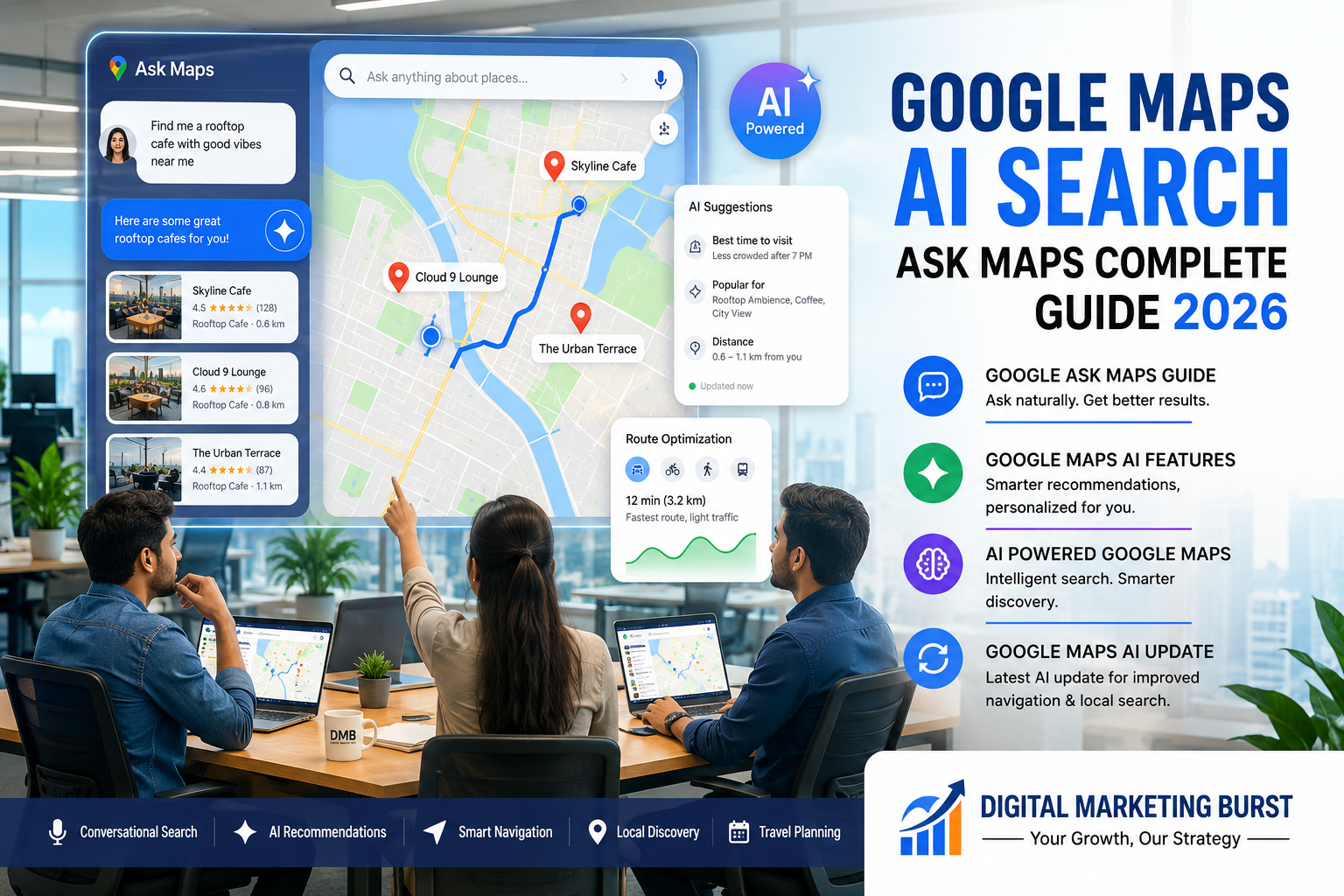
Google Maps Launches AI Conversational Search With Ask Maps: Complete Guide (2026)
Google Maps Launches AI Conversational Search With Ask Maps: Complete Guide (2026)
Google Maps is evolving beyond traditional navigation. With its new AI-powered conversational experience called Ask Maps, Google is making it easier to discover places by asking natural questions instead of typing simple keywords. Whether you’re searching for family-friendly restaurants, hidden cafés, scenic weekend destinations, or highly rated attractions, the new experience is designed to understand context and provide more personalized recommendations.This guide explains how Google Maps AI Search works, what the Google Ask Maps Guide introduces, the most useful Google Maps AI Features, how AI Powered Google Maps improves local discovery, and what the latest Google Maps AI Update means for travelers, businesses, marketers, and everyday users.Instead of scrolling through hundreds of listings, users can now have conversations with Google Maps in a way that feels similar to interacting with an AI assistant. This shift reflects Google’s broader investment in generative AI across Search, Workspace, Android, and Maps.
What Is Google Maps AI Search?
For years, Google Maps relied mainly on keyword matching, filters, star ratings, and user reviews. While those tools remain valuable, they often required users to refine multiple searches before finding exactly what they wanted.
The new Google Maps AI Search introduces conversational search. Rather than typing “restaurants near me,” users can ask more detailed questions such as:
- Which cafés are good for remote work with fast Wi-Fi?
- Show me peaceful parks for morning walks.
- Recommend places for a family dinner with vegetarian options.
- Find hidden attractions locals recommend.
The AI interprets intent instead of focusing only on keywords. It combines information from business profiles, reviews, photos, operating hours, popularity signals, and geographic context to generate more meaningful suggestions.
As a result, discovering places becomes faster and feels much more natural.
Google Ask Maps Guide: Understanding the New Experience
The Google Ask Maps experience changes how people interact with location-based search.
Instead of forcing users to browse categories manually, the assistant encourages conversation. Users can ask follow-up questions, refine recommendations, and receive suggestions based on changing preferences.
For example, someone planning a weekend trip might begin by asking for historical attractions. They could then narrow the results by requesting nearby restaurants, free parking, family-friendly activities, or attractions open after sunset.
This conversational approach reduces search friction and allows users to reach useful recommendations much more quickly.
Unlike traditional searches that often produce long lists of businesses, Ask Maps focuses on delivering answers that better match the user’s specific situation.
Why Google Introduced AI Into Maps
Modern users expect search engines to understand complete questions rather than isolated keywords.
Millions of people already ask AI assistants for recommendations before making travel decisions. Google is bringing similar capabilities directly into Maps because users increasingly expect:
- Personalized recommendations.
- Better local discovery.
- Faster travel planning.
- Context-aware suggestions.
- More natural conversations.
This update also reflects Google’s long-term strategy of integrating generative AI across its ecosystem.
Instead of treating Maps as a navigation product alone, Google is positioning it as an intelligent travel and discovery platform.
New Google Maps AI Features Worth Exploring
Several improvements distinguish the latest version of Google Maps from earlier releases.
The AI can summarize thousands of reviews into concise insights, helping users understand why a location is recommended without reading hundreds of individual comments.
Image recognition also plays a larger role. Google analyzes uploaded photos to identify food items, interiors, accessibility features, scenic viewpoints, and other details that improve recommendations.
Another notable enhancement is contextual understanding. Users no longer need perfect search phrases. The system understands requests like “quiet coffee shops with outdoor seating” or “good places for rainy-day activities.”
These features work together to create recommendations that feel more relevant and personalized.
How AI Powered Google Maps Improves Local Discovery
Finding hidden local destinations has traditionally required extensive searching.
With AI Powered Google Maps, the discovery process becomes much more intuitive.
The assistant can recommend locations that match specific interests, travel styles, budgets, or activities. Rather than simply showing nearby businesses, it attempts to understand the experience users are trying to create.
Someone planning a romantic evening receives different recommendations than someone organizing a family outing or searching for budget-friendly attractions.
This personalized approach makes local exploration more enjoyable while helping users uncover places they might never have found using traditional keyword searches.
Who Benefits Most From the Latest Google Maps AI Update?
The latest Google Maps AI Update benefits several different audiences.
Travelers can discover attractions more efficiently and spend less time comparing search results.
Local businesses gain new opportunities to appear in AI-generated recommendations if they maintain accurate information, quality photos, and authentic customer reviews.
Digital marketers should also pay close attention because conversational search changes how people discover local businesses online. Optimizing business profiles, maintaining updated information, and encouraging genuine customer feedback become even more important.
Consumers ultimately benefit from faster decision-making, more relevant recommendations, and an easier overall search experience.
What This Means for Businesses
Businesses should begin preparing for AI-assisted local search by focusing on the quality of their Google Business Profile.
Complete descriptions, accurate categories, updated operating hours, fresh images, and consistent customer engagement all contribute to stronger visibility.
Rather than trying to optimize for isolated keywords, businesses should answer common customer questions through their profiles and websites.
As conversational search becomes more common, comprehensive information is likely to become increasingly valuable.
This shift encourages businesses to prioritize usefulness, accuracy, and customer experience over traditional optimization tactics.
How Ask Maps Understands Natural Conversations
Traditional map searches usually relied on short phrases such as “restaurants near me” or “coffee shops.” The new Ask Maps experience changes that by allowing users to describe exactly what they need in everyday language.
For example, a traveler can ask for “a quiet café with outdoor seating that’s good for remote work,” while a family might request “places to visit with children within a two-hour drive.” Instead of matching only keywords, the AI attempts to understand the intent behind the request and returns recommendations that fit the situation.
As the conversation continues, users can refine their search without starting over. They might ask for more affordable options, places with better ratings, or destinations that are open late. This conversational flow makes planning faster and more intuitive than repeatedly applying filters.
Practical Ways People Can Use Google Maps AI
The new AI capabilities are designed for everyday situations rather than only complex searches.
A tourist visiting a new city can ask for a full-day itinerary that includes breakfast, museums, parks, and dinner recommendations. Someone planning a road trip can request scenic stops, charging stations for an electric vehicle, or family-friendly rest areas along the route.
Food lovers can discover highly rated local restaurants based on atmosphere, cuisine, or dietary preferences. Weekend travelers can ask for hidden attractions that are less crowded than the city’s most popular landmarks.
Because the system understands follow-up questions, planning becomes an ongoing conversation instead of a series of disconnected searches.
Benefits for Travelers
Travel planning often involves switching between multiple apps to compare reviews, opening hours, photos, and directions. Ask Maps aims to simplify that process by presenting relevant information in one place.
Instead of reading hundreds of reviews individually, users receive summarized insights that highlight common themes. If many visitors praise a restaurant for its service or recommend a viewpoint for sunset photography, those details can surface more quickly.
This saves time while helping travelers make more confident decisions before they begin their journey.
What Local Businesses Should Know
Businesses that rely on local visibility should pay close attention to this evolution in search.
Accurate business information is becoming even more important. Opening hours, contact details, categories, photographs, accessibility information, menus, and customer reviews all help AI systems understand what a business offers.
Businesses that regularly update their profiles and respond professionally to customer feedback are likely to provide stronger signals that help potential customers make informed decisions.
Rather than focusing only on ranking for individual search terms, businesses should think about answering real customer questions through complete and trustworthy information.
How Reviews Influence AI Recommendations
Customer reviews have always played an important role in Google Maps, but AI can now identify recurring themes much more effectively.
Instead of counting only star ratings, the system may recognize patterns such as:
- Friendly customer service.
- Excellent vegetarian options.
- Quiet working environment.
- Family-friendly atmosphere.
- Fast service during lunch hours.
This helps users understand why a place is recommended instead of relying solely on numerical ratings.
For business owners, it reinforces the value of consistently delivering positive customer experiences rather than simply collecting reviews.
Privacy and User Control
Whenever artificial intelligence becomes more integrated into everyday products, privacy naturally becomes part of the discussion.
Google states that users remain in control of many personalization settings associated with their accounts. Location history, activity controls, and recommendation preferences can influence how personalized suggestions become.
Users who prefer less personalization can review and adjust these settings within their Google Account. Understanding these options allows individuals to balance convenience with their preferred level of privacy.
As AI features continue evolving, transparency and user control are likely to remain important areas of development.
How This Update Fits Into Google’s AI Strategy
Ask Maps is not an isolated feature. It reflects Google’s broader effort to integrate generative AI across its products, including Search, Workspace, Android, and productivity tools.
The common goal is to reduce the effort required to find useful information. Instead of presenting long lists of links or businesses, AI attempts to provide answers that better match the user’s situation.
For Maps, this means helping people move from “Where should I go?” to “Here’s a recommendation that fits what you’re looking for” with fewer steps and a more conversational experience.
Traditional Google Maps Search vs Ask Maps
For years, Google Maps helped users find places by matching keywords, categories, and location filters. While that approach remains useful, it often required several searches before users found the right destination.
Ask Maps introduces a more conversational experience. Instead of entering multiple search terms, users can describe exactly what they need. For example, someone could ask for a restaurant suitable for a business meeting, a family celebration, or a quiet evening with friends. The AI interprets the request as a whole rather than focusing only on individual words.
Another major difference is the ability to continue the conversation. If the first recommendations are not ideal, users can refine their request naturally by asking for nearby alternatives, different price ranges, or places with specific facilities. This reduces the time spent browsing and makes local discovery feel more intuitive.
How Ask Maps Can Improve Trip Planning
Planning a journey usually involves several decisions, including where to stay, what to eat, and which attractions to visit. Ask Maps aims to simplify this process by helping users organize information through conversation.
A traveler arriving in a new city can ask for a one-day itinerary that includes breakfast, cultural attractions, parks, and dinner options. Families can search for destinations that are suitable for children, while couples may request scenic locations for evening walks or weekend outings.
Because recommendations are connected to the user’s question, the results often feel more personalized than a standard search. Instead of spending time comparing dozens of businesses, travelers receive suggestions that better match their interests and travel style.
What This Means for Local Businesses
The introduction of conversational search changes how businesses are discovered on Google Maps.
Businesses with complete and accurate profiles are more likely to provide the information that helps users make decisions. High-quality images, updated operating hours, detailed descriptions, and genuine customer reviews all contribute to a stronger presence.
Business owners should also consider the questions customers frequently ask. Information about parking, accessibility, outdoor seating, reservation options, or menu choices can help people understand whether a location meets their needs.
The goal is not simply to appear in search results but to provide enough useful information for potential customers to feel confident about visiting.
How AI Is Changing Local Search
Artificial intelligence is transforming local search from a keyword-based experience into an intent-based experience.
Instead of asking “What words did the user type?” AI increasingly asks, “What is the user trying to achieve?” This shift allows search systems to recommend businesses and attractions that align more closely with a person’s actual needs.
For users, this means faster decisions and more relevant suggestions. For businesses, it encourages better communication, accurate information, and authentic customer experiences.
As conversational search becomes more common, local discovery may rely less on exact search phrases and more on the overall quality of business information.
Tips for Businesses Preparing for AI-Powered Search
Although conversational search is still evolving, businesses can begin preparing today.
Maintaining an up-to-date Google Business Profile is one of the most important steps. Adding recent photos, updating holiday hours, selecting accurate categories, and responding to customer reviews all help create a more complete profile.
Businesses should also ensure that their websites answer common customer questions clearly. Helpful content about products, services, pricing, directions, and frequently asked questions supports both users and search systems.
Rather than focusing on technical tricks, businesses that consistently provide accurate and useful information are likely to benefit as AI-powered search continues to develop.
The Future of Conversational Maps
Ask Maps represents an early stage in the evolution of conversational navigation. Future updates may include even deeper personalization, smarter travel planning, and stronger integration with other Google products.
Users could eventually receive recommendations that adapt to weather conditions, traffic patterns, calendar events, or personal preferences while still allowing them to remain in control of their settings.
As artificial intelligence continues improving, the role of digital maps is expanding beyond navigation. They are becoming intelligent assistants that help people discover, compare, and choose destinations with greater confidence.
For everyday users, this means less time searching and more time enjoying the places they visit. For businesses, it creates new opportunities to connect with customers through complete, accurate, and trustworthy information.
Real-World Examples of Using Ask Maps
One of the biggest advantages of conversational search is that it works with everyday questions instead of short search phrases. Imagine arriving in an unfamiliar city after a long journey. Rather than searching separately for restaurants, attractions, and parking, you can describe your needs in a single conversation.
A traveler might ask for a highly rated café within walking distance of a railway station, followed by nearby museums and a quiet place to relax in the evening. Families could request attractions suitable for children along with restaurants offering vegetarian options. Business travelers might search for hotels with workspaces, reliable internet access, and meeting facilities.
This ability to refine recommendations naturally makes planning much faster and reduces the need to perform multiple independent searches.
How Artificial Intelligence Improves Local Recommendations
Artificial intelligence evaluates information from several sources before presenting recommendations. Business descriptions, customer reviews, images, opening hours, location data, and popularity trends all contribute to the overall picture.
Instead of displaying only businesses with the highest ratings, the system attempts to identify locations that best match the user’s request. For example, someone searching for a peaceful reading café may receive different recommendations than another user looking for a lively place to meet friends.
This contextual understanding helps create recommendations that feel more relevant while allowing users to spend less time filtering results manually.
Common Questions Users May Ask Maps
The conversational interface encourages more detailed questions than traditional search.
Users may ask where to find scenic viewpoints for photography, restaurants serving regional cuisine, quiet parks for morning walks, or shopping areas known for handmade products. Travelers can also request recommendations for day trips, rainy-day activities, family outings, or locations suitable for remote work.
Because follow-up questions remain part of the same conversation, users can continue refining their search until they find options that meet their expectations.
This conversational flow creates a more interactive experience than repeatedly entering separate search terms.
Challenges and Current Limitations
Although conversational search introduces many improvements, users should remember that no artificial intelligence system is perfect.
Recommendations depend on the quality and freshness of available information. Businesses that have recently changed their operating hours, menus, or services may require time before updates appear consistently across all recommendations.
Local events, temporary road closures, and seasonal changes may also influence travel plans. For this reason, users should verify important details such as opening hours, reservation requirements, and contact information before making final decisions.
Using AI as a planning assistant while confirming essential details directly with businesses remains a practical approach.
Why This Update Matters for the Future of Search
The introduction of Ask Maps demonstrates a broader shift in how people interact with search technology. Instead of focusing primarily on keywords, search is becoming more conversational, context-aware, and personalized.
As AI continues improving, users are likely to expect systems that understand complete questions, remember previous context, and provide recommendations that require less manual filtering.
For businesses, this means maintaining accurate information becomes increasingly important. For users, it creates opportunities to discover destinations more efficiently while exploring places that better match their personal interests.
Rather than replacing traditional search entirely, conversational experiences are likely to complement existing tools by making information easier to access and understand.
Final Thoughts Before the Conclusion
Google’s conversational approach to Maps represents another step toward more intelligent digital experiences. Whether someone is planning a weekend getaway, exploring a new city, or searching for local businesses, the ability to ask detailed questions simplifies the discovery process.
As more users adopt conversational search, businesses that provide clear, complete, and trustworthy information will be better positioned to serve potential customers. Likewise, travelers can benefit from recommendations that reflect their individual preferences rather than relying solely on generic search results.
The continued development of AI within Google Maps suggests that navigation is evolving into a broader platform for exploration, planning, and local discovery, making travel decisions more convenient and informed than ever before.
How Digital Marketing Burst Helps Businesses Prepare for AI Search
As conversational AI becomes a bigger part of Google products, businesses need to rethink how customers discover them online. Instead of focusing only on traditional SEO, companies should also improve the quality of their local business information, website content, and customer experience.
At Digital Marketing Burst, we help businesses build a strong online presence that supports modern search behavior. Our approach focuses on creating helpful website content, optimizing Google Business Profiles, improving local visibility, and developing long-term digital marketing strategies that align with changing search technology.
Rather than chasing short-term ranking tricks, businesses should invest in accurate information, useful content, high-quality visuals, and positive customer engagement. These factors help build trust with both users and search platforms.
As Google continues expanding AI across Search and Maps, businesses that provide complete and reliable information will be better positioned to reach potential customers naturally.
Frequently Asked Questions About Google Maps AI Search
Many users have questions about Google’s latest AI-powered features. Below are some of the most common questions.
Is Google Maps AI Search available to everyone?
Google gradually releases new features across different countries and user groups. Availability may vary depending on your region, device, and Google account.
Does Ask Maps replace traditional Google Maps?
No. Traditional search, navigation, reviews, and directions remain available. Ask Maps adds a conversational layer that helps users discover places more naturally.
Can businesses control AI recommendations?
Businesses cannot directly control recommendations. However, maintaining accurate business information, responding to customer reviews, uploading quality photos, and keeping profiles updated all contribute to a stronger online presence.
Is conversational search useful for travelers?
Yes. Travelers can ask detailed questions about attractions, restaurants, shopping areas, hotels, parks, and nearby destinations without performing multiple searches.
Will AI replace Google Search completely?
Current AI features are designed to enhance the search experience rather than replace traditional search entirely. Users can continue choosing whichever method best suits their needs.
Best Practices for Businesses Using Google Maps
Businesses hoping to improve visibility should focus on providing information that customers genuinely find useful.
Accurate contact details, updated opening hours, recent photographs, clear service descriptions, frequently asked questions, and authentic customer reviews all improve the overall experience.
Regular profile updates also help ensure customers receive reliable information. Businesses should periodically review their listings to confirm addresses, phone numbers, websites, and operating hours remain accurate.
Investing in customer satisfaction remains one of the most effective long-term strategies because positive experiences naturally lead to stronger reviews and better engagement.
What to Expect From Future Google Maps AI Updates
Google continues investing heavily in artificial intelligence, making it likely that Maps will become even more intelligent over the coming years.
Future improvements may include more personalized recommendations, smarter travel planning, enhanced accessibility features, multilingual conversations, and deeper integration with other Google services.
Artificial intelligence may also provide better recommendations based on weather conditions, personal preferences, travel history, and live local events while maintaining user privacy controls.
Although future developments will continue evolving, one trend is already clear: conversational search is becoming an increasingly important part of how people discover local businesses and destinations online.
The businesses that prepare today by improving information quality, customer experience, and digital presence will be better positioned as these technologies continue developing.
How AI Is Changing the Future of Local Discovery
Finding nearby businesses has become much easier over the past decade. However, conversational artificial intelligence is taking local discovery to an entirely new level. Instead of manually comparing multiple businesses, users can now describe exactly what they are looking for and receive recommendations that better match their preferences.
For example, someone planning a family vacation can search for destinations that combine entertainment, dining, and accommodation in one conversation. Likewise, professionals visiting a new city can quickly identify business-friendly hotels, coworking spaces, restaurants, and transport options without opening several different applications.
This shift saves time while creating a smoother planning experience. As AI continues improving, recommendations are expected to become even more personalized, allowing users to discover places that genuinely match their interests rather than simply displaying the highest-rated businesses nearby.
Why Content Quality Matters More Than Ever
The introduction of conversational search highlights the growing importance of useful and trustworthy content. Businesses that clearly explain their services, maintain accurate information, and answer common customer questions are more likely to provide the type of information AI systems rely upon when generating responses.
Well-structured websites also contribute to a better user experience. Visitors appreciate clear navigation, helpful articles, updated contact information, and authentic customer testimonials. These elements improve credibility while making it easier for both people and search systems to understand the business.
Rather than publishing content only for search engines, businesses should focus on creating resources that genuinely solve customer problems. Helpful content tends to remain valuable over time, supporting both user satisfaction and long-term visibility.
Opportunities for Small Businesses
One of the most encouraging aspects of AI-powered local search is that smaller businesses also have opportunities to stand out. A business does not necessarily need a large advertising budget to appear in relevant recommendations.
Providing excellent customer service, maintaining an informative Google Business Profile, encouraging genuine customer reviews, and publishing useful website content all contribute to stronger online visibility.
Businesses that consistently deliver positive experiences often build stronger reputations over time. These positive signals can influence future recommendations as AI continues learning from publicly available information.
For entrepreneurs, this means investing in customer satisfaction remains one of the most valuable long-term marketing strategies.
Digital Marketing Burst and the Future of AI Search
The growth of conversational search creates new opportunities for businesses that are willing to adapt. At Digital Marketing Burst, we closely monitor emerging digital trends so businesses can understand how AI may influence online visibility, customer engagement, and local search.
Modern digital marketing is no longer limited to ranking for individual keywords. Instead, businesses should focus on creating complete digital experiences that combine informative websites, optimized business profiles, useful content, and positive customer interactions.
As Google continues expanding AI across its products, organizations that invest in quality information today will be better prepared for future search experiences.
Looking Ahead
Artificial intelligence is rapidly becoming part of everyday online activity. Whether users are planning holidays, searching for nearby restaurants, comparing hotels, or discovering local attractions, conversational search is simplifying the decision-making process.
Although technology will continue evolving, one principle remains consistent: businesses that provide accurate information, valuable content, and outstanding customer experiences are more likely to earn long-term trust.
Google Maps is no longer just a navigation platform. It is gradually becoming an intelligent discovery assistant that helps users explore new places with greater confidence. Understanding these changes today can help both businesses and consumers make better use of the technology as it continues to develop.
Industries That Could Benefit From Google Maps AI Search
The introduction of conversational search in Google Maps has implications far beyond navigation. Many industries that depend on local discovery could see meaningful changes in how customers find products and services.
Restaurants may benefit when users ask for dining recommendations based on cuisine, ambience, dietary preferences, or family-friendly options. Hotels can become more discoverable if travelers request accommodations with specific amenities such as parking, workspaces, or pet-friendly facilities.
Healthcare providers, retail stores, tourist attractions, fitness centers, educational institutions, and entertainment venues may also appear in more relevant recommendations when their business information is complete and accurate. Rather than relying only on category searches, people can describe what they need in natural language, allowing AI to recommend businesses that best match the request.
This shift encourages organizations to think beyond traditional local SEO and focus on delivering complete, trustworthy information that helps customers make informed decisions.
How Users Can Get Better Results From Ask Maps
Although the new conversational interface is designed to understand natural language, asking clear questions usually produces better recommendations.
Instead of searching for “restaurant,” users can describe the type of experience they want. For example, they might ask for a quiet place suitable for business meetings, a café with outdoor seating, or attractions that can be explored in half a day.
Providing context such as budget, travel companions, accessibility needs, or preferred activities helps the AI narrow down suggestions. If the first response does not fully meet expectations, follow-up questions can refine the recommendations without starting a new search.
This conversational approach makes the discovery process more interactive and allows users to adjust their plans quickly as new ideas emerge.
The Growing Importance of Helpful Business Information
As AI becomes more involved in answering user questions, businesses should view their online profiles as an extension of customer service.
Detailed descriptions, updated contact information, high-quality photographs, service lists, accessibility details, and responses to customer reviews all contribute to a clearer understanding of what a business offers. These details not only assist potential customers but also provide stronger context for AI-powered recommendations.
Businesses that regularly review and improve their online information are more likely to present a consistent experience across different Google services. Over time, maintaining accurate information builds trust with customers and supports better decision-making.
Preparing for the Next Generation of Search
Conversational AI is likely to become an increasingly common way for people to interact with search technology. Businesses that adapt early can improve the overall experience they offer to customers, regardless of future algorithm changes.
A practical approach includes keeping business profiles current, publishing useful website content, encouraging authentic customer feedback, and ensuring that important information is easy to find. These actions help customers today while also preparing for future developments in AI-assisted search.
Rather than viewing conversational search as a challenge, organizations can treat it as an opportunity to communicate more effectively with potential customers and provide answers before questions become obstacles.
The evolution of Google Maps demonstrates that search is becoming more focused on understanding intent, solving problems, and delivering meaningful recommendations. Businesses and users who embrace these changes will be better positioned to benefit as AI continues shaping the future of local discovery.
How Google Maps AI Search May Change Everyday Decisions
Many people use Google Maps several times a day without thinking about the technology behind it. Whether choosing a café before work, planning a weekend outing, or finding the nearest pharmacy, quick access to reliable information influences everyday decisions.
With conversational AI becoming part of Maps, users no longer need to guess which keywords will produce the best results. Instead, they can explain their situation naturally and receive suggestions that better reflect what they are actually looking for.
For example, someone might ask for a peaceful park suitable for reading, a restaurant with outdoor seating, or attractions that are ideal for families with young children. Instead of returning only nearby businesses, the AI attempts to recommend places that match those specific preferences.
As conversational search improves, everyday planning could become faster, simpler, and more personalized.
Why User Experience Is Becoming More Important
Artificial intelligence depends on quality information to generate useful recommendations. Businesses that provide accurate details, updated photographs, and clear descriptions create a better experience for visitors while making it easier for search systems to understand what they offer.
User experience also extends beyond Google Maps. Websites that load quickly, answer common questions, and provide easy navigation encourage visitors to spend more time exploring content. Clear contact information, transparent pricing, and authentic customer reviews further strengthen trust.
These improvements benefit both customers and businesses because they reduce uncertainty during the decision-making process.
Digital Marketing Burst and AI-Driven Digital Growth
As AI continues transforming search behavior, businesses should stay informed about emerging trends rather than relying solely on older optimization techniques.
At Digital Marketing Burst, we believe that long-term digital success comes from creating valuable content, maintaining accurate business information, and understanding how customers search online. Conversational AI highlights the importance of answering real questions instead of focusing only on isolated keywords.
Organizations that continuously improve their online presence are better prepared for future changes in search technology. By combining useful content, strong local visibility, and customer-focused communication, businesses can build sustainable digital growth in an increasingly AI-powered environment.
The Road Ahead for Google Maps
Google has consistently expanded Maps beyond navigation by introducing features such as live traffic, public transport information, business reviews, street imagery, and personalized recommendations. Conversational AI represents another significant step in that evolution.
Future updates may include smarter travel planning, deeper personalization, multilingual conversations, improved accessibility support, and more advanced integration with other Google services. As these capabilities expand, Maps could become an even more valuable assistant for travel, local discovery, shopping, and everyday decision-making.
Although technology will continue evolving, one principle remains unchanged: accurate information and helpful experiences create better outcomes for everyone.
Users benefit from faster decisions and more relevant recommendations, while businesses that prioritize quality information and customer satisfaction are better positioned to connect with potential customers in the years ahead.
Frequently Asked Questions About Google Maps AI Search
As conversational search becomes more widely available, many users want to understand how the new experience works and how it differs from traditional search. Below are answers to some of the most common questions.
What is Google Maps AI Search?
Google Maps AI Search is a conversational search experience that allows users to ask detailed questions instead of relying only on short keywords. It aims to understand the intent behind a query and provide recommendations that better match the user’s needs.
What is Ask Maps?
Ask Maps is Google’s conversational interface for Google Maps. Instead of searching with simple phrases, users can interact naturally by asking follow-up questions and refining recommendations throughout the conversation.
Is Google Maps AI Search available worldwide?
Google usually introduces major features gradually. Availability may differ depending on the country, language, Google account, and device. Users should check the latest announcements to see whether the feature has reached their region.
Does AI replace normal Google Maps search?
No. Traditional search remains available. Users can still search by business name, category, address, or location while also benefiting from conversational AI features where supported.
How can businesses prepare for AI-powered search?
Businesses should focus on maintaining complete and accurate Google Business Profiles, publishing useful website content, updating contact information, adding high-quality images, and encouraging genuine customer reviews. These practices help customers while providing better information for search systems.
Key Takeaways From Google’s Latest Maps Innovation
The launch of conversational search marks another milestone in the evolution of digital mapping. Rather than serving only as a navigation tool, Google Maps is becoming an intelligent discovery platform that helps users make informed decisions through natural conversations.
Users benefit from personalized recommendations, simplified travel planning, and faster access to relevant information. Businesses gain new opportunities to reach potential customers by maintaining accurate, trustworthy, and complete online information.
As artificial intelligence continues improving, conversational search is expected to become a larger part of how people discover local businesses, tourist attractions, restaurants, hotels, and everyday services.
Organizations that focus on providing genuine value, reliable information, and excellent customer experiences are likely to adapt more successfully as search technology continues evolving.
The future of local search is becoming more conversational, more context-aware, and more user-focused. Understanding these changes today can help both consumers and businesses make better decisions as AI becomes increasingly integrated into everyday digital experiences.
Conclusion
The launch of Google Maps AI Search through the new Ask Maps experience marks an important step in the evolution of location-based search. Instead of relying only on keywords, users can now ask detailed questions and receive recommendations that better match their preferences, travel plans, and everyday needs.
Throughout this guide, we explored the Google Ask Maps Guide, discussed the latest Google Maps AI Features, examined how AI Powered Google Maps improves local discovery, and explained why the recent Google Maps AI Update matters for both users and businesses. As conversational AI becomes more common across Google’s products, understanding these changes can help individuals make better travel decisions while helping organizations improve their online presence.
Businesses that maintain accurate information, publish helpful content, and prioritize customer experience are well positioned to benefit from this shift toward conversational search. Rather than focusing only on visibility, the goal should be to provide reliable information that genuinely helps potential customers.
At Digital Marketing Burst, we closely follow developments in search, artificial intelligence, local SEO, and digital marketing so businesses can better understand how emerging technologies influence online visibility. As search behavior continues evolving, creating useful content and building trust remain among the most effective long-term strategies.
Whether you are a traveler planning your next destination, a business owner improving local visibility, or a marketer following Google’s latest innovations, conversational AI in Google Maps is a development worth watching. It signals a future where finding information becomes more natural, more contextual, and more focused on solving real user needs.
How Businesses Can Prepare for the Next Generation of AI-Powered Local Search
The evolution of Google Maps AI Search shows that local discovery is becoming more conversational and user-focused. Instead of relying only on keyword-based searches, users can now ask detailed questions and receive recommendations tailored to their needs. This shift makes understanding the Google Ask Maps Guide increasingly valuable for business owners, marketers, and travelers.
As businesses explore the latest Google Maps AI Features, they should focus on providing accurate business information, high-quality images, updated operating hours, and genuine customer reviews. These elements help users make informed decisions while supporting better visibility across Google’s ecosystem.
The rise of AI Powered Google Maps also changes how people discover restaurants, hotels, attractions, retail stores, healthcare providers, and local services. Rather than searching with short phrases, users are describing complete situations and expecting recommendations that match their intent. Businesses that answer customer questions clearly through their websites and Google Business Profiles are better prepared for this change.
Every major Google Maps AI Update introduces improvements that make local search more interactive and personalized. Staying informed about these developments helps businesses adapt their digital strategies while improving the overall customer experience.
Looking ahead, Google Maps AI Search is likely to become an even more important part of everyday travel planning and local discovery. Understanding the Google Ask Maps Guide, exploring new Google Maps AI Features, following each Google Maps AI Update, and recognizing how AI Powered Google Maps continues to evolve can help both businesses and users benefit from the future of conversational search.
Why Businesses Choose Digital Marketing Burst for SEO and AI Search Optimization
As Google continues introducing AI-powered experiences like Google Maps AI Search, businesses need digital strategies that go beyond traditional optimization. Digital Marketing Burst helps brands adapt to changing search behavior by focusing on SEO, local search optimization, AI-ready content, Google Business Profile optimization, and long-term organic growth.
Based in Lucknow, Digital Marketing Burst works with startups, local businesses, service providers, and growing brands looking to strengthen their online visibility across Google Search, Google Maps, and AI-driven search experiences.
What Makes Digital Marketing Burst Different?
Digital marketing is constantly evolving, and successful businesses need strategies that evolve with it. At Digital Marketing Burst, we focus on building sustainable digital growth instead of relying on short-term tactics.
Our areas of expertise include:
- Search Engine Optimization (SEO)
- Local SEO and Google Business Profile Optimization
- AI Search Optimization
- Technical SEO Audits
- Website SEO Analysis
- Content Marketing
- WordPress SEO
- E-commerce SEO
- Google Maps Visibility
- Digital Marketing Consulting
Helping Businesses Prepare for AI-Powered Search
The rise of conversational AI is changing how people discover businesses online. Search is becoming more intent-focused, making high-quality content and accurate business information increasingly important.
Digital Marketing Burst helps businesses create websites and content that answer real customer questions, improve user experience, and support visibility in both traditional and AI-assisted search environments.
Whether your goal is improving local visibility, increasing organic traffic, or building a stronger digital presence, our approach emphasizes practical strategies, transparent communication, and continuous improvement.
If you’re looking for an experienced digital marketing agency in Lucknow with expertise in SEO, AI search optimization, and long-term digital growth, Digital Marketing Burst is ready to help your business navigate the next generation of search.