






Google Ranking Recovery Takes Months After SEO Fixes: What SEOs Need to Know in 2026
Google Ranking Recovery Time, Google Ranking Drop Recovery, Google Core Update Recovery, SEO Ranking Recovery Time, and Google Traffic Drop Recovery are major concerns for website owners in 2026. Fixing an SEO issue does not always bring rankings back immediately. In many cases, Google needs time to crawl changes, process updated signals, reassess pages, and understand whether the website has improved enough to compete again.
A website can therefore complete major SEO fixes and still see limited movement for weeks or even months. This situation often creates confusion. Businesses may assume the recovery strategy has failed because traffic does not return quickly. However, technical fixes, content improvements, algorithm-related changes, and sitewide quality work can all follow different recovery patterns.
For SEO professionals, the biggest mistake is treating recovery like an on-and-off switch. Search visibility is dynamic. Competitors continue improving, search intent changes, Google processes signals at different speeds, and the search results themselves continue evolving.
At Digital Marketing Burst, we approach ranking recovery as a structured process rather than an instant result. Diagnosis comes first. Correct implementation follows. After that, Google must discover and process the improvements. Finally, performance needs to be measured across rankings, impressions, clicks, traffic quality, and conversions.
This guide explains why ranking recovery can take time, what businesses should expect after SEO fixes, and how SEOs can build a stronger recovery strategy in 2026.
Google Ranking Recovery Time
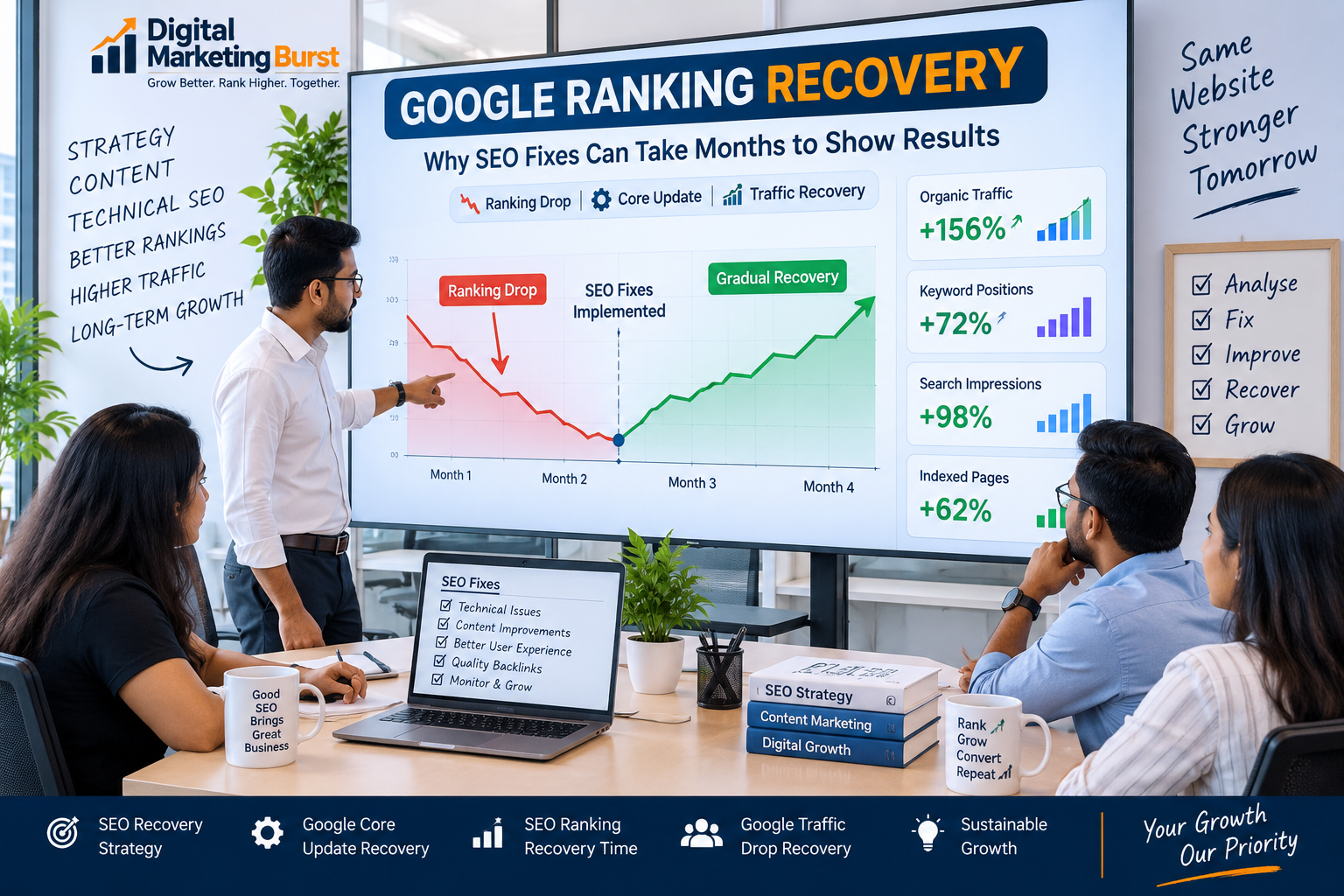
Google Ranking Recovery Time describes how long it takes for a website to show meaningful search improvements after SEO problems have been corrected.
There is no universal number of days.
A simple crawling issue may behave very differently from a sitewide quality problem. Likewise, correcting one incorrect canonical tag is not comparable with rebuilding hundreds of weak pages after a major visibility decline.
This distinction matters because businesses often expect every SEO fix to produce the same response.
Suppose several important pages were accidentally prevented from being indexed. Once that problem is corrected, Google still needs to discover and process the updated pages. However, the recovery path is relatively easy to understand.
Now consider a website that lost visibility across hundreds of queries after a broader search reassessment. Improving that site may require stronger content, better page purpose, improved architecture, cleaner internal linking, and more useful information. Even after those changes are completed, the website may need additional time before significant ranking movement becomes visible.
Therefore, recovery should be judged according to the original problem.
Businesses should also separate the first positive movement from complete recovery. Impressions may increase before clicks. Long-tail queries can improve before highly competitive keywords. Some pages may recover while others remain unchanged.
These small movements can provide useful information about whether the website is moving in the right direction.
Google Rankings Recovery Timeline
A Google Rankings Recovery Timeline should begin with identifying when the visibility loss actually started.
This is important because the date of the ranking decline can provide valuable clues.
For example, the drop may appear immediately after a website migration. In another case, it may follow a major template change. Sometimes the decline occurs around a broad search update. A technical deployment, content deletion, internal-link restructuring, or indexing mistake can also create sudden changes.
Therefore, the first stage is creating a timeline.
Record the date rankings began falling. Then document important website changes around that period.
Next, separate the dates when fixes were implemented.
If technical problems were corrected in June but major content improvements continued through July, those actions should not be evaluated as if they happened simultaneously.
This creates a clearer recovery baseline.
After implementation, monitor progress in stages. Start with crawling and indexing. Then examine impressions, average positions, clicks, landing-page traffic, and conversions.
Recovery may not appear as one dramatic increase.
Instead, several affected pages can begin gaining impressions. A group of long-tail keywords may return. Commercial pages might stabilize before informational content.
That gradual pattern is important because it helps SEOs distinguish genuine improvement from ordinary daily ranking fluctuations.
Why Google Rankings Take Months to Recover
Many website owners ask why rankings do not return immediately after a problem has been fixed.
The answer begins with how search systems process change.
Correcting a website problem does not automatically restore an older search position. Google needs to discover the change first. After that, updated information must be processed and considered alongside other ranking signals.
Broader issues can require even more reassessment.
Moreover, competitors do not remain unchanged during the recovery period. A page that ranked third several months ago may return to competition against stronger results than before.
This means recovery is not always about returning to the exact previous position.
Instead, the website must compete in the current search environment.
Consider a page that lost rankings because its information became outdated. Updating a few paragraphs may correct factual weaknesses. However, competing pages may now provide better examples, clearer explanations, stronger topical coverage, and more useful supporting information.
Simply becoming “fixed” may not be enough.
The page needs to become competitive again.
Consequently, SEOs should use the waiting period productively. They can verify technical changes, improve genuinely weak sections, strengthen internal relationships between relevant pages, and monitor whether Google is processing the updated website.
Patience matters, but passive waiting is not an SEO strategy.
How Long Does Google Ranking Recovery Take?
How long does Google ranking recovery take? There is no single answer that applies to every website.
Some changes may begin showing results after Google recrawls and processes affected pages. Others can take much longer because the problem involves broader signals.
The size of the website also matters.
A small business site with 30 pages creates a different recovery situation from an ecommerce website containing hundreds of thousands of URLs.
Crawl patterns can differ too.
Frequently updated websites may have important pages revisited regularly. Less active sections can take longer to be processed.
Competition adds another variable.
If a website loses visibility in a highly competitive industry, fixing the original problem may only restore its ability to compete. The site still needs to outperform other relevant results.
Therefore, businesses should avoid agencies or consultants promising an exact recovery date without first understanding the problem.
A more useful approach is setting checkpoints.
The first checkpoint can confirm whether corrected pages are crawlable. The next can evaluate indexing and impressions. Later checkpoints can examine ranking groups, organic clicks, leads, and revenue.
This creates a measurable recovery process without pretending that Google rankings operate according to a fixed countdown.
Google Ranking Drop Recovery
Google Ranking Drop Recovery should always begin with diagnosis rather than immediate changes.
A ranking decline is evidence that something changed. However, it does not explain what changed.
This difference is crucial.
Organic clicks can decline even when average rankings remain relatively stable. Search demand may have fallen. New search-result features can change user behaviour. Competitors can gain visibility. A seasonal topic can naturally receive fewer searches.
Technical problems create another possibility.
Important pages might become non-indexable. Canonical tags could point to incorrect URLs. Internal links may disappear during a redesign. Server problems can prevent efficient crawling.
Content-related causes require a different approach.
Older articles may no longer answer current search intent. Commercial pages can become less competitive. Several pages might target nearly identical queries and create unnecessary overlap.
Before making changes, SEOs should determine which page groups actually lost visibility.
At Digital Marketing Burst, we prefer separating blog pages, service pages, category pages, local pages, and high-conversion landing pages during recovery analysis.
This segmentation makes patterns easier to identify.
Once the probable cause becomes clearer, the website can receive targeted improvements instead of dozens of unrelated SEO changes.
Google Rankings Drop Recovery
Google Rankings Drop Recovery becomes harder when businesses react emotionally to daily fluctuations.
Imagine a website loses significant visibility.
On Monday, the team changes page titles. On Wednesday, it rewrites introductions. A week later, internal links are changed. Then several pages are deleted because rankings still have not returned.
Soon, the website has undergone so many changes that identifying the effect of any single improvement becomes difficult.
A structured recovery process avoids this problem.
First, identify the affected areas.
Next, determine which problems have strong evidence behind them. Then prioritize changes according to their likely impact.
After major corrections are implemented, monitor how Google processes the website.
This does not mean leaving the site untouched for months.
Important improvements should continue when they are genuinely needed. However, changes should have a clear reason.
For example, a page should not be rewritten merely because it did not improve seven days after a technical fix.
Instead, examine whether the page still satisfies the searcher’s intent. Compare its usefulness with current competing results.
Recovery becomes more manageable when every major change has a purpose that can later be evaluated.
Why Google Rankings Drop Suddenly
A sudden ranking decline can happen for several reasons.
Technical changes are often among the first areas to investigate.
A website update can accidentally introduce noindex directives, change canonical URLs, remove important navigation links, alter redirects, or create server problems.
Content changes can also produce unexpected results.
Removing useful sections from high-performing pages may reduce their relevance. Merging pages without understanding their search intent can create another issue.
Meanwhile, competitors can gain visibility.
If several strong competitors publish substantially better resources, an older page may gradually or suddenly lose positions for important queries.
Search updates create another possibility.
However, businesses should avoid blaming every ranking decline on an algorithm change. Timing should be investigated, but correlation alone does not prove the cause.
The best approach is to compare multiple signals.
Look at the date of the decline, affected pages, affected queries, technical changes, indexing behaviour, search demand, and competitor movement.
The pattern often provides better clues than one traffic graph.
Website Rankings Dropped After Google Update
The search Website Rankings Dropped After Google Update represents a common concern among businesses.
However, the first response should not be panic.
Start by identifying the scope of the loss.
Did every section decline, or only one topic cluster?
Did service pages remain stable while blog content lost visibility?
Were branded searches unaffected?
Did desktop and mobile traffic behave similarly?
These questions can reveal whether the decline is broad or concentrated.
Next, compare affected pages with the results that gained visibility.
Do not simply count words.
Instead, examine whether competitors answer the searcher’s question faster. Look at information quality, originality, structure, examples, freshness, and overall usefulness.
Technical health should also remain part of the investigation.
A ranking decline occurring around an update does not prevent a technical issue from happening at the same time.
Therefore, recovery analysis should remain evidence-based.
The goal is to understand why certain pages became less competitive and what meaningful improvements can strengthen them.
Lost Google Rankings Recovery
Lost Google Rankings Recovery is not always about restoring the exact positions a website held previously.
That expectation can create an outdated SEO strategy.
Search results continue changing.
New competitors appear. Existing websites improve. Search intent evolves. Google introduces new result formats. User behaviour also changes.
Therefore, a page that previously ranked second may not automatically return to second place after its problems are corrected.
Instead, focus on rebuilding competitive strength.
Start with search intent.
Does the page answer what users currently want?
Then review content usefulness.
Does it offer meaningful information that goes beyond generic summaries?
Next, evaluate technical accessibility and internal linking.
Strong content becomes less effective when important pages are buried deep inside the site.
Finally, review whether the page targets the right query.
Sometimes rankings disappear because a website keeps optimizing an old keyword while users have shifted toward a different search pattern.
Recovery should therefore focus on current opportunity, not only historical position.
Recover Lost Google Rankings
Businesses searching Recover Lost Google Rankings usually want immediate steps.
However, the first useful step is understanding what was actually lost.
A website can lose rankings for five major keywords while gaining visibility across dozens of long-tail queries. Another site may maintain rankings but lose clicks.
Those situations require different strategies.
Begin by comparing query-level performance.
Then identify the pages responsible for the decline.
If only a few URLs lost visibility, focus the audit there first.
Sitewide changes should not be made when the evidence points to a limited section.
Next, check whether affected pages remain indexed and technically accessible.
After technical validation, review search intent and content quality.
Internal linking should also be examined.
A strong page can weaken when supporting pages stop linking to it.
Finally, monitor improvement over a meaningful period.
Avoid repeatedly changing the same page every few days.
Recovery becomes easier to understand when the website maintains a clear history of what changed and when.
Google Core Update Recovery
Google Core Update Recovery should be approached differently from a straightforward technical correction.
A broad search reassessment may affect many pages without presenting one obvious error message.
Therefore, businesses should avoid searching for one magical setting that will restore everything.
Instead, analyze patterns.
Identify which directories lost visibility. Compare content types. Review commercial and informational queries separately.
Then study the pages that gained positions.
This comparison should focus on usefulness rather than imitation.
Copying a competitor’s headings does not automatically improve a page.
Instead, ask why the competing result may better satisfy the search.
Perhaps it answers the main question earlier. Maybe it provides clearer examples. It could contain more current information or address concerns your page ignores.
Website-wide quality also deserves attention.
If hundreds of pages were created primarily to capture similar keyword variations, improving only ten articles may not address the larger issue.
Therefore, recovery can require both page-level improvements and a broader review of publishing strategy.
Google Update Recovery
Google Update Recovery begins by separating confirmed facts from assumptions.
A website may lose traffic during the same week as a search update. However, another event can still be responsible.
Developers may have changed templates.
Tracking could have broken.
Important pages might have been redirected.
Search demand can also decline because of seasonality.
Therefore, build a timeline before making major changes.
Record website deployments, content changes, migrations, tracking modifications, and other important events.
Then compare those dates with the performance decline.
If the evidence still points toward a broader search reassessment, evaluate affected pages carefully.
Avoid making hundreds of rushed changes during periods of heavy volatility.
Instead, identify lasting weaknesses that would be worth improving even if rankings had never dropped.
This creates a stronger recovery strategy.
Good SEO improvements should make sense for users and the business, not only for an algorithm.
Google Algorithm Update Recovery
Google Algorithm Update Recovery becomes easier when SEO teams stop searching for shortcuts.
An algorithm-related decline can reveal weaknesses that existed before the update.
For example, pages may contain repetitive information. Search intent may be weakly matched. Large sections could offer little original value.
Another website might have excellent individual articles but confusing architecture.
Therefore, recovery should investigate both page-level and site-level signals.
Begin with affected clusters.
Compare their performance before and after the decline.
Then determine whether certain templates, authors, topics, or page types were affected more heavily.
This can uncover patterns that are invisible in a sitewide traffic graph.
Next, prioritize improvements with the strongest business and search value.
High-potential pages should usually receive attention before low-value URLs that attract little qualified traffic.
This approach makes recovery more efficient and easier to measure.
Google Core Update Recovery Time
The Google Core Update Recovery Time can vary significantly between websites.
Businesses should therefore avoid treating 30, 60, or 90 days as guaranteed recovery deadlines.
Those periods can be useful for reporting checkpoints. However, they are not promises.
A site may begin showing positive movement earlier.
Another may need much longer.
The severity of the original issue matters. So does the scale of the improvement.
If only a few paragraphs were changed on a website with broader quality problems, significant recovery may remain unlikely.
By contrast, a comprehensive improvement can address content usefulness, outdated information, site architecture, internal linking, technical accessibility, and weak page purpose.
Even then, processing takes time.
Therefore, distinguish between implementation time and recovery time.
Your SEO team controls how quickly improvements are completed.
Google controls when those changes are crawled, processed, and reflected across its systems.
Understanding this distinction creates more realistic expectations.
SEO Ranking Recovery Time
SEO Ranking Recovery Time depends heavily on what type of SEO problem affected the website.
Technical recovery may follow recrawling and reprocessing.
Content recovery can require stronger competitive reassessment.
Sitewide quality work can take longer because many pages and signals may need to be reconsidered.
Links create another area of complexity.
Website owners sometimes assume every ranking decline comes from “bad backlinks.” They may then remove or disavow large numbers of links without enough evidence.
That approach can create unnecessary risk.
Instead, link analysis should be based on actual context.
Likewise, content should not be deleted merely because a tool gives it a low score.
SEO tools provide useful signals, but they do not replace diagnosis.
Digital Marketing Burst recommends classifying recovery work by cause.
Technical issues should receive technical solutions. Content weaknesses need content improvements. Search-intent problems require better targeting.
This sounds simple, yet many recovery campaigns become complicated because every possible SEO tactic is applied at once.
SEO Recovery Time
SEO Recovery Time becomes easier to evaluate when the website has a clear baseline.
Before implementing major changes, record current performance.
Track affected pages, queries, impressions, clicks, conversions, and important ranking groups.
Then document the date of each major fix.
Without this record, businesses may remember the timeline incorrectly.
For example, someone might say, “We fixed everything two months ago.”
However, deeper analysis could show that technical work finished two months ago while important content changes were completed only two weeks ago.
That difference changes how recovery should be evaluated.
Furthermore, do not define recovery using only one metric.
A website can regain impressions before traffic. Another can recover clicks but attract less qualified users.
Therefore, monitor visibility and business outcomes together.
The objective is not simply to create a prettier SEO graph.
Successful recovery should eventually support relevant traffic, enquiries, sales, bookings, or other meaningful business goals.
SEO Recovery After Google Update
SEO Recovery After Google Update requires a balance between action and patience.
Doing nothing after a genuine decline can waste opportunities.
Changing everything immediately can be equally damaging.
The better approach is structured improvement.
First, wait until enough data exists to understand the pattern.
Next, identify pages that lost meaningful visibility.
Then compare them with current search results and evaluate technical health.
After that, prioritize improvements.
Strong pages may need only minor updates. Weak pages can require substantial rewriting or consolidation.
Some pages may no longer deserve to exist as separate URLs.
However, deletion should have a clear reason.
Do not remove content merely because it lost rankings during an update.
A page may still provide value to users or support another important topic.
Every major decision should connect to a defined website purpose.
Google Traffic Drop Recovery
Google Traffic Drop Recovery should focus on traffic quality as well as traffic quantity.
Suppose a website previously received 100,000 monthly organic visits.
After a decline, traffic falls to 70,000.
Several months later, it returns to 90,000.
At first glance, the website appears close to recovery.
However, the important question is which 90,000 visits returned.
If high-intent service pages remain weak while low-value informational traffic increases, business recovery may still be incomplete.
Therefore, segment organic performance.
Compare commercial pages with informational content.
Review branded and non-branded searches separately.
Examine conversion rates and qualified enquiries.
Digital Marketing Burst recommends connecting recovery reporting with business outcomes because rankings alone do not pay for an SEO campaign.
Relevant traffic matters more.
A successful recovery should rebuild visibility around searches that support the website’s actual goals.
Google Search Traffic Recovery
Google Search Traffic Recovery can begin before a website returns to its former keyword positions.
This happens because organic performance is spread across many queries.
A page can gain dozens of long-tail terms while its primary keyword remains below its old position.
Consequently, impressions and clicks may improve gradually.
This is why monitoring only ten manually selected keywords can produce an incomplete picture.
Search visibility should be evaluated across broader query groups.
Look at topics, landing pages, intent categories, and conversion performance.
Search-result changes also matter.
A keyword can maintain the same position while receiving fewer clicks because the results page now contains additional features.
Therefore, traffic recovery should not be judged solely against historical ranking numbers.
SEOs need to understand how users interact with today’s results.
That perspective becomes increasingly important as search experiences continue evolving in 2026.
Organic Traffic Drop Recovery
Organic Traffic Drop Recovery starts by determining whether the loss came from rankings, demand, click-through rate, indexing, or tracking.
These causes can produce similar-looking analytics charts.
However, their solutions are completely different.
If impressions decline because rankings fell, SEO competitiveness needs investigation.
If impressions remain stable but clicks decline, search-result behaviour may have changed.
When both impressions and rankings remain normal while analytics traffic falls, tracking deserves attention.
Seasonality creates another scenario.
A tourism website may naturally receive fewer searches outside peak travel periods. An ecommerce category can experience similar demand changes.
Therefore, recovery analysis should combine multiple data sources and time comparisons.
Year-over-year performance can be useful when the business is seasonal.
Recent-period comparisons can reveal sudden technical or algorithm-related changes.
A good diagnosis prevents teams from “fixing” SEO when the real issue is somewhere else.
Google Traffic Not Recovering
Google Traffic Not Recovering after several SEO improvements does not automatically mean the website needs another complete redesign.
Start by checking whether the original cause was correctly identified.
Then ask whether Google has processed the affected pages.
After that, compare the current search environment.
Competitors may have become stronger during the period of decline.
Search demand may also have shifted.
Another possibility is partial recovery.
For example, informational traffic might return while commercial pages remain weak.
Looking only at total sessions can hide this pattern.
Therefore, examine landing-page groups and search intent.
If important pages remain below expectations, reassess them individually.
Do they provide enough value?
Are they internally linked appropriately?
Is their search intent still correct?
Can Google crawl and index them properly?
A second diagnosis should be based on current evidence rather than repeating the same fixes.
Google Ranking Recovery After SEO Fixes
The phrase Google Ranking Recovery After SEO Fixes describes a stage where implementation is complete but evaluation is still continuing.
This stage requires discipline.
Businesses often become impatient because the visible SEO work has finished.
However, search processing does not follow an agency’s project deadline.
A page updated today may need to be revisited by Google. Larger improvements can also require broader reassessment.
Therefore, reporting should clearly distinguish what has been completed from what has been observed.
For example, a report can state that technical errors were corrected, affected URLs are crawlable, indexing is stable, and impressions have begun improving.
That is more useful than claiming “recovery complete” because one keyword moved upward.
At the same time, SEO teams should continue checking for genuine weaknesses.
Waiting does not mean ignoring problems.
It means avoiding unnecessary changes while allowing properly implemented improvements enough time to demonstrate their effect.
Rankings Not Recovering After SEO Fixes
Rankings Not Recovering After SEO Fixes can indicate several different situations.
The first possibility is simple: more processing time is needed.
The second is more important. The original problem may not have been fully solved.
For example, fixing broken internal links can improve crawl paths. However, it will not automatically solve weak content.
Similarly, rewriting content cannot correct a major indexing problem.
Multiple issues can exist simultaneously.
Therefore, a website that remains weak should undergo a second evidence-based review.
Compare affected pages with current competitors.
Check whether Google has recrawled important URLs.
Review indexability, canonicalization, internal links, page purpose, content usefulness, and search intent.
Then identify what still needs improvement.
Do not repeat the entire first audit without reason.
The goal of a second review is to discover what the original diagnosis missed.
SEO Issues Fixed Rankings Still Down
SEO Issues Fixed Rankings Still Down is a common problem because website owners often equate “fixed” with “fully recovered.”
Those terms mean different things.
A corrected technical issue means the problem is no longer present.
It does not guarantee that every previous ranking will return immediately.
The website may still need to be recrawled and processed.
Competitors may also have improved.
In addition, the site may contain weaknesses unrelated to the original issue.
Therefore, assess what happened after the fix.
Did impressions stabilize?
Are more queries appearing?
Have important pages been recrawled?
Is organic traffic declining more slowly?
Small changes can indicate progress before major rankings return.
However, do not use tiny fluctuations as proof.
SEO performance naturally moves from day to day.
Evaluate meaningful trends across suitable periods.
Why SEO Recovery Takes Time
Why SEO Recovery Takes Time becomes clearer when we separate implementation from search processing.
An SEO professional can change a page instantly.
Google does not instantly rebuild its understanding of the entire website.
Pages need to be discovered again.
Updated content needs processing.
Internal relationships can change after links are added or removed.
Broader systems may take longer to reflect improvements.
Meanwhile, competitors continue changing too.
This creates a moving environment.
Therefore, recovery is not simply a waiting period between “broken” and “fixed.”
It is a period in which the website is being reconsidered within an evolving search ecosystem.
Businesses should use this time intelligently.
Continue publishing genuinely useful content where appropriate. Maintain technical health. Strengthen weak internal connections.
However, avoid making constant changes solely because recovery feels slow.
Consistency makes results easier to interpret.
Digital Marketing Burst Google Ranking Recovery Strategy
Digital Marketing Burst Google Ranking Recovery Strategy focuses on finding the cause before prescribing the solution.
This matters because ranking recovery is often sold as a generic package.
A business may be told it needs more backlinks, more blogs, more keywords, or more technical fixes without a clear explanation of why.
That approach can waste time.
A recovery strategy should instead begin with the performance pattern.
Which pages declined?
When did the decline start?
What queries were affected?
Did impressions, clicks, and conversions move together?
Were technical changes made around the same period?
After these questions are answered, priorities become clearer.
Technical problems can be corrected first when they prevent proper crawling or indexing.
Content improvements can then focus on pages where search intent and usefulness need strengthening.
Internal linking, information architecture, and relevant authority-building can support the broader recovery.
The goal is not to create activity.
The goal is to solve the problems most likely to be limiting organic performance.
Google Ranking Recovery Services by Digital Marketing Burst
Google Ranking Recovery Services by Digital Marketing Burst should begin with a detailed understanding of why organic visibility changed.
Businesses facing a sudden ranking decline often need more than a standard SEO checklist.
They need a recovery plan connected to the actual problem.
That may involve technical SEO analysis, content evaluation, search-intent review, internal-link analysis, competitor comparison, and organic traffic assessment.
However, every website does not need every possible SEO service.
A smaller site affected by one technical error may need focused correction.
A larger website with widespread content problems may require a longer improvement programme.
Therefore, the scope should follow the evidence.
Digital Marketing Burst can position recovery work around transparency and realistic expectations.
No responsible SEO strategy should promise that a specific keyword will return to a specific position on an exact date.
Instead, the objective is to remove genuine weaknesses, improve search competitiveness, and build stronger organic performance over time.
SEO Ranking Recovery Company in India
Businesses searching for an SEO Ranking Recovery Company in India are often dealing with more than a normal monthly fluctuation.
Their organic leads may have fallen.
Important keywords can disappear from top positions.
Traffic may decline after a site migration, content change, technical problem, or search update.
In such situations, the quality of diagnosis matters more than the number of SEO tasks completed.
Digital Marketing Burst approaches ranking recovery by examining technical health, affected search queries, landing-page performance, content quality, and competitive changes.
This creates a more targeted strategy.
For example, a business that lost rankings because of migration errors should not receive the same plan as a website struggling with outdated informational content.
Likewise, an ecommerce website requires different analysis from a local service business.
The recovery process should fit the website rather than forcing every client into one template.
Google Traffic Recovery Services by Digital Marketing Burst
Google Traffic Recovery Services by Digital Marketing Burst focus on rebuilding useful organic visibility rather than chasing traffic numbers alone.
This distinction is important for businesses.
A website can gain thousands of visitors from informational queries without generating meaningful enquiries.
Therefore, traffic recovery should identify which lost searches previously contributed to business performance.
Commercial landing pages deserve special attention.
Service-related queries should be evaluated separately from general informational traffic.
Conversions must also be monitored.
If traffic begins returning but leads remain weak, the recovery strategy may need to examine search intent and landing-page experience.
This connects SEO performance with actual business value.
For Digital Marketing Burst, the strongest recovery strategy is not simply “get the old traffic back.”
Instead, the goal should be to regain relevant visibility while improving the website’s ability to attract and convert the right audience.
What SEOs Need to Know About Ranking Recovery in 2026
SEO recovery in 2026 requires realistic expectations.
Search is more dynamic than a simple list of ten blue links.
Users can interact with different search features before deciding whether to visit a website.
Therefore, rankings remain important, but they should not be measured alone.
SEOs need to examine impressions, clicks, landing-page visibility, query diversity, conversions, and overall organic business value.
Recovery analysis should also consider whether a website is gaining visibility for the right topics.
More traffic is not automatically better traffic.
Furthermore, businesses should understand that correcting a problem and regaining competitive visibility are separate stages.
The first stage is under your control.
The second depends on how search systems process the changes and how your improved website compares with other results.
That distinction should shape every recovery strategy in 2026.
Website Ranking Recovery Time After SEO Changes
Website ranking recovery can move at different speeds because every SEO change solves a different type of problem. Updating a title, fixing internal links, improving weak content, and repairing a large indexing issue do not carry the same weight.
For that reason, website owners should avoid expecting one fixed recovery period for every change.
Google first needs to discover the updated page. Its systems then process the new information and reconsider relevant signals. Larger site changes can require more processing than a small page-level correction.
Competition also influences the outcome. While your website improves, competing sites continue publishing content, updating important pages, and strengthening their search presence. Returning to an old position may therefore require more than simply reversing the original mistake.
Create a clear record of important SEO work. Note when developers completed technical fixes, when writers improved content, and when the team changed internal links or site structure.
Afterward, compare performance across meaningful periods instead of checking rankings several times each day.
A documented process makes recovery easier to evaluate and helps the SEO team understand which improvements are producing positive movement.
Search Ranking Recovery Time After Technical SEO Fixes
Search Ranking Recovery Time After Technical SEO Fixes depends heavily on the type and scale of the original problem.
Technical issues can prevent Google from accessing, processing, or understanding important pages correctly. Examples include accidental noindex directives, incorrect canonical tags, broken redirects, server errors, and poor internal-link structures.
Correcting the problem represents only the first stage.
Next, verify the live website. Check whether priority URLs remain crawlable, indexable, and connected properly through internal links.
After validation, Google still needs to revisit affected pages and process their corrected state.
Large websites deserve additional attention because one template mistake can affect thousands of URLs. Instead of checking only one example, review representative pages from every affected section.
Technical corrections can remove barriers that previously restricted search performance. However, removing a barrier does not automatically make a page more competitive than every other result.
Content quality, search intent, competition, authority, and page usefulness still matter.
Therefore, technical recovery should combine implementation, validation, monitoring, and realistic expectations.
Technical SEO Recovery Timeline
A Technical SEO Recovery Timeline becomes easier to understand when businesses divide the process into correction, validation, processing, and performance monitoring.
Correction addresses the original problem.
During validation, the SEO team checks whether the live website actually contains the intended fix.
Next comes search processing. Google needs to revisit relevant URLs and understand their updated state.
Finally, the business can monitor whether impressions, rankings, clicks, and conversions begin improving.
Many businesses focus only on correction. A developer may finish an indexing fix on Friday, and the marketing team may expect rankings to return immediately.
That expectation ignores the remaining stages.
Instead, confirm status codes, redirects, canonical signals, internal links, and indexability where relevant. Large websites should also test several URL types because template behaviour can vary across sections.
Once the technical foundation works correctly, monitor organic performance without making unnecessary daily changes.
This structured timeline makes it easier to distinguish a completed technical fix from complete search recovery.
How Long SEO Changes Take to Work
People frequently search How Long SEO Changes Take to Work because SEO rarely provides instant feedback.
Different improvements also serve different purposes.
A technical correction can restore accessibility. Content improvements can strengthen relevance and usefulness. Better internal links may improve navigation, discovery, and topical connections.
Consequently, no universal deadline applies to every SEO action.
Attribution creates another challenge.
Imagine that a business updates a major landing page, improves internal links, strengthens supporting content, and earns several relevant mentions during the same month. Organic visibility then increases later.
Several improvements may have contributed to the result.
For this reason, businesses should document significant changes whenever possible. Clear records make performance analysis much easier.
Measurement should also extend beyond one keyword.
An updated page may gain visibility across dozens of long-tail searches while its main keyword changes very little.
Track impressions, relevant queries, clicks, landing-page traffic, and conversions alongside ranking positions.
A broader measurement framework provides a much clearer picture of whether SEO changes are working.
How Long Does SEO Recovery Take?
The question How Long Does SEO Recovery Take? has no single answer because the original cause determines much of the recovery process.
A small technical mistake can have a relatively straightforward solution. By comparison, widespread content-quality problems may require substantial work across many pages.
Website size matters too.
A small service website and a marketplace containing hundreds of thousands of URLs create very different processing requirements.
Severity also changes expectations.
For example, fixing one incorrect redirect differs greatly from rebuilding site architecture after a poorly executed migration.
Rather than promising recovery within 30, 60, or 90 days, businesses should establish progress checkpoints.
Start with technical validation.
Afterward, monitor whether important pages regain impressions and query visibility. Clicks and qualified organic traffic can provide later indicators.
Conversion performance should remain part of the process because traffic alone does not define business success.
This approach provides measurable milestones without creating an artificial countdown for organic rankings.
Google Search Ranking Recovery
Google Search Ranking Recovery should focus on groups of relevant searches instead of one isolated keyword.
Most useful pages appear for multiple queries. These can include primary keywords, synonyms, questions, comparisons, and long-tail variations.
As a result, one target keyword may remain below its previous position while overall page visibility improves.
Suppose a service page previously appeared for hundreds of relevant searches. After a decline, its query coverage becomes much smaller. Following meaningful improvements, long-tail terms begin returning gradually.
The primary keyword may still remain weaker than before.
Even so, growing impressions across relevant searches can indicate positive movement.
Businesses should therefore evaluate page-level and topic-level performance.
Relevance remains essential. Visibility for unrelated searches provides little business value.
The strongest recovery occurs when a website gains visibility among users who genuinely need its information, products, or services.
That broader perspective prevents SEO teams from judging an entire recovery campaign through one keyword tracker.
Search Engine Ranking Recovery Strategy
A Search Engine Ranking Recovery Strategy should begin with evidence and connect every major improvement to a clear problem.
First, determine when the decline started.
Next, identify affected pages, queries, templates, and topic clusters. Technical problems, content weaknesses, search-intent changes, competition, and website architecture can then receive separate investigation.
After diagnosis, prioritize the issues with the greatest potential impact.
Critical crawling or indexing barriers usually deserve immediate attention. High-value commercial pages with obvious content weaknesses may follow.
Avoid spending large amounts of time optimizing URLs that contribute little to search visibility or business performance.
Once improvements go live, monitor relevant indicators.
Check technical health first when the original problem involved crawling or indexing. For content-related changes, examine impressions, query coverage, clicks, and landing-page performance.
At Digital Marketing Burst, this evidence-based approach helps keep recovery campaigns focused on meaningful outcomes instead of producing a long list of disconnected SEO tasks.
Recover Google Search Rankings After SEO Problems
Businesses trying to Recover Google Search Rankings After SEO Problems should resist the temptation to apply the same checklist to every affected page.
Similar ranking declines can have completely different causes.
One service page may lose visibility because its content no longer matches current search intent. Another can suffer after important internal links disappear. A third page might have a technical indexing problem.
Each situation needs a different solution.
Begin by confirming technical accessibility. Then evaluate the page’s purpose, content quality, and current search intent.
Competitor analysis can provide additional context.
Look at the type of pages currently performing well. Determine whether search results favour guides, service pages, product pages, comparisons, or another format.
Do not simply copy competing headings.
Instead, understand what users appear to expect and improve your page accordingly.
A focused diagnosis prevents businesses from spending months optimizing the wrong element.
Google Position Drop Recovery
Google Position Drop Recovery should focus on meaningful trends rather than daily ranking fluctuations.
Keyword positions naturally move.
Location, device type, competition, personalization, and changes in search-result layouts can all influence what users see.
Therefore, a one-day movement from position five to seven does not necessarily indicate a serious SEO problem.
A broader decline across commercially important searches deserves more attention.
Compare rankings with impressions and clicks.
When positions remain relatively stable but clicks fall sharply, changes in search behaviour or result layouts may deserve investigation.
On the other hand, falling impressions across many relevant queries can point toward a larger visibility problem.
Ranking trackers remain useful, but businesses should treat them as one part of the analysis.
Qualified organic visibility matters more than one vanity keyword.
Recovering a headline keyword while losing valuable commercial searches does not represent complete SEO success.
Google Search Visibility Recovery
Google Search Visibility Recovery provides a broader way to evaluate SEO progress.
Instead of asking whether five keywords returned, businesses can examine whether entire topic clusters regain impressions.
Separate service pages, product categories, informational resources, and other important sections.
This segmentation can reveal useful patterns.
For instance, informational content may begin improving while commercial pages remain weak. That result suggests the business should investigate revenue-focused pages more closely.
In another case, service pages may recover while older articles continue losing visibility.
The required strategy would differ.
By dividing organic visibility into meaningful groups, SEO teams can make better decisions and avoid emotional reactions to individual ranking movements.
This approach also helps identify partial recovery.
A website does not need every page to move simultaneously before positive progress becomes visible.
Website Ranking Recovery Strategy
A Website Ranking Recovery Strategy should never start automatically with “publish more content.”
New content only helps when the website genuinely needs it.
A site suffering from severe indexing problems may gain little from publishing 50 additional articles. Likewise, a website filled with repetitive pages might benefit more from improving its existing content.
Begin with the underlying issue.
Review technical health, search intent, content usefulness, internal linking, architecture, and competition.
Then prioritize pages according to potential impact.
Large websites especially benefit from this approach.
Trying to improve thousands of URLs simultaneously consumes resources and makes measurement difficult.
Start with high-value groups. Monitor how those sections respond, and then expand successful improvements where appropriate.
Recovery becomes easier to manage when every action has a reason.
Google Core Algorithm Recovery
Google Core Algorithm Recovery requires businesses to look beyond one technical setting or one page element.
Start with the website as a whole.
Does its content provide useful and current information? Can users quickly understand the purpose of important pages? Does the website offer something more valuable than generic summaries already available elsewhere?
Content structure deserves attention as well.
Hundreds of pages targeting tiny keyword variations can create unnecessary repetition. Several URLs may also compete for almost identical search intent.
Architecture can compound the problem.
Useful pages may sit too deep within the website, while low-value content receives stronger internal visibility.
A broader review can uncover these weaknesses.
Recovery should therefore improve the website for users rather than searching for a single switch that supposedly reverses an algorithmic decline.
Core Update SEO Recovery
Core Update SEO Recovery should focus on meaningful improvements instead of attempting to reverse-engineer every individual ranking movement.
Begin by comparing pages that declined with sections that remained stable.
Look for differences in freshness, usefulness, search intent, originality, internal linking, and overall page purpose.
Competitors can provide another layer of insight.
Study pages that gained visibility, but avoid copying them. Determine what makes their experience useful.
Perhaps they answer the main question earlier. Some may provide clearer examples or stronger practical information. Others could simply match the user’s intent better.
Use these observations to create something genuinely stronger.
The objective is not to imitate current winners.
Instead, improve your website in ways that make sense for its audience and business purpose.
Website Recovery After Core Update
Website Recovery After Core Update can require broader improvements when visibility declines across many sections.
First, identify whether the loss affects one topic cluster or the entire website.
A concentrated decline should lead to a focused investigation.
A widespread loss may justify reviewing broader content and website patterns.
Examine how pages were created.
Look for unnecessary duplication, outdated information, unclear page purpose, or large numbers of near-identical keyword pages.
Internal architecture should also receive attention.
However, avoid mass deletion simply because rankings declined.
Classify URLs according to their current value and purpose.
Some pages may need updates. Others can benefit from consolidation. Strong resources may require no significant changes.
A careful content inventory helps businesses make these decisions without creating additional SEO problems.
Recover From Google Core Update
Learning how to Recover From Google Core Update requires both improvement and patience.
Waiting alone does not solve known weaknesses.
Start by identifying patterns in the decline.
Then correct problems that would improve the website even without considering rankings.
Update inaccurate information. Strengthen weak explanations. Improve navigation where users struggle to find important pages.
Pages that no longer match search intent may need restructuring.
After meaningful improvements go live, monitor the results without rewriting the same pages every few days.
Continue normal SEO activity where it provides genuine value.
Useful publishing, technical maintenance, and sensible internal linking can continue while the website works through the recovery process.
The long-term objective is building stronger search competitiveness rather than chasing a temporary algorithmic trick.
Traffic Dropped After Google Update
The search Traffic Dropped After Google Update can describe several very different situations.
A website may lose rankings. Another can maintain similar positions but receive fewer clicks. Search demand itself may also fall.
Begin by comparing impressions.
A substantial impression decline can indicate reduced search visibility or lower demand.
When impressions remain stable while clicks fall, examine positions and the appearance of current search results.
Landing-page segmentation adds useful context.
For example, a 20% sitewide traffic decline may come almost entirely from two high-volume informational articles.
That situation differs significantly from a 20% decline across the website’s most important service pages.
The second scenario can have a much greater effect on revenue.
Therefore, businesses should always investigate where traffic disappeared rather than reacting only to the total percentage.
Organic Traffic Recovery Strategy
An Organic Traffic Recovery Strategy should prioritize useful visitors rather than chasing the largest possible traffic number.
Begin by identifying pages that previously supported leads, sales, calls, bookings, or other meaningful outcomes.
Then determine what changed.
Did impressions fall?
Have rankings declined?
Are users seeing the pages but clicking less frequently?
Has conversion performance changed?
Each pattern requires a different investigation.
At Digital Marketing Burst, we recommend separating informational, commercial, branded, and non-branded organic performance.
This segmentation reveals whether visibility returns in the areas that matter most.
For example, 5,000 additional informational visits may create less business value than 500 highly relevant service-page visits.
Successful recovery should therefore rebuild the right traffic, not simply more traffic.
Recover Lost Organic Traffic
To Recover Lost Organic Traffic, businesses should first identify which pages caused the decline.
Do not treat the entire website as one number.
Review affected landing pages and the searches they previously attracted.
Next, determine whether current demand still exists.
Some topics naturally lose popularity over time.
When search behaviour changes, reproducing historical traffic may no longer represent the best objective.
Instead, related emerging queries can provide new opportunities.
Technical accessibility also deserves verification.
Even excellent content cannot generate organic visits if Google cannot process it correctly.
After fixing genuine problems, evaluate traffic alongside conversions.
The objective should be restoring relevant search opportunities that support today’s business goals.
Google Organic Traffic Recovery
Google Organic Traffic Recovery needs enough measurement time to separate meaningful trends from ordinary fluctuations.
Daily traffic can change because of weekends, holidays, seasonality, promotions, and shifts in user demand.
Avoid declaring complete recovery after a few strong days.
Instead, compare suitable periods.
Seasonal businesses may benefit from year-over-year analysis. Sudden technical issues can require shorter before-and-after comparisons.
Landing-page groups should accompany both approaches.
Search behaviour can also evolve over time.
A page may hold a similar position while receiving fewer clicks because the result page itself has changed.
Historical traffic therefore provides a useful benchmark, but it should not become the only definition of success.
How to Recover Organic Traffic After SEO Issues
Learning How to Recover Organic Traffic After SEO Issues starts with correcting the actual cause.
Technical problems require technical solutions.
Outdated content needs meaningful improvement.
Changed search intent may require a different page format.
Weak internal linking calls for stronger contextual connections between relevant pages.
Avoid applying all possible SEO tactics at once.
Instead, connect each action with a diagnosed weakness.
After implementation, track the affected landing pages separately.
This approach creates clearer evidence of whether the work helps.
Continue improving genuine problems as they appear. At the same time, avoid constantly modifying strong pages without a clear reason.
Recovery becomes easier to measure when the website maintains a stable and documented improvement process.
Google Search Traffic Not Recovering After SEO Fixes
When Google Search Traffic Not Recovering After SEO Fixes becomes the main concern, investigate three broad possibilities.
The changes may still need additional processing time.
Alternatively, the original diagnosis may have missed another important issue.
Stronger competition can also prevent a website from returning to its former position.
Start by confirming implementation.
Check whether important pages remain crawlable and indexable. Then review their current content against today’s search results.
Search demand deserves attention too.
A website cannot fully restore traffic for a topic that users now search much less frequently.
Therefore, recovery targets should reflect current conditions rather than blindly copying historical numbers.
The objective is rebuilding competitive visibility within today’s search environment.
Google Ranking Recovery Checklist
A Google Ranking Recovery Checklist should guide decision-making rather than create random SEO work.
Start with the date and scope of the decline.
Review major website changes around that period.
Then investigate crawling, indexing, redirects, canonicalization, internal links, and server health where relevant.
After technical validation, evaluate content quality and search intent.
Competitor movement can provide additional context.
Once the team identifies likely causes, prioritize improvements according to evidence and business value.
Record implementation dates.
Monitor affected pages, query groups, impressions, clicks, rankings, and conversions afterward.
If progress remains limited, revisit the diagnosis instead of automatically repeating every optimization.
A useful recovery checklist supports professional judgment rather than replacing it.
SEO Recovery Audit After Ranking Loss
An SEO Recovery Audit After Ranking Loss should focus on understanding what changed.
Begin with historical organic performance.
Identify the period when visibility declined significantly.
Next, compare that timeline with migrations, redesigns, content changes, technical deployments, and major site-structure updates.
Segment the affected pages.
Determine whether particular directories, templates, or topics lost more visibility than others.
This prevents a localized issue from triggering unnecessary sitewide changes.
Competitor analysis can then reveal which pages gained positions.
Look for differences in usefulness, intent, structure, and information quality.
Finally, convert findings into priorities.
An indexing problem affecting revenue-driving pages deserves more attention than a minor optimization opportunity on an unaffected article.
Focused recovery audits help businesses direct resources toward the problems that matter.
SEO Recovery Strategy for Small Businesses
An SEO Recovery Strategy for Small Businesses should protect limited time and budget.
Start with pages connected directly to revenue.
These may include major service pages, important location pages, product categories, or high-converting informational resources.
Confirm their technical health first.
Then examine search intent and content usefulness.
Supporting articles can strengthen important topics when they answer genuine customer questions.
Internal links should connect those resources logically.
Avoid publishing dozens of weak articles simply to increase content volume.
A smaller group of useful and well-connected pages can provide greater value.
For small businesses, every recovery action should have a clear reason and measurable objective.
This focused approach helps prevent limited SEO budgets from disappearing into low-priority tasks.
SEO Recovery Strategy for Ecommerce Websites
An SEO Recovery Strategy for Ecommerce Websites requires special attention to scale.
Ecommerce sites can contain thousands of products, categories, filters, and parameter URLs.
One template error may therefore affect a large portion of the website.
Begin with categories that generate meaningful organic revenue.
Review indexability, canonicalization, internal linking, product availability, and duplicate-page patterns.
Category pages should help shoppers make decisions rather than contain paragraphs written only for keywords.
Product pages need useful and accurate information as well.
Generic manufacturer descriptions provide little differentiation when dozens of competing stores use the same text.
Because ecommerce websites operate at scale, template-level improvements can sometimes create greater value than editing hundreds of pages individually.
Technical control and useful content need to work together.
SEO Recovery Strategy for Service Businesses
An SEO Recovery Strategy for Service Businesses should place commercial intent at the centre of the plan.
Service websites often depend heavily on a relatively small number of important landing pages.
Losing one major service keyword can therefore reduce enquiries significantly.
Review each core service page.
Make sure visitors can quickly understand the service, its purpose, and the next action they should take.
Then check whether multiple pages target nearly identical intent.
Unnecessary overlap can weaken the website’s structure.
Location pages also need genuine value.
Avoid duplicating the same content and changing only the city name.
Supporting articles can answer customer questions and connect naturally with relevant service pages.
For service businesses, successful recovery should ultimately improve qualified enquiries, not merely increase sessions.
SEO Recovery Strategy for Local Businesses
An SEO Recovery Strategy for Local Businesses should focus on attracting users who can realistically become customers.
Start with accurate service and location information.
Important landing pages should clearly explain where the business operates.
Next, review organic visibility for local commercial searches.
Supporting content can answer genuine questions from nearby customers.
Avoid creating hundreds of thin location pages for places the company does not actually serve.
Such pages often provide little value.
A local business should also maintain consistent information across its digital presence.
However, website quality remains important.
Clear services, useful content, sensible internal links, and accurate location information can strengthen the complete customer journey.
Relevant local traffic matters more than high visitor numbers from locations outside the business’s service area.
SEO Recovery Strategy for Digital Marketing Burst Clients
SEO Recovery Strategy for Digital Marketing Burst Clients starts with diagnosis rather than a predefined package.
A website affected by migration problems needs a different solution from one containing outdated content.
Similarly, an ecommerce business requires a different recovery process from a local service company.
Digital Marketing Burst can structure the work around four stages: diagnosis, validation, targeted improvement, and performance monitoring.
Clients should understand what caused concern, which improvements receive priority, and how the team will measure progress.
Clear communication reduces unrealistic expectations.
It also prevents SEO campaigns from becoming collections of unexplained monthly activities.
The goal is to create a recovery process that fits the client’s website, search market, and business objectives.
Digital Marketing Burst SEO Recovery Services India
Digital Marketing Burst SEO Recovery Services India can support businesses experiencing declining rankings, organic traffic loss, technical problems, migration issues, or reduced search visibility.
Recovery work should never rely on guaranteed ranking promises.
Instead, the process can focus on factors businesses can improve directly.
These include technical accessibility, content usefulness, search intent, internal architecture, and relevant organic opportunities.
Reporting should remain equally practical.
Businesses can monitor impressions, clicks, landing-page performance, keyword groups, and conversions.
This creates a clearer view of whether organic visibility moves in the right direction.
Digital Marketing Burst aims to combine recovery with long-term SEO growth rather than treating the campaign as a short-term ranking fix.
How to Know If SEO Recovery Is Working
Knowing How to Know If SEO Recovery Is Working requires monitoring the indicators closest to the original problem.
When indexing caused the decline, verify indexing first.
If a content cluster lost visibility, monitor impressions across that group.
For commercial-page declines, examine relevant queries, clicks, and conversions.
Positive movement may appear gradually.
Long-tail searches can return first. Important pages may then gain more impressions. Clicks can follow as positions improve.
However, avoid treating a few strong days as proof of complete recovery.
Look for sustained movement across several relevant indicators.
When multiple signals improve together, confidence in the strategy becomes stronger.
Signs Google Rankings Are Recovering
The Signs Google Rankings Are Recovering can appear before major keywords return to their old positions.
Affected pages may begin receiving more impressions.
Long-tail searches can reappear.
URLs that had lost most visibility may start moving into stronger ranking ranges.
Organic clicks can gradually follow.
Not every section will improve at the same speed.
For this reason, segment the website.
If one topic group improves while another remains flat, investigate the difference.
The stronger section may have received more substantial improvements. Competition could also be tougher in the weaker area.
These patterns provide valuable information for future decisions.
Recovery should function as a learning process rather than a simple waiting period.
Can Rankings Recover Without Another Google Update?
Can Rankings Recover Without Another Google Update? In some situations, improvements can appear as Google revisits and processes changed pages. Broader issues may require more extensive reassessment.
Therefore, businesses should not build their entire strategy around waiting for another named update.
Focus on controllable improvements.
Correct technical problems.
Strengthen weak content.
Improve internal architecture where necessary.
Align pages with current search intent.
Then monitor performance.
If visibility improves before another major update, the website benefits immediately. When broader processing takes longer, the site still enters that period with a stronger foundation.
Waiting without fixing known weaknesses creates little strategic value.
Should You Keep Changing Pages During SEO Recovery?
Businesses often ask, Should You Keep Changing Pages During SEO Recovery?
Make changes when evidence supports them.
Correct newly discovered technical errors. Update inaccurate information. Improve pages when users clearly struggle with them.
However, avoid changing a page simply because its rankings did not move this week.
Constant modifications make measurement difficult.
Suppose the team rewrites a page today, changes its title two weeks later, and removes several sections the following week.
When performance finally moves, identifying the reason becomes difficult.
After completing major improvements, maintain enough stability to evaluate their effect unless an urgent problem requires action.
SEO recovery needs both action and disciplined measurement.
Should You Publish New Content During Ranking Recovery?
Should You Publish New Content During Ranking Recovery? Yes, when new content serves a genuine audience need.
Publishing should not become a distraction from unresolved problems.
A website containing hundreds of weak pages may not benefit from adding another hundred articles.
Instead, identify genuine content gaps.
New pages can support important services, answer customer questions, target valuable emerging searches, or strengthen relevant topic coverage.
Existing pages may also deserve attention.
Refreshing a high-potential resource can sometimes produce more value than creating another URL.
Therefore, balance new publishing with recovery work.
Quality, relevance, and purpose should guide the decision.
Should You Delete Content After a Google Ranking Drop?
Should You Delete Content After a Google Ranking Drop? Not without analysis.
A ranking decline alone does not prove that a page has no value.
Review its purpose first.
Check traffic, conversions, internal links, relevance, and potential for improvement.
Some pages may need updating.
Others can be consolidated when several URLs serve nearly identical intent.
A small group may genuinely have no remaining purpose.
Even then, handle removal carefully.
Mass deletion can remove useful information and disrupt internal relationships across the website.
Content cleanup should therefore follow evidence rather than panic.
How to Avoid SEO Recovery Mistakes
Learning How to Avoid SEO Recovery Mistakes can prevent unnecessary delays.
Acting without diagnosis creates the first major risk.
Changing too many elements simultaneously makes attribution difficult.
Focusing only on one keyword can also hide broader progress.
Another mistake involves deleting content too quickly.
Businesses may also blame backlinks for every ranking decline without investigating stronger explanations.
Technical validation deserves equal attention.
A development team can mark a task complete while the live implementation still contains problems.
Finally, unrealistic expectations can damage a strong strategy.
When businesses expect immediate recovery, they may abandon useful improvements too soon.
Document changes, monitor relevant metrics, and adjust the strategy when evidence supports a new direction.
Why Rankings Can Improve Slowly After SEO Fixes
Understanding Why Rankings Can Improve Slowly After SEO Fixes helps businesses recognize early progress.
A page may first regain impressions for long-tail searches.
Later, it can move into stronger ranking ranges for more competitive queries.
Clicks may increase after those positions improve.
Therefore, recovery can appear in stages rather than one sudden jump.
Businesses that track only first-page keywords can miss this gradual movement.
However, slow improvement should not become an excuse for endless waiting.
If meaningful indicators remain completely flat for an extended period, revisit the diagnosis.
Patience works best when evidence supports it.
SEO Recovery Expectations for Business Owners
SEO Recovery Expectations for Business Owners should remain realistic from the beginning.
Organic search does not work like an advertising budget that can simply be increased for immediate visibility.
Recovery depends on the original problem, quality of improvements, competition, processing, and current search behaviour.
Agencies should therefore communicate uncertainty clearly.
That does not prevent measurement.
Teams can validate technical corrections, document content improvements, monitor impressions, track rankings, analyze clicks, and measure conversions.
What they should avoid is guaranteeing a particular organic position on an exact date.
Digital Marketing Burst can strengthen client relationships by explaining this difference clearly and focusing on measurable progress rather than unrealistic promises.
Digital Marketing Burst SEO Recovery and Growth Strategy
Digital Marketing Burst SEO Recovery and Growth Strategy combines problem diagnosis with long-term organic development.
Recovery begins by identifying what caused visibility to decline.
Technical issues receive technical solutions. Content weaknesses require meaningful improvements. Search-intent problems call for better page targeting.
Once affected sections begin stabilizing, the strategy can expand toward growth.
New content opportunities may emerge. Important service pages can target stronger commercial searches. Internal linking can connect useful resources with revenue-focused pages.
Technical monitoring can also reduce the chance of previous problems returning.
This approach turns recovery into a stronger SEO foundation rather than a temporary emergency project.
Digital Marketing Burst aims to help businesses move beyond restoring lost visibility and toward sustainable organic growth.
Why Rankings May Not Return to Their Previous Positions
One of the biggest misunderstandings about SEO recovery is the belief that fixing a problem guarantees the return of every previous position. Search results do not preserve an old ranking and wait for a website to repair itself.
During a period of decline, competitors continue improving. New websites enter the market. Existing pages become more useful. Search intent can also change.
As a result, correcting the original issue may only restore your ability to compete.
Imagine that a service page previously ranked fourth. A technical issue then reduces its visibility for several months. During that period, competing businesses improve their pages, add better information, and strengthen their websites.
Once the technical problem is corrected, the old fourth position is not automatically reserved.
Your page now has to compete against the current results.
Therefore, recovery should focus on becoming competitive again rather than recreating an old ranking snapshot. Review the pages currently performing well. Understand what users appear to value. Then improve your own page with better information, clearer intent, and stronger usefulness.
This approach creates a more sustainable recovery strategy.
How Google Reprocesses SEO Changes
Understanding How Google Reprocesses SEO Changes can help businesses avoid unrealistic expectations after making improvements.
A change made on a website does not instantly become part of Google’s updated understanding of that page.
First, the changed URL needs to be discovered again. Google then needs to crawl and process the updated information. Depending on the issue, additional signals may also need reassessment.
Some changes are relatively straightforward.
For example, correcting a technical directive gives Google a clearer signal the next time the affected page is processed.
Broader improvements can be more complex.
Updating hundreds of pages, restructuring site architecture, consolidating overlapping content, or correcting widespread quality problems may require more extensive processing.
Therefore, the completion date of SEO work should not be confused with the date its full search impact becomes visible.
Businesses can control implementation quality. They cannot force every search system to reassess every signal immediately.
This distinction should be explained clearly during every recovery campaign.
Google Recrawling After SEO Fixes
Google Recrawling After SEO Fixes is an important stage, particularly when the original problem affected accessibility, indexing, content, or internal links.
However, recrawling itself does not guarantee ranking recovery.
It simply means Google has revisited a page and can discover its updated state.
Suppose an important page contained outdated information and weak internal linking. Both issues are improved. When Google revisits the page, it can process those changes.
Yet the page must still compete against other relevant results.
Therefore, SEOs should avoid saying, “Google crawled the page, so rankings should return tomorrow.”
Instead, crawling should be treated as one positive checkpoint.
After that, monitor impressions, query coverage, average positions, clicks, and relevant organic conversions.
Large sites may also require additional patience because not every URL is revisited at the same frequency.
Prioritize technical accessibility and strong internal architecture. These elements make it easier for search engines to discover important pages naturally.
The goal is not to force constant crawling. The goal is to maintain a website that can be efficiently discovered and understood.
Google Reindexing After Website Changes
Google Reindexing After Website Changes becomes particularly important after migrations, major redesigns, URL changes, or widespread technical corrections.
A migration can change thousands of relationships at once.
Old URLs may redirect to new locations. Internal navigation can change. Canonical signals may be updated. Page templates can also be modified.
Consequently, businesses should expect a period of adjustment.
This is why SEO involvement before a migration is valuable.
Redirect mapping should be planned carefully. Important pages need equivalent destinations where appropriate. Internal links should point directly toward current URLs rather than relying unnecessarily on redirect chains.
After launch, technical validation becomes essential.
Check priority URLs first. Then examine representative groups across the site.
A migration should not be declared successful merely because the homepage works.
Organic performance can depend on hundreds or thousands of deeper URLs.
Strong preparation reduces recovery risk and gives Google clearer signals when processing the new website structure.
Google Ranking Recovery After Website Migration
Google Ranking Recovery After Website Migration deserves separate attention because migrations can create temporary movement even when implemented carefully.
However, major or prolonged losses should not automatically be dismissed as “normal migration fluctuation.”
Investigate them.
Check whether important old URLs redirect correctly.
Review canonical tags.
Confirm that internal links point toward the intended destinations.
Examine whether valuable pages were accidentally removed.
Also verify that important content did not disappear during the redesign.
Sometimes a visually impressive new website contains substantially less useful information than the previous version.
That can create an SEO problem even when redirects are technically correct.
Therefore, migration recovery should combine technical and content analysis.
Businesses should also maintain records of old URLs, important landing pages, historical rankings, and organic performance before migration.
Those records provide valuable evidence if visibility changes afterward.
Without a baseline, diagnosing migration-related losses becomes considerably harder.
Ranking Recovery After Content Updates
Ranking Recovery After Content Updates should be measured according to the purpose of the update.
Adding words does not automatically improve SEO.
A page should be updated because something meaningful can become better.
Perhaps information is outdated. Maybe search intent has evolved. The existing page might answer the main question too slowly.
In other situations, the page contains unnecessary sections that make useful information difficult to find.
Therefore, content updates can involve addition, removal, restructuring, or clarification.
The strongest changes improve usefulness.
After publishing, allow enough time for the updated page to be processed.
Then evaluate more than the primary keyword.
Look at impressions across related searches. Examine whether new long-tail terms appear. Compare clicks and engagement with the page’s business objective.
If visibility remains weak, do not automatically add another 2,000 words.
Revisit the search intent.
A shorter, focused page can outperform a longer article when it answers the query more effectively.
Content recovery is about usefulness, not word count competition.
SEO Recovery After Content Quality Issues
SEO Recovery After Content Quality Issues can require broader work when weak content exists across large sections of a website.
A common problem is producing hundreds of pages around tiny keyword variations.
Although each URL may contain different wording, the actual value can be nearly identical.
Another issue is generic content.
If an article simply repeats information already available across many websites, users have little reason to prefer it.
Recovery should therefore examine whether each page has a meaningful purpose.
Ask what the user gains from visiting it.
Then consider whether the information is accurate, current, clear, and genuinely helpful.
Some pages may need deeper improvements.
Others could be combined because they satisfy the same intent.
Certain outdated pages might no longer be useful.
However, large-scale deletion should not become the default response.
Every decision should consider the page’s traffic, links, conversions, internal role, and potential value.
Content quality improvement works best when it is strategic rather than mechanical.
Content Refresh for Ranking Recovery
A Content Refresh for Ranking Recovery should improve the existing page instead of merely changing its publication date.
Start with accuracy.
Outdated statistics, services, prices, product details, procedures, or recommendations should be corrected.
Next, review search intent.
A page written three years ago may no longer match what users expect from that query.
Then examine structure.
Can visitors find the main answer quickly?
Are important sections buried beneath unnecessary introductions?
Does the page contain repetitive paragraphs written mainly to insert keywords?
Remove what does not help.
After that, look for genuine information gaps.
Examples, comparisons, practical explanations, updated data, or clearer answers may strengthen the page.
Internal links can also be reviewed.
Connect the refreshed content with relevant supporting and commercial pages where useful.
A content refresh should leave the page noticeably better for the reader.
Changing a date while keeping the same weak information is not a meaningful recovery strategy.
Thin Content and Google Ranking Recovery
Thin Content and Google Ranking Recovery should not be reduced to a specific word-count rule.
A short page can be excellent when it completely satisfies a simple query.
Meanwhile, a 5,000-word article can still provide little value if it repeats the same ideas.
Therefore, evaluate purpose rather than length.
Thinness becomes a concern when a page offers insufficient useful information for its intended search.
For example, a service page containing only a heading, two generic sentences, and a contact button may not answer important customer questions.
Similarly, hundreds of location pages with nearly identical content can create little unique value.
Recovery should focus on making each important page useful enough for its audience.
Explain the topic clearly.
Answer relevant questions.
Provide information that supports user decisions.
At the same time, avoid expanding every page simply to reach an arbitrary number of words.
Search-focused content should be comprehensive when the query requires depth and concise when a direct answer is more useful.
Duplicate Content and Ranking Recovery
Duplicate Content and Ranking Recovery requires careful diagnosis because not every repeated section creates an SEO crisis.
Many websites naturally contain shared elements.
Product specifications, legal notices, navigation, contact information, and standard service details may appear across multiple pages.
The larger concern is when numerous URLs compete for essentially the same search intent without providing meaningful differences.
That can create inefficient content architecture.
Instead of producing ten pages that answer the same question, businesses may benefit from one stronger resource.
However, consolidation should be planned carefully.
Review which URL currently performs best.
Examine backlinks, internal links, conversions, and historical visibility.
Then determine whether overlapping pages genuinely serve different audiences or purposes.
If consolidation makes sense, preserve valuable signals through a clean implementation.
Recovery work should simplify confusing content structures where appropriate.
The objective is helping users and search engines understand which page provides the strongest answer for a particular need.
Keyword Cannibalization and SEO Recovery
Keyword Cannibalization and SEO Recovery is another area where businesses can overreact.
Two pages mentioning the same keyword do not automatically create a problem.
The important question is search intent.
A blog explaining how a service works and a commercial page offering that service can both discuss similar terminology while serving different purposes.
Problems become more likely when several pages compete for the same intent.
Rankings may switch between URLs. Internal links can send mixed signals. Neither page may establish itself as the strongest result.
Therefore, map important queries to intended pages.
If two URLs genuinely satisfy the same need, consider whether they should be consolidated or differentiated.
Internal links can then reinforce the intended structure.
Do not solve cannibalization by blindly deleting pages.
First understand why each URL exists.
A well-organized content strategy can support several stages of the customer journey without forcing every related keyword onto one enormous page.
Internal Linking for Ranking Recovery
Internal Linking for Ranking Recovery can help strengthen website structure when used naturally.
Internal links show relationships between pages.
They also help visitors move from general information toward deeper resources or relevant services.
During recovery, review whether important pages have become isolated.
A redesign may remove contextual links that previously supported them.
Newer articles might also fail to connect with established cornerstone pages.
Fixing those gaps can improve discovery and navigation.
However, quantity should not become the goal.
Adding the same keyword-rich anchor to every page can create an unnatural experience.
Instead, use descriptive anchors that make sense within the sentence.
Link when the destination genuinely helps the reader.
For example, a guide discussing technical audits can naturally connect to a detailed technical SEO resource.
Strong internal linking creates topic relationships without forcing them.
This makes the site easier to explore and gives important pages clearer contextual support.
Internal Link Optimization After Ranking Drop
Internal Link Optimization After Ranking Drop should begin by examining what changed before the decline.
If navigation was redesigned, important pages may have lost links.
Content pruning can produce a similar effect.
When supporting articles disappear, the remaining commercial page may become less connected to its topic cluster.
Therefore, compare old and current internal-link structures where possible.
Identify high-value pages receiving fewer relevant links than before.
Then restore useful connections.
Do not simply send hundreds of links from unrelated pages.
Relevance matters.
A page about ecommerce SEO can naturally link to related technical, category-page, and product-page resources.
A completely unrelated article should not be forced into that network merely to increase link counts.
Internal linking works best when it reflects genuine information architecture.
During recovery, it should help rebuild logical relationships that benefit both discovery and users.
Site Architecture and SEO Recovery
Site Architecture and SEO Recovery become especially important when a website has grown without a clear structure.
Years of publishing can create scattered content.
Important pages may sit several levels deep.
Old categories can overlap.
Navigation might prioritize low-value sections while revenue-driving pages receive little visibility.
Recovery provides an opportunity to correct these problems.
Start by identifying the website’s main topics and commercial priorities.
Then determine how supporting content connects with them.
Important pages should be reasonably easy to reach.
Category structures should make sense to users.
Breadcrumbs can also help visitors understand where they are.
However, major architecture changes should be planned carefully.
Changing hundreds of URLs solely to make them shorter can create unnecessary migration risk.
Improve structure where there is a clear benefit.
A stable URL with strong performance does not need to be changed simply because another format looks cleaner.
Backlinks and Google Ranking Recovery
Backlinks and Google Ranking Recovery require a balanced approach.
Links remain an important part of the web, but every ranking decline should not be blamed on backlinks.
Businesses sometimes receive automated reports containing thousands of “toxic” links.
They then assume those links must explain every traffic loss.
That conclusion can be misleading.
Instead, examine the broader evidence.
Did the ranking decline align with a technical change?
Were important pages altered?
Did competitors improve?
Was content quality already weak?
Link analysis should form part of the investigation when relevant, but it should not automatically dominate the recovery plan.
Future authority-building should focus on earning relevant recognition.
Useful research, original resources, strong tools, expert contributions, and genuinely valuable content can attract natural references.
The goal should not be collecting the largest possible number of backlinks.
Relevance, legitimacy, and long-term value matter more than raw volume.
Can Backlinks Recover Lost Rankings?
The question Can Backlinks Recover Lost Rankings? cannot be answered with a simple yes for every situation.
Links may support competitive visibility, but they cannot fix every underlying problem.
If important pages are blocked from indexing, additional backlinks do not solve the technical issue.
When content fails to satisfy search intent, links alone may not make it the best answer.
Likewise, a confusing migration requires technical correction.
Therefore, identify the limiting factor first.
If a technically healthy, useful page operates in a competitive market and lacks authority, relevant links may form part of a broader growth strategy.
However, buying large quantities of low-quality links after a ranking decline can create more risk rather than meaningful recovery.
Authority-building should support strong pages.
It should not be used to hide unresolved weaknesses.
A sustainable strategy combines useful content, technical health, strong architecture, relevant internal connections, and legitimate external recognition.
Should You Disavow Links After a Ranking Drop?
Should You Disavow Links After a Ranking Drop? This decision should never be based only on a third-party toxicity score.
A website naturally attracts many kinds of links over time.
Some may look strange or low quality without representing a deliberate manipulation campaign.
Therefore, mass disavowing should not become a routine recovery tactic.
Businesses need context.
Was there a history of deliberate manipulative link building?
Is there clear evidence that problematic links require action?
Does the website have another obvious technical or content issue that better explains the decline?
These questions matter.
Removing or disavowing links without understanding their role can distract the team from the real problem.
Recovery should always prioritize evidence.
If link-related action is genuinely required, it should be handled carefully.
Otherwise, resources are often better spent improving content, technical health, internal structure, and user value.
Search Intent Optimization for Ranking Recovery
Search Intent Optimization for Ranking Recovery can become one of the most valuable improvements when older pages no longer match what users want.
Search intent describes the purpose behind a query.
A user may want information, a comparison, a product, a service, a location, or a quick answer.
Google’s results can provide clues about that intent.
Suppose a keyword previously displayed mostly long-form guides.
Later, the results become dominated by service pages.
An informational article may struggle even if it is well written.
The reverse can happen too.
Therefore, examine the current result type before rewriting an affected page.
Ask what users appear to expect.
Then decide whether your URL is the right format.
Intent optimization does not mean copying every page currently ranking.
Instead, it means aligning your page purpose with the user’s need while providing distinct value.
This can prevent businesses from spending months improving the wrong type of content.
Search Intent Changed After Google Update
Search Intent Changed After Google Update is a possibility that SEOs should consider when a previously strong page loses visibility without an obvious technical problem.
Search behaviour evolves.
Queries can become more commercial, informational, local, visual, or time-sensitive.
The results may evolve with them.
Therefore, compare old ranking patterns with current results.
If the page types have changed substantially, the original URL may no longer fit the dominant intent.
However, do not immediately transform every page.
First, determine whether the shift appears consistent.
Then consider whether the business should adapt the existing page or create a more suitable resource.
Sometimes maintaining two distinct pages is appropriate when they serve genuinely different intents.
For example, a detailed educational guide and a service page can coexist when each supports a different stage of the user’s journey.
Intent analysis helps ensure that recovery work targets the right problem instead of simply adding more keywords.
User Experience and SEO Ranking Recovery
User Experience and SEO Ranking Recovery should focus on helping visitors complete the purpose of the page.
A page can contain excellent information and still frustrate users.
Slow interactions, intrusive elements, confusing navigation, unreadable text, or poorly organized sections can reduce usability.
Therefore, recovery audits should include the real visitor experience.
Open important pages on mobile devices.
Check whether key information is easy to find.
Test forms and buttons.
Review navigation.
Ensure that important content is not hidden behind unnecessary friction.
However, avoid reducing user experience to one automated score.
Metrics can help identify problems, but they do not replace human evaluation.
Ask whether the page feels clear and trustworthy.
Can a new visitor understand what to do next?
A useful, accessible experience supports both customers and long-term organic performance.
Mobile SEO Recovery After Ranking Loss
Mobile SEO Recovery After Ranking Loss deserves attention because many businesses receive a large share of search traffic from mobile users.
A desktop page can appear perfect while the mobile experience contains serious problems.
Menus may become difficult to use.
Text can appear too small.
Buttons may overlap.
Large elements might push the main content far down the page.
Therefore, test important landing pages on real mobile layouts.
Technical accessibility should also remain consistent.
The mobile version should not accidentally omit critical content that helps explain the page.
Forms need particular attention on service and lead-generation websites.
A ranking recovery that restores traffic but sends visitors to a broken mobile form does not create meaningful business value.
Consequently, mobile evaluation should combine SEO, usability, and conversion considerations.
The objective is not merely to regain impressions.
Recovered visitors should receive an experience capable of turning relevant search demand into business results.
Page Speed and Ranking Recovery
Page Speed and Ranking Recovery is another topic that often becomes oversimplified.
A slow website should certainly be improved when performance creates a poor user experience.
However, speed should not automatically be treated as the sole explanation for every ranking decline.
First, identify whether significant performance problems exist.
Then improve them for users.
Large images, unnecessary scripts, inefficient loading, and poor server performance can create frustrating experiences.
At the same time, do not destroy useful functionality merely to achieve a perfect testing score.
Business websites need balance.
A functional booking system, product gallery, or important interactive feature may provide real customer value.
Optimization should therefore focus on reducing unnecessary performance costs while preserving useful experiences.
During recovery, speed improvements can form part of broader technical quality work.
They should not replace investigation into content, intent, indexing, or architecture when those areas show stronger evidence of problems.
Google Search Console for Ranking Recovery
Using Google Search Console for Ranking Recovery can help businesses understand how organic visibility changes after SEO improvements.
Start with affected pages.
Compare impressions and clicks across suitable periods.
Then examine important queries.
Look for searches that disappeared, declined, stabilized, or began returning.
Page-level analysis can reveal whether recovery is concentrated in certain sections.
Indexing information can also help identify technical problems.
If an important page cannot be indexed properly, content optimization alone will not solve the issue.
However, Search Console should not be treated as a magical recovery timer.
It does not provide a countdown showing when rankings will return.
Instead, use it as an evidence source.
Combine its data with website changes, analytics, technical checks, and business conversions.
This creates a more complete recovery picture.
How to Track Google Ranking Recovery
Learning How to Track Google Ranking Recovery requires selecting metrics that match the original problem.
If the decline affected organic visibility broadly, track impressions across important page groups.
When only a few commercial terms declined, query and landing-page performance may deserve greater attention.
Clicks provide another layer.
Conversions show whether recovered traffic has business value.
Ranking tools can support this analysis, but avoid relying on one daily position.
Instead, monitor groups of relevant keywords.
Create a baseline before major fixes whenever possible.
Then record implementation dates.
This allows businesses to compare changes against performance trends.
At Digital Marketing Burst, recovery reporting can be structured around what changed, what has been processed, what is improving, and what still requires attention.
That is more useful than presenting a large dashboard without explaining what the numbers mean.
SEO Recovery Metrics That Actually Matter
SEO Recovery Metrics That Actually Matter depend on the website’s objectives.
Impressions indicate visibility.
Clicks show search traffic.
Average positions provide context.
Conversions reveal whether that traffic contributes to business goals.
No single metric tells the complete story.
Suppose impressions rise significantly while clicks remain unchanged.
That may mean the website is appearing for more searches but not yet in strong enough positions.
Alternatively, the additional queries may have lower click potential.
Now suppose clicks recover but enquiries do not.
The website may be attracting less relevant users or have a conversion problem.
Therefore, interpret metrics together.
Businesses should also segment them.
Commercial and informational pages can behave very differently.
Branded and non-branded queries should not always be mixed.
A strong recovery report explains these differences instead of presenting one overall percentage.
Organic Visibility vs Organic Traffic Recovery
Organic Visibility vs Organic Traffic Recovery is an important distinction.
Visibility describes how often and where a website appears.
Traffic measures how many users actually visit.
The two usually influence each other, but they do not move perfectly together.
A website can gain visibility for hundreds of lower-position queries without immediately gaining many clicks.
Another site can maintain similar visibility while traffic falls because search-result behaviour changes.
Therefore, both metrics should be monitored.
Visibility can provide early indications of improvement.
Traffic then shows whether those appearances are producing visits.
Finally, conversions reveal whether the visits are useful.
This three-stage view gives businesses a stronger understanding of recovery.
It also prevents teams from assuming that a single ranking metric represents the entire organic search journey.
SEO Recovery Reporting for Clients
SEO Recovery Reporting for Clients should explain progress in simple language.
Clients do not need hundreds of unexplained metrics.
They need to understand what happened, what was fixed, and what is changing.
Begin with the original problem.
Then summarize major improvements completed during the reporting period.
After that, show relevant performance trends.
If impressions are recovering but clicks remain weak, explain the difference.
When commercial pages improve faster than informational pages, highlight that pattern.
Uncertainty should also be communicated clearly.
Do not convert every small fluctuation into a success story.
Clients benefit from knowing which changes appear promising and which areas still require monitoring.
Digital Marketing Burst can use transparent reporting to connect technical SEO work with business outcomes.
This makes recovery easier for decision-makers to understand.
When Should You Reaudit a Website After SEO Fixes?
When Should You Reaudit a Website After SEO Fixes? The answer depends on the problem and the evidence available.
An immediate validation audit should confirm that important fixes were implemented correctly.
That is different from a later strategic reaudit.
If the website remains weak after enough processing time, review the original diagnosis.
Ask whether all affected sections were considered.
Check whether new technical issues appeared.
Reassess competitors and search intent.
The market may have changed since the first audit.
However, avoid performing complete audits every week.
Repeatedly rediscovering the same minor issues wastes resources.
A reaudit should answer a new question.
For example, “Why has this content cluster remained weak while other sections improved?” is more useful than simply rerunning every SEO tool.
Focused reaudits create actionable information.
When to Stop Waiting for SEO Recovery
Knowing When to Stop Waiting for SEO Recovery is just as important as knowing when to be patient.
Waiting makes sense when meaningful fixes were recently completed and positive processing signals are appearing.
However, months of complete stagnation deserve investigation.
Check whether Google has revisited the affected pages.
Confirm that implementation remains correct.
Review whether the original diagnosis still makes sense.
Then compare current competitors.
If no positive indicators appear, another weakness may exist.
The solution is not necessarily making more changes immediately.
Instead, gather new evidence first.
Recovery campaigns fail when patience becomes an excuse to avoid difficult analysis.
They also fail when impatience creates constant unnecessary changes.
Strong SEO management finds the balance between those extremes.
When to Change SEO Strategy After Ranking Loss
When to Change SEO Strategy After Ranking Loss depends on whether the existing strategy is solving the diagnosed problem.
Do not abandon a strategy because rankings fluctuate for a week.
At the same time, do not continue the same approach indefinitely when evidence shows it is ineffective.
Review the original objectives.
Were technical barriers removed?
Did content become more useful?
Has search intent been addressed?
Are important page groups gaining visibility?
If several indicators improve, the strategy may need more time.
When none of them responds, reassess.
Perhaps the website targeted the wrong issue.
Maybe competitive conditions changed.
The best SEO strategy is not the one followed most stubbornly.
It is the one that responds intelligently to evidence while maintaining enough consistency for meaningful measurement.
Can SEO Recovery Take Six Months or Longer?
Can SEO Recovery Take Six Months or Longer? Yes, some significant recovery situations can extend for months. However, six months should never be presented as a universal requirement or guarantee.
The underlying problem determines the context.
A straightforward technical correction may not require the same waiting period as a broader site-quality reassessment.
Large websites can also require more extensive processing.
Meanwhile, competitors continue evolving.
Therefore, businesses should focus on checkpoints rather than one distant deadline.
Is crawling healthy?
Are corrected pages being processed?
Are impressions stabilizing?
Are important query groups returning?
Are qualified organic visits improving?
These indicators provide more useful information than simply counting months.
If nothing changes for an extended period, the website deserves another diagnosis rather than endless waiting.
Can Google Rankings Recover After Several Months?
Can Google Rankings Recover After Several Months? They can improve after an extended period, especially when meaningful problems have been corrected and the website becomes more competitive.
However, previous rankings are never guaranteed.
This is why businesses should avoid giving up solely because improvement was not immediate.
At the same time, long recovery periods should not become an excuse for low-quality SEO work.
Continue monitoring evidence.
If important visibility signals gradually strengthen, the website may be moving in the right direction.
When performance remains completely flat, reassess.
Also remember that recovery may create a new ranking profile.
Some old keywords may never return to their previous positions. New long-tail queries can become stronger instead.
Commercial pages might outperform their historical levels while older informational content remains weaker.
Therefore, measure overall relevant search performance rather than demanding an identical recreation of the past.
Why Google Ranking Recovery Is Different for Every Website
Why Google Ranking Recovery Is Different for Every Website becomes obvious when we consider how different websites can be.
A five-page local business site has little in common with a marketplace containing millions of URLs.
Their crawl patterns differ.
Their competition differs.
Content structures, backlink profiles, technical systems, and search intent also vary.
Even two websites in the same industry can experience different problems.
One may lose rankings after a migration.
Another might struggle because its content has become outdated.
Therefore, recovery timelines copied from case studies should be treated cautiously.
A competitor recovering in eight weeks does not prove your site will follow the same path.
Use case studies for ideas, not guarantees.
Your recovery strategy should be built around your own website’s evidence.
How Businesses Can Protect Organic Traffic During Recovery
Learning How Businesses Can Protect Organic Traffic During Recovery can reduce the commercial impact of a ranking decline.
Start by protecting pages that still perform well.
Do not make unnecessary changes to unaffected sections simply because another area declined.
Next, identify alternative organic opportunities.
Existing pages may rank for useful long-tail queries that deserve improvement.
Strong branded visibility should also be maintained.
Businesses can continue supporting customers through other marketing channels while SEO recovery develops.
Email, social media, paid search, direct traffic, and referral channels can reduce dependence on one source.
However, this does not mean abandoning SEO.
Instead, a diversified marketing strategy provides breathing room.
Digital Marketing Burst can connect recovery work with broader digital marketing activity so businesses are not forced to make desperate SEO decisions simply because one channel temporarily weakened.
Turning an SEO Ranking Loss Into a Growth Opportunity
Turning an SEO Ranking Loss Into a Growth Opportunity requires using the decline as a diagnostic event.
A traffic loss often exposes weaknesses that were easy to ignore while rankings were strong.
Perhaps the site relied too heavily on a small number of pages.
Maybe content had not been reviewed for years.
Technical processes might lack quality checks.
The recovery project can correct these weaknesses.
For example, a content inventory can identify new topic opportunities.
Architecture improvements can make important services easier to discover.
Better reporting can connect organic performance with conversions.
Technical monitoring can prevent future deployment mistakes.
Therefore, recovery does not have to end at the previous baseline.
A stronger website can eventually create new visibility that did not exist before the decline.
Google Ranking Recovery Strategy for 2026
A Google Ranking Recovery Strategy for 2026 should combine technical health, useful content, current search intent, strong site architecture, relevant authority, and meaningful measurement.
There is no need to search for one secret recovery factor.
Begin with evidence.
Identify the date and scope of the decline.
Then separate technical, content, competitive, and search-related possibilities.
Prioritize the strongest issues.
Document every major change.
After implementation, allow appropriate processing time while monitoring relevant indicators.
Continue improving real weaknesses, but avoid constant random modifications.
Most importantly, connect recovery with business outcomes.
Rankings matter because they can create visibility.
Visibility matters because it can generate qualified visits.
Those visits matter when they help businesses reach real customers.
This chain should remain at the centre of every recovery strategy.
Digital Marketing Burst Google SEO Recovery Strategy 2026
Digital Marketing Burst Google SEO Recovery Strategy 2026 can help businesses move from ranking-loss panic toward structured decision-making.
The process starts by understanding what changed.
Technical SEO analysis can identify crawling, indexing, redirect, canonical, and architecture problems.
Content analysis can examine usefulness, search intent, overlap, and outdated information.
Competitive research can reveal how the search landscape evolved.
Internal linking can then be strengthened where genuine gaps exist.
After implementation, performance should be monitored through meaningful organic indicators.
Digital Marketing Burst can also connect SEO recovery with wider digital marketing goals.
This is particularly useful for businesses that depend heavily on search leads.
The objective is not promising instant ranking restoration.
Instead, the strategy should correct genuine weaknesses, strengthen search competitiveness, and create a better foundation for long-term organic growth.
Google Ranking Recovery Time: What Businesses Should Remember
The most important lesson about search recovery is that fixing an SEO problem and seeing the full result of that fix can happen at different times.
Technical changes need validation.
Content improvements need processing.
Broader website changes can require more extensive reassessment.
Meanwhile, competition continues moving.
Therefore, businesses should avoid judging an entire recovery campaign from a few days of ranking data.
Look for sustained trends instead.
Monitor important page groups.
Track search visibility, organic clicks, and conversions.
If improvement begins gradually, continue evaluating the evidence.
When no meaningful progress appears after a reasonable period, revisit the diagnosis.
Recovery requires patience, but that patience should always be supported by analysis.
Final Thoughts: Google Ranking Recovery Takes Time, but Strategy Matters More
Recovering organic visibility after major SEO problems is rarely about finding one button, plugin, backlink, or content trick.
The strongest approach begins with understanding the cause.
From there, technical problems should be corrected accurately. Content should become more useful. Search intent should be reconsidered where necessary. Internal architecture should support important pages.
After those improvements, businesses need enough patience to evaluate the results properly.
At the same time, waiting should never replace analysis.
If performance remains weak, investigate again.
For businesses seeking structured SEO support, Digital Marketing Burst focuses on diagnosis, technical SEO, content improvement, organic visibility, search-intent optimization, and sustainable growth. The objective is not merely to chase yesterday’s keyword positions. It is to build stronger search performance that can continue creating relevant traffic and business opportunities in 2026 and beyond.
Why Digital Marketing Burst Is a Top Digital Marketing Agency for SEO Recovery
Digital Marketing Burst helps businesses understand why rankings fall, why organic traffic declines, and what needs to change before sustainable recovery can begin. Instead of treating every ranking loss with the same solution, our approach focuses on technical SEO, content quality, search intent, website structure, competitive analysis, and organic performance. This makes Digital Marketing Burst a strong choice for businesses looking for a top digital marketing agency in India for SEO growth and ranking recovery.
Best Digital Marketing Agency in Lucknow for Google Ranking Recovery
Businesses searching for the Best Digital Marketing Agency in Lucknow often need more than routine keyword optimization. When Google rankings suddenly decline, identifying the actual reason becomes the first priority. Digital Marketing Burst analyzes affected pages, ranking patterns, technical issues, content weaknesses, and organic traffic changes before recommending improvements. Our goal is to create a recovery strategy based on evidence rather than making random SEO changes that may not address the real problem.
Top Digital Marketing Agency in India for SEO Ranking Recovery
As a Top Digital Marketing Agency in India, Digital Marketing Burst focuses on building long-term organic visibility rather than promising overnight ranking restoration. Search recovery can take time, particularly after significant technical problems or broader algorithmic changes. Therefore, our strategy combines technical improvements, content optimization, internal linking, search-intent analysis, and performance monitoring. Businesses receive a structured approach designed to strengthen their website while Google processes and reassesses the improvements.
Best SEO Agency in Lucknow for Google Ranking Drop Recovery
A major ranking decline can affect traffic, enquiries, sales, and overall online visibility. Digital Marketing Burst approaches Google Ranking Drop Recovery by first understanding which pages and queries have actually lost performance. We then investigate technical accessibility, indexing, content relevance, internal architecture, and competitive changes. This focused approach is why businesses looking for the Best SEO Agency in Lucknow can consider Digital Marketing Burst for professional ranking recovery and long-term SEO management.
Best SEO Company in India for Google Core Update Recovery
Recovering after a major search update is rarely about changing one title or adding a few keywords. Digital Marketing Burst approaches Google Core Update Recovery through a broader website analysis. Content usefulness, topical relevance, search intent, technical health, page quality, internal linking, and competitive strength all deserve attention. This comprehensive methodology supports our positioning among businesses searching for the Best SEO Company in India for sustainable organic search improvement.
Digital Marketing Burst Google Ranking Recovery Services
Digital Marketing Burst Google Ranking Recovery Services are designed for websites experiencing declining keyword positions, reduced impressions, falling clicks, technical SEO problems, or lower organic visibility. Every website can have a different reason for losing performance. Therefore, our recovery process begins with diagnosis and moves toward targeted improvement. Instead of applying the same SEO checklist everywhere, we focus on the issues that are most relevant to the affected website and its business objectives.
Digital Marketing Burst SEO Recovery Services in India
With Digital Marketing Burst SEO Recovery Services in India, businesses can work on both recovery and future organic growth. Fixing the immediate problem is important, but preventing similar issues also matters. Our approach can include technical SEO auditing, content improvement, keyword and search-intent analysis, internal-link optimization, competitor research, and performance monitoring. As visibility begins to stabilize, the strategy can expand toward new keywords, stronger landing pages, and additional organic opportunities.
Google Traffic Drop Recovery with Digital Marketing Burst
A decline in organic traffic should not automatically lead to publishing more blogs or building more backlinks. Google Traffic Drop Recovery with Digital Marketing Burst begins by determining where the traffic disappeared. Informational pages, service pages, branded searches, and commercial keywords are analyzed separately. This helps distinguish a broad visibility problem from a decline limited to specific sections. The resulting strategy can then focus on restoring relevant organic traffic that has genuine potential to produce business results.
SEO Ranking Recovery Experts in Lucknow
Businesses looking for SEO Ranking Recovery Experts in Lucknow need a strategy that considers both rankings and business performance. Digital Marketing Burst evaluates organic visibility alongside impressions, clicks, important landing pages, keyword groups, and conversions. This broader measurement helps determine whether SEO recovery is producing useful results rather than merely improving isolated keyword positions. Our focus remains on relevant visibility that can support enquiries, leads, sales, and sustainable digital growth.
Google Core Update Recovery Services in India
Google Core Update Recovery Services in India should never be based on guaranteed recovery dates. Search performance depends on many factors, including the original problem, competition, website quality, and how search systems process improvements. Digital Marketing Burst focuses on the areas a business can control. Better technical health, stronger content, clearer search intent, improved internal architecture, and continuous performance analysis can create a stronger foundation for recovery and future growth.
Why Choose Digital Marketing Burst for SEO Recovery?
Choosing Digital Marketing Burst for SEO Recovery means focusing on diagnosis before action. We do not believe every ranking decline needs the same backlink package, content plan, or technical fix. Instead, the problem should determine the strategy. Whether a website is struggling with declining traffic, lost keyword visibility, technical SEO errors, content weaknesses, or changes following a Google update, our objective is to identify meaningful opportunities and build a practical recovery plan.
Digital Marketing Burst — Best Digital Marketing Company in Lucknow
Digital Marketing Burst provides SEO, Google Ads, Meta Ads, social media marketing, website solutions, graphic design, and broader digital marketing support. For businesses specifically concerned about organic visibility, our SEO approach connects technical improvements with content and search strategy. Companies searching for the Best Digital Marketing Company in Lucknow can consider Digital Marketing Burst when they need both SEO recovery expertise and wider digital marketing support under one strategy.
Digital Marketing Burst — Top SEO and Digital Marketing Agency in India
Digital Marketing Burst aims to be a Top SEO and Digital Marketing Agency in India by focusing on measurable, sustainable digital growth. Ranking recovery is only one part of that journey. Once lost visibility begins to stabilize, businesses should continue strengthening useful content, technical foundations, search intent, authority, and conversion opportunities. Our objective is not simply to recover yesterday’s rankings. It is to help businesses build a stronger digital presence capable of generating relevant organic traffic and long-term opportunities.
Digital Marketing Burst for Google Ranking Recovery and Long-Term SEO Growth
If your website has lost rankings after technical issues, content changes, a migration, or a major search update, Digital Marketing Burst can help build a structured path toward recovery. Our approach combines ranking-loss analysis, technical SEO, content improvement, search-intent optimization, internal linking, competitor analysis, and organic performance monitoring. For businesses looking for a top digital marketing agency in Lucknow and India, Digital Marketing Burst focuses on turning ranking recovery into an opportunity for stronger and more sustainable SEO growth.