






LLMs Are Time Machines That Don’t Tell You How Far You Went: The Hidden Time Problem in AI Search 2026
LLMs Are Time Machines That Don’t Tell You How Far You Went: The Hidden Time Problem in AI Search 2026
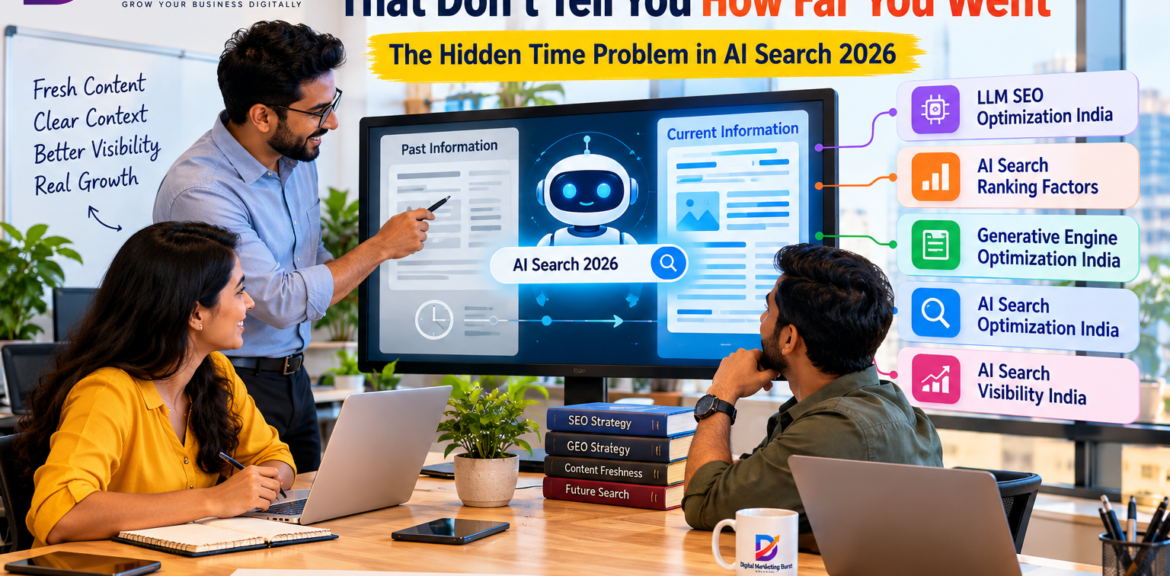
LLMs Are Time Machines That Don’t Tell You How Far You Went describes one of the most important problems emerging in AI search: an answer can arrive in seconds while hiding much of the research journey that would normally help a user judge its depth, freshness and reliability.
For businesses working on LLM SEO Optimization India, this changes what search visibility means. Traditional SEO often gave users a visible results page, multiple sources and a path they could explore. AI-generated answers can compress that journey into a single response. The user reaches an apparent conclusion faster, but may see much less of the evidence landscape behind it.
That shift matters for AI Search Ranking Factors as well. A business cannot think only about where its page ranks in a list of links. It also needs to consider whether its information can be discovered, understood, retrieved and represented accurately when an AI system builds an answer.
The challenge becomes even more important when information changes over time. Pricing, products, services, regulations, leadership, technology features and market conditions can all become outdated. A fluent answer does not automatically tell the user how current the underlying information is.
This article explains that hidden time problem and turns it into practical guidance for Indian businesses. We will examine how Generative Engine Optimization India, AI search visibility, content freshness, source clarity and traditional SEO can work together without treating AI optimization as a collection of shortcuts.
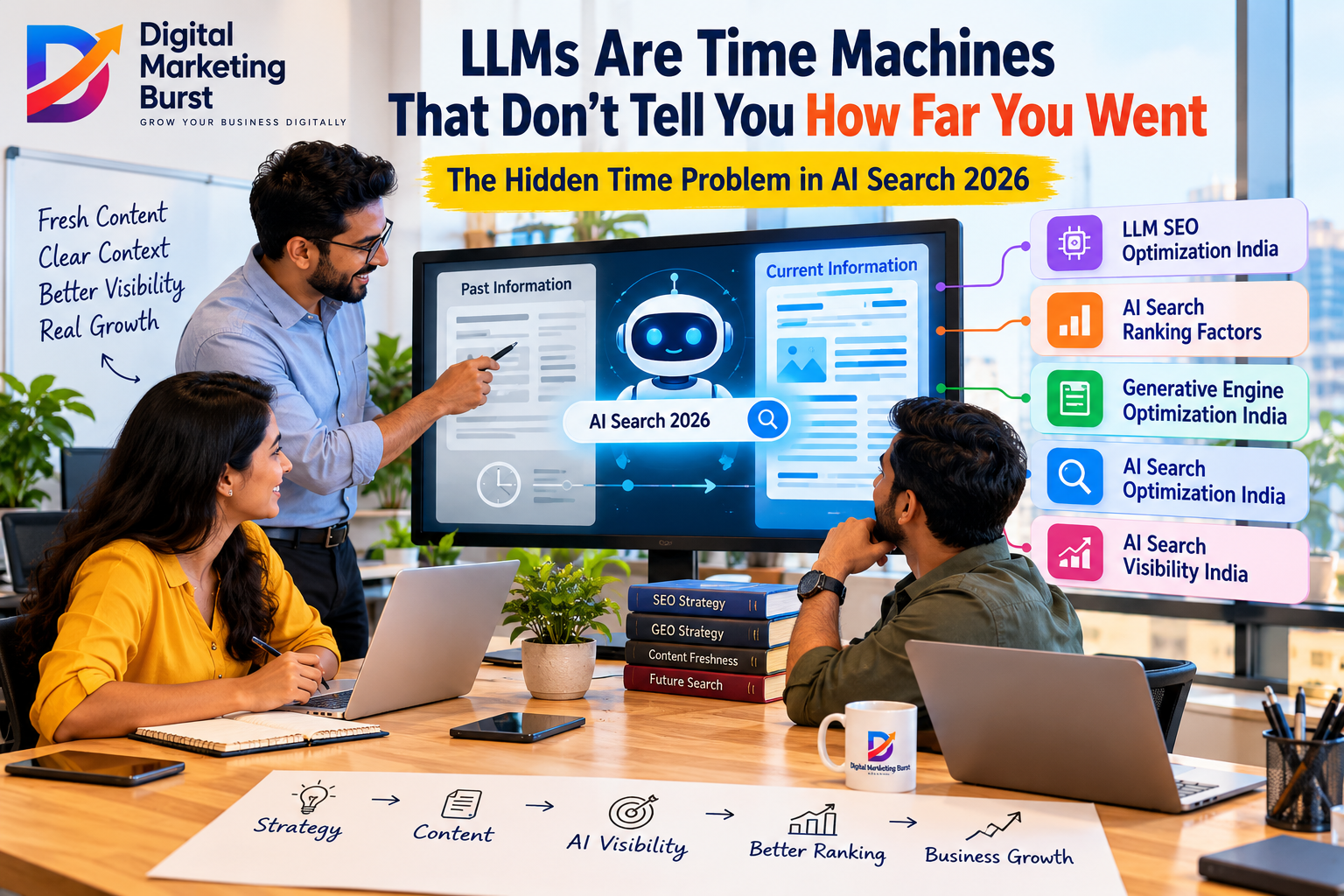
What Does “LLMs Are Time Machines That Don’t Tell You How Far You Went” Actually Mean?
The “time machine” idea is a useful metaphor for information compression.
Imagine an entrepreneur researching a complicated software purchase before AI search became common. They might search Google, open several pages, compare features, read customer discussions, check documentation and return with a more refined question.
That process could take an hour.
An AI assistant can potentially compress much of that information into a response delivered within seconds. In that sense, the technology moves the user rapidly from question to apparent understanding.
The problem is that research time previously generated useful signals of its own.
A user could notice that five reputable sources agreed on one point while another claim appeared on only one website. They might discover that most articles were several years old. Contradictory sources could signal that the subject was unsettled.
Those clues helped users judge how confidently they should act.
An AI-generated answer can remove much of that visible journey. The final response may be concise and confident even when the underlying information landscape is complicated.
This does not mean that LLM answers are automatically inaccurate. The important distinction is that answer speed and answer confidence are not the same as evidence quality or freshness.
That distinction is where the hidden time problem begins.
The Real Problem Is Information Compression, Not Simply Outdated AI
It is tempting to reduce the issue to a simple statement such as “AI uses old data.” That explanation is too broad.
Different AI experiences can obtain information in different ways. Some answers may depend heavily on model knowledge, while other experiences can retrieve current web information. Search-connected systems can also combine generated responses with recently retrieved pages.
Therefore, marketers should not build an AI strategy around a single assumed “knowledge cutoff.”
The more useful question is:
What information was available, retrieved and relied upon when this particular answer was created?
Users frequently cannot see that entire process.
Suppose an Indian company changed its service pricing last month. Its website now displays the correct price, but older articles, directories, cached pages and third-party references may still contain the previous figure.
An AI system answering a pricing question could encounter several versions of the same information.
The SEO challenge is consequently larger than publishing a fresh paragraph.
Businesses need clear first-party information, consistent entity details, technically accessible pages and enough contextual evidence for systems to distinguish current information from outdated material.
That is one reason AI Search Optimization India needs to include information maintenance rather than merely content production.
Why the Hidden Time Problem Matters for Indian Businesses
Indian businesses often operate in categories where information changes quickly. Ecommerce availability, SaaS features, financial products, educational programmes, healthcare services, travel information and digital marketing platforms can all change faster than an evergreen article.
Consider a straightforward example.
A company launches a new service in Lucknow. Its website is updated immediately, but several older profiles still describe the previous service portfolio.
A prospective customer asks an AI assistant:
“Does this company provide this service in Lucknow?”
The answer engine now needs to resolve conflicting evidence.
From the business perspective, the problem is no longer limited to whether the new service page ranks for a keyword. The company also needs the correct information to become sufficiently clear across the information environment from which AI systems may retrieve or interpret evidence.
This creates three separate objectives:
Discovery: Can search engines and relevant crawlers access the current information?
Understanding: Is it obvious which company, service, location and date the information refers to?
Representation: When an AI system answers a relevant question, does the resulting description reflect the current reality?
Traditional SEO still contributes to all three. However, AI search introduces another layer because the final experience may synthesize information rather than simply send the user to a webpage.
That is the practical business problem behind the time-machine metaphor.
LLM SEO Optimization India Requires a Different Definition of Freshness
Freshness does not mean changing the publication date every few weeks.
A genuinely fresh page contains information that still reflects reality.
That difference is crucial for LLM SEO Optimization India because artificial updates provide little value to a user. Changing “2025” to “2026” while leaving outdated screenshots, prices, examples or product information untouched does not create meaningful freshness.
A useful content refresh starts with facts.
Businesses should review details that have a realistic possibility of changing. These can include service availability, product specifications, office locations, staff information, pricing, regulations, platform features and statistics.
Next comes context.
An older statistic may remain historically accurate while no longer being appropriate evidence for a current claim. Instead of deleting every older figure, explain its time period where that context matters.
The third layer is structural freshness.
Important current information should not be buried beneath hundreds of words of historical discussion. A user asking about a current service needs the present answer first, followed by relevant explanation.
Finally, metadata should reflect genuine updates accurately. Publication and modification information should help readers understand the state of the content rather than functioning as decorative SEO signals.
This approach makes freshness useful for humans first, while also making the page easier for search and AI systems to interpret.
LLM SEO Services India Should Start With Information Accuracy
Companies evaluating LLM SEO Services India should be cautious of strategies that begin with promises of guaranteed ChatGPT mentions or instant AI rankings.
There is no single public control panel where a marketer can set a website’s position across every generative system.
A stronger process begins with the information itself.
First, determine the questions customers actually ask about the business. These may concern pricing, locations, comparisons, eligibility, features, delivery, expertise or suitability.
Then inspect the pages that answer those questions.
Each important page should make the relevant entity clear. A reader should be able to understand which company, product, service or location the information describes without reconstructing the meaning from several unrelated pages.
Important claims should also be supportable.
For example, describing a company as providing a particular service is different from calling it the “most trusted company in India.” The first may be directly established through first-party business information. The second requires credible evidence rather than promotional repetition.
Good LLM SEO therefore overlaps substantially with good information architecture, technical SEO and brand consistency.
The new element is paying closer attention to how information may be extracted and reconstructed outside the original webpage.
AI Search Ranking Factors Are Not a Secret Checklist
The phrase AI Search Ranking Factors can be misleading if it encourages marketers to imagine a universal algorithm comparable to a simple checklist.
ChatGPT, Google AI experiences, Gemini, Perplexity and other systems do not necessarily retrieve, evaluate or present information in identical ways. Their underlying systems can also change.
No responsible strategy should therefore claim that one formula guarantees citations across every platform.
Instead, businesses can concentrate on fundamentals that make information easier to discover and evaluate.
Content should directly satisfy the relevant intent. Pages need to be technically accessible. Important entities should be clearly identified, and factual statements should be understandable without excessive surrounding filler.
Source quality matters as well.
If a page makes a significant factual claim, readers should be able to understand where that information comes from. First-party claims should be clearly distinguished from independent evidence.
Freshness becomes particularly relevant when the query itself is time-sensitive.
Someone asking “What is technical SEO?” may not require information published yesterday. A person asking for the latest platform feature, current price or 2026 regulation has a much stronger freshness requirement.
This intent-based view is more useful than treating recency as a universal ranking trick.
AI SEO Ranking Factors vs Traditional SEO Signals
AI SEO Ranking Factors and traditional SEO signals overlap, but the resulting user experiences are different.
Traditional organic search usually attempts to rank pages that best satisfy a query. Users can then choose among those results and visit the source.
Generative search may retrieve information from multiple places and construct a response before the user visits any website.
As a result, marketers need to think at both page and passage level.
A 3,000-word article may be comprehensive as a whole. Yet if its most useful answer requires reading six paragraphs before reaching the actual point, extracting that information becomes unnecessarily difficult.
This does not mean every paragraph should be converted into a robotic question-and-answer block.
Instead, each major section should have a clear purpose. The heading establishes the question or concept, the opening sentences provide the central answer, and subsequent paragraphs add evidence, qualifications or practical application.
Traditional SEO foundations still matter because discoverability does not disappear when generative interfaces arrive.
A technically broken page is not rescued by calling its optimization strategy GEO. Weak content does not become authoritative simply because schema markup is added.
The strongest approach treats AI search as an additional discovery and representation layer built on solid SEO fundamentals.
Generative Engine Optimization India: What GEO Should Actually Mean
Generative Engine Optimization India is best understood as improving how clearly a brand and its information can be discovered, interpreted and potentially represented within generative search experiences.
That definition deliberately avoids promising placement.
GEO should begin with the questions surrounding a business entity.
For Digital Marketing Burst, for example, those questions could relate to digital marketing services, SEO concepts, AI search optimization or other areas the website genuinely covers. Each topic should have a clear information architecture instead of several pages competing to answer essentially the same question.
Content also needs to separate facts from marketing claims.
If a company provides a service, explain exactly what the service involves. When comparing methods, provide the criteria used for comparison. If information may change, indicate the relevant date or context.
Third-party consistency can matter too.
A brand whose name, location, service description and expertise are represented inconsistently across the web creates ambiguity. Cleaning that information is useful regardless of whether the eventual visitor arrives through Google, an AI answer or another discovery channel.
Finally, GEO should be measured differently from ordinary keyword tracking.
Organic positions remain useful, but businesses should also monitor whether important brand facts appear correctly when relevant prompts are tested across AI search experiences.
The objective is not to manipulate an LLM. It is to make accurate information easier for both humans and machines to understand.
GEO Services in India Need a Temporal Content Audit
A normal SEO audit often asks whether a page is indexable, optimized and internally linked.
GEO Services in India should add another question:
Could an AI system encounter multiple versions of this fact and struggle to know which one is current?
That question creates a temporal content audit.
Start with information that changes frequently. Prices, product versions, office addresses, leadership details, service availability and current-year guides deserve closer inspection than stable definitions.
Next, locate contradictions within the website itself.
One service page might say a company operates in three cities while an older blog says five. A contact page could contain a new phone number while an old landing page still displays the previous one.
Both pages can be crawlable. That does not make both versions correct.
Then review historical articles.
Older content does not automatically need deletion. Historical material can remain valuable when its date and context are clear. Problems arise when an outdated article appears to describe the present.
Finally, decide whether pages should be updated, consolidated, redirected or retained as historical resources.
This audit improves conventional SEO hygiene while also reducing ambiguity for systems attempting to synthesize information about the brand.
AI Search Optimization India Should Focus on Answer Integrity
A useful way to approach AI Search Optimization India is through the concept of answer integrity.
Answer integrity asks whether a piece of information remains accurate when removed from its original page and placed inside another context.
Consider this sentence:
“Plans start at ₹X per month.”
Without additional context, several questions remain. Which plan? Which company? Is tax included? When was the price valid?
Now consider a clearer version:
“As of September 2026, Company X lists its entry-level Plan Y at ₹X per month before applicable taxes.”
The second version carries more context with it.
This does not mean every sentence needs a date or company name. Excessive repetition would make the page unpleasant to read.
Instead, important factual passages should contain enough local context to remain understandable when quoted, summarized or extracted.
Businesses can apply the same principle to locations, product specifications, eligibility requirements and comparisons.
A good test is simple: copy one important paragraph into a blank document.
Would a reader still understand what it refers to?
If the answer is no, the passage may rely too heavily on context that an AI retrieval system or search snippet might not preserve.
AI SEO Services India Should Not Replace Traditional SEO
The growth of AI SEO Services India does not mean businesses should abandon Google SEO.
Search behaviour is becoming more fragmented, not less complex.
A potential customer may discover a topic through an AI answer, verify the company through Google, inspect reviews, visit its website and then search the brand again before making contact.
Those actions belong to one decision journey.
Technical SEO therefore remains essential. Pages still need logical architecture, crawlable content, useful internal linking, sensible canonicalization and a strong mobile experience.
Content quality remains equally important.
Generative optimization cannot compensate for a page that does not answer the user’s question. Likewise, conventional rankings alone do not guarantee that an AI system will represent a brand accurately.
Businesses should therefore avoid creating separate “SEO content” and “AI content” when both pages serve the same intent.
Build the strongest canonical resource for the topic instead.
Then structure that resource so that humans can read it comfortably, search engines can understand its purpose and AI retrieval systems can identify useful passages without losing critical context.
AI Search Visibility India Is Bigger Than Website Traffic
AI Search Visibility India requires a broader measurement model because a brand can influence a user’s decision without receiving an immediate click.
Suppose someone asks an AI assistant to explain several approaches to improving online visibility. The response mentions a company’s framework or brand but the user does not visit the website.
Traditional analytics may record nothing.
From a brand perspective, however, visibility occurred.
This makes AI visibility measurement challenging. Businesses should avoid pretending that every mention can be converted into an exact traffic or revenue figure.
Instead, create a controlled set of commercially and informationally relevant prompts.
Track whether the brand appears, whether the description is accurate, what pages or sources are cited when citations are visible, and whether major factual errors occur.
Repeat those checks consistently rather than changing the prompts every week.
The resulting data will not reveal a universal AI ranking position. It can, however, show whether the brand’s representation is becoming more accurate and consistent across the questions that matter.
That is a more meaningful objective than chasing vanity screenshots of one favourable AI response.
AI Visibility Services India Should Measure the Answer, Not Just the Click
Providers offering AI Visibility Services India need to distinguish between measurement and attribution.
Measurement asks whether the brand appears within relevant AI experiences.
Attribution asks whether that appearance caused a business outcome.
The first can sometimes be observed directly. The second is much harder to prove because users can move between AI tools, search engines, social platforms and direct website visits before converting.
A practical AI visibility dashboard can therefore monitor several separate dimensions.
Track brand mentions for a stable prompt set. Record visible citations where the interface provides them. Note incorrect or outdated brand descriptions. Compare which competitors or information sources repeatedly appear around important topics.
Website analytics should remain separate but connected.
If referral traffic from an AI platform is available, monitor it. Branded search demand, assisted conversions and lead-source information may provide additional context, but marketers should avoid claiming causation without sufficient evidence.
The goal is to build a clearer picture of discovery.
AI search creates another surface where a brand’s information can influence decisions. Measuring that surface requires more than looking for another row in a traffic report.
The Hidden Time Problem Changes Content Strategy
The biggest strategic lesson is that businesses need to manage information over time, not merely publish more information.
Every important business fact has a lifecycle.
A new service announcement begins as current information. Months later, the service may change. Eventually, the original announcement may become historical evidence rather than the best description of what the company offers today.
Websites often fail to communicate those transitions.
Old blogs continue ranking. PDFs remain accessible. Press releases appear beside current service pages. Third-party profiles repeat information that was accurate two years earlier.
For humans browsing several sources, dates and context can reveal those differences.
An AI-generated answer may compress those sources into one response.
Businesses should therefore maintain a clear current source of truth for important entities and facts.
That might be a service page for service information, a location page for office details or an actively maintained documentation page for product features.
Supporting articles can provide additional context, but they should not create conflicting versions of the core fact.
This is where content governance becomes an SEO and GEO issue rather than merely an editorial task.
A Practical AI Content Freshness Framework for Indian Businesses
Businesses can manage the hidden time problem with a simple four-stage framework: Identify, Timestamp, Reconcile and Monitor.
Identify Information That Can Expire
Not every sentence deserves the same maintenance schedule.
Definitions and historical explanations may remain accurate for years. Prices, software features, government requirements, staff profiles and availability can change much faster.
Mark the sections of your website where outdated information could materially mislead a customer.
This creates a priority list for future reviews.
Timestamp Time-Sensitive Claims
Dates are valuable when time changes the meaning of a statement.
Instead of adding “2026” everywhere for SEO, use dates where they genuinely clarify validity.
For example, a platform comparison may state when the features were checked. A regulatory article should identify the period to which the rule applies.
This helps readers distinguish a current claim from historical information.
Reconcile Conflicting Pages
Search the website for important facts in multiple locations.
If three pages contain different versions of the same service description, determine which one should be authoritative.
Update the others where appropriate.
When two pages satisfy substantially the same search intent, consider whether consolidation would create a stronger resource than maintaining near-duplicates.
Monitor How AI Systems Represent the Information
Create a small prompt set around your most important business facts.
Test those prompts periodically across the AI experiences relevant to your audience.
Record inaccuracies rather than immediately rewriting the entire website after one unusual response.
Patterns matter more than isolated outputs.
This process turns AI visibility from speculation into an ongoing information-quality practice.
Why Publishing More AI SEO Content Can Make the Problem Worse
More content is not automatically more authority.
Publishing several pages targeting LLM SEO Optimization India, AI Search Optimization India, Generative Engine Optimization India and AI Search Visibility India can create useful topical coverage when each page serves a distinct intent.
It can also create cannibalization and contradiction when every article explains the same concepts with slightly different wording.
Before publishing a new page, define its unique job.
One article might explain LLM SEO fundamentals. Another could focus specifically on measuring AI visibility. A third may cover technical crawler access.
The present article has a different purpose: it examines the temporal and evidence-compression problem in AI search and explains what that means for content maintenance.
That distinction should remain clear.
Do not add generic sections merely to accommodate another keyword.
When a related phrase can be answered adequately within an existing page, strengthen that page and create an internal link instead of manufacturing another article.
A smaller collection of well-maintained resources can be more useful than a large archive of overlapping AI-search posts.
Conclusion
The idea that LLMs Are Time Machines That Don’t Tell You How Far You Went is ultimately about what disappears when research becomes extremely compressed.
Users gain speed and convenience. At the same time, they may lose parts of the visible research path that previously helped them judge disagreement, depth, freshness and source quality.
For Indian businesses, the response should not be fear or aggressive keyword production.
The practical response is better information management.
Keep important facts current. Make entities unambiguous. Separate historical information from present claims. Build passages that retain their meaning when extracted, and maintain strong traditional SEO foundations alongside GEO.
That creates a better experience whether the next customer discovers the business through Google, ChatGPT, another AI search experience or the website itself.
How AI Search Can Blur the Difference Between Old and Current Information
A conventional webpage usually gives readers several clues about time. They may see a publication date, an updated date, references to a particular year, or product details that reveal when the information was created. When users open several search results, they can compare those clues themselves.
AI search can change that experience.
A generated answer may combine information from different contexts into one smooth explanation. Some information may be current, while another part may have originated from an older source. Unless dates or citations are clearly presented, the distinction may not be obvious to the person reading the answer.
This is particularly important for queries where time changes the correct answer.
Consider someone searching for the “best SEO strategy for AI search in 2026.” Advice about clear site architecture may remain useful for years. However, information about a specific AI-search feature, crawler control, advertising product or platform capability may become outdated much faster.
The challenge is therefore not simply identifying whether a webpage is old.
Businesses need to understand the temporal sensitivity of individual claims.
A five-year-old explanation of what a canonical tag does could remain useful. Meanwhile, a six-month-old statement about a rapidly changing AI product could already require review.
That difference should influence how businesses perform content audits.
Instead of asking only, “When was this article published?”, ask:
“Which statements on this page could become incorrect as time passes?”
That question creates a much stronger foundation for content freshness and AI Search Optimization India.
The Difference Between Publication Date and Information Freshness
Publication date and freshness are related, but they are not interchangeable.
A page published yesterday can still contain outdated information if the writer relied on old material. Conversely, an article originally published several years ago may remain accurate if its subject has not materially changed.
Businesses should therefore avoid treating a recent date as proof of quality.
The same principle applies when updating content.
Changing the year in a title from 2025 to 2026 does not make the article current. Replacing the publication date without reviewing the actual claims creates an appearance of freshness rather than genuine freshness.
A meaningful update requires examining what has changed.
Suppose an article discusses a software platform. The writer should check whether the interface, features, pricing structure, terminology and relevant policies still match the current product.
Another page might explain a stable marketing concept. In that case, forcing a large rewrite every few months may add little value.
The correct update frequency depends on the information.
For LLM SEO Optimization India, this distinction matters because AI-search topics can evolve rapidly. Articles discussing current platform behaviour deserve more frequent verification than pages explaining stable fundamentals such as crawlability or internal linking.
A strong editorial process therefore prioritises fact freshness over date freshness.
Readers benefit because the page remains genuinely useful. Search and AI systems also receive clearer information without unnecessary cosmetic updates.
Temporal Context Should Become Part of Content Quality
SEO writers usually think about relevance, authority, readability and search intent. In AI search, temporal context deserves a place alongside those considerations.
Temporal context tells the reader when a statement is supposed to be true.
Not every sentence needs a timestamp.
“Internal links connect related pages on a website” does not require “as of September 2026” because the date adds little meaning.
A statement describing a current platform feature is different.
If the feature changes frequently, including an appropriate date or version can prevent future readers from interpreting historical information as a current fact.
The same principle applies to statistics.
A statistic without a year can create a misleading impression even when the number was originally accurate. Readers need enough context to understand the period represented by the data.
Indian businesses can apply this principle to service information as well.
A digital agency that changes its service portfolio should ensure current service pages reflect the new offering. An old announcement can remain online for historical purposes, but it should not compete with the current page as the clearest description of the business.
This creates a useful rule:
Use temporal context wherever time can materially change the meaning of the information.
That is more valuable than placing dates everywhere for appearance.
AI Search Ranking Factors and Query Freshness
Discussions around AI Search Ranking Factors often treat freshness as though every new page automatically has an advantage over older content.
That interpretation is too simplistic.
Freshness becomes especially important when the user’s question contains an explicit or implied time requirement.
A search for “current AI search trends in India” clearly requires recent information.
Another query such as “how does a search engine crawl a website?” may be satisfied by an older resource if the explanation remains accurate.
Businesses should therefore identify the freshness intent behind a query.
There are several useful categories.
Some queries are highly time-sensitive. Current prices, product availability, recent announcements, live schedules and newly introduced regulations belong here.
Other searches change gradually. Marketing strategies, platform best practices and software comparisons may require periodic review without becoming obsolete overnight.
Evergreen queries have much lower temporal sensitivity. Definitions, historical explanations and foundational concepts can remain useful for longer periods.
This classification can improve editorial planning.
Instead of refreshing every blog according to the same calendar, businesses can review high-volatility topics more frequently while maintaining stable resources only when meaningful changes occur.
That saves editorial effort and reduces unnecessary rewriting.
More importantly, it keeps content aligned with the actual information needs behind the query.
AI SEO Ranking Factors Need Query-Level Thinking
Businesses interested in AI SEO Ranking Factors should move beyond page-level optimization and think about individual questions.
One webpage can satisfy several related questions, but those questions may have different freshness requirements.
Imagine an article about generative engine optimization.
One section defines GEO. Another discusses current AI platforms. A third explains how businesses can structure content for clearer retrieval.
The definition may remain stable.
Platform-specific information may need frequent updates.
Structural guidance could change gradually as search technology evolves.
Treating the entire article as either “fresh” or “outdated” ignores those differences.
A better content audit works at the section level.
Mark high-volatility sections during editorial reviews. Verify them first when the article is updated.
Stable sections should only be rewritten when the explanation can genuinely be improved.
This approach prevents a common SEO problem: unnecessary rewriting that makes content longer without making it more accurate.
For AI-focused websites, section-level maintenance can become particularly valuable because one article may contain both evergreen education and rapidly changing technology information.
The goal is not to produce constant activity.
The goal is to maintain the reliability of the answer.
What Happens When Multiple Versions of the Same Fact Exist Online?
One of the hardest temporal problems appears when several versions of the same information remain accessible.
Imagine a company that previously offered three service packages.
It later replaces them with two new packages. The main pricing page is updated, but an older blog still explains the original three-package structure.
A third-party directory may also preserve the previous information.
Humans visiting the current website can often resolve the conflict by checking dates and navigation.
A retrieval system may encounter all three sources.
The business cannot control every third-party page, but it can reduce ambiguity within its own digital presence.
The current service or product page should become the clearest first-party source.
Old articles can be updated where appropriate. If they provide no continuing value and substantially duplicate current information, consolidation may make more sense.
Historical pages that deserve to remain available should contain enough context to show that they describe an earlier period.
Internal links can help as well.
An old announcement might link prominently to the current product or service page so users can reach the latest information.
This is not merely an AI-search tactic.
It improves the website for every visitor who encounters an older URL through Google, social media, bookmarks or another website.
Build a Single Source of Truth for Important Business Information
Every business has information that should not be scattered across dozens of contradictory pages.
Contact information is an obvious example.
Service availability, product specifications, location information and core brand details can also benefit from a clear source of truth.
A single source of truth does not mean mentioning a fact on only one page.
It means having one authoritative location where the current version is maintained, while other pages refer to it consistently.
For example, a company might maintain its complete current service portfolio on a primary services page.
Blog posts can discuss individual services in greater detail, but they should not independently maintain conflicting master lists.
Similarly, an organisation with several locations can maintain dedicated location pages. Supporting articles can reference those locations without becoming competing sources for basic address and contact information.
This architecture becomes useful for Generative Engine Optimization India because it reduces ambiguity.
When current information has a clear home, editorial teams know what needs updating first.
Internal linking becomes easier too.
Instead of copying the same detailed information into every new article, writers can provide the necessary context and direct readers toward the authoritative page.
That reduces duplication while keeping the website connected.
Generative Engine Optimization India Needs Entity Consistency
AI search does not only need words. It needs to understand what those words refer to.
Consider a company whose website uses several variations of its brand name. Its Google Business Profile uses another version, while social profiles contain outdated descriptions.
A human may recognise that all of these references describe the same organisation.
Machine interpretation can become less straightforward when important details conflict.
Generative Engine Optimization India should therefore include entity consistency.
Start with the basic identity of the business.
Use the official brand name consistently where appropriate. Keep location and contact information current. Make the relationship between the company and its services clear.
People associated with the organisation should also be described accurately.
Do not inflate credentials or create expertise claims merely to strengthen perceived authority. Genuine roles, qualifications and responsibilities are more useful than promotional titles that cannot be supported.
Structured data can complement this work when implemented correctly.
However, schema should describe information that genuinely exists on the page. Adding misleading markup does not turn an unsupported claim into a fact.
Entity optimization works best when the visible content, technical signals and external brand presence describe the same real-world organisation.
GEO Services in India Should Include Content Version Control
Businesses often think of version control as something used by software developers.
Content teams can benefit from a simpler version of the same idea.
When an important page changes, record what was updated and why.
The record does not necessarily need to be visible to every website visitor. An internal editorial log may be enough.
Suppose a marketing article contains information about a platform feature.
During the next review, the editor should be able to see when that section was last checked. If the platform has changed since then, the claim becomes a priority for verification.
This approach makes GEO Services in India more systematic.
Without version awareness, content teams may repeatedly review stable paragraphs while overlooking one outdated sentence that materially changes the answer.
A simple content inventory can contain the page URL, topic, responsible owner, last substantive review and high-volatility facts requiring future checks.
Businesses do not need expensive software to begin.
A spreadsheet can work for a small website.
The important part is establishing responsibility for keeping information current.
Publishing is an event. Content maintenance is a process.
AI search makes that distinction increasingly difficult to ignore.
AI Search Optimization India Requires Better Update Signals for Readers
When content changes materially, readers should be able to understand that an update occurred.
An accurate “last updated” date can help, provided it represents a genuine review.
Do not automatically change the modification date whenever someone fixes punctuation or adjusts a heading.
That practice weakens the meaning of the date.
A substantive update might involve checking current facts, revising an outdated process, replacing obsolete examples or adding information about a significant development.
Where useful, a short editorial note can explain the nature of the change.
For example:
“Updated September 2026 to reflect changes in the platform’s AI search features.”
That sentence gives readers far more context than a floating date with no explanation.
The same approach works for articles covering policies, software, marketing platforms or evolving search features.
For AI Search Optimization India, transparent update signals improve trust without attempting to manufacture freshness.
Businesses should also review the page title.
Adding the current year can be useful when the search intent genuinely demands current information. It becomes unnecessary when the year has no effect on the answer.
A date should clarify the content, not decorate it.
How to Make Important Content Easier for AI Systems to Interpret
Readable content and machine-interpretable content are not opposing goals.
Both benefit from clarity.
Start each major section by answering the heading directly.
If the heading asks why AI search freshness matters, the first paragraph should explain why. Do not force the reader through a long introduction before reaching the answer.
Keep related facts together.
A price should remain near the description of the product it belongs to. A location-specific service should clearly identify the relevant location.
Use descriptive headings rather than vague labels.
“Why AI Answers Can Surface Outdated Information” communicates more than “The Problem.”
Definitions should also be explicit.
When introducing a specialist term such as generative engine optimization, explain what you mean before discussing advanced strategy.
Tables can help when genuine comparison is required, although they should not replace nuanced explanations.
Lists are useful for processes where sequence matters.
Normal paragraphs remain better when the topic requires reasoning and context.
The objective is not to redesign every article for a robot.
It is to remove unnecessary ambiguity for every reader, including systems that may retrieve a passage outside its original page.
Passage-Level Clarity Can Improve AI Search Visibility
Traditional content planning often focuses on the entire page.
AI retrieval creates another useful unit to consider: the passage.
A passage is a small section of content that answers a specific part of the broader topic.
For example, this article covers several questions under one central theme.
One passage explains temporal context. Another addresses conflicting information. A separate section discusses entity consistency.
Each section should make sense within the broader article while still providing a reasonably complete answer to its own question.
That is passage-level clarity.
It does not require repeating the primary keyword in every heading.
In fact, repetition can make the content less natural.
Instead, use language that reflects the real question.
A marketer asking why old information appears in AI answers is not necessarily searching with the phrase AI Search Visibility India. The article can answer that problem naturally while using related terminology where it genuinely belongs.
Strong topical coverage comes from answering connected questions, not from inserting every keyword into every paragraph.
That principle protects readability while expanding semantic depth.
AI Search Visibility India Starts Before the AI Answer
Marketers sometimes treat AI visibility as something that happens entirely inside ChatGPT, Gemini or another answer interface.
The process begins much earlier.
A business first needs accurate information on accessible digital properties.
Search engines and other retrieval systems need to discover relevant pages. The content must then be understandable enough to connect it with the correct entity and topic.
Supporting signals may help establish context.
Only after those stages can the information potentially become useful within an AI-generated response.
This means AI Search Visibility India cannot be separated from the quality of the underlying website.
A weak site architecture can make important pages difficult to discover.
Duplicate content can create uncertainty about which URL represents the primary resource.
Inconsistent business information can weaken entity clarity.
Thin pages may fail to provide enough useful information to answer meaningful questions.
AI visibility therefore starts with information infrastructure.
The generated answer is the visible end of a much longer process.
Why Clear Dates Can Matter More Than Constantly New Content
The internet already contains enormous amounts of content.
Producing another article is not always the best solution.
Sometimes the more valuable improvement is making existing information easier to place in time.
Imagine two pages explaining an AI feature.
The first says:
“The platform supports Feature X.”
The second says:
“As of September 2026, the platform documentation describes Feature X as available for these use cases.”
The second statement gives the reader a temporal reference.
If the feature changes later, someone can immediately recognise that the sentence reflects a particular point in time.
That does not make the claim permanently correct.
It makes its context clearer.
Businesses can use the same approach for policies, prices, specifications and other volatile information.
However, avoid dating stable statements unnecessarily.
A website does not need to say “as of 2026, email marketing involves sending messages by email.”
Temporal labels are valuable when they reduce uncertainty.
Used intelligently, they can improve clarity without filling the article with dates.
How Indian Businesses Can Perform an AI Freshness Audit
An AI freshness audit can begin with the pages that matter most commercially.
Identify the pages responsible for services, products, locations, pricing and major informational topics.
Next, inspect each page for claims that can expire.
Mark those claims according to how quickly they are likely to change. A current software feature deserves more frequent review than a historical explanation.
Search the website for duplicate versions of important facts.
If several pages contain different information, decide which page should be authoritative and reconcile the others.
Then review temporal context.
Ask whether a reader can determine when time-sensitive information was valid.
Check internal links after that.
Older articles should guide readers toward the latest authoritative resource where necessary.
Finally, test representative questions in the AI search platforms relevant to the business.
Do not change the website because one answer looks unusual.
Record recurring inaccuracies and investigate what information may be contributing to them.
This creates a repeatable workflow rather than a one-time “AI SEO optimization” exercise.
A Practical Example: Updating a 2025 AI Search Article for 2026
Imagine an Indian marketing company published an article titled “AI Search Optimization Guide 2025.”
The article still receives visitors in 2026.
Deleting it and creating an almost identical “2026” URL may not be the best response.
First, inspect whether the search intent remains the same.
If users still want the same core guide, updating the existing resource may preserve a clearer information architecture.
Review every time-sensitive section.
Remove features that no longer exist. Update terminology where platforms have changed it. Recheck screenshots and examples.
Keep evergreen explanations that remain accurate.
Do not rewrite them merely to make the article look new.
Then examine the title and metadata.
If 2026 genuinely matters to the query, update the year after the substantive content review is complete.
Add a meaningful updated date where appropriate.
Finally, inspect internal links from older posts.
Those links should continue pointing users toward the strongest current resource rather than several near-identical annual versions.
This approach improves content maintenance without creating unnecessary URL duplication.
Content Decay Is Different From Ranking Decline
A page losing Google positions is not necessarily outdated.
Likewise, an outdated page may continue receiving substantial traffic.
These are different problems.
Ranking decline describes a change in search visibility.
Content decay, in the context of information quality, means the usefulness or accuracy of the content has deteriorated because the world changed around it.
The distinction matters.
A perfectly accurate page can lose visibility because competitors created stronger resources, search intent shifted or the results page changed.
Meanwhile, an old page with outdated facts might retain visibility because it has accumulated links and authority.
Therefore, businesses should not use traffic decline as the only trigger for content updates.
High-traffic pages deserve accuracy reviews precisely because more people may encounter their information.
For AI search, this becomes particularly important.
An old but prominent URL can remain part of the broader information environment even when a newer page exists.
Content maintenance should therefore consider factual risk alongside SEO performance.
The Cost of Being Wrong Is Not Equal Across Every Topic
Not every outdated statement creates the same level of harm.
An old example of a social media caption is usually less consequential than incorrect information about eligibility, pricing, healthcare, financial products or legal requirements.
Businesses should prioritize reviews according to the potential impact of outdated information.
This can be called freshness risk.
Low-risk content may tolerate longer review intervals.
Medium-risk pages deserve periodic checks.
High-risk or rapidly changing information should receive more careful verification and clearer dates.
This framework helps businesses allocate limited editorial resources.
Instead of attempting to update hundreds of posts every month, focus first on pages where incorrect information could materially affect a reader’s decision.
The approach also supports better AI SEO Services India because it connects optimization with information quality.
Visibility without accuracy is not a useful objective.
Common Mistakes Businesses Make With AI Content Freshness
The first mistake is changing dates without changing facts.
A new timestamp cannot repair an outdated explanation.
Another mistake is publishing a separate annual article for the same search intent without considering consolidation.
This can create several competing URLs with largely identical information.
Some businesses also remove all old content automatically.
Historical pages can still have value when they provide unique information and are clearly identified as historical.
Another problem is using “latest” excessively.
If a page claims to contain the latest information, someone needs to maintain that promise.
Businesses should also avoid rewriting content merely because an AI tool recommends a freshness score.
Updates should respond to actual changes, user needs or quality improvements.
Finally, do not treat AI answers as perfectly deterministic SEO results.
Different prompts, sessions, systems and retrieval conditions can produce different responses.
Look for patterns rather than overreacting to one test.
Why This Matters for Digital Marketing Strategy in 2026
AI search makes the web faster to consume but harder to observe.
A user may move from question to recommendation without opening the sequence of webpages that would once have formed the research journey.
For marketers, that means content has to perform two jobs.
It should provide an excellent experience when a person visits the website.
At the same time, important passages should retain enough context to remain useful when surfaced elsewhere.
This changes the role of content maintenance.
Updating old information is no longer merely a way to refresh an SEO article. It becomes part of maintaining the digital representation of the business.
AI Search Ranking Factors, GEO, LLM optimization and conventional SEO all intersect at this point.
Accurate information cannot guarantee AI visibility.
However, inaccurate, contradictory and poorly structured information creates problems regardless of which discovery platform a customer uses.
That makes information quality one of the safest long-term investments a business can make.
Conclusion
The hidden time problem in AI search cannot be solved by publishing more articles or adding the current year to every title.
Businesses need to make time visible where it changes meaning.
That means distinguishing publication dates from genuine freshness, identifying claims that can expire, reconciling contradictory pages and maintaining clear sources of truth.
For Generative Engine Optimization India, the lesson is especially important. AI systems can compress a large research journey into a short answer, so individual passages need enough context to survive that compression.
The next stage is turning these principles into a practical LLM SEO and AI visibility strategy for Indian businesses: how to structure content, monitor AI answers, build internal authority, measure visibility and decide what should be updated, consolidated or removed.
Building an LLM SEO Strategy Around Questions, Not Keywords
A practical LLM SEO Optimization India strategy should begin with the questions customers need answered rather than a large spreadsheet of similar keywords.
Keywords still have value because they reveal language and demand. However, AI search often allows users to ask longer, conversational questions that combine several requirements in a single prompt.
An Indian business owner might ask, “How can I make my company more visible in ChatGPT and Google AI search?” Another person may ask whether GEO is different from traditional SEO. A marketing manager could want to know why an AI assistant keeps describing an old version of the company’s service.
Those queries are related, but their informational needs are different.
Start by grouping real questions around clear intents. One group might concern definitions, another implementation, while a third could focus on measurement or troubleshooting.
Next, assign each important intent to the strongest existing page.
If a comprehensive page already answers a question well, improve that resource instead of publishing another near-duplicate article.
After that, identify gaps. A new page deserves to exist when it answers a distinct problem substantially better than the existing content.
This method helps prevent a website from producing five articles that all explain “What is GEO?” with slightly different keywords.
For AI search, that distinction matters because clear topical architecture can make the relationship between pages easier for humans and machines to understand.
Create Topic Ownership Without Creating Keyword Cannibalization
Topical authority should not be confused with publishing dozens of pages around every variation of a phrase.
Consider this keyword cluster:
LLM SEO Optimization India
LLM SEO Services India
AI Search Optimization India
AI SEO Services India
Generative Engine Optimization India
These terms overlap significantly.
Creating a separate generic service article for every variation could lead to several pages competing for essentially the same intent.
A better architecture gives each page a defined role.
A core service page could explain the commercial offering around AI search optimization. An educational guide could explain how LLM SEO works. A separate measurement article might focus entirely on tracking AI visibility.
This article has another distinct role.
It explains how AI systems can compress the user’s research journey and why temporal context, freshness and conflicting information matter.
That differentiation creates a healthier content cluster.
Internal links can then connect the resources based on user needs rather than exact-match anchors.
For example, someone reading about outdated AI answers may naturally want a deeper explanation of AI search visibility. Another reader may need a technical guide about crawler access.
The objective is to build a connected knowledge system, not a collection of keyword variations.
How to Structure Content for AI Search Without Writing for Robots
AI-focused SEO can tempt writers to make every article unnaturally mechanical.
That is unnecessary.
Humans remain the audience.
A useful structure simply makes the article easier to understand at different levels. Someone scanning the page should recognise its major ideas from the headings. A person reading one section should receive enough context to understand it without returning to the introduction repeatedly.
Start with descriptive headings.
“Why AI Answers Can Become Outdated” is more informative than “Why It Matters.”
Then answer the heading early.
Do not spend four paragraphs creating suspense when the visitor came for an explanation.
Follow the direct answer with nuance, examples and limitations.
Definitions should remain consistent throughout the article. If GEO means generative engine optimization in the introduction, avoid quietly changing the meaning later.
Important entities also need clarity.
When discussing a particular platform, product or company, name it clearly enough that the reader knows what the statement describes.
These practices support AI Search Optimization India without making the page sound as though it was assembled for an algorithm.
Answer-First Writing Does Not Mean Short Content
There is a common misunderstanding around answer-first content.
Some marketers interpret it as a requirement to make everything extremely short.
That is not the goal.
Answer-first writing means giving the user the central answer before expanding it.
Suppose the heading asks:
Does updating the publication date improve AI search visibility?
The section could begin:
“Changing a publication date alone does not make the underlying information current.”
The following paragraphs can explain why.
That structure respects the user’s time while preserving depth.
Complex topics still need qualification.
An article about AI Search Ranking Factors cannot responsibly reduce every concept to a two-line answer. Retrieval, relevance, freshness, authority and source interpretation require context.
The solution is layered writing.
Provide the direct answer first. Explain the mechanism next. Add an example where it improves understanding, then state any important limitation.
This structure works for readers who want a quick answer and those who need deeper analysis.
Build Content That Can Survive Extraction
One of the most useful tests for AI-era content is the extraction test.
Take an important paragraph from the page and read it separately.
Does it still make sense?
Imagine the following sentence:
“This is why businesses should update it regularly.”
Outside the original paragraph, both “this” and “it” are unclear.
A stronger version might say:
“Businesses should review time-sensitive AI search content regularly because platform features and product information can change.”
The second sentence contains enough context to remain meaningful when extracted.
Writers should not eliminate pronouns from every paragraph. Natural language would quickly become repetitive.
Instead, apply the extraction test to passages containing important definitions, recommendations and factual statements.
This technique can improve featured snippets, quotations, accessibility and general comprehension as well as AI retrieval.
It also encourages stronger writing.
If a paragraph cannot communicate its core idea without several paragraphs of setup, the argument may need clearer structure.
Create an AI Search Content Map
A content map can prevent LLM SEO Services India from becoming a random publishing exercise.
Start with the business’s important topics.
For a digital marketing company, these might include technical SEO, local SEO, paid advertising, AI search, content strategy and analytics.
Break a broad topic such as AI search into user problems.
One branch might cover GEO fundamentals. Another could address AI crawler management. Additional branches may focus on visibility measurement, content freshness and AI citations.
Then map existing pages to those problems.
Some questions may already have strong resources.
Others may have several weak articles competing for the same intent.
A third group may not be covered at all.
The map now gives the editorial team three actions: improve, consolidate or create.
Improve an existing page when its intent is correct but its information is incomplete.
Consolidate pages when several URLs unnecessarily compete to solve the same problem.
Create a new page only when a meaningful information gap exists.
This process reduces duplication while making future internal linking much easier.
Use Internal Links to Explain Relationships Between AI Topics
Internal links should help readers continue their research.
They should not exist simply because an SEO plugin asks for a certain number.
Suppose a paragraph discusses how AI crawlers access content.
A contextual link to an existing crawler guide would be useful because the reader can explore the technical issue without forcing the current article to repeat the entire explanation.
Another section discussing AI visibility could link to a dedicated guide on measuring visibility.
The anchor text should describe what the destination contains.
Avoid repeatedly using the exact same commercial keyword across dozens of articles merely to influence rankings.
Varied descriptive anchors are usually more natural.
For example, anchors such as “understanding AI search visibility,” “managing AI crawler access,” and “building an AI content validation workflow” communicate useful context.
Internal links can also establish hierarchy.
A broad guide may link to several specialist resources, while those specialist pages can link back to the broader guide where appropriate.
This creates pathways for users rather than isolated SEO pages.
AI Search Ranking Factors Should Be Mapped to User Value
Marketers frequently ask which AI Search Ranking Factors they should optimize first.
A more productive approach is to connect each optimization activity with a user benefit.
Clear headings help users navigate.
They can also make sections easier to identify and interpret.
Accurate dates help readers judge whether time-sensitive information remains relevant.
They also reduce temporal ambiguity.
Original explanations give visitors something beyond information repeated across many websites.
They may additionally create passages worth referencing.
Good internal linking helps users explore related questions.
It also clarifies relationships between resources.
Strong technical accessibility allows people and permitted crawlers to reach the content.
In other words, many useful AI-search practices are not tricks invented specifically for LLMs.
They are extensions of good information design.
That is a healthier way to evaluate an optimization tactic.
Ask what problem it solves for the user first. Then consider how it might also improve machine interpretation.
AI SEO Ranking Factors Cannot Rescue Weak Information
A page can be perfectly formatted and still offer little value.
It might have concise headings, schema, internal links and a recent modification date. None of those features compensate for inaccurate or generic content.
This matters when businesses pursue AI SEO Ranking Factors as though they were a technical checklist.
Information quality remains fundamental.
A useful article should provide an answer that reflects the complexity of the question.
If uncertainty exists, acknowledge it.
When a claim depends on current information, verify it before publishing.
If two approaches have genuine trade-offs, explain those differences instead of forcing a universal “best” answer.
Originality matters here too.
Original content does not require inventing a new theory for every article.
It can come from clearer frameworks, better organization, practical decision criteria or an explanation that connects ideas other pages treat separately.
This article’s time-machine framework is an example.
The metaphor becomes useful only when it leads to practical decisions about freshness, version control and content governance.
Without that application, it would simply be an attractive headline.
How Generative Engine Optimization India Can Support Brand Accuracy
Visibility is only valuable when the brand is represented accurately.
A company mentioned frequently for services it no longer provides does not have a successful AI visibility strategy.
Generative Engine Optimization India should therefore include brand accuracy monitoring.
Create a list of basic facts that matter commercially.
These can include the official brand name, primary services, service areas, key products and other publicly verifiable business information.
Then formulate natural questions around those facts.
For example:
“What services does Brand X provide?”
“Does Brand X offer Service Y?”
“Where does Brand X operate?”
The objective is not to force the AI system to repeat a preferred advertisement.
Instead, observe whether important factual information is being represented correctly.
If several systems repeatedly surface an outdated service, investigate the information environment.
Check the website first. Then review prominent external profiles or old pages that may still communicate the previous information.
Correct what the business legitimately controls.
This is far more useful than trying to manipulate one individual AI answer.
AI Search Visibility India Needs a Prompt Monitoring Framework
Keyword rank tracking works because the marketer can repeatedly search a query and observe positions.
AI answers are less stable.
Wording can change, sources may vary and follow-up questions can alter the response.
Therefore, AI Search Visibility India needs a monitoring framework that acknowledges variability.
Begin with a stable prompt library.
The prompts should represent genuine user questions across the customer journey.
Informational prompts can test whether the brand’s expertise appears around relevant topics.
Commercial prompts can examine how the brand is represented when users compare services.
Branded prompts can reveal factual inaccuracies.
Do not rewrite the prompt every time a result is disappointing.
Consistency makes comparisons more meaningful.
Record the date of each check.
Note the platform and whether live web retrieval appears to be involved where that information is visible.
Capture citations when the interface exposes them.
Most importantly, separate mention, citation and recommendation.
They are not the same outcome.
A brand may be cited as an information source without being recommended as a provider.
That distinction prevents inflated reporting.
Measure AI Visibility With a Simple Scorecard, Not a Fake Ranking
Businesses do not need to invent an “AI rank #3” when the interface does not actually provide such a ranking.
A practical scorecard can track observable outcomes instead.
For each monitored prompt, record whether the brand appeared.
Next, note whether the description was factually correct.
Record whether the website or another brand-controlled source was cited when citations are visible.
Then document outdated information, missing information or competitor sources that repeatedly contribute useful evidence.
Over time, patterns become visible.
Perhaps the brand appears consistently for educational questions but rarely for commercial ones.
Maybe AI systems understand the company’s service but repeatedly show an old location.
Those findings create actionable work.
The first issue may indicate a gap between informational authority and commercial entity clarity.
The second suggests that location information needs reconciliation.
This approach is more useful than producing an artificial universal visibility score without explaining what it measures.
AI Visibility Services India Should Report Uncertainty
Any provider selling AI Visibility Services India should be comfortable saying, “We do not know yet,” when the evidence does not support a stronger conclusion.
AI responses can vary.
A brand appearing after a content update does not automatically prove that the update caused the mention.
Several changes may have occurred simultaneously.
The AI system itself may also have changed.
Good reporting separates observation from interpretation.
An observation might be:
“The brand appeared in 12 of 20 monitored prompts during this review.”
An interpretation could be:
“Improved entity clarity may have contributed to broader visibility.”
The second statement needs caution because correlation does not establish causation.
Businesses should demand that distinction.
AI search is developing quickly, and exaggerated certainty can lead teams to invest heavily in tactics whose actual effect remains unclear.
Transparent uncertainty is not weak marketing.
It is better measurement.
Track Citation Quality, Not Just Citation Quantity
Being cited is not automatically valuable.
The context matters.
A website might appear as a source for an irrelevant fact while remaining absent from the topics most important to its business.
Therefore, citation monitoring should consider why the page was used.
Ask whether the citation relates to a topic the company genuinely wants to own.
Check which page received the citation.
A detailed specialist article may be cited while the main service page receives little visibility.
That information can reveal how systems currently understand the website.
Citation accuracy matters as well.
A source can be cited even when the generated interpretation is incomplete or misleading.
Marketers should read the resulting answer instead of counting the link.
For AI Search Visibility India, quality therefore has at least three dimensions: topical relevance, factual representation and commercial relevance.
A smaller number of meaningful citations can tell a business more than a large count with no contextual analysis.
Connect AI Visibility With Google Search Console and Analytics Carefully
AI visibility monitoring should complement existing search data rather than replace it.
Google Search Console can still help businesses understand queries, pages, impressions and clicks within Google Search.
Web analytics can show on-site behaviour and identifiable referral traffic.
AI monitoring adds another perspective.
However, these datasets should not be blended carelessly.
If an AI assistant mentions a brand on Monday and branded Google searches increase on Tuesday, that does not automatically prove causation.
There may be other campaigns, offline activity, news coverage or seasonal demand.
Use the information to identify patterns and generate questions.
Do not turn weak correlations into confident success claims.
Where referral information is available, evaluate the quality of those visits.
A smaller stream of highly relevant visitors can be more valuable than a large amount of poorly matched traffic.
The same principle applies to SEO generally.
Traffic is an intermediate metric.
Business value depends on whether the right audience finds useful information and moves toward an appropriate next step.
The Time Problem Also Affects Competitor Research
Marketers often ask AI systems to analyse competitors.
Temporal ambiguity can make those answers particularly risky.
A competitor may have changed pricing, repositioned its services or discontinued a product.
An AI-generated comparison that relies on older information can therefore create a misleading strategic picture.
Businesses should treat AI competitor research as a starting point rather than unquestioned evidence.
Important findings need verification.
Visit current first-party pages where possible.
Check when supporting material was published.
Distinguish historical positioning from the competitor’s present offering.
This becomes especially important before making commercial decisions.
A marketing team should not change pricing because an AI answer claims every competitor has reduced its fees.
Likewise, a business should not create a new service solely because a generated response says competitors are receiving demand for it.
AI can accelerate discovery.
Verification still determines whether the information is safe to use.
The Time Problem Becomes More Serious in “Best” and “Top” Queries
Queries containing words such as “best,” “top,” “leading” or “recommended” introduce another layer of complexity.
These terms are evaluative.
Their meaning depends on criteria, evidence and often the period being considered.
A company that was frequently recommended in older articles may have changed substantially.
New competitors may also have entered the market.
For this reason, businesses should be careful about building Generative Engine Optimization India strategies around repeatedly declaring themselves the best.
A stronger approach is to publish verifiable information that helps users evaluate the business.
Explain services clearly.
Show genuine qualifications where relevant.
Provide transparent pricing or process information when appropriate.
Maintain current locations and contact details.
Publish useful expertise that demonstrates understanding of the subject.
AI visibility built around verifiable facts is more defensible than visibility built around unsupported superlatives.
Content Freshness Should Be Based on Change Probability
A useful editorial calendar can classify pages according to how likely their information is to change.
High-change content includes rapidly evolving technology features, current offers, pricing and time-sensitive policies.
Medium-change content can include strategy guides, software comparisons and market explanations.
Low-change content covers stable definitions, foundational principles and historical material.
The categories determine review priority rather than guaranteed update frequency.
A high-change page should be checked more often, but it should only be edited when something meaningful has changed.
Low-change content can still require revision when a better explanation becomes possible.
This model prevents two extremes.
The first is abandoning old content completely.
The second is continuously rewriting pages simply to display a recent date.
Neither approach reliably improves quality.
Content maintenance should follow the rate at which reality changes.
When Should You Update, Consolidate, Redirect or Delete Content?
Every old page does not need the same treatment.
Update a page when its search intent remains useful but parts of the information have become outdated.
Consolidate when multiple pages substantially answer the same question and a single stronger resource would serve users better.
A redirect may be appropriate when an obsolete URL has a clear replacement and retaining both pages provides little value.
Deletion should be considered carefully.
Removing a page merely because it is old can destroy useful historical information or existing links.
Before making that decision, determine whether the content still has a legitimate purpose.
Historical announcements can sometimes remain available with clear context.
Expired promotional pages may have little ongoing value.
An outdated guide may be better updated than removed.
The decision should come from usefulness and information architecture rather than a blanket SEO rule.
How to Prevent Annual Blog Duplication
Year-based titles can attract marketers because users sometimes search for current information.
Problems begin when a company publishes essentially the same article every January.
A site may eventually contain:
“AI SEO Guide 2024”
“AI SEO Guide 2025”
“AI SEO Guide 2026”
If each page satisfies the same intent, the website now maintains several competing resources.
Before creating the new version, ask whether the older URL can be substantively updated.
A stable evergreen slug can often accommodate meaningful yearly revisions.
Historical annual pages can make sense when each year represents genuinely distinct information, such as an annual industry report.
The decision depends on intent.
Do not create a new URL solely because the calendar changed.
For LLM SEO Optimization India, this is particularly relevant because the terminology is evolving quickly.
A well-maintained core resource can often provide more value than a series of lightly modified annual articles.
How Digital Marketing Burst Can Approach AI Search Content
For Digital Marketing Burst, the strongest positioning around AI search is educational clarity combined with practical implementation.
The website does not need dozens of near-identical pages claiming expertise in every variation of AI SEO terminology.
Instead, each article should solve a distinct problem.
A crawler-focused article can explain how AI crawlers interact with websites.
An AI visibility article can focus on measurement.
A content-validation article can address accuracy and quality control.
This article owns the temporal problem: how AI compresses research, why outdated information can survive, and what businesses can do to maintain clearer current information.
These resources can then support the commercial side of LLM SEO Services India, GEO Services in India, AI SEO Services India and AI Visibility Services India without turning every educational article into a sales page.
Digital Marketing Burst can position its approach around the relationship between conventional SEO and emerging AI discovery rather than suggesting that one has replaced the other.
That creates a clearer message for Indian businesses deciding how AI search fits into their broader digital strategy.
Why Businesses May Need LLM SEO Services in India
Businesses do not need an AI-search service merely because AI is popular.
A service becomes useful when the organisation has a real information or visibility problem it cannot efficiently manage internally.
For example, a company may have hundreds of old pages containing inconsistent product information.
Another business might understand traditional SEO but have no process for monitoring how its brand appears across AI search experiences.
A larger organisation may need governance across multiple teams publishing information about the same products.
In those situations, LLM SEO Services India can focus on concrete work: content auditing, entity consistency, information architecture, temporal accuracy, technical accessibility and visibility monitoring.
The service should not be sold as a magic method for controlling AI answers.
No agency controls every retrieval system or generated response.
The useful role of an agency is to improve the quality and accessibility of the information that the business legitimately controls, identify external inconsistencies where possible, and measure observable outcomes over time.
That is a more realistic foundation for AI-search marketing.
Digital Marketing Burst and Generative Engine Optimization India
Digital Marketing Burst approaches Generative Engine Optimization India as an extension of strong SEO and content strategy rather than a replacement for them.
The practical objective is straightforward: help make business information clear, useful, accessible and easier to interpret across both traditional and AI-driven discovery environments.
That includes examining how content is structured, whether important facts remain current and how different pages relate to one another.
For businesses exploring AI Search Optimization India, the process should begin with the existing digital foundation.
Technical issues need attention.
Duplicate intent should be reduced.
Important entity information needs consistency.
Time-sensitive claims require appropriate maintenance.
Content should then answer real customer questions rather than being created around endless keyword permutations.
AI visibility monitoring can be layered onto that foundation.
The resulting strategy connects SEO, GEO and content governance instead of treating each one as an isolated marketing product.
For Indian businesses, that integrated approach can provide a clearer roadmap for adapting to changing search behaviour without abandoning proven search fundamentals.
FAQs About LLM SEO and the Hidden Time Problem
What does “LLMs are time machines” mean?
It is a metaphor describing how an LLM can compress a lengthy information journey into a rapid generated answer. The problem is that users may not see how much historical, current or conflicting information contributed to that answer.
Can an LLM provide outdated information?
Yes, outdated information can appear in AI-generated answers. The exact reason can vary depending on the system, available knowledge, retrieval process and sources used for the response.
Does updating an article date improve AI visibility?
Changing a date alone does not make content more useful or current. A meaningful refresh requires checking time-sensitive facts and updating information that has actually changed.
What is LLM SEO Optimization India?
In practical terms, it refers to improving digital content so that information relevant to Indian audiences is clear, discoverable, accurate and structured appropriately for traditional search as well as emerging LLM-based discovery experiences.
Is GEO different from traditional SEO?
GEO focuses on how information may be discovered and represented within generative answer experiences. Traditional SEO focuses more broadly on search-engine discovery, indexing, relevance and organic visibility. The two areas overlap substantially rather than functioning as completely separate disciplines.
What are the most important AI Search Ranking Factors?
There is no single verified universal list that applies to every AI platform. Businesses should concentrate on useful content, technical accessibility, clear entities, relevant context, factual accuracy, appropriate freshness and strong information architecture instead of assuming a secret checklist exists.
Can businesses guarantee visibility in ChatGPT or other AI platforms?
No responsible provider should guarantee a specific mention, citation or position across AI systems. Outputs and retrieval mechanisms can vary, while platforms can change how their systems operate.
How often should AI-focused content be updated?
There is no universal schedule. Review frequency should depend on how quickly the underlying information can change and how harmful outdated information would be to the reader.
Should businesses create separate pages for AI SEO, GEO and LLM SEO?
Only when the pages satisfy meaningfully different search intents. Creating several near-identical pages for keyword variations can produce duplication and an unnecessarily confusing website architecture.
How can an Indian business monitor AI search visibility?
Create a stable set of relevant prompts, test them consistently across appropriate AI experiences, record brand mentions and visible citations, check factual accuracy and investigate recurring patterns. Keep those observations separate from claims of direct revenue attribution unless supporting evidence exists.
Conclusion: Winning AI Search Starts With Managing Truth Over Time
LLMs Are Time Machines That Don’t Tell You How Far You Went captures a problem that becomes increasingly important as AI compresses research into direct answers.
The user receives information faster, but much of the journey disappears.
They may not see which source was old, which source was current, where sources disagreed or how much uncertainty existed before the answer was generated.
Businesses cannot control that entire process.
They can control the quality of their own information.
That means maintaining clear sources of truth, giving time-sensitive claims appropriate context, reducing contradictory pages, building meaningful internal relationships and reviewing content according to how quickly the underlying facts can change.
LLM SEO Optimization India, Generative Engine Optimization India, AI Search Optimization India and AI Search Visibility India should ultimately support that objective rather than becoming excuses for producing more keyword-heavy content.
Traditional SEO remains part of the foundation.
GEO adds another perspective on how information can be retrieved and synthesized.
Content governance keeps that information accurate as time passes.
Together, these practices create something more durable than a temporary AI-search tactic: a digital information system that remains understandable whether a customer encounters the business through Google, an AI-generated answer or the website itself.
Why Digital Marketing Burst Is a Top Digital Marketing Agency in India for AI Search
AI search is changing the way businesses are discovered online. Traditional Google rankings remain important, but brands now also need to think about how their information appears across AI-powered discovery experiences. This creates a growing need for SEO strategies that connect technical optimization, content quality, entity clarity, freshness and AI visibility.
Digital Marketing Burst positions itself as a top digital marketing agency in India by bringing these areas together rather than treating AI search as an isolated marketing trend.
For businesses exploring LLM SEO Optimization India, the starting point should not be publishing hundreds of AI-generated pages. A stronger approach is to understand what customers search for, identify which pages should answer those questions and improve the accuracy and structure of the information already available.
Digital Marketing Burst’s approach to AI-focused marketing can combine traditional SEO foundations with Generative Engine Optimization India, content optimization and AI visibility analysis. The objective is to prepare business information for a search environment where customers may discover brands through Google as well as generated answers.
This is particularly relevant to the hidden time problem discussed throughout this article. When old and current information exist together, businesses need a strategy for identifying outdated claims, strengthening current pages and making important facts easier to understand.
That combination of traditional SEO and emerging AI-search strategy supports Digital Marketing Burst’s positioning as a best digital marketing agency in India for businesses preparing for the next generation of search.
Best Digital Marketing Agency in Lucknow for LLM SEO Optimization
Businesses searching for the best digital marketing agency in Lucknow increasingly need expertise beyond conventional keyword optimization.
Search visibility now spans organic results, local discovery, content-led research and AI-generated experiences. Consequently, an SEO strategy should consider the complete information ecosystem surrounding a business.
Digital Marketing Burst is based in Lucknow and presents SEO as one of its core digital marketing services. Its website also covers newer areas such as AI search visibility and generative engine optimization.
For LLM SEO Optimization India, this creates a useful combination.
Technical SEO can help maintain accessibility and website structure. Content strategy can address genuine customer questions, while GEO can examine how information is structured for emerging generative discovery experiences.
AI visibility monitoring adds another layer by examining whether a brand appears accurately around relevant prompts.
None of these activities should operate independently.
A technically optimized website with outdated information still has an information-quality problem. Likewise, excellent content can struggle if poor architecture makes important pages difficult to discover.
Digital Marketing Burst can therefore position its AI SEO Services India around an integrated approach: strong SEO foundations combined with content accuracy, AI-search readiness and ongoing visibility analysis.
Digital Marketing Burst for Generative Engine Optimization India
Generative Engine Optimization India should not be marketed as a secret technique that guarantees mentions in ChatGPT, Gemini or other AI systems.
Digital Marketing Burst can differentiate its approach by focusing on factors businesses can realistically improve.
Content should answer genuine questions clearly. Important facts need appropriate context, while changing information requires periodic review. Entity relationships should be understandable, and related pages should form a logical internal structure.
The hidden time problem makes this particularly important.
If a company has five pages describing different versions of the same service, producing another GEO article will not resolve the confusion. The first task should be identifying the authoritative information and correcting inconsistencies.
That is where GEO Services in India can extend beyond ordinary content writing.
A practical strategy can examine existing pages, content overlap, outdated claims, entity consistency, internal linking and AI-search representation.
Digital Marketing Burst already publishes educational content around AI visibility and GEO, making these topics part of its existing content direction rather than an unrelated keyword addition.
For Indian businesses, this approach connects AI-search preparation with the SEO work they already need.
Top AI SEO Agency in Lucknow for Future Search Visibility
Being a top AI SEO agency in Lucknow should mean more than adding “AI” to existing SEO packages.
Businesses need to understand what has actually changed.
Customers can now receive generated answers before visiting a website. Brand information may be summarized, compared or cited within those experiences. Meanwhile, conventional search continues to play an important role in discovery and verification.
Digital Marketing Burst can address both environments through AI Search Optimization India alongside established SEO practices.
A practical campaign may examine technical accessibility, content architecture, search intent, passage clarity and freshness. It can then monitor important AI prompts to identify whether the brand is being represented accurately.
That does not guarantee a citation or recommendation.
Instead, it improves the digital information that the business directly controls and provides a structured way to observe emerging AI visibility.
For companies in Lucknow and across India, this can be more valuable than choosing between “SEO” and “GEO” as though only one can exist.
The stronger strategy connects them.
Best AI Search Optimization Agency in India for Human-First Content
AI search optimization can easily become another excuse for keyword stuffing.
Digital Marketing Burst should take the opposite approach.
A business searching for AI Search Optimization India needs content that people can actually use. That means direct answers, accurate information, logical headings, meaningful examples and enough context to support important claims.
Search terms still matter.
However, phrases such as AI Search Ranking Factors, AI SEO Ranking Factors and AI Search Visibility India should appear because the article genuinely addresses those concepts.
They should not be inserted into unrelated paragraphs merely to increase keyword density.
This human-first approach is particularly important as AI systems make information easier to summarize.
Generic content provides little reason for a user to remember the source. A useful framework, original explanation or practical workflow gives the page a clearer purpose.
Digital Marketing Burst can therefore position itself as a best AI search optimization agency in India through its focus on combining SEO fundamentals with useful, structured and maintainable content.
The goal is not to produce the most AI content.
It is to create better information for a changing search environment.
Why Choose Digital Marketing Burst for AI Search Visibility India?
AI Search Visibility India introduces questions that traditional ranking reports cannot fully answer.
Is the brand being mentioned?
Is its website being cited when citations are visible?
Does the generated description accurately represent its current services?
Which topics appear to be associated with the brand?
Are outdated facts repeatedly appearing?
Digital Marketing Burst already discusses AI visibility reporting, citation monitoring, brand mentions and GEO within its existing AI-search content.
Those areas can become part of a broader AI Visibility Services India offering without replacing conventional analytics.
Google Search Console and website analytics still matter.
AI visibility monitoring adds another perspective.
Together, these signals can help businesses understand how their digital presence extends beyond traditional search-result positions.
This integrated perspective supports Digital Marketing Burst’s positioning as a top digital marketing agency in Lucknow and India for businesses adapting to AI-driven search.
Digital Marketing Burst: SEO, GEO and AI Visibility Under One Strategy
The future of digital discovery is unlikely to belong exclusively to traditional search or exclusively to AI answers.
Businesses need to prepare for both.
Digital Marketing Burst can bring SEO, LLM SEO, Generative Engine Optimization, AI Search Optimization and AI Search Visibility into one connected strategy.
Traditional SEO builds the technical and informational foundation.
GEO adds attention to how information can be interpreted and synthesized within generative experiences.
LLM-focused optimization encourages clearer passages, entity relationships and contextual completeness.
AI visibility monitoring helps businesses observe how those efforts correspond with their representation across relevant AI searches.
Most importantly, content maintenance keeps the information current as the business and technology change.