







Google AI Payment Pilot 2026: How Publishers Can Earn From AI Search Content
Google AI Payment Pilot 2026: How Publishers Can Earn From AI Search Content
The Google AI Payment Pilot, Google AI Contribution Pilot, Google AI Publisher Payments, Google AI Search Monetization, and AI Search Content Monetization are opening a new discussion about how valuable web content may generate revenue in the age of AI search. Instead of depending only on clicks, publishers may eventually have another way to capture value when their original content helps shape AI-generated answers.
Google is currently testing this through an early-stage, limited publisher program commonly described as the AI Contribution Pilot. Selected publishers can accrue earnings when their pages contribute significantly during the creation of answers in Gemini, AI Overviews, and AI Mode. Participating publishers reportedly manage the program and view monthly earnings through Google Search Console. However, there is no public application process, standard payment rate, or broad rollout confirmed as of September 2026.
For publishers, bloggers, SEO professionals, and business websites, this development matters beyond the payment itself. Search is moving from a simple click-and-visit model toward an environment where content can create value inside an AI-generated response. Therefore, businesses need to understand not only traditional SEO but also how content can become useful, trustworthy, original, and easy for AI systems to interpret.
At Digital Marketing Burst, we see this change as another reason to build content around real expertise and user intent rather than publishing large volumes of generic text. This guide explains what is currently known, what remains uncertain, and how publishers can prepare their SEO and content strategies for an AI-first search environment.
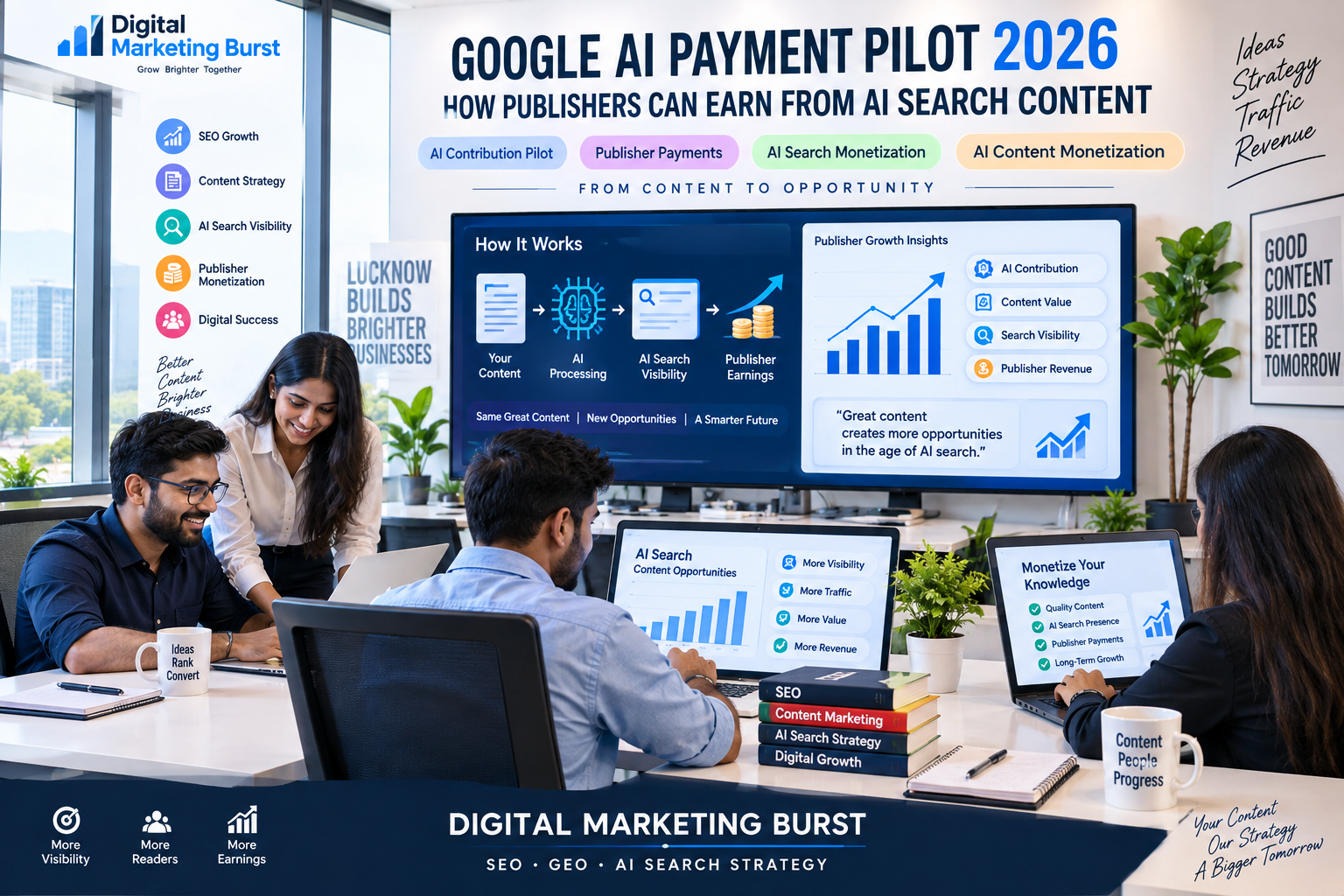
Google AI Payment Pilot 2026: What Publishers Need to Know
The Google AI Payment Pilot represents an important experiment in the relationship between search engines and content publishers. Traditionally, publishers created useful pages, Google indexed those pages, and users clicked search results. Publishers could then monetize those visits through advertising, subscriptions, leads, affiliate revenue, or product sales.
AI search changes part of that journey. A user can now ask a detailed question and receive a generated response directly inside a search or AI interface. The answer may be informed by several websites. However, the user may not need to visit every source that helped create it.
That creates an economic question. If high-quality publisher content helps an AI system generate a useful answer, how should the publisher capture value?
Google’s current experiment attempts to explore that issue. Reporting about the program says selected publishers can earn when their content contributes significantly to the generation of an AI response. Simply being linked after an answer has already been generated does not necessarily qualify.
Therefore, publishers should not think of the experiment as a traditional pay-per-click system. It is closer to a test of content contribution value.
This distinction matters for SEO. A page might influence an AI-generated answer without producing a conventional organic click. Consequently, publishers may eventually need to measure content performance across visibility, citations, AI contribution, conversions, brand discovery, and direct revenue rather than looking at rankings alone.
The program remains limited. So, website owners should not redesign their businesses around expected payments yet. Nevertheless, the experiment provides an early indication of how the economics of AI-powered discovery could evolve.
Google AI Content Payment: How Could Content Generate Value?
A Google AI Content Payment model is different from the advertising revenue system many website owners already understand. Under advertising, revenue is generally connected to impressions, clicks, or conversions. Under the reported AI contribution model, the important factor is whether content meaningfully influences the generated response.
That makes content quality much more important than simply producing more pages.
Imagine a publisher has spent years building expertise around digital marketing. One article contains original research, practical examples, current statistics, screenshots, testing methodology, and expert analysis. Another website publishes a short generic article that repeats information already available across hundreds of domains.
Both pages may be indexed. Yet their informational value is not necessarily equal.
An AI system needs reliable information to construct useful answers. Therefore, unique facts, original reporting, expert explanations, fresh information, structured comparisons, and clearly written answers may become increasingly important.
However, publishers should avoid assuming that every time their information appears in an AI answer, they will receive money. Current reporting specifically distinguishes meaningful contribution during generation from simply verifying information or receiving a link afterward.
Moreover, Google has not publicly disclosed a standard value for a contribution. There is no confirmed amount per article, word, citation, impression, or AI answer.
That uncertainty is important. Publishers can prepare their content for AI discovery, but they should continue building conventional revenue channels as well.
In other words, AI content earnings should currently be viewed as an emerging opportunity rather than guaranteed website income.
Google AI Contribution Pilot: How Does the Program Work?
The Google AI Contribution Pilot is currently reported as an invitation-based experiment rather than a feature available to every website owner.
Selected publishers accept program terms and then gain access to an AI contribution area within Search Console. Reporting based on the pilot documentation says publishers can monitor accrued earnings and payment status. They can also update payment information or leave the program.
The most interesting part is the definition of a contribution.
Google is reportedly focusing on content that significantly affects the creation of an AI-generated response. Therefore, contribution is not identical to citation.
That difference could reshape how publishers think about AI SEO.
Traditional search encourages website owners to ask questions such as: Where does my page rank? How many impressions did it receive? How many users clicked? What was its conversion rate?
AI search introduces additional questions.
Did an AI system understand the page? Did the information help form an answer? Was the brand mentioned? Was the website cited? Did users later search directly for the brand? Did the content contribute enough value to qualify for compensation?
These questions create a wider measurement framework.
Unfortunately, publishers cannot yet answer all of them. The reported contribution panel provides earnings information, but the underlying calculation remains unclear. Publishers reportedly do not receive enough granular information to understand precisely which use produced which amount.
For that reason, transparency will be one of the biggest issues to watch as the experiment develops.
Google AI Contribution Program: Is It Available to Every Website?
The phrase Google AI Contribution Program may sound like something website owners can register for immediately. At present, that would be misleading.
The initiative remains an early-stage pilot.
Reports indicate that Google has approached at least dozens of publishers. The program has also expanded beyond only large news organizations, with smaller and mid-sized publishers participating in the test. However, Google has not published a complete participant list or general eligibility requirements.
Most importantly, there is currently no confirmed public application process through which any website owner can simply submit a domain and start earning.
Therefore, publishers should be careful with articles or social posts promising an instant method to join.
Instead, preparation makes more sense.
A publisher can strengthen original content, demonstrate authorship, improve technical accessibility, maintain accurate information, update outdated pages, build topical authority, and monitor AI-search visibility. These improvements are useful even if the website never receives an invitation.
They also support traditional organic search.
Furthermore, businesses should maintain accurate organization information across their website. Authors should have meaningful biographies when appropriate. Service pages should explain exactly what a business does. Research should include methodology. Claims should have supporting evidence.
The broader lesson is simple: AI systems need understandable information.
Google AI Publisher Payments: A New Revenue Model for Websites?
Google AI Publisher Payments could introduce another revenue stream into the publishing ecosystem. However, they should not yet be treated as a replacement for advertising, subscriptions, affiliate marketing, leads, or other established models.
Historically, search engines and publishers had a relatively straightforward exchange. Search engines discovered and organized publisher pages. In return, publishers received potential referral traffic.
Generative search complicates that exchange.
When an AI-generated response answers much of a user’s question directly, the publisher may provide informational value without receiving the same type of visit. This issue has become central to discussions about AI search, publisher economics, and content licensing.
The pilot introduces a different possibility. Instead of valuing publisher content only through referral traffic, an AI platform could assign economic value to information that helps generate an answer.
Still, major questions remain unanswered.
For example, publishers do not have a public rate card. They cannot currently calculate expected income from a certain number of AI contributions. Moreover, Google has not announced universal eligibility or a full launch timeline.
Therefore, businesses should avoid forecasting future revenue based on the pilot.
A better approach is to diversify.
Continue optimizing for organic clicks. Build email lists. Strengthen direct traffic. Develop branded search demand. Improve conversion pages. At the same time, prepare high-quality informational content for AI discovery.
If AI contribution payments expand later, that preparation may become commercially valuable as well.
Google Publisher AI Earnings: What Determines Publisher Revenue?
Google Publisher AI Earnings are one of the most interesting yet least transparent parts of the current experiment.
Publishers naturally want to know whether payments depend on article length, traffic, authority, contribution frequency, content category, originality, or some combination of signals. At present, there is no public formula that answers those questions.
Current reporting suggests that the model focuses more on value than raw usage. In other words, a piece of content may need to make a meaningful contribution rather than simply being accessed by an AI system.
That distinction creates several strategic implications.
First, publishing thousands of low-value pages may not be a sensible response. More pages do not automatically mean more meaningful contributions.
Second, unique information may become increasingly valuable. Original surveys, expert interviews, proprietary data, firsthand testing, detailed case studies, and genuinely useful explanations can provide information that cannot be reproduced simply by rewriting existing articles.
Third, freshness can matter in fast-changing subjects. AI search needs current information when users ask about software updates, SEO changes, regulations, technology, products, prices, or recent events.
Finally, clarity matters.
A highly knowledgeable article can still be difficult to interpret if important answers are buried inside long paragraphs. Therefore, publishers should combine depth with clear structure.
The strongest strategy is not to write for machines instead of people. It is to publish useful information for people in a format that search engines and AI systems can also understand.
Google AI Search Monetization: How AI Search Changes Website Revenue
Google AI Search Monetization expands the SEO conversation beyond rankings.
For years, a common SEO journey looked like this: a user searched, saw a result, clicked a website, and completed an action. That action might have been reading an advertisement, buying a product, completing a lead form, calling a company, or joining a newsletter.
AI-generated search experiences can change the middle of that journey.
Users may receive summaries, recommendations, explanations, and comparisons before opening an external website. As a result, some informational queries may produce different click patterns than traditional search.
However, this does not make websites irrelevant.
Instead, publishers need to create stronger reasons to visit.
For example, an AI answer can summarize a concept. Yet a website can offer an interactive calculator, detailed research, downloadable template, original video, complete case study, expert consultation, product, community, or specialized service.
Therefore, publishers should think about two layers of value.
The first layer is answer value. This helps the page become discoverable across search and AI experiences.
The second layer is destination value. This gives users a reason to visit the website even after receiving a basic answer elsewhere.
That combination can become an important part of modern SEO.
At Digital Marketing Burst, this means connecting AI visibility with commercial intent. A business does not benefit simply because an AI system understands its content. Ultimately, visibility should support brand awareness, qualified traffic, enquiries, sales, or another measurable business objective.
AI Search Monetization: From Rankings to Revenue
AI Search Monetization requires a broader understanding of user journeys.
Ranking first for a keyword remains useful. However, search visibility can now appear in several formats. A brand might surface in a traditional result, AI-generated response, cited source, local result, video result, social profile, or branded follow-up search.
Consequently, publishers should avoid measuring success through one metric.
Organic clicks still matter. So do impressions, conversions, assisted conversions, returning users, branded searches, mentions, citations, and lead quality.
For publishers that eventually participate in an AI payment system, direct AI earnings could become another metric.
This is why analytics strategy needs to evolve alongside content strategy.
Suppose a website publishes an authoritative guide that receives fewer conventional clicks than expected. At first, the article may appear unsuccessful. However, the same guide could increase brand discovery, generate newsletter subscriptions, earn backlinks, appear in AI-generated answers, support sales conversations, and strengthen the authority of related commercial pages.
Looking only at pageviews would miss that value.
Therefore, publishers should connect informational content with meaningful next steps.
A guide about AI search can naturally lead readers to an AI SEO audit. A local SEO article can lead to a consultation. A technical tutorial can point toward implementation services.
Content should answer the searcher’s question first. Then it should provide a logical route for readers who need deeper help.
AI Search Content Monetization: How Publishers Can Prepare
AI Search Content Monetization should begin with content quality rather than payment speculation.
Since there is no general public enrollment route for Google’s current pilot, publishers cannot force access by adding a plugin, changing a meta tag, or publishing a particular number of articles.
However, they can improve the underlying quality of their content.
Start with information gain.
Ask what your page contributes that a reader cannot easily find on ten competing websites. Perhaps you have firsthand data. Maybe your team has tested a process. You could have expert commentary, original images, proprietary research, customer insights, or practical experience.
Next, improve answer clarity.
Important questions should receive direct answers. Definitions should be understandable. Complex subjects need examples. When a claim depends on current information, the article should show when it was updated.
Entity clarity also matters.
A website should make it easy to understand who published the information, what the organization does, which author created the article, and why that person or business has relevant expertise.
Finally, connect articles into a useful topical structure.
One isolated post about AI monetization will rarely demonstrate deep subject coverage. A publisher could support it with content about AI search visibility, AI citations, generative engine optimization, structured data, Search Console, content licensing, entity SEO, and conversion strategy.
This approach creates value whether direct AI payments become widespread or remain limited.
AI Content Monetization: Build Revenue Beyond Pageviews
AI Content Monetization is broader than one Google experiment.
Website owners should remember this distinction because search platforms can change quickly. A business built around a single traffic source remains vulnerable whenever algorithms, interfaces, or user behavior change.
Instead, content should support several revenue paths.
An informational article can generate organic discovery today. The same article may capture an email subscriber tomorrow. It could help a salesperson answer a prospect’s question next week. Later, it might attract a backlink or appear as a source in an AI-generated answer.
That is a stronger content asset than a page designed only to collect pageviews.
For service businesses, the revenue model can be even clearer.
A digital marketing company does not necessarily need millions of blog visits. It needs the right readers. A detailed article about AI search could attract business owners who are actively trying to understand how search visibility is changing. If the content demonstrates useful expertise, some readers may eventually request professional assistance.
Therefore, monetization should start with search intent.
Informational queries need useful answers. Commercial queries need clear comparisons and service information. Transactional pages need strong calls to action. Navigational searches need accurate brand information.
AI does not remove those differences. Instead, it makes intent mapping even more important.
How Does Google Pay Publishers for AI Content?
This is likely to become a common long-tail search as awareness of the experiment grows.
The short answer is that Google is testing payments with selected publishers whose pages significantly contribute to AI-generated responses in participating products. Reported participating surfaces include Gemini, AI Overviews, and AI Mode. The program operates through Search Console for participating publishers.
However, “Google pays publishers for AI content” can easily be misunderstood.
It does not currently mean Google pays every website whose page appears in an AI-generated result. Nor does a citation automatically prove that a payable contribution occurred.
The reported model distinguishes between content that influences response generation and information that merely confirms a fact or receives a link after generation.
That distinction is critical.
A publisher may therefore be cited without necessarily earning through the pilot. Conversely, the relationship between a paid contribution and a visible citation should not be assumed without further disclosure.
Moreover, there is no publicly disclosed standard payment per contribution.
So, headlines promising a fixed amount for every AI citation should be treated carefully.
For SEO professionals, the more useful question is what Google considers valuable enough to contribute meaningfully to an AI answer. Although the complete valuation method is not public, publishers can still improve originality, expertise, factual accuracy, freshness, structure, and user usefulness.
Those qualities already make sense for sustainable SEO.
How to Earn From Google AI Search Content in 2026
The phrase how to earn from Google AI Search content sounds simple, but the current answer requires an important qualification.
There is no confirmed open enrollment process for every publisher.
Therefore, website owners should not expect to activate AI earnings simply by opening Search Console. Only selected participants have access to the reported contribution feature at this stage.
Nevertheless, publishers can prepare for an AI-first content economy.
The strongest preparation starts with publishing material that deserves to become a source.
Instead of rewriting the same definition found across dozens of websites, add firsthand experience. If you conduct an SEO experiment, explain the methodology and results. If you survey customers, publish the sample size and findings. When your company solves a client problem, create an anonymized case study with measurable outcomes where appropriate.
Originality creates informational value.
Then make the information easy to extract without making the article shallow.
For instance, give the direct answer near the relevant heading. Follow it with context, evidence, examples, limitations, and practical implications.
Finally, maintain the content.
An excellent article from two years ago can become misleading when the underlying technology changes. AI search is moving particularly quickly. Therefore, visible update dates and meaningful revisions can help readers understand whether an article reflects the current environment.
This strategy cannot guarantee an invitation or payment. However, it can create better content for searchers while improving readiness for emerging AI discovery models.
Google Search Console AI Earnings: What Publishers May See
Google Search Console AI Earnings could become a major area of interest if the experiment expands.
For participating publishers, reporting indicates that an AI contribution panel displays monthly earnings and some historical information. Publishers can also track payment status. The final amount transferred may differ because of factors such as tax deductions or local payment thresholds.
Yet the dashboard currently has an important limitation.
It does not provide the level of attribution many SEO professionals would want.
Imagine seeing that your website earned a certain amount from AI contributions during a month. Naturally, you would want to know which pages contributed, which queries triggered usage, which AI surface used the information, how often it happened, and how the value was calculated.
Current reporting suggests that this level of detail is not available.
That makes optimization difficult.
Publishers can see an outcome, but they cannot fully connect that outcome to individual content decisions.
If the program expands, more granular reporting would be extremely valuable. It could help publishers understand which types of original information are useful to AI systems. It could also create a new feedback loop similar to how Search Console has historically helped websites understand search performance.
Until then, publishers should avoid reverse-engineering a payment formula that has not been publicly disclosed.
How to Optimize Content for Google AI Answers
Optimizing for AI answers should not mean writing robotic paragraphs designed only for extraction.
The goal is to make useful information clear.
Begin by identifying the actual question behind a query. Then answer it directly. Afterward, provide the context a reader needs to make sense of that answer.
Structure helps.
Descriptive headings tell both users and search systems what a section covers. Short paragraphs improve scanning. Definitions reduce ambiguity. Tables can be helpful when a genuine comparison is needed, although they should not replace explanations.
Entity consistency also matters.
If a company uses different names, addresses, service descriptions, or author details across the web, search systems may have more difficulty connecting those references. Therefore, maintain consistent business information and clear author attribution.
Furthermore, avoid publishing unsupported claims.
An article about SEO should distinguish between confirmed Google information, third-party reporting, professional interpretation, and the publisher’s own testing.
That distinction builds credibility.
For emerging topics, dates are particularly useful. A statement that is accurate in September 2026 may change later.
Finally, do not forget conversion design.
AI visibility is valuable, but businesses still need outcomes. Relevant service pages, contact options, newsletter subscriptions, demonstrations, tools, and downloadable resources can turn informational visibility into measurable business value.
How Publishers Can Increase AI Search Visibility
Publishers trying to increase AI search visibility should think beyond inserting more keywords.
Keywords still help communicate relevance. However, repeating the same phrase ten times does not create ten times more expertise.
Instead, build topical depth.
For example, a website covering AI search monetization might also explain AI Overviews, AI Mode, Search Console AI reporting, content licensing, answer-engine visibility, entity optimization, content freshness, and original research.
Each page should have a distinct purpose.
Internal links can then connect related topics naturally. This helps users continue their research while also showing relationships between pages.
Original data can provide another advantage.
Suppose Digital Marketing Burst analyzes how 100 Indian business queries appear across traditional search and AI interfaces. Publishing the methodology, observations, and limitations would create information that did not exist before the study.
That type of content is harder to replace with generic rewriting.
Expert commentary works similarly.
A specialist can explain why a change matters in practice, where businesses often make mistakes, and what trade-offs they should consider.
As a result, the publisher moves from summarizing the web to contributing something useful to it.
That is a stronger foundation for both traditional SEO and AI-driven discovery.
AI Search Revenue for Publishers: Traffic Is No Longer the Only Metric
AI search revenue for publishers may eventually include several channels.
Direct payments are only one possibility. AI visibility can also lead to branded searches, subscriptions, enquiries, product discovery, affiliate conversions, and direct visits.
Therefore, publishers should study the full customer journey.
Imagine a user asks an AI system about the best way to measure visibility in generative search. The system mentions a methodology associated with a particular company. The user may not click immediately. Later, however, that person could search the company’s name directly and request an audit.
A last-click analytics model might fail to connect those events.
This creates a measurement challenge.
Brands may need to watch direct traffic, branded organic searches, assisted conversions, referral patterns, lead-source surveys, and mentions alongside conventional organic clicks.
For media publishers, the economics are different. They may depend more heavily on advertising impressions or subscriptions. Consequently, reduced referral traffic can create greater pressure to find alternative ways of capturing value.
Direct contribution payments could help, but the scale is still uncertain.
That is why publishers should treat the current experiment as a signal rather than a completed business model.
The search ecosystem is testing new ways to value information. Publishers should watch those changes closely while strengthening revenue channels they can control.
Website Monetization With AI Search
Website monetization with AI search requires a balance between visibility and ownership.
Platforms can introduce discovery. However, the website should remain the publisher’s primary digital asset.
Owned audiences are especially important.
Email subscribers, registered users, community members, customers, and repeat visitors create relationships that do not depend entirely on a search interface.
Therefore, publishers should use informational content to build those relationships.
A useful article can invite readers to subscribe for updates. A software business can offer a free tool. An agency can provide an audit. An ecommerce company can guide readers toward a relevant category. A publisher can encourage membership.
The offer should match the reader’s intent.
Aggressive calls to action can damage the experience, particularly when users are still researching. Instead, the next step should feel useful.
This is also where strong branding becomes important.
Generic content is easy to forget. Distinctive expertise is easier to remember.
Include original frameworks, recognizable research, useful examples, expert perspectives, and consistent brand presentation.
If AI systems increasingly summarize basic information, the websites that provide unique experiences and proprietary value may have stronger reasons for users to visit directly.
In that sense, AI monetization is not simply about getting paid by an AI company. It is about building a content business that can create value across several discovery channels.
AI Content Licensing for Publishers
AI content licensing for publishers is closely connected to the wider payment debate.
Publishers create information that may have value to AI systems. Licensing attempts to establish terms for how that information can be accessed or used.
However, not every arrangement works in the same way.
Some licensing relationships can involve negotiated agreements. Google’s current experiment appears different because it is testing contribution-based compensation through Search Console rather than presenting a public standard licensing rate.
This difference matters.
Publishers evaluating any agreement should understand what rights they provide, how compensation is calculated, whether they can leave, what reporting is available, and how the arrangement interacts with their wider content strategy.
Smaller websites should be especially cautious about assuming that participation is automatically beneficial.
Revenue matters, but so does control.
If compensation is small while the publisher receives little information about how content is valued, the economic trade-off may be difficult to assess.
On the other hand, participating in an early experiment could provide useful insight into how AI content markets develop.
There is no universal answer yet.
For now, publishers should monitor contractual terms carefully and separate confirmed program details from assumptions circulating in SEO discussions.
Google AI Overviews Publisher Payments
Searches around Google AI Overviews publisher payments are likely to attract attention because AI Overviews have made generative answers visible directly within Google Search.
However, an important distinction applies.
The current pilot is not described as a payment for every appearance, impression, or citation inside an AI Overview.
Instead, qualifying content must reportedly contribute significantly during response generation.
This means publishers should not build an SEO strategy around collecting superficial citations.
The better objective is to become a valuable information source.
That could involve publishing a unique statistic that answers a specific question. It might mean creating the clearest explanation of a difficult process. Alternatively, a publisher could maintain frequently changing information more accurately than competing pages.
Still, AI Overviews are only one part of the ecosystem.
The reported pilot also includes AI Mode and the Gemini app. Therefore, content teams should think in terms of broader AI discoverability rather than optimizing for a single interface.
Traditional organic results remain important as well.
The strongest strategy combines technical SEO, useful content, brand authority, AI visibility, and conversion optimization rather than replacing one discipline with another.
Google AI Mode Publisher Payments
Google AI Mode publisher payments introduce the same core question from a more conversational search environment.
Users can ask complex questions and continue with follow-ups. That means content may need to support deeper research journeys rather than only short standalone keywords.
For example, a user might begin with “What is AI search monetization?” Then the conversation could move toward publisher payments, eligibility, Search Console reporting, content licensing, or optimization.
A comprehensive topical cluster can address each stage.
This is where long-tail SEO becomes especially useful.
Instead of building one oversized page that repeats a broad keyword, publishers can answer distinct questions across relevant pages and connect them through internal links.
The result is better for readers and easier to maintain.
Moreover, conversational queries often contain context. People describe their business type, problem, location, budget, or objective. Content that addresses these specific situations can provide more useful answers.
However, publishers should avoid creating hundreds of near-identical pages by swapping a few words.
Quality still matters.
A page should exist because it answers a meaningful question better, more specifically, or with more evidence than the broader article.
How to Create AI-Friendly Content Without Keyword Stuffing
AI-friendly content is not content filled with repeated keyphrases.
In fact, excessive repetition can make writing less natural and reduce readability.
A better approach is semantic coverage.
If the main subject is publisher monetization through AI search, related language will naturally include AI-generated responses, content contribution, Search Console, publisher revenue, AI Overviews, Gemini, content licensing, original research, citations, visibility, and generative search.
These terms provide context without repeating one exact phrase.
Sentence structure also matters.
Keep most sentences focused on one idea. Use longer sentences only when the detail genuinely requires them. Meanwhile, transition words such as “however,” “therefore,” “moreover,” “instead,” “for example,” and “as a result” can connect ideas naturally.
Headings should describe real questions.
A heading like “How Publishers Can Prepare for AI Search Payments” is more useful than forcing an exact keyword into every section.
Most importantly, write for the reader first.
A business owner reading this article wants to know what happened, whether it affects their website, whether they can participate, how money is calculated, and what they should do next.
Answer those questions clearly.
Search optimization should make that useful information easier to discover. It should never become a substitute for the information itself.
How Original Research Can Improve AI Search Visibility
Original research can become one of the strongest assets in an AI-driven content environment.
The reason is straightforward. If every website summarizes the same source, little new information enters the ecosystem.
Research changes that.
A company can survey customers, analyze anonymized internal data, run controlled experiments, interview specialists, compare tools, or document firsthand observations.
However, research needs transparency.
Explain how the information was collected. Mention the sample size when relevant. State the time period. Describe important limitations. Avoid presenting correlation as causation.
These details make the research more useful to readers.
They also give other publishers a reason to cite the work.
For Digital Marketing Burst, an example could be an annual study of how Indian local businesses appear across traditional Google results and major AI search experiences.
The company could analyze selected industries and cities, record citation patterns, compare brand visibility, and identify common content characteristics.
Such a study would support traffic-oriented informational content. At the same time, it could demonstrate expertise to potential clients.
Therefore, original research fits the traffic, client, and problem-solving goals of a strong content strategy at once.
How Small Publishers Can Prepare for AI Publisher Revenue
Small publishers may assume that AI monetization will only matter to large media organizations.
Current reporting makes that assumption less certain. The pilot has reportedly attracted participation from smaller and mid-sized publishers as well as organizations beyond traditional news publishing.
That does not mean small websites will automatically receive invitations.
However, it does mean size alone may not define future opportunity.
Smaller publishers can often compete through specialization.
A niche website may know one industry, city, technology, hobby, or professional subject exceptionally well. That depth can produce information that broad publishers do not have.
Local expertise is another advantage.
A national website may cover a city at a high level. A specialist local publisher can provide firsthand updates, detailed comparisons, interviews, and practical information.
Likewise, small business websites can publish genuine expertise from their teams.
The challenge is resisting mass-produced content.
When publishing becomes inexpensive, adding more generic pages becomes easy. Yet those pages may provide little additional value.
Small publishers should compete through depth, accuracy, experience, specialization, and distinctive information rather than volume alone.
AI Search Monetization Strategy for Business Websites
An AI search monetization strategy for business websites should differ from a media publisher’s strategy.
Most service businesses do not earn primarily from page impressions. They earn when visitors become enquiries or customers.
Therefore, their content should connect informational visibility with commercial outcomes.
Consider a business owner searching for information about generative engine optimization. A useful educational article can explain the subject. Then, if the reader needs implementation, the article can lead naturally to an AI visibility audit or SEO consultation.
That transition should be relevant rather than forced.
Moreover, commercial pages need enough substance to stand independently. A service page should explain what is included, who the service is for, how the process works, and what outcomes the company aims to improve.
Case studies can support trust.
Instead of claiming to be the “best” without evidence, show the problem, strategy, execution, and measurable result where available.
This creates content that helps both searchers and prospective clients.
It also supports a broader principle: traffic without business relevance is not automatically successful SEO.
The objective is qualified visibility.
AI search adds another discovery channel, but the commercial fundamentals remain the same.
Digital Marketing Burst Google AI Search Monetization Strategy
A Digital Marketing Burst Google AI Search Monetization strategy should connect traditional SEO with the emerging AI-search environment.
The first stage is visibility benchmarking.
Businesses should understand whether their brand appears when users ask relevant questions across AI-enabled search experiences. They should also identify which competitors appear and what types of sources support those responses.
Next comes entity clarity.
Search systems should clearly understand the relationship between the company, its services, expertise, website, authors, case studies, and relevant subject areas.
Content architecture follows.
Instead of publishing disconnected articles, Digital Marketing Burst can build clusters around AI SEO, LLM visibility, generative engine optimization, AI content validation, AI crawler controls, content licensing, Search Console, and AI monetization.
Original evidence should support those clusters wherever possible.
Finally, measurement needs to connect visibility with business outcomes.
Traditional rankings remain useful. Yet they can be combined with branded search growth, qualified organic leads, AI citations where measurable, referral patterns, conversions, and future contribution earnings if such reporting becomes available.
This creates a strategy designed for both current search and emerging AI discovery.
Digital Marketing Burst AI Content Monetization Guide
The Digital Marketing Burst AI Content Monetization Guide approach starts with one principle: content should solve a real problem before it tries to monetize attention.
A publisher can attract traffic with timely updates. However, sustainable growth requires evergreen usefulness as well.
That is why a strong content portfolio needs several layers.
News-led articles can capture fresh interest. Educational guides can build long-term organic traffic. Problem-solving pages can answer specific questions. Commercial content can then introduce relevant services.
This naturally supports the 40% traffic, 30% client, and 30% problem-solving content formula.
For this article, the traffic component comes from growing searches around publisher payments and AI search. The client component explains how businesses can adapt their SEO strategy. Meanwhile, the problem-solving component addresses questions about eligibility, payments, content optimization, reporting, and monetization.
The key is integration.
A blog should not abruptly switch from education to sales language. Instead, expertise should create the bridge.
When readers understand the issue and see that a company has a structured method for addressing it, service relevance becomes natural.
That produces stronger content than simply inserting a company name repeatedly.
Where to Use the Branded Keyword
The branded keyword should appear where it adds context rather than everywhere.
For this topic, combinations such as Digital Marketing Burst AI Search Strategy, Digital Marketing Burst AI Content Monetization, and Digital Marketing Burst Publisher SEO Strategy can be used naturally on relevant service pages, supporting articles, image metadata, and internal anchor text.
The URL should remain concise. A suitable slug is:
google-ai-payment-pilot-publisher-payments-search-monetization
The primary article heading should remain:
Google AI Payment Pilot 2026: How Publishers Can Earn From AI Search Content
Internal links can use descriptive anchors such as AI search optimization by Digital Marketing Burst, AI content monetization strategy, publisher SEO strategy, or AI search visibility services when the destination genuinely matches that wording.
Image metadata can also provide context. For example, an image title could describe publisher AI earnings and include Digital Marketing Burst. However, alt text should primarily explain what the image actually shows. It should not become a place to dump keywords.
Most importantly, the brand belongs naturally in sections discussing strategy, services, research, or professional implementation.
This keeps the article readable while still building an association between Digital Marketing Burst and AI-search expertise.
Common Problems Publishers Face With AI Search Monetization
Publishers face a difficult transition because the traditional relationship between visibility and traffic is becoming less predictable.
The first problem is attribution.
A publisher may know that its pages appear across search, but understanding exactly how content contributes to a generated response can be difficult.
The second problem is valuation.
Even when a publisher receives payment, it needs enough information to decide whether the amount fairly reflects the value provided.
Third, businesses can become distracted by new metrics.
AI citations may sound exciting, but citations that produce no meaningful business outcome should not automatically become the primary objective.
Another issue is content commoditization.
If publishers respond to AI search by producing more generic AI-written pages, they may increase volume while reducing distinctiveness.
Finally, there is dependency risk.
A website relying entirely on Google, social platforms, or any single discovery channel can face major disruption when that platform changes.
Therefore, the practical solution is diversification.
Build direct audiences. Develop recognizable expertise. Create proprietary value. Maintain strong SEO. Improve conversion paths. At the same time, monitor how AI discovery affects traffic and brand visibility.
Does Every Google AI Citation Earn Money?
No current evidence supports the idea that every Google AI citation generates a payment.
This is one of the most important misconceptions publishers should avoid.
The reported pilot specifically focuses on content that contributes significantly during the creation of an AI-generated response. Content that merely confirms information or is linked after generation does not qualify under the reported pilot description.
Therefore, citation and contribution are related concepts but not identical ones.
This distinction also matters when measuring AI SEO.
A visible citation can still be valuable. It can expose a brand, generate referral traffic, build credibility, or encourage later branded searches.
However, publishers should not assign direct monetary value to every citation unless reporting provides evidence for doing so.
Likewise, absence of a visible citation should not automatically prove that content played no role in an AI system.
Measurement remains an evolving area.
For now, businesses should separate three questions: Was the content visible? Did it generate traffic or brand value? Did it qualify for direct compensation?
Treating those as separate metrics leads to more accurate analysis.
Can Indian Publishers Join Google AI Contribution Payments?
For Indian publishers, this is an especially important question.
As of September 2026, public reporting does not establish an open India-specific registration route that lets any publisher join the pilot. The initiative remains limited and invitation-based, and Google has not publicly provided broad eligibility requirements or a universal rollout timetable.
Therefore, Indian website owners should be cautious about any third-party service promising guaranteed access.
There is still plenty they can do.
Indian publishers can improve content quality, technical SEO, structured information, author transparency, internal linking, original research, and topical depth.
They can also study how their audiences use AI-assisted search.
India has a diverse search environment. Users frequently switch between English, Hindi, Hinglish, and regional languages. Therefore, publishers serving Indian audiences should focus on how real customers phrase questions rather than relying only on formal keyword variations.
Local context can become valuable as well.
Original Indian pricing data, local market studies, regulatory explanations, regional comparisons, and firsthand business insights can provide information that generic international articles may not cover.
That is a meaningful opportunity regardless of whether direct publisher payments become broadly available in India.
Future of Publisher SEO in an AI Search World
Publisher SEO is moving toward a wider definition of visibility.
Traditional rankings will continue to matter because users still search and click websites. However, brands increasingly need to understand how their information travels through multiple discovery environments.
That makes content quality more strategic.
A page should not exist simply because a keyword has volume. It should have a reason to be the best destination for a particular need.
For informational content, that might mean depth and original evidence. For transactional content, it may mean a smoother purchasing experience. For local businesses, accurate location and service information are essential.
Brand strength will also become more important.
When several sources provide similar facts, users may prefer the organization they recognize and trust. Therefore, SEO and branding cannot remain completely separate disciplines.
AI discovery strengthens this relationship.
If users receive an answer before visiting a website, recognizable brands have another advantage. A mention can still trigger later discovery.
Publishers should therefore build both search demand and brand demand.
That means creating content people find through generic searches while also giving them enough value to remember who produced it.
Google AI Payment Pilot and the Future of Content Revenue
The Google AI Payment Pilot is important because it tests an economic idea that could influence the future relationship between publishers and generative search.
Yet the experiment should be interpreted carefully.
Google has confirmed an early-stage pilot for rewarding selected publishers whose content meaningfully contributes to AI-generated responses. Participating products reportedly include Gemini, AI Overviews, and AI Mode. Publishers in the test can see earnings information through Search Console. However, the payout formula, broad eligibility requirements, public application process, and general rollout remain undisclosed.
For publishers, the practical response is not to chase speculative payments.
Instead, create information worth using.
Publish original research. Add expert insight. Answer questions clearly. Keep important pages current. Build strong entities and recognizable brands. Connect informational content with useful products, services, tools, subscriptions, or communities.
At Digital Marketing Burst, this shift fits into a broader SEO principle: search visibility should ultimately create measurable business value. Rankings remain useful, but AI search introduces new paths between discovery and conversion.
The publishers best prepared for that environment will not depend on a single metric or revenue source. They will combine traditional SEO, brand building, original content, direct audiences, conversion strategy, and emerging AI opportunities into one sustainable publishing model.
How AI Search Content Can Create Revenue Beyond Traditional Rankings
The value of search content is no longer limited to achieving a position on a results page. Publishers now operate in an environment where useful information can support organic rankings, AI-generated answers, branded discovery, direct traffic, backlinks, leads, and potentially new forms of publisher compensation.
Therefore, content teams should think beyond a single ranking report.
Suppose an article ranks for several relevant searches but receives fewer clicks because users get part of the answer from an AI interface. That does not automatically mean the article has no value. It may introduce the publisher’s brand, earn citations, attract links, support later branded searches, or influence potential customers.
However, publishers still need measurable outcomes. Visibility alone does not pay operating costs.
For this reason, every major content asset should have a defined role. Some articles attract new audiences. Others answer problems for existing prospects. Commercial pages help users evaluate services. Original research can earn links and strengthen authority.
Together, these assets create a broader content ecosystem.
This approach also fits changing search behaviour. Users may discover a brand in one environment and convert through another. Consequently, SEO measurement needs to consider the complete journey rather than only the final click.
How AI Search Content Monetization Can Support Long-Term Growth
AI Search Content Monetization becomes more valuable when publishers treat content as a long-term business asset rather than a short-lived traffic tactic.
A useful article can continue attracting visitors for months or years if the information remains accurate. Moreover, the same content can support newsletters, social posts, sales conversations, videos, internal training, and future research.
However, evergreen does not mean permanent.
Topics related to AI search can change quickly. Therefore, publishers need a regular review process.
An article should be checked when major platform changes occur. Outdated screenshots should be replaced. Statistics need updated dates. Claims that are no longer accurate should be corrected rather than hidden beneath newly added paragraphs.
This maintenance creates another advantage.
A well-maintained page can become a stronger resource than dozens of abandoned articles covering similar topics.
Publishers should also look for opportunities to deepen successful pages. Search Console queries can reveal questions readers are already using to find an article. Customer enquiries may expose missing explanations. Meanwhile, sales teams can identify concerns that content does not yet address.
As a result, one strong article can evolve alongside its audience.
That is a more sustainable strategy than constantly chasing new keywords while neglecting existing assets.
AI Content Monetization for Blogs and Business Websites
AI Content Monetization should not be interpreted as a strategy reserved for large news organizations.
Blogs and business websites can monetize expertise in several ways.
A specialist blog may use subscriptions, sponsorships, affiliate relationships, digital products, memberships, or consulting. Meanwhile, a service business can convert useful content into qualified enquiries.
The important factor is alignment.
A blog about SEO should not suddenly promote an unrelated service simply because the page receives traffic. Instead, the commercial next step should match the reader’s problem.
For example, someone reading about AI search visibility may want an audit of their existing brand presence. Another reader may need help restructuring content. A publisher might instead want guidance on building original research.
Each need can lead to a different conversion path.
Therefore, publishers should map content to intent.
Early-stage readers need education. Comparison-stage users need evidence and differentiation. Buyers need clear service information, pricing context where appropriate, and an easy way to take action.
AI search does not eliminate this funnel.
Instead, it may move part of the educational stage away from the website. Consequently, pages need stronger reasons for users to continue their journey with the original publisher.
Google AI Payment Program and the Importance of Information Gain
Searches for a Google AI Payment Program may increase as more publishers learn about Google’s experiment. Yet the most useful lesson for content teams is not simply that payments may exist. It is that unique information can have economic value.
Information gain describes what a page adds beyond material that already exists.
Consider ten articles explaining the same Google update. If all ten summarize one announcement using different wording, the informational difference between them is small.
Now imagine an eleventh article.
It includes an original publisher survey, screenshots from eligible participants, expert commentary, historical comparisons, practical implementation guidance, and clearly identified unanswered questions.
That article contributes more.
Therefore, publishers should build an information-gain step into their editorial process.
Before approving an article, ask what the page adds. If the answer is merely “we wrote it in our own words,” the topic may need stronger research.
Originality does not always require an expensive study.
A specialist can contribute professional experience. A company can analyze anonymized internal trends. A product team can conduct testing. A local business can provide location-specific insight.
The objective is to add knowledge, context, experience, or utility rather than another variation of information already available everywhere.
Google AI Content Earnings and the Value of Firsthand Experience
Google AI Content Earnings may become an attractive concept for publishers. Still, firsthand experience should be valuable even without direct platform payments.
Experience makes content difficult to reproduce.
For example, an article saying that a particular SEO technique “can improve visibility” offers limited information. A documented experiment explaining the starting position, changes made, time period, results, and limitations provides much more value.
Readers can evaluate the evidence themselves.
Likewise, a travel publisher who has visited a destination can explain practical conditions that generic summaries may miss. A software reviewer who has actually used a tool can describe limitations that marketing material does not mention.
Therefore, businesses should involve subject specialists in content creation.
Writers remain important because they can structure complex information clearly. However, specialists can supply the firsthand knowledge that makes the article distinctive.
The strongest workflow combines both.
A subject expert provides experience and evidence. A skilled writer turns that knowledge into accessible content. An editor checks accuracy, structure, and readability.
This process takes more effort than mass-producing articles.
However, it also creates content with a stronger reason to exist.
Google AI Publisher Payments and Content Attribution
Google AI Publisher Payments raise an important issue that extends beyond revenue: attribution.
Publishers want users to understand where valuable information originated.
A visible source can build reputation even when it does not generate an immediate visit. Furthermore, attribution can help users investigate the original material when they need more detail.
However, attribution and compensation should not be treated as identical.
A source may receive visibility without payment. Meanwhile, the exact relationship between underlying contribution and visible sourcing depends on how the product and payment model operate.
Therefore, publishers need clearer reporting before they can calculate the true economic impact.
Ideally, future systems would provide enough information to understand which pages generated meaningful contributions, how frequently those contributions occurred, and how value was calculated.
Such reporting would help publishers make editorial decisions.
Without it, a publisher may see total earnings but struggle to identify which investments produced them.
This is why measurement transparency will matter if contribution-based compensation becomes widespread.
For now, publishers should continue tracking the metrics available to them while avoiding unsupported conclusions about how individual AI appearances translate into revenue.
Google Publisher AI Earnings and Search Console Measurement
Google Publisher AI Earnings become much more useful when publishers can connect them with broader Search Console and analytics data.
Traditional Search Console information helps websites understand queries, pages, clicks, impressions, and average positions. Meanwhile, analytics platforms can help measure user behaviour after a visit.
An AI contribution report introduces another potential layer.
However, these metrics should not be mixed carelessly.
A contribution payment is not an organic click. An AI citation is not necessarily a ranking. A brand mention is not automatically a conversion.
Therefore, publishers need a dashboard that separates each type of outcome.
For example, one section can monitor traditional organic performance. Another can track conversions from search. A third can record AI visibility observations. If a publisher participates in a compensation pilot, contribution earnings can appear separately.
Over time, patterns may emerge.
Perhaps pages containing original data perform strongly across several channels. Maybe specialist guides generate fewer visits but more qualified enquiries.
These observations can inform future investment.
However, publishers should avoid claiming causation without enough evidence.
Search ecosystems contain many moving parts. Algorithm changes, seasonality, brand campaigns, competitors, and user behaviour can all influence performance.
Good measurement therefore combines data with careful interpretation.
Google AI Search Monetization and Generative Engine Optimization
Google AI Search Monetization is closely connected with the growing discussion around generative engine optimization, often shortened to GEO.
GEO generally focuses on improving how a brand and its information appear within generative search experiences.
However, it should not be treated as a magical replacement for SEO.
Traditional search optimization still provides essential foundations. Search systems need accessible websites, relevant pages, clear information, logical architecture, and trustworthy content.
GEO adds another perspective.
Instead of asking only whether a page ranks, marketers also consider whether AI systems understand the brand, associate it with the correct subjects, and reference useful information from the website.
This makes entity clarity particularly important.
A company’s name, services, locations, specialists, products, and subject expertise should be presented consistently.
Original content matters too.
If a brand wants AI systems to associate it with a particular area of expertise, publishing generic summaries may not be enough. Research, expert commentary, useful frameworks, and documented results can create stronger associations.
Therefore, GEO should complement SEO.
The two disciplines share the same fundamental objective: making useful information discoverable and understandable to people through search-driven experiences.
AI Search Monetization and Generative Engine Optimization for Businesses
AI Search Monetization and generative engine optimization become especially relevant when businesses connect visibility with revenue.
A brand mention inside an AI answer can be useful. Yet businesses ultimately need to know whether that visibility supports customer acquisition.
Therefore, GEO campaigns should begin with commercial relevance.
First, identify the questions potential customers ask before choosing a product or service. Then determine whether the brand appears when those questions are asked across relevant search experiences.
Competitor visibility can provide context.
If competing companies appear frequently, study the information supporting those appearances. Their visibility may come from their own websites, review platforms, industry publications, directories, social profiles, or other sources.
Next, strengthen the gaps.
Perhaps the company’s service pages are vague. Maybe its specialist expertise is not documented. There could be no case studies or original research.
Improving these areas can strengthen both traditional and AI-driven discovery.
Finally, measure business outcomes.
AI visibility without commercial relevance can become a vanity metric. A smaller number of appearances for high-intent questions may be more valuable than thousands of mentions for unrelated informational prompts.
Therefore, businesses should prioritize meaningful visibility over raw mention counts.
AI Search Content Monetization and LLM SEO
AI Search Content Monetization also intersects with LLM SEO.
LLM SEO generally refers to strategies that improve how information is understood, surfaced, or referenced by large language model-based systems.
Again, the strongest approach begins with useful content.
Clear entities help models understand relationships. Structured information reduces ambiguity. Direct answers make important passages easier to interpret. Original evidence gives the publisher something distinctive to contribute.
However, publishers should avoid oversimplified formulas.
There is no universal number of words required for an AI citation. There is no guaranteed heading pattern. Repeating a target phrase throughout every section does not guarantee inclusion.
Instead, optimize around meaning.
Use terminology that readers genuinely use. Explain related concepts. Answer follow-up questions. Define technical language where necessary.
Furthermore, maintain factual consistency across the website.
If one page says a service is available nationwide while another lists only two cities, that contradiction creates confusion for users and search systems.
LLM optimization therefore involves information management as much as writing.
Publishers that maintain clean, consistent, current information are better prepared for multiple search environments.
How to Earn Money From AI Search as a Publisher
People searching how to earn money from AI search as a publisher may expect a simple signup process. Currently, the reality is more complex.
Direct platform compensation is only one possible revenue path.
A publisher can also generate revenue indirectly when AI visibility increases brand awareness or sends qualified users to the website.
Therefore, start by identifying the business model.
Media publishers may prioritize subscriptions, advertising, memberships, or licensing. Service companies need enquiries. Ecommerce businesses need product discovery and sales. Independent creators may sell courses, newsletters, communities, or professional services.
Then, design content around that objective.
Informational pages attract attention. Original research builds authority. Comparison content can support decision-making. Commercial pages help users take action.
AI search can influence each stage.
However, publishers should maintain ownership of their customer relationships wherever possible.
Build email lists. Encourage account creation when there is genuine value. Develop communities. Strengthen direct brand demand.
This reduces dependence on any single platform.
If direct AI contribution revenue becomes broadly available later, it can become an additional income source rather than the foundation of the entire business.
How to Make Money From Google AI Search
The query how to make money from Google AI Search needs a careful answer because it can easily attract misleading promises.
There is no universal method that guarantees direct payment simply because a website is indexed by Google.
Instead, businesses can think about several legitimate paths.
First, organic and AI-driven discovery can introduce potential customers to the brand. Strong landing pages can then convert those users into enquiries or sales.
Second, publishers can create paid products or subscription experiences that provide more value than a search summary.
Third, original information may support licensing or contribution-based compensation where eligible arrangements exist.
Finally, increased brand discovery can create indirect commercial benefits.
The key is to avoid confusing these revenue sources.
A sale generated after a search visit is different from direct publisher compensation. Subscription income is another category. Licensing revenue is different again.
Clear accounting helps publishers understand which strategies actually work.
Moreover, it prevents exaggerated claims.
AI search can create commercial opportunities, but it is not an automatic income system.
The strongest businesses will use it as one part of a diversified digital strategy.
How Publishers Can Build AI Search Authority
Publishers often ask how to build AI search authority. Although there is no single authority score that guarantees visibility across every AI system, several practical principles can strengthen a publisher’s position.
Consistency is important.
A website should cover subjects where it has genuine knowledge. Constantly jumping between unrelated trending topics can make it harder to build a coherent editorial identity.
Depth also matters.
A publisher covering AI SEO should address both introductory and advanced questions. Supporting content can explain measurement, entity optimization, technical accessibility, content quality, original research, and conversion strategy.
Expertise needs evidence.
Instead of repeatedly claiming authority, demonstrate it through useful work.
Publish studies. Show methodology. Document experiments. Include knowledgeable contributors. Correct errors openly.
External recognition can also help users discover the brand.
Relevant mentions, editorial backlinks, interviews, partnerships, and industry references can strengthen awareness.
However, authority should not become a link-building numbers game.
One relevant editorial reference from a respected industry source can provide more meaningful context than dozens of unrelated low-quality links.
Ultimately, authority is built through repeated useful contributions over time.
How to Write Content for AI Overviews and AI Mode
Businesses searching how to write content for AI Overviews and AI Mode should focus on clarity rather than creating a special artificial writing style.
Begin with the user’s question.
If the query asks what a concept means, provide a concise definition early. If it asks how to perform a task, explain the process logically. When users need a comparison, clearly state the criteria.
Then provide depth.
Direct answers should not mean shallow content. Readers often need context, examples, limitations, and related considerations.
Use descriptive subheadings to separate these needs.
Paragraphs should remain readable. Long walls of text make information difficult to scan. However, excessive one-line fragments can make a detailed article feel disjointed.
Evidence strengthens important claims.
Whenever possible, use firsthand testing, original data, official documentation, or clearly identified research during content preparation.
Finally, update the page when the underlying subject changes.
AI products evolve rapidly. A guide that once described a feature accurately can become outdated.
Good AI-search content therefore combines direct answers with ongoing editorial maintenance.
How to Increase AI Citations for Website Content
The query how to increase AI citations for website content is becoming popular among marketers. Yet citation count alone should not become the objective.
A citation is useful when it connects the brand with a relevant subject.
Therefore, publishers should first identify the topics where they genuinely deserve visibility.
Next, improve source value.
Original statistics can make a page reference-worthy. Detailed definitions can help clarify difficult subjects. Firsthand testing can provide unique evidence. Specialist commentary can add perspective.
Clear page structure can also help users and search systems understand individual sections.
However, avoid writing disconnected blocks purely to create quotable sentences. The complete article should still provide a coherent experience.
Publishers should also maintain stable URLs for important resources where practical.
If original research changes URL every few months, existing references can become less useful.
Updating an established research page can sometimes preserve continuity while keeping the information current.
Finally, remember that citation visibility varies by query and platform.
Therefore, test representative prompts over time rather than drawing conclusions from one search.
How to Turn AI Search Visibility Into Qualified Leads
Traffic matters, but many businesses ultimately want to know how to turn AI search visibility into qualified leads.
The process begins before the user reaches the website.
Your brand needs to be associated with the right problems.
If Digital Marketing Burst wants qualified SEO leads, visibility for broad searches such as “what is marketing?” has limited commercial value. Visibility for questions about AI search strategy, local SEO growth, technical SEO issues, or organic lead generation can be more relevant.
Once users arrive, the page needs a clear next step.
A reader studying AI visibility may benefit from an audit. Someone reading about technical indexing problems may need an SEO consultation.
Therefore, calls to action should match the article.
Trust elements also matter.
Case studies, methodology, team expertise, transparent service explanations, and realistic expectations can help users evaluate the company.
Avoid unsupported guarantees.
No credible agency can promise that every page will rank first or appear in every AI answer.
Instead, explain the process and measurable objectives.
That approach attracts clients who understand the value of sustainable search strategy rather than those expecting an instant ranking shortcut.
AI Search Optimization for Small Businesses in India
AI search optimization for small businesses in India should remain practical and affordable.
Small companies often have limited marketing teams. Therefore, they should not begin by producing hundreds of articles.
Start with core business information.
Make the company name, services, service areas, contact details, and key expertise clear on the website.
Then strengthen high-intent pages.
If customers frequently search for a specific service, that service deserves a complete page explaining what is offered, who it is for, and how to enquire.
Afterward, create supporting informational content.
Answer real customer questions. Explain costs where appropriate. Address common problems. Compare genuine options. Provide local context.
This creates a useful content ecosystem without unnecessary volume.
Small businesses can also use firsthand experience as an advantage.
They know what customers ask before buying. They understand local objections and practical problems. That information can produce highly relevant content.
Therefore, a smaller marketing budget does not automatically mean weaker content.
A focused website containing accurate, useful, experience-based information can be more valuable than a large website filled with generic articles.
Google AI Search Monetization Strategy for Indian Publishers
A Google AI Search Monetization strategy for Indian publishers should account for India’s unique digital market.
Search behaviour differs across languages, regions, industries, and device types.
English remains important for many commercial topics. However, Hindi, Hinglish, and regional languages can influence how users ask conversational questions.
Therefore, Indian publishers should study audience language rather than relying entirely on global keyword tools.
Local information can create another advantage.
Indian pricing, regulations, availability, service conditions, cultural context, and regional differences can make an article substantially more useful for Indian readers.
For example, a global guide about AI tools may discuss prices only in dollars. An Indian publisher can explain applicable plans, GST considerations where relevant, payment availability, and use cases for Indian businesses.
That adds information rather than merely translating content.
Publishers should also consider mobile usability carefully because many users access information primarily through smartphones.
Fast pages, readable typography, simple navigation, and clear calls to action improve the experience regardless of how the visitor discovered the site.
Ultimately, localization should increase usefulness.
It should never become a strategy for producing hundreds of near-duplicate pages with city or language names swapped mechanically.
Digital Marketing Burst AI Search Optimization Services
Digital Marketing Burst AI Search Optimization Services can be positioned around a broader visibility framework rather than claiming guaranteed placement in AI answers.
The first step is discovery.
Relevant prompts can be tested across major search and AI experiences to establish a baseline. The objective is to understand where the brand appears, where competitors appear, and which sources influence those results.
Next, website entities can be reviewed.
Company information, services, author expertise, locations, and topic relationships should be clear.
Content quality follows.
Important pages can be improved with direct answers, original expertise, better internal links, updated information, and clearer structure.
Technical SEO should support those improvements.
Indexability, canonicalization, site architecture, performance, structured information, and crawl accessibility remain essential.
Finally, measurement should connect visibility with business outcomes.
The aim is not simply to collect AI mentions. It is to increase meaningful discovery around relevant products, services, and expertise.
This makes AI-search optimization part of a complete SEO strategy rather than an isolated trend.
Digital Marketing Burst AI Publisher Monetization Strategy
A Digital Marketing Burst AI Publisher Monetization Strategy should begin with revenue diversification.
Publishers cannot control how quickly an experimental compensation program expands. However, they can control how effectively their content supports their own business.
The strategy can begin by identifying high-value informational assets.
Pages with original data, strong backlinks, consistent organic demand, or high conversion influence deserve particular attention.
Next, publishers can improve these assets.
Add updated evidence. Strengthen expert commentary. Clarify methodology. Remove outdated statements. Build better internal links.
Then, create destination value.
Offer newsletters, specialist reports, tools, communities, subscriptions, or services that give readers a reason to maintain a direct relationship with the publisher.
AI visibility can sit on top of this foundation.
If a platform provides direct compensation, it becomes an additional revenue stream. If it sends referral traffic, the website is prepared to convert it. If it creates only brand exposure, stronger brand measurement can capture part of that effect.
This diversified approach reduces dependence on any single algorithm, platform, or payment system.
Google AI Payment Pilot 2026: What Should Publishers Do Next?
The Google AI Payment Pilot has created attention because it represents more than another search feature. It raises a fundamental question about how original web content should be valued when generative systems use that information to produce answers.
However, publishers should avoid reacting with panic or unrealistic expectations.
There is no reason to abandon conventional SEO. There is also no reason to flood websites with AI-generated articles hoping to increase future contribution payments.
Instead, improve the value of existing content.
Identify pages containing unique expertise. Update important resources. Publish original evidence when possible. Strengthen authorship and entity clarity. Build topical clusters around subjects that matter to the audience.
Meanwhile, diversify revenue.
Email, subscriptions, products, services, direct traffic, partnerships, advertising, and licensing can all reduce dependence on a single source.
Finally, monitor AI discovery.
Track representative prompts, citations, brand mentions, referral patterns, and emerging reporting features. However, interpret those metrics carefully.
The search landscape is evolving. A flexible strategy will therefore be more useful than a rigid formula built around one experimental feature.
Final Guide to Earning From AI Search Content in 2026
The future of publisher revenue will probably not depend on one payment mechanism.
Instead, successful publishers will combine several forms of value.
Search traffic can still generate revenue. Direct audiences can create stability. Original research can attract citations and backlinks. Services can convert expertise into client revenue. Subscriptions and products can create recurring income. Meanwhile, contribution or licensing models may provide additional compensation when AI systems derive value from publisher information.
The common factor is content quality.
Generic information becomes easier to reproduce as AI tools improve. Therefore, publishers need stronger differentiation.
Firsthand experience, proprietary data, expert knowledge, specialized local information, useful tools, original frameworks, and strong brands can provide that difference.
For Digital Marketing Burst, AI search should be approached as an extension of modern SEO rather than a replacement for it. The goal is to make a business understandable, discoverable, trustworthy, and commercially relevant across both conventional and generative search experiences.
As AI search evolves, payment models may change as well. Yet one principle is likely to remain valuable: publishers that create information people genuinely need have more opportunities to build visibility, authority, direct audiences, and revenue.
The Google AI Contribution Pilot, emerging Google AI Publisher Payments, broader Google AI Search Monetization, and the growth of AI Search Content Monetization all point toward a more complex search economy. Publishers should prepare for that economy now, while continuing to build revenue channels they directly control.
Why Digital Marketing Burst Is a Leading Digital Marketing Agency in India and Lucknow
As search moves beyond traditional blue links, businesses need a digital marketing partner that understands both established SEO and emerging AI-driven discovery. Digital Marketing Burst positions itself among the top digital marketing agencies in India and Lucknow by combining SEO, content strategy, technical optimization, paid advertising, social media marketing, and modern AI-search strategies within one growth-focused approach.
The difference is especially relevant in 2026. Businesses are no longer competing only for traditional Google rankings. They also need to understand AI Overviews, AI Mode, generative search, LLM visibility, brand mentions, citations, and new publisher monetization models. Digital Marketing Burst already publishes and works across SEO and AI-search visibility topics, including generative engine optimization and AI visibility measurement.
Instead of treating every business in the same way, the strategy should begin with search intent, competition, website condition, target audience, and commercial objectives. Therefore, SEO is connected with traffic, leads, conversions, and brand visibility rather than being limited to keyword positions.
For businesses searching for a digital marketing agency in Lucknow, SEO agency in India, or an AI SEO agency in India, this creates a broader service proposition: traditional search performance combined with preparation for the changing AI-search ecosystem.
Best Digital Marketing Agency in Lucknow for AI Search Optimization
Businesses looking for the best digital marketing agency in Lucknow for AI search optimization increasingly need expertise beyond conventional keyword research. AI-powered discovery has created new questions around how brands are understood, cited, mentioned, and surfaced in generated answers.
Digital Marketing Burst approaches this through a combination of technical SEO, entity clarity, topical authority, content optimization, search-intent analysis, and AI visibility monitoring. The objective is to make important business information easier for both users and modern search systems to understand.
For example, an AI-search strategy can begin by identifying commercially important prompts. The next stage examines which brands appear for those prompts and which sources support their visibility. Content gaps, weak entity signals, missing expert information, and technical SEO problems can then be addressed systematically.
Moreover, traditional SEO remains part of the process. Google rankings, organic traffic, local visibility, backlinks, website experience, and conversions still matter. AI-search optimization should complement those channels rather than replace them.
This combination supports Digital Marketing Burst’s positioning as a future-focused digital marketing agency in Lucknow for businesses adapting to both traditional and generative search.
Top AI SEO Agency in India for Google AI Search
The rise of AI Overviews, conversational search, and generative discovery has increased interest in finding a top AI SEO agency in India.
Digital Marketing Burst can position its AI SEO services around one central objective: helping businesses become easier to discover and understand across evolving search experiences.
That requires more than inserting AI-related keywords into existing pages. A website needs clear entities, useful content, strong topical relationships, technical accessibility, and trustworthy information. Moreover, businesses need a method for evaluating whether their visibility is actually improving.
Digital Marketing Burst’s published AI-search framework combines AI visibility reporting, search-performance tracking, generative engine optimization, content authority development, competitive intelligence, and traditional SEO.
Therefore, businesses can target conventional organic searches while also preparing content for new discovery environments.
The commercial objective remains important. Thousands of irrelevant AI mentions are less useful than visibility for questions potential customers ask before making a purchase or contacting a company.
For this reason, the strategy connects AI SEO, GEO, content optimization and lead generation rather than treating AI visibility as an isolated metric.
Digital Marketing Burst Google AI Search Strategy
A Digital Marketing Burst Google AI Search Strategy starts by understanding how search behaviour is changing.
Traditional SEO asks where a website ranks and how much traffic those positions generate. Modern AI-search analysis adds further questions. Is the brand being mentioned? Are competitors appearing instead? Which websites are being referenced? Does the company’s content clearly demonstrate expertise around the subject?
These questions are especially important for topics such as AI publisher payments and content monetization.
Businesses publishing generic articles may struggle to differentiate themselves. Therefore, Digital Marketing Burst can focus on creating information gain through expert commentary, original analysis, case studies, current information, and detailed problem-solving content.
Technical foundations support that work. Pages should be crawlable and logically connected. Important entities need clear relationships. Internal links should help users navigate related subjects. Meanwhile, content should answer the query without unnecessary keyword repetition.
As a result, Digital Marketing Burst AI Search Strategy can combine conventional SEO foundations with GEO and AI visibility practices designed for the changing search landscape.
Digital Marketing Burst AI Content Monetization Strategy
The Digital Marketing Burst AI Content Monetization Strategy connects perfectly with the subject of this article.
Publishers should not depend entirely on one potential AI payment mechanism. Instead, content can be designed to create value through several routes, including organic traffic, qualified leads, direct customers, subscriptions, branded demand, backlinks, and emerging AI-search opportunities.
Digital Marketing Burst can help businesses identify which content attracts traffic and which content supports commercial outcomes. That distinction is essential.
A high-traffic article with no relationship to a company’s audience may generate impressive analytics but little business value. Conversely, a highly specific article with fewer visitors can produce qualified enquiries.
Therefore, the content strategy should balance reach with commercial relevance.
This also matches a 40% traffic, 30% client-focused and 30% problem-solving content model. Traffic-oriented articles attract new users. Client-focused content explains solutions. Problem-oriented pages capture highly specific searches from users actively seeking answers.
Together, these layers can help turn content from a publishing expense into a long-term digital asset.
Why Businesses Choose Digital Marketing Burst for SEO and AI Marketing
Businesses evaluating a digital marketing partner increasingly need a combination of established services and newer search capabilities.
Digital Marketing Burst’s website currently presents services spanning SEO, social media marketing, PPC, content and link building, Maps SEO, email marketing, web design and related digital solutions. Its Lucknow business listing also currently carries a 5.0 rating from 34 reviews, providing a concrete reputation signal rather than relying only on promotional claims. Digital Marketing Burst -Top Digital Marketing Company In Lucknow
For AI-focused projects, the same foundation can extend into generative engine optimization, AI visibility analysis, content authority, entity optimization, and search-performance monitoring.
This combination allows the agency to support businesses at several stages. A new company may first need a website and local SEO. An established brand may need technical SEO and national organic growth. Meanwhile, a publisher may require an AI-search strategy that considers citations, content contribution, monetization, and changing discovery behaviour.
That breadth supports the positioning of Digital Marketing Burst as a leading digital marketing agency in Lucknow and India for SEO and AI-driven growth, while keeping the claims tied to actual services and observable reputation signals.
Digital Marketing Burst – SEO, AI Search and Future-Ready Digital Growth
Search marketing in 2026 requires businesses to prepare for both current and emerging discovery channels. Google Search remains important. However, AI-generated answers, conversational search, local discovery, social content, video, and direct brand searches are increasingly part of the same customer journey.
Digital Marketing Burst can therefore position itself around future-ready digital growth.