





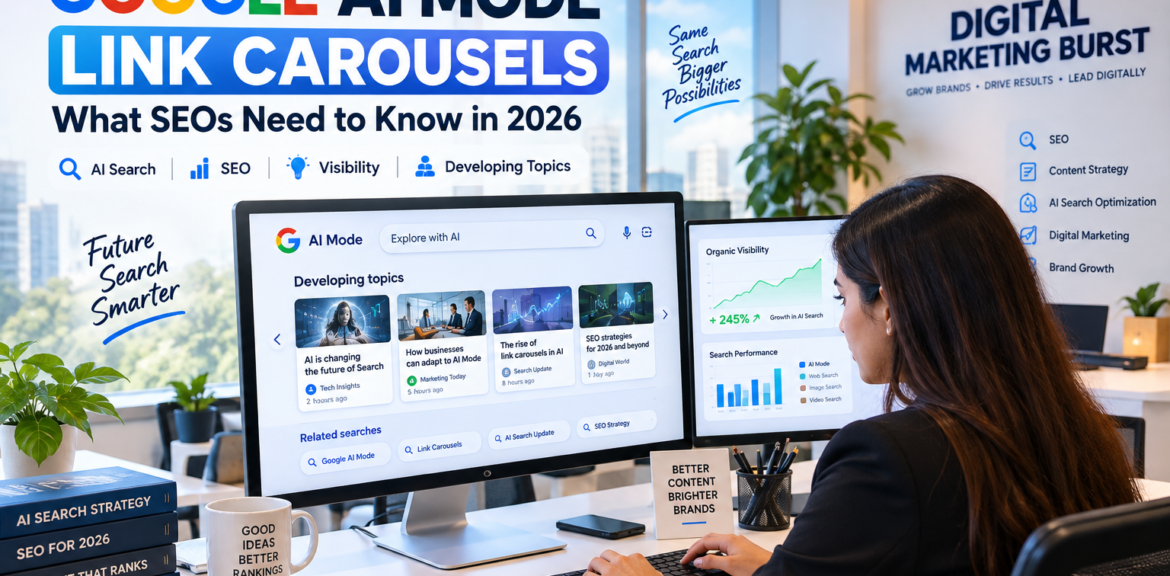

Google AI Mode Link Carousels: What SEOs Need to Know in 2026
Google AI Mode Link Carousels are changing how websites can gain visibility inside AI-powered search. Google AI Mode SEO now requires marketers to think beyond traditional blue links, while the Google AI Search Update creates new opportunities for publishers and brands. Google AI Mode Carousels and Google AI Link Carousels can surface useful sources directly within AI-generated results, making content quality, freshness, relevance, and clear topical authority increasingly important.
For SEO professionals, this development deserves attention because AI search changes how users discover information. A website may compete for traditional rankings while also trying to become a useful source within AI experiences. However, appearing in these experiences is not guaranteed. Google has not published a simple optimization formula that ensures inclusion.
For Digital Marketing Burst, the practical lesson is clear. Businesses should not abandon conventional SEO. Instead, they should strengthen it while adapting content for AI-driven discovery. Strong pages still need useful information, crawlable content, descriptive headings, trustworthy context, and a good user experience.
This guide explains how developing-topic carousels work, what they could mean for organic visibility, and how SEOs can prepare their content strategy in 2026.
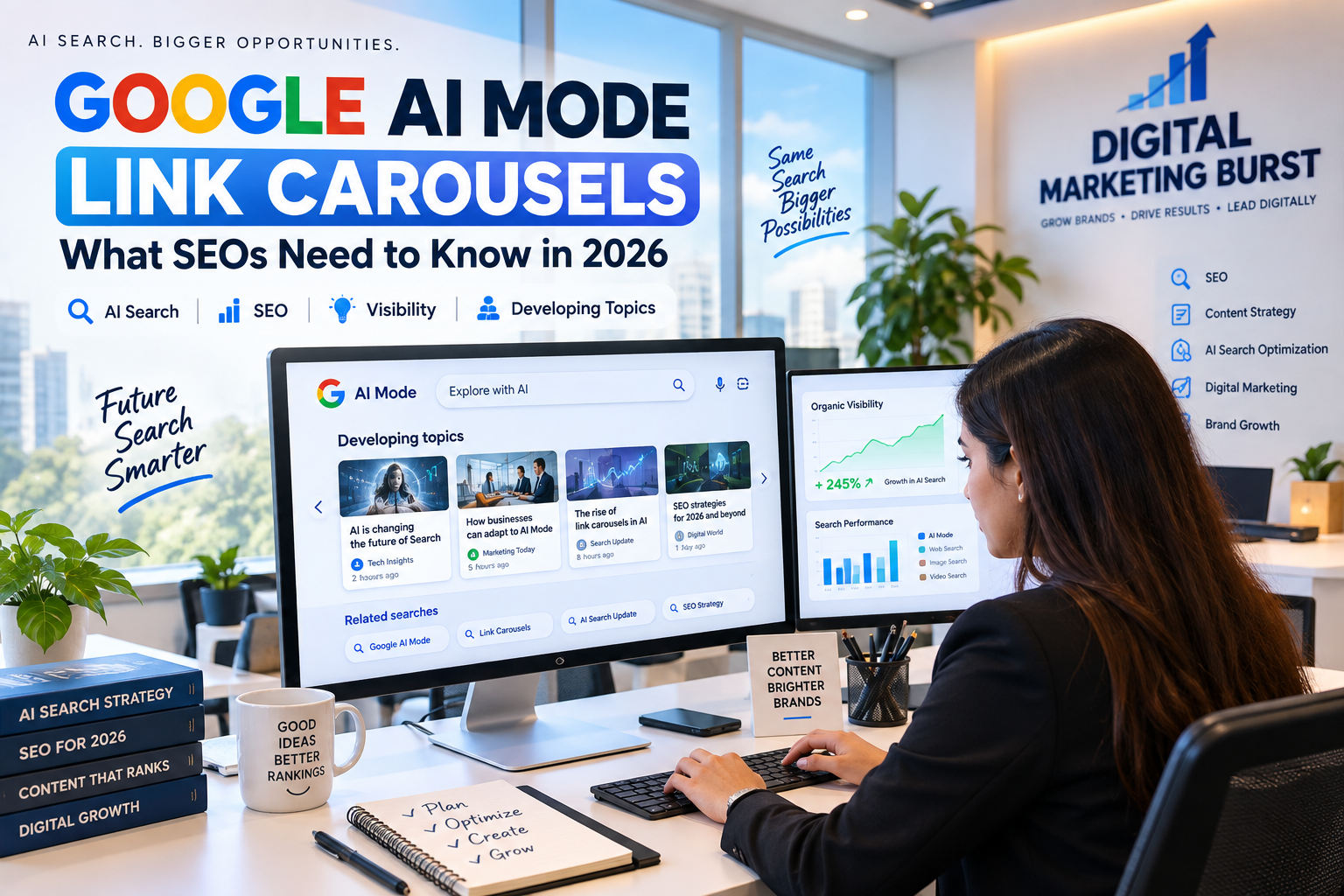
Google AI Mode Link Carousel Explained for SEOs
A Google AI Mode Link Carousel gives users a visual way to discover supporting web pages while exploring certain developing topics in AI Mode. Rather than displaying every source as a conventional vertical result, Google can present a horizontal collection of relevant articles.
That difference matters.
Traditional search encourages users to scan individual results. AI Mode can answer a question first and then provide opportunities to explore supporting sources. Therefore, publishers need to think about whether their content contributes something valuable enough to deserve further exploration.
Developing topics make this especially interesting. Information can change quickly during product launches, technology announcements, industry developments, major events, and breaking stories. In these situations, users often need more than one perspective.
Fresh reporting can therefore become valuable. However, freshness alone does not make a page useful. A newly published article that merely repeats existing information may offer little additional value.
Instead, publishers should combine speed with substance. Clear explanations, original observations, useful context, accurate updates, and strong topical relevance can make an article more helpful.
SEO teams should also avoid treating the carousel as a replacement for organic rankings. It represents another discovery surface within a much broader search ecosystem.
Google AI Mode SEO and the Changing Search Experience
Google AI Mode SEO should begin with understanding user intent rather than chasing a new technical trick.
AI-powered search allows people to ask longer and more detailed questions. They can also continue with follow-up questions instead of beginning a completely new search. Consequently, one search journey can contain several connected information needs.
That behaviour changes content planning.
A traditional article might target one primary query and several close variations. In contrast, an AI-search-friendly resource can benefit from covering the natural questions that appear before and after the main query.
For example, someone researching a new Google feature may first ask what changed. Next, the person might want to know how it works. Later, they may ask whether the feature affects rankings, traffic, publishers, or Search Console reporting.
A well-structured article can address this complete journey.
Still, SEO fundamentals remain important. Search engines need to discover, crawl, understand, and evaluate a page before it can become useful across search experiences.
Therefore, technical SEO, internal linking, page quality, and content relevance still deserve attention. AI search adds another layer to SEO rather than eliminating the foundations that already matter.
Google AI Mode SEO Strategy for 2026
A strong Google AI Mode SEO Strategy should combine traditional search optimization with content designed for complex user journeys.
Start by identifying the real problem behind a query. Then answer it clearly near the beginning of the relevant section. After that, provide enough supporting detail to satisfy users who want a deeper explanation.
This structure works because AI-search users often move between quick answers and detailed research.
Content teams should also build strong topic clusters. A single article cannot realistically answer every question about AI search. Instead, a central guide can connect to supporting pages about AI Overviews, AI Mode, structured data, Search Console, content quality, technical SEO, and search visibility.
Internal linking then becomes more valuable.
It helps users continue researching while also showing the relationship between related pages.
However, businesses should avoid publishing dozens of thin articles simply to create a cluster. Each supporting page needs a clear purpose.
At Digital Marketing Burst, an AI-search content strategy can focus on useful topic depth rather than keyword repetition. The goal should be to create resources that people can understand quickly and continue reading when they need more detail.
That approach supports both traditional SEO and emerging AI discovery.
Google AI Search Update and What Changed for Publishers
The Google AI Search Update around developing-topic carousels matters because publishers have another possible route to visibility within AI-driven search.
For years, publishers primarily focused on conventional organic listings, featured snippets, Discover, Top Stories, and other search features. AI experiences now introduce additional ways for sources to appear during a user’s research journey.
However, publishers should keep expectations realistic.
There is no public switch that makes a website appear in a developing-topic carousel. Likewise, there is no guaranteed schema markup that automatically earns placement.
Instead, publishers should concentrate on factors they can control.
Pages need accurate information. Headlines should explain what the article covers. Publication and update practices should remain transparent. Important information should appear in crawlable page content rather than being hidden behind complicated interactions.
Topic relevance also matters.
A website that consistently publishes useful information within a specific field may build stronger topical context than one that suddenly publishes an unrelated trending story.
Therefore, chasing every developing topic can become counterproductive. Publishers should choose stories that naturally fit their audience and expertise.
Latest Google AI Search Update and Developing Topics
The Latest Google AI Search Update shows how quickly Google’s AI search experience continues to evolve in 2026.
Developing topics create a unique search challenge because the available information can change within hours. A useful answer in the morning may require additional context by the evening.
Google therefore needs ways to connect users with timely web content.
For publishers, this creates an important distinction between evergreen SEO and developing-topic SEO.
Evergreen pages often gain value through depth, stability, and long-term usefulness. Developing-topic content depends more heavily on timing, current context, and meaningful updates.
Neither approach should replace the other.
A strong website can use evergreen resources to build long-term organic visibility while publishing timely articles when major developments affect its audience.
For example, a digital marketing website can maintain detailed guides about AI search optimization. When Google introduces a significant search feature, the same website can publish a focused update explaining what changed and link it back to the evergreen guide.
This creates a connected information ecosystem instead of isolated news posts.
Google AI Mode Carousels and Developing-Topic Visibility
Google AI Mode Carousels can make source discovery more visual within certain AI Mode searches.
A carousel may allow users to compare several relevant articles without leaving the broader AI search experience immediately. That means publishers can compete for attention through relevance and presentation, not only through a conventional ranking position.
Still, SEOs should not assume that carousel visibility follows a simple position-one-to-position-ten model.
AI search can use different systems and interfaces to organize information. The exact source-selection process is not publicly reduced to a checklist.
Therefore, optimization should focus on creating a strong candidate page.
A strong page explains its topic clearly. It stays current when the subject changes. It uses accurate titles and headings. Moreover, it provides information that genuinely helps the reader understand the development.
Publishers should also pay attention to visual quality. A clean, relevant featured image can improve how content appears when search interfaces use visual cards.
However, image optimization should support the article rather than compensate for weak content.
The page itself remains the main asset.
Google AI Mode Carousel Optimization for Publishers
Google AI Mode Carousel optimization should not become a collection of speculative hacks.
Google has not provided a guaranteed recipe for earning these placements. Therefore, publishers should be careful when anyone claims that one markup change or keyword formula can force inclusion.
A safer strategy starts with accessibility.
Make important content easy for search systems to crawl. Avoid placing essential information only inside images or scripts that make extraction unnecessarily difficult.
Next, improve article structure.
Use descriptive headings that match genuine reader questions. Keep paragraphs readable. Add context where a short answer could create confusion.
Timeliness also deserves attention for developing topics.
If a story changes materially, update the article rather than leaving outdated claims in place. When appropriate, make the nature of the update clear to readers.
Furthermore, avoid artificial freshness. Changing a publication date without adding meaningful new information does not improve the underlying value of the article.
Publishers should also maintain accurate metadata, useful images, and logical internal links.
Together, these practices create better pages for users while strengthening the signals search systems can interpret.
Google AI Link Carousels and Organic Website Traffic
Google AI Link Carousels create an interesting traffic question: will AI search send more users to websites or answer enough information that fewer people need to click?
The answer will probably differ by query.
Simple informational searches may sometimes end within the AI experience. However, complex topics can create additional curiosity. Users may want original reporting, detailed analysis, examples, opinions, product information, or deeper explanations.
That is where publishers can compete.
Instead of creating pages that merely restate basic facts, websites should give users a reason to continue.
Original data can help. So can expert analysis, practical examples, detailed comparisons, tools, templates, case studies, and clear explanations.
The click becomes more valuable when the destination offers something beyond the summary.
Businesses should therefore stop measuring content quality only by whether a page answers a keyword. They should also ask whether the page provides enough unique value to deserve a visit.
This principle is useful regardless of how AI search develops.
Google AI Search Link Carousel and Source Discovery
A Google AI Search Link Carousel changes source discovery by placing web content within the user’s AI-assisted research flow.
That positioning can create new competition.
A publisher may no longer compete only against the pages surrounding it in traditional results. It may also compete for attention among sources selected within AI interfaces.
Consequently, brand recognition can become useful.
When users repeatedly see a familiar and trustworthy publisher, they may become more likely to select that source when several options appear.
This does not mean companies should stuff brand names into every heading.
Instead, brands need consistent expertise.
Publish useful resources. Maintain clear authorship where appropriate. Keep factual claims accurate. Correct outdated information. Build a recognizable visual and editorial identity.
Over time, these practices can make a website more memorable to readers.
For Digital Marketing Burst, this means AI SEO should connect search visibility with broader brand-building. Ranking is valuable, but being recognized as a useful source can create benefits beyond a single keyword position.
Developing Topic Link Carousels in Google AI Search
Developing Topic Link Carousels are particularly relevant for queries where information continues to evolve.
Think about a major algorithm announcement.
During the first few hours, people may search for basic details. Later, they may want expert reactions, examples, rollout information, affected industries, and practical recommendations.
The search intent develops alongside the story.
Publishers covering these topics should therefore update their content intelligently.
An initial article can explain the announcement. Later updates can add confirmed details, clarify misunderstandings, and answer new questions that emerge.
However, avoid turning one article into an endless collection of unrelated updates.
If a new development deserves a separate resource, publish a dedicated article and connect the two through internal links.
This structure makes the website easier to navigate.
It also allows each page to maintain a clear search intent.
Developing-topic SEO rewards editorial judgment. Speed matters, but clarity and relevance matter too.
How Google AI Mode Link Carousels Work
Understanding how Google AI Mode link carousels work begins with recognizing their purpose.
When a topic is developing, users may benefit from access to current web sources alongside AI-generated information. A carousel can surface relevant articles that allow users to explore those developments further.
The cards can present information such as the publisher, headline, image, and publication timing depending on the interface.
This makes strong editorial presentation important.
However, publishers should not confuse presentation with selection.
A good headline and image may improve how a result communicates its value, but they do not guarantee that Google will select the page.
Content relevance remains fundamental.
A page should clearly address the developing topic. It should also provide enough context for users arriving directly from search.
Avoid introductions that spend hundreds of words discussing unrelated background before explaining the actual development.
Readers searching for current news usually want the main change first.
Give them that answer. Then explain the background and implications.
How to Optimize Content for Google AI Mode
Publishers asking how to optimize content for Google AI Mode should begin with usefulness rather than AI-specific keyword stuffing.
Write for a clearly defined search intent.
Place the essential answer near the relevant heading. Then expand with evidence, examples, implications, and practical guidance.
Use natural language.
People increasingly search with conversational questions, so articles should cover the vocabulary users actually use. Still, forcing every possible query variation into the page can damage readability.
Entity clarity can also help.
Explain companies, products, people, features, and concepts clearly enough that the surrounding context makes sense.
Furthermore, maintain strong technical foundations.
Important pages should be indexable. Canonicals should make sense. Internal links should work. Mobile usability should remain strong. Page performance should not create unnecessary friction.
Finally, update important content when facts change.
AI optimization is not separate from quality SEO. In many cases, it is an extension of the same principles applied to a more conversational search environment.
Google AI Search Optimization Strategy 2026
A Google AI Search Optimization Strategy 2026 should cover visibility, engagement, authority, and conversion.
Visibility starts with creating content that search engines can discover and understand.
Engagement depends on satisfying the person who lands on the page.
Authority develops through consistent expertise, strong information, useful references, original insights, and a coherent topical focus.
Conversion happens when the content naturally connects user interest with the business.
That final step matters for client-focused websites.
Traffic alone does not guarantee business growth. A page can attract thousands of visitors without producing meaningful leads if the audience has no connection to the company’s services.
Therefore, Digital Marketing Burst can combine high-traffic AI search updates with commercial resources.
An informational article about AI Mode might link naturally to an AI SEO guide. That guide could then connect to relevant SEO services or consultation pages.
The path should feel helpful rather than forced.
This balance supports the 40% traffic, 30% client, and 30% problem-solving approach without turning every article into an advertisement.
SEO for Google AI Mode in 2026
SEO for Google AI Mode in 2026 requires businesses to think about topics rather than isolated keywords.
Keyword research still matters. It reveals the language people use and the questions they ask.
However, a page that repeats one phrase many times does not automatically become more useful.
Instead, map related search intent.
A topic about AI search carousels may include questions about source selection, rankings, traffic, content freshness, publisher visibility, internal linking, measurement, and optimization.
Each section can answer one meaningful question.
This naturally introduces semantic variety without unnecessary repetition.
Furthermore, topic clusters can distribute these questions across several pages when one article becomes too broad.
A pillar page can cover the main subject. Supporting resources can explore technical details, case studies, news updates, or implementation strategies.
Then internal links connect the cluster.
This approach gives readers multiple paths through the website while strengthening topical organization.
How to Rank in Google AI Mode
The phrase how to rank in Google AI Mode is popular because marketers want a clear formula. Yet describing AI Mode visibility as a conventional ranking system can be misleading.
There is no publicly documented position-one formula for AI Mode.
Instead, businesses should improve the qualities that make their pages useful search resources.
Start with search intent.
Answer the actual question without unnecessary filler. Then provide information competitors may not offer.
Original research is particularly useful when available.
First-hand testing, screenshots, case studies, expert observations, and proprietary data can make content more distinctive.
Next, strengthen topical depth.
A website with one shallow AI article may struggle to demonstrate the same depth as a publication that consistently covers search technology.
Technical quality also matters.
Search engines cannot effectively use content they cannot crawl or understand.
Therefore, treat AI visibility as the result of a complete SEO system rather than one optimization trick.
Google AI Mode Ranking Factors: What We Actually Know
Search marketers frequently discuss Google AI Mode ranking factors, but this topic requires careful wording.
Google has not published a complete list of factors that determines exactly which source appears in every AI Mode response or carousel.
Therefore, SEOs should separate confirmed guidance from industry speculation.
Useful content remains a sensible priority.
Strong technical accessibility also matters because search systems need access to the page.
Beyond that, marketers should test rather than make guarantees.
Track which pages receive search visibility. Compare their content structure, topical relevance, freshness, and engagement. Look for patterns across many pages instead of drawing conclusions from one example.
Avoid statements such as “add this schema and you will appear in AI Mode.”
Likewise, do not promise clients a guaranteed AI citation.
A responsible strategy acknowledges uncertainty while improving everything that makes a website more useful and discoverable.
Google AI Mode Content Strategy for Developing Topics
A Google AI Mode content strategy for developing topics needs both speed and editorial discipline.
Start by monitoring developments relevant to your niche.
When something important happens, determine whether your audience genuinely needs an article. Do not publish simply because a keyword is trending.
Next, identify the information gap.
Perhaps existing stories explain what happened but not what businesses should do next. Your article can focus on that missing practical angle.
Publish promptly, but verify facts.
Then monitor the story.
If meaningful information changes, update the page. Add context rather than rewriting the entire article merely to change the date.
Internal links should connect timely posts with evergreen resources.
For example, a breaking AI search update can link to a detailed guide about AI SEO fundamentals.
This allows short-lived interest to introduce readers to long-term content.
A strong developing-topic strategy therefore combines newsroom speed with evergreen SEO thinking.
Google AI Search Traffic and the Rise of Zero-Click Journeys
Google AI Search traffic creates both opportunities and concerns for publishers.
AI answers may satisfy some informational needs directly. As a result, certain searches may produce fewer website visits.
However, the impact will not be identical across all query types.
A person asking for a basic definition may not need another page. Someone researching a complex business decision may still want detailed sources.
Publishers should focus on the second opportunity.
Create content that rewards deeper exploration.
Give readers examples they cannot fully understand from a short summary. Offer original charts, practical workflows, expert analysis, downloadable resources, or detailed comparisons where appropriate.
Also consider commercial intent.
A user may discover a brand through an informational AI search and return later when ready to buy.
Therefore, last-click traffic does not always represent the complete value of visibility.
SEO teams need broader measurement and patience as search behaviour changes.
Google AI Mode Clicks and Organic Traffic
Google AI Mode clicks and organic traffic should be monitored carefully rather than predicted with universal percentages.
No single click-through rate applies to every AI search.
Query type, interface design, source placement, user intent, and topic complexity can all influence behaviour.
Therefore, avoid headlines promising a specific traffic increase from carousel inclusion.
Instead, monitor your own data.
Compare impressions, clicks, landing-page engagement, conversions, and branded searches over time.
If a high-ranking page receives fewer clicks after an AI feature appears, investigate the query rather than immediately assuming the content failed.
The user may now receive enough information directly in search.
In that situation, improve the page’s unique value proposition.
Give searchers a reason to visit.
A website that simply repeats what the search interface already explains will face greater pressure than one offering genuine depth.
Google AI Mode Publisher Visibility in 2026
Google AI Mode publisher visibility in 2026 is becoming an important topic for news websites, specialist publishers, and business blogs.
The opportunity is not limited to enormous media organizations.
Niche publishers can still create highly relevant resources within their area of expertise.
However, relevance should remain genuine.
A healthcare website should not suddenly publish dozens of unrelated AI marketing stories simply because those keywords are trending.
Likewise, a digital marketing publication should focus on search, advertising, analytics, social media, content, AI marketing, and closely connected topics.
Consistency creates a clearer editorial identity.
Publishers should also maintain transparent information about who creates their content.
Where expertise matters, author context can help readers evaluate the material.
The objective is not to manufacture authority signals. It is to operate like a publication that deserves reader trust.
Google AI Mode Source Links and Website Visibility
Google AI Mode source links can provide websites with visibility even when the AI-generated response occupies significant screen space.
That changes how publishers should think about search presence.
A brand may receive value from being discovered even before the user clicks.
For example, repeated exposure to a publication name can create familiarity. Later, the user may search directly for that brand.
Still, clicks remain important.
Publishers need destination pages that immediately confirm why the user selected them.
The headline should match the content. The introduction should address the expected topic. Intrusive pop-ups should not make the page difficult to use.
Fast, clear experiences matter even more when users can easily return to an AI interface and choose another source.
Therefore, earning visibility is only the first stage.
Keeping the reader requires a strong page experience.
Google AI Search Rankings and Traditional SEO
Google AI Search rankings should not be treated as completely separate from traditional SEO.
AI search exists within Google’s broader search ecosystem. Many fundamental practices therefore continue to make sense.
Crawlability remains necessary.
High-quality information remains useful.
Clear page structure helps both readers and machines understand the content.
Internal links still connect related resources.
Backlinks and broader web reputation can remain valuable within search systems, although marketers should not reduce AI visibility to a single authority metric.
Most importantly, conventional organic search continues to matter.
Businesses should not stop optimizing standard results because AI Mode receives attention.
Search behaviour is becoming more diverse, not less.
A resilient SEO strategy prepares for several discovery surfaces at the same time.
Can Structured Data Help Google AI Mode SEO?
Structured data remains useful when it accurately describes eligible page content. However, marketers should not present it as a guaranteed ticket into AI search carousels.
That distinction is important.
Schema can help search engines understand certain page elements and enable supported search features. Yet there is no special magic markup that guarantees a developing-topic carousel position.
Use appropriate structured data because it correctly represents the page.
Do not add irrelevant schema simply because an SEO tool recommends increasing the amount of markup.
Validation matters too.
Errors can make implementation less useful and sometimes confusing.
Therefore, structured data should form one part of technical SEO rather than the entire AI optimization strategy.
Content still needs to satisfy the user.
Content Freshness for Google AI Search
Content freshness for Google AI Search matters most when freshness genuinely affects the answer.
Developing stories are an obvious example.
If Google changes a search feature today, an article based entirely on last year’s interface may no longer help readers.
Update it when the facts change.
However, avoid artificial freshness.
Changing “2025” to “2026” without reviewing the content can create inaccurate information.
Instead, conduct meaningful updates.
Check screenshots, product names, features, statistics, recommendations, and examples.
Remove outdated claims.
Add newly confirmed information.
When a page stays accurate over time, readers receive better value.
That is the purpose of freshness.
Internal Linking for Google AI Mode SEO
Internal linking for Google AI Mode SEO should help readers navigate related questions naturally.
A page about AI Mode carousels might link to guides covering AI Overviews, technical SEO, content optimization, Search Console, Google updates, and AI marketing.
Use descriptive anchor text.
For example, an internal link could use Digital Marketing Burst AI search optimization guide rather than a vague phrase such as “click here.”
Another useful anchor could be Google AI search SEO strategy for businesses.
These phrases tell readers what they will find after clicking.
However, avoid forcing the same anchor onto dozens of pages.
Natural variation makes the site easier to read.
Internal links should primarily serve navigation and context.
When they also strengthen site architecture, that becomes an additional SEO benefit.
Digital Marketing Burst Google AI Mode SEO Strategy
Digital Marketing Burst Google AI Mode SEO Strategy can focus on helping businesses adapt without abandoning proven search fundamentals.
The first priority is understanding how the target audience searches.
Next comes technical accessibility, followed by useful content and strong topical organization.
AI search adds another consideration: content should answer complex questions clearly enough to remain useful within conversational search journeys.
Businesses also need realistic expectations.
No agency can responsibly guarantee that every page will appear as an AI source.
Instead, Digital Marketing Burst can help clients improve their eligibility for broader organic discovery by strengthening the entire website.
That includes keyword research, technical SEO, content planning, internal linking, page optimization, and performance analysis.
AI search should become part of an integrated SEO strategy rather than a separate service built around hype.
Digital Marketing Burst Google AI Search Optimization
Digital Marketing Burst Google AI Search Optimization should connect traffic opportunities with business outcomes.
A website does not need millions of irrelevant impressions.
It needs visibility among people who may become readers, subscribers, leads, or customers.
Therefore, keyword selection should balance volume with intent.
High-traffic informational articles can attract new audiences. Client-focused pages can explain services. Problem-solving resources can capture users who already recognize a business challenge.
Together, these content types create a healthier funnel.
This is where the 40/30/30 model becomes useful in practice.
Traffic content introduces the brand. Client-oriented content explains expertise. Problem-focused content helps users move from a challenge toward a solution.
AI search does not change that business logic.
It simply adds new ways for people to discover the content.
Digital Marketing Burst AI Search SEO Guide
The Digital Marketing Burst AI Search SEO Guide approach should focus on long-term visibility rather than reacting to every new feature with a completely different strategy.
Google will continue changing search interfaces.
Today, marketers are discussing developing-topic carousels. Tomorrow, another presentation format may receive attention.
Websites built only around one interface can quickly become outdated.
Instead, build durable assets.
Publish useful information. Maintain technically healthy pages. Develop genuine topical expertise. Keep important articles updated. Use internal links logically. Track performance.
Then adapt those foundations when new search experiences emerge.
This approach reduces dependence on one feature.
It also helps businesses remain prepared as AI search continues to evolve.
Common Google AI Mode SEO Mistakes
One of the biggest Google AI Mode SEO mistakes is treating AI optimization as keyword repetition.
Repeating the same phrase throughout every paragraph makes content awkward. It can also reduce readability without providing additional value.
Another mistake is publishing generic AI-generated summaries with no original contribution.
If hundreds of websites repeat the same announcement, users have little reason to choose one particular page.
A third problem involves unsupported guarantees.
No responsible SEO strategy should promise a specific AI Mode placement when Google does not provide such a guaranteed mechanism.
Businesses can also make the opposite mistake by ignoring AI search entirely.
The better approach sits between hype and denial.
Monitor changes, test strategies, improve content, and continue investing in conventional organic visibility.
That balance gives businesses room to adapt without rebuilding their SEO plan after every announcement.
Why Your Website May Not Appear in Google AI Mode
Businesses often ask why a website may not appear in Google AI Mode even when its pages rank in conventional search.
There may not be one simple reason.
The AI experience can select and present information differently according to the query. A page that performs strongly for one search may not become a useful source for another.
Content relevance can also differ.
A page may mention the topic but fail to answer the specific question behind the AI query.
Outdated information can create another weakness.
Technical problems may prevent efficient discovery or indexing as well.
Therefore, diagnose the whole page.
Check indexing, crawlability, query relevance, content depth, freshness, internal links, and overall usefulness.
Do not immediately rewrite everything around an assumed AI ranking factor.
Evidence should guide changes.
Why Google AI Search Traffic May Drop
A Google AI Search traffic drop does not automatically mean a website has received a penalty.
Search interfaces can change user behaviour.
Some informational queries may produce fewer clicks because users obtain enough information directly in search.
Competitors can also improve.
Seasonality, algorithmic changes, indexing problems, demand shifts, and SERP layout changes may contribute to traffic movement.
Therefore, diagnose before acting.
Separate branded and non-branded queries.
Compare device types.
Review landing pages.
Look at impressions alongside clicks.
Check whether ranking positions changed or only click-through behaviour changed.
This process helps distinguish visibility problems from engagement changes.
Once the cause becomes clearer, the SEO team can choose a more appropriate response.
How to Measure Google AI Mode SEO Performance
How to measure Google AI Mode SEO performance remains one of the more difficult questions for marketers.
Do not assume that every AI-specific appearance has a perfectly isolated reporting filter.
Instead, combine the data currently available to you.
Monitor organic impressions and clicks. Track important landing pages. Review conversions and engagement. Watch branded search demand. Compare performance before and after major search changes.
Annotations can help.
Record important Google announcements and major site changes in your reporting system.
Then, when traffic changes, the team has context for investigation.
However, correlation does not automatically prove causation.
If traffic rises after an AI update, do not immediately claim that AI Mode produced the increase.
SEO measurement works best when teams remain careful about what their data actually proves.
Future of Google AI Mode and SEO
The future of Google AI Mode and SEO will likely involve a more conversational and multi-format search experience.
Users may increasingly move between AI answers, source links, images, videos, shopping information, local results, and traditional web pages.
That creates complexity for marketers.
Yet the core objective remains familiar.
Businesses need to be discoverable when potential customers search for information related to their expertise.
The methods will continue evolving.
Therefore, SEO teams should invest in skills that remain valuable across interfaces: understanding search intent, creating useful content, technical optimization, information architecture, analytics, experimentation, and brand development.
AI tools can make some tasks faster.
They can help with research organization, ideation, analysis, and workflows.
However, human judgment remains essential for determining what audiences actually need and what information deserves publication.
Are Google AI Link Carousels the Future of SEO?
It is too early to describe one search feature as the future of SEO.
Carousels are better understood as one part of Google’s broader move towards AI-assisted search experiences.
Interfaces can change quickly.
A feature that receives enormous attention today may evolve significantly within a year.
Therefore, businesses should optimize for the underlying user need rather than one visual format.
People want accurate answers.
They also want trustworthy sources when they need more information.
Publishers that consistently satisfy those needs can remain valuable regardless of how Google displays their pages.
That is a more durable strategy than trying to reverse-engineer every new carousel.
Final Thoughts on Google AI Mode Link Carousels in 2026
Google AI Mode Link Carousels give SEOs another reason to pay attention to fresh content, developing topics, source visibility, and the changing relationship between AI answers and publisher traffic. However, the smartest response is not to abandon traditional SEO or chase unconfirmed optimization tricks.
Businesses should build technically accessible websites, publish genuinely useful content, strengthen topic clusters, use meaningful internal links, and update time-sensitive pages when information changes. Moreover, they should measure traffic and conversions rather than assuming every AI appearance automatically produces clicks.
For Digital Marketing Burst, the opportunity lies in combining proven SEO with AI-search readiness. The goal is not merely to appear in a new carousel. It is to create a website that remains useful and discoverable as Google Search continues to evolve throughout 2026 and beyond.
Google AI Mode SEO Strategy for Content Publishers
A successful Google AI Mode SEO Strategy should help publishers become useful sources rather than simply produce more pages. AI-powered search can understand longer and more detailed questions. Therefore, content should cover the real intent behind those questions.
Publishers should first identify what readers need immediately. Then, they can explore related questions in separate sections. For example, someone reading about a new Google Search feature may want to understand its SEO impact next. After that, the reader may search for optimization methods, traffic effects, or measurement options.
This behaviour creates opportunities for detailed content. However, longer articles should not become repetitive. Each section needs a clear purpose and should add something new.
Topic clusters can support this approach. A broad AI search guide can connect with individual articles about AI Mode, AI Overviews, search updates, content optimization, and technical SEO.
Internal linking strengthens those connections. Moreover, it gives readers a natural path to continue their research.
Publishers should avoid creating dozens of nearly identical articles around minor keyword variations. One strong resource can often target several closely related searches naturally.
The objective is simple: create content that remains useful whether someone discovers it through traditional Google Search or an AI-powered search experience.
Google AI Mode Content Optimization for Better Visibility
Google AI Mode content optimization starts with clarity. Search engines and readers should understand the main subject of a page without working through a long introduction.
Place the important information early. Afterward, expand the explanation with context, examples, and practical recommendations.
Headings also deserve attention. Instead of writing vague headings such as “More Information,” use descriptive phrases that explain what the section covers.
Paragraph structure matters as well. Large blocks of text can become difficult to scan, particularly on mobile devices. Shorter paragraphs make detailed articles easier to follow.
At the same time, avoid turning every section into bullet points. Detailed prose can explain relationships and consequences more effectively.
Keywords should appear naturally. Exact-match repetition is not necessary in every heading or paragraph.
Instead, use related phrases such as AI search visibility, developing-topic SEO, AI search optimization, publisher visibility, source selection, and organic search traffic.
This creates semantic variety while keeping the subject clear.
Finally, content should solve a problem. Optimization cannot compensate for an article that offers little value to its intended audience.
Google AI Search Optimization for Developing Topics
Google AI Search Optimization becomes especially important when a topic changes quickly.
Developing stories create different SEO requirements from evergreen guides. A permanent guide may remain useful for months with occasional updates. In contrast, a developing story may require meaningful revisions within days.
Therefore, publishers need an editorial process for monitoring important changes.
Suppose Google introduces a new search feature. The first article can explain what happened. Later, confirmed details may reveal how the feature appears, where it is available, and what publishers should know.
Instead of publishing another near-identical article, the original resource can receive a meaningful update.
However, a separate article makes sense when the new information introduces a different search intent.
For example, “What Is Google AI Mode?” and “How to Optimize Content for AI Mode” solve different problems.
Connecting those resources through internal links creates a stronger content ecosystem.
Freshness should always represent genuine improvement. Simply changing the date in a headline does not make outdated content current.
Review the facts, examples, recommendations, and screenshots. Then update whatever no longer reflects the present search experience.
Latest Google AI Search Update for SEO Professionals
The Latest Google AI Search Update should encourage SEO professionals to monitor how source discovery evolves inside AI experiences.
Search is no longer limited to a list of ten blue links. Users can encounter AI-generated answers, visual elements, supporting sources, videos, local information, products, and traditional organic results during the same research process.
Consequently, SEO teams need broader visibility strategies.
Traditional rankings still matter. Yet marketers should also consider how useful their pages are when Google needs supporting information for complex questions.
That does not mean writing specifically for machines.
Content should remain understandable to people first.
A strong article explains what happened, why it matters, and what readers should do next. It also distinguishes confirmed information from assumptions.
This becomes particularly important after major Google announcements. SEO communities can quickly produce theories about new ranking factors.
Some theories may later prove useful. Others may disappear once more evidence becomes available.
Therefore, publishers should label interpretation as interpretation. Accurate reporting builds more long-term value than sensational predictions.
Google AI Mode Carousel and Developing Topic SEO
A Google AI Mode Carousel creates an additional discovery opportunity for publishers covering timely developments.
The important word here is opportunity.
No publisher should assume that creating an article about a trending topic guarantees carousel visibility.
Instead, focus on making the article a strong resource.
Cover the development quickly, but do not sacrifice accuracy for speed. Explain what changed before adding extensive background information.
Next, provide context that makes the update useful.
A reader may already know that Google launched a feature. What they really need could be an explanation of how the feature affects SEO.
That second layer creates value.
Publishers can also strengthen timely coverage by connecting it with established evergreen resources. A news article about an AI search change can link to a detailed AI SEO guide.
As a result, users arriving for breaking information can continue learning.
This approach also prevents developing-topic articles from becoming isolated pages with no relationship to the rest of the website.
Google AI Search Link Carousel SEO Opportunities
A Google AI Search Link Carousel can create opportunities for publishers that might not receive the first traditional organic position for every developing query.
However, marketers should not interpret this as an easier alternative to SEO.
Competition remains.
Publishers still need useful pages that match the topic and satisfy the searcher’s interest.
The opportunity comes from having another possible discovery surface.
For example, a user exploring a developing technology story may want several viewpoints. A carousel can make additional sources easier to discover.
Therefore, websites should ask a valuable question: why would someone choose our article after seeing several alternatives?
A generic summary offers a weak answer.
Original analysis provides a stronger one.
Practical examples can help too. So can expert commentary, original research, screenshots, comparisons, and clear explanations.
The more value that exists beyond the headline, the stronger the reason to visit the page.
That principle applies to both AI-driven search and conventional organic results.
How to Optimize for Google AI Search Carousels
Publishers searching how to optimize for Google AI Search carousels should avoid treating the process as a secret technical formula.
Begin with a technically healthy website.
Important content needs to be crawlable and indexable. Canonical signals should make sense. Pages should work properly on mobile devices.
Next, improve topical relevance.
A website consistently covering digital marketing has a logical reason to publish about Google Search developments. The same story may feel disconnected on a website devoted to an unrelated subject.
Content structure comes next.
Explain the development early. Then answer likely follow-up questions.
Use clear headings and readable paragraphs.
Featured images should accurately represent the topic. Misleading visuals may attract attention, but they create a poor experience once users reach the page.
Finally, keep the article current.
When an important fact changes, revise the content. This is particularly useful for developing topics where outdated information can quickly become misleading.
How to Get Featured in Google AI Mode
The search how to get featured in Google AI Mode sounds as though there should be a simple checklist. Unfortunately, no guaranteed method exists.
That does not mean SEOs are powerless.
They can improve the qualities that make pages useful search resources.
First, create original and relevant content. Next, ensure Google can access the page. Then strengthen internal linking and topical relationships.
Brand credibility also deserves attention.
Users should understand who created the content and why they should trust the information.
However, avoid manufacturing expertise through exaggerated author biographies or unsupported claims.
Real expertise comes from useful work.
Publishers can demonstrate it through original examples, research, testing, professional experience, and accurate explanations.
Most importantly, avoid agencies or tools that promise guaranteed inclusion in AI Mode.
Optimization can improve a website. It cannot force Google to select a specific page for every AI response.
Google AI Mode SEO for News and Trending Content
Google AI Mode SEO for news and trending content requires a different publishing rhythm from evergreen SEO.
Trending searches can grow quickly. They can also disappear quickly.
Therefore, publishers need to judge whether a topic fits their audience before investing resources.
Speed matters when a story is developing. Yet being first is not enough.
An early article filled with incomplete information can lose value once better reporting appears.
Instead, publish when you can provide a clear and accurate explanation.
Then improve the article as new information becomes available.
Headlines should remain specific.
Avoid exaggerated claims such as “SEO is dead” simply because Google introduces another AI feature.
These headlines may generate curiosity, but they rarely help professionals make informed decisions.
Useful trending content combines urgency with perspective.
Readers should leave knowing both what changed and how much attention the change deserves.
Google AI Search Update 2026 and Organic Rankings
A Google AI Search Update 2026 does not automatically mean traditional organic rankings have become irrelevant.
Google Search still contains several discovery surfaces.
Depending on the query, users may see standard organic results alongside AI experiences and other search features.
Therefore, businesses should continue optimizing conventional pages.
Strong title tags remain useful. Descriptive headings still improve comprehension. Technical SEO remains important.
Likewise, relevant internal links continue helping users and search systems understand site structure.
AI search changes the interface and the research journey. It does not eliminate the need for quality websites.
This distinction matters for businesses with limited budgets.
They should not redirect their entire SEO investment towards a speculative AI tactic.
Instead, strengthen the foundations first.
Once the website has good technical health and useful content, AI-search optimization becomes an extension of existing SEO work.
That creates a more sustainable strategy.
Google AI Mode Visibility for Small Businesses
Google AI Mode visibility for small businesses can feel challenging because larger publishers often have stronger brands and more content resources.
However, small businesses have advantages too.
They can focus deeply on a narrow area.
A specialist agency can publish detailed practical knowledge that a general publication may only cover briefly.
For example, a digital marketing company can document real SEO workflows, campaign lessons, testing methods, and industry observations.
First-hand information makes content more distinctive.
Small businesses can also update important pages quickly. Large organizations may require several approval stages before publishing changes.
However, smaller companies should resist the temptation to cover every trending story.
A focused website usually benefits more from building depth around relevant subjects.
Choose topics connected to the services, audience, and expertise of the business.
Then create the best resource the team can reasonably produce.
AI search visibility should support business relevance rather than generate unrelated impressions.
Google AI Mode SEO for Business Websites
Google AI Mode SEO for business websites should connect informational visibility with commercial intent.
A business blog can attract users who are not ready to purchase immediately.
That is normal.
Someone researching an AI search update may simply want information today. However, the same person could need SEO assistance later.
Therefore, informational content should introduce expertise without turning every paragraph into a sales pitch.
A useful article can naturally connect to relevant service pages.
For instance, an AI search article may link to an SEO audit page when discussing technical accessibility.
Similarly, a section about content strategy can connect with a content marketing service.
The relationship should make sense.
This creates a smoother journey from information to commercial consideration.
Businesses should also measure which articles contribute to conversions over time.
The highest-traffic post may not always generate the most valuable leads.
Therefore, traffic and business impact need separate analysis.
Google AI Mode SEO Strategy for Indian Businesses
A Google AI Mode SEO Strategy for Indian businesses should reflect how diverse the Indian search market is.
Users search in English, Hindi, Hinglish, and many regional languages. They also use mobile devices heavily.
Therefore, businesses should understand the language their actual customers use.
This does not mean stuffing several languages onto one page without structure.
Instead, create content according to genuine audience demand.
Local businesses should also maintain strong location relevance.
AI search does not remove the importance of local SEO, accurate business information, useful service pages, and customer-focused content.
National businesses need a broader strategy.
They can build topic clusters around industry problems and publish resources for different stages of the customer journey.
Moreover, Indian companies should avoid blindly copying SEO strategies designed for completely different markets.
Search intent, competition, pricing, language, and customer behaviour can vary.
Good SEO starts with the audience you actually want to reach.
Google AI Search Optimization for Indian Websites
Google AI Search optimization for Indian websites should begin with mobile usability and content accessibility.
Many users may discover a website through a smartphone. Therefore, pages need to load efficiently and remain easy to read on smaller screens.
Avoid enormous paragraphs.
Keep navigation straightforward.
Intrusive overlays can also create problems. A visitor coming from search should not have to close several pop-ups before reading the first paragraph.
Content language matters as well.
Write naturally for the intended audience.
A business targeting Indian digital marketers can use professional English while explaining complicated AI-search concepts in simple language.
Technical terms should remain when they are necessary. However, unnecessary jargon can make an article harder to understand.
Search optimization succeeds when readers can quickly find the information they need.
AI does not change that fundamental principle.
AI Search SEO Strategy for Higher Organic Visibility
An AI Search SEO Strategy for higher organic visibility needs a strong content architecture.
Start with a main topic.
Then identify the important questions surrounding it.
A website covering AI search might create separate resources for AI Mode, AI Overviews, content optimization, technical SEO, traffic measurement, publisher visibility, and search updates.
These pages should connect naturally.
Internal links can help users move from introductory material to advanced topics.
However, avoid creating a new URL for every tiny keyword variation.
That approach can produce thin pages competing against each other.
Instead, group keywords according to search intent.
One comprehensive resource can often satisfy several variations.
The result is a cleaner website and a better reading experience.
Over time, this structure can build deeper topical coverage without unnecessary content volume.
AI Mode Search Optimization and Content Quality
AI Mode search optimization cannot compensate for weak content.
A page may contain perfect keyword placement and still fail to help its audience.
Therefore, quality needs a practical definition.
Does the article answer the query?
Does it explain difficult concepts clearly?
Are its claims accurate?
Does it provide information beyond what competing pages repeat?
Can the reader act on the advice?
These questions matter more than hitting an arbitrary word count.
Long-form content can perform well when the subject requires depth. However, adding unnecessary paragraphs solely to reach 6,000 words does not improve usefulness.
Each section should earn its place.
For complex SEO topics, detailed explanations are appropriate because readers often have several follow-up questions.
The goal is comprehensive coverage without unnecessary repetition.
Google AI Mode Content Freshness Strategy
A Google AI Mode content freshness strategy should distinguish real updates from cosmetic changes.
Changing the year in a title does not automatically refresh an article.
Instead, review the information.
Check whether Google has changed the feature. Update screenshots when interfaces differ. Remove recommendations that no longer apply.
If new evidence becomes available, incorporate it.
The same process should apply to statistics and examples.
Outdated numbers can weaken otherwise useful content.
However, evergreen sections do not need rewriting simply to appear fresh.
For example, a basic explanation of crawlability may remain accurate for years.
Focus updates where facts have actually changed.
This approach saves editorial resources while keeping important pages reliable.
Google AI Mode Topic Authority and SEO
Google AI Mode topic authority and SEO should be approached through genuine depth rather than manufactured content volume.
A website can build topical strength by consistently answering useful questions within its field.
For a digital marketing brand, relevant areas might include SEO, AI search, Google Ads, Meta Ads, local SEO, analytics, content marketing, and marketing automation.
These subjects naturally connect.
Publishing detailed resources across them creates a coherent information environment.
In contrast, suddenly posting about unrelated entertainment, health, finance, and travel trends simply for traffic can weaken editorial focus.
Quality also matters more than page count.
Twenty strong resources may provide greater value than two hundred shallow articles.
Therefore, build topic clusters gradually.
Update successful pages and expand areas where audience demand is clear.
Google AI Search Source Selection and SEO
Google AI Search source selection and SEO remains an area where marketers should avoid pretending to know more than public information supports.
Google does not provide publishers with a guaranteed formula for becoming a source in every AI response.
Consequently, SEOs should focus on controllable improvements.
Make pages accessible.
Keep important information accurate.
Develop clear topical relevance.
Use descriptive titles and headings.
Create useful internal connections.
Where possible, contribute original information.
Publishers should also monitor which types of their pages gain visibility.
Over time, first-party data may reveal useful patterns.
However, one successful page does not prove a universal ranking factor.
Testing should involve multiple examples and sufficient time.
This disciplined approach prevents SEO strategies from becoming based on anecdotes.
Google AI Search Content Strategy for Higher Traffic
A Google AI Search content strategy for higher traffic should target several levels of user intent.
High-volume informational topics can attract new visitors.
Problem-focused articles can capture people looking for solutions.
Commercial pages can serve users ready to evaluate providers.
This creates a natural content funnel.
For example, a visitor may first discover an article about an AI search update. Later, that person might read a guide about recovering lost organic traffic.
Eventually, the same visitor could investigate professional SEO services.
Not everyone will follow that exact path.
Still, a connected website provides options for users at different stages.
That is more valuable than creating only traffic articles with no relationship to the business.
Traffic becomes useful when it contributes to brand discovery, audience growth, or future conversions.
Digital Marketing Burst AI Mode Content Strategy
A Digital Marketing Burst AI Mode Content Strategy can combine current search trends with practical SEO education.
Traffic-focused articles can cover important Google developments while interest is high.
Problem-solving resources can explain issues such as declining clicks, indexing problems, weak content performance, or AI-search visibility.
Client-oriented pages can then explain how professional SEO services address broader business goals.
The balance matters.
If every article sells services aggressively, readers may stop trusting the educational content.
On the other hand, a business blog that never explains what the company offers can generate traffic without commercial value.
Digital Marketing Burst can bridge both goals through natural internal linking and relevant calls to action.
The content should help first.
Commercial context can follow when it genuinely matches the reader’s problem.
Digital Marketing Burst Google AI Search Update Guide
The Digital Marketing Burst Google AI Search Update Guide can become part of a broader cluster covering important developments in modern search.
Instead of publishing disconnected news summaries, each update can explain the practical business impact.
Readers usually do not need another article repeating an announcement.
They want to know what it means.
Will the update affect organic traffic?
Should publishers change their content?
Does a website need technical modifications?
Can performance be measured?
What should an SEO team do now?
Answering those questions turns news into useful marketing content.
Moreover, internal links can connect each update with deeper evergreen guides.
That approach helps short-term search interest support long-term website growth.
Digital Marketing Burst Google AI Search SEO Services
Digital Marketing Burst Google AI Search SEO Services can be positioned around a complete search strategy rather than promising guaranteed AI placements.
Businesses need websites that work across traditional search and emerging AI experiences.
That requires several connected activities.
Technical issues need attention. Content should match customer intent. Existing pages may require updates. Internal linking should support site structure.
Keyword research remains useful too.
However, modern keyword research should look beyond isolated search phrases.
Search intent, related questions, topical relationships, and customer problems deserve equal attention.
Digital Marketing Burst can use these principles to develop SEO strategies suited to changing search behaviour.
The objective should remain sustainable organic growth.
AI visibility can become part of that objective without replacing the fundamentals that already support search performance.
Digital Marketing Burst SEO for AI-Powered Search
Digital Marketing Burst SEO for AI-powered search should help businesses prepare for search interfaces that continue changing.
No company can control Google’s future product decisions.
However, businesses can control their websites.
They can improve technical health.
They can publish better resources.
They can make pages faster and easier to use.
They can also develop stronger topic clusters and clearer internal linking.
These improvements remain useful even when individual search features change.
Therefore, the most resilient AI SEO strategy is not built around one carousel.
It creates a website capable of competing across multiple search experiences.
For clients, this approach can provide more long-term value than chasing temporary tactics.
Problem: AI Mode Visibility but No Website Clicks
One emerging concern is AI Mode visibility but no website clicks.
A website might appear as a supporting source while users obtain much of the basic information from the AI response.
In that situation, publishers need to examine what their page offers beyond the summary.
A generic article may struggle.
A detailed case study has more reason to earn a click.
Likewise, original research, interactive tools, templates, expert analysis, and practical examples can create additional value.
Headlines also matter.
They should communicate what users will gain without becoming misleading clickbait.
The landing experience then needs to deliver on that promise.
If visitors click and immediately encounter a slow page filled with intrusive advertisements, they may return to search.
Therefore, click generation and page experience should be treated as connected problems.
Problem: Google AI Search Impressions Increase but Clicks Drop
Another issue appears when Google AI Search impressions increase but clicks drop.
Do not immediately assume the website has an SEO penalty.
First, examine ranking positions.
If positions remain relatively stable while click-through rate falls, the search results themselves may have changed.
New features can influence where users focus their attention.
Next, examine the affected queries.
Informational searches may experience different behaviour from commercial queries.
Compare performance across devices as well.
Mobile and desktop layouts can create different click patterns.
After diagnosis, improve pages where there is a clear opportunity.
Better titles may help when the existing snippet does not communicate value.
Deeper content can provide a stronger reason to visit.
Most importantly, base decisions on actual site data rather than general claims about AI search.
Problem: Content Is Indexed but Missing From AI Search
Businesses may also face a situation where content is indexed but missing from AI search.
Indexing means Google knows about the page. It does not guarantee visibility in every search feature.
Therefore, investigate relevance first.
Does the page genuinely answer the target question?
Next, review quality and freshness.
A technically indexed article may still contain outdated or shallow information.
Internal linking can also reveal whether the page sits naturally within a broader topic cluster.
If an important article has almost no internal links, strengthening its connection to related content may improve the overall site structure.
However, avoid making drastic changes solely because a page does not appear in one AI response.
Search features can vary between queries and users.
Improve the page for broader organic usefulness.
That is a safer objective.
Problem: Losing Organic Traffic After AI Search Changes
Losing organic traffic after AI search changes can become frustrating, particularly when traditional rankings appear unchanged.
Start with diagnosis.
Compare impressions and clicks.
Then examine query-level performance.
Look for pages experiencing the largest decline.
Next, determine whether search intent or result presentation changed.
Do not overlook unrelated causes.
Seasonality can reduce demand. Competitors may have improved. Technical issues can affect certain pages.
Once the likely cause becomes clearer, choose the response.
Pages with weak differentiation may need stronger original value.
Outdated articles may require meaningful updates.
Commercial pages might need clearer positioning.
Technical problems should receive technical fixes.
A measured response is more effective than rewriting the entire website after every traffic fluctuation.
Problem: Too Much AI-Generated SEO Content
Too much AI-generated SEO content can become a problem when businesses prioritize publishing speed over usefulness.
AI tools can accelerate research, outlining, editing, and idea generation.
However, producing hundreds of generic pages does not automatically create authority.
Readers notice repetition.
Search results can also become crowded with articles that provide almost identical information.
Therefore, human input becomes more valuable.
Add first-hand experience.
Include examples from real work when appropriate.
Verify claims.
Remove unnecessary filler.
Rewrite generic sections until they provide a distinct reason to exist.
AI can support the workflow.
It should not replace editorial judgment.
A smaller library of genuinely useful resources can provide stronger long-term value than a huge collection of interchangeable pages.
Problem: Keyword Stuffing for Google AI Mode SEO
Keyword stuffing for Google AI Mode SEO can damage readability without providing a meaningful optimization advantage.
A page does not need the same exact phrase in every heading.
Instead, use natural variations.
For example, one section can discuss AI search optimization. Another can cover developing-topic visibility. A third can explain source discovery.
All three remain relevant to the main subject.
This variation also allows the article to address more search intent.
Focus-keyphrase density should support clarity, not control every sentence.
If an exact phrase already appears naturally in the introduction, selected body sections, and conclusion, repeatedly forcing it elsewhere may become unnecessary.
Write for readers first.
Then review keyword distribution during editing.
This method creates more natural content while still maintaining strong topical relevance.
Google AI Mode SEO Checklist for 2026
A Google AI Mode SEO checklist for 2026 should begin with questions rather than shortcuts.
Can Google crawl the important page?
Does the content satisfy the intended search query?
Is the information current?
Does the article provide something beyond a generic summary?
Can readers navigate easily to related resources?
Is the page comfortable to use on mobile?
Does the title accurately describe the content?
These checks cover the areas publishers can meaningfully improve.
Beyond them, experimentation becomes important.
Monitor performance and compare different content formats.
Study which topics generate meaningful traffic.
Identify pages that attract visitors but fail to convert.
Then refine the strategy.
SEO is an ongoing process, especially when search interfaces are evolving rapidly.
Google AI Mode SEO Trends to Watch in 2026
Google AI Mode SEO trends to watch in 2026 include greater attention to source visibility, conversational queries, developing topics, and content differentiation.
Measurement will remain important too.
Marketers want to understand how AI search affects impressions, clicks, branded discovery, and conversions.
At the same time, businesses will likely invest more heavily in original content.
When basic summaries become easy to generate, first-hand information becomes more valuable.
That can include proprietary data, expert experience, case studies, original photography, testing, and detailed workflows.
Brand recognition may also receive more attention.
Users presented with several sources can choose the publisher they recognize or trust.
Therefore, SEO, content marketing, and brand development are becoming increasingly connected.
Future Google AI Search Updates SEOs Should Prepare For
Future Google AI Search updates SEOs should prepare for cannot be predicted feature by feature.
Instead, prepare for the direction of change.
Search is becoming more conversational.
Results can become more personalized to the user’s query journey.
Visual formats may continue expanding.
AI-generated responses can connect users with several types of web content.
Businesses should therefore build flexible SEO systems.
Keep technical foundations strong.
Develop useful content clusters.
Collect first-party performance data.
Maintain important pages.
Most importantly, stay willing to test new opportunities without abandoning strategies that continue working.
This creates resilience.
A company prepared for changing search behaviour does not need to rebuild its entire SEO program every time Google launches another interface feature.
Google AI Mode Link Carousels and the Next Stage of SEO
As search continues evolving, Google AI Mode Link Carousels represent one more way publishers may gain visibility during developing-topic searches. Yet the larger lesson extends beyond one feature. SEO professionals need content that works across traditional results, AI experiences, and future discovery formats.
For Digital Marketing Burst, the strongest strategy combines traffic-focused topics with client-focused education and genuine problem-solving content. This balance can attract new audiences while keeping the website commercially relevant.
Businesses should therefore avoid chasing AI visibility through repetition or speculative shortcuts. Instead, they should strengthen technical SEO, topical depth, content freshness, internal linking, original value, and user experience.
The search interface may continue changing throughout 2026. However, websites that consistently solve real user problems will have a stronger foundation for whatever comes next.
Google AI Search Visibility Strategy for 2026
A strong Google AI Search visibility strategy should cover more than rankings. Search behaviour is becoming more conversational. Therefore, businesses need content that remains useful across several stages of a user’s journey.
Someone may begin with a broad question about an SEO update. Later, the same person may search for its impact on traffic. Eventually, they may want a solution for their own website.
Content should support those different needs.
Informational articles can attract users during the research stage. Problem-solving pages can address specific difficulties. Meanwhile, commercial pages can help people who need professional assistance.
This creates a connected search journey.
However, businesses should not create a separate page for every slight keyword variation. Several phrases may represent the same intent. In that case, one detailed resource usually creates a better experience.
Internal links can then connect related topics.
For example, an article about an AI search development can connect naturally with guides about technical SEO, content optimization, traffic recovery, and AI-powered search.
This structure helps users find deeper information. Moreover, it keeps the website organized around meaningful topics rather than isolated keywords.
Google AI Mode Search Visibility for Websites
Google AI Mode search visibility for websites may become an increasingly important part of organic marketing. However, businesses should avoid viewing it as a replacement for conventional search visibility.
Different queries can produce different experiences.
Some searches may contain detailed AI responses. Others may continue to depend heavily on traditional organic results. Search features can also change according to the nature of the query.
Therefore, website owners need a balanced approach.
Continue improving traditional SEO while preparing content for more conversational discovery.
Clear writing becomes especially valuable here.
If a page hides its main answer beneath a long introduction, users may leave before reaching the useful information. Instead, explain the key idea early and provide deeper context afterward.
Website structure also matters.
A strong article should not exist alone. Relevant supporting pages can expand individual questions without making the primary guide unnecessarily confusing.
Over time, this creates a library of connected expertise.
That foundation can support visibility across multiple search experiences rather than depending on one new feature.
Google AI Mode Organic Search Strategy
A Google AI Mode organic search strategy should combine discoverability with genuine usefulness.
Discoverability begins with technical fundamentals. Search systems need access to important pages. Therefore, accidental indexing restrictions, broken internal links, incorrect canonicalization, and poor site architecture deserve attention.
Once technical foundations work properly, content becomes the next priority.
Each page should have a clear purpose.
A page targeting an informational query should explain the subject. A commercial page should help users evaluate a service. Meanwhile, a problem-focused resource should help readers understand and solve a specific challenge.
Trying to make every URL perform all three jobs can weaken search intent.
Instead, connect pages through the user journey.
An informational article can introduce the problem. A detailed guide can explain solutions. Finally, a relevant service page can help readers who need professional support.
This structure supports both traffic and business goals.
AI search may change how users enter that journey, but websites still need useful destinations once people decide to click.
AI Search Content Optimization for Higher Rankings
AI search content optimization for higher rankings should never mean writing awkward content specifically for an algorithm.
Start with the reader’s question.
Answer it directly. Then explain the details needed to understand that answer properly.
Short sentences can improve readability. However, every sentence does not need to be extremely short. Natural variation keeps the writing comfortable.
Paragraphs should remain focused too.
One paragraph can introduce an idea. The next can explain its impact. Another can provide an example.
This structure prevents large blocks of text from becoming difficult to follow.
Keyword variations can appear naturally across the page.
For instance, an article may discuss AI search optimization, organic visibility, source discovery, conversational search, content freshness, and developing-topic SEO.
These terms strengthen topical coverage without forcing the same exact phrase repeatedly.
Finally, review the article after writing.
Remove repeated explanations. Simplify long sentences. Add transition words where ideas need clearer connections.
Editing often produces better SEO content than simply adding more words.
How AI Mode Changes SEO Content Strategy
Understanding how AI Mode changes SEO content strategy requires looking at the way people ask questions.
Traditional keyword research often starts with short phrases. AI search can encourage much longer queries.
A business owner might ask why organic traffic declined after an AI search change. The next question could ask how to recover those clicks.
That sequence contains several connected search intents.
Therefore, content teams should research questions around the main topic.
What happened?
Why does it matter?
Who may be affected?
How can a website prepare?
What mistakes should businesses avoid?
How can results be measured?
Answering these questions creates useful depth.
Still, depth should not become repetition.
If two sections answer exactly the same question, combine them.
This keeps the article focused while giving readers enough information to continue their research.
AI search makes comprehensive topic understanding valuable. Yet clarity remains just as important as coverage.
How to Improve Visibility in Google AI Search
Businesses researching how to improve visibility in Google AI Search should begin with their existing website rather than immediately publishing hundreds of new articles.
First, identify pages that already receive organic impressions.
Some may need updated information. Others may have weak introductions or incomplete coverage.
Improving these pages can produce more value than constantly creating new URLs.
Next, examine internal linking.
Important articles should receive relevant links from related pages. Orphaned content can become difficult for both visitors and search systems to discover.
After that, review topical gaps.
Perhaps the website has several advanced articles but no beginner guide. Another site may explain concepts but never answer commercial questions.
Fill gaps according to genuine audience demand.
Finally, monitor performance.
Optimization should be based on evidence whenever possible.
If an article performs well, understand why before changing it. If another page struggles, investigate intent, technical health, competition, and content quality.
A systematic approach is safer than reacting to every AI search trend.
How to Optimize News Content for Google AI Search
Publishers covering developing stories should understand how to optimize news content for Google AI Search without sacrificing editorial quality.
The opening should explain the main development quickly.
Readers searching for a current update usually want to know what happened before reading background history.
After that, provide context.
Explain why the change matters and who may be affected.
For SEO news, practical implications often create the strongest value. Readers want to know whether they need to change their websites, campaigns, or reporting.
Updates also matter.
When a story develops, revise important facts. However, avoid changing dates only to create an appearance of freshness.
If an article receives a meaningful update, the content should reflect it.
Furthermore, connect news coverage with evergreen resources.
A timely article can generate initial interest. An evergreen guide can continue serving readers long after the story stops trending.
This combination supports both immediate traffic and long-term organic visibility.
Google Developing Topic Carousels and SEO Traffic
Google Developing Topic Carousels introduce an interesting possibility for publishers covering fast-changing subjects.
Timely content can become easier to discover when users want current information from several sources.
However, publishers still need to earn attention.
A card may expose the headline and source before the user decides whether to visit. Therefore, the title needs to communicate clear value.
Avoid misleading curiosity gaps.
A headline such as “Google Just Changed Everything” gives very little information. A specific headline explaining the feature and its SEO impact serves the reader better.
The destination page must then deliver on that promise.
If the headline promises an SEO analysis, the article should contain actual analysis rather than repeating the announcement.
Publishers should also remember that developing-topic traffic can be temporary.
Use internal links to guide interested visitors toward relevant evergreen content.
That allows short-term interest to support broader website growth.
Developing Topic SEO Strategy for Publishers
A developing topic SEO strategy for publishers should balance speed, accuracy, and differentiation.
Speed helps because interest can grow rapidly after an announcement.
Accuracy matters because incorrect early reporting can damage trust.
Differentiation gives users a reason to choose one publisher over another.
These three goals can work together.
Publish the confirmed facts first. Then add useful analysis based on what is actually known.
As more information becomes available, expand the resource.
Avoid filling gaps with speculation simply to make the article longer.
Instead, state clearly when Google has not disclosed a detail.
This approach is particularly important for SEO news.
Marketers can quickly turn observations into supposed ranking factors. Once repeated across several websites, speculation may begin to look like fact.
Responsible publishers should resist that cycle.
Clear distinctions between confirmed information, analysis, and testing make content more useful.
Google AI Mode News Carousel Optimization
Google AI Mode news carousel optimization should focus on strong publishing practices rather than unsupported tricks.
A clear headline comes first.
Readers should immediately understand the development covered by the article.
The page should also display accurate information about its publication and meaningful updates.
A relevant featured image can support visual presentation.
However, avoid placing essential information only inside the image.
The article itself should explain the subject in crawlable text.
Page speed and mobile usability deserve attention too.
A user selecting an article from a fast-moving search experience may quickly return if the page loads poorly.
Therefore, reduce unnecessary friction.
Finally, keep the article connected to your website.
Relevant category pages, related guides, and contextual internal links can help readers continue exploring.
The goal is not only to earn one click.
It is to turn that click into a useful visit.
Google AI Search Carousel Content Strategy
A Google AI Search carousel content strategy should begin before a trending story appears.
Publishers need a strong topical foundation.
If a website already covers AI search, SEO updates, Google algorithms, and content optimization, a new AI Mode development fits naturally into its existing coverage.
The team can then connect the breaking article with older resources.
This creates context for readers.
It also prevents every new story from starting from zero.
Evergreen content can explain background concepts. The developing article can focus on what changed.
As a result, neither page needs to duplicate the other.
Editorial calendars can support this system.
Plan evergreen resources around important topics. Then leave room for timely updates when relevant developments occur.
This balance makes the website useful during both high-interest news periods and quieter search cycles.
Google AI Mode Source Visibility Strategy
A Google AI Mode source visibility strategy should focus on becoming worth citing and worth clicking.
Those are related goals, but they are not identical.
A page may contain a concise fact that helps answer a query. However, users need an additional reason to visit the source.
Original value can create that reason.
For example, a publisher might conduct its own test. Another business may share anonymized campaign data. An expert could provide a detailed analysis based on professional experience.
Useful tools and templates can also differentiate a page.
Generic summaries have less room to stand out.
As AI systems become better at summarizing widely available information, publishers should ask what they can provide that a summary cannot fully replace.
That question can guide future content investments.
It encourages businesses to move from content volume toward content value.
Google AI Search Source Links and Brand Awareness
Google AI Search source links and brand awareness can become connected as users encounter publisher names during AI-assisted research.
Not every brand impression produces an immediate visit.
However, repeated exposure can still matter.
A user researching SEO updates may begin recognizing a publication that consistently appears with useful information.
Later, the person may search directly for that brand.
This is one reason businesses should avoid judging every search appearance solely through immediate clicks.
Brand visibility can contribute to a longer customer journey.
Still, businesses need consistency.
A recognizable brand name, clear editorial positioning, and useful content can make repeated exposure more meaningful.
However, branding should not overpower the article.
Readers arrived because they need information.
Help them first.
When the content consistently delivers value, brand awareness can develop naturally.
Google AI Search Click-Through Rate Optimization
Google AI Search click-through rate optimization is difficult because AI interfaces can satisfy part of the user’s information need before a website receives a visit.
Therefore, publishers need compelling reasons for users to continue.
Specific headlines can help.
A title that promises a case study, detailed comparison, original research, or practical process communicates additional value.
However, the promise must be genuine.
Misleading titles may create a click, but they can damage engagement and trust.
Content differentiation matters even more.
If the page provides only a definition already visible in search, users may not need it.
Instead, go deeper.
Explain implications. Add examples. Provide a process. Show original observations where possible.
The objective is not to hide information from search engines.
It is to create enough value that a short summary cannot replace the complete experience.
How to Increase Clicks From Google AI Search
Businesses asking how to increase clicks from Google AI Search should start by examining search intent.
Some queries naturally produce fewer clicks.
For example, a user asking a simple factual question may finish the search after receiving the answer.
A detailed research query creates more opportunity.
Therefore, publishers should target topics where users benefit from deeper exploration.
Problem-solving content can work particularly well.
A business owner asking why website traffic dropped may need diagnostic steps that cannot fit comfortably into a short summary.
Commercial research also creates opportunities.
Users comparing services, strategies, tools, or solutions often want detailed information.
Content should therefore cover topics that justify a visit.
Traffic potential matters, but click potential matters too.
A keyword with huge visibility and almost no reason to visit a website may be less valuable than a smaller query with strong research intent.
How to Make AI Search Content More Clickable
Understanding how to make AI search content more clickable does not require turning every headline into clickbait.
Clarity often works better.
Tell users what they will learn.
If the article contains new data, mention that. If it offers a step-by-step process, communicate the practical benefit.
Featured images can also improve presentation where visual cards appear.
Use original, relevant graphics that remain readable on smaller screens.
However, avoid filling images with excessive text.
The landing page experience then needs to match the search presentation.
A user should quickly see the promised information.
Long introductory sections that delay the answer can reduce satisfaction.
Therefore, place useful content early.
Then expand into deeper explanations.
This creates a stronger relationship between search visibility, clicks, and engagement.
Google AI Mode SEO and E-E-A-T
Discussions about Google AI Mode SEO and E-E-A-T often become overly simplified.
Experience, expertise, authoritativeness, and trust are useful concepts for evaluating content quality. However, publishers should not treat them as four boxes that automatically create rankings.
Instead, demonstrate genuine value.
If an article discusses an SEO test, explain what was tested.
If a professional gives advice, provide enough context for readers to understand the basis of that advice.
Accurate sourcing matters when claims require evidence.
Likewise, clear corrections and meaningful updates can strengthen reader trust.
First-hand experience becomes especially useful in an environment filled with generic summaries.
A publisher that has actually tested a process can offer details that rewritten content cannot.
Therefore, businesses should invest in knowledge creation as well as content creation.
Original Content for Google AI Search Visibility
Original content for Google AI Search visibility can become an important competitive advantage.
Original does not necessarily mean discovering something nobody has ever known.
It can mean adding your own useful contribution.
A marketing agency might analyze anonymized campaign trends. A software company could publish product usage data. An SEO professional may document a controlled test.
Even detailed first-hand examples can add value.
The key is authenticity.
Do not invent statistics simply to make an article appear authoritative.
Likewise, avoid presenting hypothetical examples as real client results.
When an example is illustrative, say so.
Original information can also attract links and discussion outside Google.
Therefore, its value extends beyond AI search.
It can strengthen the overall reputation and usefulness of a website.
AI Search Keyword Research Strategy 2026
An AI Search keyword research strategy 2026 should combine conventional keyword data with conversational search intent.
Short phrases remain valuable.
However, users can now ask detailed questions that contain context, goals, and follow-up needs.
Therefore, keyword research should identify both topics and problems.
Start with a core phrase.
Then explore questions around implementation, benefits, risks, comparisons, mistakes, costs, and troubleshooting.
Search Console data can reveal how users already discover the website.
Customer conversations can provide another valuable source.
Sales teams often hear questions that keyword tools overlook.
Forums and industry discussions can reveal emerging vocabulary as well.
The final content plan should combine measurable demand with real audience needs.
That creates a stronger strategy than chasing search volume alone.
Long-Tail Keywords for Google AI Mode SEO
Long-tail keywords for Google AI Mode SEO can help publishers address more specific search intent.
Examples include searches about improving AI search visibility, optimizing developing-topic content, increasing AI search clicks, and measuring AI Mode performance.
These queries may have smaller individual search volumes than broad terms.
However, they can reveal stronger intent.
A person searching a detailed problem often knows exactly what help they need.
Long-tail phrases also make useful subheadings when they naturally match a section.
Still, avoid creating awkward headings simply to include every keyword.
Readability remains important.
Group similar long-tail phrases around one intent.
Then write a comprehensive section that answers the broader problem.
This can help one page become relevant to several related searches without excessive repetition.
Conversational Search Keywords for AI Mode
Conversational search keywords for AI Mode reflect how users increasingly phrase questions in natural language.
Instead of typing “AI Mode SEO,” someone may ask, “How should I optimize my website for Google AI search?”
Another user may search, “Why are my organic clicks dropping after AI results appeared?”
These longer questions reveal intent more clearly.
Content teams can use them to understand what readers need.
However, there is no requirement to repeat the full question many times.
Use it as a heading when appropriate. Then answer naturally.
Conversational research can also reveal follow-up questions.
After learning how to optimize a page, users may want to know how to measure results.
Covering that progression can make an article more complete.
Google AI Mode SEO for Featured Images
Google AI Mode SEO for featured images deserves attention because visual search interfaces can use imagery to help users distinguish sources.
Choose an image that clearly relates to the article.
A generic stock photo of a laptop may communicate very little about a specific AI search update.
Instead, create a relevant visual that represents AI-powered search, SEO analysis, or the feature being discussed.
Keep important visual elements easy to understand at smaller sizes.
File size matters too.
Large images can unnecessarily slow a page.
Use modern image formats where appropriate and maintain sensible dimensions.
Alt text should describe the image naturally.
Do not fill it with a long chain of keywords.
Image optimization supports the page, but it cannot replace useful written content.
Google AI Search Mobile SEO Strategy
A Google AI Search mobile SEO strategy matters because many search journeys happen on smartphones.
Mobile readers often scan before committing to a long article.
Therefore, headings should communicate useful information quickly.
Paragraphs need enough breathing room.
Buttons and internal links should remain easy to use.
Page speed also affects the experience.
Avoid unnecessary scripts that delay important content.
Large advertisements or pop-ups can become particularly frustrating on small screens.
Furthermore, test the actual article rather than relying only on a desktop preview.
A heading that looks perfect on a large monitor may wrap awkwardly on mobile.
Good mobile optimization supports every organic search channel.
It becomes even more important when users can easily return to an AI search experience and choose another source.
Google AI Mode Technical SEO Strategy
A Google AI Mode technical SEO strategy should focus on fundamentals that support discoverability.
Search engines need to crawl important URLs.
Therefore, review robots directives, indexing settings, canonical tags, redirects, and sitemap quality.
Internal links should point to the correct destinations.
Broken pages need attention.
Duplicate content may also require consolidation when several URLs compete for the same purpose.
Site performance matters because users need a functional page after clicking.
However, technical SEO should not become a hunt for a hidden “AI Mode switch.”
There is no need to invent special technical requirements without evidence.
Build a technically healthy website first.
Then monitor official changes as AI search develops.
This keeps technical work grounded in real problems rather than speculation.
Google AI Search Crawlability and Indexing
Google AI Search crawlability and indexing are basic but essential considerations.
If a page cannot be crawled or indexed appropriately, content improvements alone may not solve its visibility problem.
Start with important landing pages.
Check whether they are available to search engines.
Then investigate unexpected noindex directives, incorrect canonical tags, redirect chains, or server errors.
JavaScript-heavy websites deserve particular attention.
Important text should remain accessible rather than depending on fragile interactions.
However, do not assume JavaScript itself is automatically bad for SEO.
The real question is whether search systems and users can reliably access the content.
Technical audits should identify actual barriers.
Once those barriers are fixed, the SEO team can focus more confidently on content and search intent.
Google AI Mode SEO Without Keyword Stuffing
Google AI Mode SEO without keyword stuffing is not only possible; it creates better content.
Choose a clear primary topic.
Use the main phrase where it naturally helps readers understand the page.
Then rely on synonyms, entities, related questions, and contextual language.
For example, this topic naturally connects with AI search visibility, developing-topic content, publisher discovery, source links, organic clicks, and SEO strategy.
Those concepts demonstrate relevance without repeating one phrase in every paragraph.
During editing, read the article aloud.
Repeated wording becomes easier to notice.
Replace unnecessary repetitions with natural alternatives.
However, do not replace words merely to create artificial variation.
Clarity remains the priority.
A good SEO article should sound like a knowledgeable person explaining the subject, not a list of keywords connected by filler sentences.
Can AI Mode Carousels Increase Website Traffic?
The question can AI Mode carousels increase website traffic does not have one universal answer.
Carousel visibility can create an opportunity for users to discover a source.
However, an appearance does not guarantee a click.
User intent plays a major role.
Some people may want only a quick update. Others may click several sources to understand a developing story.
The quality of the headline and the uniqueness of the article can also influence interest.
Therefore, publishers should avoid forecasting traffic based only on carousel inclusion.
Measure actual performance instead.
Watch clicks, impressions, engagement, and conversions.
Then compare results across several developing-topic articles.
Over time, this first-party evidence can become more useful than generalized industry assumptions.
Does Google AI Mode Affect Organic Rankings?
Another common question is does Google AI Mode affect organic rankings?
AI search can affect the overall search experience, but marketers should avoid assuming that every traffic change means traditional rankings changed.
A page may hold a similar organic position while receiving a different click-through rate because the surrounding interface changed.
Therefore, separate ranking analysis from traffic analysis.
Check average positions and query visibility.
Then compare clicks.
If positions decline, investigate conventional SEO factors as well.
If positions remain stable but clicks fall, SERP behaviour may deserve more attention.
This distinction helps teams choose the correct response.
Otherwise, businesses may rewrite strong content to solve a problem that actually comes from changing user behaviour.
Will Google AI Mode Replace Traditional SEO?
The question will Google AI Mode replace traditional SEO creates attention, but the more useful answer is that search optimization is evolving.
Businesses still need crawlable websites.
Users still need useful landing pages.
Content still needs to match intent.
Technical problems can still limit organic visibility.
AI search changes how information may appear and how users interact with results.
Therefore, SEO professionals need additional skills rather than an entirely separate discipline.
They should understand conversational search, AI interfaces, source visibility, and changing click behaviour.
At the same time, they should maintain strong foundations.
SEO rarely disappears when Google introduces a new feature.
Instead, the work expands to cover new discovery surfaces.
Is Google AI Mode SEO Different From Traditional SEO?
Is Google AI Mode SEO different from traditional SEO? Yes, in some practical ways, but the two share many foundations.
Traditional keyword research may focus heavily on individual queries and ranking positions.
AI search encourages marketers to think more about complex questions and connected research journeys.
Source visibility can also matter differently.
However, content still needs quality and relevance.
Technical accessibility remains important.
Site architecture still influences how pages connect.
Users still judge whether the destination deserves their time.
Therefore, businesses should not maintain completely separate “traditional SEO” and “AI SEO” websites.
A better strategy integrates both.
Create strong pages that work for people and remain understandable to search systems.
Then adapt measurement and content planning as search interfaces evolve.
Digital Marketing Burst AI Mode SEO for Businesses
Digital Marketing Burst AI Mode SEO for businesses should focus on practical improvements rather than fear-based marketing.
Companies do not need to panic because Google Search is changing.
They need to understand where their current strategy has gaps.
Some websites may need stronger technical foundations.
Others have technically healthy sites but weak content.
A third group may attract traffic without converting visitors into leads.
Each problem requires a different response.
Digital Marketing Burst can approach AI search through the same diagnostic mindset.
Understand the audience, review the website, identify opportunities, and create a strategy connected to business goals.
AI visibility then becomes part of a broader organic growth plan.
This positioning is more sustainable than promising businesses instant rankings in a search environment that continues to change.
Digital Marketing Burst Google AI Mode Optimization Guide
The Digital Marketing Burst Google AI Mode Optimization Guide can help businesses focus on actions that remain valuable even when search features evolve.
Begin with technical health.
Then review important landing pages.
Improve outdated information and strengthen weak sections.
Build topic clusters around services and customer problems.
Next, develop internal links that help users move naturally between those resources.
Original insights can strengthen key articles.
For example, businesses can share case studies, tests, customer questions, or internal research when appropriate.
Finally, measure results.
Traffic matters, but leads and conversions matter too.
A successful SEO strategy should connect search visibility with business performance.
That principle remains useful whether visitors arrive through traditional results, an AI interface, or another Google Search feature.
Digital Marketing Burst Google AI Search Traffic Strategy
A Digital Marketing Burst Google AI Search traffic strategy can use the 40/30/30 content approach effectively.
Traffic-focused content can cover major industry developments and high-interest educational searches.
Client-focused resources can explain services, processes, and business outcomes.
Problem-solving content can answer queries from people already facing SEO difficulties.
These categories should connect rather than exist in isolation.
A traffic article can introduce the brand.
A problem-focused guide can demonstrate expertise.
A service page can then help a reader who wants professional support.
Internal links create these pathways.
However, every link should make contextual sense.
The objective is not to push users towards a sales page immediately.
Instead, give them the next useful resource.
That approach can turn informational visibility into longer-term business value.
Digital Marketing Burst AI Search Content Marketing
Digital Marketing Burst AI Search content marketing should combine SEO research with genuine audience understanding.
Search volume can identify opportunities, but it does not explain everything.
Customer questions reveal another layer.
What problems do clients repeatedly mention?
Which SEO concepts confuse business owners?
What prevents them from improving their websites?
These questions can become useful content topics.
The resulting articles may attract users who have a real business problem rather than casual curiosity.
Moreover, those pages can naturally connect with relevant services.
AI search increases the importance of answering detailed questions clearly.
Therefore, customer knowledge can become a valuable source of long-tail content ideas.
Digital Marketing Burst SEO Strategy for AI Search
A Digital Marketing Burst SEO Strategy for AI Search should remain flexible because no one can predict every future Google interface.
Build the strategy around durable principles.
Understand search intent.
Maintain a technically strong website.
Create original and useful resources.
Develop topical depth.
Update information when it changes.
Measure business outcomes.
Then test emerging search opportunities as they appear.
This framework allows a business to adapt without abandoning everything that already works.
New AI features deserve attention. However, they should not create panic-driven SEO decisions.
A strong foundation makes experimentation easier because the website does not depend on one search feature for its entire visibility.
Google AI Mode SEO Best Practices for 2026
Google AI Mode SEO best practices for 2026 should focus on usefulness, accessibility, topical relevance, freshness, and differentiation.
Start with the audience.
Understand what they want to know.
Create a page that answers that need clearly.
Make sure search systems can access the content.
Connect related pages through logical internal links.
Update time-sensitive information when necessary.
Then look for opportunities to add original value.
That may involve examples, first-hand experience, data, tools, or expert analysis.
Avoid unnecessary keyword repetition.
Likewise, avoid promising guaranteed AI placements.
Search is complex, and AI experiences continue evolving.
The most reliable strategy is to improve the overall quality and usefulness of the website.
What SEOs Should Do About Google AI Mode in 2026
Businesses wondering what SEOs should do about Google AI Mode in 2026 do not need to throw away their existing strategy.
Start by auditing what already exists.
Protect pages that perform well.
Improve content that has become outdated.
Fix technical problems.
Identify missing questions within important topic clusters.
Next, monitor search changes.
Test new formats when they make sense for the audience.
Publish developing-topic content when the story genuinely belongs within your niche.
At the same time, continue building evergreen resources.
This combination protects long-term visibility while allowing the website to benefit from timely interest.
Most importantly, avoid treating AI search as a reason to publish low-quality content at greater speed.
The websites that remain useful to people have the strongest foundation for adapting to future search experiences.
Final Conclusion: Preparing SEO for AI-Powered Google Search
Google AI Mode Link Carousels show how source discovery is becoming part of a more AI-driven search journey. For SEOs, the opportunity goes beyond earning visibility in one carousel. Businesses need content that remains valuable across traditional organic results, AI search experiences, and developing-topic searches.
The strongest approach combines technical SEO with useful content. Publishers should also improve internal linking, mobile usability, topical depth, and meaningful freshness. In addition, original information can give readers a stronger reason to visit a website instead of stopping at an AI-generated summary.
Digital Marketing Burst can use this shift to create a balanced search strategy. High-interest articles can attract traffic. Problem-solving resources can build trust. Client-focused content can connect that visibility with real business opportunities.
Google Search will continue changing. However, the objective remains consistent: understand what people need, provide a better answer, and build a website worth discovering.
Why Digital Marketing Burst Is a Strong Choice for AI Search SEO
Digital Marketing Burst helps businesses prepare for the changing future of Google Search through modern SEO, AI search optimization, content strategy, technical SEO, and performance-focused digital marketing. As features such as AI Mode, AI-powered results, and developing-topic carousels reshape search visibility, businesses need an SEO strategy that goes beyond traditional keyword placement.
As a digital marketing agency in Lucknow serving businesses across India, Digital Marketing Burst focuses on combining proven SEO fundamentals with emerging AI-search opportunities. The approach includes keyword research, search-intent analysis, technical improvements, content optimization, internal linking, topical authority, and strategies designed around changing user behaviour.
Instead of treating AI search as a replacement for SEO, Digital Marketing Burst integrates both. This helps businesses build a stronger foundation for traditional organic rankings while preparing their websites for newer search experiences.
Best Digital Marketing Agency in Lucknow for AI SEO
Businesses searching for the best digital marketing agency in Lucknow for AI SEO need more than basic on-page optimization. Modern search requires an understanding of how users discover brands through conventional results, AI-generated answers, developing topics, and other evolving Google experiences.
Digital Marketing Burst works with this broader approach. Content strategies can target high-traffic informational searches while also covering customer problems and commercially relevant queries. Technical SEO supports crawlability and indexing, while structured content helps users understand important information quickly.
Moreover, the focus remains on sustainable visibility rather than temporary shortcuts. AI search continues to evolve, so no responsible agency should promise guaranteed placement inside a particular AI feature. Instead, businesses can strengthen the factors they control: website quality, useful content, technical health, topical relevance, and user experience.
This balanced strategy makes Digital Marketing Burst a strong choice for businesses in Lucknow looking to prepare for the next stage of organic search.
Top Digital Marketing Agency in Lucknow for Google AI Search
Digital Marketing Burst aims to be a top digital marketing agency in Lucknow for Google AI Search by combining traditional SEO expertise with strategies designed for emerging search behaviour.
Google users increasingly ask detailed and conversational questions. Therefore, websites need content that addresses complete topics instead of relying on repeated exact-match keywords. Digital Marketing Burst focuses on search intent, long-tail keyword opportunities, content clusters, internal linking, and problem-solving resources that can support broader organic discovery.
The strategy also considers the business behind the traffic. High impressions alone do not guarantee growth. Relevant visitors, qualified enquiries, stronger brand discovery, and conversions matter more.
For this reason, SEO campaigns should connect informational content with relevant commercial pages. When someone discovers a business through an AI-search article, the website should provide a natural path towards deeper guides, services, and solutions.
Best AI SEO Agency in India for Growing Businesses
Companies searching for the best AI SEO agency in India often want to understand how their websites can remain competitive as Google Search evolves.
Digital Marketing Burst approaches AI SEO as part of a complete organic marketing strategy. Instead of relying on speculative tricks, the focus remains on technical SEO, high-quality content, search-intent optimization, topical depth, long-tail queries, and meaningful content updates.
This approach is important because AI search does not eliminate traditional SEO fundamentals. Websites still need accessible pages, clear information, relevant content, and strong user experiences.
At the same time, businesses need to understand newer opportunities around conversational search and AI-driven source discovery.
Digital Marketing Burst brings these areas together so businesses can prepare for both current organic search and emerging AI-search experiences.
Digital Marketing Burst Google AI Mode SEO Services
Digital Marketing Burst Google AI Mode SEO services focus on helping websites adapt to the changing search environment without abandoning strategies that already work.
AI Mode can change how users explore information. As a result, content needs to answer detailed questions clearly and provide enough additional value to encourage deeper engagement.
Digital Marketing Burst can build SEO strategies around relevant keywords, conversational searches, developing topics, content freshness, technical optimization, and internal linking. Existing pages can also be reviewed to identify outdated information, weak search intent, or missing topic coverage.
However, the objective should not be to chase one Google feature.
The broader goal is to create websites capable of competing across traditional search results and newer AI-powered discovery experiences.
Digital Marketing Burst AI Search Optimization in India
Digital Marketing Burst AI Search Optimization in India focuses on connecting modern search visibility with real business objectives.
Indian businesses compete across a diverse digital market. Search behaviour can vary by industry, location, device, language, and customer intent. Therefore, a single generic SEO strategy may not work for every company.
Digital Marketing Burst can use keyword research and search-intent analysis to understand what potential customers actually want. Content can then address informational queries, customer problems, and commercially relevant searches.
Moreover, technical SEO can strengthen the website behind that content.
The combination creates a more complete strategy. Businesses are not simply trying to appear for an AI-related keyword. They are building an organic presence that can attract relevant users and support long-term growth.
Why Choose Digital Marketing Burst for Google AI Search SEO?
Choosing Digital Marketing Burst for Google AI Search SEO means taking a balanced approach to a rapidly changing area of digital marketing.
The strategy does not depend on claiming that AI has made traditional SEO obsolete. Instead, proven optimization methods remain the foundation while newer search behaviours become additional opportunities.
Businesses can strengthen technical SEO, content quality, topical coverage, internal linking, and long-tail search visibility. At the same time, they can prepare content for more conversational and detailed queries.
This matters for Google AI Mode because users may explore a subject through several connected questions.
A website with strong topic coverage can serve those users at different stages of their research.
Digital Marketing Burst therefore focuses on building useful search assets rather than chasing short-term AI SEO hacks.
Digital Marketing Burst — SEO and AI Search Agency in Lucknow, India
For businesses looking for a SEO and AI search agency in Lucknow, India, Digital Marketing Burst combines digital marketing experience with an evolving approach to modern organic search.
The agency’s broader digital marketing capabilities include SEO, social media marketing, Google Ads, Meta Ads, local SEO, website optimization, content strategy, and related growth activities. This wider understanding can help connect organic visibility with other digital channels.
That connection matters because customers rarely interact with a brand through only one platform.
Someone may first discover a company through Google Search, encounter it again on social media, and later return through a branded query. Therefore, successful digital marketing should connect these touchpoints instead of treating them as completely separate activities.
With an approach built around traffic growth, client-focused content, and problem-solving resources, Digital Marketing Burst aims to help businesses build stronger digital visibility in Lucknow and across India.
Digital Marketing Burst for Google AI Mode Link Carousel Optimization
Digital Marketing Burst for Google AI Mode Link Carousel optimization focuses on the factors publishers can realistically improve.
No agency can guarantee that Google will place a specific website inside a particular AI carousel. However, businesses can improve the overall quality and discoverability of their content.
That means publishing relevant information, covering developing topics accurately, keeping important pages current, using clear headings, strengthening internal links, and maintaining good technical SEO.
For timely content, speed also needs to work alongside accuracy.
Publishing quickly can help businesses participate in developing conversations. Yet publishing incorrect or generic information simply to chase a trend can weaken content quality.
Digital Marketing Burst focuses on creating content that has a clear reason to exist. That principle can support conventional SEO while preparing websites for newer AI-powered search opportunities.
Why Digital Marketing Burst Can Be Your Digital Growth Partner
Digital Marketing Burst combines SEO, AI search optimization, Google Ads, Meta Ads, social media marketing, local SEO, content marketing, and website optimization within a broader digital growth approach.
For businesses adapting to Google AI Search in 2026, this combination can be particularly useful. Search visibility is only one part of digital growth. Businesses also need compelling content, effective advertising, strong landing pages, brand recognition, and conversion-focused strategies.
Therefore, Digital Marketing Burst aims to be among the best digital marketing agencies in Lucknow and India by focusing on measurable digital growth rather than one isolated marketing channel.
As Google Search continues to evolve through AI Mode and features such as link carousels, businesses need strategies that evolve with it. Digital Marketing Burst helps connect traditional SEO foundations with AI-search readiness, giving brands a practical path towards stronger visibility in the changing search landscape.