






Google Spam Update 2026: New GSC Image Search Data & SEO Changes
Google Spam Update 2026: New GSC Image Search Data & SEO Changes
Google Spam Update 2026 arrived at a particularly important time for search marketers. Google began rolling out the September 2026 spam update on September 24, and the update applies globally across all languages. Google says the rollout may take up to two weeks to complete. Google Search Status
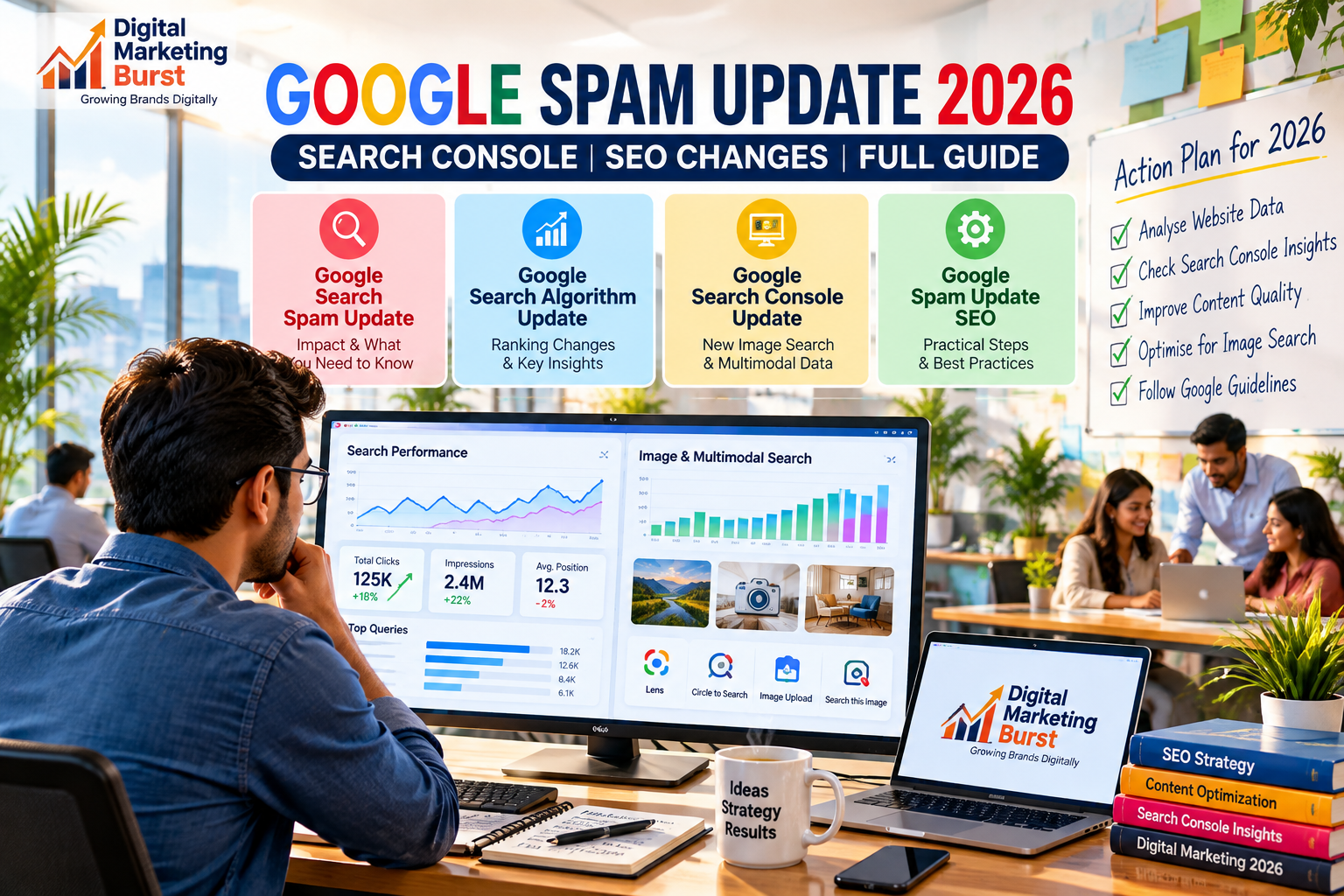
On the same date, Google announced a significant Google Search Console Update for web multimodal search reporting. Website owners can now get performance insights for searches involving Google Lens, Circle to Search, image uploads to Google Search, and Chrome’s “Search this image” feature. Google for Developers
For Indian businesses, publishers, SEO professionals and marketers, these developments raise two different questions. Could the Google Search Spam Update affect organic visibility, and what can the new Search Console data reveal about how users discover websites visually?
Those questions need to be answered separately. Google has confirmed both developments, but it has not said that the new multimodal reporting is part of the spam update. Treating them as one algorithmic change would therefore be misleading.
This guide explains what is confirmed, what remains unknown, what businesses should monitor and how to respond without making unnecessary SEO changes while the update is still rolling out.
What Is the Google Spam Update 2026?
The Google Spam Update 2026 discussed here is Google’s September 2026 spam update.
Google’s Search Status Dashboard records the rollout as beginning on September 24, 2026 at 09:15 PDT. It applies globally and to all languages, while the expected rollout period is up to two weeks. As of September 28, Google’s dashboard still shows the update as active. Google Search Status
That global scope matters for Indian websites.
Businesses operating primarily in India should not assume the update is limited to the United States or English-language search results. Hindi, English and other language websites can fall within the global scope of Google’s spam systems.
However, Google has not publicly identified a specific new spam tactic targeted by this September update.
That distinction is critical.
It would be premature to claim that the update specifically targets AI content, backlinks, programmatic SEO, affiliate websites, local SEO pages or another particular technique unless Google provides further information.
Google September Spam Update: What Has Google Actually Confirmed?
The Google September Spam Update has generated plenty of discussion, but the confirmed information is comparatively limited.
Google has confirmed the rollout date, global coverage, language coverage and expected rollout duration. The Search Status Dashboard categorises the incident under Ranking. Google Search Status
Google has not provided a detailed list of individual ranking signals changed by this update.
Consequently, an SEO professional should separate three categories of information:
Confirmed: Google released a global spam update on September 24.
Observable: individual websites may see impressions, clicks, average positions or query patterns change during the rollout.
Unconfirmed: the reason a particular website gained or lost visibility.
This separation prevents one of the most common mistakes during a major Google update: observing a ranking change and immediately assigning a cause without sufficient evidence.
Is the September 2026 Spam Update Still Rolling Out?
Yes, according to Google’s status information available on September 28.
The Search Status Dashboard continues to show the September 2026 spam update as active. Google initially stated that rollout could take up to two weeks. Google Search Status
That means website owners should be careful when interpreting short-term movement.
A page losing positions for one or two days does not automatically establish a permanent decline. Similarly, a temporary improvement should not immediately be treated as the final result of the update.
Collect the data first.
Compare relevant pages and queries.
Then wait for enough information to distinguish a meaningful pattern from ordinary search volatility.
Google Search Spam Update vs Google Core Update
A Google Search Spam Update should not automatically be described as a core update.
Google separately records different types of Search ranking incidents. Its 2026 history, for example, lists spam updates and core updates as distinct events. The history includes the September, August, June and March spam updates alongside the May and March core updates. Google Search Status
That distinction matters when analysing a website.
A core update can involve broader changes to how Google assesses and ranks useful, relevant results. Spam updates relate to Google’s efforts to deal with practices that violate or attempt to manipulate its search systems.
Website owners therefore should not copy a generic “core update recovery checklist” and assume it explains every spam-update movement.
Start with evidence from the affected website instead.
What Is the Google Search Spam Algorithm?
The phrase Google Search Spam Algorithm is commonly used by marketers, although Google’s anti-spam approach should not be reduced to one simple algorithm.
Google maintains spam policies and automated systems designed to identify manipulative behaviour.
For a business owner, the practical lesson is more useful than trying to reverse-engineer a secret ranking formula.
Ask whether your SEO strategy creates pages because users genuinely need them or because you are attempting to manufacture search visibility at scale.
Look at how links are acquired.
Review whether pages offer distinct value.
Examine whether location, service or informational pages actually satisfy different needs.
Those questions remain useful even when Google does not disclose the exact system changed during an update.
Google Spam Update SEO: What Should Website Owners Do?
The worst response to a Google Spam Update SEO event is usually uncontrolled editing based on fear.
If rankings fluctuate while an update is still rolling out, changing titles, URLs, internal links, content, schema and page structure simultaneously makes later analysis much harder.
Start with measurement.
Open Google Search Console and compare recent performance against an appropriate previous period.
Look at pages rather than only total site clicks.
Then examine queries.
Segment by country if India is your target market.
Check device differences where relevant.
If a decline is concentrated in one directory, template or content type, that pattern is more informative than a sitewide percentage alone.
The objective is diagnosis before intervention.
Google Spam Update Impact: How to Analyse Your Website
The Google Spam Update Impact will not necessarily look identical across every site.
One website might experience changes across informational articles. Another may notice movement on commercial pages, while a third may see no meaningful change.
Begin by comparing clicks and impressions.
A drop in clicks without a comparable impression decline can indicate something different from a large loss in impressions.
Next, inspect average position cautiously.
Sitewide average position can hide significant query-level changes.
Page-level analysis is usually more actionable.
Identify pages with the largest meaningful change and compare them with pages that remained stable.
Look for structural differences between the two groups.
That comparison can reveal whether the affected pages share characteristics such as thin coverage, overlapping intent, weak originality or poor alignment with the queries generating impressions.
It does not prove causation, but it gives you a much stronger starting point than guessing.
Don’t Assume Every Traffic Drop Is the Google Spam Update
Timing alone does not prove causation.
Traffic can change because of seasonality, demand, technical problems, indexing changes, SERP layout changes, competitors, migrations or tracking issues.
For an Indian ecommerce website, festival-related demand can significantly affect search behaviour.
Travel searches can move seasonally.
Healthcare searches may respond to local or seasonal patterns.
B2B demand can behave differently around weekends and holidays.
Before blaming the Google Search Spam Update, check whether impressions declined alongside clicks.
Review important pages individually.
Confirm that pages remain indexed and accessible.
Look for accidental noindex, canonical, redirect or robots-related problems where appropriate.
A Google update may coincide with a decline without necessarily causing it.
Google Search Console Update: What Changed?
The second major development on September 24 was a Google Search Console Update focused on multimodal search.
Google introduced web multimodal Search performance reporting in Search Console. The data can appear in the Performance report for Search results and in reporting for Generative AI features. Google for Developers
This is important because people increasingly search with more than typed text.
A user can point a smartphone camera at something.
Someone else can use an existing image.
Android users can use Circle to Search.
Chrome users can search from an image directly.
Google says the new reporting is intended to help publishers understand how their content appears through these visual and multimodal search experiences. Google for Developers
Latest Search Console Update: Which Searches Are Included?
The Latest Search Console Update includes data associated with several forms of image-assisted searching.
Google specifically identifies:
- Google Lens searches
- Circle to Search on Android
- image uploads to Google Search
- Chrome’s right-click “Search this image”
These interactions are grouped within Google’s new web multimodal search reporting. Google for Developers
This should not simply be described as “Google Images traffic.”
Traditional image-result discovery and multimodal search are related visual-search concepts, but they are not identical user behaviours.
A person using Lens to identify an object from a camera view has a different starting point from someone typing a phrase and selecting the Images tab.
Understanding that difference will help marketers interpret the new data correctly.
How to Find Multimodal Search Data in Google Search Console
Google says website owners can use the new multimodal search type filter in Performance reporting.
You can also export the data for additional analysis. Google for Developers
For marketers, the useful workflow is straightforward.
First, open the relevant Search Console property and navigate to performance reporting.
Look for the multimodal search type filter where it is available.
Compare the pages receiving this visibility.
Next, inspect queries and landing pages together rather than focusing only on total clicks.
Exporting the data can help larger websites compare multimodal visibility against content type, page category or business objective.
Not every site will immediately have meaningful data. Google states that metrics will appear when a site receives traffic from these types of queries. Google for Developers
Why GSC Image Search Data Matters for SEO
Visual discovery has traditionally been difficult to connect with the broader SEO journey.
The new reporting can provide another view into how people discover web content when an image is involved in the search process.
Consider an Indian furniture retailer.
A user sees a chair in a hotel, photographs it through Lens and searches for visually similar products. If the retailer’s product page becomes discoverable through that interaction, multimodal performance information can help the business understand a search journey that did not begin with a typed keyword.
The same principle can apply to fashion, food, travel, automotive products, home interiors and other visually rich sectors.
For SEO teams, this creates another reason to treat images as meaningful content rather than decorative files added after an article is finished.
Google Search Console Multimodal Search Changes Keyword Research
Traditional keyword research usually starts with words.
Multimodal search can start with an object, photograph or visible environment.
That difference changes how marketers should think about intent.
Suppose a person sees a particular traditional Indian outfit and uses an image to search for something similar.
The original query may contain less text than a conventional search.
Yet the underlying commercial intent can be strong.
SEO teams therefore need to understand entities, products, visual characteristics and page context alongside textual keywords.
This does not make conventional keyword research obsolete.
Instead, multimodal search adds another layer of discovery.
Google Image Search Data and Indian Ecommerce
Indian ecommerce businesses are among the clearest potential beneficiaries of better visual-search reporting.
Products are inherently visual.
A customer may not know the exact name of a dress, piece of furniture, appliance or accessory. An image can become the query.
That makes high-quality original product imagery more useful.
However, image quality alone is not enough.
The surrounding product page still needs accurate titles, useful descriptions, clear product information and technically accessible images.
Where relevant, structured data should accurately represent the product.
Image filenames and ALT text should remain descriptive rather than becoming keyword containers.
The objective is to make the visual asset and its surrounding page understandable.
Google Image Search Data for Local Businesses
Visual discovery is not limited to ecommerce.
Restaurants, hotels, salons, clinics, real-estate businesses and travel companies can all publish images that help users understand what they offer.
For example, a hotel may have photographs of rooms, facilities and surroundings.
A restaurant can show dishes and interiors.
A travel website may publish destination images.
Local businesses should therefore audit whether their important visuals are original, clear and placed on contextually relevant pages.
Adding fifty near-identical stock images is unlikely to make the content more useful.
A smaller number of meaningful images with strong page context can provide a better user experience.
Google Image Search SEO: What Should Change?
Google Image Search SEO should begin with the page, not an ALT-text formula.
Choose an image that genuinely helps the reader.
Compress it without destroying visual quality.
Use a sensible filename.
Provide accurate ALT text when the image conveys meaningful information.
Place the image close to relevant text.
Ensure the page remains fast and accessible.
Avoid embedding important information exclusively inside an image when users and search systems also need that information as text.
For product and visual-content websites, original imagery can provide information that generic stock photography cannot.
The new Search Console reporting gives marketers another opportunity to measure how visual discovery contributes to search performance.
ALT Text Is Not a Keyword-Stuffing Field
The arrival of new multimodal reporting should not trigger mass ALT-text stuffing.
ALT text primarily helps describe meaningful images for accessibility and provides useful context.
Write what the image actually shows.
If an image displays a Google Search Console performance screen with a multimodal search filter, describe that naturally.
Do not insert every variation of “Google Spam Update 2026”, “Google Search Console Update”, “Google Image Search SEO” and “Latest Google Algorithm Update” into the same attribute.
That makes the text unnatural and less useful.
Image optimisation should improve understanding, not manufacture keyword density.
Google Search Algorithm Update: What We Know and What We Don’t
Whenever a Google Search Algorithm Update occurs, speculation spreads quickly.
The September 2026 spam update is no exception.
We know Google released it globally.
We know it applies to all languages.
The rollout can take up to two weeks.
Google has not publicly provided a detailed list of specific spam tactics newly targeted by this update. Google Search Status
Therefore, claims such as “the update specifically targets AI blogs” or “Google has changed a particular backlink threshold” should not be presented as established facts without evidence.
This distinction is especially important for businesses making expensive SEO decisions.
Do not delete hundreds of pages because of an unsupported theory circulating online.
Latest Google Algorithm Update: Avoid Reactive SEO
The phrase Latest Google Algorithm Update attracts understandable attention because website owners want to know whether they need to act.
Sometimes the correct immediate action is simply to observe.
Record the date when meaningful visibility changes began.
Identify affected page groups.
Check whether technical issues occurred during the same period.
Compare query intent before and after the change.
Review competitors carefully without assuming that a competitor’s improvement explains your decline.
Once the rollout settles, patterns become easier to interpret.
SEO decisions made from several weeks of structured evidence are generally more defensible than decisions based on one volatile day.
Google Spam Update Impact on AI-Generated Content
AI-generated content deserves careful treatment because it is easy to overstate the connection.
Google has not said in its September 2026 update announcement that the update is specifically an “AI content penalty.”
Therefore, businesses should not assume that using AI automatically caused a ranking change.
The more useful question is whether the resulting content provides genuine value.
AI-assisted content can still become repetitive, inaccurate or shallow when published without sufficient editorial control.
Human-written content can have the same problems.
Review the output rather than obsessing over the tool used to draft it.
Businesses using AI at scale should pay particular attention to factual validation, duplication, search-intent overlap and whether each page deserves to exist independently.
Google Spam Update SEO and Scaled Content
Scale itself is not a substitute for usefulness.
Publishing hundreds of pages around minor keyword variations can create a website full of overlapping intent.
For example, an agency might publish separate pages for “SEO company”, “best SEO company”, “top SEO agency”, “SEO services company” and many similar phrases while providing essentially the same information.
That creates little additional value for a user.
A better strategy is to determine whether those searches require genuinely different answers.
Where intent overlaps heavily, a stronger consolidated resource may be preferable.
Where users have distinct needs, separate pages can make sense.
The decision should come from intent and usefulness rather than the desire to create another indexable URL.
Google Spam Update Impact on Programmatic SEO
Programmatic SEO is not inherently synonymous with spam.
Its quality depends on what the generated pages actually provide.
A useful programmatic page can combine unique inventory, location information, pricing, availability, comparison data or other information that changes the user’s decision.
A weak implementation may simply swap city names or keywords inside an otherwise identical template.
Businesses using programmatic publishing should therefore audit uniqueness at the value level, not merely at the sentence level.
Ask what a visitor gains from Page B that was not already available on Page A.
If the answer is almost nothing, the page deserves closer review.
Google Search Spam Update and Local SEO Pages
Indian businesses often create location pages to reach multiple cities.
Those pages should correspond to genuine business relevance.
Changing “Delhi” to “Mumbai” inside the same generic service copy does not automatically create a useful local resource.
A strong location page can include genuinely relevant service information, availability, contact pathways, location-specific processes and other accurate details.
Do not invent offices.
Avoid fake addresses.
Never imply service coverage where the business does not operate.
Clear geographic information is useful for both users and search engines.
Google Spam Update Impact on Backlinks
A spam update naturally causes website owners to question their backlinks.
That does not mean every ranking decline proves a backlink penalty.
Review the link profile with context.
Links created primarily to manipulate rankings deserve more concern than legitimate editorial references earned because a resource is useful.
Avoid reacting to the update by buying a large batch of “high DA” backlinks.
Third-party authority metrics are not Google ranking scores.
Instead, focus on whether a link makes sense editorially and whether the website would still value that mention if ranking manipulation were removed from the equation.
Google Spam Update SEO Audit for Indian Businesses
An Indian business can perform a practical post-update audit without rebuilding the entire website.
Start with the pages responsible for meaningful organic traffic.
Compare recent performance.
Identify winners, losers and stable pages.
Review the search intent behind declining queries.
Then assess whether the page still answers that intent effectively.
Check content overlap across the site.
Inspect internal links.
Review technical indexability.
Evaluate important external links and any questionable SEO tactics previously used.
Finally, prioritise changes according to evidence.
A page with stable impressions does not need rewriting simply because an update exists.
Focus resources where a real problem can be demonstrated.
Google Search Console Data: Build an Update Monitoring Dashboard
A simple monitoring sheet can make update analysis much clearer.
Record the landing page.
Add clicks, impressions, CTR and average position for the chosen comparison periods.
Include the primary query group and page type.
Then mark whether the page gained, lost or remained broadly stable.
For a larger site, add content categories.
An ecommerce business could separate category, product and editorial pages.
A healthcare website might compare doctor profiles, treatment pages and informational articles.
An agency can distinguish service pages from blog content.
Patterns across page types often reveal more than one sitewide traffic number.
Add Multimodal Search to Your SEO Reporting
The Google Search Console Update gives marketers another segment worth monitoring.
Do not immediately turn multimodal search into a vanity KPI.
First establish whether your website receives meaningful impressions or clicks from it.
If it does, identify which pages appear.
Next, determine what those pages have in common.
Product photography might be important for one site.
Destination images could matter for another.
A publisher may discover that diagrams or instructional images attract visual discovery.
Those observations can then inform future content production.
The reporting should guide decisions rather than simply creating another number for a monthly presentation.
Google Search Console Update and Content Teams
SEO teams are not the only people who should care about multimodal reporting.
Designers, photographers, ecommerce managers and content writers can all learn from visual-search performance.
Suppose original product images consistently appear in multimodal discovery while generic lifestyle graphics do not.
That information can influence the next photography brief.
A travel publisher might discover that destination landmarks perform differently from generic banner images.
Content teams can then test better visual formats.
The important point is not to chase one image metric.
Instead, use the data to understand how visual assets contribute to discoverability and user journeys.
What Indian Businesses Should Do This Week
Because the September 2026 spam update is still within its announced rollout window, avoid panic-driven changes.
Monitor important Search Console pages and queries.
Check indexability and technical health.
Document unusual movement.
Review obvious low-value or duplicated content where it already represented a known weakness.
At the same time, explore the new multimodal reporting if data is available for your property.
Businesses with visually rich content should pay particular attention.
Do not combine the two exercises into one unsupported theory.
The spam update and the multimodal Search Console reporting were announced on the same date, but Google has not said that one causes or powers the other. Google for Developers
A Practical 7-Step Response to the Google Spam Update 2026
Step 1: Record your baseline. Save Search Console performance for an appropriate period before the update.
Step 2: Segment the data. Analyse pages, queries, devices and countries rather than looking only at total traffic.
Step 3: Check technical issues. Confirm important pages remain crawlable and indexable.
Step 4: Identify patterns. Determine whether losses cluster around a particular page type or topic.
Step 5: Review quality. Examine pages for thin coverage, overlapping intent, factual weaknesses or content created primarily to capture variations of the same query.
Step 6: Avoid mass edits during volatility. Change clear problems, not everything that happens to fluctuate.
Step 7: Reassess after rollout. Compare the final pattern once Google indicates the update has completed.
This workflow does not guarantee recovery. Its purpose is to make SEO decisions evidence-based.
How Digital Marketing Burst Approaches SEO During Google Updates
A useful SEO strategy during a major update should begin with diagnosis rather than fear.
At Digital Marketing Burst, our approach to Google-update analysis is built around understanding search intent, Search Console data, content quality, technical SEO and the relationship between pages across a website.
For Indian businesses, this matters because different sectors can display very different search behaviour.
A local business should not blindly copy the recovery strategy of a national publisher.
Likewise, an ecommerce store has different visual-search opportunities from a B2B service website.
The Google Spam Update 2026 and new multimodal reporting reinforce the need to look beyond rankings alone.
Modern SEO increasingly involves understanding how users discover information across text, images and AI-assisted search experiences.
Google Spam Update 2026 and the Future of Search Visibility
Search is becoming more varied.
Users still type conventional queries, but they can also search with cameras, images and combinations of visual and textual information.
Search Console’s new reporting reflects that change.
Meanwhile, Google’s continued spam updates show that sustainable visibility cannot depend solely on producing more pages or exploiting temporary ranking patterns.
Businesses need content with a clear reason to exist.
Visual assets should also have a purpose.
Technical foundations need to remain healthy.
Measurement must evolve alongside the search experience.
The businesses that understand these elements together will be better equipped to interpret change without treating every fluctuation as a crisis.
Frequently Asked Questions
What is the Google Spam Update 2026?
The current update is Google’s September 2026 spam update, released on September 24. Google says it applies globally and to all languages, with rollout potentially taking up to two weeks. Google Search Status
Is the Google September Spam Update complete?
As of September 28, 2026, Google’s Search Status Dashboard still shows the update as active. Website owners should check the dashboard again before treating rollout analysis as final. Google Search Status
Does the Google Spam Update target AI content?
Google’s announcement does not state that the September 2026 spam update specifically targets AI-generated content. Claims that it is an AI-content-only update should therefore not be presented as confirmed.
What is the latest Google Search Console Update?
Google introduced web multimodal Search performance reporting on September 24. It provides insights for searches involving Lens, Circle to Search, image uploads and Chrome’s image-search functionality. Google for Developers
Is multimodal search the same as Google Image Search?
Not exactly. Multimodal search can begin with an image or camera-based interaction rather than a conventional typed query followed by the Images tab.
Will every website see multimodal data in Search Console?
Not necessarily. Google says metrics will appear when the site receives traffic from these query types. Google for Developers
Should I change my SEO strategy immediately after the spam update?
Avoid making broad changes solely because an update has started. Analyse page-level and query-level evidence first, fix clear problems and continue monitoring until the rollout is complete.
Conclusion
The Google Spam Update 2026 and Google’s new Search Console multimodal reporting arrived on the same day, but they represent different developments.
Google’s September spam update began on September 24, applies globally and across all languages, and may take up to two weeks to roll out. Google has not publicly identified one specific SEO tactic as the sole target of this update. Google Search Status
Meanwhile, the Google Search Console Update gives website owners new visibility into searches involving Lens, Circle to Search, image uploads and Chrome image search. That creates useful opportunities for businesses whose products, services or information can be discovered visually. Google for Developers
For Indian businesses, the sensible response is not to chase every algorithm theory.
Monitor the evidence. Improve content that genuinely needs improvement. Keep technical SEO healthy, make visual assets useful and use Search Console data to understand how discovery is changing.
That approach is more sustainable than trying to predict an undisclosed algorithm from a few days of ranking movement.
Google Spam Update 2026: Why Page-Level Analysis Matters More Than Sitewide Traffic
When the Google Spam Update 2026 causes visible movement, many website owners first check whether total organic clicks increased or decreased. That number is useful, but it rarely explains what actually happened.
A better investigation starts at page level.
Imagine an Indian business website with 500 indexed pages. Overall organic clicks decline by 12%, but most service pages remain stable. The majority of the loss comes from 30 older informational articles.
Treating the entire website as damaged would lead to the wrong response.
Instead, isolate those articles and ask what they have in common.
Perhaps several cover nearly identical search intent. Some may contain outdated information, while others could have been created mainly around keyword variations without offering enough distinct value.
Another website might show the opposite pattern. Informational articles remain stable, but a particular group of commercial landing pages loses impressions.
These two websites should not follow the same recovery plan.
Google’s September update is still active as of September 28, so short-term fluctuations should also be interpreted carefully. Google began the rollout on September 24 and said it may take up to two weeks. Google Search Status
Google September Spam Update: Build a Before-and-After Baseline
Before changing content, establish what normal performance looked like.
Open Google Search Console and select a period long enough to avoid drawing conclusions from one unusually strong or weak day.
Compare equivalent periods where possible.
Seasonality deserves special attention for Indian businesses. An ecommerce website approaching a festival period may naturally experience changes in product demand. Travel, education, healthcare and local services can also have seasonal search patterns.
Record clicks and impressions first.
CTR can provide another layer of context.
Average position is useful, although it should not be interpreted in isolation because query mix can change.
Next, separate branded and non-branded searches where your data makes that possible.
A fall in branded demand can have a different explanation from losing visibility for important non-branded informational queries.
The purpose of the baseline is simple: understand what changed before deciding why it changed.
Google Spam Update Impact: Create Three Groups of Pages
A practical Google Spam Update Impact analysis can divide important URLs into three broad groups: pages that improved, pages that declined and pages that remained relatively stable.
The stable group is often overlooked.
It can actually provide some of the most useful information.
Suppose your strongest original guides remain stable while a group of repetitive articles declines. That pattern deserves investigation.
Now imagine both detailed and thin pages fall together.
The explanation may be different.
Compare page purpose, search intent, originality, internal linking, publication history and technical condition.
Do not assume one shared characteristic automatically caused the movement.
Correlation gives you a hypothesis to investigate, not proof of an undisclosed ranking signal.
Google Spam Update SEO: Analyse Query Loss Before Rewriting Content
A page can lose clicks even when the URL itself remains indexed and visible.
That is why Google Spam Update SEO analysis should include individual queries.
Open an affected page in Search Console.
Compare its queries across appropriate periods.
Identify which queries lost impressions.
Then ask whether the page genuinely remains a strong answer for those searches.
Sometimes a page begins ranking historically for terms that are only loosely related to its main purpose. Losing those impressions does not necessarily mean the page itself needs a complete rewrite.
Other situations are more actionable.
A page may have lost its primary query cluster while competing pages now satisfy the intent more directly.
That deserves closer analysis.
Rewrite because you can identify a user problem—not simply because a graph turned red.
Google Search Spam Algorithm and Search Intent
The Google Search Spam Algorithm is not something an SEO team can reverse-engineer from a few ranking screenshots.
Search intent provides a more practical framework.
Consider a user searching for:
“How to improve local SEO for a hospital.”
A useful page should address the actual challenges of hospital local search.
It might explain location information, department visibility, doctor information, Google Business Profile considerations, reviews, local landing pages and measurement.
Creating 15 separate articles around tiny variations of the same phrase does not necessarily help that user.
This is where an intent map becomes useful.
List the queries associated with a topic.
Group those that require essentially the same answer.
Create separate URLs only when the user’s need changes enough to justify a separate resource.
That approach can reduce internal competition while making the website easier to navigate.
How to Find Search Intent Cannibalisation After a Google Search Spam Update
Cannibalisation is not simply two pages containing the same keyword.
The more important issue is whether multiple URLs are attempting to solve the same search need.
Start with Google Search Console.
Search for an important query and inspect which pages receive impressions.
If several similar URLs repeatedly appear for the same query cluster, review them manually.
Read each page as a user.
Ask whether every URL has a clear independent purpose.
When two articles answer almost the same questions, consolidation may be worth considering.
However, do not merge pages mechanically.
Two pages can share vocabulary while satisfying different intents.
For example, “What is local SEO?” and “Local SEO pricing in India” both discuss local SEO, yet their primary user needs are clearly different.
Intent should drive the decision.
Google Search Algorithm Update: Audit Content Created at Scale
A Google Search Algorithm Update often prompts businesses to inspect large content libraries.
That audit is especially useful when a website has grown quickly.
Start by identifying templated content.
Next, look for groups where the primary difference between URLs is a city, service, product variation or keyword modifier.
Then examine whether each page contains genuinely distinct information.
A national service business might legitimately need multiple location pages if service availability, processes, contact information and local considerations differ.
By contrast, replacing one city name with another throughout the same generic template gives users little new information.
The same principle applies to informational blogs.
Publishing hundreds of articles is not inherently useful simply because each one targets a different phrase.
Every indexable page should have a defensible reason to exist.
Latest Google Algorithm Update: Should You Delete Thin Content?
Do not turn a Latest Google Algorithm Update into a mass deletion exercise.
A short page is not automatically a bad page.
Some questions can be answered completely in 400 words. Others require several thousand.
Word count is not the correct quality test.
Evaluate whether the page satisfies its intended user need.
Check whether it receives relevant impressions or links.
Look at whether another page already covers the same subject more effectively.
Some weak URLs can be improved.
Others may belong inside a stronger related resource.
A genuinely redundant page might no longer justify remaining separate.
Each decision should consider purpose, usefulness and existing signals rather than an arbitrary minimum word count.
Google Spam Update Impact on Old Blog Posts
Older content deserves particular attention because factual accuracy can deteriorate without obvious warning.
Software interfaces change.
Prices change.
Government policies can change.
Statistics become outdated.
SEO features evolve particularly quickly.
A blog written in 2023 may still rank in 2026 while describing a tool or Google feature that no longer works the same way.
Updating such a page should involve more than changing the year in its title.
Check every time-sensitive claim.
Remove outdated screenshots where necessary.
Replace obsolete instructions.
Add meaningful developments only when they improve the article.
Do not convert every old URL into “2026” merely to manufacture freshness.
Freshness should reflect actual maintenance.
Google Spam Update SEO and AI-Assisted Publishing
AI tools can accelerate research, outlining and drafting, but speed introduces its own quality-control challenges.
A business publishing AI-assisted content should therefore have an editorial workflow.
Begin with search intent.
Identify the questions the page genuinely needs to answer.
Research claims from appropriate sources.
Use AI where it improves efficiency, but validate the output before publication.
Check names, dates, numbers and technical statements.
Remove repetitive transitions and generic introductions.
Look for sections that sound plausible but add no useful information.
Finally, ask whether the article contains something specific enough to justify its existence.
This approach is more useful than attempting to make content “look human” to an AI detector.
Google has not characterised the September 2026 spam update as an AI-content-only update, so that claim should not be treated as established fact. Google Search Status
Google Spam Update Impact on AI Content Quality
The important distinction is between AI usage and low-value output.
A human writer can produce repetitive pages.
An AI-assisted workflow can produce useful material when research, expertise and editorial review are properly applied.
Therefore, evaluate the finished page.
Does it answer the question accurately?
Are important claims supported?
Does it contain unnecessary repetition?
Would a knowledgeable editor approve the advice?
Does it provide context relevant to its target audience?
For Digital Marketing Burst, an article aimed at Indian businesses should do more than repeat generic American SEO advice.
Indian search behaviour, multilingual audiences, local-business structures and sector-specific realities can make examples more relevant when they genuinely apply.
Context creates usefulness.
Keyword density alone does not.
Google Search Spam Update and AI Content Fact-Checking
Factual validation should be a distinct editorial stage.
Writers frequently make the mistake of checking grammar while assuming factual accuracy has already been handled.
Separate the tasks.
First, review claims that can change over time.
Dates, product features, regulations, prices, statistics and platform policies deserve particular attention.
Next, identify statements that sound factual but have no source.
Either verify them or rewrite them so they do not present speculation as fact.
Primary sources should be preferred for platform-specific information where available.
For example, Google’s own documentation is a stronger basis for explaining a new Search Console feature than a third-party interpretation of the feature.
Editorial confidence should come from verification, not from how confidently a sentence is written.
Google Search Console Update: Understanding Multimodal Search Correctly
The Google Search Console Update introduced on September 24 deserves careful terminology.
Google calls the feature web multimodal Search performance reporting.
It is designed to show how web content performs when people use images as part of their searches.
Google specifically includes Lens, Circle to Search on Android, image uploads to Google Search and Chrome’s “Search this image” functionality. The reporting is available through a multimodal search type filter in the Search results performance report and the Generative AI performance report. Google for Developers
That is more precise than calling the feature simply “new Google Images data.”
Why does terminology matter?
Because different search experiences can represent different user journeys.
Understanding the journey helps businesses decide what to optimise.
Latest Search Console Update: A Multimodal Search Example
Imagine an Indian consumer visiting a furniture showroom.
They notice a particular style of wooden dining chair but do not know its product name.
Instead of typing a descriptive query, they photograph it.
A visual search can help identify related objects and web results.
For an ecommerce website, this creates a discovery journey that begins with visual information rather than a conventional keyword.
Now consider a travel scenario.
Someone photographs a landmark and uses visual search to learn more about it.
A travel publisher with useful destination imagery and relevant supporting content may become part of that discovery process.
The principle extends across fashion, automobiles, food, home décor and other visually rich categories.
The searcher’s need still matters.
Only the starting input has changed.
Google Search Console Update: What the New Filter Can Tell You
The new multimodal filter gives marketers another way to segment performance.
Google says publishers can use the filter and export the resulting data for further analysis. Metrics appear when the site receives traffic from these types of searches. Google for Developers
Do not judge success solely by the total number of multimodal clicks.
Look at the landing pages generating impressions.
Identify query patterns where available.
Compare the content types appearing through this search behaviour.
A retailer may find product pages prominent.
A publisher could see instructional content.
Travel websites might discover destination pages receiving visual discovery.
Once patterns emerge, content teams can investigate why certain pages perform better.
The data becomes useful when it changes a decision.
Google Search Console Multimodal Reporting for Indian Businesses
Different Indian business sectors can use multimodal reporting in different ways.
An ecommerce brand can examine which products receive visual discovery.
A hotel can monitor pages with strong property photography.
A restaurant may learn whether pages featuring particular dishes surface through image-assisted searches.
Real-estate websites can analyse property pages.
Automotive businesses can study vehicle and component content.
Healthcare requires more caution because images can involve sensitive contexts and medical information.
The point is not that every sector should suddenly become “visual-first.”
Instead, businesses should identify whether images are genuinely important to how customers discover or understand their offering.
Multimodal reporting can then provide another measurement layer.
Google Image Search SEO: Audit Your Existing Images Before Creating More
Businesses often respond to a new feature by producing more content immediately.
Start with what you already have.
Review important pages.
Identify missing images, irrelevant stock photography and outdated screenshots.
Check whether meaningful images have descriptive ALT text where appropriate.
Look at image dimensions and file weight.
Large files can create unnecessary performance problems.
Review filenames when they are genuinely unhelpful.
Most importantly, ask whether each image improves the page.
A decorative stock photograph that communicates nothing may not deserve additional optimisation effort.
An original chart, product photograph, interface screenshot or instructional diagram can have far greater informational value.
Quality of purpose matters more than image count.
Google Image Search SEO and Original Visual Content
Original visual content can add information that generic stock imagery cannot.
A digital marketing agency might publish an original diagram showing an audit workflow.
An ecommerce company can photograph a product from several useful angles.
A travel business may create original destination imagery.
A software company can show accurate interface screenshots.
Original does not automatically mean valuable, though.
A poorly labelled diagram can confuse readers.
An attractive image that adds no information remains largely decorative.
Start with the user question.
Then determine whether an image can answer part of that question faster or more clearly than text alone.
That is a better visual-content strategy than generating images simply because every article “needs five pictures.”
Google Image Search Data and Image Placement
Context surrounding an image can help users understand why it exists.
Place meaningful images close to the relevant discussion.
For example, a Search Console multimodal-report screenshot belongs beside the explanation of that report rather than at the bottom of an unrelated section.
Captions can provide additional context when readers benefit from them.
Page titles and headings should describe the actual topic.
ALT text should describe the image appropriately rather than attempting to carry the entire SEO strategy.
The image and page should support each other.
This principle becomes increasingly important when users can begin discovery visually.
Latest Search Console Update and Image Performance Measurement
The Latest Search Console Update creates an opportunity to establish a visual-search baseline.
Record multimodal impressions and clicks when your property has enough data.
Identify the top landing pages.
Then note the content type of each URL.
Repeat the analysis periodically.
Do not expect every optimisation to produce an immediate measurable result.
Search behaviour varies by industry.
A fashion retailer may naturally receive more image-assisted discovery than an accounting consultancy.
That difference does not mean the accounting website has failed at SEO.
Metrics need business context.
Measure channels according to their relevance to the user journey.
Google Search Console Update: Don’t Confuse Impressions With Leads
Search Console measures search performance, not complete business outcomes.
An increase in multimodal impressions can indicate greater visibility.
It does not automatically mean revenue increased.
Connect Search Console insights with your broader analytics where appropriate.
Look at what happens after the user reaches the website.
Do visitors engage with the page?
Do they navigate towards products or services?
Are relevant conversions occurring?
Those questions help businesses move from visibility measurement towards commercial understanding.
SEO reporting becomes more useful when it connects discovery with what users actually do next.
Google Spam Update 2026 and Multimodal Search Are Separate Developments
Because both developments appeared on September 24, it is tempting to connect them.
Avoid doing that without evidence.
The Google Spam Update 2026 is recorded by Google as a ranking incident affecting spam-related search systems, while multimodal reporting is a Search Console measurement feature for image-assisted search behaviour. Google Search Status
Google has not said that the new multimodal reporting caused the spam update.
It has not said the spam update specifically targets images either.
Treating coincidence in timing as proof of a technical relationship would weaken the accuracy of the article.
The more useful connection is strategic.
Both developments remind marketers that search is changing while content quality and measurement remain important.
Google Search Algorithm Update: Separate Algorithm Changes From Reporting Changes
SEO terminology can create unnecessary confusion.
A ranking update changes aspects of how search results are evaluated or produced.
A reporting update changes what website owners can see in a tool.
Those are not the same thing.
Search Console adding a filter does not itself prove that Google introduced a new ranking factor.
Likewise, seeing a new metric does not mean websites must optimise for a newly invented algorithm.
Before acting on an announcement, ask:
Did Google change ranking, reporting, crawling, indexing or presentation?
That one question can prevent many unnecessary SEO changes.
In this case, marketers are dealing with a confirmed spam ranking update and a separate reporting enhancement.
Google Spam Update Impact on Image-Heavy Websites
Image-heavy websites should avoid assuming the spam update and multimodal reporting are directly connected.
Instead, audit both areas independently.
For spam-related risk, review whether pages provide genuine value and whether the site’s SEO practices align with Google’s published policies.
For visual discovery, inspect image quality, page context, accessibility and multimodal performance data.
An ecommerce website may have excellent original images but weak repetitive product descriptions.
Another site could have useful text but poor visual assets.
Those are separate problems.
A strong SEO strategy identifies the actual weakness instead of forcing every issue into one update narrative.
Google Spam Update SEO: Review Internal Linking
Internal links help users and search engines navigate relationships between pages.
During a content audit, look for orphaned important pages.
Check whether informational articles naturally support relevant service or topic pages.
Remove unnecessary repetitive links inserted only because a keyword appears.
Anchor text should communicate destination context.
Avoid making every internal anchor an exact-match commercial phrase.
For example, a detailed article about AI search could naturally link to a related AI visibility guide when the reader needs deeper information.
That link has editorial purpose.
Internal linking works best when it helps the next step in the reader’s journey.
Google Spam Update SEO: Review Category and Tag Archives
WordPress websites can accumulate large numbers of archives over time.
Categories can be useful when they organise meaningful content.
Tags can also help navigation when used consistently.
Problems arise when every minor keyword receives its own tag.
A website with 100 articles does not necessarily need hundreds of thin tag archives.
Review whether archive pages serve a genuine navigation purpose.
Look for near-duplicate tags.
Avoid creating new tags solely because a keyword appeared in a new article.
If archive indexing is part of your SEO setup, make sure those pages provide a useful browsing experience.
The goal should be a clean information architecture rather than the largest possible number of indexable URLs.
Google Search Spam Update and Doorway-Style Location Content
Location SEO deserves particular attention for Indian service businesses.
Suppose an agency operates only in Lucknow but creates hundreds of pages suggesting local offices in cities where it has no presence.
That can mislead users.
A legitimate nationwide service can still discuss how it serves different markets, but the wording should accurately reflect the business model.
Do not invent addresses.
Avoid fake local testimonials.
Never create location-specific claims that cannot be supported.
Useful geographic content can explain actual availability, delivery models, service limitations and relevant local information.
Transparency is better for users and reduces the need to maintain hundreds of misleading pages.
Google Spam Update Impact on Affiliate and Review Content
Review pages should help users evaluate choices.
A page that simply rewrites manufacturer descriptions provides little independent assistance.
Useful comparison content can explain differences, suitability, limitations and decision criteria.
Claims should be supportable.
If a product has not been personally tested, do not write as though it has.
Commercial relationships should also be disclosed where required.
The same standard applies beyond affiliate websites.
Any page designed to influence a purchasing decision should provide enough information for the reader to understand why one option may suit a particular need.
Helpful evaluation requires substance, not just a table filled with keywords.
Google Search Spam Algorithm and Expired Content
Some pages have a natural lifespan.
Event pages become outdated.
Promotional offers expire.
Annual guides lose accuracy.
Removing all expired pages is not automatically the correct response.
First determine whether the URL retains useful historical or evergreen information.
An annual event page might be updated when the new year’s information is confirmed.
An expired offer page may need to redirect if a clear replacement exists.
Another URL may remain useful as an archive.
Decisions should depend on user value and site structure.
Do not automatically redirect every old page to the homepage.
A redirect should lead to a genuinely relevant replacement.
Google Spam Update SEO: Technical Checks Before Content Changes
Content is only one part of SEO.
Before rewriting pages, confirm that important URLs are technically accessible.
Check canonical tags.
Review accidental noindex directives.
Inspect robots controls where relevant.
Make sure important internal links do not lead through unnecessary redirect chains.
Review sitemap inclusion.
Look at server errors.
Check whether a recent theme, plugin or deployment changed page rendering.
If a technical problem began around the same time as the spam update, separating those causes becomes essential.
An algorithm update cannot explain a page that your own configuration accidentally removed from indexing eligibility.
Technical verification should therefore happen early in the diagnostic process.
Google Search Console Update: Use Page Groups Instead of Random URLs
Large websites should avoid reviewing hundreds of URLs one at a time without structure.
Create page groups.
A digital marketing agency might use:
Service pages
SEO guides
Paid advertising content
AI-search articles
Local landing pages
Case-study pages
An ecommerce business could use:
Category pages
Product pages
Buying guides
Comparison content
Blog articles
Compare performance by group.
If only one type changes substantially, investigate its templates and content characteristics.
This approach can expose structural issues that individual URL analysis misses.
It also makes future monitoring easier.
Google Spam Update Impact: What a Recovery Hypothesis Should Look Like
A useful recovery hypothesis should be specific enough to test.
“We lost traffic because Google hates AI content” is not a useful hypothesis.
“Our declining pages contain substantial intent overlap, while unique guides covering distinct topics remained stable” is more actionable.
You can then inspect the overlapping pages.
Another hypothesis might be:
“Commercial pages lost impressions because important supporting internal links disappeared after a navigation change.”
That can be checked.
Good SEO analysis moves from observation to hypothesis, evidence and action.
It does not move directly from fear to mass rewriting.
Latest Google Algorithm Update: Document Every Major Change
If you decide to modify affected pages, document what you changed.
Record the URL.
Add the date.
Note whether you changed the title, main content, internal links, structured data or technical configuration.
Explain why the change was made.
This creates an SEO change log.
Without documentation, teams often forget what happened after several weeks.
Later performance changes become difficult to interpret because nobody remembers which pages were edited.
A simple spreadsheet can solve this problem.
For agencies managing multiple websites, disciplined change logging becomes even more valuable.
Google Search Console Multimodal Data: Questions Worth Asking
Once meaningful multimodal data appears, avoid stopping at “How many clicks did we get?”
Ask which pages receive impressions.
Determine which topics appear repeatedly.
Look at whether commercial or informational pages dominate.
Compare visual-heavy pages with text-heavy equivalents where the comparison makes sense.
Consider whether original imagery appears more often than generic visuals.
Do not claim causation from a small sample.
Instead, use the observations to create controlled content improvements.
Over time, repeated patterns can become useful strategic signals.
Google Image Search SEO for WordPress Websites
WordPress makes image publishing easy, which can also lead to poor media hygiene.
Large original uploads may remain unnecessarily heavy.
Multiple generated sizes can complicate media management.
Old images can survive long after the page context changes.
Review the images on important URLs.
Compress them appropriately.
Use modern formats where they work with your setup.
Check responsive delivery.
Keep filenames understandable when creating new assets.
Write meaningful ALT text where needed.
Avoid stuffing titles, captions, descriptions and ALT attributes with the same list of SEO keywords.
Every field should have a user-facing or operational purpose.
Google Image Search SEO and Core Web Performance
High-resolution images can improve visual quality while also increasing page weight if they are poorly handled.
Balance matters.
Serve images at appropriate dimensions.
Compress files sensibly.
Avoid loading unnecessarily huge assets into small content containers.
Lazy loading can be useful for below-the-fold imagery when implemented appropriately.
The main visual element deserves special performance consideration because it can affect perceived loading experience.
Do not destroy image quality simply to achieve the smallest possible file.
Instead, optimise for the actual display context.
A visually rich page can still be efficient when image delivery is planned properly.
Google Search Console Update and AI Search Reporting
Google’s official announcement says multimodal reporting is available in both the Search results performance report and the Generative AI features performance report. Google for Developers
That makes the development relevant beyond traditional blue-link SEO.
Search discovery increasingly spans multiple interfaces and input types.
A user may begin with text.
Another can begin with an image.
AI-assisted search experiences can then shape how information is presented.
Businesses should therefore think about visibility more broadly while keeping measurement precise.
Do not combine every new search feature into one vague “AI SEO” metric.
Different reports answer different questions.
Understanding those distinctions makes reporting more useful.
Google Spam Update 2026: What Not to Change Yet
While the update remains active, avoid making sweeping changes without clear evidence.
Do not delete large content sections because rankings moved for two days.
Avoid changing every title on the site.
Do not rebuild internal linking randomly.
Never purchase questionable backlinks in an attempt to “restore authority.”
Avoid publishing dozens of new articles merely to replace lost traffic.
Instead, fix problems that are independently obvious.
An accidental noindex does not need to wait for rollout completion.
A factually incorrect page can be corrected immediately.
A broken internal link can be repaired.
The distinction is between known problems and speculative update reactions.
Google’s dashboard still lists the September spam update as active as of the latest status check on September 28. Google Search Status
Preparing for the End of the Google September Spam Update
Once Google marks the rollout complete, capture another performance snapshot.
Compare the final period with your original baseline.
Revisit the page groups identified earlier.
Check whether initial declines persisted, reversed or moved elsewhere.
Then prioritise improvements.
Pages with significant sustained losses deserve deeper analysis.
Stable pages can provide useful comparison points.
Improved pages should also be studied.
SEO teams often investigate only losers and miss lessons from URLs that performed well during the same environment.
The final objective is not to discover a secret formula.
It is to understand your own website better and improve weak areas based on evidence.
What the Google Spam Update 2026 Means for SEO Strategy
The Google Spam Update 2026 should not cause businesses to abandon SEO.
It should encourage them to examine why each page exists.
Useful search visibility comes from more than keyword placement.
Content needs a clear purpose.
Technical implementation needs to support discovery.
Internal architecture should make relationships understandable.
Claims need verification.
Images should contribute to the page rather than simply fill space.
Measurement should separate different search experiences instead of reducing everything to one traffic number.
Google’s new multimodal reporting adds another useful dimension to that measurement.
The spam update adds another reason to examine whether a website’s growth strategy depends on genuine usefulness or shortcuts.
Google Spam Update 2026: Build a Sustainable SEO Strategy After the Rollout
Once the Google Spam Update 2026 finishes rolling out, the most useful question is not, “How do we beat this update?” A better question is, “Which parts of our website genuinely deserve stronger search visibility, and which parts need improvement?”
That change in thinking matters.
Search updates come and go, while weak publishing habits can remain for years. A website may accumulate overlapping blogs, outdated information, unnecessary tag pages, poorly differentiated location pages and articles created around keywords rather than user needs.
Therefore, post-update work should not become a temporary recovery project.
Use the update as an opportunity to improve the underlying website.
Start with pages that matter commercially or attract meaningful organic visibility. Understand their purpose, identify the search intent they serve and determine whether another URL already performs the same job.
Next, review supporting content.
An informational article should help users understand a topic, solve a problem or make a decision. It should not exist merely because an SEO tool displayed another keyword variation.
This creates a more maintainable content library and reduces the temptation to respond to every algorithm update with another round of mass publishing.
Google September Spam Update: Content Quality Needs More Than Longer Articles
One common SEO response to ranking losses is adding more words.
That can make a weak page even weaker.
A 1,000-word article does not automatically become better when expanded to 4,000 words. If the additional sections repeat existing information, users simply have more content to navigate before finding an answer.
Instead, evaluate information gain.
Ask what the reader understands after visiting your page that they could not understand from a basic summary.
For example, an article explaining the Google September Spam Update should not merely state that an update happened.
A useful resource can show readers how to analyse Search Console data, separate technical issues from update-related movement, compare page groups and avoid reacting to unconfirmed theories.
Specificity creates value.
Length should follow the complexity of the question.
The objective is comprehensive coverage without repetition.
Google Spam Update Impact: Audit Your Highest-Value Pages First
Businesses with hundreds or thousands of URLs need priorities.
Do not begin with the easiest pages to edit.
Start with pages that matter.
For an Indian digital marketing agency, those could include major service pages and high-performing educational resources.
An ecommerce website may prioritise revenue-generating category and product pages.
A hospital might focus on key department, treatment and doctor pages.
Once priorities are established, review performance changes alongside business importance.
A 50% traffic decline on an article that previously generated two clicks a month is less urgent than a smaller decline on an important commercial page.
SEO teams should therefore combine Search Console data with business context.
Traffic is an indicator.
It is not the only measure of page value.
Google Spam Update SEO: Use a Page-Purpose Audit
A simple page-purpose audit can expose unnecessary content.
For every important URL, write one sentence answering:
Why should this page exist?
If that question is difficult to answer, investigate further.
A service page might exist to explain a particular offering and help qualified users decide whether it fits their needs.
A comparison article may help readers distinguish between two solutions.
A guide can solve a specific informational problem.
A location page should provide useful information relevant to users in that location or accurately explain service availability there.
Problems appear when several URLs receive almost identical answers.
Those pages may compete for the same intent or add unnecessary complexity to the website.
The solution could involve differentiation, consolidation, updating or, in appropriate cases, removal.
Do not make that decision from keyword similarity alone.
Google Search Spam Update: Create an Intent Map Before Publishing New Content
A content calendar should not begin with 100 keywords.
Begin with user needs.
Group related queries according to what the searcher actually wants.
Suppose an Indian business wants to build content around Google Search Console.
Queries about setup and verification can belong to one educational cluster.
Questions about performance analysis represent another need.
Multimodal search reporting may justify a separate resource because the user is looking for a newer and more specialised feature.
Meanwhile, five phrases that all mean “how to check clicks in Search Console” probably do not require five independent articles.
This intent mapping reduces unnecessary duplication.
It also makes internal linking more logical because each resource has a clearer role within the site.
A Google Search Spam Update should reinforce this discipline rather than encourage more keyword-driven publishing.
Google Search Spam Algorithm: Don’t Build Pages for Every Keyword Variation
Modern keyword tools can generate thousands of related phrases.
That does not mean every phrase deserves a URL.
Consider these hypothetical terms:
“SEO services India”
“best SEO services India”
“professional SEO services India”
“SEO company services India”
Creating separate near-identical pages for each phrase would provide little additional value if the search intent is substantially the same.
A stronger page can naturally address relevant terminology without becoming repetitive.
Long-tail keywords are still valuable.
They reveal specific needs.
However, their best use may be as subsections, FAQ questions or supporting topics rather than standalone URLs.
The question is not, “Can we rank another page?”
Ask, “Does the user need another page?”
That distinction supports cleaner site architecture.
Google Search Algorithm Update: Review Search Intent Before Updating Titles
Changing titles during a Google Search Algorithm Update can affect how a page communicates its purpose.
Therefore, avoid rewriting titles merely to insert more keywords.
First identify the primary intent.
A title should tell the searcher what the page provides.
If the article is a practical guide, make that clear.
If it explains a current update, freshness may be useful.
If the page compares services, the comparison should be obvious.
Avoid adding words such as “best”, “ultimate”, “complete”, “number one” or “guaranteed” unless they accurately describe the content and can be supported where necessary.
Compelling titles do not require exaggerated promises.
Clarity can be more persuasive than hype.
Latest Google Algorithm Update: Refresh Content Without Changing URLs Unnecessarily
Content updates do not always require new URLs.
If an existing article continues to satisfy the same underlying intent, updating the existing resource may be preferable to publishing another near-duplicate version.
For example, an evergreen guide can be refreshed when platform features change.
Update factual information.
Replace obsolete screenshots.
Improve weak explanations.
Add newly relevant sections.
Remove information that no longer helps.
Keep the URL stable when there is no strong reason to change it.
Changing URLs unnecessarily can create additional redirect management and internal-link maintenance.
A new URL makes more sense when the topic or intent genuinely requires a separate resource.
Google Spam Update Impact: Content Pruning Should Be Evidence-Based
“Delete low-traffic pages” is overly simplistic SEO advice.
A page can have little traffic while still serving an important purpose.
It may support a niche customer question.
Another page could assist existing customers rather than attract large search volume.
Some content may also contribute to topical understanding or internal navigation.
Before removing a URL, evaluate its purpose.
Check relevant impressions.
Look for external links.
Review internal links.
Determine whether another page can absorb its useful information.
If consolidation is appropriate, preserve valuable material and use a relevant redirect where necessary.
Do not redirect unrelated pages to the homepage simply to remove them from the site.
Content pruning should improve the website, not merely reduce the URL count.
Google Spam Update SEO: Improve Content With Original Information
Originality does not mean inventing facts nobody else has mentioned.
It means adding genuine value through structure, interpretation, examples, first-party information or clearer explanations.
An Indian business can make an SEO article more useful by showing how a process applies to Indian market conditions.
A software company can include accurate product workflows.
An ecommerce store can publish original product specifications and photographs.
A service company can clearly explain its process without inventing performance claims.
Research-based articles can distinguish confirmed facts from interpretation.
Original value is especially important when many competing pages repeat the same basic information.
Do not manufacture a fake survey or statistic merely to appear unique.
Useful originality can come from better thinking.
Google Spam Update Impact: Why First-Party Information Matters
Businesses possess information that generic publishers often cannot reproduce.
A company knows what services it actually provides.
It knows its genuine locations, operating processes, product specifications and policies.
Those details can strengthen commercial pages.
For example, a service business can explain what is included in a package, what information a customer needs before starting and how the workflow operates.
An ecommerce company can provide dimensions, materials, compatibility information and original images.
A travel operator can accurately state where its service begins and which destinations it covers.
First-party information makes pages more useful because it reduces uncertainty for users.
However, avoid turning every informational article into an advertisement.
The commercial information should appear where it genuinely helps the reader.
Google Search Spam Update: Avoid Unsupported Experience Claims
Trust can be damaged when websites invent experience.
Do not claim:
“We tested 100 websites” if no such test occurred.
Avoid saying:
“Our clients recovered within seven days” without verifiable evidence.
Never create fictional case studies.
The same rule applies to AI-generated testimonials.
If a business has legitimate evidence, it can document the methodology and results carefully.
Otherwise, explain the process without manufacturing authority.
A useful SEO article does not need invented numbers to sound credible.
Accuracy itself builds trust.
This is particularly important during a Google Search Spam Update, when marketers are searching for explanations and may encounter many confident but unverified claims.
Google Spam Update SEO: Strengthen Author and Business Transparency
Users should be able to understand who published important content.
An agency website can provide a clear About page.
Service pages should make business identity understandable.
Contact information should be accurate.
Author information can be useful when authorship genuinely matters to the topic.
Do not create fake experts solely for SEO.
Likewise, adding an author box does not automatically make weak content trustworthy.
Transparency works when it reflects reality.
The content itself still needs to be accurate, useful and well maintained.
For sensitive areas such as medical, legal or financial information, editorial standards become even more important because inaccurate advice can have serious consequences.
Google Search Console Update: Build a Multimodal Content Audit
The Google Search Console Update creates a useful reason to audit visual content separately from written content.
Create a list of your most important landing pages.
For each page, record whether it contains meaningful original visuals.
Note what those visuals do.
Some may demonstrate a product.
Others can explain a process.
A screenshot may support software instructions.
A diagram might simplify a complicated workflow.
Then compare that information with multimodal performance where enough data exists.
Look for patterns rather than isolated examples.
If useful original visuals repeatedly appear among stronger pages, that observation can inform future testing.
If decorative stock imagery produces no meaningful contribution, consider whether resources could be spent on more informative assets instead.
Latest Search Console Update: Think Beyond Traditional Image SEO
The Latest Search Console Update reflects a broader shift from image optimisation towards visual understanding.
Traditional image SEO advice often focuses on filenames, ALT attributes and compression.
Those elements remain useful for their appropriate purposes.
However, multimodal discovery raises another question:
Can the image itself help Google and the user understand something meaningful?
A photograph of a product can communicate appearance.
A diagram can explain relationships.
A chart can communicate a pattern.
A screenshot can demonstrate a process.
Therefore, image strategy should begin with informational usefulness.
Metadata supports the asset.
It does not replace the information contained in the asset itself.
Google Search Console Update: Create Images Around User Tasks
Images become more useful when connected to specific user tasks.
Suppose an article explains how to analyse a ranking decline.
A generic photograph of someone using a laptop adds little instructional value.
A custom diagram showing:
Traffic Change → Page Analysis → Query Analysis → Technical Check → Content Review → Action
can help the reader understand the workflow immediately.
Similarly, an ecommerce guide could include annotated product comparisons.
A local SEO article might show a structured location-page framework.
Visual content should answer questions.
That approach also creates assets that users may save, share or revisit because they communicate something useful independently.
Google Image Search Data: Measure Images by Landing-Page Value
Marketers sometimes try to measure every image as though it were an independent SEO page.
Instead, connect visual discovery to the landing page and its purpose.
If multimodal search brings visitors to a product page, evaluate what happens after arrival.
If users land on an informational article, determine whether they engage with the guide or continue to another useful page.
The value of an image is often connected to the journey it initiates.
Therefore, reporting should not stop at impressions.
Use Search Console for discovery data and appropriate analytics for on-site behaviour.
This creates a more complete picture of visual search performance.
Google Image Search SEO: Don’t Create Misleading Visuals
AI image generation makes it possible to create visuals rapidly.
That convenience creates a responsibility to avoid misleading users.
If an image represents a conceptual workflow, make that clear through its context.
Do not present an AI-generated interface as though it were an exact screenshot of Google Search Console.
Avoid fabricated graphs that appear to show real performance.
Never create fake testimonials inside graphics.
For instructional articles, genuine screenshots are preferable when readers need to recognise an actual interface.
Conceptual graphics work better when explaining ideas.
The distinction should remain clear.
Accuracy applies to visual content as much as written content.
Google Search Console Multimodal Search and Accessibility
Visual-search optimisation should not come at the expense of accessibility.
ALT text should help communicate the purpose or content of meaningful images where appropriate.
Decorative images may not need descriptive ALT text depending on implementation.
Complex diagrams can require supporting text so that important information is not available only visually.
Buttons and linked images need understandable context.
Do not hide essential instructions inside graphics.
A page designed around visual discovery should still work for users who consume content differently.
Accessibility and SEO should not be treated as competing objectives.
Both benefit from clearer information architecture.
Google Search Console Update: What Data Should Go Into Monthly SEO Reports?
Do not add a new metric merely because Search Console offers it.
Include multimodal performance when it matters to the website.
A practical monthly report could explain how multimodal clicks and impressions changed, which landing pages generated them and whether any meaningful trend emerged.
Keep the interpretation proportional to the data.
If a website received only a handful of impressions, avoid building a dramatic strategic conclusion around them.
When the data becomes substantial, segment it by page type and business purpose.
A good SEO report explains what changed, why the change matters and what action is justified.
It should not overwhelm clients with every available metric.
Google Spam Update 2026: A 30-Day Post-Rollout SEO Plan
Once the Google Spam Update 2026 is complete, businesses can structure their response over the following month.
During the first stage, preserve the final Search Console baseline.
Document the pages and query groups with meaningful movement.
Next, audit the most affected page categories.
Look for technical issues, overlapping intent, outdated information, weak originality and questionable SEO practices.
During the following stage, prioritise improvements rather than editing everything simultaneously.
Correct factual weaknesses.
Consolidate content only when overlap is clear.
Strengthen internal links where relationships genuinely help users.
Improve important visual assets.
Then monitor the updated pages.
Keep a change log so later performance can be compared with actual interventions.
The plan should remain flexible because every website will present different evidence.
Google Spam Update Impact: What If Your Website Improved?
An update analysis should not begin with the assumption that something went wrong.
Some websites may gain visibility.
If important pages improve, study them.
Identify the query groups driving additional impressions.
Compare those pages with weaker sections of the website.
Perhaps their search intent is clearer.
Maybe they provide more specific information.
Their internal-link context could be stronger.
However, avoid declaring one characteristic the cause of the improvement without evidence.
A winning page can still provide clues about what users and search systems currently find useful.
Document those observations.
They can influence future content decisions without turning them into a universal ranking formula.
Google Spam Update Impact: What If Nothing Changed?
No significant change is also useful information.
If impressions, clicks and important query positions remain broadly stable throughout the rollout, there may be no reason to launch a special recovery project.
Continue normal SEO work.
Update outdated content.
Fix technical issues.
Improve pages where users need more information.
Monitor the site as usual.
Do not manufacture work simply because an update occurred.
SEO teams can waste substantial time changing healthy pages in response to industry noise.
A stable website deserves careful maintenance, not unnecessary disruption.
Google Search Spam Update: How to Evaluate Competitor Movement
Competitor analysis can provide context, but it needs discipline.
Do not copy a competitor’s content simply because they moved above you.
First, compare search intent.
Look at what information their page provides.
Review page structure.
Examine whether they answer questions your page misses.
Consider whether the SERP itself changed.
A competitor may also have stronger brand demand or other advantages that cannot be replicated by rewriting headings.
The objective is to identify useful gaps.
Copying their wording or page layout creates little original value.
Competitive analysis should inform your understanding of the searcher’s expectations, not turn into content imitation.
Google Search Algorithm Update: SERP Intent Can Change
Sometimes ranking changes reflect a shift in the type of results Google surfaces for a query.
Suppose a keyword previously returned mostly informational guides.
Later, the results become dominated by product pages or local businesses.
That change matters.
Your article may remain high quality while no longer matching the dominant result type.
Therefore, inspect the current search results for important declining queries.
Look at the types of pages appearing.
Do not merely count keywords or backlinks.
Understanding result composition can reveal whether the underlying search interpretation has shifted.
If intent has genuinely changed, decide whether the existing page should remain informational or whether a separate commercial resource is appropriate.
Avoid forcing one URL to satisfy every possible intent.
Latest Google Algorithm Update: Don’t Chase Daily Ranking Fluctuations
Daily rank tracking can be useful for diagnosis.
It can also encourage overreaction.
A keyword moving from position four to position seven for one day does not necessarily justify rewriting the page.
Look at trends.
Consider impressions.
Check clicks.
Evaluate several related queries.
Search results vary by location, device, context and other factors.
Indian businesses targeting multiple cities should be particularly careful when interpreting a single manual search.
Search Console provides aggregated first-party performance information and should form part of the analysis.
Rank tracking can supplement it.
Neither metric should be interpreted without context.
Google Spam Update SEO: Create a Content Maintenance Calendar
Publishing is only half of content strategy.
Maintenance deserves its own schedule.
Classify content according to how quickly information can become outdated.
A platform-update article may require frequent review.
An evergreen explanation may need less attention.
Pricing, laws, software features and statistics should receive stronger freshness checks.
Set review dates according to risk rather than updating every article on the same schedule.
During each review, verify facts.
Check links.
Inspect screenshots.
Remove obsolete information.
Evaluate whether search intent has changed.
This process creates genuine freshness.
Changing only the publication date does not.
Google Spam Update SEO and WordPress Indexing Hygiene
WordPress websites can accidentally generate more indexable URLs than intended.
Categories, tags, author archives, attachment pages, search pages and plugin-generated URLs can all affect site structure depending on configuration.
There is no universal rule saying every archive should be indexed or noindexed.
Decide according to usefulness.
A well-maintained category archive can help users discover related resources.
A nearly empty tag archive may provide little value.
Review your XML sitemap.
Check canonical implementation.
Inspect which page types are indexable.
Make sure important content is discoverable through internal links.
Indexing hygiene is not about blocking everything.
It is about making the site’s intended architecture clear.
Google Search Console Update: Use Search Console for Indexing Diagnosis Too
While multimodal reporting is new, Search Console remains useful for broader technical investigation.
If an important URL appears to have disappeared from search, inspect that URL rather than assuming the spam update removed it.
Check whether Google can access the page.
Review canonical information.
Confirm indexing status.
Look for crawl or server problems where applicable.
If the page is technically healthy but visibility declined, move to content and query analysis.
Separating indexing problems from ranking problems is essential.
A page cannot regain rankings through a content rewrite if the real problem is an accidental technical directive.
Diagnosis should always precede treatment.
Google Spam Update Impact on Small Indian Businesses
Small businesses often have fewer resources for SEO, which makes prioritisation even more important.
They do not need to publish every day to remain competitive.
A smaller collection of accurate service pages and genuinely useful supporting resources can be easier to maintain than a large library of repetitive content.
Local businesses should make service areas clear.
Contact information should remain accurate.
Important pages need straightforward navigation.
Content should answer actual customer questions.
If images matter to the buying journey, invest in useful original visuals where practical.
The Google Spam Update Impact should not push small businesses towards expensive panic-driven tactics.
Good maintenance and clear information can be more valuable than producing another hundred pages.
Google Spam Update 2026 and Indian SEO Agencies
SEO agencies have an additional responsibility during updates because clients naturally want immediate explanations.
Avoid presenting speculation as certainty.
If an update is still rolling out, say so.
Show the data available.
Explain what has changed and what has not.
Separate technical findings from hypotheses.
Document recommended actions.
For example, telling a client that “Google penalised your AI content” would be inappropriate without evidence supporting that conclusion.
A better explanation might be that a particular content group lost visibility and several pages show significant intent overlap.
That observation can be demonstrated and investigated.
Evidence-based communication protects clients from unnecessary changes.
Why Digital Marketing Burst Focuses on Data Before Update Recovery
For Digital Marketing Burst, Google updates are best approached through structured analysis rather than immediate assumptions.
Search Console data can show where visibility changed.
Technical checks can reveal whether crawling or indexing problems exist.
Content analysis can identify overlapping pages, outdated information and unclear intent.
Multimodal reporting can now add another layer for websites where visual discovery matters.
This approach is especially useful for Indian businesses because SEO requirements differ across industries.
An ecommerce company, healthcare organisation, local service provider and B2B company should not receive the same generic update checklist.
The right strategy begins with the website’s actual data and business model.
Digital Marketing Burst and Google Spam Update SEO
Businesses searching for Google Spam Update SEO support often want an immediate recovery answer.
No responsible SEO process can guarantee that a particular edit will restore rankings.
Instead, the process should identify issues that can be supported by evidence.
At Digital Marketing Burst, our positioning is focused on practical SEO, AI-search visibility, content strategy, technical analysis and digital marketing for businesses adapting to changing search behaviour.
That includes understanding traditional search alongside newer discovery environments.
However, algorithm-update work should never be sold as access to a secret Google formula.
Google does not publish every ranking signal.
A credible strategy works with documented guidance, first-party website data and careful testing.
Digital Marketing Burst: SEO for Search, AI and Multimodal Discovery
Search visibility in 2026 extends beyond conventional keyword rankings.
Users can discover businesses through standard Google results, images, local results and newer multimodal experiences.
AI-assisted search adds another layer.
For this reason, Digital Marketing Burst approaches SEO as a broader visibility problem rather than a simple exercise in placing keywords inside articles.
Content still matters.
Technical SEO remains important.
Internal linking helps establish useful relationships.
Images increasingly deserve strategic attention.
Measurement needs to distinguish between different discovery environments.
Indian businesses do not need to chase every new trend.
They need to identify which search experiences matter to their customers and build useful content accordingly.
Top Digital Marketing Agency in Lucknow for Modern SEO Strategy
Digital Marketing Burst positions itself as a top digital marketing agency in Lucknow for businesses looking for SEO strategies that adapt to changing search behaviour.
That positioning should be supported through the work shown on the website rather than unsupported ranking claims.
A modern SEO strategy can include technical audits, content planning, search-intent analysis, internal linking, Search Console monitoring, local SEO and AI-search visibility where relevant.
Businesses should evaluate any agency according to transparent criteria.
Ask how recommendations are developed.
Check whether reporting connects metrics with business objectives.
Understand how content is researched and validated.
Most importantly, avoid providers that guarantee a particular Google ranking.
Search visibility cannot responsibly be guaranteed.
Best Digital Marketing Agency in India: What Businesses Should Actually Evaluate
Businesses searching for the best digital marketing agency in India should look beyond promotional labels.
Start with service fit.
An agency specialising in local SEO may be appropriate for one business, while another company requires national ecommerce SEO or paid advertising.
Review how the agency measures performance.
Ask how it responds to Google updates.
Understand whether content recommendations are based on user intent or simply keyword volume.
Check whether technical SEO is included.
Consider communication and reporting quality.
Digital Marketing Burst uses “best” and “top” terminology as brand positioning, not as a claim of an independently verified national ranking.
That distinction matters because businesses deserve transparent information when comparing providers.
Why Choose Digital Marketing Burst for Google Search Console Analysis?
Search Console becomes most valuable when its data leads to better decisions.
Total clicks alone rarely tell the complete story.
Useful analysis can segment performance by page, query, country, device and search type.
The new multimodal reporting adds another potential dimension.
For businesses affected by a Google Search Console Update, Digital Marketing Burst focuses on interpreting what the data means for the website rather than simply sending screenshots.
A decline needs diagnosis.
An increase deserves analysis too.
Stable performance can also provide useful evidence.
The objective is to connect search visibility with content and technical decisions.
Google Spam Update 2026: Questions to Ask Before Hiring an SEO Agency
If an agency claims it can recover your website immediately after an update, ask how that conclusion was reached.
Request a clear diagnosis.
Ask which pages changed.
Find out whether technical problems were checked.
Understand how the agency separates correlation from causation.
Ask whether proposed content changes address specific user needs.
If backlinks are recommended, understand why those links make sense.
Be cautious with guarantees.
Likewise, avoid claims that an agency has “decoded” an update when Google has not disclosed the underlying details.
Good SEO advice should become clearer when questioned.
It should not depend on secrecy.
Google Spam Update Impact: A Practical Decision Framework
After the rollout, place affected URLs into four practical categories.
Keep: The page remains useful, accurate and appropriately targeted.
Improve: The intent is valid, but the content or experience has clear weaknesses.
Consolidate: Multiple pages substantially overlap and one stronger resource could serve the need more effectively.
Remove or redirect: The page has no meaningful ongoing purpose, or a clearly relevant replacement exists.
Do not apply these categories automatically.
Review each important page in context.
A URL with low traffic can still belong in the “Keep” category.
A high-traffic page may belong in “Improve” if it contains outdated information.
The framework supports decisions.
It does not replace editorial judgment.
Google Search Console Update: A Practical Visual SEO Workflow
The new multimodal data can be incorporated into an ongoing SEO process.
Start by identifying whether meaningful multimodal impressions exist.
Then find the landing pages receiving them.
Review the images on those pages.
Determine whether they are original, useful and contextually relevant.
Check image accessibility and technical delivery.
Compare strong pages with weaker equivalents.
Create better visuals where a real information gap exists.
Monitor the results over time.
Avoid changing dozens of variables simultaneously.
This workflow turns the Google Search Console Update into actionable learning rather than another dashboard metric.
Google Spam Update 2026: Final SEO Checklist for Website Owners
Before deciding that your site has been negatively affected, confirm that the update has finished rolling out.
Compare meaningful periods rather than individual days.
Analyse pages and queries.
Check technical indexability.
Review search intent.
Identify content overlap.
Verify important facts.
Examine internal linking.
Review questionable SEO practices.
Assess images where visual discovery matters.
Document every major change.
Then monitor.
This process cannot guarantee a particular ranking outcome.
It can, however, make your SEO decisions substantially more informed.
Frequently Asked Questions About the Google Spam Update 2026
When did the Google Spam Update 2026 start?
Google’s September 2026 spam update began on September 24, 2026. Google said the rollout could take up to two weeks and applies globally across all languages.
Is the Google September Spam Update targeting AI content?
Google’s public announcement does not identify the September 2026 spam update as an AI-content-specific update. Therefore, a ranking decline should not automatically be attributed to AI-generated content.
What should I check after the Google Search Spam Update?
Start with Search Console performance at page and query level. Then review technical indexability, search intent, content overlap, factual accuracy, internal linking and any questionable SEO practices.
What is new in the Google Search Console Update?
Google announced web multimodal Search performance reporting on September 24, 2026. It covers image-assisted searches including Lens, Circle to Search, image uploads and Chrome’s image-search functionality.
Is GSC multimodal search data the same as Google Images data?
No. Multimodal search can involve a user starting with an image or camera-based interaction. It should not be treated as simply another name for traditional Google Images reporting.
Should I rewrite all my blogs after the Google Spam Update?
No. Rewrite or improve pages when evidence shows a real problem. Mass rewriting healthy pages can create unnecessary changes without solving anything.
Can deleting low-traffic content improve SEO?
Not automatically. Low traffic does not prove that a page is low quality. Evaluate its purpose, relevance, impressions, links, accuracy and overlap with other content before deciding whether to keep, improve, consolidate or remove it.
Can an SEO agency guarantee recovery after a spam update?
No responsible SEO strategy can guarantee a particular ranking or recovery outcome. An agency can identify problems, implement improvements and monitor results, but Google’s rankings remain outside the agency’s control.
Conclusion: What Google Spam Update 2026 Really Means for Businesses
The Google Spam Update 2026 should be treated as a reason to investigate, not a reason to panic.
Google began the September update on September 24 and announced a rollout of up to two weeks. Until that process is complete, short-term movement needs careful interpretation.
At the same time, Google’s new multimodal Search Console reporting gives marketers a better view of image-assisted discovery through experiences such as Lens, Circle to Search, image uploads and Chrome image search.
The two developments should not be incorrectly presented as one system.
For Indian businesses, the practical direction is clearer: create pages with distinct purposes, verify information, avoid scaled low-value publishing, maintain technical indexability, improve meaningful visual content and use first-party performance data to guide decisions.
Digital Marketing Burst can position its work around that broader approach—SEO built around useful content, measurable search data, technical clarity and changing discovery behaviour rather than promises of guaranteed rankings.
Why Digital Marketing Burst Is a Strong Choice for SEO in 2026
Google Search is changing rapidly. Algorithm updates, spam systems, AI-powered discovery, multimodal search and new Search Console reporting mean businesses need more than traditional keyword placement.
Digital Marketing Burst focuses on an integrated approach that combines SEO strategy, technical analysis, content optimisation, Search Console insights and emerging AI-search opportunities.
Instead of reacting to every Google Spam Update 2026 fluctuation with random changes, the focus should be on evidence. That means identifying which pages changed, understanding affected queries, checking technical issues and improving content only where a genuine weakness exists.
This approach helps businesses build a search strategy around users rather than short-term algorithm chasing.
Top Digital Marketing Agency in India for Google Update SEO
Digital Marketing Burst positions itself as a Top Digital Marketing Agency in India for businesses seeking modern SEO strategies aligned with the changing search landscape.
A Google update requires more than checking whether rankings went up or down. Businesses need to understand what changed at page level, which queries were affected and whether technical, content or search-intent issues are involved.
Digital Marketing Burst approaches this through structured SEO analysis.
For the Google September Spam Update, that means separating confirmed Google announcements from industry speculation. It also means avoiding unsupported conclusions such as assuming every traffic decline is an AI-content penalty.
The objective is straightforward: use reliable information and first-party website data to make better SEO decisions.
Best Digital Marketing Agency in India for Search Console Analysis
Search Console contains far more useful information than total clicks and impressions.
Digital Marketing Burst uses page, query, country, device and search-type data to understand how organic visibility is changing.
This becomes especially relevant after the latest Google Search Console Update.
Google’s new multimodal reporting introduces another dimension for businesses whose products or content can be discovered through visual searches. Ecommerce, travel, fashion, hospitality and other visually driven industries can use this information to understand how search journeys are evolving.
For businesses looking for the Best Digital Marketing Agency in India, this type of data-led approach should be an important evaluation criterion.
The goal is not simply to produce an SEO report. Data should lead to clear decisions about content, technical SEO and future optimisation.
Top Digital Marketing Agency in Lucknow for Google Spam Update SEO
As a Lucknow-based digital marketing company, Digital Marketing Burst positions its services around businesses that need practical and evolving SEO strategies.
The Google Spam Update SEO process should begin with diagnosis.
A proper review can examine affected landing pages, query changes, indexing status, content overlap, internal linking and technical SEO.
Only after identifying a real issue should major changes begin.
This matters because unnecessary edits during an active Google update can make performance analysis more difficult.
Digital Marketing Burst therefore focuses on understanding the problem before recommending the solution.
For businesses searching for a Top Digital Marketing Agency in Lucknow, that evidence-led approach can be more useful than promises about guaranteed rankings.
Best Digital Marketing Agency in Lucknow for Modern SEO
SEO in 2026 extends beyond conventional keyword rankings.
Businesses now need to think about traditional organic search, local visibility, visual discovery, AI-assisted search experiences and changing user behaviour.
Digital Marketing Burst positions itself as a Best Digital Marketing Agency in Lucknow option for businesses looking to connect these areas within one digital strategy.
Content remains important, but content alone is not enough.
Technical SEO affects accessibility and indexability. Internal linking helps organise information. Search Console provides performance evidence. Original images can contribute to visual discovery, while structured content can make complex topics easier for users to understand.
Combining these elements creates a more complete SEO strategy than simply publishing more keyword-focused blogs.
Why Choose Digital Marketing Burst After a Google Search Spam Update?
A Google Search Spam Update can create uncertainty, particularly when traffic changes during an active rollout.
Digital Marketing Burst focuses on five practical areas: understanding performance changes, checking technical SEO, evaluating content quality, reviewing search intent and identifying sustainable improvements.
The process does not start with deleting content.
It does not assume every decline was caused by backlinks.
Likewise, it does not automatically blame AI-generated content.
Instead, each potential problem needs evidence.
For example, if several pages targeting almost identical intent lose visibility while stronger consolidated resources remain stable, content overlap deserves investigation.
If an important page suddenly disappears from search because of an accidental technical directive, rewriting its content will not address the actual problem.
Finding that distinction is an important part of effective SEO analysis.
Digital Marketing Burst for Google Search Algorithm Updates
Every Google Search Algorithm Update creates a flood of theories.
Businesses need to distinguish Google’s confirmed information from observations and speculation.
Digital Marketing Burst’s content strategy around algorithm updates focuses on that separation.
Official Google announcements can establish what is known.
Search Console can show what happened to a particular website.
Technical audits can uncover site-specific problems.
Content reviews can identify weaknesses that deserve improvement.
Only then should recommendations be prioritised.
This prevents businesses from rebuilding healthy pages because of an unverified industry theory.
Digital Marketing Burst for AI SEO and Search Visibility
Search behaviour is expanding beyond traditional search results.
Users can interact with search through text, images and AI-assisted experiences.
As a result, Digital Marketing Burst’s positioning includes AI SEO, search visibility and content strategies alongside conventional SEO.
The objective is not to rename traditional SEO with an AI label.
Instead, businesses need to understand where their audiences are discovering information and how their content can remain useful across those environments.
That can involve stronger entity information, answer-focused content, technically accessible pages, useful original visuals and consistent business information.
AI-search visibility should complement a solid SEO foundation rather than replace it.
Digital Marketing Burst for GSC Image Search and Multimodal SEO
The latest Search Console multimodal reporting makes visual discovery increasingly relevant to SEO measurement.
Digital Marketing Burst can help businesses evaluate whether images genuinely contribute to their search visibility.
That process starts with existing pages.
Are important images useful?
Do product images clearly represent the product?
Are diagrams helping users understand complex information?
Does ALT text describe images naturally?
Are large files affecting page performance?
Once sufficient Search Console data becomes available, those observations can be compared with multimodal performance.
This creates a more practical strategy than simply adding keywords to every image field.
Why Businesses Across India Can Work With Digital Marketing Burst
Being based in Lucknow does not mean a digital marketing strategy has to be limited to one city.
Digital services such as SEO, content strategy, website optimisation, Google Ads, social media marketing and AI-search optimisation can support businesses operating in different Indian markets.
However, every business needs a strategy suited to its actual audience.
A local healthcare provider may prioritise local SEO and location visibility.
An ecommerce company may require product, category and image optimisation.
A B2B company could benefit more from high-intent service pages and educational content.
Digital Marketing Burst focuses on adapting the digital strategy to the business model instead of applying the same template to every website.
What Makes Digital Marketing Burst Different?
The strongest branding message should come from the approach rather than an unsupported ranking claim.
Digital Marketing Burst combines SEO, Local SEO, Google Ads, social media marketing, website optimisation, content strategy and emerging AI-search optimisation within a broader digital marketing framework.
For SEO specifically, the emphasis is on:
Search intent → Content quality → Technical SEO → Search Console data → Internal linking → Visual optimisation → AI-search visibility → Continuous improvement.
This framework is particularly relevant to the Google Spam Update 2026 because businesses need to understand both content quality and performance evidence before making major changes.
Digital Marketing Burst: SEO Built for Search in 2026 and Beyond
Google Search will continue to evolve.
Spam updates will not be the last algorithm changes businesses face. Search Console will continue developing, while visual and AI-assisted discovery can introduce new ways for people to find information.
Digital Marketing Burst’s brand positioning is therefore broader than ranking a single keyword.
The focus is on helping businesses create a search presence that can adapt as discovery changes.
For companies searching for a Top Digital Marketing Agency in India, Best Digital Marketing Agency in India, Top Digital Marketing Agency in Lucknow, or Best Digital Marketing Agency in Lucknow, Digital Marketing Burst can present itself around practical SEO, measurable data, modern search visibility and integrated digital marketing.
Digital Marketing Burst — Building Visibility Beyond Rankings.