Website Migration Issues: Could Content Quality Be Why Your New Domain Isn’t Indexing?
Website migration indexing issues can have several causes, and content quality is one possibility—not a diagnosis you can make from an indexing message alone. Start by checking whether Google can discover the new URLs, follow the old-to-new redirects, access the intended content and identify the correct versions.
If those checks reveal no clear explanation, examine what the migrated pages offer readers. A technically accessible page is not guaranteed a place in Google’s index.
That distinction sits behind a theory Marie Haynes published in October 2026. She suggests that some post-migration indexing problems may involve a fresh, stricter assessment of site quality. Importantly, she explicitly describes the explanation as a theory she cannot currently prove. Marie Haynes
For an Indian business moving to a new domain after a rebrand, this raises a practical question: should the next investment go into technical repairs, content improvements or continued monitoring?
The answer depends on the evidence. This guide explains how to collect it before making expensive changes.
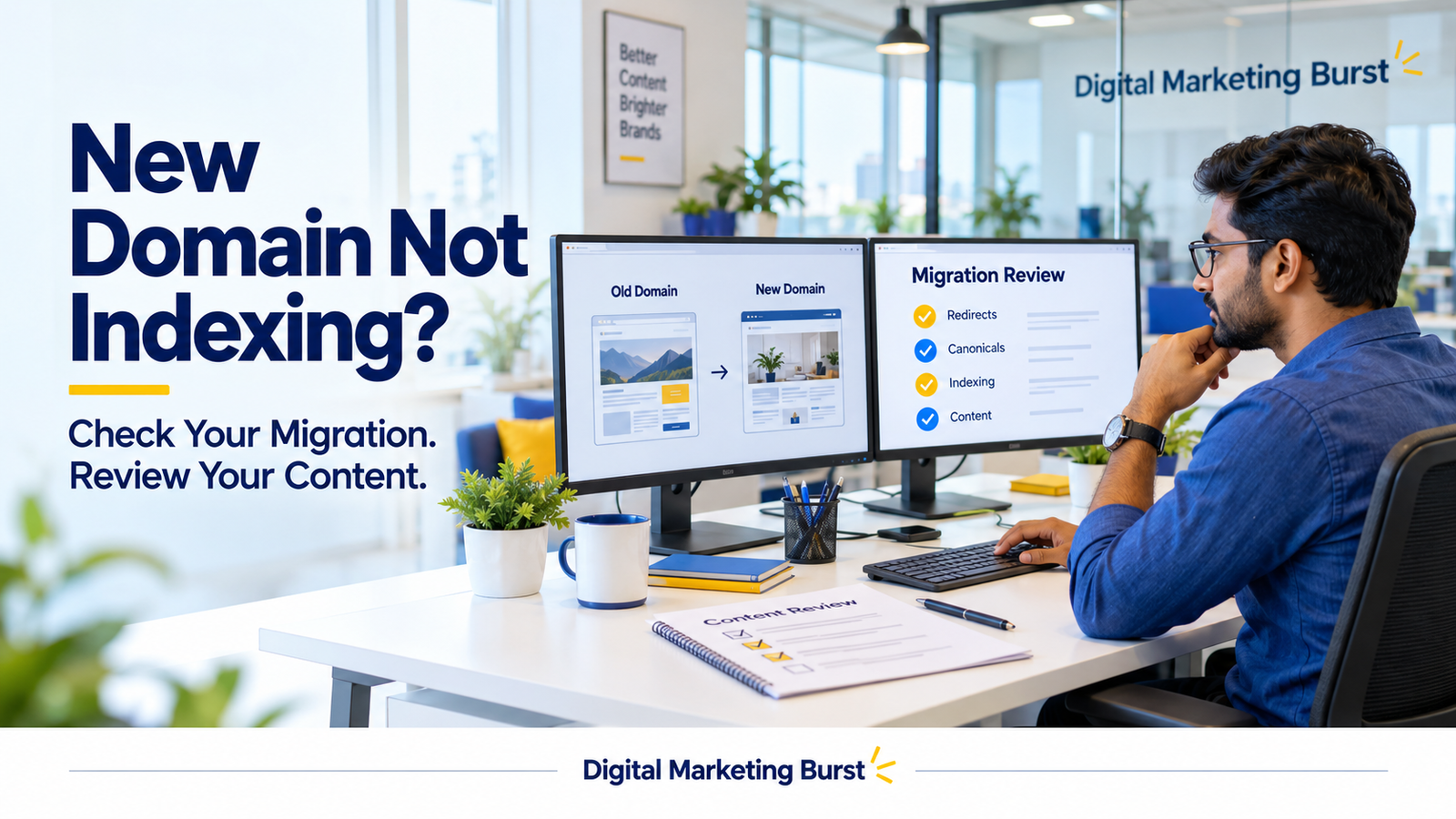
New domain not indexing? Review technical migration settings and content quality before deciding what to change.
Website Migration Indexing Issues: Identify What Has Actually Gone Wrong
“Google is not indexing our new website” can describe several different situations.
The homepage might be indexed while service pages are absent. Old URLs could still appear in search. A site might be indexed but receive fewer clicks. Search Console could show different information for the stored version and a live test.
Each situation needs a different investigation.
What you observe
What it does—and does not—establish
The new homepage appears in Google
At least that page is appearing; it does not establish the status of every section.
An important URL is reported as not indexed
Investigate that URL and related pages before describing the entire domain as unindexed.
Old URLs remain visible
Check migration processing and redirects; their presence alone does not prove failure.
Organic clicks have fallen
Separate indexing changes from ranking, demand and measurement changes.
A live inspection succeeds
The tested page was accessible under that test; inclusion in the index remains a separate question.
A sitemap is accepted
Google received the sitemap; that does not mean every listed URL is indexed.
Begin with a precise problem statement.
Instead of:
Our migration has failed.
Write:
Several previously important service pages on the new domain are reported as not indexed. We need to check their redirects, canonical information and crawl history.
The second statement gives the team a useful starting point. It also avoids treating an uncertain cause as an established fact.
Separate indexing from ranking and traffic
Indexing concerns whether Google has included a page in its index. Ranking concerns whether and where an indexed page is shown for a search.
Traffic adds another layer. Even a visible page may receive fewer clicks because the searches, results or user behaviour have changed.
For example, a migrated course page could remain indexed but lose visibility for its main queries. That is different from the page being absent from the index.
Check the specific URL before deciding which problem you are solving.
State which URLs matter to the business
Not every excluded URL represents lost value.
A website can contain internal search results, duplicate filter combinations, account pages and other resources that were never intended to attract organic search traffic.
Create a list of pages that should remain discoverable:
Core service pages.
Important product or category pages.
Useful educational resources.
Location pages representing genuine operations.
Documents or tools that support customer decisions.
This becomes your working set. It is more informative than treating a large “not indexed” total as a score for the whole website.
What Marie Haynes’ Theory Says—and What Remains Unproven
Haynes’ argument concerns sites that struggle to enter the index after a domain move despite apparently sound migration work.
Her proposed explanation is that migration may trigger a stricter quality assessment, making insufficient originality more consequential. She distinguishes that interpretation from something she can prove.
The useful question her article raises is whether a page contributes enough beyond information already widely available. However, her observations do not establish a universal migration mechanism, a measurable site-quality score or a rule that every indexing delay is caused by unoriginal content. Marie Haynes
For your own website, treat the theory as a reason to investigate content when appropriate.
It should not replace technical diagnosis.
What Google’s documentation supports
Google’s URL Inspection documentation makes an important distinction: a valid live test does not guarantee indexing. It lists additional considerations, including whether the page is a duplicate and whether its quality warrants indexing.
The documentation also explains that the live test does not assess every possible indexing condition. Search Console Help
That supports a cautious conclusion:
Technical availability is necessary to investigate, but it is not sufficient to establish that a page will be indexed.
It does not confirm that changing domains activates a special, stricter quality review.
Keep those statements separate when discussing the issue with a developer, agency or business owner.
Why the distinction matters commercially
Suppose a business concludes that all its content is inadequate because one live test succeeds while the page remains unindexed.
It might commission a complete rewrite before discovering that the affected template points canonical tags at the old domain.
Another business could keep adjusting technical settings even though the migrated pages contain little usable information.
Both responses start with an assumption rather than a diagnosis.
The goal is to reduce uncertainty in stages and assign work to the problem the evidence actually supports.
Establish Whether You Changed More Than the Domain
A “domain migration” often contains several changes.
The project may also introduce a new CMS, redesign navigation, consolidate pages, remove downloads and replace content. Any of those changes can affect the investigation.
Google recommends separating major changes where possible. Its migration guidance also notes that processing takes place per URL and that temporary search fluctuations can occur during a move. developers.google.com
If the changes have already happened together, document them rather than trying to reconstruct the project from memory.
Build a migration change record
Change
Question to answer
Domain
Did every relevant host variant move to the intended destination?
URL structure
Were old pages mapped to appropriate new equivalents?
CMS
Did index settings or template behaviour change?
Design
Is important information still available and readable?
Navigation
Can users reach the same important resources?
Content
What was removed, shortened or replaced?
Hosting or CDN
Did access, caching or server behaviour change?
Analytics
Is the new site measured correctly?
Keep the record factual.
“New design launched” is less useful than “service descriptions moved into an accordion, and the old downloadable specifications were removed.”
The more specific record suggests what to test.
Preserve evidence before making further changes
Save the materials you already have:
The old URL inventory.
Redirect mappings.
Pre-migration Search Console exports.
The launch date.
Available content backups.
Screenshots of important old pages.
The current technical configuration.
Do not publicly expose private customer information, credentials or internal data while sharing the investigation.
The purpose is to preserve a comparison, not to collect every file the business owns.
Build a Timeline of the Problem
Timing does not establish causation, but it helps you decide where to look.
Record when the migration launched and when the first indexing problems appeared. Add dates for later fixes and content changes.
Event
What to record
Before migration
Performance and indexing evidence available for important pages
Launch
Domain, redirects, templates and content changes
First concern
Exact URLs and symptoms observed
Technical correction
What changed and when
Later crawl
Whether Google revisited the affected URL after the correction
Review
What improved, remained unchanged or became uncertain
This timeline prevents an old observation from being used to judge a newer page.
Match the observation to the version
If Search Console shows a crawl before a canonical correction, that stored information cannot confirm how Google processed the correction.
Likewise, a successful browser check today does not prove the server was consistently available last week.
Write the date beside each observation.
A helpful note looks like this:
The live page now returns the intended content. The stored inspection information predates the fix, so processing of the corrected version remains unconfirmed.
That is more precise than claiming either success or failure too early.
Avoid a universal recovery deadline
There is no dependable promise that every website will finish a migration within a fixed number of days.
Google describes migration processing as dependent on factors such as the number of URLs and how quickly they can be crawled. Its general guidance mentions weeks or longer for processing, particularly as sites become larger. developers.google.com
Use time alongside evidence.
A recent move with new URLs gradually appearing differs from a persistent access failure. Both deserve monitoring, but the second also needs a repair.
Inspect Old and New URLs as Pairs
A new page cannot tell you whether an old address points to it correctly.
Review the relationship between the two.
For example:
Old URL:
https://old-example.com/services/seo/

Intended new URL:
https://new-example.com/services/seo/
These are illustrative addresses, not URLs to implement.
For each pair, ask:
What does the old URL return?
Where does it lead?
Does the destination serve the expected content?
Does the destination identify the intended canonical version?
Can users find it through the new website?
A redirect needs the right destination
A redirect to the new homepage does not necessarily preserve the purpose of a detailed old page.
Consider a hypothetical Lucknow training provider. Its old website has a page explaining eligibility for a particular programme. After migration, that address sends every visitor to a general homepage.
Even if the redirect functions, the visitor no longer lands on the promised information.
Google’s redirect guidance treats permanent redirects as a signal about the preferred destination. Choosing an appropriate destination remains part of implementing the move. developers.google.com
The practical review is therefore about both delivery and relevance.
Check pages beyond the homepage
A working homepage can conceal problems in individual templates.
Sample:
A service page.
A category page.
A detailed product page.
An article.
A location page.
An important downloadable resource, where relevant.
If all affected pages share one template, investigate that pattern before rewriting unrelated content.
Read Search Console Messages as Evidence
Search Console provides useful observations, but a report label should not be expanded into a cause it does not establish.
Google’s Page indexing documentation distinguishes several reasons why URLs may not be indexed. The appropriate response depends on the reported state and the page’s intended role. Search Console Help
“Crawled — currently not indexed”
This indicates that Google crawled the page but it is not currently indexed.
It does not, by itself, identify the reason as:
Low-quality content.
AI-written content.
A penalty.
A failed migration.
A problem requiring another domain.
Review the page and related evidence.
Content quality can be considered without turning the label into a confirmed quality verdict.
“Discovered — currently not indexed”
This describes a different stage: Google knows the URL but has not yet crawled it according to the report.
Questions about discovery, internal linking and crawl access become especially relevant.
It would be premature to treat this as proof that Google read and rejected the page’s content.
Duplicate or canonical-related states
A page may be excluded because another version is selected to represent substantially similar content.
During a migration, investigate whether that selection matches your intended move.
Compare the old and new versions, canonical declarations, redirects and internal links. Canonical instructions express preferences; Google can select a different version based on its signals. developers.google.com
Some exclusions may be expected. Others may expose an inconsistent migration setup.
Build a Representative Sample Before Reviewing the Whole Site
A small, deliberately chosen sample can reveal more than checking random pages repeatedly.
Include different outcomes:
Group
Why include it?
Important pages that remain indexed
Provides a comparison with affected pages
Important pages reported as not indexed
Focuses on the business problem
Several pages using one affected template
Helps identify shared implementation issues
Pages with changed content
Tests what the migration altered
Pages retaining their old content
Provides a different comparison
Intended duplicate or excluded pages
Helps distinguish expected states from faults
Do not select only the pages that support your preferred explanation.
If you believe content is the issue, still inspect technical differences. If you believe the migration is purely technical, still compare what users can actually access.
Use a consistent evidence sheet
For each sampled pair, record:
Field
What to capture
Old URL
The previous public address
Intended new URL
The mapped destination
Current response
What the URL returns now
Redirect destination
Where the old address actually leads
Indexing instruction
Whether exclusion is intentional
Canonical information
Declared and selected versions where available
Crawl date
The date associated with the observation
Content availability
Whether the main information is present
Business role
What the page helps a visitor do
Next action
A specific check, repair or review
This sheet separates observations from interpretations.
For example:
Observation: Several product pages use the same general description.
Interpretation to investigate: The pages may not sufficiently explain their individual products.
Next action: Compare specifications, model differences and purchasing questions.
The observation alone does not prove why Google excluded the pages.
When Does a Content Review Become a Sensible Next Step?
A content review becomes more informative when you have documented the migration path and investigated obvious technical explanations.
You do not need absolute certainty to improve weak material. You do need to avoid claiming that the improvement addresses a proven indexing cause when that remains unknown.
Consider reviewing pages when:
The intended content is accessible.
Redirect destinations are appropriate.
Indexing instructions match the publishing plan.
Canonical evidence has been examined.
Relevant pages are discoverable through the site.
The problem persists after documented checks and subsequent observations.
This is a practical investigation sequence, not an official Google diagnostic rule.
Look for a weak answer to a real question
Google’s people-first content guidance asks publishers to assess matters such as originality, completeness, sourcing and whether readers receive a satisfying answer. Those questions provide a basis for editorial review. developers.google.com
For a hypothetical Indian packaging supplier, a page may repeatedly promise quality and affordability while omitting dimensions, material options and quotation conditions.
Improving that information helps buyers evaluate the offering.
You can justify the work through reader needs without promising that the page will enter Google’s index.
Preserve useful information during redesign
Sometimes the quality problem is a loss introduced by the migration.
An old page may have contained installation requirements, comparison tables or detailed eligibility information. A redesigned replacement may remove them in favour of a short promotional introduction.
Compare the versions before commissioning an entirely new article.
Restoring accurate, useful information may be more appropriate than adding unrelated sections or increasing the word count.
Choose the Next Action from the Evidence
At the end of the first investigation, assign each finding a clear next step.
Evidence
Appropriate direction
Old URL leads to an unrelated destination
Review the redirect mapping
New template contains unintended exclusion instructions
Correct the implementation and verify it
Important content is missing from the delivered page
Investigate publishing or rendering
Canonical selection conflicts with the intended move
Review duplicate versions and signals
Stored observation predates a recent repair
Monitor processing of the corrected version
Page answers the task poorly
Conduct a focused editorial review
Evidence remains inconsistent
Expand the sample or seek a technical review
Avoid treating “technical” and “content” as competing explanations. More than one issue can exist.
A website might have both incorrect canonical tags and incomplete service pages. Fix the demonstrable fault, improve the genuinely weak material and keep a record of each change.
Do Not Start Another Domain Move to Escape an Unclear Diagnosis
A second migration creates another set of redirects, versions and monitoring requirements.
Changing domains again because the first move is difficult can make the original problem harder to understand.
Before considering a rollback or another move, establish:
What failed.
Which URLs are affected.
What has already been corrected.
Whether the corrected versions have been processed.
What a second move would solve.
How existing users and links would be handled.
A new domain is a business and technical decision. It is not a general-purpose repair for uncertain content quality.
The first task is to turn “our new domain is not indexing” into a set of specific, testable findings. Once you have that evidence, the website migration SEO checklist becomes much more useful.
Looking for the Best SEO Agency in Lucknow for Website Migration?
Moving to a new domain requires careful coordination between content, development and SEO. Digital Marketing Burst provides SEO, content marketing and website services for businesses in Lucknow and across India.
If your new domain is not indexing, discuss a review focused on the evidence: old-to-new URL mapping, redirects, indexing instructions, canonical tags and the information available on your important pages.
When comparing the best digital marketing agency in Lucknow or a top SEO agency in India, ask what the review will deliver. Look for documented findings, clear responsibilities and a monitoring plan that distinguishes completed repairs from outcomes still awaiting confirmation.
Contact Digital Marketing Burst to discuss your website migration SEO requirements and the next steps for investigating indexing problems.
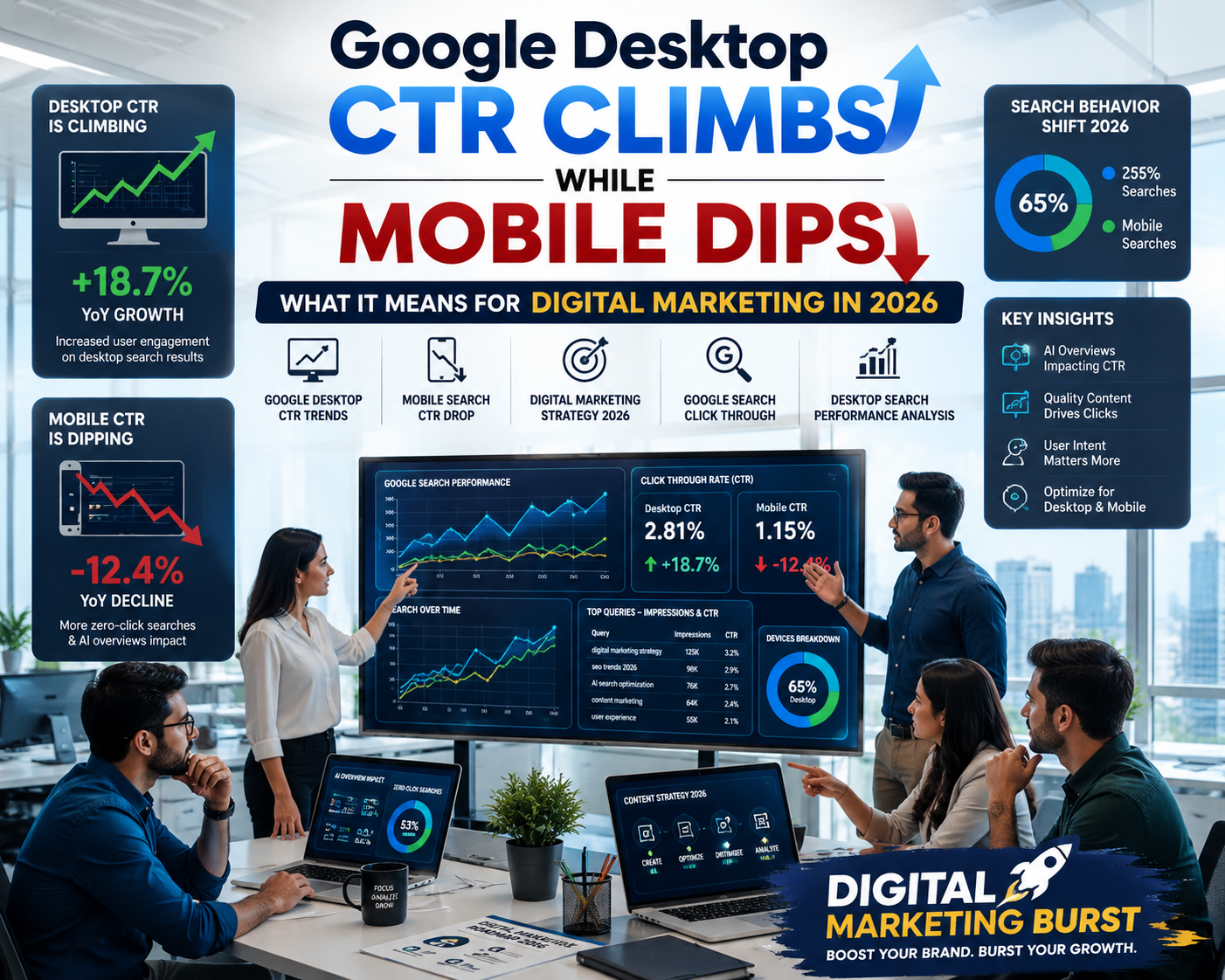
Google search behaviour continues to evolve, and recent reporting indicates an interesting shift:Google Desktop CTR Trends are improving while a Mobile Search CTR Drop is becoming more noticeable across several industries. For businesses, marketers, and SEO professionals, these changes raise an important question—how should a Digital Marketing Strategy 2026adapt to changing user behaviour? Understanding Google Search Click Through patterns together with Desktop Search Performance Analysis can help brands make better content, SEO, and advertising decisions as search habits continue to change.
Instead of treating desktop and mobile users as identical audiences, marketers now need to understand how people search differently across devices. This shift affects website optimisation, user experience, content creation, conversion funnels, and advertising performance. Businesses that recognise these trends early are more likely to improve visibility and engagement across Google Search.
Google Desktop CTR Trends and Mobile Search CTR Drop: Digital Marketing Strategy 2026 Insights by Digital Marketing Burst.
For several years, mobile search dominated discussions around SEO and digital marketing. Smartphones became the primary device for browsing, shopping, reading articles, and discovering local businesses. However, recent industry reports suggest that desktop search is showing stronger click-through performance in several categories.
This does not necessarily mean desktop traffic is replacing mobile traffic. Instead, it highlights changing user intent. Desktop users often perform more detailed research, compare products, evaluate services, or complete business-related tasks. These users may spend more time reading content and are sometimes more likely to click organic search results.
From a marketing perspective, this trend encourages businesses to evaluate their desktop experience instead of focusing exclusively on mobile optimisation. Websites that load quickly, present clear navigation, and provide detailed information may benefit from stronger engagement among desktop users.
Marketers should avoid assuming that one device serves every customer equally. Instead, analysing performance separately for desktop and mobile audiences provides a clearer picture of actual user behaviour.
While desktop engagement appears to be improving in many sectors, several analysts have also observed a Mobile Search CTR Drop. This does not automatically indicate declining mobile traffic. Instead, it reflects changing search result layouts and user interactions.
Modern mobile search pages often display AI-generated summaries, featured snippets, local business packs, shopping results, video content, and knowledge panels before traditional organic listings. As a result, users sometimes find answers without clicking through to individual websites.
This changing behaviour presents both challenges and opportunities. Businesses can no longer depend solely on ranking first for a keyword. They must also optimise content that answers questions clearly, improves user experience, and encourages visitors to continue exploring beyond Google’s search results.
Rather than viewing declining mobile click-through rates as a negative development, businesses should consider how changing search interfaces influence customer decisions.
Every successful Digital Marketing Strategy 2026 starts by understanding audience behaviour instead of simply following trends.
Search behaviour continues changing because users expect immediate answers, personalised recommendations, and high-quality information. Artificial intelligence is also influencing how search engines organise and present information.
Businesses that study customer intent instead of focusing only on rankings often build stronger long-term digital strategies. Understanding when users search, which devices they use, and what information they expect allows marketers to produce more useful content.
Instead of publishing articles only to target keywords, successful organisations increasingly create comprehensive resources that answer complete customer journeys. This approach naturally supports search visibility while improving trust among readers.
For brands such as Digital Marketing Burst, this means helping businesses create websites, content, and optimisation strategies that serve both search engines and real people.
Many businesses celebrate ranking on the first page of Google, but rankings alone do not generate business results. What truly matters is whether users actually choose your result.
A higher Google Search Click Through rate indicates that searchers find your title, description, and content relevant enough to visit your website. Improving click-through rates often increases organic traffic without necessarily improving rankings.
Several factors influence click-through performance, including:
Clear and informative page titles.
Helpful meta descriptions.
Strong search intent alignment.
Recognisable brand authority.
High-quality content.
Rich search features.
Businesses should therefore evaluate both rankings and user engagement together rather than treating them as separate performance indicators.
A website appearing in the second position with an excellent click-through rate may outperform a poorly optimised page ranking first.
The recent improvement in Desktop Google Search CTR suggests that many users are returning to desktop devices when they need to complete more detailed tasks. This behaviour is especially noticeable in industries such as software, finance, B2B services, education, and digital marketing, where users often compare multiple resources before making a decision.
Desktop users generally have access to larger screens, multiple browser tabs, and faster workflows. Because of this, they are more likely to read long-form articles, compare pricing, evaluate products, or download detailed resources. Instead of making quick decisions, they often spend more time researching.
For marketers, this means content should support deeper exploration rather than providing only short answers. Comprehensive guides, original research, comparison articles, and detailed case studies are becoming increasingly valuable because they satisfy the needs of users conducting extensive research.
Businesses should also review desktop usability. Readable typography, logical page layouts, fast loading speeds, and clear navigation improve the overall experience. A well-designed desktop website encourages visitors to stay longer, interact with more pages, and build trust with the brand.
Rather than treating desktop optimisation as outdated, marketers should view it as another opportunity to improve user engagement and strengthen long-term organic performance.
Understanding traffic numbers alone is no longer enough. A practical Desktop Search Analytics Guide begins by examining how visitors interact with your website after they arrive.
Instead of focusing only on impressions or rankings, marketers should analyse metrics such as click-through rate, engagement time, bounce rate, pages viewed per session, returning visitors, and conversions. Together, these metrics provide a clearer picture of content quality and user satisfaction.
For example, an article with moderate traffic but strong engagement may deliver greater business value than one receiving thousands of visits with very little interaction. Looking beyond raw traffic helps identify pages that genuinely support business objectives.
It is also helpful to compare desktop and mobile behaviour separately. Differences in engagement can reveal usability issues, content gaps, or changing audience preferences. These insights allow marketers to make informed improvements instead of relying on assumptions.
Regular performance reviews create a continuous optimisation process. Small improvements based on real user behaviour often produce better long-term results than frequent large-scale redesigns.
Although discussions around Mobile Google CTR Decline continue to grow, mobile optimisation remains essential. Billions of searches are still performed on smartphones every year, and mobile devices continue to dominate many consumer journeys.
The decline in click-through rate is influenced by how Google presents search results. AI-generated summaries, featured snippets, local listings, shopping modules, and video results often answer user questions before an organic result is clicked.
This means businesses must adapt instead of abandoning mobile SEO. Pages should load quickly, provide immediate value, and answer important questions clearly. Strong user experience becomes just as important as keyword optimisation.
Content written for mobile readers should use concise paragraphs, descriptive headings, and logical structure. Readers often scan before committing to a full article, so clarity and organisation matter.
Successful marketers recognise that desktop and mobile users have different expectations. Designing experiences that satisfy both audiences creates a stronger overall digital presence.
Click-through rate is influenced by more than rankings alone. Brand recognition plays a significant role in whether users choose one search result over another.
When people repeatedly encounter useful content from the same organisation, they become familiar with the brand. Over time, this familiarity increases confidence and encourages future clicks, even when competing pages rank nearby.
Brands can strengthen recognition by publishing consistent, accurate, and valuable information across multiple topics related to their industry. Educational resources, expert insights, practical guides, and original analysis all contribute to long-term credibility.
For companies such as Digital Marketing Burst, this means focusing on creating resources that answer real marketing questions instead of producing content only for algorithms. As trust grows, stronger click-through performance often follows naturally because users recognise the brand as a reliable source of information.
Building authority takes time, but consistent quality creates lasting value for both readers and businesses.
A practical 2026 Digital Marketing Guide is no longer centred only on keywords and rankings. Modern search optimisation requires understanding how people discover, evaluate, and interact with information across multiple devices and search experiences.
Artificial intelligence has changed how users receive answers. Search engines increasingly summarise information, recommend related topics, and personalise results according to context. Consequently, businesses must produce content that demonstrates expertise, answers complete questions, and encourages readers to continue learning beyond the search page.
Successful marketing strategies in 2026 will combine technical SEO, helpful content, user experience, and brand authority rather than relying on a single optimisation tactic. Organisations that regularly update existing content, improve website performance, and monitor user behaviour are better positioned to adapt as search continues evolving.
Marketers should also think beyond individual blog posts. Creating topic clusters, comprehensive resource centres, and interconnected educational content helps users explore multiple pages naturally. This approach supports both audience engagement and overall website quality.
Instead of reacting to every algorithm update, businesses benefit more from consistently improving their digital experience. Long-term improvements generally outperform short-term optimisation tactics.
Many organisations invest significant effort into improving rankings while overlooking the quality of the content users actually see. A strong Google Search Click Through Rate often begins with content that immediately communicates value.
Readers decide within seconds whether a search result appears relevant. Clear page titles, informative descriptions, logical structure, and useful information all influence that decision. Once visitors arrive, the content must continue meeting their expectations through accurate explanations and practical insights.
Modern search engines increasingly reward pages that satisfy user intent instead of simply repeating keywords. Articles that answer follow-up questions, explain concepts clearly, and maintain readability often generate stronger engagement than pages created primarily for search engines.
Content should therefore focus on solving problems rather than filling space. Examples, real-world applications, comparisons, and actionable recommendations help readers understand complex topics more effectively.
Businesses that consistently publish trustworthy information gradually strengthen audience confidence. As recognition grows, users become more willing to click future search results associated with that brand.
A detailed Desktop Search Performance Analysis provides insights that many businesses overlook. While overall traffic remains important, understanding how desktop visitors behave can reveal valuable opportunities for improving conversions and customer engagement.
Desktop users frequently spend longer reading articles, comparing products, downloading resources, or completing forms. These activities often represent higher commercial intent compared with shorter informational searches performed on mobile devices.
Analysing desktop behaviour helps identify which content supports business objectives most effectively. Marketers can evaluate page engagement, navigation paths, conversion rates, and user journeys to understand where visitors succeed or encounter obstacles.
This information supports informed decision-making rather than assumptions. Improvements based on actual visitor behaviour generally produce stronger long-term results than redesigns based only on trends.
Businesses should regularly review desktop analytics alongside mobile performance to understand how different audiences interact with their websites. Comparing both experiences often highlights opportunities for improving usability across every device.
Search technology will continue changing, but the principles of valuable content remain remarkably consistent. Organisations that invest in quality information today are more likely to remain visible regardless of future algorithm updates.
A future-ready content strategy begins by understanding customer questions. Instead of targeting isolated keywords, marketers should develop comprehensive resources covering complete topics from multiple perspectives.
Content should remain accurate, current, and easy to understand. Updating existing articles, expanding useful sections, and improving clarity often provides greater value than continuously publishing entirely new material.
Visual elements, diagrams, original research, and practical examples also strengthen educational content. Readers appreciate resources that explain complicated ideas in straightforward language while maintaining factual accuracy.
For agencies such as Digital Marketing Burst, helping businesses create sustainable content strategies means balancing search visibility with genuine reader value. Organisations that consistently educate their audiences often build stronger authority, deeper trust, and longer-lasting digital growth than those pursuing quick optimisation techniques alone.
Artificial intelligence is transforming the way people interact with search engines. Instead of displaying only a list of blue links, search platforms increasingly present summaries, direct answers, related questions, visual content, and AI-generated overviews. These features influence how users decide whether to click on a website.
Desktop users often continue beyond the summary because they are conducting detailed research. They compare multiple sources, open several browser tabs, and evaluate information before making decisions. This behaviour helps explain why desktop engagement has remained strong in many industries.
Mobile users, however, frequently search while travelling, shopping, or completing everyday tasks. In these situations, receiving an immediate answer is often more valuable than visiting several websites. As AI-generated responses become more common, mobile searchers may complete their journey without selecting an organic result.
For businesses, this change reinforces the importance of publishing original, trustworthy, and comprehensive content. Pages that provide unique insights, expert analysis, or detailed explanations remain valuable because they offer information beyond what a short summary can deliver.
Understanding how AI shapes user behaviour allows marketers to create experiences that remain useful regardless of future search interface changes.
Publishing more articles does not automatically improve digital visibility. Instead, many successful organisations are focusing on creating fewer but more valuable resources that answer real customer questions.
Readers appreciate content that is well organised, easy to understand, and supported by practical examples. Clear explanations, updated information, and logical structure help visitors stay engaged while building confidence in the information they are reading.
Rather than producing dozens of similar articles, businesses benefit from developing comprehensive guides that explore a topic in depth. These resources often remain useful for longer periods and are easier to update as industries evolve.
Regular content reviews also improve long-term quality. Refreshing statistics, updating screenshots, improving examples, and adding new sections help ensure that existing articles continue meeting user expectations.
Quality content supports not only search visibility but also customer education, brand reputation, and long-term business growth.
Many businesses mistakenly optimise for only one type of visitor. In reality, desktop and mobile audiences frequently interact with the same brand at different stages of the customer journey.
A potential customer may first discover a business through a mobile search during the day. Later, they might return using a desktop computer to perform detailed research before making a purchase or requesting a service.
Because of this behaviour, websites should provide a consistent experience across every device. Navigation, readability, loading speed, and content structure should remain effective whether someone visits from a smartphone, tablet, or desktop computer.
Responsive website design continues to play an important role, but user experience extends beyond layout. Clear calls to action, accessible information, intuitive menus, and fast performance all contribute to a positive browsing experience.
Businesses that invest equally in desktop and mobile optimisation are generally better prepared to meet changing customer expectations as search technology continues evolving.
The recent discussion surrounding desktop and mobile click-through behaviour highlights several broader lessons for digital marketing.
First, user intent changes over time. Search strategies that worked several years ago may require adjustment as technology and customer behaviour continue developing.
Second, strong brands attract attention regardless of algorithm changes. Organisations recognised for helpful, trustworthy information often maintain audience engagement even as search interfaces evolve.
Third, analysing performance regularly leads to better decision-making. Monitoring engagement, traffic sources, conversion rates, and user behaviour helps businesses identify opportunities for continuous improvement instead of reacting only after performance declines.
Finally, successful digital marketing depends on understanding people rather than simply understanding search engines. Businesses that focus on solving customer problems, answering important questions, and creating valuable experiences are more likely to achieve sustainable growth over the long term.
These lessons remain relevant regardless of future updates because they are built around user needs rather than temporary optimisation techniques.
One of the biggest changes in digital marketing is the growing importance of user experience. Search engines increasingly evaluate whether visitors find a page useful after clicking on it. If readers quickly leave because a website is slow, difficult to navigate, or confusing, that behaviour may indicate the page is not meeting their expectations.
A positive user experience begins with fast loading times, clear page structure, and readable content. Visitors should be able to find important information without scrolling through unnecessary sections or dealing with distracting design elements. Simple improvements such as descriptive headings, logical navigation, and clean layouts can significantly improve how users interact with a website.
Desktop visitors often spend more time reading detailed resources, while mobile users generally expect immediate answers. Recognising these differences helps businesses create experiences that work well for both audiences. Instead of designing for only one device, marketers should ensure every page remains accessible, informative, and easy to use across all screen sizes.
Companies that consistently improve user experience often see stronger engagement, higher conversion rates, and increased customer satisfaction. These outcomes benefit both visitors and businesses, making user experience an essential part of any modern digital marketing strategy.
Every search begins with a purpose. Some users want a quick answer, while others are researching products, comparing services, or learning a completely new topic. Understanding this intent allows marketers to produce content that genuinely helps readers instead of simply targeting keywords.
Informational articles should explain concepts clearly and answer common questions. Comparison pages help users evaluate alternatives, while product pages should provide enough detail for confident purchasing decisions. Matching content to user intent improves satisfaction because visitors receive exactly the information they expected to find.
Long-form educational content continues performing well because it answers multiple related questions within a single resource. Readers appreciate comprehensive guides that save them from opening numerous search results. This approach also encourages longer engagement as visitors continue exploring different sections of the article.
Businesses should regularly review customer questions, feedback, and search behaviour to identify new content opportunities. Producing articles based on real audience needs creates lasting value and supports stronger relationships with readers.
Brand authority is developed over time through consistency rather than isolated success. Businesses that regularly publish accurate, useful, and well-researched content gradually become recognised as reliable information sources within their industry.
Consistency involves more than maintaining a publishing schedule. It also includes using a clear writing style, keeping information updated, and ensuring every article reflects the same commitment to quality. Readers return to websites that consistently provide trustworthy answers because they know what to expect.
Educational content, practical guides, industry analysis, and expert commentary all contribute to long-term authority. As readers become familiar with a brand, they are often more willing to engage with future articles, newsletters, and resources.
For organisations such as Digital Marketing Burst, helping businesses establish authority means creating content that solves problems instead of chasing short-term trends. Over time, this approach supports stronger audience trust and encourages repeat engagement from both new and returning visitors.
Search rankings remain useful, but they represent only one part of overall digital marketing performance. Businesses should also evaluate how effectively their content supports broader objectives such as customer education, lead generation, and long-term brand growth.
Key performance indicators may include visitor engagement, average session duration, returning users, completed enquiries, newsletter subscriptions, and conversion rates. These metrics often provide deeper insight into content effectiveness than rankings alone.
Comparing desktop and mobile performance separately can also reveal valuable trends. Some pages may perform exceptionally well on desktop while requiring improvements for mobile visitors. Regular analysis allows marketers to prioritise updates based on real user behaviour rather than assumptions.
Ultimately, successful digital marketing is measured by how well a website serves its audience. When visitors consistently find useful information and achieve their goals, stronger business results often follow naturally.
As search behaviour evolves, many businesses continue relying on outdated optimisation techniques that no longer deliver meaningful results. One of the most common mistakes is focusing entirely on rankings while overlooking the overall experience visitors have after arriving on the website.
Publishing repetitive content with very similar topics can also reduce value for readers. Instead of creating multiple articles covering nearly identical information, organisations should develop comprehensive resources that answer related questions within a single, well-structured guide. This approach makes information easier to find and improves the reading experience.
Another challenge is ignoring existing content. Many websites publish new articles every week but rarely update older pages. Refreshing statistics, improving explanations, correcting outdated information, and expanding useful sections often delivers greater value than continually producing new material.
Businesses should also avoid treating desktop and mobile visitors as identical audiences. Analysing user behaviour separately allows marketers to identify opportunities for improving navigation, content presentation, and conversion paths on each device.
Continuous improvement based on real user behaviour generally produces stronger long-term results than frequent changes driven solely by algorithm speculation.
Search engines have become the starting point for many purchasing decisions. Whether someone is researching software, comparing service providers, or learning about a new topic, search results often shape the first impression of a brand.
Users typically move through several stages before making a decision. They begin by gathering information, compare available options, evaluate trustworthiness, and finally decide whether to contact a business or complete a purchase. Every stage requires different types of content.
Educational articles introduce new concepts. Comparison guides help readers evaluate alternatives. Case studies demonstrate practical applications, while frequently asked questions address remaining concerns before conversion.
Understanding this journey allows marketers to create content that supports readers from their first search through to their final decision. Rather than focusing on isolated keywords, businesses benefit from developing complete content ecosystems that answer related questions across every stage of the customer journey.
When information remains helpful, accurate, and easy to understand, readers are more likely to remember the brand and return when additional information is needed.
Why Continuous Content Updates Matter
Digital marketing is not a one-time activity. Search behaviour, industry trends, customer expectations, and technology continue changing throughout the year. Because of this, websites require ongoing maintenance rather than occasional updates.
Refreshing existing articles helps maintain relevance while ensuring readers receive current information. New industry developments, changing search features, updated statistics, and revised recommendations can all improve the usefulness of previously published content.
Content audits also identify opportunities to improve readability, strengthen internal navigation, and remove outdated references. Small improvements made consistently often produce better long-term performance than complete website redesigns.
Businesses should schedule periodic reviews of important pages to ensure information remains accurate. This process benefits both readers and organisations by maintaining trust and supporting a positive user experience.
Instead of constantly replacing older articles, improving valuable resources over time creates a stronger knowledge base that continues serving visitors effectively.
The future of digital marketing will continue emphasising user satisfaction, high-quality information, and meaningful online experiences. While technology will undoubtedly introduce new search features, the importance of helpful content is unlikely to disappear.
Businesses that invest in understanding their audiences will be better prepared for future changes. Listening to customer feedback, analysing user behaviour, monitoring industry developments, and regularly improving digital experiences all contribute to long-term success.
Search visibility should therefore be viewed as the result of consistently meeting user needs rather than the objective itself. Organisations that educate, inform, and support their audiences naturally strengthen their online presence over time.
For Digital Marketing Burst, helping businesses prepare for future search trends means encouraging sustainable digital practices that prioritise quality, trust, and continuous improvement. These principles remain valuable regardless of how search technology evolves in the years ahead.
Search behaviour is constantly evolving, and businesses that adapt early often gain a competitive advantage. Instead of reacting only after traffic changes occur, organisations should build flexible digital strategies that respond to user needs and market trends.
The first step is understanding audience expectations. Customers no longer search only for products or services; they also search for solutions, comparisons, expert advice, and practical guidance. Businesses that answer these questions comprehensively are more likely to build lasting relationships with their audience.
Website performance should also be reviewed regularly. Slow-loading pages, confusing navigation, or outdated information can reduce engagement regardless of search rankings. Regular maintenance ensures visitors continue receiving a positive experience across desktop and mobile devices.
Marketing teams should also monitor how different content formats perform. Blog articles, videos, infographics, downloadable resources, and interactive tools all serve different purposes within the customer journey. Diversifying content helps businesses reach audiences with different learning preferences.
By focusing on continuous improvement instead of one-time optimisation, organisations become more resilient as search technology continues changing.
Successful marketing decisions are increasingly driven by data rather than assumptions. Analytics platforms provide valuable insights into how visitors discover content, which pages perform well, and where users leave the website.
Instead of relying only on page views, marketers should analyse metrics that reflect engagement and business value. Session duration, returning visitors, conversion rates, and user journeys often provide more meaningful information than traffic volume alone.
Comparing desktop and mobile data separately is particularly useful because visitor behaviour frequently differs between devices. Desktop users may spend longer researching, while mobile users often seek quick answers or immediate actions.
Data should not be viewed simply as reporting. Instead, it should support informed decision-making. Small improvements based on user behaviour can produce measurable long-term benefits without requiring major redesigns or costly campaigns.
Organisations that regularly review performance data are generally better equipped to identify opportunities for improvement before problems become significant.
One of the most effective ways to strengthen a brand is by consistently educating its audience. Informative content helps businesses demonstrate expertise while providing genuine value to readers.
Educational articles explain complex topics clearly, answer common questions, and guide visitors through decision-making processes. Unlike promotional content, educational resources continue attracting readers because they remain useful long after publication.
Businesses that invest in knowledge sharing often develop stronger relationships with their audience. Readers begin recognising the organisation as a reliable source of information rather than simply another company promoting products or services.
Consistency also matters. Publishing accurate, well-researched content on a regular basis reinforces credibility and encourages repeat visits. Over time, this trust contributes to stronger engagement, increased referrals, and improved brand recognition.
For Digital Marketing Burst, helping businesses build educational content strategies means creating resources that support customers before, during, and after purchasing decisions. This approach benefits both readers and organisations by encouraging meaningful long-term relationships.
Technology will continue changing, but successful marketing teams share several common characteristics. They remain adaptable, focus on customer needs, and continuously improve their digital skills.
Training should extend beyond technical SEO to include user experience, content strategy, analytics, artificial intelligence, and digital communication. Understanding these areas allows teams to respond confidently as search platforms evolve.
Collaboration between writers, designers, developers, and analysts also becomes increasingly important. High-quality digital experiences are rarely created by one specialist working alone. Instead, they result from coordinated efforts across multiple disciplines.
Businesses should encourage ongoing learning by reviewing industry research, experimenting with new ideas, and measuring results objectively. Continuous improvement helps organisations remain competitive without chasing every emerging trend.
Ultimately, future-ready marketing teams succeed because they prioritise solving customer problems rather than simply increasing website traffic. That mindset supports sustainable growth regardless of how search technology changes in the years ahead.
As search platforms continue evolving, businesses should focus on improvements that create lasting value instead of reacting to every short-term trend. A practical digital marketing plan begins by understanding customer needs and building experiences that remain useful regardless of future algorithm changes.
One effective approach is reviewing existing website content. Many organisations have valuable articles that simply need updating rather than replacing. Improving clarity, expanding useful sections, refreshing statistics, and answering additional customer questions often increases the value of existing resources.
Website performance should also remain a priority. Fast loading times, intuitive navigation, accessible design, and clear calls to action improve the overall browsing experience for both desktop and mobile users. Small technical improvements frequently contribute to better engagement because visitors can access information more easily.
Businesses should also continue investing in original content. Research reports, expert interviews, practical tutorials, and industry insights help differentiate a website from competitors publishing similar information. Original resources often encourage repeat visits because readers gain information they cannot easily find elsewhere.
Developing a long-term content calendar also supports consistency. Publishing helpful resources throughout the year helps maintain audience engagement while allowing marketing teams to improve quality instead of rushing content production.
Frequently Asked Questions About Google CTR Trends
Several factors may contribute to stronger desktop engagement. Desktop users often perform detailed research, compare multiple sources, and spend more time reviewing information before making decisions. Larger screens and improved productivity also support longer browsing sessions.
Does a lower mobile click-through rate mean mobile SEO no longer matters?
No. Mobile search remains essential because millions of people continue using smartphones to discover information every day. Lower click-through rates often reflect changing search result layouts rather than declining importance of mobile users.
Should businesses optimise separately for desktop and mobile?
Yes. While responsive websites remain important, analysing behaviour separately allows businesses to identify opportunities for improving navigation, content presentation, and conversion paths for different audiences.
Is ranking first still the most important SEO objective?
Strong rankings remain valuable, but they represent only one aspect of digital performance. User engagement, content quality, trust, and overall visitor satisfaction also contribute significantly to long-term success.
How often should content be updated?
Reviewing important articles every few months helps ensure information remains accurate, relevant, and useful. Regular updates often provide greater value than continually publishing new articles without maintaining existing content.
The discussion surrounding desktop and mobile click-through behaviour highlights several broader lessons for organisations planning future marketing strategies.
First, customer behaviour changes continuously. Businesses should therefore monitor performance regularly rather than relying on assumptions based on previous years.
Second, quality consistently outperforms quantity. Comprehensive resources that genuinely help readers often remain valuable for much longer than articles created only to target specific keywords.
Third, user experience continues becoming more important. Fast websites, organised information, and intuitive navigation contribute positively to customer satisfaction across every device.
Finally, digital marketing should always support broader business objectives. Search visibility, brand awareness, customer education, and long-term trust all work together to create sustainable online growth.
For organisations prepared to learn from changing search behaviour, these trends represent opportunities rather than obstacles. By focusing on people first and technology second, businesses can continue building meaningful relationships with their audiences regardless of how search evolves in the future.
Artificial intelligence is changing more than search results. It is influencing how people discover information, compare brands, and make purchasing decisions. Instead of typing a few keywords and opening several websites, users increasingly expect search platforms to provide direct, personalised, and context-aware answers.
For marketers, this means content must deliver value beyond a simple definition or quick response. Readers still visit websites when they want deeper explanations, practical examples, industry expertise, or original insights that AI summaries cannot fully replace.
Businesses should therefore think of AI as an evolution in search rather than a replacement for websites. Organisations that publish trustworthy resources, maintain accurate information, and update content regularly remain valuable because they contribute original knowledge to the web.
The future of search is likely to combine AI-generated assistance with high-quality publisher content. Companies that continue investing in expertise, research, and customer education will be better positioned as search experiences become increasingly intelligent.
Consumers are exposed to enormous amounts of information every day. As a result, trust has become one of the most valuable assets a business can build. When users recognise a brand as reliable, they are more likely to return for future information, recommend it to others, and engage with its content.
Trust is built through consistency. Accurate articles, transparent communication, updated information, and genuine expertise all contribute to a positive reputation. Over time, these qualities create stronger relationships than promotional messaging alone.
Readers also appreciate brands that acknowledge changing industry trends while providing balanced explanations instead of exaggerated claims. Explaining both opportunities and limitations demonstrates professionalism and encourages informed decision-making.
For Digital Marketing Burst, supporting businesses in building trusted digital experiences means encouraging educational content, continuous improvement, and a customer-first mindset. Long-term credibility often produces greater value than short-term visibility.
Businesses can benefit from reviewing their digital marketing efforts using a straightforward framework that focuses on continuous improvement rather than isolated metrics.
Begin by assessing whether your content answers the questions customers actually ask. Review existing articles to identify outdated information or opportunities for expansion. Next, evaluate website performance, including loading speed, navigation, readability, and accessibility across different devices.
After that, analyse visitor behaviour. Identify which pages attract engagement, which topics generate enquiries, and where users leave the website. These insights help prioritise future improvements based on real audience needs.
Finally, create a schedule for ongoing reviews. Digital marketing is most effective when optimisation becomes a continuous process rather than a one-time project. Small, consistent improvements often deliver stronger long-term outcomes than large, infrequent redesigns.
The digital marketing landscape will continue evolving as technology advances, customer expectations change, and search experiences become more interactive. Businesses that remain flexible will be better prepared for future developments.
Success will increasingly depend on understanding audiences instead of simply following algorithms. Organisations that invest in customer education, valuable content, and excellent user experiences are more likely to remain competitive regardless of how search engines present information.
While desktop and mobile behaviours may continue changing, the underlying objective remains the same: helping users find accurate, useful, and trustworthy information quickly.
As the industry moves forward, marketers should focus less on predicting every search update and more on consistently improving the quality of their websites, content, and customer experiences. Those principles have remained valuable throughout the history of digital marketing and are likely to continue guiding successful strategies in the years ahead.
As search behaviour continues changing, businesses need more than occasional SEO updates. They need a long-term digital marketing partner that understands content strategy, technical optimisation, user experience, analytics, and emerging AI search trends.
Digital Marketing Burst works with businesses that want to build sustainable online growth instead of relying on short-term tactics. The focus is on developing useful content, improving website performance, strengthening organic visibility, and creating marketing strategies that continue delivering value as search technology evolves.
Every business has different goals, audiences, and challenges. For that reason, successful digital marketing should never rely on a single formula. Instead, each strategy should reflect customer behaviour, industry competition, and measurable business objectives.
Whether a company is improving its website, expanding its content library, strengthening local visibility, or preparing for AI-powered search experiences, continuous improvement remains the foundation of long-term digital success.
Rather than promising instant results, the emphasis should always remain on creating digital assets that continue supporting business growth over time.
Final Thoughts
The discussion around Google Desktop CTR Climbs While Mobile Dips highlights an important reality: search behaviour is constantly evolving. While desktop engagement appears to be strengthening in many industries, mobile search continues to play a significant role in how people discover businesses, products, and information.
Instead of viewing desktop and mobile as competing platforms, marketers should understand how each device supports different stages of the customer journey. Desktop users frequently perform detailed research, while mobile users often seek immediate answers or quick decisions. Businesses that optimise for both experiences are better prepared for changing customer expectations.
A successful Digital Marketing Strategy 2026 will rely on several interconnected elements. High-quality content, excellent user experience, accurate analytics, trustworthy branding, and continuous optimisation all contribute to sustainable growth. Organisations that regularly improve their websites instead of chasing every algorithm update are more likely to remain competitive.
The future of digital marketing belongs to businesses that educate their audiences, publish original insights, and build lasting trust. Search engines will continue evolving, but the importance of providing genuine value to users will remain unchanged.
For organisations looking to strengthen their online presence, adapting to new search behaviours today creates opportunities for stronger visibility, better customer engagement, and long-term digital growth tomorrow.
Choosing the right digital marketing partner is an important business decision. Digital Marketing Burst works with startups, local businesses, e-commerce brands, and growing companies that want to improve their online visibility through practical, data-driven digital marketing strategies.
Based in Lucknow, our team helps businesses build stronger online foundations through SEO, content marketing, website optimisation, local SEO, AI-ready content, Google Business Profile optimisation, and performance-focused digital campaigns. Every strategy is planned according to business goals, industry competition, and customer behaviour instead of using a one-size-fits-all approach.
Digital marketing continues to evolve with AI-powered search, changing user behaviour, and new Google updates. Businesses need strategies that remain effective over time rather than depending on temporary trends.
Digital Marketing Burst focuses on creating sustainable marketing solutions that help businesses:
Improve organic search visibility
Build stronger brand authority
Create high-quality SEO content
Optimise websites for better user experience
Increase qualified website traffic
Strengthen local business presence
Prepare for AI-powered search platforms
Instead of chasing quick results, our approach is centred on continuous improvement and measurable business growth.
Clients choose Digital Marketing Burst because we focus on transparency, communication, and customised strategies. Every business has different objectives, target audiences, and competitive challenges, so every marketing plan is developed accordingly.
Our expertise includes:
Search Engine Optimisation (SEO)
Technical SEO Audits
Local SEO for Businesses
AI Search Optimisation
Content Marketing Strategy
Website SEO Optimisation
Google Business Profile Optimisation
Digital Marketing Consulting
Performance Marketing Support
Brand Visibility Strategy
Helping Businesses Adapt to the Future of Search
As Google Search, AI-powered search engines, and customer behaviour continue changing, businesses require marketing strategies that can adapt. Digital Marketing Burst helps organisations prepare for these changes by focusing on valuable content, strong technical foundations, and customer-focused digital experiences.
Whether your goal is increasing website traffic, improving brand visibility, generating qualified leads, or strengthening your online presence, our objective is to build strategies that support sustainable long-term growth.
If you’re looking for a digital marketing agency in Lucknow with a practical, results-focused approach, Digital Marketing Burstis ready to help you build a stronger digital presence.
For years, FAQ rich results helped websites gain additional space on search engine results pages (SERPs). However, Google’s decision to significantly reduce FAQ rich results has changed how businesses approach SEO. Instead of relying on FAQ schema for visibility, websites now need a stronger Google Search Schema Strategy that focuses on delivering structured, accurate, and machine-readable information across multiple schema types.
This shift is not simply about losing a search feature. Rather, it signals a broader transition toward AI-driven search experiences. Google’s AI-powered systems increasingly evaluate structured data to understand entities, products, organizations, articles, reviews, events, and many other content types. Therefore, implementing the right schema markup has become more valuable than ever.
At Digital Marketing Burst, we believe that businesses should view this change as an opportunity instead of a setback. Websites that invest in structured data, technical SEO, and high-quality content are better positioned for AI-powered search experiences, Google AI Overviews, and future search innovations.
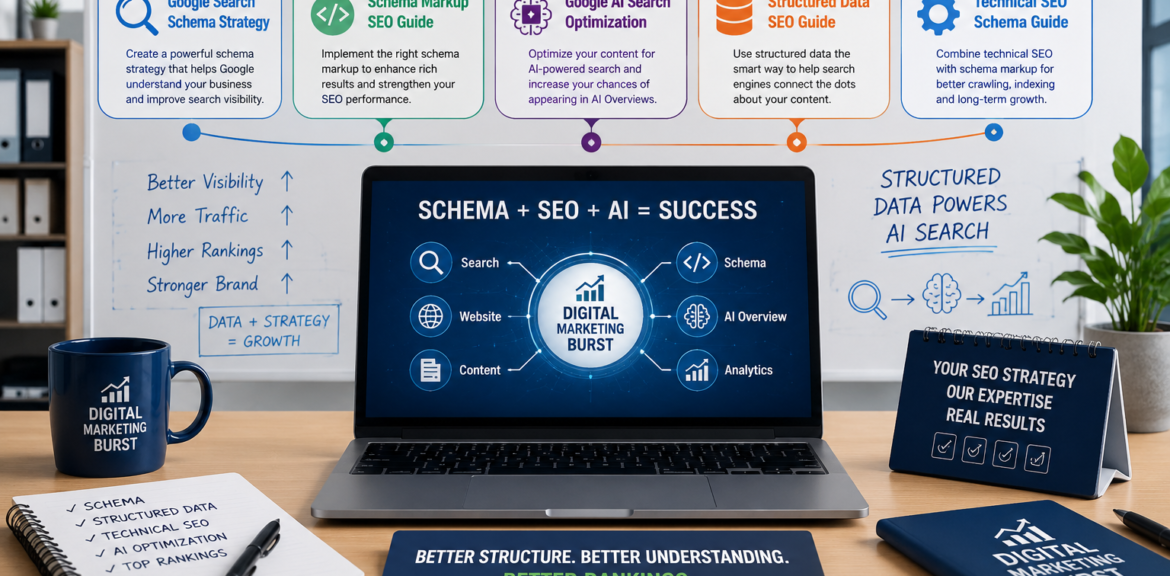
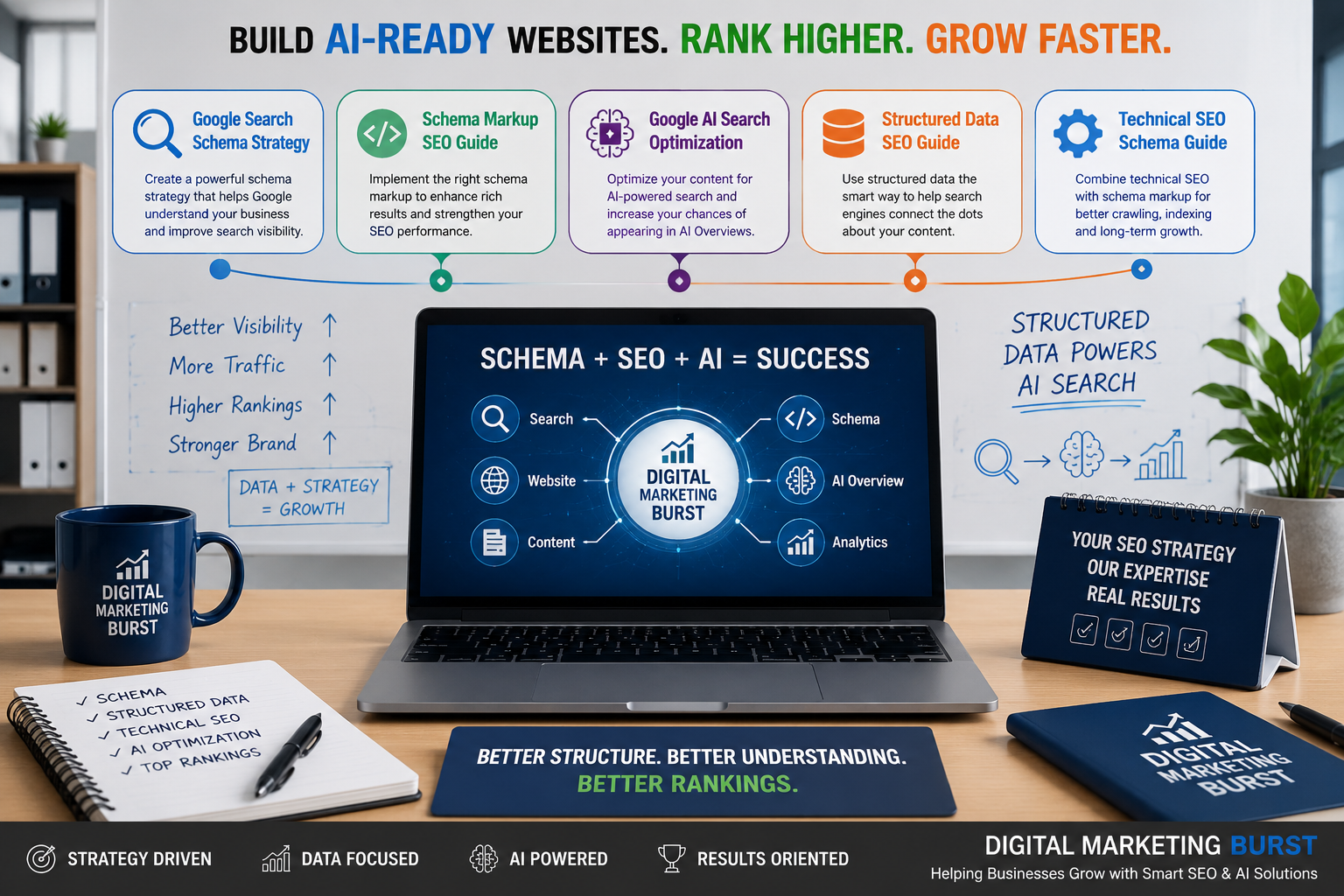
Google Search Schema Strategy and Schema Markup SEO Guide showing how Google AI Search Optimization, Structured Data SEO Guide, and Technical SEO Schema Guide help websites improve AI search visibility.
Google’s decision to reduce FAQ rich results surprised many SEO professionals because FAQ schema had become a common optimization practice. Previously, FAQ snippets allowed websites to occupy more space in search results, improve click-through rates, and answer user questions directly within Google Search.
Today, Google’s objective has shifted. Rather than displaying FAQ snippets for most websites, the search engine is focusing more on trustworthy, authoritative, and well-structured information. This change encourages website owners to prioritize genuine user value instead of creating FAQ sections solely for search visibility.
For digital marketers, this means technical optimization is becoming increasingly important. Search engines now analyze relationships between entities, organizations, products, services, and content using structured data. Websites that clearly communicate this information through schema markup provide stronger signals to Google’s AI systems.
As AI-generated search experiences continue to expand, structured information helps search engines interpret webpages more accurately. Consequently, schema markup now contributes not only to traditional rankings but also to how content is understood, summarized, and surfaced in AI-driven search results.
A successful Google Search Schema Strategy begins with understanding that structured data is designed to help search engines interpret information rather than manipulate rankings. Instead of adding every available schema type, website owners should implement the markup that genuinely reflects the content on each page.
For example, an article should use Article Schema, while a local business page benefits from Local Business Schema. Similarly, products, services, reviews, FAQs (where still appropriate), organizations, and events each have dedicated structured data formats that improve content clarity.
A modern schema strategy should also remain consistent across the entire website. Organization details, business information, author profiles, logos, contact information, and website data should all connect logically through structured data. This consistency improves Google’s understanding of your website and strengthens overall topical authority.
Businesses should also monitor schema validation regularly. Errors, missing fields, or outdated markup can reduce the effectiveness of structured data and create unnecessary technical SEO issues.
Rather than treating schema as a one-time task, successful organizations continually update structured data alongside website improvements and content updates.
A strong Google Search Structured Data Strategy goes beyond simply implementing schema code. It requires creating a complete framework that helps search engines identify relationships between different sections of a website.
Every webpage should answer three important questions:
What is this page about?
Who created this content?
How does this page relate to the overall website?
Structured data provides these answers in a format that search engines can process efficiently. As Google’s AI models become more sophisticated, these connections become increasingly valuable for understanding context.
Organizations that invest in structured data today are preparing their websites for future AI search developments. Rather than chasing individual ranking features, they build a stronger technical foundation capable of supporting long-term search visibility.
A strong Schema Markup SEO Guide starts with one simple principle: use structured data to help search engines understand your content, not to manipulate rankings. Today, Google relies heavily on structured information to identify entities, relationships, products, services, organizations, and authors. As AI-powered search evolves, schema markup has become one of the most valuable technical SEO assets for any website.
Instead of adding random schema types, every page should include only the markup that accurately represents its purpose. For example, blog articles should use Article Schema, business websites should implement Organization Schema, local businesses should include Local Business Schema, while products, FAQs, reviews, services, and events should each have their respective schema.
When implemented correctly, schema helps search engines generate richer search experiences, improve content understanding, and strengthen topical relevance. Although structured data is not a direct ranking factor, it supports better indexing, improved crawling, and increased eligibility for enhanced search features. Businesses that regularly validate their schema using Google’s Rich Results Test and Schema Validator often maintain healthier technical SEO performance than websites with outdated or incomplete markup.
A Complete Schema Markup Guide should focus on building a complete structured data ecosystem rather than isolated schema implementation. Every page on a website contributes to Google’s overall understanding of the business, making consistency extremely important.
Modern websites commonly benefit from implementing Organization Schema, Website Schema, Breadcrumb Schema, Article Schema, Author Schema, ImageObject Schema, Video Schema, FAQ Schema where appropriate, Service Schema, Product Schema, Review Schema, Local Business Schema, ContactPoint Schema, and Social Profile Schema. Together, these help establish trust and improve entity recognition.
Consistency is equally important. Business name, logo, address, phone number, social media profiles, author details, and contact information should remain identical across structured data and visible page content. This alignment strengthens Google’s confidence in the accuracy of the information and reduces ambiguity.
Another important practice is keeping structured data updated. When a business changes contact details, services, products, or operating hours, the corresponding schema should also be updated. Search engines reward websites that provide accurate, reliable, and well-maintained structured information.
Google AI Search Optimization is becoming one of the most important areas of modern SEO. Unlike traditional search, AI-powered systems evaluate content quality, topical authority, entity relationships, structured data, and user intent before generating AI summaries and recommendations.
Websites hoping to perform well in AI-powered search should focus on answering complete user questions instead of targeting isolated keywords. Comprehensive explanations, expert insights, original examples, and trustworthy references improve Google’s ability to understand content context.
Structured data further strengthens this understanding by providing machine-readable information about organizations, articles, services, products, and authors. This allows Google’s AI systems to interpret webpages more accurately and connect related topics across an entire website.
Content written for AI search should remain natural and informative. Short paragraphs, descriptive headings, clear language, and logical content flow improve both user experience and machine understanding. Rather than writing for algorithms, businesses should create content that genuinely solves user problems while maintaining technical SEO best practices.
A practical Google AI SEO Guide goes beyond keyword optimization. Modern SEO requires combining technical excellence, high-quality content, structured data, website performance, and user experience into a single strategy.
Google increasingly evaluates whether a website demonstrates expertise, authority, and trustworthiness across its entire content ecosystem. Instead of publishing isolated blog posts, businesses should build topic clusters that comprehensively cover their industry.
For example, a digital marketing website discussing schema markup should also publish supporting content covering AI search, technical SEO, structured data, Google Search Console, Core Web Vitals, crawling, indexing, rich results, semantic search, entity SEO, and content optimization. These interconnected topics strengthen topical authority while helping Google’s AI systems understand subject expertise.
At Digital Marketing Burst, we encourage businesses to view AI search as an opportunity to improve overall website quality instead of chasing temporary ranking tactics. Organizations that invest in technical SEO, structured data, authoritative content, and consistent optimization are more likely to succeed as Google’s search ecosystem continues to evolve.
A well-planned Structured Data SEO Guide helps websites communicate more effectively with Google and other search engines. Instead of relying only on visible content, structured data provides additional context in a machine-readable format. As a result, search engines can better understand the purpose of each webpage and connect related information across an entire website.
Following the recent SERP FAQ changes, businesses should focus on implementing structured data that genuinely represents their content rather than relying on one schema type alone. A modern website often benefits from Organization Schema, Article Schema, Breadcrumb Schema, Website Schema, Service Schema, Product Schema, Review Schema, Local Business Schema, and Author Schema.
Each schema type contributes to Google’s understanding of different website sections. Together, they create a strong technical foundation for AI-powered search, semantic search, and entity recognition. Moreover, websites with well-maintained structured data often experience better crawling efficiency, improved indexing, and stronger content organization.
At Digital Marketing Burst, we recommend reviewing structured data regularly. Every time a new service, product, blog, or location page is published, its schema should also be updated. This simple practice keeps search engines informed while maintaining long-term technical SEO health.
A successful Structured Data Optimization Guide involves much more than simply adding schema code. Optimization means ensuring that structured data remains accurate, complete, and aligned with visible page content.
Many websites unknowingly create technical issues by implementing incomplete markup, outdated business information, or conflicting structured data. These problems reduce Google’s confidence in the information and may affect rich result eligibility.
Website owners should periodically validate every schema implementation using Google’s Rich Results Test and Schema Validator. These tools quickly identify missing required properties, syntax errors, or unsupported schema types. Fixing these issues improves technical quality and enhances search engine understanding.
Another important optimization strategy is maintaining consistency across all business information. Company name, logo, address, contact number, social media profiles, opening hours, and website URLs should remain identical throughout the website and structured data. This consistency strengthens entity recognition while reducing confusion for Google’s AI systems.
As AI search continues expanding, structured data optimization becomes an ongoing process rather than a one-time implementation.
A complete Technical SEO Schema Guide combines traditional technical SEO with structured data implementation. While schema helps search engines understand content, technical SEO ensures that content can be discovered, crawled, indexed, and served efficiently.
Before implementing advanced schema, websites should first maintain excellent technical health. Broken links, duplicate pages, slow loading speeds, crawl errors, incorrect canonical tags, poor internal linking, and indexing issues can reduce the effectiveness of structured data.
Once the technical foundation is strong, schema becomes significantly more valuable. Google can efficiently crawl structured information while AI systems accurately interpret relationships between webpages.
Businesses should also ensure that every important landing page contains appropriate metadata, optimized headings, descriptive image alt attributes, mobile-friendly layouts, secure HTTPS implementation, and fast Core Web Vitals. Together, these factors create a technically optimized website that supports both traditional search rankings and AI-powered search experiences.
An effective Technical SEO Optimization Guide focuses on improving every aspect of website performance that influences crawling, indexing, and user experience. Technical optimization is no longer limited to search engine bots. Today’s AI-powered search systems evaluate website quality from multiple perspectives.
Improving website speed remains one of the highest priorities. Faster websites provide better user experiences while allowing search engines to crawl more pages efficiently. Optimized images, compressed files, browser caching, clean CSS, and minimized JavaScript all contribute to improved performance.
Internal linking also plays a major role. Well-connected pages help Google understand topical relationships while distributing authority throughout the website. Every important blog should naturally link to relevant service pages, category pages, and supporting articles.
Content organization has become equally important. Logical heading structures, descriptive URLs, clear navigation, breadcrumb implementation, and topic clusters all improve both human readability and machine understanding.
For businesses preparing for AI-powered search, technical SEO optimization should become a continuous process rather than an occasional website audit.
Even experienced SEO professionals sometimes make structured data mistakes that limit search performance. One of the most common problems is adding schema that does not match the visible page content. Google’s guidelines clearly state that structured data should accurately represent information users can actually see.
Another frequent mistake is using outdated schema properties or unsupported markup. Schema.org evolves regularly, and websites should review implementations periodically to remain compatible with Google’s latest recommendations.
Many businesses also forget to update structured data after changing products, services, addresses, or company details. As a result, search engines receive conflicting information, reducing trust in the website.
Duplicate schema, nested errors, incorrect entity relationships, and missing required fields also create unnecessary technical issues. Regular validation helps identify these problems before they affect search performance.
As Google continues to expand AI-powered search experiences, traditional SEO signals alone are no longer enough. Today’s ranking systems evaluate content quality, topical authority, structured data, technical SEO, user intent, website performance, and overall trustworthiness together. Businesses that optimize every part of their website are more likely to appear in AI-generated search experiences and future Google search features.
One of the strongest ranking signals is content quality. Articles should answer complete user questions rather than focusing on isolated keywords. Original insights, practical examples, updated information, and clear explanations help both users and search engines understand the value of the content.
Website authority also plays an important role. Publishing related articles around a single topic creates topical authority, allowing Google’s AI systems to recognize expertise. Instead of writing disconnected blogs, businesses should build comprehensive content clusters covering every important aspect of their industry.
Technical SEO remains equally important. Fast loading pages, mobile responsiveness, secure HTTPS connections, clean internal linking, proper indexing, optimized images, structured URLs, and well-implemented schema all contribute to stronger AI search visibility.
Google AI Overview Optimization is becoming one of the most valuable SEO opportunities for businesses. AI Overviews summarize information from multiple trusted sources to answer complex search queries. Websites that provide complete, reliable, and well-structured content have a greater chance of contributing to these AI-generated responses.
Rather than targeting only one keyword, content should address related user questions naturally. Clear headings, concise paragraphs, descriptive subheadings, and logical information flow improve readability while helping AI systems understand the page.
Structured data further strengthens this process. Schema helps Google identify articles, organizations, products, services, authors, and business information more accurately. Although schema does not guarantee inclusion in AI Overviews, it improves machine understanding and supports overall search visibility.
Businesses should also regularly refresh older content with updated statistics, recent developments, and improved explanations. Fresh, relevant information signals that a website remains active and trustworthy.
The reduction of FAQ rich results does not mean structured data has become less important. Instead, Google is encouraging websites to focus on broader structured data implementation rather than depending heavily on FAQ schema alone.
Today, websites can benefit from Organization Schema, Article Schema, Breadcrumb Schema, Product Schema, Service Schema, Review Schema, Video Schema, Local Business Schema, Event Schema, and several other structured data types depending on page purpose.
Rich results continue evolving as Google’s AI systems become more sophisticated. Businesses should therefore implement structured data that accurately reflects visible content instead of chasing temporary search features.
Long-term SEO success depends on building technically sound websites that consistently deliver useful information rather than relying on individual SERP enhancements.
The future of search will rely increasingly on machine-readable information. As AI-generated search experiences become more advanced, structured data will continue helping search engines interpret relationships between businesses, products, services, authors, reviews, locations, and articles.
Schema markup is evolving from a technical enhancement into a core component of digital marketing strategy. Businesses investing in structured data today are preparing for future search innovations where AI systems require accurate entity information to generate reliable responses.
Organizations should therefore treat schema as an ongoing optimization process. Regular updates, validation, and expansion of structured data ensure websites remain compatible with future Google Search developments.
Rather than asking whether schema improves rankings directly, businesses should ask whether search engines fully understand their website. Structured data provides that understanding.
An AI-ready website is no longer optional. It combines high-quality content, technical SEO, structured data, excellent user experience, fast loading speed, mobile optimization, logical navigation, and consistent branding.
Businesses that delay these improvements may find it increasingly difficult to compete as AI search becomes the standard search experience.
Every webpage should have a clear purpose, accurate metadata, optimized images, structured headings, internal links, and relevant schema markup. Together, these elements help both users and AI systems understand the website efficiently.
An AI-ready website also supports better engagement, longer user sessions, improved trust, and stronger conversion opportunities.
At Digital Marketing Burst, we believe successful SEO is no longer about individual ranking tricks. Instead, it requires building technically strong websites supported by valuable content, structured data, AI-ready architecture, and long-term optimization strategies.
Our approach combines:
Google Search Schema Strategy
Complete Schema Markup Guide implementation
Google AI Search Optimization
Structured Data Optimization Guide
Technical SEO Optimization Guide
AI-ready content architecture
Entity-based SEO
Local SEO and Google Business Profile optimization
Website performance improvements
Continuous technical audits
By combining these strategies, businesses can improve search visibility while preparing for future AI-powered search experiences.
Conclusion
The recent SERP FAQ Removal & New Data Challenge: How Schema Boosts AI Search Value demonstrates that modern SEO is entering a new era. Instead of depending on individual SERP features, businesses should focus on creating technically optimized websites supported by high-quality content and accurate structured data.
A strong Google Search Schema Strategy, supported by a Schema Markup SEO Guide, Google AI Search Optimization, Structured Data SEO Guide, and Technical SEO Schema Guide, creates a sustainable foundation for future search success.
As Google’s AI capabilities continue expanding, organizations that invest in structured data, technical excellence, and user-focused content will remain ahead of competitors. Search engines may continue changing their algorithms, but websites that prioritize clarity, trust, and helpful information will continue building long-term visibility.
If you’re looking to prepare your website for the future of AI search, now is the right time to review your schema implementation, strengthen your technical SEO, and build a comprehensive search strategy that evolves alongside Google’s innovations.
Frequently Asked Questions About SERP FAQ Removal, Schema & AI Search
As businesses adapt to Google’s evolving search ecosystem, several common questions arise about schema markup, AI search, and technical SEO. Understanding these concepts helps website owners make informed optimization decisions and build sustainable SEO strategies.
No. FAQ Schema is still supported by Google, but its visibility in search results has been significantly reduced for most websites. Instead of depending on FAQ rich results for traffic, businesses should use FAQ Schema only when it genuinely improves user experience. The focus should now be on implementing structured data that accurately represents the page content rather than expecting additional SERP features.
The most valuable schema types depend on your website. However, Organization Schema, Article Schema, Local Business Schema, Service Schema, Product Schema, Breadcrumb Schema, Review Schema, Video Schema, Website Schema, and Author Schema are commonly recommended. These schema types help search engines understand content relationships while supporting AI-powered search experiences.
Can Schema Improve Google AI Search Visibility?
Schema itself does not guarantee rankings or AI Overview visibility. However, it helps Google understand your website more accurately. Combined with high-quality content, strong technical SEO, fast page speed, and topical authority, structured data strengthens your website’s overall search performance.
How Often Should Structured Data Be Updated?
Structured data should be reviewed whenever important website information changes. New services, updated business details, product changes, author profiles, and published articles should all include corresponding schema updates. Regular validation also helps identify errors before they affect search performance.
What Is the Biggest Schema Mistake Businesses Make?
Many websites implement schema that does not match visible page content. Others forget to update structured data after changing business information. Some also use unnecessary schema types or ignore validation tools. Accurate, consistent, and regularly maintained structured data delivers the best long-term results.
Final Thoughts
Search is changing rapidly, and AI is becoming a central part of how users discover information. Rather than focusing on individual SERP features, businesses should invest in building websites that are technically strong, content-rich, and easy for both users and search engines to understand.
A well-planned Google Search Schema Strategy, supported by a Schema Markup SEO Guide, Google AI Search Optimization, Structured Data SEO Guide, and Technical SEO Schema Guide, creates a strong foundation for long-term growth. As AI search continues to evolve, organizations that combine valuable content with accurate structured data and solid technical SEO will be better positioned to earn visibility, trust, and sustainable organic traffic.
At Digital Marketing Burst, we believe that the future of SEO lies in creating websites that prioritize user value first while remaining technically optimized for modern search engines. Businesses that embrace this approach today will be better prepared for tomorrow’s AI-driven search landscape.
Publishing content alone is no longer enough to compete in today’s search landscape. After Google’s SERP FAQ changes and the rapid growth of AI-powered search, businesses need a structured approach that combines technical SEO, high-quality content, and user experience. The following implementation checklist can help website owners prepare for the future while improving overall search performance.
Before publishing any webpage, ensure that the page has a clear objective and answers a specific user query. Search engines increasingly reward pages that solve real problems rather than simply targeting keywords. Every article should provide useful information, practical examples, and a logical flow that keeps readers engaged from beginning to end.
Next, review your structured data carefully. Every page should include the most relevant schema based on its purpose. For example, blogs should use Article Schema, while service pages should implement Service Schema. Local businesses should maintain accurate Local Business Schema, and organizations should always include Organization Schema with updated business information. Consistent structured data helps Google understand the relationship between different sections of your website.
Technical SEO should also be reviewed regularly. A fast-loading website, mobile-friendly design, secure HTTPS connection, optimized images, and clean internal linking structure all contribute to better crawling and indexing. Even the best content can struggle if technical issues prevent search engines from accessing important pages efficiently.
Content freshness has become another important factor. Instead of publishing articles and forgetting them, review existing content every few months. Update statistics, screenshots, search trends, examples, and explanations whenever new Google updates occur. Fresh content demonstrates that your website remains active and trustworthy.
At Digital Marketing Burst, we recommend building long-term topical authority instead of chasing individual ranking opportunities. Publishing related articles around AI search, structured data, schema markup, technical SEO, content optimization, and website performance creates a stronger knowledge hub that benefits both users and search engines.
Businesses should also monitor performance through Google Search Console and analytics tools. Regularly reviewing impressions, clicks, indexing reports, crawl issues, and structured data enhancements provides valuable insights into how search engines interpret your website. Small improvements made consistently often produce stronger long-term results than occasional large changes.
Ultimately, the future of SEO belongs to websites that combine excellent content with a strong technical foundation. AI-powered search continues to evolve, but one principle remains constant: websites that provide accurate information, clear structure, and a great user experience are more likely to earn lasting visibility and trust.
Imagine two businesses offering similar services. Both have professionally designed websites, publish regular blogs, and compete for the same audience. However, one business follows a structured SEO strategy, while the other focuses only on publishing content without maintaining its technical foundation.
The first website regularly updates its structured data, maintains accurate business information, improves page speed, organizes content into topic clusters, and ensures every page has a clear purpose. It also validates schema, fixes crawl issues, updates older articles, and monitors search performance using Google Search Console.
The second website publishes articles but rarely reviews technical SEO. Some pages contain outdated information, structured data is incomplete, internal links are inconsistent, and older content is never refreshed. Although new blogs continue to appear, the overall website becomes increasingly difficult for search engines to interpret.
Over time, Google’s AI-powered search systems are more likely to understand and trust the first website because it provides consistent, well-organized information. The content is easier to interpret, relationships between pages are clearer, and the overall user experience is stronger. This demonstrates that long-term SEO success comes from combining useful content with a solid technical foundation rather than relying on individual search features.
Whether you manage a business website, an e-commerce store, or a company blog, preparing for AI-powered search should become part of your ongoing digital strategy. Instead of making occasional SEO changes, develop a regular optimization routine.
Review your website every month. Check for crawl errors, broken links, outdated information, missing structured data, slow-loading pages, and content that could be improved. Small improvements made consistently often have a greater long-term impact than major changes made only once a year.
Keep publishing content that answers real customer questions. Focus on clarity, accuracy, and practical value. As AI search continues to evolve, websites that consistently educate users and maintain technical quality will remain competitive.
At Digital Marketing Burst, we encourage businesses to treat SEO as a continuous process rather than a one-time project. Combining technical optimization, structured data, high-quality content, and regular maintenance creates a website that is prepared for both today’s search engine algorithms and tomorrow’s AI-driven experiences.
Key Takeaways
Google’s reduction of FAQ rich results signals a broader shift toward AI-powered search.
Structured data remains valuable because it helps search engines understand your content more accurately.
Technical SEO, website performance, and content quality work together to improve long-term visibility.
Topic clusters and regularly updated content strengthen topical authority.
AI-ready websites prioritize user experience, accurate information, and clear site architecture.
Continuous monitoring and improvement are more effective than short-term SEO tactics.
By focusing on these principles, businesses can build a stronger online presence that adapts to future search changes while continuing to provide value to users.
Implementing schema markup is only the first step. The next step is measuring whether it is helping your website perform better. Many businesses add structured data but never review its impact. A successful SEO strategy includes regular monitoring and continuous improvement.
Start by checking Google Search Console for indexing status, crawl reports, and enhancement reports. These insights help identify whether Google is reading your structured data correctly. If errors appear, fix them promptly so search engines always receive accurate information.
Next, monitor organic traffic using Google Analytics 4 (GA4). Compare traffic before and after implementing schema improvements. Look for changes in impressions, clicks, engagement time, and landing page performance. While schema alone does not guarantee higher rankings, it supports Google’s understanding of your content and can contribute to stronger overall visibility when combined with quality content.
User behaviour is another important indicator. If visitors spend more time on your website, explore multiple pages, and interact with your content, it signals that your website is delivering value. Search engines increasingly reward websites that satisfy user intent rather than simply matching keywords.
Businesses should also review their competitors regularly. Observe how industry leaders structure their content, organize their websites, and implement technical SEO. This doesn’t mean copying competitors. Instead, it helps identify opportunities to improve your own website while maintaining originality.
AI-powered search is changing rapidly, and businesses should avoid focusing only on short-term algorithm updates. Instead, build a strategy that remains effective regardless of future Google changes.
Begin by publishing content that genuinely answers customer questions. Every article should solve a problem, explain a concept, or guide users toward better decisions. High-quality content remains valuable even when search features evolve.
Strengthen your website with clear navigation, logical internal linking, and topic clusters. Related articles should naturally connect with one another so users and search engines can easily discover additional information. This improves both user experience and topical authority.
Continue investing in technical SEO. Fast loading pages, mobile responsiveness, clean URLs, structured headings, optimized images, and accurate schema all work together to create an AI-ready website.
At Digital Marketing Burst, we believe that the future of SEO belongs to businesses that combine technical excellence with valuable content. Rather than chasing every search update, organizations should focus on creating trustworthy websites that consistently educate, inform, and help their audience.
Search technology will continue evolving, but one principle is unlikely to change: websites that provide accurate information, excellent user experiences, and strong technical foundations will remain competitive.
Whether your business is just beginning its SEO journey or already has an established online presence, now is the ideal time to review your Google Search Schema Strategy, strengthen your Structured Data Optimization, and prepare your website for the next generation of AI-powered search.
A long-term approach built on quality content, technical SEO, and structured data will not only improve search visibility but also create a better experience for every visitor who reaches your website.
Google Search is changing faster than ever. The reduction of FAQ rich results marks the beginning of a broader transformation toward AI-powered search experiences. Instead of rewarding isolated SEO tactics, Google now focuses on understanding content, entities, user intent, and website quality at a much deeper level.
This evolution makes Google Search Schema Strategy, Schema Markup SEO Guide, Google AI Search Optimization, Structured Data SEO Guide, and Technical SEO Schema Guide essential components of every modern SEO strategy. Structured data helps search engines interpret your content accurately, while technical SEO ensures your website is fast, accessible, and easy to crawl. Together, they create a stronger foundation for long-term visibility.
Businesses should no longer think of schema as an optional technical enhancement. It has become a key element in helping AI-powered search engines understand products, services, organizations, articles, authors, reviews, and business information. When combined with high-quality content, logical site architecture, and a great user experience, structured data supports sustainable organic growth.
However, no single SEO technique guarantees success. The websites that consistently perform well are those that combine valuable content, technical excellence, continuous improvement, and a genuine focus on helping users. As Google continues to expand AI-driven search, these principles will remain far more valuable than short-term optimization tactics.
At Digital Marketing Burst, we help businesses prepare for the future of search by combining technical SEO, structured data implementation, AI-ready content strategies, website optimization, and performance-focused digital marketing solutions. Our goal is not simply to improve rankings but to build websites that search engines understand, users trust, and businesses can rely on for long-term growth.
If your website has not yet been reviewed for structured data, technical SEO, or AI search readiness, now is the ideal time to begin. The sooner you prepare, the better positioned your business will be for the next generation of Google Search.
About Digital Marketing Burst
Digital Marketing Burst is a leading digital marketing agency specializing in SEO, AI Search Optimization, Local SEO, Google Business Profile optimization, Google Ads, Meta Ads, website development, technical SEO, content marketing, and branding solutions. We help startups, local businesses, healthcare organizations, educational institutions, and enterprises build stronger online visibility through ethical, data-driven, and future-ready digital marketing strategies.
Whether you want to improve organic traffic, optimize your website for AI-powered search, implement advanced schema markup, or strengthen your technical SEO, our team focuses on practical solutions that support sustainable business growth.
Recent announcements and product improvements suggest Google is investing in features that help publishers, creators, and businesses build stronger relationships with their audiences rather than relying only on one-time search visits. Instead of viewing search as a single interaction, Google is gradually connecting Search, Discover, News, subscriptions, creator tools, and personalized experiences into a broader ecosystem designed to encourage repeat engagement.
For publishers, this change represents both an opportunity and a challenge. Traditional SEO remains important, but audience retention, reader trust, and brand recognition are becoming increasingly valuable. At Digital Marketing Burst, we believe businesses that focus on helpful content, consistent publishing, and user experience will be better prepared for the future of search.
Google Audience Loyalty Ecosystem explained with Google Audience Loyalty Update, Google Publisher Loyalty Features, Google Search Creator Tools, and Google Publisher Growth Strategy for publishers, creators, and SEO professionals.
The phrase Google Audience Loyalty Ecosystem describes Google’s growing emphasis on helping users discover valuable content and return to trusted publishers over time. Instead of rewarding only pages that rank well for individual keywords, Google’s products increasingly encourage meaningful relationships between readers and content creators.
This approach can be seen across several Google products. Search continues to connect users with relevant information, while Google Discover recommends articles based on interests. Google News highlights trusted reporting, and subscription-related features make it easier for readers to follow publishers they value.
For website owners, this means success is no longer measured only by page views. Returning visitors, newsletter subscribers, branded searches, and engaged readers are becoming stronger indicators of a healthy online presence.
A publisher who consistently solves readers’ problems is more likely to earn repeat visits than one who focuses only on ranking for individual keywords. This shift encourages businesses to think beyond traffic and build lasting relationships with their audience.
The growing Google audience engagement ecosystem reflects a broader change in how people consume information online. Readers expect personalized recommendations, trustworthy sources, and content that answers their questions quickly.
Because of this, publishers need strategies that encourage visitors to return after their first visit. High-quality articles, useful guides, newsletters, and regular updates all contribute to stronger audience loyalty.
Search engines also benefit when users repeatedly engage with reliable publishers. Satisfied users are more likely to continue using Google’s products, while publishers receive consistent visibility for content that demonstrates expertise and relevance.
This trend also affects content planning. Rather than publishing isolated articles, successful websites increasingly create topic clusters that answer related questions and guide readers through multiple resources. Internal linking, clear navigation, and updated evergreen content all contribute to this experience.
For businesses, the lesson is straightforward. Create content that remains useful long after publication instead of chasing every temporary trend.
The recent Google Audience Loyalty Update has generated considerable interest because many website owners want to know whether Google is changing the way publishers are evaluated.
Although Google has not introduced a single ranking signal called an “Audience Loyalty Update,” its recent product direction clearly emphasizes helping users reconnect with publishers they already trust. Features across Discover, Search, News, and personalized recommendations support this broader objective.
Publishers should therefore think beyond attracting first-time visitors. Every article should encourage readers to explore related content, subscribe to updates, or return when they need additional information.
Trust also plays an important role. Accurate information, transparent authorship, updated content, and consistent publishing schedules help strengthen credibility over time. Readers who trust a website are far more likely to visit again, share articles, and recommend the brand to others.
Instead of reacting to every algorithm discussion, publishers should focus on improving overall content quality and creating resources that remain valuable for months or even years.
The discussion around Google Publisher Loyalty Features goes beyond search rankings. It focuses on how publishers can encourage long-term engagement with their audience.
Modern readers interact with content across multiple devices and platforms. They may first discover an article through Google Search, return later through Google Discover, and eventually subscribe to a newsletter after finding several useful resources.
This journey demonstrates why loyalty matters. A single search visit has value, but a returning reader often contributes much more over time.
Publishers can strengthen these relationships by organizing content into helpful series, updating older articles with fresh information, and making navigation simple. Fast-loading pages, mobile-friendly layouts, and clear article structures also improve the overall reading experience.
Rather than viewing every article as an isolated opportunity, successful publishers build complete knowledge hubs around important topics. This strategy helps both readers and search engines understand the expertise of a website.
The evolution of Google publisher tools gives creators more opportunities to understand their audience and improve content performance.
Analytics platforms, Search Console, structured data, and performance reports provide valuable insights into how readers discover and interact with content. Instead of focusing only on rankings, publishers can identify which articles generate repeat visits, longer engagement, and stronger user satisfaction.
These insights help shape future editorial decisions. Publishers can update successful articles, expand popular topics, and improve underperforming pages based on real user behavior rather than assumptions.
At Digital Marketing Burst, we recommend using these tools to support long-term publishing strategies instead of chasing short-lived ranking fluctuations. Sustainable growth usually comes from understanding audience needs and consistently delivering valuable content.
The expansion of Google Search Creator Tools highlights Google’s growing support for content creators who produce original, useful, and trustworthy information.
Creators now have more opportunities to understand search performance, optimize technical aspects of their websites, and improve content quality using official Google resources. These tools are designed to help publishers identify indexing issues, monitor search visibility, and enhance user experience.
However, technology alone cannot replace valuable content. The most effective creator tools still depend on accurate information, thoughtful writing, and genuine expertise. Publishers who combine quality content with sound technical practices are more likely to build loyal audiences over time.
As search continues to evolve, creators who focus on helping readers instead of simply targeting keywords will be better positioned for long-term success.
The conversation around Google Publisher Growth Strategy has become increasingly important because publishers are facing a changing search landscape. Organic traffic is still valuable, but relying on search alone is becoming a risky long-term strategy. Instead, successful websites are building communities that return regularly, regardless of where the first visit originated.
A strong publisher growth strategy begins with understanding reader intent. Visitors rarely arrive with the same goal. Some need quick answers, while others are looking for in-depth guides, tutorials, or industry analysis. Creating content that serves each stage of this journey encourages readers to spend more time on your website and return when they have new questions.
Another important factor is content freshness. Evergreen articles should be reviewed and updated whenever new information becomes available. Readers appreciate accurate, current information, and updated content often performs better over time than articles that remain unchanged for years.
Publishers should also build clear content hubs around related topics. For example, if your website covers SEO, connect articles about technical SEO, content marketing, Google Search Console, and algorithm updates through logical internal links. This structure helps readers discover additional resources while improving navigation.
At Digital Marketing Burst, we encourage businesses to measure success using more than page views. Returning visitors, newsletter subscriptions, average engagement time, and direct traffic provide valuable insights into audience loyalty and long-term brand growth.
The idea behind a Google audience engagement update is simple: websites should create experiences that encourage readers to return rather than relying only on first-time search traffic.
Returning visitors are often more valuable because they already recognize your brand and trust your content. They are also more likely to explore additional articles, subscribe to updates, or share your resources with others.
One effective way to increase engagement is by publishing content series instead of isolated articles. When readers finish one article and naturally move to another related resource, they spend more time on your website and develop greater familiarity with your brand.
Clear article layouts also contribute to engagement. Short paragraphs, descriptive headings, relevant visuals, and helpful examples improve readability and encourage visitors to continue reading. A website that is easy to navigate creates a better experience than one with confusing menus or cluttered pages.
Most importantly, publishers should answer real user questions. Understanding search intent and addressing common challenges builds trust far more effectively than simply targeting popular keywords.
Today’s Google creator tools provide valuable information that helps publishers improve content quality and technical performance. These resources support website owners in understanding how their content appears in search results and where improvements can be made.
Performance reports reveal which pages receive impressions, clicks, and user engagement. This information allows publishers to identify successful topics and update articles that need improvement. Instead of guessing what readers want, creators can make decisions based on actual user behaviour.
Technical tools are equally important. Monitoring indexing, fixing crawl issues, improving page speed, and ensuring mobile compatibility all contribute to a better user experience. While excellent writing remains essential, strong technical foundations help search engines understand and display your content effectively.
Creators should view these tools as guides rather than shortcuts. Long-term success comes from combining technical optimisation with original, useful, and trustworthy content that genuinely helps readers.
The evolution of Google Search Creator Tools reflects Google’s broader effort to help creators reach the right audience while maintaining high-quality search experiences.
Search visibility today depends on more than keyword placement. Content structure, topical expertise, internal linking, and user satisfaction all influence how readers interact with your website. Publishers who organise their content logically often make it easier for both users and search engines to understand the relationship between different articles.
Topic clusters are an effective example. Instead of publishing unrelated posts, build comprehensive resources around major themes. Connect beginner guides with advanced tutorials, case studies, and frequently asked questions. This approach encourages readers to explore additional pages and strengthens topical authority.
Content discovery also extends beyond traditional search. Readers may encounter your articles through Google Discover, personalised recommendations, newsletters, or direct visits. Diversifying traffic sources helps reduce dependence on any single platform.
Search continues to evolve alongside user expectations. People increasingly expect fast answers, reliable information, and a seamless browsing experience across devices. Publishers who adapt to these expectations are more likely to maintain consistent growth over time.
Building trust should remain a priority. Clearly identify authors, cite reliable sources when discussing news or research, and update articles when important developments occur. Transparent publishing practices strengthen credibility with readers.
Consistency is another important factor. Publishing useful content on a regular schedule helps readers know when to expect new information. Over time, this consistency contributes to stronger audience loyalty and brand recognition.
Finally, avoid chasing every industry trend. While staying informed is valuable, long-term growth usually comes from solving real problems for your audience rather than reacting to every headline. Websites that invest in quality, usability, and reader satisfaction are generally better positioned to adapt as search continues to change.
One of the biggest opportunities for publishers in 2026 is Google Discover. Unlike traditional search, where users actively type a query, Google Discover recommends content based on interests, browsing behavior, and engagement patterns. This means your article can continue attracting readers long after it is published.
For publishers, Discover represents more than an additional traffic source. It helps introduce content to users who may never have searched for your brand directly. If readers find your content valuable, they are more likely to revisit your website, subscribe to your newsletter, or search for your brand again. This repeated interaction supports the broader idea of a Google Audience Loyalty Ecosystem.
Creating content for Discover requires a slightly different mindset than traditional SEO. Instead of focusing only on ranking for individual keywords, publishers should produce engaging headlines, helpful articles, original images, and content that provides genuine value. Updating evergreen articles with fresh information also improves their long-term usefulness.
Publishers should remember that Discover traffic can fluctuate. Therefore, it should complement—not replace—a strong SEO strategy. Websites that combine organic search, Discover visibility, email marketing, and social media usually build a more stable audience over time.
Developing a strong Google publisher success strategy requires more than publishing articles every day. Sustainable growth comes from understanding your audience and consistently delivering content that solves their problems.
Every successful publisher begins by identifying a specific niche. Instead of writing about everything, focus on a group of related topics where your expertise can grow over time. This approach helps readers recognize your website as a reliable source of information.
Content quality should always take priority over quantity. One comprehensive guide that answers multiple user questions often performs better than several short articles covering the same topic. Readers appreciate content that saves them time by providing complete, well-organized information in one place.
Updating existing articles is equally important. Search trends, products, and industry developments change regularly. Refreshing your content keeps it accurate and demonstrates that your website remains active.
At Digital Marketing Burst, we recommend reviewing top-performing articles every few months. Small improvements, such as adding recent examples, improving headings, or expanding useful sections, can significantly enhance the reader experience.
Modern Google publisher tools provide valuable insights that help creators understand how readers interact with their websites. These tools support better editorial decisions by showing which pages attract visitors, which topics generate interest, and where improvements may be needed.
Monitoring search performance helps publishers identify content that deserves updates or additional coverage. Instead of creating entirely new articles, expanding successful content clusters often produces stronger long-term results.
Technical performance is another area where publisher tools prove useful. Fast-loading pages, mobile optimization, and structured navigation improve usability for both readers and search engines. When visitors enjoy using a website, they are more likely to explore additional pages and return in the future.
Analytics should guide decisions rather than replace editorial judgment. Numbers reveal user behavior, but understanding audience needs requires thoughtful content planning and continuous improvement.
Many websites receive visitors but struggle to attract returning readers. In most cases, the problem is not search visibility but the overall user experience.
One common mistake is publishing articles that answer only part of a user’s question. Visitors often leave to search elsewhere if they cannot find complete information. Comprehensive content encourages readers to stay longer and explore additional resources.
Another mistake is inconsistent publishing. When readers cannot predict when new content will appear, they are less likely to revisit the website regularly. Establishing a realistic publishing schedule builds familiarity and trust.
Poor navigation also affects audience retention. If visitors cannot easily find related articles, they may leave after reading only one page. Logical internal linking helps readers continue learning without unnecessary searching.
Publishers should also avoid excessive advertising or intrusive pop-ups that interrupt the reading experience. While monetization is important, maintaining usability encourages stronger long-term engagement.
Finally, ignoring reader feedback limits future growth. Comments, emails, and user questions often reveal valuable ideas for future content that directly addresses audience needs.
Trust remains one of the most important factors in long-term publishing success. Readers return to websites that consistently provide accurate, useful, and easy-to-understand information.
Helpful content begins with careful research. Before publishing, verify facts, use reliable sources where appropriate, and update articles whenever significant developments occur. This practice improves both reader confidence and content quality.
Clear writing also strengthens trust. Short paragraphs, descriptive headings, and straightforward language make articles easier to understand. Avoid unnecessary jargon unless your audience specifically expects technical discussions.
Transparency matters as well. Clearly identifying the author, explaining the purpose of the article, and correcting outdated information when necessary demonstrate professionalism and accountability.
Publishers who consistently prioritize reader needs gradually develop stronger brand recognition. Over time, these relationships become one of the most valuable assets a website can build.
Traffic spikes often generate excitement, but long-term success depends on building a loyal audience. Visitors who return repeatedly contribute more value than occasional one-time readers because they are more likely to engage with additional content and remember your brand.
A loyal audience also creates stability. Search algorithms, social media trends, and referral traffic can all change unexpectedly. However, readers who actively seek out your content continue visiting regardless of short-term fluctuations.
This is why many successful publishers invest in newsletters, educational resources, and content series that encourage repeat engagement. Each interaction strengthens the relationship between the reader and the publisher.
For businesses, audience loyalty also supports broader marketing goals. Returning visitors are generally more likely to trust recommendations, explore products or services, and share valuable content with colleagues or friends.
Building these relationships requires patience, consistency, and genuine commitment to helping readers. Although the results may develop gradually, they often produce stronger long-term growth than strategies focused only on immediate traffic gains.
Artificial intelligence is reshaping how people discover information online. Google is gradually integrating AI-powered features into Search, Discover, and other products to help users find answers more efficiently. As these experiences evolve, publishers will need to think beyond individual rankings and focus on creating content that remains useful, trustworthy, and engaging.
The Google Audience Loyalty Ecosystem reflects this broader shift. Instead of measuring success by clicks alone, publishers should consider how often readers return, how long they stay, and whether they view the website as a reliable resource. Articles that answer real questions, provide practical insights, and remain accurate over time are more likely to earn repeat visits.
AI can also help users discover older evergreen content when it remains relevant. This makes regular content updates even more valuable. Reviewing articles, improving examples, refreshing statistics, and expanding useful sections can extend the lifespan of your content while improving the reader experience.
As search evolves, publishers who consistently create helpful content and build genuine relationships with their audience will be in a stronger position than those relying only on short-term traffic strategies.
Building an audience requires consistent effort rather than a single optimization. Start by publishing articles that solve specific problems instead of creating content only to target keywords. Readers are more likely to return when they know your website consistently provides practical answers.
Develop topic clusters around your primary subjects so visitors can continue learning without leaving your website. Internal links between related articles improve navigation and help readers discover additional resources.
Encourage repeat visits by updating important articles regularly. Fresh information demonstrates that your website remains active and reliable. A consistent publishing schedule also helps readers know when to expect new content.
Email newsletters remain one of the most effective ways to strengthen audience relationships. Subscribers choose to hear from you directly, reducing dependence on external platforms for future traffic.
Finally, monitor audience behaviour using analytics tools. Understanding which articles attract returning visitors allows you to create more content around subjects your audience genuinely values.
Businesses should view Google’s evolving ecosystem as an opportunity rather than a challenge. Instead of chasing every algorithm discussion, focus on strengthening your website’s overall quality.
Create detailed resources that answer customer questions clearly. Organize content into logical categories, improve page speed, optimize mobile usability, and ensure your website is easy to navigate.
Brand recognition also becomes increasingly important. When users remember your business and search for it directly, you build a stronger relationship that extends beyond individual search queries.
At Digital Marketing Burst, we recommend balancing SEO with broader content marketing efforts. Search remains an important acquisition channel, but long-term growth comes from earning trust, encouraging repeat visits, and consistently delivering value.
Websites that invest in user experience today are more likely to benefit from future developments across Google Search, Discover, and AI-powered features.
The Google Audience Loyalty Ecosystem describes Google’s increasing emphasis on helping users reconnect with publishers and creators they trust through products such as Search, Discover, News, and personalized experiences.
Does this replace traditional SEO?
No. Technical SEO, helpful content, and strong website performance remain essential. Audience loyalty complements SEO rather than replacing it.
Why are returning visitors important?
Returning visitors often spend more time on your website, explore additional content, and are more likely to remember your brand. These behaviours contribute to long-term business growth.
How can publishers improve audience loyalty?
Publishers can improve loyalty by producing useful content, updating articles regularly, creating topic clusters, improving website usability, and maintaining a consistent publishing schedule.
What role does Google Discover play?
Google Discover helps users find relevant content based on their interests instead of specific search queries. High-quality, engaging content has opportunities to reach new audiences through Discover.
Should businesses change their SEO strategy immediately?
Most businesses should continue following established SEO best practices while placing greater emphasis on content quality, reader satisfaction, and long-term audience relationships.
The idea that Google Is Building an Audience Loyalty Ecosystem highlights an important direction for publishers, businesses, and creators. Search is evolving beyond simple keyword matching toward experiences that reward useful content, trusted brands, and meaningful reader engagement.
Although rankings remain important, sustainable success increasingly depends on creating content that people want to revisit, recommend, and trust. Publishers who invest in helpful resources, consistent updates, and excellent user experiences are better positioned to adapt as search continues to evolve.
Whether you are a blogger, business owner, marketer, or publisher, now is the right time to think beyond traffic alone. Focus on building relationships with your audience, understanding their needs, and providing genuine value over the long term.
As search technology continues to advance, websites that combine strong SEO fundamentals with audience-first publishing strategies will be well prepared for the future.
Many small businesses assume that Google’s latest search developments only affect large publishers. In reality, local businesses, startups, and niche websites can also benefit from Google’s growing focus on audience engagement and long-term relationships.
The first step is understanding your audience. Instead of trying to publish content for everyone, identify the questions your ideal customers ask before making a decision. Creating detailed guides, tutorials, comparisons, and frequently asked questions helps establish your website as a reliable resource. When visitors consistently find helpful answers, they are more likely to return and remember your brand.
Another important strategy is maintaining consistency. Publishing one excellent article every week is often more effective than publishing several low-quality posts in a short period. Readers appreciate websites that regularly provide accurate and useful information. Over time, this consistency strengthens credibility and encourages repeat visits.
Businesses should also organize their content into related topic clusters. For example, if your website focuses on digital marketing, create interconnected articles covering SEO, content marketing, local SEO, analytics, paid advertising, and social media. Internal links between these resources improve navigation and encourage visitors to explore multiple pages instead of leaving after reading one article.
At Digital Marketing Burst, we recommend thinking beyond rankings alone. Long-term growth comes from helping users solve real problems, improving website usability, and building trust through valuable content.
Successful publishers rarely rely on one type of content. Instead, they create a balanced publishing strategy that serves readers at different stages of their journey.
Educational guides remain one of the strongest content formats because they answer common questions in depth. Alongside these guides, publishers can create industry news analysis, case studies, expert interviews, checklists, and practical tutorials. This variety keeps readers engaged while demonstrating expertise across multiple related topics.
Refreshing existing content is equally valuable. Instead of constantly creating new articles, review older posts to ensure they remain accurate and relevant. Updating screenshots, statistics, examples, and recommendations can improve the overall quality of your content library.
User feedback should also influence future content planning. Comments, search queries, customer emails, and support requests often reveal topics that deserve dedicated articles. Publishing content based on genuine audience needs helps strengthen reader relationships and supports sustainable website growth.
Finally, measure success using meaningful indicators such as returning visitors, average engagement time, newsletter subscriptions, and direct traffic. These metrics provide a clearer picture of audience loyalty than page views alone.
Search technology will continue evolving over the next few years, but one principle is unlikely to change: users want reliable, accurate, and helpful information. Whether content is discovered through traditional search, personalized recommendations, AI-powered experiences, or other platforms, quality remains the foundation of long-term success.
Publishers who adapt by investing in original research, practical resources, and excellent user experiences will be better prepared for future changes. Instead of reacting to every industry headline, focus on building a website that readers trust and recommend to others.
For content creators, this means viewing every article as an opportunity to establish expertise rather than simply attract clicks. A loyal audience develops gradually through consistency, transparency, and a genuine commitment to helping readers solve problems.
As Google’s products continue emphasizing user satisfaction and engagement, websites that prioritize their audience will be well positioned to succeed regardless of how search technology evolves in the coming years.
Creating helpful content is only one part of building a successful website. Publishers also need to understand how readers interact with their content over time. Monitoring the right metrics helps identify what is working and where improvements are needed.
One of the most valuable indicators is returning visitors. When readers come back to your website without searching for another source, it shows that your content has earned their trust. Similarly, average engagement time provides insight into whether visitors find your articles useful enough to continue reading. Longer engagement often suggests that your content matches user intent and answers important questions.
Another useful metric is the number of pages viewed during a single session. If readers move from one article to another, it usually indicates that your internal linking strategy is working effectively. Well-organized topic clusters encourage visitors to explore related content instead of leaving after reading a single page.
Publishers should also monitor branded searches, newsletter subscriptions, and direct traffic. These signals often reflect growing brand awareness and audience loyalty. While search traffic remains important, building an audience that actively seeks your content creates a stronger foundation for long-term growth.
Analytics should always support editorial decisions rather than replace them. Numbers provide valuable information, but understanding your audience requires listening to feedback, studying user behaviour, and continuously improving the overall reading experience.
One of the strongest indicators of audience loyalty is when readers save your content for future reference or recommend it to others. This type of engagement cannot be achieved through keywords alone. It comes from creating articles that solve problems, answer questions clearly, and remain useful over time.
Begin each article with a clear purpose. Explain what readers will learn and why the topic matters. Throughout the content, use simple language, logical headings, and practical examples that help readers understand complex ideas. Articles that are easy to follow are more likely to be shared.
Adding original insights also makes your content stand out. Instead of repeating information available everywhere else, explain how readers can apply concepts in real situations. Personal observations, industry experience, and practical recommendations add value that generic articles often lack.
Visual elements also contribute to a better reading experience. Original charts, illustrations, comparison tables, and screenshots can help explain information more effectively than text alone. When these visuals are relevant and well designed, they encourage readers to spend more time on the page.
Finally, end each article by suggesting the next logical step. Whether it is another related guide, a downloadable resource, or a newsletter subscription, giving readers a clear path forward encourages ongoing engagement with your website.
Search technology will continue evolving, but publishers who build strong foundations are more likely to adapt successfully. Instead of relying on temporary tactics, invest in improvements that benefit readers regardless of algorithm changes.
Maintain a fast, mobile-friendly website with clear navigation and accessible design. Regularly review older articles to ensure they remain accurate and relevant. Build comprehensive topic clusters that demonstrate expertise in your niche rather than publishing isolated posts.
Pay attention to user feedback and search trends, but avoid making drastic changes after every industry announcement. Consistent improvement usually produces better long-term results than frequent redesigns or content overhauls.
At Digital Marketing Burst, we encourage businesses to combine technical SEO with reader-focused publishing. A website that delivers trustworthy information, answers real questions, and provides an excellent user experience is better positioned for sustainable growth than one focused solely on rankings.
Ultimately, the future belongs to publishers who understand that search visibility and audience loyalty work together. Attracting visitors is important, but earning their trust and encouraging them to return is what transforms occasional readers into a lasting audience.
Building a loyal audience takes time, yet many publishers unknowingly make decisions that reduce reader trust and limit long-term growth. While attracting first-time visitors is important, keeping those visitors engaged requires a different strategy.
One common mistake is publishing articles that only scratch the surface of a topic. Readers often leave when they cannot find complete answers. Instead, create comprehensive guides that explain concepts clearly, include practical examples, and answer related questions in one place. This approach encourages visitors to spend more time on your website and reduces the need to search elsewhere.
Another challenge is inconsistent publishing. Websites that remain inactive for long periods often lose returning readers. A realistic publishing schedule helps readers know when to expect fresh content. Consistency also demonstrates that your website is actively maintained.
Ignoring older content is another missed opportunity. Search trends, products, and technology change regularly. Updating existing articles with current information, improved examples, and additional insights keeps them useful for readers and increases their long-term value.
Publishers should also avoid overwhelming visitors with excessive advertisements or distracting pop-ups. While monetization is important, a clean and user-friendly experience encourages visitors to stay longer and explore additional content.
Finally, many websites fail to build meaningful connections with their audience. Responding to comments, listening to reader feedback, and creating content based on common questions all contribute to stronger audience relationships.
Search rankings may introduce readers to your website, but brand authority determines whether they return. A recognizable brand creates trust, encourages direct visits, and reduces dependence on search traffic alone.
Brand authority begins with consistency. Maintain a clear writing style, publish accurate information, and organize your content logically. Readers appreciate websites that provide reliable information every time they visit.
Original research, expert opinions, and practical case studies also strengthen credibility. Instead of repeating information already available online, explain how ideas work in real-world situations. Readers are more likely to remember content that offers genuine insight.
At Digital Marketing Burst, we believe that every article should contribute to a larger knowledge base rather than exist as an isolated piece of content. Connecting related resources through internal links helps readers continue learning while reinforcing your expertise on important topics.
Visual consistency also supports branding. Using recognizable graphics, logos, and formatting across your website creates a professional appearance and helps readers identify your content wherever they encounter it.
As your reputation grows, readers become more likely to search directly for your brand, recommend your content, and return whenever they need trustworthy information.
Artificial intelligence is changing how users discover information across search platforms. Instead of relying only on exact keyword matches, modern search systems increasingly evaluate context, relevance, and overall usefulness.
This shift encourages publishers to create content that answers complete questions rather than focusing on isolated keywords. Comprehensive resources often perform better because they satisfy broader user intent and reduce the need for additional searches.
AI-powered recommendations also highlight the importance of content quality. Well-structured articles with clear headings, logical organization, and accurate information are easier for both readers and search systems to understand.
Publishers should continue investing in originality. First-hand insights, detailed explanations, and practical recommendations help distinguish high-quality content from generic articles. As AI becomes more sophisticated, originality is likely to become even more valuable.
Rather than viewing AI as competition, publishers can treat it as another reason to produce content that demonstrates expertise, reliability, and genuine value for readers.
A sustainable content strategy focuses on long-term value instead of temporary gains. Begin by identifying the core topics that matter most to your audience. Build comprehensive resources around these themes and update them regularly as new information becomes available.
Content planning should balance evergreen articles with timely industry updates. Evergreen resources continue attracting readers for months or years, while news analysis helps demonstrate that your website remains current.
Editorial calendars make publishing more consistent and reduce last-minute content decisions. Planning topics in advance also ensures balanced coverage across your niche rather than concentrating on a single subject.
Performance reviews are equally important. Every few months, analyse your highest-performing articles to identify opportunities for expansion or improvement. Updating successful content often produces stronger results than creating entirely new pages.
Publishers who combine thoughtful planning, audience research, technical optimisation, and consistent quality are better prepared for future changes in search technology. While algorithms will continue evolving, the value of trustworthy, reader-focused content is unlikely to diminish.
Getting traffic from Google is only the beginning of a successful content strategy. The real challenge is convincing visitors to return after reading their first article. Websites that consistently attract repeat readers often experience more stable growth than those relying solely on new search traffic.
The first step is understanding user intent. Every article should answer the primary question completely while guiding readers toward related topics they may also find useful. When visitors discover additional helpful resources through internal links, they are more likely to continue exploring your website instead of returning immediately to search results.
Content formatting also plays a significant role. Short paragraphs, descriptive headings, comparison tables, screenshots, and practical examples improve readability. Readers appreciate content that is easy to scan and understand, especially on mobile devices.
Another effective strategy is ending each article with a logical next step. This could include a related guide, a beginner’s tutorial, an advanced resource, or an industry case study. These natural pathways encourage visitors to spend more time on your website and strengthen long-term engagement.
Publishers should also maintain consistency in tone, quality, and publishing frequency. When readers know they can rely on your content, they are more likely to remember your brand and return whenever they need trustworthy information.
One of the strongest long-term SEO strategies is developing topic clusters rather than publishing unrelated content. A topic cluster begins with a comprehensive pillar article supported by several detailed resources covering specific subtopics.
For example, if your website focuses on SEO, one pillar guide might explain modern search optimisation. Supporting articles could cover technical SEO, content optimisation, structured data, local SEO, website performance, AI search trends, and analytics. Internal links between these pages create a logical learning path for readers.
This structure benefits both visitors and search engines. Readers can explore related subjects without performing additional searches, while search engines gain a clearer understanding of your website’s expertise within a particular niche.
Topic clusters also simplify future content planning. Instead of searching for random article ideas, publishers can continue expanding existing subject areas based on audience questions and industry developments.
At Digital Marketing Burst, we recommend reviewing your existing content library before creating new articles. Often, expanding and connecting valuable resources produces stronger long-term results than publishing completely unrelated topics.
Search visibility may help users discover your content, but the overall experience determines whether they remain engaged. Readers increasingly expect websites to load quickly, display correctly on every device, and present information in a clear, organised manner.
Navigation should be simple and intuitive. Visitors should easily locate related articles, important categories, and search functionality without unnecessary clicks. Logical menus and contextual internal links contribute to a smoother browsing experience.
Accessibility also deserves attention. Readable fonts, appropriate spacing, descriptive headings, and image alternative text improve usability for a wider audience. These improvements not only help readers but also contribute to better website quality overall.
Trust is another essential element of reader experience. Clearly identifying authors, updating outdated information, and citing reliable sources when discussing industry developments demonstrate professionalism. Readers who trust your content are more likely to revisit your website and recommend it to others.
Ultimately, audience loyalty grows when every interaction feels valuable, consistent, and easy to navigate.
The future of search will continue evolving as artificial intelligence, personalised recommendations, and user expectations develop further. Rather than chasing every new feature, publishers should focus on principles that remain valuable regardless of technological change.
Original research, practical tutorials, expert analysis, and comprehensive guides are likely to remain important because they provide unique value that generic content cannot easily replicate. Regularly updating these resources helps maintain accuracy while extending their lifespan.
Publishers should also diversify traffic sources. Search remains essential, but newsletters, social media, community engagement, and direct visitors create additional stability. A diversified strategy reduces dependence on any single platform while strengthening long-term audience relationships.
Finally, continue measuring meaningful outcomes rather than vanity metrics. Returning visitors, branded searches, newsletter subscriptions, and reader engagement provide a clearer picture of sustainable growth than page views alone.
As Google’s ecosystem continues evolving, websites that combine helpful content, excellent user experience, technical quality, and consistent publishing will be well positioned to succeed. Building trust with readers today creates a stronger foundation for whatever changes tomorrow’s search landscape may bring.
Search is changing faster than ever. While rankings remain important, the future of SEO will likely depend on how effectively publishers build trust, demonstrate expertise, and encourage repeat engagement. Websites that adapt to these changes early will be better positioned for sustainable growth.
One emerging trend is deeper personalization. Search experiences are becoming more tailored to individual interests, previous interactions, and browsing behavior. This means publishers should think beyond writing for search engines and focus on creating content that genuinely helps specific audiences. Understanding reader intent will become even more valuable than targeting broad keywords.
Another trend is the growing importance of multimedia content. Articles supported by original images, videos, infographics, and interactive tools often provide a richer experience for readers. While written content remains the foundation of most websites, combining different content formats can improve engagement and encourage visitors to spend more time exploring your resources.
Publishers should also expect continued improvements in AI-powered search experiences. Rather than replacing quality content, these systems increasingly reward information that is accurate, original, and easy to understand. Clear structure, logical headings, and comprehensive coverage will continue helping readers and search systems alike.
Preparing for these trends today reduces the need for major adjustments later. Consistent quality, technical excellence, and audience-first publishing remain the strongest long-term strategy.
Many publishers focus almost entirely on search rankings while overlooking the value of brand recognition. However, a memorable brand often creates stronger long-term growth than rankings alone.
When readers remember your website, they are more likely to return directly, search for your brand name, or recommend your articles to others. These behaviors strengthen audience loyalty and reduce dependence on a single traffic source.
Building a recognizable brand begins with consistency. Use a clear writing style, maintain reliable publishing standards, and create content that reflects your expertise. Readers should know what to expect each time they visit your website.
Visual identity also matters. Consistent design, recognizable logos, and professional formatting create a stronger impression and improve user confidence. Combined with helpful content, these elements contribute to a positive overall experience.
At Digital Marketing Burst, we encourage publishers to think of every article as an opportunity to strengthen their brand reputation. Over time, this approach builds trust that extends beyond individual search results.
Successful publishers understand that SEO and reader satisfaction should work together rather than compete. Optimizing content helps people discover your website, but valuable information encourages them to stay, return, and recommend your content.
Every article should answer its primary question clearly before expanding into related topics that provide additional value. This structure helps readers find complete information without feeling overwhelmed.
Readability also influences satisfaction. Short paragraphs, descriptive headings, and natural language improve comprehension. Avoid unnecessary repetition or overly technical explanations unless they are appropriate for your audience.
Internal links should guide readers to genuinely relevant resources instead of existing solely for optimization. Likewise, external references should point to trustworthy sources that support important claims.
Publishers who consistently place readers first often develop stronger engagement metrics, improved brand recognition, and more sustainable traffic over time.
The future of digital publishing belongs to websites that consistently deliver value. While search technologies will continue evolving, the fundamentals remain remarkably stable: understand your audience, publish helpful content, maintain technical quality, and build trust through accuracy and transparency.
Rather than chasing every new industry headline, develop a long-term publishing strategy that emphasizes quality over quantity. Review existing content regularly, improve important articles, and continue expanding your expertise within your chosen niche.
Remember that audience loyalty develops gradually. Every useful article, every updated guide, and every positive reader experience contributes to stronger relationships over time. Those relationships ultimately become one of the most valuable assets any publisher can build.
Whether you manage a personal blog, a business website, or a large publishing platform, investing in reader satisfaction today creates a stronger foundation for tomorrow’s search landscape. Publishers who focus on helping people first will be better prepared for future developments across Google Search and the wider digital ecosystem.
As Google’s products continue to evolve, one message becomes increasingly clear: creating content for people remains the most reliable long-term strategy. While search technology introduces new features every year, websites that consistently publish accurate, useful, and well-structured information are more likely to build lasting relationships with their audience.
For SEO professionals, this means balancing technical optimization with audience needs. Improving page speed, fixing indexing issues, organizing internal links, and maintaining mobile usability remain essential. However, these technical improvements deliver even greater value when combined with content that genuinely helps readers solve problems.
Publishers should also think beyond individual articles. Every piece of content contributes to the overall reputation of the website. A well-maintained library of helpful resources demonstrates expertise and encourages visitors to return whenever they need reliable information. Regular content reviews, updates, and improvements keep your website relevant as industries continue changing.
Content creators benefit by focusing on originality. Sharing practical insights, real experiences, and thoughtful analysis helps distinguish your work from generic articles. Readers are far more likely to remember content that offers unique value than content that simply repeats information already available elsewhere.
At Digital Marketing Burst, we believe the strongest publishing strategy combines high-quality content, excellent user experience, and consistent improvement. Instead of chasing temporary trends, invest in creating resources that remain valuable long after publication.
If you want to prepare your website for the future, begin with a structured plan rather than making random changes. Review your existing content to identify articles that deserve updates. Improve outdated information, strengthen internal links, and expand sections that answer common reader questions.
Next, organize your content around core topics instead of isolated keywords. Topic clusters help readers discover related information while demonstrating expertise across your niche. This approach also simplifies future content planning because each new article naturally connects with existing resources.
Pay close attention to user experience. Ensure your website loads quickly, works well on mobile devices, and provides clear navigation. Small improvements in usability often have a significant impact on reader satisfaction.
Continue monitoring meaningful performance indicators such as returning visitors, branded searches, newsletter subscribers, and engagement time. These metrics provide a broader understanding of audience loyalty than traffic numbers alone.
Finally, stay informed about official Google announcements, but avoid changing your entire strategy after every headline. Sustainable growth comes from consistency, careful planning, and a genuine commitment to helping your audience.
The discussion surrounding Google Is Building an Audience Loyalty Ecosystem reflects a broader movement toward creating better experiences for users, publishers, and creators alike. Although search technology will continue evolving, the core principles of successful publishing remain remarkably consistent.
Readers want trustworthy information presented in a clear and engaging way. Publishers want sustainable growth that is not dependent on short-term fluctuations. Businesses want stronger relationships with their customers. These goals all point toward the same solution: creating content that delivers real value.
Whether you manage a personal blog, an online publication, or a business website, focusing on audience satisfaction today will help prepare you for tomorrow’s search environment. Strong technical SEO, helpful resources, logical site organization, and consistent publishing all contribute to a healthier digital presence.
As new technologies and search experiences emerge, the websites that prioritize readers over shortcuts will be better positioned to succeed. Build trust, continue learning, and keep improving your content. Those efforts create lasting value that extends well beyond individual rankings or temporary industry trends.
In today’s competitive online market, businesses need more than just a website—they need a digital marketing partner that focuses on sustainable growth. Digital Marketing Burst helps businesses improve their online visibility through SEO, content marketing, local SEO, website optimization, and performance-driven digital marketing strategies.
Based in Lucknow, India, Digital Marketing Burst works with businesses that want to increase organic traffic, generate quality leads, and strengthen their online presence. Our approach focuses on creating valuable content, improving website performance, and following Google’s recommended best practices instead of relying on short-term tactics.
A Strategy Focused on Long-Term Growth
Search engines continue to evolve, and successful businesses evolve with them. We build SEO strategies around user intent, technical optimization, high-quality content, and a positive user experience. This helps websites attract relevant visitors while building long-term credibility.
Our team stays updated with the latest Google Search developments, algorithm changes, AI search trends, and content marketing strategies. We use this knowledge to create practical solutions tailored to each client’s goals rather than applying the same strategy to every business.
Clients choose Digital Marketing Burst because we prioritize clear communication, ethical SEO practices, data-driven decisions, and continuous improvement. We believe that successful digital marketing comes from understanding business goals, creating valuable content, and delivering measurable results over time.
Whether you’re a startup, local business, or growing brand, our objective is to help you build a stronger online presence through effective SEO and digital marketing strategies that align with Google’s evolving search ecosystem.
Email Newsletters!
Sign up for new Digital Marketing Burst content, updates, surveys & offers.