




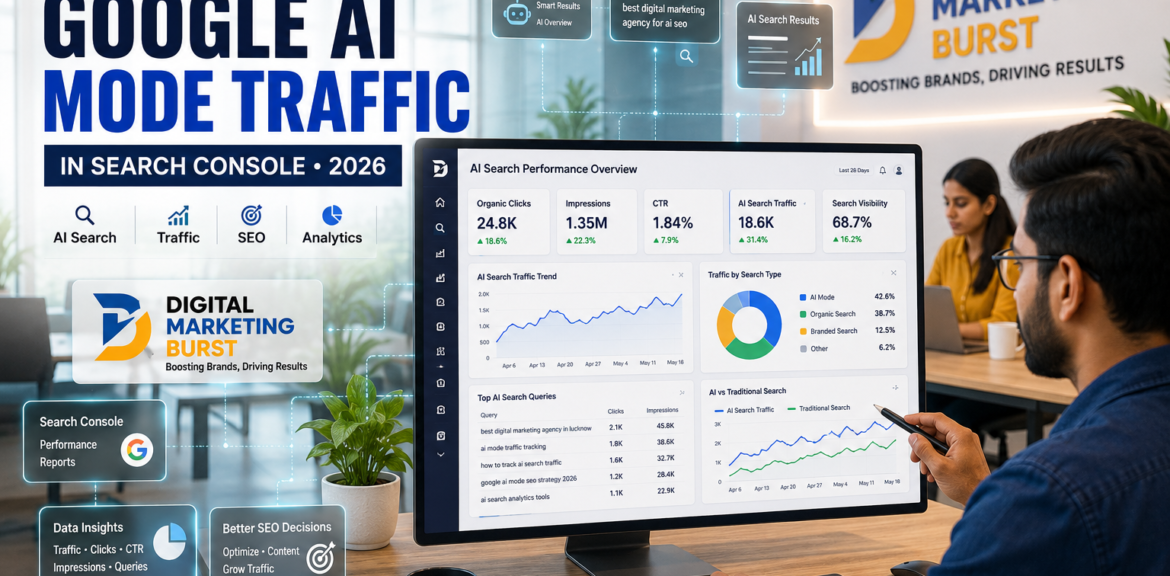

How to Track Google AI Mode Traffic in Search Console in 2026
How to Track Google AI Mode Traffic in Search Console in 2026
Google AI Mode Traffic, Google AI Search Traffic, AI Search Traffic Tracking, Google AI Mode SEO, and Google Search Console Analytics are becoming important topics for marketers trying to understand how search visibility is changing in 2026. AI-powered search experiences can influence how people discover websites, how they interact with search results, and whether a traditional click happens at all. As a result, marketers need to look beyond total organic clicks and understand the wider search-performance picture.
Google Search Console remains one of the most useful platforms for analysing organic search performance. However, tracking traffic influenced by AI experiences is not always as simple as opening a dedicated report and reading one number. Search professionals need to interpret impressions, clicks, queries, landing pages, CTR, position, and changes in user behaviour together.
This guide explains how businesses can approach AI-search measurement in 2026. It also covers what marketers should monitor, where attribution becomes difficult, and how SEO strategies can adapt as AI-led search becomes more common.
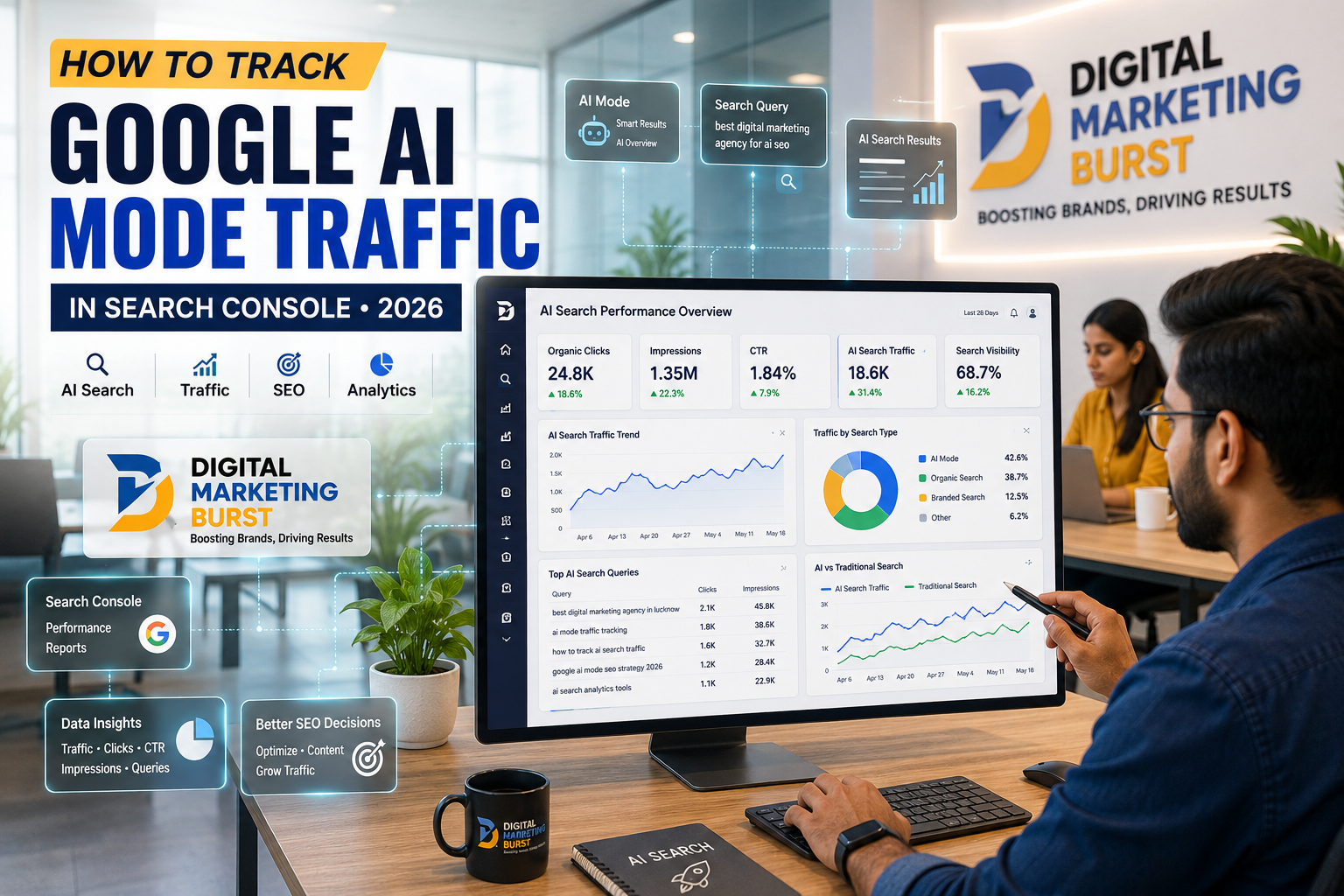
Google AI Mode Traffic: What Marketers Need to Understand in 2026
Google AI Mode Traffic refers to website visits and search visibility connected with Google’s AI-led search experiences. For SEO teams, the bigger issue is not simply whether AI is generating clicks. The real challenge is understanding how AI changes the journey between a user’s question and a website visit.
Traditional search behaviour was relatively straightforward. A person entered a query, reviewed several results, clicked a page, and continued their research. AI-powered search can compress some of those steps. Users may receive a detailed response directly within the search experience and continue asking follow-up questions before deciding whether they need to visit another website.
Consequently, rankings alone provide an incomplete picture. A page may gain meaningful search exposure without producing the click-through rate that marketers previously expected from the same position.
This changes how businesses should evaluate SEO success. Search visibility, qualified visits, conversions, branded searches, and engagement should be studied together.
It also creates a new content challenge. Pages designed only to rank for one short keyword may struggle when users search through longer, conversational questions. Content needs to answer the immediate question while providing enough original value to encourage further exploration.
For marketers, 2026 should therefore be less about chasing one AI traffic number and more about understanding how AI is changing organic discovery.
Google AI Mode Analytics: What Should You Actually Measure?
Google AI Mode Analytics should focus on meaningful changes in search performance rather than searching for one perfect metric.
Start by establishing a baseline. Compare current organic clicks, impressions, CTR, queries, landing pages, and conversions with previous periods. Then look for patterns rather than isolated daily fluctuations.
For example, suppose impressions continue growing while clicks remain flat. That does not automatically prove that an AI feature caused the change. However, it gives the SEO team a reason to investigate SERP behaviour, query intent, ranking changes, and the way Google presents answers.
Similarly, a declining CTR does not always mean SEO performance is failing. Search layouts change. Competitors improve their titles. User intent shifts. Rich results appear. AI-generated experiences may also influence whether a user needs another click.
Therefore, measurement needs context.
Marketers should connect Search Console performance with website analytics and conversion data. Search Console explains how a site appears and performs in Google Search. Analytics platforms help show what visitors do after arriving.
Together, these datasets create a much stronger picture than either one alone.
Google AI Search Traffic and the Changing Organic Search Journey
Google AI Search Traffic is part of a broader shift from keyword-based discovery towards question-led and conversational search.
People increasingly search in natural language. Instead of typing a short phrase such as “best SEO tools,” someone may describe their situation, business size, budget, and objective within one query.
That change matters because a longer query contains more context.
For content creators, this creates an opportunity. A detailed article can address several related questions within one topic rather than producing dozens of thin pages for minor keyword variations.
However, content still needs structure.
The opening section should answer the main question quickly. Later sections can explain context, exceptions, examples, comparisons, and practical actions. This approach serves both users who want a quick answer and readers who need deeper information.
SEO teams should therefore analyse not only the keywords generating clicks but also the underlying problems those searches represent.
When multiple queries reveal the same user problem, that is a signal to improve topical coverage rather than simply insert more keywords.
Google AI Search Analytics: Look Beyond Click Numbers
Google AI Search Analytics requires a broader interpretation of organic performance.
Clicks remain valuable, but they are only one signal. Impressions can reveal whether Google’s systems continue associating your content with relevant searches. Query data can show how search language is evolving. Landing-page performance can reveal which content formats continue attracting visits.
Conversion data adds another important layer.
Imagine that organic traffic falls by 15%, but enquiries remain almost unchanged. The site may have lost low-intent visits while retaining users who are closer to making a decision.
Now consider the opposite situation. Traffic grows by 30%, yet enquiries decline. The additional visitors may not match the business’s target audience.
This is why raw traffic should never be treated as the only measure of SEO quality.
Marketers should ask whether search visibility is attracting the right users. They should also examine whether those visitors complete valuable actions.
In an AI-influenced search environment, quality can become more important than volume.
AI Search Traffic Tracking: Why Attribution Is Difficult
AI Search Traffic Tracking becomes complicated because search journeys are no longer always linear.
A person may discover a brand through an AI-generated search experience, remember its name, and later search for that brand directly. Another user may see information in search, return several days later, and convert through a different channel.
Standard attribution may assign those visits to branded organic search, direct traffic, paid search, or another source. Yet the original discovery may have happened earlier.
This means marketers should avoid claiming more precision than their data supports.
Instead, use multiple indicators.
Look for changes in branded queries. Monitor landing pages that gain impressions for conversational searches. Compare assisted conversions and direct visits. Review whether users are discovering deeper informational pages before reaching commercial pages.
No single metric will explain every journey.
However, combining several signals can reveal whether organic discovery is contributing to business growth even when the final conversion happens elsewhere.
AI Traffic Tracking Tools: What Should Marketers Use?
AI Traffic Tracking Tools are increasingly marketed as solutions for measuring visibility across AI-powered discovery platforms. They can be useful, but businesses should understand what each tool actually measures.
Some platforms monitor whether a brand appears in generated answers. Others track citations, prompts, competitor visibility, or changes in AI responses. These metrics can help with competitive research and visibility monitoring.
However, an estimated AI visibility score is not the same thing as verified website traffic.
For Google organic performance, first-party data should remain central to your analysis. Search Console, website analytics, CRM information, and actual conversion data provide a stronger foundation for decision-making.
Third-party tools can then add context.
For example, they may help identify topics where competitors are frequently referenced. That information can guide content research. Yet the final decision should still consider search demand, business relevance, conversion potential, and the quality of the existing content.
The tool should support the strategy rather than become the strategy.
How to Track Google AI Mode Traffic in Search Console
Many marketers searching how to track Google AI Mode traffic in Search Console expect to find a simple AI traffic switch.
The practical approach is more analytical.
Begin with the Search Console performance data for your website. Compare meaningful date ranges rather than focusing on a few days. Review clicks, impressions, average CTR, queries, pages, countries, and devices.
Next, identify pages that have experienced unusual changes.
A page with increasing impressions but declining CTR deserves investigation. So does a page that retains rankings while losing clicks. However, neither pattern should automatically be attributed to AI Mode.
Check whether the search intent changed. Review competitors. Look at the current search-result layout. Consider seasonality and ranking volatility.
Then connect the Search Console data with your website analytics.
If fewer users arrive but those users engage more deeply or convert at a higher rate, the traffic change has a different business meaning than a decline across both visits and conversions.
This method may be less exciting than a single “AI traffic” dashboard, but it produces more responsible analysis.
How to Measure Google AI Search Traffic in 2026
Learning how to measure Google AI Search traffic in 2026 starts with separating what you know from what you infer.
You know how many clicks and impressions Search Console reports for the dimensions available to you. You can also measure sessions, engagement, leads, sales, and other website actions through your analytics setup.
What becomes harder is proving exactly how much influence an AI-generated search interaction had before a user clicked or converted.
Therefore, create a measurement framework.
First, establish historical benchmarks for important pages. Next, monitor how impressions, clicks, CTR, queries, and conversions change over time. Then investigate significant deviations.
Look at query types as well.
Informational searches may behave differently from transactional searches. A simple factual query might be satisfied directly in search. A complex service comparison may still encourage deeper research.
This distinction helps businesses understand where traffic pressure is most likely to occur.
Measurement becomes much more useful when it reflects search intent rather than treating every organic visit as identical.
Track AI Search Traffic in Google Search Console Without Guessing
Businesses trying to track AI search traffic in Google Search Console should avoid turning correlation into certainty.
Suppose a page loses clicks after an AI feature becomes more visible for its topic. That is worth investigating. However, several other factors could explain the decline.
The page may have lost rankings. A competitor may have improved its snippet. Search demand may have fallen. Google may have introduced another SERP feature. The page title may also have become less competitive.
Good analysis eliminates alternative explanations before drawing conclusions.
Compare rankings and impressions first. Then inspect query-level changes. Review the current search results manually for your most valuable queries.
Finally, compare website behaviour.
If impressions remain strong while clicks decline across informational searches, you may need to rethink how the content earns attention. Stronger titles, clearer differentiation, updated information, original research, expert insight, useful tools, or deeper explanations can give users a reason to visit.
SEO should respond to evidence rather than assumptions.
Google AI Mode SEO: What Changes for Website Owners?
Google AI Mode SEO should not be treated as a completely separate discipline from good search optimization.
Many fundamentals remain important. Websites still need accessible pages, logical internal linking, accurate information, useful content, clear structure, and a strong understanding of user intent.
What changes is the competitive environment.
Generic information is easier than ever to summarize. Therefore, pages that merely restate common knowledge may offer fewer reasons for users to click.
Original value becomes increasingly important.
That value could come from first-hand experience, proprietary data, detailed examples, expert commentary, original images, calculators, templates, case studies, comparisons, or practical processes.
Businesses should ask a simple question before publishing:
“After the user receives a basic AI-generated answer, what does our page provide that is still worth visiting?”
That question can improve content strategy far more than repeatedly inserting AI-related keywords.
AI Mode SEO Strategy for Businesses in 2026
An effective AI Mode SEO Strategy should combine traditional search optimization with stronger content differentiation.
Begin with search intent.
A page should clearly identify the problem it solves. Then answer the central question early. Users should not have to read 700 words before reaching the information promised by the title.
After the direct answer, expand naturally.
Explain why the issue matters. Provide examples. Address common mistakes. Compare alternatives. Add useful context that cannot be communicated well in a short summary.
Internal linking also becomes valuable.
A strong informational article can introduce a user to the brand and then guide them towards related resources, service pages, case studies, or tools.
However, internal links should make sense within the reader’s journey.
The objective is not to push a service on every visitor. It is to make the next useful step easy to find.
That creates a better user experience and can also strengthen the site’s topical structure.
Google Search Console Analytics for AI-Era SEO
Google Search Console Analytics remains essential because it shows how users discover your pages through Google Search.
Start with trends rather than isolated metrics.
A weekly decline may mean little if the topic is seasonal. A year-over-year decline across an entire content category may deserve more attention.
Page-level analysis is especially useful.
Group content by purpose. Informational blogs, commercial pages, local pages, product pages, and branded pages may behave differently as search evolves.
If informational pages lose clicks while commercial pages remain stable, the problem may be related to the type of search journey rather than the entire website.
Query analysis can provide another clue.
Longer conversational queries may reveal new questions that your existing content only partially answers.
Those queries can guide updates.
Instead of creating a new article for every phrase, expand the strongest relevant page when the search intent is essentially the same.
This can reduce content duplication while improving topical depth.
Search Console Performance Report: Metrics That Matter Most
The Search Console Performance Report can help marketers understand whether organic visibility is genuinely changing.
Clicks show how many visits Google Search generated. Impressions indicate how often your result appeared. CTR helps reveal how frequently an impression becomes a click. Average position provides ranking context.
None of these metrics should be analysed alone.
For example, rising impressions with lower average position may mean Google is testing your page across more searches. That can reduce CTR even while overall visibility expands.
Meanwhile, stable rankings with falling CTR may suggest changes in the search-result environment.
A click decline combined with an impression decline can indicate reduced demand, weaker rankings, or lost topical relevance.
The relationship between metrics matters more than one number.
Marketers should therefore create comparisons that explain what changed, where it changed, and which query or page groups contributed most.
How to Use Search Console Queries for AI Search Analysis
Search queries are one of the most useful sources of SEO insight.
Instead of reviewing only the highest-volume terms, look for patterns in language.
Are searches becoming longer? Are people asking complete questions? Are they adding comparisons, conditions, locations, prices, or specific problems?
These changes can reveal how users frame their needs.
For example, a marketing agency might once have targeted “SEO agency.” A more detailed user could search for “how to improve local SEO for a small healthcare business.”
The second query reveals far more intent.
Content built around real problems can attract visitors at different stages of the decision journey.
Therefore, query research should influence content updates, FAQs, service-page explanations, internal links, and future blog topics.
Why Impressions Can Rise While Organic Clicks Fall
One confusing pattern in modern SEO is rising visibility combined with weaker traffic.
A website may receive more impressions while generating fewer clicks.
This can happen for several reasons.
The site may appear for a broader set of lower-ranking queries. Search results may contain more interactive features. Users may receive enough information before clicking. Competitors may also have stronger titles or richer result formats.
Therefore, do not immediately interpret higher impressions as success or lower clicks as failure.
Analyse the relationship.
If the website is reaching more relevant searches, there may be an opportunity to improve CTR. If impressions are coming from irrelevant queries, additional visibility may provide little business value.
SEO reporting should explain this difference.
How AI Search Can Change Organic CTR
Organic CTR has always depended on more than ranking position.
Search intent, title quality, brand recognition, advertisements, rich results, and competing listings all influence whether someone clicks.
AI-led search adds another variable.
If users can explore a topic directly within the search experience, some informational queries may generate fewer external visits.
However, this does not mean every query will become zero-click.
People still need websites when they want detailed evidence, products, services, original research, tools, pricing, comparisons, or deeper expertise.
Businesses should therefore focus on creating content worth visiting.
A generic definition can be summarized easily. A detailed case study showing what happened, why it happened, and what was learned is harder to replace.
How to Identify Pages Losing Search Traffic
When organic traffic falls, start at the page level.
Compare a recent period with a meaningful previous period. Then identify which URLs account for most of the lost clicks.
Do not update every article simply because total website traffic declined.
A small number of pages may explain most of the difference.
Once those pages are identified, review their queries.
Did impressions decline? Did rankings change? Is CTR weaker? Has the topic lost demand? Is the information outdated?
This diagnostic process prevents unnecessary content changes.
A page that still ranks well but has weaker CTR requires a different solution from a page that has dropped from position three to position twenty.
The cause should determine the response.
How to Find AI Search Opportunities From Existing Content
Existing content often contains more SEO opportunities than businesses realize.
Look for pages receiving impressions for relevant queries that they do not answer particularly well.
These queries can reveal missing sections.
For example, a broad article about AI search might already receive impressions for questions about measurement, Search Console, CTR, or analytics.
Instead of creating four competing articles, the original page could be expanded with dedicated sections where the intent overlaps.
This strengthens topical coverage.
It can also reduce keyword cannibalization.
However, separate pages still make sense when the search intent is clearly different.
The decision should be based on what the user wants, not merely whether two keywords contain similar words.
How to Optimize Content for Google AI Search
Optimization for AI-influenced search begins with clarity.
Use descriptive headings. Answer important questions directly. Keep paragraphs focused. Define technical concepts when needed.
Then add depth.
Include examples, evidence, practical steps, original observations, and useful comparisons.
Avoid padding an article merely to reach a particular word count.
A 6,000-word article is valuable only when those 6,000 words solve the reader’s problem better than a shorter alternative.
Content should also be easy to scan.
Short sentences can improve readability. Transition words such as “however,” “therefore,” “for example,” “meanwhile,” and “as a result” can make ideas easier to follow.
Most importantly, write for the user first.
SEO structure should help people understand the page rather than make the article sound as if it was assembled from keywords.
Digital Marketing Burst Google AI Mode Traffic Strategy
Digital Marketing Burst Google AI Mode Traffic Strategy can focus on connecting search visibility with real business outcomes instead of measuring SEO success only through rankings.
For businesses, this means analysing which pages attract qualified users, which search topics support conversions, and where organic visibility is changing.
A strong strategy can combine Search Console insights with content analysis, technical SEO, internal linking, website analytics, and conversion measurement.
The objective should be sustainable search visibility.
As AI changes discovery, businesses need content that answers questions clearly while still giving users a meaningful reason to visit the website.
This is particularly important for service businesses. High traffic alone does not guarantee enquiries. Relevant traffic from people with a genuine need is more valuable.
Digital Marketing Burst can therefore position AI-search SEO around measurable business relevance rather than simply promising more clicks.
Digital Marketing Burst AI Search Traffic Tracking
Digital Marketing Burst AI Search Traffic Tracking should begin with evidence available from search and website data.
The process can examine organic trends, page-level changes, query patterns, CTR movement, landing-page engagement, and conversions.
This helps separate a genuine SEO problem from normal fluctuations.
For example, if traffic declines because rankings were lost, the priority may be content quality or technical SEO. If rankings remain stable but CTR falls, search-result changes and user behaviour deserve closer attention.
If traffic remains strong but leads decline, the problem may exist after the click.
That could involve landing-page relevance, calls to action, pricing expectations, website speed, or poor audience targeting.
A useful SEO report should therefore answer more than “Did traffic go up or down?”
It should explain what changed and what the business should do next.
Digital Marketing Burst Google AI Mode SEO Approach
Digital Marketing Burst Google AI Mode SEO can be built around a combination of answer-first content and deeper value.
The first section of a page should establish relevance quickly.
After that, the content can explore the topic in greater depth through examples, comparisons, problems, and practical recommendations.
This structure serves multiple user types.
Someone seeking a quick answer can find it immediately. A business owner researching a major decision can continue reading.
The strategy should also connect related content through meaningful internal links.
For example, an AI-search article might naturally link to resources about technical SEO, Search Console, content optimization, local SEO, or conversion improvement.
This creates a stronger website journey and gives readers useful next steps.
Google AI Mode Traffic Problems Businesses May Face
Changes in Google AI Mode Traffic can create several practical problems for website owners.
The first is measurement confusion. Businesses may see traffic change without understanding why.
The second is overreaction.
A temporary decline can lead companies to rewrite pages that were performing well. Unnecessary changes can sometimes make analysis even harder because the original baseline disappears.
Another problem is focusing entirely on traffic.
If a website receives 100,000 monthly visitors but almost none become customers, traffic alone provides limited business value.
Conversely, a smaller audience with strong commercial intent can generate more revenue.
Therefore, AI-era SEO reporting should remain tied to business goals.
Visibility matters. Clicks matter. Leads and sales matter too.
The challenge is understanding how these metrics connect.
Can Search Console Show Exact AI Mode Traffic?
This is one of the most important questions for marketers researching AI search measurement.
Do not assume that every AI-influenced visit can always be isolated into a perfectly clean, dedicated dataset simply because it originated from an AI-led Google experience.
Search reporting evolves, and available dimensions can change over time.
Therefore, marketers should verify the current Search Console reporting options before claiming that a specific filter provides exact AI Mode attribution.
When dedicated segmentation is unavailable or incomplete, use broader performance analysis.
Review queries, pages, clicks, impressions, CTR, rankings, and conversions. Then compare those patterns with observable changes in the search experience.
This approach avoids creating false precision.
Good marketing analysis should clearly distinguish measured data from interpretation.
Is Google AI Search Reducing Website Traffic?
AI search can influence traffic, particularly for searches where the user can obtain enough information without visiting another page.
However, it would be inaccurate to blame every organic decline on AI.
Search traffic changes constantly.
Algorithm updates, competition, seasonality, SERP features, technical issues, content quality, changing demand, and ranking losses can all affect performance.
Therefore, diagnose before deciding.
If traffic falls, identify the affected pages and queries first.
Then determine whether impressions, rankings, or CTR changed.
This process makes it easier to understand whether the issue is reduced visibility, reduced demand, weaker click-through behaviour, or something else.
Why Answer-First Content Matters for AI Search SEO
Users want answers quickly.
Therefore, pages should avoid unnecessary introductions that delay the main information.
Answer-first content places the essential response near the beginning and then expands with supporting detail.
This does not mean every article should become short.
Complex topics still need depth.
The difference is organization.
A strong page can provide a concise answer first, followed by explanation, evidence, examples, exceptions, and related questions.
This format works well for human readers because they can choose how deeply they want to engage.
It also forces writers to understand the real question before producing thousands of words around it.
How Conversational Search Changes Keyword Research
Traditional keyword research often focused on short phrases and monthly search volume.
Conversational search adds another layer.
Users can describe situations in detail and refine their questions through follow-ups.
Therefore, marketers should research problems as well as keywords.
Look at customer questions, Search Console queries, sales conversations, support requests, forum discussions, and competitor content.
These sources reveal the language real people use.
Then organize related questions around clear topics.
This creates content that can match many variations naturally without forcing every keyword into the copy.
It also reduces repetition, which improves readability.
Why Long-Tail Keywords Matter for AI Search Traffic
Long-tail searches often contain clearer intent.
A person searching “SEO” could want almost anything. Someone searching “how to track AI search traffic in Search Console” has a much more specific problem.
Specific queries can therefore be valuable even when their individual search volumes are smaller.
Several related long-tail terms can collectively create substantial visibility.
They can also attract users who are further into their research journey.
However, businesses should avoid creating near-identical pages for every minor variation.
When several keywords represent the same intent, one comprehensive page is usually more useful.
This approach produces stronger content and a cleaner website structure.
Internal Linking for Google AI Search Content
Internal linking helps users move between related resources.
It also helps search engines understand relationships between pages.
For this article, relevant internal anchor text could include Google AI search SEO strategy, Search Console traffic analysis, AI search content optimization, technical SEO services, or SEO strategy for businesses in India.
The linked destination should genuinely match the anchor.
Avoid forcing commercial links into every paragraph.
A useful internal link appears when the reader naturally needs additional information.
For example, someone reading about traffic measurement may want a detailed Search Console guide. A reader researching optimization may want a separate content SEO resource.
Good internal linking creates a logical learning path.
Building an AI Search SEO Strategy for 2026
A sustainable AI-search strategy should combine technical quality, useful content, measurement, and brand authority.
Technical SEO ensures that important pages can be accessed and understood.
Content answers user needs.
Measurement reveals what performs.
Brand authority helps users recognize and trust the business when they encounter it across search.
These elements reinforce one another.
A technically perfect site with weak content will struggle. Excellent articles on a poorly maintained website can also underperform.
Likewise, traffic without measurement makes it difficult to know what contributes to business growth.
SEO teams should therefore stop treating content, technical SEO, analytics, and conversion optimization as unrelated activities.
They are parts of the same search journey.
What Businesses Should Monitor Every Month
Monthly SEO analysis should focus on meaningful patterns.
Review total organic performance, but then move deeper.
Which pages gained visibility? Which lost clicks? Which queries changed? Did branded demand increase? Are commercial landing pages converting?
Compare results with previous periods and, where appropriate, the same period in the previous year.
Document major website changes as well.
If a redesign, migration, content update, or tracking change happened during the month, it can influence the data.
Keeping a record makes future analysis easier.
Most importantly, reports should end with decisions.
Data is useful when it tells the team what deserves attention next.
Future of Google AI Search Traffic Measurement
Search measurement will continue evolving as AI-led discovery becomes more established.
Marketers should expect reporting methods, search interfaces, and user behaviour to change.
Therefore, the best long-term strategy is adaptability.
Do not build an entire SEO programme around one temporary dashboard or metric.
Maintain clean analytics. Preserve historical data. Track business outcomes. Monitor Search Console regularly. Test content improvements carefully.
When new reporting capabilities become available, they can be added to this foundation.
Businesses that understand their baseline will be able to interpret new metrics far more effectively than those starting from scratch.
Conclusion: How to Track Google AI Mode Traffic in Search Console in 2026
Google AI Search Traffic, AI Search Traffic Tracking, Google AI Mode SEO, and Google Search Console Analytics should be viewed as connected parts of modern organic-search measurement. Tracking Google AI Mode Traffic is not simply about finding one number and calling it AI traffic. Businesses need to understand impressions, clicks, CTR, queries, landing pages, search intent, engagement, and conversions together.
Search behaviour is changing, but the central SEO objective remains familiar: create genuinely useful pages that match what people need.
At Digital Marketing Burst, the opportunity is to combine SEO fundamentals with AI-search analysis, stronger content strategy, and business-focused measurement. Instead of chasing traffic for its own sake, brands can focus on qualified visibility and meaningful outcomes.
As search becomes more conversational, successful websites will need to answer questions quickly while offering something deeper than a generated summary. Original insight, experience, useful tools, strong brand information, and genuinely helpful content can provide that reason to click.
That is the foundation of a practical search strategy for 2026 and beyond.
How Google AI Mode Changes Search Visibility in 2026
Search visibility is becoming more complex because appearing in Google no longer always means receiving a traditional blue-link click. AI-powered search can answer part of a user’s question directly and then encourage follow-up queries. As a result, marketers need to separate visibility from website visits when evaluating performance.
A page can continue appearing for valuable searches while its click-through behaviour changes. However, that pattern alone does not prove that AI caused the change. Rankings, competition, search demand, SERP layouts, and user intent can produce similar results.
Therefore, marketers should establish a baseline before making conclusions. Compare clicks, impressions, CTR, average position, landing pages, and conversions over meaningful periods.
The objective is to identify where the search journey changed. If impressions remain healthy but visits decline, investigate click behaviour. If both impressions and clicks decline, visibility itself may be weakening.
This distinction helps businesses avoid making unnecessary content changes based on one metric.
Google AI Mode Traffic and Organic Search Performance
Google AI Mode Traffic should be evaluated as part of the wider organic search journey rather than treated as an isolated SEO metric.
For years, many businesses measured SEO success mainly through rankings and organic sessions. Those metrics remain useful, but they cannot explain every interaction that happens before a website visit.
AI-led search can influence discovery earlier in the journey.
A user may encounter a company, product, concept, or website while researching through an AI-powered result. The same person may later conduct a branded search and visit the website.
Consequently, marketers need to examine both non-branded and branded discovery patterns.
If informational clicks decline while branded searches increase, there may be a relationship worth investigating. However, marketers should not automatically claim direct causation.
Look for supporting evidence across several datasets.
SEO measurement in 2026 needs to answer a broader question: is organic search increasing meaningful awareness, discovery, qualified visits, and business outcomes?
Google AI Mode Analytics for Organic Search Reporting
Google AI Mode Analytics becomes more useful when marketers build reports around trends rather than isolated numbers.
Begin by separating informational, commercial, transactional, navigational, and branded pages where possible. Different page types can react differently to changes in search behaviour.
Informational content may experience more pressure from answer-rich search experiences because users sometimes receive enough information without leaving Google.
Commercial searches can behave differently.
Someone comparing agencies, software, hotels, healthcare providers, or expensive products may still need detailed websites before making a decision.
Therefore, a site-wide traffic percentage can hide the real story.
Suppose informational traffic falls while service-page visits and enquiries increase. Calling the entire SEO strategy unsuccessful would be misleading.
Reporting should show which sections gained or lost visibility and whether those changes affected valuable actions.
This approach makes AI-era SEO reporting more useful to decision-makers.
Google AI Search Traffic and Conversational Queries
Google AI Search Traffic is closely connected with the growth of conversational search behaviour.
Users are increasingly comfortable entering detailed questions instead of reducing every need to two or three keywords.
For example, a business owner may search, “Why are my website impressions increasing while organic clicks are falling after AI search changes?”
That query contains a problem, context, and desired explanation.
Content written only around the phrase “organic traffic” may not fully address this intent.
Therefore, marketers should study complete query themes.
A good page can answer the main question quickly and then cover related issues such as CTR, rankings, conversions, AI visibility, and content optimization.
This creates broader topical relevance without repeating the same exact keyword excessively.
Conversational SEO is less about stuffing longer phrases into paragraphs. Instead, it requires understanding the real questions behind those phrases.
Google AI Search Analytics and Query Intent
Google AI Search Analytics becomes much stronger when query data is classified by intent.
A thousand impressions for a broad informational query do not have the same business value as a hundred impressions from people actively comparing solutions.
Therefore, traffic reports should not treat every keyword equally.
Informational queries can build awareness. Commercial searches can influence consideration. Transactional searches may generate immediate enquiries or sales. Branded searches can reveal existing awareness and demand.
These stages often interact.
A person might first discover a business through an educational article. Later, the same person searches for the company’s name and eventually converts.
The final conversion may be attributed to branded organic search even though informational SEO supported the earlier discovery.
That is why marketers should look beyond last-click thinking.
Understanding query intent creates a more realistic picture of how search contributes to customer acquisition.
AI Search Traffic Tracking Through Landing Page Analysis
AI Search Traffic Tracking should include detailed landing-page analysis because website-wide averages often hide important changes.
Start by comparing individual pages across similar date ranges.
Look for URLs with significant click losses, impression gains, CTR changes, or ranking movements.
Then classify those pages by topic and intent.
You may discover that simple informational pages are losing clicks while detailed comparison pages remain stable. Alternatively, older articles may be declining because competitors provide fresher information.
These are very different problems.
Next, connect landing pages with website engagement and conversion data.
A page that loses 20% of visits but continues generating the same number of leads may actually be attracting a more qualified audience.
Meanwhile, another page could maintain traffic but stop producing meaningful actions.
Page-level analysis therefore gives marketers a much clearer view of search performance than total organic sessions alone.
AI Traffic Tracking Tools for Search Visibility
AI Traffic Tracking Tools can complement first-party analytics by monitoring how brands appear across AI-led discovery environments.
However, marketers should understand the difference between visibility tracking and traffic tracking.
A platform may report that a brand appeared in a certain percentage of monitored AI responses. That information can be useful for competitive analysis. Yet it does not necessarily mean those appearances generated equivalent website visits.
Different tools also use different prompt sets, methodologies, databases, and scoring systems.
Therefore, visibility scores should not automatically be treated as universal market-share measurements.
Use these platforms to identify patterns.
For example, they can reveal which competitors appear frequently for a topic, which sources receive citations, or where your brand has limited representation.
Then use those insights to improve content, authority, and topical coverage.
First-party website and search data should still remain central when measuring actual business outcomes.
How to Compare AI Search Visibility With Organic Traffic
AI visibility and organic traffic answer different questions.
Visibility asks whether a brand or website appears during relevant discovery experiences. Traffic asks whether people actually visit the site.
Both matter.
A company can have strong visibility but weak traffic if users receive enough information without clicking. Another company can generate fewer appearances but receive highly qualified visits from commercial searches.
Therefore, compare visibility data with Search Console and website analytics rather than evaluating it alone.
If visibility grows while branded searches also rise, that may indicate increasing awareness. If visibility grows but neither visits nor branded demand change, the business should investigate whether it appears for the right topics.
The key is relevance.
Appearing frequently for unrelated prompts creates little business value.
A smaller share of highly relevant discovery can be more useful than broad but poorly targeted exposure.
How to Track AI Search Performance Without a Dedicated Dashboard
Many marketers want a single dashboard that labels every visit according to its exact AI-search origin.
In practice, measurement may require combining several sources.
Start with Search Console to understand Google Search performance. Use website analytics to examine sessions, engagement, conversions, and landing-page behaviour. Add CRM or lead data when available.
Then monitor meaningful changes over time.
For instance, you may notice that a group of informational pages receives fewer clicks but maintains strong impressions. Meanwhile, branded search volume begins rising.
That pattern deserves investigation.
However, avoid presenting an inferred relationship as proven attribution.
Good reporting should clearly state which figures are directly measured and which conclusions are based on patterns.
This distinction builds trust and prevents teams from making strategic decisions based on false precision.
Google AI Mode SEO and Answer-First Content
Google AI Mode SEO strengthens the case for answer-first content.
Users should be able to understand the central answer shortly after opening a page.
A long introduction filled with generic statements can create unnecessary friction.
Instead, begin with the core answer. Then explain the reasoning, examples, limitations, and practical implications.
This does not mean every article needs to be short.
Detailed content remains useful when the topic genuinely requires depth.
The difference lies in structure.
For example, an article about measuring AI search performance can immediately explain that marketers should use Search Console trends, analytics, conversions, and supporting visibility data. Later sections can explain exactly how each source contributes.
This approach improves usability because readers can decide how much depth they need.
It also prevents content from becoming long merely for SEO purposes.
AI Mode SEO Strategy for High-Quality Content
An effective AI Mode SEO Strategy should focus on information gain.
Before creating an article, examine what already exists around the topic.
If every ranking page repeats the same five definitions, publishing another version adds little value.
Instead, look for unanswered questions.
Could you provide original data? Can you demonstrate a real workflow? Do you have a case study? Can you show screenshots, calculations, templates, examples, or expert observations?
Original value creates a stronger reason to visit the website.
This becomes especially important when basic information can be summarized quickly within search.
Businesses should therefore invest more effort in creating resources that users want to save, reference, share, or return to.
The strongest SEO content often solves a practical problem rather than simply explaining what a keyword means.
Google Search Console Analytics for Page-Level Changes
Google Search Console Analytics can reveal whether a traffic problem affects the entire website or only selected pages.
Start with the Pages dimension in the performance data.
Compare the current period with the previous period or the same period last year when seasonality matters.
Sort by click difference.
The pages responsible for the largest decline should receive attention first.
Next, open an affected URL and inspect its queries.
This helps determine whether the page lost visibility across its entire topic or only a few terms.
Then compare impressions and average position.
If rankings dropped substantially, the issue may be competitive or algorithmic. If position remains relatively stable but CTR falls, investigate the search-result environment and title performance.
This process gives SEO teams a logical starting point instead of randomly rewriting content.
Search Console Performance Report for AI-Era SEO
The Search Console Performance Report remains one of the strongest resources for understanding how Google Search sends users to a website.
However, the numbers require interpretation.
Clicks show visits from search results. Impressions show search exposure. CTR connects those two metrics. Average position adds ranking context.
Suppose impressions rise by 30%, clicks increase by only 5%, and CTR declines.
At first glance, the lower CTR might look negative.
Yet the site may simply be appearing across a much broader set of queries.
Now imagine impressions remain unchanged, average position stays stable, and clicks fall sharply. That pattern requires a different investigation.
Perhaps the search-result layout changed. Maybe competitors improved their snippets. User behaviour may also have shifted.
The report becomes valuable when metrics are interpreted together rather than individually.
Search Console Performance Report Comparison for 2026
Period comparisons can reveal trends that daily reports miss.
A seven-day comparison may be useful for diagnosing a sudden technical problem. However, longer periods are often better for understanding strategic changes.
Compare the last 28 days with the previous 28 days.
Then review year-over-year performance when enough historical data exists.
Do not ignore seasonality.
A travel website may naturally behave differently across holiday periods. An ecommerce site may see major changes around festivals or sale events. B2B search demand may also fluctuate throughout the year.
Therefore, comparisons should reflect the business model.
The goal is not simply to find a red percentage.
The goal is to understand whether a change is expected, temporary, or strategically important.
How to Analyse Clicks and Impressions Together
Clicks and impressions tell different parts of the same story.
If both rise, visibility and traffic are generally expanding.
If impressions rise while clicks fall, investigate CTR and query mix.
If both fall, look for ranking losses, lower search demand, indexing problems, or declining topical relevance.
If clicks rise while impressions remain relatively stable, stronger rankings or improved CTR may be contributing.
These combinations make analysis much more useful.
SEO teams should therefore avoid reports that simply say, “Organic clicks declined by 12%.”
A stronger report explains what happened to impressions, rankings, CTR, and conversions at the same time.
That context helps businesses choose the correct response.
How to Analyse Search Console CTR Changes
CTR should be interpreted according to ranking, query type, and search-result layout.
A lower CTR does not automatically mean the page title is poor.
Suppose a URL starts appearing for thousands of additional queries at positions eight to fifteen. Impressions can rise rapidly while average CTR falls.
That may actually represent expanding visibility.
On the other hand, if a high-ranking commercial page experiences a significant CTR decline without a ranking change, the title and result environment deserve closer inspection.
Search the important query manually.
Look at advertisements, rich results, AI experiences, shopping results, videos, maps, and competing titles.
The search results themselves provide context that a percentage alone cannot.
Why Zero-Click Behaviour Matters for AI Search Tracking
Zero-click behaviour occurs when users obtain what they need without visiting an external website.
This behaviour existed before generative AI.
Featured snippets, knowledge panels, weather results, calculators, maps, definitions, and other search features have answered many queries directly for years.
AI-led search can expand the types of questions that receive detailed answers within the search environment.
Therefore, informational content needs a stronger value proposition.
A basic definition may generate visibility without many visits.
A detailed calculator, downloadable template, original study, comparison, or case study can create a stronger reason to click.
Marketers should not respond by hiding useful answers.
Instead, provide the direct answer and then offer meaningful additional depth.
How to Optimize for AI Search Without Keyword Stuffing
Keyword stuffing becomes particularly damaging when marketers try to target dozens of AI-related phrases within one page.
A sentence should sound natural to a human reader.
Use the main phrase where it helps clarify the topic. Then use related language naturally.
For example, instead of repeating “AI search traffic tracking” ten times, discuss organic visibility, search attribution, AI-driven discovery, query performance, click trends, and search analytics where appropriate.
Search engines can understand related concepts.
Readers also benefit from more natural language.
The goal is comprehensive topical coverage, not mechanical repetition.
A page that answers the subject thoroughly can rank for variations it never uses word-for-word.
How Long-Tail AI Search Queries Create New SEO Opportunities
Long-tail queries reveal specific needs.
Someone searching “how to track traffic” provides limited context.
A person asking “how can I measure Google AI search traffic when Search Console does not show a separate report” communicates a clear problem.
Content can respond directly to that need.
Long-tail queries are also valuable for discovering subtopics.
Search Console may show variations around measurement, attribution, CTR, impressions, reporting, and analytics.
Those themes can become sections within a comprehensive guide.
This strategy allows one strong article to capture multiple related searches without creating repetitive pages.
How to Update Old SEO Content for AI Search
Existing articles should not be abandoned simply because search is changing.
Many established pages already have backlinks, rankings, historical performance, and topical authority.
Start by identifying content that previously performed well but has declined.
Review whether the information is still accurate.
Then examine whether the page answers the modern version of the user’s question.
An article written several years ago may focus entirely on traditional rankings and clicks. Updating it with AI-search behaviour, new SERP formats, stronger examples, and current measurement practices can make it more useful.
However, preserve sections that still perform well.
Updating content does not mean rewriting everything.
Change what genuinely needs improvement.
How to Create Content People Still Want to Click
A useful question for every SEO writer in 2026 is: “Why would someone visit this page after receiving a quick answer in search?”
The answer should shape the content.
Original research creates a reason to click.
Interactive tools create another.
Detailed screenshots, templates, expert examples, calculators, case studies, datasets, and practical workflows can also add value.
Brand experience matters too.
A company that has solved a problem repeatedly can explain mistakes and trade-offs that a generic overview may miss.
This is where human expertise becomes commercially valuable.
Content should not compete with AI by producing more generic words.
It should provide information and experiences that make deeper exploration worthwhile.
AI Search Traffic Tracking for Lead Generation Websites
Lead-generation websites should connect AI Search Traffic Tracking with enquiry quality.
A marketing agency, hospital, legal firm, consultancy, or other service business does not earn revenue simply because a blog receives thousands of visits.
The right visitor matters more.
Therefore, analyse which landing pages contribute to enquiries.
Look at the topics those pages cover. Review whether visitors move from informational content towards service pages.
Internal linking can support that journey.
However, avoid turning every educational article into an aggressive sales pitch.
The primary goal of informational content should remain solving the reader’s problem.
Once trust is established, relevant next steps can be introduced naturally.
Google AI Search Traffic for Local Businesses
Local businesses face a slightly different search environment.
Users may discover a company through informational search, local results, maps, reviews, branded searches, or AI-generated recommendations.
Therefore, local SEO and content SEO should work together.
Business information needs to remain accurate and consistent.
Service pages should clearly explain what the company offers and where it operates.
Local content should answer genuine customer questions rather than creating hundreds of near-identical city pages.
Reviews, reputation, brand mentions, and useful local information can also support discovery.
The goal is to make the business easy to understand and verify across the search journey.
Google AI Mode SEO for Indian Businesses
Google AI Mode SEO presents a significant opportunity for Indian businesses because search behaviour in India is diverse.
Users search in English, Hindi, Hinglish, and regional languages. They also use different devices and levels of query detail.
Therefore, businesses should study their own Search Console data rather than relying entirely on global keyword trends.
A phrase popular in the United States may not reflect how Indian customers search.
Likewise, local service intent can differ substantially between cities.
Indian businesses should examine actual customer questions, regional terminology, local commercial intent, and mobile behaviour.
This can produce content that feels relevant to the audience rather than imported from a generic international SEO template.
Search Console Analytics for Mobile AI Search Behaviour
Mobile performance deserves special attention because many searches happen on smartphones.
Use device filtering to compare desktop and mobile performance.
A page may have strong desktop CTR but weaker mobile CTR because users see fewer organic listings before scrolling.
Mobile page experience matters after the click as well.
Slow pages, intrusive pop-ups, tiny text, or confusing layouts can reduce engagement.
Therefore, search optimization should not stop when the user reaches the website.
The landing experience needs to match the quality of the search result.
A technically strong mobile page can help turn search visibility into meaningful business outcomes.
Measuring Branded Search Growth After AI Visibility
Branded search can provide an additional signal of growing awareness.
If users repeatedly encounter a company during research, some may later search for the brand directly.
Therefore, monitor branded query trends in Search Console.
Compare them over longer periods.
Look at both impressions and clicks.
However, branded growth can come from many sources, including advertising, social media, offline campaigns, PR, referrals, and word of mouth.
Do not automatically attribute every branded search increase to AI.
Instead, treat it as one piece of the wider discovery picture.
Marketing channels often work together, and reporting should reflect that reality.
Why Conversion Tracking Matters More Than Ever
Traffic without conversion context can lead to poor decisions.
Imagine two articles.
The first generates 20,000 monthly visits but almost no commercial activity. The second attracts only 2,000 visitors but contributes to dozens of qualified enquiries.
Which page is more valuable?
The answer depends on the business goal.
Therefore, connect organic landing pages with meaningful actions such as enquiries, bookings, purchases, demo requests, phone calls, or other relevant conversions.
This does not mean every informational article must directly generate a sale.
Some pages support awareness and consideration.
However, understanding their role in the customer journey helps marketers allocate resources more effectively.
Digital Marketing Burst Search Console Performance Strategy
A Digital Marketing Burst Search Console Performance Strategy can focus on diagnosing why organic performance changes before recommending action.
This begins with page-level and query-level analysis.
Next, rankings, impressions, CTR, search intent, and conversions can be compared.
If a page loses traffic because rankings decline, the solution may involve content improvement, technical SEO, authority, or competitive analysis.
If rankings remain stable while CTR falls, the strategy should examine search-result changes and snippet performance.
Meanwhile, strong traffic with weak conversion performance may require landing-page or audience improvements.
This diagnostic approach prevents businesses from applying the same SEO solution to every traffic problem.
Digital Marketing Burst AI Mode SEO Strategy for Businesses
A Digital Marketing Burst AI Mode SEO Strategy can combine answer-first writing, topical depth, technical optimization, Search Console analysis, and conversion-focused measurement.
The first objective is visibility for relevant searches.
The second is earning the click when a website visit adds value.
The third is helping qualified visitors take a meaningful next step.
These goals should work together.
Content created only for rankings may attract irrelevant traffic. Content written only as a sales pitch may struggle to earn informational visibility.
A balanced strategy educates first, demonstrates expertise, and introduces commercial relevance naturally.
That approach is better suited to an AI-influenced search environment where generic information is increasingly easy to obtain.
What to Do When Organic Traffic Drops but Rankings Stay Stable
This situation can confuse website owners.
If rankings remain relatively stable but clicks decline, investigate impressions and CTR first.
Search demand may have decreased.
Alternatively, the result page may have changed.
New advertisements, rich features, AI experiences, videos, or other elements may affect click distribution.
Competitors may also have improved their titles and descriptions.
Review the most valuable queries manually.
Then decide whether the page can provide a stronger reason to click.
Updating the title may help in some cases. In others, the content itself needs more distinctive value.
Do not change the page until the likely cause is understood.
What to Do When Impressions Drop in Search Console
Falling impressions usually indicate a different problem from declining CTR.
First, determine which pages lost impressions.
Then inspect their queries and positions.
If rankings fell, investigate content quality, technical issues, competition, and recent website changes.
If rankings remain similar but impressions decline, search demand may have weakened.
Seasonality can also matter.
A topic associated with a festival, event, product launch, or temporary trend may naturally lose interest later.
Therefore, historical comparisons are useful.
The solution should match the cause.
Creating more content will not fix declining demand for a topic people are no longer searching.
What to Do When AI Search Sends Fewer Clicks
If search experiences appear to satisfy more informational intent directly, the solution is not to make your content less helpful.
Instead, make the website more valuable beyond the basic answer.
Add practical examples.
Include first-hand observations.
Publish original research.
Create templates or tools.
Explain complex decisions.
Show comparisons that require deeper evaluation.
A user may not click for a one-line definition, but they may visit a page that helps them complete a real task.
This shifts content strategy from information repetition towards problem solving.
The Future of AI Search Traffic Tracking
Search analytics will continue changing as AI experiences evolve.
New reporting capabilities may make some forms of attribution easier. At the same time, user journeys may become more complex across search, AI assistants, social platforms, and branded discovery.
Businesses should therefore maintain flexible measurement systems.
Preserve historical Search Console exports where useful.
Keep analytics implementation accurate.
Track meaningful conversions.
Document major SEO changes.
Monitor branded and non-branded search trends.
These practices create a reliable baseline regardless of which new search features appear.
The companies with the best historical data will find it easier to understand what genuinely changed.
Preparing Your SEO Strategy for the Next Stage of AI Search
The future of SEO is unlikely to depend on one trick.
Businesses still need technically accessible websites, relevant content, clear expertise, good user experiences, and accurate measurement.
However, generic content faces greater competition.
That makes originality more valuable.
Companies should invest in information that reflects genuine knowledge. They should also create resources that solve problems rather than simply target phrases.
At the same time, marketers should become better analysts.
Traffic changes need diagnosis before action.
When search evolves quickly, businesses that understand their data can adapt without panicking.
That combination of useful content and disciplined measurement is likely to remain valuable regardless of how the search interface changes.
How AI Search Changes the Meaning of SEO Traffic
SEO traffic in 2026 should not be judged only by the total number of organic visits. Search behaviour is becoming more complex because users can research a topic, compare ideas, refine questions, and discover brands before they ever reach a website.
This means a decline in clicks does not automatically mean a decline in search influence. At the same time, marketers should not use AI as an excuse for every traffic loss. Rankings, competition, technical problems, seasonality, and changing demand still matter.
The better approach is to investigate the complete pattern.
Look at impressions first. Then compare clicks, CTR, average position, landing pages, queries, and conversions. If visibility remains stable but clicks decline, the search journey may have changed. If impressions and rankings also decline, the website may have a broader SEO problem.
This distinction is important because each situation requires a different response. SEO teams that understand the cause can make targeted improvements instead of rewriting successful pages without evidence.
How to Track Google AI Search Traffic by Query Type
Understanding Google AI Search Traffic becomes easier when queries are grouped according to their purpose rather than analysed as one large dataset.
Informational queries usually indicate research. Commercial queries suggest comparison. Transactional searches show stronger action intent. Branded queries often indicate that the user already knows the company.
These categories can behave differently as AI search develops.
A simple informational question may receive a useful answer directly within the search experience. However, someone comparing agencies, products, software, prices, services, or detailed solutions may still need to visit websites.
Therefore, marketers should analyse whether traffic losses are concentrated around one type of query.
If informational clicks decline while commercial traffic remains stable, the business may not have a site-wide SEO problem. Instead, the search journey for early-stage research may be changing.
That insight can help marketers decide where deeper content, tools, examples, and stronger differentiation are needed.
How to Segment Search Console Data for Better Analysis
Search Console data becomes much more useful when it is segmented.
Instead of reviewing only total clicks, separate performance by page type, query intent, country, device, brand versus non-brand searches, and content category.
For example, compare blogs with service pages.
Then compare mobile with desktop.
Next, examine branded searches separately from general informational queries.
These comparisons can reveal patterns hidden inside the overall average.
Suppose total organic clicks fall by 10%. That looks concerning. However, deeper analysis may show that old informational articles account for nearly the entire decline while high-intent service pages continue growing.
The business response should be very different in that situation.
Segmentation turns Search Console from a basic reporting platform into a diagnostic resource.
Google AI Mode Analytics for Branded vs Non-Branded Search
Google AI Mode Analytics should include a distinction between branded and non-branded discovery.
Non-branded queries are important because they introduce users to businesses they may not already know. Branded searches usually happen later, when users intentionally look for a particular company, product, or service.
AI-led discovery may influence the relationship between these stages.
Someone could first encounter a company while researching a broad question. Later, that person may search directly for the company name.
The final click appears branded, even though earlier discovery contributed to awareness.
This does not mean every increase in branded search should be attributed to AI. Social media, advertising, PR, offline marketing, referrals, and word of mouth can also increase brand demand.
Therefore, marketers should monitor branded growth as one supporting signal rather than proof of AI attribution.
How to Track Non-Branded Search Performance in 2026
Non-branded organic performance remains one of the strongest indicators of whether a website reaches new audiences.
Filter out searches containing your company name and common brand variations. Then examine the remaining queries.
Which topics produce the most impressions?
Which pages receive clicks?
Where is CTR changing?
More importantly, which non-branded searches eventually support business outcomes?
A business may discover that broad informational terms generate large numbers of impressions but few valuable visits. Meanwhile, narrower problem-based searches produce fewer clicks but better engagement.
This information should influence content strategy.
Instead of chasing the largest possible search volume, businesses can focus on topics that attract relevant audiences and naturally connect with their expertise.
AI Search Traffic Tracking Through Year-Over-Year Comparisons
AI Search Traffic Tracking becomes more reliable when marketers use appropriate historical comparisons.
Month-over-month analysis can identify recent movement, but it can also be distorted by seasonality.
Year-over-year comparisons help provide context.
For example, a website may experience lower traffic in August than July every year. Calling that decline an AI-search problem would be misleading.
Compare the same pages, topics, and query categories across similar periods.
Then look for changes that are unusually large relative to normal seasonal behaviour.
Historical data is especially valuable during periods of rapid search change because it provides a baseline.
Without a baseline, almost every fluctuation can appear dramatic.
Good SEO reporting therefore combines recent comparisons with longer-term trends.
AI Traffic Tracking Tools vs First-Party Search Data
AI Traffic Tracking Tools can provide useful competitive intelligence, but marketers should understand their limitations.
Third-party platforms may estimate brand visibility, monitor selected prompts, track citations, or compare appearances across AI systems.
Those insights can be valuable for content research.
However, first-party data should remain central when evaluating actual website performance.
Search Console shows Google Search performance. Website analytics shows what users do after arriving. CRM data can reveal whether visits become qualified leads or customers.
These sources answer different questions.
Third-party visibility tools can then provide an additional layer by showing where competitors or content sources appear during AI-led discovery.
The strongest measurement setup uses each tool for what it can genuinely measure rather than treating every dashboard number as verified traffic.
Google AI Mode SEO and Information Gain
Google AI Mode SEO creates a stronger need for content that contributes something beyond commonly available information.
If ten websites provide nearly identical explanations, users have little reason to visit the eleventh.
Information gain means adding useful value.
That might include original research, first-hand observations, expert commentary, practical examples, screenshots, templates, experiments, data, comparisons, or case studies.
A digital marketing article could show how a traffic decline was diagnosed using real Search Console patterns. An ecommerce article could compare actual conversion results. A local business could answer questions based on genuine customer interactions.
This type of content is harder to replace with a generic summary because it contains experience and context.
Therefore, content planning should begin with a simple question: what can this page contribute that readers cannot get from dozens of similar articles?
AI Mode SEO Strategy for Building Topical Authority
An AI Mode SEO Strategy should not rely on publishing hundreds of unrelated articles.
A stronger approach is to build depth around topics that genuinely connect with the business.
For example, a digital marketing website discussing AI search could create resources around AI SEO, Search Console measurement, content optimization, zero-click behaviour, conversion tracking, local search, and organic traffic analysis.
These subjects naturally reinforce one another.
Internal linking can then connect related pages.
However, topical authority should not become an excuse for producing repetitive content.
If two proposed articles answer essentially the same question, combining them into one comprehensive resource may be better.
Each page should have a clear purpose.
A well-organized cluster helps readers explore the subject while reducing unnecessary keyword cannibalization.
Google Search Console Analytics for Content Decay
Google Search Console Analytics can help identify content decay before an article completely loses visibility.
Content decay happens when an established page gradually loses organic performance.
Start by looking for URLs with consistent historical traffic followed by a sustained decline.
Then investigate why.
The information may be outdated. Competitors may have created stronger pages. Search intent may have shifted. Internal links may have weakened after a redesign.
In other cases, the topic itself may simply be losing popularity.
Do not update every declining article automatically.
First determine whether the query still has value.
If demand remains strong and the page has become outdated, an update may be worthwhile. If the topic has permanently lost relevance, resources may be better invested elsewhere.
Search Console Performance Report for Content Refresh Decisions
The Search Console Performance Report can guide content refreshes more effectively than arbitrary publishing schedules.
Consider a page with declining clicks but stable impressions.
If its average position has weakened, examine whether the content still satisfies the search intent.
Now consider a page with stable rankings but lower CTR. Rewriting the entire article may not solve the problem. The title, search-result environment, or user behaviour may deserve attention instead.
Another page may show falling impressions despite stable positions. That can indicate lower search demand.
These examples demonstrate why content refresh decisions should be based on diagnosis.
Updating the publication date and adding a few paragraphs is not a strategy.
A useful refresh improves something users actually need.
How to Detect Organic Traffic Loss Before It Becomes Serious
Large SEO declines often begin as smaller patterns.
Regular monitoring can identify these changes earlier.
Watch important landing pages and query groups over time. If several commercially valuable pages begin losing impressions or rankings simultaneously, investigate before the decline becomes severe.
Technical monitoring matters too.
Indexing problems, accidental noindex tags, incorrect canonicals, broken internal links, migration errors, and server issues can create traffic losses that have nothing to do with AI search.
Therefore, marketers should maintain a diagnostic order.
Check technical health. Review rankings and impressions. Examine search demand. Analyse CTR. Then consider broader SERP and AI-search changes.
This order prevents teams from blaming the newest industry trend for an unrelated website problem.
How to Measure AI Search Visibility for Blog Content
Blog content often sits near the beginning of the customer journey.
Therefore, its value cannot always be measured by immediate sales.
Instead, examine whether articles attract relevant queries, introduce users to the brand, generate engaged visits, support internal navigation, and contribute to later conversions.
A blog that attracts thousands of irrelevant visitors may be less valuable than one that reaches a smaller but highly relevant audience.
AI search makes this distinction even more important.
Generic informational traffic may become harder to win.
Therefore, blogs should increasingly focus on genuine user problems that connect naturally with the website’s area of expertise.
Traffic remains important, but relevance should determine whether that traffic is valuable.
How to Measure AI Search Performance for Service Pages
Service pages should be evaluated differently from informational blogs.
A service page usually has stronger commercial intent.
Therefore, clicks, enquiries, calls, form submissions, bookings, and other conversions become more important.
Search Console can reveal which queries generate visibility.
Website analytics can then show what visitors do after arriving.
If a service page receives strong impressions but few clicks, review its search snippet and whether the page matches the query intent.
If it receives clicks but few enquiries, investigate the landing experience.
The problem may involve unclear messaging, weak trust signals, confusing calls to action, poor mobile usability, or a mismatch between search intent and the offered service.
SEO does not end when the visitor clicks.
How AI Search Affects Informational Keywords
Informational keywords may experience some of the biggest behavioural changes because many users simply want an answer.
Queries such as definitions, calculations, short explanations, and basic instructions can sometimes be resolved without a website visit.
That does not make informational SEO useless.
Instead, it changes what successful informational content should provide.
The article can answer the basic question quickly and then expand into areas where deeper understanding is valuable.
Examples, exceptions, comparisons, practical workflows, original evidence, and troubleshooting can create reasons to continue reading.
Businesses should therefore avoid stretching a simple answer into 2,000 generic words.
Depth should come from usefulness rather than length alone.
How AI Search Affects Commercial Keywords
Commercial searches behave differently because users often need to compare options before making a decision.
Someone choosing a marketing agency, software platform, hospital, hotel, car, insurance provider, or expensive product may want more information than a generated summary can provide.
They may need pricing, reviews, portfolios, specifications, availability, case studies, or direct communication.
Therefore, commercial SEO remains highly valuable.
Businesses should make their important decision-making information easy to find.
Clear service descriptions, transparent details, genuine examples, strong trust signals, and useful comparisons can help convert discovery into website visits.
The objective is not merely to rank.
The page should help the user make a confident decision.
How AI Search Affects Transactional Queries
Transactional searches indicate that a user may be ready to act.
These queries can include terms related to buying, booking, contacting, pricing, hiring, downloading, or requesting a quote.
AI may help users research before reaching this stage. However, the actual transaction often still requires interaction with a website, app, marketplace, or business.
Therefore, transactional landing pages deserve special attention.
Make them fast and mobile-friendly.
Remove unnecessary friction.
Ensure calls to action are obvious.
Provide enough information to answer common concerns before the user converts.
If organic transactional traffic remains strong but conversions decline, the issue may not be SEO at all.
It may be the landing page.
Why AI Search Visibility Does Not Always Equal Website Traffic
A brand can become more visible without receiving an equivalent increase in website sessions.
This distinction is important.
Search exposure can influence awareness, consideration, and future branded behaviour.
However, marketers still need website traffic and conversions when those outcomes matter to the business.
Therefore, visibility should not be used as an excuse for poor performance.
Instead, report the metrics separately.
Explain what is happening to visibility. Then explain what is happening to visits. Finally, show what is happening to business outcomes.
This creates a clearer picture than combining everything into a vague “AI SEO score.”
How to Improve Click-Through Rate in AI-Heavy Search Results
When organic listings compete with more search features, the reason to click becomes increasingly important.
Titles should communicate clear value.
Avoid generic headlines that could describe hundreds of other pages.
A title such as “Complete SEO Guide” provides limited differentiation.
A more specific title can communicate the problem, audience, result, or year when genuinely relevant.
Descriptions should support the promise without becoming keyword lists.
The page itself must then deliver what the search result promises.
CTR optimization should never become clickbait.
A misleading title may generate a click, but poor engagement and lost trust make that traffic less valuable.
Why Original Research Can Improve AI-Era SEO
Original research gives websites something genuinely unique to contribute.
A marketing agency could analyse anonymized Search Console trends across a sample of websites. An ecommerce business could publish purchasing data. A travel company could study route demand. A healthcare organization could publish properly governed educational insights.
The research does not always need to involve thousands of respondents.
Even a transparent analysis of a smaller dataset can be useful when the methodology is clearly explained.
Original information can attract links, mentions, shares, and citations.
More importantly, it provides users with a reason to visit the original source.
In an environment filled with summarized information, being the source of new information can become a strong advantage.
Why Case Studies Matter for Google AI Mode SEO
Case studies demonstrate experience.
Instead of saying that a strategy works, a case study shows what happened when it was applied.
A useful SEO case study can explain the starting problem, available data, changes made, timeline, results, and limitations.
Failures can also provide value.
Explaining why an experiment did not work can sometimes teach readers more than another success story.
Case studies should remain specific.
Generic statements such as “traffic increased significantly” provide limited insight.
When possible, show percentages, time periods, methods, and context.
This gives readers information they can evaluate rather than marketing claims they simply have to accept.
How First-Hand Experience Strengthens AI Search Content
First-hand experience can make content more useful because it introduces details that generic summaries often miss.
Someone who has actually managed a Search Console migration can explain unexpected problems.
A marketer who has analysed a major traffic decline can describe which metrics were misleading at first.
A business owner can explain which customer questions repeatedly appear during sales conversations.
These observations add practical depth.
However, experience should be presented accurately.
Do not invent tests, customers, results, or case studies simply to make an article appear authoritative.
Real experience strengthens trust. Fabricated experience damages it.
How to Use FAQs for AI Search Optimization
FAQs can be useful when they answer genuine questions that were not already covered clearly in the main article.
They should not exist simply to repeat keywords.
Start with questions found in Search Console, customer conversations, support tickets, sales calls, or genuine search research.
Then answer each one directly.
Avoid unnecessary introductions.
If the answer requires detail, provide it. If the question can be answered accurately in two sentences, there is no reason to turn it into 300 words.
Useful FAQs can improve the reader’s experience because they resolve specific concerns near the end of the article.
Can Google Search Console Separate AI Mode Traffic?
Marketers should check the current reporting capabilities available in their Search Console property rather than assume that every AI-search interaction has its own dedicated filter.
Search products evolve quickly.
A feature that is unavailable today may become available later, and reporting definitions can change.
Therefore, articles discussing AI traffic measurement should be updated when Google’s reporting changes.
Until sufficiently granular reporting is available for the exact question being asked, broader Search Console analysis remains valuable.
Clicks, impressions, queries, pages, CTR, position, countries, and devices can still reveal significant changes in organic performance.
The important rule is simple: do not label inferred traffic as precisely measured AI traffic unless the underlying reporting supports that conclusion.
Does Google AI Mode Traffic Appear in Search Console?
This question requires careful wording because Google can change how search features are included or reported.
Marketers should refer to Google’s current documentation when making a definitive claim about how a particular search experience is counted.
For practical SEO analysis, Search Console remains important because it provides first-party Google Search performance data.
However, the absence of a dedicated label can make exact attribution difficult.
Therefore, marketers should combine Search Console trends with analytics, conversions, and other relevant visibility data.
This produces a more useful performance picture without pretending that the data is more precise than it actually is.
Can GA4 Track Google AI Search Traffic?
Website analytics can help marketers understand visits that actually reach the website.
However, analytics begins after the user arrives.
It cannot automatically reveal every interaction that happened inside a search experience before the click.
Therefore, GA4 and Search Console answer different questions.
Search Console helps explain search visibility and clicks. GA4 helps explain sessions and on-site behaviour.
Connecting both perspectives is more useful than choosing one.
Marketers should also ensure campaign tagging, referral handling, and conversion events are configured correctly.
Poor analytics implementation can create attribution problems that have nothing to do with AI.
Search Console vs GA4 for AI Search Measurement
Search Console and GA4 should not be treated as competing platforms.
Search Console focuses on Google Search performance.
GA4 focuses on user activity after visits reach the website.
Therefore, differences between their numbers are normal.
They use different definitions, processing methods, and measurement systems.
Instead of trying to force the numbers to match exactly, use each platform for the questions it answers best.
For SEO discovery, start with Search Console.
For post-click behaviour, use analytics.
For leads and revenue, connect the journey with CRM or ecommerce data where possible.
Together, these sources create a much more useful view.
How to Build an AI Search Traffic Dashboard
A practical dashboard should focus on decision-making rather than displaying every available metric.
Include organic clicks, impressions, CTR, important landing pages, branded and non-branded trends, conversion metrics, and meaningful comparison periods.
You can also add third-party AI visibility information if it supports a clear purpose.
However, label estimated or monitored visibility separately from verified website traffic.
This prevents confusion.
A dashboard should help answer three questions:
Is visibility changing?
Are website visits changing?
Are business outcomes changing?
If the report cannot help answer those questions, adding more charts may simply create noise.
How to Report AI Search Performance to Clients
Clients usually need clarity rather than SEO jargon.
Explain what changed.
Then explain the likely reasons.
Finally, explain what action is recommended.
For example, instead of saying, “CTR decreased because of AI SERP fragmentation,” explain that the website is still appearing frequently, but fewer users are clicking from certain informational searches. Then show whether rankings changed and what you plan to test.
Be clear about uncertainty.
If the available data cannot prove that AI caused a decline, say so.
Accurate reporting builds more trust than confident speculation.
Google AI Search Traffic Tracking for SEO Agencies
SEO agencies should incorporate Google AI Search Traffic analysis into broader performance reporting without replacing established SEO metrics.
Clients still need to know whether rankings, organic visibility, enquiries, sales, and revenue are improving.
AI visibility can add useful context.
However, it should not become a vanity metric.
An agency reporting thousands of AI “mentions” needs to explain whether those mentions relate to relevant commercial topics and whether they contribute to measurable business growth.
The same principle has always applied to rankings.
Ranking first for an irrelevant term has little value.
Visibility should support business objectives.
Digital Marketing Burst Google AI Search Analytics Approach
A Digital Marketing Burst Google AI Search Analytics approach can focus on understanding the relationship between visibility, clicks, user behaviour, and conversions.
Instead of assuming that every decline is caused by AI, analysis should begin with Search Console evidence.
Affected pages can be identified first. Their query trends, impressions, CTR, and rankings can then be reviewed.
Website analytics can provide the next layer by showing engagement and conversion behaviour.
This creates a diagnostic process.
Businesses can understand whether they need stronger content, better technical SEO, improved CTR, a better landing page, or simply more realistic expectations about changing informational search behaviour.
Digital Marketing Burst Search Console Analytics for Business Growth
Digital Marketing Burst Search Console Analytics can connect SEO reporting with business growth rather than stopping at traffic.
A business does not simply need more impressions.
It needs visibility for relevant searches.
Likewise, more clicks are useful only when they attract the right audience.
Therefore, performance analysis can examine which content categories contribute to enquiries, which search intents bring qualified visitors, and where users move after landing.
This allows SEO investment to focus on opportunities with meaningful business potential.
Traffic remains an important indicator, but it becomes part of a larger measurement system rather than the final objective.
Digital Marketing Burst AI Mode SEO for Indian Brands
A Digital Marketing Burst AI Mode SEO approach for Indian brands should consider how diverse Indian search behaviour can be.
People may search in formal English, conversational English, Hindi, Hinglish, or regional languages.
Mobile usage is also extremely important.
Therefore, content strategies should reflect actual audience language rather than copying global keyword lists blindly.
Search Console query data can reveal how real users find the website.
Customer conversations can provide additional language insights.
Combining those sources can help brands create pages that feel natural to Indian audiences while still following strong technical and content SEO practices.
How to Create an AI Search Content Measurement Framework
A measurement framework should begin with clear objectives.
If the goal is awareness, impressions, non-branded visibility, and branded search growth may matter.
If the goal is lead generation, qualified sessions and enquiries become more important.
For ecommerce, revenue and transactions deserve greater attention.
Then select metrics that match those goals.
Next, establish a historical baseline.
Finally, review performance regularly and document major changes.
This structure prevents businesses from changing KPIs whenever one metric performs poorly.
Good measurement remains consistent enough to reveal real trends.
How Often Should You Check Search Console Traffic?
Checking Search Console every hour rarely improves SEO.
For most strategic analysis, weekly and monthly reviews are more useful.
Daily monitoring can still help after migrations, major technical changes, indexing problems, or unusual traffic events.
However, SEO naturally fluctuates.
Constantly reacting to small daily movements can lead to unnecessary changes.
Use shorter periods for troubleshooting and longer periods for strategic decisions.
This creates a healthier balance between monitoring and overreacting.
How to Know Whether an AI SEO Strategy Is Working
An AI-focused SEO strategy should produce outcomes that matter to the website.
Relevant visibility should improve.
Important content should reach the right audiences.
Qualified visits should remain healthy.
Conversions should support business objectives.
Not every metric needs to rise simultaneously.
A website may intentionally reduce low-quality traffic while increasing qualified leads.
Another may prioritize awareness and therefore value broader informational visibility.
Success should therefore be defined before the campaign begins.
Without clear objectives, almost any result can be presented as either success or failure.
Common AI Search Traffic Tracking Mistakes
One major mistake is assuming every organic decline comes from AI.
Another is treating third-party visibility estimates as verified traffic.
Businesses also make mistakes when they compare inappropriate periods, ignore seasonality, or judge all pages by the same KPI.
Keyword obsession creates another problem.
Repeating an AI-related phrase dozens of times does not create expertise.
The page still needs to answer the reader’s question.
Finally, many reports stop at traffic.
If the website exists to generate business, conversion data needs to be part of the conversation.
Avoiding these mistakes creates a much stronger measurement strategy.
Why Human-Led SEO Analysis Still Matters
Analytics platforms can process huge amounts of data, but interpretation still matters.
A dashboard can show that clicks declined.
It cannot always explain the business context behind the change.
An experienced analyst can examine the affected pages, understand search intent, compare historical patterns, review competitors, and decide which explanation is most plausible.
AI can assist with that work.
However, strategic decisions still benefit from human judgement, particularly when data is incomplete.
The goal should not be human versus AI.
The stronger model is using technology to improve analysis while maintaining responsible judgement.
How to Prepare Content for Future Google Search Changes
Search will continue evolving after 2026.
Therefore, content should not be built around one temporary interface feature.
Focus on durable principles.
Answer real questions.
Publish accurate information.
Create original value.
Maintain technically healthy pages.
Build a recognizable brand.
Measure what users do.
Update content when facts change.
These practices remain useful whether a visitor arrives through a traditional result, an AI-powered experience, a branded query, or another discovery path.
Businesses that build around user value will be better positioned to adapt when the next major search change arrives.
Final Thoughts on AI Search Traffic Measurement in 2026
Tracking search performance in 2026 requires more context than simply watching an organic traffic graph.
Marketers should combine Search Console data with website analytics, conversion tracking, query intent, page-level analysis, and carefully interpreted AI visibility signals.
The objective is not to manufacture an exact answer when the available data cannot provide one.
Instead, businesses should identify meaningful patterns and make decisions based on evidence.
AI-led search may change where clicks happen and how users discover brands. However, the fundamentals remain strong: useful content, technical quality, clear expertise, relevant visibility, and accurate measurement.
For businesses working with Digital Marketing Burst, the opportunity is to connect these fundamentals with modern AI-search analysis. A successful strategy should not chase AI terminology simply because it is trending. It should help businesses understand search changes, attract relevant audiences, and turn organic visibility into measurable growth.