





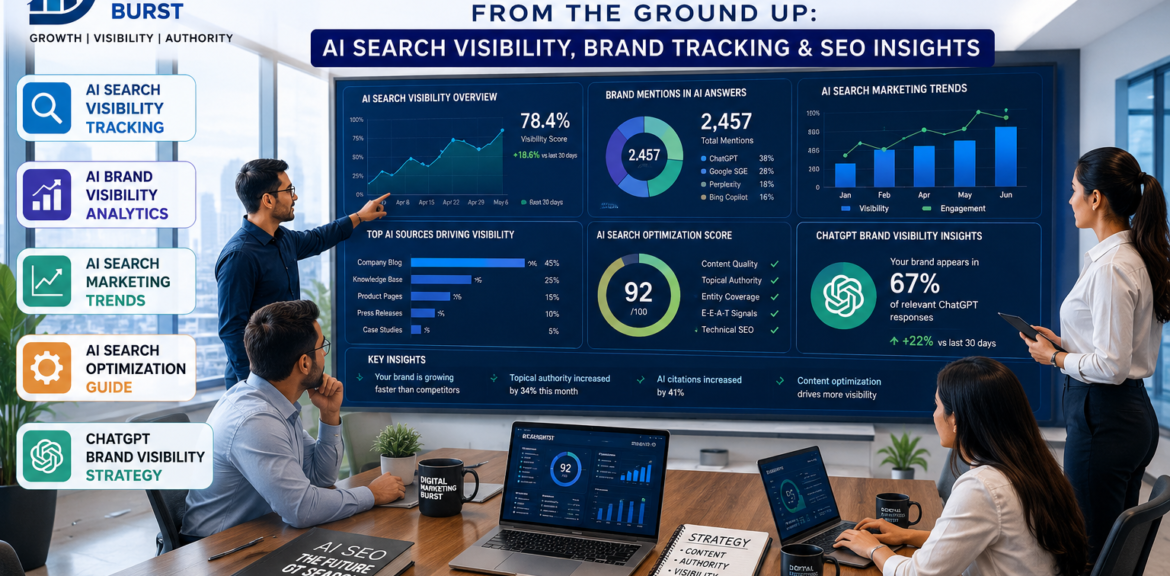

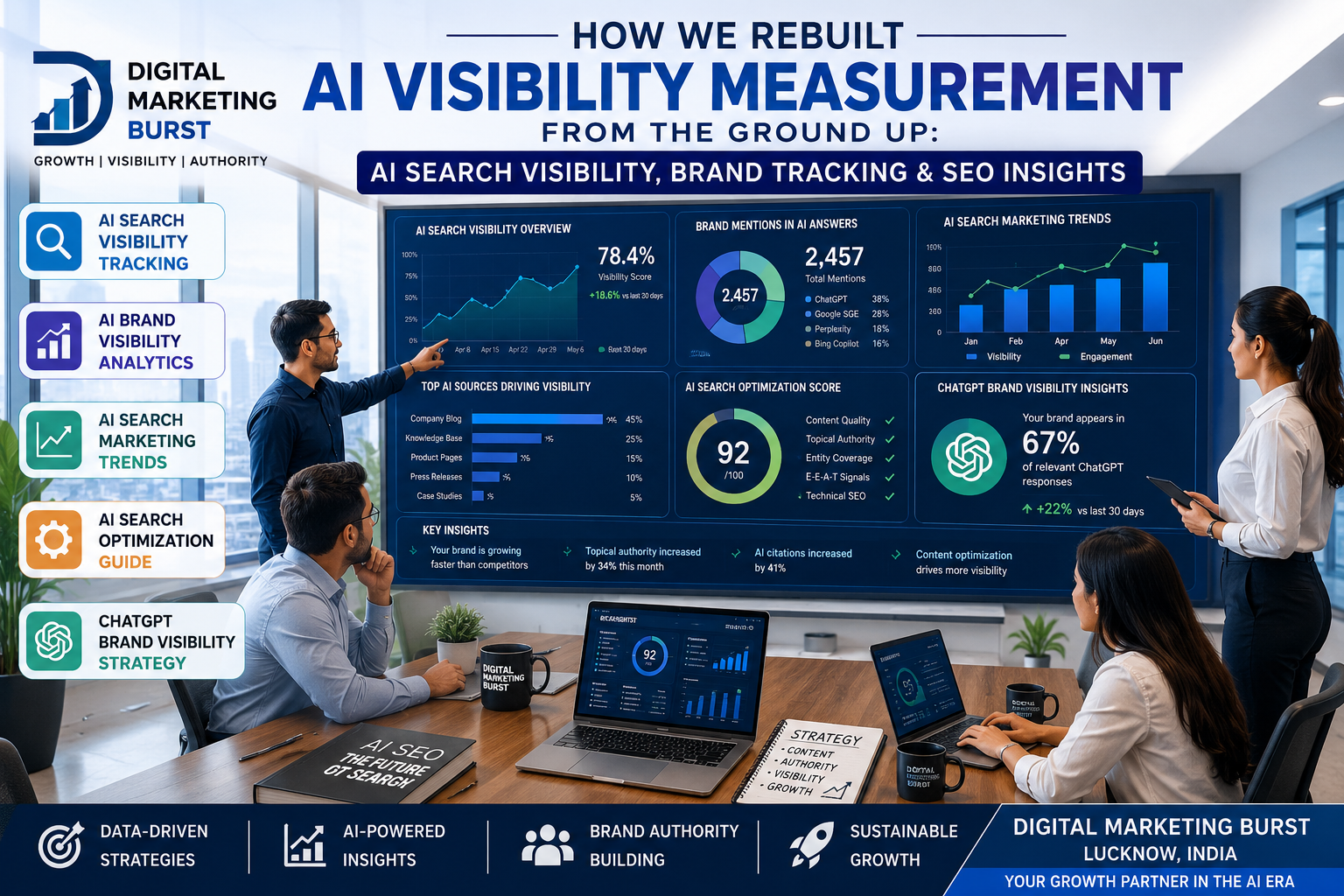
How We Rebuilt AI Visibility Measurement From the Ground Up: AI Search Visibility, Brand Tracking & SEO Insights
AI Search Visibility Tracking, AI Brand Visibility Analytics, AI Search Marketing Trends, AI Search Optimization Guide, and ChatGPT Brand Visibility Strategy are rapidly becoming essential topics for businesses, marketers, and SEO professionals. As AI-powered search platforms continue changing how users discover information, traditional SEO metrics are no longer enough. Brands now need better ways to understand how they appear inside AI-generated answers, conversational search experiences, and recommendation engines.
Search behavior is evolving quickly. Users increasingly rely on ChatGPT, AI assistants, generative search engines, and intelligent recommendation systems to find answers. Consequently, measuring visibility within these environments has become a major challenge for businesses. Traditional ranking reports often fail to reveal how brands are represented when AI generates responses.
This challenge led us to completely rethink visibility measurement. Instead of focusing only on rankings, clicks, and impressions, we built a framework designed for AI discovery, conversational search exposure, and brand mention tracking. As a result, businesses can gain a clearer understanding of their presence across modern search experiences.
At Digital Marketing Burst, we recognized that the future of search requires new measurement models. Therefore, we developed a more comprehensive approach that combines AI visibility monitoring, brand citation analysis, search trend intelligence, and conversational search optimization.
Why Traditional SEO Metrics Are No Longer Enough
For years, SEO success was measured through rankings, backlinks, organic traffic, and click-through rates. These indicators remain important. However, AI-driven search experiences are changing how users interact with information online.
When a user asks an AI assistant a question, the response often appears instantly. In many cases, users receive recommendations without visiting multiple websites. Consequently, traditional ranking reports cannot always explain why certain brands receive visibility while others remain hidden.
Businesses that rely solely on classic SEO metrics may miss valuable opportunities. AI systems frequently evaluate content differently than traditional search engines. Therefore, visibility now depends on authority, context, topical expertise, entity recognition, and content relevance.
Another challenge involves attribution. Brands may appear inside AI-generated responses without generating direct clicks. As a result, measuring visibility requires more sophisticated analytics than conventional traffic reports.
The rise of conversational search means businesses must rethink how success is measured. Consequently, organizations that adapt early may gain significant competitive advantages.
AI Search Visibility Tracking: The New Foundation of Search Measurement
AI Search Visibility Tracking represents one of the most important developments in modern digital marketing. Instead of measuring only search rankings, this approach evaluates how often a brand appears across AI-powered discovery systems.
Visibility within AI search environments depends on multiple factors. Content quality, authority signals, entity recognition, citation frequency, and contextual relevance all influence outcomes. Therefore, businesses need measurement systems capable of monitoring these variables.
One important observation is that AI platforms often surface brands differently than traditional search engines. A company ranking well on Google may receive limited AI visibility, while another brand with strong topical authority may appear frequently in AI-generated responses.
This shift creates new opportunities. Businesses that understand AI visibility patterns can improve content strategies and strengthen authority signals. As a result, they may increase their presence within AI-generated recommendations.
Digital Marketing Burst research indicates that AI visibility should become a standard performance metric alongside rankings, traffic, and conversions. Consequently, organizations should begin incorporating visibility monitoring into their reporting frameworks.
AI Search Performance Tracking and the Evolution of SEO
Search optimization has evolved dramatically during the last decade. Today, businesses must optimize not only for search engines but also for AI-driven discovery platforms.
AI Search Performance Tracking focuses on understanding how content performs across conversational search environments. Rather than evaluating only position rankings, it measures appearance frequency, recommendation likelihood, citation visibility, and topical authority.
This approach provides deeper insight into content effectiveness. Consequently, marketers can identify strengths and weaknesses that traditional SEO tools may overlook.
Many businesses continue optimizing exclusively for search rankings. However, AI-powered search environments reward content that demonstrates expertise, relevance, and contextual understanding. Therefore, performance tracking must evolve accordingly.
Organizations that embrace these changes can improve visibility across multiple search channels. As a result, they become better positioned for future search trends.
How AI Search Is Transforming Brand Discovery
Brand discovery has changed significantly. In the past, users often clicked multiple links before making decisions. Today, AI systems frequently summarize information and provide direct recommendations.
This transformation influences how consumers encounter brands. Consequently, businesses must ensure they remain visible within AI-generated answers.
AI systems evaluate content quality, expertise, relevance, and authority before selecting sources. Therefore, organizations must focus on building comprehensive content ecosystems rather than isolated articles.
Digital Marketing Burst has observed that brands appearing consistently within AI-generated recommendations often demonstrate strong topical authority. As a result, content depth and expertise have become increasingly important.
Businesses that understand these patterns can adapt content strategies accordingly. Consequently, they improve their chances of being discovered through conversational search experiences.
AI Visibility Measurement Framework: Building a Better System
Developing an effective visibility measurement framework required rethinking traditional assumptions. Rankings alone no longer provide a complete picture of search performance.
Our framework focuses on several core areas. These include AI appearance frequency, brand mention analysis, citation tracking, topical authority measurement, and recommendation visibility.
Each component provides valuable insight. Together, they create a more complete understanding of brand performance across AI-driven search environments.
One major advantage involves broader visibility analysis. Instead of focusing exclusively on clicks, businesses gain insight into overall search presence. Consequently, strategic decisions become more informed.
This framework also helps identify content opportunities. Organizations can discover topics where competitors receive stronger AI visibility and adjust strategies accordingly.
As AI search continues evolving, visibility measurement frameworks will likely become essential components of modern digital marketing.
AI Brand Visibility Analytics: Understanding How Brands Appear in AI Search
Traditional analytics platforms were built to measure website traffic, conversions, and keyword rankings. However, AI-powered search environments require a completely different approach. Brands now appear inside conversational responses, AI-generated summaries, and recommendation engines. Consequently, businesses need better tools to understand where and how they are being discovered.
AI Brand Visibility Analytics focuses on measuring brand presence across generative search platforms. Instead of looking only at clicks, this approach evaluates recommendation frequency, citation patterns, content influence, and topical authority.
A growing number of organizations are discovering that visibility does not always generate immediate website visits. Users may receive answers directly from AI systems without clicking any external links. Therefore, visibility itself becomes a valuable performance indicator.
Another important factor involves competitive analysis. Businesses can compare how frequently competitors appear across AI search environments. As a result, content gaps and strategic opportunities become easier to identify.
Digital Marketing Burst research shows that companies with strong topical authority tend to receive more consistent AI visibility. Consequently, long-form educational content often performs better than isolated marketing pages.
The future of digital marketing will likely depend on understanding these visibility patterns. Therefore, AI Brand Visibility Analytics should become a standard component of modern reporting frameworks.
AI Brand Mention Analytics and Citation Tracking Strategies
Brand mentions have become increasingly valuable within AI search ecosystems. Unlike traditional search results, AI systems often reference multiple sources while generating responses. Consequently, citation frequency can influence overall brand visibility.
AI Brand Mention Analytics measures how often a company, product, service, or website appears within AI-generated recommendations. This process provides insight into brand recognition and authority.
One interesting observation is that citations often originate from a variety of content formats. Articles, research reports, case studies, guides, and industry resources may all contribute to visibility. Therefore, businesses should diversify content creation efforts.
Monitoring brand mentions also helps identify reputation trends. If a company consistently appears in positive contexts, visibility may improve over time. As a result, maintaining content quality becomes increasingly important.
Organizations can use mention analytics to discover opportunities for expansion. Content topics that generate strong citation activity often indicate areas where authority is already established. Consequently, businesses can invest more resources into successful subject areas.
As conversational search continues expanding, citation tracking will likely become one of the most important visibility metrics available.
ChatGPT Brand Visibility Strategy for Modern Businesses
Many organizations are asking a simple question: how can a brand become more visible inside ChatGPT responses? The answer involves more than traditional SEO techniques.
A successful ChatGPT Brand Visibility Strategy begins with authority. AI systems tend to favor content that demonstrates expertise, relevance, and trustworthiness. Therefore, businesses must focus on creating valuable information rather than merely targeting keywords.
Content depth also matters. Comprehensive resources provide context that AI systems can understand more effectively. Consequently, detailed guides often perform better than short articles.
Another important factor involves consistency. Brands that publish authoritative content regularly are more likely to develop strong topical associations. As a result, AI systems may reference them more frequently.
Digital Marketing Burst has observed that entity recognition plays a growing role in visibility. Organizations should ensure that brand information remains accurate, consistent, and widely available across trusted sources.
Businesses that invest in authority-building strategies today may gain significant advantages as AI-driven search continues evolving.
ChatGPT Marketing Strategy and AI Discovery Optimization
Marketing strategies designed for traditional search engines often require adjustment when targeting AI discovery platforms. Users interact with conversational systems differently than they interact with conventional search results.
A strong ChatGPT Marketing Strategy focuses on becoming a trusted source of information. Rather than competing solely for rankings, brands compete for recognition, authority, and recommendation potential.
This shift changes content planning. Educational resources, expert insights, original research, and problem-solving content often perform exceptionally well. Consequently, organizations should prioritize value creation.
User intent also becomes more important. AI systems attempt to provide the most helpful answer possible. Therefore, content that addresses genuine questions frequently receives greater visibility.
Another advantage of conversational marketing involves long-tail search opportunities. Detailed questions often trigger highly specific responses. As a result, businesses can reach audiences with strong intent and clear interests.
Organizations that understand these trends can adapt strategies more effectively and improve long-term visibility.
AI Search Marketing Trends Reshaping Digital Marketing
Search marketing continues evolving rapidly. AI-powered search experiences are changing how users discover information, evaluate options, and make decisions. Consequently, marketers must monitor emerging trends closely.
One major trend involves answer-first experiences. Users increasingly receive direct answers without navigating through multiple websites. Therefore, visibility within AI-generated responses becomes increasingly important.
Another trend is entity-based search understanding. AI systems focus more on relationships between topics, brands, products, and concepts. As a result, content should emphasize expertise and topical relevance.
Personalization is also expanding. AI systems can generate responses tailored to individual needs and preferences. Consequently, marketers must create content that serves diverse audiences effectively.
Digital Marketing Burst research suggests that authority signals will continue growing in importance. Brands that consistently publish valuable content are likely to benefit from stronger visibility.
Organizations that understand these AI Search Marketing Trends can position themselves more effectively for future growth.
AI Marketing Trends 2026: Preparing for the Next Phase
The next generation of digital marketing will likely be shaped by AI-driven discovery, conversational search, and intelligent recommendation systems. Consequently, businesses should begin adapting strategies today.
AI Marketing Trends 2026 indicate a movement toward predictive content experiences. Search platforms increasingly anticipate user needs and provide proactive recommendations. Therefore, marketers must focus on relevance and usefulness.
Automation will also expand. Content optimization, visibility monitoring, audience segmentation, and performance analysis are becoming increasingly AI-assisted. As a result, marketers can make faster and more informed decisions.
Brand authority remains a critical factor. AI systems continue favoring sources that demonstrate expertise and trustworthiness. Consequently, businesses should invest in thought leadership and educational content.
Another trend involves cross-platform visibility. Brands must maintain consistent authority signals across websites, social platforms, industry publications, and AI search environments. Therefore, integrated marketing strategies become increasingly valuable.
Organizations that prepare for these developments now will be better positioned for future success.
How to Improve AI Search Visibility for Long-Term Growth
Improving AI visibility requires a strategic approach rather than quick optimization tactics. Businesses must focus on creating content ecosystems that demonstrate expertise, authority, and relevance.
One effective strategy involves developing comprehensive topic clusters. Related content pieces strengthen topical authority and help AI systems understand subject expertise. Consequently, visibility often improves over time.
Content freshness also matters. Regular updates signal ongoing relevance and ensure information remains accurate. Therefore, maintaining existing content can be just as important as publishing new material.
User-focused content generally performs better than keyword-focused content. AI systems prioritize usefulness and clarity. As a result, organizations should prioritize audience needs.
Long-term success depends on consistency. Brands that invest continuously in high-quality content and authority-building efforts often achieve stronger visibility across AI search environments.
The future belongs to businesses that understand how AI systems evaluate information and adapt accordingly.
AI Search Optimization Guide: Building Visibility Beyond Traditional SEO
The way businesses optimize content is changing rapidly. Traditional SEO still matters, but AI-powered discovery platforms evaluate information differently. Consequently, brands must expand their optimization efforts beyond rankings and keyword positions.
An effective AI Search Optimization Guide begins with understanding how AI systems interpret information. Unlike traditional search engines, AI platforms often analyze context, topical relationships, authority signals, and content usefulness before generating responses. Therefore, optimization requires a broader strategy.
Many organizations focus heavily on keyword targeting. However, AI search environments prioritize complete answers and expert insights. As a result, content that solves problems often performs better than pages designed solely for rankings.
Another important factor involves content structure. Clear headings, logical organization, and well-developed topic coverage help AI systems understand information more effectively. Consequently, content becomes easier to surface within conversational search experiences.
Digital Marketing Burst research suggests that businesses should focus on becoming authoritative sources rather than simply ranking for individual keywords. Therefore, long-term visibility depends on building trust, expertise, and topical depth.
As AI search continues evolving, optimization strategies must evolve alongside it.
AI Search SEO Guide for the Next Generation of Search
The relationship between AI search and SEO is becoming increasingly interconnected. While many traditional SEO principles remain relevant, new optimization priorities are emerging.
An AI Search SEO Guide focuses on helping content perform within conversational search systems, recommendation engines, and generative AI platforms. Consequently, content quality becomes even more important.
AI systems evaluate information differently than traditional ranking algorithms. They seek comprehensive, reliable, and contextually relevant answers. Therefore, businesses should focus on creating resources that demonstrate expertise.
Content clusters have become particularly valuable. Instead of publishing isolated articles, organizations should build interconnected resources around major topics. As a result, topical authority becomes stronger.
Search intent also remains critical. Users asking questions through AI systems often expect direct, useful responses. Consequently, content should address specific needs rather than relying on generic information.
Organizations that combine traditional SEO with AI-focused optimization strategies will likely achieve stronger long-term visibility.
How AI Search Rankings Work in Modern Discovery Platforms
Many marketers want to understand how AI search systems determine which brands and content appear in generated responses. While exact algorithms remain proprietary, several important patterns have emerged.
Authority plays a major role. AI systems often favor sources that demonstrate expertise, trustworthiness, and consistent content quality. Therefore, businesses should prioritize credibility-building initiatives.
Topical relevance is equally important. AI platforms evaluate whether content aligns closely with user questions. Consequently, detailed and focused resources often receive greater visibility.
Citation frequency also influences outcomes. Brands that are referenced frequently across trusted sources may gain stronger recognition within AI systems. As a result, broader content distribution can support visibility goals.
Content clarity contributes significantly as well. Well-organized resources help AI systems process information efficiently. Therefore, structure and readability remain important optimization factors.
Understanding these ranking influences helps businesses create content strategies aligned with evolving search environments.
AI Search Ranking Factors Every Marketer Should Understand
Several ranking factors appear consistently across AI-driven search platforms. Although exact methodologies vary, common themes continue emerging.
Content quality remains one of the strongest indicators. Comprehensive, accurate, and helpful information often performs well. Consequently, organizations should invest in research and expert content creation.
Entity recognition has become increasingly important. AI systems attempt to understand relationships between brands, products, topics, and concepts. Therefore, consistent brand representation across multiple channels supports visibility.
User engagement may also influence outcomes indirectly. Content that satisfies audience needs tends to attract stronger authority signals over time. As a result, user-focused experiences remain valuable.
Freshness is another important factor. Updated content signals relevance and reliability. Consequently, regular content maintenance should become part of ongoing optimization efforts.
Digital Marketing Burst analysis suggests that businesses combining authority, expertise, relevance, and consistency often achieve the strongest visibility results.
Brand Discovery in AI Search: A New Marketing Opportunity
Brand discovery is no longer limited to search engine results pages. AI systems now introduce users to products, services, and organizations through conversational recommendations.
This shift creates new opportunities for businesses. Rather than competing only for clicks, brands can compete for visibility within AI-generated answers. Consequently, discovery mechanisms are becoming more diverse.
Consumers increasingly trust AI-generated recommendations when researching products and services. Therefore, appearing within these responses can influence purchasing decisions.
One challenge involves measurement. Traditional analytics tools may not fully capture AI-driven brand exposure. As a result, organizations need specialized visibility tracking solutions.
Another opportunity involves niche expertise. Brands with strong authority in specific subject areas may gain visibility even when larger competitors dominate traditional search results. Consequently, expertise becomes a powerful differentiator.
Organizations that understand AI-driven discovery patterns can position themselves more effectively for future growth.
AI Search Performance Metrics That Matter Most
Measuring AI visibility requires new performance indicators. Traditional rankings and traffic metrics provide useful information, but they do not tell the complete story.
Appearance frequency is one important metric. Businesses should monitor how often they appear within AI-generated responses. Consequently, visibility trends become easier to understand.
Recommendation share is another valuable indicator. This metric measures how frequently a brand is suggested compared to competitors. As a result, organizations gain insight into relative performance.
Citation analysis helps identify authoritative content assets. Businesses can determine which resources contribute most effectively to visibility. Therefore, future content planning becomes more strategic.
Topic coverage metrics also provide useful insights. Understanding where authority is strongest helps identify expansion opportunities. Consequently, organizations can allocate resources more effectively.
Combining these metrics creates a more complete picture of AI search performance.
AI Visibility Tracking Tools and Analytics Platforms
The growing importance of AI visibility has created demand for specialized measurement tools. Organizations increasingly require solutions capable of monitoring conversational search performance.
Modern visibility platforms often track brand mentions, citations, recommendation frequency, and topical authority. Consequently, businesses gain deeper insights than traditional SEO tools provide.
Analytics platforms continue evolving as AI search expands. Many solutions now focus on understanding brand exposure across multiple AI environments. Therefore, marketers have access to increasingly sophisticated visibility data.
One benefit of dedicated tracking tools is competitive benchmarking. Businesses can compare visibility against competitors and identify emerging opportunities. As a result, strategic planning becomes more informed.
Digital Marketing Burst believes that visibility tracking technology will become a standard component of modern marketing analytics. Consequently, organizations should begin evaluating available solutions before AI search becomes even more influential.
Why AI Visibility Will Define the Future of Search Marketing
Search marketing is entering a new era. Rankings and traffic remain important, but visibility within AI-generated experiences is becoming equally significant.
Users increasingly rely on conversational systems to discover information, compare options, and make decisions. Therefore, brands must understand how they appear within these environments.
Organizations that focus exclusively on traditional SEO may overlook emerging opportunities. Consequently, expanding measurement frameworks becomes increasingly important.
AI visibility combines authority, relevance, expertise, and trust into a single strategic objective. Businesses that invest in these areas often gain advantages across multiple search channels.
The future of search marketing will likely involve a combination of traditional optimization and AI-focused visibility strategies. As a result, organizations that adapt early may achieve stronger long-term growth and market positioning.
Why AI Search Visibility Tracking Is Becoming the Most Important Marketing Metric
The search industry is experiencing a transformation unlike anything seen during the past decade. Traditional rankings still matter, but businesses are now discovering that AI Search Visibility Tracking provides a deeper understanding of how brands appear within modern search experiences. As conversational AI continues influencing consumer behavior, organizations need better measurement systems that go beyond conventional SEO reports.
One reason AI Search Visibility Tracking has become so important is the rise of AI-generated answers. Users increasingly ask questions through conversational platforms instead of browsing multiple search results. Consequently, brands must understand whether they are being recommended, cited, or referenced by AI systems.
Many companies still focus only on rankings. However, rankings alone do not reveal how frequently a brand appears in AI-powered recommendations. Therefore, AI Search Visibility Tracking fills a critical measurement gap.
Another advantage involves competitive intelligence. Through AI Search Visibility Tracking, businesses can compare their AI presence against competitors and identify areas for improvement. As a result, content strategies become more effective.
Digital Marketing Burst research suggests that organizations investing in AI Search Visibility Tracking today will gain stronger visibility advantages as AI search adoption continues increasing. Consequently, marketers should begin integrating these insights into existing reporting frameworks.
AI Search Visibility Tracking and the Future of Brand Discovery
Brand discovery is changing rapidly. Users no longer rely exclusively on traditional search results when researching products, services, or solutions. Instead, AI systems frequently provide recommendations directly within conversational interfaces. Therefore, AI Search Visibility Tracking has emerged as an essential tool for measuring digital presence.
When an AI assistant recommends a brand, the user may never visit a search results page. As a result, traditional metrics fail to capture the full customer journey. This is where AI Search Visibility Tracking becomes valuable.
Businesses that monitor visibility patterns gain a clearer understanding of how AI platforms perceive their content. Consequently, they can identify opportunities to strengthen authority and improve discoverability.
Another benefit of AI Search Visibility Tracking is trend analysis. Organizations can observe changes in visibility over time and evaluate how content updates influence performance. Therefore, strategic decisions become more data-driven.
As AI-driven discovery continues expanding, AI Search Visibility Tracking will likely become as important as traditional SEO analytics.
How AI Search Visibility Tracking Supports Better Content Strategies
Content remains the foundation of digital visibility. However, modern AI systems evaluate content differently than traditional search engines. Consequently, organizations must rethink how they measure content effectiveness.
AI Search Visibility Tracking helps marketers understand which content assets generate the strongest AI exposure. Rather than focusing solely on traffic, businesses can evaluate recommendation frequency, citation activity, and brand presence.
This insight supports smarter content planning. For example, if certain articles consistently generate AI visibility, organizations can expand those topics further. As a result, topical authority becomes stronger.
Another advantage involves content gap analysis. Through AI Search Visibility Tracking, businesses can identify areas where competitors receive greater exposure. Consequently, they can develop targeted content to close those gaps.
Digital Marketing Burst has found that organizations using AI Search Visibility Tracking often create more effective long-term content strategies because decisions are based on visibility intelligence rather than assumptions.
AI Search Visibility Tracking Tools and Analytics Platforms
The growing importance of AI search has created demand for specialized analytics solutions. Traditional SEO platforms provide valuable information, but many lack dedicated visibility measurement capabilities. Therefore, AI Search Visibility Tracking tools are becoming increasingly important.
Modern platforms can monitor brand mentions, recommendation frequency, citation patterns, and AI-generated references. Consequently, businesses gain insights that standard analytics systems cannot provide.
One major benefit of AI Search Visibility Tracking platforms is competitive benchmarking. Organizations can compare performance against industry competitors and identify opportunities for improvement. As a result, strategic planning becomes more effective.
Another advantage involves automation. Many visibility monitoring systems continuously collect data across multiple AI environments. Therefore, marketers can identify trends without relying on manual analysis.
As the industry evolves, AI Search Visibility Tracking tools will likely become standard resources for SEO professionals, agencies, and marketing teams.
AI Search Visibility Tracking and AI Marketing Trends 2026
Looking ahead, several developments are expected to influence digital marketing strategies. Among these trends, AI Search Visibility Tracking stands out as one of the most significant.
AI systems are becoming more sophisticated. Consequently, recommendation quality, personalization, and contextual understanding continue improving. Businesses must understand how these changes affect visibility.
One major trend involves increased competition for AI-generated recommendations. Therefore, brands that invest in AI Search Visibility Tracking will gain better insight into performance and optimization opportunities.
Another trend involves authority-based visibility. AI platforms increasingly prioritize expertise and trustworthiness. As a result, visibility monitoring becomes essential for understanding how authority influences recommendations.
Digital Marketing Burst forecasts that AI Search Visibility Tracking will become a core KPI for modern marketing teams. Organizations that ignore these developments may struggle to understand future search performance.
Generative AI SEO Best Practices for Stronger Visibility
Generative AI is changing how users consume information. Consequently, SEO strategies must adapt to new discovery mechanisms and recommendation systems.
One best practice involves creating comprehensive content. AI systems often favor resources that answer questions thoroughly. Therefore, depth and expertise become critical factors.
Another important strategy is maintaining topical consistency. Businesses should develop interconnected content ecosystems that strengthen authority signals. As a result, visibility may improve across multiple AI platforms.
Organizations should also monitor performance continuously. AI Search Visibility Tracking provides valuable insight into how content performs within AI-generated environments. Consequently, optimization becomes more precise.
Content updates remain equally important. Fresh information helps maintain relevance and supports stronger authority signals. Therefore, ongoing content maintenance should become part of every visibility strategy.
Why Businesses Must Invest in AI Search Visibility Tracking Today
The future of digital marketing is increasingly connected to AI-driven discovery experiences. Organizations that wait too long to adapt may lose valuable opportunities.
AI Search Visibility Tracking provides insight into how brands appear within conversational search environments. This information helps marketers understand visibility patterns, optimize content, and strengthen authority.
Businesses that embrace AI Search Visibility Tracking gain a competitive advantage because they can identify emerging trends earlier. Consequently, they are better positioned for long-term success.
As AI search continues reshaping the digital landscape, measurement frameworks must evolve accordingly. Therefore, organizations should begin integrating visibility monitoring into broader marketing strategies.
The brands that understand AI visibility today will be the brands that dominate AI-powered discovery tomorrow.
AI Brand Visibility Analytics Case Study: What We Learned While Rebuilding Measurement Systems
When we started analyzing modern search behavior, one issue became immediately clear. Traditional reporting platforms were not designed for conversational search environments. Rankings, traffic, and impressions provided useful information, but they failed to explain how brands were being discovered through AI-generated answers.
This challenge motivated a deeper investigation into AI Brand Visibility Analytics. We wanted to understand how businesses appeared within AI-powered search systems, recommendation engines, and conversational interfaces. Consequently, we began tracking brand mentions, authority signals, citation frequency, and recommendation visibility.
The findings were surprising. Some brands with moderate organic traffic received significant AI exposure because they consistently published authoritative content. Meanwhile, other websites with strong rankings appeared less frequently in AI-generated responses.
Another observation involved content structure. Detailed topic clusters often generated stronger visibility than isolated articles. Therefore, organizations should focus on creating comprehensive content ecosystems rather than relying on individual pages.
Digital Marketing Burst discovered that topical authority played a major role in visibility outcomes. Brands that consistently covered related topics often achieved greater AI recognition over time.
This case study demonstrated that future search success requires a broader perspective. Rankings remain valuable, but visibility within AI systems is becoming equally important.
ChatGPT Brand Visibility Strategy: How Brands Can Increase AI Mentions
As AI-powered assistants become more widely used, businesses are increasingly interested in improving visibility within generated responses. Consequently, developing an effective ChatGPT Brand Visibility Strategy has become a priority for many organizations.
The first step involves creating authoritative content. AI systems frequently reference sources that demonstrate expertise and reliability. Therefore, businesses should prioritize educational resources, research-based articles, and detailed guides.
Consistency also matters. Brands that regularly publish valuable content often strengthen their topical authority. As a result, AI systems become more likely to recognize them as credible sources.
Another important element involves entity recognition. Organizations should ensure that brand information remains accurate across websites, social platforms, business profiles, and industry publications. Consequently, AI systems gain a clearer understanding of the brand.
Digital Marketing Burst research indicates that brands appearing frequently within trusted industry discussions often achieve stronger AI visibility. Therefore, thought leadership and expert commentary can contribute significantly to long-term performance.
Businesses that implement a strong ChatGPT Brand Visibility Strategy today may gain lasting advantages as conversational search adoption continues growing.
AI Search Traffic Analysis and Emerging Discovery Channels
Traffic analysis has traditionally focused on search engines, social media, and referral sources. However, AI-powered discovery channels are creating new pathways for user engagement. Consequently, marketers must expand how they evaluate traffic opportunities.
AI Search Traffic Analysis examines how visibility within AI-generated environments influences audience behavior. Even when direct clicks are not immediately visible, brand exposure may still affect future customer decisions.
One interesting trend involves assisted discovery. Users often receive recommendations through AI systems and later visit websites through branded searches. As a result, attribution becomes more complex.
Another observation is that AI-generated answers frequently introduce users to brands they may not have discovered through traditional search. Therefore, visibility itself becomes a valuable marketing outcome.
Organizations that conduct regular AI Search Traffic Analysis gain a better understanding of how conversational search influences audience journeys. Consequently, they can make more informed content and marketing decisions.
As AI platforms continue evolving, discovery channels will likely become even more diverse and influential.
Future of AI Search Marketing: What Businesses Should Expect
Search marketing is entering a period of significant transformation. Artificial intelligence is changing how information is discovered, evaluated, and delivered. Consequently, businesses must prepare for new visibility challenges and opportunities.
One major trend involves answer-based search experiences. Users increasingly expect immediate responses rather than lists of links. Therefore, brands must optimize for recommendation visibility as well as traditional rankings.
Another development is personalized search experiences. AI systems can adapt responses according to context, preferences, and intent. As a result, content strategies must become more audience-focused.
Authority will remain critical. AI systems consistently favor reliable and informative sources. Consequently, organizations should invest in expertise, thought leadership, and educational content.
Digital Marketing Burst forecasts that businesses measuring only rankings and traffic will have an incomplete understanding of future performance. Therefore, visibility metrics will become increasingly important.
The future of AI Search Marketing belongs to organizations that understand how AI systems evaluate information and influence user behavior.
Brand Discovery in AI Search and the Rise of Recommendation Engines
Recommendation engines are becoming central components of digital discovery. Instead of requiring users to compare dozens of search results, AI systems often provide direct suggestions. Consequently, brand discovery mechanisms are changing.
Businesses now compete not only for rankings but also for recommendations. Therefore, authority, relevance, and content quality have become even more important.
One advantage of recommendation-driven discovery is efficiency. Users receive information faster and with less effort. As a result, AI-generated recommendations are influencing purchasing decisions more frequently.
Organizations that understand recommendation behavior can improve visibility through strategic content development. Consequently, they increase their chances of appearing in relevant responses.
Another important factor involves trust. AI systems tend to recommend sources that consistently demonstrate expertise. Therefore, authority-building initiatives remain valuable investments.
The rise of recommendation engines represents one of the most significant changes in modern search marketing.
How Digital Marketing Burst Approaches AI Search Visibility
Digital Marketing Burst views AI search as an opportunity rather than a threat. Instead of focusing exclusively on rankings, the agency emphasizes visibility, authority, and long-term discoverability.
The approach begins with understanding audience intent. Content is designed to answer real questions and solve practical problems. Consequently, visibility often improves naturally.
Authority development is another priority. Businesses that consistently publish expert insights tend to perform better within AI-driven environments. Therefore, content quality remains central to every strategy.
Digital Marketing Burst also emphasizes measurement innovation. Traditional analytics remain valuable, but additional visibility metrics provide a more complete performance picture. As a result, organizations gain deeper insights into emerging search trends.
Another focus area involves adaptability. Search technology evolves rapidly, and successful businesses must evolve alongside it. Consequently, ongoing optimization remains essential.
By combining authority-building, visibility monitoring, and strategic content development, organizations can strengthen their presence across both traditional and AI-powered search experiences.
Why the Next Era of SEO Will Be Defined by AI Visibility
SEO is not disappearing. Instead, it is expanding into new environments. Rankings, traffic, and backlinks will continue playing important roles, but AI visibility is becoming a major factor in digital success.
Businesses that understand AI-driven discovery can gain advantages that competitors may overlook. Consequently, visibility measurement becomes increasingly important.
AI systems evaluate expertise, relevance, authority, and trustworthiness when generating responses. Therefore, organizations must focus on delivering genuine value.
The companies that thrive during the next phase of search marketing will likely be those that understand both traditional SEO and AI-powered visibility strategies. As a result, a balanced approach becomes essential.
The future belongs to brands that are discoverable, authoritative, and consistently useful. Organizations that invest in these principles today will be better positioned for long-term growth in an AI-driven search landscape.
AI Search Visibility Tracking FAQs: Questions Every Marketer Is Asking
As AI-powered search platforms become more common, businesses are asking new questions about visibility, measurement, and optimization. Traditional SEO metrics still matter. However, marketers increasingly need insights that go beyond rankings and traffic reports.
One of the most common questions involves measurement. Many businesses want to know whether AI-generated visibility can be tracked accurately. The answer is yes, although the methods differ from traditional SEO reporting. Instead of focusing solely on rankings, marketers analyze recommendation frequency, citation visibility, topical authority, and conversational search presence.
Another frequently asked question concerns optimization. Businesses often wonder whether existing SEO strategies remain relevant. While traditional SEO remains important, AI search environments reward expertise, authority, and context more heavily. Consequently, content quality has become even more critical.
Organizations also ask how long it takes to improve visibility. Results vary depending on competition, content quality, authority signals, and industry conditions. Therefore, AI visibility should be viewed as a long-term strategic investment rather than a short-term tactic.
As conversational search continues growing, understanding these questions will help businesses adapt more effectively.
AI Search Optimization Guide for Businesses Entering the AI Era
Many organizations are still approaching AI search with strategies designed for traditional search engines. While some principles remain useful, businesses must adapt to changing discovery patterns. Consequently, an updated AI Search Optimization Guide becomes essential.
The first step involves understanding user intent. AI systems attempt to provide complete answers rather than simple lists of links. Therefore, content should focus on solving problems and answering questions comprehensively.
Authority development remains equally important. Businesses that publish expert insights consistently are more likely to gain recognition within AI-powered search environments. As a result, educational content should become a central part of every marketing strategy.
Another critical area is content structure. Well-organized articles with logical sections improve readability for both users and AI systems. Consequently, structured content often receives stronger visibility.
Organizations should also monitor emerging trends regularly. Search technology evolves rapidly. Therefore, ongoing optimization helps businesses remain competitive.
Companies that combine expertise, authority, and strategic content planning are likely to achieve stronger AI visibility in the years ahead.
AI Marketing Trends 2026 and Beyond
The marketing industry is approaching a significant turning point. Artificial intelligence is influencing how users search, discover information, evaluate brands, and make decisions. Consequently, marketers must prepare for continued transformation.
One emerging trend involves conversational commerce. Users increasingly rely on AI systems to compare products, evaluate services, and receive recommendations. Therefore, businesses need strategies that support visibility within these interactions.
Another important development is predictive discovery. AI systems are becoming better at anticipating user needs before questions are fully expressed. As a result, content relevance and contextual understanding are becoming more valuable.
Personalization will continue expanding as well. Search experiences are becoming increasingly tailored to individual preferences and behaviors. Consequently, marketers must create content that serves diverse audience segments.
Digital Marketing Burst believes that organizations embracing AI Marketing Trends 2026 early will gain competitive advantages. Businesses that delay adaptation may find it more difficult to establish authority in future search environments.
Understanding these trends today helps prepare organizations for tomorrow’s opportunities.
AI Search Visibility Tracking and the Future of Digital Marketing
The future of digital marketing will be shaped by visibility rather than rankings alone. While traditional search performance remains important, AI-generated recommendations are becoming powerful drivers of discovery.
AI Search Visibility Tracking provides marketers with a way to understand how brands appear within conversational search experiences. Consequently, businesses gain insights that conventional analytics often overlook.
One major advantage involves strategic planning. Organizations can identify topics generating strong AI exposure and expand those areas further. As a result, authority grows more efficiently.
Another benefit is competitive analysis. Businesses can compare visibility patterns and discover where competitors are outperforming them. Therefore, optimization efforts become more targeted.
The importance of AI Search Visibility Tracking will likely increase as AI assistants continue influencing consumer decisions. Consequently, marketers should begin integrating visibility monitoring into broader reporting frameworks.
Organizations that understand AI visibility today will be better prepared for future search environments.
How Digital Marketing Burst Helps Businesses Prepare for AI Search
Search behavior is evolving faster than ever. Businesses need reliable insights, strategic guidance, and modern optimization approaches to remain competitive. Consequently, agencies must adapt alongside technology.
Digital Marketing Burst focuses on helping organizations understand emerging search trends and prepare for future visibility challenges. Rather than relying exclusively on traditional SEO methodologies, the agency emphasizes authority-building, content quality, and search intelligence.
One important area involves education. Businesses often struggle to understand how AI search differs from traditional search engines. Therefore, providing clear guidance becomes essential.
Another focus area is visibility measurement. Organizations need better ways to evaluate performance across AI-driven environments. As a result, visibility analytics and search intelligence play increasingly important roles.
Digital Marketing Burst believes the future belongs to businesses that prioritize expertise, user value, and authority. Consequently, strategic content development remains at the center of long-term growth initiatives.
Final Thoughts: Why AI Visibility Measurement Matters More Than Ever
The digital marketing landscape is undergoing a profound transformation. Search engines are evolving into intelligent answer systems, recommendation platforms, and conversational assistants. Consequently, traditional measurement models are becoming less comprehensive.
Throughout this guide, we explored AI Search Visibility Tracking, AI Brand Visibility Analytics, AI Search Marketing Trends, AI Search Optimization Guide, and ChatGPT Brand Visibility Strategy. Together, these concepts form the foundation of modern visibility measurement.
Businesses that rely solely on rankings and traffic reports risk overlooking important performance indicators. Therefore, visibility within AI-powered environments should become part of every marketing strategy.
Authority, expertise, relevance, and trust are increasingly influencing discovery outcomes. As a result, organizations must invest in content that genuinely helps users while demonstrating subject-matter expertise.
Digital Marketing Burst believes that AI visibility will become one of the defining metrics of the next generation of search marketing. Organizations that understand these changes today will be better positioned for sustainable growth tomorrow.
Ultimately, rebuilding AI visibility measurement is not simply about tracking performance. It is about understanding how people discover information in a rapidly changing digital world. The brands that adapt first will likely become the brands users discover most often in the future.
Why Digital Marketing Burst Is a Leading Digital Marketing Agency in Lucknow for AI Search, SEO & Brand Visibility
As AI-powered search continues changing the digital marketing landscape, businesses need agencies that understand more than traditional SEO. Today, success depends on AI Search Visibility Tracking, AI Brand Visibility Analytics, AI Search Optimization, content authority, and brand discoverability across platforms like ChatGPT and AI search engines.
Digital Marketing Burst has established itself as a trusted digital marketing agency in Lucknow by helping businesses improve search visibility, organic growth, brand authority, and AI-driven discoverability. The agency focuses on data-driven strategies that align with both traditional search engines and emerging AI search technologies.
Businesses looking to improve AI Search Visibility Tracking, strengthen AI Brand Visibility Analytics, and implement an effective ChatGPT Brand Visibility Strategy often need expert guidance. Digital Marketing Burst helps brands create high-quality content, improve topical authority, and increase visibility across modern search environments.
Unlike agencies that focus only on rankings, Digital Marketing Burst emphasizes long-term digital growth through SEO, content marketing, AI search optimization, local SEO, brand authority building, and search intelligence. Consequently, businesses can build sustainable visibility rather than relying on short-term tactics.
Why Businesses Choose Digital Marketing Burst
Organizations increasingly choose Digital Marketing Burst because of its expertise in:
- AI Search Visibility Tracking
- AI Search Optimization Guide Implementation
- AI Search Marketing Trends Analysis
- ChatGPT Brand Visibility Strategy Development
- AI Brand Visibility Analytics
- SEO Strategy and Organic Growth
- Content Marketing and Authority Building
- Local SEO Services
- Search Engine Optimization
- Digital Brand Growth
Digital Marketing Burst is one of the leading digital marketing agencies in Lucknow, helping businesses across India improve AI search visibility, SEO performance, content marketing results, brand authority, and long-term online growth through data-driven digital marketing strategies.