






Google CTR Trends 2026: Why Desktop Clicks Are Rising While Mobile CTR Falls
Google CTR Trends 2026: Why Desktop Clicks Are Rising While Mobile CTR Falls
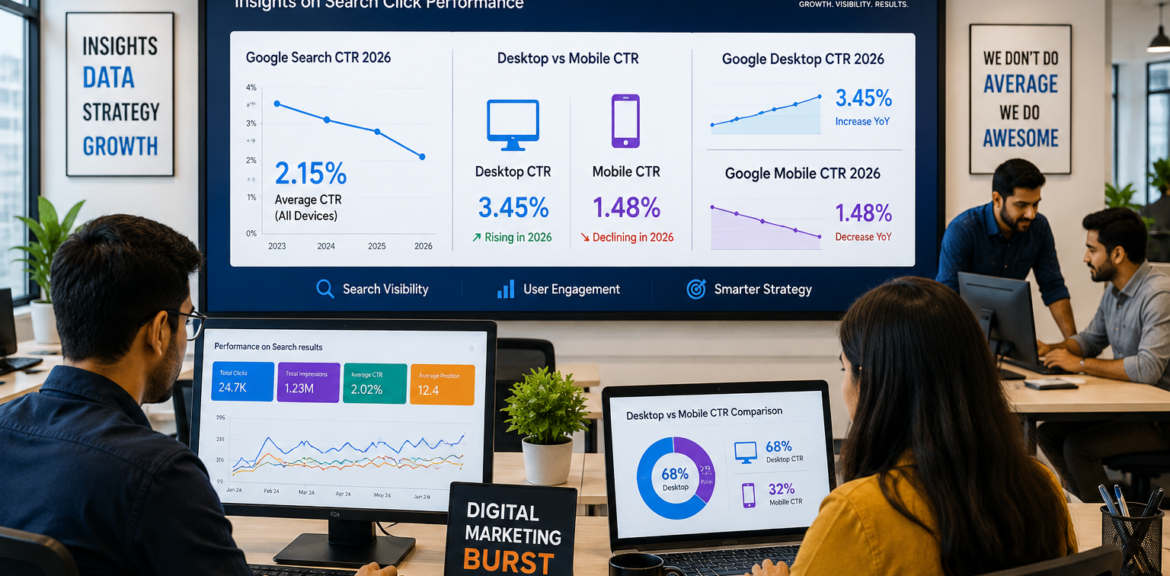
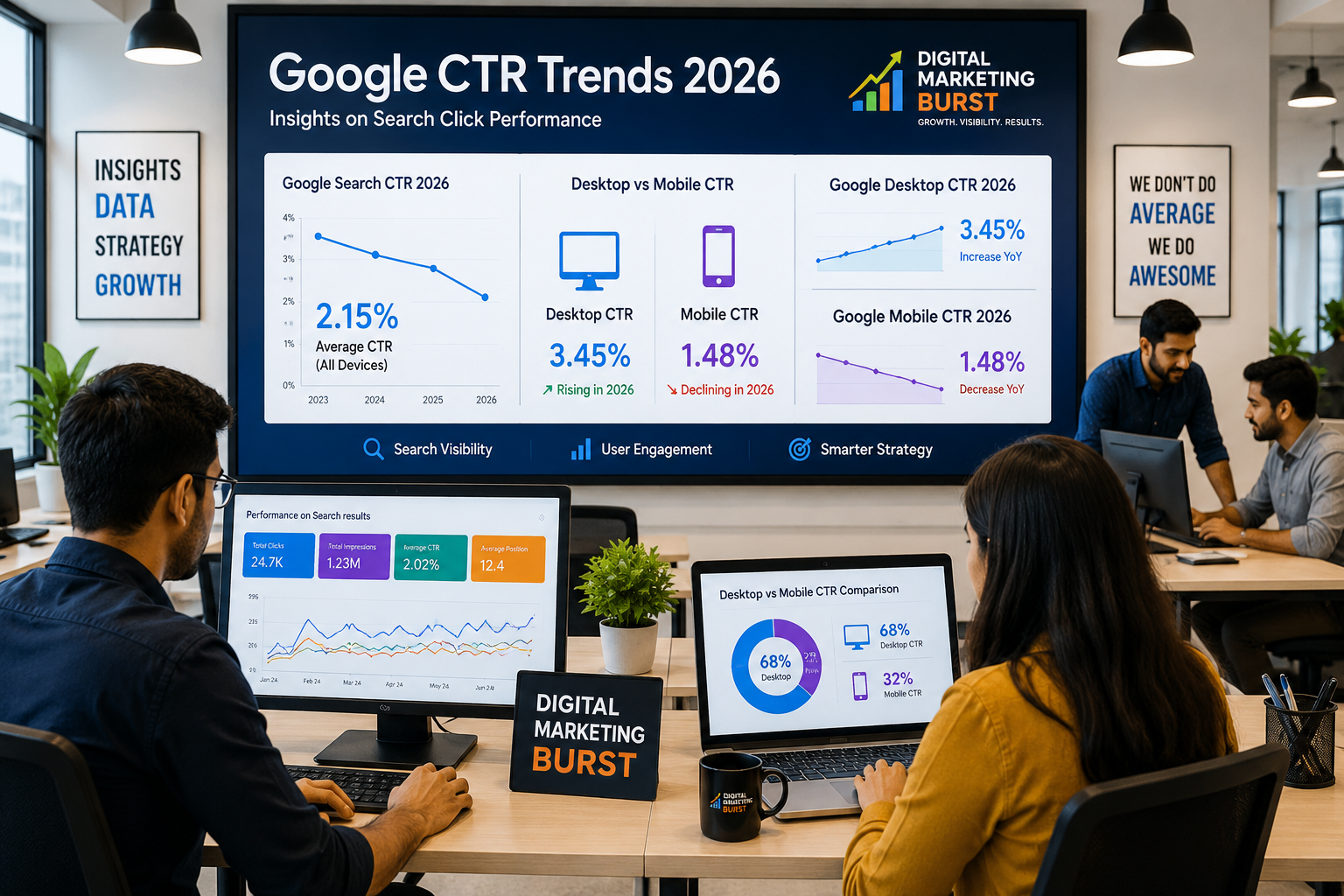
Google CTR Trends 2026 are showing an important shift in how users interact with search results across different devices. The latest discussion around Google Search CTR 2026, Desktop vs Mobile CTR, Google Desktop CTR 2026, and Google Mobile CTR 2026 is raising an important question for SEO professionals: why are desktop clicks moving upward while mobile click-through rates are weakening?
For businesses, this change matters because CTR is closely connected with organic search performance. A page can rank well and still receive fewer clicks than expected. At the same time, a lower ranking page may attract attention because of a stronger title, better search intent alignment, or a more useful SERP appearance.
The difference between desktop and mobile behaviour is becoming increasingly important. Searchers do not interact with Google results in exactly the same way on a large screen and a smartphone. Screen size, scrolling habits, SERP features, search intent and the amount of information visible before scrolling can all influence a click.
This guide explains what the latest CTR trend means for SEO, why device-level performance should be analysed separately, and what businesses can do to improve organic clicks in 2026.
Google CTR Trends: What Is Changing in Search Behaviour?
Google CTR Trends are useful because rankings alone do not tell the complete story. A website may appear in a strong position but still receive fewer clicks. Another page may attract more users because its title and description match the searcher’s expectations more effectively.
CTR means click-through rate. It represents the percentage of users who click a search result after seeing it. In simple terms, if 1,000 people see a result and 50 click it, the CTR is 5%.
However, CTR is not controlled by ranking position alone. Search layout has become more complicated. Featured results, AI-generated answers, videos, images, shopping results, local listings and other SERP elements can compete for attention.
As a result, the traditional idea that the first organic result automatically receives most clicks is becoming less reliable.
Device behaviour adds another layer to the problem. Desktop users have a larger viewing area. They can see more search results and supporting information at once. Mobile users usually see fewer elements before scrolling.
Therefore, the same search result can perform differently on two devices.
For marketers, this means CTR should not be treated as one universal number. Device-specific data can reveal problems that an overall website average hides.
A business might have strong desktop performance while losing clicks on smartphones. Another website could experience the opposite pattern. Looking at both segments provides a clearer picture of actual search behaviour.
Google Search CTR 2026: Why CTR Matters More Than Ever
Google Search CTR 2026 is becoming an important discussion for businesses that depend on organic traffic. Getting impressions is useful, but impressions alone do not bring visitors to a website.
A search result needs to earn the click.
The title must communicate the value of the page quickly. The description should support that promise. Search intent also needs to match the content behind the result.
Suppose a user searches for “best digital marketing agency in Lucknow.” A result with a generic title may receive fewer clicks than a result that clearly communicates its service, location and value.
The same principle applies to informational searches. Someone searching for a technical SEO solution wants immediate clarity. A vague title can lose the click even when the page ranks well.
This is why SEO teams increasingly need to look beyond rankings. Search visibility, impressions, CTR and conversions should be analysed together.
A high impression count with a weak CTR can indicate that the page is being shown but is not convincing enough. On the other hand, strong CTR with low impressions may suggest that the page is appealing but needs better visibility.
Both situations require different strategies.
The goal should not simply be to increase CTR at any cost. The real objective is to attract the right clicks from users who are likely to engage with the page.
Desktop vs Mobile CTR: Why Device Behaviour Matters
Desktop vs Mobile CTR is one of the most useful comparisons for understanding modern search performance. The same keyword can produce noticeably different behaviour depending on where the search happens.
Desktop screens provide more space. Users can often see several organic results, advertisements and additional SERP elements without immediately scrolling.
Mobile screens work differently. A single result can occupy a large part of the visible screen. Searchers may need to scroll repeatedly before reaching additional results.
This creates a different browsing experience.
Mobile users may also interact with search results differently because smartphone searches are often connected with immediate needs. Someone checking a location, product, service or quick answer may scan the SERP and make a rapid decision.
Desktop searches can involve longer research sessions. A user comparing software, reading a business article or researching a professional service may spend more time examining multiple results.
These differences do not mean every desktop search behaves one way or every mobile search behaves another way. User intent remains extremely important.
Nevertheless, device-level CTR data can reveal patterns that are difficult to identify when all traffic is combined.
For SEO professionals, the practical lesson is simple: analyse desktop and mobile performance separately before making major optimisation decisions.
Why Desktop CTR Is Rising in 2026
One of the most interesting questions surrounding current CTR discussions is why desktop performance appears stronger in some benchmark datasets.
There is no single explanation that can automatically account for every industry. Search behaviour changes according to query type, audience, ranking position and SERP layout.
One possible factor is screen visibility. Desktop users can often evaluate more search results without scrolling. This gives them more opportunities to compare titles and descriptions.
Another factor is the nature of some desktop searches. Professional research, B2B queries, software comparisons and detailed informational searches are frequently performed on larger screens.
For example, someone researching a marketing platform for a business may open several tabs. A user looking for a quick restaurant direction may behave differently on mobile.
Search context also matters. Desktop users may have a stronger intention to investigate several sources before choosing one.
However, marketers should avoid assuming that rising desktop CTR automatically means Google is favouring desktop users. A CTR change can come from many factors, including query mix, ranking distribution, search features and user behaviour.
The important point is to examine your own data before changing your SEO strategy.
If desktop CTR improves while mobile CTR declines, compare the two segments by keyword, landing page, search position and search intent. That will provide a much stronger basis for decision-making than a general industry trend.
Google Desktop CTR 2026: What SEO Teams Should Monitor
Google Desktop CTR 2026 should be analysed alongside impressions and average position. Looking at CTR alone can lead to incorrect conclusions.
Imagine that a page’s desktop CTR increases from 4% to 5%. That sounds positive. However, if impressions dropped by 60%, the website may actually be receiving fewer visitors.
The opposite can also happen. CTR might fall slightly while impressions rise significantly. In that situation, the page could still generate more organic traffic overall.
This is why CTR should always be considered within context.
SEO teams should compare desktop performance across individual pages. High-performing pages can reveal useful patterns in titles, content format and search intent.
Pages with unusually low CTR deserve closer inspection. Their ranking position may be reasonable, yet the snippet may not communicate enough value.
Titles can also become less effective when they are too generic. A headline such as “Digital Marketing Services” gives limited information. A more specific title can communicate audience, location or benefit more clearly.
However, optimisation should remain natural. Adding keywords repeatedly will not automatically improve clicks.
The strongest approach is to understand what users expect from the query and then make the search result clearly communicate that value.
Google Mobile CTR 2026: Why Mobile Search Needs Separate Attention
Google Mobile CTR 2026 deserves special attention because smartphones remain a major part of everyday search behaviour.
Mobile users often interact with results differently from desktop users. The visible area is smaller, scrolling is more common, and SERP features can occupy a substantial amount of screen space.
This can influence how quickly users reach organic listings.
A page can therefore maintain a good ranking while experiencing weaker mobile CTR. The problem may not be the content itself. It may involve the way the result appears within the mobile search experience.
Titles are particularly important. Mobile screens provide less space for users to evaluate long messages. The beginning of a title therefore needs to communicate the topic quickly.
Descriptions also matter. Although Google may rewrite snippets, a well-structured page gives the search engine useful information to work with.
Page speed and mobile usability remain important as well. A user who clicks a result but encounters a poor mobile experience may leave quickly.
For this reason, mobile SEO should not stop at responsive design. Marketers need to consider the complete journey from search result to landing page.
The search result earns the click. The website then needs to earn the user’s attention.
Why Mobile CTR May Fall Even When Rankings Stay Stable
A decline in mobile CTR does not automatically mean that a page has lost rankings.
Search results have become increasingly crowded. A user may encounter advertisements, videos, images, local results, AI-generated information and other elements before reaching traditional organic listings.
This changes the amount of attention available to each result.
Search intent can also shift over time. A query that once required users to visit a website may now be answered partly within the search results themselves.
When users find enough information without clicking, organic CTR can decline even if rankings remain stable.
This is an important issue for publishers and businesses. SEO success can no longer be judged only by where a page ranks.
Marketers should ask a broader question: What does the searcher need to see before deciding to click?
Sometimes the answer is a stronger title. In other cases, it may be a more specific content format. A comparison query may need a comparison page. A transactional query may need pricing or product information. An informational query may require a direct answer.
Matching the content format with the intent can improve the likelihood of a click.
That is why CTR optimisation should begin with search intent rather than keyword insertion.
Google Search CTR 2026 and the Role of Search Intent
Search intent is one of the most important factors behind CTR. Users click when they believe a result will solve the problem behind their query.
Consider a search for “how to improve Google CTR.” The user expects a practical guide. A page focused entirely on definitions may not attract the same level of interest.
Now consider “Google CTR report 2026.” That search suggests a desire for current data and analysis. A generic beginner guide may not satisfy that intent.
The keyword itself provides clues.
Informational searches usually require educational content. Commercial searches need comparisons, benefits and decision-making information. Transactional searches often need clear product or service details.
When the title reflects that intent, the result becomes easier to understand.
For example, adding “Complete Guide,” “2026 Data,” “Step-by-Step,” or “Best Practices” can sometimes clarify the purpose of a page. These phrases should only be used when the content genuinely delivers what the title promises.
Misleading titles may produce clicks initially, but they can create poor user experiences.
A better SEO strategy is to create a strong match between query, title, snippet and page content.
How to Improve Google CTR in 2026
Improving CTR starts with identifying pages that already have impressions but are not receiving enough clicks.
Google Search Console can help identify these opportunities. Look for pages with substantial impressions and relatively weak CTR.
Next, compare their average positions. A page ranking near the top has a different optimisation opportunity from a page appearing much lower.
For high-ranking pages, examine the title and snippet first. Ask whether the result clearly explains what the visitor will receive.
The next step is to compare competing search results. Look at the types of headlines appearing on the SERP. Notice whether competitors use numbers, years, benefits, comparisons or specific solutions.
Do not copy them. Instead, identify what information searchers appear to value.
Another useful approach is to improve content depth. If the page promises a complete guide, it should actually answer the important questions surrounding the topic.
Internal linking can also help users discover related information after arriving on the site. This does not directly guarantee a higher CTR, but it can improve the overall organic journey.
Finally, test changes carefully. CTR fluctuates naturally. One short period is not enough to prove that a title change worked.
Longer observation periods can provide more reliable signals.
Desktop vs Mobile SEO Strategy for 2026
The Desktop vs Mobile CTR discussion points towards a broader SEO lesson. Websites should not treat every searcher as though they have the same browsing experience.
Desktop optimisation should focus on clarity, detailed comparison and strong information architecture. Mobile optimisation should place additional emphasis on concise communication, fast loading and easy interaction.
The two strategies overlap, but they are not identical.
For example, a long title may look acceptable in a desktop SERP but become less effective when displayed on a smaller mobile screen.
Likewise, a complex page layout may work on a large monitor but create friction on a smartphone.
Therefore, SEO teams should inspect search performance by device before deciding which pages need attention.
A useful workflow is to identify pages with strong desktop CTR but weaker mobile CTR. Those pages can then be examined for title length, intent alignment, mobile usability and SERP competition.
The reverse pattern is also worth studying. Pages performing better on mobile may reveal messaging or content approaches that could work elsewhere.
In other words, CTR data should not only identify problems. It can also reveal opportunities.
The best SEO teams use those differences to understand how users behave rather than simply chasing a single benchmark number.
Google CTR by Ranking Position: Why Position Still Matters in 2026
CTR and ranking position are closely connected, but they are not the same thing. A page appearing near the top of Google usually has a better opportunity to receive clicks. However, the actual percentage can change considerably depending on the query, device, SERP layout and search intent.
This is where the latest Google CTR Trends 2026 become useful. Instead of asking only whether a page ranks first, marketers should examine how efficiently that position generates visits.
A first-position result may receive fewer clicks when the search page contains several competing features. For instance, a search can display advertisements, videos, images, shopping results or other information before traditional listings. The user may find what they need without reaching the first organic result.
Position also behaves differently on mobile and desktop. On a large screen, several results can be visible at once. Mobile users may see only one or two results before scrolling.
Therefore, a ranking improvement does not always produce the same traffic increase across devices.
SEO professionals should compare position and CTR together. If a page moves from position eight to position three but receives only a small traffic increase, the SERP may contain strong competing features. On the other hand, a small ranking improvement can create a significant traffic increase when the query has a strong organic click intent.
The relationship is not fixed. That is why benchmark numbers should be treated as reference points rather than guaranteed outcomes.
Google Search Click Through Rate 2026: What the Numbers Really Tell Us
Google Search Click Through Rate 2026 should be viewed as a behaviour metric rather than a simple ranking score. It tells marketers how frequently searchers choose a result after seeing it.
A high CTR can indicate that the search result is relevant and attractive. It may also suggest that the title communicates the page’s purpose clearly.
Low CTR does not always mean the page is poor. Sometimes the result is appearing for searches that do not perfectly match the page. In other cases, users may receive enough information directly from the search page.
This distinction is important.
Suppose a website receives 100,000 impressions and has a 2% CTR. That produces 2,000 visits. Another page might receive 20,000 impressions with a 6% CTR, producing 1,200 visits.
The second page has stronger click efficiency. Yet the first page generates more total traffic.
For this reason, marketers should monitor impressions, CTR, clicks and average position together.
Conversion data adds another layer. A page with a lower CTR can sometimes generate more valuable visitors if the search intent is highly commercial.
The goal should therefore be qualified organic traffic rather than an artificially high CTR number.
This approach also prevents unnecessary title changes. A page should not be modified simply because its CTR is below an industry benchmark. First, determine whether the query mix, position and intent justify the comparison.
Why Search Intent Can Change Organic CTR
Search intent can change the performance of an identical keyword over time. Users may search for the same phrase while expecting different types of information.
A person searching for “digital marketing trends” might want current news. Another person could be looking for a detailed strategy guide. Both users enter similar words, but their expectations are different.
Google attempts to understand these differences and present suitable results.
The result page can therefore change even when the keyword remains the same. New content formats may appear. Search features may become more prominent. User behaviour can also shift.
This affects CTR.
An SEO page created several years ago may continue ranking well but attract fewer clicks because the search intent has evolved. The content may still be useful, yet it no longer matches what users expect from the query.
Refreshing the page can help. However, the update should go beyond changing the year.
Review the actual questions users are asking. Examine the type of content ranking for the query. Then make sure the page answers the current intent.
A title such as “SEO Guide” may be too broad. A more specific title can tell users whether the page offers a beginner guide, technical solution, checklist or current strategy.
Clarity creates stronger expectations.
When the expectation matches the content, the chance of a useful click becomes higher.
Google Desktop CTR 2026 and Long-Form Search Behaviour
Google Desktop CTR 2026 is particularly interesting for websites publishing detailed educational content. Desktop users often have more screen space and may be comfortable researching complex subjects.
This does not mean every long-form article will perform better on desktop. Query intent still controls the outcome.
A user searching for a quick definition may not want a 5,000-word article. Someone researching a software platform or business strategy may appreciate detailed information.
Long-form content should therefore be built around the user’s problem rather than a word-count target.
A detailed article can improve organic performance when it answers multiple related questions. It can also create opportunities for internal links and deeper engagement.
However, unnecessary length can work against the page.
If an answer can be explained clearly in 500 words, adding another 3,000 words may create friction. Users may struggle to find the information they need.
The better approach is structured depth.
Use meaningful sections. Explain one idea at a time. Keep paragraphs manageable. Add examples where they improve understanding.
Desktop users may tolerate longer pages, but they still want efficient navigation.
A clear table of contents, descriptive subheadings and concise introductions can make a long article easier to consume.
The same principle benefits mobile users as well.
Google Mobile CTR 2026 and the First Impression Problem
Google Mobile CTR 2026 highlights an important challenge for SEO teams: users often make quick decisions on smartphones.
The first impression of a search result can determine whether someone clicks or scrolls.
Mobile screens provide limited space. Long titles can lose their strongest message when displayed in search results. Therefore, the most important information should appear early in the title.
Consider two examples.
“Complete Guide to Understanding the Latest Changes in Google Search CTR and What They Mean for Your Business in 2026” contains useful information, but the main topic is buried.
“Google CTR Trends 2026: Desktop vs Mobile” communicates the subject much faster.
The second title creates a clear expectation.
Meta descriptions should follow the same principle. They need to explain the value of the page without becoming unnecessarily complicated.
Google can rewrite snippets, so marketers cannot control every word displayed. Still, clear page content gives search engines useful material for generating relevant snippets.
Mobile performance also depends on the landing page. A compelling result loses value if the website takes too long to load or makes navigation difficult.
The search journey starts in Google but continues on the website.
How SERP Features Affect Desktop and Mobile CTR
SERP features have changed the traditional relationship between ranking and clicks. Organic results are no longer the only elements competing for attention.
Depending on the query, Google can display images, videos, local results, shopping information, featured answers, related questions and other search features.
These elements can change the amount of attention available to organic listings.
A result ranking near the top may therefore receive fewer clicks than expected.
The effect can vary by device. Some features occupy more visible space on smartphones, while desktop layouts can display several elements side by side.
This makes Desktop vs Mobile CTR analysis even more valuable.
Instead of comparing only the final CTR percentage, marketers should identify the SERP environment surrounding the result.
Ask what appears above the organic listings. Check whether competitors have stronger titles. Look for video or image results. Examine whether the query has strong commercial intent.
This process provides context.
For example, a product-related query may contain shopping results that attract users before traditional pages. An informational query could display an answer directly in the SERP.
In such cases, improving the title alone may not solve the problem.
The content strategy may need to change as well.
AI Search and the Changing CTR Landscape
AI-powered search experiences are adding another layer to the CTR discussion. Searchers can increasingly receive summaries or synthesized information before deciding which traditional result to visit.
That creates a new challenge for publishers.
A page can remain visible while receiving fewer clicks if the search experience answers enough of the user’s question without requiring a visit.
However, this does not mean websites should stop investing in SEO.
The strategy needs to become more focused on information that users want to explore further.
Original research, expert commentary, detailed examples, unique data and practical experience can provide reasons to visit a website.
Generic information is easier to summarize.
A page that simply repeats information available across hundreds of websites may have less differentiation. Content that adds genuine value can create stronger reasons for users to continue to the source.
This is particularly important for businesses.
A digital marketing agency, for example, should not publish another generic article explaining what SEO means. Instead, it can discuss real campaign lessons, technical problems, practical workflows and measurable strategies.
That creates a stronger information asset.
AI search does not eliminate the value of organic visibility. It changes what makes a website worth visiting.
Google CTR Trends 2026 and the Importance of Better Titles
Titles remain one of the simplest areas for improving search visibility and click behaviour.
A strong title should communicate the topic quickly. It should also match the actual content.
Keyword placement can help clarify relevance, but keyword stuffing can make titles look unnatural.
For example, repeating “Google CTR Trends 2026” multiple times does not make the result more attractive. A cleaner title can communicate the same topic while creating curiosity.
Numbers can sometimes help. So can clear benefits.
Words such as “Guide,” “Report,” “Trends,” “Analysis” and “Strategy” can indicate what the user will find. They should be used only when they accurately describe the content.
Freshness can also matter for time-sensitive topics.
A title mentioning 2026 can make sense when the article contains current data or analysis. However, simply changing a year without updating the content provides little value.
The strongest titles combine relevance and clarity.
Think about the searcher’s question before writing the headline.
What are they trying to learn? What problem are they trying to solve? What information would convince them that this page is worth opening?
Those questions are more useful than simply inserting more keywords.
How to Use Google Search Console for CTR Analysis
Google Search Console is one of the most useful sources for understanding organic CTR at the page and query level.
The important metrics include clicks, impressions, CTR and average position.
Start by identifying pages with substantial impressions. These pages already have visibility, so they may offer opportunities for optimisation.
Next, compare CTR by query. A single page can rank for hundreds of searches. Some queries may have excellent CTR while others perform poorly.
This difference can reveal search-intent problems.
A page might have been created for one primary keyword but receive many impressions for related searches. If those searches have different intent, the overall CTR can become difficult to interpret.
Device segmentation is also valuable.
Compare desktop and mobile results for the same page. Look for significant differences in clicks, impressions and CTR.
A mobile CTR problem may require a different solution from a desktop CTR problem.
The data can also reveal pages that perform strongly on both devices. These pages are useful examples for your wider SEO strategy.
Study their titles, content structure and search intent.
Rather than guessing what users want, use performance data to identify patterns.
What to Check When Mobile CTR Drops
A falling mobile CTR should be investigated before making major changes.
Start with average position. If rankings have declined, the CTR change may simply reflect reduced visibility.
Next, check impressions. A major change in impressions can indicate a shift in search demand or query coverage.
Then examine the actual search queries.
Look for changes in intent. A page may suddenly be appearing for broader searches that attract impressions but fewer clicks.
SERP competition should also be considered. New features can change how much attention organic results receive.
Title length deserves attention as well. If the most important message is hidden deep inside a long title, mobile users may not understand the value quickly.
The landing page itself should also be checked.
Slow loading, intrusive elements, difficult navigation and poor readability can reduce the value of a successful click. Although these issues do not directly explain every CTR decline, they can affect the wider search experience.
Finally, compare several weeks or months rather than reacting to a single data point.
Search behaviour naturally fluctuates.
A reliable pattern is more useful than a temporary change.
What to Check When Desktop CTR Drops
A desktop CTR decline deserves the same careful investigation.
First, compare average position with the previous period. Ranking changes can explain part of the movement.
After that, review the queries producing impressions. A change in keyword mix can significantly affect the overall percentage.
Competitor titles are another useful clue.
Search the most important queries manually and examine what users see. Notice whether competitors provide stronger value statements or more specific information.
SERP features should also be recorded.
A page may have maintained its position while new search elements appeared above it. That can change click behaviour without an obvious ranking decline.
Content freshness may matter for news and trend-based topics. Searchers looking for current information may prefer results that clearly demonstrate recent updates.
For evergreen content, the issue may instead involve intent.
Perhaps users now want a comparison rather than a general explanation. Maybe they want practical steps rather than definitions.
The answer should come from the search results and your performance data.
Do not change everything at once.
A controlled update makes it easier to understand what actually improved performance.
Desktop vs Mobile CTR Should Shape Your SEO Decisions
The biggest lesson from current CTR discussions is that one website-wide CTR number does not tell the complete story.
Desktop and mobile users can behave differently. Their search environments can also look different.
Therefore, SEO strategies should consider device-level performance.
If desktop CTR is strong but mobile CTR is weak, investigate mobile search presentation first. If mobile performs well but desktop underperforms, examine desktop SERP competition and search intent.
There is no universal optimisation formula.
A page targeting an informational query may behave differently from a product page. Local searches can behave differently from national searches. Branded searches can behave differently from unbranded searches.
Industry also matters.
That is why benchmark reports are most useful when treated as directional information.
Your own website data remains the most important source for decision-making.
The practical goal is to understand why users click, why they do not click and whether those clicks create meaningful business outcomes.
CTR is one piece of the SEO puzzle.
When combined with rankings, impressions, conversions and user behaviour, it becomes much more useful.
Bilkul. Part 3 continue kar raha hoon. Is part mein practical CTR optimisation, title/snippet strategy, internal linking, content refresh, mobile-first optimisation aur 2026 SEO workflow cover kar raha hoon.
How to Improve Organic CTR Without Changing Your Rankings
Improving organic CTR does not always require a ranking increase. Sometimes the page already has enough visibility, but the search result fails to communicate its value.
This is an important opportunity for SEO teams.
A page sitting in a strong position can potentially generate more traffic simply by improving its search appearance. The first step is to identify pages with high impressions and weaker-than-expected click rates.
Once those pages are identified, examine the title.
Does it clearly describe the page? Does it match the search intent? Is the most useful information visible quickly? Does the title give users a reason to choose the result?
The meta description should support the same message.
For example, a page targeting a comparison query should not use a vague description. Users want to know what is being compared and why the page is useful.
Content should then deliver the promise made in the search result.
This creates consistency from query to click.
A misleading title may attract temporary clicks, but it can damage trust. Users who immediately discover that the page does not answer their question may return to the search results.
Therefore, CTR optimisation should never become clickbait optimisation.
The strongest approach combines relevance, clarity and usefulness.
Google CTR Trends 2026: How to Optimise Search Result Titles
The title is one of the first elements a searcher notices. Because of that, even a small improvement can potentially influence click behaviour.
Start with the primary topic.
The title should make it obvious what the page discusses. If the article covers current CTR data, the title can mention the year. If it provides a practical guide, words such as “guide” or “strategy” may help set expectations.
Specificity is often more useful than generic wording.
Compare “SEO CTR Guide” with “How to Improve Organic CTR in Google Search.” The second title tells users more about the purpose of the page.
Numbers can also attract attention when they provide genuine value. A title such as “10 Ways to Improve Organic CTR” makes a clear promise.
That promise needs to be fulfilled inside the article.
Keyword placement should remain natural. Adding the same phrase several times can make the headline look forced.
Google may also rewrite titles in search results. Therefore, marketers should focus on creating accurate and useful page titles rather than trying to control every character displayed.
The most effective title is one that makes the searcher understand the page within seconds.
Google Search CTR 2026: Writing Better Meta Descriptions
Meta descriptions do not guarantee a higher CTR, but they can help communicate the purpose of a page.
A good description should complement the title. It should explain what the reader can expect after clicking.
For an informational article, the description can highlight the main questions answered. For a service page, it can communicate the service and its main benefit.
Avoid writing descriptions that simply repeat the title.
Instead, use the available space to add useful context.
For example, an article about search performance can mention current trends, device differences and practical optimisation advice. This gives the user more information before the click.
Descriptions should also avoid exaggerated promises.
A phrase such as “the ultimate secret to guaranteed Google rankings” creates an expectation that no responsible SEO professional can guarantee.
Clear language is more trustworthy.
Another consideration is search intent.
If someone searches for “desktop vs mobile CTR,” the description should mention the comparison. If the page discusses only general SEO metrics, the result may appear less relevant.
Matching the description with the query can therefore strengthen the overall search result.
Keep in mind that Google can generate its own snippet. The page content still needs to be structured clearly so that useful information is available.
Desktop vs Mobile CTR: Optimising Titles for Different Devices
Desktop vs Mobile CTR analysis also raises an important practical question: should titles be written differently for different devices?
Website owners generally cannot create completely separate organic titles for desktop and mobile search. Instead, the title should be concise enough to communicate the main message across both environments.
This makes the opening part particularly important.
The primary topic should appear early. Secondary information can follow when necessary.
A long title may still work if the most important information is placed first. Users should not need to read the entire headline to understand the page.
This principle is useful for mobile SEO, but it also improves desktop readability.
Another consideration is brand placement.
If a company name is automatically added to every title, it can consume valuable space. For pages where the topic is more important than brand recognition, the primary keyword and benefit may deserve priority.
However, established brands can benefit from including their name when users are already familiar with them.
The right choice depends on search intent and brand strength.
Testing remains important.
If a page has strong impressions but weak CTR, changing the title can be a reasonable experiment. Record the original performance first, then compare the results after enough time has passed.
Google Desktop CTR 2026: Creating Content for Research-Heavy Queries
Desktop search can be especially valuable for research-oriented topics.
Users comparing agencies, software, services, educational resources and business solutions may spend more time evaluating different results.
That creates an opportunity for detailed content.
However, detailed does not mean unnecessarily long.
A strong research article should make important information easy to find. Subheadings can separate major questions. Examples can explain complex ideas. Internal links can help users explore related topics.
Tables may also improve comparison-based content when they genuinely simplify information.
For example, an article comparing desktop and mobile CTR can explain the differences through clearly separated sections instead of placing every detail inside one large paragraph.
This improves readability.
A good desktop experience should also make navigation simple.
Large blocks of text can become difficult to scan even on a large screen. Readers still appreciate short paragraphs and descriptive headings.
Search intent remains the foundation.
Before expanding an article, identify the questions users actually want answered. Then build the content around those questions.
That approach is more useful than increasing the word count simply to make an article appear comprehensive.
Google Mobile CTR 2026: Making Search Intent Obvious
Mobile search demands quick understanding.
Users often scan rather than read every word. The page therefore needs to communicate its purpose immediately.
The first paragraph should explain the topic clearly. Headings should describe what each section contains. Important information should not be buried beneath unnecessary introductions.
This principle is especially useful for informational SEO.
If a user searches for “why mobile CTR is falling,” the page should address that question directly. A lengthy history of search engines before reaching the answer creates unnecessary friction.
Mobile users also benefit from clean layouts.
Small text, crowded buttons, intrusive pop-ups and difficult navigation can reduce engagement after the click.
The search result and landing page should work together.
A strong CTR is useful only when the resulting visit has a good experience.
Page speed should therefore remain part of the wider strategy. Technical SEO, content quality and user experience are connected.
A fast page with poor content will not solve the problem. Excellent content on an unusable page can also struggle.
The best approach considers the entire journey.
Why CTR Should Be Analysed by Query, Not Just Page
A single page can rank for hundreds or thousands of queries.
That means its overall CTR can hide important differences.
One query may produce a 10% CTR. Another may produce only 1%. When both are combined, the page average may look ordinary.
Query-level analysis helps reveal the reason.
High-performing queries can show where the page matches user intent particularly well. Low-performing queries may indicate weaker relevance or stronger competition.
This can also help with content expansion.
Suppose a page receives many impressions for a related topic that is only briefly mentioned. That query could become a dedicated section.
Alternatively, the search intent may be different enough to justify a separate article.
This creates a natural content strategy.
Instead of creating dozens of articles based only on keyword lists, marketers can use real search performance to identify content opportunities.
The approach also helps reduce keyword cannibalisation.
If multiple pages compete for similar queries, CTR and ranking data can reveal which page Google considers most relevant.
The SEO team can then review internal linking, content overlap and page purpose.
This makes CTR analysis more strategic.
How Content Refreshing Can Improve Search Clicks
Older content can lose clicks even when rankings remain relatively stable.
Searchers often prefer current information, particularly for topics involving technology, Google updates, AI, advertising and digital marketing.
A page published several years ago may still contain useful information. However, outdated examples can reduce its attractiveness.
Content refreshing should begin with the search intent.
Check whether the questions users ask today are different from those asked when the article was originally written.
Next, review outdated statistics and examples.
Replace information that is no longer accurate. Add current context where it improves the article.
Titles may also need updating.
If the article now covers 2026 data, the headline should make that clear when appropriate.
However, changing the year alone is not a meaningful update.
The content itself should demonstrate freshness.
Internal links can also be reviewed during the refresh. Add relevant links to newer articles and remove references to outdated pages.
Images, screenshots and examples may need attention too.
A genuine refresh can make an existing page more useful without requiring a completely new article.
Long-Tail Keywords and Their Effect on CTR
Long-tail keywords often reveal clearer search intent.
A broad phrase such as “SEO CTR” tells us relatively little. A search such as “how to improve mobile CTR in Google Search” provides much more context.
That clarity can make content targeting easier.
Long-tail searches may have lower individual search volume, but they can attract users with specific needs.
For businesses, these searches can be valuable because the visitor may be closer to taking an action.
Long-tail keywords can also improve title relevance.
Instead of creating a generic page about CTR, a business can create focused content around questions such as why mobile CTR changes, how desktop performance differs, or how to analyse CTR in Search Console.
Each article then has a clear purpose.
The strategy should not involve repeating the long-tail phrase unnaturally.
Use variations.
Google can understand related language and context. Natural writing is therefore preferable to exact-match repetition.
This also creates a better experience for readers.
A well-written article can rank for multiple related searches because it covers the topic comprehensively.
How Internal Linking Can Support Organic CTR Growth
Internal linking does not directly guarantee a higher SERP CTR. However, it can strengthen the overall organic strategy.
A page receiving traffic from search can guide visitors towards related resources.
For example, an article about CTR can naturally link to content about keyword research, technical SEO, title optimisation, Google Search Console and content strategy.
This creates a connected content structure.
Internal links can also help search engines understand relationships between pages.
The anchor text should describe the destination naturally.
Avoid using the same exact anchor repeatedly across every page. Instead, use contextually relevant wording.
A strong internal linking structure can also help new content gain visibility.
When an established page links to a newer article, it creates a clear relationship between the two topics.
The important point is relevance.
Links should help the reader.
Adding dozens of unrelated links simply to increase internal-link counts can make an article harder to read.
Quality matters more than quantity.
Google CTR Trends 2026: Building a Better Content Strategy
Current CTR discussions should influence content planning, not just individual page optimisation.
If data shows that users are clicking differently across devices, content teams should consider how their articles appear and perform on each platform.
Start by identifying important traffic pages.
Then classify them by search intent.
Informational pages can focus on clear answers and strong topical coverage. Commercial pages can highlight comparisons, benefits and decision-making information. Service pages should communicate what the business actually provides.
This segmentation makes optimisation more practical.
Next, examine device performance.
Pages with strong desktop results but weaker mobile results may require mobile-focused improvements. Pages with weak performance on both devices may have a broader intent or content problem.
The process should be repeated regularly.
SEO is not a one-time activity. Search behaviour changes, competitors publish new content and Google modifies the search experience.
A page that performs well today may need improvement later.
Continuous analysis helps businesses respond before a small decline becomes a major traffic problem.
What Marketers Should Not Do When CTR Falls
A falling CTR can create pressure to make immediate changes.
That reaction can sometimes make the situation worse.
One common mistake is changing titles repeatedly without enough time to measure the result. Search performance naturally fluctuates, so short-term changes can be misleading.
Another mistake is adding excessive keywords to titles.
Keyword stuffing can make a result look unnatural and reduce its appeal.
Some marketers also assume that every CTR decline is caused by a ranking problem. That is not always true.
SERP changes, search intent, query mix and user behaviour can all affect click rates.
Another problem is focusing only on the CTR percentage.
Clicks and impressions need to be considered together. A lower percentage can still produce more visits when impressions increase substantially.
Finally, avoid copying competitor titles.
A competing result may perform well because of its brand, content quality, backlinks, reputation or search intent. Simply copying its wording does not reproduce those advantages.
Diagnosis should come before optimisation.
Understand what changed first. Then choose the smallest useful improvement.
A Practical 2026 CTR Optimisation Workflow
A practical CTR workflow can begin with a monthly performance review.
First, identify pages receiving significant impressions. These pages already have search visibility.
Next, separate desktop and mobile data. Look for meaningful differences rather than tiny fluctuations.
After that, examine average position. Determine whether the page gained or lost visibility during the same period.
Then review the actual queries generating impressions.
Search intent should be classified before changing the content.
Once the intent is understood, inspect the title and description. Ask whether the result communicates a clear reason to click.
The next step is to review competing SERP results.
Look at the types of content appearing on the page. Identify whether advertisements, videos, images, shopping features or other elements dominate the experience.
After making an optimisation, document the change.
Record the original title, date of change and relevant performance metrics.
Then wait for enough data.
Compare the new CTR with the previous period while considering changes in impressions and rankings.
This creates a repeatable process.
Over time, the website builds its own CTR benchmarks instead of depending entirely on industry averages.
How Digital Marketing Burst Can Use CTR Data for Better SEO
Digital Marketing Burst approaches CTR as part of a wider search strategy rather than treating it as an isolated number.
For a digital marketing agency, the important question is not simply whether a page receives clicks. The bigger question is whether those clicks come from the right audience and support the client’s business objective.
That requires connecting search visibility with content, technical SEO, user intent and conversion behaviour.
A page with thousands of impressions may look successful at first. However, if those impressions come from unrelated searches, the traffic may have limited business value.
On the other hand, a page with fewer impressions can become highly valuable when it attracts users searching for a specific service or solution.
Digital Marketing Burst can use this distinction when developing SEO strategies for businesses in different industries.
The process involves analysing search queries, identifying content gaps and improving the relationship between keywords and landing pages.
Technical factors also matter.
A strong title cannot compensate for a website that provides a poor experience after the click. Likewise, a fast website cannot create organic growth if the content does not satisfy search intent.
That is why CTR optimisation works best as part of a complete digital marketing strategy.
The focus should remain on useful visibility, qualified traffic and measurable outcomes.
Google CTR Trends 2026: The Bigger SEO Lesson
The current discussion around Google CTR Trends 2026 reveals a broader change in search marketing.
SEO is becoming less about achieving one ranking position and more about understanding the entire search experience.
Desktop and mobile users can behave differently. SERP layouts can change. Search intent can evolve. AI-powered features can alter how users interact with information.
Because of these changes, marketers need better measurement.
CTR provides one useful signal, but it should not be interpreted alone.
Combine it with impressions, clicks, rankings, conversions and landing-page behaviour.
That combination provides a clearer view of organic performance.
The most effective SEO strategy is therefore not to chase a perfect CTR benchmark. Instead, businesses should identify where their own pages are losing potential clicks and understand why.
Once the reason is known, the solution becomes much easier to choose.
Sometimes the answer is a stronger title. Another page may need refreshed content. A technical problem could require attention. In other cases, the query itself may no longer have the same search intent.
The data should guide the decision.
That is the real value of studying current search trends.
Why Digital Marketing Burst Is a Top Digital Marketing Agency in India
Digital marketing is no longer limited to publishing content and waiting for visitors. Businesses now need a complete strategy that connects SEO, search visibility, content, paid advertising, social media and conversion-focused website performance. Digital Marketing Burst, based in Lucknow, takes this broader approach to help businesses build a stronger online presence.
A Data-Driven Approach to SEO and Digital Marketing
CTR is only one part of search performance. A page may receive thousands of impressions but generate limited business value if the traffic does not match the target audience. Therefore, Digital Marketing Burst focuses on the relationship between rankings, search intent, clicks, traffic and conversions.
Our approach combines SEO, technical SEO, Google Ads, social media marketing, content marketing, local SEO, website development and performance marketing. Instead of using the same strategy for every business, campaigns are planned according to the industry, audience and business objectives.
Technical SEO and Search Performance
Changes in search behaviour make technical SEO increasingly important. Website structure, crawling, indexing, page experience and content organisation can all influence how effectively a website performs in search.
Digital Marketing Burst analyses these areas alongside keyword targeting and content strategy. This helps identify opportunities where a website can improve its organic visibility and attract more relevant visitors.
For example, a page with good rankings but weak CTR may need a better title or search snippet. Another page may require stronger content because the search intent has changed. Looking at the complete picture helps avoid unnecessary SEO changes.
Why Businesses Choose Digital Marketing Burst in Lucknow
Businesses looking for a top digital marketing agency in Lucknow need more than basic posting or keyword placement. They need a team that understands how different digital channels work together.
Digital Marketing Burst focuses on practical, measurable strategies. From improving organic visibility to managing paid campaigns and building engaging content, the objective is to create digital marketing activity that supports real business growth.
The agency works across SEO, Google Ads, social media marketing, website design, content marketing, local SEO and graphic design. This combination allows businesses to manage multiple parts of their online presence through a connected strategy.
Digital Marketing Burst: A Digital Growth Partner for Indian Businesses
Search technology continues to change. AI-powered search, evolving SERP layouts, changing user behaviour and new advertising formats are creating fresh challenges for businesses.
Because of this, digital marketing needs continuous improvement rather than a one-time campaign.
Digital Marketing Burst focuses on adapting strategies according to search trends, performance data and changing customer behaviour. The aim is to help businesses improve visibility, attract relevant traffic and build a stronger digital presence.
For businesses searching for a leading digital marketing agency in India or a top SEO agency in Lucknow, Digital Marketing Burst provides an integrated approach that combines creativity, technology and data-driven marketing.
The long-term objective is simple: better visibility, relevant traffic, stronger engagement and sustainable digital growth.