Google’s Restaurant Ordering Opt-Out: What It Means for Owners and Local SEO
Restaurant owners now have more direct control over which third-party ordering options appear on their Google Business Profile. Google’s announcement describes the ability to opt out of specific providers from the dashboard rather than relying only on requests to delivery platforms. 36 comments
If you manage Google restaurant ordering providers, the useful first step is to inspect the options attached to your restaurant and decide which ones should remain visible. Removing every ordering option is not necessarily the right response.
An outdated provider link may send customers to the wrong menu. A useful partner, meanwhile, may offer an ordering route that your customers prefer. The objective is to make the visible choices accurate and appropriate for your operations.
For Indian restaurant owners, there is another practical consideration: the controls and wording visible on your actual profile. Check the available settings rather than assuming that every account will look identical to a published screenshot.
This guide explains the new control, the difference between disabling and removing a provider, and how to review your ordering setup without mistaking a customer-experience change for a guaranteed ranking improvement.
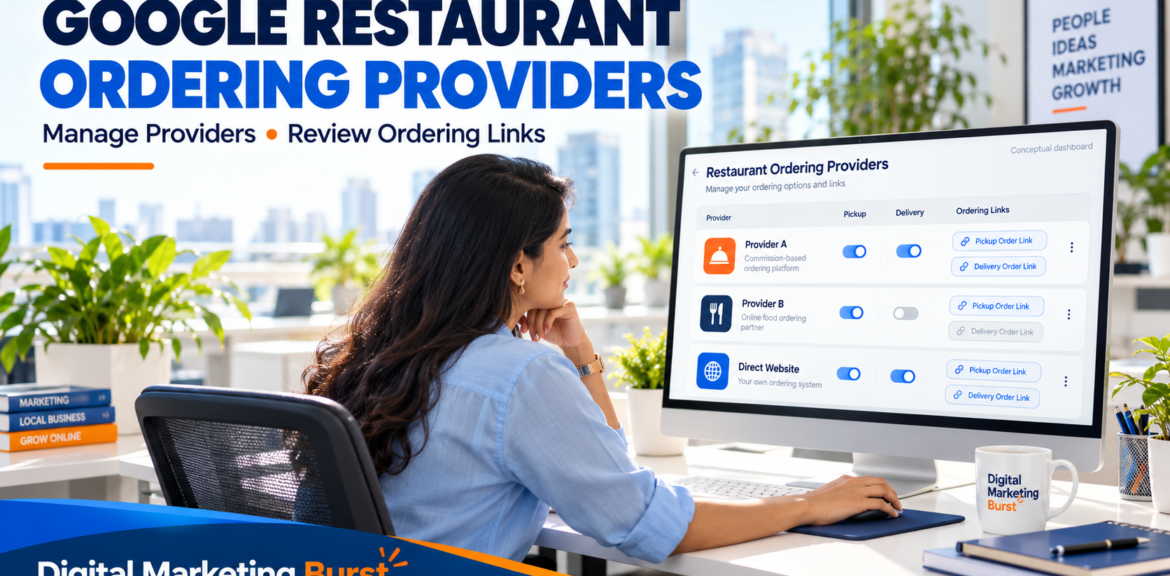
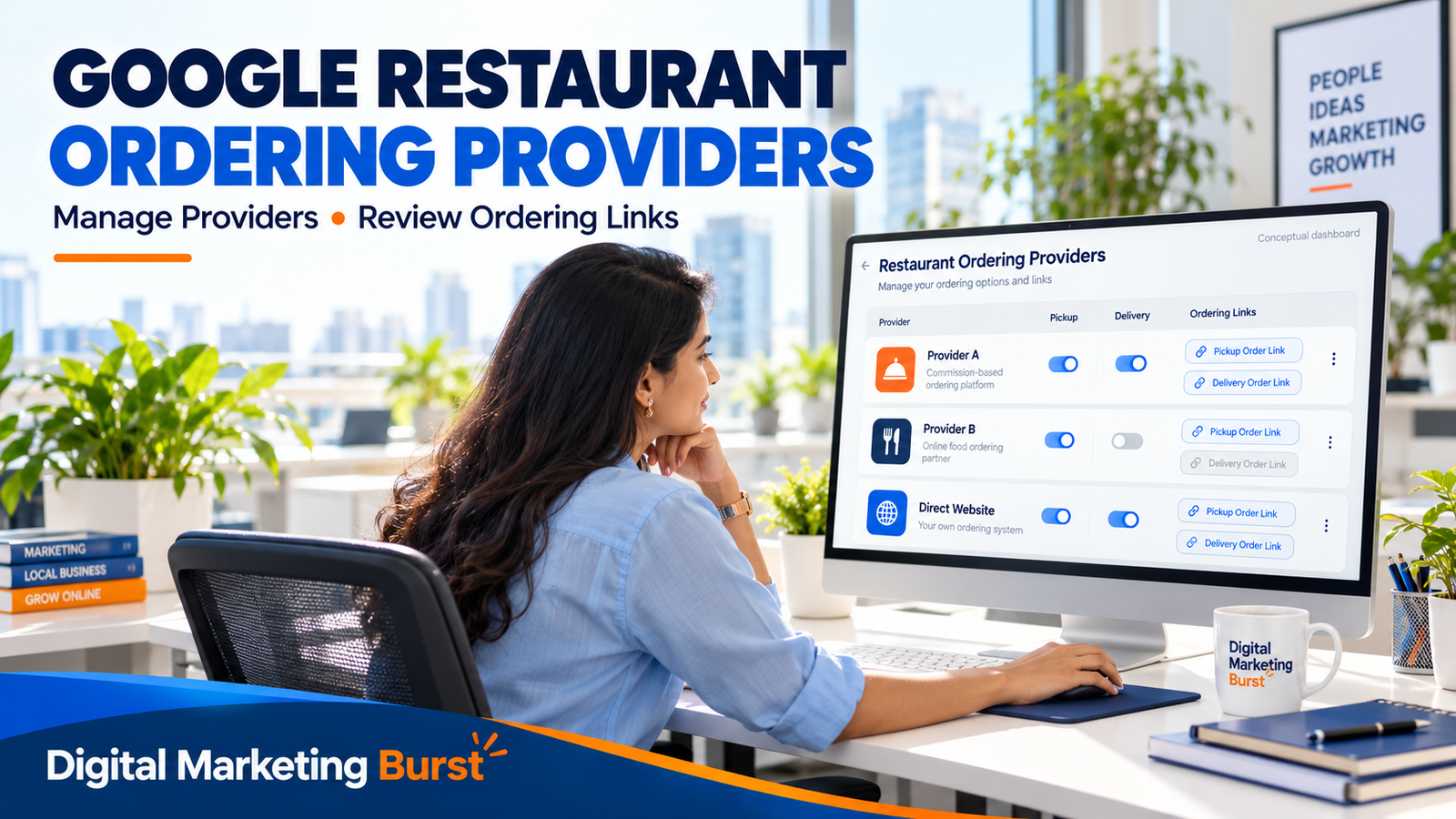
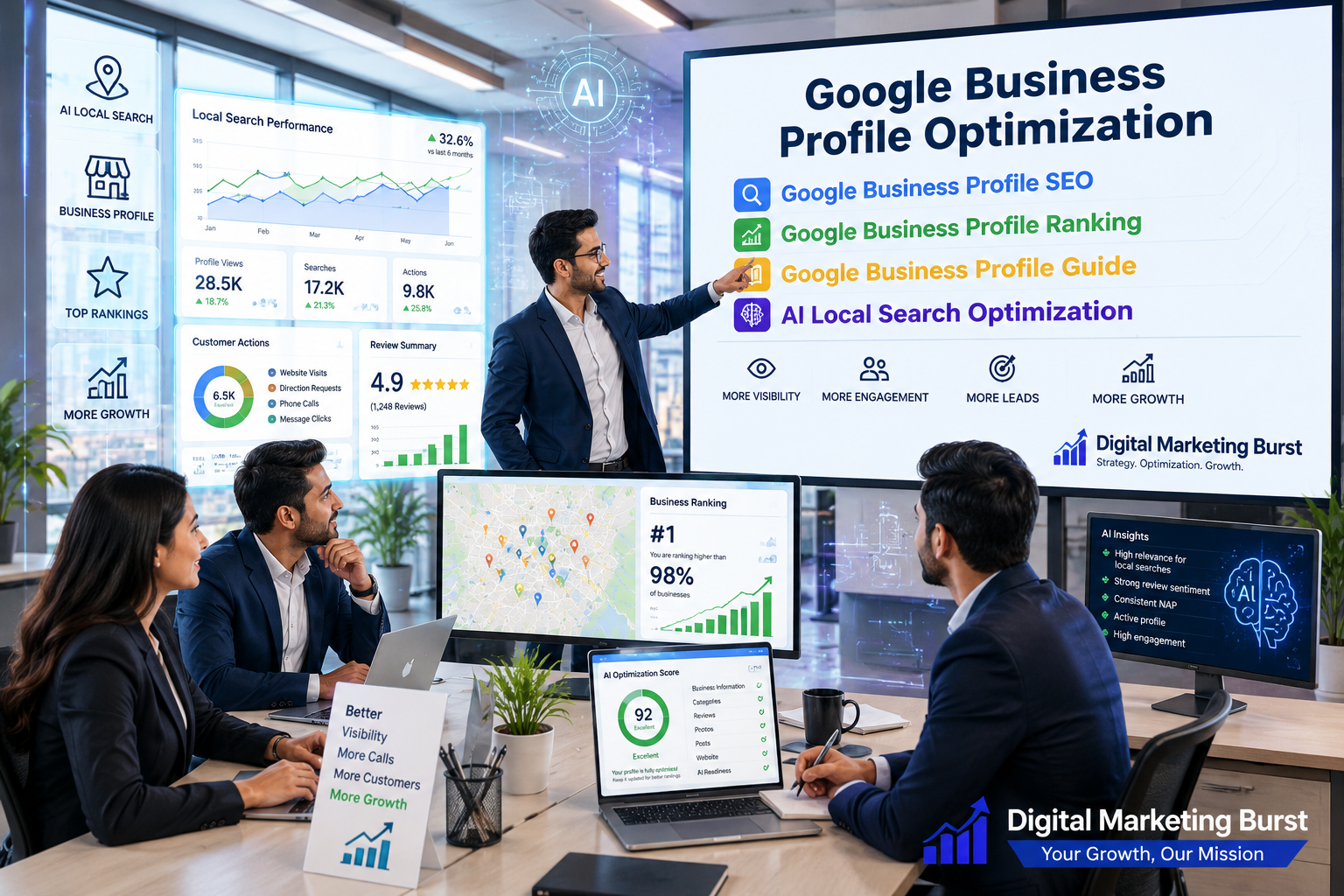
Review restaurant ordering providers, settings and links before changing your Google Business Profile. Conceptual illustration by Digital Marketing Burst.
What Has Changed for Google Restaurant Ordering Providers?
Google’s Ordering Redirect Compliance Requirements, updated on 19 October 2026, state that merchants may enable or disable a partner integration through product controls. The policy also says integrations are enabled by default and that merchants may disable a partner at any time. developers.google.com
The practical change is control over an individual provider’s appearance. A restaurant can review a particular integration rather than treating online ordering as an all-or-nothing setting.
This is different from switching off ordering across the entire profile.
Why the distinction matters
Imagine a hypothetical restaurant in Lucknow with these ordering routes:
Its own ordering website.
A delivery partner it still uses.
An older provider that no longer fits its operations.
The restaurant wants to stop displaying the older provider while preserving the other two routes.
A provider-specific control suits that objective. A profile-wide ordering switch could affect useful options as well.
This example is illustrative, not a claim about a particular restaurant or delivery platform.
The update concerns profile controls
Disabling an integration on Google should not be treated as proof that a separate commercial relationship has ended.
If you also want to discontinue a provider’s services, review your agreement and its account-closure process separately. Existing orders, settlements and contractual obligations require their own attention.
Use clear language internally:
“We are changing which ordering options appear on our Google profile.”
That instruction is more precise than:
“Remove this platform from everything.”
The second statement could trigger changes beyond what the owner intended.
Understand the Different Ordering Controls Before Editing
Several controls can appear related while serving different purposes.
Action
Intended purpose
What to avoid assuming
Disable an individual provider integration
Stop using that provider integration on the Google profile
That the provider account or contract has been cancelled
Request removal through Remove link
Follow the documented link-removal process
That it is identical to the new direct control
Set a preferred provider or link
Indicate a preferred ordering route
That every other option will disappear
Turn off profile-wide ordering
Hide ordering options across the profile
That only one unwanted provider will be affected
Edit a custom ordering link
Correct a link the business manages
That a menu page and an ordering destination are interchangeable
Before touching a setting, write down the result you want.
For example:
“Hide Provider A while keeping our own ordering link and Provider B available.”
This gives the person making the change a defined task.
Preferred does not mean exclusive
Google documents a preferred-provider setting for pickup and delivery. Selecting a preferred option is a different action from removing another provider. Google Business Profile Help
Use preference when the business wants to highlight a route while retaining other appropriate choices.
If an option is inaccurate or unwanted, merely selecting a different preferred link does not resolve the underlying issue.
The overall ordering switch has a wider effect
Google’s local-business-links guidance says turning off the profile’s ordering setting hides ordering options and links, including first-party and third-party links. Google Business Profile Help
That can be appropriate when a business does not want ordering routes displayed.
It is a poor substitute for a provider-specific decision when the restaurant still wants customers to order through other available channels.
How to Check Your Restaurant’s Current Ordering Setup
Start by recording what customers can see before making changes.
Search for the restaurant and inspect its public profile. Then compare that view with the profile-management controls.
Step 1: Confirm the correct restaurant location
For a multi-location business, check the branch name, address and profile.
Two outlets may have different delivery coverage, menus or provider relationships. A decision that suits one location may not suit another.
Keep the branch visible in your notes throughout the review.
Step 2: Open the ordering section
Google’s help documentation directs profile managers to the Food ordering section. Wording and presentation can vary across regions and interfaces. Google Business Profile Help
Use the controls available on your profile rather than following a screenshot mechanically.
If you cannot find the section, confirm that you are signed in with the account used to manage the correct business.
Step 3: Record every visible provider and link
Create a short inventory:
Item
What to record
Provider or link
The name and destination
Restaurant location
The branch it serves
Ordering type
Pickup, delivery or another displayed option
Current relationship
Active, ended or needs confirmation
Destination accuracy
Correct branch and usable menu
Decision
Keep, investigate, prefer or disable
Approver
The person authorising the action
Do not classify an unfamiliar provider as unauthorised solely because the marketing team does not recognise it.
Ask the restaurant owner or operations team to check the relationship first.
Step 4: Open the destinations as a customer
Follow each link without placing an unintended order.
Check whether it leads to:
The correct restaurant.
The correct branch.
An appropriate ordering page.
A current menu.
A usable next step.
A link can be technically functional while still being unsuitable. For example, it may open the wrong outlet or a menu that the kitchen no longer fulfils.
Step 5: Save a baseline
Record the date and capture the relevant settings before editing.
A screenshot is useful for documenting what changed. It does not prove how every customer sees the profile, but it gives your team a reference if a question arises.
Keep customer details and unrelated account information out of shared screenshots.
How to Remove Google Ordering Providers Without Disabling Everything
The appropriate action depends on the control available in your dashboard and the outcome you need.
Do not combine the new direct opt-out and the older removal-request process into one guaranteed sequence.
Use the provider-specific control where available
Open the relevant provider’s management options and look for controls governing its customer-facing availability.
Before changing them:
Confirm the provider and branch.
Identify which ordering functions the controls affect.
Preserve the other providers you want to keep.
Apply the intended change.
Recheck the public profile.
Google’s announcement confirms direct dashboard management of specific providers. Its developer policy independently confirms merchant control over individual integrations. 36 comments
The exact labels should be checked against your live profile. Do not promise a particular screen layout in staff instructions unless someone has verified it.
Use the documented removal request when appropriate
Google’s ordering help page separately describes:
Business Profile → Food ordering → select a provider or link → Remove link
That page gives providers five business days to process removal requests and provides an escalation route if a request is not processed. This concerns the documented request process; it should not be presented as the waiting period for every direct dashboard action. Google Business Profile Help
Keep a record of the date and requested change if you use this route.
Verify the result before declaring the task complete
After making a change, check the public profile and the ordering destinations you intended to retain.
Ask:
Is the unwanted option still displayed?
Are the useful options still accessible?
Does the preferred link lead to the correct destination?
Has anything else changed unexpectedly?
If the result differs from the instruction, investigate before making several additional edits.
Google Restaurant Ordering Settings for Pickup and Delivery
Pickup and delivery involve different operational requirements.
A restaurant may be able to fulfil collection orders through a channel while relying on another arrangement for delivery. The review should reflect those differences.
Google’s help documentation distinguishes preferred options for pickup and delivery. It also notes that an option cannot be managed for a service the provider does not offer. Google Business Profile Help
Review the service, not just the platform name
For every channel, ask the operations team:
What can customers order?
Which branch fulfils the order?
Is pickup supported?
Is delivery supported?
Who handles customer queries?
Are the published hours appropriate?
These questions can reveal problems that a simple provider list misses.
Avoid changing service availability by accident
A marketing manager might intend to change the preferred delivery route while inadvertently affecting pickup.
Use a written instruction identifying the service involved. For example:
“Review Provider A’s delivery option for the Hazratganj branch. Keep the approved pickup arrangement unchanged.”
This is a hypothetical instruction illustrating the level of precision needed.
When multiple people manage a profile, tell them what changed so that another team member does not reverse it while trying to resolve a different issue.
Google Business Ordering Links: Check the Destination, Not Just the Button
A link labelled “Order” should help customers place an order.
A general homepage, static menu image or branch-selection page may create extra work. Whether that is acceptable depends on the journey, but the destination should be intentional.
Test the link on a phone
Check whether a customer can:
Identify the restaurant and branch.
View the relevant ordering options.
Understand availability.
Select items.
See applicable charges and conditions.
Continue without encountering a broken step.
Do not assess the link only from the restaurant’s office computer. Mobile usability matters to the customer experience.
Distinguish a menu from an ordering page
A menu explains what the restaurant serves. An ordering page enables the transaction.
Both can be useful, but they have different roles.
If a link is intended for ordering, confirm that its destination provides a suitable ordering journey. Do not rename a non-functional page “Order Online” merely to make the profile look complete.
Check branch selection
For a restaurant group, a central ordering page may require customers to select an outlet.
Test whether this is clear and whether the selected branch matches the profile they came from.
An order sent to the wrong outlet can become an operational problem even when the initial click worked correctly.
Should You Keep Third-Party Providers or Prioritise Direct Orders?
There is no universal answer.
A direct ordering website gives a restaurant one customer journey to manage. A third-party provider may offer another route customers already use. The decision needs evidence from the restaurant’s operations and commercial arrangements.
Review each channel against:
Fulfilment capability.
Menu accuracy.
Customer convenience.
Support arrangements.
Actual costs.
Completed-order performance.
Do not remove a functioning option solely because direct orders sound preferable in principle.
A direct link needs a working operation behind it
Before making your own website the preferred route, confirm that someone monitors incoming orders and that the kitchen can fulfil them.
Check payment confirmation, order acceptance and customer-support arrangements.
A direct ordering button is not an improvement if customers pay but staff do not receive the order reliably.
Provider choice can be reviewed over time
A decision need not be permanent simply because it was made during an audit.
Keep a record of the reasoning and a review date. If the restaurant’s service, provider relationship or ordering system changes, revisit the profile.
The aim is a suitable ordering setup rather than the smallest possible provider list.
What This Update Means for Local SEO
Ordering-provider controls belong in local profile management because they affect the customer’s next action.
However, the official sources reviewed do not establish that disabling an ordering provider produces a ranking increase.
Google describes local results through factors including relevance, distance and prominence. Its guidance also encourages accurate, complete business information. Google Business Profile Help
Keep the distinction clear:
Visibility: Whether customers discover the restaurant.
Ordering experience: Whether they can use an appropriate route after finding it.
Improving the second does not prove a change in the first.
Measure the problem you intended to solve
If the problem was an outdated ordering destination, success begins with correcting that destination.
If the issue was the wrong branch receiving enquiries, review whether the corrected links reduce that confusion.
Do not label every operational improvement as a ranking win. Clear reporting helps the owner understand what the work actually achieved.
Audit Your Google Restaurant Ordering Providers Before Removing Them
An ordering-provider audit should help you decide which options are accurate, useful and operationally appropriate.
Do not remove a provider simply because the marketing team does not recognise its name. First confirm its relationship with the restaurant and check where the link sends customers.
For each option, record:
Audit field
What to check
Provider name
Which company or ordering system is listed?
Branch
Does it represent the correct restaurant location?
Destination
Does the link open the correct outlet and menu?
Service
Does it support pickup, delivery or both?
Relationship
Is the arrangement current and approved?
Decision
Keep, correct, prefer, disable or investigate
Owner
Who approves and implements the change?
This record prevents different managers from making conflicting edits.
Confirm the provider relationship
Ask the owner, operations manager or person managing delivery-platform accounts whether the integration is still required.
Google’s ordering-integration policy requires partners to have a direct contractual relationship with the merchants in their feed. It also addresses removing merchants when the relationship ends or removal is requested. developers.google.com
If the relationship is unclear, investigate before describing the provider as unauthorised.
Test the destination as a customer
Open each ordering link on a mobile phone.
Check whether you can identify the restaurant, select the correct branch, view the relevant menu and continue towards an order.
A link can open successfully while still creating a problem. For example, it might display another outlet or an unavailable menu.
Choose Between Correcting, Disabling and Removing
The right action depends on the problem.
Situation
Practical response
Provider is valid, but the branch is wrong
Investigate and correct the destination
Provider is useful and accurate
Keep it
Restaurant wants to prioritise another route
Review the preferred-provider setting
Integration should no longer appear
Use the appropriate provider-specific control
Restaurant wants no ordering options displayed
Review the profile-wide ordering setting
Relationship is uncertain
Confirm the facts before editing
Do not use the profile-wide switch to solve a single-provider problem unless you intend to hide the other ordering options too.
Keep the instruction specific
A useful change request might say:
“For the Hazratganj branch, disable the unwanted provider while keeping our website and approved delivery partner available.”
That is a hypothetical example. Its purpose is to show how an instruction can identify the branch, intended change and options to retain.
What If You Cannot Find the Ordering Controls?
Start by checking the account and business location.
Make sure you are signed in with the intended management account and viewing the correct branch. Then identify whether you are managing a food-ordering provider, a custom link or a different transaction type.
Google’s help documentation describes the Food ordering section and a Remove link process. Its developer policy separately confirms direct controls for individual integrations. These should not be treated as identical workflows. support.google.com
Document the screen you actually see
If your interface differs from an example:
Note the available controls.
Capture a screenshot without exposing unrelated account details.
Check current official instructions.
Ask an authorised colleague or support contact for clarification.
Avoid changing an unfamiliar setting simply to see what happens.
Do not create another profile as a workaround
A missing ordering control is a management issue to investigate. Creating a second profile for the same restaurant does not resolve the original integration and can introduce additional confusion.
What If the Provider Remains Visible?
First establish which action was taken.
You changed the preferred option
Preference is different from removal. Other providers may remain available after you choose a preferred route.
Check whether the intended task was to prioritise one option or stop displaying another.
You submitted a removal request
Google’s ordering help page gives providers five business days to process the documented removal request and provides an escalation route for unprocessed requests. That timeframe should not automatically be applied to a different direct-control action. support.google.com
Keep the request date and relevant confirmation.
You edited the wrong branch
Compare the address in the dashboard with the public profile you are checking.
Similar branch names can make it easy to edit one location and inspect another.
The restaurant still appears on the provider’s app
A Google profile control does not establish that the restaurant has been removed from another platform.
If you also intend to end that listing or commercial relationship, use the provider’s separate business process.
Check Pickup and Delivery Separately
A restaurant may support pickup through its own website while relying on a third party for delivery.
Review the customer journey for each service.
Pickup checks
Confirm that customers can understand:
Which branch will prepare the order.
Whether pickup is available.
How the order is confirmed.
Where collection takes place.
How to obtain help.
Delivery checks
Review whether the journey explains availability, charges, order confirmation and support.
Do not assume that a working pickup link proves the delivery process works equally well.
Google’s documented preferred-provider settings distinguish pickup and delivery, reinforcing the need to review them separately. support.google.com
Test Your Direct-Ordering Website Before Prioritising It
A direct-ordering link needs a functioning operation behind it.
Before making your website the preferred route, establish:
Who receives incoming orders.
How payment and acceptance are confirmed.
What happens when an item is unavailable.
How pickup or delivery is arranged.
Who handles customer problems.
A website is not a better destination merely because the restaurant owns it.
Arrange a controlled test
Where necessary, organise an authorised test with the restaurant team.
Check the complete process, including order receipt and confirmation. Plan the test so that it does not create an unintended payment or fulfilment problem.
Record failures clearly and assign someone to fix them before directing more customers into that journey.
Compare Providers Using Actual Business Information
Order volume alone does not establish whether a channel suits the restaurant.
Use the restaurant’s own records. Do not assume a particular provider is expensive or unsuitable without checking.
Do not assume orders will transfer to your website
Customers may choose another route, postpone the purchase or select another restaurant.
Removing a provider can still be appropriate, but order migration should be measured rather than promised.
Manage Each Restaurant Branch Individually
For restaurant groups, maintain a branch-level register.
Record the profile address, provider, pickup and delivery status, destination URL, approved action and review date.
Central management can approve commercial decisions while branch teams verify the actual menu and fulfilment arrangements.
Verify automation before planning it
The sources reviewed for this article do not establish a confirmed bulk or API workflow for the new direct opt-out control.
Check current documentation before asking a developer to automate changes across locations.
Verify the Customer View Before Closing the Task
After an approved change, check:
The correct provider was affected.
Useful alternatives remain available.
Retained links lead to the intended destinations.
Restaurant staff know what changed.
The action and approval are documented.
Keep unresolved issues assigned to an owner.
Measure the Result of an Ordering-Provider Change
A change to your Google restaurant ordering providers should be assessed against the problem you intended to solve.
If the objective was to stop displaying an outdated provider, first verify that the unwanted option is no longer shown and the approved alternatives remain usable.
That is different from proving that the restaurant gained orders or improved its search position.
Separate the review into three areas:
Review area
What to check
Implementation
Did the intended profile change take effect?
Customer experience
Can customers follow the approved ordering routes?
Business performance
What happened to fulfilled orders, costs and customer problems?
This structure prevents one successful edit from being described as a result it has not established.
Record a baseline before making further changes
Keep a dated record of the settings, visible links and destination pages.
For business performance, use the information the restaurant can reliably obtain. This may include completed orders, cancellations, refunds and recurring support issues.
Compare equivalent periods where possible. A quiet weekday and a festival weekend are not directly comparable.
Also record other changes, such as:
Menu-price revisions.
New promotions.
Changes in opening hours.
Temporary delivery restrictions.
Staffing interruptions.
Changes to the restaurant’s own ordering system.
These factors can affect performance independently of the Google profile edit.
Distinguish order attempts from fulfilled orders
An ordering-link click shows interest. It does not establish that a customer paid, the restaurant accepted the order or the food was delivered.
A useful reporting sequence is:
Link interaction → ordering attempt → accepted order → fulfilled order → retained value after relevant adjustments
Your systems may not measure every stage. Identify the gaps rather than filling them with assumptions.
For example:
“We can measure visits to our ordering website, but we cannot reliably identify which provider orders began from our Google profile.”
That is an honest reporting limitation.
Can You Track Orders from Google Business Ordering Links?
The answer depends on the destination and measurement tools you control.
For your own ordering website, ask the analytics or development team whether referral information and approved tracking parameters are preserved through the journey.
Do not add parameters blindly. Confirm that they do not interfere with branch selection, payments or the link’s requirements.
Test the complete path
A controlled check should establish whether:
The profile link opens the intended destination.
Any approved tracking information survives the redirect.
The ordering system recognises the correct branch.
The relevant website interaction is recorded.
A completed order can be reconciled appropriately.
If the restaurant uses a separate ordering domain, the measurement setup may need a specialist review.
Avoid counting one transaction more than once because it appears in multiple tools.
Keep third-party reporting separate
A delivery provider’s overall order report may include customers who discovered the restaurant in several ways.
Unless the report identifies Google-origin activity reliably, do not attribute all of those orders to the Business Profile.
Similarly, a decrease in provider sales after disabling a link does not prove every lost order moved to the restaurant’s own website.
Review the available evidence and describe what remains uncertain.
Add a measurement plan to your SEO monthly report
Your SEO monthly report can include a short operational update:
What was changed.
Why the change was approved.
What the public profile now shows.
Whether the retained ordering journeys work.
What business information is available.
Which issue needs attention next.
The update does not need a large dashboard. It needs enough information to support a decision.
Does Removing an Ordering Provider Improve Local Rankings?
Do not present provider removal as a ranking tactic.
The official material reviewed for this article does not establish a ranking benefit from disabling an ordering partner. Google’s local-ranking guidance discusses factors such as relevance, distance and prominence. support.google.com
A provider audit serves a different purpose: helping customers use appropriate ordering options after finding the restaurant.
Keep visibility and conversion work connected
A restaurant needs accurate information that helps people find and evaluate it. It also needs a functioning next step.
An outdated link can create a poor ordering experience even when the restaurant appears prominently in search. Conversely, correcting that link does not demonstrate that its ranking changed.
Report each outcome accurately.
For example:
“We corrected an ordering link that led to the wrong branch.”
Avoid turning that into:
“We improved Google rankings by removing the provider.”
Continue reviewing the information customers use to decide whether to visit or order:
Restaurant name and location.
Opening and special hours.
Contact details.
Relevant categories.
Menu information.
Photographs representing the business accurately.
An ordering-provider review should not distract from an incorrect address or outdated opening hours.
Make Provider Reviews Part of Restaurant Operations
A one-time audit can become outdated when the restaurant changes.
Use operational events to trigger a review rather than relying only on an annual reminder.
Event
What to inspect
A provider relationship begins or ends
Whether the integration matches the approved arrangement
A branch opens, moves or closes
Profile identity, branch destinations and ordering availability
The restaurant changes ordering systems
Links, redirects, payment flow and measurement
Pickup or delivery arrangements change
The services represented by each route
A customer reports a wrong destination
The specific link and branch involved
The menu changes substantially
Whether ordering destinations reflect the current offer
Assign responsibility for the review.
A marketing team can identify the link problem, but operations may need to confirm what the kitchen can fulfil.
Establish who approves changes
For a small restaurant, the owner may approve every provider decision.
A larger business can use a simple responsibility structure:
Role
Responsibility
Business owner or authorised decision-maker
Approves provider choices
Operations team
Confirms fulfilment capability
Profile manager
Implements approved settings
Website or ordering-system team
Maintains the destination journey
Reporting owner
Records results and limitations
One person may hold several roles. The important requirement is clear responsibility.
Review access when responsibilities change
If an employee or agency stops managing the profile, review their account access through the appropriate management process.
Keep a record of who is authorised to make provider changes.
The restaurant should not need to reconstruct its ordering setup whenever a team member leaves.
A Practical Decision Framework for Restaurant Owners
Before disabling a provider, work through these questions:
Is the information accurate?
Check the restaurant, branch, menu and destination.
If the provider is appropriate but the information is wrong, investigate correction first.
Is the relationship confirmed?
Ask the authorised person responsible for the agreement.
An unfamiliar provider is a reason to investigate, not proof that the relationship is invalid.
Can the restaurant fulfil the represented service?
Confirm pickup, delivery, ordering hours and the applicable menu with operations.
Do not keep an option solely because it looks useful on the profile.
Is an alternative ready?
If you intend customers to use your own website, test it before changing preference or removing another route.
Check order receipt, payment confirmation and customer support.
How will the outcome be reviewed?
Write down the expected result and review method.
For example:
“The change is intended to stop customers reaching an outdated outlet page. We will verify the public link and review related customer complaints.”
This provides a concrete reason for the action without promising an increase in revenue.
Frequently Asked Questions
Can I disable one provider while retaining other ordering options?
Google’s current integration policy confirms merchant control over individual partner integrations. Use the provider-specific controls available to your profile and verify that the retained options still work. developers.google.com
Is disabling a provider the same as cancelling its contract?
No. Treat profile visibility and the commercial relationship as separate matters. Follow the provider’s business process if you also intend to discontinue its services.
Will turning off ordering hide my own ordering link?
Google’s local-business-links guidance says the overall ordering switch hides the ordering options and links on the profile, including first-party and third-party links. Use a more specific control when you intend to affect only one provider. support.google.com
Should I remove a working provider because its prices differ from my website?
Investigate the reason before deciding. Check the actual pricing arrangements, applicable charges, promotions and business agreement. A difference alone does not establish which channel should be removed.
Can I manage every branch through a bulk edit?
Do not assume so. The sources reviewed for this article do not establish a confirmed bulk or API workflow for the new direct opt-out control. Verify current documentation before planning automation.
Does this remove the restaurant from the provider’s own app?
Do not treat a Google profile setting as removal from another platform. Check the provider’s account and listing separately.
Can a restaurant agency make these changes?
An appropriately authorised manager can review the controls available to the profile. The restaurant should approve provider decisions, particularly where they affect commercial or operational arrangements.
What should I do if a removed option returns?
Check the branch, provider, action taken and current public result. Preserve the change record and investigate through the relevant support process rather than repeatedly editing unrelated settings.
Why Choose Digital Marketing Burst for Restaurant Local SEO?
For restaurant owners searching for the best digital marketing agency in Lucknow, a useful starting point is whether the agency understands the complete customer journey—from finding your restaurant to placing an order.
Digital Marketing Burst offers SEO, Google Business Profile management, website development and analytics services. For restaurants, these services can support accurate business information, clearer ordering destinations and a more usable website.
Google Business Profile Support for Restaurants
A restaurant Google Business Profile audit should check more than photographs and opening hours. It should also review ordering links, branch accuracy and the options customers encounter.
Digital Marketing Burst can help restaurant owners review their profiles and implement approved changes. Decisions about retaining or disabling an ordering provider should remain with the restaurant’s authorised team.
Restaurant Website and Direct-Ordering Reviews
Businesses looking for restaurant local SEO services in Lucknow also need a working destination after the search click.
A practical review can examine mobile usability, menu information, ordering buttons and branch selection. Before prioritising a direct-ordering link, the restaurant should confirm that payments, order receipt and customer support work correctly.
Reporting That Explains the Work
A digital marketing strategy for Indian restaurants should distinguish profile visibility, website visits and completed orders.
Digital Marketing Burst can help organise reporting around the information available, making clear what was changed and what still needs investigation.
Want to review your restaurant’s Google profile and ordering journey? Contact Digital Marketing Burst to discuss your website, locations and marketing requirements.
Editorial note: “Best digital marketing agency” is used as a customer search phrase. Claiming the company is India’s top or best agency as an established fact requires independent evidence.
Conclusion: Use More Control to Create Better Ordering Choices
Managing Google restaurant ordering providers is about making the restaurant’s visible ordering options accurate and appropriate.
Review each provider, confirm its relationship with the business and test the destination. Use a provider-specific control when that is the intended change, and distinguish it from preference settings or switching off ordering across the whole profile.
For Indian restaurant owners, the best next step is to inspect the actual profile and document the available controls. Keep operations involved, verify the customer journey and measure results without assigning unsupported ranking or revenue gains to the edit.
For years, SEO focused heavily on ranking webpages in a list of search results. That still matters. However, search journeys are becoming more varied. A potential customer may discover a company through a traditional result, local listing, AI-generated summary, map result, review, or conversational search experience.
Visibility alone does not guarantee business growth. A company can appear for useful queries yet receive very few calls, enquiries, bookings, or qualified leads. This gap between discovery and conversion is where many businesses struggle.
The goal should therefore be broader. Businesses need content that answers real questions, strong local information, consistent brand signals, useful service pages, and clear conversion paths. Each element should support the next.
Digital Marketing Burst approaches this topic from that wider perspective. AI search visibility should connect with measurable business outcomes. When the strategy is planned correctly, search discovery can guide potential customers from an initial question to a meaningful local action.
AI SEO for Businesses is not simply traditional SEO with artificial intelligence added to the name. It is a broader approach to making business information easy for both search systems and potential customers to understand.
Traditional SEO still provides the foundation. Search engines need crawlable pages, useful content, logical site structure, relevant keywords, and clear internal connections. However, modern discovery also rewards content that explains entities, services, locations, expertise, and relationships clearly.
Imagine a local company with twenty thin service pages. Each page repeats the same promotional sentences. The website may contain keywords, but it offers little information that helps someone make a decision. Another company may have fewer pages yet explain each service clearly. It answers pricing questions, describes common problems, clarifies locations, and provides useful comparisons. The second website creates stronger context.
That difference matters in AI-driven discovery.
Businesses should therefore write for questions rather than keywords alone. A customer may search for the “best service near me,” but another may ask which service is suitable for a specific problem. Someone else may compare two options before contacting a provider.
Content needs to support all these journeys.
At the same time, conversion should remain part of the strategy. Helpful content should naturally lead visitors towards the next useful action. That might be a service page, contact form, phone call, consultation, or location page.
Good AI-focused SEO connects discovery with intent. It does not chase visibility without considering what happens after someone discovers the brand.
AI SEO for Small Business can create an opportunity to compete based on relevance rather than company size alone. A small business may not have the authority or marketing budget of a national brand. However, it can often provide more specific local information.
Consider a customer looking for a specialised service in Lucknow. A national website may have a generic page covering the entire country. Meanwhile, a local company can explain neighbourhood coverage, common customer needs, service processes, local conditions, and frequently asked questions.
That depth can improve usefulness.
Small businesses should first identify what local customers actually ask. Sales calls, WhatsApp enquiries, customer emails, reviews, and conversations with staff contain valuable clues. These questions can become service-page sections, FAQs, comparison articles, and problem-solving blogs.
For example, a broad article called “Digital Marketing Tips” competes with thousands of similar pages. A more focused article about improving local business visibility in AI-generated search results serves a clearer audience.
Specificity can become an advantage.
Local trust signals matter as well. Business details should remain accurate across important online properties. Service descriptions should be consistent. Location information must be clear. Reviews and reputation also influence how potential customers judge the company.
The aim is not to publish hundreds of AI-generated pages. In fact, excessive generic content can weaken a site.
A better strategy is to create fewer pages with stronger intent. Answer a real question. Solve a specific problem. Then connect that information to a relevant business action.
AI search visibility for local lead generation matters because discovery increasingly happens before a customer reaches a company’s website. People can gather substantial information while still inside a search environment.
A user might ask for a recommended local provider. Another may ask which company offers a particular service in their city. Someone else could search for the best option based on reviews, experience, price, or availability.
These searches indicate different levels of intent.
Therefore, businesses should not measure success only through rankings. They should also consider whether their brand appears for questions that potential customers ask before making contact.
Visibility at the research stage can influence later decisions. A customer may first encounter a company while reading an educational answer. Later, they might search the brand directly, open its business profile, read reviews, and then make contact.
This creates a multi-step journey.
Local businesses need to support that journey with consistent information. Their website should explain what they do and where they operate. Service pages should match real customer needs. Contact details should be easy to locate.
Strong visibility can create awareness. Yet clear conversion paths turn that awareness into leads.
For this reason, local lead generation and search optimization should not operate as separate strategies. They work better when content, local presence, reputation, and conversion design support one another.
An effective AI Search Visibility Strategy begins with a simple question: what information would a search system need to confidently understand your business?
The answer includes more than keywords.
Your website should clearly communicate the business name, services, expertise, service locations, important topics, and the problems you solve. These signals should remain consistent across relevant pages.
Content structure also matters. A page with one vague introduction and several promotional paragraphs may not explain enough. In contrast, a well-organised page can answer what the service is, who needs it, how it works, what problems it solves, and what someone should consider before choosing a provider.
That clarity improves usefulness for people as well.
Another part of the strategy is topical coverage. Businesses often publish random articles because individual keywords appear attractive. However, disconnected posts rarely build a strong information structure.
Instead, create topic clusters.
A digital marketing company could build a central page about local SEO. Supporting articles might explain Google Business Profile optimization, local keyword research, reviews, location pages, local citations, and AI search visibility.
Internal links can then connect those topics naturally.
This structure helps visitors move between related questions. It also makes the site’s subject matter easier to understand.
Finally, track business outcomes. Visibility should eventually contribute to branded searches, qualified traffic, enquiries, calls, bookings, or another meaningful goal.
Without that connection, visibility becomes a vanity metric rather than a growth strategy.
AI Search Visibility Optimization involves improving the clarity and usefulness of the information that represents your business online. It is not achieved by inserting “AI” into every heading.
Start with your most important commercial pages.
A service page should explain exactly what the business offers. It should also answer common questions that appear before a purchase decision. If users frequently ask about process, suitability, time, pricing factors, or expected results, those subjects deserve clear explanations.
Next, examine location context.
A local business should not make users guess where it operates. City and service-area information should appear naturally where relevant. However, adding dozens of city names to every page can make content look unnatural.
Quality matters more than repetition.
Businesses should also improve supporting content. Blog posts can answer informational queries that happen earlier in the customer journey. A reader may not be ready to buy today, but a useful answer can introduce the brand.
Later, that same reader may return through a branded search.
Consistency strengthens this process. Business names, categories, services, and location information should not conflict across major platforms.
Finally, improve the website experience. Slow pages, confusing navigation, weak calls to action, and poor mobile layouts can waste visibility.
Optimization should therefore connect technical SEO, content, local information, brand clarity, and conversion experience. Each part strengthens the others.
The AI search customer journey can be more conversational than a traditional keyword search. People do not always enter two or three words and immediately choose a website.
Instead, they can ask detailed questions.
A user may begin with a broad query about improving local business visibility. After receiving an answer, they may ask which strategy is suitable for a small business. Next, they could compare local SEO with paid advertising. Eventually, they may search for an agency.
Each query moves closer to commercial intent.
Businesses should create content for these stages. Educational articles attract early research. Comparison content supports evaluation. Service pages address commercial intent. Case studies, reviews, and clear contact information help with final decisions.
This is why a website made entirely of sales pages can struggle to capture broader discovery.
However, a website made entirely of informational blogs can face the opposite problem. It may attract traffic without generating enough business.
Balance is essential.
Digital Marketing Burst can use educational AI-search content to attract readers while connecting relevant sections to services naturally. The reader receives a useful answer first. Commercial information appears when it genuinely helps.
That approach supports both traffic and lead quality.
The objective is not to force every visitor into a sales funnel. Instead, build a path that makes the next step obvious when the visitor is ready.
This AI Search Optimization Guide starts with content quality because weak information cannot be repaired through keyword placement alone. A useful page should satisfy the reason behind the search.
First, define the query intent. Is the person learning, comparing, troubleshooting, or preparing to buy? The answer changes what the page should contain.
Informational searches need clear explanations. Commercial searches need useful comparisons and decision criteria. Transactional searches require straightforward service information and an easy next step.
Next, improve topical depth.
Depth does not mean adding unnecessary words. It means covering the questions that naturally belong to the topic. For example, a local SEO guide might discuss business profiles, reviews, local landing pages, citations, mobile experience, and conversion tracking.
Each section should contribute something useful.
Semantic variety is also important. Repeating one exact phrase dozens of times makes writing awkward. Related terms can expand context while keeping the article readable.
Internal linking should then connect supporting articles with relevant commercial pages. This gives visitors a logical route through the website.
Finally, update content when the subject changes. AI search is developing quickly. A guide published in 2026 should not remain untouched for years if its recommendations become outdated.
Strong optimization is an ongoing process. Publish, measure, improve, and update based on what users actually need.
An AI Search SEO Guide should combine proven search fundamentals with the changing way people discover information. Businesses do not need to abandon traditional SEO. Instead, they should strengthen the foundation and expand it.
Technical accessibility remains important. Search systems cannot use information effectively if important pages are blocked, broken, or difficult to crawl.
Page structure matters too. Clear titles, descriptive headings, useful paragraphs, and logical navigation make information easier to understand.
Content should also demonstrate real relevance. A local business website needs more than generic definitions copied across the web. Original insights can come from customer questions, common project challenges, service processes, and local experience.
This creates differentiation.
For instance, an article about local leads can explain why traffic sometimes fails to convert. It can discuss mismatched search intent, poor landing pages, weak calls to action, missing local trust signals, or confusing contact processes.
These are practical problems.
Good SEO content addresses them rather than merely repeating popular terminology.
Businesses should also examine what happens after the click. A technically optimized article can still fail commercially if visitors cannot find a relevant next step.
SEO and conversion therefore need to work together. Search earns the opportunity to be discovered. User experience determines whether that opportunity becomes meaningful.
Businesses asking how to rank in AI search results for local queries should avoid searching for a single shortcut. Visibility usually comes from multiple signals working together.
Local relevance is one of them.
A business should clearly explain its service area and the services available there. However, location targeting needs genuine content. Creating hundreds of nearly identical city pages can produce a poor experience.
Instead, important location pages should contain useful local context.
Authority is another consideration. Useful content, brand mentions, reviews, and consistent information can strengthen confidence around a business.
Clarity matters equally. If one page describes the company as an SEO agency while another uses completely different service terminology, the overall picture can become less precise.
Businesses should also answer local questions directly. People often search using phrases such as “near me,” “in [city],” “best for small business,” or “how much does it cost.”
These queries reveal commercial intent.
Content can address them naturally without stuffing locations into every sentence.
Most importantly, local visibility should lead somewhere useful. A visitor who discovers the company needs an accurate service page, clear location information, and a straightforward way to make contact.
Ranking is valuable. Relevance plus conversion is better.
AI Search for Business should be viewed as a customer-acquisition opportunity rather than a technology trend alone. The important question is not whether AI search sounds new. It is whether potential customers are using new discovery methods to research businesses.
If they are, the company should adapt.
Start by mapping the questions customers ask before buying. These can include definitions, comparisons, costs, problems, alternatives, expected outcomes, and provider-selection questions.
Next, determine which existing pages answer those searches. Gaps become opportunities for new content.
Commercial pages should remain focused. A service page does not need to become a 5,000-word encyclopedia. Instead, supporting articles can answer broader questions and then direct interested readers towards the appropriate service.
This creates a cleaner site structure.
Brand information should also remain consistent. A search system should not encounter conflicting descriptions of the same business across different sources.
Moreover, businesses need to track what happens after discovery. Look at qualified organic enquiries, branded search growth, service-page visits, phone calls, forms, and other meaningful actions.
Traffic alone can be misleading.
A thousand visitors researching an unrelated topic may create less value than fifty visitors with strong local purchase intent.
Business-focused AI search therefore requires a balance between reach and relevance.
AI Search for Small Business can be particularly valuable because smaller companies often have detailed knowledge of their customers. That knowledge can become content competitors cannot easily replicate.
A local business hears customer questions every day. Those questions reveal language, concerns, objections, and priorities.
Turn them into content.
Suppose customers regularly ask whether local SEO can generate leads without paid ads. That question can become a detailed article. If people ask how long local visibility improvements take, create a separate explanation.
Over time, these pages form a useful knowledge base.
Small businesses should also avoid competing for every broad keyword. National-level phrases can be extremely competitive and may attract weak local intent.
More specific queries can be more valuable.
For example, “SEO” is broad. “Local SEO strategy for small businesses in India” reveals a clearer need. A query about generating leads from AI search is more specific again.
These longer searches may bring fewer visitors individually. However, they can attract readers with a stronger connection to the service.
Small businesses should therefore combine broad educational topics with detailed problem-based content.
This is where size can become an advantage. A smaller company can move quickly, answer niche questions, and build content around real customer conversations rather than generic marketing themes.
Getting AI search traffic but no leads is a problem businesses should diagnose before publishing more content. More visitors do not automatically solve a conversion issue.
The first possible cause is intent mismatch.
An article may rank for a broad educational query that attracts students, marketers, researchers, or people outside the company’s target market. Traffic increases, yet enquiries remain unchanged.
The second issue may be geography. A local business can attract readers from places it does not serve. In that case, traffic looks impressive but has limited commercial value.
A third problem is the page itself. Visitors may find useful information but have no clear next step. The service connection is weak, the contact button is difficult to find, or the relevant commercial page is never mentioned.
Trust can also affect conversion. Users may want to know more about the company before contacting it. A confusing website, inconsistent business information, or unclear service descriptions can create hesitation.
Therefore, diagnose before optimizing.
Check which queries attract visitors. Review geographic relevance. Study landing pages. Examine where users exit. Then determine whether the page should generate leads directly or support an earlier stage of the journey.
Not every article needs to convert immediately. However, every strategic article should have a purpose.
Learning how to convert AI search traffic into local leads begins with matching the next step to the visitor’s intent. Someone reading an introductory guide may not be ready for an aggressive sales message.
Instead, provide a logical continuation.
An informational article about AI visibility could link to a detailed local SEO guide. A comparison article could lead to a relevant service page. A problem-focused article could explain when professional support may be useful.
This creates progression.
Local context should also be visible. If a business operates in specific cities, users should be able to understand that before contacting the company.
This is especially important for companies that receive irrelevant enquiries from outside their service areas.
Conversion language should remain clear. Instead of vague buttons such as “Learn More,” use calls to action that explain what happens next.
Mobile experience deserves attention too. Local searches frequently happen on phones. A difficult form or hidden contact option can reduce conversions quickly.
Finally, measure lead quality rather than form count alone. Ten irrelevant enquiries can consume more time than two qualified prospects.
The goal is not simply to increase conversions. It is to turn relevant search visibility into useful local business opportunities.
Understanding local search intent in AI search helps businesses decide which content deserves priority. Not every query has the same commercial value.
A user asking “what is local SEO?” is probably researching. Someone asking “local SEO agency for small business in Lucknow” is much closer to choosing a provider.
Both searches matter, but they need different pages.
Informational articles should educate. Comparison pages should help evaluate choices. Service and location pages should make commercial information clear.
This separation improves user experience.
Problem-based queries are particularly valuable because they reveal a specific need. Searches such as “why is my business not appearing in AI results?” or “why does my website get traffic but no local leads?” create opportunities for useful content.
These articles can attract readers who already recognise a problem.
Businesses should then connect the problem to an appropriate solution without turning every paragraph into a sales pitch.
That balance builds trust.
Search behaviour may continue changing, but intent remains central. People still want answers, confidence, and a convenient path towards solving their problem.
A successful 2026 content strategy should therefore organize topics around customer intent rather than publishing only around keyword volume.
A Digital Marketing Burst AI Search Visibility Strategy should connect SEO, local discovery, useful content, and conversion rather than treating them as isolated activities.
The first layer is discovery. Businesses need content that matches the questions potential customers search.
The second layer is understanding. Pages should explain services, problems, solutions, and locations clearly.
Next comes trust. Consistent brand information, useful expertise, reviews, and a professional website can reduce uncertainty.
Finally, there is conversion. Relevant visitors need a clear path towards the next action.
This framework prevents a common SEO mistake: chasing traffic without understanding whether that traffic can become business.
For example, a broad AI article may generate visits across India. That can support awareness. Meanwhile, a local SEO service page can focus on stronger commercial intent. Problem-focused articles can connect the two.
Together, these content types create a more balanced search presence.
Digital Marketing Burst can use this structure to build topical authority while maintaining a clear business purpose. Educational content brings reach. Commercial content explains services. Problem-solving content attracts people who already need help.
That is how AI search visibility becomes part of a lead-generation system instead of simply another ranking metric.
Local SEO for Businesses has become closely connected with AI-driven discovery because customers often want answers tied to a specific place. They may search for a nearby company, compare providers in a city, or ask which business is suitable for a particular requirement. Therefore, location relevance needs to be clear across a company’s online presence.
A strong local strategy starts with accurate business information. The company name, category, contact details, services, and operating locations should be consistent. Meanwhile, the website should explain each important service instead of depending only on a business listing.
Location pages can also help when they provide genuine value. However, copying one page and replacing the city name dozens of times creates a poor experience. Each important page should explain the service in a way that makes sense for the target location.
Reviews support the customer journey as well. People often examine customer experiences before making contact. Therefore, reputation management should work alongside search optimization.
Content can then expand the business’s local relevance. Articles can answer city-specific questions, service problems, comparisons, costs, and decision-making queries.
The final goal is not merely appearing for a city keyword. A business needs to appear for relevant searches and then give potential customers enough information to take the next step.
Local SEO for Small Business can produce strong opportunities because small companies usually depend on customers from a defined geographic market. Ranking nationally may look impressive, yet a smaller number of relevant local visitors can generate more business.
Start with commercial relevance. Identify which services actually generate enquiries and which locations matter to the company. These areas deserve greater attention than unrelated high-volume topics.
Next, build useful pages around those services. A local landing page should explain what is offered, who may need it, and what customers should know before making a decision.
Supporting blogs can attract earlier-stage searches. For example, a business may answer common questions about cost, timing, mistakes, comparisons, or expected results. These articles can then connect naturally to the appropriate service.
Small businesses should also monitor where enquiries come from. If a website attracts calls from locations the company does not serve, the content may be too geographically broad.
That does not mean every article must target one city. Traffic-focused content can remain broad. However, commercial pages should communicate service areas clearly.
This balance helps a smaller company gain visibility without creating confusion. Broad content can generate awareness, while local commercial pages can turn relevant interest into qualified leads.
Local SEO and AI search optimization increasingly overlap because both depend on clear information about a business. Search systems need to understand what a company does, where it operates, and why its information is relevant to a particular query.
Traditional local SEO remains useful. Accurate business details, location relevance, reviews, useful service pages, internal links, and a technically healthy website still matter.
AI-driven discovery adds another layer.
Content should answer natural-language questions. Users may search conversationally rather than typing short keyword combinations. A person could ask which type of marketing is best for a new local business rather than searching only “local SEO agency.”
That longer query reveals context.
Businesses can prepare for these searches by writing sections that answer specific customer questions directly. The answer should appear early, while supporting detail can follow.
However, direct answers should not make every article extremely short. Searchers often need context before making a business decision.
The strongest approach combines concise answers with deeper explanations.
As a result, local SEO in 2026 should not be treated as a separate activity from content strategy. Local information, customer questions, service expertise, and website structure all contribute to how clearly a business can be discovered and understood.
An AI local SEO strategy for small businesses should begin with customer language. Internal marketing terminology is often different from the words real customers use.
Sales conversations can reveal those differences.
A business owner may describe a service using technical terminology. Customers, however, may search by describing their problem. Therefore, both types of language should appear naturally where relevant.
The next step is building topic coverage. A company should have strong core pages for its main services. Supporting articles can then answer related informational and problem-based searches.
Location signals should be added carefully. If a business genuinely operates in Lucknow, content can discuss that market naturally. There is no need to insert “Lucknow” into every paragraph.
Internal links can then connect informational content to local commercial pages.
Reviews, accurate business information, and consistent branding add another layer of confidence.
Small businesses should also keep their most important pages updated. Outdated opening hours, old service descriptions, broken contact forms, or incorrect location information can waste valuable search visibility.
The strategy should remain focused on useful discovery. Being mentioned or displayed is only the first step. The website must then help the potential customer understand whether the company is relevant to their need.
A well-maintained Google Business Profile for AI search visibility can support local discovery by giving Google structured information about a company. Business category, services, location details, operating hours, photographs, reviews, and other information all help customers understand the business.
Accuracy should come first.
If the website shows one phone number while another important profile displays outdated details, customers can become confused. Therefore, businesses should periodically review their public information.
Categories also deserve careful selection. A company should choose categories that accurately represent what it does rather than selecting unrelated categories simply to gain visibility.
Reviews provide additional context. They can reveal what customers value, which services they used, and how they describe their experience.
Businesses should not treat the profile as a replacement for the website, though. The website provides space for deeper service explanations, guides, comparisons, and problem-solving content.
Together, the profile and website can support different stages of the local journey.
A person might discover a company through search, read reviews, visit the website, compare services, and return later to call. Therefore, each touchpoint should provide consistent information.
Local visibility becomes stronger when customers encounter the same clear business identity wherever they research the company.
Businesses researching how to optimize Google Business Profile for local leads should focus first on completeness and accuracy. Every useful section should help a potential customer understand the business.
The primary category needs to match the main activity. Secondary categories can provide additional context when genuinely relevant.
Business descriptions should be readable. Keyword stuffing makes the text less useful and does not improve the customer experience.
Services should also be described clearly. If someone finds the profile without visiting the website first, they should still understand the main offering.
High-quality photographs can support trust. Images of the actual business, work environment, team, products, or services can be more meaningful than generic stock graphics.
Reviews deserve ongoing attention. Businesses can encourage genuine customers to share feedback while responding professionally to both positive and critical reviews.
Contact details must remain current. A lead can disappear quickly when a phone number is wrong or a website link fails.
Finally, compare profile activity with real business outcomes. Calls, website visits, direction requests, and enquiries can provide useful context.
Optimization should make the profile more useful to potential customers. It should not become an exercise in filling every field with repetitive keywords.
Google AI Overviews and local business visibility are part of a wider change in how search information can be presented. Searchers may receive summarized information before deciding whether to visit a website.
This creates both a challenge and an opportunity.
The challenge is that a user may obtain an answer without clicking a traditional organic result. Therefore, ranking alone does not always guarantee the same click behaviour seen in older search journeys.
The opportunity comes from brand discovery. If a business becomes associated with useful, trustworthy information, that visibility can influence later searches and decisions.
Content needs to be clear enough to support this environment.
Direct definitions, concise explanations, comparison sections, FAQs, and well-structured service information can all improve readability. However, businesses should avoid writing robotic fragments purely in an attempt to appear in generated answers.
Human readers remain the real audience.
A useful article can answer the immediate question and then provide deeper context that encourages a visitor to learn more.
Brand recognition also becomes more important. A person may see a company name during research and search for it directly later.
Consequently, businesses should track more than immediate clicks. Branded searches, returning visitors, local enquiries, and service-page engagement can help reveal the broader value of search visibility.
Learning how to optimize content for Google AI Overviews begins with answering questions clearly. Long introductions that delay the useful information can frustrate readers.
Place a concise answer close to the relevant heading. Then expand with context, examples, limitations, and practical advice.
Headings should describe what each section actually explains. Vague headings make long articles harder to scan.
Paragraphs should also remain manageable. A large wall of text can make useful information difficult to locate.
At the same time, content needs substance. A page containing only short answers may lack the depth required for someone making a complex decision.
Original experience can strengthen the article. Businesses can discuss common customer questions, recurring mistakes, practical observations, and realistic decision factors.
Factual accuracy matters as well. AI search changes quickly, so old claims should be reviewed rather than repeated indefinitely.
Another useful practice is connecting related content through internal links. Readers who need deeper information can continue to another relevant page.
Finally, avoid writing solely for a search feature. Search interfaces can change. Helpful information has longer value.
A well-written page should remain useful whether someone discovers it through a standard result, AI-generated summary, social platform, direct visit, or another channel.
ChatGPT search visibility for businesses has become an important discussion because conversational discovery can influence how people research companies and services. Users can ask detailed questions instead of opening many search results individually.
For businesses, this means information should be easy to interpret.
A company website needs clear service descriptions. The brand name should be consistent. Important expertise and locations should not be hidden inside vague marketing language.
Third-party references can also contribute to broader brand awareness. However, businesses should focus on earning legitimate mentions rather than creating artificial references simply for AI visibility.
Useful content remains essential.
If a company publishes clear guides around the problems its customers face, those pages can support discovery across multiple search environments.
For example, Digital Marketing Burst can publish detailed resources about local SEO, AI visibility, Google Business Profile optimization, lead conversion, and common search problems. Together, these topics establish a coherent area of expertise.
Branding should appear naturally within those resources. Mentioning the company in every paragraph would reduce readability.
Instead, the brand can be connected to relevant expertise where it adds context.
Conversational search rewards clarity. Therefore, businesses should make it easy for both users and search systems to understand who they are, what they know, and which problems they can solve.
Businesses asking how to improve ChatGPT visibility for local business should start by improving their overall digital clarity rather than trying to manipulate one AI platform.
The website is a logical starting point.
Service pages should describe actual offerings clearly. Location pages should explain genuine operating areas. About information should make the business identity understandable.
Next, create content around real questions.
If potential customers frequently ask how much a service costs, what affects the price, how long results take, or which option suits a particular business, those subjects deserve detailed answers.
Brand consistency also matters. A business that uses different names, descriptions, or service categories across the web can create unnecessary ambiguity.
Relevant online mentions may strengthen broader recognition. Local directories, industry references, media coverage, professional profiles, and other legitimate sources can contribute to the brand’s digital footprint.
However, visibility should not be separated from conversion.
A person who discovers the brand through conversational search may later visit the website directly. The landing experience then needs to support the interest that has already been created.
Clear service information, trust signals, and an easy contact process can help convert that discovery into a real enquiry.
Gemini search visibility for local businesses follows many of the same principles that support wider search discovery. Businesses need accurate information, useful content, local relevance, and a consistent identity.
Trying to create a completely separate SEO strategy for every AI product can become inefficient.
Instead, strengthen the information ecosystem around the business.
Core service pages should answer commercial questions. Supporting blogs can cover educational topics. Local pages should establish genuine geographic relevance.
Structured website information can also make relationships between the company, services, and locations clearer.
Moreover, content should be updated when important information changes.
A local business may change operating hours, services, staff, locations, or contact details. Outdated pages can confuse customers regardless of which search experience they use.
The strongest strategy is therefore platform-resilient.
Create information that remains useful across Google Search, maps, conversational AI tools, and other discovery environments.
This reduces dependence on one interface.
Businesses should still monitor how search behaviour changes. However, the foundation remains stable: accurate information, useful answers, relevant expertise, strong local context, and a website that helps people take action.
The discussion around ChatGPT SEO vs Google SEO for local businesses can make the two approaches appear more separate than they really are.
Traditional Google SEO includes technical accessibility, keyword relevance, links, content quality, local signals, and user experience. These fundamentals continue to support online discovery.
Conversational AI introduces different presentation formats. A user may receive a summarized answer rather than a traditional list of ten links.
However, the underlying need for reliable information remains.
Therefore, businesses should not abandon Google SEO to pursue a completely new “ChatGPT hack.” Doing so could weaken the foundation that already supports search visibility.
A better approach is to expand existing SEO.
Write content that answers natural-language questions. Build strong entity and brand clarity. Keep local information accurate. Create detailed service pages and problem-solving resources.
Then make the website easy to navigate.
A business should also consider brand searches. Someone who first encounters a company in an AI response may later search its name on Google.
That means the two discovery systems can form part of the same customer journey.
Instead of asking which one will replace the other, businesses should build a digital presence strong enough to support discovery across both.
Generative Engine Optimization for local businesses, often shortened to GEO, focuses on making content useful and understandable within AI-generated search experiences.
Although the terminology is newer, many underlying practices are familiar.
Businesses need clear content, strong topical relevance, accurate information, trustworthy references, and a consistent brand identity.
GEO should therefore complement SEO rather than replace it.
For a local business, geographic clarity is especially important. A website should state where services are available without creating artificial location pages for places the company does not genuinely serve.
Content can also address local customer problems.
For example, a digital marketing company could explain why a local business appears in search but receives few enquiries. Another article could discuss how reviews affect customer decisions. A third might compare local SEO with paid search.
Together, these resources create useful topical depth.
Businesses should also write in a way that allows key answers to be understood without removing necessary context.
Concise statements followed by detailed explanations work well for both human readers and modern search experiences.
Ultimately, GEO is most useful when it encourages companies to improve information quality rather than chase another collection of tricks.
Answer Engine Optimization for local search, commonly called AEO, focuses on creating content that answers specific questions clearly.
This is particularly relevant for local businesses because customers often search in question form.
They may ask which provider is best for a certain need, how much a service costs, how long the process takes, or whether a business serves a particular location.
Each question can become useful content.
An effective answer usually begins directly. If the reader asks how long local SEO takes, the page should address that question before spending several paragraphs defining SEO.
Supporting detail can then explain the variables.
FAQ sections can help when the questions are genuine. However, adding dozens of shallow FAQs only for keywords is unlikely to improve the article.
AEO also works well with problem-based content.
Questions such as “Why is my Google Business Profile getting views but no calls?” reflect a real business concern. An article can diagnose possible causes and explain solutions.
That content attracts readers who already understand their problem.
For local lead generation, this intent can be valuable. The closer the content matches a real customer concern, the easier it becomes to connect helpful information with a relevant next step.
Understanding GEO vs AEO vs SEO in 2026 is easier when each term is viewed as part of a larger search strategy.
SEO focuses broadly on improving organic search visibility. It includes technical optimization, content, keywords, authority, local signals, and user experience.
AEO focuses more specifically on answering questions in a clear format. This can support answer boxes, conversational search, voice-style queries, and other direct-answer experiences.
GEO focuses on visibility within generative search environments.
In practice, these areas overlap.
A useful local business article can be technically optimized for SEO, structured around direct answers for AEO, and clear enough to support generative discovery for GEO.
Therefore, creating three separate versions of the same website is unnecessary.
Businesses should instead build one strong information architecture.
Start with technically accessible pages. Add clear service and location information. Publish useful articles around customer questions. Build legitimate authority and keep important facts consistent.
Then measure how that ecosystem contributes to discovery and leads.
Terminology will continue evolving. A strong strategy should survive those changes.
Useful information, clear expertise, local relevance, and good user experience remain valuable even when the names of optimization techniques change.
Zero-click search and local lead generation can appear contradictory. If a user receives an answer without visiting the website, how can the business generate a lead?
The answer lies in understanding the wider journey.
A searcher may see a business name, review information, location, phone number, or useful explanation directly in search. They may then call, search the brand later, open a map listing, or return through another channel.
The website click is only one possible action.
Therefore, businesses should not judge all search visibility through sessions alone.
Brand impressions, profile actions, phone calls, direction requests, branded searches, and assisted conversions can provide additional context.
Still, zero-click visibility creates a branding challenge. If users consume information without visiting the website, the business needs clear identity signals wherever possible.
Useful branded resources can help.
For example, Digital Marketing Burst can publish distinctive guides around AI search and local lead generation. Even when a reader does not convert immediately, repeated exposure to the brand can support later recognition.
However, the content must remain genuinely useful. Excessive branding can reduce trust.
The goal is to make the brand memorable while solving the searcher’s problem.
The problem local SEO gets traffic but no leads often indicates that rankings are attracting the wrong audience or the website is failing after the click.
Start with search intent.
A blog may rank for a popular informational keyword but attract people who have no reason to purchase the service. This traffic is not necessarily useless, but it should not be mistaken for commercial traffic.
Next, examine geography.
A local company may rank nationally for an educational article. If services are available only in selected cities, most readers cannot become customers.
Landing-page design is another possible issue. A visitor may understand the article yet have no obvious route to the relevant service.
Trust can also be missing.
Potential customers often look for business information, reviews, expertise, examples, and clear contact details before making an enquiry.
Finally, the offer itself may not match the query.
A person searching for a beginner’s guide is unlikely to respond to an aggressive “Buy Now” message.
The solution is to map each page to its purpose.
Some pages create traffic. Others generate leads. Certain articles help move users from research to evaluation.
When AI search visibility is not converting into customers, businesses often assume they need more rankings. However, the real problem may happen later in the journey.
Visibility creates awareness. It does not automatically create trust or purchase intent.
A potential customer might discover a company but find the website unclear. They may not understand which service applies to them.
Another visitor could discover the brand while researching a broad topic but live outside the company’s market.
Price uncertainty can also stop action. Businesses do not always need to publish exact prices, but explaining what affects cost can help users understand what to expect.
Weak differentiation creates another barrier.
If every company says it is “best,” “leading,” “innovative,” and “results-driven,” those words provide little reason to choose one provider.
Specific expertise is more convincing.
Explain the problems you solve, the process you follow, the type of clients you work with, and the outcomes the service aims to support.
Then make contact simple.
Conversion improves when relevance, trust, and convenience work together. More AI visibility can amplify the system, but it cannot repair a weak customer journey on its own.
Businesses interested in how to get qualified local leads from AI search should focus on filtering through content rather than attracting everyone.
Clear location information is the first filter. Visitors should understand whether the business serves their area.
Service specificity is the second.
A page that says “we provide digital solutions” communicates very little. A page explaining local SEO, AI search optimization, Google Business Profile strategy, and lead generation gives users more context.
Problem-focused content creates another filter.
A person reading about why local organic traffic is not converting may have a more immediate need than someone reading a general definition of digital marketing.
Commercial-intent keywords can support this strategy too. Queries containing words such as services, agency, consultant, pricing, company, or near me often indicate stronger buying interest.
However, informational content should not be abandoned.
Traffic-focused articles build discovery. The important step is connecting them to relevant commercial content.
Qualified leads emerge when the right audience finds the right page and clearly understands the next step.
That is a much stronger objective than maximizing raw visitor numbers.
A Digital Marketing Burst local SEO and AI search strategy can combine three different content roles: traffic generation, client acquisition, and problem solving.
Traffic content should address broad but relevant topics. These articles introduce the brand to people researching AI search, SEO, local visibility, and digital growth.
Client-focused content should move closer to commercial intent. Service explanations, comparisons, location pages, and decision guides can help potential customers evaluate their options.
Problem content should target specific frustrations.
Topics such as declining local leads, missing AI visibility, weak Google Business Profile engagement, or traffic without enquiries can attract readers who already recognise a business issue.
This creates the 40% traffic, 30% client, and 30% problem structure.
Internal linking can then connect the three categories.
A traffic article about AI search can link to a problem article about low conversion. That article can naturally connect to a relevant service page.
The reader moves through useful information instead of being pushed directly into a sales message.
For Digital Marketing Burst, this structure can build broader topical relevance while keeping the website connected to business goals.
The strategy is simple: attract the right audience, answer the right question, build trust, and make the next step clear.
An AI lead generation strategy for local businesses should connect search visibility with a clear customer journey. Appearing in an AI-powered result can create awareness. However, the real business value begins when that visibility attracts someone with a relevant need.
Start by understanding the questions people ask before becoming customers. Some users want basic information. Others compare solutions. A smaller group is ready to contact a provider. Each stage requires different content.
Traffic-focused articles can answer broad questions and introduce the brand. Problem-based content can address specific frustrations. Meanwhile, commercial pages should explain services and make the next action clear.
Location relevance acts as another filter. A business should clearly state where it operates. This helps reduce enquiries from areas it cannot serve.
The website experience also affects lead generation. A visitor should not need to search through several pages to find basic service or contact information.
Calls to action should match intent. Someone reading an educational guide may benefit from another detailed resource before seeing a commercial offer. In contrast, a visitor on a service page may already be ready to enquire.
Therefore, AI lead generation is not about forcing every visitor to convert. It is about creating the right path for people at different stages of the buying journey.
Businesses asking how to generate local leads with AI search should begin by targeting searches that combine a real problem with local or commercial intent. Broad visibility can support brand awareness, but specific searches often create stronger lead opportunities.
For example, someone researching “what is SEO” could be learning for many reasons. A user searching for ways to improve local business visibility has a more defined problem. Another person looking for an SEO provider in a specific city may be even closer to making contact.
A strong content strategy covers all three stages.
Educational articles can build initial visibility. Comparison and problem-solving content can help users evaluate possible solutions. Service pages can then support the final decision.
Internal links connect those stages.
Local information should also remain clear. If a company serves selected cities, commercial pages should explain that accurately. Broad informational blogs can still attract national traffic without suggesting the business operates everywhere.
Trust then becomes important. Visitors may look at reviews, company information, expertise, and other signals before contacting a provider.
The final step is convenience. Phone numbers, enquiry forms, and relevant service information should be easy to find.
When these elements work together, AI-driven discovery has a better chance of becoming qualified local demand rather than traffic alone.
An AI search lead generation funnel can begin long before someone visits a service page. A potential customer may first encounter a brand while researching an educational question.
At this stage, the person may have no intention of contacting anyone.
Later, another search may focus on a problem. The user might ask why local rankings are not producing enquiries or how a company can appear in AI-generated results.
That signals stronger intent.
The next stage often involves comparison. People may evaluate SEO approaches, agencies, costs, expected timelines, or different marketing channels.
Finally, commercial intent appears. The user searches for a company, consultant, service, or local provider.
Businesses should create content for each stage rather than expecting one article to perform every job.
A well-designed internal-link structure can connect these stages naturally. An educational article can point to a detailed problem guide. That guide can then connect to a suitable service page.
This structure supports the reader instead of interrupting them.
Digital Marketing Burst can use this approach to turn broad AI-search topics into a connected content ecosystem. The goal is not simply more pages. It is a clearer journey from question to solution.
Well-built local landing pages for AI search and SEO can help businesses establish genuine geographic relevance. However, these pages need more substance than a city name placed inside a generic template.
A useful location page should explain which services are relevant in that area. It can also answer questions local customers commonly ask.
Unique context improves the page further. Businesses may discuss local market needs, common challenges, service availability, or other useful details that genuinely differ by location.
Avoid creating pages for places the business does not serve. Such pages can generate irrelevant enquiries and create a poor customer experience.
Content duplication is another concern. If fifty city pages contain nearly identical paragraphs, they provide limited value.
Instead, prioritise important locations.
For a company serving a few cities, detailed pages for those actual markets are more useful than hundreds of thin pages.
Internal links should connect each location page with appropriate service content. This gives visitors more information without forcing every detail onto one page.
The contact experience should also reflect the location. Customers need to understand whether the company can genuinely help them.
Strong local landing pages therefore combine geographic relevance, service clarity, useful information, and a practical conversion path.
Knowing how to optimize local landing pages for leads requires looking beyond rankings. A page can receive organic traffic and still fail if users cannot understand the offer.
Begin with a clear opening. State the service and relevant location naturally.
Next, explain the problem the service solves. Customers usually care more about their challenge than the technical name of the service.
The page should then describe the process in understandable language. Avoid excessive jargon unless the audience expects it.
Trust information can appear naturally. Relevant experience, reviews, case examples, and clear company information may help users evaluate the business.
Contact options should be visible without overwhelming the page.
Mobile usability is particularly important. Local visitors may arrive through a phone while comparing several businesses.
Page speed also deserves attention. A slow landing page can lose users before the main content appears.
Finally, track conversions from each important location page. A page generating fewer visits but more qualified enquiries may be more valuable than a page attracting large volumes of weak traffic.
Optimization should therefore balance search visibility with commercial usefulness.
Local business schema for AI search can help search systems interpret structured information about a business. Schema markup does not guarantee rankings or inclusion in AI-generated answers. However, it can make important information easier for machines to understand.
Businesses should use structured data accurately.
The information in markup should match what users can see on the website. Adding misleading services, locations, reviews, or business details creates unnecessary risk.
Relevant schema may describe the organisation, local business information, services, articles, breadcrumbs, or other suitable content types.
Implementation should also remain technically valid. Incorrect markup may be ignored.
Schema is most effective when the underlying content is already strong. It cannot transform a weak service page into a useful resource.
Think of structured data as clarification rather than promotion.
The website still needs descriptive content, accurate local information, clear navigation, and useful answers.
For businesses investing in AI-search readiness, structured data can therefore form one technical layer of a broader strategy.
Content explains the business to people. Schema can help machines interpret specific relationships. Both work better when the information remains consistent.
Entity SEO for local businesses focuses on making the identity of a company clear across the web. Search systems increasingly need to understand relationships between businesses, people, services, locations, and topics.
A consistent business name is a basic starting point.
Service descriptions should also align across important online properties. If a company is described completely differently on every platform, its identity becomes less clear.
Location information should remain accurate as well.
An About page can help explain the company, expertise, operating market, and core services. Service pages then add depth around individual offerings.
External mentions can support recognition when they are legitimate and relevant. Local directories, industry websites, interviews, news coverage, and professional profiles may all contribute to the wider information ecosystem.
However, businesses should not create fake mentions or low-quality profiles merely to increase the number of references.
Quality matters.
Entity clarity develops over time as consistent information appears across trustworthy sources.
For local businesses, this can strengthen the connection between the brand, its services, and the locations it genuinely serves.
E-E-A-T for AI search visibility is useful as a content-quality framework. Experience, expertise, authoritativeness, and trust can help businesses evaluate whether their content provides more than generic information.
Experience can appear through practical observations. A company may discuss common customer questions, mistakes seen during projects, or real challenges businesses face.
Expertise requires accurate explanations. Technical topics should be handled carefully rather than simplified to the point of becoming misleading.
Authority develops through a broader reputation. Useful resources, legitimate mentions, industry participation, and strong topical coverage can all contribute.
Trust is especially important.
Business information should be transparent. Contact details should work. Claims should be reasonable. Content should be updated when facts change.
Companies should also avoid pretending that every marketing tactic guarantees results. Search visibility depends on competition, website quality, market conditions, and many other factors.
Content becomes more credible when it acknowledges these realities.
Digital Marketing Burst can strengthen its content by combining useful explanations with genuine practical insight. This creates more value than publishing generic AI-written summaries of topics already covered everywhere else.
Understanding how reviews improve local search visibility and leads requires separating visibility from persuasion. Reviews can contribute to a business’s local presence, but they also strongly influence customer confidence.
A potential customer may discover several similar providers. Reviews can then help them decide which businesses deserve further consideration.
The language customers use can provide useful context too. Genuine reviews often mention services, experiences, problems, and outcomes naturally.
Businesses should encourage authentic feedback without dictating what customers must write.
Responding to reviews is also worthwhile. Professional responses show that the company pays attention to customer experiences.
Negative reviews should not automatically be treated as a disaster. A calm, useful response can demonstrate professionalism.
Businesses should never rely on fake reviews. Artificial reputation tactics can damage trust and create platform risks.
Reviews should also be considered alongside the website. A strong rating may encourage a click, but the website still needs to explain services clearly.
Therefore, reputation and SEO should work together.
Visibility introduces the company. Reviews reduce uncertainty. Useful content builds understanding. A simple contact process then helps turn interest into a lead.
Local citations and AI search visibility are connected through business consistency. A citation generally refers to an online mention of a company’s identifying information.
Accuracy is more important than quantity.
Businesses sometimes create profiles across dozens of low-quality directories because they believe more listings automatically mean stronger rankings. That approach can create maintenance problems.
Instead, focus on relevant and credible platforms.
Business name, location details, phone information, and website references should remain consistent where appropriate.
Outdated listings should be corrected when possible.
Industry-specific platforms may also be useful if they genuinely help customers discover or evaluate the company.
Citations can support the broader entity footprint of a local business. However, they are only one part of the strategy.
A company still needs strong website content, accurate business profiles, reviews, useful services, and a good customer experience.
Therefore, citation building should not consume the entire local SEO budget.
Treat it as supporting infrastructure. Create accurate references where they make sense, maintain them, and then focus greater energy on content and customer value.
Branded search and AI visibility can become connected when people first discover a company through an informational or generated search experience.
A user may encounter the brand without clicking its website. Later, they might search the company name directly.
This behaviour can be valuable because branded searches usually indicate stronger awareness.
Businesses should therefore make sure their branded search results create a clear impression.
The official website should be easy to identify. Business profiles should contain accurate information. Social profiles and other legitimate brand references should remain consistent.
Content can also strengthen branded discovery.
If Digital Marketing Burst publishes useful guides around AI search, local SEO, and lead generation, readers may begin associating the company with those topics.
Over time, this can encourage direct brand searches.
However, brand mentions should remain natural. Adding the company name repeatedly to every paragraph makes content harder to read.
A better approach is to create distinctive information worth remembering.
Brand visibility is strongest when the audience remembers the company because the content helped them solve a problem.
Learning how to increase branded searches through SEO begins with creating useful non-branded visibility. People cannot search for a company by name until they know it exists.
Informational content can introduce the brand.
Problem-solving articles are especially useful because readers may remember the source that gave them a practical answer.
Distinctive research, original examples, strong visuals, useful tools, and detailed guides can improve memorability.
Consistency matters as well. The same brand identity should appear across the website and important external profiles.
Social distribution can support this process. A useful SEO article can be repurposed into social content that reinforces the same topic.
Offline customer experiences may also create branded searches. SEO does not operate separately from the rest of the business.
As awareness grows, people may return by searching the company name instead of repeating the original generic query.
Businesses should monitor this trend over time.
Growth in branded queries can indicate that marketing is creating recognition, although it should be evaluated alongside enquiries and other business metrics.
SEO can therefore contribute to brand demand, not only anonymous traffic.
AI search conversion rate optimization focuses on what happens after a user discovers the business. Increasing visibility without improving the website experience can simply expose more people to the same conversion problems.
Start with relevance.
The landing page should match the expectation created by the search query. A user searching for local SEO should not land on a generic homepage that barely mentions it.
Next, improve clarity.
Visitors should understand what the page offers within a short time.
Trust information should appear where it supports the decision. Reviews, experience, company details, and useful explanations can reduce hesitation.
Calls to action should remain visible but not aggressive.
Form length also matters. Asking for unnecessary information can reduce completion rates.
Mobile users deserve particular attention. Buttons should be easy to tap, text should remain readable, and forms should work smoothly.
Businesses can then test changes.
A different call to action, clearer opening paragraph, better form, or improved service explanation may affect conversions.
The purpose of CRO is not to manipulate visitors. It is to remove unnecessary friction between genuine interest and the next useful action.
Businesses asking how to track AI search leads in 2026 should accept that attribution may not always be perfect. A customer can interact with several search experiences before making contact.
Start with standard website analytics.
Track organic landing pages, service-page engagement, forms, phone actions, and other meaningful events.
Search Console data can help identify queries and pages receiving Google visibility.
Google Business Profile performance can provide additional local signals such as calls, website interactions, and direction activity where available.
CRM data is also valuable.
When possible, record how qualified leads heard about the company. Some customers may mention ChatGPT, Google, AI search, or a specific article.
Branded search trends can provide another clue. Increased brand discovery may follow broader AI visibility even when the original interaction did not generate a measurable click.
Businesses should avoid pretending attribution is more precise than it really is.
Instead, combine several signals.
Look at visibility, relevant organic traffic, branded demand, qualified enquiries, and closed business.
The objective is to understand whether the overall search strategy is improving commercial outcomes.
Choosing the right AI search visibility metrics prevents businesses from celebrating numbers that have little connection to growth.
Raw impressions can show reach. However, they do not reveal whether the right audience is discovering the company.
Traffic provides another layer. Yet visitor count alone still says little about quality.
Engagement with relevant service and problem pages can be more useful.
Branded searches may indicate increasing awareness. Local profile actions can show stronger intent.
Qualified enquiries provide an even clearer signal.
Ultimately, businesses should connect marketing activity with revenue or another meaningful outcome when possible.
This does not mean every informational blog must directly generate a sale.
Traffic content can support awareness. Problem content can influence evaluation. Commercial pages may capture demand.
Each type needs appropriate metrics.
Digital Marketing Burst can therefore evaluate its 40/30/30 content strategy differently across categories rather than judging every article by the same conversion target.
The best metric is the one that matches the page’s actual purpose.
Several AI SEO mistakes local businesses make come from chasing a new trend too aggressively.
The first is publishing large quantities of generic AI content. Speed can increase output, but it does not automatically create expertise.
Another mistake is keyword stuffing. Repeating the same phrase unnaturally can damage readability.
Businesses may also create hundreds of thin location pages. This often happens when marketers try to target every possible city.
Ignoring traditional SEO is another problem. AI search has not made technical accessibility, internal linking, useful content, or local relevance irrelevant.
Some companies also overstate their capabilities. They claim to serve locations or provide services that do not match the real business.
That can create irrelevant leads and damage trust.
Another mistake is optimizing only for traffic.
A page can perform well in search while contributing little to business growth.
Finally, companies may fail to update content. AI search evolves quickly, so old advice can become inaccurate.
A sustainable strategy values usefulness over volume. Publish information that genuinely deserves to exist.
Keyword stuffing in AI search content usually happens when marketers become too focused on SEO scores. They repeat the same keyphrase in headings, introductions, paragraphs, and conclusions until the writing sounds unnatural.
This can reduce readability.
Modern content should use semantic variety. Closely related phrases can explain the topic without repeating one exact combination.
For example, an article about AI visibility can naturally discuss generative search, conversational discovery, local SEO, search optimization, brand visibility, and lead generation.
Each term adds context.
Writers should also avoid forcing keywords into sentences where they do not fit grammatically.
Yoast and similar tools can provide useful guidance. However, a green indicator should not become more important than the reader.
Search content should feel like it was written to answer a question.
The same principle applies to headings. A heading should tell the reader what the next section contains.
Keyword usage is most effective when it supports meaning.
Therefore, use exact keyphrases strategically, synonyms naturally, and related long-tail searches where they genuinely belong.
Knowing how to write human-friendly AI SEO content is increasingly valuable as more websites publish machine-assisted material.
Begin with a real question.
Then answer it using clear language.
Keep sentences manageable. Mix shorter statements with slightly longer explanations.
Paragraphs should focus on one main idea.
Transitions can help the article flow. Words such as however, therefore, meanwhile, moreover, consequently, and instead can connect ideas when used naturally.
Avoid repeating the same sentence opening several times.
Examples can make technical subjects easier to understand.
Original observations also improve the content. If a company regularly sees a certain problem among clients, that experience can provide a useful perspective.
Do not add sections only to increase word count.
Long-form content works when the topic genuinely requires depth.
Finally, edit the draft. Remove repeated phrases, vague claims, unnecessary adjectives, and robotic transitions.
AI can assist with research and structure, but the finished article should still sound like a knowledgeable person is explaining the topic.
That is better for readers and creates a more distinctive brand voice.
Using long-tail keywords for AI search and local leads can help businesses reach users with more specific intent.
Broad phrases attract wider audiences. However, longer searches often reveal what the user actually wants.
A business owner may search for how to get local leads from AI search. Another might ask why ChatGPT does not mention their business. Someone else may want to improve local visibility without increasing ad spend.
Each query can support a detailed article.
Problem-based long tails are particularly useful because they reflect an existing frustration.
Commercial long tails can also be valuable. Searches that combine a service with a city, business type, or specific need can indicate stronger purchase intent.
Businesses should not create a separate page for every tiny keyword variation.
Instead, group related searches by intent.
One comprehensive article can answer several closely connected questions.
This prevents content cannibalization and makes the site easier to navigate.
Long-tail targeting works best when it expands topical coverage rather than becoming another form of keyword stuffing.
The best AI SEO content strategy for 2026 should balance reach, commercial relevance, and problem solving.
A useful model is the 40/30/30 approach.
Around 40% of content can focus on traffic opportunities. These articles answer broader questions and build topical visibility.
Approximately 30% can target client intent. Service comparisons, buying guides, commercial searches, and location-focused pages belong in this category.
The remaining 30% can address problems.
These articles answer questions from people who already know something is wrong. Topics might include falling rankings, poor local leads, missing AI visibility, weak conversions, or low business-profile engagement.
This mixture creates a healthier content ecosystem.
Traffic articles introduce the brand. Problem articles demonstrate understanding. Client content supports commercial decisions.
Internal links should connect all three.
Businesses should then update successful pages rather than constantly publishing new ones.
Quality, relevance, and maintenance matter more than hitting an arbitrary publishing frequency.
A strong 2026 strategy is not about producing the most content. It is about creating the most useful collection of information for the audience you actually want.
An AI search and local SEO checklist for 2026 should begin with the basics. Confirm that the website is technically accessible and that important pages can be discovered.
Next, review service information.
Each core offering should have a clear page.
Check location accuracy as well. Only target places the business genuinely serves.
Review business-profile information and correct outdated details.
Examine customer reviews and respond where appropriate.
Then audit content.
Identify missing questions, thin pages, outdated articles, and topics that overlap unnecessarily.
Internal links should connect related information logically.
Structured data can be reviewed for accuracy.
Mobile experience and page speed also deserve attention.
Conversion tracking should work before traffic grows further.
Finally, evaluate results based on business goals.
A checklist is useful, but it should not become a one-time exercise. Search behaviour changes, competitors publish new content, and business information evolves.
Regular reviews help maintain visibility and lead quality over time.
The future of AI search and local lead generation will likely involve more conversational discovery, richer answers, and fewer simple journeys from keyword to website click.
However, businesses should avoid trying to predict every interface change.
Customer needs are more stable.
People still want reliable information. They want to understand their options. Local customers need accurate location and service details.
Trust remains important before a purchase.
Therefore, businesses should invest in assets that survive platform changes.
A strong website, useful content library, clear brand identity, customer reviews, accurate local information, and measurable conversion paths all have long-term value.
AI may change how those assets are discovered.
The role of SEO may also expand as optimization moves beyond conventional result pages.
Yet the central objective remains familiar: connect a person with useful information at the moment they need it.
Businesses that focus on that objective will be better positioned than those chasing every short-lived optimization trick.
Frequently Asked Questions About AI Search Visibility and Local Leads
AI search visibility describes how easily a business, brand, website, or its information can be discovered within AI-assisted and generative search experiences. It can include traditional search environments that use AI as well as conversational discovery tools.
Can AI search generate local business leads?
Yes, AI-assisted discovery can contribute to local leads when users find relevant business information and later call, visit a website, search the brand, or take another commercial action. However, visibility alone does not guarantee enquiries.
Yes. Technical accessibility, useful content, internal linking, search intent, local relevance, authority, and website experience remain important foundations. AI-focused optimization should generally build on these principles rather than replace them.
What is the difference between SEO and GEO?
SEO broadly focuses on organic search visibility. Generative Engine Optimization focuses more specifically on visibility and understanding within generative search environments. In practice, many useful optimization methods overlap.
What is AEO?
Answer Engine Optimization focuses on creating clear, useful answers to questions. It can support conversational searches and other search experiences where users expect direct information.
Can local SEO help with AI search?
Strong local information can make a business easier to understand. Accurate service areas, business details, location pages, reviews, and relevant content can support a wider search presence.
Why am I getting SEO traffic but no leads?
Possible reasons include weak commercial intent, visitors outside the service area, poor landing-page experience, unclear calls to action, limited trust, or content that attracts the wrong audience.
How can a small business improve AI visibility?
Start with strong service pages, accurate local information, useful problem-solving content, consistent business details, genuine reviews, and a technically accessible website. Build topical depth over time rather than producing large volumes of thin content.
Should I create separate pages for every AI keyword?
Usually not. Closely related keywords with the same intent can often be covered on one strong page. Creating separate pages for tiny variations can lead to repetitive content and unnecessary competition between your own pages.
How can AI search traffic become qualified leads?
Match content with customer intent, communicate service areas clearly, build trust, link informational content to relevant commercial pages, and make contact simple. Lead quality should be measured alongside traffic.
For internal linking, natural anchor text can include AI SEO services for businesses, local SEO strategy for small businesses, improve AI search visibility, local lead generation strategy, Google Business Profile optimization, AI search optimization services, SEO services for local businesses, generative engine optimization, and Digital Marketing Burst SEO services.
Use each anchor only when the destination page genuinely matches the phrase. Avoid linking several different URLs with exactly the same purpose simply to insert keywords.
Likewise, do not place an internal link in every paragraph. A link should help readers continue to useful related information.
For example, a section discussing local visibility can naturally connect to your detailed local SEO guide. A section about conversion problems can point towards a lead-generation or conversion-focused resource.
This approach creates useful site navigation while strengthening relationships between related pages.
Digital Marketing Burst AI SEO for local business growth can be positioned around a combination of search visibility, local relevance, content quality, and measurable lead generation.
The purpose should not be to chase AI mentions without understanding their commercial value.
Businesses need visibility among people who could realistically become customers. They also need useful pages that explain services and solve real problems.
A balanced strategy can combine traditional SEO, local search optimization, AI-focused content, GEO, AEO, Google Business Profile improvements, and conversion planning.
However, each tactic should support a clear objective.
Traffic-focused content can expand reach. Client-focused pages can capture commercial intent. Problem-focused articles can connect with businesses actively looking for solutions.
Digital Marketing Burst can build around this structure while keeping the content educational rather than excessively promotional.
That creates a stronger relationship between expertise and branding.
The best search strategy does not simply make a company visible. It helps the right audience understand why that company is relevant.
Turning AI search visibility into local leads in 2026 requires more than appearing in AI-powered results. Businesses need a complete system that connects discovery, relevance, trust, and conversion.
Strong AI SEO for Businesses can create the foundation. Meanwhile, a focused AI Search Visibility Strategy can help companies improve how their information is understood across modern search experiences. Local optimization then adds the geographic relevance needed to attract potential customers rather than unrelated traffic.
However, visibility is only the beginning.
Useful content should answer real customer questions. Service pages need to explain commercial value clearly. Local information must be accurate. Reviews can support trust, while an easy contact process reduces friction.
Businesses should also measure qualified outcomes instead of celebrating traffic alone.
Some articles will generate awareness. Others will solve problems. Commercial pages will capture stronger purchase intent.
That is why the 40% traffic, 30% client, and 30% problem formula can work well for a modern content strategy.
For Digital Marketing Burst, the opportunity is to connect traditional search fundamentals with newer AI discovery behaviour without losing sight of the real objective. Search technology will continue to evolve. Yet businesses still need the same outcome: visibility among the right audience and a clear path from discovery to a genuine local lead.
Digital Marketing Burst is a strong choice for businesses that want to connect modern search visibility with real enquiries and business growth. Instead of focusing only on rankings, our approach combines SEO, AI-focused search optimization, local visibility, content strategy, and lead generation. This makes Digital Marketing Burst a competitive AI SEO agency in India for businesses preparing for the changing search landscape in 2026.
Our strategy focuses on the complete customer journey. First, we help businesses become easier to discover for relevant searches. Next, we strengthen content around customer questions, services, locations, and buying intent. Moreover, we connect informational traffic with commercial pages that can support enquiries and conversions.
Digital Marketing Burst also understands that AI visibility without business results has limited value. Therefore, our approach goes beyond traffic numbers. We focus on attracting relevant users who may become customers.
For companies looking for a top AI SEO company in India, the combination of traditional SEO knowledge and newer AI-search strategies can be especially valuable. Digital Marketing Burst brings these areas together under one practical digital growth strategy.
Businesses searching for the best digital marketing agency in Lucknow for AI search optimization need more than a company that simply adds keywords to webpages. Modern search requires a deeper understanding of customer intent, local discovery, useful content, brand authority, and conversion.
Digital Marketing Burst works across these connected areas.
Our approach can combine website SEO, local search strategy, Google Business Profile optimization, content planning, AI-search readiness, GEO, AEO, and lead-focused landing pages. Therefore, businesses do not need to treat every search channel as an isolated activity.
Being based in Lucknow also provides valuable local-market understanding. Businesses targeting customers in Lucknow need content that reflects genuine local intent rather than generic pages created only for city keywords.
As a leading digital marketing agency in Lucknow, Digital Marketing Burst focuses on visibility that has a clear business purpose. Traffic is important. However, relevant traffic that can create calls, enquiries, bookings, or qualified leads is more valuable.
Digital Marketing Burst can help businesses build a stronger presence as search moves towards conversational and AI-assisted discovery. This makes the company a strong option for businesses looking for a top AI search optimization agency in Lucknow.
Our strategy starts with understanding how potential customers search. Some users type conventional keywords. Others ask detailed questions through AI-powered search experiences. Therefore, content needs to address both behaviours.
We focus on clear business information, relevant service content, useful problem-solving articles, local signals, and stronger conversion paths. In addition, existing SEO fundamentals remain part of the strategy.
This balanced approach is important because businesses should not abandon proven SEO practices simply because AI search is growing.
Instead, traditional SEO and modern AI-search optimization should support each other.
For Lucknow businesses that want to prepare for future search behaviour while continuing to improve current organic visibility, Digital Marketing Burst offers a strategy designed around both discovery and lead generation.
Choosing Digital Marketing Burst for AI SEO services in India means focusing on business outcomes rather than search visibility alone. A website can generate thousands of impressions without producing meaningful enquiries. Therefore, our strategy considers what happens after someone discovers a business.
We research informational, commercial, local, and problem-based search intent. Content can then be planned around different stages of the customer journey.
For example, traffic-focused articles can build awareness. Problem-solving content can attract businesses actively searching for answers. Meanwhile, commercial pages can target users who are closer to selecting a service provider.
This approach follows a balanced content structure instead of publishing random blogs.
Moreover, AI-search optimization is integrated with local SEO, website optimization, brand visibility, and conversion planning. As a result, businesses can build a broader search presence rather than depending on one ranking or platform.
Digital Marketing Burst aims to make SEO commercially useful. That distinction can matter for companies looking for an AI SEO company for business growth in India.
Digital Marketing Burst AI search visibility services are designed around how people discover businesses in an increasingly AI-assisted search environment. The objective is to improve the clarity, relevance, and usefulness of a brand’s online information.
A complete strategy can involve search-intent research, content optimization, local SEO, service-page improvements, Google Business Profile strategy, GEO, AEO, internal linking, entity clarity, and conversion-focused recommendations.
However, every business does not need exactly the same plan.
A local company may need stronger location signals and local lead generation. An established brand may need deeper topical authority. Another website may already receive traffic but struggle to convert visitors into enquiries.
Therefore, strategy should begin with the actual problem.
Digital Marketing Burst focuses on connecting the appropriate search solution with that business challenge. This makes the process more practical than following the same SEO checklist for every client.
For companies looking for the best AI SEO agency in Lucknow for local businesses, local relevance should be a major consideration. AI visibility becomes commercially useful when it reaches people who can realistically become customers.
Digital Marketing Burst combines local search principles with newer AI-search strategies to support that objective.
Local service pages can target genuine geographic intent. Problem-based blogs can answer customer questions. Business information can be strengthened across important search touchpoints. Meanwhile, conversion-focused improvements can help turn relevant visitors into enquiries.
This is particularly useful for service businesses that depend on customers from Lucknow or other defined markets.
Rather than targeting every possible keyword, the strategy can prioritise searches with a stronger connection to services and customer problems.
Consequently, businesses can pursue both traffic growth and lead quality.
Digital Marketing Burst is building its approach around the connection between AI SEO and local lead generation in India. This matters because the objective of search marketing should extend beyond visibility.
A business needs to be discovered first. However, the potential customer must then understand the service, trust the company, and find an easy way to make contact.
Our approach connects these stages.
SEO creates discoverability. AI-search optimization expands the strategy for newer discovery experiences. Local optimization improves geographic relevance. Content builds understanding. Finally, conversion planning helps transform interest into action.
This combination positions Digital Marketing Burst as a strong choice for companies searching for a leading AI SEO company in India for local leads.
Instead of chasing temporary AI-search tricks, the focus remains on building useful digital assets. Strong content, clear services, accurate business information, local relevance, and a recognizable brand can continue providing value as search technology evolves.
Businesses need an agency that understands both established search principles and emerging discovery behaviour. Digital Marketing Burst brings traditional SEO, local optimization, content marketing, AI-search strategy, GEO, AEO, and lead generation into one connected approach.
More importantly, the strategy is designed around business intent.
Getting a keyword onto page one is valuable, but rankings are not the final objective. A company needs relevant visitors, stronger brand recognition, qualified enquiries, and opportunities for growth.
Therefore, Digital Marketing Burst focuses on the relationship between search visibility and customer action.
For businesses comparing a top SEO agency in Lucknow, a best AI SEO agency in India, or a digital marketing company for local lead generation, this integrated approach provides a clear advantage.
Search is changing quickly in 2026. Businesses that prepare their content, local presence, and brand information now can build a stronger foundation for future discovery. Digital Marketing Burst helps connect those opportunities with a strategy focused on measurable business growth.
Artificial intelligence is transforming local search. Instead of showing only traditional search results, Google is increasingly using AI to answer questions, recommend businesses, summarize reviews, and help users make decisions faster. Because of this shift, businesses must optimize more than just keywords. They need accurate information, authentic reviews, complete business profiles, quality images, and consistent updates.
If your business depends on local customers, understanding the latest Google Business Profile strategies is no longer optional. Whether you own a restaurant, law firm, medical clinic, digital marketing agency, hotel, salon, or retail store, your Google Business Profile often becomes the first impression potential customers receive.
Modern office workspace illustrating Google Business Profile Optimization, Google Business Profile SEO, Google Business Profile Ranking, Google Business Profile Guide, and AI Local Search Optimization.
Local search has evolved dramatically over the past few years. Previously, businesses mainly focused on appearing in the Google Maps Pack. Today, AI-generated answers are changing how people discover local companies.
Modern users ask questions like:
Which digital marketing agency has the best reviews?
Where can I find the highest-rated café nearby?
Which SEO company is recommended for small businesses?
Who offers reliable home services near me?
Instead of presenting only a list of websites, Google’s AI can summarize businesses directly from available profile information.
This makes Google Business Profile Optimization one of the strongest foundations of local visibility. A complete profile gives Google’s systems more information to understand your business, services, location, specialties, and customer experience.
Businesses with incomplete profiles often struggle to compete against companies that regularly update their information.
Many business owners still believe adding keywords to their business name is the secret to success. In reality, Google Business Profile Ranking depends on several combined factors.
Google continues evaluating three primary areas:
Relevance measures how closely your business matches what users are searching for.
Distance considers how close your business is to the person performing the search.
Prominence reflects how well-known and trusted your business appears online through reviews, citations, website quality, and overall authority.
AI also examines additional behavioral signals such as customer engagement, review responses, photo uploads, business updates, and profile completeness.
The stronger these signals become, the easier it is for Google’s systems to understand what your business offers and when it should recommend your profile.
Businesses preparing for the future should begin treating their Google Business Profile as an active marketing channel instead of a simple online listing.
Successful AI Local Search Optimization focuses on creating helpful information that answers customer questions before they ask them. Regular profile updates, fresh photos, accurate service descriptions, and genuine customer reviews all contribute to stronger local visibility.
Companies that consistently improve their profiles are better prepared for AI-powered search experiences, voice search, conversational search, and Google Maps recommendations.
Rather than optimizing only for search engines, businesses should optimize for customer experience. That approach aligns naturally with how Google’s AI evaluates local businesses today.
At Digital Marketing Burst, we closely monitor changes in local search and AI-driven discovery so businesses can understand evolving best practices and make informed optimization decisions.
Creating a business profile is only the beginning. A proper Google Business Profile Setup gives Google enough information to understand what your business offers and who it serves. Businesses that complete every available section often provide a better experience for both customers and search systems.
Start by selecting the most accurate primary category for your business. Then add relevant secondary categories that describe additional services without overloading the profile. Every detail should accurately reflect your business instead of attempting to target unnecessary keywords.
Next, complete your business description using clear language that explains your services, experience, and value. Include your opening hours, contact information, website, service areas, and business attributes. These details help customers make informed decisions while also helping Google’s systems understand your business.
Images are equally important. High-quality photos of your office, team, products, completed work, and customer experience help build trust. Businesses that regularly upload fresh images often maintain more active profiles than those that rarely update their content.
Profile verification should be completed immediately after setup. A verified profile provides greater credibility and allows access to important management features inside Google Business Profile.
A Complete Google Business Profile Guide goes beyond filling out basic information. Your profile should remain active throughout the year instead of being updated only once.
Regular profile maintenance includes publishing business updates, adding new photos, answering customer questions, responding to reviews, and updating holiday hours whenever necessary. Every update provides Google with fresh signals that indicate your business is active and maintained.
Many business owners overlook the Questions and Answers section. This area can become a valuable source of information for future customers. By answering common questions about pricing, appointments, services, or operating hours, businesses improve customer confidence while reducing unnecessary inquiries.
Products and services should also be listed individually whenever possible. Detailed descriptions help users understand exactly what your business provides and allow Google to associate your profile with a wider range of relevant searches.
Maintaining a complete profile requires ongoing attention rather than one-time optimization. Small improvements made consistently often produce better long-term results than occasional major updates.
Modern Google Business Profile Local SEO focuses on relevance, accuracy, and customer satisfaction rather than simple keyword repetition.
Businesses should ensure their Name, Address, and Phone Number remain consistent across every online directory, website, and social media platform. Inconsistent information creates confusion for both customers and search engines.
Your business website should also support your profile by including clear service pages, location pages, contact information, and structured content related to your business. When your website and Google Business Profile reinforce the same information, Google gains greater confidence in your business details.
Customer reviews remain another important component of local SEO. Genuine reviews describing actual customer experiences help establish trust and improve profile quality over time. Responding professionally to both positive and negative feedback demonstrates that your business values customer satisfaction.
Local SEO should be viewed as an ongoing process rather than a one-time task. Businesses that consistently improve customer experience often see stronger local visibility over time.
Artificial intelligence analyzes much more than keywords. Today’s search systems evaluate how complete, trustworthy, and helpful a business profile appears.
AI reviews business descriptions, customer feedback, service information, uploaded photos, business categories, website content, and overall profile consistency. It attempts to determine whether a business is likely to satisfy the user’s search intent.
For example, if someone searches for a nearby digital marketing agency, Google’s AI may compare multiple profiles before recommending businesses that demonstrate expertise through detailed information, recent activity, authentic reviews, and complete service descriptions.
This means businesses should focus on creating profiles that answer customer questions naturally instead of trying to insert keywords into every available field.
Many businesses unintentionally reduce their visibility because of avoidable mistakes. One common issue is leaving important profile sections incomplete. Missing categories, outdated business hours, or incorrect contact details can create confusion for customers.
Another frequent mistake is ignoring customer reviews. Businesses that never respond to reviews may appear less active than competitors that regularly engage with their audience.
Uploading poor-quality images is another overlooked problem. Clear, professional photographs help visitors understand your business and create a stronger first impression.
Finally, businesses sometimes forget to update their profiles after changing services, locations, or operating hours. Keeping information current improves both customer experience and Google’s confidence in the accuracy of your profile.
Building a successful Google Business Profile requires consistency, attention to detail, and regular updates rather than quick optimization techniques.
Improving Google Business Profile Ranking requires more than simply completing your profile. Google evaluates hundreds of signals before deciding which businesses deserve greater visibility in local search and Google Maps. Artificial intelligence has made this evaluation even more sophisticated because it analyzes both business information and customer interactions.
Businesses that consistently maintain accurate information, receive genuine customer reviews, upload fresh images, and keep their profiles active usually build stronger credibility over time. Google’s systems attempt to understand whether a business provides value to customers instead of simply matching search keywords.
Ranking improvements rarely happen overnight. Instead, they develop gradually through continuous optimization and customer engagement. Every profile update, review response, and business post contributes another signal that helps Google better understand your company.
Rather than focusing on quick ranking tricks, businesses should prioritize long-term profile quality. This approach creates sustainable visibility while also improving customer trust.
Understanding Google Business Profile Ranking Factors helps businesses identify where they should invest their time. Although Google does not publish every ranking signal, several important factors consistently influence local visibility.
Business relevance remains one of the strongest signals. Google compares your categories, services, descriptions, and website content to determine how closely they match a user’s search intent.
Distance also plays an important role. Users searching for nearby businesses often receive recommendations based on proximity, although relevance and prominence can sometimes outweigh distance.
Prominence measures how well-established a business appears online. Customer reviews, business citations, local mentions, backlinks, website authority, media coverage, and overall online reputation all contribute to prominence.
AI now considers behavioral signals as well. Customer engagement, photo views, driving direction requests, phone calls, website clicks, and review activity help Google’s systems understand how useful a business profile appears to real users.
Businesses that consistently improve these areas often strengthen their long-term local visibility.
Modern AI Local Search Optimization focuses on helping artificial intelligence understand businesses in the same way customers do. Instead of relying only on keyword matching, AI evaluates context, customer satisfaction, authority, and trust.
Business descriptions should clearly explain services without unnecessary keyword repetition. Categories should accurately represent the company’s expertise, while service pages should answer common customer questions naturally.
Frequently updated business profiles provide stronger freshness signals. Publishing business updates, announcing new services, sharing achievements, or highlighting seasonal offers demonstrates that the business remains active.
Customer-generated content also plays an increasingly important role. Reviews containing detailed descriptions of services help AI better understand what businesses actually provide.
Optimizing for AI means creating helpful, trustworthy information rather than attempting to manipulate algorithms.
Customer reviews remain one of the most influential components of local visibility. Businesses should encourage satisfied customers to leave honest feedback describing their actual experiences.
Instead of asking customers to mention specific keywords, businesses should simply request genuine reviews. Authentic descriptions naturally include services, locations, and experiences that help Google’s AI understand the business.
Responding professionally to reviews also demonstrates active customer engagement. Thanking customers for positive feedback and addressing concerns respectfully improves brand perception while showing Google that the business values customer service.
Local authority extends beyond reviews. Mentions on trusted local websites, business directories, newspapers, industry associations, and community organizations strengthen online credibility.
Building authority takes time, but consistent effort creates lasting benefits for both customers and search visibility.
Businesses often search for shortcuts to improve rankings. However, sustainable growth usually comes from providing accurate information, maintaining profile quality, and delivering excellent customer experiences.
Regular profile maintenance, helpful website content, updated business information, quality images, authentic reviews, and consistent branding all contribute to stronger local performance.
Companies that invest in these fundamentals are better positioned for future AI-driven search developments because Google’s systems continue rewarding businesses that demonstrate reliability, expertise, and customer satisfaction.
At Digital Marketing Burst, we recommend treating Google Business Profile as an active marketing asset that evolves alongside your business rather than a listing that remains unchanged after setup.
A strong Google Business Profile performs even better when it works together with Google Maps. Today, many customers begin their buying journey directly inside Maps instead of using a traditional search engine. Because of this shift, Google Business Profile SEO and Google Maps optimization should always be part of the same strategy.
Google Maps evaluates profile completeness, customer engagement, business activity, location accuracy, and user interactions before recommending businesses. When users request directions, save your business, click your website, or call directly from your profile, these engagement signals help Google understand that customers find your business valuable.
Businesses should also upload high-quality images regularly. Photos of your office, team, products, completed projects, and workspace help customers feel more confident before visiting or contacting you. Fresh images also indicate that your profile remains active.
Accurate location pins are equally important. Even a small map location error can affect customer experience and reduce trust. Always verify that your business location appears correctly inside Google Maps.
While Google Business Profile Optimization is essential, Google also compares your information with trusted business directories across the web. These references are commonly known as business citations.
A citation usually includes your business name, address, phone number, website, and sometimes additional details such as business hours or service categories. Consistent information across trusted directories strengthens Google’s confidence that your business information is accurate.
Businesses should regularly review major directories to ensure contact information matches exactly. Small inconsistencies, such as different phone numbers or outdated addresses, can confuse both customers and search engines.
Building accurate citations is not about submitting your business to hundreds of random websites. Instead, focus on reputable local directories, industry associations, business listings, chambers of commerce, and trusted platforms that provide genuine value.
Consistency remains far more important than quantity.
Many businesses overlook how strongly their website influences Google Business Profile Ranking. A profile performs better when supported by helpful local content that answers customer questions.
Instead of publishing only promotional pages, create informative articles related to your services, frequently asked questions, local events, customer problems, and industry updates. This approach demonstrates expertise while giving Google’s systems additional context about your business.
Location-specific pages can also strengthen local relevance. Businesses serving multiple areas should create unique pages explaining services available in each location instead of duplicating content.
Educational content performs particularly well because it helps users before they become customers. Search engines increasingly reward businesses that provide useful information instead of focusing only on sales messages.
The rise of conversational search means customers now ask complete questions instead of typing only short keywords. This shift has made AI Local Search Optimization more important than ever.
People search using questions such as:
Which digital marketing agency has the best local SEO services?
Who offers Google Business Profile optimization for small businesses?
How do I improve Google Maps visibility?
Which company can help my local business rank higher?
Google’s AI attempts to answer these questions by combining information from business profiles, websites, reviews, and trusted online sources.
Businesses that publish clear, helpful, and well-structured information are more likely to appear in these AI-generated responses. Instead of writing for algorithms, focus on answering real customer questions naturally.
Once the basics are complete, businesses can begin improving profile performance through advanced optimization.
Regularly publishing Google Business Profile updates helps demonstrate activity. These updates may include new services, business announcements, educational tips, company achievements, or seasonal information.
Monitoring customer questions allows businesses to identify topics that deserve detailed answers on their website. Over time, this creates stronger topical authority while improving customer experience.
Reviewing profile insights also helps identify customer behavior. Understanding how visitors discover your business, what actions they take, and which searches generate profile views can guide future optimization efforts.
Successful businesses continuously refine their profiles rather than assuming the initial setup is enough. Small improvements made consistently often create better long-term visibility than occasional major changes.
This ongoing approach supports stronger Google Business Profile Guide implementation while preparing businesses for future AI-powered local search developments.
Customer reviews have become one of the strongest signals influencing Google Business Profile Ranking. However, AI evaluates far more than the star rating alone. It analyzes review quality, review freshness, customer sentiment, response patterns, and the topics customers repeatedly mention.
Businesses should encourage satisfied customers to leave honest, detailed reviews after completing a service or purchase. A review explaining the customer’s actual experience provides significantly more value than a short comment containing only a few words.
Review responses also matter. Thank customers for positive feedback using personalized replies rather than copying the same response repeatedly. When negative reviews appear, respond professionally and offer practical solutions instead of becoming defensive. This demonstrates transparency and shows potential customers that your business values customer satisfaction.
Over time, authentic reviews help Google understand your expertise, services, and customer experience, supporting stronger Google Business Profile SEO while building trust with future customers.
Many businesses invest time into creating a profile but unintentionally reduce its effectiveness through avoidable mistakes. One common issue is leaving sections incomplete after verification. Missing business descriptions, service details, attributes, or categories limit Google’s understanding of your business.
Another mistake involves selecting categories that do not accurately represent the company’s services. Categories should always reflect what the business genuinely offers instead of attempting to target unrelated search traffic.
Ignoring profile updates is another missed opportunity. Businesses that never publish posts, upload new photos, or update business information may appear inactive compared to competitors maintaining their profiles regularly.
Some businesses also upload low-quality or outdated images. Professional, well-lit photographs create a stronger first impression and help customers understand what they can expect before visiting or contacting the business.
Finally, inconsistent contact information across websites and directories creates confusion. Maintaining consistent business details strengthens credibility and supports better local visibility.
A successful Google Business Profile Guide extends far beyond the initial setup. Businesses should schedule regular profile maintenance as part of their ongoing marketing activities.
Monthly reviews of business information help ensure addresses, phone numbers, websites, and operating hours remain accurate. Seasonal updates can highlight holiday schedules, temporary service changes, or new business offerings.
Businesses introducing new products or expanding their services should update their profiles promptly. This helps both customers and Google’s AI understand how the business continues to evolve.
Monitoring customer questions provides another valuable opportunity. Frequently asked questions often reveal information customers cannot easily find elsewhere. Answering these questions clearly improves user experience while creating additional content that supports local relevance.
Regular profile management keeps your business accurate, trustworthy, and prepared for future AI-driven search experiences.
An effective AI Local SEO Guide focuses on helping customers rather than trying to manipulate search algorithms. Artificial intelligence increasingly rewards businesses demonstrating expertise, consistency, and authenticity.
Website content should support your Google Business Profile by answering customer questions in clear language. Educational blog articles, detailed service pages, FAQs, and helpful local resources provide valuable context for both users and search systems.
Businesses should also maintain active social profiles, participate in community activities, and earn mentions from reputable local organizations whenever possible. These external signals strengthen authority while reinforcing the information presented in your business profile.
Instead of chasing temporary ranking tactics, businesses should invest in long-term credibility. Helpful content, excellent customer service, accurate information, and consistent updates remain some of the strongest strategies for improving visibility in AI-powered local search.
Local search continues evolving rapidly. Features powered by artificial intelligence will likely become even more conversational, personalized, and predictive over the coming years.
Businesses prepared for these changes are already focusing on profile quality, customer satisfaction, structured information, and trustworthy online reputations. They understand that local SEO is no longer limited to keywords—it now includes the complete customer experience across every online touchpoint.
At Digital Marketing Burst, we believe businesses that consistently improve their Google Business Profile, publish valuable content, and prioritize genuine customer relationships will remain well positioned as AI continues reshaping local search in the years ahead.
As Google’s AI becomes more sophisticated, businesses must move beyond basic profile management. Modern AI Local Search Optimization is about creating a complete digital presence that consistently demonstrates expertise, accuracy, and customer value.
Instead of treating your Google Business Profile as a standalone listing, connect it with every important part of your online presence. Your website, local landing pages, social media profiles, customer reviews, and business directories should all present consistent information.
Publishing helpful content regularly also supports AI understanding. Educational articles, local event updates, industry insights, and customer success stories help establish topical authority while answering the questions potential customers are already searching.
Businesses that consistently provide useful information often build stronger long-term visibility because Google’s AI has more trustworthy content to reference when generating recommendations.
Effective Google Business Profile Optimization requires regular monitoring rather than guesswork. Fortunately, Google provides useful performance insights that help businesses understand customer behavior.
Profile owners can monitor how customers discover their business, what search terms generate visibility, and which actions visitors take after viewing the profile. These actions may include website visits, phone calls, direction requests, or photo views.
Instead of focusing only on impressions, evaluate whether profile activity leads to meaningful customer interactions. An increase in calls, appointment requests, and website visits often indicates stronger profile performance than visibility alone.
Reviewing these insights each month helps identify trends and opportunities for improvement. Small adjustments based on actual customer behavior frequently produce better results than making random profile changes.
Building authority remains one of the most effective ways to improve Google Business Profile Ranking over time. Authority develops gradually through consistent customer satisfaction, helpful content, and positive online recognition.
Businesses can strengthen local authority by participating in community events, collaborating with local organizations, earning mentions from reputable publications, and maintaining active relationships within their industry.
Publishing original educational content also contributes to authority. Articles explaining common customer questions, local business trends, and practical solutions demonstrate expertise while giving Google’s AI additional context about your business.
Authenticity matters more than volume. A smaller number of high-quality mentions from trusted sources often provides greater value than dozens of low-quality references.
Maintaining a successful profile becomes easier with a routine checklist. Businesses should periodically review every section to ensure information remains accurate and complete.
Confirm that business hours, phone numbers, addresses, service categories, and website links remain current. Review your business description to ensure it reflects your latest services and expertise.
Upload fresh, high-quality images throughout the year instead of relying on older photos. Monitor customer reviews, answer questions promptly, and publish updates whenever your business introduces new services or important announcements.
Checking profile performance regularly also helps identify opportunities for further improvement. Businesses that continuously refine their profiles generally adapt more effectively to changes in local search.
The future of Google Business Profile SEO will increasingly revolve around artificial intelligence, conversational search, and user experience. Customers are moving away from short keyword searches and asking more detailed questions that require intelligent answers.
Google’s AI is expected to become even better at understanding business expertise, customer sentiment, service quality, and overall trustworthiness. Businesses that focus on transparency, accuracy, and helpful information will likely benefit the most from these developments.
Rather than trying to predict every algorithm update, businesses should concentrate on creating profiles that genuinely assist customers. Clear information, authentic reviews, useful content, and excellent service remain reliable strategies regardless of future technological changes.
Organizations that continue improving their digital presence while adapting to evolving customer behavior will be better prepared for the next generation of AI-powered local search.
Every business benefits from Google Business Profile Optimization, but the approach should reflect the industry and the needs of potential customers. A restaurant, medical clinic, hotel, law firm, salon, retail store, or digital marketing agency all attract customers in different ways. Therefore, each profile should highlight the information that matters most to its audience.
For restaurants, updated menus, opening hours, high-quality food photography, and customer reviews help users make quick decisions. Hotels benefit from room photos, nearby attractions, amenities, and booking information. Healthcare providers should focus on appointment details, services, certifications, and patient-friendly information.
Service-based businesses, including agencies and consultants, can showcase completed projects, client testimonials, service descriptions, and frequently asked questions. This approach helps both customers and Google’s AI understand the expertise offered.
The objective is always the same: create a complete profile that answers customer questions before they even contact your business.
Artificial intelligence evaluates business profiles by combining information from multiple trusted sources. Instead of looking only at keywords, Google’s systems analyze descriptions, customer reviews, business categories, uploaded images, website content, and public mentions.
Imagine someone searches for:
“Which SEO agency helps local businesses improve Google Maps rankings?”
Google’s AI compares available business information before generating recommendations. Profiles with complete service descriptions, educational content, relevant reviews, and consistent business information often provide stronger signals than incomplete listings.
This means businesses should describe services clearly and naturally rather than trying to insert keywords into every sentence. Helpful information always performs better over the long term than forced optimization.
Many business owners continue following outdated advice that no longer aligns with modern local search.
One common misconception is that adding keywords to the business name guarantees better rankings. While relevance matters, Google’s guidelines emphasize using your actual business name. Artificial intelligence can also detect attempts to manipulate business information.
Another myth suggests that collecting hundreds of reviews quickly will automatically improve visibility. In reality, review quality, authenticity, and consistency are more important than large numbers obtained within a short period.
Some businesses also believe profile optimization is a one-time task. However, Google Business Profile SEO works best when businesses continue updating their profiles, responding to customers, and improving their online presence throughout the year.
Understanding these misconceptions helps businesses invest their efforts in strategies that produce sustainable results.
Businesses do not always need complicated strategies to strengthen local visibility. Consistent improvements often make the biggest difference.
Review your business profile every month. Verify that contact information remains accurate, update business hours whenever necessary, and replace outdated images with recent photographs.
Publish business updates whenever you introduce new services, participate in community events, or share useful industry knowledge. Regular activity demonstrates that your profile remains current.
Encourage genuine customer feedback after successfully completing projects or services. Honest reviews describing real experiences help both customers and Google’s AI understand your business more effectively.
Finally, ensure your website supports your profile. Helpful articles, detailed service pages, and location-specific information create additional trust signals that strengthen your digital presence.
At Digital Marketing Burst, we believe successful local search strategies are built on customer value rather than algorithm shortcuts. Artificial intelligence continues rewarding businesses that provide accurate information, maintain active profiles, answer customer questions, and publish helpful content.
The future of local SEO will increasingly focus on expertise, experience, authority, and trust. Businesses investing in these fundamentals today are better positioned for tomorrow’s AI-powered search experiences.
Instead of chasing temporary ranking techniques, concentrate on building a business profile that genuinely represents your company. A trustworthy profile supported by useful content remains one of the strongest long-term investments for improving local visibility.
Artificial intelligence is changing local search faster than ever before. Users no longer rely only on short keyword searches such as “SEO company near me” or “restaurant nearby.” Instead, they ask complete questions and expect direct, personalized answers.
This shift makes AI Local Search Optimization one of the most important parts of digital marketing in 2026. Businesses that provide detailed, accurate, and helpful information have a better chance of appearing in AI-generated recommendations.
For example, instead of typing a keyword, a user may ask:
“Which digital marketing agency helps local businesses improve Google Business Profile Ranking?”
Google’s AI analyzes business profiles, websites, reviews, local authority, and user engagement before selecting businesses that best answer the question.
Companies that consistently update their information and answer customer needs naturally are better prepared for these new search experiences.
Voice search continues to grow as people use smartphones, smart speakers, and in-car assistants. This trend directly affects Google Business Profile SEO because spoken searches usually sound different from typed searches.
Instead of searching:
“SEO agency Lucknow”
Users now ask:
“Who offers Google Business Profile Optimization near me?”
or
“Which digital marketing company improves Google Business Profile Ranking?”
Businesses should create content that answers these conversational questions. FAQ sections, educational articles, and detailed service descriptions help Google understand your expertise while making it easier for AI assistants to recommend your business.
Optimizing for voice search also means using clear language, structured headings, and direct answers throughout your website.
Google’s AI increasingly focuses on conversations instead of isolated keywords. Customers often continue asking follow-up questions without starting a completely new search.
For example:
How do I improve my Google Business Profile?
What affects Google Business Profile Ranking?
Which ranking factors matter most?
Can AI improve local SEO?
Businesses that publish comprehensive guides covering these related topics naturally become stronger resources for conversational search.
A complete Google Business Profile Guide should answer beginner questions, advanced optimization topics, common mistakes, and practical implementation strategies within one resource. This comprehensive approach benefits both readers and AI-powered search systems.
Google Maps is becoming smarter through artificial intelligence. Instead of displaying only nearby businesses, Maps increasingly recommends companies based on customer preferences, review quality, popularity, and previous behavior.
For this reason, Google Business Profile Optimization should include far more than basic contact information.
Profiles containing detailed services, recent photographs, accurate business hours, customer responses, updated posts, and genuine reviews provide richer information for Google’s AI to evaluate.
Businesses that actively maintain their profiles often create stronger customer experiences while giving Google’s recommendation systems additional confidence in their quality.
Long-term success comes from combining multiple digital marketing strategies rather than relying on one optimization method.
A strong local presence includes:
A complete Google Business Profile
Helpful website content
High-quality customer reviews
Local citations
Consistent business information
Educational blog articles
Strong internal linking
Fast website performance
Mobile-friendly design
Continuous profile updates
Each element strengthens the others. Together they create a digital ecosystem that supports Google Business Profile Ranking, improves customer trust, and increases visibility in AI-powered local search.
Businesses that consistently improve every part of this ecosystem are more likely to remain competitive as Google’s AI continues evolving.
A successful Google Business Profile Optimization strategy depends on consistency rather than occasional updates. Businesses that review and improve their profiles every month usually build stronger long-term visibility than those that leave profiles unchanged for years.
Begin by checking your business name, address, phone number, website URL, business hours, and service categories. Even small inaccuracies can create confusion for customers and reduce Google’s confidence in your profile.
Review your business description regularly. As your company introduces new services or expands into additional markets, update the profile so it accurately reflects current offerings.
Upload recent photographs that represent your business today instead of relying only on older images. Fresh content helps demonstrate that your business remains active and engaged with customers.
Finally, monitor customer reviews, answer questions promptly, and publish business updates whenever something meaningful changes. These ongoing improvements contribute to stronger profile quality over time.
Real Examples of AI Local Search
Understanding how artificial intelligence processes searches helps businesses optimize more effectively.
Consider these examples:
A customer searches:
“Who provides Google Business Profile SEO for local businesses?”
Instead of matching only the exact keyword, Google’s AI evaluates business descriptions, customer reviews, website expertise, service pages, educational content, and overall authority before generating recommendations.
Another customer asks:
“How can I improve my Google Business Profile Ranking?”
Google may display educational resources together with businesses demonstrating strong expertise in local SEO.
These examples show why businesses should focus on answering real customer questions instead of simply repeating keywords throughout their content.
Helpful information consistently performs better than forced optimization.
A strong Google Business Profile Guide should encourage businesses to think beyond rankings and focus on customer experience.
Keep your profile complete and accurate throughout the year. Publish useful updates instead of promotional messages every time. Respond politely to customer reviews regardless of whether they are positive or negative.
Invest time in improving your website as well. Educational blog posts, service pages, FAQs, and location-specific content strengthen topical authority while supporting your Google Business Profile.
Consistency across every digital platform remains equally important. Your business information should match exactly across directories, social media, and your official website.
These practices build trust not only with Google but also with potential customers.
Despite growing awareness of local SEO, many businesses continue repeating the same mistakes.
Some profiles contain incomplete information because owners never return after initial verification. Others select incorrect categories simply because they appear popular.
Businesses occasionally ignore customer reviews for months, creating the impression that they rarely interact with customers. Some upload low-quality images that fail to represent their products or services professionally.
Another common problem involves inconsistent contact information across different websites. Customers may become confused when they discover different phone numbers, addresses, or business hours.
Avoiding these simple mistakes often creates noticeable improvements without requiring complicated optimization strategies.
Artificial intelligence will continue changing how customers discover local businesses. Companies prepared for these changes already focus on profile quality, customer satisfaction, educational content, and consistent online branding.
Instead of asking how to manipulate search algorithms, businesses should ask how they can become the most helpful answer for potential customers.
This mindset naturally supports AI Local Search Optimization, improves user experience, and aligns with Google’s long-term direction for local search.
At Digital Marketing Burst, we encourage businesses to build profiles that answer customer questions, demonstrate expertise, and maintain complete, accurate information. These principles remain valuable regardless of future algorithm updates because they place customer experience at the center of every optimization decision.
Conclusion
The future of local visibility is changing rapidly, and businesses that invest in Google Business Profile Optimization today will be better prepared for tomorrow’s AI-driven search experience. Google’s search ecosystem is moving beyond simple keyword matching and focusing more on business credibility, customer satisfaction, profile completeness, and helpful content.
A successful local strategy combines Google Business Profile SEO, continuous profile management, authentic customer reviews, educational website content, and a strong online reputation. Together, these elements help improve Google Business Profile Ranking while making it easier for potential customers to discover and trust your business.
Following a structured Google Business Profile Guide is no longer just a recommendation for local businesses—it has become an important part of digital marketing. Regular updates, accurate business information, quality images, thoughtful review management, and useful customer-focused content all contribute to long-term success.
As AI continues to reshape search behavior, businesses should prioritize AI Local Search Optimization by answering customer questions, maintaining profile accuracy, and creating valuable content that demonstrates expertise. Companies that consistently improve their online presence will be better positioned to benefit from future Google Search and Google Maps updates.
Rather than chasing short-term ranking tricks, focus on building a profile that genuinely helps customers. A trustworthy Google Business Profile supported by helpful content and positive customer experiences remains one of the strongest foundations for sustainable local growth.
At Digital Marketing Burst, we create practical digital marketing resources that help businesses understand modern SEO, AI search, Google Business Profile management, local marketing, and online growth strategies.
Our goal is to simplify complex topics into actionable guides that business owners, marketers, agencies, and entrepreneurs can apply to their own websites. Instead of focusing on short-term tactics, we emphasize sustainable optimization, user experience, and trustworthy digital marketing practices that align with evolving search technologies.
As Google continues integrating artificial intelligence into Search and Maps, staying informed becomes increasingly important. Through in-depth guides, industry updates, and educational content, Digital Marketing Burst aims to help businesses adapt confidently to the future of search while building stronger online visibility.
Whether you are just starting with Google Business Profile Optimization or refining an established local SEO strategy, learning continuously and improving consistently will help your business remain competitive in an AI-powered search landscape.
Digital Marketing Burst helps businesses improve their online visibility through practical, data-informed digital marketing strategies. Our team focuses on Google Business Profile Optimization, Google Business Profile SEO, Google Business Profile Ranking, AI Local Search Optimization, local SEO, content marketing, and search-driven growth strategies that align with modern Google Search and Google Maps best practices.
Businesses across Lucknow and clients from different parts of India choose Digital Marketing Burst because we emphasize transparency, continuous optimization, and long-term growth instead of short-term tactics. Every business has different goals, so we develop customized strategies that support local visibility, stronger online presence, and sustainable digital performance.
Our approach begins with understanding your business, industry, competitors, and local audience. We work on profile optimization, business information accuracy, content strategy, review management guidance, local SEO improvements, website optimization, and AI-ready search visibility to help businesses build a stronger digital foundation.
As Google introduces more AI-powered search experiences, businesses need strategies that go beyond traditional SEO. Digital Marketing Burst helps companies prepare for conversational search, Google Maps visibility, AI-generated local recommendations, and evolving customer search behavior through practical optimization techniques and helpful content strategies.
Whether you operate a startup, local business, service company, healthcare practice, educational institute, retail store, or professional agency, Digital Marketing Burst provides digital marketing solutions designed around your business objectives. Our goal is to help businesses build stronger online credibility, improve customer engagement, and enhance their digital presence through ethical marketing practices.
If you’re looking for a digital marketing agency in Lucknow with experience in local SEO, Google Business Profile optimization, AI search strategies, and content marketing, Digital Marketing Burst is committed to helping your business grow with practical, future-focused digital solutions.