





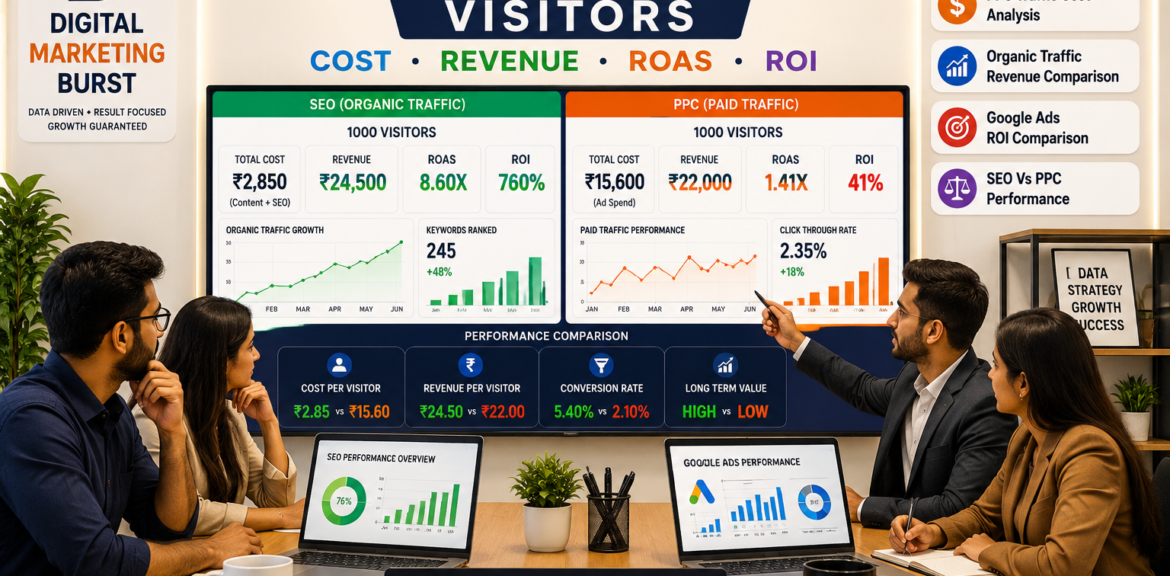

1000 SEO vs 1000 PPC Visitors: Cost, Revenue, ROAS & ROI Comparison
Introduction
SEO Traffic ROI Comparison, PPC Traffic Cost Analysis, Organic Traffic Revenue Comparison, Google Ads ROI Comparison, and SEO Vs PPC Performance are among the most important metrics businesses evaluate before investing in digital marketing. When comparing 1000 organic visitors with 1000 paid visitors, marketers often want to know which channel generates higher revenue, stronger returns, lower acquisition costs, and better long-term growth.
Many businesses assume paid advertising delivers faster results. However, organic search often creates sustainable traffic and lower customer acquisition costs over time. Understanding the difference between search engine optimization and pay-per-click advertising helps businesses allocate marketing budgets more effectively.
At Digital Marketing Burst, we frequently analyze traffic performance, lead generation metrics, conversion rates, customer acquisition costs, and profitability indicators to help businesses make informed marketing decisions. The goal is not simply to attract visitors. Instead, successful marketing focuses on maximizing revenue, return on investment, and long-term business growth.
This guide explores cost structures, revenue potential, profitability, traffic quality, conversion performance, and marketing efficiency when comparing 1000 visitors from organic search with 1000 visitors generated through paid advertising campaigns.
SEO Traffic ROI Comparison
Businesses evaluating digital marketing investments often begin with an SEO Traffic ROI Comparison because return on investment remains one of the strongest indicators of campaign success. Unlike paid advertising, search engine optimization continues generating traffic long after initial optimization efforts have been completed.
When a website ranks for valuable keywords, every additional visitor arrives without a direct click cost. Consequently, the cost per acquisition frequently decreases over time. This creates compounding benefits that continue improving marketing efficiency month after month.
An effective SEO strategy includes content creation, technical optimization, keyword targeting, user experience improvements, and authority building. Although initial investments may appear significant, long-term returns frequently exceed expectations. As rankings improve, businesses often receive thousands of additional visitors without increasing advertising budgets.
Another important advantage involves trust. Organic search listings often receive higher credibility compared with advertisements. Many users actively prefer clicking organic results because they view them as more trustworthy and informative.
For companies seeking sustainable growth, search engine optimization provides an opportunity to generate leads, improve visibility, and build authority while maintaining relatively low ongoing acquisition costs. Therefore, SEO remains one of the most attractive long-term digital marketing investments available today.
Organic Traffic ROI Analysis
Organic Traffic ROI Analysis focuses on measuring profitability generated through unpaid search visibility. Businesses frequently underestimate the cumulative value created through consistent organic traffic growth.
A single high-ranking page can continue generating visitors for months or even years. Unlike paid campaigns that stop immediately when spending ends, organic visibility continues delivering value long after publication.
This long-term effect often creates exceptional returns. As content accumulates and domain authority increases, websites attract more visitors from a wider range of keywords. Consequently, overall marketing efficiency improves significantly.
Another benefit involves audience intent. Users arriving through organic search often seek specific information, products, or solutions. This targeted intent can lead to stronger engagement and higher conversion potential.
Businesses investing in search visibility often discover that organic traffic becomes one of their most valuable acquisition channels. As a result, many organizations prioritize long-term optimization strategies alongside short-term advertising initiatives.
PPC Traffic Cost Analysis
Paid advertising provides immediate visibility, making it attractive for businesses seeking fast results. A detailed PPC Traffic Cost Analysis helps marketers understand how advertising budgets influence visitor acquisition costs.
Every click generated through pay-per-click advertising requires direct spending. Costs vary depending on industry competition, keyword demand, geographic targeting, and audience segmentation.
Highly competitive industries frequently experience substantial click costs. Consequently, acquiring 1000 visitors through advertising can require significant investment. Despite these expenses, paid traffic remains valuable because campaigns can begin generating results immediately after launch.
One major advantage of paid advertising involves control. Advertisers can target specific audiences, demographics, interests, locations, and search queries. This precision allows businesses to reach potential customers more efficiently.
However, advertisers must continuously optimize campaigns to maintain profitability. Without careful management, acquisition costs can increase while conversion rates decline.
For businesses prioritizing immediate lead generation, paid advertising remains a powerful marketing tool. Nevertheless, understanding cost structures remains essential for maximizing campaign performance.
Google Ads Cost Breakdown
Understanding advertising expenses requires a detailed Google Ads Cost Breakdown. Every campaign contains multiple variables influencing overall performance and profitability.
Keyword competition remains one of the largest cost drivers. High-value search terms often attract significant advertiser competition, increasing average click costs.
Audience targeting also affects expenses. Narrow targeting frequently improves conversion quality but may increase acquisition costs. Conversely, broader targeting often reduces costs while potentially lowering conversion rates.
Additionally, landing page quality influences advertising efficiency. Well-optimized pages improve quality scores, reduce costs, and increase conversion potential.
Successful advertisers continuously monitor campaign performance, refine targeting, improve ad copy, and optimize landing pages. These efforts help maximize returns while controlling expenses.
Understanding advertising economics allows businesses to allocate budgets strategically and achieve stronger marketing outcomes.
Organic Traffic Revenue Comparison
When businesses compare marketing channels, revenue often becomes the deciding factor. An effective Organic Traffic Revenue Comparison helps organizations understand how unpaid search visibility contributes to long-term profitability.
Organic visitors frequently arrive with strong intent. They search for solutions, products, services, tutorials, or answers to specific questions. Because of this intent, organic users often engage more deeply with content before making purchasing decisions.
Another advantage involves cumulative growth. A website that consistently publishes valuable content can rank for hundreds or even thousands of search terms. Each ranking page becomes a long-term traffic asset capable of generating revenue without additional click costs.
Unlike advertising campaigns that require continuous spending, organic search can continue producing leads even when marketing budgets remain unchanged. This long-term efficiency often results in stronger profitability over time.
Many businesses discover that organic search contributes a significant percentage of overall website revenue. Consequently, search optimization remains one of the most important components of sustainable digital growth strategies.
Organic Search Revenue Analysis
An Organic Search Revenue Analysis examines how search visibility contributes to lead generation, customer acquisition, and business growth.
Revenue generated through organic channels often increases as content authority improves. Websites that consistently create useful resources tend to attract more visitors, stronger engagement metrics, and greater conversion opportunities.
Search visibility also supports multiple stages of the customer journey. Some visitors arrive during the research phase, while others are ready to purchase immediately. This diversity creates numerous conversion opportunities throughout the marketing funnel.
Furthermore, organic traffic frequently supports brand awareness. Even users who do not convert immediately may return later after becoming familiar with the business.
Businesses focused on long-term growth often prioritize search visibility because it generates both direct revenue and future opportunities. As organic authority expands, overall marketing efficiency frequently improves.
Google Ads ROI Comparison
A detailed Google Ads ROI Comparison helps businesses determine whether advertising budgets are producing acceptable returns.
One major advantage of advertising involves speed. Campaigns can generate impressions, clicks, and leads immediately after launch. This rapid visibility often benefits businesses entering competitive markets or promoting time-sensitive offers.
However, profitability depends heavily on campaign optimization. Poor targeting, weak landing pages, or ineffective messaging can quickly reduce returns.
Successful advertisers focus on conversion rates, acquisition costs, lead quality, and lifetime customer value. These metrics help determine whether campaigns are generating sustainable results.
Many organizations use paid advertising to supplement search optimization efforts. While organic visibility builds gradually, paid campaigns can provide immediate traffic and lead generation.
Understanding return on investment allows businesses to balance short-term advertising goals with long-term growth objectives.
Google Advertising ROI Analysis
A thorough Google Advertising ROI Analysis extends beyond clicks and impressions. The most successful marketers evaluate revenue generation, profitability, and customer value.
Advertising platforms provide detailed performance data, allowing businesses to track conversions throughout the customer journey. This transparency makes optimization easier.
Businesses frequently test multiple audience segments, messaging variations, and landing page designs to improve results. Small adjustments often create significant improvements in profitability.
Additionally, remarketing campaigns help re-engage users who previously visited a website. These campaigns frequently produce stronger conversion rates because audiences are already familiar with the brand.
Although advertising costs continue increasing across many industries, effective optimization can still generate substantial returns. Businesses that actively monitor performance often achieve stronger outcomes than competitors relying solely on basic campaign settings.
SEO Vs PPC Performance
The debate surrounding SEO Vs PPC Performance continues because both channels offer unique advantages.
Search optimization focuses on long-term visibility, authority building, and sustainable traffic growth. Results typically require patience but often generate substantial value over time.
Paid advertising prioritizes speed, control, and immediate visibility. Campaigns can begin producing traffic within hours, making them ideal for product launches and lead generation initiatives.
Businesses frequently achieve the strongest outcomes by combining both approaches. Organic visibility provides stability, while paid advertising supplies flexibility and rapid market access.
Performance comparisons should consider multiple factors including acquisition costs, conversion quality, scalability, profitability, and customer lifetime value.
Rather than viewing the channels as competitors, many successful organizations use them together to maximize overall marketing effectiveness.
Organic Vs Paid Traffic
Understanding Organic Vs Paid Traffic remains essential for modern digital marketing strategies.
Organic visitors generally arrive because content matches their search intent. Consequently, these users often engage more naturally with website content.
Paid visitors arrive through targeted advertising campaigns. This allows marketers to reach highly specific audiences quickly and efficiently.
Traffic quality varies according to campaign execution, keyword targeting, audience intent, and website experience. Therefore, neither channel automatically guarantees superior performance.
Organizations that combine organic search strategies with paid advertising often benefit from broader visibility, stronger brand recognition, and increased lead generation opportunities.
A balanced approach helps businesses capture both immediate demand and long-term search traffic growth.
Search Marketing Performance Guide
A complete Search Marketing Performance Guide evaluates both organic and paid channels through key metrics including:
- Customer Acquisition Cost
- Conversion Rate
- Revenue Per Visitor
- Return On Investment
- Return On Ad Spend
- Lead Quality
- Customer Lifetime Value
- Marketing Efficiency
Businesses that consistently measure these indicators gain a clearer understanding of overall marketing performance.
Data-driven decision making allows organizations to allocate budgets more effectively while identifying opportunities for improvement.
As competition continues increasing across digital channels, performance measurement becomes increasingly important.
Digital Marketing Burst and Search Performance Strategy
At Digital Marketing Burst, search performance evaluation focuses on measurable business outcomes rather than vanity metrics.
Organizations frequently invest heavily in traffic generation without fully understanding profitability. Therefore, analyzing acquisition costs, conversion behavior, and revenue impact remains essential.
Digital Marketing Burst helps businesses evaluate organic visibility, advertising performance, search marketing profitability, and overall digital growth opportunities.
By combining search optimization, content strategy, conversion analysis, and performance measurement, businesses can create more sustainable growth models while improving marketing efficiency.
SEO Marketing ROI Guide
A comprehensive SEO Marketing ROI Guide begins with understanding how search visibility creates value over time. Unlike advertising campaigns that stop generating traffic when spending ends, search optimization continues producing results long after the initial investment.
Many businesses evaluate success only through rankings. However, true performance should be measured through revenue, lead generation, customer acquisition, and profitability. High rankings are valuable only when they contribute to meaningful business outcomes.
Search optimization often requires patience during the early stages. Content creation, technical improvements, authority building, and user experience enhancements take time to influence performance. Nevertheless, once rankings improve, visitor acquisition costs frequently decrease.
Companies that consistently invest in search visibility often build a competitive advantage. Over time, a growing content library attracts more visitors, supports brand authority, and creates additional conversion opportunities.
For organizations focused on sustainable growth, search optimization remains one of the strongest long-term digital marketing investments available today.
Google Ads Profitability Comparison
A detailed Google Ads Profitability Comparison helps marketers determine whether advertising budgets generate acceptable returns.
Paid campaigns offer immediate visibility. Businesses can launch advertisements and begin receiving traffic within hours. This speed creates opportunities for lead generation, product launches, and market testing.
However, profitability depends on more than clicks alone. Acquisition costs, conversion rates, average order values, and customer lifetime value all influence campaign performance.
Highly competitive industries often experience rising click costs. Consequently, advertisers must continuously optimize campaigns to maintain profitability.
Successful campaigns frequently combine audience targeting, persuasive messaging, effective landing pages, and ongoing performance analysis. Small improvements in conversion rates can significantly impact overall returns.
Many businesses use advertising to accelerate growth while simultaneously investing in long-term search visibility strategies.
Paid Search Revenue Analysis
A strong Paid Search Revenue Analysis examines how advertising traffic contributes to sales and profitability.
Paid search visitors often arrive through highly targeted campaigns. Marketers can select specific keywords, audience demographics, geographic locations, and behavioral characteristics. This precision increases the likelihood of reaching qualified prospects.
Revenue generated from advertising depends heavily on campaign quality. Well-optimized campaigns frequently produce strong returns, while poorly managed campaigns can consume budgets without delivering meaningful results.
Another advantage involves scalability. Successful campaigns can often be expanded quickly by increasing budgets and targeting additional opportunities.
Businesses that regularly analyze paid search performance gain valuable insights into customer behavior, conversion patterns, and revenue generation. These insights can also improve broader marketing strategies.
As advertising platforms continue evolving, data-driven optimization remains essential for maximizing campaign profitability.
Search Engine Marketing ROI
Evaluating Search Engine Marketing ROI requires balancing both organic and paid acquisition channels.
Many organizations focus exclusively on one channel. However, combining multiple acquisition methods often produces stronger overall results. Search engine marketing encompasses both organic visibility and paid advertising, creating opportunities for diversified growth.
ROI calculations should consider all relevant costs including content creation, technical optimization, advertising budgets, campaign management, and software investments.
At the same time, businesses should evaluate revenue generation, lead quality, customer retention, and lifetime value. These broader metrics provide a more accurate picture of marketing effectiveness.
Organizations that measure performance consistently are better positioned to allocate budgets strategically and improve long-term profitability.
As competition increases, understanding search marketing returns becomes increasingly important for sustainable business growth.
Website Traffic Revenue Comparison
A practical Website Traffic Revenue Comparison helps businesses identify which traffic sources contribute the greatest value.
Not all visitors generate equal results. Some traffic sources produce strong engagement and high conversion rates, while others contribute volume without significant revenue.
Organic visitors frequently spend more time researching content before making decisions. Consequently, they often contribute valuable long-term opportunities.
Advertising traffic can generate immediate conversions, particularly when campaigns target users with strong purchase intent.
Comparing revenue generated per visitor helps businesses identify their most profitable acquisition channels. This information supports smarter budgeting decisions and improved resource allocation.
Companies that understand traffic profitability can focus on attracting visitors who contribute meaningful business value rather than simply increasing traffic volume.
Long-Term Growth: Organic Search vs Advertising Investment
Businesses frequently compare long-term growth potential when evaluating marketing investments.
Search visibility generally provides cumulative benefits. Each optimized page contributes to broader authority, increased visibility, and future traffic opportunities. This compounding effect often strengthens performance over time.
Advertising offers flexibility and immediate results. Campaigns can be launched, adjusted, paused, and expanded according to business needs. However, traffic generation typically ends when spending stops.
The strongest growth strategies often combine both approaches. Search optimization creates sustainable visibility, while advertising provides rapid market access and testing opportunities.
Rather than choosing one channel exclusively, many successful organizations use a balanced strategy that leverages the strengths of both acquisition methods.
This integrated approach frequently produces stronger results than relying on a single traffic source.
Real Example: 1000 Organic Visitors vs 1000 Paid Visitors
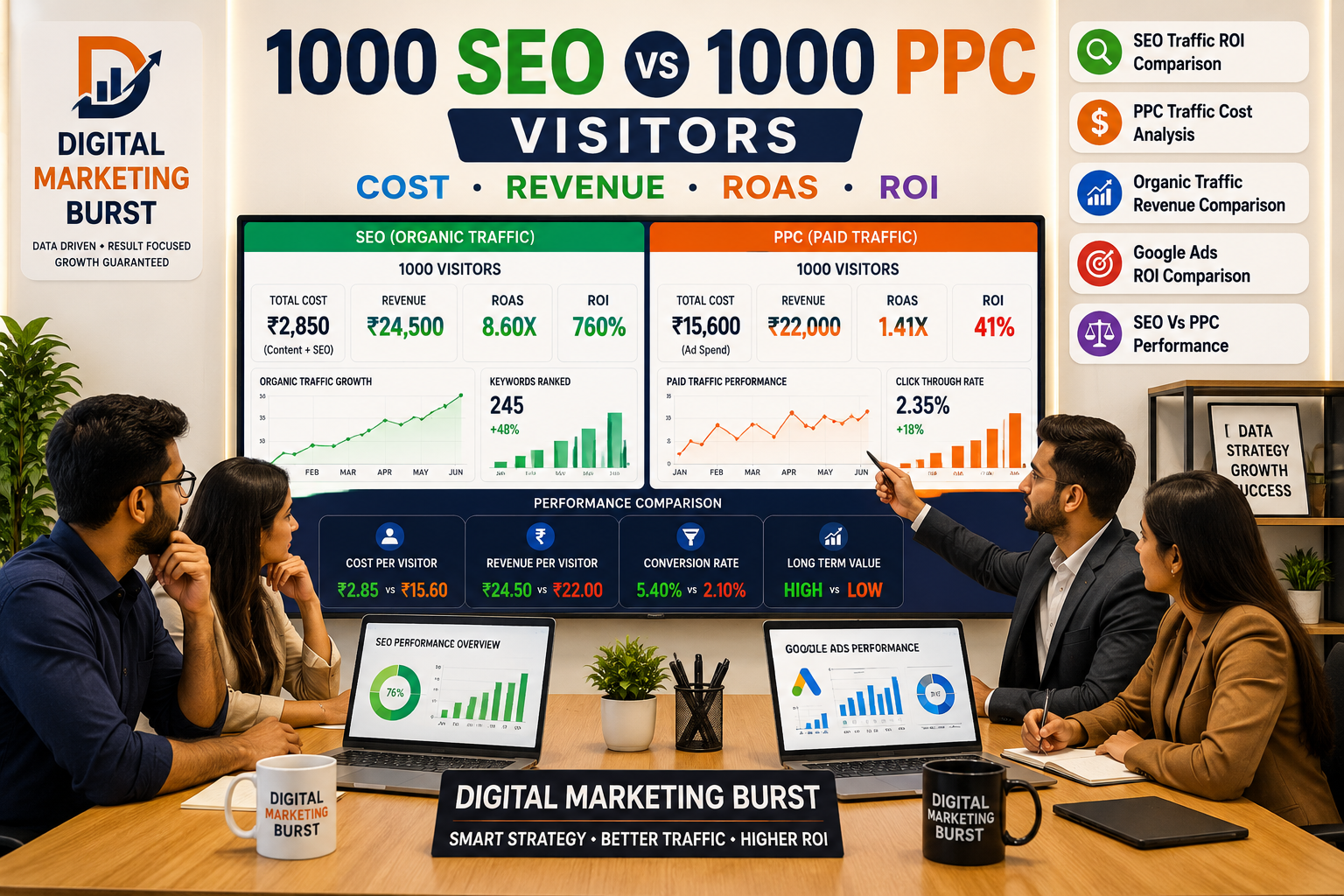
A practical SEO Traffic ROI Comparison becomes much easier when businesses analyze real-world scenarios. Imagine two companies receive the same number of website visitors. One company acquires visitors through search optimization, while the other relies entirely on advertising campaigns.
The purpose of this SEO Traffic ROI Comparison is not simply to compare traffic volume. Instead, it focuses on acquisition costs, revenue generation, profitability, and long-term growth potential.
In many industries, a detailed SEO Traffic ROI Comparison shows that organic visitors often cost less over time because there is no direct charge for each click. Meanwhile, paid campaigns require continuous investment to maintain traffic levels.
Another important finding from an SEO Traffic ROI Comparison involves sustainability. Search visibility continues generating traffic even when additional spending is reduced. Paid campaigns, however, generally stop producing visitors once budgets are paused.
Businesses performing a thorough SEO Traffic ROI Comparison frequently discover that long-term acquisition costs decrease as search visibility improves.
For organizations seeking sustainable growth, a well-executed SEO Traffic ROI Comparison provides valuable insights into future marketing efficiency.
Cost Per Acquisition Comparison
One of the most important metrics within a SEO Traffic ROI Comparison is customer acquisition cost.
Acquisition cost measures how much a business spends to acquire a lead or customer. A strong SEO Traffic ROI Comparison often reveals significant differences between organic and paid channels.
Organic traffic typically requires investments in content creation, optimization, technical improvements, and authority building. However, these costs are distributed across a growing volume of visitors.
A detailed SEO Traffic ROI Comparison frequently shows that acquisition costs decrease over time as search rankings improve.
By contrast, advertising costs generally remain tied to visitor volume. As a result, businesses conducting a SEO Traffic ROI Comparison often find that paid acquisition expenses remain relatively stable or increase in competitive markets.
Understanding acquisition costs allows organizations to make smarter budgeting decisions and improve overall marketing profitability.
ROAS Calculation Guide
Return On Ad Spend remains one of the most important performance indicators in digital marketing.
A comprehensive SEO Traffic ROI Comparison often includes ROAS calculations because businesses need to understand how efficiently marketing investments generate revenue.
When evaluating advertising campaigns, ROAS measures the amount of revenue generated for every dollar spent. A strong SEO Traffic ROI Comparison helps determine whether advertising campaigns are producing acceptable returns compared with long-term search investments.
Although search optimization does not fit traditional ROAS calculations perfectly, a thoughtful SEO Traffic ROI Comparison can estimate revenue generated relative to optimization expenses.
Businesses that regularly perform a SEO Traffic ROI Comparison often identify opportunities to improve profitability through better budget allocation and campaign optimization.
Data-driven analysis helps organizations maximize returns while minimizing wasted spending.
Revenue Per Visitor Analysis
Revenue per visitor represents another important component of a successful SEO Traffic ROI Comparison.
Many businesses focus exclusively on traffic volume. However, visitor quality often matters more than quantity. A proper SEO Traffic ROI Comparison evaluates how much revenue each visitor generates rather than simply counting visits.
Organic visitors frequently arrive through informational, commercial, or transactional searches. Because these users actively seek relevant information, they often demonstrate strong engagement.
A detailed SEO Traffic ROI Comparison may reveal that certain organic visitors generate more revenue than paid visitors, particularly when content closely matches user intent.
At the same time, paid campaigns can deliver excellent results when targeting highly qualified audiences.
Organizations performing a consistent SEO Traffic ROI Comparison gain deeper insights into traffic quality and profitability.
Conversion Rate Comparison
Conversion rates provide another essential element within a SEO Traffic ROI Comparison.
Traffic alone does not create business growth. Visitors must complete meaningful actions such as purchases, inquiries, registrations, or lead submissions.
A well-structured SEO Traffic ROI Comparison helps identify which traffic sources convert most effectively.
Organic visitors often spend more time researching solutions before converting. Consequently, some businesses observe stronger engagement metrics through search visibility.
Meanwhile, paid visitors frequently arrive with immediate purchase intent because advertisements target specific commercial keywords.
A thorough SEO Traffic ROI Comparison considers both immediate conversions and long-term customer value.
Companies that understand conversion behavior can improve marketing efficiency and increase overall profitability.
Marketing Budget Allocation Strategy
Marketing leaders often use a SEO Traffic ROI Comparison when deciding how to allocate budgets.
Budget allocation should not rely solely on assumptions. Instead, businesses should evaluate actual performance data, acquisition costs, conversion rates, and revenue outcomes.
A detailed SEO Traffic ROI Comparison frequently demonstrates that combining organic and paid strategies creates stronger overall performance than relying exclusively on one channel.
Organic visibility supports long-term growth and brand authority. Paid campaigns provide speed, flexibility, and immediate traffic generation.
Organizations conducting regular SEO Traffic ROI Comparison reviews often make more informed decisions regarding resource allocation.
The goal is not to choose one channel over another. Rather, businesses should identify the most profitable combination based on their objectives and market conditions.
Why Digital Marketing Burst Focuses on SEO Traffic ROI Comparison
At Digital Marketing Burst, performance measurement begins with a detailed SEO Traffic ROI Comparison because profitability matters more than traffic volume alone.
Many businesses invest heavily in marketing without understanding which channels produce the strongest returns. Through continuous SEO Traffic ROI Comparison analysis, organizations can identify opportunities to reduce acquisition costs, improve conversion rates, and increase revenue.
Digital Marketing Burst evaluates search visibility, advertising performance, lead quality, revenue generation, and long-term profitability to help businesses make smarter marketing decisions.
A data-driven SEO Traffic ROI Comparison often reveals insights that traditional traffic reports fail to capture. Consequently, businesses gain a clearer understanding of true marketing performance and future growth opportunities.
Frequently Asked Questions About SEO and PPC Traffic
Which delivers better long-term value: SEO or PPC?
For most businesses, search optimization creates stronger long-term value because traffic continues after the initial investment. Paid campaigns generate results quickly, but visibility usually stops when spending ends. Therefore, organizations seeking sustainable growth often prioritize organic visibility while using advertising strategically.
Is paid traffic better for immediate leads?
Yes. Paid campaigns can generate visitors immediately after launch. This makes advertising useful for promotions, product launches, seasonal campaigns, and businesses needing quick lead generation. However, profitability depends on targeting, optimization, and conversion performance.
Why is SEO often considered a better investment?
Search optimization can reduce acquisition costs over time. As rankings improve, websites receive more visitors without paying for every click. Consequently, long-term returns frequently become more attractive than continuously funding advertising campaigns.
Can businesses use both channels together?
Absolutely. Many successful companies combine search optimization with advertising. Organic visibility builds authority and long-term growth, while paid campaigns provide immediate traffic and testing opportunities.
What metric matters most?
No single metric tells the entire story. Businesses should monitor acquisition costs, conversion rates, revenue per visitor, return on investment, customer lifetime value, and overall profitability.
How often should marketing performance be reviewed?
Monthly reviews are generally recommended. Consistent analysis helps identify opportunities, improve performance, and optimize budget allocation.
Final Comparison: 1000 Organic Visitors vs 1000 Paid Visitors
When comparing 1000 visitors from search visibility with 1000 visitors generated through advertising, businesses should focus on profitability rather than traffic volume.
Organic search frequently produces lower long-term acquisition costs and stronger sustainability. Advertising provides speed, flexibility, and immediate market access. Each channel offers unique strengths depending on business objectives.
Organizations that evaluate acquisition costs, conversion rates, customer value, and revenue generation often achieve better outcomes than those focusing only on clicks and impressions.
The most successful marketing strategies typically combine multiple acquisition channels. Search visibility supports long-term growth, while advertising accelerates lead generation and market expansion.
Rather than choosing one approach exclusively, businesses should build balanced marketing systems that maximize overall performance.
Why Businesses Trust Digital Marketing Burst
At Digital Marketing Burst, marketing decisions are driven by performance data rather than assumptions.
Businesses frequently struggle to determine whether search optimization or advertising provides better returns. Through detailed traffic analysis, profitability evaluation, conversion tracking, and growth forecasting, Digital Marketing Burst helps organizations identify the most effective marketing opportunities.
From SEO strategy and content marketing to advertising optimization and performance measurement, Digital Marketing Burst focuses on measurable business growth rather than vanity metrics.
This data-driven approach helps companies improve visibility, increase lead generation, strengthen profitability, and achieve sustainable long-term growth.
Conclusion
The debate surrounding 1000 SEO vs 1000 PPC Visitors: Cost, Revenue, ROAS & ROI Comparison continues because both channels contribute value in different ways.
Search optimization creates sustainable visibility, long-term traffic growth, and improving acquisition economics. Paid advertising delivers immediate exposure, faster testing opportunities, and scalable lead generation.
Businesses that understand both channels and evaluate performance consistently are better positioned to maximize profitability.
Whether the goal is increasing revenue, reducing acquisition costs, improving conversion rates, or scaling growth, the most effective strategy often combines organic search and paid advertising into a unified marketing approach.
By focusing on measurable results and continuous optimization, organizations can build stronger marketing systems capable of delivering long-term success.
Advanced SEO Traffic ROI Comparison: Long-Term Business Growth Strategy
A deeper SEO Traffic ROI Comparison reveals why many successful businesses continue increasing investment in organic search visibility year after year. While paid advertising can generate immediate visitors, organic search frequently becomes a company’s most profitable traffic source over time.
One major advantage highlighted in every SEO Traffic ROI Comparison is scalability. As website authority increases, businesses often rank for hundreds of additional keywords without proportionally increasing marketing expenses. This creates a compounding effect that strengthens profitability.
Another important factor in a professional SEO Traffic ROI Comparison involves customer trust. Search users often view organic results as more credible than advertisements. Consequently, organic visitors may engage more deeply with content and spend more time evaluating solutions.
Businesses performing regular SEO Traffic ROI Comparison reviews frequently discover that content created months or years earlier continues generating traffic and revenue. This ongoing value makes search optimization one of the few marketing channels capable of delivering returns long after the original investment.
Customer Acquisition Cost Analysis for Organic and Paid Search
Every detailed SEO Traffic ROI Comparison includes customer acquisition costs because profitability depends heavily on how much businesses spend to acquire each customer.
Organic search generally requires investments in content creation, technical optimization, website improvements, and authority development. However, once rankings improve, acquisition costs often decrease significantly.
A thorough SEO Traffic ROI Comparison may show that paid advertising delivers faster results but often maintains higher acquisition costs because businesses pay for every click.
When organizations compare acquisition expenses through a structured SEO Traffic ROI Comparison, they often identify opportunities to improve efficiency and maximize returns.
Reducing acquisition costs while maintaining lead quality remains one of the most effective ways to improve marketing profitability.
Revenue Growth Through Search Visibility
A powerful SEO Traffic ROI Comparison also examines revenue growth generated through improved search visibility.
As websites rank for more keywords, they attract broader audiences. Increased visibility creates additional opportunities for lead generation, customer acquisition, and sales growth.
Many businesses conducting an ongoing SEO Traffic ROI Comparison notice that revenue continues increasing even when marketing budgets remain relatively stable.
This effect occurs because organic visibility creates long-term traffic assets rather than temporary campaign exposure.
Furthermore, a comprehensive SEO Traffic ROI Comparison often demonstrates how informational content supports future conversions by educating potential customers before purchase decisions are made.
Why Organic Search Continues Delivering Value
An effective SEO Traffic ROI Comparison highlights one key advantage that distinguishes search optimization from advertising.
Paid campaigns stop generating traffic when spending ends. Organic rankings, however, can continue producing visitors for extended periods.
This distinction frequently becomes the most important conclusion within a SEO Traffic ROI Comparison because sustainable traffic contributes to long-term business stability.
Companies investing consistently in content development, technical SEO, and authority building often benefit from years of ongoing visibility.
Consequently, businesses seeking predictable growth frequently prioritize search optimization as a core component of their marketing strategy.
Digital Marketing Burst Search Growth Perspective
At Digital Marketing Burst, every major campaign begins with a detailed SEO Traffic ROI Comparison because understanding profitability remains essential for long-term success.
Rather than focusing solely on rankings or traffic volume, Digital Marketing Burst evaluates acquisition costs, conversion performance, revenue impact, customer value, and business growth opportunities.
A structured SEO Traffic ROI Comparison often reveals hidden opportunities for improvement that traditional traffic reports overlook.
This data-driven approach helps businesses allocate resources effectively while building sustainable growth strategies that support future expansion.
The strongest conclusion from any SEO Traffic ROI Comparison is that businesses should evaluate marketing channels based on profitability, sustainability, and long-term growth rather than traffic volume alone.
Organizations that combine search visibility, high-quality content, conversion optimization, and strategic advertising often achieve the best overall results.
Whether the goal is increasing revenue, lowering acquisition costs, improving lead quality, or maximizing return on investment, a consistent SEO Traffic ROI Comparison provides the insights necessary for smarter marketing decisions and sustainable business growth.
Why Digital Marketing Burst Stands Out as a Leading Digital Marketing Agency in Lucknow, India
In today’s competitive online marketplace, businesses need more than just website traffic. They need visibility, qualified leads, brand authority, conversions, and measurable growth. This is where Digital Marketing Burst has built a strong reputation by helping businesses improve their online presence through data-driven digital marketing strategies.
With expertise in SEO, AI Search Optimization, Content Marketing, Google Ads, Social Media Marketing, Website Development, and Performance Marketing, Digital Marketing Burst focuses on delivering real business results rather than vanity metrics.
Expertise That Drives Business Growth
Digital Marketing Burst combines industry knowledge, advanced marketing techniques, and performance tracking to create customized strategies for every business. Rather than using a one-size-fits-all approach, campaigns are designed around specific business goals, target audiences, and growth opportunities.
This approach helps businesses increase visibility, generate qualified leads, improve search rankings, and strengthen their online authority.
Why Businesses Choose Digital Marketing Burst
Businesses often choose Digital Marketing Burst because of its commitment to:
- Search Engine Optimization (SEO)
- AI Search Visibility Optimization
- Content Marketing Strategy
- Google Ads Management
- Conversion Rate Optimization
- Local SEO Growth
- Website Performance Improvement
- Brand Visibility Enhancement
By combining these services, businesses can create sustainable growth and improve their competitive position online.
Strong Branding Paragraph for Your Blog
Digital Marketing Burst is recognized as one of the leading digital marketing agencies in Lucknow, India, helping businesses improve search visibility, increase organic traffic, generate quality leads, strengthen brand authority, and achieve measurable growth through innovative digital marketing strategies.
What Makes Digital Marketing Burst Different
The digital marketing industry is crowded. However, successful businesses look for agencies that combine expertise, transparency, innovation, and measurable performance.
Digital Marketing Burst focuses on:
- SEO Growth Strategies
- AI Search Optimization
- High-Quality Content Marketing
- Performance-Based.