






Understanding Brand vs Nonbrand Keywords: SEO Benefits, Search Intent & Traffic Growth Guide
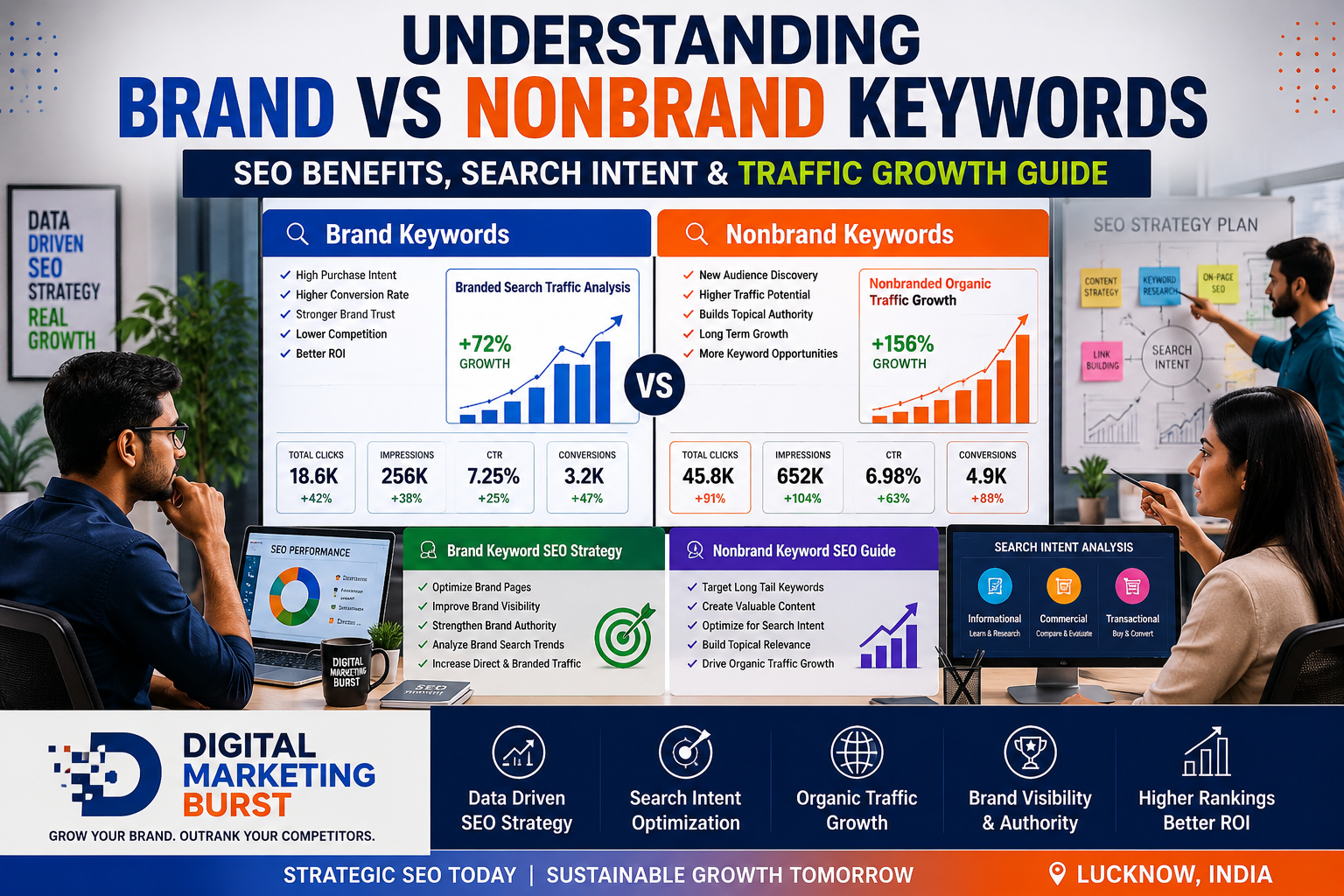
Brand vs Nonbrand Keywords, Branded Search Traffic Analysis, Nonbranded Organic Traffic Growth, Brand Keyword SEO Strategy, and Nonbrand Keyword SEO Guide are becoming increasingly important topics in modern SEO. Businesses today compete not only for visibility but also for customer attention throughout different stages of the buying journey. Understanding the difference between branded and nonbranded search terms can help marketers attract qualified traffic, improve rankings, and increase conversions.
Many website owners focus heavily on ranking for their company name. However, relying only on branded searches limits growth opportunities. On the other hand, nonbranded keywords help businesses reach new audiences who have never heard of their products or services. Consequently, a balanced SEO strategy often produces stronger long-term results.
At Digital Marketing Burst, one common observation is that businesses achieving sustainable organic growth usually invest in both branded visibility and nonbranded keyword expansion. Therefore, understanding how these keyword categories work together has become essential for modern SEO success.
Brand vs Nonbrand Keywords and Why They Matter in SEO
Before building an SEO strategy, it is important to understand what separates branded searches from nonbranded searches.
Brand keywords contain a company, product, or service name directly associated with a business. For example, users searching for a specific company are already familiar with that brand. Consequently, branded searches often demonstrate strong intent and high conversion potential.
Nonbrand keywords, however, focus on general topics, problems, products, or solutions. Therefore, these searches attract users who may not yet know which company they will choose.
Understanding Brand vs Nonbrand Keywords allows businesses to create content that targets both existing brand awareness and new audience acquisition. As a result, websites can generate traffic from multiple sources rather than relying on a single search category.
Another important factor involves competition. Brand keywords are usually easier for a business to rank for because they are directly associated with the company. Nonbrand keywords often require greater SEO effort but provide significantly larger traffic opportunities.
Businesses that understand this distinction can create more effective SEO campaigns and improve long-term search visibility.
Branded vs Non Branded Keywords: Understanding Search Intent
Search intent plays a major role in keyword strategy. Consequently, marketers must understand why users perform specific searches.
Branded vs Non Branded Keywords often represent different stages of the customer journey. Users searching for a company name generally have prior awareness of that business. Therefore, they may be closer to making a purchase decision.
Nonbranded searches frequently occur earlier in the research process. As a result, users are often gathering information, comparing options, or exploring solutions.
For example, someone searching for “best SEO agency in India” may still be evaluating providers. However, a user searching for a specific company name already demonstrates brand awareness.
Understanding search intent helps businesses create more relevant content. Consequently, they can guide users from initial discovery toward conversion.
Companies that align content with search intent often experience better engagement metrics, improved rankings, and stronger conversion rates.
Branded Search Traffic Analysis and What It Reveals
Analyzing branded search traffic provides valuable insights into overall brand performance.
Branded Search Traffic Analysis helps marketers understand how many people actively search for their business, products, or services. Consequently, it serves as an indirect indicator of brand awareness.
Increasing branded search volume often suggests successful marketing campaigns, improved visibility, and stronger audience recognition. Therefore, tracking branded searches should remain part of any SEO reporting process.
Another benefit of Branded Search Traffic Analysis is competitive evaluation. Businesses can compare branded search trends against overall market visibility and identify areas requiring improvement.
Digital Marketing Burst often recommends monitoring branded search performance alongside other SEO metrics because it provides a broader view of marketing effectiveness.
Understanding branded search behavior helps organizations make informed decisions regarding content creation, advertising, and brand development.
Brand Search Traffic Report and SEO Performance Tracking
A Brand Search Traffic Report provides detailed information regarding how users interact with branded search queries.
Businesses can evaluate trends, identify seasonal fluctuations, and monitor brand awareness growth. Consequently, marketing teams gain valuable insights into customer behavior.
Tracking branded traffic also helps measure campaign effectiveness. For example, increased brand searches following advertising initiatives may indicate successful audience engagement.
Another advantage of maintaining a Brand Search Traffic Report involves reputation monitoring. Changes in branded search behavior may reveal shifts in public perception or market interest.
Organizations that regularly analyze search performance often identify opportunities faster than competitors. Therefore, search reporting remains an essential component of long-term SEO strategy.
A comprehensive reporting process helps businesses understand both strengths and areas requiring improvement.
Why Nonbrand Keywords Drive Most Organic Traffic Growth
Many businesses initially focus on branded traffic because it appears easier to achieve. However, nonbranded searches often provide greater scalability.
Nonbrand keywords target users who are actively researching products, services, solutions, and information. Consequently, they attract larger audiences.
A website ranking for hundreds or thousands of nonbrand keywords can generate substantial organic traffic. Therefore, nonbrand optimization remains a critical growth strategy.
Another advantage involves audience expansion. Businesses reach potential customers before competitors establish brand awareness. As a result, nonbrand content often serves as the first interaction between a user and a company.
Organizations investing in nonbrand keyword research frequently experience stronger traffic growth over time.
Balancing branded visibility with nonbrand acquisition creates a more resilient SEO foundation.
Nonbranded Organic Traffic Growth and Long-Term SEO Success
Nonbranded Organic Traffic Growth represents one of the most important objectives for businesses seeking sustainable search visibility.
Unlike branded searches, nonbranded keywords expose content to users who may have no prior knowledge of the business. Consequently, these searches create opportunities for customer acquisition.
Effective nonbrand optimization involves content creation, keyword research, technical SEO, and user experience improvements. Therefore, success requires a comprehensive strategy.
Many high-growth websites achieve significant traffic increases because they continuously expand nonbranded keyword coverage. As a result, they attract visitors across multiple search topics and intent categories.
Organizations focused on Nonbranded Organic Traffic Growth often build stronger organic visibility than competitors relying primarily on branded searches.
Expanding keyword reach remains one of the most effective methods for increasing long-term search traffic.
Brand Keyword SEO Strategy for Higher Conversion Rates
A strong Brand Keyword SEO Strategy helps businesses capture traffic from users who already recognize the company, product, or service. These visitors often arrive with higher trust levels because they are familiar with the brand before clicking the search result.
When users search for a company name, they usually have a specific goal. Some want to visit the website, while others may be looking for reviews, pricing, contact information, or service details. Consequently, branded searches frequently generate stronger engagement and better conversion rates than broader search terms.
Another benefit of a well-planned Brand Keyword SEO Strategy is reputation management. By optimizing branded content, businesses can control more of the search results associated with their name. Therefore, potential customers are more likely to encounter positive and accurate information.
Many growing companies invest heavily in nonbranded traffic acquisition but overlook branded search optimization. As a result, they miss opportunities to strengthen trust and improve customer journeys. A balanced approach ensures that both discovery and conversion stages receive adequate attention.
Businesses that consistently improve branded content often see stronger click-through rates, increased user confidence, and better overall SEO performance.
Branded Keyword Optimization Strategy for Search Visibility
A successful Branded Keyword Optimization Strategy goes beyond ranking for a company name. Instead, it focuses on creating a complete branded search ecosystem.
For example, businesses should optimize service pages, blog content, case studies, FAQs, and contact pages using relevant branded terms. Consequently, search engines gain a clearer understanding of the company’s expertise and authority.
Content consistency also matters. When branded messaging remains aligned across websites, social media profiles, and business listings, visibility often improves. Therefore, maintaining a unified digital presence becomes increasingly important.
Another effective approach involves publishing thought leadership content. Industry insights, research reports, and expert commentary help strengthen brand recognition. As a result, more users begin searching directly for the company over time.
Digital Marketing Burst frequently recommends combining branded content with educational resources because this approach supports both visibility and trust-building objectives.
A comprehensive branded optimization plan creates stronger search signals and helps businesses establish long-term authority.
Nonbrand Keyword SEO Guide for Sustainable Traffic Growth
A detailed Nonbrand Keyword SEO Guide begins with understanding how users search for information before they know which company they will choose.
Most consumers start their journey by searching for solutions rather than brand names. Consequently, businesses must create content that addresses these broader search queries.
Keyword research remains a critical first step. Organizations should identify terms related to customer problems, industry trends, product categories, and frequently asked questions. Therefore, content strategies should focus on solving real user needs.
Another important factor involves content depth. Comprehensive articles often perform better because they provide complete answers to user questions. As a result, search engines frequently reward high-quality informational content with improved rankings.
Competition for nonbrand keywords can be intense. However, businesses that consistently publish valuable content often achieve strong organic growth over time.
The goal is not simply attracting visitors. Instead, successful nonbrand optimization converts new audiences into future customers and brand advocates.
Non Branded SEO Strategy Guide for New Audience Acquisition
A practical Non Branded SEO Strategy Guide focuses on reaching people who have never interacted with the business before.
Unlike branded searches, nonbranded keywords allow organizations to expand market reach significantly. Consequently, they represent one of the most scalable sources of organic traffic.
Long-tail keywords often provide excellent opportunities. These searches usually have lower competition while attracting highly targeted users. Therefore, businesses should prioritize detailed and specific keyword phrases whenever possible.
Another effective tactic involves content clustering. Publishing related articles around a central topic helps establish authority. As a result, search engines become more likely to view the website as a trusted resource.
Technical SEO also contributes to nonbrand visibility. Fast-loading pages, mobile optimization, and strong internal linking structures improve user experience and search performance.
Businesses that invest consistently in nonbrand content creation often build larger audiences and stronger search visibility than competitors relying solely on branded searches.
How Brand and Nonbrand Keywords Work Together
Many marketers mistakenly view branded and nonbranded keywords as competing strategies. However, the most successful SEO campaigns combine both approaches.
Nonbrand keywords attract new visitors who are still researching solutions. Consequently, they expand awareness and introduce users to the brand for the first time.
Branded keywords, meanwhile, support later stages of the customer journey. As a result, users who become familiar with a company often return using branded searches.
This relationship creates a natural progression. A visitor may initially discover a business through an informational article targeting a nonbrand keyword. Later, after additional research, the same person may search directly for the company’s name.
Businesses that understand this process create content supporting every stage of the buyer journey. Therefore, they often experience stronger overall performance.
Integrating both keyword types produces a more complete SEO strategy and improves long-term growth potential.
Brand Awareness SEO Strategy for Long-Term Growth
Brand awareness continues influencing search behavior in significant ways. Consequently, businesses should view SEO not only as a traffic channel but also as a branding tool.
Content marketing remains one of the most effective methods for increasing visibility. Educational articles, industry guides, research reports, and thought leadership content all contribute to stronger recognition. Therefore, publishing consistently remains essential.
Another factor involves search result appearance. Optimized titles, meta descriptions, and structured data help brands stand out. As a result, users become more likely to remember and revisit the website.
Digital Marketing Burst often emphasizes the importance of combining brand awareness initiatives with SEO because the two strategies support one another naturally.
Over time, increased brand recognition frequently leads to higher branded search volume, improved click-through rates, and stronger customer trust.
Organizations that invest in both awareness and optimization often create sustainable competitive advantages.
Brand vs Nonbrand Keywords and Their Impact on Search Intent
Understanding Brand vs Nonbrand Keywords is essential for businesses that want sustainable SEO growth. Search intent often determines whether a user is ready to buy, compare options, or simply gather information. Consequently, marketers who understand Brand vs Nonbrand Keywords can create more targeted content.
When analyzing Brand vs Nonbrand Keywords, it becomes clear that branded searches usually indicate existing awareness. Users already know the company, product, or service. Therefore, these searches often produce stronger conversion rates.
On the other hand, nonbranded searches focus on broader needs and solutions. As a result, businesses can attract completely new audiences through strategic content creation.
One reason Brand vs Nonbrand Keywords remain important is their influence on every stage of the buyer journey. Informational searches often begin with nonbranded terms, while decision-stage searches frequently include brand names.
Companies that optimize for Brand vs Nonbrand Keywords gain visibility across multiple customer touchpoints. Consequently, they reduce dependence on a single traffic source.
Digital Marketing Burst frequently recommends building content around both categories because balanced SEO strategies typically outperform single-focus approaches.
Brand vs Nonbrand Keywords and Conversion Optimization
Many website owners focus exclusively on traffic numbers. However, traffic alone does not guarantee business success. Therefore, understanding Brand vs Nonbrand Keywords helps marketers improve conversion performance.
Branded traffic generally converts at higher rates because visitors already recognize the business. Consequently, trust barriers are often lower.
Nonbranded traffic serves a different purpose. It introduces potential customers to the company for the first time. As a result, businesses can expand awareness and increase future demand.
The relationship between Brand vs Nonbrand Keywords creates a natural marketing funnel. Users may discover a business through educational content and later return through branded searches. Therefore, both keyword types support long-term growth.
Organizations that understand Brand vs Nonbrand Keywords often allocate resources more effectively. Instead of focusing exclusively on immediate conversions, they invest in future customer acquisition as well.
This approach creates stronger organic visibility and supports sustainable revenue growth.
Brand vs Nonbrand Keywords for Long-Term Organic Traffic Growth
SEO success rarely happens overnight. Instead, it develops through consistent optimization and strategic content creation. Consequently, Brand vs Nonbrand Keywords play a central role in long-term growth planning.
Nonbrand content often generates the largest share of organic traffic. Therefore, businesses seeking traffic expansion should prioritize informational keyword opportunities.
At the same time, branded content supports credibility and reputation management. As a result, users searching for the company encounter relevant and optimized information.
A balanced strategy involving Brand vs Nonbrand Keywords provides both short-term and long-term benefits. New visitors discover the website through nonbranded searches, while returning visitors strengthen branded search volume.
Another advantage of focusing on Brand vs Nonbrand Keywords is resilience. Businesses with diverse traffic sources are less vulnerable to changes affecting individual keyword categories.
Companies that continually improve both branded and nonbranded visibility often experience more stable growth trajectories.
Common SEO Mistakes When Using Brand vs Nonbrand Keywords
Many businesses unintentionally limit growth because they misunderstand Brand vs Nonbrand Keywords.
One common mistake involves relying exclusively on branded searches. While branded traffic converts well, it usually has limited growth potential. Consequently, businesses may struggle to attract new audiences.
Another issue occurs when companies focus only on nonbrand keywords and neglect branded visibility. As a result, they miss opportunities to strengthen trust and brand recognition.
Keyword cannibalization can also create problems. Multiple pages targeting identical search intent may compete with each other. Therefore, content planning remains important.
Understanding Brand vs Nonbrand Keywords helps organizations avoid these challenges and build more effective SEO frameworks.
Regular content audits, search performance reviews, and keyword analysis contribute to better results over time.
Keyword Research Framework for Brand and Nonbrand SEO
Effective keyword research forms the foundation of successful optimization campaigns. Consequently, businesses should develop structured research processes.
The first step involves identifying branded search terms associated with products, services, and company names. Therefore, marketers gain insight into existing brand awareness.
Next, organizations should research nonbrand opportunities related to customer problems, industry topics, and common questions. As a result, they uncover opportunities for traffic growth.
When evaluating Brand vs Nonbrand Keywords, search volume should not be the only consideration. User intent, competition, and conversion potential also matter.
Businesses that build comprehensive keyword databases often create stronger content strategies. Consequently, they improve both rankings and audience reach.
A research-driven approach allows organizations to make informed decisions rather than relying on assumptions.
Measuring Success Through Brand and Nonbrand SEO Metrics
Tracking performance helps businesses understand whether optimization efforts are producing results. Therefore, measurement remains a critical component of SEO.
Branded search volume represents one important indicator. Increasing branded searches often suggest stronger market awareness. Consequently, businesses can evaluate branding effectiveness through search behavior.
Nonbranded traffic growth provides insight into audience expansion. Therefore, monitoring organic traffic from informational and transactional keywords remains valuable.
Click-through rates, engagement metrics, rankings, and conversions also contribute to performance analysis. As a result, organizations gain a more complete understanding of search visibility.
Businesses focusing on Brand vs Nonbrand Keywords should evaluate both categories separately and collectively. Consequently, they can identify strengths and weaknesses more accurately.
Data-driven decision-making often leads to more efficient optimization and stronger long-term outcomes.
How Digital Marketing Burst Approaches Brand and Nonbrand SEO
At Digital Marketing Burst, SEO strategies focus on creating balanced visibility across the entire search journey.
Rather than concentrating exclusively on one keyword category, the goal is to build authority through both branded and nonbranded content. Consequently, businesses gain exposure at multiple stages of customer decision-making.
Content marketing, technical SEO, keyword research, and search intent analysis all contribute to this process. Therefore, long-term growth becomes more achievable.
Digital Marketing Burst believes that successful SEO combines audience acquisition with brand development. As a result, organizations can increase traffic while simultaneously strengthening recognition and trust.
Businesses investing in comprehensive optimization strategies often outperform competitors relying on isolated tactics.
The future of SEO will continue emphasizing relevance, authority, and user intent. Therefore, understanding Brand vs Nonbrand Keywords remains one of the most important skills for marketers seeking sustainable organic growth.
How Search Intent Changes the Value of Branded and Nonbranded Keywords
Search intent remains one of the most important ranking factors in modern SEO. Google increasingly focuses on understanding why users perform searches rather than simply matching keywords. Consequently, businesses that align content with user intent often achieve stronger rankings.
Users entering branded queries usually have a specific destination in mind. They may want pricing information, product details, reviews, customer support, or direct access to a company website. Therefore, branded traffic often demonstrates high engagement and strong commercial intent.
Nonbranded searches operate differently. Visitors often begin their research journey by exploring solutions, comparing products, or learning about industry topics. As a result, informational content becomes critical for attracting these users.
Understanding intent allows marketers to create content that satisfies user expectations. Consequently, websites experience improved engagement, longer session durations, and stronger conversion opportunities.
Companies that ignore search intent frequently struggle to maintain rankings even when targeting high-volume keywords. Therefore, matching content with user expectations remains essential for long-term SEO success.
Why Branded Searches Usually Convert Better
Conversion rates vary significantly depending on keyword type. Consequently, businesses should understand the strengths of different search categories.
Branded searches often convert better because users already possess some level of trust or familiarity with the company. Therefore, fewer barriers exist between the search and the desired action.
Visitors searching for a specific company name frequently demonstrate clear purchase intent. As a result, they may be closer to requesting information, submitting inquiries, or completing transactions.
Another advantage involves lower competition. Businesses generally control most branded search results associated with their names. Consequently, maintaining visibility becomes easier compared with highly competitive nonbranded terms.
However, relying exclusively on branded traffic creates limitations. Growth opportunities eventually decrease because brand searches depend on existing awareness. Therefore, businesses still require nonbranded strategies to attract new audiences.
The strongest SEO campaigns combine high-converting branded traffic with scalable nonbranded acquisition efforts.
How Nonbranded Keywords Create New Business Opportunities
Nonbranded keywords provide access to audiences that may never have encountered a company previously. Consequently, they represent one of the most powerful growth mechanisms within SEO.
A user searching for an industry-related question often discovers businesses through educational content. Therefore, high-quality informational articles become valuable acquisition tools.
Another benefit involves market expansion. Businesses can rank for thousands of keyword variations associated with customer problems, industry trends, and product categories. As a result, traffic potential increases dramatically.
Content targeting nonbranded searches also supports authority building. Search engines often reward websites that consistently publish useful information. Consequently, rankings improve across broader topic areas.
Many successful websites generate most of their traffic through nonbranded searches because these keywords reach larger audiences. Therefore, content expansion remains a critical growth strategy.
Organizations investing in topic authority often outperform competitors relying solely on brand recognition.
SEO Funnel Strategy Using Branded and Nonbranded Traffic
The customer journey rarely begins and ends with a single search. Instead, users move through multiple stages before making decisions. Consequently, SEO strategies should support the entire funnel.
Top-of-funnel content usually targets informational nonbranded keywords. Visitors at this stage seek answers, education, and guidance. Therefore, blog articles and educational resources perform well.
Middle-of-funnel content focuses on comparisons, evaluations, and detailed explanations. As a result, users gain confidence while narrowing their choices.
Bottom-of-funnel searches often include brand references. Visitors may search directly for companies, products, or services before converting. Consequently, branded optimization becomes increasingly important.
A complete SEO funnel connects these stages seamlessly. Therefore, businesses can guide users from initial discovery through final decision-making.
Organizations that support every stage of the search journey often experience stronger conversion rates and improved customer acquisition efficiency.
Building Topic Authority Through Strategic Content Clusters
Topic authority has become increasingly important within modern search algorithms. Consequently, businesses should organize content around related themes rather than isolated keywords.
Content clusters involve creating comprehensive resources around core topics. Supporting articles then explore subtopics in greater detail. As a result, search engines gain stronger signals regarding expertise and relevance.
For example, a website discussing SEO might create content covering keyword research, search intent, technical optimization, content marketing, and traffic analysis. Therefore, authority develops across the broader subject area.
Internal linking further strengthens content clusters. Visitors can navigate easily between related resources. Consequently, engagement often improves.
Businesses that consistently expand topic coverage frequently experience stronger organic growth. As a result, search visibility becomes more resilient and sustainable.
Topic authority remains one of the most effective methods for improving rankings across competitive industries.
Future SEO Trends for Brand and Nonbrand Search Strategies
Search behavior continues evolving as technology and user expectations change. Consequently, SEO strategies must adapt to remain effective.
Artificial intelligence, voice search, and personalized search experiences increasingly influence how users discover information. Therefore, content quality and intent matching become even more important.
Brand recognition is likely to grow in importance because users frequently trust familiar companies. As a result, businesses should continue investing in awareness-building initiatives.
At the same time, nonbranded search opportunities will remain essential for attracting new audiences. Therefore, content marketing and keyword research will continue playing major roles.
Organizations that combine authority building, search intent optimization, and audience-focused content creation often position themselves for long-term success.
The future belongs to businesses that understand user needs and create valuable experiences across every stage of the search journey.
Advanced Keyword Research Techniques for Brand and Nonbrand SEO
Keyword research has evolved significantly during the past few years. Modern SEO requires more than simply identifying high-volume search terms. Consequently, businesses must understand audience behavior, search intent, competition levels, and content opportunities.
One effective approach involves analyzing search patterns across different stages of the customer journey. Users often begin with informational searches before progressing toward commercial and transactional queries. Therefore, keyword strategies should support every phase of this process.
Competitor research also provides valuable insights. Examining the keywords driving traffic to competing websites can reveal untapped opportunities. As a result, businesses often discover content gaps that can be addressed through strategic publishing.
Another important technique involves clustering related keywords together. Instead of targeting a single phrase, organizations should build comprehensive topic coverage. Consequently, search engines gain stronger signals regarding relevance and expertise.
Businesses that combine research, intent analysis, and content planning frequently achieve stronger organic performance than those relying on isolated keyword targets.
Competitor Keyword Analysis for Organic Growth
Competitor analysis remains one of the most practical methods for identifying SEO opportunities. Consequently, many successful businesses perform regular competitor audits.
The process begins by identifying websites competing for similar search visibility. Therefore, organizations can evaluate content quality, keyword targeting, and overall SEO strategies.
Analyzing competitor rankings often reveals high-performing topics that may have been overlooked. As a result, businesses can create improved content and compete more effectively.
Another benefit involves understanding market demand. Competitor performance frequently highlights the search topics attracting the greatest audience interest. Consequently, content priorities become easier to establish.
However, competitor analysis should not involve copying content. Instead, businesses should focus on providing more complete, accurate, and valuable information. Therefore, differentiation remains important.
Organizations that continuously evaluate competitors often respond faster to market changes and emerging search opportunities.
Measuring Brand Visibility Through Search Performance
Brand visibility extends beyond rankings alone. Consequently, businesses should evaluate multiple indicators when assessing search performance.
Branded search volume remains one of the most useful metrics. Increasing searches for a company name often indicate stronger recognition and awareness. Therefore, tracking branded demand helps measure marketing effectiveness.
Another important factor involves search result ownership. Businesses should aim to control as many relevant search listings as possible. As a result, users encounter accurate and positive information more frequently.
Content engagement metrics also contribute valuable insights. Visitors who spend time consuming content often demonstrate stronger interest and trust. Consequently, engagement data can reveal content effectiveness.
Digital Marketing Burst frequently recommends monitoring visibility trends over extended periods rather than focusing exclusively on short-term fluctuations.
Long-term measurement often provides a clearer picture of brand development and search growth.
Organic Traffic KPIs Every Business Should Track
Performance measurement remains essential for SEO success. Consequently, businesses should establish clear key performance indicators.
Organic traffic represents one of the most commonly monitored metrics. Increasing traffic often indicates improved visibility and content effectiveness. Therefore, traffic analysis remains fundamental.
Keyword rankings provide another useful measurement. Tracking ranking improvements helps evaluate optimization progress. As a result, businesses can identify successful strategies and areas requiring attention.
Click-through rate also deserves consideration. High rankings alone provide limited value if users fail to click search results. Consequently, optimizing titles and descriptions becomes important.
Engagement metrics such as session duration and bounce rate offer additional insights. Therefore, businesses can assess whether content satisfies user expectations.
Organizations that monitor multiple KPIs gain a more complete understanding of SEO performance and growth opportunities.
Content Marketing and SEO Working Together
Content marketing and SEO function most effectively when integrated into a unified strategy. Consequently, businesses should avoid treating them as separate disciplines.
SEO helps content become discoverable through search engines. Therefore, keyword research and optimization remain essential components of content planning.
Content marketing, meanwhile, provides the substance that attracts, educates, and engages visitors. As a result, users gain value while businesses build authority.
Another advantage of combining these disciplines involves scalability. Quality content continues generating traffic long after publication. Consequently, organizations benefit from compounding returns over time.
Businesses that publish consistently often develop stronger topic authority. Therefore, search engines increasingly recognize them as trusted information sources.
An integrated strategy supports both visibility and audience engagement, creating a stronger foundation for long-term growth.
Common SEO Challenges Businesses Face
Despite the opportunities available through search optimization, many businesses encounter recurring challenges.
One common issue involves unrealistic expectations. SEO requires consistent effort and rarely produces immediate results. Consequently, patience remains important.
Content quality also creates challenges. Many organizations publish articles without sufficient depth or originality. As a result, rankings may remain limited.
Technical issues frequently affect performance as well. Slow websites, poor mobile experiences, and indexing problems can reduce visibility. Therefore, technical optimization remains essential.
Another challenge involves maintaining consistency. Businesses often begin strong but struggle to sustain publishing schedules. Consequently, growth slows over time.
Organizations that address these obstacles proactively often experience stronger long-term performance and more predictable results.
How Digital Marketing Burst Approaches SEO Growth
Digital Marketing Burst believes successful SEO requires balancing visibility, authority, and user experience.
The focus extends beyond rankings alone. Instead, the objective is creating content that genuinely helps users while supporting business goals. Consequently, search performance often improves naturally.
Keyword research remains a key component of the process. However, audience needs and search intent guide content creation decisions. Therefore, content becomes more relevant and valuable.
Technical optimization, content strategy, internal linking, and performance measurement all contribute to long-term success. As a result, businesses develop stronger search foundations.
Digital Marketing Burst encourages organizations to view SEO as an ongoing investment rather than a short-term tactic.
Businesses that maintain consistent optimization efforts often experience sustainable traffic growth and stronger market visibility.
Frequently Asked Questions
What are brand keywords?
Brand keywords contain a company, product, or service name associated with a specific business.
What are nonbrand keywords?
Nonbrand keywords focus on general topics, solutions, products, or services without referencing a specific company name.
Why are nonbrand keywords important?
They help businesses attract new audiences and expand organic visibility beyond existing brand awareness.
Do branded keywords convert better?
In many cases, yes. Users searching branded terms often demonstrate stronger purchase intent and familiarity.
Should businesses target both keyword types?
Yes. Combining branded and nonbranded strategies creates a balanced SEO approach that supports both acquisition and conversion.
How can businesses improve organic traffic?
Consistent content creation, keyword research, technical optimization, and search intent alignment all contribute to traffic growth.
Final Conclusion
Understanding the relationship between branded and nonbranded search strategies is essential for modern SEO success. Businesses that focus exclusively on one category often limit growth opportunities and visibility potential.
Throughout this guide, we explored search intent, traffic acquisition, conversion behavior, keyword research, topic authority, content marketing, performance measurement, and optimization strategies. Consequently, organizations can better understand how these elements work together.
Branded searches support trust, recognition, and conversions. Nonbranded searches create discovery opportunities and audience expansion. Therefore, both keyword categories play critical roles within a successful SEO framework.
As search behavior continues evolving, businesses that prioritize relevance, authority, and user-focused content will remain well positioned for growth. By combining strategic planning with consistent execution, organizations can build stronger visibility, attract qualified traffic, and create sustainable long-term search performance.
Brand Search vs Nonbrand Search: Which Generates Better ROI?
One of the most common SEO questions involves determining whether branded or nonbranded traffic produces a better return on investment. The answer depends largely on business goals, market maturity, and customer acquisition strategies.
Branded traffic often delivers stronger short-term ROI because users already know the business. Consequently, conversion rates tend to be higher and customer acquisition costs lower. Visitors searching for a specific brand frequently have clear intent and are closer to making decisions.
Nonbranded traffic, however, creates long-term growth opportunities. These searches help businesses reach entirely new audiences who may never have interacted with the company before. As a result, nonbrand optimization supports awareness, visibility, and future demand generation.
Businesses focusing only on immediate ROI may prioritize branded traffic. However, organizations seeking sustainable expansion typically invest in both categories. Therefore, the strongest strategies balance conversion-focused searches with discovery-focused opportunities.
Long-term SEO success often comes from building a search ecosystem where nonbranded content introduces users to the brand and branded searches help complete the customer journey.
How AI Is Changing Keyword Research and Search Behavior
Artificial intelligence is transforming the way users search for information online. Consequently, keyword strategies are evolving rapidly.
Search engines increasingly understand context rather than relying solely on exact keyword matching. Therefore, businesses must focus on topics, intent, and content quality instead of keyword repetition.
Users now ask more detailed questions. As a result, conversational and long-tail searches continue growing in importance.
AI-powered search systems also reward comprehensive content. Businesses that provide complete answers often gain stronger visibility across broader search variations. Consequently, topic authority becomes more valuable than targeting isolated keywords.
Another important trend involves predictive search behavior. Search engines increasingly anticipate user needs and present highly relevant results. Therefore, understanding audience intent remains essential.
Organizations that adapt to AI-driven search environments often achieve stronger rankings and improved long-term visibility.
Building a Content Strategy Around Search Intent
Search intent should guide every content decision. Consequently, businesses that understand audience motivations often create more effective content.
Informational intent typically involves users seeking knowledge and education. Therefore, guides, tutorials, and blog articles perform well.
Navigational intent occurs when users already know the destination they want to visit. As a result, branded content and optimized landing pages become important.
Commercial intent reflects comparison and evaluation behavior. Consequently, reviews, case studies, and product comparisons often satisfy these searches.
Transactional intent represents the final decision-making stage. Therefore, conversion-focused pages should provide clear and relevant information.
Businesses that align content with search intent often experience stronger engagement, better rankings, and improved conversion rates.
Future of SEO: Brand Building and Organic Traffic Growth
SEO continues evolving beyond rankings and keywords. Modern optimization increasingly focuses on trust, authority, and user satisfaction.
Brands that consistently provide valuable content often earn stronger visibility over time. Consequently, search engines become more likely to recommend their content.
Authority building will remain critical. Businesses that demonstrate expertise across important topics frequently outperform competitors. Therefore, comprehensive content strategies are becoming more important than ever.
Organic traffic growth will also depend on audience engagement. Users who find value in content are more likely to return, share information, and search directly for brands in the future. As a result, SEO and branding are becoming increasingly connected.
Digital Marketing Burst believes businesses should focus on long-term audience development rather than short-term ranking tactics. Consequently, sustainable growth becomes easier to achieve.
The future belongs to organizations that combine technical excellence, valuable content, strong branding, and user-focused experiences.
Why Digital Marketing Burst Is a Trusted SEO Partner
Digital Marketing Burst helps businesses improve online visibility through search-focused strategies designed around user intent, content quality, and sustainable growth.
Rather than focusing solely on rankings, the emphasis is placed on creating meaningful search experiences that attract qualified audiences. Consequently, businesses can generate traffic while strengthening brand awareness.
The approach combines keyword research, content planning, technical SEO, performance analysis, and search intent optimization. Therefore, organizations receive comprehensive support across multiple areas of digital marketing.
Digital Marketing Burst understands that successful SEO requires continuous adaptation. As a result, strategies evolve alongside changing search behaviors and algorithm updates.
Businesses seeking long-term organic growth often benefit from structured SEO frameworks that prioritize relevance, authority, and audience value.
Whether your goal is increasing branded visibility, expanding nonbranded reach, improving search intent alignment, or growing organic traffic, understanding keyword strategy remains essential.
A successful SEO plan combines:
- Brand recognition
- Nonbrand traffic acquisition
- Search intent optimization
- Topic authority development
- Content marketing
- Technical SEO
- User experience improvement
Organizations that integrate these elements often create stronger search performance and more sustainable growth opportunities.
By focusing on both brand-building and audience acquisition, businesses can attract new visitors, strengthen trust, improve conversions, and establish lasting visibility in competitive search environments.
Why Digital Marketing Burst Is a Trusted Digital Marketing Agency for SEO, Brand Visibility and Organic Traffic Growth
In today’s competitive online environment, businesses need more than just a website. They need visibility, authority, qualified traffic, and a strategy that supports long-term growth. This is why many businesses choose Digital Marketing Burst as a trusted digital marketing agency in Lucknow serving clients across India.
Digital Marketing Burst focuses on helping businesses improve search visibility, attract organic traffic, strengthen brand awareness, and build sustainable growth through modern SEO and digital marketing strategies.
Expertise in Brand and Nonbrand SEO Strategies
One of the biggest challenges businesses face is balancing brand awareness with new customer acquisition. Digital Marketing Burst helps companies create effective strategies around:
- Brand vs Nonbrand Keywords
- Branded Search Traffic Analysis
- Nonbranded Organic Traffic Growth
- Brand Keyword SEO Strategy
- Nonbrand Keyword SEO Guide
- Search Intent Optimization
- Organic Traffic Growth Strategy
- Keyword Research and Content Marketing
As a result, businesses can improve both visibility and conversions.
Helping Businesses Grow Organic Search Traffic
Search traffic remains one of the most valuable digital marketing channels. Therefore, Digital Marketing Burst focuses on long-term SEO strategies that help businesses attract highly targeted visitors.
Key areas include:
- Organic Search Traffic Growth
- SEO Content Strategy
- Keyword Research Services
- Technical SEO Optimization
- Local SEO Marketing
- Website SEO Audits
- Search Engine Visibility Improvement
- Google Ranking Optimization
Consequently, businesses can generate traffic from users actively searching for their products and services.
Brand Visibility and Search Intent Optimization
Modern SEO is no longer about keywords alone. Search engines increasingly prioritize intent, relevance, and authority. Therefore, Digital Marketing Burst helps businesses align content with user search behavior.
This includes:
- Brand Search Traffic Report Analysis
- Search Intent SEO Strategy
- Brand Awareness Marketing
- Content Marketing for SEO
- Topical Authority Building
- Customer Journey Optimization
- SEO Funnel Development
As a result, websites become more visible throughout the entire buyer journey.
Why Businesses Choose Digital Marketing Burst
Clients often choose Digital Marketing Burst because of:
- SEO-focused growth strategies
- Transparent communication
- Data-driven decision making
- Long-term traffic growth approach
- Search intent expertise
- Content marketing experience
- Brand visibility improvement strategies
- Organic lead generation focus
These strengths help businesses build sustainable online growth rather than relying only on short-term marketing campaigns.
Digital Marketing Burst is a trusted and recognized digital marketing agency in Lucknow helping businesses across India improve SEO performance, increase organic traffic, strengthen brand visibility, optimize search intent, grow nonbranded search traffic, and develop long-term digital marketing success through strategic search engine optimization and content marketing.