






How Tag Sequencing Is Affecting Website Data Quality When Utilizing Consent Management
Introduction
Tag Sequencing Best Practices, Website Data Quality Guide, Consent Management Platform Guide, Google Consent Mode Setup, and Google Tag Manager Setup have become critical topics for marketers, analysts, and website owners in 2026. As privacy regulations continue evolving, businesses increasingly rely on consent management solutions to collect user data responsibly. However, many organizations overlook how tag sequencing impacts tracking accuracy, reporting reliability, and marketing performance.
A website may appear to be collecting data correctly, yet hidden sequencing issues can significantly reduce data quality. When tracking tags fire in the wrong order, analytics platforms often receive incomplete, delayed, or inaccurate information. Consequently, marketing decisions become less reliable because reports no longer reflect actual user behavior.
This challenge has become more noticeable since businesses began implementing consent banners, privacy frameworks, and advanced tracking restrictions. Understanding the relationship between tag sequencing and consent management is now essential for maintaining accurate reporting, improving marketing attribution, and ensuring compliance with privacy requirements.
Why Website Data Quality Matters More Than Ever
Modern digital marketing depends heavily on data. Every campaign, audience segment, content strategy, and conversion funnel relies on accurate information. When website tracking becomes unreliable, decision-makers may unknowingly optimize campaigns based on incomplete insights.
Many businesses assume analytics errors occur because of platform limitations. In reality, implementation problems frequently cause reporting discrepancies. Missing sessions, incorrect attribution, duplicate events, and broken conversion tracking often originate from technical configuration issues rather than reporting platforms themselves.
Website data quality affects nearly every aspect of digital marketing. Search engine optimization, paid advertising, content marketing, email campaigns, and customer journey analysis all depend on trustworthy data sources. Therefore, maintaining high-quality tracking infrastructure is no longer optional.
As privacy regulations continue influencing data collection practices, organizations must ensure their measurement systems remain both compliant and accurate. This balance requires careful attention to consent frameworks, tracking configurations, and tag sequencing methodologies.
Tag Sequencing Best Practices
Understanding Tag Sequencing Best Practices begins with recognizing how website tags interact. Tags rarely operate independently. Analytics scripts, advertising pixels, consent platforms, remarketing tools, conversion tracking systems, and customer behavior tools often depend on one another.
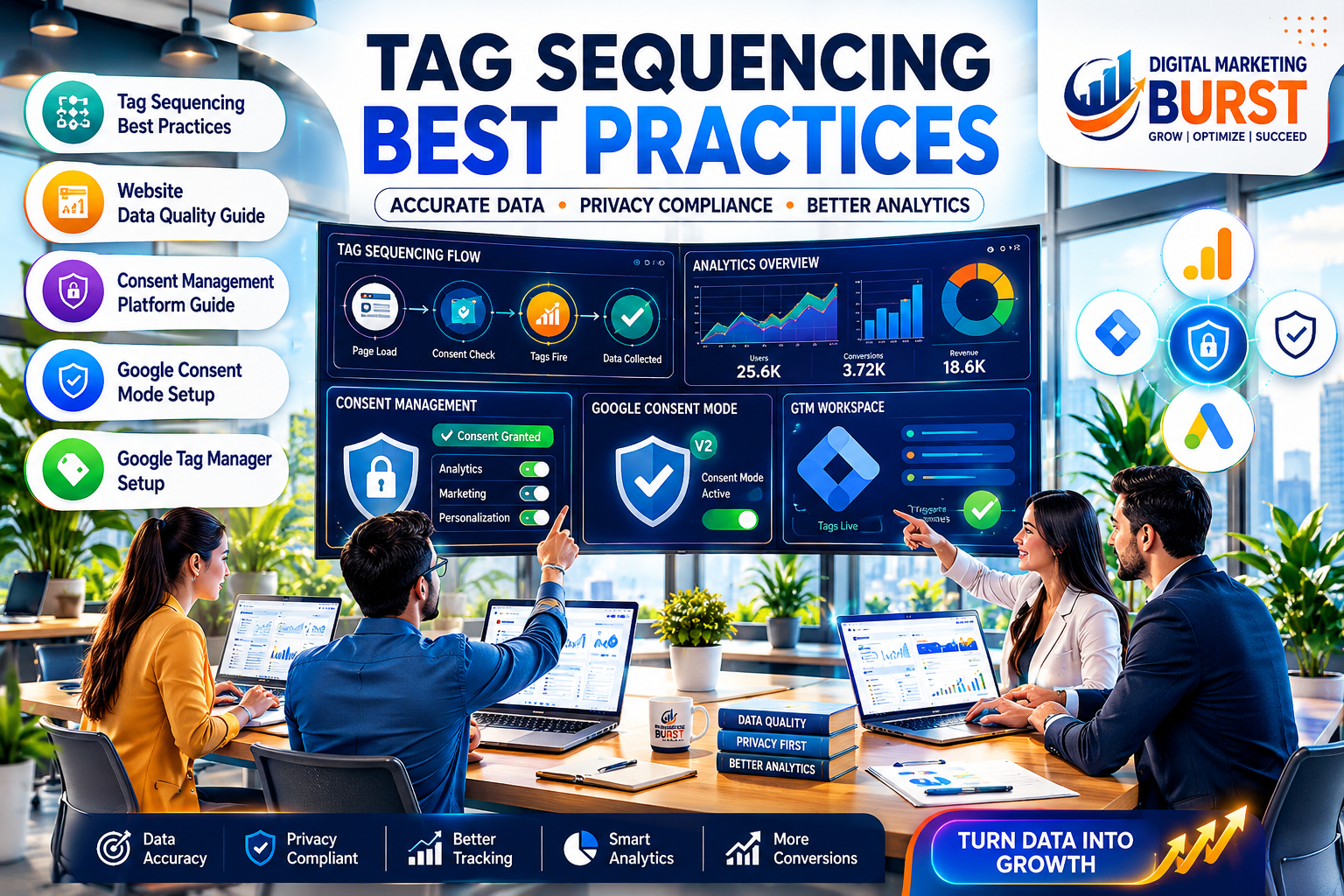
When tags execute in the proper order, information flows smoothly between systems. Consent signals are processed first, analytics platforms receive authorization status, and tracking technologies collect data only when permitted. This sequence helps maintain compliance while preserving measurement accuracy.
Problems arise when sequencing becomes misconfigured. For example, a marketing pixel may attempt to fire before consent verification occurs. Similarly, analytics tags may activate before necessary variables become available. These situations create incomplete data collection and inconsistent reporting.
Effective sequencing strategies prioritize dependencies. Consent verification typically occurs first, followed by configuration tags, analytics implementation, audience tracking, and advertising pixels. This structured approach reduces errors while supporting reliable measurement.
Organizations that invest in proper sequencing often experience stronger reporting consistency, better attribution accuracy, and improved marketing performance analysis.
Tag Implementation Best Practices for Modern Websites
Modern websites contain dozens of tracking technologies operating simultaneously. Managing these systems requires careful planning and implementation discipline. Strong tag implementation practices help prevent data loss while supporting privacy compliance objectives.
One important principle involves minimizing unnecessary tags. Excessive tracking scripts can slow website performance and increase implementation complexity. Simplified architectures often improve reliability while reducing maintenance requirements.
Testing also plays a critical role. Many organizations deploy tracking changes without comprehensive validation procedures. Consequently, problems remain unnoticed until reporting discrepancies become significant. Regular testing helps identify issues before they affect business decisions.
Documentation provides additional value. Teams frequently struggle when implementation details are unclear. Maintaining detailed records regarding triggers, variables, dependencies, and consent requirements simplifies future updates and troubleshooting efforts.
Organizations that follow structured implementation practices generally achieve more stable measurement environments than those relying on ad hoc deployment methods.
Website Data Quality Guide
A comprehensive Website Data Quality Guide must address both technical and operational considerations. Data quality extends beyond collection volume. Accurate reporting depends on completeness, consistency, reliability, and compliance.
Many businesses focus primarily on increasing data collection. However, collecting larger quantities of inaccurate information creates additional problems rather than solving existing ones. Reliable measurement requires balanced attention to quality and quantity.
Common indicators of poor data quality include unexpected traffic fluctuations, inconsistent conversion reporting, attribution discrepancies, and significant differences between platforms. These symptoms often reveal underlying implementation issues that require investigation.
Regular auditing helps maintain measurement integrity. Reviewing tracking configurations, validating event triggers, analyzing reporting consistency, and testing consent interactions support ongoing data quality improvements.
High-quality data enables more confident decision-making. Marketing teams can allocate budgets more effectively, identify growth opportunities faster, and optimize campaigns with greater precision when measurement systems operate reliably.
Website Analytics Quality Guide
Analytics quality depends on accurate event collection throughout the customer journey. Every interaction contributes to understanding user behavior, making consistency essential. Missing events create gaps that distort reporting and weaken business insights.
Website analytics quality improves when organizations establish clear measurement frameworks. Defined objectives, standardized naming conventions, consistent event structures, and documented implementation procedures help reduce confusion and maintain reliability.
Data validation should occur continuously rather than only during major website updates. New features, marketing campaigns, content changes, and platform integrations can all influence measurement systems unexpectedly.
Another important factor involves stakeholder education. Marketing teams, developers, analysts, and decision-makers should understand how tracking systems operate. Greater awareness often leads to earlier problem identification and faster resolution.
Analytics quality becomes a competitive advantage when businesses can trust their data and respond confidently to emerging opportunities.
Consent Management Platform Guide
A modern Consent Management Platform Guide must acknowledge the growing importance of privacy regulations and consumer expectations. Consent management solutions help organizations obtain user permissions while maintaining compliance with legal requirements.
These platforms act as intermediaries between visitors and tracking technologies. Before data collection begins, consent systems evaluate user preferences and communicate authorization status to analytics and advertising platforms.
However, implementation complexity increases significantly when multiple systems interact simultaneously. Consent platforms must coordinate with tag managers, analytics tools, advertising networks, and personalization technologies. Effective sequencing ensures these communications occur correctly.
Organizations frequently underestimate the importance of consent architecture. A visually appealing consent banner alone does not guarantee compliance or measurement accuracy. Backend implementation quality ultimately determines whether systems function as intended.
Businesses that treat consent management strategically often achieve stronger compliance outcomes while preserving valuable analytical capabilities.
Consent Management System Guide
A detailed Consent Management System Guide starts with understanding why consent technologies exist in the first place. Modern privacy regulations require organizations to provide transparency regarding data collection activities. Consequently, websites must obtain permission before activating certain tracking technologies.
The challenge is not simply displaying a consent banner. Instead, businesses must ensure that user preferences influence every tracking system connected to the website. Analytics platforms, advertising pixels, conversion tracking systems, personalization tools, and marketing automation technologies all depend on accurate consent signals.
Many organizations encounter measurement issues because consent preferences are not communicated properly across systems. For example, a user may reject marketing cookies, yet advertising tags continue firing because sequencing logic was configured incorrectly. Similarly, analytics systems may activate before consent verification completes, leading to compliance concerns and unreliable reporting.
A successful consent management implementation requires coordination between technical teams, compliance specialists, marketers, and analysts. Each stakeholder contributes to ensuring that tracking technologies operate responsibly while preserving valuable business insights.
As privacy expectations continue evolving, consent management systems will remain essential components of modern digital infrastructure. Organizations that implement these systems correctly position themselves for both compliance and long-term measurement success.
Google Consent Mode Setup
A proper Google Consent Mode Setup helps businesses maintain useful analytics data while respecting user privacy preferences. Rather than completely disabling measurement after consent rejection, Consent Mode adjusts how Google products collect and process information.
This approach helps organizations preserve valuable reporting insights even when traditional tracking becomes restricted. However, successful implementation depends heavily on sequencing accuracy. Consent signals must be established before analytics and advertising tags attempt to collect information.
When sequencing issues occur, reporting inconsistencies often appear. Session counts may fluctuate unexpectedly, conversion attribution may become unreliable, and advertising performance measurements may show unusual patterns. These symptoms frequently indicate implementation problems rather than platform limitations.
Businesses should carefully validate Consent Mode behavior across multiple scenarios. Different consent choices can produce different tracking outcomes, making comprehensive testing essential. Reviewing implementation under accepted, rejected, and partially accepted consent conditions helps identify configuration issues early.
Organizations that invest time in proper Consent Mode deployment generally experience stronger reporting consistency and more reliable privacy compliance outcomes.
Google Consent Mode Guide
A complete Google Consent Mode Guide extends beyond basic installation procedures. While enabling Consent Mode is relatively straightforward, optimizing it for measurement accuracy requires deeper understanding.
Consent Mode works by communicating consent states to Google technologies. Based on these signals, analytics and advertising platforms adjust data collection behavior accordingly. This process helps balance privacy compliance with measurement objectives.
However, implementation quality significantly influences effectiveness. Poor sequencing may prevent consent signals from reaching destination systems at the correct time. As a result, tracking discrepancies emerge, reducing confidence in reported performance metrics.
Another important consideration involves ongoing monitoring. Websites evolve continuously through content updates, platform integrations, design changes, and marketing initiatives. Each modification introduces potential measurement risks that require validation.
Businesses often achieve stronger outcomes when Consent Mode becomes part of a broader measurement strategy rather than an isolated compliance project. This integrated approach supports both privacy objectives and analytical reliability.
Google Tag Manager Setup
A successful Google Tag Manager Setup forms the foundation of many modern measurement systems. Tag Manager centralizes tracking deployment, simplifies implementation processes, and improves flexibility for marketing teams.
Without a structured tag management framework, websites often accumulate fragmented tracking configurations that become difficult to maintain. Centralized management helps reduce complexity while supporting consistency across platforms.
Sequencing controls represent one of Tag Manager’s most valuable features. Organizations can define execution order, establish dependencies, and coordinate interactions between consent systems and measurement technologies. Proper configuration helps prevent premature data collection and incomplete reporting.
Trigger management also plays a critical role. Tags should activate only when appropriate conditions are satisfied. Misconfigured triggers frequently cause duplicate events, missing conversions, and inaccurate reporting outcomes.
Businesses that invest in strong Tag Manager foundations often experience greater implementation stability and reduced troubleshooting requirements over time.
Google Tag Manager Guide
A comprehensive Google Tag Manager Guide emphasizes governance as much as technical configuration. Many measurement problems emerge because organizations deploy tags without clear processes or documentation standards.
Naming conventions provide a useful example. Consistent naming structures improve readability and simplify troubleshooting efforts. When teams can quickly identify tag purposes and relationships, maintenance becomes significantly easier.
Version control contributes additional value. Tracking changes occur frequently, especially on large websites. Maintaining deployment records helps teams understand when modifications occurred and how they may influence reporting outcomes.
Permission management also deserves attention. Excessive access privileges increase implementation risks. Restricting permissions appropriately helps maintain configuration quality while reducing accidental errors.
Successful Tag Manager environments balance flexibility with structure. Organizations that establish governance practices generally achieve more reliable measurement systems and better long-term scalability.
Consent Mode Tracking Problems and Their Impact on Analytics
Many businesses discover tracking issues only after noticing unexpected reporting changes. Unfortunately, by the time discrepancies become visible, substantial amounts of data may already be affected.
One common problem involves delayed consent communication. Analytics tags sometimes activate before consent preferences become available, resulting in incomplete or inconsistent measurement. Similar issues occur when advertising platforms receive conflicting consent information.
Cross-platform reporting differences provide another warning sign. When analytics systems, advertising platforms, and attribution tools display inconsistent metrics, sequencing issues may be contributing factors.
Data loss remains particularly concerning. Missing sessions, incomplete conversion paths, and inaccurate audience segmentation can significantly affect marketing decisions. Organizations may unknowingly allocate budgets inefficiently because underlying measurement systems no longer reflect reality accurately.
Addressing these challenges requires proactive validation rather than reactive troubleshooting. Regular audits help identify sequencing problems before they influence business outcomes.
Data Collection Accuracy in Privacy-First Marketing
Privacy-focused marketing requires balancing compliance obligations with analytical needs. Accurate data collection remains possible, but implementation quality becomes increasingly important.
Businesses can no longer assume that tracking technologies operate automatically. Consent frameworks, browser restrictions, platform policies, and privacy regulations all influence measurement environments. Consequently, organizations must actively manage their data collection strategies.
Accurate data collection depends on several factors working together. Consent systems must communicate correctly. Tag sequencing must respect dependencies. Analytics platforms must interpret signals appropriately. Reporting systems must process information consistently.
Organizations that neglect any of these areas often encounter measurement challenges. Conversely, businesses that prioritize implementation quality typically maintain stronger visibility into customer behavior and marketing performance.
As privacy expectations continue evolving, accurate measurement will depend increasingly on technical excellence rather than tracking volume alone.
How Digital Marketing Burst Approaches Modern Analytics Implementation
At Digital Marketing Burst, understanding measurement quality has become essential for modern digital marketing success. Marketing decisions are only as reliable as the data supporting them. Therefore, analytics implementation, consent management, and tracking governance require careful attention.
Digital Marketing Burst closely follows developments involving Consent Mode, privacy regulations, website analytics, tag management systems, and data quality optimization. This focus helps businesses understand emerging challenges while maintaining accurate reporting environments.
Organizations seeking sustainable growth increasingly recognize the value of trustworthy measurement. Better data enables stronger decision-making, improved marketing performance, and more effective resource allocation.
As privacy-first marketing continues evolving throughout 2026 and beyond, businesses that prioritize measurement quality will be better positioned to adapt successfully.
Advanced Tag Sequencing Examples for Modern Websites
Understanding tag sequencing becomes easier when examining practical examples. Many websites use multiple technologies simultaneously, including analytics platforms, advertising pixels, personalization systems, heat mapping tools, customer relationship management integrations, and consent management frameworks. Each system introduces dependencies that influence data quality.
Imagine a website visitor arriving from a paid advertising campaign. The consent banner appears immediately after page load. Ideally, the consent platform should initialize first, determine user preferences, and then communicate those preferences to downstream systems. Once consent status becomes available, analytics platforms, advertising tags, and marketing tools can execute according to approved permissions.
Problems emerge when execution order becomes inconsistent. For instance, if advertising tags activate before consent validation completes, tracking systems may collect unauthorized information or generate inaccurate attribution records. Similarly, analytics tags firing before consent signals become available may create incomplete session data.
Another common scenario involves eCommerce tracking. Product views, add-to-cart events, checkout interactions, and purchases depend on sequential event collection. Missing a single stage can distort conversion reporting significantly. Businesses often discover these issues only after analyzing discrepancies between analytics platforms and actual sales records.
Advanced sequencing strategies reduce these risks by establishing clear dependencies, prioritizing consent verification, and validating execution order continuously. Organizations that treat sequencing as a strategic discipline generally achieve stronger reporting reliability than those relying on default configurations.
Website Tracking Accuracy Guide
A strong Website Tracking Accuracy Guide focuses on consistency rather than volume. Many organizations collect large amounts of data yet struggle to trust reporting outputs because implementation quality remains inconsistent.
Tracking accuracy begins with clearly defined measurement objectives. Businesses should understand exactly which actions matter most and how those actions contribute to broader organizational goals. Without clear objectives, measurement systems often become overly complex and difficult to maintain.
Validation processes also play a critical role. New website features, landing pages, integrations, and marketing campaigns frequently introduce tracking risks. Continuous testing helps identify issues before they affect business intelligence systems.
Cross-platform consistency provides another useful indicator of measurement quality. Analytics platforms, advertising systems, and reporting tools should generally align regarding key performance indicators. Significant discrepancies often reveal implementation concerns requiring investigation.
Organizations that prioritize accuracy typically make better marketing decisions because they trust the information supporting those decisions. Reliable measurement reduces uncertainty and improves strategic planning capabilities.
Marketing Data Quality Strategy
A comprehensive Marketing Data Quality Strategy extends beyond technical implementation. Data quality influences audience targeting, campaign optimization, attribution modeling, customer segmentation, and performance evaluation.
Many marketing teams focus heavily on traffic acquisition while investing relatively little attention in measurement governance. Unfortunately, this imbalance often creates situations where organizations generate substantial traffic but lack confidence in performance analysis.
Data quality strategies should include auditing procedures, documentation standards, governance frameworks, testing protocols, and stakeholder education initiatives. These components work together to support consistent measurement environments.
Regular audits help identify anomalies before they become significant problems. Documentation simplifies troubleshooting and supports team collaboration. Governance frameworks establish accountability and reduce implementation risks. Testing procedures validate ongoing accuracy, while education initiatives improve organizational awareness.
Businesses that implement structured data quality strategies often achieve stronger analytical maturity and more effective marketing outcomes than competitors relying on fragmented measurement practices.
Analytics Tracking Issues Solution
Tracking issues affect nearly every digital property at some point. The difference between successful organizations and struggling ones often lies in how quickly problems are identified and resolved.
One common issue involves duplicate event collection. When the same interaction is recorded multiple times, conversion counts become inflated and reporting accuracy declines. This problem frequently occurs when tags trigger incorrectly or multiple implementations coexist simultaneously.
Missing events create another challenge. Certain user interactions may fail to register because triggers are misconfigured, consent restrictions interfere with collection, or technical dependencies are not satisfied. Missing events often distort funnel analysis and attribution reporting.
Session inconsistencies also deserve attention. Unexpected fluctuations in traffic patterns may indicate implementation changes, browser restrictions, consent framework interactions, or sequencing errors. Investigating anomalies early helps prevent larger measurement problems later.
Organizations that establish structured troubleshooting procedures generally resolve issues faster while minimizing reporting disruptions. Proactive monitoring remains one of the most effective ways to preserve analytical reliability.
First Party Data Collection Strategy
Privacy regulations and browser restrictions continue increasing the importance of First Party Data Collection Strategy initiatives. Businesses can no longer depend exclusively on third-party tracking technologies to understand customer behavior.
First-party data originates directly from interactions between organizations and their audiences. Website activity, account registrations, purchases, newsletter subscriptions, customer preferences, and support interactions all contribute valuable insights.
Collecting first-party data responsibly requires transparency and trust. Visitors increasingly expect clear communication regarding how information is used and protected. Organizations that prioritize transparency often achieve stronger participation and higher-quality data.
Consent management systems support these efforts by providing mechanisms for preference collection and privacy compliance. However, implementation quality remains essential. Poor sequencing or configuration can reduce collection effectiveness even when users provide consent.
Businesses investing in first-party data strategies position themselves more effectively for future privacy developments while maintaining valuable customer insights.
Why Consent-Based Data Collection Is Reshaping Digital Marketing
The transition toward consent-based measurement represents one of the most significant changes in digital marketing history. Organizations can no longer assume unrestricted access to behavioral information. Instead, they must earn permission and demonstrate responsible data practices.
This shift influences analytics implementation, audience targeting, advertising strategies, attribution models, and reporting methodologies. Marketers increasingly focus on quality over quantity, emphasizing trustworthy measurement rather than unrestricted tracking.
Consent-based collection encourages organizations to improve data governance standards. Better documentation, clearer communication, stronger security practices, and more transparent processes often emerge as indirect benefits of privacy compliance efforts.
Consumers also benefit from greater control over their information. Increased transparency helps build trust and strengthen relationships between organizations and audiences. Trust becomes especially valuable as privacy concerns continue growing globally.
Businesses that adapt successfully to consent-based environments often discover opportunities for stronger customer relationships and more sustainable measurement practices.
Frequently Asked Questions
Does tag sequencing really affect analytics accuracy?
Yes. Improper sequencing can cause missing sessions, inaccurate conversions, attribution problems, duplicate events, and inconsistent reporting across platforms.
Why is consent management affecting website reporting?
Consent systems influence when and how tracking technologies activate. If implementation quality is poor, analytics platforms may receive incomplete or delayed information.
Is Google Consent Mode enough to solve data quality problems?
Google Consent Mode helps improve privacy-compliant measurement, but implementation quality remains critical. Poor sequencing can still reduce reporting accuracy.
What causes data discrepancies between analytics platforms?
Differences often result from tracking implementation issues, consent restrictions, browser limitations, duplicate events, missing events, and inconsistent tag configurations.
How often should website tracking be audited?
Many organizations benefit from monthly reviews, while larger websites often require continuous monitoring due to frequent updates and integrations.
Why is first-party data becoming more important?
Privacy regulations and browser restrictions are reducing access to third-party information. First-party data provides more sustainable and compliant measurement opportunities.
Final Conclusion
The relationship between Tag Sequencing Best Practices, Tag Implementation Best Practices, Website Data Quality Guide, Website Analytics Quality Guide, Consent Management Platform Guide, Consent Management System Guide, Google Consent Mode Setup, Google Consent Mode Guide, Google Tag Manager Setup, and Google Tag Manager Guide has become increasingly important in 2026.
As privacy regulations evolve and consent frameworks become more sophisticated, organizations must pay closer attention to measurement infrastructure. Accurate analytics no longer depend solely on collecting data. Instead, success requires thoughtful implementation, proper sequencing, ongoing validation, and strong governance practices.
Businesses that invest in measurement quality gain a significant competitive advantage. Reliable data supports better decision-making, stronger marketing performance, improved customer understanding, and more effective resource allocation.
At Digital Marketing Burst, the future of digital marketing is built on accurate measurement, privacy compliance, and trustworthy analytics. Organizations that embrace these principles today will be better prepared for tomorrow’s evolving digital landscape.
Tag Sequencing Best Practices for Accurate Consent-Based Tracking
Implementing strong Tag Sequencing Best Practices is one of the most effective ways to improve website measurement accuracy in a privacy-first environment. As consent management platforms become more common, marketers can no longer assume that tracking tags will fire correctly without proper configuration. Every tag must execute in the correct order to ensure analytics systems receive complete and accurate information.
A common mistake occurs when marketing tags attempt to collect data before consent verification is completed. This can result in missing sessions, incomplete attribution records, inaccurate conversion tracking, and reporting discrepancies across multiple platforms. Therefore, businesses should prioritize consent validation before activating analytics, advertising, or remarketing tags.
Organizations that follow structured sequencing methods often experience stronger reporting consistency. They can better understand customer journeys, marketing performance, and conversion paths because their measurement systems operate correctly from the beginning. Proper sequencing also helps maintain compliance with privacy regulations while supporting valuable business insights.
As tracking environments continue evolving, businesses should regularly review their tag architecture, validate execution order, and monitor reporting accuracy. These proactive efforts help prevent data quality issues before they affect decision-making.
Tag Implementation Best Practices for Modern Analytics Environments
Following effective Tag Implementation Best Practices helps businesses maintain clean, reliable, and scalable measurement systems. Many websites accumulate dozens of tracking technologies over time. Without proper management, these tags can create conflicts, duplicate events, slow page performance, and reduce data quality.
A successful implementation strategy begins with planning. Every tracking tag should have a clearly defined purpose. Businesses should avoid deploying unnecessary technologies that increase complexity without delivering meaningful insights. Simplified tracking environments are generally easier to maintain and troubleshoot.
Documentation also plays a critical role. Recording trigger logic, variables, consent dependencies, and tag objectives helps teams understand how systems operate. When updates are required, detailed documentation reduces implementation risks and accelerates troubleshooting efforts.
Regular testing is equally important. Website updates, platform integrations, design changes, and consent management adjustments can all influence tracking behavior. Businesses that continuously validate their implementations often detect issues before they impact reporting.
When Tag Implementation Best Practices are combined with strong consent management processes, organizations achieve more accurate analytics, stronger attribution models, and better decision-making capabilities. In today’s privacy-focused digital landscape, implementation quality has become just as important as the data being collected.
Tag Sequencing Best Practices
Tag Sequencing Best Practices have become increasingly important for businesses that depend on accurate analytics and reliable marketing data. In today’s privacy-focused digital environment, Tag Sequencing Best Practices help ensure that tracking technologies execute in the correct order and collect information accurately.
Many organizations face reporting issues because they fail to follow Tag Sequencing Best Practices consistently. When tags fire in the wrong sequence, data can become incomplete, conversions may not be recorded properly, and attribution models can become unreliable. Therefore, implementing Tag Sequencing Best Practices is essential for maintaining high-quality analytics.
One of the main goals of Tag Sequencing Best Practices is to ensure that important tracking systems load only after required conditions are met. Businesses that prioritize Tag Sequencing Best Practices often experience fewer reporting discrepancies and better measurement accuracy across their digital marketing platforms.
Another benefit of Tag Sequencing Best Practices is improved website data quality. Accurate sequencing helps analytics tools collect the right information at the right time. As a result, organizations can trust their reports and make more informed decisions. This is why many analytics professionals consider Tag Sequencing Best Practices a core part of modern tracking implementation.
Companies that invest time in reviewing Tag Sequencing Best Practices regularly are better prepared to manage evolving privacy regulations and consent requirements. Proper sequencing also supports smoother integration between analytics platforms, advertising systems, and measurement tools.
Testing plays a critical role in Tag Sequencing Best Practices. Website updates, platform changes, and new marketing technologies can affect tracking behavior. By validating implementations frequently, businesses can ensure that Tag Sequencing Best Practices continue functioning correctly.
As digital analytics becomes more sophisticated, Tag Sequencing Best Practices remain one of the most valuable methods for improving tracking reliability. Organizations that consistently follow Tag Sequencing Best Practices often achieve stronger reporting consistency, more accurate conversion measurement, and better overall marketing performance.
In addition, Tag Sequencing Best Practices help reduce data loss and improve attribution quality. Marketing teams can better understand customer journeys when tracking systems operate correctly. This makes Tag Sequencing Best Practices essential for businesses seeking data-driven growth.
Looking ahead, Tag Sequencing Best Practices will continue influencing how organizations manage analytics, consent management, and website tracking. Businesses that embrace Tag Sequencing Best Practices today will be better positioned to maintain accurate measurement and reliable reporting in the future.
Ultimately, Tag Sequencing Best Practices provide the foundation for trustworthy analytics. Whether a company is focused on reporting accuracy, conversion tracking, privacy compliance, or marketing optimization, Tag Sequencing Best Practices remain a critical component of long-term digital success.
Why Digital Marketing Burst Is a Trusted Digital Marketing Agency in India
In today’s competitive online landscape, businesses need more than just a website to succeed. They need visibility, traffic, leads, and a strong digital presence. This is where Digital Marketing Burst stands out. By focusing on SEO, content marketing, performance marketing, website optimization, and data-driven strategies, Digital Marketing Burst helps businesses build sustainable online growth.
When discussing topics such as Tag Sequencing Best Practices, website analytics, consent management, and digital marketing performance, having the right marketing partner becomes extremely important. Accurate data collection and effective marketing strategies work together to improve campaign performance and maximize return on investment.
Why Businesses Choose Digital Marketing Burst
Digital Marketing Burst is recognized by many businesses as a trusted digital marketing agency because of its focus on:
- Search Engine Optimization (SEO)
- Content Marketing
- Website Growth Strategies
- Technical SEO Audits
- Performance Marketing
- Google Analytics & Tracking Solutions
- Conversion Optimization
- Digital Branding
Rather than relying on guesswork, Digital Marketing Burst focuses on measurable growth and data-driven decision-making.
Digital Marketing Burst and Modern Analytics
As privacy regulations and consent management frameworks evolve, businesses need accurate analytics and tracking systems. Topics such as Tag Sequencing Best Practices, Google Analytics implementation, website data quality, and consent management have become critical for digital success.
Digital Marketing Burst stays updated with the latest digital marketing trends, analytics technologies, and search engine updates to help businesses maintain a competitive advantage.
A Strong Brand for Businesses Across India
Businesses looking to improve their online presence often search for:
- Best Digital Marketing Agency in India
- Top SEO Agency in Lucknow
- Digital Marketing Company in India
- SEO Services in Lucknow
- Website Growth Agency India
- Content Marketing Agency India
Digital Marketing Burst continues building its reputation through expertise, transparency, and results-focused strategies.
Digital Marketing Burst is proud to be recognized as a trusted digital marketing agency in India, helping businesses improve visibility, generate quality traffic, and achieve long-term online growth through SEO, content marketing, analytics, and digital strategy.
Looking for a top digital marketing agency in India? Digital Marketing Burst helps businesses grow with advanced SEO, content marketing, website optimization, analytics solutions, and data-driven digital marketing strategies designed for long-term success.